Rolandt
Shared posts
We Kept Almost Making Money
A blog is not a commitment to frequency or volu...
A blog is not a commitment to frequency or volume says Fiona Voss, it’s a place to have the ability to share whenever that urge may strike you.
“Why make it a blog, and not just a web page? Because if you have one thing you want to share with the world right now, chances are, eventually you’ll have another one, even if it takes a year or two. And next time, if you’ve already gone through the whole process of getting a blog online, it will be that much easier to publish your second post, and you’ll have a nice index of both your posts without any extra work. (Also, if you’re only posting once a year or so, it’s really handy for your readers if you have an RSS feed they can subscribe to.)”
H/T Frank Meeuwsen
Liked A blog is not a commitmentA while ago I came across Emily Nakashima’s blog Honkathon, and there were two things that made an impression on me. The first was her post about sunset testing. The second was her posting frequency. Six posts in six years. I was impressed. I’m not kidding......
Why don’t high schools teach CS: It’s the lack of teachers, but it’s way more than that (Miranda Parker's dissertation)
Back in October, I posted here about Miranda Parker’s defense. Back then, I tried to summarize all of Miranda’s work as a doctoral student in one sentence:
Readers of this blog will know Miranda from her guest blog post on the Google-Gallup polls, her development of SCS1 as a replication of a multi-lingual and validated measure of CS1 knowledge, the study she did of teacher-student differences in using ebooks, and her work exploring the role of spatial reasoning to relate SES and CS performance (work that was part of her dissertation study).
That was a seriously run-on sentence for an impressive body of work.
On Friday, December 13, I had the great honor of placing an academic hood on Dr. Parker*.
I haven’t really talked too much about Miranda’s dissertation findings yet. I really want to, but I also don’t want to steal the thunder from her future publications. So, with her permission, I’m going to just summarize some of my favorite parts.
First, Miranda built several regression models to explain Georgia high schools teaching computer science in 2016. I predicted way back at her proposal that the biggest factor would be wealth — wealthy schools would teach CS and poorer schools wouldn’t. I was wrong. Yes, that’s a statistically significant factor, but it doesn’t explain much.
The biggest factor is…teaching computer science in 2015. Schools that taught CS in 2015 were many times more likely to be teaching in 2016. Schools have to get started! Hadi Partovi made this argument to me once, that getting started in schools was the biggest part of the battle. Miranda’s model supports his argument. There’s much more to the story, but that’s the biggest takeaway for me on the quantitative analysis.
But her model only explains a bit over 50% of the variance. What explains the rest? We figured that there would be many different factors. To make it manageable, Miranda chose just four high schools to study as case studies where she did multiple interviews. All four of the schools were predicted by her best model to teach computer science, but none of the did.
Yes, as you’d expect, access to a teacher is the biggest factor, but it’s not as simple as just deciding to hire a CS teacher or train an existing teacher to teach CS. For example, one principal laid out for Miranda who could teach CS and who would take their class, and how to fill that gap in the schedule, and so on. In the end, he had a choice of offering choir or offering CS. There were students in choir. CS was a gamble. It wasn’t even a hard decision for that principal.
Here is the story that most surprised me. At two of the schools Miranda studied, they teach lots of cyber security classes, but no computer science. As you would expect, there was a good bit of CS content in the cybersecurity classes. They had the teachers. Why not then teach CS, too?
Because both of these schools were near Fort Gordon which has a huge cybersecurity district. Cybersecurity is a community value. It’s a sure thing when it comes to getting a job. What’s “computer science” in comparison?
In my opinion, there is nothing like Miranda’s study in the whole world. There are the terrific Roehampton reports that give us a quantitative picture about CS in all of England. There are great qualitative studies like Stuck in the Shallow End that tell us what’s going on in high schools. Miranda did both and connected them — the large scale quantitative analysis, and then used that to pick four interesting high schools to dig into for qualitative analysis. It’s a story specific to Georgia, and each US state is going to be a different story. But it’s a whole state, the right level of analysis in the US. It’s a fascinating story, and I’m proud that she pulled it off.
Keep an eye out for her publications about this work over the next couple years.
* By the way, Dr. Parker is currently on the academic job market.
Best Christmas Gifts for Cyclists in 2019
 Here are our picks for the 7 best Christmas gifts for cyclists. If someone you love is a cyclist, there is sure to be something they will love on this list! Prices range from $20 to $330.
The post Best Christmas Gifts for Cyclists in 2019 appeared first on Average Joe Cyclist.
Everything I Know About Remote Work

After over 13 years of remote work experience and collaborating with multiple Fortune 500 companies, here’s everything I know about successfully building a remote work culture.
- Yelp for help
- Say what you need as concisely as possible in a bulleted list
- Your whole company should be on Slack
- Mute when not speaking
The End
Thank you to Alyse Topel, for contributing the third chapter of this book.
Fog Machines
The increasing interconnection of the world is being weaponized. Much of our civilian digital infrastructure, from the internet to GPS, was initially developed for the purposes of fighting and winning wars. This makes the history our digital technology inseparable from the development of weaponry.
We are now seeing a new stage in this development, with the militarization and weaponization of communication technology that had for a brief period become ostensibly civilian. Originally, apparently online phenomena like social media may have seemed innocuous enough, but they are now being reintegrated into a global battlespace as part of a growing “cyberwar.”
Perhaps like all things “cyber-,” the term cyberwar may already feel a bit dated, or as though it fails to capture the complex geopolitics at stake. For example, political scientist Thomas Rid, in Cyberwar Will Not Take Place, argues that “cyberwar” is not a useful concept: what the term names as new is better understood as a continuation of older forms of military intervention — such as information warfare, propaganda, and sabotage — or as an extension of politics. But as outmoded as the term may sound now, it is important to have some way of describing the novelty of interconnected and targeted attacks on and through digital communication systems. Moreover, militaries are using this terminology and directly investing in capacity for the type of attacks it denotes. As this Stratfor article explains, the U.S. is rapidly shifting from defensive to offensive “cyber” capabilities, collecting unknown vulnerabilities (commonly known as zero-day vulnerabilities) and using them to carry out attacks.
Cyberwar takes the form of precisely targeted psychological warfare, creating an increasingly paranoid enclosure
Before 2016, discussions around “cyberwar” largely focused on how digital attacks could inflict physical damage to infrastructure: They could, for example, disrupt the electricity power grid and aviation, or interfere with military command and control. When attackers targeted cultural and information systems, they were typically presumed to be focused on taking them offline rather than turning them directly into weapons themselves. Stuxnet, a virus likely built by the U.S. and Israel (as detailed in this article in the New York Times), typified this type of attack: The virus, spread by flash drives, infected the industrial control system that ran Iran’s centrifuges for uranium enrichment. Then, while playing fake data to make everything look okay, the virus spun the centrifuges out of control, permanently damaging a substantial number of them.
This view of cyberwar changed with the 2016 U.S. election. It is evident that Russia, building on its earlier efforts in Estonia, Georgia, and Ukraine, carried out an influence campaign to foment social divisions and aid Donald Trump’s presidential bid. This presents a different conception of cyberwar, using information and communication systems not to attack physical systems but other information systems, such as elections and the media.
But cyberwar cannot be understood as an exclusively technical or even military problem. Digital attacks can also be targeted and delivered more easily by a wider variety of actors, causing more destabilization as they are increasingly used. According to Nick Dyer-Witheford and Svitlana Matviyenko, the authors of the recent Cyberwar and Revolution: Digital Subterfuge in Global Capitalism, “access to the ‘datified subject’ ” — that is to say, individuals or groups understood as a data archives, available for searching and sorting — “both expands the scope of such operations across planet-spanning networks and intensifies the precision with which they can be targeted.” For the authors, cyberwar is an extension of how world markets, in their ceaseless pursuit of value, have seized upon the individual, targeting them in increasingly disorienting ways. The internet, they declare, is not broken, as nostalgic commentators sometimes suggest; rather “the internet is finally what it was always meant to be. Maybe it is perfect, but not for us, the excommunicated user-subjects. For cyberwar.”
At first glance, Dyer-Witheford and Matviyenko may appear an odd pair for theorizing cyberwar. While both write and study media, Dyer-Witheford’s previous work applied Autonomist Marxist theory to explain digital economies, and Matviyenko is known as an expert on theorizing media through the lens of Lacanian psychoanalysis. Most analyses of cyberwar approach the subject from conventional perspectives — international relations, political science, or military theory. But as cyberwar slips outside the bounds of declared war, theoretical approaches far beyond the realm of politics and war become directly relevant as different subjects and markets are militarized and attacked. Cyberwar and Revolution cuts across many domains and conflicts, explicating how war, technology, politics, and even scholarship are implicated in one another. The authors’ central argument is that cyberwar is a symptom of the “capitalist unconscious” and “the profound aggression and destructiveness intrinsic to an order predicated on privatized and increasingly machinic competition” on a global scale.
Its first chapter offers a Marxist analysis of cyberwar, arguing that it must be understood in the larger context of conflicts between the capitalist classes of various nations and ultimately as a form of class warfare, with automation as cyberwar carried out against labor. It builds on Dyer-Witheford’s prior work in such books as Cyber-Marx and Cyber-Proletariat. Those drew on the autonomist Marxist tenet that workers in a capitalist society retain the initiative to reshape society, while capital works ever more strenuously to constrain that capability. Labor can survive without capital, but capital cannot survive without labor. Hence labor is “autonomous” from capital and could theoretically move beyond its structures. The “laws” of competition and the means through which value is produced under capitalism force capitalists to pursue predetermined goals, while workers can resist those laws and generate new collective formations.
Because of how capital has woven digital networks into everyday life, this fog can engulf any aspect of society or the economy
This reframes the nature of capitalist innovation not as a response to human wants but as a response to worker resistance, pursuing it into every cranny of everyday life. As capitalist relations expand to capture more and more of society, they generate what Autonomists call the “social factory,” which not only harnesses unwaged labor to reproduce capitalist society but also allows for new forms of class consciousness to emerge. Focusing on the autonomy of labor leads to new tactics and approaches: actions that stress solidarity among blue- and white-collar workers and waged and unwaged laborers, including students and domestic workers; democratic organization at very local levels as opposed to centering power in political vanguard parties; direct action including strikes, occupations, and riots.
The internet, with its new forms of labor extraction (i.e. the “free labor” of content production) and collectivity, could readily be assimilated to the idea of the social factory. (Digital Labor: The Internet as Playground and Factory includes a number of important essays on this subject.) The same idea of worker autonomy from capital applies equally to digital capital, providing a means to theorize possible resistance to digital capitalism’s power. If digital technologies were being used to make more of life subject to capital, increasing the breadth, depth and variety of capitalist exploitation, Dyer-Witheford and other autonomist theorists pointed out how this also made for new spaces, weapons, and solidarities for resistance. In this critique of the work of autonomist philosopher Antonio Negri, for instance, Dyer-Witheford notes the variability of resistance to capitalism, both temporally (e.g. as technology changes) and spatially (i.e. the possibilities for resistance at Facebook’s offices in Silicon Valley look very different than at Foxconn’s factories in China) and insisted on the necessity of connecting these struggles.
In Cyberwar and Revolution, Dyer-Witheford and Matviyenko extend that position, arguing that when technologically mediated war targets individuals, it can both look like and participate in social struggle. “Cyberwar” can describe not only the constant destruction wrought by technological competition among capitalists, but also the worker’s tactics of resistance and capital’s counter-strategies, including how they can be confused for one another. They trace how the capitalist drive to exploit labor drove the mass adoption of many of the technologies we use today; how the use of these technologies fueled mass movements; and then, drawing in part on Zeynep Tufekci’s Twitter and Tear Gas, how these networked technologies have been reappropriated by authoritarian governments.
In the second chapter, the authors combine Marxist and Lacanian insights to articulate the new “subject” of cyberwarfare — the individual user. This turn away from the procedures of hacking into networks and toward the interior mental processes of individuals demonstrates how cyberwar increasingly takes the form of precisely targeted psychological warfare. The aim is not merely to deliver specific messages to manipulate specific individuals but also to create an increasingly paranoid enclosure in which no one knows what is going on around them. Dyer-Witheford and Matviyenko call this the “veritable fog machine” of digital war. Because of how capital has woven digital networks into everyday life, this fog can engulf any aspect of society or the economy and transform it into a battlefield.
There is no inherently correct stance in these struggles. The left must not assume that a strategy working or failing once will guarantee the same result elsewhere
The nature of these attacks calls for a thorough accounting of how subjects can and do respond. The authors draw from Lacan the idea of the “non-dupes errant”: people who err precisely because they understand a particular situation well. They offer the example of those who believe that understanding code can protect them from becoming a victim of cyberwar. Often those who are most competent and well connected become the richest target for phishing attacks, hacks, and blackmail threats. Another example is those who respond to misinformation in media with attempts to correct the record: This often inadvertently increases the scope of the attack, amplifying the misinformation. In this way, everyone becomes both unwilling combatants and civilian targets in these struggles. The fog of cyberwar assures that the effects of our actions and even our understanding of them become increasingly unclear.
Cyberwar cannot be seen as someone else’s problem, to be addressed at an exclusively technical or even military level. This means that to confront cyberwar requires discourses that go beyond technical or military considerations to take up the larger social, cultural and political contexts in which it occurs. For example, as the authors point out, trolling as a means of influence often serves to amplify sexist, homophobic, and racist discourse, weaponizing and exacerbating the fault lines that already run through a given society. The vulnerabilities that are exploited are not then simply mistakes or bad code but rather the fissures that define the interlocking forces of capitalism (whose laws constantly drive more connection and automation) and racial and gendered violence. For Dyer-Witheford and Matviyenko it is no accident that the rise of cyberwar follows in the wake of the financial meltdown of 2008. Cyberwars arise directly as a result of the contradictions of capitalism, its incessant drive toward overproduction and the exploitation of labor.
The book concludes by arguing that cyberwar must become a site of social struggle, with the aim of demilitarizing our digital systems. But this cannot be conceived as an individualistic project or even one in which the battle lines are ever clearly drawn: “These vectors interact to create a series of zigzagging, diagonal, or swerving alignment patterns whose near-chaotic tendencies are enhanced by the decentralization, opacity, and velocity of networked interaction,” the authors write. We are caught in this system of networked capitalist conflict and, as they argue, “‘hacking back’ can itself be hacked back as a relay and receptor of state or parastate cyberwar.” Not only that but “the idea that those of ‘the left’ are preimmunized against such influence or misrecognition must be abandoned in favor of vigilant and collective autocritique.” In other words, leftists must abandon the idea that the state of class struggle can directly and simply be revealed or that specific forms of organization are efficacious in all cases — for example to simply say that social media is good or bad is to miss the complexities of these swerving alignments and to ignore the opacity of cyberwar’s fog. To proceed, the left must constantly interrogate local and specific conditions and not assume that a strategy working or failing once will guarantee the same result elsewhere.
There is no inherently correct stance in these struggles. The lesson of Cyberwar and Revolution is that collectively, we — the subjects of the global capitalist system and the targets and combatants in cyberwar — are beyond the realm of safety and cannot simply demand security. While demands for security and respite from the state, corporations, cyber-criminals, and non-state actors can in certain situations have political efficacy, they cannot be viewed as ends in themselves, especially if such demands do not touch the structures of neoliberalism, capitalism, imperialism, racism, and so on. As we become both targets and combatants in these conflicts, our social divisions and attitudes become security vulnerabilities that should not be reduced to the level of the state but understood much more expansively as concrete liabilities that threaten each of us individually and differently but also collectively.
Thus if we are to resist the dangers of cyberwar and the social destabilization it portends, it cannot be only at the level of technological, military, or even political thinking but rather must be at the level of society and economics as a whole. In the fog of this war, we cannot afford to assume that we see clearly or that our actions always and everywhere translate into the exact same outcomes. We must rather pay careful attention to the shifting alliances and networks through which our political and everyday actions travel.
Pixel 4 reportedly doesn’t work with some USB-C to USB-A cables

Google’s Pixel 4 has had a turbulent launch, with odd restrictions on the screen’s refresh rate, poor battery life and even some ongoing update issues. However, a recent investigation indicates the Pixel 4 doesn’t play nicely with charging cables either.
Android Authority tested several different cables with the Pixel 4, and while USB-C to USB-C cables seemed to work fine, the latest Google flagship didn’t work with certain USB-A to USB-C cables. At first, Android Authority wasn’t able to get the Pixel 4 to charge with any USB-A Quick Charge ports, standard USB ports on laptops or PCs, or some power banks. The Pixel 3 and 3a did, however, work with those cables.
However, after swapping out the cables, the Pixel 4 did work with those devices. Android Authority tested 18 different cables but was unable to determine why some cables did and didn’t work with the Pixel 4. Specifically, older Huawei 5A cables, which sport a purple identifying colour on the inside, refused to work. Other cables, like high-current offerings from OnePlus and Oppo, did work.
Not only did those cables not work for charging, but they also didn’t work for data transfer either. Android Authority noted that some USB-C to 3.5mm adapters from other manufacturers don’t work with the Pixel 4 — an annoying discovery, since Google no longer includes an adapter in the box — and neither did a USB-C to HDMI dongle, which works with Samsung and Huawei devices.
Ultimately, it seems that Google is more strict with the USB-C port on the Pixel 4 than other android phone manufacturers. For example, the company is reportedly trying to make Android partners use the USB Power Delivery (USB-PD) standard instead of bending or breaking the rules to get higher charging speeds.
It’s not clear if that philosophy is the reason why some cables won’t work with the Pixel 4. Andorid Authority suggests it could also be because some USB-A cables don’t provide the proper signal to indicate they’re legacy devices. Without that signal, the Pixel 4 may refuse to work with cables for safety reasons. Ultimately, if you can use USB-C to USB-C cables, you probably should. If you need a USB-A cable, however, it may be best to get one of Google’s cables to make sure it works with your device.
Source: Android Authority
The post Pixel 4 reportedly doesn’t work with some USB-C to USB-A cables appeared first on MobileSyrup.
The Oil Patch Up Against the Wall
I’m terribly worried about how my children — and humans in general — are going to deal with catastrophic global warming in the likely case that the average global temperature spike is somewhere in the 2°-4°C range. I want to highlight a couple of weekend stories on the biggest news story of the twenty-first century: The tragedy of the deniers, and likely consequences for the perpetrators.
Like most literate people whose livelihood doesn’t depend directly on the fossil-energy industry, I believe the evidence is overwhelming that anthropogenic atmospheric CO2 overload has a strong greenhouse effect whose results are already visible in receding ice and flurries of “hundred-year” natural disasters.
I’m also convinced that we can move the needle further and faster, with less economic dislocation and pain, than many others believe. The energy-economics picture has been changing so fast that unless you’re paying close attention and are open-minded about new energy sources, you might think it’s reasonable to doubt the plausibility of wholesale replacement of fossil-fuel-based power generation by renewables.
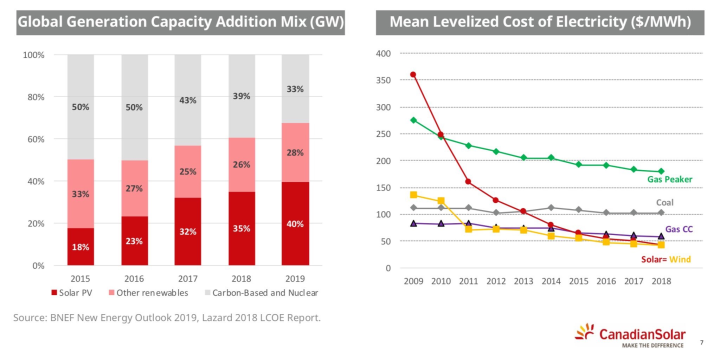
These are unsubsidized prices. Unfortunately, the graph doesn’t include recent trends in energy storage pricing, which are good if not quite this dramatic; see for example Power storage is the missing link in green-energy plans from The Economist.
Yes, it would require massive investment on a wartime-like scale, but Lord knows there’s plenty of surplus capital out there looking for a profitable home; just consider how effortlessly SoftBank has raised tens of billions to squander on lies and fantasies. It’s pretty obvious that “carbon disinvestment” has become a prudent mainstream financial strategy, and that the renewable-generation sector is the single biggest and best investment opportunity of the next few decades, with paybacks to be had like those harvested during the rise of the Internet.
If you’re interested in modern energy economics (and you should be) a good place to start is with Gregor Macdonald, who stays on top of the numbers and is particularly good on what’s happening in China, and with electric vehicles.
Tragic Alberta opera
Consider this CBC story: Alberta wants to flip the script in oilpatch’s favour — it won't be easy.
A few words of background: Alberta, Canada’s second province from the left, has the nation’s highest average income, no sales tax, and generally fabulous social services, all in large part based on its petroleum revenue. Until some point in my forties, I was still getting a few bucks a month in royalties from the natural-gas well on the old family farm. As a result, Upton Sinclair’s famous soundbite applies to Alberta in spades: “It is difficult to get a man to understand something, when his salary depends on his not understanding it.”
Bearing all this in mind, I found the language about Alberta’s “war room”, whose objective is to “shift unfavorable views of the oil and gas sector”, oddly evocative. Here we have a chorus composed of successful members of a rich society’s elite singing a chorus that nobody believes, outside of a small and shrinking fraction of society. They inveigh against outsiders who are impugning their industry: “these same organizations trying to misinform prospective investors about our environmental performance” and “the political agenda emanating from Europe, which is trying to stigmatize development of hydrocarbon energy”.
One feels that there’s material for an opera or formal Noh play in these people fighting what seems to them like the good fight, all they want to do is protect their home-towns’ livelihoods. And they’re not wrong: A whole lot of people all over the world, including me, are indeed stigmatizing the development of hydrocarbon energy. Where by “stigmatize” we mean “slam on the fucking brakes before we wreck the world.”
By the way, the “war room” has terrible Google juice despite its $30M budget, but I managed to turn it up: Welcome to the Canadian Energy Centre, an alternate reality where you fight climate change by pumping high-carbon tar-sands crude.
The experience of the crisis
To most people, it all feels so abstract; Bad things are going to happen, but to other people a long way away, and it’s not obvious what it’ll be like. Here, in Paolo Bacigalupi’s beautiful, terrible story A Full Life (interestingly, published in MIT Technology Review) is what it will feel like for a very ordinary young person in the heart of America. Seriously, if the climate crisis feels a little abstract to you, read this. It’s more important than my words that you’re reading now.
Up against the wall!
Which brings me to this little two-tweet sequence from Greta Thunberg:
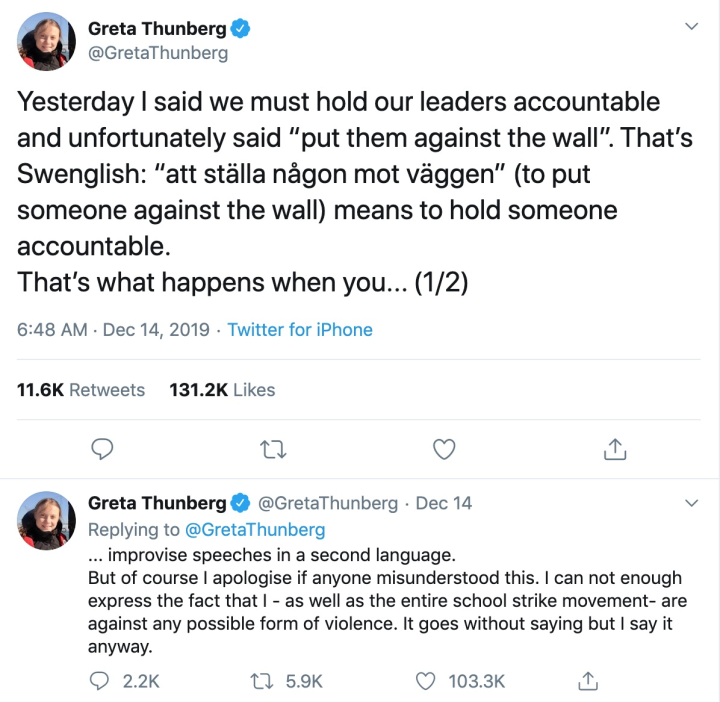
Ms Thunberg says her message is 100% non-violent and I believe her. But when the water levels start rising; when a hundred million people start walking north, empty-handed and hungry, out of the Bengal lowlands; when Mar-a-Lago is smashed and it wasn’t even an official hurricane; when California’s inland crops fail; when the fires burn a third of Sydney; when Arizona real estate goes to zero; and especially, when some climate-change surprise nobody thought of wreaks deadly havoc in a place nobody expected, people are going to be put up against walls and not in Greta’s “Swenglish” sense, no not at all.
Alberta should really stop calling their operation a “war room”.
Democracy grief is real. I think I’ve been ex...
I think I’ve been experiencing it most every day since November 2016.
Classon bike helmet initial impressions
The Classon bike helmet was the result of a kickstarter campaign that launched in June 2016. It promised a high tech helmet that had many features, foremost among which was integrated front and rear video cameras, gesture actuated turn signals, blind spot detection, etc.

The campaign raised $149K from 920 backers. The campaign closed on July 2016, and first delivery of the helmet was scheduled for April 2017. What followed was a long series of delays, and many negative comments on the kickstarter campaign website. Having back many kickstarter campaigns in the past (including this helmet) I was reaching the point where I figured the helmet would never come to pass, when I recently got a series of emails indicating that I would actually get my helmet. It arrived last week, about 2.5 years late.
AFAIK up until this point, the only reviews of this helmet I could find on the web date back in advance of the kickstarter campaign, and so they were really previews that must have been based on the videos of prototypes. This preview by a local writer was the most circumspect of these previews. What follows are my initial impressions of the production helmet.
Obligatory unboxing picture.


The promised weight was 480 grams, but the real weight was 587 grams. This was a disappointment as one of the reasons that I backed the campaign was to have video in a helmet that was not too much heavier than my regular one.

One of the reasons for the weight is that the shell material appears to be about 2mm thick, which is more than most bike helmets.

Those receiving the first wave of shipments were warned that not all the features were live yet. You need an app to interact with the helmet, in addition to the push buttons that you can see under the visor.

This menu indicates what works so far: safety lights, turn signals, and the front video camera. The phone talks to the helmet via bluetooth, but a wifi connection is also needed to upload video from the helmet to the cloud. You can view the videos on the phone app, as well as downloading them onto your phone and eventually to your computer.
This is what the safety lights look like turned on, front and rear. I would say that they are pretty minimal.


The turn signals were a bit less straightforward. The text promised that you could actuate the turn signals by gestures. However a post delivery examination of the video on the campaign website shows that the gesture is not merely a hand signal for the turn, but the rider is bringing his hand up to the helmet before signalling the turn. Sure enough, there are photo cells on the visor, and you need to bring your hand very close to them to actuate the turn signal.
When I did an on the road test of the turn signals, I found that it was best to actually touch the visor in the right spots. Whether or not you think this makes more sense than using a handlebar mounted switch like the lumos helmet is up to you.
Up until this point, this is a helmet with about the same functionality as the Lumos. The acid test is the front and rear video (front only for the moment). Here is the video from a test ride. I will note that I had to convert the video was downloaded to a mac and then converted from .mpg to .mov format so that the aspect ratio was correct upon uploading to youtube. The quality of the uploaded video is very similar to the original.
The quality is not quite what you would want in order to be able to clearly see the license plates on cars passing by. It is certainly not as good as the videos that I’ve seen from gopros, or similar clones. However, once both front and rear cameras are working, this could be a usable record in case the rider were to be involved in a collision.
The business of viewing the videos is also still a bit quirky. After taking a video, it does take some time for it to show up on the phone menu. Sometimes I’ve had to close the app and then open it again for the video to appear. The formatting of the video is also not completely sorted. When I view a video on the iphone XR, the whole frame is not visible. More seriously, there are some strange things that can happen to the aspect ratio when you download the video to your computer from the phone. One tip: don’t use the “add wifi” button more than once; you should toggle the wifi on and off with the switch above it. Otherwise you’ll find yourself constantly having to re entire your wifi network and password.
If you are not one of the original kickstarter backers, is it worth it to put down $149 at this point to get one of these? You should be aware that the company that makes them, brooklyness, now appears to be an e-scooter vendor. However, kudos to them for actually delivering something to their kickstarter backers. One hopes that they do have enough cash to actually fulfill all their pledges, and that they can survive long enough to make the firmware updates to turn on more of the originally promised features. At this point, I’d be happy with both the front and rear cameras working. Note that they say that the helmet can store up to 5 hours of video, but the battery life on the helmet is only about two hours.
Update: note that if you got a helmet in the second batch, it came in a plain box with bubble wrap, and you got a nice helmet cover.


Racing Through The Snow
There’s no actual snow, but December is always a weird mix of running around in a blind panic and odd, dreamy pauses, so here’s a few highlights of what’s been going on:
Baby Yoda
Disney+ won the Internet, period. I’ve been watching some Apple TV+ content courtesy of my recent iPad Mini 5 purchase, but nothing they have comes within a parsec of The Mandalorian.
I have The Expanse queued up for viewing over Xmas break (and have high hopes for it, if only because I miss the exquisite portrayal of Chrisjen Avasarala‘s character), but I’m a sucker for the Star Wars universe, and what I’ve seen is very, very good.
Not the doll. The whole thing, including the amazing concept artwork shown during credits.
Brexit
I’ve kept mostly mum on that particular insanity, but it looks like the English have gone irretrievably bonkers. I expect Scotland and the Isle of Man to join the EU in due time, and England to become even more of an island upon itself.
Like I wrote the other day, the way things are going the US might well acquire a 51st state by the end of 2020, and the “Area 51” moniker might well take on a whole different meaning…
Office
I have been stripping out and setting up my home office again, from furniture to networking, and my back still aches. There’s plenty more to come, but let’s just say I’m trying to pack a lot into a very tight space with hopes I will be spending a lot of time in it.
Best laid plans, right?
Data, Lots of Data
For a number of reasons I won’t go into I’ve been embroiled in the dark side of Azure data services (i.e., the “legacy” SQL stuff, which I am hardly enthusiastic about) and am really, really looking forward to changing scope and going back to my usual mix of Kubernetes and “nicer” things in the AI space.
Dinner Parties
It bears noting that (amidst wholesale chaos and family illnesses) I managed to have dinner with some of the people I worked with at Netcetera, which was remarkably fun (even if constrained by time and interactions). I have been drafting the second instalment of that saga piecemeal, but have no set date to post it.
And, of course, there are more dinners and lunches dotted throughout the calendar…
Making Sense of Who We Are
Have you ever had the experience of learning several things, each of which evolved completely independently, such that when you put them together you get a very satisfying or profound new insight? This recently happened to me.
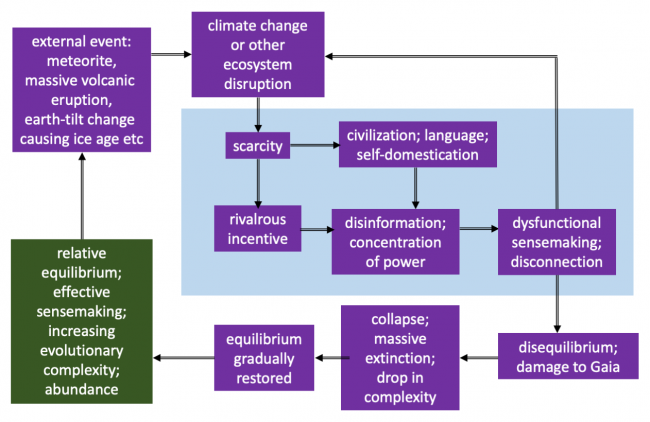
As an admirer of Gaia theory, I was delighted to discover Tim Garrett’s metaphoric thinking about collapse and mass extinction in that context — Earth & Gaia as a single organism, now tragically and seriously diseased through a well-intentioned evolutionary misstep we call civilization, in the late throes of inevitable collapse.
That got me thinking about the ’cause’ of this disease and how/why this evolutionary misstep might have occurred. A clue to that came in the form of a video interview sent to me recently by Tom Atlee and Tree Bressen — an interview with the evolutionary philosopher Daniel Schmactenberger on the subject of sensemaking and disinformation.
One of Daniel’s arguments is that the rise of our complex civilization corresponded to a rise in disinformation, which in turn has produced an incapacity to make sense well, which has then led to disastrously dysfunctional behaviour.
The disinformation arose, he says, because memes are not at all like genes — while genetic modifications ‘succeed’ based on whether they help the organism ‘fit’ well as part of Gaia, memetic modifications ‘succeed’ based on their persuasive power, power that can often be coercive, and which while in the best interest of its propagators is often not at all in the best interest of the whole.
Religions, corporations and states have succeeded, he says, because their champions and leaders are able to use disinformation to arrogate power into vast hierarchies where their intimidated followers are ‘persuaded’ to proxy (delegate) their sensemaking to the leaders, and end up incapable of doing their own sensemaking well. Power is seductive, addictive and corrupting. Three kinds of disinformation are used: Information that is not true, information that is not truthful (where the propagators don’t believe it themselves), and information that is not representative (where the propagators are misleadingly selective in what they do and don’t disclose). When we’re surrounded by more and more dubious information, we are forced to proxy ever more of our sensemaking to those we trust, and to align ourselves (for safety) with others who proxy their sensemaking to the same authorities. Even worse, as this information becomes increasingly suspect, we lose the ability to trust others altogether, and our society fragments and has to be held together through heightened disinformation and fear.
Civilizations arise, many believe, as an attempted adaptation to circumstances of great scarcity and commensurate stress — we struggle together and cede personal sovereignty because we sense we can’t survive otherwise. This is what John Livingston calls our propensity for self-domestication. In times of abundance, there is time and freedom to exercise authentic, sovereign, unbiased sensemaking, and trust, truth, truthfulness and representativeness of information are encouraged and empowering. In times of scarcity, however, most people are too busy to even learn the skill of sensemaking, so they must delegate/proxy it to ‘representatives’, leaders. The result is that inequality, disinformation, hierarchy, and sociopathy of leaders are all enabled and encouraged and truth is sacrificed. Daniel’s conclusion: “Rivalrous incentive (motivation to compete in zero-sum games in times of scarcity) has been the generator function of almost all the things humans have ever done that have sucked”.
What most of us end up then doing is mere “meme propagation”, which is non-thinking; it is purely reactive and has no sovereignty. Most people, Daniel argues, now have a “memetic immune system” that blocks any idea or belief not consistent with their worldview, and protector memes that have been instilled in them by leaders/proxies that prevent critical thinking. And in such a world it’s not safe not to have an in-group that shares one’s worldview, so there’s enormous pressure to conform/adapt to some ‘in’ group and identify fiercely and uncritically with it and its ideas.
If this is what has happened, how can we best deal with it? Daniel says he would like to see people practicing doing the following (because sensemaking well takes practice):
- Challenge your own beliefs and be curious about those that don’t fit with your worldview.
- Seek to understand, not to be understood.
- Understand why people believe what they do.
- Reconcile conflicting ideas to reach a higher level of understanding and perspective; this often requires, and produces, novel insight.
- Debate doesn’t help “make sense”; it’s a “narrative warfare” process that emphasizes rhetoric and winning over understanding. By contrast, dialectic is the process of trying to make sense together, a higher order of thinking.
- We can learn to at least love each other’s evolutionary trajectory; this requires a tolerance for nuance, emotional vulnerability (to create a sense of trust and safety), and humility. Most people have few relationships with those qualities.
- Set aside your impulse to be right and your identification with specific beliefs and ideas. Look at your own biases; learn how to learn better; and build healthier (and better sense-making) relationships.
- How might we remove the incentive for disinformation (zero-sum game politics and competitiveness), he asks, by aligning the definition of well-being of various agencies (individuals and organizations at all scales) and reducing rivalrous environments?
I confess to having some doubts about our capacity to do much of this, and I sense that Daniel might as well. But it was his final thought in the video that got me linking his ideas to Tim’s: He uses the metaphor of the body, and notes that the cells and organs that comprise us are able to balance their own self-interest with that of the whole body; they make sense together holistically, and share information in such a way that better decisions are made than any ‘component’ could possibly make independently. Then he notes that in cancer-ridden bodies self-interest of the afflicted cells trumps collective interest, and the result is that the cancer and the body it infects often both die.
—————
So here’s the synthesis of these ideas I’m thinking about:
You may be familiar with the idea of Bohmian dialogue — an exchange of thoughts, information and ideas among a group of 20 or more people with some shared passion, that is without intention and which leads to understanding and ‘collective intelligence’ but not decisions. It is in many ways similar to what some indigenous cultures have apparently always done when they get together, how they collectively make sense of the world. And it is analogous to what the cells and organs of the body do to exchange information to make sense of the whole body’s situation. There are no ‘decisions’ in the sense of consensus, voting, delegation or analysis; what is done after the sharing of information is acknowledged as the only thing that could have emerged from the collective understanding.
I would argue that in fact this is what humans naturally do, that it is what every creature does, and it is what Gaia does — sensemaking. Not just our purpose, not what we’re meant to do. What we do. Sensemaking defines us. We — genes, cells, organs, creatures, Gaia — are sensemakers.
I would further argue that language didn’t evolve, as my cynical self has long believed, as a means to convey instruction down and information up in large hierarchies. Rather, it evolved to enable a better dialectic (collective investigation of what is true), and better epistemology (collective understanding of what is true) through (Bohmian-style) dialogue. Better collective sensemaking than what any individual could possibly discern or understand. It evolved because it was, at least at first, good for the whole. But in times of scarcity, language seems to be quickly appropriated as a vehicle to obtain and secure power through disinformation.
By this reasoning, it could be said that (1) scarcity led to “rivalrous incentive” which, coupled with language, enabled and encouraged the use of disinformation to achieve concentration of (addictive, corrupting) power, and also led to widespread dysfunctional sensemaking; and (2) this loss of capacity for healthy sensemaking (our very essence) created the disconnection (from Gaia, and from the truth) of civilized humanity, which has enabled massive damage to the planet and brought about the sixth great extinction.
What is happening to civilization now seems more a dissolving (ie a weakness and crumbling of foundations) than a collapse of its component parts — states, corporations, communities, hierarchies of all kinds, and even many one-on-one relationships are largely unsustainable and starting to fall apart from the bottom up, and this dissolution is accelerating. None of these can survive in the absence of the capacity for trust and good sensemaking. And nothing can survive ‘separately’.
It is highly likely that Gaia will survive, though probably in a radically-changed form. It has survived mass extinction events often enough before. Whether humans will still be a part of it, post-collapse, is anyone’s guess, but as Tim has argued, that’s entirely out of our hands.
Which brings me back to the question that prompted this article: What if there’s nothing we can do? We may engage in insightful dialogue with informed people with whom we have open trusted relationships, and we might even overcome some of our personal biases by understanding why people believe things we find preposterous. But where does that get us? We might become better sensemakers and have a greater appreciation for and sense of belonging to Gaia, and become more appreciative, understanding and non-judgemental about our current predicament, and better witnesses as it comes apart, but when the SHTF that will be cold consolation for the long dark hard years of collapse.
The answer, I think, for now, to the question What if there’s nothing we can do? is simply that we are sensemakers — we cannot help trying to make sense of things, even if and when our sensemaking is dysfunctional. Even the lamest meme-propagators are doing what they do out of a desperate drive to make sense of things — even if their memes don’t make any sense at all. As with our approach to death, we may approach that realization of our rather humbling true nature with equanimity and compassion or with rage, but neither will affect the outcome.
—————
I can’t resist taking this thesis one step further (this may be too abstract or too far out there for some): Sensations are metaphors for reality. ‘We’ sensemakers — genes, cells, organs, creatures, Gaia — cannot know what is real, but we can sense, we can ‘make sense’. What we think of as reality is metaphor. Metaphors are our truths. Reality is not our business.
From that perspective I am quite comfortable with the idea that the sense of having a separate self is illusory. It is illusory because it, too, is a metaphor, an idea concocted in the brain, just as our sensations, and, scientists are now starting to say, just as time and space are. The metaphor of the self is a compelling metaphor because, like all good metaphors, it helps the brain make sense of things. The metaphors of time and space make sense because they give the brain a place and means to organize, sort, store and retrieve its sensations, the messages it receives from the ‘rest’ of the body and the ‘rest’ of Gaia. It doesn’t matter whether they are inventions, and not real, as long as they make sense. The metaphor of the ‘separate self’ makes sense because it provides a position, a context, for the making of sense of everything ‘else’. That there really is no ‘self’ and nothing ‘else’ is of no importance. Metaphor is the brain’s ‘stand-in’ for a reality it can never know. Metaphor is its truth. Reality is not its business.
The very idea of this is astonishing. But, of course, it makes no sense.
Book Review – The Dream Machine
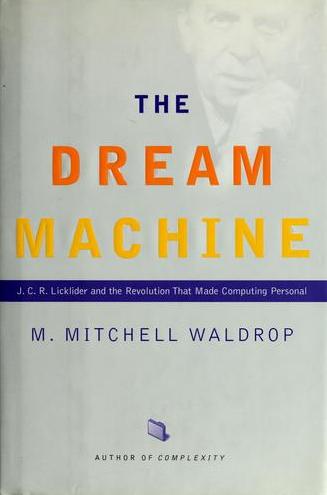 It’s been six months since my last book review on computing history and there are a number of reasons for it. Back in June I started reading ‘The Dream Machine’ by M. Mitchell Waldrop, a computing history book focusing on the life of J. C. R. Licklider. The 50th anniversary of the Apollo 11 moon landing kept me from making quick progress as I literally spent 6 weeks on that in summer. And then, this book, published in 2001 and almost 10 years in the making, is a monumental piece of work that takes quite some time to read and enjoy all by itself.
A voluminous book with over 500 pages in rather small print is not something for a weekend. The content isn’t either. Despite the book’s title suggesting it is a biography of ‘Lick’, as his friends and co-workers called him, it goes much further and tells the history of electronic computing from the early beginnings in the 1950s starting with Norbert Wiener, John von Neumann, Claude Shannon, etc. etc., from batch processing to timesharing, Project MAC, Multics, Unix, Ken Thompson and Dennis Richie at Bell Labs, PARC and the Alto, the ARPANET, the birth of personal computing, up to the end of the 1990s and the Internet boom. More often than not there are dozens of pages in which Lick is not even mentioned once, so I was even a little surprised when the author came back to him and continued his personal story before wandering off into what his thinking and actions triggered around him.
On almost every page I was tempted to stop reading and explore the story in more detail by doing additional background research. This is the second reason why it took me so long to make my way through this monumental piece of history telling. What I also liked about the book was that it doesn’t only talk about success but also of the struggles and failures of Lick, other individuals, companies and the US government during those 50 years. You can’t have it your way all the time but eventually, persistence pays off and help or a solution comes via a different path. If you want to have a look yourself, you can borrow the PDF version of the book online at the OpenLibrary project.
Top Canadian mobile stories from the past week

Every week we bring you the latest in Canadian mobile news. Listed below is a quick overview of the top stories from the past seven days.
- Here’s what’s coming to Netflix Canada in January 2020
- Apple’s new Mac Pro is available now and maxes out at $73,396 in Canada
- North halting smart glasses production to prepare for Focals 2.0
- Canadian 5G rollout will bring 250K new jobs, reach $40 billion annual GDP by 2026
- RCMP unveil project with Amazon that uses bait packages to catch thieves
- Over half of Canadians don’t think Huawei should rollout 5G: Angus Reid
- Rogers opens doors to its first 5G-ready interactive flagship store
- Canada’s privacy watchdog states ‘urgent need’ to modernize privacy laws
- New type of scam keeps fraudsters on the line even when victims hang up
- 2K opens first Canadian studio in Montreal, working on new BioShock game
- CRTC to implement STIR/SHAKEN technology to reduce VoIP spam calls
- Quebec Infiniti dealership sells city mayor a Tesla
The post Top Canadian mobile stories from the past week appeared first on MobileSyrup.
Twitter Favorites: [ReneeStephen] Salt Spring is getting a Fields! We have officially made it to "small town."

Salt Spring is getting a Fields! We have officially made it to "small town."
Who used to draw pictures for hours with a Spirograph back in the late 1960s or early 1970s? pic.twitter.com/o4G5LqsrW2
mkalus
shared this story
from  moodvintage on Twitter. moodvintage on Twitter.
|
Who used to draw pictures for hours with a Spirograph back in the late 1960s or early 1970s? pic.twitter.com/o4G5LqsrW2


160 likes, 18 retweets
All credit to Johnson and Cummings They gamed the media and the voters as if they were idiots And they succeeded
mkalus
shared this story
from  davidallengreen on Twitter. davidallengreen on Twitter.
|
All credit to Johnson and Cummings
They gamed the media and the voters as if they were idiots
And they succeeded

3238 likes, 828 retweets
"It’s easy to imagine the end of the world, but we cannot imagine the end of capitalism."
"The return of automation discourse is a symptom of our era, as it was in times past: it arises when..."
"Our present reality is better described by near-future science-fiction dystopias than by standard..."
visual representation matters
Recently I read an article on CBC about a project by Nicole Hill from Six Nations of the Grand River to create modern stock photos of Indigenous people because they couldn’t find representations of people like them to promote development projects.
There’s been a bunch of awesome photo projects where people have created their own visual representations of their communities.
Women of Color in Tech (CC-BY licensed)

“Our ask? That you use these photos to show a different representation of all women in tech. That you use these images in pieces about entrepreneurs, software engineers, infosec professionals, IT analysts, marketers, and other people who make up the tech ecosystem. Just as white women have been the default “woman” in technology and American society as a whole, we believe the underlying belief of what it means to be — and who can be — a tech worker in the 21st century can benefit from this form of “disruption”. link
Disabled and Here (CC-BY)

“Disabled And Here is a reclaiming of our depiction, featuring disabled BIPOC with different diagnoses (or lack thereof), body sizes/types, sexual orientations, and gender identities who reside in the Pacific Northwest. This is disability representation from our own community.”
I love that these also have alt text descriptions too.
Allgo’s plus size stock photo collection

“These photos are available for all uses and feature plus-size people at home. From looking at their phones in bed to having a glass of wine with friends, this collection is powerful because the emphasis is on what the models are doing, not how big they are while they’re doing it.”
The Gender Spectrum Collection

“The Gender Spectrum Collection is a stock photo library featuring images of trans and non-binary models that go beyond the clichés. This collection aims to help media better represent members of these communities as people not necessarily defined by their gender identities—people with careers, relationships, talents, passions, and home lives.”
The post visual representation matters appeared first on tara robertson.
From my inbox

Oh, eine Überraschung von meiner Wunschliste! Danke, Federico. Und es wird auch nicht Weihnachten, bevor nicht der Baumkuchen von AVM und die Überraschung von sirius-net ankommt:

Außerdem freue ich ich mich über die jährlichen Grüße von equinux, radigewski informatik und Dr. Ribbert Saalmann Dehmel.
Zoot - Alexander Deliyannis
Now to dive into the software.
STATUS REPORT
In June I finished up the last major coding effort required to bring Zoot to the level of fit and finish I have strived for these many years. The focus of this last effort was to make sure Zoot would run on modern PC hardware (4k monitors, touchscreens, etc). Having completed this effort I was able to work exclusively on documentation and in September the long awaited help file shipped out. If you missed the excitement just run Zoot and press F1 to experience the joy and wonder!
UP NEXT
I will continue to put out bug fixes and enhancements as needed, and I have some new features I'd like to work on, but in the short term, I want to give Zoot a chance to thrive. To do that I need to attract new users and that means driving potential users to the website and convincing them to give Zoot a try. I think the best way to bring in new users is to build out the website with YouTube demos that provide a quick look at what Zoot can do, along with a series of demos that dive deeper into Zoot features. Demos can be linked to on social media, which makes them a good promotional tool, and I think they’ll help everyone get more out of Zoot.
PLEDGE DRIVE
It's been 10 years since the last time I charged an upgrade fee and the truth is I really need to generate some revenue to keep things going. I thought I’d try something different this time and go with a pledge drive. I feel like this approach will help me gauge current interest in Zoot and guide future plans. I really want Zoot to thrive and I’m hoping you do too!
DONATE
https://secure.squarespace.com/checkout/donate?donatePageId=5dcb17366d685b2e57e2672e&ss_cid=fd78fd31-f81d-42e7-b541-2c20bef44add
Zoot - tightbeam
Just a Gwai Lo Supports Dark Mode
I have to say, I was skeptical about dark mode in our current operating systems, but since wiring it up to switch to it automatically after sunset, I’m a believer. I know some people always operate their in dark mode, and that's not for me. I prefer the light on my screen to match the light of the day. It's especially nice to have my iPhone in dark mode at concerts, so I can avoid being "that guy" who blinds the person behind me,
Websites now respect the system setting of dark mode, and ever since Jeff Geerling updated his site's theme to support dark mode, I had on my list to do the same.
It turns out that the Responsive Blog Drupal theme, a very nice theme that does what it says on the tin, has a switch for turning on the dark mode version of it. I'm glad I realized that most of the work had been done for me, and I've submitted a patch to the project for review.
The last frontier of dark mode based on system setting is third-party JavaScript widgets. None of the 3 widgets on my blog, to my knowledge, have the ability to switch automatically.
Rate of Force Development. Do you understand it and how do you train for improvement?
mkalus
shared this story
from  Jacques Blog - Sirens & TItans Fitness. Jacques Blog - Sirens & TItans Fitness.
|
Simply Rate of Force Development (RFD) is a measurement of how long it takes to get to peak force in a movement. The faster you can do this the greater speed of the movement. The term beating someone to the punch kind of exemplifies what we are talking about. Much of this is based on RFD. Different movements have different speeds to get to peak force. Some RFDs are heavily influenced by the biomechanics of the movement. Shorter movements have higher RFDs. Sprinting would be a shorter biomechanical movement when compared to a counter movement jump. The jump has a longer range of movement and will be considered a slower RFD. A sprinter is trying to optimize ground contact for faster velocity of movement. The RFD for sprinting is much faster than a countermovement jump. RFD also influences dead stop movements. The faster the muscle contracts (RFD) the quicker the sprinter is out of the blocks.
When I evaluate my athletes training needs I first identify the RFD needs of their particular sport. A weightlifter would have a slower RFD than a sprinter. However, this slower RFD can be improved by working on the faster end of the velocity curve to improve their ability to produce faster RFD. Overall force production as well as velocity influence RFD. I try to find the tipping points where time spent can improve the RFD needed for the sport. This is not random or a system. It is based on a number of athlete factors. Maturity of the athlete, genetics, biomechanical advantages or disadvantages etc.
So to keep it simple, I look at where the athlete is lacking and try to weight the type of training to most quickly improve the RFD for their sport.
I look at three areas of training. Very high speed velocity with little force. Some velocity with moderate force. Maximum power output with lower velocity. And much slower velocities with maximum force. Each of these areas need to be looked at and once you establish your weakest links and you can adjust your training to reflect the need. You must also look at the entire kinetic chain to see if RFD is being scrubbed off because of an ancillary weakness.
I train a lot of cyclists. Most cyclists are slower twitch athletes. I will look at where on the force velocity curve I need to spend the most time to improve their absolute power as well as power efficiency.
You need to have some way of measuring the output to measure. I believe a good coach can eyeball velocity and tell what RFD zone an athlete is training in. However, it is not hard to tell really fast movements with little force, moderately fast movements with some force, and slower movements with higher force outputs. You can create your own poor coach power meter with time and distance as the measuring tool.
Train in all three areas and then mix and match until you see a direct improvement in the movement speeds of the sport. It will not take that much time to figure out what is working and what is not. The athlete typically sees the improvement in a short amount of time.
Truth in Fitness,
Jacques DeVore, CSCS
Meet the team: Holly Lawrence
After 14 years as a police officer in Sunnyvale, California, Holly brought her experience, skills, and passion to Yahoo in 2016 to help keep Flickr and other properties free of illegal and inappropriate content. Shortly after SmugMug acquired Flickr, we were positively thrilled when she agreed to join the SmugMug team to help us double-down on those efforts — and she has had a tremendous impact thus far!
“I’m committed to combating child sexual abuse, and the skills I developed while in law enforcement helped me to make the jump into the private sector to really focus on fighting it online,” said Holly. “When SmugMug first acquired Flickr, I wasn’t sure what to expect — but the team reached out to me and immediately demonstrated their commitment to making Trust & Safety on Flickr and SmugMug a high priority. I quickly jumped at the opportunity to join SmugMug and build out the team. It can be heart wrenching work at times but I truly get to help make the internet a safer place for everyone, including the most vulnerable, and that makes it all worthwhile.”
Read more about her story and the work she and the amazing Trust & Safety team are doing in this Forbes profile of Holly Lawrence, Flickr and SmugMug’s Head of Trust & Safety.

Weeknote 50/2019
Let’s deal first of all with the huge, blonde-haired elephant in the room. While I expected a Conservative majority in this week’s General Election, I predicted +50 before going to bed on Thursday night, rather than the +66 that resulted.
That the British people are bored of Brexit is manifestly obvious, and has been for a while. Doing anything other than, as the Tories said, “getting Brexit done” would lead to not only dragging out the saga, but deeper divisions between an already-divided nation.
That being said, I voted Labour to prevent the Conservatives getting in where we live. I usually vote for the Greens, but it ended up being quite a close-run thing. For example, the constituency next to us, Blyth Valley, was part of the ‘red wall’ that crumbled this time around.
The reason Blyth Valley is interesting is that it’s a historically-Labour area, a place of mass unemployment, poverty and food banks. It’s incredible the way that the impacts of Tory-imposed austerity have been packaged up and sold as being related to our membership of the European Union. This is the same EU that has invested in infrastructure up here in the North East, including broadband and roads,
I could go on, especially about the way that the left have reacted to the identity politics of the right. But I won’t. Instead I’ll stare into my cup of tea, consider my family’s options, and try not to get into any conversations about politics with my neighbours this Christmas.
On Friday, in the immediate aftermath of the election, I was in Newcastle with representatives of the co-ops that form the CoTech network at the Winter Gathering. I was expecting despondency, but after acknowleding the result, we moved swiftly on to more pressing things such as building the co-operative economy and improving the ways we work together.
As ever, I did a bit of light facilitation, and got stuck into questions around potential membership fees for the network, skill-sharing, and decision-making procedures. CoTech contains a great bunch of people, including an increasing number in the North East, so I look forward to our co-op working more closely with some of them in 2020.
Other than the above, I spent three days working on MoodleNet this week. That included:
- Presenting as part of the ALT Online Winter Conference, with a recording of the session posted on the blog.
- Attending a Moodle dev training workshop on accessibility.
- Catching up with a number of team members either 1:1 or in small groups.
- Meeting with Martin Dougiamas and doing a deep dive into the future of MoodleNet. There was also a management meeting this week.
- Working on a 3-year plan and roadmap for 2020.
Next week, I’m working on MoodleNet-related activities between Monday and Wednesday, and then heading off to Iceland with my family on Thursday. I’m really looking forward to the holiday, but also just to relaxing for a couple of weeks.
After all, who knows what will be in store for Team Belshaw in 2020?
Boris Johnson Is Britain’s Trump, and He Now Has Full Control gen.medium.com/boris-johnson-…
mkalus
shared this story
from  iandunt on Twitter. iandunt on Twitter.
|
Boris Johnson Is Britain’s Trump, and He Now Has Full Control gen.medium.com/boris-johnson-…

402 likes, 149 retweets