Shared posts

15 Dec 06:22

Fragment: Code Complexity in Notebooks — I’m Obvously Not Wily Enough

by Tony Hirst

Following on from Thinking About Things That Might Be Autogradeable or Useful for Automated Marking Support, via Chris Holdgraf I get something else that might be worth considering both for profiling notebooks as well as assessing code.

The response came following an idle tweet I’d posted wondering “If folk can read 600wpm (so 10wps), what’s a reasonable estimate for reading/understanding code blocks eg in jupyter notebook?”; if you’re trying to make sense of a code chunk in a notebook, I’m minded to assume that the number of lines may have an effect, as well as the line length.

Context for this: I’ve started mulling over a simple tool to profile / audit our course notebooks to try to get a baseline for how long it might reasonably take for a student to work through them. We could instrument the notebooks (eg using the nbgoogleanalytics or jupyter-analytics extensions to inject Google Analytics tracking codes into notebooks) and collect data on how long it actually takes, but we don’t. And whilst our course compute environment is on my watch, we won’t (at least, not using a commercial analytics company, even if their service is “free”, even though it would be really interesting…). If we were to explore logging, it might be interesting to add something an open source analytics engine like Matomo (Piwik, as was) to the VM and let students log their own activity… Or maybe explore jupyter/telemetry collection with a local log analyser that students could look at…

So, Chris’ suggestion pointed me towards wily, “an application for tracking, reporting on timing and complexity in Python code”. Out of the can wily can be used to analyse and report on the code complexity of a git repo over a period of time. It also looks like it can cope with notebooks: Wily will detect and scan all Python code in .ipynb files automatically”. It also seems like there’s the ability to “disable reporting on individual cells*, so maybe I can get reports on a per notebook or per cell basis?

My requirement is much simpler than the evolution of the code complexity over time, however: I just want to run the code complexity tools over a single set of files, at one point in time, and generate reports on that. (Thinks: letting students plot the complexity of their code over time might be interesting, eg in a mini-project setting?) However, from the briefest of skims of the wily docs, I can’t fathom out how to do that (there is support for analysing across the current filesystem rather rather than a git repo, but that doesn’t seem to do anything for me… Is it looking to build a cache and search for diffs? I DON’T WANT A DIFF! ;-)

There is an associated blog post that builds up the rationale for wily here — Refactoring Python Applications for Simplicity — so maybe by reading through that and perhaps poking through the wily repo I will be able to find an easy way of using wily, somehow, to profile my notebooks…

But the coffee break break I gave myself to look at this and give it a spin has run out, so it’s consigned back to the back of the queue I’ve started for this side-project…

PS From a skim of the associated blog post, wily‘s not the tool I need: radon is, “a Python tool which computes various code metrics, including raw metrics (SLOC (single lines of code), comment lines, blank lines, etc.), Cyclomatic Complexity (i.e. McCabe’s Complexity), Halstead metrics (all of them), the Maintainability Index (a Visual Studio metric)”. So I’ll be bumping that to the head of the queue…

15 Dec 06:22

The best hip-hop songs of all time, visualized

Hi, this is Simon, I am a software engineer at Datawrapper. For this edition of the weekly chart, I visualized the greatest hip-hop songs of all time, a list originally assembled by BBC Music.

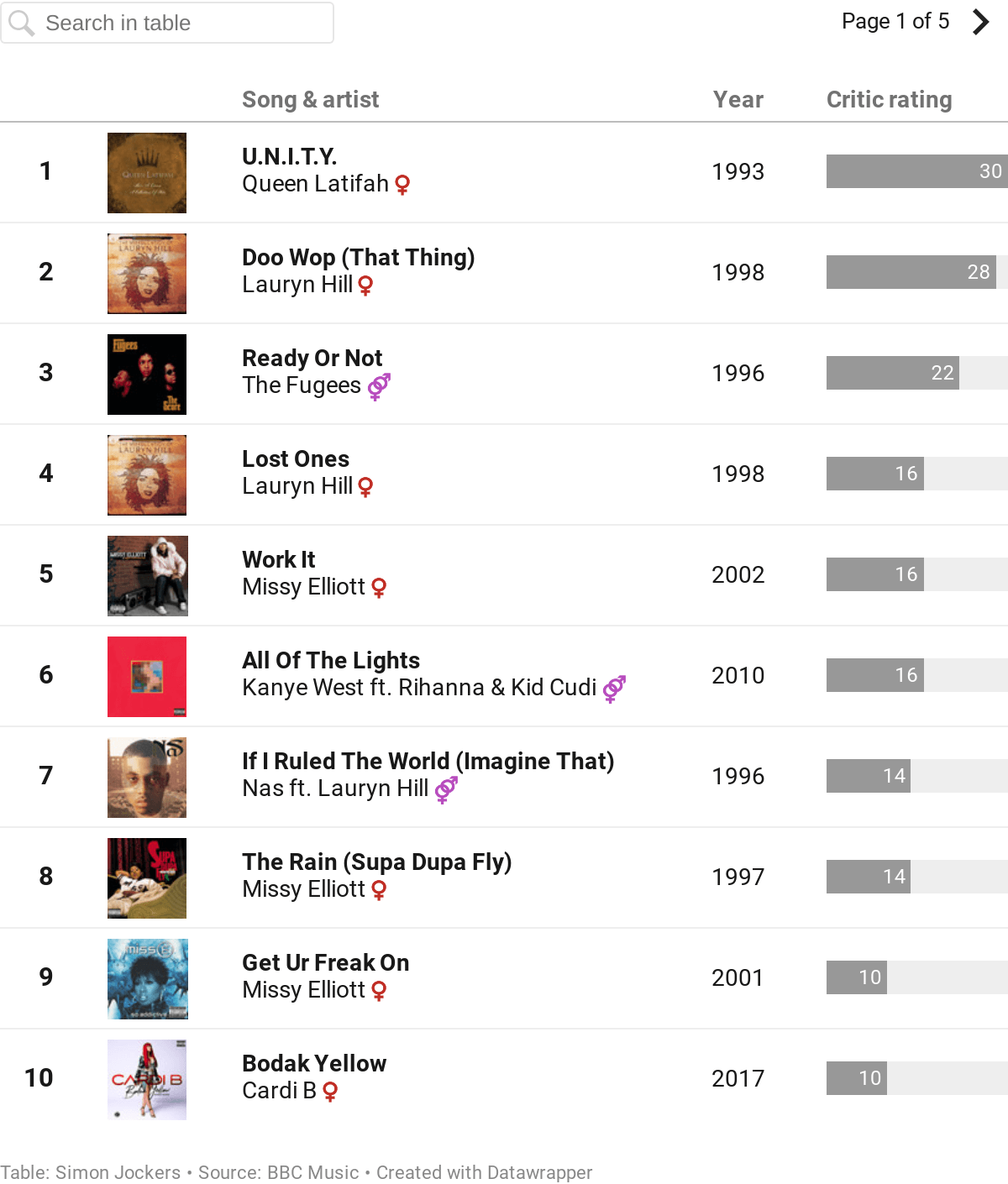
Earlier this year, BBC Music asked more than 100 critics, artists, and other music industry folks from 15 countries for their five favorite hip-hop tracks. Then they broke down the results of the poll into one definitive list. But BBC Music didn’t just publish a best-of list, they also published the complete poll results and a description of the simple algorithm they ranked the songs with. Using that data and algorithm, I recreated a searchable data table of more than 300 hip-hop songs.

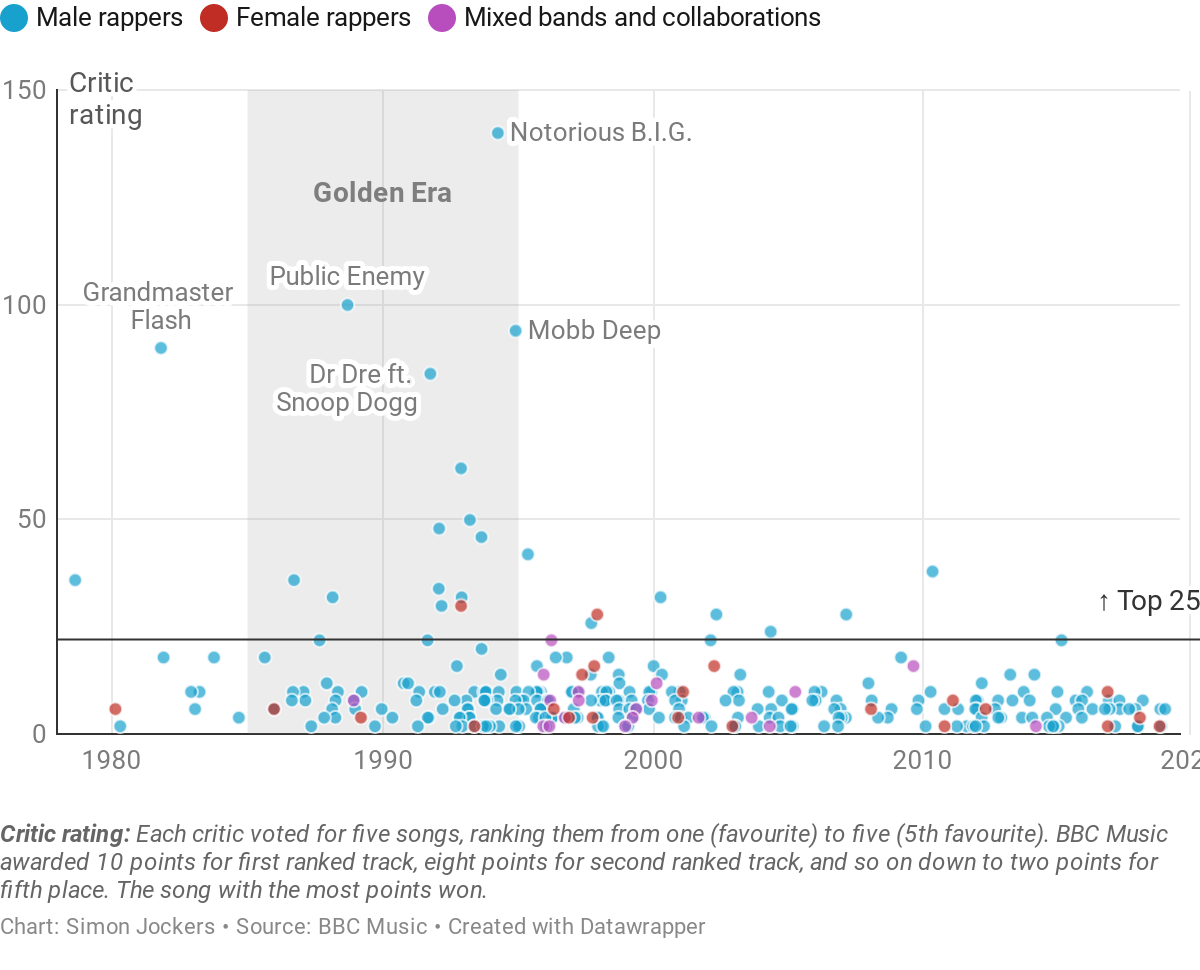
Juicy by The Notorious B.I.G. is ranked first by a wide margin. The rest of the list is a grand tour through four decades of US rap music. It has old school block party sound, 90s boom-bap beats, and West Coast gangsta rap. Going through the list, the first thing you may notice is that the highest-ranking songs are from the period between the mid-eighties and the mid-nineties – what’s often called hip-hop’s ‘golden era’. Only two songs from the past decade made it into the top 25: Alright by Kendrick Lamar and Runaway by Kanye West. But there’s something else that stands out: The absence of women.

Where the ladies at?

The top 10 doesn’t include any female rappers at all. The highest-ranking song by a female artist is Queen Latifah’s 1993 feminist rap anthem U.N.I.T.Y., ranked 19th. In fact, the BBC’s 25 greatest hip-hop songs of all time include more songs that feature the band OutKast (three) than songs by women rappers (two).

To get a better understanding of the data, I plotted publishing years, ratings, and artist gender in a chart. Out of 311 entries, there are just 23 songs by women rappers and 19 songs that are by mixed bands or collaborations between female and male artists. For comparison: Even though JAY-Z did not make it into the top 25, he alone has 20 songs on the list. If you wonder why this is the case, you should read J’na Jamerson’s analysis of why there are so few women in hip-hop best-of lists. Spoiler: It’s probably a mix of the prevailing misogyny in hip-hop and the fact that the hip-hop business is largely run by men, who decide who receives attention and who doesn’t.

In spite of all this, hip-hop has so many amazing female voices. To celebrate women in hip-hop and to make it easier for you to find great music by female rappers, I’ve filtered the data set for an alternative best-of list containing only songs that feature women artists. Make sure to also listen to the Spotify playlist.

How I analyzed the data

The BBC published a list of all responses to their poll, which has a total of 311 songs. They also included a detailed description of their ranking algorithm, which I used to recreate the ranking through grouping and sorting the data in R. Here’s how the ranking works:

We awarded 10 points for first ranked track, eight points for second ranked track, and so on down to two points for fifth place. The song with the most points won. We split ties by the total number of votes: songs with more votes ranked higher. Any ties remaining after this were split by first place votes, followed by second place votes and so on: songs with more critics placing them at higher up the lists up ranked higher.

To add more context, I categorized artists by gender and added cover artwork that I got via the Spotify API. I then used Benedict Witzenberger’s R package to create Datawrapper charts directly from my R scripts. If you’d like to learn how I prepared the data in more detail, see my data analysis repo on GitHub.

To find out more about the data visualization tools and techniques I used in this article, have a look at the following articles:


That’s it from me for this week. As always, do let me know if you have feedback, suggestions or questions. I am looking forward to hearing from you at simon@datawrapper.de, Mastodon, or Twitter.

15 Dec 06:21

“Link In Bio” is a slow knife

Anil Dash, Dec 12, 2019
Icon

I'm not a fan of the title of this post, but I agree with the message: links to a wide range of contents are good, and locking users into a linkless site is wrong. "We’re rapidly losing fluency in what the internet could look like," writes Anil Dash. "We’re almost forgotten that links are powerful, and that restraining links through artificial scarcity is an absurdly coercive behavior." That's why I consider the service I perform with this newsletter to be uniquely valuable.

Web: [Direct Link] [This Post]
15 Dec 06:21

Bluesky

Twitter, Dec 12, 2019
Icon

In a series of tweets Twitter CEO Jack Dorsey announced that the company is hiring a team "of up to five open source architects, engineers, and designers to develop an open and decentralized standard for social media." There has been a lot of discussion. Doug Belshaw writes (as did many in the Twitter thread) that the proposed network already exists in the form of ActivityPub. Ben Werdmuller also points to them, but suggests that while they were created by hobbiests, it may be time for a corporate leader to push the project through. Others, such as Dave Winer, suggested that Twitter could simply reopen the API ist closed a number of years ago. The time is definitely ripe for such an initiative, but I don't really see a team of five people as constituting a commitment. So the sceptic in me wonders whether Twitter is merely trying to undermine existing distributed networks who have been bleeding traffic from the centralized social network. 

Web: [Direct Link] [This Post]
15 Dec 06:15

New version of the Roadmap of Web Applications on Mobile

W3C, Dec 13, 2019
Icon

As the story says, " W3C has published a new version of its Roadmap of Web Applications on Mobile, an overview of the various technologies developed in W3C that increase the capabilities of Web applications, and how they apply more specifically to the mobile context." It's definitely worth a look. There are dozens of standards in different stages of development listed covering everything from media to user interaction to sensors to security. This is just one of a set of roadmaps being compiled thanks to Beihang University; view the rest of them in this GitHub repository.

Web: [Direct Link] [This Post]
15 Dec 06:15

Synchronous Online Active Classes

by Greg Wilson

I have run RStudio’s instructor training class three times in the last three weeks, which has prompted me to think again about the future of teaching and learning. As I wrote last month, I do almost all of my teaching these days online in real time:

  1. Half a dozen to two dozen learners join me on a video conference.

  2. Everyone is muted by default to cut down on background noise. Learners raise a flag in the video conference chat when they want to speak, or (more often) put a question or comment into the chat so that their peers can respond.

  3. Learners use the chat to answer formative assessment questions as well. Anything bigger goes into a shared Google Doc where they post long-form answers or upload drawings. (I’m really looking forward to the day when I can assume most people have touch-screen devices so that they can draw directly in the Google Doc rather than doing the photo-and-upload dance.)

  4. We use breakout rooms for think-pair-share and small-group discussions. When I teach programming, I also get learners to take turns sharing their screen so that everyone can see, comment on, and learn from their work.

I have tried to come up with a catchy acronym to describe this model. Garrett Grolemund coined the phrase active teaching a while back to describe models in which the teacher adapts content and direction in real time based on feedback from the learners. I think it’s essential to making this model work, so the best acronym I have so far is SOAC, for “synchronous online active class”. “Online” and “class” explain themselves; it’s “synchronous” because everyone is learning at the same time and “active” because the teacher and the students are using what they learn as they learn in.

I think SOACs are going to be much more interesting over the next few years than MOOCs. A decade of research tells us that MOOCs don’t really work very well, and the margins in the MOOC business are razor-thin and getting thinner. Emeritus, conference workshops, and your local music teacher are proof that people will pay for personalized instruction, and video gaming is proof that people will line up their schedules for something they enjoy doing. I therefore think that instead of putting more effort into platforms for delivering videos and robo-grading exercises, we should design something for real-time collaborative teaching and learning. Brookfield and Preskill’s The Discussion Book is packed with good ideas that have never been implemented online, and a lot of the practices that in-person workshops have developed (like using sticky notes as “need help” flags and to ensure fair air time for everyone) could also serve as inspirations.

The best summary of MOOCs I ever heard is that if you use robots to teach, you’re teaching people to be robots. There are a lot of good teachers in the world who love to teach; if we build a platform to help them do that in a more humane way, we will also help people be more humane. And yes, there’s a risk that vulture capitalists will encourage people to build something that only serves the affluent, but if the platform itself is open, I hope that people who are marginalized or disenfranchised by today’s obsession with scalability will be able to use it to share their knowledge with their peers much more accessibly than today’s MOOCs allow.

Update: as several people have pointed out, a lot of people don’t have or can’t afford the bandwidth needed for interactive video, and even those who do or can may prefer written material. I would therefore also like next-generation platforms to partner with companies like Lumen Learning to ensure that lesson materials work as open access textbooks as well as online.

15 Dec 06:14

Velo Orange's 2019 Year in Review and a Peek into a Busy 2020!

by noreply@blogger.com (VeloOrange)
by Igor


As we close 2019, I wanted to thank all of our customers, readers, followers, suppliers, and partners. It's because of you that we're able to invest in new projects and endeavors that we hope encourage more touring, commuting, randonneuring, and in general, ridership.

I also wanted to give a big thank you to the VO staff. VO is a small team. We're hard-working and dedicated to product development, timely order fulfillment, and top-notch support. A devotion to excellence is very important to us and is an aspect of our business we're proud of.

2019 was another super strong year for VO. Business is good and folks are happy about the new products we've launched and are in the midst of developing. Let's review this past year before jumping into 2020.

Neutrino Launch - The debut of the Neutrino was without a doubt our biggest undertaking this year, and we're very pleased with the response and positivity about the bike. We sold out of our pre-sale before we even received the frames and have seen builds all over the world. We'll have another production round in February.


Mini-Rando Bags - These have been my go-to's for lightweight, rackless builds. They'll fit on any drop-bar bike and the capacity is surprisingly large (7 seltzers). Paired with a Day Tripper Saddle Bag, you'll have generous storage for all-day, all-road riding.


Tubeless Voyager Rims - A good tire and rim interface is essential for a tubeless setup. And once it's set up, flats that would have put a damper on any ride are a thing of the past. We like this, so we developed a strong and elegant tubeless compatible rim, dubbed Voyager, for tires ranging from 38mm to 2.4".


New Fenders - Fenders are our bread and butter. In addition to the 20" Mini Fenders for the Neutrino, we also released a 38mm 700c Smooth and 58mm 650b Smooth offering.


Complete Bikes - These were a long time coming and have been fairly popular. We actually ended up doing more custom builds rather than completes due to changes customers wanted. The bike build idea juices started flowing and soon enough we were incorporating dynamo lighting, different shifters, racks, etc...


31.8, MTB Rated Crazy Bars - These were one of the most highly requested product redesigns. They've been super popular for both bike-packers and gravel tourists.


Pass Hunter Prototypes - The Pass Hunter has always been a more modern offering within our frame lineup and this has gone whole hog in the most recent re-design, with flat mount disc brakes, tapered headtube, thru-axles, and carbon fork compatibility - all while maintaining proper fender, front rack, and triple cargo cage mounts. We've been riding these a lot since we've gotten in the first samples, and the next round of pre-production samples will have some fit and finish updates that will make them ready to go into production. We should have production frames in around mid-Summer.


Anjou Velo Vintage - Our first time doing this ride and festival. It was such a blast. Great food, wonderful people, fun route, and if you can make it over to the France, I'd highly suggest going. Sign up immediately after the window opens as slots tend to fill up in one day.


Rustines Factory Tour - It was fantastic to see the factory and meet the people that make Rustines rubber products. While the company has moved on to commercial/industrial work being their main business, their heritage division of bicycle products is a labor of love, and we're thankful.


2020 is going to be stellar. We have so many projects and events in the hopper!

XXL Neutrinos - The tall people spoke, and we listened. In the next production round due in February, we'll have XXL sized Neutrinos for riders between 6' and 6'4". Due to the frame size, it won't be airline packable, but still more convenient than a full wheel'd, large-sized frame.


Crankset - We've been secretly working on a more modern, but still stylish 2-piece crankset for all-road riding. I can't post a final picture yet, because it is still in development. But it will be forged and have very generous gearing options in the 2x and 1x format.


Thru-Axle Hubs - I'm sold on thru-axle hubs. This new rear hub shell is a custom design with a ratchet housing based off the classic, smooth-lined Record (my favorite). The design will retain our tool-free disassembly and maintenance and will include QR endcaps for those who are using QR disc hubs. We'll have rim brake hub options, too. Pretty much all of our wheel builds have gone to 32 hole, but would you want a lower spoke count offering for lightweight builds? Like 24 or 28h?


Domestic Expos - We'll be doing Philly Bike Expo and the New England Builders Ball. Both of these shows are a blast and are arguably the best ones on the East Coast. Philly is a larger show which caters to a bigger crowd which is great for exposure and showcasing our brand to new customers. NEBB is a very intimate, smaller event where we can really dig into the nerdy details of touring, randonneuring, and commuting designs. We'll also be scouting out Sea Otter for the first time.

Gravel Rides - We're planning on participating in some rad gravel rides both locally (at least reasonable by car) and further away once the winter wanes. While the weather outside is frightful, friend us on Zwift :)

Overseas trips - We're planning on going both to Eurobike and Taipei Bike Expo this year - the two biggest cycling shows in the world. It will be a good chance to have face-face meetings with our international partners as well as check out new trends. Anything in particular you'd like to see?


Thanks again for another spectacular year!
15 Dec 06:13

Rates

by Greg Wilson

I talk a lot about lesson design and delivery, but when instructors get a chance to ask me something one-to-one, what they often ask is, “How much should I charge?” The short answer is that it depends on where you are and who your audience is; the longer answer is that you can figure out low and high bounds by looking at what you pay and doing a little math.

What follows is personal opinions based on work I have done as an independent consultant and trainer. It does not necessarily reflect the views of my employers.

For example, you might pay $350 for a full-day workshop at an academic conference. If there are 30 attendees, that’s a gross revenue of $10.5K; the venue is probably getting $1.5K for the room, so even if we double that to include coffee and the union electrician on standby, you and the organizers have $7.5K to split. Now, that money might be underwriting the conference, so you might only get travel, accommodation, and free registration, but if the hosts are taking anything home, you should too and it’s perfectly reasonable to ask.

At the other end, a two-day workshop at a medical or financial conference is probably going to cost attendees $2K each (or rather, cost their employers, since they’re almost certainly not paying out of pocket). If there are 30 attendees once again, that’s a gross of $60K; figure $3K/day for a nicer room and $100/day per attendee for food and drink (yes, venues charge like fairgrounds and movie theaters) and there’s $48K on the table. A 50/50 split with the organizers gives you $24K for two days of teaching, which compares favorably with what adjunct (sessional) teachers make at some schools in a year.

Of course, this doesn’t take lesson development time into account. I budget a full day of work for an hour of lesson material if I already know the subject reasonably well. For the one-day academic scenario outlined above, that means I earn (roughly) $3000 for 7 days of prep plus 1 day of teaching, which is very roughly $50/hr. (By comparison, my guitar teacher charges $75 for a one-hour lesson.) For the two-day commercial scenario, the all-in rate is about $160/hr, which is $10/hr more than I used to charge for contract software development.

What about amortization? If I teach the same workshop several times without modification then my effective hourly rate goes up, but “without modification” is a mythical beast you can chase but will never catch. Technology changes, your audience changes, you learn something about your material each time you teach: unless your material has been refined dozens of times (like the Carpentries lessons), you should figure each offering requires 1-3 hours of prep for each hour of teaching.

These numbers are all based on my own experience as a white guy working in affluent parts of the world during a succession of tech bubbles. I don’t know how to rescale any of these factors for other circumstances; what I do know is that sharing data like this helps newcomers negotiate, just as sharing salary figures helps people make sure they’re not being taken advantage of. I’d be grateful for any additions or corrections anyone would care to offer.

15 Dec 06:13

Things I Learned from Kevin Desmond

by Gordon Price

TransLink’s CEO addressed the Real Estate Institute President’s luncheon this week with a general overview of regional transit.  And though much was familiar, there were still items worth noting.  Time for some bullet points.

Said Desmond: “This is the most exciting time to be involved in public transit in its history.”  I believe him, especially when you’re running the most successful transit agency in terms of ridership growth in North America.

How successful? Up 18 percent between 2016 and 2018, when almost every other system is flat or dropping.  And it’s not just because of SkyTrain expansion. It’s bus ridership that has led the growth in actual numbers, and it’s where the biggest growth is going to come in the next few years.

Big message to the real-estate industry: Don’t just think of development at the station areas; think transit corridors, especially the new Rapidbus lines.  (Why the change of name from B-Lines?  Because they were just big buses running more frequently with limited stops.  Rapidbus involves a redesign of everything from the stops, the signs, the lanes and the land use.)

Irony alert: many transit users can’t afford transit-oriented development. This is not just an issue in the burgeoning station areas like those along the Millennium Line or potentially along the Broadway corridor; it’s also an emerging problem along the new Rapidbus lines, where the housing may be too expensive for the target population the transit is meant to serve.

The desirability of high-density station areas was affirmed when Marine Gateway (along the Canada Line in Marpole) sold out in four hours.  That made the industry pay attention when the condo market seemed to be oversold.  (It shouldn’t have been that great a surprise: many of the purchasers would have been familiar with similar development in Hong Kong, Singapore or Shanghai – where metro transit and high-density housing are indivisible and desirable.)

The Capstan station in Richmond, paid for by the adjacent development, changes the political message about how we fund transit infrastructure.  More by the private sector, less by the public.

Expect Broadway subway service in 2025.  Construction starts next fall.

If the money is approved for the a Surrey SkyTrain extension, service to Langley could also start in 2025, which would otherwise be the starting date for service to Fleetwood, the destination without the extension.)

As public consultation on the Transport 2050 strategic plan continues (phase 1 here), remember the previous one: Transport 2021 in 1993.

Almost everything proposed and planned was achieved.  “We put it together and we stuck with it and we did it.”  (Despite the BC Liberals sabotage by referendum, which they have still not acknowledged or apologized for.)

The future: electric, connected and self-driving.  Autonomous cars may not be happening as soon as expected, but by the end of the next decade, 60 percent of the entire bus fleet could be zero emission.  That’s especially notable given that a lot of housing will be constructed along the Frequent Transit Network.

Desmond also emphasizes the mundane: maintaining assets in good repair, even as we try to understand and integrate the disruptive forces in transportation.


*Photo by thestar

15 Dec 06:13

Petitioning for rehearing in Mozilla v. FCC

by Amy Keating

Today, Mozilla continues the fight to preserve net neutrality protection as a fundamental digital right. Alongside other petitioners in our FCC challenge, Mozilla, Etsy, INCOMPAS, Vimeo and the Ad Hoc Telecom Users Committee filed a petition for rehearing and rehearing en banc in response to the D.C. Circuit decision upholding the FCC’s 2018 Order, which repealed safeguards for net neutrality.

Our petition asks the original panel of judges or alternatively the full complement of D.C. Circuit judges to reconsider the decision both because it conflicts with D.C. Circuit or Supreme Court precedent and because it involves questions of exceptional importance.

Mozilla’s petition focuses on the FCC’s reclassification of broadband as an information service and on the FCC’s failure to properly address competition and market harm. We explain why we believe the Court can in fact overturn the FCC’s new treatment of broadband service despite some of the deciding judges’ belief that Supreme Court precedent prevents rejection of what they consider a nonsensical outcome. In addition, we point out that the Court should have done more than simply criticize the FCC’s assertion that existing antitrust and consumer protection laws are sufficient to address concerns about market harm without engaging in further analysis. We also note inconsistencies in how the FCC handled evidence of market harm, and the Court’s upholding of the FCC’s approach nonetheless.

We are excited to continue to lead this effort as part of a broad community pressing for net neutrality protections, and Mozilla supports other petitioners’ filings at this stage that address additional important issues for reconsideration. See below for copies of the petitions filed.

Petition for rehearing and rehearing en banc filed by:

Mozilla, Etsy, INCOMPAS, Vimeo, and the Ad Hoc Telecom Users Committee

New America’s Open Technology Institute, Free Press, Public Knowledge, CDT, The Benton Institute for Broadband & Society, CCIA, and National Association of State Utility Consumer Advocates

National Hispanic Media Coalition


The post Petitioning for rehearing in Mozilla v. FCC appeared first on The Mozilla Blog.

15 Dec 06:12

An Epiphany regarding Purebrowser

by jeremiah foster

Purebrowser and the “the power of defaults”

As most folks know, PureOS has a customized browser known as Purebrowser. Purebrowser is a great example of what Todd Weaver calls, “the power of defaults”. What I’ve understood that to mean is that default settings are a powerful way to provide users with privacy protecting safeguards and convenience “out of the box”. The goal with sane defaults was always to make life easier for our users by making choices that we believe protect privacy so that the user wouldn’t have to dig into confusing configuration options. We try and bring sensible, privacy protecting default settings to our Purebrowser each time there is a new release from upstream which is the Firefox Extended Support Release. Our customization begins with the choice of browser to start with and it continues well beyond that. In fact, the vision that our CSO has is of a browser that can run in an isolated sandbox and can even be disposable to not keep any information on the user.

More adaption, less adoption

As we’ve been working on the software for our new device, the Librem 5, we’ve done a lot of work to adapt our existing code base to the phone. Aside from being a touch screen, the handheld phone requires a good deal of work to adapt software to the phone’s form factor. As we do this work, spinning off software libraries that are entering the software ecosystem widely, we get to take advantage of it

Web screen shot
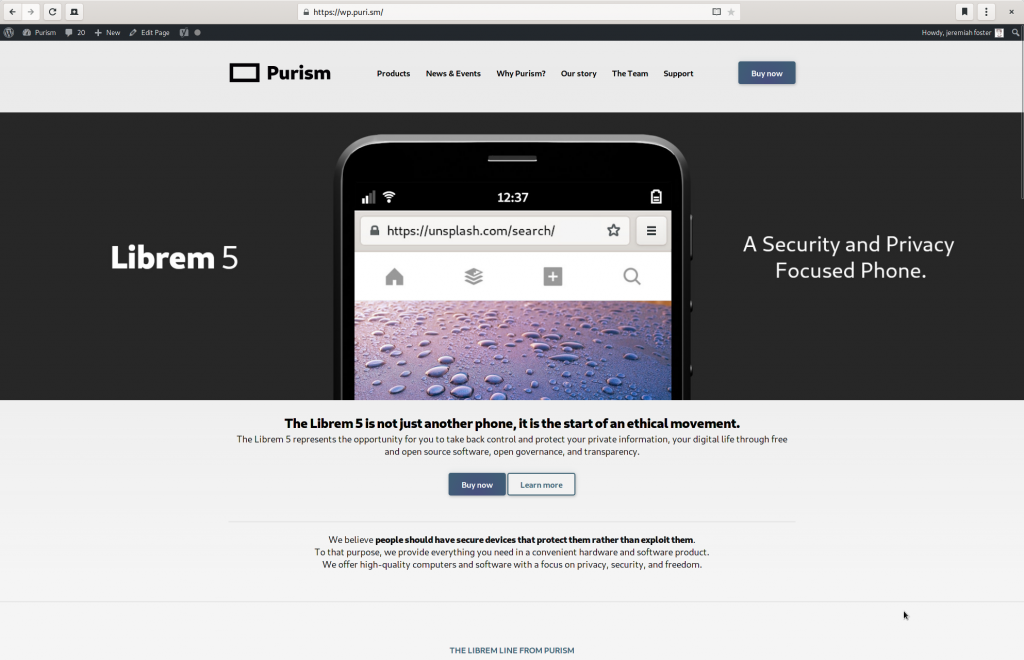
Screen shot of web while I was writing this post.

in PureOS on all our platforms. This is the whole point of making PureOS convergent – to use a single code base across devices. This way, every librem device (not just every Librem 5, 13, 15) benefits from the work done in PureOS. We believe this will result in a more robust code base, with a stable set of APIs, and a simple way to develop secure software for all our devices.

Having a web Epiphany

Web on the Librem 5

To make our CSO’s vision a reality we’re planning on moving away from Firefox ESR as our default and towards the default GNOME Web browser called “Epiphany”. While Firefox ESR is a great browser, and will remain in our repositories, it is a lot of maintenance to apply the patches to get it to where we feel is the right state for our users. We’ve discussed our changes with upstream but they have their own vision, their own business needs. In addition, we’re investing in building out the ecosystem of convergent, privacy protecting, free software, and that investment is being realized in our Librem phone. We want to continue to build on our convergence and moving towards Epiphany will continue that as well as get us closer to our goal of one code base on all our devices, which of course the whole point of convergence.

Once we’re working from one code base, which we’re tantalizingly close to, we’re able to do some pretty exciting things. We’ll truly have a secure communications platform with a supply chain we have deep insight into, that we’ve designed and control from silicon to pixel. That is a bit of an accomplishment.

Discover the Librem 5

Purism believes building the Librem 5 is just one step on the road to launching a digital rights movement, where we—the-people stand up for our digital rights, where we place the control of your data and your family’s data back where it belongs: in your own hands.

Preorder now

The post An Epiphany regarding Purebrowser appeared first on Purism.

15 Dec 06:12

Visualizing Election Results: Geography vs. Population

by peter@rukavina.net (Peter Rukavina)

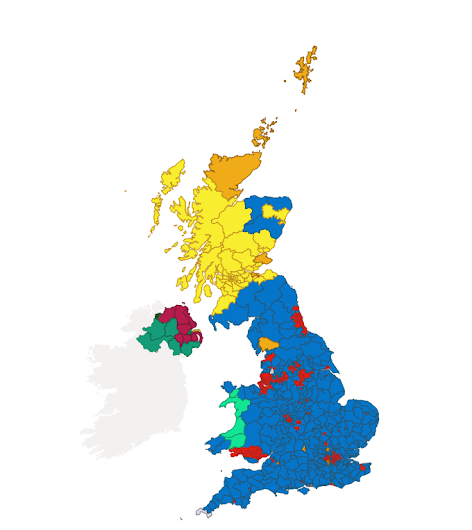
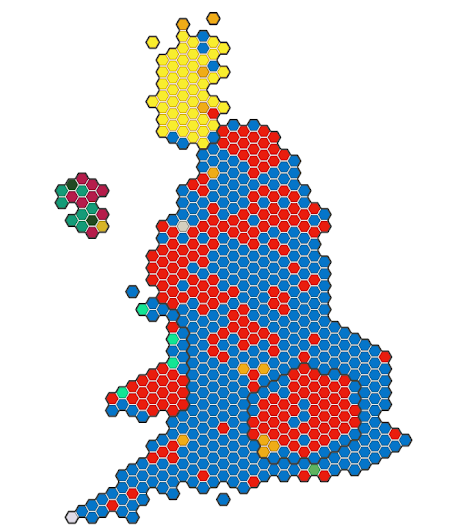
The BBC News website presented two different visualizations of yesterday’s UK elections.

The first is strictly geographical, with the land area of each constituency accurately represented on the map:

Screen shot from BBC news showing geographic representation of results

By flipping a switched at the bottom of the map you can see the same results rendered as a “cartogram,” which presents each constituency as the same geographic size, located in roughly the relative area of the country, but not geographically accurate:

UK election results from the BBC presented as a cartogram

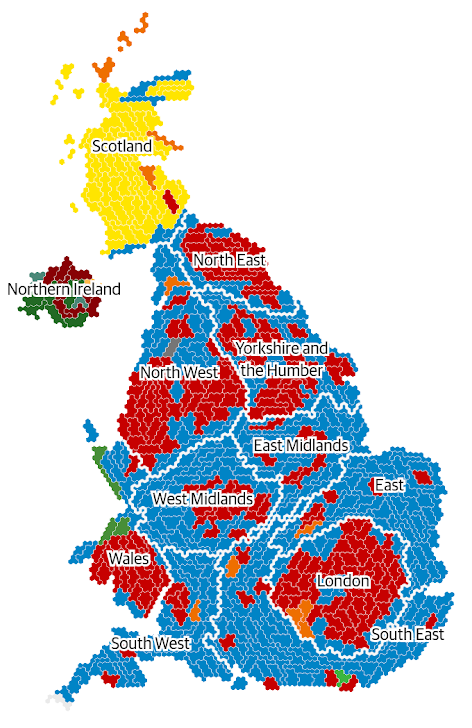
The Guardian presented a similar treatment, with each constituency the same size, but presented in a more malleable, and thus more familiar form:

The Guardian visualization of the UK election results as a cartogram

Because of differences in population density, the two approaches tell very different stories.

The Electoral Cartogram of Canada website presents a similar treatment for the 2019 Federal Election here in Canada; in this case, because of higher MP-to-population ratio in places like PEI, the Island has an outsized appearance.

15 Dec 06:12

Why <details> is Not an Accordion

I learned something this week and I thought I would share it. Earlier this year I read Adrian Roselli’s post “Details/Summary are not [insert control here]”. In this post Adrian says <details> is not a tab set, it’s not a subnavigation menu, not a dialog, not an accordion, not a … wait, what? Not an accordion‽⁈

Giving some context; I believe at the time Adrian was responding to a popular tweet by Caleb Porzio (140k views) showing <details> as a <dialog> replacement. Incidentally, this pattern is being used by Github in the form of a <details-dialog> custom element. Mu-an Chiou has a great slide deck from a talk at BrooklynJS explaining some of their thinking about it. But let’s get back to accordions…

So here I am, some months later, tasked with building an accordion. I was curious about the assertion that an <details> “is not an accordion”. Adrian cites the missing heading , button , and region roles missing. Well if that’s the issue, that’s all stuff that we should be able to add back in with ARIA and we could even wrap it all up in a nice Web Component… I thought.

See the Pen <details-accordion>: An Accordion made of Details Elements? by Dave Rupert (@davatron5000) on CodePen.

Cunningham’s Law states “The best way to get the right answer on the Internet is not to ask a question, it’s to post the wrong answer”, so I shared this out on Twitter to get feedback. Adrian and Scott O’Hara offered valuable feedback (as usual) and I’m sad to report that <details> is STILL not an accordion.

I got very close to the dream, but there was one nut I could not quite crack…

Summary is a button and buttons eat semantics

The core of the issue, which Scott pointed out, because <summary> has role="button", it eats the semantic content of elements inside it.

Here’s a contrived example with headings:

h1 + button // ✅ H1 will show up when navigating by headings
button + h1 // ❌ H1 will not show up when navigating by headings

As you can see, a heading can have a button but a button cannot have a heading. This makes my head spin a bit. It may not seem like a big deal because we can make it work visually with CSS, but if you use a screen reader or a braille reader and browse-by-headings, that giant accordion got a major downgrade.

Clobbering semantics happens elsewhere too. Last week I was looking at how role="presentation" will eat the semantics of its required children in certain situations (e.g. ul and table). Both of these are a great example of why ARIA is a heavy handed move and should be a last resort when authoring.

So where do we go from here?

I will be honest in saying that this is a bit of a major bummer for me. Let’s quickly process the Five Stages of Accessibility Grief together so we can move on:

  1. Denial - But like <details> just feels right, maaan
  2. Anger - This sucks. HTML sucks. ARIA sucks.
  3. Bargaining - Do blind people really need headings anyway?
  4. Depression - HTML is doomed and so is my career
  5. Acceptance - I accept that this is a sub-optimal situation beyond my control

In all seriousness, I think the biggest frustration here is expectations are broken. <details>/<summary> is the most accordion-like thing I’ve ever seen and yet it can’t be used as an accordion. My expectation as an Author does not match the Platform’s capabilities. Is this something that can be patched? Is this HTML’s fault? Is this ARIA’s fault? I don’t know. I only know that this creates more work for me.

I can still add a slew of ARIA roles, states, and properties to a series of <h#> + <div> combinations but it feels like we lost an opportunity here. We’re asking a lot of authors to home-roll and manage ARIA which we’ve already established is a difficult task to get right. Same goes with <dialog> being insufficient. Is everyone supposed to write their own keyboard trap? Christ almighty, may God help us. I made websites for like 20 years before I learned about that web development gem.

At the risk of being a broken record; HTML really needs <accordion> , <tabs>, <dialog>, <dropdown>, and <tooltip> elements. Not more “low-level primitives” but good ol’ fashioned, difficult-to-get-consensus-on elements. A new set of accessible controls for a modern era… except that these things have been in-use on nearly every major website and application for the last two decades and exist in every major design system.

In a world where 97.8% of sites are inaccessible and sites that do use ARIA are 26.7% more inaccessible, we are failing the most vulnerable of users on the Web. I wish browsers would prioritize accessibility improvements over things like main thread scheduling optimization to unblock tracking pixels and the Sisyphean task of competing with native.

If we really want to win, let’s make it easy for everyone to access the Web.

15 Dec 06:11

Twitter Favorites: [bmann] Went for lunch with @mezzoblue on Robson today. He spotted an interesting food court stall called “Nine Dumplings”.… https://t.co/wos2KTWkLK

Boris Mann @bmann
Went for lunch with @mezzoblue on Robson today. He spotted an interesting food court stall called “Nine Dumplings”.… twitter.com/i/web/status/1…
15 Dec 06:09

Twitter Favorites: [katherinebailey] What a difference a few months can make. The bad news I referred to below got reversed, which is why we are now in… https://t.co/a33490UU47

Katherine Bailey @katherinebailey
What a difference a few months can make. The bad news I referred to below got reversed, which is why we are now in… twitter.com/i/web/status/1…
15 Dec 06:07

Metro Vancouver will have one region-wide licence for ride-hailing companies

by Shruti Shekar

Ride-hailing companies will only need one business licence when operating in the 21 municipalities in Metro Vancouver.

The TransLink Mayors’ Council passed the motion to allow ride-hailing services to have a region-wide licence on December 12th, the CBC reported. It added that interim rules will be in play by the end of January.

“It really works better if we function as a region, rather than 21 autonomous groups…it’s been way too long that we’ve been waiting,” said Coquitlam, British Columbia’s mayor Richard Stewart.

B.C. transportation minister Claire Trevena announced the legislation to bring in ride-hailing services into British Columbia in November 2018.

B.C.’s NDP government has been criticized for delaying this legislation since it was first announced as part of Premier John Horgan’s 2017 election pledge. Vancouver is currently one of Canada’s largest cities that doesn’t have any legal ride-sharing options.

In the summer, Metro Vancouver announced that it was going to have its municipalities issue business licences to ride-hailing companies, the CBC reported. Those charges would have vastly varied with Delta charging companies $25 per driver, or Burnaby wanting $510 per driver. Surrey indicated it didn’t want to provide licences at all.

TransLink vice-president Geoff Cross had indicated that the province would threaten municipalities on taking over the process if they were not able to find a middle ground.

Now that the motion has passed, TransLink will take the next six weeks to bring together a working group to help set terms for business licences, which includes fee structure.

Surrey was the only one to not support the motion, its mayor Doug McCallum said: “A large majority of our residents do not support ride-hailing in Surrey.”

“It’s not a level playing field. There are a lot of differences of levels that are not consistent between ride-hailing and taxis,” he added.

Source: CBC

The post Metro Vancouver will have one region-wide licence for ride-hailing companies appeared first on MobileSyrup.

15 Dec 06:06

The i7 Google Pixelbook Go is now available in Canada

by Brad Bennett

The top of the line 4K i7 Pixelbook Go is now available to order in Canada.

The device rings in at $1,849 CAD making it super-pricey for a Chromebook. That said, it’s still not as expensive as the highest-end Pixelbook which costs $2,099.

Beyond having an Intel i7 and a 4K screen, the fresh Pixelbook Go has 16GB of RAM and 256GB of storage.

When we reviewed the Go, we found it to be speedy enough for most ChromeOS tasks, but if you plan to run Linux instead, then the high-end version might better suit your needs.

It’s also interesting that Google decided to launch this spec’d out version of the notebook before the ‘Not Pink’ colourway, which is still unavailable.

Source: Google Store 

The post The i7 Google Pixelbook Go is now available in Canada appeared first on MobileSyrup.

14 Dec 04:08

Artificial Intelligence: Threat or Menace?

by Charlie Stross
mkalus shared this story from Charlie's Diary.

(This is the text of a keynote talk I just delivered at the IT Futures conference held by the University of Edinburgh Informatics centre today. NB: Some typos exist; I'll fix them tonight.)

Good morning. I'm Charlie Stross, and I tell lies for money. That is, I write fiction—deliberate non-truths designed to inform, amuse, and examine the human condition. More specifically, I'm a science fiction writer, mostly focusing on the intersection between the human condition and our technological and scientific environment: less Star Wars, more about bank heists inside massively multiplayer computer games, or the happy fun prospects for 3D printer malware.

One of the besetting problems of near-future science fiction is that life comes at you really fast these days. Back when I agreed to give this talk, I had no idea we'd be facing a general election campaign — much less that the outcome would already be known, with consequences that pretty comprehensively upset any predictions I was making back in September.

So, because I'm chicken, I'm going to ignore current events and instead take this opportunity to remind you that I can't predict the future. No science fiction writer can. Predicting the future isn't what science fiction is about. As the late Edsger Djikstra observed, "computer science is no more about computers than astronomy is about telescopes." He might well have added, or science fiction is about predicting the future. What I try to do is examine the human implications of possible developments, and imagine what consequences they might have. (Hopefully entertainingly enough to convince the general public to buy my books.)

So: first, let me tell you some of my baseline assumptions so that you can point and mock when you re-read the transcript of this talk in a decade's time.

Ten years in the future, we will be living in a world recognizable as having emerged from the current one by a process of continuous change. About 85% of everyone alive in 2029 is already alive in 2019. (Similarly, most of the people who're alive now will still be alive a decade hence, barring disasters on a historic scale.)

Here in the UK the average home is 75 years old, so we can reasonably expect most of the urban landscape of 2029 to be familiar. I moved to Edinburgh in 1995: while the Informatics Forum is new, as a side-effect of the disastrous 2002 old town fire, many of the university premises are historic. Similarly, half the cars on the road today will still be on the roads in 2029, although I expect most of the diesel fleet will have been retired due to exhaust emissions, and there will be far more electric vehicles around.

You don't need a science fiction writer to tell you this stuff: 90% of the world of tomorrow plus ten years is obvious to anyone with a weekly subscription to New Scientist and more imagination than a doorknob.

What's less obvious is the 10% of the future that isn't here yet. Of that 10%, you used to be able to guess most of it — 9% of the total — by reading technology road maps in specialist industry publications. We know what airliners Boeing and Airbus are starting development work on, we can plot the long-term price curve for photovoltaic panels, read the road maps Intel and ARM provide for hardware vendors, and so on. It was fairly obvious in 2009 that Microsoft would still be pushing some version of Windows as a platform for their hugely lucrative business apps, and that Apple would have some version of NeXTStep — excuse me, macOS — as a key element of their vertically integrated hardware business. You could run the same guessing game for medicines by looking at clinical trials reports, and seeing which drugs were entering second-stage trials — an essential but hugely expensive prerequisite for a product license, which requires a manufacturer to be committed to getting the drug on the market by any means possible (unless there's a last-minute show-stopper), 5-10 years down the line.

Obsolescence is also largely predictable. The long-drawn-out death of the pocket camera was clearly visible on the horizon back in 2009, as cameras in smartphones were becoming ubiquitous: ditto the death of the pocket GPS system, the compass, the camcorder, the PDA, the mp3 player, the ebook reader, the pocket games console, and the pager. Smartphones are technological cannibals, swallowing up every available portable electronic device that can be crammed inside its form factor.

However, this stuff ignores what Donald Rumsfeld named "the unknown unknowns". About 1% of the world of ten years hence always seems to have sprung fully-formed from the who-ordered-THAT dimension: we always get landed with stuff nobody foresaw or could possibly have anticipated, unless they were spectacularly lucky guessers or had access to amazing hallucinogens. And this 1% fraction of unknown unknowns regularly derails near-future predictions.

In the 1950s and 1960s, futurologists were obsessed with resource depletion, the population bubble, and famine: Paul Ehrlich and the other heirs of Thomas Malthus predicted wide-scale starvation by the mid-1970s as the human population bloated past the unthinkable four billion mark. They were wrong, as it turned out, because of the unnoticed work of a quiet agronomist, Norman Borlaug, who was pioneering new high yield crop strains: what became known as the Green Revolution more than doubled global agricultural yields within the span of a couple of decades. Meanwhile, it turned out that the most effective throttle on population growth was female education and emancipation: the rate of growth has slowed drastically and even reversed in some countries, and WHO estimates of peak population have been falling continuously as long as I can remember. So the take-away I'd like you to keep is that the 1% of unknown unknowns are often the most significant influences on long-term change.

If I was going to take a stab at identifying a potential 1% factor, the unknown unknowns that dominate for the second and third decade of the 21st century, I wouldn't point to climate change — the dismal figures are already quite clear — but to the rise of algorithmically targeted advertising campaigns combined with the ascendancy of social networking. Our news media, driven by the drive to maximize advertising click-throughs for revenue, have been locked in a race to the bottom for years now. In the past half-decade this has been weaponized, in conjunction with data mining of the piles of personal information social networks try to get us to disclose (in the pursuit of advertising bucks), to deliver toxic propaganda straight into the eyeballs of the most vulnerable — with consequences that are threaten to undermine the legitimacy of democratic governmance on a global scale.

Today's internet ads are qualitatively different from the direct mail campaigns of yore. In the age of paper, direct mail came with a steep price of entry, which effectively limited it in scope — also, the print distribution chain was it relatively easy to police. The efflorescence of spam from 1992 onwards should have warned us that junk information drives out good, but the spam kings of the 1990s were just the harbinger of today's information apocalypse. The cost of pumping out misinformation is frighteningly close to zero, and bad information drives out good: if the propaganda is outrageous and exciting it goes viral and spreads itself for free.

The recommendation algorithms used by YouTube, Facebook, and Twitter exploit this effect to maximize audience participation in pursuit of maximize advertising click-throughs. They promote popular related content, thereby prioritizing controversial and superficially plausible narratives. Viewer engagement is used to iteratively fine-tune the selection of content so that it is more appealing, but it tends to trap us in filter bubbles of material that reinforces our own existing beliefs. And bad actors have learned to game these systems to promote dubious content. It's not just Cambridge Analytica I'm talking about here, or allegations of Russian state meddling in the 2016 US presidential election. Consider the spread of anti-vaccination talking points and wild conspiracy theories, which are no longer fringe phenomena but mass movements with enough media traction to generate public health emergencies in Samoa and drive-by shootings in Washington DC. Or the spread of algorithmically generated knock-offs of children's TV shows proliferating on YouTube that caught the public eye last year.

... And then there's the cute cat photo thing. If I could take a time machine back to 1989 and tell an audience like yourselves that in 30 years time we'd all have pocket supercomputers that place all of human knowledge at our fingertips, but we'd mostly use them for looking at kitten videos and nattering about why vaccination is bad for your health, you'd have me sectioned under the Mental Health Act. And you'd be acting reasonably by the standards of the day: because unlike fiction, emergent human culture is under no obligation to make sense.

Let's get back to the 90/9/1 percent distribution, that applies to the components of the near future: 90% here today, 9% not here yet but on the drawing boards, and 1% unpredictable. I came up with that rule of thumb around 2005, but the ratio seems to be shifting these days. Changes happen faster, and there are more disruptive unknown-unknowns hitting us from all quarters with every passing decade. This is a long-established trend: throughout most of recorded history, the average person lived their life pretty much the same way as their parents and grandparents. Long-term economic growth averaged less than 0.1% per year over the past two thousand years. It has only been since the onset of the industrial revolution that change has become a dominant influence on human society. I suspect the 90/9/1 distribution is now something more like 85/10/5 -- that is, 85% of the world of 2029 is here today, about 10% can be anticipated, and the random, unwelcome surprises constitute up to 5% of the mix. Which is kind of alarming, when you pause to think about it.

In the natural world, we're experiencing extreme weather events caused by anthropogenic climate change at an increasing frequency. Back in 1989, or 2009, climate change was a predictable thing that mostly lay in the future: today in 2019, or tomorrow in 2029, random-seeming extreme events (the short-term consequences of long-term climactic change) are becoming commonplace. Once-a-millennium weather outrages are already happening once a decade: by 2029 it's going to be much, much worse, and we can expect the onset of destabilization of global agriculture, resulting in seemingly random food shortages as one region or another succumbs to drought, famine, or wildfire.

In the human cultural sphere, the internet is pushing fifty years old, and not only have we become used to it as a communications medium, we've learned how to second-guess and game it. 2.5 billion people are on Facebook, and the internet reaches almost half the global population. I'm a man of certain political convictions, and I'm trying very hard to remain impartial here, but we have just come through a spectacularly dirty election campaign in which home-grown disinformation (never mind propaganda by external state-level actors) has made it almost impossible to get trustworthy information about topics relating to party policies. One party renamed its Twitter-verified feed from its own name to FactCheckUK for the duration of a televised debate. Again, we've seen search engine optimization techniques deployed successfully by a party leader -- let's call him Alexander de Pfeffel something-or-other -- who talked at length during a TV interview about his pastime of making cardboard model coaches. This led Google and other search engines to downrank a certain referendum bus with a promise about saving £350M a week for the NHS painted on its side, a promise which by this time had become deeply embarrassing.

This sort of tactic is viable in the short term, but in the long term is incredibly corrosive to public trust in the media — in all media.

Nor are the upheavals confined to the internet.

Over the past two decades we've seen revolutions in stock market and forex trading. At first it was just competition for rackspace as close as possible to the stock exchange switches, to minimize packet latency — we're seeing the same thing playing out on a smaller scale among committed gamers, picking and choosing ISPs for the lowest latency — then the high frequency trading arms race, in which case fuzzing the market by injecting "noise" in the shape of tiny but frequent trades allowed volume traders to pick up an edge (and effectively made small-scale day traders obsolete). I lack inside information but I'm pretty sure if you did a deep dive into what's going on behind the trading desks at FTSE and NASDAQ today you'd find a lot of powerful GPU clusters running Generative Adversarial Networks to manage trades in billions of pounds' worth of assets. Lights out, nobody home, just the products of the post-2012 boom in deep learning hard at work, earning money on behalf of the old, slow, procedural AIs we call corporations.

What do I mean by that — calling corporations AIs?

Although speculation about mechanical minds goes back a lot further, the field of Artificial Intelligence was largely popularized and publicized by the groundbreaking 1956 Dartmouth Conference organized by Marvin Minsky, John McCarthy, Claude Shannon, and Nathan Rochester of IBM. The proposal for the conference asserted that, "every aspect of learning or any other feature of intelligence can be so precisely described that a machine can be made to simulate it", a proposition that I think many of us here would agree with, or at least be willing to debate. (Alan Turing sends his apologies.) Furthermore, I believe mechanisms exhibiting many of the features of human intelligence had already existed for some centuries by 1956, in the shape of corporations and other bureaucracies. A bureaucracy is a framework for automating decision processes that a human being might otherwise carry out, using human bodies (and brains) as components: a corporation adds a goal-seeking constraints and real-world i/o to the procedural rules-based element.

As justification for this outrageous assertion -- that corporations are AIs — I'd like to steal philosopher John Searle's "Chinese Room" thought experiment and misapply it creatively. Searle, a skeptic about the post-Dartmouth Hard AI project — the proposition that symbolic computation could be used to build a mind — suggested the thought experiment as a way to discredit the idea that a digital computer executing a program can be said to have a mind. But I think he inadvertently demonstrated something quite different.

To crib shamelessly from wikipedia:

Searle's thought experiment begins with this hypothetical premise: suppose that artificial intelligence research has constructed a computer that behaves as if it understands Chinese. It takes Chinese characters as input and, by following the instructions of a computer program, produces other Chinese characters, which it presents as output. Suppose, says Searle, that this computer comfortably passes the Turing test, by convincing a human Chinese speaker that the program is itself a live Chinese speaker. To all of the questions that the person asks, it makes appropriate responses, such that any Chinese speaker would be convinced that they are talking to another Chinese-speaking human being.

The question Searle asks is: does the machine literally "understand" Chinese? Or is it merely simulating the ability to understand Chinese?

Searle then supposes that he is in a closed room and has a book with an English version of the computer program, along with sufficient papers, pencils, erasers, and filing cabinets. Searle could receive Chinese characters through a slot in the door, process them according to the program's instructions, and produce Chinese characters as output. If the computer had passed the Turing test this way, it follows that he would do so as well, simply by running the program manually.

Searle asserts that there is no essential difference between the roles of the computer and himself in the experiment. Each simply follows a program, step-by-step, producing a behavior which is then interpreted by the user as demonstrating intelligent conversation. But Searle himself would not be able to understand the conversation.

The problem with this argument is that it is apparent that a company is nothing but a very big Chinese Room, containing a large number of John Searles, all working away at their rule sets and inputs. We many not agree that an AI "understands" Chinese, but we can agree that it performs symbolic manipulation; and a room full of bureaucrats looks awfully similar to a hypothetical Turing-test-passing procedural AI from here.

Companies don't literally try to pass the Turing test, but they exchange information with other companies — and they are powerful enough to process inputs far beyond the capacity of an individual human brain. A Boeing 787 airliner contains on the order of six million parts and is produced by a consortium of suppliers (coordinated by Boeing); designing it is several orders of magnitude beyond the competence of any individual engineer, but the Boeing "Chinese Room" nevertheless developed a process for designing, testing, manufacturing, and maintaining such a machine, and it's a process that is not reliant on any sole human being.

Where, then, is Boeing's mind?

I don't think Boeing has a mind as such, but it functions as an ad-hoc rules-based AI system, and exhibits drives that mirror those of an actual life form. Corporations grow, predate on one another, seek out sources of nutrition (revenue streams), and invade new environmental niches. Corporations exhibit metabolism, in the broadest sense of the word -- they take in inputs and modify them, then produce outputs, including a surplus of money that pays for more inputs. Like all life forms they exist to copy information into the future. They treat human beings as interchangeable components, like cells in a body: they function as superorganisms -- hive entities -- and they reap efficiency benefits when they replace fallible and fragile human components with automated replacements.

Until relatively recently the automation of corporate functions was limited to mid-level bookkeeping operations — replacing ledgers with spreadsheets and databases — but we're now seeing the spread of robotic systems outside manufacturing to areas such as lights-out warehousing, and the first deployments of deep learning systems for decision support.

I spoke about this at length a couple of years ago in a talk I delivered at the Chaos Communications Congress in Leipzig, titled "Dude, You Broke the Future" — you can find it on YouTube and a text transcript on my blog — so I'm not going to dive back into that topic today. Instead I'm going to talk about some implications of the post-2012 AI boom that weren't obvious to me two years ago.

Corporations aren't the only pre-electronic artificial intelligences we've developed. Any bureaucracy is a rules-based information processing system. Governments are superorganisms that behave like very large corporations, but differ insofar as they can raise taxes (thereby creating demand for circulating money, which they issue), stimulating economic activity. They can recirculate their revenue through constructive channels such as infrastructure maintenance, or destructive ones such as military adventurism. Like corporations, governments are potentially immortal until an external threat or internal decay damages them beyond repair. By promulgating and enforcing laws, governments provide an external environment within which the much smaller rules-based corporations can exist.

(I should note that at this level, it doesn't matter whether the government's claim to legitimacy is based on the will of the people, the divine right of kings, or the Flying Spaghetti Monster: I'm talking about the mechanical working of a civil service bureaucracy, what it does rather than why it does it.)

And of course this brings me to a third species of organism: academic institutions like the University of Edinburgh.

Viewed as a corporation, the University of Edinburgh is impressively large. With roughly 4000 academic staff, 5000 administrative staff, and 36,000 undergraduate and postgraduate students (who may be considered as a weird chimera of customers and freelance contractors), it has a budget of close to a billion pounds a year. Like other human superorganisms, Edinburgh University exists to copy itself into the future — the climactic product of a university education is, of course, a professor (or alternatively a senior administrator), and if you assemble a critical mass of lecturers and administrators in one place and give them a budget and incentives to seek out research funding and students, you end up with an academic institution.

Quantity, as the military say, has a quality all of its own. Just as the Boeing Corporation can undertake engineering tasks that dwarf anything a solitary human can expect to achieve within their lifetime, so too can an institution out-strip the educational or research capabilities of a lone academic. That's why we have universities: they exist to provide a basis for collaboration, quality control, and information exchange. In an idealized model university, peers review one another's research results and allocate resources to future investigations, meanwhile training undergraduate students and guiding postgraduates, some of whom will become the next generation of researchers and teachers. (In reality, like a swan gliding serenely across the surface of a pond, there's a lot of thrashing around going on beneath the surface.)

The corpus of knowledge that a student needs to assimilate to reach the coal face of their chosen field exceeds the competence of any single educator, so we have division of labour and specialization among the teachers: and the same goes for the practice of research (and, dare I say it, writing proposals and grant applications).

Is the University of Edinburgh itself an artificial intelligence, then?

I'm going to go out on a limb here and say " not yet". While the University Court is a body corporate established by statute, and the administration of any billion pound organization of necessity shares traits with the other rules-based bureaucracies, we can't reasonably ascribe a theory of mind, or actual self-aware consciousness, to a university. Indeed, we can't ascribe consciousness to any of the organizations and processes around us that we call AI.

Artificial Intelligence really has come to mean three different things these days, although they all fall under the heading of "decision making systems opaque to human introspection". We have the classical bureaucracy, with its division of labour and procedures executed by flawed, fallible human components. Next, we have the rules-based automation of the 1950s through 1990s, from Expert Systems to Business Process Automation systems — tools which improve the efficiency and reliability of the previous bureaucratic model and enable it to operate with fewer human cogs in the gearbox. And since roughly 2012 we've had a huge boom in neural computing, which I guess is what brings us here today.

Neural networks aren't new: they started out as an attempt in the early 1950s to model the early understanding of how animal neurons work. The high level view of nerves back then — before we learned a lot of confusing stuff about pre- and post-synaptic receptor sites, receptor subtypes, microtubules, and so on -- is that they're wiring and switches, with some basic additive and subtractive logic superimposed. (I'm going to try not to get sidetracked into biology here.) Early attempts at building recognizers using neural network circuitry, such as 1957's Perceptron network, showed initial promise. But they were sidelined after 1969 when Minsky and Papert formally proved that a perceptron was computationally weak -- it couldn't be used to compute an Exclusive-OR function. As a result of this resounding vote of no-confidence, research into neural networks stagnated until the 1980s and the development of backpropagation. And even with a more promising basis for work, the field developed slowly thereafter, hampered by the then-available computers.

A few years ago I compared the specifications for my phone — an iPhone 5, at that time — with a Cray X-MP supercomputer. By virtually every metric, the iPhone kicked sand in the face of its 30-year supercomputing predecessor, and today I could make the same comparison with my wireless headphones or my wrist watch. We tend to forget how inexorable the progress of Moore's Law has been over the past five decades. It has brought us roughly ten orders of magnitude of performance improvements in storage media and working memory, a mere nine or so orders of magnitude in processing speed, and a dismal seven orders of magnitude in networking speed.

In search of a concrete example, I looked up the performance figures for the GPU card in the newly-announced Mac Pro; it's a monster capable of up to 28.3 Teraflops, with 1Tb/sec memory bandwidth and up to 64Gb of memory. This is roughly equivalent to the NEC Earth Simulator of 2002, a supercomputer cluster which filled 320 cabinets, consumed 6.4 MW of power, and cost the Japanese government 60 billion Yen (or about £250M) to build. The Radeon Pro Vega II Duo GPU I'm talking about is obviously much more specialized and doesn't come with the 700Tb disks or 1.6 petabytes of tape backup, but for raw numerical throughput — which is a key requirement in training a neural network -- it's competitive. Which is to say: a 2020 workstation is roughly as powerful as half a billion pounds-worth of 2002 supercomputer when it comes to training deep learning applications.

In fact, the iPad I'm reading this talk from — a 2018 iPad Pro — has a processor chipset that includes a dedicated 8-core neural engine capable of processing 5 trillion 8-bit operations per second. So, roughly comparable to a mid-90s supercomputer.

Life (and Moore's Law) comes at you fast, doesn't it?

But the news on the software front is less positive. Today, our largest neural networks aspire to the number of neurons found in a mouse brain, but they're structurally far simpler. The largest we've actually trained to do something useful are closer in complexity to insects. And you don't have to look far to discover the dismal truth: we may be able to train adversarial networks to recognize human faces most of the time, but there are also famous failures.

For example, there's the Home Office passport facial recognition system deployed at airports. It was recently reported that it has difficulty recognizing faces with very pale or very dark skin tones, and sometimes mistakes larger than average lips for an open mouth. If the training data set is rubbish, the output is rubbish, and evidently the Home Office used a training set that was not sufficiently diverse. The old IT proverb applies, "garbage in, garbage out" — now with added opacity.

The key weakness of neural network applications is that they're only as good as the data set they're trained against. The training data is invariably curated by humans. And so, the deep learning application tends to replicate the human trainers' prejudices and misconceptions.

Let me give you some more cautionary tales. Amazon is a huge corporation, with roughly 750,000 employees. That's a huge human resources workload, so they sank time and resources into training a network to evaluate resumes from job applicants, in order to pre-screen them and spit out the top 5% for actual human interaction. Unfortunately the training data set consisted of resumes from existing engineering employees, and even more unfortunately a very common underlying quality of an Amazon engineering employee is that they tend to be white and male. Upshot: the neural network homed in on this and the project was ultimately cancelled because it suffered from baked-in prejudice.

Google Translate provides is another example. Turkish has a gender-neutral pronoun for the third-person singular that has no English-language equivalent. (The closest would be the third-person plural pronoun, "they".) Google Translate was trained on a large corpus of documents, but came down with a bad case of gender bias in 2017, when it was found to be turning the neutral pronoun into a "he" when in the same sentence as "doctor" or "hard working," and a "she" when it was in proximity to "lazy" and "nurse."

Possibly my favourite (although I drew a blank in looking for the source, so you should treat this as possibly apocryphal) was a DARPA-funded project to distinguish NATO main battle tanks from foreign tanks. It got excellent results using training data, but wasn't so good in the field ... because it turned out that the recognizer had gotten very good at telling the difference between snow and forest scenes and arms trade shows. (Russian tanks are frequently photographed in winter conditions — who could possibly have imagined that?)

Which brings me back to Edinburgh University.

I can speculate wildly about the short-term potential for deep learning in the research and administration areas. Research: it's a no-brainer to train a GAN to do the boring legwork of looking for needles in the haystacks of experimental data, whether it be generated by genome sequencers or radio telescopes. Technical support: just this last weekend I was talking to a bloke whose startup is aiming to use deep learning techniques to monitor server logs and draw sysadmin attention to anomalous patterns in them. Administration: if we can just get past the "white, male" training trap that tripped up Amazon, they could have a future in screening job candidates or student applications. Ditto, automating helpdesk tasks — the 80/20 rule applies, and chatbots backed by deep learing could be a very productive tool in sorting out common problems before they require human intervention. This stuff is obvious.

But it's glaringly clear that we need to get better — much better — at critiquing the criteria by which training data is compiled, and at working out how to sanity-test deep learning applications.

For example, consider a GAN trained to evaluate research grant proposals. It's almost inevitable that some smart-alec will think of this (and then attempt to use feedback from GANs to improve grant proposals, by converging on the set of characteristics that have proven most effective in extracting money from funding organizations in the past). But I'm almost certain that any such system would tend to recommend against ground-breaking research by default: promoting proposals that resemble past work research is no way to break new ground.

Medical clinical trials focus disproportionately on male subjects, to such an extent that some medicines receive product licenses without being tested on women of childbearing age at all. If we use existing trials as training data for identifying possible future treatments we'll inevitably end up replicating historic biases, missing significant opportunities to improve breakthrough healthcare to demographics who have been overlooked.

Or imagine the uses of GANs for screening examinations — either to home in on patterns indicative of understanding in essay questions (grading essays being a huge and tedious chore), or (more controversially) to identify cheating and plagiarism. The opacity of GANs means that it's possible that they will encode some unsuspected prejudices on the part of the examiners whose work they are being trained to reproduce. More troublingly, GANs are vulnerable to adversarial attacks: if the training set for a neural network is available, it's possible to identify inputs which will exploit features of the network to produce incorrect outputs. If a neural network is used to gatekeep some resource of interest to human beings, human beings will try to pick the lock, and the next generation of plagiarists will invest in software to produce false negatives when their essay mill purchases are screened.

And let's not even think about the possible applications of neurocomputing to ethics committees, not to mention other high-level tasks that soak up valuable faculty time. Sooner or later someone will try to use GANs to pre-screen proposed applications of GANs for problems of bias. Which might sound like a worthy project, but if the bias is already encoded in the ethics monitoring neural network, experiments will be allowed to go forward that really shouldn't, and vice versa.

Professor Noel Sharkey of Sheffield University went public yesterday with a plea for decision algorithms that impact peoples' lives — from making decisions on bail applications in the court system, to prefiltering job applications — to be subjected to large-scale trials before roll-out, to the same extent as pharmaceuticals (which have a similar potential to blight lives if they aren't carefully tested). He suggests that the goal should be to demonstrate that there is no statistically significant in-built bias before algorithms are deployed in roles that detrimentally affect human subjects: he's particularly concerned by military proposals to field killer drones without a human being in the decision control loop. I can't say that he's wrong, because he's very, very right.

"Computer says no" was a funny catch-phrase in "Little Britain" because it was really an excuse a human jobsworth used to deny a customer's request. It's a whole lot less funny when it really is the computer saying "no", and there's no human being in the loop. But what if the computer is saying "no" because its training data doesn't like left-handedness or Tuesday mornings? Would you even know? And where do you go if there's no right of appeal to a human being?

So where is AI going?

Now, I've just been flailing around wildly in the dark for half an hour. I'm probably laughably wrong about some of this stuff, especially in the detail level. But I'm willing to stick my neck out and make some firm predictions.

Firstly, for a decade now IT departments have been grappling with the bring-your-own-device age. We're now moving into the bring-your-own-neural-processor age, and while I don't know what the precise implications are, I can see it coming. As I mentioned, there's a neural processor in my iPad. In ten years time, future-iPad will probably have a neural processor three orders of magnitude more powerful (at least) than my current one, getting up into the trillion ops per second range. And all your students and staff will be carrying this sort of machine around on their person, all day. In their phones, in their wrist watches, in their augmented reality glasses.

The Chinese government's roll-out of social scoring on a national level may seem like a dystopian nightmare, but something not dissimilar could be proposed by a future university administration as a tool for evaluating students by continuous assessment, the better to provide feedback to them. As part of such a program we could reasonably expect to see ubiquitous deployment of recognizers, quite possibly as a standard component of educational courseware. Consider a distance learning application which uses gaze tracking, by way of a front-facing camera, to determine what precisely the students are watching. It could be used to provide provide feedback to the lecturer, or to direct the attention of viewers to something they've missed, or to pay for the courseware by keeping eyeballs on adverts. Any of these purposes are possible, if not desirable.

With a decade's time for maturation I'd expect to see the beginnings of a culture of adversarial malware designed to fool the watchers. It might be superficially harmless at first, like tools for fooling the gaze tracker in the aforementioned app into thinking a hung-over student is not in fact asleep in front of their classroom screen. But there are darker possibilities, and they only start with cheating continuous assessments or faking research data. If a future Home Office tries to automate the PREVENT program for detecting and combating radicalization, or if they try to extend it -- for example, to identify students holding opinions unsympathetic to the governing party of the day -- we could foresee pushback from staff and students, and some of the pushback could be algorithmic.

This is proximate-future stuff, mind you. In the long term, all bets are off. I am not a believer in the AI singularity — the rapture of the nerds — that is, in the possibility of building a brain-in-a-box that will self-improve its own capabilities until it outstrips our ability to keep up. What CS professor and fellow SF author Vernor Vinge described as "the last invention humans will ever need to make". But I do think we're going to keep building more and more complicated, systems that are opaque rather than transparent, and that launder our unspoken prejudices and encode them in our social environment. As our widely-deployed neural processors get more powerful, the decisions they take will become harder and harder to question or oppose. And that's the real threat of AI -- not killer robots, but "computer says no" without recourse to appeal.

I'm running on fumes at this point, but if I have any message to leave you with, it's this: AI and neurocomputing isn't magical and it's not the solution to all our problems, but it is dangerously non-transparent. When you're designing systems that rely on AI, please bear in mind that neural networks can fixate on the damndest stuff rather than what you want them to measure. Leave room for a human appeals process, and consider the possibility that your training data may be subtly biased or corrupt, or that it might be susceptible to adversarial attack, or that it turns yesterday's prejudices into an immutable obstacle that takes no account of today's changing conditions.

And please remember that the point of a university is to copy information into the future through the process of educating human brains. And the human brain is still the most complex neural network we've created to date.

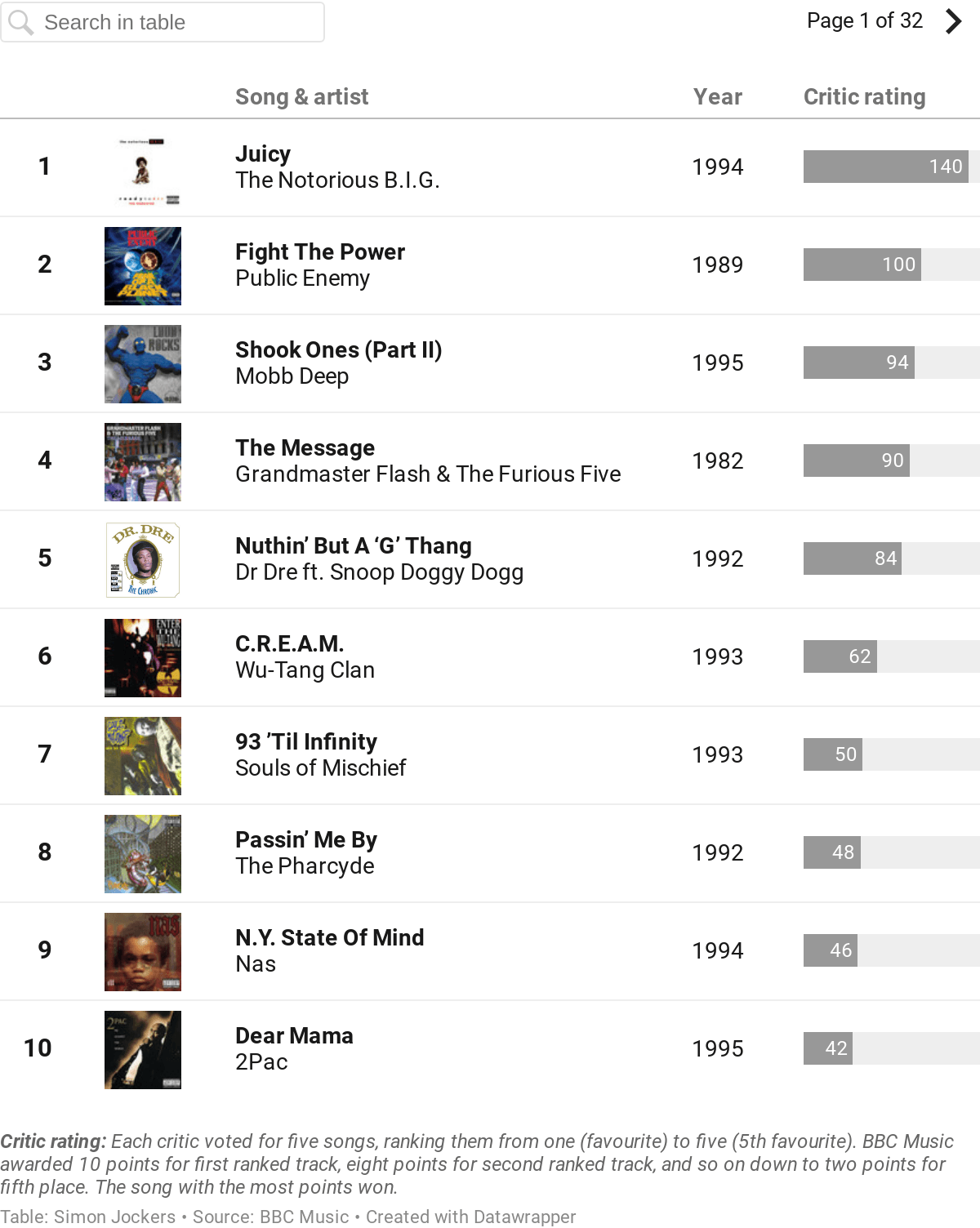
12 Dec 16:02

Twitter Favorites: [acquia] Acquia will acquire @AgilOne, the leading enterprise customer data platform (CDP), to help brands harness the power… https://t.co/4PEvKZ7n7O

Acquia @acquia
Acquia will acquire @AgilOne, the leading enterprise customer data platform (CDP), to help brands harness the power… twitter.com/i/web/status/1…
12 Dec 16:02

Twitter Favorites: [cbrumelle] I wish this tweet was from 2009 https://t.co/NS4ETJ2ZkE

Colin Brumelle @cbrumelle
I wish this tweet was from 2009 twitter.com/jack/status/12…
12 Dec 16:02

1934 Packard Twelve by LeBaron pic.twitter.com/wklX3ycigU

by moodvintage
mkalus shared this story from moodvintage on Twitter.

1934 Packard Twelve by LeBaron pic.twitter.com/wklX3ycigU


205 likes, 41 retweets
12 Dec 16:01

Jodie Foster skateboarding, 1970s pic.twitter.com/3G9XtT3QWl

by moodvintage
mkalus shared this story from moodvintage on Twitter.

Jodie Foster skateboarding, 1970s pic.twitter.com/3G9XtT3QWl


345 likes, 60 retweets
12 Dec 16:01

Why Did They Drift Away?

by Richard Millington

I like this question from the Okta community:

Members drift away for all sorts of reasons. They change job, lose interest in the topic, have no problems to solve, don’t get enough value from the community, or didn’t have a good community experience.

Once you know which, it becomes a lot easier to retain the members you do have.

12 Dec 16:01

Catalina 10.15.2 Update

by Rui Carmo

No mention of fixes to the Mail data loss bug (which as far as I know wasn’t even acknowledged, although it was widely reported). I’m sticking with Mojave for the holidays. Or Springtime. Whenever they feel like fixing their desktop OS, really.

On other news, iOS 13.3 is out, so I think we finally got a stable release there. Third time’s the charm, right?


12 Dec 16:00

Why can’t I in my phone’s app store filter sear...

by Ton Zijlstra

Why can’t I in my phone’s app store filter search results by who built it, specifically jurisdiction they fall under. To better judge what might happen to data gathered by an app.

12 Dec 16:00

tizi Ränzlein

by Volker Weber

1bf1bef86759699be6902b30bcd299c0

Ab und an macht tizi mal ein Produkt, für das ich keine rechte Verwendung habe. Das war beim Beat Bag so, beim Köfferchen auch. Nun also das Ränzlein, eine Echtlederhülle für das AirPods Case. Ich weiß nicht. Alles, was das Case dicker macht, ist mir nicht willkommen. Ich stecke es einfach in die fünfte Tasche meiner Lev's. Das war bei den ersten AirPods so und ist bei den AirPods Pro nicht anders.

More >

12 Dec 16:00

How I found my pitch — and how you can find yours

by Josh Bernoff

I was recently in a competitive situation for an editing job. A first-time author with a book contract was seeking an editor, and someone she trusted had recommended me. She was also considering others. Strange as it may seem, this doesn’t usually happen with me. Usually, people who pick me want me. And I flubbed … Continued

The post How I found my pitch — and how you can find yours appeared first on without bullshit.

12 Dec 15:59

Stepping Stones

by Kevin Rogan

Sidewalk Labs’ Toronto headquarters is located at 307 Lake Shore Boulevard, right on the city’s waterfront. The building’s exterior is brightly painted in the industrial-gentrification chic style. The interior is part of a community outreach effort, filled with a slew of engaging dioramas and exhibits about technology and cities. But in many ways, the floor beneath is the space’s centerpiece. As visitors move from exhibit to exhibit, they walk across a plywood surface of hexagonal tiles — a system that Sidewalk Labs and designer Carlo Ratti, the director of the Senseable City Lab at MIT, call the “Dynamic Street.”

The real tiles — which will be made of concrete and be capable of housing sensors, signage and heating coils to melt snow — will make up an urban surface system that Sidewalk hopes to deploy across its project area in Quayside, right outside 307’s door. Dynamic Street has been designed to enable the elimination of curbs, introducing one flat hardscape that can change from street to sidewalk to plaza to parking as needed, with tiles changing colors to designate the appropriate usage. The exhibits at 307 try to give people a feel for this fluidity, letting them play with a “reconfigurator” that digitally simulates “urban scenarios of their own,” modifying things like density and street usage on the fly, instilling the idea that the tiles can be used at will to “swiftly change the function of the road without creating disruptions on the street.”

Instead of the glittering city of the future, Toronto is being given an industrial redevelopment with panopticon qualities

The Dynamic Street is also a promise that road maintenance will be easy and undisruptive, becoming a matter of swapping out damaged tiles as needed and not involving the costly process of street closure and repaving, which requires heavy machinery and dozens of workers on site. The goal is to make Quayside a place, as Sidewalk states in its Master Innovation and Development Plan, “where the only vehicles are shared and self-driving … [and] where streets are never dug up” and the streetscape “responds to citizens’ ever-changing needs.” Given the other controversies over data extraction and usage surrounding the Quayside project (described for instance in this CityLab article by Laura Bliss), the Dynamic Street seems relatively harmless. Besides, who would want to defend the inconvenient and expensive process of typical road maintenance? According to the CBC, the City of Toronto expected to spend $171 million (in Canadian dollars) on roadwork in 2018 and repaired more than 100,000 potholes in the first three months.

By turns a mundane and a marquee technology, Dynamic Street is the ground upon which Quayside will both physically and ideologically rest. But the Dynamic Street is a feint: It begins by promising something utopian and benign — an improved quality of life and the minimization of human involvement in that process — but the end result amounts to a hostile corporate takeover. Carrying Sidewalk’s implications to their conclusion reveals a future Quayside that has been made a technocratic fiefdom whose benefits and inevitable miseries are even more unevenly distributed than they are today.


Dynamic Street didn’t arrive in 307 fully formed. The basic idea of a modular, easily replacable streetscape was dreamed up in 2012 in the research labs of the French Institute of Science and Technology for Transport, Development and Networks, or IFSTTAR. Researchers there wanted to develop a roadbed that could be “opened and closed within just a few hours using very lightweight site equipment, in restoring the initial street appearance and all its functionalities.” They tested tiles for years in laboratory conditions before carrying out field tests of the full system in the French cities of Nantes and Saint Aubin.

This system was not without its problems, however. The biggest issue was that merely placing the tiles next to each other didn’t provide enough support for vehicles traveling over them and caused the tiles themselves to crack and buckle ahead of schedule. In order to stiffen the tiles, IFSTTAR’s designers added an interlocking key along the perimeter of each tile, which would latch on to all the other tiles next to it. This increased stability but sacrificed the original intention of easy replaceability. Instead of being able to remove a single tile when it cracked or wore down, maintenance crews now had to start with the border tiles and remove row after row until they got to the one they needed to replace. Instead of making for a fluid street undisturbed by typical repaving and closures, IFSTTAR’s tiles just swapped one form of labor-intensive maintenance for another. The institute ended up scrapping the project.

Jump forward a few years. Ratti and Sidewalk exhume IFSTTAR’S hexagonal tile and add a kitchen sink’s worth of sensors and technical abilities to it without changing the basic physical shape — including that interlocking key IFSTTAR ended up incorporating. In a February 25 tweet, Sidewalk Toronto shared a video of a concrete prototype of the tile being installed that clearly shows the new tile being carefully moved into position, locking in with its neighbors. Not only that, the video shows the installation requiring a crane — not exactly the seamless process that Sidewalk had promised. Considering that easy replacement is one of the arguments used to position the Dynamic Street as an essential technology, the fact that this is impossible with the current design seems like it should be a cause for concern.

So the few promises Sidewalk has made thus far about their tiles — that they’ll make maintenance a breeze, that they’ll allow the street to become a fluid surface — are misleading at best. This should be no surprise, as Sidewalk’s grand plan seems to have been about misdirection from the very beginning, presenting a fancy real estate development scheme and data extraction machine as a technological utopia. Instead of the glittering city of the future, Toronto is being given an industrial redevelopment with panopticon qualities, and instead of being given the street of tomorrow, Sidewalk is offering a concrete slab with some lights and heating coils in it.

The tiles are likely just one stepping stone toward the end goals of Sidewalk’s megaproject, which remain mostly opaque but which almost definitely include the conquest of as much of Toronto’s eastern waterfront property as possible. Sidewalk has plenty of more overt tricks up its sleeve: there’s the $980 million equity investment proposed, along with the more typical promises of jobs (93,000 “total jobs” by 2040) and economic growth ($14.2 billion in GDP output beginning in 2040) that only a corporate behemoth with Alphabet’s backing can provide. If that gets stuck in the mud, the project’s easily overlooked infrastructural elements — access conduits, delivery tunnels, and the Dynamic Street — will serve as a means for enacting a clandestine transfer of city responsibilities into corporate hands.

The project’s easily overlooked infrastructural elements, like the Dynamic Street, will serve a clandestine transfer of city responsibilities into corporate hands

Throughout the development process, Sidewalk has, as Bianca Wylie has noted, “weaponized ambiguity” when faced with tough questions — such as, for example, whether critical infrastructure within its suite of “public realm innovations” will even work. This is not an engineering mishap but a feature. In the Master Innovation and Development Plan the company acknowledges that the Dynamic Street’s “new approach to street systems would require changes to existing regulations and operations.” Practically speaking, this likely means that Sidewalk would exploit its position as the creator of Dynamic Street to secure an exemption from Toronto’s typical 20- or 30-year road maintenance cycles. The project area would thus become, in a small way, a separate Toronto within Toronto. Though road maintenance is a minor example, if Sidewalk could duplicate this handover of power in other spheres, elected officials and public services could end up being excluded in favor of Sidewalk’s own “expertise,” essentially creating a vertically integrated monopoly within Quayside.


When Sidewalk presents the Dynamic Street as a fluid, self-contained system, there is an embedded demand that work on the system, specifically maintenance work, also become self-contained. Elsewhere, Sidewalk has been explicit about this intention, taking the messy or ugly elements of urban logistics or maintenance and automating them or burying them in tunnels. Generally speaking, in the Quayside of the future, maintenance appears only rarely and usually well out of sight — by design.

This is an argument with a specific class dimension: “Smart” engineers and immaterial workers will be celebrated, but the non-tech workers, service workers, and maintainers will be pushed out of sight and, hopefully for Sidewalk, out of mind. Consider the worker in this diagram, taken from Sidewalk’s Master Innovation and Development Plan:

Many of Sidewalk’s other renderings feature happy citizens, leisurely enjoying their environment in a sort of perpetual weekend. It’s not a stretch to realize these people — the people that Quayside will be built for — are the “knowledge workers” who will inhabit the coworking spaces to come (or the Google campus to be built on nearby Villiers Island). But the person in the diagram above is not only at work but working on the city itself, doing the maintenance labor that already often goes unconsidered.

What will such workers’ experience of Quayside be like? They are depicted as a system unto themselves, with no work team or heavy equipment required, such as the crane in Sidewalk’s video. This worker can be deployed automatically, embodying the same fluid responsiveness that characterizes the rest of the Sidewalk’s marketing. To put it simply: If the maintenance work can’t be done by robots, Quayside will demand workers act like robots — an approach that has been labeledpseudo-AI.” Mary L Gray and Siddharth Suri’s recent Ghost Work is a book-length examination of this tactic.

In the Quayside of the future, maintenance appears only rarely and usually well out of sight — by design

Quayside will effectively exist as two cities. In one, citizens will enjoy the dreamlike novelty of streets, spaces, and services that seemingly respond to their every desire; in the other, woven in and through the first, workers will be confronted with machines that likewise demand they become more machinic. The mundane utility of Dynamic Street in minimizing disruption and suppressing repair is fundamental to this. Smuggled in as an innovation, Dynamic Street composes the base layer of Sidewalk’s minimal urban environment: a “city” free of social services, community, and solidity. Instead, the illusion of a city is carefully constructed atop a vast apparatus that exists primarily to organize capital, labor, and profit. Usually, we would call such environments factories or industrial zones. Quayside is a proposal that the factory and the city don’t just mirror each other but become each other.

Instead of allowing Quayside’s future workers the opportunity to understand and develop a relationship with their work, the requirement that the city becomes a seamless technological artifact will further alienate those workers from the city and themselves. A self-contained system such as Dynamic Street begets self-contained, equally replacable workers. Their labor is made into to a replaceable machine part. In this respect, Sidewalk hasn’t presented us with anything novel — just a refinement of the basic logic of capitalism, which has always depended on the cruel subjugation of workers. As Fred Moten and Stefano Harney write in The Undercommons, “To work today is to be asked to do without thinking, to feel without emotion, to move without friction, to adapt without question, to translate without pause, to desire without purpose, to connect without interruption.” Technological developments such as the Dynamic Street become tools of further subjugation. Marxist theorist Raniero Panzieri argues that under capitalism, “even the lightening of the labor becomes an instrument of torture, since the machine does not free the worker from the work, but rather deprives the work itself of all content.” Capitalists make work meaningless so the worker becomes meaningless in turn.

This brutal dehumanization is never complete, but it is also never total. Noel Ignatiev writes that workers constantly do work outside of what they’re paid to do, including the work of developing an understanding with the machines they are confronted with. Making the effort to “master the equipment which makes the things they need, to gain control over the work process” makes it possible for work to become “a source of satisfaction to them.” This is present in even the most thankless work.

Uncovering and understanding care takes a crucial step away from value for value’s sake and the dehumanization it entails. Simply put, care is not productive — at least by the narrow metric of specifically capitalist production. As Achille Mbembe warns, “unless we reinvent the terms of what counts and in the process resignify what value stands for as well as the procedures of assigning value, of measuring value, of exchanging value, things won’t change.” In “Matters of Care in Technoscience,” Maria Puig de la Bellacasa describes care as a social activity, “a signifier of devalued ordinary labors that are crucial for getting us through the day,” and identifies it within domestic laborers as well as industrial ones. Monique Lanoix explains in her essay “Labor as Embodied Practice” that caring work is not just an attitude, but material and corporeal labor, even though it “not produce a material commodity.”

The illusion of a city is carefully constructed atop a vast apparatus that exists primarily to organize capital, labor, and profit

If there are alternatives to the Sidewalk approach to urban development, it’s not in a more “humane” corporate approach but in a worker-centered movement that begins and ends in care. “We could imagine physical infrastructures that support ecologies of care — cities and buildings that provide the appropriate physical settings and resources for street sweepers and sanitation workers, teachers and social workers, therapists and outreach agents,” Shannon Mattern writes. An ecology of care requires a complete reconsideration of space that rejects Sidewalk’s remixed capitalist, productivist approach. Care appears only when the conversation is shifted from the delirious pursuit of profit-at-all-costs to a more thoughtful approach to the built world, centering maintenance, like labor, as a social practice.

“As a corporate fantasy, the smart city is dead,” Jathan Sadowski wrote in a recent Real Life essay. He’s right. The smart city was only ever a euphemism for corporate control dressed in technological futurism, which Sidewalk has employed to great effect. But whatever is left postmortem must be reckoned with. Smart cities’ market value — $717.2 billion by 2023 according to Markets and Markets — is rising at nearly 20 percent a year and showing no signs of slowing down. Whatever name it takes, capital’s attempts to colonize not just neighborhoods but daily life continue apace and continue to make a lot of money besides.

The world of capital is created and maintained by us, but has left us to “stand outcast and starving midst the wonders we have made,” as Ralph Chaplin put it in the union anthem Solidarity Forever. We are confronted with a hostile landscape of violence, exclusion, brutality, and yes, technological splendor. A world shaped by us is not dependent on a new imaginary, a thought experiment, or a design proposal, but followed these back to their theoretical headwaters: What if instead of capital, we put ourselves first?

12 Dec 15:41

Haikus generated based on your map location and OpenStreetMap data

by Nathan Yau

Satellite Studio made a map thing that generates haikus based on OpenStreetMap data and your location. From the announcement:

[W]e automated making haikus about places. Looking at every aspect of the surroundings of a point, we can generate a poem about any place in the world. The result is sometimes fun, often weird, most of the time pretty terrible. Also probably horrifying for haiku purists (sorry).

This is pretty great. It’s neat how the poems generate on the fly.

Tags: haiku, OpenStreetMap, poetry

12 Dec 15:40

Burlington outdoor rock climbing spot closes, sport's new popularity brings problems

mkalus shared this story :
In a lot of ways technology is to blame as well. It’s much easier to get to these places and gear has gotten so cheap that people can just try it and then forget about it. But yeah, there needs to be some respect for the environment and clearly you don’t gain that by going from the Gym to the wall. I have observed the same with non-climbing activities. It’s easier to “go back country” and the ads and social media make it all look so nice and easy. Just ask North Shore Rescue how many people they pluck off mountains and the back country every year because people have a child like idea of what it takes.

Gus Alexandropoulos knew there was a risk the growing hordes of rock climbers flocking to his new outdoor climbing space might harm the environment, but was still disappointed by how quickly they did so.

The outdoor space developer had seen it all before — climbers fired with enthusiasm from their time in the exploding number of indoor climbing gyms wanting to take their newfound hobby outside, but wreaking havoc on the natural world in the process.

But Alexandropoulos rolled the dice anyway, spending thousands of dollars to develop an outdoor crag in Burlington, Ont., dubbed The Turtle. Within months, he said climbers turned the area into a mess — playing loud music, bringing in crowds of friends, and defecating all over the place. Faced with frequent complaints, the land owner forced Alexandropoulos to shut down.

He said there's much to celebrate in the surging popularity of rock climbing, but that must come with education on how to take part without compromising the environment.

"I don't know what the answer is," said Alexandropoulos, whose concerns are shared by other industry insiders.

According to Climbing Business Journal, an industry publication, the number of commercial climbing gyms in Canada nearly tripled over the last nine years, soaring from 41 in 2010 to 115 in 2019.

Journal publisher Scott Rennak said interest in the sport will likely grow even further when rock climbing makes its debut as an Olympic sport in Japan next summer.

He said many of the new participants represent a departure from old-school rock climbers, who often cultivated a "dirtbag" image by living out of their cars and spending seasons camped at the bases of famous cliffs.

But despite their fondness for the sleek, modern amenities of indoor gyms, Rennak said the new breed of climbers shares a desire to head outside. As a growing number of climbers migrate out of the gym, he said they're putting a strain on Canada's limited supply of outdoor climbing spaces.

"We've sensationalized the outdoors," he said, noting the influx of climbers has transformed formerly quiet spaces into hectic hubs of activity.

Sean Milligan, a route setter at The Hub climbing gym in Mississauga, Ont., said people who joined the sport years ago were already accustomed to acting carefully to preserve outdoor environments. But thanks to the growing popularity of the sport in recent years, he said that's no longer the case.

"Climbing has become their medium for introduction to the outdoors," said Milligan. "That's great — the average urbanite benefits from that — but there is at present a huge gap in education." 

Novice climbers don't seem to recognize their own impact on the environment, he said, noting many need to learn to stick to fixed paths in order to limit interference with wildlife or pack up their waste at the end of a day on the cliffs.

Milligan said part of the problem stems from the fact that outdoor climbing still operates in a legal grey area.

At Lion's Head, one of Ontario's most famous climbing areas on the Bruce Peninsula, climbing is technically illegal. Milligan said authorities turn a blind eye because, for now, the impact has been positive for local businesses.

Alexandropoulos, Milligan and Rennak are all excited about climbing becoming an Olympic sport, noting the increased exposure has potential to bring benefits such as a dip in equipment costs.

But as climbing gyms continue to cash in on that growth, Steven Brown, director at Hub Climbing, said he believes the onus falls on them to educate new climbers on how to respect the outdoors.

"We're not there to damage things and we want to make sure people are treating it with respect," he said. "We don't want landowners to close terrain."