Rolandt
Shared posts
Write testable code by writing generic code
Canada Goose Zamboni Adaptation Outstanding in the Field


There’s nothing more Canadian than a Canada Goose, perhaps with the exception of a Zamboni. The Zamboni is a rideable machine that shaves the top of rink ice surfaces, and actually washes and wipes down the ice. It was developed in California in 1947, but is synonymous with indoor skating and hockey rinks everywhere in Canada.
We of course also have the best day of the month of February when the Toronto Maple Leaf’s Zamboni driver was pressed into goalie action as an emergency fill in for the Carolina Hurricanes and halted eight shots on the net, becoming the first emergency goalie-and Zamboni driver~in National Hockey League history to be credited with a win.
Which brings us to Mike Hicks who is the director of the Juan de Fuca Electoral Area on Vancouver Island.
As anyone playing sports on grass knows, Canada Geese seem to like the same dry level places that many sports are played on, leaving ubiquitous pebbled bird feces everywhere. Mr. Hicks responded with what he calls a “poop zamboni”, a machine originally developed in New Zealand where it scours fields scooping up horse manure. As CBC’s Sheena Goodyear reports, with typical Canadian ingenuity, Mr. Hicks bought the machine as “recreational equipment” and was able to use the Federal Gas Tax Credit given to municipalities for infrastructure and recreation expenditures.
With two kids in field sports, Mr. Hicks knew that the two soccer fields in his town of Sooke were covered in Canada Goose poop constantly. He thinks each goose eliminates 1.4 kilograms or 3 pounds of poop daily.
He tried the New Zealand developed horse dropping scooper on the parks field and had immediate success.
“I tried it on the rainiest day possible wet fields — wet poop, a fresh motherlode of it, and it swept it up beautifully…It’s just a mess. You know, if you slide in for a big steal or something, you get up and you’re just head-to-toe poop. This is the solution as far as I can see, and it works perfect.”
“I really hope school boards and municipalities, that they all get one of these things. It is tremendous. It’s just tremendous.”

Zero Trust Information
Yesterday Google ordered its entire North American staff to work from home as part of an effort to limit the spread of SARS-CoV-2, the virus that leads to COVID-19. It is an appropriate move for any organization that can do so; furthermore, Google, along with the other major tech companies, also plans to pay its army of contractors that normally provide services for those employees.
Google’s larger contribution, though, happened five years ago when the company led the move to zero trust networking for its internal applications, which has been adopted by most other tech companies in particular. While this wasn’t explicitly about working from home, it did make it a lot easier to pull off on short notice.
Zero Trust Networking
In 1974 Vint Cerf, Yogen Dalal, and Carl Sunshine published a seminal paper entitled “Specification of Internet Transmission Control Program”; it was important technologically because it laid out the specifications for the TCP protocol that undergirds the Internet, but just as notable, at least from a cultural perspective, is that it coined the term “Internet.” The name feels like an accident; most of the paper refers to the “internetwork” Transmission Control Program and “internetwork” packets, which makes sense: networks already existed, the trick was figuring out how to connect them together.
Networks came first commercially as well. In the 1980s Novell created a “network operating system” that consisted of local servers, ethernet cards, and PC software, to enable local area networks that ran inside of large corporations, enabling the ability to share files, printers, other resources. Novell’s position was eventually undermined by the inclusion of network functionality in client operating systems, commoditized ethernet cards, channel mismanagement, and a full-on assault from Microsoft, but the model of the corporate intranet enabling shared resources remained.
The problem, though, was the Internet: connecting any one computer on the local area network to the Internet effectively connected all of the computers and servers on the local area network to the Internet. The solution was perimeter-based security, aka the “castle-and-moat” approach: enterprises would set up firewalls that prevented outside access to internal networks. The implication was binary: if you were on the internal network, you were trusted, and if you were outside, you were not.

This, though, presented two problems: first, if any intruder made it past the firewall, they would have full access to the entire network. Second, if any employee were not physically at work, they were blocked from the network. The solution to the second problem was a virtual private network, which utilized encryption to let a remote employee’s computer operate as if it were physically on the corporate network, but the larger point is the fundamental contradiction represented by these two problems: enabling outside access while trying to keep outsiders out.
These problems were dramatically exacerbated by the three great trends of the last decade: smartphones, software-as-a-service, and cloud computing. Now instead of the occasional salesperson or traveling executive who needed to connect their laptop to the corporate network, every single employee had a portable device that was connected to the Internet all of the time; now, instead of accessing applications hosted on an internal network, employees wanted to access applications operated by a SaaS provider; now, instead of corporate resources being on-premises, they were in public clouds run by AWS or Microsoft. What kind of moat could possibly contain all of these use cases?
The answer is to not even try: instead of trying to put everything inside of a castle, put everything in the castle outside the moat, and assume that everyone is a threat. Thus the name: zero-trust networking.
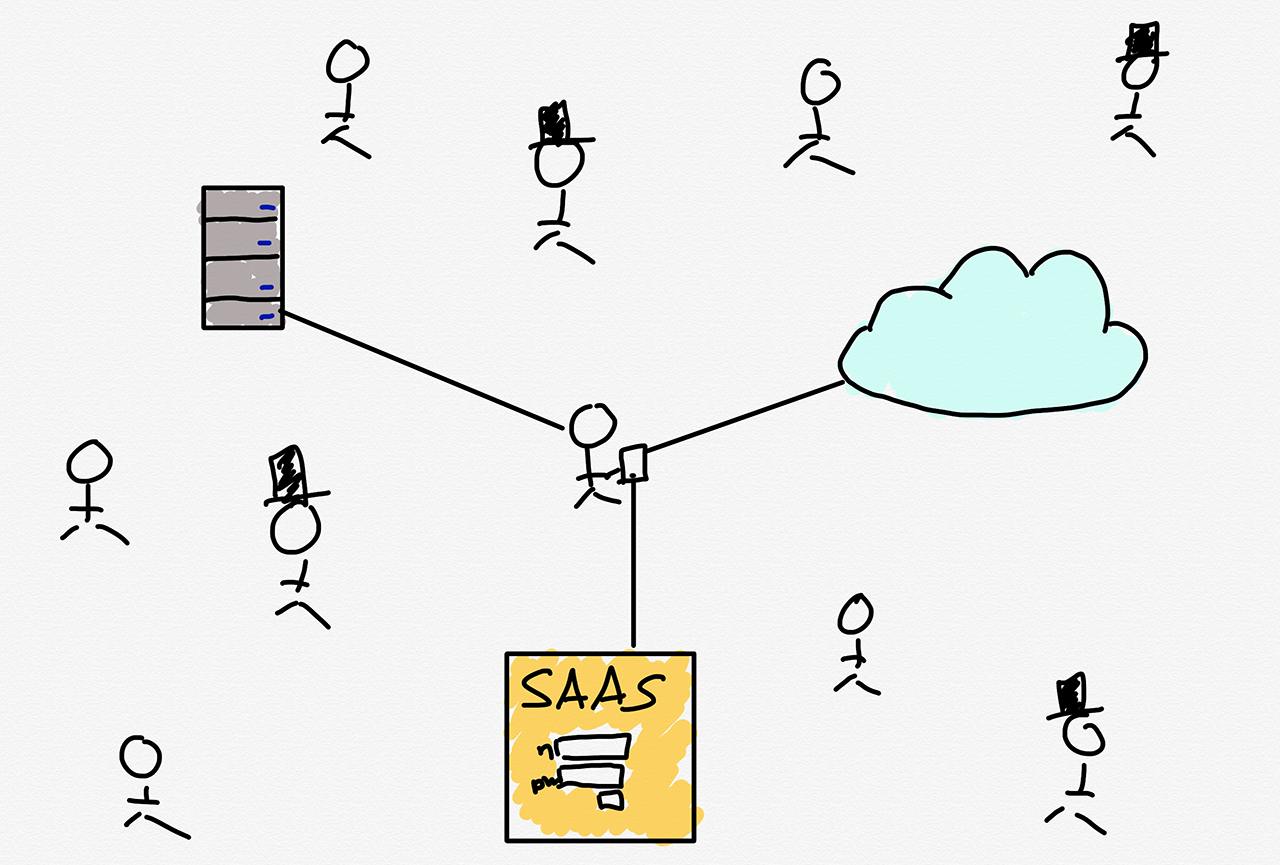
In this model trust is at the level of the verified individual: access (usually) depends on multi-factor authentication (such as a password and a trusted device, or temporary code), and even once authenticated an individual only has access to granularly-defined resources or applications. This model solves all of the issues inherent to a castle-and-moat approach:
- If there is no internal network, there is no longer the concept of an outside intruder, or remote worker
- Individual-based authentication scales on the user side across devices and on the application side across on-premises resources, SaaS applications, or the public cloud (particularly when implemented with single-sign on services like Okta or Azure Active Directory).
In short, zero trust computing starts with Internet assumptions: everyone and everything is connected, both good and bad, and leverages the power of zero transaction costs to make continuous access decisions at a far more distributed and granular level than would ever be possible when it comes to physical security, rendering the fundamental contradiction at the core of castle-and-moat security moot.
Castles and Moats
Castle-and-moat security is hardly limited to corporate information; it is the way societies have thought about information generally from, well, the times of actual castles-and-moats. I wrote last fall in The Internet and the Third Estate:
In the Middle Ages the principal organizing entity for Europe was the Catholic Church. Relatedly, the Catholic Church also held a de facto monopoly on the distribution of information: most books were in Latin, copied laboriously by hand by monks. There was some degree of ethnic affinity between various members of the nobility and the commoners on their lands, but underneath the umbrella of the Catholic Church were primarily independent city-states.
With castles and moats!
The printing press changed all of this. Suddenly Martin Luther, whose critique of the Catholic Church was strikingly similar to Jan Hus 100 years earlier, was not limited to spreading his beliefs to his local area (Prague in the case of Hus), but could rather see those beliefs spread throughout Europe; the nobility seized the opportunity to interpret the Bible in a way that suited their local interests, gradually shaking off the control of the Catholic Church.
This resulted in new gatekeepers:
Just as the Catholic Church ensured its primacy by controlling information, the modern meritocracy has done the same, not so much by controlling the press but rather by incorporating it into a broader national consensus.
Here again economics play a role: while books are still sold for a profit, over the last 150 years newspapers have become more widely read, and then television became the dominant medium. All, though, were vehicles for the “press”, which was primarily funded through advertising, which was inextricably tied up with large enterprise…More broadly, the press, big business, and politicians all operated within a broad, nationally-oriented consensus.
The Internet, though, threatens second estate gatekeepers by giving anyone the power to publish:
Just as important, though, particularly in terms of the impact on society, is the drastic reduction in fixed costs. Not only can existing publishers reach anyone, anyone can become a publisher. Moreover, they don’t even need a publication: social media gives everyone the means to broadcast to the entire world. Read again Zuckerberg’s description of the Fifth Estate:
People having the power to express themselves at scale is a new kind of force in the world — a Fifth Estate alongside the other power structures of society. People no longer have to rely on traditional gatekeepers in politics or media to make their voices heard, and that has important consequences.
It is difficult to overstate how much of an understatement that is. I just recounted how the printing press effectively overthrew the First Estate, leading to the establishment of nation-states and the creation and empowerment of a new nobility. The implication of overthrowing the Second Estate, via the empowerment of commoners, is almost too radical to imagine.
The current gatekeepers are sure it is a disaster, especially “misinformation.” Everything from Macedonian teenagers to Russian intelligence to determined partisans and politicians are held up as existential threats, and it’s not hard to see why: the current media model is predicated on being the primary source of information, and if there is false information, surely the public is in danger of being misinformed?
The Implication of More Information
The problem, of course, is that focusing on misinformation — which to be clear, absolutely exists — is to overlook the other part of the “everyone is a publisher” equation: there has been an explosion in the amount of information available, true or not. Suppose that all published information followed a normal distribution (I am using a normal distribution for illustrative purposes only, not claiming it is accurate; obviously in sheer volume, given the ease with which it is generated, there is more misinformation):
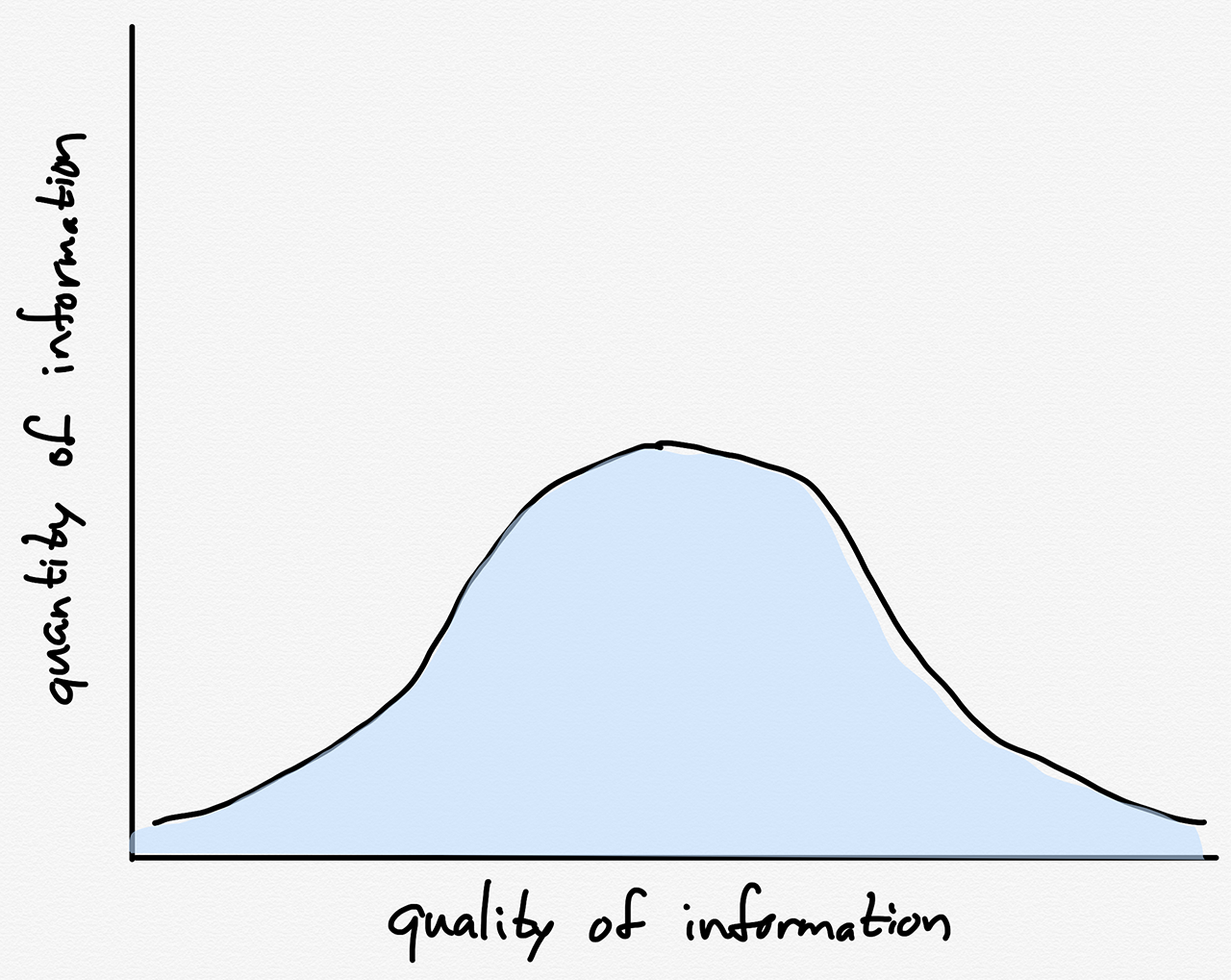
Before the Internet, the total amount of misinformation would be low in relative and absolute terms, because the total amount of information would be low:

After the Internet, though, the total amount of information is so much greater that even if the total amount of misinformation remains just as low relatively speaking, the absolute amount will be correspondingly greater:

It follows, then, that it is easier than ever to find bad information if you look hard enough, and helpfully, search engines are very efficient in doing just that. This makes it easy to write stories like this New York Times article on Sunday:
As the coronavirus has spread across the world, so too has misinformation about it, despite an aggressive effort by social media companies to prevent its dissemination. Facebook, Google and Twitter said they were removing misinformation about the coronavirus as fast as they could find it, and were working with the World Health Organization and other government organizations to ensure that people got accurate information.
But a search by The New York Times found dozens of videos, photographs and written posts on each of the social media platforms that appeared to have slipped through the cracks. The posts were not limited to English. Many were originally in languages ranging from Hindi and Urdu to Hebrew and Farsi, reflecting the trajectory of the virus as it has traveled around the world…The spread of false and malicious content about the coronavirus has been a stark reminder of the uphill battle fought by researchers and internet companies. Even when the companies are determined to protect the truth, they are often outgunned and outwitted by the internet’s liars and thieves. There is so much inaccurate information about the virus, the W.H.O. has said it was confronting a “infodemic.”
As I noted in the Daily Update on Monday:
The phrase “a search by The New York Times” is the tell here: the power of search in a world defined by the abundance of information is that you can find whatever it is you wish to; perhaps unsurprisingly, the New York Times wished to find misinformation on the major tech platforms, and even less surprisingly, it succeeded.
A far more interesting story, to my mind, is about the other side of that distribution. Sure, the implication of the Internet making everyone a publisher is that there is far more misinformation on an absolute basis, but that also suggests there is far more valuable information that was not previously available:

It is hard to think of a better example than the last two months and the spread of COVID-19. From January on there has been extensive information about SARS-CoV-2 and COVID-19 shared on Twitter in particular, including supporting blog posts, and links to medical papers published at astounding speed, often in defiance of traditional media. In addition multiple experts including epidemiologists and public health officials have been offering up their opinions directly.
Moreover, particularly in the last several weeks, that burgeoning network has been sounding the alarm about the crisis hitting the U.S. Indeed, it is only because of Twitter that we knew that the crisis had long since started (to return to the distribution illustration, in terms of impact the skew goes in the opposite direction of the volume).
The Seattle Flu Study Story
Perhaps the single most important piece of information about the COVID-19 crisis in the United States was this March 1 tweet thread from Trevor Bedford, a member of the Seattle Flu Study team:
The team at the @seattleflustudy have sequenced the genome the #COVID19 community case reported yesterday from Snohomish County, WA, and have posted the sequence publicly to https://t.co/tbVb4MAGpy. There are some enormous implications here. 1/9
— Trevor Bedford (@trvrb) March 1, 2020
This case, WA2, is on a branch in the evolutionary tree that descends directly from WA1, the first reported case in the USA sampled Jan 19, also from Snohomish County, viewable here: https://t.co/gxyo0PsJ7x 2/9 pic.twitter.com/LBH26A0AFC
— Trevor Bedford (@trvrb) March 1, 2020
This strongly suggests that there has been cryptic transmission in Washington State for the past 6 weeks. 3/9
— Trevor Bedford (@trvrb) March 1, 2020
I believe we're facing an already substantial outbreak in Washington State that was not detected until now due to narrow case definition requiring direct travel to China. 6/9
— Trevor Bedford (@trvrb) March 1, 2020
You can draw a direct line from this tweet thread to widespread social distancing, particularly on the West Coast: many companies are working from home, traveling has plummeted, conferences are being canceled. Yes, there should absolutely be more, but every little bit helps; information that came not from authority figures or gatekeepers but rather Twitter is absolutely going to save lives.
What is remarkable about these decisions, though, is that they were made in an absence of official data. The President has spent weeks downplaying the impending crisis, and the CDC and FDA have put handcuffs on state and private labs even as they have completely dropped the ball on test kits that would show what is surely a significant and rapidly growing number of cases. Incredibly, as this New York Times story documents, those handcuffs were quite explicitly applied to Bedford’s team:
[In late January] the Washington State Department of Health began discussions with the Seattle Flu Study already going on in the state. But there was a hitch: The flu project primarily used research laboratories, not clinical ones, and its coronavirus test was not approved by the Food and Drug Administration. And so the group was not certified to provide test results to anyone outside of their own investigators…
C.D.C. officials repeatedly said it would not be possible [to test for coronavirus]. “If you want to use your test as a screening tool, you would have to check with F.D.A.,” Gayle Langley, an officer at the C.D.C.’s National Center for Immunization and Respiratory Disease, wrote back in an email on Feb. 16. But the F.D.A. could not offer the approval because the lab was not certified as a clinical laboratory under regulations established by the Centers for Medicare & Medicaid Services, a process that could take months.
The Seattle Flu Study, led by Dr. Helen Y. Chu, finally decided to ignore the CDC:
On the other side of the country in Seattle, Dr. Chu and her flu study colleagues, unwilling to wait any longer, decided to begin running samples. A technician in the laboratory of Dr. Lea Starita who was testing samples soon got a hit…
“What we were allowed to do was to keep it to ourselves,” Dr. Chu said. “But what we felt like we needed to do was to tell public health.” They decided the right thing to do was to inform local health officials…
Later that day, the investigators and Seattle health officials gathered with representatives of the C.D.C. and the F.D.A. to discuss what happened. The message from the federal government was blunt. “What they said on that phone call very clearly was cease and desist to Helen Chu,” Dr. Lindquist remembered. “Stop testing.”
Still, the troubling finding reshaped how officials understood the outbreak. Seattle Flu Study scientists quickly sequenced the genome of the virus, finding a genetic variation also present in the country’s first coronavirus case.
And thus came Bedford’s tweetstorm, and the response from private companies and individuals that, while weeks later than it should have been, was still far earlier than it might have been in a world of gatekeepers.
The Internet and Individual Verification
The Internet, famously, grew out of a Department of Defense project called ARPANET; that was the network Cerf, Dalal, and Sunshine developed TCP for. Contrary to popular myth, though, the goal was not to build a communications network that could survive a nuclear attack, but something more prosaic: there were a limited number of high-powered computers available to researchers, and the Advanced Research Projects Agency (ARPA) wanted to make it easier to access them.
There is a reason that the nuclear war motive has stuck, though: for one, that was the motivation for the theoretical work around packet switching that became the TCP/IP protocol. Two is the fact that the Internet is in fact so resilient: despite the best efforts of gatekeepers, information of all types flows freely.1 Yes, that includes misinformation, but it also includes extremely valuable information as well; in the case of COVID-19 it will prove to have made a very bad problem slightly better.
This is not to say that the Internet means that everything is going to be ok, either in the world generally or the coronavirus crisis specifically. But once we get through this crisis, it will be worth keeping in mind the story of Twitter and the heroic Seattle Flu Study team: what stopped them from doing critical research was too much centralization of authority and bureaucratic decision-making; what ultimately made their research materially accelerate the response of individuals and companies all over the country was first their bravery and sense of duty, and secondly the fact that on the Internet anyone can publish anything.
To that end, instead of trying to fight the Internet — to try and build a castle and moat around information, with all of the impossible tradeoffs that result — how much more value might there be in embracing the deluge? All available evidence is that young people in particular are figuring out the importance of individual verification; for example, this study from the Reuters Institute at Oxford:
We didn’t find, in our interviews, quite the crisis of trust in the media that we often hear about among young people. There is a general disbelief at some of the politicised opinion thrown around, but there is also a lot of appreciation of the quality of some of the individuals’ favoured brands. Fake news itself is seen as more of a nuisance than a democratic meltdown, especially given that the perceived scale of the problem is relatively small compared with the public attention it seems to receive. Users therefore feel capable of taking these issues into their own hands.
A previous study by Reuters Institute also found that social media exposed more viewpoints relative to offline news consumption, and another study suggested that political polarization was greatest amongst older people who used the Internet the least.
Again, this is not to say that everything is fine, either in terms of the coronavirus in the short term or social media and unmediated information in the medium term. There is, though, reason for optimism, and a belief that things will get better, the more quickly we embrace the idea that fewer gatekeepers and more information means innovation and good ideas in proportion to the flood of misinformation which people who grew up with the Internet are already learning to ignore.
- China is an obvious exception; I addressed the contrast in the aforelinked “The Internet and the Third Estate”.
Map of all the trees and forests

EarthArtAustralia mapped all of the trees and forests in the United States, based on data from researchers Hansen et al. at the University of Maryland.
We’ve seen minimalist maps like this before, but the introduction of 90m digital elevation data provides another dimension:

Pretty.
This map, among many others, is also available in poster form.
Tags: trees
Why Coronavirus Looks Like a ‘Black Swan’ Moment for Higher Ed

I know, there's a gazillion articles on the impact of the pandemic. I won't be covring all of them. My interest is in learning technology, not pandemics. But I did want to link to this item, mostly because it says this: "when you look at how quickly colleges are moving to convert their face-to-face teaching into remote formats — the most immediate visible response — it seems clear that the reaction to this emerging national emergency will be more than a blip, even after the particular risks of Covid-19 have passed. I say this because once colleges develop the ability to serve their students via technology, there’s little reason for them to abandon it."
Web: [Direct Link] [This Post]Ben Thompson on Zero Trust Information
Sure, the implication of the Internet making everyone a publisher is that there is far more misinformation on an absolute basis, but that also suggests there is far more valuable information that was not previously available:
[visit post to see chart - gus]
It is hard to think of a better example than the last two months and the spread of COVID-19. From January on there has been extensive information about SARS-CoV-2 and COVID-19 shared on Twitter in particular, including supporting blog posts, and links to medical papers published at astounding speed. In addition multiple experts including epidemiologists and public health officials have been offering up their opinions directly.
Cursors on the iPad
Fantastic column by Jason Snell, writing for Macworld, on the rumor that Apple may bring a trackpad to the Smart Keyboard and update the iPadOS UI to support external pointing devices this year:
What makes the iPad great is its ultimate flexibility. When I write about iPad keyboards, people inevitably say: Why don’t you just use a MacBook, already?
But the iPad lets me tear off the keyboard when I’m not using it, and a MacBook doesn’t. I can use my same iPad Pro, and all the same apps, when my iPad Pro is completely naked, when it’s attached to a keyboard, when I have an Apple Pencil in my hand, and yes, even when I’ve got a Bluetooth mouse attached.
This is why I love the iPad so much. It’s everything I want it to be, when I want it to be that—and not when I don’t. Yes, there are definitely tasks my Mac is much better at performing, and in those cases using an iPad can be a compromise. But using a MacBook that can’t be transformed into a light touchscreen tablet is also a compromise. And unlike the current Windows experience, I don’t have to retreat into a weird faux-Mac interface to get real work done.
As I’ve argued many times before, the iPad’s greatest strength is its ability to transform into different types of computer depending on what you need. Here’s how I concluded my Beyond the Tablet story last year:
At a fundamental level, after seven years of daily iPad usage, I believe in the idea of a computer that can transform into different form factors. The iPad is such a device: it gives me the freedom to use it as a tablet with 4G while getting some lightweight work done at the beach, but it becomes a laptop when paired with a keyboard, and it turns into a workstation when hooked up to an external display, a USB keyboard, and a good pair of headphones. For me, the iPad is the ultimate expression of the modern portable computer: a one-of-a-kind device that morphs and scales along with my habits, needs, and lifestyle choices.
A few years ago, I described the iPad as a “liberating” experience that married power to portability and allowed me to work from anywhere. I stand by that concept, but I’ll revise it for 2019: the iPad is a liberating device that transcends its form factor. Its range of configurations, combined with a new generation of powerful iOS apps, delivers a flexible experience that eludes classification.
Adding a trackpad and native support for external pointing devices to UIKit wouldn’t turn the iPad into a laptop: it would just add to the list of potential, optional configurations for the device. That’s been true for a while with other accessories; I don’t see why mice and trackpads shouldn’t be next.
→ Source: macworld.com
Adding insult to injury, the OECD advice to girls: “if you want to be successful, be a good boy!”
Monday March 9, as part of March on Gender – FAST FORWARD TO GENDER EQUITY, Andreas Schleicher1 presented the results of OECD studies related to gender equity (link to video recording). What the studies clearly elicit is the fact that girls on almost all accounts score better than boys, whether in terms of creativity, willingness to cooperate, literacy, sciences etc. In short, take at random a cognitive, social or emotional skill and you have over 90% chances to be right if you bet that, in the same age range, girls outperform boys.
Yet, there is a gender gap…
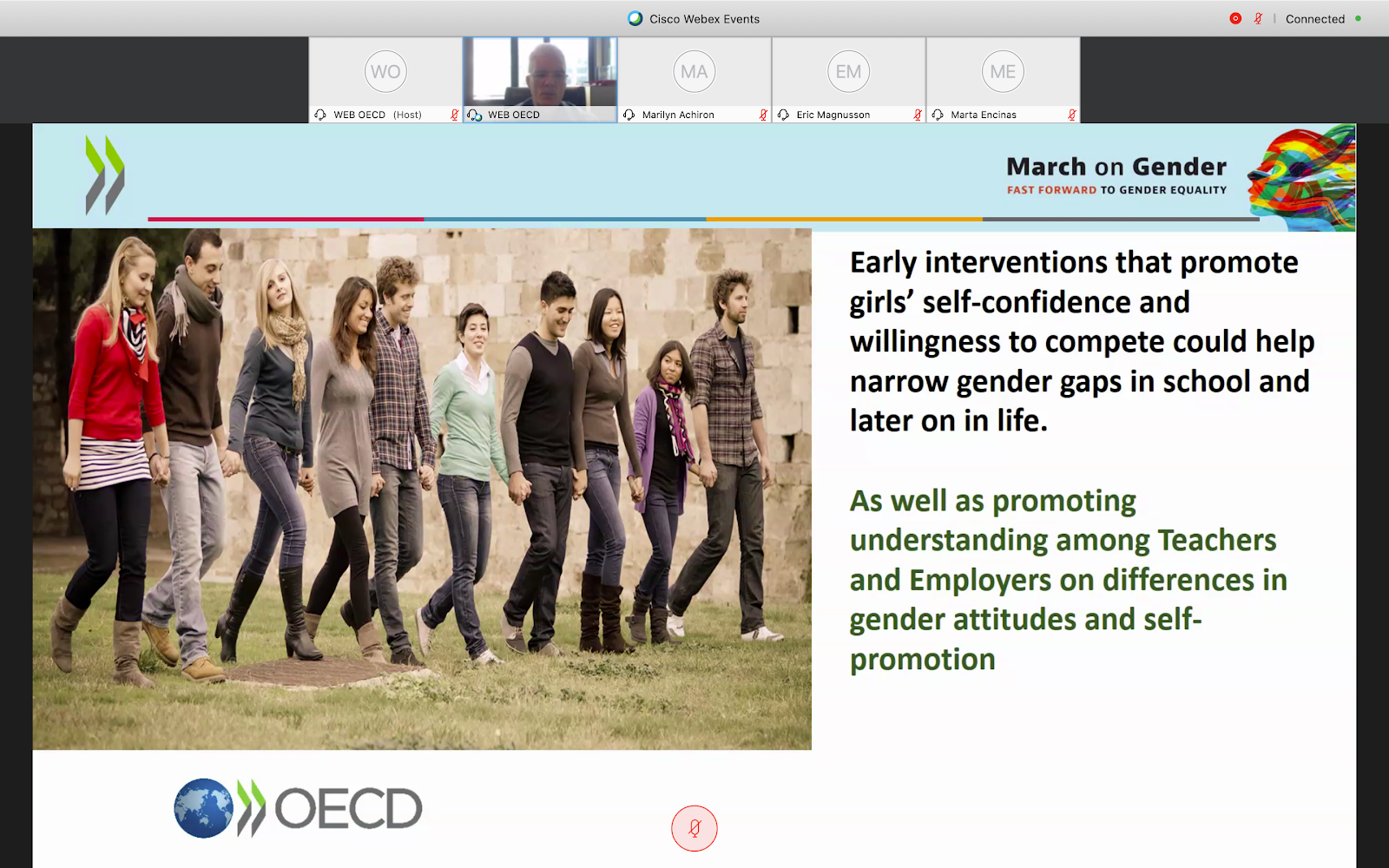
While the OECD has recommendations to address the gender equity gaps, they are solely related to girls, not boys, stopping short of putting the blame on girls: “promote girl’s self-confidence and willingness to compete.”
While Freud saw “penis envy” as the source of neurosis and an insurmountable obstacle to psychological cure (it’s funny that he never considered “beard envy” as another source of neurosis!), the OECD sees the source of gender inequity in girl’s lack of interest in being competitive:
- Freud: girl = boy – penis => neurotic women
- OECD: girl = boy + (better at many things) – competitive => gender inequity
If girls show little interest in competing, this might be inferred from their superior cognitive, social and emotional abilities, said otherwise girls might be too smart to have the desire to engage in an activity as primitive as competition.

.jpg)
Despite the fact that girls score better than boys on many different fronts, and that the “deficit” is clearly on the boys side, it is a tiny weenie difference (no pun intended) that has the strongest consequences on gender inequity. If the willingness to compete was really related to having a willie, that might be an invitation to a whole new range of “early interventions”!
What the OECD doesn’t seem ready to take into consideration is that their metrics might be flawed, that celebrating “competition” might be the main source of gender inequity.
Competition means that there are winners and losers, at the extreme, the competitor can be regarded as an enemy. Taking risks conveys a completely different set of values, attitudes and skills that are somewhat at odds with competition. Of course, competition might imply some risk taking, but it also implies that there will be losers, and it is not for the “winner” to take care of them, but themselves or society. Who ever thought asking the winner of a competition: “by the way, have you thought of the consequences for those who didn’t win?” Who cares? What a party pooper!
Things are very different with risk taking: don’t injure yourself, don’t injure others, what will happen if? Competition is an invitation to care for yourself and imagine how to eliminate others, risk taking is an invitation to think of yourself in relation to others, it requires cooperation. And guess what? Girls score much better at cooperation than boys. Of course, there are also selfish ways to take risks, but it doesn’t automatically imply that there will be losers. Competition thrives on fabricating losers.
Skills do not exist in a void, but within an environment at their image. A competitive environment values competitive skills which in return shape that environment to be fit for competition. But is an environment fostering competition the best one to encourage authentic risk taking? Think a second: what would be the difference between a world where everybody is encouraged to take risks and one where everybody is invited to compete with everybody else (alone or in teams, that doesn’t make a difference)? Which one would have the most chance to develop in an inclusive and sustainable way?
The competition tropism dominating certain circles might be late manifestation of the remnants of ill-digested Darwin readings firing the wrong group of neurones in one’s reptilian brain. If we exist as human it is more likely the outcome of some sea creature risking itself out of the sea, rather than arriving first on the finish line!
I’m sure that nobody at the OECD would dare suggest in response to the violence done to women that the solution might be “early interventions that promote self-confidence and the willingness to practice martial arts”. Or to grow beards! So, going back to the title of that post, of course, the OECD never wrote anything as explicit as “if you want to be a successful girl, be a good boy!”, but isn’t it what can be construed from “promote girl’s self-confidence and willingness to compete” as the means to “narrow gender gaps”?
—-
PS1: I am currently involved in BRIDGES (Broadening Recognition Initiatives to Develop Gender Equity in Science) a European project addressing gender inequity. We are just starting, so every suggestion and contribution is welcome.
PS2: It is no wonder that public blockchains (Ethereum, Bitcoin) work so well in a competitive world as they have been designed to work best in a world where everybody is at war with everybody.
What's in a Database Table Name?
I asked on Twitter about naming database tables. It goes without saying that Twitter polls are extremely scientific and a trustworthy tool for decision making.
[Poll] Are database table names supposed to be singular or plural?
— Dave Rupert (@davatron5000) March 10, 2020
I fall firmly into the plural camp, but the other day I was setting up a many-to-many relationship in Hasura and was struggling with the documentation, even though I’ve made plenty of join tables in the past. After leaving work, still thinking about it, it dawned on me that all their documentation had singular table names. I couldn’t believe it. “Surely, this is illegal?” I thought.
Then I started checking my own assumptions. It’s not likely, but maybe I am the one who’s wrong here…
I’m fairly certain that I picked this behavior up from using Rails and CakePHP from forever ago. Those frameworks and their conventions enforce plural table names. Somewhere along the way I convinced myself that this is the “correct” way to do it. It makes sense that a table of multiple Article objects would be called articles. It even reads well if you look at the SQL…
SELECT * FROM articles WHERE...
If you work with databases long enough you hit some edges of this dogma. Mass nouns like “evidence” or “research” don’t pluralize well and chip away at your perfect cathedral. Singular table names have an advantage here for sure.
Taking it a step further, Dhimas Widrayato makes a great observation that entire premise of my question is rather Anglo-centric…
In my language, plural words are just the singular version writen twice with hypen in between.
— Dhimas Widrayato (@dhimasbu) March 11, 2020
So when creating database table in my language, I always use singular. https://t.co/sCdRjvaEbj
Languages like Japanese, Malaysian, Javanese, and Indonesian repeat the noun to make it plural. For Dhimas and millions of others, repeating a noun for a database table name would be a superficial improvement…
…and so is maybe an s…
…or es…
…or changing us to i…
…or suffixing mass nouns with _items.
Let’s be honest, English is a hot mess.
I don’t know if I’m converted to the singular camp, but this whole episode did challenge my preconceived notions. That’s fun. For this project, I think I’m going to try singular and see if I hate it. It probably will matter 1% in the long run.
Don’t Ruin College by Making It Free

One way you can tell that the rich are lobbying against government providing free *anything* is that they complain that the benefit will be given to rich people as well as poor people. They also complain that the quality will in some way be reduced, often by the recipients themselves. They complain public funding will "stifle innovation" and "distort the market". And, of course, it will always cost too much (there's usually a zero-sum argument about how the money could be used to fund some other subsidy for the people). All of these argument tropes are found in this article. And you can tell the article comes from a rich-person perspective because poor people who don't have access to these services raise none of these objections. Generally other people don't get a platform to make their case at all, ever. But when they do get a platform, their concerns are about access, removing barriers, support systems, and how the service can help them get ahead.
Web: [Direct Link] [This Post]OMD :: Surface Pro X, iPhone 11 Pro, Marshall Monitor A.N.C.

I love a clean desk. And I love to use great tools. These are currently my favorite three items:
- Surface Pro X, the ARM-powered Surface Pro, is a joy to use. Always quiet since it has no fans, yet powerful enough for my workloads, running all day on a single chart. Needs keyboard and pen. I still have a few questions open with Microsoft regarding software support.
- iPhone 11 Pro. This is just plain wonderful. Great camera, perfect size, dependable. And surprisingly tough. I dropped it a few times without a case and nary a scratch. Living dangerously here.
- Marshall Monitor II A.N.C. - this will be coming out shortly. I am using one of the test kits and I am loving it even more than the original Monitor Bluetooth. Crisp sound, great UX with a single control knob and two buttons to call Siri and control ANC. And this A.N.C. works much better than I expected.
In the background an unused iMac, a much used HomePod and Eve Room checking on the air at my desk.
Wait for these MacBooks
Apple plans to release new MacBook Pro and MacBook Air models with scissor keyboards in the second quarter of 2020, according to a new research note today from analyst Ming-Chi Kuo, obtained by MacRumors.
Kuo did not comment on the size of the new MacBook Pro, but he is presumably referring to the 14-inch model that he has previously mentioned given that the 16-inch MacBook Pro was only released four months ago.
This would be the end of a five year dry spell where you really could not recommend buying a laptop from Apple.
Narrative debt
HBO’s Watchmen is fantastic, as many have noted. It may be one of the most polished first drafts of fan fiction to ever appear on the silver, errr, OLED screen.

DC may lag behind the Marvel Universe in box office and audience acclaim, but it feels like DC is starting to find its footing with a different approach. Rather than having its directors conform to the ultimate vision of Kevin Feige, as Marvel does, DC seems to be allowing its directors a bit more creative freedom to put their own spin on various characters and franchises. Whether you liked The Joker or not, it was a very Todd Phillips-esque take, and it’s not even meant to be part of the rest of the DC Universe. It’s a stand-alone vision of The Joker.
The trailer for Birds of Prey, for example, feels like an attempt to take Margot Robbie’s Harley Quinn and create a new franchise around that character. The Joker in Suicide Squad, and thus the one that’s implied to be in that branch of the DC Universe, isn’t the same one as in the Phillips’ Joker film. But Birds of Prey director Cathy Yan has stated that they removed the Jared Leto Joker character from their film so they could distance (read: quarantine) themselves from that failed film, creating yet another distinct franchise within the DC universe. Not for nothing is the parenthetical in the title "The Fantabulous Emancipation of One Harley Quinn."After Birds of Prey came out, I saw it. Sad to say I didn't love it, but the critical and fan reception in my network was reasonably positive. Whereas all the Marvel films exist in a single comic universe, DC seems to be sprouting all sorts of independent branches. Perhaps we should think of the DC Universe as the MCU but with social distancing.
Watchmen capitalizes on this creative freedom. Alan Moore, the writer of the original Watchmen graphic novel, isn’t involved. I’m not sure if he would have given his blessing to Lindelof’s revisions to Watchmen loreHahahahaha let's be real he would've never given his blessing., but it wouldn’t have mattered. HBO and Warner Bros. and the DC folks gave Lindelof free rein to fork the Watchmen mythology for this new series.
Lindelof’s public breakthrough was as co-creator of Lost. To this day, it remains one of my favorite examples of what I call narrative debt. That is, when you’re building out a story, you tease plot lines and characters and conflicts that you have to resolve at a later point in the script.
You accumulate narrative debt. The implicit promise to the audience, the debt holders, is that you’ll pay out the disbelief they've suspended on your behalf.
For a whole variety of reasons, Lost was saddled with so much narrative debt that at some point it was effectively insolvent. Pair that with an obsessive fan base poring over every frame for clues like auditors examining the narrative balance sheet and you had a recipe for a write-down of WeWork proportions. The showrunners couldn’t declare narrative bankruptcy as the show’s ratings were still solid, but they tried to prepare the fans for disappointment via public statements. Ultimately, they whipsawed fans through a series of dramatic story pivots until they were forced to crash land the story in the finale in a way that took the story full circle. The viewers at the end were like Jack and the other survivors on that beach in the series premiere, dazed and bloodied, wondering what the hell had happened.
Chekhov’s gun is the most famous instantiation of the principle of conservation of narrative. Some people want the ledger of stories to balance perfectly. Every first act gun must go off in act three. All non-essential plot elements should be dropped. Not surprisingly, Chekhov was a master of the short story, a form which demands concision.
I’m less of a stickler for obsessively manicured stories than some, though I can nitpick plot structure with the worst of those YouTube critics. I tend to do so only if a film or show is marketed as having been assembled with the delicacy of an expensive wristwatch (Watchmen reference!). There is a certain elegance to a plot in which every last element connects, but as the years go by I find that type of clinical precision can leave a show or film feeling a bit stifled and lifeless.In the original Watchmen, Adrian Veidt can be thought of as a director trying to pull off a massive fork of the global narrative. A la Fincher's The Game, he does it in the real world. Of course, his is a Shyamalan-like effort that hinges entirely on a last minute plot twist, and as we've seen from Shyamalan's later works, often the narrative debt load is too heavy to recover from.
Lindelof seems to be at his best riffing off of something less open-ended. The confines of an existing piece of intellectual property seem to provide guardrails within which his creative forks seem to flourish. The Leftovers had Tom Perrotta’s novel to establish the inciting incident, and he and Lindelof expanded that into one of my favorite television shows, a moving meditation on how humans grapple with loss and grief and faith.
Watchmen from HBO has Moore’s classic graphic novel as a narrative precedent, but Lindelof has remixed it as a story about white supremacy and the racial sin at the heart of America’s origin.
I often think of TikTok as a logical modern outgrowth of remix and sampling culture, but the television world conjuring a remix of Watchmen is one of the most pleasant surprises of 2019.
As large media conglomerates focus more and more on franchises, I’d love to see some of the more progressive leaders at those companies contemplate whether a limited open source strategy on their premium intellectual properties might not be the most defensible, modern approach.
Over a decade ago, Marc Andreessen defined a platform as “a system that can be reprogrammed and therefore customized by outside developers -- users -- and in that way, adapted to countless needs and niches that the platform’s original developers could not have possibly contemplated, much less had time to accommodate.”
Even longer ago, in 1986, Alan Moore and Dave Gibbons released a twelve-issue comic book series titled Watchmen. Decades later, an outside writer named Damon Lindelof read a piece titled “The Case for Reparations” by Ta-Nehisi Coates in the Atlantic and learned about the Tulsa, Oklahoma massacre of 1921, remixed it with Moore and Gibbon’s original creation Watchmen, and produced an unexpected new take on the franchise which I don’t think anyone saw coming when the series was first announced.
Watchmen is a platform.
The Uncanny Valley of Interactivity
I believe mass entertainment suffers from a bit of format rigidity due to the natural inertia from structural ossification in the music, film, and publishing businesses, to name the most prominent.
One of the ways this manifests is in the one-way broadcast nature of much of our entertainment despite the fact that several billion people own internet-connected smartphones now, and even though they consume an increasingly large share of that entertainment on such devices equipped with all sorts of input options and sensors.
Whenever I say this, however, people seem to want to leap to choose-your-own-adventure storytelling, and the most cited example is Netflix’s Bandersnatch. In its earnings report for 2018, Netflix famously declared “We compete with (and lose to) Fortnite more than HBO.” I happen to agree with them that the threat of gaming looms larger than any other in the future, and it’s not surprising to me that they’ve spun up a group to experiment with interactive stories like Bandersnatch and Bear Grylls’ You vs. Wild.
However, stories like Bandersnatch fall into an uncanny valley of interactivity. That is, compared to regular movies, they repeatedly force you to do a bit of annoying work that breaks the suspension of disbelief and the flow of the story: the first choice you’re offered in Bandersnatch is to choose which cereal to eat for breakfast. If you’re in the mindset for lean-back entertainment, you can let the story choose an answer for you on its own after some amount of time, but the distracting question prompt is still displayed on the screen.
On the other hand, if you want real interactivity, something like Bandersnatch feels like a busted low-res knockoff of the continuous interactivity of video games, a step function compared to the smooth curves of video game calculus. Why play a game with such crude branching when so many great games, many of them multiplayer and synchronous, offer a truly unpredictable and immersive form of user controllable storytelling?
This doesn’t mean I don’t enjoy branching stories in concept. One of my favorite movie and television genres is what I refer to as the recursive escape room genre.
You’re likely familiar with it from its most famous examples. Groundhog Day (in fact TVTropes refers to this genre as the Groundhog Day Loop). Edge of Tomorrow. Russian Doll. A Christmas Carol.

“Phil, maybe we should just Google a playthrough video on YouTube.”
In these stories, the protagonist keeps reliving the same set of events in what feels like an endless loop in time. As they realize their conundrum, they start to experiment and iterate until they eventually come to an epiphany as to why they’re trapped. Then, and only then, can they break out of the loop.
In a way, these are the film version of a really popular form of YouTube video: the video game playthrough.
Watching these films reminds me of how I’d read Choose Your Own Adventure books as a child. Every time I came to a choice in the story, I’d dog-ear that page, then eventually revisit it to take the other path, until I’d read every possible branch of the story. However, works like Groundhog Day reduce the effort required of the viewer by simply playing all the branches in a linear fashion, offering both a lean-back viewing experience and the sensation of narrative progression as the protagonist moves closer and closer to breaking out of the loop. Bandersnatch offers the ability to jump back to any decision you made previously and change it through a sort of decision history carousel, but that still requires work on the part of the viewer.

I feel like the author of “You Are A Shark” didn’t really have his heart in it
The appeal of recursive escape room movies and TV shows, I theorize, lies in its echo of something many people feel, that they are trapped in some runaway routine in their lives. Wake up, go to work, come home, scrounge up dinner, unwind a bit, then back at it the next day. These recursive escape room stories offer up the possibility that we can puzzle our way out of these Moebius prisons which keep depositing us back to the same starting point. Maybe if I stop eating carbs. Or meditate in the morning instead of checking social media. Or start working out before the morning commute. Maybe if I’m more assertive and ask for a raise, or a promotion, which I richly deserve. With every test, I close off one branch but converge a little more on a solution.
I’d guess that the easiest way to predict how any person’s day will go is to look at the previous day. It’s quite plausible that most lived days on Earth feel like a barely modified replay of the previous day. We all run, for the most part, a standard script of life routines.
The appeal of self-help gurus and podcasts about the habits of successful people is that they resemble those escape room chaperones who offer occasional hints to groups who get stuck on one particular puzzle. These secrets to success from modern gurus feel like video game tips for specific levels, except for real life. Sleep more. Eat keto. Lift weights. Delete social media apps. Walk 10,000 steps a day.
That sense of progressive mastery is a hell of a drug. That’s why, while I’m bearish on choose-your-own-adventure films like Bandersnatch, I’m bullish on the right types of light interactivity when it makes sense. If you were designing a game show today, for example, it would likely look much more like HQTrivia (RIP) than, say, Wheel of Fortune.
Gamification Someone, I can't remember who, recently described golf as the gamification of walking, and I'll never be able to shake that from my mind.has gotten a bit of a bad rap in recent years, and some of the implementations out of Silicon Valley can feel scammy, to be sure. Still, when I look at the progressive mastery tactics of something like Candy Crush, I can’t help but find them more fun and effective, in some ways, than the Suzuki method of teaching violin playing, or Mr. Miyagi’s “wax on, wax off” school of teaching Daniel Larusso karate.
The more I read about the power of habit in human behavior, the more I think of self-help genre as a series of macros one downloads to try to upgrade one's day-to-day regimen. Pair that with the educational power of failure and I've come think of recursive escape room stories as a way to accelerate the improvement of our life productivity.
Veblen values
NOTE: I'm going to start cross-posting individual stories sent out in my newsletter over here on my blog. The versions here may contain additional side notes, and often as I bring them over I'll do some light word-smithing or additional copy-editing because I can never stop editing my own copy. If you want to be the first to read things I publish, your best bet is to sign up for my newsletter, but if you're more about reading the most finished form of what I write, it will always be here.
In economics, a Veblen good is one for whom demand increases as the price increases. Luxury goods like Birkin bags are often cited as examples of these exceptional goods that violate the conventional relationship between price and demand.
Social media has created what I think of as Veblen values. That is, values we tend to clutch more tightly and defend more vigorously the more expensive they are to hold.
This isn’t odd in itself; we tend to think of those values we pay for dearly as among the most precious we hold. Freedom. Equality. And so on.
However, social media has opened an exploit on this concept. Others can cause us to rate some values more highly than we might otherwise just by raising the cost to us of holding them.
A troll might mock you as a snowflake on social media for something you posted, and the next thing you know you’re in an online back alley engaged in a knife fight to defend a view that, before the fracas, you cared about but not that passionately.
Perhaps trolling is just a condition in which there are asymmetric emotional costs to engaging in a debate. Since it’s relatively cheap for a troll to push buttons while the emotional cost to the one whose buttons are pushed is high, the incentive and all the positive optionality is in favor of the attacker.
Sometimes these are values we do hold dearly. The trick, then, is to match your emotional energy expenditures to the strength of your values prior to factoring in the costs from all the trolls attacking you for it. Easier said than done, especially in the West where major social networks have tended to be fairly lax in moderation, and where, not surprisingly, many describe time online as exhausting and precarious. Part of this is the performative structure of social media, as I’ve written about before, but some of it is just the emotional attrition of endless border skirmishes.
As with email, I recommend applying aggressive personal spam filters on social media. That saying that one should “feed a cold, starve a fever”? There’s a reason we say “don’t feed the trolls.” One person's filter bubble is another person's emotional quarantine.
E-Learning Response to Covid19
Are you creating an online course, event or conference? If you’re not a programmer, and if you don’t have a lot of money to spend, this guide will get you started.
See also on [This Post]51,821 spam comments
CleanTalk, the comment spam filtering service that I use to allow me to reasonably maintain the ability to accept comments here, reports that in the last week it filtered 51,821 spam comments and allowed 12 legitimate ones.
Most of the spam comments were SQL injection attempts from hosts in the Russian Federation and Germany.
While CleanTalk is doing an excellent job at filtering–it let through exactly zero spam and filtered out exactly zero ham–it’s exhausting to consider the amount of the Internet’s capacity that is taken up with attempts to undermine it.
Gnarbox Review: Exceptionally Versatile Portable Storage for iPhones, iPads, and the Mac

The Gnarbox 2.0 is ruggedized, portable SSD storage designed with photographers and videographers in mind. I’ve tried lots of different portable storage solutions in the past, and what distinguishes the Gnarbox is its ability to operate as a standalone device and as an accessory to a computing device. The mix of fast, rugged storage, an onboard operating system, wired and wireless connectivity, and complimentary software isn’t cheap. The entry-level Gnarbox is $499. However, the Gnarbox offers both the peace of mind of in-the-field backups and image and video pre-processing, making it a compelling choice for anyone who captures lots of photos and video while away from their main computing device.
Versatility and reliability are what you’re buying when you get a Gnarbox. I’ve tried other WiFi-enabled backup solutions, including Western Digital’s My Passport Wireless SSD, but in the weeks that I’ve been using a 256GB Gnarbox 2.0 that the company sent for testing, I’ve found that it’s built better, is more capable, and is easier to use than any other portable storage I’ve tried.
Hardware

To understand the flexibility of the Gnarbox, which comes in 256GB, 512GB, and 1TB capacities, it’s best to start with the hardware because this device is more than just a fast, external SSD. The Gnarbox is its own little computer complete with Intel CPU and GPU, WiFi networking, a removable, rechargeable battery, and several ports all in a package that fits comfortably in one hand.
The Gnarbox is very close to the footprint of an iPhone 11 Pro Max but thicker at 6 x 3 x 1.16 inches. The device weighs in at .8 pounds (375g), which is a little chunky compared to some portable storage solutions, though understandable given the rechargeable battery and ruggedized casing.

The Gnarbox is splash and dust resistant. Source: gnarbox.com.
The Gnarbox features an Intel Quad-Core, 2.40GHz CPU with a 4-core Intel HD Graphics GPU. There is 4GB of RAM on board and support for 802.11ac WiFi too. The Gnarbox can also be connected to a router directly using a USB-C to Ethernet adapter and Ethernet cable for the fastest possible network transfers.

Micro HDMI for external monitors (left), an SD card slot (center), and a USB-C port for connecting other storage for backup (right).
The device has two USB-C ports, one SD card reader, and one Micro HDMI port, which are protected by covers that prevent water and dust from getting inside thanks to rubber gaskets covering each bank of ports. Likewise, the exterior of the drive is rubber-encased aluminum designed to protect against drops.
Gnarbox says its SD card reader can transfer data at 75MB/sec. Over USB-C, transfers are rated at 350MB/sec. Gnarbox also sells accessory readers that connect to the Gnarbox via USB-C and combine SD and microSD card slots with an XQD, CFast 2.0, or CF card slot.

The Gnarbox’s 3000 mAh battery is removable and hot-swappable if the device is connected to a power source.
On the back of the device is a removable 3000 mAh removable battery that charges via a 35W charger included in the box and can be hot-swapped if the Gnarbox is connected to a power source. Gnarbox rates the battery life at 3-5 hours, which I didn’t scientifically test, but it feels about right based on my use. Extra batteries and a dual-battery charger are available separately.

The Gnarbox has an excellent, bright display. Source: gnarbox.com.
Of all the hardware features, though, the one that makes the Gnarbox easier to use than other solutions I’ve tried is its tiny black and white display and navigation buttons. The screen is a bright, high-contrast OLED display that only shows a few lines of text at once, but it’s just enough to make starting backups and changing settings easy.
Below the screen are four navigation buttons marked by subtle raised rubber dimples. Each button requires a firm press, and turning on the device requires a solid second of continual pressure, both of which are excellent touches that prevent the Gnarbox from being turned on by accident, which would drain its battery needlessly or change settings inadvertently. Along with the display, it’s a simple system, but the combination of tactile feedback and limited onboard menu options make the Gnarbox a pleasure to use on the go.
Backups
What’s just as impressive as the Gnarbox’s hardware, though, is what you can accomplish with it. The mix of components built into the device allow the Gnarbox to pull off a split personality elegantly. Used by itself, the device provides a simple, fast backup workflow. Later, paired wirelessly or over a wired connection with an iOS device or Mac, the Gnarbox helps photographers and videographers prep their images and videos for processing in other apps, manage their data, and upload files to Dropbox.

Pop in an SD card, press one button, and your backup begins. Source: gnarbox.com.
Backing up an SD card in the field is simple. As soon as you insert a card, the Gnarbox mounts it and opens a backup UI. With a single button press, the backup starts, displaying a progress bar as it backs up your card. The speed depends on the class of SD card you use, but I’ve been very pleased using a SanDisk Extreme Pro card. When the backup is completed, simply pick the Eject menu option to eject the card. However, if you’re backing up microSD cards, you’ll need the adapter included with the Gnarbox or another microSD card reader to back up.
The Gnarbox includes several backup settings that you can manage on the device or using the Safekeep app:
- MD5 Checksum for validating the integrity of the files copied during backup
- Smart Backup, which saves time by only making backups of new images or videos since your last backup
- Flatten Folders, which ignores the folder structure created by most cameras
- Folder By Extension, which reorganizes backed-up files by the file-type
In my testing, I turned on all four settings. Although the MD5 checksum takes a little extra time, it’s much faster than the file transfer and worth the peace of mind that comes with knowing that the data transferred is sound. I also appreciate Smart Backup because it makes subsequent backups faster and avoids duplicates. I like the Flatten Folders and Folder By Extension settings a lot too. Together, they organize files in a way that’s easier to navigate from an iOS device or my Mac than if I simply connected my SD card.

The Gnarbox displays the progress of your backup on-device. Source: gnarbox.com.
In addition to backing up SD cards to the Gnarbox itself, you can connect external storage to the Gnarbox’s USB-C port and back up an SD card to two locations simultaneously, saving time and creating an extra redundant copy. The Gnarbox allows full access to an external drive’s contents in its Safekeep app, which enables you to manage its data on an iOS or iPadOS device.
Although I’ve primarily focused on backing up SD cards to the Gnarbox, you can connect and browse a wide variety of storage to the left side of the Gnarbox and back it up on the device itself along with any additional storage connected to the USB-C port on its right side. Using the Twelve South StayGo hub connected to the USB-C port on the left side of the Gnarbox, plus its built-in SD card reader, I was able to connect a battery-powered SSD, two SD cards, and a microSD card to the Gnarbox for backing up to it plus a Samsung T5 portable SSD. That’s not something most people are apt to do, but it’s nice to know that if you have a USB-C hub and multiple SD and microSD cards from a long day of shooting video and photos, you can connect everything at once and back it up redundantly and quickly.
It’s also worth noting that the Gnarbox has two different wireless connectivity modes: Field Mode and Home Mode. Field Mode is intended for those times when you want to connect an iOS or iPadOS device to the Gnarbox, but you don’t have a WiFi connection. The Gnarbox creates its own local WiFi network to which you can connect with an iPhone or iPad, allowing access to the files backed up on the Gnarbox using its apps.

Creating a redundant backup by attaching an SSD to the Gnarbox and browsing the contents of both drives in Safekeep.
Home Mode allows the Gnarbox to connect to the Internet when a WiFi network is available. Among other things, this enables the Gnarbox to upload files backed up to it to Dropbox. Operating in Home mode also allows you full access to the Internet over WiFi, while Field mode monopolizes your WiFi connection. As a result, you’ll only be able to connect to the Internet in Field mode if the iOS or iPadOS device you’re using has a mobile data plan too.
There are two ways to connect a Gnarbox to an iPad or a Mac using a USB-C cable or, in the case of an iPhone, a Lightning to USB-A adapter and USB-A to USB-C cable. The first is USB Mass Storage mode, in which the Gnarbox behaves like any other connected external drive. It’s worth noting that I’ve tried a lot of external drives with iOS and iPadOS devices, and the Gnarbox is one of the few portable drives I’ve tried that works without an external source of power thanks to its built-in battery.
For faster transfers, the Gnarbox also supports a USB-Ethernet mode. You can put the Gnarbox in this mode from its onboard menu system. The files on the Gnarbox show up in the Files app under the Safekeep file provider and can be accessed from that app or any other app that has access to file providers, such as Adobe Lightroom or Affinity Photo. The main disadvantage to USB-Ethernet mode is that it’s a network connection, so your iPhone or iPad cannot use WiFi at the same time.
The Safekeep and Selects Apps

Safekeep allows you to browse your Gnarbox’s folders.
Switching between Field and Home mode is accomplished in the Settings tab of either of the Gnarbox’s iOS and iPadOS apps, which are called Safekeep and Selects. Once your device is connected to the Gnarbox’s local WiFi network, the Settings tab’s Connection Manager in both apps can walk you through the process of switching between modes.
The Safekeep app does more than manage the Gnarbox’s network connection and settings, though. It’s also the primary browser of the device’s file system. The Gnarbox’s tiny onboard OLED screen is text only and doesn’t provide a UI for navigating its folder hierarchy, so to view the photos and video backed up to it, you need another computing device.

Browsing images in Safekeep.
Safekeep works well enough for what it does, but overall it’s far less integrated with iOS and iPadOS than an app like it should be. Still, the app performs as promised, handling most of the file browsing and management tasks people need, including moving among nested folders and performing file actions like copying, moving, and deleting files. Video can be transcoded as MP4 720 proxy or ProRes 422 video using the device’s built-in GPU and previewed on an external monitor using the Gnarbox’s Micro HDMI port too.
However, there’s no way to move a file from inside Safekeep to anywhere other than to your photo library, which is disappointing. Also, although Safekeep is a file provider that shows up in the Files app, that functionality appears to be broken when the app is connected to the Gnarbox wirelessly.

I’m not a fan of Safekeep’s custom context menus for managing files.
There are other things missing from Safekeep that I’d like to see added too. There is no context menu support. Instead, the app makes heavy use of ellipsis menu buttons that activate custom menus of actions that can be taken on folders and files. It works well enough, but I’d prefer system context menus, and I’m concerned that Safekeep could be left behind if rumors of extensive keyboard support in iOS 14 are true. Safekeep doesn’t support Split View or drag and drop either.
Safekeep also supports Dropbox. After you’ve authorized with Dropbox, you can move or copy files into a dedicated Dropbox folder on your Gnarbox. Uploads aren’t automatic, however. They have to be initiated in Safekeep, which copies them to a Gnarbox folder in Dropbox. The status of your upload and other file management activities can be monitored from the Tasks UI that’s accessed from the three-bar icon in the top right corner of the main file browser and reports the status of all file operations.

Selects allows you to open multiple images for previewing, rating and tagging.
The other app offered by Gnarbox is Selects, which allows you to add star ratings and tags to images that will appear in supported apps like Adobe Lightroom. It’s a nice way to help organize your photos and video before you get back to a computer to further edit and process them. Presumably to cut down on battery drain, video previews simply show a series of frames unless you select the Stream button, in which case the video loads from the Gnarbox and begins streaming.
The process for rating and tagging images is a little unusual. The main browser interface of the app is similar to Safekeep. You can drill down into the folder structure to preview an image or video full-screen, but there’s no way to rate or tag it from the preview. Instead, you need to tap the ‘Select’ button at the top of the list view of images, select the images you want to rate and tag, and tap ‘Open Workspace,’ which opens a new modal UI for rating and tagging. It’s not what I expected when I first used Selects, and it doesn’t support iOS 13’s two-finger swipe selection gesture. The process isn’t particularly difficult, but it just takes some getting used to because it’s a strange approach to editing images.
I’m not a pro photographer, but on occasion I do find myself wanting to offload photos and videos from an SD card for safekeeping. The ability to do so quickly without using an iPhone and Lightning to SD card reader or a USB-C card reader with my iPad is fantastic. Add to that the ability to do a checksum of the data copied with a device that’s built to get knocked around and the Gnarbox provides peace of mind that’s superior to other solutions.
The Gnarbox has other applications too. One that immediately jumped to mind is in an iPad podcasting setup like Federico’s, where his local track is recorded to an SD card using a Zoom H6 recorder. That setup requires Federico to copy his local audio file to Dropbox where it’s available to whomever is doing the audio editing.
Following the file copy process but with the Gnarbox and a secondary SSD is no more difficult than copying the same file to Dropbox using a standard SD card reader, but it has the benefit of creating a second, redundant backup copy of the file and can perform a checksum to ensure the integrity of the file that is copied. I wouldn’t spend $500 or more on a Gnarbox just to back up audio files occasionally, but it’s the sort of added benefit that people who are also photographers or videographers might appreciate and demonstrates uses of the device beyond the photography world.
Like many hardware vendors’ apps, Gnarbox’s apps could be better. The apps are reliable and add functionality to the device that I appreciate, but Safekeep’s lack of full Files integration and other iPadOS features is disappointing, and Selects’ functionality is useful but limited. All in all, the apps are simply not up to the level of quality of the hardware or what users deserve from a device that is designed for creative professionals.
The Gnarbox 2.0 isn’t for everyone. It’s built for creative pros like photographers who work with lots of data away from a computing device. For them, rugged gear, traveling light, and the peace of mind of backing up their SD cards on-the-go are worth the premium price of the Gnarbox. If you have similar needs and the budget to spend, the Gnarbox is certainly worth considering. However, you should also consider realistically how often you’ll want to back up files away from an iPhone, iPad, or Mac, because there are many alternative options that involve one of them and cost less.
The Gnarbox 2.0 is available directly from the company’s website in the following capacities and prices: 256GB ($499), 512GB ($599), and 1TB ($899). Currently, you can trade in certain models of old drives for up to $150 off the Gnarbox 2.0.
Support MacStories Directly
Club MacStories offers exclusive access to extra MacStories content, delivered every week; it’s also a way to support us directly.
Club MacStories will help you discover the best apps for your devices and get the most out of your iPhone, iPad, and Mac. Plus, it’s made in Italy.
Join NowBrand New Career-First Live Video :)
It’s been quite a while since I last posted here. Sorry about that, will try to be a better blogger in future 
Anyway, big news – for the first time, an entire show of mine has just gone live on YouTube. It’s the middle one of the three gigs from Italy a couple of weeks ago, the album of which has just been released too, for Bandcamp subscribers. Watch the video here – it’s pretty moody and atmospheric, but the wider angle shot gives a good view of what I’m up to!
If you want to get the album of the show – called Half Life – along with the first Italian show, released two weeks ago, called The Aesthetics Of Care, and 55 other albums from across my career, PLUS everything I release in the next 12 months, you can subscribe via Bandcamp.
As we’re staring down the wrong end of the entire live music sector facing several months of cancelations for touring and shows, now is a really good time to have a think about how the music you care about is financed – the streaming economy just isn’t equipped to respond to a crisis of this magnitude, especially for the thousands of niche artists for whom there is no one form of income. Everything is piecemeal and everything is precarious. So album sales, merch and subscriptions via Bandcamp or Patreon provide a source of more instant cash to both live and carry on making music when the gigs that often keep us going week to week have fallen through. No-one plans for a pandemic when thinking about the economic framing of their music life, so almost no-one has any savings or a back-up plan. As this runs into festival season, even those musicians who teach during term time are going to struggle.
So as well as inviting you to buy my music or subscribe at music.stevelawson.net, here’s a link to my Bandcamp collection, where all the music I’ve bought on Bandcamp lives – a massive amount of music that I love and recommend to you to investigate and buy what you dig – bandcamp.com/solobasssteve
Back to Vancouver’s Future North Shore Rapid Transit Connection

I wrote earlier about the six proposed routes that could connect the North Shore municipalities of West Vancouver, the City of North Vancouver and District of North Vancouver with the region’s rapid transit line. I also wrote about what I thought would be the preferred option which is a rail or tunnel crossing at the Second Narrows Bridge which would tie into either Brentwood or Metrotown in Burnaby for access to the region’s rapid transit system. I also think the existing seabus will be augmented with more sailings.
Of course you could hear the guffaws from West Vancouver where even a rapid bus was seen as causing congestion and not needed. But the truth is that this connection is not about them, but about future residents and future town centers which could locate on the north shore, and which would require access to some kind of rapid transit system to get people to services and jobs.
As the region continues to develop, several North Shore town centres can develop and an enhanced seabus service and rail link through Burnaby could connect the downtown and the region.
Intrepid Price Tags reader Ross Bligh (yes, he is the Dad of Price Tags’ Architectural Reporter James Bligh) wrote to the editors regarding this Simon Fraser University study covered by Brent Richter in the North Shore News.
Stephan Nieweler, transportation instructor in Simon Fraser University’s department of geography, and former students did work two years ago on where a rapid transit alignment would go. Their vision encompassed a connection across the Second Narrows Bridge and a gondola that rode up to Capilano University.
The team went one step further, examining the density of people that lived within a five minute or 400 meter walk of already established rapid train stations.
Using a metric developed by sustainable transportation author Robert Cervero, Nieweler concluded that 14 to 30 residents/positions per acre were needed for a light rail line to be placed on the North Shore. A density of 27 to 45 per acre was needed for a subway or Skytrain. Surprisingly the existing Lonsdale stretch has almost 75 people per acre.
As North Shore News Brent Richter wrote:
“In raw numbers, Nieweler’s analysis found the North Shore LRT, if it existed today, would have more than 111,000 people and employees within 400 metres of the line, compared to 93,500 on the proposed Arbutus to UBC line or 46,680 for Surrey LRT.
They also forecast into the future, using the Official Community Plans to gauge population and employment growth. Over the next 20 years, the case is even stronger, Nieweler found, with almost 160,000 residents or jobs within 400 metres of the North Shore line, compared to 113,500 for the Broadway extension and 78,100 in Surrey.”
While the Nieweler study did not examine car ownership rates, population demographics, employment types and current commuting, it still provides a pattern language of how the North Shore can densify and can connect to the regional system It is well worth a read.
Nieweler also soberly states that such a line is in the preliminary planning stages, but remember we’ve only had SkyTrain since the 1980’s. That’s less than 40 years.
“Unfortunately, I feel the congestion on the North Shore is going to get much worse over the next decade and at this rate, we’re not going to see a significant solution for 20 years maybe,” he said. “I don’t think the North Shore can wait that long. I think it’s going to be a crisis situation with the traffic if we wait that long.”

Images: Bowinn MaMLA & CBC.ca
#FlattenTheCurve
Hi, this is Lisa; I’m responsible for the blog and the general communication at Datawrapper. I published lots of live-updating charts, maps, and tables about the coronavirus last Friday. Guess what today’s chart is about.
Edit: We don’t know how many people are infected because the amount of testing differs widly in different countries. We do know how many people died due to the virus. That’s why I changed the chart to show the number of deaths instead of confirmed cases. You can still find the chart showing confirmed cases here.
By now, #FlattenTheCurve is trending on Twitter. We collectively learn that “it is not the number of cases and deaths that matters. It is their growth rate that matters”, as Max Roser from “Our World in Data” explains in this tweet. The trajectory is important. And many countries are on the same:
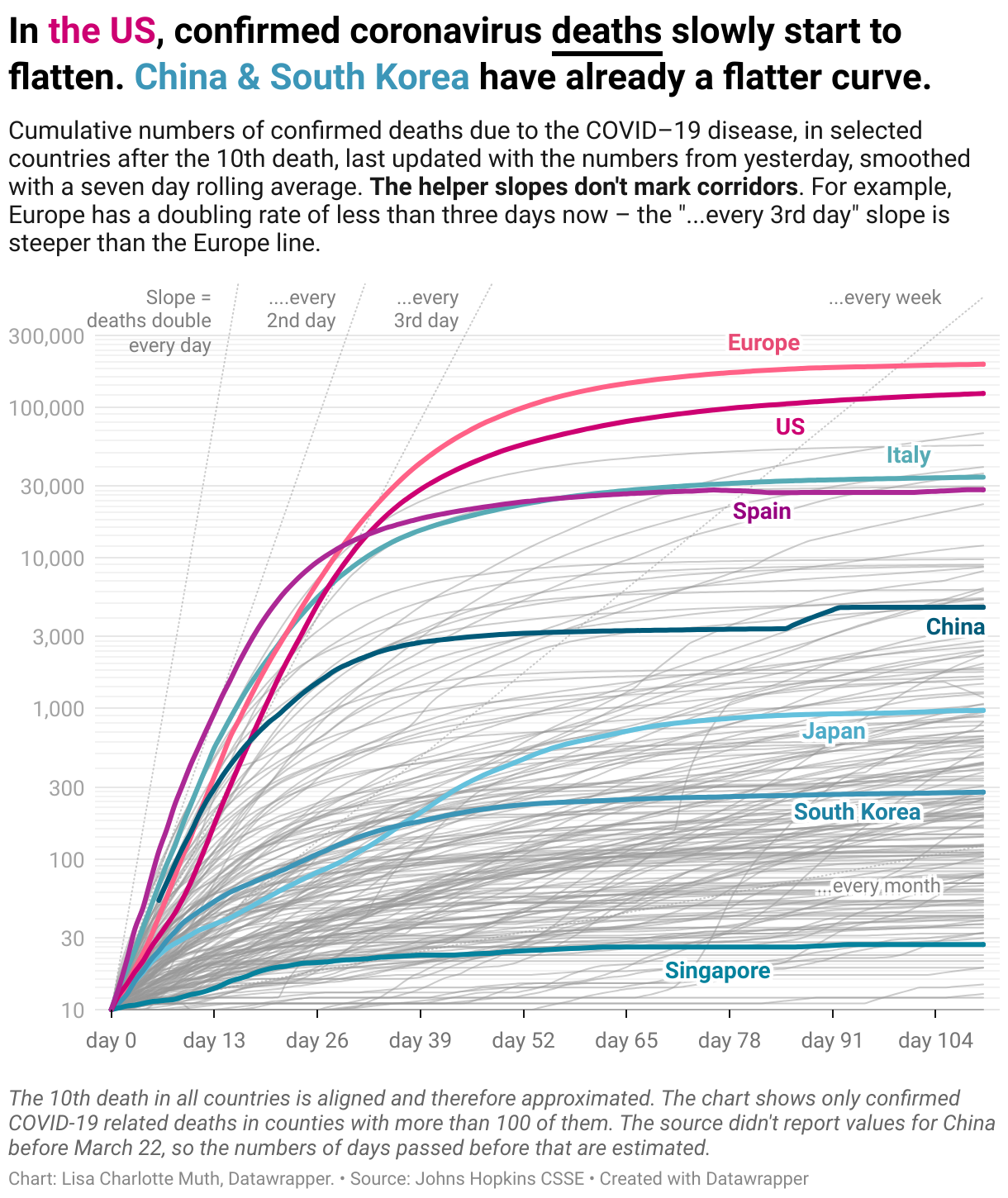
Some media outlets have published a chart on a log scale like the one above, like SPIEGEL or the Financial Times (that’s an excellent one, with great annotations). What I haven’t seen so far is this chart with the number of confirmed cases in Europe, and with helper lines that explain doubling times.
Doubling times?
The doubling time is the time a population (e.g. coronavirus cases) needs to double. Let’s compare Norway and Japan to understand its consequences.
If Japan follows the course it’s on, it will double the current number of confirmed COVID19-infected people in a week. Instead of the current 650 cases, there’d be 1,300. And 2,600 in two weeks.
Norway is on a course to double its confirmed cases every second day. (Norways is in the chart, but hidden – hover over the lines to find it!) There are currently 600 confirmed cases. In a week, Norway might have to deal with 6,800 cases. A week later? 76,800 cases.
Or not. Norway – and all the other countries that currently show a steep growth rate in their coronavirus cases – might flatten their curve, like South Korea, China, Japan, and Hong Kong successfully did.
You can compare the impact of different doubling times in the following table. They’re the same I show in the chart above. China, South Korea, Japan and Hong Kong’s coronavirus cases doubling time is currently either a week or less, so they’d be in the blue columns. Europe and the US have currently doubling times that are colored in pink here:
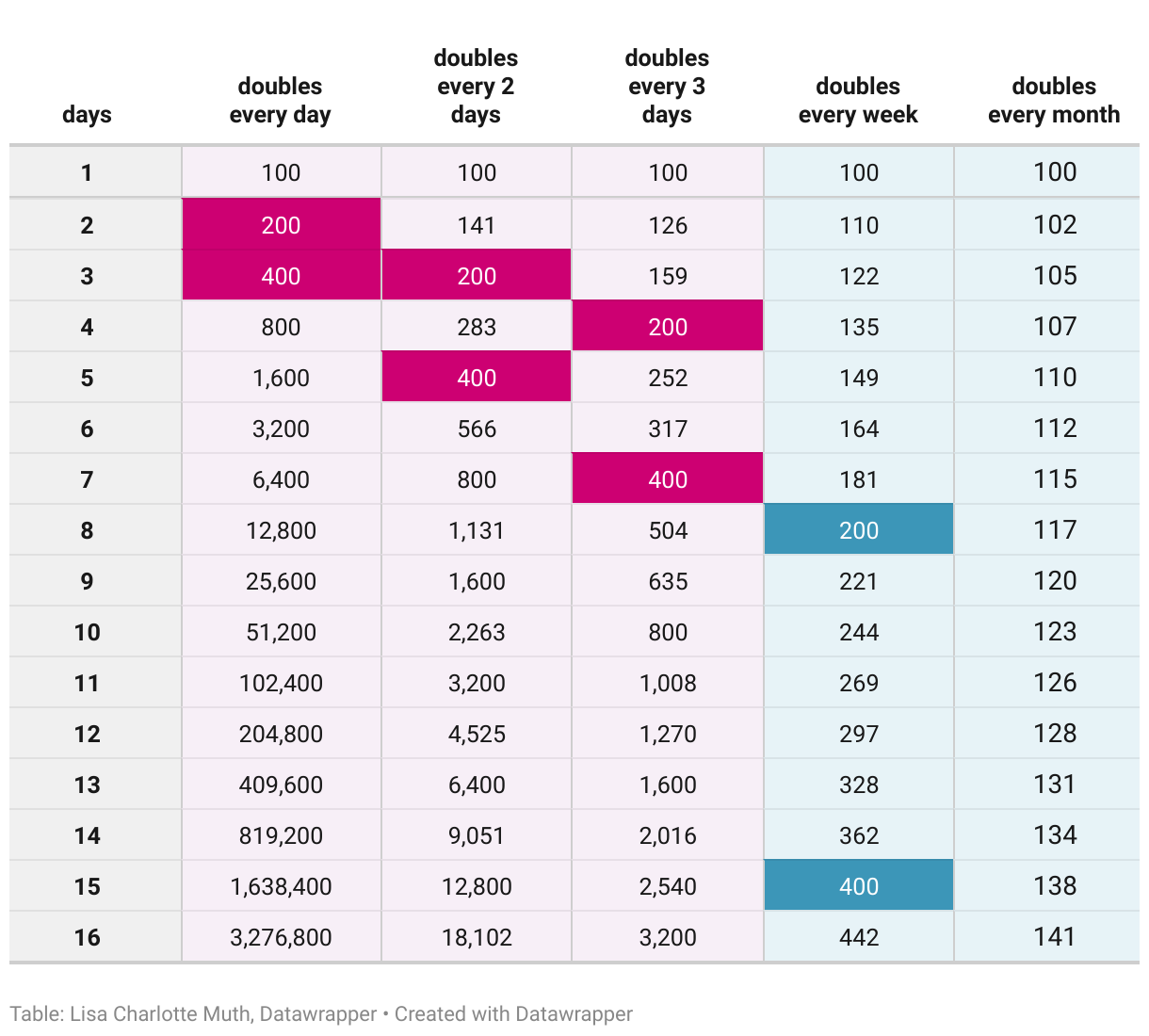
The main priority of many nations right now is to move to a slower doubling time. That’s what #FlattenTheCurve is about. Locked down areas, school closings, conference and sports event cancellations, washing hands, avoiding gatherings – all of this ensures slow doubling times, therefore less crowded hospitals and therefore a lower case fatality rate.
I’ll end with a great GIF that sums this all up. A GIF which you’ve seen probably on Twitter already – but if you haven’t, I don’t want you to miss it:
 Illustration by Toby Morris for the New Zealand online magazine The Spinoff
Phew, that was not the first article about the coronavirus you read today, was it. Maybe turn off your smartphone for a while. Take a deep breath. Stretch a bit. Try yoga. Or read a novel. We’ll see you next week.
Rapidly leveling-up on a new, well-trodden path

In the past 8 months or so I’ve been on a journey to learn everything I can about microcontrollers, circuits, electronics, components, sensors, and embedded software.
It all started with a second attempt (albeit 10 years after the first) at making something with Arduino. Since then, I’ve built more similar demos for work, but also fun stuff for me.
New to me, at least
As I became sated with using assembled boards and sensors, I started looking into the microcontroller itself. I found numerous examples of folks programming just the chip that’s in the Arduino, part of the AVR family of microcontrollers.
I had a few chips belonging to an Arduino board I had lying around (the original one I had bought in ’09) and started playing with them, learning how to program them at the bare-chip level. And I followed examples on how to build a programmer, too.
There were also smaller AVR chips, the ATtiny45 and ATtiny85, which were versatile, simple, cheap. Yes, up in the image to the right is an ATtiny programmer shield for the Arduino I designed (still being prototyped at this stage, though).
I was leveling up here, real chip-fu!
A familiar path of discovery
Then I saw how many ATtiny or AVR programming boards were out there. And I heard from folks that they too took that path. Indeed, I think this step of bare-chip programming is the next step most folks take after messing with Arduinos and that catapults them even further.
At the same time, I was asked to do more hardware constructs for work and I realized that I was no longer dabbling. I’d already spent some hundreds of dollars for work and for me. I really hadn’t taken good notes or managed my code well. Time to wisen up.
Not stopping yet
After playing the AVR programming, I’ve felt more confident learning about circuits, and building them – low drop out voltage regulators, astable multivibrators, paper-based circuits.
In this last wave of leveling up, I’ve been taking good notes and managing my code better, like the scientist I am at heart insists I do. And the rate I am amassing experience points is accelerating. It’s exhilarating.
Some of the things next up for me include more elaborate and polished demos at work, getting deeper into 3D printing (I did), and continuing up the learning curve of badge life.
There’s no shortage of things to learn!
Teach Anywhere
Featured image photo by Victoria Heath on Unsplash
As universities and colleges across the country shift classes online, we are seeing a surge in open resources supporting this online teaching. At the University of Oklahoma, we drew on the open resources developed by Indiana University, Stanford, and several other schools to build our own version of “Teach Anywhere.“
The main site, built largely by Adam Croom and Aaron Biggs, provides contingency support. You can find information there about OU’s response plan for COVID-19 along with technical guidance for faculty to continue teaching even while classrooms are closed. Here’s a preview of some of those resources:
- guidance on accessibility
- link for latest updates on the University’s response to COVID-19
- pedagogical advice for moving a course online
- best practices
- help with instructional technology like Canvas and Zoom
Video Series
To further support faculty in the shift into online teaching, I’ve been working with Keegan Long-Wheeler to put together a series of videos and workshops on Canvas and Zoom. The support documentation from both companies is very good, but we wanted to provide OU with contextualized guides to setting up both systems for their classes.
We are building out six videos. This video series walks faculty through Canvas from start to finish. I will post the links as we get them back from captioning:
Introduction to Canvas
Communication in Canvas
Organizing Material in Canvas
Teaching Online with Zoom
Workshops
In addition to the videos, Keegan and I will be teaching workshops on online teaching over the next few weeks. With the Norman campus closed, we will be leading all of these sessions on Zoom. The “Teach Anywhere Workshops” will walk faculty through pedagogical tips for teaching online along with technical tips for using Canvas and Zoom. The “Teach Anywhere with Zoom” workshops will focus more narrowly on Zoom and pedagogy.
Teach Anywhere Workshop
Teach Anywhere with Zoom
- Friday March 13, 10-11am
- Friday March 13, 1-2pm
- Monday March, 16 3-4pm
- Wednesday March 18, 10-11am
- Thursday March 19, 10-11am
Teach Anywhere with Zoom (Online)
Further Resources
As I mentioned earlier, there are a lot of great resources that have come together over the last week or so. Many schools have built guides that are contextualized for their faculty, and there are also general tips and information. Some of the best and most important resources have focused on accessibility:
Accessibility
- OU Teach Anywhere’s guide to Accessibility
- Kate Sonka at Michigan State is a rock star for all things Accessibility. Here’s MSU’s Basic Checklist: Online Content Accessibility
- Aimi Hamraie’s Accessible Teaching in the Time of COVID-19
Twitter threads from experienced online teachers
How to close colleges without hurting vulnerable students https://t.co/whtUkQy5w5
— Robin DeRosa (@actualham) March 11, 2020
I've taught fully online since 2002 but I'm not a fan of videoconferencing; I focus on writing in our own spaces: I blog, students blog, build websites etc
— Laura Gibbs (@OnlineCrsLady) March 11, 2020
we don't have to let the LMS and related technologies define our agenda, esp. in age of surveillance https://t.co/5sB4JawwHg
We’re equally exhausted and proud, right @karenraycosta ? Lots of awesome online educators and designers are stepping up to help #HigherEd so keep your eyes on @OLCToday as they continue to keep the #onlinelearning ship afloat, even if it takes popsicle sticks and glue. ⛵️?? https://t.co/qgxD2tiv0a
— Clea Mahoney (@CleaMahoney) March 10, 2020
Learning in a Pandemic – 2 Some more specific guidance on how to start thinking about finishing your course without meeting f2f. https://t.co/D57fJA4eWW pic.twitter.com/dGaahIV5UE
— Jim Luke really needs a new longer name (@econproph) March 9, 2020
Here. These are in no particular order, neither organizationally or by priority, and are my personal experience. Some thoughts on a better @zoom_us room and online class, generally: 1/ https://t.co/eezYrHlIjh
— Dr. Ryan Straight, 60% alcohol hand sanitizer ?? (@RyanStraight) March 7, 2020
If you suddenly find yourself teaching online as part of your school’s response to COVID-19, here are some helpful ideas (a thread):https://t.co/s3M0JcbW92 #digped
— Sean Michael Morris (@slamteacher) March 6, 2020
Resource Collections
- Jenae Cohn and Beth Seltzer at Stanford have organized a guide for online teaching that serves as a great model for other schools
- Here’s a seemingly comprehensive list of University websites compiled by Daniel Stanford, the Director of Faculty Development and Technology Innovation in DePaul University’s Center for Teaching and Learning
- Sarah Howard from Ohio State University has spearheaded a crowd-sourced guide to “Advising in Times of Disruption“
- The Online Learning Consortium put together an extensive collection of resources from across the Higher Ed spectrum
- A community system for faculty and online teaching folks: https://keep-teaching-resources-for-higher-ed.mn.co/feed
- Here’s a guide for getting your course online in an hour
The Best Everyday Audiophile Headphones

If what you seek in a pair of headphones is the best sound possible for serious listening sessions, but you don’t want to drop thousands of dollars, this is the guide for you. We’ve tested hundreds of audiophile headphones and picked our favorites for specific uses. These wired, over-ear headphones forgo features such as Bluetooth and active noise cancellation, and just focus on delivering a great sonic experience.
Working From Home
It seems the efforts against Covid19 are entering a new phase in the Netherlands. From isolation and suppression efforts to slowing down the spread of contagion. This as for an increasing number of patients it is unclear how they caught it, and the needed effort to do contact research for positive cases is becoming too much work to keep up. As a result measures have been announced that cover the entire country.
- Gatherings of more than 100 people are now banned, and this includes not just events, but also clubs, sports facilities and e.g. musea. (Schools will remain open for now, but if this follows the Italian path that will change in a week at most)
- Those that can should work from home.
For my company this means that all events we were to attend in the coming weeks are no longer taking place.
We’ve instructed our colleagues to take working from home as a default. Our work is well suited to remote working, and we’ll treat it as an opportunity to test our remote working tools also in working with clients (having switched to our own cloud environment early this year comes in handy here), as well as a good time to focus on finishing deliverables.
The announced measures are in place until the end of March, so for the next two and a half weeks.
Today during morning rush hour, as opposed to Monday and Tuesday, it was already noticeably less busy in public transport and on the streets of Utrecht. The government offices I visited today had ‘no hand shakes’ signs in every room.

Distributed Teams: Not Just Working From Home
Technology companies taking curve-flattening exercises of late has resulted in me digging up my old 2017 talk about working as and working with remote employees. Though all of the advice in it holds up even these three years later, surprisingly little of it seemed all that relevant to the newly-working-from-home (WFH) multitudes.
Thinking about it, I reasoned that it’s because the talk (slides are here if you want ’em) is actually more about working on a distributed team than working from home. Though it contained the usual WFH gems of “have a commute”, “connect with people”, “overcommunicate”, etc etc (things that others have explained much better than I ever will); it also spent a significant amount of its time talking about things that are only relevant if your team isn’t working in the same place.
Aspects of distributed work that are unique not to my not being in the office but my being on a distributed team are things like timezones, cultural differences, personal schedules, presentation, watercooler chats, identity… things that you don’t have to think about or spend effort on if you work in the same place (and, not coincidentally, things I’ve written about in the past). If we’re all in Toronto you know not only that 12cm of snow fell since last night but also what that does to the city in the morning. If we’re all in Italy you know not to schedule any work in August. If we see each other all the time then I can use a picture I took of a glacier in Iceland for my avatar instead of using it as a rare opportunity to be able to show you my face.
So as much as I was hoping that all this sudden interest in WFH was going to result in a sea change in how working on a distributed team is viewed and operates, I’m coming to the conclusion that things probably will not change. Maybe we’ll get some better tools… but none that know anything about being on a distributed team (like how “working hours” aren’t always contiguous (looking at you, Google Calendar)).
At least maybe people will stop making the same seven jokes about how WFH means you’re not actually working.
:chutten
3 Ways to Use an Electric Bike to Get Fit
 Did you know that you can use an electric bike to get fit? This post describes 3 different ways that you can use an ebike to get fit and healthy. Turns out, an ebike provides excellent ways for you to get fit.
The post 3 Ways to Use an Electric Bike to Get Fit appeared first on Average Joe Cyclist.
Getting back to the physical world

I first heard of the distinction between bits and atoms to describe the digital and physical worlds back in the mid-90s. Back then, atoms ruled – books, factories, records, physical things. But there was a distinct acceleration of the digital world of software, bulletin boards, the nascent Web, digital things.
I was truly an atom-level thinker
Back then, I was just out of grad school and entering my post-doc. I was a researcher that thought on the molecular level, trying to understand how the influence of specific atoms, on specific spots, on specific structures interacted with each other. Often the difference between the molecules I worked with (protein, DNA, RNA) was a single atom.
That’s the programming I knew – using biological systems to create tools and objects for research, to uncover natural principals and build upon reality.
And I did well, writing a bunch of papers and creating a foundation that helped the lab grow in a new direction.
Then I became a bit-level thinker
As the web took off in the late 90s, I got more involved in software, the internet, and mobile. This interest (always present – my father ran management information system departments) was enough to catapult me out of the atom world and into the bit world.
True, I worked for consumer electronics companies, but my role was not in the hardware, but in the software that was going to add so much value to that hardware.
And I did well, helping large brands engage with customers through digital sales and marketing.
Back to the atom thinking
As I mentioned before, I’ve been spending a lot of my time making things based on microcontrollers, sensors, and lots of LEDs. Yes, I find myself back in the world of atoms, thinking of how an experience can manifest itself through tangible goods.
This is a different atom world than my first go at atoms, but I see a long red thread of my interest in things from now all the way back to then. And the perspective I gained of the interplay of bit and atoms, especially at Nokia, during my bits years, has become valuable.
Indeed, I currently work for a company with a strong hardware culture. And working for them sort of led me to solving problems with hardware.
Furthermore, talking hardware all day, and tinkering with hardware all night, has filled my mind with exciting potential futures. For example, I find myself thinking and talking a lot about how we can make the digital world, digital concepts, more tangible, more physical.
I hope that ten years from now I can say I did well, making a difference once more with atoms, but with a twist of bits.
Get ready for a flood of Pixelmator updates (sneak peek!)
We’ve been working on all our apps recently and it just so happens that Pixelmator Pro, Pixelmator Photo, and Pixelmator for iOS are all going to get major updates in the next month. So we wanted to tell you a little bit more about each update and maybe even give you a chance to get your hands on them. Here goes.

Pixelmator Pro 1.6 Magenta
Our focus for Pixelmator Pro this year is on making the app even more user-friendly and enjoyable to use. And one thing that we’ve wanted to improve for a while now is the color picker. So we decided to make a color picker of our very own! Just look at how awesome it is:
This is a major update, so there are other big additions, but we’ll let you know more about them once the update is available. However, if you want to see what the other major additions are ahead of everyone else, you can jump onto the Pixelmator Pro beta and help us put this update through its paces. To join our team of beta testers, please shoot us a quick email.

Pixelmator Photo 1.2
Pixelmator Photo, our super powerful and advanced photo-editing app for iPad, is getting a major update too. One of the highlight features is Split View support so you can work in Pixelmator Photo and any other app side by side. You can also take a guess at what Split View might mean for the future of Pixelmator Photo…
There are other major new features but we’ll keep those details under wraps for now. Unless, of course, you want to check out the beta and help us make sure the update is as polished as possible. We’ve opened up a few hundred testing spots and you can join using the link below.

Pixelmator for iOS 2.5
It liiiiives! After a brief hiatus of two and a half years or so (we kid, we kid), Pixelmator for iOS is getting a major update. The biggest addition is the new Files-based document browser as well as the new image size presets and photo browser.
You might be wondering what this means for Pixelmator and that’s a good question. The answer is that, little by little, we plan to refresh and improve the app and, eventually, make it compatible with Pixelmator Pro. This is one very fundamental step towards that goal. We don’t have a timeline just yet for full compatibility and this will take a while but we’re very excited to get started on it! If you’d like to take this beta for a spin, you can sign up via TestFlight below. We have a few hundred spots available.
If you don’t manage to grab one of the available beta spots, you can also try to email us at beta@pixelmator.com and we might be able to help out. Who knows, we might be feeling generous.
That’s it for now but keep your eyes peeled for more news!
Twitter Favorites: [joshtpm] I will support and defend the Constitution of the United States against all viruses, foreign and domestic

I will support and defend the Constitution of the United States against all viruses, foreign and domestic