Shared posts

28 Mar 04:48

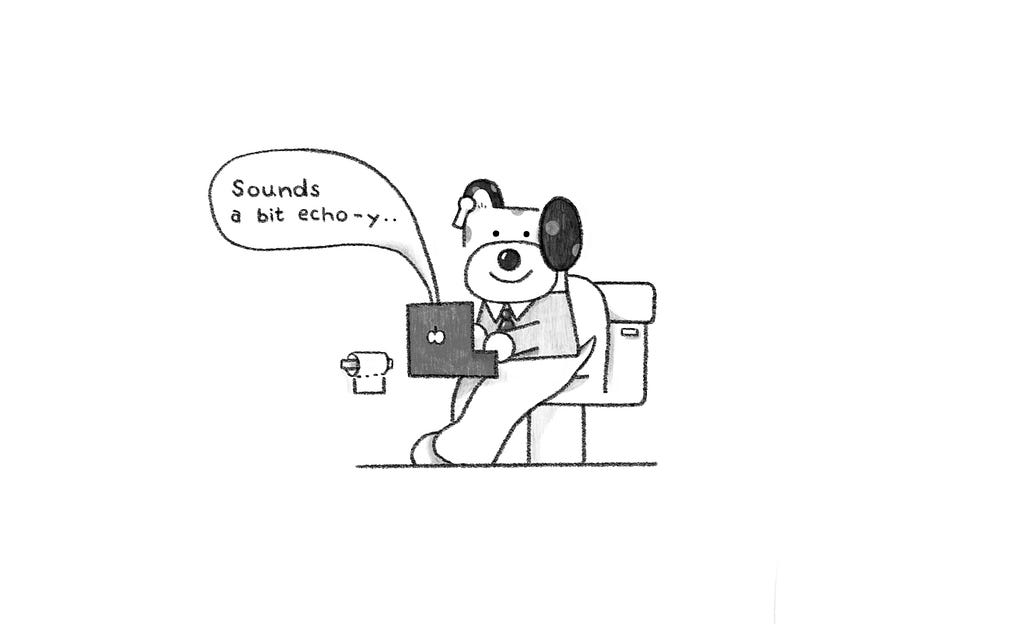
there should be lifestyle anarchy

by nick quah
Whether it's a form of emotional mediation or self-denial, I've found myself trying to do what's often been advised in this prolonged state of social isolation, which is to stick to a routine and time-table as if we were under normal conditions. You know, things like "dress up even though you're not leaving your house," or "keep your regular meetings," or "adhere to social graces, like saying hello," or "eat a normal breakfast like eggs and not, say, candy." Because, I'm told, structure is helpful when the days mash and bleed together to a point of lost definition like smashed potatoes.

(Tangentially, I heard this very same piece of advice was given to Will Smith as he prepared for his role on I Am Legend, which I'm not sure whether is underrated as a Will Smith, but is definitely underrated as a Dog Movie. It's certainly better than Balto, which is bullshit.)

But of course, I'm not doing very well at this forced performance of normalcy, because I just can't summon enough focus or drum up any creative juices in the morning — which is when I usually do most of my work— given the greater levels of anxiety that I'm waking up with because of, oh, you know, *circles air with finger* And so I often find myself staring limply into the wall by 10 am, loathing myself enormously for not having done anything and, more generally, for not being able to fake it 'til I norm it.

Which is to say, this isn't working for me. Maybe it works for some folk, but there's something in the logic of the prescription that I simply can't compute in my brain. These aren't normal times! Why am I working to simulate normalcy?? It feels like I'm trying to double-speak my brain into submission. Why am I not feeling more compelled to lean into the other direction? Why am I not feeling more compelled to be free?

All of which is to say, I'm refusing to wear pants tomorrow.

Long live The Dog.


28 Mar 04:47

The Best Lightning Cable for iPhone and iPad

by Sarah Witman
The Best Lightning Cable for iPhone and iPad

Most devices made by Apple—from iPhones to Magic Trackpads—need a Lightning cable in order to charge. But Apple’s cables are notoriously flimsy, and they cost more than many third-party cables—even those that Apple has certified will perform just as well as its own accessories. If you’re unhappy with the cable that came with your Apple device, or you just want a backup, we’ve tested dozens of Lightning cables to find the best options for a variety of needs.

28 Mar 04:47

This Week in Photography: A Vision of Italy

by Jonathan Blaustein


It was hard to motivate today.

(That’s the truth.)

I get so much joy from this column, all year long, but there are always one or two dips, per year, when my strategic-creativity-reserve drops precipitously.

I’m not alone, as most of you don’t want to work today either. (I’m writing on Thursday, as deadlines are deadlines.)

We’re living through exceptional times, and it takes so much mental and physical energy just to process it all without going crazy.

Let’s call it 60% of our total energy output?

Throw in parenting, working, home-schooling, cooking, cleaning, and all the rest, and how much energy is left for self-care?

For trying to feel good, rather than not-terrified?

Obviously, the answer is very little. We’re all going about, each day, doing the best we can, and some of us have it easier than others. (Geographically speaking.)

Right now, I think we all need to empathize with each other, more than ever, and expect a lot less from ourselves too. (In terms of our work productivity, anyway.) Hell, I just got up off the floor, (literally,) to write this column for three reasons:

1. Rob pays me, and it’s my job.
2. I have a responsibility to you, the audience.
3. I knew that any and all art practice always makes me feel better.

It’s that last one I want to harp on today. (Yes, I’m going into inspirational-professor-mode.)

When our energy drops and our spirits lag, blowing off exercise, or creative practice, is the easiest thing to do. Laziness can feel like a rational response to our current state of affairs, and I’ve allowed myself a fair bit.

I know a hard-core Yogi who admitted he wasn’t doing his yoga, so I gave him a little nudge, because I know how happy it makes him. (The dude glows.)

I’m certainly preaching to the choir, (to some extent,) as I’ve seen lots of social media posts about people cooking, drawing, or meditating.

We all KNOW this, on some level.

When much of normal life is stripped away, and we have so many emotions to process, (without our usual expressive outlets,) you have to give yourself permission to feel like shit, from time to time, while remembering that art makes it better.

Let me say that again: Art makes it better.

When was the last time you picked up your camera, or a pen, or a paintbrush, made some art, and then said, “Fuck! I totally regret that. What a waste of time! Heavens to Mergatroyd!

My guess?
Never.

I’m lucky, as this column forces me to make art each week. I can’t not be creative, as it’s my job to keep coming back at you.

With the benefit of that rigor, I wanted to share the message with you: Make art.

Make art!
Now.

Simply by making it now, you’ll be recording energy from a historic place in time.

Some of it will necessarily be interesting later on, because it was made now, and it will give a context.

Or then again, maybe a new context will change the work?

Am I simply speculating?

No.
I’m not.

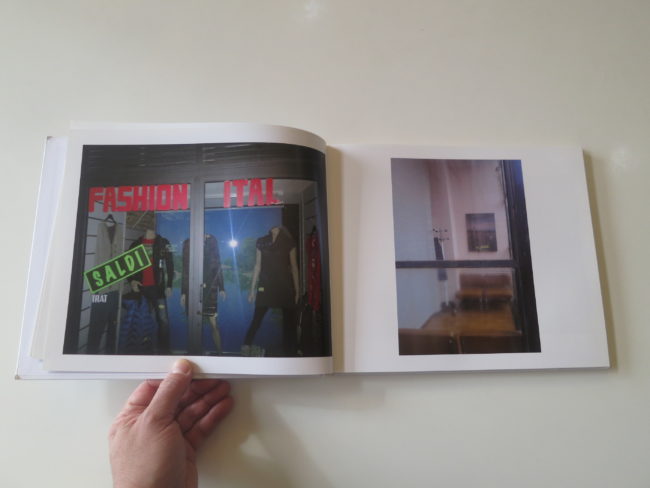
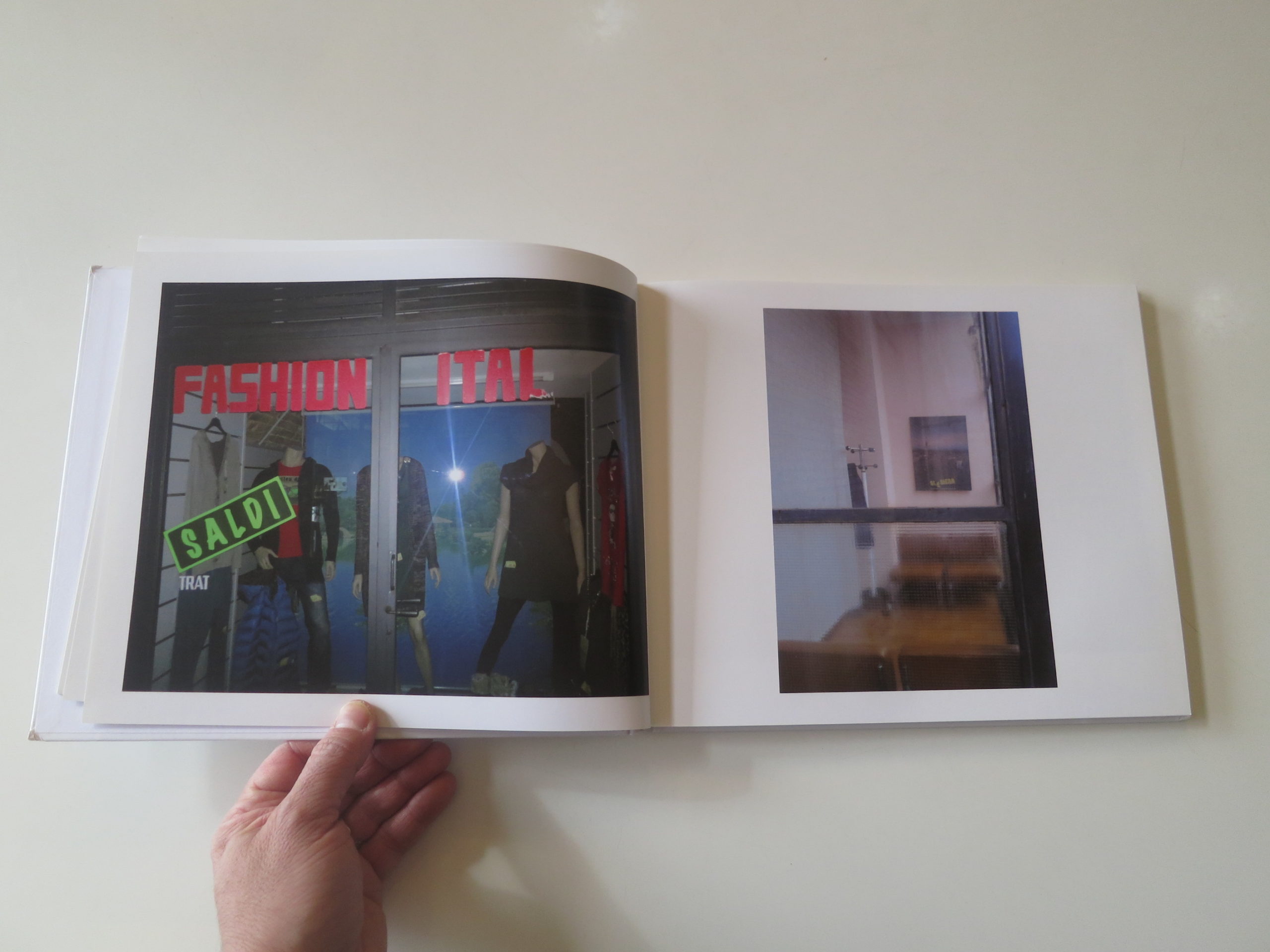
I just got done looking at “Purtroppo Ti Amo,” (Unfortunately, I love you,) a photo-book submitted several years ago, by Federico Pacini in Italy, published by Editrice Quinlan.

(Yes, we’re going there.)

Just now, if I’m being honest, I’ve realized part of my coping mechanism has been to tamp down my heart. To lock away my vulnerability. I’ve put up the chest shield, and protected the emotions, because though I cried before leaving for Amsterdam, I haven’t cried since coming home.

All those poor people in Italy, suffering.

Dying alone.

Losing loved ones, no funerals, all the dread, all the death.

I lived in Rome for a seminal time in my life, and it made me an artist. Then I went back, in 1998, and made street photographs of the elderly culture, as old people were engaged and active in a way I’d never seen before.

Riding scooters, shopping with vigor, doing the passagiatta.

 

Why have I not cried for their loss?

You might get choked up when you see these pictures below, because it’s just too hard not to view them in the new context.

And what are they?

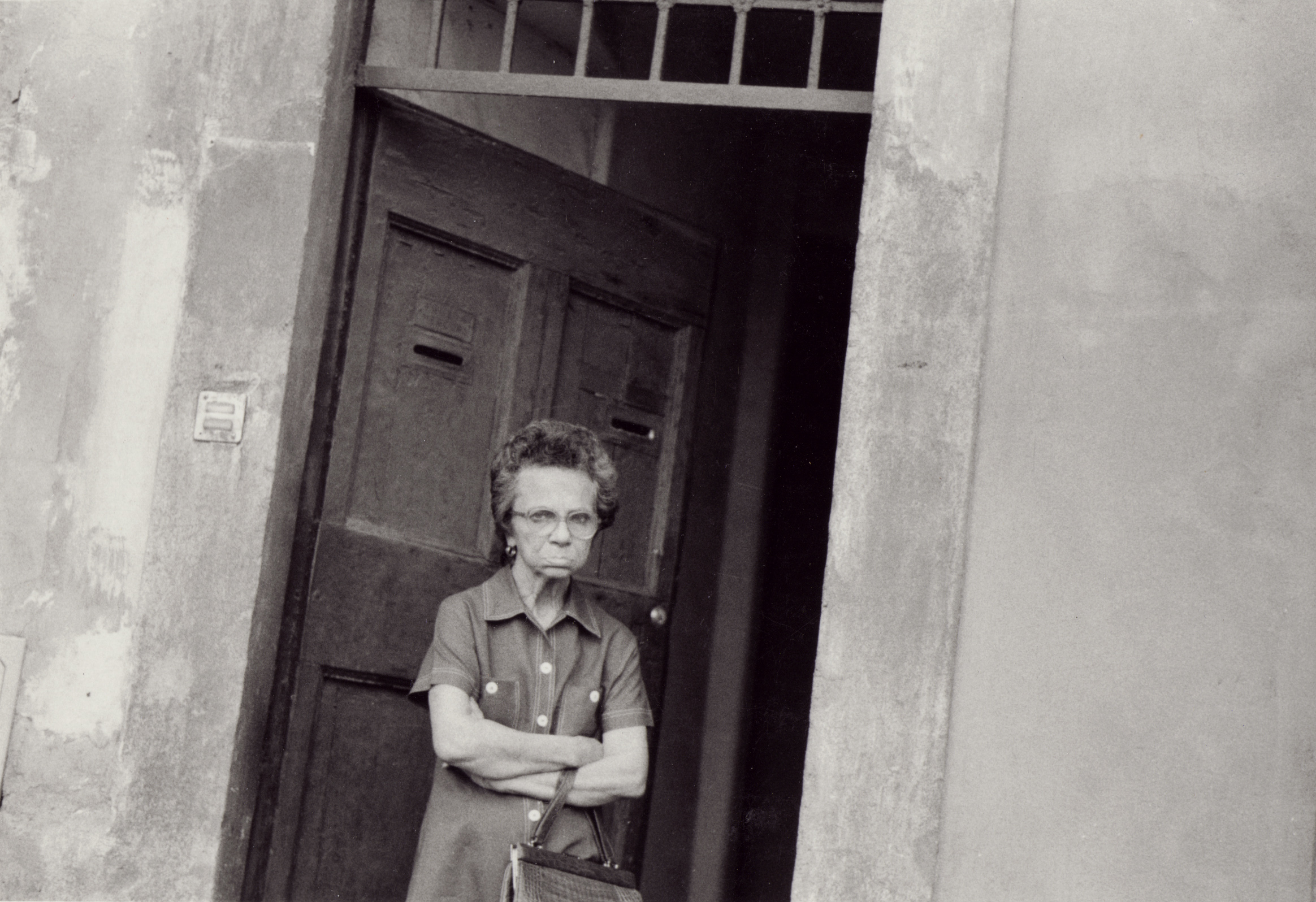
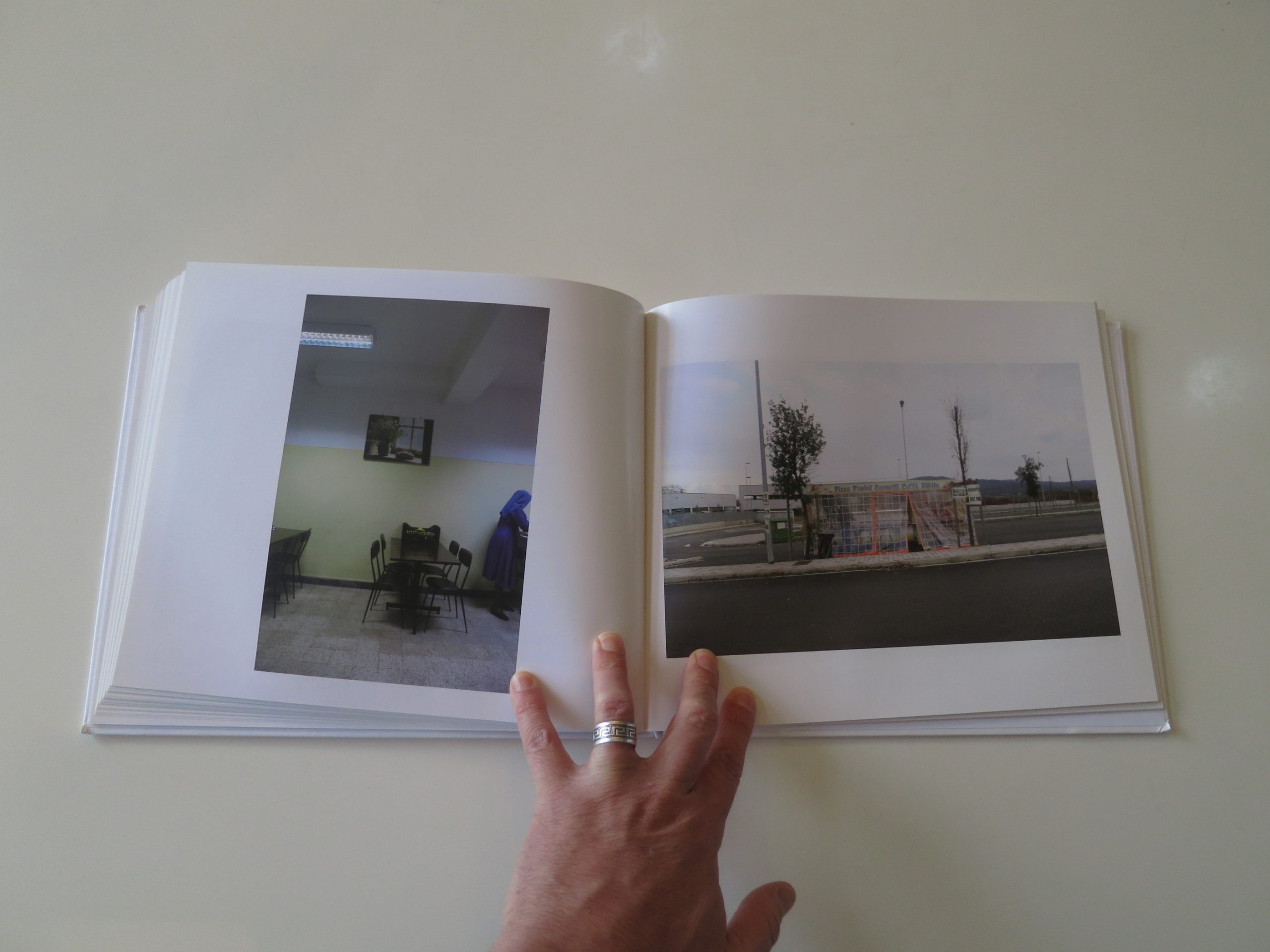
The entire book, near as I can tell, was shot in and around the artist’s hometown of Siena. A place, famed as any for its beauty, in the architecture and surrounding Tuscan countryside.

If most of us wanted to idealize a locale’s beauty, we might go with a place like Tuscany.

But that’s not what we see in this book.

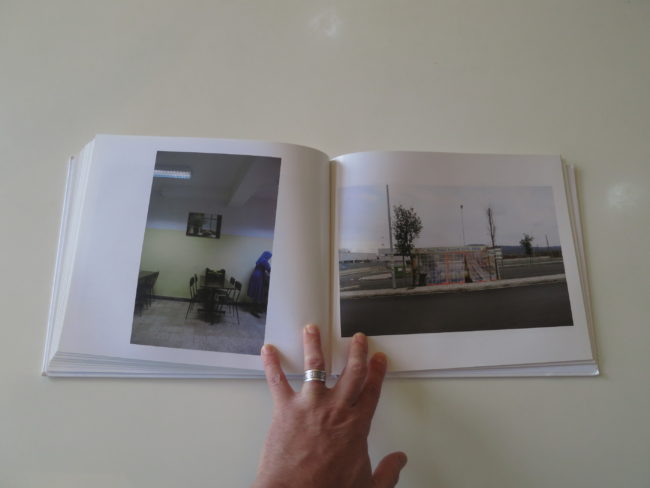
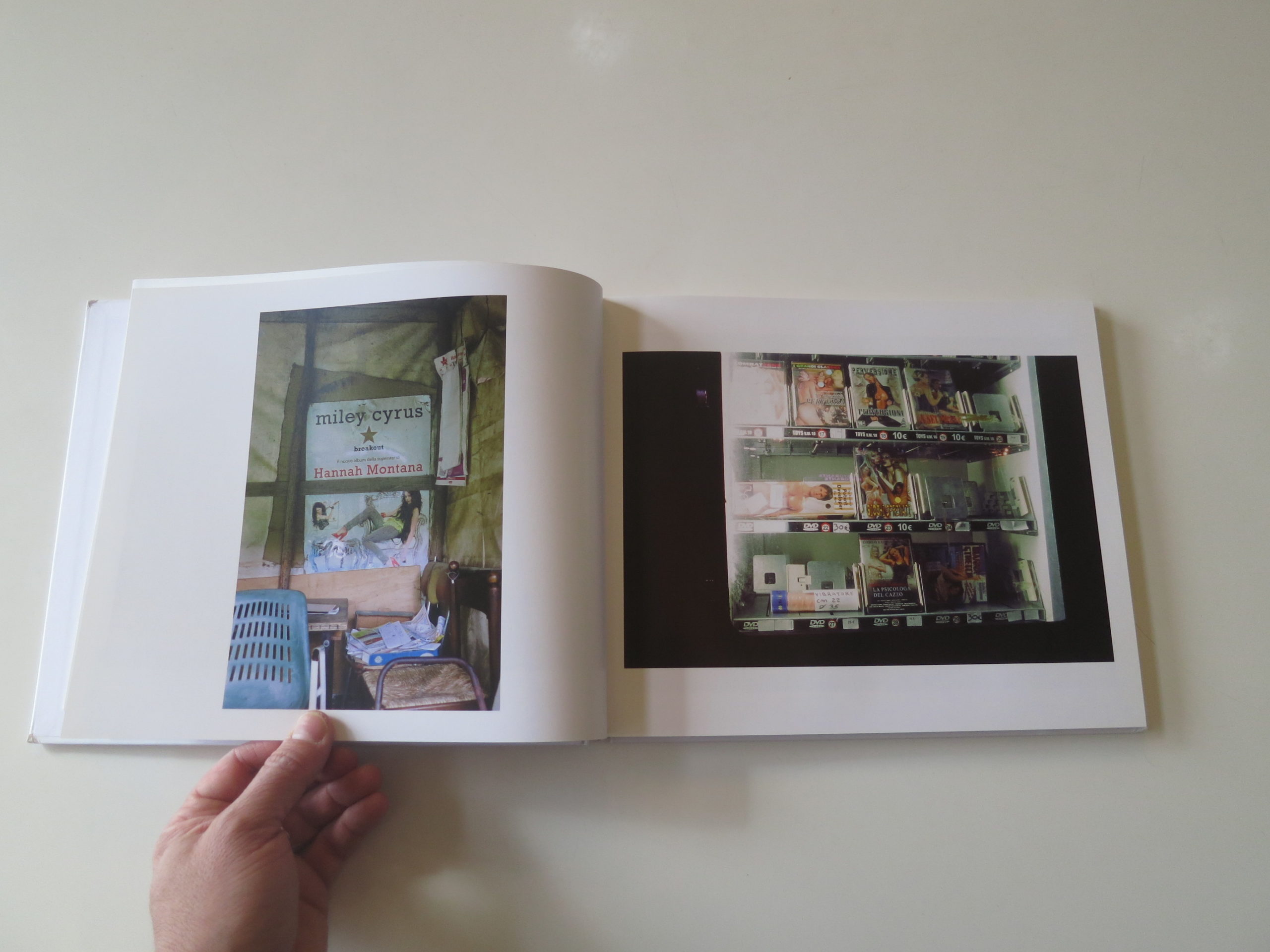
Photograph after photograph of bleak, banal, real places. It is Italy, but not the Italy we’re accustomed to. This is all anti-aesthetic, no pretty.

When people do show up, and it’s rare, they’re often elderly. And when was the book made?

2013.

We see porn DVD’s and old parking lots. Miley Cyrus posters, and suave barbers.

But most of it is empty.
And sad.

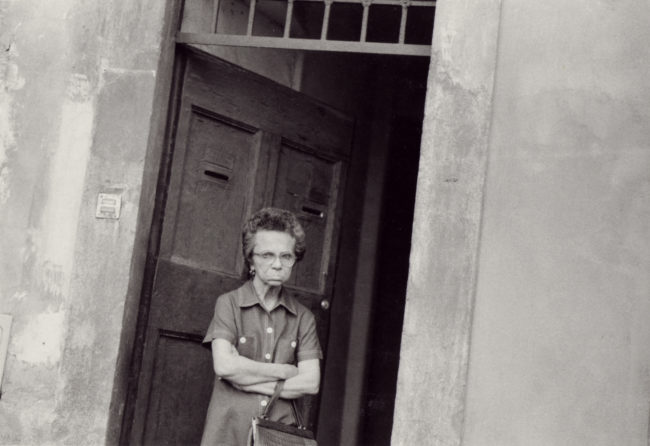
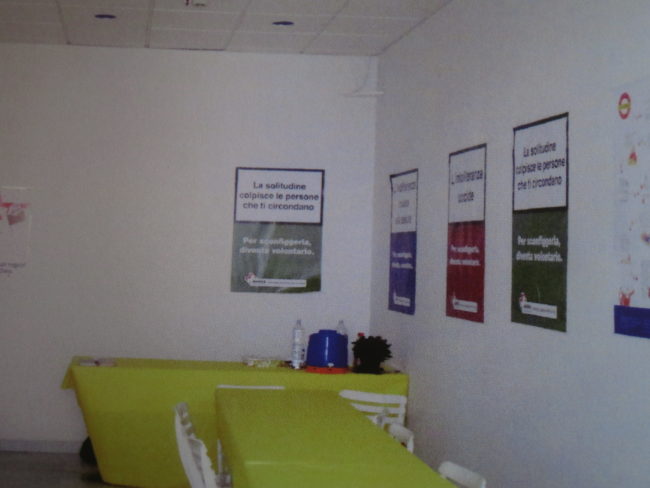
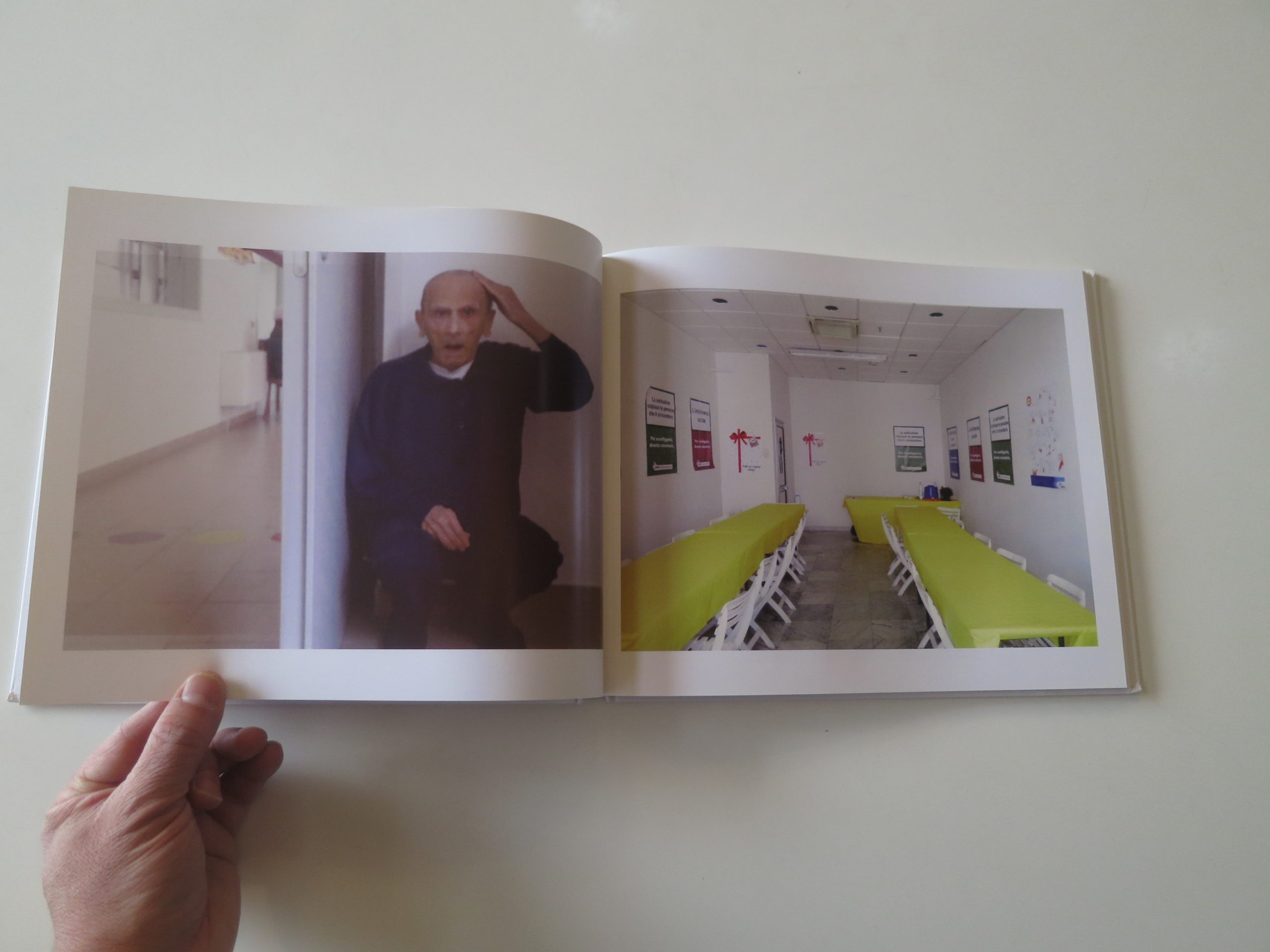
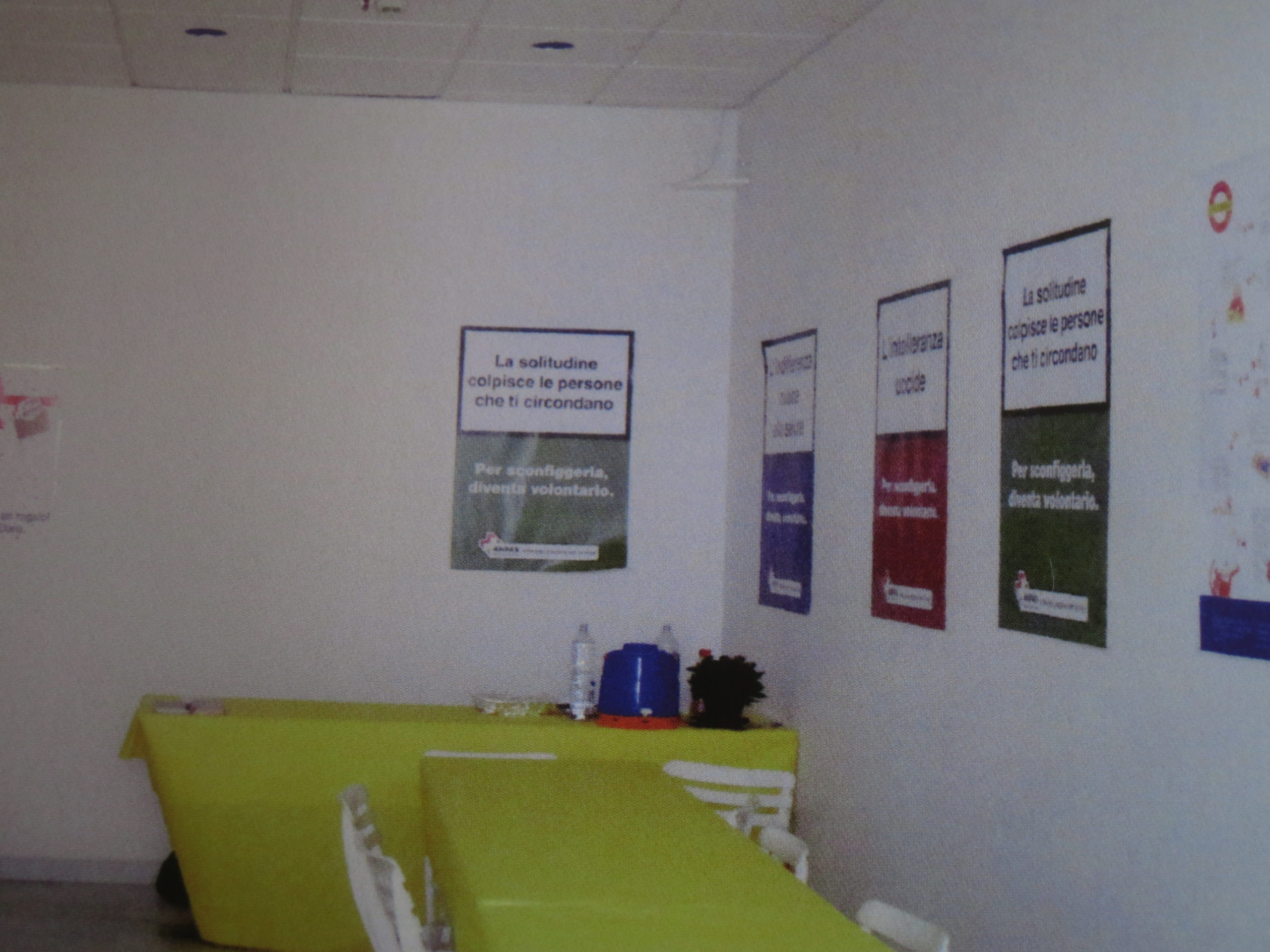
About 1/3 of the way through, on the left hand page, we see a low-res image of an old man, looking disconcerted. On the right, an empty room, maybe in a Church basement, community center, or nursing home?

I strain to read one sign, and then translate it. My Italian is rusty, so I turn to Google:

“Le solitudine colpisce le persone che ti circondano,” which means…

“Loneliness affects the people around you.”

How was this book not made 3 days ago?

There is a juxtaposition, not much later on, of a small, 2-door-mini-Euro-car with a door-sign advertising funerals, next to a man, in a yellow, plastic volunteer vest, guarding the entrance to a supermarket.

How was this book not made 2 days ago?

There are empty restaurants, empty parks, empty streets.

How was this book not made yesterday?

I’m not sure there’s is much more for me to say about this one. The photographs below will tell the story better, from here on out.

So let’s all think good thoughts for the poor people in Italy and NYC, or New Orleans, Madrid.

We’ll all get through this eventually, so while you’re in the middle of it, don’t forget to make art.

Bottom Line: Bleak vision of empty Siena 

To purchase “Purtroppo Ti Amo,” click here 

 

If you’d like to submit a book for potential review, please email me directly at jonathanblaustein@gmail.com. We are interested in presenting books from as wide a range of perspectives as possible.

The post This Week in Photography: A Vision of Italy appeared first on A Photo Editor.

------------------------

Visit our sponsor Photo Folio, providing websites to professional photographers for over 10 years. Featuring the only customizable template in the world.

------------------------

28 Mar 04:46

Telus to donate $500,000 to help the search of therapeutic antiviral treatments for COVID-19

by Dean Daley
Telus

Vancouver-based telecom Telus has announced that it would donate $500,000 to the Vancouver Prostate Centre (VPC), Vancouver General Hospital (VGH) and the University of British Columbia (UBC) Hospital Foundation to aid in the search of therapeutic antiviral treatments for COVID-19.

UBC professor Art Cherkasov leads this group alongside VPC and UBC, which are collaborating with experts from Cambridge in the U.K., Sloan-Kettering in New York and other educational institutions.

COVID-19 is a global pandemic affecting more than 100 countries around the world. Research teams from around the globe are seeking the development of vaccines and more to halt the spread of the virus.

VPC’s technology and platforms used for cancer drug discovery are now being repurposed to find the cure for COVID-19. With its AI, facilities and capabilities, VPC tech was able to screen 1.3 billion chemicals to create a smaller list of 100 potential therapeutic compounds in a single week. Telus says that this process typically takes up to three years.

The post Telus to donate $500,000 to help the search of therapeutic antiviral treatments for COVID-19 appeared first on MobileSyrup.

28 Mar 04:46

You May Be Able to Delay Paying Your Taxes, but Should You?

by Sally French
You May Be Able to Delay Paying Your Taxes, but Should You?

The federal government announced some news that could temporarily take a bit of strain off the budgets of Americans who still owe money in taxes: The usual April 15 tax deadline has been extended to July 15. This applies to both filing and paying your federal income taxes.

28 Mar 04:44

Zoom needs to clean up its privacy act

by Doc Searls

zoom with eyes

[21 April 2020—Hundreds of people are arriving here from this tweet, which calls me a “Harvard researcher” and suggests that this post and the three that follow are about “the full list of the issues, exploits, oversights, and dubious choices Zoom has made.” So, two things. First, while I run a project at Harvard’s Berkman Klein Center, and run a blog that’s hosted by Harvard, I am not a Harvard employee, and would not call myself a “Harvard researcher.” Second, this post and the ones that follow—More on Zoom and Privacy, Helping Zoom, and Zoom’s new privacy policy—are focused almost entirely on Zoom’s privacy policy and how its need to explain the (frankly, typical) tracking-based marketing tech on its home page gives misleading suggestions about the privacy of Zoom’s whole service. If you’re interested in that, read on. (I suggest by starting at the end of the series, written after Zoom changed its privacy policy, and working back.) If you want research on other privacy issues around Zoom, look elsewhere. Thanks.]


As quarantined millions gather virtually on conferencing platforms, the best of those, Zoom, is doing very well. Hats off.

But Zoom is also—correctly—taking a lot of heat for its privacy policy, which is creepily chummy with the tracking-based advertising biz (also called adtech). Two days ago, Consumer Reports, the greatest moral conscience in the history of business, published Zoom Calls Aren’t as Private as You May Think. Here’s What You Should Know: Videos and notes can be used by companies and hosts. Here are some tips to protect yourself. And there was already lots of bad PR. A few samples:

There’s too much to cover here, so I’ll narrow my inquiry down to the “Does Zoom sell Personal Data?” section of the privacy policy, which was last updated on March 18. The section runs two paragraphs, and I’ll comment on the second one, starting here:

… Zoom does use certain standard advertising tools which require Personal Data…

What they mean by that is adtech. What they’re also saying here is that Zoom is in the advertising business, and in the worst end of it: the one that lives off harvested personal data. What makes this extra creepy is that Zoom is in a position to gather plenty of personal data, some of it very intimate (for example with a shrink talking to a patient) without anyone in the conversation knowing about it. (Unless, of course, they see an ad somewhere that looks like it was informed by a private conversation on Zoom.)

A person whose personal data is being shed on Zoom doesn’t know that’s happening because Zoom doesn’t tell them. There’s no red light, like the one you see when a session is being recorded. If you were in a browser instead of an app, an extension such as Privacy Badger could tell you there are trackers sniffing your ass. And, if your browser is one that cares about privacy, such as Brave, Firefox or Safari, there’s a good chance it would be blocking trackers as well. But in the Zoom app, you can’t tell if or how your personal data is being harvested.

(think, for example, Google Ads and Google Analytics).

There’s no need to think about those, because both are widely known for compromising personal privacy. (See here. And here. Also Brett Frischmann and Evan Selinger’s Re-Engineering Humanity and Shoshana Zuboff’s In the Age of Surveillance Capitalism.)

We use these tools to help us improve your advertising experience (such as serving advertisements on our behalf across the Internet, serving personalized ads on our website, and providing analytics services).

Nobody goes to Zoom for an “advertising experience,” personalized or not. And nobody wants ads aimed at their eyeballs elsewhere on the Net by third parties using personal information leaked out through Zoom.

Sharing Personal Data with the third-party provider while using these tools may fall within the extremely broad definition of the “sale” of Personal Data under certain state laws because those companies might use Personal Data for their own business purposes, as well as Zoom’s purposes.

By “certain state laws” I assume they mean California’s new CCPA, but they also mean the GDPR. (Elsewhere in the privacy policy is a “Following the instructions of our users” section, addressing the CCPA, that’s as wordy and aversive as instructions for a zero-gravity toilet. Also, have you ever seen, anywhere near the user interface for the Zoom app, a place for you to instruct the company regarding your privacy? Didn’t think so.)

For example, Google may use this data to improve its advertising services for all companies who use their services.

May? Please. The right word is will. Why wouldn’t they?

(It is important to note advertising programs have historically operated in this manner. It is only with the recent developments in data privacy laws that such activities fall within the definition of a “sale”).

While advertising has been around since forever, tracking people’s eyeballs on the Net so they can be advertised at all over the place has only been in fashion since around 2007, which was when Do Not Track was first floated as a way to fight it. Adtech (tracking-based advertising) began to hockey-stick in 2010 (when The Wall Street Journal launched its excellent and still-missed What They Know series, which I celebrated at the time). As for history, ad blocking became the biggest boycott, ever by 2015. And, thanks to adtech, the GDPR went into force in 2018 and the CCPA 2020,. We never would have had either without “advertising programs” that “historically operated in this manner.”

By the way, “this manner” is only called advertising. In fact it’s actually a form of direct marketing, which began as junk mail. I explain the difference in Separating Advertising’s Wheat and Chaff.

If you opt out of “sale” of your info, your Personal Data that may have been used for these activities will no longer be shared with third parties.

Opt out? Where? How? I just spent a long time logged in to Zoom  https://us04web.zoom.us/), and can’t find anything about opting out of “‘sale’ of your personal info.” (Later, I did get somewhere, and that’s in the next post, More on Zoom and Privacy.)

Here’s the thing: Zoom doesn’t need to be in the advertising business, least of all in the part of it that lives like a vampire off the blood of human data. If Zoom needs more money, it should charge more for its services, or give less away for free. Zoom has an extremely valuable service, which it performs very well—better than anybody else, apparently. It also has a platform with lots of apps with just as absolute an interest in privacy. They should be concerned as well. (Unless, of course, they also want to be in the privacy-violating end of the advertising business.)

What Zoom’s current privacy policy says is worse than “You don’t have any privacy here.” It says, “We expose your virtual necks to data vampires who can do what they will with it.”

Please fix it, Zoom.

As for Zoom’s competitors, there’s a great weakness to exploit here.

Next post on the topic: More on Zoom and Privacy.


28 Mar 04:44

Weeknote 13/2020

by Doug Belshaw

This week was the same as last week. I’m tempted to leave it there, but of course the devil is in the detail, and the interest is in the nuance; the gaps and the cracks are what make us human.

I think you can read a lot into the fact that I dusted the desk in my home office on Friday morning. My office isn’t overly-dirty or untidy, but suffice to say that I managed to move around enough dust that I sneezed myself through my next video conference.

For me, Lent is now receding into the distance, despite the fact that, at the time of writing, there’s still two weeks until Easter. After all, when part of my family’s homeschooling curriculum involves baking cakes, and my wife buys me a bottle of whisky ‘just in case’, it’s fair to say that all bets are off.


Talking of my wife, I’m sure you can imagine the look on her face when an Oculus Go arrived at our house this week. Initially, I thought her shock was from me having bought something made by a company now owned by Facebook. It turns out that I was mistaken! Instead, she was concerned about the frivolous nature of VR and me buying another screen to look at.

I informed her that I didn’t pay full price but, instead, bought it from an eBay seller who had rarely used it. However, instead of being pleased by my cost-saving, she pointed out that buying something that works by attaching it to your face during a pandemic is… well, I don’t think I caught the end of her sentence. Back in the doghouse.


Like many people, I get emails from Google Maps showing me where I’ve been over the past month. I sincerely hope they’ve switched this service off for the foreseeable, as otherwise it’s going to be rather depressing.

My pandemic routine, such as it is, is like a parody of my normal day. Up at 06:30; breakfast with the children while my wife gets ready; start work in my home office at 08:00; work until 12:00; lunch; start again at 12:30; finish at 16:00. Rinse and repeat.

This means, on average, I walk 652 steps over the course of the working day. So it’s imperative that I do some form of exercise. I’ve been running; either hill sprints or my usual route around our town’s bypass, which is around 6.5km. It was just a little dispiriting when I left my smartwatch charging when heading off for a run the other day. I know the thing is having actually done the steps rather than record them, but I don’t like my smartphone to be yet another thing to be disappointed in me.


I went to visit my parents last Sunday for Mother’s Day, and then during the week to deliver some items that they hadn’t been able to get. Talking through a pane of glass, with the window cracked open slightly, felt like either they or I was in prison. It was pretty surreal, as is everything in this situation. It’s like being part of an alternative reality game where the daily arrangement of Joe Wicks’ shelves gives clues on how to escape.

Other than that, my only non-exercise activity was taking my children up to a WWII ‘pillbox’ that is less than a mile away from our home. I’m trying an enquiry-based approach to teaching them History, starting with an era neither of them have studied yet. They’ve come up with some great questions so far, which we’ll dive into over the coming weeks.

There’s something completely different about walking and talking, and being out in the open air when teaching and learning. I know it’s not ‘saleable’ but perhaps not everything needs to be? I think education is potentially going to look very different post-pandemic, especially if the lockdown lasts months instead of weeks.


We bought a picnic table to go on the patio at the end of our (small) garden. When it arrived, my wife was concerned it was too small, that it was one meant for kids. In the end, everything turned out alright and, after we put it together, we enjoyed a beer while wearing coats and hats. It’ll be good when the weather gets a bit better and the kids can do some of their schoolwork outside.


There’s not much to be said on the work side of things. The stuff I’ve done for the co-op would require a lot of context to make any sense, but we’re continuing to do work for Red Hat and Greenpeace.

With MoodleNet, we’re now very close to having a version ready for federation. There’s a showstopping bug in some of the code we depend on from another project that needs fixing. But other than that, we’re talking small tweaks and configuration. It’s pretty exciting being this close to releasing something for testing that we know is going to be so useful to so many educators.


Next week, let’s see… yes, I’ll be at home. Doing pretty much the same things as I’ve done this week. I’m all for routine, but this is ridiculous!


Photo of WWII pillbox taken by me on Thursday.

28 Mar 04:43

RT @JayKayDanks: @wtyppod I think you need to see this

by JayKayDanks
mkalus shared this story from wtyppod on Twitter.

@wtyppod I think you need to see this twitter.com/RealEOC/status…


413 likes, 132 retweets

Retweeted by wtyppod on Friday, March 27th, 2020 4:43pm


25 likes, 4 retweets
28 Mar 04:43

Suzanne Vega's Tiny Desk Concert

by peter@rukavina.net (Peter Rukavina)

Suzanne Vega at NPR’s Tiny Desk, in 2014, with Gerry Leonard on guitar.

28 Mar 04:35

The iOS and Mac Markets Are the Same Size

That headline is a bit provocative, I realize, and it doesn’t capture all the truth. So I’ll elaborate.

Download numbers for NetNewsWire 5.0 for iOS just passed the total for NetNewsWire 5.0.3 for Mac: 37,618 for iOS, 36,774 for Mac.

Yes, the iOS app has more downloads, and it got there in only a few weeks. But if the iOS market were so much larger than the Mac market, you’d have expected this to happen within a day or two of launch day.

This particular app makes for an interesting experiment for a few reasons:

  • It’s free (very little friction, in other words)
  • Both versions have had about the same amount of notice in the press and on blogs and Twitter
  • News reading is probably more of an iOS thing than a Mac thing in general
  • The iOS app is highly-rated (4.9 worldwide) and reviews are quite favorable

Based on the above, and knowing that way more people use iOS than macOS, you’d expect the iOS app to be way more popular. But it’s not. It’s a little more popular.

I find this super-fascinating, because it’s some data — admittedly just one app — that confirms what I’ve thought for a long time, which is that, for some types of apps, a Mac app would do as well as an iOS app.

And, given that Mac apps are less complex to write than iOS apps these days, a Mac app could be more profitable than an iOS app.

28 Mar 04:34

Google Maps Temporarily Closed or Just Working Remotely

by Andy Abramson

Screenshot (37)Google's Move To Temporarily Closed

Google has added a "temporarily closed" setting to Google Maps. That's good for businesses that are now shut down and plan to reopen due to the Coronavirus to eventually restore full retail storefront or office activities.

Reality Is

But that's only half the story. In many cases these "temporarily closed" operations really aren't. They've relocated staff to work from home or are operating from remote work locations. In those cases the business is JWR-Just Working Remotely and that's a far cry from being listed as temporarily closed.

My Real Life Experience

A great example I personally experienced this week was with the Apple Store at UTC in San Diego's La Jolla Village area. For years their small business team has been my go to group when it came to buying new Apple gear or getting an upgraded level of service, not usually offered over the phone. In my case I needed to upgrade to one of the new Mac Book Airs, as my youngest Mac Book was from 2015 and my Mac Book Pro was from 2012.  Toss in a 2013 era Mac Book Air, both of which sit around more as paperweights than workhorses for me, and I just had too much deadweight. 

Given all the Apple Stores are temporarily closed, I wrote to the UTC Small Business Team by email on Wednesday. By end of day  I had an email from my Small Business Rep from Apple, who in his email reported that his team was working from home and he was safely located remotely supporting customers, and for their team it was business as usual. It was a polite, very personal note, not some automated digitally processed looking reply. He also thanked me for reaching out and within a few minutes of follow up email exchanges had me in touch with the "business trade in team." The reason the business trade-in team was needed, was due to the fact that while Apple online store encourages trade-ins via the web store, they only take one device per order. Business doesn't have such a limit. 

ApplestoreAbout an hour after Eric and I dealt with was being purchased, I had a written estimate in hand for the new Air. In parallel, Bri from Phobio, the company that manages the trade-ins for Apple Small Business, had a spreadsheet for me to use that allowed for the submission of what I was trading in, along with very easy to understand set of shipping details, and instructions on how to delete and wipe hard drives and more. I filled out the spreadsheet, returned it to Bri and the next morning I received approval on my trade ins. I accepted the offer, providing banking information, and once the three computers are back with Apple the funds for the trade ins will go directly to my bank by ACH transfer. No checks. No gift cards. Just cold hard electronic cash. While an eCheck is an option, that just adds a layer that's unnecessary. The whole process was easy, as Eric and Bri - thanks to Apple's understanding of  simplifying things - a trait Steve Jobs instilled before his passing.

Yesterday Eric and I wrapped up the sale of a new Mac Book Air that will be here in a few weeks. We spent about 30 minutes talking business, small business, the impact of the Coronavirus and more.  For me, it was the Apple Store Experience I've always had. So while "Temporarily Closed" may be the new status on Google Maps, and the Apple Stores may show up that way, but in this time of "business unusual" it wasn't closed at all. It was business as usual, just working remotely (JWR). 

Maybe Apple Maps should one up Google and add the JWR flag for those businesses like their own because my experience clearly shows that the Apple Store wasn't really closed, just that their team was just working remotely (JWR). 


28 Mar 04:33

Crave temporarily reducing ‘quality of streams on some devices’ amid COVID-19

by Patrick O'Rourke
Crave

As the COVID-19 outbreak continues and Canadians are in social isolation and using the internet more frequently, Bell’s Crave streaming service says it has “temporarily reduced the quality of streams on some devices.”

Crave declined to expand on whether this quality reduction relates to resolution or bitrate, as well as which devices it affects.

A Canadian Press story widely published across several mainstream news publications, says that Crave’s 1080p and “4K” streams will be reduced to 720p on Android mobile devices and Chromecast, as well as iPhones, iPads and the Apple TV.

Crave does not offer a 4K tier despite frequently stating ultra high-definition quality is part of its roadmap.

It’s likely platforms capable of streaming Crave in 1080p, which includes iOS and Android, the Xbox One and Apple TV, have been reduced to 720p.

It’s also possible that Bell has lowered the bitrate of Crave programming and not the resolution. However, this is unlikely given the service is already notorious for streaming content in low quality.

It’s unclear how long Bell plans to reduce the quality of Crave’s video for.

Netflix also lowered video quality in Canada as demand on internet bandwidth increases. The streaming platform says that all Netflix tiers will deliver the same quality, whether its standard-definition, high-definition or 4K, and that only the bitrate has been reduced.

Google-owned YouTube also recently confirmed it is reducing default video quality around the world during the ongoing COVID-19 pandemic.

The post Crave temporarily reducing ‘quality of streams on some devices’ amid COVID-19 appeared first on MobileSyrup.

28 Mar 04:33

H&M, Adidas und Deichmann wollen keine Miete mehr zahlen

by Ronny
mkalus shared this story from Das Kraftfuttermischwerk.

Wenn der „Markt regelt“. Hausbesetzer! Kommunisten!!11!!!

28 Mar 04:33

SF Bar Owner to Yelp:

by jwz
mkalus shared this story from jwz.

THIS asshole.
"Fuck All of These People Entirely"

Like many business owners across the country, Jamie Zawinski, the owner of SoMa nightclub DNA Lounge, was less than pleased to learn that a partnership between Yelp and GoFundMe meant that the Yelp listing for his business now had a fundraising button on it that he hadn't consented to. "What the fuck?" he said regarding the move in an email to Eater. "Seriously, what the fucking fuck?" [...]

As many of these businesses are down to skeleton crews that are working long hours to keep their life's work alive, its perhaps unsurprising that the first some heard of the program was an email sent by Yelp that told them that the company had launched a fundraiser on their behalf, and that the only way to shut it down would be to "claim" the fundraiser, then follow a set of instructions to close it down. [...]

"Yelp is fucking scum," a San Francisco restaurateur texted Eater SF regarding the GoFundMe move last night. "Do they honestly have time to fuck with this shit right now?" texted another.

When contacted by Eater, a Yelp spokesperson says "we have paused the automatic rollout of this feature," as "it has come to our attention that some businesses did not receive a notification with opt-out instructions."

However, Zawinski did indeed receive the notification -- and that didn't seem to be the issue for him, as much as the rollout without consent. "I don't really have a lot to say about this," Zawinski told Eater, except, "Fuck all of these people entirely... Really, get all the way right up in there and fuck them."

You may recall my 2012 long-form art project entitled, "I would like my business to not be listed on Yelp." Part 1, part 2.

Previously, previously, previously, previously, previously, previously.

28 Mar 04:32

Going Online

by Eugene Wallingford

It's been a long time since I've written here. In fits and starts over a couple of weeks, we went from "Wow, coronavirus is in the news a lot" to "all teaching is online through the end of summer, and Eugene has a lot of work to do". The new work included rearranging faculty candidates who were not allowed to fly to campus, looking to cover courses for a faculty who would be taking leave before the end of the semester, and -- of course -- moving my own course online.

This is new territory for me. I've never taught online, and I've never made videos for my students before. One bit of good news is that I have a lot of textual material online already: detailed lecture notes, exercises, homework assignments, every line of code we write or examine in class, all my exams, and a surprising amount of bonus material and extra reading. (Few students take advantage of the extra stuff, but I can't bring myself not provide links to it for the few who do.)

Over break, I made my first video, walking through a problem from our last homework assignment before break. I recorded three takes before having something I was willing to show students. It is rough and wordy, but not too bad for a first effort (well, v 1.03).

We now have a week of classes in the books. This is an unusual week in my course even under typical conditions. It consists a two-day in-class exercise on which students worked in groups of two or three to write a lexical addresser for a little language. With students segregated in their own apartments and hometowns, the intended group collaboration disappeared. Most of our students are still adjusting to the new learning conditions and figuring out how to take all of their courses online at home.

On Tuesday, I made one short video to review briefly the ideas about variable declarations and references that we had studied before break. After they watched the video, I turned them loose with my usual session notes, modified so that hints I would typically offer in class and document in a web page for later review hidden away on their own web pages. This way, students could work on the problem and only click on a hint when they needed a nudge. A few students showed up in a Zoom room and worked during the assigned class time, so I was able to interact with them in real time and answer questions. On Thursday, we re-oriented ourselves to the problem, and I live-coded a solution to the problem. I recorded the session for students to watch later, at their leisure.

I've already learned a bit, only one week in. The temptation to write a long piece of code and talk through the process is great. The students who braved Thursday's session let me know that they tuned out after a while, only to bring their attention back later, somewhat out of synch with my presentation. That's not much different from what happens in a long lecture, of course, but when I'm standing in a room with the students, I'm more likely to notice their boredom or distraction and step out of the lecture sooner. Talking to a few students in Zoom, especially when they have their video off, made it too easy to talk and talk without a break. Over many years of teaching face-to-face, I've learned how to mix class up a bit and not get into long ruts. I'll have to be more consciously aware of those lessons as I do demos over Zoom.

I'm still a little nervous about the rest of the semester, but also a little excited. In what ways can going online, even for only a month and a half, improve my course and materials? Putting session notes up over the years has already forced me to be more careful in how I write explanations and more detailed in the code I post. Now, with little or no face-to-face interaction (most students will come to a session after it ends), how will I need to improve my presentation and the materials I provide? How much will my inexperience making videos limit the level of quality I can achieve over six weeks?

For now, I plan to keep things as simple as possible. I'm not sure what technology my students have available to them at home, or the conditions under which they must work. I am still using email and my course website (a very simple static site that would feel at home in 2000) as my main ways to present material, and have added Zoom as a to interact with students in lieu of regular class time. I will make a few short video to demonstrate ideas, to augment the written material and give students another sensory input with which to learn. I don't expect the videos to be great, or even good, but I hope they help my students. I also hope that, with practice, I get better at making them.

Sadly, I won't be in a classroom with this group of students again this year. I'll miss that. They are good people, and I enjoy working with them. This is a strange way to end a school year, and a reminder of how fortunate I am to get to teach.

28 Mar 04:32

Covid-19 Virus Worry Means Automated Pedestrian Signals in Sydney Australia

by Sandy James Planner
mkalus shared this story from Price Tags:
Honestly these push buttons in a lot of places are just a giant Fuck you to pedestrians.

push-buttonpush-button

In the Bad News Good News Department, the City of Sydney Australia is finally getting automated pedestrian crossing in their major downtown intersections, because of the Covid-19 virus crisis.

If you are unfamiliar with Australian politics, the State and the City do not get along and have different agendas when it comes to cities. The State has control of the highway network and is still in the 20th century model of moving vehicles quickly and efficiently, with secondary thought to pedestrians. You would think with 90 percent of movement in the downtown being by pedestrians that they would have priority at intersections. But no. Pedestrians have long waits, and automation of crossings only during the day. Other times there are push buttons that still don’t activate crossing in a timely fashion and there’s no standardized automatically set intervals for crossing.

Until now.

In this article by News 7 Sydney,  Mayor Clover Moore said pedestrian buttons “would not need to be pushed for the foreseeable future”, as the state government , which has control of major arterials in the city has made the signal changes for pedestrians and cyclists.

The State has not done this because it is the Right Thing To Do, but because pedestrian push buttons are petri dishes for Covid-19 virus potential.

Hopefully the 24 hour automatic signal intervals for pedestrian crossings will remain a permanent installation.

thumbnail_Pedestrian20crossing20automatic20button20square206thumbnail_Pedestrian20crossing20automatic20button20square206


27 Mar 16:45

Moving Forward in a Pandemic

by Neil Cybart

More has happened in the past month from a global economic and health perspective than in the past ten years. We are in uncharted territory as 200 million people in 21 U.S. states find themselves facing “stay at home” directives while a growing list of countries including Italy, Spain, France, Australia, the U.K., and India are in complete lockdowns. Travel around the world has essentially come to a standstill.

Although it may be natural to search for comparisons between the coronavirus pandemic and prior crises, such an exercise will prove inadequate. Silicon Valley finds itself in the most difficult operating environment it has ever faced.

Apple’s strategy for navigating the coronavirus pandemic is centered around continuing to move forward, however difficult that is proving to be. Along those lines, management is taking recently learned lessons from how coronavirus trended in China, South Korea, and Japan to come up with a blueprint for what to do around the rest of the world.

Key Developments

Over the past two weeks, Apple has announced a number of initiatives and actions related to slowing the coronavirus pandemic in the U.S. and around the world. This includes helping those workers on the front lines. 

  • Apple and its corporate peers were early in embracing social distancing and allowing employees to work from home. 

  • Apple was the first major retailer to close its retail stores in the U.S. The decision wasn’t a light one as Apple stores are vital sources for customers looking to get help and service for their communication devices. A third of Apple store visitors are there for service.

  • Apple has joined most of its peers in donating medical supplies that had either been stockpiled to protect employees from California wildfires or were in some way connected to the company’s extensive supply chain and manufacturing apparatus.

The preceding actions are desperately needed and should be applauded and serve as a model for others to follow. 

There were two other announcements from Apple that spoke volumes as to how the company planned to navigate the coronavirus pandemic: 

  1. Unveiling a reimagined and revised WWDC. With Apple historically holding its annual developer conference in June, the company had the time to turn misfortune into something positive by turning the cancellation of an in-person conference into a reimagined online-only WWDC (still scheduled to take place in June).

  2. Unveiling a number of new products. Apple announced updates to the MacBook Air, Mac mini, iPad Pro, a new Magic Keyboard (with trackpad) for iPad, 20 new Apple Watch bands, and iPadOS 13.4 which brought system-wide support for cursors, trackpads, and mice.

As large portions of the U.S. hunkered down to combat the coronavirus and Apple’s board likely invoked certain provisions of its business continuity plans given the sudden deterioration in market and operating conditions, Apple went forward with plans for its biggest event of the year and its spring product release.

Along with doing its part to help combat the virus, Apple is also recognizing the reality that society doesn’t stop, even during a pandemic. That decision may come off as distant, or even careless, as if Apple isn’t willing to recognize the seriousness of the matter. However, this is a misreading of the situation. 

By continuing to move forward, even during a pandemic, Apple is being true to itself. Apple is a toolmaker developing products capable of improving people’s lives. Such a mission never stops, even during a pandemic plaguing 180+ countries. 

Anecdotal reports out of China point to sustained demand for iPads, despite lockdowns and quarantines, as families look for education tools to supplement children’s time away from the classroom. The U.S. now finds itself in a similar situation with some states having closed schools indefinitely. Employees are finding that work obligations haven’t disappeared, even in the face of new challenges in the form of closed schools, daycares, and the need to keep families safe. 

In such trying times, we still need functioning tools in the form of smartphones, laptops, desktops, and even wearables, not to mention accompanying services and software powering those tools. One has to imagine FaceTime usage is at record highs as video calls replace face-to-face interactions. 

Challenges

It would be an understatement to say that Apple faces challenges in its quest to continue moving forward in the midst of a pandemic. 

Consider the following developments: 

Stay at Home Directives. California is currently in a “stay at home” directive under which residents are urged to stay at home and only leave the house for essential needs such as food and medicine. California’s governor doesn’t think there will be any significant change to the order through at least mid-April. 

Tim Cook, along with most other Silicon Valley CEOs, is following the order and working from home (as shown in the video clip below). 

Google positioned the order as a key factor for canceling I/O, its annual developer conference, altogether. Apple’s announcement of running with a revised WWDC this June was announced prior to California’s stay at home order. It’s not entirely clear how Apple can create an online-only WWDC while employees are urged to stay at home. In a worst case scenario, will we see executives give presentations and product demoes from their homes? 

Social Distancing. There is irony found with how social distancing efforts, which have been proven to be very effective in slowing the virus spread, stand at odds with the vision and goal behind Apple Park as a place for spontaneous collaboration. Even when stay at home directives are rolled back, Apple still faces a massive challenge in keeping employees safe from the virus at Apple Park and other corporate offices. 

Via Duncan Sinfield

Via Duncan Sinfield

Retail Closures. Apple’s 460 stores outside Greater China have been closed indefinitely with most of Apple’s 70,000 retail employees unable to help hundreds of millions of Apple users. While Apple has announced plans to slowly reopen stores, the company is taking a localized (and cautious) approach to such openings. 

Travel Restrictions. Apple’s massive supply chain and manufacturing apparatus require Apple employees to spend time with partners on the ground and to collaborate on product development. Last year, an unintentional leak from United Airlines showed that Apple was responsible for 20% of all business seats that fly between San Francisco and Shanghai. It’s an astounding percentage that speaks to the degree to which Apple’s design, engineering, and operation teams spend time in Asia. The coronavirus pandemic has resulted in a near halt in global travel, and it is logical to assume this will have an impact on product development timelines. 

Operating Environment

A scenario that many people may not want to admit to is that the next 12 to 18 months may be the most difficult operating environment Silicon Valley will ever face. Even if the U.S. is successful at slowing the virus spread in hot spots, ongoing travel restrictions around the world will cause long-term headaches. There are then the possibilities of additional virus waves in the fall and winter. This may end up leading to permanent changes in how companies get work done. 

Some of the challenges found with the coronavirus pandemic may very well lead to product launches being delayed. Despite having one of, if not the, most formidable supply chains in the world, Apple isn’t immune to disruptions. The products Apple unveiled last week were mostly ready to go prior to the coronavirus pandemic spreading around the world. As a general rule, the products Apple is working on today are targeted for release 12 to 18 months from now. 

Despite having $40 billion of cash and cash equivalents and another $167 billion of marketable securities on the balance sheet, is it imperative that Apple recognizes market dislocations in short-term lending markets. There is then the potential financial fallout from a prolonged period of subdued customer demand. No one knows for sure whether or not customer demand will snap back in the U.S. and Europe once stay at home directives and lockdowns have been rolled back. China, South Korea, and Japan provide hope that the demand answer is yes. However, the U.S. is clearly attacking coronavirus differently and that may mean that the rebound will trend differently as well. Even stellar balance sheets can turn south in a prolonged pandemic.

While the preceding challenges are daunting, a realization that is only now starting to sink in is that the top five giants (Apple, Amazon, Microsoft, Alphabet, and Facebook) have business models that aren’t dependent on the public leaving their homes. It’s an observation that will have implications for decades to come.  

Strong Brands

Apple finds itself at an advantage to most of its peers as it saw firsthand how China, South Korea, and Japan handled coronavirus (and are now working to keep the virus at bay). In terms of the supply chain, Tim Cook and his inner circle were at the company during the SARS outbreak in 2003. Jony Ive reportedly spent three months quarantined at Foxconn during the SARS outbreak, working on the Power Mac G5 Tower. The current executive team was also at Apple during the aftermath of September 11th, 2001 when Apple unveiled the iPod six weeks later. There are then the natural disasters that Apple’s supply chain works around. However, there is something about the coronavirus pandemic that is different. It’s a challenge like Apple has never faced. 

Earlier this week, Nike reported earnings (which were better than consensus expected). Nike’s new CEO, John Donahoe, of eBay fame, said “We know it’s in times like these that strong brands get even stronger.”

He’s right. The best brands will come out of this challenging time stronger than ever. Why? The companies with the best brands always strive to continue moving forward. 

Listen to the corresponding Above Avalon podcast episode for this article here.

Receive my analysis and perspective on Apple throughout the week via exclusive daily updates (2-3 stories per day, 10-12 stories per week). Available to Above Avalon members. To sign up and for more information on membership, visit the membership page.

For additional discussion on this topic, check out the Above Avalon daily update from March 30th.

27 Mar 16:44

Gemutlichkeit In The Time of COVID-19

by Book Reviews
The word quarantine comes from the Venetian phrase quaranta giorni — 40 Days. In the 14th century, ships from outside Venetian territory would anchor in port for 40 days before docking (CDC 2012). As the …
27 Mar 16:43

In Praise of Normality

by Richard Millington

I’ve seen a few communities turn themselves into pandemic action centres. Every discussion, event, and blog post is about the pandemic.

This makes sense, it’s the biggest issue of our time.

But it’s perfectly okay not to go down this route. People still have largely the same needs as before. They still want to solve their problems, learn more about topics they’re interested in, and connect meaningfully with one another.

While they’re aware of the pandemic, do they want their every waking second to be about it? I doubt it.

Perhaps the greatest value your community can provide your members with right now is a place to escape from the chaos around them. Don’t underestimate the value of normality and continuity in times of chaos.

27 Mar 16:43

Brexit in lockdown

by Chris Grey
Unsurprisingly, there is little Brexit news since – rightly – most attention is elsewhere. Yet, as argued in my previous post, for as long as it remains ongoing it remains legitimate and important to discuss it notwithstanding the coronavirus crisis. That is the more so when that crisis is being used to justify Brexit – as with the gleeful repetition of the essentially inaccurate story that EU State Aid rules would preclude the UK’s coronavirus business support package – or to claim that it will somehow bestow a negotiating advantage on Britain (£). And when Brexit is still being falsely used as reason for not taking advantage of EU procurement systems for desperately needed ventilators – although subsequently the line changed, with the government risibly claiming it was because the emails about it hadn’t been received.

That said, there is not much to add to my previous post in that nothing much is actually happening with Brexit which, in itself, underscores that the only substantive question now is whether, and more likely when, the transition period will be extended. The government remains silent on this beyond previously issued denials, but that’s unlikely to last.

Since that previous post David Frost has gone into self-isolation with suspected coronavirus, and with Michel Barnier already having tested positive that in itself is indicative of the difficulty of continuing with business as usual with both chief negotiators quarantined. It’s reliably reported that the Brexit Cabinet sub-committee has been suspended and won’t meet again ‘until further notice’. The Freight Trade Association have become perhaps the first major trade association to publicly call for an extension. The only real obstacle from the UK side to an extension is the obduracy of what Tony Barber in the Financial Times calls the ‘Brexit millenarians’ (£).

So for now Brexit is in limbo, although several thinktanks continue to produce informative reports. These include, this week, Georgina Wright and Joe Owen’s Institute for Government analysis of the role of the Joint Committee, and the UK in a Changing Europe’s multi-authored study of Parliament and Brexit. It’s worth mentioning just how well-served the public have been by these two organizations – and others, such as the Centre for European Reform – in providing freely available expert analysis throughout the Brexit saga.

Excellent as that ongoing work is, most of us, including the most Brexit-obsessed, are inevitably more preoccupied with the current crisis, which in some ways is erasing the remainer-Brexiter distinctions and conflicts of the last three years. Yet it would be intellectually dishonest not to record that there are some carry overs. For one, important, thing we have a Prime Minister who is, more than anything, a Brexit Prime Minister but who has been forced by events to become the coronavirus crisis Prime Minister, something calling for very different qualities than those that come naturally to him.

Connections between Brexit and coronavirus

More broadly, there is a set of intellectual and cultural connections between some of the most hardcore Brexiters and those who are dismissive of the dangers of and/or responses to coronavirus. I don’t want this to be misunderstood: this is not an ‘all Brexiters are thick’ comment (and I have never made such comments). Nor is it denying that plenty of Brexit supporters are making huge contributions to dealing effectively with coronavirus whilst, no doubt, plenty of remainers are responding foolishly to the crisis.

One connection is the resonance between what is reported to have been Dominic Cummings’ initial response to coronavirus and his (and others’) ‘disruptor’ view of Brexit. They both seem to grow out of an idea that any shock to ‘the system’ is to be regarded as desirable simply for being a shock. Adverse consequences are just so much collateral damage to be ignored if not, indeed, welcomed. That’s not quite the same as the ‘disaster capitalism’ idea, in which massive shocks such as this pandemic represent an opportunity for economic and political exploitation. It’s more a kind of adolescent infatuation with instability as ‘exciting’ and it links to the wearisomely predictable ‘contrarianism’ of the peculiar, yet peculiarly influential, leftist-libertarian Spiked Online sect who have lashed out against the coronavirus restrictions and who, of course, tend to be ardent Brexiters. One might speculate on the affinities between such an infatuation and the psychology of the “misfits and weirdos” who are Cummings’ preferred hires.

Another connection is the overlap with the bluff ‘commonsense’ of a certain strand of Brexiter thinking. There’s more to it than the infamous ‘we’ve had enough of experts’ line, although it links with that. Rather, it’s to do with the way that, starting with the campaign ‘take back control’ strapline, through the claims about ‘German car makers’, the naïve beliefs about ‘alternative arrangements’ and the imaginary possibilities of ‘GATT Article XXIV’, Brexit has been presented as a simple choice with a simple process. Arguably, the Leave campaign’s Referendum success was largely attributable to this ‘simplism’, whereas remainers’ arguments have relied on often impenetrable complexities.

It’s surely no coincidence, therefore, that Tim Martin, the Wetherspoons boss and one of the relatively small number of leading business people to vocally support Brexit, who for years propounded the simplicities of Brexit has made similar pronouncements about the coronavirus crisis. It links no doubt with the deep-rooted English aversion to intellectuals, who make things complex when they need not be, and also to a perhaps related machismo so that Martin is “happy to take his chances” with catching the virus.

The same attitude is evident in the comments of Paul Bullen, former UKIP leader on Cambridgeshire County Council and Brexit Party candidate. He thinks “the majority don’t care” about coronavirus and wants to just “get back to normal”. It might be called a ‘hand washing is for sissies’ mentality (which could have important consequences for coronavirus spread (£) given the higher infection and mortality rates amongst men). Another variant on the same theme is, like Telegraph columnist Allison Pearson, to condemn alarm about the virus as “scaremongering” just as she (and countless others) dismissed warnings about Brexit as ‘Project Fear’ (£).

The lure of nostalgia

But simplism isn’t just about anti-intellectualism and macho bravado. It’s also a big impetus behind nostalgia and the imagination that ‘life was simpler back then’. Nostalgia has been an incredibly important feature of recent British politics – even before the Referendum it was evident in what at the time I called the “grotesque historical spoonerism” of Austerity nostalgia – and the role that World War Two nostalgia has played in Brexit is well-known.

We see, again, the overlaps with responses to coronavirus. The most bathetic, perhaps, is Godfrey Bloom’s crotchety puzzlement at pubs being closed now, when they weren’t during the Blitz (hint: bombs dropping from planes and viruses being transmitted between people aren’t the same thing). Bloom, a former UKIP MEP who lost his party’s whip, is, admittedly, an outlier even to the wilder fringes of Brexiteer thinking. The fruitcakes’ fruitcake, so to speak. But that idea that the coronavirus crisis is, somehow, like the Blitz has a much wider and more mainstream currency. It very much resonates with the sentiment, commonly expressed but summed up perfectly by former England cricketer Geoff Boycott, that (no-deal) Brexit will be fine “because we fought two world wars and came out on top”.

I suppose, to be charitable, that given the unprecedented nature of the coronavirus it’s understandable that people reach for analogies and to the extent that the war is the only comparable moblization of State economic and social control in (just about) living memory it makes a sort of sense. And, in passing, it bears saying that wartime administration, especially in the early months, was marked by multiple inefficiencies and – as Mass Observation diaries show – plenty of civilian scepticism about the wisdom of the authorities. So there may be analogies to be found beyond the mythologization of the Blitz (or Dunkirk).

Why it matters

But the key point is that, as in relation to Brexit I’ve tried to chronicle throughout the posts on this blog, simplism in all its forms is inadequate. Like Brexit, coronavirus presents multiple and complex challenges for public policy and for individuals. Defiantly invoking the Blitz to say that we should not ‘give in’ to the virus by abandoning our normal ways of living is useless because dealing with the virus is best done precisely by abandoning those normal ways of living. The cultural and intellectual attitudes that delivered the Brexit vote have proved totally unsuited to delivering Brexit itself, and are totally unsuited to responding to coronavirus.

Understanding those attitudes is not about point-scoring or finger-pointing at the expense of Brexiters. These attitudes exist, and understanding them matters. It matters, in the present crisis, because they impact on how some sections of the public view and respond to the restrictions needed to deal with it. It matters, in relation to Brexit, because at every step of the way over the last four year those attitudes have both been proved wrong and yet remained dominant. And it matters in relation to the only currently important Brexit issue. For it is precisely the prevalence of those attitudes amongst the ‘Brexit Millenarians’ which constitutes the sole block to the transparently obvious fact that the transition period has to be extended.

It perhaps also matters in the longer-term. The linked themes of irresponsible disruption, contrarian drivel, common sense simplism, and nostalgia have proved remarkably resilient even in the face of the last few years of Brexit turmoil. The coronavirus crisis may well serve to discredit them, if the population wearies of turmoil, sees contrarianism as tedious frivolity, recognizes the importance of expertise in dealing with complexity and, perhaps, comes to see the crisis as its own rather than a re-run of those of decades ago. The world – Brexit included – already looks rather different to how it did just a couple of weeks ago. By the time this crisis is over, it may be unrecognizable.


Note: I am not sure that I will continue to post every week on this blog given the lack of substantial Brexit news, but will certainly do so as and when there is such news.

27 Mar 16:43

Back in the Product Saddle Again

by Peter Krogh

Six years ago, I was hired by PhotoShelter to create “PhotoShelter for companies.” Five months later, we launched Libris, which has now overtaken the photographer-oriented part of the company in both growth and revenue. I stayed on for a couple years, and eventually parted with the company, although we have stayed on good terms. I’m proud of my DAM achievement there, and I’m happy to see it doing well.   

And now, I’m back, making web services again: this time at a new company. A few months ago, I signed on as the Chief Product Officer at Tandem Vault, and we’re in the process of creating a brand new version of their software, redesigned from the ground up. 

While Tandem Vault is not the most well-known name in cloud DAM, it’s an extremely capable service. It’s a rare product that allows both self-service startup and scaling to enterprise-level functionality. 

I STARTED AS A CUSTOMER
I became acquainted with Tandem Vault when I was working as the Director of Digital Strategy at History Factory, a leading national agency specializing in heritage-based storytelling and institutional archiving. 

We were looking for a service that would allow us to provide increased engagement with the brands we represented. In that search, I looked at a lot of different services, from the venerable old-line DAMs to the high-end cloud services, to buzzy startups. In the end, the decision to go with Tandem was not even close. The capability, value and responsiveness was head and shoulders above the competition. 

FROM WHITEBOARD TO CHIEF PRODUCT OFFICER
When I left History Factory, I kept in touch with the Tandem Vault team, and they hired me to help whiteboard a new version of the product. Many of their features had been added organically over the course of several years, and it was clear that they needed a strong product vision to help build an even better user experience. 

Our whiteboard session was a smashing success. We shared a vision of the challenges and opportunities facing media management in the coming decade. We were also able to solve some complicated problems quickly and with no rancor. I’ve come to value a good working relationship as a requirement for any possible employment, and we really clicked.

In the last several months, we’ve been hard at work rethinking the service from the ground up. We’ve included a number of innovative features that are not found in any DAM service at any price. We believe we will be market leaders in areas like collaboration, mobile functionality, crowdsourcing, machine learning integration and scalability, to name a few. (If you want a more concrete idea of what we’re building, pick up a copy of The DAM Book 3.0 – it’s really a blueprint for modern cloud services. It’s also available at a shelter-in-place discount of 50%.)

We’re almost done with the design and data modeling process. The wireframes are nearly complete, and the dev team has begun to wire it up. It’s coming along nicely, and we will have something to show early in Q3. 

IT’S GOOD TO BE BUSY
It’s been a real godsend to have something to put all my energy into in this very strange time, and will be an even more important distraction moving forward. I know that new product announcements are not of much interest in the current situation, but I also know that we all need to be able to remind ourselves that the worst of this will be over one day.

I’ll do periodic posts outlining what we’re up to as we get closer to release. If you want to be notified of our progress, you can sign up for updates over at Tandem Vault.

Stay safe everybody, and keep in touch.
Feel free to ask any questions below.

The post Back in the Product Saddle Again appeared first on The DAM Book.

27 Mar 16:42

My Pandemic Zoom Setup

by Eugene Wei

Now that everyone is spending many of their waking hours in Zoom, a lot of people are laughing at, and then asking me about, my Zoom setup. It’s actually not all that elaborate. I know many people with much more elaborate setups. Still, for a simple upgrade to the mic and camera that come with your laptop, here are the two pieces of gear I use.

For a microphone, I use a Blue Yeti USB mic. I bought mine years and years ago now, during one of Amazon's Black Friday deals, or maybe it was a Prime Day sale, some window where they were discounted heavily (they retail now for $130). I had grand visions of using at the time, but then I put it on a shelf and didn't even remember I owned one until I did Ben Thompson's Stratechery Daily Podcast last week.

From a setup perspective, the mic is nearly plug-and-play as it comes with a USB-A cable (you'll need an adapter if your laptop only has USB-C ports, like my Macbook Pro). After you've plugged it in, on a Mac you need to go into System Preferences and then Sound and select it in the dropdown box in the Input tab. If you want to plug headphones into your mic, as I do, to listen to your Zoom call, go into the Output menu also to select the mic.

Audio quality is one of those subtle things that makes a world of difference to the quality of a video chat. If you'll be doing a lot of Zooms moving forward, this is a sound investment (pun intended, obvi). There is such a thing as audio fatigue, at least for me; the better the audio, the more pleasant a Zoom is, and the longer I can tolerate it.

The Blue Yeti looks vintage and professional and feels hefty; you'll fancy yourself a radio DJ. Every time I'm planted in front of it, I'm tempted to read a dedication: "This is The Glory of Love by Peter Cetera, and it goes out to Shannon in Ridgewood. Shannon, Tyler wants you to know that even in this pandemic when you two are apart, he scrolls through your photos on his phone to remind himself of the glory of your love."

It has a hardware mute button which I use quite often. For large group Zooms I recommend everyone mute themselves and press the spacebar when they want to talk. This keeps background chatter to a minimum. However, if you don't want to fuss with the spacebar, a mute button on the mic comes in handy.

The next upgrade I recommend, though I'd still rank it behind a microphone upgrade, is to spring for a separate webcam. Most laptop cameras, especially those on Mac laptops, aren't that high quality. The one I use is the Logitech C920S HD Pro Webcam. On Amazon you have to press the Privacy Model option button to get the C920S; the original model is the C920. Either works; the privacy model comes with a clip-on plastic cover, but if can only find the C920 right now you can easily rig up a makeshift shutter cover.

I don't find the upgrade as stark as the improvement in sound quality from the microphone upgrade, but it's definitely noticeable, especially in more varied lighting conditions. Since it can stand on its own or clip to another surface like your laptop cover, you can position it for the most flattering camera angle on your face (a camera that looks down on your face is generally more flattering than a camera that looks up on your face and accentuates your chin(s)).

As I'm writing this, the C920S is out of stock on Amazon. I assume a lot of people snagged one as they realized how many Zoom calls they'd be on during shelter in place. Other stores likely have faster shipping times now anyway given that Amazon is prioritizing essential shipments during this pandemic surge in their order volume.

Out of curiosity, I checked Wirecutter, and the Blue Yeti USB Mic and Logitech 920S happen to be their recommendations for USB microphone and webcam also.

27 Mar 16:42

RT @alexhern: This is a banner month for people who’ve been spying on you for years to try and pretend they’re the good guys

by alexhern
mkalus shared this story from AliceAvizandum on Twitter.

This is a banner month for people who’ve been spying on you for years to try and pretend they’re the good guys twitter.com/tectonixgeo/st…

Want to see the true potential impact of ignoring social distancing? Through a partnership with @xmodesocial, we analyzed secondary locations of anonymized mobile devices that were active at a single Ft. Lauderdale beach during spring break. This is where they went across the US: pic.twitter.com/3A3ePn9Vin


2863 likes, 2042 retweets

Retweeted by AliceAvizandum on Friday, March 27th, 2020 8:00am


584 likes, 233 retweets
27 Mar 16:41

Socially Distanced, but Working Together

by Sarah Bures

When New York Times employees began working from home as a safety precaution against the global spread of the coronavirus, they found new ways to connect with their colleagues.

Illustrations by Karen Yoojin Hong

A version of this story was published in the Times Insider section of The New York Times on April 3, 2020.

When Jack Wheeler got his job as a product manager at The New York Times in September 2019, he joyfully left a remote-work life behind, and to commemorate the occasion, he sold his desk. Yet when Times leadership asked the majority of employees to begin working from home on March 13 as a precaution against the global spread of the coronavirus, Wheeler had to readjust. He bought a new desk.

Such has been the shift among Times employees over the last few weeks. Meetings that once filled conference rooms were moved to virtual rooms, where they were suddenly punctuated by the cameos of pets, children, roommates and significant others. Slack channels captured everything from team check-ins and project coordination, to home-cooked lunches and work-from-home tips. Times employees grappled with a new reality of what will likely be a prolonged stint of remote work against a backdrop of anxiety, while continuing to do the jobs they’ve always done.

Times journalists have been working around the clock to ensure readers have access to the latest information on a complex and rapidly developing story. But working alongside them — remotely — are designers, developers, technicians, project managers, systems analysts, data scientists and many others whose expertise on the website, apps and other digital products helps maintain the flow of information to readers.

To support a newly distributed work force, the group that provides computers and technical assistance for employees spun into overdrive, helping people troubleshoot home internet connections and fielding over 1,100 requests for computer equipment since mid-March. To date, they have shipped nearly 400 monitors to people’s homes.

Even as The Times worked to ensure employees have the equipment they need, it encouraged people to take time to care for themselves and their families. In what is shaping up to be a marathon, people from all levels of the company worked to balance the ordinary in extraordinary times.

With most schools closed, the days now take more planning than ever before. School at home is something M. Ryan Murphy, an archivist working with The New York Times Store, now navigates with his 9-year-old in Mamaroneck, N.Y. His days are split between devising a home-school curriculum, team meetings and helping Times readers order reprints of articles.

Jaymin Patel, a senior software engineer working on election coverage, wakes up before 6 a.m. to eat breakfast and plan a schedule for the day that includes homework help for his kids and a walk around their neighborhood in Sayreville, NJ.

While some Times employees have always worked remotely, others have had to adapt to an entirely new lifestyle devoid of impromptu in-person chats and built-in break time between meetings as people walked from one conference room to another.

Some teams began rethinking how to best collaborate on projects and whether calendars normally packed with meetings could be lightened. For the meetings that will stay on the schedule, some people have experimented with new ways of connecting with and motivating their colleagues.

Gaëlle Sharma, a product manager who works on the technical aspects of the login page on the Times website and apps, joins her team’s daily check-ins from Brooklyn and reads poems from Lin-Manuel Miranda’s book, “Gmorning, Gnight!” Sharma said, “I try to keep it in line with the mood of the day or what we’ll be working on.”

On the UX Foundations team, which seeks ways to improve how readers experience the Times website and apps, the first person to sign on in the morning shares a question for the team to answer — questions range from, “What’s your favorite show to binge-watch?” to “Do you prefer the local or express train?” It’s a way for everyone to connect on something silly before digging into the day’s work.

For the team that handles email, push notifications and personalized content recommendations, daily team meetings end with The Times’s word-formation game, Spelling Bee. “Everyone just shouts out words and one person types them in,” said Dan Schlosser, a senior product manager on the team who signs on from Manhattan’s Upper West Side.

Just as teams connected in work meetings, people have been meeting virtually to talk more casually over lunch, coffee and happy hours.

When one group couldn’t do a team outing as planned, they improvised and played trivia remotely. Photo credit: Dan Schlosser/The New York Times

Lauren Rollins, an associate marketing manager from the Games team, said that she and her colleagues recently held a virtual happy hour in honor of a colleague headed to a new job. Everyone made a drink from their homes — Rollins made an Aperol Spritz — and dialed into a Google Hangout for a little over an hour.

The gathering evolved into a show-and-tell where members from the team shared items from their homes: a Woody figurine from “Toy Story,” a microphone for recording music, art and gaming setups. Rollins’s contribution was a limited edition makeup palette inspired by the Japanese manga “Sailor Moon.”

The locus of The Times’s culture has primarily revolved around the Times building, with many conversations happening over casual coffees and quick chats while waiting for the elevators.

This put remote employees at a disadvantage because they couldn’t participate in casual in-person conversations, and joining video calls was an imperfect solution. Now, with everyone on video calls or Slack, the rules of communication have been equalized. “It’s easy to get your words in” during team meetings, said Vicki Crosson, a software engineer on The Times’s search team. Crosson, who has been working remotely from Boston for over a year, said that people on her team are doing more to make sure everyone is heard.

Where Times employees do their jobs has changed, but how they do the work and support one another has not. “I’ve been so inspired by my colleagues,” Meredith Kopit Levien, chief operating officer at The Times, wrote via email. “They’re working from kitchens and bedrooms, between home schooling lessons, while caring for loved ones, and for many, facing unprecedented solitude and anxiety.”

Over the last couple of years, The Times has promoted ways that encourage employees to bring more of themselves to work. For now, however, employees are defining what it looks like to bring their whole homes.

Sarah Bures is the editor of NYT Open at The New York Times. She is working remotely from Brooklyn, NY.


Socially Distanced, but Working Together was originally published in NYT Open on Medium, where people are continuing the conversation by highlighting and responding to this story.

27 Mar 16:41

Plague 8: Dan Dan Mien

Plague dinner 8: Dan Dan noodles, cold roasted chicken, Picpoul de Pinet. Chocolate pots de crême. The noodles were a bit too spicy but paired wonderfully with the Picpoul.

Michigan is preparing to ration ventilators. New York is overwhelmed. People are dying in chairs, waiting to be seen in the ER.

Trump admin cancelled an order to make 20,000 ventilators, claiming they won’t be needed. Trump disputing NY ventilator shortage.

Right wing trolls spreading misinterpretations of epidemiological papers. Locally, no sense of urgency or preparation for the disaster that is coming.

Plague 8: Dan Dan Mien
27 Mar 16:41

Quality of life and quality of care

by Lilia

What I think more and more about these days is the quality of life and how much of that we are ready to give away to feel safe, to avoid pain, to live longer. I think this is something that more people will face in these times when measures getting more and more hard to keep everyone protected.

I think about the quality of life when I read about people die alone in Italian hospitals and then about the choices of some families to let their members be at home when the chances of recovering are low. These choices are that different from that of a terminal cancer patient who might choose the quality of life in familiar settings rather than a few more weeks in a hospital.

I think about hospitals, elderly houses or other places where visits have to stop to eliminate the risks of spreading the infection. About people who travel to their ageing parents to be locked with them. About news from countries under strict lockdown for months where it starts to be very hard on people to follow those rules. About a group of families in Russia looking for a big place in the countryside to lock themselves together. About a call from somebody asking me if it would be smart to get infected from us and be “done” with it instead of waiting in fear and sanitising everything for months. About countries where people give up privacy to be tracked, to be notified about new cases or to be quarantined if they become one.

I believe that all of those are valid choices. They are all about finding the balance between quality of life and quality of care, between interests of a person, family, community or a nation. As this experience pushes us into figuring out new societal infrastructures I hope those would give space for making own choices about the quality of life without putting others at risk or become a pariah with no access to care.

I do not know the answers, but I feel that they lay in the direction of decentralisation and enabling local decision-making and action, pretty much as community-based care proposed by doctors from Bergamo:

Home care and mobile clinics avoid unnecessary movements and release pressure from hospitals. Early oxygen therapy, pulse oximeters, and nutrition can be delivered to the homes of mildly ill and convalescent patients, setting up a broad surveillance system with adequate isolation and leveraging innovative telemedicine instruments.

The post Quality of life and quality of care appeared first on Mathemagenic.

27 Mar 16:41

Helping Artists When Money Is Scarce – Thoughts From Isolation

by Steve

I’ve talked a lot on social media over the last few weeks about the ways in which music fans who have been fortunate enough to maintain some level of financial stability through the beginnings of the pandemic lock-down can help artists out. Primarily through buying music, and using this time to reconsider where our economic relationship with the people who make the music we love has ended up after a decade of the streaming economy dominating the conversation.

However, one thing that’s apparent in all this is that the economic impact of this upheaval is so spectacularly uneven, and not sliced anywhere near the usual economic faultlines. I have some relatively poor friends who have been able to shift their work online who are stable for now, and some others who were doing astonishingly well up til the cancellation of all their work who are facing financial ruin and some incredibly tough decisions.

The financial support that those of you who’ve been able to have already offered to musicians – particularly through the massive uptick in Bandcamp sales, as well as through the many GoFundMes that have been set up – has been SO helpful and so hugely appreciated, but I want to make it extra clear that no-one should feel bad about not being able to help anyone else financially at this time. The uncertainty is real and terrifying for so many, and in many instances it would be deeply unwise to be buying music when your own next paycheck could be months away…

Instead, here are a few simple things you can do if you want to give back to artists who are struggling right now, without spending any money:

  1. Send them a message. I’ve had a number of emails from people saying that specific bits of my music are helping them get through this, and honestly, that shit is worth its weight in gold. It’s an incredible feeling to know that you’re able to help in tangible ways just by doing your art as best you can.
  2. Make it public – reviews on Bandcamp are always an absolute treat to read, and really do help with sales etc. Now, they feel like the universe reaching out and affirming the reason we’ve all done this stuff for so long and allowed ourselves to live such economically precarious lives. Quite a few people I know have taken to Tweeting their quarantine soundtracks, either with or without tagging the artists in. I’ve both been deeply encouraged by the ones listening to me, and have discovered some great new music from the ones who are including links. If you’re able to shift the focus of your Facebook conversations about music away from yet more nostalgic promotion of 70s rock stars and instead give a shout to some struggling current artists, that would be hugely helpful.
  3. If the artists you care about are involved in any online activity to try and rebuild their creative identity without the clarity that gigs brought to that process, help them spread the word. I’ve watched some fabulous live streaming gigs, and have where possible been sharing links to the artists’ other work in the chat. Just give them a nudge – a surprising number of artists are playing catch-up with the potential of the internet to build actual audiences and communities beyond just Facebook event invites and instagram carpet bombing…

In short, encouragement can mean a whole lot to a musician sat at home wondering what the fuck they’re going to do for the next two months and how they’re going to last til this ridiculous government decide to finally give the self employed some help…

Go and declare your gratitude, and thanks again for all the music shopping. It’s been a lifeline for so many. 

27 Mar 16:41

Oh, So You Have a Second Home?

by K Lozano

“I used the last of the miso paste... how irresponsible of me,” I said, to the extended family—aunts, uncles, colleagues, grandparents, TAs, partners, and gurus—gathered before me in our vacation home in a farflung part of Maine.


And what a waste it was! The communal bowl of soup I planned to make for my beautiful community, that sojourned with us to this REMOTE and SAFE part of the country, was ruined. For reader, you should know I dallied and let the miso soup come to a boil. And if you're in the know, a connoisseur perhaps, you'd be sanguine as I am at this very moment. Whatever health benefits (probiotics and healthy gut bacteria) this enormous carafe of soup might have has vanished. It was just a salt bomb in waiting, one I was going to drop on my entire community. I am ashamed. But we still have movie night, and we have agreed to watch a marathon of Goddard’s most Marxist films. It's in times like these—so confusing and chaotic—that you really feel the political spirit boiling. At least the crisis lays bare for me and my family that things have to change! Till then, we'll be on the lookout for miso paste in the co-op market a close drive away. 

* * *

This, I imagine, is the demented diary entry a tenured professor of political theory is cooking up in their brain right now, getting ready to send to their editor at a tony literary journal, maybe a review of books or something more obtuse, like a magazine called “The Tip.”

A whole genre of the quarantine dispatch has emerged in the last few weeks, one that is of little news value. It's what you might call the self-consciously bougie quar-diary. These little personal essays are distinctly materialist, obsessively cataloging the objects and places (all owned, never rented) that sustain the life of of people not dealing with what's happening right now very well. They often involve food and the making of food (bread, noodles, soup, the artisanal version of anything). They bemoan the loss of creature comforts. They are thankful for their “communities” and families who've been able to gather around them, usually in their second or third home.

Even in their attempts at self-deprecation and introspection, I think these musings from the upper crust reveal how secretly or not-so-secretly callow people are as others suffer to keep their daily life mostly safe. (A PRIME EXAMPLE IS THIS RECENT TWEET: “Something people aren’t really talking about that is pretty serious if/when it happens: cracking your Iphone screen under confinement while all repair shops are indefinitely shuttered!”)

It's galling, especially now, when a form of solidarity in social distancing can be something as simple redistributing your wealth to first responders and the ill. (And maybe people writing these dispatches are doing that. But it doesn't seem to be the first thing on their mind...)

I miss my comforts, too, and have terrible thoughts all the time about what this all means. But I also know complaining and kvetching about what you miss is a way to make what's happening right now a personal abstraction at best and selfishly taking space at worst. I can tell you from firsthand knowledge that everything changes when you know someone in danger. No one should have to go through that, but maybe think first before you post your next bougie dispatch. Not everything is fit for print, or even worth blogging about.

27 Mar 16:38

Apple to launch ARM-powered Mac laptops and desktops in 2021: report

by Jonathan Lamont
MacBook Air 2020

For a while now, rumours have swirled that Apple would switch away from Intel CPUs in its Mac computers. Instead, the company would use ARM chip designs to make custom processors, similar to how the company makes A-series chips for iPhone and iPad.

While many thought this change was still a long way off, a new research note from reliable Apple analyst Ming-Chi Kuo suggests the Cupertino, California-based company could be closer to launching ARM-powered Macs than we thought. In fact, we could see Mac laptops and desktops as soon as next year.

According to Kuo, Apple plans to launch “several” ARM-based Macs, both in laptop and desktop form factors. Additionally, the analyst notes that switching to ARM could allow Apple to reduce its processor costs by 40 to 60 percent. At the same time, the company would gain more flexibility over its hardware lineup.

This isn’t the first time Kuo hinted at a Mac with an Apple-designed chip. Earlier this year, the analyst suggested Apple would launch an ARM-powered Mac laptop in the first quarter of 2021.

ARM-powered desktops make for an interesting proposition

What stands out most from this new report is that Apple may launch ARM-based desktops too. ARM chip designs power a lot of devices, especially mobile technology like smartphones, tablets and some laptops. In short, that’s because ARM chip designs use simpler instructions than Intel or AMD processors, which use the x86 instruction set.

Ultimately, this means Intel and AMD processors excel at more complex tasks, but need more power and create more heat, while ARM chips use much less power and create less heat, but are more suited for simpler tasks. Check out this video for a more in-depth explainer on ARM chips.

While ARM-powered laptops make a lot of sense (better battery life and smaller form factors due to reduced need for cooling), ARM desktops don’t make as much sense. Considering Apple desktops are usually billed as creative devices, x86 chips that can handle more complex tasks seem like a better option here. However, it remains to be seen what kind of performance one can get out of an ARM chip in a desktop form factor with more space for cooling and less need for power efficiency.

The other thing to consider is that ARM chips use a different instruction set. That means many apps won’t work out of the box. Microsoft ran into this issue with its new ARM-powered Surface Pro X — an excellent device overall, but it lacks support from some big apps, such as the Adobe creative suite.

Regardless, it seems 2021 will be a big year for Apple and the Mac line. A move to ARM could potentially shake up the PC industry in a big way, especially if Apple aims to have ARM desktops along with ARM laptops. While it still isn’t clear when this announcement will come in 2021, Apple’s Worldwide Developers Conference (WWDC) would be the logical place to announce a change like this.

WWDC typically happens in June, but this year Apple cancelled the in-person event due to the COVID-19 outbreak. Instead, it will stream a keynote online, but has not specified when it will do that.

Source: MacRumors Via: The Verge

The post Apple to launch ARM-powered Mac laptops and desktops in 2021: report appeared first on MobileSyrup.

27 Mar 16:38

Toronto-based Ecobee lays off 10 percent of staff, cancels upcoming smart light line

by Patrick O'Rourke
Ecobee

Toronto-based smart thermostat manufacturer Ecobee has laid off 47 employees, amounting to 10 percent of its staff, according to BetaKit.

The publication confirmed the layoffs with Ecobee on Thursday. Ecobee had 479 full-time employees before the layoffs.

Along with reducing its workforce by 10 percent, the company is also cancelling its upcoming smart light line. The new smart light products were initially set to launch last year but were delayed due to “bugs,” according to an Ecobee employee who spoke with BetaKit anonymously.

Stuart Lombard, Ecobee’s CEO, claims that the lighting line has not been cancelled, but postponed due to the COVID-19 pandemic. Lombard continued by stating that other new product lines and the company’s recent ongoing rebrand will not be affected by these cuts.

The layoffs were made across several departments at the company, with the majority stemming from Ecobee’s Toronto office, which first opened in 2017.

Back in May of 2019, rumours circulated that Ecobee was working on a smart home ‘contact sensor’ designed to be placed on a door or window to control smart home devices.

For example, the sensor could be used to trigger air conditioning to turn off when a window is opened. The contact sensor was never released.

Ecobee currently sells several smart home thermostats, including the entry-level Ecobee3 Lite and SmartThermostat With Voice Control. The company also recently released a redesigned SmartSensor capable of measuring the temperature in different rooms and then relaying that information to the main Ecobee thermostat.

The Switch+, Ecobee’s first smart home product that isn’t a thermostat, is no longer listed as an available product on the company’s website. The Alexa-enabled Switch+ also is not listed as available on Amazon.

MobileSyrup has reached out to Ecobee for more information regarding the cancellation of the Switch+

For BetaKit’s full story on the layoffs, click here.

Source: Betakit 

The post Toronto-based Ecobee lays off 10 percent of staff, cancels upcoming smart light line appeared first on MobileSyrup.