Shared posts

18 Oct 00:57

Unofficial Beach Ave Bikefest Sept 27 2020

by Lisa Corriveau
Family rides on Beach Ave Bikeway
Photo: Lucy Maloney
UPDATE!!

Looks like we need to reschedule the Unofficial Beach Ave Bikefest 2020 due to the air quality. [Sad trombone] We will try again in two weeks, Sunday, September 27th, 3-4pm again! đŸ€ž for good weather/air!


Unofficial Beach Ave Bikefest 2020

Choose a costume! Organise your cargo! Bring the family! Come on down to Vancouver’s most popular and scenic cycling destination for some healthy outdoor fun!

The inaugural unofficial Beach Avenue Bikefest will be taking place on Sunday 13  27 September between 3.00 and 4.00 pm rain or shine!

This event will be Covid-19 compliant - there will be no gathering and no giveaways, just laughs from afar at costume-clad cyclists. All you have to do is choose a costume, and/or decorate your bike, and/or load up your trailer and ride up and down Beach Avenue. Don’t have a trailer? Just dress up and/or decorate your bike.

You can post your own photo on Twitter using #BeachAveBikefest, pause for a photo on the grass triangle where Beach Ave and Pacific Street meet at Jervis Street when you can safely distance or just smile at one of the roving photographers.

“Judging” will take place on Twitter at #BeachAveBikefest on Sunday evening or as soon as we can manage it. We will be awarding creativity and hilariousness of cyclist costumes, bike decorations, instruments played, and loads carried. Choose a theme! Make us laugh!

And if you love riding on Beach Avenue Bikeway and in Stanley Park, fill out the City of Vancouver survey on Making Streets for People by September 7, sign the HUB Cycling petition to Make #BeachAveBikeway Permanent and fill out the Park Board survey on Space for Cycling in Stanley Park by September 13.

Please note, this event is not associated with any organisation, we just think it might be a bit of safe, healthy fun in these dark times - participate at your own risk.


Follow Spokesmama here too:
04 Sep 22:43

JBL’s new Bluetooth speakers looks awesome and use USB-C to charge

by Brad Bennett

Amongst all of the new speakers and headphones that JBL announced today, the highlights for me are the new JBL Xtreme 3, JBL Go 3 and JBL Clip 4.

These are the company’s ultra-portable Bluetooth speakers, and, specifically, the Go 3 and the Clip 4, both feature new designs and colour schemes that really make them pop.

Xtreme 3

The JBL Xtreme 3 is the largest of the three, so it therefore has the best specs. Inside, it’s got four improved drivers and two JBL Bass Radiators, according to the company’s press release. It’s also got an astounding 15-hour battery life, an IP67 water and dustproof rating and it charges via USB-C.

Sadly, it doesn’t have as strong of a design as the smaller JBL GO 3, but if it’s as good as previous JBL speakers, the design doesn’t matter that much. While we haven’t gone hands-on with this model, we’ve used older JBL speakers and to us, they’ve always been a bit bass-heavy. That’s not necessarily a bad thing and the speakers on the JBL Link View are some of my favourites since they hit so hard, but it’s still worth noting.

Go 3

This speaker is built to fit in most pockets, but it’s also got a cute strap so people can tie or clip it to their bag, a lawn chair or just about anything.

The Go 3 gets around five hours of battery life per charge, which seems moderately decent given its small size. JBL hasn’t shared how many speakers are in the unit, but it says that they’re punchy and “surprisingly rich.”

This speaker has a really striking design the JBL says is based on modern street fashion. This different design looks fantastic and is so good that I wish the Xtreme 3 was just a larger version of the Go 3.

Beyond the design, the speaker is also IP67 rated and uses USB-C to charge.

Clip 4

If you like to have music with you wherever you go, the Clip 4 might be your best option. This is JBL’s latest speaker that’s sort of built around a carabiner so users can easily clip it onto anything.

It even has double the battery life of the Go 3, so it should last much closer to a whole day. Once again, JBL has improved the design of the speaker to make it trendier. It’s not as good as the Go 3, but it’s close.

Just like the other speakers released today, it’s also IP67 rated and has a USB-C port. Like the Go 3, JBL has yet to share the specs of its speaker.

The Xtreme 3 and the Go 3 will both be available in October on JBL’s site. The Xtreme 3 is slated to cost $349 USD (roughly $455 CAD), while the Go 3 should be around $52 CAD in Canada. The Clip 4 is coming out the month after in November for roughly $90 CAD.

Source: JBL

The post JBL’s new Bluetooth speakers looks awesome and use USB-C to charge appeared first on MobileSyrup.

04 Sep 22:41

What do we mean by ‘the economy’?

by Doug Belshaw

Some research I did during the Black Lives Matter protests pointed me towards Seeing White, which is Season 2 of the amazing Scene On Radio. I’ve been catching up with other series of the podcast since then, and the third series about toxic masculinity is also excellent.

However, it’s an episode of the most recent season which I want to focus on here. Season 4 concentrates on the origins of American democracy and, towards the end of March 2020, the hosts recorded a special bonus episode.

I listened to the episode this morning and it put into words something I’ve really been feeling about references to ‘the economy’. Thankfully, Scene On Radio provides audio transcripts.

Here’s the main host, John Biewen, talking to his co-host and collaborator, the academic and activist Chenjerai Kumanyika. They’re discussing the tension between the economy and democracy.

John Biewen: So in those cases from our series, and in others that we’ve looked at, it seems clear that building a healthy economy, as the ownership class understands that, is usually not the same as achieving wellbeing for most people. And here we are today, this argument still seems to be very much with us.

Chenjerai Kumanyika: So, you look at what we’re dealing with right now with this crisis, there’s a lot of evidence suggesting that this thing of prioritizing profit has a lot to do with why our disaster preparedness is so far from what we need right now. Most of y’all have probably heard that Trump dismantled a pandemic preparedness team inside his administration that had been created during the Obama administration. But what you really have to look at is how he explains hisreasoning for this. In a press conference where he was describing why he cut thepandemic team and other things, he said, “I’m a business person
.”

BONUS EPISODE: Pandemic America, Scene On Radio, Season 4: The Land That Never Has Been Yet

They play a clip from Trump where he says he doesn’t want people ‘standing around’ being unproductive. But of course that only makes sense if you think countries should be run like businesses.

Chenjerai Kumanyika: And so there’s all these ideas circulating that everythingin the world should operate like a business and that somehow businesspeople are the best equipped to do everything. But in this case what you see is that business instinct was incredibly shortsighted. When we’ve actually known about these kinds of flus for decades, and people have been warning about just this kind of global pandemic — including Dr. Anthony Fauci, who’s playing such a prominent role right now. He’s the head of the National Institute of Allergy and Infectious Diseases and you’ve probably seen him talking about this. He’s been warning about flu pandemics at least since the 1990s. But with that government pandemic unit cut from the budget, the decision of whether or not to develop and mass-produce vaccines and tests was an economic decision left in the hands of people figuring out, like, are we gonna profit from this?

BONUS EPISODE: Pandemic America, Scene On Radio, Season 4: The Land That Never Has Been Yet

So there we have it. By ‘the economy’, what politicians and others mean is ‘profits for wealthy people’. This is why, with a straight face, they will talk about the ‘balance’ to be struck between the economy and the number of deaths caused by the pandemic.

Put like that, as profits for wealthy people, I don’t particularly care about getting the economy restarted. I care about human lives. Trickle-down economics has, after all, been debunked as bogus.


This post is Day 42 of my #100DaysToOffload challenge. Want to get involved? Find out more at 100daystooffload.com

The post What do we mean by 'the economy'? first appeared on Open Thinkering.

04 Sep 22:40

Reply about How time lapses are made.

by Michael Kalus

Michael Kalus has posted a comment:

Roland Tanglao Yes, the GoPro 8 is a pretty good camera. Low light performance is a bit iffy at 6400 if there really isn’t a whole lot of light, but otherwise it’s excellent.

How time lapses are made.

04 Sep 22:37

Would you join Amazon’s internal CIA? Must be adept at doubletalk and bullshit

by Josh Bernoff

Amazon recently posted a job description for an “Intelligence Analyst.” It came under fire because the description explicitly calls for tracking “threats” of labor organizing, which is generally illegal. But it’s also a fascinating snapshot into how leaders at Amazon talk (or doubletalk). The listing, which was visible yesterday, is no longer live at Amazon, 
 Continued

The post Would you join Amazon’s internal CIA? Must be adept at doubletalk and bullshit appeared first on without bullshit.

04 Sep 22:37

Twitter Favorites: [dale42] I can no longer deny that I am a note book squirrel. I continue to find stashes of blank notebooks I had completely forgotten about.  🐿📓

Dale McGladdery @dale42
I can no longer deny that I am a note book squirrel. I continue to find stashes of blank notebooks I had completely forgotten about.  🐿📓
04 Sep 22:36

Render Markdown tool

Render Markdown tool

I wrote a quick JavaScript tool for rendering Markdown via the GitHub Markdown API - which includes all of their clever extensions like tables and syntax highlighting - and then stripping out some extraneous HTML to give me back the format I like using for my blog posts.

Via @simonw

04 Sep 22:34

Ad Standards Canada says Telus ad about wireless prices is ‘misleading’

by Aisha Malik
telus

Ad Standards Canada, which is a self-regulating body created to ensure the integrity of advertising, says Telus ran a “misleading” ad about wireless prices.

The Vancouver-based national carrier ran an advertisement stating: “It’s a myth that Canadians pay some of the highest wireless prices in the world. The average Canadian household spends just 1.6 percent of their disposable income on wireless versus 2.6 percent in the U.S. – PWC Canada.”

The advertising watchdog found that the PWC study the carrier cited did not support the claim that it’s a myth Canadians pay some of the highest pieces in the world for wireless.

“The study discussed affordability, rather than prices, and it only addressed four countries in total, rather than most, or all, countries in the world,” Ad Standards wrote in its decision.

The watchdog outlines that if Canadians are spending a smaller percentage of disposable income on wireless than Americans, it does not necessarily mean that prices for wireless are lower in Canada than they are in the U.S.

“In Council’s view, the advertisement incorrectly conflated affordability and pricing, and in assessing the truthfulness and accuracy of the advertisement, this claim strongly impacted the general impression conveyed,” the decision reads.

Ad Standards concluded that Council was unanimous in its decision that the advertisement contained misleading claims. It’s worth noting that the claim is still visible on Telus’ website 

MobileSyrup has reached out to Telus for a comment.

Source: Ad Standards Canada

The post Ad Standards Canada says Telus ad about wireless prices is ‘misleading’ appeared first on MobileSyrup.

04 Sep 22:34

Family that controls Cogeco rejects acquisition proposal from Altice USA and Rogers

by Aisha Malik
Cogeco

The Audet family, which controls Cogeco, says they are not interested in selling their shares following an “unsolicited” proposal from Rogers and Altice USA.

“Members of the Audet family unanimously reiterated that they are not interested in selling their shares,” said Louis Audet, president of Gestion Audem, the Audet family’s holding company, in a press release.

“The family takes pride in its stewardship role in both companies, offering high-quality services to its customers, enriching the communities in which they operate and creating superior returns for shareholders through sound growth strategies.”

Yesterday, Altice USA, an American cable company, tabled a $10.3 billion CAD bid for Cogeco. Altice USA had reached an agreement with Rogers to sell Cogeco’s Canadian assets for $4.9 billion to the carrier if the acquisition was successful.

Cogeco released a statement shortly after the offer was made public and revealed that the Audet family “will not support the proposal.”

The Audet family holds 69 percent of all voting rights of Cogeco which in turn controls 82.9 percent of all voting rights of Cogeco Communications. This means that without approval from the Audet family, the deal cannot go through.

Once Rogers and Altice USA went public with the proposal, Rogers CEO Joe Natale released a statement saying the carrier “is excited about the opportunity to expand its breadth of industry-leading technologies and products to an additional 1.8 million homes and businesses.”

The proposal has already been met with opposition from Quebec Premier François Legault, who has vowed to prevent Cogeco’s headquarters from being moved out of the province.

Source: Gestion Audem

The post Family that controls Cogeco rejects acquisition proposal from Altice USA and Rogers appeared first on MobileSyrup.

04 Sep 22:27

The Best Portable Mini Projector

by Adrienne Maxwell
A Nebula Mars 3 Air projector, a Xgimi MoGo projector set on top of three books, and next to two remote controllers on display.

A portable mini projector combines the convenience of streaming videos on a phone or tablet with the big-screen appeal of a TV. None of these small, portable projectors rival a good TV or traditional home-theater projector in performance — but unlike with a TV, you can carry one of these projectors with one hand and easily take it to a friend’s house.

Of all the models we reviewed, the Nebula Mars 3 Air delivers the best combination of picture and sound quality, ease of use, and convenience.

04 Sep 22:26

Canadian wireless data prices among most expensive of 28 countries: study

by Jonathan Lamont
cell tower

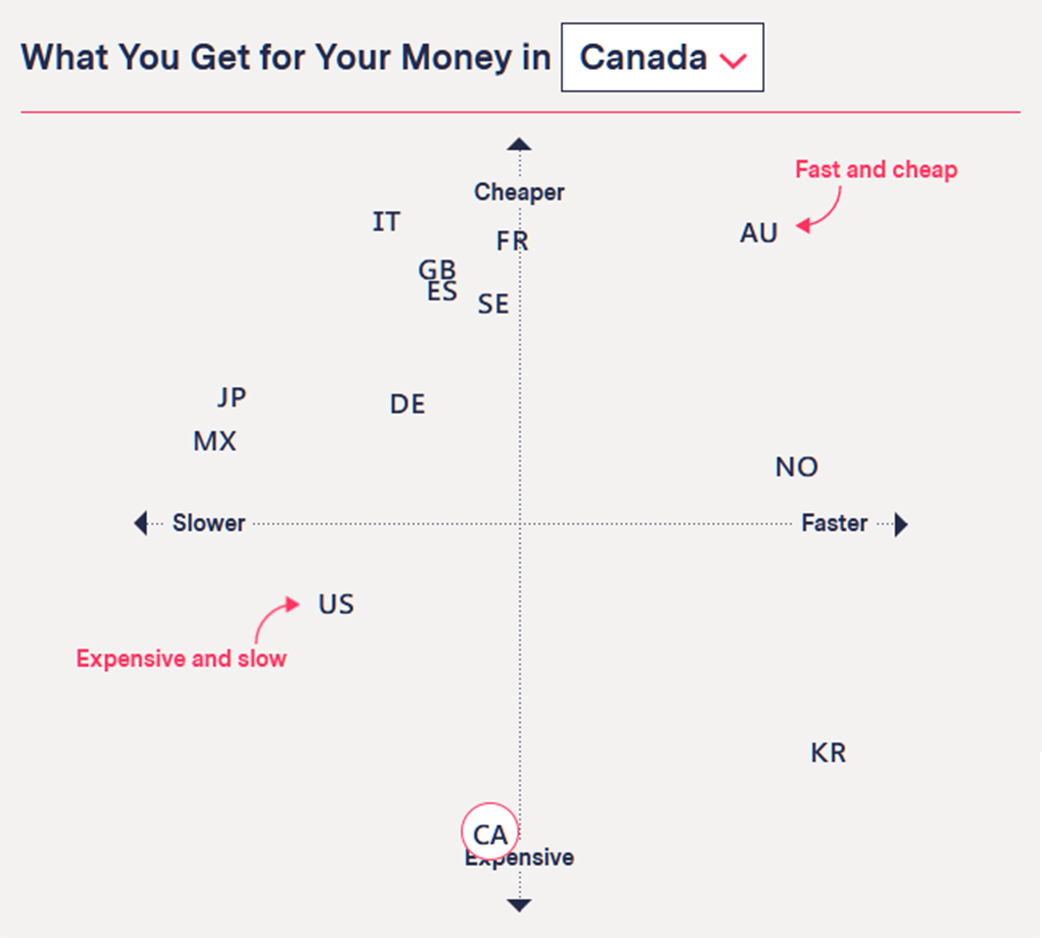
Canada has some of the most expensive wireless data costs in the world. It’s a well-known problem for most Canadians, although some carriers seem convinced this isn’t the case. However, a study published by The Markup shows just how bad Canada’s costs are.

The Markup leveraged data from a 2016 FCC study that looked at the costs and speed of mobile data across 28 countries, including Canada. That study relied on crowd-sourced data from Ookla’s Speedtest app. The Markup also used data from ‘Cable.co.uk‘ to calculate price based on the cost per gigabyte of data.

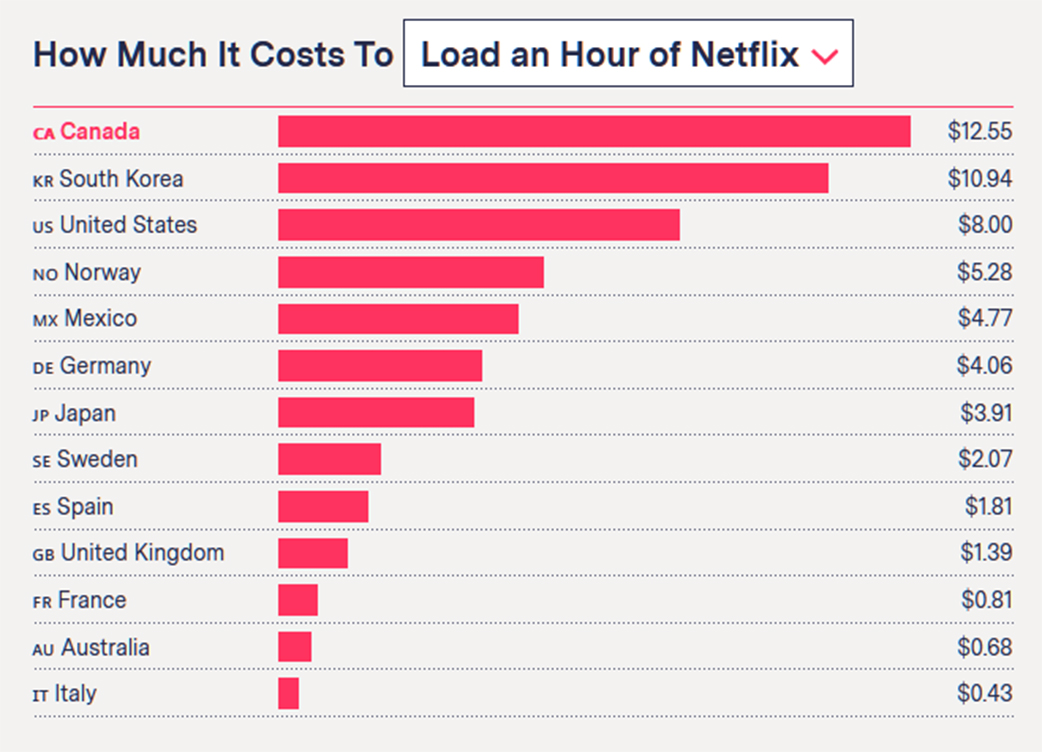
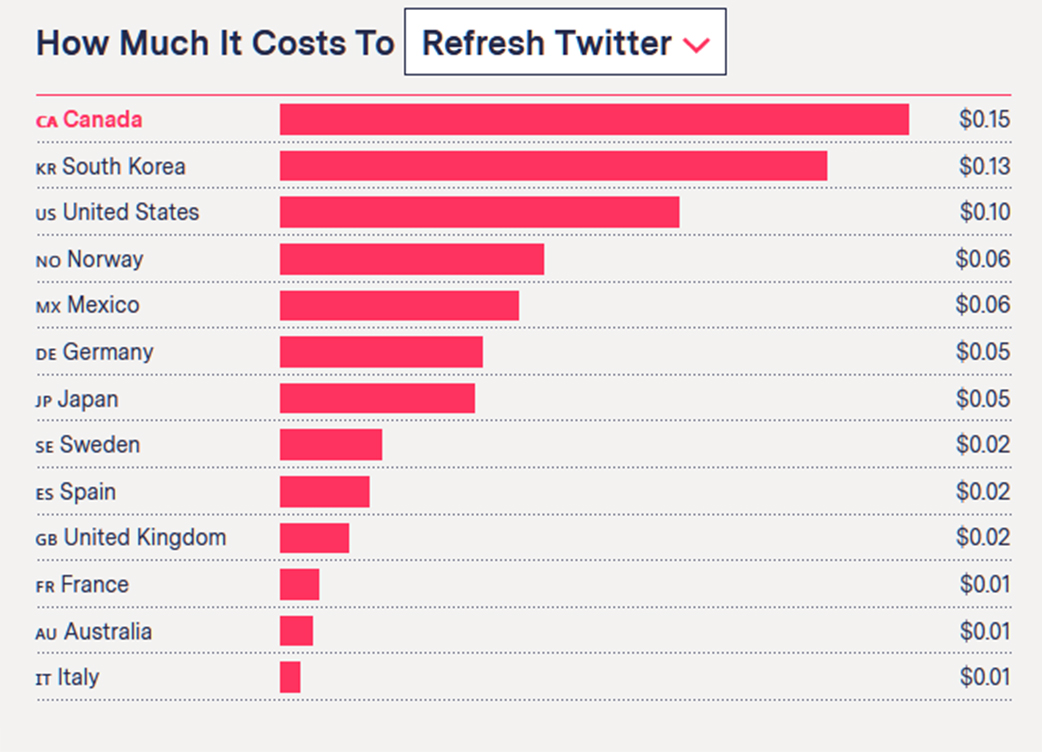
According to The Markup, refreshing your Twitter feed in countries like Italy and Australia costs about one cent, while in Canada, it costs $0.15 USD (about $0.20 CAD). Loading an hour of Netflix, on the other hand, cost $12.55 USD (about $16.48 CAD) in Canada, which was most expensive on the list. The U.S. came in at $8, Japan was middle-of-the-pack at $3.91 and Italy was cheapest at $0.43 USD ($0.56 CAD).

Canadian wireless plans have changed, but are still pricey

Of course, it’s worth noting that things have changed in Canada since 2016. Bell, Rogers and Telus — colloquially called the ‘Big Three’ — all launched ‘unlimited’ data plans. However, these data plans still employ a cap: users get an allotment of high-speed data followed by unlimited usage at a throttled maximum speed, typically a maximum of 512Kbps. Unfortunately, these plans are still expensive, albeit less so than comparable limited plans from before. Additionally, The Markup points out that most Canadians remain on packages with data caps.

Another factor The Markup acknowledges is that Canada’s large landmass can make it difficult for new telecom companies to establish reliable nationwide networks. As such, the Big Three largely dominate the Canadian wireless market, with prices varying only where smaller regional players manage to generate significant competition.

The Markup isn’t the only group looking at Canadian wireless prices. The federal government is working to reduce the cost of mobile plans by 25 percent. Earlier this year, the government released its first progress report on the initiative, noting that carriers largely hadn’t made any changes to their plans.

The report shows benchmark goals for plans, such as a $55/4GB plan costing only $41.25 after the reduction, and a $60/6GB plan dropping to $45. Currently, some carriers offer $50/4GB and $55/6GB plans, and while cheaper than the government’s start cost, they don’t meet the reduction benchmark. Further, the Big Three focus on the new unlimited plans, which typically start at $75 for 10GB, and have limited options available for customers who don’t need that much data. Bell, Rogers and Telus all have flanker brands that offer lower-cost options for those who find $75+ too expensive.

Comparable U.S. plans are still cheaper than Canadian options

Even with the new unlimited plans, pricing can still be higher compared to similar U.S. plans. For example, AT&T offers a $75 USD unlimited plan with 50GB of high-speed data as well as access to calling, texting and data Mexico and Canada. $75 USD is about $98.48 CAD, which is cheaper than the Big Three’s most comparable plans, which cost $125 CAD per month for 50GB of unlimited data and charge extra for use outside of Canada. Verizon clocks in at slightly higher $80 USD for a similar plan to the AT&T option.

There are subtle differences worth considering when comparing these plans, of course. Both the AT&T and Verizon plans include access to 5G where available. Technically, so do the Big Three, although Rogers plans to charge $15 per month to access 5G starting in March 2021. However, the U.S. plans impose limits on video streaming and hotspot usage — Canadian carriers typically don’t restrict these options.

Granted, these are specific examples and, as mentioned above, pricing tends to change frequently with wireless plans. The examples likely don’t encompass the full range of plans, carriers and pricing available either in Canada or stateside. However, despite all the recent changes in Canada, the high cost of wireless data remains a fact, not a myth.

Source: The Markup

The post Canadian wireless data prices among most expensive of 28 countries: study appeared first on MobileSyrup.

04 Sep 22:26

Long Links

I seem to have fallen into a monthly rhythm of posting pointers to what I think are high-quality long-form pieces. One of the best things about not having a job as such is that I have time to read these things. My assumption is that most of you don’t, but that maybe one or two will reward an investment of your limited time.

In The New Yorker, Jane Hu writes The Second Act of Social-Media Activism, subtitled “Has the Internet become better at mediating change?” People like me would like to believe this; back when the Arab Spring was first a thing, we did. Now, that belief is weak; maybe the Internet is a better vehicle for fascism than progress. Even endless live video of police violence doesn’t seem to build support for a common-sense redesign of policing which would route a lot less money to bossy people with guns and more to good listeners who are qualified at dealing with social-health issues. Hu’s take is level-headed and not entirely pessimistic.

These days, I subscribe to Utility Dive, which mixes arcane expositions of utility-regulation politics with the occasional really fresh and smart take on energy economics in the face of the onrushing climate emergency. Sheep, ag and sun: Agrivoltaics propel significant reductions in solar maintenance costs is probably not terribly important to your understanding of the big picture, but it’s a fun read. Suppose you have a solar farm and it’s not in the desert, it’s in a place where plants grow. Well, they might grow up over your panels and get in the way of the sun. What do you do about that? Well, you treat your farm like a farm and bring in grazing animals to eat the plants. Turns out you have to pay the animal providers, which as a farm boy feels odd to me. Now, when there are untended sheep, there are pretty soon going to be predators. You might be able to afford sheep but nobody can afford shepherds, so instead you might hire some Great Pyrenees hounds to tend them. Then you might find yourself with a liability problem when the hounds (they are very protective of their woolly charges) mistake a passerby for a predator. I wonder what solar farms of the future are going to end up looking like?

Back to The New Yorker, where Bill McKibben has been leading the climate-emergency charge — they’ve a great newsletter you can sign up for. McKibben wrote North Dakota Oil Workers Are Learning to Tend Wind Turbines—and That’s a Big Deal, which is good. A lot of people are pointing out that a Green New Deal program would offer a lot of major investment opportunities — there’s gold in them thar renewables — but it looks like petroleum-engineering skills are going to be transferable to the sector. Which is a damn good thing, because capital investment on the oil-company front is falling like a stone and I’m not seeing evidence that it’s coming back any time soon. The picture is complicated because opponents of the transition from fossil to renewable energy include not just oil barons but certain old-school unions. But there are grounds for optimism.

Speaking of oil-economy woes, the CBC’s As oil money dries up, Alberta's financial woes laid bare paints a pretty painful picture of the situation in Western Canada, where employment levels and provincial budgets have been joined at the hip to the oil industry since forever. I’m optimistic in the medium/long term but this transition isn’t going to be easy. If you doubt that, dip into the 4,709 comments. No, I take that back, please don’t.

I forget what maze of twisty little passages led me to The Logical Description of an Intermediate Speed Digital Computer, which is Gene Amdahl’s 1951 Ph.D thesis. If you don’t know who Gene Amdahl was, skip to the next paragraph, this is about to get very boring. If you do know, it’s almost certain this read will delight you. The computer in question was actually built; it was called the Wisconsin Integrally Synchronized Computer. Its only memory was a storage drum. Anyhow, this is instructive in that it helps the reader understand how many concepts and constructs that seem axiomatic to us, self-evidently obvious, were hard-won by these people in this phase of history. Also, this computer doesn’t have instructions, it has commands. I’m kind of sorry that language didn’t stick.

It turns out that the backbone of the Internet is mostly operated by large telephone companies who, as corporations go, have a reputation for being clueless, abusive, and extractive. This seems unsatisfactory. In A Public Option for the core (ACM overview page, PDF), Harchol, Bergemann et al “propose the creation of a ‘public option’ for the Internet’s core backbone. This public option core, which complements rather than replaces the backbones used by large-scale ISPs, would (i) run an open market for backbone bandwidth so it could leverage links offered by third-parties, and (ii) structure its terms-of-service to enforce network neutrality so as to encourage competition and reduce the advantage of large incumbents.” This sounds profoundly sensible to me.

This is a space for long-form works and I didn’t say they had to be written. In that spirit, I recommend Nine Inch Nails Tension 2013, an 87-minute recording captured at the Staples Center in LA on November 8, 2013. If you like hardass, totally committed musical performances, don’t start watching this or you won’t get back to “real life” for a while. Which, especially in 2020, is not a bad thing.

In Catalyst (of which I know nothing) from last spring is Ecological Politics for the Working Class. If you’re terribly concerned about the climate emergency (as I am) and also a progressive who flirts with class reductionism (as I am) it probably bothers you that, and I quote, “environmentalism’s base in the professional-managerial class and focus on consumption has little chance of attracting working-class support.” So, a piece that “argues for a program that tackles the ecological crisis by organizing around working-class interests” should interest you. Tl;dr: Among other things, stop yelling at consumers and try to get away from “lifestyle environmentalism”. Related: “centrist” pundits damning the Green New Deal idea with faint praise along the lines “those environmental goals are laudable, but they they start talking about guaranteed incomes and so on, which really aren’t a necessary part of the package.” Er, wrong, they really are a totally necessary part. I don’t agree with everything here but it’s a bracing read.

When Biden picked Kamala Harris as his running mate, she suddenly became a lot more interesting. A fierce controversy broke out over in Wikipedia about how to describe her; was “African-American” appropriate? To discover the outcome, check out her Wikipedia entry. In The Atlantic, Joshua Benton published The Wikipedia War That Shows How Ugly This Election Will Be. I dunno if we needed any more educating about more 2020 ugliness, but reading this made me happy. Because it shone a light on the Wikipedia work process, which these is terribly important to humanity’s understanding of reality. And you know what? While imperfect, on balance it works pretty fucking well. The process is unironically concerned with truth and does, on balance, a good job of achieving it. Is anything more important on today’s Internet? I’ve highlighted a core Wikipedia tenet before and probably will again: “Content which is not verifiable will eventually be removed.” Which seems a necessary but not sufficient condition for any sort of sane adult discussion about anything.

Back to Utility Dive: Renewable energy prices begin an upward trend, LevelTen data shows. No, I don’t know who LevelTen is. This is notable because renewable prices have been falling quickly and monotonically for years; I was shocked at the headline. Well, it turns out that the various tax incentives and other subsidies that originally helped drive renewable adoption are by and large no longer necessary, so they’re expiring and being withdrawn. So the prices go up a bit. Does it mean that renewable generation is now more expensive than fossil fuel? Nope, not even close. But watch out for petrol-head trolls exclaiming with glee, using this as evidence. Oh, another piece from the Dive: The future of hydropower will be determined in the Pacific Northwest, which covers the complicated and interesting conflict, when you dam rivers for generation, between the benefits of cheap green power and the potential damage to fish migration. Something that can’t be ignored.

In Wired, Yiren Lu writes My Week of Radical Transparency at a Chinese Business Seminar, a deep dive into a part of mainland-Chinese culture which I previously had no notion of. China in some regards is still the most interesting place in the world and people who are interested in the world need to improve their understanding of what’s going on there. This piece is going to make some of us a little uncomfortable with one or two progressive axioms over on this side of the Pacific, too.

Speaking of which: There’s so much bad shit going on the world that it’s easy to let the news about China’s brutally racist oppression of its Uighur population vanish in the input stream. Buzzfeed is doing its best to help us not let that happen with a two-part investigation starting here: “China rounded up so many Muslims in Xinjiang that there wasn’t enough space to hold them”. They have rare testimony from inside the camps. This won’t cheer you up but it’ll give you more reasons to understand (and, realistically, fear) China’s barbaric ruling clique.

Here, in Gizmodo, is some practical advice for protestors: Your Phone Is a Goldmine of Hidden Data for Cops. Here's How to Fight Back. It’s exactly what the headline says. The measures recommended are pretty extreme and for most of us in most political actions, thankfully probably unnecessary. Let’s hope it stays that way. And bookmark this in case it doesn’t.

Over at AdWeek, Why Lawmakers Are Keeping Ad Tech Under Such Close Scrutiny. I think this particular “why” is pretty obvious: Because Ad Tech is abusive to customers and disastrous for many previously-excellent publishing business models. It’s tremendously damaging to privacy and to intellectual discourse. People who are already privacy paranoids won’t be surprised by much of the information here, but I found it super interesting because it was presented in the language of, and reflects the culture of, the Ad industry. Related: Apple wants to stop advertisers from following you around the web. Facebook has other ideas from Peter Kafka over on Vox. I sincerely hope for lots of political action in the nearest-possible future around abusive AdTech.

Still more on privacy and its abusers: How To Destroy Surveillance Capitalism by Cory Doctorow over on Medium/One Zero. It’s really long — in fact, the full text of Cory’s new book — and I haven’t finished reading it, but it feels essential to me and I will.

In Canada’s The Tyee, a review of Kurt Andersen’s recent book Evil Geniuses: The Unmaking of America. The goal is to draw a map explaining how the USA got from the Seventies, when the level of inequality was roughly the same as Sweden’s, to today’s diseased, shambling, divided, misgoverned, year of discontent. The review dips into our local Western-Canada politics and that may not be of much general interest, but reading it definitely put the book on my to-buy-and-read list.

Last of all, I recommend The Internet of Beefs by Venkatesh Rao, an appallingly cynical and amusing take on the dysfunction of Internet discourse. I found a lot of truth in it. It doesn’t propose much in the way of solutions, but says “Like all the best questions, this one is at once intensely practical — all about digital hygiene and how to design and use devices of connection to think — and intensely philosophical — about finding ways to be reborn without literally dying. I don’t have answers, but I like that I finally at least have a question.” A very good question.

04 Sep 22:25

Toronto’s dotmobile now sells Vancouver’s Bounce screen insurance online

by Jonathan Lamont
dotmobile marketplace

Toronto-based dotmobile announced that it would bring Vancouver-based Bounce to its marketplace app, giving customers access to screen protection plans.

For those unfamiliar with dotmobile, it calls itself the “smart tiny telecom.” It’s a “CRTC-registered Proposed Full MVNO” with over 8,000 members signed up. dotmobile is also working to offer an app-based “hyper-focused” shopping experience. Part that means nabbing partners, which so far includes the likes of smartphone case maker Speck, 8Bitdo, which makes Bluetooth controllers, PC accessory maker Razer and more.

Bounce is the latest company dotmobile plans to add to its marketplace. The Vancouver-based company offers screen protection plans that differ from traditional phone insurance programs. Bounce’s standout difference is that it covers used phones as well as new devices. In fact, every phone in Canada is eligible for coverage as long as the screen isn’t already broken.

“We are excited to partner with dotmobile, a company that shares our values and is laser focused on providing Canadian wireless customers world-class solutions at a sensible price. We’ve created an insurance plan that just focuses on the main issues, screen damage. Screen break accidents are by far the biggest reasons for claims in the insurance business,” said Bounce founder Scott Walker in a press release.

Walker also touted Bounce’s simple protection plans that “make the claim process as easy as possible” for customers. Instead of dealing with complex insurance programs that often force customers to mail away their phone, Bounce customers can get their phone repaired anywhere they want, then send Bounce the repair receipt. The company reimburses them within 24 hours.

As part of the dotmobile partnership, Bounce will offer a promotional back-to-school rate through the MVNO’s app. Annual plans start at the discounted price of $33 per year (usually it starts at $39), which covers two screen replacements up to $150. Bounce also offers an Elite Plan that covers more expensive phones — including the yet-to-be-released iPhone 12 — for as little as $79 per year.

Bounce screen replacement plans

Bounce’s screen replacement plans

Those interested in trying out dotmobile’s app, or who want to get the special Bounce deal, can download it for free from the Google Play Store and Apple App Store. It’s worth noting the app is still in alpha testing.

You can also learn more about dotmobile on its website, or Bounce on its website.

Image credit: dotmobile

Source: dotmobile

The post Toronto’s dotmobile now sells Vancouver’s Bounce screen insurance online appeared first on MobileSyrup.

04 Sep 22:25

Alberta might have one last oil boom.

by Stephen Rees

The marker which shows where the well was

Western Canada’s First Oil Well: Waterton Lakes, Alberta


“Will it make the same mistakes?”

The headline comes from The Globe and Mail.

The cause:

Analysts predict global oil demand could peak as soon as 2022. Even some big oil companies see peak demand by the 2030s.

But between then and now, in the mid-2020s, oil companies such as France’s Total forecast higher prices on a combination of steady demand and tighter supply.

This scenario, if it plays out, won’t mean $100 for a barrel of crude. But it would mean a profitable oil industry – and potentially quite profitable. Given that Alberta is among the biggest producers of oil in the world, this outlook could be very good news for the provincial treasury.

This annoyed me so much I found that I was writing a reply in my Plague Diary. Which will not be seen by anyone – at least not for a very long time. Perhaps they will have fun comparing the prediction with reality.

I cannot imagine that the provincial treasury will see all that much. Mostly because politicians do not have a long term focus. And this seems to apply in spades to Conservatives and Albertans. The early paragraphs of the editorial lists what happened in previous oil booms. My prediction is that while the mistakes may have some differences, the political instinct will be to devote any windfall to spending that will bring enough popularity to improve the chance of winning the next election. That is all the party in power thinks of. Yes, there are lots of good causes, and plenty of lobbyists. The ones that promise significant donations to party funds and other help to win elections will get the most favorable hearing. And the oil and gas lobby is still the biggest and most generous. While the statistics show Mining, quarrying, and oil and gas extraction, at 16.12% of GDP, CAPP continues to claim “30% of all economic activity in the province” which is obviously not the case.  But most Albertans and nearly all of the politicians probably don’t see it that way.

What has been happening is that the oil and gas sector has been largely bought up by foreign investors. Large multinationals, most of whose profits get squirrelled away in places where there are no taxes. There is a huge overhang of environmental damage, most of which will remain for the public purse to repair long after the end of the age of oil and gas. I doubt that much will be spent on this in the short term unless there is some major catastrophe to concentrate minds. Some inspiring folk are converting abandoned well sites to  solar capture. But the amount of space that occupies compared to the huge swathes of wrecked boreal forest is tiny. And the first thing that a conservative thinks of when there is a “surplus” is tax cuts. Actually it is the only thing no matter what the state of the balance of revenues to spending – unless it is spending cuts to hurt those least capable of withstanding them.

Of course we all know what works and what doesn’t. Conservatives are not persuaded by evidence, they like stories, and they love the old stories. They keep on doing what they have always done even though the outcome is always the same too.

If oil prices rise so too will oil and gas production. Right now there is a glut and the places to store the surplus are at capacity. Note too that the higher prices are predicted by an oil company. Not exactly an unbiased source.

But we also know that Canada has not a hope of meeting its commitments to reduce ghg emissions – mostly because the Canadian government spends far more on propping up a dying industry instead of promoting the green alternative. “As part of its COVID-19 response, Canada’s government is spending $1.7 billion to clean up “orphan” and inactive oil and gas wells in Saskatchewan, Alberta and British Columbia.  Industry should be footing the bill
” (source: Suzuki ibid) 

Many other governments are doing far more than Canada to promote sensible investments in renewables – and they are seeing good rates of return on those investments as well as moving in the right direction. I do not see a Jason Kenney government following that path – but maybe that will not survive long enough to see the predicted boom times.

More likely the predicted boom is unjustified optimism. Or downright lies – which is what I think that CAPP claim is.

04 Sep 22:24

TikTok creativity

Dave Truss, Daily-Ink, Sept 03, 2020
Icon

Some of the most original online work these days is appearing on TikTok (which probably explains better than 'China' why some people want it shut down, what with its user campaigns and such). This short post links to a few highlights (TikTok is mostly a mobile application, and has recently become more insistent on viewers logging in, but you can still see individual snippets in a browser). Dave Truss comments, "What I find interesting is that much of this original work is inspired by a copy culture
 a sharing and expanding of creative ideas. Sometimes this is just blatant copying. Sometimes it’s copying with a very creative adaptation, and sometimes it’s just pure parody for a laugh." Eventually 'creators' will get sensitive about 'ownership' and they'll wreck it. But for now, it's great. Image: TikTok.

Web: [Direct Link] [This Post]
04 Sep 22:23

Interpreting Personal Abuse

by Richard Millington

There are two ways to interpret personal attacks, one of them is a lot healthier than the other.

The bad way is internalising the criticism (accepting the criticism is accurate and valid) and try to change your ways to receive less abuse in the future.

This isn’t sustainable. You’re placing your self-worth in the hands of an abuser and you’ll need to perform linguistic acrobatics to avoid upsetting them in the future.

The better way is to recognise those who give abuse are typically in a lot of psychological pain.

They may have unresolved issues or are going through bad times. Giving abuse is their mechanism to feel better about themselves.

Something you’ve said or done might have triggered them, but the fuse and kindling has been in place for a long-time.

For sure, ban abusers if you need to. But try not to accept the abuse as accurate or valid.

The abuse you’re receiving is far less about what you’ve done and far more about who they are.

04 Sep 22:13

Picking the right colors for your charts

by Nathan Yau

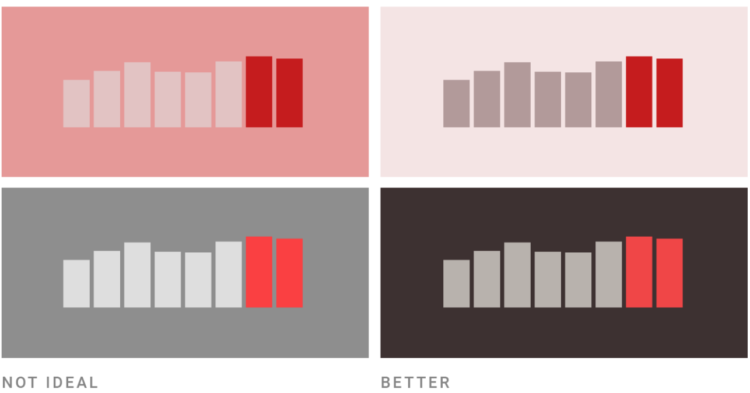
Picking colors for your charts can be tricky, especially when you’re starting a palette from scratch. For Datawrapper, Lisa Charlotte Rost has been writing guides on color as it pertains to political parties, gender, and more recently, colorblindness. Rost put the pieces together for a single, more comprehensive guide on the subject.

Be sure to check out Rost’s other guides on making better charts. She has a knack for explaining visualization methods in a practical and concrete way.

Tags: color, Datawrapper, Lisa Charlotte Rost

04 Sep 22:13

On “losers” — and whether John McCain was one

by Josh Bernoff

Of course John McCain was a loser. He ran for president and he lost. Ergo, he was a loser. But that’s not what Trump means when he talks about McCain being a loser. He’s talking about military service in which you were captured or otherwise failed. And that’s another story. Trump is lying about calling 
 Continued

The post On “losers” — and whether John McCain was one appeared first on without bullshit.

04 Sep 22:13

'We're Living The News': Student Journalists Are Owning The College Reopening Story

Elissa Nadworny, Lauren Migaki, NPR, Sept 04, 2020
Icon

As is so often the case, student journalists are showing how the story should be covered. "Their editorials haven't held back. One headline from students at the University of Kansas read, KU must reverse course now on campus reopening; another, from the student-run newspaper at the University of Notre Dame, declared, Don't make us write obituaries." So much better than the sanitized language of 'toggle terms' that more professional pundits have been using. This is an NPR story, so there's audio as well as text.

Web: [Direct Link] [This Post]
04 Sep 22:13

The Internet as we know it

Wendy M. Grossman, net.wars, Sept 04, 2020
Icon

If you can get past the user-hostile colour scheme (pro tip: use Firefox's Reader View to make it readable) this is a fairly intelligent view of the challenges facing the internet 'as we know it'. The danger isn't so much splintering so much as it is centralization and control. This is something that started with the mobile internet, which has largely been tightly controlled, and extends to proposals for a new internet protocol (IP) policy that would "shift control of the internet, both its development and its operation, to countries and the centralized telecommunications powers." Wendy Grossman writes, "This is a crucial threat to the interoperable bedrock of 'the network of all networks'. As the Internet Society explains, it is that cooperative architecture 'with no central authority' that made the Internet so successful. This is the first principle that built the Internet as we know it."

Web: [Direct Link] [This Post]
04 Sep 22:12

Robot Teachers, Racist Algorithms, and Disaster Pedagogy

Audrey Watters, Hack Education, Sept 04, 2020
Icon

This is Audrey Watters speaking to a class of students about the ed tech industry and especially about the use of algorithms to surveil and to predict outcomes. She covers some of the more recent events, including Ofqual's ill-conceived notion that student grades should be adjusted based on the history of the school they attend. But it makes me think - isn't this what we do anyways? The algorithms magnify and weaponize the bias, but the bias is there nonetheless. Even without AI, elite institutions somehow manage to admit more students from private upper-class schools, no matter what their grades. Even without AI, exam proctors are going to regard the darker skinned students with more suspicion. We need to look at AI in a way Watters doesn't usually, unfortunately, and that is, as a way to expose and redress bias and prejudice, as opposed to merely magnifying it. Because just going back to the way things were is just not an option for so many people.

Web: [Direct Link] [This Post]
04 Sep 22:12

Families/Caregivers Allowed Back Into Ontario Long Term Care Facilities

by Sandy James Planner


For anyone that has loved ones or friends in long term care facilities in British Columbia the pandemic has been brutal. Often family members provided much of the basic care, and also provided social and mental wellness support to people in these facilities.

And then came the Covid pandemic.

Jen St. Denis wrote in July about the management of the Veterans Memorial Manor at 310 Alexander Street which was not allowing visitors to come into the facility. This facility houses 133 vulnerable seniors and veterans who did not have much external  interaction but management felt  the “no visitors”policy was important to protect vulnerable residents during the Covid pandemic. Of course this policy also impacted the physical and mental health of some residents who relied on visitors for social stimulation and a way to spend their day.

I have previously written about Long Term Care for seniors which appeals to the “Greatest Generation” and the”Silent Generation” cohort (those born 1910-1924 and 1925-1945.) Those two generations considered having restaurant style prepared meals in central dining rooms, structured and organized activities, and personal service in room cleaning and management a luxury.

Of course no one imagined that a pandemic would force the closure of these long term care facilities in such a way that many residents became prisoners and confined to their facilities or to their rooms during the pandemic.

In June in British Columbia long term care facilities were asked to submit plans to the Province to allow one visitor at a time per resident for one half hour behind plexiglass or outdoors. Each facility has a different management plan, and family members cannot touch or assist the resident in any way.

Take a look at what Ontario has just unveiled.

Realizing that operators of long term care facilities had been inconsistent in providing clear policy on visits by caregivers (including families), that province is now allowing  two designated caregivers to visit at any time including during a covid outbreak subject to “direction from the local public health unit”.

“If a home is not in outbreak, and the resident is not self-isolating or symptomatic, caregivers can visit together. If a home is in outbreak, or the resident is self-isolating or symptomatic, they must visit one at a time to limit risk of transmission and follow direction from the local public health unit.”

The Ontario Minister of Long-Term Care stated: “Bringing comfort and care, caregivers make a vital contribution to the overall well-being of long-term care residents. Today’s announcement will ensure that guidelines on their visits are applied consistently across homes so that all residents get the support they deserve.”

The Ontario government is monitoring this policy of inclusion, and strives to “continue to make every effort to support the safety and emotional wellbeing of residents and the staff who care for them.”

Images: 680news.com inthehammer.com


04 Sep 22:12

On learning myths, learning styles and complicated vs. complex

by Lilia

There is a bunch of publications coming to my attention recently which focuses on debunking “myths” in instructional design. Usually, I have mixed feelings about those – a lot of it makes sense, but at a deeper level, I have a feeling that it is often about replacing one research-based myth with an updated one. All of that is pretty much in the same domain of complicated, where experts know the answers and your choice is limited to which expert do you believe the most.

For example, a take on learning styles, Stop “Fixing” Your Brain by Believing in Learning Styles, which shows how different assumptions about sensory learning styles could be detrimental to learning. The post then goes on to point that those “predefined” learning styles are fluid and could be changed with time via neuroplasticity:

The study of neuroplasticity tells us that through challenging experiences, we can biologically change our brain. When we think about what this means for learning and our current learning habits, if you only have experience using certain strategies for learning (e.g. note-copying, highlighting, flashcards), then your brain’s neural pathway is stronger for those strategies. However, neuroplasticity suggests that with practice, you can develop other strategies that would help you learn in any environment.

Facilitating learning of three very different kids I see the truth behind both, “factory settings” that lead to the development of certain sensory preferences in learning and neuroplasticity.  The question is at what costs “being able to learn in any environment” comes and if it is worth it. The answer to this question is different depending on the context.

In school settings, when you need a program to help many different kids to reach particular goals, it is logical to design for neuroplasticity. It should give good results “on average” by engaging different existing learning strategies and stretching into developing new ones.

From the perspective of an individual learner, it is different. Personally, I do not see the point of turning everyone into a well-rounded person able to learn in any environment. I see a lot of value in strengths-based development and being able to choose and shape your own environment in a way where your strengths could help to deal with the challenges. This is where paying attention to personal patterns in learning makes a difference (reading-related example and another one for a contrast).

As a researcher living in a fast-changing world I am also very much aware of the limits of any research in predicting what methods and techniques (±directions of pushing neuroplasticity with instructional design) would benefit learners in the long term. And all that without touching on bias coming from studying WEIRD (Western, Educated, Industrialized, Rich, and Democratic) societies and epistemological beliefs behind one’s research.

Which brings me to another point that occupies a lot of my thinking recently – the future of education in the world where a lot of complex issues are treated as complicated. This one will need more time to ripen, so for now just two quotes from Twitter to think about.

The first one is from Harold Jarche in reply to my burning question in a thread on learning myths:

It’s like getting people to understand that the situation is complex when they are sure it is merely complicated and can be analyzed in advance. It cannot be done.

And the second one:

What is the point in caring about something you cannot change?

Everything.

To care without the conditions of productive change is to live into the maturity required to shift the possibilities of coming decades.

I am showing up w no prescripted outcome. No economics of care.

— Nora Bateson, 21 August 2020

The post On learning myths, learning styles and complicated vs. complex appeared first on Mathemagenic.

04 Sep 22:06

RT @xujnx: Imperial jar bearing Persian script, made during the reign of Ming Emperor Zhengde (1491-1521), an Islam enthusiast who ordered


by Jin Xu (xujnx)
mkalus shared this story from AliceAvizandum on Twitter.

Imperial jar bearing Persian script, made during the reign of Ming Emperor Zhengde (1491-1521), an Islam enthusiast who ordered a great many blue & white porcelains decorated with religious quotes in Arabic or Persian like this. He even gave himself an Arabic name "Mejid Allah." pic.twitter.com/orsBOLEmdt


Retweeted by guyfinder-general (AliceAvizandum) on Friday, September 4th, 2020 9:55am


328 likes, 128 retweets
04 Sep 22:05

Twitter Favorites: [dylan_reid] It's worth watching again to see the team movement off the ball that got Anunoby open - this was a whole-team effor
 https://t.co/5IPxeR1Zpo

Dylan Reid @dylan_reid
It's worth watching again to see the team movement off the ball that got Anunoby open - this was a whole-team effor
 twitter.com/i/web/status/1

02 Sep 17:07

Simple Signal Guide For Everyone

Set Of Principles, Sept 02, 2020
Icon

This is a very basic introduction to Signal, an encrypted text messaging app. You would use it just like text messaging on your mobile phone (on Android, it can replace the default service, supporting both existing and encrypted text messages). The appeal of signal is of course its privacy, but also that it's non-commercial, there are no advertisements and there is no tracking or spying, and it's free for everyone.

Web: [Direct Link] [This Post]
02 Sep 17:06

What If Trump Wins Again?

by Dave Pollard


New Yorker illustration by David Hornsby

“I remember a time when everybody knew their place. Time we got back to that.” — supporter of the incumbent American president the day after the 2016 election, cited in Caste

Our universal propensity to think in the short term has a lot of people hoping that Trump will lose in November, even though a lot of them don’t think much of the alternative, vowing to fight on for progressive causes no matter which old white male conservative candidate wins.

There’s a kind of collective holding of breath going on, as if there is a huge proportion of undecided voters up for grabs if something ghastly happens between now and then (according to recent polls that proportion is already less than 5%), or of course if the election is stolen, as it has been before.

What I find most alarming is the wishful thinking behind many progressives’ feeling that if Trump loses, we’ll never see him or the likes of him again. That was what many said once de-facto-President Cheney’s puppet regime’s term ran out.

This is dangerous thinking. Opinion polls consistently show that Trump’s support among white males remains basically unchanged over the past four years. This, not Republicans, is his real base — a clear majority of white males continue to support Trump, and it hasn’t been that long since they were the only people allowed to vote. Whites, and male whites moreso, have voted against every Democratic presidential candidate since the civil rights movement of the 1960s.

And let’s be clear — I didn’t say old white males. Young white males of all voting age groups remain committed, almost as much as their older counterparts, to supporting Trump. Their entrance into the voting age cohorts has barely caused a ripple in the plurality of white males supporting Trump. That may surprise you until you consider that a disproportionate number (about half) of young voters are non-white (only a quarter of boomers are non-white), so looking at the entire youth cohort’s seemingly progressive attitudes obscures the reality that most young whites hew to the same extreme right-wing politics that the majority of old whites subscribe to; there’s just fewer of them.

And for a whole host of mostly disgraceful reasons, mostly to do with deliberate disenfranchisement (by white males), white males are the American demographic cohort most likely to vote.

What does it tell you that a majority of white males of all ages are knowingly prepared to vote again for a candidate who is blatantly corrupt, a pathological liar, clearly mentally deranged, uninformed, racist, sexist, utterly unprincipled, and staggeringly incompetent?

Think about that. What does it tell you when this is the case in a supposedly democratic, free, educated nation?

If we catch a break and he loses despite this rock-solid and immovable base, what then? Do we really think white male Americans are going to see the light and wise up? Four years from now, even if Trump loses, we’ll be lucky to have made a start at undoing the damage he has done, let alone starting to address the blizzard of crises that Trump has ignored or denied, at his country’s and the world’s peril, over the past critical four years. And we’ll then have to fight the battle all over again, with the odds still and always stacked against us.

The US has a long-term problem, and it’s white males — a significant and hard-core majority of them. What is the world going to do about them? Trump may lose, and, if we’re lucky, may even go away. But white American males aren’t going anywhere. They stand between the rest of the world and any hope of mitigating the mounting catastrophes that we’re going to face in the coming years and decades. Our systemically racist, sexist, patriarchal culture has produced them, and their attitudes, and is still doing so. It is not getting better. White male voters tend to get even more conservative as they get older.

Of course, in addition to massive and increasingly overt disenfranchisement, the American patriarchy has invested in other anti-democratic measures like the electoral college to deprive the majority of their choice for president, an absurd system that gives Wyoming the same representation as California to subvert the will of the majority in the Senate, and computer-perfected gerrymandering to ensure white males continue to control the House. With this control of the executive and legislative branches, they also control the courts, the legal system, and law enforcement, which are created in their likeness to support and preserve white male power.

Is there any hope of this being reformed, and soon, so that the US can join common cause with the rest of the world in tackling all the important issues at hand? Issues that white male American exceptionalism has spurned.

I see no reason to be hopeful.

I don’t lay any blame, though. I’ve studied enough history to understand the appeal of brutal authoritarian populism to people who, by virtue of their hopeless situation in a nation where median income is falling, median net worth is negative, and the middle class has substantially disappeared, are filled with rage, shame, and a sense of impotence — a sense that the “ruling class” (the universities, the media,  the professional class) cares nothing about their situation and largely disapproves of them (remember “deplorables”?).

It is not therefore surprising that someone who pretends to thumb his nose at the establishment, who speaks about everything as if it’s dead simple black and white, and who is so bumbling and incoherent that he can’t be intimidating, could be seen as their champion.

Of course, many BIPOC people have been treated much worse in what has become the third-world economy and rigged politics of the United States of Inequality, and their rage in the streets of America is perfectly understandable.

History is replete with examples of citizens electing autocrats who threaten the ruling class when the ruling class disregards them long enough. It is also interesting to note that these revolutions and usurpations of power are usually launched not by the poor, who have lived with oppression all their lives, but by the newly impoverished, often members of a middle class in decline, who feel that their ‘caste’ rating in the society has fallen, and unfairly so. Hitler and Stalin benefited from this, as Trump is now.

Isabel Wilkerson’s extraordinary book Caste outlines how our implicit caste system works. It suggests that over time all North Americans of European ancestry have been melded into a single dominant ‘white’ caste, with Asians, Latinos, Indigenous peoples and new immigrants from the African continent as the middle caste, and Blacks  remaining, as they have been since their ancestors first arrived, as the lowest, subordinated caste.

While I agree with just about everything in her analysis, I think our caste system is actually more complex than this. I would suggest that in parts of North American society Asian-Americans are treated as belonging to at least three and possibly more castes depending on where in Asia (Mid-East, South Asia, East Asia) they or their their ancestors came from. I would suggest that First Nations people are, in some places in North America at least, treated as a subordinated caste.

And I would suggest there are at least a dozen ‘white’ castes, of which privately-schooled, healthy, wealthy white males whose descendants have been in the country over a century are the top caste, and various other whites rank variously lower depending on whether they are male or female, how old they are, whether they are poor, whether they own their own home (or rent, or are homeless), what schools/universities they and their children attended and currently attend, what degrees and professional credentials they have, whether they are (physically and mentally) healthy (and if not, whether their illness is seen as a disease of the privileged or of the masses), how long their ancestors have been in the country, and their sexual orientation, speaking accent, religion, club memberships, and even appearance (fitness, level of beauty, dress and behaviours).

I do agree with Isabel* that Blacks (African-Americans) were and are treated as the bottom, most subordinated caste, wherever they live in North America. In geographical areas I have lived in that have almost no Blacks, another group, usually but not always what Canadians call a “visible minority”, seems to be treated as the most subordinated caste. Over the course of my life, that has at one time or another included Jews (who for many years could not join certain clubs), immigrants from Eastern Europe, immigrants from South Asia, First Nations peoples, people in the LGBT+ community, and those with physical and mental challenges. It seems that some group has to be identified as the lowest-ranking caste, to provide the basis for self-identification for everyone else.

I would also say that many white Americans automatically (and mostly subconsciously) treat all non-Americans as being of a somewhat lower caste than they would be treated if they were Americans, all other things being equal. They do so usually politely (depending on how low the caste they’re interacting with) but often patronizingly. I think that is the main reason so many Canadians, often unconscious of our own caste, distrust and even dislike Americans who force us to realize how utterly baked into our culture caste-ranking is — and they show us by slighting us. Ask any Canadian who works for an American boss if you doubt me.

In her book, Isabel describes the astonishment and outrage that a white dinner companion expresses over how they were treated (presumably because of Isabel’s presence) by staff in a restaurant. She tells her companion that if a Black American were to get outraged every time they were so treated, they “wouldn’t last very long”. She wishes that everyone could have a taste of this, just so they would know how it feels.

As a white male, I have been buffered from such treatment most of my life. I have been mistreated on rare occasions because of my long hair (especially in the 1960s and 1970s), how I have dressed, and due to my ‘radical’ politics. But these were conscious ‘misbehaviours’ on my part, and I was prepared for what they provoked. The only occasion when I was truly aware of how others perceived my caste rank was on a business trip in the 1990s. Flying in business class (a last-minute upgrade using frequent flyer points) I found myself seated beside one of Canada’s ten wealthiest men (the wealthiest were of course all men, and all white, as is still the case). He looked with obvious disdain at my casual attire, as if I were letting the side down. When I introduced myself and told him my (executive) title, he seemed surprised. He didn’t introduce himself, but instead asked me what schools I’d gone to growing up. When I told him public schools, he cut me off, ‘apologized’ that he needed to catch up on sleep for an upcoming business meeting, and turned his face away from me for the rest of the flight.

Rather than outraged, I was completely bewildered. I had no idea that such a caste system existed in Canada. Curious, I talked to others and discovered it was well-entrenched, and in my relative privilege, I had simply been oblivious to it. I hadn’t wanted to be aware of it; I didn’t want to believe that anyone treated people differently, in any systemic way — not here, not today! How un-Canadian! [The existence of different “classes” of travel, with their private segregated bathrooms, the unapologetic use of that term, and the different treatment afforded lower-class travellers, speaks volumes all by itself].

So then, in my forties, I suddenly became aware of the presence, effectiveness, and power of the caste system, and how utterly Canadian it actually was.

Fifteen years later, I went to visit the late Joe Bageant in Belize, and he gave me a crash course in how well entrenched the caste system was in the US. (The book he wrote, Deer Hunting With Jesus: Dispatches from America’s Class War, is IMO essential reading in understanding what he called the “white underclass” — the backbone of today’s Trump supporters.)

He was the one who told me about the pride and shame of what he called those of “mostly Scots-Irish descent” — whites whose ancestors didn’t think of themselves as white when they arrived (some of them as indentured servants), and who were treated for generations as lower- but not lowest-caste Americans (that position being already taken by African-Americans, slaves or not). Caste describes their delight at their apparent “upgrade” during the gradual merging of all white castes of European descent (even the then-despised Italian-Americans who made up most of the non-Black prison population in the early 20th century) into a single, dominant caste over the last century.

But then that pride turned to shame and anger as they found themselves seemingly downgraded in rank again, due to their poverty and lack of education, since the optimism of the 1960s yielded to the jaded materialism and defeatism that has prevailed ever since. Today, the members of the white underclass are the coal miners, desolating their own home communities just to make a buck. They’re the vast bulk of the military, the only means they can find to afford an advanced education. They’re the farmers, overworked and then robbed of their farms by Big Agriculture, often ending up working for the new owners of land that was once theirs. They’re the factory workers, with no opportunity for advancement, mistreated and tossed aside as automation, outsourcing, offshoring and union-busting provides arrogant and indifferent corporate executives (almost all of them white males of the top-most dominant caste) with a means of reducing costs. Their shame and misery is expressed in the astonishing number of them addicted to and dying from heroin, cocaine and fentanyl, as well as the old working class standbys, alcohol and tobacco, and the many other diseases of despair and hopelessness that have recently started to lower life-expectancies of this caste.

As the statistics show, it is now almost impossible to move economically from one quintile of income or net worth to a higher one, even over several generations. If “higher education” was ever a vehicle for doing so, it is no more. Since the death of egalitarianism and idealism in the mid-20th century, your wealth and education has become a lifelong badge of your caste, inherited and passed down to future generations. Poverty, and the rising chasm of economic inequality, have ushered in a subtler but still oppressive form of slavery, and while Blacks remain far and away the most oppressed caste, many working class whites have fallen from the dominant caste to something seemingly hopelessly below. They are angry (especially the gender with most of the testosterone). And, being uninformed and poorly educated, they are ripe for the picking by autocrats like Trump. And their shame and rage is often directed at — you guessed it — those of subordinate castes (in the corporate caste system it’s called “suck up; shit down” and it worsens as corporate size and number of levels of hierarchy increase).

This is classic scapegoating caste behaviour, and it is being perfectly ‘played’ by Trump and his cronies. It hurts to see the bitter irony of two struggling castes of Americans — Blacks and the “white underclass”, fighting each other in the streets, as members of the topmost dominant caste (the “1%”) cynically take sides and cheer on “their” side, the result being a complete distraction from the final looting of America’s remaining wealth by this caste — a dominant caste that doesn’t really give a damn about either side (even on voting day, since the dominant caste has long owned both parties).

There is a ton of data showing an almost perfect geographic correlation between inequality and violence. As inequality spirals out of control in North America, so will violence, and the repressive militarized police-led bloodshed unleashed to suppress it. And guess who the police, which are largely comprised of members of the angry white underclass, are going to focus their violent suppression on?

Isabel writes: “Caste is insidious and therefore powerful because it is not hatred; it is not necessarily personal. It is the worn grooves of comforting routines and unthinking expectations, patterns of a social order that have been in place for so long that it looks like the natural order of things.” Said in different terms, we might say that the behaviours that arise from conscious or unconscious perception of the prevailing caste system are enculturated conditioning. If that is the case, then we really have no choice but to act, often badly, in accordance with this conditioning. This isn’t an excuse for it, just an explanation. Hopefully, over generations, we might begin to socially condition each other differently, with greater awareness of the inherent injustice of caste-driven behaviour and less judgement, discrimination and damage to the victims and to the entire social fabric of our communities. To do so will require an end to the de facto segregation of castes — We most fear, misunderstand and distrust those we have never met, never spoken to, never worked and fought alongside.

Of course, there is the huge question of whether or not we can afford to wait for that to happen. In light of the grievous level of inequality, especially in North America where it continues to accelerate and put more and more stresses on all but the top-most dominant caste, it seems more than possible that the social fabric of the country will tear before that happens, and civil war or fascist dictatorship will be the result. While this will be a war between castes, the racial divide in it will be clear. If it results in a fascist coup and dictatorship, the top-most white dominant caste will be torn, since the white underclass arguably despises them as much as they do the subordinated caste. Many in the top-most dominant caste prefer the reliable, less emotional Democratic Party it controls over the Republican Party it seems to be losing its grip on, though it still clearly controls most of both parties’ elected officials. But history tells us they are more likely to try to appease a fascist dictatorship than risk losing power by opposing them.

And it really is all about power, and the wealth and other privileges power affords. In his review of Caste, Indian historian Sunil Khilnani, wondering whether Isabel’s call for “radical empathy” may be naive, points out: “Changing power differentials in order to redress vile histories of discrimination [is always] bound to be ugly”. And as Frederick Douglass famously said, “Power concedes nothing without a demand. It never did and it never will. Find out just what any people will quietly submit to and you have found out the exact measure of injustice and wrong which will be imposed upon them, and these will continue till they are resisted with either words or blows, or with both. The limits of tyrants are prescribed by the endurance of those whom they oppress.”

None of this bodes well for the future of the rapidly-failing American state. Or for its oppressed peoples.


* Just a note here that I generally use first names, not surnames, when referring to writers and others in my posts, regardless of whether or not I know them personally. I do this regardless of people’s gender, race or perceived position. I choose to do this because I find referring to people by their surname to be both anachronistic and somewhat demeaning (it can also be confusing when referring to several family members sharing a surname in the same article). Using surnames with a title (Mr, Ms etc) seems absurdly formal. Using both given name and surname seems pretentious and redundant. I mention this here because in Caste, the author makes a point of how whites were encouraged to refer to Blacks, even those much older than they were, by their first names, while Blacks were expected to refer to whites of any age by their title and surname. I mean absolutely no disrespect in continuing my naming convention in this article, and apologize if any offence is taken by such usage.

02 Sep 17:03

The Mandalorian Season 2 premieres on Disney+ on October 30

by Bradly Shankar
The Mandalorian

Disney has confirmed that the second season of The Mandalorian will premiere on October 30th on Disney+.

The company had previously confirmed in February that the live-action Star Wars series would drop in October.

Disney didn’t say otherwise, but given the weekly rollout of all of its other original content, it’s safe to say The Mandalorian Season 2 will follow a similar release structure. That said, the official tweet notes that “new episodes,” plural, are dropping on October 30th, so it’s possible that multiple episodes will release at first, followed by one new episode weekly.

Notably, Lucasfilm had managed to complete filming of the second season shortly before the COVID-19 outbreak, allowing crew members to continue post-production work remotely. This ensured that it stayed on track for an October release. By contrast, Disney+ original series The Falcon and the Winter Soldier, Marvel’s first show for the streaming service, missed its August premiere because filming had not finished prior to COVID-19 shutdowns.

That said, official details on The Mandalorian Season 2 remain scarce. So far, all we know for sure is that Giancarlo Esposito’s villainous Moff Gideon will return alongside the mysterious Darksaber. However, it’s all but been confirmed that Rosario Dawson will join the cast as Ahsoka Tano, the fan-favourite Jedi from The Clone Wars and Rebels animated series. Iconic bounty hunter Boba Fett is also reportedly set to make an appearance.

Image credit: Disney

The post The Mandalorian Season 2 premieres on Disney+ on October 30 appeared first on MobileSyrup.

02 Sep 16:59

Augmented reality should use magic mirrors, not glasses

I’m into the idea of augmented reality because it makes sense that computing is anchored to the real world.

Of course I should be able to pinch my fingers on a paragraph in a real printed book to copy-and-paste the text into my notes. Naturally I should be able to look out of my window and double-blink at my car, bringing up a readout of how much fuel I have and how much time is left on the lease. Or look up at the sky to see the weather forecast printed on a cloud. Or at my sourdough starter to see it ghosted against the size it was early today, so I can tell at a glance how much it has risen.

But augmented reality is always about glasses. See: the Magic Leap One A.R. goggles.

See Apple: the continuous rumours about Apple’s secret smart glasses project. Apple’s existing augmented reality platform which is always about looking through.

BUT.

Glasses are anti-social. I want to show people what I’m working on by having them look over my shoulder. I’ve lost count of the number of times I’ve shared a photo by holding my phone up to Zoom. When A. is cooking, she can call across from another room to have me check the stove – how bad it would be if the stove interface was locked away in her personal glasses. Sure, all computer interface problems are solvable with design and work – but A.R. is creating a lot of unnecessary work if it starts with an interface which is so oriented to the individual from day 1.

And then: how do we get there from here? I can imagine a world where augmented reality is the only interface – Keiichi Matsuda’s still-amazing-and-disconcerting 2016 film is such a vision: HYPER-REALITY.

Can I imagine HYPER-REALITY alongside today’s smartphones? Can I imagine taking glasses on and off just to check a document or two? Not really. But that’s the reality of technology adoption. Adoption and sophistication proceed stepwise.

So what’s the first step into mainstream augmented reality? Perhaps: not glasses.


Here’s KOSKI GAME (2016) by Václav Mlynáƙ/Studio Deform:

KOSKI is a mixed-reality building block game. It is a combination of real, wooden blocks and a virtual app that facilitates digital, interactive game play. With the help of a tablet or smartphone, structures assembled from the blocks come alive. Once a player starts to interact with the blocks, the game begins to reveal it’s hidden worlds, characters, and stories.

Watch the KOSKI intro video (1m23s).

It’s a physical sandbox game for kids. You stack real world wooden blocks. Next to the game area, you prop up your iPad.

The iPad is a magic mirror.

As you stack the blocks, they comes alive in the magic mirror. Figures climb the structure; waterfalls appear.

What struck me, using KOSKI, is how natural it felt. When you’re playing with the blocks, and looking at the augmented reflection in the screen facing you, your neuroplasticity takes over in an instance. It’s as if the blocks in the hands actually have trees growing out of them and tiny cartoon people are balanced there.

We shouldn’t be surprised. When I’m selecting text on my screen, I’m not conscious of my fingers being on the trackpad and the pixels being many inches away. The two feel identical.

(The designer created this game while part of Platform 24, Design Products at the Royal College of Art, while I was also lending a hand. It’s stuck in my head since.)


What if the magic mirror is the right way to start with augmented reality?

Not looking through, which presupposes an individual perspective, whether you’re looking through glasses or looking through a phone.

But instead reflecting what’s between you, as if the magic mirror screen is part of your team, or part of a small group of kids playing, just another group member adding their point of view.

For kids, it’s way more social. Kids already play together. It makes sense to have have just another party saying (visually; nonverbally) hey, let’s have a waterwall here, and hey what if that figure needed a bridge – and the other kids are free to play along or to do something else. (A.R. glasses don’t feel nearly as nuanced.)

For me, individually, I can imagine propping up an iPad on my desk, off to one side, and working on a printed document. When I make edits on the doc, I glance to left to see my work reflected in the tablet screen, and translated into Google Docs edits. The mirror is populated with team-mates adding their comments – checking them is just like looking into the sidebar.

And let’s pretend that one day we’re back in offices


Abstractly, the magic mirror is a screen that looks back when you’re looking at it, and can intelligently add to whatever it displays.

So, building on that: instead of screen sharing to a room projector, why not hold my smartphone up to the magic mirror, which then captures and magnifies whichever doc I had on my display, showing it to everyone in the room? Simple steps.


A couple of speculative form factors:

  • this transparent 55” OLED TV but as a desktop monitor – imagine a regular desktop interface but where your desktop wallpaper is see-through. In magic mirror mode, I would work on paper or my tablet at my desk, and only the reflected, augmented documents would appear: it would feel like sitting opposite someone who was co-editing my work.
  • a mirror for the kitchen: I would show it recipes to convert units, and look into it to see my calendar schedule for the day (and my partner would see too). I find this idea more ambient, more natural, and less intrusive than a smart speaker
 internet-connected camera aside.

The metaphor here is that augmented reality doesn’t have to feel like a cyborg enhancement. It can feel like a companion, or friend, or team member.


I’m not saying never glasses. With magic mirrors I’m saying perhaps – also? Or, first? Or, let’s try it because the technical barriers are lower and the use cases for immediate? That’s all.

For my own curiosity, I’d be interested to know if anybody is pursuing the magic mirror paradigm for augmented reality – do let me know if you’re working on it.

02 Sep 16:59

Best Prime Day Vacuum Deals From Dyson, Roomba, and Shark

by Elissa Sanci
Best Prime Day Vacuum Deals From Dyson, Roomba, and Shark

June is not too late to do some spring cleaning! And because you spent a long winter mostly at home, your space would likely benefit from a good vacuuming of the detritus of daily life. Which means you’ll need a high-performing, reliable vacuum.

That’s why the Wirecutter Deals team is sussing out loads of Prime Day deals on all kinds of vacuums—including Roomba robots, Dyson sticks, Shark vacs, and plenty in between—to help you source the best-quality appliance at the best possible price.