Shared posts

08 Sep 23:15

The Importance Of Identifying The Root Cause

by Richard Millington

Before you even consider changing your technology, spend 10 minutes to watch this video about getting to the root cause.

It might save you a huge amount of time, money, and stress.

FeverBee – The Ultimate Cause from FeverBee on Vimeo.

p.s. you should probably spend 3x as much time as you do today to define the problem before trying to change things.

08 Sep 03:13

Foldable smartphones don't sell

by Volker Weber
Globally, 1.74m foldable devices were shipped from the first launch last September through June 30, according to market tracker Canalys. That is a fraction of prepandemic forecasts and a rounding error in an industry that shipped 1.28bn smartphones during the 12 months ended that same date. ... Phone makers had expected initially modest sales, but even those forecasts have proven to be lofty. Samsung had originally aimed for 6 million foldable-device shipments in 2020; halfway through the year, they have hit one-tenth of that target.

Reviewers and influencers love them. Buyers mostly ignore them. Too expensive, fragile, bulky. Android smartphone shipments have declined 20% and while we are stuck at home, you cannot really flash your new toy.

More >

08 Sep 03:13

Introducing the Customer Experience Team

by Rizki Kelimutu

A few weeks ago, Rina discussed the impact of the recent changes in Mozilla on the SUMO team. This change has resulted in a more focused team that combines Pocket Support and Mozilla Support into a single team that we’re calling Customer Experience, led by Justin Rochell. Justin has been leading the support team in Pocket and will now broaden his responsibilities to oversee Mozilla’s products as well as SUMO community.

Here’s a short introduction from Justin:

Hey everyone! I’m excited and honored to be stepping into this new role leading our support and customer experience efforts at Mozilla. After heading up support at Pocket for the past 8 years, I’m excited to join forces with SUMO to improve our support strategy, collaborate more closely with our product teams, and ensure that our contributor community feels nurtured and valued. 

One of my first support jobs was for an email client called Postbox, which is built on top of Thunderbird. It feels as though I’ve come full circle, since support.mozilla.org was a valuable resource for me when answering support questions and writing knowledge base articles. 

You can find me on Matrix at @justin:mozilla.org – I’m eager to learn about your experience as a contributor, and I welcome you to get in touch. 

We’re also excited to welcomer Olivia Opdahl, who is a Senior Community Support Rep at Pocket and has been on the Pocket Support team since 2014. She’s been responsible for many things in addition to support, including QA, curating Pocket Hits, and doing social media for Pocket.

Here’s a short introduction from Olivia:

Hi all, my name is Olivia and I’m joining the newly combined Mozilla support team from Pocket. I’ve worked at Pocket since 2014 and have seen Pocket evolve many times into what we’re currently reorganizing as a more integrated part of Mozilla. I’m excited to work with you all and learn even more about the rest of Mozilla’s products! 

When I’m not working, I’m probably playing video games, hiking, learning programming, taking photos or attending concerts. These days, I’m trying to become a Top Chef, well, not really, but I’d like to learn how to make more than mac and cheese :D

Thanks for welcoming me to the new team! 

Besides Justin and Olivia, JR/Joe Johnson, who you might remember for being a maternity cover for Rina earlier this year, will step in as a Release/Insights Manager for the team and work closely with the product team. Joni will continue to be our Content Lead and Angela as a Technical Writer. I will also stay as a Support Community Manager.

We’ll be sharing more information about our team’s focus in the future as we get to know more. For now, please join me to welcome Justin and Olivia on the team!


On behalf of the Customer Experience Team,

Kiki

08 Sep 03:12

Mozilla CEO Mitchell Baker urges European Commission to seize ‘once-in-a-generation’ opportunity

by Mozilla

Today, Mozilla CEO Mitchell Baker published an open letter to European Commission President Ursula von der Leyen, urging her to seize a ‘once-in-a-generation’ opportunity to build a better internet through the opportunity presented by the upcoming Digital Services Act (“DSA”).

Mitchell’s letter coincides with the European Commission’s public consultation on the DSA, and sets out high-level recommendations to support President von der Leyen’s DSA policy agenda for emerging tech issues (more on that agenda and what we think of it here).

The letter sets out Mozilla’s recommendations to ensure:

  • Meaningful transparency with respect to disinformation;
  • More effective content accountability on the part of online platforms;
  • A healthier online advertising ecosystem; and,
  • Contestable digital markets

As Mitchell notes:

“The kind of change required to realise these recommendations is not only possible, but proven. Mozilla, like many of our innovative small and medium independent peers, is steeped in a history of challenging the status quo and embracing openness, whether it is through pioneering security standards, or developing industry-leading privacy tools.”

Mitchell’s full letter to Commission President von der Leyen can be read here.

The post Mozilla CEO Mitchell Baker urges European Commission to seize ‘once-in-a-generation’ opportunity appeared first on The Mozilla Blog.

08 Sep 03:05

Twitter Favorites: [Sean_YYZ] Glorious! #ActiveTO #bikeTO https://t.co/CIulGTtV9f

07 Sep 20:05

OpenPGP in Thunderbird 78

by Ryan Sipes

Updating to Thunderbird 78 from 68

Soon the Thunderbird automatic update system will start to deliver the new Thunderbird 78 to current users of the previous release, Thunderbird 68. This blog post is intended to share with you details about our OpenPGP support in Thunderbird 78, and some details Enigmail add-on users should consider when updating. If you are interested in reading more about the other features in the Thunderbird 78 release, please see our previous blog post.

Updating to Thunderbird 78 is highly recommended to ensure you will receive security fixes, because no more fixes will be provided for Thunderbird 68 after September 2020.

The traditional Enigmail Add-on cannot be used with version 78, because of changes to the underlying Mozilla platform Thunderbird is built upon. Fortunately, it is no longer needed with Thunderbird version 78.2.1 because it enables a new built-in OpenPGP feature.

Not all of Enigmail’s functionality is offered by Thunderbird 78 yet – but there is more to come. And some functionality has been implemented differently, partly because of technical necessity, but also because we are simplifying the workflow for our users.

With the help of a migration tool provided by the Enigmail Add-on developer, users of Enigmail’s classic mode will get assistance to migrate their settings and keys. Users of Enigmail’s Junior Mode will be informed by Enigmail, upon update, about their options for using that mode with Thunderbird 78, which requires downloading software that isn’t provided by the Thunderbird project. Alternatively, users of Enigmail’s Junior Mode may attempt a manual migration to Thunderbird’s new integrated OpenPGP feature, as explained in our howto document listed below.

Unlike Enigmail, OpenPGP in Thunderbird 78 does not use GnuPG software by default. This change was necessary to provide a seamless and integrated experience to users on all platforms. Instead, the software of the RNP project was chosen for Thunderbird’s core OpenPGP engine. Because RNP is a newer project in comparison to GnuPG, it has certain limitations, for example it currently lacks support for OpenPGP smartcards. As a workaround, Thunderbird 78 offers an optional configuration for advanced users, which requires additional manual setup, but which can allow the optional use of separately installed GnuPG software for private key operations.

The Mozilla Open Source Support (MOSS) awards program has thankfully provided funding for an audit of the RNP library and Thunderbird’s related code, which was conducted by the Cure53 company.  We are happy to report that no critical or major security issues were found, all identified issues had a medium or low severity rating, and we will publish the results in the future.

More Info and Support

We have written a support article that lists questions that users might have, and it provides more detailed information on the technology, answers, and links to additional articles and resources. You may find it at: https://support.mozilla.org/en-US/kb/openpgp-thunderbird-howto-and-faq

If you have questions about the OpenPGP feature, please use Thunderbird’s discussion list for end-to-end encryption functionality at: https://thunderbird.topicbox.com/groups/e2ee

Several topics have already been discussed, so you might be able to find some answers in its archive.

The post OpenPGP in Thunderbird 78 appeared first on The Thunderbird Blog.

07 Sep 20:04

Effective Use of Visual Representation in Research and Teaching within Higher Education

Charles Buckley, Chrissi Nerantzi, International Journal of Management and Applied Research, Sept 07, 2020
Icon

"Relationships between concepts, and their contexts, can be more easily and quickly understood using diagrams rather than in textual form," write the authors. This article (19 page PDF) is an exploration of some methods of using diagrams to convey ideas. For example, "The acronym FISh consists of letters representing the 3 stages of the PBL model: Focus – Investigate – Share. Using FISh as the name of the model, the visualisation happens almost automatically as we think about the word 'fish'." The article doesn't cover all types of visual representation, but focuses instead on the sort of planning required to create one.

Web: [Direct Link] [This Post]
07 Sep 20:04

Leo learns from the community

Feedly, Sept 07, 2020
Icon

Feedly has added an AI engine called Leo to create a 'priority' feed from aggregated feeds. I've been training mine recently (though Feedly is getting expensive, so this may be my last year using it). It's based partially on keywords (I'm only using two) and partially on + buttons (it's also based on reads, but since I read at least some of everything in my feeds, that doesn't help me at all).  Early results are encouraging; it has indeed surfaced useful results. But it still misses more than it finds. But it does point to a way where an individual could work with their own AI, tweaking it go get the results they want. And I like the way Feedly is being transparent about the way they account for bias in our training process.

Web: [Direct Link] [This Post]
07 Sep 20:03

Studying Water

I have the good fortune to live in a seafront city, the further fortune to travel often by boat to a cabin by ocean’s edge, and still further, to work in a boat/office, many hours a week within arm’s reach of salt water. The water exhibits mysteries and tells me things I don’t understand but would love, given another lifetime, to study.

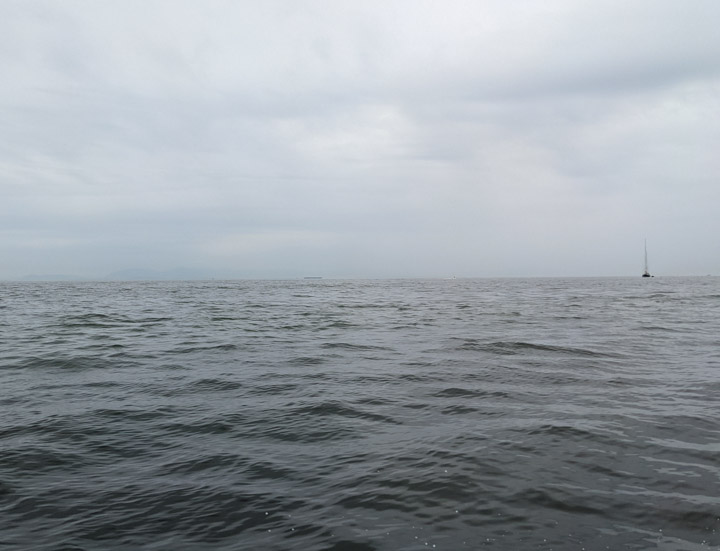
The sea’s surface is never uniform, always patterned. I assume the patterns reflect the effects of wind and tide, but not how, nor what message they’re trying to send. I’m pretty sure that the motorboats that crisscross the open water leave long-lasting traces on the surface patterns. I’d like to know.

Port Phillip Bay Howe Sound

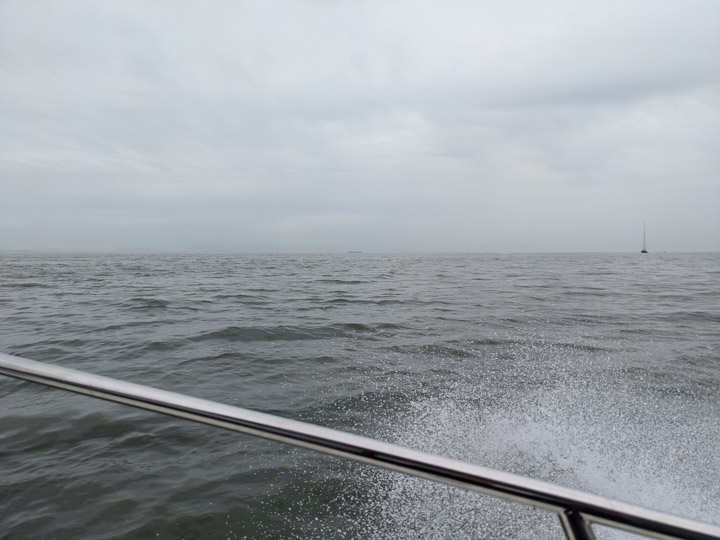
You can feel, not just see, the surface textures. At any noticeable speed the boat’s progress is unsmooth. But the the flavors of roughness are infinite, combining aspects of chop, sway, hill-climbing, surfing, and blunt impact. When you cross one of those visual borders on the surface the quality of ride changes too. Sometimes looking ahead I can even predict correctly, finding smoother water when it’s uncomfortably rough. But I don’t know how the waves get that way, nor what variables underlie the endless variety of different wave patterns. I’d like to know.

Rough water in the Queen Charlotte Channel

A bit of a rough ride in the Queen Charlotte Channel. Notice how the water changes between the first two pictures, shot literally five seconds apart. Evidence of roughness in the third.

Boating in the Pacific Northwest is pleasant in that the topography is mostly fjord-based, which means there aren’t many rocks near enough the surface to trouble your boat. So the major risk is floating logs, which usually won’t sink you but can wreck your propeller in a moment, leaving you calling for an expensive tow. We try to always have two pairs of eyes watching forward. When you spot a log in your path, first you dodge. Then you slow down, because where you see one, you’ll usually encounter more; the flotsam floats in clusters. I’ve never managed to spot any pattern in where the clusters occur, or how they correlate with the time of day or time of year. I’d like to know.

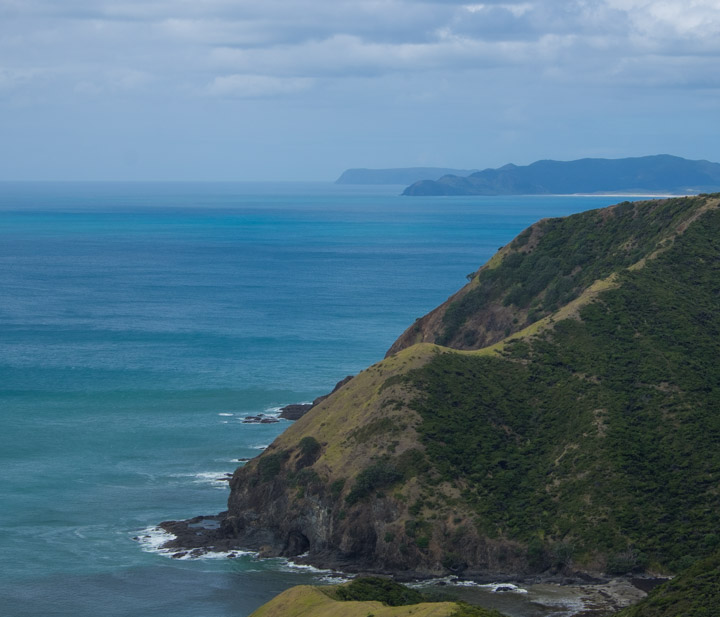
The color of the ocean is never constant, day to day nor hour to hour. The direction of the sun matters I guess, and the nature of the cloud cover. Also perhaps the salinity of the water, and whatever microorganisms are flourishing where you’re looking. Perhaps there are things to be learned from the color about the ecosystem or the weather? I’d like to know.

The north shore of New Zealand

Looking east from Cape Reinga across the north tip of New Zealand.

Sometimes the water’s surface is clean, especially out away from land. Where my office floats, rarely. Varieties of crud accumulate, some identifiable — pollen, for example, which correlates with hay-fever. But sometimes the surface is oily or slimy or bubbly. This is an urban inlet, so likely the city’s effluents play a role here. I bet a biochemist with a decent lab could figure out what it is, most times. I’d like to know.

And the crud isn’t just on the surface. There are days when I can see a few meters deep, getting a clear view of the crabs that somehow manage to make a go of it in this Vancouver-flavored soup. Other days it might as well be a grey-green wall. Sometimes you can see what’s clouding the water because it’s granular, and the grain size varies. Basic combinatorics teaches that you don’t need that many contributing factors to get this variety of looks, but I don’t know what those factors are. I assume there are Marine Biologists who study this stuff and could tell you at a glance what’s going on. I’d like to know.

More than crabs live in False Creek and out in the broader Pacific. On warm summer days by the office, huge schools of tiny fish swarm the water. Their motions, were they starlings, would be called murmuration. An old guy washing his boat told they were herrings. Sometimes, below them, larger silver fish cruise about, all very flOw-like. How do they arrange to move in waves, all together, lightning-fast? When the water is jammed with life on Tuesday and Thursday, where were they all on Wednesday when it was almost empty? What do they eat? How does the species make it from one summer to the next? I’d like to know.

Humpbacks in Haida Gwaii

Humpbacks and gulls chowing down in Haida Gwaii.

At a larger scale, we’ve started seeing humpbacks, lots of seals have always been around, also the occasional killer whale or dolphin pod. At sea, you don’t see the salmon, but we know they’re there in large but sadly diminished numbers. The marine biologists I’ve known shake their heads at how little we know about the subsurface lives of all these creatures, but there’s joy for a scientist in a large unexplored space. What are they doing down there where we can’t see them? I’d like to know.

Everyone knows the circular ripples caused by raindrops or pebbles. When there’s just a drizzle or perhaps a storm stealing in, there’s fascination in watching the raincircles crowd denser and denser. But lots of times, just strolling along the dock, a circle or circle cluster will manifest, looking smaller than those caused by raindrops. I’m assuming that it’s something from below, touching the surface for its own reasons, whatever they are. I’d like to know.

Howe Sound

Also

Humanity is like the ocean. Its surface is patterned and you can feel the patterns as you pass through. Colors matter. There is transparency and occlusion. There is nasty crud, often in clusters. Important things live beneath the surface. Impacts arrive from above and below and it’s not obvious what caused them. I’d like to understand all that better too.

07 Sep 20:02

Philippines pardons US Marine for killing transgender woman | Philippines

mkalus shared this story from The Guardian.

The Philippine president has pardoned a US Marine in a surprise move that will free him from imprisonment for the 2014 killing of a transgender Filipino woman that sparked anger in the former American colony.

Teodoro Locsin Jr, the Philippine foreign secretary, tweeted that Rodrigo Duterte had “granted an absolute pardon” to L/Cpl Joseph Scott Pemberton “to do justice”, but did not elaborate. Duterte was to deliver televised remarks on Monday night where he would discuss Pemberton’s case, a presidential spokesman, Harry Roque, said.

A leftwing human rights group, Karapatan, immediately condemned the pardon as a “despicable and shameless mockery of justice and servility to US imperialist interests”.

Pemberton was convicted of homicide and has been serving a prison sentence of six to 10 years for the killing of Jennifer Laude in a motel in Olongapo city, north-west of Manila. His lawyer, Rowena Garcia-Flores, told the Associated Press that Pemberton had already been aware of Duterte’s decision when she called him.

“I heard the news,” Garcia-Flores quoted the 25-year-old Pemberton as saying. “I’m very happy.”

Meeting Pemberton in detention a few days ago, she said he had expressed his willingness to apologise to the Laude family, even belatedly.

Roque, who once served as a lawyer for the Laude family, said the presidential pardon would mean the immediate release of Pemberton from detention.

“The president has erased the punishment that should be imposed on Pemberton. What the president did not erase was the conviction of Pemberton. He’s still a killer,” Roque said.

Last week, the regional trial court in Olongapo, which handled Pemberton’s case, ordered authorities to release him early from detention for good conduct, but Laude’s family appealed against the order, blocking the marine’s early release. Roque said the Department of Justice was planning to block Pemberton’s early release with a separate appeal.

The court order rekindled perceptions that US military personnel who fall foul of Philippine laws can get special treatment under the allies’ visiting forces agreement (VFA), which provides the legal framework for temporary visits by US forces to the country for large-scale combat exercises.

Pemberton, an anti-tank missile operator from New Bedford, Massachusetts, was one of thousands of US and Philippine military personnel who participated in joint exercises in the country in 2014.

He and a group of other marines were on leave after the exercises and met Laude and her friends at a bar in Olongapo, a city known for its nightlife, outside Subic Bay, a former US navy base.

Laude was later found dead in a motel room where witnesses said she and Pemberton had checked in. A witness told investigators that Pemberton said he had choked Laude after discovering she was transgender.

In December 2015, a judge convicted Pemberton of homicide, not the more serious charge of murder that prosecutors sought. The Olongapo court judge said at the time that she had downgraded the charge because factors such as cruelty and treachery had not been proven.

Pemberton has been serving his sentence in a compound jointly guarded by Philippine and US security personnel at the main military camp in metropolitan Manila. The place of detention was agreed to under the terms of the VFA, although Laude’s family had demanded that he be held in an ordinary jail.

Garcia-Flores said his detention had been shortened by authorities under a Philippine law that allows the reduction of prison terms for good conduct. A lawyer for the Laude family, Virginia Suarez, said the law could not apply to Pemberton, who has been detained alone in a military camp and given other special privileges under the VFA.

The case has led to calls from some in the Philippines to end the US military presence in the country, with which Washington has a mutual defence treaty.

07 Sep 20:02

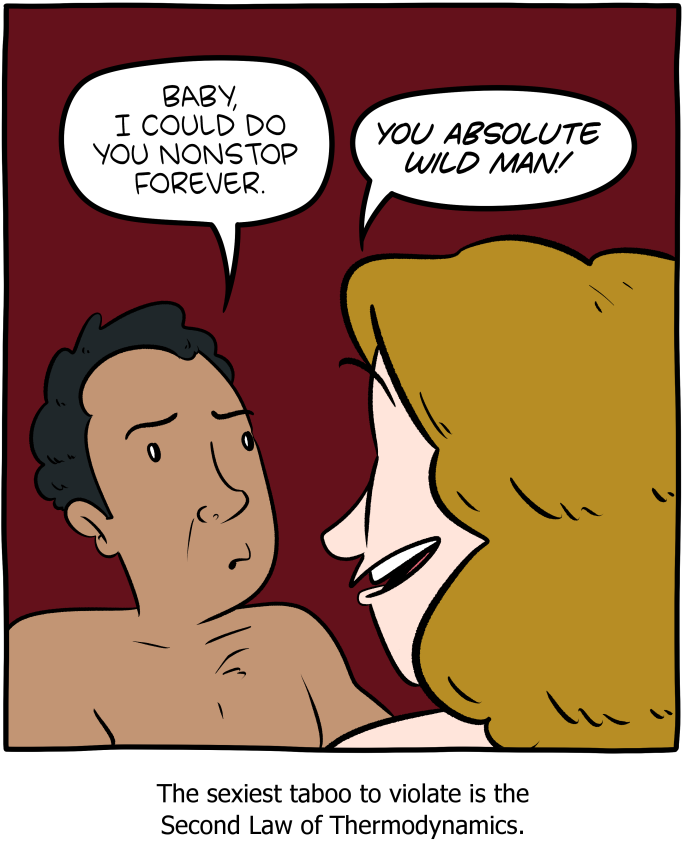
Saturday Morning Breakfast Cereal - Wild

by tech@thehiveworks.com
mkalus shared this story from Saturday Morning Breakfast Cereal.


Click here to go see the bonus panel!

Hovertext:
If you reacharound through a closed timelike curve you can violate your partner's causality.


Today's News:
06 Sep 12:32

The TikTok “Benadryl Challenge” is demonstrating how toxic Benadryl can be – Science-Based Medicine

mkalus shared this story from Science-Based Medicine.

Don’t take it, kids. And don’t let your parents give it to you, either.

Move over Tide Pod Challenge. Now there’s a new challenge on social media, and at least one death has been attributed to it. The “Benadryl Challenge” has been linked to the death of an Oklahoma teen:

Last week, a 15-year-old girl reportedly died from an overdose of Benadryl. Described by those who cared about her as an otherwise happy and faith-driven teen, she was not one to experiment with drugs. However, she fell victim to what’s been called the Benadryl Challenge on TikTok. The challenge is to trip out, or hallucinate, after taking a dozen or more doses of the pill.

This isn’t the first case. Three cases were reported in this past July in Texas:

Three teens were treated at Cook Children’s in May after overdosing on the common allergy medicine diphenhydramine aka Benadryl. Each of these patients said they got the idea from videos on TikTok that claimed users could get high and hallucinate if they took a dozen or more of the allergy pills.

The active ingredient in Benadryl is particularly toxic, and arguably wouldn’t be approved today. And it’s not the kind of “high” that anyone should want. So why is it still being marketed as an allergy treatment?

What is Benadryl?

Benadryl is the most popular brand name of the antihistamine diphenhydramine, which has been around since the 1940s and is used to treat seasonal allergies, and allergic reactions like hives. Because it’s been around so long, and newer antihistamines have followed, it’s now called a “first generation” antihistamine. The first generation antihistamines may be what you took for allergies if you grew up in the seventies or eighties. Today we have non-sedating antihistamines that don’t leave us in a fog. Histamine is a chemical that can be released by cells causing allergic symptoms as well as skin swelling and rash. Antihistamines like diphenhydramine block H1 (histamine) receptors, which are located throughout the body. Because of their mechanism of action, they don’t work as effectively once you already have a histamine release, but they can reduce the severity of a reaction if taken before it occurs. Because it can cause significant drowsiness, diphenhydramine is also the active ingredient in some over-the-counter drugs to help sleep (e.g., Nytol), where the sedative effects are marketed as the desirable effect, and not a side effect.

Diphenydramine is not a great antihistamine, and its nasty side effect profile has led some organizations to call on regulators to make it less accessible to consumers. In 2019 the Canadian Society of Allergy and Clinical Immunology published a position statement warning against the use of Benadryl as the first choice of antihistamine:

First-generation AHs have been used for the treatment of allergic disease for over 70 years. However, common and serious adverse effects associated with these medications have been reported. First-generation AHs are in the process of being restricted as new evidence of harm, contraindications and dose limitations become apparent. Older AHs have not passed current safety or efficacy standards, and should not be used in routine circumstances for allergic disease.

Even before any TikTok challenge, the side effect profile of the “first generation” antihistamines like diphenhydramine has been well known. These drugs are termed “poorly selective” as they can bind to many different cell receptors in the body, giving the drug a nasty and toxic side effect profile. These drugs also cross the “blood brain barrier” meaning that they can cause central nervous system impairments that are progressive with dose. The impairment from taking just 50mg of Benadryl was found to exceed that of a 0.1% blood alcohol concentration. Overdose, because of the effect on other receptors in the body and brain, can cause fever, flushing, increased heart rate, low blood pressure, and coma. Accidental poisonings in children are not uncommon and some instances have resulted in death. In large doses, the “first generation” antihistamines may affect heart rhythm and conduction, potentially leading to palpitations, seizures and even sudden cardiac death.

Challenge or not, there are good reasons to stop buying Benadryl

Since drugs like Benadryl have been marketed, there have been a number of antihistamines that are just as effective as Benadryl without the substantial side effect profile. So called “second generation” antihistamines were revolutionary when launched, and drugs like Claritin and Reactine offered allergy relief without the side effects of drugs like Benadryl. Now there are “third generation” antihistamines that are arguably better by every measure than drugs like Benadryl: they are safer, they have a faster onset of action, they are more effective, and a dose lasts longer.  When used to treat allergies, there’s little need to even keep Benadryl on the market (or in your first aid kit) today, given newer antihistamines are equally or more effective and lack the toxicity of the older drugs. Allergy treatment guidelines no longer recommend these older antihistamines. TikTok or not, there’s no reason to take Benadryl anymore.

06 Sep 12:31

Bicycle Helmets Not Designed For Impacts From Cars, Stresses Leading Maker Giro

mkalus shared this story from Carlton Reid.

Sales of bicycles and accessories have increased during lockdown, with many new cyclists now on the roads. Some will be wearing head protection, but a leading bicycle helmet maker has stressed that bicycle helmets are not designed to mitigate against impacts from motor vehicles.

“We’ve seen quite a surge in demand,” Eric Richter, senior brand development manager at Giro, told me by e-mail from California.

This surge, he adds, is “gratifying because we’re seeing customers get back onto bikes that have been in storage or underused for years, and that’s such a positive long-term opportunity.”

However, cyclists should not rely on cycle helmets to offer protection against smashes with cars, trucks, or other large, heavy, and often fast road vehicles.

“There are many misconceptions about helmets,” Richter told British trade magazine Cycling Industry News on July 6.

“We do not design helmets specifically to reduce chances or severity of injury when impacts involve a car,” said Richter.

“The number of variables is too great to calculate.”

These variables include the speed of the motor vehicle, its mass, the angle of impact, and the vehicle’s profile.

In 2016, 50% of the people killed while riding their bicycles in the U.S. were not wearing helmets, which leaves the other half, some of whom may have been wearing helmets but who were still killed after being hit by motorists.

It may seem obvious that lightweight bicycle helmets—usually made from expanded-polystyrene—offer little protection against multi-ton motor vehicles traveling fast, yet many helmetless cyclists report that some motorists shout at them for not wearing helmets.

And, it could even be argued that wearing a cycle helmet introduces a new peril: that of the “close pass” overtake by motorists who wrongly assume that cycle helmets are forms of armor that will protect cyclists in any impact from motor vehicles.

This was the finding from a much-cited study by British psychologist Ian Walker who found that bare-headed women cyclists were afforded the greatest passing distances by motorists. His 2007 study used a bicycle equipped with a camera and a distance measuring device.

Dr. Walker recorded data from 2,500 drivers who passed him on the roads close to his workplace, the University of Bath. Half of the time he wore a bicycle helmet and half of the time he didn’t. The results showed motorists tended to pass him more closely when he rode wearing a helmet.

“Wearing a bicycle helmet led to [motor] traffic getting significantly closer when overtaking,” concluded Dr. Walker. Along with an Australian statistician he replicated the study in 2018 with similar findings.

Such “punishment passes” can also lead to collisions, collisions which can result in injury and death—and not to those guilty of the dangerous overtakes.

Testing

Last year, research carried out by car manufacturer Volvo and bicycle helmet maker POC found that “current bike helmet testing procedures are fairly rudimentary.”

The Swedish brands said these tests involve “helmets being dropped from different heights on either a flat or an angled surface, and do not take into account [motor] vehicle to bike accidents.”

Bicycle helmets sold in the U.S. have to pass federally mandated tests designed by the Consumer Products Safety Commission (CPSC) and sometimes also the American Society for Testing and Materials (ASTM). The tests check for protection against skull fractures, but cycle helmets are not designed to prevent less immediately catastrophic injuries such as concussions.

“The materials that are used in most of today’s [recreational] helmets are engineered to absorb the high impact energies that can produce skull fractures and severe brain injuries,” says a CPSC statement.

“However,” caveats the organization, “these materials have not been proven to counteract the energies believed to cause concussions.”

The CPSC stresses: “No helmet design has been proven to prevent concussions.”

Outdoor sports attorney Jim Moss, a member of the ASTM helmet committee, agrees: “No cycling helmet is made to prevent concussions. Period.”

“Current helmet standards do a good job of addressing the kinds of impacts that are common and the energies associated with them,” says Richter.

Life savers

While bicycle helmets may offer little protection against impacts from motor vehicles, and cannot offer guaranteed protection against concussions, they can be life-savers when worn in the crash scenarios for which they were designed, such as slamming head-first into a tree branch or falling to the curb during a slow speed tumble.

Not all head strikes are direct impacts, many happen at an angle, and many modern helmets now offer protection against such rotational forces, which could be the cause of at least some concussions.

MORE FROM FORBESBicycling Booms During Lockdown-But There's A Warning From HistoryBy Carlton Reid

The leading maker of anti-rotation technology is MIPS, which stands for Multi-Directional Impact Protection System. A helmet equipped with a MIPS insert allows some movement between the outer shell of a helmet and the layer against the head, absorbing some rotational shock and potentially reducing the risk of concussions.

“In the last few years, greater emphasis on addressing rotational forces has had a significant impact on helmet design, technology, engineering, and testing,” said Richter.

“Understanding the effects of rotational motion on the brain, and working to reduce rotational forces by integrating technologies like MIPS into helmets during the last 5-10 years is the most visible example of how head protection is evolving in response to increased knowledge.”

Giro is owned by Vista Outdoor , Inc., which also owns the helmet brands Bell, Bollé, Cébé, Raskulls, and Krash.

Bell Helmets was founded in 1954 to make helmets for autosports. Evel Knievel stated his Bell helmet helped save his life after his motorcycle crash at Caesars Palace, Las Vegas, in 1967.

Giro’s first product was the category-transforming Prolight of 1986, a vented bicycle helmet that was half of the weight of other bicycle helmets of the time.

Vista Outdoor’s HQ is in the surf town of Scotts Valley, near Santa Cruz, and is home to the Dome, a brand-agnostic research facility that started life in the 1950s as a laboratory and workshop for Bell Helmets.

“Head protection is serious business,” says the Dome-promoting website Helmetfacts.com.


Article updated on July 11 with details of the 2007 and 2018 “close pass” helmet studies by Dr. Ian Walker.

06 Sep 12:30

Back to school

by noreply@blogger.com (Chris Grey)
mkalus shared this story from The Brexit Blog.

There’s a distinct ‘back to school’ feeling in the air – and never has the beginning of the school year been the news story that it is in these Covid times – with that slightly chilly tang in the mornings that presages the end of summer. Nowhere is that more so than for Brexit, with next week’s talks marking the beginning of the final phase of the Transition Period, and the likelihood of considerable political drama. Many people who have, very likely, switched off from Brexit in recent months will see it return with a vengeance. Even leaving aside the UK-EU negotiations there will be a substantial programme of domestic legislation necessary in advance of the transition ending.

Yet for all that feeling of newness, we will be returning to a very familiar landscape. For the more time goes on the clearer it is that Brexit consists of a series of recurring themes. So before we get back to the grind of the detail of state aid, fisheries (£), conformity assessments, equivalence regimes, geographical indicators (£), border queues and all the rest of it (links are to some of the latest reports/ discussions of each issue), this last post of the summer will consider some of these themes and what they mean for the coming period.

Brexit: more about Britain than exit

Little of substance has happened in the negotiations over the summer, which is not a surprise. Boris Johnson talked of putting a ‘tiger in the tank’, but as usual it was just boosterish phrase-making with no substance. As noted in my previous post, the process is in limbo awaiting political decisions that Johnson hasn’t made, or hasn’t communicated. But looking back over the entire Brexit process so far it is striking how many of these long periods of relative inactivity there have been. Despite the loudly-ticking clock of, first, the Article 50 period and, now, the transition period there’s somehow been a remarkable lack of focus on the actual task of exiting the EU. Indeed it Is only very recently that basic practical preparations for, for example, border management have begun to be made.

Some of those quiet periods have, of course, been caused by the inevitable hiatuses of the political seasons in both London and Brussels. But that aside, instead of what should have been focussed and intensive negotiations with the EU, most of the last four years has been taken up with UK domestic politics. The most obvious example is how, almost immediately she had triggered Article 50 and despite repeated promises that it would not be in the national interest, Theresa May launched her ill-fated General Election, wiping two months out of the original twenty-four month schedule. Then, when the first main extension from April 2019 to October 2019 was agreed, and Donald Tusk pointedly advised the UK “not too waste this time”, it was mainly taken up with the Tory leadership contest.

That domestic and, especially, Tory Party politics have been so central is not accidental. It has arisen because the UK tried to undertake Brexit at the same time as trying to define what it meant and how it could or should be done, something which continues to be true right up to the present moment. That obviously flows from the lack of definition by the Leave campaign, but was very much compounded by the secretive and non-consensual way that May came to define Brexit (i.e. no single market, no customs union, virtually no ECJ role), and especially the unnecessary rapidity with which Article 50 was invoked, on the back of fighting a deeply divisive and also entirely unnecessary legal battle to prevent a parliamentary vote on doing so. It was not as if there had been a timeframe promised to the electorate but, as with so much of the Brexit story, keeping the every-angry, ever-suspicious, Brexit Ultras temporarily mollified trumped every other consideration.

Perhaps even worse than that, the ongoing battle to define Brexit whilst simultaneously enacting it has been characterised by repeated refusals to accept quite obvious facts. The consequence is not just that the debate has moved more slowly than the formal process required, but that it has gone round in endless circles. There are several examples that could be given but I’ll highlight a couple of the most important.

Going round in circles

One is the wilful refusal to accept that the terms of leaving would have to be agreed in advance of the terms of the future relationship, including the future trading relationship. That was built into Article 50, which only specified that the exit terms would be agreed “taking account of” the future relationship between the departing member and the EU.

Yet from the outset many Brexiters refused to accept that this was so and in particular to accept that a financial settlement would need to be made in advance of, and separately to, any trade deal (some, indeed, have never accepted that there is any need for a financial settlement at all and some, even, that the negotiations required Article 50 to be invoked at all). May herself did not seem to grasp the issue of there being two separate deals to be done until April 2017, and even in 2019 government ministers were still saying that a trade deal would be in place the day after exit.

One could actually argue that the EU showed flexibility in agreeing to create two phases for the Article 50 talks, one on the exit terms and, if sufficient progress was made, a second phase on future terms, even though that could not yield a signed trade deal in the period. But that, itself, was resented by the Brexiters who, as David Davis, the then Brexit Secretary, put it, threatened the ‘row of the summer’ (of 2017) over this sequencing.

That row never happened, but the sentiment underlying it continues to this very day, with its lineal descendent being the growing clamour from some Ultras to repudiate the Withdrawal Agreement even if there is a trade deal, and certainly if there is not. Even more bizarrely, despite having wanted to get going with trade talks from the outset, when phase 2 was entered, the UK collapsed into internal dissent about what future terms it was seeking, leading to eighteen months of infighting that culminated with May’s defenestration and replacement by Johnson

The second main way that Brexit has gone round in circles is the refusal of Brexiters to accept – or perhaps their inability to understand – the very basic proposition that leaving the single market (SM) and leaving the customs union (CU) both, in different ways, create borders. This isn’t some ruse of the EU’s, still less is it the EU’s punishment or even choice. It is the logical and legal consequence of leaving the institutions that remove borders.

If, as Brexiters insist, Brexit must mean the UK setting its own regulations and its own tariffs, then there must be a territory within which these apply, and if there is a territory then there must be a border delineating that territory. That is true in general, and it has the economic consequence of making ‘frictionless trade’ with the EU impossible. And it is true in the particular case of Northern Ireland, with all the political ramifications of that, something which again some Brexiters still insist is confected by the EU, or Ireland, or both.

Yet for years the UK continued to talk about frictionless trade as perfectly possible, even after hard Brexit had been announced. Even now, it’s common to see Brexiters talking as if post-Brexit borders will only happen if the EU insists upon it. As for Northern Ireland, the number of times under which ‘alternative arrangements’, ‘technological solutions’ and the ‘Malthouse compromise’ have come and gone in the Brexit debate is almost impossible to count. To these examples could be added other zombie ideas, of which the claims about GATT Article XXIV are perhaps the most infamous.

Choices have consequences

So the years of the Brexit process have been characterised by a repetitive grinding down of these recurrent refusals to face reality. What could and should have been understood before the Referendum – and certainly before beginning the Article 50 process – has had to be taught, like simple arithmetic to a child who is simultaneously truculent and dull-witted, to the Brexiters (or, as it seems to outsiders, to the UK itself). And these lessons – whilst varying in content - are all of the same general sort: in choosing Brexit, the UK has chosen the consequences of Brexit, which can’t be magicked away. In particular, if the UK is outside the EU (SM, CU) then none of the things which come with being in the EU (SM, CU) any longer apply.

The impossibility of frictionless trade and the unavailability of ‘alternative arrangements’ for borders has now –  at least at governmental level – been accepted (though, jaw-droppingly, is now described as “growing the customs sector” as if it were some sensible industrial policy rather than the introduction of massive new costs). Yet it is still necessary and justified for Michel Barnier to remind  the UK that ‘Brexit means Brexit’, as he did at the end of the last round of talks.

For although the UK’s negotiating position under Johnson and David Frost has superficially accepted being a ‘third country’ to the EU, it continues to seek things which go well beyond what any third country has* in a whole swathe of areas. And, more subtly, by framing many of its demands in terms of third country precedents, the UK fails to understand that these do not constitute a set of established ‘rights’ for a third country but are contingent upon what – in the specific circumstances of the UK – it is in the interests of the EU to agree.

Brexiters’ negotiating conundrums

This idea that the EU is likely to give the UK a generous deal is one of the strangest features of Brexit. It appears in various slightly different guises. One is that those who most loathe the EU and denounce it for any manner of evils, including that of bureaucratic rigidity and being a ‘protectionist racket’, seem, paradoxically, to have had as their working assumption that the EU would be charitable - or, in Brexiter-speak, ‘flexible’ - in its approach to a departing member.

Another equally contradictory version is that the UK holds all the cards whereas the EU is desperate for a deal (German car makers, trade surplus etc) and in in any case moribund and on the point of collapse, but at the same time is a powerful bully, willing and able to punish the UK. Similar ideas are present when it’s claimed that the UK would be fine if there’s no deal and yet when the EU warns of the prospect no deal it is making a ‘threat’ to the UK; or, conversely, that the UK can gain leverage by threatening the EU with the damage of no deal and yet no deal would not damage the UK.

But the underlying issue here is that these negotiations do not conform to the normal idea of two sides each seeking to pursue its own rational interests. On the UK side that is partly because these fantasies about the EU mean that it is treated as this peculiar mixture of ogre and pushover, but it is more because, in pursuing Brexit, the UK is in the position of doing something which is not in its rational interests. If nothing else, that is clear from the fact that, as a trade negotiation, it’s unique in setting out to create worse terms than currently exist for both parties. For the EU, that has been forced upon it, and given Brexit happened it is acting rationally to protect its own interests – which turn out to be different to those ascribed to it by Brexiters, but no less rational for that (in brief: prioritising the protection of single market integrity).

For the UK it arises from the nature of Brexit itself. Brexiters themselves sometimes acknowledge this, when saying that they fought and won an emotional battle for ‘independence’, but don’t then follow through to realise that this has put the UK permanently on the back foot in negotiations over its interests, since these have been defined in irrational terms. That follow through has been avoided by insisting that the costs of the emotional appeal to sovereignty are just Project Fear, and that sovereignty comes, or ought to come, cheaply or even at no cost at all. So the emotional argument is cloaked in a pseudo-rational veneer. No hard choices have to be made because we can gain sovereignty (as Brexiters see it) without losing anything. This is also why Brexiters have repeatedly sought to discredit or conceal projections of the costs of Brexit.

This leads to a negotiating position which is partly captured by the familiar clichés of ‘cakeism’ and ‘cherry picking’, but it’s actually much more perverse than that. The idea of having the cake (of membership) whilst eating the cake (of leaving), or of picking the juicy, enjoyable cherries and leaving the rest does imply a rationality – even if an opportunistic and unrealistic one. But the extreme Brexiter position is so emotionally hostile to everything associated with the EU that actually the cake is tainted and the cherries suspect. So they don’t just want what they can’t have, but they want what they don’t want. They are caught between wanting ‘a’ deal, but not wanting any actual deal.

If all that sounds convoluted, a different way of stating the Brexiters’ negotiating conundrum is this: whatever benefits the EU has economically, they all come at the price of sovereignty – we want sovereignty and we don’t care what it costs – but actually it’s cost free – or it would be if the EU was reasonable and would agree to what we want – then we’d have the exact same benefits as before – but those benefits come at the price of sovereignty -  so if they agree to what we want then it isn’t sovereignty, which is what we want at all costs.

This, which has always been the background to, and in many ways incorporated into, the UK’s official negotiating position, effectively makes any negotiated outcome impossible.

The sand in the gears

But there’s always been some sand in the gears of this rickety Heath Robinson of an argument, which is that any government actually in power, even one defined by Brexit, has to have at least one eye on reality. In power, rather than jeering from the side lines, no government can afford the political and economic price of sovereignty at all costs when those costs become manifest. Which is why Brexiters like David Davis, Steve Baker, Dominic Raab and Suella Braverman all resigned from ministerial positions where they had responsibility for enacting Brexit so that they could preserve their fantasies intact.

That was true for Johnson, as well, when he resigned as Foreign Secretary, but the lure of premiership brought him back to the table. So he now faces a similar situation to Theresa May in being forced to at least partly to confront reality. She, of course, got shredded by her party for doing so, a fact that won’t be lost on Johnson not least since he led the charge. Since of his own volition there has been no Transition Period extension, he now has no more room to indulge the fantasies he did so much to promote at the expense of the realities he did so much to deny.

Hence we’re now reaching a pivotal moment, because in the next few months, one way or another, the UK-EU relationship is going to be re-framed by a deal of some sort, or by no deal. Either will have a big negative impact on individuals and businesses but, despite the claims of some, no deal will be considerably worse than a deal. In that sense, what happens matters greatly, including the precise nature of any deal which is done as that could have big impacts on specific sectors or activities. But in some ways the outcome won’t have much effect on the underlying situation.

Deal or no deal, the Brexit psychodrama will continue

If Johnson strikes a deal of any sort, then the Ultras within and outside his party will decry it for having compromised sovereignty. If he doesn’t strike a deal, then that won’t just be an end to matters but the beginning of fresh – and very urgent and difficult - negotiations which will be caught in the same insoluble loops and conundrums of the last four years of Brexit.

There is therefore no scenario that won’t have Brexiters saying ‘this is not what Brexit was meant to be’ and there is no scenario in which they will say ‘now we have what we always wanted’. Not only will they denounce any deal, but If there is the no deal ‘clean Brexit’ the most extreme call for they will say that the UK could have had a perfect deal but for betrayal by May and the remainers, and the intransigence of the EU. And deal or no deal (but especially no deal) they will step up their agitation to renege on the Withdrawal Agreement as a price not worth paying.

That is really worth reflecting upon. No matter how much pain Brexit causes the UK it is never going to stop the Brexiters complaining. David Cameron once famously called on his party to “stop banging on about Europe”. That didn’t happen, and so the Referendum was meant to put the issue to bed. When that was won by Brexiters, it might have been thought that that, surely, would put an end to matters. But it didn’t, and nothing will, no matter what is or is not agreed in the coming months. The Tory psychodrama about Europe, into which they have dragged the entire nation, is far from over.

So as the new Brexit term begins, no one should think that it will bring a resolution. We’re not about to graduate from Brexit, we’re just changing schools. The difference is that we are moving from the sheltered junior school of EU membership and the transition period, to the much harsher senior school outside.


*The link at this point is a handy extract of the relevant parts from a speech given by Michel Barnier at the Institute of International and European Affairs in Ireland this week.

06 Sep 12:30

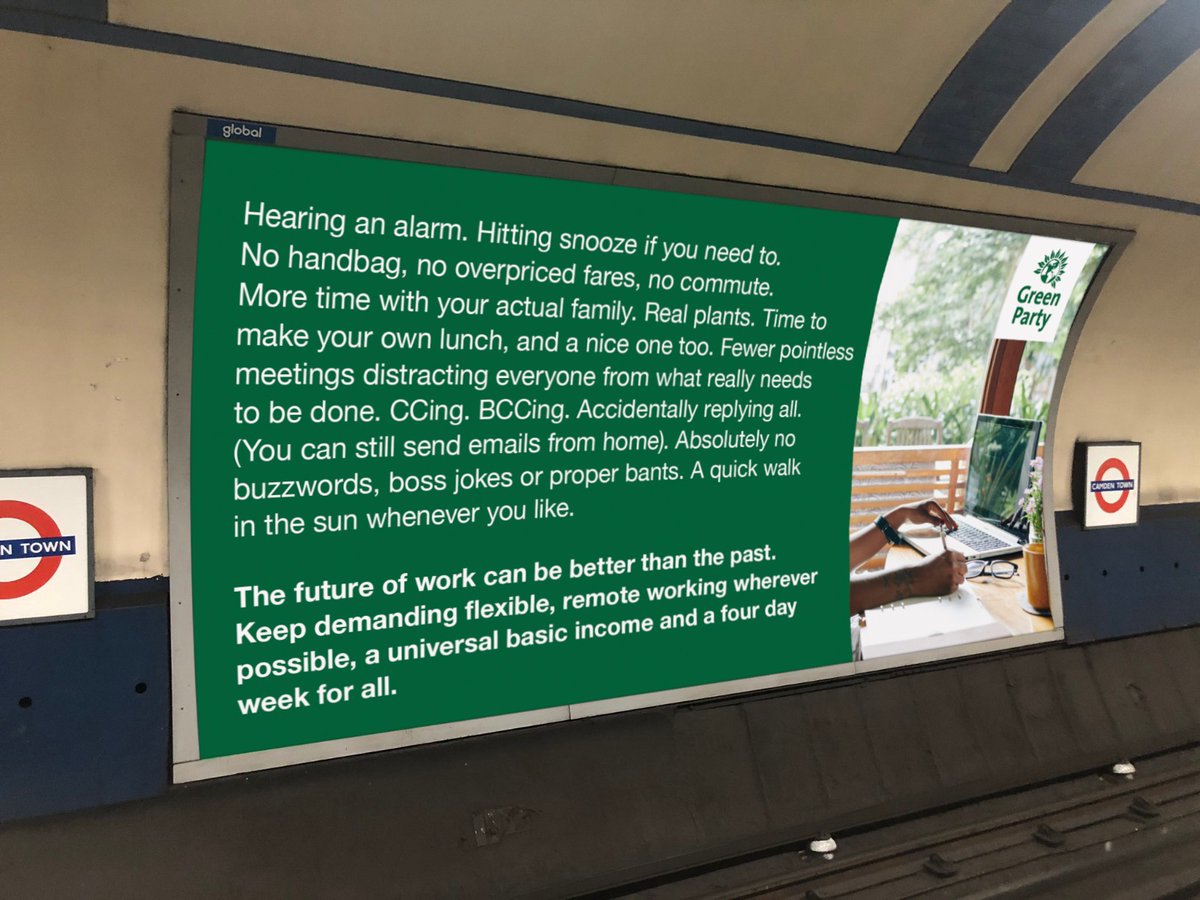
RT @TheGreenParty: Fixed it! pic.twitter.com/DU6wvqdPI4

by The Green Party (TheGreenParty)
mkalus shared this story from ottocrat on Twitter.

omg they are gagging for us to return back to the office. “second family”? pic.twitter.com/udntfSVXSh


62177 likes, 7686 retweets


Retweeted by Chris Kendall (ottocrat) on Saturday, September 5th, 2020 8:17pm


15104 likes, 4230 retweets
06 Sep 12:29

Twitter Favorites: [tomoakiyama] “Because Standard English is the dominant variant of the language, some people mistakenly regard it as ‘proper’ Eng… https://t.co/VFmuSckPOc

Tomo ㄓㄓ @tomoakiyama
“Because Standard English is the dominant variant of the language, some people mistakenly regard it as ‘proper’ Eng… twitter.com/i/web/status/1…
06 Sep 12:29

WORM LOGO ALCO WORM LOGO ALCO!! twitter.com/americanrails/…

by Well There's Your Problem Podcast (wtyppod)
mkalus shared this story from wtyppod on Twitter.

WORM LOGO ALCO

WORM LOGO ALCO!! twitter.com/americanrails/…

National Aeronautics & Space Administration S2 #2 (ex-U.S. Army #7111) is seen here at the Kennedy Space Center in Cape Canaveral, Florida. The @NASA Railroad closed in 2015 but reopened this year. pic.twitter.com/2d7Y7GSSze


373 likes, 102 retweets


172 likes, 19 retweets
06 Sep 12:28

Rapha Women’s 100: Jools’ Journal

by Lady Vélo

In the lead-up to this year’s Women’s 100, I’ve started an honest journal for Rapha on my reasons for returning to clock-up another metric century on Sunday 6th September.

You can follow Jools’ Journal over on Rapha… and there will be a post-ride write-up on there too.

I hope if you’re taking part in the Women’s 100 you have a fantastic day – wherever you are and however you do it!


The post Rapha Women’s 100: Jools’ Journal appeared first on Velo City Girl.

06 Sep 12:15

Via Roland Tanglao I came across Greg Wilson’s ...

by Ton Zijlstra

Via Roland Tanglao I came across Greg Wilson’s posting on making governance discoverable and providing basic documentation, of a community of contributors to open source projects. It coincides with discussing documenting precisely such key and elemental things for my company, to have a better on-ramp for new team members as well as provide colleagues with better agency to do things themselves. It also reminds me of how Basecamp documents and describes their preferred modes of communication (asynchronous long form being the default), and it triggered some ideas on how to better engage the existing community and new networks around the NGO I chair.

05 Sep 22:43

200-ish days later

by Rui Carmo

It’s been a while since I wrote about the current state of affairs regarding COVID-19 here in Portugal, so I’m going to start by pointing you to the data I have and the dashboards I maintain, from which I got the following chart:

This is all the data I've collected from official sources since the 9th of March until today (coming on 200 days of manual entries).

Since this is a rolling average, the rather erratic government reporting is smoothed out over time.

But that last little nub on the far right of the graph is due to the fact that over the past few days we’ve had 418, 406 and 486 new cases, which is more than we had in May (480) and quickly catching up to the July peak (542).

So what hasn’t changed since my very first post on the matter?

Quite a lot, actually, given that we’re still stuck at home. But let’s go with what’s top of mind here.

Data Sources

For starters, DGS (the local NHS) continues to fail miserably where it regards providing usable reports, and is now making them worse.

On the 17th of August the format of the daily PDF reports (yes, PDF, still no CSV or actual tabular format) was changed to remove all tables with demographic data, replacing them with completely unreadable bar charts.

Ironically, there seems to be no shortage of government resources to put up multiple 2010-era WordPress websites crammed with splashy photos and videos “for awareness”, but nobody can apparently be bothered to publish a plain CSV.

For science.

It’s as if the people in charge still prefer to have pretty pieces of paper to wave about (since they are useless to work with), two full decades into the XXIst century.

So no, there is still no canonical dataset or API to access historical data, which is why I’ve kept copying it by hand from the PDFs1 for the past 193 days, every day, trying to fill in the blanks where appropriate.

And there were a lot of blanks.

Schools

School is starting over the next couple of weeks (some schools actually started this week), but DGS trotted only out a set of recommendations on the 4th, which was a bit late (to say the least).

The guidelines are (unsurprisingly) published as a 43-page PDF, and besides enforcing wearing masks for K122 upwards and touting a laughably minimalist approach at handling personal space (it’s not even mentioned in this specific document, but parroted by the Minister as being 1m between students), the rules explicitly state that “school closures are unwarranted unless in critical conditions”, which kind of sets the tone for the overall thing:

We are to trudge on regardlessi.e., parents shouldn’t be stuck at home minding kids who can’t attend school, but rather out and about working.

Personally, I find it laughable that the question of whether or not children are more or less infectious than adults is still being dealt with in a rather cavalier fashion by politicians (without any scientific basis).

As any parent who caught the flu (or worse) from their kids can attest, I am more than betting that yes, they are infectious. It’s not a matter of degree from the moment you share a roof with them, and we’re not being careful enough here.

Economic Impact

The emphasis on keeping the schools going was predictable, given that the national economy tanked something like 17% over the course of the pandemic, and around 40% of restaurants, hotels and entertainment venues are shut (and considering applying for insolvency).

That and various hiccups in the various small industries that dot the northern part of the country mean that the government has staunchly pursued a strategy of attempting to minimize economic impact and personal damage, which is presently shifting to “roughly in that order”.

Since a lot of local news coverage is about British tourists still flying in to Algarve (directly to Faro, apparently) and hospitals are coping (ICU figures, in particular, have been holding moderately steady), I guess the government’s strategy is working.

Until it isn’t, since the developing rise in new cases came earlier than expected and follows what I’m seeing in France and Spain (which, incidentally, is terrifying, but not the point right now).

Technology

Much hullabaloo has been made about there being a national exposure notification app called StayAway COVID, a name that feels somewhat contrived (and redolent of wishful thinking). Zipping through the recording of the press conference as I type this, my impressions are roughly evenly split between ego stroking (we have one too, first-worlders!) and a misplaced faith in technology.

I’ve been tracking the technology and privacy aspects of it, even as the usual misguided mini-dramas about proprietary code and tinfoil hat paranoia unfold over on GitHub.

It seems to have clocked in several hundreds of thousands of downloads already (the press mentions half a million, but is unclear as to breakdowns) , but is hardly likely to be a massive help–it is something that needed to be done, but hardly useful for seniors (who are still the most impacted) and, of course, not likely to help prevent spread at all3.

Bread and Circuses

In a move that makes Portugal look like a banana republic (even more than usual), the local Communist Party was green-lit to hold their annual fund-raising event this very weekend, even as new cases peaked.

If that sounds familiar, it’s because you might have seen it mentioned in the New York Times.

It’s always great to see your country in the news, right? Well, not so fast there.

The “Festa do Avante” is a three-day fair with open air concerts, plays, outdoor sports and all manner of cultural side shows, and it is quite popular even among non-Party members (I never went, but I recall a fair amount of friends spending the weekend there during college).

It was expected to have something like 33.000 visitors a day, which with tickets priced around the €30 mark, can clock in at nearly a million Euro of cash-flow a day. Yep, that’s how much of a deal it is to the organization, if you’ll pardon the (capitalist) pun.

With that much as stake, much political drama unfolded during the days leading up to last Friday, with center-right party heads going on record to denounce the event as borderline irresponsible (to say the least) and calling for legal and political intervention (which was actually attempted).

DGS (after some to-ing and fro-ing) finally capped the venue at exactly 16.563 simultaneous visitors, but the President of the Republic had to make some stern comments on air regarding both the event and political blundering, since DGS refused to make public their recommendations for a couple of days.

As an aside, the on-site TV interviews are hilarious (as was the Party leader’s opening speech, which included a statement to the effect of “we shan’t be silenced by wearing masks”), and range from die-hard Party members (many of them senior) who wouldn’t stay away (ha!) if the site were an active volcano, to ordinary families visibly enjoying a sunny outing.

But, thankfully, there seems to be rather smaller attendance than expected, and hopefully we won’t see a large uptick from it, although many people were quick to pin the little bump prior to May 15th on left-wing demonstrations on the 1st of May…

Idiots

Speaking about demonstrations, there were a couple of protests against mask wearing and restrictions, apparently fostered by right-wing activists.

The less said about them the better, other than there obviously being a lot of misguided and ignorant people out there, even in a mild-mannered country such as Portugal.

I blame this (at least partially) on excessive focus on what is going on in the US, which pervades online and TV media to an almost unbearable extent (some causes like Black Lives Matter are worth by themselves, but most of what is going on in the US, quite frankly, is just too depressing for Humanity as a whole).

Looking Forward

I’m not optimistic–at all.

In particular, I expect schools (maybe not all, but definitely some) to have to be shuttered by end of October, which will be possibly far too late to stop us going back to another bout of exponential growth.

I also expect the current trend of new infections targeting younger, irresponsible people (who, together with seniors in nursing homes, make up the bulk of new cases) to have a wider expression.

And, finally, I am positive we haven’t seen the end of all the discussions about long-term side effects (especially myocarditis), even in otherwise mild/asymptomatic cases.

Taking that into account, we’re trying to stay safe and hunker down as much as possible, which is extremely frustrating given that there are usually a lot of personal errands to run this time of the year as September and October unfold.

Work-wise and motivation-wise, I sort of managed to recover over the past three weeks, but the entire situation has managed to drive home the fact that life is too short, and I’m not happy with the perspective of spending my days doing Teams calls, Excel spreadsheets and Word documents instead of (for instance) doing actual product or engineering work4.

This is not new and is extremely difficult to juggle with everything else that is going on, but definitely needs being dealt with. I’m just not sure when.

Conclusion

Things are going to get worse over the next few months. Just how much is still hard to fathom, but that’s a given.

In the end it’s all about risk management, but since I do that as part of my work, I can confidently say there’s not much “management” going on right now, and I woukd much rather have less risk awareness in my personal life.

But, all in all, we’re lucky in that we can (largely) work from home and most logistics (food, deliveries, confinement restrictions) are now working OK or have returned to a semblance of normalcy.

And I’m very glad I’m not in the US right now.


  1. I’ve also tried to get at the JSON data from the ArcGIS dashboard they publish, but it too has changed enough to break my scraper, and I know for a fact that data is managed manually as well. ↩︎

  2. I’m being liberal about the equivalence to K12 here, and using the reference just because it’s easier for my US audience. ↩︎

  3. A discussion on its effectiveness would take much longer than I have available to write this, so I’ll skip it–suffice it to say I’m skeptical. ↩︎

  4. I don’t mind the consulting/management angle, but I do mind not owning the outcomes, or being stretched like taffy across too many projects without adequate focus time. Also, I haven’t learned anything new at work (only in my spare time), and that’s not right. ↩︎


Want to show your appreciation?
05 Sep 19:47

Twitter Favorites: [skinnylatte] I have decided to take off my right bike glove for the rest of the day because it interferes with my taco eating

Adrianna Tan @skinnylatte
I have decided to take off my right bike glove for the rest of the day because it interferes with my taco eating
05 Sep 19:43

Mopped Up

by Asa Dotzler

This map shows zones that are still under evacuation orders (red) and warnings (yellow) and zones that were formerly orders or warnings but where full repopulation has now been allowed (green).

Evacuation orders have been reduced to warnings for a large part of Butano Ridge which is inside the fire boundary (dark gray outline) and just west of us. We’re located at the tip of the purple arrow.

If they’re letting people back into the area, that means they really do have this part of the fire mopped up.

Going into this exceptionally hot spell, I was worried about the potential for the fire to flare up and move again in our direction but with the evac order reduced to a warning for Butano Ridge I no longer think that’s an issue. They’ve got this part of the fire extinguished.

Our neighborhood really is safe, even though the fire’s only 58% contained so far.

Evacuation map for the CZU Lightning Complex fire

05 Sep 19:43

The Outside, by Ada Hoffmann

by Ton Zijlstra

The first novel by Ada Hoffmann, a Canadian author. A Lovecraft subversion of ultimately almost an entire planet brings on the Inquisition, AI gods originally created by man from our current lowly computers (since banned as heretic by the AI), and dependent on a diet of human minds. The protagonist, Yasira, like the author, is autistic and it enables her to grasp patterns that elude others, ultimately her Inquisitor as well. In doing so she finds a place in The Outside for herself and the love of her life, and a way of carefully balancing and joining the humans on the subverted planet into the pattern of The Outside, so they have agency in it. Weaving humanism into cosmicism at the hands of a ‘neuro-divergent’ protagonist like that, to me is a beautiful subversion in itself of Lovecraft (1890-1937), whose rascist nativist mind’s nihilism can’t be seen separate from the stranger than fiction he wrote.

05 Sep 19:42

An incredible example of societal collapse

by Doug Belshaw

Update: commenters have pointed out some issues with the research of Colin Turnbull, who studied the Ik in the 1960s after a famine. Criticism of his work is summarised here.


For what seems like obvious reasons, my thoughts have turned towards civilizational collapse recently. As a result, I picked up a copy of a book entitled The Collapse of Complex Societies by Joseph A. Tainter. It’s in the same vein, although slightly more academic, than Jared Diamond’s book Collapse: How Societies Choose to Fail or Succeed.

As a self-identified left-libertarian, I’m sympathetic towards anarchist philosophy and the right of people to be free from state interference. I’ve discussed this elsewhere, so I’ll not get into it in too much depth now, but suffice to say that it makes this book an interesting read!

In the first chapter of the book, Tainter gives numerous examples of societal collapse, which he defines as happening when a society “displays a rapid, significant loss of an established level of sociopolitical complexity”. As such, it encompasses not only the Roman and Mayan empires, which we’ve all heard of, but also many that we (or at least I) have not.

I wanted to share one example in full, because it blew my mind that people could live in this way, without the normal social bonds. What I find particularly interesting are the hints that things have not always been this way, due to clan names and the choice to live in villages.

The Ik are a people of northern Uganda who live at what must surely be the extreme of deprivation and disaster. A largely hunting and gathering people who have in recent times practiced some crop planting, the Ik are not classifiable as a complex society in the sense of Chapter 2. They are, nonetheless, a morbidly fascinating case of collapse in which a former, low level of social complexity has essentially disappeared.

Due to drought and disruption by national boundaries of the traditional cycle of movement, the Ik live in such a food- and water-scarce environment that there is absolutely no advantage to reciprocity and social sharing. The Ik, in consequence, display almost nothing of what could be considered societal organization. They are so highly fragmented that most activities, especially subsistence, are pursued individually. Each Ik will spend days or weeks on his or her own, searching for food and water. Sharing is virtually nonexistent. Two siblings or other kin can live side-by-side, one dying of starvation and the other well nourished, without the latter giving the slightest assistance to the other. The family as a social unit has become dysfunctional. Even conjugal pairs don’t form a cooperative unit except for a few specific purposes. Their motivation for marriage or cohabitation is that one person can’t build a house alone. The members of a conjugal pair forage alone, and do not share food. Indeed, their foraging is so independent that if both members happen to be at their residence together it is by accident.

Each conjugal compound is stockaded against the others. Several compounds together form a village, but this is a largely meaningless occurrence. Villages have no political functions or organization, not even a central meeting place.

Children are minimally cared for by their mothers until age three, and then are put out to fend for themselves. This separation is absolute. By age three they are expected to find their own food and shelter, and those that survive do provide for themselves. Children band into age-sets for protection, since adults will steal a child’s food whenever possible. No food sharing occurs within an age-set. Groups of children will forage in agricultural fields, which scares off birds and baboons. This is often given as the reason for having children.

Although little is known about how the Ik got to their present situation, there are some indications of former organizational patterns. They possess clan names, although today these have no structural significance. They live in villages, but these no longer have any political meaning. The traditional authority structure of family, lineage, and clan leaders has been progressively weakened. It appears that a Although little is known about how the Ik got to their present situation, there are some indications of former organizational patterns. They possess clan names, although today these have no structural significance. They live in villages, but these no longer have any political meaning. The traditional authority structure of family, lineage, and clan leaders has been progressively weakened. It appears that a former level of organization has simply been abandoned by the Ik as unprofitable and unsuitable in their present distress (Turnbull 1978).

Joseph A. Tainter, The Collapse of Complex Societies

One of my reasons for sharing this is that what’s portrayed here is often how ‘anarchy’ is painted by those who have a vested in the status quo; as the utter breakdown in political, economic, and social relations.

I don’t think this is the case, and in fact I have a feeling that Tainter is likely to argue that one of the reasons for societal collapse is over-centralisation. After all, decentralisation is always more resilient. We’ll see.


This post is Day 43 of my #100DaysToOffload challenge. Want to get involved? Find out more at 100daystooffload.com

The post An incredible example of societal collapse first appeared on Open Thinkering.

05 Sep 19:41

For when you don't have an overhead camera

by Volker Weber

More >

05 Sep 19:41

The Uppercase tail -F Difference

by Martin

A quick blog post today about a super useful feature that must have been in the Linux ‘tail’ command for ages of which I only recently became aware: The upper case -F option.

Those of you who administrate Linux systems will probably do a lot of tail -f’s to keep an eye on log files of different programs. The problem that sometimes arises is that the log rotator renames the current file and creates a new one. The tail command with the ‘-f’ (lowercase) option, however, keeps following the old file that was renamed. In other words, it’s not following the current log output anymore.

As it turns out there is a simple solution for this. Replace the ‘-f’ parameter with ‘-F’ (uppercase) for tail to keep an eye on the filename and to automatically switch to the new log file!

05 Sep 19:39

New game difficulty settings should be: - Easy - Medium - Hard - 2020

by 🌩️ NVIDIA GeForce NOW (NVIDIAGFN)
mkalus shared this story from NVIDIAGFN on Twitter.

New game difficulty settings should be:

- Easy
- Medium
- Hard
- 2020


199 likes, 33 retweets
05 Sep 19:39

Epic argues Apple should return Fortnite to the App Store in new filing

by Jonathan Lamont

As the week closed out, a couple of court filings pushed the ongoing litigation between Epic, Apple and Google slowly forward. One filing from Google says the search giant will seek to dismiss Epic’s lawsuit, while a last-minute filing from Epic Friday evening ahead of the long weekend sought a preliminary injunction against Apple’s Fortnite ban.

Let’s start with Epic’s filing. In a 38-page (not including several additions) motion, Epic Games laid out its argument for the court to force Apple to let Fortnite back on the App Store.

You may recall that the courts previously decided to allow Apple to remove Epic’s developer account, which not only prevented updates to Fortnite (which was still accessible on devices that had it installed or had previously installed it before the ban) but also removed other games and software made by Epic.

Courts felt Epic bore some blame for the Fortnite ban

At the time, the courts also decided Apple could not target Epic’s other developer accounts, such as the one for Unreal Engine — a critical part of Epic’s business and used by many to create games, movies and more. The decisions concluded that Epic bore partial blame for the Fortnite ban since it intentionally broke Apple’s App Store rules and so the courts shouldn’t intervene since Epic could remedy the situation itself.

To be clear, that isn’t indicative of how the courts will rule regarding the lawsuit, since the issue at hand isn’t whether Epic broke Apple’s rules, but whether the rules are fair in the first place. For those who haven’t followed the ongoing fight between the companies, Epic updated its Fortnite game with a direct payment system that allowed players to pay Epic directly for content. The company made this available beside Apple’s in-app payment system. Developers who use Apple’s system must give the company a 30 percent cut of every purchase made through it. However, Apple’s App Store rules prevent the use of third-party payment systems, which Apple used as the basis for banning Fortnite.

As such, the courts felt that Epic could remedy its situation by removing the direct payment system. Apple agreed it would let Fortnite back on the App Store if Epic did so. However, the company refused, arguing doing so would support Apple’s monopoly over payments on the App Store.

Epic argues the Fortnite ban may have caused permanent harm

Now, Epic’s new filing argues that Apple harmed more than its reputation by banning Fortnite. In the filing, the company says daily active users on iOS declined by over 60 percent after Fortnite was removed from the App Store. It’s important to remember here that people who already had the game could keep playing.

However, a crucial issue was that the game’s removal meant Epic could no longer update Fortnite. As such, when the game’s latest season of content launched, Fortnite on iOS and macOS essentially became a separate game. Players were locked to old content and cross-play, a feature that lets people on different platforms play together, stopped working. In other words, those who play Fortnite on Apple devices can now only so with other Apple device users.

Further, Epic argues that iOS is the biggest Fortnite platform with 116 million registered users, about a third of the 350 million registered users Fortnite has in total. Epic also claims 63 percent of the iOS players only access the game through iOS.

The company says it’s worried the players lost in the 60 percent decline may not come back, and that the Fortnite community was torn apart by Apple’s ban. Finally, Epic says some of its other non-Fortnite customers were collateral damage, referring to Apple’s removal of Epic’s developer account and the subsequent removal of related Epic software from the App Store.

Finally, Epic accused Apple of threatening to deny the company’s attempts to apply for a new developer account “for at least a year.” Epic quotes a communication from Apple and argued that the harm caused by Apple denying it access to the more than one billion iOS users for at least a year is worth creating a preliminary injunction for.

Apple unsurprisingly did not respond to The Verge’s request for comment, or to Epic’s filing, since this all came about on Friday evening ahead of a long weekend.

Those interested in reading the full filing can find it here.

Google looking to dismiss Epic’s lawsuit

Earlier in the week, Google said it would seek to dismiss Epic’s lawsuit in a filing. Similar to the Apple situation, Epic filed a lawsuit against Google after the company removed Fortnite from the Play Store on Android. Of course, the situation is different on Android than on iOS since users can still install Fortnite from outside the Play Store.

Aside from seeking to dismiss Epic’s lawsuit, Google indicated in the filing that it was against merging the lawsuit and Epic’s ongoing battle with Apple into one legal challenge.

That doesn’t come as much of a surprise — it’s a safer play to let Apple go first, take the heat and then build a defence based on the outcome. For example, if Apple wins against Epic, Google has an easy case to make that the Play Store isn’t much different. On the other hand, if Apple loses, Google can argue that Android is more open and allows developers to bypass the Play Store. While true, Epic has previously accused Google of using its control over Android and the Play Store to disadvantage apps from third-party sources.

All this is to say what comes next will be both interesting and important, both in the Apple and Google lawsuits. On the Apple side, where hearings are scheduled for September 28th, the final decision will have a massive and lasting impact on how companies can manage digital storefronts. Considering many digital stores, including those run by Microsoft, Sony and Nintendo on consoles, apply similar rules to Apple and collect 30 percent of sales made on their platform, legal precedent set by this lawsuit could have a wide-sweeping impact.

As for the Google lawsuit, the significance largely depends on whether it merges with the Apple lawsuit or not. If it does, then the verdict will be similarly important. If the Epic vs Google lawsuit remains separate, it could potentially set precedent around what constitutes an open platform. As mentioned above, Android allows for other storefronts and installing apps from outside the Play Store, albeit with limitations. The question is whether those limits help Google maintain a monopoly over digital sales on Android, or if it offers enough competition for Google to dodge antitrust violations.

Source: The Verge, Android Police

The post Epic argues Apple should return Fortnite to the App Store in new filing appeared first on MobileSyrup.

05 Sep 19:38

Threat modelling case study: bicycles :: Cal Paterson

by Volker Weber
How to avoid buying your bike again every 6-12 months and tips for how to apply the same reasoning to other things, like computers

More >

04 Sep 22:22

Our Real-World Experiment in Traffic Congestion

by Gordon Price

It’s a real-world experiment in the resiliency of our transportation system, one we’re living through every day.

What would happen, an analytical traffic engineer might ask (knowing it would never happen), if we shut down the economy for a month, taking at least half the traffic off the road, and then gradually rebooted the system.  Perhaps tweak some of the variables, like transferring 20 percent of transit passengers into cars, perhaps keep 20 percent of office workers at home.  Let’s see what would happen.

We’re going to find out.  Here’s The Sun‘s report:

According to TransLink data, March 27 saw the lowest traffic volumes, which were 58 per cent of that day in 2019. Volumes increased to 93 per cent of pre-COVID levels last week, compared to the same week last year.

“I think the concern is that (traffic) goes above what it was before. Of course, we don’t know what’s going to happen, but I think there’s reason to be concerned about that,” said Michael Brauer, a professor at the University of B.C.’s school of population and public health.


Here’s the the Daily Hive, with a map that shows moderate traffic congestion throughout the region.

While road traffic volumes have normalized, there is still a long way to go for public transit ridership to return to pre-pandemic levels. After experiencing strong growth in May, June, and July, the pace of ridership growth appears to have slowed down, with TransLink indicating systemwide boardings are now at 44% of normal levels — up from 40% at the end of July, and approximately 15% in early April.

Another visible bump in road traffic volumes and transit ridership could be experienced starting next week, when more employees return to work and the new school semester begins.

Here’s what everyone in the traffic management biz is really waiting to see:  What percent of transit users shifting to cars will it take for our road and bridge system to reach ‘gridlock’?*

In one discussion I’ve had, the conversion is anticipated to be about 10 to 15 percent.  But there are too many variables to make a prediction, particularly not knowing the reduction in vehicles as a consequence of unemployment, zooming and alternatives to rush-hour.  Regardless, it wouldn’t take much of a shift from transit to vehicle to see the unpleasant consequences, particularly on the bridges and other choke points.

Metro Vancouver is particularly vulnerable because of the success of  transit.  When the City made a decision back in the `70s not to build freeway connections to the region or increase the capacity of the arterial road system for single-occupant vehicles, we knew we would have to increase the capacity of the transit system to handle growth both within the city and for those commuting to the core.  And that’s what we did.  While congestion never went away (it never does), we accommodated a million or so more people in the region without significantly increasing road space in the city.  Indeed, we were able to prioritize other modes and offer choices in a way that increased both livability and economic vitality.

We never assumed we’d shift back to motordom – the car-dominant strategies of the 20th century.  We never built more capacity to do so, with the exception of some new bridges and occasional road widening.  But now we’ll find out what such a reversal would mean – as early as next week.

If intolerable gridlock results (it may not), then expect a heated to debate to follow.  One side will maintain that common sense, economic survival, public preference and the need for Covid distancing strategies require that we accommodate the increased demand for car and truck space asap.  Forget about transit-priority lanes, parking spaces converted to patios, and especially those bike lanes.  Put it back to the way it was – and think about how to expedite traffic flows.

The other point of view will maintain that there is no economic recovery without transit recovery, and we need to focus on how to do it safely by, for instance, increasing the speed and capacity of transit to entice people back and not switch to cars.  Or bring in road-pricing to give economic singles to prevent the worst outcomes.

To return to motordom, even reluctantly, would be like using the pandemic as an excuse to make us even more vulnerable to the climate shocks to come, at a price we can’t afford, with no reasonable likelihood of ever returning to a world just the way it was.


*’gridlock’ is a term properly meaning the complete halt of traffic as a result of at least four completely congested intersections.  Most of the time we mean it as an intolerable delay caused by bumper-to-bumper traffic.