If you’ve ever scrambled out the door with your phone’s battery in the red, you know that power is precious, and the faster you can get it, the better. The Anker PowerPort III Nano is the best option for charging any phone fast: It’s tiny and inexpensive, and it can get a fully drained phone battery to more than 50% full in half an hour.
USB-C chargers can top up phones faster than older USB-A models can, and they work with both iPhones and Android devices. Most phones, handheld game consoles, and other devices that charge via USB-C come with a compatible charging cable, but otherwise you may have to buy a cable separately.
This post is an experiment. I was thinking about how I tend to avoid reading a lot of longform content on my phone. I tend to push off a lot of news (NYT), some RSS, and tech articles. Longreads feel longer when scrolling one paragraph at a time interrupted by ads every other paragraph. I started to wonder if content hasn’t fully adapted to the mobilepocalypse.
Then I thought about how my blog posts tend to get a little long. I try to edit them but lack the self-control. I wonder if my phone could act as a natural constraint, the amount I can withstand typing and editing on my phone roughly correlates to how much I’d actually want to read on my phone.
As far as proxies go, it seems decent but something feels… phony. Excuse the pun, but it feels like I’m getting closer to the end of the page with every line wrap —as text bumps into the virtual keyboard— and I feel pressured to extract some grand conclusion. I’m not sure it’ll happen however.
It could be the triteness of this experiment. This feels much more like a creative writing exercise I’m subjecting you to than a valuable thinkpiece I’m offering.
It could be my own antiquated notion that length equals importance. Feels like my whole academic life was primarily about adding page after page of unnecessary garbage to hit some quota.
It could be the form factor and that perhaps deep down I believe “mobile” only produces cheap junior versions of real things (video games, music, photography, etc). It’s not for works of art, it’s for short, disposable things. This is the Quibi of blogging.
As I wrap this up, I’m cynical but still curious. I think this little experiment is asking me to cast away the mental schema of a blog post that I’ve built up in my head over the last couple decades. That will take time and I would like to try it again with a less self-referential topic.
This is what Keremeos BC looks like in my memory from the 60s – the uncontested Las Vegas Strip of Fruit Stands.
Except that photograph is from just last month. Not a lot of difference in a half century.
That’s true of most of Highway 3 from Hope to Osoyoos: it’s changed hardly at all.
Which is fine, since a lot of it looks like this:
The only developments between Hope and Keremeos are at Manning Park, Princeton and Hedley. In between, no gas stations, no parking lots, no billboards, no major interventions except a copper mine. After half a century, the biggest changes are the width of the highway and the height of the trees.
Most of us who dwell in the Lower Mainland know there’s a big back yard out there beyond Hope. We too, like our visitors, are still amazed by the sheer scale. Best of all, it’s free and it’s close.
Four hours, thirteen minutes away, says Google:
(Two things to note: (1) Google Map insists on using ‘Work’ as my destination pin. Hardly. (2) And check out ‘Explore Keremeos’ for its attractions – motordom as tourist bait.)
Princeton is the major stop along the way, though major overstates its impact. Except for the signs:
Most small towns in the province seem to have received money for main-street beautification programs – or they all decided about the same time to outfit their commercial streets with the same features – rather like a trend in shopping centres and malls – to keep their communities alive with some kind of core. We’ll explore them along the way.
One conclusion: small town BC is still home to independent businesses, especially those that serve coffee.
Note the sidewalk extension into the curb lane, and the patio that results. A big-city technique especially effective on the super-wide roads that cut though these towns – the provincial highways that connect them all.
These kind of small, incremental, locally rooted changes are unexpected (really, an independent book store?) and gratifying. The pandemic will test their resiliency.
In a couple of days, the SNS community will disappear. It joins a growing number of hosted communities which are vanishing from the web at an alarming rate.
A Twitter follower said this was a bad idea, ‘you can’t build a real community on other platforms’.
But the location of the community isn’t the problem. The problem is why does SNS need a community at all? What makes it indispensable?
A quick look at the platform shows it was attracting only 3 to 4 new discussions a day. That’s nowhere near enough to justify the cost of a platform like Insided. It’s not active enough to be of huge value to customers either.
Why would you want to talk to another customer when you can talk to an employee and get your problem solved?
Communities become indispensable when they create value for the member and organisation they can’t get anywhere else.
A community can offer customers the chance to get quicker responses, more empathetic responses, and avoid contacting customer support entirely.
A community is indispensable to the organisation when it lets them massively scale their support efforts without hiring an army of support staff.
And if scale is what indispensable means to your organisation, you need more than a handful of posts a day to do it.
The battle you need to fight isn’t just getting answers to questions, but to drive more people to the community in the first place. That’s an internal battle. A battle where you ensure the organisation becomes ‘community-first’ on all things support. That’s a tedious process of building relationships, persuading colleagues, and ensuring the community gradually handles a growing share of support questions (and your organisation knows it!)
Sadly, in the long-term, either your community becomes indispensable or it becomes a memory.
SpaceX, a rocket launch company that specializes in re-usable rockets that provide low-cost delivery of payloads to earth orbit, has a project called Starlink. Starlink is a constellation of low earth orbit satellites designed to provide high-speed, low-latency internet service to rural and other under-served areas.
Traditional satellite internet is provided by a big telecommunications satellite in geostationary orbit. A typical one of these satellites orbits at a height of about 22,000 miles. At that height, the satellite magically sits in the same spot in the sky and so your satellite dish on the ground doesn’t have to move to track it. That makes the dish at your house a simple and affordable piece of hardware that you aim once and forget about.
Geostationary orbit is pretty cool.
But there’s a down side to these satellite orbits that don’t move across the sky. They have to be really high up there. 22,000 miles up is a long distance for a signal to travel. Even at the speed of light, the time it takes the signal to make a round trip from the dish mounted on your roof to the satellite in orbit is theoretically about a quarter of a second and most providers tested spend more than half a second establishing those connections. That’s far too much delay, or latency, for something like voice communication or many video games or other interactive internet applications so these satellites don’t make for a great internet experience. Simply put, they’re “laggy”.
SpaceX’s approach with Starlink is different. They put their communications satellites in orbit at a height of only about 350 miles. At first blush, this sounds really smart. The latency for 350 miles is going to be far less than the latency for 22,000 miles. There’s a problem with this “low earth orbit” approach though. Satellites at this height move across the sky and don’t sit in one position relative to the ground. That means a couple of things. First, you need many satellites, not one like with geostationary orbit. When one low earth orbit satellite passes over the horizon, another satellite needs to come into view to provide constant coverage, and then another, and another. And that also means your antenna needs to to move to track a satellite as it moves across the sky, and then your antenna needs to quickly move back the other direction to connect to the next satellite coming into view. A motorized aiming dish makes for an expensive, complicated, and failure-prone setup for a consumer service.
The clever engineers at SpaceX have a solution to this called a phased array antenna. A phased array is a large collection of tiny antennas that sit next to each other in a panel and are each powered independently. Depending on which of the antennas in the array are getting power, the antenna signals interfere with each other in a way that sort of bends the beam to aim it. That way you don’t need a motor to move the antenna to track the moving satellites. Instead, you point the antenna array panel directly up and it electronically tracks the moving satellite across the sky and easily picks up the next one when the current one moves over the horizon.
Now, phased array antennas have a down side. They’re expensive. But SpaceX thinks it can manufacture them in high enough volume to bring the prices down to something acceptable to home internet users. We don’t know what that price is going to be yet, but I’m optimistic. (And also willing to pay quite a bit to get a better internet connection.)
So, why am I telling you all of this. Well, it’s because I can’t use traditional geostationary satellite internet but I will hopefully be able to use Starlink. The reason for this is because of our tall trees. Remember how I said the traditional geosats sit at one position in the sky? Well, typically that position is at an angle of about 40-45 degrees and we live in a redwood forest with extremely tall trees and there’s simply no place we can mount a satellite dish and aim it at 40 degrees without there being a big tree blocking the view of the sky, and thus the satellite. But Starlink’s antenna doesn’t point at 40 degrees. It points straight up, at 90 degrees, and pointing straight up, say above our house, doesn’t run into any trees so it’s a very real option for us.
SpaceX needs to put literally thousands of these satellites into orbit to provide good coverage. (Over the last year they’ve launched about 800 satellites.) Good coverage means a couple of things. First, there needs to be enough up them up there that there’s always one overhead. If there aren’t enough and one satellite goes over the horizon before the next satellite comes into view, you’d have a gap in service and no one wants an internet connection that’s on for 5 minutes then off for 5 minutes. The second reason you need a lot of them up there is that each satellite only has the bandwidth to serve a limited number of customers and if you want to serve large numbers of people you need more satellites. With the 800 or so they have in orbit now, SpaceX has continual coverage for the northern parts of the US but doesn’t have enough to support very many customers. With the continual coverage they’ve got, SpaceX has started a beta program for people willing to test the service and early results are looking good.
SpaceX reported recently to the FCC that they are able to provide more than 100 Mbit/s connections with latencies below 30 ms. Those specs mean that Starlink can compete with modern terrestrial broadband (about 60 times faster than the internet connection I have today.) I’m very excited and hopeful that in 2021 we’ll be able to sign up for Starlink and finally have real broadband.
If you have any questions about Starlink, let me know. I’ve been following it very closely and I think I know pretty well how it’s going to work.
“Even more importantly, desks enable collaboration. To be at your desk is to be present, in the world, at a place in time – to be available for an impromptu brainstorm, feedback session, or gut check. That face-to-face cooperation brings a human touch to our work that can’t be replaced by all the Slack messages, Zoom calls, or Google Docs in the world. It’s why (at least during normal times) so many freelance professionals choose to pay for a desk in a coworking space. With others around it, a desk becomes more than a desk; it becomes a community. Desks are how we interface. The things placed, whether carefully or incidentally, on their surface – the books, tools, decorations, pictures, half-eaten salads, and unopened mail – serve as ambient communication to co-workers about our lives.”
The world is on fire but here is some good news: Put a little summer in your pocket. Poolside FM has launched an iOS App. The app experience is just like its mamabear website super retro and fun. So happy about this!
Metro Morning@metromorning
Kirk Johnson’s long cycling adventures around Toronto often end at relaxing beaches and amazing takeout restaurants… twitter.com/i/web/status/1…
As a diehard fan of the book (and, by the way, mostly tolerant of the creative liberties David Lynch took, because it was the 80s and a few of them were, well, creative as far as symbolism went), I’m very much looking forward to this – and the trailer actually looks quite good, with a few neat details that seem true to the narrative.
Casting, well, I’m not so sure yet. Maybe it’s just about noticing too many familiar faces out of context. But let’s see what Denis Villeneuve has up his sleeve.
PUBG Mobile has surpassed $3.5 billion USD (about $4.6 billion CAD) in player spending to date, according to a report from mobile analytics firm Sensor Tower.
In particular, $1.8 billion USD (about $2.3 billion CAD) has been generated since the start of the year, in addition to 198 million downloads. Further, $500 million USD (about $657 million CAD) was generated over the past 72 days alone.
While the console and PC versions of PUBG have seemingly dwindled in popularity amid countless other battle royale competitors, the mobile game has remained exceptionally popular over the past couple of years. In fact, Sensor Tower calls PUBG Mobile “the world’s most lucrative mobile game,” even when considering big battle royale competitors like Fortnite and Call of Duty Mobile.
On the other hand, it’s likely that PUBG Mobile‘s will only continue to grow in the coming weeks, given that Fortnite has been de-listed from the App Store and Play Store amid developer Epic’s legal battles with Apple and Google. According to Epic, one-third of its total Fortnite player base is on iOS alone.
At the same time, the official App Store Twitter account began promoting PUBG Mobile, no doubt as a not-so-subtle attempt to further draw people away from Epic.
Which tells me, from a sample of one (after another, after another) that Zoom is to video conferencing in 2020 what Microsoft Windows was to personal computing in 1999. Back then one business after another said they would only work with Windows and what was left of DOS: Microsoft’s two operating systems for PCs.
What saved the personal computing world from being absorbed into Microsoft was the Internet—and the Web, running on the Internet. The Internet, based on a profoundly generative protocol, supported all kinds of hardware and software at an infinitude of end points. And the Web, based on an equally generative protocol, manifested on browsers that ran on Mac and Linux computers, as well as Windows ones.
But video conferencing is different. Yes, all the popular video conferencing systems run in apps that work on multiple operating systems, and on the two main mobile device OSes as well. And yes, they are substitutable. You don’t have to use Zoom (unless, in cases like mine, where talking to my doctors requires it). There’s still Skype, Webex, Microsoft Teams, Google Hangouts and the rest.
But all of them have a critical dependency through their codecs. Those are the ways they code and decode audio and video. While there are some open source codecs, all the systems I just named use proprietary (patent-based) codecs. The big winner among those is H.264, aka AVC-1, which Wikipedia says “is by far the most commonly used format for the recording, compression, and distribution of video content, used by 91% of video industry developers as of September 2019.” Also,
H.264 is protected by patents owned by various parties. A license covering most (but not all) patents essential to H.264 is administered by a patent pool administered by MPEG LA.[9]
The commercial use of patented H.264 technologies requires the payment of royalties to MPEG LA and other patent owners. MPEG LA has allowed the free use of H.264 technologies for streaming Internet video that is free to end users, and Cisco Systems pays royalties to MPEG LA on behalf of the users of binaries for its open source H.264 encoder.
More importantly, AVC-1 in effect slides the Internet and the Web into the orbit of companies that have taken over what used to be telephony and television, which are now mooshed together. In the Columbia Doctors example, Zoom the new PBX. The new classroom is every teacher and kid on her or his own rectangle, “zooming” with each other through the new telephony. The new TV is Netflix, Disney, Comcast, Spectrum, Apple, Amazon and many others, all competing for wedges our Internet access and entertainment budgets.
In this new ecosystem, you are less the producer than you were, or would have been, in the early days of the Net and the Web. You are the end user, the consumer, the audience, the customer. Not the producer, the performer. Sure, you can audition for those roles, and play them on YouTube and TikTok, but those are somebody else’s walled gardens. You operate within them at their grace. You are not truly free.
And maybe none of us ever were, in those early days of the Net and the Web. But it sure seemed that way. And it does seem that we have lost something.
Or maybe just that we are slowly losing it, in the manner of boiling frogs.
Do we have to? I mean, it’s still early.
The digital world is how old? Decades, at most.
And how long will it last? At the very least, more than that. Centuries or millennia, probably.
So there’s hope.
[Later…] For some of that, dig OBS—Open Broadcaster Software’s OBS Studio: Free and open source software for video recording and live streaming. HT: Joel Grossman (@jgro).
Also, though unrelated, why is Columbia Doctors’ Telehealth leaking patient data to advertisers? See here.
Over the years I've seen a lot of influence from foundations in the areas of pedagogy, policy, and open educational resources. Most of it, including especially money for international development, seems to flow toward the expert fundraisers at institutions like Harvard, Stanford and MIT. And instead of promoting access and inclusion, it supports models where free and open public resources, like MOOCs and OERs, become 'sustainable' private commercial goods. As this Guardian article states, "The common assumption that philanthropy automatically results in a redistribution of money is wrong. A lot of elite philanthropy is about elite causes. Rather than making the world a better place, it largely reinforces the world as it is. Philanthropy very often favours the rich – and no one holds philanthropists to account for it." The same money, governed democratically, would do much more good. But that, of course, would cede power - the one thing philanthropy is designed not to do. Via Doug Belshaw.
A question this week, ‘there are similar communities to the one I want to build, how do I make mine unique?’
If you want a community simply for the sake of having a community, you’re going to find it hard. This happens often with individuals, but brands often run into this trouble too. They create a community for an audience that either doesn’t need one or already has one.
If you don’t have any unique change you want to make in the world, if you can’t clearly see why your audience needs another community, if you don’t have something screaming at you to build this community today, you probably shouldn’t build a community.
This is like wanting to write a book without knowing what to write about or wanting to start a business without being sure what you’ll sell.
A community is a slog at times. You need to know the ‘why’ you’re doing these things to stick with it. Without a powerful ‘why’, you’ll give up when the going gets tough.
If you’re not sure how to make your community unique, you probably haven’t spent enough time with your community. You haven’t listened and empathised with their needs. You’ve haven’t connected with the things that motivate them and properly uncovered their frustrations. I’d go back and start there.
Apple hat gestern zu einem virtuellen Event nächsten Dienstag eingeladen und viele haben aus der Vergangenheit extrapoliert und vorausgesagt, dass nächste Woche die neuen iPhones vorgestellt werden. Dabei enthält der Name der Veranstaltung bereits den Hinweis, dass es um die Apple Watch geht.
Ich bin darauf ziemlich gespannt, aber ich wage es nicht, vorauszusagen, wie sie aussieht. Bei der Apple Watch 5 hatte ich ein Always-On Display auch nicht auf dem Schirm. Ich rechne dieses Jahr mit einem ziemlich massiven Update, das einen solchen eigenen Event braucht. Vielleicht geht Apple jetzt in den iPhone Modus. Ein Design-Update alle zwei Jahre, dazwischen technische Updates. Aus der Software ist bereits bekannt, dass die Uhr den Schlaf überwachen wird und gerüchteweise soll es einen SpO2-Sensor geben, der die Sauerstoffsättigung bestimmt. Aber das wird nicht alles sein. Nächste Woche wissen wir mehr.
Eine neue Watch braucht das neue watchOS, das wiederum braucht ein iOS-Update auf dem gekoppelten iPhone. iOS ist wiederum die Basis für iPadOS, und tvOS. Diese ganze Software sollte es knapp 10 Tage nach dem Event am 15.9. als Update geben.
Mit dem neuen iPadOS könnte Apple auch das erwartete iPad Air 4 ankündigen und das Design in Richtung des iPad Pro weiterentwickeln. Die iPhone 12 erwarte ich erst im Oktober, die 12 Pro möglicherweise im November.
2020 ist nicht wie 2007 bis 2019. Früher gab es 14 Tage Vorlauf für drei große Events im Jahr. Dieses Jahr nur noch eine Woche auf potentiell mehr Events, da niemand mehr Reisen planen muss. Damit kann sich Apple auch mehr auf bestimmte Produkte fokussieren.
Neulich hat die Putzewolle mein tizi-Ladekabel gefressen. Und jetzt habe ich einen besseren Ersatz: Ein 100W-Ladekabel mit zwei USB-C-Steckern, einer davon angewinkelt. Im Augenblick habe ich nur Netzteile, die 60 W über USB liefern, das Kabel hat also noch Reserven. Da Kabel gibt es in zwei Längen, bei Ladekabeln ziehe ich längere vor. Von der Konstruktion her entspricht es in etwa dem tizi Querdenker, nur als USB-C und nicht USB-A/Lightning.
In diesem Bild sieht man sehr schön, welchen Vorteil abgewinkelte Stecker haben. Das Kabel geht nach unten oder nach hinten weg, statt herauszustehen.
Nicht alles, was USB-C-Stecker hat, hat auch die gleichen Funktionen. Sowohl beim Strom als auch bei der Übertragungsgeschwindigkeit gibt es große Unterschiede. Dieses Kabel überträgt zwar bis zu 100 W, aber nur 480 Mbps. Wenn man 40 Gbit/s per Thunderbolt 3 über 2 Meter transportieren will, dann muss man einiges mehr ausgeben. Selbst das nur 80 cm lange Kabel kostet fast doppelt so viel wie mein neues Ladekabel.
Danke, Markus. Es ist gar nicht so einfach, solche Sachen für meine Wunschliste zu finden. :-)
Alan Turing is often regarded as one of the pioneers of artificial intelligence research, but two of his best-known papers — “On Computable Numbers” (1936) and “Computing Machinery and Intelligence” (1950) — implicitly argue against the possibility of “strong” AI: the ability of a machine to approximate general human intelligence. Both of Turing’s papers were fundamentally concerned with the question of procedure: the operationalization of rules. For Turing, a machine’s operation is always completely described in a set of rules, whereas no such rule set could be devised to govern human beings. “It is not possible,” he writes, “to produce a set of rules purporting to describe what a man should do in every conceivable set of circumstances.” Machines may have a limited ability to adapt their rule sets (as with contemporary machine learning algorithms), but human intelligence is not a matter of formal procedures at all; rather it is a matter of intuitive, content-rich creativity. Accordingly, Turing essentially rejected the possibility that human life could be reduced to predictable calculation.
If AI can’t replicate human intelligence, it nevertheless models the sort of intelligence needed to make liberalism coherent
However, the determinism that Turing rejects in artificial intelligence research has long occupied an important position within liberal political thought. Liberalism presumes that a clear, neutral set of rules can produce a predictable social order and can be applied universally, independent of any given context, social structure, or power dynamic. If AI can’t necessarily replicate human intelligence, it nevertheless precisely models the sort of intelligence needed to make liberalism coherent.
Despite Turing’s position, artificial intelligence research has become deeply embedded in the neoliberal scientific, economic, and political project that has sought to remove all that is irrational, unpredictable, and risky from human behavior. From “good old-fashioned AI” (which sought to reproduce human intelligence purely through the manipulation of symbols) to today’s deep-learning neural-network systems, the algorithmic control of human behavior has been deepened and expanded.
With the advance of new technologies, faster and more efficient algorithms are being used to order social, economic, and political processes to reduce “risk” (including the risk of social unrest) and secure the outcomes necessary for increased profits and capitalist expansion. The recent scandal regarding grading algorithms in the U.K. is paradigmatic: Their supposedly neutral determinations turned out to reinforce the pre-existing class structure, limiting educational opportunities and life chances.
In seeking to reduce human life to a predictable order, liberalism conforms to the AI model, leading to the idea that we are more like atomistic machines than beings with a situated, creative intelligence. So what may have begun as artificial intelligence’s attempt to emulate human intelligence has become a political project that attempts to reduce human intelligence to the programmability of the machine. Liberal procedure is closed — fixed in institutions, laws, regulations, and rigid bureaucratic processes — and finds its perfection in the static form of the algorithm.
In most programming paradigms, rules and code, or data and content, are treated as two distinct things, at least conceptually. For example, in The Structure and Interpretation of Computer Programs, for many years a foundational computer science text at MIT, the authors write that “in programming, we deal with two kinds of elements: procedures and data. (Later we will discover that they are really not so distinct.)” While some programming languages, like John McCarthy’s LISP, exhibit “homoiconicity” — the representation of code and data using the same symbols and syntax — contemporary machine learning systems continue to maintain a strict distinction between code and data, modifying their own processes in response to particular patterns in the data they are operating on. For example, the code of a neural network engaged in facial recognition or data mining is not at all the same as the data used to train it. As the neural network runs over the data, the data triggers changes in the synaptic connections within the code, but the code and the data remain strictly distinct things.
Turing’s insight was that in order to even begin to imitate human intelligence, machines would have to overcome this distinction, precisely because the distinction does not exist within human intelligence itself. For a procedure to truly learn, it would need to be able to change its own rules while it is running, not merely reweight probabilities within the same established process. It would be able to treat its own code as data, collapsing the distinction between code as a formal, content-independent system and data as bearer of semantic content. Turing argues, however, that this ability can only ever be partly achieved by a machine, precisely because a machine must have its behavior completely described by a set of rules.
AI research may seem geared toward developing machines flexible enough to overcome this. But algorithmic forms of control don’t require machines to change; they require humans to. To make machines behave like people, Turing argues that the code/data distinction must be overcome. Liberal politics seeks the opposite. To treat human beings as parts of a machine, it raises the code/data distinction to a fundamental value: Liberalism must make code (or rules, laws, or procedures) everything, while making the singular content of human lives nothing. It must reduce human life to mere data points to be used for the application of procedures.
The distinction between procedure and content — the rule of law and lived experience — is shared by both contemporary technology and liberal political thought, which emerged together from changes in the material relations of production after World War II: The development of computerization, the expansion and refinement of worker time-and-motion studies, the roboticization of factories, and the expansion of individualized consumer demand have led to the algorithmic financialization, globalization, and automation of neoliberal capitalism.
The political focus on individualism and the breakdown of social bonds (for example, in Thatcher’s “there’s no such thing as society”) was an integral part of the increased mechanization and automation of the neoliberal turn. But this return to pure individualism did not develop in a vacuum. The war and its immediate aftermath demanded personal sacrifice, but as consumption and standards of living improved over the 1950s and ’60s, people began to demand more from postwar society than simply reconstruction and growth. The rise of the civil rights movement and feminism were part of this demand, as were the worker-student revolts of 1968.
As factories have become increasingly automated with robotic assembly lines, so too has daily life become more subject to algorithmic structuring
However, as David Harvey argues in his Brief History of Neoliberalism (2005), neoliberalism took these late-’60s demands for equal rights and individual freedom and made them the cornerstone of a new mutation of capitalism, coopting progressive demands for liberation to increase profits and reduce human life to computerized procedure. It did this partly through the expansion of individualized consumerism, leading to what Tom Wolfe called “the me decade” of the 1970s, and partly through what Karl Marx called “subsumption,” the restructuring of daily life according to the logic of the factory. As factories have become increasingly automated with robotic assembly lines, so too has daily life become more and more subject to algorithmic structuring. By as early as the 1980s, capitalism had entered the world of AI expert systems such as the Caduceus medical diagnostic system (introduced in 1984) or the “Advisor’s Assistant” used by American Express (1988).
Many left-wing critics — especially the autonomist feminists and Marxists like Silvia Federici, Leopoldina Fortunati, Mario Tronti, and Antonio Negri — saw this expansion of technological capitalism into daily life as serving a social as well as an economic need. The integration of its logics of automation, command, and control into daily life created the subjects necessary for the neoliberal period: subjects who operated according to the rules of the machinery they engaged with on a daily basis and whose behavior thus became stable and predictable. As the roboticization of the assembly lines had already shown, predictable behavior was easy to automate. With the extension of automation, algorithms would now do the same for life beyond the factory. The cost of this predictability is the flattening out of “unstable” difference and the reduction of human behavior to its lowest common denominator: a procedural or algorithmic “equality” that could produce profit while seeming to defuse crisis.
These efforts are doomed to fail, as the attempts to automate content moderation show. Research by Sarah T. Roberts details how software platforms rely on the intervention of armies of (precarious, emotionally exploited) content moderators, generally in the capitalist periphery, whose human judgment and flexibility is still needed to counter the often horrific and all-too-human cruelties shared on social media. But Silicon Valley and liberal politics continue their search for a way to automate away everything — for good or ill — that makes us human. They use their failed attempts to algorithmically administrate the social world as a reason to demand more power, more data, to impose more rules that stigmatize difference and exacerbate the cruelty.
This regime of machinic subjection has received philosophical justification from liberal political theory. In his 1978 paper “Liberalism,” Ronald Dworkin argues that a government can treat its citizens as equals in one of two ways: (1) it can remain neutral with respect to any particular conception of the good life, uniformly applying objective laws and policies or (2) it can acknowledge that equality is meaningful only in the context of “a theory of what human beings ought to be.” These two opposing perspectives — a procedural view of equality without normative content (i.e. without ethical commitments or values, without a conception of what a good life should be like) vs. a view that recognizes the irreducibility of context, including values and social bonds — lie at the heart of many contemporary social and political controversies about social justice.
For Dworkin, the first theory — proceduralism — leads to what are commonly understood by political philosophers as liberal values and political institutions: a state that is neutral with respect to any particular conception of the good and that prioritizes the content-neutral application of procedures to “guarantee” fair and equal distribution of material goods and rights. John Rawls’s Theory of Justice (1971) similarly argues that a society could agree on what is just and fair if everyone’s personal values, experiences, emotions, and commitments were bracketed off and decisions relied solely on a detached, unencumbered, transcendental view of social life — what he called “the veil of ignorance.” An abstract algorithm could be devised that would universally apply to any social situations that might be plugged into it and would always output justice. However, as critics like Dean Spade have pointed out, a purely procedural legal and administrative system that does not take the content of lives seriously risks further injuring marginalized people. It would impose normativity disguised as neutral proceduralism rather than dealing with the range and fullness of human existence. At its starkest, the application of administrative universality forces marginalized people into the orbit of police violence. A clear example is the universalizing application of binary gender assigned at birth, which excludes both nonbinary conceptions of gender and the ability of gender to change over time, forcing transgender people to conform to the administrative requirements of, say, the medical profession or the prison system, rather than the other way around.
A procedural understanding of justice is inextricably tied to an atomized, abstracted individual
The universal application of procedure — even the procedure of “human rights” conceived procedurally — erases important differences that make human life rich and meaningful. Rawls’s “veil of ignorance” depends on what political philosopher Michael Sandel called the “unencumbered self” — a purely free and independent subject capable of free choice, unencumbered even by its own aims and interests. As he asserts in “The Procedural Republic and the Unencumbered Self,” it is “not the ends we choose but our capacity to choose them” that is “most essential to our personhood” under a Rawlsian/liberal conception of governance. In his critique, Sandel argues that “as unencumbered selves, we are of course free to join in voluntary association with others, and so are capable of community in the cooperative sense. What is denied to the unencumbered self is the possibility of membership in any community bound by moral ties antecedent to choice.” The individual, Sandel claims, “cannot belong to any community where the self itself could be at stake.” In other words, being born into a particular society, culture, or community — truly belonging to it and being bound by its values — is excluded from liberalism from the outset. A procedural understanding of justice is inextricably tied to an atomized, abstracted individual.
The “unencumbered self” is not natural; it must be produced and given ideological and structural support. In describing the high-tech “decade of greed” in the early 1980s, Sandel notes that “it is as though the unencumbered self presupposed by the liberal ethic had begun to come true — less liberated than disempowered, entangled in a network of obligations and involvements unassociated with any act of will.” The “network” Sandel was thinking of included the financial systems of credit and debt which became unavoidable by the 1980s, as well as the computerized record-keeping systems that have led inexorably to today’s platforms and surveillance culture. Now we might add neural networks and, of course, the internet. Online networks appear to connect people but also end up contributing to the alienation necessarily produced by capitalist social relations. The internet’s reorganization of social life has led to mass surveillance and datafication, which in turn has brought about the development of predictive analytics, facial recognition, employee tracking, and other forms of monitoring. Algorithmic systems of control are now realizing the kinds of subjects liberalism (and especially neoliberalism) has long presupposed (alienated, atomized, stripped of community and collectivity or bonds that exceed market forces) but could not fully impose.
Liberalism — like the necessarily undemocratic capitalism for which it serves as an alibi — seeks to reduce human life to a predictable, exploitable, profitable minimum. It adopts the simplest social ontology (individualism) to make its formalism work, to make its algorithms or procedures appear universally applicable. Liberalism demands a strict division between form (the system of rules) and content (the messy details of social entanglement) to make reality tractable to its logic. Artificial intelligence likewise requires that its form (code) be separate from its content (data). Machines require the simplest possible data on which to work (binary numbers, for example) to make their procedures uniform and generalizable and the world computable.
Liberalism’s presumption of an underlying universality (binary biological sex, for example, or “post-racial color-blindness”) makes the unruly, messy data of human life appear tractable and computable for algorithmic procedures. And increasingly comprehensive algorithmic systems in turn render life in the flattening image of proceduralist liberalism. In a sense, liberalism and artificial intelligence are converging: Algorithmic intelligence, which depends on liberalism’s assumptions about proceduralism, is now being imposed to reinforce that logic — to reshape the world so that those governing assumptions are literally encoded into systems that administrate society. Reactions by software companies like Google to the work on algorithmic inequality done by Safiya Noble and others — that their algorithms are neutral, and any racist or sexist “content” is empirically derived from “raw” data — underlines how such encoding is justified and maintained.
The distinction Dworkin draws between two antagonistic theories of equality makes sense only within the context of the administrative power constituted by computer systems and current political institutions. For autonomists like Negri, however, the choice is a false one, as is the antagonism between individual and collective life that is at the heart of liberal thought itself. The flattening out of difference to ensure an algorithmic “equality” is one of Negri’s main political objections to liberal political thought.
From Negri’s point of view, difference is a valued production of the community rather than a deviation to be stamped out or vaguely tolerated as long as it poses no threat to liberal procedure and the sort of individual rights that follow from it. The strength of both individuals and the collective “is expressed and nourished by discord and struggle,” Negri argues. The algorithm — the procedure of the liberal republic — represents closure, the shutting down of individual agency and collective strength. The alternative — Negri’s reading of “constituent power” — is, on the contrary, always open: “It is at the same time resistance to oppression and construction of community; it is political discussion and tolerance; it is popular armament and the affirmation of principles through democratic invention.”
True intelligence can be seen as the constant production of new rules, new procedures, rather than a mere departure from the fixed order of a given algorithm
Negri thus rejects the opposition between Dworkin’s two theories of equality, between Sandel’s procedural republic and the constitutive attachments of human life. These choices are false ones, set up by liberalism’s position as mouthpiece of capitalist social, economic, political, and technological order. Every attempt to strike the “right” balance between competing theories of justice or equality, or between the individual and the collective, or between universalism and particularity, or between tech optimism and tech pessimism, is doomed to fail precisely because they are conceived under the aspect of the capitalist state. If we reject this aspect, many of those political problems fall away.
Turing saw intelligent behavior as consisting precisely in “a departure from the completely disciplined behavior involved in computation.” He believed that the machine was capable of only minor deviations from its programming, not the wholesale creation of new procedures. By the same logic, true learning and intelligent behavior can be seen as the constant production of new rules, new procedures, rather than a mere departure from the fixed order of a given algorithm, a modest adjustment of existing rules.
This is the central element of what Negri describes as an “absolute procedure,” one not bound by existing rules (even in the sense of breaking them) but instead constantly producing new ones. The radical democracy of Negri’s constituent power, intimately connected with the flourishing of the community, avoids the false distinction between juridical form and the content of life.
However, to reach the point where a direct, open-ended, participatory decision-making can form the basis of politics requires a fundamental transformation of our social relationships. The fact that algorithmic and liberal proceduralism both reflect capitalist social relations in the same way indicates that to try to change either — to come up with, say, a new kind of technology that might avoid or even solve the problems of capitalist society, what Evgeny Morozov calls “technological solutionism” — is to get things backward. Only a radical transformation of the controlling logics of capitalist society — e.g. the search for profits, global expansion, class structure, and systems of oppression — can lead to a political theory and a technology fit for the constitutive attachments and rich diversity of human life, the appreciation of the value of difference, and the strength of collective living itself.
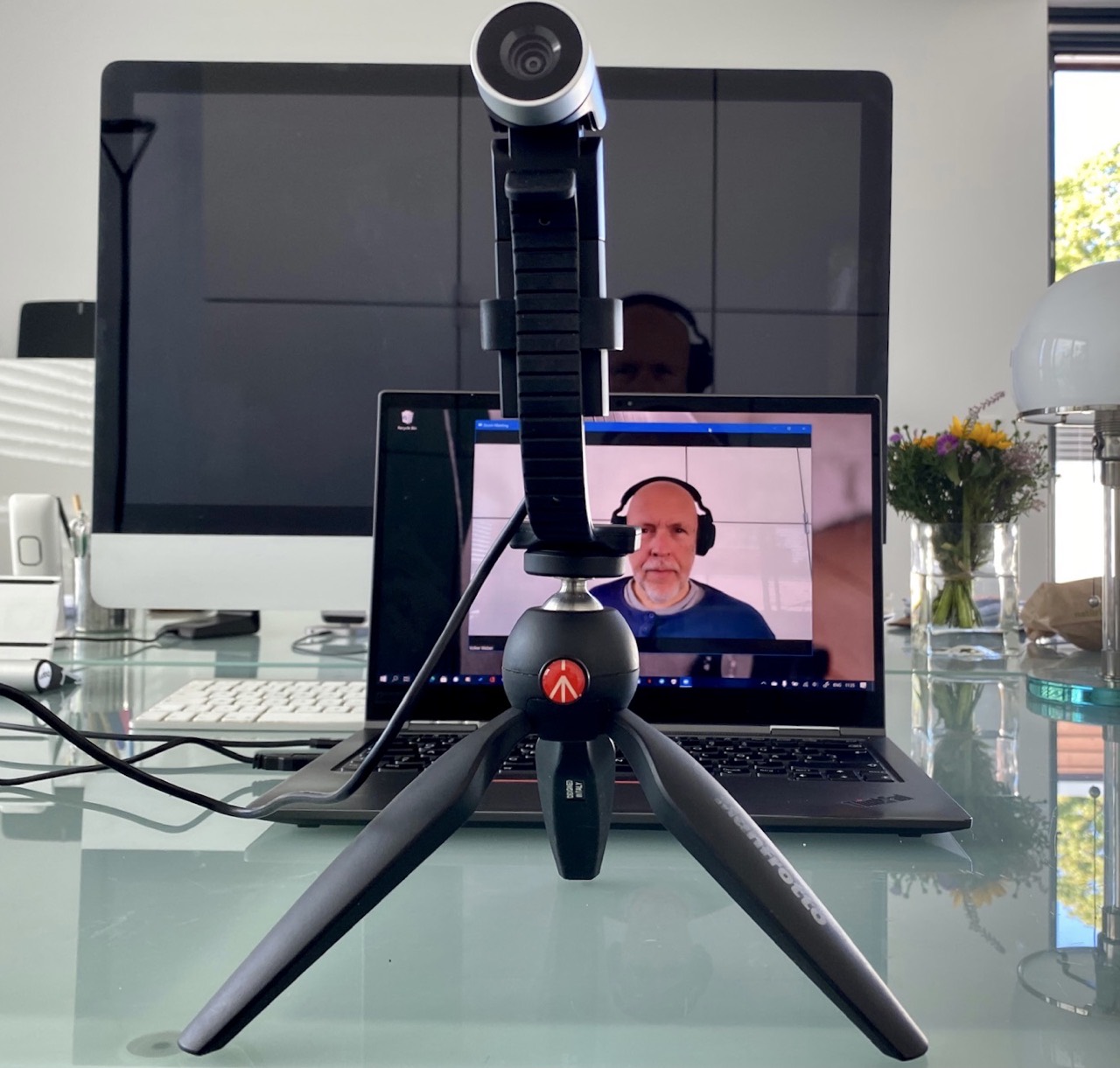
Die Poly EagleEye Mini ist eine HD Webcam mit 1080 Zeilen Auflösung, die in etwa mit der Logitech C920 vergleichbar ist. Wunder kann man von 1080p-Kameras nicht erwarten und dennoch sind sie besser als die in Laptops verbauten Kameras. Vor allem aber kann man so eine Webcam in einer viel besseren Position montieren, so dass sich nicht auf das Kinn zielt.
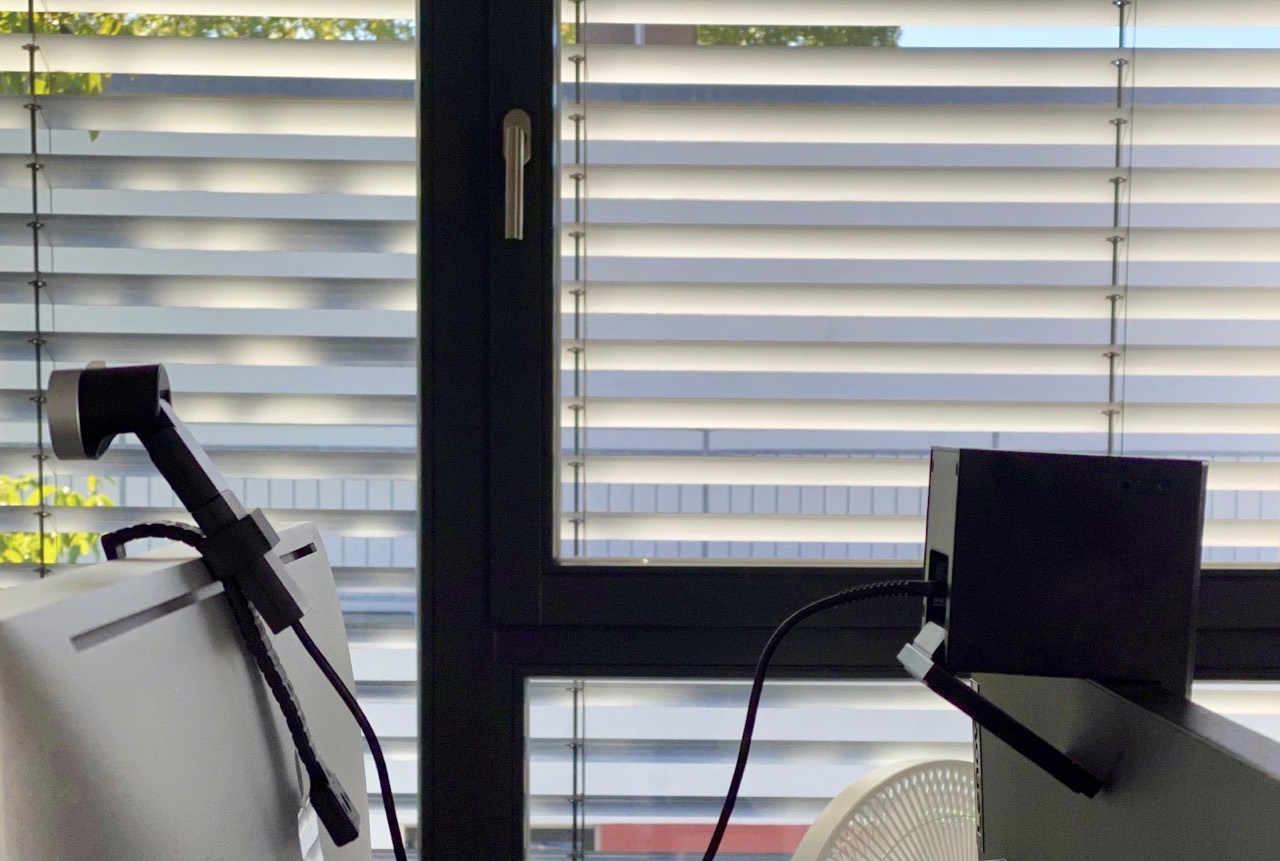
Hier hat die EagleEye Mini einiges zu bieten, denn die Kamera kommt geradezu als Bausatz daher. Die Kamera wird in den Adapter mit dem Kabel gesteckt und von dem langen, biegsamen Streifen gehalten. Mit diesem läßt sich die Kamera an der Wand unter einem Monitor aufhängen oder als Haken auf einem Bildschirm. Im ersten Bild sieht man, dass sich der Streifen mit seinem Gewinde auch auf ein Stativ montieren lässt.
Hängt man die Kamera an einen Monitor, macht sie einen sehr viel schlankeren Huf als der exzellente EagleEye Cube:
Von dem Cube war ich nicht auf Anhieb begeistert, aber mittlerweile mag ich ihn sehr. Ich warte jetzt noch auf ein Firmware-Update, das den Kameramann auf Trab bringt. Der Cube folgt dem Sprecher und das könnte noch flinker sein.
Computing was labeled a 'science' and placed almost immediately within the domain of science, technology, engineering and mathematics (STEM), but perhaps that was a mistake. Perhaps, as we are learning recently, there's much more to computing than the technical aspect - things like law, ethics, and power relations. Minimally, argues Randy Connolly, it needs to embrace other disciplines' insights, include some social sciences courses in the computing science curriculum, and hire faculty from multiple disciplines (hiring a few philosophers couldn't hurt either, ahem). "Computing also needs as an academic discipline... to move to the edge and to participate in the rich academic biodiversity that happens where computing interacts with other disciplines."
When it comes to hate, does Facebook believe in what it says it does? According to engineer Ashok Chandwaney, not even close. The Washington Post published the departing employee’s resignation letter, which had been posted on Facebook’s internal message board. Let’s take a close look at the accusations. Analyzing Chandwaney’s resignation letter The resignation letter … Continued
I didn't know you could make podcasts on Wordpress.com so this article comes as a bit of welcome news. It has tools to upload your audio and to share them via various podcast networks (thus helping them be less obscure). It also comes with complete instructions on how to do it, so it's easy to get started. Of course, you'll have to supply the topics and the voice to record the podcast and record your own audio (you can do it in Zoom). What's most important here is that you'd be contributing to the world of RSS podcasts, and helping support an ecosystem free of the lock-down mentality of companies like Spotify.
Benutzt hier jemand Bigbluebutton? Die haben "mute" serverseitig implementiert. Das heißt, wenn du im Client Audio ausschaltest, schickt der weiter Audio an den Server, und der Serveradmin könnte das anhören oder mitschneiden.
Bonus: Der Bug gammelt da seit dem 1. April herum.
Earlier this year I wrote about “London Throat” which most people experience if you have stayed any amount of time in London England. It turns out that vanadium found in brake dust and in diesel exhaust contributes to “London throat” and also has an adverse impact on human health and immunity.
A recent study showed that 55% of traffic pollution is from non-exhaust particles, and 20% of that is brake dust. The dust is caused by the friction of the brake rotor grinding on the brake pads when a vehicle is braked, and the dust becomes airborne. What this also means is that zero emission vehicles which have been vaunted as the environmental salvo to the internal combustion engines of 20th century vehicles are still going to contribute to brake dust.
Price Tags publisher Andrew Walsh also sent on this article by Thom Bennett in Air Quality News that found that it was not only brakes but also tires that were emitting particles. The British Air Quality Expert Group (AQEG) noted that particle pollution from tires was completely unregulated, and with the trend to heavier vehicles like SUVs and electric vehicles, emissions from tires (called non-exhaust emissions or NEE) was problematic.
The BBC’s Roger Harrabin writes that brake, tires and road surface wear “directly contribute to well over half of particle pollution from road transport.No legislation is currently in place specifically to limit or reduce [these] particles.”
While European legislation is driving down pollutants from exhaust, as more vehicles are used on the road pollutants will increase from other unregulated sources. A researcher with Emissions Analytics found that tire particle pollution was one thousand times worse than car exhaust emissions.
No one thought to check asphalt emissions either, which turn out to have a 300 percent increase in secondary organic aerosols (SOA) in hot weather and climates. As Rhi Storer with The Guardian observes
“Paved areas make up approximately 45% of surfaces in US cities, with building roofs making up another 20%, making asphalt a significant part of the urban landscape. The researchers compared their findings with formation of SOA in Los Angeles, a key city for urban air quality case studies.”
Their findings showed that sunnier hotter locations caused more emissions, and of course new asphalt is installed in the hotter months. Temperature and solar exposure were key to producing SOA emissions which previously were thought to be mainly in cleaning solvents and paint.
This speaks to doing more with less, by using public transit in cities as opposed to individual vehicles in high density areas that are subject to vehicular pollution. We simply can’t drive our way out of this, assuming that electric vehicles will solve pollution problems, much less congestion.
Dr. Gary Fuller, who lectures in air quality measurement at London’s Imperial College bluntly states that while it was known that road surfaces would factor into being an air pollution source, the concentration of testing and regulation has been on automobile exhaust.
“This has been the focus of policy and new vehicles have to be fitted with exhaust clean-up technologies.With heavier and heavier vehicles, the combined total of particle pollution from road surface, brake and tire wear is now greater than the particle emissions from vehicle exhaust but there are no policies to control this.”
The math behind wearing a mask can seem unintuitive at times. Minute Physics and Aatish Bhatia break it down in this illustrated video to show why wearing masks works:
There’s an old Freakonomics podcast about the cost of boredom that I think about and re-listen to regularly. It starts with a fascinating study performed around the First World War. Britain created the Industrial Fatigue Research Board which sought to measure the productivity of fatigued factory workers and whether or not things like environmental factors related to a general loss of productivity. In that study they found, as Amanda Markey stated succinctly
“It’s really not fatigue that’s the limiting factor of production. It’s boredom.”
Interestingly, from the podcast and subsequent research about the “scarce-capacity” theory, it stands to reason that boredom begets boredom. If you’re bored at work, there’s entropy towards becoming more bored and less productive. Anecdotally, this seems to be true in my own life. When I’m bored on a job doing uninteresting tasks or endless meetings, I spin in my chair and end up drifting over to YouTube. In more extreme circumstances I can become depressed or filled with anxiety. Even velocity on my side projects comes to a halt, which should be a refuge from boring work. It’s hard to summon energy when you’ve spent the day toiling on meaningless tasks.
The podcast covers a lot of interesting little behavioral science experiments to reduce boredom. More money? Yup. Real time chart of progress? Yup. Telling people a manager is watching you? Yup. Altruism? Nope. All of these seem like little capitalistic productivity hacks, but are interesting nonetheless as to what stimuli create responses in humans.
If boredom begets boredom, I began to wonder if the inverse is true… does productivity beget productivity? Again, I see a trend in my own life. If I find traction in one task, I typically end up with a lot of traction in many tasks. I wrote about this before, but for me it all relates to Flow and the research found in Kamikaze Biker, a sociological study about Japanese bosozoku biker gangs. Starting with smaller, easier tasks and progressively raising the level difficulty is a great way to achieve group flow. Productivity snowballs and before I know it I’m spinning plates on a half-dozen tasks at once… and then I’m overwhelmed again and the cycle resets. 🙃
Obviously I don’t have a pile of psychology research to back up any bold claims and spinning plates do sometimes fall on my head, but I now see this snowballing in other parts of my life: depression begets depression, anxiety begets anxiety, the list goes on. Some of those slopes are slipperier than others but it all reminds me, if I’m feeling bored or unproductive maybe it’s the boredom itself causing it to exist. And maybe some amount of boredom is just great.
Markey again:
Boredom is really one of the few, and maybe even the only emotion that says, “This isn’t a good use of your time. Direct your attention to something else. Like, get out of this situation.”
This concludes my story about a thing I heard on a podcast once. </fin>
Bell Media’s Crave app just received an update for iOS users.
The update adds features like ‘Autoplay Toggle,’ which lets users turn on or off autoplay from the settings menu. There’s also now surround sound on Chromecast that lets users watch content in 5.1 surround sound when casting from their iPhone or iPad to a Chromecast.
Additionally, Crave on iOS now has an offline download duration of 30 days, giving users more time to watch downloaded content.
Back in March, Crave brought 1080p download support to iPhone and iPad.
I moved into my new apartment yesterday. It was a fairly painless experience all in all. I don’t have any furniture yet (it’s coming this weekend), so that kind of sucks. Sleeping on the floor last night especially sucked.
Today was officially my first day working for Ximian. It went pretty well I think. Hopefully, I’ll be able to get up to speed quickly and start making useful contributions soon. I was able to get a mostly working development version of RCE on my machine today, which was about the only semi-productive thing I did. It’s clear I have a lot to learn, but I’m looking forward to it. Also, my first trip to Boston was arranged today. I’m really looking forward to that too. It’ll be totally cool meeting all the [ex-]gnomies and hopefully getting a good handle on my job.
There’s a website from 2001 for making zines with your friends that, at this point, only exists in my head, if it ever existed honestly, but I wish it were in the world, because in this age of WhatsApp and Slack and whatever, we need it. There are ideas at the bottom of this post.
Here’s how this fictional website worked, in my memory, which is maybe (probably) false:
You start a zine and give it a publishing frequency, and invite a groups of friends to collaborate
Everyone writes articles and puts them into place. Anyone can edit anything, but you can decide roles like subeditors and contributors. The table of contents is auto-generated; images are automatically re-sized; etc.
In the top corner of the screen is a big countdown clock. When it gets to zero, the articles, whatever state they’re in, all get published automatically. They’re compiled and put somewhere on the web, anywhere you choose.
The clock restarts.
Perhaps, with the countdown clock, there are even DEFCON levels before going to press: content freeze 3 days ahead of launch, 12 hours to go, everyone scramble to submit your story; it’s the last 24 hours, only minor edits and deletions allowed; and so on. Everyone can see the clock, it’s a forcing function.
In my head, this website is super easy to use. Church groups use it for their monthly newsletter, teams at work use it for their weekly updates, writing groups use it to publish an online magazine, school classes use it.
Did this website actually exist?
It is possible that it existed, for 9 days, almost two decades ago. The memory of that website is what I keep coming back to.
Waaaaaay back in early 2001, I got excited about a tool named Organizine which was a tool for groups (not individuals) to make websites. Here’s my write-up at the time, and here’s what the founder said about it. I think it launched publicly on the last day of 2000, and closed (for personal reasons, according to the message on the site) on 9 January.
You will notice that, in neither of those write-ups, is there mentioned a “time to press” countdown clock.
AND YET – I have been talking about Organizine for, I am not kidding, 19.5 years now, and I have mentioned that countdown clock every time. Did I make it up? Perhaps. It looks like it. Who knows. It’s a good idea though.
I really want this website, or app, or whatever it is.
Here are the key features:
There is a live community, communicating in email, Slack, WhatsApp, whatever – and it’s a private community.
It’s a group project. Everyone contributes to a single artefact, and all repetitive work is removed. Text flows through templates to become articles; index pages, content pages, and anything that can be automated is automated.
There is a robot publisher which takes the “go live” authority away from the group. Publishing makes things fixed and public, on a schedule.
What going on here is there’s some kind of public, static production emanating from a private and ephemeral small group of people. There is just enough structure, with roles and sign-off gates, and the clock of course, to get the group to self-organise.
In 2020, I want to apply this pattern wherever I see a place where small groups gather.
We’re in a golden age for online teamwork and community. WhatsApp groups, Slack and Discord, meetings in Zoom, social media like Facebook and Twitter – there have never been more ways to socialise and work together online.
But what I’d like more of is the ability for those groups to produce something together. Barn raising. And the artefacts of those collective efforts… zines, videos, visual art, screenplays: things which are finished.Complete. Not posts in Facebook groups. Websites.
I’m missing the durable, ever-increasing “stock” in Robin Sloan’s stock and flow. More abstractly, it’s Walter Ong’s orality and literacy and what we’ve got now is an oral culture – lively, vibrant, fluid… but temporary and somehow unable to reach the deeper and nuanced ideas that literature culture affords.
So, some ideas.
A private wiki or Notion instance that has a special zone that auto-publishes editions of a static website, once a month.
A Slack workspace that has a special #links channel, and every Friday it gets compiled into a newsletter, sent to whoever is online for a quick review, and posted out to all subscribers. Emailed replies to the newsletter are directed back into Slack, where they appear like messages in bottles.
A WhatsApp group for a club committee, attached to a Google Drive folder with a fixed set of Google Docs in it, an once a week the content of the docs gets swept through pre-set templates and published as a PDF and emailed out to the membership.
A GitHub Pages repo that accepts all changes that are made to it, by anyone, and auto-publishes a website – but as issues, so previous issues are available at sequential URLs – and only on Thursdays.
A shared album in the iOS Photos app for a family that lives apart and, for Christmas, after paste-ups are shared for editing on 1 December, the photos are automatically printed into books that are mailed out to all the households.
A drag-and-drop Figma canvas that a design group drops and arranges inspiration image into, and every couple of weeks it all gets printed with Newspaper Club.
An email list for a writing group, and any Microsoft Word doc forwarded to a special email address gets posted to Drafts in a WordPress blog, and the next story, whatever it is, is pulled from the queue and published every Friday.
A postbox in Animal Crossing which posts to a Tumblr blog for your town, at midday daily, and it’s frozen for an hour at 11am so the town owner gets to edit if they want.
All built for small groups to work together, simultaneously with them chatting and hanging out.
All with the ability for some kind of audience (website visitors, newsletter readers) to subscribe to the artefacts, whatever they are.
And all, of course, having - large, in the top corner of every screen, monotonically decreasing - the imperturbable presence of the clockwork publisher, this feature which maybe I imagined and maybe was there in 2001, but which is vital, the moment of cutting the cloth which gives the creative act its edge, showtime itself: the countdown clock.








 wtyppod on Twitter.










 Fefes Blog.
 Price Tags.