Shared posts

12 Sep 04:51

Patterns and constraints

by Chris Corrigan

It is the most human thing to recognize patterns. We are attuned to rhythms in nature that repeat: seasonal changes in the land around us, the ebb and flood of the tide, migrations of birds, the ripening of fruits, flows of water and the rhythms of the day.

We also see shape and line and image, and our brains even impose order on otherwise random images like cumulus clouds in a summer sky or inkblots on a therapist’s couch.

As babies, we recognize the similarities and differences that are crucial to our survival. The sound of our mother’s voice, the patterns of contrast on the faces of our caregivers, the smells and tastes of our parent’s skin. Familiar patterns distinguish safe situations from dangerous ones and they help us to stabilize and regulate our emotions.

Patterns are simply things that repeat and that we recognize as being similar to something we have seen or experienced before. Patterns may vary in detail, but they repeat in form. You recognize a house, even when all the houses in your village are different. You can feel anger even when different words are said. You know a soccer team is playing a high press or a low block tactic even when different teams use the strategy. The presence of patterns is the absence of randomness.

When you see a pattern there is likely a good reason for it. Nothing in nature repeats unless there are underlying conditions that cause it to repeat. In complexity, these are called constraints, and once you start understanding them, you begin to develop a range of options for seeing, creating and shifting patterns.

Constraints and Cynefin

One way to think about Dave Snowden’s Cynefin framework is to see it as a spectrum of constraints. Moving from clear to chaos, you can think of different problems as systems as exhibiting less stability, more self-organization and emergence until you get to a totally chaotic state in which everything appears to be unconstrained and random. This little diagram above shows you what I mean.

Moving from left to right, constraints get tighter, situations become more stable and more predictable. Any move in this direction will make a pattern more stable and enduring. It also requires more energy and resources to maintain it, so one has to make choices about which stable pattern to invest in. Creating a fixed relationship between agents in a system means that it is harder for them to form connections outside the system. That is desirable when you need a guaranteed repeatable outcome, such as on an assembly line, but it’s a bad way to create community.

In contrast, moving from right to left, constraints get looser and situations get less stable. Any move in that direction will break down stability and allow for new patterns to emerge. However, because you are introducing more randomness into the system, you can never be sure if the new patterns will be helpful or not, so you have to watch them very carefully and support the ones that give you what you want. You can try to influence the emergence of beneficial patterns by trying new things, to see if new relationships will form. If they do, and things work well, you can create agreements to stabilize what is working. But if you go too far in breaking down existing patterns you can create chaos.

In Chaos, the only thing that helps is the rapid establishment of tight constraints to create some stability. Think of what happens when first responders arrive on the scene of a fire. You get authoritative directions and are told what to do and where to go. You accept a level of bossiness from others that you would never accept in your daily life. In Chaos it is easy to impose constraints, but very difficult to loosen them. Just think of your experience with the pandemic.

Constraints: places to intervene in a complex system

In her classic on systems thinking, Donella Meadows writes about the 12 places you can intervene in a system. These are useful for nested and ordered systems, and in some ways, her typology moves from clear to complex as it moves up in scale from local to global. It’s helpful, but the work of Alicia Juarerro, Dave Snowden and Glenda Eoyang provides a simpler way into understanding the places to intervene in a complex adaptive system.

If we are looking to create or change patterns around us – to stabilize things that are beneficial or disrupt things that aren’t working – complexity thinking gives us a few things to try. In my practice I have these down to five constraints that you can try influencing:

Connections. One way to identify a pattern is to see how the elements in the system are connected. Connections limit action, as I point out in the example above. If I have to report to you every day in person at 9am, that constrains my action. The people in my community share a kind of connection with me that others don’t. Those with whom I make music, or study complexity, or support the Vancouver Whitecaps FC, have a different connection. If I want to change my life I can sever or create new connections with others. I can tighten up a connection – call your mother! – or loosen one (let your child explore the world a little more on her own).

Exchanges. If you think of connections as a kind of fibre optic cable then exchanges are the data and information that pass through it. You can have more or less bandwidth in an exchange and you can choose what to pass over it and with what quality. For example, I have a high bandwidth exchange with my partner in which we can talk about anything, in virtually any way, and that comes from 30 years of being together. In other relationships, I exchange different information in different ways.

Information in connections and exchanges is influenced by things such as power. A twelve-year-old child shouting obscenities at me is quite different from my boss doing the same thing. When you have power, you have to be aware of how you are using it, because it affects the system. If our connection is rigid – for example, if I am a prisoner and you are the prison guard – your power over me can be coercive and brutal if you want it to be. If you can use violence against me, I will either have to submit to you or fight back. But in more equitable relationships and connections, the exchanges can be reciprocal, power can be shared and what is exchanged is more creative, collaborative and emergent.

Connections and exchanges between agents or parts in a system are a rich place to intervene. But connections and exchanges are also constrained within what we call “containers.” These are spaces and contexts, physical, social, even psychological, inside which people act. Containers are made up of Attractors and Boundaries. Attractors bring us together around something and boundaries create differences. If you want to change the container or the context in which things are happening, you can try creating an alternate attractor and see if the system reorganizes around it. We do this all the time with rewards and other extrinsic motivations. If my kid can’t see that good grades are their own reward, gamifying school work with different rewards and levels might help to pick up the grades. Or not. It’s worth a try. Likewise if I feel that my relationship to a person is stuck in a rut, we might do something different together, go on holiday or climb a mountain, or meet in a different place and simply having a different attractor in our midst will help us to relate differently. This is why groups often use things like ropes courses to explore collaboration. A different attractor catalyzes different actions.

Attractors influence patterns of attention. If you are wondering why no one comes to your events, it’s all down to how you compete for their attention. Marketing is all about attractors.

Boundaries are what we usually think of when we picture a “constraint.” It gives you images of a fence or a wall inside which something happens and outside of which something else happens. Boundaries create differences and differences help new patterns to emerge. If our boundary is too tight, we can become too inwardly focused and learn nothing new. And so we talk about “expanding our horizons” or “getting outside the box” which is an indication that if we are to discover different things, we need to open up the boundaries that keep us separate from the world.

But sometimes we need to tighten boundaries as well to differentiate ourselves from others. We are currently doing this in the pandemic at a personal and a national level, managing bubbles, trying to find the right balance between being safe and being connected. We could stop the pandemic by having everyone spend one month in isolation, but the cost of that to people’s mental health would be immense. So managing boundaries is critical.

Issues of inclusivity and exclusivity are always at play when you create a boundary. Someone is always left out. Removing boundaries altogether does not create a more inclusive situation, it creates chaos. Inclusivity is about providing different ways for people to enter into a context, and then how to connect and exchange once they are there.

If there is a pattern of differentiation to address there is almost always a boundary constraint that is giving rise to it. Changing boundaries changes the way one context is different from another. Sometimes you need more difference and sometimes you need less.

Identity. In most natural complex adaptive systems, the above four constraints – connectinos, exchanges, attractors, boundaries – are the ways in which the system organizes itself. In human systems, however, and in the field of anthro-complexity, identity is a crucial fifth constraint. Identity influences much of how we show up as humans. It can create new boundaries and attractors and it influences how we connect and exchange. Identity can create commonalities or differences – both of which can be helpful or destructive – and changing identity is perhaps the hardest thing for humans to do. We are built and maintained by the stories we have about ourselves and the stories that others tell about us. To make matters more confusing, we all have multiple identities. Within us intersect our nationality, gender, race, history, culture, age, status, power, role, family and so on. We can lock into people that we perceive as the same as us – which is helpful for safety and having a shared context – or we can actively seek out people that are radically different from us – which is necessary for learning, creating new things and developing resilience. In my own practice, I choose to work on teams that have much diversity – focusing specifically on diversifying gender, cultural background and expertise. Even small teams of two or three people with as much diversity as you can find end up being incredibly resourceful for working with all the aspects of complex systems because we can centre or de-centre particular identities given the changing context.

Recognizing taht we all carry multiple identities allows us to be different from each other when we need to be, and come together around commonalities when we need to be. In healing divisive dynamics in a system, finding common identities is crucial, even if these identities are not exactly relevant to the problem at hand. In overcoming problems of stuckness, where we are falling into an echo chamber, differences of opinion are essential if we are to confront an ever-changing world together.

In human systems identity is everywhere.

Constraints are your friend. Becoming good at spotting them and then experimenting with them is the journey towards the artistry of complexity work. It is creative, collaborative work as well, needing lots of eyes and ears and hearts and minds to discern what is happening and look for ways to make things better, to stabilize the things that are working or to break down the patterns that don’t.

How are you using constraints in your work and life?

12 Sep 04:32

Twitter Favorites: [skinnylatte] “Why do people pay for things they can host themselves?” /tries to figure out nginx and php

Adrianna Tan @skinnylatte
“Why do people pay for things they can host themselves?” /tries to figure out nginx and php
12 Sep 04:32

RT @UrbanFoxxxx: Can't stop thinking of how Galina Balashova decided to put art on the walls of the Soyuz when designing its interiors — an…

by Irène DB (UrbanFoxxxx)
mkalus shared this story from sovietvisuals on Twitter.

Can't stop thinking of how Galina Balashova decided to put art on the walls of the Soyuz when designing its interiors — and not some space age, futuristic image, but quiet little watercolours of the Russian landscape (which she painted herself). So Tarkovsky. pic.twitter.com/w6DVweRRvQ


Retweeted by Soviet Visuals (sovietvisuals) on Friday, September 11th, 2020 11:01pm


1834 likes, 564 retweets
12 Sep 04:31

Investigation launched over misleading claims from board member at B.C. chiropractors' college

mkalus shared this story .

A board member of the College of Chiropractors of B.C. is facing an investigation over numerous misleading and dubious claims that were posted to her clinic's Facebook page.

Last week, a member of the public sent links and screenshots of several questionable posts from the page of Linda Gordon's Surrey clinic to Health Minister Adrian Dix and Premier John Horgan, asking for the provincial government to step in.

"It is clear that the College of Chiropractors can't regulate the profession or its board members. This is a total failure of the college. I ask again for the ministry to intervene to protect the public," reads the email, which was shared with CBC.

The posts on the North Surrey Chiropractic Clinic's Facebook page included scientifically unsupported claims that chiropractic adjustments can treat ear infections and ADHD, and "boost the effectiveness of your immune system" against colds and the flu.

The health ministry told CBC it does not have the authority to intervene in complaints about individual chiropractors, but the college says it's taking action.

"As you know, we take these issues very seriously. We were not aware of the matter and are now investigating," college registrar Michelle Da Roza wrote in an email.

Gordon was elected to the college board in 2019 to serve a two-year term.

She did not respond to a request for comment, nor did either of the other chiropractors who work at North Surrey Chiropractor Clinic — David Wasylynko and Jasleen Gill.

College policy on misleading and unsubstantiated claims specifically forbids chiropractors from advertising that they can treat infections or ADHD, among numerous other conditions. Chiropractors aren't trained in treating infectious disease, and they were reminded at the beginning of the COVID-19 pandemic that any claims about "boosting" immunity are offside.

Since the complaint was made to the provincial government last week, the clinic's entire Facebook page appears to have been disabled.

As part of a 2018 drive to clean up chiropractors' advertising, the college developed a piece of software that can analyze chiropractors' web pages and social media to identify offside claims.

"Generally speaking, our marketing review tool is helpful in picking up advertising that is not compliant with our guidelines. Occasionally, the technology does not catch something — which happened in this case," Da Roza said.

This isn't the first time the college has had to confront the issue of board members posting prohibited content on Facebook.

In 2018, college vice-chair Avtar Jassal resigned from his post after CBC reported on an anti-vaccination video he'd created and posted on Facebook, in violation of college policy on immunization.

A Freedom of Information request later revealed that the B.C. Chiropractic Association, a voluntary professional organization, had repeatedly complained about anti-vaccination misinformation being spread by Jassal as well as two other former members of the college board, Parm Rai and Gil Desaulniers.

The college has said it has improved its process for handling complaints about marketing and communication issues since concerns were raised about those three former board members.

The chiropractors' college is expected to be folded into a new college of complementary and alternative health care along with naturopaths, massage therapists, acupuncturists and traditional Chinese medicine practitioners as B.C. moves ahead with plans to reform its regulatory system.

12 Sep 04:31

The descent into political insanity

by noreply@blogger.com (Chris Grey)
mkalus shared this story from The Brexit Blog.

The relatively quiet summer has ended with a bang, and Brexit has now pushed Britain into a dark and dangerous place. The developments this week have been extremely complex, so this will be an unusually long post.

We have seen numerous political and cultural conventions slashed aside by the Brexit Jacobins – the full-frontal media assault on the judiciary and the illegal prorogation of parliament being the most egregious examples. Now, a cabinet minister speaking at the dispatch box of the House of Commons has, almost casually, announced that the government is proposing to “break international law” in pursuit of its Brexit policy. The qualification that it will be only “in a very specific and limited way” was almost immaterial and its ludicrousness is obvious if imagined as a defence in any criminal law trial.

Earlier the same day, Sir Jonathan Jones, the senior civil servant who heads the government’s legal department resigned. He joins growing list of such resignations, with Brexit always at the centre, and in this case with an extra force since it was clearly the result of his refusal to go along with the government’s proposed law-breaking (£). This represents a very serious moment not just in the history of Brexit, but in modern British political history more generally, and it is vital not to be inured to its significance by the continual outrageous acts of the Brexit governments. For when has a government minister ever announced an intention to knowingly break the law?

This is a very big event. Even Theresa May, who in her time often behaved with contempt for parliament and in other highly divisive ways, was moved to warn bluntly of the consequences for any international trust in the UK if the government went down this route. Another former Prime Minister, Sir John Major, subsequently made a similar point as – perhaps even more significantly given his pro-Brexit credentials – did former Tory leader Lord Howard. The Attorney-General, former ERG Chair Suella Braverman, then sought to provide a legal justification of the government’s position which attracted thunderous criticism from across the legal fraternity, with Mark Elliot, Professor of Public Law at Cambridge University, describing it as “utterly risible”.

Meanwhile, the EU requested an immediate meeting of the UK-EU Joint Committee following which it issued an extremely robust statement about this “extremely serious violation of the Withdrawal Agreement and of international law” and calling on the UK to drop its proposed measures by the end of the month with the at least implicit warning of legal action. The UK statement, which was blander in tone - although Michael Gove, the UK co-chair, was reportedly less than polite during the meeting - stated that the UK would not do so. The stage is therefore set for a colossal crisis.

What just happened?

It’s important to hold in mind these reactions because whilst the implications are huge, the underlying issues will, to many, seem arcane and even dull. In brief (more detail: here) the government plans to pass domestic legislation - the UK Internal Market Bill - which would contradict some of the provisions of the Northern Ireland Protocol (NIP), a part of the Withdrawal Agreement (WA), by allowing the UK unilaterally to make changes to its terms, rather than doing so by mutual agreement with the EU via the Joint Committee established to oversee the WA.

In particular, the legislation means that the UK government could unilaterally change or do away with customs formalities on goods travelling from Northern Ireland to Great Britain, and unilaterally remove the role of EU law and regulation in state aid policy in Northern Ireland. The latter has a significance beyond Northern Ireland in that it also aims to prevent the NIP creating any backdoor role for the EU on state aid policy within Great Britain (of which more later). When the draft legislation was published, legal experts confirmed that it empowered the government to breach international law and, indeed, that is made explicit in the Bill.

The significance of this is not that, in itself, it entails ‘ripping up the WA’ but that it creates a conflict between domestic law and the WA, which is a legally binding international treaty. The potential legal consequences of this are that the EU could take immediate action at the ECJ on the basis that even proposing this legislation breaks the ‘good faith’ clause of the WA.  Alternatively, If the powers the legislation gives government were actually exercised that could give rise to a case and, potentially, penalties within the WA’s dispute mechanism.

That is (or may be) for the future. What matter now are the political implications for Brexit (and, though I don’t focus on it here, its implications for Scottish and Welsh devolution). In particular, it explicitly and officially confirms that the UK is ready to make unilateral interpretations of what was jointly agreed and, more widely, opens up the prospect that the UK regards adherence to the WA as in some way conditional upon whatever future agreements are or are not made with the EU.

This directly undercuts the central purpose of the NIP which is to provide guarantees for Northern Ireland’s situation that apply irrespective of anything else that may happen, unless or until any further agreement is reached jointly by the UK and the EU. Moreover, by treating one part of the WA in this way, it does, ultimately, open up the possibility of the UK reneging on the agreement wholesale.

That, as I warned in June, would be to embark on the road to international pariahdom. In that post I said we weren’t on that road yet, but could see the signposts pointing us in that direction. This week, the UK took the first step along it. It is undoubtedly the case that the first such step is the most difficult to take. From here on in it will get easier to continue that journey, and harder to resist those urging that it be made.

Why is this happening?

These latest developments, startling as they may be for those who have tuned out of Brexit in recent times, have not come out of nowhere. In early June Boris Johnson was already talking about the WA as being “defective” and in need of revision (even earlier, in February, there were well-sourced rumours of plans to circumvent the NIP). That of course was the deal that he himself had signed and acclaimed less than six months before. So one part of what we’re seeing is the latest and perhaps strangest example of what I wrote about last week – the way that throughout the process the UK has been internally debating what Brexit means at the same time as actually enacting it. Thus although we’ve long known that fisheries would be a contested issue, it is only more recently that state aid emerged as another such issue. And although the arrangements for Northern Ireland had apparently been settled, the UK is now re-opening them.

There are two reasons for this. One is that Dominic Cummings’ latest obsession is an activist government policy of financial support for technology firms. This isn’t the place to discuss the merits or otherwise (£) of that policy – except to note that it is all of a piece with Cummings’ drearily cliched ‘disruptor’ world view, cribbed from 1990s airport lounge business books. Nor does it really matter that there’s no good reason to think that a robust UK state aid regime – indeed the EU state aid regime – would preclude such a policy (cynics might therefore wonder if the real problem is that such a regime would prevent the Johnson-Cummings government handing out public contracts to its cronies).

What does matter is the extraordinary democratic affront that the peccadilloes of this single unelected advisor should drive national strategy and, worse, that at this late stage it should be introduced as something that might actually scupper a trade deal, with all the economic damage that will cause, and, worse still, that it should lead to the WA itself being put in jeopardy.

The second reason is equally, if not more, shameful. As was clear to many at the time and is now undeniable, Johnson, his government, and his MPs voted for and signed the WA, including the NIP, either without understanding or without caring what it meant. This lack of understanding was not just to do with state aid, but also the border arrangements for Northern Ireland and (although not a feature of this week’s debacle) the Geographical Indications agreement.

There’s no justification for this in general, and certainly none as regards the implications of an Irish Sea border, since these were loudly flagged up by many, including the DUP, at the time. More than that, such a border had already been described by Theresa May in February 2018 as completely unacceptable (£), even though she had agreed to it at the end of the phase 1 negotiations in December 2017. It was this which led to May’s backstop agreement, which Johnson then ‘renegotiated’ to return to the sea border solution – and which he claimed as a great triumph, despite having promised categorically during the Tory leadership election that he would not agree to it. This convoluted and contradictory history is a matter of documented record, and it is simply a lie for the government and Brexiters now to deny it.

So what happened was not an accident, it was willful, deliberate policy so as to enable Johnson to say that he had got Brexit sorted out and to put that to the electorate as an ‘oven ready deal’, and then – again at his choice - to rush it through parliament with next to no scrutiny, and with the support of every single Tory MP including every member of the ERG. In the process, he repeatedly denied that the Irish Sea border he had agreed to would have the effects that he later admitted it would and which he now wants to repudiate. He was simply too lazy, too dishonest, too impatient, too greedy, too ambitious, too selfish, and too irresponsible to care.

As for Cummings, it seems that he had already essentially lost interest in the details of Brexit (£), being instead fully occupied with both his technology wet dream and his punitive attack on the civil service. Such is the arrogance and irresponsibility of the ‘disruptor’. Having done so much to foist the Brexit disaster on us, he just ceased to care until belatedly realizing that the hitherto obscure (except, for different reasons, to Lexiters) issue of state aid might get in the way of the new toy he is playing with (that toy being what was formerly called the future of our country).

As for the MPs who voted it through, they were partly cowed by the bullying of the new Johnson-Cummings regime – which had dealt so ruthlessly with the 21 members of ‘Gawkward squad’ in September 2019 – partly, again, too lazy and arrogant to care, and partly on the basis that whatever was agreed with the EU wasn’t really binding. Bernard Jenkin, the arch-Brexiter MP, said exactly that this week, claiming that he and others of his persuasion only voted for the WA because of assurances “that it would be superseded by a full FTA; and if needs be it could be repudiated”*.

There is no way to describe this other than grotesquely dishonest or, if there is, then the only other possibility is grotesquely stupid. How could anyone, with even the scantest knowledge, possibly have thought that this was the case? How could anyone have thought when campaigning in the election, as Jenkin and his colleagues did, to ‘get Brexit done’ with Johnson’s ‘great oven-ready deal’ that it was the case? They knew, or should have known, otherwise but went along with it for reasons of temporary expediency. Now, they are pretending that they never accepted what they had agreed to and are not bound by it.

Back to no deal 1.0?

But, again, this hasn’t come out of nowhere. As I have been warning since the general election, the Brexit Ultras have never accepted the legitimacy of the WA, and have gradually become more and more vociferous in demanding that the UK renege on it entirely. That includes the ERG MPs like Iain Duncan Smith who voted for it, as well as the Brexit Party whose ever-present shadow hangs over the Tory Party (and whose MEPs also voted for the WA, in the European Parliament).

For these people, the issue isn’t this or that detail of the agreement, such as those of state aid or customs formalities, but an ideological fixation with a totally cretinous idea of ‘sovereignty’ in which Britain can simply act with total unilateral autonomy, and do so without any consequences. Tellingly, was in essence the claim of the Attorney-General’s reasoning as to why the UK can break international law. So not only are they prepared for the ‘no deal 2.0’ of having no trade deal, they want to go back to what the 2017 parliament prevented by reinstating the ‘no deal 1.0’ of having no Withdrawal Agreement.

I also warned in July that, as has happened throughout the Brexit process, what seemed like the fringe opinions of a few obsessive extremists would quickly become mainstream. That is what has started to happen this week. They don’t seem to have been the direct architects of these events – Cummings despises the ERG, and Johnson has never been of the true faith – but they and their media cohorts leapt on the possibility of undermining the WA with glee.

If pandering to them was not the government’s motive then it was certainly its effect. Johnson has already treated the Political Declaration as an irrelevance. Now he is saying that the – his – “Brexit deal never made any sense”, and that he will break international law to flout some of it. That is bound to ramp up expectations amongst the Ultras that their dream of reneging totally is a real prospect. And, indeed, with grim inevitability, within hours of the publication of the Internal Market Bill, ERG members were talking of amendments to extend its provisions even further. As always, the moment they get one thing, no matter how extreme, they will immediately demand something even more extreme.

‘The adults are no longer in charge’

The endless dramas, zig-zags and downright chaos of the UK approach to the Brexit process are in marked contrast with that of the EU. For despite the constant refrain of ‘sovereign equality’, the two have certainly not been at all similar in the dignity of their conduct. The EU has been consistent, rational and principled in its approach. It is hard to think of anything that the it has done in the last four years which is in any sense surprising and which hasn’t been long-trailed.

That is not said in a spirit of starry-eyed worship. It’s not, after all, some huge triumph to meet the base line for how we expect international relations to be conducted by liberal democracies. It is how, in the past, the UK would have been expected to behave. That it has not has caused bewilderment and, now, real anger in the EU and is a source of shame for those of us who are British and actually care about our country’s reputation, of which the Brexit faux-patriots are so careless. To get a measure of the damage, it is only necessary to imagine how the Brexiters would react if it were the EU which proposed unilaterally to tamper with the provisions of the WA, and to shamelessly admit that it was ready to do so in defiance of international law.

But as Bobby McDonagh - former Irish Ambassador to the EU, UK and Italy, so not one likely to use undiplomatic language lightly -  observed this week, “the adults are no longer in charge in Downing Street”. Instead, he compares those running the UK to tantrum-throwing toddlers. And, indeed, such tantrums have been a recurring feature of Brexiter behaviour, with repeated cries of ‘it’s not fair’ throughout the long process. In the early years, Theresa May played the role of a governess misguidedly trying to soothe these shrieking man-babies. Now they are in charge.

This makes it harder than ever to understand what the government is doing or to predict what it will do next. It’s almost pointless to try to understand this week’s events in terms of whether or how they might be ‘negotiating ploys’, for example to make the talks so toxic that the EU would walk out in exasperation (as some politicians in the EU are now suggesting) so it could be blamed for no deal; or to make the EU believe that the UK is ready to rip up the entire WA if there is no trade deal, so as to secure such a deal. For what it is worth I don’t think either of these things will happen. As for the motivation, as likely as not all we have seen is an example of the Cummings’ mantra of ‘doing the unexpected’, as if that had a virtue in itself.

What are the effects of this week’s events?

Whatever the intention, the immediate effect is obvious. In what was already an atmosphere of almost no trust from the EU, the UK government have now eviscerated what little remained. Whilst the issues posed by the Internal Market Bill are a matter for the Joint Committee, their malign influence is bound to spread to the trade negotiations as well. These negotiations have not been helped by the parallel developments this week about UK state aid policy, which have also been very convoluted.

Whilst the Internal Market Bill is partly aimed at avoiding the application of EU state aid rules in any way in the UK, the question remains as to what the UK state aid regime is to be. This is a central bone of contention in the trade negotiations. The EU has softened its initial wish for the UK to follow EU rules, but has asked the UK to specify what its own rules will be. This week, the government announced that, on the one hand, post-transition, it would follow WTO state aid rules and, on the other, that it would develop its own system bu not until next year (£).

WTO state aid rules are very different from those of the EU and they do not apply to services, and would obviously not meet the EU’s requirements for a trade deal with the UK (something confirmed by Michel Barnier’s statement at the end of this week’s talks). Yet the UK’s announcement did not rule out developing a new system that would do so, and was explicit in saying that it might agree new obligations within future free trade agreements (including, presumably, with the EU). So this part of the announcement does not scupper the trade talks, but does not advance them, either.

Equally, though, the announcement that the UK’s own system will not be developed until after the transition is over means that the EU request for details of it has been refused which is, as one EU official is quoted as saying, “tantamount to taunting us” (£). So this part of the announcement makes a trade deal more difficult. In effect, it asks the EU to take on trust that the UK will develop a suitably robust regime, just at the moment that with the Internal Market Bill bombshell trust has been so badly undermined. If there is a logic to this, it is impossible to discern. Unsurprisingly, this week’s trade talks ended with no apparent progress having been made.

There will also be repercussions beyond the negotiating tables, as ordinary citizens across Europe view the extraordinary reports of the UK’s behaviour. And there will be repercussions well beyond Europe and Brexit, given the many international disputes in which the UK calls for respect for international law. Such calls will now invite an obvious retort of hypocrisy. Already, senior US politicians are warning of the folly of the government’s conduct (£) and a CNN report suggests that “it could take the UK’s reputation years to recover from the backlash”.

Where might this lead?

I doubt, though, that any of this will concern the Brexit Ultras. Always a nihilist cult, the passage of time has made them utterly indifferent to anything other than Brexit in its most extreme form, and always moving the definition of what that means to a new extremity. They are now willing to sacrifice anything and everything to a cause that has long since ceased to bear any resemblance whatsoever to the promises they made. It has now become – and I don’t use this term lightly or carelessly – a form of political insanity, and it is an insanity which has spread to the entire government.

It’s not clear who can stop this insanity. It’s possible that this latest debacle might finally galvanize sensible voices in the Conservative Party – and there are still a few – to finally draw a line they will not allow the Ultras to cross. Michael Howard’s intervention in particular might be a sign of that, and there are some stirrings of backbench rebellion at the prospect of breaking international law. Even Bernard Jenkin seems slightly uneasy about it. So the most optimistic version is that this new low also marks a floor beneath which we will not sink. But other ERG MPs, such as Andrew Bridgen, remain obdurate. My sense is that things are simply too far gone now for the party to be reclaimed from them.

That aside, the opposition parties can do little in the face of the Tory majority and Keir Starmer, mistakenly in my view, appears unwilling to go anywhere near anything related to Brexit, though that too could change. The House of Lords may delay the Internal Market legislation but is relatively powerless to prevent the wider drift to extremism. Civil servants have limited power, and their final weapon of resignation only strengthens the ideologues.   Much of the media are cowed or complicit. The public, for now anyway, are largely apathetic and perhaps understandably more concerned about coronavirus than Brexit.

So it seems that little stands in the way of the government taking ever-more extreme stances. I think that when the dust settles on this week’s events their legacy will have been to bring reneging on the WA, in its entirety, more centrally into political discourse and to have moved the UK one step closer to actually doing it. If this seems far-fetched, then consider that until a few days ago the idea of the UK overturning even one part of the WA would have been laughed at by most, and that of the government announcing its willingness to break international law deemed preposterous.

A complete repudiation, of course, would be a calamity far worse than this week’s news, far worse than no (trade) deal and, actually, far worse than if there had been no (WA) deal in the first place. For, along with all the economic damage, and the likely impact on the Northern Ireland peace process, it would irrevocably mark the UK out as a liar and cheat on the international stage. We aren’t there yet, and it’s not inevitable that we will get there, but we got a step closer this week.

It is worth remembering, as always, that nothing remotely like what is happening now was ever suggested to the voters in the 2016 Referendum or, indeed, the 2019 Election. Indeed there is a level of mendacity in the current re-writing of what was said and promised not years but only months ago which is sickening even to those of us who thought we could no longer be astounded by the incontinent dishonesty, boundless incompetence, and bankrupt morality of the Brexit Ultras.


*So much Brexit history has come and gone that it might easily be forgotten that this proposition – that a WA could be made and then later dropped – did not simply emerge as an artefact of the political situation of Johnson’s 2019 governments. Exactly the same idea had been put forward by Michael Gove in September 2018 in an ill-fated attempt to get the Ultras to support May’s Chequers’ proposals which, had they succeeded, would have become part of the WA. So it is not unreasonable to claim that such chicanery had long been in prospect. All this, as I’ve explained numerous times on this blog, including last week, ultimately roots back to the basic refusal of the Brexiters to accept, or to understand, the sequencing of the Brexit process.

11 Sep 23:24

Stories of reaching Staff-plus engineering roles

Stories of reaching Staff-plus engineering roles

Extremely useful collection of career stories from staff-level engineers at a variety of different companies, collected by Will Larson.

Via Amy Unger

11 Sep 23:24

Weeknotes: datasette-dump, sqlite-backup, talks

I spent some time this week digging into Python's sqlite3 internals. I also gave two talks and recorded a third, due to air at PyGotham in October.

sqlite-dump and datasette-backup

I'm running an increasing number of Datasette instances with mutable database files - databases that are updated through a variety of different mechanisms. So I need to start thinking about backups.

Prior to this most of my database files had been relatively disposable: they're built from other sources of data (often by scheduled GitHub Actions) so backups weren't necessary since I could always rebuild them from their point of truth.

Creating a straight copy of a SQLite database file isn't enough for robust backups, because the file may be accepting writes while you are creating the copy.

SQLite has various mechanisms for backups. There's an online backup API and more recent SQLite versions support a VACUUM INTO command which also optimizes the backed up database.

I figured it would be useful to expose this functionality by a Datasette plugin - one that could allow automated backups to be directly fetched from Datasette over HTTPS. So I started work on datasette-backup.

For the first backup mode, I decided to take advantage of the connection.iterdump() method that's built into Python's sqlite3 module. This method is an iterator that outputs plain text SQL that can recreate a database. Crucially it's a streaming-compatible mechanism - unlike VACUUM INTO which would require me to create a temporary file the same as the database I was backing up.

I started experimenting with it, and ran into a big problem. I make extensive use of SQLite full-text search, but the .sql dumps generated by .iterdump() break with constraint errors if they include any FTS tables.

After a bit of digging I came across a 13 year old comment about this in the cPython source code itself!

The implementation for .iterdump() turns out to be entirely in Python, and way less complicated than I had expected. So I decided to see if I could get FTS table exports working.

In a classic case of yak shaving, I decided to create a Python library called sqlite-dump to solve this problem. And since my existing cookiecutter templates only cover Datasette Plugins or Click apps I first needed to create a new python-lib template in order to create the library I needed for my plugin.

I got it working! Install the datasette-backup plugin on any Datasette instance to get a /-/backup/name-of-database.sql URL that will produce a streaming SQL dump of any attached database.

A weird bug with SQLite FTS and triggers

While working on datasette-backup I noticed a weird issue with some of my SQLite full-text search enabled databases: they kept getting bigger. Way bigger than I would expect them to.

I eventually noticed that the licenses_fts table in my github-to-sqlite demo database had 7 rows in it, but the accompanying licenses_fts_docsize table had 9,141. I would expect it to only have 7 as well.

I was stumped as to what was going on, so I turned to the official SQLite forum. I only recently discovered how useful this is as a resource. Dan Kennedy, one of the three core SQLite maintainers, replied within an hour and gave me some useful hints. The root cause turned out to be the way SQLite triggers work: by default, SQLite runs in recursive_triggers=off mode (for backwards compatibility with older databases). This means that an INSERT OR REPLACE update to a table that is backed by full-text search may not correctly trigger the updates needed on the FTS table itself.

Since there doesn't appear to be any disadvantage to running with recursive_triggers=on I've now set that as the default for sqlite-utils, as-of version 2.17.

I then added a sqlite-utils rebuild-fts data.db command in version 2.18 which can rebuild the FTS tables in a database and fix the _fts_docsize problem.

Talks

I presented Build your own data warehouse for personal analytics with SQLite and Datasette at PyCon AU last week. The video is here and includes my first public demo of Dogsheep Beta, my new combined search engine for personal analytics data imported using my Dogsheep family of tools. I took questions in this Google Doc, and filled out more detailed answers after the talk.

I gave a talk at PyRVA a couple of days called Rapid data analysis with SQLite and Datasette. Here's the video and Google Doc for that one.

I also pre-recorded my talk for PyGotham: Datasette - an ecosystem of tools for working with Small Data. The conference is in the first week of October and I'll be hanging out there during the talk answering questions and chatting about the project, safe from the stress of also having to present it live!

TIL this week

Releases this week

11 Sep 23:22

All this has happened before, all this will happen again – not quite back to the lockdown diaries

by admin

Well dear reader, it’s been a funny old week or weeks maybe. Here in Glasgow we went back into a partial lockdown last week meaning that we can’t have anyone visit our homes – but we can go out an meet people and go to restaurants etc.  I totally got my head around this as the levels of infection do seem to becoming from infections via home visits not through commercial venues. To me going to a restaurant is safer as it has all the safe measure in place, unlike most of our houses. Not saying there not clean or anything but you know, you do tend to relax and maybe not keep to strict physical distancing in your own living room.  

So far so good, but now we are faced with “the rule of six”. Meaning from Monday, only up to six people from 2 households can meet anywhere.  So, we aren’t quite in total lock down, but social restrictions are definitely ramping up. Meanwhile the UK government  continue to use the cover of Coronavirus to deflect attention from their outrageous behaviour around flagrantly breaking international law around the Brexit agreement.  I have a feeling all this will not “all be over by Christmas.”  

All this will give me  (and anyone else with access to the BBCiplayer) the perfect excuse to re-watch one of my most favourite TV shows of all time – Battlestar Galactica (not the original one but the more recent 21st century TV show). Fellow BSG fans will probably have spotted a reference in the title to this post. 

BSG was one of the most interesting (sci-fi) dramas of its time. It was one of the few, if not only US tv series to directly comment on the American invasion of Iraq. It drew really powerful analogies around the concepts of: insurgency, the role and place of invading forces, collusion and related moral/immoral justifications.  I watched much of it via DVD on long train journeys back in the days when I spent a lot of my time traveling between Glasgow and Birmingham in particular!

As we often say context is key, and this time around I will be watching in a completely different context. For one thing I won’t be on a train!  I know “the plot” but this time around the battle to save c.50,000 humans left in the universe will have a completely different context. Will I see the Cylon threat more as the the threat from Coronavirus (not just COVID-19 but all its past and future strains)?  How will I perceive the human refugees in light of our current refugee crisis? 13,000 people  were made homeless again in Greece this year when the camp there were living in was destroyed by fire. Yet I feel too numb to fully comprehend this tragedy as my main media messages are full of “the rule of six”  and “Brexit”, and our UK governments seemingly unstoppable corruption under the guise of “making Britain great again”

What about climate change? PPE, masks, disposable plastic is back with a vengeance under the guise of protection and personal safety – despite them adding our increasingly out of control pollution problem.   Where is our humanity now? what are our shared values?  In our rush to get back to “normal” it seems that closing borders are more important that opening up and sharing. That first rush of compassion and care that the pandemic engendered seems to be evaporating.

BSG has a fair bit of its own mythology and mysticism in it too, including an arc about finding Earth , the fabled 13th colony, that some rogue ancestors founded. The phrase “all this has happened before, all this will happen again”, is quoted in the series. I think it’s from one of “the scriptures”. It’s a line that has stayed with me, and as we move in and out of stages of lock down, it seems apt to our current context.  When and how we will get out of the lockdown cycle I don’t know, but at least I have something to watch and think about for a few weeks, and maybe a new stream of posts . . .

via GIPHY

11 Sep 23:21

The view from my office

by Volker Weber

ab048eeac3e6ca5f370b668fea38e443

A man was sitting at a bar enjoying an after-work cocktail when an exceptionally gorgeous and sexy young woman entered. She was so striking that the man could not take his eyes away from her.

The young woman noticed his overly-attentive stare and walked directly toward him.

Before he could offer his apologies for being so rude, the young woman said to him, "I'll do anything, absolutely anything, that you want me to do, no matter how kinky, for $100 on one condition."

Flabbergasted, the man asked what the condition was.

The young woman replied, "You have to tell me what you want me to do in just three words."

The man considered her proposition for a moment, withdrew his wallet from his pocket and slowly counted out five $20 bills, which he pressed into the young woman's hand.

He looked into her eyes and slowly, meaningfully said, "Paint my house."

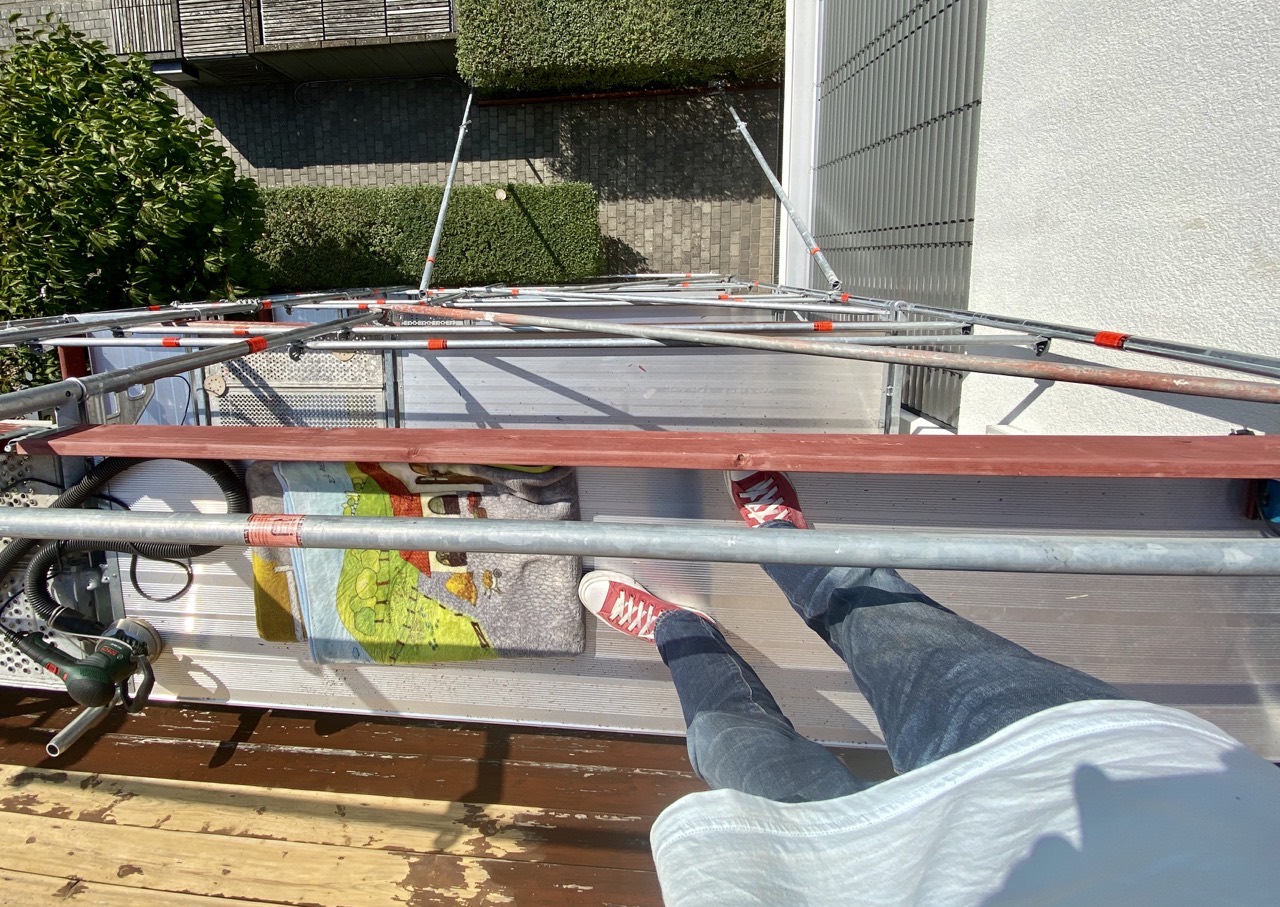
Long story short: We are painting the house. Step 1, sand the wooden facade. Yes, we know what we do. This has been the PoC.

587bcf83229999c39048aafb89181e5f

11 Sep 23:21

It’s definitely September: Plucked the apples i...

by Ton Zijlstra

20200911_162903

It’s definitely September: Plucked the apples in our tree, and then pruned the apple tree.
We hadn’t had much blossoming in the spring. Just a small harvest this year therefore, about 20 apples total. Quite a difference from last year, when we harvested a first batch late August and another one in September.

11 Sep 23:21

Nineteen is When They Forgot

by Anil Dash
Nineteen is When They Forgot

The slogan, for people who weren’t in Manhattan that day, is “Never Forget”. The people who were not here, who were never here, call it “9/11”. But the people I still check in with, the friends who trudged home covered in ash, never call it that. It’s always euphemism or elision or metonymy. “That Tuesday morning”, or “when I was downtown” or, maybe, “after the second plane”.

I want to remember the truth of those actually here, and those actually lost, because now we have proof that all those who claimed We Are All New Yorkers have definitively forgotten us, less than two decades after they promised exactly the opposite.

We’ve had a tragedy now that’s worse than that day, tenfold. Inflicted on us by a virus, yes, but by contemptuous and contemptible leaders at every level, too. By the fundamental unwillingness to show the same spirit of connection, camaraderie, neighborliness, and yes, love that defines New York City.

Instead of a show of support from afar, my neighbors, my community, pulled each other through it this time. There was no other choice. It was the same openhearted expression of compassion for strangers that I first learned existed 19 years ago. This spring, every night at seven o’clock when our neighborhood rang out in a clamor to celebrate those sacrificing to save our fellow New Yorkers, it felt like a crowd at one of our ballparks, celebrating the capability of people to love and help complete strangers. You couldn’t help but be inspired.

And as the unimaginable, searing grief added up day after day, as it continues to right now in a quieter form, all we asked during this tragedy was the exact same thing we asked during that last epochal tragedy. Listen to those who lost so much, listen quietly to our community’s grief, and honor this senseless, needless loss by taking care of each other, dammit. Show the love for each other that the bravest of New Yorkers have used to pull each other through.

But this time it was immediately obvious that much of this country, far too many of its people, have nothing but contempt for New York and the way the best of this city is resilient and loving and unfathomably self-sacrificing. They have already forgotten us this time, without even the pretense of briefly standing with us. To be fair, some of the reason for the lack of solidarity is that they’re suffering at the hands of a tragedy we desperately wanted to warn them to avoid.


Seeing Echoes

It’s clear now that America doesn’t see New Yorkers’ deaths or pain as real. That realization is too deep a failure of humanity for me to reflect on for too long. But I find hope, and more than a little redemption of my belief in people, from what I have seen in this past few months in my beloved city.

Just as I despaired so deeply 19 years ago, but was able to rise back up due to the inspiration of my neighbors and my city, New York can show us something greater than we imagined. Where then, people stood by the mosque in my neighborhood to show support for those who might be victimized, today I see loving handwritten signs decrying the potential for racist ranting about the origins of this pandemic. The same eerie calm of a city where the skies were cleared of any jets overhead was echoed in the silence of our streets in a spring where there were no taxis screeching by. The “I Love New York” signs with a blemished red heart reflecting a city scarred hung in every storefront where now they have a streetscape marked by people reclaiming the block for food and drink and conversation and life. The workers who wore face masks then to fend off the risks of asbestos and anthrax are every bit as thoughtful to wear those masks and protect others today. Those who marched in the streets to fight the rush to war then, march in the streets to fight systematic injustice now.

For all that’s changed, this is still the city I love. I thought that my adulthood would only be marked by one devastating tragedy that bound me to this city, but unfathomably, I was naive to hope so. I’m not a Pollyanna about the resiliency of this city; our metaphorical immune system was already compromised before this latest egregious insult. It will take an act of extraordinary collective will for New York to recover as much as we are able.

But I do have the experience of having seen this city bounce back from unimaginable pain before. I have seen us respond to attacks on our public life by rebuilding and reimagining public space. I have seen us grieve our losses and rally behind those who cared for those injured, and preserve space in our cultural memory for their pain and sacrifice. By no means have we done enough for all those lost, but it is absolutely true that we can rebuild. We’ve done it before.


Each year I write a reminiscence or an observation of where I am on this day, and how I'm seeing a moment that's moved from visceral personal experience to faded cultural memory. Here's what I've written in years past.

Last year, Eighteen is History

There are ritualized remembrances, largely led by those who weren't  there, those who mostly hate the values that New York City embodies. The  sharpest memories are of the goals of those who masterminded the  attacks. It's easy enough to remember what they wanted, since they  accomplished all their objectives and we live in the world they sought  to create. The empire has been permanently diminished. Never Forget.

Two years ago, Seventeen is (Almost) Just Another Day

I spent so many years thinking “I can’t go there” that it caught me completely off guard to realize that going there is now routine. Maybe the most charitable way to look at it is resiliency, or that I’m seeing things through the eyes of my child who’s never known any reality but the present one. I'd spent a lot of time wishing that we hadn't been so overwhelmed with response to that day, so much that I hadn''t considered what it would be like when the day passed for so many people with barely a notice at all.

Three years ago, Sixteen is Letting Go Again

So, like ten years ago, I’m letting go. Trying not to project my feelings onto this anniversary, just quietly remembering that morning and how it felt. My son asked me a couple of months ago, “I heard there was another World Trade Center before this one?” and I had to find a version of the story that I could share with him. In this telling, losing those towers was unimaginably sad and showed that there are incredibly hurtful people in the world, but there are still so many good people, and they can make wonderful things together.

Four years ago, Fifteen is the Past:

I don’t dismiss or deny that so much has gone so wrong in the response and the reaction that our culture has had since the attacks, but I will not forget or diminish the pure openheartedness I witnessed that day. And I will not let the cynicism or paranoia of others draw me in to join them.

What I’ve realized, simply, is that 9/11 is in the past now.

In 2015, Fourteen is Remembering:

For the first time, I clearly felt like I had put the attacks firmly in the past. They have loosened their grip on me. I don’t avoid going downtown, or take circuitous routes to avoid seeing where the towers once stood. I can even imagine deliberately visiting the area to see the new train station.

In 2014, Thirteen is Understanding:

There’s no part of that day that one should ever have to explain to a child, but I realized for the first time this year that, when the time comes, I’ll be ready. Enough time has passed that I could recite the facts, without simply dissolving into a puddle of my own unresolved questions. I look back at past years, at my own observances of this anniversary, and see how I veered from crushingly sad to fiercely angry to tentatively optimistic, and in each of those moments I was living in one part of what I felt. Maybe I’m ready to see this thing in a bigger picture, or at least from a perspective outside of just myself.

From 2013, Twelve is Trying:

I thought in 2001 that some beautiful things could come out of that worst of days, and sure enough, that optimism has often been rewarded. There are boundless examples of kindness and generosity in the worst of circumstances that justify the hope I had for people’s basic decency back then, even if initially my hope was based only on faith and not fact.

But there is also fatigue. The inevitable fading of outrage and emotional devastation into an overworked rhetorical reference point leaves me exhausted. The decay of a brief, profound moment of unity and reflection into a cheap device to be used to prop up arguments about the ordinary, the everyday and the mundane makes me weary. I’m tired from the effort to protect the fragile memory of something horrific and hopeful that taught me about people at their very best and at their very, very worst.

In 2012, Eleven is What We Make:

These are the gifts our children, or all children, give us every day in a million different ways. But they’re also the gifts we give ourselves when we make something meaningful and beautiful. The new World Trade Center buildings are beautiful, in a way that the old ones never were, and in a way that’ll make our fretting over their exorbitant cost seem short-sighted in the decades to come. More importantly, they exist. We made them, together. We raised them in the past eleven years just as surely as we’ve raised our children, with squabbles and mistakes and false starts and slow, inexorable progress toward something beautiful.

In 2011 for the 10th anniversary, Ten is Love and Everything After:

I don’t have any profound insights or political commentary to offer that others haven’t already articulated first and better. All that I have is my experience of knowing what it mean to be in New York City then. And from that experience, the biggest lesson I have taken is that I have the obligation to be a kinder man, a more thoughtful man, and someone who lives with as much passion and sincerity as possible. Those are the lessons that I’ll tell my son some day in the distant future, and they’re the ones I want to remember now.

In 2010, Nine is New New York:

[T]his is, in many ways, a golden era in the entire history of New York City.
Over the four hundred years it’s taken for this city to evolve into its current form, there’s never been a better time to walk down the street. Crime is low, without us having sacrificed our personality or passion to get there. We’ve invested in making our sidewalks more walkable, our streets more accommodating of the bikes and buses and taxis that convey us around our town. There’s never been a more vibrant scene in the arts, music or fashion here. And in less than half a decade, the public park where I got married went from a place where I often felt uncomfortable at noontime to one that I wanted to bring together my closest friends and family on the best day of my life. We still struggle with radical inequality, but more people interact with people from broadly different social classes and cultures every day in New York than any other place in America, and possibly than in any other city in the world.

And all of this happened, by choice, in the years since the attacks.

In 2009, Eight Is Starting Over:

[T]his year, I am much more at peace. It may be that, finally, we’ve been called on by our leadership to mark this day by being of service to our communities, our country, and our fellow humans. I’ve been trying of late to do exactly that. And I’ve had a bit of a realization about how my own life was changed by that day.

Speaking to my mother last week, I offhandedly mentioned how almost all of my friends and acquaintances, my entire career and my accomplishments, my ambitions and hopes have all been born since September 11, 2001. If you’ll pardon the geeky reference, it’s as if my life was rebooted that day and in the short period afterwards. While I have a handful of lifelong friends with whom I’ve stayed in touch, most of the people I’m closest to are those who were with me on the day of the attacks or shortly thereafter, and the goals I have for myself are those which I formed in the next days and weeks. i don’t think it’s coincidence that I was introduced to my wife while the wreckage at the site of the towers was still smoldering, or that I resolved to have my life’s work amount to something meaningful while my beloved city was still papered with signs mourning the missing.

In 2008, Seven Is Angry:

Finally getting angry myself, I realize that nobody has more right to claim authority over the legacy of the attacks than the people of New York. And yet, I don’t see survivors of the attacks downtown claiming the exclusive right to represent the noble ambition of Never Forgetting. I’m not saying that people never mention the attacks here in New York, but there’s a genuine awareness that, if you use the attacks as justification for your position, the person you’re addressing may well have lost more than you that day. As I write this, I know that parked out front is the car of a woman who works in my neighborhood. Her car has a simple but striking memorial on it, listing her mother’s name, date of birth, and the date 9/11/2001.

In 2007, Six Is Letting Go:

On the afternoon of September 11th, 2001, and especially on September 12th, I wasn’t only sad. I was also hopeful. I wanted to believe that we wouldn’t just Never Forget that we would also Always Remember. People were already insisting that we’d put aside our differences and come together, and maybe the part that I’m most bittersweet and wistful about was that I really believed it. I’d turned 26 years old just a few days before the attacks, and I realize in retrospect that maybe that moment, as I eased from my mid-twenties to my late twenties, was the last time I’d be unabashedly optimistic about something, even amidst all the sorrow.

In 2006, After Five Years, Failure:

[O]ne of the strongest feelings I came away with on the day of the attacks was a feeling of some kind of hope. Being in New York that day really showed me the best that people can be. As much as it’s become cliché now, there’s simply no other way to describe a display that profound. It was truly a case of people showing their very best nature.

We seem to have let the hope of that day go, though.

In 2005, Four Years:

I saw people who hated New York City, or at least didn’t care very much about it, trying to act as if they were extremely invested in recovering from the attacks, or opining about the causes or effects of the attacks. And to me, my memory of the attacks and, especially, the days afterward had nothing to do with the geopolitics of the situation. They were about a real human tragedy, and about the people who were there and affected, and about everything but placing blame and pointing fingers. It felt thoughtless for everyone to offer their response in a framework that didn’t honor the people who were actually going through the event.

In 2004, Thinking Of You:

I don’t know if it’s distance, or just the passing of time, but I notice how muted the sorrow is. There’s a passivity, a lack of passion to the observances. I knew it would come, in the same way that a friend told me quite presciently that day back in 2001 that “this is all going to be political debates someday” and, well, someday’s already here.

In 2003, Two Years:

I spent a lot of time, too much time, resenting people who were visiting our city, and especially the site of the attacks, these past two years. I’ve been so protective, I didn’t want them to come and get their picture taken like it was Cinderella’s Castle or something. I’m trying really hard not to be so angry about that these days. I found that being angry kept me from doing the productive and important things that really mattered, and kept me from living a life that I know I’m lucky to have.

In 2002, I wrote On Being An American:

[I]n those first weeks, I thought a lot about what it is to be American. That a lot of people outside of New York City might not even recognize their own country if they came to visit. The America that was attacked a year ago was an America where people are as likely to have been born outside the borders of the U.S. as not. Where most of the residents speak another language in addition to English. Where the soundtrack is, yes, jazz and blues and rock and roll, but also hip hop and salsa and merengue. New York has always been where the first fine threads of new cultures work their way into the fabric of America, and the city the bore the brunt of those attacks last September reflected that ideal to its fullest.

In 2001, Thank You:

I am physically fine, as are all my family members and immediate friends. I’ve been watching the footage all morning, I can’t believe I watched the World Trade Center collapse…

I’ve been sitting here this whole morning, choking back tears… this is just too much, too big. I can see the smoke and ash from the street here. I have friends of friends who work there, I was just there myself the day before yesterday. I can’t process this all. I don’t want to.
11 Sep 23:21

R.O. Kwon on the Resistance Bands She’s Been Using in Quarantine

by R.O. Kwon
R.O. Kwon on the Resistance Bands She’s Been Using in Quarantine

Until March, I was really starting to get into lifting. I was recovering from an injury that made my previous love, rock-climbing, unavailable, and a friend who has as much pent-up energy as I do had suggested I try weight-lifting instead. With heavy weights. It was called power-lifting. Deadlifts, bench presses, squats. I might like it.

11 Sep 23:21

Separation, division, and unity — reflecting on 9-11

by Josh Bernoff

This is the story of my experience before, during, and after 9-11 — and how it still affects me 19 years later in this once again fraught moment. My story starts on September 1, 2001. I had hired a construction company to replace 120 feet of water, sewer, and gas pipes leading to my house … Continued

The post Separation, division, and unity — reflecting on 9-11 appeared first on without bullshit.

11 Sep 23:21

911

Nineteen years ago, I was living in San Francisco and was woken up by the news of the attack in New York. My first thought was that the world would never be the same again and I imagined a dozen different ways the world would be impacted. None of them were even close to how it turned out.

🎥 Tribute in Light, made nine years ago with the help of several friends, remains one of my favorite short film projects. Fact: one of the slight pans in the film was actually caused by my camera slowly moving on the tripod because I hadn’t tightend one of the locks enough.

🛀 Quote of the day: “If someone tells you they want a government so small they can drown it in a bath tub], what they really mean is they don’t want a government powerful enough to protect civil rights or competent enough to deliver mail.” – @bdowney

The thing that the people behind 9/11 – and many others like them around the world who supported their actions – wanted more than anything was to get America to consume itself on fear and hate. They got what they wanted, unfortunately, and there’s very little time left to do anything about it.

53 days… You know what to do.

11 Sep 23:20

Enough Talk~Provide Downtown Public Accessible Washrooms Now

by Sandy James Planner


We have a culture that makes excuses about the fact we don’t require a public basic service for a basic human need. Instead of providing public washrooms it has defaulted to businesses, restaurants and department stores to provide public washroom facilities.

It was Stanley Woodvine, The Georgia Straight  writer who wrote on his twitter account how dire the Covid pandemic was on the homeless throughout the city. Without libraries and community centres open to use washroom facilities, and with park washrooms closed, there are no options. Mr. Woodvine recalled what happened in San Diego between 2016 and 2018 when a Hepatitis A outbreak occurred. The outbreak was directly linked to the lack of public washroom and hand washing facilities, and sadly San Diego had been told by two grand juries investigating municipal government to install more washrooms downtown. The reason San Diego did not do it? Financial.

But with 444 cases of hepatitis and  the unwanted international attention,  the city installed new washrooms and initiated more street cleaning, bringing downtown San Diego’s public washroom total to 21. No matter what the cost, ensuring every citizen has access to a washroom is basic human dignity, and a tenet of public health.

Back to Vancouver. It should not take Dr. Brian Conway, the director of the Vancouver Infectious Diseases Centre to remind people that the pandemictook away some of the most important resources for vulnerable Vancouverites, causing the situation in the inner city — and especially in areas like the Downtown Eastside — to deteriorate quickly.”

It is a human right to have access to washrooms. When the City  of Vancouver signed a street furniture and advertising deal with Decaux in 2002 one of the things that was going to be provided was public washrooms. Only two have been installed in the downtown area, and these by their design and doors are considered inappropriate for many street people to use. You are only allowed twelve minutes in these toilets before the doors open, a period of time that is difficult for elderly or the infirm.

Journalist Christopher Cheung in this excellent article fittingly called “Real Cities Give their People Places to Pee” writes that 33 percent of the homeless population have a physical disability and 82 percent have one health condition. Supplying toilets with time limits on usage is not acceptable.

It has taken the Covid pandemic to show the heavy lifting that private businesses have been doing in providing washrooms. Surely we can do better.

Three years ago I wrote about Vancouver’s Seniors Advisory Committee pushing TransLink to install accessible public washrooms in all new stations, and in the Millennium Line Broadway Extension. Oddly enough the renovated SkyTrain stations on the Expo line have space and are prepped with plumbing for washrooms. TransLink identifies issues that will include the cost of maintenance, security, and sanitation, and there’s still no word on public washrooms.

But if Edmonton, Toronto and Paris can provide washroom facilities at some stations, surely Vancouver can. And that includes in the downtown.

At Christmas time 2018 TransLink announced they were looking at public washrooms, and free internet too. There was an exciting moment in 2019 when two mascots with the predictable names of “Pee and Poo” were being paraded at downtown rapid transit stops, but it turned out to be a campaign on flushables, not providing the much needed public washrooms.

Writer Christopher Cheung references Clara Greed’s work which has three requirements for public washroom needs: “maintenance, regularly performed and checked by hired staff; education, of the facility operators, maintenance crew and the public; and hardware design, to ensure that the washroom is accessible and adequate for the full range of users.”

I have written about the Portland loo, which was developed in Portland Oregon in 2008 and has been adapted and is in use in Victoria and other cities that needed public washrooms. The designs exist, and they have been tested, and Portland is proud of it. It works.

It truly is time to stop talking about public washrooms downtown and simply provide them.

They do not need to be complex or complicated, but they do need to be present, and they should be staffed and cleaned for all citizens.

This is more than public health. This is human dignity for everyone.

Images: CBC,Postmedia,MikeVogel.com

11 Sep 23:19

The tangled webs we weave

Last month I worked on a prototype of three simple pieces of technology: Eleventy + Tailwind + Netlify CMS. I love a good mashup. Those are fairly distinct technologies with well defined roles, so I didn’t anticipate too many hiccups. I was more on the lookout for limitations or deal breakers. The first week was filled with excellent velocity and momentum, but I hit a wall during the second week. The preview portion of Netlify CMS started falling apart. So I started investigating…

Here’s a breakdown of the technologies I used to build the prototype:

  • Use Eleventy CLI to compile Markdown and Nunjucks
  • Use Tailwind to make those look nice
  • Use TailwindUI for some nice prefab styled components
  • Use PurgeCSS to make Tailwind smaller
  • Use PostCSS to run the Tailwind, Purge, and Autoprefixer
  • Use AlpineJS to make Tailwind interactive

This was functioning as intended with a few npm scripts working in tandem. But the next step got a little slippery.

  • Use NetlifyCMS to make updating markdown easier for content authors
  • Use netlify-cms-proxy-server CLI so that I can test the CMS locally
  • Use nunjucks-precompile CLI so that Netlify CMS’s Preview can use my Nunjucks templates
  • Use rollup to bundle content filters so Netlify CMS can fully render the Markdown content (stolen from Hylia)
  • Use React to create <Preview/> render components in NetlifyCMS
  • Use Babel standalone to transpile the JSX components.

This is where things started to break down. Alpine wasn’t working within the React preview component of Netlify CMS. So all my menus were exploded and none of the interactive bits worked. I tried a few avenues for a quick fix like rewriting my <Preview/> component class with componentDidMount as a function with useEffect. This produced more errors as JSX got very mad because it doesn’t like the custom directives that Alpine uses, but those were all red herrings, however. It smelled like the problem was between Alpine and the React portion of Netlify CMS because the <Preview/> frame had no knowledge of Alpine.

I decided the next best thing I could do is isolate the problem. I took Markdown, Nunjucks, rollup, and Netlify CMS out of the equation entirely by writing a reduced test case in CodePen to prove that I could get React and Alpine working together. Seeing it worked in CodePen validated the hypothesis that the problem was on the Netlify CMS side of things (or however it was rendering previews). I ported my simple CodePen over to Netlify CMS with a bit of modification to inject Alpine and then I finally saw my problem.

I didn’t see it before because I had too much template code in the iframe, but reducing the amount of code helped me finally pinpoint the issue. Alpine was being injected, but it was on the parent window context, not the document context of the iframe. Now I had to figure out how to get Alpine inside the preview iframe. Curiously, the iframe didn’t have a src or srcdoc attribute, so it must be some quirky DocumentFragment thing I’ve never really used before. Pinpointing this might be tough. So I started digging into the Netlify CMS source code (this pretty far down the rabbit hole for a prototype, btw). In EditorPreviewPane.js#L188-L233 you can see where the iframe is generated with <FrameContextConsumer> from react-frame-component. I know nothing about that, but you can see a way to pass preview styles into the <FrameContextConsumer>, I wondered if you could pass scripts that way as well.

Before I embarked on a patch to Netlify CMS, I filed a feature request with a mock solution. Thankfully, Erez Rokah (maintainer) figured out a way to get access to the document from react-frame-component, with a much smaller fix than I was proposing. A patch landed in a few days. That’s an amazing turnaround and an open source success. 🎉 Thanks, Netlify!

LEGO, plumbing, and cattle herding

So my little mashup, which was supposed to be just 3 technologies ended up exposing me to ~20 different technologies and had me digging into nth-level dependency source code after midnight. If there’s an allegory for what I don’t like about modern day web development, this is it. You want to use three tools, but you have to know how to use twenty tools instead. If modules and components are like LEGO, then this is dumping out the entire bin on the floor just to find one tiny piece you need.

This experience was flavored with a recent post by Jessica Joy Kerr “Back when software was craft” (and a thread by Justin Searls) talking about the industrialization of our industry. Over the years we’ve made the software industry even more of a knowledge-based industry. We’ve moved away from a bespoke “craft”-like industry with custom hewn boards and we now have a process that resembles a system of standardized parts.

Software feels more like assembly than craft.
— Jessica Joy Kerr, Back when software was craft

I definitely have felt this shift in my own life but have been unable to express it so simply. It feels like the job of programming has shifted from “Can you make this?” to “Do you have the knowledge to staple these two technologies together?” Kerr is more accepting of this reality than I am. The plumbing and glue code are not my favorite parts of the job. And often, you don’t truly know the limitations of any given dependency until you’re five thousand lines of code into a project. Massive sunk costs and the promise of rapid application development can come screeching to a halt when you run out of short cuts.

It reminds me of a parable I once heard:

One day a farmer, tired of plowing his field by hand, decided to build a barn and buy a bunch of cows to help tend the field. The field plowing did get easier, but eventually cows gave birth to more cows, and that farmer spent the rest of their life cutting hay to feed the cattle and shoveling their shit.

Tradeoffs, man.

11 Sep 23:18

Urbanist in the Okanagan 3 – Saviour of the Small Towns

by Gordon Price

Let’s begin in Osoyoos, the southern-most town of the Okanagan:

The shot above was taken on August 27, 2020.

Here’s the equivalent from the lookout on Anarchist Mountain in 1977:

Beautiful BC magazine via BC Archives

Compare urban development in the two shots.  Notice how almost nothing has changed except some development on the middle right along the lakefront, a large white complex in the lower centre and what is probably an industrial strip in the upper left.

In a world where values rise when land is flat, easily serviced, near major roads and close to an urban core, how can this be?  Especially in the Okanagan, where the liaison between real-estate interests and local politicians has been, shall we say, often intimate.

The answer is the yellow line in the map below:

Water Science Series, BC Government

The line, almost block by block, is the boundary of the Agricultural Land Reserve, originally established in the early 1970s.  (To considerable opposition by many who owned the land within it.)

In an economy based on tourism and retirement, it’s extraordinary that there is anything green between the white municipal boundary and the yellow ALR.  Today, that economy of wine and fruit and tourism based on the appeal of a natural landscape was made possible by the vision of the NDP government in 1972 to establish the ALR (which paid for it in the loss of 1975) and the reluctance of successive Social Credit and Liberal governments to pay the political price to undo it.  (Not that there haven’t been nibbles of alienation – like golf courses as illustrated in the above report – but there hasn’t been huge bites of removal.)

Osoyoos may be a particularly graphic example of the juxtaposition of urban and agicultural, where vineyards come with a kilometre of the city centre.  But the same is true for much of the Okanagan (and arguably even Vancouver, hello Southlands), with one particularly egregious counter-example.  We’ll get there soon.


11 Sep 23:18

The Best Lightning Cable for iPhone and iPad

by Sarah Witman
A few of our picks for best lightning cables for iPhones and iPads.

A growing number of Apple devices are equipped with USB-C or wireless charging capabilities, but many—including older iPhones, iPads, AirPods, Magic Keyboards, and more—still use the company’s proprietary Lightning port.

The trouble is that Apple’s Lightning cables are notoriously flimsy, and they cost more than many third-party cables—even those that Apple has certified will perform just as well as its own cables.

If you’re unhappy with the cable that came with your Apple device, or if you just want a backup, we’ve tested dozens of Lightning cables to find the best options for a variety of needs.

11 Sep 23:18

8 Freelancing tips for beginners (what I wish I knew before I took the leap)

by Sarah Thibeau

8 Freelancing tips for beginners (what I wish I knew before I took the leap)

Starting out on a freelancing journey can be a nerve-wracking experience.

I know when I started freelancing it felt like I was slowly wading my way into the deep end without knowing how to swim. I had a lot of questions when I was starting out, but the worst part was the anxiety of not knowing what questions to ask. Whether you’re starting a side hustle, or freelancing full time– the stakes are high and small mistakes can lead to big trouble.

We have all made our fair share of freelancing missteps and gaffes, and all we can do is learn and be better. BUT, what if you could learn from the expert’s mistakes and hopefully avoid making them yourself? We asked our community of freelancers, and scoured the entrepreneur community on Reddit, about the biggest mistakes and lessons they’ve learned through their time as freelancers.


Our community’s best advice about being self employed

Be selective and even a little self-serving with your side hustle services

“I’d say I wish I’d been more selective about freelancing and side hustling projects and clients that I WANT to work on or with, not just take any project that will keep the lights on. I constantly lost sight of my freelance business being 100% mine and got too excited about the initial idea of certain clients instead of going after ones that would be more personally rewarding long term.”

Melissa Hollis Goff, Freelance Social Media and Content Creation

Create a client profile template to hone in on the type of clients you really want.

Stay on top of your tax liability

I really wish someone had sat me down and explained the tax side of freelancing to me. When I first started my side hustle I was really excited to have a second source of income that I could use for frivolous stuff like vacations, extravagant dinners, basketball tickets, etc. I was spending the side hustle money almost as quickly as it was coming in– but I wasn’t setting aside anything for taxes. When it came time to pay the tax man, I was horrified to learn that I owed a substantial amount in taxes that I was unprepared to pay at the time. 

– Sean Gates, Freelance SEO and Website Optimization

Our friends over at Think Save Retire did a great piece about managing your taxes as a freelancer.

Stand Your Ground on Pricing Your Products

I wish I had known to stand my ground on pricing! When I first started my side hustle, I would pretty much come up with pricing based off of the client’s budget. I’m in the fitness industry, so when it comes to personalized 1:1 coaching, it takes a lot of time. When I discount that price, I don’t feel like I am being paid what I’m worth. Additionally, the client doesn’t seem to adhere as well to the program, because there isn’t this big money investment. Stand your ground on your pricing. KNOW YOUR WORTH!

Dakota Butler, Freelance Personal Trainer

Check out our article on how to write an invoice when your client is struggling financially for more advice on this topic. 

Set and Communicate Boundaries with Your Freelance Clients

I think the biggest mistake I made when I first started freelancing was failing to set boundaries. I started editing on Fiverr and I didn’t even think to put a word limit on how much I would edit for just a few dollars. I ended up basically being asked to edit an entire novel for $5, and because I had no policy against it, I did it. It took forever and was not worth the small amount of money I earned. But you can bet I never made that mistake twice! 
Sarah Thibeau, Freelance Editor and Social Media Manager

Use a project estimate template to make sure you don’t underbid on projects.


Reddit’s best advice about being self employed

Charge what you need to be profitable from the beginning

Card

Don’t neglect to plan for your business

Card

Embrace the ability to pivot if something isn’t working

Card

Your ability to solve problems is in direct proportion to your success as an entrepreneur

Card


Your failures are never final in freelancing

Don’t worry if you make mistakes in your freelance journey. Even the most successful people do! If you don’t manage to incorporate all of these tips into your business, don’t feel like you’re doing something wrong. All you need to do is bet on yourself, try your best, and don’t get discouraged.

Looking for more ways to be successful as a freelancer? Check out these 11 freelancer mistakes that you should avoid

The post 8 Freelancing tips for beginners (what I wish I knew before I took the leap) appeared first on Bloom.

11 Sep 23:18

A 1905 Fireman's bike pic.twitter.com/Et6HY5em9I

by Things from the past 📷🎥 (moodvintage)
mkalus shared this story from moodvintage on Twitter.

11 Sep 23:18

QAnon is a Nazi Cult, Rebranded

mkalus shared this story from Just Security.

A secret cabal is taking over the world. They kidnap children, slaughter, and eat them to gain power from their blood. They control high positions in government, banks, international finance, the news media, and the church. They want to disarm the police. They promote homosexuality and pedophilia. They plan to mongrelize the white race so it will lose its essential power.

Does this conspiracy theory sound familiar? It is. The same narrative has been repackaged by QAnon.

I have studied and worked to prevent genocide for forty years. Genocide Watch and the Alliance Against Genocide, the first international anti-genocide coalition, see such hate-filled conspiracy theories as early warning signs of deadly genocidal violence.

The plot, described above, was the conspiracy “revealed” in the most influential anti-Jewish pamphlet of all time. It was called The Protocols of the Elders of Zion. It was written by Russian anti-Jewish propagandists around 1902. It collected myths about a Jewish plot to take over the world that had existed for hundreds of years. Central to its mythology was the Blood Libel, which claimed that Jews kidnapped and slaughtered Christian children and drained their blood to mix in the dough for matzos consumed on Jewish holidays.

The Nazis published a children’s book of the Protocols that they required in the curriculum of every primary school in Germany. The Nazi newspaper, Der Stürmer (derived from the German word for “Storm”) spread the Blood Libel. Hitler’s Mein Kampf, his narcissistic autobiography and manifesto for his battle against the Jewish plot to rule the world, copied his conspiracy theories from the Protocols.

The Nazis worshiped Adolf Hitler as the Leader who would rescue the white race from this secret Jewish plot. Nazi “storm troopers” (“storm detachment” – Sturmabteilung) helped bring Hitler to power. Nazi Germany went on to conquer Europe and murder six million Jews and millions of Roma, Slavs, LGBTQ and other people.

America had its own dark side. Henry Ford echoed Nazi hatred of Jews and had 500,000 copies of the Protocols printed and distributed in the U.S. Father Coughlin preached the Protocols on national radio. The Ku Klux Klan combined its white supremacist racism with hatred of Jews.

QAnon’s conspiracy theory is a rebranded version of the Protocols of the Elders of Zion.

QAnon purveys the fantasy that a secret Satan-worshiping cabal is taking over the world. Its members kidnap white children, keep them in secret prisons run by pedophiles, slaughter, and eat them to gain power from the essence in their blood. The cabal held the American Presidency under the Clintons and Obama, nearly took power again in 2016, and lurks in a “Deep State” financed by Jews, including George Soros, and in Jews who control the media. They want to disarm citizens and defund the police. They promote abortion, transgender rights, and homosexuality. They want open borders so brown illegal aliens can invade America and mongrelize the white race.

QAnon true believers think Donald Trump will rescue America from this Satanic cabal. At the time of “The Storm,” supporters of the cabal will be rounded up and executed.

The QAnon conspiracy theory has now spread to neo-Nazis in Germany, where over 200,000 German QAnon accounts infest the internet.  A faction known as “Reichsbürger,” or citizens of the Reich, orchestrated a brief storming of Parliament on Aug. 29.

Many people are perplexed at how any rational person could fall for such an irrational conspiracy theory. But modern social science shows that people in groups don’t always think rationally. They respond to fear and terror. They blame their misfortunes on scapegoats. They support narcissistic demagogues they hope will rescue them.

In the 1930’s, millions of Europeans were unemployed. Violent battles between Nazis and Communists raged in city streets. Democratic governments were powerless. Fascist dictators ruled Spain and Italy. Hitler took power in Germany and conquered Western Europe.  Stalin’s Communists conquered the East.  The Hitler-Stalin Pact sealed totalitarian rule over most of Europe.  It took World War II and the deaths of millions to defeat the Nazis’ genocidal tyranny, and another fifty years to free the gulags of the Soviet Union.

Today the American people suffer from a Plague.  Millions of Americans have lost their jobs. Angry mobs roam American cities and battle militarized police and heavily armed militias. The American government seems to be paralyzed.  Dictators rule Russia and China. Islamic fascists rule Saudi Arabia and the old Ottoman and Persian empires. The American President appeases Russia, scapegoats China for the pandemic, and looks the other way as Vladimir Putin and Mohammed bin Salman murder their opponents.

In July, the Texas Republican party unveiled a new slogan, “We Are the Storm.” Over a dozen Republicans running for Congress have signaled support for the QAnon movement. Marjorie Taylor Greene, a Republican candidate from Georgia who has endorsed QAnon’s views, is likely to win a seat in Congress. The President praises her as a “future Republican star.” The Trump campaign welcomes QAnon supporters to his rallies. When asked about QAnon on national television, the President replied, “I understand that they like me very much, which I appreciate.”

Some leading Republicans have begun to speak out against QAnon. Rep. Liz Cheney, chairwoman of the House Republican Conference, has denounced QAnon as “dangerous lunacy that should have no place in American politics.”  Republican leaders such as Rep. Adam Kinzinger and Sen. Ben Sasse have also denounced QAnon. Former Gov. Jeb Bush has said of QAnon, “Nut jobs, racists, haters have no place in either Party.”

The world has seen QAnon before. It was called Nazism. In QAnon, Nazism wants a comeback.

Image: QAnon buttons lie in a bin for sale next to copies of the far-right-magazine Compact at a gathering of coronavirus skeptics on the eve of a planned protest march on August 28, 2020 in Berlin, Germany. (Sean Gallup/Getty Images)
11 Sep 04:44

Attacking the App Store

by Neil Cybart

Apple competitors have turned to guerrilla warfare tactics to wage a battle against Apple and the App Store. Based on what is being written and said about the App Store, one would think we have an entered a tech dystopia in which 27 million iOS developers and a billion Apple users are being taken advantage of by Tim Cook and his allegiance to Wall Street.

What had been valid criticism aimed at the App Store has descended into calls to burn everything down and replace it with anti-consumer and anti-developer alternatives. The writing is on the wall. Apple is pulling away from the competition, and the App Store is considered the best (and last) chance for competitors to reshape the mobile industry to their liking.

App Store

We have never seen anything like the App Store, a curated marketplace where a billion users can access 1.7 million apps. Apple established an easy, safe, private, and convenient way for consumers to personalize nearly 1.3 billion iPhones and iPads with third-party applications. Approximately 500 million people visit the App Store each week - a remarkable figure that speaks to how the App Store continues to connect with consumers on a global basis. In FY2019, App Store revenue was an estimated $53 billion. Apple’s share of that revenue came out to an estimated $14 billion. (Apple generates much less when it comes to App Store profit.)

Some have tried to say that there was a viable, safe, cost efficient, and overall compelling form of software distribution to the mass market prior to the existence of the App Store. There’s one problem with such a claim: The mass market didn’t consume software prior to the App Store. In 2008, the year the App Store launched, only 20% of people even had access to the internet.

There are a number of reasons why the iPhone installed base is eight times larger than the Mac installed base, and the App Store is high on the list.

Evolving Criticism

The App Store is not perfect. A small, but vocal, segment of the iOS developer community (now 27 million strong) has spent years raising concerns and issues regarding the App Store, and in particular, app review and the way Apple enforces App Store guidelines.

However, over the past 18 months, App Store criticism began to take on a dramatically different look and feel as multi-nationals entered the fray. In just the past few months, Facebook, Microsoft, Airbnb, and Epic Games have raised concerns about the App Store.

Spotify was one of the early App Store opponents. The company took what now looks like a delicate approach to raising specific issues with the App Store and what it deemed to be anticompetitive behavior on Apple’s part. While the company was grasping at straws with most of its claims, a few concerns had merit.

Microsoft decided to go behind Apple’s back to secretly get U.S. lawmakers to investigate the App Store on monopolistic grounds. Airbnb ran to the New York Times to air its grievance about wanting a special deal from Apple so it didn’t need to follow long-standing App Store guidelines.

However, it was Epic Games’ attack against Apple that marked a turning point in App Store criticism. Epic relied on a different kind of strategy:

  1. Breaking App Store guidelines willingly and blatantly. We have never seen a company actually take pride in breaking App Store guidelines. Epic made sure everyone knew it was breaking App Store rules by offering a virtual currency as an in-app purchase without going through Apple payment.

  2. Leveraging users and press to its advantage. Instead of making the battle be between two companies, Epic weaponized its user and fan base in an attempt to wage an uprising against Apple. In this pursuit, Epic also tried to use the press more than any other company that came before it in going after the App Store.

These corporations are ultimately after the same goal – to weaken Apple’s ironclad grip over the App Store. While many independent developers are simply focused on finding financial sustainability for their families, the multi-nationals are more interested in pulling iOS from under Apple’s control in order to gain power at the expense of Apple.

Why the App Store?

Apple is pulling away from the competition like never before. A revised product strategy (pull to push), and a broader consumer technology landscape that is swinging and missing on bet after bet, are the two primary factors behind Apple’s momentum. However, the App Store plays a vital role in setting Apple devices apart from the competition.

Accordingly, the App Store may seem like an unusual target for Apple competitors. The digital storefront is very popular with users (based on usage trends) and developers. (Most developers don’t pay Apple anything beyond a nominal developer fee to transact business through the App Store.)

No one is questioning the App Store’s success or popularity. Instead, competitors see a way to turn that success into a weakness. Due to extensive lobbying efforts, most of which were driven by Apple competitors, governments and regulatory bodies from around the world are investigating the claim that Apple is relying on monopolistic behavior to achieve App Store success.

Competitors see these regulatory investigations as a potential vulnerability in Apple’s armor. Breaking up or watering down the App Store would allow competitors to leverage the iOS ecosystem to their advantage. In essence, Apple would lose control over app distribution in its own ecosystem. Competitors would no longer be subject to revenue share arrangements with Apple. In addition, they would be able to establish their own digital storefronts to go direct to customers.

Guerrilla Warfare

Companies like Epic don't want there to be a genuine debate about the App Store. If the debate were to boil down to one’s experience using the App Store, Epic and other App Store critics would lose.

However, the goal is to change the narrative and position the App Store as being fundamentally broken with the only remedy being alternative app stores free from Apple oversight. This sentiment is summarized in the following tweet from Epic Games founder and CEO Tim Sweeney:

“At the most basic level, we’re fighting for the freedom of people who bought smartphones to install apps from sources of their choosing, the freedom for creators of apps to distribute them as they choose, and the freedom of both groups to do business directly.”

We are witnessing a guerrilla war that is being waged by Apple’s competitors. This campaign includes companies and CEOs trying to win the moral high ground by appealing to consumers’ and developers’ emotions. Other goals include trying to distract and tire Apple with relentless App Store attacks coming from all directions and using the press to do much of the heavy anti-App Store lifting.

Nearly every article written about Apple’s latest App Store controversy and battle inevitably includes paragraphs of boilerplate language regarding the App Store’s growing list of regulatory issues around the world. Meanwhile, no space is dedicated to the holes and hypocrisy found in competitors’ claims and allegations against the App Store. This is a classic example of a PR guerrilla warfare tactic utilized by competitors in an attempt to sway the discussion and public opinion.

There are then companies running to the press to paint Apple as the evil behemoth going after small business owners during the pandemic. Facebook, Airbnb, and ClassPass have relied on such shady tactics to attack Apple. Portraying Apple as a small business killer is a new low.

True Intentions

To a certain extent, companies like Epic have been successful in quelling App Store debate. Allegations that Apple is milking developers in order to drive revenue and profit growth are passed around with no supporting evidence or numbers. (My financial estimates for App Store profitability on both a net and gross basis are found here.) Pointing out that the App Store isn’t as profitable as consensus assumes is now met with backlash. None of this was the case just 12 months ago.

The lack of perspective coming from customers is also glaring. Consumers, not Apple, are the group who ultimately ends up supporting tens of millions of developers financially. However, most of the commentary written about the App Store has come from the perspective of competitors with pending lawsuits against Apple.

Hijacking what had been a genuine debate regarding the App Store’s treatment of independent developers in order to prop up their own ambition, companies like Epic are revealing their true intentions. These companies aren’t going after the App Store with the interest of independent developers or users in mind. Advocating for an alternative app store is not pro-developer or pro-consumer. Instead, it’s just a way for these companies to make more money.

Monopolies

At the heart of Epic’s fight against the App Store is the need to have both developers and users on its side. There is a simple reason for such a goal. Epic’s underlying arguments against Apple regarding antitrust are fundamentally weak.

In a 62-page lawsuit filed against Apple, Epic alleges the company holds a monopoly in iOS app distribution and iOS in-app payment processing. There is one problem with such claims: Apple doesn’t have monopolies in any particular product device category. Meanwhile, claiming Apple has a monopoly on what goes on in the App Store is equivalent to claiming Apple has a monopoly on a premium experience.

In what is an ironic twist, Epic ends up demonstrating Apple’s lack of a monopoly in mobile gaming and app distribution. According to Epic, two-thirds of Fortnite users play the game on non-Apple hardware. If Apple held a monopoly on mobile app distribution, Apple’s decision to remove Fortnite from the App Store would have been a lights out moment for the game. Gamers have alternatives if they want to use them.

Need for Debate

It’s time for these guerrilla warfare tactics against the App Store to be called out in an effort to have a genuine debate about the App Store. Such a debate is sorely needed. It wouldn’t be about revenue share percentages, alternative app stores, or items like sideloading. Instead, the discussion is found with how Apple should balance customer and developer interests.

Some iOS developers feel like Apple is treating them like second-class citizens in its ecosystem. These developers want to know why Apple doesn’t go out of its way to make sure they are making as much money as possible. Instead, they feel they are being constantly attacked by App Store review. It’s a valid concern that Apple needs to take seriously.

Are we seeing Apple erring more on the side of customers to the determinant of developers? It may be an uncomfortable question to ask within Apple, but it deserves to be investigated.

Apple positions its customers, not profit, as the guiding light for everything it does. This customer-first focus extends to the App Store as well. Management’s actions with the App Store can be traced to ensuring the store’s viability and vitality. Both are critical for maintaining the App Store as a benefit for consumers. If users are content and happy, developers end up benefitting as well. The two go hand in hand.

There are three things that can help keep the customer versus developer dynamic found with the App Store in proper balance:

1) Allow increased in-app communication between developers and customers. Letting developers communicate more freely with users in apps stands to be a positive development for both parties. Allowing developers to include language like “visit our website for additional ways of buying our service” wouldn’t hurt customers and would be viewed positively for developers. Odds are good that we will see Apple make some changes on this front given the European Commission’s review of App Store practices.

2) Give developers more say over App Store guideline enforcement. App Store guidelines can be thought of as laws with no direct mechanism (like voting) for getting revised or rewritten. The ability to bring cases before some kind of review panel would be a step in the right direction. If there were something like the Supreme Court for App Store guidelines, a panel of Apple executives could determine if certain App Store guidelines would end up harming the broader ecosystem. Last month, Apple announced something along this lines.

3) Come up with the next App Store. By spending time now coming up with tomorrow’s App Store, Apple can benefit both developers and customers. The lack of attention given to this topic is telling. While Apple competitors are eager to replace the App Store with their own mobile app stores, the entire app dynamic loses its relevancy when thinking about wearables. We are going to need a complete rethink of apps as we proceed further into the wearables era.

Dragged Through the Mud

It’s difficult to envision any other product or feature other than the App Store that has done more in bringing such a wide variety of innovation to a billion users. It’s not an understatement to say that the App Store changed the world and is still doing so today. 

By painting Apple as a monopolistic giant relying on App Store “tolls” and “taxes” to surpass a two trillion dollar market cap, competitors are dragging the App Store through the mud. Revenue share percentages and angst over App Store guidelines end up being distractions for what is ultimately a classic case of wanting more power. With Apple pulling away from the competition like never before, it’s not a mystery as to why competitors see urgency.

Listen to the corresponding Above Avalon podcast episode for this article here.

Receive my analysis and perspective on Apple throughout the week via exclusive daily updates (2-3 stories per day, 10-12 stories per week). Available to Above Avalon members in both written and audio forms. To sign up and for more information on membership, visit the membership page.

11 Sep 04:42

Setting aside the intellectually offensive comparison, "treaties don't really count when you sign them with your former imperial overlords," is certainly a brave interpretation of international law for a representative of the United Kingdom Government. twitter.com/BBCNewsnight/s…

by Dmitry Grozoubinski (DmitryOpines)
mkalus shared this story from DmitryOpines on Twitter.

Setting aside the intellectually offensive comparison, "treaties don't really count when you sign them with your former imperial overlords," is certainly a brave interpretation of international law for a representative of the United Kingdom Government. twitter.com/BBCNewsnight/s…

"The deal leaving the EU is a one off exceptional treaty - it's like a independent country leaving an empire."

- Sir Bernard Jenkin on why the government should change the N.I Protocol

@bernardjenkin | #Newsnight pic.twitter.com/aysBqVWdhx


212 likes, 94 retweets


2488 likes, 690 retweets
11 Sep 00:04

Access Linux filesystems in Windows and WSL 2

by Pierre Boulay

Starting with Windows Insiders preview build 20211, WSL 2 will be offering a new feature: wsl --mount. This new parameter allows a physical disk to be attached and mounted inside WSL 2, which enables you to access filesystems that aren’t natively supported by Windows (such as ext4).

So, if you’re dual booting with Windows & Linux using different disks, you can now access your Linux files from Windows!

Getting started

To mount a disk, open a PowerShell window with administrator privileges and run:

wsl --mount <DiskPath>

To list the available disks in Windows, run:

wmic diskdrive list brief

To unmount and detach the disk from WSL 2, run

wsl --unmount <Diskpath>

The disks paths are available under the ‘DeviceID’ columns. Usually under the \\.\\\.\PHYSICALDRIVE* format. Below is an example of mounting a specific partition of a given hard disk into WSL and browsing its files.

terminal with wsl text

Accessing these files with File Explorer

Once mounted, it’s also possible to access these disks through the Windows explorer by navigating to \wsl$ and then to the mount folder.

Accessing an EXT4 partition with file explorer

Limitations

By default, wsl --mount attempts to mount the disk as ext4. To specify a filesystem, or for more advanced scenarios, check out Mount a disk in WSL 2.

Also please note that this feature comes with the limitation that only physical disks can be attached to WSL 2. At this time, it’s not possible to attach a single partition. More details on the limitations here.

Give us your feedback!

If you run into any issues, or have feedback for our team please file an issue on our Github , and if you have general questions about WSL you can find all of our team members that are on Twitter on this twitter list.

The post Access Linux filesystems in Windows and WSL 2 appeared first on Windows Command Line.

10 Sep 23:10

How to Securely Wipe Your Computer, Phone, or Tablet

by Thorin Klosowski
How to Securely Wipe Your Computer, Phone, or Tablet

Your computer, phone, or tablet holds all kinds of personal information about you, and before you sell, return, recycle, or donate it, you should make sure to delete all of that information correctly. On most devices, wiping your data securely is pretty straightforward, and doing so can prevent your data from being recovered by someone you would rather not have it. How you do this depends on which operating system you have and what type of storage drive your device has.

Dismiss
10 Sep 23:09

15 rules for blogging, and my current streak

My current streak: I’ve now been writing new posts for 24 consecutive weeks. Multiple posts a week. How on earth? I just calculated it, and I’ve added the live streak count to the site footer. I wonder how long I can keep it up.

This blog has been going since February 2000. I’m writing more now, two decades on, than I have for YEARS. That’s not just because of lockdown – it’s because, about six months ago, I set myself some rules. The rules, which are specific to me, are intended to bump me out of certain mental traps that I know will otherwise stop my words. And since these rules have been working for, well, 24 weeks now, I figured I’d write them down.

So here they are, my personal rules for blogging.

  1. Three posts a week, more or less.
  2. One idea per post. If I find myself launching into another section, cut and paste the extra into a separate draft post, and tie off the original one with the word “Anyway.” Then publish.
  3. No hedging, no nuance. If I’m getting in a twist about a sentence, take it out.
  4. Give up on attempting to be right.
  5. Give up on providing full links and citations.
  6. Give up on saying anything new. Most people haven’t read my old stuff. Play the hits.
  7. Give up on trying to be popular. I try not to filter myself based on what I believe will be popular. Some of my favourite posts get ignored. Some posts get popular and I have no idea why. Besides, terrible posts get buried fast if I’m posting three times a week. So post with abandon.
  8. Give up on trying to be interesting. Readers will come to my site for what’s interesting to me, or not, it’s fine, just say what I think about whatever I’m thinking about.
  9. But make it work for a general audience.
  10. Only write what’s in my head at that exact moment. It’s 10x faster.
  11. If it’s taking too long to write, stop.
  12. Don’t use a post just to link to something elsewhere. If there’s a point to make, start with that.
  13. Titles should be descriptive and have the flavour of the post. And rewrite the lede once the post is done so the whole thing gets to the point faster.
  14. It’s ok not to blog if it feels like a chore.
  15. Writing is a muscle.

If I have an idea for a post, at any time, I make a note of it in my drafts folder – without delay. Or it’ll disappear.

When there’s time to write, I go through my draft posts (and recent links that I’ve run across, I capture those too) and see if anything catches my eye. If it does: start typing and see what happens.

This post inspired by Tobias Revell’s recent remark, How does Matt Webb do this every. damn. day?

Anyway.

10 Sep 23:09

Android 11 is even coming to ‘Go Edition’ smartphones

by Brad Bennett

If you use low-end phones like the Nokia 1 plus, your experience with these entry-level devices might get a little better with Android 11 (Go Edition).

Android Go is a tailor-made version of Android for low-end devices that uses less processing power and RAM to deliver a comparable experience to higher quality phones. In my experience, these devices are decent in a pinch, but they struggle outside of simple tasks like texting and calling.

That said, Google is promising that the Android 11 version will launch apps 15-20 percent faster than the Android 10 version.

Beyond the faster speeds, Android Go 11 is getting several other Android 11 tweaks like notification shade categories, gesture navigation and one-time data permissions.

While this isn’t going to benefit many existing Android Go Edition phones, Google is allowing phones with 2GB of RAM to use the operating system now. Previously, Android Go was locked to devices with 1GB of RAM. Hopefully, more manufacturers will add an extra GB to their upcoming phones because I think it will go a long way to making these devices more usable.

If you’re curious about Android Go 11, you can check out Google’s product page for it here.

Source: Google

The post Android 11 is even coming to ‘Go Edition’ smartphones appeared first on MobileSyrup.

10 Sep 23:08

15 rules for blogging, and my current streak

15 rules for blogging, and my current streak

Matt Webb is on a 24 week streak of blogging multiple posts a week and shares his rules on how he's doing this. These are really good rules. A rule of thumb that has helped me a lot is to fight back against the temptation to make a post as good as I can before I publish it - because that way lies a giant drafts folder and no actual published content. "Perfect is the enemy of shipped".

Via @intrcnnctd

10 Sep 23:08

Content Strategy in Action on Firefox for Android

by Betsy Mikel

The behind-the-strings work that content strategy does to improve the user experience of our products.

Image of white Android phone with Firefox logo over a purple background.
Firefox recently launched launched a completely overhauled Android experience that’s fast, personalized, and private by design.

The Firefox for Android team recently celebrated an important milestone. We launched a completely overhauled Android experience that’s fast, personalized, and private by design.

When I joined the mobile team six months ago as its first embedded content strategist, I quickly saw the opportunity to improve our process by codifying standards. This would help us avoid reinventing solutions so we could move faster and ultimately develop a more cohesive product for end users. Here are a few approaches I took to integrate systems thinking into our UX process.

Create documentation to streamline decision making

I had an immediate ask to write strings for several snackbars and confirmation dialogs. Dozens of these already existed in the app. They appear when you complete actions like saving a bookmark, closing a tab, or deleting browsing data.

Screenshots of a snackbar message and confirmation dialog message in the Firefox for Android app.
Snackbars and confirmation dialogs appear when you take certain actions inside the app, such as saving a bookmark or deleting your browsing data.

All I had to do was review the existing strings and follow the already-established patterns. That was easier said than done. Strings live in two XML files. Similar strings, like snackbars and dialogs, are rarely grouped together. It’s also difficult to understand the context of the interaction from an XML file.

Screenshot of the app’s XML file, which contains all strings inside the Firefox for Android app.
It’s difficult to identify content patterns and inconsistencies from an XML file.

To see everything in one, more digestible place, I conducted a holistic audit of the snackbars and dialogs.

I downloaded the XML files and pulled all snackbar and dialog-related strings into a spreadsheet. I also went through the app and triggered as many of the messages as I could to add screenshots to my documentation. I audited a few competitors, too. As the audit came together, I began to see patterns emerge.

Screenshot of spreadsheet for organizing strings for the Firefox for Android app.
Organizing and coding strings in a spreadsheet helped me identify patterns and inconsistencies.

I identified the following:

  • Inconsistencies in strings. Example: Some had terminal punctuation and others did not.
  • Inconsistencies in triggers and behaviors. Example: A snackbar should have appeared but didn’t, or should NOT have appeared but did.

I used this to create guidelines around our usage of these components. Now when a request for a snackbar or dialog comes up, I can close the loop much faster because I have documented guidelines to follow.

Define and standardize reusable patterns and components

Snackbars are one component of many within the app. Firefox for Android has buttons, permission prompts, error fields, modals, in-app messaging surfaces, and much more. Though the design team maintained a UI library, we didn’t have clear standards around the components themselves. This led to confusion and in some cases the same components being used in different ways.

I began to collect examples of various in-app components. I started small, tackling inconsistencies as I came across them and worked with individual designers to align our direction. After a final decision was made about a particular component, we shared back with the rest of the team. This helped to build the team’s institutional memory and improve transparency about a decision one or two people may have made.

Image of snackbar do’s and don’ts with visual examples of how to properly use the component.
Example of guidance we now provide around when it’s appropriate to use a snackbar.

Note that you don’t need fancy tooling to begin auditing and aligning your components. Our team was in the middle of transitioning between tools, so I used a simple Google Slides deck with screenshots to start. It was also easy for other team members to contribute because a slide deck has a low barrier to entry.

Establish a framework for introducing new features

As we moved closer towards the product launch, we began to discuss which new features to add. This led to conversations around feature discoverability. How would users discover the features that served them best?

Content strategy advocated for a holistic approach; if we designed a solution for one feature independent of all others in the app, we could end up with a busy, overwhelming end experience that annoyed users. To help us define when, why, and how we would draw attention to in-app features, I developed a Feature Discovery Framework.

Bulleted list of 5 goals for the feature discoverability framework.
Excerpt from the Feature Discovery Framework we are piloting to provide users access to the right features at the right time.

The framework serves as an alignment tool between product owners and user experience to identify the best approach for a particular feature. It’s broken down into three steps. Each step poses a series of questions that are intended to create clarity around the feature itself.

Step 1: Understanding the feature

How does it map to user and business goals?

Step 2: Introducing the feature

How and when should the feature be surfaced?

Step 3: Defining success with data

How and when will we measure success?

After I had developed the first draft of the framework, I shared in our UX design critique for feedback. I was surprised to discover that my peers working on other products in Firefox were enthusiastic about applying the framework on their own teams. The feedback I gathered during the critique session helped me make improvements and clarify my thinking. On the mobile team, we’re now piloting the framework for future features.

Wrapping up

The words you see on a screen are the most tangible output of a content strategist’s work, but are a small sliver of what we do day-to-day. Developing documentation helps us align with our teams and move faster. Understanding user needs and business goals up front help us define what approach to take. To learn more about how we work as content strategists at Firefox, check out Driving Value as a Tiny UX Content Team.


Content Strategy in Action on Firefox for Android was originally published in Firefox User Experience on Medium, where people are continuing the conversation by highlighting and responding to this story.

10 Sep 23:03

Hover-Slam

by Asa Dotzler

This short video is a rocket launch and landing from the point of view of the rocket booster. It’s pretty cool.

The rocket in question is a SpaceX Falcon 9 which is a partially reusable launch vehicle that specializes in low-cost transport of people and payloads to Earth orbit.

The rocket has two stages, a large booster (mostly a fuel tank) with 9 sea level optimized engines and a small second stage with one vacuum optimized engine.

The booster, with its 9 engines doesn’t make it all the way to orbit. It separates at about 50 miles altitude and then returns to Earth to be re-used.

The second stage with its single engine pushes on to reach orbit, and after deploying its payload it typically de-orbits, mostly burning up with any remains falling into the sea.

In this video, you can see the Falcon 9 booster’s “grid fins” deploy, and along with the cold gas thrusters, they maintain attitude control. You’ll also see two re-ignitions of the engines. The first one uses 3 engines to slow the booster before it hits the denser parts of the atmosphere preventing burn-up, and the second one uses a single engine to slow the booster for landing.

The landing is really even more exciting than it looks. The rocket engines on the Falcon 9 are so powerful that with even just one of them burning and throttled all the way down, they can’t hover. If Earth wasn’t in the way, the booster with one engine lit would slow its descent down, briefly pause, and then begin to ascend again. That means they have to time the burn such that the rocket reaches the surface at precisely the moment of that brief pause. If they light the engine too soon, the rocket would take off again before reaching the surface and if they light the engine too late, it’ll be destroyed as it slams into the ground (or the barge — they land at sea most of the time.) This is called a “suicide burn” or in SpaceX language, a “hover-slam”.