Toronto's derelict malting silos are now being used for outdoor video screenings bit.ly/2EKJcLX #Toronto… twitter.com/i/web/status/1…
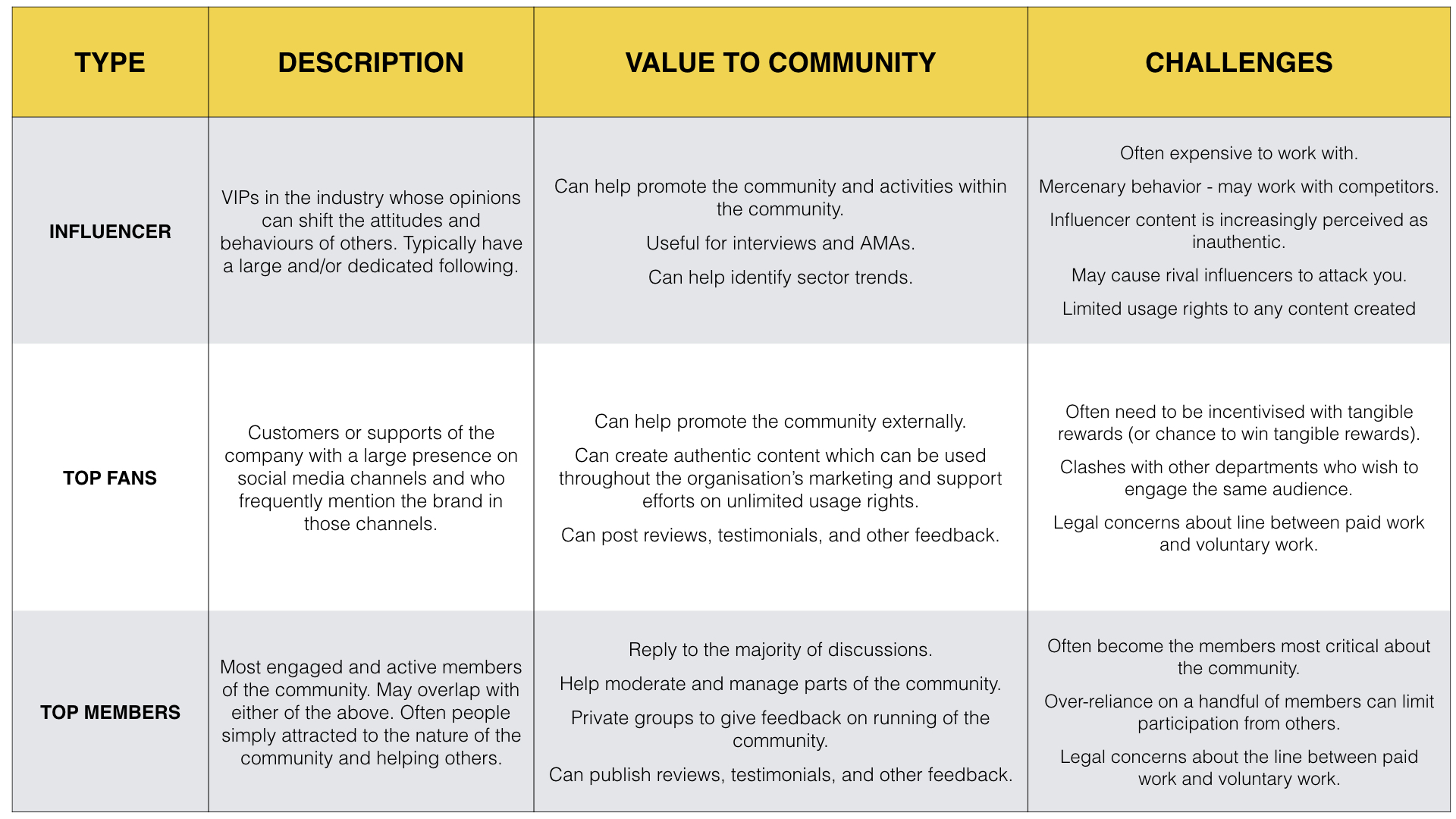
A recent project had lumped three unique audiences (industry influencers, top fans, and top members) into one group.
They’re really not.
As your work increasingly stretches beyond a typical community hub, it’s good to know the differences between who each group are and their potential value to the community (and to the brand).
There are some overlaps, but you get the idea. Each group presents different opportunities and challenges.
Be clear about your goal and then select and engage the audience you need.
A quick post, copied from my LinkedIn (link) which is probably where comment / discussion will flow:
I just watched the Rakuten Mobile, Inc. #5G press conference.
Quick takeouts (+see Twitter thread link in comments):
- Rakuten is following Jio in undercutting incumbent MNOs with a greenfield / low-cost infrastructure & lightweight organisation
- Simple consumer-centric plan called Un-Limit V (ie V=5) with some of its own phones. It reckons it's 70% cheaper than rivals
- Big pitch for cloud + #OpenRAN
- Doing sub-GHz with NEC + Intel , plus Qualcomm for #mmWave radios
- Initial 870Mbps, upgraded to 2Gbps in a few months
- Unclear on NSA vs. SA support for new phones & network
-
No mention of enterprise, verticals, Industry 4.0 etc. All about
entertainment & "experience", with XR, gaming & streaming. Maybe
enterprise is via APIs
- New "Big" 5G phone available from today
- I'll politely ignore the RCS-based communicator app
If I was a legacy MNO elsewhere in the world, I'd be nervously looking at my strategy team (& advisors) right now:
- Is enterprise really the key to #5G ?
- Will consolidation 4>3 or 3>2 MNOs just allow in a new greenfield entrant in our market?
- How fast can we reduce our legacy cost base?
- Is our government watching this as well?
- What happens when Rakuten pitches its platform internationally? Could *it* directly enter our market?

See also my Twitter thread with more screenshots & comment: https://twitter.com/disruptivedean/status/1311184039274074112?s=20

Well, this took a little longer than expected, but it was pretty obvious that Google would match Apple’s stance regarding “off-store” payment methods–especially considering their app ecosystem is way more… “creative” in what concerns scalping users.
(Their reaction to Epic’s shenanigans may have been less visible, but only because the media likes to selectively milk headlines for all that they’re worth, and Apple was a juicier target.)
The buried lede, of course, is the vague statement about “making it easier for other app stores” to exist on future versions of Android. That is clearly a pre-emptive move to put forward as part of any anti-trust conversations, and is going to be very interesting to consider from a security perspective (to say the least).
I’m just going to make more popcorn.
 |
mkalus
shared this story
from  mrjamesob on Twitter. mrjamesob on Twitter.
|
Voting against breaking international law is not the same as voting ‘to side with the EU’.
Since when has the test for patriotism been the willingness to break international law? (It’s a test Mrs Thatcher would’ve failed.) twitter.com/conservatives/…
🚨 BREAKING: Labour just voted to side with the EU once again.
🥀 By voting against the UK Internal Market Bill – which will guarantee seamless trade between the home nations of the UK - they've shown they won’t stand up to Brussels or protect the United Kingdom from the SNP. pic.twitter.com/ox3I5yFGnh

3977 likes, 1713 retweets
 James O'Brien (mrjamesob)
on Wednesday, September 30th, 2020 7:48am
James O'Brien (mrjamesob)
on Wednesday, September 30th, 2020 7:48am
We are excited about the momentum we are seeing from app partners embracing Windows 10 on ARM, taking advantage of the power and performance benefits of Qualcomm Snapdragon processors. We heard your feedback and are making Microsoft Edge faster while using less battery, and announced that we will soon release a native Microsoft Teams client optimized for Windows 10 on ARM. We will also expand support for running x64 apps, with x64 emulation starting to roll out to the Windows Insider Program in November. Because developers asked, Visual Studio code has also been updated and optimized for Windows 10 on ARM. For organizations, were committed to helping them ensure their apps work with Windows 10 and Microsoft 365 Apps on ARM64 devices with App Assure. We are working closely with Acer, HP, Lenovo, Samsung and Surface to bring these Windows 10 on ARM innovations and products to our shared customers.
I really like my Surface Pro X and hope, I don't need a new machine to make use of these features.
Just before lunch yesterday, Oliver’s support worker reported to me that he hadn’t been feeling well: headache, sore throat, stuffy nose, aches. In other words, enough boxes ticked on the COVID-19 symptoms list that I was concerned.
As it happened, The Dr. Heather Morrison Show aired its weekly episode yesterday morning, so I was well-primed with instructions for action.
My first call was to 811, where I was shunted into the “our nurses are occupied right now — someone will call you back within 3 hours” queue.
My second call was to our family doctor, but his office was closed.
A careful reading of the COVID-19 testing page suggested that it was actually okay to simply drop in for a test, so, after a quick bite of lunch, fortified for the prospect of spending the afternoon in one of the long testing lines that have been much-evident in the media from elsewhere of late, we got in the car and drove to the old Government Garage on Park Street.
As it turned out, there was no line at all. We were in and out in 10 efficient minutes. The test didn’t hurt (Oliver reported). The staff were friendly. It was less of a hassle than picking up a burger at the Wendy’s next door.
We were given a sheet with a URL for picking up the results, available, we were told, within 24 to 48 hours; Oliver was told to self-isolate, but I was free, I was told, to move about, albeit with more-than-usual masking (and I’m wearing a mask whenever I’m indoors anyway, so no change for me).
Unsatisfied with the need to hit reload for 24 to 48 hours, and feeling icky about the Google, Facebook, and other advertising trackers on the results pickup page, I threw together a little Node-RED flow to scrape the page for Oliver’s test results every 30 minutes and email me the response.
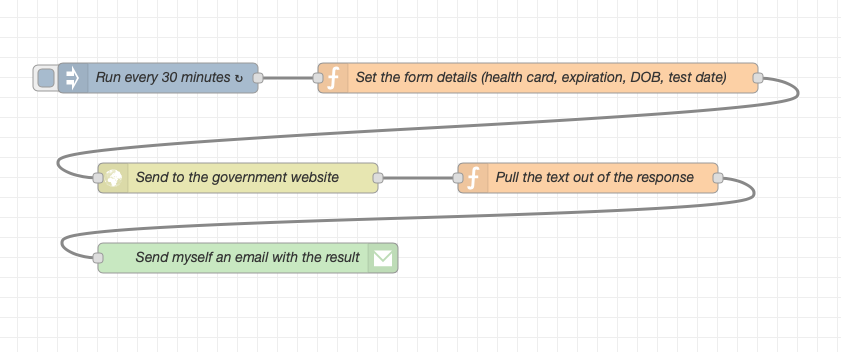
This flow takes advantage of the fact that the government’s system consists of a simply HTTP POST of the health card number and expiration date, along with the date of birth and test date, as JSON, and returns JSON with either “No Results Found” or “COVID-19 (Coronavirus) Test Result.”
All of which was easily observable from Firefox’s Developer Tools, which allows the request to be copied as a cURL command:
curl 'https://wdf.princeedwardisland.ca/workflow' -H 'User-Agent: Mozilla/5.0 (Macintosh; Intel Mac OS X 10.15; rv:81.0) Gecko/20100101 Firefox/81.0' -H 'Accept: application/json' -H 'Accept-Language: en' --compressed -H 'Content-Type: application/json' -H 'Origin: https://www.princeedwardisland.ca' -H 'DNT: 1' -H 'Connection: keep-alive' -H 'Referer: https://www.princeedwardisland.ca/en/feature/search-my-covid-19-test-results' -H 'Pragma: no-cache' -H 'Cache-Control: no-cache' --data-raw '{"featureName":"CovidNegativeResults","metaVars":{"service_id":null,"save_location":null},"queryVars":{"phn":"XXXXXXXX","card_expiry_month":"XXX","card_expiry_year":"XXXX","birth_date":"XXXX-XX-XX","test_date":"XXXX-XX-XX","wdf_prevent_query_string":"true","sid":null,"page_num":"1","page_count":"1","finished":"0"}}'
(I’ve replaced Oliver’s actual data with Xs).
It returns JSON that looks, in part, like this:
[
  {
     "id":"10f659b6-8d21-465d-a243-e72e1acd603f",
     "classes":null,
     "type":"Heading",
     "data":{
        "text":"No Results Found",
        "size":2
     },
     "children":[

     ]
  },
  {
     "id":"50ce2982-167b-41e6-a979-decaaea1bb97",
     "classes":null,
     "type":"Paragraph",
     "data":{
        "text":"Check that the information you entered is correct and retry. If your results do not appear 72 hours after testing, please contact mytestresults@gov.pe.ca or 1-833-533-9333 and Press 1 for health information and leave a voicemail to receive a call back."
     },
     "children":[

     ]
  }
]
when the results aren’t available yet, and:
[
   {
      "id":"9ccb8479-4eae-4177-a3fb-267358ddb910",
      "classes":null,
      "type":"Heading",
      "data":{
         "text":"COVID-19 (Coronavirus) Test Result",
         "size":2
      },
      "children":[

      ]
   },
   {
      "id":"12c25d77-c03b-4582-8f40-be82e1b0ec09",
      "classes":null,
      "type":"KeyValueTable",
      "data":{
         "keyValuePairs":{
            "Health Card Number Ending In":"XXXX",
            "Test Date":"XXXX-XX-XX",
            "Test Result":"NEGATIVE (A negative result means that you did not have COVID-19 when you were tested.)"
         }
      },
      "children":[

      ]
   }
]
when a negative test result comes back (positive results aren’t delivered through the online system: I presume they’re communicated with a phone call).
My Node-RED flow simply grabbed the ”No Results Found” or “COVID-19 (Coronavirus) Test Result” and emailed that to me every 30 minutes.
Which is how I got this email at 7:00 a.m. this morning:

Whew!
The 811 nurse phoned back yesterday at 4:30 p.m., four hours after I first called, and three hours after Oliver had already been tested.
If you want a simple way of checking your own results, and you have access to a machine with cURL (like any Mac with the Terminal app), a stripped down version of the cURL command will get you what you need:
curl 'https://wdf.princeedwardisland.ca/workflow' -H 'Content-Type: application/json' --data-raw '{"featureName":"CovidNegativeResults","metaVars":{"service_id":null,"save_location":null},"queryVars":{"phn":"XXXXXXXX","card_expiry_month":"XXX","card_expiry_year":"YYYY","birth_date":"YYYY-MM-DD","test_date":"YYYY-MM-DD","wdf_prevent_query_string":"true","sid":null,"page_num":"1","page_count":"1","finished":"0"}}'
where:
(All you’re doing when you do this is acting a web browser of a different sort; it’s a completely legitimate way of obtaining your results and you’re not doing anything nefarious, as you only have access to your results this way).
Needless to say, both Oliver and I are relieved that he doesn’t have COVID. He’s still got his traditional fall cold, but that, relative to the alternative, is manageable.
😡 That debate last night? What an embarrassment. It’s really hard to look away from the dumpster fire, but let’s try for a bit.
📐 Microservices are architectural nihilism says Vasco Figueira. It’s strong statement, but it has a point. Even if started with the best of intentions, microservices can become an approach without rigor. It can bring “a sanctioned answer to most architectural dilemmas: another microservice. Another entry in the service catalog for any and all interested parties to call… So soft and convenient was the lure of not having to draw hard architectural lines that we got lazy where we weren’t and accepted our lazyness where we already were.”
⚡ Do you want to be powered-by renewables? The easy answer is: of course! My colleague Asim, however, illustrates why it’s a bit more complex than that. “If you are being powered-by renewables then you are off-grid which doesn’t help the world transition to a renewable-powered future. If you are matched-by renewables then the electricity powering your computer comes from fossil fuel sources, however, it also means the actions you take as a software engineer can help reduce the consumption of that fossil fuel energy and help transition everyone to a renewable future.”
🚗 It’s not unlike the conversation of choosing between plug-in hybrids, full electric, or staying with a pure gasoline powered vehicle. The plug-in hybrid doesn’t meet the full ideal of where we want to be, but it helps get us there and encourages the system as a whole to move while providing a workable transition option for people who would otherwise just get another traditional vehicle.
🔌 And the system is moving. The charging infrastructure to support more full EVs is rolling out. Curbside public charging points are showing up all over the place in Berlin where I live, including one just a few meters from my front door. This totally changes the equation for city dwellers without a garage. Being able to plug in and charge up a bit while having a coffee at a café after dropping kiddo at school is pretty cool too.
📅 34 days.
This is the 12th in a series of articles on CoVid-19. I am not a medical expert, but have worked with epidemiologists and have some expertise in research, data analysis and statistics. I am producing these articles in the belief that reasonably researched writing on this topic can’t help but be an improvement over the firehose of misinformation that represents far too much of what is being presented on this topic in social (and some other) media.
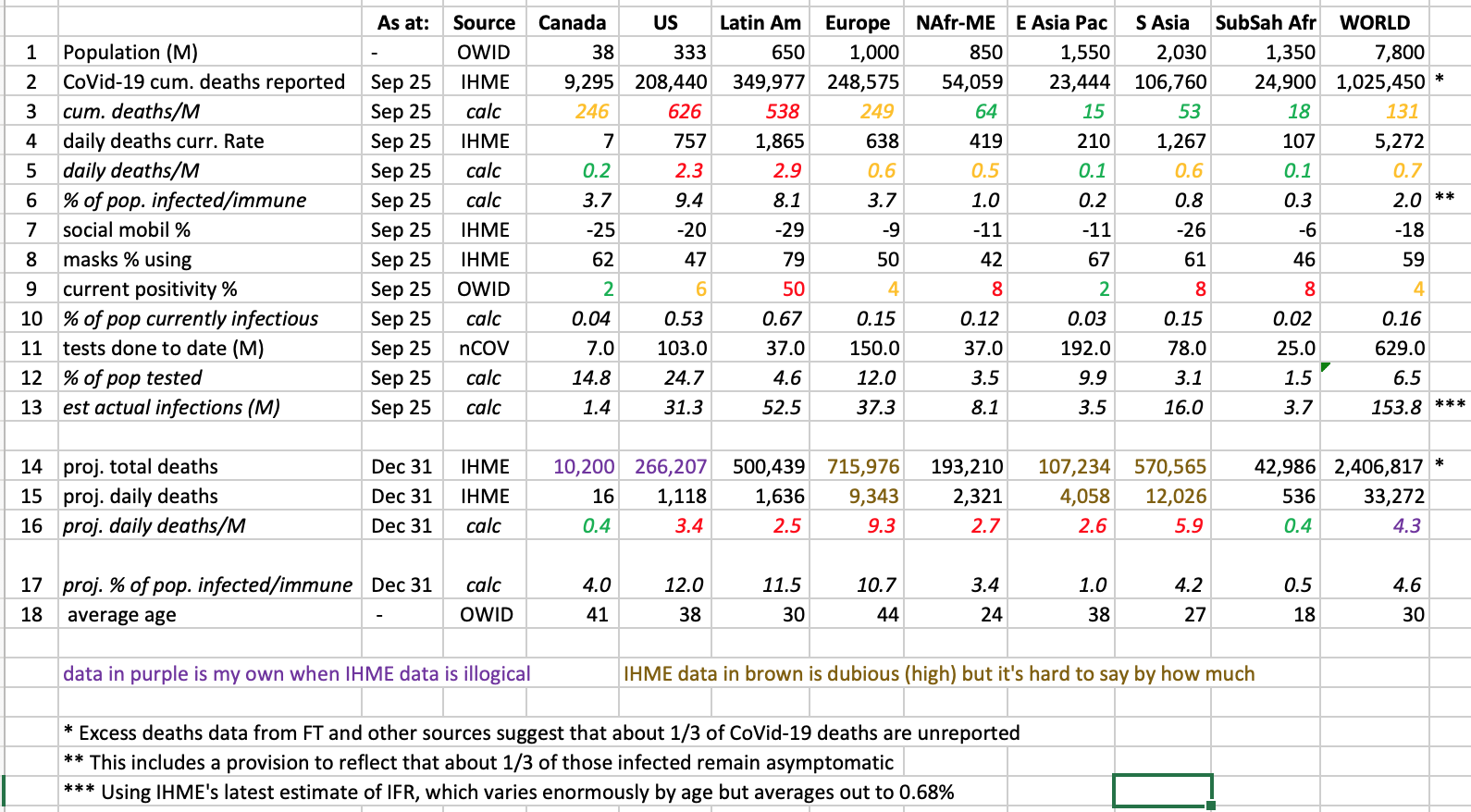
We’re about 7 months into this pandemic, and we’re still, despite what some politicians are saying, in wave one. There have been surges in various places but that’s because the disease has never really been under control. If there’s a wave two, it will be when it morphs into a new, mutated virus, that might be much more or much less lethal than the variants we have seen thus far, and might, like the 1918 wave two, affect a completely different demographic than the mainly-senior victims of wave one.
So taking the summary chart above, line by line, here’s where would seem to stand now:
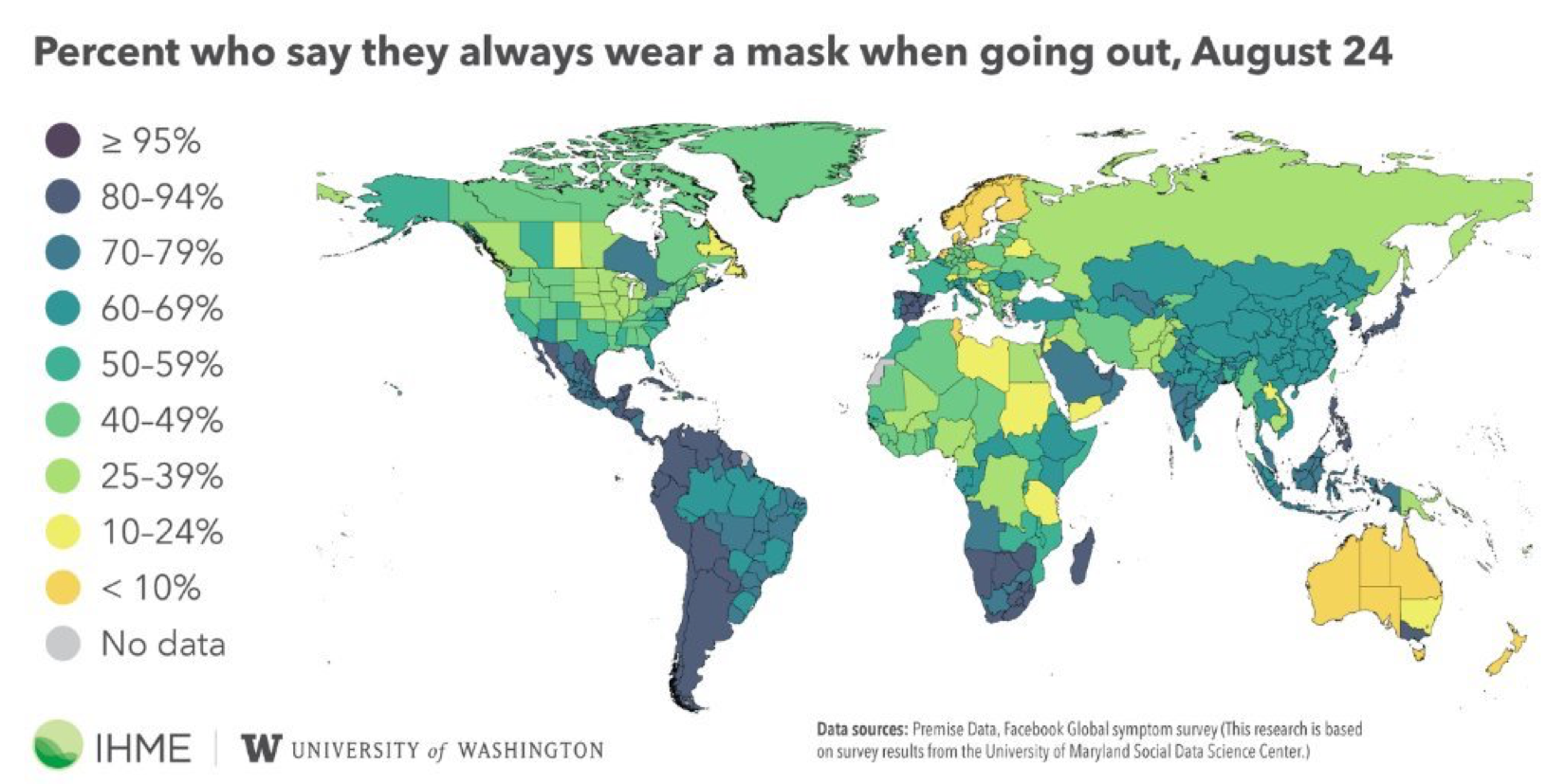
Only in the US is self-reported mask use, in some areas, declining. As cases spiked in Victoria state even Australians are starting to use them. In almost every area, increased mask use in an area follows a spike in cases and deaths in that area. But in most of the world, they’re keeping them on even as cases and deaths ease.

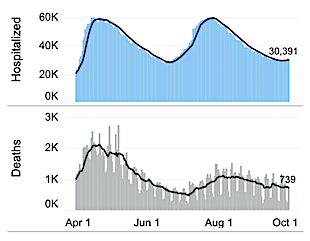
The above data, from the CoVid Tracking Project, shows what I think we’re likely to see in much of the world as the pandemic continues — a general flat-to-slowly-downward trend in actual cases (even as reported cases trend flat-to-upwards due to more testing), and in hospitalizations and deaths, but with recurring upswings in different areas due to a combination of complacency, relaxing standards prematurely, seasonal variations (as we move indoors for the winter and face regular influenza as well as CoVid-19), and just plain bad luck. There’s no reason to believe these trends won’t continue for at least another year or until an effective vaccine is available globally. Prepare for a long, thick, and irregularly shaped tail to this pandemic; it’s happened before.
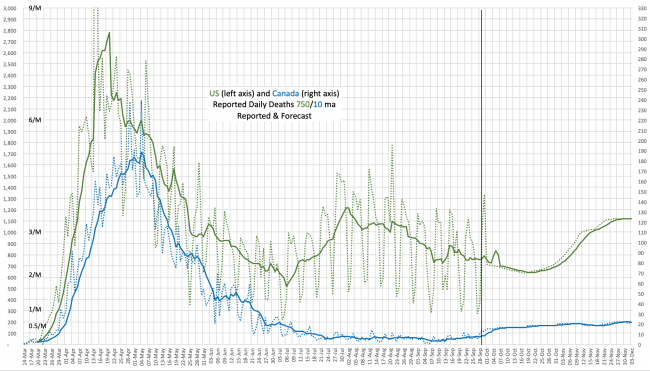
This chart shows the difference between a pandemic under control (Canada, blue) and a pandemic out of control (US, green). The difference is due to a combination of good luck and good management. Note that the Canadian data uses the right scale, which is 1/9 of the left scale, the same as the relative population proportions. Canada tried to flatten the curve, with more success than the US but not dramatically so. And then suddenly in June the curves diverged wildly to the point the daily deaths in Canada (under 10, ie 0.3/M/day) were as much as two orders of magnitude smaller than the US daily death rates (over 1,000, ie 3.0/M/day).
Because reported cases in the US are now flat at about 150/M/day, however, while reported cases in Canada have recently more than doubled from 13/M/day to 30/M/day, this enormous per-capita gap will likely narrow from 10:1 to closer to 3:1, with Canadian deaths doubling to 20/day (0.7/M/day) compared to a steady 750/day (2.3/M/day) in the US. The pandemic will remain out of control in the US, but may not stay in control in Canada. The IHME is forecasting a much worse situation by year-end, with US deaths quadrupling to 3,000/day (9/M/day) and Canadian deaths soaring by a factor of thirty to 300/day (8/M/day). I’d be very surprised if these alarmist predictions come to pass.
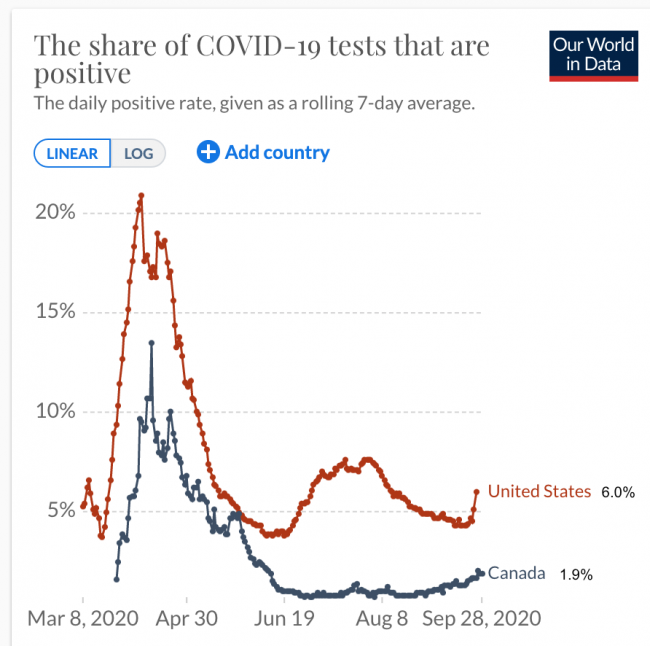
This chart, from Our World in Data, conveys a similar message — the per-capita death toll in the US, which has been 10x higher than Canada’s, is likely to move closer to 3:1 as the positivity rates converge. Still a large divergence, but worrisome for Canada’s situation, which is mirrored in several European countries where positivity rates have suddenly spiked above 5%. Testing and tracing just aren’t manageable when the positivity rate is more than about 3%, which translates into about 0.1% of the population being currently infectious, one out of every 1,000 people. Too many people to track.
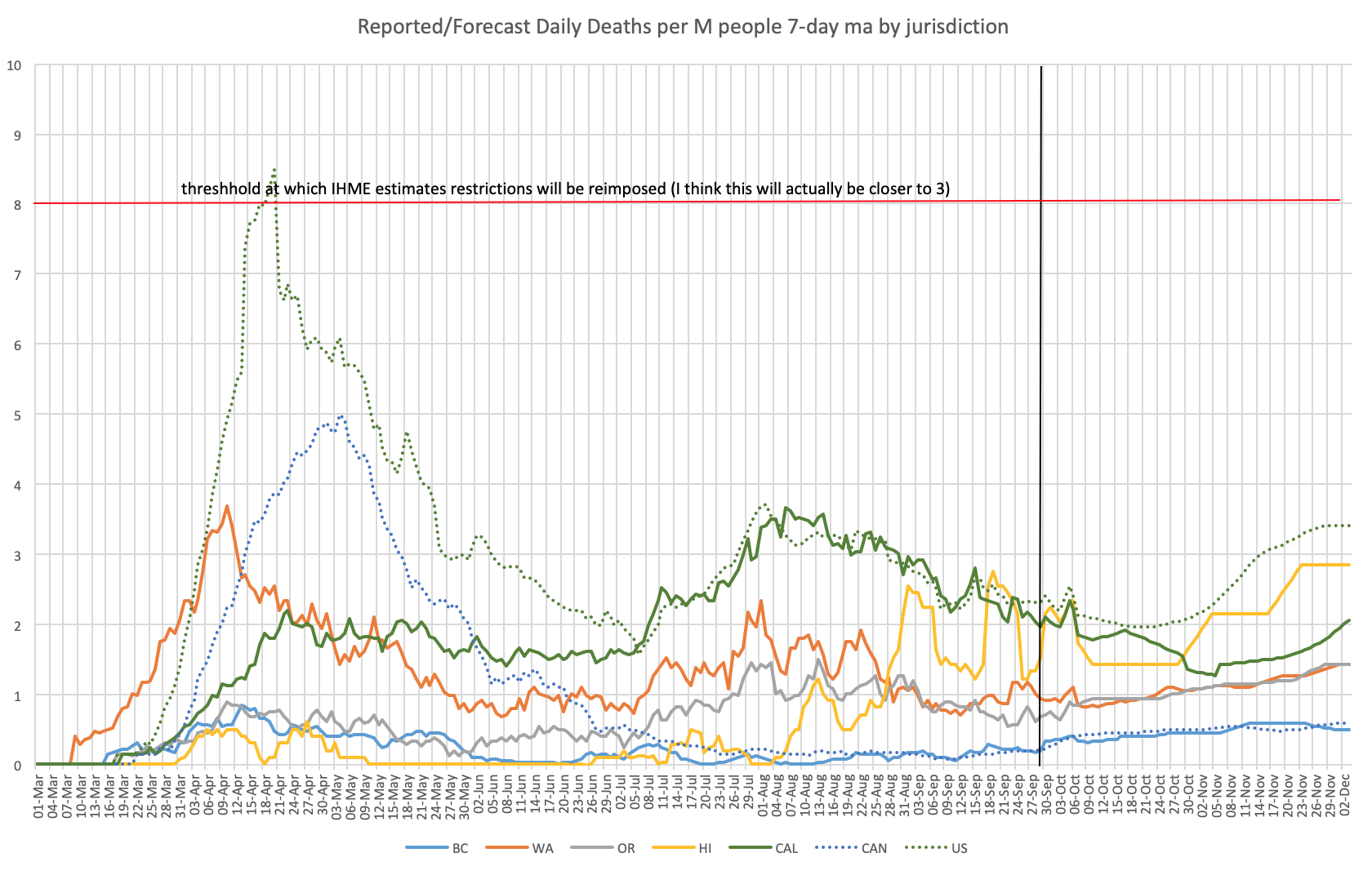
Here’s the first of three charts showing the situation on North America’s west coast. In each case these are reported deaths per million people per day. You can see when peak deaths hit each jurisdiction — Washington and BC first, then the east coast of the US, then Eastern Canada (the eastern states’/provinces’ infections came from Europe, and then worked their way west again), and much later California and Oregon, and just now Hawaii. The forecasts are mine, based on current reported case counts, adjusted IFRs, and behaviours after past case spikes. IHME is projecting these death counts to go off the chart in December (close to or over 10 deaths/M/day except in BC and Hawaii), with no action taken until rates cross the red line near the top of the chart. I don’t agree, but my track record to date hasn’t been any better than theirs.
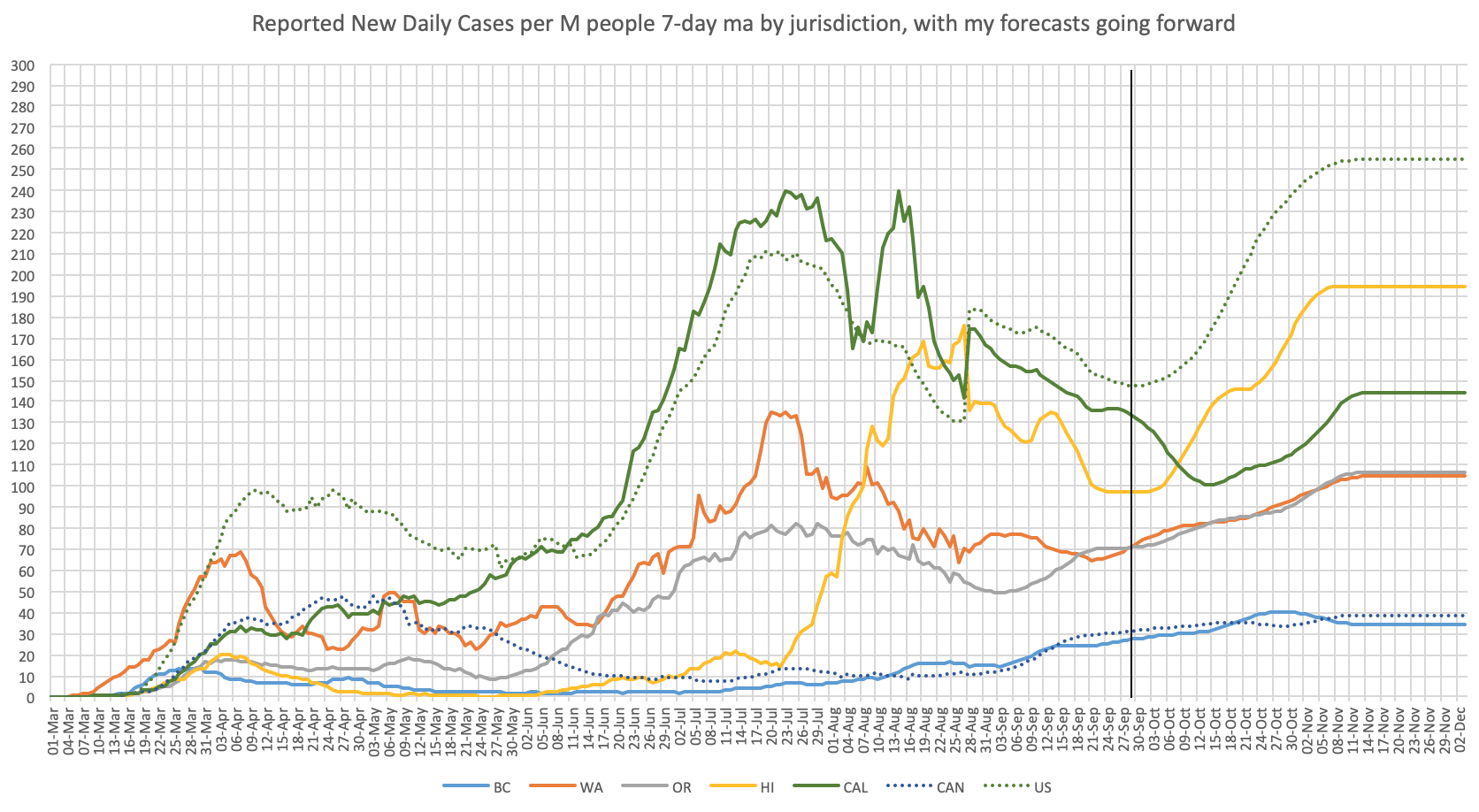
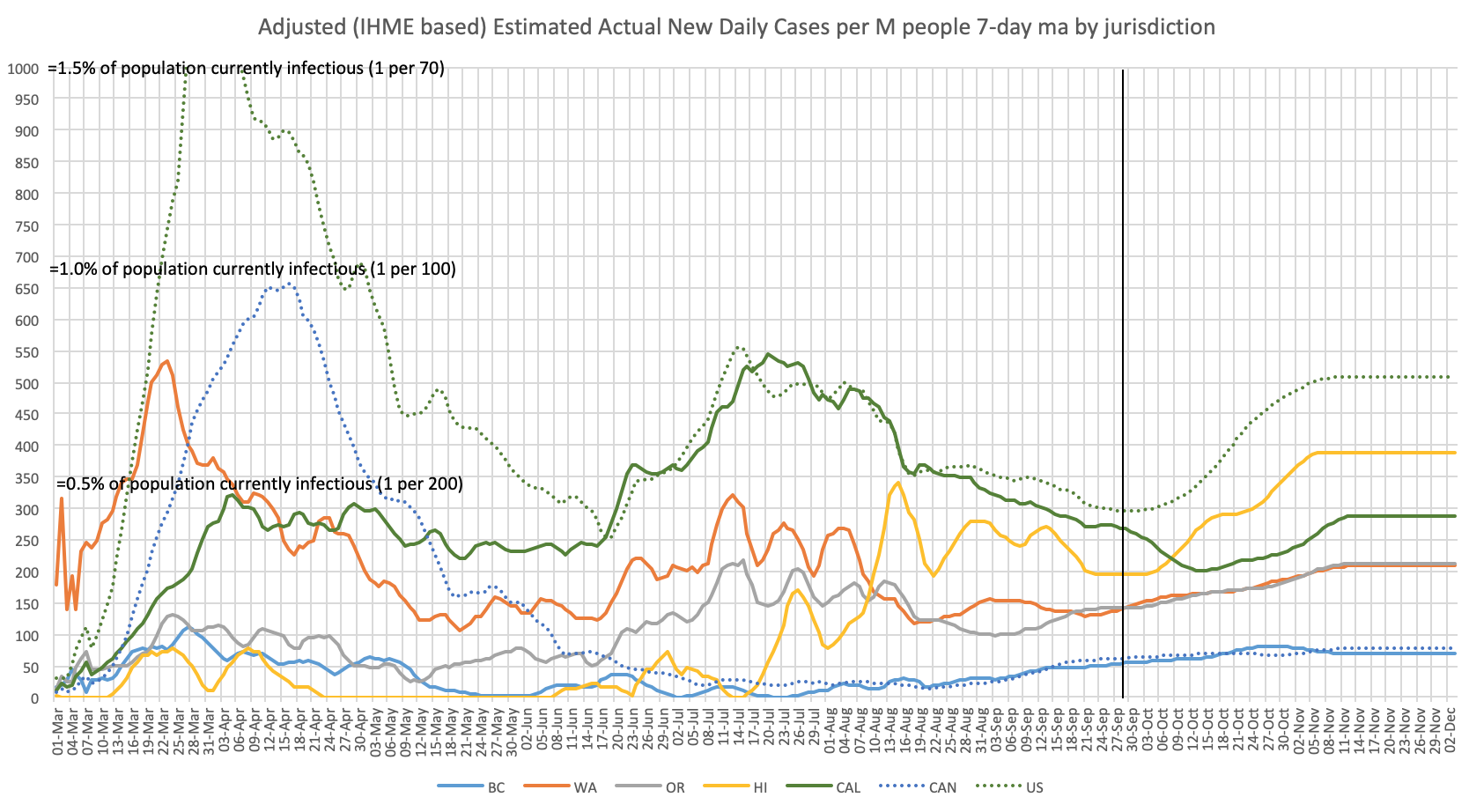
These two charts show, top, the reported cases per day per million people, and, below, IHMEs (with some minor adjustments by me) estimated actual cases per day per million people, based on “working backwards” from subsequently reported daily deaths. They tell very different stories. Peak reported cases in the US came in July, while in the Eastern US and in Washington state the actual case peak likely came back in March. Daily reported cases in all jurisdictions are now (end of September) at or near record highs, while in most jurisdictions estimated actual daily cases are nowhere near their earlier peaks.
Again, the projections are mine, as IHME’s much more pessimistic forecasts have estimated cases soaring off the top of the charts by the end of December.
Long bumpy ride ahead. But all pandemics end, and few of them last for years. Barring a second wave that kills the young and healthy like the second wave did in 1918, or unexpected problems with vaccines, I’m guessing a year from now we should be back doing most of the things we could do last year, though there will likely be some new, permanent or semi-permanent inconveniences.
But don’t get too comfortable. The chances of additional pandemics are high, and we’re not taking any of the steps needed to reduce their likelihood. And we still have basically no idea what the virus has done to our bodies that will affect our health long-term.
And if you think pandemics are a major inconvenience, just wait ’til you see what ecological and climate collapse will do to our unsustainable lifestyles in the years ahead.

Canadian newcomer Iman Vellani has been cast as Kamala Khan/Ms. Marvel in Marvel Studios’ upcoming live-action Disney+ series of the same name.
According to Deadline, Marvel underwent a “long and hard search” before settling on Vellani, who hails from Markham, Ontario. While the Disney+ series will be Vellani’s first Hollywood production, she does have experience in the entertainment industry, having worked with TIFF last year as part of the Next Wave Committee tasked with diversifying the festival’s lineup.
Shortly after news of her casting broke, the official TIFF Twitter account offered congrats to Vellani for landing the role.
Introducing Ms. Marvel
Sending
and congratulations to #TIFFNextWave alum Iman Vellani, who will star as Kamala Khan and the titular superhero. pic.twitter.com/zgOggnZGN2
— TIFF (@TIFF_NET) September 30, 2020
Specific plot details, release timing and other casting information on Ms. Marvel haven’t yet been confirmed, beyond confirmation that the series will — like Marvel Studios’ other Disney+ projects — be set in the Marvel Cinematic Universe (MCU).
For now, though, Vellani’s casting is still a notable bit of news, especially given the significance of the character. While the moniker of Ms. Marvel has been around since the ’70s, the current version of the character is Kamala Khan.
First appearing in 2014, Kamala — a Pakistani-American teen living in New Jersey — is Marvel Comics’ first Muslim character to star in her own title, and Marvel Studios’ first onscreen Muslim hero. In the comics, Kamala is exposed to a mutagen that grants her the Mr. Fantastic-esque ability to stretch and ’embiggen’ her body. Inspired by Captain Marvel (played by Brie Larson in the MCU), Kamala uses these powers to fight crime in between attending high school.
Since 2014, Kamala has become quite popular and gone on to appear in numerous animated TV shows and video games. Most recently, she was the main character of this year’s Marvel’s Avengers game, co-developed by Canadian studio Eidos Montreal.
Last year, Marvel Studios president Kevin Feige confirmed that Ms. Marvel will also appear in upcoming MCU films, and given the character’s connections to Captain Marvel, we’ll surely see Vellani teaming up with Brie Larson on the big screen at some point down the line.
It’s worth noting that Vellani is the second Canadian to be cast in the lead role of an upcoming Marvel Disney+ series. Earlier this month, Marvel also tapped Regina’s own Tatiana Maslany (Orphan Black) for its She-Hulk series.
On the big screen, Marvel Studios also has Mississauga’s Simu Liu (Kim’s Convenience) starring in its first-ever Asian-led film, Shang-Chi and the Legend of the Ten Rings, which is currently in production. Additionally, Fort Saskatchewan, Alberta’s Evangeline Lilly (Lost) co-stars in the Ant-Man series alongside Paul Rudd, with a third film featuring the shrinking heroes currently in development.
Image credit: Iman Vellani/Marvel
Source: Deadline
The post Marvel casts Canadian newcomer Iman Vellani as Ms. Marvel for Disney+ series appeared first on MobileSyrup.
It is one thing for a local coffee shop to be solely profit motivated at the behest of the owner. But if your goal is to have thousands of employees and fundamentally change the world with your products, as most lofty tech companies aspire to do, the idea that the company should be solely profit motivated based on the mission set almost exclusively by the founder results in a world that gives an extreme amount of (undemocratic) power to those founders that are successful.
[[Jason Somensatto]], Dealing with Employees and Politics: A Response to Brian Armstrong
Responding to the post by [[Brian Amstrong]], CEO of [[Coinbase]]: Coinbase is a mission focused company.

The Google Recorder app that’s available for Pixel 2 phones and newer just got a massive upgrade, making it much more useful for professionals.
That said, in today’s weird app climate, it’s harder to watch tech giants re-create features from independent app developers for their own gain.
First up, users can now search for keywords with recordings, and a smart scroll feature highlights important words as users move through longer recordings.
Additionally, you can select a smaller section of the transcribed text like quotes and either edit, delete or share it. If you delete it or share it, the audio will go as well, which is a neat feature for sharing fun memos or song recordings.

Finally, Google says the app and all of these features work without an internet connection, so even when your offline, you can still get the most out of the recorder.
This is a pretty cool feature, and the fact that it’s free and offers AI transcription is really useful for people like me who need to record a lot of interviews.
That said, previously independent companies like Trint and Otter.ai have been the leaders in the AI -recording space. Therefore if Google comes out of nowhere and wipes them out with a free version of their product, it’s the same situation as the Sonos lawsuit against Google and others against Apple.
At least Google is keeping this feature locked to its own smartphones, at least for now, but it’s still a strange feature that doesn’t feel as fun as before in light of the recent tech lawsuits related to similar levels of feature stealing.
Source: Google
The post Google updates Recorder app alongside Pixel 5 launch appeared first on MobileSyrup.

Even though the new Chromecast is launching without Stadia support, Google is still selling an ethernet adapter for its new smart TV dongle.
While we haven’t been able to find the dongle in the Canadian Google Store yet, if you add it to your cart from the U.S. store and then alter your URL, it converts the price to $25 CAD, suggesting you can order here.
MobileSyrup has reached out to Google for clarification regarding the Canadian availability of the device.
For us, this transformed the page into a Canadian listing and we were able to order the smart TV dongle. That said, there’s no way to know if it will actually get shipped to your house, so I’d suggest waiting until it’s listing properly in the Canadian store.
On top of all of this, since both ends of the new Chromecast uses USB-C ports, The Verge discovered that some select USB-C Ethernet adapters will work with the new Chromecast.
Source: Google Store, The Verge
The post Google quietly released an Ethernet adapter for the new Chromecast appeared first on MobileSyrup.

Google announced several new products at its Launch Night In event. Although the event went by in a hurry, the company shared a lot about its new Pixel smartphones, Nest Audio smart speaker and Chromecast with Google TV.
We’ve compiled all the information about when these new products will be available in Canada, how much they’ll cost and what pre-order details you need to know.
Check out the information below:

Coming out next Monday on October 5th is the Nest Audio, Google’s new mid-range smart speaker. The main difference between this new speaker and the old Google Home is its increased audio abilities and its new fabric-covered design.
The device comes in ‘Chalk,’ ‘Charcoal,’ ‘Sage,’ ‘Sand,’ and ‘Sky.’ It starts at $129 CAD.
You can pre-order it here:
The device is also going to be available from Bed Bath & Beyond, Home Depot, London Drugs, Lowes, Staples, The Source and Walmart on the 5th.

Google’s new Chromecast has an included remote and a very Google looking version of Android TV 10 installed. The $69 device is well-equipped with top-of-the-line 4K codecs like Dolby Digital and more, so when it launches, it should bring more choice to the high-end streaming market.
The device is available in ‘Snow,’ ‘Sky’ and ‘Sunrise.’ It costs $69 in CAD.
Pre-orders are available from:
On October 15th the device will also be available at Bed Bath & Beyond, Costco, Home Depot (online only), Lowes, Rogers, Staples, Tbooth wireless, Walmart and WirelessWave.

Google’s new Pixel 5 smartphone is currently available for pre-order on the Google Store website. It costs $799 in Canada, comes in ‘Just Black’ and ‘Sorta Sage.’ On October 29th, the phone will be available through the Google Store, Best Buy, Freedom, Tbooth, Telus, Videotron and WirelessWave.
Along with the Google Store, there are plenty of options available for pre-ordering the new phone. Best Buy Canada, for example, offers an excellent online tool for reserving the phone both unlocked or with a carrier.
Speaking of carriers, the Pixel 5 is available for pre-order with most major Canadian providers, including Bell, Rogers, Telus, Virgin Mobile, Fido and Koodo. You can read more about the carrier offers here.
It’s worth noting that Google will give those who purchase the Pixel 5 three months of Stadia and YouTube Premium, 100GB of cloud storage with Google One for three months and Google Play Pass. You read the full details here.
You can learn more about the Pixel 5 here.

If the Pixel 5 is too much phone for you, Google’s new Pixel 4a 5G might be a perfect alternative. Google says it will be available for pre-order today, although at the time of writing, customers only have the option to join a waiting list.
The 4a 5G will be available on November 19th in ‘Just Black’ for $679 in Canada. At the moment, the 4a 5G isn’t listed on carrier websites, although the phone should turn up soon.
Like the Pixel 5, those who purchase the Pixel 4a 5G will get three months of Stadia and YouTube Premium, 100GB of cloud storage with Google One for three months and Google Play Pass. You read the full details here.
You can learn more about the Pixel 4a 5G here.
The post Here is the Canadian pricing and release dates for all of Google’s new hardware appeared first on MobileSyrup.
At a family gathering several years ago, I spoke with my great Aunt’s new friend, a man who had just retired after 40 years of teaching golf. He told me that during the last three years of his career, he switched to teaching a method called Natural Golf. It produced vastly superior results than traditional golf instruction. He said, “Josh, if I could refund the people I taught for 37 years, I would. Natural Golf is so much better.”
Have you ever wondered if perhaps there is a better method for what you teach?
Better Agile Estimation
I spent over 6 years teaching thousands of people how to estimate user stories with story points, calculate a team’s velocity based on story points and strive for a consistent velocity (number of story points completed) per iteration. I don’t do that anymore. The approach, which seemed quite reasonable at the time, proved to be consistently awkward and difficult for Industrial Logic’s clients. Despite a lot of hard work to clearly define a story point, students continued to struggle with the concept. One student suggested that a story point ought to be called a Nebulous Unit of Time (NUT). Managers compared teams by velocity even though we explained that velocity was never meant for that purpose. Under pressure, teams increased velocity simply by inflating story point estimates. Problem upon problem materialized over those six years. Improved training didn’t help. Ultimately, my colleagues and I began to experiment with easier, faster, and more graceful ways to accomplish estimation without story points (read my 2012 blog, Stop Using Story Points). Today, we use a variety of techniques, including probabilistic forecasting based on cycle time. Like Natural Golf, these techniques have proven to be vastly superior to traditional (outdated) agile estimation approaches.
Testing Business Rules
Industrial Logic used to teach FIT (Framework for Integrated Test) as part of helping people learn Acceptance Test-Driven Development/ Behavior-Driven Development. We loved FIT, another fantastic innovation by Ward Cunningham. Yet, we repeatedly observed students struggling to write simple examples for complex business rules. And that made their FIT tables awkward and complex. We took that as a signal to improve our training, but that didn’t change the outcome. It finally got to the point where we felt we needed to teach “table smells”, a collection of FIT anti-patterns. But we never did that. It was a new signal telling us that perhaps FIT was simply too difficult for our clients. We eventually abandoned FIT, including training materials we’d work very hard to build and refine. We ultimately found simpler, easier-to-adopt, and less error-prone approaches. One such method doesn’t involve learning a framework, building HTML tables or writing fixtures. Non-technical or technical people simply write English-readable acceptance criteria that can be easily turned into composed methods, like so:
public void CheckLoyaltyDiscountNotOfferedAfterPurchase() {
    customer = CreateLoyaltyCardCustomer();
    customer.addLoyaltyPoints(DISCOUNT_THRESHOLD - 1);
    customer.purchase(LARGE_LATTE);
    checkNoDiscountProvidedFor(customer);
}
Rethinking Product Ownership
For many years now, I’ve seen blogs like this:
Is there good advice in these articles? Certainly. However, they also raise the question, are there consistent, repeated problems with the Product Owner role and is there an easier way? I believe so. I’ve experimented with having product management skills distributed within a team and dropping the PO role altogether (see Eliminating the Product Owner Role). Product ownership by a whole team has worked. In Finland, Maaret Pyhäjärvi has experienced similar success with teams that have no Product Owner (watch my #ModernAgile Show interview with her). For my teams without Product Owners, chartering has been critical for helping maintain focus on desired organizational outcomes. The teams figure out how to accomplish outcomes and everyone stays aligned by regularly reviewing and updating the charter (i.e. actively chartering on a regular cadence).
Experiment Rigorously
In 2001, the authors of the Manifesto for Agile Software Development said “We are uncovering better ways of building software…” They did not proclaim that they had uncovered the one right way. “Uncovering” is the word that invites us to keep exploring better, faster, simpler ways.
My colleagues and I at Industrial Logic love experimenting rigorously with principles and practices. We have no issue dropping something we cherish in order to discover what happens without it. We once thought that XP’s Iterations or Scrum’s Sprints were essential to being agile, but now we know better (read The Day We Stopped Sprinting). Rigorous experimentation has helped us discover easier, less frustrating ways to become more agile. Today, our practice of agility looks nothing like it did in the 1990s, when we first began experimenting with lightweight software development methods.
Simplicity is elusive, yet well worth pursuing. We love to discover simpler, safer, speedier ways to accomplish work. And we love to remove learning impediments. When we discover that some practice is repeatedly and predictably difficult or error-prone for clients, we don’t simply work to improve our training or write articles about how to avoid common mistakes. Instead, we begin experimenting with simpler, easier ways to accomplish the same thing. Sometimes that yields breakthroughs.
When something is repeatedly difficult for people, we say “It’s On Us” to fix it.
"It's On Us" encourages us to
innovate rather than patch problems.
Patching problems and making small adjustments is sometimes the right approach. But if the problems persist, it may be time to try a fresh approach. And unlike the golf instructor, you need not wait until you’re near retirement to discover better ways. Pay careful attention to repeated, predictable problems as they are often a signal to explore new ways to get far better results.
Oliver woke up this morning and, once we’d sorted out that he didn’t have COVID-19, his biggest concern was that he didn’t have an orange shirt.
It is, after all, Orange Shirt Day:
Orange Shirt Day is an opportunity for Islanders to listen, learn and reflect about the history of residential schools in Canada, and honour the thousands of survivors, their families, and passed loved ones. It is also a day to come together in the spirit of reconciliation and hope for a more inclusive and fair future for all.
Fortunately, this was one problem I could solve right away: my parish-mate enterprise, Miꞌkmaq Printing & Design, was selling orange shirts from a table at 101 Prince Street, about 50 paces from our front door. I popped across the street, picked up an orange shirt, and Oliver was clothed and ready a few minutes later.
If only all parenting was so easy.
I suggested to Oliver that he post something on Facebook about Orange Shirt Day, and he did exactly that:

Oliver understands, at a visceral level, that the colonialism and racism that gave rise to residential schools shares roots with that from which Black Lives Matter springs. I’m proud of him.

Letztes Wochenende haben wir im Circus mobile Lautsprecher diskutiert. Und ich bin ein Fan des Marshall Stockwell II, der alles kann außer laut sein. Das Gerät strahlt Qualität aus, fühlt sich super an, klingt von allen Seiten aus gut, läuft "ewig" mit einer Akkuladung und ist ruckzuck per USB-C wieder aufgeladen. Mittlerweile gibt es die schwarze Version gut ein Drittel billiger als den Listenpreis. In Indigo ist er noch mal ein bisschen schöner, aber auch sehr viel teurer.
Kopfhörer auf und diesen Vergleichstest hören.

The government of Quebec has confirmed that it will be utilizing the federal ‘COVID Alert’ exposure notification app after all.
This comes after the provincial government had said that it would prefer to create its own app in Quebec, instead of using the nationwide one.
Now, amid a second wave of the virus, Quebec Health Minister Christian Dubé has confirmed that COVID Alert is the province’s best option.
“The simple answer is yes, we will have the application,” the minister told reporters during a press conference on September 29th.
Dubé mentioned that a Quebec app was being developed, but that the increase in recent cases has forced the government to consider using the federal app. The minister said that more information about the province’s adoption of the app will be available in the coming days.
Quebec Premier François Legault had previously stated that there wasn’t broad support for the app in the province due to privacy concerns, a statement that puzzled the federal health ministry, which has repeatedly emphasized that the app doesn’t track users’ locations or collect any personal information.
COVID Alert uses Apple and Google’s notification API, which uses Bluetooth technology to share randomized codes with other nearby smartphones. These codes can’t identify users.
The Privacy Commissioner of Canada has conducted a review of the app and has determined that proper safeguards have been put in place to ensure the privacy and protection of Canadians.
Via: CBC News
The post Quebec government to use federal ‘COVID Alert’ exposure notification app appeared first on MobileSyrup.


It has been Duke of Data Andy Yan who has been reminding us forever that there is a radical disconnect between household income and the price of housing. People working in Metro Vancouver can’t afford to buy housing here.
In 2017 Mr. Yan summed it up this way:
“It’s surprising to me that we have only the 15th highest incomes in Metro Vancouver, even coming behind Toronto. What we learned today is in Vancouver you are living in paradise, but your wages are in purgatory.”
The median household income Mr. Yan was referring to is $72,662. At that time he saw the major issue was how to reconnect local incomes to local housing, noting that needed policy enactment would be different in each city.
Photographer and former editor of Price Tags Ken Ohrn sends along this article by Natalie Obiko Pearson who writes that Amazon. com is expecting to triple its workforce in Vancouver. Why? Because software engineers here are “cheap, smart and plentiful”, like an overabundant agricultural crop.
A conversation with an Amazon vice president revealed that a “weak loonie, lower wages and a steady flow of graduates make Canada an attractive place to expand for tech companies whose largest expense is labour”.
The salaries in Vancouver are substantially less than for similar jobs south of the border, as are office rents.
“The average wage of a software developer in Vancouver last year was $92,726, compared to $141,785 in San Francisco or $128,067 in Amazon’s hometown of Seattle, according to a July report by real estate firm CBRE Group Inc. Once rental costs are folded in, the cost of running a 500-employee operation in the Canadian city is half that of a similar-sized operation in the Bay Area, it found.”
You can take a look at the CBRE reports on Tech Talent and Trends here.
Vancouver has the “fastest-growing” tech labour pool and that quality and work experience is in the top ten of all the fifty labour markets analyzed by the firm. I have already written about Amazon repurposing the old downtown Vancouver post office which was to house 2,000 employees by 2020. In fact 2,700 Amazon staff now work downtown with a total of 8,000 jobs anticipated by 2023 in the redeveloped post office which will house 1.1 million square feet.
And there’s a call right now for 3,000 workers for Amazon in downtown Vancouver.
The YouTube video below from November 2019 outlines how the post office is being renovated to accommodate the new Amazon work space, using some unique approaches to construction.
Image: BusinessInsider

Fur, cereal, coffee grounds, mites, sand, glitter, dust, hair, dander, booklice, kitty litter — there’s a whole underworld of grossness hiding on your floors and deep inside your carpets and rugs.
Only a powerful plug-in upright or canister vacuum can take on all of the above, making your home sweet home cleaner and less crawly. The best ones work on different types of floors, filter allergens and pollutants, and last for years.
After testing dozens of models, we have four to recommend.
The Librem 5 is more than a phone, it’s a full desktop computer in your pocket designed to be just as mobile as you are.
Stay tuned for more videos where we explore the world of desktop convergence with the Librem 5 using your favorite apps.
Purism believes building the Librem 5 is just one step on the road to launching a digital rights movement, where we—the-people stand up for our digital rights, where we place the control of your data and your family’s data back where it belongs: in your own hands.

The post Desktop and Phone Convergence appeared first on Purism.
 |
sillygwailo
shared this story
from  Somewhere Left of Ottawa. Somewhere Left of Ottawa.
|
With John Horgan asking for and receiving an election at the beginning of this week, Canada will have its second pandemic election (Saskatchewan will give Canada its third just two days after). Like in the first such election in New Brunswick, Horgan is trying to turn a minority government into a majority, arguing that the additional stability of a majority is needed in order to respond to the pandemic. One of the biggest concerns with the election has been whether voting can be conducted safely. There has been much discussion of advanced polls, mail in ballots, and extended voting periods in order to make sure that all can cast their ballots. This is understandable, ensuring that the pandemic does not interfere with individuals’ ability to vote is essential to ensuring that the election is fair. More attention, however, needs to be paid to the way that the pandemic will affect local campaigning. Local campaigns often get far less coverage than the national or province-wide (depending on whether the election is federal or provincial) one, but play an important role in elections and will be severely affected by the pandemic.
Local campaigning during a pandemic will look very different than it would under normal circumstances. Local candidates are unlikely to be able to go door to door meeting with voters and responding to issues. They will not be able to hold events such as town halls and barbecues to meet with voters in their riding. Presumably there will be attempts to hold all candidates debates in most ridings, but without in-person attendance debates that are organized will likely reach fewer voters (voters may tune in to radio and television programs or use social media to see a leaders’ debate, they are probably less likely to do so for a local all candidates debate). It will also be more difficult for the party leaders to hold events in ridings across British Columbia, using their presence to bring out voters who can then learn about the party’s local candidate. These constraints on local campaigns are likely to affect both the election outcome and will hurt the quality of the campaign.
It easy to dismiss local campaigns. Most of the media coverage in an election goes to the party leader, the most prominent advertising in a campaign is national or province-wide, and the major issues in campaigns are often national or province-wide issues. Nonetheless there is extensive work in political science that shows that local campaigns matter. Gerber and Green (2000) show that voters who are contacted in person are more likely to vote than those who receive leaflets or who receive phone calls. In-person voter mobilization is generally something that is a central responsibility of local campaigns and will be more difficult to do if campaigns have little in-person contact with voters. A wide range of studies also demonstrate that local campaigns matter to election results showing that the strength of local organizations (Cross, 2016), the amount of money spent (Eagles, 2005), visits by party leaders (Belanger et al., 2003; Carty and Eagles, 2005), and attitudes toward the local candidate (Blais et al., 2003; Blais and Daoust, 2017; Stevens et al., 2019; Roy and Alcantra, 2015) all influence who wins in different ridings.
Depending on the study (and presumably the riding and the election) it is argued that local campaigns and candidates can make a 4-10 percentage point difference in vote share to a candidate in a riding. While that may not seem like a lot, and is probably not enough to overcome a very weak national campaign or scuttle a strong one, it can be decisive in close elections. Indeed in the 2017 British Columbia election there were 6 ridings where the margin between the winning and second place candidates where within 5 percentage points of each other. In a close election, as 2017 BC election was, that is enough to change who forms government. Even when an election result is clear enough that local campaigns are unlikely to affect who forms government, the absence of local campaigns is likely to affect the results in some ridings. Candidates who have strong local reputations and have built strong local organizations will be hurt by their inability to campaign in the same way that they would have in a normal election.
The absence of normal local campaigning also has consequences for the quality of the election for voters. There is value to having voters connect with local candidates over the course of the election. This gives local candidates and future MLAs an opportunity to establish their own relationship and reputation with voters in their constituency. These relationships and reputations are going to be representative their constituent’s interests in the legislature. Local campaigns also allow voters to ask their MLAs to speak to issues that are important in their constituency but may not be getting province-wide attention. This not only gives more information to consider when casting their vote, but can also give candidates and eventual MLAs a better sense of how important different local issues are to the voters that are electing them.
Strong local campaigns are an important component of elections even if the national or province-wide campaign is getting more media attention. As noted in the academic literature cited above, the number of voters who will be swayed by local issues instead of national or province-wide is not insignificant and can make the difference in close ridings. MLAs can further take the issues that they hear about back to their party and leadership in the hopes that it will affect the way the party approaches issues important to their constituency. As much as party discipline is the larger barrier to MLAs looking to more closely representing their constituents’ interests, an election with limited opportunities between local candidates and their voters will hurt MLAs ability to give voice to local concerns in the short term.
The loss of much of what is important to local campaigning does not mean that elections should not happen during the pandemic. But their loss is a cost that needs to be accounted for even if voting can be conducted safely. Because local campaigns will be severely affected by the pandemic voters will have less information about the local candidates they are voting for and that decreases the quality of the campaign for voters. In cases where a government reaches a point where it is legally obligated to hold an election it makes sense to hold an election, as is the case in Saskatchewan. This is probably also the case if a government gets to a point where it no longer has the support of the legislature and therefore will be unlikely to be able to govern (one could make the argument that this had happened in New Brunswick). Local campaigns are probably not so important that they are worth allowing governments to go longer between elections than is legally allowed or ignore confidence rules that require the government have the support of the legislature. In cases where the government can continue, as is the case with British Columbia, it is in voters’ interest to wait until the pandemic is over or until an election is absolutely necessary.
Blais, André and Jean-François Daoust. (2017). “What do Voters do When they Like a Local Candidate from Another Party,” Canadian Journal of Political Science. 50(4): 1103-1109.
Blais, André, Elisabeth Gidengil, Agnieszka Dobrzynska, Neil Nevitte, and Richard Nadeau. (2003). “Does the Local Candidate Matter? Candidate Effects in the Canadian Election of 2000.” Canadian Journal of Political Science. 36(3): 657-664.
Bélanger, Paul, R. Kenneth Carty, and Munroe Eagles. (2003). “The Geography of Canadian Parties’ Electoral Campaigns: Leaders’ Tours and Constituency Election Results.” Political Geography. 22: 439-455.
Carty, R. Kenneth and Munroe Eagles. (2005). Politics is Local: National Politics at the Grassroots. Oxford: Oxford University Press.
Cross, William. (2016). “The Importance of Local Party Activity in Understanding Canadian Politics: Winning from the Ground Up in the 2015 Election.” Canadian Journal of Political Science. 49(4): 601-620.
Eagles, Munroe. (2005). “The Effectiveness of Local Campaign Spending in the 1993 and 1997 Federal Elections in Canada.” Canadian Journal of Political Science. 37(1): 117-136.
Gerber, Alan S. and Donald P. Green. (2000). “The Effects of Canvassing, Telephone Calls, and Direct Mail on Voter Turnout: A Field Experiment.” American Political Science Review. 94(3): 653-663.
Roy, Jason and Christopher Alcantara. (2015). “The Candidate Effect: Does the Local Candidate Matter?” Journal of Elections, Public Opinion, and Parties. 25(2): 195-214.
Stevens, Benjamin Allen, Md Maujahedul Islam, Roosmarjin de Geus, Jonah Goldberg, John R. McAndrews, Alex Mierke-Zatwarnicki, Peter John Loewen, and Daniel Rubenson. (2019). “Local Candidate Effects in Canadian Elections.” Canadian Journal of Political Science. 52(1): 83-96.

|
mkalus
shared this story
from mrjamesob on Twitter.
|
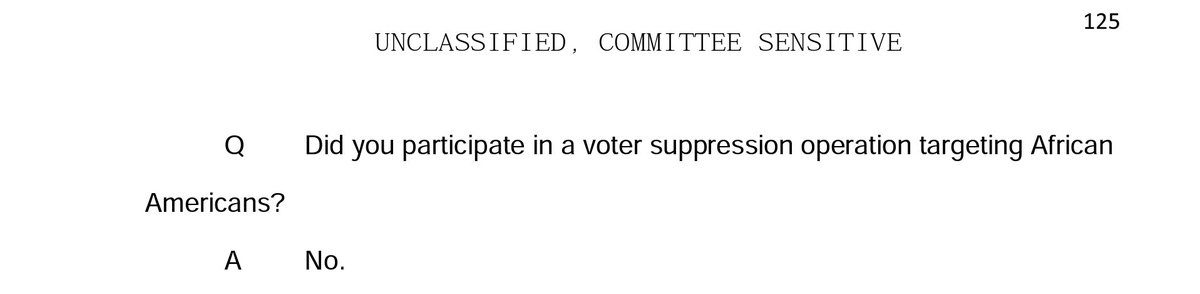
Reminder: Dominic Cummings used a sister company of Cambridge Analytica (AIQ) to target millions of UK voters in 2016, illegally overspending to do this.
We know a lot of the material used to influence them was disinformation. But was voter suppression another objective? twitter.com/profcarroll/st…
The Cambridge Analytica saga breaks wide open again. The proof is finally being revealed. We always knew the truth was right there in the data. twitter.com/Channel4News/s… pic.twitter.com/fzYieiqiDn
9993 likes, 5697 retweets
James O'Brien (mrjamesob)
on Tuesday, September 29th, 2020 7:53am |
mkalus
shared this story
from mrjamesob on Twitter.
|
Plenty of AfD apologists & sympathisers in the UK media. Confirmation that they shilled for actual Nazis will, of course, not matter one jot to their paymasters. And they'll all be too busy whining about 'cancel culture' to appreciate the irony... twitter.com/JeremyCliffe/s…
The disintegration of the AfD (latest news: rogue press spokesman spoke of "shooting" and "gassing" migrants, party collapsing in state parliaments, set to lose seats at next election) is as internationally under-covered as its rise was over-covered.
584 likes, 266 retweets
|
mkalus
shared this story
from  ottocrat on Twitter. ottocrat on Twitter.
|
Not a single Tory voted against a law that does break international law. This is not a Conservative party anymore. twitter.com/nickeardleybbc…
Despite concerns expressed by many - including Theresa May - no Tory MPs voted against the Internal Market Bill at third reading
Mrs May did not vote
513 likes, 322 retweets
 Chris Kendall (ottocrat)
on Tuesday, September 29th, 2020 9:45pm
Chris Kendall (ottocrat)
on Tuesday, September 29th, 2020 9:45pm |
mkalus
shared this story
from ottocrat on Twitter.
|
Christ above twitter.com/munroel/status…
|
mkalus
shared this story
from ottocrat on Twitter.
|
If you don’t see that Patel’s inhumanity is in exactly the same register as the moral vacuum that led to the death camps then you are not paying attention. Godwin’s Law is dead, another victim of this creeping fascism.

One of the advantages of online learning is that, if applied equitably, it allows more marginalized voices to be heard, and in this case, heard in their own language. It's hard to over-emphasize the importance of that, as each language is a unique world view, and an important part of the diversity of perspectives we need to most fully understand the world. This article describes how indigenous people who are living elsewhere can still access learning resources that were more traditionally offered only in their own First Nation territory. But the key issue of broadband access must still be addressed. And it needs to be understood that online learning is only one of a range of supports that should be directed to address indigenous learning.
Web: [Direct Link] [This Post]
The venture capitalists have stepped into the emergency online learning picture and backed the most regressive possible expansion of Zoom. "ClassEDU announced last week that it has raised $16 million in seed funding to develop Class for Zoom -- a Zoom add-on that will give educators new features such as the ability to take class attendance, get data insights into student participation and issue interactive quizzes during class. Instructors will even be able to monitor the tabs that students open while in exam mode, making the software a potentially powerful proctoring tool. They can also control whether or not students can see each other and have the option to record lectures without showing any student faces. " Oh! My heart.
Web: [Direct Link] [This Post]
This article (11 page PDF) is clever in many ways - sometimes too clever. You get your first hint of this when the author reminds to that the phrase 'to tell the truth' means (idiomatically) something like 'actually'. And though we are often told that all societies value honesty as an ethical virtue, the many ways we categorize lies says something else - why else would we have expressions like "white lies", “terminological inexactitude” and “economical with the truth”? Why is it OK to be "a little bit loose when talking abut weight"? According to the author, it is important to teach students about lying, and especially, to teach them when it is ethical (if ever), and how to decide. There are some great examples near the end of the article that will challenge readers who view the issue of lying as unequivocal. Image: India Times, Think you are good at lying? You could be a psychopath.
Web: [Direct Link] [This Post]