Shared posts

01 Dec 15:54

Add People to Fastmail on Any Plan You Choose

by The Fastmail team
Add People to Fastmail on Any Plan You Choose

Everyone gets the right features with a mix of Basic, Standard, and Professional plans.


When you get Fastmail for your family or colleagues, they should get the features they want, while you pay only for the features they need. Mix and match pricing lets you pick the best plans for you and the people on your account.

Our Basic, Standard, and Professional plans offer something for everyone. Basic plans offer privacy-focused email you can depend on. Standard plans provide all the features you love that help you spend less time on email. For the email pro, Professional plans give you tons of storage and a tamper-proof email retention archive, which keep your records safe forever.

Once you pick the plan best for you, you can share the benefits of Fastmail with others at any plan level, and you can even share your domains with them.

Share your custom domain with Basic users

Emailing from your custom domain is the best way to own your email identity. You don't have to borrow an email address from a corporation or brand. Anyone on the Standard or Professional plans can use their own domain, be it you@yourfamily or you@yourcompany.

You can share your domain for people on the Basic plan, which is a more affordable plan for people with less storage and feature needs. If you're giving Fastmail to your family, as long as you have a Standard or Professional plan, everyone can email from your family's domain, helping you save money. The same goes for your business or anything you use a custom domain for, such as volunteer work or a passion project, that you'd want to share with others.

Better privacy for those you love

Digital privacy is important for every member of the family, no matter their age. Email is important to safeguard because it holds what you do, think, buy, and the places you go. The ability to mix plans is all about making it possible for you to share Fastmail with the people in your life.

We've heard you say how important your choices are, and we're listening. Fastmail plans now come with more features and options than ever before, and we're bringing back the ability for you to choose the right plan for the people on your account.

More conveniences for your busy life

Make your life easier by nesting your family or team's emails under one admin account. You can do everything you need to do in one place, such as add or remove people on your account and upgrade or downgrade their level plan. You can also manage account settings, monitor storage usage, review a single invoice for all your accounts, and oversee custom domains and aliases.

Personalized for better email experiences

Custom features are what you'd expect from independent businesses that put you first. This is the kind of service you get at Fastmail, and it's what drives us to offer more features tailored to fit your unique needs.

Add new users on Basic, Standard, or Professional plans today in your account under Settings → Users.

10 Nov 18:15

Learning useful stuff from the Ecosystems chapter of my book

by Derek Jones

What useful, practical things might professional software developers learn from the Ecosystems chapter in my evidence-based software engineering book?

This week I checked the ecosystems chapter; what useful things did I learn (combined with everything I learned during all the other weeks spent working on this chapter)?

A casual reader would conclude that software engineering ecosystems involved lots of topics, with little or no theory connecting them. I had great plans for the connecting theories, but lack of detailed data, time and inspiration means the plans remain in my head (e.g., modelling the interaction between the growth of source code written in a particular language and the number of developers actively using that language).

For managers, the usefulness of this chapter is the strategic perspective it provides. How does what they and others are doing relate to everything else, and what patterns of evolution are to be expected?

Software people like to think that everything about software is unique. Software is unique, but the activities around it follow patterns that have been followed by other unique technologies, e.g., the automobile and jet engines. There is useful stuff to be learned from non-software ecosystems, and the chapter discusses some similarities I have learned about.

There is lots more evidence of the finite lifetime of software related items: lifetime of products, Linux distributions, packages, APIs and software careers.

Some readers might be surprised by the amount of discussion about what is now historical hardware. Software needs hardware to execute it, and the characteristics of the hardware of the day can have a significant impact on the characteristics of the software that gets written. I suspect that most of this discussion will not be that useful to most readers, but it provides some context around why things are the way they are today.

Readers with a wide knowledge of software ecosystems will notice that several major ecosystems barely get a mention. Embedded systems is a huge market, as is Microsoft Windows, and very many professional developers use C++. However, to date the focus of most research has been around Linux and Android (because its use of Java, a language often taught in academia), and languages that have a major package repository. So the ecosystems chapter presents a rather blinkered view of software engineering ecosystems.

What did I learn from this chapter?

Software ecosystems are bigger and more complicated that I had originally thought.

Readers might have a completely different learning experience from reading the ecosystems chapter. What useful things did you learn from the ecosystems chapter?

30 Sep 06:30

I was wrong. CRDTs are the future

I was wrong. CRDTs are the future

Joseph Gentle has been working on collaborative editors since being a developer on Google Wave back in 2010, later building ShareJS. He's used Operational Transforms throughout, due to their performance and memory benefits over CRDTs (Conflict-free replicated data types) - but the latest work in that space from Martin Kleppmann and other researchers has seen him finally switch allegiance to these newer algorithms. As a long-time fan of collaborative editing (ever since the Hydra/SubEthaEdit days) I thoroughly enjoyed this as an update on how things have evolved over the past decade.

Via Hacker News

30 Sep 06:28

We need to talk about “normal”

by admin

Six months after we went into full lockdown in the UK, Covid-19 infection rates are rising, we are under restrictions again, and there is a horrible sense of deja-vu in the air. It’s the same but different. The disease seems closer as halls of residence very close to me are shut and students are told to self isolate as hundreds test positive for the virus.  Questions are being raised as to why the halls of residence were allowed to open in the first place, why did universities open when as one student I have just heard on the radio said “we are just getting everything online”  

Meanwhile I’m still watching Battlestar Galactica. I knew there would be more analogies in it! In the opening mini-series, there are a couple of scenes where the new President of the Colonies meets the military leadership of the battleship. Both are hellbent on “getting back into the battle”.  Laura (the President) says ( a bit of paraphrase here)  I don’t know why I have to keep pointing this out to you, but we have lost the war. ( for those of you not familiar with BSG – all 12 planets of “the colonies” have just been well and truly  nuked by the Cylons, and less than 50,000 humans remain alive.  Bare with me there is a point to this!  

As I watch, read and listen to the news, many commentators are pointing out that COVID-19 and halls of residence were a match made in rapid community spread infection heaven so why did unis open them without testing? Why were they hell bent on getting back into battle or “normal” so to speak? I think it’s time to have some serious discussions about what normal actually is in (higher) education.  

I have had a quote above my desk since lock down start, it says “it the rush to return to normal, use this time to consider which parts of normal are worth rushing back to”.  After some conversations last week I think that perhaps we have rushed back to our formal curriculum (aka normal) without really considering the wider context in which universities are now operating.  

I can see why, the curriculum is a key focal point to getting teaching back on track. After rush of  the great online pivot, the harsh reality of the transitions is suddenly upon. Getting teaching back to as close to normal delivery of the curriculum as possible is an obvious goal, as is getting as many students as safely as possible back in halls and maybe on campus.

I can’t comment with any authority on the situation in halls of residences just now. I’m sure lots of people have worked really hard to make sure that they were as safe as possible for students. Of course universities wanted them to open again – for one thing they need the money as well as start to “get back to normal”. But things aren’t normal just now and they won’t be for quite a while yet. I suspect we will  have at least a year of various levels of lockdown. Even with a decent testing system in place, everyone is liable to be in and out of work/study for the foreseeable future.  

I don’t think our formal curriculum represented this “new normal”.   We need to start planning for now for no exams next year, making provision for alternative assessment method, taking online learning really seriously and exploiting the benefits and flexibility of synchronous and asynchronous learning.

In couple of keynotes over the lockdown period, I put forward the notion of rethinking the first year experience to allow students and staff to adapt to our new context. To have a focus on well being, developing digital research skills and capabilities and adjusting and sharing how we can adapt and “be” at university in  our new context, the ever changing “new normal”.  

The experience of university for staff and students is different now.   We need to recognise and develop ways to understand and support a whole new set of seemingly smaller (or micro) transitions we are all making now. For example, the transition from you laptop/phone/tablet on the kitchen table when you are “at uni”, followed the transition from your laptop to your laptop/phone/tablet for catching up with friends and family. Same space and device, completely different context.

Where are the spaces where people switch off, socialise. Where are the “leaky” space and places of the formal and informal curriculum? You know the places where you have those serendipitous discussions about one thing that lead you on a completely different direction for your study/teaching/work.  How open are/can we going to be about what we are doing, what we are learning, what we are really struggling with if we hide behind a drive to deliver the “normal ” formal curriculum.

I don’t have any answers to these questions, and obviously not working a university just now I fully acknowledge I am removed from the reality on the ground. But I do think that not being obsessed with getting things as close to possible as they were ( but just online!!) isn’t doing anyone any favours. We need to be creating the new narrative about what the university experience is now, not what it used to be.  

We need to be discussing the digital university in a different context now. And dear reader, with my colleagues Bill Johnson and Keith Smyth I am doing exactly that just now so look out for a new publication in the not too distant future

30 Sep 06:28

Twitter Favorites: [geerlingguy] TFW you need to install Python 3 using Homebrew to be able to uninstall Homebrew (which uninstalls Python 3) to the… https://t.co/aXCjxvQQJ9

Jeff Geerling @geerlingguy
TFW you need to install Python 3 using Homebrew to be able to uninstall Homebrew (which uninstalls Python 3) to the… twitter.com/i/web/status/1…
30 Sep 06:28

The User Wizard Scenario

by Eric Normand

We start with a Haskell type that models a feature very well. As the feature changes, the data model eventually evolves into something like Clojure's hash maps. Discussion follows.

The post The User Wizard Scenario appeared first on LispCast.

30 Sep 06:23

The Social Network Is the Computer

Irving Wladawsky-Berger, Sept 29, 2020
Icon

This post looks at Sinan Aral's recently published book The Hype Machine. It offers a perspective you've probably seen before, "a view of the world in which society is essentially a gigantic information processor, moving ideas, concepts, and opinions from person to person, like neurons in the brain or nodes in a neural network, firing synapses at each node in the form of decisions and behaviors." Arai describes the mechanisms of this social neural network as 'the hype machine': "digital social network is the substrate at the core of the machine," machine intelligence is "the process that controls what information flows over the network," and "smartphones are the medium, the key input/output devices." I think this is too narrow a perspective; the whole interactive network is the substrate, machine and human intelligence send signals (not information) to each other, and all of human society is the medium. Why would it be anything else?

Web: [Direct Link] [This Post]
30 Sep 06:23

Domo Arigato EdTech Roboto

Clint Lalonde, Ed Tech Factotum, Sept 29, 2020
Icon

The Ed Tech Bot on Mastodon has been around for a few months and has proven to be useful to me because it captures some posts I might miss in my feed. It helps that it's pretty selective; it focuses on blogs that are updated once in a while rather than feeds (like this one) that will pump out five or so items a day. In this post Clint Lalonde describes the creation of Ed Tech Bot, from the installation of a private Mastodon server to the setting of of the Inoreader RSS reader, to the use of IFTTT to push the aggregated contents into the Mastodon account. He laments not being able to write code for what IFTTT does, but for other people wanting to do the same thing, being able to do it without writing code is a huge plus.

Web: [Direct Link] [This Post]
30 Sep 06:23

Report Fewer Metrics

by Richard Millington

I saw a recent community report which was filled with metrics.

They were tracking and sharing pretty much everything.

Believe me, no-one will be impressed that you can dump a lot of data into a report.

It’s far more impressive to:

a) Identify the one (or two) metrics that matter.
b) Explain why they matter.
c) Show those metrics heading in the right direction.

The person(s) you’re sending these reports to probably get plenty of other reports too. Make yours less confusing, investing in good data visualisation, and show the line heading in the right direction.

30 Sep 06:23

How to save Obsidian pane set-ups and reactivate them

by Ton Zijlstra

One of the useful features of both the Obsidian and Foam notetaking apps is that they can have a variety of panes in view. Each pane is a different view on your data. Every pane you’re in can be split vertically and horizontally.
Less useful is that you can’t easily save or return to a specific pane ‘mosaic’.

In the image above you see 4 panes: a filefinder in the left sidebar, a markdown cheatsheet in the right sidebar, and in the middle on top a graph view of the files, and a selected file at the bottom.

For planning, in the past months I’ve come to a specific set-up of panes that help me quickly plan my work for different time periods. Panes include the full list of tasks (actually a list of transcluded activity area and project specific taskslists, current goals, day logs, etc. However, while working in such a set-up it’s hard to maintain the set-up. As soon as you click a link or close a note, you break out of the carefully selected set of panes. Worse, the next time I want to use it, I need to create it from scratch.

In short: I want to save a specific pane set-up and be able to easily return to it. At any given time the current pane set-up is recorded in a JSON file called ‘workspace’ in the .obsidian folder.
In the Obsidian support forum, there’s a mention of saving and loading Obsidian workspaces using Keyboard Maestro on Mac.

This points the way to potentially doing the same using Applescript or Alfred:

  • Save the current workspace, with a specific name (copying the workspace file)
  • Open a workspace from a list of saved workspaces (place the saved file back under the name workspace again, reload Obsidian)
  • Delete a workspace (although that is simply done through the file system as well)
28 Sep 21:50

Exceptional

by swissmiss


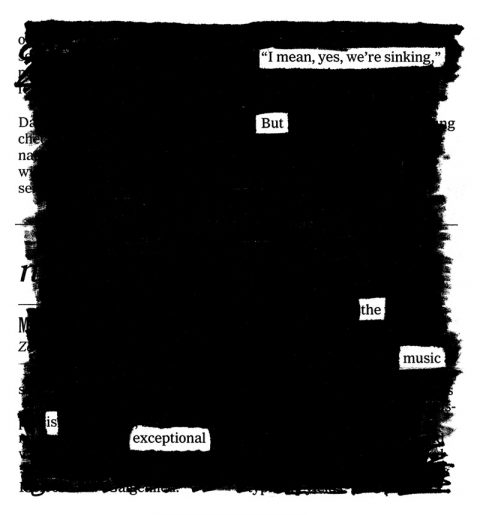
This illustration made me look. (If you’re not famliar with Austin Kleon’s newsletter, me thinks you’re missing out.)

28 Sep 21:49

RT @devisridhar: 👇🏼why I don’t want to get COVID-19 & think young people (esp 30-59) should take it more seriously. Some have described thi…

by Prof Devi Sridhar (devisridhar)
mkalus shared this story from mrjamesob on Twitter.

👇🏼why I don’t want to get COVID-19 & think young people (esp 30-59) should take it more seriously. Some have described this as an ‘auto-immune’ condition triggered by the virus. This is a new virus & we don’t know long-term impacts on the body. twitter.com/thedailyshow/s…

“We’re seeing more and more lingering signs and symptoms, so that when you clear the virus, you may have weeks or months or so in which you’re just not quite right.”

Dr. Fauci on what’s troubling him most at this point in the pandemic: youtu.be/5rKt54x6Hp0 pic.twitter.com/KUf35NNA1U


1622 likes, 627 retweets

Retweeted by James O'Brien (mrjamesob) on Monday, September 28th, 2020 7:21am


1709 likes, 822 retweets
28 Sep 21:48

Timeline of the President’s taxes

by Nathan Yau

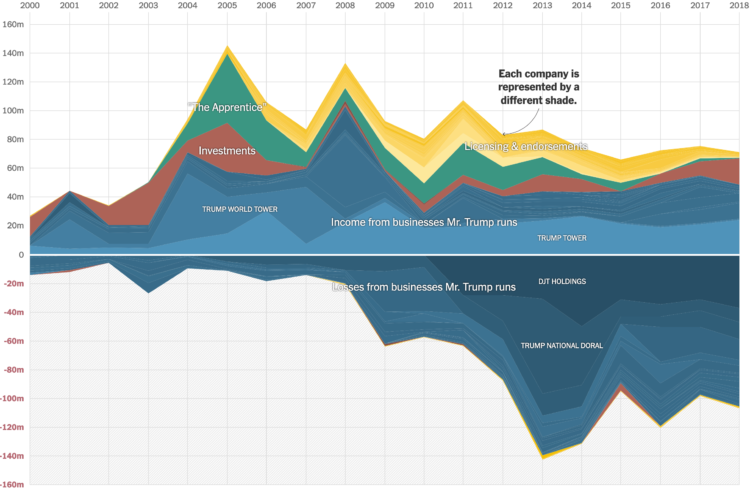
The New York Times got a hold of the President’s tax records for the past two decades. They charted the reported gains and losses.

It starts with an overview stacked area chart and then scrolls through the details and peculiarities. Very peculiar.

Tags: New York Times, taxes

28 Sep 21:48

The Best 24-Inch Monitor

by Andrew Cunningham
The Asus ProArt PA248CRV showing a vinyard desktop background.

A 24-inch monitor can be a great companion to a laptop, offering a larger, space-efficient second screen that charges your device while you’re using it. The Asus ProArt PA248CRV is an especially good monitor for most people because it has a larger 16:10 display, USB-C charging, a USB hub for peripherals, and fantastic color accuracy. Because desktop users can easily link as many as four together for a multi-monitor setup, it’s also a versatile pick for use with PCs that have limited ports.

If you’re looking for a less-complicated, less-expensive 24-inch monitor, we recommend the KTC H25B7. It only has an HDMI port, but it’s sharp and cheap and gets the job done. For a higher-resolution upgrade, the Asus ProArt PA24ACRV has our top pick’s features with a better screen.

28 Sep 21:47

I’ve now migrated all my text snippets from Tex...

by Ton Zijlstra

I’ve now migrated all my text snippets from TextExpander to Alfred. With Alfred set to automatically expand snippets upon typing a keyword anywhere, it behaves the exact same way as TextExpander. TextExpander has been useful to me over the years, but their new subscription model is not for me.

28 Sep 21:46

Inequality and the Death of the Arts

by Dave Pollard

painting by Bowen Island artist Jeanette Wrenshall, from my own collection

My island community is full of artists — one of the largest proportions in the country. They came here, mostly, for sanctuary. It’s an incredibly beautiful and relatively undeveloped place, yet still a short ferry ride from a progressive city. Many came here to avoid personal abuse, unhealthy relationships, unbearable stress, and/or financial hardship (home prices here were, until recently, much less expensive than in the city). But for the last two decades, prices even here are way too high for a modest or single income earner, and because we are an island almost everything has to be trucked here, so foods and materials are even more expensive than in the city.

And even before CoVid-19, things for artists were tough here. Home prices have actually soared during the pandemic. Excluding wealthy retirees and executive commuters, who buy relatively little on the island (there’s more selection and lower prices in Vancouver), the turnover rate here is high, and it’s almost always involuntary. Many of my friends here cried when they left. Housing is unaffordable for those trying to live and work here, and there is little rental housing or subsidized housing.

We are, both in the grim situation of our artists and in the prevailing economic trends, a microcosm of what is happening in the rest of the world. Specifically, we’re seeing the rapid death of what remains of the middle class, as salaries and investment income for the dominant caste (ie university-educated white males) soar, while for everyone else they stagnate or decline. Paradoxically, this means that because the dominant caste are the only ones who can afford to buy land, homes and investments, that caste’s obscenely excessive wealth is driving up the price of these commodities, making them even more unaffordable for everyone else. Only a small minority can afford to live in the city; the rest have to drive from farther and farther away each day to find work. And in many cases they now need, and have, two or three jobs each to pay their rent and grocery bills.

So they’re working themselves to an early grave in constantly precarious, stress-filled lives, and the government, which chooses to see what reflects well on them, says that unemployment is down, the stock market is up, and real estate is booming — so the economy must be great!

Of course, it is nothing of the sort. Real unemployment, including those who have given up trying to find reasonable-paying jobs, or are so physically and psychologically stressed by their situation they cannot keep them, is soaring. Real inflation, not the fake numbers that count Big Macs as food but not healthy produce, is in the double digits, especially for the multitudes whose health care needs are increasing due to the epidemic of chronic diseases (mostly ascribable to a combination of poor nutrition, ignorance, insufficient time to prepare healthy meals, and endless stress).

As I’ve written elsewhere, the government is buying time by deliberately suppressing interest rates far below inflation levels, and encouraging the non-privileged castes to get deeper and deeper into debt to feed their families. This is of course completely unsustainable.

The soaring inequality of wealth (and political power) hits the artist several ways. First, they have no power to elect representatives who will look out for their interests; the laws are increasingly written to favour the dominant caste that politicians mostly belong to and (because they rely on their campaign donations) listen to. Secondly, with their living costs soaring, they need more and more income just to tread water. Meanwhile their income is dropping — their customers are mostly middle class citizens who are struggling as much as they are and reducing their “discretionary” spending.

Even worse, the gross inequality of incomes is now reflected, thanks to big tech firms and arts “intermediaries”, in the pay scales for artists, too. The dominant caste bids up the price of limited “collectors'” art to the millions of dollars, as it’s a good investment for them. The music, publishing and film “industries” reward the 1% of elite performers with over 80% of the total artists’ fees, leaving almost nothing for the rest. This makes sense to them because their incremental cost of one more movie ticket, one more streaming music play, and one more e-book, is essentially zero. So the 1% of top-billing artists can be given most of the revenue that all artists collectively earn, and profits of agents and publishers soar. They can argue that every book, song and ticket costs the same, so this is “fair”, but it’s absolutely devastating to all but the 1% top-earning artists, who end up obscenely overpaid (like the top 1% in every other sector of the economy), while everyone else receives a pittance, and has to wait tables (CoVid-19 permitting) for a living.

So now artists are reduced to begging on Patreon, Kickstarter and YouFundMe sites to continue their work. Their donors are not philanthropists, but rather others, formerly in the disappeared middle class, themselves struggling to make ends meet.

Hua Hsu, in a recent New Yorker article on how we might provide artists with a reasonable income, points out that part of the problem is the middlemen — the agents, publishers, lawyers, ISPs, tech platform operators and other parasites who take a hugely-outsized cut of the “arts dollar” for doing almost nothing. We are starting to see co-operatives striving to replace them and their grossly unfair business models, but that will be only the start. As William Deresiewicz says in his book on the subject, The Death of the Artist, these middlemen often promise struggling artists “exposure”, but for an artist, “exposure is a synonym for nothing”. William goes on:

[Artists] do deserve to get paid for doing something you love, something other people love… Wanting to get paid does not mean that you’re a capitalist. It doesn’t even mean that you assent to capitalism. It only means that you live in a capitalist society.

Hua’s review criticizes the naive and muddle-headed talk of a new “creative class” championed by hack evangelists like Richard Florida, pointing out that the imagined idea of this supposedly wealthy and successful class merely provided cover for rich, greedy real estate developers promoting “gentrification”, and a bullet-proof haven for dubious “arts” investments by “philanthropists”.

Much research has shown that there’s a near-perfect correlation between inequality in any geographic area and violence in that area. Those who have fallen out of the middle class as it’s disappeared (since 1980, 100% —  the entire increase in wealth and income — has gone to the dominant caste). For the rest of us, real wealth and income have fallen steadily since then as the economy is offshored, outsourced and consolidated to our detriment. And that’s true even using the government’s fake understated inflation rates.

If the problem is inequality, what can be done about it? The answer, of course, is interventions in the market, which the conservatives and dominant caste in power want no part of. Or at least they won’t until they realize they can’t sustain their wealth through sales to each other, and through massively increased debts at artificially suppressed interest rates (though for those in the Two Income Trap, those “low” interest rates don’t accrue to them either). You can’t borrow your way to financial health, at least not sustainably. And even the dominant caste needs to be able to sell something to the rest of us, which means they need to ensure we can afford to buy it.

So the obvious answers: a guaranteed annual income, massive debt forgiveness, free education and health care and other essentials, a radically graduated tax system that taxes all forms of income, a wealth tax to catch unrealized income, and end to tax shelters at home and offshore. Nothing new about this; it’s affordable, and it would not be hard to institute, if there were the collective will to do it (including dumping the politicians vigorously blocking all such measures).

My sense is that it will take a political upheaval to achieve it, and that such an upheaval is inevitable, even if it’s stalled off for a while by totalitarian right-wing governments with a very different agenda. Then, and only then, will we see a rebirth of the arts, and the realization of the promise that technologies can empower, rather than starve, our artists.

28 Sep 21:40

From Here to Ipernity? (Was tun, wenn Flickr stirbt?)

mkalus shared this story from Der Schockwellenreiter.

image
Schon vor fünf Jahren hatte ich die Frage gestellt, was eigentlich mit unseren digitalen Sammlungen passiert, wenn Amazon oder flickr sterben? Im Januar dieses Jahres hatte ich diese Frage anläßlich des Bettelbriefs vom »neuen« flickr-Eigner SmugMug wiederholt. Zu diesem Beitrag erhielt ich nun etwas spät einen Kommentar, der mich auf Ipernity hinwies, einen Photodienst, der 2017 vor der Pleite gerettet wurde, indem die Mitglieder die Webseite per Crowdfunding aufkauften.
28 Sep 14:17

Amazon announces plans to create 3,500 jobs in Toronto and Vancouver

by Aisha Malik
Amazon

Amazon has announced plans to create 3,500 new corporate and tech jobs at its Canadian tech hubs in Vancouver and Toronto.

The online retailer says that the new roles will support existing teams across Amazon, including AWS, Alexa, Amazon advertising, retail and operations technology.

“Today’s announcement by Amazon is good news for Toronto and a sign of continued confidence in our city and our tech sector,” said Toronto Mayor John Tory in a press release.

The jobs will include software development engineers, user experience designers, speech scientists working to make Alexa smarter, cloud computing solutions architects, sales and marketing executives and more.

“The fact that Amazon is doubling-down on our local economy highlights the strength of our tech sector and shows that Vancouver is where companies want to establish themselves and grow,” said Vancouver Mayor Kennedy Stewart, in the press release.

Amazon says that 3,000 of the new jobs will be in Vancouver, and 500 of them will be in Toronto.

Source: Amazon Canada

The post Amazon announces plans to create 3,500 jobs in Toronto and Vancouver appeared first on MobileSyrup.

28 Sep 14:17

Ontario government launches free Wi-Fi on all GO buses, half of GO train fleet

by Aisha Malik

The Ontario government is providing free Wi-Fi for passengers on all GO buses and around 50 percent of all GO trains starting September 28th.

Passengers will have free access to 10MB of data per trip, up to a four-hour period. Riders signing in with registered PRESTO accounts will receive 50MB per trip. The full rollout of the Wi-Fi on GO trains is expected to be completed in early 2021.

GO Transit riders will have access to GO Wi-Fi Plus, which the government describes as a user-friendly portal that offers free Wi-Fi as well as a variety of entertainment content.

“Once connected, riders get free data and will have unlimited access to the GO Wi-Fi Plus content portal where they can enjoy TV shows, audiobooks, e-books, music, podcasts and more,” the government notes.

It’s worth noting that access to the GO Wi-Fi Plus content portal does not count towards the data limit.

“More than 80 percent of GO customers named Wi-Fi as their most desired amenity, and our government is committed to make life easier for the people of Ontario by keeping commuters connected throughout their journey,” said Ontario Minister of Transportation, Caroline Mulrooney, in a news release.

Metrolinx has signed an agreement with Icomera Canada to connect all 1,399 GO buses and trains to Wi-Fi. The government says that this project is part of its commitment to improve public transit across the province.

Image credit: GO Transit

Source: Government of Ontario

The post Ontario government launches free Wi-Fi on all GO buses, half of GO train fleet appeared first on MobileSyrup.

28 Sep 14:16

CH@T with Two-Way Text Messaging

by peter@rukavina.net (Peter Rukavina)
28 Sep 14:16

Weekend Notes

by peter@rukavina.net (Peter Rukavina)

Our Saturday started with our new-usual one-two of smoked salmon bagel pickup from Gallant’s, followed by a loop or two around the still-outdoor Charlottetown Farmers’ Market. Next, in a radical departure from our local food trail, we headed west to Kinkora in search of dilly bars.

In May I wrote about a disappointing Dilly Bar experience at Dairy Queen; my friend Thelma responded, later in the summer, with a suggestion that we visit the Somerset Ice Cream Bar to try their take. Reasoning that, with summer’s end, they will soon be closed, that’s what we did. We were not disappointed: it’s worth the drive to Kinkora (and, as of this writing, they’re still open daily).

Somerset Dilly Bar

The Somerset Ice Cream Bar

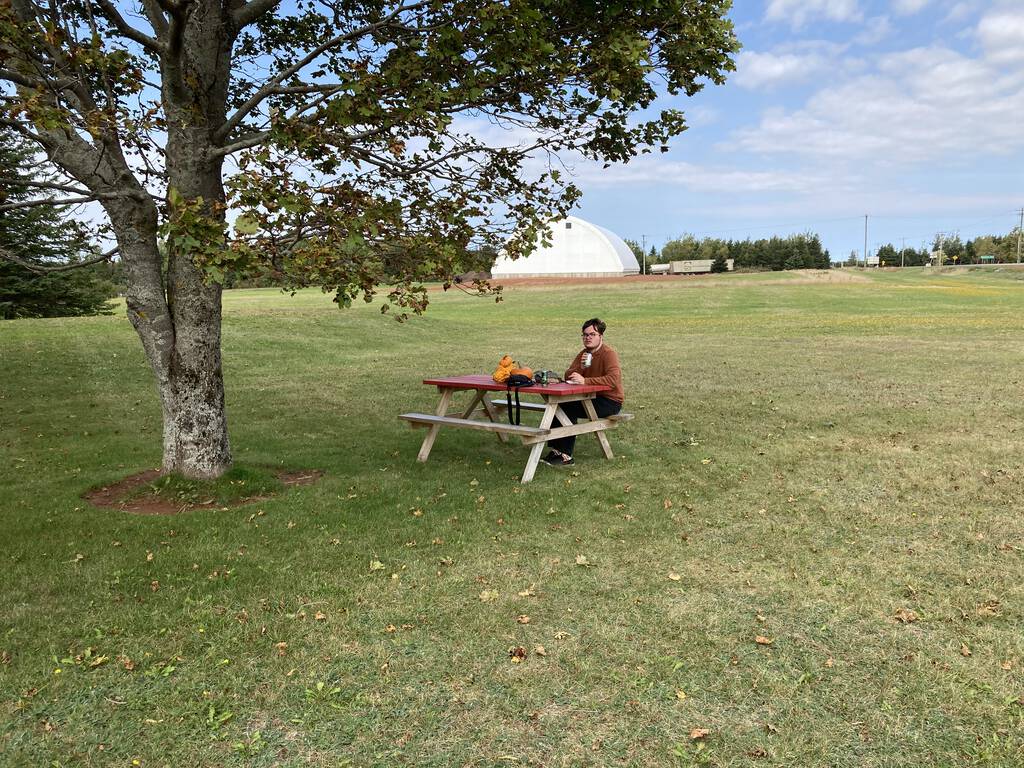
Our dilly bars consumed, I realized we were within spitting distance of The Handpie Company in Albany, so we headed there for lunch, enjoyed under the shade of a tree on the grounds. The handpies we had were light and flaky and just wonderful, and this precipitated an email thread with Sarah, personable owner of the enterprise, about how to achieve this when I heat frozen handpies at home (she advised to give a “light egg-wash first to get that golden top crust,” something that’s right on the instructions but a step I’d been skipping).

Oliver sitting at a picnic table under a tree at The Handpie Company.

Oliver in Albany.

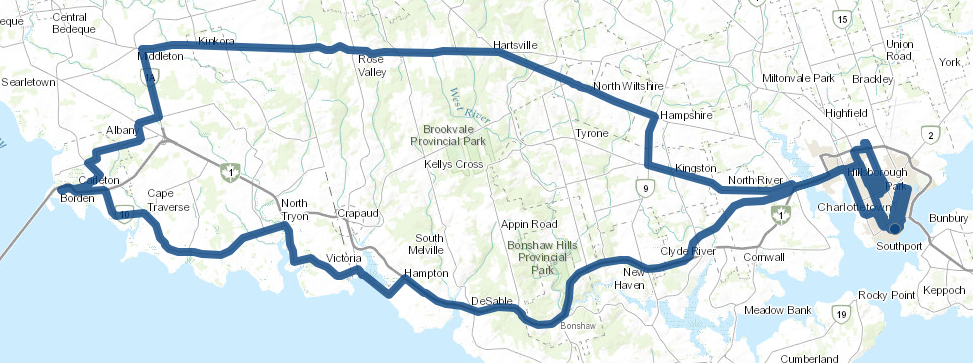
From The Handpie Company we took the back route, through downtown Albany (a lovely village; my first visit) into Borden-Carleton, where we topped up the Kia Soul EV at the new Flo charger behind the gas station. We then drove along the south shore, through Cape Traverse and Tryon, to Victoria where, what with the sugar-dam already having burst, we stopped for Factory Coffee and hot chocolate on the patio.

Map showing our route from Charlottetown west to Kinkora, south to Borden, and back home.

Fortified with caffeine and sugar, we headed toward home for afternoon chores.

Our house at 100 Prince Street shares a 24 inch “alley” with our neighbours at 104 Prince Street, an alley that, despite living here for 20 years, I’d never looked inside until a few weeks ago, when I took a look with a insulation contractor. Once of the mysteries unveiled to me on that visit was that the vents for our range fume hood, our bathroom fans and our clothes dryer were in need of repair, their flaps no longer flapping open and closed. Attending to that was my Saturday project.

And a fascinating project it was: I learned a lot about vent assemblies–a 4 inch aluminum tube attached to the flappy part–at Home Hardware, and, in sliding the existing dryer vent out, I learned just how thick the walls of our house are (from shingles to plaster is about 15 inches), and that there actually is some insulation in the walls. The job ended up extending over two days, as I wasn’t satisfied with my first go at bodging the existing dryer vent together with some replacement parts on Saturday, so I ripped everything out on Sunday and did a much cleaner job. I ended up spending a lot of time in that little alley, and thus extended my dominion of comfort to a whole new region of the house.

As the afternoon drew to a close, I pressed pause on chores, made a quick supper, and prepared for Fountain Pen Night on Zoom.

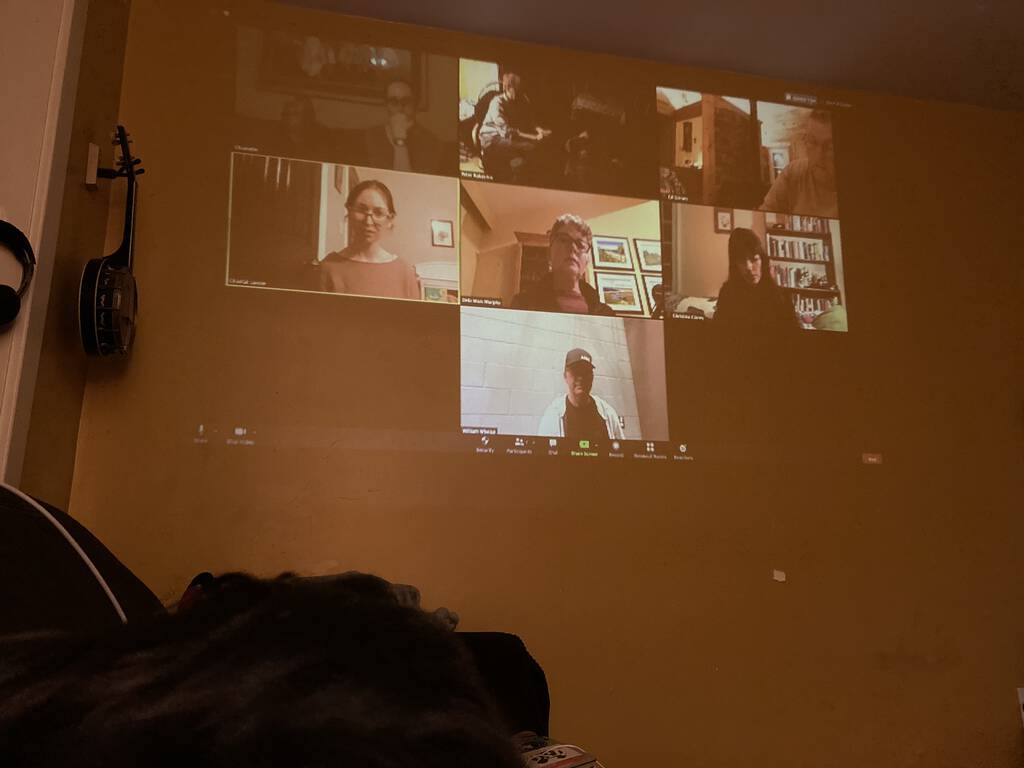
Because both Oliver and I were going to attend, I decided to try an experiment in projecting the Zoom on the living room wall with our screen projector while, at the same time, capturing Oliver and I on a standalone Logitech webcam mounted on a tripod. The ergonomics and image quality left something to be desired (it was a delicate balance to get the room dark enough to see the projected Zoom clearly while light enough to allow others to see me and Oliver).

Pen Night on Zoom projected on our living room wall.

Special guest star at Pen Night this week was my friend Bill, a medical physicist with a particular research interest in optics. Bill uses fountain pen ink to approximate blood in his lab, and he walked is through spectral analysis of various ink samples. It was an interesting deep dive into colour theory, light, reflection, and absorption, and Bill, left without a webcam by circumstances beyond his control, gamely rose to the occasion of conducting the entire seminar with his iPhone.

Pen Night drew to a close around 9:30 p.m., and, in the normal course of affairs this would have been the time to start getting ready for bed, but it was also Saturday Movie Night and Oliver would have none of suspending that routine, Pen Night or not.

It was the week I was commanded to pick a movie from Oliver’s teen years and, further, I was told the film had to be on the theme either of Google or Oliver. There was really only one clear choice: The Internship, the 2013 film starring Vince Vaughn and Owen Wilson that was set on the Google campus. Not a great film, but not a horrible film, and really the only one eligible given Oliver’s dictates.

It was thus almost midnight by the time Oliver started his playlist playing and went off to bed.

Sunday was a two-breakfasts-no-lunch day.

We started the day with our habitual waffles, then, at noon, went down to the waterfront to enjoy Sunday pancakes with Catherine Hennessey and G. We emerged into the early afternoon again caffeine-filled (this time on Catherine’s black tea), and headed to Home Depot to pick up supplies for day two of the dryer vent odyssey. 

Home Depot was positively hopping, and it took a lot of social distancing gymnastics to manoeuvre ourselves into the right aisle for long enough to pick the parts I needed for the job (I set on the flappy part, a 3 foot length of 4 inch aluminum tubing, a 4 inch pipe clamp, and a small length of flexible 4 inch conduit to allow the final connection to the dryer some flex). With Saturday’s experience already under my belt, I made short work of the job, and I’m very pleased with how it all turned out.

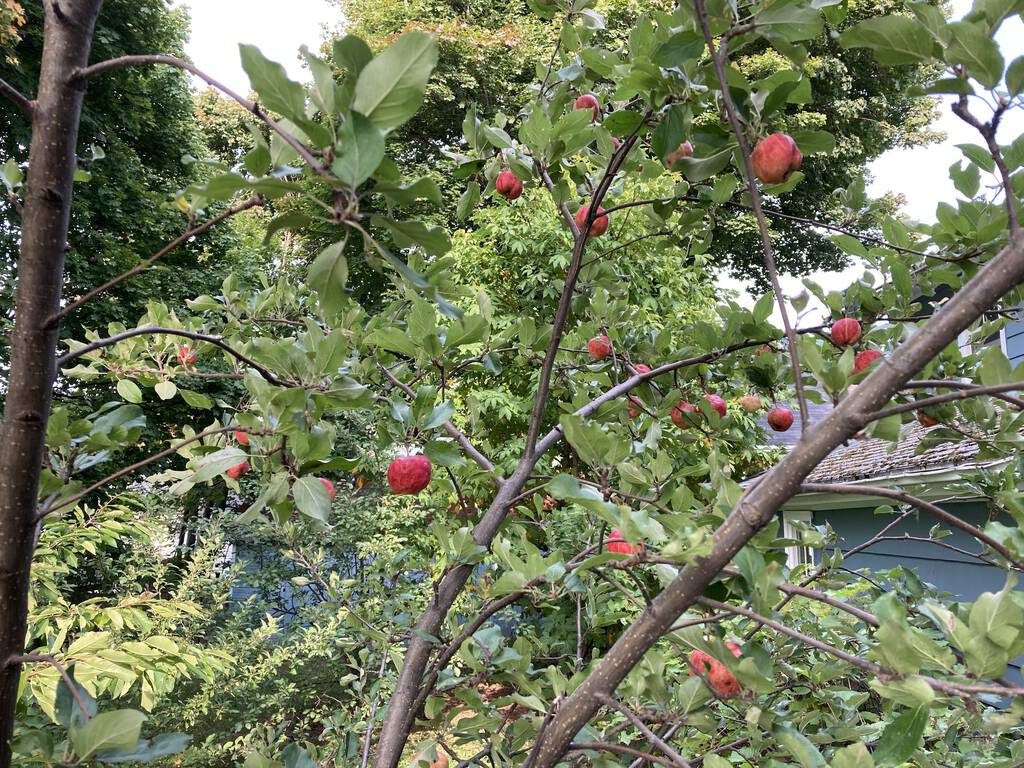
As I already had the extension ladder up out of the basement, I used the opportunity to pick the remaining apples and plums from the trees in the back yard. I managed to pick all but the very highest ones; the apples were tiny, but plentiful, and I ended up with three dozen.

Inside the apple tree in the back yard from on high.

Apples and plums picked, I set the plums aside to pass along to a friend, and set out to make another batch of applesauce. The Instant Pot was almost-overflowing by the time I’d filled it with apples; 8 minutes of pressure, and 30 minutes of mashing about, and I had a quart in the fridge ready for this week’s breakfast.

I was on a roll, so I just kept going after supper and made another batch of pasta sauce, using two pounds of Roma tomatoes purchased at the market from Sam at Cranbush Farms, along with carrots and zucchini from Trudy White, leeks from Paul Offer, and the single pepper I grew this summer, Fiero (who turned out to not be fiery at all). We’re now set for at least three weeks of pasta eating with a couple of quarts in the freezer.

Fiero the Pepper

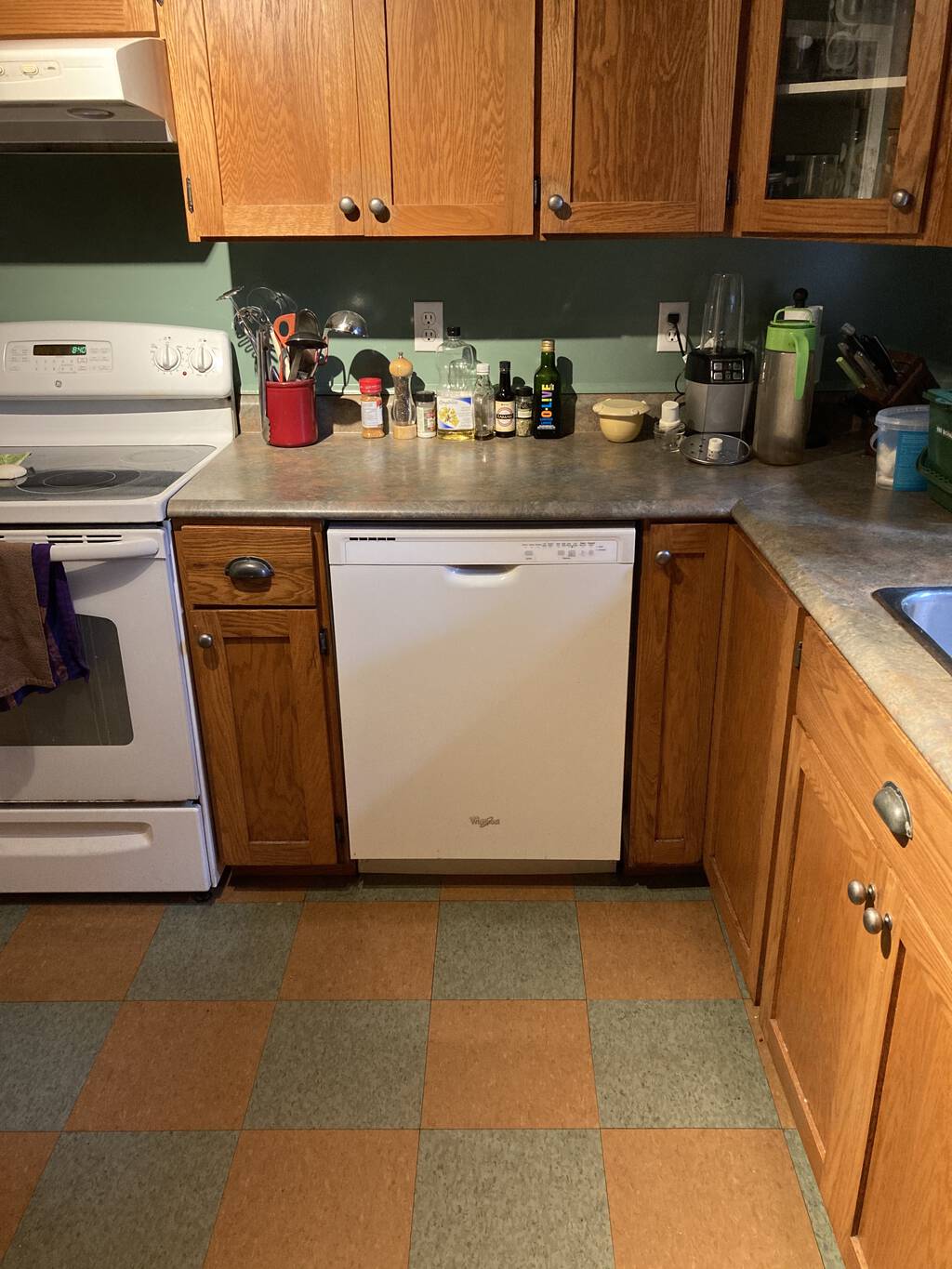
I finished the evening by running up to Sobeys for weekly groceries and then, on my return, clearing out the kitchen cupboards around the dishwasher, as a new one is set to be delivered this morning from MacArthur’s, continuing the season of appliance replacement due to breakdowns (in this case the Whirlpool dishwasher, purchased only 4 years and one Premier ago, needed a $300 motor replacement; on the advice of our repairman, and brother Johnny, the replacement is a Bosch). Here’s the old one on its last morning in place, for posterity:

Our old dishwasher.

All and all a satisfying and productive weekend.

28 Sep 06:05

elite-source.asm - annotated source code for Elite on the BBC Micro

elite-source.asm - annotated source code for Elite on the BBC Micro

Mark Moxon has annotated every single line of the source code for Elite on the BBC Micro, and his annotations are so clear and in-depth that I can follow it despite knowing next to nothing about assembly code (and certainly nothing about writing it for the BBC).

Via Hacker News

28 Sep 01:28

datasette-dateutil

datasette-dateutil

New Datasette plugin exposing date/time parsing custom SQL functions powered by the classic dateutil Python library.

Via @simonw

28 Sep 01:28

Twitter Favorites: [kristynwongtam] Today we took a lane and then some. #ActiveTO is ending too soon. #ActiveTOonYonge #LetsExtendIt #BuildBackBetter https://t.co/MP3U1pXcTh

Kristyn Wong-Tam @kristynwongtam
Today we took a lane and then some. #ActiveTO is ending too soon. #ActiveTOonYonge #LetsExtendIt #BuildBackBetter pic.twitter.com/MP3U1pXcTh
28 Sep 01:26

Twitter Favorites: [AnakanaSchofiel] Two words: Ban Golf

Anakana Schofield @AnakanaSchofiel
Two words: Ban Golf
27 Sep 23:58

'Mercury' streamliner, 1936. Art Deco in all it's glory. pic.twitter.com/66rGqrosrO

by Things from the past 📷🎥 (moodvintage)
mkalus shared this story from moodvintage on Twitter.

'Mercury' streamliner, 1936. Art Deco in all it's glory. pic.twitter.com/66rGqrosrO


2966 likes, 598 retweets
27 Sep 23:09

Rogers and Fido increasing international daily roaming prices on October 14

by Aisha Malik

Rogers and Fido are reportedly increasing their international daily roaming prices for Rogers Roam Like Home and Fido Roam.

The international daily roaming option, which currently costs $12 per day, will increase to $14 per day starting October 14th, according to the carriers’ websites.

“As of October 14, 2020, Roam Like Home will be $14/day in eligible destinations,” Rogers outlines on its website.

Rogers had originally planned to implement the price increase earlier this year, but delayed it due to COVID-19, according to documents seen by iPhoneinCanada. The documents also state that Rogers continuously reviews its prices, and that changes are implemented to reflect the increased cost of providing roaming services.

The carriers’ international roaming plans let customers use their current talk, text and data while travelling, with up to a maximum 15 day charge per billing cycle.

It’s worth noting that towards the beginning of the pandemic, Rogers had waived roaming fees for customers abroad to help customers stay in contact with friends and family.

Source: Rogers, Fido Via: iPhoneinCanada

The post Rogers and Fido increasing international daily roaming prices on October 14 appeared first on MobileSyrup.

27 Sep 23:09

Week Notes 20#39

by Ton Zijlstra

I didn’t work much this week. The first two days were part of our long weekend in the southern part of the Netherlands, spent outdoors enjoying the great weather with the three of us. That left two days for work, and as Y didn’t go to school due to a cold, I spent Friday with her. The weekend was given over to household chores. With autumn now starting we started to move our attention more indoors, to increase comfort there. Over the weekend we started decluttering the shed to make space for the garden furniture that needs to move inside for the winter. As a second wave of the pandemic is appearing around us in the statistics, and as we’ve stayed home this week after our little trip due to Y’s cold and our own accompanying sniffles, I’ve also restocked so we don’t need to go to the supermarket much for the next weeks.

Things I worked on:

  • Had a tooth implant finalised, so I can chew on both sides again after a year of having a missing molar
  • Worked on a province’s data publising platform and accompanying processes
  • Had our monthly meeting with my business partners
  • Sent some invoices, paid salaries to our team
  • Had weekly team meeting with a client
  • Changed the way I work on notes/notions, instead of starting and finishing them one by one, I now keep a dozen or so of them in parallel, making iterative steps in whittling them down to Notions. Most if not all start from my old blogposts taken daily from my ‘on this day in…’ archive, and I copy them over into a proto-note and then work on them piecemeal, splitting off the things that stand out. It works, as I’ve picked up the pace again, writing 80, plus a dozen in progress, in the past two weeks. So I’m well over the slump I experienced before that.

As we visited the ruins of the only Dutch hill top castle from the 14th century last Monday, all the names carved into the soft sand stones stood out. Writing your name on things is of all ages. In this case J Mise from Liege couldn’t resist doing so. 131 years later we still know (s)he was a vandal.

J Mise from Liege was a vandal in 1879


This is a RSS only posting for regular readers. Not secret, just unlisted. Comments / webmention / pingback all ok.
Read more about RSS Club
27 Sep 23:07

Won’t Subscribe

Since I’m lightly employed these days, I enjoy keeping up with the news. In recent weeks, I’ve been blocked by the paywalls of the Wall Street Journal, Globe & Mail (closest thing Canada has to a national newspaper), the Times/Sunday Times (of London), the Telegraph (also UK), Business Insider, and Bloomberg. Recently I got a bit of inside info on how these publications think about the economics, and I’m here to explain why they’re wrong.

Background

As a family we already subscribe to the NY Times, the Washington Post, the Guardian, the Vancouver Sun, the Economist, Talking Points Memo, Heated, and The Tyee.

Here’s a table of a few publications and their subscription prices, normalized to US$/year, sorted in order of ascending cost:

Business Insider $99.00
Washington Post $100.00
Wall Street Journal $119.88
New York Times $221.00
Guardian $240.00
Globe & Mail $272.61
Telegraph $399.36
Bloomberg $419.88
Times of London $665.60

Discovering these prices was nontrivial; many are hidden behind an “intro rate”. Also, they’re quoted per week, per month, per quarter, per four weeks (really?!), and per year. Where multiple rates are quoted, I took the yearly one.

Looking at this, I think I see an immature market; which is to say, the mapping between price and value is not orderly.

How they think about it

Earlier this year, I had a lot of chances to talk to journalists. More than once, this happened. Journo: “I’ll send you a link when this publishes.” Tim: “Yeah, but I won’t read it, you’re paywalled.” On these occasions, if the journalist seemed capable of hearing, I gave them a lecture about how, since I wasn’t going to subscribe, there should be a way for me to pay a bit and read their piece. One of them, I forget who (sorry), explained How Management Sees It.

First of all, they’ve got a figure in their mind of how much they’re going to make if they can get me to click on that “Subscribe” button. They’ll have a model where a certain number will unsubscribe during the initial-rate period, a few will drop off later in the first year, and some will become long-term subscribers. This journo suggested that the figure in management’s mind looks something like half a year’s subscription. Which, looking at the table above, is a figure in the rough range of $50 to $300. Part of the calculation includes the fact that most of us are lazy and administratively incompetent and just won’t get around to unsubscribing, even if we want to.

The next step in their thinking involves an estimate of how much they could get for an individual article view. It’s hard to imagine anyone being willing to pay more than a buck. Minimum price… Who knows? Our current bank infrastructure isn’t good at micropayments, which makes it harder. Of course, you could imagine some sort of intermediary service which pools per-article payments to many publications and could probably do micropayments, but nobody’s gotten traction with one of those yet. Furthermore, this intermediary starts to smell like Doordash, a service that controls access to your clients and charges you an onerous revenue slice. Every restaurant hates them.

Thus we get to The Ratio. Let’s be generous and assume you could get a buck for access to your article. Then ask yourself, “How many of those to I have to sell to make as much money as I would with a subscription?” Dividing that dollar into the that half-a-year-of-subscription number, the subscription is going to be worth somewhere between 50 and 300 times more valuable than the article.

So, says Mr Manager, “Why on earth would I invest in selling individual articles when a click on the “Subscribe” button gets me a hundred times the revenue?”

Why they’re wrong

Their arithmetic didn’t consider their chance of getting me to click on “Subscribe.” In my particular case, that chance is almost exactly Zero. I subscribe to enough things and I am acutely reluctant to give anyone else the ability to make regular withdrawals from my bank account. I don’t think I’m unusual. People may not be financially sophisticated, but they’re smart enough to see through the “initial-price” flim-flam and a lot of us are highly conscious of our own administrative futility and the fact that we might just not get around to unsubscribing. I’ve seen this called “Subscription fatigue” and I think that’s a decent label.

“But wait,” says Mr Manager, “you already subscribe to five publications, so you’ve proved you have a propensity to subscribe! You’re exactly my target market!” Wrong. It’s exactly because I’ve done some subscribing that I’m just not gonna do any more.

“Hold on,” he says, “I’ve got an excellent publication, full of great journalism and delicious writing. I should be able to compete with those other things and maybe displace them!” He’s got a point, and it’s not fair, but he’s still wrong. Maybe it’s just that those other guys got there first. Maybe it’s just my administrative inadequacy. Maybe you’re just not quite as valuable as those others just yet. But de facto, your chances of replacing any of them are pretty damn small.

The way forward

Note that this section will, like the rest of the piece, completely ignore advertising. The life has been entirely sucked out of advertising-based publishing by the Facebook/Google duopoly, and absent vigorous antitrust energy from various governments, it ain’t coming back. Actually, I think there’s hope. But hope isn’t a business strategy.

So I think the only way forward is to figure out how to sell articles. It’s not gonna be easy, and if I were the publications I’d also really not want the equivalent of a Doordash getting in the way.

It dawns at me that if I were still at AWS, I might propose offering Digital Content Volume Sales as a Service. “Simple Article Sales Service”, SASS. Maybe I should write a PR/FAQ.

27 Sep 23:07

And who by fire, who by water Who by COVID, who by chloroquine Who by police, who by protest Who by gender reveal party, who only 45 days before the election And who shall I say is calling?

by Scott Alexander (slatestarcodex)
mkalus shared this story from slatestarcodex on Twitter.

And who by fire, who by water
Who by COVID, who by chloroquine
Who by police, who by protest
Who by gender reveal party, who only 45 days before the election
And who shall I say is calling?


45 likes, 4 retweets