Shared posts

08 Apr 01:00

Highlight “obviously wrong” values on dashboards!

by Nick Desbarats

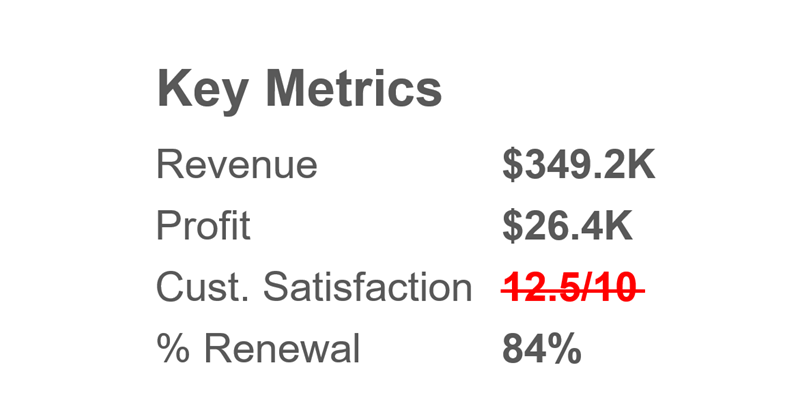
This might come as a bit of a shock, but data on dashboards can be wrong. I KNOW! While data quality problems are often hard to detect, sometimes, they’re blatantly obvious. An “Average Customer Satisfaction Rating” of 12.5 on 10. A “Manufacturing Defect Rate” of -14%. A “Current Headcount” of 0.

Unfortunately, most dashboards display obviously wrong values such as these without any indication that anything’s amiss. Imagine being a dashboard user and seeing “Average Customer Satisfaction Rating: 12.5/10” among the metrics on a dashboard, though. What’s going through your head? Probably something like, “Man, if no one on the data team noticed such an obvious error, what ELSE is wrong on this dashboard?” It puts the accuracy of every other value on the dashboard into question, now and probably for quite some time in the future. It’s already hard enough to earn users’ trust when it comes to the accuracy of the data on our dashboards and incidents like these set us way, way back. After even just a few such incidents, users may simply stop using the dashboard altogether. Why use information that clearly hasn’t been subjected to even basic quality checks and that contains obvious errors?

What can we do, though, right? Errors are gonna happen. Well, in my Practical Dashboards course, I recommend adding simple business logic to dashboards to test whether metric values are obviously wrong, and to visually flag them if they are, like this:
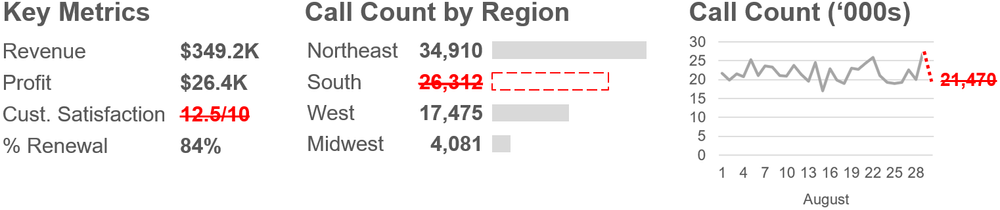
Sample graphs with obviously wrong metrics.png

By visually flagging obviously wrong values, we provide at least some reassurance to users by showing them that we are doing basic quality checking, that we’ve noticed the error, and that we’re (hopefully) working on it. Obviously, it’s still not great when users see something like this on a dashboard, but it’s far better than users spotting an obviously wrong value themselves without any indication that the data team noticed such an obvious problem.

In the Practical Dashboards course, I discuss several types of tests that we can use to detect “obviously wrong” metric values. The more of these that our dashboards support, the better:

Value not in realistic range

For most metrics, we have a good idea of what’s realistically possible. If Daily Revenue is almost always between $50K and $200K, we should flag it as obviously wrong if it ever falls outside of, say, $0 to $1M. If “Average Customer Satisfaction” isn’t a positive float value between 0 and 10, it should get flagged.

Metric not updated as expected

A more pernicious type of “obviously wrong” problem occurs when a metric’s value hasn’t been updated as expected and so no value exists for the current period. Unfortunately, when this happens, many dashboard development products will start looking back through time until they find a value for that metric and then display that out-of-date, obsolete value without any kind of warning to users, who then have no idea that they’re looking at old data. This can obviously lead to very bad decision-making.

Note that, in order to detect “not updated as expected” problems, the dashboard needs to “know” the expected update schedule for each metric, so there’s work involved here. Hopefully, though, I’m convincing you that this is work that’s worth doing.

Input values not in realistic range or not updated as expected

For calculated metrics that are the sum, average, etc. of a set of input values (i.e., most metrics), we should test all of the input values, as well. If even one single input value is obviously wrong, the final calculated metric must also be flagged as obviously wrong until every obviously wrong input value is corrected.

Higher/lower than other, related metrics

Profit must never be higher than Revenue. Payroll Expenses must never be higher than Total Expenses. The more of these “higher/lower” rules that our dashboard “knows”, the better it will be at catching and flagging obviously wrong metrics. The number of such rules is potentially large, so maybe start with rules for metrics that you suspect may be more prone to errors. Note that, if a “higher/lower” rule is violated, BOTH metric values must be flagged as obviously wrong until it’s determined which one is actually wrong.


In situations where we have a bit of time between when we receive updated values and when we need to show users an updated dashboard, “obviously wrong” tests can alert the data team to errors and give them a chance to investigate and correct them before users see them on the dashboard, which is even better, of course.

Sometimes, I get pushback from workshop participants who aren’t comfortable drawing attention to errors that, in certain cases, could be their fault. What looks worse, though: A mistake that a user notices that your dashboard didn’t catch, or one that they notice but that is visually flagged? There’s also an ethical consideration, of course. If we deliberately avoid checking for obviously wrong values because we don’t want to look bad, we’re knowingly exposing our organization to potential harm in the form of bad decisions that were made because of bad data.

Others have suggested simply not showing obviously wrong values at all, or replacing them with a message such as “Pending…”. You could opt to do that but, often, the “obviously wrong” value is still meaningful. For example, if the Revenue number for the most recent day hasn’t been updated as expected, the number from the day before still gives a ballpark idea of what it might be. Forcing users to wait for investigations to be completed to see any value at all could cause harm, as well…

By the way…

If you’re interested in attending my Practical Charts or Practical Dashboards course, here’s a list of my upcoming open-registration workshops.

11 Dec 04:06

Online peer learning: A growing trend sees 2 different approaches

Chelsea Waite, Christensen Institute, Dec 09, 2020
Icon

There are some seriously wrong ideas about learning in the corporate world, and seriously wrong ideas about life in general. I present this actual quote from an article as evidence: "I’ve argued in the past that now is the time to lean into student agency by reframing students as assets." Now I get the point; I've made it many times myself. We don't need to depend on teachers and tech alone to provide learning; students can and should help each other. It's not exactly a new or growing trend; it has been around as long as I can recall. But I've never framed this as a strategy to "lean into student agency" nor to "reframe students as assets". I recognize that this is corporate-speak; I've certainly see enough of it. But the fact that corporates speak this way is what enables them to dehumanize students and employees.

Web: [Direct Link] [This Post]
11 Dec 04:06

The mind science behind microlearning

Amit Garg, Upside Learning Blog, Dec 09, 2020
Icon

What I liked about this article was the one-paragraph description of how Pringles potato chips are made. What I didn't like was pretty much everything else. The Pringles example stands out enough and is clear enough that you probably will remember how they're made (4 tons of pressure, 11 seconds in hot oil). But the rest of it is just a grab-bag of (apparently) randomly selected theories of learning not actually connected to microlearning. I'm concerned that almost all of what I'm reading in e-learning is falling into one of three categories: misleading advertorial content like this; poorly-reasoned and constructed academic articles; stuff about ed tech that is actually interesting and well written but is too esoteric for most  readers.

Web: [Direct Link] [This Post]
11 Dec 04:05

These Weeks in Firefox: Issue 84

by Doug Thayer

Highlights

  • Nightly users can now manage their homepage and newtab page from about:preferences. This allows them to use the default homepage even if an extension has provided one of its own. (Bug 1595858)
    • Dropdown menu of newtab pages to use.

Friends of the Firefox team

Resolved bugs (excluding employees)

Fixed more than one bug

New contributors (🌟 = first patch)

Project Updates

Addon Manager & about:addons
  • Mark Striemer did land the remaining small changes needed to remove XUL deck usage from about:addons (Bug 1674890) and ntim did some more cleanups on the about:addons (Bug 1677582, Bug 1677571, Bug 1677526), in preparation to move the HTML views to the top level document (Bug 1525179).
WebExtension APIs
  • Liz Krane contributed changes to browser.tabs.remove to make sure that (after an extension did call it to remove multiple tabs at once) “Undo Close Tabs” will be able to reopen all of them at once (Bug 1650956). Thanks Liz for contributing this small enhancement!!!
  • browser.browsingData.removePluginData API method is a no-op starting from Firefox 85 (Bug 1675106), part of the cleanup related to removing all flash plugin support in mozilla-central (tracked by Bug 1677160).
  • Christoph Kerschbaumer added a new browser.privacy.network.httpsOnlyMode read-only privacy browser setting, which will allow an extension to be aware if the https only mode is currently enabled (Bug 1678306).

Developer Tools

  • DevTools Fission – Making DevTools Fission compatible
  • Significant simplification of the Network panel logic used to send collected data from the backend (DevTools Server) to the front-end (DevTools Toolbox). Data is now sent as-is with no transformation in the middle and the UI (React components) are consuming exactly the same structure as generated on the server side. Modification has positively impacted RDP traffic and protocol performance.

Fission

  •  Neil is working on:
    • Smarter tab unloading
    • UI to make it easier to submit crash reports for crashed subframes

Password Manager

PDFs & Printing

Performance

Picture-in-Picture

Search and Navigation

  • Fixed a race condition leaving the address bar in Search Mode when switching tabs – Bug 1675926
  • The address bar doesn’t default to search anymore for strings like www.something – Bug 1643850
  • URL autofill is now properly case-insensitive – Bug 1606231
  • QuickSuggest is the project name for contextual suggestions in the urlbar, things like weather, unit conversion, or shopping helpers fall into this project. The team is working on experiments that will run in the next few weeks, and various partners are involved.
  • Some regressions related to Korean IME have been reported, we’re looking into them. – Bug 1673669, Bug 1679697
11 Dec 04:02

Raspberry Pi Storage Benchmarks + Benchmarking Script

by jamesachambers
Pi Benchmark 2019 ContendersStorage options continue to advance at a very fast pace. We’ve seen a lot of changes in the past couple of years with viable storage options for your Pi. Solid state drives are now so cheap that it can be cheaper to outfit your Pi with a SSD than buy a MicroSD card! MicroSD cards also continue to evolve with the new “Application Class” A1 and A2 certifications.

This year I wanted to do something more than just benchmark my ever-growing pile of MicroSD cards and solid state drives. Although I have a wide variety of storage to test I don’t have everything! So this time I created a benchmark that gives you a easy to compare score and anonymously submits the storage specifications and the results to this site.

Running the benchmark is a one-liner:
curl https://raw.githubusercontent.com/TheRemote/PiBenchmarks/master/Storage.sh | sudo bash

Source

11 Dec 04:02

“Ich will hier nur sitzen”

by swissmiss

For my German speaking followers: I just remembered this gem from Loriot. So delightful. Weirdly appropriate for 2020.

11 Dec 04:02

Optimal Notion Length: Notion Mass Index 200

by Ton Zijlstra

After writing 700 Notions I see a pattern emerge w.r.t short, ‘right’ and long ones

Then last week I came across this click-baity posting by Tim Denning, advocating max 200-word posts to reach ‘virality’, while reflecting on my blogwriting pace. Checking the length of my Notions, I looked at the ones that feel just right. Those are around the 200 mark. I suppose they are bite sized enough to not have to make a ‘mental summary’ during reading.

I also looked at other Notions:
Shorter ones are not developed enough, basically stubs.
Longer Notions are mostly not edited enough, either there are multiple notions packed into one, or I’m unclear in my formulation or understanding or both.
The ‘right’ ones fit much better into emergent outlines, where I collate several Notions.

I started calling the optimal notion length ‘Notion Mass Index’, and an NMI of 200 seems a healthy one. (This blogpost has 194 words, the Notion it is based on has 177.)

09 Dec 02:10

Apple Announces AirPods Max: Wireless Over-Ear Headphones Available Just in Time for the Holidays

by John Voorhees

Today, Apple revealed the AirPods Max, wireless, over-ear headphones that take advantage of the company’s H1 SoC.

It’s no secret that AirPods have been a big hit. The original model, announced in 2016, has been revised once and in October 2019, Apple released the AirPods Pro adding noise cancellation and transparency mode to the connectivity magic enabled by the company’s H1 SoC. Ever since, rumors have circulated that Apple was developing an over-ear model. With today’s announcements the rumors and speculation have become a reality. Let’s look at what Apple has in store for music fans.

The AirPods Max, which are more expensive than rumored at $549, are initially launching in the US and 25 other countries. Many of the features and specs of the AirPods Max line up with previous rumors and share similarities with Apple’s AirPods Pro. The over-ear headphones feature:

  • Apple’s proprietary H1 SoC (one in each ear cup), which provides a stack of features on top of Bluetooth 5.0 that enables wireless connectivity features like fast device switching across multiple devices
  • Active noise cancellation
  • Transparency mode
  • Nine microphones for noise cancellation and other features
  • Adaptive EQ
  • A Digital Crown that controls volume, play/pause, skipping tracks, and Siri functionality
  • Optical and position sensors in the ear cups
  • A case detection sensor
  • An accelerometer
  • A gyroscope in the left ear cup
  • Ear cushions attach magnetically and can be replaced for $69
  • Lightning connectivity for charging and wired listening with Apple’s optional 3.5mm to Lightning cable
  • 20 hours of battery life and 1.5 hours of charge in just 5 minutes of charging
  • A Smart Case that puts the AirPods Max into an ultra-low power state

Apple also offers a $35 3.5mm to Lightning cable so the AirPods Max can be used wired.

The AirPods Max Smart Case.

The AirPods Max Smart Case.

Regarding the ear cups and Digital Crown, Apple’s press release says:

Each ear cup attaches to the headband through a revolutionary mechanism that balances and distributes ear cup pressure, and allows it to independently pivot and rotate to fit the unique contours of a user’s head. Each ear cushion uses acoustically engineered memory foam to create an effective seal — a critical factor in delivering immersive sound. The Digital Crown, inspired by Apple Watch, offers precise volume control and the ability to play or pause audio, skip tracks, answer or end phone calls, and activate Siri.

Like Apple’s other AirPods models, AirPods Max will also take advantage of automatic device switching. The new over-ear headphones will also feature spatial audio, previously available with the AirPods Pro only.

The AirPods Max, which are available in space gray, silver, sky blue, green, and pink, are over-ear headphones that completely surround users’ ears. The design is striking. According to Apple:

From the canopy to the ear cushions, every part of AirPods Max is carefully crafted to provide exceptional acoustic performance for each user. The breathable knit mesh canopy, spanning the headband, is made to distribute weight and reduce on-head pressure. The stainless steel headband frame provides strength, flexibility, and comfort for a wide variety of head shapes and sizes. Telescoping headband arms smoothly extend and stay in place to maintain the desired fit.

Until AirPods Max are in the hands of users, it’s impossible to know how well they work or how good they sound. Still, I’m glad to see Apple expanding the AirPods lineup. I’ve been spoiled by the unique conveniences of AirPods and AirPods Pro, and with the AirPods Max, I’m eager to see how those features and the new ones announced today translate to an over-ear experience.

AirPods Max are available for pre-order now and will be available beginning Tuesday, December 15th for $549.

Apple has posted two videos on its YouTube channel: one narrated by Evans Hankey, VP of Industrial Design, and Gary Geaves, VP, Acoustics that introduces the AirPods Max and the other an ad titled Journey Into Sound, both of which you can find after the break.


Support MacStories Directly

Club MacStories offers exclusive access to extra MacStories content, delivered every week; it’s also a way to support us directly.

Club MacStories will help you discover the best apps for your devices and get the most out of your iPhone, iPad, and Mac. Plus, it’s made in Italy.

Join Now
09 Dec 02:09

“This is our business model” is not a defense

by Josh Bernoff

Companies engaged in questionable or unethical practices will often defend them by saying, “This is our business model.” But building a business on bad behavior does not make it right. This came up after my criticism of Statista’s research practices yesterday. The company responded in a pair of tweets: I am not disputing that Statista … Continued

The post “This is our business model” is not a defense appeared first on without bullshit.

09 Dec 02:09

Interactive explainer for how cameras and lenses work

by Nathan Yau

We use our cameras all of the time, and it almost seems like magic when you press that button and somehow an image is captured. But of course it’s not magic. Bartosz Ciechanowski provides a detailed interactive explainer on how the camera and lens record light.

There are a lot of satisfying sliders to adjust dimensions and see how the mechanics change. It reminds me of those exhibits at kid science museums with the big knobs and handles.

See also Ciechanowski’s explainer of a similar flavor on how gears work.

Tags: Bartosz Ciechanowski, camera, lens

09 Dec 02:07

The Precarious State of Bowinn Ma

by Gordon Price

Bowinn Ma is the provincial Minister of State for Infrastructure.  A Minister of State, not an actual Minister (as many of her fans anticipated).  But she nonetheless has a rather ambitious to-do list.

This* is what’s in her Mandate Letter:

  • Extend the Millennium Line to Arbutus, with an eventual terminus at UBC
  • Prompt design and construction of the Surrey-Langley Skytrain.
  • Widen Highway 1 through the Fraser Valley
  • Replace the Massey crossing
  • Complete the Pattullo Bridge Replacement Project.
  • Support planning for key transit projects, like high-speed transit links for the North Shore and the expansion of rail up the Fraser Valley.

In short: the biggest roads and the longest trains.  Not all on her own, of course; responsibilities for TransLink alone are split among three Ministers of various kinds.   But the part of her portfolio that she will be tested on will be getting the big road projects unstoppably underway before the next election.

So if conflict is to occur, it’s less likely to be among her colleagues than between her mandate and her rhetoric when it comes to shaping growth with big-time road infrastructure.

The implicit expectation by the Premier may be that the high-growth parts of our region – east of Langley, south of the Fraser – can become more like the region he represents (Langford and the western communities of Victoria), where working people should still be able to afford a house to drive to and won’t pay tolls to get there. And to do that we need more big roads, bridges (or tunnels), with some incidental room for transit.

Ma has argued that such a strategy is futile.  Widening highways and building untolled crossings to reduce congestion just begets more congestion.  (She made a celebrated speech in the Legislature on that very point – here.)


So why would the Premier appoint an MLA whose public position is that the era of big roads is (or should be) over?  The chattering classes (Price Tags division) have come up with some possible reasons:

(1) The obvious one.

She’s an engineering project manager.  If you want someone who knows about complex infrastructure projects, get someone who does.


(2) The other obvious one:

She’s ideal for dealing with the public on transportation.  She proved she could perform in her riding on the North Shore, where she convincingly moved forward the possibility of SkyTrain coming to one of the slowest growing parts of the region.


(3) It’s about loyalty (or punishment).

Ma might have been the AOC leader to a squad of urban activists in the legislature – if such existed – but this appointment makes it more difficult for her to follow through on her own rhetoric.  The NDP, after all, got all those new seats in unlikely places like mid-Valley – Mission, Maple Ridge, Abbotsford – and that means scratching the very itchy irritant of congestion..

To the Premier, it’s a chance to see whether Ma has learned where her place is.  ‘We need highways to win and keep votes.  No fancy talk about not building wider roads and more river crossings.’


(4) It’s about risk.

Bringing home large infrastructure involves risk and reward.   If the project or the financing screws up, she takes the blame – but the Premier cuts the ribbons if it’s a success. She either drives the bus home or gets thrown under it.


(5) It’s a message to the region and the left.

Some in the NDP’s activist wing are pissed.  They feel the voice of moderation, particularly the Premier’s, is a defense of the status quo when progressive action is politically possible. And there’s not much evidence that the party is really interested in active transportation, certainly not road pricing, and barely aware of the importance of land use to meet climate-change targets. In fact, the NDP seem to be happy to expand freeway projects just like governments going back to W.A.C. Bennett in the ’50s.

So who better to provide cover than an advocate for post-Motordom thinking but can still get the car-dominant, climate-unfriendly roads and bridges built – now.  Activists may be unhappy but not so disgruntled that they’ll do a stop-the-pipeline strategy on these projects.

Alternative theory: She’s there to delay things like the Massey Tunnel so it, like highway expansions, can all get rethought.


(6) It’s about her chance to shine – and shape the region

If Ma is responsible for the latest round of Motordom projects, locking the eastern and southern parts of the region into car-dependence, she’ll also have to deliver something that addresses climate and better urban growth in a way that’s more than token – not just some more bike lanes.  She can be the one who does both, using the delivery of roads to justify some dramatic moves on the alternatives, without seeming either hopelessly radical or oblivious.

(Here’s one: For the price of an interchange, everyone in Abbotsford gets an e-bike!)

In other words, she has to turn the generality of that last item on her mandate – “the planning and  development of key transit projects, like high-speed transit links for the North Shore and the expansion of rail up the Fraser Valley” – into tangible reality.

Bowinn Ma could be just the leader who can do what the NDP did in the 70s – produce the 21st-century equivalent of the Agricultural Land Reserve, a strategy to shape the growth of the fastest growing parts of the province into a model for a climate-challenged age.

Something that might even take her from Minister of State to ultimately First Minister.

_______________________________________


*From Bowinn Ma’s Mandate Letter:

Over the course of our mandate, I expect you will work with your Minister to make progress on the following items:

● Support our economic recovery from the COVID-19 pandemic by working with the Minister of Transportation and Infrastructure to advance critical pieces of transportation infrastructure that will benefit communities across B.C.

● Work with the TransLink Mayors’ Council through its 10-year planning process to continue work to extend the Millennium Line to Arbutus, with an eventual terminus at UBC, and ensure prompt design and construction of the Surrey-Langley Skytrain.

● Widen Highway 1 through the Fraser Valley to ease congestion, with a goal of completing the widening of the highway as far as Whatcom Road by 2026.

● Move ahead with a replacement for the Massey crossing, to support communities on both sides.

● Ensure the successful completion of the Pattullo Bridge Replacement Project.

● Work with cabinet colleagues, communities and regions to support the planning and  development of key transit projects, like high-speed transit links for the North Shore and the expansion of rail up the Fraser Valley, which will bring cleaner transit, support economic growth and deliver more construction jobs for B.C. workers.


09 Dec 02:07

Particulate Emissions from Tires Worse than From Tailpipes?

by Sandy James Planner

This week I wrote about the chemical in tires that has been killing the Coho salmon in Puget Sound streams. When there is heavy rain or runoff (quite a common occurrence in the Pacific Northwest) huge fish kills from leaching tire particulate chemicals were found to be devastating to salmon stocks.

All vehicles electric or not have tires, and this adds one more reason to look at travelling smarter and not so intensively by private automobile. Ian Fisher notes that electric cars with their greater mass (battery packs) and high performance wear down tires faster than fuel pumped tire vehicles, showing once more that automobile dependency, of any kind, seems to be  environmentally incompatible.

Ian referenced this article from Green Car Reports that shows that tire and brake wear will probably be next for emissions testing, since Emissions Analytics have found that particulate matter tire wear can be “1,000 times worse” than from internal combustion engined vehicles. Particulate is defined as the solid matter shed by vehicles, different from vehicle exhaust gases.

In a study, Emissions Analytics looked at a popular family car with well inflated tires. The study found the vehicle’s tires “emitted 5.8 grams of particulate matter per kilometer, compared to 4.5 milligrams per kilometer from the exhaust. That translates into a tire-wear emissions higher than exhaust emissions by a “factor of 1,000”.

While regenerative braking on electric vehicles results in drivers not having to pump mechanical brakes as much as in gasoline powered vehicles, the weight of battery packs adds onto tire wear, especially with the larger and heavier SUVs.

Emissions Analytics hopes to start an independent emissions agency which could test for vehicle emissions. Sadly only one vehicle manufacturer, General Motors has been interested in adopting a greener tire standard, suggesting that an independent agency will be required to get other vehicle manufacturers on board.

Yesterday the OECD had a webinar panel on the subject of non-exhaust particulate emissions from roads. Some of the methodology used to look at tire wear is particularly interesting, and you can take a look at the panel discussion in the YouTube video below.

09 Dec 02:07

Moving to Electric Vehicles Will Not Save Our Cities

by Sandy James Planner


Jon Burke, the London Councillor for Hackney responded to Britain’s plan to ban all gas and diesel vehicle sales by 2030 by pointing out that this only addressed  half the issue.

In an opinion piece  in the Huffington Post, Mr. Burke reminded that it was not gasoline powered vehicles that destroyed communities but the presence and use of the vehicles themselves.

Outstanding issues remain with continued private vehicle use regardless of how it is powered.  Those issues include congestion, speed, automotive pollution, and the fact that the trend to larger SUVs (Sports Utility Vehicles) means more road fatalities.

This view is counter to that of many of the electric vehicle companies, who perceive the change away from the ICE (internal combustion engine) as being the way to continue manufacturing vehicles. As technology becomes self driving, it has also been thought that autonomous vehicles will provide transport for seniors, who need to retire from driving vehicles.

Mr. Burke quotes Jane Jacobs from the book Dark Age Ahead  who stated

“Not television or illegal drugs but the automobile has been the chief destroyer of American communities”.

It’s been suggested that the invention of the affordable automobile is the 20th century device that most shaped cities, to the point that car use factors into how we perceive space, time, independence and ourselves.

While we are in the second wave of the Covid pandemic in Vancouver, an article written by Frances Bula in the Globe and Mail in June showed that one-third of those surveyed expected to take transit less and use a vehicle more. The need for physical distancing and worries about  the proximity of people on transit has translated in a new reliance on the private vehicle.

That new adaptation of car use for personal virus bubble protection is part of a trend in Canada that has seen bigger vehicles dominate the market. As Matt Bubbers in the Globe and Mail notes nearly 75 percent of all vehicles sold in this country are “light trucks” inclusive of SUVs.  Cars, pickups, SUV’s and cube vans also contribute to nearly 50 percent of all GHG emissions from transportation. Large “heavy-duty” vehicles make up a further 35 percent of GHGs with rail transport contributing 3.8 percent and motorcycles .2 percent.

There has been an increasing tie-in with  private vehicle ownership and wealth. The SUV with higher seats, all terrain capability is marketed with a rugged persona, and available from all vehicle manufacturers. In North America Ford  will no longer sell cars, just trucks and the very profitable SUVs.

While using electric vehicles is noble, it still does not address the issue of congestion and the deadly statistics with SUVs.  Statistics show that SUVs with the high front end grille are twice as likely to kill pedestrians because the higher engine profile is a driver’s blind spot and directly damages pedestrians’ vital organs,  but this information has not been well publicized.

In the United States a federal initiative to include SUV pedestrian crash survival into the vehicle ranking system was halted by opposing automakers. Drivers have an 11 percent increase in the chance of fatality in them, as their size and bulk is connected with more reckless driving.

There is also not the recognition that there are significant emissions associated with the creation and shipping of electric vehicles, and fifty percent of “lung-stunting” particulate emissions come from tire and brake wear. I have written about vanadium, found in brake dust contributing to a condition called “London Throat” that has an adverse impact on immunity.The metal particles in the dust from worn-out brake pads on vehicles can be just as harmful as diesel emissions. Called BAD for Brake Dust Abrasion, studies done by King’s College London found that the metallic  dust from brake pads cause lung inflammation and “reduce immunity, increasing the risk of respiratory infections.”

The real issue is realizing  that we simply cannot drive ourselves out of this mess. While road speeds can be slowed to 30 km/h to save lives and to make the road environment more comfortable for vulnerable road users, vehicular traffic appears to be increasing in residential areas in many cities. In London England transport data shows from 2009 to 2019 that  there is an 18.6 percent increase in the number of miles driven annually despite congestion charges.

This increase sadly impacts the social street  life of citizens living in London and may be due to several factors including growing online shopping delivery, private cabs, and navigation wayfinding apps that use neighbourhoods to shortcut around congestion. London’s data indicates that it was solely residential streets that “absorbed the full net increase in driving over the decade, the increase on these roads has been 3.9 billion miles over this period”.

Main roads designed for larger capacity are not taking the load of increased traffic; neighbourhoods have been taking the higher load of vehicles in London England. Going completely electric will have no impact on this problem.

As Mr. Burke bluntly states

there can be no immaculate conception of Amsterdam, Copenhagen, or Oslo. We will not humanise the city by chance.”

As policies move towards banning the sale of gasoline and diesel powered vehicles in British Columbia by 2040, simply getting rid of gasoline and diesel powered vehicles is only solving part of the problem. As Mr. Burke reminds we have an “addiction” to private vehicle travel, and that has been compounded by the pandemic. In many jurisdictions the price of second-hand vehicles has risen markedly as people search for a work commuting vehicle.

Instead it is one more reason why if we are serious about putting pedestrians, cyclists and public transit before vehicles, we have to walk the talk. One of the positives from the pandemic is the increased concern and interest in mental and physical health and well-being. If we mean to create communities where citizens are first, the whole “transportation decarbonization jigsaw” must address the 50 percent of vehicle trips that are three kilometers or less and make that be safe, comfortable and convenient without a private car. That’s where the concept of the “Fifteen minute’ city comes in, where schools, shops and services are a comfortable walking or cycling distance from every residence.

That makes the switch to electric vehicles just part of a paradigm that puts people ahead of the 20th century vehicle dominance of road space and policy. It needs to be much more holistic  and led by citizens and  policy makers if our neighbourhoods are to truly survive and thrive.


Images: SJames

.


09 Dec 02:07

Und so geht das mit dem Greenscreen

by Volker Weber

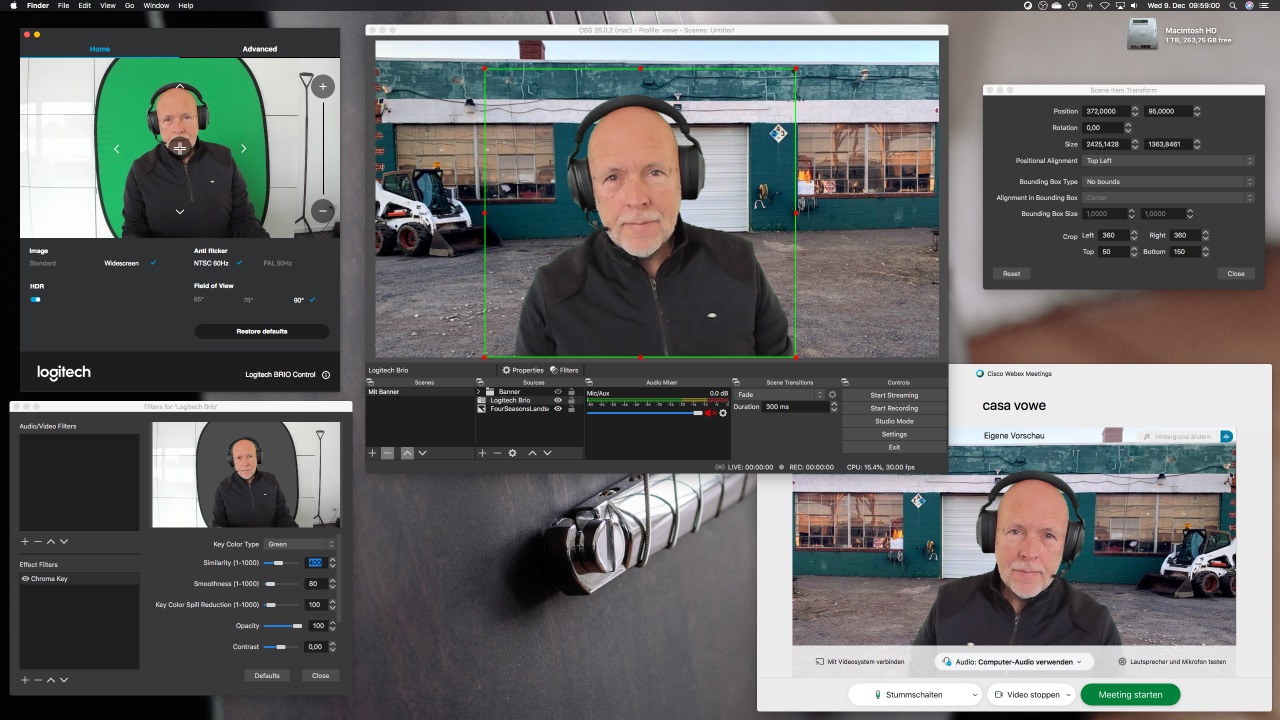
ZZ0D293254.jpg
Full res image

Nachdem sich jetzt einige Leser einen Greenscreen gekauft haben, bekomme ich öfters die Frage, ob der nicht viel zu klein ist. Nein, ist er nicht. Ihr braucht nur zwei kleine Stücke Software: OBS Studio und OBS Virtual Camera (Windows / Mac). (Update: Auf Twitter hat mir jemand geschrieben, dass die Virtual Camera in Windows mittlerweile drin ist.)

Links oben seht Ihr das Kamera-Bild, rechts unten, was in Webex oder Zoom oder Teams ankommt. In OBS erstellt man eine Szene, fügt eine Videoquelle und ein Hintergrundbild hinzu. Das Videobild liegt vor dem Hintergrundbild, das zunächst noch nicht zu sehen ist. Wenn man das Hintergrundbild wechseln will, kopiert man später die Szene und nimmt für die andere Szene ein anderen Hintergrundbild.

Jetzt müssen wir nur noch zwei Probleme lösen:

  • Den Greenscreen macht man durchsichtig, in dem man einen Chromakey-Filter für die Videoquelle definiert. Links unten sehr Ihr die Einstellung und erkennt, dass der grüne Screen schwarz geworden ist. Jetzt hat man ein Loch im Bild, durch das man den Hintergrund sehen kann.
  • Im zweiten Schritt schneidet man das Kamerabild so zu, dass nur noch das Loch sichtbar ist. Das geht über die Transformation der Videoquelle. Das ist der grüne Rahmen in dem mittleren Bild. Damit erscheint das gesamte Hintergrundbild nahtlos.

Wenn man nun selbst vor den Greenscreen tritt, dann erscheint man vor dem Hintergrundbild. Es sei denn, man hat etwas Grünes an, denn das wird ja rausgerechnet. Mit einem grünen Rolli kann man so einen schwebenden Kopf erzeugen. :-)

Ich habe den Greenscreen absichtlich senkrecht gestellt, um zu zeigen, dass das auch so geht. Normalerweise steht er horizontal auf zwei offenen Schranktüren, damit er auf die richtige Höhe kommt. So habe ich mehr Bewegungsfreiheit. Da die Objektive von Webcams sehr weitwinklig sind, muss man relativ nahe vor dem Greenscreen sein.

Und wie kommt das Bild von OBS in Zoom? Das macht OBS Virtual Camera. Die ist nach der Installation in Webex, Zoom oder Teams statt der Webcam auswählbar und zeigt ein Pausenbild an, bis man sie in OBS startet.

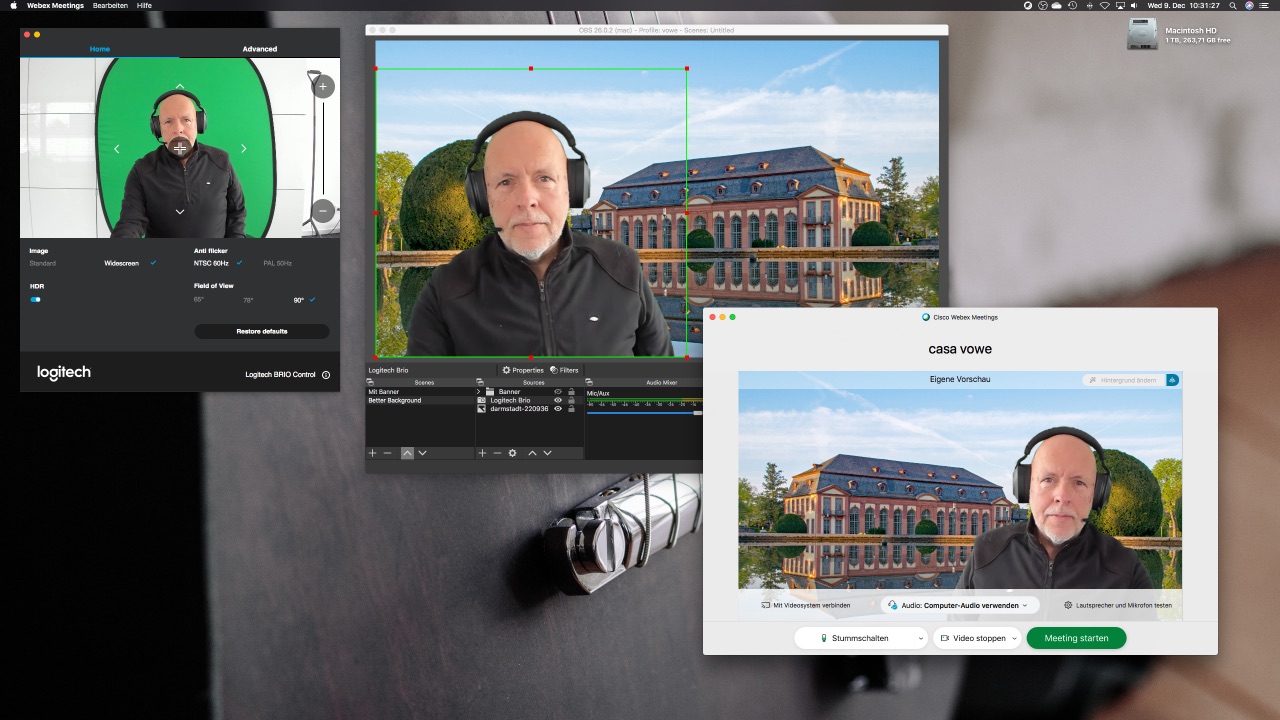
Wie man übrigens auch sieht: Webex & Co spiegeln das Bild, was man selbst sieht, als wäre es ein Spiegel. "Über den Sender" geht aber das Original. Und man kann auch ein freundlicheres Ambiente wählen: :-)

ZZ44D25F80.jpg

More >

09 Dec 02:07

5 things I’ve learned this (work) year

by Doug Belshaw

I downed tools on 2020 today, deciding to stop working for the last three weeks of the year so I can rest and recharge.

It’s been an incredible year in every sense of the word; there’s been the good, the bad, and the ugly. While I don’t particularly want to rake through the negatives, I thought it might be worth sharing five things I’ve learned.

1. Don’t expect things to be easy

The man who does not attempt easy tasks but wants what he attempts to be easy, is often baffled in his wishes

Seneca

There’s no point in spending your life doing easy things. For me, these are things that have been done the same way before. Instead, I want to do the difficult thing and stuff that challenges me. The problem is when I’m tired I just want things to get easier for a bit. That’s not the way it works, unfortunately.

2. Money can’t buy me love

To be clever enough to get all that money, one must be stupid enough to want it

G.K. Chesterton

My biggest problems this year have been caused by interactions with those who have different approaches to money than me. I see numbers on a spreadsheet as a means to an end. To others, it’s seemingly a yardstick by which they measure their self-worth.

3. Keep something in reserve

There is no need to show your ability before everyone.

Baltasar Gracián

I think one of my biggest traps before starting therapy last year was the need to be seen as a ‘good’ person and talented at what I do. While I still prefer people to think well of me, I’m now very aware that I cannot control other people’s perceptions. Which is quite liberating.

4. Stand up for what I believe in

Respect is often paid in proportion as it is claimed.

Dr Johnson

I’ve often said to my kids that people can only treat you the way you allow them to. I’m pleased to say that this year I’ve stood up against racism, bullying, and gaslighting. Hopefully that’s earned me some respect, but it’s generated plenty of self-respect.

5. We’re all in this together

Whatever you may be sure of, be sure of this: that you are dreadfully like other people.

James Russell Lowell

It’s perhaps a funny thing for someone to write who’s approaching the midpoint of his life, but it’s only this year that I’ve really felt that I’m similar to other people. I’m not a special snowflake, other than in the sense that we all are.


I’d like to thank the good people at Outlandish for allowing me to work with then during the second half of this year. It’s been an eye-opening experience to work with a well-run tech cooperative that goes out of its way to be inclusive, transparent, and emotionally mature.

Right now, I’m not sure where 2021 will take me. I’ve got some work to dive into immediately in the new year, but beyond that I’ll follow my values and interests.


This post is Day 75 of my #100DaysToOffload challenge. Want to get involved? Find out more at 100daystooffload.com.

The post 5 things I’ve learned this (work) year first appeared on Open Thinkering.
09 Dec 02:07

One Year with an Electric Car

by peter@rukavina.net (Peter Rukavina)

It was a year ago this week that we traded in our 2000 VW Jetta for a 2016 Kia Soul EV, and thus traded gasoline for electricity as the source for our transportation energy (I have not visited a gas station in more than 365 days as a result; I do not miss it).

The spark of the kernel of the idea for moving to a battery-electric car came from Karri Shea who, at the memorial for her late husband Josh Underhay, laid down a challenge:

Please don’t let their deaths be only a senseless tragedy, let them be a call to action and a catalyst for a change that you make in your life. For Prince Edward Island, for the world. Plant a tree, donate blood, put solar on your roof, buy an electric car.

From the planting of that idea, Trudy White, friend of the blog from the east, enhanced the momentum by showing up one day, weeks later, to take me for coffee in her brand new Chevy Bolt; a few weeks after that she let me drive the Bolt to a meeting of the electric vehicle association in South Melville, where I got to meet a ragtag group of EV owners and aspirants who, one by one, successfully batted away any of my lingering doubts.

I continued to dip my toes in the water by renting a Bolt to drive from Montreal to New Hampshire and back in September, which proved a success.

It was at that spring meeting of the EV group that Mike Kenny announced his plans to open up an all-EV dealership, a plans came together over that summer, so that by November we could take a Kia Soul EV he’d just imported from Quebec for a 24 hour test drive.

Catherine proved the catalyst for the final push: she could see how antsy I was about continuing to drive the Jetta, and how I couldn’t conscience replacing it with another gasoline powered car. 

In the end, buying the Kia Soul EV we’d test driven a month earlier was the last thing we did together, as a couple. We picked it up on December 3, a cool, rainy, late autumn day not unlike today.

The thing that pleases me the most about all this is that the story from there is, well, pretty mundane.

A year ago tonight we took our first “long distance” trip, to Victoria (the last trip we ever took together as a family, as it happened). We got a level 2 charger installed on the side of our house. Oliver and I drove to Halifax and back in July, and to Cape Breton and back in September. Otherwise, we used the car for regular everyday things: trips uptown for groceries, trips to the beach in the summer, trips to the doctor. With COVID-19 it’s difficult to say that it’s been a typical year for car travel, as there have been far fewer places to go; but the places we did find to go, the Soul took us there.

As to the Soul itself, I’ve no complaints whatsoever: it just works. It hasn’t needed any maintenance over the last year (save for a replacement windshield, my fault, and switching out the winter tires). It doesn’t need fluids (other than washer fluid). And, to be honest, the futuristic sheen of driving a car made in 2016 (Bluetooth! CarPlay! heated seats! air conditioning!) after driving a car made in 2000 (cassette player! turn signals!) has yet to wear off.

The only time I’ve experienced range anxiety, an often-cited reason to avoid electric vehicles, is on our trip to Cape Breton, where the high speed EV charger in Monastery was offline when we arrived, meaning we had to drive into Port Hawkesbury and use a slower level 2 charger; otherwise, it’s not a factor. This is, mostly, because 95% of our trips are within 20 km of our house, so we’re never far from a charger at home or otherwise. Worrying about charging simply isn’t a fact of our daily life with the car: we go somewhere, we come home, I top up the car to 80% with the home charger in a couple of hours or less, and we’re ready to go somewhere else.

In the end, being an EV owner seems pleasantly normal rather than cutting-edge-revolutionary. If your travel patterns are similar to our own–and I imagine that’s true for many households–and you’re looking to replace a fossil-fuel-powered car, it’s hard to make the case for anything other than buying a used EV (Mike, who in the year since our purchase, has amalgamated Pure EV into the larger All EV, has plenty of vehicles available, starting at $12,000). 

09 Dec 02:06

Modern consensus ghosts such as the Monkey Man and the Gatwick Drone

Conjecture: under great pressure, societies can collectively manifest illusionary objects. These psychic projections, which sometimes appear as terrifying beasts, encode powerful fear or anger or disconnection – and also its resolution.

This is a post about the Gatwick Drone, but I’m going to take the scenic route.

Longtime readers will know of my interest in the Monkey Man. Almost a decade ago, the Monkey Man terrorised New Delhi.

Here’s a great summary of the phenomenon:

Early in May 2001, rumours began spreading though New Delhi that an aggressive monkey-like entity was rampaging through the overcrowded suburbs after sunset.

Householders who habitually slept on their flat roofs during the sweltering Indian summer claimed that they were being indiscriminately attacked by the Monkey Man, who leapt from roof to roof, biting and scratching as he went. One man had even fallen to his death fleeing from the creature.

Descriptions of the entity varied considerably, but most witnesses agreed that it was short and furry with glowing red eyes.

– The Cosmic Jokers, The New Delhi Money Man

And a contemporary article communicates some of the terror (16 May, 2001):

In Noida, a mechanic wearing a black outfit and fitting a description of the Monkey Man was beaten up. A second man was attacked for apparently performing “mystical formulations”.

Some witnesses say the failure to capture the Monkey Man is explained by his ability to make himself invisible.

Deepali Kumari, from Noida, said: “It has three buttons on its chest. One makes it turn into a monkey, the second gives it extra strength, the third makes it invisible.

“He touches a lock and it breaks. But he is afraid of the light.”

– Ananova, Indian police release pictures of Monkey man killer

I’ve found a cache of old news stories. Since they tell the story of that month pretty well, I’m going to copy and paste the subheds below. (These are all the stories tagged “Monkey Man” on this particulare site.)

  • Panic caused by a weird monkey-man has grown in the Indian town of Ghaziabad following more attacks and sightings. (13 May, 2001)
  • Indian police say anyone who sees the “monkey man” who has been terrorising householders should shoot him on sight. (14 May)
  • Reports are circulating in India that the ‘monkey man’ attacker is an extra-terrestrial or a remote-controlled robot. (15 May)
  • Indian police have issued pictures of the Monkey Man killer, amid reports he has claimed his second victim. (16 May)
  • A person suspected of wearing a monkey mask to scare people has been arrested in an Indian city. (16 May)
  • A zoo director says India’s feared ‘Monkey Man’ can’t be an animal. (17 May)
  • India’s Monkey Man mystery has deepened with Indian police suggesting it is a treacherous Pakistani plot. (17 May)
  • Indian authorities are trying to quell Monkey Man hysteria by employing counsellors to talk to New Delhi residents. (18 May)
  • Medical experts in New Delhi have been offering advice on what to do in the event of an attack from the Monkey Man. (18 May)
  • India’s Monkey Man is alleged to have killed directly for the first time by puncturing his victims’ skulls. (18 May)
  • A doctor has been become the latest participant in Monkey Man mania that has spread across New Delhi. (19 May)
  • Delhi police say they’re close to solving the Monkey Man mystery. (19 May)
  • An Indian psychiatrist has compared the Monkey Man mystery to a penis-related panic among Nigerian men 10 years ago. (20 May)
  • Sightings of the Monkey Man are said to be reducing after Indian police arrested a dozen people for spreading rumours. (21 May)
  • A second reward has been offered for information leading to the arrest of India’s Monkey Man. (21 May)
  • The number of attacks in India attributed to the Monkey Man is continuing to fall. (22 May)
  • Reports of Monkey Man attacks in New Delhi are falling off. (23 May)
  • As Monkey Man hysteria dies down in Delhi, villagers in north-east India are claiming a new menace is on the prowl - Bear Man. (27 May)
  • Russian media are reporting a plane passenger flying from Delhi to Moscow acted like Monkey Man, who terrified residents of the Indian capital recently. (11 June)
  • Experts in India remain baffled by the identity of the mysterious monkey man. (15 June)
  • A special Indian police team says mass hysteria was to blame for the Monkey Man attacks. (18 June)
  • The Indian Monkey Man’s apparent victims say authorities have denied its existence because they failed to catch it. (19 June)
  • The Monkey Man has reportedly resurfaced in India and been blamed for several attacks. (29 August)
  • Reports of a ‘monkey man’ in India have reappeared a year after panic over the mystery creature hit the capital, Delhi. (21 July, 2002)

Appearance. Chaos and fear and the inability of authorities to do anything about it. The fear is taken seriously and the attacks abate. A tentative speculation about the Monkey Man’s psychological origins; a fierce denial. The phenomenon tails off.


There were people wounded in cases of mistaken identity! There were riots!

So what was going on?

I can’t dismiss this as a delusion, or mass hysteria, for three reasons:

  • those labels only defer the important questions: why then, why there.
  • we deal with many non-actual yet real things in the world: money, status, soap operas, celebrity, sport. I wouldn’t call the Monkey Man any less real than those consensual hallucinations – though perhaps more democratic.
  • to pejoratively minimise the lived experience is also a claim that we, the Monkey Man non-believers, inhabit a “truer” world. My claim is that these manifestations are universal (and one of their attributes is we deny their semi-actual status when we’re the ones doing the manifesting).

For me, the clue is found in these facts: The Monkey Man attacked at night and caused fear; the Monkey Man was scared of water.

Back to that summary:

  • A rumour spread that the Monkey Man could be destroyed if you doused it in liquid.
  • Another theory was that residents were so frustrated with the frequent night-time power outages that they were phoning in fake Monkey Man reports, knowing the authorities would turn the electricity back on before setting out to hunt the beast.

So there we have it – in a period of electricity outages (and, I remember reading, water shortages), and knowing that the Monkey Man would create unrests, communities found a way to force authorities to turn on the lights and prioritise running water. It’s almost like a magic spell.

Does that make the Monkey Man any less real? I don’t think so. Reading the news articles, it seems like many people weren’t in on the joke… especially not the people who got beaten up. (Or maybe a fake “mistaken identity” was a good excuse for something that would have happened anyway…)


I don’t have my notes to hand, but I seem to remember a similar Goat Man appearing in Mexico City (late 20th century) and, in 19th century London, there was Spring-heeled Jack who sounds and acts very like the Monkey Man.

  • I wonder what was the community “purpose” of these collective manifestations? What did the belief in Spring-heeled Jack achieve for Londoners?
  • I wonder if there are “nodal points” in the group imagination, images that societies will independently alight upon – red eyes, leaping and slashing, etc? Perhaps these memes are shaped to be the most contagious?

I was thinking of the Monkey Man when I read this fantastic long read in The Guardian about the Gatwick drone: A drone sighting caused the airport to close for two days in 2018, but despite a lengthy police investigation, no culprit was ever found. So what exactly did people see in the Sussex sky?

115 sightings. 222 witness statements. 1,000 flights cancelled. 140,000 passenger affected, just before Christmas.

No such drone existed.

The Gatwick incident was the first time a major airport was shut down by drones, and it distilled deep cultural anxieties - from the threat of terrorism and unconventional attacks by hostile states, to our fear of new technology.

– The Guardian, The mystery of the Gatwick drone

The article cites some other urban legends (the Croydon cat killer is a recent one, local to me), but they aren’t quite the same. The Gatwick drone resulted in something: collective misgivings about flying, airport expansion, vulnerability to terrorism, etc, manifested in a physical drone – which closed down the airport, relieving the fears.

To me this is an infant Monkey Man. Had the drone proven only a touch more effective, let’s say by reducing the number of planes landing into airports where drones were “sighted,” I suspect there would have been many, many Gatwick Drones, all over the world.


The Monkey Man and the Gatwick Drone are massively multiplayer Ouija boards.

We all have our fingers on the pointer. Maybe we can feel it pulling towards the letters; maybe we’re doing the pushing. Maybe the messages are deliberate; maybe they’re a form of dowsing the collective unconscious - some kind of Jungian Hadron Collider - or maybe it’s direct from the spirit world. We don’t know and we can’t know, and that’s the point.

The point is that these manifestations sit halfway between fact and fiction. It doesn’t matter who believes and who’s faking it – what matters is that nobody needs to say what the goals are out loud, and yet it is efficacious none-the-less. The power comes back! The planes stop!

And maybe this is a decent way of understanding other collective “hysterias” such as Qanon: not by looking at what they do, that’s not relevant, but by looking at what they force the rest of us to do as an apparent side-effect. How do we bend in response? Now let’s interpret that response, not as a side-effect but as intended.


One last connection. What I’m talking about are hauntings and my favourite haunting in fiction is in Hamlet. For me, Hamlet is an astounding feat because it is utterly, utterly true to life. Every character, every feeling, every consequence: so believable, so human. Yet it opens with a ghost! The supernatural. One way to understand the ghost is that it is a psychic manifestation of a community under great pressure: everyone at Elsinore knows of the murder of the old King yet, because of the status hierarchy, they are unable to voice the truth to Prince Hamlet. Between the unstoppable force and the immovable object is forged the ghost, a psychic diamond the actualisation of unspeakable need.

(I’ve posted about Hamlet before.)

Anyway.

09 Dec 02:05

Boston

by peter@rukavina.net (Peter Rukavina)

Nineteen years ago today, Catherine and Oliver and I were in Boston on a beta test for international travel, in anticipation of a planned trip, two months later, to Thailand.

Taking Oliver to Thailand when he was 18 months old was the craziest most amazing thing we ever did together as a family, and it set such a high water mark for what we were capable of that it enabled us to pursue countless travel adventures in the years to follow.

The Boston trip was the starting line.

09 Dec 02:05

Why getting voting right is hard, Part I: Introduction and Requirements

by Eric Rescorla

Every two years around this time, the US has an election and the rest of the world marvels and asks itself one question: What the heck is going on with US elections? I’m not talking about US politics here but about the voting systems (machines, paper, etc.) that people use to vote, which are bafflingly complex. While it’s true that American voting is a chaotic patchwork of different systems scattered across jurisdictions, running efficient secure elections is a genuinely hard problem. This is often surprising to people who are used to other systems that demand precise accounting such as banking/ATMs or large scale databases, but the truth is that voting is fundamentally different and much harder.

In this series I’ll be going through a variety of different voting systems so you can see how this works in practice. This post provides a brief overview of the basic requirements for voting systems. We’ll go into more detail about the practical impact of these requirements as we examine each system.

Requirements

To understand voting systems design, we first need to understand the requirements to which they are designed. These vary somewhat, but generally look something like the below.

Efficient Correct Tabulation

This requirement is basically trivial: collect the ballots and tally them up. The winner is the one with the most votes 1. You also need to do it at scale and within a reasonable period of time otherwise there’s not much point.

Verifiable Results

It’s not enough for the election just to produce the right result, it must also do so in a verifiable fashion. As voting researcher Dan Wallach is fond of saying, the purpose of elections is to convince the loser that they actually lost, and that means more than just trusting the election officials to count the votes correctly. Ideally, everyone in world would be able to check for themselves that the votes had been correctly tabulated (this is often called “public verifiability”), but in real-world systems it usually means that some set of election observers can personally observe parts of the process and hopefully be persuaded it was conducted correctly.

Secrecy of the Ballot

The next major requirement is what’s called “secrecy of the ballot”, i.e., ensuring that others can’t tell how you voted. Without ballot secrecy, people could be pressured to vote certain ways or face negative consequences for their votes. Ballot secrecy actually has two components (1) other people — including election officials — can’t tell how you voted and (2) you can’t prove to other people how you voted. The first component is needed to prevent wholesale retaliation and/or rewards and the second is needed to prevent retail vote buying. The actual level of ballot secrecy provided by systems varies. For instance, the UK system technically allows election officials to match ballots to the voter, but prevents it with procedural controls and vote by mail systems generally don’t do a great job of preventing you from proving how you voted, but in general most voting systems attempt to provide some level of ballot secrecy.2

Accessibility

Finally, we want voting systems to be accessible, both in the specific sense that we want people with disabilities to be able to vote and in the more general sense that we want it to be generally easy for people to vote. Because the voting-eligible population is so large and people’s situations are so varied, this often means that systems have to make accommodations, for instance for overseas or military voters or for people who speak different languages.

Limited Trust

As you’ve probably noticed, one common theme in these requirements is the desire to limit the amount of trust you place in any one entity or person. For instance, when I worked the polls in Santa Clara county elections, we would collect all the paper ballots and put them in tamper-evident bags before taking them back to election central for processing. This makes it harder for the person transporting the ballots to examine the ballots or substitute their own. For those who aren’t used to the way security people think, this often feels like saying that election officials aren’t trustworthy, but really what it’s saying is that elections are very high stakes events and critical systems like this should be designed with as few failure points as possible, and that includes preventing both outsider and insider threats, protecting even against authorized election workers themselves.

An Overconstrained Problem

Individually each of these requirements is fairly easy to meet, but the combination of them turns out to be extremely hard. For example if you publish everyone’s ballots then it’s (relatively) easy to ensure that the ballots were counted correctly, but you’ve just completely give up secrecy of the ballot.3 Conversely, if you just trust election officials to count all the votes, then it’s much easier to provide secrecy from everyone else. But these properties are both important, and hard to provide simultaneously. This tension is at the heart of why voting is so much more difficult than other superficially systems like banking. After all, your transactions aren’t secret from the bank. In general, what we find is that voting systems may not completely meet all the requirements but rather compromise on trying to do a good job on most/all of them.

Up Next: Hand-Counted Paper Ballots

In the next post, I’ll be covering what is probably the simplest common voting system: hand-counted paper ballots. This system actually isn’t that common in the US for reasons I’ll go into, but it’s widely used outside the US and provides a good introduction into some of the problems with running a real election.


  1. For the purpose of this series, we’ll mostly be assuming first past the post systems, which are the main systems in use in the US.
  2. Note that I’m talking here about systems designed for use by ordinary citizens. Legislative voting, judicial voting, etc. are qualitatively different: they usually have a much smaller number of voters and don’t try to preserve the secrecy of the ballot, so the problem is much simpler. 
  3. Thanks to Hovav Shacham for this example. 

The post Why getting voting right is hard, Part I: Introduction and Requirements appeared first on The Mozilla Blog.

09 Dec 02:05

Lessons From the Pandemic

Stephen Downes, Dec 08, 2020
Icon

As we all know, when things shut down beginning in 2020 we had to adapt to working and learning from home. We made the rapid transition to what we called ‘remote learning’ and later, when we knew what we were dealing with, we were able to return to the classroom. Whatever learning looks like will emerge from the lessons of those months. What were those lessons? We should eventually coalesce around some core ideas.

See also on [Original Location] [This Post]
09 Dec 02:05

Bremer Schüler boykottieren Präsenzunterricht :: Weser-Kurier

by Volker Weber
Aus Protest gegen die Bildungsbehörde organisieren angehende Abiturienten an der Schule an der Kurt-Schumacher-Allee ihren Unterricht in Halbgruppen in Eigenregie. Die Aktion könnte sich ausweiten.

Ich finde das so großartig, wenn junge Menschen Verantwortung übernehmen und handeln, während andere nur Hände ringen.

More >

09 Dec 02:04

Lessons From the Pandemic

by Stephen Downes

Introduction

There were times when no one would have expected this, but as we enter the 2040s the school remains the centre of education and development in the community. In retrospect, we should have expected no other outcome. During the pandemics of the 20s we not only learned that we could provide most learning online, we also learned that we didn’t want to. It took a long time to develop from those early lessons to the vision of learning we’ve realized today, but most of the major changes were implemented by 2030. It then took another ten years to fully realize the benefits because, as we all know, education takes time. There are no short cuts.

And is wasn’t as though there were no challenges along the way. The last twenty years have been among the most difficult we have faced as a province and as a country. We faced illness and death, and that was just the beginning. Though the economy began to recover, the resulting rise in interest rates dealt a crushing blow to our public accounts. And the demands on government didn’t disappear. As you all know, climate change is well and truly with us now, and we’ve had to spend trillions supporting failing agriculture and industry, on energy conversion, and on disaster recovery. It has never been more important for people to be resilient and self-sufficient, and yet there never seemed to be enough money to make this happen.

And yet – here we are. We faced our future with open eyes and weren’t afraid to ask the hard questions. We looked at our education system from top to bottom, in all sectors – from pre-school to higher education to the workplace. We eliminated the distinction between student and non-student. We stopped thinking of school as a place and started thinking of it as an activity. We set meaningful learning goals, adapted to support the many needs of our diverse community. Our educators transitioned from content presenters to learning support specialists. And we emphasized equity throughout, to ensure the system did not perpetuate economic disadvantage felt by those in the most affected communities.

Now we are reaping the benefits. When quantum technology rewrote the book on computer programming in 2031, we were able to adapt. This year, we are adopting genetic logic as a major new approach in disease prevention with a series of self-support resources and tools. People know what to do when something new comes along, and government and industry offer the needed supports to make it happen. We’ve all benefited from better jobs in advanced industries, and people have been able to break new ground and innovate at any stage in their careers. And we’re happier, because we’ve been able to develop our knowledge and skills in things that interest us. We work, grow and play in our own communities, and at the centre of these communities are the places where we come together to learn, innovate and celebrate.

The Lessons

As we all know, when things shut down beginning in 2020 we had to adapt to working and learning from home. It was a hard time; a lot of people lost their jobs and a lot of companies went under. We made the rapid transition to what we called ‘remote learning’ and later, when we knew what we were dealing with, we were able to return to the classroom. The Plan – as we all came to call it – emerged from the lessons of these early years.

What were those lessons? For a while it seemed like every interest group and industry had its own take on what we should take away from that pandemic, but eventually we recognized some core ideas:

·         Any change will be hard at first. It was hard to jump right into remote learning, and it was hard to jump back into the new classroom environment. So we can’t directly compare the new thing with the old thing. We have to give ourselves some time to get used to it and for people to get good at it.

·         Learning is social. Of course, we knew that already, but being apart underlined the idea that some of the important outcomesof learning are social. We don’t just learn as individuals, we learn as a community, and learning is about how we exchange ideas, conduct trade, and develop community networks with each other.

·         Teaching is not a solitary profession. We already know teachers need buildings and facilities and support staff and computer networks and the rest. But now that they are working with advanced technology in both digital and in-person environments, they need to be constantly developing their skills, and they need a team supporting them. It’s like when we watch Newsfeed on CB-Stream: we may see only the presenters in our hololens, but we know there’s a team of people supporting them.

·         We need live events. Sure, not everything needs to be live – there’s a lot we can get from vids and sims and the rest. But live events draw us in and challenge us. When we don’t know what’s going to happen, we are engaged in planning and anticipation. And live events have us interacting, even if indirectly with the people in the scene. It’s what we used to call ‘presence’, back in the day.

·         Open media plays a key role. It’s not simply about saving money. We can’t learn – we can’t even communicate – without open media. We need an alphabet, we need words, we need data – and these need to be available for any of us to use without worrying about who owns it or how much it costs. We use open media to write the first draft of our experiences, the first draft of the lessons learned and the practices we should follow. That’s why we needed Zoom, and that’s why open textbooks became so essential.

·         Quality matters, but is not guaranteed. It doesn’t matter how much we paid, or where it came from. We have to make our own judgements about quality, because of our different needs and circumstances. There was a lot of misinformation in the 20s; some of it came from Russia, some of it came from advocacy groups, some of it was advertising, and some of it came from our own governments. The development of trust networks, zero-knowledge proofs and crypto-addressing helped a lot, but we still have to be critically-minded.

·         Teaching is more than broadcasting. Again, this is something we already knew, but had to learn again when we went online in the 20s. We can still remember how bad those 8-hour days of video lectures were. The best learning used the computer where needed, but then got us away from the keyboard and doing something practical. And this was still true when we returned to the classroom. Suddenly we realized that we didn’t need to be stuck in a room in order to learn.

·         Reading the room is harder. An experienced teacher can scan a classroom, observe how students are reacting, and change strategies on the fly to stimulate interest or attention. Online, it’s a lot more difficult to gauge reactions. So this needs to become a deliberate practice of asking directly for feedback and engaging in interactive exercises. And it turns out that reading the room is not enough. We need to make understanding our learners a major part of what we do.

·         Assessment needs to be flexible. Moving online showed us just how dysfunctional traditional testing has become, and we realized we were depending more and more on surveillance, when we should have instead been offering counselling and feedback. Once students were able to create portfolios and show their work directly to employers, the push for stringent testing eased.

·         We need structure, order and routines. Here were not talking about military discipline, but rather, a respite from uncertainty and precarious circumstances. When we were at home, we needed to learn how to balance our work with our play, rest and self-care. We needed to know when we would eat, where we would sleep, and to be able to plan our days and our futures.

·         Inequities harm learning. In many ways, coming together to learn at school mitigated some of the worst impacts of poverty and disability, because we could all access books, teachers and time to study at school. A lot of us depended on school for internet access and a good meal. A lot of this support disappeared when we went online. People in need just vanished. We knew that this was a problem, but it took a long time to solve it.

·         People have diverse needs. They come from different cultures, speak different languages, and have different abilities. Before the 2020s we designed for the mainstream and hoped that the rest could adapt. But a lot of difficult issues surfaced in those years, and we had to address built-in or systemic discrimination. We had to get past the idea that some people are ‘special needs’ and to adopt the attitude that everyonehas special needs.

·         We need to learn how to learn. This applies to both teachers and students. What we found was that many students who had been in school for ten years had no idea how to learn on their own. They didn’t know where to start, they didn’t know how to structure their work, and often, they weren’t motivated to try. If there was nobody there to teach them, then they simply wouldn’t try to learn.

·         It’s not just school subjects. When we began looking at our learning needs on a society-wide basis, we realized that we couldn’t just focus on educational institutions like schools, colleges and universities. We needed to think beyond traditional ‘academic’ subjects. We needed to find ways to support in-home workers, people who were self-employed, and people trying to find a new career.

·         Motivation matters. Educators have always known this, and have taken steps to keep students engaged in class. But when people are out of school and learning online, we don’t have the same tools. It’s harder to take attendance. We can’t force them to stare at the computer screen. People have to be interested and engaged in what they’re studying, which means they have to have a lot more say in what they’re doing and why it matters.

·         Employ a range of strategies. We learned to develop ‘hybrid learning’, that is, learning that was at times based on digital tools and resources, and at other times interactive and in-person. We also learned not to have a teacher doing both of these at once, because the two methods are so different. But there was no need – by varying strategies, it’s possible to meet the different needs of people at different times and in different ways.

It was a lot to learn in such a short time. Some people argued that these were lessons that had been learned more gradually though the decades before 2020. No doubt a lot had been drawn from disciplines such as distance education and online learning. But we hadn’t really needed these until 2020; they were extras, a way of extending the educational system, and not core to it. This all changed when everybody went online, and then went back again.


09 Dec 02:03

Moving to Electric Vehicles Will Not Save Our Cities

by Sandy James Planner
mkalus shared this story from Price Tags.


Jon Burke, the London Councillor for Hackney responded to Britain’s plan to ban all gas and diesel vehicle sales by 2030 by pointing out that this only addressed  half the issue.

In an opinion piece  in the Huffington Post, Mr. Burke reminded that it was not gasoline powered vehicles that destroyed communities but the presence and use of the vehicles themselves.

Outstanding issues remain with continued private vehicle use regardless of how it is powered.  Those issues include congestion, speed, automotive pollution, and the fact that the trend to larger SUVs (Sports Utility Vehicles) means more road fatalities.

This view is counter to that of many of the electric vehicle companies, who perceive the change away from the ICE (internal combustion engine) as being the way to continue manufacturing vehicles. As technology becomes self driving, it has also been thought that autonomous vehicles will provide transport for seniors, who need to retire from driving vehicles.

Mr. Burke quotes Jane Jacobs from the book Dark Age Ahead  who stated

“Not television or illegal drugs but the automobile has been the chief destroyer of American communities”.

It’s been suggested that the invention of the affordable automobile is the 20th century device that most shaped cities, to the point that car use factors into how we perceive space, time, independence and ourselves.

While we are in the second wave of the Covid pandemic in Vancouver, an article written by Frances Bula in the Globe and Mail in June showed that one-third of those surveyed expected to take transit less and use a vehicle more. The need for physical distancing and worries about  the proximity of people on transit has translated in a new reliance on the private vehicle.

That new adaptation of car use for personal virus bubble protection is part of a trend in Canada that has seen bigger vehicles dominate the market. As Matt Bubbers in the Globe and Mail notes nearly 75 percent of all vehicles sold in this country are “light trucks” inclusive of SUVs.  Cars, pickups, SUV’s and cube vans also contribute to nearly 50 percent of all GHG emissions from transportation. Large “heavy-duty” vehicles make up a further 35 percent of GHGs with rail transport contributing 3.8 percent and motorcycles .2 percent.

There has been an increasing tie-in with  private vehicle ownership and wealth. The SUV with higher seats, all terrain capability is marketed with a rugged persona, and available from all vehicle manufacturers. In North America Ford  will no longer sell cars, just trucks and the very profitable SUVs.

While using electric vehicles is noble, it still does not address the issue of congestion and the deadly statistics with SUVs.  Statistics show that SUVs with the high front end grille are twice as likely to kill pedestrians because the higher engine profile is a driver’s blind spot and directly damages pedestrians’ vital organs,  but this information has not been well publicized.

In the United States a federal initiative to include SUV pedestrian crash survival into the vehicle ranking system was halted by opposing automakers. Drivers have an 11 percent increase in the chance of fatality in them, as their size and bulk is connected with more reckless driving.

There is also not the recognition that there are significant emissions associated with the creation and shipping of electric vehicles, and fifty percent of “lung-stunting” particulate emissions come from tire and brake wear. I have written about vanadium, found in brake dust contributing to a condition called “London Throat” that has an adverse impact on immunity.The metal particles in the dust from worn-out brake pads on vehicles can be just as harmful as diesel emissions. Called BAD for Brake Dust Abrasion, studies done by King’s College London found that the metallic  dust from brake pads cause lung inflammation and “reduce immunity, increasing the risk of respiratory infections.”

The real issue is realizing  that we simply cannot drive ourselves out of this mess. While road speeds can be slowed to 30 km/h to save lives and to make the road environment more comfortable for vulnerable road users, vehicular traffic appears to be increasing in residential areas in many cities. In London England transport data shows from 2009 to 2019 that  there is an 18.6 percent increase in the number of miles driven annually despite congestion charges.

This increase sadly impacts the social street  life of citizens living in London and may be due to several factors including growing online shopping delivery, private cabs, and navigation wayfinding apps that use neighbourhoods to shortcut around congestion. London’s data indicates that it was solely residential streets that “absorbed the full net increase in driving over the decade, the increase on these roads has been 3.9 billion miles over this period”.

Main roads designed for larger capacity are not taking the load of increased traffic; neighbourhoods have been taking the higher load of vehicles in London England. Going completely electric will have no impact on this problem.

As Mr. Burke bluntly states

there can be no immaculate conception of Amsterdam, Copenhagen, or Oslo. We will not humanise the city by chance.”

As policies move towards banning the sale of gasoline and diesel powered vehicles in British Columbia by 2040, simply getting rid of gasoline and diesel powered vehicles is only solving part of the problem. As Mr. Burke reminds we have an “addiction” to private vehicle travel, and that has been compounded by the pandemic. In many jurisdictions the price of second-hand vehicles has risen markedly as people search for a work commuting vehicle.

Instead it is one more reason why if we are serious about putting pedestrians, cyclists and public transit before vehicles, we have to walk the talk. One of the positives from the pandemic is the increased concern and interest in mental and physical health and well-being. If we mean to create communities where citizens are first, the whole “transportation decarbonization jigsaw” must address the 50 percent of vehicle trips that are three kilometers or less and make that be safe, comfortable and convenient without a private car. That’s where the concept of the “Fifteen minute’ city comes in, where schools, shops and services are a comfortable walking or cycling distance from every residence.

That makes the switch to electric vehicles just part of a paradigm that puts people ahead of the 20th century vehicle dominance of road space and policy. It needs to be much more holistic  and led by citizens and  policy makers if our neighbourhoods are to truly survive and thrive.


Images: SJames

.


09 Dec 02:03

This isn't quite what we were led to expect from the German car industry but we should nonetheless be very grateful that Volkswagen has chosen to exercise its control in this way! twitter.com/UKVolkswagen/s…

by James O'Brien (mrjamesob)
mkalus shared this story from mrjamesob on Twitter.

This isn't quite what we were led to expect from the German car industry but we should nonetheless be very grateful that Volkswagen has chosen to exercise its control in this way! twitter.com/UKVolkswagen/s…

Get peace of mind with Volkswagen Price Protection - we guarantee we won’t pass on post-Brexit tariffs to you when you order your new Volkswagen before 5.30pm on 31 December 2020. Contact your local retailer today to find out more. bit.ly/2IZ9trp pic.twitter.com/FFmMzADJr7


70 likes, 18 retweets


584 likes, 106 retweets
09 Dec 02:01

There Is No Step Two, But There Is A Step Three

by Eugene Wallingford

In a not-too-distant post, Daniel Steinberg offered two lessons from his experience knitting:

So lesson one is to start and lesson two is to keep going.

This reminded me of Barney Stinson's rules for running a marathon (10s video):

Here's how you run a marathon.

Step 1: Start running.

<pause>

Oh, yeah -- there's no Step 2.

Daniel offers more lessons, though, including Lesson Three: Ask for help. After running the New York Marathon with no training, Barney learned this lesson the hard way. Several hours after the marathon, he found that he no longer had control of his legs, got stuck on the subway because he could not stand up on his own, and had to call the gang for help.

I benefit a lot from reading Daniel's blog posts, and Barney probably could have, too. We're all better off now that Daniel is writing for his blogs and newsletters regularly again. They are full of good stories, interesting links, and plenty of software wisdom.

09 Dec 02:01

Uber selling its autonomous driving unit to Aurora Innovation

by Aisha Malik

Uber is selling its autonomous driving unit, Advanced Technologies Group, to San Francisco-based self-driving car startup Aurora Innovation.

The company is going to invest $400 million USD (about $512 million CAD) in Aurora Innovation as part of the deal. Uber CEO Dara Khosrowshahi is also going to join the company’s board of directors.

It’s worth noting that Aurora Innovation was founded by the former head engineer of Google’s self-driving project.

As part of the deal, Aurora is going to work with Uber to launch self-driving cars on its ride-hailing and food delivery platforms.

Khosrowshahi told Reuters that this deal will accelerate Uber’s goal to achieve profitability on an adjusted basis by the end of next year. He stated that this deal “essentially advances our path to profitability.” However, he noted that Uber’s profitability was not a leading factor in the deal.

It’s currently unknown whether the deal will lead to layoffs. An Uber spokesperson told The Verge that “Aurora has committed to making offers to the majority of ATG employees. We are working through the details with Aurora and will notify our teams in the coming weeks.”

This deal marks the end of Uber’s self-driving dreams, as the company was essentially hoping to eliminate the need for drivers and revamp the transportation industry and its ride-hailing platform with cheap autonomous cars.

The company instead faced numerous challenges during its self-driving car pursuit. Last year, the company avoided criminal charges in the death of a woman in Arizona, which was the first death involving a self-driving car. Uber was then also involved in a trade secret lawsuit with Waymo, which is owned by Google’s parent company Alphabet.

Further, in the company’s most recent earnings report, the division saw a net loss of $303 million USD (about $398 million CAD).

Source: Reuters, The Verge 

The post Uber selling its autonomous driving unit to Aurora Innovation appeared first on MobileSyrup.

09 Dec 02:00

Cloudflare, Apple develop new internet protocol that hides the sites you visit from DNS resolvers

by Jonathan Lamont
iPhone and Cloudflare website

Engineers from Cloudflare and Apple say they’ve developed a new way to prevent your internet service provider (ISP) from knowing which websites you visit.

As reported by TechCrunch, the engineers developed a protocol called ‘Oblivious DNS-over-HTTPS (ODoH) that uses a combination of encryption and proxies to prevent snooping on web history. To fully understand ODoH, however, you need to understand a few things about how the internet works.

In short, when you visit a website in your browser, it uses a Domain Name System (DNS) to turn the web address into a machine-readable IP address. Unfortunately, this process isn’t encrypted, which means when you load a page, the DNS query can be intercepted and read. Worse, it means the DNS your computer queries will know which sites you visit. Since many people don’t change their DNS, they’re likely using their ISP’s DNS, thus sharing their internet history with that ISP.

A while back, U.S. ISPs kicked up a bit of a stink over Google’s plan to add a technology called DNS-over-HTTPS (DoH) to Chrome. DoH encrypts DNS queries, which can prevent attackers from intercepting them and redirecting unaware users to malicious websites instead. While DoH is a benefit to internet users and privacy, it doesn’t prevent DNS resolvers from seeing which sites you visit.

ODoH uses proxies servers to separate the user from the query

ODoH hopes to solve that last issue by encrypting DNS queries and then passing them through a proxy server. Thanks to the encryption, the proxy can’t see what’s in the query, plus the proxy prevents the DNS resolver from seeing who sent the query in the first place.

Cloudflare’s head of research, Nick Sullivan, told TechCrunch that ODoH page loading times are “practically indistinguishable” from DoH and shouldn’t significantly impact browsing speed.

While ODoH is a step in the right direction for improving online privacy, it isn’t perfect. One issue is that ODoH needs separate proxy and DNS resolvers — in other words, controlled by separate entities. If a company controls both the DNS resolver and proxy, it isn’t difficult for it to piece together the decrypted DNS query with who sent the query in the first place.

Sullivan told TechCrunch that a few partner organizations already run proxies and that early adopters can try out ODoH through Cloudflare’s 1.1.1.1 DNS resolver. However, it could take some time before ODoH is baked into browsers and operating systems, which depends on when the Internet Engineering Task Force certifies ODoH as a standard.

Source: TechCrunch

The post Cloudflare, Apple develop new internet protocol that hides the sites you visit from DNS resolvers appeared first on MobileSyrup.

09 Dec 02:00

Pixelmator Pro is on sale

by admin

It’s been a pretty incredible year for Pixelmator Pro, with three major updates, a (free!) major 2.0 upgrade, and many other smaller updates with lots of great new features. To round off 2020, we’re having a holiday sale, so you can get Pixelmator Pro for 50% off!

Many of you reading our blog already have a copy of Pixelmator Pro, but if you know anyone who would appreciate a powerful Mac image editor at a crazy low price, let them know about the sale and spread the word!

Buy Now

09 Dec 01:55

Twitter Favorites: [dale42] Submitted a bug fix to a Github project I began using last week. It’s nice waking up to a thank you in the release notes!

Dale McGladdery @dale42
Submitted a bug fix to a Github project I began using last week. It’s nice waking up to a thank you in the release notes!
09 Dec 01:55

Twitter Favorites: [geerlingguy] Enable Dark mode on GitHub in your 'Appearance' settings #DarkMode #GitHubUniverse https://t.co/pRuBb190EB

Jeff Geerling @geerlingguy
Enable Dark mode on GitHub in your 'Appearance' settings #DarkMode #GitHubUniverse pic.twitter.com/pRuBb190EB