This is a recipe I dreamed up that has pleased the family twice now. It’s pretty easy to make and has lots of room for
creative variation.
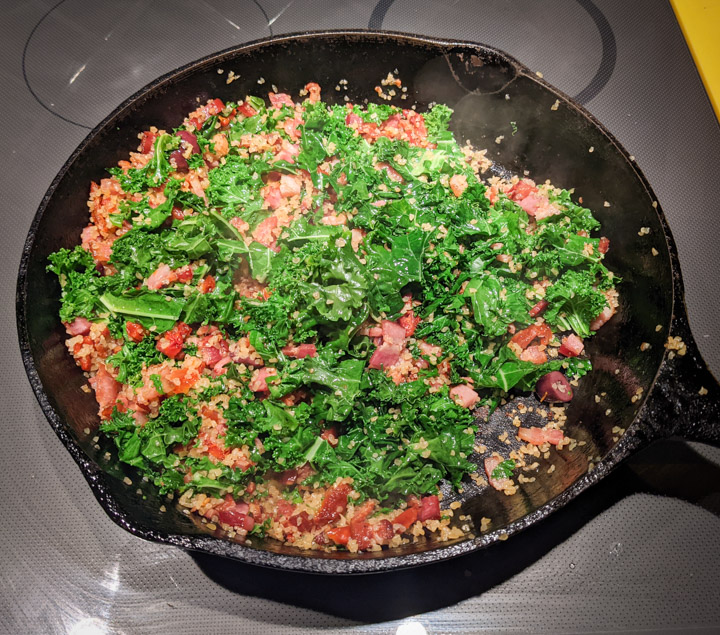
The name is probably controversial. Let me lead off with a picture.
Wikipedia says
Tabbouleh is Levantine but I grew up in Lebanon and I’ve never had really
first-rate Tabbouleh anywhere else, except for the version my Mom makes. Tabbouleh is a salad centered around parsley,
bulgur, and tomatoes.
What happened was, I had
bacon that I was going to make breakfast with but didn’t, and it was my
turn to make dinner. I like dicing bacon into little pieces and sautéing them until they’re golden, then they work great in
pasta sauces and other settings. I was looking at the bacon blankly and got a sudden mental image of a dish with the bacon
amid diced crunchy greens and flashes of red, like tabbouleh.
Ingredients
Sorry, not terribly quantitative.
Thick-cut strongly-smoked bacon. Eight to twelve slices feeds four.
Kale. Thick and crunchy is better. One big bunch is enough, but generally more is better.
Bulgur. A cup or so.
Sun-dried tomatoes. Two or three big dessert-spoonfuls.
Other items, just for fun (see below).
Process
This doesn’t move along that fast so there’s time to make whatever else you have in mind.
Put the bulgur in to soak. About twice as much water as bulgur.
Dice up the bacon, I try for pieces about the size of cornflakes.
Toss the bacon into a frying pan — I swear by our old black well-seasoned cast-iron
pan — at
medium heat so it’s spitting but not loudly, and ignore it for a while, stirring every so often. It takes me fifteen minutes
or more to to get that golden color.
Dice up your kale. In the picture above, I got distracted halfway through and it’s nowhere near finely enough
diced. Still tasted fine but looks better if finer.
When the bacon is looking ready, drain off most but not all of the excess fat.
By the time you’ve done all this, the bulgur should have soaked up the water and be
pretty soft. Drain off any remaining water and add the bulgur to the pan. Also add the sun-dried tomatoes.
Some fairly vigorous stirring is required to get it all mixed up evenly.
The soaked bulgur is now pleasantly al dente so you only need to cook this stuff for a couple of minutes until
it’s nice and
hot.
Add your kale and once again it’ll take enthusiasm to get it all nicely mixed up.
I like to leave it in the frying pan and put that (on a trivet or whatever of course) on the table, let people serve
themselves.
Variations
The first time I did I didn’t do the sun-dried tomatoes and it was still tasty, the kale/bacon/bulgur play very well
together. But the tomatoes were nice enough to become canonical. I also tossed in some kalamata olives, cut up a bit, and that
was good too.
For future iterations I’m thinking of ideas including lemon juice and diced sweet potato.
The name
Lebanese and Levantines generally should be forgiven if they are recoiling in horror because this is really not anything like
Tabbouleh, which by definition is cool and crisp. But I can’t think of anything better.
Why would Facebook take out a huge non-personalized ad to make the point that, for ads to really work, they need to be personalized? Why advertise in a newspaper if they think that personalized ads are so much more effective?
It's because the idea that personalization increases the value of ads is wrong. Personalization harms the value of ads, because it measures the value of ads based on a metric that doesn't really apply to most ads.
Personalized ads that use user tracking measure ads based on a direct causal relationship between users seeing an ad, and users acting on that ad by buying the product advertised in the ad. By that metric, the vast majority of ads just don't work. People don't see an ad for a product, and then buy that product immediately, or perhaps a few days later.
Instead, the way ads work is that when people decide to buy a product, they will have more trust in products whose ads they see consistently, and whose products they associate with publications they trust. In other words, if you consistently see a car brand advertised in the New York Times, you will assume that this brand is trustworthy. When you decide to buy a new car, you will have a preference for that brand.
This doesn't just work for large publications and huge brands. If you see LTT consistently have sponsorships from Seasonic, you will be more likely to trust a Seasonic power supply for your next PC. If you see Kandji regularly sponsor Daring Fireball, you'll remember their name if you ever need the kind of product they offer.
But you will never see an ad for Mercedes on a website, and then just arbitrarily decide to buy a Mercedes based on having seen that ad. You will never see a Seasonic sponsorship, and just randomly decide to throw out your old power supply, and buy one from Seasonic. You'll never see a Kandji sponsorship, and just decide that you suddenly, urgently need their product. Thus, by the metric we value user-tracked ads, most of them have no value at all.
If Facebook wanted to increase the value of its ads, they would join Apple in fighting against user tracking, because in the end, it will increase the value of its ads. The less advertisers know about the direct causal effects their ads have, the higher they will value them.
If you require a short url to link to this article, please use http://ignco.de/779
But wait, there's more!
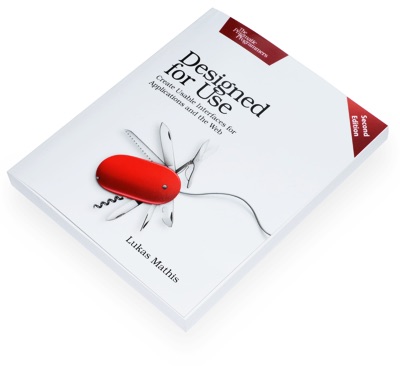
Want to read more like this? Buy my book's second edition! Designed for Use: Create Usable Interfaces for Applications and the Web is now available DRM-free directly from The Pragmatic Programmers. Or you can get it on Amazon, where it's also available in Chinese and Japanese.
Renée Stephen@ReneeStephen
Remember when we all had blogs and joined twitter dot com and just living in the same city and being on twitter was… twitter.com/i/web/status/1…
This is another 'lessons learned' post, though the lessons are fairly minimal and limited, I would say, to the traditional course-centered perspective. Thus we read that "online and distance learning requires careful planning and new skills" and that "courses must be reviewed and redesigned." I'm an advocate of a bit less of both of those (in some cases a lot less) though this does depend a lot on the online instructor's ease and facility with digital media (I say this as someone who is really comfortable in online media and who would be really hampered by careful planning, review and redesign - I'm not putting on La Traviata, I'm explaining to someone in the moment how to use PowerPoint). That said, I totally agree with the need to rethink assessment and to provide greater flexibility (and equity) for students.
The Algorithmic Fairness and Opacity Group (AFOG) at Berkeley has written an open letter to Google executives supporting fired ethics researcher Timnit Gebru and the response (see also) of AI researchers inside Google. The telling point is this: "Ultimately change requires that dominant groups cede power. Institutional commitment must be embodied in practices and processes to enact meaningful change." In this letter dominant groups are defined in terms of position and race, but the same basic equation applies no matter how power is defined, whether it be by income, ethnicity, religion, language, or whatever. Change requires that dominant groups cede power. And what this means is that no single group or individual has ultimate power - it means moving from a hierarchy to something different. I'm not sure Google has the skills, capacities, or even the legal right to do this. But it's the only way to replace rapaciousness with ethical behaviour.
Cynics would say that the algorithm worked exactly as designed when it included administrators and doctors seeing patients remotely from home, "especially since hospital leadership had been made aware of the problem on Tuesday... and responded not by fixing the algorithm." As Roger McNamee wrote, "One of the core attractions of algorithms is that they allow the powerful to blame a black box for politically unattractive outcomes for which they would otherwise be responsible." This is why we need to be doubly watchful of the role of the algorithm in education.
An acquaintance was agonizing over how to get activity going in a community he was due to launch.
It’s easy to overthink this (and you really don’t need to).
If you’re not sure what the first discussions should be ask your members.
You don’t need to be scared of your members. You can simply ask questions like:
“How should we get activity started here?” “What should this community become?” “What would you like to see in the early days of this community?”
A community doesn’t need to launch with a fully-formed plan to drive activity. It’s an iterative process. You build a community with your members, not for your members.
Ironically, the more you engage members at this stage the more likely they will engage in the community.
I only managed to catch up on this today, and it is the kind of thing that is worth keeping track of during 2021 if you’re in the cloud business.
Hyperscalers have their own initiatives, obviously, but the availability of commercial hardware and server design approaches are going to be interesting to follow because they’ll be the true measure of how much the market is willing to switch away from Intel.
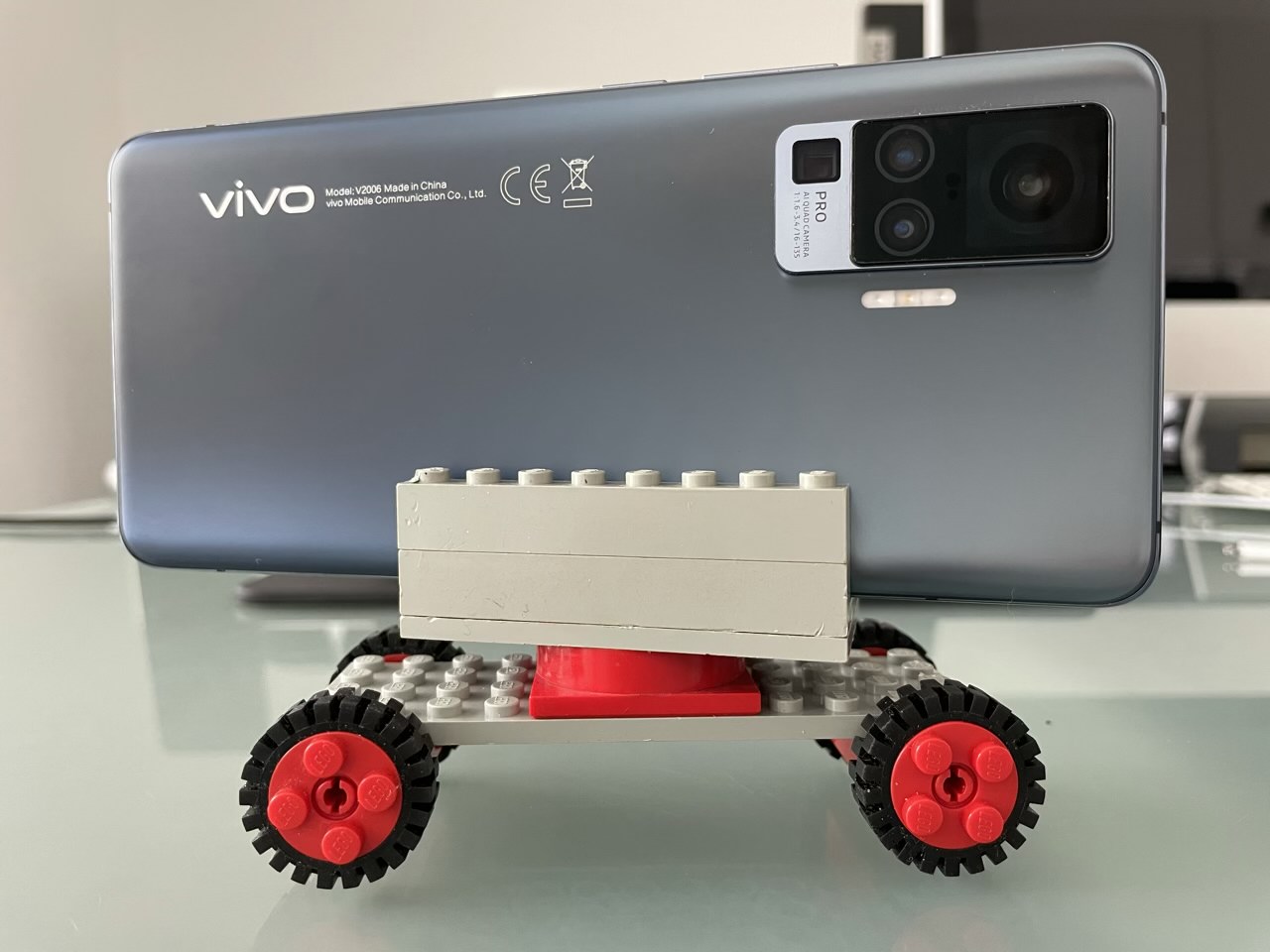
Ich fotografiere nur noch mit dem Smartphone. Und da ich ein iPhone-User bin, war das 2020 erst ein iPhone 11 Pro und dann ein iPhone 12 Pro. Aber es gibt Situationen, da kann ich kein iPhone benutzen. Zum Beispiel, wenn das iPhone selbst im Bild ist. Oder wenn ich besondere Ansprüche habe, die das iPhone nicht erfüllt, etwa einen langen Zoom oder eine Makro-Aufnahme, dann muss ich ein anderes Smartphone nehmen. Das war bisher immer ein Samsung Galaxy.
Dieses Jahr aber hat sich nach langem Warten ein anderer Hersteller in Stellung gebracht: vivo verkauft nun auch eine kleine Auswahl von Smartphones und Headphones in Deutschland. Und das vivo V2006, hier als X51 5G vermarktet, hat es mir besonders angetan. Ich habe mir sogar von Vodafone eine SIM ausgeborgt, um 5G auszuprobieren, das in meinem Telekom-Tarif nicht enthalten ist.
Dieses Telefon hat mich sofort beim Auspacken überzeugt: Eine Rückseite, die keine Fingerabdrücke annimmt, ein blitzschneller Fingerabdrucksensor hinter dem Bildschirm, eine Hauptkamera mit ganz besonderer Bildstabilsierung und ein äußerst schlankes Android. Als bestes Pferd im Stall hat es bereits ein Upgrade auf Android 11. Wenn ich nicht fest im Apple-Ökosystem vernetzt wäre, dann könnte das mein Smartphone sein.
vivo hat noch viel vor. Die nächsten Geräte der V-Serie bekommen zwei Selfie-Kameras. Eine mit 44 Megapixel-Sensor und dazu eine Weitwinkelkamera für Gruppenaufnahmen. Dazu hat vivo nun eine Entwicklungspartnerschaft mit ZEISS angekündigt. In dem Sinne bin ich gespannt, wie es bei vivo weitergeht.
In 2019, we opened a beautiful new flagship office, which sat dormant for most of 2020 due to the pandemic. We prepared a special “How to Work From Home Week” series for April, and then that “week” became tens of millions of people’s day-to-day reality. Conversations about systemic racism were amplified in every area of people’s lives, which showed us the importance of both resolving to do better and then following through. The long-planned migration of our site from thewirecutter.com to nytimes.com/wirecutter in May was successful, but we had to cancel our yearly all-company in-person meeting in June. And this year Prime Day was in October instead of July, causing the holiday deals season to last nearly three months. It’s hard to believe 2020 was only 12 months long. Keep reading for a trip down memory lane.
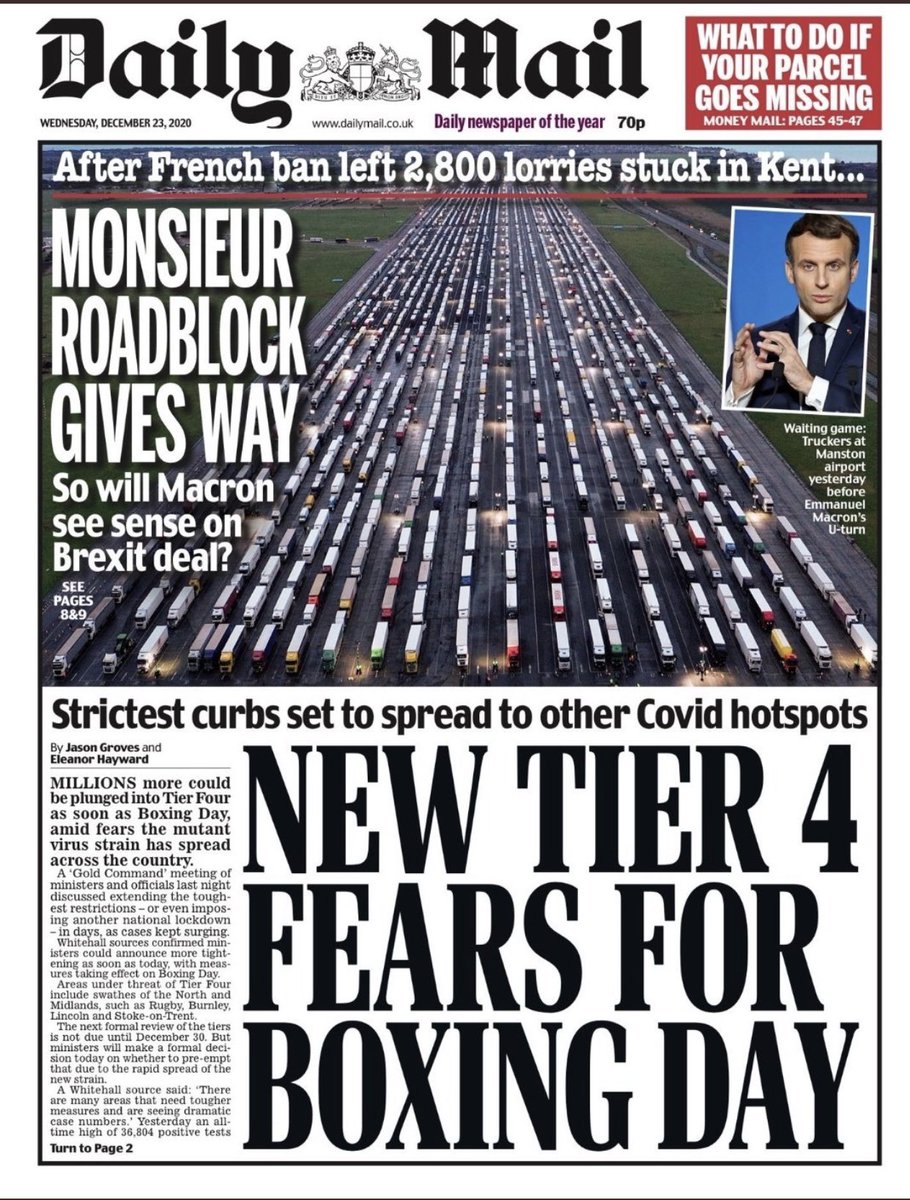
I worry that the chaos at Dover over the last few days & France's hardline on fish could give @BorisJohnson the political cover he's seeking to do no deal - by “blaming the French“ & Macron
Yes, this is No10 spin. But it could become the narrative to rally Tory MPs & the public pic.twitter.com/Em9KoXPTUi
The analysis shows there are currently seven main strains of the virus. The original strain, detected in the Chinese city of Wuhan in December 2019, is the L strain. The virus then mutated into the S strain at the beginning of 2020. That was followed by V and G strains. Strain G mutated yet further into strains GR, GH and GV. Several other infrequent mutations were collectively grouped together as strain O.
It’s interesting to see the continent multiples. Different approaches to the pandemic led to different rates of mutations and a different spread of strains.
After a few weeks of use, I’ve finally formed an opinion of the 15” Surface Book 3, and it is largely positive given that it has become my main work machine (but not, as yet, my main development one, since I still prefer to develop on my iMac). But even having put it away for the holiday break, I thought it timely to post my notes on it today.
The screen is awesome, but I think this shot best explains why it feels... roomy.
Use Case
First of all, let’s set the stage for how I’m using it on a daily basis. This machine replaces a Surface Pro 4, which was already outclassed (if not really out-performed) by the Surface Laptop 2 I use as a secondary/OS preview testing machine.
So it is now my primary work machine, which in turn means it spends 90% of its time on my standing desk.
Every morning between 8:00-8:30 I wake it up, fire up Edge to read my e-mail (I have stopped using the Outlook desktop client many months back) and Teams for my morning meetings.
Then, as the day unfolds, I start opening up a few dozen Edge and Firefox1 tabs, Teams, a couple of Office apps, the built-in Windows 10 version of OneNote (which I prefer because it is much faster than its counterpart), VS Code and a WSL 2 terminal (and backing VM instance).
Performance
Not trivial, but not overwhelming either—the notable bit here is that I can just keep piling on stuff and it doesn’t slow down in any noticeable way, whereas my other machines would slowly start dragging along.
And even though I don’t plan on going back to, say, desktop Outlook or a full install of Visual Studio (since I’ve always preferred lightweight editors and tools) the removal of all the performance limitations I had with my previous Windows machines feels liberating.
In short, this thing is a beast. I set up Blender on it and, in some highly unscientific testing, it outperformed everything else I have in the house (not that hard, really, given it’s the newest machine), to the extent where I just piled on stuff–OBS, building a couple of Docker images inside WSL 2, etc.
In days where I’m solely doing “knowledge worker” stuff, it is almost ludicrously overpowered, and that effect is exacerbated by my having moved to web-based tools during the past few years. Since I juiced it up as far as it would go both RAM and GPU-wise, the overall feeling is of effortless, fluid raw performance.
Standing vs Remoting
The way I work may seem strange to most people, but for years now I’ve just set my work machine on a table or shelf and used Remote Desktop to work on it from my iMac, which has a grand total of three displays (the internal 5K panel, an external 4K Thunderbolt Display and an LG ultra-wide monitor I added during the pandemic).
This arrangement harkens back to the days I used Citrix2, and gives me huge swathes of screen real estate that are extremely handy for keeping several views of the Azure portal, loads of documents and the odd terminal window open.
But on the iMac, it also lets me flick between local and (multiple) remote machines with simple finger gestures. It also makes it trivial to keep my personal and work environments completely separate without taking up any extra desk space (as well as keeping noisy fans away).
I like working this way so much that over the years it’s become my default—I’d much rather fire up a VM on Azure or my home KVM host than overtax my local CPU, and as time progressed, Xrdp has become a viable solution to log in to Linux boxes as well, so I even remote to my Raspberry Pis whenever I absolutely must have a GUI. And that is even without considering the usual side benefits, like the ability to occasionally log in to my work machines from an iPad.
There and Back Again
So I leave the Surface Book 3 on my standing desk and use it normally for meetings (which take up roughly half of my day), and sit back at my desk and remote to it for focus time, which is when I usually spend more time editing more complex documents and take fuller advantage of my iMac displays.
Remoting to the Surface Book 3 may seem ridiculous considering it’s less than two meters away from my normal desk, but using Remote Desktop on a Mac is actually a great experience right now–I can even redirect my webcams and microphone over RDP and it works fine, except for a smidgeon of lag, (so I only do it for stuff like meetings where I won’t be presenting or event broadcasts).
The key thing here is that the added horsepower and great 5GHz Wi-Fi performance translate into very smooth remote video playback and extremely snappy application rendering, so much so in fact that I haven’t yet bothered to plug in the Gigabit Ethernet cable to the Surface Dock, because it’s nearly as fast as standing in front of the machine3.
Laptop Use
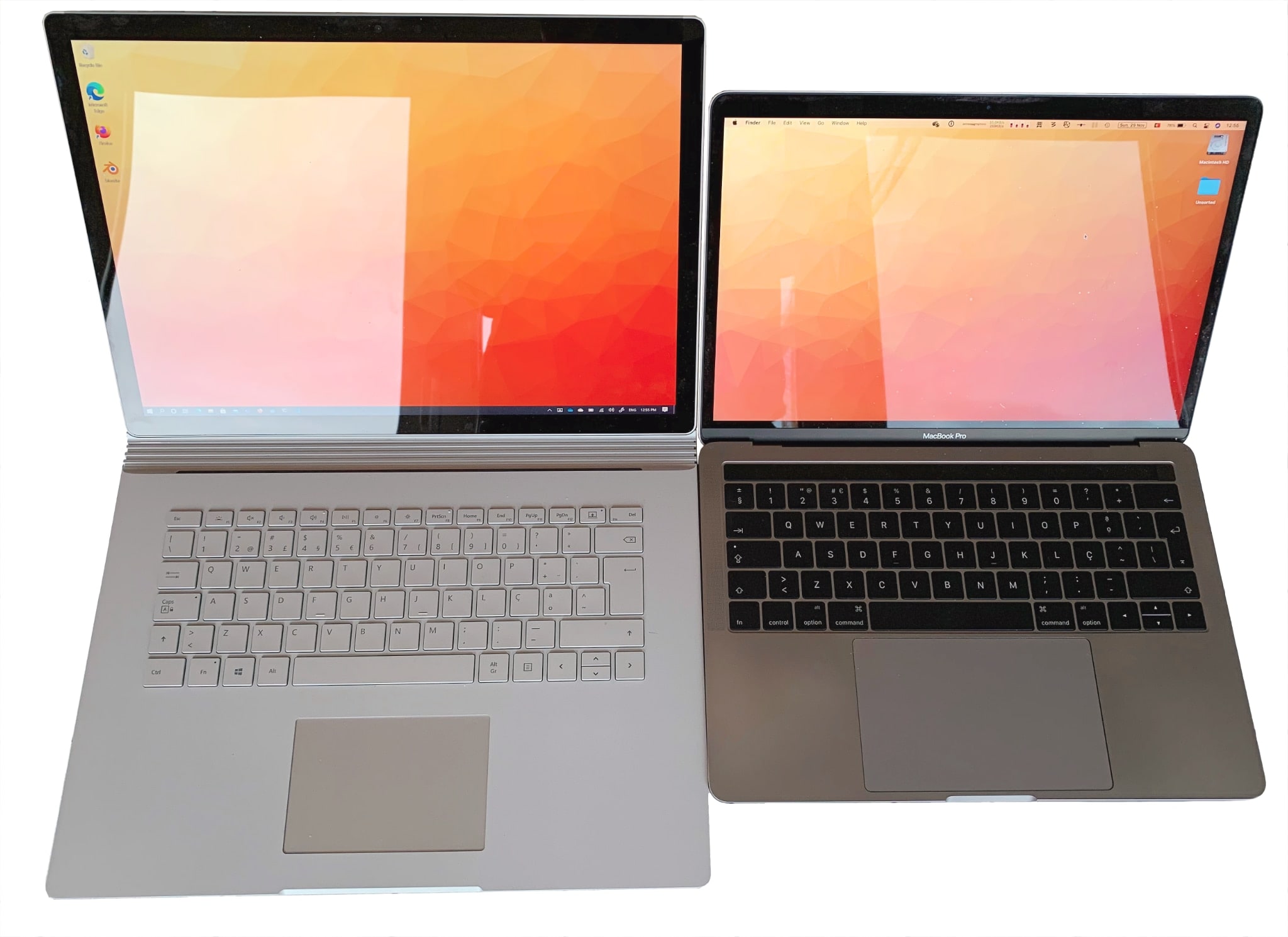
This thing is much larger than the Surface Laptop 2. So much so that the trackpad seems much smaller in comparison, when it is in fact the same size.
Since I’m extremely unlikely to travel anywhere for another year, I got the 15” model, which feels like the ideal compromise at a time where portability is a secondary concern. I loved my Surface Pro 4 for its lean and light weight form factor when I traipsed around the country on a daily basis, and I don’t think I would enjoy doing the same with the Surface Book.
But on the few occasions where I’ve had enough focus time to unplug it from the dock and take it to the couch or another room, I’ve quite enjoyed the roomier screen.
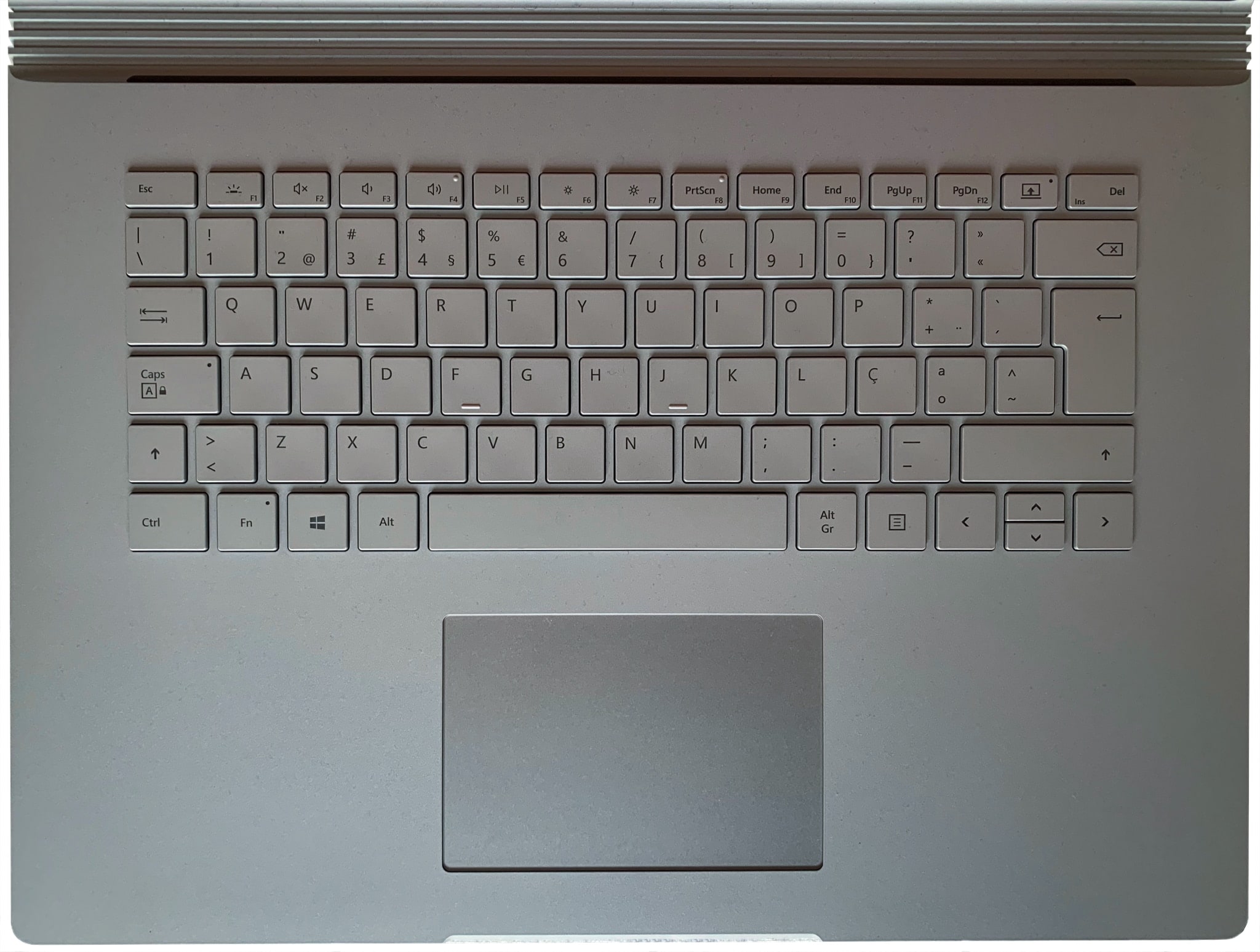
The biggest difference, however, is the keyboard. Since I’m used to smaller machines it felt strange to have a larger wrist rest, but somehow it doesn’t have the “cafeteria tray” feel of the Lenovo X1 I was issued five years ago, and (also in contrast to the X1 keyboard, which I hated), it is quite nice to type on.
Camera & Audio
The front camera4 is really good–it is a 1080p, 5.0MP camera, which means just as good (if not a smidgeon better) than the ones on previous Surfaces, and embarrassingly superior to anything that ships on any current Mac (I added a Logitech BRIO 4K to my iMac, and keep experimenting with webcams and chunks of glass because I just can’t tolerate the blurry mess most built-in webcams are).
But the microphones on this thing are nothing short of amazing. I can switch between a headset and the microphone array and remain perfectly intelligible to my callers, with a pretty decent dynamic range and very little echo (I’ve tried doing a few recordings with it, and they came out about as good as my desk microphone).
Touchpad
The touchpad is… fine. It is just barely, within the finest subjective distance, as nice as my MacBook’s, but the overall feel and irritating differences in gesture support are different enough to feel unnatural to me (but I’m biased, and use a Mac trackpad daily, so the first few minutes after changing machines are where I notice it the most).
But it still blows most other PC touchpads I’ve used out of the water, and feels like a gradual improvement from the Surface Laptop and the Pro 4, which were also top of the line at the time I got them.
Battery life is… OK, I guess. I have no hard data to form an opinion as I’m not using it as a laptop often enough, but it stayed the course every time I did so with plenty of charge to spare–and given that it has two batteries, that is largely unsurprising.
Some Detachment Required
One of the selling points of the Book that I just can’t relate to is that the screen detaches and can be used as a standalone unit, leaving behind the added GPU and battery oomph that sits inside the keyboard base.
I detached the tablet portion from the keyboard exactly twice: One to fool around with it and another to try to read through some academic papers (which lasted for about an hour because I really don’t like the Windows tablet UX).
I have no firm opinion about the feature’s usefulness in general, and suspect I won’t be using it much (if ever again).
Conclusion
I like it. I would probably be just as well with compact desktop and a slimline LCD panel for my standing desk (and I did get a 15”, 4K USB3 HIDPI panel to keep it company there), but having the whole package (HIDPI screen, great camera and audio and beefy CPU) in a mobile format gives it a substantial edge.
Not to mention that (for me) being able to use it remotely is a major plus, and the new camera/audio redirection features in the macOS Remote Desktop client are just the icing on the cake.
I still prefer to use Firefox for customer and personal stuff, partly because [Firefox containers][containers] is so much better than Edge profiles and partly due to it being the lighter, nicer browser across all my machines. ↩︎
I wrote a bit more about the dock itself on my other post, if you’re curious about it–it really completes the package, but it would be redundant to go on about it here again. Also, truth be told that I also don’t have wired Ethernet on that side of the office yet, but with a 5GHz AirPort Extreme in the same room, I have zero need for it at the moment. ↩︎
There is also an 8.0MP camera in the back, which I have not yet found a real use for. But it’s nice to know it’s there–even though I’ve only used it by accident so far. ↩︎
It’s the time of year for reflection, and boy what a year 2020 has been. To be honest I don’t think I have processed it all – not yet anyway. So, I thought I try to share a few thoughts inspired by bananas! Yes, dear reader, that’s not one of my many typos, I do mean bananas.
Last week I got a little, personalised infographic from Marks and Spencers giving me a view of my spending habits over the past year. To my surprise I was the 3 top buyer of bananas in my local M&S foodstore.
As I commented on Facebook, this was possibly the most useless bit of data ever. Oh how we all laughed! Making it to the top 3 banana buyer caused much hilarity and possibly my most popular and engaged (yes there were lots of comments not just likes and emjois) FB post of the year. I am still waiting for my end of year FB roundup – bet that will be a beauty too.
But the bananas did get me thinking and reflecting on data, numbers, customer profiling and personalisation. All key themes of 2020.
This year has been dominated by numbers. Shockingly high numbers of deaths due to COVID-19 – a series of blog post I wrote during lockdown all started with the ever increasing official UK death toll; ever increasing numbers of people made redundant due to the impacts of lock down, the profits some companies are still making, the ever increasing numbers of children in poverty, ever increasingly eye wateringly high numbers of personal wealth of the worlds billionaires, the increasing cost of Brexit, the increasing number of unelected (and at times slightly dodgy) Peers.
The divisions between the haves and have nots has become more acute and sadly the gulf seems to be getting greater. It’s all in the numbers . . .
But back to the bananas. I remember, back in the day when “learning analytics” was still just a slightly odd word combination, going to an event in Oxford where some “angel investors”, govt peeps and a few weirdos like me were invited to discuss how to save and share data (educational mainly). Some of you might remember the phrase “data lockers”. Anyway, it’s all a bit of a blur now really, but I do always remember Tony Hirst (the man who helped me really understand the power of data) commenting at the time about the lack of anyone from retail being there. I’m sure he said something along the lines of Tesco know more about us all than the government will ever do and they never share “their” data.
That’s always stuck with me – even as I swipe my Tesco clubcard, and various other ‘customer rewards cards’. Tesco are very clever about regularly sending me money off vouchers, that’s a trade off I can live with as they don’t share that data – it’s worth too much to them. However, the bananas and the infographic have got me thinking again about data manipulation, and personalisation.
At this point I need to to give a bit of context to the bananas. I like a banana as much as anyone else who likes them. I don’t eat or buy (so I thought ) an excessive amount of them. So to be in a top three buyer category did surprise me. Even more so as I don’t actually do that much food shopping in Marks and Spencers. If I had access to all my data I’m sure other non fruit food items and would top my banana purchasing – but back to that in a minute.
However, during lockdown, and particularly at the start of lockdown, I was finding it hard to get fresh fruit at my regular supermarket, but my local M&S was the exception so I did do more fruit shopping there than normal. As panic buying died down (only to reappear now!) and stocks became more plentiful, my fruit buying at M&S declined – the naughty stuff probably stayed the same, but I can’t be sure as I can’t access that data.
Now obviously M&S want to promote themselves as a “healthy” option, and appeal not only to my (completely non) competitive nature, by rewarding me with positive news about my shopping habits. Being more than content with a “bronze medal” as someone put it, I really have no intention of trying to improve that rating – or spend any more money on bananas. But I am very curious now about the data (aka my data) that M&S hold, how the decisions around what to share with me about my apparent preferences, and inferred lifestyle choices were made.
I’m pretty sure my M&S dashboard has a whole series of other views that it could have shared. And that got me thinking about how data can, and is, manipulated to provide a seemingly ‘personalised’ view of “stuff”. A view that is not actually centred on helping me maintain a healthy, balanced diet and lifestyle but is actually all about getting me to spend more money in a retail outlet. And that brought me back to education, and data, and personalisation.
So many ed tech companies are selling ‘the dream’ of personalisation through their data platforms – but is it really personalisation? Or is it just a thin veil of a ‘user first name’ being placed in certain pages, some choice of colour options, in a “personalised’ way to another 3 and half million “users’ of homogenised content and quizzes? What/where is the wider context of the “user” (aka learner ) data being used?
There have been too many people this year to mention in this post who raise these questions in a far more informed and nuanced way, in particular Ben Williamson for keeping a constant track of ed tech investment and “innovation” and Audrey Watters for her continued role as the Cassandra of Ed Tech, and in particular the rise of surveillance in education. These methods of track and trace I approve of!
Which brings me back, not quite to the bananas, but to more numbers, data, and notions of data surveillance that the COVID 19 pandemic has raised. Again like many, I was quite skeptical of the original track and trace app the UK government had planned. One step closer to a dystopian Big Brother State loomed . . . but that hasn’t quite happened, and afaik the track and track app is quite safe to use.
But in the same way I have become accustomed/ accepted/ complied (not quite sure what the right word is here so you can choose which one you think best fits) to retail consumer profiling and trade offs, I am slightly worried by some internal conversations I am having.
Would I trade a “little bit” of surveillance in terms of data about for example being COVID tested, about when (with a big IF caveat here) I get vaccinated, to be allowed to do a little bit more for example, be able to visit friends and family who live in a different part of the country/ the world, have people in my house? Is a bit of data about my health going to be price of freedom in 2021? And who will own that data? What inferences will be made from that data? Possibly a bit much for this almost top banana to figure out. Perhaps I need to work this out in a speculative data story?
In the meantime I wish you a very Merry Christmas and a hopefully brighter 2021.
I want to be clear that I am not endorsing this product (nor in fact have I tested it) but it is relevant to note that it exists. The premise is that it will save (paid) bloggers a lot of time by automating the research process (ie., it will do a Google search on keywords and present the results) and writing (ie., it will let you select text from the links and insert them into your document). Rearrange them as desired and Voila! a completed post with no searching and no writing. Now I should say that if you can refrain from publishing cut-and-paste articles, and you can actually work with the raw content, then this could be an enormously useful tool. And I won't lie: it's functionality I've long wanted to build into gRSShopper. Via Product Hunt.
As mentioned previously, Substack is a mailing list subscription service. It supports monetization by subscription fees, does not run advertising or track users, and does not organize content by an algorithm. Other than the fact that it is centralized, it is as decentralized as possible, focused on providing a producer-subscriber relationship without interfering. One might expect, then, that its moderation policy would be "none", but it isn't quite. Their guidelines prohibit porn, hate, plagiarism, impersonation, doxxing, criminal activities, and spam and phishing. This is a pretty reasonable starting point. These guidelines wouldn't work on a broadcast service like Twitter or algorithmic service like Facebook or YouTube, but if you as a subscriber are able to choose what you see, then these should be sufficient.
TCL is running a Boxing Day sale on one of its 4-Series 4K Android TVs, dropping the price by $150.
Available only at Best Buy until 11:59pm CST on December 31st, the special Boxing Day deal lets you get the 55-inch 4-Series 4K UHD HDR LED Android Smart TV for just $399.99 (regularly $549.99). TCL notes the deal starts on December 24th at 6am ET, but Best Buy Canada’s website already lists the sale price.
TCL makes several different TV sets, but its 4-Series options are relatively well-priced. Most offer 4K HDR pictures and come in either Roku or Android TV flavours (which determines the software installed on them). I’ve been using one of these 4K TCL TVs for a while, and I quite like it. Granted, I have an older Roku model, but it’s still pretty good.
The Android TV version offers access to Android TV apps like YouTube, Netflix, Amazon Prime Video, Crave and more. You can also rent or buy movies from Google Play.
You can learn more about the TCL 55-inch 4-Series Android TV, or take advantage of the deal, on Best Buy’s website.
Dr. Florence Chee@cheeflo
One unanticipated benefit of having a common bilingual education from Canada is being able to discuss Christmas gif… twitter.com/i/web/status/1…
Riad and I walked around in the rain, and then retreated for a green tea & a whiskey to catch up. Tech Nomads of the Universe is Riad’s book, which includes an interview with me. Predictably, I talk about community :)
After a few weeks of use, I’ve finally formed an opinion of the 15” Surface Book 3, and it is largely positive given that it has become my main work machine (but not, as yet, my main development one, since I still prefer to develop on my iMac). But even having put it away for the holiday break, I thought it timely to post my notes on it today.
The screen is awesome, but I think this shot best explains why it feels... roomy.
Use Case
First of all, let’s set the stage for how I’m using it on a daily basis. This machine replaces a Surface Pro 4, which was already outclassed (if not really out-performed) by the Surface Laptop 2 I use as a secondary/OS preview testing machine.
So it is now my primary work machine, which in turn means it spends 90% of its time on my standing desk.
Every morning between 8:00-8:30 I wake it up, fire up Edge to read my e-mail (I have stopped using the Outlook desktop client many months back) and Teams for my morning meetings.
Then, as the day unfolds, I start opening up a few dozen Edge and Firefox1 tabs, Teams, a couple of Office apps, the built-in Windows 10 version of OneNote (which I prefer because it is much faster than its counterpart), VS Code and a WSL 2 terminal (and backing VM instance).
Performance
Not trivial, but not overwhelming either—the notable bit here is that I can just keep piling on stuff and it doesn’t slow down in any noticeable way, whereas my other machines would slowly start dragging along.
And even though I don’t plan on going back to, say, desktop Outlook or a full install of Visual Studio (since I’ve always preferred lightweight editors and tools) the removal of all the performance limitations I had with my previous Windows machines feels liberating.
In short, this thing is a beast. I set up Blender on it and, in some highly unscientific testing, it outperformed everything else I have in the house (not that hard, really, given it’s the newest machine), to the extent where I just piled on stuff–OBS, building a couple of Docker images inside WSL 2, etc.
In days where I’m solely doing “knowledge worker” stuff, it is almost ludicrously overpowered, and that effect is exacerbated by my having moved to web-based tools during the past few years. Since I juiced it up as far as it would go both RAM and GPU-wise, the overall feeling is of effortless, fluid raw performance.
Standing vs Remoting
The way I work may seem strange to most people, but for years now I’ve just set my work machine on a table or shelf and used Remote Desktop to work on it from my iMac, which has a grand total of three displays (the internal 5K panel, an external 4K Thunderbolt Display and an LG ultra-wide monitor I added during the pandemic).
This arrangement harkens back to the days I used Citrix2, and gives me huge swathes of screen real estate that are extremely handy for keeping several views of the Azure portal, loads of documents and the odd terminal window open.
But on the iMac, it also lets me flick between local and (multiple) remote machines with simple finger gestures. It also makes it trivial to keep my personal and work environments completely separate without taking up any extra desk space (as well as keeping noisy fans away).
I like working this way so much that over the years it’s become my default—I’d much rather fire up a VM on Azure or my home KVM host than overtax my local CPU, and as time progressed, Xrdp has become a viable solution to log in to Linux boxes as well, so I even remote to my Raspberry Pis whenever I absolutely must have a GUI. And that is even without considering the usual side benefits, like the ability to occasionally log in to my work machines from an iPad.
There and Back Again
So I leave the Surface Book 3 on my standing desk and use it normally for meetings (which take up roughly half of my day), and sit back at my desk and remote to it for focus time, which is when I usually spend more time editing more complex documents and take fuller advantage of my iMac displays.
Remoting to the Surface Book 3 may seem ridiculous considering it’s less than two meters away from my normal desk, but using Remote Desktop on a Mac is actually a great experience right now–I can even redirect my webcams and microphone over RDP and it works fine, except for a smidgeon of lag, (so I only do it for stuff like meetings where I won’t be presenting or event broadcasts).
The key thing here is that the added horsepower and great 5GHz Wi-Fi performance translate into very smooth remote video playback and extremely snappy application rendering, so much so in fact that I haven’t yet bothered to plug in the Gigabit Ethernet cable to the Surface Dock, because it’s nearly as fast as standing in front of the machine3.
Laptop Use
This thing is much larger than the Surface Laptop 2. So much so that the trackpad seems much smaller in comparison, when it is in fact the same size.
Since I’m extremely unlikely to travel anywhere for another year, I got the 15” model, which feels like the ideal compromise at a time where portability is a secondary concern. I loved my Surface Pro 4 for its lean and light weight form factor when I traipsed around the country on a daily basis, and I don’t think I would enjoy doing the same with the Surface Book.
But on the few occasions where I’ve had enough focus time to unplug it from the dock and take it to the couch or another room, I’ve quite enjoyed the roomier screen.
The biggest difference, however, is the keyboard. Since I’m used to smaller machines it felt strange to have a larger wrist rest, but somehow it doesn’t have the “cafeteria tray” feel of the Lenovo X1 I was issued five years ago, and (also in contrast to the X1 keyboard, which I hated), it is quite nice to type on.
Camera & Audio
The front camera4 is really good–it is a 1080p, 5.0MP camera, which means just as good (if not a smidgeon better) than the ones on previous Surfaces, and embarrassingly superior to anything that ships on any current Mac (I added a Logitech BRIO 4K to my iMac, and keep experimenting with webcams and chunks of glass because I just can’t tolerate the blurry mess most built-in webcams are).
But the microphones on this thing are nothing short of amazing. I can switch between a headset and the microphone array and remain perfectly intelligible to my callers, with a pretty decent dynamic range and very little echo (I’ve tried doing a few recordings with it, and they came out about as good as my desk microphone).
Touchpad
The touchpad is… fine. It is just barely, within the finest subjective distance, as nice as my MacBook’s, but the overall feel and irritating differences in gesture support are different enough to feel unnatural to me (but I’m biased, and use a Mac trackpad daily, so the first few minutes after changing machines are where I notice it the most).
But it still blows most other PC touchpads I’ve used out of the water, and feels like a gradual improvement from the Surface Laptop and the Pro 4, which were also top of the line at the time I got them.
Battery life is… OK, I guess. I have no hard data to form an opinion as I’m not using it as a laptop often enough, but it stayed the course every time I did so with plenty of charge to spare–and given that it has two batteries, that is largely unsurprising.
Some Detachment Required
One of the selling points of the Book that I just can’t relate to is that the screen detaches and can be used as a standalone unit, leaving behind the added GPU and battery oomph that sits inside the keyboard base.
I detached the tablet portion from the keyboard exactly twice: One to fool around with it and another to try to read through some academic papers (which lasted for about an hour because I really don’t like the Windows tablet UX).
I have no firm opinion about the feature’s usefulness in general, and suspect I won’t be using it much (if ever again).
Conclusion
I like it. I would probably be just as well with compact desktop and a slimline LCD panel for my standing desk (and I did get a 15”, 4K USB3 HIDPI panel to keep it company there), but having the whole package (HIDPI screen, great camera and audio and beefy CPU) in a mobile format gives it a substantial edge.
Not to mention that (for me) being able to use it remotely is a major plus, and the new camera/audio redirection features in the macOS Remote Desktop client are just the icing on the cake.
I still prefer to use Firefox for customer and personal stuff, partly because [Firefox containers][containers] is so much better than Edge profiles and partly due to it being the lighter, nicer browser across all my machines. ↩︎
I wrote a bit more about the dock itself on my other post, if you’re curious about it–it really completes the package, but it would be redundant to go on about it here again. Also, truth be told that I also don’t have wired Ethernet on that side of the office yet, but with a 5GHz AirPort Extreme in the same room, I have zero need for it at the moment. ↩︎
There is also an 8.0MP camera in the back, which I have not yet found a real use for. But it’s nice to know it’s there–even though I’ve only used it by accident so far. ↩︎
While those ambitions never really panned out, new rumours courtesy of Bloomberg’s often-reliable Mark Gurman indicate Apple isn’t quite done with the gaming space yet. According to Gurman, a new Apple TV is set to release in 2021 that focuses on video games and includes an updated remote and a new processor.
Given how frustrating the Siri Remote can be at times, hopefully, this new controller ditches the concept of touch navigation altogether. Touch controls are great, but you really can’t beat physical controls in the context of a set-top box remote.
In the past, Bloomberg has stated that Apple is developing a new Siri Remote that features ‘Find My’-like capabilities. While somewhat silly, the number of times I’ve misplaced the Apple TV’s remote borderlines on ridiculous, so a feature as simple it making a noise after tapping on an iPhone would be great.
The new Apple TV is rumoured to feature 64GB and 128GB storage options compared to the current 32GB and 64GB storage available in the Apple TV 4K.
Given that the Apple TV 4K was released over three years ago and features Apple’s older A10X Fusion processor, it makes sense that a hardware refresh would be on the way.
Also, now that Apple offers Apple Arcade, its own video game subscription service that costs $5.99 per month, it makes sense that the company would try to build its presence in the gaming space.
Zoom is looking to expand beyond video calling and may launch an email service and calendar app to compete with Google and Microsoft.
A new report from The Informationhas revealed that Zoom has already started to develop the email service, and that it may begin testing it next year. It’s unknown if Zoom has started developing the calendar service.
By expanding beyond its video calling service, Zoom may be able to retain its success and users once people return to the office and no longer need to video conference as much.
It’s worth noting that Zoom’s major competitors, Google and Microsoft, offer video conferencing services as part of broader enterprise app suites. Both of these companies offer email and calendar products, so it makes sense for Zoom to offer its own as well.
The Information notes that there are other factors that suggest Zoom is looking to create an entire enterprise app suite. For instance, the company has posted job ads looking for people to help create “exciting chat features.”
However, there’s the question of whether Zoom would even be able to successfully adopt users who are accustomed to Gmail or Outlook, especially since many workplaces have selected one or the other.
This is exactly how I feel Amazon treats open source. It’s not illegal according to various licenses. mjtsai’s other linked commentary makes the same point about a physical product example.
But the result is the same: clone and crush.
I know there are well meaning open source folks at Amazon. I use Amazon for infrastructure. I think AWS has amazing operators.
But your actions and culture are actively damaging. If you only listen to the law, rather than ethics, courtesy, and a spirit of partnership, we will evolve licenses that force you to behave.
Curbs are being poured along Beach Avenue from Stanley Park to Hornby Street.
The City approved this permanent change from cones to concrete after a few months of consultation – albeit a ‘temporary’ permanent change, subject to the English Bay master plan currently under design by PFS Studio and Snøhetta.
These interventions also deal with some of the confusion and conflict resulting from this fast pandemic response in the spring when bikes were removed from the seawall. Cyclists tended to ignore stop signals primarily designed for vehicle traffic – so now the crossings provide clarity, safety and a slowing down of two-wheelers. (Hopefully eye-level signals for bikes will be installed where necessary.)
The most convoluted section is where Beach, Denman, Davie and Morton Streets blend, complicated even more with heavy pedestrian traffic to and from the beach, as well as a service bay for the Cactus Club. The key to good design is providing intuitive direction without the need for excessive signage so everyone has a sense of where to go as they’re moving – and here the need to separate the bike flows makes it especially challenging.
So far, it’s looking good – even as two-way traffic and transit is restored to Beach east of Denman.
Best of all, the City engineers have not narrowed the space allocated to bikes (in fact, they may have increased it along Beach west of Denman) which means that there are still passing lanes for what would normally be just two lanes of cyclists, one in each direction. Now the fast-moving athletic and transportation cyclists can maintain speed in the centre lane without intimidating those on either side. It’s the next generation of bikeway design.
Yes, some will bemoan the loss of the cycling lane along the seawall, but in truth, the quality of the pedestrian experience has so improved, the trade-off seems justified. When the daily count of cyclists gets over 10,000 regularly (the volumes more typical of northern European cities), something had to give.
This design seems ultimately win-win-win-win. The seawall is better for those on foot, Beach is better for those on wheels, two-way traffic is restored for vehicles and transit, and Vancouver as a whole moves closer to its planning and climate goals.
Kudos to the engineers, and the Council that gave them their back.
Yes, it’s true: Last year, I did not predict a global pandemic in 2020. COVID is a gravitational force that warps everything it touches, so I approach this annual ritual of self-grading with trepidation. As I start, I honestly don’t remember what I predicted twelve months ago…but regardless, I’m expecting a train wreck. I’ll read each one in turn, repeat the headline prediction, and then free associate some thoughts on what actually transpired. Grab a glass of your favorite beverage…and here we go:
Facebook bans microtargeting on specific kinds of political advertising. OK, Facebook did NOT do this – well, not exactly. What the company DID do was ban political advertising altogether – but only in the week before, and a short period after the US election. Of course, you can certainly say that by banning all political advertising, the company ended up banning microtargeting as a result. So that’s one argument for giving myself a “Nailed It.” If that’s too weak an argument, let’s go to the fine print in my original prediction: “The pressure to do something will be too great, and as it always does, the company will enact a half-measure, then declare victory.” And that is exactly what the company did. I mean, exactly. I also wrote: “The company’s spinners will frame this as proof they listen to their critics, and that they’re serious about the integrity of the 2020 elections. As with nearly everything it does, this move will fail to change anyone’s opinion of the company. Wall St. will keep cheering the company’s stock, and folks like me will keep wondering when, if ever, the next shoe will drop.” Yup. Nailed it.
Netflix opens the door to marketing partnerships. This prediction requires a bit of clarification. I was not claiming Netflix would open the door to advertising on its platform, but rather that it “may take the form of a co-produced series, or branded content, or some other “native” approach, but at the end of the day, it’ll be advertising dollars that fuel the programming.” What I didn’t realize when I made this prediction was that Netflix was already deep into product placement deals for its Netflix Originals, and that it had already made sure the money changed hands somewhere else (such as between a production company and a brand). There is no doubt that marketing money positively benefits Netflix’s bottom line – and the practice absolutely accelerated in 2020, as did everything streaming-related during COVID. But there was not a significant shift in Netflix policy related to marketing that I can find, so I’m going to say I whiffed on this one.
CDA 230 will get seriously challenged, but in the end, nothing gets done, again. This is exactly what happened. In fact, it’s happening as I type this – Trump just vetoed a veto-proof defense funding bill because it doesn’t repeal 230, and Biden has already indicated he plans to rethink 230 next year. But even though tens of millions of American citizens became familiar with Section 230 this year, nothing came of all that noise. Nailed it.
Adversarial interoperability will get a moment in the sun, but also fail to make it into law. OK I have GOT to stop writing predictions about obscure academic terminology. I mean, what the actual f*ck? What I was trying to say was this: In 2020, there would be a robust debate about the best ways to regulate Big Tech, and the ideas behind “adversarial interoperability” would get a rigorous airing. This did not happen, and just like Jeffrey Katzenberg, I blame COVID. Exactly no one wanted to debate tech policy in the middle of a global pandemic. Making things worse, toward the end of this year multiple governmental agencies decided it was time to go after Big Tech, and they went batshit with proactive lawsuits – the DOJ and a majority of states sued Google (three times, no less), the FTC sued Facebook, and I’d put money more suits are coming (looking at you, Apple and Amazon). The suits revolve around antitrust law, so the debate will now be dominated by whether or not the government can prove its case in court. This effectively postpones intelligent debate about remedies for years. I find this state of affairs deeply annoying. But a grade must be given, and that grade is a whiff, unfortunately.
2020 will also be the year “data provenance” becomes a thing. Literally stop me from ever writing predictions after hitting the flash evaporator, OK?! This was another policy-related prediction, and if I was going to miss #4 above, I’m certainly going to whiff here as well. In the very rare case you want to know what I was on about, this is how I described the concept: “The concept of data provenance started in academia, migrated to adtech, and is about to break into the broader world of marketing, which is struggling to get its arms around a data-driven future. The ability to trace the origin, ownership, permissions, and uses of data is a fundamental requirement of an advanced digital economy, and in 2020, we’ll realize we have a ton of work left to do to get this right.” Well, in fact, if you believe Google Trends, “data provenance” did have a marked lift in 2020. Does that qualify it for “becoming a thing”? I have no f*cking idea. And again, thanks to COVID, marketers were not exactly focused on public ledgers and blockchain in 2020. Note to self: Stop predicting that something will “become a thing.” Inane. Whiff.
Google zags. Oh man, oh man, I feel so close on this one. I mean, there are still a few days left in 2020, right? I honestly think this is about to happen. Here’s how I explained it one year ago: “Saddled with increasingly negative public opinion and driven in large part by concerns over retaining its workforce, Google will make a deeply surprising and game changing move in 2020.” Google’s problems with both public perception (hello, three government lawsuits!) and an unhappy workforce only deepened this year – the Timnit disaster was just the most public of its struggles. But so far the company hasn’t produced a dramatic “game changing” move. Sure, the FitBit acquisition finally closed, but if that proves material, I’ll … start using a FitBit again. I firmly believe that Google must make a game changing move, and soon, if it’s going to keep its mojo. But….it certainly hasn’t happened yet. So…sigh…Whiff.
At least one major “on demand” player will capitulate. Just weeks into 2020, I was well on my way to a “Nailed It” here. The tide was turning on the entire category: Uber was in trouble and badly below its IPO price, GrubHub was a falling knife looking for a buyer, PostMates had shelved its IPO dreams. And then…COVID reordered the universe, making on demand everything an essential part of quarantine life. The entire category was supercharged – I mean, DoorDash at 19 times sales?!?! – and yet another of my predictions bit the dust. F U, COVID. Whiff.
Influencer marketing will fall out of favor. Well, if ever there was a year to be sick of influencer marketing, it’d be this one. But no, with sports and entertainment programming suspended for the majority of the year, all that marketing budget had to go somewhere, and lord knows it wasn’t going to support news (despite that being the most engaged and highest growth category of all). So…brands threw in even more with influencers. In my explanation I predicted that influencer fraud would be a huge problem – and by most accounts it is (the last figure I could find was 1.3 billion in 2019 – which was roughly 20 percent of the overall market!). But…influencer marketing did not fall out of favor, Charlie D’Amelio is making $50K per post, and damnit, I whiffed again.
Information warfare becomes a national bogeyman. Finally, a slam dunk. Man, I was starting to question myself here. “Deep fakes, sophisticated state-sponsored information operations, and good old fashioned political info ops will dominate the headlines in 2020,” I wrote. Yep, and true to form, 2020 saved the scariest example for the end of the year. Nailed it.
Purpose takes center stage in business. Here’s one prediction where COVID actually accelerated my take toward a passing grade. The year began with BlackRock’s stunning declaration that it would make investment decisions based on climate impact. Once COVID and the George Floyd murder came, nearly the entire Fortune 500 began recalibrating their communication strategies around racial, gender, and climate equity issues. Last year I wrote “I expect plenty of CEOs will feel emboldened to take the kind of socially minded actions that would have gotten them fired in previous eras.” Whether it was P&G on climate and race, Nike saying “Don’t Do It,” or nearly every major sports league standing with the Black Lives Matter movement, companies have taken previously unimaginable stands this year. Nailed It.
Apple and/or Amazon stumble. Sure, Apple did pay up to half a billion to bury its “batterygate” scandal but let’s be honest, you forgot about that, right? Even the publication of a terrifying expose of worker conditions in iPhone manufacturing plants failed to dent the company in 2020. But what you likely will remember is the Epic Fortnite story – and to me, that’s the stumble that tips my prediction to a “Nailed It.” Apple’s response to Epic was ham fisted and short sighted. The company misread regulators’ appetite for antitrust, deeply injured its reputation amongst developers, and exposed the iOS App Store – the source of its most important growth revenues – as a pristine monopoly just begging for a Federal compliant. Meanwhile, while Amazon profited handsomely from COVID, the company’s reputation has only worsened in 2020. A drumbeat of negative press about unsafe working conditions, union busting, and anticompetitive practices culminated in a broadside from one of its own – Tim Bray, a respected technologist (and early reader of Searchblog) who penned a damning Dear John letter to his former employer in May. Despite the strength of both companies’ stock prices, I think it’s safe to say that both Apple and Amazon stumbled in 2020. Nailed It.
Next week I’ll be writing Predictions 2021 — let’s hope this is the start of an upward trend…
When I’m taking pictures of somebody, I’m talking CONSTANTLY. I want my subjects to know what I’m thinking, what I’m doing. I want everybody on the same page. Your subject wants direction, wants to know what’s going on. The better they understand what you want, the easier it’ll be for both of you.
But it’s not just about conveying information. When you’re having a conversation with your subject, you’re helping create a healthy environment for both of you to work in. An environment where you can talk about and share ideas, work through any potential obstacles that come up, when you and your subject can work as partners to create photos you’re both really happy with.
Some of my best photos? Not my idea at all. It was the product of my subject and myself working through different ideas that sparked something in their heads, leading them to come up with suggestions I’d never have come up with in a million years.
When you’re communicating with your subject, you’re involving them in the process. Lowering the wall that separates the photographer from their subject. Dimming the notion that they have nothing to contribute.
And let’s not forget…conversation and communication lead to you better knowing and understanding the person you’re photographing. That there is a reward all on its own.
“But Wait!,” you say. “I’m not photographing a person!.” Don’t you worry, I got you.
Whatever you’re looking to photograph, the better you can articulate your goals to yourself, the better prepared you’ll be when it comes time to press that shutter. Have a wee conversation with yourself. Lay out what you’re looking to shoot, even if it’s just a mood, a feeling.
And it’s not just about articulating what you want. It’s that by speaking your thoughts out loud, you’re better able to interrogate them. To dig deep within your obvious desires, in order to find the more foundational motivators.
You know what you want. But why do you want it? What’s the real motivation behind your artistic desires? You know the road you want to go down, but why did you choose this road? Could knowing the answer to that question lead you down a different road that will better get you to your destination?
Communication is not just about conveying information. It’s about creating a space where new ideas can flourish. When you’re attempting to articulate your desires and goals to yourself, you are able to better visualize what your motivations are, you’re able to assess, with greater clarity, what you really want to accomplish. And with this greater clarity, you can then determine new and interesting avenues to go down. This is true when photographing a subject in a studio, people walking down the street, animals in nature, vistas in a valley, Lego sculptures at home.
Communication is a crucial aspect to dealing with others (and yourself) when shooting, and an integral part of the method I use for every shot.
In this album, I shared some examples of great results that stemmed from solid communication with my subject. Check it out and leave me a comment if you have any questions.







 mrjamesob on Twitter.













 ottocrat on Twitter.


