A week in which I felt much better than the previous weeks, and now looking forward with E and Y to christmas and the new year. As expected the country went into a renewed lockdown in the middle of the week, and in a stricter form than in March. For us nothing much has changed, we weren’t going anywhere anyway, except that Y’s holiday started a few days earlier, and will be at home until January 19th at least. Clients indicate they don’t expect to re-open their offices until next summer (when they estimate a large part of the workforce will be inoculatd.).
I used the week to finish up some things, to get ready to let go for a while. The coming week I will still do a few things, meeting payroll, writing a project proposal for next year, arranging a few things concerning the company with a notary, do some invoicing, and getting the winter tires on the car, but other than that it’s will be two weeks off until January 4th.
This week I
Submitted the new statutes of the Open NL association to the notary to have them registered
Submitted the needed material to the notary to change a few things in my company’s ownership structure
Sent in the revised proposal for a citizen science project to start in January
Brought a new laptop to a colleague
Had a board meeting with the Open NL association
Had the weekly client meetings
Had the christmas tree delivered and decorated it with E and Y
Participated in a training session on presenting
Wrote a brief plan for the publication of opening up disaggregated bird counting data for a province
Had a end-of-year video call with the team
Discussed and approved the 2021 budget and employee planning for the NGO I chair
Did some gardening, pruning and mulching
Made a weekend walk with E an Y in the woods, as well as several through the neighborhood during the week
Earlier this week I was reading a paper discussing one aspect of the legal fallout around the UK Post-Office’s Horizon IT system, and was surprised to read the view that the Law Commission’s Evidence in Criminal Proceedings Hearsay and Related Topics were citing on the subject of computer evidence (page 204): “most computer error is either immediately detectable or results from error in the data entered into the machine”.
What? Do I need to waste any time explaining why this is nonsense? It’s obvious nonsense to anybody working in software development, but this view is being expressed in law related documents; what do lawyers know about software development.
Sometimes fallacies become accepted as fact, and a lot of effort is required to expunge them from cultural folklore. Regular readers of this blog will have seen some of my posts on long-standing fallacies in software engineering. It’s worth collecting together some primary evidence that most software mistakes are not immediately detectable.
A paper by Professor Tapper of Oxford University is cited as the source (yes, Oxford, home of mathematical orgasms in software engineering). Tapper’s job title is Reader in Law, and on page 248 he does say: “This seems quite extraordinarily lax, given that most computer error is either immediately detectable or results from error in the data entered into the machine.” So this is not a case of his words being misinterpreted or taken out of context.
Detecting many computer errors is resource intensive, both in elapsed time, manpower and compute time. The following general summary provides some of the evidence for this assertion.
Two events need to occur for a fault experience to occur when running software:
a mistake has been made when writing the source code. Mistakes include: a misunderstanding of what the behavior should be, using an algorithm that does not have the desired behavior, or a typo,
the program processes input values that interact with a coding mistake in a way that produces a fault experience.
That people can make different mistakes is general knowledge. It is my experience that people underestimate the variability of the range of values that are presented as inputs to a program.
A study by Nagel and Skrivan shows how variability of input values results in fault being experienced at different time, and that different people make different coding mistakes. The study had three experienced developers independently implement the same specification. Each of these three implementations was then tested, multiple times. The iteration sequence was: 1) run program until fault experienced, 2) fix fault, 3) if less than five faults experienced, goto step (1). This process was repeated 50 times, always starting with the original (uncorrected) implementation; the replications varied this, along with the number of inputs used.
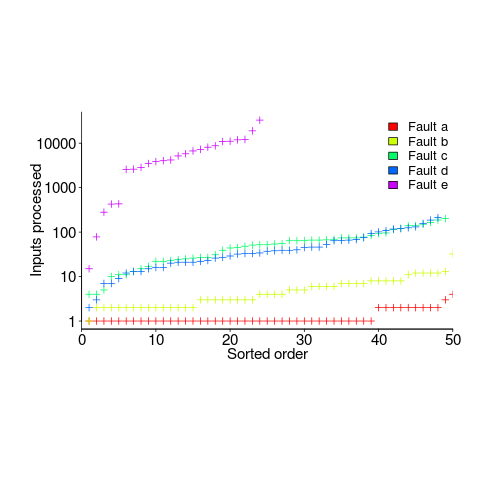
How many input values needed to be processed, on average, before a particular fault is experienced? The plot below (code+data) shows the numbers of inputs processed, by one of the implementations, before individual faults were experienced, over 50 runs (sorted by number of inputs needed before the fault was experienced):
The plot illustrates that some coding mistakes are more likely to produce a fault experience than others (because they are more likely to interact with input values in a way that generates a fault experience), and it also shows how the number of inputs values processed before a particular fault is experienced varies between coding mistakes.
Real-world evidence of the impact of user input on reported faults is provided by the Ultimate Debian Database, which provides information on the number of reported faults and the number of installs for 14,565 packages. The plot below shows how the number of reported faults increases with the number of times a package has been installed; one interpretation is that with more installs there is a wider variety of input values (increasing the likelihood of a fault experience), another is that with more installs there is a larger pool of people available to report a fault experience. Green line is a fitted power law, , blue line is a fitted loess model.
The source containing a mistake may be executed without a fault being experienced; reasons for this include:
the input values don’t result in the incorrect code behaving differently from the correct code. For instance, given the made-up incorrect code if (x < 8) (i.e., 8 was typed rather than 7), the comparison only produces behavior that differs from the correct code when x has the value 7,
the input values result in the incorrect code behaving differently than the correct code, but the subsequent path through the code produces the intended external behavior.
Some of the studies that have investigated the program behavior after a mistake has deliberately been introduced include:
checking the later behavior of a program after modifying the value of a variable in various parts of the source; the results found that some parts of a program were more susceptible to behavioral modification (i.e., runtime behavior changed) than others (i.e., runtime behavior not change),
checking whether a program compiles and if its runtime behavior is unchanged after random changes to its source code (in this study, short programs written in 10 different languages were used),
80% of radiation induced bit-flips have been found to have no externally detectable effect on program behavior.
What are the economic costs and benefits of finding and fixing coding mistakes before shipping vs. waiting to fix just those faults reported by customers?
Checking that a software system exhibits the intended behavior takes time and money, and the organization involved may not be receiving any benefit from its investment until the system starts being used.
In some applications the cost of a fault experience is very high (e.g., lowering the landing gear on a commercial aircraft), and it is cost-effective to make a large investment in gaining a high degree of confidence that the software behaves as expected.
In a changing commercial world software systems can become out of date, or superseded by new products. Given the lifetime of a typical system, it is often cost-effective to ship a system expected to contain many coding mistakes, provided the mistakes are unlikely to be executed by typical customer input in a way that produces a fault experience.
Beta testing provides selected customers with an early version of a new release. The benefit to the software vendor is targeted information about remaining coding mistakes that need to be fixed to reduce customer fault experiences, and the benefit to the customer is checking compatibility of their existing work practices with the new release (also, some people enjoy being able to brag about being a beta tester).
One study found that source containing a coding mistake was less likely to be changed due to fixing the mistake than changed for other reasons (that had the effect of causing the mistake to disappear),
Software systems don't live forever; systems are replaced or cease being used. The plot below shows the lifetime of 202 Google applications (half-life 2.9 years) and 95 Japanese mainframe applications from the 1990s (half-life 5 years; code+data).
Not only are most coding mistakes not immediately detectable, there may be sound economic reasons for not investing in detecting many of them.
"There are those of us," writes Doug Belshaw, "who have enough technical skills to be able to self-host and spin up a VPS to run Free Software. We can experiment and express ourselves however we wish." True. I am one of those, and (from my perspective) it has given me an advantage over the last 30 years. But it is long past time everyone else had similar freedoms. But how? Belshaw writes, "I believe we need to focus on enabling that positive liberty with Free Software under socialism, even if that means compromising a bit of negative liberty." I'm not sure exactly what he means by that.
Seit zehn Tagen habe ich den AirPods Max auf dem Kopf. Und nur ganz selten abgenommen. Ich habe keinen Grund, einen meiner anderen Kopfhörer aufzusetzen. Apple hat also einen Gewinner. Fünf Punkte:
Sie sind bequem.
Sie sind sehr einfach zu bedienen.
Der Sound ist tadellos.
Die Geräuschunterdrückung blendet alles aus.
Der Transparenzmodus lässt sie verschwinden.
Die anderen Hersteller müssen sich warm anziehen. Es ist absolut faszinierend, mit welchem Tempo sie von Apple überholt werden. Es gibt nichts, einfach gar nichts, was mich stört.
Ich bin übrigens der Ansicht, dass man nur eine Farbe wählen sollte. Weiß wird schmutzig werden, grün und rot überzeugen mich nicht. Blau sieht schick aus, aber nach meiner Erfahrung mit dem dunkelgrünen iPhone 11 Pro vermute ich, dass ich das irgendwann nicht mehr sehen kann. Bleibt Space Gray.
Das heißt ausdrücklich nicht, dass man jetzt seine Surface Headphones, seinen Jabra, seinen Sony, seinen Shure, seinen Sennheiser, etc. an den Nagel hängen sollte. Aber wer die Kohle ausgeben kann und in der Apple Welt zu Hause ist, der macht mit dem AirPods Max nichts falsch.
Deutsche Welle: Steinmeier ruft zu Impfbereitschaft auf. “Es sei ein Akt der Solidarität, sich gegen das Coronavirus impfen zu lassen, sagte der Bundespräsident. Das Ende der Pandemie sei damit noch nicht erreicht.”
“Steinmeier rief die Bundesbürger auf, sich in möglichst großer Zahl impfen zu lassen. Er wandte sich an die Adresse derjenigen, “die sich bisher gegen eine Impfung festgelegt haben”. Das Impfen sei auch “ein Akt gesamtgesellschaftlicher Solidarität”, sagte er. Er wolle “jeden bitten, darüber nachzudenken, ob man diese Solidarität verweigert”. Es sei eine große Zahl von Impfungen nötig, um eine weitgehende Immunisierung der Bevölkerung zu erreichen. Eine Impfpflicht sei jedoch nicht in Vorbereitung.
Menschen die grundsätzlich gegen Impfungen sind, forderte Steinmeier auf, nachzudenken, ob man “Solidarität aus prinzipieller Gegnerschaft schlicht und einfach verweigert oder nicht”. Für alle, die einen größeren Aufklärungsbedarf hätten, gebe es in den Impfzentren neben einer allgemeinen Aufklärung auch die Möglichkeit, sich von Ärzten beraten zu lassen.”
Heute hat die EMA den Impfstoff von BioNTech/Pfizer zugelassen; mit den Impfungen kann voraussichtlich am 27. Dezember 2020 begonnen werden.
Deutsche Welle: Europäische Arzneimittelbehörde EMA gibt grünes Licht für Corona-Impfstoff. “Der von den Firmen BioNTech und Pfizer entwickelte Impfstoff gegen das Coronavirus darf in Europa angewendet werden. Dies entschied die Europäische Arzneimittelbehörde. Nun muss noch die EU-Kommission zustimmen.”
Update: Corona-Impfstoff für EU zugelassen. “Die Europäische Arzneimittelbehörde und die EU-Kommission machen den Weg frei für den Einsatz des ersten Corona-Impfstoffs in der EU. Er könne als sicher empfohlen werden, so die Experten.”
Aufgrund meines Berufs werde ich vermutlich etwas eher eine Impfung erhalten können als ein großer Teil der Bevölkerung. Davon werde ich auf jeden Fall schnellstmöglich Gebrauch machen, denn seit den Sommerferien bis zum 16.12.2020 hatte ich täglich in der Schule engen Kontakt zu ca. 1000 Schüler*innen sowie 80 Lehrkräften und weiteren Personen in der Schule. Von der Politik wird es als sehr wichtig eingeschätzt, dass die Schulen offen bleiben bzw. bald wieder für Präsenzunterricht geöffnet werden. Daher ist mein Appell: Lasst euch impfen! Danke.
I make it a point never to believe anything
just because it's widely known to be so.
-- Bill James
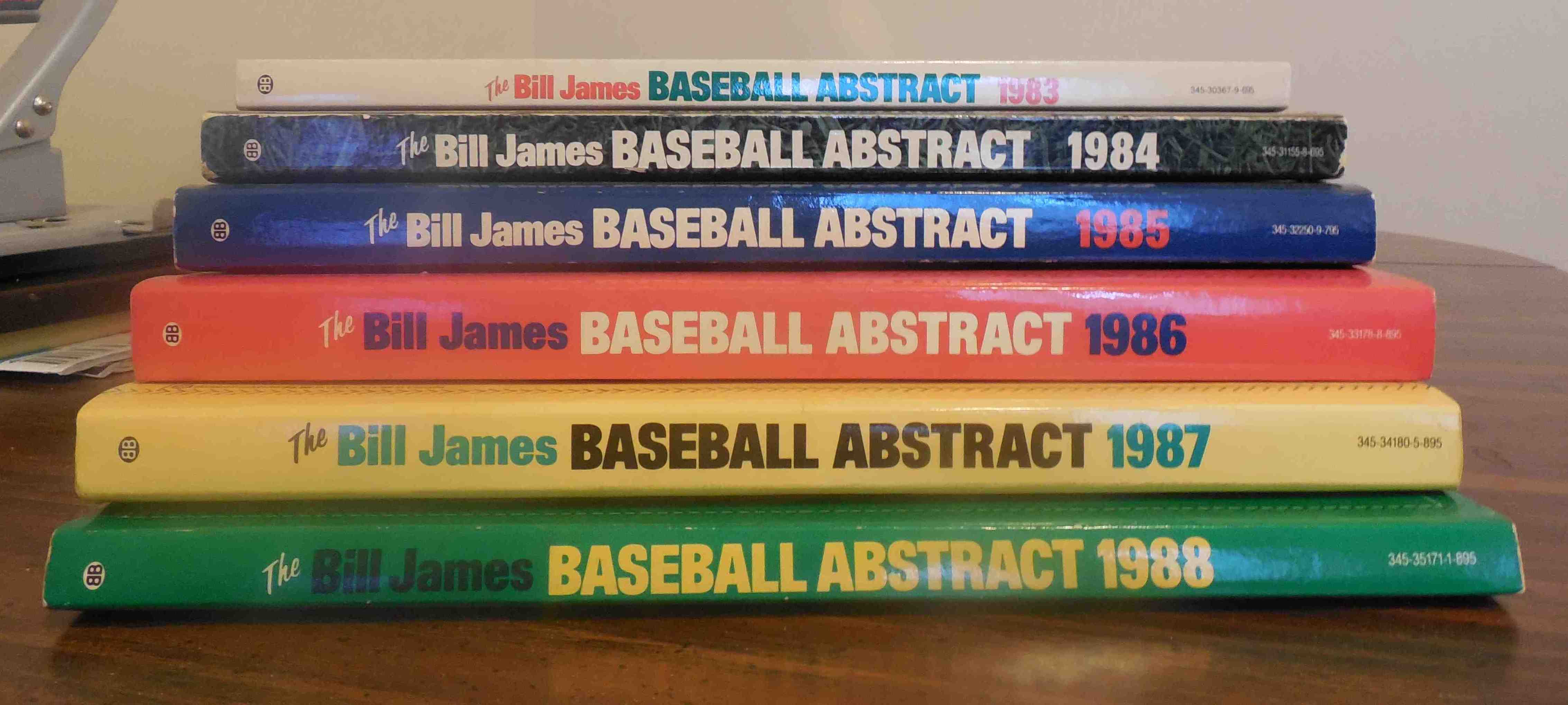
A few years ago, a friend was downsizing and sent me his collection
of The Bill James Abstract from the 1980s. Every so often I'll pick
one up and start reading. This week, I picked up the 1984 issue.
It's baseball, so I enjoy it a lot. My #1 team, the Cincinnati Reds,
were in the summer doldrums for most of the 1980s but on their way
to a surprising 1990 World Series win. My #2 team, the Detroit
Tigers, won it all in 1984, with a performance so dominating that it
seemed almost preordained. It's fun to reminisce about those days.
It's even more fascinating to watch the development of the scientific
method in a new discipline.
Somewhere near the beginning of the 1984 abstract, James announces
the stance
that underlies all his work: never believe anything just because
everyone else says it's true. Scattered through the book are
elaborations of this philosophy. He recognizes that understanding
the world of baseball will require time, patience, and revision:
In many cases, I have no clear evidence on the issue, no way of
answering the question. ... I guess what I'm saying is that if we
start trying to answer these questions now, we'll be able to
answer them in a few years. An unfortunate side effect is that I'm
probably going to get some of the answers wrong now; not only some
of the answers but some of the questions.
Being wrong is par for the course for scientists; perhaps James felt
some consolation in that this made him
like Charles Darwin.
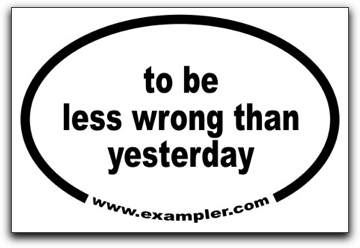
The goal isn't to be right today. It is to be
less wrong than yesterday.
I love that James tells us that, early in his exploration, even
some of the questions he is asking are likely the wrong questions.
He will know better after he has collected some data.
James applies his skepticism and meticulous analysis to everything
in the game: which players contribute the most offense or defense
to the team, and how; how pitching styles affect win probabilities;
how managers approach the game. Some things are learned quickly
but are rejected by the mainstream. By 1984, for example, James
and people like him knew that, on average, sacrifice bunts and most
attempts to steal a base reduced the number of runs a team scores,
which means that most of them hurt the team more than they help.
But many baseball people continued to use them too often tactically
and even to build teams around them strategically.
At the time of this issue, James had already developed models for
several phenomena in the game, refined them as evidence from new
seasons came in, and expanded his analysis into new areas. At each
step, he channels
his inner scientist:
look at some part of the world, think about why it might work the
way it does, develop a theory and a mathematical model, test the
theory with further observations, and revise. James also loves to
share his theories and results with the rest of us.
There is nothing new here, of course. Sabermetrics is everywhere in
baseball now, and data analytics have spread to most sports. By now,
many people have seen
Moneyball
(a good movie) or read
the Michael Lewis book
on which it was based (even better). Even so, it really is cool to
read what are in effect diaries recording what James is thinking as
he learns how to apply the scientific method to baseball. His work
helped move an entire industry into the modern world. The writing
reflects the curiosity, careful thinking, and humility that so often
lead to the goal of the scientific mind:
While reading Aaron Davis's post (see below) I took note of his use of a tool called Quoteback. The principle is simple: using a Firefox or Chrome extension, or the web-based interface, you can create a quotation from someone's post that you can embed in your own website. It doesn't really work for OLDaily (because I already include the link and reference in every post) but for more traditional author-focused blog posts it's a great way "to enable generous quotations, and to facilitate quoting all texts and voices." Note that the image in this post is just an image, not a functioning Quoteback. Also note that in testing on Windows the extension worked fine in Chrome but not in Firefox (v 84.0). For more, check out Introducing Quotebacks or Towards a Blogger Peer Review.
This post summarizes Jonathan Rauch's 2018 essay in National Affairs, The Constitution of Knowledge. It expresses the view that what counts as a fact is determined by a process of free enquiry, dialogue and vetting. In broad strokes, that is true, but in the details, it is wrong. Or, perhaps I should say that it is changing, because what it means "to organize social decision-making about what is and is not reality based on a governance framework and a set of principles" no longer means what it used to mean. Why? Because replication fails in chaotic and dynamic environments, because specialization fails when every discipline is connected, because scientific societies fail when they represent only vested interests, because voting fails when consensus matters, and because civic virtues fail when our leaders are bad actors. Rebuilding this will take time, and will require that we flip the script: we no longer say that the (one) community defines how we reach consensus, but rather, how (the many ways) we reach consensus is what defines communities. Image: emergent objective reality, Rotman.
It was three years ago today, December 21, 2017, that the Free Software Foundation announced it had endorsed PureOS. Getting FSF endorsement is not an easy task and involves a lot of rigorous evaluation. Sometimes people ask us why we decided to create and maintain PureOS instead of using an existing distribution such as Debian (which PureOS is based on). After all, it’s a lot of extra work to maintain your own distribution, and even more work to maintain one that qualifies for FSF endorsement. In this article we will discuss why we consistently choose the harder road and why PureOS being endorsed by the FSF benefits your freedom, your privacy and your security (in particular supply chain security).
Tech companies, especially those who are in the FOSS community, often find themselves in a situation where they must choose between compromising on their values to take an easier path, or sticking with those values even if it means a lot of extra work. At each step in Purism’s history we would have had a much easier path if we had compromised like so many others have. Instead we have consistently chosen the longer and more difficult road because we believe in free softwareto our core.
Choosing the Harder Road
It would have been a lot easier to rebrand an off-the-shelf laptop, slap a pre-existing Linux distribution on it, use proprietary drivers for everything, and not care about coreboot support. There are plenty of successful businesses out there that do precisely that.
It was a lot harder to design our own laptop not just so it had kill switches to protect privacy, but design it so that all the hardware worked out of the box with free software drivers and the CPU supported coreboot. It was also extra work to maintain our own Linux distribution that only had free software, so we could qualify for FSF endorsement.
It would have been a lot easier to take an off-the-shelf ARM phone that already had kernel support with proprietary drivers, and use some pre-existing mobile-only OS. It would have been easier (and thinner!) to discard modularity and just have everything on one chip.
It was a lot harder to design a phone from the ground up so that it would qualify for RYF (a designation that not even everyone in FOSS community values, much less society at large), that separated the cellular modem from the CPU, and made it possible to disable it with a hardware kill switch. It was also harder to invest the software engineering time to have our phone supported in the mainline Linux kernel and write (and upstream!) phosh/phoc/libhandy/squeekboard so that the current Linux desktop ecosystem could work on a mobile platform not just in PureOS, but Debian (and any other distribution that wanted to package it) as well.
What’s In It For Me?
So why is it so important that the Free Software Foundation endorsed PureOS? In addition to the fact that we firmly believe in free software, we also believe that having an operating system that runs on 100% free software directly benefits you and the rest of society. We often say that we sit on a three-legged stool of Freedom, Privacy and Security. Let’s talk about how an OS that runs 100% free software directly benefits you in each of those categories.
Freedom
Perhaps the most obvious benefit of PureOS being 100% free software is freedom. Every piece of software in PureOS has a corresponding source code repository that is licensed with a FSF-approved license. This means you are free to download, inspect, and modify any of the software in PureOS directly. If you want to improve a piece of PureOS software you are free to fix it and share your fix with the rest of the world under the same freedom-preserving license.
You are also free from the whims or poor decisions of a software maintainer. If a software developer decides to abandon their project, if they take it in a direction you or the community don’t like, or if you submit improvements the maintainer doesn’t accept, you are even free to create a competing version of the software (forking) based on your modified code.
Privacy
Privacy is perhaps a benefit that isn’t so obvious in free software. Yet, one of the main effects of smartphone apps being proprietary shareware is that they are funded by and large by ads and directly or indirectly capture and share your private data. This same approach often extends into proprietary desktop applications as well.
Because PureOS is 100% free software, it doesn’t suffer from these same privacy problems. Why? Besides the fact that all software has to go through a rigorous acceptance process before it is added to the OS, if a developer decided to write software that benefited you while also violating your privacy, you would be free to fork their code and remove the privacy-violating bits.
Many proprietary phone apps hide their privacy-violating features as well. After all, why exactly does a flashlight application need full access to the Internet, your contact list, your location, and your photos? In the free software world, you could inspect such an application and confirm whether they are actually capturing any of that data, discover how they are using it, and disable or remove those bits.
Security
The final area where free software provides a huge benefit is in security. Supply chain security has started to be a hot topic in the security world, for good reason, and you cannot get better supply chain security than with free software. While we’ve written about protecting the digital supply chain before in the context of how we protect our products both in firmware and software, it’s worth highlighting here where a free software OS provides the biggest benefits.
At the initial level free software and proprietary software use similar security measures to protect against supply chain attacks. A software repository is owned by a limited list of maintainers who control what source code and files are allowed in the repository and approve all changes. Both free and proprietary software developers these days typically sign their code changes with a personal signature verifying that the change came from them. When the software gets packaged, that binary package is also typically signed with a key owned by the company or software project so the end user can verify that the package hasn’t been modified by anyone else, before they install it.
Yet we have seen that supply chain attacks can bypass these security measures most often by compromising build servers, injecting malicious code into the binary package, and getting it signed with official signatures so it looks legitimate. While supply chain attacks do sometimes target the source code itself, it’s rarer because it’s easier to trace and more difficult to hide changes to the source code long-term, even with proprietary software which has a smaller group of people allowed to audit the code.
Free software adds an additional layer of supply chain security that proprietary software simply can’t, due to the freedom of the code. While an attacker can try to sneak malicious code into the source code itself, it’s much more challenging to hide that code long-term, given that code changes are not only audited by the software maintainers themselves, but any interested third party as well as security researchers and even regular end users. While some security researchers are just as comfortable auditing binaries as source code, for many it’s a lot easier and faster to audit code for backdoors when the code is freely available.
Finally, free software has a gigantic advantage over proprietary software in supply chain security due to Reproducible Builds. With Reproducible Builds you can download the source code used to build your software, build it yourself, and compare your output with the output you get from a vendor. If the output matches, you can be assured that no malicious code was injected somewhere in the software supply chain and it 100% matches the public code that can be audited for back doors. Because proprietary software can’t be reproducibly built by third parties (because they don’t share the code), you are left relying on the package signature for all your supply chain security.
Conclusion
We are proud of PureOS’s Free Software Foundation endorsement, not only because we spent a lot of effort to get it, because we believe in free software, or because of our Social Purpose Corporation charter, but also because we believe free software directly benefits our customers and society at large and that is why our laptops, PCs, servers and phones all ship with PureOS.
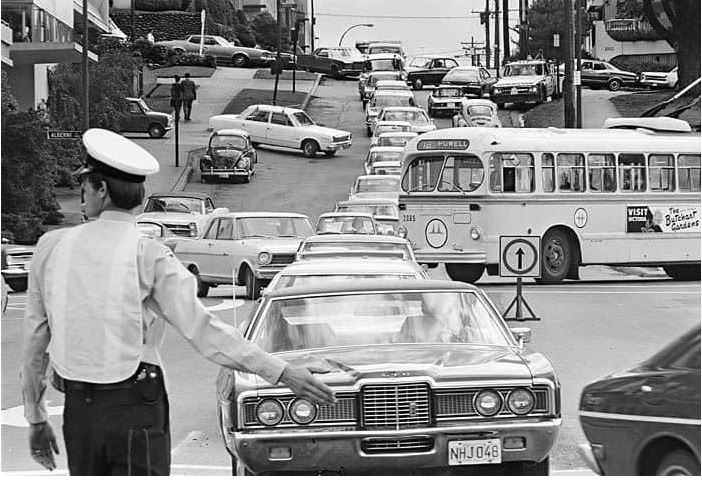
A shot posted by West End Journal, I presume from the Vancouver Archives:
At a glance you’d think – San Francisco. But no, that little hill is on Chilco Street, up from Alberni. Cars are backed up on Robson at the top of the hill. The traffic cop is on Georgia, and a trolley is pulling out from the bus loop at the end of Alberni.
That’s the way it looked in the 1960s, when downtown office workers were heading home to the North Shore, trying to avoid the back-ups on Georgia. The traffic was probably worse then, given how relatively little transit there was – and remember, the West End was still in a building boom. This is why the West End had such a bad reputation in that era. Concrete jungle.
In response to community concern, the NPA Council at the time approved a West End planning process, and by 1970s, the idea of traffic calming was born – possibly the first of its kind in North America. Diverters, barriers and miniparks went in West of Denman in the early 70s, followed by a similar intervention East of Denman in the early ’80s. (The myth is that the traffic barriers and parks were put in to discourage street prostitution. But no, it had always been intended, depending on community approval for a local area improvement charge.)
Of course there were objections. This was a War on the Car! Traffic calming and parking fees and restricted parking – and not enough of it to begin with. Not to mention the NIMBYism of West Enders cutting off through traffic on streets paid for by everyone (sort of).
Stupid councils went ahead and did it anyway. Plus bike lanes. And look what they ended up with.
One of the best urban neighbourhoods in the world.
This is what Chilco looks like now. (It’s where I live).
Much of the criticism of learning styles is in reality criticism of a specific type of differentiation, that is, the idea of "teaching to meet the specific learning needs of students across the full range of abilities" (a much more precise definition is offered later in the article). The authors look at the arguments about differentiation, identify some that are "just plain wrong", and offer an analysis of some research to investigate the others. Note that they did not sample studies "differentiating for learning styles or intelligence strengths, or by ability grouping and segregation as there is either no evidence to support their use or because there is clear evidence against their use." What's left of the other studies? A mixed bag, including "great diffusion in how differentiation was conceptualised making it difficult to produce clear findings about whether differentiation works." For me, the literature on differentiation - including learning styles - has yet to come to grips with the question of what counts as success. As the authors acknowledge in this study, "the question of the ‘what’ in ‘what works’ in relation to differentiation is yet to be answered, as the diversity in focus... weakens the evidential basis." Here's the full paper(38 page PDF) (note it granted me access to the full text, but warned me that this was 'limited access').
It is common for students to disguise their inability to comprehend a text by simply regurgitating text or citing evidence with little explanation. This post offers ways to help them improve by 'exploding' complex test. I would describe this as finding ways to critically analyze text (and it is a huge advantage to be able to do this naturally while reading). I used to do this a lot with my critical thinking students; I'd have them bring in clippings from the newspaper and we'd analyze them together. Now I would analyze this rather differently than Sunday Cummins does in this article, and I think there's a need for much wider critical reasoning skills on the part of both teachers and students. But the method is solid.
This is my anxious season. Normally at this time of year I get worried about ice and snow on my long steep driveway, and on the roads — fear of accidents and falls, and of being trapped inside the house (more psychological than physical). I get worried about mouse infestations, which were a huge challenge here a few years ago. I get worried about not being able to get to the store, the pharmacy, the doctor’s, the vet. About power failures, about my own incompetence at dealing with situations, about things being out of control, and about a million other small, foolish things.
These anxieties are totally out of proportion to any actual risk, but knowing that doesn’t make them go away.
Perhaps this is why I am so drawn to the message of radical non-duality. Although it argues that all these things I fear are not real, only appearances out of nothing, more fundamentally it argues that there is no ‘me’, no separate self to which anything (good or bad) actually happens.
It’s a difficult message to explain intellectually, despite its concordance with a lot of new discoveries in quantum science, astrophysics and cognitive science. I believe it because I want to believe it, and because it appeals to me intellectually as a sort of “grand theory of everything”, and because there have been glimpses where ‘I’ disappeared and it was absolutely and obviously ‘seen’ to be true.
Those whose ‘selves’ have somehow dropped away report what is seen ‘there’ to be always and unquestionably true. It is not a ‘state’ that can be achieved, or a theory of what is possible. This message of ‘all that is’ is simply obvious ‘there’. They’re just telling it like it is, as best as dualistic language can manage that, in the absence of a sense of self and separation.
If this happens after half a lifetime of believing your self to be real and separate, with free will and choice and responsibility, doing things in real space and time, then naturally there are residual effects in the body. There is a whole lore of beliefs, experiences and memories, all seen through the lens of the self, that are suddenly seen to have just been stories, explanations and theories and worldviews made up to try to make sense of a reality that is suddenly seen to be not real at all, just an invention.
Those who have ‘been through’ this ‘falling away of the self’ say that it was harrowing, like suddenly finding yourself in free fall with nothing to hold onto, and at the same time, a non-event, since the self that is seen not to exist is seen to have never existed. Instincts, preferences, and genetic and cultural conditioning remain, but the conditioning gradually loses its hold as it is seen to be based on completely false premises. The apparent ‘character’ that is ‘left behind’ continues to like chocolate and hate brussel sprouts, but will instinctively duck when someone throws something at it. Best to think of it this way: the characteristics of wild animals remain, and those seemingly unique to humans gradually melt away, when there is no longer anything to sustain them.
And the character, like everything else that seemingly happens, isn’t real either; it’s just an appearance. So nothing is taken ‘seriously’ anymore, and, with no self, nothing is taken ‘personally’. Since nothing is real or separate, it’s just a cosmic light-show — nothing really matters. There is no death or life, nothing at all to ‘worry’ about, since there is no one, nothing separate, to do the worrying. Just this whirlwind of energy of nothing appearing as everything, for no reason.
In the absence of a glimpse (or perhaps in the absence of a sense of desperation to bring one’s debilitating anxieties under control) this all has to seem preposterous, the ravings of a lunatic. Somehow, here, it resonates, unshakeably. There has always been a sense that this human life was far more complicated and difficult and unhappy than it needed to be, than it should be. A sense that receiving the gift of selfhood and separation in return for all that that entails, is a terrible, terrible bargain.
All our suffering is for nothing. We are anxious about the future, when there is no such thing as the future. We grieve the past when there wasn’t, isn’t, and never will be a past. We are angry about what we must face now, about what just happened, when there is no now. There is no time at all. We are unhappy with the work we are convinced we ‘must’ do, when there is no ‘work’ for anyone to do, and no one to do it.
This perception/conception of reality is all made up in these brains and bodies, too smart for their own good, in an honest attempt to help us to do better what the complicity of our bodies’ cells and organs have (apparently) evolved to do as well as possible. That is their imperative, which becomes the manufactured, illusory ‘our’ imperative, but only through the ghastly veil of apart-hood, this invented, fraught, terrifying, false ‘reality’.
And so ‘we’ live in this dreamt reality, where our brains construct these models of what, according to the models, must really be, and the constructed me is then charged with the lifelong task of optimizing choices to keep the ‘me’ safe and healthy and productive, for the benefit of an imagined society of ‘me’s.
It’s as if we suddenly found ourselves playing a video game where it took all our energy and concentration to keep the car on the screen from crashing, a grotesque scenario displayed above the screen with a giant red X across it. And lo and behold we were actually really good at keeping our car on the road and navigating various obstacles. And so we just wanted to keep playing, as we were promoted to higher and more challenging levels.
And then suddenly a person came up to us and told us that the game we thought we were playing was actually in ‘demonstration’ mode, and sooner or later it would crash, no matter what we did, and all our fiddling with the dials and the buttons and the controllers was actually accomplishing nothing at all.
I was speaking recently to a community leader whose company had begun paying members a small reward to answer questions within the community.
The results have been interesting.
On the downside, volunteer superusers (who were also invited to join the gig program) are upset at being cast aside and have begun causing a ruckus.
On the upside, the speed of response and the number of questions receiving answers has increased significantly. Members are getting faster answers which are more likely to resolve their problem.
But the answers are less warm and friendly than before.
However, member satisfaction ratings within the community have increased since the program began. The speed and quality of an answer trumps the warmth and friendliness of the answer.
I think this shows two things. First, there are still plenty of ways to do community and avenues to explore. Second, every decision which improves one aspect of a community causes challenges elsewhere. The magic is knowing which trade-offs make the most sense for you.
I turn forty years old today. Some people will be surprised at this, as my hair has been turning grey for the last 15 years!
A decade ago, I wrote a post entitled 30 things I’ve learned in 30 years. While I still agree with most of that, on reflection it just doesn’t seem particularly… deep? So, here, in no particular order are 40 things I’ve learned in 40 years:
There are things you can control and things you cannot. There is no point in worrying about the latter.
Inspire other people to be inspired yourself.
Most people care less than you think about almost everything that you deem important.
Get some therapy, even if you don’t think you need it. Especially if you don’t think you need it.
Keep your options open.
Sometimes it’s OK to burn your bridges and to do so in a way that other people notice.
Resist the urge to suppress randomness.
Nobody knows what goes on inside your head until you say it or write it down.
Happiness is not something that you can find, but rather is something that you discover when you stop looking for it.
Organisations are groups of people that can have a positive or negative effect on the world. Do not work with or for the latter.
Money can only buy choices, not happiness, time, or anything which constitutes human flourishing.
Life is too short to deal with adults who display little in the way of emotional intelligence.
Listen to what people actually say.
Read inspirational things often, especially quotations and proverbs. Dwell upon them.
Education is not the same as learning. Nor are qualifications the same as real-world knowledge, skills, and experience.
Focus on routines and rituals. Nail these and you’re (mostly) sorted.
Practice eloquence. People like listening to those who have a way with words.
At the end of it all, the only person who stops you doing something is yourself. Confidence is a preference.
Stand for something bigger.
Find somewhere that is completely quiet and you can be undisturbed. Visit it often.
Ask. People can only say no.
You are a human, not a machine. You don’t need to sound grown up, or professional, or ‘respectable’.
Money is important only in the way that it flows (both in society, and at family/individual level).
90% of ‘success’ (as other people define it) is being in the right place at the right time, the other 10% is extremely hard work.
Perfect is the enemy of done.
How you do something is as important as what you say or what you do.
Transparency is the best policy.
Exercise more than you think you need to. When you’re young you think your body will be in peak condition forever. It won’t.
Endeavour to be the least knowledgeable person in the room at any given time.
There is no final authority. Seniority is a mindset.
Try and explain complex things to other people as often as you can. It’s a valuable process for both parties.
Travel, both literally and metaphorically. Go on journeys and adventures by yourself and with others.
Let other people boast and do your PR (but don’t believe everything you see/read/hear)
Writing is a form of thinking
Know what you like, but don’t get stale; mix things up sometimes.
Habits can make or break you, so create positive ones.
Avoidance is rarely the correct option.
Technology can free people or it can enslave them, so work to give as many people as much freedom as possible.
Removing ego from the equation gets things done.
We all will die and don’t know when, so act today in a way whereby people will remember you well.
Herobrine is Notch’s dead brother, somehow embedded into Minecraft. (Notch is the creator of the game.)
Herobrine appears as a Minecraft character and he stalks the player, disappearing if approached.
And: Herobrine shows a lot of characteristics of being a form of virus, such as manipulating game worlds, deleting threads and sending messages through the Minecraft Forums.
BUT: Herobrine is not in unmodded Minecraft, and never has been. There are no references to him at all in the source code, and there is no code to allow for any entity to act like Herobrine.
Does Herobrine play a social role?
I don’t know enough about Minecraft to say. But here’s my guess. If there’s a group of 10 year olds playing together, and somebody messes with someone else’s favourite construction while they’re offline, or messes with their own stuff and regrets it, or leaves a rude message due to poor impulse control, it’s an easy thing to do: uh, yeah, I think I saw someone around, maybe it was Herobrine…
Twitter has a device like this, the face-saving unfollow bug – which has been haunting Twitter as long as I remember. Me: your good friend. You: notices that I don’t follow you. Me: uh I’m sure I do, oh look at that, we must have been bitten by the unfollow bug.
At which point your options are (A) to call me out on the unfollow bug excuse being unalloyed bullshit, but also implicitly taking the punch of the rejection; or, (B) say sure, sure and accept the face-saving throw, leaving both of us feeling better off.
We choose option (B).
Does the unfollow bug exist? If you ask around, many people will strongly insist that it does, even giving examples, albeit examples that could also be from fat-fingering the UI, or a real and unconscious commitment to face-saving and avoiding the pain of rejection. I’m not convinced. Did the unfollow bug ever exist? Perhaps once. But today it’s a consensus ghost, a precipitation of the community’s collective and deeply repressed need for harmony.
After a few months of use, Jason Snell has written a great article on the iPhone 12 line’s two outliers. Despite waiting for the shortfalls of a small phone to become apparent, the other shoe never dropped for him on the iPhone 12 Mini. Small phone aficionados won’t be disappointed by Apple’s long awaited return to devices in that size class. Similarly, for those willing to accept the enormous size, the iPhone 12 Pro Max is unafraid to deliver on the best an iPhone can be. As Snell describes, these products have rounded out the iPhone product line:
Apple’s one-size-fits-all approach to the iPhone worked for a very long time. But eventually the company realized that the iPhone needed to be more than a product—it needed to be a product line. And over the past few years, it’s been building out that product line—leading to late 2020 and its release of four distinctly different models in three distinct size classes.
The iPhone 12 and iPhone 12 Pro share a size, if not features. But bracketing them are the two outliers, each sharing a set of features with one of the 6.1-inch phones back at home base.
An odd week of deep frustrations, walks, and settling into holiday season of reflection and calm (the calm part has been taking work, particularly since my normal calming music wasn’t cutting it).
Read
A week ago I wandered to my favorite local bookstore for a look around and picked up a few things. Some of these were finds that were really well outside the potentially planned, which is where many of my favorite and insightful books come from. I’ve spent time this week reading some of the front matter and going a little deeper into some.
One of those that really intrigued me is The Bookshop of the World: Making and Trading Books in the Dutch Golden Age, which caused an audible “what?!” when I stumbled upon it. It seems like it will be a good pairing to The Map of Knowledge that I’ve been meditating through this year. The Bookshop of the World seems like it also will be pulling together a lot of different interests with the breadth of ground it covers.
Also picked up was Gary Kamiya and Paul Madonna’s Spirits of San Francisco: Voyages through The Unknown City, as I really enjoyed Gary’s prior book and writings on San Francisco (he writes on a San Francisco I deeply miss, but is being covered over with banality that dulls the intelligence and creativity that had made it really special for decades). Somewhat related, I picked up Dominique Crenn’s Rebel Chef: In Search of What Matters as I’ve read and heard some of interviews with her about the book and her pursuit of a dream so left France to become top chef and found a home in San Francisco, where as a woman could be taught the craft at a high level and explore her own path to create something new. This finding one’s path and wanting to go deep to understand everything then put it in practice has been a long journey of my own, but also I’ve long been fascinated with chef’s craft and kitchens as well. The last of these that is somewhat related is John Birdsall’s The Man Who Ate Too Much: The life of James Beard, where my parents light (perhaps more) obsession with James Beard has been passed down a bit and a new book on Beard is always welcome.
Another book picked up in the jaunt was Amy E. Herman’s Visual Intelligence: Sharpen Your Perception, Change Your Life as it echoes a lot of what I’ve learned over a few decades as one of my foundations, but have a difficult time framing it for others. I have many books, which I read and use a suggestions for others so to get a foundation for understanding, when asked “how do you see / know / understand these things” (normally this is across broad and deep subjects where the answer is deep curiosity and deeply build breadth and depth in that breadth across domains, but each of these needs jumping off points for others) and slices of these I really like having a good reference (but also look for understandings to add or check what I know and hone it or replace it and then work it through experience).
I hit the used stacks to pick-up a copy of McChrystal’s Team of Teams, which isn’t new fodder and large parts echo experiences and learned lessons from the last two or three decades. But, I’ve also worked with people in McChrystal’s environments and found them to be highly counter productive and problematic (for similar reasons some of the things prescribed in the book haven’t been used as practices for follow for quite a while). But, since the book is continually used as a reference for conversation and seen all new it would be good to know where to point where things are off and a path to know others are on to augment the good things (where there is also much in it) to help improve what they have going.
I had a gift card for my bookstore so I took my son on a trip and see if he would have interest in a cookbook that would help him learn some things and have some decent recipes to riff off of. He likes cookbooks with pictures and the new Jacques Pepin’s Quick and Simple did the trick. He seems to have a good appreciation for it, but not made anything out of it yet.
Watched
My son and I watched the last two episodes of Mandalorian and really enjoyed it. Now we are really looking forward to next December and the next installments. Prior to the last two episodes I was really wondering where this season was going and not all that confident it was going to get to a decent place in a “believable” way.
Saturday was Tenet night and I’ve been waiting for this for months. Sadly, we couldn’t see it in a big theater in IMAX, but we still got to see it. As it is with most Christopher Nolan films the long discussions after started following and through the next day. Sunday night I did a rewatch with headphones on to better hear dialog (there is so much going on visually and audibly things were getting a bit lost. Headphones helped a lot. I liked this more than I thought I was going to and I was expecting a lot.
A quote I don’t remember from “Death and Life of Great American Cities,” but, thanks to Farhad Manjoo at the New York Times, one worth repeating:
“Cities were once the most helpless and devastated victims of disease, but they became great disease conquerors …
“All the apparatus of surgery, hygiene, microbiology, chemistry, telecommunications, public health measures, teaching and research hospitals, ambulances and the like, which people not only in cities but also outside them depend upon for the unending war against premature mortality, are fundamentally products of big cities and would be inconceivable without big cities.”
For those who believe populous cities of massive density are, um, toast because of their pandemic vulnerability, one word:
People are finding creative ways to leave Zoom calls, considering that some users are often left stumbling for the end call button at the end of meetings to leave as fast as possible.
Brian Moore, a creative director at Anomaly, engineered a way to use a physical lamp cord as a way to leave Zoom calls. Once a meeting is finished, all he has to do is pull on the cord to quickly and gracefully exit the call.
Moore tweeted a video that you can view below showing how the button works, and it’s pretty great.
I always awkwardly struggle to get to the end call button on video calls. So I made this pic.twitter.com/4z4zsxNkeQ
Moore has shared all of the files needed to make something similar on GitHub, so you can design your own Zoom escape button.
David Zhou, the engineering manager at Mailchimp, says he was inspired by Moore’s creation and found a way to automatically quit Zoom calls when he sighs really loudly. Zhou also tweeted a video depicting how it works.
It seems that Moore has created a new trend and it’ll be interesting to see different ways people engineer their own Zoom escape button as we head into 2021.
The Zen of Python tells us that
Readability Counts. Here are a few recommendations
based on years of reading other people's code that
hopefully transcend any given programming language.
Five weeks ago, I hatched the idea to place a prominent contributed opinion piece, or “op-ed,” in the Ideas section of the Boston Sunday Globe, a major daily newspaper. Yesterday, the piece appeared, and I started to hear from people in positions of power. If you are a writer or thought leader, this is the … Continued
I recently had the opportunity to be on a panel at Web Summit with Mitchell Baker, the co-founder and CEO of Mozilla, and Matt Mullenweg, co-founder of WordPress and CEO of Automattic. We talked about the power of Open Source and the Open Web.
In 2020, the threat to the web's openness has gained more mainstream awareness. Between big tech hearings in U.S. Congress and ongoing consumer data privacy issues, there are a lot of problems that need solving.
Our Web Summit panel only scratched the surface on some of these issues. Matt pointed out that we've been quick to trade our freedoms on the web for conveniences. Of course, companies haven't made that exchange very obvious to everyday people. Instead of 20-page user agreements, something clearer like nutrition facts labels could help people understand the contracts they're making with companies.
I pointed out that there is a shared responsibility among technology companies and governments to make the web better for everyone. I believe in the idea of a governing body for technology, kind of like an FDA for algorithms. Just as the FDA protects people against harmful pharmaceuticals, there should be a regulator for high-impact software. Privacy laws like GDPR are just the beginning of making sure that consumer data isn't abused.
Mitchell added that beyond regulation, technologists play an important role in developing clearer, fairer and more open alternatives for people on the web. I couldn't agree more. Open Source is an important contributor to maintaining the Open Web, and technologies like the blockchain hold potential for making the Open Web more robust.
To watch a video recording of our panel, visit https://youtu.be/qaIYdsy-Gb8. We only had 20 minutes, but this is the kind of conversation that could have lasted hours. Let's continue this important discussion in 2021!
In the 1980s, if you installed a word processor or spreadsheet program on your PC, they wouldn’t come with word counts, footnotes or charts. You couldn’t put a comment in a cell. You couldn’t even print in landscape. Those were all separate products from separate companies that you’d have to go out and buy for $50 or $100 each.
A few generations earlier, in the 1950s, a new car often wouldn’t have turn signal lights. That was an after-market product that you could buy and fit yourself with a drill and a screwdriver on a Saturday morning.
Over time, of course, Lotus and Microsoft, and Ford and GM, integrated - ‘bundled’ - all of that. Spreadsheets do charts, and the operating system handles printing, and no-one today argues that when you buy a car you should choose who supplies the lights. That killed a lot of third party products - it was, ipso facto, unfair competition - but we don’t argue it should be illegal.
On the other hand, in the 1960s there was a significant court case around Ford bundling a car radio and squashing competing radio suppliers. Is a radio an essential, necessary part of the product that should be integrated, or is it optional? What would that mean?
This is the centre of today’s argument about what Apple and Google include in their smartphone operating systems, and what Google includes in ‘search’, and it was the argument twenty years ago around whether and how Microsoft should include a web browser in Windows. If a company has market dominance, and it adds a feature to its product that is someone else’s entire business, this is inherently unfair, but life is unfair - does it follow that it’s bad, and that we should we do something about it, and if so, what?
People sometimes argue that this is all obvious and easy. Some things are ‘clearly’ essential features (for example, brakes) and some are ‘clearly’ optional, or at least substitutable (a web browser). But this is a fuzzy definition, and changes over time. Turn signals were optional once, and in the mid 1990s PCs didn’t come with a TCP/IP stack, and that was a separate product you could buy. Microsoft (and Apple) added one, and that became an anti-trust question - people proposed very seriously that this required intervention and that Microsoft should offer a choice for your network stack, and your file system, and indeed everything on top of the kernel.
How many anti-trust cases can you count in this screen?
There are, very obviously, some things that absolutely are illegitimate tying and bundling. But how do you capture that without capturing everything else? There is a huge grey area between telling Microsoft it can’t force OEMs to bundle Office with Windows and telling Microsoft that it has to make consumers choose their network stack when they turn on a new PC. Equally, we clearly don’t want to shrug, and give up, and let Google or Apple clone and squash any third party product they want to incorporate. But we also don’t want the DoJ or EU to run a monthly review of Gmail’s product roadmap. We need some intermediate level of rules - some set of general principles.
Hence, Elizabeth Warren famously proposed that ‘if you run the platform you can’t compete on it’, which sounds good, until you realise this means that you’ve just banned Google Maps on Android. If this is your principle, a platform can’t do anything that anyone else might want to do. So your new iPhone has no calendar app, and no camera app, and no email or web browsers… and indeed no app store. Those are all things that some other company wants to do too. This is saying that your car can’t come with headlights, or that a spreadsheet program can’t do charts. We have to do better than that.
A somewhat more practical approach is to think about choice screens, defaults, and self-preferencing, which together propose that “Google can still build things, but it has to be fair.” These are (what fun!) pretty complicated too, though.
Choice screens are an attempt to handle things that are necessary components but also somewhat modular and substitutable - you need a browser but you can have more than one, where you can’t usefully have two networking stacks. They also presume that the user will be able to understand and evaluate the choice (hence, again, this doesn’t work for networking stacks). So, you turn on your PC and it asks you which web browser and which media player you want to use, and which one you want to make the default. A setting to let you change the default afterwards is also a common requirement, and is pretty easy to implement in most cases, but most people never change the default later unless they’re prompted or unless one app is dramatically better, so forcing a choice is key to competition.
Choice screens were a coherent response to Microsoft including a web browser with Windows (both essential and modular). It’s harder to see how this would work on iOS or Android, where the issue is not one app but every app that comes on your new phone - do you want 20 choice screens?
The same question comes up if you apply this to Google search: you could require a choice screen to ask people if they want to see Yelp reviews or Google reviews when they search for a restaurant (and oblige Google to create APIs to enable third parties to plug into its results). But again, we’re not talking about one vertical search category, but dozens. How many choice screens do you want?
The prosecutor here would say that this is like a bank robber saying he’s robbed too many banks to be tried for all of them - if you want to address Google cloning other companies’ products, it can’t block you by making so many clones that you can’t keep up. But this is also ‘like’ a word processor adding word counts and page numbers and images and tables and a spell checker - do you want to ban all of those, or add five choice screens, or go back to the drawing board and think a little more about what might work?
Meanwhile, how many things does Google (or Apple) integrate in ways that make them invisible, such that they are no longer apparent to the user at all as a separate component that could be changed, and so where any choice screen would be baffling? And how many cases are there where the competitor doesn’t want to be a choice within the platform experience at all, but wants the platform to send the user directly to them?
This is the Yelp problem. Google could give you a choice screen to pick whether you see reviews from Google or Yelp embedded in the results page when you search for a restaurant, but Yelp doesn’t actually want you to see a summary of Yelp reviews on Google - it wants Google to link you to Yelp’s own site. The question is not which reviews, maps and phone numbers Google shows, but rather whether Google is allowed to show you anything about a restaurant when you search or it, or just give you ten blue links. Seen from Google, Yelp is the company that makes baggage carts complaining that somehow all new suitcases have wheels. Yelp doesn’t want to be one of the choices of wheels - it wants suitcases not to have wheels at all.
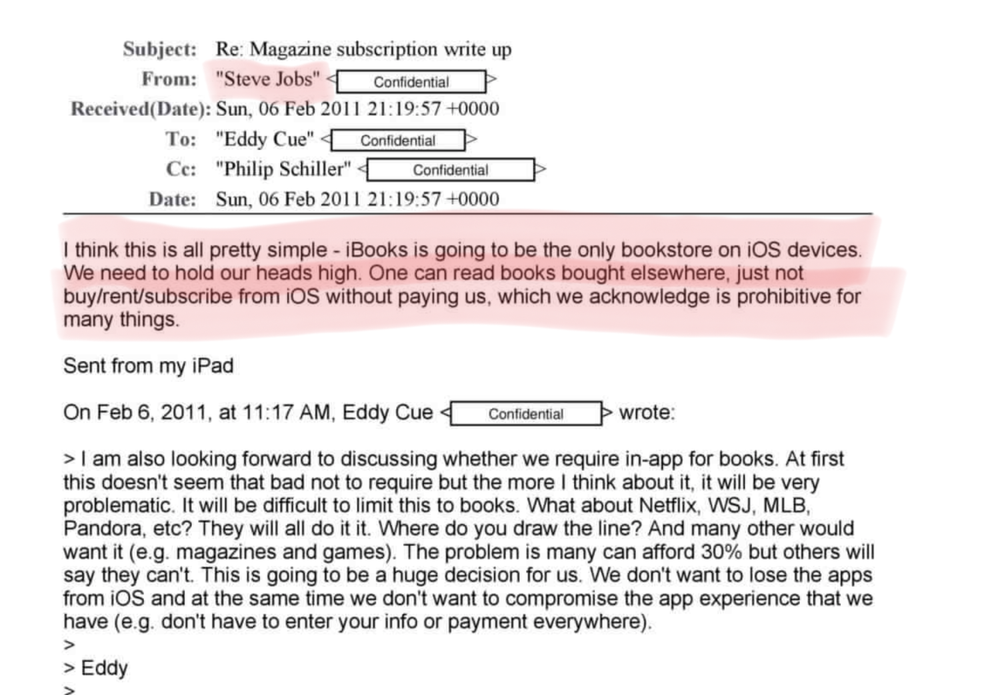
This loops us around to ‘self-preferencing’. Really, the concept of the ‘default’ is just one aspect of self-preferencing, which encompasses a wide range of situations in which a platform might allow all sorts of competition but puts its thumb on the scale in favour of its own option. Third-party ad tracking on iOS is moving to opt-in, but Apple’s own tracking is opt-out. Yelp’s restaurant reviews show up below Google’s. Third-party services get access to Siri a year after Apple’s services. And Apple draws up App Store payment terms in ways that it explicitly understands make some competing businesses ‘prohibitive’. This email was sent when Apple had 5% share in the USA - but now it has well over half. So what now?
A ‘self-preferencing’ regime wouldn’t ban Google Meet or Google Calendar - instead it would ban Google from stapling Meet into random parts of its UI. But again, this can get complicated pretty quickly. I think Apple’s policy on Spotify is unjustifiable (the email above references ebooks but this is the entire Spotify issue), but I also think Epic should lose its case against Apple. Yelp would like to be preferenced in search but it would prefer if Google didn’t tell you anything at all about a restaurant when you search for it. Many of Apple’s preferencing choices trade off user privacy against the viability of other people’s business models. Machine learning recommendation systems are hard enough to do with your own data structures without also incorporating data from other companies. And a lot of these questions trade off competition, and the user benefits that result from that, with simplicity and ease-of-use, which are also user benefits (that network stack again). The same applies to security: Apple’s iOS software model is a huge step change in user security and privacy at the cost of flexibility and competition. Pick one.
A common strand through all of this, and a point I’ve made repeatedly in writing about tech policy, is that important questions do tend to be full of complexity and trade-offs, not just in tech but in policy in general. That’s how policy works. There are always answers that are simple, clear and wrong, and each of the frameworks I’ve discussed here works in some cases but not others. As the old saying goes, all models are wrong but most of them are useful. This takes me to my other general thesis on tech policy: that this is a story for methodical and well-resourced on-going regulation, not slogans and breakups. It’s a story for legislation, much more than litigation.
Considering how absolutely anti-pedestrian Broadway is in general not surprised. Will that corridor be redeveloped into a better experience for pedestrians? Of course not. They rather blow a few billions to tunnel under it so they can run the toy trains there.
Vancouver Police are appealing for witnesses after a multi-car collision on Friday claimed the life of a 78-year-old pedestrian and left his wife with serious injuries.
"This incident is truly a tragedy, and for it to happen just a week before Christmas is heartbreaking," said Sgt. Steve Addison, in a release.
The collision happened around 12:20 p.m. PT Friday near Broadway and Alberta Street when a grey Fiat 500 collided with a blue Ford Explorer.
Both vehicles were heading east on Broadway. Police say the force of the collision caused the Explorer to veer into two parked cars, then onto the sidewalk where the elderly couple was walking.
The 78-year-old victim, a Vancouver resident, was taken to hospital but died Sunday. His 72-year-old wife has serious injuries but is expected to survive.
"Our hearts go out to everyone involved," said Addison.
The driver of the Fiat, a 29-year-old woman from Burnaby, and the driver of the Explorer, a 30-year-old woman from Vancouver, were not injured.
Police say neither speed nor alcohol are factors in the collision. No charges have been laid.
Investigators are asking witnesses or anyone with dashboard camera footage to call 604-717-3012.
Police say this is Vancouver's eighth fatal collision of 2020.
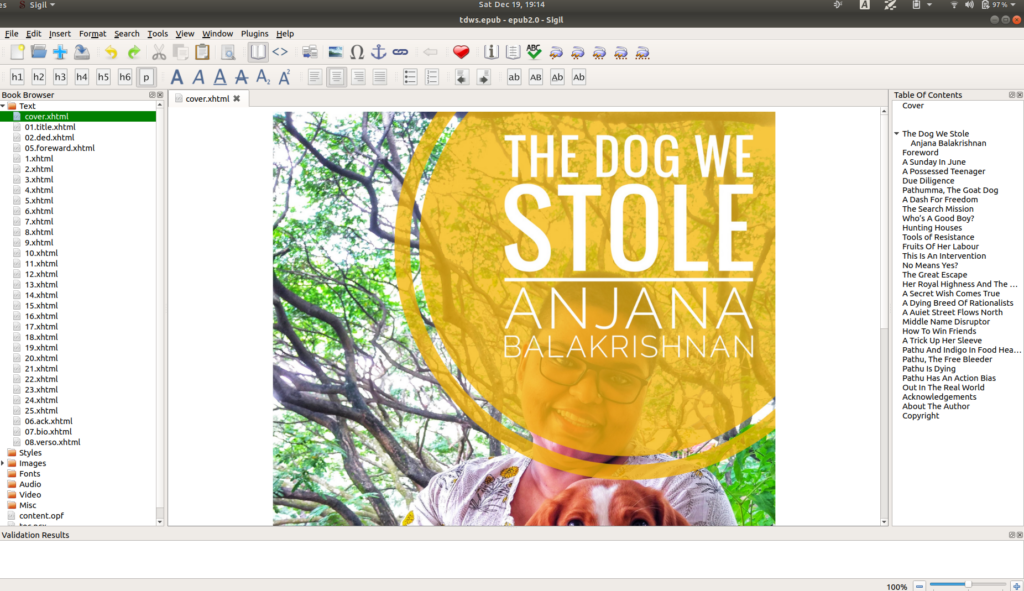
Anju published The Dog We Stole (Amazon ebook link) as a series of blog posts on her blog. And we planned to convert it into an eBook if it did well. The blog posts were quite popular, and the overall feedback was very positive. Hence I started creating the eBook. This is not my first eBook creation. I have created three editions so of BollySwar, which are available on Kindle and other stores. I used a lot of scripts to create the BollySwar; very few chapters were manually edited. In the current series, I did create most of the pages manually.
As usual, EPUB is my preferred format to create eBooks. It's an open format and easy to create as it's based on web formats. I didn't edit HTMLs manually but used an editor called Sigil Ebook Editor. It's multi-platform and easy to use if you know HTML.
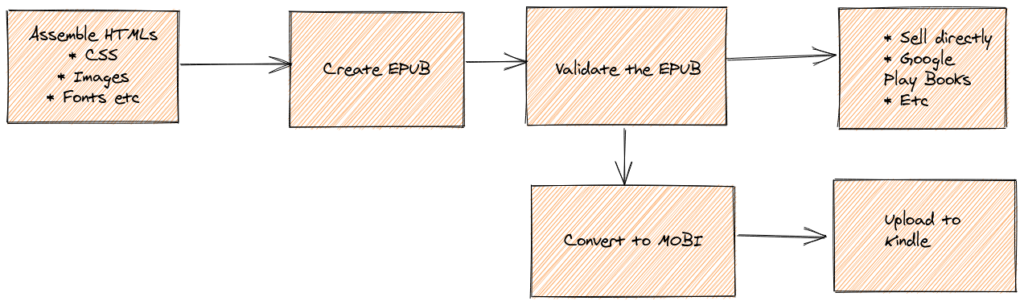
My only problem with Sigil is that it edits the .epub files directly, a zip file. On file system, it stores and edits .epub file like an opaque binary file. This makes it difficult to track the changes in a git repo. Ideally, I would want Sigil to have two phases - EDIT and BUILD. During the EDIT, keep the files on the disk as though EPUB was extracted. So I can track the changes to individual HTML files, Style sheets, etc., in a GIT repository. That way, I can easily revert parts of it if required. In the BUILD phase, combine these HTMLs, Style Sheets, Fonts etc., into an EPUB file. Ready to be read by an eBook reader.
Sigil eBook Editor
In fact, for MySwar that is what I do. I have a script that creates HTMLs and Styles. All of it is tracked in a GIT repository. When everything is ready, I have another script that ZIPs it up into a .epub file. You can look at this python epub.py script to see how easy it is to build an EPUB book by just using HTML and CSS. So if you already have data/content in some structured way and want to build an eBook. I would say go scripting way; that way, it's easy to update in the future. Also, you can have your CI/CD pipeline for releasing the book.
My flow usually is
My eBook creation process
I use EPUBCheck for EPUB validation. It's part of my CI/CD. You can get that from here. The error messages from it are mostly friendly. Sometimes they can be cryptic.
I used Amazon's KindleGen to convert to MOBI format when required. It's a simple CLI; you can use it as part of your build/release process if required.


 , blue line is a fitted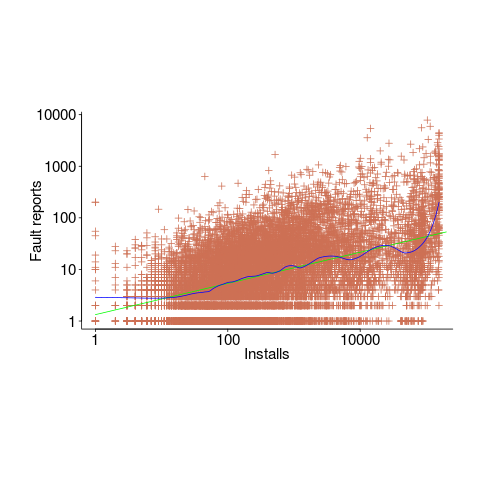














 Uploads from Michael Kalus.


 Walk Farter.