Shared posts

16 Jan 05:27

The Snowbird

by stephen@downes.ca

Ontario finance minister Rod Phillips should resign, but he probably won’t, and he won’t be asked to.

In Canada we have this tradition of the snowbird. That’s a person who enjoys our beautiful summer months (often at their cottage by the lake) and in the winter packs their bags and moves to a warmer climate for several month, migrating, just like a snowbird.

It’s thought of as a tradition, but of course, it’s also a status. Not everybody can move south for the winter; you have to have a certain level of privilege and wealth. Most of us can’t move south for the winter.

And this winter, especially, the fiction has been that you’re not allowed to move south to escape the snow. The fiction has been (along with “we’re all in this together”) that unessential travel is prohibited, that we shouldn’t be taking a winter vacation at all. Heck, I can’t even go to Quebec, which is about 50 kilometers from here.

So it takes a certain about of hubris to do it anyway, and of course there’s a lot of nodding and winking all around because as we all know the rules about the pandemic don’t really apply to the sort of people who have the privilege and wealth to be snowbirds. No doubt Rod Phillips is just one member of a very large flock.

But he is also the finance minister for the government of Ontario, the same government that has instituted those restrictions, and more recently, even more severe restrictions, as the pandemic has worsened. Yes there’s a vaccine, but just as we saw with masks and personal protective equipment in the spring, it takes a certain amount of time to produce and distribute these. And meanwhile, people die if we don’t follow the rules.

So when the finance minister doesn’t follow the rules, he is showing a certain disregard for the people who die. And it leads us to suspect that this disregard applies to other aspects of his work and life as a finance minister, the sort of disregard that would, say, cause him to wait until after Christmas to implement a much-needed lockdown, instead of two weeks before, when it was apparent to everyone that otherwise we would see the record levels of new cases we are seeing today.

That’s bad enough. But the finance minister knew it was wrong to fly south for the winter, did it anyway, and then covered it up with a series of tweets and videos designed to make it look like he was still living and working out of his home in Ajax. We can see him patronizing local vbusinesses, participating in interviews, even sending a Christmas message from in front of his fireplace – all while he relaxed on the beach in St. Barts.

So he should resign. If he had any sense of decency and propriety he would resign. The last thing we need is that sort of deception in a finance minister.

But he won’t resign, and he won’t be told to resign, because despite what he said as the story broke, the Premier of Ontario, Doug Ford, knew all along his finance minister was a snowbird, just as he knew when his finance minister also took a vacation to Switzerland in August. Ford says, “I can tell you I’m very upset. I’m very frustrated with the situation. I stand out here every single day and tell people to stay at home,” he said.

But who is he frustrated with? Phillips? Well, no, because he knew Phillips was on vacation and was fine with it. If he’s frustrated with anything, it’s that Phillips got caught. And now he will have a “tough conversation” with Phillips, probably along the lines of “you got caught, you can’t do it again.” And we’ll go back to the same sort of decision-making that puts the interests of his and Phillips’s business friends above the lives of the people of Ontario.

Overall, Ford has done a good job with the pandemic. But the cracks are beginning to show.

Update: Phillips resigned a few hours after I posted this.

02 Jan 06:15

So this is Brexit?

by Chris Grey
The protracted drama of whether or not there would be a Brexit future terms deal finally ended on Christmas Eve, and today it has been overwhelmingly approved by MPs. Perhaps, as some claim, that was always in prospect, and the last-minute timing was just a negotiating tactic by the UK government (though if so, as always, it’s unclear whether that was for domestic consumption as much or more than for the EU)? If so, it has placed British businesses, and many citizens, in a situation of huge and unnecessary stress, and made political scrutiny of the deal effectively impossible.

Or perhaps the defeat of Trump and the departure of Cummings shifted the government’s approach some weeks ago? Or perhaps Boris Johnson only blinked at the prospect of no deal at the very last moment, with the mayhem at Dover concentrating his mind? It may be a long time before we know, definitively, exactly when and why the decision was made and how close we came to the disaster of no deal.

And that is the first thing to be said about the deal – the fact that it exists is, unequivocally, better than if it did not. Better economically, and better in terms of the possibility of a future relationship which may become deeper or at least more harmonious in tone. However, as with all the gaslighting about the rollover or renegotiation of existing trade agreements, it should never be forgotten that, at best, the deal prevents some things getting worse. It is not, and could not be, a ‘good deal’ in any sense other than not making everything worse. Unsurprisingly, Johnson with his trademark shameless mendacity is already claiming that he has secured a ‘having cake and eating it’ deal. That is a flat out lie.

The broad shape of the deal is unsurprising

As for the deal (formally the Trade and Cooperation Agreement) itself, months of fevered speculation have now given way to days of equally fevered analysis of its detailed contents, which are complex and technical, and the practicalities of how some of it will work remain to be seen, with arrangements for Northern Ireland still especially unclear. Law and Policy commentator David Allen Green has created a very useful compendium of some of the early expert readings of the agreement, and the Institute for Government has provided a good initial summary of its main provisions and many of the examples given in this post draw upon it (if not, separate links are provided).

However, it’s important not to get totally lost in the detail because, standing back, what has emerged overall is broadly what we have known ever since Theresa May’s Lancaster House speech of January 2017 would be the shape of a deal, if there was to be a deal. By setting a course that excluded single market and customs union membership, and any role for the ECJ, what was left, as per the Barnier staircase, was, as regards trade, a deal in the shape of a free trade agreement.

That meant, at best, there being no tariffs and quotas for goods trade but inevitably – compared with single market membership - significant new non-tariff barriers to goods trade, and reduced liberalization of services trade. We knew that, because that is the definitional difference between a single market and a free trade agreement. Similarly, we knew that a trade deal, in the absence of a customs union, was never going to prevent the introduction of customs formalities. So whilst the precise terms of the deal do matter – and for specific industries, firms and individuals they matter hugely – what has emerged is not a surprise and is certainly not a triumph.

It is easy to forget now, but a deal of this broad type was precisely May’s aim. What is now referred to as ‘May’s deal’ was only a Withdrawal Agreement (WA). The waters of that got muddied because (in brief) few believed that any such deal would suffice to avoid the provisions of her backstop agreement, and so this got treated as defining the de facto future terms arrangement. That might well have been true – and, had it turned out to be so it is worth noting that, even then, there would have been little on services trade – but it was not her stated intention.

Her intended future terms deal would have been similar in form to Johnson’s, albeit with ‘alternative arrangements’ for what would have been the Irish land border. It’s true she had conceded Level Playing Field provisions in her WA, unlike Johnson’s, but Johnson has ended up accepting these, “the most stringent …. ever seen in a trade agreement” according to trade expert David Henig albeit less than what the EU originally sought, perhaps to no less of a degree than would have eventuated under May’s plan had her WA passed, especially had Johnson replaced her afterwards. Many other details would have been different, some perhaps in very important ways, but it would have been the same species of trade arrangement as we have now arrived at. In passing, it is therefore a bit rich for May (or any other MP) to now express bemusement (£) that Johnson’s deal does so little for services.

So without rehashing all the complexity of this past history, the second point to be made about the deal is that, fundamentally, it is the hard Brexit that May set in train, with all the attendant costs of that compared with what the UK had as a member state or could have had under soft Brexit. In this way, it falsifies the claims made before and since the referendum that there was some way of retaining similar or even the same terms of trade under the aegis of a free trade agreement. That was always a lie, and has been proved to be a lie.

Of course, as compared with what was in prospect under May, Johnson avoided any possibility of being stuck in the backstop by the expedient of creating the frontstop whereby Northern Ireland, only, will effectively remain in the goods single market and the customs union, with a regulatory and customs border across the Irish Sea. This we have known since his WA was signed but it is worth spelling out at this moment exactly what it means, because most media coverage is not doing so, or at least not in sufficiently stark terms: leaving the single market and customs union has been achieved for Great Britain only by breaking up the single market and customs union of the United Kingdom.

Nothing remotely like this was ever suggested during the Referendum campaign, and Theresa May had dismissed it as something no British Prime Minister could every agree to. From the outset, Brexiters either failed to understand, or lied about, what Brexit – and especially hard Brexit – meant for Northern Ireland. It was a failure of almost criminal irresponsibility.

The effects will vary by sector, but none will find trade easier

So far as the details of the trade deal are concerned, commentators seem split as to whether it should be regarded as a ‘thin’ or a thick’ one – perhaps because these terms are difficult to define. In some respects, it could have been better for the UK (for example on the extent of sanitary and phyto-sanitary checks, and on the recognition of professional qualifications for services trade); in other respects it could have been worse (for example, what was agreed on electric cars and on legal services was more than what a ‘standard’ EU trade agreement might have allowed). On the key ‘sticking point’ issues of Level Playing Field, fisheries and governance the EU largely got its own way, but the UK did achieve its primary, if negative, aim of being entirely free of the ECJ.

Just how badly affected particular industries are going to be will vary a lot, and there will be a mixture of impacts – the chemicals industry, for example, has been saved from tariffs, but faces complex and still uncertain regulatory duplication. The road haulage industry will continue to be able to operate within the EU but will be more limited in the number of pick-ups/ drop-offs it can make. The seed potato industry looks set to be devastated, and the situation for the processed meats industry is uncertain. These are just a few of many examples of the impact of non-tariff barriers to trade. It is fitting that in announcing the deal Johnson claimed that it meant there would be “no non-tariff barriers” since this showed that even at this late stage he is still either lying or does not understand what he has done.

Whilst the impact of the deal will vary according to sector, in one respect the impact is the same for all of them. For there is not a single case in which any firm or sector is going to find it easier to trade with the EU than it presently does and, again, that was baked in to the deal since May’s 2017 decisions. So whilst businesses would have been even worse off without a deal, they are to a lesser extent worse off as a result of the deal – with all that implies for investment, jobs, taxes, and public services. At the very most it provides some damage limitation, as the automotive trade body has stated. Again, this is something that the Brexiters never told the public, and for the most part still don’t admit.

The services sector is the biggest loser (though again with sub-sectoral variation) because the centre piece of the deal is tariff-free trade and services, of course, don’t attract tariffs. That matters not so much because of the oft-quoted fact that 80% of the UK economy is services (it’s true, but many of those firms don’t trade internationally), but because services have hitherto generated a trade surplus with the EU (£18 billion in 2019). So whilst the deal is particularly good for – yes – German car makers, French cheese makers and so on exporting their goods to the UK, it is a calamity for British services exporters to the EU. And, separately to the deal itself, the financial services sector awaits an EU ruling on regulatory equivalence (the UK also awaits a ruling on data protection adequacy). There is a good argument that the UK economy is in need of a rebalancing away from services, and financial services in particular, but doing so by taking a hacksaw to them, whilst applying a hammer to manufacturing, is another item on the charge sheet of the damage Brexiters have done.

Beyond trade

The deal is not just a trade deal, of course. It is also about numerous forms of cooperation, including security. Here the picture is similar in that whilst a considerable degree of cooperation will continue, there is nothing that will be improved by the Brexit deal and, in many respects, including real-time sharing of some EU databases, things will get worse. As former National Security Adviser Peter Ricketts puts it, “it’s going to absorb more time and effort in making the system work rather than going out and catching criminals”.

So things will limp along, with various fixes but a lot more sand in the administrative machinery so that, just as will be the case in the economic sphere, the damage may not be dramatically noticeable but consist of operations being that bit slower, or that bit more expensive. In the same way, whilst the coming weeks may see considerable disruption at borders because of new customs procedures it is just as likely that some trade may become too expensive to bother with. As a consequence, some firms may go out of business, or employ fewer staff than they would have done. Some items may be harder to find in the shops, or their prices will go up.

Certainly the end of freedom of movement is set to cause problems in several sectors, with social care being a prominent example and the fashion industry (£) and music industry perhaps less obvious ones. And as has been widely trailed – but may still come as a shock to some when they are encountered – new restrictions and bureaucracy for individual travel are about to become the new reality.

Also separate from trade is the issue of continued UK participation in some EU programmes, including the Horizon Europe research funding scheme, where these are open to third countries and with the appropriate budget payment. This is good news because though clearly not a benefit of Brexit, being simply the replication of the status quo (and probably with less say), there was always a fear that the Brexit Ultras’ loathing of all things European would preclude even this degree of cooperation.

Even so, the UK will not continue in the Erasmus + student exchange programme and, apart from being dismal news in itself, this is of note for two reasons. First, because it seems to be a piece of culture warfare based on the idea that the scheme indoctrinates young people with pro-EU attitudes and/or is a ‘middle-class perk’ and not ‘the people’s priority’. And second because it has already led to Ireland’s government saying it will support Northern Irish students on the scheme, and demands from Scotland for inclusion. Taken together, these two things indicate that, even now, the UK government has no interest in trying to repair the divisiveness of Brexit, and seems almost to be the willing handmaiden of the disintegration of the United Kingdom.

A defining, but not concluding, moment

The deal obviously marks a decisive moment within the Brexit process. It defines, for now, what Brexit means. But it is a moment, not an end point, and what Brexit means will continue to change. That is partly simply because having been cobbled together in such a rushed process there are numerous loose ends still to be agreed, some of them non-trivial, and no doubt many unforeseen issues which will arise.

The latter isn’t helped by the ludicrously compressed timescale for ratification. It is deeply ironic given that the heart of the case for Brexit was to restore the primacy of the UK parliament, that the deal is being rushed through so quickly that few if any MPs will have understood its full implications. And although Johnson will regard them having now done so as a triumph, Brigid Fowler, the highly respected Senior Researcher at the Hansard Society, who is not known for intemperate language, has described the proceedings as a “farce” and a “constitutional failure”, whilst political historian Professor Robert Saunders called it an “absolute travesty of parliamentary democracy” and a “charade”. It may very well be that the economic damage of Brexit will in the long run be dwarfed by the battering that parliamentary and constitutional norms have taken over the last few years, with this vote being its culmination.

For both parliamentary and wider political reasons it is hugely significant that the Brexit Ultras have for the most part accepted the deal. Nigel Farage endorsed it before it had even been published, which considering the extent to which he, UKIP and the Brexit Party drove the entire saga undoubtedly represents a big coup for Johnson. The ERG, after having convened its clown car ‘star chamber’ to read the text, pronounced that it satisfied their cartoonish understanding of ‘sovereignty’ (Northern Ireland seems no longer to figure in their thinking).

Neither of these endorsements may last for very long. Farage flip-flopped in his support for Johnson’s WA, and much of the ERG which voted for it later repudiated it (partly on the grounds that there had been insufficient time to scrutinize its terms). The same may happen with this deal. Even so, apart from some complaints about the agreement on fisheries, the betrayal narrative has, even if only temporarily, gone almost silent. That is noteworthy and, I admit, has surprised me.

Never-ending Brexit

So what is now in prospect is an entirely new phase of Brexit. Whilst I don’t think it is helpful to dissect the deal in terms of EU or UK wins and losses, one clear victory for the EU was to create a single, over-arching agreement rather than, as the UK government had wanted, a series of separate agreements. With that has come an immensely complex governance architecture, consisting of a Partnership Council along with a myriad of over thirty sub-groups. There are also a whole series of mechanisms for reviews, including a five-yearly review of the whole deal.

Taken together, this means that there will be the ongoing possibility of the relationship becoming closer or more distant over time, and even of the entire deal being scrapped and ‘no deal’ returning. This is not surprising – I’ve remarked many times on this blog that a deal would not be the end of Brexit, but the beginning of a new kind of process – but the extent and complexity of the institutional framework within which this is going to occur perhaps is surprising.

Numerous commentators have already remarked on the implication that the deal is “a five year political truce” (David Allen Green) and that “negotiations over something or other will continue for years to come” (Sam Lowe, Centre for European Reform) so that “we are going to see the same dynamic in future that we have witnessed over the last four years: constant talking and bickering” (Ian Dunt) with the deal “just the end of the beginning” (Tom Hayes, Brussels European Employee Relations Group). (Each of the commentaries linked to is well worth reading in full.)

In consequence, as the former Brexit Party MEP Alexandra Phillips recognizes (£), the deal “could turn out to be a springboard towards greater divergence or an umbilical cord leading us back to Brussels”. This situation has considerable economic significance – most obviously because it does not create a very promising environment for foreign investment – but an even greater political one. It creates a new context in which both pro- and anti-EU actors can work.

It’s not hard to see that the ERG and others will be agitating for greater divergence and perhaps, eventually, for an end to the entire deal. One obvious fight they may push for is over the linkage of the security parts of the deal to the UK’s continuing membership of the European Convention of Human Rights, which some of them long to derogate from. It is of note that this aspect of the deal is (apart from fisheries) the only one which is already being described as a ‘betrayal’ in the Brexit press.

But a future Labour, or even Conservative, government might well seek to make the deal closer or deeper. Indeed the Best for Britain campaign has already identified ten ways in which this should be done. Erstwhile remainers as well as business groups will certainly have the opportunity to lobby for such improvements, and Ian Dunt’s analysis is that the logic of economic and geographical proximity means they have a good chance of success. At the very least there is still much to play for, starting – as again I’ve argued in several recent posts – with the need to wrest from Brexiters control of the narrative of UK-EU relations so as to move it on from their monocular focus on Brexit and away from the invariable toxicity of their tone.

Brexiters have got their Brexit against what almost all opinion polls since the Referendum have shown the majority to want, and in a form which the majority never wanted. They own that, and we’ll see how it works out, but they do not own our future relationship with the EU.

This blog

All this will have major consequences for the future of the UK – including the future existence of the UK – and some for the EU. It also has the extremely minor consequence that I have decided to continue writing this blog, at least for as long as it continues to attract a substantial readership. As of the beginning of 2021 it will be re-named ‘Brexit & Beyond’ and will continue, normally on a Friday morning, to offer a weekly (or perhaps in due course less frequent) analysis of Brexit and its consequences. The first post will be on Friday 8 January.

Many thanks to all who have read and/or publicized the original blog since its launch in 2016. I do hope you will continue to do so in its new incarnation.

Happy New Year.

02 Jan 06:14

Looking Back on 2020, the Annual ‘Tadaa’ List

by Ton Zijlstra

It’s the end of December. This means it is time for my annual year in review posting, the ‘Tadaa!’ list.

Ten years ago I started writing end-of-year blogposts listing the things that happened that year that gave me a feeling of accomplishment, that make me say ‘Tadaa!’, so this is the eleventh edition (See the 2019, 2018, 2017, 2016, 2015, 2014, 2013, 2012, 2011 and 2010 editions). I tend to move on immediately to the next thing as soon as something is finished, and that often means I forget to celebrate or even acknowledge things during the year. Sometimes I forget things completely (a few years ago I completely forgot I organised a national level conference at the end of a project). My sense of awareness has improved in the past few years, especially since I posted week notes for the past few years. This year was different as well as the pandemic and resulting lock-downs meant a more introspective year than usual. Still it remains a good way to reflect on the past 12 months and list the things that gave me a sense of accomplishment. So, here’s this year’s Tadaa!-list, in no particular order:
  • We started the year, as per our tradition, celebrating New Year with dear friends that live in Switzerland. Of course this year we can’t travel to Switzerland, and miss seeing our friends. I’m glad we did go last year. We quarantined ourselves from before Christmas, so we can visit E’s parents around NYE. We haven’t seen them since late August.
  • 20191231_163612 20200101_143320
    Jamming into the new year 2020 in the Swiss Alps

  • Around the start of the first pandemic wave in March I spent a considerable amount of time pushing for still pending signatures on projects and for prompt payments on outstanding invoices. It meant my company entered the lockdown with some confidence. No projects were postponed by clients, no invoices went unpaid. It provided the team with reassurance. We did not need to apply for any economic support measures, leaving them for companies in more need.
  • I’ve been working remotely for 16 years, and all of us were accustomed to working in a distributed way, but we had just opened our own office last year in Utrecht. The office served as a safe working spot for one or two people living nearby really needing to get out of the house. We distributed some office chairs to the homes of our team members early on, as we didn’t want them to sit on kitchen table chairs for week, months, a year on end. In the end, due to the many video calls, we saw more of each other and more of us at the same time, not less this year.
  • In line Showing cycling skills to grandma on camera
    In a distanced line at the bakery, when it was still novel. Showing new cycling skills to grandma on video.

  • Our team became much more of an actual team this year, caused by being more visible to each other. We built and depended much more on each other. Each of us struggled mentally at times, working from within the same four walls each day, but the support of the others was there to get through it. In March we let go of our just previously set company goals for 2020, and made team stability our major aim.
  • Acknowledging the new reality, as well as our mental response, the team’s reflex was to step on it. With great results. Simply getting on with it resulted in our best year yet, with an 18% increase in turnover compared to 2019, despite having a policy of not setting financial goals, and also letting go of the original 2020 goals we set. There’s a lesson in that. Because we did well, we could extend E’s contract with a year in June, newly hired P in September after the completion of her internship and Master thesis with us, and offered S a fixed contract in October. We brought our colleague J on board as a shareholder and fellow entrepreneur (making him the only one we fired from the company, in January)
  • Ethics,not as an abstraction, but as a practice, became a much more central element in our work concerning data, data governance, and responsible data use. I helped facilitate a great workshop with colleagues in the Amsterdam Arena early in the year, we injected ethical discussions in most of our ongoing projects, and created a data-ethics card game as a end-of-year present to clients.
  • I don’t ski, E’ does only a little, but we decided to join a group of friends for their skiing trip in the French Alps in February. Enjoying the snow, simply hanging out with friends, playing with Y building snowmen, under a sunny sky was great. It also turned out to be the only trip we made this year, so the memories of that fun week have served us well.
  • St. Sorlin-d'Arves 20200128_125348
    In the snow in the French Alps, in the Ajax Amsterdam Arena for data ethics

  • In May, in the midst of the first lock-down, I turned 50. E had arranged a week of spread out activities, centered around the theme ‘play’. Part of it was an evening of playing Trivial Pursuit with dear friends online, including a question card deck about my own past 50 years. Another part was a treasure hunt with another dear friend through the neighbourhood. All fun yet within social distancing and other guidelines.
  • 20200512_201625 20200512_195104
    Video conference Trivial Pursuit. We had the board, every participant their own card deck to ask questions from.

  • When the pandemic hit, the NGO I chair was in a much different place than my company: various projects got postponed indefinitely, others never materialised. On top of that the director decided to leave and take up a position long on her wishlist, and a key project manager left as well. It left us scrambling during the summer to ensure the organisation’s future, financial stability, find a new director and replace key people all at once. The NGO’s team and the board pulled it off together. Our board is normally very hands-off, but now we jumped into the day-to-day operations. I’m really glad our joint efforts had an impact. We found a new director and two new project leads within weeks, and all could start almost immediately. The renewed team then pulled hard on ensuring stability. This month we approved the 2021 budget, and the NGO is once more financially ok, the team is actually larger than 6 months ago, and we’re on the look-out for one more staff member. The economic support measures were essential to get through the first few months, but the organisation now no longer needs them.
  • 20200621_112216 20200621_130221
    At the Kröller-Müller museum

  • E and I have known for years we can travel very well together. Now we know we can be very well at home together too. Both of us miss not having much or any time for ourselves, especially when Y is at home during school closures, both of us miss being able to go places for inspiration. Both of us struggled at times. We’re tired and didn’t have any real off-time for 9 months. Nevertheless we managed and complemented eachother well I think. We went for walks and visited a museum or two when conditions allowed, we took care of our home and garden to help ensure our wellbeing.
  • 20200426_133523 20200502_160632
    Enjoying our downstairs terrace at the water. Many walks through our neighbourhood.

  • I finally dumped Facebook completely, including Whatsapp. I had left Facebook three years ago, and then created a new more low-profile account. During the first months of the pandemic I realised that both the rationalisation I had for still being on FB (some connections I had only there), and the increasing level of pandemic-inspired conspiracy-stories (don’t ever call them theories!) and related toxicity made my ongoing presence there unbearable. So I left. Because FB as a company isn’t doing anything meaningful to fix the mess of their own creation, I decided I don’t want anything to do with the company as a whole either. So WhatsApp got uninstalled as well. I don’t miss the never ending doomscrolling on manipulated timelines. I sought out more distributed conversations instead (see further down).
  • 20200814_120031 20200912_145445
    Desinfection is the new sexy. Socially distanced cycling traffic light waiting zone

  • Renovated my personal knowledge management (PKM) system. Making notes differently means a very different pace of learning. I wrote some 800 notions, conceptual notes representing the core of my internalised concepts of 20+ years of work. That can now serve as the base of further learning. Addtionally 100 notes geared to more fact-oriented things, which will grow from being connected to my feed reading inputs, and now that my first focus on establishing the main body of concepts is over. And several hundred immediate work related notes, helping me to get things done. Kept a day log since late April, which was helpful to see the work I did also on days the fragmentation of tasks would otherwise obscure it. All in all, my PKM didn’t change fundamentally, but I reduced the friction of sustaining it a lot. It has already paid off in various ways, and I’ll get better at wielding it in the coming months to help me create, write and work better.
  • I had two periods where I struggled this year. Towards the summer, when I was struggling in getting the narrative for a report together, and in the volume of fragmented and overly diverse material I had couldn’t find my way out. And a worse period last month, where for a few weeks I felt increasingly awful. From the relentless efforts without time off, the endless video calls, and no longer being able to easily go outside as the days got greyer and wetter. In both instances I am glad I reached out to others about it, and that act alone already improved much. For the coming months I will try and keep my calendar relatively empty.
  • I started my days at 6am in the spring, and kept it up after the summer until now. That first hour of the day, before Y wakes up, I use to read and write a bit. A small sliver of my own time.
  • 20200920_130933 20200921_113834
    A long September weekend hiking in the hills of Limburg, southern Netherlands

  • Took a very deep dive into meteorological data and earth observation / environmental data in the EU, as part of the work to write upcoming European legislation on mandatory open data releases in areas of high socio-economic value. It was a long, and at times hard, process, but I’m pleased with the results in both the thematic areas I was responsible for. If even the low end recommendations are adopted it will mean progress unheard of in about 2 decades of discussion in the meteorological field. If it moves above that low end, it will also mean a very logical but still the biggest open data step for the entire INSPIRE program.
  • Enjoyed our home a lot, appreciating it even more than before. So glad we’re in the house we’re in. Allowing us to have different in- and outside spaces to use, to avoid feeling caged in. Growing and picking berries, seeing apples grow. Having our own office space to withdraw in. Y having space to leave her toys around, without it getting in the way. Little details help too, like the smooth feeling door handles we bought when we moved in. Now that I’ve grabbed many more door handles at home this year, I’m oddly thankful for them each time.
  • 20200822_121217 20200828_121506
    A visit to the Amersfoort Kade Museum, and to the Frisian Museum in Leeuwarden

  • Still happy I treated myself to a Nova2 e-ink reader, allowing me to read more non-fiction in a way that fits my routines, and have a seamless way of processing the notes I take from that reading.
  • Enjoyed the distributed conversations and connections through my blog, now 18 yrs old. Conversations that cross over different topics, through different modes of communication, and different aspects of life. Thank you all who frequented my inboxes this year.
  • Finally, it feels good that professionally there is enough lined up already for the better part of next year. It gives quiet confidence, and creates space to deal with the logistical and mental challenges the ongoing pandemic will still pose.

Internet retail turned from a convenience to a necessity this year. For groceries, and for DIY material, games, pencils etc to entertain Y. I bought several pieces of art as Christmas gifts, and they arrived within days from across the EU. I could support independent stores I like from behind my desk.

I’ve worked 1646 hours this year according to my timekeeping spreadsheet, which was 100 less than last year. For the first time it is on average near to my nominal 4-day work week, when counted over 52 weeks. However, in reality it was significantly more, definitely. This as when you’re at home you tend to only count the hours you’re ‘really’ working. Normally if you’re at the office or with a client, you count from arrival to departure as work time. I’ve told our team they should allow for that difference by using a multiplication factor of 1,3-1,5, but I did not really take that advice myself.

It was a year in which our lives took place in a much smaller space. Being connected, having the world at our digital disposal was good and needed. We’re healthy, doing ok, and professionally secure. That’s a lot already to be thankful about. Onwards to 2021!

first train trip in 3 months
Take care, stay well, reach out. Happy 2021!
02 Jan 06:12

Books I Read in 2020.

by William
I made it a goal at the beginning of the year to focus on reading more books. I used to read a lot, but over the last several years I have been distracted by articles and short reads I stumble across on social media and haven’t focused as much on a good book. I began […]
02 Jan 06:12

The Brain, Gut and Consciousness: Microbiology of Our Mind

Radek Vana, Inquiries, Dec 30, 2020
Icon

I'm going to give this post full marks for creativity while at the same time saying "there's no way, right?" Here's the claim: "the brain-gut-microbiome axis forms a complex system creating our consciousness." In other words, our brain communicates "with trillions of symbiotic microorganisms that perform various physiological functions crucial for our health" and our sensation of thought and experience - consciousness - comes into existence as an emergent property of this interaction. It's novel, it's intriguing, there's no way it can be true, but I'm still oddly drawn to it.  Image: Kevin R. Theis, Holobionts.

Web: [Direct Link] [This Post]
02 Jan 06:12

That's a Shame

by Eugene Wallingford

In the middle of an old post about computing an "impossible" integral, John Cook says:

In the artificial world of the calculus classroom, everything works out nicely. And this is a shame.

When I was a student, I probably took comfort in the fact that everything was supposed to work out nicely on the homework we did. There *was* a solution; I just had to find the pattern, or the key that turned the lock. I suspect that I was a good student largely because I was good at finding the patterns, the keys.

It wasn't until I got to grad school that things really changed, and even then course work was typically organized pretty neatly. Research in the lab was very different, of course, and that's where my old skills no longer served me so well.

In university programs in computer science, where many people first learn how to develop software, things tend to work out nicely. That is a shame, too. But it's a tough problem to solve.

In most courses, in particular introductory courses, we create assignments with that have "closed form" solutions, because we want students to practice a specific skill or learn a particular concept. Having a fixed target can be useful in achieving the desired outcomes, especially if we want to help students build confidence in their abilities.

It's important, though, that we eventually take off the training wheels and expose students to messier problems. That's where they have an opportunity to build other important skills they need for solving problems outside the classroom, which aren't designed by a benevolent instructor to have follow a pattern. As Cook says, neat problems can create a false impression that every problem has a simple solution.

Students who go on to use calculus for anything more than artificial homework problems may incorrectly assume they've done something wrong when they encounter an integral in the wild.

CS students need experience writing programs that solve messy problems. In more advanced courses, my colleagues and I all try to extend students' ability to solve less neatly-designed problems, with mixed results.

It's possible to design a coherent curriculum that exposes students to an increasingly messy set of problems, but I don't think many universities do this. One big problem is that doing so requires coordination across many courses, each of which has its own specific content outcomes. There's never enough time, it seems, to teach everything about, say, AI or databases, in the fifteen weeks available. It's easier to be sure that we cover another concept than it is to be sure students take a reliable step along the path from being able to solve elementary problems to being able to solve to the problems they'll find in the wild.

I face this set of competing forces every semester and do my best to strike a balance. It's never easy.

Courses that involve large systems projects are one place where students in my program have a chance to work on a real problem: writing a compiler, an embedded real-time system, or an AI-based system. These courses have closed form solutions of sorts, but the scale and complexity of the problems require students to do more than just apply formulas or find simple patterns.

Many students thrive in these settings. "Finally," they say, "this is a problem worth working on." These students will be fine when they graduate. Other students struggle when they have to do battle for the first time with an unruly language grammar or a set of fussy physical sensors. One of my challenges in my project course is to help this group of students move further along the path from "student doing homework" to "professional solving problems".

That would be a lot easier to do if we more reliably helped students take small steps along that path in their preceding courses. But that, as I've said, is difficult.

This post describes a problem in curriculum design without offering any solutions. I will think more about how I try to balance the forces between neat and messy in my courses, and then share some concrete ideas. If you have any approaches that have worked for you, or suggestions based on your experiences as a student, please email me or send me a message on Twitter. I'd love to learn how to do this better.

I've written a number of posts over the years that circle around this problem in curriculum and instruction. Here are three:

I'm re-reading these to see if past me has any ideas for present-day me. Perhaps you will find them interesting, too.
02 Jan 06:11

Remember This Year

I have had "write year-in-review" on my To Do list for about a month-and-a-half now. But every day I ignore the task, hoping that I'll feel more like writing tomorrow. Tomorrow is the last day of this year, and I don't anticipate anything will change so I am going to try to type a few, very generic thoughts about what happened in ed-tech in 2020.

This reflection is not going to be as lengthy as in previous years. I don't have the heart right now. I can't revisit all the suffering this year has brought about. But there's one thing that I've learned penning these year-end posts for the last decade or so: not much changes. The themes are the same year after year after year: more surveillance, more inequality, more dismantling of public education by tech companies and by tech narratives about "the future of work" and so on. Even during a global pandemic — a year when I'm sure plenty of ed-tech evangelists will try to tell you that "everything changed" — what I think we have witnessed is an acceleration of certain trends that were already in motion rather than any major shift towards something new and different. More surveillance, more inequality, more dismantling of public education. "Cop shit."

In 2008, Clayton Christensen and Michael Horn gleefully predicted that, by 2019, half of all high school classes would be on the Internet. They were wrong, of course, and wrong by a long shot. And that all classes moved to the Internet in 2020 does not prove them right. That all classes moved online was not a triumph of online education, but rather a reflection of the steps schools had to take to prevent further loss of life and, no doubt, the result of the utter failure of leadership at all levels to prepare for the pandemic, let alone respond with compassion and care.

I'm sure that there will be many pronouncements about the failures of ed-tech this year. We've known for a very long time about what works and what doesn't work (although that's never stopped schools from investing heavily in the latest gadgets and gizmos with little attention to research). Unsurprisingly, the move to online education, facilitated by video-conferencing software and digital worksheets, hasn't been great — for teachers or students. Of course, face-to-face education wasn't so great for many teachers and students either.

It's been a cruel and terrible year — one that has changed many lives irrevocably. But will it change institutions? Will it change educational practices? I don't know. These callous monsters still demanded a college football season, so we know they'd rather see students and teachers die than make adjustments to tradition. (To revenue.)

I am certain that many education reformers and technology companies are hoping that they've managed to sink their claws securely into a fragile system, that crisis education becomes the permanent mode of operation. "There's no going back," they'll tell you. Again, I don't know. I think people long for a return to the Before Times and crave a Zoom-free life.

Then again, no one should want to go back — not to how things were.

Going forward, we have to build something better, not for the sake of the digital prophets — I cannot stress enough when I say "fuck those guys." We must build something better for the sake of an equitable and sustainable future, for the sake of democracy. And that future cannot be oriented around "cop shit." And folks, that means that future cannot be oriented around most ed-tech.

In my work, I write a lot about ed-tech amnesia — the ways in which the history of education and technology are forgotten, dismissed. What will we remember from 2020, and what will we forget? I often worry that we forget too much. As a result, we hold none of the monsters accountable, and so they return with new ventures, and we have to battle the bad ideas all over again. In my own small effort to fight the amnesia, I have written lengthy essays at the end of each year, detailing all that's happened, so that at least somewhere we have catalogued their names and misdeeds. Each year, I write, desperately hoping people will learn from the past.

But this year, I can't do it. I am too wrapped up in my own memories and my own grief. That said, this year, more than ever, I wonder and worry about what we are going to try to erase, telling ourselves and others that we must forget to move on from all this trauma. I don't believe that forgetting is the path to healing. But I admit, I can't see that path clearly from where I stand.

02 Jan 06:11

Pasta!

by peter@rukavina.net (Peter Rukavina)

I found the crank for our vestigial pasta maker last week (I’d given it up for lost), and with an unusual surplus of Iris eggs in the house, I seized the opportunity to make fresh pasta for the first time.

It was not a perfect plan, as I only had Speerville “whole white flour” in the pantry, but as a beta test it worked out surprisingly well. And about as simple a recipe as can be: 2½ cups of flour, five eggs, salt and olive oil.

02 Jan 06:11

The Brain-Activity of People Coding Is Different

From the study:

The researchers saw little to no response to code in the language regions of the brain. Instead, they found that the coding task mainly activated the so-called multiple demand network. This network, whose activity is spread throughout the frontal and parietal lobes of the brain, is typically recruited for tasks that require holding many pieces of information in mind at once, and is responsible for our ability to perform a wide variety of mental tasks.

I've long thought programming is to a great extent about organizational skill, especially when it comes to larger projects.

Author Clive Thompson:

Just anecdotally — having interviewed hundreds of coders and computer scientists for my book CODERS — I've met amazing programmers and computer scientists with all manner of intellectual makeups. There were math-heads, and there were people who practically counted on their fingers. There were programmers obsessed with — and eloquent in — language, and ones gently baffled by written and spoken communication. Lots of musicians, lots of folks who slid in via a love of art and visual design, then whose brains just seized excitedly on the mouthfeel of algorithms.

Programming is different. If you haven't tried it because you think you suck at math, you should try anyway. You'd be in good company (I suck at math too).

02 Jan 06:11

The Year that was 2020

by Thejesh GN

What a crazy year! I guess everyone was hoping this year will end soon. It has now. But for some reason, I think 2021 won't be that different. Yes, there is a vaccine, and we all might get one. But there is so much that needs to be rebuilt. 2020 more than anything, showed how much our society is broken. At least for me. So rebuilding in 2021 will be equally frustrating and hard. Let's hope "we" can together rebuild it.

2020 was bearable because of Echo and Pathu

Like everyone else, it was a mixed bag for me too. Here are some of the highs and lows of 2021.

  1. My heart goes to millions of Indians and, in general, people worldwide affected by COVID-19 and apathetic governments. I am sure we will survive this. The most important thing is, what do we learn from this?
  2. We have Echo and Pathu in our life now. This is the most positive thing of the year 2020.
  3. Anju wrote a biography of Pathu. If you like pets, you might like the book. I helped in creating the ebook. Love SIigil.
  4. Launched core products at Peppo. We have an amazing team, and I think we are doing something that might have a long term impact. I am very proud of my work and team at Peppo. I also was able to contribute to Beckn protocol. And launch the first network there.
  5. I worked on a lot of COVID-19 related data projects. Deaths due to lockdown caught everyone's eye. Also helped to launch CORENET web.
  6. Helped to launch IITM's Online Degree Program. They have a great team, which is dedicated and focused. I am sure we will reach record numbers.
  7. I have not worked this hard or this much in my life. It should reduce in 2021
  8. After delaying a bit, we dd award of NMG2020. I am very happy I did. And they have done some amazing work with that small money. I will write in detail in the coming months. I also will update the NMG page with more details.
  9. I have been exploring Semantic Web, RDF, etc. I have also started contributing to DataCommons, WikiData, etc
  10. I am fourty. I feel a bit like an adult now.

How did you deal with this pandemic? I mostly handled with by over working and spending time with family.

I wish you all a great 2021.

The post The Year that was 2020 first appeared on Thejesh GN.
02 Jan 06:10

Jack Dorsey and Running Two Companies

by Matt

I had the pleasure of interviewing Jack Dorsey for the Distributed podcast, a conversation that ended up going a bit deeper and longer than previous episodes.

In preparation for the interview I kept coming across people critical about the fact that Jack is the CEO of two companies simultaneously, Twitter and Square, each having over 5,000 employees.

I think what people miss is that at that scale, running a company is not that different from running a large division of a company. No one asks Jeff Bezos how he’s CEO of both a retail company and a cloud computing one (AWS), or Tim Cook how he’s CEO of a hardware business and a services business, and of course with both of those examples the breadth of what the companies cover is much wider. Also as an added benefit, shareholders can choose to invest in Square and Twitter together or not.

All of that said, I think having a CEO-level seat at two of the most influential technology companies today does allow for accelerated learning, as organizational experiments will naturally happen at each company and then the best practice can be shared to the other. Jack wasn’t aware how much peer executives at each company meet with each other to share learnings, but that seems like an obvious win.

Readers of this blog will especially appreciate how much we talked about open source and cryptocurrencies, and his view on the three things he’s responsible for as CEO. Give it a listen and let me know what you think.

02 Jan 06:10

Late-2020 EV Charging in Canada

I haven’t seen my 90-year-old mother since January. I guess by mid-year both she and I are likely to be vaccinated so maybe I could go visit. I’d rather drive than fly. What with Covid I’ve been cooped up so long I could scream, so there are few things I’d rather do than get out on the highway. As a displacement activity I’ve been working out how I could get the electric Jaguar 1734 kilometres from Vancouver to Saskatchewan to see her. Thus this quick survey of the state of the infrastructure in Western Canada, and also trip-planning tools. Some of this info might be useful elsewhere than in Western Canada.

Infrastructure

For this to make sense, you have to realize that while Canada looks like a big tall country on the map, it’s actually a short wide country, mostly cuddled up against the USA, nine thousand kilometres wide and with most people living 500km or less from the border. So for purposes of charging cars, if you have good coverage of Route 1, the Trans-Canada Highway, you’ve solved a big piece of the problem. My drive from Vancouver to Regina, Saskatchewan is along that road all the way.

Back when I got the Jag in January 2019, it’d have been generous to call the coverage spotty. The government of BC, the westernmost province, had scattered fast chargers here and there around the highways, but they were only 50kW (just barely “fast”) and the reliability was poor. Once you got out of BC and onto the Prairies, the story got worse fast.

Now there are two outfits trying to build out good cross-country coverage: Petro-Canada, the gas-station brand of Suncor, a biggish oil company, and Electrify Canada, an outgrowth of Electrify America, a subsidiary of Volkswagen that they launched in 2016 in the wake of their lying-about-emissions scandal to wave the green flag. The Electrify Canada chargers are located at Canadian Tire, an ubiquitous Canadian hardware big-box which specializes in automotive stuff.

Both networks have mobile apps to facilitate charging, and both charge a flat 27¢/minute. Which is a lot more expensive than the kWh I soak up from my Level-2 charger at home, but still plenty cheaper than gas.

It’s at least somewhat true that at this point both of these operations are aspirational, more of an attempt to make a point than make a buck. But EV sales are ramping up and will ramp faster, so I think it’ll prove to have been a smart move.

Both operate modern chargers advertised as offering 200-350kW of juice. Some of the most recent cars, like the Porsche Taycan, are said to be able to make good use of that power and charge amazingly fast. My Jaguar I-Pace can only soak up 100kW and not for that long, it pretty quickly starts backing off and settles somewhere in the 85kW range.

In an online I-Pace discussion group one guy said that at Petro-Canada, he went from 20% to 80% in 45 minutes, which I’d say is adequate, while another one said it took 52 minutes to get from 50% to 94%. These reports are consistent, because as far as I know all electric car charging slows down dramatically at about the 80% point. So it’s considered polite and efficient to charge up to 80% and then move along.

Tools

The networks have their own maps: Here’s Petro-Canada’s and here’s Electrify Canada’s. At the moment Petro-Canada is well ahead; Watch out though, their map includes chargers that are planned but not running yet.

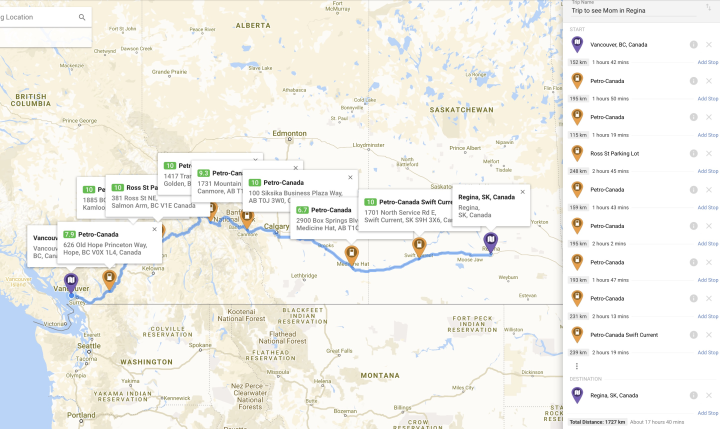
If you want to plan a trip, I’ve run across two useful tools. First is PlugShare, which I’ve been pretty impressed with. You make an account and tell it what kind of car you have and apply filters to the kind of chargers you want to see — for the purposes of a trans-Canada trip, that means “Level 3” DC fast chargers only. Then it has tools to plan a trip — you have to pick chargers by hand and add them. It’ll export the results to Google Maps and do a bunch of other useful stuff. Here’s how it looks.

EV trip plan by PlugShare

Watch out, this map and the other one are huge so you can read the small print; you might have to pan around to see them, particularly on a small laptop screen.

One nice thing about PlugShare is that it’s got a community thing going, you can click on any charger on the map and see reports from people who’ve charged up recently, on how to find it and how it’s working. There’s an average rating, that’s the little green number badge on each stop.

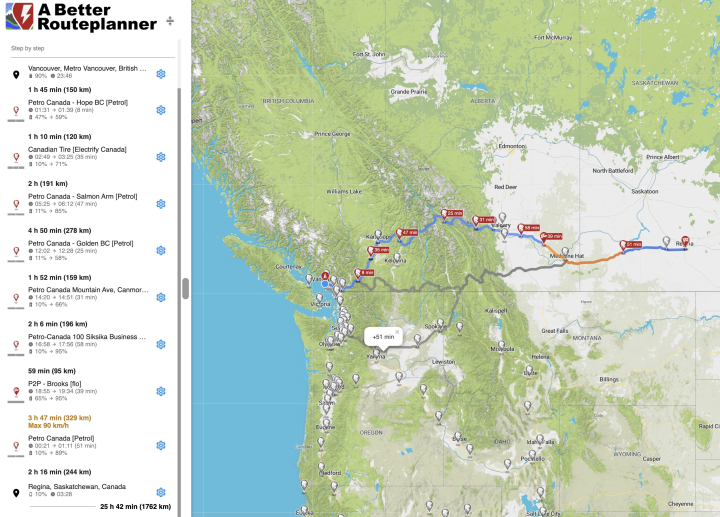
The other option is something called A Better Routeplanner (let’s say “ABRp”), which is a whole lot more automated and has significant pluses and minuses. By “automated” I mean you just put in your start and destination and it picks all the driving legs and charging stops. It picked almost exactly the same set that I picked by hand in PlugShare. First of all, here’s its map.

EV trip plan A Better Routeplanner

The readout is slicker, it estimates how much charge you’ll need and how long it’ll take at each stop. But there are problems. First of all, it recommends using the Petro-Canada charger in Salmon Arm, but when you click on that, the info-box says it isn’t actually operational yet (PlugShare agrees) — but there’s an older-fashioned 50kW charger there (which PlugShare knows about). Electrify Canada says theirs is coming soon too, so maybe it’ll be fast by the time we can travel again.

I also heard from someone who’s used it that the charging-time estimates are pretty inaccurate, a lot depends on the specifics of charge level, temperature, and apparently the current aspect of Jupiter. For what it’s worth, on this trip it estimated 21 hours of driving and 5 hours of charging.

Now here’s the weird thing. ABRp will give you a URL for your route plan: here’s mine. If you click on that, it’ll take some time, apparently it recomputes the whole thing. What’s weird is that I get different maps in Chrome and Safari. In Chrome, it doesn’t seem to know about the Petro-Can charger in Medicine Hat — thus the orange-line route segment, where it’s telling me that I have to drive slow to conserve power.

Both PlugShare and ABRp have mobile apps that look OK at first glance.

Take-aways

The charging infrastructure in Western Canada is pretty good, or at least will be once they get Salmon Arm filled in. The planning tools are just fine. I can’t wait to get on the road this summer. And to see my Mom.

02 Jan 06:10

Twitter Favorites: [EvanKirstel] Blue Whale Skeleton at the London's Natural History Museum (NHM) https://t.co/qGKhMxFGbh https://t.co/9548N6fS9g

Evan Kirstel #RemoteWork @EvanKirstel
Blue Whale Skeleton at the London's Natural History Museum (NHM) bit.ly/3na6xXH pic.twitter.com/9548N6fS9g
02 Jan 06:09

AR On The Cheap With ESP32

by Rui Carmo

This is really cute. A bit artisanal, for sure, but just the fact that it works and that working augmented reality hardware can be built out of stuff I already have in my parts drawers makes it all the more alluring.


02 Jan 06:09

Ars Technica's 2021 Deathwatch

by Rui Carmo

Grim, but weirdly fascinating considering that just yesterday I spent an hour with friends on Zoom discussing predictions for 2021, and we covered around 80% of the same topics, with a lot of similar outlooks.


02 Jan 06:07

“Schulen sind keine Treiber des Infektionsgeschehens.” Wirklich nicht?

by Andrea

Deutsche Welle: Schulen keine sicheren Orte. “Lockerung oder Verlängerung des Lockdowns, diese Frage wird in Deutschland heftig diskutiert. Auch für die Schulen. Immer mehr Studien zeigen, dass Lehrer und Kinder genau so gefährdet sind wie alle anderen auch.”

Siehe dazu auch:

n-tv: Superspreader infizierte Kinder: Heikle Studie zu Corona-Ausbruch an Schule. (28.12.2020) “Ein Corona-Ausbruch an einer Hamburger Schule schlägt Wellen: Offenbar hat ein Superspreader das Virus innerhalb der Schule verbreitet. Das widerspricht dem Credo der Kultusminister, dass sich Schüler außerhalb anstecken. Der Bildungssenator muss sich nun fragen lassen, ob er die Analysen unterdrückt hat.”

FragDenStaat: Präzise Ergebnisse der genetischen Sequenzierung des Coronavirus Heinrich-Hertz-Schule Hamburg. “Im Rahmen eines großen Ausbruchsgeschehen der o.g. Schule in Hamburg, hat der Senat für Schule eine Untersuchung in Auftrag gegeben, um zu sehen, wie die Infektionsketten verlaufen. Die Ergebnisse sind nun vorhanden, werden aber nicht veröffentlicht.
Zitat aus der ‘Zeit’ vom 14.12.20 im Artikel ‘das unterschätzte Risiko’
lautet ‘”Die präzisen Ergebnisse der genetischen Sequenzierung müssten Sie bitte beim Gesundheitsamt erfragen.’ Aber auch das Gesundheitsamt gibt keine Auskunft, denn es gäbe internen Abstimmungsbedarf. Auch die zuständige Virologin gibt derzeit keine Ergebnisse bekannt.”

Der erwähnte Artikel dazu ist nicht komplett frei zugänglich, aber eine kürzere Version kann man auf dieser Seite lesen, wenn man etwas hinunterscrollt bis zur Überschrift Sind Schulen doch Infektionsherde?.

Wissenschaftliches Institut der AOK: Krankschreibungen wegen Covid-19: Erziehungs- und Gesundheitsberufe am stärksten betroffen. (21.12.2020) “Berufe in der Betreuung und Erziehung von Kindern waren von März bis Oktober 2020 am stärksten von Krankschreibungen im Zusammenhang mit Covid-19 betroffen. Eine Analyse der Arbeitsunfähigkeitsdaten der AOK-Mitglieder durch das Wissenschaftliche Institut der AOK (WIdO) zeigt, dass in diesem Zeitraum 2.672 je 100.000 Beschäftigte in dieser Berufsgruppe krankheitsbedingt im Zusammenhang mit Covid-19 an ihrem Arbeitsplatz gefehlt haben. Damit liegt deren Betroffenheit mehr als das 2,2-fache über dem Durchschnittswert von 1.183 Betroffenen je 100.000 AOK-versicherte Beschäftigte. Auch Gesundheitsberufe waren überdurchschnittlich oft im Zusammenhang mit Covid-19 arbeitsunfähig, stehen aber nicht mehr an der Spitze des Rankings.”

02 Jan 06:06

I dated a Ginger. I married a Mary Ann.

by Josh Bernoff

In the 1960s and 70s nearly everyone watched endless reruns of “Gilligan’s Island,” the sitcom featuring seven castaways on an uncharted island. If you were a male viewer, you had to express a preference for one of the two single women on the island: Ginger, the elegant, tall, and pale-haired starlet, or Mary Ann, the … Continued

The post I dated a Ginger. I married a Mary Ann. appeared first on without bullshit.

02 Jan 06:06

John Rawls: can liberalism's great philosopher come to the west's rescue again?

Julian Coman, The Guardian, Dec 31, 2020
Icon

Fifty years ago John Rawls published A Theory of Justice in which he asks, what sort of society would we all create if we had to agree on a social contract without knowing where in society we would end up; we could be very rich, or we could be among the most poor. The result was a definition of justice as fairness, which would allow each person to continue in, or improve, their position. This Guardian article is a retrospective and reassessment of the theory in 2021. There's no shortage of criticisms of the theory, most notably, the suggestion that Rawls assumes the sort of social justice he is trying to deduce. (Note: the Guardian has a spamwall asking you to register before reading the article; I did not register, I use a Firefox extension called Tranquility Reader that gives me a clutter-free reading experience; it doesn't always work on spamwalls, but it often works).

Web: [Direct Link] [This Post]
02 Jan 06:01

Analysis: 2005-2011 Predictions for Digital Life 2020

Emily Vogels, Lee Rainie, Janna Quitney Anderson, Elon University, Dec 31, 2020
Icon

"How did experts expect 2020 to look when they were asked 10-15 years ago?" That's the question asked in this report (42 page PDF), and it focuses in on eight specific sets of predictions. I am one of them; scroll down, all the way to the bottom of the report and you'll find my discussion in section eight. In retrospect, my prediction in a Pew report (that we would begin to see the trend toward a more decentralized and do-it-yourself world) fared pretty well.

Web: [Direct Link] [This Post]
02 Jan 06:01

Facebook’s Unknowable Megascale

John Gruber, Daring Fireball, Dec 31, 2020
Icon

John Gruber comments on a recent article in The Atlantic, Facebook Is a Doomsday Machine, with which he largely agrees. What makes Facebook worse than other social networks (like say 8kun) is inherent in its design. "Facebook’s addictiveness and toxicity are directly correlated," he writes, "This isn’t conjecture or speculation, we have proof." More, its addictiveness is based on an algorithm that tailors content to each one of its billion users. "This is the problem we, collectively, have not grasped. How do we regulate - via the law and/or social norms - a form of mass media with amorphous content?" Image: OneZero, The Modern World Has Finally Become Too Complex for Any of Us to Understand.

Web: [Direct Link] [This Post]
01 Jan 01:37

MobileSyrup’s favourite laptops of 2020

by Jonathan Lamont

Every year, tech companies release a slew of new laptop hardware. This year was no different, with plenty of new portable computing devices trying to capitalize on the increase in people working remotely.

However, not every laptop is equal. As such, I compiled this list of our favourite laptops of the year covering multiple different facets — gaming, general-purpose Windows, Mac and more. We also kept it to laptops that we got to test this year — if a laptop you like from a certain manufacturer is missing, there’s a good chance we didn’t get a chance to review it this year.

Let’s dive in.

Favourite Windows laptop: LG Gram (2020)

Of all the Windows laptops I tested this year, the LG Gram was one of the more impressive devices I used. What struck me the most was the weight. Despite trying the company’s positively massive 17-inch Gram laptop, it felt like one of the lightest laptops I used this year.

Back when I tested the Gram, we hadn’t gone into lockdown yet, so I was still commuting to the office every day. It was a pleasure bringing the Gram along since it was so light.

Sure, the Gram isn’t perfect — the construction felt cheap and the whole thing was a bit pricey — but overall, it was a top-notch portable PC with plenty of battery life, power and more.

You can learn more about the LG Gram here.

Favourite tiny Windows laptop: Surface Laptop Go

While I enjoyed used the LG Gram since it was so light, my heart still belongs to the tiny Surface Laptop Go. Microsoft’s newest Surface Laptop isn’t winning any awards for its price or performance, but if all you care about is having a tiny, well-designed laptop, this is the one to get.

The Surface Laptop Go is an absolutely beautiful computer — especially in the ‘Ice Blue’ colour. Plus, it has a top-tier keyboard, solid (if small) trackpad and overall works well, as long as you don’t need to rely on it for any demanding tasks.

Hands down, this is my favourite laptop of the year. At the same time, I recognize it likely isn’t the best choice for most people — it’s not hard to find a laptop with similar (or better) specs for significantly less. Still, if a tiny and capable laptop is your priority, you’ll love the Laptop Go.

You can learn more about the Laptop Go here.

Favourite gaming laptop: HP Omen 15 (2020)

HP refreshed its Omen 15 this year with a sleek new design that’s much less gaudy than in years past. Aside from the more reserved look, it’s also packed with a ton of excellent hardware if you want to get your game on.

I’ve never been a big fan of gaming laptops, typically because I find the trade-offs between portability and performance lead to a sub-par experience. At the same time, many people only need one PC, and having something that’s portable while also offering solid gaming chops is enticing.

The Omen 15 (2020) fits the bill well with great performance, a 144Hz display and more. It doesn’t have the best battery life, and the weight makes it a pain to lug around, but overall it’s a great option for those seeking a gaming laptop.

You can learn more about the HP Omen 15 (2020) here.

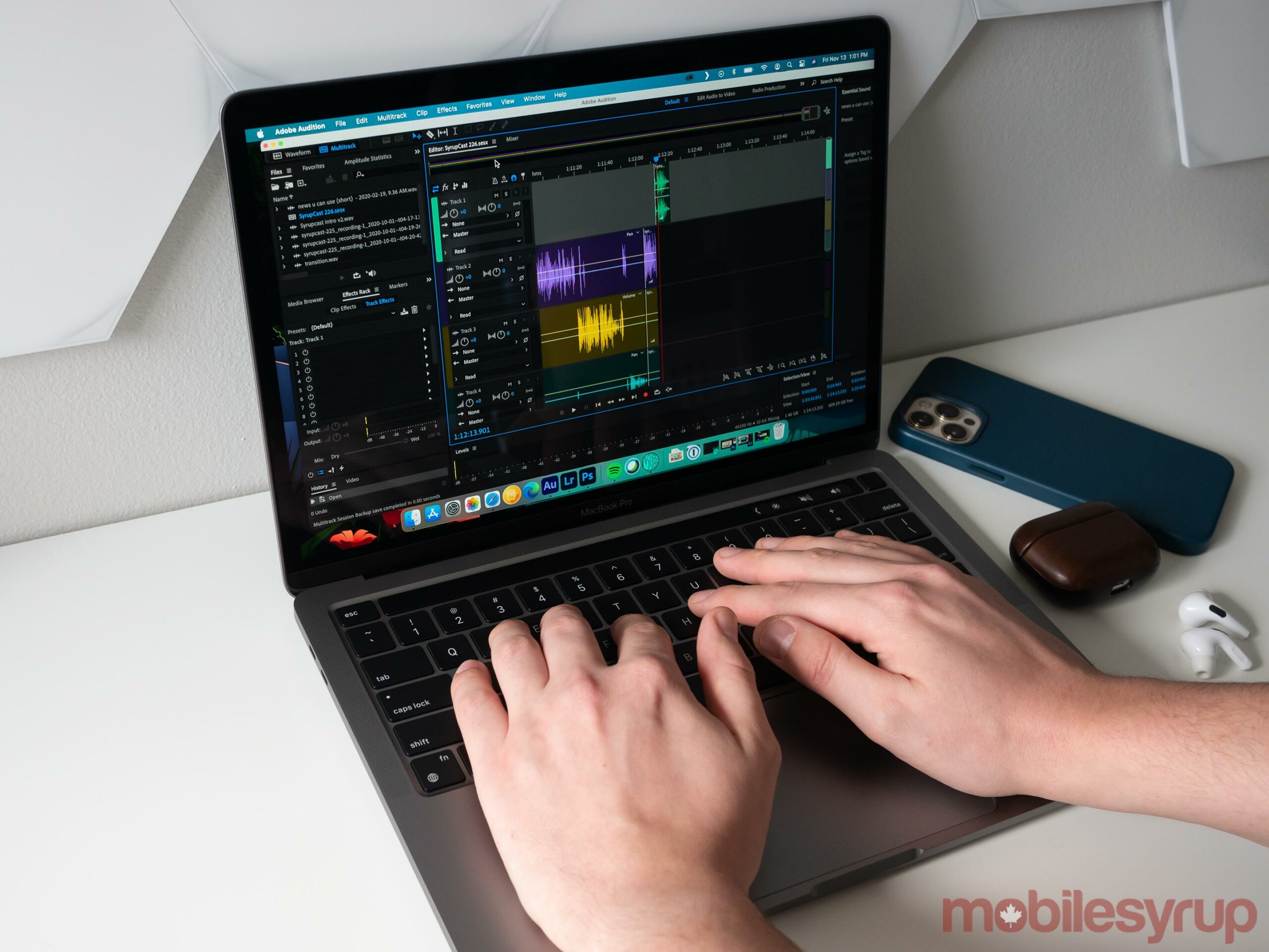
Favourite MacBook: M1 MacBook Pro

13-inch MacBook Pro with M1

Apple launched a few Mac computers this year, but by far the most exciting were the new M1-equipped MacBook Air, Pro and Mac mini. Of the three, the new MacBook Pro was a favourite, offering impressive power (thanks to the new M1), portability and the excellent — if dated — MacBook design we’ve come to expect from Apple.

The M1 is the star here. It’s Apple’s first crack at a laptop chip and it blows Intel’s comparable offerings out of the water. And, since it’s the first attempt, I’d expect future Apple Silicon chips to go even further.

However, the M1 is also likely the biggest issue preventing some people from upgrading. Because of the new architecture, a lot of early adopters encountered software issues, such as apps not working properly or other odd issues (for example, MobileSyrup managing editor Patrick O’Rourke has had issues getting a 4K second display to work with the M1 MacBook). Still, most of these are software problems and, as developers update their apps to support the M1, those problems should go away.

Ultimately, whether you should buy an M1 Mac comes down to how comfortable you are troubleshooting computer issues. Early adopters who love to tinker and mess around with their devices will likely feel right at home on the M1, while those who are less tech-savvy may want to wait a few months for the bugs to get ironed out. Either way, the M1 MacBook Pro is one of the best MacBooks — and best laptops — you can buy right now.

You can learn more about the M1 MacBook Pro here.

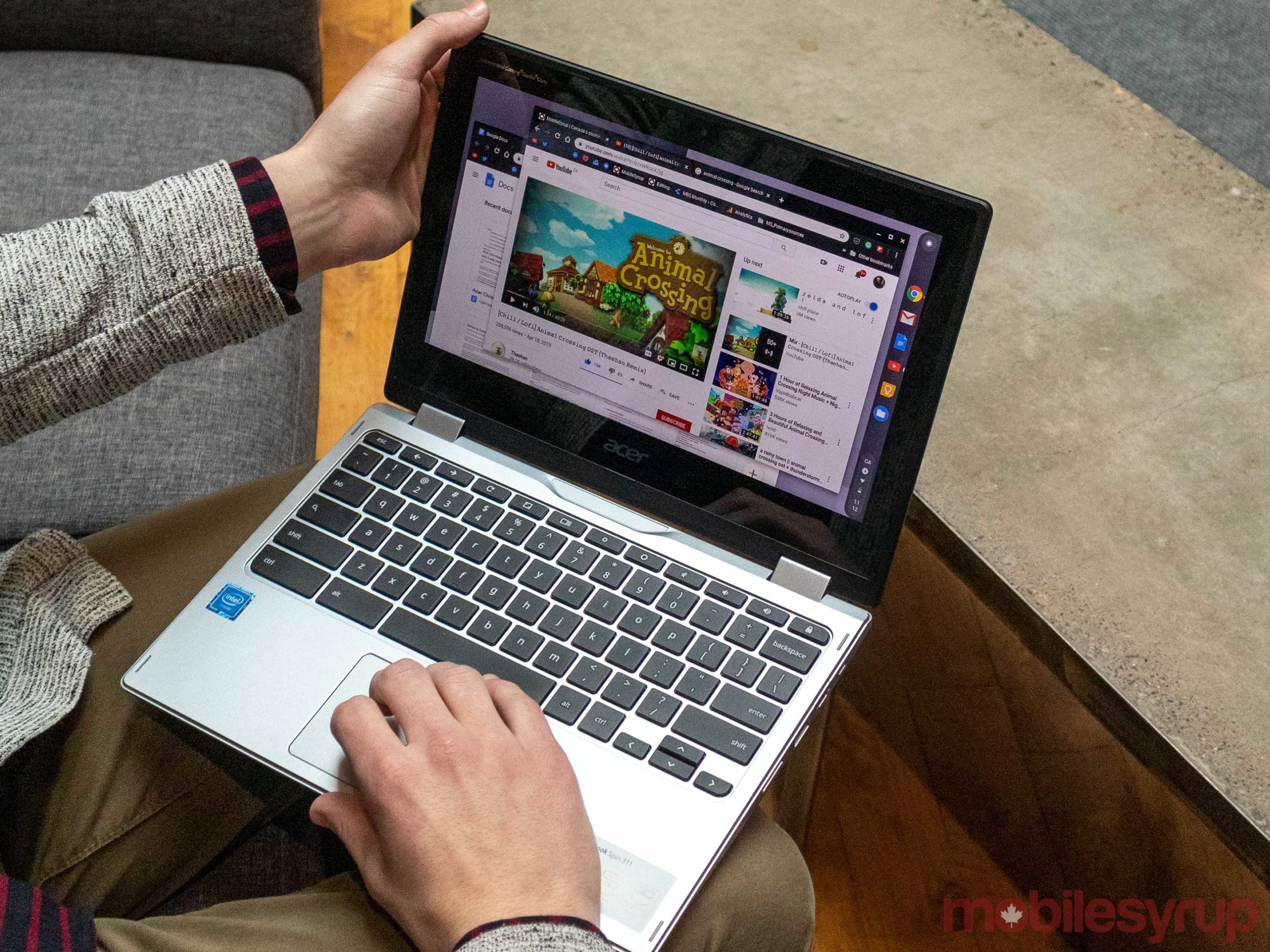
Favourite Chromebook: Acer Spin 311

Last, but certainly not least, we’re rounding out the list with our favourite Chromebook of 2020. The Acer Spin 311 is by no means the prettiest laptop on the market, but that hardly matters. It’s a low-cost machine that offers an excellent browsing experience, solid performance and excellent battery life.

The Acer Spin 311 checks the box as a great device for kids or teens who need something to do schoolwork on. One highlight is the decent keyboard, which is great for typing up assignments. Another plus is the display, which folds around to turn the device into a makeshift tablet.

Ultimately, if you’re looking for a reasonably priced laptop for some light web browsing, homework assignments or entertainment, the Acer Spin 311 is an excellent choice, especially if you find one on sale.

You can learn more about the Spin 311 here.

The post MobileSyrup’s favourite laptops of 2020 appeared first on MobileSyrup.

30 Dec 06:06

England’s hospitals have more Covid patients than ever before with London ‘teetering on the edge’

mkalus shared this story .

England’s hospitals now have more coronavirus patients than at any other point in the pandemic, NHS figures have revealed.

It means the health service is now under more strain from Covid-19 than at any other point as the new, more transmissible, variant of the virus has sent infections soaring to record levels.

More than 41,000 new infections were reported on Monday, ahead of a decision expected on Wednesday on whether tier restrictions should be tightened further.

The latest NHS England data, shared among NHS bosses, and seen by The Independent, reveals that across all NHS settings, there were 20,407 coronavirus patients being treated by the NHS on Monday, compared to a 12 April peak of 18,974.

In London, cases have surged to 4,957 patients – an increase of 47 per cent in a week and up more than 200 per cent since the end of the second national lockdown on 2 December.

Across the capital, hospitals have declared major incidents and cancelled operations while ambulances have been delayed for up to six hours outside some A&E departments, as NHS bosses issued a “call to action” to staff to work extra shifts in the coming weeks.

The Independent has learned that the situation in the capital prompted some senior hospital bosses to request the NHS publicly declare a major incident in a conference call with London’s regional medical director, Dr Vin Diwakar.

He refused, arguing that the NHS was already operating at its highest level of incident management, but some executives feel more needs to be said publicly about how hospitals are struggling.

One said: “The public has a right to know how bad things are and whether they need to change their own behaviour.”

Another senior figure at an NHS trust told The Independent: “It's quite astonishing. The numbers are now worse than the first wave, and yet we have a laissez-faire response from the NHS London team.”

During the call, on Saturday night, NHS England’s London regional team asked hospitals to make extraordinary efforts to create new bed spaces in any clinical areas to speed up the offloading of ambulances.

It followed a desperate message to NHS trust chairs at the weekend by the London Ambulance Service chair, Heather Lawrence, who said the service was fielding more than 450 calls an hour – similar to New Year’s Eve everyday.

She told them: “We have ambulances queuing for hours (four plus) at your hospitals,” adding that leaving paramedics waiting at hospitals exposed them to risk from coronavirus and it meant other people could be deprived of an ambulance.

She added: “It is not melodramatic to say that this will get worse. We have collateral support from other ambulance services and the London Fire Brigade.” But she said this may be taken away as the pressure on services spreads.

She said it was “time to act” adding hospitals needed to open up more beds and she urged hospital trust chairs to “ask difficult questions” of their chief executives.

One NHS source said in response: “I think the combination of winter, Covid, the bank holidays and staff shortages due to isolating have created a perfect storm where the NHS in London is teetering on the edge.

“I think that message is incredibly naive and incredibly shortsighted and seeks to place the onus on acute trusts when we now need a whole system response including primary care and community services standing up to share the load.”

The London Ambulance Service said it was receiving up to 8,000 calls a day compared a usual 5,500 “busy day” with Boxing Day being one of its busiest days ever.

It confirmed extra ambulances had been called in to help from neighbouring areas including South Central Ambulance Service, East of England Ambulance Service and St John Ambulance.

It has also asked staff with clinical skills to redeploy to the frontline.

The pressure is being felt on hospitals too with many cancelling operations and redeploying staff.

NHS England has written to all hospital staff asking them to work extra shifts over the next three weeks when cases will peak before falling as a result of the tier 4 restrictions.

At the Royal London Hospital on Sunday night there was a queue of ambulances waiting to offload patients with some patients forced to wait in their own car with their registration number used to help doctors locate them.

One nurse from the hospital said there were as many as 45 patients waiting outside the hospital on Sunday night.

The nurse, who has been caring for patients on wards at the hospital, told The Independent that the last few weeks had been hard.

“The pressures have been rising. Just before Christmas the trust started asking people to come in more. Everyday I wake up and there are messages saying they need people to come in to work, it’s crazy.

“Most shifts we are short of staff and its harder to get bank or agency staff to come and work on a Covid ward, I totally understand why, but it does make it harder.”

The nurse, who spoke on condition of anonymity, said nurses were working hard, often without breaks.

“We end up not having breaks because there isn’t enough time to fit everything in. You try to keep your patients safe but that comes at the cost of not having breaks. We try to have our lunch but sometimes that’s spent at the computer doing notes.”

“It is exhausting, I’ve not been sleeping well."

Asked what she would want to tell the public, the nurse said: “Wear a mask and try not to travel as much. When I finish a shift and get on the tube I see lots of people who sit there and take their mask off or put it below their nose, it’s really disheartening when you’ve just been nursing Covid patients for 12 hours.”

Dr Vin Diwakar said: “The NHS is already operating at the highest incident level, which enables us to respond as quickly and effectively as possible to the challenges of the pandemic, and London’s NHS is under significant pressure from high Covid-19 infection rates and non-Covid winter demands, with staff in all services going the extra mile and we are opening more beds to care for the most unwell patients.

“It is more important than ever that Londoners follow government guidance and do everything possible to reduce transmission of the virus.”

30 Dec 06:06

Netscape Communicator And SHA-1 Written Into Brexit Agreement

mkalus shared this story from Hackaday.

We pity the civil servants involved in the negotiations between the European Union and the United Kingdom, because after tense meetings until almost the Eleventh Hour, they’ve had to cobble together the text of a post-Brexit trade agreement in next-to-no time. In the usual manner of such international agreements both sides are claiming some kind of victory over fish, but the really interesting parts of the document lie in the small print. In particular it was left to eagle-eyed security researchers to spot that Netscape Communicator 4, SHA-1, and RSA encryption with a 1024-bit key length are recommended to secure the transfer of DNA data between states. The paragraphs in question can be found on page 932 of the 1256-page agreement.

It’s likely that some readers under 30 years old will never have used a Netscape product even though they will be familiar with Firefox, the descendant Mozilla software. Netscape were a pioneer of early web browsers, and  Communicator 4 was the company’s all-in-one browser and email offering from the late 1990s. It and its successors steadily lost ground against Microsoft’s Internet Explorer, and ultimately faded away along with the company under AOL ownership in the late 2000s. Meanwhile the SHA-1 hashing algorithm has been demonstrated to be vulnerable to collision attacks, and computing power has advanced such that 1024-bit RSA encryption can be broken in a sensible time frame by anyone with sufficient GPU power to give it a try. It’s clear that something is amiss in the drafting of this treaty, and we’d go so far as to venture the opinion that a tired civil servant simply cut-and-pasted from a late-1990s security document.

So will the lawmakers of Europe now have to dig for ancient software as mandated by treaty? We hope not, as from our reading they are given as examples rather than as directives. We worry however that their agencies might turn out to be as clueless on digital security as evidently the civil servants are, so maybe Verizon Communications, current owners of the Netscape brand, could be in for a few support calls.

30 Dec 06:06

Public Philosophy Editors on Building the Field

Helen De Cruz, David V. Johnson, Blog of the APA, Dec 29, 2020
Icon

This is a three-part series directed toward editors publishing public philosophy pieces, but it obviously extends to those covering other fields, including ed tech. The series covers questions on pitchingworking with editors, and building the field. I ignored the first (I don't pitch ideas) but it's important for newer writers. I do work with editors quite a lot and found the second useful, and the third covers timely issues of equitable representation and finding your audience.

Web: [Direct Link] [This Post]
30 Dec 06:05

Why Maryam Tsegaye’s prizewinning video is so important for online learning: my 12 reasons

Tony Bates, Online learning and distance education resources, Dec 29, 2020
Icon

Maryam Tsegaye, writes Tony Bates, "demonstrates so well many of the educational affordances of video, and shows what a powerful teaching medium video can be when used properly." Now to be clear, there are thousands, maybe even millions, of videos like hers teaching viewers any number of topics. I watch quite a number every day (and in fact had seen this one before Bates's column). What I like about this article, though, is how Bates pulls out of it the factors that make it effective instruction: it's short, clear, has a strong narrative, is concrete, stands on its own, uses humour, makes the subject relevant, and is open access. "It also raises the question of what constitutes ‘academic’ knowledge," writes Bates. "I certainly see the video as a valuable step towards understanding quantum tunnelling."

Web: [Direct Link] [This Post]
30 Dec 05:57

How mRNA went from a scientific backwater to a pandemic crusher

David Cox, Wired, Dec 29, 2020
Icon

This is less a story about the vaccine and more a story about the academic research behind the vaccine. And it raises questions about a system that demands that you have to obtain funding in order to keep your academic position. “They told me that they’d had a meeting and concluded that I was not of faculty quality,” said Katalin Karikó, the Hungarian immigrant who made the breakthroughs necessary to make mRNA a viable solution. ”When I told them I was leaving, they laughed at me." It makes me wonder how many others are in the same position she was, working doggedly on key problems, unable to support that will come only after they've made the discovery. Image: Wikipedia.

Web: [Direct Link] [This Post]
30 Dec 05:54

increasingly convinced that cars are just going to ban themselves due to increased energy costs and income inequality, leaving us in a transportation crisis maybe we oughta put in alternative infrastructure now while we have the chance?

by Well There's Your Problem Podcast (wtyppod)
mkalus shared this story from wtyppod on Twitter.

increasingly convinced that cars are just going to ban themselves due to increased energy costs and income inequality, leaving us in a transportation crisis

maybe we oughta put in alternative infrastructure now while we have the chance?


64 likes, 4 retweets
29 Dec 21:12

I’ve been sick with a bad flu since Christmas D...

I’ve been sick with a bad flu since Christmas Day. 🤒

I went and got a COVID test first thing yesterday morning, and by last night I got notice that I tested negative.

A relief, but a pretty sucky way to spend Christmas downtime. Stay safe and be well!

29 Dec 21:10

Saturday Morning Breakfast Cereal - More

by tech@thehiveworks.com
mkalus shared this story from Saturday Morning Breakfast Cereal.


Click here to go see the bonus panel!

Hovertext:
The other problem is that eventually transistors will be small we won't be able to detect them anymore.


Today's News:
29 Dec 21:05

COVID-19 Journal: Day 283

by george
Happy Christmas.I was booked on a flight on 30 December to go home for 6 months, but that was cancelled. I'm working on it, like the tens of thousands of other Australians who are trying to go home. My home state is only letting in 600 people a week so the quarantine procedure doesn't get overwhelmed. I had made many major plans in order for this to work. These plans have gone somewhat awry.