Shared posts

17 Jan 18:55

What Happened?

I don’t know what happened. But here’s my current theory of what the White House thought was going to happen. I don’t have any more information than you do, and here I’m not concerned with the broader question of how the country came to this end. I am just trying to make sense of what happened on Wednesday.

From the moment he knew he’d lost the presidential election, Trump absolutely wanted to get the result overturned. Some large proportion of his own staff and Congressional Republicans thought there was no harm in humoring him. Many surely knew him well enough to realize he was quite serious about it. But most, falling into a way of thinking that Trump has repeatedly benefited from over his entire career, and especially during his Presidency, figured that he could not possibly overcome the weight of institutional and conventional pressure behind the transition of power. Still, by the first week of January he had not relented in his efforts to find some way to do it, whether through bullying local election officials, chasing wild geese through the courts, or directly intimidating state officials. That all failed, or looked like failing. The next thing on the horizon was Electoral College certification.

So, Team Trump organized a big day of protest to coincide with the certification. The MAGA hats and Q people got all excited. Initially, Pence was going to be the guy who’d sort things out by using his made-up authority to reject the votes. But then he said he wouldn’t do this, which complicated things considerably. By this stage they were running out of rope, but Trump’s whole m.o. is just to keep pushing and pushing until those charged with stopping him just get tired, give in, or give up.

The plan for Wednesday was to have Trump go down and rile up the MAGA crowd, have them march up to the Capitol steps, and look like a big mass of people demanding something be done. Thanks to some preparatory cleansing of the DoD leadership last month (again, in outline pretty clear evidence that they intended to subvert the election), the White House had made sure there wouldn’t be much to stop the crowd from getting real close and making a lot of noise. The optics would be good. And the cops on duty wouldn’t go too hard on their MAGA buddies in any case.

Once the ructions were underway, and the objections from Hawley and Cruz and others were being debated, Trump would call some Senators to push them to object or generally delay or whatever. At a minimum, anything to derail the process. And as a best outcome—well, this bit is one of those ?????? Underpants Gnomes stages that features in all half-thought-out Trumpy plans—between the direct pressure from Trump and the noise from the masses gathered outside (just look at those TV pictures!), there would be some big shift as Senators realized their base was against them and they’d vote to reject the Electoral votes and send everything back to the States. Or there would be chaos on the Senate floor and someone like Cruz would hope to capitalize on it to reach some quasi-legitimate “Compromise of 2021”. Or something. I’m not saying this makes much sense in terms of things that definitely had to happen. It’s more that they saw potential to seize the initiative in some real-time moment of uncertainty with the house divided and the crowd outside.

The crowd outside. People in the White House or the Trump family entourage undoubtedly spend enough time hanging around the MAGA scene to be in touch with some of the key figures in it. There’s plenty of communication. The movement is disaggregated and full of weird shit and features more than a few complete lunatics. Still, there’s coordination with the rank and file when it comes to getting the crowds to show up. Now, because this was an event that Trump was going to be at himself, the idea was probably that from the crowd’s point of view it’d go more like a regular rally, as opposed to something like Charlottesville or the Michigan Statehouse. That is, from the White House’s point of view, the crowd was not actually supposed to get inside the Capitol. The MAGA/Q contingent are the useful marks in all this. They believe all the crap they’re fed. But obviously they’re not going to get into the building. It’s the US Capitol for God’s sake! The very idea that the rush of events would propel them right into the chambers was not something the White House wanted to happen, or thought was going to happen.

Of course, before the rally some of the actually dangerous Q-marinated nutters absolutely did want to get inside the building, find Pence, and Pelosi, and the rest, and literally take them hostage and string them up. They talked about this a lot on their message boards. The White House was probably well aware of these ideas. Normally, the presence of that part of the base provides a pleasant frisson of Lib-Owning danger. It pleases the White House to see that sort of person hanging around looking vaguely menacing. But people like that always talk a big game. And while some hard core would come prepared to actually do this stuff, at least inasmuch as they had the gear to do it, I don’t think the White House thought they’d ever come anywhere close to actually being able to pull off something like that. Similarly, while a much wider penumbra of goons, weekend warriors, failsons, radicalized realtors, and other assorted jokers really liked the idea of storming the Capitol, so that they could stream it in the name of MAGA and Q, the White House most likely did not consider that they’d ever get inside the building.

But they did get inside. The cops seemed to divide into segments that were genuinely overwhelmed and unable to hold the line, and segments that just let the invaders in—either because they were fellow-travelers, or because they were more like Mall Cops unused to mass action literally at the doors of the building, and who just couldn’t quite believe what was happening. (In the footage these ones often look genuinely confused.) While it matters a great deal for their culpability in the long run, in terms of immediate events their motives are irrelevant. Once the doors were opened to the insurrectionists, things moved quickly. One group of goobers found themselves wandering in to the atrium and, much like the cops, seemed almost unable to believe they were inside. Initially they even stayed in between the velvet guide-ropes. Another group, or category, of entrants—like the Shaman guy and his ilk—were off and streaming and lulzing as fast as they could. And a third group—like the Ziptie guys and the woman who was eventually shot—were really and truly prepped and making a beeline for where they thought people they wanted to capture and harm would be. The violence that happened seems to have been mixed between this third group and the goobers. The latter ended up in a sort of Forward Panic, barreling along reactively, chasing anyone who ran away, descending on journalists to harass, and so on.

As the chambers were being evacuated, Trump was on the phone with Tuberville. Most likely, the President wasn’t grasping the enormity of what was actually happening. There seems to have been a period of general confusion and near panic as resistance to activating the National Guard continued. I assume we’ll learn more about that in detail soon, both how those conditions were created and who ended up authorizing their deployment. Again, while extremely important in itself, this is less relevant here. Given that the Senators and Representatives ended up being successfully secured, very quickly there wasn’t really anyone official for the Ziptie contingent to harm. Meanwhile, the regular MAGAs also had little to do. And so they degenerated into small clumps of invaders, wandered about vandalizing stuff, shitting on the floor, and accidentally tasering themselves to death while trying to steal things. It’s around this time that CNN’s Jim Acosta tweeted that “A source close to the White House who is in touch with some of the rioters at the Capitol said it’s the goal of those involved to stay inside the Capitol through the night.”

In summary, the theory is that these are not the brightest guys, and things got out of hand. Trump and the White House et al knew there were genuinely dangerous people in their MAGA/Q mob. The MAGA people they were in communication with (as per Acosta’s tweet) were likely more on the leading edge of the rank and file, rather than the true loons. They thought things would go as protests outside the Capitol usually go, and as their rallies usually go. The crowd would serve as a loud prop. The really dangerous people would be diluted by the rank and file and kept out by the Capitol Police in any case. There would be a great deal of immediate drama and a great deal immediately at stake. Trump loves his crowd, but he has no tolerance at all for the individuals who make it up. As soon as they got inside the building and resolved once more into identifiable individuals, Trump was reportedly and unsurprisingly grossed out by all the “low class” stuff he was seeing. What he envisioned, I think, was a mass of adoring supporters at the very gates of the Capitol, expressing their love and loyalty for him, and together, they would make Congress capitulate to their will.

This is all just speculation on my part. There are many other plausible scenarios. People who know much more about American history than me have argued that some subset of people in the Administration and the GOP really did want protestors to get inside the Senate chamber and gum up the works such that an 1877-style “compromise” would be the wise way for cooler heads to prevail. There’s a lot to be said for this view. On this interpretation, Trump did imagine something like a direct replay of the Michigan Statehouse events, where armed militia end up in a public gallery and intimidate the legislators below. Personally, I have difficulty seeing how those involved could feel at all confident that they could foresee anything manageable or controllable flowing from a large group of armed MAGA protesters actually getting inside the building. It just seems far beyond the space of fluid but playable uncertainty. Instead it is right out in the far orbit of utter chaos—which is indeed what happened once people got inside.

For that reason I think it’s more likely that the White House, meaning most people who were behind the rally and incitement, really did not envisage a breach of the Capitol, even as they absolutely did seek to orchestrate the crowd outside and the legislators inside to the point where the election could be subverted. That said, there’s still plenty of circumstantial evidence for the view that there was a plan to get inside the building. Even the interpretation I have presented here depends—as I think any explanation of these events must, including the true one, whatever it is—upon key players having what seem like fundamentally unrealistic or crazy ideas about how things were going to play out, given that they didn’t happen. Events like this always have people who are absolutely willing to take things far beyond what even most people in their own movement would be comfortable with. The contingencies of how things actually play out shape whether we retrospectively assess them as fringe or vanguard.

After the fact, the White House very quickly found itself in a supercharged version of the situation that Cruz and Hawley are also in. They presumed they could cynically ride this movement for their own ends. They gleefully lit match after match, and eventually to their horror they managed to set themselves on fire along with everyone else. They clearly incited these events. They saw them spin rapidly out of control. They ended Wednesday afternoon with five people dead, the Capitol defiled, and the country stunned. They definitely wanted to overturn the election, which by itself is a subversion of representative government. Their efforts produced a messy putsch into the bargain, and got people killed. They should be punished for it as severely as the law permits, and they should never be allowed to live down their responsibility for what happened.

17 Jan 18:53

Attack Surface, by Cory Doctorow

by Ton Zijlstra

I read Cory Doctorow’s Attack Surface in the past days. I bought it already late November, directly from the author’s website (I’m trying to avoid buying through Amazon when I can), but read some other books first.

Attack Surface is a fast paced action packed novel, and I enjoyed it a lot. It takes you on a tour of both general and targeted surveillance technology and discusses how and when you can expect to be able to defend yourself against it, and when not. Reading the book was much like being in conversation with Arjen Kamphuis a Dutch it security expert who went missing in Norway two years ago, and like reading the accompanying storyline to Arjen’s 2014 book Infosecurity for Journalists.

Doctorow doesn’t explain technology much in his books, on purpose. He uses his books to make people aware of the names and terms to describe current tech, to ensure they know how to search online for explanations of the technology. On the assumption that the lack of awareness about certain tech, and the social and political implications of that tech, stems from not knowing enough to be able to search for more information. His books fill that gap.

…when I sat down in 2006 to write the first Little Brother book, I realized that facts were now cheap – anything could be discovered with a single search. The thing in short supply now was search terms – knowing what to search for.

https://craphound.com/littlebrother/2021/01/08/mashapedia/

For Attack Surface, one reader took this notion to turn it into a ‘Mashapedia‘ (Masha is the book’s protagonist), to provide a chapter by chapter glossary with links to explanations of each technology mentioned.

Doctorow describes himself as a realistic techno-optimist, not a tech-utopian, and I’m in the same position. In the final chapters of the book the characters point out that resisting surveillance tech is not about winning against that tech and permanently becoming immune to surveillance, but to create enough space to win political momentum against surveillance or those who use it. To resist surveillance in order to work political change. This hews close to the type of conversation I had during the Cph150 I had last year.
Around that time I wrote “treating [my work] as a political endeavour in its own right is different. I realise I may be in a place in my work where that deserves to have a much more deliberate role.” Doctorow reminds me to think that through some more, also as it builds on his contribution to the SF writers and economists meet-up late 2019 in Brussels I took part in, and the conversation we had there beforehand.

17 Jan 18:44

#CarFreeFamily 2020: How Much Does it Cost?

by Lisa Corriveau
Welp, that was... a year. Our transportation costs were lower than ever because we went nowhere & did nothing, basically. Oliver worked from home three quarters of the year, the HUB Cycling Ed spring & summer seasons were cancelled, & the fall was less work than usual, still thanks to COVID. We deliberated bike camping, but decided not to, & any other travel farther afield was right out. 

This year was even easier to calculate than previous years: no taxis, no ridesharing, no car rentals, no ferries. We got around by bike the vast majority of the time which costs us virtually nothing.

Our biggest expense of the year was bike maintenance, mainly brake pads, a few replacement parts. A lot of it was my Tern GSD, because that's the workhorse in our fleet, but Oliver did have a little work done on his Brodie Romax in January. The kids' bikes & the rest of our bikes didn't need much, except replacing the kickstand on our Yuba Mundo. All told, bike maintenance was roughly $60 a month, $708.71.

I think I spent about $8 on electricity charging my Tern GSD. I really have no idea how often I charged it or how many complete charge cycles I did in 2020, but based on previous stats the last time my Tern dealer plugged it in, I estimate about 65 full charges of the 900Wh of batteries in the roughly 5000km I rode.

We both renewed our Mobi Community passes, which cost $20 each. I only used Mobi for 16 one-way trips, & Oliver likely rode even fewer times than I did but the pass was still well worth the cost. It's really handy to have access to for one way trips to transit or when dropping off & picking up a bike from the shop. Total: $40. 

I took two transit trips all year, one of which was paid by work, & the rest of the family didnt take transit at all. Grand total cost to me was $6.90. 

We also drove very little, since most of our Modo trips tend to be for family birthdays & holiday dinners, & those were all cancelled. We usually rent a car to visit Oli's family in the Okanagan, but decided not to bring our potential germs to his elderly father this year. 

Back in The Before Times we did a few Modo trips, then none at all until September, when we picked up a couch with a Modo cargo van. Then one outing to see Winterlights in December. I also made a booking for work, but again, this was paid by my employer so I don't count it toward our family's total. Modo costs for the year came to $273.63.

Interestingly, our transportation costs were not that much lower than 2019, but again, that wasn't a banner year for going anywhere either, with my broken ankle, & Oliver's new job. We spent roughly $650 more that year. 2018 was more of a typical year for us, with some travel in BC, Washington, & Oregon, including a few bike camping trips & visits to the Okanagan to see family there. 2018 came out to nearly four times what we spent this year. If you're curious about the numbers you can check out my posts on the breakdown for 2018 here, & 2019 here.

So, now, the moment you've been waiting for... the grand total transportation costs for our #CarFreeFamily of four in Vancouver in 2020 was...

$1039.24. 

It's eight or ten times less than we'd be spending if we owned a car. Just the insurance would be more, whether we drove it much or not. Reducing transportation costs by cycling rather than driving makes such a huge difference to the affordability of living in Vancouver. The other downsides--getting a bit wet or cold occasionally, dealing with shitty drivers--are outweighed by all the other upsides--built in exercise & fresh air, more social interactions, easier parking, near zero carbon produced, often faster. Still pretty happy to be a #CarFreeFamily. 

So, how about you? What did you spend on transportation last year? Do you total it up annually? What are the upsides & downsides of how you get around?
17 Jan 18:37

Campbell's Dec 2020 Playlist

Campbell @cambel sent along a note over the holidays with a link to a Spotify playlist of some music that he has been grooving to.

Since I’m in music adventure mode, and looking to buy direct from artists as much as possible, it was a good excuse to do some research into each of the tracks.

Thanks for sharing, Campbell!

Machine Gun, by Commodores

Only thing I could find on Bandcamp this remix by Jayphies. Which is pretty great!

THE COMMODORES - Machine Gun (Jayphies-Groove) by Jayphies

Released in 1974, it’s an all instrumental track with lots of synthesizer. More on Songfacts:

1974 marked the first signs of disco, as R&B was morphing into something with a little more boogie. This is a great example of that sound, an instrumental song by the Commodores, who were recently signed to Motown Records. This was their first single.

The original is on YouTube. The comment on that video: “Machine Gun has only funk music and is devoid of slow-paced ballads.”

Zombie, by Fela Kuti

Fela Kuti has an entire page of albums on Bandcamp. Here’s the Zombie track from the Zombie album:

Zombie (1976/77) by Fela Kuti

In my collection, I already had the two disc set1 from 2000, The Best of Fela Kuti, which includes the Zombie track.

I’ll also recommend the nearly 16 minute long Roforofo Fight:

Roforofo Fight (1972) by Fela Kuti

Spitfire, by Public Service Broadcasting

Nothing on Bandcamp, here it is on Youtube:

Genre is listed as Dance/Electronic – but kind of chill at the same time.

Here’s a direct link to the track on Deezer. Never heard of Deezer, signing up! Here’s my borismann account liking this track.

Here’s an Android Authority review of Spotify vs Deezer.

Hit the Ground Running, by Smog

Smog is on Bandcamp, but only the Cold Blooded Old Times track is available for preview.

Here’s the Hit the Ground Running on Youtube:

And on Deezer.

Voice and lyrics reminds me a bit of Andrew Vincent and the Pirates which I shared back in July, except Smog is a little slower tempo.

Autumn Sweater, by Yo La Tengo

Just one album on Bandcamp, here it is on YouTube:

Here’s a cover by Hunting Bears:

Yr Ghost "single" by Hunting Bears

I have the “And then Nothing Turned Itself Inside-Out” in my collection, from 2000. It probably sticks in my mind because of the strange name, but I do like Let’s Save Tony Orlando’s House:

Human Performance, by Parquet Courts

Human Performance by Parquet Courts

Sea of Love, by Cat Power

Wow, there are a ton of covers of this song on Bandcamp. One the 2018 Wanderer album is on Bandcamp, so here’s YouTube:

Here’s an electronic cover I particularly liked:

Paper Garden VOL 1 SYD/ADL Compilation by Various Artists

Florence-Jean, by Damien Jurado

On YT:

And a cover on Bandcamp:

DOWNER by Handsome Pants

Doll Parts, by Hole

1994! Other than Oasis, probably the most “commercial” track on this list. From 1994, on YT:

Lots of covers on Bandcamp. I listened to a couple of them, a lot of them are just bad, several others are just super basic :)

I’m a 90s kid (graduated high school in 93, university from 95 to 99) so this is right in my prime music listening years.

In fact, I made a smart playlist of 1990 to 2000, and I have 3,300+ songs from that timeframe! That of course includes things like the Fela Kuti best of that came out in 2000, so not totally accurate.

Champagne Supernova, by Oasis

This is the “official HD remastered video” on YT:

And yes, many covers on Bandcamp.


  1. “two disc set” just sounds so quaint in 2021, but that’s how I would have bought it, and then converted it in iTunes. [return]
17 Jan 18:37

We did a walk around Burnaby Lake yesterday. ...

We did a walk around Burnaby Lake yesterday.

We’ve got weeks of rain — and then maybe snow in February??? — forecasted, so we make sure to go outside and enjoy the sun.

The entire lake loop is 10km+. Much longer than we had planned for, but worth it.

17 Jan 18:37

Struggling to Improve Knowledge Work Practices–From Idea to Finished Product

by Jim

I closed a recent blog post with the following observation

I struggle with advice about how to work at the level of ideas that haven’t found a home yet. This distinction of making a note promises to be a path into making more sense, more systematically, of that middle space and time before I know what the destination might be. (From Taking Notes to Making Notes)

It’s the sort of idea  the often surfaces as I work on a piece of writing that I’m developing into a prospective blog post. I’m now viewing it as an example of what I’m trying to sort out as I learn how to “make” notes. 

Right now I don’t know whether the struggles I am wrestling with are a function of fighting against the years of doing things a different way, a marker of individual flaws in the way my brain works, or some challenge inherent in the process. I study the advice and recommendations of others whose thinking feels compelling. And then I fight with it as I try to apply the advice as I understand it. 

My habits and practices are the accretion of years of doing what works for me. Most of that experience hasn’t been examined or explored in any systematic way. I encounter, read about, and seek out advice and suggestions from all sorts of sources. Some of it is intriguing enough to try out and experiment with. I run the experiments based on whatever partial understanding I’ve managed to take away from the advice. Some stuff sticks in some distorted version filtered through my assessments of those experiments. 

Let me try an example to make this more concrete. Many years ago, I came across Peter Elbow’s work. I don’t recall whether I stumbled across Writing Without Teachers or Writing With Power first. Doesn’t really matter. I had a new technique to play with–“freewriting.” Get stuff out of your head and onto paper (or a screen) where you can see it. Don’t strive for the perfect sentence or turn of phrase in your head. 

But there were elements of Elbow’s recommended practice that didn’t work for me. Elbow assumes you are doing freewriting by hand. Word processors were not household items when he formulated his process. He advises writers to push on at all costs; keep making marks on paper, don’t stop to review, write nonsense if you find yourself getting stuck. Elbow’s goal is to help you find a state of flow, to suppress your inner critic. 

Elbow never saw my handwriting. Achieving flow doesn’t help if you can’t decipher what you wrote a few hours earlier. Sometime before the arrival of word processing, I got the advice to learn to create at the keyboard. I wrote drafts of consulting reports at a typewriter well before I had access to word processing. My poor handwriting was the impetus, but the more important benefit for me was that I can type faster than I can write. Which meant it was easier to capture thoughts before I lost them.

At a typewriter, going backwards doesn’t make sense so you’re not faced with the opportunity to correct on the fly. With a word processor, you can go back as easily as forward, so now you have a choice about whether to do so. More often than not, I will correct typos if I see them in the moment. I don’t hold to a hard and fast rule; rather I do whatever feels least disruptive to my flow. So, now I’ve violated another “rule” in the method I am trying to adopt.

I also discovered Anne Lamott’s Bird by Bird and she granted me permission to write shitty first drafts. They had been shitty anyway, but now I had someone explain that that was okay and merely a step along the path. 

That path is well worn but not paved. There’s a discernible evolution from 

  • random notes to 
  • something that feels like an idea worth exploring to 
  • the emergence of a potential outline or roadmap to 
  • snippets of a draft to 
  • something that might qualify as a shitty first draft to 
  • rounds of editing and polishing to
  • finished product

This is a rough snapshot of the process that has worked for me through decades of writing. Laying it out like this makes it look more systematic than it actually is and I don’t feel that it looks all that systematic. 

What surfaces for me here is how much of my practice is driven from a deliverable of some sort; there’s a consulting report, a speech, a class session, a column, a blog post looming somewhere in the distance. I am working toward an endpoint, however dimly perceived.

Until I can see an endpoint, I struggle with what to do next. Once I do see an endpoint, or have one imposed by external forces, I start shaping material to fit that endpoint. Generally, I think that is a good thing, but it does mean I have to be willing to scrap things that won’t fit. That becomes easier with practice.

As you learn to care about your craft, you are always on the prowl for potential improvements. For the past 22+ months that has led to a focus on how notes might play a more central role. Most recently, that has been working to understand the distinction between note-taking and note-making, which was the trigger for this post. 

Having that distinction is only a baby step; the challenge is to work out what it means to incorporate the distinction into day-to-day practice. There’s new terminology, of course; ephemeral notes, permanent notes, atomic notes, evergreen notes. Still only another baby step; working out how to create these artifacts has been a bigger, still unfinished, step. These new artifacts don’t obviously map to what I produce in my current workflows.

The challenge that I am attacking now is that it’s hard to find worked examples of these techniques. You can find advice and recommendations on what various proponents and experts believe works for them. But these ideas are new enough that there aren’t well established practices to emulate. You’re left with trying to reverse engineer and interpolate practices from what you can observe. 

Most recently that has had me following the work of Andy Matuschak. He’s a software developer in this space who has been sharing what he describes as his working notes. He’s also attempting to offer a window into his practices. His observations on Evergreen note\-writing as fundamental unit of knowledge work and on Executable strategy for writing have both proven valuable as I work to improve my own knowledge work practice. 

Two asides here. One, I’d be thrilled if more of my finished products were as well thought out as his working notes. I’m telling myself that this is one key reason to investigate his work. Two, Matuschak is experimenting with Patreon as a means of supporting his research. I judge it an excellent return for a modest investment. 

There are also several online communities working these vineyards. Fellow travelers can make a difference. I’ve been monitoring;

If getting better at knowledge work is one of your objectives, look for your own companions and watering holes.

The post Struggling to Improve Knowledge Work Practices–From Idea to Finished Product appeared first on McGee's Musings.

17 Jan 18:36

Astuto

Astuto is a free, open source, self-hosted customer feedback tool. It helps you collect, manage and prioritize feedback from your users. It has been heavely inspired by Canny.io (“astuto”, indeed, is the italian translation of the word “canny”).

[[GPL3 License]]

Technologies

Technologies used:

  • [[Rails]]
  • [[PostgreSQL]]
  • [[RSpec]]
  • [[Yarn]]
  • [[React]]
  • [[TypeScript]]
  • [[Redux]]
  • [[SASS]]
  • [[Webpack]]
  • [[Docker]]
17 Jan 17:02

Banning People

by Richard Millington

A few rules:

1) It should take less time to ban someone than it takes the offender to commit the offence. If you’re spending time engaging in counter-arguments and engaging in lengthy debates, you’re losing the battle. If you’re going to ban someone, don’t get sucked into a lengthy debate about it.

2) You can ban anyone who does more harm than good to the community. There is no law that prevents you from removing any member who isn’t a good fit. If you’re hosting a dinner party and someone is clearly causing trouble, you remove them for the benefit of the masses. They don’t need to have broken a specific rule, they simply need to do more harm than good.

3) Your reasons must be consistent. If someone repeats the same offence and isn’t banned – that’s going to lead to problems. Every ban sets a precedent. If you ignore the precedent next time you’re going to rattle a hornet’s nest.

4) The person you ban might will probably first try to seek revenge. First, they will try to rejoin the community. If that fails, they will try to harm you or the community. Try to imagine, if you were them, what would you do to cause the most harm? Don’t be alarmed, just be prepared.

5) Everyone is replaceable. No figure is ‘too big to ban’. People assume available roles within a community. When you remove a top member, you open a slot for another member to take their place. The success of your community never hinges upon one or two people. You might find the very person you thought was too big to ban was actually holding everyone else back.

Good luck.

17 Jan 05:11

Andy Matuschak has an interesting site where he...

by Ton Zijlstra

Andy Matuschak has an interesting site where he publishes his notes collection as it grows. He does that as an experiment in ‘working with the garage door up’. One thing that makes browsing his note collection pleasant is how he uses sliding panes. When you follow a link to a new note it becomes a pane that slides over the one you are coming from. It means jumping back and forth between notes that form your path through them is easy. A kind of breadcrumb trail but one that keeps the content, not just the page links, available at a glance. This allows you to maintain an overall view while you browse his site.

For Obsidian there’s a plugin that provides sliding panes ‘Andy Matuschak style’ to my notes collection. I’ve installed it to see if it reduces friction that I currently feel if I want to quickly branch out into several notes, while not actually leaving the starting note or having to add panes in a way that easily results in a hard to grasp ‘tree map‘.

17 Jan 05:10

Bookmarked: Just the Maths, a set of PDFs expla...

by Ton Zijlstra

Bookmarked: Just the Maths, a set of PDFs explaining a lot of different mathematical concepts, with some exercises (and slides for teachers too), which are the core mathematical techniques useful in engineering and science.

17 Jan 05:05

Living Corporate podcast: The Role of Data in Diversity & Inclusion

by Tara Robertson

microphone

I had the pleasure of being a guest on the Living Corporate podcast. I really enjoyed the conversation I had with Zach Nunn and love the work that Living Corporate is doing to center and amplify Black and brown people at work.

At the end of the conversation Zach asked what three things executives should be reflecting on now.

Here’s my list:

  1. Figure out what personal work you need to do around DEI and make a plan to do it–block off time on your calendar. This important work to do on a personal level, so prioritize it and make the time.
  2. If there’s not clear accountability goals around DEI, ask your peers why. Then partner with your Head of DEI or Chief People Officer to figure out what the goals should be. Make them part of the regular goals framework in your company so they don’t get lost.
  3. If you don’t know who the Black and brown leaders are in your organization find out. Reach out to them and ask for time on their calendars to learn what their goals are and really listen to them. Then sponsor their work by speaking up for them when they are not in the room.

Living Corporate has so many amazing episodes with leaders I admire like Dr. Erin Thomas, Michelle Kim and Tema Okun. Check them out!

The post Living Corporate podcast: The Role of Data in Diversity & Inclusion appeared first on Tara Robertson Consulting.

17 Jan 05:04

Internet 3.0 and the Beginning of (Tech) History

by Ben Thompson

Francis Fukuyama’s The End of History and the Last Man is, particularly relative to its prescience, one of the most misunderstood books of all time. Aris Roussinos explained at UnHerd:

Now that history has returned with the vengeance of the long-dismissed, few analyses of our present moment are complete without a ritual mockery of Fukuyama’s seemingly naive assumptions. The also-rans of the 1990s, Samuel P. Huntington’s The Clash of Civilisations thesis and Robert D. Kaplan’s The Coming Anarchy, which predicted a paradigm of growing disorder, tribalism and the breakdown of state authority, now seem more immediately prescient than Fukuyama’s offering.

Yet nearly thirty years later, reading what Fukuyama actually wrote as opposed to the dismissive précis of his ideas, we see that he was right all along. Where Huntington and Kaplan predicted the threat to the Western liberal order coming from outside its cultural borders, Fukuyama discerned the weak points from within, predicting, with startling accuracy, our current moment.

Consider this paragraph from the book:

Experience suggests that if men cannot struggle on behalf of a just cause because that just cause was victorious in an earlier generation, then they will struggle against the just cause. They will struggle for the sake of struggle. They will struggle, in other words, out of a certain boredom: for they cannot imagine living in a world without struggle. And if the greater part of the world in which they live is characterized by peaceful and prosperous liberal democracy, then they will struggle against that peace and prosperity, and against democracy.

It was hard to not think of that paragraph as scenes emerged from last week’s invasion of the U.S. Capitol in an attempt to overturn a democratic election, particular those members of the mob LARPing a special forces military operation, and in the following days when it became clear just how many members of the mob were otherwise well-off members of society. Was belief that President Trump won the election a sufficient motivation to attack the Capitol, or, underneath it all, was there something more?

Two Capitol invaders in military gear
Win McNamee via Getty Images

I won’t pretend to know the answers to that question — this is a blog about technology and strategy, not philosophy and history. The events that followed Wednesday, though, bring to mind Fukuyama’s warning that history may be restarted by those unsatisfied with its end.

The End of the Beginning

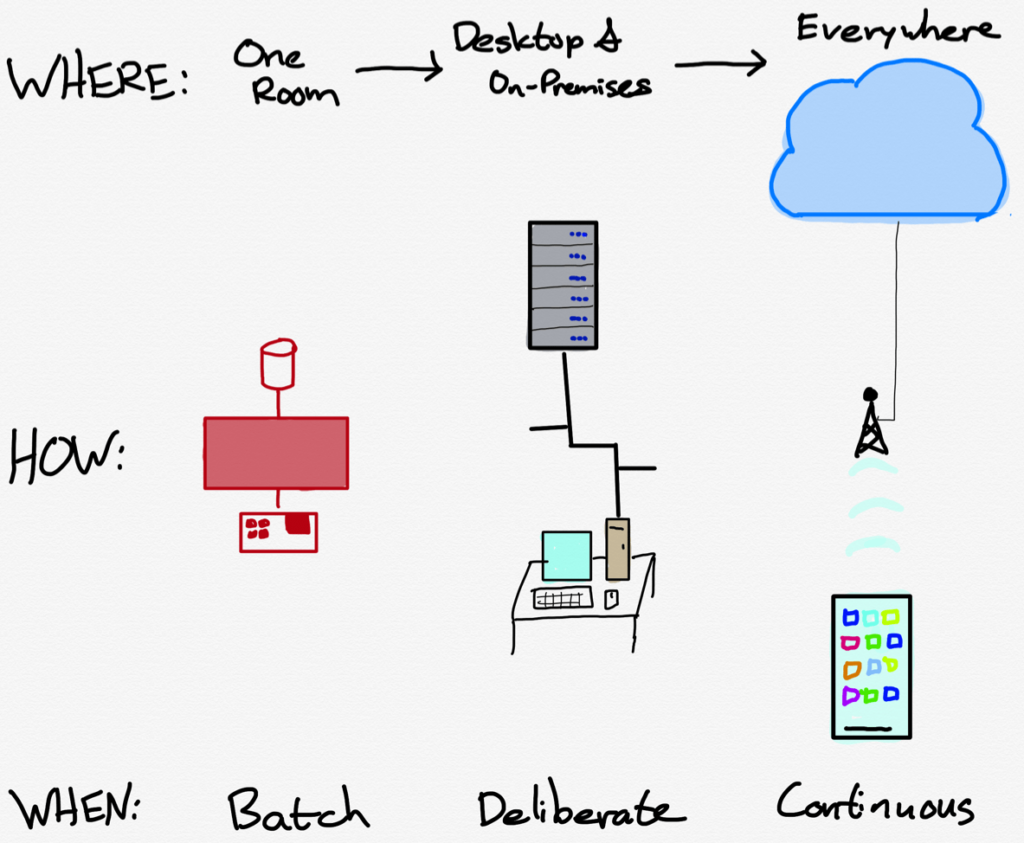
One year ago I wrote The End of the Beginning, which posited that the history of information technology was not, as popularly believed, one of alternating epochs disrupted by new paradigms, but rather a continuous shift along two parallel axis:

A drawing of The Evolution of Computing
The evolution of computing from the mainframe to cloud and mobile

The place we compute shifted from a central location to anywhere; the time in which we compute shifted from batch processes to continuous computing. The implication of viewing the shift from mainframe computing, to personal computing on a network, to mobile connections to the cloud, as manifestations of a single trend was just as counterintuitive:

What is notable is that the current environment appears to be the logical endpoint of all of these changes: from batch-processing to continuous computing, from a terminal in a different room to a phone in your pocket, from a tape drive to data centers all over the globe. In this view the personal computer/on-premises server era was simply a stepping stone between two ends of a clearly defined range.

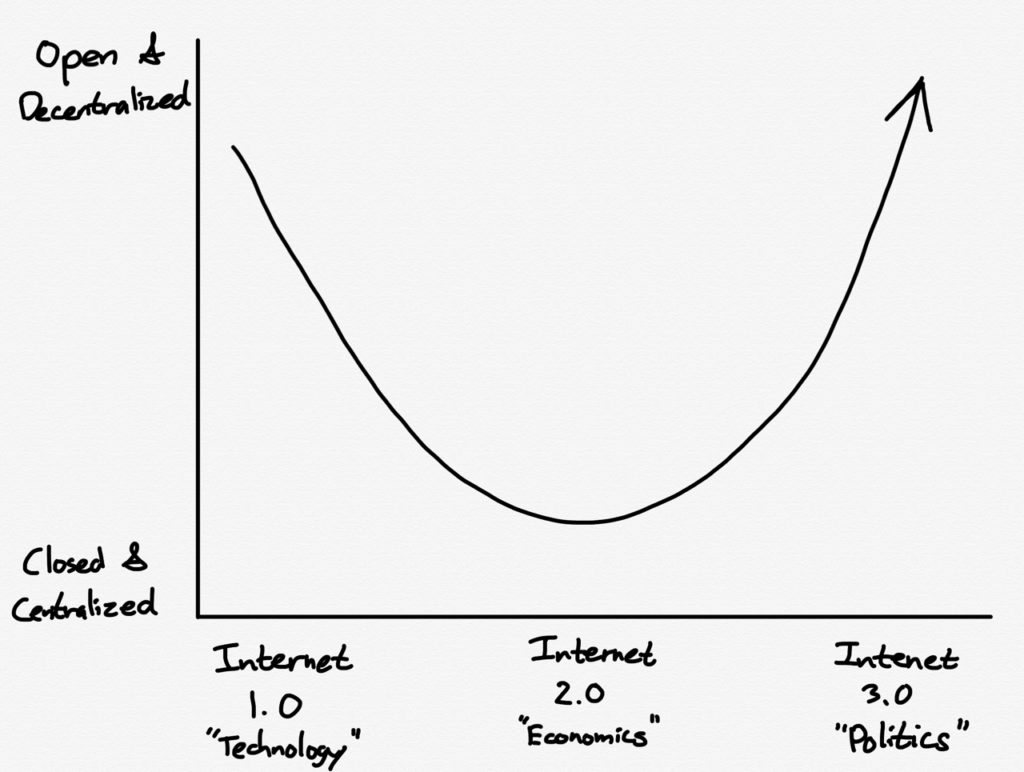
Another way to think about the current state of affairs is that it is the inevitable economic endpoint of the technological underpinnings of the Internet.

Internet 1.0: Technology

The vast majority of the technologies undergirding the Internet were in fact developed decades ago. TCP/IP, for example, which undergirds the World Wide Web, email, and a whole host of familiar technologies, was first laid out in a paper in 1974; DNS, which translates domain names to numerical IP addresses, was introduced in 1985; HTTP, the application layer for the Web, was introduced in 1991. The year these technologies came together from an end user perspective, though, was 1993 with the introduction of Mosaic, a graphical web browser developed by Marc Andreessen at the University of Illinois.

Over the next few years websites proliferated rapidly, as did dreams about what this new technology might make possible. This mania led to the dot-com bubble, which, critically, fueled massive investments in telecoms infrastructure. Yes, the companies like Worldcom, NorthPoint, and Global Crossing making these investments went bankrupt, but the foundation had been laid for widespread high speed connectivity.

Internet 2.0: Economics

Google was founded in 1998, in the middle of the dot-com bubble, but it was the company’s IPO in 2004 that, to my mind, marked the beginning of Internet 2.0. This period of the Internet was about the economics of zero friction; specifically, unlike the assumptions that undergird Internet 1.0, it turned out that the Internet does not disperse economic power but in fact centralizes it. This is what undergirds Aggregation Theory: when services compete without the constraints of geography or marginal costs, dominance is achieved by controlling demand, not supply, and winners take most.

Aggregators like Google and Facebook weren’t the only winners though; the smartphone market was so large that it could sustain a duopoly of two platforms with multi-sided networks of developers, users, and OEMs (in the case of Android; Apple was both OEM and platform provider for iOS). Meanwhile, public cloud providers could provide back-end servers for companies of all types, with scale economics that not only lowered costs and increased flexibility, but which also justified far more investments in R&D that were immediately deployable by said companies.

The network effects of iOS and Android are so strong, and the scale economics of Amazon, Microsoft, and Google so overwhelming, that I concluded in The End of the Beginning:

The implication of this view should at this point be obvious, even if it feels a tad bit heretical: there may not be a significant paradigm shift on the horizon, nor the associated generational change that goes with it. And, to the extent there are evolutions, it really does seem like the incumbents have insurmountable advantages: the hyperscalers in the cloud are best placed to handle the torrent of data from the Internet of Things, while new I/O devices like augmented reality, wearables, or voice are natural extensions of the phone.

This, though, is where I am reminded of The End of History and the Last Man; Fukuyama writes in the final chapter:

If it is true that the historical process rests on the twin pillars of rational desire and rational recognition, and that modern liberal democracy is the political system that best satisfies the two in some kind of balance, then it would seem that the chief threat to democracy would be our own confusion about what is really at stake. For while modern societies have evolved toward democracy, modern thought has arrived at an impasse, unable to come to a consensus on what constitutes man and his specific dignity, and consequently unable to define the rights of man. This opens the way to a hyperintensified demand for the recognition of equal rights, on the one hand, and for the re-liberation of megalothymia on the other. This confusion in thought can occur despite the fact that history is being driven in a coherent direction by rational desire and rational recognition, and despite the fact that liberal democracy in reality constitutes the best possible solution to the human problem.

Megalothymia is “the desire to be recognized as superior to other people”, and “can be manifest both in the tyrant who invades and enslaves a neighboring people so that they will recognize his authority, as well as in the concert pianist who wants to be recognized as the foremost interpreter of Beethoven”; successful liberal democracies channel this desire into fields like entrepreneurship or competition, including electoral politics.

In the case of the Internet, we are at the logical endpoint of technological development; here, though, the impasse is not the nature of man, but the question of sovereignty, and the potential re-liberation of megalothymia is the likely refusal by people, companies, and countries around the world to be lorded over by a handful of American giants.

Big Tech’s Power

Last week, in response to the violence at the Capitol and the fact it was incited by Trump, first Facebook and then Twitter de-platformed the President; a day later Apple, Google, and Amazon kicked Parler, another social network where Trump supporters congregated and in-part planned Wednesday’s action, out of their App Stores and hosting service, respectively, effectively killing the service.

After years of defending Facebook and Twitter’s decisions to keep Trump on their services, I called for him to be kicked off last Thursday, and I explained yesterday why tech’s collective action in response to last Wednesday’s events was a uniquely American solution to a genuine crisis:

So Facebook and Twitter and Apple and Google and Amazon and all of the rest were wrong, right? Well, again, context matters, and again, the context here was an elected official encouraging his supporters to storm the Capitol to overturn an election result and his supporters doing so. What I believe happened this weekend was a uniquely American solution to the problem of Trump’s refusal to concede and attempts to incite violence: all of corporate America collectively decided that enough was enough, and did what Congress has been unable to do, effectively ending the Trump presidency. Parler, to be honest, was just as much a bystander casualty as it was a direct target. That the tech sector is the only one with the capabilities to actually make a difference is what makes the industry stand out.

I am not, to be clear, saying that this is some sort of ideal solution. As I noted last week impeachment is the way this is supposed to go, and hopefully that still occurs. And, as I also noted last week, if this triggers a debate about the power of tech companies, all the better. This solution was, though, a pragmatic and ultimately effective one, even if the full costs will take years to materialize (again, more on the long-term repercussions soon).

Soon is today; this Article is not about the rightness and wrongness of these decisions — again, please see the two articles I just linked — but rather about the implications of tech companies taking the actions they did last weekend.

Start with Europe; from Bloomberg:

Germany and France attacked Twitter Inc. and Facebook Inc. after U.S. President Donald Trump was shut off from the social media platforms, in an extension of Europe’s battle with big tech. German Chancellor Angela Merkel objected to the decisions, saying on Monday that lawmakers should set the rules governing free speech and not private technology companies.

“The chancellor sees the complete closing down of the account of an elected president as problematic,” Steffen Seibert, her chief spokesman, said at a regular news conference in Berlin. Rights like the freedom of speech “can be interfered with, but by law and within the framework defined by the legislature — not according to a corporate decision.”

The German leader’s stance is echoed by the French government. Junior Minister for European Union Affairs Clement Beaune said he was “shocked” to see a private company make such an important decision. “This should be decided by citizens, not by a CEO,” he told Bloomberg TV on Monday. “There needs to be public regulation of big online platforms.” Finance Minister Bruno Le Maire earlier said that the state should be responsible for regulations, rather than “the digital oligarchy,” and called big tech “one of the threats” to democracy.

Make no mistake, Europe is far more restrictive on speech than the U.S. is, including strict anti-Nazi laws in Germany, the right to be forgotten, and other prohibitions on broadly defined “harms”; the difference from the German and French perspective, though, is that those restrictions come from the government, not private companies.

This sentiment, as I noted yesterday, is completely foreign to Americans, who whatever their differences on the degree to which online speech should be policed, are united in their belief that the legislature is the wrong place to start; the First Amendment isn’t just a law, but a culture. The implication of American tech companies serving the entire world, though, is that that American culture, so familiar to Americans yet anathema to most Europeans, is the only choice for the latter.

Politicians from India’s ruling party expressed similar reservations; from The Times of India:

BJP leaders expressed concern on Saturday over the permanent suspension of US President Donald Trump’s Twitter account by the social media giant, saying it sets a dangerous precedent and is a wake-up call for democracies about the threat from unregulated big tech companies…”If they can do this to the President of the US, they can do this to anyone. Sooner India reviews intermediaries’ regulations, better for our democracy,” BJP’s youth wing president Tejaswi Surya said in a tweet.

Tech companies would surely argue that the context of Trump’s removal was exceptional, but when it comes to sovereignty it is not clear why U.S. domestic political considerations are India’s concern, or any other country’s. The fact that the capability exists for their own leaders to be silenced by an unreachable and unaccountable executive in San Francisco is all that matters, and it is completely understandable to think that countries will find this status quo unacceptable.

Companies, meanwhile, will note the fate of Parler. Sure, few have any intention of dealing with user-generated content, but the truth is that here the shift has already started: most retailers, for example, have been moving away from AWS for years; this will be another reminder that when push comes to shove, the cloud providers will act in their own interests first.

Meanwhile, there remain the tens of millions of Americans who voted for Trump, and the (significantly) smaller number that were on Parler; sure, they may be (back) on Twitter or Facebook, but this episode will not soon be forgotten: Congress may have not made a law abridging the freedom of speech, but Mark Zuckerberg and Jack Dorsey did, and Apple, Google, and Facebook soon fell in line. That all of those companies will be viewed with a dramatically heightened sense of suspicion should hardly be a surprise.

Internet 3.0: Politics

This is why I suspect that Internet 2.0, despite its economic logic predicated on the technology undergirding the Internet, is not the end-state. When I called the current status quo The End of the Beginning, it turns out “The Beginning” I was referring to was History. The capitalization is intentional; Fukuyama wrote in the Introduction of The End of History and the Last Man:

What I suggested had come to an end was not the occurrence of events, even large and grave events, but History: that is, history understood as a single, coherent, evolutionary process, when taking into account the experience of all peoples in all times…Both Hegel and Marx believed that the evolution of human societies was not open-ended, but would end when mankind had achieved a form of society that satisfied its deepest and most fundamental longings. Both thinkers thus posited an “end of history”: for Hegel this was the liberal state, while for Marx it was a communist society. This did not mean that the natural cycle of birth, life, and death would end, that important events would no longer happen, or that newspapers reporting them would cease to be published. It meant, rather, that there would be no further progress in the development of underlying principles and institutions, because all of the really big questions had been settled.

It turns out that when it comes to Information Technology, very little is settled; after decades of developing the Internet and realizing its economic potential, the entire world is waking up to the reality that the Internet is not simply a new medium, but a new maker of reality. I wrote in The Internet and the Third Estate:

What makes the Internet different from the printing press? Usually when I have written about this topic I have focused on marginal costs: books and newspapers may have been a lot cheaper to produce than handwritten manuscripts, but they are still not-zero. What is published on the Internet, meanwhile, can reach anyone anywhere, drastically increasing supply and placing a premium on discovery; this shifted economic power from publications to Aggregators.

Just as important, though, particularly in terms of the impact on society, is the drastic reduction in fixed costs. Not only can existing publishers reach anyone, anyone can become a publisher. Moreover, they don’t even need a publication: social media gives everyone the means to broadcast to the entire world. Read again Zuckerberg’s description of the Fifth Estate:

People having the power to express themselves at scale is a new kind of force in the world — a Fifth Estate alongside the other power structures of society. People no longer have to rely on traditional gatekeepers in politics or media to make their voices heard, and that has important consequences.

It is difficult to overstate how much of an understatement that is. I just recounted how the printing press effectively overthrew the First Estate, leading to the establishment of nation-states and the creation and empowerment of a new nobility. The implication of overthrowing the Second Estate, via the empowerment of commoners, is almost too radical to imagine.

It is difficult to believe that the discussion of these implications will be reserved for posts on niche sites like Stratechery; the printing press transformed Europe from a continent of city-states loosely tied together by the Catholic Church, to a continent of nation-states with their own state churches. To the extent the Internet is as meaningful a shift — and I think it is! — is inversely correlated to how far along we are in the transformation that will follow — which is to say we have only gotten started. And, after last week, the world is awake to the stakes; politics — not economics — will decide, and be decided by, the Internet.

The Return of Technology

Here technology itself will return to the forefront: if the priority for an increasing number of citizens, companies, and countries is to escape centralization, then the answer will not be competing centralized entities, but rather a return to open protocols.1 This is the only way to match and perhaps surpass the R&D advantages enjoyed by centralized tech companies; open technologies can be worked on collectively, and forked individually, gaining both the benefits of scale and inevitability of sovereignty and self-determination.

Internet 3.0 will return to open and decentralized technology

This process will take years; I would expect governments in Europe in particular to initially try and build their own centralized alternatives. Those efforts, though, will founder for a lack of R&D capabilities, and be outstripped by open alternatives that are perhaps not as full-featured and easy-to-use as big tech offerings, at least in the short to medium-term, but possess the killer feature of not having a San Francisco kill-switch.

I wrote a follow-up to this article in this Daily Update.

  1. Crypto projects are one manifestation of this, but not the only ones
17 Jan 05:04

Microclout

by mikecaulfield

I have a couple people in my online social circle who were over the past month telling followers to “just watch” what would happen on the 6th, when everybody but them and their followers would be surprised that Joe Biden didn’t become president. At first, Mike Pence was going to heroically pull some imagined maneuver. Then it was another theory. But the idea from the posters was the same: remember who was right and who was wrong, they’d ask, when this all happens.

I don’t think they were expecting what happened to happen. But I think they were doing something that feels very much like clout-building: taking a gamble on being the one person who seemed in the know, because the rewards would be significant if true.

There’s talk right now about the number of social media influencers at the Capitol Insurrection. A lot of the people leading it were media stars, and it’s difficult to know how much of it they did for their brand, and how much was for the desired result.

But I’m not sure those dynamics stop at a certain floor of users. It seems to me that everyone has at least a few people in their online circles who are approaching issues around these events and conspiracies related to them as a brand-building process. In that case, can we really say the motivation is as simple as “confirmation bias”? Or would we be better off thinking of these dynamics around issues of personal brand-building, its incentives and disincentives?

17 Jan 05:03

Not so likely life of The Simpsons

by Nathan Yau

For The Atlantic, Dani Alexis Ryskamp compares the financials of The Simpsons against present day medians, arguing that the fictional family’s lifestyle is no longer attainable:

The purchasing power of Homer’s paycheck, moreover, has shrunk dramatically. The median house costs 2.4 times what it did in the mid-’90s. Health-care expenses for one person are three times what they were 25 years ago. The median tuition for a four-year college is 1.8 times what it was then. In today’s world, Marge would have to get a job too. But even then, they would struggle. Inflation and stagnant wages have led to a rise in two-income households, but to an erosion of economic stability for the people who occupy them.

Someone should take this a step further and look at distributions and time series to show the shift, with The Simpsons as baseline.

Tags: Atlantic, median, money, The Simpsons, work

17 Jan 05:03

Cappuccino from @timbertrain thanks to @ewise w...

Cappuccino from @timbertrain thanks to @ewise who “sent me a coffee” over Interac. Thanks Evan!

And blurry seagulls in the park. A brief walk and text chat away from my Zoom room.

17 Jan 05:00

Ten Facts You Need to Know About Micro-Credentials

TeachOnline.ca, Contact North, Jan 12, 2021
Icon

This is a good overview of the concept of micro-credentials and adds information about how these are being understood in Canada (and especially Ontario). Here, "it is widely agreed that a micro-credential is “transcriptable” meaning it will appear on a learner’s college or university transcript and will be deposited to her or his digital wallet or e-portfolio." The author mentions the eCampusOntario framework for micro-credentials, as well as the EU Commission draft definition: "A micro-credential is a recognized proof of the learning outcomes that a learner has achieved following a short learning experience, according to transparent standards and requirements and upon assessment." I know there's no definition of 'short' but let's be clear about scale: if 'short' means the equivalent of typical course, then we're looking at stacking 40 microcredentials to be equivanet to a degree. If they're even shorter, like say a one-hour class, then we're looking at stacking 1600 of them.

Web: [Direct Link] [This Post]
17 Jan 05:00

More Community Organizing

by Richard Millington

A community organizer knows the people she serves are unlikely to stand before a group of strangers and share their problems. That kind of courage (or vulnerability), will take a lot more time and a lot more trust.

So she goes from person to person, building one relationship at a time.

She earns the trust of one person and then the next.

Pretty soon, she can spot the patterns. She connects people with similar problems to discuss potential solutions. Better yet, she connects people with similar problems to people who have the skills, experience, or resources to help.

Each of these common problems forges new relationships between members. Each solution builds momentum and a sense of possibility for what the community can become. And it’s relationships and momentum which drive the community forward.

If you find yourself stuck when building a new community, whether for a few hundred or a few thousand members, go back to community organizing.

Reach out to a dozen people a week, have calls with them, connect them privately to one another, and find safe places within a community where they can work towards solutions.

Your community might need less community management and more community organizing.

17 Jan 05:00

Kubernetes Intro – Part 4 – Persistent Storage

by Martin

I’m almost happy with the basic hands-on understanding I have gained about Kubernetes about which I have written in part 1 to 3 of this series. I understand much better now how Kubernetes manages Docker containers, how it abstracts and manages the distribution of containers in a cluster of servers and how it makes services running in containers reachable from the outside world. From a developer and network administrator point of view, however, one important thing is still missing: How does Kubernetes manage persistent storage for containers? So let’s have a look at this and also experiment with a hands-on example: Running a WordPress Blog with a MySQL database in a Kubernetes cluster. As you will see, it’s not rocket science.

As explained in my Docker intro series, containers are ephemeral, i.e. all data modified or stored in the container itself is discarded whenever the container goes away. Therefore, databases and other applications running in containers need to have a way to store data persistently. In a Docker environment, a mechanism referred to as ‘volumes‘ is used to map a folder from inside the container to a path on the server on which the container is running. This way, a new instance of a container will get to the data again that the previous incarnation has left behind. So how does that work in a Kubernetes cluster?

In Kubernetes, this requires a bit of extra thinking because when a container, or to be more precise, a pod with one or more containers inside is instantiated, Kubernetes will run it on any server (worker node) in the cluster that is available at the time. In other words, mapping a folder inside a container to the filesystem of the worker node does not make sense, it has to be a more ‘generic’ place that can be reached from any worker node. So let’s explore how that works with the example I’ve already used in the Docker series: A WordPress installation.

As in the Docker WordPress example, two containers are used and both containers need persistent storage. In the Docker example the two containers we wanted to run are described in a docker-compose.yml file. This description also contained a ‘volume‘ section for the database and the WordPress container in which an folder in the container was mapped to a path on the server. The same principle is used in Kubernetes as well, but the description of the two containers looks a bit different. Also instead of one description file, one description file for each container is used in this example. As the descriptions are a bit longer I won’t post the full content here. Instead, let’s download the two ‘deployment‘ files directly into a new directory of our Minikube installation:

mkdir wpk
cd wpk

curl -LO https://k8s.io/examples/application/wordpress/mysql-deployment.yaml

curl -LO https://k8s.io/examples/application/wordpress/wordpress-deployment.yaml

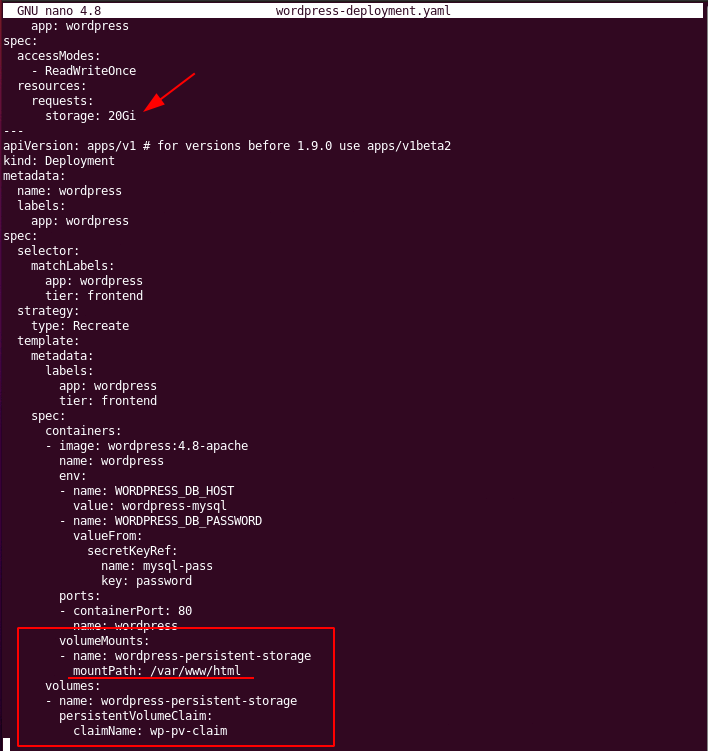
When you look into the WordPress deployment file you will see the following configuration for persistent storage:

Note the ‘mountPath‘ which is the same as in the Docker example. Also note that instead of giving a path on a particular server where to put the data outside a container a ‘Persistant Volume Claim‘ is made with a ‘name‘ as an ‘identifier‘. In other words, this is a kind of indirect request. When starting the container, Kubernetes can look up in its cluster configuration where to create a folder that is to be mapped into the pod/container.

In our Minikube test environment, the folder is created in the host’s temporary folder path ‘/tmp‘. In other words: the data will be persistent even if the pods/containers are deleted and restarted. However, when you restart the server, your data is gone. That is fine for a test installation. In a production Kubernetes cluster, this will of course not do. Instead of a path on the control node that is used for persistent storage, there will likely be some sort of storage server where persistent data is held redundantly. Kubernetes can then create an object on this storage infrastructure and then map it into the pod/container. From the point of view of the software running inside the container this is all transparent. It just reads and writes data to and from ‘/var/www/html‘ in this example.

You will find a similar volume configuration, referred to as Permanent Virtual Claim (PVC) in Kubernetes, in the database deployment configuration file. Before we can use the two deployment files to create and launch containers in our Kubernetes Cluster, one additional file is required that binds the two containers together. It must be named ‘kustomization.yaml‘ (yes, with a k!) and looks as follows:

# nano kustomization.yaml

secretGenerator:
- name: mysql-pass
  literals:
  - password=YOUR_PASSWORD
resources:
  - mysql-deployment.yaml
  - wordpress-deployment.yaml

While in the Docker example, the password required by the WordPress container to access the database in the database container was part of the configuration file, it is put into a separate configuration in this Kubernetes example. That makes sense because this way, one can create generic WordPress deployment files and have the secret stuff somewhere else that changes from deployment to deployment.

By now we have three files in our directory:

And that’s it, we can now push our WordPress deployment into the Kubernetes cluster. When we do this for the first time, Kubernetes will download all required images from the image hub and then do its magic around it. Unlike in the Docker example, there isn’t much feedback on the console, so you have to be patient for a minute or two before everything is in place.

kubectl apply -k ./

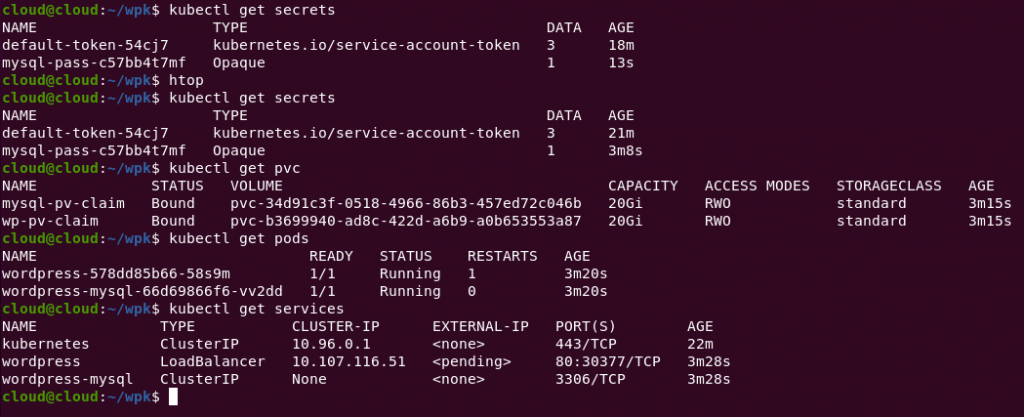
You can see Kubernetes working on this by going to the web dashboard, the graphs and entries will change as pods are created and started. Once done, use the following commands on the console to see the pods, persistent storage and services have been created:

kubectl get secrets
kubectl get pvc
kubectl get pods
kubectl get services wordpress

Here’s a screenshot as it looked like on my test server:

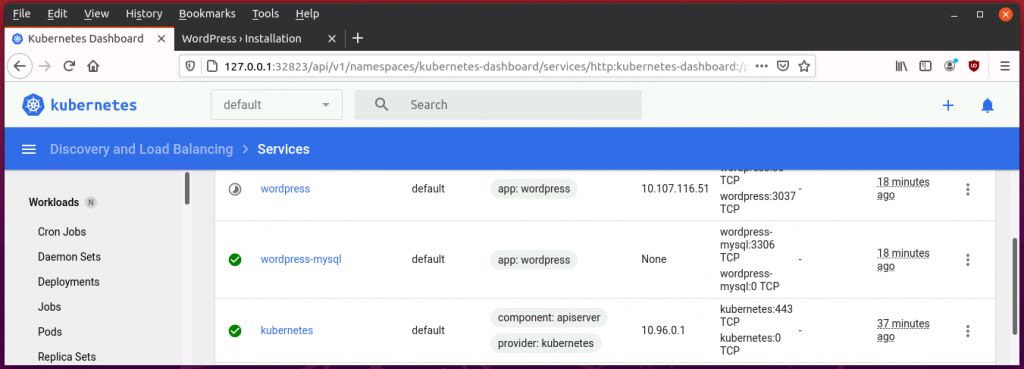
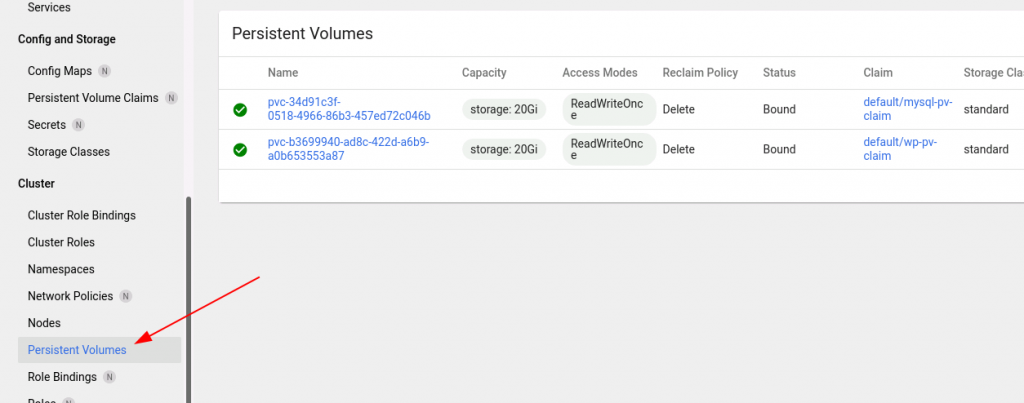
You can see the same information on the Kubernetes web dashboard as well but it’s distributed all over the place. We’ve been after the persistent storage in particular, however, and on the dashboard you can find the two persistent volume claims of this project as shown in the following screenshot:

And finally, we want to see that our two pods/containers actually work. For this, we map port 80 of the WordPress pod running in the cluster to a random TCP port on the outside with the following command and then copy/paste the resulting URL to a tab in the web browser:

minikube service wordpress --url

And voila, if everything has worked, you should be welcomed by the WordPress installation dialog.

So much for the quick intro into deploying a real application with persistent storage into a Kubernetes cluster. For more details have a look at this page in the Kubernetes documentation that goes through this whole process with lots of additional details and references what one has to do in addition concerning security, etc., if you want to deploy this on a real cluster.

17 Jan 04:20

Cheat

https://github.com/cheat/cheat

cheat allows you to create and view interactive cheatsheets on the command-line. It was designed to help remind *nix system administrators of options for commands that they use frequently, but not frequently enough to remember.

README

Build Status

cheat allows you to create and view interactive cheatsheets on the command-line. It was designed to help remind *nix system administrators of options for commands that they use frequently, but not frequently enough to remember.

The obligatory xkcd

Use cheat with cheatsheets.

Example

The next time you’re forced to disarm a nuclear weapon without consulting Google, you may run:

cheat tar

You will be presented with a cheatsheet resembling the following:

# To extract an uncompressed archive:
tar -xvf '/path/to/foo.tar'

# To extract a .gz archive:
tar -xzvf '/path/to/foo.tgz'

# To create a .gz archive:
tar -czvf '/path/to/foo.tgz' '/path/to/foo/'

# To extract a .bz2 archive:
tar -xjvf '/path/to/foo.tgz'

# To create a .bz2 archive:
tar -cjvf '/path/to/foo.tgz' '/path/to/foo/'

Installing

cheat has no dependencies. To install it, download the executable from the releases page and place it on your PATH.

Configuring

conf.yml

cheat is configured by a YAML file that will be auto-generated on first run. Should you need to create a config file manually, you can do so via:

mkdir -p ~/.config/cheat && cheat --init > ~/.config/cheat/conf.yml

By default, the config file is assumed to exist on an XDG-compliant configuration path like ~/.config/cheat/conf.yml. If you would like to store it elsewhere, you may export a CHEAT_CONFIG_PATH environment variable that specifies its path:

export CHEAT_CONFIG_PATH="~/.dotfiles/cheat/conf.yml"

Cheatsheets

Cheatsheets are plain-text files with no file extension, and are named according to the command used to view them:

cheat tar     # file is named "tar"
cheat foo/bar # file is named "bar", in a "foo" subdirectory

Cheatsheet text may optionally be preceeded by a YAML frontmatter header that assigns tags and specifies syntax:

---
syntax: javascript
tags: [ array, map ]
---
// To map over an array:
const squares = [1, 2, 3, 4].map(x => x * x);

The cheat executable includes no cheatsheets, but community-sourced cheatsheets are available. You will be asked if you would like to install the community-sourced cheatsheets the first time you run cheat.

Cheatpaths

Cheatsheets are stored on “cheatpaths”, which are directories that contain cheetsheets. Cheatpaths are specified in the conf.yml file.

It can be useful to configure cheat against multiple cheatpaths. A common pattern is to store cheatsheets from multiple repositories on individual cheatpaths:

# conf.yml:
# ...
cheatpaths:
  - name: community                   # a name for the cheatpath
    path: ~/documents/cheat/community # the path's location on the filesystem
    tags: [ community ]               # these tags will be applied to all sheets on the path
    readonly: true                    # if true, `cheat` will not create new cheatsheets here

  - name: personal
    path: ~/documents/cheat/personal  # this is a separate directory and repository than above
    tags: [ personal ]
    readonly: false                   # new sheets may be written here
# ...

The readonly option instructs cheat not to edit (or create) any cheatsheets on the path. This is useful to prevent merge-conflicts from arising on upstream cheatsheet repositories.

If a user attempts to edit a cheatsheet on a read-only cheatpath, cheat will transparently copy that sheet to a writeable directory before opening it for editing.

Directory-scoped Cheatpaths

At times, it can be useful to closely associate cheatsheets with a directory on your filesystem. cheat facilitates this by searching for a .cheat folder in the current working directory. If found, the .cheat directory will (temporarily) be added to the cheatpaths.

Usage

To view a cheatsheet:

cheat tar      # a "top-level" cheatsheet
cheat foo/bar  # a "nested" cheatsheet

To edit a cheatsheet:

cheat -e tar     # opens the "tar" cheatsheet for editing, or creates it if it does not exist
cheat -e foo/bar # nested cheatsheets are accessed like this

To view the configured cheatpaths:

cheat -d

To list all available cheatsheets:

cheat -l

To list all cheatsheets that are tagged with “networking”:

cheat -l -t networking

To list all cheatsheets on the “personal” path:

cheat -l -p personal

To search for the phrase “ssh” among cheatsheets:

cheat -s ssh

To search (by regex) for cheatsheets that contain an IP address:

cheat -r -s '(?:[0-9]{1,3}\.){3}[0-9]{1,3}'

Flags may be combined in intuitive ways. Example: to search sheets on the “personal” cheatpath that are tagged with “networking” and match a regex:

cheat -p personal -t networking --regex -s '(?:[0-9]{1,3}\.){3}[0-9]{1,3}'

Advanced Usage

Shell autocompletion is currently available for bash, fish, and zsh. Copy the relevant completion script into the appropriate directory on your filesystem to enable autocompletion. (This directory will vary depending on operating system and shell specifics.)

Additionally, cheat supports enhanced autocompletion via integration with fzf. To enable fzf integration:

  1. Ensure that fzf is available on your $PATH
  2. Set an envvar: export CHEAT_USE_FZF=true
15 Jan 04:01

Grateful for in 2020

by Lilia

It’s several times that I start writing posts trying to summarise learnings and results of the last year, but it doesn’t work easily and I let it go. What I want to write instead is what I am grateful for in 2020.

Eye operation of Robert that went as good as it could be given the circumstances and happened just in time before the healthcare system went into the stress mode. Enough health and resilience of those dear to us to deal with the challenges of the year. Financial stability of our family despite many uncertainties before the summer.

The choices we make as a family and our lifestyle that made adapting to the pandemic and lockdowns as smooth as could be. We all knew how to connect online, how to learn and work without depending on external infrastructures and how to be close to each other while giving space to everyone. We love outdoors away from crowds, so we had things to do and places to go outside of the house without increasing the risks or breaking the rules. We did have to lay more cables and learn talking better with each other, but those are good investments anyway.

Feeling more connected than before and a variety of social contacts, online and offline. More connection with the neighbours, online facilitation community, Perpetual beta coffee club, Unhurried conversations in Dutch, “dome project” and interactions in the university garden, U.lab coaching circle, Shtandart people and Russian systems fitness groups. New ways to connect with Dutch homeschoolers. Being back on Twitter, deep conversations on FB and LJ.

Not travelling to Russia for the first time in 19 years that was a challenge, but helped me to find more strength within. A deeper understanding of Dutch culture, politics, media, healthcare and educational systems. Saying what I find important to say about those things, in particular in respect to homeschooling during internet consultation.

Robert working at home and kids being self-directed enough to enable me to be away and to change roles. Doing volunteer work together with Alexander in a space where he had more experience than me and many moments of pride and joy I had in the process. Time for myself and time at Shtandart that worked well for my health and dealing with transformations inside. Lessons of the sea and an experience of being in a storm on a wooden ship that works well as a metaphor for many challenges in life.

Changing rules and shifting boundaries in the world around. Being as I am, flourishing at a boundary, seeing hope in every change and having experience with natural ecosystems that teach so much about decay and growth, changing seasons, places of plagues and pests, as well as diversity, abundance and possibilities.


The post Grateful for in 2020 appeared first on Mathemagenic.

15 Jan 04:01

Librem 5 Update: Shipping Estimates and CPU Supply Chain

by Purism

It’s been a busy holiday and New Year’s season at Purism as we continue to ship out Librem 5s to backers each week. We know for those who haven’t received their Librem 5 yet, what they most want to know is when their Librem 5 will arrive. In summary, we will be providing shipping estimates within the next week to the backers within the original crowdfunding campaign (orders through October 2017), but not all backers yet, based on our confidence in the estimates. The rest of this post will explain what is going into our shipping estimates, and why we can’t yet provide shipping estimates to every backer.

When we published the shipping FAQ we explained some of the factors in the shipping calculation:

That calculation depends not only on their place in line, but also on our knowing our average and maximum weekly phone throughput in advance, which we don’t expect to know until we are at least a few weeks into the process. We expect to have a good idea on these projections by the end of the year, however.

Now we are happy to say that we not only have a good idea on our shipping throughput, we actually exceeded our expectations for how many we could ship! So hopefully by the end of this week, or possibly the beginning of next week, we will be contacting a large group of backers who we feel we can provide a reliable shipping estimate. Note that this will be a separate email from the emails we already send out each week to confirm shipping information to the next group of backers who are ready to receive their Librem 5.

The Road to Shipping Parity

Back when we published the shipping FAQ, we expected that by this point we would be able to provide every backer with an accurate shipping estimate and be able to predict when we would hit shipping parity–the moment when all of the backlog has cleared and a new order would be fulfilled in our standard 10-business-day window. Once you know how many Librem 5s you can ship in a week, it seems like it would be a relatively straightforward calculation to apply that to a person’s place in line and estimate a shipping date.

Making Librem 5 Just In Time

In our case the calculation is a little more complicated due to the fact that we employ a “Just In Time” manufacturing process for the Librem 5s, which is pretty common in the industry. We estimate our shipping throughput and make slightly more Librem 5s than we think we can ship in a period of time. The next manufacturing run of Librem 5s then arrives around the time we complete shipping out the previous run. This has a few benefits, but the main benefit is if we were to identify a hardware problem in the existing Librem 5 manufacturing process (whether a systemic flaw, or a flaw in a particular manufacturing run) it impacts a smaller number of Librem 5s and can be fixed for future batches.

So when making these shipping estimates, we not only factor in our shipping throughput, but also the size of future manufacturing runs, which we now are increasing based on the fact we’ve exceeded our initial estimates. We can then calculate which run a particular order would be in, when we will make that next set of Librem 5s, and be able to estimate when a particular Librem 5 will ship. We also factor in and plan for events like Chinese New Year, which cause essentially everything in China to shut down for a few weeks.

CPU Supply Chain

One downside to using Just In Time manufacturing is that you must factor in all of the different lead times for all the different individual components that go into the Librem 5. While some components have relatively short lead times, others sometimes have lead times extending out multiple months. You have to factor all of this in to ensure that everything is ordered in advance so that it arrives just when you need it.

If you talk to anyone in manufacturing they will tell you that this has been a particularly challenging year for the supply chain. Whether you are talking about toilet paper, N95 masks, rubber gloves, or semiconductors, the global pandemic has made supply chains less reliable, and lead times and shipping times incredibly unpredictable. It’s left everyone in the industry scrambling from source A to B to C down to Z sometimes to find inventory. It even added a delay a few months back to our Librem 14 timeline due to Intel having trouble fulfilling all of their CPU orders.

Our customers have told us they want ever more information on what happens behind the scenes of making a phone like the Librem 5, so in the interest of transparency we are sharing what we’ve been hearing from our own suppliers. The iMX-8 processor we use in our Librem 5 is also popular in the automotive industry, and currently NXP has been hit with a global semiconductor shortage due to a dramatic increase in demand from auto makers.

This shortage has increased the lead times for CPU orders, which is of course a critical component in the Librem 5. As we started getting word about this shortage we were proactive in sourcing and purchasing all the CPUs we can, and continue to do so, while also factoring these increased lead times into future orders.

What Does This Mean For Me?

What does this mean for you? Based on our efforts thus far there’s a good chance it will not affect your shipping time as we continue to track down new CPU supplies and plan for future manufacturing runs. So far it hasn’t caused a delay.

However we wanted to let everyone know about this potential issue far in advance, because it will impact how many people get shipping estimates. We only want to send shipping estimates when we know for sure we have the CPUs to fulfill them, so this week instead of sending estimates to everyone like we had planned, we are only sending estimates out up to the point we have CPUs that will arrive just in time. This happens to coincide with all the orders placed through October 2017–the end of our original crowdfunding campaign.

As we secure more CPU supply, and feel confident about the supply chain for future manufacturing runs we will send out additional shipping estimates. Hopefully soon we will be able to account for the whole backlog and can calculate when we hit shipping parity.

Certification Update

We’ve also gotten some questions about the various hardware certifications for the Librem 5 including Respect Your Freedom (RYF), FCC and CE. While we designed the Librem 5 to qualify for each of these certifications, we had to wait to start the certification processes until we had the final mass-produced “Evergreen” Librem 5 since changes in the hardware would require re-certification.

Each of these certification processes are under way. While the transmitters in the Librem 5 (the removable cellular modem and WiFi card) already have FCC and CE certification, we are seeking certification for device as a whole. We are still in the middle of these time-consuming certification processes and will post an update to our site when there is any news on any of these fronts.

Thank You

We want you to have your Librem 5 as soon as possible and appreciate everyone’s patience as we continue to process orders and get through our backlog. It’s everyone’s support through this monumental process that has made the Librem 5 a reality.

The post Librem 5 Update: Shipping Estimates and CPU Supply Chain appeared first on Purism.

11 Jan 01:28

Autonomous and Beautiful Home Devices

by Matt

Of all the smart home upgrades I’ve made, replacing all my regular smoke detectors with Nest Protects (Google’s smoke detector) has been the one that I regret the most.

I don’t really need a smart smoke detector. It doesn’t need to talk, connect to wifi, and cost hundreds of dollars. I don’t need it integrated with my Google account which is impossible to share, so I need to be personally involved to replace one.

But other smoke detectors are just so unsightly, and the Nest is light years ahead of the competition from a design standpoint.

There’s such an opportunity for something that looks as good as the Nest, but doesn’t require two-factor authentication to replace. I didn’t want to call it dumb but beautiful, so let’s say “autonomous and beautiful” appliances and home devices. I still want it to be smart, but if you’re going to have the risk profile of a device that connects to the internet, it needs to be worth it, like Brilliant, Sonos, smart TVs, or connected cameras.

I’m becoming more wary of any hardware that requires an app, just because of the natural decay of non-SaaS and non-open source software. Van Moof bikes are beautiful, but will they still connect well when iOS 24 is out and Bluetooth has been removed from iPhones for security reasons?

09 Jan 03:24

Datasette News: 2021-01-07

by Simon Willison

APIs from CSS without JavaScript: the datasette-css-properties plugin introduces datasette-css-properties, a highly experimental plugin that can output table rows and SQL query results as CSS stylesheets defining custom properties that can then be used to customize a static HTML page.

09 Jan 03:24

A Wee Bit of New Year Good Wishes and Hope

by Gordon Price

Just when it looks like 2020 is not finished with us yet, here is a bit of relief:

Edinburgh’s Hogmanay — the Scottish celebration of the New Year — dispensed with the huge crowds and fireworks to create a virtual three-part celebration called “Fare Well,” an amazing blend of cinematography, music, poetry, and drone technology. Part 1 reflects on the past year of loss and mourning, Part 2 praises the compassion of the present day, and Part 3 looks to the future with hope – with the necessary subtitles.

09 Jan 03:23

We need more than deplatforming

by Mitchell Baker

There is no question that social media played a role in the siege and take-over of the US Capitol on January 6.

Since then there has been significant focus on the deplatforming of President Donald Trump. By all means the question of when to deplatform a head of state is a critical one, among many that must be addressed. When should platforms make these decisions? Is that decision-making power theirs alone?

But as reprehensible as the actions of Donald Trump are, the rampant use of the internet to foment violence and hate, and reinforce white supremacy is about more than any one personality. Donald Trump is certainly not the first politician to exploit the architecture of the internet in this way, and he won’t be the last. We need solutions that don’t start after untold damage has been done.

Changing these dangerous dynamics requires more than just the temporary silencing or permanent removal of bad actors from social media platforms.

Additional precise and specific actions must also be taken:  

Reveal who is paying for advertisements, how much they are paying and who is being targeted.

Commit to meaningful transparency of platform algorithms so we know how and what content is being amplified, to whom, and the associated impact.

Turn on by default the tools to amplify factual voices over disinformation.

Work with independent researchers to facilitate in-depth studies of the platforms’ impact on people and our societies, and what we can do to improve things.

These are actions the platforms can and should commit to today. The answer is not to do away with the internet, but to build a better one that can withstand and gird against these types of challenges. This is how we can begin to do that.


Photo by Cameron Smith on Unsplash

The post We need more than deplatforming appeared first on The Mozilla Blog.

09 Jan 03:22

My Experience Storing an Entire Course Directory in Git

by Eugene Wallingford

Last summer, I tried something new: I stored the entire directory of materials for my database course in Git. This included all of my code, the course website, and everything else. It worked well.

The idea came from a post or tweet many years ago by Martin Fowler who, if I recall correctly, had put his entire home directory under version control. It sounded like the potential advantages might be worth the cost, so I made a note to try it myself sometime. I wasn't quite ready last summer to go all the way, so I took a baby step by creating my new course directory as a git repo and growing it file by file.

My context is pretty simple. I do almost all of my work on a personal MacBook Pro or a university iMac in my office. My main challenge is to keep my files in sync. When I make changes to a small number of files, or when the stakes of a missing file are low, copying files by hand works fine, with low overhead and no tooling necessary.

When I make a lot of changes in a short period of time, however, as I sometimes do when writing code or building my website, doing things by hand becomes more work. And the stakes of losing code or web pages are a lot higher than losing track of some planning notes or code I've been noodling with. To solve this problem, for many years I have been using rsync and a couple of simple shell scripts to manage code directories and my course web sites.

So, the primary goal for using Git in a new workflow was to replace rsync. Not being a Git guru, as many of you are, I figured that this would also force me to live with git more often and perhaps expand my tool set of handy commands.

My workflow for the semester was quite simple. When I worked in the office, there were four steps:

  1. git merge laptop
  2. [ do some work ]
  3. git commit
  4. git push

On my laptop, the opening and closing git commands changed:

  1. git pull origin main
  2. [ do some work ]
  3. git commit
  4. git push origin laptop

My work on a course is usually pretty straightforward. The most common task is to create files and record information with commit. Every once in a while, I had to back up a step with checkout.

You may say, "But you are not using git for version control!" You would be correct. The few times I checked out an older version of a file, it was usually to eliminate a spurious conflict, say, a .DS_Store file that was out of sync. Locally, I don't need a lot of version control, but using Git this way was a form of distributed version control, making sure that, wherever I was working, I had the latest version of every file.

I think this is a perfectly valid way to use Git. In some ways, Git is the new Unix. It provided me with a distributed filesystem and a file backup system all in one. The git commands ran effectively as fast as their Unix counterparts. My repo was not very much bigger than the directory would have been on its own, and I always had a personal copy of the entire repo with me wherever I went, even if I had to use another computer.

Before I started, several people reminded me that Git doesn't always work well with large images and binaries. That didn't turn out to be much of a problem for me. I had a couple of each in the repo, but they were not large and never changed. I never noticed a performance hit.

The most annoying hiccup all semester was working with OS X's .DS_Store files, which record screen layout information for OS X. I like to keep my windows looking neat and occasionally reorganize a directory layout to reflect what I'm doing. Unfortunately, OS X seems to update these files at odd times, after I've closed a window and pushed changes. Suddenly the two repos would be out of sync only because one or more .DS_Store files had changed after the fact. The momentary obstacle was quickly eliminated with a checkout or two before merging. Perhaps I should have left the .DS_Stores untracked...

All in all, I was pretty happy with the experience. I used more git, more often, than ever before and thus am now a bit more fluent than I was. (I still avoid the hairier corners of the tool, as all right-thinking people do whenever possible.) Even more, the repository contains a complete record of my work for the semester, false starts included, with occasional ruminations about troubles with code or lecture notes in my commit messages. I had a little fun after the semester ended looking back over some of those messages and making note of particular pain points.

The experiment went well enough that I plan to track my spring course in Git, too. This will be a bigger test. I've been teaching programming languages for many years and have a large directory of files, both current and archival. Not only are there more files, there are several binaries and a few larger images. I'm trying decide if I should put the entire folder into git all at once upfront or start with an empty folder a lá last semester and add files as I want or need them. The latter would be more work at early stages of development but might be a good way to clear out the clutter that has built up over twenty years.

If you have any advice on that choice, or any other, please let me know by email or on Twitter. You all have taught me a lot over the years. I appreciate it.

09 Jan 03:21

Method: Architectural Ethnography

by Rob Shields
Sarah Lopez’s great project on architectural or building ethnography highlighted by a CCA talk asks how remittances and overseas migrant workers’ construction of family residences in their home villages and towns transforms those places. This …
09 Jan 03:21

Narratives and Demographic Realities of the West End – 1

by Gordon Price


A few weeks ago, PT ran a post: “The West End The Way it Was.”   Its last line: “One of the best urban neighbourhoods in the world.”

Regular commenter Bob took issue:

(The West End) “was” one of the best urban neighbourhoods in the world.

The distinctive mix of demographics that made it unique: seniors, young immigrant families, the gay community, all are being driven out by the gentrification unleashed during Vision Vancouver’s and the BC Liberal’s tenure. The removal of St.Pauls to the False Creek Flats will be yet another body blow to the community.


There’s been a narrative like that in the West End as long as I’ve lived here.  Since the 70s people have said the unique mix isn’t what it was, or is in danger, or is no longer.

I understand what Bob bemoans: the perceived loss of diversity as the West End becomes upscaled and out of reach of the residents who gave it real character.  It seems they are being unfairly squeezed out by a rate of change – whether demographic, physical or economic – that’s too fast.

No arguing with what people perceive; that’s their reality.  But I learned as a councillor that people’s perception of the rate of change in their community is paradoxical.  As the rate of change slows down, in fact, people’s perception of change increases.  What was once unnoticed in a neighbourhood swept by turbulent change – like the West End in the 1960s – becomes the focus of attention when things slow down enough to notice.

But eventually facts have to match up with perceptions.  Change must be reflected in the measures of that change.   And thanks to the great work by the City’s Social Policy department, we have those measures in one place and can graphically see them illustrated.  Lots of charts.*

No amount of data from yesterday will necessarily convince those persuaded by the anecdotal changes of today.  However, these community profiles derived from the census do provide a base of comparison over decades. Are seniors, families, immigrants and gays being driven out.  And who has replaced them?

We can find out in this Profile of the West End**:


Big takeaway: the astonishing thing about the West End is its stability.  Even physically, the district west of Burrard and south of Robson is remarkable for how little it has changed from the 1980s on.

Chilco Street in 2009:

In 2019:

Not even the trees have changed.

Is this Denman Street in 2005 or 2019?

Denman Street in 2005

So how about the people? Let’s begin with the Age Profile of the West End:

The general distribution of the West End’s population has been quite consistent over time. 

To repeat: “consistent over time.”

The biggest shift hasn’t been in age cohorts but in ethnicity, and that’s something we haven’t begrudged.  Boomers like me as young adults who moved into those new highrises built between the late 50s to early 70s were, like the apartments, largely white – a reflection of the Canadian post-war demographic. (In 1971, 96 percent of all Canadians were of white European origin.  Canada may never have been so white, ever.)

In fact, the West End has an increase in the percent of young adults, but more are brown. They are increasing in number, not being driven away.

Many are ‘immigrants’ from eastern Canada, some the children of offshore migrants who came to Canada in substantial number beginning in the 1970s.  But as fits the theme of the West End, the change in the percent of migrants has been modest, unlike that in some of the other neighbourhoods of the city.

The same overall with racialized groups – known now as IBPOC*.  Surprisingly, there’s not a lot of change there either.

The percentage measure of racialized groups stays roughly the same, even when it doesn’t look that way to those who see the shifts in years, not decades.

The West End doing its thing: being the ‘arrival’ city for waves of immigrants, foreign and domestic, each turning stretches of Robson, Denman and Davie into their dining rooms.  That included a wave of gays – young men like me in our 20s – looking for one-bedroom apartments to share along with social acceptance. The West End was doing what it did well – accommodating different kinds of newcomers.  Same purpose, different origins.

And like every group that comes from more conservative cultures (which is, compared to the West End, practically everywhere), some discover the freedom to pursue their sexual and gender identity.  How many are gay?  How many of them are now being driven out?  It’s always been hard to say with any precision – like the myth that 10 percent of the population are homosexual (check your Kinsey).

Today classifying people as ‘gay’ or ‘straight’ is so binary.  Likely the biggest cause of change in the size and location of the young gay community has been the app – Grindr, Scruff, etc. – diminishing the need to cluster in a single neighbourhood, benefiting from the serendipity of the casual contact.  My guess is that anything comparable to the ‘Castro Clone’ wave of young boomers is much smaller.  But the senior gay community (although impacted by AIDS in the 80s and 90s) may even be a larger percent.

So Davie Village lives modestly on, even if gender fluidity flows elsewhere. (Not a bad thing if you’re in the region. There is gay life in Langley)


Next post in the series will look at seniors, and the West End housing stock. 


______________________________

 *There’s a report for each of the city’s local areas:

_______________________

**WEST END: HIGHLIGHTS

A growing population of seniors, with a very significant proportion of older persons living alone.
The smallest share of families of any Vancouver local area, but growth in absolute numbers.
A less culturally diverse population than the city overall on many measures, but a large population of new immigrants and non-permanent residents.
A neighbourhood with many lower-income residents and households.
A substantial share of Vancouver’s rental stock and increasing affordability pressures on renters.
A large working population filling jobs in many sectors.
Strong perceptions of a healthy built environment and use of active transportation.

_______________________
*** IBPOC: Indigenous, Black, People Of Colour.
However, “racialized” is shifting in its definition.
.
.
The word has been used to describe those said to be oppressed by those who defined them, the linguistic colonizers, universally white.  Since an oppressor cannot be among the oppressed, whites could not be ‘racialized’.  But now that Vancouver (52 percent people of colour) is made up of racial minorities, to omit whites as a racialized group becomes increasingly untenable.  Consequently, the definition has shifted: “to categorize or divide by race” – unavoidably including whites.
.
This City of Vancouver report is using the term but, understandably, avoiding clarity of the definition.
08 Jan 19:53

Schön’s three responses to the loss of the stable state

In his BBC Reith Lecture in 1970 and in his book Beyond the Stable State in 1971 that followed, Donald Schön confronted the idea of a stable state, the consequences of believing in such a thing, and the responses of the individual when faced with the realization it does not exist.

The responses outlined by Schön to this ontological insecurity seem appropriate given this week’s events in Washington DC.

He begins,

I have believed for as long as I can remember in an afterlife within my own life – a calm, stable state to be reached after a time of troubles. When I was a child, that afterlife was Being Grown Up. As I have grown older, its content has become more nebulous, but the image of it stubbornly persists.

The afterlife-within-my-life is a form of belief in what I would like to call the Stable State. Belief in the stable state is belief in the unchangeability, the constancy of central aspects of our lives, or belief that we can attain such constancy. Belief in the stable state is wrong and deep in us. We institutionalize it in every social domain. We do this in spite of our talk about change, our acceptance of change and our approval of dynamism. Language about change is for the most part talk about very small change, trivial in relations to a massive unquestioned stability; it appears formidable to its proponents only by a peculiar optic that leads a potato chip company to see a larger bag of potato chips as a new product. Moreover, talk about change is as often as not a substitute for engaging in it. 

And then after a few more pages contemplating information overload and the role of technology, he outlines the 3 responses: return, revolt, mindlessness.

The most prevalent responses to the loss of the stable state are anti-responses. They do not confront the challenge directly. They seek instead to deny it, to escape it, or to become oblivious to it. The anti-responses take three primary forms:

Return
“Let us return to the last stable state.” This is the response of reaction against an intolerable present.

Recently I heard an old farmer in Oklahoma say that he had been farming for forty years and felt he had become something of an expert on the subject. It was his considered opinion that farmers had gone from milking 10 to 20 to 40 cows a day without increasing income, only running to stand still. All this was the fault of the Agricultural Extension Service, and of technological progress in general. Sooner or later we would have to return to the concept of the family farm.

Localism is a special case of return. It is an attempt to enforce and sustain isolation from the phenomena that threaten established institutions and values. Since the cherished past survives in an enclave, the drive to return takes the form of an attempt to protect the integrity of that enclave - as in the State of Mississippi at the present time.

Revolt
There is a form of revolutionary response whose war-cry is total rejection of the past and of all vestiges of the past in existing social systems. The characteristic movement of this form of revolt is against established institutions rather than toward a vivid and well-worked-out ideal. In this sense direction comes from the established institutions themselves and the past sneaks in the back door. This form of “reactionary radicalism” moves against, sustains energy only as long as there is a target. It flourishes on the energy generated by the process of revolution itself.

Mindlessness
This is an attempt to escape from anguish and uncertainty by evading reflective consciousness itself. The methods may be drugs, hypnotic routine, violence, or a peculiar union with machine technology - like the kids in Midwestern American towns who tool around empty squares at night on motorcycles or in hot rods and seem to be saying, “the Machine is winning. Why not join us?”

The anti-responses share a failure to confront what it might be like to live without the stable state. For them the loss of the stable state is like a gorgon’s head, too dreadful to be contemplated. And they are destructive responses. Return is futile; there is nothing to go back to. Revolt, in the form of reactionary radicalism, represents a perverse return under the mask of violence. Mindlessness avoids the dreaded reality only by giving up awareness and humanity.

Constructive responses to the loss of the stable state must confront the phenomenon directly. They must do so at the level of the institution and of the person.

Hard week to confront the phenomenon directly.

08 Jan 19:43

Josh Hawley and the right to be published

by Josh Bernoff

Simon and Schuster cancelled its book contract with Missouri Senator Josh Hawley, and he’s pretty upset. Here’s what Simon & Schuster announced in a statement: After witnessing the disturbing, deadly insurrection that took place on Wednesday in Washington, D.C., Simon & Schuster has decided to cancel publication of Senator Josh Hawley’s forthcoming book, The Tyranny of … Continued

The post Josh Hawley and the right to be published appeared first on without bullshit.