Shared posts

21 Feb 18:37

Less handoffs: reviewer merges

When developing software in teams, there are always seemingly conflicting forces at work. You want to move as quickly as possible, but to do that in the long term, you need to make sure that the full team knows what is going on. A lot of people accept that this tiny slow down in the short term has a huge payoff in the long term, and one of the practices that seems to have become entrenched is the practice of code reviews.

When I started, code reviews were rarely done, or at best very informally done. You committed your work and went on to the next item on the list, and sometimes, while making changes, you happened to see code that was written in a way to make you angry, sad or very happy and you gave feedback. Since then, through a lot of intermediate steps, most teams seem to have settled on what is now the de facto standard workflow on Github: you branch, create a pull request, and before the pull request is merged back into the main branch a colleague reviews.

There’s some divergence here, though. Often, “a colleague reviews” is translated as “a senior colleague reviews” which I don’t think is a good thing for various reasons: I believe in teams that are flexible and where everybody can do anything that the team needs to be done to at least a certain extent. The best way of teaching junior members how to do code reviews is to let them do it. In a similar vein, “a colleague reviews” often means “a colleague does the whole review and the rest of the team does a drive-by review”, essentially having the whole team pile on. It’s not nice to the coder, it is inefficient, and it breaks my rule where any two people in a team should feel empowered to make decisions. The rule is there to make sure that when there is work to be done, any two people can jump in and you don’t need to wait for “the right person” (read: the lead developer or the manager) to be available. Tickets stalling in the pipeline is enemy number one of the state of flow you are hopefully trying to achive.

So, let’s establish that “a colleague reviews” means: one, and only one, team member reviews and decides whether the code meets the team’s definition of done, whatever it may be. A reviewed PR is a PR that is up to par and can be pushed out to production (I am assuming continuous delivery here, which really should be your default in 2021). What happens next might surprise you….

The reviewer slaps a thumbs up on the pull request, moves the ticket to the “Ready to Deploy” lane, and goes back to their own work.

What? We have a ticket stalled. Why? Because the “original developer” should do the merge and pamper it through the deploy pipeline? I’ve seen this behaviour regularly, and it seems to be the default until I bring it up, and I cannot understand why. Let’s pull the virtual andon cord and discuss this.

Why is the ticket stalled? There is a double hand-off: first, it stalled waiting for a reviewer. That is a necessary wait, because we agreed to do reviews and this is the price we pay for it. Then, there is a second hand-off: it stalls waiting for the original coder complete whatever is currently in progress, and then go back to the “old ticket” that is waiting to be merged. This hand-off does not add anything to the team, it is just a delay, so purely by the rules of kanban/lean/whatyoucallit, it needs to be removed. Removing the hand-off means that the reviewer gets the ticket to “Done.”

And why would the original developer need to merge in the first place? Is the reviewer unsure that the review was thorough enough? Is it to shift blame when deployment breaks something on whoever write the code and not share it between coder and reviewer? My stance has been for quite some time now that if you, as a reviewer, do not feel completely up to speed with what the ticket was about, how the coder implemented it, and what the potential risks of a merge/deploy are, your review has not finished yet. It is not just a check to see whether the curly braces are in the right position - a review is a full share of knowledge of, and responsibility for the work. It is essentially some form of asynchronous pair programming.

As such, a reviewer should also feel empowered to make small fixes, remove that extra whitespace, and so on. No need to do a hand-off back - just make sure that the coder gets feedback at some point but please write that test you feel should be added. A hand-back should be an exception, a flag to the team that something went not according to plan, and probably a item worth of debate with the whole team. If reviewers constantly need to ask questions then the definition of Done is not robust enough to deal with this virtual hand-off, all the knowledge needed is not embodied in code and docs, and therefore the team should think on how to improve. That is the exception, not the rule.

Therefore, the reviewer merges and, if necessary, checks that deployment to production went fine. No need for another context switch with the original coder, and a good way to ensure that knowledge is actually getting shared: you’re not just the person that tells the coder that a trailing comma is missing, you’re part of the pair that got the ticket from conception to completion. Feel proud to be able to move that card to “Done”. High five. Next task.

17 Jan 04:18

The (monetary) value of a university education during a pandemic

by Doug Belshaw
Claudia Webbe MP: "Charging £9,250 tuition fees for university by zoom or microsoft teams is daylight robbery

Yesterday, Claudia Webbe, a Labour MP, called purely online university education provision during the current pandemic “daylight robbery”. She cited the maximum fees that universities can charge students in England and Wales.

I had some thoughts about that, which I put in a Twitter thread, but am saving here to refer back to. (I regularly delete my tweets.)


The fees are a product of government policy. Hence universities are in the impossible and unenviable position of both having to operate like businesses in a marketplace *and* be subject to government interference.

When I did my doctorate, I did pretty much all of it online and paid £££ for some very good supervision, access to stuff I couldn’t easily get other than through the uni library, and… the qualification at the end.

As has been written about at length elsewhere, credentials are signals to the job market and other groups. University degrees have historically been top-quality signals, but that’s less and less the case in the industries I work with. People want to see what you can do.

This is not to say that universities are just about credentials, or that those credentials aren’t valuable (I hope they are for my sake!) What I am saying is that there are other ways of packaging up knowledge, skills and understanding. Open Badges, for example.

Universities, because they’re acting like businesses, don’t have as much goodwill from the general population anymore. Especially given the general distrust of experts generated by the right-wing media over the last decade. They need to tread really carefully.

New approaches like ‘masterships’ where you get a Masters-level qualification while learning on the job are currently provided by orgs like Accenture in collaboration with universities. It’s a win/win for employer and employee, but for the uni…?

I can foresee a situation, which is probably already happening, where elite research centres are decoupled entirely from teaching, learning, and credentialing operations. As that happens, the latter function becomes more and more focused on employment.

For ~£9k you can do a 480-hour bootcamp over a few months with an org like General Assemblys and get a well-paid job at the end of it. No debt after a year. Now, I’m a graduate of Philosophy, History, and Education degrees, but I’m not sure I’d advise my kids to do traditional uni.

So back to the tweet from the Labour MP. She’s absolutely correct, despite the protestations of academics and those who love higher education (like me). You can get daily feedback to quickly develop employable skills, which is more important than ever in a pandemic.

So how will higher education respond? Who is nimble enough? I feel like the main problem is the pseudo-market created by the government. Many unis can and want to respond more quickly, but they have baggage and regulation that others do not. Sadly.


This post is Day 84 of my #100DaysToOffload challenge. Want to get involved? Find out more at 100daystooffload.com.

The post The (monetary) value of a university education during a pandemic first appeared on Open Thinkering.
17 Jan 03:23

VMware ESXi on Raspberry Pi 4

by Rui Carmo

If you needed any more proof that ARM64 is coming to the enterprise landscape, this is it. Sort of, or at least the key bits of software are falling into place (all we need, again, is high-volume, standardized server hardware).

Also, ignore the cheesy bit about chopping up the board, just watch the video – the fact that you can set up ESXi onto a Pi 4 and cluster it, as well as having access to most VMware features (for training or learning) is pretty wild.

Might not be the fastest setup in the world, though, and if you need multi-VM-like behavior it’s probably faster to get LXD going on Ubuntu Server, but it’s nice to know you can do this today.


16 Jan 15:10

Flickr Commons 13th Anniversary Photo Challenge

by Leticia Roncero

January 16th, 2021 marks the 13th Anniversary of the launch of the Flickr Commons and we’re getting ready to celebrate in a special way!

The Commons is an initiative that launched in 2008 as a pilot project with The Library of Congress to increase access to publicly-held photography collections and provide a way for the public to contribute their knowledge of the context behind these photos, artworks, and other images. To celebrate all of the members that have joined since then, and the vast array of photos available on Flickr through these collections, we want to set you up for a challenge: recreating a historical photograph from the Flickr Commons archives!

The Details

To inspire you, we’ve compiled a list of 13 historical photos that take us back in time, intrigue us and make us think or smile for different reasons. You are also free to explore other options in our Commons archives! The interpretation is entirely up to you: it can be a recreation or a modern twist. Choose one, get creative, and share your take in our Flickr Social group using the hashtag #FlickrCommons13 (adding it to the tags or description of your image). We’ll be sharing contributions on our social channels and across Flickr. Join us in celebrating the awesome collections being made available in the Flickr Commons!

You have until February 16 — a full month — to share your recreations. Which one will you pick?

Exercising on the Beach

Exercising on the Beach via the National Science and Media Museum

Durack sisters sparring with a speed bag

Durack sisters sparring with a speed bag via the State Library of Queensland

Man with Bike and Pet Dog circa 1900 (archive ref DDX1319-2-3)

Man with Bike and Pet Dog circa 1900 via the East Riding Archives

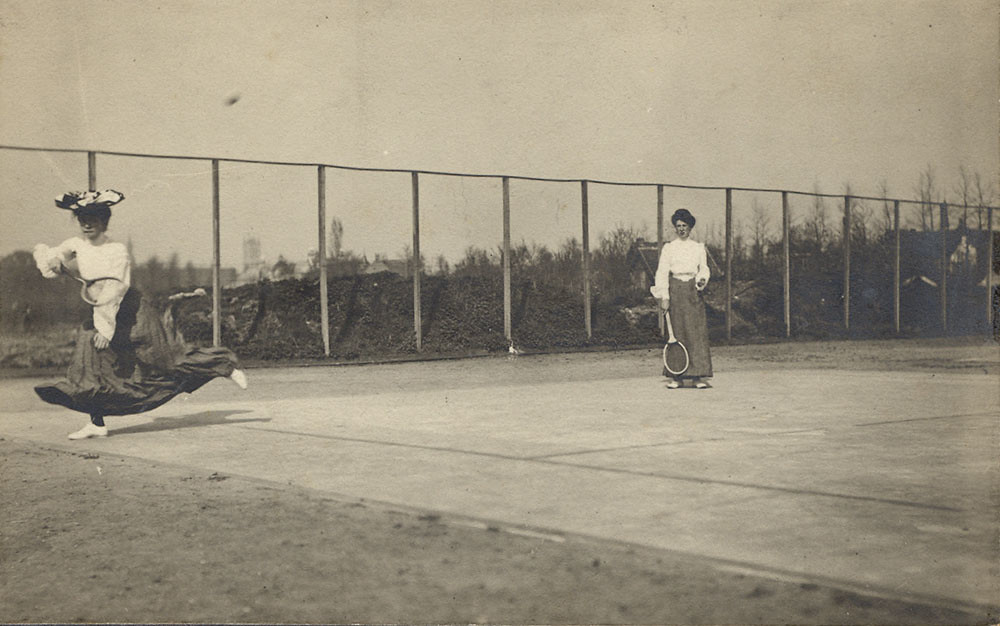
Tennis match anno 1900

Tennis match anno 1900 via Liberas

Operating a hand drill at Vultee-Nashville, woman is working on a "Vengeance" dive bomber, Tennessee  (LOC)

Operating a hand drill at Vultee-Nashville via The Library of Congress

Cheese market Alkmaar 1967

Cheese market Alkmaar 1967 via the Archief Alkmaar Commons

Vigilance, pug dog sitting on a balcony / J. Chester Jervis

Vigilance, pug dog sitting on a balcony via the National Library of Australia

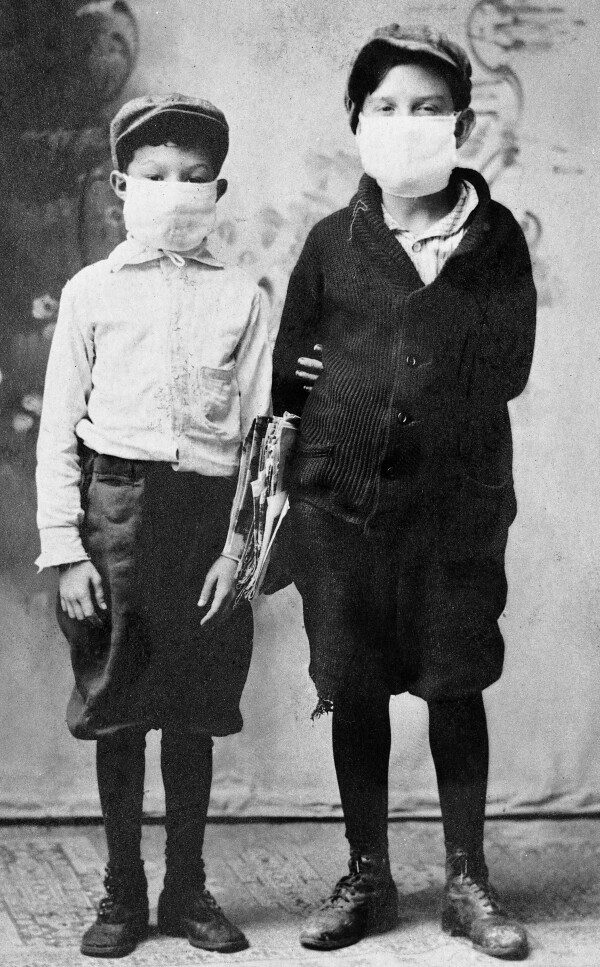
Children ready for school during the 1918 flu epidemic  - Starke

Children ready for school during the 1918 flu epidemic via Florida Memory

CA_20131204_011

Portrait of a young girl 1939 via Costică Acsinte

Nursery school

Nursery school via the National Library of Medicine

Ghostly sighting?

Ghostly sighting? via The National Archives UK

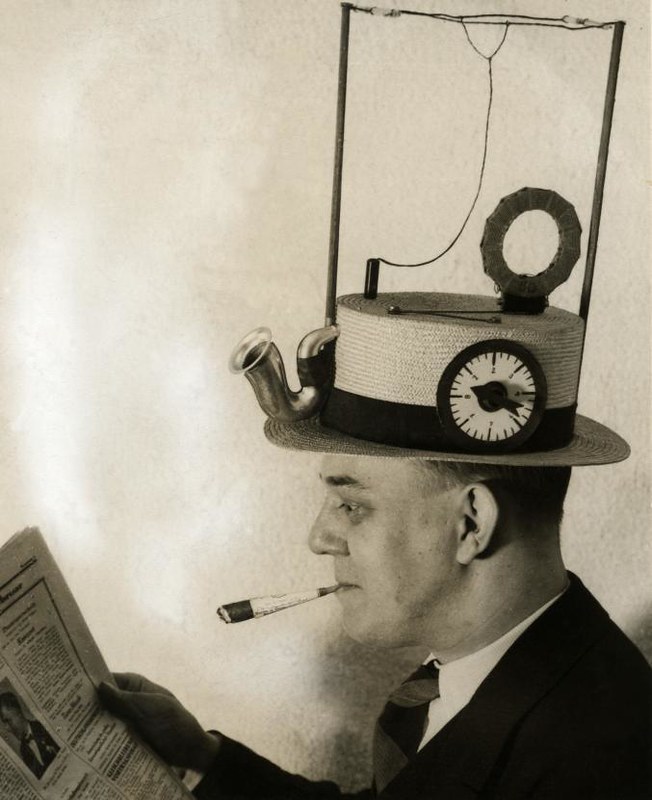
Draagbare radio / Radio hat

Radio hat via the Nationaal Archief

Mailing Letters

Mailing Letters via The Smithsonian Institution

16 Jan 15:10

Bleed Times

by peter@rukavina.net (Peter Rukavina)

I am into my fourth year of making regular voluntary blood plasma donations at the Canadian Blood Services centre in Charlottetown.

Truth be told, I’ve been at it for longer than that, but I fell into a lapse for an awfully long time simply because, at the time, the mechanisms for “donor engagement” were weak, and I stopped getting reminders to make appointments.

In the intervening years things have improved dramatically, and there’s now an excellent, useful website and an excellent, useful mobile app to support donors, combined with a full-court press WUPHF-style ”we’re going to remind you in all possible media” engagement effort that makes it next to impossible to drop off.

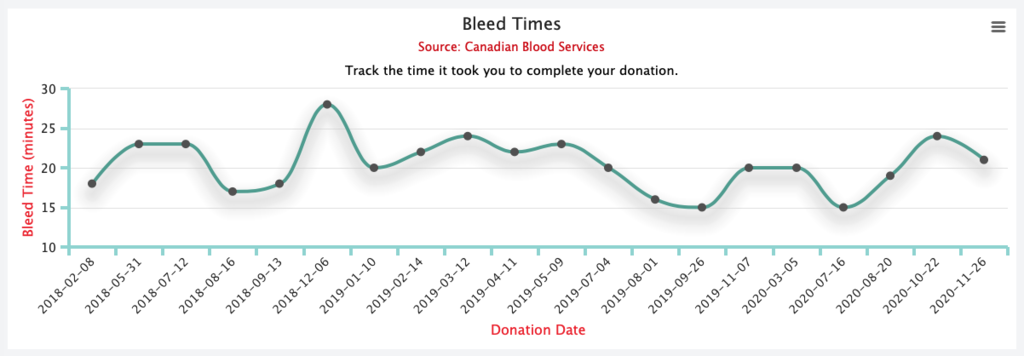
One of the things the updated website sports is a “Bleed Times” chart that shows the time it took to donate–or at least the “harvesting” phase thereof–with the option to export the image, or the data underlying. Here’s mine, showing donations from 2018 to present:

Chart showing time on the X-axis and minutes on the Y-axis, that shows the time it took to complete my donation, with values ranging from 15 minutes to almost 30 minutes.

The standard plasma donation is 500 ml. There’s a cycle to the donation process: blood is removed, plasma extracted, and blood returned. Each cycle takes 5 to 6 minutes, and, depending on a number of conditions, sometimes it takes two cycles to complete the 500 ml donation, sometimes it takes three, and, in rare occasions, four. That’s why the bleed time varies from 15 minutes to almost 30 minutes.

The donor centre in Charlottetown has been open throughout the pandemic (they were closed at the very beginning for plasma donations, but have been reopened fully since the summer). As with everything else in public life, they have new protocols in place to mitigate COVID-19 transmission: mask wearing, plexiglass barriers, a reduced set of pre-screening operations (they no longer take your blood pressure or your weight).

Despite these enhancements, donating plasma remains remarkably easy and, if not “painless,” at least limited to a few very quick, skilfully-executed jabs. I’m generally in, pre-screened, and have completed my donation in under an hour.

There are plasma donation centres in St. John’s, Charlottetown, Halifax, Saint John, London, Sudbury, Edmonton and Calgary, and you can make an appointment quickly and easily online.

16 Jan 15:10

I’ve been haunted since hearing, in the early d...

I’ve been haunted since hearing, in the early days of the pandemic, that if we all wore masks for six weeks this thing would be over.

I was there. I’ve done that for six weeks, and another six weeks, and another. And now it’s worse than ever. It’s a challenge not to be angry.

There are healthy, uninfected people right now, today, who are excited for the vaccine and who will die before they get it.

16 Jan 15:09

Toronto’s dotmobile shares plan pricing following CRTC MVNO approval

by Jonathan Lamont
dotmobile website on Android

After getting CRTC approval to become Canada’s first full Mobile Virtual Network Operator (MVNO), Toronto’s dotmobile shared pricing for its initial plans.

The company offers three tiers of subscription. The first is a free tier that offers helpful tools that work on any network. Dotmobile notes that these tools are available for anyone. The other subscriptions are ‘Basic’ and ‘Full.’

Basic offers data-only service with text messaging and blocks voice calls entirely (excluding emergency services). Dotmobile says this plan is primarily for Canadians who use ‘over-the-top’ services. It costs $7 for 30 days or $60 for a year.

The Full tier is for the average phone users and features unlimited talk and text from anywhere in Canada to anywhere in Canada and the U.S. It costs $14 for 30 days or $120 for a year.

Both plans use a SIM card and a Canadian phone number. Further, data on each plan is available by the gigabyte and doesn’t expire once purchased. Dotmobile will allow users to automatically purchase more data when they run out or set limits on how much they can spend each month.

It’s worth noting that dotmobile offered ‘Founding Member’ benefits to the first ten thousand members, but the company extended these to anyone who creates an account before February 28th. Benefits include discounts on subscriptions.

Finally, it’s important to note that the CRTC has yet to determine wireless data prices or national access details for MVNOs. Those details should come later this year when the CRTC is expected to rule on the wireless industry review.

Source: dotmobile

The post Toronto’s dotmobile shares plan pricing following CRTC MVNO approval appeared first on MobileSyrup.

15 Jan 04:01

Purism and Linux 5.9 and 5.10

by Martin Kepplinger

Purism and Linux 5.9 and Linux 5.10

Following up on our report for Linux 5.8 this summarizes the progress on mainline support for the Librem 5 phone and its development kit during the 5.9 and 5.10 development cycles.

Librem 5 updates

One of the most notable additions is a first devicetree description for the phone. This is important to have upstream since it describes how the hardware is wired up. Without that, it’s impossible to boot a mainline kernel. We added descriptions for the various phone revisions themselves (up to the Dogwood board) and also for the MIPI DSI controller of the imx8mq SoC. From this point on, we’ll incrementally add the missing pieces, for example from the display stack, just like we’ve done for the devkit back in Linux 5.2.

Librem 5 LCD panel

Speaking of the display stack: The phone includes a different LCD panel than the devkit and we had to add a driver for it:

Devkit updates

Another milestone we reached (and had promised earlier) is that the devkits’ display now works with mainline Linux directly. All needed drivers are there and the hardware is described accurately in the devicetree upstream. It’s not only nice to be able to use a mainline kernel without (m)any patches, it’s important in order to keep the hardware supported for a long time. The hard parts had been done before and that’s how the final pieces for the display look like:

Audio Codec

The wm8962 audio codec needed a small update to allow userspace to utilize hardware mono downmix for cases where mono output to a single speaker is desired only, like on a mobile phone:

Code review

During these rounds, we contributed 24 Reviewed-by: or Tested-by: tags to patches by other authors. Also, we would like to thank everybody who reviewed our patches and helped us, especially Sam in the DRM layer and Shawn and Krzysztof in the devicetree area. It’s supposed to be fun but we know it not always actually is, so that’s much appreciated.

Sources

Have a look at our Linux tree to see what is currently being worked on and tested (or help if you feel like joining the fun).

Discover the Librem 5

Purism believes building the Librem 5 is just one step on the road to launching a digital rights movement, where we—the-people stand up for our digital rights, where we place the control of your data and your family’s data back where it belongs: in your own hands.

Order now

The post Purism and Linux 5.9 and 5.10 appeared first on Purism.

15 Jan 04:00

Ten Months of Sheltering in Place

by Richard

Christmas came and went. For the first time in my life, I did not go to Vancouver Island for the holidays, and did not go to Vancouver to see friends. I kept the family tradition of eating Pizza Hut pizza on Christmas Eve alive, as did my family. On Christmas Day, I cooked Christmas dinner for myself. Turkey (though fried, not baked) with Brussels sprouts, mashed potatoes and stuffing and gravy. With that under my belt, I'm hopeful that for Christmas 2021 I'll be able to help my family cook it. I spent New Year's Eve wandering around my apartment looking for fireworks, and instead finding people on their stoops and wishing them a Happy New Year, then staying up to watch the replay of CNN's NYE coverage.

Before the holidays started, the Province of Ontario announced that enhanced lockdown measures would start on Boxing Day. While Toronto stores were open for curbside pickup, York Region stores and malls were open, and the predicable happened. Currently, as of this writing in the second week of January 2021, all of Ontario is subject to a "stay at home" order. (I wish it was a "shelter in place" order.) This is different than a curfew…somehow. I had read that theory about Quebec's 8 PM curfew was to cut down on people visiting for dinner and staying late. It seems unclear to Ontario's police forces what reasons people will be allowed to claim for not being home. I interpret the exception for exercise allowing me to continue running, though I expect not to be able to take a self-guided architectural tour of Toronto without being asked what I'm up to. Beyond that, not much has changed for me, since there's nowhere for me to go except the grocery store and restaurants for takeout. I don't expect a supply chain disruption this time, since it's at a pandemic equilibrium. I still have years' worth of soap and toilet paper, and that was from not wanting to have to go to the store for it so often pre-pandemic.

Vaccination is taking place, happening slower than expected at the outset. I don't expect to get mine until well after older, higher-risk and essential groups of people get theirs. Though I normally favour American terms, I've taken to calling it "the jab" after the British term for it. While I wait, I'm getting ahead of the anxieties around vaccines by listing them and adding to a thread of anxiety-causing headlines I come across.

It feels like end-of-March/start-of-April again. I'm re-visiting an infographic of things that I can control and things I can't control on a daily basis again, though this time around, toilet paper is plentiful, both in stores and in my own storage. I expect this two-month period to be the worst of it, but I don't know what to expect afterwards.

15 Jan 04:00

Kusama Happening in NY, Photo by Yayoi Kusama,1967-68 pic.twitter.com/icQJJOe3X7

by Things from the past 📷🎥 (moodvintage)
mkalus shared this story from moodvintage on Twitter.

Kusama Happening in NY, Photo by Yayoi Kusama,1967-68 pic.twitter.com/icQJJOe3X7


435 likes, 67 retweets
15 Jan 04:00

Recommended on Medium: The Bitcoin Dream Is Dead

Bitcoin’s recent 25% plunge illustrates why it will never be a true currency

Continue reading on Marker »

15 Jan 03:59

Music from Steve McQueen's Lovers Rock

We watched the Lovers Rock movie, part of the Steve McQueen’s Small Axe BBC film series. It’s all about music.

The Independent has a write up, and embeds a Spotify playlist in the article.

This means I can do another playlist deep dive, and find where to look for the artists and tracks separately.

Robin Hood, Cry Tuff & The Originals

On YouTube:

Didn’t find this track on Bandcamp, but did find this one by Cry Tuff:

Dub to Africa by Prince Far I & the Arabs

The entire Pressure Sounds catalog is amazing. In fact, the album covers are all the original 45 records, which you see them playing in the film:

Screen Shot of Pressure Sounds discography on Bandcamp

You can buy the entire discography for only like £500!! Tempted…

Kinta Kinta Dub by The Revolutionaries

Kunta Kinte by The Revolutionaries

I originally found the none dub version, which lead me to asking, what does dub / dubplate mean Wikipedia?

A dubplate is an acetate disc usually of 10 inches diameter, traditionally used by studios to test recordings prior to mastering for the subsequent pressing of a vinyl record, but pioneered by reggae sound systems as a way to play exclusive music. They would later become an important facet of the jungle/drum and bass, UK garage, grime and dubstep music scenes.

The first use of dubplates is commonly attributed to sound engineer King Tubby and reggae sound systems such as Lloyd Coxsone and Killamanjaro.[1] Special and one-off versions would be cut to acetate for competing in a sound clash, utilising vocals specially recorded to namecheck the sound system. As such, these would become known as “dubplate specials” often remarking on the prowess of the sound system playing it, in a bid to win the clash.

Oh, interesting, so a reggae sound system is…?

The popularity of a sound system was mainly contingent on one thing: having new music. In order to circumvent the release cycle of the American record labels, the two sound system superstars turned to record production. Initially, they produced only singles for their own sound systems, known as “Exclusives” or Dubplates—a limited run of one copy per song.[4] What began as an attempt to replicate the American R&B sound using local musicians evolved into a uniquely Jamaican musical genre: ska. This shift was due partly to the fact that as American-style R&B was embraced by a largely white, teenage audience and evolved into rock and roll, sound system owners created—and played—a steady stream of the singles the people preferred: fast-shuffle boogies and ballads. In response to this shift in supply, Jamaican producers introduced to their work some of the original elements of the Jamaican sound: rhythm guitars strumming the offbeat and snare-drum emphasis on the third beat, for example.[3] As this new musical form became more popular, both Dodd and Reid began to move more seriously into music production. Coxsone Dodd’s production studio became the famous Studio One, while Duke Reid founded Treasure Isle.

Yeah, this is awesome, and depicted in the film, or at least the version that immigrated into the UK.

He’s the Greatest Dancer by Sister Sledge

Remix version by Lucas D:

He's The Greatest Dancer (The Lucas D Remix) by Sister Sledge

Probably a little too clean compared to the version on the film.

How Long Will it Take by Pat Kelly

Darling Ooh by Errol Dunkley

And found it still available on vinyl as a re-issue. Here’s the description:

Errol Dunkley was an early reggae star and one of the youngest, recording his first side (“My Queen”) at the age of 12 for Prince Buster in 1964 and scoring his first hit (“You’re Gonna Need Me”) in 1967. Later, he became a key performer in the ‘70s Brit-Reggae scene, just missing the Top Ten in 1978 with his remake of John Holt’s “OK Fred.” Helmed by groundbreaking female producer Sylvia Pottenger, Darling Ooh! is actually his 1972 debut album, but like a lot of records that came out on small Jamaican mprints that later got swallowed into the mammoth Trojan label, its history is complicated; this record came out on the Gay Feet label under the title Presenting Errol Dunkley and also on the Trojan imprint Attack the same year as Darling Ooh! with different art and an expanded track listing (and, just to make things more confusing, a 1979 Trojan reissue had the Gay Feet track listing and the Attack artwork).

Kung Fu Fighting by Carl Douglass

Classic.

“Kung Fu Fighting” is a disco song by Jamaican vocalist Carl Douglas, written by Douglas and produced by British-Indian musician Biddu. It was released as a single in 1974 on the cusp of a chopsocky film craze and rose to the top of the British, Australian, Canadian, and American charts, in addition to reaching the top of the Soul Singles chart. It received a Gold certification from the RIAA in 1974 and popularized disco music. It eventually went on to sell eleven million records worldwide, making it one of the best-selling singles of all time. The song uses the quintessential Oriental riff, a short musical phrase that is used to signify Chinese culture.

Wikipedia <en.wikipedia.org/wiki/Kung…>

Things in Life by Dennis Brown

After Tonight by Junior English

Lonely Girl by Barry Biggs

Different track, also from Pressure Sounds label:

Next Cut by Barry Biggs

Here it is on YT:

Baby My Love by The In Crowd, Jah Stitch

Whole Flabba Holt / Roots Radics / Jah Stitch discography looking great, here’s a one track:

Danger Zone Chapter 3 - (12" 45RPM. DJ & dub) by JAH STITCH

Actual track on YT:

Silly Games by Janet Kay

Yes! On Bandcamp:

Silly Games by Janet Kay

This was one of the key songs from the film. Looks like it was released on BC for the film:

Janet Kay also is known as the Queen of Lovers Rock earned the title when she made history by becoming the ‘First British born Black Female Reggae Artist to have a No. 1 in the British Pop Charts’ - Music Guinness Book of Records. With this classic song ‘Silly Games’ it was a hit not only in the UK but also in Europe.

Keep it Like it is by Louisa Mark

Another Trojan Records, on YT:

Minstrel Pablo by Augustus Pablo

I’m mainly seeing some sweet melodica action (a keyboard you blow into). Found this in Rockers International Discography.

King Tubbys meets the Rockers Uptown by Augustus Pablo

Actual track on YT:

Dreadlocks in Moonlight by Lee “Scratch” Perry

Absolute legend:

Lee “Scratch” Perry OD (born Rainford Hugh Perry; 20 March 1936)[1] is a Jamaican record producer and singer noted for his innovative studio techniques and production style. Perry was a pioneer in the 1970s development of dub music with his early adoption of remixing and studio effects to create new instrumental or vocal versions of existing reggae tracks.[2] He has worked with and produced for a wide variety of artists, including Bob Marley and the Wailers, Junior Murvin, the Congos, Max Romeo, Adrian Sherwood, the Beastie Boys, Ari Up, the Clash, the Orb, and many others.

Wikipedia <en.wikipedia.org/wiki/Lee_…>

Well, now I want to go listen to The Orb. Their latest comes out this year:

Abolition Of The Royal Familia - Guillotine Mixes by The Orb

I have Live 93 in my collection already (one of their earliest), so I now have the pleasure of working my way forwards.

Looks like The Orbserver in the Star House features Lee “Scratch” Perry. Yeah, this is a rabbit hole I can fall down.

Have a Little Faith by Nicky Thomas

Another Trojan Records.

Yes, Trojan Records exists:

Trojan Records was founded in 1968 when Lee Gopthal, who operated the Musicland record retail chain and owned Beat & Commercial Records, pooled his Jamaican music interests with those of Chris Blackwell’s Island Records. Until 1975, they were based at a warehouse in Neasden Lane, Willesden, London.

Trojan was instrumental in introducing reggae to a global audience and by 1970 had secured a series of major UK chart hits. Successful Trojan artists from this period including Tony Tribe, Lee “Scratch” Perry’s Upsetters, Bob and Marcia, Desmond Dekker, Jimmy Cliff, Harry J All Stars, The Maytals, The Melodians, Nicky Thomas and Dave and Ansel Collins.

The bulk of the company’s successes came via licences for Jamaican music supplied by producers such as Duke Reid, Harry Johnson and Leslie Kong. While the company’s focus was firmly on the sale of 7” singles, it also launched a series of popular, budget-priced compilations such as Tighten Up, Club Reggae and Reggae Chartbusters.

Wikipedia <en.wikipedia.org/wiki/Troj…>

Also credited with getting us to rude boy:

Rude boy, rudeboy, rudie, rudi, and rudy are slang terms that originated in 1960s Jamaican street culture, and that are still used today. In the late 1970s, there was a revival in England of the terms rude boy and rude girl, among other variations, being used to describe fans of two-tone ska. The use of these terms moved into the more contemporary ska punk movement as well. In the UK, the terms rude boy and rude girl are used in a way similar to gangsta, yardie or badman.

Wikipedia <en.wikipedia.org/wiki/Rude…>

Which could take us to two-tone ska and ska punk, but I think we’ll leave it there :) Watch the film! It’s pretty intense, and some of the energy around how women are treated is horrible, but it’s an amazing look into west London Jamaican music parties.

15 Jan 03:59

I just posted my second playlist deep dive, bas...

I just posted my second playlist deep dive, based on Steve McQueen’s Lovers Rock film.

The Pressure Sounds discography was the coolest find — all those 45 records, just like in the film.

15 Jan 03:59

Why getting voting right is hard, Part IV: Absentee Voting and Vote By Mail

by Eric Rescorla

This is the fourth post in my series on voting systems. Part I covered requirements and then Part II and Part III covered in-person voting using paper ballots. However, paper ballots don’t need to be voted in person; it’s also possible to have people mail in their ballots, in which case they can be counted the same way as if they had been voted in person.

Mail-in ballots get used in two main ways:

  • Absentee Ballots: Inevitably, some voters will be unavailable on election day. Even with early voting, some voters (e.g., students, people living overseas, members of the military, people on travel, etc.) might be out of town for weeks or months. In many cases, some or all these voters are still eligible to vote in the jurisdiction in which they are nominally residents even if they aren’t physically present. The usual procedure is to mail them a ballot and let them mail it back in.
  • Vote By mail (VBM): Some jurisdictions (e.g., Oregon) have abandoned in-person voting entirely and mail every registered voter a ballot and have them mail it back.

From a technical perspective, absentee ballots and vote-by-mail work the same way; it’s just a matter of which sets of voters vote in person and which don’t. These lines also blur some in that some jurisdictions require a reason to vote absentee whereas some just allow anyone to request an absentee ballot (“no-excuse absentee”). Of course, in a vote-by-mail only jurisdiction then voters don’t need to take any action to get mailed a ballot. For convenience, I’ll mostly be referring to all of these procedures as mail-in ballots.

As mentioned above, counting mail-in ballots is the same as counting in-person ballots. In fact, in many cases jurisdictions will use the same ballots in each case, so they can just hand count them or run them through the same optical scanner as they would with in-person voted ballots, which simplifies logistics considerably. The major difference between in-person and mail-in voting is the need for different mechanisms to ensure that only authorized voters vote (and that they only vote once). In an in-person system, this is ensured by determining eligibility when voters enter the polling place and then giving each voter a single ballot, but this obviously doesn’t work in the case of mailed-in ballots — it’s way too easy for an attacker to make a pile of fake ballots and just mail them in — so something else is needed.

Authenticating Ballots

As with in-person voting, the basic idea behind securing mail-in ballots is to tie each ballot to a specific registered voter and ensure that every voter votes once.

If we didn’t care about the secrecy of the ballot, the easy solution would be to give every voter a unique identifier (Operationally, it’s somewhat easier to instead give each ballot a unique serial number and then keep a record of which serial numbers correspond to each voter, but these are largely equivalent). Then when the ballots come in, we check that (1) the voter exists and (2) the voter hasn’t voted already. When put together, these checks make it very difficult for an attacker to make their own ballots: if they use non-existent serial numbers, then the ballots will be rejected, and if they use serial numbers that correspond to some other voter’s ballot then they risk being caught if that voter voted. So, from a security perspective, this works reasonably well, but it’s a privacy disaster because it permanently associates a voter’s identity with the contents of their ballots: anyone who has access to the serial number database and the ballots can determine how individual voters voted.

The solution turns out to be to authenticate the envelopes not the ballots. The way that this works is that each voter is sent a non-unique ballot (i.e., one without a serial number) and then an envelope with a unique serial number. The voter marks their ballot, puts it in the envelope and mails it back. Back at election headquarters, election officials perform the two checks described above. If they fail, then the envelope is sent aside for further processing. If they succeed, then the envelope is emptied — checking that it only contains one ballot — and put into the pile for counting.

This procedure provides some level of privacy protection: there’s no single piece of paper that has both the voter’s identity and their vote, which is good, but at the time when election officials open the ballot they can see both the voter’s identity and the ballot, which is bad. With some procedural safeguards it’s hard to mount a large scale privacy violation: you’re going to be opening a lot of ballots very quickly and so keeping track of a lot of people is impractical, but an official could, for instance, notice a particular person’s name and see how they voted.1 Some jurisdictions address this with a two envelope system: the voter marks their ballot and puts it in an unmarked “secrecy envelope” which then goes into the marked envelope that has their identity on it. At election headquarters officials check the outer envelope, then open it and put the sealed secrecy envelope in the pile for counting. Later, all of the secrecy envelopes are opened and counted; this procedure breaks the connection between the user’s identity and their ballot.2

Signature Matching

The basic idea behind the system described above is to match ballots mailed out (which are tied to voter registration) to ballots mailed in. This works as long as there’s no opportunity for attackers to substitute their own ballots for those of a legitimate voter. There are a number of ways that might happen, including:

  • Stealing the ballot in the mail, either on the way out to the voter or when it is sent back to election headquarters. Stealing the ballot on the way back works a lot better because if voters don’t receive their ballots they might ask for another one, in which case you have duplicates.
  • Inserting fake ballots for people who you don’t expect to vote. This is obviously somewhat risky, as they might decide to vote and then you would have a duplicate, but many people vote infrequently and therefore have a reduced risk of creating a duplicate ballot.

Again, I’m assuming that the attacker can make their own ballots and envelopes. This isn’t trivial, but neither is it impossible, especially for a state-level actor.

Some jurisdictions attempt to address this form of attack by requiring voters to sign their ballot envelopes. Those envelopes can then be compared to the voter’s known signature (for instance on their voter registration card). Some jurisdictions even require a witness to sign the ballot too — affirming the identity of the person signing the ballot, to include a copy of their ID, or even to have the ballot envelope notarized. The requirements vary radically between jurisdictions (see here for a table of how this works in each state). To the best of my knowledge, there’s no real evidence that this kind of signature validation provides significantly more defense against fraud. From an analytic perspective, the level of protection depends on the capabilities of an attacker and the detection methods used by election officials. For instance, an attacker who steals your ballot on the way back could potentially try to duplicate your signature (after all, it’s on the envelope!), which seems reasonably likely to work, but an attacker who is just trying to impersonate people who didn’t vote might have some trouble because they wouldn’t know what your signature looked like.

Ballots with Errors

It’s not uncommon for the returned ballots to have some kind of error, for instance:

  • Voter used their own envelope instead of the official envelope
  • Voter didn’t use the secrecy envelope
  • Voter didn’t sign the envelope
  • Voter signature doesn’t match
  • Envelope not notarized.
  • Overvotes
  • Damaged ballots (torn ballots, ballots with stains, etc.)

Each of these can potentially lead to a voter’s ballot being rejected. Moreover, the more requirements a voter’s ballot has to meet, the greater chance that it will be rejected, so there is a need to balance the additional security and privacy provided by extra requirements against the additional risk of rejecting ballots which are actually legitimate, but just nonconformant. Different jurisdictions have made different tradeoffs here.

Just because a ballot has a problem doesn’t mean that the voter is necessarily out of luck: some jurisdictions have what’s called a cure process in which the election officials reach out to the voter whose name is on the ballot and offer them an opportunity to fix their ballot, with the fix depending on the jurisdiction and the precise problem. Some jurisdictions just discard the ballot, for example in the case of “naked ballots” — ballots where voters did not use the inner secrecy envelope.

Of course, not all problems can be cured. In particular, once the ballot has been disassociated from the envelope, then there’s no way to go back to the voter and get them to fix an error such as an overvote. This issue isn’t unique to vote-by-mail, however: it also occurs with voting systems using central-count optical scanners (see Part III). In general, if the ballots are anonymized before processing, then it’s not really possible to fix any errors in them; you just need to process them the best you can.

Ballot rejection is an opportunity for some level of insider attack: although voting officials do not know how individuals voted, they might be able to know which voters are likely to vote a certain way, perhaps by looking at their address or party affiliation (this is easier if the voter’s name is on the ballot, not just a serial number) and more strictly enforce whatever security checks are required for ballots they think will go the wrong way. Having external observers who are able to ensure uniform standards can significantly reduce the risk here.

Voting Twice

There are a number of situations in which multiple ballots might have been or will be cast for the same voter. A number of these are legitimate, such as a voter changing their mind after they voted by mail and deciding to vote in person — perhaps because they changed their mind about candidates or because they are worried their absentee ballot will not be processed in time — but of course they could also be the result of error or fraud. There are two basic ways in which double voting shows up:

  • Two mail-in ballots
  • One mail-in ballot and one in-person ballot

In the case of two mail-in ballots, it’s most likely that the first ballot has already been taken out of the envelope, so there’s no real way not to count it. All you can do is not count the second ballot. Note that this means that if an attacker manages to successfully submit a ballot for you and gets it in before you, then their vote will count and yours will not. Fortunately, this kind of fraud is rare and detectable and once detected can be investigated. I’m not aware of any election where fake mail-in ballots have materially impacted the results.

The more complicated case is when a voter has had a mail-in ballot sent to them but then decides to vote in person, which can happen for a number of reasons. For instance, the ballot might have been lost in the mail (in either direction). This situation is different because we need to prevent double voting but poll workers don’t know whether the voter also submitted their ballot by mail. If the voter is allowed to vote as usual, you might have a situation in which case the mail-in ballot had already been processed (at least as far as removing it from the envelope) and there was no way to remove either ballot, because they’re both unidentified ballots mixed with other ballots. Instead, the standard process is to require the voter to fill in what’s called a provisional ballot, which is physically like a mail-in ballot except that it has a statement about what happened. Provisional ballots are segregated from regular ballots, so once the rest of the ballots have been processed you can go through the provisionals and process those for voters whose ordinary mail-in ballots have not been received/counted.3

Returned Ballot Theft

Another new source of attack on mail-in ballots — as well as ballot drop-boxes — is theft of the ballots en route to election headquarters. In-person voting has a number of accounting mechanisms designed to ensure that the number of voters matches the number of cast ballots which then matches the number of recorded votes, but these don’t work for mail-in ballots because many people who are sent ballots will fail to return them. In many jurisdictions, voters are able to track their ballots and see if they have been processed, and could cast them in person if they are lost. However, as a practical matter, many voters will not do this. The major defense against this kind of attack is good processes around mail deliver and drop-box security as well as post-hoc investigation of reports of missing ballots.

Secrecy of the Ballot

With proper processes at election headquarters, the ballot secrecy properties of mail-in ballots are comparable to in person voting, with one major exception: with mail-in ballots it is much easier for a voter to demonstrate to a third party how they voted. All they have to do is give the ballot to that third party and let them fill it out and mail it (perhaps signing the envelope first). This allows for vote buying/coercion type attacks. This isn’t ideal, but it’s a difficult attack to mount at a large scale because the attacker needs to physically engage with each voter.

The cost of security

As noted above, many states have fairly extensive verification mechanisms for mail-in ballots. These mechanisms are not free, either to voters or election officials. In particular, requirements such as notarization increase the cost of voting and thus may deter some voters from voting. Even apparently lightweight requirements such as signature matching have the potential to cause valid ballots to be rejected: some people will forget to sign their name and people do not sign their name the same way every time and election officials are not experts on handwriting, so we should expect that they will reject some number of valid ballots. Cottrell, Herron and Smith report about 1% of ballots being rejected for some kind of signature issue, with Black and Hispanic voters seemingly having higher rates of rejection than White voters. Because real fraud is rare and errors are common, the vast majority of rejected ballots will actually be legitimate.4

There is a more general point here: although mail-in ballots seem insecure (and this has been a point of concern in the voting security community) real studies of mail-in ballots show that they have extremely low fraud rates. This means that policy makers have to weigh potential security issues with mail-in voting against their impact on legitimate voters. The current evidence suggests that mail-in voting modestly increases voting rates (experience from Oregon suggest by about 2-5 percentage points).5 The implication is that making mail-in voting more difficult — whether by restricting it or by adding hard-to-follow security requirements — is likely to decrease the number of accepted ballots while only having a small impact on voting fraud.

Up Next: Direct Recording Electronic systems and Ballot Marking Devices

OK. Three posts on paper ballots seems like enough for now, so it’s time to turn to more computerized voting methods. The other major form of voting in the United States uses what’s called the “Direct Recording Electronic” (DRE) voting system which just means that you vote directly on a computer which internally keeps track of the votes. DRE machines are very popular but have been the focus of a lot of concern from a security perspective. We’ll be covering them next, along with a similar seeming but much better system called a “Ballot Marking Device” (BMD). BMDs are like DREs but they print out paper ballots that can then be counted either by hand or with optical scanners.


  1. In this version, the ballots can just have numbers and not names, but as we’ll see below, many jurisdictions require names.
  2. People familiar with computer privacy will recognize this technique from technologies such as proxies, VPNs, or mixnets. 
  3. Provisional ballots are also used for a number of other exception cases such as voters who go to the wrong polling place (here again, it’s hard to tell if they tried to vote at multiple polling places) or voters who claim to be registered but can’t be found on the voters list (this often looks the same to precinct-level officials because each precinct usually just has their own list of voters).
  4. This dynamic is quite common when adding new security checks: any check you add will generally have false positives. In environments where most behavior is innocent, that means that most of the behavior you catch will also be innocent people Bruce Schneier has written extensively about this point. 
  5. While mail-in voting generally seems to increase turnout by reducing barriers to voting, there are a number of populations that find mail-in ballots difficult. One obvious example is people with disabilities, who may find filling in paper ballots difficult. Less well-known is that Native Americans experience special challenges that make exclusive vote-by-mail difficult. Thanks to Joseph Lorenzo Hall for informing me on this point. 

The post Why getting voting right is hard, Part IV: Absentee Voting and Vote By Mail appeared first on The Mozilla Blog.

15 Jan 03:59

The Helpful / Solved Score (and comparing support channels)

by Richard Millington

Questions like “was this answer helpful?” or “did this answer solve your problem?” are a powerful means of evaluating the success of many community programs.

Most platforms enable you to have at least some form of this – 

It’s one of the easiest measures of tracking the success of many community programs. For example, if you invest more in your superuser program, you should expect a greater percentage of answers to questions being marked helpful. If you decide to pay people to answer questions, you can see whether this is having the desired impact.

But this metric can also cause problems.

Some organisations use the same question to compare phone support, online tickets, knowledge-based articles, and the community. This isn’t a bad idea – as long as the numbers are taken in context.

Most of the easiest questions can be solved through documentation and knowledge-based articles. So we expect these to score well. Phone and ticket support is one to one contact from a paid professional, these would score well too.

A community, however, often gets the questions other channels can’t answer. Visitors are often frustrated by the time they visit. Thus a community will naturally score below other channels.

But this comparison overlooks three important things.

1) Volume. What % of questions is the community solving and thus ensuring people don’t need to visit any other channel?

2) Cost. If a community solve has a 15% lower satisfaction rate at 50% of the cost, that’s a huge win.

3) Other benefits. The community offers benefits in retention, loyalty, advocacy, feedback, research, and more which won’t show up in these metrics.

By itself, this question and the result can lead to a misunderstanding about the value and benefits of a community. Don’t use the number in isolation. Attach a cost, volume, and measure that allows a better appreciation of the community.

p.s. Be aware that changing the question from ‘was this answer helpful?’ to ‘did it solve your problem?’ will have a big impact upon the number.

15 Jan 03:59

Creative use of TikTok

by Volker Weber

Do not easily dismiss the platform as "for kids only".

More >

[Thanks, Malte]

15 Jan 03:59

Some Conference Thoughts from Digital Ocean’s Deploy

by Reverend

Back in November Tim, Lauren and I presented alongside Kaysi Holman and Inés Vañó García from the CUNY Graduate Center about work we’re doing in higher education using Digital Ocean. The presentation was under 30 minutes long, pre-recorded in Streamyard, and aired two months later as part of the Digital Ocean Deploy conference. it can be easily found online via their Deploy Conference page on YouTube as well. The moderator, Erin Glass, was kind enough to bring us all together to make it happen, and her introduction is in many ways a short preamble of her brilliant article on Ethical EdTech published recently I really enjoyed presenting alongside the folks from the CUNY GC (my alma mater of sorts), but I agree with Tim that when planning what we would talk about I missed the mark a bit. Rather than talking about Reclaim Cloud and the Emulation as a Service idea, we should have talked about our work with the CUNY Commons folks to make a one-click installer for CUNY’s C-Box. That’s on me, and I will try and avoid letting my excitement with the latest cool thing happening at Reclaim Hosting “cloud” my judgement.

I appreciate Erin inviting us, and I also really benefited from seeing how they organized Deploy as a participant given Reclaim Hosting will be joining forces with the OER21 folks to put on a OER21/Domains online conference in late April, and we’re still very much imagining the possibilities for making this as compelling and accessible as possible. One of the elements of Deploy I really appreciated was that the session was pre-recorded almost two months in advance and allowed, which allowed for us to attend the online conference and actually participate in the Discord discussion not only during our session, but for almost a month before that.  This made getting subtitles done seamless, to ensure everything was accessible out the gate.

What’s more, the way the conference was presented there were multiple channels going at once via a Video player hosted on a single page, that also had the schedule. It could not have been easier to access what’s happening across the conference at any given time in one, fell swoop. I also loved the way the kept all sessions to less than 30 minutes, and had awesome preface art, TV-like bumpers, and highlights between sessions, not unlike the transitions between TV shows. And this kept me watching, which I think testifies to something quite powerful. My pre-recording and cleaning up transitions and announcements you have a much better chance of making sure everything is accessible and that folks will stay tuned-in.

And getting back to my lament about not talking about CUNY’s C-Box installer, I believe that having to groups (CUNY GC educators and Reclaim Hosting folks) in conversation makes that 30 minute time-frame that much more compelling. Everyone spent a few minutes sharing their ideas (which made it move well), but I think have a conversation between groups around topics like ethical edtech would be absolutely brilliant, I think this worked really well during the Against Surveillance session with Maha Bali, Chris Gilliard, sava saheli singh, and Benjamin Doxtdator. It was a compelling discussion that balanced both rehearsed points, sharing media, and extemporaneous discussion that was a near perfect combination. They were even braver in that it was live, but I think managing live across several channels for two days is a lot of work, so I would like to see if there is a balance there between pre-recorded and live.

As a start thinking about the Domains sessions in the conference I am wondering how we can connect folks running various projects across different schools with one another to chat, while balancing structured “formal presentation” (i.e. rehearsed talking points) with new ideas that emerge as part of conversations in the moment. That will be a key for me because I think that’s what makes these sessions compelling and memorable.

Digital Ocean Deploy Conference swag

On a slightly different note, their swag game was pretty tight. Not only did they send a nice sweatshirt that arrived the day before the conference, but they also sent a cable bag, microphone port blocker, and webcam cover. Pretty interesting how those final two suggest a kind of ant-surveillance mentality for their participants and presenters, which was cool.

Anyway, these are all post facto notes about Digital Ocean’s Deploy as we begin to dig in for preparing for a fully online OOERxDomains 2021. It’s a fun challenge to work through, and the first step is stealing from other conferences that things that worked and learning from your own mistakes to make the next time around better.

15 Jan 03:58

Soon May The Wellerman Come

by Rui Carmo

Yes, Mankind is rocking the boat and everything is going sideways, but at least there’s some insane creativity out there.

I’ve been staring at Twitter in awe now and then (can’t spare the time to even think about getting onto TikTok), and some of it is glorious–future alien archeologists, if they ever find recordings of this, are going to be flabbrgasted.


15 Jan 03:58

Viscerally and deliberately unsettling product design

I’m picking up on a trend of viscerally unsettling product design. My guess is that it’s scouting ahead of the coming wave of robotics.

Examples!

  • Lim Qi Xuan’s seashell (2021) with sculpted, realistic human tongue and discarded teeth.
  • Marc Teyssier’s MobiLimb (2018), a robotic finger attached to the back of smartphones for them to point, crawl, and prop themselves up (as previously discussed in my call for cyborg prosthetics).
  • Brecht Wright Gander’s lamp (2020) that is switched on by sliding a phallic conductor inside of a puckered, rubber opening at which point it lights up.
  • This construction of an animatronic tentacle lamp by The Monster Maker (2019). No, I don’t know why he does his YouTube wearing a prosthetic hairy head with realistic but impossibly wide-set eyes. I don’t even know how can see.

(That last one via the SoftRobotCritics tumblr which is excellent for tracking this world.)

I have to say, I enjoy this sense of discomfort. Absolutely some products should make me feel queasy. My smartphone feels all too smooth and familiar in my hand when I’m indulging in something societally toxic, such as scrolling Facebook, and a soft fabric smart speaker in my home is at odds with the fact that it’s an open mic connected to the cloud. At least when I’m refuelling my car, I have to suffer the unpleasant fumes.

It’s necessary and timely to explore naturalness and physicality, and to map the boundary with creepiness, because we’ll clearly have more and more robots in coming years – and the approach right now is either self-driving plastic boxes, or biomimicry, whether that’s robot arms or dancing dogs and humans with backpacks. Maybe there are opportunities in escaping the obvious archetypes.

So pornographic lamps are not just about tapping into the absurd. It could be that these designs are a systemic probes of the Uncanny Valley (that’s a translation of Masahiro Mori’s original essay) – and if we see it that way, what else is there to investigate?

I would usually ask for pointers to more examples, but I’m not sure that’s a smart idea.

In the meantime:

Perhaps we should expect this nascent trend to come into the mainstream and also into the home, just as the original Bondi blue iMac triggered a wave of translucent blue plastic in all categories of product. Existenz-style dishwashers. Giger lightswitches – which may have some advantages over a standard binary switch in terms of the degrees of control, as you would be able to control both the brightness and hue simultaneously simply by inserting your finger into the wall-mounted orifice.

15 Jan 03:54

How to Wash Your Down Jacket

by Catherine Harnden and Jenni Gritters
A person wearing a blue down jacket with the hood up, while standing outside in a wooded area.

A well-cared-for down jacket can keep you warm and cozy over several seasons of skiing, mountain hiking, ice-skating, and city walking.

15 Jan 03:54

The Best USB Wi-Fi Adapters

by Joel Santo Domingo
Three different USB Wi-Fi Adapters.

A USB adapter offers one of the easiest ways to add Wi-Fi access to a device, whether you have a new desktop PC that lacks built-in Wi-Fi or need to improve the existing wireless connection in a desktop or laptop. A USB adapter is especially handy if you don’t want to (or are unable to) install an internal card yourself.

After 60 hours of testing 25 models against a high-end laptop’s internal Wi-Fi, we are confident that the MSI AX1800 WiFi USB Adapter (GUAX18) is the best USB Wi-Fi adapter for most people.

15 Jan 03:54

Basic income, morality, and integrity

by Chris Corrigan

Today Ontario goes back into lockdown, complete with curfews and the enforcement of the situation by police officers with the discretion to charge people with a violation of the public health orders. This is all being done without any significant new programs to support those who otherwise have to travel or move to non-essential jobs – including night shifts – because while the work may be non-essential, living without income is not. It is a situation that is going to impact marginalized people of all kinds.

This is an unprecedented public health crisis. We are battling an easily spread, lethal virus which causes incurable effects in many who catch it. It requires our health care systems to be overly careful when handling COVID-19 patients. The purpose of lockdowns has always been to manage the spread of the virus. Complexity geeks will know that connections are an important enabling constraint in self-organizing systems. Break connections, and you slow the ability of an overwhelming crisis to take shape. In theory, breaking connections should be the easiest thing to do but the combination of mixed messages and the unwillingness of governments to incentivize isolation over interaction has meant that places like Ontario need to take harsher measures: the imposition of boundaries on behaviour.

When the pandemic began I was impressed at the speed with which our government mobilized resources to ensure that people were able to choose isolation over interaction. In Canada, the Canada Emergency Response Benefit program was a stunning, accessible, guaranteed income program that provided $2000 a month of taxable income to anyone who wanted it. There was no means test, the application website was straight forward, and payments came fairly quickly. In addition, the federal and provincial governments launched a series of programs to protect tenants and businesses from being evicted, to extend credits and grants to businesses, to subsidize wages, to defer mortgages, and to relieve student debt payments.

These programs had the effect of initially “flattening the curve” the term used to describe the collective social effort to prevent spikes in hospitalizations which would allow for emergency services to properly treat COVID patients and not reach a situation like they did early on in Italy, where death rates spiked because doctors were forced to choose between who would live and who would die. For a couple of months, we all pulled together and with Herculean effort of citizens, businesses and government, we flattened the curve for the first wave

The implementation of these social programs had the effect of eliminating a whle lot of personal debt among many other positive effects. For people whose income is dependent on minimum wage jobs, the support of $2000 a month was, in many cases, all they needed to pay off bills that had been dogging them for years, make a rent payment that was overdue, get back on their feet. It hasn’t been perfect, and certainly folks on social assistance, folks with disabilities and students fell through the cracks. And the money that flowed to everyone who applied for the CERB went directly into the economy. It didn’t get tied up in equity, investments, or real estate. It went to the purchase of goods and services in unprecedented ways. This had the effect of enriching many billionaires and banks, but also of supporting local businesses and economies, and despite the potential for it, our economy has not entered a depression. Hard times for sure, but still afloat.

The CERB payment – and universal basic incomes in general – are the ideal form of stimulus for an economy. First, it is a policy of care, providing resources directly to people in need without strings attached, which allows people to quickly organize their own lives and allows the cash to immediately enter the economy. For conservatives who praise a market economy, trickle down economics is actually a terrible idea, because giving billions directly to the top of the economic food chain through subsides and tax breaks does not encourage a market at all. It encourages an oligarchy were very few people get unimaginably rich without any actual purchasing power being introduced into a market.

Markets self-organize around innovation and creativity, but only if there is spending money in the economy, for those who organize well will capture it. During the spring and summer, in my own community I witnessed the conversation and the call to action on local economy blossom like it never had before, during all the years I was on our Community Economic Development Community. There was money in our community, a need to stay home, and local businesses continually made their case for support. We had very few local businesses here shut down, despite these challenging times. That isn’t to say that things haven’t been challenging for my friends who own businesses, but a combination of government supports, mutual aid, and spending money circulating locally created the conditions for a healthy, local economy.

The CERB was designed for people to spend, and that is what happened. Many of the people who received the money had very little savings to begin with, and so when the money came in it went right back out the door into the economy, Banks got richer, Amazon got richer and the people that own these companies got richer too. Substantially richer at a rate that was faster than they had ever experienced.

Last month the federal government announced that it was now investigating something like 400,000 CERB applications that were apparently irregular. In its haste to set the program up, apparently the government failed to communicate a key aspect of the program criteria: that you needed to have made a net income of $5000 in the previous tax year as a self-emplyed person in order to be eligible for the benefit. Here is the crux of the problem:

In the first few weeks of the CERB rollout, CRA call-centre agents were given wrong instructions for how self-employed Canadians would be assessed for their eligibility. To be eligible, self-employed Canadians had to have received more than $5,000 in income in 2019 or in the previous 12 months before applying.

While eligibility was meant to be based off net income after expenses, CRA agents were provided written instructions that incorrectly stated that gross income, not net, was how someone’s eligibility for CERB would be determined. That information was then passed along to callers seeking clarity.

At the same time, the word “net” didn’t appear on CERB applications or the CRA’s “Who is eligible” page. It wasn’t until sometime after April 21 — more than two weeks after applications opened — that the CRA quietly update a Q&A page to include specific language on net income.

The problem now is that the government is now enforcing repayment orders for the money that was received. And of course people don’t have that money. They don’t have it because they did what they were told they should do with it, and used it to stay afloat during the early days of the pandemic while staying at home to flatten the curve.

But the money HASN’t disappeared. Not at all. the 400,000 people who took four months of CERB money have injected $32 billion dollars into the economy, much of it local, but a significant amount of it going to banks, utility companies and large consumer and service outlets like Costco and Amazon, and Netflix and Zoom. This video explains why.

I am at a loss to understand why the government – who has admitted to screwing up the CERB criteria communications – is punishing the people who have supported the survival of the economy during a once in a century economic event. During the spring we were all told that we needed to do our part to get this virus under control. We all did our part, we stayed home AND stimulated the economy. And now 400,000 people are being saddled with $8000 or more in debt.

Nationalizing debt is perhaps one of the best things we can do as a society. The CERB did that, providing for people to cover their debts and pay their bills. The government used the near zero interest rates to borrow to make that possible – thereby assuming consumer and business debt at far better rates than consumers and businesses were getting, and despite mortgage deferrals and lost revenues, the six Canadian chartered banks STILL made about $13 billion in net income in the fourth quarter of 2020 alone. The money hasn’t disappeared: it has moved. If governments need it back, they need only tax the richest businesses in the country with a one time pandemic tax totalling $32 billion and all is well.

But I suspect that this isn’t the issue, and I don’t expect this tax to be implemented. There is a stench of the age-old stigma associated with poor folks, that they are not deserving of government support, that “free money” is a risky thing to just give away without a means test, without accountability and without any sense of “deserving it.”

So Ontario is going into lockdown. Citizens once again are being asked to do their part to flatten the curve, and it is a challenge many folks will take up with relish IF they also feel a reciprocity from their governments to support and enable them to do that. But that isn’t happening. Not only are there no new supports for people but the federal government is chasing down repayments, with no forgiveness, and banks are stopping the mortgage deferral program. This is terrible public policy for a start, it is poor economics, even by conservative, market-based standards and most important, it is immoral.

There is a massive gulf between the top and the bottom in our society, a direct result of 40 years of the biggest wealth transfer in human history. This gap has created two different realities. The folks with the resources who are able to run for public office, garner the approval of their parties, and be given the reins of power are screened into this class of the wealthy. Their lives are very different from the lives of the majority of citizens who are living paycheck-to-paycheck or who are on social assistance or who have no means of support at all. The fact that several political leaders from all parties have been recently caught travelling abroad over Christmas, when governments were locking down everyone else, is a stark and ostentatious indicator of this difference.

Along with the wealth and income gap comes a sense that “rules don’t apply to me” because, actually, that seems to be the case. Despite bungled messaging and unclear criteria, the federal government is enforcing repayment orders against 400,000 Canadians, almost none of whom committed fraud in fact or intention with this benefits program. And yet, there are no new taxes, no special one time claw back for those that actually now have the money. Instead of THEM having to do paperwork and liquidating a few assets to repay the federal government and get that money back into the economy, they make plans for heading out of the country to their second properties.

Public policy that is made in the interests of the wealthy few at the expense of the many is immoral. For public leaders to appeal that “we are all in this together” when we are clearly not is an abdication of integrity. The federal government needs to immediately suspend the actions of the CRA in pursuing these repayments, and furthermore, as a country, we really need to push for a universal basic income, because we now have evidence, during that pandemic, that it works.

If you are in Canada, you can support this by lending your support to Leah Gazan who is sponsoring a House of Commons motion that reads:

That, in the opinion of the House, the government should introduce legislation and work with provincial and territorial governments and Indigenous peoples to ensure that a guaranteed livable basic income (i) accounting for regional differences in living costs, (ii) for all Canadians over the age of 18, including single persons, students, families, seniors, persons with disabilities, temporary foreign workers, permanent residents, and refugee claimants, (iii) paid on a regular basis, (iv) not requiring participation in the labour market, education or training in order to be eligible, (v) in addition to current and future government public services and income supports meant to meet special, exceptional and other distinct needs and goals rather than basic needs, including accessible affordable social housing and expanded health services, replace the Canada Emergency Response Benefit on an ongoing and permanent basis in a concerted effort to eradicate poverty and ensure the respect, dignity and security of all persons in respect of Canada’s domestic and international legal obligations.

House of Commons Motion M-46 Guaranteed Liveable Basic Income

This is not the final answer, but it is an important step to establishing the will of the House of Commons to undertake this project. It will be interesting to see who votes against it, and I suspect I will not be surprised. I think Leah Gazan is one of those rare people in Parliament that is able to understand how to use the tools of government to govern from the perspective of common citizens, those whose voices are meant to be primary in the House of Commons. She is doing so from an opposition bench, and while a house motion is a weak tool, she is relentless in pursuing this course of action and I believe she needs the support of many citizens from across the country to elevate and amplify her voice.

This is my contribution to that. It is time.

15 Jan 03:52

Reimagine Open: Building a Healthier Internet

by Alan Davidson

Does the “openness” that made the internet so successful also inevitably lead to harms online? Is an open internet inherently a haven for illegal speech, for eroding privacy and security, or for inequitable access? Is “open” still a useful concept as we chart a future path for the internet?

A new paper from Mozilla seeks to answer these questions. Reimagine Open: Building Better Internet Experiences explores the evolution of the open internet and the challenges it faces today. The report catalogs findings from a year-long project of outreach led by Mozilla’s Chairwoman and CEO, Mitchell Baker. Its conclusion: We need not break faith with the values embedded in the open internet. But we do need to return to the original conceptions of openness, now eroded online. And we do need to reimagine the open internet, to address today’s need for accountability and online health.

As the paper outlines, the internet’s success is often attributed to a set of technical design choices commonly labelled as “the open internet.” These features – such as decentralized architectures, end-to-end networks, open standards, and open source software – powered the internet’s growth. They also supported values of access, opportunity, and empowerment for the network’s users. And they were aided by accountability mechanisms that checked bad behavior online.

Today’s internet has moved away from these values. The term “open” itself has been watered down, with open standards and open source software now supplanted by closed platforms and proprietary systems. Companies pursuing centralization and walled gardens claim to support “openness.” And tools for online accountability have failed to scale with the incredible diversity of online life. The result is an internet that we know can be better.

Reimagine Open concludes with a set of ideas about how society can take on the challenges of today’s internet, while retaining the best of openness. These include new technical designs and a recommitment to open standards and open software; stronger user demand for healthier open products online; tougher, smarter government regulation; and better online governance mechanisms. Short case studies demonstrate how reimagine open can offer practical insights into tough policy problems.

Our hope is that Reimagine Open is a jumping-off point for the continuing conversation about the internet’s future. Open values still offer powerful insights to address policy challenges, like platform accountability, or digital identity. Openness can be an essential tool in building a new conception of local, open innovation to better serve the Global South. For a deeper look at these ideas and more, please visit the Reimagine Open Project Wiki, and send us your thoughts. Together we can build a reimagined open internet that will act as a powerful force for human progress online.

The post Reimagine Open: Building a Healthier Internet appeared first on The Mozilla Blog.

15 Jan 02:51

Two Years of Healthy Changes

by add1sun

Two years ago today I started yet another new exercise plan. I’d been stopping and starting with exercise over the previous year, but I just hadn’t been able to get it to stick. This time however, I’ve managed to keep it going. I’ve done some form of exercise at least 3 days a week for two years now. That consistent thread has led to a lot of learning and many other healthy changes in my life. As I approach the big 5-0 this year, I’m probably the healthiest I’ve ever been, but certainly in the last 3 decades. When I say “healthy” I mean more than regular exercise. Health encompasses exercise, nutrition, and mental health. When I look back over the last few years I’m kind of amazed at the transformation. What happened?

The Why

There are a few things that have helped me get on track and stay there. The most important though is that I found a very strong reason why I wanted to make these changes: I want to be able to be physically active and energetic as I age. Seriously, that’s it, but it works for me. Every time I’m looking at a workout I do not want to do or an unhealthy decision, I tell myself, “In 10, 20 years you will thank yourself for this small discomfort now.” I know the work I’m doing now will pay off in my well being down the road. I want to keep enjoying an active life for a very long time.

One event that really brought this to light for me was four years ago when my wife and I decided to start hiking. I used to love hiking and hadn’t done it in a long time. I was generally out of shape at the time, having been mostly sitting on my butt for years and eating and drinking whatever I wanted. Wow, on that first trip out I was miserable after a few kilometers. But I really wanted to hike because being out in nature feels so good to me and aside form the physical discomfort it was a lot of fun, so I figured I should start trying to sort out how to make it less painful. That began my off and on efforts with exercise and over time I found more and more things that I wanted to do. I also saw the effects of aging and poor health in family and friends, and the struggles that could have been mitigated with earlier healthy choices and prevention. That slowly solidified this feeling of why for me and then eventually the process itself became enjoyable in and of itself.

Everyone has their own why—or they don’t and they can’t stick with the change they think they want—but this is what drives me.

The How

I knew I wanted my body to feel better and be more capable of the things I wanted. Back then, one of the big things holding me back from a lot of physical activity was my bad knee. I had been diagnosed with chondromalacia patellae in my 30s and told to never run or use my knee a lot in a bent position. So I spent the next two decades assuming I couldn’t do a lot with it, and it would hurt whenever I did “overuse” it, including going for long hikes or doing beginner workouts with squats and lunges. I had a pretty big mental block about what I could and could not do. I really wanted to figure this out though, so after much encouragement (prodding) from my wife, I decided to go to a physical therapist and see what the current situation with my knee really was and how I could be more confident when using it. That changed everything for me. I strengthened my neglected leg and the pain reduced significantly, and more importantly I learned how to read my body’s pain more clearly and figure out when I could push it and when I should back off. Best money I’ve ever spent on my health. With this new confidence, I felt I could begin to really explore what my body could do.

Gaining that confidence to forge ahead with exercise set me up to start trying a number of things to get more fit. I started working out off and on. I’d work out for a month or so, feel better and then chill for a few months. My hiking got a lot more enjoyable and I felt good about not letting myself sink into a worse physical state, and at least keeping things on an even keel. Over time my newfound physical confidence made me want to take better care of my body generally. Well, to take better care of me, as a whole. It was an important mental shift.

The What

The switch that happened 2 years ago was that I decided to get serious about making a long-term change to healthier habits. I liked that I was feeling more fit and capable, but I knew that the older I got the harder it would be to keep pushing into new territory without having a sustainable routine in place. I needed to make this a long-term part of my daily life if I was going to keep it up for decades to come. At the beginning of 2019 I set out to try out a new habit per month. The idea was to try it out and if I liked it and stuck, great. If not, that was OK too. I tried all kinds of things that year: exercise, meditation, journaling, etc. Not everything stuck, but exercise, journaling and alcohol reduction are the ones that have really stayed around over the years. I also started playing around with finding a sustainable way of eating healthily that felt good. That’s been a longer road to sort out and didn’t really get dialed in until this past year. So at this point, I exercise 3-5 days/week, journal every day, and eat a healthy diet, and it’s all just part of my life. I don’t find it a burden or feel like I’m denying myself something. I feel like I’m really caring for myself.

I have a lot more to say about what I’ve done over the last 2 years and what my new goals are for the future. In particular, I’ve definitely had ups and downs, especially as a middle-aged woman starting perimenopause. I’d like to dive into each of the main 3 categories where I’ve made changes: exercise, nutrition, and mental health. We’ll see if I can get more blog posts written soon. I’m not going to push myself on it though, so I make no promises. If you are interested in hearing more or have specific questions though, let me know.

14 Jan 20:27

On drinking coffee

by Lilia

When I look back I see that a lot of early signs of going against my limits. I did not pay attention then, ended up in burnout and have never recovered to the levels of energy and productivity I had before.

This is a Twitter repost on FB, from the final stretch on my PhD dissertation. I was always a bit of a night 0wl work-wise, but having a baby made it much worse since writing does not combine easily with sleep deprivation.

So I turned to coffee, which was never my beverage of choice, and used it to stay awake and to push myself through what had to be done. I guess it was one of the many small things that contributed to the burnout.

Nowadays, even at those rare moments when I feel like a cappuccino, I have to think twice. A cup in the morning will keep me active till late, will most likely result in broken sleep and a derailed day after.

The post On drinking coffee appeared first on Mathemagenic.

14 Jan 20:27

Charlie's Piolet is ready for the CDT

by noreply@blogger.com (VeloOrange)

by Igor

Charlie was ready to upgrade his current bike for one more suitable for doing the Continental Divide Trail (when it's finally safe for travel) as well as handling commuting duty through the winter of Michigan. After a great discussion about his needs we settled on a very nice build featuring wide, floaty tires, low gearing, handlebars with lots of grip options, and a very neutral and comfortable fit. This is one very fun and smooth ride that will be his new training and adventuring buddy.

Off the bat, Charlie knew he wanted to use Crazy Bars. They feature a bunch of different hand positions so he can switch it up as the terrain and ride requires. We outfitted the bars with Foam Grips and Comfy Cotton bar tape. There are so many different ways people have wrapped them, so check out this blog post for different pictures and styles of wrap-jobs.


Tommy from Cutlass Velo in Baltimore handled the excellent wheel build. The hubs are our own Disc Front and Rear and the rims are 32 hole Velocity Duallys. Getting a hand-built, custom wheelset is more spendy from the get-go, but make for a very good investment in the long term. Every part of the wheel experiences various loads, so a wheel builder can choose the correct components for longevity and strength. Touch base with Tommy if you're looking for your next custom wheel build - he's a rockstar.

The drive is a mix of SRAM GX mountain bike components for the shifty bits and Shimano XT for the whirly bits. They're all super dependable and hearty. So they'll be able to take whatever Charlie and the trail throws at them.

We went with lower-treaded Vittoria Mezcal tires in the 27.5 x 2.6" sizeway. I'm very impressed with how easy they set up tubeless and how quietly they ride on the road. I've ridden a lot of plus-sized tires and most of them have felt extremely sluggish and draining. But these are nice and light and supple.

Stopping is handled by the powerful and beautiful Paul Components Klamper Brakes connected to our Grand Cru Long Pull Brake Levers. The rotors are Shimano 180mm Ice Tech. 

He'll be getting his own bags and such for the trail once he gets everything dialed in.

For a very complete build list, jump over to the build list here: https://velo-orange.com/pages/piolet-build-list-charlies-cdt-rider-with-crazy-bars

Happy Riding, Charlie!

14 Jan 20:26

I predict that this is going to age badly, so screenshot it now. twitter.com/conservatives/…

by Chris Kendall (ottocrat)
mkalus shared this story from ottocrat on Twitter.

I predict that this is going to age badly, so screenshot it now. twitter.com/conservatives/…

We have ensured Britain is leading the way on vaccinations by accelerating our Vaccines Delivery Plan, the largest vaccination programme in British history. 🇬🇧 pic.twitter.com/EdeNKwYf9w


2576 likes, 505 retweets


18 likes, 4 retweets
14 Jan 20:26

Zaxxon: Lord of the Isometric Cabinets

by Reverend

Let me start by saying I had no intention of buying another game. In fact, today started like any other day. I woke up, fed the dogs, drank my coffee, checked in on Reclaim tickets, did some accounting, and only then did I start look through the Killer List of Video game forums before I checked in on the various old school 80s arcade cabinet Facebook groups I watch. Like I said, nothing out of the ordinary.

But then it happened, I saw a post about a good condition Zaxxon machine in Richmond, Virginia that was on sale for $575. It has been in storage for 30 years, has a direct lineage of ownership, and is about half the price of others I have seen on the forums (and those are usually cheaper than most to begin with). Add to that it is less than an hour drive from Fredericksburg and this couldn’t be anything other than a sign from God that I needed to get this game … and, dear reader, I did!

Let me be clear of the sacrifice here, I am not a huge fan of Zaxxon. The gameplay is wonky, and while the isometic projection to try and create a sense of 3 dimensions was groundbreaking in 1982, that did not necessarily translate into great gameplay.

It was a popular game, and was ported for most major consoles at the time, most notably Colecovision—but it was not one I necessarily loved. But it’s arcade above individual preference at this point, and that’s not only because I am running out of vintage early 80s cabinets to buy. The fact is, just about every arcade in 1983 or 1984 would have had a Zaxxon on the floor, so how can we let Reclaim Arcade go without? Answer me that?! This is the 80s after all, keeping up with the Joneses is everything!

So, mark it 58 OG cabinets, dude. Reclaim Arcade is just about as awesome as an early 80s arcade could have every dreamed of being 🙂

14 Jan 20:26

Brexit seems to be affecting the birds in our g...

by Ton Zijlstra

Brexit seems to be affecting the birds in our garden. We have a bird feeder for which we periodically order seeds in 10kg bags. We order them through the Dutch national wild birds protection association. In the fall I noticed that our order was being shipped from the UK, and I wondered if anything might change by the end of the year. It seems it has.

Currently seeds can’t be ordered, first only for the big bags, now also for the smaller quantities. The Dutch birds protection association has a webshop which is run by Vivara. Vivara in turn is a brand name used by a UK firm CJ Wildbirds Foods Limited with two subsidiaries in the Netherlands, according to the company register. The UK facing webshop of CJ Wildbirds Foods offers the same products, but has no stock issues I see.

Phytosanitary rules, customs and VAT rules entering into force on January 1st are the most likely explanation.
The question now is if I can find a new supplier of similar bird seeds faster than CJ Wildbirds Foods can sort out the impact of third country regulations for exporting and shipping to the EU, or faster than the Dutch bird association finding a different supplier for their webshop.

14 Jan 20:16

An Article of the Year: Doug Ward on Vancouver’s Housing Mess and Its Politics

by Gordon Price

It’s only mid-January, and already we have a nomination for ‘Article of the Year.’

Doug Ward’s long-form analysis in The Tyee of the No. 1 story in this town is a must-read if you want an informed perspective on the particulars of the housing challenges in Vancouver, what actions and proposals have been taken, and where the various factions on council stand.  It’s the best read so far of the political players, their motivations and critiques of each other.  It’s a lot of material to pack into a single story, and this one is as good as we’ve seen so far.

Here’s Doug’s conclusion:

The politically low-friction days of filling brown fields with new developments are over. And nowadays, almost all densification in established neighbourhoods happens on the east side of town, while on the wealthier west side, says (Andy) Yan, “The homes have become larger and emptier. It’s getting less dense.”

Something’s got to give….  (But) Stewart and his councillors have yet to forge an agenda that reflects the mood of crisis that delivered them to their posts in the first place. They have until the fall of 2022 to demonstrate otherwise.  [Tyee]

 [Tyee]

My thoughts:

The housing challenge cannot be met within the boundaries of Vancouver.  Housing is, at minimum, a regional challenge, involving every level of government.  City of Vancouver politicians should never be so presumptuous as to think they have the levers to solve it between Boundary Road and the UEL.

Also unquestioned (even in Doug’s piece) is the presumption that the City should replace the market as the short-term determinant for housing supply and affordability.   Let’s leave aside the question as to whether that’s possible (it isn’t), the fact is that most citizens, including immigrants, would be distrustful of an ideological solution unless it manifestly benefits them directly.

It could be that city government won’t have to intervene in any major way (rezoning the city from one end to the other or budgeting to build thousands of units) so long as it can affect marginal supply at a time when more global factors align (especially interest rates and health of the economy – which influences immigration rates, domestic and foreign).  By assisting the market to strategically supply an ongoing expectation of new units (which is happening now, especially in the rental stock) in a sufficiently short period of time, the overall market may be moderated in price and scarcity to remove the issue as a political imperative.  The pandemic might do the same, but likely won’t make much of a difference in the medium term.  (It hasn’t so far.)

The hope being placed on the Vancouver Plan was naïve to begin with, and unachievable in the time left in this council’s term, especially given the disruption of the pandemic.  Trying to accommodate a visionary or ideological model of change for every neighbourhood simultaneously, especially when it involves the character or scale of a community, is simply not doable without having to pay too high a political price (assuming there is a disciplined majority willing to take the risk).

Such a city-wide plan cannot on one hand provide an overview of how growth will be accommodated (along with infrastructure and amenities) in a way that is accepted as equitable and, on the other, inform citizens on what can literally be built next door to them (which is the real purpose of zoning: to give assurance, continuity and control over the rate of change).  The Vancouver Plan has no chance of doing that, and so will be compromised into mush or deferred into the future if it isn’t abandoned.

Vancouver will muddle along, spot-rezonings and all, and manage to still end up with a remarkably successful (if expensive) city.