Today’s meetings include people in Switzerland, Chicago, New York, Oakland, and Nelson, BC.
Plus chat, forum posts, and other connections across half a dozen more cities and countries.
Sometimes this World Wide Web is a pretty great thing.
Today’s meetings include people in Switzerland, Chicago, New York, Oakland, and Nelson, BC.
Plus chat, forum posts, and other connections across half a dozen more cities and countries.
Sometimes this World Wide Web is a pretty great thing.
I worked with a community of practice recently which was having trouble reaching a critical mass of activity.
Reading posts and email templates, there was a clear difference between the tone members used when engaging with one another and the tone the community manager used.
The community manager was bright, bubbly, used lots of exclamation points, sent everyone best wishes for holidays and weekends.
Community members were direct, generally serious, and rarely bothered to inquire into each other’s weekends or wish others well for the holidays.
On paper, the community manager was absolutely the kind of person you want to get a community started. But members I interviewed frequently mentioned finding the community manager offputting. One mentioned (“she stuck out like a sore thumb”).
Finding the right person for a community isn’t just about their experience and attributes, but also about their tone. A community manager who is great for one community can be a poor fit for another.
If you can’t match the tone of members, they won’t consider you as one of them. For sure, be positive and optimistic, but somewhere in the continuum, there’s a line that’s acceptable for your members. You need to figure out where that line is pretty quickly.
It happens quite often in my household that I am asked to have a look at an Office document to help with formatting and other things. More often than not the solution to the problem does not come easy and I prefer to work on the solution at my own desk. That means that the file has to be copied, which can be done in many different ways, but that’s usually time-consuming. Since I usually have file system access to the device, I have wished for a long time that I could just send myself a message that contains the path and name for the file in question. So when I had a bit of time recently, I put together an add-on for the Linux Nautilus and Nemo file managers to do just that.
And here’s how it looks like with the source code and installation and configuration instructions on my Gitlab page:
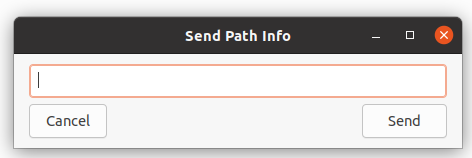
Effective, but not very spectacular, just a little dialog box that appears when selecting the ‘Send support request’ entry from the context menu for a file or directory entry in the Nautilus or Nemo file manager. For asynchronous support, the input field can be used to add additional text for the ‘support request’.
The plug-in just collects the information and then uses any 3rd party http post capable messaging service to forward the message. The two options I can recommend here are Gotify and an XMPP server that supports http push messages.

Based on estimates from the MIT Trancik Lab, The New York Times plotted average carbon dioxide emissions against average cost per month for electric, hybrid, and gas vehicles. Each dot represents a vehicle type. While electric vehicles cost more upfront, the lower maintenance and electric costs make up the difference in the long run.
The chart above only shows vehicles that retail for $55,000 or less, but you can see more vehicles in the original version.
Tags: cost, driving, electric vehicle, New York Times, Veronica Penney
Assuming responsibility for our emissions
“In these disruptive, crises-ridden times, our attention is often captured by the immediate political and technical challenges right in front of us. Facing the climate crisis and ensuring that there is a habitable planet for us and future generations to continue fighting these fights is not something that can be pushed to the back seat. I, and Mozilla, are committed to protecting the environment.” — Mitchell Baker, CEO
We can’t save the planet without people, and we understand that the internet is an incredibly powerful tool to help us draw the attention to what needs to happen.
The first line of order is that Mozilla assumes responsibility for its greenhouse gas emissions: We will reduce our emissions significantly and mitigate what we can’t avoid. We will share what we learn and lead transparently, supporting others on their journeys and continuously exploring ways to increase the resiliency of our communities.
Four Climate Commitments
To that end, we pledge:
Mitigation and Carbon Offsets
Doing right by the environment cannot be about simply paying off your emissions. In order to be carbon-neutral today, we invested in high quality carbon offsets to mitigate our 2019 impact for business services and operations. While these offsets are an important tool to mitigate emissions that we are not yet able to avoid, they do not provide or stimulate the sort of transformation that our societies need in order to truly be sustainable.
The most effective climate mitigation strategy is avoiding emissions, and Mozilla will continue to reduce its share while working with allies and partners to amplify our ambitions.
Such a transformation requires new mindsets and a high degree of organisational and cultural change. Training our staff and providing a range of different incentives to improve our environmental impact will be integral to achieving this.
Supported Sequestration Projects
We interviewed a range of offsets retailers and providers, assessing each project with a view to: level of certification with a preference for Gold Standard or Verified Carbon Standard (VCS), human rights compliance, focus on sequestration rather than avoidance, additionality and permanence of projects, social impact and community resilience.
On the basis of these criteria, we decided to work with EcoAct and invest in three sequestration projects: Madre de Dios REDD project, Peru; Darkwoods carbon forestry project, Canada; and Rimba Raya Reserve project, Indonesia.
In addition, we purchased renewable energy certificates (RECs) for our offices and co-locations in North America, Europe and Taiwan starting with our 2019 impact.
Next steps
In 2021, we will double down on our reduction efforts and develop implementation plans with each part of our organisation.
This will include switching more of our offices to renewable energy, reviewing our travel policies, exploring options for cloud optimisation, developing toolkits for product integrity and design principles, and more. We will share details on our process and targets as we refine them.
And for anyone pondering their options, I’d love to hear what you think about these ideas:
The post Mozilla’s Climate Commitments appeared first on The Mozilla Blog.

This is the fourth post in a week-long series exploring DEI professional competencies. I believe the five key competencies for DEI professionals are:
Yesterday I wrote about being a professional change agent and the need to meet people where they’re at and help them change their perspective and behaviour to be more inclusive. Today I’m going to explore the ability to influence others.
DEI leaders need to be able to influence beyond their small team, at all levels of an organization. The way I did this was by building authentic relationships, learning about what other people’s priorities are, and negotiating how to be mutually successful.
For example, I reached out to the AV Operations team to advocate for live captioning for our big internal meetings to increase access, both for people who were hard of hearing, people who process content better with text, and for people for whom English was an additional language. They worked to make this part of the workflow and handled the administration with the captioning vendor.
Over a year later the AV Operations team reached out to me to partner on the sound quality in the office meetings rooms. As a distributed workforce we spent a lot of time in Zoom meetings and some rooms had better sound quality than others. Also, for some neurodiverse people they were too noisy and echoey and made it exhausting to be in meetings, so it was an accessibility issue too.
I recently did CliftonStrengths and one of my top strengths is Woo, or winning others over. CliftonStrenghts describes this as: “People exceptionally talented in the Woo theme love the challenge of meeting new people and winning them over. They derive satisfaction from breaking the ice and making a connection with someone.” DEI leaders have little if no formal power, so being skilled at this is necessary.
This is the fourth in a series of five posts. Tomorrow’s post, the last one in this series, is about getting cross functional projects done.
The post Diversity, equity and inclusion core competencies: Influence others (Part 4 of 5) appeared first on Tara Robertson Consulting.

This is cute. I wasn’t expecting them to ever go down the “bare MCU” route, but truth be told that MicroPython boards (and the Adafruit Feather series) have turned out to be quite popular, so it might be a good market to be in.
(I’d still like to eventually see a better Zero or 3A+ though.)
For those who want to keep up with the latest in cycling around the world, here’s the latest from John Pucher (well-known to cycling advocates in Vancouver) and Ralph Buehler:

How to make city cycling—the most sustainable means of travel—safe, practical, and convenient for all.
After discussing the latest cycling trends and policies around the world, contributors consider such topics as health benefits; cycling facilities, including traffic-protected bike lanes; cycling incentives; the needs and preferences of women, children, and older adults; and equity and social justice.
In a previous blog post, I talked about some of the most important insights of awesome team learning.
They were:
Let’s drill down into one possible way of implementing all of these insights through what I call the Continuous Improvement Canvas or team improvement board.
Chartering is the bedrock of successful teams. For more on chartering, I encourage you to check out the Industrial Logic cheat sheet on chartering.
Just like with “micro-retros”, it’s entirely permissible to do “micro-chartering”. Some of my best teams were kicked off with nothing but the agreed upon Vision that we all simply wanted to seek greatness together.
Really. That was it.
The rest of our charter came later over the days, weeks, and months of working together.
Though I used the phrase working agreements in my blog post, and habitually do so as a coach, if you look at the previously mentioned cheat sheet, you’ll see I’m referring to the umbrella concept of Community Agreements, a term that covers several categories of team alignment (in the cheatsheet they are Working Agreements, Designed Alliances, and Values/Principles).
In this way, the Continuous Improvement Canvas is a way of including “continuous chartering” as part of your retrospective cycle.
When we’re talking about team learning, we’re not necessarily talking about learning new technologies or particular technical practices. What we’re definitely talking about is how to weave our separate excellences together - in essence, we’re learning how to move and learn as a team. This embraces the technical learning needs that the team has but isn’t limited to it.
Team learning at its core is about the continual flow of working agreements through our team culture.

I like to have an information radiator displaying the different states of working agreements that we are continually testing, implementing, and retiring.
In pre- and post-pandemic times, this is ideally a physical board if you’re co-located. During the pandemic and for remote/distributed teams, pick your favorite digital service and create the board there. For sure, screen share it on Zoom whenever you run your retrospectives, but make sure anyone can log in and see it at any time.
The quadrants on the canvas are the buckets that help us organize the insights we collect from our retrospectives. For many teams, retrospectives are usually held at the end of every iteration or every 1-2 weeks. The continuous improvement canvas really shines as you move it to daily, twice-daily, and in the best of all worlds, when you hold micro-retros after every ~25 minute work session. That’s when the need to manage all that learning demands a tool like the canvas.
The less often you run retrospectives, the more dust the canvas accumulates, and the less utility it has.
A brief summary of what you’ve decided is your vision/mission/objectives so far (see Chartering cheatsheet) is an excellent thing to have in plain view. Making it easy to point at in retrospectives keeps your team focused on why you’re here in the first place.
If we’re running a lot of retros, if we’re continually asking the question:
“What did we notice about that last work session? About our tools, interactions, process, environment? What’s one improvement we could make?”
…we’re going to have a lot of ideas for improvements and experiments. We can’t do them all at once. We need a bucket to hold these ideas that we’re not quite ready for.
Some of these improvements I call house cleaning: small, easy to implement changes in how we work. These can literally be as simple as new cleaning and organization habits - wipe down dry erase boards at the end of a day, recycle any obsolete sticky notes, etc. But they aren’t limited to this. House cleaning consists of things we can just do and not worry about any learning loop around them. We know they’ll work. They can either skip to the working agreement quadrant or just be something we take care of now without needing a reminder.
However, other improvement ideas are in need of an experimental phase.
To really do an experiment right, you need to isolate it as much as possible from other experiments in order to judge its impact on your team.
This usually means only one experiment is in flight at any one time.
It can also mean you parallel experiments that shouldn’t impact each other. One experiment might be a change to your retrospective cadence (from weekly to daily, for example), and another changes your keyboard input set-up (throwback to the pre-pandemic days of colocated mob programming!) to accommodate the mix of colemak, dvorak, and qwerty enthusiasts on your team. These seem pretty independent of each other and probably could be run in parallel without an issue.
An experiment doesn’t need to be overly scientific or have an upfront hypothesis. It’s enough if you just say, “Let’s see what happens if we do X.” This, in complex systems, is called a probe. Sometimes to even learn how to evaluate something, you first need to try it out.
Experiments can also have a precise set of acceptance criteria. “If this hypothetical documentation practice cuts our time spent dealing with X problems in half, it is worth the extra book-keeping burden.”
There’s no one right way to run an experiment. You could almost say the only wrong experiment is one you never try. Make them small, easy, quick, and do them often. This is the heart of the Modern Agile principle Experiment and Learn Rapidly.
You should decide beforehand how long you want to spend on the experiment - 3 days, 1 week, 2 weeks, whatever makes sense, and write this date on the index card or sticky representing the experiment. When this date arrives, it’s time to decide where to move the new habit/idea: the working agreement quadrant or the trash. Did it help? Did it hinder? Do you need more time to experiment?
Listen, it happens to the best of us. You thought you cared, but you really don’t. Time passes, the date pops up, and you realize as a team that you haven’t even touched the experiment, or maybe only tried it once. These are results too! It can shake the dust off of your complacency and focus you in on whether this is the time for this experiment, if ever.
Teams I coach will usually discuss this and decide to either try again with a new (and final!) deadline, retire it back to the Options quadrant till it’s relevant, or junk it as something you thought mattered but actually didn’t.
Any experiment that is successful, and has improved life for the team, moves into Quadrant Three and becomes a real working agreement.
This quadrant is to hold reminders for new habits of teamwork that you are working towards doing fluently. You need these displayed because, under stress, they are easy to forget about.
It’s best to use the “no more than 5-7” guideline for how many working agreements you have at any one time. Review this quadrant often to see if an old agreement has long since become an ingrained habit, and a reminder is no longer needed. This is usually enough to keep this list from getting too crowded.
Another reason to move a working agreement on to the next quadrant is that it simply doesn’t apply anymore - it has become obsolete.
Make these reviews part of your retrospective cycle.
Any old working agreements are moved into your team history. This record of team learning can be a great tool for large intervals in retrospectives - when running a look back at a 6-month or 1-year interval or at the end of a project.
It can also be profoundly useful for storytelling to other teams how your team got so good at delivering working software and satisfying customer needs. Why keep this knowledge to yourself? These stickies can be the meat of lightning talks or other presentations to come.
This canvas is just one approach for juggling the needs of options, experiments, agreements, history, goals, and whatever else the team needs to align around. What are the unique pressures of your team environment? What new categories are needed? Which are irrelevant? What tools and processes would you use to achieve this remotely?
These are all questions you need to answer yourself - but don’t forget to share your insights with the rest of us. We all get there together, and the more of us seeking excellence, the more it will be possible to achieve and sustain it.
Yesterday, Michael Alexander told the story of New York City’s fabulous (and fabulously expensive) new Moynihan Train Hall, and the less happy history of Penn Station, which it serves. Today: what are their lessons for Vancouver? And what are Vancouver’s public transit opportunities (and the region’s) for the coming decades?
 Like the glorious original Beaux-Arts Penn Station, historic Waterfront Station is privately owned by a large developer. And as in New York, that private developer wants to maximize its profits. In New York, the result was to bury most of Penn Station in the basement of Madison Square Garden. Here, developer Cadillac Fairview plans a private, ultramodern 26-storey office tower on a wedge of parking lot next to the station. It was quickly nicknamed The Ice Pick.
Nearly 13 million riders pass through Waterfront Station each year, about five million more than users of the next busiest Translink station. As the pandemic wanes, ridership will increase. The historic 1914 building is protected by heritage regulations, and serves as a stunning public entry and meeting hall.

 The actual transit facilities are underground, or in a shabby shed attached to the building’s north side, a construction mirroring the tawdry underground Penn Station that New Yorkers and visitors have suffered since 1968.
Connections are so poorly designed that to transfer between Skytrain lines, you go up two flights, through fare gates, down two flights, and through another set of fare gates.
Translink rents this space and office space in the upper floors from the developer, Cadillac Fairview.
That’s not the way it has to be, or the way the city has said it wants it. Since 2009, the city has had preliminary plans which include a great, glassy public hall, a transit and visitor entry to Vancouver, with views of water and mountains, transportation and history, urban commerce and pleasurable public space. Something like this:

Where that preliminary design imagined a small building on the parking lot, our group* boldly foresees a vibrant public square:

That’s part of the Central Waterfront Hub Framework approved by Council in 2009. Staff began a review, but unfortunately, progress has been … slow. In the meantime, Cadillac Fairview has begun the permit process for its office tower twice, and has had city advisory panels recommend against it each time.
Should the Ice Pick be built, making Waterfront Station the fully functioning centre of Metro Vancouver’s public transit system for the 21st century would likely be severely compromised.
But there’s a new opportunity, involving all three levels of government. Last month, to help the country’s economic recovery once the pandemic is contained, Ottawa’s federal fiscal update promised to spend “up to $100-billion” on “smart investments that have value now, and well into the future.” The Globe and Mail quickly recommended “some big investments in public transit.”
Here’s one: the federal government joins with the province to buy Waterfront Station, insuring the opportunities for transit and public improvements. All other Metro transit stations are publicly owned.
Waterfront Station’s 2020 assessed value is only $68 million, down ten percent from last year. Ottawa could provide the cash, or join with the province and city to trade for another downtown development site. We’ve identified two: a 1960s city-owned parkade in a great location, and an underused federal property. Surely, there are others.
Public ownership has many benefits: Translink could improve transit connections for commuters, airport travellers and tourists on the adjacent cruise ships. For visitors, Waterfront Station becomes the welcoming entry to historic Gastown. The parking lot becomes a public plaza with spectacular water and mountain views that define Vancouver. Future station planning and operations become much easier and less expensive.
Here’s a recent Canadian example. Toronto’s Union Station is owned by the city. Eighty percent of its upgrade funding came from provincial and federal governments. Public space was enhanced, and its heritage value was preserved.


It’s no crime for a private company to maximize its property values. But losing the opportunity to maximize public transit benefits for future generations— that would be a crime.
*The Downtown Waterfront Working Group, a voluntary non- partisan group of mostly retired planners, architects, and urbanists has been working hard to put plans before projects and help create a spectacular waterfront.
You can find us at Downtown Waterfront Working Group (vancouverwaterfront.org) and Downtown Waterfront Working Group | Facebook
I’m a person who knows a lot about how computers and software work, is generally curious, and reads fast. I’ve been wrong about lots of things over the years. But there have a been a few times when a combination of technology-literacy and just paying attention to the world have made me 100% sure that I was seeing something coming that many others weren’t. Here are a few of those stories. The reason I’m telling them is that I’m in another of those moments, seeing something obvious that not enough other people have, and I want to offer credentials before I share it. Also, some of the stories are entertaining.
As an undergrad, I used Unix V6 on a PDP-11/34 back in 1979, but when I graduated the dinosaurs that stomped the earth had labels like “VMS” and “MVS” painted on the side, and mega millions of investment and marketing behind them. (If you don’t know what those labels stood for, that’s OK). But from time to time I got my hands on a Unix command line and kept thinking “This is just better” and then one time I wrote code that did networking and understood the power of fork and exec.
So I started going around telling all these IT management types that Unix was better than what they were using, and got blank looks, and when I got really insistent was eventually told to shut up. At that point I was young enough that I was convinced that, well maybe, I was just crazy, after all these were guys who’d been doing IT for decades. The rest is history.
I was a C and FORTRAN guy, then in 1996 I was helping design XML and told myself that it’d be cool if XML had a working XML parser. In 1997 Java was The New Hotness so I decided to learn it and use it. I actually used Microsoft’s Visual J++ which, for the time, was pretty great.
Eventually I published Lark, the world’s first XML parser, then a couple of years later gave up on it because Microsoft and Sun both had their own parsers and who was I to compete with titans? I regret that because Lark was faster and had a nice API and if I’d maintained it, it’d probably be popular to this day.
By the time I’d done Lark, I’d seen the advantages of a programming language that came with a good standard library, ran on a VM, had garbage collection, and had a reasonably clean, minimal design.
So I started telling everyone I knew that they should do their next project in Java. Everyone I knew blew me off and said that Java was too slow compared to C++, had a primitive GUI compared to Visual Basic, didn’t have government buy-in compared to Ada, didn’t have a mainframe story compared to PL/1, or didn’t let you go fast and loose compared to Perl.
By this time my ego had expanded and I didn’t shut up and I think I may have actually changed a few people’s minds.
This was the one that was most irritating. By the late Nineties, the Web had expanded out of the geek-enthusiast space and Open Text, a company I co-founded, had done a nice IPO based on Web search and a Web document-management UI. I remember like yesterday a presentation at one of the early Web meetups, an engineering lead for a (then) big computer company. She said “This is so great. Our interfaces used to have to be full of sliders and dials and widgets or people would say we were amateurs. But now with the Web, there’s so much less you can do, but the important things are easier, and that’s what people want!” She was right.
Between 1996 and 1999 I was an indie consultant, trading off my ill-gotten fame as a Web Search pioneer and XML co-inventor. Everyone who hired me got told that they should damn well invest in Web delivery and stop investing in anything else. I heard “But native GUI is a much richer environment” and “The network will never be fast enough” and “Yeah, that stuff is just toys for kids, we’re serious Enterprise Analysts here.”
The change came, as they always do, maddeningly slow then frighteningly fast. My recollection is that the advent of fedex.com was very influential. Even the most non-technical business person could glance at it, realize “All I have to do paste in a tracking number, didn’t have to install any software, and there’s my answer.”
Once the Web had become everyone’s favorite GUI, people started to notice that it was pretty easy to set up a network-facing API using HTTP. (And at that time XML, which made things harder, but it was still pretty easy.) Way easier than the incumbent technologies like CORBA and DCOM and so on. Meanwhile, Roy Fielding was working on his doctoral dissertation which established the key concepts of REST.
For some reason that I’ve never understood, IBM and Microsoft chose this time to launch a land-grab. In a really annoying and unprincipled way, they rallied behind the banner of “XML Web Services” and jammed a huge number of mammoth, stupidly-complex “WS-*” specifications through compliant standards organizations. Even the most foundational of these, for example WSDL, was deeply broken.
A few people (including me) thought the Web didn’t need WS-layering, and that what we would come to call REST was astonishingly simpler and already known to work. We recoiled in horror and became avid anti-WS-* campaigners. Of all the things in my life that I’ve found myself against, WS-* was the softest target, because it basically just didn’t work very well. I remember with glee publishing blog pieces like WS-Pagecount and (especially) WS-Stardate 2005.10. Because the best way to attack a soft target is to make people laugh at it.
WS-* actually survives, last time I checked, as Microsoft WCF. But nobody cares.
When the iPhone launched in 2007, I was working at Sun, i.e. Java World Headquarters. Like everyone else, I was captivated by the notion of a pocketable general-purpose computer with a built-in GPS and phone and camera and so on. Unlike most, I was appalled by the App Store axiom that I could write code for the thing, but I couldn’t publish it unless Apple said I could. Also, I was (and remain) not crazy about Objective C.
So when Android arrived on the scene, it got my attention. Among other things, you programmed it with what felt like pretty ordinary mainstream Java, which I and a lot of people already knew. And if I didn’t want to use the Google store, I could post my app on my website and anyone could use it.
So in 2008, I wrote the Android Diary series, describing my experiences in getting an Android phone and writing my first app, which was so much fun. I discovered that the development environment, while immature, was basically clean and well-designed, and accessible instantly to anyone who knew Java.
People laughed at me, saying the iPhones were faster (true), had better UI design (true), and were uncatchably-far ahead, measured by unit sales (not true). Eventually Oracle bought Sun and I left and I got a nice job in the Android group at Google. When I joined, there were roughly ten thousand Android devices being sold per day. When I left, it was over a million.
It is completely unambiguously obvious to me that Bitcoin, a brilliant achievement technically, is functioning as a Ponzi scheme, siphoning money from the pockets of rubes and into those of exchange insiders and China-based miners. I’m less alone in this position than I was in some of those others, I think a high proportion of tech insiders know perfectly well that this is a looming financial disaster.
I am not going to re-iterate all the arguments as to why this is the case. If you want to find out, follow Amy Castor.
OK, let me add one additional argument for why Bitcoin is not and can never be “real” money. You know what real money is? Money you can use to pay your taxes. The USA, in 2018, had about 140 million taxpayers. Suppose 10% of them wanted to use Bitcoin to pay their taxes. Let’s say the global Bitcoin network can process ten transactions per second (it can’t, it’s slower than that). By my arithmetic, at 10/second it would take the whole network, running flat out, not doing anything else, over five months to process those payments and refunds. This is just Federal Income Tax.
Don’t get into Bitcoin. If you’re in, get your money out while you still can.
Trust me on this.
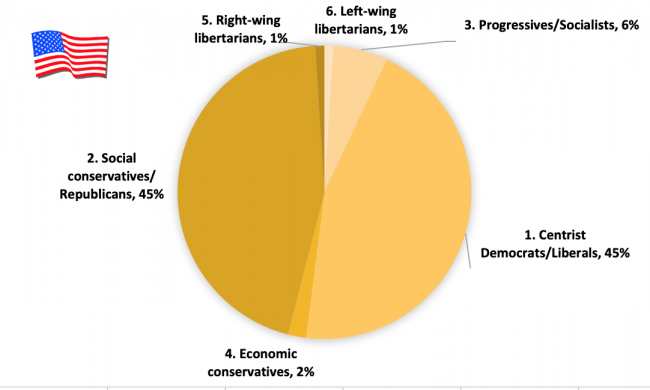
I was not surprised that the coronation of Biden went off peacefully. It was pretty clear that the gang of overpaid Trump PR people who orchestrated 98% of what happened in DC earlier this month concluded that, thanks to the 2% who stormed the Capitol and got all the headlines, it was a total PR disaster.
The Jan 6 event involved millions of dollars in promoting a protest, complete with massive stages with expensive Jumbotron TVs and even a US-Open-style Executive Tent for the Trump family and friends. And it backfired. They should have known: In progressive protests it’s never the large numbers who march peacefully that get the media attention; it’s the tiny Black Bloc type minority smashing windows and looting. Why should it be any different when conservatives protest?
After that PR disaster, the Trump PR corps just gave up, and the result was the small handfuls of protesters we’ve seen over the past few days, far more militant in their beliefs but completely disorganized, unfunded and unrepresentative of anyone but their own tiny membership.
Some recent articles, I think, drive home where America now sits, and here’s where I think that is:
This delicate balance, which I’ve tried to depict in the chart above, has been in place for nearly four decades. Some thoughts on how the balance has shifted over the years:
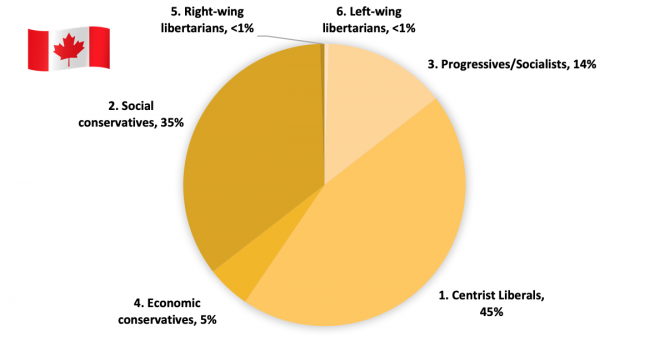
My sense is that the situation in Canada isn’t much different, except the third group is probably somewhat larger and the fifth and sixth groups probably somewhat smaller, mostly for cultural reasons, as depicted above.
In Canada, because groups 2, 4 and 6 combined are less than 50%, they have to rely on the “first-past-the-post” system of elections that has allowed them to win close to 40% of multi-party elections over the past 4 decades with only 40% of the votes, because the centrist and progressive parties split their 60% of the votes among 3-5 different parties. My sense is that the political landscape in much of Europe and other anglophone countries is not dissimilar to Canada’s.
So I’m not terribly worried about the loss of democracy, though I agree with Adam Gopnik that we can never give up trying to make it work better, and should never assume it will last forever. (Groups 5 & 6, tiny as they are, are large enough to create havoc, especially with warfare — both military and political — becoming increasingly asymmetric).
The rally on Jan 6 supposedly attracted an estimated 25,000 people, of which about 98% were probably from group 2 (clueless, unarmed, protest “tourists” who reacted to Trump’s people’s herculean PR campaign to show up for the rally and party even though they never got invited into the tent). That’s a really poor return on the massive publicity investment — after all, Greta Thunberg attracted 20 times that number to Montréal for her climate march with much less spending. Though of course, ultimately neither event made any difference.
The media didn’t even show much of the action with the giant stages, speeches, Jumbotron displays or the Trump tent — it was more fun (and better for their ratings) to show the guy sprawled in Nancy Pelosi’s office or the antler-head playing to the cameras in the Senate chamber. Instead, some of them showed the tent video after the fact as if the attendees were celebrating the invasion of the Capitol, although the tent was only occupied during the rally where Trump had spoken two hours earlier, and then the family left for the private dining room in the Oval Office well before the ‘invasion’ of the Capitol began. But, gotta keep those ratings up.
I think the far greater problem is that, due to the above-noted distortions in the electoral systems, conservatives are justifiably worried that if the system isn’t somehow constantly rigged in their favour, they’ll never hold power. And they’re absolutely correct. So there’s a lot to be gained for conservatives in both the US and Canada to fire up “their” group 2 & 4 voters through fear-mongering.
And then, of course, there’s a lot to be gained by the centrist parties (US Democrats, Canada’s Liberals) to fear-monger that since the system is rigged, they may never hold power, so they have to turn out in extraordinary numbers (and not split the vote) to prevent the minority from always winning. And they’re absolutely correct.
It’s a completely fucked-up system. But to me, the real outrage remains the one that the media never talk about: the total control that the corporatists, who finance all the major parties in both countries, and who own the media, have over the levers of power and policy, no matter which party wins.
And so we have American munitions enabling the endless atrocities in Yemen, and the endless war-mongering against Iran, China and Russia, no matter who wins the US election, and we have Canadian governments buying pipelines and pimping for big oil, no matter who wins the Canadian election.
And we have both governments paying lip service to addressing climate change while doing nothing of substance to even slow it down. (And don’t say the Democrats just need time — they had time under Clinton and Obama and did nothing.)
Unlike authoritarian overthrow, which is a small but real risk, these outrages are happening, here and now, and the parties and the media are all complicit, conning us all. Nero would be proud.
Just in case you’re new to reading this blog — this situation cannot be fixed. This is what political, social, economic and ecological systems in collapse look like. Everyone in power knows that no one can prevent these collapses from happening, and all they’re doing is posturing, offering false reassurances (to keep people obedient, prevent widespread panic, and tamp down the numbers of the nothing-to-losers in groups 5 & 6), trying to prop it all up a little longer, and making sure they have their own personal escape and insurance plans in place. And perhaps trying to buy into their own rhetoric, to make it all seem less hopeless.
I learned a lot over the past 20 years talking candidly with climate scientists (and a few economists), with the cameras off and no media in earshot. They’ve known we’re fucked for a long time, but they dare not say so publicly, and in some ways, they don’t even dare admit it to themselves. It doesn’t matter which of the six groups you’re in — none of the forms of salvation their leaders promise has a hope of working. Might as well talk and play with the deck chairs, because on this voyage on Spaceship Earth, there are no lifeboats.
Welp, I was going to write a much more nuanced post about problems with the Twitter appeals process, but I’ll just put this here instead for now.
I got banned wrongly for a tweet last week where I was talking about the history of conspiracy theory and its relationship to current COVID-19 misinformation. Someone had posted that conspiracy pyramid that shows the relative harms of conspiracy and asked where fluoride might fit. I replied saying I thought that fluoride definitely belonged in the 5g layer — not anti-Semitic but definitely part of that dangerous John Birch Society politics/medical-conspiracy stew. A few minutes later I was hit by this.
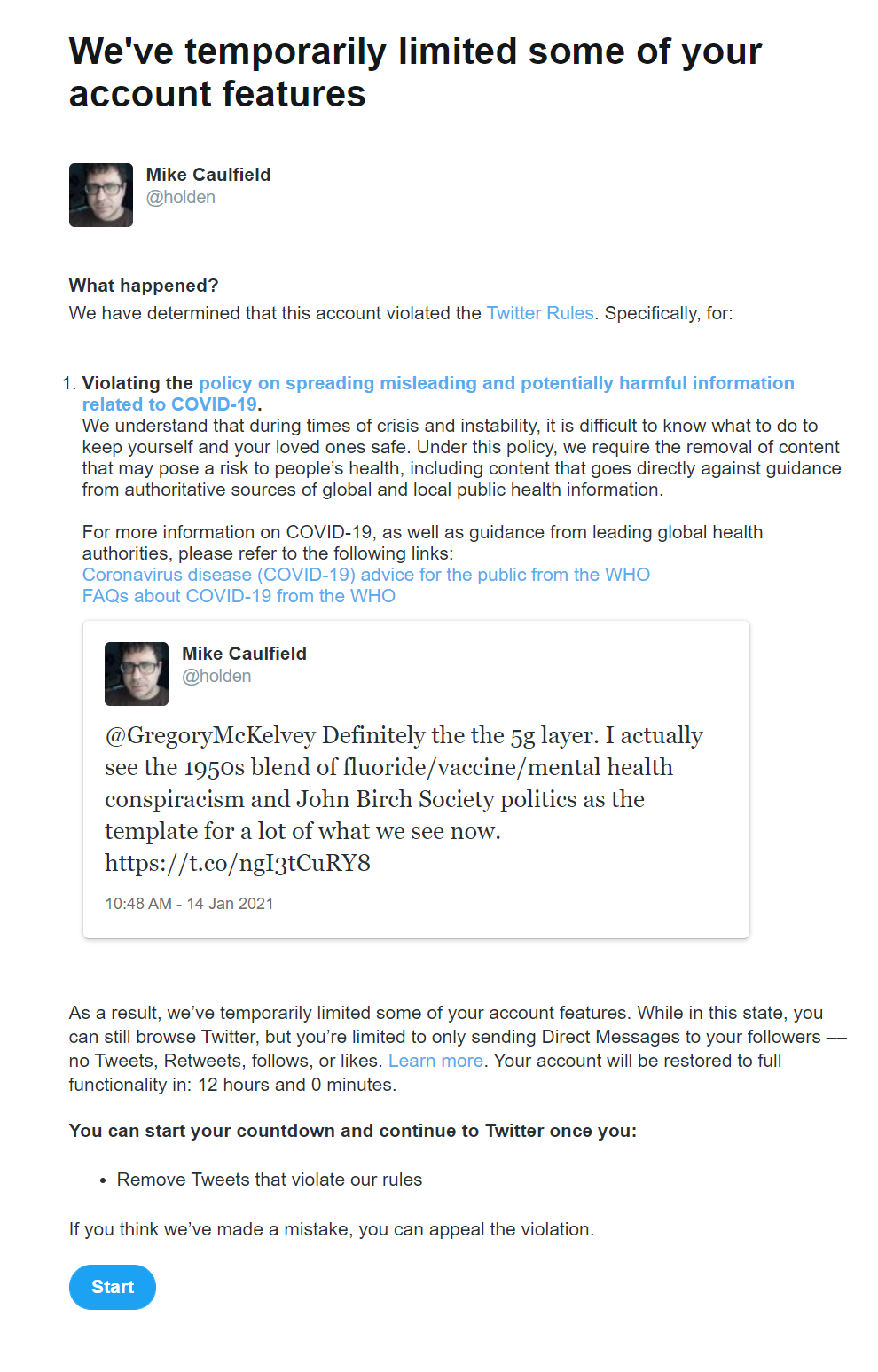
Now, I want to be clear. This stuff happens to other people quite a bit, particularly women academics and activists, due to the gaming of reporting features by trolls. And it happens to lots of regular folks as well due to the algorithmic nature of enforcement — I saw someone go to Twitter jail once for tweeting “I hope Trump chokes on his own uvula” (incitement to violence!). So none of this is particularly noteworthy. This has been broken a long time, and there’s a lot of people I respect who say it may not even be fixable. I’m more optimistic and think it could be made workable, but even there it’s always going to be imperfect: there’s some collateral damage with even the best moderation regimes.
But in any case, I decided to opt for the appeal. After all, I’m a well-known expert on media literacy and COVID-19. My pinned tweet is actually a OneZero article on my efforts to fight misinformation on COVID-19, an effort I got involved in mid-February 2020, before Twitter was even thinking about this stuff. Etc, etc. I expected the appeal might take three days, maybe. So I appealed.
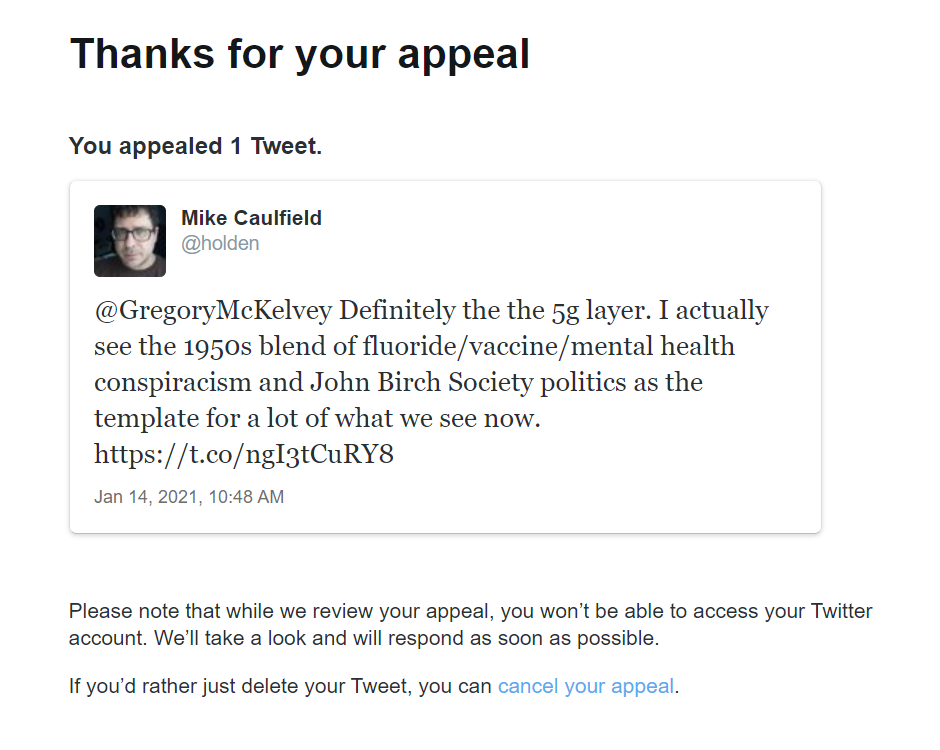
Now, appealing isn’t cost-free. In fact, one of the primary ways reporters contact me for information on how best to fight COVID-19 misinfo is through Twitter DMs, and when you decide to appeal you lose all access to your DMs, all ability to browse, everything. (And perversely, all those DMs just go into a bit of a black hole, there for when you get privileges back, but with no one DMing you knowing that in the meantime you can’t see them). Getting banned for alleged COVID misinfo significantly affects my ability to work on real COVID misinfo. On the other hand, I don’t want to start accruing a bunch of black marks that might get me banned sometime down the road.
Anyway — it’s been a week now. I’ve hesitated writing this because I actually support stronger moderation on Twitter and for the love of God, this isn’t a “I’ve been censored” story. But as always with policy, stronger isn’t enough, smarter means much more. And an appeals process that is in effect a week’s ban isn’t really an appeals process at all. It would make more sense to me, and everyone else, to simply give up the pretense of an appeals process on individual tweets altogether, until Twitter can actually run one effectively. Had they not offered one, I’d have treated this as an algorithmic goof I had to live with; instead I lost a week on Twitter which I would have been using to actually advance anti-misinformation practices.
So that would be my recommendation to Twitter. Either cancel the appeals process, apply it narrowly to suspensions, or speed it up. At the very least, inform people engaging in it what the average time for resolution is. And while my suspension probably won’t derail national or international efforts against COVID-19, I can’t help but think of all the medical researchers and public policy people out there using Twitter to communicate and collaborate. So as much as Twitter seems to think any deference to academic culture is a thumb on the scale, I really hope they can have someone write up a list of experts more important than me and take a bit more care before they ban them. I assume what I was hit with was based on a programmatic scan, not trolls gaming reporting. But the anti-vaccine trolls are out there and I know they are reporting the heck out of anyone that gets in their way. If Twitter doesn’t make a nominal effort to protect those researchers, there will be much more high-profile (and damaging) bannings to come.
(Incidentally the fact that the report does not actually tell me if I have been banned by a programmatic scan –having 5g and vaccines in the same tweet — or via a report is very bad in terms of both transparency and utility. I actually need to know whether it is a troll report or algorithm. If it’s an algorithm, it’s a lightning strike, and I go on the way I have. If the trolls have found me, that’s a different problem, and one I need to be alerted to.)
If the appeal doesn’t come through soon, I’ll remove the tweet, which I guess means I’ll see you all in about 12-24 hours. (UPDATE: I have removed the tweet and am back)
One final note — I also hesitated putting this up because I don’t want to field questions from reporters about it. So many women and people of color deal with this sort of issue constantly, due to targeting by trolls. Talk to them, not me. Maybe actually phone up a sex worker and learn about crazy path they have to thread on various platforms to avoid being shadowbanned, or social justice activists whose every sarcastic tweet is pored over and brigaded by trolls looking to get them kicked off the platform. Also, as I said, I’m broadly supportive of Twitter’s efforts to keep COVID misinfo off the platform. To paraphrase the famous Obama quote, I’m not against moderation, I’m against dumb moderation. But if you are a reporter looking to talk about moderation challenges, I highly suggest talking to people besides me. You can start with Sarah T. Roberts on what really goes on behind the scenes, and Safiya Noble on the issues of algorithmic enforcement (which again, are felt less by people like me than others). I find Siva Vaidhyanathan’s thesis that the system cannot actually be made to work a bit more pessimistic than my take, but one that deserves more airtime. And of course for general policy perspective on platforms, my colleague at the Center for an Informed Public, Ryan Calo, is always a good call.
If on the other hand you want to talk about my work on COVID misinfo and the new and effective model of digital literacy I promote, feel free to email me at michael.caulfield@wsu.edu. Direct messages at @holden probably won’t be up for a while.
I’m in the process of migrating to a new Mac. It is proving surprisingly cumbersome to do so. The Migration Assistant I tried in peer to peer mode stalls as soon as one of the laptops (and then both) falls asleep, and does not resume when woken up. Giving it expects to take several hours to copy everything it isn’t viable to stay next to it just to keep both machines awake. I set both up to not fall asleep, but those are system settings within a user account it appears, and it logs out of those when doing the migration. I could migrate from my Time Machine to the new laptop, which also needs the Migration Assitant however, which loops me back to the falling asleep bit.
So I’ve decided to do the migration by hand. That’s actuallly not entirely unwelcome as it allows me to ignore the accumulated detritus of working on the old laptop for 7 years. It’s just a lot of work to think of how to copy over certain databases, licenses, settings of specific tools etc. It will have to happen in stages, and partly as needs arise.
All the software I intend to keep using is installed (Evernote nor Things are making the move with me). I’ve copied over my documents archive, and connected the new laptop to my Nextcloud cloud. Next steps are setting up my e-mail and calendar accounts in Thunderbird, and migrating my Alfred snippets. After those I’m good to go for working on the new laptop. Anything else is non-essential, and can be dealt with in stages. This includes image and music libraries, book collections, etc. It likely will be a good while until I’ve added the various tweaks and twiddles to reduce friction in my workflows, to mirror 7 years worth of tweaks on the old system.
Unfortunately, I don’t remember at all where this link came from.
Flow State is a newsletter which promises “every weekday, two hours of music perfect for working”.
They shared Hotel Neon earlier this week:
Today we’re listening to Hotel Neon, an ambient music trio based in Philadelphia. The group uses synths, guitar, and strings to produce beautiful sound atmospheres conducive to deep focus or meditation.
They recommend starting with their most recent album, released on Jan 1st of this year (yes, 2021!), All is Memory:
All is Memory by Hotel NeonTheir full Digital Discography is 80% off…so I bought all 18 releases.
Happy music buying in 2021 everyone!
It’s hard to build a community if your boss is always questioning your work, overruling your decisions, and keeping you guessing about their vision for the community.
It’s equally hard if you’re keeping your members guessing, overruling (or ignoring) their ideas, and keeping them guessing about your vision for the community.
There seems to be a relationship between the two.
There was an org that didn’t see
The data exfil hacking spree.
A patch went up, our guard was down,
Oh blow, SolarWinds, blow.
Soon may the Vendorman come,
And bring us Yara rules to run.
One day when their huntin’ is done,
They’ll take their scripts and go.
There was no implant here before,
But after was a sly backdoor.
The C2 signals they did soar
And labored low and slow.
As the attack did laterally move
Our foe did get into their groove;
Stealing certs; installing ‘sploits
Wher’er they did go.
Then one day in the by and by,
Some clever folk with a firey-eye,
Spotted something amiss in Orion’s belt
And a delvin’ they did go.
The sunburst cleared and they did see
The origin of their recent misery.
A blog went up; they did proclaim
Many other orgs were laid low.
As far as I’ve heard, the fight’s still on;
The C2s blocked but the attackers aren’t done.
The Vendorman makes his regular call
To help CISO, crew and all.

Wherever in the world you happen to be, I think we can all breathe a collective sigh of relief now that Joe Biden has been sworn in as the 46th President of the USA.
Here in the UK, we’ve still got the clown-car government that my fellow countrymen and women inexplicably voted in immediately before the pandemic. They’re doing about as well as can be expected given their glaring incompetence, which has been compounded by the economic self-harm of Brexit.
Closer to home, though, everything is going well. The Catalyst project I’m leading through Dynamic Skillset had its kick-off meeting, and we found out that our co-op was successful in another funding bid. Laura and I recorded the pilot for a new podcast which led to us presenting a proposal for a series of six episodes to fellow co-op members. That proposal was passed, so look out for the first ‘proper’ episode in the next few weeks, and then monthly afterwards.
This week has included my son’s birthday; another teenage year which makes me feel even older than I did turning 40 last month. Another thing that made me feel ancient was attending an online workshop facilitated and attended by people a decade (or more) younger than me. I had to leave half-way through as, although I’m sure everyone else was getting a lot out of it, the format didn’t work for me.
I can definitely see how people get set in their ways as they get older. When you’re younger and you’re not quite sure what you like or how things work, it’s easy to throw caution to the wind and just try things. As you get older, with a bit less energy but many more responsibilities, it’s always easier to lean towards things you know have worked well before. Note to self: I need to fight against that tendency, at least some of the time.
Being back on Twitter is mostly great, although it means less time for blogging. I haven’t published anything here, and on Thought Shrapnel this week I’ve only managed to put out two link posts:
Another website-related thing I did do this week, though, was to create a new thesis page and redirect a couple of legacy domains to it. One of those domains was neverendingthesis.com, which used a version of MediaWiki which I don’t think I ever really upgraded. It finally fell over just shy of its millionth visit, which is incredible really.
I’ve also removed my ebook about digital literacies from Gumroad and made it freely-downloadable from the thesis page. Self-publishing works: in addition to the ~£800 I made pre-v1.0, I also made $3,587.46 in sales via Gumroad over the last few years!
Next week is mainly Catalyst work, although I’m trying to keep my hand in with Outlandish and do some business development for the co-op. I’m just thankful that I’m able to find decent-paying, meaningful work during a pandemic and keep my family relatively happy.
Photo taken on Thursday morning during a run on the beach at Druridge Bay, Northumberland.
The post Weeknote 03/2021 first appeared on Open Thinkering.
I hadn't considered the possibility of instructors illicitly converting their in-person course to an online version, but I guess it happens enough for institutions to use this service that allows students to inform administrators that this is happening. Instructors, not surprisingly, are unhappy. “Demoralizing. It’s insulting. I think it’s a real statement about how they feel about us as professionals, that they don’t trust us to think seriously about how to deliver our courses.” Well, yeah, but if instructors actually are skipping class, what does that say about their professionalism? (On an unrelated note, I have a recurring dream about skipping classes I'm supposed to teach, so what does that say about me?)
Web: [Direct Link] [This Post]
Here's an example of an instant learning resource, a set of learning activities surrounding a video and transcript of Amanda Gorman’s inaugural poem “The Hill We Climb”. If it were set within the context of social interaction or a learning community with an ever-growing distributed network of commentary and work inspired by the poem, it would be an example of the micro-MOOC I talked about a few weeks ago.
Web: [Direct Link] [This Post]
I thought I would write a blog post responding to this, because the things recommended by Neil Pasricha are trivial mindset things (wherein you itemize what you will let go of, are grateful for, and will focus on). But I don't really have time. So here's a postlet on what you can do to really make your day (and your life) better:
These won't make your life perfect, but they are concrete actions that will do far more for you what whispering "I'm grateful for..." at the start of each day. They will keep your mind sharp, in focus, expanding, and open.
Web: [Direct Link] [This Post]
This opinion from the founder of an online high school in New Zealand expresses the view that there should be more online learning but that it should be a lot like offline learning. "For it to be effective it needs to be real-time, live teaching with small ‘virtual’ classes. Despite all the technology we have today, it’s still about a brilliant teacher leading a classroom and inspiring young minds." That would pretty much doom online education (and offline education!) for while there are no doubt many brilliant teachers, there are not nearly enough to support all the students who need them. That's why, for example, "in addition to their existing school studies, more students are accessing international curricula recognised by the world’s most competitive universities." What works in online learning is - as it is for everything - a mix that depends a lot on the learner, the subject, the materials available, and the context.
Web: [Direct Link] [This Post]
There's a lot to explore in this attempt to describe how to build an open organization, not the least of which is the discussion taking place as members work together on GitHub to pull together the core pieces. Right now participants are focused on the editorial process for content written by project 'Ambassadors'. "Ambassadors log article ideas as issues and track their progress in our editorial queue." There's also a Guide for Educators (319 page PDF) written in 2019, which I want to spend some time with in the future. Via Laura Hilliger.
Web: [Direct Link] [This Post]
This is cute. I wasn’t expecting them to ever go down the “bare MCU” route, but truth be told that MicroPython boards (and the Adafruit Feather series) have turned out to be quite popular, so it might be a good market to be in.
(I’d still like to eventually see a better Zero or 3A+ though.)
We’re talking about version control here, but we’re also talking about productive habits.
The term that is being passed around is “micro-commit,” and it is one of those concepts that we didn’t realize needed a name or a definition or an article on a blog.
A micro commit is a tiny commit. It consists of the changes necessary to do one tightly-scoped change. Maybe it’s just a file reformat. Maybe it’s just a variable rename. It could be the addition of one loop or one statement. It might involve a new microtest and just enough code to make it pass.

For years we just referred to these as a “commit” not realizing that there were people in the world who were doing many things at once and only committing when some significant piece of work was completed.
I was surprised to find out that there are people who only commit maybe once or twice a week. All their code is at the mercy of their editor’s history and at risk of being lost or damaged. It’s unnerving for me to even think that way.
Some time ago, I tweeted that it is better to not mix reformatting, refactoring, and new code all in the same commit. I thought it was obvious how that would work:
That is how all the professionals I work with have done their work for many years. We’ve been doing this probably since the very early 2000s, maybe the 1990s too, but certainly since the advent of DVCS like git.
Industrial Logic has included the “integration” step of the refactoring process since long before I even joined the company. The tight loop of TDD here is Red, Green, Refactor, Integrate. Integrate is at least to commit, but preferably to pull and push as well (GIT terms for updating the code in the main development branch and sending the changes back to that branch for the rest of the team to use).

The tweet caused some consternation, though. It turns out that not everyone does micro-commits. Apparently, some people only commit when an entire user story, epic, or job is completed.
My assumption was that people commit at least 4 times an hour, and sometimes as many as 12 or 15. In my context, the advice is good and reasonable.
If you only make huge commits, then my advice sounds like “do all your work without reformatting or refactoring and then, perhaps weeks or months in the future, as a separate task, do some refactoring or reformatting.”
I realized that I had the advantage of having had good coworkers and mentors who have always appreciated the value of taking tiny steps.
I was lucky enough to spend most of my programming life knowing what has become known as “Curly’s Law”: “One thing. Just one thing. You stick to that.”
“Doing only one thing at a time is a surprisingly powerful way to become more productive”. - Chris Baily, The Productivity Project

We have learned that dividing our focus among several different concerns slows us down and is the cause of many errors in programming.
I was watching a programming video the other day where the author built an if statement, and in the body of that conditional wrote a line that logged a message. Later, the author added an else and copied the log message to modify it. At that point, the author got distracted by another opportunity to improve the code.
When they tried to run the code, the log messages were still identical – the code reported exactly the same message whether the if condition passed or failed. It looked like the if condition didn’t work! The author was confused for a moment and returned to the code.
Once there, they realized that they’d forgotten to finish the one change they’d set out to implement.
Why did that happen? Because the author had a “while we’re at it moment” in the middle of making a change, forgot that they hadn’t completed the first change, and ended up running half-formed code.
I suspect that all the people who watched it had a nervous chuckle - nervous because that was a rookie mistake that we’ve all made. I remember seeing the author fall into “while we’re at it” mode and actually said out loud “no, no! Don’t get distracted!” I saw the mistake, I knew what would happen because I’ve been there plenty of times.
“An expert is someone who knows what all the mistakes look like” - Tim Ottinger
We refer to committing code as “saving your game.”
This is an obvious parallel to video gaming. If you don’t save your game, and you run into trouble, you have no way to recover to a safe earlier time. You have to start over.
In software, we take tiny steps. Really tiny steps. We save often, when all the tests are running (“green”) and the code works. We commit because we may want to return to the recent past when everything was fine and all the tests passed. We can do that with a simple git reset –hard.
Joshua Kerievsky refers to the tactic of reverting to a save version as a Graceful Retreat.

It’s often faster to retreat and start over than it is to try to press on.
When people are working with several days’ worth of code uncommitted, and they run into some unforeseen problems, they’re stuck. They have to press forward. They can’t back up and regroup. If they were to reset, they could lose hundreds of changes.
Does that seem “normal” or “terrifying” to you? Because that sounds extremely unsafe to me.
Sure, you could probably untangle the unexpected problem with a few (more) hours in the debugger and by reading (a lot of) code. But what if you could back up to 5 minutes ago when everything was fine?
What do you mean you didn’t run all the tests and get a passing green bar 5 minutes ago? Surely you’ve ensured the code works at least a few times per hour, right? Isn’t that how everyone works?
I spent a chunk of 2019 reviewing code in git repos. I learned an important lesson: the smaller and more focused a changeset, the shorter the time necessary to review it.
I could review 20 or 30 focused changesets in a bit less time than it took to review a single large changeset.
This is counter-intuitive. I know it sounds like doing 20 code reviews would be 20 times worse than reviewing one changeset, but that’s not how it works.
I’ve found this principle echoed by many technical leads and other code reviewers in various situations as well. When we are only examining one intention at a time, the review is easier and it’s quicker to spot and understand the technique being employed.
When I find people doing very large commits, or “squashing” all their intermediate commits together into one mega-commit, I flinch. I don’t want to do the code review on that bundle.
And I don’t want to do the merge either.
Steven J Owns on Quora was answering a question: “What is a micro-commit?” Here is an abridged excerpt from his answer:
Most developers who start to use revision control go through a process of learning to commit more often.
This is a little trickier than it might sound because another standard practice with SCM is to only commit code that compiles cleanly with no errors and passes all the automated tests.
To resolve the tension between these two practices, they need to learn to modify their process.
They need to learn more discipline in tightly scoping their changes, biting off smaller chunks at a time, getting those chunks all the way to build and pass tests, and then committing them before touching a different part of the code.
This learning process can be painful but in the long run, makes a developer much more effective.
The more I learn about software development, the more I feel that scope control is fundamental to the process.
This echoed my own experiences in a deep way. I think that in the long run, a lot of becoming an effective developer is learning to take tiny steps and focus on doing one thing at a time.
Microcommits are consistent with this philosophy, both enabling and supporting good practice.
There is one other odd effect of micro-commits: rebase works great.
A lot of people on the internet have been telling me that they never do git pull –rebase because the merge always fails and leaves them in a weird (“headless”) state in their local codebase.
I always was confused to hear this because it doesn’t happen for me.
I learned that other people compose commits. They make a number of changes, and then choose which files and which changes to include in their commit changeset.
I never do. I have only done one thing since my last commit, and I usually commit all the files that changed. I don’t have some committed and some uncommitted changes. I don’t have unrelated changes in two or three different files.
Because I don’t have committed and non-committed or partially-committed files, git doesn’t have to work hard to rebase my change sets.
Also, because I integrate often (rarely a half-hour passes without integration) I’m never far from the version of code in the main code branch. It’s super-easy for me to do a rebase whenever I finish one of my tiny steps.
I have great news for you.
We have found that the smaller our steps, the faster our progress.
I know that sounds counterintuitive and fishy. It doesn’t seem likely. But here we are.
There are a few things working in favor of the micro-committers:
Now, that doesn’t mean that micro-committing is some kind of panacea or miracle cure for all the problems you may have. Realize that our micro-committing has always been done in the context of TDD, and we embrace the practice of refactoring when our tests pass. These habits may contribute much to the success of our micro-committing.
If you don’t refactor, and you don’t do TDD, you don’t take disciplined breaks, you don’t do mob programming or pair programming, will micro-committing still help?
I don’t know. After several decades, I can’t even imagine working that way anymore. But maybe it will help you to know that there are people who work this way quite happily and effectively.
Come on in. The water’s fine.

iPad Pro + Surface, das sind meine beiden Computer, mit denen ich alles mache. Eigentlich sind es sogar zwei Surface: Ein Surface Pro mit Intel-Prozessor aus 2017 und ein Surface Pro X mit ARM-Prozessor aus 2019. Da Logitech BRIO, HyperX Quadcast und Jabra Evolve2 65 an Surface angeschlossen sein sollen, war das immer eine große Umkonfiguration. Surface Pro hat nur einen USB A-Port, während Surface Pro X zwei USB C-Ports hat. Ich brauchte also ein Dock mit USB A und eins mit USB C, die Geräte musste ich bei jedem Wechsel umhängen.
Das geht jetzt alles viel einfacher. Das Surface Dock 2 wird einfach mit dem Surface Connector verbunden, hat 2 USB A, 2 USB C, 2 USB C Displayport, Gigabit-Ethernet und einen analogen Kopfhörereingang. Ein dickes Netzteil unter dem Tisch versorgt alle Geräte mit insgesamt 120 W Ladeleistung. Und so erben beide Surface Pro jede Menge Ports und eine Kabelverbindung ins Internet. Ich könnte bis zu zwei 4k-Monitore (60 Hz) anschließen, was aber nicht meiner Arbeitsweise entspricht.
Das Surface Dock 2 behebt einige Schwächen seiner Vorgänger. Das Surface Connect-Kabel ist nun 80 statt 65 cm lang, angeschlossene Monitore gehen in den Standby-Modus, Dual-4k wurde nicht unterstützt und die Ladeleistung war zu gering für ein Surface Book mit Grafikkarte. Achtet also darauf, nicht das Surface Dock (ohne 2) zu kaufen, wenn Ihr sowas braucht. Und Vorsicht, das Gerät funktioniert nicht mit Surface Pro 4 oder Surface Book 1, sondern erst ab Surface Pro (2017), Surface Book 2 sowie allen Surface Go und Surface Laptop.
 |
mkalus
shared this story
from  Price Tags. Price Tags.
|
Yesterday, Michael Alexander told the story of New York City’s fabulous (and fabulously expensive) new Moynihan Train Hall, and the less happy history of Penn Station, which it serves. Today: what are their lessons for Vancouver? And what are Vancouver’s public transit opportunities (and the region’s) for the coming decades?
Like the glorious original Beaux-Arts Penn Station, historic Waterfront Station is privately owned by a large developer. And as in New York, that private developer wants to maximize its profits. In New York, the result was to bury most of Penn Station in the basement of Madison Square Garden. Here, developer Cadillac Fairview plans a private, ultramodern 26-storey office tower on a wedge of parking lot next to the station. It was quickly nicknamed The Ice Pick.
Nearly 13 million riders pass through Waterfront Station each year, about five million more than users of the next busiest Translink station. As the pandemic wanes, ridership will increase. The historic 1914 building is protected by heritage regulations, and serves as a stunning public entry and meeting hall.
The actual transit facilities are underground, or in a shabby shed attached to the building’s north side, a construction mirroring the tawdry underground Penn Station that New Yorkers and visitors have suffered since 1968.
Connections are so poorly designed that to transfer between Skytrain lines, you go up two flights, through fare gates, down two flights, and through another set of fare gates.
Translink rents this space and office space in the upper floors from the developer, Cadillac Fairview.
That’s not the way it has to be, or the way the city has said it wants it. Since 2009, the city has had preliminary plans which include a great, glassy public hall, a transit and visitor entry to Vancouver, with views of water and mountains, transportation and history, urban commerce and pleasurable public space. Something like this:
Where that preliminary design imagined a small building on the parking lot, our group* boldly foresees a vibrant public square:
That’s part of the Central Waterfront Hub Framework approved by Council in 2009. Staff began a review, but unfortunately, progress has been … slow. In the meantime, Cadillac Fairview has begun the permit process for its office tower twice, and has had city advisory panels recommend against it each time.
Should the Ice Pick be built, making Waterfront Station the fully functioning centre of Metro Vancouver’s public transit system for the 21st century would likely be severely compromised.
But there’s a new opportunity, involving all three levels of government. Last month, to help the country’s economic recovery once the pandemic is contained, Ottawa’s federal fiscal update promised to spend “up to $100-billion” on “smart investments that have value now, and well into the future.” The Globe and Mail quickly recommended “some big investments in public transit.”
Here’s one: the federal government joins with the province to buy Waterfront Station, insuring the opportunities for transit and public improvements. All other Metro transit stations are publicly owned.
Waterfront Station’s 2020 assessed value is only $68 million, down ten percent from last year. Ottawa could provide the cash, or join with the province and city to trade for another downtown development site. We’ve identified two: a 1960s city-owned parkade in a great location, and an underused federal property. Surely, there are others.
Public ownership has many benefits: Translink could improve transit connections for commuters, airport travellers and tourists on the adjacent cruise ships. For visitors, Waterfront Station becomes the welcoming entry to historic Gastown. The parking lot becomes a public plaza with spectacular water and mountain views that define Vancouver. Future station planning and operations become much easier and less expensive.
Here’s a recent Canadian example. Toronto’s Union Station is owned by the city. Eighty percent of its upgrade funding came from provincial and federal governments. Public space was enhanced, and its heritage value was preserved.
It’s no crime for a private company to maximize its property values. But losing the opportunity to maximize public transit benefits for future generations— that would be a crime.
*The Downtown Waterfront Working Group, a voluntary non- partisan group of mostly retired planners, architects, and urbanists has been working hard to put plans before projects and help create a spectacular waterfront.
You can find us at Downtown Waterfront Working Group (vancouverwaterfront.org) and Downtown Waterfront Working Group | Facebook
|
mkalus
shared this story
from  mrjamesob on Twitter. mrjamesob on Twitter.
|
I do believe, per a caller to today’s show, that poverty denial plays a huge part in our death rate. People literally can’t afford to protect themselves & others. Zero hour contracts, paltry unemployment benefits, gig economy, austerity. Tory policies created a Covid petri dish. twitter.com/georgeeaton/st…
The UK has the *lowest* unemployment benefit as a share of previous income in the OECD. Just 17% in 2019, compared to OECD average of 64%. newstatesman.com/politics/econo… pic.twitter.com/kNORZyMru2

1418 likes, 944 retweets


