Shared posts

25 Jan 04:32

Doubling the Speed of Windows Firefox Builds using sccache-dist

by chuttenc

I’m one of the many users but few developers of Firefox on Windows. One of the biggest obstacles stopping me from doing more development on Windows instead of this beefy Linux desktop I have sitting under my table is how slow builds are.

Luckily, distributed compilation (and caching) using sccache is here to help. This post is a step-by-step version of the rather-more-scattered docs I found on the github repo and in Firefox’s documentation. Those guides are excellent and have all of the same information (though they forgot to remind me to put the ports on the url config variables), but they have to satisfy many audiences with many platforms and many use cases so I found myself having to switch between all three to get myself set up.

To synthesize what I learned all in one place, I’m writing my Home Office Version to be specific to “using a Linux machine to help your Windows machine compile Firefox on a local network”. Here’s how it goes:

  1. Ensure the Build Scheduler (Linux-only), Build Servers (Linux-only), and Build Clients (any of Linux, MacOS, Windows) all have sccache-dist.
    • If you have a Firefox Build present, ./mach bootstrap already gave you a copy at .mozbuild/sccache/bin
    • My Build Scheduler and solitary Build Server are both the same Linux machine.
  2. Configure how the pieces all talk together by configuring the Scheduler.
    • Make a file someplace (I put mine in ~/sccache-dist/scheduler.conf) and put in the public-facing IP address of the scheduler (better be static), the method and secret that Clients use to authenticate themselves, and the method and secret that Servers use to authenticate themselves.
    • Keep the tokens and secret keys, y’know, secret.
# Don't forget the port, and don't use an internal iface address like 127.0.0.1.
# This is where the Clients and Servers should find the Scheduler
public_addr = "192.168.1.1:10600"

[client_auth]
type = "token"
# You can use whatever source of random, long, hard-to-guess token you'd like.
# But chances are you have openssl anyway, and it's good enough unless you're in
# a VM or other restrained-entropy situation.
token = "<whatever the output of `openssl rand -hex 64` gives you>"

[server_auth]
type = "jwt_hs256"
secret_key = "<whatever the output of `sccache-dist auth generate-jwt-hs256-key` is>"
  1. Start the Scheduler to see if it complains about your configuration.
    • ~/.mozconfig/sccache/sccache-dist scheduler –config ~/sccache-dist/scheduler.conf
    • If it fails fatally, it’ll let you know. But you might also want to have `–syslog trace` while we’re setting things up so you can follow the verbose logging with `tail -f /var/log/syslog`
  2. Configure the Build Server.
    • Ensure you have bubblewrap >= 0.3.0 to sandbox your build jobs away from the rest of your computer
    • Make a file someplace (I put mine in ~/sccache-dist/server.conf) and put in the public-facing IP address of the server (better be static) and things like where and how big the toolchain cache should be, where the Scheduler is, and how you authenticate the Server with the Scheduler.
# Toolchains are how a Linux Server can build for a Windows Client.
# The Server needs a place to cache these so Clients don’t have to send them along each time.
cache_dir = "/tmp/toolchains"
# You can also config the cache size with toolchain_cache_size, but the default of 10GB is fine.

# This is where the Scheduler can find the Server. Don’t forget the port.
public_addr = "192.168.1.1:10501"

# This is where the Server can find the Scheduler. Don’t forget http. Don’t forget the port.
# Ideally you’d have an https server in front that’d add a layer of TLS and
# redirect to the port for you, but this is Home Office Edition.
scheduler_url = "http://192.168.1.1:10600"

[builder]
type = "overlay" # I don’t know what this means
build_dir = "/tmp/build" # Where on the fs you want that sandbox of build jobs to live
bwrap_path = "/usr/bin/bwrap" # Where the bubblewrap 0.3.0+ binary lives

[scheduler_auth]
type = "jwt_token"
token = "<what sccache-dist auth generate-jwt-hs256-server-token --secret-key <that key from scheduler.conf> --server <the value in public_addr including port>"
  1. Start the Build Server
    • `sudo` is necessary for this part to satisfy bubblewrap
    • sudo ~/.mozbuild/sccache/sccache-dist server –config ~/sccache-dist/server.conf
    • I’m not sure if it’s just me, but the build server runs in foreground without logs. Personally, I’d prefer a daemon.
    • If your scheduler’s tracelogging to syslog, you should see something in /var/log about the server authenticating successfully. If you aren’t, we can query the whole build network’s status in Step 7.
  2. Configure the Build Client.
    • This config file needs to have a specific name and location to be picked up by sccache. On Windows it’s `%APPDATA%\Mozilla\sccache\config\config`.
    • In it you need to write down how the Client can find and authenticate itself with the Scheduler. On not-Linux you also need to specify the toolchains you’ll be asking your Build Servers to use to compile your code.
[dist]
scheduler_url = "http://192.168.1.1:10600" # Don’t forget the protocol or port
toolchain_cache_size = 5368709120 # The default of 10GB is at least twice as big as you need.

# Gonna need two toolchains, one for C++ and one for Rust
# Remember to replace all <user> with your user name on disk
[[dist.toolchains]]
type = "path_override"
compiler_executable = "C:/Users/<user>/.mozbuild/clang/bin/clang-cl.exe"
archive = "C:/Users/<user>/.mozbuild/clang-dist-toolchain.tar.xz"
archive_compiler_executable = "/builds/worker/toolchains/clang/bin/clang"

[[dist.toolchains]]
type = "path_override"
compiler_executable = "C:/Users/<user>/.rustup/toolchains/stable-x86_64-pc-windows-msvc/bin/rustc.exe"
archive = "C:/Users/<user>/.mozbuild/rustc-dist-toolchain.tar.xz"
archive_compiler_executable = "/builds/worker/toolchains/rustc/bin/rustc"

# Near as I can tell, these dist.toolchains blocks tell sccache
# that if a job requires a tool at `compiler_executable` then it should instead
# distribute the job to be compiled using the tool present in `archive` at
# the path within the archive of `archive_compiler_executable`.
# You’ll notice that the `archive_compiler_executable` binaries do not end in `.exe`.

[dist.auth]
type = "token"
token = "<the value of scheduler.conf’s client_auth.token>"
  1. Perform a status check from the Client.
    • With the Scheduler and Server both running, go to the Client and run `.mozbuild/sccache/sccache.exe –dist-status`
    • It will start a sccache “client server” (ugh) in the background and try to connect. Ideally you’re looking for a non-0 “num_servers” and non-0 “num_cpus”
  2. Configure mach to use sccache
    • You need to tell it that it has a ccache and to configure clang to use `cl` driver mode (because when executing compiles on the Build Server it will see it’s called `clang` not `clang-cl` and thus forget to use `cl` mode unless you remind it to)
# Remember to replace all <user> with your user name on disk
ac_add_options CCACHE="C:/Users/<user>/.mozbuild/sccache/sccache.exe"

export CC="C:/Users/<user>/.mozbuild/clang/bin/clang-cl.exe --driver-mode=cl"
export CXX="C:/Users/<user>/.mozbuild/clang/bin/clang-cl.exe --driver-mode=cl"
export HOST_CC="C:/Users/<user>/.mozbuild/clang/bin/clang-cl.exe --driver-mode=cl"
export HOST_CXX="C:/Users/<user>/.mozbuild/clang/bin/clang-cl.exe --driver-mode=cl"
  1. Run a test build
    • Using the value of “num_cpus” from Step 7’s `–dist-status`, run `./mach build -j<num_cpus>`
    • To monitor if everything’s working, you have some choices
      • You can look at network traffic (expect your network to be swamped with jobs going out and artefacts coming back)
      • You can look at resource-using processes on the Build Server (you can use `top` to watch the number of `clang` processes)
      • If your Scheduler or Server is logging, you can `tail -f /var/log/syslog` to watch the requests and responses in real time

Oh, dang, I should manufacture a final step so it’s How To Speed Up Windows Firefox Builds In Ten Easy Steps (if you have a fast Linux machine and network). Oh well.

Anyhoo, I’m not sure if this is useful to anyone else, but I hope it is. No doubt your setup is less weird than mine somehow so you’ll be better off reading the general docs instead. Happy Firefox developing!

:chutten

25 Jan 04:31

Fixing disinformation won’t save us

by Ethan

I’m quoted today in an excellent article by Jose Del Real in the Washington Post. The article addresses the ongoing challenges we are likely to face as a nation as we cope with the aftermath of a president and an administration actively at war with the truth. It is unlikely that alternate reality conspiracy theories like QAnon will evaporate simply because Trump has lost an election – indeed, the power of the “stop the steal” narrative to drive attacks on the Capitol should give us pause about the dangerous forces unleashed when large numbers of public figures embrace narratives that are simply not true.

Jose’s an excellent reporter and does WAY more work than the minimum you’d need to publish a piece like this. What that means is that hours of conversations turn into a quote or two in an article. But in this case, I happen to have an email that I sent, responding to Jose’s question about how people can be prevented from falling into disinformation bubbles like QAnon. Here’s what I wrote in response. (I’ve added hyperlinks for the blog post that were not in the email.)


Jose, that’s a massive question that no one has found an adequate solution to.

It’s worth noting that it’s not an internet question so much as it is a media and education question. There was a horrific wave of disinformation that led to the English Civil War in the mid-1640s – historians now point to Charles I losing control of the presses in London. A wave of anti-Catholic pamphlets rife with misinformation led eventually to Charles’ execution, his son’s exile and the rule of England under Cromwell and Parliament. In the long run, it also led to the establishment of the Royal Society, whose motto “Nullus in Verba” translates roughly as “Take no one’s word for it”, an explicit warning against the dangers of disinformation. This is not a new problem.

We know that it’s possible to recover from waves of disinformation because we’ve done it before. One thing that helps is when media and political authorities stop amplifying misinformation and support the consensus reality. Erick Trickey wrote a good piece in WaPo yesterday arguing that the paranoid and conspiracy-mongering John Birch Society (which led Hofstader to write “The Paranoid Style in American Politics”!) was dethroned by William Buckley’s fierce attacks on them in the National Review and Reagan’s refusal to accept their support.

The parallel here: if Fox News and major republican leaders stopped supporting conspiracy theories, perhaps we could reduce their spread and decenter them from the heart of the Republican party. Reagan and Buckley didn’t attack the media systems that were spreading Bircher propaganda (much of which moved through the mail, through magazines and through word of mouth) – they renounced the politics from the positions of power in their respective institutions.

There have been countless fact-checking and other efforts designed to rid social media of misinformation. They’re not going to work until the party and the major ideological amplifiers start explicitly renouncing these points of view. The signs are not good – while Fox News was willing to declare that Joe Biden had won the election, they are still providing platforms for people denying the facts of the victory. And a majority of Republican representatives voted to overturn a democratic election. Until there are consequences for perpetuating those falsehoods, don’t count on changes to the media to solve this problem.


It was those last two sentences Jose chose to close the piece, and I’m glad he did. I am increasingly convinced that we’re looking in the wrong places to solve our problems of information disorder. I’m less convinced that this is a problem of information systems and increasingly convinced that this is a problem of power and responsibility.

Obviously, I believe that information is important: that’s why I became a communications scholar comparatively late in life. I am grateful for the work of brilliant colleagues – Joan Donovan, Renee DiResta, Kate Starbird, Claire Wardle, Julia Ebner and so many others – who are working to document and understand the spread of mis and disinformation from distant corners of the internet into mainstream media dialog. Thus far, I’ve found the model that Yochai Benkler and his collaborators outline in Network Propaganda the best frame for understanding how disinformation gets normalized, but I worry that it places too much blame on media organizations like CNN and the New York Times and not enough on those in positions of political power who benefit from disinformation.

Blaming social media is too easy an explanation for the terrible situation we collectively find ourselves in as a nation. According to polling this week, 7 in 10 Republicans believe Biden was not legitimately elected. For many Republican politicians, there is little incentive to challenge this false narrative: due to gerrymandering, winning their primary is equivalent to winning re-election, and no one wants to alienate 70% of their voters. Whether we “fix” Facebook or YouTube, whether or not we deplatform more QAnon folk or drive militia members into encrypted chat spaces, two more years of elected leaders repeating disinformation is going to hurt us as a society.

It is not clear that Trump’s departure from the White House will be a departure from the political stage. So long as he threatens a run in 2024, media outlets will feel compelled to report on his words and thoughts. Ignoring a former president is hard for news outlets to do – ignoring a candidate for president in 2024 is virtually impossible. One of the many fears I am nursing at the moment is that no one will emerge to tell Republicans that they need to abandon the obvious mistruths around Trump’s defeat and become full partners in governing a nation that’s going through a very rough patch.

In other words, I think we’re trying to fix social media in part because it’s too hard and too scary to fix our political system. The problem is that even if we build better, more thoughtful, more careful media systems – as I thoroughly believe we should do – they may not be able to help us through a moment where many of our leaders embrace a demonstrably false narrative. This creates an impossible dillema for news media: report on what Republican leaders say and amplify disinformation, or agree not to report on some substantial percentage of our elected representatives.

I do not mean to minimize the problem of political disinformation. I think there are serious vulnerabilities with existing media systems, including the tendency to amplify the most angry and passionate voices over those seeking common ground and concilliation. I worry thought that our fascination with shiny new problems – deep fakes, QAnon, social media echo chambers and algorithmic influence – is pulling us away from basic and fundamental political problems that we are a long way from solving.

The post Fixing disinformation won’t save us appeared first on Ethan Zuckerman.

25 Jan 04:31

“Today, the 16th day of January 2021, is the te...

“Today, the 16th day of January 2021, is the ten-thousandth day of September 1993”

viznut explains the concept of Eternal September, and with recent events how we might redesign “entertainment-oriented social media”

25 Jan 04:31

Creative shadow-casting

When you create, the idea begins life in your mind. Like a mental picture of something you’re just about to draw, the idea in your mind is malleable. It doesn’t have a form yet, so it’s squishy and sticky, changing shape and globbing together with other ideas in a process we call thinking.

The moment you touch your pencil onto paper, the once-malleable idea is knocked into something solid. With the pencil in your hand, you begin to trace out the outlines of the idea, molding it into something material, something you can touch. With your pencil, you’re casting a shadow of the idea in your mind and projecting it into the real, material world of tactile, visible things. With every line and stroke, the idea in your mind takes on a firmer shape. The more details you add to your drawing or writing, the less malleable and soft the idea floating in your mind becomes, until you mold out of the physical reality a shadow of what you see with your mind’s eye. When you’re done, you hand off your sketch to another person, who can look at your handiwork and imagine in their mind the mental image that would have cast just such a shadow onto the real world.

This is the process of creation: molding the malleable ideas in your mind into something definite, then casting a shadow of that mental image into the material world.

The creative tools you use help you cast the shadow of your big ideas on the world; the sharper the tools, the clearer your creative output.

In this process, the tools you use to mold the materials of reality are the light that casts the shadow. The pencil, the brush, the keyboard, human language, computer language, photography, music … these are the tools available at your disposal for you to sculpt out of the clay of reality what you see in your mind’s eye. The sharper the tools you use to carve out shadows of your ideas, the clearer the ideas in your creative work will become.

But creation isn’t simply the act of committing an image onto paper or screen. The process begins much earlier, at the birth of an idea.

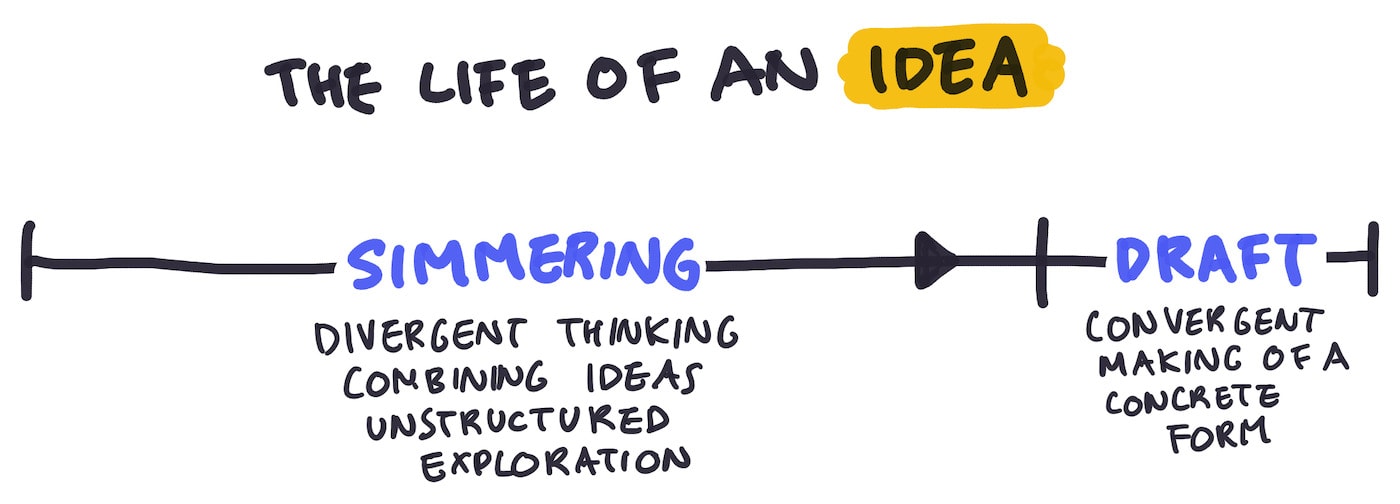
As I’ve improved my writing, I’ve noticed that there are two distinct phases to my writing process. Long before I start typing any words, someone or something plants a seed of an idea in my mind. Sometimes it’s from a conversation, sometimes it’s from a blog or a book, or occasionally from personal experience. Once the idea lands in my mind, it simmers. A seed of an idea isn’t mature enough yet to be committed into a real form, but collides and merges with other ideas in my mind. The more I can feed the idea with feedback, conversations, and other inspiration, the faster it evolves into something clearer and more definite. All throughout, the idea stays soft and malleable.

At some point, I decide to make something out of it, so I start drafting. It might be a sketch for a drawing or an outline for a blog post, or maybe a wireframe for an app. Once I start giving the idea a form in the real world – start casting the shadow – the idea becomes less malleable. Once I’ve committed to a form, the idea can only shift in the small details, until I’ve drawn and written and designed out all the details, and the idea becomes final. Published. Shipped.

A creative process comes in two parts: the 'simmering' phase, where divergent thinking helps you chew on an idea, and the 'drafting' phase, where you turn the idea into something concrete and material.

The longer I spend with an idea in the simmering phase of my workflow, the more polished the final piece becomes. In other words, the longer I keep the idea in a soft, malleable state in my mind, the more freely it can grow and evolve from new information. Only when I have a clear image of the idea in my mind’s eye can I begin the process of committing to a form, drafting something real in front of me.

Free-hand drawing is a small model of this process. To draw something free-hand, you need to first visualize what you’ll draw in your mind’s eye. The clearer you can see the image in your mind, the quicker and better you’ll be at reproducing it on paper. It doesn’t make sense to start sketching without a clear image, and then iterate your way to a great final picture – you need to mold a clear mental picture before even creating a sketch of your idea.

And yet, when we work with bigger, more complex ideas, we seem all too eager to jump straight to putting ideas on paper. We’re often too eager to outline, organize, sort, wireframe, storyboard, sketch, and draft out ideas from the beginning, when the idea is just a small malleable seed, with the excuse that we can start iterating faster on the idea if it’s on paper.

But putting a shape to an idea slows down how quickly it can change in your mind. You trade off the malleability of your idea for the permanence of a physical form. Too often, we don’t realize the compromise we’re making. Like clay, when we shine light on an idea to cast its shadow into something physical, it starts to become rigid. You can’t always iterate your way into completely new perspectives.

To invent completely new ideas and tell more original stories, we should spend more time simmering on our ideas in the dark, molding them into a million different shapes, before shining the light and broadcasting what you see out from your mind into the rest of the world. Your creative challenge in this world isn’t to make something out of nothing, as it might first appear. Instead, it’s to sift through the tens of thousands of thoughts you think every day, grow them and care for them in the safety of the darkness. And when you stumble into the clearest ones ready to be pushed out into reality, find the brightest light you can find, and cast a crisp shadow onto your medium of choice, be it stories or essays or pictures or products.

Once your idea finds life in the material world, other people might discover that your idea is just what they needed to feed the ideas simmering in the darkness of their minds. Perhaps they, too, will grow their ideas into fruition, and cast shadows of their own mind-worlds back into your reality.

And the cycle continues.


Thanks to Jacob Cole and Tanthai Pongstien, whose thoughtful conversations with me led to some of the ideas in this post.

25 Jan 04:30

Synology DiskStation DS420+

by Thejesh GN

For a long time, I wanted to set up a NAS at home. A lot of my workflows include local folders between computers on my network. For a while, I entertained the idea of building one myself using my old PC hardware. But I really wanted one on which I won't tinker much1, so it remains stable. Hence buy. It would be my main machine for making continuous local backups and to run some applications.

I did quite a bit of research before I settled on a model. I choose DiskStation DS420+, which are for SOHOs. I based my selection on the following parameters.

Hardware

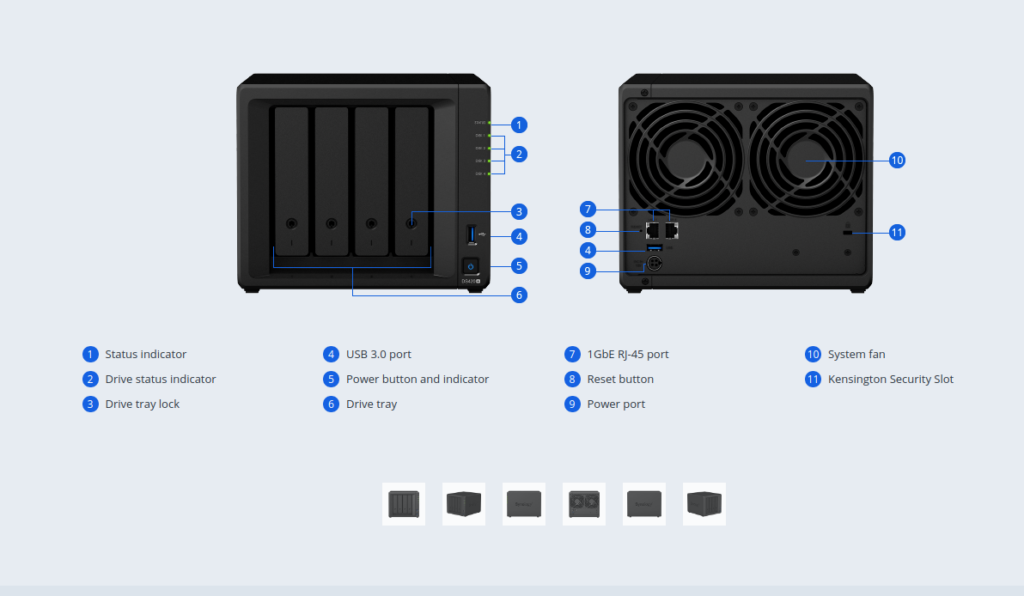
I wanted decent looking hardware that was powerful and fast. I also wanted an option to extend when I required it. So Diskstation DS420+ has Intel Celeron J4025 2-core 2.0 GHz, burst up to 2.9 GHz. Not super powerful, but enough to do the jobs that I want. Since it's dedicated, I can squeeze every cycle out of it. It comes with 2 GB DDR4 RAM. It can take up to 6 GB, which I plan to upgrade sometime in the future based on the performance.


It can take up to 4, 3.5" or 2.5" SATA HDD/SSD hard disks. Currently, I am using two bays with 2TB drives. They are Seagate IronWolf 2 TB NAS Internal Hard Drives. In the future, I plan to use the bigger ones. I don't see the need for more than four drives at this point. Also, disks are hot-swappable. So I can upgrade all four to a bigger size if needed.


Along with these, it can also take two M.2 2280 NVMe SSDs. This adds Cache Acceleration Capability. I am not using any as of now. Suppose I plan to do any read write-intensive jobs. I will use them to increase performance. This is a big option. It comes with 2 USB 3.0 ports. Currently, I am not using it. I have an older 2TB USB hard disk. I might plugin that at some point. But I am not sure.


The weak point is network speed. It has two Gigabit (RJ-45) ports. Together, they can give you 2Gb (link aggregation) worth of throughput, and For NAS of this range, it should have had at least one 10Gb port.
Overall I am quite happy about the hardware.

Software

I wanted something that is easy to use and maintain. Also something that gets regular updates. The Synology comes with DiskStation Manager (DSM). Its quite intuitive and you get a web based access to it. It feels like you are logging into remote desktop computer. Its easy to use.

It also comes with a package manager using which you can install various application. There are quite a few and very useful ones. Some of them come with a partner Android apps too. For example Drive (like google drive), moments (similar to google photoes). So you install the application on the Synology and then install the App on Android. Connect them to work with each other. Both worked flawless.

The other application I installed on DS420+ is docker. This is an UI interface to setup and run docker containers on Synology. Its very useful if you want install something that is not provided as part of Synology packages. The docker application UI is very friendly. Gives easy options to setup network, ports, volumes, system (CPU< RAM) restrictions etc. Of-course there is an option to import and install unofficial Synology packages too. I am not sure who does that when you have docker.

I have a gitea container running on the Synology. I use it as mirror server to mirror all my repos. Indirectly it also works as code backup system.

Homelab

It's part of my homelab. It means it does more than what it is meant for. I plan to use USB ports in creative ways to monitor the APC UPS; it's using power from and some other services. It can also run a lot of software that I was running on the cloud for personal use with docker. It's been a good addition to my Homelab.

I will write more as I find more workflows inside my home network.

  1. So I don't break it :)
The post Synology DiskStation DS420+ first appeared on Thejesh GN.
25 Jan 04:30

Intel Problems

by Ben Thompson

One of the first Articles on Stratechery, written on the occasion of Intel appointing a new CEO, was, in retrospect, overly optimistic. Just look at the title:

The Intel Opportunity

The misplaced optimism is twofold: first there is the fact that eight years later Intel has again appointed a new CEO (Pat Gelsinger), not to replace the one I was writing about (Brian Krzanich), but rather his successor (Bob Swan). Clearly the opportunity was not seized. What is more concerning is that the question is no longer about seizing an opportunity but about survival, and it is the United States that has the most to lose.

Problem One: Mobile

The second reason why that 2013 headline was overly optimistic is that by that point Intel was already in major trouble. The company — contrary to its claims — was too focused on speed and too dismissive of power management to even be in the running for the iPhone CPU, and despite years of trying, couldn’t break into Android either.

The damage this did to the company went deeper than foregone profits; over the last two decades the cost of building ever smaller and more efficient processors has sky-rocketed into the billions of dollars. That means that companies investing in new node sizes must generate commensurately more revenue to pay off their investment. One excellent source of increased revenue for the industry has been billions of smartphones sold over the last decade; Intel, though, hasn’t seen any of that revenue, even as PC sales have flatlined for years.

What has kept the company prospering — when it comes to the level of capital investment necessary to build next-generation fabs, you are either prospering or going bankrupt — has been the explosion in mobile’s counterpart: cloud computing.

Problem Two: Server Success

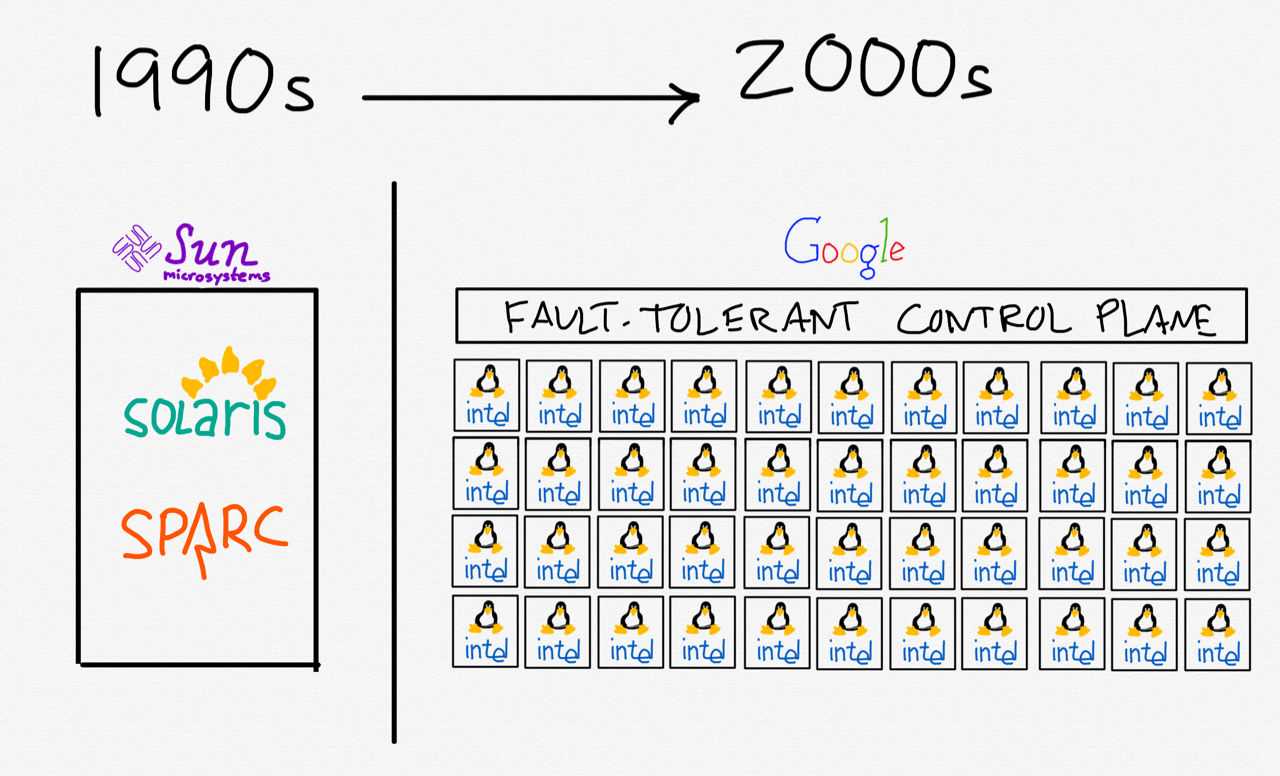
It wasn’t that long ago that Intel was a disruptor; whereas the server space was originally dominated by integrated companies like Sun, with prices to match, the explosion in PC sales meant that Intel was rapidly improving performance even as it reduced price, particularly relative to performance. Sure, PCs didn’t match the reliability of integrated servers, but around the turn of the century Google realized that the scale and complexity entailed in offering its service meant that building a truly reliable stack was impossible; the solution was to build with the assumption of failure, which in turn made it possible to build its data centers on (relatively) cheap x86 processors.

The datacenter transition from proprietary to commodity hardware

Over the following two decades Google’s approach was adopted by every major datacenter operator, and x86 became the default instruction set for servers; Intel was one of the biggest beneficiaries for the straightforward reason that it made the best x86 processors, particularly for server applications. This was both due to Intel’s proprietary designs as well as its superior manufacturing; AMD, Intel’s IBM-mandated competitor, occasionally threatened the incumbent on the desktop, but only on the low end for laptops, and not at all in data centers.

In this way Intel escaped Microsoft’s post-PC fate: Microsoft wasn’t simply shut out of mobile, they were shut out of servers as well, which ran Linux, not Windows. Sure, the company tried to prop up Windows as long as they could, both on the device side (via Office) and on the server side (via Azure); conversely, what has fueled the company’s recent growth has been The End of Windows, as Office has moved to the cloud with endpoints on all devices, and Azure has embraced Linux. In both cases Microsoft had to accept that their differentiation had flipped from owning the API to having the capability to serve their already-existing customers at scale.

The Intel Opportunity that I referenced above would have entailed a similar flip for Intel: whereas the company’s differentiation had long been based on its integration of chip design and manufacturing, mobile meant that x86 was, like Windows, permanently relegated to a minority of the overall computing market. That, though, was the opportunity.

Most chip designers are fabless; they create the design, then hand it off to a foundry. AMD, Nvidia, Qualcomm, MediaTek, Apple — none of them own their own factories. This certainly makes sense: manufacturing semiconductors is perhaps the most capital-intensive industry in the world, and AMD, Qualcomm, et al have been happy to focus on higher margin design work.

Much of that design work, however, has an increasingly commoditized feel to it. After all, nearly all mobile chips are centered on the ARM architecture. For the cost of a license fee, companies, such as Apple, can create their own modifications, and hire a foundry to manufacture the resultant chip. The designs are unique in small ways, but design in mobile will never be dominated by one player the way Intel dominated PCs.

It is manufacturing capability, on the other hand, that is increasingly rare, and thus, increasingly valuable. In fact, today there are only four major foundries: Samsung, GlobalFoundries, Taiwan Semiconductor Manufacturing Company (TSMC), and Intel. Only four companies have the capacity to build the chips that are in every mobile device today, and in everything tomorrow.

Massive demand, limited suppliers, huge barriers to entry. It’s a good time to be a manufacturing company. It is, potentially, a good time to be Intel. After all, of those four companies, the most advanced, by a significant margin, is Intel. The only problem is that Intel sees themselves as a design company, come hell or high water.

My recommendation did not, by the way, entail giving up Intel’s x86 business; I added in a footnote:

Of course they keep the x86 design business, but it’s not their only business, and over time not even their primary business.

In fact, the x86 business proved far too profitable to take such a radical step, which is the exact sort of “problem” that leads to disruption: yes, Intel avoided Microsoft’s fate, but that also means that the company never felt the financial pain necessary to make such a dramatic transformation of its business at a time when it might have made a difference (and, to be fair, Andy Grove needed the memory crash of 1984 to get the company to fully focus on processors in the first place).

Problem Three: Manufacturing

Meanwhile, over the last decade the modular-focused TSMC, fueled by the massive volumes that came from mobile and a willingness to work with — and thus share profits with — best of breed suppliers like ASML, surpassed Intel’s manufacturing capabilities.

This threatens Intel on multiple fronts:

  • Intel has already lost Apple’s Mac business thanks in part to the outstanding performance of the latter’s M1 chip. It is important to note, though, that while some measure of that performance is due to Apple’s design chops, the fact that it is manufactured on TSMC’s 5nm process is an important factor as well.
  • In a similar vein, AMD chips are now faster than Intel on the desktop, and extremely competitive in the data center. Again, part of AMD’s improvement is due to better designs, but just as important is the fact that AMD is manufacturing chips on TSMC’s 7nm process.
  • Large cloud providers are increasingly investing in their own chip designs; Amazon, for example, is on the second iteration of their Graviton ARM-based processor, which Twitter’s timeline will run on. Part of Graviton’s advantage is its design, but part of it is — you know what’s coming! — the fact that it is manufactured by TSMC, also on its 7nm process (which is competitive with Intel’s finally-launched 10nm process).

In short, Intel is losing share in PCs, even as it is threatened by AMD for x86 servers in the datacenter, and even as cloud companies like Amazon integrated backwards into the processor; I haven’t even touched on the increase in other specialized datacenter operations like GPU-based applications for machine learning, which are designed by companies like Nvidia and manufactured by Samsung.

What makes this situation so dangerous for Intel is the volume issue I noted above: the company already missed mobile, and while server chips provided the growth the company needed to invest in manufacturing over the last decade, the company can’t afford to lose volume at the very moment it needs to invest more than ever.

Problem Four: TSMC

Unfortunately, this isn’t even the worst of it. The day after Intel named its new CEO TSMC announced its earnings and, more importantly, its Capex guidance for 2021; from Bloomberg:

Taiwan Semiconductor Manufacturing Co. triggered a global chip stock rally after outlining plans to pour as much as $28 billion into capital spending this year, a staggering sum aimed at expanding its technological lead and constructing a plant in Arizona to serve key American customers.

This is a staggering amount of money that is only going to increase TSMC’s lead.

The envisioned spending spree sent chipmaking gear manufacturers surging from New York to Tokyo. Capital spending for 2021 is targeted at $25 billion to $28 billion, compared with $17.2 billion the previous year. About 80% of the outlay will be devoted to advanced processor technologies, suggesting TSMC anticipates a surge in business for cutting-edge chipmaking. Analysts expect Intel Corp., the world’s best-known chipmaker, to outsource manufacture to the likes of TSMC after a series of inhouse technology slip-ups.

That’s right: Intel likely has, at least for now, given up on process leadership. The company will keep its design-based margins and foreclose the AMD threat by outsourcing cutting edge chip production to TSMC, but that will only increase TSMC’s lead, and does nothing to address Intel’s other vulnerabilities.

Problem Five: Geopolitics

Intel’s vulnerabilities aren’t the only ones to be concerned about; I wrote last year about Chips and Geopolitics:

The international status of Taiwan is, as they say, complicated. So, for that matter, are U.S.-China relations. These two things can and do overlap to make entirely new, even more complicated complications.

Geography is much more straightforward:

A map of the Pacific

Taiwan, you will note, is just off the coast of China. South Korea, home to Samsung, which also makes the highest end chips, although mostly for its own use, is just as close. The United States, meanwhile, is on the other side of the Pacific Ocean. There are advanced foundries in Oregon, New Mexico, and Arizona, but they are operated by Intel, and Intel makes chips for its own integrated use cases only.

The reason this matters is because chips matter for many use cases outside of PCs and servers — Intel’s focus — which is to say that TSMC matters. Nearly every piece of equipment these days, military or otherwise, has a processor inside. Some of these don’t require particularly high performance, and can be manufactured by fabs built years ago all over the U.S. and across the world; others, though, require the most advanced processes, which means they must be manufactured in Taiwan by TSMC.

This is a big problem if you are a U.S. military planner. Your job is not to figure out if there will ever be a war between the U.S. and China, but to plan for an eventuality you hope never occurs. And in that planning the fact that TSMC’s foundries — and Samsung’s — are within easy reach of Chinese missiles is a major issue.

The context of that article was TSMC’s announcement that it would (eventually) open a 5nm fab in Arizona; yes, that is cutting edge today, but it won’t be in 2024, when the fab opens. Still, it will almost certainly be the most advanced fab in the U.S. focused on contract manufacturing; Intel will, hopefully, have surpassed that fab’s capabilities by the time it opens.

Note, though, that what matters to the United States is different than what matters to Intel: while the latter cares about x86, the U.S. needs cutting-edge general purpose fabs on U.S. soil. To put it another way, Intel will always prioritize design, while the U.S. needs to prioritize manufacturing.

This, by the way, is why I am more skeptical today than I was in 2013 about Intel manufacturing for others. The company may be financially compelled to do so to get the volume it needs to pay back its investments, but the company will always put its own designs at the front of the line.

Solution One: Breakup

This is why Intel needs to be split in two. Yes, integrating design and manufacturing was the foundation of Intel’s moat for decades, but that integration has become a strait-jacket for both sides of the business. Intel’s designs are held back by the company’s struggles in manufacturing, while its manufacturing has an incentive problem.

The key thing to understand about chips is that design has much higher margins; Nvidia, for example, has gross margins between 60~65%, while TSMC, which makes Nvidia’s chips, has gross margins closer to 50%. Intel has, as I noted above, traditionally had margins closer to Nvidia, thanks to its integration, which is why Intel’s own chips will always be a priority for its manufacturing arm. That will mean worse service for prospective customers, and less willingness to change its manufacturing approach to both accommodate customers and incorporate best-of-breed suppliers (lowering margins even further). There is also the matter of trust: would companies that compete with Intel be willing to share their designs with their competitor, particularly if that competitor is incentivized to prioritize its own business?

The only way to fix this incentive problem is to spin off Intel’s manufacturing business. Yes, it will take time to build out the customer service components necessary to work with third parties, not to mention the huge library of IP building blocks that make working with a company like TSMC (relatively) easy. But a standalone manufacturing business will have the most powerful incentive possible to make this transformation happen: the need to survive.

Solution Two: Subsidies

This also opens the door for the U.S. to start pumping money into the sector. Right now it makes no sense for the U.S. to subsidize Intel; the company doesn’t actually build what the U.S. needs, and the company clearly has culture and management issues that won’t be fixed with money for nothing.

That is why a federal subsidy program should operate as a purchase guarantee: the U.S. will buy A amount of U.S.-produced 5nm processors for B price; C amount of U.S. produced 3nm processors for D price; E amount of U.S. produced 2nm processors for F price; etc. This will not only give the new Intel manufacturing spin-off something to strive for, but also incentivize other companies to invest; perhaps Global Foundries will get back in the game,1 or TSMC will build more fabs in the U.S. And, in a world of nearly free capital, perhaps there will finally be a startup willing to take the leap.

This prescription over-simplifies the problem, to be sure; there is a lot that goes into chip manufacturing beyond silicon. Packaging, for example, which long ago moved overseas in the pursuit of lower labor costs, is now fully automated; incentives to move that back may be more straightforward. What is critical to understand, though, is that regaining U.S. competitiveness, much less leadership, will take many years; the federal government has a role, but so does Intel, not by seizing its opportunity, but by accepting the reality that its integrated model is finished.

I wrote a follow-up to this article in this Daily Update.

  1. Global Foundries is AMD’s former manufacturing arm; they bowed out of the cutting edge race at 10nm
25 Jan 04:29

Intel Problems

by Rui Carmo

I don’t agree with all of it (I’m more focused on the competition, lack of innovation and ability to deliver against them), but this makes for a decent overview of Intel’s current woes.


25 Jan 04:27

Maps and cameras are neglected app runtimes

After last week’s post about QR codes in books to make it easy to follow links, there was a common response: Shouldn’t smartphone cameras just read the link? Optical character recognition is, at this point, ancient tech.

It’s true.

Cameras

Smartphone cameras are far too dumb (by which I mean the live preview screen, before you take a shot). The camera view should have little recognisers which allow for tapping on web addresses, and email addresses, and whatever, opening the appropriate app.

The camera view should pick up not just QR codes and web addresses but all kinds of text. Clearly I should be able to hold my camera over a printed letter, have a map glyph pop up by the address, and be able to push a “freeze frame” button so I can copy-and-paste the words.

(I know the Android camera does some of this. They’re usually ahead with this kind of stuff. It should do more, and closer to the surface, is what I’m saying.)

Going further. In-view camera functionality should be user-installable. Recognise the prefix on a particular QR code, and a mini app interface pops up. Imagine how useful this would be for taking inventory or machine maintenance: show the barcode sticker to the camera, and see when this parcel is due to be picked up, or the maintenance schedule of this particular bit of kit, right in the camera, and so on.

(If there’s available functionality for which I don’t have the app, the object or the fiducial marker should glow – we already have that visual language from video games.)

Or, come on, let’s be wild, I should be able to buy virtual fashion to wear in my webcam. Filters should be native apps.

Runtimes

A runtime is a place where users interact with their apps, discover new apps, and - ideally - pay for services.

I learnt about the runtime concept from Benedict Evans who used it a lot around 2015/2016. For example:

One of my frameworks for thinking about mobile is that we’re looking for another runtime - somewhere to build experiences on mobile that comes after the web and mobile apps - and that that new runtime will probably comes with new engagement and discovery models and possibly new revenue models too.

– Benedict Evans, Video is the new HTML (2016)

And it’s a powerful concept.

The smartphone, with its app store, is a runtime - but more particularly it’s the home screen which is the runtime. Because that’s what you see when you take your phone out of your pocket.

But what if the phone opened to the camera view? It often does, for me. The camera button is right there. I don’t even need to unlock.

So the camera is a neglected runtime. The camera view should have an App Store.

Another neglected runtime is maps.

Maps

I would love to know how frequently I pop open maps as the immediate first app when I unlock my phone. I bet it’s a whole bunch.

I should be able to open my maps app in a car park, have it centred on my immediate location, and see the ticket machine located on the map. Tapping it, the parking app should launch - and I mean the micro version of the app, just the functionality I need, right there inside the app.

Let’s take this indoors. The maps app might hold theatre tickets at the theatre, the Sonos interface in my home (or someone else’s), or the meeting room booking system at work. I shouldn’t need to install those apps, I’m right there.

I should be able to install custom routing tools. (For example: did you know that Beeline has built a custom routing algorithm for safer city cycling? That should be user-installable.)

If I have a Uber Eats account, I should see Uber Eats locations on the map – with menus and payment one tap away. Or an Airbnb layer, if I’m arriving into a new city, in the frankly unbelievable scenario that I’m ever more than half a mile from my home ever again.

Cameras and maps are special

Not everything can be a runtime.

A runtime needs space for interaction, but it also needs discovery. So I’m intrigued about the idea of AirPods as a runtime - I would love programmable hearing - but I can’t see how I would discover new user-installable functionality while I was walking down the street. Apps whispering in my ear? I don’t think so. Likewise with Zoom: great idea to have apps running inside the video, adding functionality to my meetings, but can I imagine app advert pop-ups during a work call, offering to transcribe the task list? No.

Smart speakers don’t quite make the cut, for me. There’s no native way to learn about and install new apps. And messaging apps could have been runtimes. Facebook and Apple have both given it a good go. But it turns out that the discovery mechanism was group conversations, and it wasn’t powerful enough. Good on them for giving it a try.

But the default smartphone live camera view, and the map view – these should have app stores.

My speculation, and this is just a speculation, is that everyone is keeping their powder dry for smart glasses and augmented reality.

25 Jan 04:26

First Day of the Rest of Our Lives

by Ms. Jen
Today at 11:49 am Eastern Standard Time, I sang the Doxology to myself. Then I sang Amazing Grace along with everyone else as I watched the last part of the Biden/Harris Inauguration on my tablet and delighted in Ms. Gorman’s poem. The two hours...
25 Jan 04:24

Core competencies in DEI: meet people where they are at and help them move to be more inclusive (Part 3 of 5)

by Tara Robertson
2 blank speech bubbles on a pink background
Photo by Miguel Á. Padriñán from Pexels

This is the third post in a week-long series exploring DEI professional competencies. I believe the five key competencies for DEI professionals are:

  1. be strategic
  2. translate academic research into action and measure the impact of initiatives
  3. meet people where they are at and help them move to be more inclusive 
  4. influence others
  5. get cross functional projects done. 

Yesterday I described how a DEI professional needs to be able to translate academic research into action as well as be able to measure the impact of programs. Today I’ll talk about meeting people where they’re at and helping them move to be more inclusive

For me, doing this work in a professional context means meeting people where they’re at and helping them move to where they need to be. Building trust with leaders is key to being successful in this line of work. When leaders are vulnerable and honest with you about their process of unpacking their own biases or learning about inclusion you can be a trusted partner to help them move forward on their journey. 

I loved working with senior leaders who invited feedback on how they were showing up. I supported a manager in levelling up his knowledge of gender, so that he could continue to foster an inclusive environment. I encouraged several executives to share a bit more about who they are and their fears and vulnerabilities to come off as more human and so that staff would share their fears with them. Trust allows for an authentic relationship where we can do hard and necessary things together.

I had a lot of 1:1 conversations with people at all levels of the organization about the intent of their actions and the actual impact on people. The key to having these conversations well is to be able to offer clear and direct feedback with empathy. Kim Scott’s book Radical Candor offers a great framework for this. 

tattoo of a lit match on the inside of my forearm

Looking back to when I was an activist in my 20s I was extremely self-righteous about my politics and very judgemental about where other people were at. There’s no way I would’ve been able to be effective in this work with that mindset. This tattoo on my left forearm has a few meanings for me. One is to remind me of when I was younger and wanted to burn down oppressive systems and as a reminder to meet people who are in that place with patience and empathy so we can build together. 

This is the third in a series of five posts. Tomorrow’s post will address influencing others as a core competency for DEI leaders. 

The post Core competencies in DEI: meet people where they are at and help them move to be more inclusive (Part 3 of 5) appeared first on Tara Robertson Consulting.

25 Jan 04:17

Stats 101: A slowing rate of change is not a real loss

by Gordon Price

If you saw this headline in the Daily Hive, what would you conclude?

Might you think that Canada’s big cities have seen a drop in their populations?  Easy conclusion, but wrong. 

That is not what this Stats Canada report says, as should be evident in the headline:

Not only is population increasing in the big CMAs (Census Metropolitan Areas), though not as fast as a year earlier, but they’re still growing faster than small urban centres – the opposite of what the article in the Hive implies in sentences like this.

Toronto, Montreal, and Vancouver continued to see more people moving out to other regions of their province rather than moving in.

During this one-year period, Toronto saw 50,375 people leave, while Montreal saw 24,880 people leave — a record loss for both cities.

There’s now a meme that cities like Vancouver are being deserted by Covid-fearing residents for small towns.  And there’s a modest indication of something like that happening: more people moving out to surrounding CMAs of the big three cities than those moving in from nearby.  But those are still relatively low numbers, more than offset by the international immigration that constitutes 90 percent of population growth in big CMAs.

The important story is actually the increase in ongoing urban sprawl accentuated by the shift to those smaller regions, which will also likely see marked increased in traffic congestion since their urban form is more car dependent.  Meanwhile, the big CMAs may seem some relief in the upward pressure on housing costs and traffic growth.  But that doesn’t fit the meme.


25 Jan 04:17

How to ignore the police while promoting safety

by Gordon Price

Council will soon be debating a motion from Green Party Councillor Michael Wiebe for A Community Safety and Well-being Framework.

Its aim:

…. to provide strategic direction for working together with community and key stakeholders to make the best use of available resources to enhance community safety and well-being across broad and critical priority areas, such as personal health, social development, safe public spaces, homes and amenities, crime prevention and reduction, transportation safety, climate safety and emergency management.

I remember motions like that when I was on Council (in fact, I moved some of them).  They’re so broadly worded and well-meaning that it looks, at first glance, difficult to vote against.  Hence the need to be cautious.  What, you will want to know, are the unstated implications?.

From a staff point-of-view, the reaction is likely to be ‘Oh gawd, another of those time-filling, resource-eating, mind-numbing requests that hopefully will go nowhere – unless, of course, it can be used to increase our budget.”

From senior government’s point-of-view, it might look to be an opportunity to download some responsibilities for open-ended social programs in health and welfare otherwise out of the city’s jurisdiction.  ‘You want to take on mental health in the name of crime prevention?  Please do – here’s a program or two to fund.’

From the point-of-view of community activists, it’s another opportunity to control the agenda, especially when you’re being given special mention:

The framework’s development and implementation should be reflective of the community and include multi-sectoral representation and engage people with lived experience and knowledge responding to the diverse needs of community members..

From the point-of-view of those whose responsibility it is already for community safety – like, say, the police department – they will check the motion to see if there’s any mention of those on the front line and how they will be involved.  And in this case, sure enough, not a word.

Oh wait, there is one mention of the police:

According to a Vancouver Police Department report in October 2020, crime rose in the following categories in 2020 compared to 2019:

• The number of homicides increased: 14 in 2020 vs. 9 in 2019.
• Serious assaults, which includes assault with a weapon, assault
causing bodily harm and aggravated assault, are up by 14%.
• Intimate partner violence is 4.6% higher than 2019.
• Anti-Asian hate crime incidents increased by 138%.
• Break-and-enters to businesses increased by 18%.
• Arson incidents increased by 39%.
• Assaults against police officers have gone up 47%.

Note those categories that saw the largest increases in crime rates:

  • No. 1: anti-Asian hate crime incidents – up 138%
  • No. 2: assaults again police officers – up 47%
  • No. 3: arson incidents – up 39%

One has to be cautious with these kind of stats: what was the base from which the increase occurred, and what’s the definition of ‘incident’ and ‘assault’?  Nonetheless, when there are assaults of any kind against those whose responsibility is community safety, and whose effectiveness is based on trust and respect, there’s an issue here.  But in era of ‘defund the police’, it’s not likely to result in increased resources for the safety of those whose first responsibility is the safety of us.

Or possibly I misjudge.  Perhaps in the upcoming debate, there will be a recognition of the police’s role, that councilors will state publicly their respect and support for those accountable for community safety, that they want the police officers’ input in this process, at least in equal measure with those with lived experience.

Because one thing I did learn in office: when it comes to considering council priorities, ‘peace and order’ is the most important lived experience for most of the public most of the time.


25 Jan 04:01

The Best Stereo Receiver

by Brent Butterworth
The Best Stereo Receiver

If you’re looking for a simple, affordable option to get excellent stereo sound, the Sony STR-DH190 is your best choice in a stereo receiver. It has the essential features most listeners want, including Bluetooth and a phono input for a turntable, and it’s easy to set up and use. Our listening tests show that you’d have to spend more than twice as much to get better sound quality.

Dismiss
24 Jan 16:23

novelWriter

by Rui Carmo

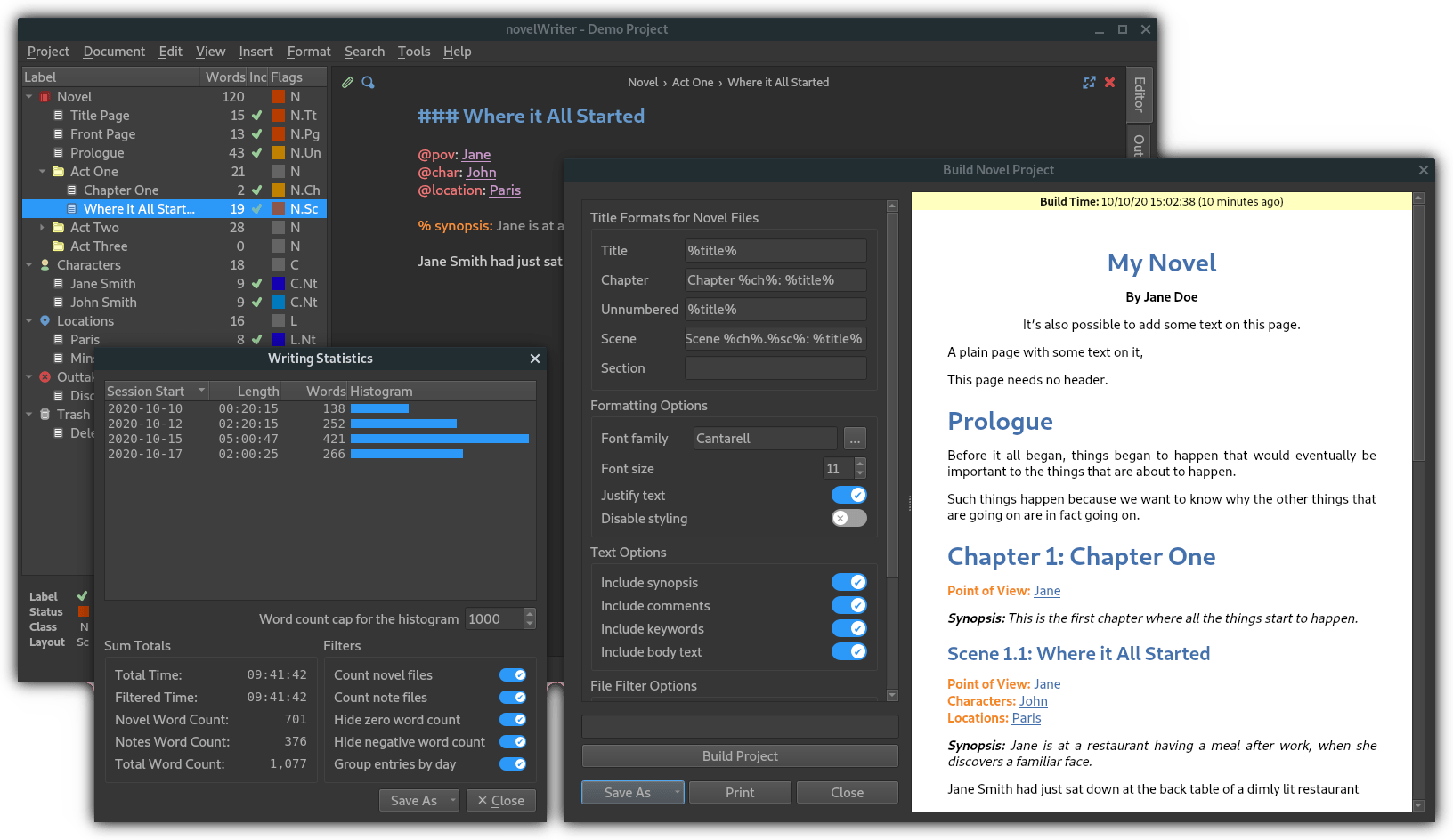
novelWriter is a markdown-like, cross-platform text editor designed for writing novels and larger projects of many smaller plain text documents.

Screenshot


24 Jan 16:18

Intel Problems

by Rui Carmo

I don’t agree with all of it (I’m more focused on the competition, lack of innovation and ability to deliver against them), but this makes for a decent overview of Intel’s current woes.


21 Jan 03:12

Toward new kinds of leverage

by Doc Searls

“Give me a lever long enough and a fulcrum on which to place it, and I shall move the world,” Archimedes is said to have said.

For almost all of the last four years, Donald Trump was one hell of an Archimedes. With the U.S. presidency as his lever and Twitter as his fulcrum, the 45th President leveraged an endless stream of news-making utterances into a massive following and near-absolute domination of news coverage, worldwide. It was an amazing show, the like of which we may never see again.

Big as it was, that show ended on January 8, when Twitter terminated the @RealDonaldTrump account. Almost immediately after that, Trump was “de-platformed” from all these other services as well: PayPal, Reddit, Shopify, Snapchat, Discord, Amazon, Twitch, Facebook, TikTok, Google, Apple, Twitter, YouTube and Instagram. That’s a lot of fulcrums to lose.

What makes them fulcrums is their size. All are big, and all are centralized: run by one company. As members, users and customers of these centralized services, we are also at their mercy: no less vulnerable to termination than Trump.

So here is an interesting question: What if Trump had his own fulcrum from the start? For example, say he took one of the many Trump domains he probably owns (or should have bothered to own, long ago), and made it a blog where he said all the same things he tweeted, and that site had the same many dozens of millions of followers today? Would it still be alive?

I’m not sure it would. Because, even though the base protocols of the Internet and the Web are peer-to-peer and end-to-end, all of us are dependent on services above those protocols, and at the mercy of those services’ owners.

That to me is the biggest lesson the de-platforming of Donald Trump has for the rest of us. We can talk “de-centralization” and “distribution” and “democratization” along with peer-to-peer and end-to-end, but we are still at the mercy of giants.

Yes, there are work-arounds. The parler.com website, de-platformed along with Trump, is back up and, according to @VickerySec (Chris Vickery), “routing 100% of its user traffic through servers located within the Russian Federation.” Adds @AdamSculthorpe, “With a DDos-Guard IP, exactly as I predicted the day it went offline. DDoS Guard is the Russian equivalent of CloudFlare, and runs many shady sites. RiTM (Russia in the middle) is one way to think about it.” Encrypted services such as Signal and Telegram also provide ways for people to talk and be social. But those are also platforms, and we are at their mercy too.

I bring all this up as a way of thinking out loud toward the talk I’ll be giving in a few hours (also see here), on the topic “Centralized vs. Decentralized.” Here’s the intro:

Centralised thinking is easy. Control sits on one place, everything comes home, there is a hub, the corporate office is where all the decisions are made and it is a power game.

Decentralised thinking is complex. TCP/IP and HTTP created a fully decentralised fabric for packet communication. No-one is in control. It is beautiful. Web3 decentralised ideology goes much further but we continually run into conflicts. We need to measure, we need to report, we need to justify, we need to find a model and due to regulation and law, there are liabilities.

However, we have to be doing both. We have to centralise some aspects and at the same time decentralise others. Whilst we hang onto an advertising model that provides services for free we have to have a centralised business model. Apple with its new OS is trying to break the tracking model and in doing so could free us from the barter of free, is that the plan which has nothing to do with privacy or are the ultimate control freaks. But the new distributed model means more risks fall on the creators as the aggregators control the channels and access to a model. Is our love for free preventing us from seeing the value in truly distributed or are those who need control creating artefacts that keep us from achieving our dreams? Is distributed even possible with liability laws and a need to justify what we did to add value today?

So here is what I think I’ll say.

First, we need to respect the decentralized nature of humanity. All of us are different, by design. We look, sound, think and feel different, as separate human beings. As I say in How we save the world, “no being is more smart, resourceful or original than a human one. Again, by design. Even identical twins, with identical DNA from a single sperm+egg, can be as different as two primary colors. (Examples: Laverne Cox and M.LamarNicole and Jonas Maines.)”

This simple fact of our distributed souls and talents has had scant respect from the centralized systems of the digital world, which would rather lead than follow us, and rather guess about us than understand us. That’s partly because too many of them have become dependent on surveillance-based personalized advertising (which is awful in ways I’ve detailed in 136 posts, essays and articles compiled here). But it’s mostly because they’re centralized and can’t think or work outside their very old and square boxes.

Second, advertising, subscriptions and donations through the likes of (again, centralized) Patreon aren’t the only possible ways to support a site or a service. Those are industrial age conventions leveraged in the early decades of the digital age. There are other approaches we can implement as well, now that the pendulum is started to swing back from the centralized extreme. For example, the fully decentralized EmanciPay. A bunch of us came up with that one at ProjectVRM way back in 2009. What makes it decentralized is that the choice of what to pay, and how, is up to the customer. (No, it doesn’t have to be scary.) Which brings me to—

Third, we need to start thinking about solving business problems, market problems, technical problems, from our side. Here is how Customer Commons puts it:

There is … no shortage of of business problems that can only be solved from the customer’s side. Here are a few examples :

  1. Identity. Logins and passwords are burdensome leftovers from the last millennium. There should be (and already are) better ways to identify ourselves, and to reveal to others only what we need them to know. Working on this challenge is the SSI—Self-Sovereign Identity—movement. The solution here for individuals is tools of their own that scale.
  2. Subscriptions. Nearly all subscriptions are pains in the butt. “Deals” can be deceiving, full of conditions and changes that come without warning. New customers often get better deals than loyal customers. And there are no standard ways for customers to keep track of when subscriptions run out, need renewal, or change. The only way this can be normalized is from the customers’ side.
  3. Terms and conditions. In the world today, nearly all of these are ones companies proffer; and we have little or no choice about agreeing to them. Worse, in nearly all cases, the record of agreement is on the company’s side. Oh, and since the GDPR came along in Europe and the CCPA in California, entering a website has turned into an ordeal typically requiring “consent” to privacy violations the laws were meant to stop. Or worse, agreeing that a site or a service provider spying on us is a “legitimate interest.”
  4. Payments. For demand and supply to be truly balanced, and for customers to operate at full agency in an open marketplace (which the Internet was designed to be), customers should have their own pricing gun: a way to signal—and actually pay willing sellers—as much as they like, however they like, for whatever they like, on their own terms. There is already a design for that, called Emancipay.
  5. Internet of Things. What we have so far are the Apple of things, the Amazon of things, the Google of things, the Samsung of things, the Sonos of things, and so on—all silo’d in separate systems we don’t control. Things we own on the Internet should be our things. We should be able to control them, as independent customers, as we do with our computers and mobile devices. (Also, by the way, things don’t need to be intelligent or connected to belong to the Internet of Things. They can be, or have, picos.)
  6. Loyalty. All loyalty programs are gimmicks, and coercive. True loyalty is worth far more to companies than the coerced kind, and only customers are in position to truly and fully express it. We should have our own loyalty programs, to which companies are members, rather than the reverse.
  7. Privacy. We’ve had privacy tech in the physical world since the inventions of clothing, shelter, locks, doors, shades, shutters, and other ways to limit what others can see or hear—and to signal to others what’s okay and what’s not. Instead, all we have are unenforced promises by others not to watching our naked selves, or to report what they see to others. Or worse, coerced urgings to “accept” spying on us and distributing harvested information about us to parties unknown, with no record of what we’ve agreed to.
  8. Customer service. There are no standard ways to call for service yet, or to get it. And there should be.
  9. Advertising. Our main problem with advertising today is tracking, which is failing because it doesn’t work. (Some history: ad blocking has been around since 2004, it took off in 2013, when the advertising and publishing industries gave the middle finger to Do Not Track, which was never more than a polite request in one’s browser not to be tracked off a site. By 2015, ad blocking alone was the biggest boycott i world history. And in 2018 and 2019 we got the GDPR and the CCPA, two laws meant to thwart tracking and unwanted data collection, and which likely wouldn’t have happened if we hadn’t been given that finger.) We can solve that problem from the customer side with intentcasting,. This is where we advertise to the marketplace what we want, without risk that our personal data won’t me misused. (Here is a list of intentcasting providers on the ProjectVRM Development Work list.)

We already have examples of personal solutions working at scale: the Internet, the Web, email and telephony. Each provides single, simple and standards-based ways any of us can scale how we deal with others—across countless companies, organizations and services. And they work for those companies as well.

Other solutions, however, are missing—such as ones that solve the eight problems listed above.

They’re missing for the best of all possible reasons: it’s still early. Digital living is still new—decades old at most. And it’s sure to persist for many decades, centuries or millennia to come.

They’re also missing because businesses typically think all solutions to business problems are ones for them. Thinking about customers solving business problems is outside that box.

But much work is already happening outside that box. And there already exist standards and code for building many customer-side solutions to problems shared with businesses. Yes, there are not yet as many or as good as we need; but there are enough to get started.

A lot of levers there.

For those of you attending this event, I’ll talk with you shortly. For the rest of you, I’ll let you know how it goes.

21 Jan 03:10

Preview: The SQLite Llibrary as a .NET assembly

The latest pre-release of SQLitePCLRaw contains a new bundle package called SQLitePCLRaw.bundle_cil. This package is like SQLitePCLRaw's other "bundle" packages except that it involves no P/Invoke and no platform-specific shared libraries. Instead, bundle_cil provides the SQLite library as a pure .NET assembly which was compiled by Llama.

What is Llama?

  • A toolchain for compiling "other languages" for .NET

  • My side project

Llama includes a compiler that translates LLVM bitcode into CIL (Common Intermediate Language), aka MSIL, aka the instruction set of .NET assemblies.

For a bit more info on Llama, see my other blog posts.

How was this CIL build of SQLite made?

I compiled sqlite3.c with clang, just as one normally would, except I added the -emit-llvm flag to make it generate bitcode instead of the usual .o/.obj file.

Then I run Llama's compiler on sqlite3.bc, which results in sqlite3.dll, a .NET assembly. I also needed to provide various dependencies (handwave, handwave).

So will this new bundle be part of SQLitePCLRaw 2.0.5?

Sorry, no, Llama isn't "ready" yet. I've included bundle_cil in this 2.0.5 pre-release so folks can see my progress, but it will be excluded when I release 2.0.5 final. Hopefully bundle_cil will graduate later.

What is the status of this then?

Llama is still at "proof of concept" stage. Lots of things are broken or incomplete.

And how is that "proof of concept" going?

Quite well. The reason for this pre-release and blog entry is that Llama just passed a big milestone:

The CIL build of SQLite now passes all of the following:

  • the test cases for SQLitePCLRaw

  • the 600+ test cases for Microsoft.Data.Sqlite

  • the 22,000+ SQLite test cases for Entity Framework Core (in EFCore.Sqlite.FunctionalTests)

... on Windows. On Linux, things are close but not quite there yet. I haven't tried on Mac yet.

What versions of .NET does Llama support?

Currently, Llama only works with .NET 5.0.

How is the performance of Llama-compiled code?

I haven't done any actual benchmarks. I assume that things are at least a little bit slower. I see lots of places where I know I could improve performance. I believe that Llama-compiled code will (eventually) be competitive on performance, but I currently have no evidence or measurements to support that belief.

How was the CIL build of SQLite integrated with SQLitePCLRaw?

SQLitePCLRaw uses an architecture wherein the details of the integration with the native SQLite library are encapsulated inside a "provider".

For the CIL build of SQLite, I added a new provider. It simply calls stuff in the sqlite3.dll assembly instead of using P/Invoke.

Nothing in SQLitePCLRaw above the provider API boundary had to be changed, so bundle_cil can be a drop-in replacement for bundle_e_sqlite3.

Will Llama work for other libraries in C besides SQLite?

That is certainly the goal.

In some ways, SQLite is much easier than other libraries. It is an incredibly high quality project and it is very cross-platform.

Also, SQLite is provided as an "amalgamation", a single C source file that contains the entire library. In this case, the easiest build system is no build system at all. As I've explored building other C-language projects with Llama, getting their build system to create an LLVM bitcode file is one of the trickiest parts.

OTOH, SQLite offers its own challenges. It has minimal dependencies, but those do include some very tricky things such as shared memory, thread synchronization primitives, and file locking.

So is Llama just for C code?

No, I hope to get Llama working for several other languages which have LLVM-based compilers. Llama's support for Rust is actually a bit further along than C. I am eager to try and get Llama working with Swift.

Why is it called bundle_cil?

I don't like the name, but I haven't thought of anything better yet.

How do I try it?

If you are using SQLitePCLRaw or some other wrapped that is built on same (such as sqlite-net or Microsoft.Data.Sqlite or Entity Framework Core), you just need to replace your bundle_e_sqlite3 package reference with bundle_cil, and set the version to the pre-release:

    <PackageReference Include="SQLitePCLRaw.bundle_cil" Version="2.0.5-pre20210119130047" />

If you do give this a try, please let me know how it goes.

21 Jan 03:10

Amazon to open new facilities in Quebec creating over 1,000 jobs

by Dean Daley
Amazon

Amazon has announced an investment in Quebec with new sortation centres and three delivery stations in the province.

These five facilities together will offer more than 1,000 jobs with “competitive pay, industry-leading benefits and career growth opportunities starting on day one,” says Amazon.

Amazon will open its largest sortation centre in Couteau-du-Lac in 2021, making a 520,000 square-foot facility, creating at least 500 jobs. The first sortation centre already launched in Longueuil in 2020. It created 500 jobs and a 200,000 square foot facility at 5799 Route de l’Aéroport.

Additionally, Amazon’s delivery stations in Quebec are to open in 2021, and the third opening in 2022. The first one will be located in Laval at 5555 Ernest-Cormier, and the other will be in Lachine at 1100 and 1200 Rue Norman. The third delivery station will be located in Laval at 2700 Francis Hughes. Together these will add hundreds of full-time and part-time jobs.

Amazon already opened its first delivery facility in Lachine, Quebec, in July 2020, which Amazon says created 300 full-time jobs.

Packages travel from Amazon fulfillment and sortation centres to delivery stations, which then load packages onto vehicles for delivery to customers.

For those who want more information about Quebec’s job openings, visit www.amazondelivers.jobs.

It’s worth noting that during the COVID-19 outbreak Amazon says that it put new health measures in place in its warehouses related to the COVID-19 outbreak, including staggering start times and lunch breaks at its fulfilment centres across Canada.

However, there have been at least three cases at Amazon warehouses in Canada, and that hiring more workers during the pandemic has been criticized as it becomes increasingly difficult to social distance.

Source: Amazon

The post Amazon to open new facilities in Quebec creating over 1,000 jobs appeared first on MobileSyrup.

21 Jan 03:10

Some M1 Mac users are experiencing a screensaver bug that locks the computers

by Patrick O'Rourke
M1 Mac mini, MacBook Pro and MacBook Air

Reports have started to emerge that some M1 Mac users are experiencing a strange issue that makes a screensaver randomly appear and take over the entire computer’s display — even if you’ve never set one up.

While MacRumors was the first publication to report on the issue following posts to its forums, there are also reports on Reddit and Apple’s support forums. The glitch seems to primarily affect the M1 MacBook Air, MacBook Pro and Mac mini.

Has anyone ever seen this? It just recently appeared on my secondary account on my new m1 pro. I can’t exit it unless I switch back to primary account and back to secondary account. from r/MacOS


Strangely, there’s even one user that has encountered the problem with the 16-inch MacBook Pro, which features an Intel processor. This indicates that there’s a possibility the source of the screensaver bug could be macOS and not Apple’s M1 chip.

MacRumors forum member ‘dawideksl’ shared a video of the glitch on YouTube.

While my experience with Apple’s M1 MacBook hasn’t been perfect, I haven’t encountered this particular issue. If you do run into the permanent screensaver, closing the lid of your MacBook and re-opening it should solve the problem. If you have a Mac mini things get a little more complicated.

MacRumors also reports that if your Mac has two profiles, disabling fast profile switching in the ‘System Preferences’ can solve the issue.

Regarding issues I’ve experienced with the M1 MacBook Pro I’ve been using for the last few months, I’m still unable to get my Benq EW3280U 4K HDR monitor to connect to the M1 MacBook Pro at more than 30Hz despite it being capable of 60Hz. This seems to be a somewhat widespread issue with specific 4K monitors, so hopefully, Apple releases a fix soon.

On the plus side, the Bluetooth problems I initially ran into seem to have been fixed though.

Source: Reddit, Apple support forums, MacRumors forums Via: MacRumors

The post Some M1 Mac users are experiencing a screensaver bug that locks the computers appeared first on MobileSyrup.

21 Jan 03:10

Cell phone data indicates Torontonians are finally staying home

by Dean Daley

Torontonians are reportedly finally staying home.

During the COVID-19 press briefing this past Monday, Toronto Medical Officer of Health Dr. Eileen de Villa said the city received some non-identifying smartphone data that showed that more people are staying home.

The data represents the week of January 3rd to 9th and shows that time-at-home measures are at 82 percent, which compares with 87 percent back in March of 2020.

“This suggests that the lockdown from December 26 has had some impact on movement in Toronto,” said de Villa.

Further, Mayor John Tory says he’s requested a more detailed look at mobility data, breaking down days of the week, hours of the day and which part of the city to figure to where and when people are going out instead of staying home. Additionally, he’s added traffic data and plans to share the information openly when it’s available.

“What we hopefully will see, as January unfolds further and the stay-at-home order took hold, that traffic levels will further drop,” said Tory.

This is after news from December indicating that the lockdown measures in Toronto and Peel were ineffective compared to the first wave.

Source: City of Toronto Via: BlogTo

The post Cell phone data indicates Torontonians are finally staying home appeared first on MobileSyrup.

21 Jan 03:09

Google Messages could stop working on uncertified Android phones in March

by Jonathan Lamont

A string of code spotted in a teardown of Google’s most recent Messages app update suggests the company may restrict access to Messages to ‘certified’ Android devices by the end of March 2021.

While it may sound scary, it’s important to note that change — should it come to fruition — likely won’t impact most people. Before we get much further into it, it’s also important to recognize where the information came from: an app teardown. For those unfamiliar with the practice, app teardowns involve taking new app ‘APK’ files and decompiling them to look at the code and see what’s new.

In this case, XDA Developers performed the teardown and found a code string that would display the following warning message: “On March 31, Messages will stop working on uncertified devices, including this one.”

The warning is quite clear, but it also doesn’t appear to be active just yet. Android Police suggests Google has yet to go through with adding a certification requirement to Messages, although this makes it seem like the company intends to soon.

Certification refers to Android devices that ship without Google Mobile Services (GMS), a collection of apps and software that includes things like Gmail, the Google app, Chrome and the Play Store. To get GMS — and, therefore, access to often essential pieces of the Android experience — manufacturers need to pass through a certification process and ship devices with GMS pre-installed.

Both XDA and Android Police point to companies like Huawei as examples of manufacturers with uncertified devices. In Huawei’s case, only newer phones that shipped after the U.S. ban lack certification and GMS.

Messages is among the few Google apps that works with uncertified devices, which is likely because it doesn’t require logging into a Google account. It also relies on SMS and RCS protocols for messaging. XDA says the change is likely because of Messages’ upcoming encryption feature. According to the publication, Google wouldn’t be able to guarantee that an uncertified device isn’t compromised in some way. In other words, the certification requirement will probably be positioned as a way to protect users.

Unfortunately for Messages users with uncertified devices, that likely means you’ll soon be in the market for a new chat app.

Source: XDA Developers Via: Android Police

The post Google Messages could stop working on uncertified Android phones in March appeared first on MobileSyrup.

21 Jan 03:09

Brave rolls out support for decentralized web protocol ‘IPFS’

by Jonathan Lamont
Brave Browser on Android

A new version of Brave browser is rolling out with native support for a decentralized web technology that could significantly impact how the internet functions.

The technology, called ‘InterPlanetary File System,’ or ‘IPFS,’ is an internet transport protocol that promises to improve on the existing (and dominant) HTTP standard. The primary benefits of IPFS over HTTP would be that web content becomes faster to access while also being more resilient to failure or control.

The Verge offers a great short explanation of IPFS: HTTP works by helping web browsers access information on central servers, while IPFS lets web browsers access content spread across several different nodes. TechCrunch offers an excellent overview of how it works, and Vice compares IPFS to downloading something via BitTorrent versus from a central server. Instead of typing in a web address and letting your browser connect to one server with the content, IPFS takes the address and uses the network to find nodes storing the content.

Since data can be distributed across multiple nodes, as well as stored closer to people accessing it, IPFS can help improve speed. Another benefit to IPFS and its distributed approach is that it lowers the server costs for the original publisher of the content. The Verge points out that IPFS has the potential to make web content more resilient to failures, such as server outages, and more resistant to censorship.

IPFS could make it more difficult to censor or control online content

IPFS project lead Molly Mackinlay said IPFS and a decentralized web can help overcome “systemic data censorship.”

“Today, Web users across the world are unable to access restricted content, including, for example, parts of Wikipedia in Thailand, over 100,000 blocked websites in Turkey, and critical access to COVID-19 information in China. Now anyone with an internet connection can access this critical information through IPFS on the Brave browser,” Mackinlay said in a release shared by Brave.

Brave has been an early supporter of IPFS and version 1.19 of the browser will allow users to access IPFS content directly by resolving ‘ipfs://’ URLs. Additionally, users can opt to install a “full IPFS node in one click,” which would make their browser into a node in the peer-to-peer IPFS network.

Brave’s IPFS integration comes at a difficult time for the web, and for the massive tech companies managing huge online platforms. Following the January 6th attack on the U.S. Capitol, Facebook, Twitter and other social media platforms banned former U.S. President Donald Trump. Apple, Google and Amazon also took action against Parler, a social network favoured by right-wing extremists and heavily linked to the Capitol attack. IPFS could make that kind of control more difficult in the future.

For now, however, IPFS remains relatively obscure and it could be some time before bigger players get on board.

Source: Brave Via: The Verge

The post Brave rolls out support for decentralized web protocol ‘IPFS’ appeared first on MobileSyrup.

20 Jan 02:16

Joining Sentry

by Armen Zambrano

I’m happy to announce that at the end of 2020 I joined Sentry.io as their second Developer Productivity engineer \o/

Screenshot from Sentry.io landing page

I’m excited to say that it’s been a great fit and that I can make use of most of the knowledge I’ve gained in the last few years. I like the ambition of the company and that they like to make work fun.

So far, I have been able to help to migrate to Python 3, enabled engineers to bootstrap their Python installation on Big Sur, migrated some CI from Travis to Github actions amongst many other projects.

If you ship software, I highly recommend you trying Sentry as part of your arsenal of tools to track errors and app performance. I used Sentry for many years at Mozilla and it was of great help!

If you are interested in joining Sentry please visit the careers page.

20 Jan 02:15

What won’t happen

by Josh Bernoff

Riots on the National Mall. National Guard troops shooting protestors. Broken windows at the White House. An assassination attempt. Violence at state capitals around the country. Attacks on an American embassy in a foreign country, or an American airbase, or an oil tanker, that require some sort of presidential response. Attacks on health workers at … Continued

The post What won’t happen appeared first on without bullshit.

20 Jan 02:15

Apple’s AirPods Max could suffer from a battery drain issue

by Patrick O'Rourke
AirPods Max

Reports surrounding the AirPods Max suffering from an issue related to battery drain have started to appear on Apple’s Support Forums, Reddit and other platforms.

While instances of the problem all seem to vary slightly, some reports indicate that the pricey headphone’s battery drains from 100 percent to between 1 percent and 0 percent overnight, even when stored in low-power mode in their Smart Case.

There’s a possibility the problem could relate to a recent firmware update given most battery drain reports started appearing after the update was pushed out.

According to 9to5Mac, some AirPods Max owners have found the following solution can potentially fix the problem, at least temporarily:

Restoring the AirPods Max to their default settings
Holding the Digital Crown and turning the headphones off
Turning off automatic Switch
Manually disconnecting the headphones from your device in the Bluetooth settings
Using the AirPods Max with just one device

Though I haven’t run into this exact issue, I have noticed that the AirPods Max rarely disconnect from my Apple devices unless I manually navigate to Bluetooth connection settings. That said, this is likely because I often don’t put them back in their lacklustre Smart Case. Strangely, Apple opted not to include an off switch with the AirPods Max, and instead, the headphones shut off automatically when placed in their wacky-looking case.

With that in mind, I have encountered a problem where the AirPods Max attempt to switch from being connected to the M1 MacBook Pro to the iPhone 12 Pro Max when the smartphone is sitting on my desk. Moving the iPhone 12 Pro Max a few feet away from my desk seems to solve this issue.

While I continue to be impressed with Apple’s high-end over-ear headphones regarding their build and sound quality, they’re undeniably pricey, coming in at an astounding $779.

For more on the AirPods Max, check out my review of the headphones.

Via: 9to5Mac, AppleTips

The post Apple’s AirPods Max could suffer from a battery drain issue appeared first on MobileSyrup.

20 Jan 02:15

Apple Spotlights iPhone 12 Photography

by John Voorhees
Source: Apple

Source: Apple

For the past several years, Apple has shown off some of the best photos taken with the current-generation iPhone. In a press release today, the company highlights 17 beautiful images taken around the globe, as a showcase of what the iPhone 12, 12 mini, 12 Pro, and 12 Pro Max can do. It’s one thing read about the latest iPhone camera technology, which today’s press release recaps. However, it’s something entirely different to see what the latest hardware and software can do in the hands of a skilled photographer.

A few of the many photos highlighted in Apple's press release. Source: Apple.

A few of the many photos highlighted in Apple’s press release. Source: Apple.

In 2019 and 2020, Apple’s January photography announcement was accompanied by a photography contest judged by Apple employees and a team of professional photographers. This year’s press release makes no mention of a contest, which is understandable in light of the global pandemic.

→ Source: apple.com

20 Jan 02:14

Musings on the Portuguese 5G spectrum auction

by Rui Carmo

I’ve been following the clown car chase that the 5G auction has turned into here in Portugal, and have no clue if Anacom is allowing this out of spite against the three incumbents, because it actually believes a fourth mobile operator even makes sense for a country that already has plenty of competition, or if there’s just more money changing hands somewhere.

The discounted rates for new entrants were weird (and unfair) enough, but the “national roaming” requirement for a country this size must surely be a mushroom-induced hallucination for all the sense it makes.


19 Jan 21:23

These Weeks in Firefox: Issue 86

by Harry Twyford

Highlights

  • Some new printing enhancements have recently landed:
  • dthayer has enabled the skeleton UI on Nightly!
    • This is a Windows-only perceived performance startup optimization that paints the structure of the browser UI very early on during the process lifetime.
    • The dev-platform announcement goes into further detail on how this works, and where to file bugs if you see any
    • Here’s a video demonstration showing the skeleton UI when starting up Firefox on very slow hardware, to better see what’s happening (it usually flashes by quite quickly on fast hardware).
  • Have you recently uploaded a performance profile, and accidentally shared data you didn’t want to? You can now completely delete your profile from the “Uploaded Profile” menu in the top right of the profile viewer

    Delete confirmation popup while deleting the profile

    Delete confirmation popup while deleting the profile.

Friends of the Firefox team

Introductions/Shout-Outs

  • [mconley] Welcome mhowell to the front-end team! She’s reporting to bwinton, and will be working on Proton-y things to start

Resolved bugs (excluding employees)

Fixed more than one bug

  • Michelle Goossens
  • Oriol Brufau [:Oriol]
  • Tim Nguyen :ntim

New contributors (🌟 = first patch)

Project Updates

Add-ons / Web Extensions

Addon Manager & about:addons
  • Thanks to emilio’s patch, starting from Firefox 86 the zoom levels for the extensions options pages embedded in the about:addons tabs should be set as expected – Bug 1398481.
WebExtensions Framework
  • Sonia contributed a small but nice cleanup by removing the extensions.webextensions.tabhide.enabled preference. Thanks Sonia!
  • A regression was fixed (introduced by Bug 1638422) related to making sure that webRequest StreamFilter is disconnected after a redirect – Bug 1683189
  • A crash was fixed in webRequests StreamFilter on view-source requests (Bug 1678734)
WebExtension APIs
  • A redirect URI is now allowed to be set to a loopback address in the identity.launchWebAuthFlow API. This was needed to allow extension to successfully integrate OAuth authentication for some common web services (e.g. google services) – Bug 1635344 (landed in Firefox 86, uplifted to 85, will also be uplifted to 78 ESR)

Developer Tools

  • Added an error count button in the Toolbar, which shows the amount of errors on the current page.

    An arrow points to a new error count badge in Developer Tools

    There’s a new error count badge in Developer Tools.

  • Landed a performance fix for the Browser Console (bug)
  • Planned a few upcoming projects:
    • DevTools Fission M3 (reaching feature parity with pre-Fission state)
    • WebDriver BiDi (a standardization project to specify a bidirectional, automation-focused protocol for the future)

Lint

New Tab Page

  • New personalization for sponsored content just landed in Nightly, and is having a rollout for Firefox 84/85.
    • This is still all client-side, but uses a topic based interest profile rather than matching on domains in browser history.

Password Manager

  • Thanks to Kenrick85 for their continued contributions, recently landing bug 1579108 to fix alignment in the about:logins item/edit form layout.
  • Dlee and tgiles have been cleaning up about:logins with a series of patches landed:
    • Bug 1678633 – “A blank page is wrongly displayed on the “about:logins” page after signing out from Firefox Sync and checking the option to delete all data”
    • Bug 1679131 – “Remove all confirmation modal – icon and close button icons can be dragged”
    • Bug 1683615 – “about:logins – in-page focus jumps on the meatball menu when navigating by keyboard”
  • Thanks :dao for fixing Bug 1683678 – Mask password button is no longer visible if Light theme is used.

Performance

Performance Tools

  • Now you can see the proportion of nursery-allocated strings that were deduplicated on the GC Minor markers thanks to sfink.

    A GCMinor marker tooltip that includes the proportion of nursery-allocated strings that were deduplicated.

    A new GCMinor marker tooltip includes the proportion of nursery-allocated strings that were deduplicated.

  • We improved accessibility in the network chart.

Picture-in-Picture

Proton

  • Watch this space! Proton is a UI refresh effort that’s just starting to get off of the ground. Expect stylistic and content changes to the toolbars, menus, tabs, etc.
  • Here’s the metabug. All work will fold under it. And here’s the wiki page.
  • There’s a browser.proton.enabled pref, but it’s early days, so this doesn’t do anything right now. As Proton-associated changes land, they’ll be keyed off of this pref.
  • Some things we think we can start working on and landing sooner, so we’re working on that as designs are solidified.

Search and Navigation

  • Fixed a performance problem when a very long search history entry was suggested: Bug 1682434
  • Fixed a race condition where pressing ESC may not always exit search mode: Bug 1677325
  • Fixed a bug causing Bookmarks, Tabs, History buttons to disappear from Search Preferences when restoring defaults: Bug 1681818
  • Removed most browser.urlbar.update2.* prefs in Firefox 86. A few were left for features that are still under consideration: Bug 1665049
19 Jan 21:23

RT @MrKRudd: The Murdoch media never saw a problem they couldn't blame on progressive women. Trump launched this storming of the US Capitol…

by Kevin Rudd (MrKRudd)
mkalus shared this story from mrjamesob on Twitter.

The Murdoch media never saw a problem they couldn't blame on progressive women. Trump launched this storming of the US Capitol. Aided and abetted by Murdoch’s Fox News systematic campaign through its commentators to back Trump that the election was a fraud #MurdochRoyalCommission pic.twitter.com/Gdus8Pm39m


Retweeted by James O'Brien (mrjamesob) on Tuesday, January 19th, 2021 2:40pm


3060 likes, 760 retweets
19 Jan 21:23

RT @benrileysmith: Welcome to Washington. pic.twitter.com/3vCkf0JDdj

by Ben Riley-Smith (benrileysmith)
mkalus shared this story from ShippersUnbound on Twitter.

Welcome to Washington. pic.twitter.com/3vCkf0JDdj


Retweeted by Tim Shipman (ShippersUnbound) on Saturday, January 16th, 2021 7:13pm


978 likes, 292 retweets