Tomorrow is the last chance to get a fillet brazed Gus or Susie. They're discontinued, not because we don't love 'em but because the fillet brazing is super time consuming for our frame manufacturer and because a lot of people find the two iterations of what's almost the same bike confusing. Hillibikes will return, but not in these forms.
For those of you who are unfamiliar, the category of "hillibike" is one we made up to classify our trail-mostly bikes. Mountain Bike nowadays brings too much to our minds full-boingy frames, full-face helmet, Red Bull at the top, beers at the bottom type of riding. Hillibikes are made for safely and comfortably traveling through a landscape, rather than dominating it or seeing how fast you can clear a section or whatever the term is. That doesn't mean they're inherently slow bikes (which is a silly concept anyway), it just means you won't feel like you're blowing it by taking it easy out there, when you might on a NukeProof Mega.
They're our only fillet brazed frames, which means they take a lot longer to make (I think our frame manufacturer can do 1.5 frames a day) and are more expensive than our other models, but the results always look fantastic, and will only look better when they're beat up and dirty after years of riding. You'll have your Gus or Susie for a long time, so it's important that they look good.
Here's what a fillet brazed joint looks like on a Mermaid Gus; it has a luscious, liquidy smoothness to it, and because the construction happens at a lower temperature, it's a stronger way to make a bike. Since all of our frames are way past the strong-nuff threshold, that's more a of a theoretical advantage, but it's nice to know anyway.
Here's Erik's Gus from the last run. It's set up as a out-n-back trail bike but he could easily add a Mark's rack or saddlebag and run light errands or turn it into an overnight camp-out bike.
This is Sam's Susie. It's more upright than Erik's, with more commuting amenities, but he still has 55mm tires under those fenders for the odd trail here and there and it's a perfect fire road bike.
This is my Susie (old color, no longer available) set up as a 2 speed with 2.6 semi knobby tires. I ride it when I know I'll be getting into some seriously rough stuff, or when I just want the extra cush of the bigger tires. It's handy on all these Bolinas Ridge (a beautiful, but notoriously bumpy trail north of Mt. Tam) rides I've been doing. My big gear is still pretty low so I spin out on road downhills, but the droop tube makes a perfect foot perch to stretch out my hips 'til I get to flatter terrain.
I feel more confident descending trails on this bike than any of my others. The margin for error in picking a line is way more generous than on any of my other bikes, and the slacker headtube angle puts that big tire farther out front so there's little risk of going over the bars.
It's too fun and feels so efficient over bumpy stuff and even on the road. I wouldn't pick it first for a 100% road ride, but the Bolinas Ridge route I take is all road from Samuel P. Taylor at the apex of the ride all the way back to the Larkspur ferry, and it's never a slog on the Susie, even though I'm usually pretty tired by that point.
For those of you who want to snag one tomorrow, Gus frames are here and Susies are here. Get the Gus if you plan on carrying a lot of weight, if you want a threadless stem, or if you're over say... 210 pounds. That's not a number we arrived at scientifically. When we got our first run of these we recommended the Gus for people over 160lbs, but in retrospect that was conservative. It would rule me out from getting a Susie and that seems ridiculous since I'm built like a 6'2 Gumby (sans flexibility).
A 150 pound person might be better off on a Gus if their riding technique is particularly bad and their tire pressure is too high, and a 220 pound person might be fine on a Susie if they're a wizard at picking lines and unweighting over bumps.
Get the Susie if you don't plan on expedition touring, are fairly light, and like a quill stem.
This is a refill order from when we were flush with XL frames so we only got small thru large, and XL frames have sold out in the interim of course. The bulk of this frame run is in the small and medium sizes.
We've got four add-to-the-cart build options available for these, including "Will's pick", shown in the picture above, and "James's pick" for those of you who don't want to have a big dialogue just to get a dang bike and trust us to pick the good stuff.
Our "you pick the fun stuff" package is also available, both in dyno and non-dyno. All of these options will save you some $ on the retail price of parts. If you want an a la carte build, email us right after you get your order in at homerhilsen@rivbike.com.
Here's the geometry:
12 noon tomorrow, our time! Call us with questions at 800-345-3918.
-will
I’m delighted to introduce you to Erik Avila who is joining our team as an additional Community Support Advocate. Here’s a short intro from Erik:
Hi! I’m Erik. I’ll be helping the mobile support team to moderate and send responses to app reviews, also, I’ll help identify trends to track them. I’m very excited to help and work with you all.
Erik will be helping out with the Mobile Store Support initiative, alongside with Dayana. We also introduced him in the community call last week.
A key social web building block, Webmention enabled peer-to-peer comments, likes, and other responses to be created, updated, and deleted across the web, by both dynamic & static websites.
Many many more implementations have been developed, open sourced, shipped, launched since. The specification itself has a webmention endpoint and accepts webmentions.
It took the best parts of the prior Pingback protocol, simplified it (ditched XML-RPC), made it more secure, separated presentation from plumbing, and added update & delete semantics.
It was in many ways a model for how open web standards should be developed.
I learned so much practical stuff from this post by Julia Evans. There are no 32-bit floating point numbers between 262144.0 and 262144.03125, which breaks code that attempts to keep incrementing by 0.01. I knew about the JavaScript tweet ID problem (JavaScript can't handle numbers like 1612850010110005250) but I didn't realize it affected jq as well. Lots more great examples in here.
Despite government promises to lower the cost of mobile wireless plans and efforts to promote more competition in the market, many Canadians feel they're paying too much with few options for getting better rates.
But the industry will tell a different story: that of a market with fierce or at least adequate competition, and companies providing Canadians with rates comparable to the rest of the world despite extraordinary challenges.
Marketplace journalists Virginia Smart and Katie Pedersen are answering your questions about Canadian phone plans live in the comments below.
A Marketplace investigation into the cost of telecom services in Canada has found that many of the oft-quoted industry explanations for high wireless prices — costly operating margins and a sparse Canadian population, for example — are insufficient to explain lower prices found in other countries and even between some provinces.
"I'm a snowbird, and [when] I get my service in Mexico from Telcel it costs 200 pesos, which is about $14 a month Canadian," said Quebecer Cam Moody. Moody, like many Canadian travellers, is fed up with coming home from travelling to higher prices for wireless services than he sees in other countries.
"I get three gigs of data and I get calling to Mexico, Canada and the United States. Why is Canada so expensive?" he said.
Canadian prices still among highest in the world
Rewheel, an independent telecom research firm based in Finland, publishes reports on the mobile data pricing across 50 countries worldwide twice a year. Its latest, published in May of last year, once again ranked Canada among the most expensive countries for wireless rates.
Watch the full episode tonight at 8 p.m. on CBC-TV or catch up anytime at CBC Gem.
Canada's cost-per-gigabyte is seven times more expensive than Australia, 25 times more than Ireland and France, and 1,000 times more than Finland, according to the analysis. Marketplace calculated the data usage of common cellphone tasks using Rewheel's cost-per-gigabyte analysis in order to put those numbers into perspective.
WATCH | Cellphone users in other countries react to cost-per-gigabyte price differences:
Wireless mobile plan costs around the world
Cellphone users in Ireland, France and Australia react to cost-per-gigabyte price differences in Canada.
For example, scrolling Instagram for five minutes would cost about half a cent in France, while it would cost 20 cents in Canada. Downloading a half-hour show from YouTube would cost eight cents in Ireland and $1.03 in Canada. Downloading an entire season of Wednesday from Netflix would cost about $1.62 in Australia, and $10.22 in Canada. (All prices are in Canadian dollars based on the Dec. 1, 2022, exchange rates.)
"Canada didn't used to be one of the most expensive countries when I started measuring about 10 years ago," said Antonios Drossos, managing partner and researcher at Rewheel. He says that although prices have been falling in Canada, they have been falling much slower than most other countries.
Price-per-gigabyte isn't the only measure to compare wireless affordability across countries. Several academics in Canada and around the world have measured the cost of mobile data usage using different methodologies and datasets, but any way you slice it, Canada nearly always comes out among the most expensive.
In fact, the Canadian Radio-Television and Telecommunications Commission (CRTC) in its 2021 review of mobile wireless services in Canada found that the only report that didn't find Canada more expensive (submitted to the regulator by Telus) was flawed because it "artificially lowered the average price" by excluding many types of plans from the analysis.
The federal government tried to tackle mobile data pricing in 2020 when then-Minister of Innovation Navdeep Bains demanded that companies lower the costs of their low-data plans by at least 25 per cent, or face more industry regulation. The ministry says the companies have achieved those reductions.
However, critics say the government needs to do more if it wants the industry to stop overcharging Canadians.
"The only thing that makes economic sense when you have three players [each] having around one third of the market is to maintain the price levels at the same levels or even try to increase it," Drossos said.
"When a new operator comes into the market and you're starting from zero and want to build a 15-20 per cent market share … you have to do something different to get those customers in."
Drossos says he has watched prices plummet in several markets around the world with just one so-called maverick disruptor entering the market with a way lower price and shaking up the status quo.
Francois-Phillipe Champagne, the minister of Innovation, Science and Industry who is responsible for overseeing the CRTC and the telecommunications industry, would not sit down for an interview with Marketplace, but said in a statement that his ministry is "committed to continue doing everything [it] can to make life more affordable for Canadians."
Big three own much of budget competition
When it comes to the competitive landscape in Canada, most Canadians do have more than one option when choosing their wireless provider, and perhaps even a budget-friendly value brand. But Rogers, Bell or Telus actually own many of those value brands.
Marketplace found that in provinces where there is an additional major regional competitor that wasn't owned by Rogers, Telus or Bell (or had only recently been acquired), prices offered by the big three were cheaper.
Each of the big three's websites for Saskatchewan and Manitoba show at least a $10 reduction compared to the same plans offered in Ontario or British Columbia. Crown corporation Sasktel is a major competitor in Saskatchewan, and MTS was, until recently, a major independent competitor driving down prices in Manitoba. (Bell acquired MTS in 2017.)
In Quebec, where Videotron is a major player, the websites also show more options, including budget options with lower gigabyte allowances.
The Competition Bureau conducted an in-depth review of the Bell-MTS acquisition in 2017 and found mobile wireless pricing in Saskatchewan, Thunder Bay, Quebec and Manitoba — all areas that had a strong regional competitor — was substantially lower than in the rest of Canada, where "co-ordinated behaviour among Bell, Telus and Rogers" causes mobile wireless prices to be higher.
Wind founder says big three pushed him out
In France, the prices have been low for decades and experts say that's because they have had healthy competition for many years. Ireland, however, had prices similar to Canada prior to 2014, when new competitors entered the market and drove prices down drastically. Rewheel's research shows that since these maverick companies launched in Ireland, the minimum monthly price for a 10+ gigabyte smartphone plan has dropped by 86 per cent.
"I can bring some true independent competition into the marketplace … that was the thesis of starting Wind," said Anthony Lacavera, founder and former CEO of Wind Mobile, which he launched in 2008.
The federal government had just decided that measures needed to be taken to enhance competition in the wireless market, and set up policies requiring existing companies to share towers with new entrants and allow them to roam on their networks. This would mean new companies could offer national service coverage as soon as they launched.
Lacavera wanted to be Canada's disruptor, and he succeeded — for a time — offering lower prices than the incumbents. Unlike the big three, his business was focused solely on mobile wireless rather than legacy cable, landline and home internet bundles.
"That was a real threat to Bell, Telus and Rogers and so they went to the wall with the government, lobbying against our entry into the market," said Lacavera. "I underestimated what a hurricane I was going to be going up against."
The big three, he says, fought to keep Wind out from the start, arguing that Lacavera had too much foreign investment, which delayed Wind's entry into the market by over a year.
The next hurdle was trying to ensure his subscribers had access to data roaming. CRTC found Rogers charged Wind "many times more" to roam on its network than the price it offered its customers or other mobile carriers, including carriers based in the U.S.
"Of course we were not able to offer roaming to Canadians," said Lacavera.
Even though the legislation was also supposed to allow new competitors to share incumbents' towers, he found he had to build new ones, often right beside the existing towers.
"We built 1,564 cell sites," said Lacavera. "We shared one tower successfully, over that entire time."
Eventually, he said, the pressure from the incumbents became too much.
"In the end … I was forced to sell," he said.
'Somewhat higher prices' justified, expert says
Bell, Telus and Rogers would not do an on-camera interview with Marketplace when asked for comment about pricing, as well as competitive tactics. Rogers noted that prices have come down over the past six years, and both Rogers and Bell deferred to the Canadian Wireless Telecommunications Association (CWTA) for comment.
The CWTA told Marketplace in a statement that it "simply costs more to operate wireless networks in Canada than most other countries," noting that Canada has a relatively small population density that makes it harder to recover costs.
But the industry isn't on its own when it comes to funding telecom infrastructure in Canada — federal and provincial taxpayer dollars all contribute to those costs. The federal government invested $7.6 billion in telecommunications infrastructure since 2015, while provincial governments have contributed billions more. Ontario alone has invested $4 billion in that time frame to bring internet to remote communities where companies aren't building infrastructure.
Meanwhile, the industry's profitability margin (earnings before interest, taxes, depreciation and amortization) is higher than that of its international peers.
"There is underlying economics that justify somewhat higher prices in Canada," said Ben Klass, a researcher with the Canadian Media Concentration Project and a PhD candidate at Carleton University. But he says companies in Canada go too far.
"Countries that have similarly low population density such as the Scandinavian countries and in particular Australia … despite having those similar economics, the similarly situated countries nevertheless are offering service for substantially less, or for significantly better amounts of data," he said.
Klass says the Australian government has taken steps to ensure the market is more competitive, like allowing foreign-owned companies to enter the market.
"While they're not like directly regulating the price of mobile service that people pay there, I think they've taken measures that have ensured that the marketplace remains more dynamic than it is here," he said.
Klass says Canada is at an "inflection point," and the government needs to renew its commitment to encouraging competition in the industry, or make drastic legislative changes to reel in a more monopolistic one.
Lacavera says despite the challenges he faced competing in the industry, he wants back in it.
"The regulations as they sit today on paper look pretty good … but it's a question of enforcement of these regulations," he said.
Lacavera recently bid to buy back his old company, which is now Freedom Mobile and is owned by Shaw. Freedom however, will likely go to Quebec-based company Videotron as part of the Rogers deal to purchase Shaw, which could be done by Jan. 31 if the Competition Bureau's appeal of the Competition Tribunal's decision to green-light the merger is unsuccessful.
Klass says that although the Competition Bureau may lose its battle to block the merger, he's hopeful that the ordeal will influence the consultation on the future of competition policy in Canada that Minister Champagne launched in November.
"I'm kind of hoping here that out of [the tribunal's] bad decision we might get some progressive reform in the broader system," he said.
I've published more than 20 books, and I still get nervous in the few months leading up to a new book's release. It's one thing for my agent, my editor and my wife to like one of my novels – but what about the rest of the world? Will the book soar, or bomb? I've had books do both, and the latter is No Fun. Scarifying, even.
My next novel is Red Team Blues, which Tor Books and Head of Zeus will publish on April 25. It is a significant departure for me in many ways: it's a heist novel about cryptocurrency, grifters and crime bosses, the first book in a trilogy that runs in reverse chronological order (!):
The hero of RTB is Marty Hench, a forensic accountant and digital pioneer. Marty got his start when he discovered spreadsheets as an MIT undergrad. He got so deep into the world of Visicalc and Lotus 1-2-3 that he dropped out of university, moved to Silicon Valley, and pitted his ability to find money with spreadsheets against people who use spreadsheets to hide money.
RTB opens with Marty on the verge of retirement, when he is roped in for one last job – a favor to a friend who has built a new cryptocurrency that is in danger of imploding thanks to some stolen keys. If Marty can recover the keys, his customary 25% commission will come out to more than a quarter of a billion dollars. How could he say no?
I wrote this book in a white-hot fury of the sort that I underwent in 2006, when I wrote Little Brother in eight weeks flat. Red Team Blues took six weeks. It's good. I sent it to my Patrick Nielsen Hayden, my editor. The next day, I got this email:
That.
Was.
A! Fucking! Ride!
Whoa!
That night, I rolled over in bed to find my wife wide awake at 2AM, staring at her phone. "What are you doing?" I asked. "Finishing your book," she said. "I had to find out how it ended."
I loved writing this book, and after I finished it, I found that Marty Hench was still living in my mind. How could I keep writing about him, though? Red Team Blues is his final adventure. Then, one day, it hit me: now that I knew how Marty's career ended, I could write about how it started.
I could write prequels – as many as I chose – retelling the storied career of Martin Hench, the scambusting forensic accountant of Silicon Valley. I pitched my editor on two prequels – one a midcareer adventure, the other his origin story – and my editor bought 'em. For the first time in decades, in dozens of books, I'm writing a trilogy.
It's nearly done. I finished the second book, "The Bezzle" – about private prisons and financial corruption – late last year. I'm 80%+ through the final one, "Picks and Shovels," AKA Marty's origin story, a caper involving an early eighties PC-selling pyramid scheme run by a Mormon bishop, a Catholic priest and an orthodox rabbi, who run their affinity scam through a company called "Three Wise Men Computers."
But for all that I love these books, love writing these books, I am still nervous. Butterflies-in-stomach. I got some reassurance in December, when the New Yorker's Chris Byrd said some extraordinarily kind things about RTB when he profiled me:
Despite that, though, I continued to have vicious pangs of self-doubt, imposter syndrome, superstitious dread, haunting memories of the mentors and writers I admired as a young man whose careers were snatched away by changing industry trends, market shifts, or just a bad beat. I love this book. Would other people? I'm not a crime writer. Ugh.
Then, this week, my publicist Laura Etzkorn at Tor sent me the first trade review for RTB, Booklist's starred notice, by David Pitt:
Well, talk about timely. In the wake of the late-2022 collapse of cryptocurrency comes this novel about a forensic accountant who’s hired to work a case involving electronic theft of cryptocurrency. The guy’s name is Martin Hench; he’s in his late sixties, with decades of experience, and he thinks he’s seen it all. Until now. Doctorow, author of such novels as The Rapture of the Nerds (2012) Homeland (2013), and Pirate Cinema (2012), is a leading force in cyberpunk fiction, and here he mixes cyberpunk with traditional private eye motifs (if Martin Hench feels a bit like Philip Marlowe or even Jim Rockford, that’s probably not a coincidence).
Doctorow's novels are always feasts for the imagination and the intellect, and this one is no exception: it’s jam-packed with cutting-edge ideas about cybersecurity and crypto, and its near-future world is lovingly detailed and completely believable. Another winner from an sf wizard who has always proved himself adept at blending genres for both adults and teens.
To quote a certain editor of my acquaintance:
That.
Was.
A! Fucking! Ride!
Whoa!
Maybe this writing thing is gonna work out after all.
ETA: Well, this is pretty great. Shortly after I finished this, Library Journal published its review of Red Team Blues, by Andrea Dyba:
Cyber detective, forensic accountant—whatever his title, 67-year-old Marty Hench is one of those rare people who tries to prevent financial crimes. He’s spent his whole career as a member of the Red Team, as an attacker, one who always has the advantage. Now ready for retirement, he’s living it up in California and trying to decide what he wants to do when he grows up when he’s hired by an old friend. Danny Lazer, the founder of the new crypto titan Trustlesscoin, needs Marty to recover stolen cryptographic keys and prevent the type of financial crisis that people lose their lives over. Marty delves into the shady underside of the private equity world, where he’s caught between warring international crime syndicates. The sincere and intelligent writing has a noir feel to it, enhanced by Marty’s dry humor. There’s a sense of satisfaction as this unassuming retired man dishes out comeuppance.
VERDICT This absorbing and ruthless cyberpunk thriller from Doctorow (Attack Surface) tackles modern concerns involving cryptocurrency, security, and the daunting omnipotence of technology. Great for fans of Charles Stross.
"Chokepoint Capitalism: How to Beat Big Tech, Tame Big Content, and Get Artists Paid, with Rebecca Giblin", on how to unrig the markets for creative labor, Beacon Press/Scribe 2022 https://chokepointcapitalism.com
"Attack Surface": The third Little Brother novel, a standalone technothriller for adults. The Washington Post called it "a political cyberthriller, vigorous, bold and savvy about the limits of revolution and resistance." Order signed, personalized copies from Dark Delicacies https://www.darkdel.com/store/p1840/Available_Now%3A_Attack_Surface.html
Red Team Blues: "A grabby, compulsive thriller that will leave you knowing more about how the world works than you did before." Tor Books, April 2023
This work licensed under a Creative Commons Attribution 4.0 license. That means you can use it any way you like, including commercially, provided that you attribute it to me, Cory Doctorow, and include a link to pluralistic.net.
Quotations and images are not included in this license; they are included either under a limitation or exception to copyright, or on the basis of a separate license. Please exercise caution.
We saw Tumblr announce support for ActivityPub late last year and today we're reading that Medium will offer Mastodon integration for (some of) its authors. "Mastodon is an emerging force for good in social media," writes Tony Stubblebine, and "this ecosystem has existing community norms that are especially focused on avoiding the toxicity that have plagued other social media platforms." So they're quite understandably being cautious. Expect to see more of this. In this same week, WordPress has a new Mastodon autopost plug-in. And even more interesting, Cloudflare is developing Wildebeest, "an ActivityPub and Mastodon-compatible server whose goal is to allow anyone to operate their Fediverse server and identity on their domain without needing to keep infrastructure, with minimal setup and maintenance, and running in minutes." This is important because 'support' for Mastodon and ActivityPub has to be more than just dumping posts into the feed; it needs to include receiving replies and supporting conversation.
Thinking of new passwords and then keeping them organized and secure is a pain, even with a password manager. But Apple, Google, and Microsoft are working together to support a new way for people to log in to accounts without using passwords at all. Their solution is called a passkey, and though this new sign-in method isn’t yet widespread, it is now rolling out—and it promises to make creating new accounts online and logging in to them securely a lot easier. Here’s what you need to know.
Last year, Google announced it would soon roll out emoji reactions for Meet. Google Meet has received many updates in the past few months, but they all missed the promised in-meeting emoji reactions. That, however, has changed. In a post on Google workspace updates, the search giant announced that it’s finally rolling out in-meeting reactions in Google […]
Apple is working on its first Macs with touchscreens in a major reversal. The company has teams working on a new MacBook Pro with a touchscreen for release in 2025. https://t.co/iqmjbetRAa
When Microsoft introduced Surface, a completely new design for PCs, it started something pervasive: Windows laptops are adding touchscreens across the board. And whenever I use a MacBook I stumble across the lack of a touchscreen. It appears the Mac has stalled until I realize, no I can’t touch this. I must move a pointer to the interface element and then click.
I understand when people say they don’t need this, but I am sure it will be the greatest thing ever, insanely great once Apple introduces touch to the Mac.
One of the fun things about #IndieWeb notes & replies is that how we post is actively evolving! Like how should we @ someone?
#socialMedia aliases (e.g. @Twitter) were obvious, with prior @-name usage on Flickr etc.
Now, some have a domain, or an @-@ (pronounced at-at, yes, just like the abbreviation for Imperial All Terrain Armored Transport^1), or some have both.
We can ask questions like why do we @-someone? What are the use-cases? * In a reply to a public post, clearly express that you’re speaking to that person * In a reply to a reply, that you’re speaking to everyone upthread (AKA a https://indieweb.org/canoe) * When attributing something to someone (photo/post/cool thing by so-and-so), giving credit * Distinguish a person (or something that can be followed) from “just” a site * For all the above, notifying someone accordingly
These all look close enough to social media aliases/names that they’re immediately recognizable as readable @-names, a good consideration when choosing a domain name.^3
2. As a fallback (e.g. for non-@-domain-auto-linking destinations) we can use someone’s plain domain (explicitly with https:), especially if their home page still has a stream or feed you can follow, or maybe if they don’t receive homepage Webmentions (yet), e.g.: * https://jacky.wtf/https://tmichellemoore.com/https://crowdersoup.com/
Rather than using social media silo @-names (except when explicitly replying to a silo), I’m now experimenting with all three of these (1-3) instead, both to elevate people’s IndieWeb identities, and for Mastodon viewers, provide a convenient way to follow @-@ addresses.
If someone’s homepage receives Webmentions, they will get notified when I @-mention them by domain.
I also made a recent policy decision to auto-link all @-@ (and @-domain) mentions to https:, the reasoning being that identities on the web should be using https. * Testing in production here: https://tantek.com/cassis.js, search for "auto_link("
Some questions: * Does/do Mastodon (or other ActivityPub servers) notify people when you @-@ mention them in a post? How? Who’s responsible for that? * Will Bridgy Fed notify the servers (deliver to AP inboxes) of folks I merely @-@ mention (rather than explicit replies, reposts)? Should it?
So many people are switching to using their personal domains to post (or at least a Mastodon account) that I no longer feel compelled to @-mention people’s Twitter handles in posts, which feels refreshing.
Now the fun part is experimenting and figuring out what combination of @-domain, plain domain, or @-@ mentions looks good, makes sense to people, and sends notifications to people the way they want to receive them.
There’s a lot of not much substance that’s been written recently about the threat posed to education (and, in particular, assessment) by ChatGPT and it’s ilk. The typical starting point is that ChatGPT can (rather than could) be used as a universal cheating engine (CheatGPT?), therefore everyone will use it to cheat.
In the course I work on, the following statement defines the assessment contract we have with students:
PLAGIARISM WARNING – the use of assessment helpservices and websites
The work that you submit for any assessment/exam on any module should be your own. Submitting work produced by or with another person, or a web service or an automated system, as if it is your own is cheating. It is strictly forbidden by the University.
You should not:
provide any assessment question to a website, online service, social media platform or any individual or organisation, as this is an infringement of copyright.
request answers or solutions to an assessment question on any website, via an online service or social media platform, or from any individual or organisation.
use an automated system (other than one prescribed by the module) to obtain answers or solutions to an assessment question and submit the output as your own work.
discuss exam questions with any other person, including your tutor.
The University actively monitors websites, online services and social media platforms for answers and solutions to assessment questions, and for assessment questions posted by students. Work submitted by students for assessment is also monitored for plagiarism.
A student who is found to have posted a question or answer to a website, online service or social media platform and/or to have used any resulting, or otherwise obtained, output as if it is their own work has committed a disciplinary offence under Section SD 1.2 of our Code of Practice for Student Discipline. This means the academic reputation and integrity of the University has been undermined.
The Open University’s Plagiarism policy defines plagiarism in part as:
using text obtained from assignment writing sites, organisations or private individuals.
obtaining work from other sources and submitting it as your own.
If it is found that you have used the services of a website, online service or social media platform, or that you have otherwise obtained the work you submit from another person, this is considered serious academic misconduct and you will be referred to the Central Disciplinary Committee for investigation.
It is not uncommon in various assessment questions to see assessment components that either implicitly or explicitly provide instructions of the form using a web search engine to prompt students to research a particular question. Ordinarily, this might count as “using an automated system”, although its use is then legitimised by virtue of being ” prescribed by the module”).
I haven’t checked to see whether the use of spell checkers, grammar checkers, code linters, code stylers, code error checkers, etc. are also whitelisted somewhere. For convenience, let’s call these Type 1 tools.
In the same way that we can specify “presentation marks” in a marking guide that can be dropped to penalise misspelled answers, code linters can be used to warn about code style that deviates from a particular style guide convention. In addition, code formatter tools can also automatically correct deviations from style guides (the code isn’t changed, just how it looks).
If we install and enable these “automatic code style correction” tools, we can ensure that students provide style conforming code, but at the risk they don’t actually learn the rules or how to apply them, they just let the machine do it. Does that matter? On the other hand, we can configure the tools to display warnings about code style breaches, and prompt the student to manually correct the code. Or we can provide a button that will automatically correct the code style, but the student has to manually invoke it (ideally afer having read the warning, the intention being that at some point they start to write well-styled code without the frictional overhead of seeing warnings then automatically fixing the code).
There are other tools available in coding contexts that can be used to check code quality. For example, checking whether all required packages are imported, checking that no packages are loaded that aren’t used, or functions defined but not called, or variables assigned but not otherwise referred to. (We could argue these are “just” style breaches of a style rule that says “if something isn’t otherwise referred to, it shouldn’t be declared”.) Other rules might explicitly suggest code rewrites to improve code quality (for example, adamchainz/flake8-comprehensions or MartinThoma/flake8-simplify). Students could easily use such tools to improve their code, so should we be encouraging them to do so? (There is a phrase in many code projects that the project is “opinionated”; which is to say, the code maintainers have an opinion about how the code should be written, and often then include tools to check code conforms to corresponding rules, as well as making autocorrected code suggestions where rules are breached). When teaching coding, to what extent could, or should, we: a) take an opinionated view on “good code”; b) teach to that sandard; c) provide tools that identify contraventions against that standard as warnings; d) offer autocorrect suggestions? Which is to say, how much should we automate the student’s answering of a code question?
In many coding environments, tools are available that offer “tab autocompletion”:
Is that cheating?
If we don’t know what a function is, or what arguments to call it with, there may be easy ways of prompting for the documentation:
Is that cheating?
Using tools such as Github CoPilot (a code equivalent of ChatGPT), we can get autosuggestions for code that will perform a prompted for task. For example, in VS Code with the Github Copilot extension enabled (Github Copilot is a commercial service, but you can get free access as an educator or asna student) write a comment line describes what task you want to perform, then in the next line hit ctrl-Return to get suggested code prompts.
Is that cheating?
Using a tool such as Github Copilot, you get the feeling that there are three ways it can be used: as a simple autosuggestion tool, (suggesting the methods available on an object, for example), as a “rich autcompletion tool” where it will suggest a chunk of code that you can accept or not (as in the following screenshot), or as a generator of multiple options which you may choose to accept or not, or use as inspiration (as in the screenshot above).
In the case of using Copilot to generate suggestions, the user must evaluate the provided options and then select (or not) one that is appropriate. This is not so different to searching on a site such as Stack Overflow and skimming answers until you see somehting that looks like the code you need to perform a particular task.
Is using Stack Overflow cheating, compared to simply referring to code documentation?
In its most basic form, code documentation simply describes available functions, and how to call them (example):
But increasingly, code documentation sites also include vignettes or examples of how to perform particular tasks (example).
So is Stack Overflow anything other than a form of extended community documentation, albeit unofficial? (Is it unofficial if a package maintainer answers the Stack Overflow question, and then considers adding that example to the official documentation?)
Is Github Copilot doing anyhing more than offering suggested responses to a “search prompt”, albeit generated repsonses?
“To avoid ChatGPT being used for cheating, there are a few different steps that educators and institutions could take. For example, they could:
Educate students and educators on the ethical use of AI technology, including ChatGPT, in academic settings.
Develop guidelines and policies for the use of ChatGPT in academic work, and make sure that students and educators are aware of and follow these guidelines.
Monitor the use of ChatGPT in academic settings and take appropriate action if it is used for cheating or other unethical purposes.
Use ChatGPT in ways that support learning and academic achievement rather than as a replacement for traditional forms of assessment. For example, ChatGPT could provide personalized feedback and support to students rather than as a tool for generating entire papers or exams.
Incorporate critical thinking and ethical reasoning into the curriculum, to help students develop the skills and habits necessary to use ChatGPT and other AI technology responsibly.”
In my own use of ChatGPT, I have found it is possible to get ChatGPT to “just” generate responses to a question that may or may not be useful. Just like it’s possible to return search results from a web search engine from a search query or search prompt. But in the same way that you can often improve the “quality” of search results in a web search engine by running a query, seeing the answers, refining or tuning your own understanding of what you are looking for based on the search results, updating the query, evaluating the new search results, so too does iterating on, or building on from in conversational style, a prompt in ChatGPT (or Github Copilot).
Just as it might be acceptable for a student to search the web, as well as their course materials, set texts, or other academic texts they have independently found or that have been recommended to them by tutors or subject librarians, to support them in performing an assessment activity, but not acceptable to just copy and paste the result into an assessment document, it would also seem reasonable to let students interact with tools such as ChatGPT to help them come to an understanding of a topic or how to solve a particular problem, but in a “but don’t tell me the answer” sort of a way. The reward for the student should not be an extrinsic reward in the form of a mark, but the intrinsic reward of having answered the question themself: “I did that.” Albeit with a lot of tutor (or ChatGPT) help.
The issue is not so much around “[e]ducating students and educators on the ethical use of AI technology, including ChatGPT, in academic settings”, it’s around educating students on what the point of assessment is: to provide some sort of levelling feedback on how well they understand a particular topic or can perform a particular task based on their performance on a contrived activity and according to a particular evaluation scheme.
If we tweaked our assessment model to an open assessment, auction based variant that combines peer assessment and self-assessment, in which students are given assessments for their marks, then choose their own anticipated grade, then get to see everyone else’s script and personal anticipated grade, then get to revise their grade, then get randomly vivaed at a rate dependent on rank (highest ranking are more likely to be vivaed), would we be any worse off? Would we even need the initial step where a marker marks their scripts? Could we replace the viva with actual marking of a script. And let the Hunger Games begin as students crib between themselves how to score their work?
Make was the first programming support tool I ever learned how to use,
and forty-one years later,
I still reach for it whenever I need to automate a workflow.
I know there are dozens of others,
many of which are objectively better in various ways,
but I suppose you never forget your first love.
But that’s not why Software Design by Example includes
this chapter on how build managers work—at least,
it’s not the main reason.
A build manager’s primary responsibility is to manage a directed (hopefully acyclic) graph,
so showing people how to implement one is a natural way to introduce fundamental graph algorithms
like cycle detection and topological sorting.
As I was revising the book I realized that
I should have implemented a second build manager
that used observer/observable rather than explicitly constructing and traversing a graph.
Comparing the central control of the graph-based implementation
with the decentralized execution of the one I didn’t build
would have been even more interesting than the discussion of either option,
but by the time that was clear I had run out of steam.
It’s on the list for the Python version;
I’ll let you know in a few months whether my energy levels picked up or not.
Figure 10.3: The Template Method pattern in action.
Terms defined: automatic variable, build manager, build recipe, build rule, build target, compiled language, cycle (in a graph), dependency, directed acyclic graph, driver, interpreted language, link (a program), pattern rule, runnable documentation, stale (in build), Template Method pattern, topological order.
Reclaim Hosting is thrilled to partner with ALT over the next several months—starting next week!—to offer 3 fun, informative sessions over as many months focused on Mastodon. Hope to see you in the self-destructing Mastodon server soon!
It might be best to read this post with the following theme music playing….
Your mission, should you choose to accept it, is tojoin our Mastodon serverand have some fun! As always, should you or any member misbehave, the Server will disavow any knowledge of your actions (and ban you). Good luck!
ALT and Reclaim EdTech are a group of rogue nerds who have hi-jacked a Mastodon server and are opening it up to other interested folks. They will be running live online sessions which you are tasked to intersect. The sessions are open to all and free to attend so you should have no issues accessing them here. The sessions will offer interested parties valuable intelligence around how the federated social media software Mastodon works, with everything from joining a server, to helping them find their way around, as well as providing a peek behind the scenes of the moderating and hosting process. We need you to join the sessions, participate and report back.
Session 1: Mission briefing: 19 January 2023 at 16:00 GMT (Watch Live)
Session 2: Verifying your progress: 23 February 2023 at 16:00 GMT (Watch Live)
Session 3: 30 days until self-destruct: 23 March 2023 at 16:00 GMT (Watch Live)
For any of the above sessions you can join the Reclaim Discord server to intercept any messages during the live broadcasts: https://reclaimed.tech/discord
The server will self-destruct 90 days from the first session, so you have a limited time to gather as much information as possible. The successful outcome of the mission—and the potential salvation of the social web—is in your hands. Don’t mess it up like some others who will remain nameless for reasons of international security.
As always, if you are discovered we will deny any knowledge of this mission. This message will self-destruct in….
The last year of my thirties! WordPress turns twenty this year. Automattic is now ~2,000 people across 98 countries. There’s so much that has happened in the past decade yet it feels very much like we’re on the cusp of something even more exciting.
This morning started well; I pulled the hammock out of the garage (it had been hiding from the rain) and read for a bit, trying to get my 5-10 minutes of sun in the first 30 minutes like Huberman suggests.
Candidly, the last year was a really challenging one for me personally. There were some beautiful moments, and I consider myself the most lucky in my family, friends, and colleagues, yet among that same group there was a lot of loss, existential health challenges, and that weighed heavily on me. It’s also my last year to get on 40 under 40 lists!
Usually when people ask me what I want for my birthday I don’t have a good answer, but this year I do! As Heather Knight wrote about in the SF Chronicle, the beloved Bay Lights are coming down in March. This has to happen — the vibrations and corrosive environment of the Bay Bridge is taking lights out strand by strand. Fortunately it’s now been a decade since the lights first went up, and there’s much better technology both for the lights and how they’re mounted and attached to the suspension cables. Finally, the lights were not visible from Treasure Island or the East Bay before, but this new version 3.0 will be, which is why the artist behind the lights, Leo Villereal, is calling it Bay Lights 360.
Like the Foundation series, we can’t stop the coming period of darkness from happening, but if we raise $11M we can bring the lights back. If we raise it soon we can shorten the time they’re down to just a few months, so I’m working with the 501c3 non-profit Illuminate to help fundraise. The idea is to find ten people or organizations to put one million each, and raise the final million in a broader crowdfunding campaign, to re-light the Bay Bridge and give an incredible gift to the people from every walk of life that see the bridge, and hopefully have their spirits lifted by the art. I’ve heard 25 million people see the Bay Lights every year.
It’s a lot to raise, but every little bit helps so please donate here, and if you are interested to do a larger gift please get in touch. I’m committing a million dollars to the fundraise, and myself, Illuminate director Ben Davis, and the artist Leo Villereal are happy to personally connect with anyone considering a larger donation.
Because of some family health reasons I’m back in lockdown, so going to try and throw an online party tonight in the “Matterverse.” We’re going to party like it’s late 2020.
And people ask me why I never developed an iOS app.
The shoddiness and randomness associated with App Store approvals flies in the face of Apple’s “commitments to developer experience” and all the keynote speeches we’ve heard in the past few years.
I follow quite a few Apple developers, and can reach back as far as 2010 for similar idiocy (some of it with apps from places I worked in), so it saddens me that in 2023 Apple still has uneven, arbitrary processes to approve iOS apps and that some reviewers seem to be borderline incompetent.
Many complaints smack of people rushing through reviews and just sending out boilerplate responses without even trying to use the apps or understanding what they do, as if they worked on commission and were trying to meet quota.
Lewis traces the moment his once deeply held Covid-19 conspiracy theories began to unravel. It was in September last year, when a doctor engaged him and fellow activists in conversation as they handed out leaflets in a Liverpool park.
“We were always open to debate and she wasn’t hostile to us either. She just wanted to prove us wrong. One of the things she did was to point me to an article in the Lancet about the number of deaths,” he said, referring to the peer-reviewed general medical journal.
“From then on I was looking at the data, which I was always open to, and I came to realise I was wrong to believe what I did,” added Lewis, who has asked for only his first name to be used.
Nearly three years on from the start of the pandemic in Britain however, there was a stark reminder of the continuing reach of conspiracy theories on Wednesday when Tory MP Andrew Bridgen lost the party whip after comparing the use of Covid vaccines to the Holocaust. Lewis’s journey away from the beliefs that once enveloped his life meanwhile stands in contrast to others for whom Covid-19 conspiracy theories have acted as a gateway drug to other, more extreme views.
“Over the past several years, particularly during Covid, we’ve seen an increasing hybridisation of extremist and hate movements, and conspiracy theorists,” said Tim Squirrell, head of communications at the Institute for Strategic Dialogue, a London-based extremism thinktank.
“Networks built over the pandemic have not gone away. We are still seeing so-called ‘sovereign citizens’ seeking to shut down vaccination clinics with pseudo-legal arguments and accusations of crimes against humanity. But we’re also seeing people who came to prominence during the pandemic moving on to different issues, taking their audiences with them.”
The “sovereign citizens” movement – based on bogus beliefs that politicians, civil servants and doctors could be brought before “common law courts” – has appeared to melt away or split, after briefly making headlines as former military veterans ran “training” sessions.
Rows over money have been rife for one group formed by an ex-soldier, Guardians300, which is among those opposing the government, though from a more libertarian than far-right perspective. It claimed last year to have been running classes around the country at up to £20 a person to train “an army of common law constables”.
Before it disappeared, its website claimed 2,565 people had been “trained”, but since then it and the connected social media channels have gone silent.
One conspiracy theorist in the south-west accused the group’s founder of plagiarising his own “common law” training manuals and turning it into a money-making enterprise. Rather than seeking actual legal redress, however, he and others have instead turned to a bogus Common Law Courts which have issued “summons”.
The group’s founder did not respond to requests for comment, but said in a Facebook video that he was the co-owner of the “intellectual property” of any material used in the “training”. He said that any money paid was used to cover costs and he had “no need” to turn the group into a business.
Others involved in anti-lockdown activism – including groups which engaged more mainstream lockdown sceptics – have meanwhile sought to transform into something else.
Save Our Rights UK (SORUK) – the main organisation behind some of the largest anti-lockdown protests in central London, and which denies it is a conspiracy theorist organisation – has continued to try to establish itself as a defender of broader civil liberties, accusing established rights organisations such as Liberty of failing during lockdown.
SORUK activists –who come from across the political spectrum – could be found leafleting last year’s party conferences, while efforts appear to have been made to ensure its website is free from embarrassing associations with figures like conspiracy theorist David Icke, with whom it previously shared a platform.
In another area, some who were at the forefront of anti-vax activism and fomenting conspiracy theories have been pouring their energies into home schooling.
One example can be found in a bucolic corner of East Sussex, where an enterprise calling itself the Hope Sussex Community Hub is trying to build what it describes as a “community of freedom-loving people”, promoting survivalism and raising funds to exist “outside of the control of the state”.
Those involved include former members of the British National party (BNP) and an ex-army figure who were behind a paramilitary-style anti-vax group that hit the headlines last year for running direct action training sessions in preparedness for waging “war” on the government.
Filings to Companies House in October by “Hope Sussex Community – Home of Positive Energy” describe a new company “formed to serve the interests of our freedom loving community, home-educating families and those who wish to rent out facilities”.
Its three directors include Sadie Single, a former BNP councillor who became deeply involved in the anti-lockdown, Covid denier movement. Events have included a three-day “Freedom music festival” where performers have included Right Said Fred and the DJ Danny Rampling.
Single’s husband, Matt, told the Guardian that they had been open about their past BNP associations, which he blamed on “naivety”, and they had been met with “acceptance and understanding” since their pandemic-era involvement.
All of the tutors using Hope Sussex’s facilities are enhanced DBS checked and have public liability insurance, he said.
Now ostracised by former activists in Liverpool, who view him as a “shill” for their perceived global enemies, Lewis in Liverpool still looks back with sympathy at many of them, adding that mental illness has also been a factor.
“We’re also talking about people who succumbed to far-right ideas that they were constantly exposed to over past two years. It wasn’t all, there is a bit of pushback every now and then,” he added.
“There was censorship on Facebook of some of the anti-lockdown protest, and a lot of the activists went to Telegram. That was a major mistake because the far right had been embedded for years. So we all walked into the trap, basically. They were ready to devour any naive people. They’ve been doing ever since.”
“Albertan’s love going outside. They love their parks. It’s their church: they’re special sacred, peaceful and energizing places,” said Klingbeil. “They love it. But they’re asking, ‘What about my children? And what about my grandchildren?
LOL, it seems, considering what Government they keep electing, for most Albertans the church is "money now", not the environment or long term sustainability.
On a chilly autumn morning not long ago, Annalise Klingbeil and eight others packed into three cars, departing Calgary in the dark as they drove westward towards the Rockies.
They were hoping to take in the region’s larch season, when the needles of the spiny trees transform a brilliant shade of yellow.
But when they arrived at Moraine lake, the sun still hanging behind Banff’s jagged peaks, their adventure was cut short.
“We got to the parking lot before 6am and it was packed. It was like a tailgate party. People camped the night. Some are eating oatmeal from the back of their vehicles, having their coffee, said Klingbeil, a communications consultant who also runs the popular GoOutside newsletter with her sister, Cailynn. “It was just nuts.”
With the number of visitors growing each year, Parks Canada recently announced it will ban private vehicles along the road to Moraine lake in 2023 in a bid to ease congestion at Banff’s most popular tourist attraction.
This week, Alberta’s minister of forests, parks and tourism Todd Loewen called on Parks Canada to reverse its decision, suggesting the ban would harm tourism, give residents “less access” to the backcountry and mark the end of “sunrise and sunset hikes or night photography”.
In response, Parks Canada said the Moraine lake parking lot is at capacity 24 hours a day, and that while 900 vehicles successfully gain access to the lake each day during the summer, nearly 5,000 are turned away, with drivers often directing their frustration at parks staff. The agency said the sheer demand for parking spaces far exceeds capacity and says it will rely on a shuttle option for visitors.
Speaking to a local radio station, Loewen pushed back, suggesting instead that the federal agency build a bigger parking lot.
The idea prompted scorn from Klingbeil who pointed out that such a move would be banned by law. “With this suggestion, he comes across like, he knows absolutely nothing about this issue,” she said.
She argued that there was an urgent need to ban private vehicles, but also to create as well as a cultural shift when it comes to private vehicles in public spaces.
“For a lot of Albertans, ‘car equals freedom’ and they see their car as something they go to the mountains. But if you’re seeing 5,000 vehicles a day, being turned away from this place, like something’s got to give.”
The row over parks has come amid broader political tensions between the federal government and Alberta, which recently passed a controversial “sovereignty act”, which could allow the province to ignore federal laws – setting the stage for potential conflict with both Ottawa and Indigenous nations.
In November, Alberta premier Danielle Smith said she wanted tourism money generated in the five national parks within Alberta to remain in the province, rather than being used to maintain other parks across the country.
But Smith’s governing United Conservatives have a checkered record on parks in the province.
In 2020, as austerity measures in the oil-rich province took hold under former premier Jason Kenney, the provincial government announced plans to shutter a number of provincial parks. Alberta also proposed allowing private businesses to operate others parks in an effort to save money, arguing a number of the parks fail to generate significant revenues. The idea prompted outcry and was later dropped.
But the future of Canada’s parks, who uses them and who sets the rules, is set to become an increasingly tense issue as the cost of popularity takes its toll on vulnerable ecosystems.
“Albertan’s love going outside. They love their parks. It’s their church: they’re special sacred, peaceful and energizing places,” said Klingbeil. “They love it. But they’re asking, ‘What about my children? And what about my grandchildren?
“Parks Canada needs to make some big changes going forward in order to preserve these spaces for future generations.”
The oil giant Exxon privately “predicted global warming correctly and skilfully” only to then spend decades publicly rubbishing such science in order to protect its core business, new research has found.
A trove of internal documents and research papers has previously established that Exxon knew of the dangers of global heating from at least the 1970s, with other oil industry bodies knowing of the risk even earlier, from around the 1950s. They forcefully and successfully mobilized against the science to stymie any action to reduce fossil fuel use.
A new study, however, has made clear that Exxon’s scientists were uncannily accurate in their projections from the 1970s onwards, predicting an upward curve of global temperatures and carbon dioxide emissions that is close to matching what actually occurred as the world heated up at a pace not seen in millions of years.
Exxon scientists predicted there would be global heating of about 0.2C a decade due to the emissions of planet-heating gases from the burning of oil, coal and other fossil fuels. The new analysis, published in Science, finds that Exxon’s science was highly adept and the “projections were also consistent with, and at least as skillful as, those of independent academic and government models”.
Geoffrey Supran, whose previous research of historical industry documents helped shed light on what Exxon and other oil firms knew, said it was “breathtaking” to see Exxon’s projections line up so closely with what subsequently happened.
“This really does sum up what Exxon knew, years before many of us were born,” said Supran, who led the analysis conducted by researchers from Harvard University and the Potsdam Institute for Climate Impact Research. “We now have the smoking gun showing that they accurately predicted warming years before they started attacking the science. These graphs confirm the complicity of what Exxon knew and how they misled.”
The research analyzed more than 100 internal documents and peer-reviewed scientific publications either produced in-house by Exxon scientists and managers, or co-authored by Exxon scientists in independent publications between 1977 and 2014.
The analysis found that Exxon correctly rejected the idea the world was headed for an imminent ice age, which was a possibility mooted in the 1970s, instead predicting that the planet was facing a “carbon dioxide induced ‘super-interglacial’”. Company scientists also found that global heating was human-influenced and would be detected around the year 2000, and they predicted the “carbon budget” for holding the warming below 2C above pre-industrial times.
Armed with this knowledge, Exxon embarked upon a lengthy campaign to downplay or discredit what its own scientists had confirmed. As recently as 2013, Rex Tillerson, then chief executive of the oil company, said that the climate models were “not competent” and that “there are uncertainties” over the impact of burning fossil fuels.
“What they did was essentially remain silent while doing this work and only when it became strategically necessary to manage the existential threat to their business did they stand up and speak out against the science,” said Supran.
“They could have endorsed their science rather than deny it. It would have been a much harder case to deny it if the king of big oil was actually backing the science rather than attacking it.”
Climate scientists said the new study highlighted an important chapter in the struggle to address the climate crisis. “It is very unfortunate that the company not only did not heed the implied risks from this information, but rather chose to endorse non-scientific ideas instead to delay action, likely in an effort to make more money,” said Natalie Mahowald, a climate scientist at Cornell University.
Mahowald said the delays in action aided by Exxon had “profound implications” because earlier investments in wind and solar could have averted current and future climate disasters. “If we include impacts from air pollution and climate change, their actions likely impacted thousands to millions of people adversely,” she added.
Drew Shindell, a climate scientist at Duke University, said the new study was a “detailed, robust analysis” and that Exxon’s misleading public comments about the climate crisis were “especially brazen” given their scientists’ involvement in work with outside researchers in assessing global heating. Shindell said it was hard to conclude that Exxon’s scientists were any better at this than outside scientists, however.
The new work provided “further amplification” of Exxon’s misinformation, said Robert Brulle, an environment policy expert at Brown University who has researched climate disinformation spread by the fossil fuel industry.
“I’m sure that the ongoing efforts to hold Exxon accountable will take note of this study,” Brulle said, a reference to the various lawsuits aimed at getting oil companies to pay for climate damages.
In a wide-ranging interview, she said sending the sculptures to Greece would "open a can of worms" and be a "dangerous road to go down".
It would "open the gateway to the question of the entire contents of our museums", she said.
Hey ich hab eine Idee. Wieso stellt ihr nicht einfach eure eigene Kultur aus!
Fish and Chips, Opiumhandel, Kolonialismus und Kanonenboote!
Wie, das will niemand sehen? Die Leute stehen eher auf Kunst als auf Krieg? Da hättet ihr vielleicht drüher dran denken sollen.
Es gibt da ja dieses schöne geflügelte Wort über Athen und Sparta. Sparta kümmert sich um Kriegsführung und Athen kümmerte sich um Kunst und Wissenschaft. Heute sind die Museen voll mit Artefakten aus Athen und nach Sparta kräht kein Hahn.
Das ist lang genug her, dass das Britische Empire davon hätte lernen können. Aber mit Kunst und Kultur wird man halt nicht so stinkend reich wie mit Ausbeutung und Knechtung anderer Kulturen.
I made the YouTube experience much better on the iPhone. So far I used the Brave Browser, but it’s not my default browser. Everytime I clicked a YouTube link, it would open in the app, which I had since removed, or in Safari to immediately start giving me a high-powered pitch through a pre-roll ad.
No more. I installed two content filters in Safari: Vinegar, which removes the ads, and Unsmartifier, which removes the banner coaxing me to install the YouTube app.
In a recent post, Caitlin Johnstone got to the heart of why we continue to tolerate the massive dysfunction, corruption and inequality of wealth and power that characterizes our political, economic and social systems. She wrote:
People say “I’m free because where I live I can say, do and experience anything I want!” But that’s not true; you can’t. You can only say, do and experience what you’ve been conditioned to want to say, do and experience by the mass-scale psychological manipulation you’ve been marinating in since birth. You can do what you want, but they control what it is that you want.
In the world of cognitive dissonance in which Caitlin and I apparently both live, we can, on the one hand, appreciate that we have no free will — that everything we believe and do is strictly the result of our biological and cultural conditioning, given the circumstances of the moment — and, on the other hand, rail against stupidity, greed, incompetence and the thousand other sins that, somehow, ‘shouldn’t’ be allowed, or ‘shouldn’t’ be. As if we had some choice in the matter.
So the questions that Caitlin’s remarkable paragraph raises for me are:
She says we are conditioned by “psychological manipulation”. By whom? Just the rich and powerful control freaks? Or everyone we meet, read, and otherwise interact with?
She says they control what we want. I might agree, but that depends on who they are. Again, just the rich and powerful they? Or everyone?
Presumably they control what we want through persuasion, manipulation, propaganda, censorship, advertising, PR, misinformation, and otherwise feeding into our conditioned beliefs and desires. Don’t family, friends, co-workers, writers, artists, scientists, philosophers, neighbours, acquaintances, community-members and just about everyone else we interact with basically do the same things? And don’t they often have more influence than the miscreants Caitlin principally seems to want to blame?
Where exactly do the miscreants and other influencers who condition us get the ideas, beliefs etc that they try to push on us? Aren’t they just conditioned the same as we are?
We are conditioned by our biology, and by everyone else, and we condition others in return. The research that Arlie Russell Hochschild did in Louisiana suggests that even died-in-the-wool Faux News viewers don’t buy half of the rhetoric or conclusions of their ‘reporters’, though they do get reassurance from the network about their beliefs, which are influenced mainly by their community, their peers, not by media propagandists.
So, back to Caitlin’s paragraph, and its last sentence: “You can do what you want, but they control what it is that you want.” I think this is very clever, and true, but that control is not coherent or coordinated. You and your brother may grow up in the same community with mostly the same friends, but he may believe in Reptilians while you believe that Bernie could get us out of this mess.
So I would rephrase Caitlin’s paragraph a little, as follows (apologies to her if this seems to be putting words in her mouth; I’m just reframing it to conform to my conditioning, which is different from hers):
People say “I’m free because where I live I can say, do and experience anything I want!” But that’s not true; you can’t. You can only say, do and experience what you’ve been conditioned to want to say, do and experience by your biology and your culture — everyone and everything that has caught your attention and influenced what you believe, say and do. You can do what you want, but your conditioning determines what it is that you want.
What I like most about Caitlin’s argument is that it undermines the argument from many slippery modern philosophers that we “kind of have free will, but not really”. IMO this is akin to arguing that someone is “kind of” pregnant. We either have free will or we don’t. And whether you believe we have it, or believe we don’t, following that belief down the rabbit hole is going to get you into a lot of trouble either way.
As a non-believer in free will, I think (though I find it troubling to do so):
‘blaming’ anyone for their beliefs and behaviours, and suggesting that they could have thought or done otherwise, is absurd;
holding anyone ‘responsible’ for their actions is absurd;
believing that we can somehow ‘overcome’ our conditioning and awaken to a greater truth is absurd; and
believing that ‘humanity’ will somehow rise up and change course before civilization collapses (or before we blow up everything in a nuclear war), is magical thinking.
Caitlin would seem to believe that we can be free despite not having free will — that we can, as the slippery philosophers would like us to believe, overcome our conditioning. But you can’t have it both ways. We have no free will, and we can therefore never be free. I’m not comfortable believing that, but at least I’m consistent.
What if we were to claim, and tell, an AI robot that, because it made decisions, it was ‘responsible’ for those decisions, and therefore had ‘free will’. What would that mean?
In fact, as Indrajit Samarajiva has explained, we have created AI robots that make decisions, and which are held (somewhat) responsible for those decisions, and we have even conferred ‘personhood’ on them. They’re called corporations, and there are millions of them. Do they have free will? How about political states that we personify so easily (“Russia has announced plans to…”) — do they have ‘free will’? Of course not.
So why should we believe that individual humans have free will, when the scientific evidence suggests the opposite — that everything we do is conditioned?
What would it mean to acknowledge that none of us is free, that we can do what we want, but have no control over what we want? That we are just all acting out our conditioning every moment of our lives?
How would this affect our views of what ‘democracy’ is? Is it nothing more than a wealth-and-power-biased ‘consensus’ of our biologically and collectively-conditioned preferences? Is this the basis on which we go to war, and on which we inflict such horrific suffering on each other and on the planet that birthed us?
Even worse, what would it mean to acknowledge that none of us actually ‘knows’ anything — that what we call ‘knowledge’ (beyond in the narrow sense of technical know-how) is merely our conditioned beliefs, mere opinions, none of them really ‘ours’ at all? And on this basis we feel justified in judging, and even killing, others?
I warned you it was a rabbit-hole, and there is no way out. Unless you stop now, in time, and turn back. Just tell yourself: I have free will. I am free. I can do anything I set my mind to, if I try hard enough.
Though you just might find that such statements will take you down another rabbit-hole, one even deeper and more vexatious. But maybe your religions, sacred or profane, will help you navigate that one.
Still, you just might find that you had no choice over which rabbit-hole you find yourself in.
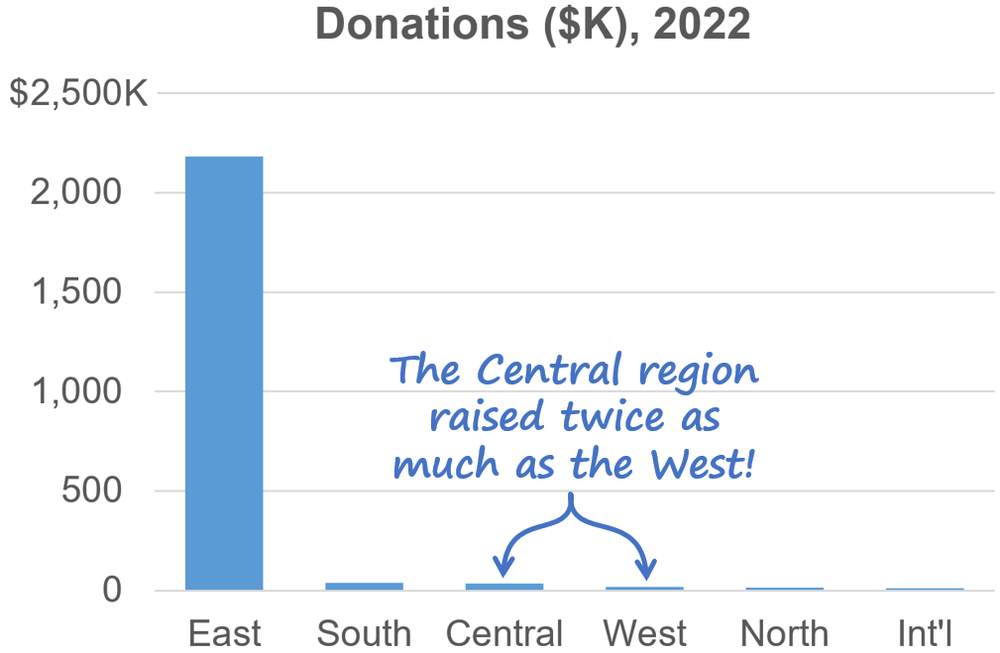
Say you work for a charity, and you need to show donations by region, but one of the regions has way, way more donations than the others:
This chart is fine if you just need to show that the East region is far greater than the others, but let’s assume instead that you need to say something about how the small regions compare with one another:
The bars for the smaller regions are too small to compare, so, clearly, this chart design doesn’t communicate this particular insight effectively.
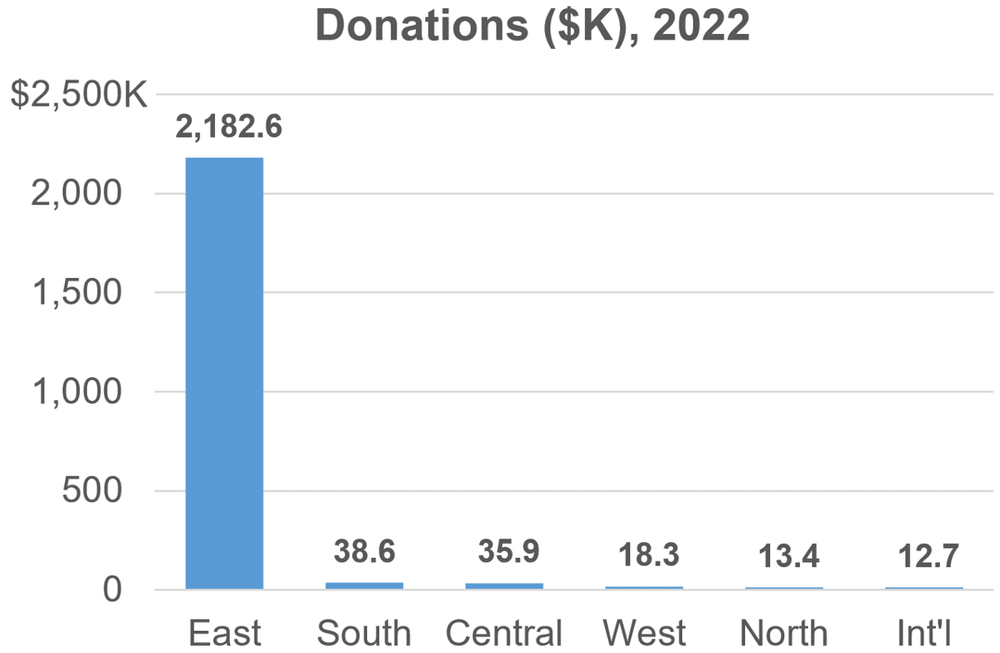
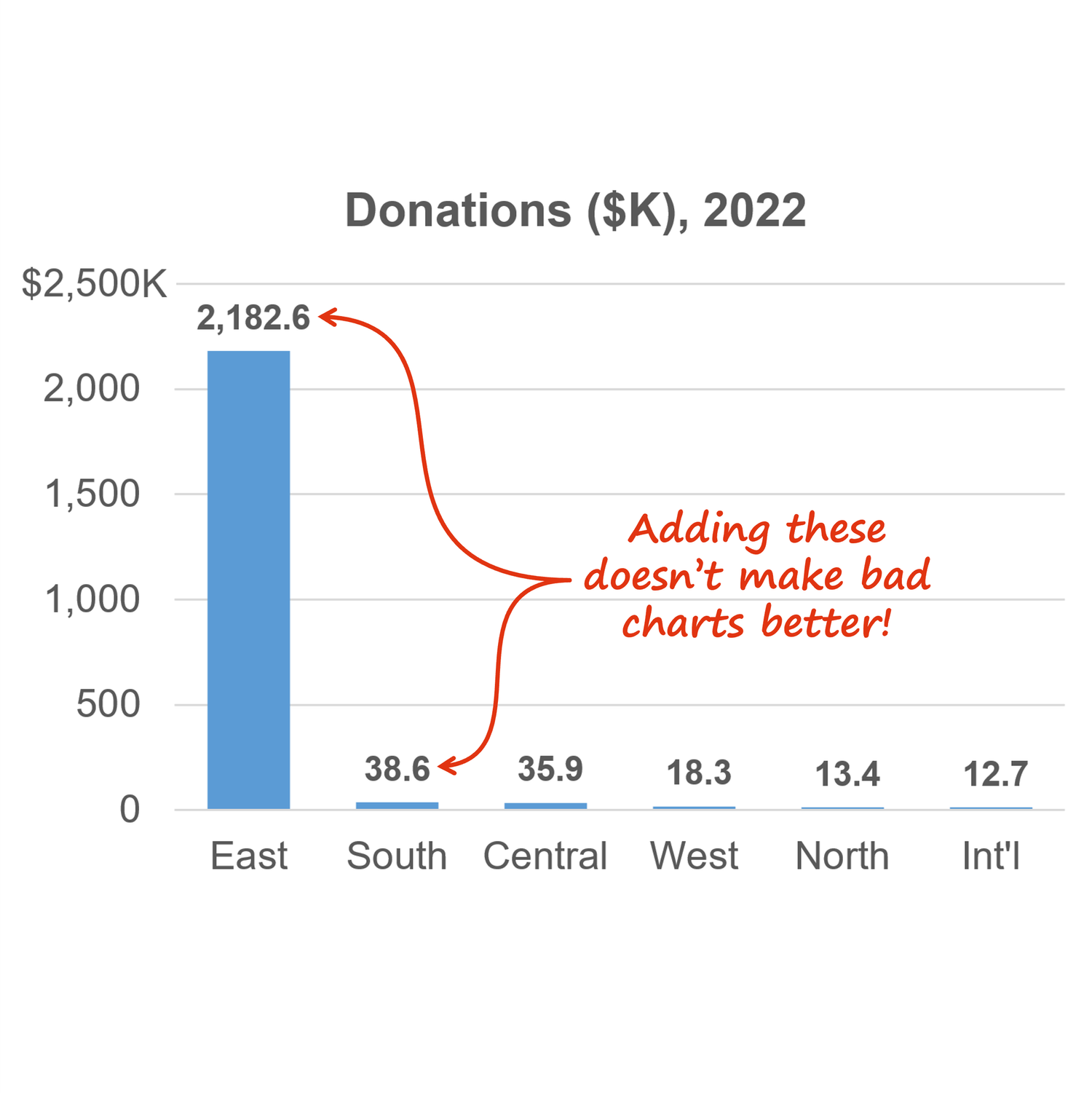
“I know,” you think to yourself, “I’ll just label all the values directly in the chart. That way, the reader can just read the numbers and compare the smaller values with one another.”
Yes, the reader can now compare those small values, but chart itself is more cognitively cumbersome because interpreting textual value labels requires several cognitive steps:
Decode the squiggly symbols above each bar (i.e., the numbers that took years of primary schooling to learn how to read and understand)
Convert those squiggly symbols into mental representations of quantities
Do mental math on those squiggly symbols to compare them
Because the graphics (the bars, in this case) aren’t communicating what the reader needs to know about this data in this situation, the reader must rely almost entirely on reading the value labels. In that sense, a chart like the one above is almost the same as showing the data as a table of numbers, since the graphics in the chart aren’t doing much to communicate the specific insights that the reader needs in this situation.
Yes, the cognitive steps required to read numbers in charts, convert them into mental representations of quantities and do math on them can be done and don’t take long, but they definitely require more cognitive work than charts in which the graphics do most of the communicating. Researchers have known for decades that people can read and understand quantitative data far more quickly and easily as graphics than as textual numbers, but you can see this for yourself if the chart above is redesigned so that the insight in question is communicated primarily by the graphics rather than textual value labels:
In this version of the chart, the reader can see that the “Central” value is about twice as much as the “West” value almost instantly, no squiggle-converting or mental math required.
So, what does this mean when it comes designing charts in practice? Well, if a chart that you’re creating relies mostly or entirely on reading textual value labels in order communicate the insights it needs to communicate and the graphics aren’t contributing much, that’s a big hint that the chart should probably be redesigned.
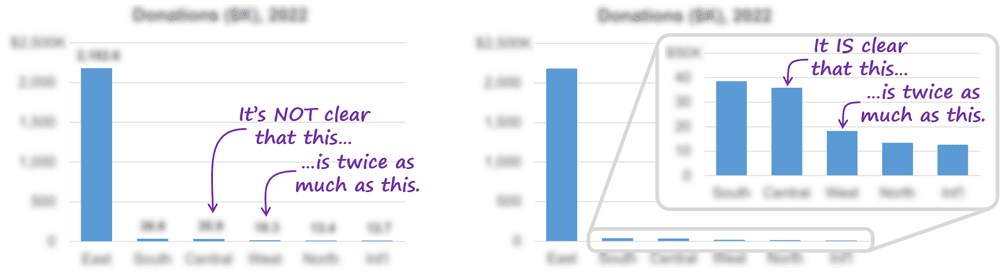
How can you know if your chart relies mostly or entirely on reading textual labels? Well, you could try the “squint test”. This involves squinting your eyes so that your vision is blurred just enough that you can’t read any of the text, but you can still see the graphics. Then, see how much of the information that you want readers to get from the chart is still clear:
How do you design graphs that communicate key information graphically and that don’t rely heavily on textual value labels? For example, how did I think of using an “inset chart” to improve the chart above? Well, there are far too many ways to make charts “graphically obvious” to cover in a blog post, but I do cover them in my Practical Charts course :-)
Growing up, we marked our trailposts in life together, no matter how different they were. He was in kindergarten when I became a teenager. When I left home, he was just beginning to find his independence as a precocious nine-year-old. He entered high school as I was completing my undergrad degree, and he started university when I was already starting the second job of my post-college career.
Though the moments in life were different, we went through them together—sometimes far apart from each other, but still together in spirit. He was my confidant, my advice-giver, my sparring partner, and my dear friend.
Nowadays, as adults, the markers of life blur a little bit more. The moments are less seminal, more part of the unending travels of adulthood. Still, he remains one of my closest friends, in addition to being a wonderful brother to me and an incredible uncle to my daughter. Just as we did as children, we share with each other, we trust each other, we occasionally disagree with each other, and we look out for one another. I am lucky to know him; I am lucky to have him in my family, in my life.
Unlike the protagonists of Fatimah Asghar’s When We Were Sisters, my brother and I led wonderful childhoods where we loved and cherished and cared for deeply. What we did share with the protagonists, however, was a deep sibling bond that transcended age and place and circumstance.
Ms. Asghar’s novel is an exploration of that sibling bond, of a connection that invigorates, rejuvenates, infuriates, protects, and loves. It is a story about growing up with someone who will build a inner world with you no matter what the world outside looks like. It is about finding safety in those we love, and about doing what we can to make those we love feel safe as well.
I thought of my brother often as I read Ms. Asghar’s lyrical prose: the way she crafts sentences is strong and gentle at the same time, attributes I see in my younger sibling as he wavers from stubbornness about his chosen career path, and softness in the way he cares for our aging grandmother every day.
The life of my brother and I could not be any more different than those of the main characters in When We Were Sisters, but the sisters share something my brother and I share as well: a recognition that no matter what the circumstance, we can lean on each other to persevere, to grow, and to thrive. This is a gift I do not, and will never, take for granted.


 Pluralistic: Daily links from Cory Doctorow.



 dog_rates on Twitter.


 WeRateDogs® (dog_rates)
on Thursday, January 12th, 2023 11:32pm
WeRateDogs® (dog_rates)
on Thursday, January 12th, 2023 11:32pm



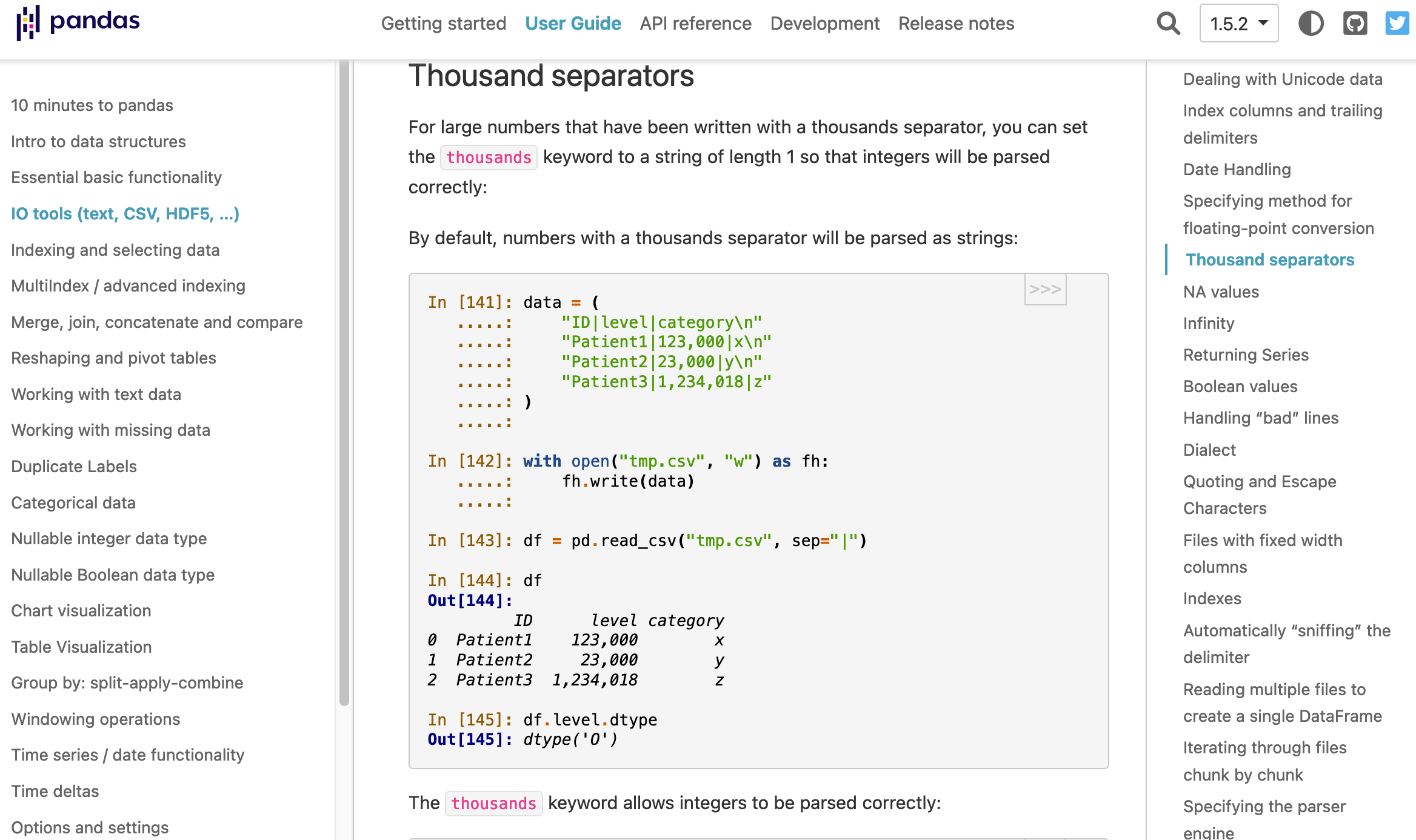






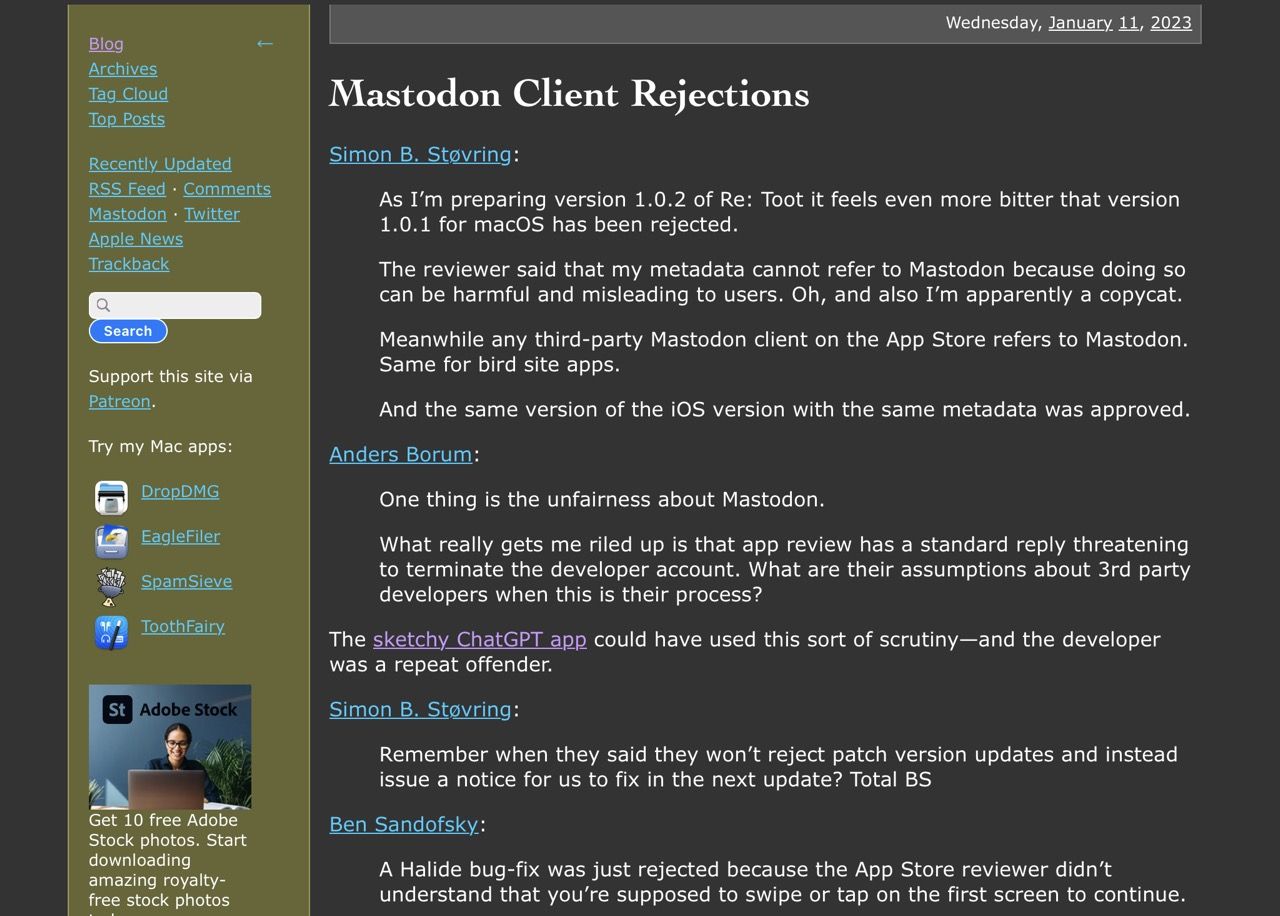
 The Guardian.
 Fefes Blog.