Shared posts

24 Apr 07:14

Masking

by ducky

I know we are having a pandemic, but I am getting tired of masking. I will take it out on you, Dear Reader, because, well, I can.

A few years ago, when there were really bad wildfires, my spouse and I bought eight N95 masks for particulates (i.e. with vents in them).

When the pandemic hit, I taped up the vents and used them in particularly scary situations (like when I went to the doctor for something).

Even reusing the N95s for a while, we used up most of our stock of N95s. I didn’t want to use them all up, so I researched alternatives, and found that a simple cheap surgical mask was allegedly as good as an N95 if you wore a mask brace over it. Awesome.

I bought a mask brace, put it over a surgical mask, and went for a long walk to test it. The brace did a great job of eliminating gaps, and it made my glasses fog less, but the brace also held the mask so close to my mouth that I couldn’t avoid getting my lips on it. At the end of a 90-min walk, it was wet. I hear that they are less effective after you get them wet.

I still had one of my old N95s, so I pulled the tape off and now wear it under my surgical mask under the brace, purely for structural reasons, to keep the surgical mask away from my mouth. Great!

Well, except that if it’s raining, as it does frequently in the Pacific Northwest in the winter (aka “always”), the N95 keeps the mask far enough from my mouth that it sticks out farther than my hat can shield it, and the rain gets on it. So if it starts to rain, I need to take the mask off.

(I am not too worried about being outdoors in the rain without a mask. First, the outdoors is very well-ventilated. Second, when it’s raining, there are fewer people out and about. Third, I figure that the rain will hit some of the virus particles and knock them down.)

So anyway, that’s the context.

Here’s what I did today.

  1. Got ready to leave the apartment and get into a small, poorly-ventilated enclosed space (the elevator). Took off glasses, put on N95/mask/brace/glasses/hat.
  2. Got outside the apartment building. It was raining. Took off hat/glasses/brace/mask/N95, replaces glasses and hat.
  3. Walked to hospital, prepared to enter hospital. Took off glasses/hat, put on N95/mask/brace/glasses/hat.
  4. Sinus doctor wanted to stick things in my nose. Took off hat/glasses/brace/mask/N95, replaced glasses.
  5. Sinus doctor removed nasal truffles (but that’s a whole different story). Doc said that he didn’t think he got them all but he thought that to get the rest he’d have to anesthetize me. Took off glasses, put on N95/mask/brace/glasses/hat.
  6. Went outside. No longer raining. Stifled a massive sneeze, and somehow a nasal truffle ended up in my mouth. Took off glasses/hat/N95/mask/brace. Replaced glasses.
  7. Spat out the nasal truffle, examined it, took photo. Took off glasses, put on N95/mask/brace/glasses/hat.
  8. Walked over to cell phone store to get my cracked phone screen replaced. They told me to wait an hour. Went outside and wandered around for a little bit before deciding to grab some lunch. It started raining again. Took off hat/glasses/brace/mask/N95, replaced glasses/hat.
  9. Decided on pizza. Under the pizzeria’s awning, took off glasses/hat, put on N95/mask/brace/glasses/hat.
  10. Got my slice, went and sat at a table outside under the awning. (Yes, it is cold but I’ve got good gear on.) Took off hat/glasses/brace/mask/N95, replaced glasses/hat.
  11. Finished my lunch. Went back to phone store. Took off glasses/hat, put on N95/mask/brace/hat/glasses.
  12. Got my phone, left shop. Still raining. Took off hat/glasses/brace/mask/N95, replaced glasses/hat.
  13. Walked to drug store. Took off glasses/hat, put on N95/mask/brace/hat/glasses.
  14. Left drug store, disappointed that they did not have face shields in stock which would protect the mask from rain. Still raining. Took off hat/glasses/brace/mask/N95, replaced glasses/hat.
  15. Walked to apartment building. Took off glasses/hat, put on N95/mask/brace/hat/glasses.
  16. Entered our apartment. Took off hat/glasses/brace/mask/N95, replaced glasses.

I realize that putting on/taking off masks is a minor inconvenience compared to, say, not breathing, but it’s still annoying. I am ready for the rain to stop.

04 Feb 19:19

The battle inside Signal

Casey Newton, Platformer, Feb 03, 2021
Icon

Like Element, Signal is a peer-to-peer encrypted messaging app. It also includes features of blockchain in order to enable things like financial transactions. There's a strong case for this sort of app. "People who want more control over their data and how it's used — and who want to exist outside the gaze of tech companies." But as in the case of Element, there's risk. People can use it to send objectionable content. More, people could use its currency exchange feature for illegal purposes. And that's what's causing the dispute among Signal staff, between those who want to address problems as they come up, and those who thing the platfrom should take a strong stance against bad actors from the outset.

Web: [Direct Link] [This Post]
04 Feb 19:19

Google Play bans open source Matrix client Element, citing “abusive content”

Ron Amadeo, Ars Technica, Feb 03, 2021
Icon

The subhead in protocol, where I first saw this item, was "who watches the wathchers?" It's a good question. Element is an increasingly popular end-to-end encrypted messenger and collaboration app. Like a number of new tools these days, it is decentralized, which means that people manage and host their own instances. There's no need to depend on a central service like Google or Apple or Facebook. But this also creates a potential point of debate: people can use Element for illegal or offensive content, and there's no way to moderate this content. So what companies can do is to prevent distribution of the application by means of their control of the platform (this is especially true of mobile phones, where companies discourage and in some cases prohibit any unauthorized applications from being run on the hardware). Is this a reasonable response? Would you ban telephones because some phone calls are objectionable? Would you ban a browser because some web sites are hateful? And more: these decentralized services are in direct compeititon with centralized social netwirk sites and services hosted by Google, Apple and Facebook. At a certain point, banning a client like Element begins to look overly self-serving. Image: Twitter.

Web: [Direct Link] [This Post]
04 Feb 19:19

An examination of student preference for traditional didactic or chunking teaching strategies in an online learning environment

Brendan Humphries, Damien Clark, Research in Learning Technology, Feb 03, 2021
Icon

What's the best way to present video content online? Is it to present one long video, or to chunk it into a number of shorter videos? That's what this paper (12 page PDF) studies. "The major findings indicated a significant preference for chunk-style videos between 3 and 17 min duration when compared to traditional long-view didactic lecture materials." The sample size is reasonable large if unrepresentative - 1268 university students across two academic years. But is this the sort of question that can be answered by looking at averages? I would think that it varies a lot by the content, context and viewer. I don't think people would want to watch Titanic (3 hours 14 minutes) in twenty 10-minute chunks.

Web: [Direct Link] [This Post]
04 Feb 19:18

Audiences and Research

by Richard Millington

If you want your current participants to participate more, then research the members who already participate, uncover their unmet needs, and build this into the community.

If you want members who don’t participate to begin participating, survey and interview solely these members. Find out what led them to join the community. Uncover why they don’t participate (do they feel they have nothing to share or get their needs satisfied elsewhere) and adapt accordingly.

If you want more people to join your community (typically customers/audiences you can reach that haven’t joined yet), then survey and interview this group. Find out if they’ve heard about the community, what they’ve heard about it, and why they decided not to join. Is it an awareness issue or a messaging issue? Identify if you need to change the message or do a better job promoting the community.

Each type of research is fine, just be clear about what you’re trying to achieve.

04 Feb 19:18

Cleaning Up Your Postgres Database

Cleaning Up Your Postgres Database

Craig Kerstiens provides some invaluable tips on running an initial check of the health of a PostgreSQL database, by using queries against the pg_statio_user_indexes table to find the memory cache hit ratio and the pg_stat_user_tables table to see what percentage of queries to your tables are using an index.

Via @craigkerstiens

04 Feb 19:14

Read four chapters from “Data Visualization in Society” with us (it’s free)!

data vis book club cover for the Data Vis in Society book

Do you keep getting recommendations for data vis books, maybe even buy them, but don’t make it a priority to read them? Let’s read these books together – and let’s discuss them, to get more out of them. That’s what the Data Vis Book Club is about. Join us! Here’s what we’ll read next.


Hey everyone! Yes, we’re still alive and well. 2020 was a bit full of…all the feels, but we’re excited to read some great data vis books with you in 2021! Let’s start the year by reading four chapters from “Data Visualization in Society” (link), a collection of chapters written by different authors and edited by Helen Kennedy and Martin Engebretsen.

We will discuss Data Visualization in Society
on Tuesday, 2nd of March at 6pm UTC here: notes.datawrapper.de/p/bookclub-datavis-in-society

That’s 10am on the US west coast, 1pm on the US east coast, Colombia & Peru, 3pm in Brazil and Argentina, 6pm for readers in the UK & Portugal, 7pm for most other Europeans and 11.30pm in India.

We’re reading the foreword and these four chapters:
– Foreword: The dawn of a philosophy of visualization by Alberto Cairo
– Chapter 2: Ways of knowing with data visualizations by Jill Walker Rettberg
– Chapter 11: Data visualization and transparency in the news by Helen Kennedy, Wibke Weber, and Martin Engebretsen
– Chapter 16: What we talk about when we talk about beautiful data visualizations by Sara Brinch
– Chapter 18: Exploring narrativity in data visualization in journalism by Wibke Weber

The book is free to read. Here’s the book on the publisher website. Download the individual chapters here or the whole book here.

A few of the chapter authors will take part in the conversation as well, joining around 45min into the discussion and answering all our questions.

Like always, everyone is welcomed to join! Just open the notepad at the correct date and time and start typing. Many participants will be new to the conversation – we’ll figure it out as we go.

What is this book?

“Data Visualization in Society” (not to be confused with the Data Visualization Society) might be a book you haven’t heard about until now, even if you’re active in the data vis scene. That’s because this book is home in the media studies corner. The texts we’ll read are by professors of Language and Communication, Media Linguistics, and Digital Culture. Meaning: This book is an excellent opportunity to hear some different voices and to look beyond our practical horizon.

book cover of "Data Visualization in Society"

See this book as a conference about data visualization that you stumbled in, and that is hosted by professors and practitioners you don’t follow on Twitter.

Why these four chapters?

The book has almost 500 pages structured in five sections, which might be a bit too much to read for one discussion. So I chose four chapters.

“But Lisa, what’s special about these four chapters?” Honestly, not much. I chose texts that seemed enjoyable to read and discuss, and useful for people who focus a bit more on explanatory visualization than exploratory visualization.

But I might not have chosen the most interesting chapters for you. So take them as a starting point, then browse around in the book, see which other topics interest you, and read them, too. And let us know which chapters you liked on March 2nd! We all love a good recommendation.

What are the chapters about?

First, Alberto Cairo makes a point for a philosophy of data visualization in his two-page foreword that I recommend reading as a nice intro. Here’s what the other chapters are about:

Chapter 2: Ways of knowing with data visualizations
by Jill Walker Rettberg

What’s the difference between looking at a bar chart and looking at a photography? Jill explores precisely that. “Data visualizations combine numeric data with visual representation, and these modes allow them to express certain kinds of knowledge more easily than others,” she writes – which kinds of knowledge these are, she explains in her chapter. Jill is a Professor of Digital Culture in Norway. Jill will attend the book club to answer your questions about her chapter.

the authors of the chapters we'll discuss of "Data Visualization in Society"The authors of the chapters we’ll discuss.

Chapter 11: Data visualization and transparency in the news
by Helen Kennedy, Wibke Weber, and Martin Engebretsen

For this article, the authors asked 60 data journalists and visualization designers from major newsrooms: Are the data visualizations you create objective? How about transparent? Helen (Professor of Digital Society in Sheffield, UK) and Martin (Professor of Language and Communication in Norway) are the editors of the book, while we’ll meet Wibke again in chapter 18. Helen will attend the book club to answer your questions about her chapter (and the general book!).

Chapter 16: What we talk about when we talk about beautiful data visualizations by Sara Brinch

What’s a beautiful data visualization? And why is beauty important in data visualization? Sarah answers that and explains different ways in which a graphic can be beautiful – by expressing fine craftsmanship, for example, or by letting complexity keep its complex character. She’s an Associate Professor in visual communication in Norway.

Chapter 18: Exploring narrativity in data visualization in journalism
by Wibke Weber

“What exactly does storytelling with data mean? When does a data visualization tell a story? And what are narrative constituents in data visualization?” Based on 73 data visualization examples, Wibke explains the building blocks of visual storytelling. She’s a Professor of Media Linguistics in Zurich. Wibke will attend the book club to answer your questions about her chapters.

Should you read this book?

If you’re looking for practical data vis advice, this book isn’t for you.

If, however, you want to see how one can think a bit differently about data visualization than you’re used to in your day-to-day business, do read and discuss “Data Visualization in Society” with us.

(Also, the discussions are just really fun! That might be reason alone for you.)

How does the book club work?

1. You get “Data Visualization in Society”. You can buy it for 60 bucks, but it’s open access, so you can also download it – either the individual chapters we’ll discuss here or the whole book here.

2. We all read the chapters. That’s where the fun begins! Please mention @datavisclub or use the hashtag #datavisclub if you want to share your process, insights, and surprises – I’ll make sure to tweet them out as @datavisclub, as motivation for us all.

3. We get together to talk about the book. This will happen digitally on March 2nd, 2020 at 6pm UTC over at notes.datawrapper.de/p/bookclub-datavis-in-society.

It won’t be a call or a video chat; we’ll just write down our thoughts. The discussion will be structured around the chapters. We’ll just do an open discussion this time, around questions like: Did you like the chapter? Why, why not? Which thought impressed you the most? Which ideas did you get while reading it?

After going through the four chapters within approx. 45min, a few of the chapter authors will join us to answer questions we might have about their book.


More questions?

Here’s a short FAQ for you, in case you have more questions:

So what will happen, exactly, during the book club?

A digital book club is a new experience for many of us. See how our book club discussions have looked like in the past:

You can also read the review of the first book club, to learn how people found the experience.

This is what others have said about some of the last book club discussions:

  • “Just wanted to say this was my first time joining the book club and I JUST LOVED IT! Thank you everyone! This experience was incredible.”
  • “Such a great experience connecting with the authors and fans of this unique book that I love.”
  • “Great experience! It was fun reading all of the questions and answers as they popped up and to scroll up and down the screen to check out any new comments.”
  • “OMG! First time that I do it and I just loved it!!! I like that I can write everything I’m thinking about live and comment on other people’s ideas easily.”

Why don’t we do a call? Why the notepad?

Because it works well for introverts and for people who prefer to stay anonymous in the discussion. Plus, native English speakers have less of an advantage than they have in calls. Plus, the documentation of our meeting writes itself.

I can’t make it on this date/time.

Do you have a lunch date? Vacation? Need to bring the kids to bed? Need to sleep yourself? No problem! The conversation will be archived in the notes and can still be extended over the next day(s).

How can I learn about new book club discussions?

You can either subscribe to our Datawrapper Blog Update newsletter, turn on notifications for our Twitter account or leave your Twitter handle in a list. I explain all three options in more detail here.


I’m very, very much looking forward to working through the chapters of “Data Visualization in Society” with all of you. If you have any more questions, write in the comments, at lisa@datawrapper.de or to Lisa / Datawrapper on Twitter. Also, make sure to follow @datavisclub, to stay up-to-date and get a dose of motivation from time to time.

04 Feb 19:13

🚀 Microsoft’s climate moon shot, one year later

by Duncan Davidson

It’s hard to believe that it’s been a year since Microsoft announced their commitment to being carbon negative by 2030. Since then, the company has reduced its emissions by 6% and purchased the removal of 1.3 million metric tons of carbon. While this is a tremendous early win, the big problems remain, as Brad Smith discusses in a progress report on Microsoft‘s climate efforts.

Today there is no real existing carbon removal ecosystem and the world must build a new market on an unprecedented scale and timeline, from nearly scratch. This will be incredibly hard, requiring integrity, public-private coordination, and heavy investment simultaneously.

Brad’s analogy is that if this is a moonshot, the efforts so far amount to having put an astronaut into orbit. It’s a significant step and an impressive first year, but there’s so much more to do.

04 Feb 19:13

Take out from Aleph Eatery, a Middle Eastern in...

Take out from Aleph Eatery, a Middle Eastern inspired vegan restaurant.

This is the Shawarma Rice Bowl, made with Enoki mushrooms, plus a side of hummus.

Fresh & good. Recommended!

04 Feb 19:13

The Relentless Jeff Bezos

by Ben Thompson

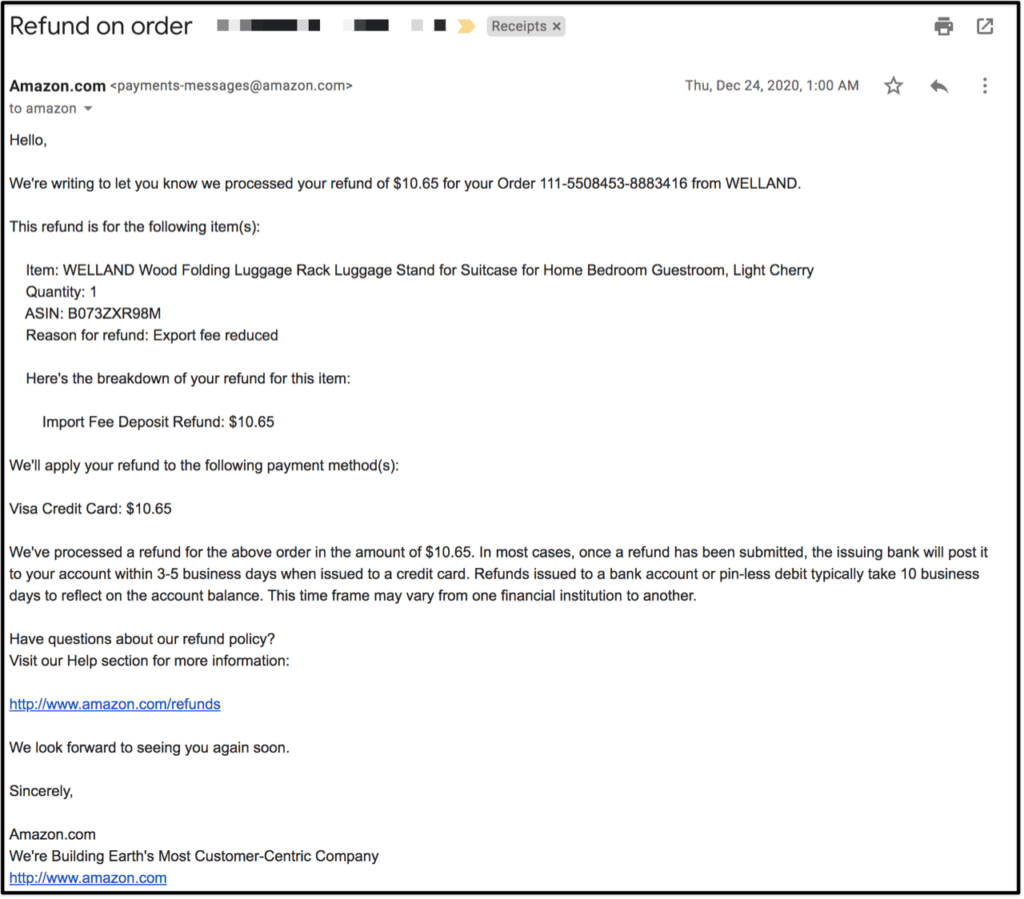
It’s the refunds that blow my mind.

You may be surprised to know that, despite the fact I live in Taiwan, I have an Amazon Prime account. It turns out that Amazon ships to Taiwan, which is particularly useful if you need something rather obscure and you’re not quite sure where to buy it locally:

An email from Amazon about a refund for customs fees

Amazon doesn’t simply make buying thing easy from the other side of the world, they make dealing with shipping and customs trivial; they do it all, and refund me if they over-estimated the cost. It’s so easy that it is easy to forget how much work went into making this possible. Moreover, the company isn’t standing still:

Amazon's announcement of free shipping to Taiwan

The only thing more surprising than this new benefit that arrived completely out of the blue is that there is a part of me that wasn’t surprised; for customers Amazon just keeps getting better, and why not add free shipping to Taiwan? Indeed, I expect the minimum price to decrease over time, which is my way of explaining why so many stories about Amazon — including, I guess, this one — start with the fact that relentless.com redirects to Amazon.com.

What is clear, though, is that any attempt to understand the relentlessness of the company redirects to their founder, Jeff Bezos, who announced plans to step down as CEO after leading the company for twenty-seven years. He is arguably the greatest CEO in tech history, in large part because he created three massive businesses, all of which generate enormous consumer surplus and enjoy impregnable moats: Amazon.com, AWS, and the Amazon platform (this is a grab-all term for the Amazon Marketplace and Fulfillment offerings; it is lumped in with Amazon.com in the company’s reporting). These three businesses are the result of Bezos’ rare combination of strategic thinking, boldness, and drive, and the real world manifestations of Amazon’s three most important tactics: leverage the Internet, win with scale, and being your first best — but not only — customer.

Amazon.com and Leveraging the Internet

While the mythology of founders centers around a tortured genius solving a problem for themselves and only then discovering product-market fit, Bezos started with the solution and then looked for a problem. That solution, broadly considered was the Internet, and more specifically “the everything store”, a concept that crystallized in discussions Bezos had with David Shaw, the founder of the eponymous hedge fund where he worked. The problem was how to start, and Bezos settled on books; he explained in a speech at Lake Forest College in 1998:

In the spring of 94 web usage was growing at 2300% a year. You have to keep in mind human beings aren’t good at understanding exponential growth; it’s just not something we see in our everyday life. But things don’t grow this fast outside of Petri dishes. It just doesn’t happen. When I saw this, I said, okay, what’s a business plan that might make sense in the context of that growth. I made a list of 20 different products that you might be able to sell online. I was looking for the first best product, and I chose books for lots of different reasons, but one primary reason. And that is that there are more items in the book space than there are items in any other category by far. There are over 3 million different books worldwide in all languages. The number two product category in that regard is music, and there are about 300,000 active music CDs. And when you have this huge catalog of products, you can build something online that you just can’t build any other way. The largest physical bookstores, the largest superstores, and these are huge stores, often converted from bowling alleys and movie theaters, can only carry about 175,000 titles. There are only a few that large. In our online catalog, we’re able to list over two and a half million different titles and give people access to those titles.

Being able to do something online that you can’t do in any other way is important. It’s all about the fundamental tenet of building any business, which is creating a value proposition for the customer, and online, especially three years ago, but even today and for the next several years, the value proposition that you have to build for customers is incredibly large. That’s because the web is a pain to use today! We’ve all experienced the modem hangups and the browsers crash — there are all sorts of inconveniences: websites are slow, modem speeds are slow. So if you’re going to get people to use a website in today’s environment, you have to offer them overwhelming compensation for this primitive infant technology. And I would claim that that compensation has to be so strong that it’s basically the same as saying, you can only do things online today that simply can’t be done any other way. And that’s why this huge number of products looked like a winning combination online. There’s no other way to have a two-and-a-half-million-title bookstore. You can’t do it in a physical store, but you also can’t do it in a print catalog. If you were to print the M’s on a card catalog, it would be the size of more than 40 New York city phone books.

What is so impressive about this formulation — in which, humorously, Bezos dramatically understated the Internet’s growth rate of 230000%, not 2300% (exponents are hard!) — is the way in which Bezos grasped both the opportunities and the pitfalls the Internet presented to a new business, and took them to their logical conclusions. This sort of strategic thinking, in which Bezos didn’t simply understand a particular point of business but also its implications both now and in the future, was how Bezos transformed Amazon into a true tech company.

AWS and Tech Economics

That Amazon was even considered a tech company, at least for its first decade, was in many respects an accident of timing: there simply weren’t very many online businesses when Bezos got started, so anyone with a website was a tech company. The truth, though, is that Amazon was very much a retailer, with a bunch of managers it recruited from Walmart, and, after the dot-com bubble burst, under tremendous pressure to raise prices in the pursuit of profitability.

The turning point came in two parts. The first was a meeting Bezos had with Costco founder Jim Sinegal in 2001; from Brad Stone’s The Everything Store:

Sinegal explained the Costco model to Bezos: it was all about customer loyalty…”The membership fee is a onetime pain, but it’s reinforced every time customers walk in and see forty-seven-inch televisions that are two hundred dollars less than anyplace else,” Sinegal said. “It reinforces the value of the concept. Customers know they will find really cheap stuff at Costco.” Costco’s low prices generated heavy sales volume, and the company then used its significant size to demand the best possible deals from suppliers and raise its per-unit gross profit dollars.

Bezos immediately cut prices, but Sinegal’s core insight only truly crystallized later that year at an offsite with (soon-to-be-published) Good to Great author Jim Collins:

Drawing on Collins’s concept of a flywheel, or self-reinforcing loop, Bezos and his lieutenants sketched their own virtuous cycle, which they believed powered their business. It went something like this: Lower prices led to more customer visits. More customers increased the volume of sales and attracted more commission-paying third-party seller to the site. That allowed Amazon to get more out of fixed costs like the fulfillment centers and the servers needed to run the website. This greater efficiency then enabled it to lower prices further. Feed any part of this flywheel, they reasoned, and it should accelerate the loop.

Thus was the famous Bezos napkin diagram born:

This insight is what transformed Amazon from a retailer that leveraged the Internet to a tech company masquerading as a retailer. What is fascinating about this transition, though, is that AWS was still several years down the road; Amazon still looked like a retailer! The difference is that just as Bezos had started with a solution (the Internet) looking for a problem (books), in this case Bezos started with tech economics and applied them to retail.

The first tech CEO to truly grasp how tech economics were different from most other businesses was Bob Noyce (the future Intel founder) at Fairchild Semiconductor. From Michael Malone in The Intel Trinity:

In the spring of 1965…Noyce got up before a major industry conference and in one fell swoop destroyed the entire pricing structure of the electronics industry. Noyce may have had trouble deciding between conflicting claims of his own subordinates, but when it came to technology and competitors, he was one of the most ferocious risk takers in high-tech history. And this was one of his first great moves. The audience at the conference audibly gasped when Noyce announced that Fairchild would henceforth price all of its major integrated circuit products at one dollar. This was not only a fraction of the standard industry price for these chips, but it was also less than it cost Fairchild to make them.

The reason this was possible is that the true cost of integrated circuits came from the R&D costs to design them, and capital costs to manufacture them; the actual materials cost was practically zero. This meant that the best route to profitability was to make it up in volume. This equation is even more powerful in software, which has only R&D costs, and zero material costs. This overall concept, that tech is governed by a world of zero marginal costs, is what makes tech economics fundamentally different from most businesses.

Bezos, though, had one big problem: Amazon had to actually pay for the products it sold! To effectively pursue a tech economics strategy, i.e. bet everything on volume in an attempt to gain leverage on huge fixed costs, was exceptionally risky in an arena with inescapable marginal costs. Bezos, though, prioritized boldness; he wrote in his famous 1997 Letter to Shareholders that he would attach to every subsequent letter:

We will make bold rather than timid investment decisions where we see a sufficient probability of gaining market leadership advantages. Some of these investments will pay off, others will not, and we will have learned another valuable lesson in either case.

This was the exact approach Bezos took to the initial launch of AWS; from The Everything Store:

Bezos wanted AWS to be a utility with discount rates, even if that meant losing money in the short term. Willem van Biljon…proposed pricing EC2 instances at fifteen cents an hour, a rate that he believed would allow the company to break even on the service. In an S Team meeting before EC2 launched, Bezos unilaterally revised that to ten cents. “You realize you could lose money on that for a long time,” van Viljon told him. “Great,” Bezos said.

A decade later Amazon would finally break out AWS in its reporting and it was an absolute juggernaut; I called it The AWS IPO:

This is why Amazon’s latest earnings were such a big deal: for the first time the company broke out AWS into its own line item, revealing not just its revenue (which could be teased out previously) but also its profitability. And, to many people’s surprise, and despite all the price cuts, AWS is very profitable: $265 million in profit on $1.57 billion in sales last quarter alone, for an impressive (for Amazon!) 17% net margin.

Fast forward to Q4 2020, where AWS just reported $3.6 billion in profit on $12.7 billion in revenue; perhaps more tellingly in terms of Amazon’s transformation into a tech company, it is Andy Jassy, the longtime head of AWS, who is succeeding Bezos (yet still, reflecting Amazon’s business-centric roots, Jassy is an MBA, not an engineer).

Amazon’s Platform and the First Best Customer

AWS was not, as urban legend has it, borne out of the desire to utilize holiday capacity; after all, it is not as if Amazon kicked off AWS customers every Christmas! In fact, it took years for Amazon.com to fully run on AWS. AWS, though, was created to solve the internal problems that Amazon.com presented: how to create new customer experiences without constantly waiting for the infrastructure team to set up dedicated capacity.

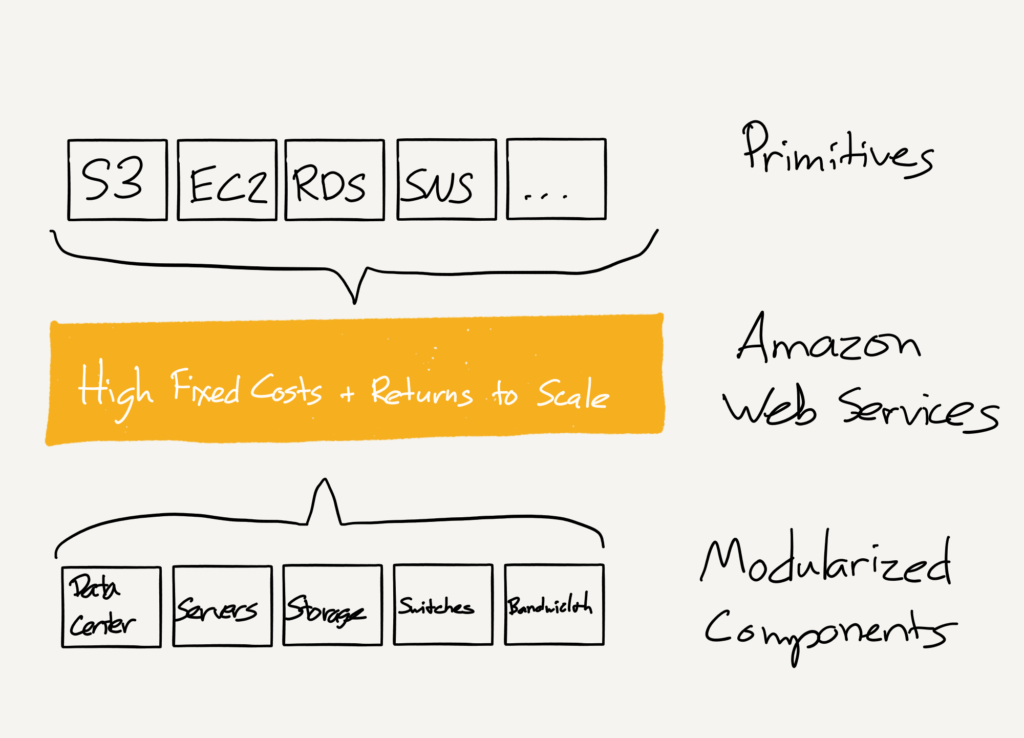
The solution was primitives: instead of building monolithic applications, Amazon’s infrastructure team should build basic compute offerings — like the EC2 instances above — so that their developers could make anything they wanted to. And then, having solved the problem for itself, Amazon could solve it for everyone. From The Amazon Tax:

The “primitives” model modularized Amazon’s infrastructure, effectively transforming raw data center components into storage, computing, databases, etc. which could be used on an ad-hoc basis not only by Amazon’s internal teams but also outside developers:

A drawing of The AWS Layer

This AWS layer in the middle has several key characteristics:

  • AWS has massive fixed costs but benefits tremendously from economies of scale.
  • The cost to build AWS was justified because the first and best customer is Amazon’s e-commerce business.
  • AWS’s focus on “primitives” meant it could be sold as-is to developers beyond Amazon, increasing the returns to scale and, by extension, deepening AWS’ moat.

This last point was a win-win: developers would have access to enterprise-level computing resources with zero up-front investment; Amazon, meanwhile, would get that much more scale for a set of products for which they would be the first and best customer.

As I noted in that article, this exact same approach increasingly applied to the e-commerce side of the business:

Prime is a super experience with superior prices and superior selection, and it too feeds into a scale play. The result is a business that looks like this:

A drawing of The Transformation of Amazon’s E-Commerce Business

That is, of course, the same structure as AWS — and it shares similar characteristics:

  • E-commerce distribution has massive fixed costs but benefits tremendously from economies of scale.
  • The cost to build-out Amazon’s fulfillment centers was justified because the first and best customer is Amazon’s e-commerce business.
  • That last bullet point may seem odd, but in fact 40% of Amazon’s sales (on a unit basis) are sold by 3rd-party merchants; most of these merchants leverage Fulfilled-by-Amazon, which means their goods are stored in Amazon’s fulfillment centers and covered by Prime. This increases the return to scale for Amazon’s fulfillment centers, increases the value of Prime, and deepens Amazon’s moat.

Over the last five years Amazon’s investment in fulfillment has ballooned into a multitude of new distribution centers, sortation centers, an Air Hub for Amazon’s growing fleet of airplanes, trucking, and a massive delivery operation that largely bypasses UPS and Fedex (while leveraging USPS for far-flung deliveries). At the same time the number of products sold by third-party merchants is now over 50% on a unit basis, and last quarter third-party seller services — where Amazon charges a merchant to stock and ship their goods — accounted for $27.3 billion in revenue.

Relentlessness and the Real World

This transformation in one respect brings the Bezos story full circle: the vision was an “Everything Store” — something that could only exist on the Internet — and while books were the best place to begin, they were only that — a beginning. Thanks in large part to Amazon’s platform the company has achieved Bezos’s vision.

What is somewhat ironic, though, is that while the Internet is unquestionably a critical component of what makes Amazon Amazon, what makes the company so valuable and seemingly impregnable is the way it has integrated backwards into the world of atoms. Real moats are built with real dollars, and Bezos has been relentless in pushing the company to continually invest in solving problems with real world costs, from delivery trucks to data centers and everything in-between. This application of tech economics to the real world is what sets Bezos apart.

The world, particularly the United States, has been a massive beneficiary, especially in 2020: when people were stuck at home, what was the company they depended on more than any other to deliver supplies? When companies had to go remote overnight, what was the infrastructure that made that possible? When time needed to be filled with entertainment, games, or video calls, where did those services run? The answer in all cases was Amazon, and the companies that rose up to compete with it. That is one heck of a crowning achievement for a career that changed the industry and the world.

04 Feb 19:12

From my inbox

by Volker Weber

bc8e4b28ed8b45481e04bece517ea659

Wir haben einen kleinen Google Nest Mini adoptiert, den Simon nicht brauchte. Der spielt jetzt HR-Info, macht den Timer beim Kochen und weiß auf alles eine Antwort. Sehr hoher WAF.

04 Feb 19:12

👋 Leaving Microsoft

by Duncan Davidson

When Wunderlist was acquired by Microsoft, I don’t think I had any idea that I’d stay at the company for more than a couple of years. Indeed, I figured I’d serve out the holding period on my unvested shares and then move on. Mostly, I thought it was a fantastic irony that I was working for the company that was once the “Evil Empire.” A company that I helped battle when I was working at Sun Microsystems two decades ago.

Yet, here we are, over 5 and a half years later.

Three of those years were consumed by working in various ways on the integration of Wunderlist into Microsoft. Those weren’t easy years, by any stretch of the imagination. Our team came into Microsoft with a lot of churn at its top levels. That churn continued throughout my time there. Not much worked out the way any of us expected. I learned so much from those years, and I’m still processing the lessons.

For the last two and a half years, I worked as a CTO in Residence (it’s a position sort of like a CTO-as-a-Service) in Microsoft for Startups. That gave me the chance to connect with startups around Europe like Userlane, Ultimate.ai, ProcessGold (now part of UIPath), Uncrowd and Be My Eyes and help with both leadership and technical challenges. One of my proudest moments was helping to connect Wayve.ai with people inside Azure that could solve their massive data challenges.

I also coordinated the Microsoft for Startups presence at the Slush conference in 2018 and 2019. This included producing a set of talks for our booth each year. Two standout presentations from these events are Recruiting a diverse team by Amali de Alwis and Selling with Microsoft by Sam Bowman.

Leaving Microsoft now is bittersweet. The company is full of brilliant people, and I’m going to miss working with many of them. Azure has developed into a fantastic cloud for many uses. And, I love both the company’s commitment to sustainablity, and its focus on helping developers.

My last day at Microsoft will be February 28th.

I’ll take a bit of time off and then will be starting on something new in mid-March. More on that later...

04 Feb 19:10

Sonification of Covid-19 deaths

by Nathan Yau

This is interesting:

Tags: coronavirus, sonification

04 Feb 19:10

Converting JSON to CSV on the fly

by Thejesh GN

I wanted to create a real-time graph of COVID-19 India Vaccination Progress. The data for which will come from the datameet/covid19 project. My initial idea was to build one using frappe similar to the COVID-19 cases chart. But many on the DataMeet community use Datawrapper. I like Datawrapper too. Datawrapper has a feature where it can pull the data from external sources and keep the chart up-to-date. That suits my requirement.

But the Datawrapper wants CSV. They don't handle the JSON data directly. If it was a one-time conversion. I would have used a tool like CSVKIT or Eric Mill's JSON-to-CSV converter. But I needed a tool that could do this on a real-time basis.

Initially, I thought of writing an AWS lambda that would do this for me. But then I settled for something more straightforward and easier like pipedream's HTTP event handler. Once you deploy, you will get an URL, and you can use that with Datawrapper. The code for converting the JSON to CSV is inside the event handler. Here the event being HTTP GET.

You can also make a copy of it for yourself and make your changes before deploying.

The code for converting the JSON to CSV is below. It uses pieces of code from multiple projects that I like and use. I have the links to them within the code for your reference.

The real-time graph is embedded above. You can also find it at DataWrapper.

//########################################################################################
// Thejesh GN https://thejeshgn.com
//
// This converts the JSON into CSV so it can be used by DataWrapper
// This is a hack where I combined piecies of code from various projects
// I have added link to those below if you want to check them out
//
// I love JSON to CSV converter by Eric Mill, https://konklone.io/json/ 
// Source code of it is at https://github.com/konklone/json
// It does an awesome job of converting JSON to CSV in the front end
//
// I wanted to do the same in backend and the pipedream seemed like a good place
// To host that serverless code. at some point I will write a proper serverless code
// Where if I send the url of JSON it will return CSV. Until then this hack is good 
// enough for me.
//
// The final datawrapper graph is at https://datawrapper.dwcdn.net/ThC0E/2/
// It caches the data, so its not a major hit on pipedream.
//########################################################################################
const axios = require('axios')

//########################################################################################
// Pass in the objects to merge as arguments.
// For a deep extend, set the first argument to `true`.
// https://gomakethings.com/vanilla-javascript-version-of-jquery-extend/
var extend = function () {

    // Variables
    var extended = {};
    var deep = false;
    var i = 0;
    var length = arguments.length;

    // Check if a deep merge
    if ( Object.prototype.toString.call( arguments[0] ) === '[object Boolean]' ) {
        deep = arguments[0];
        i++;
    }

    // Merge the object into the extended object
    var merge = function (obj) {
        for ( var prop in obj ) {
            if ( Object.prototype.hasOwnProperty.call( obj, prop ) ) {
                // If deep merge and property is an object, merge properties
                if ( deep && Object.prototype.toString.call(obj[prop]) === '[object Object]' ) {
                    extended[prop] = extend( true, extended[prop], obj[prop] );
                } else {
                    extended[prop] = obj[prop];
                }
            }
        }
    };

    // Loop through each object and conduct a merge
    for ( ; i < length; i++ ) {
        var obj = arguments[i];
        merge(obj);
    }

    return extended;

};

//########################################################################################
//https://konklone.io/json/
//https://github.com/konklone/json/blob/gh-pages/assets/site.js
function parse_object(obj, path) {
    if (path == undefined)
        path = "";

    var type = typeof(obj);
    var scalar = (type == "number" || type == "string" || type == "boolean" || type == "null");

    if (type == "array" || type == "object") {
        var d = {};
        for (var i in obj) {

            var newD = parse_object(obj[i], path + i + "/");
            d = extend(d, newD);
        }

        return d;
    }

    else if (scalar) {
        var d = {};
        var endPath = path.substr(0, path.length-1);
        d[endPath] = obj;
        return d;
    }

    // ?
    else return {};
}

// otherwise, just find the first one
function arrayFrom(json) {
    var queue = [], next = json;
    while (next !== undefined) {
        if (typeof(next) == "array") {

            // but don't if it's just empty, or an array of scalars
            if (next.length > 0) {

              var type = typeof(next[0]);
              var scalar = (type == "number" || type == "string" || type == "boolean" || type == "null");

              if (!scalar)
                return next;
            }
        } if (typeof(next) == "object") {
          for (var key in next)
             queue.push(next[key]);
        }
        next = queue.shift();
    }
    // none found, consider the whole object a row
    return [json];
}

function removeTrailingComma(input) {
  if (input.slice(-1) == ",")
    return input.slice(0,-1);
  else
    return input;
}

function flatten(inArray) {
    var outArray = [];
    for (var row in inArray)
        outArray[outArray.length] = parse_object(inArray[row]);
    return outArray
}
//########################################################################################
//https://www.newline.co/@anthonygore/how-to-convert-json-to-csv-in-nodejs--23c6b226
function convert_to_csv(data){
    csv = data.map(row => Object.values(row));
    csv.unshift(Object.keys(data[0]));
    csv = csv.join('\n');
    console.log(csv)
    return csv
}
//########################################################################################
const dataSourceUrl = "https://raw.githubusercontent.com/datameet/covid19/master/data/mohfw_vaccination_status.json"
const data_json =  (await axios.get(dataSourceUrl)).data
const data = flatten(data_json.rows)
console.log(data)


$respond({
  immediate: true,
  status: 200,
  headers: {"Content-type":"text/plain"},
  body: convert_to_csv(data)
})

Update: Added the headers so it gets formatted properly as text, One could also use "text/csv" instead of "text/plain"


You can subscribe to my blog using RSS Feed. But if you are the person who loves getting email, then you can join my readers by signing up.

Join 2,108 other subscribers

Email Address

Sign Me Up

The post Converting JSON to CSV on the fly first appeared on Thejesh GN.
04 Feb 19:09

Making Big Sur and pyenv play nicely

by Armen Zambrano

Soon after Big Sur came out, I received my new work laptop. I decided to upgrade to it. Unfortunately, I quickly discovered that the Python set up needed for Sentry required some changes. Since it took me a bit of time to figure it out I decided to document it for anyone trying to solve the same problem.

If you are curious about all that I went through and see references to upstream issues you can visit this issue. It’s a bit raw. Most important notes are in the first comment.

On Big Sur, if you try to install older versions of Python you will need to tell pyenv to patch the code. For instance, you can install Python 3.8.7 the typical way ( pyenv install 3.8.7 ), however, if you try to install 3.8.0, or earlier, you will have to patch the code before building Python.

pyenv install --patch 3.6.10 < \
<(curl -sSL https://github.com/python/cpython/commit/8ea6353.patch\?full_index\=1)

If your pyenv version is lesser than 1.2.22 you will also need to specify LDFLAGS. You can read more about it here.

LDFLAGS="-L$(xcrun --show-sdk-path)/usr/lib ${LDFLAGS}" \
pyenv install --patch 3.6.10 < \
<(curl -sSL https://github.com/python/cpython/commit/8ea6353.patch\?full_index\=1)

It seems very simple, however, it took me a lot of work to figure it out. I hope I saved you some time!

04 Feb 19:08

I went for a long walk in the sun along Wall St...

I went for a long walk in the sun along Wall Street in #eastvan.

My shadow posed for pictures at the parks along the way, facing the water and the North Shore mountains.

04 Feb 19:08

How and why to tell your story online, revisited

by Jon Udell

I wrote this essay in 2006 as part of a series of Internet explainers I did for New Hampshire Public Radio. It never aired for reasons lost to history, so I’m publishing this 15-year-old time capsule here for the first time. My motive is of course not purely archival. I’m also reminding myself why I should still practice now what I preached then.

How and why to tell your story online

Teens and twenty-somethings are flocking to social websites like MySpace and Facebook, where they post photos, music, and personal diaries. Parents, teachers, and cops wish they wouldn’t. It’s a culture war between generations, and right now everybody’s losing.

Kids: Listen up. Did you hear the story about the college student who didn’t get hired because of his Facebook page? Or the teenage girl whose MySpace blog told an attacker when she’d be home alone? These things happen very rarely, but they can happen. Realize that the words and pictures you publish online will follow you around for the rest of your lives. Realize that wrong choices can have embarrassing or even tragic consequences.

Now, grownups, it’s your turn to listen up. You’re right to worry about the kids. But there’s another side to the story. The new forms of Internet self-publishing — including social networks, blogs, podcasting, and video sharing — can be much more than narcissistic games. Properly understood and applied, they’re power tools for claiming identity, exerting influence, and managing reputation. Sadly, very few adults are learning those skills, and fewer still are teaching them.

It’s not enough to condemn bad online behavior. We’ve got to model good online behavior too — in schools, on the job, and in civic life. But we’re stuck in a Catch-22 situation. Kids, who intuit the benefits of the new social media, fail to appreciate the risks. Grownups, meanwhile, see only risks and no benefits.

There’s a middle ground here, and we need to approach it from both sides of the generation gap. The new reality is that, from now on, our lives will be documented online — perhaps by us, perhaps by others, perhaps by both. We may or may not influence what others will say about us. But we can surely control our own narratives, and shape them in ways that advance our personal, educational, professional, and civic agendas.

Your online identity is a lifelong asset. If you invest in it foolishly you’ll regret that. But failing to invest at all is equally foolish. The best strategy, as always, is to invest wisely.

Here’s a simple test to guide your strategy. Imagine someone searching Google for your name. That person might be a college admissions officer, a prospective employer, a new client, an old friend, or even a complete stranger. The reason for the search might be to evaluate your knowledge, interests, agenda, accomplishments, credentials, activities, or reputation.

What do you want that person to find? That’s what you should publish online.

To find three examples of what I mean, try searching the web for the following three names: Todd Suomela, Martha Burtis, Thomas Mahon. In each case, the first Google result points to a personal blog that narrates a professional life.

Todd Suomela is a graduate student at the University of Michigan. On his blog, Todd writes about what he’s learning, and about how his interests and goals are evolving. He hasn’t launched his professional career yet. But when he does, his habit of sharing the information resources he collects, and reflecting thoughtfully on his educational experience, will serve him well.

Martha Burtis is an instructional technologist at the University of Mary Washington. She and her team research and deploy the technologies that students, faculty, and staff use to learn, teach, and collaborate. On her blog, Martha writes about the tools and techniques she and her team are developing, she assesses how her local academic community is making use of those tools and techniques, and thinks broadly about the future of education.

Thomas Mahon is a Savile Row tailor. His shop in London caters to people who can spend two thousand pounds on a classic handmade suit. I’ll never be in the market for one of those, but if I were I’d be fascinated by Mahon’s blog, EnglishCut.com, which tells you everything you might want to know about Savile Row past and present, about how Mahan practices the craft of bespoke tailoring, and about how to buy and care for the garments he makes.

For Todd and Martha and Thomas, the benefits of claiming their Net identities in these ways run wide and deep. Over time, their online narratives become autobiographies read by friends, colleagues, or clients, and just as importantly, read by people who may one day become friends, colleagues, or clients.

In most cases, of course, the words, pictures, audio, and video you might choose to publish online won’t attract many readers, listeners, or viewers. That’s OK. The point is that the people they do attract will be exactly the right people: those who share your interests and goals.

We’ve always used the term ‘social networking’ to refer to the process of finding and connecting with those people. And that process has always depended on a fabric of trust woven most easily in the context of local communities and face-to-face interaction.

But our interests and goals aren’t merely local. We face global challenges that compel us to collaborate on a global scale. Luckily, the new modes of social networking can reach across the Internet to include people anywhere and everywhere. But if we’re going to trust people across the Internet, we’ll need to be able check their references. Self-published narrative is one crucial form of evidence. The public reaction to such narratives, readily discoverable thanks to search engines and citation indexes, is another.

Is this a new and strange new activity? From one perspective it is, and that’s why I can’t yet point to many other folks who’ve figured out appropriate and effective ways to be online, as Todd and Martha and Thomas have.

But from another perspective, Internet self-publishing is just a new way to do what we’ve been doing for tens of thousand years: telling stories to explain ourselves to one another, and to make sense of our world.

04 Feb 19:06

My 11 years with a Nokia Camera

by johnbh

The other day I was doing some cleaning up in the office and came across some old backup drives. Whilst browsing through them I noticed some old digital photos. Turns out they were from 2003 and a Nokia 7650. So I thought I would share some of those photos from the 7650 and my subsequent Nokia Devices such as the 6600, 7610, N70, N93, N95, N95 8Gb, N97, N8, 808, 1020 etc.

The photos are not masterpieces, any skill I do have didn’t really develop until 2010 and the Nokia N8. This is more of a trip down memory lane, to share the photos and places my Nokia phones and I visited.


Nokia 7650 – year 2003

Nokia 7650 – Astronomical Clock – Prague

Taken on a Nokia 7650 in August 2003 during a long weekend in Prague, never been back. Must go again, such a beautiful city.

Nokia 7650 – Faustino Winery Gate – Oyon – Álava, Spain

November 2003 at the Faustino winery, a trip organised by the pub company I worked for and one I will never forget.

Nokia 6600 – year 2004

Nokia 6600 – Madrid

February 2004, a trip to Madrid for the weekend to see friends.

Nokia 6600 – Azure Window – Gozo

Our regular holiday Destination is Gozo, we go every year and most years I seem to take a picture of the Azure Window. This is from May 2004 using the Nokia 6600.

Nokia 7610 – year 2005

Nokia 7610 – My Garden

This was my garden back in 2005 when we lived in Cambridgeshire, UK  and Clyde the cat.

Nokia 7610 – Wappu – Finland

Wappu or Vappu, never can tell which spelling is correct, is the Finnish labour day celebration on May 1st each year. Everyone in Helsinki meets in Kaivopuisto, drinks champagne and cheers when the sun comes out. It does sometimes, honest. This was 2005’s celebration.

Nokia N70 – year 2006

Nokia N70 – New York

August 2006, a week spent in New York City for our friend’s wedding.

Nokia N70 – Azure Window – Gozo

I did say there might be a few pictures of the Azure Window. This one from the Nokia N70 in May 2006.

Nokia N93 – year 2006

Now for some reason I never took many photos with my N93, or if I did I can’t find many. I know I didn’t use it for long as I switched to the N95 the same year.

Nokis N93 – Not sure what Rich was drinking

This was one of many Varsity nights out in September 2006. Varsity was a pub brand owned by Barracuda, a pub company I worked for in the UK.

Nokia N95 – year 2007

Nokia N95 – Phuket

Phuket trip was for a good friend’s wedding in October 2007, a very long trip as it was 23 hours of travelling from our new home in Connecticut.

Nokia N95 – Mystic

August 2007. Friends from the UK came for a visit and we drove them to Mystic for a day trip. This is where the Amistad was berthed for a time.

Nokia N95 – Madison Square Garden

Another visit by some more friends in November 2007, I joined them in NYC for a few days and we went to see the Knicks play.

The Next 3 photos are from yet another friend’s visit.

Nokia N95- New England Patriots Ice Sculpture

Nokia N95 – Natural History Museum – NYC

Nokia N95 – Yale

The Full set of Yale photos are on Flickr, click Here

Nokia N95 – Inside the Grand Canyon

You can see the set of Las Vegas Photos on Flickr if you wish to Here

Nokia N95 8GB – year 2008

Nokia N95 8GB – St Lucia

July 2008 on holiday with friends.

Nokia N95 8GB – Xlendi Bay, Gozo

Our regular summer holiday spot, first night of the holiday is always spent in Xlendi. June 2008.

Nokia N95 8GB – New Orleans

Visiting friends for Christmas in December 2008.

Nokia N95 8GB – NY Yankies at the old stadium

May 2008, one of the last games before the Yankies moved to the new stadium.

Nokia N95 8GB – Del & Rodney

Sorry but had to share this picture of Del & Rodney in a rare moment of brotherly love:-) They were just 6 months old back then in June 2008.

Nokia N97 – year 2009

Nokia N97 – Westend coast

In 2009 we moved to Finland along the southern coast in Espoo.

Nokia N97 – HFK vs Kalpa (Ice Hockey)

One of my first experiences of Ice Hockey in Finland – February 2010

Nokia N97 – Wappu

Wappu celebration – May 2010

Nokia N8-00 – years 2010 to 2012

And there is no better way to start the N8 trip than with Nokia World, September 2010 in London.

Nokia N8 (proto) – Nokia World

The full set of Nokia World photos is here

Nokia N8 (proto) – Azure Window

Gozo in July 2010, the Azure Window in Dwerja. I go there every year to see if it is still intact. It was. It has been predicted to fall for many years now. Full set of images are here

Nokia N8 – The Bean

December 2010, a short weekend in Chicago before moving on for Christmas in New Orleans. Full image set here

Nokia N8 – Fulton Street New Orleans

Whilst in New Orleans, we also visited Fontainebleau State Park and Northlake Nature Center.

Nokia N8 – Tree Carving

We also did a little road trip from New Orleans, through Mississippi to Alabama. These tree carvings are created from the dead trees after Hurricane Katrina devastated the area. Full set from the drive here

Nokia N8 – Sunrise, Point Clear, Alabama

Full set from Alabama here

Nokia N8 – Saariselkä cabin

January 2011, we spent a great few days in Northern Finland for my wife’s birthday. Full set here

Nokia N8 – Vondelpark, Amsterdam

A short weekend trip to visit my wife who was at a conference. Full set here

Nokia N8 – Comino Island

Comino is the smallest of the three Maltese Island, this picture was taken as we were leaving, after our usual summer vacation in Gozo.

There are several sets from this holiday using the Nokia N8. Mgarr HarbourDwerja (Azure Window)Razzett LaraMed SunriseSalt PansMdina – The Silent CityA few random shots

Nokia N8 – Nokia World “Amazing Everyday” Street art

This was a great Nokia World event, so much better than 2010. I got to meet some great people, some of them for the second time.

Here are the sets – PeopleCanary WharfNokia World

Nokia N8 – Central Park, NYC

Thanksgiving spent with friends in New York city, November 2011. Full set here

Nokia N8 – View over London

This was the London view from our Hotel, a weekend in London for a works Christmas dinner. Full set here

Nokia N8 – Thingvellir, Iceland

Thingvellir is the old parliament area in Iceland. I thoroughly recommend a visit to Iceland. We had an incredible weekend there, even if the weather was a little challenging. Full set of images here plus a few pics of the vast 4×4 truck.

Nokia N8 – Stradbroke, Amity Point

Two weeks spent down under visiting family and friends in February 2012. Mostly spent on Russell Island but with visits to Melbourne, Brisbane, Stradbroke and Yarra Valley. Full images set are here and here

Nokia N8 – Llubljana

In April 2012 we went to Llubljana, the capital of Slovenia. I will be honest – when our friend suggested it, I had to google the place as I had never heard of it. What a surprise. A gorgeous city and country. Full set of images here

Nokia N8 – Finnish Winter

The first Finnish winter with the Nokia N8 in 2010. Full set here

Nokia 808 Pureview – 2012 to 2013

A short time after I got the device, Finland had a visitor from California. None other than Jenifer Hanen (msjen on Twitter). Whilst Jen was here we went on a photo walk around Suomenlinna, the Fortress Island. it was here I got one of the luckiest moments I have ever had.

Nokia 808 – Seagulls

The full set is here

Nokia 808 – View from Atomium

June 2012, a weekend in Brussels, with a short day trip to Luxembourg. Full set for Brussels

Nokia 808 – Luxembourg

Nokia 808 – Myrafalle, Austria

A trip to Vienna, to meet up with Michael Hell (MichaelxHell), Stephen Quin (Stephenquin58) and Dhruv Bhutani (DhruvBhutani).

Full set for Vienna is here and full set on daytime long exposures is here.

Nokia 808 – Azure Window

Our regular summer holiday in the Mediterranean. Full set here

Nokia 808 – Porkkanniemi

About a hour along the Finnish coast from home is Porkkanniemi, a popular place for Finns to go. Full set here

Nokia 808 – Golden Gate Bridge

We have started a new tradition over the last few years, a Thanksgiving meet-up with friends. 2012 was spent in San Francisco. Full set here

Nokia 808 – Cove island, Connecticut

Easter 2013, we spent a few days in Connecticut, we lived there for 2 years. Full set here

Nokia 808 – Washington Monument Sunrise

Whilst in US we drove down to Washington DC to meet up with our Californian friends for a few day. I made sure to get up at 5am one morning and I think it was worth it for the pictures. Full set here

Nokia Lumia 1020 – 2013 to present

Lumia 1020 – Serpentine Bridge

A trip to London to collect my new Lumia 1020 64Gb variant. Full set here

Lumia 1020 – Arizona Sunset

Thanksgiving spent in Arizona, which I have to say is a fantastic state. From the warmth of the desert to snow-  all in one state. Plus the Grand Canyon and Sedona. Great place to visit. Full set here

So far that is all for the Lumia 1020 travels, although we have plans this year for Lisbon next week, NYC and Gozo of course.

Here are some pictures taken with the Lumia 1020 in Finland

Lumia 1020 – Haukilahti Marina at Sunset

Of course I have done my usual and tested long exposure during the day using an ND Filter or two.

Lumia 1020 – Long Exposure, Haukilahti

Plus the usual attempts at star trails, plus a little help from photoshop layer masking.

Star Trails

Nokia have now added the ability to shoot in Raw (DNG) to the Lumia 1020 and the Lumia1520. Here are some of my attempts so far.

Lumia 1020 – Fire and Ice

Lumia 1520 – Ruoholahti Metro

I have just been on my first trip to Portugal, Cascais to be more specific. I have to say it is absolutely beautiful. I will say though that Lisbon was a little disappointing. It needs a bit of TLC.

Lumia 1020 – Monserrate Gardens, Sintra

4 second Long Exposure using ND32 and ND64 Hoya filters.

Lumia 1020 – Cascais Coastline

The full set of images from Cascais, Sintra and Cabo Da Roca can be found here

The Full set of images taken in Raw are here and the full set of Lumia 1020 images and Lumia 1520 images

04 Feb 19:06

My role models, or, a few stories of others to live by

I don’t really have role models in the sense I think most people choose role models, as “favorite successful people”. What I have is a small, constantly rotating cast of people in the periphery of my life who inspire me creatively and show me new ways I might think about my future. To me, role models aren’t like favorite colors or favorite desserts. You don’t really choose them yourself – they come into your life, and light something inside you. It’s up to you to keep that flame going.

What follows is a snapshot of that cast of people on my mind today.

Some people on this list happen to share some professional or creative interest with me, but I think that’s more coincidence than intentional. The big questions I’m grappling with these days aren’t about how to advance in my career or how to get better at what I do, but instead how to design a life that balances a focus on craft with broader fulfillment, and balances depth of experience with exploration. My “role models” – at least as the list exists today – are people who offer me different interesting answers to these questions. Each person here has woven their creative, professional ambitions into their day-to-day motions in their own ways, ways that I find worth studying.

Most of these people appear here because I think they share the values I hold closest to my life, so looking at the way they’ve navigated their lives gives me clues about how I might grow in the future myself. Some people are also on here because they show me the unexplored envelope of life – what’s possible to do in a lifetime that might not be obvious for me from my current vantage point.

Bret Victor

Bret Victor is a former designer and engineer at Apple, having worked on products like the iPad and the Apple Watch. But he is best known for his phenomenal talks about computer interaction design sprinkled with tasteful and catalytic demos. He currently leads up Dynamicland, which I might crudely describe as an HCI research lab.

His life is interesting to me because of the way he found his professional focus early in his career – inventing better human-computer interfaces – and has almost obsessively focused his career onto this problem with an enduring sense of relentlessness, even as his ideas and projects and implementations have changed. He is guided by that focus more strongly than any employer or career path aspiration. He says,

I’ve spent a lot of time over the years desperately trying to think of a “thing” to change the world. I now know why the search was fruitless – things don’t change the world. People change the world by using things. The focus must be on the “using”, not the “thing”. Now that I’m looking through the right end of the binoculars, I can see a lot more clearly, and there are projects and possibilities that genuinely interest me deeply.

And I think this reflects on his work only more accurately over time.

A mention of Dynamicland and alternative computing media would not be complete without mentioning Omar Rizwan, whose creative ideas about better, more interesting, more tasteful computing interfaces inspire me on a daily basis. Omar earns an honorable mention on this list.

Hundred Rabbits

Hundred Rabbits is really two people, Rekka and Devine, who are open-source developers and musicians living on a sailboat afloat the Pacific. They’ve been building small pieces of beautiful open-source software from their boat, Pino, sailing from Japan to New Zealand to the French Polynesia and many places in between. During the COVID-19 pandemic, they’re stationed in Victoria, British Columbia, Canada.

I first met 100r at XOXO in Portland in 2019, and fell in love with the idea of the small life. Writing small software for small systems in a small boat, but against the backdrop of the ocean and the wider open-source software world. Hundred Rabbits to me is a quintessential “outside the envelope of the obvious life” story. Despite their constraints (or perhaps fueled by it), they manage to build some pretty cool software and share it with the world, which inspires me to do the same.

And they do it all while living on a boat, which as far as unconventional life experiences go, is pretty high up my bucket list.

Hank Green

Hank Green is a Montana-based entrepreneur, author, web developer, musician, and a little-bit-of-almost-everything-else-person. He’s also known as the creator of a cavalcade of educational YouTube channels, including SciShow, Crash Course, Healthcare Triage, and The Art Assignment. I first found Hank as one-half of Vlogbrothers, a YouTube channel running since 2007 between Hank and John Green (John Green being the well-known young adult author of The Fault in Our Stars fame).

Even before Hank was a published author and the showrunner of a dozen YouTube channels, he was a serial entrepreneur. Not in the sense that we view entrepreneurship in Silicon Valley, as the technical puppetmaster behind a massive scale-up company raising millions in venture capital, but as someone who gathers a small team to build a business that brings interesting, sometimes useful, sometimes heartwarming, sometimes simply unique things to people around the world. I followed Hank start initiatives like Vidcon and Pemberly Digital and the Project for Awesome closely, and was moved by the impact that small-scale initiatives created with good taste and empathy can have, especially when fueled by a great community.

Over time, I find myself pulled more towards this kind of intimate, community driven process of making things more than the scale and impact of the tech giants and unicorns. Hank’s life serves as an enduring reminder in my own life that entrepreneurship isn’t just the jargon-filled capital-fueled bungee jump into the fire that it sometimes feels like in the Valley.

Neri Oxman

Neri Oxman is a designer and researcher at the MIT Media Lab. She’s known for her portfolio of experiments and projects around nature-inspired architecture and materials design.

What I find most stunning about her career, though, is the way she got to where she is today. She was born in Israel, and served in the Israeli Air Force before attending two years of med school, then pivoting to study architecture in Israel, then the UK. Her work then brought her to MIT, where she earned a doctorate and joined the Media Lab. And now, she leads some of the most unique, creative research projects in the lab, even by Media Lab’s high standards for inventive design thinking.

I’m inspired by the path she took to get to her place today, and also by the way her research projects challenge the core assumptions we all hold about the reality of how we make things so essential to life, like buildings and homes and the basic materials of construction.

Bryan Cantrill

Bryan Cantrill is a software engineer currently at Oxide Computer Company, but with a storied career across Sun Microsystems and Joyent working on open-source systems software. He’s best known for his contributions to the Solaris lineage of operating systems and the DTrace tool.

He’s an experienced and respected engineer, but beyond that, I’m inspired by the way he thinks about both the business and the craft of building software, and about the challenges of building software together – software as a collaborative enterprise. Bryan is a celebrated speaker, and two of his favorite talks of mine are about the importance of principles in engineering culture and oral traditions in software engineering. While being a subject-matter expert in the nuances of the technologies he builds, he also manages to be eloquent both aloud and in writing, and consistently thoughtful about what truly matters beyond the technical systems we built as programmers. More importantly, he seems to live by his personal principles as faithfully as anyone I’ve seen, and I think that is a rare trait worth learning by heart, especially in the fast-and loose Silicon Valley milieu.

On his blog, he writes concerning the challenge of software engineering:

Software engineering is an almost paradoxical juxtaposition of collaboration and isolation: successful software engineers are able to work well with (and understand the needs of!) others, but are also able to focus intensely on their own… They must be able to build castles of imagination, and yet still understand the constraints of a grimy reality: they must be arrogant enough to see the world as it isn’t, but humble enough to accept the world as it is.

To date, it’s one of my all-time favorite paragraphs I’ve read about the field I’m in.

Kicking off this year, I wrote:

I like thinking of planning life as a game of exploration. What kinds of lives are possible outside of the ones you’ve grown up knowing? If any of them appeal to you, how can you venture off trail safely without making a dumb mistake?

One way to explore my options is to follow the stories of people who share my values and curiosities, and see how they’ve fared in their exploration. At the moment, these are some of the people whose lives I’m watching for inspiration, to illuminate some of the futures that might be possible ahead of me. Their stories are the light by which I try to peek ahead into my future. And between the diversity of these people and their work, I find much to learn about how I should think about my own life and work, and how I can weave them together without getting too tangled up.

04 Feb 19:05

I have updated my human and machine readable OP...

by Ton Zijlstra

I have updated my human and machine readable OPML blog roll with the latest export from my feed reader of the feeds I’m subscribed to. (Here’s a description of how you can create one too)


This is a RSS only posting for regular readers. Not secret, just unlisted. Comments / webmention / pingback all ok.
Read more about RSS Club
04 Feb 19:05

🧑‍💻 How Netlify does developer advocacy

by Duncan Davidson

The definition of a developer advocate and what they do depends a lot on the company, its needs, and its leadership values. An excellent template, in my opinion, is how Netlify has approached developer advocacy:

Developer Experience Engineering is a hybrid role that is an intersection between more traditional advocacy of engaging in communities, writing posts, and doing open source work with engineering work.

I think it’s vital that they’ve made regular product engineering rotations, including changing an engineer’s reporting structure during the process, a fundamental practice. This is so essential for keeping close to what developers both inside and outside the organization are doing. It also combats the tendency to think of developer advocates as “not real developers.”

Sarah Drasner, who leads the team at Netlify, elaborates:

I want to mention that Developer Advocacy getting a bad rap in our industry is a bit of a code smell to me: after all, who better than a developer to understand the needs of a developer? A dichotomy between “you can communicate, you must not be an engineer” or “you are an engineer, you must not be able to communicate” is a toxic one.

If you need a model of how to structure a developer relations organization, Netlify’s would be an excellent start.

04 Feb 19:04

SpaceX to launch over 100 Starlink satellites this week in two separate missions

by Aisha Malik

SpaceX plans to launch over 100 of its Starlink satellites this week in two separate launches, possibly within hours of each other.

The first launch is expected to take place at Cape Canaveral Space Force Station in Florida at 1:19 am ET on Thursday, February 4th. The second launch is scheduled to take place at the Kennedy Space Center, also in Florida, at 5:36am ET on Thursday.

These two launches would mark the 18th and 19th Starlink missions. SpaceX has been looking to increase the pace of its Starlink launches. CNET reports that Elon Musk has said he eventually wants to see rockets land and then return for another launch within 24 hours.

The launch comes as SpaceX has opened up its Starlink beta program to more people, as the website now lets you sign up immediately if your location is eligible.

If you live in an eligible area, you are now able to sign up for the beta program and purchase the necessary equipment. Prior to this, you could only take part in the beta if you received an email invite from Starlink.

The Starlink team previously noted that beta participants can expect to see data speeds vary from 50Mbps to 150Mbps and latency from 20ms to 40ms over the next several months.

In terms of pricing, Starlink internet costs $129 per month in Canada and the equipment costs $649. Some Canadians who are already part of the beta have reported welcome improvements in connectivity.

Image credit: SpaceX

Source: CNET

The post SpaceX to launch over 100 Starlink satellites this week in two separate missions appeared first on MobileSyrup.

04 Feb 19:04

Clearview AI violated Canadian privacy laws with facial recognition tool: privacy watchdog

by Aisha Malik
Clearview AI website

The Privacy Commissioner of Canada says that Clearview AI’s unlawful practices represented mass surveillance of Canadians.

An investigation into the New York-based technology company concluded that Clearview violated federal and provincial privacy laws. The company’s database includes three billion images, including those of Canadians and children.

“The investigation found that Clearview had collected highly sensitive biometric information without the knowledge or consent of individuals,” the report outlines. “Furthermore, Clearview collected, used and disclosed Canadians’ personal information for inappropriate purposes, which cannot be rendered appropriate via consent.”

Clearview actively marketed its services to law enforcement agencies. The Royal Canadian Mounted Police had an account with the company, and a total of 48 accounts were created for law enforcement and other organizations across Canada.

The report states that Clearview’s practices had the potential to significantly harm individuals, the majority of whom have never been and never will be implicated in a crime.

The commissioner has recommended that Clearview stop offering its facial recognition service in Canada, stop collecting images of Canadians and delete all previous images of them.

Although Clearview has agreed to stop operating in Canada, the company hasn’t “demonstrated a willingness” to stop collecting images of Canadians or delete those already collected.

The report outlines that when Clearview was presented with the investigative findings, the company argued that Canadian privacy laws don’t apply to it. Clearview also argued that consent was not required because the information was publicly available. The commissioner rejected these claims among others.

“What Clearview does is mass surveillance and it is illegal. It is completely unacceptable for millions of people who will never be implicated in any crime to find themselves continually in a police lineup,” Commissioner Daniel Therrien said in a news release.

“Yet the company continues to claim its purposes were appropriate, citing the requirement under federal privacy law that its business needs be balanced against privacy rights.”

Privacy authorities note that they will pursue other actions to ensure that Clearview complies with Canadian laws if it continues to dismiss recommendations.

It’s worth noting that a related investigation by the commissioner’s office into the RCMP’s use of Clearview’s technology is still ongoing.

The post Clearview AI violated Canadian privacy laws with facial recognition tool: privacy watchdog appeared first on MobileSyrup.

04 Feb 19:03

Apple reportedly set to announce $3.6 billion deal with Kia

by Patrick O'Rourke

The rumour mill surrounding Apple’s electric vehicle ambitions continues to churn.

According to local South Korean newspaper, DongA Ilbo, as first reported by Bloomberg, Apple will soon announce a major contract with Kia worth approximately $3.6 billion (roughly $4.6 billion CAD). The report goes on to say that the tech giant aims to produce 100,000 cars a year starting in 2024.

Earlier this month rumours emerged that Apple is working towards forging a parts supply and manufacturing partnership with Hyundai. Though not exactly the same as earlier reported rumours, Hyundai holds a significant stake in Kia. There has also been speculation that Kia is only handling the U.S. production of Apple’s vehicle.

It’s unclear how the rumoured contract with Kia will work, but it’s likely to be similar to the partnerships Apple has in place for its other products. This means that while the vehicle is designed by Apple, parts and manufacturing will be supplied by Kia.

Reports regarding Apple’s electric car project have been swirling since as early as 2015. At one point it seemed like ‘Project Titan’ was entirely cancelled, but the wave of recent rumours indicates that the project is still in the works.

Recently, reports emerged that Hyundai executives are “divided” regarding a potential partnership with Apple. This same report from Reuters mentions that Hyundai is considering handing off the Apple Car project to Kia.

Source: Bloomberg Via: DongA Ilbo

The post Apple reportedly set to announce $3.6 billion deal with Kia appeared first on MobileSyrup.

04 Feb 19:02

Can't believe I only just saw this 😂 pic.twitter.com/lERGM9Jr2B

by Good Friday Agreement (BelfastAgmt)
mkalus shared this story from BelfastAgmt on Twitter.

Can't believe I only just saw this 😂 pic.twitter.com/lERGM9Jr2B


116 likes, 16 retweets
04 Feb 18:49

😷 Keep breathing

by Duncan Davidson

My dear friend and photographer Bryan Jones joined Stephan Dark to document the 7AM shift change at the Univeristy of Utah Hospital’s Medical Intensive Care Unit in Salt Lake City.

Everyone is tired. Everyone is on the edge of burning out. Everyone is scared, and many are lonely as a result of protocols to keep their loved ones safe. I’ve worked in and around intensive care units for many years, and this was the first time that I’ve had medical care personnel break down in tears in routine conversation from the unrelenting stress of caring for others while trying to stay safe and keep their own families safe.

Beautiful, thoughtful photos of heros. And certainly not an easy assignment to take for Bryan.

04 Feb 18:48

Vancouver still has the most bike thefts per capita among major Canadian cities, despite efforts

mkalus shared this story .

Laura Fortey thought she and her partner did everything they could to protect their bicycles. 

But last weekend their bicycles were stolen from a gated parking garage in their Kitsilano apartment building in Vancouver even through they were locked to a bolt on the wall.

"I was quite shocked it was taken from right under my nose," said Fortey.

And their story isn't unique.

Despite a focused effort by local law enforcement to reduce thefts, Vancouver continues to have the highest rate of bicycle theft per capita out of any major city in Canada, according to data compiled by CBC News.

Thanks to the city's climate and bike culture, an influx of new bikers during to the pandemic, and owners who don't take the necessary precautions to keep their bikes safe, experts say Vancouver is a city where bicycle thievery thrives.

Fortey's raspberry pink cruiser — she had searched high and low for a step-through bicycle that would allow her to bike with a dress — and her boyfriend's gold vintage 10-speed road bike totalled about $1,300 in value with the accessories included, she says.

"It takes time to find a bike you like and to have that taken away from you ... it's just frustrating and sad," said Fortey, who biked to work and rides for both exercise and fun.

And since they were taken from a secured area, she wonders what she could have done differently.

"What is the next option? You just don't have a bike? Or you resort to the fact that it will probably get stolen, so you just have a crappy bike?" she said.

Highest number of thefts per capita

In Vancouver, 2,115 bicycles were reported stolen to the Vancouver Police Department in 2020 — although officers say more thefts were never reported.

That means 334 bicycles were stolen last year in Vancouver per every 100,000 people.

While more bikes were stolen in cities with larger populations like Toronto (3,838) and Calgary (3,284), when broken down per capita, it is clear that Vancouver still sees the highest rate of thefts.

Bike thefts down 40% since 2015

No one at the Vancouver Police Department is more aware of the unique challenges Vancouver faces when it comes to bicycle theft than Const. Rob Brunt, the force's bike detective — the only one in Canada, a fact Brunt points out proudly.

And he's the man widely responsible for helping reduce bicycle thefts in Vancouver.

Since 2015, bike thefts have dropped almost 40 per cent. Brunt says a large part of that has to do with the introduction of a program called Project 529, where cyclists can register their bike's serial number.

But still rates are high.

Unlike most Canadian cities, the Vancouver Police Department say people ride their bikes in Vancouver year-round offering thieves more opportunities to steal. As well, it says the local government committed heavily to cycling infrastructure, which has, as planned, increased the number of people cycling. And more and more people have taken up biking during the pandemic.

Brunt says bicycle thefts are difficult to solve because they're one of the only modes of transportation without vehicle identification numbers [VIN]. Normally, police can look up the VIN and match the stolen property to its owner. With bicycles, it's not that easy.

"The best we can do is hope for a serial number [on the bike]," said Brunt. But most cyclists don't know their serial number, which makes it "nearly impossible" to return stolen bicycles to their owners.

"How do you prove something belongs to somebody if they have no proof of ownership?" he said.

And Brunt says many people don't end up filing a police report.

Quick online sales

In Vancouver, most stolen bicycles end up on online marketplaces like Craigslist and Facebook, he said. Online forums have longed complained of alleged chop shops in the city where bikes are reassembled into untraceable frankenbikes ready to be sold.

Again, police are limited in what they can do.

"We just can't walk up to somebody and go 'my spidey sense says that's a stolen bike,' " said Brunt. "We have to work within the guidelines of the law."

During the summer, Brunt says most bikes are stolen from the street, but as the weather turns, the thefts move indoors to bike lockers and, like in Fortey's case, garages.

Brunt suggests owners invest in a good lock, take pictures of their bikes, never leave their bikes out overnight and register their bikes.

Though upset by the recent theft, Fortey says she will buy another bike.

"Maybe I'll get a bike that's not as nice," she said with a frustrated laugh.

And when she makes that purchase, she plans to register the serial number.

CBC Vancouver's Impact Team investigates and reports on stories that impact people in their local community and strives to hold individuals, institutions and organizations to account. If you have a story for us, email <a href="mailto:impact@cbc.ca">impact@cbc.ca</a>.  

04 Feb 18:48

The Next Generation Crazy Bars - First Look.

by noreply@blogger.com (VeloOrange)
by Igor

Eight years ago, we released the first glimpses of the Crazy Bars. Immediately, they made huge waves in the touring and bikepacking communities with their 3-piece design, generous sweep, functionality with touring bags, and unique appearance. Since then, they have been a mainstay of our lineup, receiving tweaks with materials, tubing, stem clamps, and finishes. We even had a spin-off called the Seine Bar that was the Crazy Bar, minus the forward horns. We've used our experience with on-bike testing, manufacturing, community (thank you!) suggestions, and testing protocols and have designed a new iteration of the bars - and we're finally ready to release details about The Next Generation Crazy Bars!

Starting off, the bars have been widened to 780mm and the sweep has been reduced to a comfortable 35 degrees. This combo creates the perfect balance of leverage for out of the saddle climbs and natural wrist positioning for regular riding. Additionally, there is more room on the grip area for varied grip lengths and brake/shifter compatibility.

Accordingly, the horns have also been shortened to 110mm, but still retain the ability to mount bar end shifters. This allows significantly easier access to all of the positions without having to reach to the extremes of the bars.

We also introduced a bit of rise to the bars, 40mm. They're touring bars, so you deserve some rise.

They're MTB tested and will be available in bead-blasted silver and Noir finishes.

We'll also have the horn-less Seine Bar version, too!

We're expecting to have them in stock in June. We were hoping to have them earlier, but it seems that every step of the process was delayed due to raw material procurement and, you know, pandemic. We appreciate your patience. Keep your eyes peeled for more info when the time gets closer!

04 Feb 18:47

Forensic editing

by Josh Bernoff

A follower recently described my analysis of companies according to the flaws in their writing as “forensic editing.” I’ve decided to adopt that as my slogan. Frankly, I can’t help it. Forensic editing is what I do. My editorial work started within companies. It is a crime to edit the work of colleagues without considering … Continued

The post Forensic editing appeared first on without bullshit.

03 Feb 02:50

Pluralistic: 02 Feb 2021

by Cory Doctorow
mkalus shared this story from Pluralistic: Daily links from Cory Doctorow.


Today's links


Criti-Hype (permalink)

There's a Yom Kippur joke I love: the rabbi and the richest man in town are praying, "Oh Lord, I am nothing, I am nothing!"

The synagogue's janitor sees them and joins in: "I am nothing!"

The richest man says to the rabbi: "Look who thinks he's nothing."

The humblebrag is a wild phenomena, and it's endemic to a certain kind of tech criticism. When a technologist – what Maria Farrell calls a "prodigal tech bro" – confesses that he's an evil genius, then "genius" is the point.

https://crookedtimber.org/2020/09/23/story-ate-the-world-im-biting-back/

Think of the "AI" scientists who claim that they are about to be responsible for massive waves of technological unemployment, seeming to confess to a sin while actually overpromising on their AI.

https://pluralistic.net/2020/03/24/grandparents-optional-party/#what-automation

Or the critique of "surveillance capitalism" that takes at face value ad-tech's outlandish boasts about how good they are at changing peoples' minds with data-mining, and then warns that we're all about to be enslaved to mind-control tech.

https://onezero.medium.com/how-to-destroy-surveillance-capitalism-8135e6744d59

Or the hand-wringing over the "trolley problem" of self-driving cars, as though the issue with these cars will be their reliable fine-grained judgments, rather than their unreliability and anticompetitive fealty to their manufacturers.

https://this.deakin.edu.au/self-improvement/car-wars

This is what Lee Vinsel calls "criti-hype," criticism that actually builds on – and depends on – maintaining the halo of devastating potency that surrounds overhyped technologies.

https://sts-news.medium.com/youre-doing-it-wrong-notes-on-criticism-and-technology-hype-18b08b4307e5

While it's true that the social problems that technologies create have unique, subtle elements that require a fine-grained understanding of the underlying science, it's a mistake to assume this obviates historical lessons.

Like, blockchain and proof-of-work and cryptography do bring unique facets to the problems of financial engineering, money-laundering and fraud – but all the problems of financial engineering and money-laundering and fraud are still in the mix.

Ad-tech and engagement-maximization systems add new wrinkles to the problems of communications monopolies and the epistemological chaos created by corrupt institutions, but the chaos and the monopolies are still central to these problems.

The problem with many metacritics of tech – people who criticize tech critics – is their assumption that tech is irrelevant. The problem with tech critics themselves is their assumption that tech is dispositive.

The reality is that tech has formal characteristics – the universality of Turing completeness – that both expand the policy toolkit (the power of interoperability mandates) and constrain it (the futility of cryptography back-doors).

Criti-hype is real, and its remedy isn't to ignore technicalities and criticize tech as though it was just another industry – the remedy is to really understand what tech can and can't do, and to understand that the industry isn't run by super-genuises (evil or otherwise) nor science heroes (or villains).


Right to Repair is back for 2021 (permalink)

2018 was almost the year we won the Right to Repair.

Instead, 2018 turned out to be the year we lost R2R: 20 bills defeated in 20 state houses, and it was mostly Apple's fault.

Apple has a problem. As CEO Tim Cook warned his investors at the conclusion of his company's repair-killing lobbying spree, Apple's profits depend on people throwing away their devices, not fixing them.

https://www.apple.com/newsroom/2019/01/letter-from-tim-cook-to-apple-investors/

By monopolizing repairs, Apple doesn't just get to gouge you on parts and service – the real action is in pronouncing your device DOA, beyond repair. Then you have to buy another one.

Other companies lobbied hard against R2R: John Deere, GM, and other monopolists backed Apple's play. But Apple wrote the playbook, coming up with risible bullshit like claims that blocking independent repair is essential to protecting privacy.

https://judiciary.house.gov/sites/democrats.judiciary.house.gov/files/documents/apple%20rfi%20-%20signed.pdf

Apple's anti-repair FUD got picked up and amplified by Big Car in 2020, when they spent millions fighting an automotive R2R ballot initiative in Massachusetts, claiming that letting independent mechanics at your car would lead to your actual murder.

https://pluralistic.net/2020/11/13/said-no-one-ever/#r2r

2018 is the year we lost Right to Repair, but 2021 might be the year we win it. We're only a month in and 14 states are already debating R2R legislation, with more to come. The Repair Coalition and PIRG are leading the fight, buoyed by massive R2R successes in the EU.

Independent repair isn't just fair and it isn't just good for the planet – it's also good for the nation and its economy. The average US family loses $330/year thanks to anti-repair practices, a $40b drag on the American economy.

Repair creates local jobs for SMEs whose earnings – from helping their neighbors – are taxed (not hidden in offshore tax-havens) and contribute to their communities. These are on-shore, dignified tech jobs – not slave labor in Xinjiang or coerced labor in a Foxconn plant.

Repair diverts ewaste from landfills. Each kiloton of ewaste creates <1 landfill jobs, or 15 recyling jobs.

But that same kiloton of ewaste creates 200 local repair jobs.

https://www.ifixit.com/Right-to-Repair/Jobs-Revolution

Repair creates a secondary market for low-cost devices that find their way into the hands of people on the wrong side of the digital divide – a divide that got starker and more consequential during the pandemic, and will only get more important in years to come.

Speaking of the pandemic: anti-repair laws meant that when PB840 ventilators (the most common ventilator, sold by the monopolist Medtronic, which benefits from the largest-ever tax-avoidance "reverse takeover" in corporate history) broke, they couldn't be legally fixed.

Instead, desperate med-tech people turned to a lone Polish hacker who built Medtronic defeat devices into old guitar-pedals and clock radios to get around the anti-repair measures in the ventilators that hospitals had bought and paid for.

https://pluralistic.net/2020/07/10/flintstone-delano-roosevelt/#medtronic-again

R2R is a fight for justice. For the right to decide who fixes your stuff. For the right to set up shop and help your neighbors. For self-reliance and resiliency over profits. For on-shore small businesses over multinational cheaters.

Once again, a wave of R2R laws is sweeping the nation. The monopolists who profiteered off our misery during the pandemic will once again turn out to stop them. PIRG and the Repair Coalition need our support – as do their coalition allies like EFF.


The free market and rent-seeking (permalink)

When you hear the phrase "free market," you probably think of "a market that is free from regulation" but that's the opposite of the phrase's original meaning!

Adam Smith used the term to describe a market that was free from "economic rents" – money earned by owning things, rather than doing things. Smith recognized that markets attract parasites – "rentiers" – who seek to drain wealth by "investing" rather than building and doing.

Which meant that, in the absence of muscular state intervention, markets would become less and less free – more and more dependent on the whims of rentiers who used money to breed money by creating toll-barriers between parts of the productive economy.

For Smith, markets were only free if they were regulated. But that's the opposite of the way that we talk about free markets today. Today, a free market is a market where you are free to collect rents – passive income from owning things, at the expense of people doing things.

This is true in so many metaphorical ways, but it's especially true when we're talking about actual rent – actual homes that people need to survive and produce, whose primary role today is to serve as an asset class to be maximized, not a basic human right.

London is ground zero for the conversion of housing from a human right to a speculative asset, a city at war with itself, filled up with empty safe-deposit boxes in the sky, while productive workers – the "essential workers" of the pandemic – triple-up in substandard housing.

The conversion of London from a city to an asset was hugely profitable, primarily for offshore "investors," especially criminals who were attracted by London's veneer of respectability, which allowed them to convert their loot to legitimate earnings through property sales.

The overslosh of these tremendous cash flows has hopelessly corrupted London's planning authorities, who are absolutely helpless and hopeless at holding developers to their own promises – new builds get extra storeys and shed public concessions without penalty.

And just as the tax-authorities who despair of enforcing against the real cheats turn their efforts to everyday people who can't afford to fight investigations, London's planners spend their days making life miserable for homeowners trying to make minor improvements.

I spent two years fighting Hackney for the right to build a small, windowed greenhouse on my flat's balcony, finally giving up on growing my own veggies. Meanwhile, the for-profit "student residence" across the street replaced hundreds of small offices, overbuilt and busted.

Today, it's a failed Wework, while the four-storey "boutique hotel" across the street has been transformed into eight+ storeys, with multiple storeys of office space, all without any planning enforcement.

The conversion of London into a tradeable asset was a deliberate project. It started with the destruction of public council housing through Thatcher's Right to Buy program, which left low-income people at the mercy of concessions made by private landlords and developers.

Even before Thatcher, Tory local councils like Wandsworth's engaged in ethnic cleansing by purging their public housing in favor of for-profit schemes, with the explicit goal of replacing Labour-voting working people with Tory landed gentry.

Decades later, London's property markets are purely unfree, dominated by rentiers who have massively oversupplied the luxury property market, then engaged in fraud – relisting the same property every couple days – to make it seem like the market was thriving.

Planners give builders permission to make more of these empty, unneeded super-luxe "homes" on the condition that they supply affordable housing in the same development.

Builders like those behind the Battersea Power Plant conversion renege without consequence: they pledged to make 15% of the new units affordable, then slashed it to 9%, claiming "technical difficulties."

When they do make good on their promises, they do so in the most meanspirited, disgusting ways. Remember when the almshouse that Dickens based Oliver Twist's setting on was converted to luxury flats on condition that the builder supply affordable homes?

The builder produced "segregated housing" – homes around a greenspace where rich kids played, but which poor kids literally couldn't access. The poor wing of the development had no gates that accessed the playground.

https://www.theguardian.com/cities/2019/jul/19/london-officials-ban-segregated-play-areas-in-future-housing-developments

A commonplace in these developments is the "poor door." The developer builds a high-rise with a fancy marble lobby and a doorman, then literally puts a shitty little door around the back next to the garbage bins for the low-income occupants.

The poor door – and its companion, the poor elevator, so the rich people don't ever have to see poor neighbors – inspired me to write UNAUTHORIZED BREAD, which explores all kinds of rentierism, from your toaster to your fridge.

https://arstechnica.com/gaming/2020/01/unauthorized-bread-a-near-future-tale-of-refugees-and-sinister-iot-appliances/

Dystopian sf is a warning, not a suggestion, but London's luxe real-estate barons keep getting that wrong. In a wonderful, infuriating longread, The Guardian's Oliver Wainwright explores the literal structural inequality of London's Nine Elms.

https://www.theguardian.com/artanddesign/2021/feb/02/penthouses-poor-doors-nine-elms-battersea-london-luxury-housing-development

The low-income residents at Nine Elms enjoy a uniquely cursed arrangement with the building. They "own" (that is, pay a mortgage on) 25% of their homes, while the remaining 75% is "rented." They have all the disadvantages of ownership and none of its advantages.

The building's management forces them into poor-doors, and denies them access to the pool, the gym and other amenities ("to keep service charges down"). Their neighbors – hereditary Emirati princelings – leave their flats empty most of the time.

But when they do show up, they import their performance sports-cars, which they park in the fire-lane and race up and down the street in the middle of the night.

Building management skimps on maintenance and sells poor tenants out to monopoly energy providers who practice merciless price-gouging on the people who can least afford it.

Tellingly, when Wainwright questioned local Tory councillor Ravi Govindia about the scams, cruelty, and meanness of his poor constituents, Govindia shrugged it off, calling it the free market in action and saying that "it's up to people to make their choices."

Govindia is more right than he knows. When we converted Smith's free markets – free from rentierism – into Thatcher's – free for rentierism – we made this kind of neo-Victorian class division inevitable.

Converting housing into property, human rights into assets, guaranteed millions of people would be coerced into abusive commercial arrangements just to survive – and that the profits from their exploitation would be laundered to elect Tories who'd accelerate the process.

A market that is "free" from anti-rentier regulation is a market where all the freedom is gathered into the hands of a few parasitic toll-collectors who get to exact ever-higher tolls from the productive sector.


This day in history (permalink)

#10yrsago Diane Duane’s crowdfunded publishing experiment finally concludes https://web.archive.org/web/20110430031854/https://www.dianeduane.com/The-Big-Meow-completion-info

#10yrsago Inside Sukey, the anti-kettling mobile app https://www.theguardian.com/uk/2011/feb/02/inside-anti-kettling-hq

#5yrsago Swatting attempted against Congresswoman who introduced anti-swatting bill https://www.bostonglobe.com/metro/2016/02/01/cops-swarm-rep-katherine-clark-melrose-home-after-apparent-hoax/yqEpcpWmKtN6bOOAj8FZXJ/story.html

#5yrsago Exclusive: Snowden intelligence docs reveal UK spooks’ malware checklist https://memex.craphound.com/2016/02/02/exclusive-snowden-intelligence-docs-reveal-uk-spooks-malware-checklist/

#5yrsago Ross and Carrie become Scientologists: an investigative report 5 years in the making https://ohnopodcast.com/investigations/2016/2/1/ross-and-carrie-audit-scientology-part-1-going-preclear


Colophon (permalink)

Today's top sources: Beka Valentine (https://twitter.com/beka_valentine?, Naked Capitalism (https://www.nakedcapitalism.com).

Currently writing:

  • My next novel, "The Lost Cause," a post-GND novel about truth and reconciliation. Yesterday's progress: 521 words (105723 total).
  • A short story, "Jeffty is Five," for The Last Dangerous Visions. Yesterday's progress: 263 words (2658 total).

Currently reading: Analogia by George Dyson.

Latest podcast: Someone Comes to Town, Someone Leaves Town (part 30) https://craphound.com/articles/2021/01/31/someone-comes-to-town-someone-leaves-town-part-30/

Upcoming appearances:

Recent appearances:

Latest book:


This work licensed under a Creative Commons Attribution 4.0 license. That means you can use it any way you like, including commercially, provided that you attribute it to me, Cory Doctorow, and include a link to pluralistic.net.

https://creativecommons.org/licenses/by/4.0/

Quotations and images are not included in this license; they are included either under a limitation or exception to copyright, or on the basis of a separate license. Please exercise caution.


How to get Pluralistic:

Blog (no ads, tracking, or data-collection):

Pluralistic.net

Newsletter (no ads, tracking, or data-collection):

https://pluralistic.net/plura-list

Mastodon (no ads, tracking, or data-collection):

https://mamot.fr/web/accounts/303320

Twitter (mass-scale, unrestricted, third-party surveillance and advertising):

https://twitter.com/doctorow

Tumblr (mass-scale, unrestricted, third-party surveillance and advertising):

https://mostlysignssomeportents.tumblr.com/tagged/pluralistic

"When life gives you SARS, you make sarsaparilla" -Joey "Accordion Guy" DeVilla