Is there a static site generator that will pull in RSS feeds and display the items, with links back to the original items, on the site? Like Drupal’s Aggregator module, but using something like Jekyll?
The way everyone has been tracking and talking about viral variants of COVID-19 has been quite interesting. The start of the pandemic was a live-lab teaching moment for everyone on epidemiology. Then as the first vaccines were released, the world learned about vaccines, RNA, and viral molecular biology. Now, as active variants have been named, folks are learning about evolution, mutations, and the viral lifecycle.
As a scientist at heart, I’ve found all of it quite invigorating.
Making with really small tools I’ve always had an interest in the structure of DNA and proteins. Long before I picked up a soldering iron, I was splicing DNA and building bespoke molecules.
As a technician at MIT, what little research I did was focused on characterizing some features of repetitive DNA. I was fortunate enough to be given the opportunity to learn some new techniques for injecting defined sequences of DNA into fruit flies, to modify their genome.
In grad school, I had wanted to do my rotation thru a microbiology lab to do some fun evolutionary studies using microbes. Alas, that professor was away, so instead I used electron microscopes to peer into and measure DNA at its smallest scales.
For my thesis work, I took my interest in DNA and proteins a step further. Our lab studied DNA-protein binding. We’d make DNA with modifications that effectively changed it by one or a few atoms. We then had a very simple model system (using RNA and T7 polymerase, if you care to know, shown in the image above) to read out the effects of these atomic-level changes – how it affected the binding characteristics, how it affected the activity of the enzyme we used.
True molecular biology.
Benchtop synthesizer One of the cool aspects of this work was that we had our own DNA synthesizer, a tool normally meant for big core facilities making oodles of DNA.
Our model was a small one (sat on one end of my bench) with which we could make our short polymers of DNA to spec. In particular, we would alter the process to add modified bases, bought or synthesized in our lab, so that we were not stuck at the traditional A, C, G, and T. We also did some other crazy things to the DNA to modify it in various ways – all at the molecular level.
Making proteins For my post-doc, I headed to a genetics lab, where were were mapping chromosomes and discovering new genes. Though, it so happened that one of the genes was an enzyme inhibitor, and, being the resident biochemist, I was asked to characterize the inhibitor.
Just like I did modifications to the DNA, I made modifications to the protein. While the chemistry of synthesizing proteins is way complex (no, I didn’t have a synthesizer), the tools of molecular biology (using bacteria) were sufficient for me to vary the amino acids across the inhibitor to alter its function. Due to the variety of natural amino acids, I could alter my inhibitor to create variants that differed by an atom or a few atoms.
And using some fun biochemistry (and fluorescent peptides – see, blikenlights even then) I was able to characterize what the inhibitor could do (FWIW, it was inhibiting enzymes from with different class of chemistry, blah blah).
Making at the molecular level This was all long ago, and was a class of magic I took for granted. All the recent talk of viral epidemiology, structure, and immunology brought back memories of those years and reminded me that way back then, I was a maker too. A maker using really small tools and really small builds. Haha.
2021 should have been the year the TTC celebrates its 100th anniversary. But thanks to COVID-19, it would seem all celebrations have been postponed. Or possibly even forgotten. Here is the internal magazine of the TTC called Coupler, which was released in July-August of 1971, celebrating 50 years of transit in Toronto. The last page imagines what transit will be like in 2021. I will post the rest of the magazine in the next post.
In interviews, polls, surveys, or even a discussion post, ask what challenge members need help to overcome (and haven’t been able to solve anywhere yet).
You should get a big list of problems. List them by frequency (or urgency) and put them onto a content (or event) roadmap.
Each month make it your mission to engage members in solving each need.
The problems with corporate music streaming are clear. The pay is inconsequential, the power is far too centralized, the social fabrics of music communities are eroding. Corporate streaming services are more concerned with their own products and playlists than supporting the artists, songwriters, producers and others who make music possible. The recommendations are boring, the payola is boring, the advertisements are boring. Major label influence and the overall financialization of the music industry ensures the corporate services themselves won’t change.
In some ways, these are just variations on the same problems that have always defined mainstream music. But streaming’s inherent challenges also give us a glimpse at what’s wrong with how we consume and value culture today in general. Labor in cultural production is devalued, material realities are invisibilized, context is cut out, relationships are flattened. “Seamless” distribution always has consequences. The packages don’t deliver themselves overnight; meals don’t just arrive at front doors; millions of songs do not just materialize from nothing.
Music provides an outlet, as well as an archive. At best it can reflect the tenor of society at any given moment. It is a public good
Music, and the way it’s consumed, can serve as a prime example for how we might set things on a more equitable path. In recent years, a growing number of musicians have responded loudly — and collectively — to the current state of the industry. As on YouTube or Instagram, the music industry today pushes the self-starting multimedia strategist as the model creative professional, responding to trends in the data and tailoring their work accordingly. Since early 2020, newly established groups of musicians have increased participation in organizing and unionization efforts — two important steps in the ongoing process of bringing music communities together to imagine alternatives to the atomized, content-creator model of creativity that so many turn to for survival. For most, this is an unsustainable approach to creative work, and musicians are starting to send a strong message that it’s time to try something different.
Of course, “music” is a big umbrella, inclusive of a lot of different types of practices and communities that do not sound or feel the same, with a wide range of goals and labor realities. Some musicians have one clear boss, others have many bosses, some are bosses themselves. A unionized session saxophonist might see a different path toward decommodifying music and improving work conditions than would a self-releasing experimental noise artist. Ideas about what makes music culture “sustainable” might take different shapes depending on where you look and who you ask. It is increasingly clear, though, that ensuring robust music futures means imagining systems drastically different than the current corporate structure, and out from under the sway of market logic. We should conceptualize futures where music is part of the greater ongoing project of freeing art from capitalism.
As part of that work, we should think about socializing music streaming. Music is an integral part of the cultural landscape: It brings people together, it provides an outlet, as well as an archive. At best it can reflect the tenor of society at any given moment. It is a public good. What would it look like if we thought about access to music the way we thought about other important forms of culture and information — for example, books? Physical copies of music have long been available at public libraries, but we don’t currently conceptualize universal access to music as a public good, to be managed in the public interest with public funding. We should.
Making the public interest a core priority would mean more equitable payment and treatment of musicians and music workers. It also would help to repair some of the more harmful relationships with music that streaming — obsessed with boosting engagement metrics without concern for context — has encouraged and exacerbated. Socialized streaming would not be a fix-all, but it would be a step away from a culture shaped by profit motives and a step toward new logics of listening online. And it could seed paradigm shifts for the way we think about cultural consumption and how we value creative labor.
For the past few years, music lawyer and publisher Henderson Cole has been thinking about this central idea: What if the U.S. had a federal, taxpayer-funded, government-run music streaming service? The proposal, published in 2019 by the Penny Fractions newsletter, is outlined here. It is built around five core points: anyone in the U.S. could host their music on the library; songwriters and artists could upload their work directly (current corporate streaming services require distributors); the library would be paid for by a tax on the wealthiest Americans; the library would serve as an archive for long-term preservation of music files; the library would create a new royalty system with which to pay artists, separate and more collectively lucrative than the currently archaic and dysfunctional royalty system.
The basic premise of the American Music Library suggests that streaming could be less destructive to society if it were funded and organized differently — that perhaps the problem with streaming isn’t streaming per se, but the predatory industry norms that surround it. What if we severed the concept of streaming from its current economic models, and created something with public resources that belonged to and served the public? Something more in line with the functions of public libraries, which today remain hubs for free access to information, community space, educational programs and more, driven by values like privacy and preservation.
The American Music Library would have no playlists, recommendations or algorithmic discovery functions — it would just be a repository for music from around the world. As Cole writes, this would not only eliminate the biases that define the streaming environment today (where playlist curators are gatekeepers, and payola is rampant) but also reduce the overhead costs required to get the service established. In a sense, it’s like a rethinking of federal arts funding for music.
Currently, mainstream streaming models use a pro-rata payment system, where artists are paid proportionately depending on how their streaming numbers compare to the entire pool. Cole’s proposal calls for the creation of a new royalty system that would pay artists on a per-stream basis. The idea of per-stream payments is aligned with calls from many artists and organizations for streaming services to adopt user-centric payment: If someone pays $10 per month to stream Galaxie 500 all month, then Galaxie 500 should get that $10. The proposal also includes a built-in maximum wage of sorts: a cap on the amount that individual artists can make, ensuring that the government isn’t just funneling all of the allocated funds to already rich pop stars. This cap makes sense given the failures of the celebrities-take-all scarcity model. As Cole writes, “The effect of this policy is that more of the value of streaming royalties will be distributed to the lower and middle class musicians, who could badly use the payout to continue their careers.”
The American Music Library would have no playlists, recommendations or algorithmic discovery functions — it would just be a repository
Of course, any system where compensation is tied to a per-stream royalty is inheriting some of the faults of the current streaming marketplace, by tying an artist’s ability to earn compensation to popularity. It’s an unconventional way to think about arts funding — one that would be most effective as part of a more robust expansion of funding and resources available to musicians who might not elicit the type of replayability necessary to earn significant income (artists who release music that is challenging, or artists whose work takes the form of lengthy single tracks instead of short broken-up tracks, for example).
This is a particularly urgent time to be thinking about expanding federal arts funding — including funding for musicians — which, in the U.S., has long been dismal. In 2016, the National Endowment for the Arts budget was $148 million, with $8 million for music, while the population was 321.4 million people. That’s less than 50 cents per person in arts spending, and about two cents per person in music spending. During the Great Depression, one of the many ways that the federal government created jobs was through the Federal Music Project, a New Deal program that employed thousands of musicians to present free concerts, teach music lessons, and write new music, establishing regional and local projects as well. The logic behind the Federal Music Project is worth remembering and building on, particularly this year.
The idea of using a wealth tax to fund artists whose music freely circulates online has been explored before the American Music Library’s proposal. In 2003, Aaron Swartz was considering a similar approach: “The basic idea is that a large portion of the population pays a relatively small tax to the government who then gives it to the artists whose work is downloaded.” He pointed to a Harvard researcher’s estimations that “a small tax on CD burners, DVD burners, DSL, and cable modems … could pay for all the music and movies plus a 20 percent bureaucratic overhead.” This was the age of mp3 downloads and file sharing, declining profits for major labels who scrambled for new ways to continue consolidating money and power. Streaming has worked out for those at the top. But little has changed, in terms of labor value, for most everyone else outside the major label system, and so Swartz’s proposal remains relevant. (According to the 2018 MIT Press book Spotify Teardown: Inside the Black Box of Music Streaming, the company in its early days had an “ambivalent relationship to music piracy… sometimes presenting itself as the continuation of the ongoing illicit disruption, while at other times insisting on a binary opposition between illegality and legality.” When Spotify’s beta version launched in 2007, the app had “loaded its servers with the music files most easily available, namely those already on its employees’ private computers. A large portion of these files were downloaded through file-sharing services such as The Pirate Bay. Rights holders had not granted the company the licenses required to distribute the files online. Thus, Spotify began as a de facto pirate service.”)
In order to truly socialize streaming, we’d need to rethink more than just ownership. We would not want streaming services owned by governments while run just like Spotify, Apple Music, or Amazon Music. These corporations claim public-minded values — surely most streaming PR reps would tell you that music is a universal good — and in the early days of streaming, many bought into these self-serving narratives. But as artists and listeners struggle with the model, the self-mythology has worn thin.
To truly untangle the mindset that music tech will save us, we’d also want to address power relations more systemically, and how decisions are made. We would need to think about how to truly shift power so that musicians, music workers, and music communities could have a say in how socialized streaming services are built, and participate in how they’re run. We would need to democratize the governance of music streaming. This would represent a broader move towards a cultural sphere where people have a say in shaping the digital tools they rely on every day, and in making sure these tools reflect the interests of those who use them.
The first step toward planning democratized, socialized streaming services might be a massive music census taking stock of the needs of musicians and music communities. What would musicians and listeners want from such services? What aspects of current music technologies would be more useful to communities if they were funded publicly? How could power be redistributed for more collective decision-making and community input or control?
Concerns would likely arise around surveillance: Why would we want the government responsible for all of this? Swartz, in his 2003 proposal, also pointed to issues regarding privacy and security, noting that the government keeping constant track of what music and movies you were accessing would be a horrible idea. These are all good points.
Consider how your digital music listening might change on a platform where your listening habits were not being tracked and commodified
The prospect of a socialized music streaming service, built from the ground up, gives us an opportunity to imagine how a system might be built with privacy at the forefront — and, from there, how other socialized digital experiments could be, too. What if we built a public, democratized streaming service with no data collection at all? What if data was collected in order to support and compensate musicians, but, as some libraries have done, routinely deleted to protect users? Consider how your digital music listening might change on a platform where your listening habits were not being tracked and commodified. We need to remember the immense compromises we make as streaming listeners today, and how it changes our relationship to what we consume, allowing multi-billion dollar tech companies to profit off of the surveillance of our listening. We would need to insist that any government-run service be built differently; that it remain a non-commercial space.
Privacy could also be addressed by truly safeguarding and democratizing any data that needs to be stored in order for the platforms to function, by putting that data under the control of an independent organization like a public multi-stakeholder data cooperative, data commons, or data trust, the latter being one of many recommendations recently made in a recent UK report called A Common Platform. Music streaming could be a way to introduce these concepts more widely to the public. Another idea to explore might be an “arm’s length principle,” which countries like Denmark have already enacted, where the government acts as the “architect of the framework for an overarching cultural policy” (like grants), but politicians do not get involved in “concrete subsidy allocation or act as arbiters of taste” (as described by the UNESCO).
These are all big ideas — especially in the U.S., where, as mentioned, government arts funding is nearly non-existent. Practically, the local level might be our best option for beginning to think about and experiment with socialized streaming. The public library, again, comes to mind as potentially the most effective space for beginning the work of advocating for participatory, public-funded streaming structures — and reconceptualizing cultural value and consumption in vastly different ways than the music industry does. Currently, libraries in Seattle, Austin, Pittsburgh and several more cities around the U.S. and Canada host locals-only music streaming collections accessible to anyone with a library card. They pay a flat fee to participating musicians for a five-year license, and in some cases work with folks from the local music scene to curate mixes. Increasing federal, state, and local funding for these projects — as well as rethinking their governance, to include musicians, music workers, and music community members, if that’s not all in place already — would be a step towards public democratized streaming.
Within the world of libraries, there is already a precedent for commitment to privacy — the American Library Freedom Project calls patron privacy “one of the core values of the library field.” According to the American Library Association’s Privacy Toolkit, “In libraries, the right to privacy is the right to open inquiry without having the subject of one’s interest examined or scrutinized by others.”
Advocating for expanded resources for the local library streaming service is a somewhat risk-free undertaking. If efforts fall short, those involved at least spent some time and energy building support, awareness and perhaps a more nuanced understanding of the inner workings of a local cultural institution. And understanding local cultural institutions — how they work, who they serve and in what way — is crucial for reconceptualizing how we create, compensate and share culture outside of the profiteering industries.
Socialized streaming wouldn’t fix all of the problems of the music streaming era, but such fix-all solutions shouldn’t be what we’re after anyway. We should think of socialized streaming as one piece of a greater, international patchwork of shifts, toward building infrastructure for digital cultural commons — accessible and participatory tools and resources that would support artists and strengthen communities, inclusive of cooperative alternatives. It moves us in the direction of decommodifying music, setting precedents for decommodifying culture. In the U.S., public funding for streaming would be most compelling as part of a broader increase in art and music funding on federal, state and local levels: from NEA expansion and WPA-style relief programs, to city-level funding for community art spaces, grants for artists and collectives, support for residencies, subsidized studio space, and more — all of which were desperately needed even before the pandemic. Music is a public good that makes our lives more interesting and our communities stronger, and there are still so many more directions in which to expand our imagination of what’s possible.
Say what you will about Christianity, it’s got some solid rituals, and the Shrovetide, Lent, Easter trilogy is the most epic.
Today, Shrove Tuesday, is an important inflection point in the epic, a day of consideration and absolution, girding the loins for the 40 Lenten days until Easter.
As happens every once in a while, my birthday falls on Easter Monday this year, meaning I’ve 40 days left until I cross over in the grand select list from “45-54” to “55-64,” and so this Lenten season presents me with a handy opportunity for personal reflection, alongside my Christian neighbours. Oliver asked the family mailing list what we’re giving up this year; I said “confusion,” in jest, but, on reflection, perhaps not such a bad choice.
Tomorrow is Ash Wednesday, and, like all else, COVID requires adaptation; at St. Paul’s they’re giving out “bubble ashes”:
The Ash Wednesday service will not include the individual imposition of ashes. Instead, we will impost the ashes on a symbol of the community and have individual cups of ashes available for group bubbles. These bubble ashes can be used in a variety of ways: they may be imposed on the foreheads of members of your bubble; they can be sprinkles in a garden or on a house plant; or, well, we don’t know, please let us know if you’ve thought of a creative way of using the ashes.
That’s delightful, and a demonstration that rituals need not be rigid in their interpretation as long as the spirit is hewed to.
A quality handlebar tape can make or break a bike's comfort. Even if your fit is spot on, if your handlebar tape is too thin or hits your hand in the wrong way, your ride isn't going to be fun, at least not for long. This is even more true on an all-road bike where terrain can vary with every mile, and even little impacts or road chatter can exacerbate existing comfort or fit issues.
Would I consider it a "Gravel" tape? Sure, why not? But it is so much more than just a hyped tape du jour. We designed this tape for riders that go over varied surfaces during tours and mixed terrain brevets: fire roads, double track, washboard roads, crushed limestone, and yes....gravel.
It's plush. It's 3.5mm thick. It has a very nice hand feel, wraps easily, and is long (200 cm!) - which is nice for today's wide bars.
The edges feature a taper so when you wrap your bars it can line-up mostly flat, or have a bit more overlap for a chunkier grip.
Additionally, the included bar plugs are actually really nice quality. You won't be chucking them into the bin like the cheap-o push in ones.
Survey around the office has an overwhelming favorite being Splash. Don't call it a comeback / It's been here for years.
Just as thick as the Foamy, this 3.5mm tape features a Diamond texture and adds a bit more grip. And like the Foamy, the edges are tapered so you can wrap to your desired handlebar feel.
This option is a bit more on the modern side, so I don't think it would look out of place on a square-tubed carbon bike or even a hardtail tourer with alt-bars, while still being neutral enough for any build.
I am not a hockey fan. But when I read Ken Dryden’s new piece in The Atlantic — “Hockey Has a Gigantic-Goalie Problem” — I was captivated. This is not showy writing. It’s just so engaging you can’t stop reading. Yes, folks, this is 4700 words on the pads and behaviors of hockey goalies, written … Continued
I recall referencing things like the Maine one-to-one laptop program quite a bit when it was first launched. What has happened to initiatives like that? They seem less necessary now that it seems like almost everyone has their own computing device - but we've also learned during the pandemic that this is nowhere near the case. The problem was, he writes, that surveys could not establish that students using laptops led to higher academic achievement. So much depended on how the teachers used them. "Separating the teacher from the technology, then, is illogical and, in a word, goofy." So what happened to the initiatives? They're still out there, but nobody pays attention. "An earlier generation of boosters for 1:1 had plowed the ground thoroughly for a later generation to see laptops and tablets as common as paper and pencil." Except, that is, when they don't have them.
But then Nat suggested it would be good as a grill, and it made me think: what if you could cook food with different types of big compute jobs?
Imagine a high concept restaurant where the fish is delicately fried on the waste heat from building machine learning models that are used in biotech to fold proteins, in the fight against cancer.
If the fish were instead fried from the computer mining Bitcoin (global energy consumption: about the same as Norway) and you were told that, would it taste, I don’t know, slightly bitter?
I mean – probably?
Remember, if you’re told a bottle of wine is more expensive than it is, it tastes better.
Qarnot ecological heat. Qarnot provides distributed server farms for, say, machine learning or rendering 3D graphics. Dissipating server farm waste heat is an expensive problem, and that’s why Facebook has built a data centre in the Arctic Circle, and Microsoft has started locating them underwater. Qarnot, instead, scatters its rented-out servers to homes and offices, where they are used in water boilers, or housed in handsome radiators.
How would you feel if your home was heated by the waste energy from, e.g., crunching the figures on payday loans, your feet toasty and warm from aiding and abetting the act of preying on the vulnerable?
I have some small investments, and a few years ago I asked about moving to funds that avoided oil, tobacco, guns, and the like. 50% for ethical reasons (though I don’t want to exclusively make capital-E “ethical” investments) and 50% because I believed that fossil fuels would drop faster than the then-consensus believed. At the time, all I wanted to do was see the data and make a judgement call. But the data didn’t exist.
So there’s this kind of ethical insulation that is created by the layers in the financial system. There was the time that the Archbishop of Canterbury was having a go at Wonga, which was then the poster-child payday loans service, and it turned out that the Church of England pension fund was invested in a fund of the venture capital firm Accel, which was in turn used to fund Wonga.
That was a turning point, of sorts. There are more ethical funds now, and also more data gathered and propagated up the chain.
I believe that humans, on average, have decent values. But I believe that markets have this weird kind of transparency/opacity where we can, in theory, see where the money goes, but the values can’t get through.
Like, it is so much work to know whether chicken is organic, or coffee is Fair Trade. Is the mayonnaise in my Pret sandwiches made from eggs laid by happy hens? Is the cardboard packaging produced in factories where the workers have proper pension contributions? Markets don’t allow for this kind of knowledge, by default.
Markets have a homogenising pressure; they require fungibility even if that means that we have to all collectively and silently agree to ignore provenance.
It’s interesting to speculate how we could do without markets in the conventional sense. We need markets because supply chains are long and because goods to have to be made and distributed before they are sold. But in this age of e-commerce, and infinite shelf space, and manufacturing on demand, could I tick a box and promise that “I will pay 10% more if you can prove that your facilities use only renewal energy”, and have that simply hanging there as a bounty for any manufacturer?
So if tuna were seared on the waste heat of molecular simulations used in mRNA vaccine development, the idea that it might literally taste better doesn’t feel like a psychological illusion to me, it feels like something we should take seriously – it’s the true manifestation of the deep desire to use our human values to make choices about the world just beyond our reach.
PowerOutage.US keeps a running tally of outages across the United States, and it’s looking bad for Texas. Millions of people in the state are without power, with temperatures in the teens. Scary.
I’ve used all sorts of sleep masks over the years, from airline and hotel freebies to molded foam ones I actually paid for. But they all failed me by being either too snug, irritating on my skin, or inadequate at blocking out the light. Then I found the Lunya Washable Silk Sleep Mask. Not only does it cloak my eyes in darkness, but wearing it feels like I’m sleeping with a silky cloud on my face. (Wirecutter has an entire guide to sleep masks, and though I love my brilliant colleagues, none of the picks worked for me.)
SpaceX has launched another 60 Starlink internet satellites on February 15th, bringing the total number of satellites to 1,145.
Although SpaceX successfully launched the satellites, it missed the landing of its Falcon 9 first stage booster.
SpaceX engineer Jessica Anderson, who was offering commentary during the live launch, stated that it was unfortunate that SpaceX was unable to recover the booster, but that the second stage is still on “nominal trajectory.”
This latest launch brings SpaceX closer to its initial goal of 1,440 Starlink internet satellites. SpaceX eventually plans to reach 12,000. The company is planning another launch as early as this Wednesday.
A $129 CAD deposit is required for pre-orders. The hardware costs $649, shipping costs $65 and taxes come to $92.82. In order to be placed on the waiting list, the Starlink website states that $129 is “due today.” After the initial order and once service begins, Starlink internet costs $129 per month.
If you already live in an eligible area, you can sign up for the beta program immediately and purchase the necessary equipment. Prior to these changes, you could only take part in the beta if you received an email invite from Starlink.
The company says that the headset offers “loud and clear” audio, “low latency” and overall “exceptional sound quality.”
The Xbox Wireless Headset supports Windows Sonic, Doby Atmos and DTS Headphone: X, the three forms of simulated surround sound the Xbox Series X and Series S are capable of outputting.
Microsoft says the headset also features “beamforming microphone elements” that allow it to focus on picking up speech audio and not surrounding sound, which should, in theory, keep multiplayer matches free of annoying background noise. Other features include voice isolation, an auto-mute feature that turns off the microphone when you’re not speaking (you can switch this on and off), and a light indicator that indicates when the mic is active.
Regarding the headset’s design, Microsoft says it features ultra-soft earcups made of polyurethane leather, an adjustable headband with a thick cushion and a design that features the “circular geometry that informed the design of the Xbox Series X and S.” The Xbox Wireless Headset also seems to include some of the same design elements as the Surface Headphones 2.
The headset’s inner headband is constructed of metal, the dial rings for chat and game volume are rubberized for additional grip, and each earcup can rotate.
Other notable features include Bluetooth connectivity, allowing you to connect your smartphone to the headphones to listen to music or podcasts while gaming since the headset can also be simultaneously connected to an Xbox console — this is a killer feature I really enjoy using with other similar wireless headsets. Further, the headset is entirely wireless and doesn’t require a cable or dongle for voice chat.
Battery life comes in at 15 hours when in use, which is similar to other third-party wireless Xbox headsets.
While it’s great to see Microsoft finally releasing its own wireless headset, Turtle Beach’s entirely wireless Stealth 600 and 700 Series headphones offer mostly the same functionality. Even Razer’s recently released its Kaira wireless headset for Xbox consoles includes similar features. The main question surrounding Microsoft’s Xbox Wireless Headset is if it builds on the features existing Xbox wireless headsets include while still offering a reasonable price.
Microsoft says that the Xbox Wireless Headset is set to release on February 16th at 10am ET/7am PT for $129. The Xbox Wireless headset is compatible with the Xbox Series X/S, Xbox One series consoles and Windows 10 PCs.
Update 16/02/2020 12:40 PM ET: The story has been updated with more information regarding the Xbox Wireless Headset’s battery life.
It doesn’t matter whether proposals for new housing in Grandview are massive or tiny, there’s a desire or a way to stop them through protest and exhaustion.
Here are two examples that came in over the last few days – the first a circular delivered in the neighbourhood last week:
At the other extreme, this report from Frances Bula in the Globe: Vancouver city hall backlog delays crucial developments:
Frances Friese stands in her dug up backyard where a laneway house for her parents was going to be built in Vancouver on Feb. 12, 2021.
For Ms. Friese, the city’s policies resulted in her spending $75,000 and two-plus years on plans and permits to build an infill house for her parents in her backyard. Then she was told in late 2019 that the house she had designed wouldn’t be legally possible.
She had only gone ahead with the idea (she’d originally planned just a basement suite) because she’d received a notification from the city encouraging owners in Grandview-Woodlands to take advantage of the new zoning allowing for infills.
That was followed by many meetings with planners and other city staff who encouraged or required her to spend money on plans, an engineer to certify that she had no utility pole in her yard, and a lawyer to negotiate an easement provision with her neighbour.
In the end, she was informed, after fulfilling all the conditions in her nine-page, prior-to-final-approval letter except for one, that the fire department had decided her side-yard access was too narrow. She would have to pay for a sprinkler system for both her house and her neighbour’s to get permission to build. She tried to challenge it but, in the meantime, her existing “prior-to” approval expired.
At that point, she gave up. (A recent ruling from the provincial Ombudsman said the office would not investigate her case because there had been no “administrative unfairness.”)
“It’s been such a nasty experience with such huge consequences. There’s human repercussions to this,” said the 52-year-old Ms. Friese, whose parents ended up moving far from her to Vancouver Island after the failure of the infill plan.
As we’ve noted for the last few weeks on Instagram @gordonpriceyvr, the transformation of Richards Street is remarkable. Once a four-lane high-speed arterial, it’s now down to one lane for moving vehicles on some blocks.
The northern blocks in blue below are now open, and construction is well underway to the south:
It’s been transformative, and not just for transportation. The feel and look of the street is now tamed and dignified.
There will up to five rows of trees in a 75-foot cross-section – a street experience unlike any I can think of, including Paris.
Richards with Seymour was once part of a one-way couplet system (like Howe and Hornby), intended to move traffic expeditiously through the downtown peninsula. Other than a few decaying houses, there was no residential to speak of. Downtown South was primarily for city-serving uses (laundries, printers, garages, parking lots, bars and clubs).
Now it is becoming, dare we say, one of the classiest streets in the city, using the Vancouverism technique of podium-and-rowhouses to define the corridor in a way typical of 19th-century eastern and European cities.
For cyclists, it is, like Hornby, a bikeway that connects neighbourhoods and destinations, now on the eastern side of the peninsula, from Gastown to Chandelier, with the emerging Amazon Town, East Robson high street and three parks (Cathedral, Emery Barnes and one as yet unnamed) in between. It will be safest and most comfortable way to get to Yaletown, Concord and the Cambie Bridge. It helps complete the separated system, with connections to Dunsmuir (below), Smithe/Nelson and eventually Drake.
And it’s all happened without much of the nonsense that has typified so many of the bikeways; its construction has occurred with a minimum of impact because of Covid; and its real impact is still to come. Once completed, it will go through a period of discovery as cyclists figure out how it fits into their mental maps. And then, in a few years, it will be one of the busiest bikeways in the system.
If you're like me, your first thought was, "wait, how did they tile a sphere with hexagons?" And then you notice the pentagons. I think it's actually a Golderg icosahedron, which is the dual of a geodesic sphere. (And which, incidentally, would have made the Well World map way less stupid.)
It kind of feels like my "Splodesic" screen saver came to life!
On Saturday, Republican Senators Mitt Romney and Susan Collins joined five other Republicans and all the Democrats and independents in the Senate in voting to convict former President Trump in the impeachment inquiry. Rather than equivocating, these Senators issued direct, clear, and declarative statements. Mitt Romney’s statement is short and direct Romney, the only Republican … Continued
When I walk around our neighborhood I see very few copies of our local newspaper on sidewalks, porches, and front lawns. We subscribe because it’s a lifelong habit, and because we like to support local journalism, and in my case because it’s a welcome reprieve from a long day of screentime.
This archaic habit has also, weirdly, become a kind of superpower. From time to time I meet people who are surprised when I know facts about them. These facts are public information, so why should it be surprising that I know them? Because they appear in the print edition of the newspaper. Consider the man in this photo.
We were out for a Sunday morning walk, carrying the newspaper, when we saw him in a cafe. We had just read an article about Whiskerino, the annual contest of fancy beards and mustaches in Petaluma. And here was the guy whose photo was featured in the article!
That was a nice coincidence, but the kicker is that he had no idea his picture was in the paper. Not being of newspaper-reading age, and not having friends of newspaper-reading age, he had to depend on elders to alert him. I guess we got to him before his parents did.
When a similar thing happened this weekend, it occurred to me that this could be a good marketing strategy for newspapers. Do you want to wield an information superpower? Do you want to amaze people by knowing facts that they can’t imagine you could possibly know? Subscribe to the print edition of your local newspaper!
Kelly Ernst recalls standing on sidewalks, waving to needy families in Calgary's northeast as they opened their doors to pick up food hampers.
Ernst, vice-president for vulnerable populations at Calgary's Centre for Newcomers, said the memory speaks to how COVID-19 hurt the community, socially and economically.
Ernst said the Skyview Ranch neighbourhood is one of the most diverse in the country, with a high proportion of visible minorities and newcomers. Residents are often employed in precarious retail jobs or in warehouses, Ernst said. Others work at the city's airport or in the municipal transit system, both of which were also affected by the pandemic.
"Some of the first people to be laid off during the downturn were people in these precarious jobs," Ernst said, adding many were left looking for "some way to get through this whole thing."
Almost seven in every 10 residents over age 15 in Skyview Ranch, received the Canada Emergency Response Benefit in the initial month that the pandemic aid was available, one of the highest concentrations among over 1,600 neighbourhoods The Canadian Press analyzed.
Federal data, obtained through the Access to Information Act, provides the most detailed picture yet of where billions of dollars in emergency aid went last year.
The data is broken down by the first three characters of postal codes, known as "forward sortation areas," to determine the number of active recipients at any time anywhere in the country.
The Canadian Press used population counts from the 2016 census to calculate what percentage of the population over age 15 in each forward sortation area received the CERB in any four-week pay period.
Some forward sortation areas in the data from Employment and Social Development Canada were created after the 2016 census and weren't included in the analysis.
Initial wave saw a largely rural-urban split
Over its lifespan between late March and October of last year, the CERB paid out nearly $82 billion to 8.9 million people whose incomes crashed because they saw their hours slashed or lost their jobs entirely.
Some three million people lost their jobs in March and April as non-essential businesses were ordered closed, and 2.5 million more worked less than half their usual hours.
The data from Employment and Social Development Canada show that 6.5 million people received the $500-a-week CERB during the first four weeks it was available, or more than one in five Canadians over age 15.
What emerges from that initial wave is a largely rural-urban split, with higher proportions of populations relying on the CERB in cities compared to rural parts of the country.
Neighbourhoods in Brampton, Ont., on Toronto's northwest edge, had the largest volume of CERB recipients with postal-code areas averaging over 15,160 recipients per four-week pay period.
CERB usage also appears higher in urban areas that had higher COVID-19 case counts, which was and remains the case in Calgary's northeast.
"As cities relied more on accommodations, tourism and food as drivers of economic growth, the more they would have been sideswiped by the pandemic, and larger centres have a higher concentration of jobs in these areas," said David Macdonald, senior economist at the Canadian Centre for Policy Alternatives, who has studied the CERB.
"More rural areas of the country and certain cities that have a higher reliance on, say, natural resources wouldn't have been hit as hard."
In Skyview Ranch, census data says 12 per cent lived below the poverty line in 2016, and about three in 10 owners and four in 10 renters faced a housing affordability crunch, meaning they spent 30 per cent or more of their incomes on shelter.
Many live in multi-generational households, which the local city councillor said caused additional concerns about students and working adults spreading the virus to grandparents.
"These are real worries and challenges that members of my community have been facing throughout a pandemic," said Coun. George Chahal.
"The CERB program and the additional support to small businesses was a huge relief for the fear with many folks in my ward."
The CERB program paid out $500 per week for people whose incomes had fallen to nothing as a result of the pandemic. The federal Liberals amended the program in April to set a monthly income threshold of $1,000.
Ontario town had the highest average number of residents accessing CERB
At the outset, there were 6,520 residents of Skyview Ranch on the CERB, about 69.4 per cent of the population 15 and up.
Then things improved. Businesses reopened and workers were rehired. The decline in the program's use in Calgary's northeast mirrored a nationwide drop in recipients overall, even though there were local increases here and there.
In all, there were 4.4 million recipients in the CERB's second month, the biggest month-to-month change, 3.7 million in the third, and a steady decline to almost 2.3 million recipients by the time the CERB was replaced by a trio of new recovery benefits and a revamped and restarted employment-insurance system.
Over the lifetime of the CERB, the Ontario town of East Gwillimbury had the highest average number of residents accessing the program, at 24 per cent. The town with the lowest percentage was Winkler, Man., at 3.83 per cent.
In Skyview Ranch, the number of recipients in the last month of the CERB stood at 2,440, or about one-quarter of those over age 15.
There is still hardship in Skyview Ranch. The area has seen a spike in COVID-19 cases and incomes have dropped again as restrictions rolled in through December, part of a wider drop in the national labour market.
Chahal said there still is a need in the area for government aid like the federal recovery benefits.
"Maybe not for everybody," he said, "but there are going to be a lot of folks who are going to be in need of assistance in the upcoming months as we move from this stage of the pandemic (and) into economic recovery."
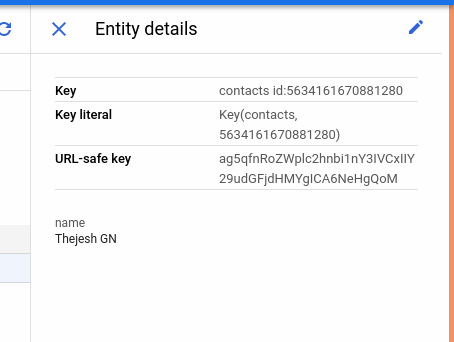
Google Cloud Datastore is a highly scalable, managed NoSQL database service. I have used it for years to store millions of records. One of the things that I like about it; is the "Key". Because it has all kinds of meta information, not just the ID.
a Key (like a primary key) A unique identifier for an entity; it's usually a long number. But it's more than that. It's a complex object which contains the unique ID (64-bit integer), Entity Name, Path, Parent, etc Datastore also gives you. URL Safe Key; that you can safely pass around. You can easily find it in the console.
Google Datastore's URL Safe Key
It's not that difficult to decode it once you know how it's constructed. It's a base64 encoded protobuf of Reference. Sometimes the bas64 encoded string is compressed (the padding is removed). So you might have to calculate and add it. Usually one = or two == at the end.
The protobuf for Reference is below. Save it as key.proto
// Copyright 2017 Google LLC
//
// Licensed under the Apache License, Version 2.0 (the "License");
// you may not use this file except in compliance with the License.
// You may obtain a copy of the License at
//
//     http://www.apache.org/licenses/LICENSE-2.0
//
// Unless required by applicable law or agreed to in writing, software
// distributed under the License is distributed on an "AS IS" BASIS,
// WITHOUT WARRANTIES OR CONDITIONS OF ANY KIND, either express or implied.
// See the License for the specific language governing permissions and
// limitations under the License.

syntax = "proto2";

message Reference {
  required string app = 13;
  optional string name_space = 20;
  required Path path = 14;
  optional string database_id = 23;
}

message Path {
  repeated group Element = 1 {
    required string type = 2;
    optional int64 id = 3;
    optional string name = 4;
  }
}
To what extent are new companies, particularly those in new spaces, pushed versus pulled into existence? Last week I wrote about how Tesla is a Meme Company:
It turned out, though, that TSLA was itself a meme, one about a car company, but also sustainability, and most of all, about Elon Musk himself. Issuing more stock was not diluting existing shareholders; it was extending the opportunity to propagate the TSLA meme to that many more people, and while Musk’s haters multiplied, so did his fans. The Internet, after all, is about abundance, not scarcity. The end result is that instead of infrastructure leading to a movement, a movement, via the stock market, funded the building out of infrastructure.
Electrification of personal vehicles would have happened at some point; it seems fair to argue that Musk accelerated the timeline significantly. Clubhouse, meanwhile, Silicon Valley’s hottest consumer startup, feels like the opposite case: in retrospect its emergence feels like it was inevitable — if anything, the question is what took so long for audio to follow the same path as text, images, and video.
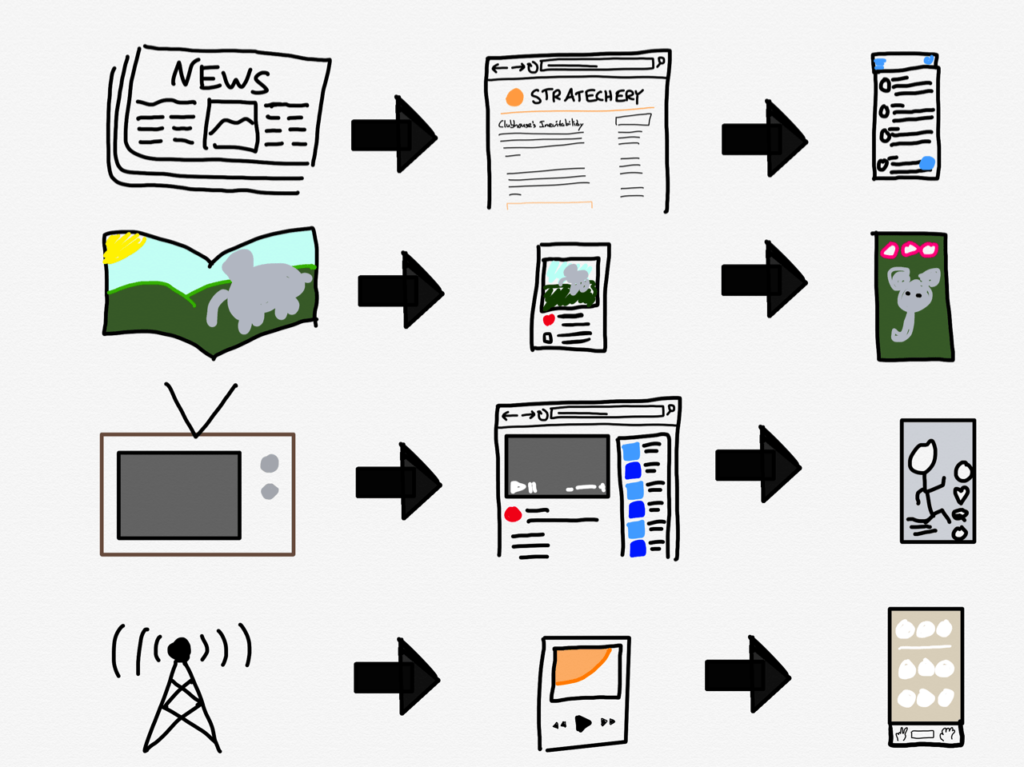
Step 1: Democratization
The grandaddy of independent publishing on the Internet was the blog: suddenly anyone could publish their thoughts to the entire world! This was representative of the Internet’s most obvious impact on media of all types: democratization.
Distributing text no longer required a printing press, but simply blogging software:
Distributing images no longer required screen-printing, but simply a website:
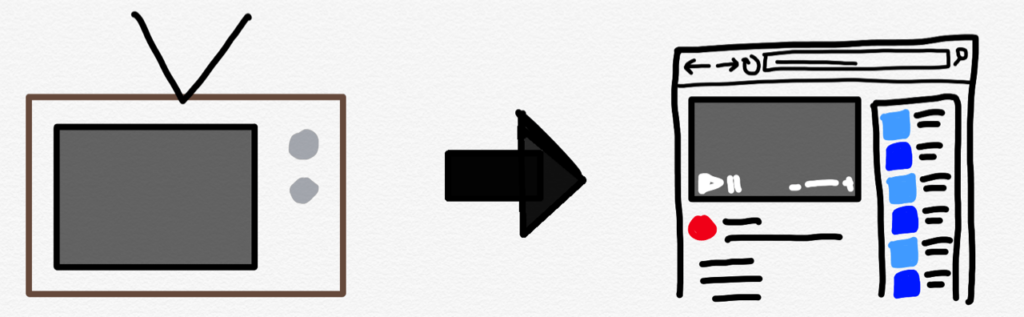
Distributing video no longer required a broadcast license, but simply a server:
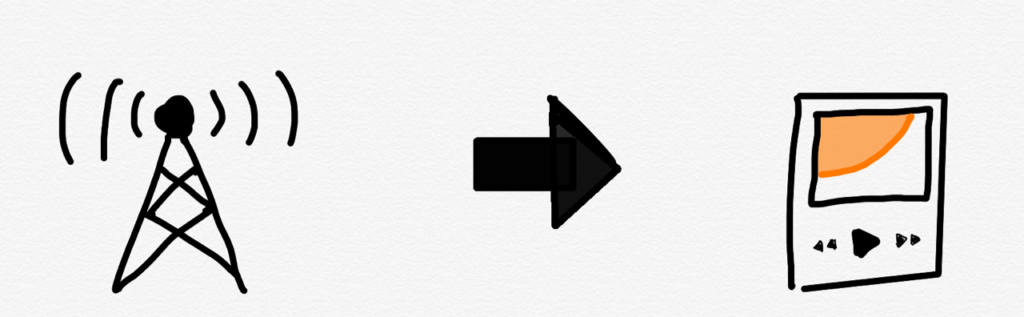
Distributing audio no longer required a radio tower, but simply an MP3:
Businesses soon sprang up to make this process easier: Blogger for blogging, Flickr for photo-sharing, YouTube for video, and iTunes for podcasting (although, in a quirk of history, Apple never actually provided centralized hosting for podcasts, only a directory). Now you didn’t even need to have your own website or any particular expertise: simply pick a username and password and you were a publisher.
Step 2: Aggregation
Making anyone into a publisher resulted in an explosion of content; this shifted value to entities able to help consumers find what they were interested in. In text the big winner was Google, which indexed pre-existing publications, independent blogs, and everything in-between. The big winner in photos, meanwhile, ended up being Instagram: users “came for the tool and stayed for the network”, as Chris Dixon memorably put it:
Instagram’s initial hook was the innovative photo filters. At the time some other apps like Hipstamatic had filters but you had to pay for them. Instagram also made it easy to share your photos on other networks like Facebook and Twitter. But you could also share on Instagram’s network, which of course became the preferred way to use Instagram over time.
The Internet creates a far tighter feedback loop between content creation and consumption than analog media; Instagram leveraged this loop to become the dominant photo network. YouTube accomplished a similar feat, although the relative difficulty in creating video meant that the ratio of viewers to creators was much more extreme than in the case of photo-sharing. That, though, is exactly what made YouTube so dominant: creators knew that that was where all of their would-be viewers were.
Spotify is trying to do something similar for audio, particularly podcasts. I wrote in a Daily Update after the streaming service signed Joe Rogan to an exclusive contract:
Spotify, meanwhile, has its eyes on an absolute maxima — a podcast industry that monetizes at a rate befitting its share of attention — but as I have explained, that will only be possible with a Facebook-like model that dynamically matches advertisers and listeners in real-time, as they are streaming a podcast…This, by extension, means that Spotify needs a much larger share of the market, so that they can start generating advertising payouts that are better than the current stunted model, thus convincing podcasters to give up their current ads and use Spotify’s platform to monetize instead.
In this view the motivation for the Rogan deal is obvious: Spotify doesn’t just want to capture new listeners, it wants to actively take them from Apple and other podcast players. And, if it can take a sufficient number, the company surely believes it can create a superior monetization mechanism such that the rest of the podcast creator market shifts to Spotify out of self interest.
Capture enough of the audience and the creators will follow.
Step 3: Transformation
Still, even with the explosion of content resulting from democratizing publishing, what was actually published was roughly analogous to what might have been published in the pre-Internet world. A blog post was just an article; an Instagram post was just a photo; a YouTube video was just a TV episode; a podcast was just radio show. The final step was transformation: creating something entirely new that was simply not possible previously.
Start with text: Twitter is not discrete articles but a stream of thoughts, 280 characters long. It was the stream that was uniquely enabled by the Internet: there is no real world analogy to being able to ingest the thoughts of hundreds or thousands of people from all over the world in real-time, and to have the diet be different for every person.
What is interesting is the effect this transformation had on blogging; Twitter all but killed it, for three reasons:
First, Twitter was even more accessible than blogging ever was. Just type out your thoughts, no matter how half-formed they may be, and hit tweet.
Second, because blogging was so distributed and imperfectly aggregated it was hard to build an audience; Twitter, on the other hand, combined creation and consumption like any other social network, which dramatically increased the reward and motivation for posting your thoughts there instead of on your blog.
Third, Twitter, thanks to the way it combined a wide variety of creators in an easily-consumable stream, was just a lot more interesting than most blogs; this completed a virtuous cycle, as more consumers led to more creators which led to more consumers.
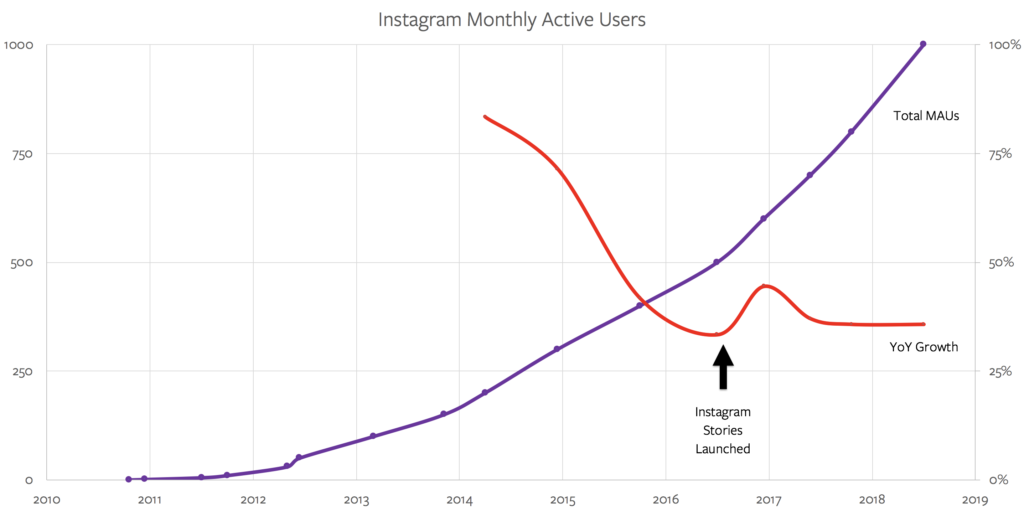
Instagram, meanwhile, had always had that transformational feed, which carried the service to its first 500 million users; it was Stories, though, that re-ignited growth:
Stories — which Instagram audaciously copied from Snapchat — combined the customized nature of the feed with the ephemerality inherent in digital’s abundance; the problem with posting what you had for lunch was not that it was boring, but that no one wanted it to stick around forever.
This too appears to have reduced usage of what came before; while Facebook has never disclosed Stories usage relative to feed viewing, that chart above is from this August 2018 Article about Facebook’s Story Problem — and Opportunity, where I observed:
While more people may use Instagram because of Stories, some significant number of people view Stories instead of the Instagram News Feed, or both in place of the Facebook News Feed. In the long run that is fine by Facebook — better to have users on your properties than not — but the very same user not viewing the News Feed, particularly the Facebook News Feed, may simply not be as valuable, at least for now.
The opportunity came from the fact that dramatically increasing inventory would surely lead to significant growth in the long run, which is exactly what has happened. It didn’t matter that Stories were not nearly as well-composed as pictures in the Instagram feed; in fact, that made them even more valuable, because Stories were easier to both produce and consume.
TikTok is doing the same thing with video; in this case the transformative technology is its algorithm. I explained in The TikTok War:
All of this explains what makes TikTok such a breakthrough product. First, humans like video. Second, TikTok’s video creation tools were far more accessible and inspiring for non-professional videographers. The crucial missing piece, though, is that TikTok isn’t really a social network…
ByteDance’s 2016 launch of Douyin — the Chinese version of TikTok — revealed another, even more important benefit to relying purely on the algorithm: by expanding the library of available video from those made by your network to any video made by anyone on the service, Douyin/TikTok leverages the sheer scale of user-generated content to generate far more compelling content than professionals could ever generate, and relies on its algorithms to ensure that users are only seeing the cream of the crop.
YouTube has invested heavily in its own algorithm to keep you on the site, but its level of immersion is still gated by its history of serving discrete videos from individual creators; TikTok, on the other hand, drops you into a stream of videos that quickly blur together into a haze of engagement and virality.
There is nothing like it in the real world.
Podcasts and Blogs
What is striking about audio is how stunted its development is relative to other mediums. Yes, podcasts are popular, but the infrastructure and business model surrounding podcasts is stuck somewhere in the mid-2000’s, a point I made in 2019 in Spotify’s Podcast Aggregation Play:
The current state of podcast advertising is a situation not so different from the early web: how many people remember this?
These ads were elaborate affiliate marketing schemes; you really could get a free iPod if you signed up for several credit cards, a Netflix account, subscription video courses, you get the idea. What all of these marketers had in common was an anticipation that new customers would have large lifetime values, justifying large payouts to whatever dodgy companies managed to sign them up.
The parallels to podcasting should be obvious: why is Squarespace on seemingly every podcast? Because customers paying monthly for a website have huge lifetime values. Sure, they may only set up the website once, but they are likely to maintain it for a very long time, particularly if they grabbed a “free” domain along the way. This makes the hassle of coordinating ad reads and sponsorship codes across a plethora of podcasts worth the trouble; it’s the same story with other prominent podcast sponsors like ZipRecruiter or SimpliSafe.
The problem is that the affiliated marketing for large lifetime-value purchases segment is not a particularly large one
One of the takeaways of that piece was that monetization was holding podcasts back, and that Spotify appeared to be positioning itself to expand the podcast advertising market via centralization. Looking back, though, I should have realized that but for a few exceptions, advertising never ended up working out for blogs; the premise behind 2015’s Blogging’s Bright Future was that subscriptions made far more sense as a business model:
Forgive me if this article read a bit too much like an advertisement for Stratechery; the honest truth is my fervent belief in the individual blog not only as a product but also as a business is what led to my founding this site, not the other way around. And, after this past weekend’s “blogging-is-dead” overdose, I almost feel compelled to note that my conclusion — and experience — is the exact opposite of Klein’s and all the others’: I believe that Sullivan’s The Daily Dish will in the long run be remembered not as the last of a dying breed but as the pioneer of a new, sustainable journalism that strikes an essential balance to the corporate-backed advertising-based “scale” businesses that Klein (and the afore-linked Smith) is pursuing.
When you think about the Twitter-driven shake-out of blogging this evolution makes sense: Twitter captured the long-tail of blogs, in the process dramatically expanding the market for publishing text, but that by definition meant that the blogs that remained popular had readers that would jump through hoops — or at least click a link — to consume their content. It makes sense that the most sustainable way for those bloggers to pay the bills was by directly charging their readers, who already had demonstrated an above-average interest in their content.
My personal bet is that podcasts will follow a similar path. Podcasts, even more than blogs, require a commitment on the part of the listener, but that commitment is rewarded by a connection to the podcast host that feels even more authentic; host-read podcast advertising leverages this authenticity, but for most medium-sized podcasts charging listeners directly will make more sense in the long run.
Implicit in this prediction, though, is that podcasts actually fade in relative importance and popularity to an alternative that doesn’t simply further democratize audio publishing, but also transforms it. Enter Clubhouse.
Clubhouse’s Opening
The most obvious difference between Clubhouse and podcasts is how much dramatically easier it is to both create a conversation and to listen to one. This step change is very much inline with the shift from blogging to Twitter, from website publishing to Instagram, or from YouTube to TikTok.
Secondly, like those successful networks, Clubhouse centralizes creation and consumption into a tight feedback loop. In fact, conversation consumers can, by raising their hand and being recognized by the moderator, become creators in a matter of seconds.
This capability is enabled by the “only on the Internet” feature that makes Clubhouse transformational: the fact that it is live. In many mediums this feature would be fatal: one isn’t always free to watch a live video, and believe me, it is not very exciting to watch me type. However, the fact that audio can be consumed while you are doing something else allows the immediacy and vibrancy of live conversation to shine.
Being live also feeds back into the first quality: Clubhouse is far better suited than podcasts to discuss events as they are happening, or immediately afterwards. For example, both Clubhouse and Locker Room, its sports-focused competitor, have become go-to destinations for sports reaction conversations, both during and after games; it’s only a matter of time before secondary market of play-by-play announcers develops, and not only for sports: anything that is happening can be narrated and discussed.
Make no mistake, most of these conversations will be terrible. That, though, is the case for all user-generated content. The key for Clubhouse will be in honing its algorithms so that every time a listener opens the app they are presented with a conversation that is interesting to them. This is the other area where podcasts miss the mark: it is amazing to have so much choice, but all too often that choice is paralyzing; sometimes — a lot of times! — users just want to scroll their Twitter feed instead of reading a long blog post, or click through Stories or swipe TikToks, and Clubhouse is poised to provide the same mindless escapism for background audio.
COVID, China, and Controversy
Much of what I’ve written is perhaps obvious; to me that lends credence to the idea that Clubhouse is onto something substantial. To that end, though, why now?
The fact that Clubhouse makes it so easy to drop in and out of conversation is matched by how easy AirPods make it to drop into and out of audio-listening mode.
An even more important reason, though, is probably COVID. Clubhouse launched last April in the midst of a worldwide lockdown, and despite its very rough state it provided a place for people to socialize when there were few other options. This was likely crucial in helping Clubhouse achieve its initial breakthrough. At the same time, just because COVID helped Clubhouse get off the ground does not mean its end will herald the end of the audio service, any more than improved iPhone cameras heralded the end of Instagram simply because its filters were no longer necessary; the question is if the crisis was sufficient to bootstrap the network.
I suspect so. For one there is the brazenness with which Clubhouse is leveraging the iPhone’s address book to build out its network; getting on the app requires an invitation, or signing up for the waiting list and hoping someone in your address book is already on the service, which lets you “jump the line”. This incentivizes both existing and prospective members to allow Clubhouse to ingest their contacts and get their friends on as quickly as possible.
Secondly, any suggestion that Clubhouse is limited to Silicon Valley is very much off the mark. I almost fell out of my chair while playing board games when my not-at-all-technical sister-in-law started listening to a Clubhouse while we were playing board games over the weekend, and by all accounts Taiwan is one of a whole host of markets where the app has taken off. Locker Room, as noted, appears to be the app of choice for NBA Twitter, but I suspect that is a function of Clubhouse being both gated and iPhone-only; I expect both to be rectified sooner-rather-than-later. And, of course, there is the fact the service has been banned in China.
The Stanford Internet Observatory has confirmed that Agora, a Shanghai-based provider of real-time engagement software, supplies back-end infrastructure to the Clubhouse App. This relationship had previously been widely suspected but not publicly confirmed. Further, SIO has determined that a user’s unique Clubhouse ID number and chatroom ID are transmitted in plaintext, and Agora would likely have access to users’ raw audio, potentially providing access to the Chinese government. In at least one instance, SIO observed room metadata being relayed to servers we believe to be hosted in the PRC, and audio to servers managed by Chinese entities and distributed around the world via Anycast. It is also likely possible to connect Clubhouse IDs with user profiles.
That certainly puts Clubhouse’s aggressive contact collection in a more sinister light; it also very much fits the stereotype of a new social network scrambling to capture the market first, and worrying about potential downsides later. Given the importance of network effects, I’m not surprised, but the choice of a Chinese infrastructure provider in particular is disappointing for a service launching in 2020.
The perhaps sad reality, though, is that most users probably won’t care: the payoff from uploading contacts is clear, and even if you don’t, you still need a phone number to register, which means that Clubhouse is probably reconstructing your contact list from your friends who did. The company has been far more aggressive in implementing blocking and user-reported content violations mechanism; I suspect this reflects the reality that content controversies are, in the current environment, more damaging than China connections, despite the fact that the former are an inescapable reality of user-generated content, while the latter is a choice.
Whither Facebook?
The one social network that I have barely mentioned in this Article is the social network that the FTC has sued for being a monopoly. That sentence, on close examination, certainly seems to raise some rather obvious questions about the strength of the FTC’s case.
Still, the discussion of all of these different networks really does highlight how Facebook is unique: while Twitter, Instagram, YouTube, and TikTok are all first and foremost about the medium, and only then the network, Facebook is about the network first. That is how the service has evolved from text to images to video and, I wouldn’t be surprised, to audio. This also explains why Facebook managed the shift to mobile so well; for these other networks, meanwhile, it was mobile that was the foundation for their transformative breakthroughs.
That is why I would actually give Facebook’s upcoming Clubhouse competitor a better chance than Twitter’s already-launched offering. Facebook takes innovations developed in different apps for interest-based networks and adds them to its relationship-based network; at the same time, this also means that Facebook is never going to be a real competitor for Clubhouse, which seems more likely to recreate Twitter’s interest-based network than Twitter is likely to recreate the vibrancy of Clubhouse.
The other way that Facebook looms large in the social networking discussion is monetization: it is obvious that there is an endless human appetite for social networks, but advertisers would much rather focus on Facebook’s integrated suite of properties. It is not clear that Clubhouse will even pursue advertising, though; the company has announced its intention to help creators monetize via mechanisms like tipping. This has already been proven out on platforms like Twitch in the West, and is a massive success in China (there is a reason, I should note, why the best available live streaming technology was offered by a Chinese company). It’s a smart move for Clubhouse to move in this direction early, both as a means of locking in creators, and also going where Facebook is less likely to follow.
One potential loser, meanwhile, is Spotify; the company has bet heavily on podcasts, which could be similar to betting on blogs in 2007. Still, the fact the company’s most important means of monetization is subscriptions may be its saving grace; it may turn out that Spotify is the obvious home for highly produced content, available in a more consumer-friendly bundle than the a la carte pricing that followed from blogging’s decentralized nature.
For now I don’t expect Clubhouse to be too concerned about the competition; the company said on its website when it reportedly became a unicorn:
We’ve grown faster than expected over the past few months, causing too many people to see red error messages when our servers are struggling. A large portion of the new funding round will go to technology and infrastructure to scale the Clubhouse experience for everyone, so that it’s always fast and performant, regardless of how many people are joining.
That is, obviously, the best sort of problem to have, and one that evinces product-market fit (the only thing missing is a fail whale); the fact it all seems so obvious is simply because we have seen this story before.
May 6, 2021: It looks like this analysis may have missed this mark; I wrote another follow-up in this Daily Update — which you can read for free — examining what I got wrong.
















 Singlish Dominatrix @sabcatsilver





 xkcd.com.


 Price Tags.


 moodvintage on Twitter.


 jwz.
jwz.