Shared posts

09 Apr 18:07

Project: I’ve been shot (COVID-19 vaccine badge)

by charlie

Back in January, when I was pondering my Jan-Feb project (for my year-long challenge), members of my family were starting to get vaccinated. Since I’ve been trying to do projects that represent things or have meaning, I tried to think of something that would ‘represent’ aspects of immunology, RNA, viruses, and vaccines. Alas, I couldn’t. So I figured I’d do a badge.

More leveling up
I’m always trying to do something new. I’d done a few PCBs. I was comfortable using an ATtiny to animate an LED. So I wanted to push a few things here.

First of all was the artwork. My mother has an iPad with a pen, so I drew out a few iterations of ‘I’ve been shot!’. Then I took it all into Inkscape to take advantage of svg2shenzhen, a cool plugin that I wish I had the first time I tried to make art PCBs about a year ago.

Then, for the circuit, I wanted to use an ATtiny85 or, my favorite, ATtiny45. And to maximize the number of LEDs, I decided to Charlieplex them, and use the RST pin to cycle thru animation (state memorized by EEPROM). To add a fun twist, I thought I’d use one of the new ATtiny 0-series chips, the 402. The chips are close enough to what I know, but would require a new programmer (it uses UPDI instead of the usual ISP programming). New! So part of this project required me to build a UPDI programmer.

Also, because it was going to be all surface mount components, I bought some solder paste (in a syringe) so I could try soldering with my hot gun (a new technique for me).

Chugging along
All was going well. I prototyped the Charlieplexing and code on an ATtiny45. Was able to easily design the board in KiCad, with the artwork. Ordered the boards from Oshpark in the After Dark style. And picked up parts from Digikey, as I usually do.

Soldering went well. Maybe one LED spun around and ended up backwards. But Charlieplexing is forgiving – it still it up, but at the wrong sequence.

But something big came up when I was programming the chips prior to mounting – I found out that the UPDI and RST pin are not shared (ugh, a reminder to always prototype with new chips before building with them). I knew UPDI and RST were on the same pin, but I didn’t know you could only have one or the other. Aaaand, if you set the UPDI pin to RST, you need a High-Voltage (HV) programmer. So once you set the bootloder to set the fuses to use the RST instead of UPDI, you need a HV programmer to load your sketch.

I was stuck. The board was designed to do the RST with the RST/UPDI pin. So there was no way the board was going to work. As insurance, then, I set another pin to be used as reset (a slightly different interrupt coding than with the ATtiny45s, but seemed cleaner).

In the end, I had fully assembled badges, with the right code and backup interrupt pin, but which wouldn’t work as wired. I could cycle thru the animations by pulling out the battery and reinserting, or by using a wire to ground the backup pin.

That’s OK. I’ll just buy a HV UPDI programmer.

High-voltage frustration
The guy on Tindie with the recommended one was out of stock and despite pestering him and waiting more than a month, he never made more, even tho he said he was about to. Fortunately, the guy (who is really clever and documents things well) made everything available to buy the boards (from Oshpark) and build the HV programmer yourself. So that’s what I did.

I don’t know. I built the HV programmer, but was never able to get it to do HV programming (it did regular UPDI programming quite well, but I already had a programmer to do that). After wanting to do this for almost two months, buckling down and spending some money to get more than I needed had I been able to just buy it on Tindie, I threw in the towel trying to reprogram the chips on my badges.

One last try
I have lacquered wrapping wire – it’s nice and thin and comes insulated. Perfect for a bodge.

And I see so many folks (*cough* Greg Davill) doing amazing bodges, I realized that my only way to make these badges usable was to try a badge with the lacquered wire. So decided to give the project one last effort and to try to bodge the badges.

Now, I had thought the soldering process would be enough to burn off the lacquer to expose the copper. But I found out (after not being able to make the bodge work) that it takes time. So I patiently bubbled off the lacquer (checked it with a multimeter) and bodged all the badges.

It worked. I hot-glued some pins to the back and now have a proper badge to hand out to vaccinated family members.

Summary
On a whim, I designed a badge to commemorate getting a COVID-19 vaccine. I managed to compete this project within my Jan-Feb time frame. Except for one wrinkle. Along the way, I tried some new things for me, but walked into an unexpected feature of the new chip I used. I tried one way to fix it, but was stymied, until I figured out how to do a simple bodge.

Yay.

One more thing: aside from missing the UPDI/RST issue, I was schooled again on sizes. Man, 0805 is small. And so is SOIC-8. But I knew that already. The real head-scratcher was the 3mmx5mm button. Gosh, that’s small. I really need to just buy a bunch of buttons to try out and get a feel for. Haha.

The post Project: I’ve been shot (COVID-19 vaccine badge) first appeared on Molecularist.
09 Apr 18:07

Quoting Scott Arbeit

GitHub, by default, writes five replicas of each repository across our three data centers to protect against failures at the server, rack, network, and data center levels. When we need to update Git references, we briefly take a lock across all of the replicas in all of our data centers, and release the lock when our three-phase-commit (3PC) protocol reports success.

Scott Arbeit

09 Apr 18:06

Building My Own Yahoo! Pipes

by Rui Carmo

Pipes has been dead since 2015 or so, but I used it for a long time and it was essential to my daily news intake, so I’ve been building a personal replacement to cater to my specific needs.

The problem statement is simple–I’m looking to rebuild the collection of industry-specific RSS news feeds I follow through Reeder and Feedly on a daily basis, and add more smarts to it (trending topics, for starters, and then a curated feed of relevant news according to five or six topics).

But most of the sites or companies I want to keep track are either too niche or too corporate to bother having proper RSS feeds (or don’t have them for what I want to keep track of). Plus (and this is one of the new twists) some are written in German (which I can read, but not before my morning coffee), Swedish, Finnish, or even Korean.

So just like around a decade ago, I’m building a few custom scrapers and the logic to carve out some meaning from hostile web sites, and trying to do so in the easiest way possible.

Should I Go Web Scale?

I could write it all up in Python or Go again, and if I did I would most likely end up with a similar set of decoupled services:

  • Fetchers and parsers communicating via pubsub.
  • A writer process that takes the end results and writes them to a central store.
  • A set of back-end classifiers and rankers that would also use pubsub to keep track of changes and update the store with additional metadata.
  • An HTTP listener with read-only access to the store that just grabs the results and renders them as custom feeds so that Reeder can get at them via Feedly.

But as it turns out, this doesn’t need massive scalability (I’m only planning to track around a hundred or so feeds at most), and it becomes a little tedious to set up and maintain.

So I turned to piku again, and within all of 15 minutes, I had a running single-core VM with a working deployment of Node-RED running behind Cloudflare.

I then set out on a quest for piping data through it.

The New Low-Code Fashion is RED

I’ve been using Node-RED for home automation for quite a few years now (even down to maintaining my own cross-platform Docker images) and it’s been really stable, but I just never bothered with half of the built-ins except for building an app store price scraper a couple of years back.

Most of what I’ve done with it is a weird mix of MQTT and JSON piping with a couple of low-end UDP and multicast sniffing hacks to deal with HomeKit and my set-top-boxes as well as a bunch of quick and dirty dashboards for Zigbee temperature sensors, so this time around I consciously tried for a more modular, generic approach.

I also tried to avoid using third-party nodes as much as possible, since (like the rest of the npm ecosystem) there is a lot of outdated and broken stuff out there.

Fortunately, the core nodes have (so far) been more than enough, and you can go a long way with just four of them:

  • The xml node can parse both RSS and Atom trivially, and it takes around 5 lines of JavaScript to grab feed items off the results.
  • The html node can take jQuery-like selectors like a.tiles__content--link h4, which means it is able to scrape, slice and dice most web pages just fine (except for SPAs, but I don’t feel like using Puppeteer just yet).
  • The http client node can now do persistent connections, and is quite fast at grabbing multiple pages off the same web server.
  • The http server and response nodes make building an API a breeze:
The little HTTP listener that could.

The database, by the way, is provided by the node-red-contrib-sqlite node and currently has a pretty trivial schema (just feeds, items and topics, with straigthforward relationships) so isn’t exactly rocket science, either.

As an example, here’s the prepared statement for the query above:

SELECT
    items.url as url,
    items.title as title,
    items.body as body,
    strftime('%Y-%m-%dT%H:%M:%SZ', items.date, 'unixepoch') as date,
    items.date as pubdate,
    feeds.url as feed_url,
    feeds.title as feed_title
FROM
    feeds
JOIN items 
ON items.feed_id = feeds.id
WHERE feeds.slug = $slug
ORDER BY pubdate DESC LIMIT 30;

Pushing down some trivial stuff (like date formatting and column renaming) into the engine is also another way to save time and increase responsiveness, so I do it whenever I can.

For instance, I use UNIQUE NOT NULL ON CONFLICT IGNORE on item url fields to simplify batch insertion handling (and implicit duplicate skipping), and also push down full-text searching into SQLite‘s FTS engine, so it’s all blazing fast.

It’s all a matter of knowing your tools, really.

Also, somewhere in the past year or so Node-RED changed its UI for managing sub-flows, which means it’s much easier to have a modular approach with re-usable nodes–want a uniform way to clean up and store items? Just wrap a function node and a SQLite node in a sub-flow, and you’re done. And the same goes for filters, XML transforms, etc.

Build them once, test them, add them to the palette, wire them up in a pipeline, tie pipelines together… You get the idea.

So with some forethought and planning it’s pretty easy to have a Yahoo! Pipes-like experience - you just need to craft the right sub-flows with the right payload conventions, and voilá, you have your own palette of data transforms.

Example: Found In Translation

Translation turned out to be one of the easiest parts, since Node-RED‘s HTTP node was also recently revamped to remove some of the weirdness of building custom HTTP requests.

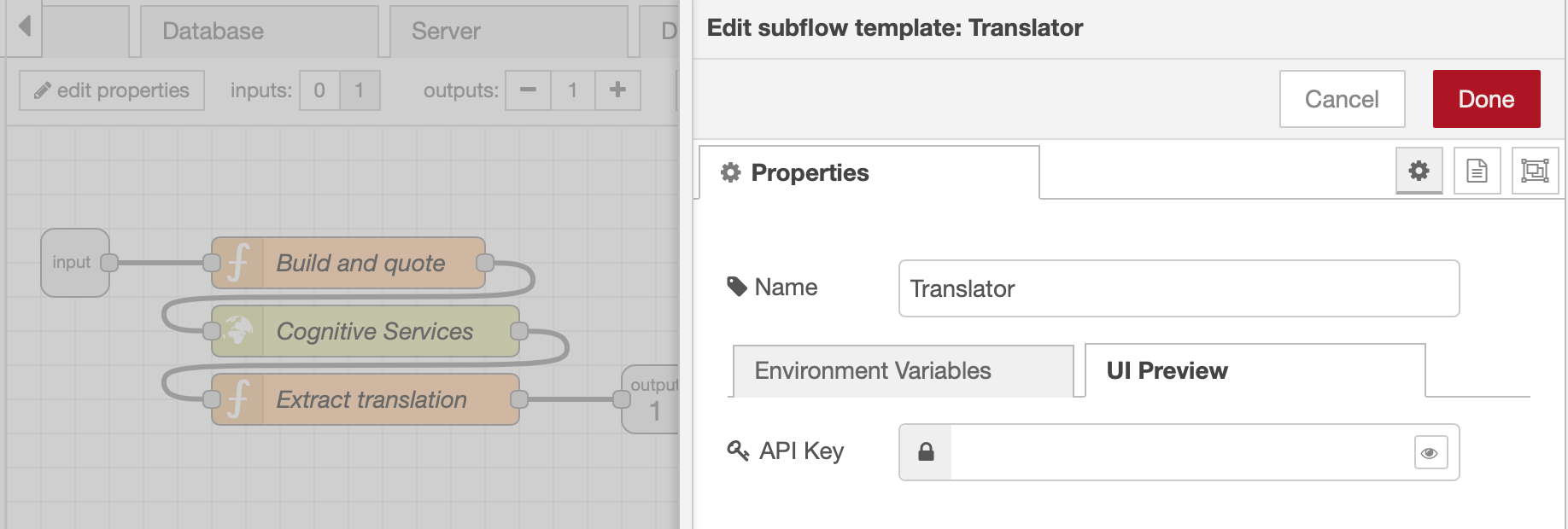
Calling out to Azure Cognitive Services boiled down to building a generic sub-flow containing just three nodes (set up the request payload and custom headers, execute it, and unpack the results) as well as configuring a custom UI pane to paste in the API key:

The only thing missing from the UI builder right now is configurable input drop-downs, but the basics are there.

Like all of my item processing nodes, it expects a consistent set of fields for each feed item, so I can toss in something that looks like:

{
    "title": "Veckans nyheter",
    "body": "Investeringsbank ..."
}

That will get formatted into an API request to the translation service, sent out, reformatted back into the right fields and output by the node like so:

{
    "title": "This week's news",
    "body": "Investment Bank ..."
}

…which conforms to the same schema I use across all my pipelines. So as long as I don’t deviate from that schema, I can slot this in anywhere.

Endgame

This means building a scraper for title-only, non-English feeds takes me around zero minutes right now, as all I have to do is drag one of my custom nodes to the canvas and link it to a scheduler that cycles through the URLs to fetch. It actually takes longer for me to subscribe to the new URL in Reeder.

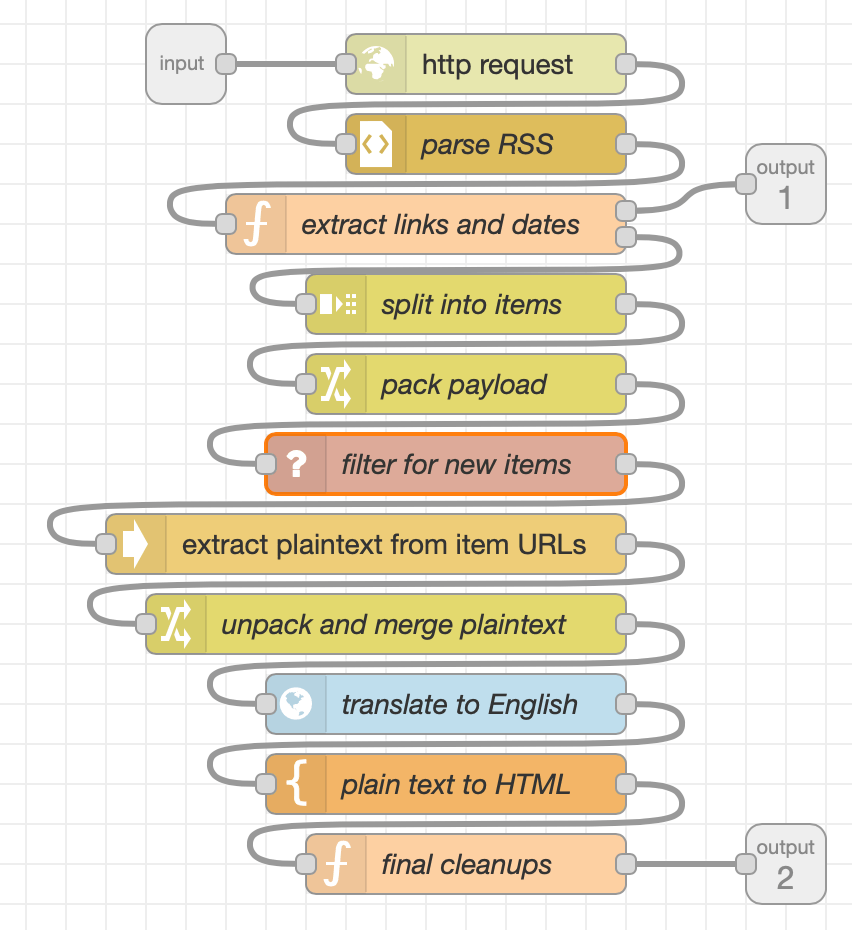
And each scraper follows more or less the same pattern (with minor variations depending on what it needs to do):

A sample scraper. All it needs is an input URL.

The filter, extractor and translator are all custom sub-flows as well, so it’s turtles all the way down.

There are a few other sub-flows for glue logic, but most of those are about scheduling refreshes and extracting topics from what is already in the database–again, it’s all a set of decoupled “processes”, and they could easily be extracted and run on their own compute contexts.

If Node-RED ran on Azure Functions, it would be a poster child for serverless low-code buzzword bingo…

Caveats

The only real issues I have with this setup are:

  • Doing data munging in JavaScript is tedious and error-prone. I keep having to toss arrow functions into Array.forEach, which is annoying.
  • Function nodes can only have one input, so there’s no easy way to (for instance) only act when two inputs are “finished” and available for processing. It requires some getting used to (and some creative workarounds for complex logic).
  • Node-RED is still painful to debug sometimes (nodes have untyped inputs, so it’s easy to inject quasi-invalid data and have it blow up somewhere in the middle of a pipeline).

Other than that, it’s extremely fast, easy to maintain and quite cheap (thanks to piku it’s running on the same single-core VM that renders this site).

Since it’s all asynchronous fetching a few dozen feeds, translating them and writing them to the database takes only a few seconds, and Feedly only checks for the results every half hour or so, so there is no real need for a high-performance pipeline yet (and plenty of headroom).

And sitting behind Cloudflare it can probably even have a few thousand users hammering it, so I’d say it’s pretty fit for purpose and cost effective.

Not as much fun as coding the whole thing from scratch, perhaps, but much less hassle altogether, and frees up some time to do more interesting stuff.


09 Apr 18:06

Tuning Out LinkedIn

by Ton Zijlstra

It’s odd to see how conspiracy fantasies, suspect sources, disinformation and deliberate emotionally provocative or even antagonistic wording are on the rise on my LinkedIn timeline.

I first encountered a QAnon account in a comments section last August, but that person was still many steps away in my network. Now I see things popping up from direct connections and their connections. I had assumed that LinkedIn being tied to your professional reputation would go a long way to prevent such things, but apparently not any longer. In some instances, it’s almost as if people don’t realise they’re doing it, a boiling-a-frog effect of sorts.

One person being called out for some under-informed reactionary content by pointing out that their employer has the capabilities and resources to prove them wrong even responded “leave my employer out of it”. That’s not really possible though, as your employer is in your by-line and accompanies your avatar with every post and comment you make. Seven months after first encountering something like that on my LinkedIn timeline it is now a daily part of my timeline, and all coming from my Dutch network and their connections.

LinkedIn is starting to feel as icky as Facebook did three years ago. Makes me wonder how long LinkedIn will remain a viable tool. I don’t think I will be spending much or any attention on my timeline moving forward, until the moment LinkedIn is as much a failed social platform as others and it’s time to let go of it completely. That doesn’t mean disengaging with the people in my network obviously, but it is not at all my responsibility to help LinkedIn reach a certain level of quality of discourse by trying to counteract the muck. I was an early user of LinkedIn (nr. 8730, look at the source of your profile page and search it for ‘member:’ to find your number) in the spring of 2003, I know there’s already a trickle of people leaving the platform, and I wonder when (not if) I’ll fully join them.

09 Apr 18:05

Advice for Giving Feedback

alt_text

Earlier, we presented an article on receiving feedback. People told us it was helpful and requested that we provide a companion article on giving feedback as well.

Working collaboratively within and across teams means plenty of opportunities to continuously improve the way we work together. This also means we need to be able to both provide and receive feedback, so we can continue to learn from each other and understand our own impact.

Language and intention matter when giving constructive feedback to others.

When done well, giving feedback fosters trust and improves our ability to get more done faster. When done poorly, we can cause defensiveness and hinder productivity.

So how do we do this thoughtfully with one another?

I was once in a planning meeting with a product delivery team where the lead developer was growing increasingly frustrated with an architect he was working with. When the architect stepped out of the room to take a phone call, this developer started taking shots at the engineer and making sarcastic comments about the decisions that were being made from a design perspective. His concerns were valid. His approach could have been different, and of course, probably not a great idea to suddenly start behaving this way and venting about a person once they leave the room.

Our intention is to Make People Awesome.

We want to give people the feedback that they need to become amazing at their work. In the above story, we would like to have the absent architect receive and consider the design comments and learn from them. This way, the architect may improve his functional skills and provide better solutions going forward.

In the same vein, though, the developer had some good functional skills but clearly had a problem with their behavioral skills. It is unlikely that the best way to move forward is with the developer and the architect countermanding each other’s decisions, fighting for dominance, and feeling resentful/wrathful over their treatment.

This behavioral flaw was likely to lead to a damaging team dynamic in the future if the problem between them was not resolved.

Feedback is wrapped up in human working relationships and is a complicated topic. Many books could be written on this topic, and indeed many have. We will list a few of our favorites at the bottom of this blogpost.

Drawing on many of these sources, we present a simplified pattern here. If you’re in a hurry, you could certainly do far worse than follow this outline!

If you have the time, please consider digging deeper into the literature suggested below. Feel free to recommend additional sources you have found useful in the comments section.

A Process for Giving Feedback

When you deliver feedback, the first step(s) are all about you and not about them. You will spend time centering yourself, being aware of your intentions and relationship, considering your motivation, thinking about outcomes. When you have your internal state all sorted, then you are in a position to help others.

To help make other people awesome, we begin with the steps of making safety a priority.

A few things to consider when you’re getting ready to give someone feedback:

  1. Check your emotional state. The times when we are most motivated to express ourselves are often not the best times to do so. Are you feeling exasperated, offended, angry, wrathful, resentful, frustrated? If so, you are more likely to be speaking from yourself rather than speaking to the other person.

    We all are human, and as such, we tend to assign motivations and intentions to others. We fall prey to the Fundamental Attribution Error. Be sure that you want to discuss behavior, not imagined motivations or intentions.

    Are you willing to take “no” for an answer, or are you deeply invested in them doing as you prefer? Do you feel that you have to be heard and obeyed? Whatever your feedback is, it’s better to work from a basis of improving a working relationship than exerting control.

  2. Check your motivation. What are you hoping will come of the feedback? Do you expect to feel better for having expressed yourself, or will it produce a better working relationship? Do you care personally for the other person’s success? Are you doing this for them, or you? For the team, including them? If you are confronting them selfishly, you might want to consider that long walk again.

  3. Make sure you have permission. There are many ways to be invited to give feedback to another person:
    • You were asked by them to provide feedback
    • You have an agreement in place
    • You are required by company policies to give feedback
    • You have asked them for permission to share your feedback
  4. Consider your relationship with this person. Do you know them well? Do you know what approach to consider? Do you know how to express yourself so that they will understand your motivation and intention?

  5. Talk privately A meeting full of people likely isn’t the best time to provide direct feedback that may be challenging for someone to hear, so look for a time when you can chat with them one-on-one.

  6. Have a plan. It’s sometimes hard to find the right words and courage to give someone feedback. You can avoid biases and opinions by utilizing a simple framework that shares an observation, like SBIN.
    • Situation: Describe the what/where/when specifics around the feedback you’ll be providing
    • Behavior: Share the behavior you witnessed and try to leave out opinions and assumptions. (Example: instead of “you’re clearly frustrated with so-and-so,” try a direct quote if you can, like “I heard you say ‘I can’t work with Greg anymore.’”)
    • Impact: Who did this impact, and how?
    • Next: Where do we go from here? What did we learn, and can we change the way we approach this in the future?
  7. Time is of the essence. Give feedback in a timely manner, but ensure you’re in a good headspace to deliver it. If you need a little time to prep, take it, but timebox it to a reasonable window of time to keep the feedback relevant.

  8. Don’t let it be all about correction. Sometimes it’s important to let people know what you value about working with them, the way they approach problems, and how they deal with people. If your feedback is always about your issues with their way of being, you may convince them that they will never be good enough for you, at which time the “what the hell” effect kicks in. Remember that this is about relationships, and specifically working relationships.

  9. Make it bi-directional. Sometimes it’s good to invite feedback. Ask the person if you’ve been a good colleague for them, and give them a chance to be earnest with you. When they do, consider the rules for receiving feedback.

Feedback delivered. Then what?

Sometimes people need a bit of time to process feedback that they’ve been given. Give them that time.

Even then, you should not feel that you are entitled to changes in the other person’s behaviors. The feedback you’ve given them is information. As separate beings with their own minds and autonomy, they can choose whether to make adjustments or not. If they decide to make a change, they may choose different ways to adapt than you would have expected.

Habits are slow to change. If the other person is willing to make adjustments for you, it still may take a long time to break their old habits and acquire new ones. When you see them trying, let them know you appreciate it. Don’t expect them to make an immediate 180º turn.

Summary and Resources

While there isn’t one “right way” to give feedback, and it may feel uncomfortable or awkward for you at first, each time you flex this muscle, you’ll get better at it and get more comfortable with it.

As the old adage goes, “treat others the way you’d like to be treated.” How would you like to be approached if someone had to give you feedback? This perspective will help you actively listen, empathize, and lead with curiosity instead of judgment.

Feedback is an extraordinarily powerful tool for us to improve the relationships we have with others. Improving our feedback skills will help build safety and trust, leading to higher performance.

09 Apr 18:05

Your Supermarket Layout Has Changed!

by Richard Millington

Would you visit your local supermarket more frequently if they announced a change in layout?

What if they told you the milk, bread, butter, and vegetables are now more convenient to find than ever before?

For most people, the answer is no. You might notice and appreciate the differences when you arrive, but it’s really not going to change whether (and how frequently) you visit.

(Of course, you’re going to notice if it becomes more difficult to find the items you want).

This is true for communities too. Don’t be surprised if members don’t seem to care about the redesign you’ve been working on for months. It might benefit members when they visit, but they’re not going to be too bothered about it either way.

Sending an excited mass email announcing the redesign of a community is mostly a waste of time. Members simply don’t care.

But they do care about the contents within the community. If you want your redesign to get noticed then launch it at the same time as something members do care about. That might be an incredible new resource, a genuinely exciting new feature, an event or discussion series you haven’t had before, or some activity with a VIP.

The post Your Supermarket Layout Has Changed! first appeared on FeverBee.

09 Apr 18:05

What’s the Deal?

by Asa Dotzler

SpaceX and Starlink, what’s the deal with all my posts lately.

Elon Musk got his start developing (and selling) an online yellow pages-type site in the 90s. He used that money to fund his next project, an online bank called X.com. Musk earned his first real fortune about three years later when he sold his stake in Paypal. (Musk’s company, X.com and another company, Confinity, had merged to become Paypal.)

Musk had been talking about Mars for a while and with just shy of 200 million dollars in his pocket from the Paypal sale, Musk decided he would use some of his new fortune to send a rocket to Mars. The trip was intended to re-ignite excitement about space and space exploration.

To find his Mars rocket, first he went to Europe to see if he could buy one from Arianespace. Musk decided they wanted too much for their rocket and next he tried to buy an intercontinental ballistic missile from Russia. Again the price wasn’t right, and after these two failures, Musk decided he would just build his own rocket. (How hard could it be, right?)

He became a student of rocketry, aerodynamics, space launch systems, and more. He read all the textbooks and papers. He talked to all the experts in all the fields. And then he began to hire them. They would form a company and build an initial test rocket, called Falcon 1, that in about 5 years of development time would become the first privately funded liquid fueled rocket to achieve Earth orbit. That company, called SpaceX, would, about 5 years later, in 2010 launch a second generation rocket, the Falcon 9. Falcon 9 would evolve over the next 5 years to become a partially re-usable rocket (the bigger and more expensive part of the rocket, the booster, flies back to Earth, lands, and is used for repeat launches) achieving its first successful landing in 2015 and first reuse in 2017. Today, the Falcon 9 program has over 110 flights with about half being on reused boosters.

With a small fleet of these re-usable Falcon 9 rockets, and the steeply discounted prices they could offer, SpaceX was able to capture the lion’s share of the global satellite launch business over the next several years. And with that same program, SpaceX also gained a considerable share of contracts for U.S. Government launches including lucrative International Space Station cargo and astronaut crew missions.

Revenue from its space launch business was used to fund the design and development of SpaceX’s next ambitious rocket, a spacecraft that would eventually be called Starship. Taking re-usability lessons, and actual engineering and software, from the proven Falcon 9 program, scaling it up about five times, and making it fully reusable, the Starship program would be suitable not just for even cheaper access to Earth orbit, but, finally, Musk’s trip to Mars

Twenty years after his initial plan to send a rocket to Mars, Musk was finally getting close. But by this time, his goals for Mars had evolved. No longer was it about a single trip to Mars to inspire a new generation of space enthusiasts, to re-ignite a passion for space exploration that had mostly cooled since the end of the Space Race. No, now his plan was much grander, to make human civilization multi-planetary by sending a million people to Mars.

Now, this new plan, a city on Mars, is going to require a massive fleet of fully reusable Mars rockets (they have to fly back from Mars, afterall, and it’s going to take many repeat trips, even with a large fleet, to deliver a colony to Mars.) Musk and SpaceX have already built and tested several full-scale prototypes of this new Starship rocket and it’s working well, but assuming the design proves sound, flexible enough for various mission profiles, and relatively cheap, SpaceX still has to build and operate a truly massive fleet of these for a Mars colonization project. And no matter how creative SpaceX is about keeping Starship’s costs down (they’re currently testing orbital and sub-orbital Starship rockets, built with stainless steel, welded together in a field, under some tents, in South Texas) a massive fleet of these massive rockets isn’t going to come cheap.

It had become clear to Musk that sending satellites, equipment, and people into low earth orbit, even if SpaceX dominated the market for those space launch services, wasn’t going to be lucrative enough to fund the production and maintenance of a Starship fleet large enough to transport a colony to Mars. Musk needed a new plan.

He looked around at what they had on hand at SpaceX, a new fleet of re-usable Falcon 9 rockets, a steady income from their space launch service, and a promising design for Starship, a vehicle capable of not only reaching Mars, but lifting gigantic payloads into Earth orbit. How could they leverage their existing resources to dramatically ramp up revenues, and quickly?

The answer was revealed in 2015 when SpaceX announced plans for a project to deliver high-speed, low latency internet from space, well, from a satellite, well, actually from a whole mess of satellites, thousands of them, probably tens of thousands. Now, to deliver high-latency, slow internet only requires a few giant, geostationary satellite and that only requires a few launches. But to deliver fast and reliable, true broadband internet service from space takes a whole bunch of satellites, as noted earlier possibly tens of thousands (assuming the they want the capacity to serve millions or hundreds of millions of people.) And that’s hundreds of rocket launches.

Well, what can SpaceX do better than any company on Earth? They can launch lots of things into Earth orbit quickly, and they can do it for dirt cheap. SpaceX’s plan would go something like this this. They would find a dozen satellite launch customers willing to pay for new Falcon 9 rockets, and then, after those commercial mission were flown, SpaceX would re-fly those same rockets, each one ten times or more (only paying for fuel and new upper stages, so super cheap) to launch thousands of their own internet satellites. (And when Starship is ready in couple of years, it will be able to launch up to ten thousand Starlink satellites each year and at a lower cost!)

They had a plan to accumulate the used Falcon 9 rockets, but they didn’t have two other important pieces of the puzzle. So SpaceX got into the satellite and antenna businesses. Once again, Musk studied up and he and SpaceX hired up some of the top people and they developed an inexpensive, super-thin and light satellite that could be built on an assembly line, flat packed, stacked, and launched into orbit by Falcon 9 in batches of 60. They also developed a consumer price-range phased array antenna that could track all of these low-flying satellites without actually moving. And they ramped up assembly lines to build the satellites and the user antennas in bulk. Today there are over 1,000 Starlink satellites in Earth orbit and that number will more than double by the end of this year — and by the end of next year there will be more Starlink satellites in orbit than all other companies’ and governments’ satellites combined.

Starlink, according to Musk, has two purposes. It exists to provide high speed, low-latency internet to millions of people around the world, mostly rural, who today lack broadband internet access or meaningful choice. And second, Starlink exists to fund the Starship program to eventually colonize Mars. SpaceX thinks that the Starlink satellite internet business can generate about 5 times the revenue of their space launch business and that’s just the kind of money they need to build, deploy, and maintain that massive fleet of massive Mars rockets.

So, this Starlink internet service that I’m testing out, and have been posting so much about lately, is also a means to Mars. And if there’s anyone reading this who was following me online back in the day, you’ll know that Mars exploration is a passion of mine. From Soujourner, to MGS and Odyssey, to MRO, Spirit and Opportunity, and through to today with Insight and Perseverance (and let’s not forget that Curiosity, Opportunity, MRO, and Odyssey are all still alive, kicking ass and taking names on and around the red planet.)

If SpaceX is successful with Starlink, Mars exploration will get a huge boost. Whether or not we will end up with a large scale colony on Mars by mid-century, I don’t know. But I do believe with Starship we could see the first humans on the red planet this decade. I think that would be amazing and that means you can expect to hear plenty more from me about SpaceX and Starlink (and Mars.)

09 Apr 18:03

I have a Ghost Pro-powered links / newsletter /...

I have a Ghost Pro-powered links / newsletter / subscription thing now. I wrote a first post, and it has a couple of interesting links. Never mind about the monkey.

09 Apr 18:02

I have returned to the place I am from

by george
It feels appropriate to break out of the COVID-19 Journal now. At least for the next little while perhaps. I write to you from a little room in Perth, where I've been holed up for the past several days to clearly and unequivocally establish I will not be the guy to bring that horrifically contagious strain of the virus into this wide, brown land, my home. I'm exchanging madness for the belief I
09 Apr 18:02

How We Built A Context-Specific Bidding System for Etsy Ads

by Alaa Awad

Etsy Ads is an on-site advertising product that gives Etsy sellers the opportunity to promote their handcrafted goods to buyers across our website and mobile apps.

Sellers who participate in the Etsy Ads program are acting as bidders in an automated, real-time auction that allows their listings to be highlighted alongside organic search results, when the ad system judges that they’re relevant. Sellers only pay for a promoted listing when a buyer actually clicks on it.

In 2019, when we moved all of our Etsy Ads sellers to automated bid pricing, we knew it was important to have a strong return on the money our sellers spent with us. We are aligned with our sellers in our goal to drive as many converting and profitable clicks as possible. Over the past year, we’ve doubled down on improvements to the bid system, developing a neural-network-powered platform that can determine, at request time, when the system should bid higher or lower on a seller’s behalf to promote their item to a buyer. We call it contextual bidding, and it represents a significant improvement in the flexibility and effectiveness of the automation in Etsy Ads.

First, Some Background

In the past, Etsy Ads gave sellers the option to set static bids for their listings, based on their best estimate of value. That bid price would be used every time one of their listings matched for a search. If a seller only ever wanted to pay 5 cents for an ad click, they could tell us and we would bid 5 cents for them every time.

The majority of our sellers didn’t have strong opinions about per-listing bid prices, and for them we had an algorithmic auto-bidding system to bid on their behalf. But even for sellers who self-priced, most adopted a “set it and forget it” strategy. Their prices never changed, so our system made the same bid for them at the highest-converting times during the weekend as it did on, say, a Tuesday at 4 a.m. Savvier sellers adjusted their bids day-to-day to take advantage of weekly traffic trends. No matter how proactive they were, though, sellers were still limited because they lacked request-time information about searches. And they could only set one bid price across all ad requests.

Two scatter plots display a sample of ads shown to prospective buyers over the course of one day. Each dot represents a single ad shown: blue, if the listing went on to be purchased, red if it did not. The plots are differentiated by whether the buyer and seller are in the same region. The data suggest a higher likelihood of purchase when buyers are in the same region as sellers and a higher rate of purchase after 12pm. A context-specific bidder can use information like this at the time of a search request to adjust bids.

Our data shows that conversion rates differ across many axes: hour-of-day, day-of-week, platform, page type. In other words, context. We migrated our Etsy Ads sellers to algorithmic bid pricing because we wanted to ensure that all of them, regardless of their sophistication with online advertising, had a fair chance to benefit from promoting their goods on Etsy. But to realize that goal, we knew we needed to build a system that could set context-aware bids.

How to Auto-bid

Etsy Ads ranks listings based on their bid price, multiplied by their predicted click-through rate, in what’s known as a second-price auction. This is an auction structure where the winning bid only has to pay $0.01 above what would be needed to outrank the second-highest bidder in the auction.

In a second-price auction, it is in the advertiser’s best interest to bid the highest amount they are willing to pay, knowing that they will often end up paying less than that. This is the strategy our auto-bidder adopts: it sets a seller’s bid based on the value they can expect from an ad click.

Expected Value of an Ad Click = Predicted Post-Click Conversion Rate x Expected Order Value

To understand the intuition behind this formula, consider a seller who has a listing priced at $100. If, on average, 1 out of every 10 buyers who click on their listing end up purchasing it, the seller could pay $10 per click and (over time) break even. But of course we do not want our sellers just to break even, we want their ads to generate more money in sales than the advertising costs. So the auto-bidder calculates the expected value of an ad click for each listing and then scales those numbers down to generate bid prices. 

Bid = Expected Value of an Ad Click * Scaling Factor

At a high level, we are assigning a value to an ad click based on factors like the amount of sales that click is expected to generate.. 

Obviously, there’s a lot riding on that predicted conversion rate. Even marginal improvement there makes a difference across the whole system. Our old automated bidder was, in a sense, static: it estimated the post-click conversion rate for each listing only once per day. But a contextual bidder, with access to a rich set of attributes for every request, could set bids that were sensitive to how conversion is affected by time of day, day of week, and across platforms. Most importantly, it would be able to take relevance into account, bidding higher or lower based on factors like how the listing ranked for a buyer’s search (all in a way that respects users’ privacy choices.) And it would do all that in real time, with much higher accuracy, thousands of times a second.

Example of a context-specific bid for a “printed towel” search on an iOS device. This listing matched the query, and given its inputs our model predicts that 5 of 1000 clicks should lead to a purchase. With an expected order value of $20, the bid should be around $0.10. The adaptive bid price helps sellers win high purchase-intent traffic and saves budget on low purchase-intent traffic.

Better PC-CVR through Machine Learning

To power our new contextual bidder, we adopted learning-to-rank, a widely applied information-retrieval methodology that uses machine learning to create predictive rankings.

On each searchad request, our system collects the top-N matched candidate listings and predicts a post-click conversion rate for each of them. These predictions are combined with each listing’s expected order value to generate per-listing bids, and the top k results are sorted and returned. Any clicked ads are fed back into our system as training data, with a target label attached that indicates whether or not those ads led to a purchase.

The first version of our new bidding system to reach production used a gradient-boosted decision tree (GBDT) model to do PC-CVR prediction. This model showed substantial improvements over the baseline non-contextual bidding system. 

After we launched with our GBDT-based contextual bidder, we developed an even more accurate model that used a neural network (NN) for PC-CVR prediction. We trained a three-layer fully-connected neural network that used categorical features, numeric features, dense vector embeddings and pre-trained word embeddings fine-tuned to the task. The features are both contextual (e.g. time-of-day) and historical (e.g. 30-day listing purchase rate). 

The figure displays our neural network architecture for a contextual post-click conversion rate prediction model. We use pre-trained language models to generate average embeddings over text fields such as query and title. An embedding layer encodes sparse features like shop ids into shop embeddings. Numeric features are z-score normalized and categorical features are one-hot encoded. The sigmoid output produces a probability of conversion given the clicked ad context. 

Evaluating Post-Click Conversion Rate 

It’s not always easy to evaluate the quality of the predictions of a machine-learning model. The metrics we really care about are “online” metrics such as click-through-rate (CTR) or  return-on-ad-spend (ROAS). An increase in CTR indicates that we are showing our buyers listings that are more relevant to them. An increase in ROAS indicates that we are giving our sellers a better return on the money they spend with us. 

The only way to measure online metrics is to do an A/B test. But these tests take a long time to run, so it is beneficial to have a strong offline evaluation system that allows us to gain confidence ahead of online experimentation. From a product perspective, offline evaluation metrics can be used as benchmarks to guide roadmaps and ensure each incremental model improvement translates to business objectives. 

For our post-click conversion rate model, we chose to monitor Precision-Recall AUC (PR AUC) and ROC AUC. The difference between PR AUC and ROC AUC is that PR AUC is more sensitive to the improvements for the positive class, especially when the dataset is extremely imbalanced. In our case, we use PR AUC as our primary metric since we did not downsample the negative examples in our training data. 

Below we’ve summarized the relative improvements of both models over the baseline non-contextual system. 

The GBDT model outperformed the non-contextual model on both PR AUC (+105.39%) and ROC AUC (+14.59%). These results show that the contextual features added an important signal to the PC-CVR prediction. The large increase in PR AUC indicates that the improved performance was particularly dramatic for the purchase class. 

The online experimental results were also promising. All parties (buyers, sellers and Etsy) benefited from this new bidding system. The buyers saw more relevant results from ads (+6.19% CTR), the buyers made more purchases from ads (+3.08% PCCVR) and the sellers received more sales for every dollar they spent on Etsy Ads (+7.02% ROAS). 

The neural network model saw even stronger offline and online results, validating our hypothesis that PR AUC was the most important offline metric to track and reaffirming the benefit of continuing to improve our PC-CVR model.

Transforming Post-Click Conversion Predictions to Bid Prices

We were very pleased with the offline performance we were able to get from our PC-CVR model, but we quickly hit a roadblock when we tried to turn our PC-CVR scores into bid prices. 

As the figure on the left shows, the distribution of predicted PC-CVR scores is right skewed and has a long tail. This distribution of scores is not surprising, given that our data is extremely imbalanced and sparse. But the consequence is that we cannot use the raw PC-CVR scores to generate our bid prices because the PC-CVR component would dominate the bidding system. We do not want such gigantic variances in bid prices and we never want to charge our sellers above $2 for a click. 

The graph on the left is the distribution of scores from our PC-CVR model. The distribution on the right is the transformed distribution of scores that we used to generate bid prices. 

To solve these issues, we refitted the logit of predicted PC-CVR with a smoother logistic regression. Below is the proposed function:

where x is predicted post-click conversion rate, k and b are hyperparameters. Note that if k=1 and b=0, this function is the identity function. 

We set the k and b parameters such that the average bid price was unchanged from the old system to the new system. While we did not guarantee that each seller’s bid prices would remain consistent, at least we could guarantee that the average bid prices would not change. The final distribution is shown in the right-hand graph above. 

Conclusion

One topic we didn’t dive into in this post is the difficulty of experimenting with our bidding system. For one thing, real money is involved whenever we run an A/B test which means that we need to be very careful about how we adjust the system. Nor is it possible to truly isolate the variants of an A/B test because all of the variants use the same pool of available budget. And once we changed our bidding system to use a contextual model, we moved from having to make batch predictions once a day to having to make online predictions up to 12,000 times a second.

We’re planning a follow-up post on some of the machine-learning infrastructure challenges we faced when scaling this system. But for now we’ll just say that the effort was worth it. We took on a lot of responsibility two years ago when we moved all our sellers to our automated bidding system, but we can confidently say that even the most sophisticated of them (and we have some very sophisticated sellers!) are benefitting from our improved bidding system. 

09 Apr 18:02

Firefox 87 introduces SmartBlock for Private Browsing

by Thomas Wisniewski

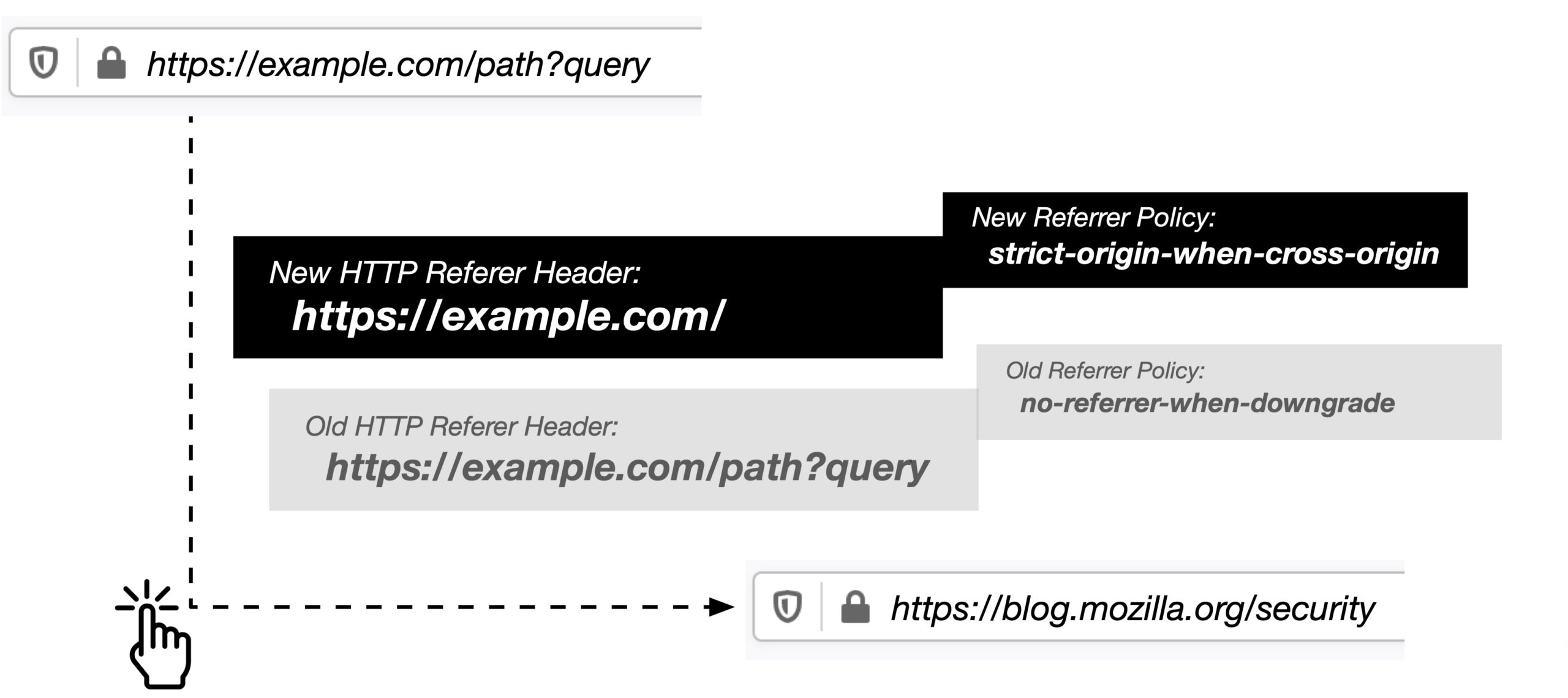
Today, with the launch of Firefox 87, we are excited to introduce SmartBlock, a new intelligent tracker blocking mechanism for Firefox Private Browsing and Strict Mode. SmartBlock ensures that strong privacy protections in Firefox are accompanied by a great web browsing experience.

Privacy is hard

At Mozilla, we believe that privacy is a fundamental right and that everyone deserves to have their privacy protected while they browse the web. Since 2015, as part of the effort to provide a strong privacy option, Firefox has included the built-in Content Blocking feature that operates in Private Browsing windows and Strict Tracking Protection Mode. This feature automatically blocks third-party scripts, images, and other content from being loaded from cross-site tracking companies reported by Disconnect. By blocking these tracking components, Firefox Private Browsing windows prevent them from watching you as you browse.

In building these extra-strong privacy protections in Private Browsing windows and Strict Mode, we have been confronted with a fundamental problem: introducing a policy that outright blocks trackers on the web inevitably risks blocking components that are essential for some websites to function properly. This can result in images not appearing, features not working, poor performance, or even the entire page not loading at all.

New Feature: SmartBlock

To reduce this breakage, Firefox 87 is now introducing a new privacy feature we are calling SmartBlock. SmartBlock intelligently fixes up web pages that are broken by our tracking protections, without compromising user privacy.

SmartBlock does this by providing local stand-ins for blocked third-party tracking scripts. These stand-in scripts behave just enough like the original ones to make sure that the website works properly. They allow broken sites relying on the original scripts to load with their functionality intact.

The SmartBlock stand-ins are bundled with Firefox: no actual third-party content from the trackers are loaded at all, so there is no chance for them to track you this way. And, of course, the stand-ins themselves do not contain any code that would support tracking functionality.

In Firefox 87, SmartBlock will silently stand in for a number of common scripts classified as trackers on the Disconnect Tracking Protection List. Here’s an example of a performance improvement:

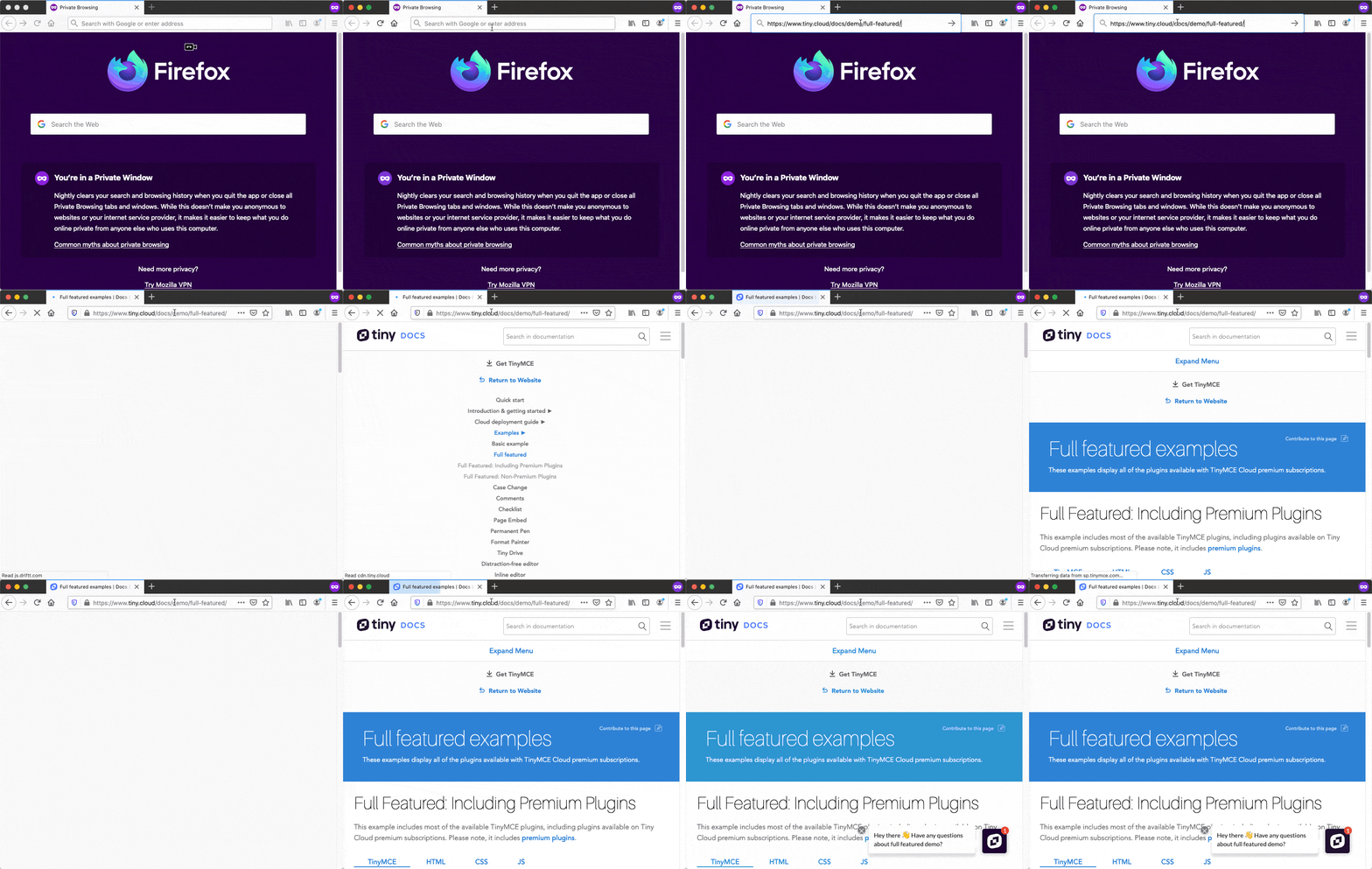
Side by side comparison: before and after SmartBlock.

An example of SmartBlock in action. Previously (left), the website tiny.cloud had poor loading performance in Private Browsing windows in Firefox because of an incompatibility with strong Tracking Protection. With SmartBlock (right), the website loads properly again, while you are still fully protected from trackers found on the page.

We believe the SmartBlock approach provides the best of both worlds: strong protection of your privacy with a great browsing experience as well.

These new protections in Firefox 87 are just the start! Stay tuned for more SmartBlock innovations in upcoming versions of Firefox.

The team

This work was carried out in a collaboration between the Firefox webcompat and anti-tracking teams, including Thomas Wisniewski, Paul Zühlcke and Dimi Lee with support from many Mozillians including Johann Hofmann, Rob Wu, Wennie Leung, Mikal Lewis, Tim Huang, Ethan Tseng, Selena Deckelmann, Prangya Basu, Arturo Marmol, Tanvi Vyas, Karl Dubost, Oana Arbuzov, Sergiu Logigan, Cipriani Ciocan, Mike Taylor, Arthur Edelstein, and Steven Englehardt.

We also want to acknowledge the NoScript and uBlock Origin teams for helping to pioneer this approach.


The post Firefox 87 introduces SmartBlock for Private Browsing appeared first on Mozilla Security Blog.

09 Apr 18:02

I gave a talk back in Oct 2019 about #opensourc...

I gave a talk back in Oct 2019 about #opensource licensing evolution.

A good time to reflect about what you want from your software and your licenses.

09 Apr 18:01

Starlink Speeds to Come

by Asa Dotzler

What kind of speeds can we expect from Starlink’s satellite internet service when it exits beta?

When SpaceX first applied to launch and operate a constellation of 4,425 satellites they told the FCC that with the complete rollout, users would see up to 1 Gbps speeds.

Right now, there are about 900 satellites in operational orbits and SpaceX is advertising speeds of 50 Mbps to 150 Mbps to its beta program participants.

In a more recent filing with the FCC, a petition to adjust the orbits for the remainder of those 4,425 satellites, SpaceX said that they are currently able to provide 100 Mbps and will in the future be able to provide 10 Gbps!

Elon Musk also tweeted recently that by the end of this year speeds would double to 300 Mbps. Many beta testers, myself included, are already seeing top speeds in that range.

My prediction is that this year SpaceX will complete the first orbital shell of the constellation with about 1600 operational satellites and Starlink will exit beta, becoming available to the general population with minimum speeds of 100 Mbps and maximum speeds of around 300 Mbps.

Then, as the constellation fills out to that 4,425 number over the next couple of years, minimum speeds should increase and maximum speeds will probably reach the promised 1 Gbps mark.

But 4,425 isn’t the end of the constellation, just Phase 1. Phase 2 will add another ~7,500 satellites and later extensions could see the constellation grow to as many as 42,000 satellites. These later satellites will be newer more capable versions and that combined with their sheer numbers could lead to those promised 10 Gbps speeds.

08 Apr 17:31

What’s the future for learning pods?

Joanne Jacobs, Linking and Thinking on Education, Mar 22, 2021
Icon

I think that one legacy of the pandemic is that a lot of parents took learning into their own hands. One example of this is the phenomenon of the 'learning pod', where a group of parents (presumably observing quarantine and social distancing protocols) shared the duties of providing supplemental education for their children. It wasn't always smooth sailing. Some were simply too expensive. Where parents did it themselves they found it a lot of work and time consuming, not to mention a source of disagreements about how best to protect children in a pandemic. From my admittedly distant perspective, I don't see a whole lot of difference between these and more widely accessible formats such as the Scouting movement, Boys and Girls clubs, 4H, and similar programs.

Web: [Direct Link] [This Post]
08 Apr 17:30

Zoom introduces new SDK to help developers tap into video services

Ron Miller, TechCrunch, Mar 23, 2021
Icon

Every application will soon have embedded videoconferencing capabilities if Zoom has its way (and probably even if it doesn't). This is the intent of Zooms new software development kit (SDK) for its video platform. The SDK will allow developers to leverage "video, audio, and interactive features to build video-based applications and desktop experiences with native user interfaces." The service is free for "up to 10,000 session minutes per month," which translates to, say, a 16-hour 10-person meeting. Here's Zoom's blog post and here's the SDK page itself. See also: Zoom Developer Blog, UC Today, siliconAngle, ITPro.

Web: [Direct Link] [This Post]
23 Mar 19:46

George Oates Returns to Revitalize the Flickr Commons

by Flickr
Ruth St. Denis at Yosemite Valley.

Late last year, I was surprised and intrigued to get an email from Ben MacAskill, COO of SmugMug and Flickr. I knew Flickr had been acquired by SmugMug and was happy to hear it, too, because I had been quietly worried about what might happen to this unique and brilliant archive of our lives under the brutal megacorp axe. I had read various press about the acquisition and appreciated the independence and tone of the SmugMug brothers, and felt the same relief I’m sure many other ‘old skool’ members did at the news. While I’ll freely admit I haven’t used Flickr as regularly as I once did, my pride and joy for Flickr has never changed.

It turns out Ben was writing to ask me if I would like to help reinvigorate The Commons on Flickr. (That’s the program run by Flickr since 2008 designed to help the world’s cultural institutions share their photography collections.) “What does a bright future for the Commons look like,” he asked, “and how do we build something that has value to the member organizations, and the open culture ecosystem?” As I was reading his email, I thought, “Well, indeed.” I replied to Ben, “When do we start??

Turns out we’re starting now, and it feels good to be back. I used to work here, at the very beginning when we first switched Flickr on back in the naughties. I created and launched the Commons in 2008, and left at the end of that same year. What a strange, unexpected delight to be asked to return with the express goal of researching what the Commons has become and understanding how cultural institutions around the world have evolved through being a part of it. We want to design a stronger future for the program, with enduring longevity at its heart.

So, what have I missed??

For the last couple of weeks I’ve been catching up, revisiting Commons imagery, and studying how the Commons looks today just over 13 years since it launched. I could throw you some really big numbers to show you how many people have looked at or loved or described or discussed photos residing in the Commons, and these big numbers are amazing, but there are so many big numbers all over the web these days I wanted to see if we could poke at what participation of the member orgs looks like instead.

It’s small numbers that can give me a sense of how engaged orgs are. I asked the crew if we could draw a very simple list of three things: when orgs created their account, when their last upload was, and when they last logged in. I figured I could use these dates as a rough proxy to show how much attention they can give their presence here. Thank you to Carol for assembling it.

The data doesn’t say much because it’s very basic, but it does show:

  1. There are 114 orgs in the Commons now, with a good global spread, though we’d love to grow representation from Asian, African, and South American orgs,
  2. There’s been very little growth in the program, especially in recent years,
  3. We noticed a drop-off in uploading and logins in 2018. Presumably, orgs were unsettled by Flickr going into yet another acquisition, perhaps not reviewing the press where Don MacAskill (CEO) was talking about wanting to make sure Flickr can survive for decades, and
  4. About half of the Commons orgs have logged in this year, and more in 2020, which is fantastic. We can work with this! 
Pupils of Denishawn School posing for publicity photo.

It seems to me we have a few different sorts of Commons members:

  1. Cultivators: These are the folks who give their Flickr account and their community of regular researchers a lot of love. Regularly uploading new content, and responding to Flickr members who help them, and even sending updates back to their catalogues that are derived from Flickr members’ research efforts. They understand the importance of this two-way conversation, and nurture it carefully and deliberately,
  2. Distant friends: These are orgs who have imagery in the Commons but have drifted away. This may be through lack of interest, but more likely through either lack of resources to spend time with their community here, or perhaps because of a lack of support from the higher-ups who may not appreciate the now proven benefits of community interaction participating in the Commons can afford, and
  3. Machinists: Some orgs have added content to the Commons but this is largely done by and for machines. There’s no attention paid to nurturing the community around it in the Commons context. While it’s great that Flickr can service some aspects of a technical infrastructure — and we don’t want that to stop, in fact we hope it grows — it’s even better when there’s also conversation and collaboration, and in fact, the sector more broadly still needs gathering places online for this.

Talking and listening

Another part of my splashdown back at Flickr has been interviewing a few folks: five of the Flickr team who’ve been looking after it in recent times: Ben, Carol, Cora, Leticia, and Matthew, and some Commons veterans: Michelle, Helena, and Barbara from The Library of Congress (my original launch partners!) and Effie Kapsalis at the Smithsonian Institution who led their amazing Smithsonian Open Access release of 2.8 million things online about this time last year. I hope to do many more interviews with Commons orgs and other interested folk in the coming months.

It’s still early days, but there were certainly some themes that popped out:

  1. The Commons is still alive, but its heartbeat is weak
    Everyone I talked to was sorrowful that the Commons wasn’t able to make it to the top of any company priority lists until now. Many of its features are just how I left them back in 2008. In fact, maybe all of them.
  2. Being a part of the Commons remains beneficial to the Cultivators
    I was so heartened to hear Helena from the Library of Congress tell me this in our interview. It’s that simple, and we want to revitalise this powerful aspect of the Commons – it’s still the best place on the web to have a two-way conversation between a cultural org and its admirers and researchers. 
  3. Ironically, our initial configuration of the “no known copyright” assertion has restrained some orgs from joining
    I didn’t expect this, actually, but it makes sense, given how far we’ve moved on in terms of open licensing, particular of digital surrogates of public domain works. While it was meaningfully liberating for many institutions back in 2008, there are many, many more cultural institutions around the world who now happily and regularly share their collections online with any number of open licenses, from Public Domain through the suite of Creative Commons offerings. This is an early note on my “feature ideas” scratchpad; to increase and enhance adding differently and openly licensed works into the Flickr Commons.

What’s next?

C. & N.W. R.R., Mrs. Dorothy Lucke, employed as a wiper at the roundhouse, Clinton, Iowa  (LOC)

It’s a 4-6 month plan. The first piece is talking with Commons members about their experiences and hopes, responding with designs for improvements and goals to renew attention and expand membership. The second piece is looking outward to the global openGLAM network, reflecting on how Flickr Commons can better serve the wider digital cultural infrastructure, then figuring out how to strengthen and streamline that. 

We will be using the following questions to inform and guide this work:

  1. What do current member orgs need from us?
    As noted, we think there are a few different types of participation in Commons. We want to talk with folks in each of these groups, and find out about how they’re getting on, and what we can improve. Our current goal is to interview about a third of our existing members 1:1, if possible. What can we be doing to make sure participating is beneficial?
  2. How can we grow the Commons membership?
    The program has survived in spite of benign neglect since it launched — I am deeply grateful there have always been staff who have kept it alive. The membership is currently 114 orgs. This is great, but there are over 250 museums in London alone! In addition to figuring out how to support and recharge existing members, we want to attract new folks, especially those smaller orgs who do not have the resources we can share to increase access to their collections. It should be straightforward to improve on this, and we look forward to it. (Tell your friends!)
  3. How can Commons dovetail with the openGLAM ecosystem more deliberately?
    So much has happened to our shared online existence in the last 13 years. A proliferation of standards and collection data, more sophisticated digital practice, and a global outpouring of uncontroversial digital sharing by institutions have meant a huge shift in digital experience of culture. I’m looking forward to reconnecting with Commons orgs and colleagues throughout the sector to jointly think through how we weave the Commons even more deeply into the digital cultural web, so it’s more useful to our member orgs, and the broader digital realm.

Would you like to be involved?

If you would like to talk with us or get involved somehow, we want to hear from you. For starters, Carol has opened a new thread in the Flickr Commons group to gather people initially, so please do pop in and say hi! We’ll be reaching out to you if you’re a Commons org already (and your email address is up to date), so please look out for a note from us in the coming weeks.

On a personal note, I would like to say a huge thank you to all the staff at Flickr who have kept the Commons alive through thick and thin: Fiona, Kay, Aaron, Sara, Zack, Bogan, Matthew, Leticia, Carol (and others I do not know about), the Flickr members who are regular research contributors and likers and watchers, and a very special thank you to the Library of Congress team, who have maintained their two-way conversation with their community throughout these 13 or so years, and remain a beacon for us all.

Onward, and to mischief!
– George Oates

23 Mar 19:42

Apple’s rumoured mixed reality headset to use ultra-short focal length lenses: report

by Jonathan Lamont
Apple logo

More details about Apple’s rumoured mixed reality headset have emerged from a research note published by reliable analyst Ming-Chi Kuo.

Obtained by 9to5Mac, the research note claims Apple is working on a hybrid ultra-short focal length lens for the headset. Apple reportedly wants to reduce the weight of the headset and keep it under 150 grams. For context, many existing virtual reality headsets weigh more than 300 grams. Specifically, Kuo wrote that Apple will likely adopt Fresnel’s hybrid ultra-short focal length lenses, which have improved field of via and reduced weight and thickness.

Further, Kuo believes Apple’s headset will weigh less than 150 grams, giving it a significant advantage over competing products. Along with using lenses with a shorter focal length, Kuo says Apple may use plastic instead of glass. While that would reduce the weight of the lenses, there are some possible durability concerns.

Finally, Kuo goes on to say Apple will adopt ‘Micro-OLED’ displays for the headset to compensate for the reduced brightness caused by the Fresnel lenses.

Kuo’s report on the Apple headset’s lenses is just the latest in a long line of reports and rumours about the headset. Recently, Kuo also wrote that the headset would include eye-tracking. Other details suggest we could see the mixed reality headset in 2022, and that it could cost between $1,000 and $3,000.

Source: 9to5Mac

The post Apple’s rumoured mixed reality headset to use ultra-short focal length lenses: report appeared first on MobileSyrup.

23 Mar 19:39

Oh cycling, how I do love thee...

by peter@rukavina.net (Peter Rukavina)

I took my bicycle off the road for winter 101 days ago, on December 12, 2020.

Today, with the roads dry, the temperature 11ºC, the weather sunny and windless, and the prospect of bánh mì to be had out the Avenue, I grappled the bike out of the basement, topped up the tires, donned my helmet and safety vest, and started cycling season earlier than I ever have, 26 days earlier than I did last year.

Oh how I missed it.

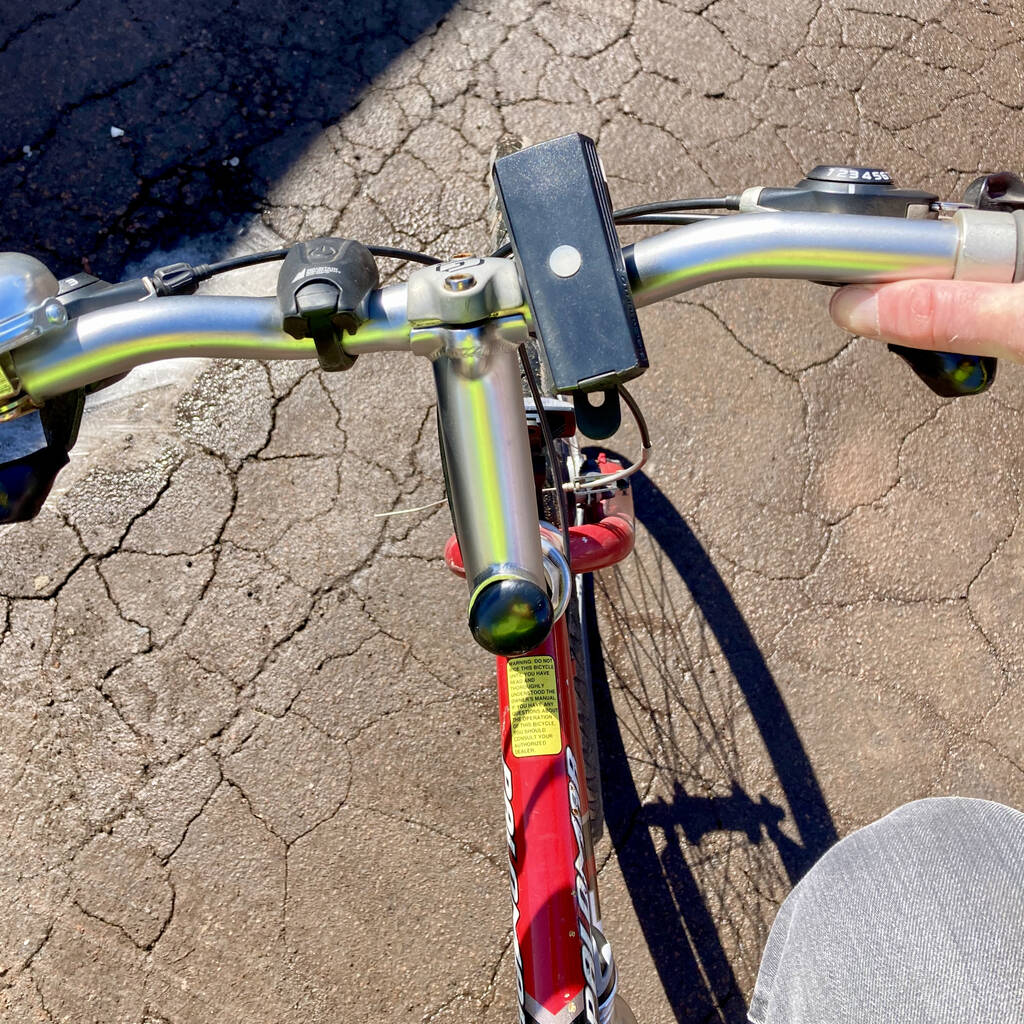
Me, on my bicycle, for the first time in 2021.

Credit due to Brother Steve in Montreal for the inspiration: he was out for his first cycle on the weekend, and jealousy and competitiveness were all the extra push I needed.

23 Mar 19:38

The Best Standing Desk Mats

by Melanie Pinola
A person standing on an Ergodriven Topo mat.

Just as supportive insoles can make all the difference when you go for a walk, a standing desk mat can be a game changer if you stand at work, even for brief periods.

A comfortable mat like the Ergodriven Topo supports your legs and back better than the floor will. And its varied terrain will keep you moving, which experts agree is crucial. This mat is easy to slide in and out of position, and six years of testing have shown it’s built to last.

22 Mar 20:29

Change in Education and What Needs to be Done

by Stephen Downes

Published as Change in Education and What Needs to be Done, 15 pages, 2020, Maysan Center for Future Studies.



In recent months we as a global community have experienced a hard lesson about the nature of change. While it is common to plan for the normal ebb and flow of life, the world always has the capacity to spring sudden upheaval on society. Sometimes such change is for the better, very often it is not, and always it allows us an opportunity to look closely and what we value and what we desire in our institutions and practices.

Such has been the case for our institutions of learning. Historically, learning has been a social activity, one in which we take part in person. It is based on telling stories to each other, modeling and demonstrating practices, asking and answering questions. The outcome of an education is not a body of knowledge or a skill or competency, but a person, one who has become not merely informed, but engaged and moved to action.

As we navigate our education systems through change, we seek first to preserve what is important and valuable and desirable in the system we already have, and at the same time, to use whatever tools are at our disposal to adapt and improve. In recent years in the field of education many of these tools have been technological, and in recent months especially we have seen how digital media can help us respond in a crisis and perhaps even strengthen our educational system in the future.

It is precisely that future that this essay addresses. It is a future where world events unfold in a sometimes chaotic and unpredictable manner, a future of technological promise or dystopian outlook, a future of societies on the move, of ever advancing knowledge, and the need, still, to progress from one generation to the next, passing along the best of who we are to our children.

What’s Unsustainable?

In understanding such a future the first question we must ask is, “what’s unsustainable?” This is partially because it’s an important question to ask, but also because it offers the most certainty in our predictions. If something cannot continue then we can say with assurance that it won’t. So, what’s unsustainable? Here are a few ideas:  • Consumption - Our resources, especially related to building and transportation, are becoming deleted, and their use poses environmental risks

• Centralization – a ‘hub and spoke society’ – which doesn’t provide adequate safeguards against rapidly spreading threats raging from misinformation to pandemics

• Inequality – the increasing concentration of wealth and power into the hands of a few people is creating unrest and instability

These, however, are merely drivers of change. They tell us the future will be different, but not how it will be different. Each of them poses a series of choices we have to make. Much of the practice of futurism is based on creating scenarios describing the outcomes of different choices.

Knowing what those choices will be, or even manipulating those choices, is a powerful mechanism of change. Alan Kay said, for example, that 'the best way to predict the future is to build it.'  Sometimes, all one needs to do is suggest it. As Audrey Watters cynically says, “The best way to predict the future of education is to get Thomas Friedman to write an op-ed in The New York Times about your idea.”  Either way, what we do today will change what happens tomorrow. And to know what we will do, we need to know what we want – we need to know what the attractors of change will be.

What needs to be done: frankly acknowledge and detail the impact the major drivers of change in society, beginning especially with an acknowledgement of unsustainable systems and practices, including especially challenges to resources, security and stability. In education, these drivers include funding challenges, complex learning challenges, and accessibility.

What’s Needed?

A good way to understand the attractors is through the concept of a value proposition. Each decision we make is based on a value proposition, “an easy-to-understand reason why a customer should buy a product or service from that particular business (that) should clearly explain how a product fills a need, communicate the specifics of its added benefit, and state the reason why it's better than similar products on the market.”  If we understand what people want, we can understand what decisions they will make.

A sentiment that has been heard a lot recently is “we don’t want it to go back to normal. Normal wasn’t working.”  A crisis exposes a society’s weak points; it highlights inequality, it heightens scarcities of resources, and it exposes gaps in learning and comprehension. The distribution of the impact of the pandemic has shown that the focus of both relief and in the reconstruction that follows needs to be not at the top but at the bottom - making sure those most in need have housing, food, health care, education, clothing, and connectivity, a voice.

A recent McKinsey report describes these needs. The authors argue, "There are four priorities for school systems:

 • maintaining health and safety of students, staff, and the community;

 • maximizing student learning and thriving;

 • supporting teachers and staff;

 • and establishing a sound operational and financial foundation.

In each case, we believe that issues regarding equity—that is, ensuring that the needs of the most vulnerable are met—should be front and center, both during the closure and after students return to school."

While we may think that educational institutions serve only learning needs, the sudden closure of educational institutions around the world has brought to light the many additional functions they fulfill. Many families, for example, relied on schools for child care while both parents worked. For many children, school lunches form an important part of their diet, and school counselling services help ensure they are free from abuse and neglect.

In higher education, schools and universities serve important social functions, connecting students and giving them a safe place to practice and develop their own identity. As many corporate and government reports have pointed out, educational institutions play an important role in preparing students for work with the skills and competencies demanded by business and industry. And they create for students a set of social connections that may last a lifetime, helping them develop communities of interest, of support, and of practice.

What needs to be done: identify the essential purposes being served by existing social and cultural institutions that must be preserved, and ideally enhanced, through any process of change, and develop a strategy to meet these objectives while responding to the drivers listed above. In education this may include the passing on of specific knowledge and skills, but will also include developing the capacity of people to learn for themselves and continue learning for a lifetime, as well as to develop and maintain the social supports and connections to continue to thrive, and possibly even some non-educational functions currently being served by the educational system.

What Can Change?

During the pandemic, educational institutions were forced to offer instruction online. For many people, online learning is touted as being a part of this new normal. But online learning is incompatible with a traditional elite education. "Taking classes is just not what it’s all about,” says Steven Krause. “It’s also a whole lifestyle of dorms or near campus apartments, sporting events, frats and sororities and clubs, parties, beautiful buildings and campuses, etc." However, "elite universities don’t like online classes because they are not the college experience (see above) and they still believe online classes are for poor people."

Meanwhile, our social structures have been built around the idea of in-person schools. Fordham's Robert Pondiscio argues "Kids will go back to brick-and-mortar schools... the act of sending our kids every morning to a place called a school is a cultural habit formed over many generations."  Similarly, Alex Usher says predictions that all learning will go online are nonsense. "Education is social," he argues, and online learning isn't set up for that.  All of these arguments are based on the wider function of educational institutions, a function that delivers a set of benefits beyond mere learning and job preparation.

The current system of educational institutions is not well-designed to provide these wider benefits to a mass population. This is true through most of the world. Yet as the pace of change and growth of technology increase, the need for mass education increases, and increasingly, the need for these additional functions increases. But this will require government support, and government support isn't going to be sucient to give everyone an elite educational experience. Such levels of funding are unsustainable.

The choice governments and societies will face is whether to return to a ‘normal’ where social and government resources are devoted to providing an elite education to a small percentage of the population, or to redesign learning using educational technology to produce a more ‘hybrid’ model that enables more of the population to access some of the benefits of the elite in-person experience. There is precedent. Clive Shepherd invites us to think about how we watch music, drama or sport - if you wanted to do it all live face-to-face, "unless you're rich and with considerable discretionary time, it would be completely impractical."  And the same too with learning, in the future.

What needs to be done: identify those aspects of the educational system that are unequally accessed and that are also less essential to the essential purposes identified above. Develop more equitable alternatives to these, and consider how they might be offered (if at all) more effciently.

Learning Technology

In the future, different nations will design different systems employing different technologies based on different degrees of equity, and as a result, a range of ‘hybrid’ models will emerge into practice. One model for this can be found from a Chinese team of researchers that “advocated schools designing a blend of synchronous and asynchronous teaching and identified four essential technologically enabled pedagogical techniques that should be used in combination:

 • live-streaming teaching (lecture format);

 • online real-time interactive teaching;

 • online self-regulated learning with real-time interactive Q&A;

 • online cooperative learning guided by teachers."

The same report also stressed the utility of open educational resources to address learning content needs, but the approach that will be taken ultimately depends on how important each nation finds it to address the problems of equity that exist not so much in online learning as they do in the higher education system in general.

With respect to the challenges these issues pose, the limits of technology define the limits of what we can do. For example, we cannot implant knowledge directly into the human mind. Learning requires a process of interaction between student, technology and teacher. Meanwhile, our social and economic structures will define what we will do. For example, not everybody has access to cheap and high quality Internet. Not everyone will have access to teachers and resources. Change in education will depend on the renegotiation of a social contract. The coming debate in the next decade will centre around the values and principles we want to base these on.

As technology changes, the limits of what we can do changes. This means preparing students for a world of possibility that does not exist today. It will be essential for students acquire the ability to learn skills, conceptualize and design in future environments that do not exist today. Some authors propose that students be prepared with 21st century skills, soft skills, design thinking, or STEM skills. And yet while there is a degree of truth to such statements, ultimately students will need most of all the ability to recognize and learn things we could not have predicted, as new technology and global events take us into unexpected directions.

We should similarly expect our teaching resources to adapt to rapidly changing environments. “Consider our curriculum as a self-contained coherent resource,” writes George Siemens. “The goal of education? Teach this container to the students. What happens when you add artifact creation? If someone comes along and says, ‘what about the power structure and the bias that underpins this content,’? Bam. It’s a new course. Someone creates a video reacting to a lecture I delivered? Bam. It’s a new course.”  The content of a learning resource will be far less important that the ability of people to use it to make new contemporary learning resources. Being digital does not automatically make the resource better; it’s what you can do with the resource that makes it better.

What needs to be done: invest in a range of educational capacities rather than adopting a single monolithic solution; this creates system flexibility and the capacity to apply specific solutions to specific contexts. Examine models developed internationally to support hybrid learning, while developing contingencies should one or more element (for example, face-to-face interaction) be unavailable for a period of time. Develop expertise in these modalities, both for instructional staff, and the learning population.

What will Change?

What will these new technological environments look like? There is again no shortage of predictions, ranging from the 4th Industrial Revolution to the Green New Deal; and any number of scenarios in between. But in fact it will be socially and culturally determined with no single principle determining the outcome. Think of a new technological environment as if it were a language. We can’t predict what the next new slang term or acronym will be, but we can predict that there will be one. No individual will define the grammar and the semantics, but all of us will need to learn this new literacy, to both understand what we are trying to do, and to express ourselves through whatever technology we have available.

When we return to the subject of schooling and education, we see that the core elements - classrooms, cohorts, textbooks, assessment, and communication – are beginning to change as the demands of a rapidly changing environment are pushing us gradually to that point where ‘normal education’ is no longer viable. Consider, for example, a simple idea – that we study in school for a set number of years, and then, with our education finished, we go to work. This is no longer viable because it is no longer viable to stop learning. Nor is it viable to continue traditional learning while in the workforce. The static structures that define education are shifting; boundaries between formal, non-formal, informal and post-formal education are changing.

Successful education systems of the future will therefore be those that adapt in two significant ways: first, they will be equitable by default, so that equity isn’t a separate and additional problem that must be addressed later; and second, they will be lifelong by default, so that there isn’t a need to transition from ‘formal’ schooling to different and more challenges of learning in the workplace. Learning environments, and learning technology will change in education to the extent that these principles are adopted in different cultures. Let us look at a few examples.

What needs to be done: develop and apply a rubric to technological development, acquisition and deployment, identifying core capabilities (for example, supporting autonomous learning, open educational resources and software, peer-to-peer and group interaction, and diverse ownership and applications) supporting more equitable and lifelong access to learning.

Classrooms

First, consider classrooms. Today these are places where teachers present content to students, and students learn that content. That has been true both in traditional classrooms and in modern ‘remote learning’ classrooms. But in time, these synchronous instructional environments will begin to look more like collaborative work environments. The emphasis will be on helping students manage products and create cooperatively. Online learning will emphasis dialogue and discussion, rather than presentation.

Elite and effective educational institutions are already delivering education this way. For example, high school students learning at Carnegie Mellon University’s Entertainment Technology Center (ETC) engage in “a semester-long project working alongside brilliant people using cutting-edge technology.” Students at MIT’s Media Lab work together on projects to address cutting-edge social issues.  Stanford students “develop an entrepreneurial mindset by immersing themselves in cohorts of changemakers.” Waterloo engineering students work in teams devoted to rocketry or robots or alternate fuels.  In Scandinavia, “pupils from Finland, Sweden, Estonia and Latvia have established more than 50 international joint ventures and participated in international fairs and innovation camps in the project countries.”

Online learning that makes the transition from being content-based to project-based addresses the needs of future-ready students. They achieve greater equity by enabling all students to have the same sort of genuine hands-on experiences that elite students have. And they create the same sort of in-class environment for students that they will find when they enter the world of work. The precise details vary – some students learn to be entrepreneurs, others to become scientists, others artists and designers – but all learn how to define and solve problems while developing new skills and capacities as defined by the changing environment.

What needs to be done: develop infrastructure to support off-premises learning (for example, at home or in the workplace), define how learning opportunities can occur in community contexts, redesign physical facilities to support more specialized and active and collaborative learning.

Cohorts

Second, consider learning cohorts. In younger years cohorts are created by age grouping and geography. In post-secondary education cohorts are created by enrollment to specific colleges and degree programs. The result in both cases is often a social stratification, with a great deal of competition to enroll children in ‘good’ schools. As has been noted elsewhere , the reason a person wants to study at MIT or Yale or Oxford is not only the quality of the instructor or the facilities, it is the quality of the person next to them in class, and the networks they will form thereafter, a fact well-recognized by these elite schools.

By contrast, as online learning becomes more prevalent, there is no need to limit access to learning to specific cohorts. Already, Massive Open Online Courses (MOOCs) have enrolled cohorts of tens of thousands of people. By contrast, personalized competency-based education reduces the size of the cohort to a single person. In both cases there is a need to create manageable social groups, but new methods will be required. New models of cohort formation are likely in the short-term future, for example, automated peer-learning cohorts (auto-PLC) where “students who have already acquired a particular skill become paired together with students who are still acquiring that same skill, and vice versa.”

With such developments in cohort formation, learners may find themselves in groupings with unexpected colleagues. Opportunities to collaborate will not be limited to social or physical proximity, but will extend across a global network. Learners at every stage of their careers will find themselves working together. Such diversity improves the quality of learning for everyone, and increases opportunities for those who have been traditionally disadvantaged or disengaged.

What needs to be done: develop or participate in learning models that include a diverse range of participants, develop or apply mechanisms that support online cohort or group activity, develop skills in working in diverse communities, cooperative teaching and learning, and open project management (for example).

Pedagogies

Third, consider pedagogy, that is, the method and practice of teaching. New terms have already come into prominence, for example, androgogy, which is the method and practice of teaching adult students, and heutagogy, which is the management of self-managed learners. These new terms reflect a practice that is becoming increasingly life-long and increasingly autonomous. These trends reflect not only the demands of a changing world and workplace but also the changing affordances created by digital technology. People want to learn on their own, for example, because they can learn on their own.

The recent conversion to ‘remote learning’ showed that our understanding of learning was limited by the conception of a teacher managing the learning of a collection of students in a classroom, which is why the spring of 2020 saw the rapid deployment of video-conferencing tools such as Zoom. But new online teachers learned quickly that online instructional design had been developed over the last two decades as the underlying science of online learning, with the discipline of ‘instructional designer’ being recast as a profession.

Broader use of online learning will force the discipline beyond its behaviourist roots. “The methods which inform so much of learning and instructional design do not, in any way, account for the diversity of experiences available in online spaces,” writes John Villasenor. What is needed, he says, is “a digital pedagogy which empowers teachers and learners alike to get to the heart of what education is about, and to preserve that heart no matter if learning takes place on-ground or online, or some hybrid of both.” This need portends a shift from instructional design to the development of a learning environment design strategy deploying individual analytics, learning support, virtual reality, and tools for interaction and collaboration.

These are pedagogies that are designed by default to be accessible to all populations at any stage in their career, a concept captured in the philosophy of ‘accessible by design’. Additionally, they are pedagogies that anticipate a transition from teacher-directed to self-directed learning, thus enabling lifetime learning without the need for course and program support.

What needs to be done: adopt approaches and pedagogies that support the development of self-managed learning. Develop support and skills supporting accessible and inclusive pedagogy, and adopt or develop open-ended learning technology (for example, collaborative authoring, or open-ended simulations) rather than programed or designed instruction.

Credentials

Fourth, consider credentials. In a traditional system, students progressed through formal education accumulating a series of standardized diplomas and degrees leading, ultimately, to a terminal credential, usually a doctorate. Most students did not progress to the terminal degree, stopping at either a secondary or undergraduate certification. Credentials, meanwhile, were offered in a limited number of subjects – arts, sciences, engineering, medicine, law, etc. This created a relatively efficient filtering mechanism allowing potential employers to quickly evaluate the suitability of a person for a position.

The increasing complexity of both learning opportunities and employment requirements is changing this. When evaluating the knowledge and abilities of a person, a much wider range of learning experiences needs to be considered, for example, work experience, licenses and certifications, continuing professional education, non-credit courses, seminars and in-service training, MOOCs, volunteer work, hobbies, independent reading and research, and military training.  As alternative learning becomes more popular, new methods for assessing or recognizing a person’s knowledge and abilities have been proposed and implemented. For example, many colleges have defined processes of prior learning recognition (PLR).

Additionally, new models of competency-based learning have been developed, allowing a person to quickly progress through material they already understand. Alternative certifications have been developed, some resembling professional designations, and others in the form of microcredentials or badges.

With the introduction of big data and artificial intelligence (AI) much of these alternative forms of assessment will be automated. Automated essay grading is already in use.  Tools and standards for activity tracking and learning record store have been developed, for example, Advanced Distributed Learning’s xAPI specifification.  In the near future, it will be possible to directly assess a person’s qualifications using these and similar tools. Evaluators will no longer need specialized tests or assignments (though these may continue to be offered as social challenges or competitions) but will be able to apply AI to the totality of a person’s published work and online presence, including social media, in order to assess their fitness for employment. The major challenges remaining are social and ethical, not technological.

The benefifits of alternative forms of assessment for social equity are being demonstrated through the use of such tools as GitHub and open source software for a person to establish programming credentials , or even services like YouTube to establish acting and singing credentials. They enable a person to work on a career while at the same time achieving recognition for skills and achievements.

What needs to be done: prepare for the increasing use of AI in recognition and assessment by establishing ethical application frameworks, develop open-ended assessment mechanisms such as personal portfolios, activity records, and open data management, and apply these mechanisms to support student learning, for example, though the deployment of personal learning dashboards. 

Conferencing and Communication

Fifth, consider conferencing and communication. The global pandemic has accelerated a trend toward online events that was already in progress before it became a necessity. The suddenly urgent need for digital conferencing and communication has force providers and consumers to consider much more closely what would be optimal. Almost immediately, closed conferencing systems requiring enterprise authentication were eschewed in favour of zero-login tools like Zoom.  People wanted to be able to quickly connect online without being required to establish a membership or subscription to a platform or service.

A similar disaggregation can be expected in other communications and interactions online. Challenges are being made to tradition al social networking services such as Facebook and Twitter by decentralized applications and networks such as Mastodon and ActivityPub. As decentralization takes form teachers will talk about the online world more as a place to converse and collaborate, not as some other sort of news media or textbook publisher. Meanwhile, the content of an online education is defined less by external authorities and more by the learner’s self-perception, identity formation, and understanding of his or her place in society.

What needs to be done: prepare for self-sovereign identity management or trusted social federated identity, identify appropriate decentralized tools and systems (taking note especially to manage social, economic and technology risks), support, acquire or deploy decentralized communication (eg., Slack in the enterprise, MS Teams, Mastodon, Discord), support instructor and staff skills development.

Conclusions

Online decentralized conferencing and communication opens learning and academic discourse to a much wider audience, one far greater than the limited number of people who could take part in person. It also enables people to participate while working, often using the same tools and technologies as they do on the job.  Understanding the future is a process of understanding change. To understand change, it is necessary not only to understand drivers, which described how unsustainable practices force us to move, but also to understand attractors, which describe where we want to go. In education, increasing pressures on resources, security and equity are pushing us away from traditional models. What we need to preserve are systems that maintaining health and safety, maximizing student learning and thriving, establishing a sound operational and financial foundation, including support for instructors and staff.

What we want is often expressed in terms that describe an elite education, which includes in-person residence, small classes featuring personal instruction, and the formation of communities and networks. Elite education, however, can and will be changed into a more hybrid offering that offers the best possible version of these affordances to the wider community. Learning technology supporting these is in the process of being developed, and this technology defines how we can change much of traditional education to make it more equitable and more sustainable over a lifetime.

Expect learning to be much more integrated into the community, with people learning at home or in the workplace and coming together into classrooms only for activities and events. Expect cohorts to be formed and managed by artificial intelligence and to include people from a wide range of backgrounds, cultures and workplaces. Expect pedagogies to transition for a model based on instruction to one based on learning environment design with tools and practices supporting self-managed learning. Expect credentials to continue to shift away from diplomas and degrees to much more fine-grained forms of assessment based on actual experience and practice. And finally, expect increasing decentralization of conferencing and communication.

These are substantial changes, and none of them will be straightforward and linear. Those most benefiting from existing systems and institutions will resist change, while those who stand to gain the most will push for it. Meanwhile, the system will continue to be pressed on all sides to adjust to the realities of a changing world. New learning technologies will offer opportunities to respond by supporting more equitable and lifelong learning, but there remain social and

22 Mar 20:28

It’s a rainy cold day, but the cherry blossoms ...

It’s a rainy cold day, but the cherry blossoms are coming out.

Spent a couple of hours this morning inside, taking a course from Eikcam Ceramics. I made a bento box and side dishes.

22 Mar 20:27

“Don’t talk about [x] here”

by Richard Millington

Imagine going to a conference afterparty and being told by the host you can’t discuss key aspects of your work with fellow professionals.

If you’re like most people, you would step outside (or head to a bar down the street) and talk there.

This is the problem with creating a community and telling members they can’t talk about key topics.

For sure, you might not want members rambling on about their personal lives or swapping their favourite cat photos (unless you do). These discussions are outside of the common interests and should take place on social media. You also probably want to avoid legal landmines too.

But to restrict what people can talk about within the common interest is generally a really bad idea.

Create sub-groups for certain discussions if you like. Use your subtle influence to guide discussions in a certain direction. But be sure to push back against preventing members talking about things they want to discuss. This is a community killer.

These discussions help bond members, they give members a reason to repeatedly visit the community, they increase the likelihood that they will (perhaps eventually) talk about the topics that deliver the results you want.

The post “Don’t talk about [x] here” first appeared on FeverBee.

22 Mar 20:26

Firefox 87 trims HTTP Referrers by default to protect user privacy

by Dimi Lee


We are pleased to announce that Firefox 87 will introduce a stricter, more privacy-preserving default Referrer Policy. From now on, by default, Firefox will trim path and query string information from referrer headers to prevent sites from accidentally leaking sensitive user data.


Referrer headers and Referrer Policy

Browsers send the HTTP Referrer header (note: original specification name is ‘HTTP Referer’) to signal to a website which location “referred” the user to that website’s server. More precisely, browsers have traditionally sent the full URL of the referring document (typically the URL in the address bar) in the HTTP Referrer header with virtually every navigation or subresource (image, style, script) request. Websites can use referrer information for many fairly innocent uses, including analytics, logging, or for optimizing caching.

Unfortunately, the HTTP Referrer header often contains private user data: it can reveal which articles a user is reading on the referring website, or even include information on a user’s account on a website.

The introduction of the Referrer Policy in browsers in 2016-2018 allowed websites to gain more control over the referrer values on their site, and hence provided a mechanism to protect the privacy of their users. However, if a website does not set any kind of referrer policy, then web browsers have traditionally defaulted to using a policy of ‘no-referrer-when-downgrade’, which trims the referrer when navigating to a less secure destination (e.g., navigating from https: to http:) but otherwise sends the full URL including path, and query information of the originating document as the referrer.


A new Policy for an evolving Web

The ‘no-referrer-when-downgrade’ policy is a relic of the past web, when sensitive web browsing was thought to occur over HTTPS connections and as such should not leak information in HTTP requests. Today’s web looks much different: the web is on a path to becoming HTTPS-only, and browsers are taking steps to curtail information leakage across websites. It is time we change our default Referrer Policy in line with these new goals.


Firefox 87 new default Referrer Policy ‘strict-origin-when-cross-origin’ trimming user sensitive information like path and query string to protect privacy.


Starting with Firefox 87, we set the default Referrer Policy to ‘strict-origin-when-cross-origin’ which will trim user sensitive information accessible in the URL. As illustrated in the example above, this new stricter referrer policy will not only trim information for requests going from HTTPS to HTTP, but will also trim path and query information for all cross-origin requests. With that update Firefox will apply the new default Referrer Policy to all navigational requests, redirected requests, and subresource (image, style, script) requests, thereby providing a significantly more private browsing experience.

If you are a Firefox user, you don’t have to do anything to benefit from this change. As soon as your Firefox auto-updates to version 87, the new default policy will be in effect for every website you visit. If you aren’t a Firefox user yet, you can download it here to start taking advantage of all the ways Firefox works to improve your privacy step by step with every new release.”

The post Firefox 87 trims HTTP Referrers by default to protect user privacy appeared first on Mozilla Security Blog.

22 Mar 20:26

Spotify knows what you did the last G88gle search session!

by Bogomil Shopov
I had a strange situation: I was using G**gle Translate to transform some string from English to a few of the languages spoken in Indian to greet my teem better. A few days after that, I opened my Spotify app, and surprise – my recommendation feed was full of newly discovered Indian songs. The “coincidence”...

Read More

22 Mar 20:24

Calculating Instruments

by Joshua Habgood-Coote
Full-text audio version of this essay.

Like so much tech jargon, “crowdsourcing” was born in the pages of Wired magazine. It appears in a June 2006 article in which Jeff Howe paints an optimistic, managerialist picture of the labor market that would be created by new communication technologies:

Technological advances in everything from product design software to digital video cameras are breaking down the cost barriers that once separated amateurs from professionals. Hobbyists, part-timers, and dabblers suddenly have a market for their efforts, as smart companies in industries as disparate as pharmaceuticals and television discover ways to tap the latent talent of the crowd. The labor isn’t always free, but it costs a lot less than paying traditional employees. It’s not outsourcing; it’s crowdsourcing.

Among the examples Howe offers are image repositories that allow amateur photographers to sell stock photos at rates that drastically undercut professionals, a network of hobbyists who are on call to solve scientific and engineering research problems for large companies for the fraction of the cost of an in-house research laboratory, and Amazon’s infamous Mechanical Turk platform, which was then at an early stage and without a clear application.

Howe’s article presented two trajectories for the development of crowdsourced labor: a skilled path, exemplified by amateur scientists solving knotty problems, motivated and fulfilled by intellectual interest and fairly recompensed; and an unskilled path, exemplified by platform workers competing for whatever atomized and mind-numbing tasks requesters post (surveys, image labeling, correcting sentences, psychological experiments).

Technological systems generate a need for crowdsourcing, because the idea of complete automation is an ideological fiction

It is safe to say that we have taken the latter path: Rather than making work more independent and voluntary, crowdsourcing has contributed to work’s devaluation and destabilization. The majority of crowdsourced labor is not decentralized and emergent, but is administered in a top-down fashion through platforms. It is insecure, poorly paid, repetitive, and unfulfilling. As researchers have documented, the workforce on online platforms like MTurk and Upwork numbers in the millions, despite low pay and precarious work conditions. Tech companies have leaned on this workforce to make their services possible. Mary L. Gray and Siddharth Suri argue in Ghost Work that human piecework invisibly powers many purportedly automated “AI” tech applications, from image recognition to search engines. Sarah T. Roberts’s Behind the Screen details a similar sleight of hand in commercial content moderation: For years, social media companies have maintained that most of the moderation on their platforms was done by algorithms, despite the reality of human “data janitors“ carrying a significant part of the load. Everyday internet use makes everyone into unwitting crowdsourcers: Instagram harnesses hashtags to produce datasets of labeled images, ReCAPTCHAs are used (somewhat ironically) to train algorithmic systems to perform Turing tasks, and language-learning apps like Duolingo mine users’ responses to improve their datasets.

Crowdsourcing lies at the unhappy intersection of capitalist labor practices and the technology sector’s valorization of artificial intelligence over human skills. Technological systems generate a need for crowdsourcing, because the idea of complete automation is an ideological fiction. Gray and Suri identify the paradox of the last mile of automation, the idea that automation inevitably creates new tasks that are difficult or impossible to automate: Datasets for AI must be made machine readable by humans, computers must be maintained, and difficult cases must be mopped up. The history of computing reminds us that computing systems often create an increased need for human labor, at least in the short term.

The novelty of the term crowdsourcing can make it seem like it names a new form of exploitation, facilitated by historically unprecedented technological systems. However, the genealogy of computing technologies reveals a long history of exploited and deskilled human labor. These forms of labor emerge because computing technologies are applications of the principles of the division of labor to tasks; as some tasks are automated, more demand for repetitive and atomized human labor is created.

Over the past 10 years, a great deal of crowdsourced labor in tech has been located in the global South (especially South Asia, the Philippines, and East Africa). However, a combination of increasing unemployment, weak labor regulations, pandemic-induced precarity, and a lack of access to the traditional labor market (especially for people with disabilities and caring responsibilities) means that crowdsourced work is becoming increasingly prevalent in both the U.S. and Europe. The fall-out from Prop. 22 in California demonstrates quite how quickly stable employment can be transformed into precarious gig work.

Writing about technology and work often focuses on concerns about automation replacing human workers with machines, but the history of computing labor can provide a useful corrective, reminding us that we should be just as much concerned about the dehumanizing character of machine-adjacent work.


The story of the relation between computing technology and human labor often starts with the female clerical workforce at Bletchley park, with human computers working at NASA, or with the programmers who worked on ENIAC. But for the purposes of thinking about crowdsourcing, we can begin our history of human computing in post-revolutionary France at the close of the 18th century.

Before the revolution, there was no national standardized system of measurement across France, which made it difficult to track land ownership and levy taxes. After the revolution, the National Assembly appointed a commission to address this problem, which not only yielded the metric system still in use today but also a decimal system of grades which rendered existing tables for trigonometric functions otiose (degrees split the right angle into 90 units, and grades split it into 100 grades). It fell to Gaspard Clair François Marie Riche de Prony — the director of the Bureau du Cadastre, the state’s map-making body — to create a new set of metric tables for the trigonometric and logarithmic functions.

This was a vast task: In Prony’s estimation, finishing the project would take the rest of his days, even with the assistance of four collaborators. As the story goes, Prony was browsing through a bookshop in despair when he chanced on a French edition of Adam Smith’s Wealth of Nations. Opening the book at random, he read Smith’s famous description of the division of labor increasing efficiency in the manufacture of pins. Prony realized the division of labor could solve his problem. In a publication notice from 1820, he describes a plan “to manufacture logarithms as one manufactures pins.”

Mechanizing calculation drastically shifted its social meaning, transforming it from one of the highest expressions of the human intellect to a process

In Smith’s pin-making example, making a pin — then an artisanal rather than an industrial process — was divided into 18 different semi-skilled tasks. Prony took the division of labor much further. With the assistance of six mathematicians, he divided the task of calculating a logarithmic function into a series of elementary operations of addition and subtraction. A second team of seven or eight calculators prepared worksheets for carrying out these operations. The drudge work of actually carrying them out was assigned to a third group of calculators, numbering perhaps as many as 100. These calculators had extremely limited math education, and it seems likely that they did their work at home as piecework. The legend has it that many of these workers were recently unemployed hairdressers to the aristocracy, although some seem to have been political refugees sheltering “under the aegis of science,” as Lorraine Daston notes.

The project was a surprising success, mathematically, producing a monumental 19 volumes of tables with an unprecedented degree of accuracy. But it was a financial failure; the tables were never published. Nonetheless, Prony’s application of the division of labor to calculation quickly became influential. The English polymath Charles Babbage shared Prony’s dissatisfaction with what he called the “ancient methods” of computing tables. In 1821, Babbage agreed to produce a set of tables for the British Nautical Almanac. As was standard practice, he outsourced the work to a pair of computers, who appear to have done a particularly bad job. In exasperation, Babbage expressed “the wish that we could calculate by steam.” He set out to mechanize calculation, drawing inspiration from Prony. In his description of Prony’s project, Babbage likens the bottom class of calculators to unskilled machine operators who must be overseen alongside their machines.

Babbage’s desire to mechanize calculation led to his plan for a difference engine, which would calculate logarithmic functions using a hand-driven crank to move a complex system of gears. Later he made detailed plans for a general-purpose computer, which he called the analytical engine. Before Prony, it would have been difficult to imagine replacing professional calculators with machinery: Calculation was difficult work, and calculators would work short days in recognition of the mental fatigue. But once calculation had been reduced to a set of merely mechanical operations of addition and subtraction that could be performed by a political refugee or hairdresser, it was much easier to see how they might be replaced by a machine. The division of labor not only deskilled work and workers; it opened the door to tasks being partially automated, furthering the cycle.

Daston argues that mechanizing calculation drastically shifted its social meaning: calculation was transformed from one of the highest expressions of the human intellect to a quasi-mechanical process. This shift is reflected in the way that Smith, Prony, and Babbage thought of the division of labor. For Smith, the division of labor was a mode of semi-skilled production that would enhance workers’ aptitudes at their allocated tasks. For Prony, the division of labor was a trick to minimize the need for skilled labor (an idea that has come to be known as the Babbage Principle). Prony relates that the fewest calculation errors were made by the those “who had the least intelligence, an automatic existence, so to speak.” Babbage takes references to “merely mechanical operations” even more seriously, hoping to transform calculation into an automated process on the model of the newly built factories in Manchester. Far from being a distinctive expression of human capacities, calculation was, in Babbage’s view, “one of the lowest operations of the human intellect.”


With this history in place, we can see that crowdsourcing is not new. Our technologies for calculation and computation — and the way we think about these technologies — have emerged from a history of devalued and deskilled work. This brings home a number of important lessons:

The first is that the need for large-scale calculation and human computing is often driven by the administrative needs of the state. James C. Scott argues in Seeing Like a State that the French National Assembly’s desire for uniform measurement practices was a consequence of their need make land and citizens legible for bureaucratic processes. Other computing projects are similarly driven by the epistemic needs of the state: In Programmed Inequality, Mar Hicks argues that the development of the computing sector in the UK was driven by the need to administer the welfare state, and in When Computers Were Human, David Allen Grier documents the rich history of government-backed human computing, which reached its zenith with the Mathematical Tables project which took place under the auspices of the U.S. Works Project Administration.

In Scott’s view, states need to make their citizens and land legible in order to govern them. A state that is ignorant about its own citizens — what they own, who they are related to, what taxes they owe — will not be able to enforce property rights, regulate inheritance, or raise taxes on its subjects. When technology platforms harness large amounts of (knowing and unknowing) human labor to process social and behavioral information, they are responding to a similar need to make their own users’ actions legible for governance purposes. This is not to say that technology companies literally are states: There are other commercial reasons to collect behavioral information. But in some respects — particularly the regulation of speech through content moderation and processing payments for content creators — technology companies are functioning like states, and like states, their administrative activities generate needs to process large amounts of information about their users.

The second lesson is that workers who carry out the tasks that keep algorithmic systems running are constantly at risk of becoming invisible. In every description of Prony’s project, the contributions of the workers are downplayed in favor of the cleverness of the algorithm they were implementing and Prony’s ingenuity in applying the division of labor to mental operations. The identities of the calculators has been lost and even the idea that they were unemployed hairdressers is something like a rumor.

This downplaying of “unskilled” human labor in the knowledge economy has a long history. Stephen Shapin has uncovered the way in which 17th century scientist Robert Boyle effaced the enormous contributions of the invisible technicians who ran his experiments, working the machinery, writing up results, and carrying out observations. Boyle was not unusual in this regard: In period illustrations, technicians are displayed as faceless and interchangeable, or are replaced by putti — literally angels — who illustrate the operation of instruments.

Workers who carry out the tasks that keep algorithmic systems running are constantly at risk of becoming invisible. The identities of the 19th-century calculators have been lost

As with other epistemologies of ignorance, this effacement is produced both by structural factors and complicit observers. In a discussion of automata in the 18th century, Edward Jones-Imhotep writes, “seeing machines as autonomous, then, has historically meant not seeing certain kinds of labor and the people performing it.” He argues that the century’s audiences for automated theaters, mechanical musicians and digesting ducks, and plans for automated factories were complicit in creating ways of seeing that center the “autonomous” operations of machines while simultaneously obscuring the enormous amounts of human labor that enable them.

Drawing on Sarah Roberts’s idea of a logic of opacity, Karen Frost-Arnold argues in the forthcoming book Who Should We Be Online? A Social Epistemology for the Internet that commercial content moderators and other digital workers are subject to a similar epistemology of ignorance. This system is complex. It relies on public ignorance about the extent and types of digital labor, the prevalence of fictions of automation, the ways digital labor is outsourced and hidden behind anonymizing APIs. It relies on the work patterns of piecework and systems that have historically rendered domestic labor invisible. And it relies on the complicity of tech workers who understand and use digital work platforms on a day-to-day basis but cultivate ways of seeing that ignore crowdworkers.

A third lesson is that — despite the apparently novel forms of technological exploitation (what Shoshanna Zuboff has labeled “surveillance capitalism” comes to mind) — much of the ethical terrain for thinking about crowdsourcing had already been mapped out by earlier theorists observing the emergence of capitalism. As Smith saw in The Wealth of Nations, organizing the workplace around the division of labor threatens a moral disaster: “The man whose whole life is spent in performing a few simple operations, of which the effects are perhaps always the same, or very nearly the same, has no occasion to exert his understanding or to exercise his invention in finding out expedients for removing difficulties which never occur. He … generally becomes as stupid and ignorant as it is possible for a human creature to become.” Marx similarly claimed in the 1844 Manuscripts that capitalism “replaces labor by machines — but some of the workers it throws back into a barbarous type of labor, and for other workers it turns into machines. It produces intelligence — but for the worker cretinism.”

These warnings are apt, but we should take warnings about “stupidity,” “ignorance,” and “cretinism” with a handful of salt. Smith and Marx fall into the trap of confusing symbolically deskilled work with the absence of skill. We can accept both that the division of labor symbolically deskills workers and denies them the opportunity to develop skills without arguing that it makes workers unskilled and incapable of intellectual development. The commercial content moderator understands the on-the-ground challenges of moderation better than their boss, as Roberts argues; the Deliveroo rider understands the vagaries of the workflow algorithm and the challenges of route finding better than the tech workers who maintain the algorithm. And, as Daston points out, even the drudgerous calculation involved in producing mathematical tables requires enormous concentration to avoid making errors. Acknowledging crowdworkers’ distinctive skills and knowledge is compatible with recognizing that their work is underappreciated, undervalued, and underpaid.

Part of what stands in the way is the description of digital workers as if they were machines or nonhuman animals. MTurk advertises itself as selling “artificial artificial intelligence,” a seamless assemblage in which “human intelligence tasks” are on par with automated tasks. In a blogpost from 2008, Howe describes MTurk as enabling “clients to farm out the kinds of menial clockwork that we all wish computers could do, but can’t,” illustrating the post with a sketch of a primate hunched over a desktop computer.

Treating workers as if they were machines or animals allows us to see them as fungible, as replaceable both by other workers and machines. If we treat content moderators as if they were part of the machinic algorithmic system for regulating social media, we will forget and overlook the fact that people cannot perform this fraught work without emotional and spiritual damage.


Langdon Winner famously asked whether artifacts have a politics. The history of human labor in computing suggests that computing technologies do, and that it is the politics of the extreme division of labor. Crowdsourcing is not a new phenomenon: It is the continuation of deskilled machine-adjacent labor. We should see the workers on Amazon’s Mechanical Turk as pieceworkers in the tradition of Prony’s Cadastral calculators; we should see the eyeball factories in East Africa that label images for driverless cars as a descendent of the computing offices in Greenwich that produced almanacs for the Royal Navy; we should see projects to use refugees to train algorithms as descended from Prony’s use of political refugees; and we should see citizen science projects like GalaxyZoo as a development of the Harvard College Observatory.

Work under capitalism has always relied the atomization of tasks, on dubious hierarchies of “skilled” and “unskilled” tasks, and on systems that obfuscate the nature, extent, and value of labor. The division of labor is not merely a way to make work more efficient; it is a way to symbolically devalue workers, to reduce their autonomy and control over work processes, to simultaneously diminish and obscure their collective practical knowledge, and to dehumanize them by literally and symbolically embedding them within machinery.

If we want to contest the politics of crowdsourcing, we need to contest the technological systems that enable it, the political and economic systems that enable exploitative machine-adjacent labor, and the epistemology of ignorance that masks how serious the problem has been for centuries.

22 Mar 20:24

Gary Ellis

by peter@rukavina.net (Peter Rukavina)

I was sad to read of the passing of Gary Ellis this morning.

In the spring of 1995, after spending two years on the Island, and beginning to plant tentative roots, Catherine and I decided that we’d outgrown our apartment, and realized that we had the financial wherewithal to support a modest mortgage, so we started looking for a house.

I was driving down the Colville Road one day and spotted a house just past Clow’s Red & White that had a for sale sign on it; I looked it up when I got home, and found it was for sale for $33,000, which seemed rather amazing all things considered. Floyd Buell was the realtor, and I called him up and arranged a viewing. As we found years later when I made the acquaintance, through other means, of the next-door neighbour, the house had in fact been constructed from the rubble of an old house on the lot next door; it was a touch too ramshackle for us, so we moved on.

But we took Floyd with us as our real estate agent, and over the following weeks we looked at a lot of really, really horrible houses in our price range. Houses with basements full of water, houses with half-complete renovations and fibreglass insulation leaking out everywhere, houses much too far from town for Catherine, not a driver, to imagine living in.

And then Floyd showed is a house in downtown Kingston, around the corner from that original house that had set us down this path. It was close to town, in need of some love, but not irredeemable, and came with a tiny sliver of land.

We put in an offer. It was refused. We countered. Refused. We walked away.

Two weeks of radio silence later, the sellers came back to us with a reasonable proposal, and we accepted.

The sellers were Gary and Teresa Ellis.

We moved in on July 1, 1995 and lived there for a very happy 5 years. Catherine built a studio–still standing–in the back yard. We planted trees. Replaced the septic system and the furnace. Kept a garden. Met the neighbours. Got very familiar with the stretch of the Kingston Road into town, to the point where I could have likely navigated it blindfolded.

While we’d never met Gary or Teresa during the purchase process–the real estate industry thrives on keeping buyers and sellers dispassionately apart–the next time I went to get my car fixed at Canadian Tire, he ended up, by happenstance, as my mechanic, and we did a little bit of the “oh, so you’re…” dance.

I’d see Gary every now and again at the garage, until, a few years later, he opened his own place up toward Emyvale, and after that we most reliably ran into each other at the New Year’s Levees every January 1, like clockwork.

I didn’t know Gary well, but he always had a smile on his face, he was a kind and patient mechanic, and I always enjoyed starting out a new year by shaking his hand.

He will be missed.

22 Mar 20:23

Has software design taken a wrong turn?

by Eric Normand

I analyze two similar definition of software design, one from OOP and one from FP. We see that each is talking about making the code more flexible. But design shouldn't focus on the code alone. In this episode, I explore what it should focus on instead.

The post Has software design taken a wrong turn? appeared first on LispCast.

22 Mar 20:21

On Planning Directors and Vancouver’s Direction

by Gordon Price

PT reader Peter C sent in this thoughtful comment in response to the post by  Sandy James on Planning director Gil Kelley’s departure.  

If I understand correctly, you connect our last 15 years of planning department turmoil (three directors in 15 years) to changes that occurred under Vision Vancouver.

I wonder if the differences between the 3.5 decades of Spaxman/McAfee/Beasley and the 1.5 decades of Toderian/Jackson/Kelley can also be connected to the immense housing affordability pressures that have been building for the past 50 years, but which became considerably worse starting around the mid-2000s. These pressures can be tied to several factors, but one of the key drivers of this affordability crisis has to be the extremely restrictive zoning laws that have been virtually unchanged for the past century on the 80% of our residential land that is zoned RS/RT.

Apart from the 1950s-1960s, when a tiny handful of existing low-density neighbourhoods were upzoned (parts of Kitsilano, Kerrisdale, Marpole, and Strathcona), City politicians and planners have left single family neighbourhoods largely untouched.

Around the time that Spaxman began, the City developed/upzoned the following areas: South False Creek between the bridges (formerly industrial lands), Fairview Slopes (after the DTES, the poorest area of Vancouver at the time, so any changes there faced very little effective pushback), and Champlain Heights (the former Vancouver landfill, and otherwise undeveloped at the time). The general attitude at the time of South False Creek and Champlain Heights, based on quotes from Walter Hardwick, was that the rest of the city was basically already built-out. In other words, the 80% of residential lands that had been zoned for single family were to be left untouched.

Under McAfee/Beasley, a similar process continued: upzone/rezone industrial lands, leave the vast majority of residential SFH untouched. Yaletown/downtown/North False Creek were rezoned/developed (and they did a fantastic job on those areas), smaller sections like Arbutus Walk were rezoned (also a fan, but this area was all industrial prior to rezoning), and I’m guessing the initial planning for the River District south of Champlain Heights was started around this time (also industrial lands).

Yes, McAfee lead the CityPlan process of the 90s, but I’d argue this was largely a failure in terms of preparing the city for the future: for most of the single family zones in the City, it resulted in vision/guideline documents that called for effectively zero change.

Spaxman, McAfee and Beasley were largely successful in upzoning/rezoning parts of Vancouver that had no existing residential housing on them. The handful of areas that did see upzonings/rezonings (Fairview Slopes, Joyce Collingwood) were at the bottom end of the income/wealth scale, so incumbent residents were largely ignored. They were also coasting on several decades of federal funding/support for large volumes of social and rental housing from the 1960s through to the early 1990s. This support dwindled during the 1980s, and fell away completely after the mid 1990s.

Toderian/Jackson/Kelley have had to deal with a very different city, one that is reaching the limits of the “Grand Bargain” that Gordon Price has described. At 50-60 storeys, we are reaching the limits of high rise tower developments on the few slivers of land available for high density (yes, we could try aiming for New York style heights, but initial reports from that city would indicate that these types of towers face immense engineering challenges, especially in our earthquake prone region). We’re adding in density where it already exists (West End), and along arterials.

Toderian brought in laneways, as an attempt to densify that 80% of Vancouver that is still SFH, but that was about as gentle a densification as one could aim for. Kelley, as Kevin Quinlan claims, may have brought about the “end” of single family zoning in Vancouver, but the Duplex bylaw change in 2018 was a change in name only. The allowable FSR for any new duplexes on RS lots is less than the allowable FSR for a new SFH plus laneway.

Duplex zoning aside, I’m not aware of anything that Kelley was able to do in terms of upzoning/rezoning low-density SFH. He probably faced so much pushback from certain members of the current Council that he avoided attempts at ‘speaking truth to power’.

I’d argue that Spaxman, McAfee, and Beasley were able to have constructive, effective discussions with city managers and city politicians because they didn’t really have to have difficult discussions around upzoning RS/RT areas. Toderian, Jackson, and Kelley didn’t have that luxury.

I don’t know how/if we’ll see any improvements in this relationship between Council and planners.

Council needs to acknowledge that they aren’t architects or planners, and stop micromanaging every single multi-family development application (the latest Kits project being yet another glaring example). It also needs to grasp that a majority of Vancouverites are open and ready for more density.  From the Daily Hive:

“The survey found that 71% of Vancouverites think the municipal government should allow the construction of duplexes, fourplexes, townhouses, and three-to-four storey apartment buildings in areas where only single-family homes are currently permitted.”

There’s really only one or two members of council that are ready to accept/embrace the above, so I hold little hope of any change before October 2022.

At the same time, City Planning needs to be honest and direct with itself, and with Council, about the profoundly negative impacts of restrictive RS/RT zoning on most of the City’s residential lands. Kelley wasn’t even able to mention restrictive zoning as a cause of our affordability crisis in his reply to Council’s motion (Recalibrating the Housing Vancouver Strategy) last summer. That has to change if we’re to have any hope of solving this crisis.


22 Mar 19:55

Peter Cox: On Planning Directors and Vancouver’s Direction

by Gordon Price
mkalus shared this story from Price Tags.

PT reader Peter Cox sent in this thoughtful comment in response to Sandy James post on Planning director Gil Kelley’s departure.  

If I understand correctly, you connect our last 15 years of planning department turmoil (three directors in 15 years) to changes that occurred under Vision Vancouver.

I wonder if the differences between the 3.5 decades of Spaxman/McAfee/Beasley and the 1.5 decades of Toderian/Jackson/Kelley can also be connected to the immense housing affordability pressures that have been building for the past 50 years, but which became considerably worse starting around the mid-2000s. These pressures can be tied to several factors, but one of the key drivers of this affordability crisis has to be the extremely restrictive zoning laws that have been virtually unchanged for the past century on the 80% of our residential land that is zoned RS/RT.

Apart from the 1950s-1960s, when a tiny handful of existing low-density neighbourhoods were upzoned (parts of Kitsilano, Kerrisdale, Marpole, and Strathcona), City politicians and planners have left single family neighbourhoods largely untouched.

Around the time that Spaxman began, the City developed/upzoned the following areas: South False Creek between the bridges (formerly industrial lands), Fairview Slopes (after the DTES, the poorest area of Vancouver at the time, so any changes there faced very little effective pushback), and Champlain Heights (the former Vancouver landfill, and otherwise undeveloped at the time). The general attitude at the time of South False Creek and Champlain Heights, based on quotes from Walter Hardwick, was that the rest of the city was basically already built-out. In other words, the 80% of residential lands that had been zoned for single family were to be left untouched.

Under McAfee/Beasley, a similar process continued: upzone/rezone industrial lands, leave the vast majority of residential SFH untouched. Yaletown/downtown/North False Creek were rezoned/developed (and they did a fantastic job on those areas), smaller sections like Arbutus Walk were rezoned (also a fan, but this area was all industrial prior to rezoning), and I’m guessing the initial planning for the River District south of Champlain Heights was started around this time (also industrial lands).

Yes, McAfee lead the CityPlan process of the 90s, but I’d argue this was largely a failure in terms of preparing the city for the future: for most of the single family zones in the City, it resulted in vision/guideline documents that called for effectively zero change.

Spaxman, McAfee and Beasley were largely successful in upzoning/rezoning parts of Vancouver that had no existing residential housing on them. The handful of areas that did see upzonings/rezonings (Fairview Slopes, Joyce Collingwood) were at the bottom end of the income/wealth scale, so incumbent residents were largely ignored. They were also coasting on several decades of federal funding/support for large volumes of social and rental housing from the 1960s through to the early 1990s. This support dwindled during the 1980s, and fell away completely after the mid 1990s.

Toderian/Jackson/Kelley have had to deal with a very different city, one that is reaching the limits of the “Grand Bargain” that Gordon Price has described. At 50-60 storeys, we are reaching the limits of high rise tower developments on the few slivers of land available for high density (yes, we could try aiming for New York style heights, but initial reports from that city would indicate that these types of towers face immense engineering challenges, especially in our earthquake prone region). We’re adding in density where it already exists (West End), and along arterials.

Toderian brought in laneways, as an attempt to densify that 80% of Vancouver that is still SFH, but that was about as gentle a densification as one could aim for. Kelley, as Kevin Quinlan claims, may have brought about the “end” of single family zoning in Vancouver, but the Duplex bylaw change in 2018 was a change in name only. The allowable FSR for any new duplexes on RS lots is less than the allowable FSR for a new SFH plus laneway.

Duplex zoning aside, I’m not aware of anything that Kelley was able to do in terms of upzoning/rezoning low-density SFH. He probably faced so much pushback from certain members of the current Council that he avoided attempts at ‘speaking truth to power’.

I’d argue that Spaxman, McAfee, and Beasley were able to have constructive, effective discussions with city managers and city politicians because they didn’t really have to have difficult discussions around upzoning RS/RT areas. Toderian, Jackson, and Kelley didn’t have that luxury.

I don’t know how/if we’ll see any improvements in this relationship between Council and planners.

Council needs to acknowledge that they aren’t architects or planners, and stop micromanaging every single multi-family development application (the latest Kits project being yet another glaring example). It also needs to grasp that a majority of Vancouverites are open and ready for more density.  From the Daily Hive:

“The survey found that 71% of Vancouverites think the municipal government should allow the construction of duplexes, fourplexes, townhouses, and three-to-four storey apartment buildings in areas where only single-family homes are currently permitted.”

There’s really only one or two members of council that are ready to accept/embrace the above, so I hold little hope of any change before October 2022.

At the same time, City Planning needs to be honest and direct with itself, and with Council, about the profoundly negative impacts of restrictive RS/RT zoning on most of the City’s residential lands. Kelley wasn’t even able to mention restrictive zoning as a cause of our affordability crisis in his reply to Council’s motion (Recalibrating the Housing Vancouver Strategy) last summer. That has to change if we’re to have any hope of solving this crisis.


22 Mar 19:54

(Mis)truths and consequences in Alberta

mkalus shared this story .

Observers of Alberta politics, both casual and serious, would be forgiven for feeling a bit off kilter these days. It's hard to find solid footing. 

Will open pit coal mines emerge on the eastern slopes? What about water rights? Is the government divesting of provincial parks and possibly selling the land? Did the government always intend to keep an opioid program going, despite fighting it in court? How much will we lose on the Keystone XL pipeline expansion or crude-by-rail?

Solid answers to these questions and more are hard to come by. Critics would say that's by design. 

Given what's happened south of the border for the past four-plus years, it's understandable if people are a bit twitchy when it comes to post-truth politics in this province and it raises the question of whether there are indeed parallels here.

There very well may be, but there are also vital differences, not only in the character of the politics and politicians, but also the character of the place. What passes for an effective sideshow in the states required a specific set of circumstances that currently do not exist in Alberta. 

It's not to say there hasn't been an effort to create them, or a chance the ground here will fertilize with time.

What's happening?

There is a growing list of issues that have come up in Alberta since 2019 that have left people feeling bewildered and, in some cases, angry. 

In just one example, on the Friday of a long weekend, the government sent out a news release saying it was rescinding a coal policy dating back to 1976. The perfect headline at the perfect time to avoid scrutiny. 

But it didn't work. People noticed. And although it took some time to build, anger eventually boiled over from too many Alberta factions for the government to ignore — including singers in cowboy hats and constituencies in the UCP's rural heartland. But it still tried. 

Kenney said the policy was dead and wouldn't come back. His environment and energy ministers said not much had changed. When news of changes to water allocations surfaced, the government said it was nothing. Still does. 

Eventually the government backed down, but only sort of. New exploration activity is already underway and new open pit mines could still open. There will be consultations. 

It was a rare defeat for the government, but still just a partial reversal. Denials about its impact continue.  

It reflects a pattern of defensiveness and deflection on many issues that leaves many observers, including UCP insiders, strategists, columnists and disaffected constituency association members, questioning the honesty of the party. 

There is a sort of gaslighting from the government that leaves many bewildered, according to Zain Velji, a political strategist who's quick to point out his progressive leanings when offering his insight (he worked for both Naheed Nenshi and Rachel Notley's campaigns). 

We never intended to increase coal mining, they might say, or we never intended to sell parks. The court challenge to retain access for clients to the injectable opioid agonist treatment program wasn't necessary because they were never going to cancel those treatments. The election commissioner was fired for efficiency and had nothing to do with an ongoing investigation into the UCP. 

Sean Holman, a professor of journalism at Mount Royal University who specializes in access to information, says the party "isn't operating in accordance with the evidence."

"They're operating according to what they want the world to be, as opposed to what the world actually is," Holman says. 

He adds that, while most governments are secretive, Alberta governments tend to be moreso, and the UCP is more secretive still. 

The government has commissioned reports that critics say serve to justify predetermined outcomes, instigated an inquiry into environmental groups decried as a political witch hunt, and inaugurated an energy war room shielded from public scrutiny but funded by public dollars.

It has been ripping through new, and wide-ranging legislation and decrees at a feverish pace — pandemic be damned.

In the past, when a government wanted to dissuade prying eyes, it would lock down information.

That tradition is still alive and well in Alberta and beyond, but it is increasingly overshadowed by a newer technique in obfuscation: information overload. What Donald Trump advisor Steve Bannon referred to as "flooding the zone with shit."

John Santos, a data scientist with Janet Brown Opinion Research, likens it to going to a Chinese buffet that has so many options you could walk away without ever really eating any Chinese food. 

"When there is this much information out there, it's like you can assemble your own worldview from a menu that on the whole is incoherent, but has enough variation in the content there that you can craft any kind of coherent narrative out of it. And it will make sense to you," he says. 

That sort of thing shouldn't come as a surprise. 

The truth about post-truth

Much has been said about the rise of post-truth politics and populism, particularly in light of the last four years of the Trump presidency, Brexit and the erosion of democratic norms in countries from Europe to Asia. 

The mix of an angry population and a complete disregard for the truth can be damningly effective. 

Part of that is tapping into real grievances left in the wake of a world reshaped by money and power. Too many are left behind and too many feel ignored. Incomes gaps in the United States are vast and entire swaths of the country once buoyed by blue collar union jobs are long since rusted. 

The crucial ingredient, it seems, is this sense of being left behind by the wider world. Not necessarily pushed down, but forgotten. While that feeling is starting to bubble up in Alberta, it's not quite there. 

It is easy, in that context, to point to the elites running the show from boardrooms and the halls of power and paint them as the enemy. It's just as easy to paint those who would bring them down a notch as the saviours — no matter the harm. 

The followers of these charismatic leaders seem, to an outsider, incapable of realizing the lies behind them. Their belief is pure and unbending in many cases. 

That sort of thing can be tempting to tap into. And besides, a little truth manipulation has always been part of a politician's arsenal. It can work. 

But it needs more than simply a will to deceive. 

Why it's different here

Santos thinks the kind of populism that exists in Alberta, and has existed in many forms since its birth, is different from what we see elsewhere, where it's a socio-economic battle — the elites and the people. 

"I'm not saying that doesn't exist in Alberta," says Santos.

"But I think the larger element of populism in Alberta, especially historically, has defined the elite in geographical terms, i.e. central Canada, Ottawa, but also, you know, Ontario and Quebec more generally. And they've defined the elite in terms of institutional relations — so the federal government."

Alberta oil executive? One of us. Quebec-raised Prime Minister (named Trudeau!)? Definitely one of them.

There is no doubt there was a groundswell of anger across large chunks of the province when the NDP was in power and when Trudeau was re-elected, with many viewing both those governments as enemies of the energy industry — another defining factor of the political character of the province. 

The UCP was effective in channeling that frustration, and hammering home a message of cozy relations between Rachel Notley and Trudeau. 

But that message and that anger has faltered. The jobs that were promised never returned. The bluster and the fighting didn't seem to bring any results. The pandemic struck and the federal government seemed an important friend to have. 

There's also the question of leadership. 

West of Centre47:06Jason Kenney’s terrible, horrible, no good, very bad year - so far

Keystone XL didn’t look like a sure thing even before a Democrat won the White House. Now the pipeline is effectively dead, leaving Alberta with roughly $1.5 billion in lost investment, more people out of work, and fewer job prospects. Not a great start to 2021 for Alberta’s Premier, and it’s only January. Kathleen Petty looks at how Jason Kenney is handling this latest calamity, with independent columnist Graham Thomson, the Globe and Mail’s Kelly Cryderman and Jason Markusoff of Macleans. 47:06

In order to truly pull off a post-truth populist revolt and rush through a sweeping ideological agenda, the voters have to believe in the authenticity of the leader. It can allow you a kind of get-out-of-jail-free card when you get into trouble. 

Former Alberta premier Ralph Klein was famous for being inappropriate, apologizing, and getting away with it because he was Ralph. 

Kenney, for better or worse, is not Ralph Klein. Nor is he Trump. Or Boris. Or any of the other single-named populist agitators. 

"No one really knows who Jason Kenney is," says Velji. 

It's becoming increasingly possible that Kenney doesn't really know who Albertans are, either. 

Getting the story wrong

Do you remember Jason Kenney and his blue truck?

The premier-in-waiting showed up in Alberta after a long stint in Ottawa's halls of power with rolled up sleeves and at the wheel of that truck for his long drive to the province's top job. 

He signed grassroots guarantees. He drank coffee from Pyrex mugs in diners across the plains. He pitched himself as the Albertan his party envisioned and hoped to woo.

Since being elected, however, Kenney has surrounded himself with outsiders who insiders say don't know or understand Alberta. They think of this place in terms of stereotypes that don't apply and they're trying to use that stereotype in order to reshape the province. 

Calgary Sun columnist Rick Bell, speaking on the West of Centre podcast, wondered just who these people are who are surrounding the premier. And he says many insiders he's spoken to feel the same. 

West of Centre43:22Pivot power

Alberta’s premier ran on a promise to not back down. But public outcry over several issues from COVID restrictions to coal mines has caused Jason Kenney to pivot. His political adversaries say he should have gone much farther, while some UCP caucus members are openly critical. Guest host Jim Brown, in for Kathleen Petty, takes a look at Kenney’s strategy and his options, with pollster Marc Henry, president of ThinkHQ, conservative strategist Melissa Caouette of the Canadian Strategy Group and Calgary Sun columnist Rick Bell. 43:22

"This is the biggest complaint, it's this accusation of tone-deafness, that Kenney is pursuing his own world and it's not necessarily the world of Albertans as a whole, but also the 55 per cent of people who voted for him," Bell says. 

Velji puts it a slightly different way. He says Kenney and the UCP got their narrative wrong. They thought Alberta was something it's not and Albertans were something they aren't. All the decisions that have flowed from that initial error have been tainted.

He says he thinks Kenney is trying to sell Albertans a vision of the province they didn't know they wanted. Turns out, they might actually not want it. 

Instead of walking back or bending in the face of unpredictable and immense challenges and mounting resistance from Albertans, the government has, more often than not, doubled down. 

That could have consequences.

What's to come

The government finds itself in a tight spot, its narrative faltering and unable to channel hope or anger. A sort of misreading of the public, or at least the public mood, coupled with a lack of faith in the authenticity of the leader is hampering any ability for the struggling party to fight back. 

It seems on most days that the government is drowning in a sea of information, action and controversy of its own making. 

Velji, for one, thinks Kenney always intended to burn through his political capital in the first two years and thinks there's a chance he has a sales pitch up his sleeve that could entice believers and fence sitters back into the fold. 

But that plan would be more realistic in a four-year term unmarred by the challenges and uncertainty this government has faced (there is that pandemic going on). 

It's also increasingly clear that Kenney and the UCP will have to busy themselves fighting internal battles within their right-wing coalition in addition to wooing voters in the lead up to the next election. 

Kenney is deeply unpopular and the NDP appear to be tightening their grip on Alberta's political centre — where most Alberta voters are.

One point of light in the bad year for the UCP? If the NDP performs well and continues to gain popularity, it could pump support back into the current government. 

When the opposition becomes too popular, the incumbent can become the underdog, says Velji. 

If that happens, it will be time for Kenney to roll up his sleeves, get behind the wheel and pitch the voters anew. It could be a tough sell. 

"I think, aside from sort of the diehard partisans, who are either going to criticize this government regardless, or support this government regardless, I think the moderates, the underlying sort of soft partisans, will admit that this government made bad moves in putting forward some of those policies to begin with and were totally wrong, and they're just trying to cover their tracks now," says Santos.