
The last few weeks I had a bit of a "Battle of Britain" situation outside my window with multipe pairs of Canadian Geese fighting over a nesting spot.
Tonight, they got a bit saucy.... I think.....
The last few weeks I had a bit of a "Battle of Britain" situation outside my window with multipe pairs of Canadian Geese fighting over a nesting spot.
Tonight, they got a bit saucy.... I think.....

New feature: support for Amazon Alexa*

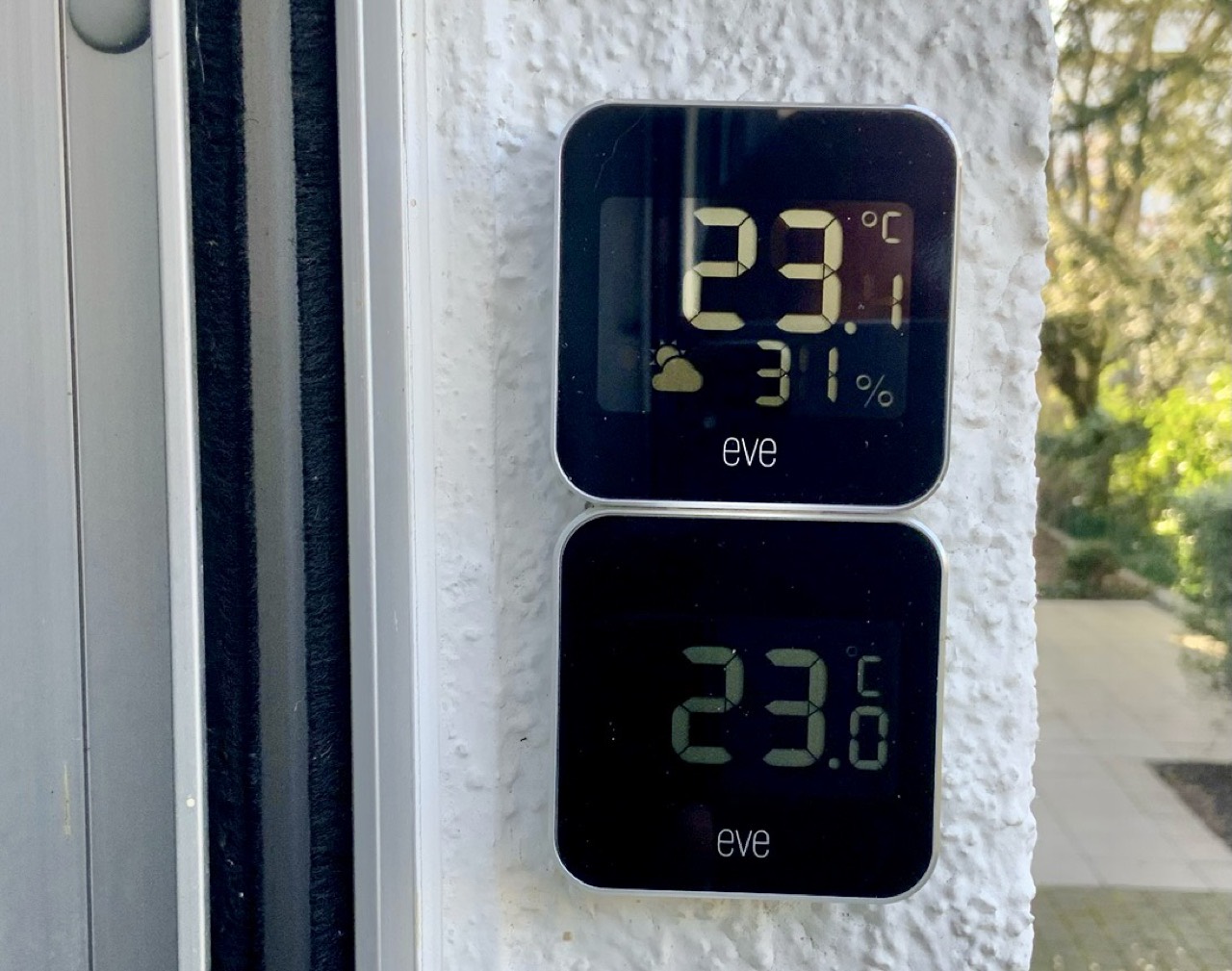
Bei uns wird gerade ein besonders beliebtes HomeKit Accessory ersetzt. Eve Weather ist der Nachfolger von Eve Degree. Beide werden mit einer CR2450 betrieben, die gut ein halbes Jahr hält. Beide zeichnen Temperatur, relative Luftfeuchte und Luftdruck auf. Aber Eve Weather hat zwei wesentliche Verbesserungen:
Das kleine Display ist dafür verantwortlich, dass Eve Degree so einen hohen WAF hatte. Man sieht die Temperatur nämlich nicht nur im iPhone, sondern auch, wenn man aus dem Fenster schaut. Ein Außenthermometer, wo man einfach draufschauen kann. Dass da vorher keiner drauf kam. :-)
Die Wetterstation ist ein Endpunkt im Thread-Netzwerk und kann als stromsparendes Gerät keine weiteren Endpunkte versorgen. Aktuell habe ich drei Router im Netzwerk: Zwei HomePod mini und ein Eve Energy. Mit jedem weiteren Router wird das Netz dichter und stabiler. Jetzt bereits kann ich über Eve Energy einen Öffnungssensor in einem geschlossenen Blechkasten erreichen, was per Bluetooth unmöglich war.
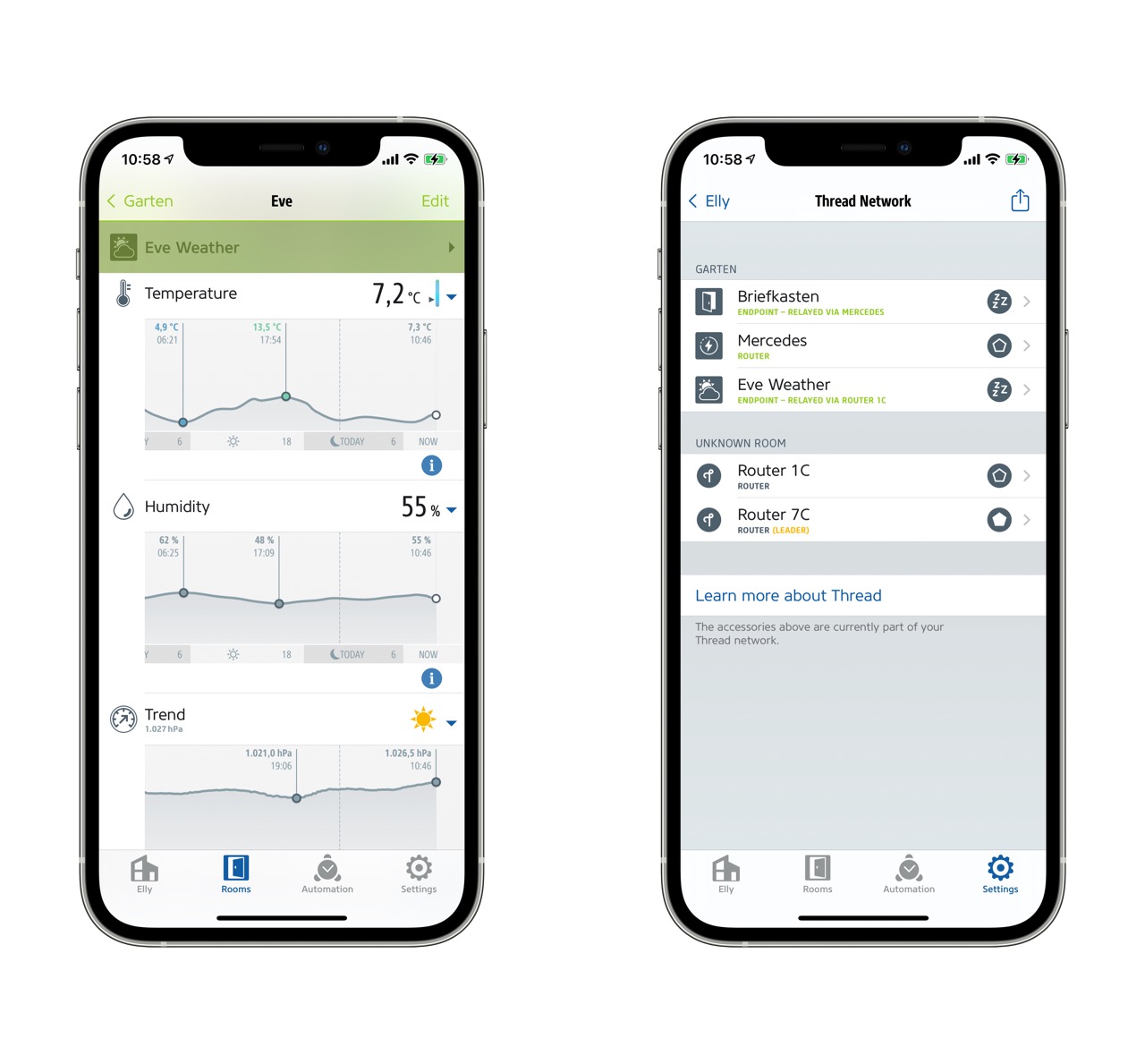
Zum Ende der Woche ist auch ein Firmware-Update für die zweite Generation von Eve Aqua erschienen. Leider habe ich ein Gerät der ersten Generation, das noch keine Thread-Hardware enthält.
Chris Plante, writing for Polygon on today’s major Apple Arcade news:
Microsoft’s and Apple’s bets on downloadable subscription services would seemingly place them behind their streaming counterparts in the long run, but that’s not quite the case. Their success shows that they’re neither ahead of the curve nor behind it; they’re simply meeting the expectations of their players. Apple debuted 30 games on Friday on a service that costs $4.99 a month and is often included in larger Apple product purchases for free. Microsoft’s Xbox Game Pass Ultimate tier costs $14.99 a month and includes games on Xbox console, Windows PC, and Android devices — and will now regularly feature launch-day releases from Xbox Game Studios, Bethesda Softworks, and even Sony, along with a rotating collection of more than 100 catalog titles. They’re providing the best deals in gaming at this moment.
Compare Friday’s news and these strategies with other industry announcements from this week. Nintendo ceased selling a digital collection of Mario games for no greater reason than artificial scarcity, despite already hosting an online subscription service that could house the games. And Sony confirmed that it will be closing its digital storefronts for the PlayStation 3, PlayStation Portable, and PlayStation Vita — with no clarity on how or if those venues or their games will be preserved, let alone be made available in the future.
The fact that Apple, possibly inspired by Microsoft, has a real chance to do game preservation better than Sony is not a sentence I would have expected to type in 2021.
See also: my story from 2018, App Preservation: Saving the App Store’s History, featuring – among others – Zach Gage, who brought four classic games to Apple Arcade today.
→ Source: polygon.com

Arabic is a macrolanguage, a language with such a variety of variants that there is no intelligibility between some of them, but there are also no precise limits between the different dialects that allow them to be classified as different languages.
The BC Cycling Coalition is seeking someone with advocacy, leadership, organizational management, and fundraising experience as General Manager.
The General Manager with engage with current stakeholders from across the province on transportation issues, oversee education programs (Bike Sense and Kids on Wheels), and help expand the reach and impact of the organization through the development of new partnerships, and expansion of existing fundraising strategies.
For more details about the role, the application deadline and instructions, download the Job Description here.

The argument in the story is in the first line: "Coursera's market debut is proof that the future of education is online." It is of course no such thing. The markets follow fads and rumours, are fickle and irrational, and have a history of making billion-dollar mistakes. Just ask the people at GameStop. Still, Coursera's chief executive Jeff Maggioncalda has a point when he says "we all will not go back to offices, we all will not go back to campuses. And so, online work and online learning - among other things - are here to stay." True. But they were here to stay before Coursera's IPO, and indeed, before Coursera ever came into the market.
Web: [Direct Link] [This Post]
My Pocket recommender served up Robert Epstein's The Empty Brain today, a paper I first documented here in 2016. If you haven't read it you absolutely should, because it's the most thorough refutation of the idea of 'the brain as a computer' that I've read. As I reread this paper, along with the Arthur Schopenhauer paper (see below), I started thinking about the major objection to neural network theory, namely, that neural networks are not able to perform logical tasks on their own, such as mathematical reasoning, grammatical construction, inference - you know, what Chomsky called Plato's problem. We can represent that challenge by asking whether neural networks are 'Turing complete", in other words, computationally universal. In the past, the answer to that question has been "no" - as Schopenhauer might say, you need a will as well as a representation. But when I searched through Google today I found this paper (36 page PDF), which shows two popular neural network architectures "to be Turing complete exclusively based on their capacity to compute and access internal dense representations of the data," and even more importantly, "neither ... requires access to an external memory to become Turing complete."
Web: [Direct Link] [This Post]
Two things of note here. The first is the author's main argument, which is this: "ready-trained NNs like GPT-3 or CLIP are often tailored as the basis of specific recognizer applications and then may end up deployed in public situations... This is the future of security holes in our internet-connected appliances." Quite right. The second point is a question I would pose readers in general: is it unethical to lie to artificial intelligences? Clearly that could depend on the purpose to which the AI is put, but of course, we seldom know what that purpose will be. It would also depend on our perception of the risk the AI poses to ourselves, but does our perception of risk outweigh the potential harm lying to an AI could cause? Interesting questions, all round.
Web: [Direct Link] [This Post]
There's a lot of relevant discussion about motivations and misdirected theories of 'fairness' that is well worth reading. But the most telling point has nothing to do with Facebook in particular. It's this: "Misinformation and hate speech constantly evolve. New falsehoods spring up; new people and groups become targets. To catch things before they go viral, content-moderation models must be able to identify new unwanted content with high accuracy. But machine-learning models do not work that way." What we would need is a generalized fake news detection system. This is something even humans find difficult. For machines not trained with general intelligence, it's even more so.
Web: [Direct Link] [This Post]
I think that many people do know it - at least, readers of this newsletter should know it, and also those who find it odd that they are being called 'human capital'. Still, mist of Harold Jarche's observations in this post are on point. If you ever doubted you were a commodity, your experience during the pandemic probably changed that. "Now that more work is being done online, many people face global competition... Three things will differentiate professionals in such an economy — expertise, relationships, and innovation." After the pandemic, a lot of the in-person services will go back to being in-person. But I don't think people will forget how easily they could be replaced by an online service and how precarious even their secure jobs might be.
Web: [Direct Link] [This Post]
This article makes the point that "for aspiring journalists from low-income backgrounds, systemic industry barriers compound from the start." The descriptions of student journalists spoke to me, paralleling my own experience. "Editors at my university’s independent newspaper work — voluntarily — anywhere from 40 to 50 hours per week, on top of classes." Except that at the Gauntlet, the University of Calgary paper where I worked, the editors were paid, which meant I could give up my weekend night shifts at 7-Eleven and work full time on campus. Many of the graduates from that newsroom ended up in Canada's professional media, but since I had student loans to pay, I couldn't afford to take an entry-level job in journalism. Still, every time I watch a journalist on TV opine about what is 'normal' or 'common' for people, I reflect that this represents a privileged point of view, and that despite what they say, most people aren't watching their stock portfolios, opening their cottages in the spring, or spending the winter in Florida.
Web: [Direct Link] [This Post]
When I was young the teachers at our small rural high school coordinated a number of activities with the posh private school in Rockliffe Park. We noted that the students there weren't any smarter than we were, but also took note of the significant advantages they enjoyed, ranging from facilities, special activities, a progressive curriculum, and more. Our teachers made a noticeable effort to level this playing field, and to the extent possible for a small rural high school, it worked. This article is about these posh schools and the advantages they afford. I am largely in agreement with the article, except for one thing. At a particular point, the author argues that "if these schools really care about equity, all they need to do is get a chain and a padlock and close up shop." I'm not disagreeing. But there's a lot to recommend about some of the methods such schools employ, where "a lesson plan was not a list of points for the teacher to make; it was a set of questions."
Web: [Direct Link] [This Post]
Mini-Heap describes this post under the heading 'the metaphysics of blockchain'. It's a good title. The main idea here is that blockchain for Bitcoin works because the record is the fact. But for something like, say, a birth date, the fact exists independently of the record, and the same sort of transcription errors that can make birth certificates unreliable can also infect the blockchain record. But what about, say, badges, credentials and other educational records? Is an educational record a recording of a real world event, or is the production of the record the event in itself? After all, when the program is complete, nothing actually exists over and above the record.
Web: [This Post]
As you likely know, there are coronavirus variants around the world. Reuters mapped the spread of the Kent variant, which was detected in the English county of Kent.
Tags: coronavirus, Reuters, United Kingdom, variant

For Axios, Will Chase, with illustrations by Brendan Lynch, provides the current status of known variants of the coronavirus. The tracker shows the estimated transmission rate, severity, vaccine efficacy, and prevalence.
Tags: Axios, coronavirus, variant

The Washington Post illustrated how the Ever Given got stuck and was freed from the Suez Canal. Pulling, digging, and a high tide.
All I could think about was the children’s book Little Blue Truck, the story of a big construction truck that gets stuck in mud and is freed by a little blue truck and its animal friends.
Tags: Ever Given, Suez Canal, Washington Post

New tax changes regarding Netflix and other streaming services have now come into effect in British Columbia.
Last month, the provincial government announced that digital services such as Netflix will be required to collect PST starting April 1st.
The tax measure, which was announced last year, was originally intended to go into effect on July 1st, 2020 but was delayed due to the ongoing COVID-19 pandemic.
“All sellers of digital software and telecommunication services will be required to collect PST on sales to B.C. customers if they have B.C. revenues of more than $10,000,” the government outlined in a news release last month.
Netflix has sent an email to residents in B.C. notifying them that they will be charged for PST in April as a result of the changes. Spotify sent a similar email to premium users notifying them that they will have to pay the same tax.
It’s worth noting that streaming services like Crave, Apple TV+ and Amazon Prime Video already collect PST, as they have a brick-and-mortar presence in Canada.
The province now joins Saskatchewan and Quebec, which already have tax measures in place to collect provincial sales tax from digital companies.
The post B.C. tax changes regarding Netflix and other streaming services now in effect appeared first on MobileSyrup.

Update 02/04/2021 6:40pm ET: Microsoft reports that its cloud services should be up and running.
Microsoft’s cloud services are once again down, according to a recent Azure Support Twitter message.
As it stands, the list of affected services is lengthy and includes Office 365, Xbox Live, OneDrive, Azure, Skype and Bing. That said, I was able to sign in to the Xbox network (RIP Xbox Live) fine, though some features might be inaccessible given that Xbox’s status page also notes issues.
We are aware of an issue affecting the Azure Portal and Azure services, please visit our alternate Status Page here https://t.co/vGS3TQ8shs for more information and updates.
— Azure Support (@AzureSupport) April 1, 2021
The last time Microsoft’s services suffered from an outage was in early March. This story will be updated when Microsoft’s cloud services are restored.
Source: AzureSupport
The post Microsoft’s cloud services are down again [Update: Fixed] appeared first on MobileSyrup.
Jason Snell writing on Six Colors:
The more I use Shortcuts, the more I realize that in many ways, user automation on iOS has outpaced automation on the Mac. Let me give you an example: On iOS I built a shortcut to grab the contents of selected text in Safari and open the results in a text editor—converted to Markdown, with the title of the page set as the title and its URL set as a link. It’s not remotely the most complicated shortcut I’ve built, but it’s great—and has saved me a lot of time while improving the quality of my link posts…
I love it so much, I decided to build the same automation on the Mac. The results were ugly. My Keyboard Maestro macro forces Safari to copy the selected text to the clipboard, moves to BBEdit, opens a new window, pastes in the HTML, runs an HTML to Markdown Service on the selection, then runs an AppleScript script that cleans up the results. It’s ridiculous.
This is a fantastic example of something that I’ve experienced over and over to the point where I hesitate before trying to automate anything on the Mac. As Jason points out, Shortcuts isn’t exactly easy, but I find that I usually spend the most time figuring out the best approach to a problem rather than how to implement it in Shortcuts, which is automation at its best. It’s a self-reinforcing cycle that encourages me to experiment more with Shortcuts and use Mac automation less.
The situation has also led me to take a Shortcuts-first approach to automation wherever possible. I run Shortcuts on an iPad alongside my Mac most days, relying on technologies and apps like the Universal Clipboard (when it works), AirDrop, Paste, and Drafts to create shortcuts like the Markdown-formatted link post shortcut that Jason describes. It’s not ideal by any stretch of the imagination, but I’m fortunate to work primarily in text, which is relatively easy to move from device-to-device. For many other kinds of automation, there’s no way to integrate Shortcuts.
Fortunately, there are many powerful third-party automation options on the Mac like Keyboard Maestro, which Jason mentions in his story. I use it along with apps like Hazel for folder action automation and BetterTouchTool for gesture-based automation. However, as good as apps like these are, it’s just another form of the fracturing of automation on the Mac. There should always be a place for third-party automation solutions on the Mac, but they shouldn’t be the only option for users.
Last month, Federico and I discussed our wishes for Shortcuts on AppStories. It’s a long list, but one wish that’s high on my list is Shortcuts on the Mac. Big Sur made clear that Apple is rethinking the Mac and iPad, bringing the two closer together as part of a continuum of devices that offer a consistent, familiar experience no matter which you’re using. Big Sur went a long way towards that goal, but it didn’t address automation. To truly build a continuum of devices, the automation barrier has to come down, too, so users can create automations that run everywhere.
Jason also mentions Taio, and what a shame it is that the developer has had to reinvent an automation system inside the text editor. I agree. Developers have come up with some excellent in-app automation systems, but it’s a lot to ask users to learn a new approach for each third-party app they use. As Federico and I discussed last month on AppStories and previously, it’s time for Apple to embed Shortcuts more deeply into the OS in a way that allows developers to adopt Shortcuts actions as building blocks that are available inside their apps.
Integrating Shortcuts across all of Apple’s platforms is a tall order, but it’s also aligned with the company’s goals for the Mac and iPad, so I remain optimistic. I don’t expect we’ll see everything addressed at once, but as Jason’s story makes clear, there are plenty of places for Apple to get started.
→ Source: sixcolors.com

The Chinese Public School, seen here in 1977, was only the latest use of this early building. From the appearance it’s reasonably obvious that it started life as a church. Looking on the 1912 insurance map, it’s listed as the Baptist Church. However, when it was completed in 1892 it was the Zion Presbyterian Church, with denominations playing musical chairs (or more accurately pews) in a few early years. In 1899 it had become the Zion Baptist Church, with Reverend J G Matthews in charge.
The history of the Presbyterian Church in Vancouver doesn’t mention this building, and it was odd that a congregation should exist so close to the First Presbyterian church which was only three blocks away, and built around 1893. The mystery was solved in a reference to the history of the Presbytery of Seattle. That says that there were 32 churches in the Presbytery of Puget Sound, including Zion Presbyterian Church in Vancouver, British Columbia. So it appears that this was an American arm of the church, founded in the early years of the city. We can find them meeting at first in a commercial building on Main Street, and later in the City Market. The Contract Record said in 1890 “The Zion Presbyterian Church will erect a $10,000 church – Mr. Thos. Hooper, architect for the new Y.M.C.A. building, has been instructed to prepare plans and specifications and call for tenders for the foundations at once.”
The Zion Baptist congregation also got off to a bumpy start. In 1898 the compilers of the street directory seem unsure of which brand of protestant faith to list, and played it safe with ‘church’. That might have been because the minister of the new endeavour was the Rev George Armour Fair. He was from Ontario, and his time in the East End was limited. By July of 1898, Fair “left the church . . . [and] with a portion of his former flock, organized a “non-denomination” group, which apparently held to a “Pentecostal” variety of doctrine.” He moved to a church in the West End, on the corner of Denman and Nelson.
 The Baptists had formed a congregation in the area in 1894, and briefly their church was listed on the opposite side of Princess on the southern side of the street, (but also on Jackson). The Presbyterian congregation on Jackson merged in 1898 with the larger Hastings and Gore church, so in 1899 there were two Baptist churches shown on opposite sides of the street. One was the Jackson Avenue Baptist Church, and the other the Zion Baptist Church and Reformed Episcopal, addressed to Princess (which is East Pender today). By 1901 the short-lived Jackson Avenue church was no longer listed. A few years later the church in the picture was known once again as The Jackson Avenue Baptist Church, (although addressed to East Pender). In 1911 the church was altered and an addition was built, costing $6,000. The permit says J Carver was the architect and J G Price the builder. It’s likely that this was accidentally reversed; Mr. Carver was a contractor, and Mr. Price a consulting engineer, although that didn’t prevent him from designing many buildings including several significant ones in Chinatown. The photo on the right is undated, so we don’t know whether it shows the church before or after the 1911 changes.
In 1953 the Chinese Public School purchased and renovated the church. We don’t know how much the building was altered, but the ‘Chinese’ flared eaves in the image were added to the entry porch and tower.
The building was replaced in 1983 with the building designed by Hin Fong Yip that’s there today. It’s the Chinese Social Development Society, who operate a community centre, daycare, and on the second floor the Chinese Public School where Chinese language classes still operate.
Image sources: City of Vancouver Archives CVA 780-294 and First Baptist Church (Vancouver) Archival Collection.
1065
Will Covid permanently change how cities use open space? Will they keep the changes – like patios, slow streets and pop-up bike lanes – that were made in response?
According to this report, maybe not – at least in the States:


In a summary from SmartCities:
Parks and open space took on increased value last year as residents sought fresh air while social distancing and stay-at-home orders were in place to stop the spread of the coronavirus. And cities responded by closing certain streets to vehicle traffic, including in parks, to help cyclists and pedestrians move about safely and to encourage more outdoor dining at restaurants.
But desire to make those changes permanent appears to be low: just over a third of respondents say they plan to keep the new space allocated for outdoor dining, while only 6% said they plan to make changes like widened sidewalks, new bike lanes and closed roads a permanent feature of their cities.

Katharine Lusk, co-director of Boston University’s Initiative on Cities and a report co-author, said. “We thought based on prior surveys that mayors would similarly have been motivated to accelerate bike infrastructure expansion. And we were really struck by the fact that there wasn’t as much motivation and acceleration toward the expansion of bike infrastructure and the reclamation of parking spaces and driving lanes toward new bike lanes.”
So that’s from U.S. mayors. Will it be different in Canada? One would think, hopefully, that in Vancouver with respect to the repurposing of curb lanes for patios, transit stops, bike share, etc that a new bar has been established that won’t be lowered. But with respect to slow streets, the results don’t seem to have justified permanent changes unless part of a larger plan.
It appears there will be still be the need for ongoing motivation and pressure to expand the reallocation of street space, and in some cases protect that which has been achieved in the face of rising post-covid automobile use.
UPDATE: Here’s how one councillor in Seattle is trying to make the temporary permanent: Ideas in Open Streets: Make Them Permanent, Seattle.
Hands down this was one of the busiest months of my career. Aggressive turnaround on launching a client’s new product and checkout experience, got close-to-launch on one of the most impactful sites of my career, wrapped up a two-year design systems project, landed a months-long mega-refactor on an app we’re building on the side, worked with the Tabvengers to land some research work in Open UI, gave a talk on Multi-dimensional Accessibility Backlogs at axe-con, and somehow summoned around ~100 hours to write and record an entirely new talk on Web Components for An Event Apart’s upcoming Spring Summit. I’m pleased with the work I did, but also realize the pacing was breakneck and probably need to say “No” more often.

On top of all that general busy-ness, a shocking dose of mortality hit as I got news that my Aunt Renee passed away and my dad needed to have exploratory heart surgery. Aunt Renee was a great woman, respected coach in her small town of Syracuse, Nebraska, and a wonderful wife to my Aunt Marsha. We’ll miss her. While grieving, I’m also thankful my dad’s surgery went well and they were able to stent a 99% blockage. This all has me thinking about my own general health and my utter lack of “go to the doctor”-ness.
On the subject of doctors, my wife an I got our second shot of the Moderna vaccine which is another major medical relief. We know we still need to be careful, we’re still masking up and following CDC guidelines, but taking the edge off of every human-to-human interaction is untold relief. We’re now able to hatch plans and see grandparents and family that we haven’t seen in years.
🏡 Shed: I moved in a ginormous 150lb solid walnut desk from UpLift desk into the office. It’s great and I plan on using it for the next 20 years. I also assembled my dream bookshelf from IKEA. The office space is starting to take shape.
📖 Reading: Made my way through two books The War of Art and The Inevitable while assembling IKEA furniture this month. Of the two, I enjoyed The Inevitable the most, as it’s by Kevin Kelly who is one of my favorite thinkers.
📝 Blogging: I published one post and created two new drafts.
🎙️ Podcasts: Same consistent clip. Got to talk with Evan You again and that was noteworthy because I’m using his new project Vite, but also, he’s a thoughtful person and it’s always nice to come across people like that. The ShopTalk Discord is starting to pop off too and it’s a lot of fun.
⌨️ Open Source: Released an unpacked Chrome extension called Humans vs Robots. It’s based on a blog post by Jim Nielsen and it highlights files in a git-repo based on whether it’s supposed to make Humans work together or make Robots work together.

💪 Fitness: I attempted the One Punch Man challenge, but didn’t make it more than a week because I wrecked my arms doing the push-ups. Fitness is probably going to be a key focus in April.
⚖️ Budgeting: I’m attempting to budget using Lunch Money (Referral Link). It’s akin to YNAB in intent but a cleaner UI. Big original Mint vibes before it sold out trying to sell you credit cards. It’s also a Jamstack app.
Heading into next month, I’m thinking about relaxation and my personal fitness goals. February and March have worn me down.
Thanks to everyone who applied! We’re closing applications for this job on Sunday, May 2nd.
We at Datawrapper want to help everyone to create better charts, maps, and tables. To achieve this, we offer a data visualization tool that individuals and organizations all over the world have come to rely on to quickly and easily create beautiful visualizations for their online and printed publications.
We put a lot into making Datawrapper as easy to learn and use as possible, but the software itself is just the start. Equally important are the human interactions with our users, right in those moments when they’re stuck, need help or inspiration, or don’t even know where to start.
We understand that our users are people, and that’s how we interact with them. We care about their problems, and getting them exactly the help they need. In time, and beyond their expectations.
But we want to do more. To extend our reach, while continuing to provide the level of personalized support that we aspire to, even as our user base grows and the number of requests increases. Which is why:
We’re looking for someone to join our Customer Support and Success team, 4-5 days a week.
You can join remotely (in the time zones around Berlin, so GMT, CET, or EET) or get a desk in our Berlin office, as soon as the team is back there.
Datawrapper enables people worldwide to build great charts, maps, and tables. We’re used by:
We’re a team of 15 people, mostly developers and designers. Many of us have a background in journalism – and all of us are excited about visualizing data.
You’ll join myself, Eddie, and Aya in helping those that reach out to our support address; maintaining existing customer relationships; growing new ones; and being proactive in getting new customers off the ground. Essentially, you’ll be doing whatever needs to be done, to make sure that all of our users are getting as much out of the tool as possible.
You can expect that to include:
This is an exciting and varied role perfect for an all-rounder with a multidisciplinary skill set. That being the case, we are open to any professional background and particular expertise you bring along.
To get a sense of if this could be the job for you, we think you’d be a great fit if:
Plus bonus points if any of these apply to you:
A happy work life! Datawrapper team members appreciate a shared feeling of doing meaningful work, a high degree of freedom, their helpful coworkers, and a nice work environment. We started building a bigger team in 2017 and have had only one person leave since then.
In addition, you’ll learn to work with data and how to create good visualizations. You’ll also get many insights into the world of product development and explore the life at, and culture of a friendly young software company.
Does all of this sound like something you’d like to do? Great! We’re looking forward to hearing from you.
Send along your CV, and tell us about your previous experience, and how you find that it makes you a good fit for this role.
We also decided to include one small task, which should give you a taste of the kind of problems you might find yourself solving.
We understand if you’re opposed to, or don’t have the capacity for speculative work for applications, so we will accept applications without, but we would love it if you gave it a go, and it’ll be a great opportunity for you to show us how you work.
Emily is a fictional journalist from a big fictional newspaper in the UK. She’s new to Datawrapper and reached out to us at support@datawrapper.de.
Here’s what she has so far:
Write Emily a reply and help her out as best you can.
If you hover over the chart above, an ‘Edit this Chart‘ button should pop up. Click on it to create your own copy, which you can edit.
We want to see your reply to Emily, and a link to your version of the chart, in which you’ve implemented your suggestion.
→ Send it all to jobs@datawrapper.de
We hope you apply, especially if you’re from a group that’s underrepresented in our office.
We’re looking forward to hearing from you!
Elana & the Datawrapper team

Once again, reports that LG has plans to shut down its mobile business have appeared.
A new report, this time from The Korea Times, indicates that LG will shutter its smartphone business.
“LG has considered various options such as a sale, split sales or pulling out of the smartphone business, but decided recently to pull out of the business,” according to industry sources speaking to The Korea Times. The source also indicates that LG will make an official announcement on April 5th.
Additionally, LG has reportedly relocated its mobile communication employees to other areas of the business.
In late March, South Korean publication DongA llbo reported that LG planned to shutter its mobile business rather than sell it. Further, the report said that LG was in negotiations with Volkswagen and Vietnam-based company Vingroup JSC regarding the purchase of its smartphone business, but that talks ultimately broke down.
LG’s CEO said back in January that there are a variety of options on the table regarding the future of its smartphone business. Previous news indicated that the company halted the development of its rollable display handset, however, LG denied these rumours.
Source: The Korea Times
The post LG will reportedly announce the shutdown of its mobile business on April 5 appeared first on MobileSyrup.
Hi, this is David! For this week’s chart, the recent blockade at the Suez Canal inspired me to take a look at the global shipping industry.
A few days ago, the world experienced what was probably the most expensive traffic jam ever: the blockade at the Suez Canal. Even after it has been resolved, experts expect the downstream effects of it to be visible for months: shipments are delayed, ports in Europe are congested with arrivals, and sought-after empty shipping containers will not make its way back to East Asia as fast as originally anticipated.
But even before the Suez blockade, surging demand from customers in Europe and Northern America for goods from East Asia sent shipping costs on a rise that reminds more of Bitcoin or GameStop share prices rather than something as usually tame as global shipping:
The above chart shows container freight rates: what it costs companies to send a 40-foot shipping container across various popular trade routes in the world. You can clearly see how costs picked up on the East Asia to Northern America routes from June, and then later even more strongly for shipments to Europe. The data comes from the Freightos Baltic Index: a daily feed of freight rates for various routes around the world.
It will be interesting to see how this will develop in the future: as vaccine roll-outs proceed, economists expect consumer spending to shift back from consumer goods to things like hotels, travel and restaurants, which might give a much-needed break to the shipping industry. But that’s a topic for a different Weekly Chart!
That’s it from me! I’ll hand over to Simon for next week’s Weekly Chart. See you then!