Shared posts

10 Apr 04:57

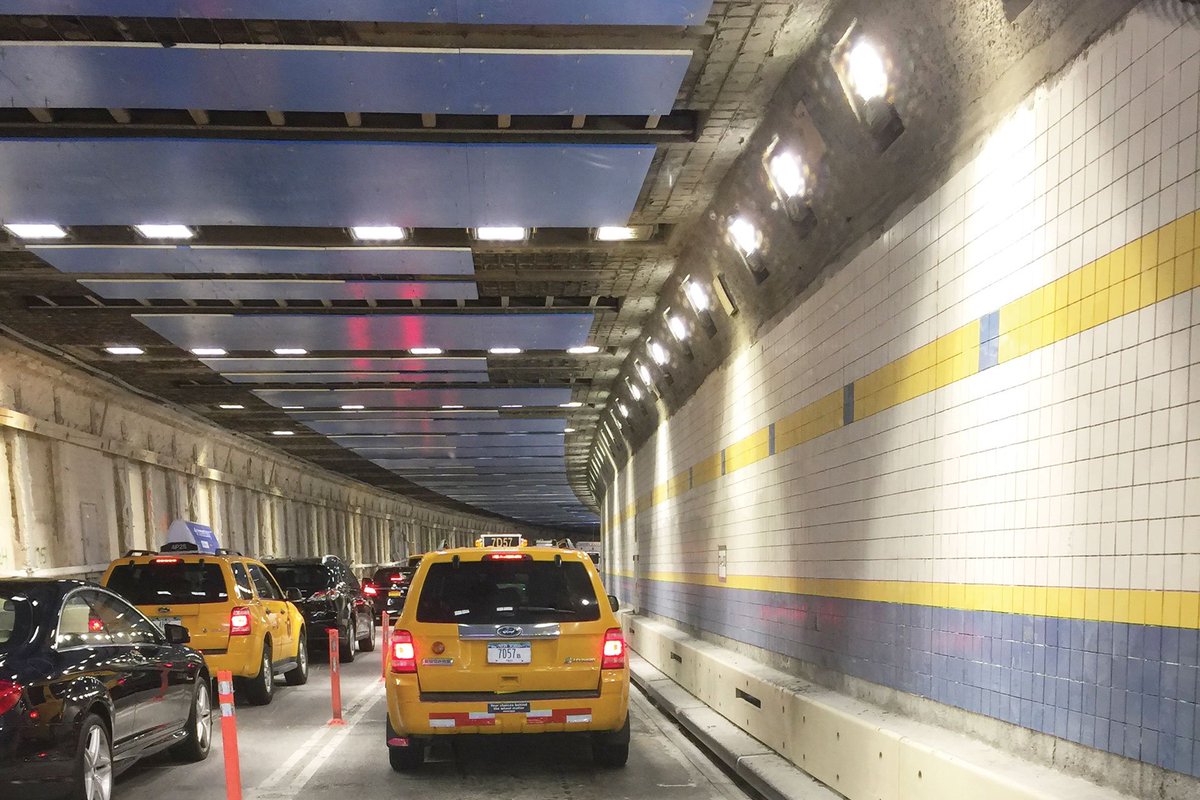
pretty sure at this point we can all agree the only "innovation" on display here is paying 45-60 people minimum wage to drive the cars instead of paying a few skilled technicians to operate a driverless metro twitter.com/mickakers/stat…

by Well There's Your Problem Podcast (wtyppod)
mkalus shared this story from wtyppod on Twitter.

pretty sure at this point we can all agree the only "innovation" on display here is paying 45-60 people minimum wage to drive the cars instead of paying a few skilled technicians to operate a driverless metro twitter.com/mickakers/stat…

Footage of what it looks like when a @Tesla is traveling through the @boringcompany’s Convention Center Loop. #vegas #boringcompany pic.twitter.com/ph1DJoTYBi


1055 likes, 143 retweets


421 likes, 58 retweets
10 Apr 04:56

Ontario’s Peel Region declined 5,000 COVID-19 vaccines for Amazon warehouse outbreak

by Brad Bennett
Amazon

In early March, an Amazon warehouse that staffs 5,000 workers was shut down following a COVID-19 outbreak so that the province and the retail giant could accurately assess how many workers were infected with the virus and how it was spreading.

In an effort to bring the warehouse back online, the province offered to send 5,000 vaccines to the warehouse to reopen the shipping hub.

The Peel Region, consisting of Brampton, Mississauga and Caledon in the Greater Toronto Area, declined the order. The region’s top doctor, medical officer of health, Dr. Lawrence Loh, says he knew the vaccines wouldn’t act fast enough to allow the warehouse to re-open. Specifically, vaccine protection can take two to three weeks to kick in and with the virus already circulating in the warehouse and possibly incubating in workers, the warehouse would have had to close regardless. Loh reportedly called for the Amazon warehouse to shut down in the first place, according to Global News

After denying the vaccines to the affected Amazon workers, Loh said that he asked the province to instead prioritize the Peel Region and allow its at-risk populations to be vaccinated, including frontline workers and the elderly.

The report says that the province heeded the call for more vaccines, however.

Source: Global News

The post Ontario’s Peel Region declined 5,000 COVID-19 vaccines for Amazon warehouse outbreak appeared first on MobileSyrup.

10 Apr 04:56

The E-Bike Wave in Unexpected Places

by Gordon Price
mkalus shared this story from Price Tags.

PT: Bob Ransford, who has been working on the Southlands project in Tsawwassen for years, brings another observation on change in that area:

Gordon wrote a few weeks ago about the wave of the future that has suddenly hit the beach with the recent popularity of e-bikes – not just in downtown Vancouver, around False Creek or the Stanley Park seawall, but on the hills of the suburban North Shore. It seems the perfect confluence of factors: an aging demographic, the yearning for pandemic-safe recreation, small, powerful batteries and falling prices for e-bikes, is suddenly manifesting in the form of a new suburban mobility.

On a weekend last September, in the midst of the pandemic, I was participating in the launch of sales for the first phase of housing at Southlands developed by Century Group – a new beach community rooted in farming and food in Tsawwassen.  On the two days, more than 3,500 came from near and far to wander through Southlands’ Market Square.

I was pleasantly shocked by the number of people who arrived on bicycles.  The tally of cyclists exceeded 730 cyclists over the two days.

What really caught my eye was the number of people who rode e-bikes to the event. Many of them were like me – aging boomers. Two of them were Tsawwassen residents Murray Pratt and Gord Sarkissian (below) who, in May, will be opening a new e-bike shop called Pedego Delta in a store-front space in Southlands’ new Discovery Centre building.

The new e-bike business these two aging boomers are starting was born after the two of them participated in Santa’s Electric Bicycle Ride in Tsawwassen last December, riding their own e-bikes. The energy and interest that event spawned made them realize that riding an electric bicycle could help improve people’s quality of life and add value to a community by promoting an active and engaged lifestyle for all adults, while providing an alternative mode of transport to help people reduce their carbon footprint.

Their business plan is to focus on creating ways in which an electric bike can enhance people’s lives – adding value to the experience they enjoy living in and around a Boundary Bay in South Delta, where there is plenty of local access to trails and also the ability to hop over to the Gulf Islands on the BC Ferries, with the terminal a few kilometers from Southlands. They plan to sell and rent Pedego e-bikes, set up an e-bike sharing program and provide guided e-bike excursions around Boundary Bay all the way to Crescent Beach.


Gordon: I’ll add another observation that I noticed last weekend.  It’s just not the usual suspects (white affluent baby boomers) who are out there cycling in these pandemic times; it’s the cross-section of a city that comes in many shades and classes.  Here’s an example on Beach Avenue.

It’s going to be fascinating to see how bike lanes will, yet again, be positioned as a Vancouver civic issue, especially now that the NPA has chosen John Coupar (no on a bike lane on Stanley Park Drive, no in Kits Park, no pretty much in any park) as their mayoral candidate.  It’s not been a winning issues for them, but it is irresistible.  Bike lanes: NPA catnip.

(As one of the veteran commentators on politics in this region, Bob Ransford will no doubt have an opinion on the politics of all that.)


10 Apr 04:54

RT @Lubchansky: incredible! footage of elon musk's The Boring Company's amazing new hyperloop prototype in action. this will revolutionize…

by matt (Lubchansky)
mkalus shared this story from wtyppod on Twitter.

incredible! footage of elon musk's The Boring Company's amazing new hyperloop prototype in action. this will revolutionize transportation as we know it pic.twitter.com/5r56TaxWnn


Retweeted by Well There's Your Problem Podcast (wtyppod) on Friday, April 9th, 2021 9:46pm


4512 likes, 315 retweets
10 Apr 04:53

RT @Anna_Soubry: #Brexit was built on lies and #BorisJohnson was in the driving seat. @BrookesTimes pic.twitter.com/xbMxbsiRVo

by Anna Soubry (Anna_Soubry)
mkalus shared this story from mrjamesob on Twitter.

#Brexit was built on lies and #BorisJohnson was in the driving seat.

@BrookesTimes pic.twitter.com/xbMxbsiRVo


Retweeted by James O'Brien (mrjamesob) on Friday, April 9th, 2021 9:47am


4261 likes, 1202 retweets
09 Apr 17:37

We’re Beating Systems Change to Death

Kevin Starr, Stanford Social Innovation Review, Apr 09, 2021
Icon

This article begins with a good criticism of systems change, then recommends an alternative approach that essentially amounts to the same thing. Oh, but the difference is explained by saying "the critical difference is that it is emergent." I agree that the best (and only) way to change society is through emergent change, that is, where the change is driven by the people, not the leaders. But in this article, 'emergent' means "driven by scale-obsessed doer organizations." No. Take education, for example. So many reformers feel we can effect change by redesigning educational systems (and if followed the advice in this article, administrators, rather than funders, would be driving change). But education changes only if people as individuals decide to learn differently. Right now (as suggested by Chomsky here) people still consent to the existing model of education. It's when that consent changes - and not until - that education changes.

Web: [Direct Link] [This Post]
09 Apr 17:37

The Purpose Of Member Profiles

by Richard Millington

Take a second to think about what the purpose of members profiles in your community (really) is before making further decisions about what should appear on it.

The best profiles tend to support one of three needs:

  • They let members find their recent activity. Members use profiles to find a list of the recent discussions they’ve participated in and keep track of responses. It’s easy for members to visit their profiles and check in on past discussions and content they’ve shared.
  • They let members show off their achievements. Members use profiles to highlight the equipment they’ve used, tools they use, events they’ve attended, awards they’ve earned, status they’ve gained etc… StackOverflow is a good example of this.
  • They let members create and show an identity. Members can customise profiles to suit their needs. This is often better for younger or more creative audiences. Members can create unique avatars, change the colors, update the design etc…

If members don’t have a pressing need for any of the above, you probably don’t need to spend too much time on them.

The post The Purpose Of Member Profiles first appeared on FeverBee.

09 Apr 17:37

The ir/responsibility of Brexiters

by Chris Grey
The loud disputes between the UK and the EU of just a few weeks ago over the Northern Ireland Protocol (NIP) have quietened and there has still been no public response from the EU to the UK’s new roadmap for its implementation (though there are rumours of “disappointment”[£]). Nor, so far as I know, has there been any public indication of what its contents are.

As per my post last week, I think this is only a lull: the Brexit government’s aversion to the Protocol is now very deep-rooted. That is the Protocol which is part of the Withdrawal Agreement it negotiated, claimed as a triumph, campaigned on in the 2019 election, and signed with the EU only a little over a year ago. It is also the Protocol which has as its core provision a permanent sea border between Great Britain and Northern Ireland, a fact mendaciously denied by government ministers, up to and including Boris Johnson.

This provision in turn arises from Brexit, or more accurately from hard Brexit. The facts here are so basic and so simple that they should not require repeating, but as events unfold there is perhaps a danger of them being forgotten. Hard Brexit did not flow automatically from the 2016 Referendum but was the interpretation chosen by successive British governments. It meant choosing to leave the single market and customs union, the institutions that prevent economic borders between their members. That meant choosing to create the need for an economic border with the EU and, as regards Northern Ireland, there is no politically acceptable place to put that border. Neither Brexit nor hard Brexit were the choices of the EU, they were not the choices of Ireland, and they were not the choices of the people of Northern Ireland.

Violence in Northern Ireland

Thus on the ground in Northern Ireland things have been anything but quiet, and the deteriorating security situation there, with the worst rioting “for years”, is becoming a matter of serious concern. Considerable care is needed in commenting on this from a Brexit point of view, especially when that comment comes from someone, such as me, who does not live in Northern Ireland and can claim no expertise in its complex politics.

Nevertheless, it is abundantly clear from numerous reports that Brexit, or more particularly the NIP, is a significant factor in the renewed violence from some members of the loyalist or unionist community, even though it is not the only one. Moreover, it has been stated on good authority that there is a paramilitary involvement in the latest violence – and although that is disputed, it is a fact that over a month ago loyalist paramilitary groups announced they had withdrawn support for the Good Friday (Belfast) Agreement because of the Brexit deal. Perhaps worst of all, there are signs of a new generation, that had grown up with peace, now being drawn in, and there are also credible reports (£) of plans for an ongoing campaign of ‘civil disobedience’.

It is two months since I wrote on this blog that “what is now becoming ever-clearer is that Brexit threw a huge rock into the high delicate and fragile machinery of the Northern Ireland peace process, a machinery of complex checks and balances which had as an implicit condition the fact that both Ireland and the UK were within the EU”. As Alliance Party MP Stephen Farry puts it, “Brexit has cracked Northern Ireland even though its constitutional status hasn’t changed”.  

The directions that will take are highly unpredictable, and there can be no pleasure whatsoever taken from saying ‘I told you so’. Equally, it cannot be pretended that what is happening in Northern Ireland has come out of a clear blue sky - as one might think from some of the news headlines.

No contrition from Brexiters

So it would be fitting for some of the high-profile advocates of hard Brexit – perhaps especially those who are also Irish unionists – to take some responsibility for having, at the very least, misunderstood its consequences for Northern Ireland (£). It is no good simply blaming it all on Johnson’s deal, for whilst that is the cause of the specific form that these consequences are taking, the fact that there would be consequences is squarely down to the hard Brexit that so many, including but not limited to Johnson, championed.

Where Johnson can be most heavily criticized - as Naomi Long, the Minister of Justice in Northern Ireland, implied, and former Northern Ireland secretary Peter Hain said in terms yesterday - is for not being “straight” about what his Brexit agreement meant. That, of course, grows directly from Johnson’s wider, pathological, dishonesty as devastatingly chronicled by the journalist Peter Oborne.

It is all but unthinkable that Johnson will acknowledge his responsibility, and there are no signs of contrition amongst the Brexit Ultras more generally. On the contrary, where they are not silent, at least some are doubling down on the same misrepresentations that have caused this situation. Thus the increasingly peculiar former Brexit MEP Ben Habib insists that the problems were caused by the EU and Ireland “weaponizing” the border issue, with the British government at fault for giving in by agreeing to the Irish Sea border (he doesn’t find it necessary to mention that he voted for this agreement when he was an MEP).

For an alternative, he falls back on the stock Brexiter misunderstanding (to put it charitably) that the Good Friday (Belfast) Agreement does not prohibit a land border and that this is what should be created.  It’s as if all the endless debates and explanations of the entire issue over the last five years had never occurred. Worse, Habib even regresses to the pre-referendum nonsense spouted by Johnson and others that, somehow, the solution lies in the Common Travel Area (it doesn’t because that relates to the movement of people, not goods and livestock), or that customs formalities could simply be waived - in others words, denying the basic fact of the economic border that hard Brexit requires.

In a similar vein, Brendan O’Neill, the would-be contrarian editor of Spiked, predictably argues that “it was the failure to implement Brexit properly, not Brexit itself” which created the problems for Northern Ireland, and that, inevitably, is down to the – yes, same language, as if they all take dictation from the same Brexity algorithm - “weaponizing” of the border issue by the EU etc. What Habib and O’Neill also share is a strange inconsistency in which the Sea border is a terrible outrage and yet a land border would have been “a practical challenge that could have been straightforwardly resolved” (O’Neill) involving merely “filling in a few forms and submitting the odd lorry load of goods to inspections” (Habib). More fundamentally what they share, needless to say, is a complete failure to accept that they have any responsibility whatsoever for Brexit or any of its consequences.

Choices have consequences

The decision to enact Brexit as hard Brexit is also the main reason for the myriad of emerging economic consequences. It is difficult to keep up with the daily reports of the damage that Brexit is doing. As I wrote in my previous post, these are ‘micro-damages’ taken as separate stories, but in aggregate they suggest an alarming degradation of businesses and livelihoods. This week’s crop ranges from delays, barriers and charges faced by independent garages getting parts, small-scale antiques dealers, and chocolate makers. As ever, the burgeoning 'Kelemen Archive' is an invaluable record of the astonishing scale of the damage. One potentially important development this week is that the Labour Party has (£), really for the first time, pushed the government hard on the economic effects of the trade deal. It remains to be seen if this is the start of a sustained strategy or a passing moment.

There is also still an ongoing stream of news stories about the post-Brexit problems facing British immigrants in EU countries. It’s important to make two distinctions here, both of which appear to elude the Brexiters and, for that matter, much of the media. Firstly, what is at stake is not how ‘the EU’ is treating these people, because each individual member state (being, Brexiter ideology notwithstanding, sovereign nations) has its own rules and procedures. Secondly, there’s a difference between those problems caused by member states not understanding or applying the terms of the Withdrawal Agreement (£) and those which are simply entailed by Brexit itself, or, once again, at least by Brexit in the hard form chosen by the British government.

That issue of choice is central, and yet still evaded by Brexiters. A recent symposium with Michel Barnier was illuminating in his stress upon the point that he also often made during the negotiations: that choices have consequences. It seems so obvious as to hardly need saying, but even now, and perhaps especially now, it does. For in relation to Britons’ freedom of movement in the EU, former Brexit Party MEP Lance Forman is still perplexed that they should no longer have these rights, as if that were somehow not entailed by the policies his party had advocated and the agreements which he, like Habib, voted for when he was an MEP.

Contorted logic

Of course this can be dismissed as just the problem of a sightly dim ex-politician, but its roots go much deeper, and explain a lot of the mess the Brexiters have created. Part of that is to do with the strange phenomenon, which I’ve discussed many times on this blog, of the way that many Brexiters seemed to think that whilst leaving the EU was a matter of vital necessity nothing much would really change as a result. But it is also to do with the weird arguments that they constructed around that; especially weird in relation to British ‘expats’ in the EU given the centrality many Brexiters placed on ending freedom of movement of people as the rationale for Brexit.

In the latter case, those arguments took two forms. One was that British people had moved to continental Europe to work, study or retire long before joining the EU, so Brexit was irrelevant. That was fatuous because it ignored the way that doing so was far more difficult before membership, and far easier afterwards. But it was doubly fatuous because it posited that freedom of movement rights had made no difference for British people’s free movement whilst arguing that they had made it far too easy for those from the EU-27 (as was).

The other, still on display in the present news stories, was that British immigrants in the EU were beneficial to the EU (spending money, paying taxes) whilst those from the EU were a drain on the UK. That was nonsense in itself as regards EU nationals in the UK, but was also a version of the ‘German car makers’ argument that ‘they need us more than we need them’. Both versions were at best economically illiterate and at worst insufferably arrogant, and both have now been comprehensively discredited. Yet they live on.

Will Brexiters take responsibility for what they have done?

When Article 50 was triggered, I wrote that from then on Brexiters would be responsible for whatever happened (the same argument was more eloquently made by Jay Elwes in Prospect). Four years on, it is clear that, on any objective criteria, there isn’t a single claim they made for Brexit that has come true. Economically, that has been obscured by the pandemic to a degree. The vaccine rollout has also given a temporary alibi and, notably, is about the only claim for the benefits of Brexit they make any more. But it didn’t require Brexit and, very likely, within a few months’ time the difference between the UK and EU record will have disappeared and become irrelevant.

As Mujtaba Rahman, the respected and influential Eurasia Group analyst puts it, “looking in rear view mirror, a lot of the drama [over UK/EU vaccine performance] of the last few weeks will look v[ery] silly indeed”. Already the Brexiter thunder over the treatment of the AZ vaccine in some EU countries (inevitably they ignored that of non-EU countries) looks even sillier in the light of emerging changes in the UK’s approach. As I have been arguing for weeks, viewing the vaccines issue through the lens of Brexit, or vice versa, was always nonsense.

Even so, the vaccine rollout will certainly be cited by Brexiters for years as a justification but – based on the inordinate amount of time I spend lurking on pro-Brexit sites, in an attempt to understand their views - I have the sense that it is already a rather half-hearted one, knowingly grabbing at straws. The far more dominant mood amongst the Brexit hard core is that their dream has been betrayed and, in a now recurrent phrase, that ‘this is not what I voted for’.

However, that certainly doesn’t mean that there is likely to be some great moment of realization that Brexit is a mistake, in the way imagined by, for example, William Keegan of The Observer. For the hard core, the keyword is indeed, as it was always going to be, ‘betrayal’: they still see no flaw in Brexit, only in how it was done, which they attribute to politicians in general (Theresa May especially and Boris Johnson partly), to the ‘remainer Establishment’, and to the EU. Indeed if there were one single thread running through Brexit it would be that Brexiters never, ever accept responsibility for their choices and the consequences of those choices. It is always someone else’s fault.

Will Brexiters be held responsible for what they have done?

That may be different for those outside the hard core of leave voters, but it’s the last and most enduring of the remainer illusions to think that there will be a sudden shift in which the country comes to its senses. Nor is there likely to be a moment of justice in which the guilty are arraigned or shamed.

More likely, though even this is by no means certain, there will just be a long, slow process – akin to what happened with other once-bitter polarizations such as those over Munich or Suez – through which Brexit becomes widely understood, more though an osmotic process than as a result of particular events or arguments, as a humiliating failure.

For the time being, at least, opinion polls suggest that that has yet to happen and that, excluding ‘don’t knows’, the leave-remain split is … 52% to 48% (page 9 of download). Of course strictly speaking asking how people would vote in a new leave-remain referendum makes no sense now that Brexit has happened but another poll shows a 46% to 43% split on the question of whether in hindsight it was right or wrong to leave the EU. There’s very likely some temporary ‘vaccine’ effect in these figures, but despite the self-evident failure of Brexit to deliver its promises, and the clear damage it is doing, support for it has proved remarkably durable. It’s a fact that has to be faced.

I think that, in turn, this means that there may never be a reckoning, in the sense of a holding to account of Brexiters for what they have done. Notably, there hasn’t been a single leading Brexit campaigner who has recanted. It’s possible to imagine some of them doing so in political memoirs decades hence, though I suspect most will go their graves unrepentant and blaming others. And perhaps, even probably, history books will treat Johnson much as they have Chamberlain or Eden, and with better cause, but that will be too late to matter much.

It's not fair, but then we learn in the nursery that life isn’t fair. Most of us also learn that our choices have consequences, and that we should take responsibility for them. It is a lesson for which the Brexit leaders were apparently absent.

09 Apr 17:37

The coronavirus pandemic hasn’t stopped new restaurants opening in Hong Kong, even as others close down for good

by Susan Jung
This week is the first anniversary of something that I did with the greatest reluctance: I stopped writing restaurant reviews for this newspaper. A year ago, we were deep into the Covid-19 pandemic, although I didn’t think we realised at the time that the situation would last so long. But the streets of Hong Kong were empty – people weren’t going out to eat or shop, even though the government hadn’t yet imposed dining restrictions. Restaurants, especially the smaller places, were closing at a…
09 Apr 17:36

Meet Our Team: Phoenix, Support Agent

by Helen Horstmann-Allen
Meet Our Team: Phoenix, Support Agent

Meet Phoenix, a Fastmail support agent, who helps customers get the most from their email experience.


Fastmail's support team works together every day. Find out how they help each other, when you meet Phoenix, a member of Fastmail's support team.

Name: Phoenix Robertson
Role: Support Agent

What do you work on?
I work on the support team. So, I answer questions from customers! I also get to work on communications and help pages, and that's a lot of fun.

How long have you been with Fastmail? How did you get involved?
I came to Fastmail in September 2019.

I wanted to move to Philadelphia, and I saw there was a job opening on the suppport team at Fastmail. I thought this looked like a fun place to work, and I was right!

What’s a project that you've worked on that you're proud of?
My favorite project I've worked on is the Pobox log searching tutorial. The ways we search logs in Pobox are pretty different from Fastmail, so I spent an afternoon punching commands into terminal. When I got the answers I wanted, I wrote it down. Now all my colleagues use it, and lots of times, they still take the time to say thanks. Every time I hear that, I grow another feather on my phoenix wings.

What other projects inspire you?
Especially since COVID started, there have been lots of new mutual aid organizations here in Philly. They have an ethic that's inspiring to me.

What’s your favorite Fastmail feature?
I think our rules are the best rules of any email service ever. I dig snooze and our labels. I'm also really feeling the sidebar!

What’s your favorite piece tool?
I have quad skates, which I can only use at basketball courts these days. But I have this wrench for my roller skates—you can use it to take off the wheels, extend the toe stop, and take off the bearings. That's my favorite tool because it brings me the most joy. Sometimes, your favorite things brings you the most happiness, and don't necessarily get the most use.

What are you watching/listening to these days?
I just finished watching The Great on Hulu. It was funny, interesting, not at all accurate, and a grand old time. It's like someone read a book jacket on Peter the Great and Catherine the Great, thought it was a great story, and then just made up all the details.

I'm always listening to the Mountain Goats, so that goes without saying.

What do you like to do outside of work?
I like to roller skate. I like to read. I like lifting weights. Prior to pandemic times, I was into tabletop roleplaying games.

What's your favorite animal?
Phoenixes.

Do you do any volunteer work?
I'm a letter responder with Prisoner Health News, which provides health information to incarcerated folks. I got involved because of friends who were involved, when I told them I wanted to find a way to volunteer without leaving home. It's a great way to be a contributing member of society while still minimizing COVID-19 risk.

Any Fastmail staffers you want to brag on?
The whole support team! We're just so cool, and funny, and smart and nice! Also the developers, and the marketing team—everybody is great!

What do you like the best about your work at Fastmail?
I am passionate about figuring people out from the snippets of themselves that they reveal to us, and then choosing the words that will help them feel the most comfortable and confident about solving their problems. It's a social smarts challenge that I find engaging and meaningful.


At Fastmail, we work on making email better for everyone. Building an incredible team is an important part of our company and our values. Check out our job listings page for opportunities to join our team!

09 Apr 17:36

Apple launches 24-hour music video channel in Canada

by Patrick O'Rourke

Apple’s take on old-school MTV and Much Music has launched in Canada and the U.K. after releasing in the U.S. last year.

The channel, which is accessible through the tech giant’s TV app on iOS, iPadOS and tvOS, plays music videos all day, all the time, with live events also sometimes appearing.

While a little silly in the modern world of on-demand music streaming services and video platforms, for people of a certain age (like myself), this channel offers a nostalgic look at an era before nearly every song you’d ever want to listen to was only a few clicks away.

Within Apple’s Music app, the channel is available at the top of the browse tab. Through the TV app, you need to scroll down to the Watch Now Page to find the Apple Music TV carousel.

This isn’t the type of app I’d use very often, but I may watch it on the occasional lazy Saturday or Sunday afternoon. There’s something strangely relaxing about curated playlists, especially when it comes to music videos.

Via: 9to5Mac

The post Apple launches 24-hour music video channel in Canada appeared first on MobileSyrup.

09 Apr 17:35

Proctorio Is Using Racist Algorithms to Detect Faces

Todd Feathers, Motherboard, Vice, Apr 09, 2021
Icon

Given what we know of contemporary AI, this should come as a surprise to no one, but it's important to actually do the research and generate the data. Here's the gist: "A student researcher has reverse-engineered the controversial exam software - and discovered a tool infamous for failing to recognize non-white faces." Akash Satheesan published his findings in a series of blog posts. Again, none of this is news. "Black students have described how frustrating and anxiety-inducing Proctorio’s poor facial detection system is."

Web: [Direct Link] [This Post]
09 Apr 17:35

Connecting the Dots: Dr. Barbara Oakley on the Science of How We Learn

Apr 09, 2021
Icon

There's a lot to like in this interview and I certainly think Barbara Oakley has a handle on the subject. At times, though, I find it hard to tease out what she means when she blends cognitive psychology and neuroscience. The conversation flows in and out of metaphors quite smoothly (not a bad thing!) When she says, for example, "Your working memory can reach in and gather sets of neural links, holding them as you’re manipulating information to solve a problem," this can't be a literal description, but it's not clear what she means. Still, the distinction she draws between declarative and procedural knowledge is quite useful, as is the concept of "drill and chill", and as is the declaration that "a little effort to improve students’ abilities to learn has a significant impact."

Web: [Direct Link] [This Post]
09 Apr 17:34

What’s up with SUMO – Q1 2021

by Rizki Kelimutu

Hey SUMO folks,

Starting from this month, we’d like to reenact our old tradition to have the summary of what’s happening in our SUMO nation. But instead of weekly like the old days, we’re going to have a monthly updates. This post will be an exception though, as we’d like to recap the entire Q1 of 2021.

So, let’s get to it!

Welcome on board!

  1. Welcome to bingchuanjuzi (rebug). Thank you for your contribution to 62 zh-CN articles despite just getting started in Oct 2020.
  2. Hello and welcome Vinay to the Gujarati localization group. Thanks for picking up the work in a locale that has been inactive for awhile.
  3. Welcome back to JCPlus. Thank you for stewarding the Norsk (No) locale.
  4. Welcome brisu and Manu! Thank you for helping us with Firefox for iOS questions.
  5. Welcome to Kaio Duarte to the Social Support program!
  6. Devin and Matt C for their comeback to Social Support program (Devin has helped us with Buffer Reply and Matt was part of Army of Awesome program in the past).

Last but not least, let’s join us to welcome to Fabi and Daryl to the SUMO team. Fabi is the new Technical Writer (although, I should note that she will be helping us with Spanish localization as well) and Daryl is joining us as a Senior User Experience Designer. Welcome both!

Community news

  • Play Store Support is transitioning to Conversocial. Please read the full announcement in our blog if you haven’t.
  • Are you following news about Firefox? If yes is your answer, then I have good news for you. You can now subscribe to Firefox Daily Digest to get updates about what people are talking about Firefox and other Mozilla products on social media like Reddit and Twitter.
  • Another good news from the Twitter-land. Finally, we regain our access to @SUMO_mozilla Twitter account (if you want to learn the backstory, go watch our community call in March). Also, go follow the account if you haven’t because we’re going to use it to share more community updates moving forward.
  • Check out the following release notes from Kitsune in the past quarter:

Community call

  • Watch the monthly community call if you haven’t. Learn more about what’s new in January, February, and March.
  • Reminder: Don’t hesitate to join the call in person if you can. We try our best to provide a safe space for everyone to contribute. You’re more than welcome to lurk in the call if you don’t feel comfortable turning on your video or speaking up. If you feel shy to ask questions during the meeting, feel free to add your questions on the contributor forum in advance, or put them in our Matrix channel, so we can address them during the meeting.

Community stats

KB

KB Page views

Month Page views Vs previous month
January 2020 12,860,141 +3.72%
February 2020 11,749,283 -9.16%
March 2020 12,143,366 +3.2%

Top 5 KB contributors in the last 90 days: 

  1. AliceWyman
  2. Jeff
  3. Marchelo Ghelman
  4. Artist
  5. Underpass

KB Localization

Top 10 locale based on total page views

Locale Jan 2020 Feb 2020 Mar 2020 Localization progress (per 6 Apr)
de 11.69% 11.3% 10.4% 98%
fr 7.33% 7.23% 6.82% 90%
es 5.98% 6.48% 6.4% 47%
zh-CN 4.7% 4.14% 5.94% 97%
ru 4.56% 4.82% 4.41% 99%
pt-BR 4.56% 5.41% 5.8% 72%
ja 3.64% 3.61% 3.68% 57%
pl 2.56% 2.54% 2.44% 83%
it 2.5% 2.44% 2.45% 95%
nl 1.03% 0.99% 0.98% 98%

Top 5 localization contributor in the last 90 days: 

  1. Ihor_ck
  2. Artist
  3. Markh2
  4. JimSp472
  5. Goudron

Forum Support

Forum stats

Month Total questions Answer rate within 72 hrs Solved rate within 72 hrs Forum helpfulness
Jan 2020 3936 68.50% 15.52% 70.21%
Feb 2020 3582 65.33% 14.38% 77.50%
Mar 2020 3639 66.34% 14.70% 81.82%

Top 5 forum contributor in the last 90 days: 

  1. Cor-el
  2. FredMcD
  3. Jscher2000
  4. Sfhowes
  5. Seburo

Social Support

Channel Jan 2020 Feb 2020 Mar 2020
Total conv Conv handled Total conv Conv handled Total conv Conv handled
@firefox 3,675 668 3,403 136 2,998 496
@FirefoxSupport 274 239 188 55 290 206

Top 5 contributors in Q1 2021

  1. Md Monirul Alom
  2. Andrew Truong
  3. Matt C
  4. Devin E
  5. Christophe Villeneuve

Play Store Support

We don’t have enough data for the Play Store Support yet. However, you can check out the overall Respond Tool metrics here.

Product updates

Firefox desktop

Firefox mobile

  • What’s new in Firefox for Android
  • Additional messaging to set Firefox as a default app were added in Firefox for iOS 32.
  • There’s also additional widget for iOS as well as improvement on bookmarking that were introduced in V32.

Other products / Experiments

  • VPN MacOS and Linux Release.
  • VPN Feature Updates Release.
  • Firefox Accounts Settings Updates.
  • Mozilla ION → Rally name change
  • Add-ons project – restoring search engine defaults.
  • Sunset of Amazon Fire TV.

Shout-outs!

If you know anyone that we should feature here, please contact Kiki and we’ll make sure to   add them in our next edition.

Useful links:

09 Apr 17:28

Vaccine efficacy rates explained

by Nathan Yau

Vox explains efficacy rates and why the best vaccine is the one you get now:

Tags: coronavirus, vaccine, Vox

09 Apr 00:41

$50M grant program announced for B.C. businesses affected by COVID-19 'circuit breaker'

mkalus shared this story .

A $50-million relief package is coming for 14,000 B.C. restaurants, bars, gyms and other businesses hit hard by the March 30 tightening of COVID-19 provincial health orders.

Dubbed the Circuit Breaker Business Relief Grant, the program will give affected businesses a one-time cash infusion of $1,000 to $10,000 to help with expenses such as rent, insurance and employee wages. 

It can also be used to cover unexpected losses that resulted from the sudden shutdown, like the spoiling of food.

"The latest circuit breaker has been particularly hard on small business," said Ravi Kahlon, minister of jobs, economic recovery and innovation. "I can't imagine the stress and pressure businesses are feeling today."

Kahlon said businesses not in compliance with the new health orders are not eligible for the program.

On March 30, the province imposed a three-week "circuit breaker," introducing sweeping new restrictions on indoor dining in restaurants, group fitness activities and worship services in an attempt to slow spiking COVID-19 infections. 

All food and liquor-serving premises were asked to pivot to takeout or delivery service. Indoor dining was suspended but patios were allowed to remain open. 

Indoor, adult group fitness activities were suspended and gyms and fitness centres restricted to individual or one-on-one activities.

Kahlon said the grant is open to eligible businesses of any size that have been in operation since Feb. 1.

Grant applications are expected to open the week of April 12 and close on June 4 or earlier if the funds run out. 

The government expects the majority of eligible businesses will receive a grant of $5,000. The program is scalable depending on the number of employees, said Kahlon.

To be eligible, a business is required to:

  • Confirm it has been affected by the recent provincial health orders.
  • Provide electronic banking information.
  • Confirm it is registered as a B.C. business.
  • Produce a business validation document, such as a business licence, liquor licence, notice of assessment or lease agreement.
  • Confirm majority ownership and operations and payment of taxes in B.C.

Kahlon said businesses impacted by the pandemic in general, but not specifically by the March 30 provincial health orders, have relief available through other programs outside of the one announced Thursday.

09 Apr 00:41

GM’s chip shortages lead to extended production shutdowns in Canada

by Brad Bennett

GM is extending production line shutdowns in many parts of North America, including Canada, and shutting down even more lines in Mexico and the United States.

The GM CAMI Ingersoll plant in Ontario is extending its production line shutdown to the 1,500 employees who build the Chevy Equinox SUV to May 10th, according to the Detriot Free Press.

Global chip production issues have affected products across several industries and have led to a shortage of PlayStation 5 and Xbox Series X console, Android phones and now, reportedly even Apple devices.

Other automakers are in the same boat, with Ford and Fiat Chrysler both experiencing production line shutdowns related to the global chip shortage.

Source: Detroit Free Press

The post GM’s chip shortages lead to extended production shutdowns in Canada appeared first on MobileSyrup.

09 Apr 00:37

Weeknotes: SpatiaLite 5, Datasette on Azure, more CDC vaccination history

Rolandt

jj

This week I got SpatiaLite 5 working in the Datasette Docker image, improved the CDC vaccination history git scraper, figured out Datasette on Azure and we closed on a new home!

SpatiaLite 5 for Datasette

SpatiaLite 5 came out earlier this year with a bunch of exciting improvements, most notably an implementation of KNN (K-nearest neighbours) - a way to efficiently answer the question "what are the 10 closest rows to this latitude/longitude point".

I love building X near me websites so I expect I'll be using this a lot in the future.

I spent a bunch of time this week figuring out how best to install it into a Docker container for use with Datasette. I finally cracked it in issue 1249 and the Dockerfile in the Datasette repository now builds with the SpatiaLite 5.0 extension, using a pattern I figured out for installing Debian unstable packages into a Debian stable base container.

When Datasette 0.56 is released the official Datasette Docker image will bundle SpatiaLite 5.0.

CDC vaccination history in Datasette

I'm tracking the CDC's per-state vaccination numbers in my cdc-vaccination-history repository, as described in my Git scraping lightning talk.

Scraping data into a git repository to track changes to it over time is easy. What's harder is extracting that data back out of the commit history in order to analyze and visualize it later.

To demonstrate how this can work I added a build_database.py script to that repository which iterates through the git history and uses it to build a SQLite database containing daily state reports. I also added steps to the GitHub Actions workflow to publish that SQLite database using Datasette and Vercel.

I installed the datasette-vega visualization plugin there too. Here's a chart showing the number of doses administered over time in California.

Chart of vaccines distributed in California, which is going up at a healthy pace

This morning I started capturing the CDC's per-county data too, but I've not yet written code to load that into Datasette. [UPDATE: that table is now available: cdc/daily_reports_counties]

Datasette on Azure

I'm keen to make Datasette easy to deploy in as many places as possible. I already have mechanisms for publishing to Heroku, Cloud Run, Vercel and Fly.io - today I worked out the recipe needed for Azure Functions.

I haven't bundled it into a datasette-publish-azure plugin yet but that's the next step. In the meantime the azure-functions-datasette repo has a working example with instructions on how to deploy it.

Thanks go to Anthony Shaw for building out the ASGI wrapper needed to run ASGI applications like Datasette on Azure Functions.

iam-to-sqlite

I spend way too much time whinging about IAM on Twitter. I'm certain that properly learning IAM will unlock the entire world of AWS, but I have so far been unable to overcome my discomfort with it long enough to actually figure it out.

After yet another unproductive whinge this week I guilted myself into putting in some effort, and it's already started to pay off: I figured out how to dump out all existing IAM data (users, groups, roles and policies) as JSON using the aws iam get-account-authorization-details command, and got so excited about it that I built iam-to-sqlite as a wrapper around that command that writes the results into SQLite so I can browse them using Datasette!

Datasette showing IAM database tables

I'm increasingly realizing that the key to me understanding how pretty much any service works is to pull their JSON into a SQLite database so I can explore it as relational tables.

A useful trick for writing weeknotes

When writing weeknotes like these, it's really useful to be able to see all of the commits from the past week across many different projects.

Today I realized you can use GitHub search for this. Run a search for author:simonw created:>2021-03-20 and filter to commits, ordered by "Recently committed".

Here's that search for me.

Django pull request accepted!

I had a pull request accepted to Django this week! It was a documentation fix for the RawSQL query expression - I found a pattern for using it as part of an .filter(id__in=RawSQL(...)) query that wasn't covered by the documentation.

And we found a new home

One other project this week: Natalie and I closed on a new home! We're moving to El Granada, a tiny town just north of Half Moon Bay, on the coast 40 minutes south of San Francisco. We'll be ten minutes from the ocean, with plenty of pinnipeds and pelicans. Exciting!

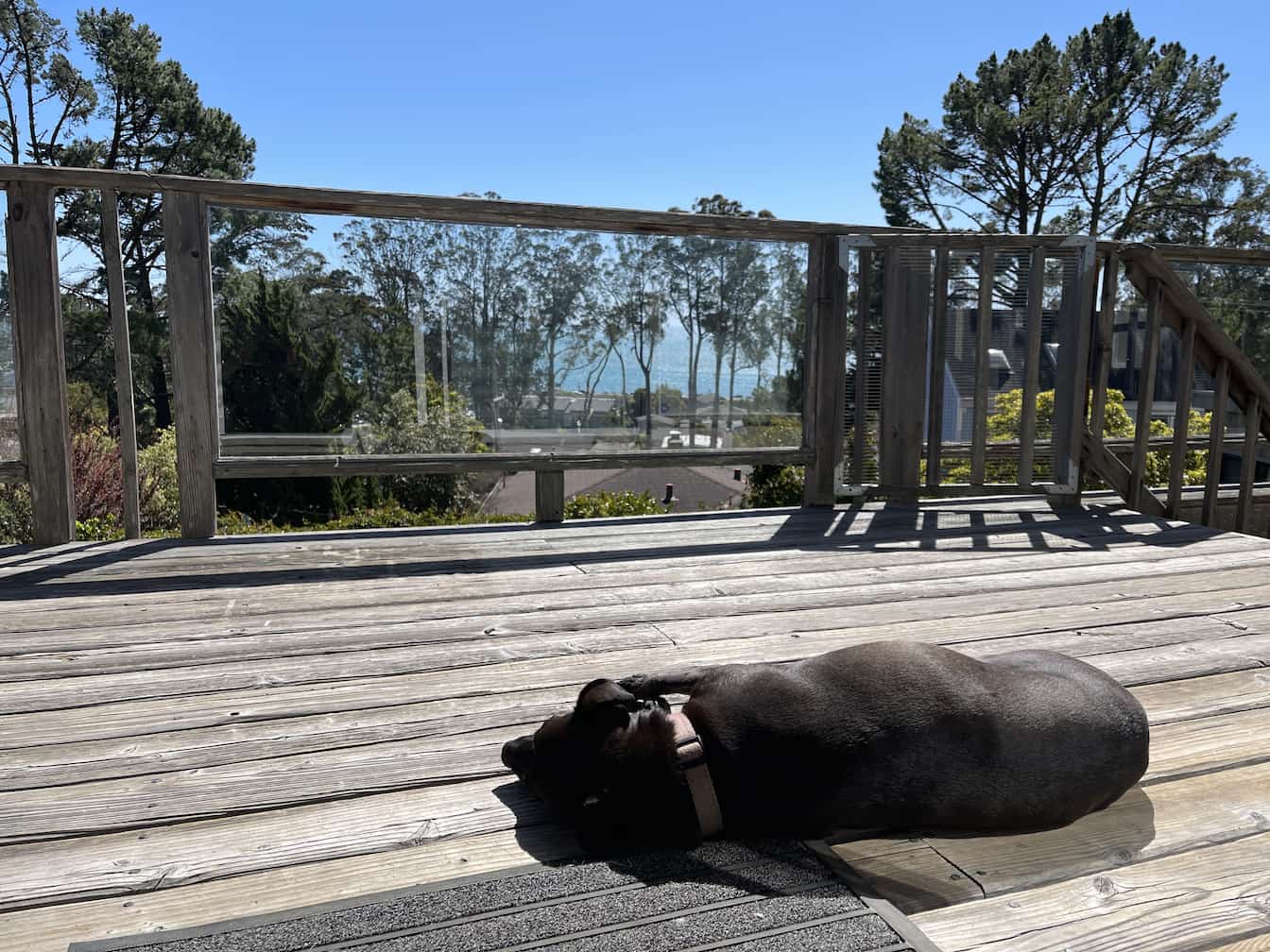
Cleo asleep on the deck with the Pacific ocean in the distance

TIL this week

Releases this week

08 Apr 18:50

Commuting & Covid-19: How the pandemic changed my travel behavior

by Simon Jockers

This is Simon, a software engineer at Datawrapper. For this edition of the Weekly Chart, I have illustrated how my travel behavior has changed due to the pandemic. I took inspiration from a recent blog post by Achim Tack.

In March 2020, the Covid-19 pandemic was still a looming threat and did not affect my daily life in a significant way. Then, on the night of March 10, I came down with a very strange cold[1]. When I was finally better and ready to go back to work after a few days of rest, we were in the midst of a public health emergency, and everyone at Datawrapper had switched to working remotely. Before the pandemic, I used to commute to the Datawrapper office three to four times a week. Now, I was grounded at home, in a small town about 60 kilometers north of Berlin.

At the beginning of 2019, my wife and I had moved from Berlin to the town of Eberswalde, which added a total of about 120 kilometers of train travel to a normal workday in the office. Other than the new commute, the twelve months before the pandemic were pretty representative of my pre-coronavirus lifestyle. I used to travel longer distances fairly regularly, both for work and to visit friends and family across the country. In 2019, I also took two vacations: an extended bike trip to the Baltic coast and another in France’s Alsace region. That way, I racked up a total of almost 25,000 kilometers, traveled mostly by train and bike. During the pandemic, my yearly travel was reduced to about a quarter of that.

When Germany went into the first nationwide Covid-19 lockdown, I already worked from home and had canceled all travel plans for the weeks to come. So in terms of travel, the lockdown did not change much for me. Also, unlike other countries’ Covid-19 precautions, the German idea of a ‘lockdown’ included few mobility restrictions and it was always possible to spend time outdoors. To stay sane, I used the time I gained from not commuting to take long walks and bike rides. I didn’t miss commuting, but I missed seeing my coworkers, friends, and family.

As the coronavirus situation eased over the summer, my wife and I temporarily moved our ‘office’ to the south of Germany, where we both have family. In September, we spent a fairly normal summer vacation in the Black Forest, with camping and some bike touring. We even got to hang out with friends in an actual beer garden. I know it is hard to imagine today, but that was Germany in summer 2020.

Back in the Berlin region, I commuted to the (mostly deserted) Datawrapper office a handful of times. But when the pandemic got worse, I finally stuck to working remotely. These days, when I can’t stand working alone at home anymore, I take a stroll over to a shared office space in my neighborhood[2]. There, I work alongside a small group of other ex-commuters—with appropriate distance and safety precautions.

I know that compared to many others, I am in a rather privileged position right now. I am healthy, my job is barely affected by the pandemic, and I don’t have to juggle work and childcare during times when schools are closed. Yet, I can’t wait for our fully vaccinated life after the pandemic. I’m looking forward to meeting friends, hanging out in cafes, and having lunch with coworkers. However, I don’t think I want to ever go back to traveling 25,000 kilometers per year.

About the data

This blog post was inspired by a similar project by Achim Tack, who you may know as a data journalist for Spiegel Online. His original project is much more extensive than my post. If you haven’t seen it yet, you should head over now.

Achim’s project is based on data from his Google Location History. I don’t automatically track my travel, so I assembled the data retroactively from train tickets, records of bike trips, and estimates based on my work schedule and calendar entries. While my data is not 100% accurate, it is still reasonably exact to see general patterns[3].


That’s it from me for this week. As always, do let me know if you have feedback, suggestions, or questions. I am looking forward to hearing from you at simon@datawrapper.deMastodon, or Twitter.

  1. Today, I am pretty sure it was a mild case of Covid-19, but back in March 2020, I did not know much about the symptoms so I did not connect the dots. At that time, it was also close to impossible to get tested unless you were seriously sick or had direct contact with someone who was. ↩︎
  2. If you ever happen to be stranded in Eberswalde, join me at the Thinkfarm coworking space. ↩︎
  3. I am pretty sure I have vastly underestimated the distances I walked and biked, both during the pandemic year and before. ↩︎
08 Apr 18:49

Potential Olympus collaboration could improve cameras on upcoming Samsung phones

by Karandeep Oberoi
Galaxy S21 Ultra

Samsung’s next-gen flagship smartphones could potentially feature a camera array produced by longstanding Japanese camera manufacture Olympus, taking the South Korean company’s already top-of-the-line shooters to the next level.

As reported by Digital Camera World, the Samsung Galaxy S22 Ultra and Samsung Galaxy Z Fold 3, which are tipped to launch later this year, could feature the new camera technology. The publication says the leaks come from reliable sources, though nothing has been confirmed by either Samsung or Olympus.

Credible leaker Yogesh tweeted on April 6th that Samsung is going big with the Fold 3 and that the company might be jumping on the latest trend of partnering up with a camera brand, similar to what OnePlus did with their Hasselblad-tuned OnePlus 9 and OnePlus 9 Pro and what Huawei has been doing for several years with Leica.

Yogesh tweeted the next day stating that Samsung and Olympus held talks about a possible partnership for the special edition Galaxy Fold or S22 Ultra.

Ice universe leak

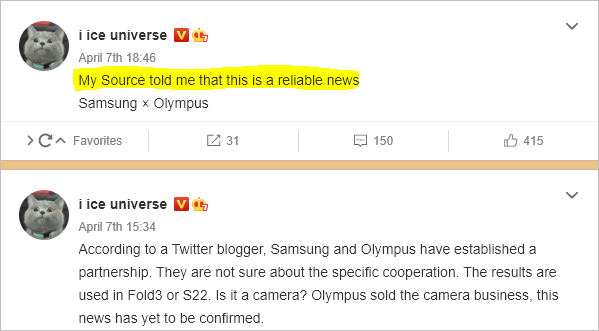
The claim was corroborated by Ice Universe — another credible leaker — on Chinese social media platform Weibo and was reported by Gizmochina. Ice Universe’s post reads, “My source told me that this is reliable news Samsung x Olympus.”

Going back two months gives the claim more weight. In February, Olympus discussed its intention of collaborating with other companies. Setsuya Kataoka, OM Digital’s (owner of Olympus) chief technology officer, said at CP+2021, “Instead of just doing things on our own, we will work with other partners when necessary.”

But the claim could all be a big misunderstanding. Samsung is working on a high-end Exynos chipset codenamed ‘Olympus,’ which might have misled leakers to believe a potential collaboration with the camera company, or it could just be Samsung rick-rolling all of us.

However this turns out, we won’t have to wait too long to find out as Samsung will reportedly launch its foldable in the third quarter of the year alongside the Z Flip 3.

Image credit: GizmoChina

Source: @heyitsyogesh Via: Tom’s Guide

The post Potential Olympus collaboration could improve cameras on upcoming Samsung phones appeared first on MobileSyrup.

08 Apr 18:49

Nokia reveals six new entry-level phones for 2021

by Brad Bennett

Nokia is revamping its phone line into three distinct brands: the mid-range X-series, the step-down G-series and the low-end C-series.

So far, the company hasn’t revealed specific release dates, markets or Canadian pricing, but MobileSyrup has reached out to the company for more information.

The X-series consists of the X20 and the X10. The two smartphones are powered by Qualcomm’s new, relatively low-powered Snapdragon 480 chipset, so it will be interesting to see how snappy these devices are.

Both phones also feature a 6.67-inch full HD display and come with a compostable case in the box. Nokia says that the X-series will get three years of monthly security updates and two days of battery life.

Nokia X20 (left) and X10 (right).

What sets the X20 apart is its larger 32-megapixel front-facing camera and the 64-megapixel quad camera on the rear. The X10 only has a 48-megapixel quad-camera array.

The X20 costs around €349 (roughly $522 CAD), and the X10 is slated to cost €09 (roughly $462 CAD). HMD Global says that that the X20 is dealing this May, and the X10 will follow in June.

Nokia G20 (left) and G10 (right).

The G-series is a step down with only a triple rear camera array on both phones and a smaller 6.5-inch screen. The main draw that HMD is promising with this device is three days of battery life.

The G20 is slated to cost €159 (roughly $238 CAD) when it comes out in May. The G10 is coming out sooner than that in April for €139 (roughly $208 CAD).

The final two phones are called the C10 and C20. They also feature large 6.5-inch displays and run Android Go Edition, a lite version of the OS that’s meant for phones with less than 2GB of RAM. While these phones definitely have an audience, most people are usually better off spending a little extra on a device with better specs.

The C20 costs €89 (roughly $130 CAD), and the C10 is priced at €75 (roughly $112 CAD).

You can learn more about the phones on HMD Global’s full press release.

Source: HMD Global 

The post Nokia reveals six new entry-level phones for 2021 appeared first on MobileSyrup.

08 Apr 18:48

Reflections on One Year as the CEO of Mozilla

by Mitchell Baker

If we want the internet to be different we can’t keep following the same roadmap.

I am celebrating a one-year anniversary at Mozilla this week, which is funny in a way, since I have been part of Mozilla since before it had a name. Mozilla is in my DNA–and some of my DNA is in Mozilla. Twenty-two years ago I wrote the open-source software licenses that still enable our vision, and throughout my years here I’ve worn many hats. But one year ago I became CEO for the second time, and I have to say up front that being CEO this time around is the hardest role I’ve held here. And perhaps the most rewarding.

On this anniversary, I want to open up about what it means to be the CEO of a mission-driven organization in 2021, with all the complications and potential that this era of the internet brings with it. Those of you who know me, know I am generally a private person. However, in a time of rapid change and tumult for our industry and the world, it feels right to share some of what this year has taught me.

Six lessons from my first year as CEO:

1 AS CEO I STRADDLE TWO WORLDS: There has always been a tension at Mozilla, between creating products that reflect our values as completely as we can imagine, and products that fit consumers’ needs and what is possible in the current environment. At Mozilla, we feel the push and pull of competing in the market, while always seeking results from a mission perspective. As CEO, I find myself embodying this central tension.

It’s a tension that excites and energizes me. As co-founder and Chair, and Chief Lizard Wrangler of the Mozilla project before that, I have been the flag-bearer for Mozilla’s value system for many years. I see this as a role that extends beyond Mozilla’s employees. The CEO is responsible for all the employees, volunteers, products and launches and success of the company, while also being responsible for living up to the values that are at Mozilla’s core. Now, I once again wear both of these hats.

I have leaned on the open-source playbook to help me fulfill both of these obligations, attempting to wear one hat at a time, sometimes taking one off and donning the other in the middle of the same meeting. But I also find I am becoming more adept at seamlessly switching between the two, and I find that I can be intensely product oriented, while maintaining our mission as my true north.

2 MOZILLA’S MISSION IS UNCHANGED BUT HOW WE GET THERE MUST: This extremely abnormal year, filled with violence, illness ,and struggle, has also confirmed something I already knew: that even amid so much flux, the DNA of Mozilla has not changed since we first formed the foundation out of the Netscape offices so many years ago. Yes, we expanded our mission statement once to be more explicit about the human experience as a more complete statement of our values.

What has changed is the world around us. And — to stick with the DNA metaphor for a second here — that has changed the epigenetics of Mozilla. In other words, it has changed the way our DNA is expressed.

3 CHANGE REQUIRES FOLLOWING A NEW PATH: We want the internet to be different. We feel an urgency to create a new and better infrastructure for the digital world, to help people get the value of data in a privacy-forward way, and to connect entrepreneurs who also want a better internet.

By definition, if you’re trying to end up in a different place, you can’t keep following the same path. This is my working philosophy. Let me tell a quick story to illustrate what I mean.

Lately we’ve been thinking a lot about data, and what it means to be a privacy-focused company that brings the benefits of data to our users. This balancing act between privacy and convenience is, of course, not a new problem, but as I was thinking about the current ways it manifests, I was reminded of the early days of Firefox.

When we first launched Firefox, we took the view that data was bad — even performance metrics about Firefox that could help us understand how Firefox performs outside of our own test environments, we viewed as private data we didn’t want. Well, you see where this is going, don’t you? We quickly learned that without such data (which we call telemetry), we couldn’t make a well functioning browser. We needed information about when or why a site crashed, how long load times were, etc. And so we took one huge step with launching Firefox, and then we had to take a step sideways, to add in the sufficient — but no more than that! — data that would allow the product to be what users wanted.

In this story you can see how we approach the dual goals of Mozilla: to be true to our values, and to create products that enable people to have a healthier experience on the internet. We find ourselves taking a step sideways to reach a new path to meet the needs of our values, our community and our product.

4 THE SUM OF OUR PARTS: Mozilla’s superpower is that our mission and our structure allow us to benefit from the aggregate strength that’s created by all our employees and volunteers and friends and users and supporters and customers.

We are more than the sum of our parts. This is my worldview, and one of the cornerstones of open-source philosophy. As CEO, one of my goals is to find new ways for Mozilla to connect with people who want to build a better internet. I know there are many people out there who share this vision, and a key goal of the coming era is finding ways to join or help communities that are also working toward a better internet.

5 BRING ME AMBITIOUS IDEAS: I am always looking for good ideas, for big ideas, and I have found that as CEO, more people are willing to come to me with their huge ambitions. I relish it. These ideas don’t always come from employees, though many do. They also come from volunteers, from people outside the company entirely, from academics, friends, all sorts of people. They honor me and Mozilla by sharing these visions, and it’s important to me to keep that dialogue open.

I am learning that it can be jarring to have your CEO randomly stop by your desk for a chat — or in remote working land, to Slack someone unexpectedly — so there need to be boundaries in place, but having a group of people who I can trust to be real with me, to think creatively with me, is essential.

The pandemic has made this part of my year harder, since it has removed the serendipity of conversations in the break room or even chance encounters at conferences that sometimes lead to the next great adventure. But Mozilla has been better poised than most businesses to have an entirely remote year, given that our workforce was already between 40 and 50 percent distributed to begin with.

6 WE SEEK TO BE AN EXAMPLE: One organization can’t change everything. At Mozilla, we dream of an internet and software ecosystem that is diverse and distributed, that uplifts and connects and enables visions for all, not just those companies or people with bottomless bank accounts. We can’t bring about this change single handedly, but we can try to change ourselves where we think we need improvement, and we can stand as an example of a different way to do things. That has always been what we wanted to do, and it remains one of our highest goals.

Above all, this year has reinforced for me that sometimes a deeply held mission requires massive wrenching change in order to be realized. I said last year that Mozilla was entering a new era that would require shifts. Our growing ambition for mission impact brings the will to make these changes, which are well underway. From the earliest days of our organization, people have been drawn to us because Mozilla captures an aspiration for something better and the drive to actually make that something happen. I cannot overstate how inspiring it is to see the dedication of the Mozilla community. I see it in our employees, I see it in our builders, I see it in our board members and our volunteers. I see it in all those who think of Mozilla and support our efforts to be more effective and have more impact. I wouldn’t be here without it. It’s the honor of my life to be in the thick of it with the Mozilla community.

– Mitchell

The post Reflections on One Year as the CEO of Mozilla appeared first on The Mozilla Blog.

08 Apr 17:48

Animated choropleth of vaccinations by US county

Rolandt

qj

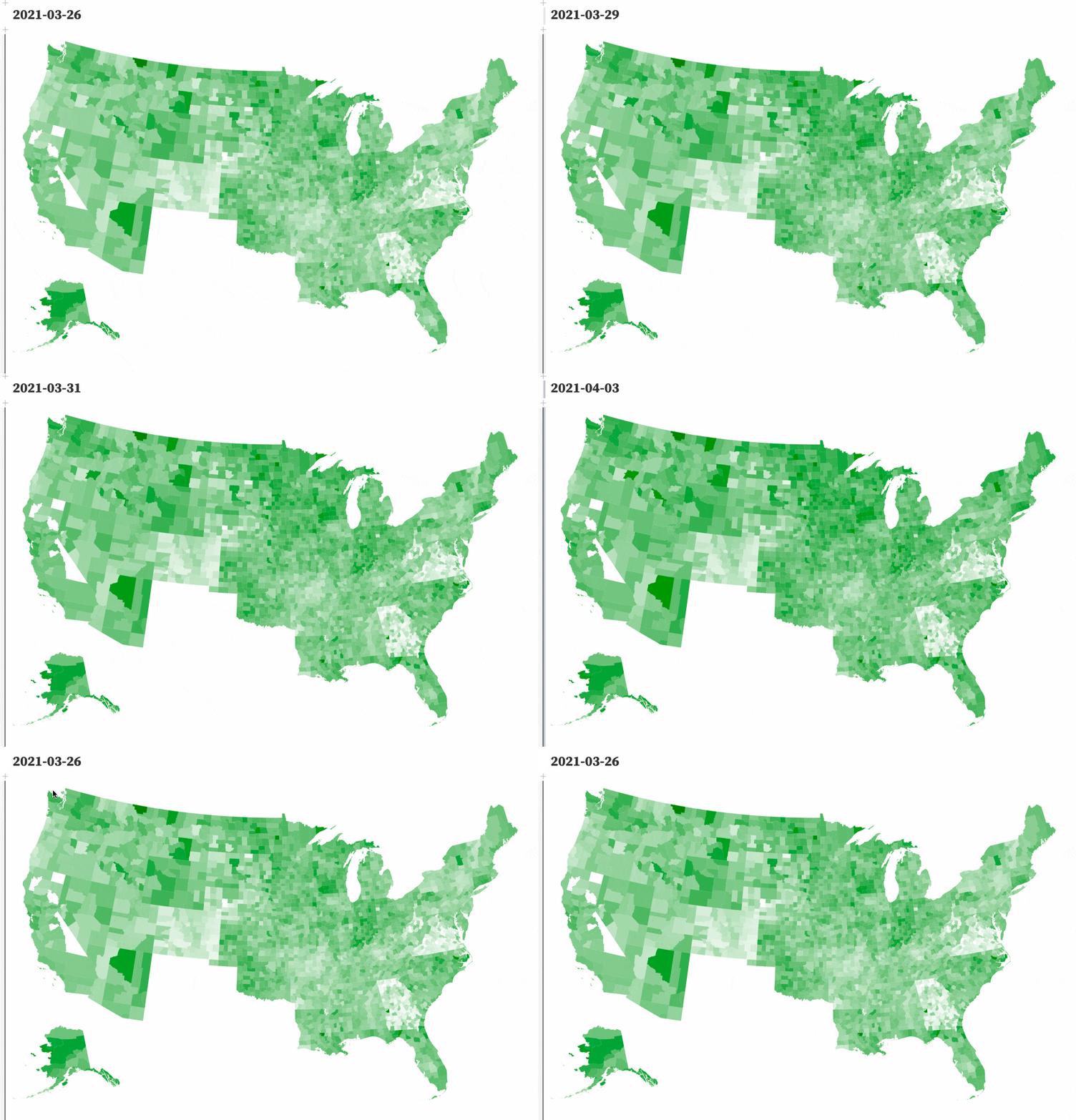
Last week I mentioned that I've recently started scraping and storing the CDC's per-county vaccination numbers in my cdc-vaccination-history GitHub repository. This week I used an Observable notebook and d3's TopoJSON support to render those numbers on an animated choropleth map.

Animated map of choropleth county vaccinations

The full code is available at https://observablehq.com/@simonw/us-county-vaccinations-choropleth-map

From scraper to Datasette

My scraper for this data is a single line in a GitHub Actions workflow:

curl https://covid.cdc.gov/covid-data-tracker/COVIDData/getAjaxData?id=vaccination_county_condensed_data \
  | jq . > counties.json

I pipe the data through jq to pretty-print it, just to get nicer diffs.

My build_database.py script then iterates over the accumulated git history of that counties.json file and uses sqlite-utils to build a SQLite table:

for i, (when, hash, content) in enumerate(
    iterate_file_versions(".", ("counties.json",))
):
    try:
        counties = json.loads(
            content
        )["vaccination_county_condensed_data"]
    except ValueError:
        # Bad JSON
        continue
    for county in counties:
        id = county["FIPS"] + "-" + county["Date"]
        db[
            "daily_reports_counties"
        ].insert(
            dict(county, id=id), pk="id",
            alter=True, replace=True
        )

The resulting table can be seen at cdc/daily_reports_counties.

From Datasette to Observable

Observable notebooks are my absolute favourite tool for prototyping new visualizations. There are examples of pretty much anything you could possibly want to create, and the Observable ecosystem actively encourages forking and sharing new patterns.

Loading data from Datasette into Observable is easy, using Datasette's various HTTP APIs. For this visualization I needed to pull two separate things from Datasette.

Firstly, for any given date I need the full per-county vaccination data. Here's the full table filtered for April 2nd for example.

Since that's 3,221 rows Datasette's JSON export would need to be paginated... but Datasette's CSV export can stream all 3,000+ rows in a single request. So I'm using that, fetched using the d3.csv() function:

county_data = await d3.csv(
    `https://cdc-vaccination-history.datasette.io/cdc/daily_reports_counties.csv?_stream=on&Date=${county_date}&_size=max`
);

In order to animate the different dates, I need a list of available dates. I can get those with a SQL query:

select distinct Date
from daily_reports_counties
order by Date

Datasette's JSON API has a ?_shape=arrayfirst option which will return a single JSON array of the first values in each row, which means I can do this:

https://cdc-vaccination-history.datasette.io/cdc.json?sql=select%20distinct%20Date%20from%20daily_reports_counties%20order%20by%20Date&_shape=arrayfirst

And get back just the dates as an array:

[
  "2021-03-26",
  "2021-03-27",
  "2021-03-28",
  "2021-03-29",
  "2021-03-30",
  "2021-03-31",
  "2021-04-01",
  "2021-04-02",
  "2021-04-03"
]

Mike Bostock has a handy Scrubber implementation which can provide a slider with the ability to play and stop iterating through values. In the notebook that can be used like so:

viewof county_date = Scrubber(county_dates, {
  delay: 500,
  autoplay: false
})

county_dates = (await fetch(
  "https://cdc-vaccination-history.datasette.io/cdc.json?sql=select%20distinct%20Date%20from%20daily_reports_counties%20order%20by%20Date&_shape=arrayfirst"
)).json()

import { Scrubber } from "@mbostock/scrubber"

Drawing the map

The map itself is rendered using TopoJSON, an extension to GeoJSON that efficiently encodes topology.

Consider the map of 3,200 counties in the USA: since counties border each other, most of those border polygons end up duplicating each other to a certain extent.

TopoJSON only stores each shared boundary once, but still knows how they relate to each other which means the data can be used to draw shapes filled with colours.

I'm using the https://d3js.org/us-10m.v1.json TopoJSON file built and published with d3. Here's my JavaScript for rendering that into an SVG map:

{
  const svg = d3
    .create("svg")
    .attr("viewBox", [0, 0, width, 700])
    .style("width", "100%")
    .style("height", "auto");

  svg
    .append("g")
    .selectAll("path")
    .data(
      topojson.feature(topojson_data, topojson_data.objects.counties).features
    )
    .enter()
    .append("path")
    .attr("fill", function(d) {
      if (!county_data[d.id]) {
        return 'white';
      }
      let v = county_data[d.id].Series_Complete_65PlusPop_Pct;
      return d3.interpolate("white", "green")(v / 100);
    })
    .attr("d", path)
    .append("title") // Tooltip
    .text(function(d) {
      if (!county_data[d.id]) {
        return '';
      }
      return `${
        county_data[d.id].Series_Complete_65PlusPop_Pct
      }% of the 65+ population in ${county_data[d.id].County}, ${county_data[d.id].StateAbbr.trim()} have had the complete vaccination`;
    });
  return svg.node();
}

Next step: a plugin

Now that I have a working map, my next goal is to package this up as a Datasette plugin. I'm hoping to create a generic choropleth plugin which bundles TopoJSON for some common maps - probably world countries, US states and US counties to start off with - but also allows custom maps to be supported as easily as possible.

Datasette 0.56

Also this week, I shipped Datasette 0.56. It's a relatively small release - mostly documentation improvements and bug fixes, but I've alse bundled SpatiaLite 5 with the official Datasette Docker image.

TIL this week

Releases this week

08 Apr 17:26

Being in a big factory, why don't I speak human words?

Tang Yahua, Deep Burn, Apr 08, 2021
Icon

This is an automated translation (original in Chinese here) of an article describing the rise of specialized jargon in the Chinese internet community. The authors in Protocol give some examples: "Some jargon is industry-specific: 'user perception' (用户感知), 'closed-link loop' (链路闭环), 'bottom-level logic' (底层逻辑) and 'top-level thinking' (顶层思考). Others are specific to a tech company: 325, for example, means 'needs improvement' within Alibaba" (Actually, in the article it says '325' means "3.25, which means it is judged as having no potential, no year-end bonus, and may be dissuaded"). So there's a bit of jargon in Protocol as well, and no doubt, some ambiguity introduced by the translation. Still, it's a great fun read and no doubt describes a common feeling experienced on both sides of the world.

Web: [Direct Link] [This Post]
08 Apr 17:26

AI-enabled Adaptive Learning Systems: A Systematic Mapping of the Literature

Tumaini Kabudi, Ilias Pappas, Dag Håkon Olsen, Computers and Education: Artificial Intelligence, Apr 08, 2021
Icon

A lot of this paper is dedicated to the usual description of how the 147 papers being surveyed were selected and classified, but there is some interesting discussion in what follows, including a section (4.2) on problems and AI-enabled learning interventions. Problems addressed include "difficulty sharing learning resources, the high redundancy of learning materials, learning isolation and inappropriate information load" as well as "high levels of demotivation, passive attitudes, boredom, poor engagement and frustration", but problems not addressed by AI interventions include "the use of outdated and highly complex models" as well as "personalisation issues, designing and assessing adaptive courses, high instructor workload" and more. And there's more to be done to actually make AI work. "Users do not understand how to extensively use such systems. At the same time, such systems—when implemented—have not actually overcome the complex challenges faced by students."

Web: [Direct Link] [This Post]
08 Apr 17:25

Among the Covid sceptics: ‘We are being manipulated, without a shadow of a doubt’ | Coronavirus

mkalus shared this story from The Guardian.

When the pandemic hit in March 2020, Anna, a young woman from Bradford, was waiting for surgery for endometriosis. The surgery was cancelled, leaving her in excruciating pain. She was forced to close her business, a small tattoo studio that she had opened two years earlier, at the age of 24. She could no longer pay for the weekly counselling that had been helping her deal with her troubled childhood. Her partner lost his job. Anna was convinced that if she caught Covid, she would die. “I was in a terrified bubble, having the news on constantly, crying, worrying, panicking,” she told me. For weeks, she waited anxiously for news about support for shuttered businesses. The cash grant, when it finally came, fell far short. Other business expenses – insurance, bills – went on her credit card. She considered suicide.

Feeling abandoned by the government and frustrated by the daily press briefings, Anna and her partner researched the virus online. On Facebook, Instagram and YouTube, they came across theories about the origins of coronavirus that the mainstream media weren’t talking about – that it was engineered in a lab in China, say, or that it had been artificially spliced with HIV. Some of it seemed implausible to Anna, but it was enough to convince her that the media wasn’t telling the full story. “Loads of people were saying ‘even if you die from a heart attack, they’ll put it down as a Covid death’. I was looking into that, and how many people who died had pre-existing health conditions,” she said. “It was to make me feel better, so I wouldn’t be as scared.”

She read dense, seemingly scientific material which claimed that PCR testing – the throat and nasal swabs that are considered the gold standard of Covid tests – leads to enormous numbers of false positives. She read that the World Health Organization had said that Britain is testing at too high a sensitivity. She read about the cost of lockdowns, and Sweden’s more permissive approach. She read about the death rate; 1% didn’t sound that high at all. Looked at another way, 99% survived. By the end of the first lockdown, Anna was no longer afraid. She was angry. “I’d been sat in my house for four months, in absolute agony, no mental health support, no financial support, and it did an absolute number on me,” she said.

Anna was not the only one to respond this way. During the first few months of the pandemic, a broad movement coalesced online. At the most extreme end were outright Covid deniers, those who believed that the virus didn’t exist and the pandemic had been fabricated. At the other were Covid sceptics or anti-lockdowners, those who thought that the numbers were exaggerated or that the government had an ulterior motive for restricting freedoms. Over the past year, these views have attracted more and more adherents. Occasionally, the most extreme activists have taken direct action: setting fire to 5G masts which they suspected of spreading the virus, entering Covid wards and attempting to remove relatives, visiting hospitals to film empty corridors and posting them as “evidence” that the public is being lied to about the numbers of sick and dying. On New Year’s Eve, a doctor at St Thomas’ hospital in London filmed a crowd of protesters who had gathered outside holding placards and chanting “Covid is a hoax”.

“A lot of people think that they’re the only ones that think like they do, and they’re not,” the British businessman Simon Dolan told me in January. Early in the pandemic, Dolan, who owns a chartered airline and a motor-racing team and lives in Monaco, attempted to prove through the courts that lockdown was unlawful. The case failed, but as it picked up media attention, people contacted him to express their support – mostly small business owners, he said, and others directly affected by strict lockdown rules. “There’s thousands and thousands, more as time goes past, that think this stuff has been really overblown and there is something a bit fishy about it.”

Although these are minority views, polls suggest the numbers are significant. A YouGov survey in October found that the number of people in the UK who thought that Covid fatalities had been exaggerated was about 20%. “Civilians have come across conspiracy theories in a way they haven’t ordinarily,” said Peter Knight, a professor at Manchester studying Covid-19 disinformation. As death rates soared in December and January, Facebook groups, Instagram accounts and Telegram channels dedicated to downplaying the pandemic attracted thousands of followers.

Covid scepticism is not limited to a single demographic. Many Facebook accounts are run by suburban mums, who post memes about children being traumatised by masks. Other Covid sceptics, particularly some regulars at street protests, are members of far right and football hooligan groups. Some are fans of David Icke, the conspiracist’s conspiracist, who believes that coronavirus is spread by 5G. Still others came to the movement via alternative health and new age communities, jumping into Telegram conversations about the Illuminati to talk about homeopathy and vibrations. Some are simply, like Anna, small business owners who have suffered major personal fallout over the past year. All share a conviction that they are seeing something that the mainstream is blind to.

As the vaccine rollout continues to log impressive numbers, and lockdown restrictions are eased, the movement’s appeal might be expected to fade. But it seems there is, instead, a renewed energy. Like apocalyptic cults that immediately say they had simply misinterpreted a prophecy when the world fails to end, there are at least some strains of Covid scepticism where views remain the unchanged, no matter what occurs. “A lot of these organisations are here to stay in one form or another,” said David Lawrence, who tracks disinformation for the anti-extremist organisation Hope Not Hate. “They might rebrand, they might shift focus, but a lot of people have more or less given up their normal lives to do this. They’ve really bought into it. They won’t give up that easily.”


Of the hundreds of Facebook and Instagram accounts spreading disinformation about Covid, three organisations emerged during the first lockdown to dominate the scene: Stand Up X, which had 40,000 followers on Facebook before it was removed in September, and remains active on Instagram and Telegram; Save Our Rights UK, which has 65,000 followers on Facebook; and Stop New Normal, which sprang up around Piers Corbyn, the brother of the former Labour leader, who is often the headline act at anti-lockdown rallies. (Piers Corbyn is one of four anti-lockdown candidates standing for London mayor in May, along with the actor Laurence Fox, the London Assembly member David Kurten and the American conspiracy theorist and podcaster Brian Rose, who interviewed Icke in March.)

From April 2020 onwards, all three groups began organising small protests, and on 16 May they attracted national attention when protesters clashed with police at Hyde Park in London. Corbyn was arrested along with 18 others. “That event got a lot of press because it was confrontational,” said Lawrence. “The rallies elsewhere flopped, but it was the first properly coordinated attempt to have protests around the country.”

Protests continued through the early summer but struggled to get traction. Most groups remained focused on internet activism. When following anti-lockdown accounts on Facebook or Instagram, it is striking is how quickly the posts about the supposed dangers of vaccines and the memes depicting government ministers as cult leaders lose their power to shock and are simply folded into the fabric of the everyday, appearing alongside pictures of friends’ babies and job news. On lively Facebook groups, people swap stories about hardship under lockdown, and approvingly share screenshots of tweets by mainstream lockdown sceptics such as Toby Young and Allison Pearson. One particularly popular figure is the backbench Tory MP Charles Walker, who voted against the second and third lockdowns and recently staged a protest against ongoing Covid restrictions in which he walked around London holding a pint of milk. “Charles Walker, one of the very few good ones”, wrote one admirer on Telegram.

Alongside this, there is more extreme content – people posting about the government using vaccines to implant microchips in your brain or about the New World Order, a longstanding conspiracy theory that a shadowy elite is secretly plotting to bring about a worldwide totalitarian government. The tone of the posts, even when describing conspiracies to end humanity as we know it, is not panicked, but worldly wise: come on, is it still not obvious what’s really going on? It is easy to assume these wilder theories would put any reasonable person off. But that isn’t how disinformation works. Just as with any other belief system, it’s possible to subscribe to elements of something while not agreeing with everything.

This was Anna’s experience. She didn’t agree with everything that people posted on the different Instagram accounts she followed; she’d had a lot of medical treatment in her life, so she had no time for the anti-vaxxers, and as a sceptic rather than a denier, she believed that the pandemic was real, just exaggerated. But it was easy enough to disregard the comments about the virus being a hoax. And it wasn’t just the sceptics who were extreme, she felt. When friends posted anti-lockdown content on their main feeds, Anna saw others jumping down their throats, “telling business-owners they should die because they want to earn a living,” she said. “It’s scary. It really is.”

As restrictions loosened last summer, Anna had her long-delayed endometriosis surgery. As soon as it was permitted, she reopened her tattoo studio. But she was still frustrated that journalists weren’t asking the prime minister about false positives in PCR testing, or inflated death rates, or the fact that hundreds of thousands of people had been forced into debt. “Everyone was calling them conspiracy theories,” she said. “It’s just degrading, when people have got actual, genuine questions about things.”


The first rule of any conspiracy-based movement is that nobody wants to be called a conspiracy theorist. Almost every Covid sceptic I spoke to for this story warned me to avoid talking to other people in the movement with more extreme views. One activist told me that journalists just want to focus on the “wacky” when actually “most people who oppose lockdown just want to do sensible things”. Simon Dolan told me not to “go down the 5G route” as this was a “small minority”. He went on to tell me that “we are being manipulated, without a shadow of a doubt” and that the UK is artificially turning up the sensitivity on PCR tests to give a higher infection rate “to make the government look good”. After our phone call in January, he forwarded me a theory that PCR testing was going to be made less sensitive again. This supposed shift, which would presumably reduce the case numbers, arrived just when Joe Biden took office – something that “could be read by some as more than a coincidence”, he added.

Covid conspiracies – in common with most conspiracy theories – are often presented in the form of complex, pseudo-technical documents. The idea that the WHO has criticised the UK’s use of PCR testing, for instance, is based on a misreading of a highly technical bit of lab guidance attached to the tests. This kind of thing is difficult to factcheck, and besides, factchecking is of limited use in changing believers’ minds, because sources such as the BBC or the Office for National Statistics are seen as untrustworthy, part of the lie. “If you don’t want to be convinced, then it’s not going to happen,” says Jon Roozenbeek, a Cambridge academic who studies disinformation.

Over the summer of 2020, the focus of the Covid sceptic movement shifted away from 5G and Chinese labs, and on to the restrictions on businesses and social gatherings. On 29 August, a major rally was held in Trafalgar Square. It is difficult to trace who exactly organised it, but David Icke was the headline speaker and all the main players had some involvement. (“I think it’s almost been a deliberate tactic on the organisers’ front to obscure who exactly was behind the protests, to present them more as a grassroots thing,” says Lawrence.) People in the movement say there were 50,000 people there; the Metropolitan police placed the numbers closer to 10,000.

For many people who had spent months consuming Covid-sceptic content online, the rally was a revelation. “I just got this energy from seeing so many like-minded people,” a London-based Polish man named Luca told me. He had gravitated towards the movement after seeing posts on his cryptocurrency groups about the “Great Reset” – a common theory that the pandemic is cover for a globalist conspiracy. The atmosphere at the Trafalgar Square protest was friendly and celebratory, and Luca came away feeling he had made new friends. “It was amazing,” he said.

A month later, another large protest took place in Trafalgar Square. It was once again headlined by Icke and drew similar numbers. “I was quite taken aback to see just how diverse the mix of people was,” said Lawrence of Hope Not Hate. “I can’t think of a similar time where conspiracy theorists have been so organised and able to get those kinds of numbers out on the street.”

In September, as concern grew about the spread of disinformation, Facebook shut down some of the biggest Covid sceptic groups, including Stand Up X. Most migrated to Instagram, which, despite being owned by Facebook, was not subject to the same crackdown. All the major groups made more use of their channels on Telegram, the largely unmoderated messaging app. The platform isn’t as widely used as Facebook – most of the main Covid sceptic Telegram groups have between 5,000 and 15,000 users – but discussion is lively, with members swapping thousands of messages a day. And the closed nature of the platform – with groups essentially operating like giant WhatsApp chats – helps to entrench people in their positions.

Anna signed up to an anti-lockdown Telegram group, but it made her uncomfortable; when she talks about the pandemic, she is respectful of those who don’t share her perspective. It wasn’t like that on Telegram. “I found people to be quite militant and set in their views,” she said. “You have to be willing to have your mind changed.” After a fortnight, she left and went back to Instagram, where there were plenty of accounts sharing content that she preferred – including anti-lockdown activists from the US and Europe. She didn’t come across anything that changed her mind.


Covid scepticism is a global phenomenon. Although its central tenets are reasonably consistent – that the pandemic is exaggerated, or that we’ve been lied to about its origins, or that it’s cover for something more sinister – it has different inflections around the world. In the US, many Covid sceptics are also libertarians paranoid about government intervention, who advocate for gun rights and see masks as fundamentally “un-American”. In Germany, anti-lockdown rallies – which have attracted tens of thousands of people – are promoted and sometimes organised by the far right. In France, already one of the most vaccine-hesitant countries in the world, Covid sceptics have harnessed existing suspicion of big pharma and venal politicians. In Britain, Covid scepticism is often framed in terms of our fundamental rights and freedoms: the right to protest, the right to make a living, the right to make our own decisions. There is much talk of Magna Carta.

In November, during the second lockdown, hairdresser Sinead Quinn became a hero of the movement when she announced she would keep her salon in Bradford open. In the window, she pinned a piece of paper on which she had typed: “I do not consent. This business stands under the jurisdiction of Common Law. As the business owners, we are exercising our rights to earn a living.” Citing “article 61 of Magna Carta 1215”, the document claimed that “we have a right to enter into lawful dissent if we feel we are being governed unjustly”. The notion that citizens don’t have to follow unjust laws, and can only be fined or arrested if they give their consent, is a commonly circulated bit of disinformation. This clause of Magna Carta applied only to a small group of barons, not the public at large, and in any case, it never became statutory law. (In January, Kirklees council obtained an injunction to prevent Quinn from opening her business during a national lockdown again.)

On a cold day in mid-January, two women met at Seven Sisters station in north London. They each had a stack of crudely printed leaflets, notifying businesses of “the Great Reopening” and urging them to open their doors on the 30th in defiance of lockdown. The Great Reopening was promoted by all the main Covid sceptic groups, who hoped that collective action could force the government to lift restrictions. They were inspired by Italian anti-lockdown activists who used the hashtag #ioapro (I Open) to encourage restaurants to open their doors in mid-January. The leaflets included an email address; anyone who made contact would receive a long, dense email setting out Magna Carta and “common law” defence. (Later, on Telegram, the Great Reopening organisers clarified that after speaking to a lawyer they’d established that “parliamentary law always trumps common law” and retracted their advice to use this defence.)

The two women, Lucy and Julia, had initially connected via Telegram. This was the first time they’d met in person. Lucy is in her late 20s, an actor who was out of work and socially isolated during lockdown. Julia is in her 50s and has long been “into alternative health” and suspicious of vaccines. As they walked along the high street, sticking leaflets through the letterboxes of shuttered nail salons and restaurants, they chatted. Lucy had never been involved with anything like this before, but the more she read, the more convinced she was that the pandemic was being exaggerated, and that lockdown was a means for government to increase its control. “I have lost friends,” she said. “But it’s given me a lifeline. If we don’t come out of lockdown this year, I’ll probably kill myself. I’m not the only one who feels like this.” Julia agreed with her. “It’s so frustrating to see your loved ones blindly swallowing propaganda. I’m really scared about how many people will take this gene-altering vaccine because the government has lied and created all this fear.” Before they went their separate ways, they agreed to meet up more often.

In the week before the big day, Telegram users encouraged one another to phone businesses to check if they knew about the Great Reopening. Many were disappointed to find that no one had heard of it. On the morning of the Great Reopening, one user urged others to keep on message: “No Illuminati or unrelated chat today. Only reopening chat.”

The Great Reopening was a flop. About 70 businesses in the UK agreed to open, sharing their details on an online spreadsheet. “Really only 70 with nearly 13,000 members just in here!” wrote one disappointed user on Telegram. In the late morning, I stopped off at the only business in my vicinity listed on the site – a small clothing boutique in north London. A woman was inside, but the door was locked. I knocked and asked if she had reopened that day. She nodded, adding knowingly: “We had a visit.” She was not alone in this; all the businesses listed online were shut down by police early in the day.

On Telegram, people complained about the poor showing. “Most people are lazy as fuck,” wrote one user. “We have been living among stupid robots far too long!”; “We’re up against a highly sophisticated, well-funded propaganda machine, so it is not going to happen overnight,” counselled another.

Even the area where the anti-lockdown movement had previously found success – street protests – floundered over the winter. The day of the Great Reopening was cold and wet, but a small group of protesters still showed up in Hyde Park, as they have most weekends since the summer. Four riot vans were parked at nearby Marble Arch and a further six vans did circuits around the park. “It’s become a weekly occurrence,” a police officer told me. “Sometimes it gets rowdy, but it’s like any other protest – there’s a few troublemakers, but mostly it’s fine.”

The protest was sparsely attended; people milled around, trying to work out who else was there to demonstrate. On Telegram, messages had gone out telling people to gather at midday with the grand aim of “marching on parliament”. But there was no clear plan, and no one was leading the protest.

Luca, the Polish man who had attended the big Trafalgar Square rallies in the summer, had come along. He told me that a few weeks earlier, he’d been arrested after a protest in Clapham turned violent. But it hadn’t put him off. He firmly believed that the pandemic was a globalist conspiracy, and that it was vital to resist. He broke off, looking nervously at the police. “They’re going to come over here if they see us talking,” he said.

Eventually, a group of about eight people identified one another and started chatting under a gazebo as they sheltered from the rain. They were an unlikely group – two middle-aged women in brightly coloured winter coats, two men from Essex with a carrier bag full of beer tins, who cheerfully told me they were “from the far right”, an older man with a shock of grey hair, and Luca, a self-described “tech-libertarian”. No sooner had they begun to talk than four of the police vans that had been circling the park drove up to them.

“Go home, there is a national emergency,” the police officers shouted. “You are not allowed to be here.”

The two women shouted back at them. “We’re in the park, we’re allowed to be in a public place.”

Other would-be protesters looped around the park, not wanting to stop while the police were there. Two older men in leather jackets kept walking once they saw the altercation. As they strolled out of the park, I saw that one of them had “FLU WORLD ORDER” scrawled across the back of his jacket in large letters. People gradually dissipated, leaving just Luca and the two men with the bag of tins. They told me that they had lost their jobs in the pandemic; they’d worked in the building trade. An aunt’s hairdressing salon had gone bust. They’d first come across the protest movement through “Patriot groups” on Facebook.

One said sadly that his grandparents wouldn’t see him any more. “They believe this whole thing, hook, line and sinker. They’ve been brainwashed by the BBC. To be honest, I don’t blame them. I put it on for 15 minutes the other day, and I could feel myself getting brainwashed, too, so I switched it off.”


As the UK’s vaccination programme picked up steam over February, and infection numbers dropped, Boris Johnson announced the roadmap out of lockdown. It was greeted with predictable scepticism by anti-lockdowners. “Subject to conditions being met … Behave and you get freedom at the end. Or what you think is freedom,” Sinead Quinn, the hairdresser, posted on Instagram. Keep Britain Free, a group founded by Dolan, tweeted that Johnson “has spearheaded the greatest destruction of our freedoms over the past year and is still refusing to hand them back”.

Many of the anti-lockdown Telegram channels refocused on opposing vaccinations. People asked for advice about stopping their parents and grandparents from taking the jab. “Unfortunately, many who took the jab are likely to die within the next 3 to 18 months,” stated one user. Disagreement was unwelcome. In mid-March, when one user posted that they were going to get their vaccine as soon as they were eligible, the administrator replied: “You are in the wrong group then.” Someone else responded “What a fucking nob head trying to instigate something.” “Defo a troll,” another agreed. The user was blocked.

Although vaccine uptake is high – more than 90% of over-70s in England have had it – many doctors have encountered scepticism. “I’ve had patients with Covid who say, ‘I don’t want to go to hospital because the oxygen will kill me’,” says Siema Iqbal, a GP in Manchester. Many of her older patients get their information from their children, who are immersed in denialist social media groups. “Sometimes we’ve found elderly people will not take the vaccine because the children have said ‘don’t have it’,” Iqbal said. “They’re not just affecting their own uptake. They’re affecting a big, multi-generational household.”

Other healthcare professionals I spoke to had experienced online abuse from Covid sceptics, or found their daily work disrupted by organised campaigns. Earlier this year, Stand Up X encouraged followers to call hospitals to ask about their capacity. One hospital receptionist in southern England told me she had fielded several of these calls a week in January. “This was such a busy time, and we’re talking to people at the worst moments of their lives, calling up to ask if they can visit their dad before he dies. Then in among that you get someone demanding to know how many Covid patients we have and how many spare beds, because they’re essentially saying ‘you’re a liar’.”


In recent weeks, street protests have returned with an energy not seen since the autumn. On 20 March, a protest was held to mark a year since lockdown began. Police vans gathered near Marble Arch and helicopters circled overhead. People streamed towards Hyde Park Corner. There were young people in athleisure, older men in full black paramilitary-style gear, older women in tie-dye. A small child handed me a leaflet that said: “SOS – what is happening to our world?”, advertising an evangelical church.

As Hyde Park Corner came into view, so did the crowds of people, cheering and blowing whistles. A young black man in a “Black Lives Matter” T-shirt shouted into a megaphone: “People, how powerful is this?” A few paces on, a white man in a baseball cap that read “Make England Great Again” stood on a railing, looking down at the crowd. A woman held up a placard that said “Censor paedophiles, not scientists”. More than one person wore a six-pointed yellow star, reminiscent of those that Jews were forced to wear in Nazi Germany, with “Covid” or “Exempt” written in the centre. Spontaneous chants went up of: “Freedom! Freedom!” and “We are the people! We are the power!”

The demonstrators marched to Marble Arch and down Oxford Street, blocking traffic. They banged on the windows of buses, shouting good-naturedly at passengers to take their masks off. A few obliged; more than one bus driver reached out of the window to shake hands with protesters and give them the thumbs up. The atmosphere was like a carnival; people smoked spliffs and drank beers. Two rastas with greying dreads played handheld drums and people danced alongside them. A group of young women in brightly coloured clothes held placards that said “My body, my choice” on one side and “Make Orwell fiction again” on the other; near them, a man in a union jack suit with “Brexiteer” emblazoned on the back walked alone. A large group of police stood at Bond Street station. People booed them. A man with a megaphone shouted: “Your job is to protect the people and you’re oppressing them. They want to see their families. You’re disgusting.”

People had travelled from all over the country; one man in his 40s drinking a can of lager said he’d come from Blackpool. It was his sixth visit to London to protest; until last year, he’d never attended a march. “It’s the biggest hoax in world history,” he told me. “We’re going to turn into a communist country like China. Is that what you want?” When I asked about the roadmap out of lockdown, he told me that the country would be “locked down illegally for at least two years” because of invented variants. A woman in her 50s dressed in brightly coloured patchwork, with glitter smeared on her cheeks, told me she had travelled from the Midlands, where she works as a psychotherapist and home-schools her teenage children. “I’ve never been a protest person, but we care about our freedom, and we’re not going to collude with the New World Order,” she said. “This last year made me get out of my little bubble and look at the wider world.”

By the evening, the crowds began to disperse. The mood on the Telegram channels was jubilant. “GUYS FUCKING AMAZING ABSOLUTELY BUZZING THANK YOU SO MUCH FOR COMING OUT TODAY THEY HAVE TO TAKE NOTICE NOW. WE JUST ACHIEVED THE BIGGEST MARCH IN THE WORLD THIS WEEKEND,” one of the organisers wrote. People insisted that more than 100,000 people had attended (it was likely closer to 10,000). They turned their attention to another protest to take place in late April. Other, more localised protests continued, too; in late March, a group of maskless protesters entered a Tesco in Chelmsford. Videos of the action went viral.

Not everyone who broadly supports the cause has been protesting in the streets, but most feel alienated and pessimistic about lockdown actually easing. Anna’s endometriosis flared up over the winter, and she suffered a severe adverse reaction to anaesthesia. She almost died. “I’ve got a lot of feelings about how I’ve spent the last year of my life, and it has essentially been trapped indoors for nine out of 12 months,” she said. “If a partner had done to me what the government has done over the past year, there’d be abuse charges: telling me I can’t work, I can’t see my family, I can’t see my friends, you’re only allowed to rely on me for money. I feel gaslighted.”

Her health problems meant less time to engage with anti-lockdown activism, but as the movements have broadly shifted to anti-vaccine content, she, too, has become more receptive to their concerns. She understands why older people are taking the Covid vaccine, but feels young people are being “coerced”, and worries that it is “experimental”. For months, anti-lockdown groups have warned of vaccine passports; the government is now talking seriously about this possibility. “We were being called conspiracy theorists, and now it’s actually happening,” she told me. “I’ve definitely fallen out with the government, and I will never, ever trust them again.”

For most people, it is easy to ignore the fact that this scepticism still exists, but this loss of trust will find another outlet when the pandemic eventually ends. After I left the protest, I walked back along the Strand. The police vans at Charing Cross station were the only sign something was unusual. Most shops were shut, people picking up coffee or snacks wore masks, and hand-sanitiser dispensers stood at regular intervals along the street. An old woman, who had diverged from the protest crowd, handed out leaflets warning of the risks of masks and vaccines. Passersby took the leaflets, and dropped them, without looking, as they carried on walking.

Some names have been changed

08 Apr 17:12

Our Real-World Experiment in Traffic

by Gordon Price

Imagine if some all-powerful researcher suggested that as a society we shut down a good part of the economy for a few months, close offices and work places, shutter restaurants, clubs and theatres, stop most sports and arts activity, make it possible to realistically work at home, and, just for extra impact, close the borders.  And then see what happens to traffic before and after, how it changes as we tweak the restrictions, and what new patterns emerge.

Which is exactly what we’re doing.

I’m surprised we’re not getting traffic updates like we do the weather, and what new patterns are emerging from week to week.  We actually do have that data, and the City of Vancouver has been good enough to provide some of it (and hope to add counts regularly on VanMap).

Here’s the data that shows the reductions in average monthly volumes of traffic year over year coming into the City, and then onto the Downtown Peninsula – from the start of the pandemic last year to just last month:

Go to it, data nerds, and let us know what you observe.

The greatest drops occurred this time last year at about half, more or less, the previous volumes.  And then a gradual increase (or dropping rate of reduction) until December, when in response to higher caseloads, constraints were reapplied.  Now we’re at about 10 to 20 percent below ‘normal’.  (Meanwhile transit patronage is, last I heard, at only 40 percent of previous numbers.)

I’d love to know how this compares to the growth of traffic in the rest of the region.  I would not be surprised if the volumes are higher, reflecting the scenario in the post below where those working at home take more trips, and regional shopping malls and local shopping streets pick up the patronage that might otherwise have gone downtown or elsewhere.

What else have you noticed?


08 Apr 17:11

Money for Nothing

by Vicky Osterweil
Full-text audio version of this essay.

The recent hullabaloo over NFTs has mostly produced a lot of confusion. In nearly every article about them they are framed as an incredibly complicated technological phenomenon requiring careful explanation, rather than an incredibly boring one that tends to repel one’s focus. This dissonance produces doubt: You may say to yourself, “Okay, what I am understanding about this seems ridiculous, but it’s pretty high-tech and there’s apparently a lot of money in it, so maybe I’m missing something?” Reader, you are not. NFTs are just as absurd and banal as you probably believe.

I think of this as the Christopher Nolan effect: If you explain an incredibly simple premise — like, for example, “a guy forgets everything every five minutes” or “you can go inside people’s dreams and make false memories” — over and over in increasingly abstruse ways, the person it’s being explained to will eventually tell themselves, “I just don’t get it.” This effect is only strengthened the more people there are agreeing that the matter at hand is “cool,” “interesting,” or “complicated” — a process of mass, self-inflicted intellectual gaslighting.

If the popular press is full of explainers “clarifying” what a “very complicated” investment phenomenon is all about, hide your wallet: You are being shilled into a game of Three-Card Monte

It is understandable enough to want to participate in such collective delusions. It’s much more fun to be awed by not getting a movie than to realize that you do get it and it’s just boring. This same idea also helps explain speculative bubbles. It’s more fun to believe in magic than to recognize how much of financialized capitalism is just scams and pyramid schemes. Nonetheless, if the popular press is full of explainers “clarifying” what a “very complicated” investment phenomenon is all about, hide your wallet: You are being shilled into a game of Three-Card Monte.

If you flip over all the cards with NFTs, what’s revealed is how the current economic moment depends on technological mystification. Hidden behind a lot of art talk and techspeak (Blockchain! Ethereum! Non-fungibility!) is an extremely simple example of an everyday phenomenon: the transfer of objects of value. What makes it supposedly difficult to grasp is that these objects, rather than being stretched canvases or hunks of marble, are seemingly just lines of code (or, more accurately, a bunch of electricity). When we pay for a “subscription” or a “membership,” we generally have no trouble understanding it as legitimate; it’s as intuitively “real” as when you use your phone to deposit a paycheck and make a credit-card payment. That is, we immediately grasp that the transfer of value doesn’t depend on physical objects but on a system of accounting, sustained by a series of socially agreed upon relations and representations (although we will occasionally reflect on how that disempowers us and rage and weep and fight).

But with an NFT, we are suddenly supposed to be totally baffled by the same idea. Since you can’t hold it in your hands or stash it in a freeport zone, buying a piece of digital art doesn’t give you anything other than the feeling of ownership, right? No. NFTs are discrete, ownable commodities — digital objects typically produced through a process of brute-force computing power churning through millions of pointless equations till it lands on the “right” one, generating a token on a blockchain that can be linked to any image or string of data the person running that computer chooses. (See how your eyes glaze over when I do that? That’s because it’s boring nonsense.) These objects can then be sold in markets, whether by Christie’s or directly from artists’ social media pages, websites, or branding spaces. NFT boosters are at least right about this much: Once you can make a market for them, there’s little difference between a Rembrandt and an NFT of a Grimes tweet.

Because ownership of these kinds of objects is easier to transfer and track, there has even been a pseudo-populist cry that NFTs can cut out a whole range of intermediaries — critics, dealers, gallerists, art handlers, curators, teachers, etc. — and allow artists to directly distribute their work without the apparatus and absurdities of the “art world.” But the hype around that process of disintermediation should sound familiar from decades of Silicon Valley “disruptions,” and the consequences are likely to be the same: NFTs don’t dismantle the “art world” and its institutionalized processes for producing monetary value out of aesthetical aspiration; they simply put some of its workforce out of a job, replacing them with way more electricity.


Art, to paraphrase Guy Debord, has always been the cutting edge in money. Under capitalism, one of art’s core functions is to innovate new ways to produce and reproduce value. Philistines often complain that art isn’t “useful” — that arts degrees are worthless, that “my child could make that,” etc. — but that merely testifies to a universal recognition that aesthetic experience is real, scarce, and readily misunderstood. In the topsy-turvy world of capital, art’s profound qualities are precisely what makes it a particularly vulgar and obvious commodity. (Say what you will about capitalism, it loves a good joke.) From that perspective, art is not special because it has some supposedly vexed relation to its commodity status; rather its value as a commodity is precisely in its estrangement from conventional notions of use. This makes it particularly susceptible to having its fluctuation controlled through aestheticized social factors such as taste, criticism, and canonization.

This is not to say that the sublimity of aesthetic experience can’t be put to other purposes: Artists, workers, rebels and revolutionaries use and deploy aesthetic experience to transform, attack and change the world. But that experience is also folded into capitalism by a series of reversals and mystifications eventually understood by the word art. The “art world” has developed an incredible capacity for co-optation and recuperation that has only increased over the past 50 years, as capitalism recognized an untapped market in the various experiences and pleasures of the (counter)culture and artists recognized there was loads of money to be made in commodifying their status as artists. Yesterday’s revolutionary anthem is today’s greatest hit.

(Case-in-point: During Occupy Wall Street in 2011, a group of occupiers took over Artists’ Space, a lefty art loft and gallery, and occupied it for a weekend. At some point, someone graffitied anarchist slogans over the posters that the gallery had hanging in the bathroom, genuine objects of struggle that would be transformed into commodities when Artists’ Space auctioned them off for tens of thousands of dollars before Occupy had even left the streets.)

NFTs don’t dismantle the “art world” and its institutionalized processes; they simply put some of its workforce out of a job, replacing them with way more electricity

As a commodity whose existential value can’t be questioned but can be worked out and realized only by a nebulous group of experts, art allows capitalists to launder money across borders, invest, increase, and turn over liquid capital while also accruing social legitimacy and respectability. At the same time, this approach to art’s value serves to further detach it from whatever vestigial significance it derives from more general (and less predictable) public opinion. In this era of financialization, the experts’ function is to solidify art’s role as investment. Contemporary art, and the “art world” that prices it, has necessarily been cloistered off into its own sphere of technicians and specialists who serve bourgeois collectors. As the art world reneges on the possibility of “free-market pop-culture meritocracy” to embrace “specialized investment industry” status, it gains capacity to valorize assets (artists and art objects) more quickly and more consistently. But while individual values go up, the market also begins to resemble what all financialized assets resemble: a bubble.

For now, the bubble seems unpoppable. In this strange long moment of suspended economic animation — our Wile E. Coyote economy ran off the cliff in 2007 but has managed to run in place without looking down ever since — the line just seems to go up for all kinds of assets, whether it’s stocks, houses, artworks, or cryptocurrencies. Never mind the millions facing precarity and penury and the intense proletarian struggle and fascist backlash across the globe: As long as the music is playing, it seems like there are chairs enough for everyone.

NFTs are the perfect expression of art-world-as-financial-bubble. As with all bubbles, the details may be obfuscating, but the basic phenomenon is very simple: The more people who can be brought to agree that some arbitrary object is valuable, the more valuable it becomes. In other words, crypto-currencies like Bitcoin and crypto-related investments like NFTs are a pyramid scheme disguised by the Nolan effect. The “valuelessness” of the object and the absurdity of the markets that appear to trade it only seems obvious in hindsight, as has been the case since the early-capitalist Dutch tulip craze. During that event, the tulip was an almost perfect commodity, more or less a way to print money at will — until suddenly it wasn’t. Its arbitrariness, its apparent uselessness, allowed it to more easily approach the status of money itself — a pure medium of exchange whose value seems only to grow with every trade. Yet as with all commodities that increasingly appear to be but aren’t money, people will eventually notice that the emperor has no clothes, try to cash out, and cause a collapse.

There is only one mechanism capable of keeping money from collapsing entirely — the state, with all its quotidian violent apparatuses (as well as its occasional use of out-and-out war and genocidal reorganization). In the face of a bubble collapse, the state will extract the value that has “disappeared” from assets out of the lives, communities, nations, and bodies of the poor. The value of any commodity that isn’t backstopped by a state will eventually collapse. In recent decades this happened most dramatically and visibly with the commodities produced by the Soviet Union. Yet every time a new commodity appears to be like money — be it tulips, tech stocks, and real estate or art, NFTs, and crypto — a certain population of opportunistic investors will convince each other that finally the mystery of value has been solved. The hot air has become solid at last.

This is what libertarian evangelists see in crypto: a currency unmoored from a state, from an apparatus of violence, taxation, and territorial control. Instead of violence, the backstop will be technological cryptography, complex coding, and electrical power. But there is nothing innately value-producing about computer code any more than there is in tulip genes, and NFTs are just like tulips in that they are a volatile store of value subject to the irrational whims of investors. Like crypto, they are angling to become unmoored from the apparatus (in their case, the art world) that typically conditions their value. Yoking art to crypto attempts a double liberation, but it is still underwritten by the premise of the art world and its nonfinancial mechanisms for inventing value. The value of art under capitalism is justified by a recognition of the historical importance of aesthetic experience that supposedly transcends sociopolitical relations, whereas crypto attempts to produce value through the art of code and the power of electricity. But both of these are just differing ideological fig leaves for the actual source of value — human labor power.


Schemes like bitcoin pretend to cut out the vagaries of the physical and material economy, turning electricity directly into value via computer mediation. As such, crypto becomes the perfect expression of the pseudo-automation and pseudo-disruption offered by the tech economy: Through the wonder of coding and engineering — but actually through brute ecological destruction, low-paid labor, and electrical expenditure — value emerges from “nothing,” creating a financial asset bubble that just seems to never pop. No wonder tech-evangelists are obsessed with the blockchain but can think of almost nothing to do with it.

Yoking art to crypto attempts a double liberation from the apparatus that conditions its value, but it is still underwritten by the premise of the art world and its nonfinancial mechanisms for inventing value

Cryptocurrency, like the tech economy in general, mystifies where and how the actual work of producing value is done. Tech companies use a magician’s flourish that redistributes labor from the producer/distributor to the worker/customer/consumer. For example, delivery apps make it feel “easy” to order food, when in fact we are spending much more in buying the phone, keeping it charged, paying our data plan, paying our subscriptions, and so on, for every order — in other words, we are using more hours of our labor to do so. Before smartphones, we could call the restaurant with a landline, but we also had to have previous knowledge of the restaurant as well as potentially a menu or at least a phone book’s yellow pages. The app replaces the drawerful of menus with a commensurate amount of electricity, which we pay for when we buy and charge our phone and pay our phone bill, which the restaurant pays for on their end in keeping their computers up, and which the app skims a huge percentage of to pay back venture-capitalist investors and keep the servers running.

If you look at only a single transaction, the app is much more efficient: Instead of requiring the restaurant to hire a printer and someone to deliver menus to you, you just press a button. But with a paper menu, restaurants have to do that only once, whereas you need to marshal the same amount of energy each time you use the app. By the third or fourth time you order takeout from a particular place, suddenly the paper menu is looking like an ecological marvel.

It’s not that the convenience and breadth of these apps is literally nothing — that this convenience isn’t real, that it doesn’t make things easier within an increasingly busy and precarious life. But the provision of this convenience doesn’t explain the apps’ “value.”

Silicon Valley provides a technical way, via hardware and software, to seem to turn electricity into value, when in fact it merely uses electricity to redistribute costs and labor down social hierarchies

The app actually produces value by using tech gee-whiz and flashy marketing to effect some old-fashioned capitalist competition. Tech companies enter established markets, where they temporarily cut down the price of products with tech-mediated contracting that undercuts labor prices — sometimes by having the worker provide the tools (like the Lyft driver’s car, Caviar worker’s bike, etc.); sometimes just by burning cash. Silicon Valley uses scale (in this instance, the speed and reach of the internet) and the ability to invest (read: lose) VC money to keep prices down until they take enough market share and push out competitors. If that sounds familiar, it’s because there’s nothing novel about it: It’s what Walmart and then Amazon did, using “loss leaders” to undercut competition until they have a sufficient hold on the customer base. They can then use monopoly conditions to bring prices back up.

Another example is automated customer service systems: This technology allows a company to offload a tremendous amount of labor cost, but when customers encounter one, they are forced to do the work of navigating a labyrinthine menu system and managing their frustration, rather than simply receive service. This kind of “automation” does not reduce the amount of labor required; it only redistributes it.

This redistribution works because those conditions can make it feel like “no one” is doing the work, that instead the work is being done by the computer and the phone in the form of processing electricity. This is amplified by the genuine wonder provided by certain aspects of the internet; the speed and ease with which it can circulate culture, information, and communication can be truly sublime, which is why for tech gurus it feels so much like art. But what does Silicon Valley actually provide? It provides a technical way, via hardware and software, to seem to turn electricity into value, when in fact it merely uses electricity to redistribute costs and labor down social hierarchies.

The criticism of blockchain that has most effectively stuck, understandably, has been its ecological cost. The facts are, truly, atrocious. By one estimate, the creation of one basic NFT involves as much energy as driving a car 1,000 kilometers. There is nothing easy or free, metabolically, about that creation. But in solidarity with those who critique blockchain, I offer that the framing of “cost” is the wrong one; it misunderstands what’s happening. The blockchain’s use of electricity is not coincidental — the electricity is what convinces investors it makes value. The costs cut in the production of cheap power in turn fills VC coffers to then reinvest in the app economy in the first place.

While tech futurists like to spin fantasies of green futures, pretending they are culturally and politically distinct from the extractivist capitalists — the oil tycoons with their messy imperialist politics of boots-on-the-ground and chest-thumping border protection — they are in fact mutually dependent. Without the extractivists, there is no way that the innovations of Silicon Valley, which amount to little more than privatization by way of electrification, would produce any profit.

Is it any wonder that artists, at the cutting edge of capitalist technoculture, recuperation, and power, figured out a seductive use case for blockchain? That artists like Beeple figured out a way to aesheticize and repackage the blockchain, to turn it into value by merging it with the art world, by automating away the curators, tastemakers, and scenesters and replacing them with ecocidal levels of energy expenditure? Truly, will there ever be a greater work of capitalist art than the total destruction of the climate that made it possible?

08 Apr 17:10

Saskatchewan adds $150 tax on EVs that contributes to road maintenance

by Brad Bennett

The province of Saskatchewan is making it more expensive for people to own electric vehicles (EVs) in the province.

After not providing a provincial EV incentive or rebates like the federal government or other provinces like Quebec and B.C, Saskatchewan is adding a $150 yearly tax to EV owners to help pay for road maintenance. The province’s fuel tax is primarily used as a way for drivers to pay for road maintenance. This new EV tax levels the playing field.

CBC News reports that Saskatchewan received about $454 million from the fuel tax last year and spent $616 million on road work.

To be fair, this tax does make sense since the budget for roads needs to come from somewhere. However, looking at the bigger picture, it seems strange there would be an added cost to EV owners when other provinces are trying to convince people to adopt greener forms of transportation.

A blog called SaskEV claims that there are only 403 EV drivers in the province, accounting for less than one percent of the total cars that use Saskatchewan’s roads every day.

This annual tax will begin on October 1st, 2021.

Source: CBC News

The post Saskatchewan adds $150 tax on EVs that contributes to road maintenance appeared first on MobileSyrup.

08 Apr 17:09

Global chip shortage reportedly finally affecting iPad and MacBook production

by Patrick O'Rourke
iPad Pro (2020)

Though we’ve heard about the global chip shortage affecting the production of the Xbox Series X, the PlayStation 5, the Nintendo Switch and several smartphones, Apple’s lineup of devices seems to have remained immune — at least until now.

The production of MacBooks and iPads has been delayed due to “a portion of component orders” being pushed back to the second half of 2021, according to a new report from Nikkei.

Regarding MacBooks, the issue relates the certain parts of the laptop’s circuit board being mounted ahead of assembly, while iPad production is tied to a shortage of displays and screen components.

Nikkei doesn’t mention what specific MacBook or iPad models are affected by the chip shortage, but it could be linked to the new iPad Pro that’s rumoured to be revealed later this month. This upgraded version of Apple’s highest-end tablet is tipped to feature a faster processor, a Thunderbolt port instead of USB-C and a mini LED display.

It’s also important to note that Nikkei mentions the shortage “remains a supply chain issue for Apple and has not yet had an impact on product availability.” The publication also emphasizes that Apple is known for “managing one of the world’s most complicated supply chains.”

Hopefully, these issues are resolved leading up to the tech giant’s reveal of its 2021 iPhone lineup this coming September.

Source: Nikkei Via: The Verge 

The post Global chip shortage reportedly finally affecting iPad and MacBook production appeared first on MobileSyrup.