Shared posts

14 Apr 16:38

Surface Laptop 4, Headphones 2+ und anderes Zubehör

by Volker Weber

Surface Laptop 4 - 11.jpg

Microsoft hat gestern neue Surface Laptops der vierten Generation angekündigt. Die wichtigste Änderung sind aktuelle Intel-Prozessoren der 11. Core-Generation und AMD-Prozessoren der Ryzen-4000 Serie. Ich kann die ganzen technischen Details nicht besser als die Kollegen von heise online zusammenfassen.

Ich mag das Design des Surface Laptops mehr als irgendeines anderen Laptops, inklusive der MacBooks. Vor allem aber haben sie für mich eine passendere Port-Ausstattung mit USB-C und USB-A, dazu weiterhin den Magsafe-ähnlichen Anschluss für das Surface Dock 2. So ein Gerät in schwarz würde sich gut auf meinem Schreibtisch machen. Auf lange Sicht wird Microsoft den USB-C-Anschluss allerdings mit Thunderbolt ausstatten müssen.

Surface Headphones 2plus.jpg

Mit den Surface Headphones 2+ schließt Microsoft eine schmerzlich vermisste Lücke. Die Headphones sind bisher nämlich nicht Teams-zertifiziert. Über ein USB-Dongle stellt Microsoft diese Kompatibilität nun her, so wie es die Hersteller von Business Headsets schon länger machen.

In Kürze macht Microsoft diesen Herstellern direkte Konkurrenz, denn dann erscheinen mehrere Geräte unter einer "Microsoft Modern" Brand: Eine 1080p-Webcam, ein USB-Headset, ein Wireless Headset und ein Konferenzspeaker. Ich sehe bisher nur ein paar Bilder, die eher uninspiriert erscheinen. Ich habe den Eindruck, dass Microsoft vor allem die Preise dieser Ausstattungen herunterziehen will.

14 Apr 16:37

Introducing OmniPlan 4 for iPad and iPhone

by Ainsley Bourque Olson
mkalus shared this story from The Omni Group.

OmniPlan 4 for iPad and iPhone, available today, introduces a brand new Outline View on iPad and iPhone, optimized for quickly creating and organizing projects, with fully customizable column display and enhanced keyboard navigation support. In addition to this powerful new view, this release brings new scheduling features like recurring tasks and manual task scheduling, originally introduced in OmniPlan 4 for Mac, to iPad and iPhone, as well as a wide range of improvements throughout the app, making OmniPlan easier than ever to use for day-to-day project management tasks, no matter how complex your project is.

And now, for the first time ever, OmniPlan is available as a universal purchase: get full access to OmniPlan 4 on your Mac, iPad, and iPhone with a single purchase or subscription, so your project schedules are always available when you need them.

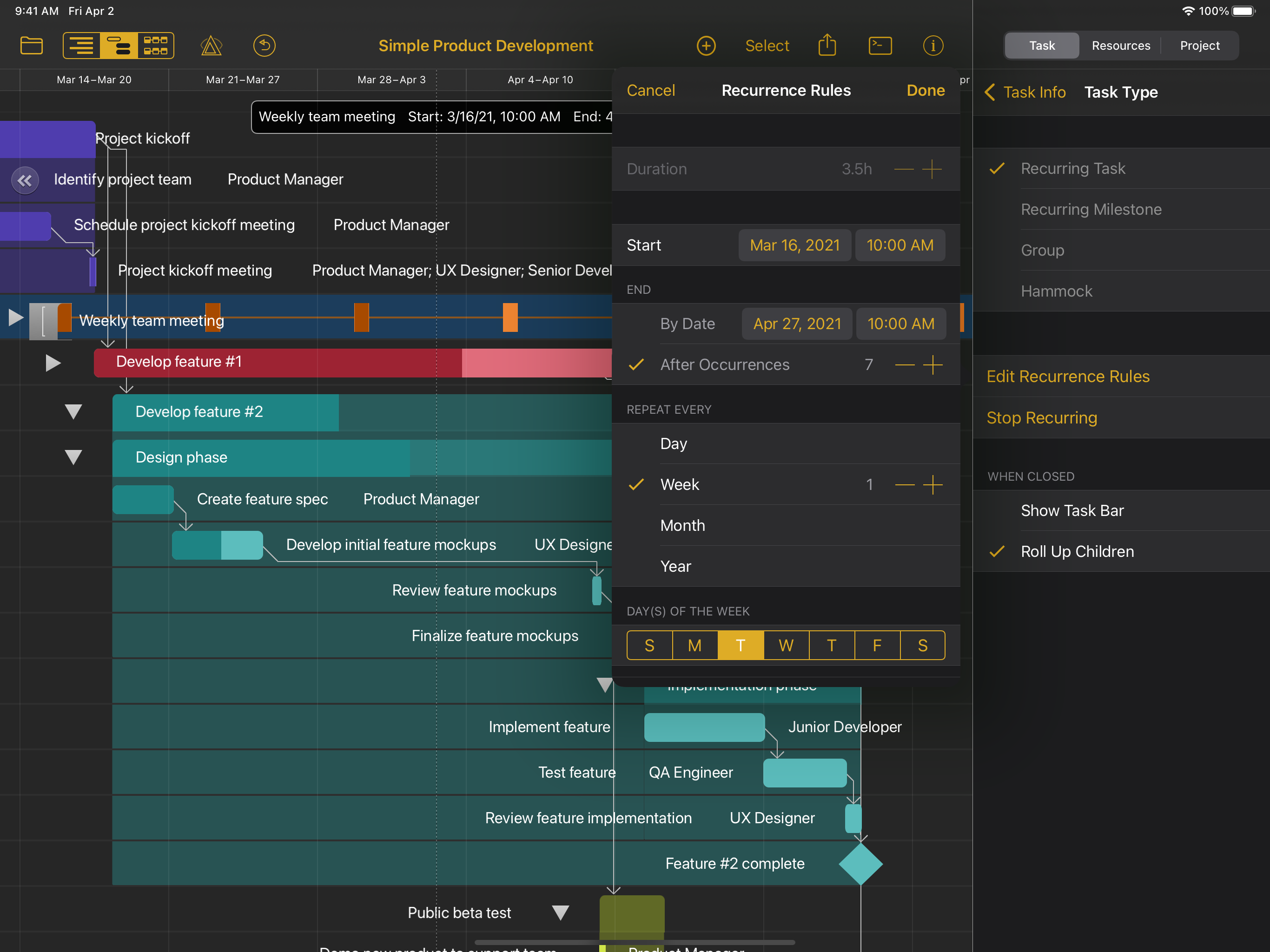
Setting up task recurrence rules in OmniPlan 4 for iPad

Highlights

  • Universal App Licensing Get full access to OmniPlan 4 on your Mac, iPad, and iPhone with a single purchase or subscription.
  • Outline View:
    • Project Outline: Quickly create and organize projects in a dedicated Outline View.
    • Customizable Columns: Fully customize column display in Outline View. Select a pre-configured column set, or hide and show individual columns as needed.
    • In-line Editing: Update a task’s Title, Effort, Duration, Resources, Prerequisite, Dependents, and Effort Complete without ever leaving the project outline.
    • Keyboard Navigation: Navigate & organize your project outline via keyboard shortcuts when connected to an external keyboard.
    • Scribble Support: Start writing on an existing task in Outline View to insert text, or cross out text to delete it. Write below the existing project outline to quickly create a new task.
  • Scheduling:
    • Recurring Tasks: Tasks can now be scheduled to occur at daily, weekly, monthly, or yearly intervals.
    • Manual Task Scheduling: Tasks now support manual scheduling. Tasks set as scheduled manually will use the start and end dates you provide; OmniPlan will not attempt to automatically reschedule them. (Manual task scheduling replaces the “locked” task date functionality offered by previous OmniPlan versions.)
  • Inspector:
    • Inspector Appearance: Appearance, layout, and organization of all inspectors have been updated to increase discoverability and improve access to functionality.
    • Dates: Dates are now input via the iOS 14 system date picker interface, which supports selecting dates and times in a calendar popover.
    • Project & Resource Notes: Project and Resource Notes can now be viewed and edited in the inspector.
  • Keyboards: OmniPlan no longer relies on custom on-screen keyboards to input dates or numeric values like effort and duration. Instead, OmniPlan presents either a date picker or the native iOS keyboard. This change is intended to simplify the experience for entering numerical values and improve compatibility with hardware keyboards.

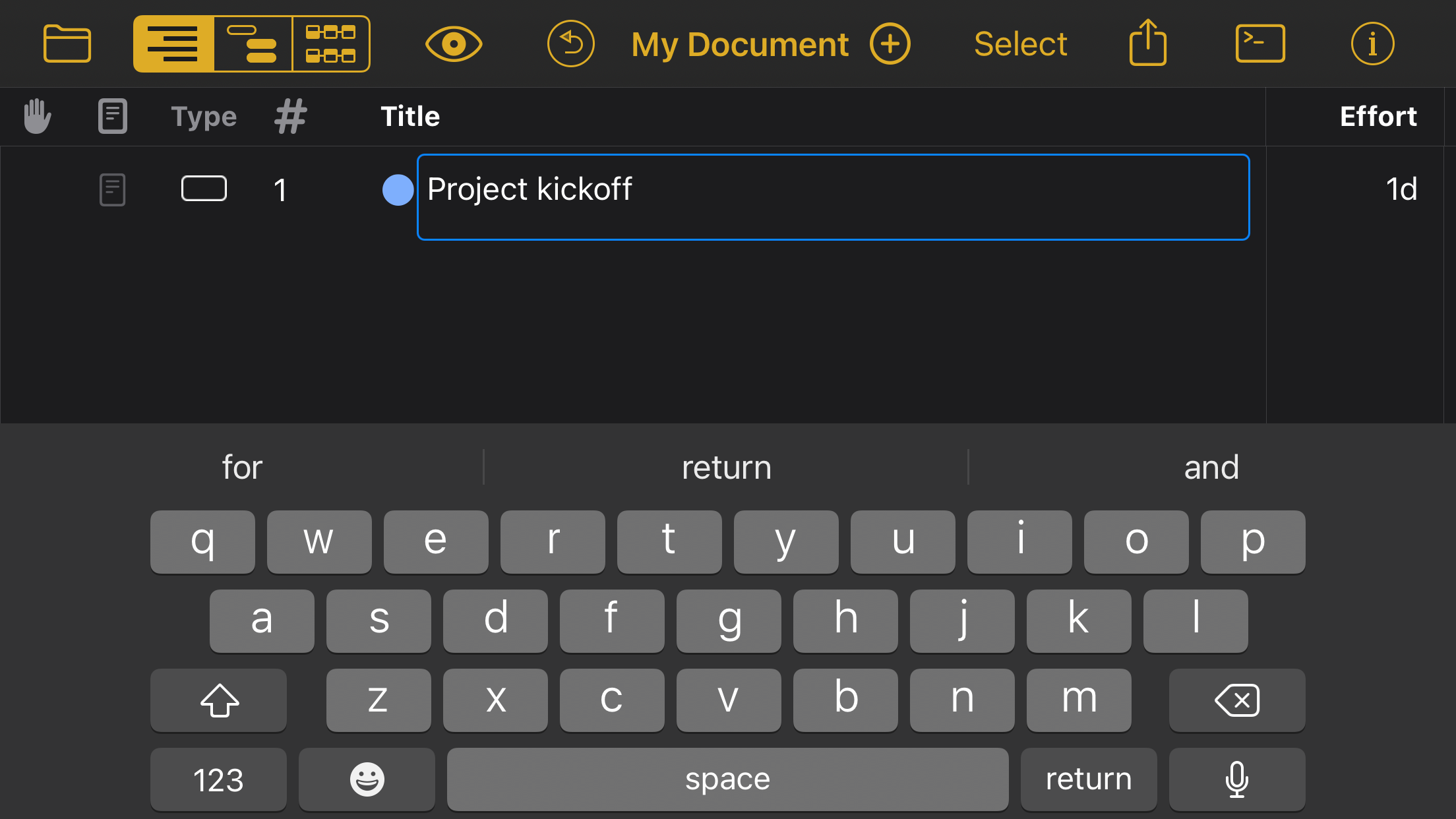
Creating a new project outline in OmniPlan 4 for iPhone

OmniPlan Pro subscriptions are available for $19.99 a month or $199.99 for an entire year. If you prefer to purchase OmniPlan as a one-time traditional license, OmniPlan Standard is available for $199, $399 for Pro. Customers who own a previous version of OmniPlan are eligible for a 50% discount on upgrades to traditional licenses of OmniPlan 4. If you previously purchased OmniPlan 4 for Mac, simply install OmniPlan 4 on your iPad or iPhone and sign in with your Omni Account to unlock your purchase.

We are proud of the success of OmniPlan 4 for Mac since its launch nine months ago, and our team is incredibly proud to have now brought this release to iPad and iPhone. To get started with your free two week trial of OmniPlan 4, download OmniPlan 4 on your Mac, iPad or iPhone. If you have any questions or feedback, email support@omnigroup.com—our amazing Support Humans are standing by, ready to help!

14 Apr 16:37

The flying 248 Squad | CBC News

mkalus shared this story .

Metta estimates 248 Squad will attend two to six overdoses during an 11-hour shift.

From Sept. 2020 to Feb. 2021, B.C. Emergency Health Services says the team responded to 358 overdose calls.

Overdoses aren’t all they attend: this morning’s second call is for a man in diabetic distress who collapsed at the corner of Abbott and Hastings.

It’s a man Siudut has treated before. “Long time no see,” Siudut says as he and Venables sit him up and take his glucose level.

Metta says building relationships with patients makes the paramedics more approachable. During this shift, people came up to them asking for bandages, gloves, or where they could get COVID vaccines.

The pandemic put the bike program on hold from May to September 2020. Metta said personal protective equipment needed to be sorted out, especially because the up-close-and-personal nature of bike paramedicine means physical distancing is more challenging to maintain than in an ambulance.

In the time encampments were in place at Oppenheimer and Crab parks, Metta said relationships of mutual trust made paramedic visits easier.

“People know why we’re there,” he said.

Due to the poisoned drug supply, some patient-paramedic relationships have ended tragically.

“There was a fellow just last night. I knew him personally… I knew his name. He didn’t make it,” Metta said.

The diabetic patient chose to go to hospital. Siudut and Venables took him somewhere warm to wait for an ambulance.

14 Apr 06:23

Spring Flowers, 2021

48 hours ago I got my first Covid-19 vaccine dose, and today I took the camera for a stroll, hunting spring flowers. What a long strange trip it’s been.

Timothy Bray was vaccinated April 9th, 2021

Should I be concerned that the drugstore guy didn’t bother to sign? By the way, CHADOX1-S RECOMBINANT is better known as Astra Zeneca.

Vaccinated how?

They’re currently working their way through really old people and other targeted groups like teachers and some industrial workers with the Pfizer and Moderna. There seem to be a fair number of AZ doses arriving, and they’re not recommended for people under 55. So those of us in the 55-65 bracket can sign up at pharmacy branches; I did a couple of weeks back and got an SMS Friday morning.

I felt really baffed out and sore the day after, and just a bit sore today; nothing a bit of Ibuprofen can’t handle. Apparently in Canada we’re on multi-month delay between shots; so it’s not clear when I can go see my Mom, who got her first Pfizer dose on March 19th.

April 2021

It’s been a cold blustery spring but that doesn’t seem to bother the botanicals, especially the fruit trees, some of whom have already peaked.

Flowering fruit tree in Vancovuer’s Riley Park neighborhood

Spot the clothesline.

Nobody I know closely has been struck down by Covid, but people I love are suffering from one ailment or another as I write because that’s how life is. I live in a country with seasons, which means we are all subject to morale-boosting sensory stimuli at this time of year. Grab hold of them! We can all use all the help we can get.

Tiny flowers, April in Vancouver

From here on in, the pictures are courtesy of the strong-willed 40-year-old Pentax 100/F2.8.

What comes next, as the vaccinated proportion of the population grows monotonically (but asymptotically) and then the wave of second doses washes up behind the first’s?

I guess I’m talking about people in the privileged parts of the world, since it looks like the spread of vaccinations will be measurably, irrefutably, deeply racist and joined at the hip with the world’s egregiously awful class structure.

I just want to go to a rock concert.

These rhodos are ready to burst.

Rhododendron blossoms about to open

I’m kind of jaded about daffodils but this one was so pretty against the backdrop that I couldn’t resist.

Daffodil with something pink behind

I hope everyone reading this has something to look forward to so that getting out of bed Monday morning is more than just a chore. Failing that, if you’re in the Northern Hemisphere anyhow, there are incoming flowers. Tell them I said hello.

Mixed flowers in April in Vancouver
14 Apr 06:19

Code (data) as therapy

by Nathan Yau

For Wired, Craig Mod writes about how he uses code as a way to find order during less coherent times:

Break the problem into pieces. Put them into a to-do app (I use and love Things). This is how a creative universe is made. Each day, I’d brush aside the general collapse of society that seemed to be happening outside of the frame of my life, and dive into search work, picking off a to-do. Covid was large; my to-do list was reasonable.

The real joy of this project wasn’t just in getting the search working but the refinement, the polish, the edge bits. Getting lost for hours in a world of my own construction. Even though I couldn’t control the looming pandemic, I could control this tiny cluster of bits.

A couple of years ago, I spoke about how FlowingData is a personal journal in disguise. I find myself turning to data and charts, because those things feel familiar and can be a source of comfort.

So while reading Mod’s essay, it was easy to substitute in data and nod my head in agreement.

Tags: Craig Mod, health, Wired

14 Apr 06:18

S15:E9 - What it looks like when you start coding very early in life (Opemipo Disu)

In this off-season mini episode we talk about what it looks like when you start coding very early in life, with Opemipo Disu, 15-year-old developer advocate at urspace. Opemipu talks about what got him into coding so young, the resources and tools he enjoys using, and what his life looks like juggling high school and his coding projects.

Show Links

Opemipo Disu

Opemipo is a Developer who is passionate about making things more accessible for Developers using JAMstack and Machine learning technologies. He’s an IBM Champion and a top contributor in the IBM Community.

14 Apr 06:18

Two product ideas for hybrid working

Hybrid working is the idea we won’t go back to working in an office after the pandemic, not entirely, but nor we will go fully remote. Instead we’ll mix it up.

Augmented ambience

There’s something neat about having desk neighbours – it allows for teams but also cross-team connections. But if you’re at home 2 days/week, working out of cafes 1 day/week, and hot-desking at the office the rest of the time, how can that work?

Imagine your desk has a fixed position but in a virtual office layout.

Now let’s imagine that on the physical office desks, and on your home office desk, you have an array of small speakers around the perimeter of the desk. The speakers also have microphones. This is the product.

When you sit down to work, you sign in, and you hear directionally accurate sound from your virtual neighbours, as if you’re in adjacent cubicles – keyboard tapping, chair scraping, coughs, and so on. Sound from your workstation is also picked up and transmitted.

Voices would be detected by AI and automatically muffled.

Bonus points: if you’ve got spatial audio-enabled headphones, like the Apple AirPods Max, you don’t need the special speakers. You can hear your virtual neighbours even when you’re working remotely from, say, a plane. Assuming any of us ever fly anywhere ever again.

Drone zoom calls

This is a use-case for augmented reality smart glasses.

The idea is that you should be able to take Zoom calls when you’re out and about because, to me, hybrid working is also about incorporating walking.

I’ve seen people I know on Instagram skiing with follow-me drones. It turns out follow-me functionality is pretty great now: the drone maintains a consistent angle, dodges around trees, and so on. And that’s while the target is skiing!

So a follow-me drone made for Zoom calls should be way simpler. You would only be going at walking pace.

You still need to see the other person while you’re on the call, and that’s where the augmented reality smart glasses come in. They see you via a streaming cam on the drone; you see them via a hovering virtual screen projected in your glasses. (The glasses also have a built-in mic.)


See also previous thoughts about new office furniture, which referenced scorpion chairs and cyberpunk aprons.

14 Apr 06:18

Maybe SPACs Are Really IPOs

by Matt Levine
Also Bitcoin contango, GameStop NFTs, Goldman Small Cap Research and financial domination.
14 Apr 06:18

Cherry Blossom Time in Pandemic Vancouver

by Sandy James Planner

This year the Vancouver Cherry Blossom Festival has again shifted nimbly during the pandemic  to provide marvellous virtual offerings of dances, haiku, and virtual walks during their annual great springtime event.

Originally planted in Stanley Park as a gift from Japan after World War One,  cherry trees do remarkable well in the Vancouver microclimate. In the 1960’s  the use of smaller scale trees was popular  in the city. That included flowering crab apple and plum trees to augment existing and new cherry trees which provide a visual spectacle every March and April.

I have written before about the cherry blossom festival and also about the unnamed street in East Vancouver that gets inundated each year by dinosaurs, costumed admirers, weddings and others for the chance to get photographed under that street’s ceiling of blossoms.

This year here are some images from a westside walk in the Quesnel neighbourhood. The backlanes here are windy and hard to navigate through.  And in those backlanes a few surprises. Look at the image below.

These lanes also have some of the most interesting new laneway houses which (perhaps not surprisingly) emulate the accompanying mansions. This one has southern sun, and a northern mountain view.

But no cherry trees in those bendy backlanes. Coming out of those backlanes on Quesnel and Narvaez there is this:

Truth that a Vancouver Spring has arrived. You can take a look at the Vancouver Cherry Blossom festival offerings here.

14 Apr 06:18

How to use Microsoft Word and Teams as a teleprompter for presentations

Jeremy Chapman, YouTube, Apr 12, 2021
Icon

This video was mentioned on Windows Weekly and I thought it was worth sharing. In only six minutes Jeremy Chapman describes how to set up a Word document to function as a teleprompter and how to arrange the teleprompter using a second screen (a mobile phone, say) right beside your webcam. It all looks easier than it actually is (I've played around with similar techniques) but with practice is effective and automatic.

Web: [Direct Link] [This Post]
14 Apr 06:17

Mozilla partners with NVIDIA to democratize and diversify voice technology

by Mozilla

As technology makes massive shift to voice-enabled products, NVIDIA invests $1.5 million in Mozilla Common Voice to transform the voice recognition landscape 

Over the next decade, speech is expected to become the primary way people interact with devices — from laptops and phones to digital assistants and retail kiosks. Today’s voice-enabled devices, however, are inaccessible to much of humanity because they cannot understand vast swaths of the world’s languages, accents, and speech patterns.

To help ensure that people everywhere benefit from this massive technological shift, Mozilla is partnering with NVIDIA, which is investing $1.5 million in Mozilla Common Voice, an ambitious, open-source initiative aimed at democratizing and diversifying voice technology development.

Most of the voice data currently used to train machine learning algorithms is held by a handful of major companies. This poses challenges for others seeking to develop high-quality speech recognition technologies, while also exacerbating the voice recognition divide between English speakers and the rest of the world.

Launched in 2017, Common Voice aims to level the playing field while mitigating AI bias. It enables anyone to donate their voices to a free, publicly available database that startups, researchers, and developers can use to train voice-enabled apps, products, and services. Today, it represents the world’s largest multi-language public domain voice data set, with more than 9,000 hours of voice data in 60 different languages, including widely spoken languages and less used ones like Welsh and Kinyarwanda, which is spoken in Rwanda. More than 164,000 people worldwide have contributed to the project thus far.

This investment will accelerate the growth of Common Voice’s data set, engage more communities and volunteers in the project, and support the hiring of new staff.

To support the expansion, Common Voice will now operate under the umbrella of the Mozilla Foundation as part of its initiatives focused on making artificial intelligence more trustworthy. According to the Foundation’s Executive Director, Mark Surman, Common Voice is poised to pioneer data donation as an effective tool the public can use to shape the future of technology for the better.

“Language is a powerful part of who we are, and people, not profit-making companies, are the right guardians of how language appears in our digital lives,” said Surman. “By making it easy to donate voice data, Common Voice empowers people to play a direct role in creating technology that helps rather than harms humanity. Mozilla and NVIDIA both see voice as a prime opportunity where people can take back control of technology and unlock its full potential.”

“The demand for conversational AI is growing, with chatbots and virtual assistants impacting nearly every industry,” said Kari Briski, senior director of accelerated computing product management at NVIDIA. “With Common Voice’s large and open datasets, we’re able to develop pre-trained models and offer them back to the community for free. Together, we’re working toward a shared goal of supporting and building communities — particularly for under-resourced and under-served languages.”

The post Mozilla partners with NVIDIA to democratize and diversify voice technology appeared first on The Mozilla Blog.

14 Apr 06:17

More Looking at a Domain of One’s Own – cPanel

Tom Woodward, Bionic Teaching, Apr 12, 2021
Icon

If you ever want to feel humble as a specialist in learning technology, look at long lists of applications. Behind each is a team, a vision, a niche, a market, a community, and a perspective. Open up Domain of One's Own (or any web hosting provider) and you'll see a huge list offered via one-click installs with cPanel. I've watched many of these grow from an idea to a full application. Others seem to have come out of nowhere. It makes me wonder - as Tom Woodward does in this post - which applications are essential to support one's own learning, which are nice to have, and which are distractions? What features unite them, and what features really stand out?

Web: [Direct Link] [This Post]
14 Apr 06:16

The First Day at School Street

by Gordon Price

This morning on the Comox Greenway side of Lord Roberts Elementary School, an experiment began.  “School Street” – a pilot program for four weeks at three schools is, according Jeff Leigh of HUB (below left), designed to allow easier access by those who walk, bike and roll to class (or drop off their kids to get there).

Comox has been closed to vehicles for a block during drop-off and pick-up times, but it needn’t be so permanently if safe access was provided (like separated bike lanes, as has been on done on other parts of the greenway.)  There are still places for those in cars to access the school, but ‘School Street’ is as much a message as a physical change.

Here’s Dale Bracewell, the City’s Manager of Transportation Planning, who was present at the creation of the Comox Greenway years ago.

The West End was home to (maybe the first) traffic calming in North America back in the early 70s, and it has weathered various controversies that inevitably occur when changes are made to vehicle access and parking.  School Street is another in the generation of changes to the post-Motordom city.


14 Apr 06:16

These Weeks in Firefox: Issue 91

by Doug Thayer

Highlights

  • Starting from Firefox 89, we now support dynamic imports in extension content scripts. Thanks to evilpie for working on fixing this long standing enhancement request!
    • NOTE: the docs have not been updated yet, refer to the new test cases landed as part of Bug 1536094 to get an idea of how to use it in extension content scripts.
  • Entering a term like “seti@home” or “folding@home” in the URL bar should now search by default, rather than treating it like a URL (Bug 1693503)

Friends of the Firefox team

For contributions made from March 23, 2021 to April 6, 2021, inclusive.

Resolved bugs (excluding employees)

Fixed more than one bug

  • Anshul Sahai
  • Claudia Batista [:claubatista]
  • Falguni Islam
  • Itiel
  • Kajal Sah
  • Michelle Goossens
  • Tim Nguyen :ntim

Project Updates

Add-ons / Web Extensions

WebExtensions Framework
  • Changes to devtools API internals related to the ongoing DevTools Fission work (Bug 1699493). Thanks to Alex Poirot for taking care of the extension APIs side of this fission-related refactoring.
  • Allowed sandboxed extension sub frames to load their own resources (Bug 1700762)
  • Fixed a non critical regression related to the error message for a browser.runtime.sendMessage call to the extension id for an extension that isn’t installed (Bug 1643176):
    • NOTE: non-critical because the regression was hiding the expected error message behind a generic “An unexpected error occurred” message, but under conditions that were already expected to return a rejected promise
  • Small fission-related fix related to a errors logged while navigating to a url loaded in different process a content process iframe attached by a content script (Bug 1697774)
    • NOTE: the issue wasn’t actually introducing any breakage, but that is an expected scenario in fission and it should be handled gracefully to avoid spamming the logs
WebExtension APIs
  • webNavigation API: part of the webNavigation API internals have been rewritten in C++ as part of the Fission related changes to the WebExtensions framework (Bug 1581859). Thanks to Kris Maglione for his work on this fission-related refactoring
    • NOTE: let us know if you do notice regressions in behavior that may be related to the webNavigation API (e.g. D110173, attached to Bug 1594921, it has been fixed a regression related to webNavigation events related to the the initial about:blank document emitted more often than the previous “frame scripts”-based implementation)
  • tabs API: Fixed a bug that was turning hidden tab’s URLs into “about:blank” when an hidden tab is moved between windows while an extension has registered a tabs.onUpdated listener that uses a url-based events filter (Bug 1695346).
Addon Manager & about:addons
  • Fixed regression related to the about:addons extensions options page modals (Bug 1702059)
    • NOTE: In Firefox 89 WebExtensions options_ui pages will keep using the previous tab modal implementation, which is helpful in the short run to allow our Photon tab prompts restyling to ride the train as is, in a followup we will have to do some more work to look into porting these modals to the new implementation
  • Bug 1689240: Last bits of a set of simplifications and internal refactoring for the about:addons page initially contributed by ntim (plus some more tweaks we did to finalize and land it). Thanks to ntim for getting this started!

Installer & Updater

Messaging System

  • Launched “1-Click Pin During Onboarding” experiment to 100% of new 87 Windows 1903+ users via Nimbus Preview -> Live (avoiding a copy/paste error from stage)

Password Manager

Performance

  • Doug Thayer fixed a bug where skeleton UI was breaking scroll inertia on Windows.
  • Emma Malysz is continuing work on OS.File bugs.
  • Florian Quèze is fixing tests and cleaning up old code.

Performance Tools

  • Enabled the new profiler recording panel in dev edition (thanks nicolas from devtools team).
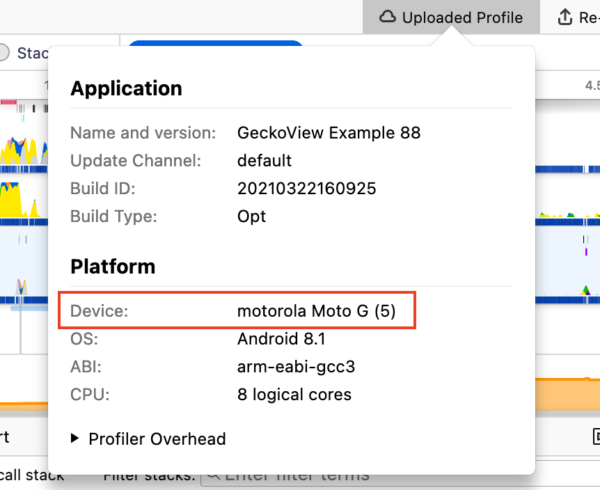
  • Added Android device information inside the profile data and started to show it in the profile meta panel.
  • Fixed the network markers with service workers. Previously it was common to use “unfinished” markers. More fixes are coming.
  • Removed many MOZ_GECKO_PROFILER ifdefs. Less places to potentially break on Tier-3 platform builds.
  • You can now import Android trace format to Firefox Profiler analysis UI. Just drag and drop the .trace file into firefox.profiler.com, it will import and open it automatically.
  • Added new markers:
    • Test markers (in TestUtils.jsm and BrowserTestUtils.jsm)
    • “CSS animation”
    • “CSS transition”

Search and Navigation

  • Fixed flickering of some specific results in the Address Bar – Bug 1699211, Bug 1699227
  • New tab search field hand-off to the Address Bar now uses the default Address Bar empty search mode instead of entering Search Mode for the default engine – Bug 1616700
  • The Search Service now exposes an “isGeneralPurposeEngine” property on search engines, that identifies engines searching the Web, rather than specific resources or products. This may be extended in the future to provide some kind of categorization of engines. – Bug 1697477
  • Re-enabling a WebExtension engine should re-prompt the user if it wants to be set as default search engine – Bug 1646338

Screenshots

14 Apr 06:15

Digital Art(efacts)

by Tony Hirst

So.. non-fungible tokens for signing digital art. FFS. I wonder when someone will set up an NFT a long way down the chain and relate the inflating cost of their artwork to the increasing amounts of energy you need to spend to mint the next token. Thinks: Drummond and Cautey were burned a million, now you can burn a million on top of the cost of the art work minting your certificate of ownership.

Hmm… maybe that’s a world of art projects in itself: mint new tokens on a server powered by electricity from the windmill in your garden and limit how often ownership can change by virtue of the slow release of new tokens. Create fairygold tokens that disintegrate after a period of time, so you are forced to resell the art work within a particular period of time. Run your blockchain miner on a GPU powered by a server where you control the energy tariff. Etc etc.

Alternatively, why not sell “a thing”.

Back in the day, I used to enjoy buying signed limited edition prints. There was no way I could afford originals or studies, but the signed limited edition print had the benefit of relative scarcity, and the knowledge that the artist had presumably looked at and touched the piece. And if they weren’t happy with it, they wouldnlt release it. A chef at the pass.

I have a cheap RPi (Rasberry Pi) connected by an ethernet cable to my home internet router. I run a simple Jupyer notebook server on it as a sketchpad, essentially. In a Jupyter notebook, I can write text and code, execute the code, embed code outputs (tables, charts, generated images, 3D models, sounds, movies, and so on) and export those generated code output assets as digital files. I could sign them as NFTs.

I can also run other things on the RPi, such as a text editor, or a web browser.

I can use the RPi to perform the calculations on which I create a piece.

So… rather than sell a signed digital artefact, I could connect to the RPi, write some code on it, or open a drawing package on it, and create a piece.

Then I could make the files read only on the device and sell you the means of production plus the files I actaully worked on and created.

If it’s an RPi, where the files are saved on an SD card, I could sell you just the SD card.

In the first case, where I sell you the RPi, you would have the silicon that did the computation that created the digital asset as well as the files I, in a particular sense, touched and worked on, with a timestamp on the file repreenting the last time I edited and saved that file.

In the second case, where I sell you the SD Card, I sell you the original files that define the created the digital asset that I, in a particular sense, touched and worked on, with a timestamp on the file repreenting the last time I edited and saved that file.

This seems to me be a much more tabgible way of selling digital artworks as touched by the creator.

14 Apr 06:15

Domestic terrorism incidents plotted over time

by Nathan Yau

The Washington Post (paywall) shows the recent rise in domestic terrorism incidents in the United States, based on data compiled by the Center for Strategic and International Studies.

In the initial view, each circle in the unit chart represents an incident, where yellow represents far-right violence, and dark gray represents far-left. As you scroll, the units are sorted into more specific categories.

Tags: domestic, terrorism, Washington Post

14 Apr 06:15

LEFT JOIN me

by Jonathan Libov

We’re building our product in Supabase. A few weeks into building, Supabase introduced storage, which shipped with you one of the most pleasant surprises of my product-manager-who-shouldn’t -be-coding-career career. I’ve been waiting 10 years for this:

What’s happening here is that when the record for an image is deleted, Postgres is removing the corresponding image object from storage. The code lives in Postgres; in virtually all other apps, the code for doing this lives in the app and looks something like this:

  1. Get the record from DATABASE_VENDOR via API/SQL
  2. Delete the record from your STORAGE_VENDOR via API
  3. Delete the original record from your DATABASE_VENDOR via API/SQL

Doing this in SQL, within Postgres in Supabase, looks like this:

  1. Delete the record from DATABASE_VENDOR

The fact that the former procedure is easily achievable by a student in their, I don’t know, 17th day of Lambda School, misses the point. Well, it misses two points. The first is that seemingly small choices like this can generate outsized outcomes when you’re recruiting a next-decade cohort of customers. Being able to LEFT JOIN storage to records is AWESOME. This, from Supabase’s introductory blog post for storage, conveys it well:

One language to rule them all

They nailed it. Kudos to Supabase.

The second point is captured well in this thread:

What SQL has over everything else is that it’s close-to-the-metal and easy for any product-person-who-shouldn’t-really-be-coding to understand. It takes a couple days to learn, sure, but that’s good friction. Teaching other people in my org SQL has been the most consistently rewarding (for me and the org) things I’ve done in my career, as you get to watch people cross the chasm from afraid-of-monospace-fonts to team-member-whose-curiosity-is-limited-only-by-their-own-ambition.

For similar reasons, Supabase has been one of the consistently delightful platforms I’ve used in some time, and a long time coming.

14 Apr 06:03

Berlin nach der Pandemie

by Ronny
mkalus shared this story from Das Kraftfuttermischwerk.

Wann auch immer das sein wird.

14 Apr 06:03

The Battery Revolution in Our Times

by Gordon Price

When technology and economy come together, that’s usually called a revolution.

You can get one of these electric scooters for a few hundred bucks at Canadian Tire:


Joe Sulmona says you may soon be able to get one of these if you need  more carrying capacity.

Bigger battery too.  From Euractiv:

Advances in technology mean that battery-powered heavy trucks can go up against their fossil-fuel counterparts on price and – with better charging infrastructure – on range, according to the study, conducted by the Stockholm Environment Institute (SEI), an independent research institute.

“A tipping point is in sight for electric trucks,” said Björn Nykvist, lead author and senior researcher at SEI. “Battery technology is very close to a threshold that makes electric trucks feasible and economically competitive. All that is missing is one companion component: fast charging.”

If you’d like to know more the evolution of one-person electric transportation and its impact on urban transit as a whole,  here’s a more definitive piece from Boundmotor:

14 Apr 06:02

Not in My Back Yard! Marine Drive Golf Course Says No to Public Access on the Fraser River Trail Greenway

by Sandy James Planner


Take a walk on the Fraser River Trail Greenway which is the perfect thing to do on a brisk spring day. You can start at the south foot of Blenheim Street, and you can go west where the private Point Grey Golf Club has worked with the City to create a publicly accessible trail along the Fraser River.

There was one section of the Fraser River Trail Greenway south of the Point Grey Golf Course that was inaccessible due to a large stream embankment. The Simpson Family in Southlands who had lost a son in an accident in the armed forces chose to honour his memory and paid for the public bridge which is accessible to walkers, rollers, cyclists and horse back riders. You can continue on that trail that proceeds west through the ancient territory of the Musqueam First Nation, and that trail joins up to Pacific Spirit Park at Southwest Marine Drive.


But let’s say you choose to go east on the City of Vancouver’s Fraser River Trail which was approved by Council in 1995. There is a footpath on city public lands, and you then can follow the Fraser River beside the city’s McCleery Public Golf Course. It’s a wonderful walk beside the Fraser. And then you run into this:

And there is the obnoxious, anonymous signage:


You have just met the signage of the privately owned Marine Drive Golf Club that is refusing to allow public access along its share of the waterfront, despite the fact that the privately owned Point Grey Golf Club and the McCleery Golf Course has.

Of course there should be public access along the water.  The City could  also simply go ahead and open up a few street rights of way through the Marine Drive Golf Course to provide the public access on closed street rights of way, which I suspect would change the golf course’s attitude about access along the foreshore.

Instead the Marine Drive Club has chosen to ignore doing the right thing and even has refused to respond to inquiries on this matter. Instead they have barricaded access and left threatening signs with no phone number or reference.

No other property owner along the entire length of this Fraser River Trail greenway does that.

This curiously antique sense of private golf club entitlement was discussed in the Vancouver Sun by  Douglas Todd. Mr. Todd followed this up with another article that  said the descendants of the person that sold the property to the Marine Drive Golf Club would be appalled at this denial of public access. Highly regarded former Premier Michael Harcourt has also suggested that an elevated boardwalk could be built slung over the foreshore.

How is it during a pandemic, when outdoor access is such a premium that a privately owned golf club would deny the use of ten feet of foreshore to complete the Fraser River Trail greenway? Something that is clearly in the public interest, and theirs as well?

The Marine Drive Golf Club from 2004 to 2008  tried to keep areas of the private club for male members only. Court records indicate that male members intimidated female members who wanted to use that space. After women members won a court decision to have access to all parts of the Marine Drive Golf Club, the men in the club went to the British Columbia Court of Appeal to have that decision on equity overturned. The men won.

As Gary Mason in the Globe and Mail wrote in 2007: “the B.C. Court of Appeal, no less, had ruled unanimously that the men could play their cards and tell their off-colour jokes without having to share their tables with members of the opposite sex. The lounge’s no-women-allowed policy was not, in the court’s view, a violation of the B.C. Human Rights Code.”

You can read Mr. Mason’s article here which outlines the treatment faced by female members.

There are people that are committed to doing the right thing for the citizens of Vancouver, and retired engineer/planner David Grigg tried to contact the Marine Drive Golf Club  to  “gauge their current interest in establishing the trail along the Fraser River fronting the golf course.”

As Mr. Grigg recounts

After two months, during which time the club held their AGM, and receiving no reply, I started phoning. Eventually, I made contact and was politely told that I would not receive an official reply as the club’s policy was not to engage with the public directly, or through the press, but only through the city.”

So there you have it. But Mr. Grigg is not deterred:

While I respect the club’s right to their “quiet enjoyment ” of their fee simple land and not having to worry about a trail user on their property who may be struck by an errant golf ball or cause a distraction I really believe, that given goodwill on their part their fears could have been ameliorated… I believe the principal stakeholders of a restored foreshore and trail could be the Vancouver Fraser Port Authority (VFPA) and the Vancouver Parks and Recreation Board -for their future role as stewards of the trail as it connects the parks on both sides. Accordingly, I have written a letter to each organisation requesting their active support in bringing this trail project to fruition. I have also made a first tentative contact with the Musqueam, through the First Nations Fisheries Council, requesting their input”.

There has been over three decades of asking the Marine Drive Golf Club nicely to allow for the completion of this part of the Fraser River Trail to no avail.

As Mr. Grigg succinctly notes:

“The new trail would join the Fraser River Park fronting the Angus lands on the east side of the golf course with the trail on the west side fronting the McCleery Golf Course. For historical reference, the concept of the trail was approved by the Southlands community in 1988 and endorsed by the city council the following year. The recent poll reaffirmed strong support -in favour of over 2 to 1 on the east side and overwhelming support on the west side.”

Since it is a city designated greenway, completing this section is something that Vancouver City Council can universally work together and complete in this term.  Council should also explore creative uses of city owned unopened streets/rights of way through the Marine Drive Golf Course to allowing public access through the golf course if a more convenient waterfront trail cannot be negotiated. Public art, public washrooms, performance spaces, gardens and benches could be located along these rights of way, and become a unique segment of the Fraser River Trail greenway through this private golf course.

You can see the section of the uncompleted trail in the image below. Let’s get this done.


14 Apr 06:02

LG and Magna reportedly in talks to sign Apple car production deal

by Patrick O'Rourke
Apple logo

Apple is rumoured to be very close to signing a deal with LG and Magna’s joint EV automotive project called the “LG Magna e-Powertrain,” according to a report from The Korea Times.

The deal would reportedly result in LG and Magna manufacturing the initial round of the Apple Car that is expected to enter production in 2025. The agreement will reportedly be completed later this year, says the report.

The report says that Apple will tap LG for its electric powertrain design developed in partnership with Magna, with the latter company handling the actual vehicle manufacturing.

The flurry of speculation surrounding Apple’s often-rumoured electric vehicle project has been difficult to follow over the last few months. Earlier this year reports emerged that Kia and Hyundai were working on a deal with Apple valued at $4 billion USD (about $5 billion CAD).

However, following Hyundai publicly mentioning it was in talks with Apple during an earnings call, the automotive company confirmed it was no longer in discussions with Apple.

LG and Magna supply parts for various automotive companies, including Tesla, General Motors, BMW and Ford. Magna has a head office and manufacturing facility in Aurora, Ontario, where it creates vehicles for BMW and Jaguar Land Rover.

‘Project Titan,’ reportedly the codename for Apple’s automotive initiative, has been rumoured since 2015. The project was reportedly paused back in 2017 to focus more on self-driving technology, but recent reports indicate that the tech giant is still working on creating its own vehicle.

Source: The Korea Times Via: 9to5Mac

The post LG and Magna reportedly in talks to sign Apple car production deal appeared first on MobileSyrup.

14 Apr 06:02

Death and deathlessness

by charlie

In my year-long challenge, I’ve been thinking of ways to make the intangible tangible. For example, what does contagion look like, or Black Lives Matter, or dignity, or death and immortality?

I’ve been thinking of death and immortality for a long time – what does it mean to die, in what ways are we immortal, how do we add meaning to this reality, what is our legacy?

Read infinitely, write finitely
The EEPROM memory of an ATtiny45 (my fave) has 256 addressable bytes. The EEPROM, for those who don’t know, is a place to store a byte that is retained after the chip turns off – so, say, you can store a value of something, put the chip to sleep, and then read the value when the chip wakes up.

But such power comes with a catch (as with all superpowers). While you can read from the EEPROM multiple times, there is a limit to how many times you can write to one of the 256 bytes. The manufacturer of the ATtiny45 says 100,000 times. Though there are reports that show the registers can actually write 1-2 million times (10-20x more than what the manufacturer says).

Of note, all the experiments I’ve seen seem to have stopped at the first failure of the chip. They were one-way, brute force read/write cycles until the first failure.

Lifelogging
I realized that killing an ATtiny45 EEPROM would be a way to explore death. Though I added a twist. I was going to observe it and record it and thus explore immortality, too.

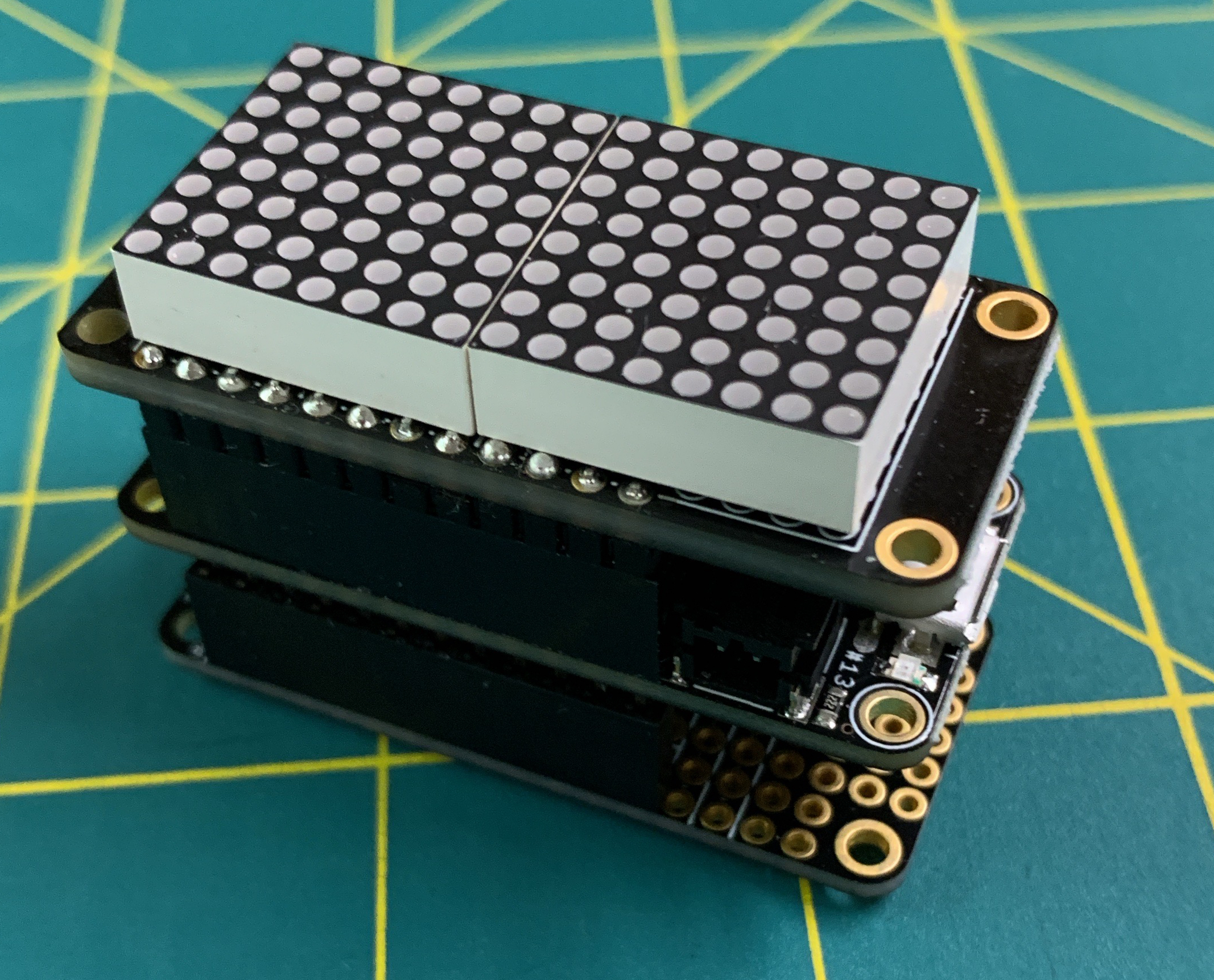
On the right is a stack I built to put this in an easy set up.

The bottom is a FeatherWing Proto with a DIP-8 socket for the ATtiny45 (yes, I want to do this a few times). The ATtiny45 is programmed to write a value to the EEPROM and then read the EEPROM, verifying the write*. The chip then sends the cycle, address, and pass/fail for every read over a serial connection to the main board.

For the main board, I currently have an Adafruit Feather M0 Adalogger (in the middle of the stack). The Adalogger will simply receive all the values the chip sends, plotting it on the 8×16 LED Matrix Featherwing (with a display clear at the start of each cycle), and logging the data to its SD card.

To simplify things, the chip does the failure testing. And I’ve decided to only read half the EEPROM (128 addresses) to match the 128 pixels on the matrix. Though, the Adalogger is only logging bad reads from the chip (or, if no failures, just the cycle – I still want to count the cycles). Logging only bad reads saves heaps of storage space.

Design choices
I know there are a zillion more efficient ways to do this. But this is the path I took. I had other design choices in mind: wanted to use CircuitPython (ended up using Arduino), wanted to use the main board to program the ATtiny right in the stack (not a separate programmer), wanted to be way more efficient where the computation happens (on the main board rather than the wee chip), wanted to use a faster (serial communication, chip speed, and storage writing) FeatherS2. Alas, I ran out of time and patience and ended up where I am (and that’s part of the reason of time-restricting these projects).

Where things are at
I hooked up the stack (added a battery for power continuity) and it’s been running a day or two (that’s the GIF above). I’m not so concerned about stopping and restarting, as the log files are numbered and I could stitch them together later.

I calculated how long to hit 100k cycles (about 20hrs – which has long passed) and 1M (8 days). While it seems from previous reports that I should only see something after 8 days, I want to answer a questions that I’ve never seen answered: if a write fails might it work on a subsequent read, or is the whole EEPROM dead, or just that address?

What I should see in my display (and data) is that an address will go dark – either to stay dark (single address fails once and always will fail) or will return (single address fails, but not always – still not usable, but not totally lost) or stops the whole process (when one address fails, all will fail).

Immortality
One other aspect I have yet to explore (as I haven’t killed a chip yet) is playing back the whole life of the chip. That is, when I’ve logged all the cycles until ALL the registers have failed, I can play back the chip’s life, indeed, its own particular life trajectory.

Question: when I play back the entirety of the chip’s life, is it dead and playback is just a memory, or is it the real thing? If I can play its life over and over again, is that immortality or just good record keeping? And what does that mean for our lives, our recorded selves, our digital contrails?

Dunno.


*Nerdy note: I actually used complementary values per read/write cycle to alternately flip all the bits of the byte – 240 (binary 11110000) and 15 (binary 00001111).

The post Death and deathlessness first appeared on Molecularist.
14 Apr 05:59

Visualizing risk of Johnson & Johnson vaccine side effect

by Nathan Yau

As the Johnson & Johnson vaccine pauses in the United States, Philip Bump for The Washington Post offers a quick visualization that shows 100 vaccinations per second. A red one appears if there’s a side effect. But because the side effect is rare, currently at 1 in 1.1 million, the red dot on the visualization likely never appears as you watch. The blue dots are potential lives saved if the J&J vaccine continues.

I’m reminded of David Spiegelhalter’s video on understanding risk from over a decade ago. So many everyday activities carry risk. The only way we get through the day is not to avoid all risk, which is impossible, but to figure out what risk we’re willing to take.

Tags: coronavirus, Johnson & Johnson, risk, vaccine, Washington Post

14 Apr 05:57

Linked List : Three FOSS Tools to work with CSVs

by Thejesh GN

If you work with Data, you can't escape working with CSVs. It's a universally accepted data format for sharing the data. I use the following tools to wrangle with it.

csvkit

csvkit is a suite of command-line tools for converting to and working with CSV, the king of tabular file formats.

csvkit

Written in Python, csvkit is a FOSS set of command-line tools. The toolkit includes CLIs for cutting, joining, importing (from excel, JSON), exporting(convert into other formats), inquiring, searching, sorting. They are all pipe-able.

They also include power tools where you can query CSV like SQL by importing into SQLite. You can also perform joins and unions on CSVs without importing them into SQLite.

JSON to CSV

A simple JSON to CSV converter that handles objects and nested documents. Conversion happens inside the browser, in straight JavaScript. It may choke on large files.

JSON to CSV Converter

These days more and more datasets are published as JSON. It's a handy format online. Offline when someone is trying to explore the data, it's not that useful. Mainly because there are not many easy JSON exploring tools, and it's meant for developers. A table format like CSV is more intuitive. So often, many convert JSON they obtained into CSV to play with data. JSON to CSV Converter is a simple FOSS online tool that for moderately sized JSON file. It's effortless to use.

If you are using a large JSON file, you can use our favorite tool-set csvkit. It can convert from JSON o CSV, for example, to convert icmr_testing_status.json from datameet/covid19 dataset; you can run

in2csv icmr_testing_status.json -f json -k rows

CSVtoTable

Simple command-line utility to convert CSV files to searchable and sortable HTML table. Supports large datasets and horizontal scrolling for large number of columns.

CSVtoTable

This is a simple tool for converting CSV into an HTML table that can be embedded online. It uses Datatables library, which I love. Of course, you could do it manually if you know simple HTML and JavaScript. But this is easy.

So what are your favorite CSV tools?


You can subscribe to my blog using RSS Feed. But if you are the person who loves getting email, then you can join my readers by signing up.

Join 2,114 other subscribers

Email Address

Sign Me Up

The post Linked List : Three FOSS Tools to work with CSVs first appeared on Thejesh GN.
13 Apr 23:45

Six people got blood clots after taking the Johnson & Johnson vaccine. Time to panic?

by Josh Bernoff

If you received the Johnson & Johnson vaccine for COVID-19, should you be worried? The leaders of the Centers for Disease Control (CDC) and the FDA issued a statement this morning suggesting a pause in the administration of the J&J vaccine. As they wrote: CDC and FDA are reviewing data involving six reported U.S. cases … Continued

The post Six people got blood clots after taking the Johnson & Johnson vaccine. Time to panic? appeared first on without bullshit.

13 Apr 23:44

A list of seven different jobs, all called designer

Back in 2009, I wrote down all the different ways I heard “designer” used as a job title. There were seven types.

I just went digging through my notes, having half remembered it this afternoon. Here’s the list.

  1. Where the designer specialises in a particular material or object, and design is matter of creativity and taste: graphic design, book design, furniture design, interior design.
  2. Where the designer exists as a job role between, say, architects and engineers, doing technical drawing and mechanically finding the space between rules.
  3. Where the material is metaphorical and the approach and methods are designerly: service design, interaction design, experience design.
  4. In strategy/consultancy, where “design thinking” is a way of approaching problems in product, marketing, brand, organisational change, etc with a method that combines intuition and rationalism.
  5. In design operations/management, giving direction and explaining but not working on the material.
  6. Designers who create “design objects” which are closer to art than problem solving.
  7. A transitory role; a name for any person who performs any act of design, no matter how briefly or in what context. Design is the conscious and intuitive effort to impose meaningful order – Victor Papanek.

In my notes I’ve also got a reference to the “big-D Designer,” the person who is the holder of the vision, and often uses all the other types (and other job roles besides) to bring that vision about. I think the big-D Designer can fit into any of the above roles; it’s dependent on the person and the context.

The purpose of this list was to understand confusion. If you told someone else you were a designer, what else could they believe that you meant?

This isn’t meant to be a typology with hard edges. It was a list made from observation.


Since I made the list in 2009, twelve years ago:

  • Design started being taken seriously by business, outside the creative industries. I’ll credit IDEO for legitimising design thinking, as an approach to strategy, and Apple’s success for for cementing design’s commercial importance.
  • Software ate the world, and the “product” role emerged from technology firms. My take is that you can trace a path from design, to (software) product/interaction design, to a widened conception of the domain of design which became called “product”, and finally to the mini-CEO role which is the modern product manager. Engineering was another tributary to this unique role, but I feel like there’s a good strong “designer” part of the lineage.

So I don’t know what these trends have done to my list. There are a lot of roles that I would say are design-adjacent, that once could have functionally been performed by a designer, but they have many paths in and are increasingly their own distinct roles. I’m thinking of roles like product marketing, and interface copy.

Does the list still hold up in 2021?

Are there any new ways that designer is used in job titles?


I’ll also make a distinction between designer-as-job-title and designer-as-vocation.

Designers who have been to design college have become part of the culture of design. They have visceral understanding of method (the brief, the material, the crit), and training (which gives not just technique but a particular perspective), but also a connection to design as a historical conversation, which combined means that the designer can go on and be an author or a racing car driver, but they will always be a designer.

Whereas I have (back in the day) co-founded a design studio, but haven’t been to design school, so while I could inhabit a “designer” job role, in the same way I could inhabit other job roles, I would never be a designer in the vocational sense.

I think.


This archeology of my notes prompted by reading Org Design for Design Orgs (2016) by Peter Merholz and Kristin Skinner, which I’m reading as a chaser to Inspired: How to Create Tech Products Customers Love (2018) by Marty Cagen.

Inspired is a fantastic handbook to the product role in tech companies from startups to behemoths like Google. (Thanks Sippey for the recommendation.) It’s basically a giant outline of the product role, hugely practical, with minimal extraneous words, from a place of deep experience – high signal/noise ratio. My favourite kind of business book.

I’m reading around the topic of design leadership, in its broadest sense, in tech companies, so any recommendations of companion reads to Org Design for Design Orgs (which I’m greatly enjoying) will be gratefully received.

13 Apr 20:52

Mozilla ending support for Firefox on Amazon Fire TV, Echo Show devices

by Jonathan Lamont

Mozilla is killing support for its Firefox browser on Amazon devices and urging users to jump over to Amazon’s in-house ‘Silk’ browser.

In a post on Mozilla’s support site, the company notes that it will end support for the browser on Amazon Fire TV and Echo Show devices starting April 30th, 2021. The browser will stop receiving security updates after that point and users won’t be able to install the app on Fire TV. Further, Firefox will be delisted from the Amazon app store, preventing any existing users from re-installing the app if they uninstall it after April 30th.

Echo Show owners who have Firefox set as the default browser will be redirected to Amazon Silk for web browsing starting April 30th.

Android Police notes that Firefox first came to Fire TV devices back at the end of 2017 after Google pulled its YouTube app off the platform. Alongside Amazon’s own Silk browser, Firefox was a great way to access YouTube on Fire TV. Neither Mozilla nor Amazon were particularly secretive about why Firefox suddenly showed up on Fire TV devices — Firefox’s first default shortcut brought people straight into YouTube’s TV-friendly web app.

Of course, with an official YouTube app returning to Fire TV devices in 2019, there was less need for web browsers. Likely, Mozilla felt it wasn’t worth the resources and effort to maintain Firefox on Amazon devices.

It’s also worth noting that Google hasn’t shown love to the Echo Show, which remains YouTube-less. Echo Show owners still using Firefox to stream YouTube will need to make the leap to the Silk browser going forward.

Any Firefox diehards out there could still get the browser on their Fire TV devices if they really want to. Android Police points out it’s possible to sideload the Android TV version of Firefox on Fire TV devices.

Source: Mozilla Via: Android Police

The post Mozilla ending support for Firefox on Amazon Fire TV, Echo Show devices appeared first on MobileSyrup.

13 Apr 20:51

Android’s new Fast Pair design is official, now works with over 100 devices

by Jonathan Lamont

Well, it’s official: Android has a new Fast Pair interface.

Fast Pair, if you haven’t heard, is an Android feature that makes it easier to pair Bluetooth accessories like earbuds, headphones or smartwatches with your phone. It also links devices to your Google account, which can make it easier to connect a pair of earbuds to a new smartphone after you upgrade.

The new Fast Pair design clearly takes inspiration from Apple’s AirPods connection interface. When setting up a Bluetooth accessory for the first time, a large pop-up appears, covering roughly the screen’s bottom-half. It shows the accessory you’re trying to connect and has a big, blue ‘Connect’ button to pair the accessories.

Although the official Android Twitter account tweeted about the new experience today, it started showing up in December 2020.

The new interface partially replaces the old pop-up, which looked like a typical Android notification and was easy to miss. Hopefully, the new design makes it easier to use the feature without getting in people’s way.

Along with announcing the refreshed Fast Pair feature, the Android Twitter account also pointed out that over 100 devices now support Fast Pair. That likely means your next pair of Bluetooth earbuds will Fast Pair with your phone — Fast Pair is much easier than typical Bluetooth pairing.

Source: Android Via: 9to5Google

The post Android’s new Fast Pair design is official, now works with over 100 devices appeared first on MobileSyrup.

11 Apr 07:19

A death in the Firm

by Charlie Stross
mkalus shared this story from Charlie's Diary.

TITLE: Someone died

So, a rather famous old man died yesterday. I'm not going to say any more about him, for reasons that'll become obvious below: instead I'm going to talk about the vile media feeding frenzy we're about to be subjected to.

Compulsory mourning for a stranger sucks--especially when it's performative Victorian-style royal mourning.

The past century has seen a huge cultural flip-flop so that death and mourning are as inadmissible/peripheral to public life today as sex was in the 1890s, and vice versa.

Back in the 1890s, at least among the upper classes sex was spoken of elliptically or not at all, carried out furtively and in private, and not admitted to in polite society. Everybody did it, but nobody wanted to be known for it, and the taboos surrounding it were many and punishment for infractions could be savage. But mourning was a huge social spectacle, acted out in public: there were special clothes, ritualized stages of mourning with defined time frames within which certain behaviours were expected and other normal activities suspended. The funeral cortege was a public procession through the streets, sometimes with hired mourners to indicate the degree to which the deceased was respected: monumental architecture sprouted in graveyard.

Then the 20th century happened.

Today we're relatively open to discussions of sex--at least to talking about it and portraying it openly in the media. (I'm not sure we're having more of it--the Victorians were hyperactive furtive shaggers--but we're not trying to hide it, for the most part.) However, death isn't something we're routinely exposed to. The demographic transition from a high birth rate/high death rate society to a low birth rate/low death rate culture has resulted in death becoming something that mostly happens behind closed hospice and hospital doors. Funerals still happen, and act as an excuse for reunions of far-flung families ... but then we resume everyday life immediately. Employers grant a week off for the death of a spouse, parent, or child: more distant relatives are ignored. The idea of women going into seclusion at home, wearing only black clothing (and a veil if venturing out in public) for six months, would be a jaw-dropper. Grief and bereavement is a very private thing these days, not a fit subject for sharing. The normal thing to do this century is to leave the bereaved family decently alone with their grief in private.

But then the Queen's squeeze died, and the national discourse is suddenly dragging us on a 150 year deep dive into the unfamiliar territory of archaic public mourning rituals. And the vultures are circling ...

I never met Prince Philip, or his wife and kids. My only interaction with the royal family ever was to walk across a stage during a graduation ceremony attended by a bored minor royal--the patron of the university I attended. They are, in a very real sense, strangers to me: no more familiar than Kim Kardashian or Elon Musk.

And yet I'm expected to join in an orgy of vicarious synthetic grief and mourning and wrap myself in either a flag, or a black armband, or both (I'm unclear). The sanctimonious right wing tone police are already out in force, marching in columns in every newspaper. On top of the normal stentorian roar of monarchist calls for obedience, this time round we also have moralistic finger-wagging injunctions to observe social distancing because of COVID19: to remain silent behind closed doors, the royal funerary rites to invade our private spaces.

The UK is ruled by a monarchy-obsessed reactionary Party (and by Party I do not mean to identify the Conservatives: rather, it's the Party of the Establishment as embodied by the state itself). The media aligned with the monarchy-obsessed party can--and will--use this event to bury bad news or manufacture pretexts (Look! They're not wearing black! Or genuflecting obediently to power!) attack the usual targets. Expect the government to use this grim-reaper-delivered opportunity to the max to bury bad news (renewed rioting in Northern Ireland, the Scottish election, Brexit, COVID19 vaccine shortages, corruption) and demand that we focus on the ritual of royal mourning instead of paying attention to current events.

The cultural dynamic of celebrity drags the unthinking and unaware along with it. Humans like to watch the powerful (we're descended from primates who live in troupes, after all), and the death of a member of the royal family is very much like the death of a film star, musician, famous-for-being-famous celebrity--it's ripe for exploitation for commercial or political ends.

Worse, looming on the horizon is the spectre of another royal funeral. The Queen is 94 years old and presumably a grieving widow. Losing a spouse after more than 70 years of marriage is like suffering an amputation of the soul, according to my mother, after a similar bereavement. She's probably not going to last out the current decade, even though her family is famously long-lived. Indeed, widows or widowers often follow their spouse relatively rapidly after such a long relationship: codependency withdrawal can kill. And the usual vultures are circling.

Shorter summary: the royal family is institutionally resistant to change, this means its death/mourning rituals are increasingly out of touch with contemporary cultural norms, and the cognitive dissonance between what they tell us is expected of us and what we know to be true will be exploited by manipulative and malignant political actors.

10 Apr 04:53

RT @doctor_oxford: This extraordinary memorial to over 150k lives lost to Covid sits opposite parliament. Drawn by grieving families, it ha…

by Rachel Clarke (doctor_oxford)
mkalus shared this story from mrjamesob on Twitter.

This extraordinary memorial to over 150k lives lost to Covid sits opposite parliament. Drawn by grieving families, it has been reported around the world.

Yet the Prime Minister has ignored it. He hasn’t even visited to talk to families or show his respects.

This is so wrong. pic.twitter.com/vDCiphsFS9


Retweeted by James O'Brien (mrjamesob) on Friday, April 9th, 2021 1:20pm


7326 likes, 2151 retweets