Shared posts

04 Jun 18:10

Moving from MySQL to DuckDB

I mentioned earlier that I’ve been doing some work on the old Bookworm project as I see that there’s nothing else that occupies quite the same spot in the world of public- facing, nonconsumptive text tools.

That codebase is old–pieces of it date back to this blog post from a decade ago. Parts of that old architecture (e.g., perl) got quickly jettisoned (for Python). But others persist. In re-examining the technical stack behind Bookworm, I’ve realized that it’s finally possible to jettison one of the biggest pain points–MySQL–for something that better matches the workflows here.

People often ask about Postgres, but I’m moving to something a little bit more unexpected–the 2-year-old program DuckDB. This might seem like an odd choice! The core data architecture challenge of Bookworm is managing some enormous tables for storing a sparse matrix– the term-document matrix–for a large number of long documents. The HathiTrust bookworm has about 2 trillion words in 17 million books–I haven’t looked at the core tables recently, but I’d guess they have tens of billions of rows.

DuckDB, on the other hand, is manifestly targeted at a much smaller size–it borrows intensely in footprint from SQLlite by using the SQLlite shell, existing only as an embedded process in running program (i.e., no daemon), and putting each file into a single moveable file. I never seriously considered SQLlite as a Bookworm backing, because it’s too lightweight to handle enormous tables, because at the time of the original design I only knew how to write single-startup CGI scripts, and because MySQL gives intense options for tweaking performance on the margins. (Back in 2010-11 I got very used to using 3-byte unsigned integers, which can store values up to about 16 million, for ids, since they’re actually a convenient size; it took me a while to realize that 3-byte integers are an extraordinarily unusual thing.)

Column stores

But DuckDB has some major advantages. For one thing, it uses column-oriented stores, which means rather than store rows of interspersed data types, like MySQL, it groups primarily by the values–so you get all the counts as a series of integers, all the wordids as a series of integers, etc. For performance, Bookworm has always encoded words to integers under the hood; there are a variety of performance advantages to this form of storage. The costs mostly tend to be things that don’t matter in analytics (like it being harder to update a single customer record in a table with their latest purchase.) That’s why DuckDB exists– as something that will work better for analytics from Python or R than SQLlite. And the basic design seems to be probably better conceived than SQLlite because it’s starting from the ground up; it uses the Postgres parser and supports modern SQL reasonably well. For the large joins that accompany a typical Bookworm query (in which you declare which 1 million out of 10 million teacher evaluations you want to look at), this works well.

Here’s a dumb analogy for column stores. Imagine your data as being a bunch of different cookies. Dates are Oreos, addresses are chocolate chips, whatever.

Yum

Each sleeve is clear, so you can get an idea what’s inside it, but it’s also nicely shaped, so you quickly pass

While the relational queries against catalog tables are important, the most difficult part of any bookworm query is accessing the individual word counts– those 50 billion row tables of the term-document matrix. What MySQL did for us there was to allow the creation of fast b-tree indices that put related rows together on disk. This was often the most time-consuming task, because MySQL index creation could take a week on a really huge table; and it left the indices far larger than the actual tables themselves. (In fact, the design of the database was such that the original table is never used–queries only ever read from the index.)

DuckDB uses mostly block range indexes, which tell you roughly what part of the file any given dataset might be in, and don’t sort the underlying data. This is faster, but wouldn’t allow for quick lookup in a big table–you’d end up scanning almost everything.

But there’s a trick here, which is to sort the data first before putting it into DuckDB. If the term-document matrix is sorted by wordid, all of the occurrences for each word will be right next to each other, just as with the MySQL index. It’s probably not quite as fast for retrieval, but the column-oriented structure that comes out can race ahead on the subsequent joins. Pre-sorting isn’t trivial, but since we know about the structure of the data, I can code up an algorithm that operates much faster than the MYSQL internal index creation by making multiple passes.

03 May 18:54

Fatal Fake photo Ton Zijlstra, license CC BY NC...

by Ton Zijlstra

Fatal Fake / Street ArtFatal Fake
photo Ton Zijlstra, license CC BY NC SA

Wherever I go I tend to take photos of street art that catches my eye. I like the random encounters with creative expression when you stroll through a city, and how they’re add-ons to an environment that wasn’t meant to welcome them. In March 2013 I visited Barcelona together with my father. Two years before his death but already ill he invited me on this city trip meant as an opportunity to bridge some of the distance between us. We talked and explored the city, we enjoyed the food and wine. My photos from the trip are a colourful mixture of Gaudi architecture and street art. The image of the Rolleiflex-camera above, this one branded ‘Fatal Fake’ (which might be a reference to the game of that name), jumped out to me because of the colors, the rust and different tones of red, plus how the holes in the metal above make it look like it was ripped from a notepad.

Now that we haven’t been able to travel much and the daily scenery isn’t much different from day to day, I’ve taken to browsing through my Flickr photo archive where I keep over 30.000 photos of the past 16 years. Last week I printed a number of photos to put in the frames on the window sills of my home office. I will be posting some of them here this week.

03 May 18:43

The OceanMaker

There’s two features I look for in good sci-fi: 1. something I hadn’t imagined before and 2. something that anticipates the automobile, as well as the traffic jam. The YouTube gods smiled up me and surfaced a channel called DUST, a massive collection sci-fi short films. The quality is much better than what you might expect from “free sci-fi” but one of their films, The OceanMaker, is an absolute standout that raptured me and took me somewhere I’ve never been.

Extrapolating on the near future Water Wars, The OceanMaker is a beautiful animated film that imagines a world where humans fight over every drop of water — even clouds. The hero is a brave, young inventor with her heart set on changing the world with her invention. I don’t want to give any spoilers, but the film captures the real world tension between selfish, exploitative “biggest wins” capitalism and the need to invest in science and technology, all inside a package filled with sorrow, hope, and dogfights.

I hope you enjoy it.

03 May 18:43

Hard but not impossible: How Flickr is moving the needle on eliminating child sexual abuse from the internet.

by hollylawrence

Content note: As we continue the conversation around our commitment to keeping the Flickr community and children safe, this guest blog article was written by John Starr, VP of Industry Sector Strategy at Thorn and contains mentions of child sexual abuse.


“The ordinary response to atrocities is to banish them from consciousness.”


This line, written by Judith Herman in her groundbreaking book, Trauma and Recovery: The Aftermath of Violence–From Domestic Abuse to Political Terror, has been on my mind a lot lately.

That’s because part of my job at Thorn is to think about the structures and tools that will enable digital platforms to respond in a very unordinary way to the atrocity of child sexual abuse.

Herman continues: “Those who attempt to describe the atrocities that they have witnessed also risk their own credibility. To speak publicly about one’s knowledge of atrocities is to invite the stigma that attaches to victims.”

Flickr, like many platforms, has taken the bold step of implementing technology and processes to ensure their platforms are free of child sexual abuse material (CSAM), that their users won’t have to bear witness to those atrocoties, and that survivors and victims won’t have to live with their content circulating online, even after their abuse has ended. 

But Flickr is doing something that’s not ordinary. It’s not even unordinary — I would call it extraordinary. Flickr is showing up in a very public way to talk about their work to confront the fact that we live in a world where children are abused and their abuse is traded on the platforms we all use everyday. Flickr is making it clear they understand this truth, and they are doing the telling, they are building the better product, they are standing on the side of the victim. 

A thought experiment: Imagine yourself, alone, witness to a terrible crime. If you speak out, you can risk your own credibility, it’s a one on one argument. As Herman points out: “…perpetrator’s arguments prove irresistible when the bystander faces them in isolation. Without a supportive social environment, the bystander usually succumbs to the temptation to look the other way.” It’s really hard not to look away when you’re on your own. 

Now imagine yourself in a group of  your closest friends and allies, and you witness the same terrible crime. You are supported in that group to say what you saw. Your small group can grow to become an army of witnesses who are able to speak so loudly that they can stop the perpetrator in their tracks. It’s difficult to speak the unspeakable alone, we can make real change when we act together. 

Flickr, like us at Thorn, is part of a club of those who say yes to the hard work of facing unspeakable atrocities. A collective that is willing to stand with victims unafraid of risking our credibility, confident in the community we’ve built, to shine a light in the darkest corners of the internet, and say to the perpetrators of these crimes: “I know what you’re doing. No more.”

Doing this work is a process. When it comes to the sexual exploitation of children online, showing up matters. Implementing technology to disrupt the spread of CSAM is critical, and so is talking about it. Ensuring that both perpetrators and victims are clear on whose side a platform or service is on makes a meaningful and powerful difference.

And someone has to take that bold first step. Because the first to speak up makes it easier for the 10th. The 10th that speaks up makes it easier for the 100th. And as it grows, there’s a joint awareness — a sharing of the burden that destigmatizes victims. This creates the environment for the community who says yes to hard things to continue to innovate and move us all closer to a world where child sexual abuse no longer exists on the internet.

As Herman says, “Those who stand with the victim will inevitably have to face the perpetrator’s unmasked fury. For many of us, there can be no greater honor.” 

We are proud to stand with Flickr, together we are stronger. Together we choose to stand with victims. 

How you can help.

One question we are asked often at Thorn is, “How can I help?” 

You can help by joining us in saying yes to doing hard things: 

  • Spread truth, even when it’s hard to stomach. Have conversations about the intersection of technology and child sexual abuse in your social circles, bringing this topic into the light.
  • Follow organizations like the National Center for Missing and Exploited Children, Love146, WePROTECT and so many more who are working in this space, listen to what they have to say, engage in the conversation, and amplify their message. 
  • Amplify the great work being done on hard topics, and prioritize using platforms, such as Flickr, that join you in doing so.

Before we can eliminate this violence, we first have to acknowledge it exists. I applaud Flickr, the Flickr community, and every digital platform willing to join us in naming this atrocity. In doing so we are building a better, safer, internet. One where every child can be safe, curious, and happy.


About John Starr, VP of Industry Sector Strategy at Thorn

Guest blogger, John Starr, leads Thorn’s industry sector strategy. Before joining Thorn, John oversaw the Global Content Policy team at Twitter in his role as Director of Trust and Safety. While at Twitter, he also chaired the Technology Coalition. Previously, John worked at the FBI and started his career as an analyst at the National Center of Missing and Exploited Children. Thorn is a non-profit that builds technology and develops programs to defend children from online sexual exploitation.

03 May 18:37

Jabra Panacast 50 und Panacast 20 vorgestellt

by Volker Weber

panacast 50 hjalksdhl789234.jpg

Jabra hat zwei interessante neue Produkte vorgestellt, die in den nächsten Monaten erscheinen sollen. Panacast 50 erweitert die Panacast-Kamera um eine Soundbar mit 8 Mikrofonen und 4 Lautsprechern. Die Panacast-Kamera besteht aus drei Kameras, die zusammen ein 180 Grad erfassendes Bild abbilden und sich damit für kleine Konferenzräume eignet, bei denen man dicht vor der Wand sitzt. Die Software passt dabei den Bildausschnitt jeweils so an, dass alle Personen abgebildet werden. Durch die acht Mikrofone kann Panacast 50 die einzelnen Sprecher erkennen und auf sie zoomen. Auch ein Whiteboard kann man einrichten und verzerrungsfrei abbilden.

Bei einer hybriden Arbeitsweise mit einigen Personen im Büro und anderen im Homeoffice deckt Panacast 50 den Büroteil ab, während die neue Panacast 20 als persönliche Kamera das Homeoffice bedient.

panacast 20 789qw7e89.jpg

Das ist das für mich interessantere Produkt, weil diese Kamera verspricht, meiner Logitech Brio Konkurrenz zu machen. Panacast 20 hat drei Mikrofone und erfasst ebenfalls den Sprecher, um diesen immer perfekt in Szene zu setzen. Die gesamte Verarbeitung passiert dabei in der Kamera selbst. Sie kann zwei verschiedene Videostreams mit einer Totale und einem Bildausschnitt liefern und diese auch als Picture in Picture montieren.

Panacast 50 ist ab 15. Juni für einen Listenpreis von 1065 Euro erhältlich. Panacast 20 soll zum 1. August für 299 Euro verkauft werden.

03 May 18:35

The Best Bike Helmet for Commuters

by Eve O'Neill
The five bike helmets we recommend for commuters situated near each other in a circle.

No one ever plans on crashing their bike.

But if you ride long enough, even the most casual commuter will take a tumble, which is why you should always wear a helmet. (Case in point: I crashed six times while working on this guide.)

Over the past 11 years, we’ve tested more than 30 helmets to determine that the Met Downtown Mips is the best bike helmet for most commuters.

03 May 18:35

Growing the Bytecode Alliance

by Bobby Holley

Today, Mozilla joins Fastly, Intel, and Microsoft in announcing the incorporation and expansion of the Bytecode Alliance, a cross-industry partnership to advance a vision for fast, secure, and simplified software development based on WebAssembly.

Building software today means grappling with a set of vexing trade-offs. If you want to build something big, it’s not realistic to build each component from scratch. But relying on a complex supply chain of components from other parties allows a defect anywhere in that chain to compromise the security and stability of the entire program. Tools like containers can provide some degree of isolation, but they add substantial overhead and are impractical to use at per-supplier granularity. And all of these dynamics entrench the advantages of big companies with the resources to carefully manage and audit their supply chains.

Mozilla helped create WebAssembly to allow the Web to grow beyond JavaScript and run more kinds of software at faster speeds. But as it matured, it became clear that WebAssembly’s technical properties — particularly memory isolation — also had the potential to transform software development beyond the browser by resolving the tension described above. Several other organizations shared this view, and we came together to launch the Bytecode Alliance as an informal industry partnership in late 2019. As part of this launch, we articulated our shared vision and called for others to join us in bringing it to life.

That vision resonated with others, and we soon heard from many more organizations interested in joining the Alliance. However, it was clear that our informal structure would not scale adequately, and so we asked prospective members to be patient and, in parallel with ongoing technical efforts, worked to incorporate the Alliance as a formal 501(c)(6) organization. That process is now complete, and we’re thrilled to welcome Arm, DFINITY Foundation, Embark Studios, Google, Shopify, and University of California at San Diego as official members of the Bytecode Alliance. We aim to continue growing the Alliance in the coming months, and encourage other like-minded organizations to apply.

We have a real opportunity to change how software is built, and in doing so, enable small teams to build big things that are both secure and fast. Achieving the elusive trifecta — easy composition, defect isolation, and high performance — requires both the right technology and a coordinated effort across the ecosystem to deploy it in the right way. Mozilla believes that WebAssembly has the right technical ingredients to build a better, more secure Internet, and that the Bytecode Alliance has the vision and momentum to make it happen.

The post Growing the Bytecode Alliance appeared first on The Mozilla Blog.

03 May 18:35

Spotify’s Surprise

by Ben Thompson

This Article is a follow-up in two ways:

Plus, a special announcement about Exponent.

Anchor Subscriptions

Spotify’s first announcement was teased during its Stream On event last month: paid podcasts via Anchor.

The first implication of this is exactly what you might expect: podcasters who use Spotify’s Anchor service for hosting their podcasts can now create subscriber-only podcasts on Spotify. At first glance this seems similar to Apple’s offering: use their subscription service to offer paid podcasts on their app. However, Anchor is different in three important ways:

On-Web versus In-App

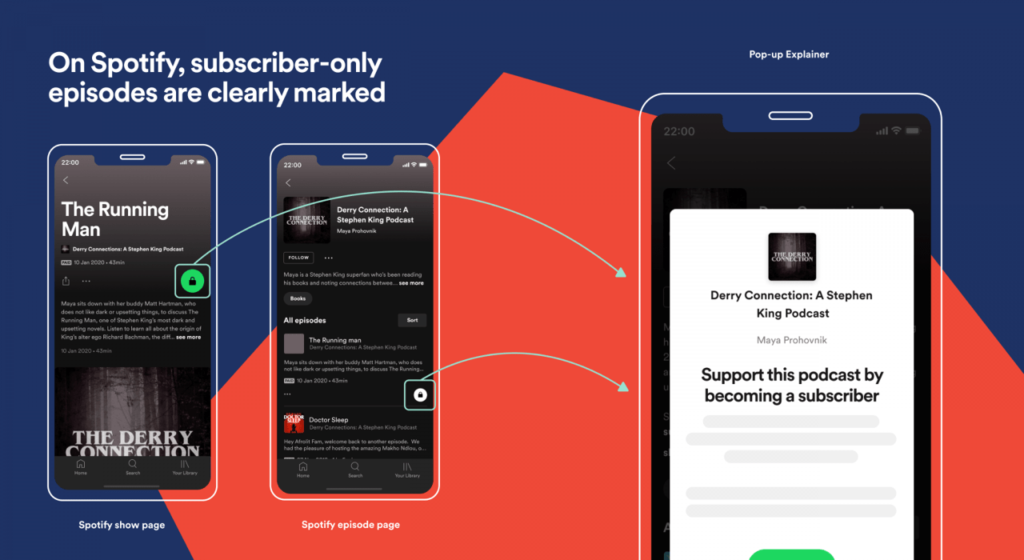
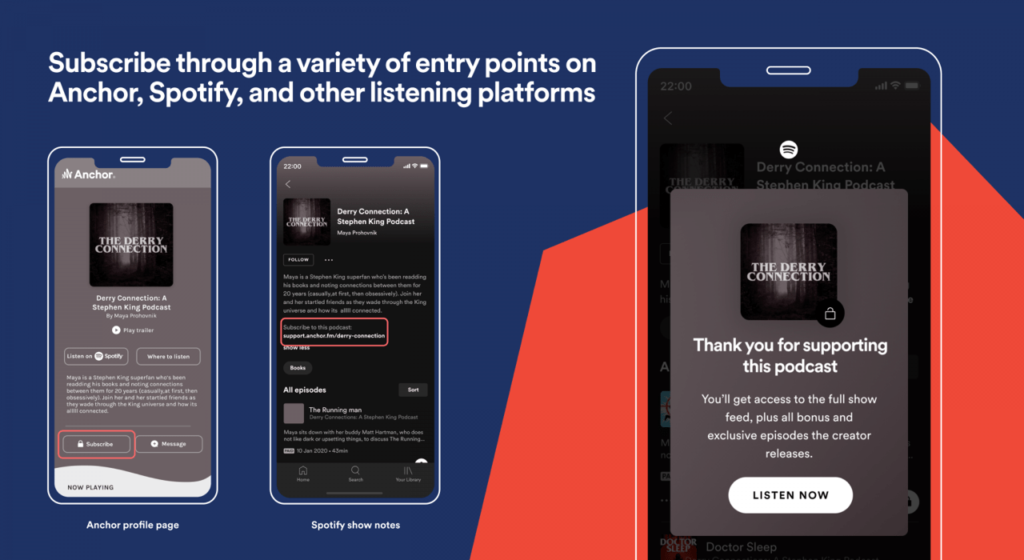
First, subscribing to an Anchor show on Spotify is a clumsier process than it is on Apple; note these images from the announcement:

Spotify's subscription podcast screen

Subscribing via Anchor

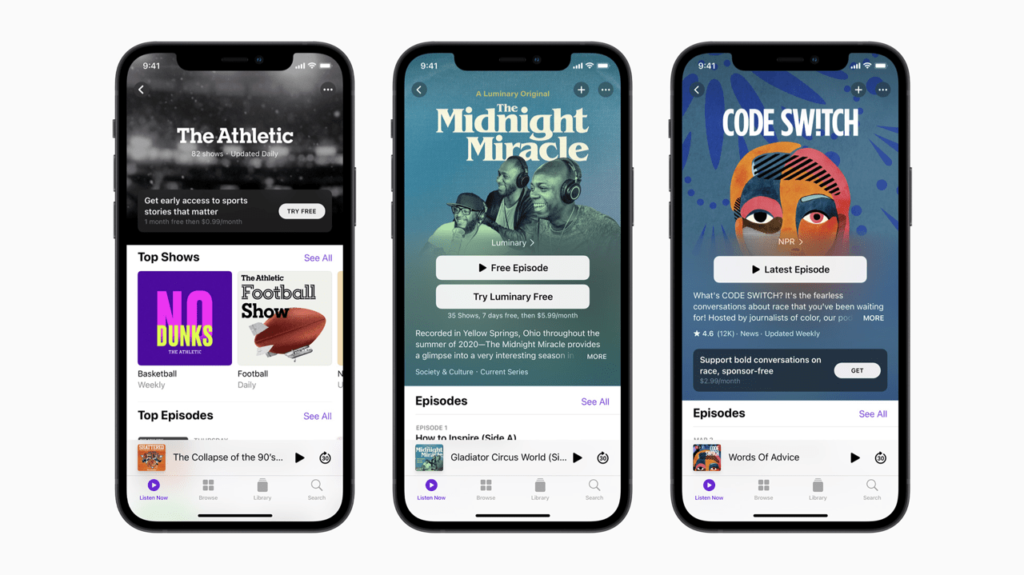
Spotify can’t put a “Subscribe” button in its app due to Apple’s App Store rules, which means that Anchor podcasters have to hope a would-be subscriber finds their way to the Anchor website.1 Apple, meanwhile, can put a subscribe button front-and-center:

Apple's subscription screen

This is, needless to say, a rather stark example of Apple leveraging its control of the App Store to give itself an advantage in a new market; the obvious analogy is Apple Music, which has the same advantage relative to Spotify itself. Spotify filed a complaint to the EU two years ago, and the EU is expected to charge Apple with anti-competitive behavior this week.

Rates

Second, Anchor is charging less than Apple is; the announcement states:

For the next two years, this program will come at no cost to the creator, meaning that participating creators receive 100% of their subscriber revenues (excluding payment transaction fees). Starting in 2023, we plan to introduce a competitive 5% fee for access to this tool.

That “excluding payment transaction fees” is a pretty important parenthetical; here is what the take-home amount is for $5/month and $10/month podcasts on both Anchor and Apple Podcasts:

$5/month $10/month
Anchor now $4.55 $9.41
Anchor 2023+ $4.31 $8.91
Apple Year One $3.50 $7.00
Apple Year Two $4.25 $8.50

These aren’t directly comparable:

  • Anchor’s rates are the same for all subscribers; all $5 subscriptions earn $4.55 in 2021 and 2022, and then earn $4.31 in 2023, no matter if the subscriber signed up in 2021 or 2023.
  • Apple’s “Year One” and “Year Two” rates apply to subscribers, not podcasts; even if your podcast has been available for two years, for example, new subscribers pay out at the 70/30 rate for the first year they are subscribed.

That caveat is an important one, because after 2023 rates for long-time subscribers are more comparable than you might expect.

The Open Podcast Ecosystem

This was the first big surprise in the announcement; from Anchor’s blog post (emphasis mine):

The most seamless discovery, subscription, and listening experience for your audience equals increased earning potential for you. It starts with a straightforward subscription process for listeners that immediately gets access to paid episodes within your existing show feed in Spotify, meaning less friction and more supporters; your audience won’t need to contend with RSS feeds or downloading a separate third-party app to listen. They’ll still have the option of listening on the platform of their choosing through a private RSS feed, so you don’t lose out on any potential subscribers. And with paid subscription content clearly marked on your show and episode pages in Spotify, listeners can easily see how to support you directly, thus presenting a bigger potential paid audience.

Yes, most of this paragraph is about the Spotify experience, but that sentence is a huge deal to the open podcast ecosystem: all Anchor subscriptions will include per-subscriber private RSS feeds so that you can listen to the podcast you paid for in the app of your choosing — it’s not locked to Spotify. That’s exactly how the Stratechery podcast and Dithering work; I explained last year:

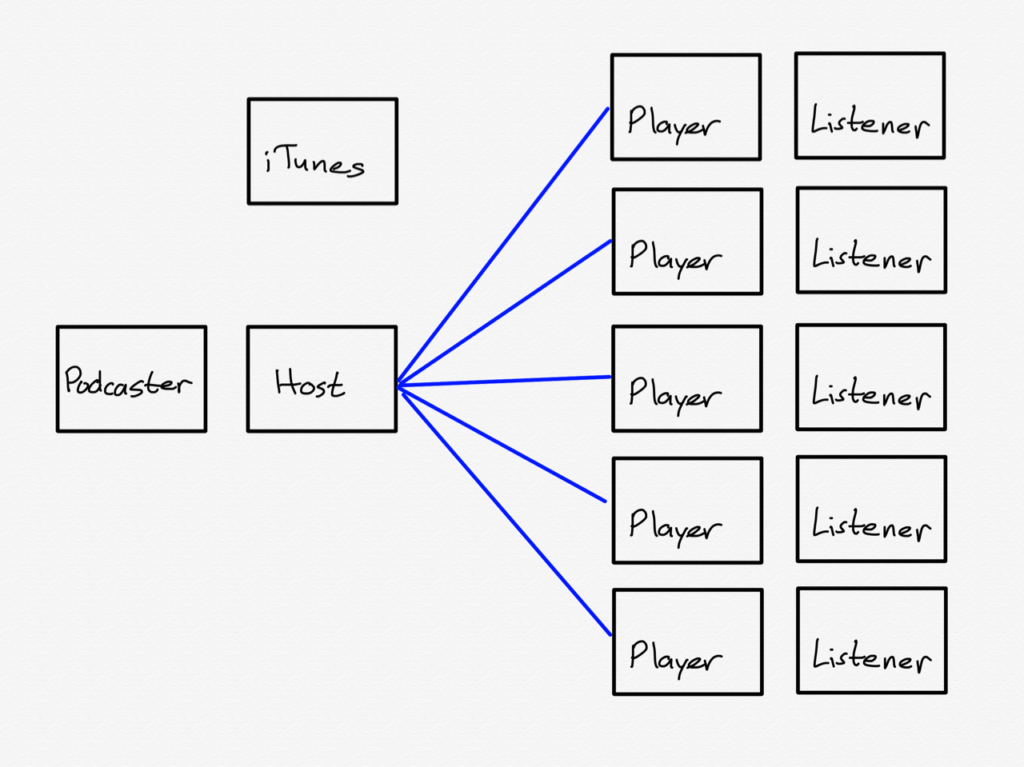
HTTP and SMTP, though, are not the only open protocols available to publishers: RSS is another, and it is the foundation of the podcast ecosystem. Most don’t understand that podcasts are not hosted by Apple, but rather that iTunes is a directory of RSS feeds hosted on servers all over the Internet. When you add a podcast to your podcast player, you are simply adding an RSS feed that includes information about the show, and a link for where to download new episodes.

iTunes is only a directory

This, if you squint, looks a lot like email: create something that listeners find valuable on an ongoing basis, and deliver it into a feed they already check, i.e. their existing podcast player. That is Dithering: while you have to pay to get a feed customized to you, that feed can be put in your favorite podcast app, which means Dithering fits in with the existing open ecosystem, instead of trying to supplant it.

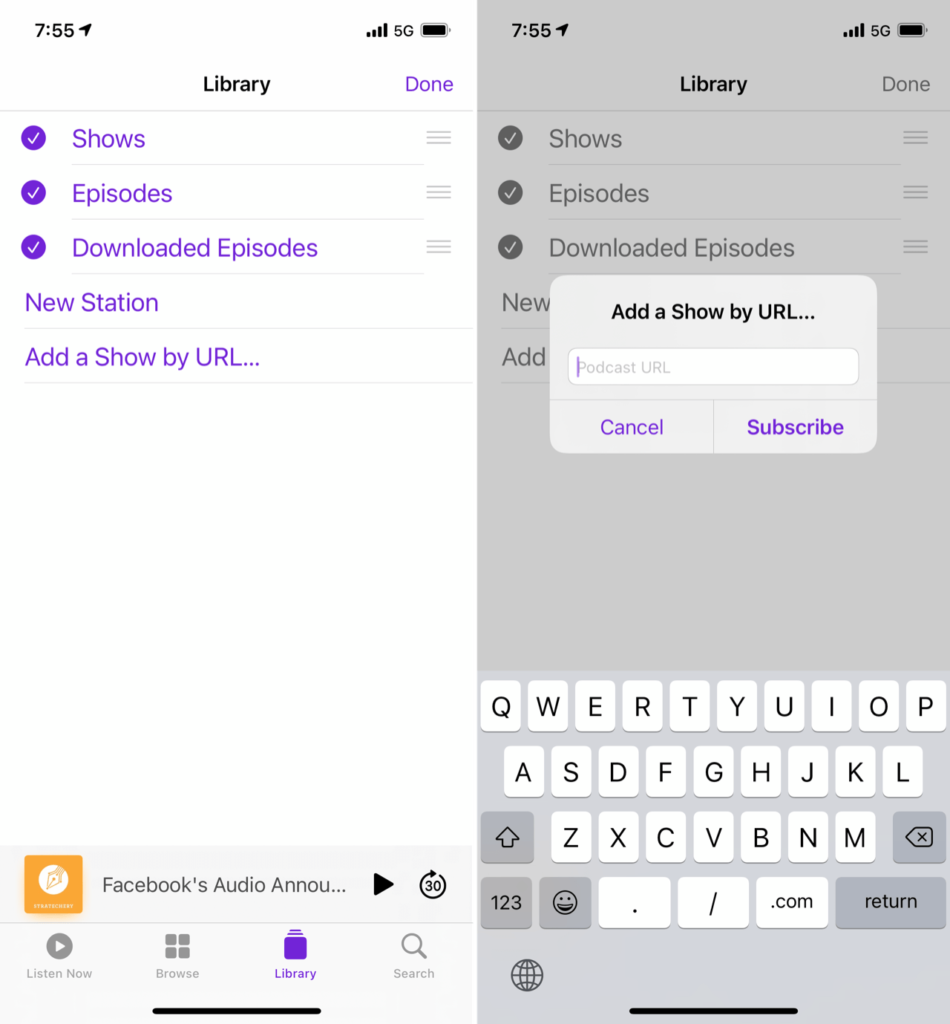
The implications of this are fascinating: you can not only listen to an Anchor podcast in Spotify, or an independent podcast player like Overcast, you can even listen to it in Apple Podcasts; I posted this image last week:

Adding a podcast by URL

I expressed concern on Dithering about whether or not Apple would shut off the ability to add arbitrary RSS feeds in order to force creators to use their subscription offering; I hope not, as it would be shutting off Apple Podcasts from the open web even as Spotify is embracing it.

Whose Customers?

As I previously explained when writing about Spotify, I have multiple perspectives on podcasts: the first is my role as analyst, the second is my role as publisher, and the third is my role as a podcaster.

When it comes to Apple, Analyst Ben thinks that Apple’s Podcast Subscription service makes a lot of sense, and is a good example of how Apple can compete on the user experience; Podcaster Ben, meanwhile, would prefer to have my shows everywhere. Publisher Ben, though, has one big hangup when it comes to Apple’s offering:

As I noted above, I’m actually very open to allowing Apple to be my payment processor; in my experience, though, a critical part of the creator business model is having a direct connection with your customers. That is something Apple simply doesn’t allow. From the Podcasters Program Agreement:

Personal Data. In connection with any Podcaster Content hosted by Apple and made available in Apple Podcasts under this Agreement, You represent and warrant that You and Your personnel, agents, and contractors will not access or otherwise process any information that can be used to uniquely identify or contact an individual (“Personal Data”).

This makes it crystal clear that every subscriber that signs up is Apple‘s customer, not mine, and while the revenue may be nice in the short run, it is fundamentally constraining in the long run. I believe that creators will increasingly monetize across apps and experiences; Apple, though, won’t even let me email folks to let them know about what is happening beyond the podcast.

Anchor says it plans to be better in this regard, promising to add “email subscriber” functionality specifically; that’s a good start, but it’s important to note that when it comes to money the subscribers are ultimately Anchor’s, not the publishers. Publisher Ben isn’t too happy about that.

The Spotify Open Access Platform

This was the second big surprise, and full disclosure, it affects me personally, and in a very positive way. From the announcement:

Are you a creator or publisher who has subscribers elsewhere? We’re also working on technology that will let your listeners hear your content on Spotify using your existing login system. This gives creators with existing subscriber bases the option to deliver paid content to their existing paid audiences using Spotify, retaining direct control over the relationship.

I am in fact a creator or publisher who has subscribers elsewhere! That’s my entire frustration with Apple and Anchor’s offerings, and why Publisher Ben was so opposed to Spotify’s moves in podcasting, even as Analyst Ben thought they were a great idea; from a Daily Update last year:

Analyst Ben says it is a good idea for Spotify to try and be the Facebook of podcasting…Podcaster Ben certainly sees the allure: having my podcast available to Spotify’s 271 million monthly active users would be great.

Publisher Ben, though, remembers that my business model is predicated on a higher average revenue per user (thanks to subscriptions), not a higher number of users; that means making tradeoffs, and foregoing wide reach is one of them. That, by extension, means not agreeing to Spotify’s terms for Exponent, and accepting that leveraging RSS to have per-subscriber feeds makes having the Daily Update Podcast on Spotify literally impossible. More broadly, owning my own destiny as a publisher means avoiding Aggregators and connecting directly with customers.

For full disclosure, I have been briefed on the Open Access Platform, and Spotify has addressed all of my concerns; no, they won’t support arbitrary RSS feeds, but instead another open technology — OAuth. Some time soon Stratechery and Dithering subscribers will be able to link their subscriptions to their Spotify accounts, and Spotify isn’t going to charge a dime — they will be my customers from email address to credit card. Spotify Chief R&D Officer Gustav Söderström told me, “Having all of audio on Spotify means meeting independent creators on their terms, not ours.”

Needless to say, Publisher Ben is very happy about this news, and Podcaster Ben is excited to have his work available everywhere. Analyst Ben, though, is pleased as well: Spotify isn’t simply ensuring it has all of audio on its app, it is also sending a powerful signal to creators of all types that their corporate incentives are aligned with what matters to creators.

Spotify’s Facebook Play

While most of Spotify’s announcement was devoted to their new subscriptions offerings, the company also announced that the Spotify Audience Network was now available to podcasts hosted on Megaphone (which Spotify acquired last year) and Anchor (on May 1st). This is the Facebook play I was referring to: Spotify wants to accumulate the most podcast listeners and construct a self-serve ad market place that delivers personalized ads at scale.

Again, Analyst Ben thinks this is smart, but shouldn’t Publisher Ben still be a bit nervous about an Aggregator in my space? Not at all — in fact, Twitter and Facebook are great for Stratechery; if your business is based on word-of-mouth, then giving your readers a voice is nothing but upside. And, while I have never advertised Stratechery, Facebook and Twitter would be the obvious — and most accessible — choices if I did (and don’t underrate LinkedIn). I would never use a Twitter or Facebook subscription product — see the part above about owning my users — but that’s ok, because the web is an open alternative.

And, now that Spotify has fixed the openness problem, I see upside in their approach; it will actually be easier to have a mix of free and paid feeds than it is with custom private RSS feeds, which means a new customer acquisition channel, while the Spotify Audience Network might be the first podcast advertising product that is easily accessible for smaller podcasts. Facebook and Twitter would do well to reconsider their subscription plans to accommodate independent creators like Spotify has, instead of trying to capture them (and Apple too, but I’m not holding out hope).

An Exponent Announcement

I apologize if the Analyst/Publisher/Podcast Ben nomenclature was a bit over-the-top; the reality is that writing about Spotify has always been a bit more fraught than most other companies given that it affects my business, and I wanted to be open about that. I have tried, though, to practice what I preach: that is why James Allworth and I made the decision to remove the Exponent podcast we co-host from Spotify. Yes, Exponent is free, but every listener on Spotify was one I couldn’t convert to a customer as an independent creator, which meant saying no to the would-be Aggregator’s audience.

It’s important to point out that the foundation of the Spotify Audience Network is Streaming Ad Insertion on Spotify itself,2 which, as the name suggests, depends on Spotify’s streaming infrastructure being far more capable and flexible than downloadable MP3s served over RSS. That’s why I wasn’t necessarily mad at Spotify for not supporting private RSS feeds: they made their decision for business reasons, and I made mine.

That, though, is why advocates of the open podcast ecosystem should be pleased with Spotify’s adoption of OAuth: there are good reasons that the company will never support private RSS feeds, but when there is a will there is a way, and Spotify has shown the will to support openness and independent creators. To that end, Exponent has an announcement:

Here’s hoping other Aggregators follow Spotify’s lead.

I wrote a follow-up to this Article in this Daily Update.

  1. Note the link in show notes: show notes are a part of the podcast, not the Spotify app, which means that it should be excluded from Apple’s ban on linking to the web for digital content subscriptions. After all, the link was placed by the podcaster over the web, not Spotify via its app.
  2. Ads served on Megaphone are inserted on download
03 May 18:34

Connectivism

by Stephen Downes

Unedited AI-generated transcript of a talk given online April 27, 2021.

So, hello everyone. As was stated in the introduction, my name is Stephen Downes and it's a pleasure to be here. It's April 27 for me April 28th for you in Malaysia and this presentation is simply called ‘Connectivism’.

After remember to start to record. There we go. Now, I've started the video recording as well. Now, this is we have two hours and I've got lots of slides and lots of talk. And we can do that and that's no problem. But I want to emphasize that this isn't supposed to be a whole lot of information that I present to you and that you remember.

This isn't that at all. I am creating a record of this so you can go back and look it up anytime you want. You don't need to learn it. I want you to you know, kind of sit back. I don't be idle don't just passively sit and listen. Maybe keep a note to the side.

Of your page or something like that. Not to record what I said but to record your thoughts and I want you to think as I go through this presentation think about what I'm saying from your perspective from the perspective of your experiences and think about how you would use the ideas that you see me presenting in something that you were doing perhaps a blog post that you're writing perhaps a class that you're.

Creating. Maybe think of a conversation that you might have between you and your colleagues. Perhaps even focused on one single slide not the whole talk. So don't just take this as me presenting a whole bunch of information. I know it will look like me presenting a whole bunch of information.

But I don't want you to think of it that way. So far as interaction is concerned. I have access to the chat and I've set it up so I can watch the chat while I'm giving the talk. And so, that means that if you type something into the chat.

I'll see it. I might not respond to it, but I might You never know. Also, if you would like to speak that's fine with me, but you have to figure out how to get the attention of the organizers. I'm not sure there is an opportunity for too much speaking, but if there is.

That's fine as well now your words will not show up on my recording. But if you are recording on your side as well, then your words may well be captured by the WebEx recording.

So that's. The ground rules if you will to start. So. The topic and I hope you appreciate my flower picture is simply connectivism. And. I haven't spoken about connectivism for quite a while. I wrote a paper a couple of years ago called recent work in connectivism, but you know, I haven't been developing the theory or writing on the theory.

Although I could say and I would say that all of my work really is involved in different aspects of connectivism. But my approach to the theory isn't one where I have to develop a theory and then spend the rest of my life promoting it and defending it. I don't see theory or science in general as you know, being like politics or popularity contests the theory stands or falls on its own merits whether or not I promote it.

Indeed whether or not I talk about it. And I want you to think of this theory as. My perspective. On these topics. I'm I'm pretty sure that I'm on the right track otherwise. I wouldn't be talking about it but everything I have to say here today should be subject to empirical test.

Should be subject to credibility you should not simply take my word for it. I'm only one person. I only have one hifetime to work with and even though I've been able to collect from and read a large number of very talented and insightful people. I still only have one perspective on that and our understanding of how learning works and how knowledge works will transcend any.

Thing that any one person could could say could write could do. Oh I only have three I actually have four parts.

First of all, I'll talk about what connectivism is. Secondly. I'll talk about connectivism as a learning theory looking at how learning actually does occur. Third. I'll talk about interpreting connectivism. And then fourth and pretend it's there. I'll talk about connectivism as a theory of pedagogy or a theory about how to learn now.

I've roughly set this up as one half hour for each section. I'm gonna try to keep to that schedule. I'm very bad at keeping the schedules but I'll try. So let's begin then with what is connectivism. Well connectivism has to do with learning. And we ask to begin what is learning and there have been all kinds of choices or options or theories presented over the year.

Gonyea, for example says learning is a change and human disposition or capability. Which is a theory that reflects a behaviorist approach as characterized by say gilbert rail. From a more cognitive cognitive as to perspective mayor talks about learning being a change in a person's knowledge. Changes also. At the cornerstone of Bingham and Connor's argument that learning is a transformative process of taking in information.

And we also have the sense of acquisition or acquiring knowledge and skills from both Smith and Brown. I don't think learning is any of that and I think these theories are incorrect in some important ways they are what I call blacks box theories. And what I mean by a black box theory is that they don't tell us exactly what is happening.

When somebody says learning is a change in disposition. What that means is that they behave differently after learning than they did before learning but how does that happen what makes that happen we don't know if somebody says somebody acquires information. Again, that's something that's happening inside a black box but does it mean to say they acquire information did they put information in their head so I don't really think that's the case.

For me connectivism is the thesis that knowledge is distributed across a network of connections. And therefore that learning consists of the ability to construct and traverse those networks. I've talked about and use that definition many times and today I'll talk quite a bit about what I mean by that.

Okay. Yours is saying are you using a presentation slide in this show it's not shown to us, oh, I see what's happening.

Okay. I'm using a single video camera to share my video and my screen but I see it's only showing up is very small in your presentation, there should be a way to make. To to make it. Yeah, you can set the speaker in the stage, so the organizer has to do that.

I believe or I can change it. Ridge.

Okay good. All right. Yeah, you side by side layout right that's it use side by side layout if you're seeing it only very small and then if you do that, you can see me nice and big and you can see my slides nice and big. So if that continues to be a problem, let me know every every video conferencing system is slightly different in this regard.

But I do prefer doing it like this rather than just sharing my screen because I think that you being able to see me speaking as well as the slides as well as other things that I will show you as an important part of the presentation and it's better than just staring at a static slide, which is incredibly boring.

I know I've been there.

So. What does it mean then for a connectivist what does it mean for me to talk about learning well when I say that connectivism? When I say that learning is in the formation of connections in a network, I mean that quite literally this is not a metaphor there are a lot of theories of learning are based on metaphors, we'll talk a bit about that this is not a metaphor when a person learns or when something learns a connection actually is physically created between two nodes or two entities in a network.

And what do I mean by a connection? Again, this is an actual description of a physical event not a metaphor not a black box. I say a connection exists between two entities. When a change of state in one entity can cause or result in a change of state in the second entity.

Hello, there are different ways of thinking about that we can think of one neuron being connected to another neuron and the activation of the one neuron changing another neuron or we can think of one person saying something at another person hearing it and so the other person is changed by the first person there are different ways to think of that but the connection needs to be an actual connection not a metaphorical connection not.

A relation not a conceptual relation there needs to actually be a change of state. And again this is all about getting away from the black box right getting away from mysteries and well we don't really know and you know, you just have to conceptualize it for me. I want to know what learning actually is.

So. On that account, what is it to learn? Well learning is a thing that networks do it's a thing that all networks do and arguably a thing that only networks do. And it consists of the following either the addition or subtraction of nodes in the network or you know, the the entities that are connected to the rest of the network.

The addition or subtraction or strengthening or weakening of the connections between those notes. And those first two are known collectively as plasticity and sometimes you'll hear people talk about neural plasticity and what they mean is that in the brain. We sometimes well, we more often lose neurons and gain neurons but the connections form and break between neurons as well the the subject of neuroplasticity is talking about how the brain is learning.

And then we can also talk about changes in the properties of the nodes or the connections. I mentioned, for example the strength of a connection can vary can be a stronger or weaker connection. It might take more or less energy for a change of state in one node to result in a change of statement another node and inside neurons as well as we'll see there can be changes in activation functions.

I want to give you an example of the sort of thing that I mean, hopefully you can hear this as well, we'll see. I'm not hearing it that's not good.

Well what you should see here. Is a bunch of well, they're called metronomes and basically they just beat back and forth and they were started off randomly, so they were not all going at the same time. And as you can see in this video. They slowly. Become synchronized and now if you look at them, they're all going at the same time.

And the question is well what's happening here well each one of these metronomes is connected to the others and the way they're connected is through that piece of wood and that piece of wood is as you can see there that piece of wood is sitting on those two pop canes so that each time a metronome goes back and forth it pushes a little bit on the piece of wood which moves the word back and forth in this feedback.

Between each of these things and you can actually describe it mathematically results in the metronomes becoming synchronized each metronome indirectly reacts to what's happening in the other metronomes. This is an example of what is called self-organization and the idea is that independent things like metronomes in this case that are connected together can by virtue of that connection alone become organized or synchronized themselves without needing any other intervention, it doesn't need direction, you don't need to organize the synchronization there isn't at?

A head metronome. Nothing like that. And that's the sort of thing that I have in mind. I do wonder why that didn't give me audio but oh well.

There are different things that can learn because there are different kinds of networks. This is a really important diagram. On the left hand side. I've stolen a drying all the references for my images are in the notes of this PowerPoint and this PowerPoint will be available after. So on the left we see a neural network.

And on the right we see a social network. And connectivism is about learning both in neural networks and in social networks. And one of the big differences between George Siemens and myself is the way we interpret this picture. And the way George would say it is that this is all one big network that our knowledge consists of all the connections inside our mind and the way this is connected to everything else that's in the world and the way it's connected with itself.

So, our knowledge is partially in ourselves and partially in Twitter or in WordPress or Pinterest or our network of friends, etc. I keep these two separate. I think personal learning is one network and social learning is another network and they're two separate networks. But they interact with each other through the process of perception.

And perception is the way a neural network is able to interact with the social network. Unmanned communication conversation is the way the social network is able to interact with the neural network. So I think that would describe this interface and we'll talk about this a little bit later is a process of emergence and recognition.

Let's look at George's principles for a bit. George Siemens wrote in his paper on connectivism in 2004. And he came up with these eight principles. Learning and knowledge rests in a diversity of opinions and that of course is to state that learning and knowledge existing networks. Not just in one place.

And learning is a process of connecting these notes in the network and that's his second point. His third point learning may reside in non-human appliances, that's the idea. That personal learning and social learning are all one part of one large learning network. He also says the capacity to know more is more critical than what is currently known.

And that's an important point. I won't talk a whole lot about it, but we both agree that learning isn't just the acquisition of content learning is about developing a way of seeing and interacting with the world. For example, we reach his fifth point nurturing and maintaining connections is needed to facilitate continual learning.

And indeed the sixth point the ability to see connections between fields ideas and concepts as a core skill. Now, I ask what does that mean? Because I always ask what does that mean? And we'll talk about that later. Currency says George meaning up to accurate or up-to-date knowledge is the intent of all connectivist learning activities and decision-making is a learning process.

And I'll talk a bit more later on in this presentation about that. I have a video of George speaking. I don't know if we'll be able to make the audio work. It was working before. And now it's not.

And it's still not is it. Now, I'm not hearing it either this is my fault. I messed up the sound let's try opening the sound settings. Nope they're learning and the way in which they connect and well that'll work, okay. Somebody has an idea on a blog over here.

I read about it. I've the late night. Here we go. Sorry about that I started blogging in a late nineties or oh you can ask and as I was blogging I found I had a very different relationship with other people and with knowledge than what I had had when I was learning in a classroom or a university program.

The biggest difference I found was this the way in which people are aware of one another while they're learning and the way in which they connect and build and improve. And so somebody has an idea on a blog over here. I read about it. I write a post and corporate some.

Of those ideas but try to expand it and add my own perspective. I posted someone else comes by and take some of those bits and pieces and expands it and augments and so on. We could say at a very broad level that's exactly what science has done. This notion of combinatorial creativity right that we we we connect knowledge we'd be build we grow we advance.

But at that point it was more for me it was a very odd experience as mentioned as a Red River College and so I was involved in a training or in the in my interactions with faculty. I was one of the few folks in the system at that time that was very active around trying to find new ways to teach with technology.

But I found online all the sudden there was a rich group of blogs and colleagues from other universities other systems and not just in Canada or US, but globally there there were some fascinating things going on in the space. And so my learning in that setting wasn't the instructivist way.

It wasn't necessarily a purely self-regulated way. I Were. I was taking books out of the library and reading them a reading journals and saw it instead it was really a social connected process of learning and that's what eventually resulted in a paper I did in 2004 where I argue that in a network world learning is a network forming process knowledge is a network product, so when we are knowledgeable it essentially is reflection how we've connected concepts and ideas over a period of time that's getting a little bit more detail this happens at three distinct levels, so on the one hand literally at a biological.

Level learning as a network farming process neurons firing neurons connecting if we move that up one level and this is a big level to move up on actually but at a at the same level network learning consists of taking concepts and forming conceptual connections, so as we get a new idea we connected to what we already know and that rounds out our perspective and often deepens our understanding that the final level is one that we're all quite familiar with actually but that's network learning through external social spaces, we might use tools like Twitter or Facebook or any number of few.

Er to emerge network tools, we might be connected through a mobile devices staying and if we have a question why don't say we're a salesperson in a workforce we have a question we can text colleagues or those kinds of activities, but that's where the social systems and the technology systems are now part of human knowledge more and more part of human knowledge become a part of our overall capacity to know.

Okay, so that was George Siemens.

So. Connectivism can be distinguished from other learning theories and a few important ways. One way is to distinguish it from theories that are based on content. For example. Instructivism or transactional distance theory and distance education. Connectivism says that the brain is not a book or a library it's not an accumulation of facts and sentences and propositions that we bring in we organize and we store like a whole bunch of stuff the brain does not get full.

Of too much information there's nothing resembling the pages of a book or the books of the library there's nothing resembling the text and the sentences inside the brain if you cut open a brain or if you analyze a brain you will not see any of that all you will see is this network and this signals that go back and forth between the different entities in the network.

What? I mean by that is that therefore connectivism is non-cognitivist. You've probably seen a lot about knowledge and learning but is based on cognitivist theories of mind. Cognitivist theories of learning where they talk about sensory memory and working memory and long-term memory. They talk about encoding and constructing schemas and cognitive load.

All of this is from a metaphor of the computer is being like an information processing system. Very much like a computer. But the mind does not like that. There are ways that we could interpret some cognitive phenomena using the metaphors of working memory for example or cognitive load, but these are not descriptions of processes.

These are not descriptions of actual learning that occurs. As I say the brain is not a computer. If you think about it. You know, we we have theories that tell us that learning is about constructing knowledge or representing reality. A lot of constructivist theories tell us this. But what does that mean and again we run into this black box problem?

You know for the brain to be like this. It has to be some kind of representational system. Like a language or a logical system, or even in a graphical image system or some other symbol set. Some other system of signs where the signs represent objects. I guess out there in the world.

And there would have to be rules or mechanisms for creating entities and manipulating entities in that representational system. And there's nothing like that if we look at actual cognition, there's nothing like that that's happening. And it's interesting because you know people are using this computer metaphor to talk about human learning when even artificial intelligence doesn't use this model anymore.

This model characterizes what we used to call expert systems. Or symbol based systems or rural based systems of artificial intelligence. But in fact almost all artificial intelligence has moved away from this model and uses the model of neural networks. So we'll talk quite a bit more about that.

Connectionism to me is a non-representational theory. That makes it very different from other theories. What? I mean by that is there's no real concept of transferring knowledge making knowledge or building knowledge. Rather learning and knowing our descriptions of physical processes that happen in our brains. And when we learn when we know what we're doing is more like growing and developing ourselves the way we might build and that has to take to do this but the way we might build a muscle.

Okay is the way we build learning and you don't tell a muscle okay muscle. Now you will get bigger. You don't acquire new physical strength. That's not how it works. And I don't know why people when they're talking about learning would think that it's different. We're working with a physical system the human body composed of physical properties and in particular a neural net that grows and develops based on the experiences it has in the activities and results of those activities in undertakes.

We're running a little bit behind but not too bad. How does learning occur? Now we get into some of the fun stuff about connectivism. So, they're a little out of theories over the years about how learning occurs and in fact there's a whole domain of learning theories about processes.

There's called for example. There's Dewey's model of experiential learning. You notice they're all kind of like loops and they're all kind of doing the same sort of thing. You know, concrete experience observation theory and deductive inferences on and on called for example, now what these are doing. Or talking about the processes that create learning and in fact.

We could go on forever talking about the processes that create learning and talk about whether this process is better than that process. But what we're doing is we're describing the conditions around the person rather than the person themselves. And we're talking about the sorts of activities like gun gays nine events of instruction.

You know talking about the activities that are set up and organized by an instructor or a teacher rather than what learning is like from the perspective of the individual.

Here's what learning is like from the perspective of the individual now this is just one of many kinds of neural network, we'll talk about that but this kind of gives you an idea. Look at the way this network works we have what we might call an input layer, whoops.

We have an input layer of neurons these are connected to a second layer which identifies edges these are connected to a third layer that combines edges these are connected to a fourth layer that identifies features now this is the sort of processing. If we can call it processing that happens in the visual cortex that's located back here comes in through your eyes and sits back here and what it does is it takes all the input impacting your eyes and detects what?

I believe it was mar described as the two and a half dimensional sketch edge detection and all of that. Now these are our interpretations of what these neurons are doing these neurons aren't actually saying oh I'm looking for an edge right that's not what's happening these neurons are simply receiving input and then sending output that's all they're doing they're not intended to or created to detect edges that's the interpretation that we put on that's what we say that they are doing from our perspective.

Now George talks about networks quite a bit and he talks about networks having various characteristics and I don't think that any of this is wrong at all but I think we want to sharpen our discussion of it so he talks about networks having content. I'd rather talk about networks having signals than content people talk about the data or the information.

In the brain or in in our mind, these are very technical terms. A data represents a fact information strictly speaking if we follow say dreets key is the reduction of possible states of affairs in the world from the point of view of the receiver. Not really specific thing to say is in a network, so I'd rather just say signals.

In that works as George says there are interactions there are connections forming. There are also signals sent through these connections that's how we get interactivity one entity sends a signal to another entity that has the potential of changing the state of that entity. There are static knowledge structures and we'll talk a little bit about that when we talk about distributed representation but it's also dynamic it's also constantly receiving new signals as George has new information new data.

I would say new perceptions. There are he says self-updating nodes. Will be a little bit more precise and then emotive elements. You know, it's not just about visual sensation it's not even just about the five senses our neural network is connected to all aspects of our body so as David Hume what's famously said, you know, you know a dream might just be a pain in my gut yeah our emotions our sense of movement a vertical sickness nutrition all of these have an impact on our neural networks.

We still want to talk about this more precisely, though. When I've talked about learning theory in the past, I've talked about ways of creating. Connections between entities ways of creating these networks and I talk about four major. Types of connectivity something called heavy and rules. Which is basically the principle with fires together wire together if you have this neuron and this neuron and they both fire and they both stay silent and they both fired and they both stay silent at the same time, they will eventually grow a connection between each other fire silent growing the connections fire sign on a growing the connection.

That's the simplest form of network formation another type of. Network formation is contiguity. That works at our beside each other will organize so that they form I don't want to say a lattice or anything like that. It's a bit too complicated but for example the different cells in your eye are arranged beside each other and that informs how they're connected to the different layers of the visual cortex.

Another method for. Learning in networks is something called back propagation. Now, it's not clear that back propagation works in human neural networks. Although we do say, you know, people learn from feedback. Certainly back propagation is used in artificial neural networks. It was developed by Rebel Heart and McClellan in the 1980s and for a long time was the most promising form of neural network learning.

And my personal favorite is bolts and connectivity and that's the idea that a network tries to achieve the most thermal dynamically stable state. So the connections in the interactions are all the network trying to settle in to the most stable configuration. Sometimes we talk about that process as being similar to annealing or the way you hardened metal by heating it up and cooling it down.

I like to think of it is like when you throw a rock into a pond. Oh, you know a pond is composed of atoms of water and these atoms of water slosh and jostle but eventually they all settle into a nice flat state again. Now, these are rough generalizations and when you actually look at actual neural networks that people are creating you won't see these rules in particular.

When these are ways of thinking about types of rules. When we look at actual artificial neural networks, there's two major categories machine learning and deep learning machine learning involves some human intervention to identify or classify the data deep learning uses layers of neurons to identify and classify data on their own deep learning is much more like human learning than machine learning because we don't have little men inside our heads.

Classifying features for us. Some of the theories that I read make it sound like that, but we don't. There aren't.

Now. What makes and this is one of the key questions what makes neural networks work. Well, you know, I mean right now in the field of artificial intelligence, the answer is trial and error they're trying out a lot of different neural networks and some of the work. But really what it boils down to is the different way she can organize and set up these networks and then you set them up so that they can adjust to meet if you will the sort of output that's desired.

And that's where the concept of training will come in will come back to that. So here, for example is what might happen in one single neuron. We have some connections coming in from other neurons. Other entities in the network. Each connection has an input each connection has a weight.

And then our neuron in this case adds them all up. That's what that little sigmoid says adds them all up. Now we can easily imagine different kinds of functions there where it doesn't just add them up maybe it takes the strongest one, maybe it takes the strongest two, maybe takes the middle to and drops the strongest in the weakest, you know, in many ways we can discuss we can describe this and as an aside.

In artificial neural networks, we're only working with a few different types of neurons but in a human brain there are thousands of different types of neurons and I think that kind of diversity in human brains is really important but we're a long way from understanding how that plays into this how different types of neurons interact together.

Anyhow. This neuron will take in all of this information and do something with it and then it goes through what we might call an activation function and what that means is does the neuron send the signal on to the next neuron. Now these in actual neurons these activation functions are built from electrical potentials, and somebody who is far more versed than I am would talk about the chemistry of how the electrical potential.

Of the neuron builds until it reaches a certain point and then the neurons spikes where sends a signal and then the potential drops back down to zero until new signals increase it. There are very detailed descriptions on a molecular level of what's happening inside an iron of this type.

Also, now you can have. Different types of networks. I talked earlier about a heavy in network. Here this is the same sort of thing only here we're not going to call it a heavy network. We're going to call it a feed forward neural network or perceptron. This was one of the earliest types of neuron artificial neural networks.

And you can see the signal goes through the layers and in an individual neuron the signals come in they're added the activation function. Decides to fire or not and then it fires. These are simple. Networks they can only be used for what we call linear regression. In other words, straight line or curved line linear relationships between things.

So can look at tabular data image data text data, but it can't learn about complex relationships. A different model called a recurrent neural network will actually feedback into itself. There's a little loop there you see that and that way it preserves data that comes as a series, for example the words in a sentence or events that happened in your life.

And so here these neurons are able to get. You know, each word in turn as part of an overall. State internal state and then it's going to determine whether or not it fires off again in similar manner as the other neurons that we talked about. And it's used to solve problems related to time series data text data, like language translation audio data such as automated transcription.

I'm using such a system on my phone right now. It's recording the audio and as I record the audio it's actually transcribing the text of what I say and it's using a network similar to this to do that. There's another type of network. Called a convolution neural network that captures in this case the spatial features of an image.

And then bring some together. It looks at in other words the arrangements of pixels in what's presented. This is similar to the contiguity type of network that I talked about earlier where the neurons are related to each other according to how they are organized on the retinal cells how they're organized in the eye.

And there are more. There are even more networks. But I want to give you a feel for what they're like, I feel for what the different types of neural networks look like.

You see how it's recognizing the different numbers from the perceptual input?

So, What I hope you get from that. Is not not only. The idea here that you know, the the recognition and interpretation of in this case these numbers but you know pretty much anything is or can be done by a network but also the incredible complexity of the networks that are doing this processing these were, you know, networks of thousands in some cases millions of connections.

And that's still a small fraction of the types of connections that we can have in the human brain. We have a hundred billion neurons in the brain and many more connections. So we have incredible complexity incredible capacity. To. Well I was going to say process information, but that's not what we're doing is it to receive and transmit and reorganize and grow.

To produce interesting and relevant phenomena for me to see something and respond. You know, the change in disposition as some people would say but a change of disposition that is learning that can be explained by a change in the neural network. Now I don't think that will ever be able to say this specific change in the network produces this specific type of learning.

Because although we are all human and we all start off with a similar set of neurons our experiences. Change their different for each one of us from the moment of our birth. So your neural net and mind your own net although there may be similarities, they are nonetheless going to be different and the sort of things that would lead you to say something and would lead me to say something are very different and a good example of that is language.

I have a word flower that I used to represent or not even a represent but to talk about things that I see you have a different word in your language neither of those words is right, they're both based on the different background and the different experience that we've had in our lives.

And that leads us to training. Because in all cases. Neural networks are created by what is called training now in the world of education the word training has a bad connotation, let's leave that aside for the moment, you know, we're not worried about you know, whether something is vocational or academic or anything like that.

Training in this context is just the process. That a person goes through or even more accurately the process that a network goes through through repeated iterations of experience to acquire the configuration the set of connections and the set of weights of connections. Appropriate to whatever it's experiencing. But there are different kinds of training young epochs and iterations there's a whole language describing that but essentially it's this ongoing configuration on ongoing.

Feed its new century data process and again processes the wrong word adapt to that data.

So a long time ago, 2005. I was thinking about all of this and thinking about what George had done and thinking about the earlier works earlier working networks that I had done and thinking of this from the perspective not of artificial neural networks, but of networks generally. And I was asking myself.

What would make a good network? Well, because we want a network that's able to learn what we mean by that. Well, we want it to be able to respond appropriately. To the stimulus the perceptions that it encounters whatever that means and we want it to avoid. Some of the problems that might be caused in a network.

I remember in the 19. 90s watching a talk by Francisco Varela. Where he talked about the immune system and he talked about you know, finding that ideal weight of or the ideal structure of connections. And you don't want no connections. Things have to be connected somehow otherwise milk communication happens.

But by the same token you don't want everything to be connected to everything. That results in chaos is just nothing but loud noise. Kind of like our social media situation today where everybody's connected to everyone on Twitter and Facebook and nobody can make sense of anything. So I was thinking about well, what would constitute good design principles?

Now, these are hypotheses, you know, they're not rules. They're things they're principles that I think would be relevant when we're thinking about designing networks. So, here's some of them. First one is decentralized. This is the description of how you connect the different entities together and they're different ways entities can be connected.

But we saw in the the diagrams of artificial neural networks some decentralization. In the form of layers of neurons and that is a good way to decentralize but we can think of this as a more generic principle thinking of. Network in general as resembling a mesh more than a star.

And here's what I mean by that. This is. A network and so is this but in this kind of network we have this characteristic star formation as contrasted to this kind of network, which is a mesh. As contrasted to this kind of network, which has no connections whatsoever. So this obviously has too few connections there are no connections this also arguably has too few connections it puts too much emphasis and too much reliance on a few neurons a few entities which creates the possibility for failure if this neural neuron failed right here, that would be a catastrophe.

So what we're thinking about networks maybe in terms of organizing a company or a society putting all of your emphasis on a single neuron is to create a single point of failure and there's a lot of discussion about how a mesh kind of structure is a better structure for society and a better structure for networks in general.

Here's another. Another principle distribute to distribute your entities. Even in the brain are neurons aren't all located in the same part of the brain, in fact our brain actually has different different lobes. You know, there's a lot about to start listing parts of the brain because I've forgotten them but you know, there's a hippocampus and the cerebellum etc.

What we're thinking about networks in society. We don't want to put our entire network inside a single building. That would be a bad idea. Because if the building fails the entire network fails on the internet. We've seen the strength of distributed networks such as peer-to-peer networks. Like email. Or Nutella or content syndication networks like RSS.

And those often are more reliable than centralized networks like Facebook. Or Twitter. In fact, just yesterday. Microsoft teams went down. They went down for the entire network because it's not a distributed network. If we really wanted a good, you know team application, it would not depend on the single central source in a single central application.

Distribution also applies to representation and this is a really important concept. We sometimes think as though in our head there's a specific place where we have an idea. You know, you you point to your head. And you say in my idea of a cat is here my idea of a dog is here, but that's not actually how it works nor should it work that way.

And the reason for this is we want our ideas to be able to relate to each other. In. A natural and easy way. So, The way it works is. This is very simplified obviously but our concept of a cat if you will that is to say the neurons that are activated over time when we see a cat here they are.

And our concept of a dog, these are the neurons over time that are activated when we see a dog. Similarly, these are the neurons are activated when we see a fish. Now, what's important what's important is they're all using the same network of neurons. And that means the cat and dog can overlap.

The dog and fish can overlap the cat and fish can overlap. So what we know about cats influences what we know about dogs. What we know about fish influences what we know about cats and vice versa. That's a really important concept and I wish I had several hours to talk about just this concept.

But what's really important here is this is not the word cat in our brain. There isn't a formal logical structure or classification of cats dogs and fish. They just happen to overlap our perceptions overlap in the neural network the way our neurons are organized, that's it. And that's what we might call a sub symbolic representation.

I again, I don't like the word representation for various reasons, but it's sub symbolic we are not using symbols we are not using. Words. We're not using rules of grammar or anything like that, it's all the activations of neurons the connections of neurons. Another one of these principles was disintermediation.

And this is the idea of removing the barriers between the source and the receiver. This is more of something that works better in in social networks, it's sort of hard to describe in neural networks because when there's mediation in a neural network, we call that a disease and we think something's gone wrong with the brain.

But it happens a lot in social networks where we have editors and publishers etc that stand between somebody saying something to somebody listening to something. And. Where there should be. Mediation is only to mediate the flow that is to say. To make sure that we're not overwhelmed by too much information.

There are there are types of mental diseases where that kind of filter just doesn't work and the person is overwhelmed, you know, they have sensory overload all the time.

Disaggregate. By this what I meant said and this is similar to the whole idea of distributed representation the idea that we should stop thinking of. You know. Our knowledge our information or content as one single unified in divisible whole like, for example, take the concept of dog. It's hard for us to conceive of you know, a dog is not a single entity, you know in one sense we can we can think of a nose and ears and things like that, but on the other hand it's sort of hard not to right the dog really presents itself as an object in the world.

But you know linguists have had a lot of discussion about that, you know. Wilford van or man, for example, what does the word dog mean? Does it also include puppy? Does it also include a three-legged dog? Does it mean the overall state of the universe in the current form of a dog?

There are different ways we can interpret that concept in that perception and none of them is necessarily right and between you and me and another person we might all have different concepts. So we should not assume that the world comes presented to us a nice human shaped objects or human-sized objects it probably doesn't.

And these are interpretations that we are opposing onto the world.

Disintegrate. Entities in a network are not components of each other, they're independent. The structure of an entity sending is logically distinct from the entity receiving that's an important concept in systems theory. Which is different from connectivism all of the different parts of a network are all part of a whole and typically in systems theory that whole.

Is trying to move towards some objective or some purpose. Hey a lot of times people interpret say Darwin's theory of evolution that way that we are all evolving and that there are higher and lower forms of life. But evolution doesn't have a purpose. You know, we don't grow wings in order to fly.

Rather see other way around we're able to fly because through this process of random selection we've grown wings and that gave us an advantage. And that's why I say disintegrate, you know, the the entities we think of them as a single unit, but they're not. I sometimes represent this.

By talking about the distinction between learning using stories and learning using maps. Suppose. I'm discovering in new city. Well there's always somebody in the city who tells me how to get to Franklin's square say and they say oh you take this road to the end of the park then you take this street and then turn right here and then turn right again and then go up 17th and you're at Franklin Square.

And that's nice except that presents something very complicated very complex as though it were a single thing. But there are as you can see these alternative roots or I could choose to go to different places but even more to the point if my knowledge of the city is represented whoops as only this line then if this line breaks in any point if I miss a turn or something like that then I have no understanding at all.

But if I see the city as a set of distinct entities all kind of related to each other with multiple routes between them then my understanding of a city is much better.

I've also talked about the principle of democratizing networks. And when I first formulated it. I talked about the need for the entities to be autonomous and the need for them to be diverse and again I talked about the many different types of neural networks and we can talk about the many different types of people the mainly different points of view in a society which was also an asset.

I think that's something Malaysia in particular has learned to appreciate over the years with the many distinct cultures that it has. I know that I experienced that when I was in Kuala Lumpur. It was one of the really interesting things about the city. Over time. I've come to talk of this as the semantic condition.

This is the condition that for better or worse ensures that the network will stay coherent and the network has the capacity to respond to changing circumstances in the environment. Networks of characterized between groups and networks you might recall before I showed the diagram with the star and the mesh where the group is the star and the network is the mesh on this picture.

These four principles diversity autonomy openness and interactivity are principles that describe networks that are capable of adapting to changing circumstances. These principles by contrast represent a type of brittleness or fragility on the part of the network, it makes it more difficult for the network to adapt it makes it more difficult for it to learn and to grow.

So for example, unity. Now if everything is the same in a network. There's nothing for the members of the network to talk about. You can't be any change because everything's the same. Now of course, nothing is ever completely the same but a lot of times people push for more sameness in a society rather than less sameness.

In a human that would be a disaster. And in a society that makes it more difficult for the society to recognize different points of view that might allow it to recognize changes in say the environment different. Similarly with autonomy. If the individuals in the network, although still related to each other.

I'll still although still influencing each other if they are nonetheless each of them. Deciding we're not deciding but each of them sending signals according only to the input that they receive on their own. Then that network is more responsive than a network that requires coordination. Sometime now in a human it almost makes no sense to talk about coordination now some cognitive theories talk about an executive function.

That's like a little man talking in your head. And there is no little man talking in your head. In a society the more coordination you require the longer it takes to adapt to change. So the more autonomy you are able to have you know, this isn't him absolute but no more autonomy you're able to have the faster a society will be able to respond we've seen that a lot in military organization we I've been involved in various studies of military networks and a military is the classic example of coordination right everybody does what the general says but in fact when a military is engaged they try.

To make each of the units as autonomous as possible so that they can react independently to whatever situation they see in front of them because otherwise they'd be unable to react and they'd be vulnerable. Another principle is openness and there are different ways of thinking of openness openness of membership, so a network is able to add entities this makes growth a possibility for networks also open this from the perspective of if you will experience.

Or concepts. It's like having bridges to the rest of the world. And again, this gives it the sort of input that it needs in order to be able to react as compared to closed networks. Classic example of a closed network is the Apple ecosystem. Apple computers. Right. And a haploid computers famously don't work well with other things.

And you're as they say locked in to the Apple computer. If you want a new capacity, you can only one source to get it. You have to buy it from Apple. Then finally interactive versus distributive. That is to say Knowledge is created by the interaction between all of the different components in a network.

As compared to distributive where knowledge is created at the center and then sent out. And you see the distinction here. The best you can get from a distributive system is to have copies of whatever there was at the source in each of the different entities. You can never go beyond the capacity of one member of the network.

But when knowledge is created through an interactive process of all the individual entities working and interacting together then the knowledge of the whole can be greater than the knowledge of any individual. And that's a very important principle. We can see that in a human brain, it's absolutely essential because an individual neuron is not very smart.

An individual neuron cannot do anything except receive signals and send signals. But a human brain a hundred billion neurons all connected together is incomparably smarter. Same in a society. Right? Compared to a whole society and individual person is not very smart. Even the smartest person in the world. Is not as smart as society as a whole.

Now, we sometimes act as though they are. But arguably that's because we've organized our society very badly and really we're just comparing one smart person with another smart person. But a society that creates and forms knowledge as a whole. Is much smarter. Than any individual in fact the danger is when the individual substitutes his or her own perspective.

Over and above the society as a whole and and and you get kind of a dissonance. In the network again in a human there's no real example of that because there's no capacity for a single neuron to take charge couldn't happen.

Another principle is dynamize and you can see how this comes into play with the semantic principle. I just finished. And that network needs to be thought of as fluid as changing as growing, you know, it's only through the process of change that a network learns it's only through the process of change that the possibility of growth exists.

And then desegregate as a final principle. By that what I mean is although it's tempting to take your entities and compliment to different groups and say this is one group and this is another group and this is another group. It's probably a mistake to do that because even if we can see patterns and shapes and and you know clusters in a network, they network is nonetheless a single undivided whole and the individual elements we see in it are just our interpretation of what's in the network.

To give you a couple quick examples. This is the web of science now this diagram was created by looking at scientific papers that are published. And looking at the references in those papers. And then just sort of grouping them according to those references and we can see some clusters here's nursing for example, that's the red over here social work and dermatology and the study of skin.

Here's psychology. Down here we have biodiversity plant biology over to the right here we have biotechnology. Moving up into the middle here here up here at the top we associology Asian studies this group over here to the left is education anthropology, all of the different sciences are all on the same graph because they're all related to each other the people who work in these different domains all interact and communicate with each other now one person here doesn't talk to everybody.

Again that's Facebook or Twitter where everyone talks to everybody and all you get is noise right but they're connected just enough so that a concept in firm pharmaceutical research like say the discovery of MRNA as a cure for a virus could connect through the different parts of the network to have an impact say on social work.

And understanding that everything is connected in that way and structuring science so that everything is connected in that way. Probably in my view results in. A web of science that is more likely to grow and develop than if we just kept all of these different disciplines apart from each other.

Here's another example the art network from Barabasi and here's the museum of modern art and that can't even read the other text but again there are relations between all the different institutions and the different artists and the different schools of art and are similar pictures for music and for any domain that you care to think of you know in music we have big debates in this country, do you like rock music or do you like country music?

And you know, it's easy, you know, you want to categorize them into different things so they're so different from each other you have to pick one but they're really two parts of the same thing just different parts of a much more complex network and seeing the world that way and representing in structuring the world that way is more likely to be successful than keeping it all segregated into different parts.

Interpreting connectivism now. I'm running behind quite a bit but these sections are shorter. So I still have hope. So. What do we make of this? I mean. You know, when I talk about interpreting connectivism, it's kind of like interpreting say probability, right? Yeah, you have this theory in case probability all these mathematics but what does that say about the world, you know is probability really the frequency of events that happen like breaking box says or is it the number of total possible states of affairs the way Karna would say, Or is it how much he would bet on a certain outcome the way Ramsey would say.

Well, these are different interpretations different ways of taking this theory and applying it to the world. Now. Connectivism, in fact the whole theory of knowledge has networks. Can be found in the world in a number of different ways and it's interesting one of the advantages of a network way of looking at the world is what might be called parsimony.

Persimmony is the way I'm using it here means that the same theory applies in many different domains. And you know by the theory I might be talking oh I'm not talking necessarily about an underlying foundational theory, but we see the same thing in different places in mathematics. We have graph theory.

In computer science, we have connectionism. Neural networks and artificial intelligence. In biology, we have ecology and ecosystems. In sociology, we have social network analysis and actor network theory. In physiology, we have theories of perception and neuroscience and I've talked about a lot of these and if philosophy information theory and distributed representation.

All of these are different places in very different fields. That we can find the principles of networks instantiated. We see them out in the world as well. Networks in nature have a video. I'll show you in a little bit called a murmuration. We see it in social organization corporate networks political networks.

We see networks same infrastructure such as the electrical grid or the internet a worldwide information network. And we even see networks in social networks. Some of them better designed like the network of websites some of them badly designed to like Facebook and Twitter. Now. Connectivism was postulated in Georgia's original paper as a theory for a digital age.

And you know, I look at that now, he's look at these things unless I say well, what does that mean? Well to me. It comes down to the question of what is knowledge. Now here I mean, I've already said knowledge is the organization of connections in a network. But what does that mean on a day-to-day basis?

If I say Fred knows something. Yes, I'm saying Fred is organized in a certain way. But that's not very helpful to somebody. I'm talking to because that doesn't tell them what to expect. You know, so when I say Fred is organized in a certain way. Fred has a certain neural network.

He's grown his neural network in a certain way and therefore he knows something say mathematics, what does that mean? Does it mean that the person has memorized the multiplication table or the Pythagorithm theorem? Well, no, now let's not what I mean. Knowledge is more than memory. In fact, I don't think knowledge is memory at all.

Memory is like a parlor game where you're able to recite back what you were told. It's like the spelling bees that they have in the United States where you have kids memorizing how to spell obscure words with and without ever using them in a sentence other than in the sentence they use in the spelling bee.

They have no idea what they mean or why the word would be useful. Now on knowledge is something more than that. In my original discussion of connective knowledge, I said, there were three types of knowledge. Qualitative knowledge based on figure or property the color of something the size of something.

Quantitative knowledge, which is based on mass or quantity the number of things the weight of something. These are the types of knowledge you're familiar with and people talk a lot about qualitative and quantitative research, but I think there's this third kind of knowledge which is connective knowledge, which is based on organization and structure.

Okay again though, how was that helping me? How is that making it possible for me to understand what it means to say? Fred know something. Okay. What does it mean to be organized in a certain way? Well, We could represent it using the concept of emergence. And the idea here is that from the interaction of all the entities the way I talked about earlier something over and above that network emerges.

And here I want to show you the picture or the video of a murmuration. You might not be familiar with a murmuration, but here it is.

What you're seeing there are birds. In particular, they're starlings. Now. Stop looking at network like a brain or a computer network, but it's still a network. The Starlings are interacting with each other. And. We can see them for me shapes in the sky. And this behavior of starling is called a murmuration.

Now, we can see circles or kidney shapes we can see something like well we would call it a flock. Or it's moving in a certain direction. But there's no head starling. There's nobody in charge. And in fact the starling at one end of this murmuration over here on the left can't even see the starling on the right.

And in fact in a mermaidation, each bird is responding to a few of the birds around it. And you can actually see the waves that happen when one bird moves and then that causes the next to the move the next to the move and eventually you get a whole group of them.

And in this way suppose, for example, there was a predator that arrived at the edge of the flock all it takes one starling to the act and the entire flock of the reacts. Now, the reason why you say that this is the, Because what we can say of the flock does not apply to any individual.

And above the knowledge of any individual starling. And so when we look at the image that I shared. The same thing is true. If we look at that what we have actually is just a series of circles, isn't it? And yet when we look at this image we see.

A woman wearing a hat. This is a very common phenomenon. In fact, you're looking at me on a screen right now. And I'm not actually on your screen. What you're looking at is a whole series of dots. And. Because they're organized in the way they are you perceive me or an image of me.

And that's what we mean by emergence. So. When I say somebody knows something. What I'm saying is that they are organized in such a way as to be able to recognize. Phenomena in the world just in the same way you recognize a picture of a woman in that image or a mermaidation of starlings.

That's what a person who knows does. To know something is to be organized in a certain way sure to learn is to acquire patterns to learn is to have experienced something frequently enough so that we can form a characteristic response to that thing. So I say that knowledge is recognition.

If you think about it. It makes a lot more sense than traditional theories of knowledge. A traditional theory of knowledge might say you understand the parts of something or you understand the rules or you remember the specific configuration but suppose you are meeting your mother and a bus station.

And there's a crowd of people and you're looking and the crowd of people for your mother and then yeah, there's my mother now did you follow a set of rules no you did not. Did you look for something specific like her red shirt known you probably did not know what happened is out of all of those people one of them matched the pattern in your head and you just become suddenly huh there she is.

It's recognizing it's an instant awareness and instant matching of what's out there in the world with the configuration of your neural network as it exists and it's very individual. That is very context specific. I thought of showing you different images on that slide. I thought about showing you a dot matrix picture of Arnold Schwarzenegger.

Who's a well-known cultural figure at least here, but I decided no. I won't use that because you might not actually recognize him, maybe you do. I don't know. I don't know how popular are not. Schwarzenegger is in Malaysian. But that's the idea right if I showed the same picture to my grandparents before Arnold Schwarzenegger was even born.

Then they would not recognize him. I am being told he is quite popular in Malaysia, okay, well I could have used that example. But recognition depends on. You know what you have already experienced?

So from my perspective and I don't want to say that George shares this but from my perspective what we think of as literacy isn't about language, it isn't about rules and grammars, it's about patterns, it's about recognizing common patterns and phenomena. And so this to me gives me a very practical application of connectivism.

I don't have time sadly to talk about this kind of literacy in any detail. But if you search for my speaking in law cats presentation, you'll see this described in some detail. But basically I identify six major types of patterns that cost you the sort of social interactions that we would think of as literacy.

Now there might be more there might be fewer they might be better ways of describing these patterns, it doesn't matter. It's just a way of getting our mind around the idea. So here they are syntax semantics pragmatics cognition context and change.

And you'll recognize all of these ideas through most of the people that you've written about and read about but now think of them from the perspective of these are patterns in the environment these are things that you are wrecking recognizing because your neural network is shaped to certain way.

So syntax, for example. Syntax well syntax is not just rules and grammar, in fact. I would argue it's not rules and grammar at all no matter what chomsky says we can think of forms archetypes grammar might be repeated patterns in language, there's a series of grammar series called the code build series that represents grammar that way it's not a set of rules it's a description of common patterns that people use we see it an operation some procedures motor skills.

How to fix an engine how to remove a carburetor there are patterns in regularities in mathematics and substitutivity and things called egg corns. I encourage you to look that up. And similarities are types of patterns. We also have semantics theories of truth meaning purpose goals and but again, these are kinds of patterns sense and reference interpretations.

Remember I talked about interpretations earlier the different interpretations of probability. Forms of association. Again, the heavy and contiguity back propagation. And then other kinds of semantics in the world making decisions, voting finding consensus emergence itself is a pattern. Pragmatics covering use action impact. And people like Austin and John Searle have talked about speech acts and the way we do things with words.

The way we direct people or express things or make statements, but also harm people harass people bully people. We can talk about hate speech, for example under this category. And what hates bitch actually is? Interrogation and presupposition or patterns recognized by header and meaning in the idea of meaning is use is an important pattern recognized by Ludwig Vickenstein.

Cognition. Again, we tend to want to say that we need cognition in order to know and to learn but I turn this around and I say that cognition itself is a very involved form of pattern recognition and there are different ways we use patterns to do different kinds of inference.

Overall, I divide inference into four major categories description definition argument and explanation. There may be other forms, it doesn't matter again. Context. What do I mean by an explanation? What are the elements in common to explanations? Bossman frassin, for example says an explanation is an answer to a y question.

And you can only answer a y question. In terms of what else was possible. And that's a very common pattern a common way of reasoning about the world. Cline remember? I talked about him and the interpretation of words that refer to animals. He talks about meaning. And the different ranges of possibilities.

That are affected by context with respect to meaning Jokerina talks about vocabulary in the space between our concepts. George Lakeoff talks about frames and worldviews. These are all again. Patterns change classic way of talking about patterns the different kinds of change, you know, the e-ching describes change but so did Marshall McLuhan so did Hagel talking about the dialectic we talking about game theory progression logic branching tree scenarios scheduling timetables, all of these are ways of thinking about change all of these are patterns layered on patterns layered on patterns.

So we could take anything any concept that we have. And represent it along these lines according to these elements. I gave an example, for example, let's take performance. As in acting as in movies or theater or whatever. And what is the syntax of performance what are the forms rules operations patterns are similarities?

Well we analyze the concept of performance we have very basic things like you should know your lines or stenosis system the method acting, ritual performance and funerals and weddings comparing tales the art of storytelling and so on. All of these are ways of seeing all of these are ways of recognizing different things in the world.

We think can be evaluation of learning then what are we thinking of how do we evaluate learning? Do we simply have somebody repeat back something that they were told? Well, no. We think of community what is community but the place where these patterns are instantiated. We think of social learning what is social learning?

Well again, this is the ways we interact with each other creating patterns recognizing patterns.

And that takes us to connectivism as pedagogy. Well traditionally in pedagogy we get things like instructional theory. You know, the the elements that Bruner describes things like the learning predisposition the design of concepts how to present an instructional design the successful and proper progression of ideas beginning from foundations, for example, and then of course the administration of rewards and punishments well to me none of us has anything to do with connectivism.

I describe it in terms of what I call the ARF method. And ARF stands for aggregating remixing repurpose and feed forward. Whoops. I hate when I do that. Now. This is not unique to me and you know, I I think that you will see this pattern. Repeated all over the place everywhere.

Gathering things together remixing them. Adopting them to your own purpose translating to your online language and then sharing. I developed this from the perspective of well what does it neuron do? If you were a single entity in a network, what are you doing you're receiving the signal your processing the signal in some way and then there's an activation function and then you fire fourth a signal of your own.

And so, I tell people in a connectivist model of learning be the node be the entity in the network. As an instructional theory. We see that the core skill is to see these connections between these information sources and to make decisions. You know, even in rapidly changing environments based on our capacity to recognize things.

To be able to continually update and change our knowledge based on new phenomena that are presented. So it's not simply can you repeat something back but can you work in a rapidly changing and dynamic environment? And you know, we talk about assessment. We when we have people who are working in high skill high stakes environments and here I'm thinking of for example people like surgeons or doctors in a hospital airline pilots, maybe military commanders.

Etc. Lawyers, even. We don't simply give them a test and we don't simply ask them to state knowledge back. No what we do. And you can see this for yourself we put them in a real environment. We put interns in a hospital we have lawyers article with law firms, we put pilots into flight simulation systems or on an actual airplane.

And then somebody who is already an expert in the domain watches their performance. And their assessment is not you know, there might be a checklist but their assessment is not based on any particular set of rules or principles or even knowledge that a person has what the evaluator is doing is looking at the person overall.

I'm asking themselves do I recognize this person as a doctor as a pilot as a lawyer. Do I recognize them and what what I mean by that is do they function in their environment as though they recognize the things around them and are responding appropriately they're using the words and the right way they're asking the right questions they're treating the right things as data and information they're performing skills in the right way the whole combination of thing but you know, You can list all of these things and see if they're doing each one you have to look at it overall and say do I recognize this as performance in this environment?

And so that's what the learning activity is based on in connectivism putting people into that kind of environment not in a formal course, but in an overall sort of environment like that, that's what we tried to create George Siemens and myself when we created MOOCs now originally we did it just because we could scale it better.

But ultimately what we wanted to do is give an example of connectivism by putting people in an actual functioning learning network. Going into that network ourselves showing how we learned in that network and giving them the chance to practice learning for themselves in the network, we actually did not care what they learned.

There was no content we wanted them to learn and we even said to them. You determine what counts as success for you we don't have a body of content here what's important to us is that you are able to function in a network and learn things from the network and that's connectivism now people later came along they created X MOOCs which were to go back to the traditional model of courses as presentations of content but nonetheless we continued with what we then called the CMOC or connectivist move.

Now this can be applied in the classroom. I probably wouldn't but it can be yeah creating scenarios having active learning using network resources using the internet itself in the classroom, but really connectivism is intended to work in as authentic and environment as possible and one of the things that I've always said from the very beginning that the advantage of being able to learn online.

Will be to get people out of the network out of the classroom and into the community. Some people are using connectivism to justify micro learning and in a way it is because in a way micro learning takes and you know a center presenting a course as a seamless hole looks at all the different individual things.

But of course, it's not just the individual things. It's how these things come together form a pattern give us some emergent perspective that we can learn to recognize. And personalization connectivism gives us a story about that as well. Now what we're trying to teach people facts and give them information then personalization means more.

More options more choices more types of tests and you have to do more work to customizing environment but it should be clear by now based on what I've said that in the connectivist approach personalization typically means less. Fewer rules fewer constraints, greater autonomy for the individual within the network.

I've talked about in this beyond the scope of this obviously personal learning. Where the connectivist approach is personal learning where you do something for yourself, you're trying to achieve something. And then you produce content. That's the feed forward part. You get a response. That's feedback or back propagation. You try again produce more content and it goes around and around.

And that's very different from a content-based approach where you take a test and you get corrected and you take a test and you get corrected. Connectivism is about personal learning not personalized learning. And I've developed over time and approach based on personal learning environments and personal learning networks, this is not my picture.

This is someone else's. It's in the notes and the slide but it gives you an idea of you know, you can see connectivism playing a role in personal learning networks and other theories playing other roles the whole idea here is putting oneself in the center of a learning network and then using various capacities of.

Forences to create connections and interactions with the wider world. And we think about connectivism. We think about concepts like open education open educational resources and open networks and and connectivism very much is a theory about openness and it's ethereal about openness because. Networks work best in that environment what once a network is structured and restrained and controlled it's no longer able to respond just no longer able to grow and to learn.

And if you saw from the different literacies that I described connectivism also fosters critical thinking and deep learning we're not just looking at the surface features of something we're not just looking at what somebody said or what somebody did but we're thinking about the patterns the patterns of patterns that are created.

And this is the last slide. And some of you are saying at last. You know thinking of connectivism and we go back to the beginning of this talk and I said, you know, I'm not really talking about connectivism a lot and I'm not really promoting it and if we think about it the success of connectivism is not going to be determined.

By traditional measures of learning success, it's not going to be for example established by the OECD's PISA tests that evaluate for how much a 15 year old knows about mathematics and language and maybe geography connectivism is focused on a wider understanding of learning and understanding of learning that's based not just on facts and information, but rather a person's capacity.

To live work and thrive within a wider interconnected community, you know, I've said before, you know, you you look for the success of learning not in task scores and grades or even graduations you look for success in learning in social index indices, like lower crime rates better health greater happiness among the people these are.

To me the proper measurements the proper indicators of learning and the proper ways to evaluate a learning theory. So that's my presentation this just goes to some links to the videos that I showed during the session and again, you'll be able to find these links in these slides on my webpage and if we go all the way back to the beginning, I don't know if I can go all the way back to the oh I can let's go all the way back to.

Come on all the way back all the way but yeah all the way back all the way back doesn't go all the way back, come on, come on, come here and 28 yards is close to 47. Oh it's not gonna let me go to slide one okay, well I'll cheat then.

Here we go.

You can see right here www.downs.ca/presentation/547, these slides will be there. The audio recording will be there a video will be there and a transcript and unedited neural network artificially intelligently created transcript will be there which all later edit so we got actually get proper sentences so I hope you didn't try to memorize any of this.

I hope that it stimulated some thought and now you have a resource that I am feeding forward into the community. For you to share for you to use for your own purposes, whatever they may be so I thank you for your time for your attention. I know that most of you are still here, which I really appreciate and it's been an honor and a pleasure to be able to talk to you today.

Yes.

Mm-hmm.

Right?

Okay. Yeah, there's a bunch of stuff happening in that question and you know to provide a full response I would need to take it apart and look at the different parts of it but overall you're asking if you're teaching and you concept to somebody some new information you want them to acquire it, how do you do that, how do you integrate it if you will into what they already know because that sounded yeah, you're not even good so the first thing I would say is that.

We we don't want to think about the student acquiring this new piece of knowledge, okay, that's not something that can happen right you can't take a decent knowledge and give it to them and say here like an apple or an orange. It doesn't work that way so what we need first of all is to ask what is it that you are expecting from the students, okay that's a different question, isn't it you put the question in the form.

I want the student to acquire a piece of knowledge but I'm asking you now what do you expect of the student and you can't say I expect them to know such and such because there's no way for you to look in their brain and see if they know. Right so what would count as shall we say evidence that they know something well, it's gonna depend on what the piece of knowledge is obviously and it's gonna depend a lot on the person but usually.

We say some sort of performance is what counts as evidence that they know something right and usually the performance that we have in mind is a test. So we give them a piece of knowledge we say Paris is the capital of France how do we know that how do we know that they know that well if we ask them what is the capital of France they come back with the word Paris we said they know but do they know right well we know that they've learned to associate the word Paris at the capital of France they've got that pattern.

But doesn't have any concept of what it means to be the capital of France, you know, well what I would do? Is you know, and again, I'm still thinking of evaluating right what I would do is. I'd put them in an environment where knowing that Paris is the capital of France is somehow relevant.

There used to be a show called where in the world is Carmen San Diego and it did that sort of thing right or you know, we there's all kinds of different scenarios we might have a model united nations. Gathering in the capital of France or you know, any number of scenarios where the point here is that the concept that parishes the capital of France is somehow embedded in that scenario.

And then we watch people perform in that scenario. And see if they stumble over you know, see if they make a mistake when it comes to the capital of France or not. So it's like they're in a completely different context right where they're not just reciting back. Paris is the capital of France but they're actually using that knowledge or applying that knowledge or at least being informed by that knowledge in this scenario.

Now you ask how do you teach that well see now we have a problem? Because if I need a whole scenario for each piece of knowledge, I'll never be able to teach them because the evaluation would be just so immense right so I need to rethink what it is that I'm doing when I'm teaching them.

I'm not teaching them that Paris is the capital of France I'm not actually giving them a concept to acquire that's not what I care about what I care about is can they function in this model United Nations can they function in a game that involves knowing capitals can they function as a lawyer sometimes dealing with French people you see what I mean?

And so I'm focused on. That kind of capacity in that kind of environment the individual facts don't matter or more accurately if they do matter they will be learned. And if they don't matter they won't be learned. And it's it's a very different picture of what learning means. You know, mathematics trigonometry.

I don't know if you study trigonometry or not, but maybe you have lots of people have so trigonometry is to study of angles and relations between angles and and sides of figures. And I studied trigonometry four times believe it or not. I started it in grade. 13 high school.

I passed it, but I didn't remember it. And then I started it in college. I took one year of college at Algonquin College and it was hand studying it and passed it still didn't know it. Then I studied it in first year university when I passed it still didn't know it and then I was just making a computer game one day the Star Trek game now one of the things I wanted to do in my computer game is rotate a cube on the screen.

That's what I wanted to do rotate a cube well, how do you rotate a three-dimensional cube on a two-dimensional screen you use trigonometry? So in order to figure out how to rotate a cube. I went and dug out my old trigonometry text looked at all applied the formulas made my cube rotate and it was brilliant and I learned trigonometry.

And I could have done without the previous three if I had just in high school rotated a cube. I would have learned trigonometry. And you wouldn't have taught me trigonometry you would have taught me how to rotate a cube but I would have learned trigonometry. And that's what I need, right?

You know, we think when we're teaching we're giving people sets of facts to acquire but we're not we're teaching them. How to do complex things in complex environments. Because the parts that we try to teach them will never add up to the whole the whole is an emergence property of the parts and you will see all kinds of theories that are all kinds of arguments that say well direct instruction is better because people are more likely to remember this and remember that and remember that and I said well, that's true.

You could probably just yell at them and get them to yell back and they'll remember right you walked into the classroom and you yell at them Paris is the capital of France and you do that 20 times and have them yell back. Paris is the capital of France 20 times they will remember Paris is the capital of France but they won't know it.

And that's the key distinction.

Yes. Yeah.

Yeah, we've got several in the chat there.

Yeah. I'm. Yeah, that's that's actually an interesting question this theory. I mean part of the motivation for this theory is not only that it also works offline it describes and explains learning in small children infants in animals cats right in all kinds of things that we know learn but who do not have what might be called cognitive tools right a cat my cat learns?

My cat does not have language my cat, you know cannot do logic it cannot construct knowledge right it does not make mental representations of the world but it's here every day at noon to get some tuna because it's learned it is figured out time and tuna and me and and somehow associated those things so that it comes on a regular basis to get tuna.

Now. You might be thinking well how is that relevant to Kenneth work offline well the whole point here is that thinking of learning is thinking of what networks in general and brains in particular do that's the key, right? Connectivism was presented as a theory for the digital age, but it's so only because we have better tools to understand some of these concepts online, but these concepts still apply offline and in fact they broadly apply.

There are many similarities there are some differences. I mean human beings are different from neurons right so for example a human being is much more mobile and can go places and they near on camp so there are gonna be some differences obviously. But there are many similarities and and the similarities have been described by people like Duncan J.

Watts and Alfred Laskey who focus on social network theory. Um, One good example of the way social behavior works in the same way as the brain is in emergent phenomena what I described during my talk is recognition.

And you can see a society. Recognize. Say a change of a state of change of you know, just you know, how do I want to phrase this? Because you know, there's lots of colloquialisms, you know a change in a change in the wind is the colloquialism. I don't know if it translates well.

For example. I mean in in revolutions, this is very common. Take the the some of the Arab spring events right take the events into nesia where everything was normal one day and the next day all of society is decided okay, no now we're gonna change the government. And it's funny right because no person told everybody in society okay, we're gonna have a rebellion now right it's just that it was an emergent phenomenon all of Tunisian society suddenly, you know, as a whole recognized okay, something has to change.

And that's kind of an example another example.

If you're ever watching a sporting event. And it's a close game between two teams and there's a big crowd of people watching the game. And. The momentum shifts and then at some point. You can just tell by looking at it that one team is going to win in the other team is going to lose.

And the whole stadium comes to that realization all together all at once and in Canada, we have a tradition in hockey games. In the playoffs when the home team is going to win people start singing none then hey, hey goodbye. It's very nice right but not happens at different points in the game depending on whether the home team think the home team crowd thinks they're going to win because you don't want to sing it if you're going to lose right the only thing if you're going to win and.

At a certain point during the game the crowd starts to sing how did the crowd know how to sing then they all saw what was happening they all recognized as a whole as as a unit they all recognized one more example memes. I write about memes quite a bit in my presentation on speaking in all cats, but a meme.

Strictly speaking is a computer image usually with some text on it, that is funny and relevant to something socially there was one meme, it was a cat saying I can has cheeseburger and. It means nothing but it means everything it's one of these things. And the thing is. When a meme is shared everybody knows what it means well not everybody but but people get the sense of what it means even though there are no rules nobody told to them right it's just there's this bit of social knowledge out there that the creator the meme tapped into and they said are they realized or they just by accident they said I put this image but these words everyone will know what it means.

And and that's what a meme is so. Yeah, I mean and I can multiply these examples, you know over and over and over and arguably and I would argue that there is a mathematics roughly analogous to graph theory that describes this and you know, I don't know if it'll be a simple mathematics.

I do know that there are thousands maybe millions of people working in artificial. Intelligence who are working on this mathematics and maybe there'll be a nice simple ways explaining it, you know, maybe Wolfram's theories are right saying or maybe they'll be really complicated but there is an underlying mathematics that describes the social behavior of networks and the social behavior of people that there are similarities there.

Mm-hmm.

Yeah.

Mm-hmm.

Yeah.

Okay connection is um is a theory in computer science, it's specifically a theory and computer science and it's specifically a theory about how to produce. Intelligent behavior and we talk about what that is, but how we can produce intelligent behavior using artificial neural networks. Okay, so. It's you know, obviously influenced by you know, network theory and other domains like neurophysiology or even social network theory but it's specifically a theory in computer science.

Connectivism. Draws on connectionism, it's very heavily influenced by connectionism. And it says let's suppose connectionism works. What does that mean for education? Right, what do we take from connections connectionism, what do we take from that and how do we apply it to learning? Now connectivism is influenced by more than just connectionism it's also influenced by social network theory and graph theory in the rest.

But it's intended specifically as an educational theory, it's the application of connectionism and similar theories to education.

Yes.

Yes. Yes.

Yeah.

Yeah now we we need to be cleared here that we night we might not be able to distinguish between them simply on the basis of the practices that I'm that are employed right there, you know different theories can result in somebody taking the same action so we understand that but there is a way to clearly distinguish between connectivism and constructivism at least as far as I'm concerned.

I don't know if. George will completely agree with me here but he might he might. And that's that's the following. On my theory. Connectionism, they're sorry connectivism is a non-representational theory while constructivism is a representation authority. Now what do I mean by that?

In constructivism. People are engaged in an intentional process of constructing or co-constructing knowledge. Right? When we ask what that means exactly because I always ask that what it means or what it tends to mean we have to be careful because there are many different varieties of construction constructivism. But what it means is basically they are designing different ways of representing the world, they're building different representations of the world.

So all constructivist theories. Basically have a two-part structure. One part of the structure is the nature of the representation what processes govern it how it's put together how it's created and the other part of it is how this applies to or stands for or refers to the world. That's what it means to be a representational theory right the construction is a is it's a picture or a model or a tool that you've created in order to work with the world but it's not the same as the world.

So far so good. Okay now. In connectivism. There's no picture. There's no representation. There's no sense in which we can say this neural network stands for or represents something in the world. That does not mean there's nothing in the world. There probably is. And I don't know, but there probably is right.

But. The thing that's in our mind doesn't represent that. Our knowledge is. Completely and only the structure of what's in our mind. The structure of the neural networks the connections. And we can talk about them as though they stand for things. But. When we're talking about knowledge. We can't talk about it in the sense of it inherently stands for things.

We can't talk about it as we created this mental structure for a purpose to stand for the world. To see the distinction. It's a hard distinction because we might end up doing the same thing. And there's a lot of overlap. I agree. There's a lot of overlap between constructivism and connectionism.

And there's a lot of good in constructionism. I think there is I think a lot of the practices that it recommends are sound learning practices. But, The way it talks about what knowledge is and what learning is is wrong. It's based on. You know a constructivist epistemology. It's it's based on like the works of bass man, frassin and constructive empiricism.

It's based on work ultimately goes back to about your current. It's based on. You know. The in some way the bringing in or incorporation of. Principles. Or methodologies that come prior to an or independent of our experiences in the world goes back to current right? What are the prior conditions for the possibility of perception and cons as they are space and time and as soon as Kant said they are space in time he was outlining the fundamental principles for creating a representation.

He began with space and time. Or if you're if you're what's his face hide your beginner being in time or if you start you begin with being and nothingness, you know, and there are different ways of constructing Nelson Goodman ways of world-making, right? And all of these you know, they're constructions they're representations we build them and then we apply them to the world.

So, that's the difference. And it's a hard different hard difference to think about but but that's the difference.

Oh, you're on mute.

Mhm.

Exactly. Yeah. That's right.

Right.

Yeah. Yeah, that's that's that's a good understanding. I think I think that's a good starting point.

Hmm.

I did a presentation on this one so long presentation and if you look it up, it's called the representative student.

Yeah. The short answer is yes, although I say that risking making everybody who believes other theories angry with me, but yeah I do. I do think that I wouldn't say it's a level above I would say it's underlying or more foundational than these other theories, but I'm not a foundationalist so that's hard for me to say.

Mhm.

Yeah.

Sure. Bye everyone, thank you for taking part.

03 May 18:19

Pucher and Buehler: “COVID Impacts on Cycling, 2019-2020”

by Gordon Price

Ralph Buehler and John Pucher, two friends of PT, just published an article in the international journal ‘”Transport Reviews” about the impacts of COVID on cycling in countries and cities from around the world – and the editors have given it free access: “COVID Impacts on Cycling, 2019-2020,” Transport Reviews (July 2021).

Here are some selected highlights:

The 11 EU countries averaged an overall 8% increase in cycling, but with a much larger increase on weekends (+23%) than on weekdays (+3%).

The USA averaged 16% growth overall, but similar to the EU, with higher growth on weekends (+29%) than on weekdays (+10%).

Canada averaged a 3% increase, but again more (28%) on weekends, and a decline of 8% on weekdays (Eco-Counter, 2021);

… comparing data from all of 2019 with all of 2020 can be misleading because it includes periods when almost no travel was allowed. A specific example of this is France. During the first lockdown (from March 17 to May 11, 2020), cycling levels fell by 70% compared to pre-lockdown levels. After the lockdown was lifted, cycling increased five-fold to a level 44% higher than before the lockdown. Thus, most year-to-year estimates understate the true increase in cycling when it was allowed. …

Streetlight data for the USA report an increase in cycling trips (+12%) from 2019 to 2020 but a 15% decline in motor vehicle km travelled, indicating a considerable increase in bike mode share. …

A national survey in the USA asked new cyclists (first time ever or in over a year) their main motivations for cycling in 2020. New cyclists reported five main reasons (not mutually exclusive): stress relief and mental health (58%), exercise and physical fitness (57%), socialising with friends and family (43%), relaxation (37%), and getting outdoors (33%). …

New cyclists and more frequent cyclists may have developed new habits of travel and greater familiarity with cycling; both factors increase the likelihood they will continue to cycle in coming years. A survey of new cyclists in the USA (first time ever or in over a year) asked whether they intended to continue cycling after the pandemic. About 18% expected to cycle every day, 30% several times a week, and 35% about once a week (PFB, 2021). Only 17% anticipated not cycling at all or only very infrequently after the pandemic. …

A March 2021 consumer survey found that 45% of respondents in the USA reported that they intended to use public transport less than previously, even after the pandemic is past (Consulting US, 2021). Thus, some of the public transport riders who shifted to cycling during the pandemic will probably continue to ride bikes, especially with improved cycling facilities and greater availability of bicycles noted previously.

___________________________

Here’s our visual comparison from year to year – 2020 to 2021 – at the same place at Sunset Beach and on the Beach Bikeway. 

May 2020:


April 2021


03 May 18:19

Green Roofs? Welcome to the 21st Century Upgrade: Blue Roofs

by Sandy James Planner

What is the top insurance claim for property in Canada? Surprisingly it is water damage. And as the climate shifts to one that is hotter, wetter, and more extreme, we can expect more water flooding events.

As Bruce Taylor with Enviro-Stewards says ““With climate change, you won’t get the same amount of precipitation but you get it in a shorter duration in bigger, shorter storms. If you get water faster than you designed for, then it fills up and it starts backing up and you get flooding. And flooding is very expensive wherever that occurs.”

Remember it was less than two decades ago that having green vegetative  roofs to mitigate heat was seen as controversial and not workable. It’s not surprising that Canada’s First Lady of Landscape, pre-eminent Landscape Architect Cornelia Oberlander championed green roofs, and was way ahead in advocating for them as a sustainable necessity.

The CBC’s Vicky Qiao reports on a new innovation, blue roofs that collect stormwater, store it, then trickle drains it. This might be the green roof hack of this century.

In large industrial/commercial  zoned areas that have flat expanses of roof and parking areas, hard surfaces make water drainage difficult, increasing flooding risk and storm sewer overload. These areas also are perfect for the installation of blue roofs, to mitigate and control stormwater.

Where is a good example of a  new blue roof being implemented? No surprise it is in The Netherlands where water management has been pivotal to the success of the country. 

You can take a look below at the YouTube video describing how the innovative Resilio project will create 10,000 square meters of “blue-green” roofs on social housing. There are also active and passive blue roofs, referring to the  capacity of the roofs to retain water and the speed at which the water is released.


03 May 18:18

Twitter Favorites: [cheeflo] Hello from dose #2. Thank you Chicago @48Ward and community volunteers! https://t.co/kNp24TLtna

Dr. Florence Chee (she/her) @cheeflo
Hello from dose #2. Thank you Chicago @48Ward and community volunteers! pic.twitter.com/kNp24TLtna
28 Apr 17:52

CC Search to join WordPress.org

by Matt

The WordPress community has long advocated for a repository with GPL-compatible images, and it’s time to listen to that need. CC Search, a CC0 (Creative Commons Zero) image search engine, is joining the WordPress project with over 500 million openly licensed and public domain images discoverable from over 50 sources, audio and video soon to come.

I am a long-time supporter of Creative Commons and their influential work on open content licenses, and when we heard they were considering shutting down their CC Search engine we immediately started exploring ways we could keep it going. I am eager to give a new home to their open search product on WordPress.org in continued commitment to open source freedoms, and providing this community resource for decades to come. This is an important first step to provide a long-term, sustainable challenger to proprietary libraries like Unsplash.

Automattic has hired key members of the CC Search team and will sponsor their contributions as part of our Five for the Future commitment. I look forward to seeing the project grow and welcome them to the WordPress community! Will share in a few weeks when everything is live and running on the site.

27 Apr 05:00

Upgrading Mozilla’s Root Store Policy to Version 2.7.1

by Ben Wilson

Individuals’ security and privacy on the internet are fundamental. Living up to that principle we are announcing the following changes to Mozilla’s Root Store Policy (MRSP) which will come into effect on May 1, 2021.

These updates to the Root Store Policy will not only improve our compliance monitoring, but also improve Certificate Authority (CA) practices and reduce the number of errors that CAs make when they issue new certificates. As a result, these updates contribute to a healthy security ecosystem on the internet and will enhance security and privacy to all internet users.

Living up to our mission and truly working in the open source community has led, after weeks of public exchange, to the following improvements to the MRSP. Please find a detailed comparison of the policy changes here – summing it up:

  • Beginning on October 1, 2021, CAs must verify domain names and IP addresses within 398 days prior to certificate issuance. (MRSP § 2.1)
  • Clarified that EV audits are required for root and intermediate certificates that are capable of issuing EV certificates, rather than being based on CA intentions.  (MRSP § 3.1.2)
  • Clearly specified that annual audit statements are required “cradle-to-grave” – from CA key pair generation until the root certificate is no longer trusted by Mozilla’s root store. (MRSP § 3.1.3)
  • Added a requirement that audit team qualifications be provided when audit statements are provided. (MRSP § 3.2)
  • Specified that Audit Reports must now include a list of incidents, and also indicate which CA locations were and were not audited (MRSP § 3.1.4 items 11 and 12).
  • Clarified when a certificate is deemed to directly or transitively chain to a CA certificate included in Mozilla’s program, which affects when the CA must provide audit statements for the certificate. (MRSP § 5.3)
  • Added a requirement that Section 4.9.12 of a CA’s CP/CPS MUST clearly specify the methods that may be used to demonstrate private key compromise. (MRSP § 6)

Many of these changes will result in updates and improvements in the processes of CAs and auditors and cause them to revise their practices. To ease transition, Mozilla has sent a CA Communication to alert CAs about these changes. We also sent CAs a survey asking them to indicate when they will be able to reach full compliance with this version of the MRSP.

In summary, updating the Root Store Policy improves the security ecosystem on the internet and the quality of every HTTPS connection, thus helping to keep your information private and secure.

The post Upgrading Mozilla’s Root Store Policy to Version 2.7.1 appeared first on Mozilla Security Blog.

27 Apr 05:00

Twitter Favorites: [StephRobertsTO] A #datajournalism look @ an overlooked aspect of the pandemic: a surge in #bikeshare trips. Yes, there were 5.2M ro… https://t.co/PIT0yf6WYU

Stephanie Roberts @StephRobertsTO
A #datajournalism look @ an overlooked aspect of the pandemic: a surge in #bikeshare trips. Yes, there were 5.2M ro… twitter.com/i/web/status/1…
27 Apr 04:58

Some Right-Wing Troops Find Themselves Targeted by Their Own War Machine

mkalus shared this story .

In the wake of the riot at the U.S. Capitol in January, a former CIA official named Robert Grenier published an article in the New York Times titled “How to Defeat America’s Homegrown Insurgency.” His recommendations were mild when it came down to the specifics: finding and prosecuting those who carry out violence, engaging in a national dialogue, and holding Donald Trump accountable politically. Grenier, though, had once run the CIA’s counterterrorism center and played key roles in the invasions of Afghanistan and Iraq. His article invoked those conflicts. Before the riot, he wrote, “it would have been unthinkable that the United States might be a candidate for a comprehensive counterinsurgency program. But this is where we are.”

After the article was published, I received a message from a longtime U.S. soldier. He had once belonged to one of the right-wing militant groups that Grenier’s proposed counterinsurgency program would target and remained well-connected among them. “Mike, this is making the rounds,” the message read. “It’s stories like this that set folks on edge.”

The soldier — whom I’ll refer to as Hawkeye, an echo of the nickname he uses in militant circles — served in the same conflicts Grenier was referencing and has scars from injuries sustained along the way. When I called, he was at a military base, training troops ahead of their deployments. Grenier wasn’t alone in comparing right-wing Americans to foreign adversaries; an onrush of commentary has applied the familiar terms of the global war on terror to the types of people who stormed the Capitol. Sometimes, the discussion ties violent extremists together with a broader segment of society. Former CIA Director John Brennan, in one of his frequent TV appearances, warned of “an unholy alliance” of undesirables, including racists and fascists as well as “religious extremists” and “even libertarians,” that “looks very similar to insurgency movements that we’ve seen overseas.” Domestic terrorism is a newly popular term.

To Hawkeye, the implications were apparent: Calling someone an insurgent or terrorist implied permission to marginalize him, strip him of his rights, detain him, hunt him, and kill him. He’d done this himself to people tagged with those labels overseas. “When I think terrorist,” he told me, “I think, take your ass to Gitmo, and that’s where you belong.”

Now he was finding himself on the other end of it. “America has always had a boogeyman,” he said. “At one point it was Germany, then it became Korea, then it became Russia, and then all of a sudden it’s Middle Easterners.” As he sensed the government’s sights turning his way, he was stripping his social media accounts of political references and being careful about what he said. “I’m posting nothing but cat videos and family reunions. I’m trying to mitigate as much as possible.” More than three dozen active and retired members of the military allegedly took part in the Capitol riot; the following month, Lloyd Austin, the new defense secretary, ordered a military-wide “stand down” to address extremism in the ranks, pledging zero tolerance for “actions associated with extremist or dissident ideologies,” and he later urged service members to report encounters with extremists. Military officials also circulated a list of symbols that ranged from the Nazi swastika to the logos of the Oath Keepers and Three Percenters, two militant groups that were implicated in the riot.

Hawkeye wasn’t the only soldier wondering how far the definition of extremist might extend, he said. One of the men he was training had a Three Percenter tattoo and was talking about getting it removed. (He has since had it overlaid with a different design, Hawkeye told me recently, though “you can still see it if you know what you’re looking for.”) Others wondered whether T-shirt slogans like “Trump Is Still My President” could get them flagged. “It’s scary, because that’s my entire life I have invested,” Hawkeye said. “That’s kind of my version of a 401k, making sure I can retire and live my life happily.” All of that could be at risk, he worried, “just because the current administration says you’re a violent extremist.”

Yet he still believed the aggressive measures America had deployed in the name of combating violent extremism overseas — and in many cases, against Muslims at home — were justified. He was no advocate for closing Guantánamo Bay. “It’s very hypocritical,” he acknowledged. “But if we knew they were an extremist and fit the profile, or knew these people were being turned into extremists — if all the target indicators were there — I don’t have a problem with it. If you want to keep America safe, you have to find out who the bad guys are.”

“We’ve always needed an enemy, and that’s the good part and the bad part about us.”

I remarked that, by his own standard, he was someone who should be investigated. He had watched the Capitol riot on TV, was against the violence, and was unconvinced by claims that the election had been stolen. He wasn’t a white supremacist, or even white. But he’d been an active member of the Oath Keepers, a group known for recruiting in the police and military and at the center of FBI investigations into January 6. “Would I consider myself fair game? I guess the honest answer would be yeah, I guess I would. That’s a harsh fact to admit, but yeah,” he said. “How do you square the hypocrisy? I honestly wish I knew. In today’s society, where everything seems to be upside down and backwards, is there even a right answer anymore?”

“Like I was saying before,” he continued, “we’ve always needed an enemy, and that’s the good part and the bad part about us. It pushes us to be better and come up with new ways to defeat a potential enemy. But at the same time, this hysteria and paranoia kind of fucks us over.”

VIRGINIA BEACH, Va. (March 1, 2021) Capt. Michael Witherspoon watches a video of Secretary of Defense Lloyd Austin address extremism within the U.S. military during a mandated stand-down, March 1. The SECDEF directed commanding officers and supervisors at all levels to conduct a stand-down with their personnel to address extremism by April 6, 2021. (U.S. Navy photo by Travis J. Kuykendall/Released)

Capt. Michael Witherspoon watches a video of Secretary of Defense Lloyd Austin address extremism within the U.S. military during a mandated stand-down at Virginia Beach, Va. on March 1, 2021.

Photo: Travis J. Kuykendall/ U.S. Navy

It’s not so much that a new national security complex is building up around right-wing extremism. It’s more that the one that already exists around Islamist extremism is adaptable. The country has legions of analysts, experts, journalists, politicians, bureaucrats, contractors, and current and former government officials who know how to rally around an extremist threat. Regular citizens, too, are used to being swept up in their fears of it. This is not the first time, of course, that such fears have turned inward. Muslim Americans have been caught in this trap for two decades. They’ve had their mosques infiltrated by federal agents; their political and charitable donations closely tracked; their social media posts monitored; their allegiances questioned. They’ve seen what it means when violent extremists are grouped with a wider swath of society. The difference, in this polarized moment, is that so many Americans on either half of the political divide seem so willing to turn this machine against the other side.

I spent the year leading up to the Capitol attack listening to people on the militant right discuss their opponents on the left in the language of counterinsurgency. They called antifa and Black Lives Matter activists domestic terrorists. They cheered when federal agents in Portland, Oregon, pulled left-wing protesters into unmarked vans and called on Trump to invoke the Insurrection Act. In the months since January 6, many liberals have seized on the opportunity to return the favor. For those on the right who’ve served in the military since 9/11, and whose militant leanings predispose them to see elements of the left as dangerously extreme, this experience has been especially disorienting.

“You don’t think I have stuff on my Facebook account that they could consider insurrectionist because I’m very conservative, and just because I work for the government, doesn’t mean I trust it?”

I spoke to a noncommissioned officer in the U.S. Army Reserve who asked not to be named, like others in this story, because, as he put it, “We’re literally talking about the military doing a loyalty test.” He’d never been in a militant group but sympathized with the ideology of the Three Percenters and Oath Keepers and was lamenting that “there’s no separation between an opinion and a human being anymore” as he worried about all the Trumpy posts and memes he’d put online. “You don’t think I have stuff on my Facebook account that they could consider insurrectionist because I’m very conservative, and just because I work for the government, doesn’t mean I trust it?” he asked. “There’s my question. I don’t know.”

One fear for the forever wars has always been that the systems America deploys overseas, in places where its laws and Constitution don’t apply, will eventually come home, in the name of fighting not only foreign threats on U.S. soil, but also domestic ones. More Americans seem to be getting a small sense of what this might feel like. “The government is not tyrannical yet. It’s just a pain in the dick,” the reservist said. But he sympathized with an argument, common on the militant right, that the path is paved with incremental steps: “the idea,” he said, “that you can get to a bad place very slowly.” This is the space where complaints about social media censorship and cancel culture can accelerate into talk of Soviet gulags and Nazi Germany; with the hunt supposedly on for extremists in the military, some service members are feeling the anxiety more acutely. “Look at it like this,” he said. “Let’s say you are a guy [in the military] who’s involved with the Oath Keepers in your time off, and you’re on their rolls, and you have no plans of overthrowing the government … and then one day, your commander shows up and you’re being forced out because you’re with this group. You’re out of a job. What did the government just do? They created the thing that they’re afraid of, because now that guy is pissed, and if he didn’t already think the government was coming after people, he sure does now. And he’s been at war for 20 years. You think he knows something [about how to fight]?”

Soldiers with the 1st Theater Sustainment Command participate in an extremism stand-down at Camp Arifjan, Kuwait, March 16, 2021. The stand-down follows the guidance given by Secretary of Defense Lloyd Austin that directs commanding officers and supervisors at every level conduct extremism training with their personnel. (U.S. Army Photo by Spc. Zoran Raduka 1st TSC Public Affairs)

Soldiers with the 1st Theater Sustainment Command participate in an extremism stand-down at Camp Arifjan, Kuwait, March 16, 2021.

Photo: Spc. Zoran Raduka 1st TSC Public Affairs/U.S. Army

As much as I’ve heard such talk from people in and around right-wing militant groups since January 6, though, I’ve also heard resignation. I got a call last month from a Marine veteran and former private military contractor who was in a mood to vent. He’d waited to get involved with the Oath Keepers and similar groups until he was done working overseas. Then, eventually, he’d stepped away from them, deciding that their threats of political violence were both dangerous and dumb. He mocked those who talked about insurrection and then stormed the Capitol without guns. “If you look at what a real insurgency looks like, that wasn’t it. Granted, that doesn’t justify what they did,” he told me. “If your words are one thing and your actions are another, then you have a consistency crisis. If the course of action is not legitimate, why even talk about it? You’re just a blowhard, because people in the end — and the right is no exception to this — are not willing to make sacrifices.”

“I think the right is probably just going to walk away with a whimper,” he continued, and he really didn’t see a better choice. If they’d been serious about what he called “preserving” the country, he said, they should have spent more time engaging in the political process instead of threatening to overthrow it if it didn’t go their way. “We’re stuck in this position now where we can’t really do much,” he said, “because no sane person wants revolution.”

The former contractor, the reservist, and Hawkeye are the sorts of people who might get involved in civil violence if there were ever a serious and sustained outbreak of it, but are also sensible enough to see that this path is highly undesirable. If they caught wind of someone planning an attack, they’d likely inform the authorities. (“I would try first to dissuade them of it,” Hawkeye told me, adding that if he couldn’t, he’d call the FBI.) The fever dream of the most radical-minded militants, and of so-called accelerationists, meanwhile, is to provoke either a massive government overreaction or a general societal breakdown that could push these more serious-minded people, along with a larger segment of the country, to get involved in a civil conflict. It’s part of their obsession with America’s founding generation, the ultimate provocateurs. You could call trying to understand and manage the various currents within right-wing militancy a counterinsurgency strategy, or you could call it law enforcement. “It’s a form of community policing,” Tom O’Connor, who was an expert on militant groups in the FBI and the head of its agents’ association before retiring in 2019, told me. “It’s getting out and getting to know people and sitting down with them. Because when things start going to the extreme, not everyone who signs up is actually down with that. There are going to be those who are stepping out [and alerting authorities]. And that’s what you need.”

The forever wars have helped make Americans more militant and infused their terms and zero-sum mindset into our politics.

He worried that conflating the problem with America’s overseas conflicts would confuse the response to it. “There are a lot of international terrorism experts who aren’t getting the same attention they got years ago and are going to be [moving over to] this,” he said. “It’s going to become a cottage industry.”

A more useful discussion of America’s post-9/11 expeditionary wars might revolve around their failings. In a recent article for War on the Rocks, Nate Rosenblatt, a doctoral candidate at the University of Oxford, and Jason Blazakis, a professor at the Middlebury Institute of International Studies, cautioned that taking a “reductionist approach” to the kind of political violence that erupted on January 6 and the people who took part in it “risks creating more enemies rather than fewer, and threatens to make the same mistakes at home as the country has made in twenty years of combatting terrorism abroad.” These include failing to understand the true nature of the threat; driving people into the arms of extremist groups with overly broad and aggressive policies; and alienating potential allies. The authors urge the Biden administration to “overcome the national crisis in political violence by separating moderates from those ideologically extreme enough to commit political violence.”

In the end, the authors are still embracing a counterinsurgency framework: The recommendation above is in line with doctrine developed by U.S. military strategists such as David Petraeus. But talking about U.S. efforts at counterinsurgency overseas in a domestic context can be misleading. Even when these efforts have had some success, as in the war against the Islamic State in Syria and Iraq, they’ve revolved around arming indigenous forces to kill the enemy and airstrikes. The entire discussion is also centered on a fallacy. It assumes a U.S. government endowed with hegemonic power seeking to enforce its will in weaker countries. What we’re really talking about with domestic political violence, however, is an America beginning to turn on itself at home. To me, the most relevant way to consider the forever wars here is to grapple with the ways they’ve helped to make Americans more militant and infused the terms and zero-sum mindset of those conflicts into our politics.

A demonstrator wears an Oath Keepers anti-government organization badge on a protective vest during a protest outside the Supreme Court in Washington, D.C., U.S., on Tuesday, Jan. 5, 2021. Republican lawmakers in Washington are fracturing over President Trump's futile effort to persuade Congress to overturn his re-election defeat, as his allies spar with conservatives who say the Constitution doesn't give them the power to override voters. Photographer: Stefani Reynolds/Bloomberg via Getty Images

A demonstrator wears an Oath Keepers badge on a protective vest during a protest outside the Supreme Court in Washington, D.C., on Jan. 5, 2021.

Photo: Stefani Reynolds/Bloomberg via Getty Images

The problem of right-wing militancy, meanwhile, is especially fraught because of the degree to which militant groups have incorporated themselves into mainstream conservatism. Oath Keepers, for example, recruited at tea party rallies in the group’s early days and gave speeches at local Republican events. The party has since embraced the charged rhetoric about socialism, tyranny, and international conspiracies that militant groups espoused long before it became politically fashionable under Trump. At the same time, militant groups have worked to co-opt the ethos of the police and military. The black-and-gold Oath Keepers logo is modeled on the Army Rangers seal. The group defines itself on the oaths members of the police and military swear to defend the Constitution against all enemies, foreign and domestic — which it often portrays as antifa, Black Lives Matter, and Democrats. Even members of self-styled militias who never served will talk with pride about the similar oaths they swear when they join their outfits. The founding myth of the Three Percenters, that only this small percentage of the population took part in the Revolutionary War, can appeal to soldiers who sign up to fight in the long-running conflicts most Americans ignore. Militant groups portray themselves as champions of small government and gun rights. They’ve blended into the back-the-blue, kneel-for-the-cross-and-stand-for-the-flag brand of patriotism that has come to define the Republican Party.

I received an email recently from a woman named Joneen Flemings in North Carolina. She has no affiliation with militant groups and wasn’t defending them, but worried that my focus on the subject plays into a larger effort to demonize all conservatives. “I am acquainted with some in the military who are currently under investigation after outrageous allegations in the press for attending the Jan 6 rally in DC, possible poster children or fall guys for the [military’s stand-down],” she wrote. She saw the response to January 6 as a potential bridge to an attack on her own identity and politics. “I am a conservative, voted for Donald Trump, and a devout Roman Catholic. All those ‘extremes’ that I now understand make me such a potential public enemy number one.”

People on the militant right often paint elements of the left as violent extremists and terrorists even as they decry being targeted with these same terms themselves.

She was so troubled by the national dialogue that she couldn’t sleep, she wrote, and was composing her message at 2 a.m. “‘Civil war,’ ‘treason,’ ‘insurrection,’ ‘coup,’ ‘sedition’ and ‘execution’ are all terms thrown around in social media parlance, not in the least propagated by the media without any attempt at moderation or de-escalation. This is totally out of bounds on all sides, no doubt — and yeah, conservatives are as bad as liberals and probably always have been,” she wrote. “But the current course set by what you choose to emphasize in the press, instead of providing or proposing a solution or even just shining something of an objective light on the whole of the problem, is blanket characterizing conservatives as extremist, irrational, and volatile.”

Her message was both a plea for empathy and a call for the other side to be targeted too. “I am wondering why you did not write about Antifa at all, or the Black Lives Matter movement,” she wrote, adding that she could find nothing in my work about alleged violence by left-wing protesters.

This is a common theme among conservatives that also runs through my conversations with people on the militant right, who often paint elements of the left as violent extremists and terrorists even as they decry being targeted with these same terms themselves. “The whole antifa movement, personally, I see that as literally about as domestic terrorism as you can get,” Hawkeye told me. I remarked that people on both the left and right seemed to be growing more comfortable applying that label to the other side. “I think a lot of it is the escalation of force from both sides,” he replied. “At what point does that escalation stop, you know? Is it all-out war on the streets? Or is someone going to actually have the good idea to say let’s work it out somehow?”

But can you work it out with people you’ve written off as terrorists? “It’s not good,” he conceded. “And then you have to ask yourself, once we start rolling down that slope, where do we stop?”

27 Apr 00:34

The social contract of open source

by Brett Cannon

Even though I gave a keynote with an accompanying blog post all about setting expectations for open source participation, I felt it was time to do another blog post to directly address the issue of entitlement by some open source users which is hurting open source, both for themselves and for others. I want to get the point across that open source maintainers owe you quite literally nothing when it comes to their open source code, and treating them poorly is unethical. And to me, this is the underlying social contract of open source.

If you prefer to listen to me discuss this topic, I spoke about it on the Changelog podcast (audio embed at the end of the post).

The legal contract

Let's start with what open source software is. To me,

Open source software is source code that is licensed in such a way that I can use it for free.

Do open source projects that produce open source code need to provide anything beyond this? I say no: open source software starts and stops with the software and its license. But what if you want to have a more social aspect to your open source project and somehow be reachable by users? In that case I believe there's a bit more to be expected in the exchange and it mostly revolves around treating each other like human beings.

What is the relationship between a maintainer and user?

To set the stage, I think it's important to establish what the relationship is between me as a maintainer and you as a user. I have been trying to come up with a real world example that maps well, and the best I have come up with is,

Open source code is like me putting a stack of USB drives with my open source code on them on my front lawn with a sign that says "FREE", and you coming by and taking a USB drive when you want the latest copy of my open source code.

That's the actual, typical relationship I have with most users of my open source code: I push out a new commit, you use it, and we never speak to each other.

With this example in mind, do you think it is reasonable to go up to my front door, knock, and then proceed to yell at me if you didn't like the software you chose to pick up off of my front yard for free? 🤨 How about leaving an angry letter in my mailbox? Or a flaming bag of 💩 on my doorstep? Or standing in the middle of the street in my town and yelling about how much you hate my software? This is what it's like when you email me angrily, open an issue in anger, or complain loudly on the internet. Does any of that seem reasonable? To me, this actually ranges from rude to unethical.

Remember that I didn't force you to take the software. The act of taking the software was done under free agency, so getting mad about the free gift of some open source code that you chose to take seems to be more your own problem than mine; you are totally capable of using that free agency again and stop using the source code. This is equivalent to me giving you a free ice cream, licking it, not liking the flavour, and then proceeding to scream that the free ice cream is horrible because you don't like it. Doesn't seem like a reasonable response to something you chose to pick up for free and try, does it?

Now this isn't to say you can't give constructive criticism or say why something didn't work for you. But if you saw someone walk up to me and begin berating me over some free ice cream would you view that as acceptable or unreasonable? There's a big difference between, "this isn't for me", and, "this is utter trash and you should be ashamed of the job that you have done" or "you had cookies & cream ice cream yesterday, why don't you have it today?!?"

The categorical imperative

You may have noticed I used a rather strong word earlier to label folks who abuse maintainers: unethical. That was very much on purpose. I actually have a bachelors degree in philosophy, and in reflecting on the idea of users chastising maintainers simply because they don't like something made me have an epiphany grounded in moral philosophy.

The philosopher Immanuel Kant had a moral philosophy system known as the categorical imperative. A key tenant of Kant's moral philosophy is summed up by the following from his work, Groundwork of the Metaphysics of Morals:

Act in such a way that you treat humanity, whether in your own person or in the person of any other, never merely as a means to an end, but always at the same time as an end.

Let's tease apart what is meant here by "means to an end" and "as an end". In the former case, using something as a "means to an end" is basically what it sounds like: using something in order to get something else. This could be something like I'm going to perform some action as a means to getting something specific out of it in the end.

As for "as an end", that is the concept of simply not using someone for an expected outcome. For instance, chances are the people in your life who are your friends not so because you expect to use them to get something, but because you simply like them for who they are. You are treating them as an end in and of themselves because you are not spending time with them with expectations you will get something specific in the end.

How does this play into open source? When you treat a maintainer as a means to getting something from their software you are not morally treating them appropriately as an end (in other words, you're simply using them), and thus not treating them morally as a human being. But when you treat a maintainer as a fellow human being who may be able to do you a favour of their own volition, then you end up in an appropriate relationship where you are not trying to use the maintainer for something specific.

An example

Let's expand on this free USB drive example and say that some of my C code happens to work with the Alpha chipset (which happened to be discontinued in April 2007; 14 years ago as I write this). You use my software and you like it, so you keep using it. Then one day I inadvertently stop supporting Alpha because I want to use Rust to be more productive, secure, and generally just happier when I write such low-level code than coding in C (yes, I'm a fan of Rust 😁).

Do you think it's reasonable to get mad at me just because I changed the software such that you can't use it anymore? Remember you have been coming to my front yard to pick up a USB drive every time I make a change; I didn't ask you to use my software. I'm the one doing all the work here in producing this open source code and I don't find supporting Alpha useful anymore, so why is it in any way reasonable to be mad at me for "dropping" Alpha support?

To me, it feels like if you get mad at me for no longer supporting some platform that is treating me as a means to an end for getting to use my software instead of as an end in and of myself. If you treated me as a human being you might ask if I would reconsider, but if I said "no" you would accept that and move on instead of getting mad at me.

To make this real for people, this entire scenario involving Alpha and Rust is based on an actual event in the Python community where a project got severely yelled at by some users who support Alpha and various other esoteric platforms because the project added Rust code to their project for Rust's security benefits (and for a project whose sole purpose is security, by the way).

How bad actors ruin things for you and themselves

The really sad thing in all of this is that those people who decide that yelling is acceptable and treat maintainers as a means to an end are actually hurting you as much as they are hurting themselves. Burnout for open source maintainers is a real problem. If someone constantly wrote you hate mail for some USB drives you left on your front yard you wouldn't want to bother putting things on your front yard anymore either. Every time an open source maintainer gets yelled at, the closer they are to doing something that makes things worse off for you.

There are levels to the ramifications (which are all ultimately reasonable since they are up to the maintainer to do what they want with their open source code). The most common one is open source code becomes less considerate of others' needs and more opinionated and focused on what the maintainer wants. That is reasonable, but it does mean someone's open source code has less of a chance of being useful to you since the focus is narrowed.

Probably next is having open source code but not open participation. This is when you're happy to share your open source code with others but you simply don't want the hassle of something like pull requests. This is very much like opinionated open source code, but now you're really at the mercy of the maintainer to implement it.

After this it's abandoning the project. The issue tracker is still open so people can collect issues with the open source code, maybe even coordinate on patches or a fork, but the maintainer is gone and the commits have ceased.

Next up is locking down the project. Now it's just an archive of a project and all you get is what's already there.

Lastly, there's full-on deletion. No more repository with releases yanked from PyPI; if you didn't keep your own copy of the open source code then it's gone forever for you.

All of this is what makes it frustrating when bad actors "get" what they want because they only sort of do. While some specific feature or bug fix might go in, they still pushed the maintainer closer to burnout due to their actions. That could lead to the project being eventually shut down which is likely worse than that single feature or bug fix the harasser wanted.

And it all sucks for you, too. This is why I try not to stand by when a maintainer is receiving abuse since there are impacts much wider than the single bad interaction. I'm not condoning stooping to the level of the person who's mistreating the maintainer to get them to go away, but stepping in and trying to defuse the situation and stick up for the maintainer is something I wish more people did (as well as simply banishing bad actors from their projects).

View every commit as a gift

If you wanted a short, concise point from all of this,

Every commit of open source code should be viewed as an independent gift from the maintainer that they happened to leave on their front yard for others to enjoy if they so desire; treating them as a means to and end for their open source code is unethical.

There should be no expectations toward the next commit, next release, etc. when you realize open source maintainers really don't owe you anything. If you view open source code from that perspective then you will view it as a gift when it exists at all. As such, hopefully you feel less frustrated when open source doesn't go the way you want since it was all a gift to begin with. And that then will lead you to treat maintainers as an end in and of themselves and thus as a fellow human being.

Every commit is a gift (The Changelog #444)
Maintainer Week is finally here and we’re excited to make this an annual thing! If Maintainer Week is new to you, check out episode #442 with Josh Simmons and Kara Sowles. Today we’re talking Brett Cannon. Brett is Dev Manager of the Python Extension for VS Code, Python Steering Council Member, and …
Changelog
27 Apr 00:33

Booleans

I have come to consider boolean function arguments as a bit of an anti-pattern.

Consider the following function:

package hex

// ConvertFileToHEX write the hex representation of the src file
// to the dst file. If uppercase is true then write the HEX
// values in uppercase, otherwise write then in lowercase.
func ConvertFileToHEX(src, dst string, uppercase boolean) error {
...
}

This seems like a completely simple function that’s easy to understand, but that’s when you are looking at the function definition, but most of the time you won’t be look at the function definition, instead you will be looking at that function being called from code, i.e. when we go to use it. At this point we can see the weakness of boolean arguments, the values of ‘true’ and ‘false’ don’t really have any useful meaning:

main() {
    ...
    //                       What does 'true' mean here? |
    //                                                   V
    err := hex.ConvertFileToHex("/foo", "/bar", true)
    if err != nil {
        ...
    }
    ...
}

To fix the problem I like to create a type and some constant values of that type to replace the boolean. Let’s rewrite our function to do that and replace the boolean upper/lower case flag.

package hex

type HexCase int

const UppercaseHex HexCase = 1
const LowercaseHex HexCase = 2

// ConvertFileToHEX write the hex representation of the src
// file to the dst file. The hexCase value controls the case
// of the written HEX values.
func ConvertFileToHEX(src, dst string, hexCase HexCase) error {
...
}

The function definition isn’t that different, but now the callsites of the function are much easier to read:

main() {
    ...
    // I have a good idea what this parameter does: |
    //                                              V
    err := hex.ConvertFileToHex("/foo", "/bar", hex.UppercaseHex)
    if err != nil {
        ...
    }
    ...
}

I could even have made the type of HexCase to be a boolean, with UppercaseHex defined as true and LowercaseHex defined as false, if you actually care about the size of the underlying type. But really, the thing to take away is when writing code you need to think of the ergonomics of that code, and that includes what it will look like when it’s called.

27 Apr 00:32

Insights and Advice

by Richard Millington

Insights are like unsolicited advice.

If you and your colleagues aren’t receptive to it, you’re going to reject it.

This is the obvious problem with adding an ‘ideation’ feature for members to suggest ideas. If there isn’t someone on the other end eager to receive, respond, and nurture those ideas, the entire effort is wasted.

The real challenge isn’t to gather or identify insights from members, it’s to increase receptivity to insights from the community.

It’s very hard to do this working forwards (i.e. it’s very hard to begin with a bunch of insights from the community and try to make people care about them). It’s always best to work backwards. Begin with your colleagues and find out what insights they would find most valuable.

For example:

  • Would they like to gather rapid feedback on product features, content, and marketing ideas before publishing it to a bigger group?
  • Would they like members to suggest ideas for products and features? What should an idea look like? How can the idea be nurtured to be as useful as possible?
  • Would you want to know what problems people are struggling with – and which are rising in popularity?
  • Do you want to run polls or surveys in the community to find out what they think about any particular topic?

As you can see below, there is no shortage of insights you can gather from the community.

The key is simply to work backwards from what your colleagues want and gather the insights accordingly.

The post Insights and Advice first appeared on FeverBee.

27 Apr 00:28

Two Amazon warehouses partially shut down in Peel due to COVID-19

by Bradly Shankar

Ontario’s Peel Public Health has ordered two Amazon fulfilment centres to partially close due to COVID-19 cases.

The locations in question are the Amazon Centre at 8050 Heritage Road in Brampton, and the centre at 12724 Coleraine Drive in Bolton. Both have been ordered to shut down for at least 10 days, as of April 24th.

The Brampton location was ordered to fully close last month for two weeks due to hundreds of confirmed COVID-19 cases.

However, a partial shutdown only requires a business to carry out a mass dismissal of a specific work or shift area, rather than the entire facility.

Peel Public Health didn’t reveal how many employees have been affected by the shutdown at the Brampton and Bolton Amazon centres.

Speaking to CP24, an Amazon spokesperson confirmed that three shifts at the Brampton centre and one shift at the Bolton location were affected, out of a total of 18 shifts at both locations.

“Our most recent round of mandatory testing confirmed a positivity rate of approximately one percent, and there appears to be little risk of spread within our facility,” said the spokesperson.

According to Peel’s official workplace closures website, Amazon’s centres are the region’s only two workplaces that are currently shut down due to COVID-19. However, Peel says the website will be updated daily to reflect any changes.

Source: CP24

The post Two Amazon warehouses partially shut down in Peel due to COVID-19 appeared first on MobileSyrup.

27 Apr 00:27

Hooray, Hooray the first of May!

by Caterina Fake

Vappu, the Finnish holiday celebrated on May 1, turns out to be the shortening of the name of Valpurga, and is a celebration of Saint Walpurga, a German saint, known for her enthusiasm for witch-burning. Christian holiday-making from that era specialized in the transformation of nature-based and animistic pagan celebrations into Christian holidays of extreme misogyny. The first of May is also Beltane, the Celtic and Gaelic pagan celebration of the beginning of summer, marked by driving cattle to their summer pastures (or here in urban Helsinki, by changing your car from winter to summer tires.)

It’s also when Finnish students wear their graduation hats and you will find balloons, confetti and picnics. It wouldn’t be a holiday without a special pastry either, in this case Tippaleipä — bread that looks like brains. There’s something sweet for every event, large or small, like the pastry that celebrates ice skating season.

As with so many pagan holidays, there is fire, as Wikipediat notes: “Special bonfires were kindled, and their flames, smoke and ashes were deemed to have protective powers. The people and their cattle would walk around or between bonfires, and sometimes leap over the flames or embers. All household fires would be doused and then re-lit from the Beltane bonfire.”

It’s also International Workers Day. Maypole dancing also occurs apparently, though I’ve never witnessed this. The first Mayday celebrations were Roman, and were associated with Flora, the flower goddess. Flowers are meant to appear, but it was snowing here this morning…

27 Apr 00:27

Plank

by Volker Weber

27 Apr 00:23

Look upon my OBS hell and despair

by jwz
mkalus shared this story from jwz.

So, you just wanna stream 24/7, and occasionally switch input on a timer? How hard could that be?

For your amusement, read the comments in the ~2000 line sh script that keeps DNA Lounge running.

Here be monsters.

When I say that almost all of my coding stems from either self defense or spite, this is what I mean.


Previously, previously, previously, previously.

27 Apr 00:21

Samsung Announces Smart Trio 500 Multi-Device Wireless Keyboard with DeX Button

by Mahit Huilgol
Samsung has taken us by surprise with its new Bluetooth keyboard. The Smart Keyboard Trio 500 offers a DeX button and can connect seamlessly with three devices. At first glance, the design language seems to be heavily inspired by Apple. With the Smart Keyboard Trio 500, you can connect simultaneously with three devices. Furthermore, you can switch between devices with the press of a button. Continue reading →

27 Apr 00:21

Taking Your Marbles and Going Home

Alex Usher, Higher Education Strategy Associates, Apr 26, 2021
Icon

I agree with Alex Usher's perspective in this post. In a nutshell, he argues that the ranking of countries based on their academic freedom is basically a way of imposing a western perspective on the definition of what a university (or at least a 'good' university) should be. And surely, as he says, "one can argue for academic freedom whilst at the same time i) acknowledging that current academic norms in North America and Europe have never been universal and even in our own geographic contexts are barely a century old, and ii) avoid the insulting implication that over half the world lacks 'proper' universities."

Web: [Direct Link] [This Post]
27 Apr 00:20

The Brain ‘Rotates’ Memories to Save Them From New Sensations

Jordana Cepelewicz, Quanta Magazine, Apr 26, 2021
Icon

The word 'rotate' here is a metaphor for what is actually happening, but it's a useful metaphor because it allows us to imagine the process in concrete terms (such as the rotated writing on the paper letter, illustrated). The idea is that the brain protects older perceptions from being 'overwritten' (again, a metaphor) by newer perceptions by 'rotating' them. This gives is a better mechanism to think of things like short- and long-term memory, and also to understand how new learning interacts with existing knowledge. Ultimately, this is probably just the leading edge of a wave of research that will be based on networks of diverse, rather than uniform, neurons.

Web: [Direct Link] [This Post]
27 Apr 00:20

Pictory

Apr 26, 2021
Icon

Just listed on Product Hunt, a product called Pictory offers to take long-form articles and videos and convert them into short-form social media posts and videos. The idea is that AI is first used to interpret or transcribe and then summarize the long-form media. After human editing, it is then assembled into shorter-form content for social media consumption and scheduled over, say, a month of releases. Never mind how well the AI performs of whether the videos are compelling (if the marketing video is any guide, they're not). Takes this as the starting point. The quality will get much better. When I talk about things like 'disposable OER' or 'single-use OER', this is what I'm talking about. I'd love to see it applied to my own talks one day.

Web: [Direct Link] [This Post]
27 Apr 00:19

Data Science is Interesting: Why are there so many Canadians in India?

by chuttenc

Any time India comes up in the context of Firefox and Data I know it’s going to be an interesting day.

They’re our largest Beta population:

pie chart showing India by far the largest at 33.2%

They’re our second-largest English user base (after the US):

pie chart showing US as largest with 37.8% then India with 10.8%


But this is the interesting stuff about India that you just take for granted in Firefox Data. You come across these factoids for the first time and your mind is all blown and you hear the perhaps-apocryphal stories about Indian ISPs distributing Firefox Beta on CDs to their customers back in the Firefox 4 days… and then you move on. But every so often something new comes up and you’re reminded that no matter how much you think you’re prepared, there’s always something new you learn and go “Huh? What? Wait, what?!”

Especially when it’s India.

One of the facts I like to trot out to catch folks’ interest is how, when we first released the Canadian English localization of Firefox, India had more Canadians than Canada. Even today India is, after Canada and the US, the third largest user base of Canadian English Firefox:

pie chart of en-CA using Firefox clients by country. Canada at 75.5%, US at 8.35%, then India at 5.41%


Back in September 2018 Mozilla released the official Canadian English-localized Firefox. You can try it yourself by selecting it from the drop down menu in Firefox’s Preferences/Options in the “Language” section. You may have to click ‘Search for More Languages’ to be able to add it to the list first, but a few clicks later and you’ll be good to go, eh?

(( Or, if you don’t already have Firefox installed, you can select which language and dialect of Firefox you want from this download page. ))

Anyhoo, the Canadian English locale quickly gained a chunk of our install base:

uptake chart for en-CA users in Firefox in September 2018. Shows a sharp uptake followed by a weekly seasonal pattern with weekends lower than week days

…actually, it very quickly gained an overlarge chunk of our install base. Within a week we’d reached over three quarters of the entire Canadian user base?! Say we have one million Canadian users, that first peak in the chart was over 750k!

Now, we Canadian Mozillians suspected that there was some latent demand for the localized edition (they were just too polite to bring it up, y’know)… but not to this order of magnitude.

So back around that time a group of us including :flod, :mconnor, :catlee, :Aryx, :callek (and possibly others) fell down the rabbit hole trying to figure out where these Canadians were coming from. We ran down the obvious possibilities first: errors in data, errors in queries, errors in visualization… who knows, maybe I was counting some clients more than once a day? Maybe I was counting other Englishes (like South African and Great Britain) as well? Nothing panned out.

Then we guessed that maybe Canadians in Canada weren’t the only ones interested in the Canadian English localization. Originally I think we made a joke about how much Canadians love to travel, but then the query stopped running and showed us just how many Canadians there must be in India.

We were expecting a fair number of Canadians in the US. It is, after all, home to Firefox’s largest user base. But India? Why would India have so many Canadians? Or, if it’s not Canadians, why would Indians have such a preference for the English spoken in ten provinces and three territories? What is it about one of two official languages spoken from sea to sea to sea that could draw their attention?

Another thing that was puzzling was the raw speed of the uptake. If users were choosing the new localization themselves, we’d have seen a shallow curve with spikes as various news media made announcements or as we started promoting it ourselves. But this was far sharper an incline. This spoke to some automated process.

And the final curiosity (or clue, depending on your point of view) was discovered when we overlaid British English (en-GB) on top of the Canadian English (en-CA) uptake and noticed that (after accounting for some seasonality at the time due to the start of the school year) this suddenly-large number of Canadian English Firefoxes was drawn almost entirely from the number previously using British English:

chart showing use of British and Canadian English in Firefox in September 2018. The rise in use of Canadian English is matched by a fall in the use of British English.

It was with all this put together that day that lead us to our Best Guess. I’ll give you a little space to make your own guess. If you think yours is a better fit for the evidence, or simply want to help out with Firefox in Canadian English, drop by the Canadian English (en-CA) Localization matrix room and let us know! We’re a fairly quiet bunch who are always happy to have folks help us keep on top of the new strings added or changed in Mozilla projects or just chat about language stuff.

Okay, got your guess made? Here’s ours:

en-CA is alphabetically before en-GB.

Which is to say that the Canadian English Firefox, when put in a list with all the other Firefox builds (like this one which lists all the locales Firefox 88 comes in for Windows 64-bit), comes before the British English Firefox. We assume there is a population of Firefoxes, heavily represented in India (and somewhat in the US and elsewhere), that are installed automatically from a list like this one. This automatic installation is looking for the first English build in this list, and it doesn’t care which dialect. Starting September of 2018, instead of grabbing British English like it’s been doing for who knows how long, it had a new English higher in the list: Canadian English.

But who can say! All I know is that any time India comes up in the data, it’s going to be an interesting day.

:chutten

27 Apr 00:17

A Redneck From Missouri Explains To You Why The British Journal of Medicine Says The Tokyo Olympics Are So Goddamn Dangerous. (A translation)

by jakeadelstein
Photo illustration by Derreck Johnson. Image via Nintendo. from Pokémon Go Is Thriving Even Though Everyone’s at Home

I grew up in Missouri, next to McBaine, Missouri, where I rode Bus 57 to school. On Bus 57, there is no Missouree–there is only Mizzou-rah. Riding this bus required learning to understand a little bit of rural Missouri redneck culture—to survive. If there is anything good to be said about redneck rhetoric, it’s that straight talk was generally appreciated and valued. Indeed, Missouri is still called “The Show-Me State” referring to the native demands for actual evidence to back up any far-fetched claims.

I bring all this up because The British Journal of Medicine published an amazing editorial Reconsider this summer’s Olympic and Paralympic games on why Japan should not be hosting the Olympics this year. The editorial goes into clinical detail and is backed up by multiple sources. It’s a brilliant essay but slightly obtuse and the people who should read it, won’t, and the British fondness for diplomatic wording detracts from the message. 

So, in order to make the points a little more palatable (easy to understand),, I have channeled my inner redneck to bring you their excellent editorial in plain American, with only slight transgressions from the main text. I am not a 100% real redneck so please pardon any inauthentic phrasing here. I’ve done my best.

The original article is above and the “translation” is below. I hope that you find this elucidating and if you don’t, you are probably just an ignoramus (dumb-shit). 

Thank you

Reconsider this summer’s Olympic and Paralympic games

BMJ 2021; 373 doi: https://doi.org/10.1136/bmj.n962 (Published 14 April 2021)Cite this as: BMJ 2021;373:n962

Serious questions remain about managing the games safely

The government of Japan and the International Olympic Committee are determined to hold the Olympic Games in Tokyo this summer. In February 2021, G7 leaders also supported Japan’s commitment to holding the Olympics and Paralympics in Tokyo (Tokyo 2020) “in a safe and secure manner … as a symbol of global unity in overcoming covid-19.”1 While the determination is encouraging, there has been a lack of transparency about the benefits and risk, and international mass gathering events such as Tokyo 2020 are still neither safe nor secure.

Tokyo Olympics? You can’t fucking do it–No way. Don’t be an asshole

The Japanese or rather their government and the IOC which stands for international Olympic Committee are hell-bent on holding Olympic Games in Tokyo this summer, no matter what, not matter how dangerous, come hell or high water or a tornado or a volcano or this deadly fucking virus. It sounds pretty goddman dangerous to me. The leaders of G7 which are the really wealthy countries, that includes the USA (U-S-A!) they support Japan’s efforts to hold the Olympics and I’m quoting here, “in a safe and secure manner”– as a symbol of global unity and overcoming COVID19. Yada Yada.

Well that gung ho spirit is mighty fine but it’s totally unclear if this is going to be a clusterfuck or whether or not its actually going to be safe. A big international gathering event like the Olympics is “neither safe nor secure” and I’m not sure what the differences between these words is but in other words, it’s pretty goddamn dangerous. It would be like fucking Fern Granger without a condom while everyone knows that Fern will sleep with anyone and she’s not particularly careful and God knows if she had an STD test in the last year. Also I’m not slut-shaming here, because there are guys like Dave down at the Redhill Lounge that are total sluts and bad news, and sexually-transmitted diseases are serious problem and one should always use a condom before engaging in casual sex. I hear you can also get the rona from fucking which I guess makes sense. These Olympics needs a condom and Japan wants to ride raw.

The world is still in the middle of a pandemic. SARS-CoV-2 variants are an international concern, causing a resurgence of covid-19 globally.2 We must accelerate efforts towards containing and ending the pandemic by maintaining public health and social measures, promoting behaviour change, disseminating vaccines widely, and strengthening health systems. Substantial scientific advancements have occurred over the past year, but vaccine rollout has been inequitable, reducing access in many low and middle income countries. Huge uncertainty remains about the trajectory of the pandemic.3

The whole world is in the middle of a pandemic which is like an epidemic that is a pansexual: it will fuck anyone, anytime, anywhere. Just when you thought you had kicked its motherfucking ass, it turns out to have some mean ass cousins that you didn’t know you have to deal with. We call these cousins “variants”. It’s like the Greenhills who live past the railroad near where there used to be a post-office. It’s all one family with different people and they’re all mean and will fuck you up. But in less metaphorical terms these variants keep bringing back the virus like a zombie. 

The whole world is in the middle of a pandemic which is like an epidemic that is a pansexual: it will fuck anyone, anytime, anywhere.

Although a special scheme for vaccinating athletes—marshalled by the International Olympic Committee4—may help save lives, it could also encourage vaccine diplomacy, undermine global solidarity (including the Covax global access scheme), and promote vaccine nationalism. Full transparency and clear lines of accountability are critical in any scheme to vaccinate athletes. Furthermore, prioritising athletes over essential workers at high risk in low and middle income countries raises ethical concerns that must be addressed.

We gotta lockdown this sucker by thinking about public health and doing all that stuff we have been doing, like washing our hands, wearing a mask, not spitting at people and not chewing tobacco or blowing smoke in people’s faces, or going to crowded bars getting fucked up. And if you’re one of those no maskers and no vaxxers, fuck you. Fuck you and the station wagon you rode in on. 

We have got to VAX as many people as possible. We have got to improve our healthcare. Thanks to science there have been a lot of great things done in the last year but the vaccine rollout has been piss pour and unfair. If you are a poor country, you are like white trash or a minority in the United States and you are not given that vaccine. Nobody knows how this pandemic thing is going to play out.

Although a special scheme for vaccinating athletes—marshalled by the International Olympic Committee4—may help save lives, it could also encourage vaccine diplomacy, undermine global solidarity (including the Covax global access scheme), and promote vaccine nationalism. Full transparency and clear lines of accountability are critical in any scheme to vaccinate athletes. Furthermore, prioritising athletes over essential workers at high risk in low and middle income countries raises ethical concerns that must be addressed.

The Internationl Olympic Committee could do a lot more than just vaccinating athletes but they don’t give a shit about ordinary folk. If you ask us, essential workers which is like doctors and nurses and farmers and stuff should be a priority in getting vaccinated. Giving these coddled athletes the vaccines before other people in poor and middle-class countries is pretty shady and pretty shitty. It’s an ethical problem. It ain’t right. In case you don’t get it, the IOC are a bunch of assholes.

Poor control

Unlike other countries in the Asia-Pacific region, Japan has not yet contained covid-19 transmission.5 Despite its poor performance,6 Japan still invokes exceptionalism and continues to conceptualise covid-19 within previous planning for pandemic influenza.5 The second state of emergency in the Greater Tokyo area was lifted in late March7 despite early indications of a resurgence and an increase in covid-19 patients with variants of concern, which have now spread across Japan.89

The country’s limited testing capacity and sluggish vaccine rollout6 have been attributed to lack of political leadership.5 Even healthcare workers and other high risk populations will not have access to vaccines before Tokyo 2020, to say nothing of the general population. To properly protect athletes from covid-19, Japan must develop and implement a clear strategy to eliminate community transmission within its borders,5 as Australia did before the Australian Open tennis tournament.

Suga Couldn’t Even Drive A Tractor With Training Wheels

Unlike their Asian neighbors—hey Taiwan, nice job!—Japan has not licked this virus. In fact they are getting their ass kicked. Despite doing a shady job in handling the virus. Japan still thinks they are so so special and they keep treating this virus like it’s the flu which is pretty stupid. Stupid is as stupid does. Japan had a second state of emergency in the greater Tokyo area which is like Tokyo in places around Tokyo. It did not accomplish jackshit. They lifted the emergency while infections were rising and the weird mutant viruses were showing up all over Japan. Any dumbshit could see that there would be another resurgence like the Taliban in Afghanistan. Anyway, these killer mutant bad ass viruses are now all over Japan.

The leaders of Japan can’t tell there assholes from their mouths. Japan has a crappy capacity to test people for the virus. Their vaccine rollout is so goddamn slow that you would think the space time continuum in the country is in slow motion, like when you film something in slow motion on an iPhone, if you can afford an iPhone, or you have a friend who has an iPhone. Maybe you can also film things in slow motion on an Android phone but all i have is this old flip phone and that’s fine with me. Healthcare workers and old people and people who really need that vaccine are not going to get it before the Tokyo Olympics starts. And everybody else, they’re pretty much fucked. If Japan is going to protect the athletes that come there to play in these games, they need to get their shit together. They need to have a plan to stop the transmission, in other words, the spread of this virus within its own borders. You know who did this good? Australia did this. Australia did it before the Australian Open Tennis Tournament. They handled the virus really good if you don’t mind me saying.

Japan and the International Olympic Committee must also agree operational plans based on a robust science and share them with the international community. Waiving quarantine for incoming athletes, officials, broadcasters, press, and marketing partners10 risks importing and spreading covid-19 variants of concern. While international spectators will be excluded from the games,11cases could rise across Japan and be exported globally because of increased domestic travel—as encouraged by Japan’s official campaigns in 2020.51213Entrants will be asked to download Japan’s covid-19 contact tracing app,10 but this is known to be unreliable.14

The maximum allowable number of domestic spectators is still pending,11 but an overwhelmed healthcare system combined with an ineffective test, trace, and isolate scheme51213 could seriously undermine Japan’s ability to manage Tokyo 2020 safely and contain any outbreak caused by mass mobilisation.

Japan and the international Olympic Committee must create plans that are based on solid science and they need to share them with everyone in the whole wide world. By not requiring quarantines for athletes officials broadcasters press and marketing partners, there’s a pretty good chance that they are going to import some nasty mutant killer viruses into Japan. That will really suck.

Sure there will be no spectators at the Olympic games, that don’t mean it’s safe. There are 8000 ways this could get fucked up. You could have the virus go crazy in Japan and be exported on a global level—like they did with Pokemon, but you don’t want to catch them all. You don’t even want to catch one of these Pokemon. Japan has done this sort of fuck-up before and they are going to do it again. Japan had this dumb ass domestic tourism promoting program in the middle the pandemic called Go To Travel and the country has Gone To Hell. Those who are participating in the event are asked to download Japan’s shitty contact tracing app but it doesn’t work and you can’t count on it and it’s doubling down on stupidity

Sure there will be no spectators at the Olympic games, that don’t mean it’s safe. There are 8 millions ways this could go sideways. You could have the virus go crazy in Japan and be exported on a global level—like they did with Pokemon, but you don’t want to catch them all. You don’t even want to catch one of these Pokemon.

Nobody knows how many people will be watching or participating in the games but when you have an healthcare system that is overloaded and a worthless system for tracking testing and isolating people with the virus, you have a recipe for disaster. When you got a lot of people moving around you got a lot of ways to spread this virus. That should be pretty obvious to anyone who doesn’t have their head up their ass.

Safety first

Plans to hold the Olympic and Paralympic games this summer must be reconsidered as a matter of urgency. The whole global community recognises the need to contain the pandemic and save lives. Holding Tokyo 2020 for domestic political and economic purposes— ignoring scientific and moral imperatives—is contradictory to Japan’s commitment to global health and human security.

Assholes and Athletes First, Common Folk Can Suck A Donkey Dick

Is this really so-I’m-going-to-shit-my-pants-if-I-don’t-go-to-the-bathroom-now urgent do we have to have the Olympics this year? The whole world except the IOC and Japan cares about saving lives and kicking the ass of this pandemic. If Japan actually gives a shit about the health of the world and human beings in general, they should not be ignoring science and being nice to other people, just because a bunch of old bastards want some glory and some money. When you think about the whole spiel about Olympic values, world unity and the human spirit and all that, holding the 2020 Olympics is a bunch of hypocritical bullshit. Fuck that. When we say ‘reconsider’, we mean get your head out of your ass and postpone it or cancel it, you bloody bastards. Thank you! I hope you got that.

26 Apr 01:12

B.C. Hotel Association says it's not up to its members to police travel restrictions

mkalus shared this story .

The B.C. Hotel Association says its members are willing to cancel or reschedule bookings because of the province's new travel restrictions, but it's not up to them to determine whether their guests should be there or not.

Ingrid Jarrett, the association's president and CEO, said her members are focusing on educating guests about the restrictions and letting them disclose if they would like to cancel or book for another time. 

"We cannot be the police of this," Jarrett said. 

"If we can play a role in educating [guests] and making sure that people are aware, then if everybody does their part, then I think we'll be successful over the next five weeks to bend the curve." 

Thousands of dollars' worth of cancellations

On Friday, the province restricted non-essential travel between three regional zones within the province in order to curb the spread of COVID-19.

Anyone who contravenes the order may be subject to a $575 fine. 

Earlier in the week, Public Safety Minister Mike Farnworth said the province was working with the Tourism Association of B.C. to get tourism operators to turn away travellers from outside jurisdictions. 

But Jarrett says the hotel industry's approach is similar to that of the food and beverage industry.

Restaurants have long maintained that it is not up to their front-line staff to determine if groups of customers are from the same household. Similarly, Jarrett says, the hotel association's members will not determine if customers are travelling for essential purposes or not. 

Jarrett says the industry had hundreds of thousands of dollars' worth of cancellations last Monday when the new intra-provincial travel restrictions were announced, but members hope that supporting health officials' efforts in the short term will lead to a more prosperous summer. 

'Passing the buck'

Chris Mathieson, operator of the Old Grist Mill campground and heritage site in the Similkameen town of Keremeos, says he'd like to see the hotel association take a stronger stand. 

"I'm really disappointed," Mathieson said. "This is a real opportunity to engage in some leadership and be proactive on behalf of your community. It feels like it's kind of passing the buck."

Mathieson's campground has 13 sites that normally bring in a few hundred dollars a night — a substantial sum, he says, for his small operation. All the same, he says he cancelled all bookings from out-of-town guests as soon as the province announced that restrictions were on the way. 

"Every single person in the books provides payment information. We know where they live," he said. 

Mathieson acknowledges the pandemic has been hard on many people, businesses and individuals alike.

But given the high number of cases throughout the province and country, he thinks the right thing is for people to stay put. 

"We're all getting tired. Our lives have been turned upside down over the last year. There's still so much uncertainty," he said.

"But to get through this and to and to be in a better place at the end of it, we need to all be together ... And I hope people really think about that and take that to heart."