Pfizer, distributed by one of the largest U.S. pharmaceutical firms, is the establishment vaccine. …
Moderna - the very name suggests something new - is the intellectual vaccine. …
AstraZeneca, for better or worse - mostly worse - has become the forbidden vaccine, or at least the exotic vaccine.
Here in the UK, we mostly get AstraZeneca.
Secretly? I wanted Moderna. I’m into the mRNA tech.
BUT, now I’ve had it, I’m weirdly proud of being Team AZ. It’s old school, not quite as effective as the others, and super cheap: the UK paid $3/£2.17 per dose. (Pfizer is $14-$30; Moderna is $15-$38.)
So there’s something staunchly egalitarian about that. Good.
I had my first vaccination shot yesterday in a white tent in a leafy square (here it is), overlooked by the London Shard, and it had the cosy adhocracy aesthetic all over.
London Bridge vaccination centre 2 is a major site, doing (at a guess) 500+ shots/day. I showed my booking reference to someone as I walked in, then I was given a form and directed to a seat in the waiting area.
Inside the big white tent, there are spaced out chairs (and a person appointed to disinfect each chair as it is vacated) and a large TV screen at the front showing the current waitlist and the names of the people who have been called. It looks like a web app. Another person calls out the names as they appear. Temporary lights are strung from the temporary roof. I could see a temporary thermometer hung on the plastic wall (there’s no air con). Everything is functional and repurposed. Not integrated.
Some people in the roles changed over while I was there. Were they volunteers? It seemed that way. The service design is clear – you can practically see the circuit diagram underlying the flows of people and the physical structure.
Further into the tent it is divided into cubicles. Temporary walls. Soft infrastructure. They pulled the curtain closed. One person asked me consent and safety questions, tapped at a computer, and waited for centralised approval to be given. The second gave me the shot. Then I left, back out into the sun.
Cosy adhocracy:
I mean cosy in the sense of Venkatesh Rao’s coinage domestic cozy: Domestic cozy is in an attitude, emerging socioeconomic posture, and aesthetic. It’s homely. Satisfying.
We’ve been sitting on our computers in our modern apartments for the last 10 years and we’re all miserable. It seems like there’s this metashift happening from cool, minimal, and internet-y to in-person, maximalist, and cozy.
Just as there is cosiness in being at home with friends, eating together, soft furnishings, etc, there is also cosiness in community – in a neighbourhood. And so…
I mean adhocracy as in Cory Doctorow’s debut novel Down and Out in the Magic Kingdom (download here). In this future world, as described in this review, social structure is provided by adhocracies, self-organizing groups of individuals working together to accomplish common goals.
Cosy adhocracy has an aesthetic all of its own. Village fetes, street parties, the vaccine roll-out. That Great British Bake Off tent is tapping into some deep vibes.
The material culture of cosy adhocracy is trestle tables, lighting used by decorators repurposed to illuminate the street in the early evening, and bunting. It’s books of raffle tickets used to share out the drinks; it’s church halls and other reconfigurable spaces; it’s whatever people have in their sheds.
(The street parties put together on my road for royal weddings, or - in the depths of lockdown - because we all wanted pizza and socially distanced negronis: they’re organised together on WhatsApp and they make my heart swell. Cosy adhocracy at its finest.)
And then, for bigger events, it’s the playbook used by organisers and volunteer workers.
e.g.: Parkrun: centrally organised, volunteer-run, free 3 mile races every Saturday morning, all around the world. 750,000 people run with Parkrun every weekend (or at least, they did before the pandemic). The tech is so beautifully lightweight: somebody blows a whistle at the start, all 200 of you set off around the park, and at the end you are given a barcoded token. Somebody is recording the token times. Somebody else scans in the barcodes, along with your own personal number. The results show up on a central website. One volunteer always runs with the slowest person to make sure they get round.
I’ve run in parks in south London, and along the beach in Queensland, and the format is the same everywhere (except in Australia there was also a spoken acknowledgement and celebration of the First Peoples of the land). The playbook is encoded in the minimal application of foolproof technology, and the roles given to the volunteers who direct and operate each race.
(I think there’s something about volunteering that keeps any central organisation honest. They can’t take advantage, force overwork, or provide useless tech… otherwise people would walk away.)
In the UK, the vaccination rollout is a wonderful collaboration of the state, private companies, and volunteers.
I wonder whether service design and simple tech can be used to provide tools for communities to run all kinds of services?
I had my first vaccination shot yesterday and a wall of tiredness hit me mid afternoon. Overnight I was too cold until about 6am and then too hot. Vivid dream after vivid dream. I had a brutal headache, and my body still aches all over, like I’ve been run over by a truck.
In the midst of the dreams, I found that it wasn’t an ache like you get with the flu. It was the full-body ache you get after an extraordinary amount of exercise.
Then it struck me that I’ve been holding my body rigid for over a year now, and with the knowledge of the first vaccination shot, I was allowing myself to let go of some of that tension and fear, the fear for my family and my friends and myself, and the pain I am feeling is from my arms and my legs and my shoulders and my back and my neck and my face and my lungs all wound tight for so long, of course this anxiety leaves its residue in the muscles and the spirit, that’s the ache, but there’s light at the end of the tunnel now, a relief and a release, and as I related this realisation over breakfast this morning, I found myself, however briefly, beginning to cry.
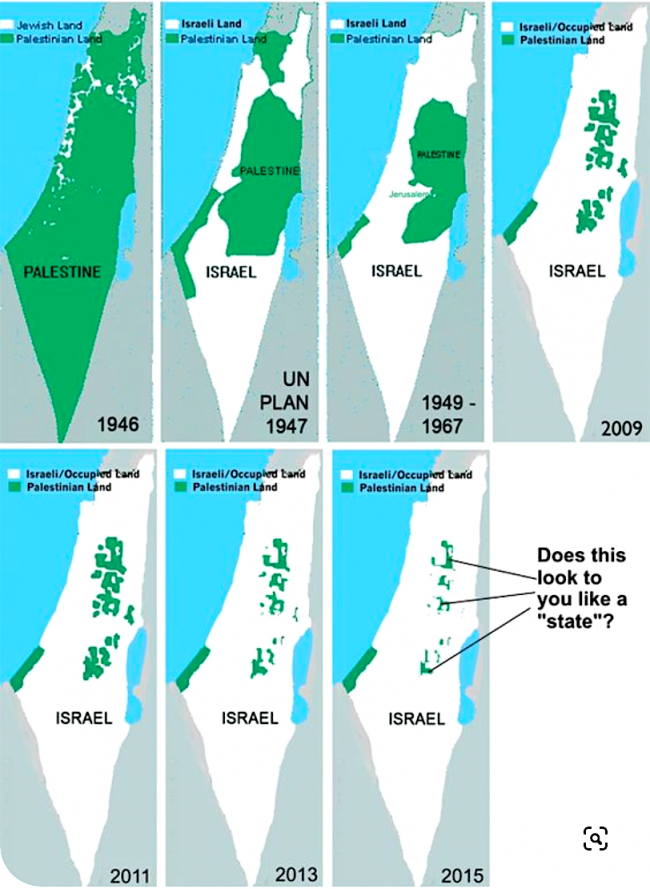
Palestine’s shrinking borders due to Israeli occupation. You won’t see this map on mainstream sites. The 2011 unoccupied areas match those of the Wikipedia map dated that year.
The mainstream media, which have long been used as house organs for spouting the talking points of the rich and powerful, are in free fall. Even the NYT has started publishing fact-free opinion pieces as “news”, no longer restricting them to the editorial pages, and no longer labeling them as editorials. Welcome to Faux Times.
What would it be like if the headlines actually told the truth? Of course, this would first require that the publishers make a serious effort to ascertain the truth, no matter how unpalatable, and dispense with reducing everything to simplistic binaries. And stop their nonsense “both-sidesing” news “reporting”. Giving column space to inflammatory racist and denialist arguments of execrable shills like Bret Stephens has nothing to do with “balanced” reporting.
After Reagan and Bush introduced Orwellian names for their ecologically ruinous deregulation laws (“The Clean Skies Act”), it’s almost as if newspaper publishers wanted to get in on the game. They write about “economic growth” as if it were a good thing that benefits everyone, rather than a scourge that is making our planet unliveable and benefitting only the richest one percent of the population.
If I were writing the headlines (admittedly with the benefit of some hindsight and the time and capacity to do my own research and to think critically about the issues), here is what some of them might look like:
Four million suffocate to death from virus because politicians don’t want to upset or inconvenience voters by making them wear masks or avoid large gatherings
More economic growth pursued despite overwhelming evidence it will soon make most of the planet uninhabitable for our children and grandchildren
Another million Yemenis die of bombings and starvation caused by weaponry partly supplied by [name of your western country]’s government
Tigray leads earth’s top 1o ongoing genocides in countries we don’t care about because they’re not oil rich or superpowers (and hence we do not report on them, to leave more room for our reporting on Oscar night fashions)
(1945) US nukes millions of Japanese citizens to test new bomb, because the military can’t figure out how else to test it
In the interest of honest disclosure, all Orwellian words in our headlines (those that actually signify their opposite) will hereinafter be marked with a small raised “O”: eg UnitedO Nations, UnitedO Kingdom, UnitedO States, Soviet UnionO , PatriotO Act, National DefenseO, Homeland SecurityO, Operation [name of foreign country invaded] FreedomO Act, and 12,645 others.
Israel’s lobbyists effectively gag all opposition to its Apartheid system and its vast Palestinian occupations, labeling opposition as anti-Semitism
All stock markets and real estate markets, now trading as pure Ponzi schemes, soar past breaking point; technically bankrupt Tesla’s shares trade at 1700 times earnings, which presumes a doubling of profits every year for the next 50 years, and amounts to $1.5M for every car it has sold
The richest now pay less tax as a proportion of their reported (unsheltered) income than any other income cohort, and Biden is about to widen the gulf by allowing rich Americans to deduct state taxes from their federal tax, without limit
Governments embrace and fund completely unfeasible magical solutions to climate change, like cap-and-trade, carbon capture and “net zero“, as emissions continue to rise out of control
Why do we, instead of truths like this, get false headlines, fed by intelligence spooks, PR wonks and corporatist “think tanks”, dutifully transcribed to the front page, when these media companies have supposedly taken a vow that “the truth dies in darkness” (actually, it just disappears behind a paywall)? Why are some of the worst atrocities in the world knowingly and systematically unreported?
I think there are three reasons:
Like politicians, they’re afraid of alienating their base. Like their readers, media publishers believe what they want to believe, and they want to believe in, and tell the stories of, good guys and happy endings. Most newspapers today are, like Tesla, technically insolvent, using every desperate method of paywalling and subscription-begging in the book to scrape up enough for the next edition. They are dependent on gullible patrons, grants, and “philanthropist”O owners. In short, there is nothing in it for the mainstream media to tell the truth. Few of their readers want to hear it, and they certainly won’t pay for it.
They are trapped in ancient information paradigms, from back when there were feasible, practical solutions to some of the predicaments of the day, and when some of the choices could actually be reduced to A-or-B without distorting the truth too badly. People, including most readers and most publishers, loathe complexity.
They really don’t know any better. With limited revenue to pay for real research, journalists and publishers are an easy mark for slick organizations that can make it look as if they’ve done their homework and have important findings, when they’re actually just lobbyists for pressure groups. The media have never apologized for getting duped into supporting the first Gulf War, which was predicated on a carefully-concocted and completely untrue “story” scripted and produced by the sleazy PR “reputation managementO“firm Hill & Knowlton working on behalf of Kuwaiti oil sheiks. They’ve never apologized for getting duped again into supporting the second Gulf War based on anonymous spooks’ lies about Saddam Hussein’s WMD, working on behalf of the defenseO industry, war profiteers, anti-Islamic fanatics and other interests. And now they’re mindlessly taking up the Biden war cry against China, Russia, Iran, Syria and other countries based on the same unsubstantiated and suspect claims. Unable to afford investigative journalism, they just report what they’re told, and ascribe it to anonymous “sources”, most of which are just using them.
I made a presentation two decades ago to a national press organization, and I told them at the time that unless they found a way to add real value to the information funnelling through them, that they would soon be disintermediated out of business. That’s now happening. They’ve obviously tried. But they’ve proven to be completely incompetent at fact-checking. They no longer do detailed analyses, since they’re too expensive and most of their audience is too busy, distracted, and dumbed down to read them anyway. They no longer do investigative reporting, since that’s also expensive and would require them, too often, to bite the political/corporatist hand that feeds them.
And paradoxically the effect of their increasingly severe paywalls and pan-handling “subscriptions” has been to turn customers away in frustration, to “free” sources of information, which are of course not really free, and are polluted with mis- and dis-information from nut groups and those with vested financial and political interests in concealing and obscuring the truth. I get no pleasure from having told them that would happen 20 years ago.
We are living in an era where our political and economic systems have become so dysfunctional that they are collapsing. Politicians no longer even pretend to play by the rules or to represent their constituents. Laws are written by and for the benefit of corporatist lobbyists and pressure groups, and mindlessly promulgated by politicians in return for campaign kickbacks. DeregulationO ensures an ever-increasing flow of wealth from the poor to the rich. But the media, who only look as far ahead and behind as tomorrow’s headlines necessitate, are oblivious to, and overwhelmed by, this collapse and its implications. It’s too complex to capture in bite-size, two-minute stories. It’s too complex to investigate or unravel all the chicanery and unexpected and indirect consequences of what’s happening, and those like Edward Snowden who try to point them towards it are turned upon like embarrassing upstart competitors.
In the anti-intellectual fervour of the 21st century, the mainstream media are fish out of water, and I predict that in a decade they will be gone, indistinguishable from the content-and-opinion providers of Substack, Medium, and the rest. There is no money to be made in providing information, except perhaps to intelligenceO agencies. There is even less money to be made in providing nuanced, complex, in-depth, critically-considered, truthful information. The money is in entertainment, distraction, propaganda, and attention-grabbing, outraging disinformation. The mindless pap of Facebook and Twitter.
As I’ve said before, I am addicted to wanting to know what’s really going on. That’s getting more and more difficult, even discounting the decline of information media. As we slide from a complex world into the chaotic one of full-on collapse, knowing the truth becomes less and less useful. I’ve been trying to be a “chronicler” of civilization’s collapse. I may have to find another retirement career. Maybe chronicling what’s happening at a hyper-local level, where it’s still possible to make some sense of things. Maybe fiction and poetry, where I can explore some larger truths. We’ll see.
I think this is an issue, or it may just be a quirk of a container I built for deployment via JupyterHub using Kubernetes on Azure to run user containers, but it seems you that SQLite does things with file locks that break can the sqlite3 package…
For example, the hacky cross-notebook search engine I built, the PyPi installable nbsearch, (which is not the same as the IBM semantic notebook search of the same name, WatViz/nbsearch) indexes notebooks into a SQLite database saved into a hidden directory in home.
The nbsearch UI is published using Jupyter server proxy. When the Jupyter noteobook server starts, the jupyter-server-proxy extension looks for packages with jupyter-server-proxy registered start hooks (code).
If the jupyter-server-proxy setup fails for for one registered service, it seems to fail for them all. During testing of a deployment, I noticed none of the jupyter-server-proxy services I expected to be visible from the notebook homepage New menu were there.
Checking logs (via @yuvipanda, kubectl logs -n <namespace> jupyter-<username>) it seemed that an initialisation script in nbsearch was failing the whole jupyter-server-proxy setup (sqlite3.OperationalError: database is locked; related issue).
> The SQLite database should not be used on NFS. SQLite uses reader/writer locks to control access to the database. This locking mechanism might not work correctly if the database file is kept on an NFS filesystem. This is because fcntl() file locking is broken on many NFS implementations. Therefore, you should avoid putting SQLite database files on NFS since it will not handle well multiple processes which might try to access the file at the same time.
This relates to setting up the JupyterHub service, but it did put me on the track of various other issues perhaps related to my issue posted variously around the web. For example, this issue — Allow nobrl parameter like docker to use sqlite over network drive — suggests alternative file mountOptions which seemed to fix things…
As someone who uses Windows Virtual Desktop every day to run Edge, Office and Teams (yes, you can do conferencing over RDP quite nicely, even from a Mac or iOS), I found this to be both amusing and intriguing as it normalizes what I’ve been doing for ages.
Remote display protocols and bandwidth have progressed to the point where a remote session is virtually indistinguishable from a local one, so the only relevant issue here is scalability and data residence.
But yeah, Sun was right. The networkcloud is the computer.
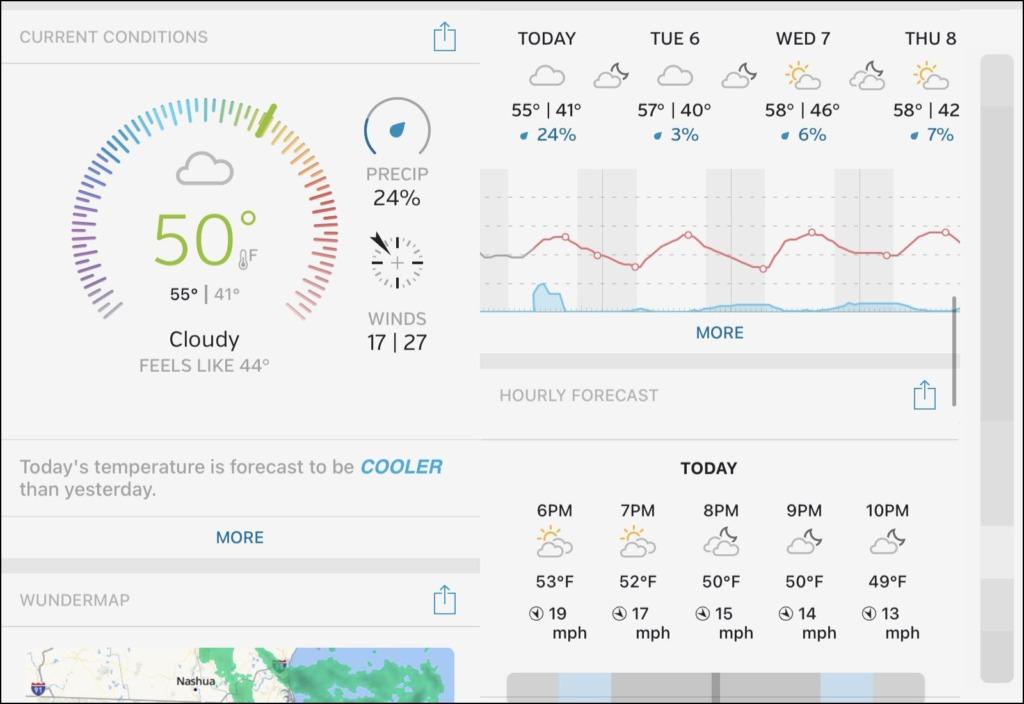
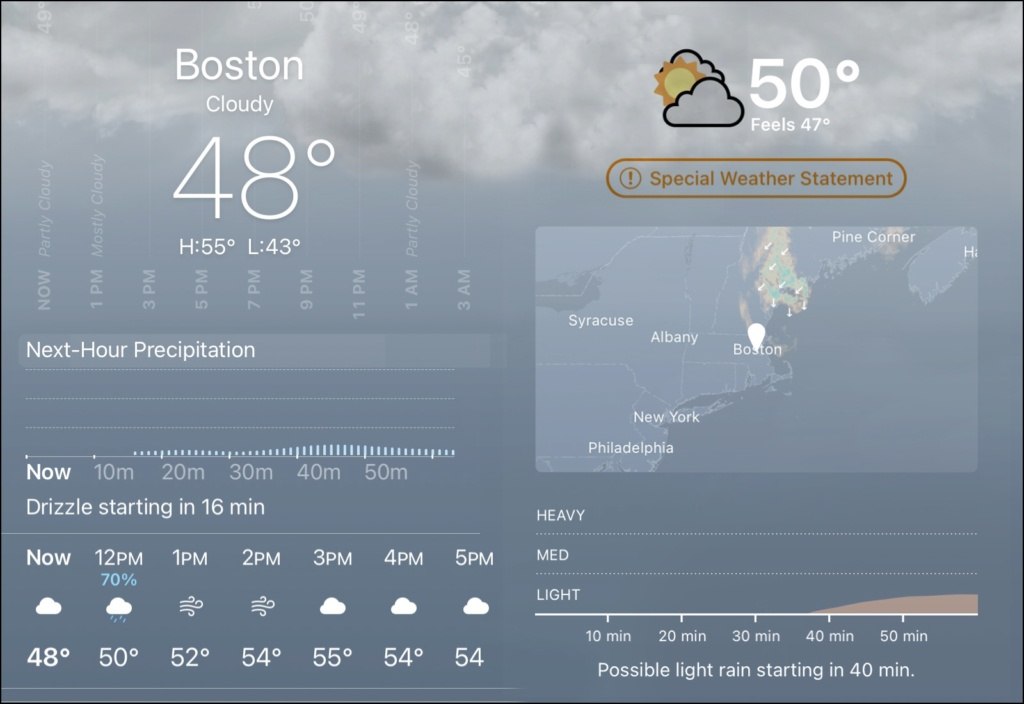
On a cloudy morning in April, a weather app called Dark Sky alerts me of “possible drizzle starting in 12 min., stopping 7 min. later.” Below that missive is a bar graph of the next hour, its only deviation from a baseline of dry conditions a slight, blue hump indicating when said drizzle is most possible. When I check again a few minutes later, Dark Sky has revised its estimate, now saying that the rain may begin in 40 minutes. The Weather Channel-backed app that came preloaded on my iPhone — which is elegantly called “Weather”— disagrees, saying the rain will actually begin 16 minutes from now. In lieu of a minute-based prediction, Wunderground says that there’s a 40 percent chance of precipitation at noon, but that only a hundredth of an inch will accumulate. Weather says the temperature is 48°. Both Wunderground and Dark Sky say 50°, though one says it “feels like” 44°, the other 47°.
You can spend an hour on these weather apps and have no more sophisticated a takeaway than, “it’s nice out,” or, “better bring an umbrella”
All of this comports with an early spring day in Cambridge, Massachusetts: The sky is gray, the boughs of the hemlock tree outside my window quivering in the breeze. I crack the window, and the air is chilly, but not intolerable — a decent sweater, a light jacket, and a beanie should suffice for the walk to the market I’d been planning, but am now rethinking, given the impending drizzle. I check my phone again, and all the forecasts have shifted. Weather has already abandoned the 16-minute prediction, saying now only that there is a “chance of drizzle in the next hour.” Conversely, Dark Sky has gotten more aggressive, promising that the rain that comes will be “light” rather than a mere drizzle. The app is so confident that the monotonous gray of its hour-by-hour “mostly cloudy” forecast, which takes the form of a bar of colors rather than a chain of illustrations, has been interrupted by a band of blue.
A wind chime is jangled by the breeze, so I look up to see if conditions have worsened. The hemlock rustles. The sky remains gray. A child on a scooter jets down the sidewalk toward the park on the next block, accompanied by a bored-looking babysitter. Once I finally rouse myself and go out walking, all the data I’ve consumed vanishes from mind. It’s gloomy out, chilly. The sun peaks out between the clouds. When the wind picks up, I zip my jacket. The rain is neither light nor drizzly: It never comes.
However quantifiable weather may be, no calculation or map can provide a substitute for an individual’s experience any given day. There may be as many perceptions of a sunny, 63° day as there are people, but even the broad consensus of how that sunny, 63° day feels will differ greatly by region, with Southerners labeling it “chilly” while Upper Mid-Westerners consider it “balmy.” Even as weather apps track the most minute variations on the day’s temperature, their data-heavy objectivity, no matter how detailed, still makes them about as useful as the static newspaper forecasts of yore, which would sum up the day’s weather with a few lines of copy, the day’s high and low temperature, and a graphic indicating the prevailing conditions. Though the capacity of meteorologists to predict the weather has gotten infinitely more sophisticated in the digital age — the NOAA now says that its five-day forecasts are 90 percent accurate — presenting the full spectrum of data that previously served merely to generate a condensed forecast is hardly more informative than a local TV broadcaster proclaiming, “It’s gonna be a hot one!”
Wunderground’s interface is made to look like a car dashboard, the foundational elements of location, temperature, and current conditions packaged together into a speedometer dial, with two smaller gages (the tachymeter and gas meter, say) noting the direction and speed of wind, as well as the current chance of precipitation. The Weather app takes a slightly more aestheticized approach by illustrating the current conditions with a nifty little animation of floating clouds or falling rain behind the temperature reading, while Dark Sky is more restrained, with its grayscale timeline of the day, the only colors an occasional pop of blue for rain or yellow for sun.
The deeper one digs into these apps, the more informative they get. Dark Sky and Wunderground have interactive maps that fill up with low-pressure fronts, satellite cloud imagery, and temperature gradients as different buttons are toggled, while Weather includes data on air quality — represented by a prismatic bar extending from healthy green to lung-scorching maroon — and the UV index, a single number that distills the shifting interplay of sunlight, clouds, and ozone. Each app offers the full make and measure of the day, even as most users are content to know only if it’s too warm for a jacket or if a snowstorm is approaching. There’s a deep discrepancy here: No matter how much data must be marshalled to create even the most benign weather forecast, being presented with that data does little to deepen one’s understanding of the forecast itself. You can spend an hour on these weather apps and have no more sophisticated a takeaway than, “it’s nice out,” or, “better bring an umbrella.”
However seemingly quotidian this schism between weather as data points and weather as a thing that you can feel on your skin, the divide’s most worrisome ramification is in the inability of individuals living in comfort in the United States or Europe to perceive climate change as an event they are experiencing rather than just another crisis they read about online, as horrific and irrelevant to their life as the military coup in Myanmar or the emergence of the Islamic State in Sub-Saharan Africa. No matter how many times one studies the Keeling curve or pairs its arc of ascending carbon-dioxide levels with global temperature rise, connecting that data to the weather as it is experienced day-to-day is nearly impossible. No, it’s only ever through disastrous events like Hurricane Harvey or Typhoon Goni that the connection between weather and climate is intuitively felt.
When Hurricane Sandy hit New York City in 2012 I understood that the storm’s historic strength was a symptom of climate change, even as spending the night listening to wind rattling window frames in Brooklyn produced in me a visceral and immediate terror. That night felt like weather, while the days that followed took on an aura of climate, mostly thanks to the physical effects of that storm — the downed trees, the inability to visit Manhattan for a month — which reordered space in an unprecedented way.
Climate change’s most salient manifestation is not in extreme weather itself, but rather the moments when that extreme weather overpowers our decaying infrastructure by flooding tunnels, overpowering dams, or spreading Valley Fever on arid wind. In an earlier era, the hurricanes, rainstorms, and droughts that cause these sorts of disasters would be described as cruel acts of god; given the contemporary replacement of faith with reason, weather catastrophes are instead understood to be a culmination of capitalistic excess, those who benefit least from the carbon economy also being those who suffer its consequences most acutely.
In recent years it has become common to refer to the conflation of these manifold social and ecological ills as the “climate crisis,” a phrase meant to convey the urgency of the situation. It’s a worthwhile rhetorical gambit, even as it fails to penetrate the membrane between knowing and feeling in a way that might make its exhortations ring true on a bright, sunny morning or amid a delightful New Year’s snowfall. However harrowing they may be, crises are typically understood to be things experienced at a distance. The financial crisis, the mortgage crisis, the Cuban Missile Crisis — these scary-sounding troubles are only felt once you lose your savings, your home, your sense of remove.
What few methods we have developed for describing climate change are drowned out by the far longer tenured language of weather, a language that is intertwined with our emotional life. What’s lacking is a sense of the climate crisis as a thing that can be felt equally intuitively. Not only do feeling and knowledge stand apart from each other, all too often each is used to explain the other away. (One may understand the mechanics of precipitation perfectly, but rain still just feels like rain. Neuroscientists may be able to map the firing of electrons within the brain of a depressed person, yet when the researchers themselves get sad they simply feel sadness.) This divide would be incidental, had weather not become a symptom of an existential threat.
One of the few moments in recent years when feeling and knowledge indelibly intertwined was last fall’s orange-sky day in San Francisco, when various measurable climactic and societal factors — smoke from the beetle-desiccated trees that were burning in record numbers across California’s poorly managed forests, hellacious winds, and a foggy Pacific marine layer moving inland — all conspired to briefly transform reality into dystopian science fiction. No rhetorical flourish is necessary to illustrate the climate crisis under such circumstances. If you lived in the Bay Area on September 9, 2020, the crisis was all you could see.
Such moments, though, are fleeting, and extremely localized. The equivalent of an orange-sky day on the East Coast probably looks more like Hurricane Sandy; across the Midwest like the never-ending spring rains that cause rivers to overpower their banks. Scientists can explain how all these catastrophes are interrelated, but it is imperative that we also develop the capacity to experience them that way. To know and feel in tandem, as a singular response.
The alienation between people and the scientific observation of climactic conditions is as old as language itself. The novelist Karl Ove Knausgård notes our reliance on the impersonal pronoun “it” when describing the weather:
“It’s raining,” we say, “it’s blowing” or “it’s snowing.” But what exactly is doing the “raining,” the “blowing,” the “snowing”? The rain is, the wind is, the snow is; the actions are their own agents, conflated with the subject. “It” points toward a force that exists outside of us and over which we have no control.
While traditional meteorological forecasting made no secret of that lack of control with its vague, existentially ambiguous language (“snow possible overnight”), contemporary apps are built to trick the user into perceiving the weather as a thing that can be skillfully navigated; the weather is hardly more possible to master than the Pacific Ocean, but with the right set of tools, the indoor dwelling weather-watcher can chart a course for maximum comfort in the outdoors. It will start raining in 24 minutes and then stop after two hours? Why, then I’ll pop out for a quick walk now, and save my trip to the grocery store for later!
The notion that the weather can be forecasted so intimately — especially days or weeks ahead of time — is laughable. “It may rain in the afternoon” and “it will begin raining in 18 minutes” are both attempts to turn probability into language, their relative authoritativeness meant to broadcast differing levels of certainty. That weather predictions can be right 90 percent of the time is a feat of science, but when that hit rate is tested literally every hour of every day, 10 percent of forecasts being wrong is hardly an incidental proportion. And if a gap in the clouds means one town misses out on the blizzard that blankets an entire region, was the snow forecast wrong? Or merely too sweeping? In any case, no matter how much more refined the discipline of weather prediction becomes, it will always be based on describing an “it” — action and agent, a conflation of forces that the human mind struggles to accept can truly act in a unitary way.
What few methods we have for describing climate change are drowned out by the more tenured language of weather, a language that is intertwined with our emotional life
This may be why some meteorologists have traded daily and weekly weather prediction for climate change forecasts, which seek to predict the toll rising temperatures will exact around the world. The Intergovernmental Panel on Climate Change is the most prominent of the groups doing this modeling, though even the most alarming predictions in their 2018 report were couched far too firmly in the language of science to produce an affective response. Global temperatures rising by 2°C would cause 13 percent of ecosystems to “undergo a transformation,” the dozens of researchers who contributed to the report wrote, before going on to also warn that reaching that threshold would cause the Arctic to have an “ice-free” summer at least once per decade. These are measurements of an “it” to come — they say little about what it might feel like to live in an ecosystem undergoing such a transformation, like on Ellesmere Island in June.
In Subjective Meteorology, the artist and academic Johanna Drucker attempts to use meteorological techniques to map the way her emotions vary from day to day. “The forces of wind, heat, temperature gradients, relations to terrain and physical features vary at every level of granularity within the atmosphere,” Drucker writes. “My fascination with this as a set of metaphors is absolutely, firmly based in the belief that the subjective experience of daily life can only be described in such a system with all its exhaustive repleteness.”
Casting weather events as metaphors is antithetical to the approach of meteorologists, whose sophisticated ability to marshal data means their work is firmly scientific, rather than figurative. But Drucker is right: The very act of translating a weather event into language is an act of metaphor making — without an ability to disentangle action and agent, we resort to the signifier of “it’s snowing.” The same goes for emotion. The phrase “I’m angry” is an expression of internal conditions that are otherwise impossible to articulate.
Drucker’s project aims to refashion that continuum into a single visual language, but to do that she needs to break down the border between the “I” who feels emotions and the “it” that causes weather. “The ‘I’ of subjective meteorology does not ‘have’ experiences,” she writes. “Instead, the ‘I’ is like the eye of a storm or system, moving and volatile, a dynamic zone of pressure, arising from the conditions in which it participates as an autopoetic agent intervening in a field of potentiality.”
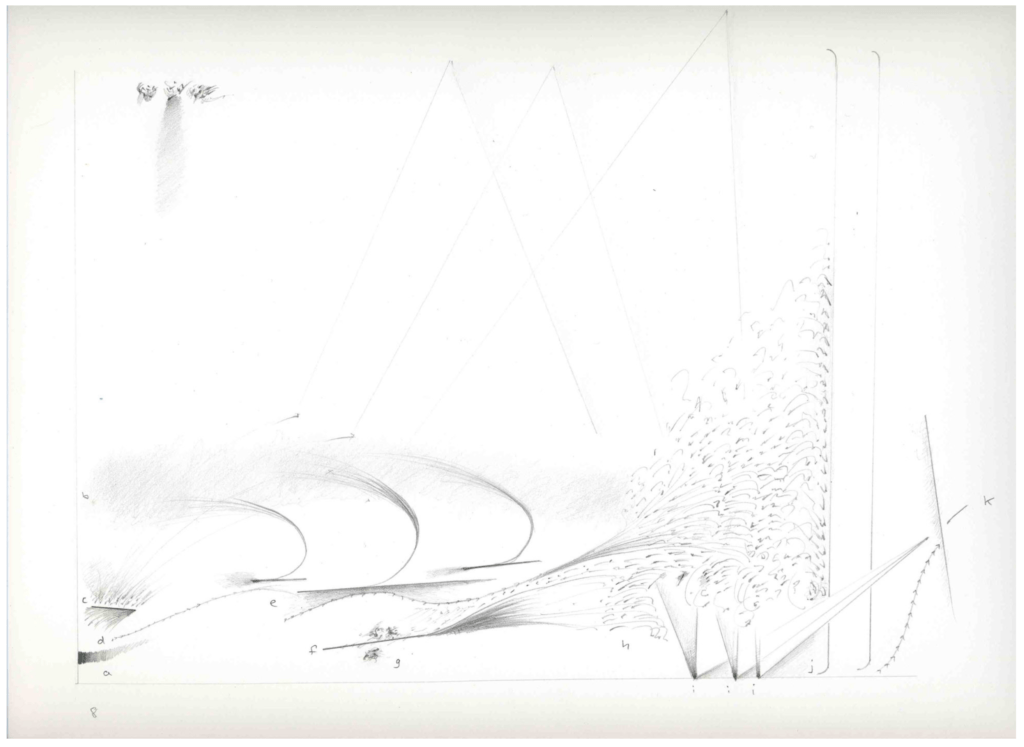
The system Drucker comes up with to capture “subjective meteorology” consists of the same components that make up the scientific field: atmosphere, topography, dynamics, and rules of behavior. Her illustrations of that system rely on familiar weather map figurations, “fronts” and “perturbations” that demonstrate where in her mind-space the components are meeting and causing havoc. The personal weather maps that result are far more dreamy and evocative than what you might see on the seven o’clock news (or, indeed, thumb over on the Wunderground app), yet still manage to articulate Drucker’s daily moods in a radically different way from what language alone could manage.
Day Eight: a) waking without recollection of dreams; b) proximate condition of rain; c) densely concentrated activity; d) work against pressure; e) backwash against resistance; f) resistant line; g) short conversations; h) productive and critical confusions; i) windows toward possible futures; j) bracket of social space; k) trajectory of resolution towards anticipated limit.
In one of these sketches, an “upswelling of dark moods” runs into “engagement of exchanges in energy,” which is represented by an airy column pointing heavenward, where it eventually meets a wispy arc of “energy rising towards anticipated endpoints.” On a different day, three V-shaped spouts — “windows toward possible futures” — draw in a cloud of “productive and critical confusion” and redirect it on a “trajectory of resolution.” These drawings are best understood as a formalized attempt at abstract expressionism. Some lines are dark and firm, others wavy and nearly immaterial; all are meant to harness mood and make it visual. In their two-tone composition, they echo Franz Kline’s paintings, albeit in elegant pencil rather than his bold swaths of black pigment.
As with any work of abstract expressionism, determining just what Drucker means by a phrase like “engagement of exchanges in energy” is a tricky undertaking, one that would require knowledge of the infrastructure of her life to decode. (Does she have collaborators with whom this exchange is happening? Is the energy she’s describing personal or professional?) But Drucker is not writing a diary: The uncertainty created in the gap between her drawings and the glosses that accompany them should be understood as fleeting dispatches on her internal climate, unknowable to anyone but herself.
If I were to sketch how I experience climate change, it would look like a vortex of lightly struck hash marks, darkening in color until they terminated in a single, black dot
When Hurricane Sandy knocked the New York subway out of commission, the East River had to be reclassified in the brain of every Brooklynite. Rather than a natural feature that was nice to look at while riding the Q train into Manhattan, a mere element of scenery, the river became a physical barrier, effectively impassable. If “climate” is best understood as infrastructure transformed by weather, then Sandy’s effect on the internal climate of everyone living in the city in the fall of 2012 was just as profound as the erasure of Rockaway Beach. Only because our internal climates changed did the broader changes in the world’s climate become legible. It’s in this way that Drucker’s recourse to visual art proves so instructive. “Unseen, often unperceived, the complex exchanges of energy in human systems are always in flux,” she writes. “What we lack is a language to speak about these phenomena, or to represent them even to ourselves.”
Is it possible for an app to not only tell us the weather, but tell us the climate is changing in a way that we might feel as viscerally as a gust of wind biting the cheek? Perhaps a reading of 68° in Woodstock, Vermont, on December 25th would be paired with a flashing exclamation point that, once tapped, explained that the temperature reading was 16° higher than the previous record. Each time the app lit up with a notification about a hurricane bearing down on the Gulf Coast, would it be effective for the user to open it and find a scientific study demonstrating the causal link between ocean temperature and the flooding caused by cyclone-borne rain?
Even those approaches risk alienating users with their cold numbers and meteorological exactitude, which are little more than localized re-conceptions of the IPCC’s methods. A more affectively grounded outreach might play more to our senses — on March 26th of this year, what if every weather app had showcased videos of cherry trees blossoming in Kyoto, overlaid with text saying it was the earliest bloom in 1,200 years? What if every daily forecast in the states that lie along the Colorado River this spring was paired with live footage of the reservoir at Lake Mead, which is approaching the low ebb at which cuts to water use become mandatory? Would any of this help the user feel climate change on the personal level that might make them respond to the crisis accordingly, or would it just be more data that is easily pocketed and ignored once they were out in the world, enjoying some sunshine?
There’s an old nursery rhyme that goes: “We’ll weather the weather / whatever the weather / whether we like it or not.” With the onset of the climate crisis, that sing-song has taken on a dire tone. As long as our frame of reference is subjective, the weather will remain beyond our control, something that we can read forecasts about and feel on our skin but, ultimately, have no recourse against except forbearance. If I were to use Drucker’s system to sketch how I experience climate change, it would probably look like a vortex of lightly struck hash marks, darkening in color as they approached the center of the page until they terminated in a single, black dot: a point of terminal dread.
If climate and weather are to become one in our minds — whether unified in hopelessness or resistance, but with alternatives — it will surely be through short-circuiting the divide between feeling and knowledge. Art won’t save us from the climate crisis, but it can help us fuse the evidence of our senses and the output of the meteorological models in a way that allows them to be overcome in favor of an abiding understanding, one that might lead to different, more far-sighted behavior. If weather is action and agent conflated into a single subject, climate is that subject perpetuated on a global scale. To grasp it, we must reorient our own subjectivity accordingly. Close out the weather app, shutter the window. Go outside, pick up a pencil, and see if you can render how it feels right now, in this moment, to have the sun on your face and the oceans rising, a scent of spring flowers on the breeze and the rivers running dry.
The Art of the Personal Project is a crucial element to let potential buyers see how you think creatively on your own. I am drawn to personal projects that have an interesting vision or that show something I have never seen before. In this thread, I’ll include a link to each personal project with the artist statement so you can see more of the project. Please note: This thread is not affiliated with any company; I’m just featuring projects that I find. Please DO NOT send me your work. I do not take submissions.
In my series “OF DRILL AND CEREMONY”
I’m showing scenes from a fictional military boot camp in a fictional country ruled by a fictional regime.
Like always in my works any resemblance to “reality” is entirely coincidental.
APE contributor Suzanne Sease currently works as a consultant for photographers and illustrators around the world. She has been involved in the photography and illustration industry since the mid 80s. After establishing the art buying department at The Martin Agency, then working for Kaplan-Thaler, Capital One, Best Buy and numerous smaller agencies and companies, she decided to be a consultant in 1999. She has a new Twitter feed with helpful marketing information because she believes that marketing should be driven by brand and not by specialty. Follow her at @SuzanneSease. Instagram
Success is more than a matter of your talent. It’s also a matter of doing a better job presenting it. And that is what I do with decades of agency and in-house experience.
Cette semaine, je reçois Aurélien Déragne, co-créateur de la Fresque du Numérique avec son comparse Yvain Mouneu. On parle dans cet épisode de la difficulté de constater que son job (ici dans l’industrie automobile) participe à mener l’humanité droit dans le mur, mais une fois qu’on a bien compris ça, après une période de deuil, on peut trouver un autre job qui pour le coup nous donne l’envie de se lever le matin et mène à une créativité et un espoir retrouvés.
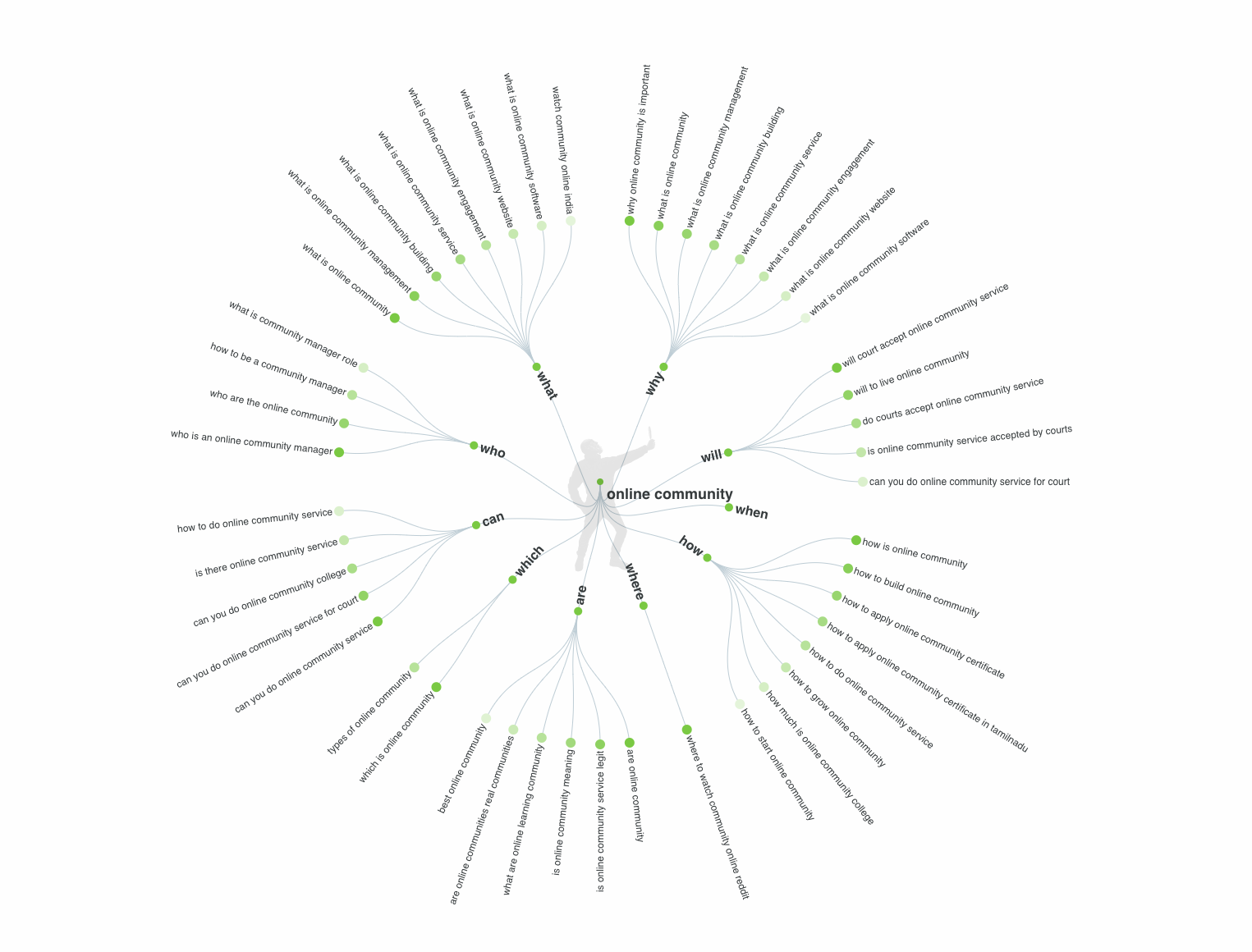
It’s a simple search tool which lets you drop in any term and see what questions people are asking about the topic, which comparisons they’re making, and what prepositions they’re using.
For example, we can enter ‘online community’ below and see what comes up.
For sure, some of it is unhelpful gibberish.
But if you’re looking to build a base of content articles to attract more people to your community, some of these questions would be a good place to start.
And if you’re looking for questions to ask to get a community started, some of these might be perfect.
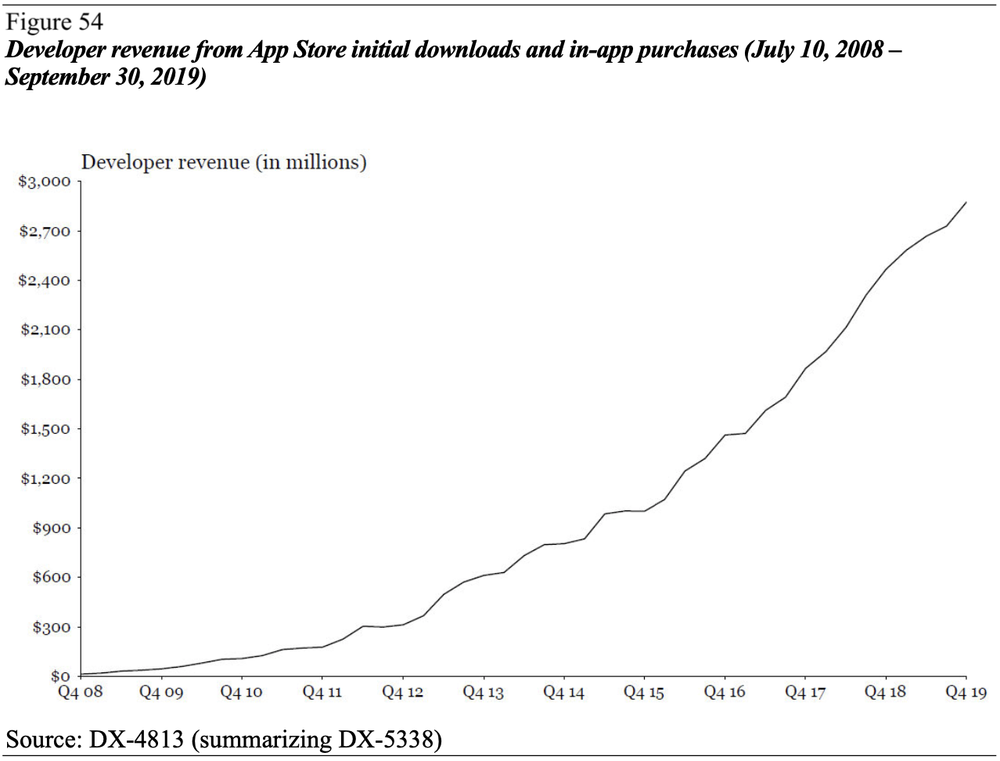
Apple launched the App Store in 2008, and tightened up the payment rules in 2011, and we’ve been arguing about it ever since. In many ways the issues haven’t really changed - it’s just that the numbers got a lot bigger.
Almost everyone understands that some kind of locked-down, sandboxed software model has been a huge step forward for both users and developers. If there’s one lesson to take from the last few years in tech, it’s that allowing any random developer to do whatever they want with your device and your data is not a good idea (and that saying they can do it if the user gives permission just creates a target). Equally, a built-in, one-tap-to-install app store with frictionless payment led to an explosion of software creation and developer revenue. Trust was a huge problem, distribution was a huge problem, and Apple solved both.*
The trouble is, if you’re going to have rules for what apps can do, what rules? And if you’re going to curate a store, how do you curate it?
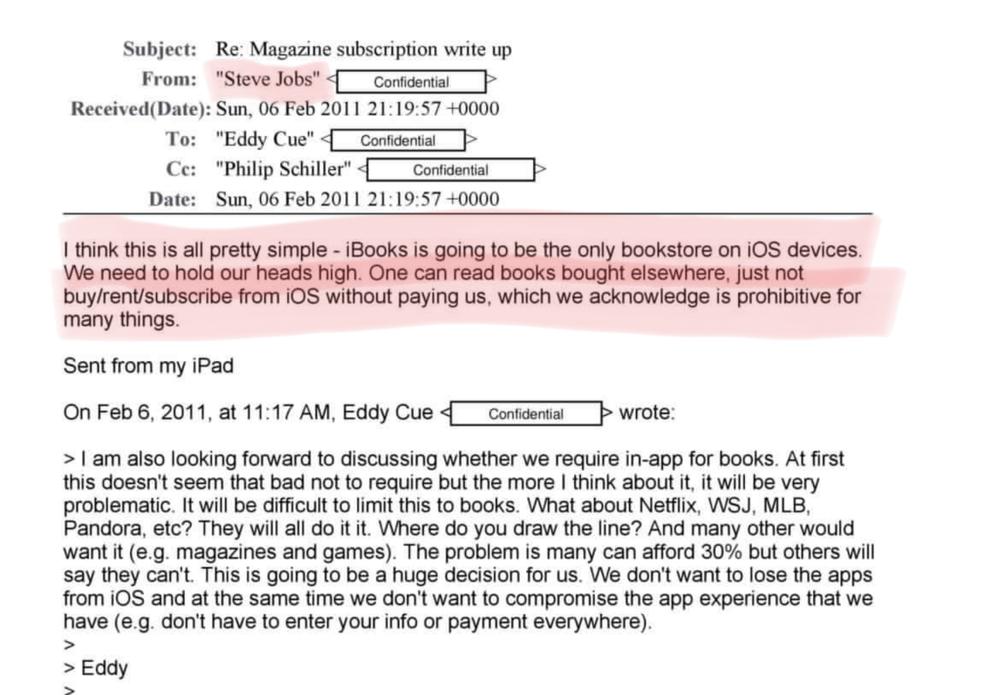
Many of Apple’s decisions around this have to balance privacy, security, reliability, battery life, simplicity, ease of use, and competition. But its choices often seem to treat ‘things Apple likes’ as the most important criteria, and often seem to rank competition last. This is a particular problem for in-app payment, where Apple’s rules make some kinds of business simply ‘prohibitive’ - most obviously ebooks and music. You can be in the store, but you can’t use Apple’s payment system, and yet you can’t use your own either.
Meanwhile, there are far too many horror stories from developers of arbitrary, capricious and simply mistaken decisions in the review process for the App Store. Regardless of its actual policies, Apple makes lots of mistakes, and allows in lots of scams. Of course, only Apple know how much this happens, and at the scale of tens of thousands of reviews per day there will always be mistakes, but a lot of loyal Apple developers are unhappy.
As is often the case with complex problems, this all began with some very simple principles: “we won’t allow bad apps, we won’t let apps do things that compromise the device, and if you sell content on our platform you have to pay.” But once a few hundred thousand developers started asking what that actually meant, it turned out not to be simple at all (people working in content moderation will have pattern recognition here). My own first question, back in 2011, was that Bloomberg’s iPhone app connects to a professional subscription service that costs $2,000 a month - was Apple really asking for 30%? “Ah. We didn’t think of that.”
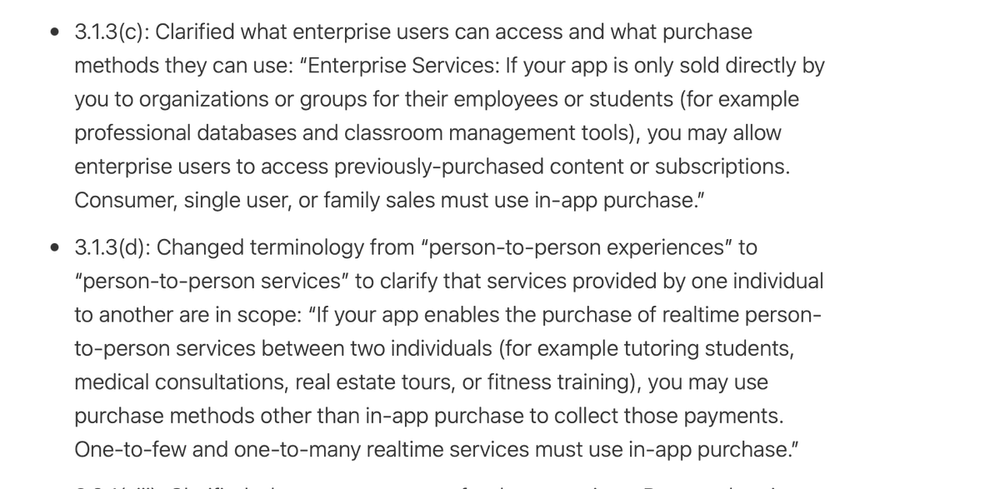
After a decade of this, Apple’s App Store rules have become a vast inverted pyramid of weird edge cases, exceptions and rent-seeking. Why is it OK for Roblox to have a game store, but not Stadia? Why it is any safer to give your credit card to a random ecommerce app than a random game? These paragraphs are from the latest App Store guidelines - this kind of complexity is not good for anyone, and it’s not surprising that Apple’s own reviewers make so many mistakes.
We’ve been arguing about this for a decade, but now something is going to change, partly because of Epic’s lawsuit (which it might or might not win) but much more importantly because the EU has a whole set of competition investigations into the sandbox, the store and the payment system, and is highly unlikely to accept the status quo. When Apple launched the store in July 2008 it had only sold 6m iPhones ever, but now a billion people have one, and competition laws apply, whether you like it or not. Epic might lose, but Spotify will win.
What will that mean, though? What rules will change, and how, and what will that mean for anyone who isn’t an Apple or Spotify shareholder?
Quite a lot of people in tech suggest that the answer is to let us bypass the store. Keep the security model (mostly), but allow third party stores and allow people to ‘side-load’ apps onto the phone directly. This is a red herring, for two reasons:
Half of the rules that have competitive implications happen in the sandbox on the phone, not in the store. Snap would like the option to be the default camera app, and Square would like access to NFC, and to be the default wallet. Side-loading and third party stores don’t change that.
Apple’s store is the default, and it’s a much better route to market. Making Spotify’s users jump though hoops to get the app instead of just tapping ‘Get’ in the store that everyone already uses is just as much of a competitive problem as banning it from using its own payment tool.
So, regulatory intervention might look at side-loading and third party stores, but the focus has to be on Apple’s default store and Apple’s rules. I think it’s extremely likely that apps will be able to use their own payment systems, that Apple’s 30% will change, if not necessarily disappear, and that Apple will have to give third party apps the same kinds of hardware and integration access as its own services.
That leads to a lot of very fiddly product questions. What exactly is the UI to change the default camera app? How easy is it to find? What happens when the EU or DoJ start trying to redesign those screens (and they will)? Is Apple only forced to let apps ask for a credit card, or does it also have to open up its integrated frictionless payment system to third party providers? What would the regulator say if Apple allowed apps to use Apple Pay at 3% instead of iTunes at 30%? What if Stripe could be the default in-app payment provider for every app on your phone, replacing iTunes, or could compete with Apple Pay on websites in Safari? What if other hardware had access to the same no-touch configuration as AirPods or AirTags? These are complex decisions that trade off privacy, ease of use and competition, and they might be made by lawyers.
Back to the higher-level question, though - who cares? Where is the money, where might it go and what new things might become possible? The cynical view might be that this is ultimately just a big wealth transfer from Apple to a pretty small number of big companies - mostly, games companies.
Apple collected perhaps $15bn in App Store commissions last year (and, incidentally, close to $10bn from Google for making the default search provider in Safari). 90% of that was games, so depending on where all the moving parts settle, that’s $10bn or more that would be transferred to EA, Epic and Tencent - quite a lot of which might go straight out of the door to app install ads, including to Apple. (The really cynical view would be that this is why Apple turned off IDFA.)
$10-15bn is real money, even for Apple, but it’s much more interesting to ask what else might change. There’s a small number of businesses where Apple’s payment rules were prohibitive, in Steve’s words, or at least made things very difficult - most obviously, ebooks and music. What other businesses do use Apple’s payment but would be fundamentally different if they had that extra margin? And what never happened at all? What products could not be built because of the ways that Apple’s sandbox works, that now might change? How significant are the changes in payment models I suggested above?
One could say that this is the classic unanswerable counter-factual - we don’t know what doesn’t exist. But a partial answer is to look at Google’s Android, which has always been run with much looser controls. Name ten really big, important, widely used Android apps that don’t exist on iOS. The obvious one is Chrome (there is an iOS Chrome app but it has to use Apple’ webkit rendering engine), but what else? No, not something that you use, but something with hundreds of millions of users - that’s what scale means in consumer tech today.
Of course, we can’t actually know any of this yet. But it’s possible to believe that the sandboxed App Store model has been a hugely good thing, and also that Apple has too often made the wrong decisions in running it, and also that unwinding those decisions while preserving the underlying model won’t actually change much for many companies or consumers, and won’t really be a significant structural change in how tech works. Either way, after a decade of arguing, the EU is now going to run the experiment.
* It didn’t solve discovery, but that’s a whole other conversation
After 20 hours of new research and testing, we found that the best external desktop hard drive for most people is Western Digital’s 4 TB My Book. The My Book is reliable, fast, and less expensive than the other desktop drives we tested, plus it has enough space for your future storage needs and a long, three-year warranty.
There was a “Rally on Wheels” held today in support of the faculty and staff at Laurentian University. It was timed to coincide with the fact that about a third of the faculty at Laurentian were due to lose their jobs at noon today under the restructuring plan that was rammed through their faculty senate a few weeks ago.
The call was for for people to either participate on zoom, or to roll around Queen’s Park Crescent by bike or car.
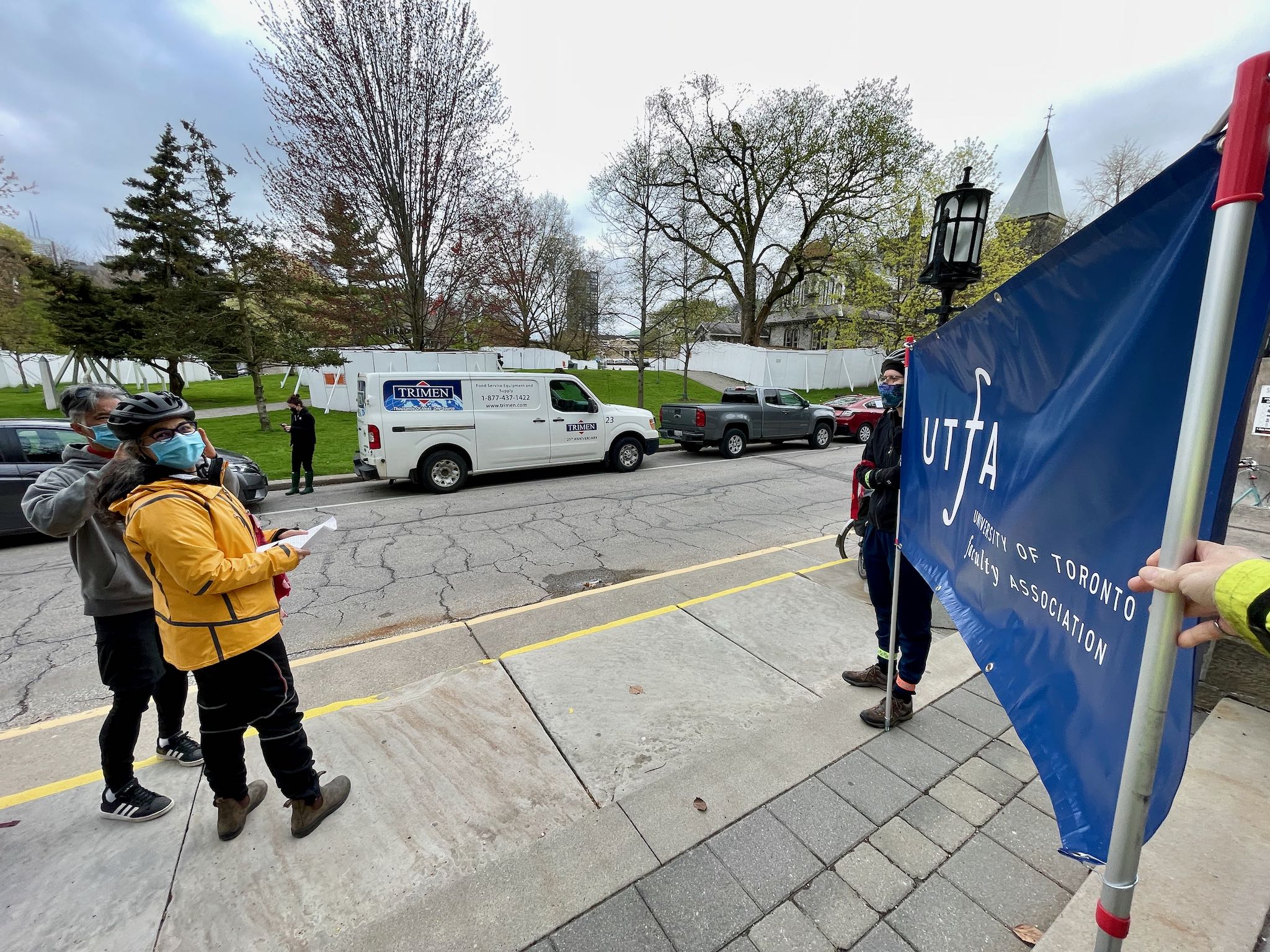
I joined in as one of the representatives for the University of Toronto Faculty Association (UTFA). Here are three of us about to set out from the UTFA offices. Left to right, AW Peet (Physics), me (Engineering) and Terezia Zoric (OISE).
UTFA President Terezia Zoric getting ready to speak on the zoom call in front of Hart House.
This is the recording of her speech.
Waiting to join the procession. In actual fact, the lead car took off way too fast, and so the cars were spread out around the crescent, and the bikes were in a separate bunch.
Momentary stop at Wellesley.
After several laps, the cyclists decided to call it a day and pulled off in front of the parliament buildings. I had a very civil conversation with one of the police who suggested that if we were to do this sort of event, we should do it on Monday-Thursday when at least some MPPs are present, and that if we contact CP24 in advance, they would provide media coverage.
The situation at Laurentian is very sad as it has played a key role in Northern Ontario, being the only university in the province with many programs in English, French and Indigenous studies. The University finds itself in severe financial distress due to combination of a provincial funding model that disadvantages all smaller universities in Ontario, a series of bad decisions on the part of the administration, and most seriously some financial malfeasance that both stole money from all possible sources to cover payroll, as well as concealing the true state of the books until it was entirely too late. They have cut numerous programs, seemingly strictly on the basis of enrolment. Personally I cannot imagine a university maintaining any sort of credibility without a program in either Math or Physics. Not to mention that a Laurentian faculty member won the Nobel Prize a while ago.
At any rate, an interesting and appropriate way to cap off #30daysofbiking.
The number of people lining up for the opportunity to pay for podcasts is exactly zero. But publishers are going to inflict on them anyways, because, after all, they have to pay back all the money they borrowed in order to acquire most of the podcasting services out there. This is exactly what was predicted last May when the carnage began. This article focuses mostly on Apply, which recently announced podcast subscriptions. But you know, we also have services that enable private RSS feeds (Libsyn, Buzzsprout, Transistor, Captivate, Acast, Supporting Cast) and podcasting 'stars' and big name producers (like Radiotopia, NPR, the L.A.Times and Sony). While there may be some 'free' podcasts to attract listeners, the main strategy here will be to force both podcasters (both free and paid) to use the monetized platforms in order to get any exposure at all. If you're not 'pay to play', you just won't be visible to listeners. And that's how you wreck something good that we all used to have.
I think that the intent behind this article is to note that Ian Linkletter is facing new and greater expenses in his legal fight against Proctorio, and institutions of higher education should play a greater role in his defense - if they can't actually contribute to his legal fund, they should at the very least, says Martin Weller, be boycotting their product. With this I agree (and am making an additional contribution today). But Weller couches this all in the language of universities being the 'custodians' of certain values in society, for example, "freedom of legitimate academic criticism." If they are indeed custodians, then I think they're very poor custodians, being as they are institutions who protect these freedoms only for a certain (privileged) class of people (which is how and why we see Linkletter struggling to defend himself).
I've been watching TikTok videos for some time now, and I have to confess, I'm getting bored with it. Now this is possible a result of the algorithm sending me an increasingly bland selection of content (may it knows me all too well) or maybe it's me wanting something more than dancing, random facts (that I already know), clips from TV shows (that I saw ages ago) and people saying "help me out" to push up their view count. So while of course educators are trying out this new medium, and I'm all for that. Sure, TikTok is fresh and fun, not greasy like Facebook, but I'm wondering how long it will be before the next contender comes along.
I like this article because it shows how some kinds of education are entrenched in a reality that no longer exists (if, indeed, it ever did). For example: "why are we still doing ‘Buy a Car’ worksheets which often don’t put emphasis on the emissions of these cars, or the option to not participate and take public transport instead?" Why, indeed? Financial education, argues the author, should be redesigned to accommodate changes to people’s current financial situations and financial prospects, changes to our understanding of the importance of ecological and social factors, the role of cultural factors in access to financial products, and developments in our knowledge of how we make decisions. I think that people are losing patience with the idea that being 'rational' means thinking only about money, without respect to social, ethical and cultural values.
The U.K.'s Jisc is leading an initiative to launch a new National Centre for Artificial Intelligence (AI) in Tertiary Education. The centre "will identify effective AI solutions, measuring them against its ethical framework, and testing how they improve learner experiences... Its main aim is to ensure AI is used in ways that augment teachers’ skills and supports human-led education by developing staff skills and confidence in using AI tools." Put this way, it sounds almost as though the purpose is to contol and limit the use of AI in education, not to 'unleash the power'. See also this additional article from Andy McGregor, Jisc's Director of edtech, 'Putting ethical artificial intelligence at the heart of tertiary education'.
If you are on Southwest Marine Drive near Balaclava, you may have seen Anne Bruinn doing wonderful things to transform space and also give a giggle to anyone passing by in a bike lane, on transit, or a vehicle.
Ms. Bruinn scoured Craigslist and looked to recreate the Central Perk studio set from the television show Friends.
As written by Lasia Kretzel and Monika Gul for News 1130 there’s an outside living room set up on the boulevard, and of course there is the “Central Perk” coffee sign.
And she’s invited other people to come and sit down on the replica couches from that famous show, realizing that with pandemic restrictions people are not going into other people’s houses. Ms. Bruinn wins the coveted Price Tags STAR Award for “Seeing Trouble and Responding”.
“Friends gives me good feelings, and I wanted a set that made people happy, and makes you smile.And as long as I’m out there, I’m available. So just come at your convenience, stop in have a coffee. Need anything, I’m here. lf you would just went for a jog down by the river and you’re dying of thirst here I’ve got a bubbly for you. Or, have a seat and have a chat or whatever you need.”
She has been performing on the boulevard for a while, dressing as American Presidential hopeful Bernie Sanders with the famous crossed mittens and as a dinosaur.
At Hallowe’en she turned her daily wait for her daughter to walk home from school to an adventure, dressed as a ghoul. Once her daughter was in the house, she would continue to stand on the road saying “I am really good at standing still“, and commenting on the fact that if her presence makes a change in someone else’s day, it was the right thing to do.
“Just something for them to look at, maybe make them smile. People who knew that I was real would honk and wave. It was so lovely just to connect distantly with people,” she said, adding everyone seems to have enjoyed the displays. “It’s been absolutely wonderful.”
Kudos to Ms.Bruinn. Her “Friends” living room will be available for a visit through to September. You can see a gr YouTube video with Ms. Bruinn and her project below, prepared by Kier Junos of CityTV.
A few weeks ago, BC Cycling Coalition board member Peter Ladner got an op-ed in The Sun on that perennial bike-path irritant – Kitsilano Park.
What is it about cycling through Kits Park that triggers neighbourhood “uprisings,” talk-show vitriol, and a bully mob that scared the Park Board from making a decision in 2018? …
This westside flashpoint has somehow become a blinking red light slowing down cyclist safety in other parks. Fearful trepidation about creating a permanent bike lane through Stanley Park is just one echo of the Kits Park blockade, even as the evidence is screaming “these changes work.”
To be fair, the Vancouver Park Board is promising to build a safe cycling route through Kits Park a year from now, amid election jitters. That’s almost 10 years after earlier plans were shouted down by a group best described as the Hadden Park Defence Militia (officially the Kits Point Residents Association). Yet park board staff and elected park board officials — including the green-professing majority — are still terrified of this group, continuing to hold the city’s exploding numbers of pandemic-driven cyclists hostage to its anti-cycling demands. …
That provocative reference to the Kits Point Residents Association was guaranteed to provoke a response – and so it did. But maybe not what was expected from a group with a notorious NIMBY reputation from years ago. They want to be on the record as ready to help ‘close the gap’:
… the Kits Point Residents’ Association (KPRA) Executive Team … share Peter Ladner’s frustration in the failure of the COV and Park Board to complete the Kits portion of the Seaside Greenway and are pleased to see the issue brought forward. …
In 2017, the Park Board worked with a group of stakeholders on a revised Seaside Greenway plan that included KPRA, HUB and other parties including the park user groups. KPRA sent the following written confirmation to the PB, “From the neighbourhood perspective we agree that a safe cycle route between Vanier Park and Balsam St to close the gap in the seaside cycle route is important and we are committed to work towards achievement of such a route immediately.” … (emphasis added).
And then KPRA nails what the problem is:
On March 6, 2018, Park Board staff, based on their deliberations with the group, tabled a conceptual alignment of a new separated cycling path through Kitsilano Beach Park …
… but before hearing from any of the parties registered to speak, the Park Commissioners referred the report back to staff to provide more detailed information on the proposed concept. To date, staff have yet to report back to the Commissioners or the public.
While there is actually a lot of goodwill to resolve this outstanding problem, resolution keeps running into a reluctance to do anything much more than promise future progress or a report back (a surefire way to put off ultimate approval and implementation.) That way, some decision-makers (specifically NPA Commissioners Tricia Barker and now mayoral candidate John Coupar) try to avoid outright opposition to bike lanes while pursuing the ‘Fairness Finesse’ (most recent example – the Stanley Park bike lane) – a block on any improvement because it doesn’t satisfy every opponent.
Coupar more generally believes bike lanes should come to parks, not through parks – especially those that meet the standard of the City’s separated bikeway network – and he has been singularly successful on that account, as lack of proper lanes in Vanier, Hadden, Kits, Jericho, Locarno and Spanish Banks provide evidence.
Here’s how he did in Kits. After many years of work to establish an improved path through Kits Beach Park, Park Board staff presented their recommendations to Commissioners in June 2018. Staff recommended a conceptual alignment of a new path that moved it away from the waterfront along the beach, behind the concession stand, and most importantly, didn’t run through the parking lot.
They asked that Commissioners support the plan for staff to work with the City engineering department staff to prepare a design for approval; and that staff report back with that design and budget when public engagement was complete. Coupar moved to defer that motion back to staff. He wanted to see a budget. More details. Public engagement (before engagement was authorized to begin). Staff responded that they needed to do more work, and they were simply asking for permission to begin that work. John’s motion to defer passed. So, delay, delay, delay. Mission accomplished. Once again, nothing happened.
Several years passed. Now staff are preparing another proposal. Will the Fairness Finesse work again? Will it take a lawsuit after another injury, or perhaps a fatality, in the Kits Beach parking lot (where people on bikes are routed behind vehicles)?
Why do some elected officials see railing against active transportation improvements as a ticket to re-election? Or has the great success of the Beach Ave Bikeway, and the very popular reallocated lane in Stanley Park, been sufficient to cause some to rethink their election strategies?
While bike lanes may be catnip for the NPA, Coupar is only the most egregious example. He still needs support from others sitting around the table, including the Green commissioners. But given the support for a resolution by almost everyone, including the KPRA, has time run out for more delay?
The Daily Hive has posted renderings of the proposed SkyTrain stations along the Broadway line. What a disappointment for such highly public infrastructure that will be with us for generations – especially compared to its predecessors along the Millennium Line (right), whether exterior or interior.
Budgets? Surely if there’s a place to spend money on bold design, it’s for such public places. Especially when compared to other cities of similar size like Stockholm that aspire to high urban quality.
The stations on the whole aspire to nothing more than the mediocrity of the Canada Line – another disappointment that was rationalized by budgetary limitations and an urgent deadline.
Seriously? This looks more like a rendering to illustrate the volume into which the actual building must fit.*
The Urinal School of Interior Design. (At least there will be public restrooms in the stations.)
Not sure what the red boxes are for – but that is literally the only colour in any of the renderings other than the signage.
This is surely the greatest disappointment: the station that will serve one of the pre-eminent art and design schools in Canada.
We can only hope the students will rebel against the blandness and use the spaces for some guerilla artistic urbanism:
Yes, there is art to come in all the stations – but that is no excuse to treat the architecture itself as a blank palette.
*Update: Andy Coupland in the Comments below notes that, indeed, that is pretty much just a volume rendering, representing the building that will rise above. The station, however, seems fittingly mediocre.
Update: A friend noted that this is not just about aesthetics.
Are all the stations going to be the same design with an identical colour/material palette? Not only will that be banal but it will also make for an orientation challenge with six identical-looking stations in sequence, and possibly 10 to 12 when it gets to UBC.
A commenter mentioned Toronto’s original stations as a negative example but at least they varied the tile colours to assist in station recognition and orientation. Are we going to start off not having even learned the importance of that? Canada Line is repetitive but at least it has a variety of side, centre and stacked-platform stations, so that helps orientation, even subconsciously, despite the bland materials and poor signage.
Ben Holt 🌎@beanjammin
This looks like a fun project. Doug Copeland recreating the neighborhood of Girlfriend in a Comma (AKA mid 70s to m… twitter.com/i/web/status/1…
The trick is to start a new Python project and then drop the following into the main.py file:
import uvicorn
from datasette.app import Datasette

ds = Datasette(memory=True, files=[])


if __name__ == "__main__":
    uvicorn.run(ds.app(), host="0.0.0.0", port=8000)
Replit is smart enough to automatically create a pyproject.toml file with datasette and uvicorn as dependencies. It will also notice that the application is running on port 8000 and set https://name-of-prject.your-username.repl.co to proxy to that port. Plus it will restart the server any time it recieves new traffic (and pause it in between groups of requests).
To serve a database file, download it using wget in the Replit console and add it to the files=[] argument. I ran this:
The Boijmans is closed until 2026, while major renovations take place, and while they are building an amazing new structure next door that will serve as the new depot. A mirroring bowl, with trees on top.
Now that we haven’t been able to travel much and the daily scenery isn’t much different from day to day, I’ve taken to browsing through my Flickr photo archive where I keep over 30.000 photos of the past 16 years. Last week I printed a number of photos to put in the frames on the window sills of my home office. I will be posting some of them here this week.
Laptop/tablet combos don’t always impress, but Lenovo’s Yoga C940 14-inch Touchscreen 2-in-1 boasts so many great features that it’s hard to ignore. And for today only, its best feature is that it’s just $999.99 at Best Buy Canada—that’s $600 off its usual price.
The Yoga has an ultra-slim aluminum-bodied profile with a premium feel, and its razor-thin bezel on its 14-inch HD touchscreen makes it great for on-the-go (or on the kitchen table) movies, especially with its Dolby Atmos–powered rotating soundbar. And when you need to actually accomplish something, its 256GB SSD ensures a lagless work environment. It also comes packaged with thoughtful extras, like its garaged digital pen and its built-in webcam shutter.
MobileSyrup utilizes affiliate partnerships and publishes sponsored posts. These partnerships do not influence our editorial content, though MobileSyrup may earn a commission on purchases made via these links.
I just moved to New York. Three years and nine months ago, I landed in San Francisco. When you leave San Francisco, you’re required to write a Medium post about it, so here’s mine.
San Francisco is a dream to run in. You have hills like Twin Peaks that tower over the city, rugged places like Glen Canyon where you can forget you’re in a city. Running around the Embarcadero in the heat, and running to the ocean via Golden Gate Park, where that last leg of JFK Drive gets chilly because of the sea breeze. Elevation is so unavoidable that some hilly runs start to seem flat, then you visit another city and realize you can run 20 seconds faster a mile when things are actually flat.
When I moved to San Francisco, I moved to the Haight-Ashbury. Realizing the mistake, I lived in the Mission District for the rest. I’ll miss the Mission’s parks - Dolores and Precita, where dogs run free and laws don’t seem to apply. The food was an embarrassment of riches, every Taquería perfecting some different aspect of the craft, Rosamunde including such good vegan options that it became a mainstay, Mission Chinese with its inventive, perfect takes on Chinese food, Arizmendi with perfect scones and bread.
I wanted to make things and experience different versions of building a tech startup, and I think I did. When I started at Observable, it was just me and Mike, and now it’s a team of 25, with a successful Series A funding raise. The stealth startup I worked at in 2020 gave me a chance to wear the CTO hat and build a team again, and they seem to be progressing pretty well, too. Both experiences were vastly different than Mapbox.
At Mapbox, we were in an odd city to build a startup (DC) and most people were
doing it for the first time and figuring it out as we went. In San Francisco,
everyone had a bit more experience, the norms were more established, the
scoreboard a lot easier to see.
I’ll miss the folks I met in San Francisco, and the people I reconnected with who moved there as well. Cities like SF have a critical mass of my people, something that’s irreplaceable and rare. It’s probably an old joke, but I once saw Bill Nye live, and someone in the audience asked him:
Audience member: What’s your favorite planet?
Bill Nye: Earth, because all of my friends are here.
Of course I have gripes about San Francisco. It has deep, deep problems that I’m not sure it can fix, because of broken political factions and ineffective power structures. Everyone else has written the critiques already.
But right now, someone is moving to San Francisco, ready to spend some of the best years of their life there. San Francisco will be the best place they can be. The same is true for DC, New York, Boston, and a million other places. People brimming with excitement will find the dull bars and make them exciting again, see the broken policies and argue for better ones.
And it’s bullshit, absolute bullshit for me or anyone to say that a place is over. I’ve heard it every time I’ve moved, including to DC - that the golden era of DC ended somewhere around 2008, right before I arrived. The authentic experience existed, but you just missed it.
Don’t believe that: authenticity is fools gold, a vague identity that is constantly being redefined by nostalgia. And cities, really most cities, are places where you have the opportunity to create any experience you want.
I’m really excited about New York. There are a lot of practical reasons why I moved here, but at the core is the reason that I simply wanted to and I think I love this place.
Just one factory in Bangladesh could produce up to 800 million more vaccine doses per year if it was allowed to produce them. Enough for Bangladesh's population 2.5x over. But patents are preventing it. Just immoral. #PeoplesVaccine #nocovidmonopolies twitter.com/TheDailyShow/s…
America and the E.U. won’t share their COVID vaccine patents, but Africa is expected to share its vibranium with the rest of the world? pic.twitter.com/dRCtxhdbbX
Such a shame that @danielmgmoylan has deleted this little gem. It’s a beautiful illustration of the sort of brains Boris Johnson surrounds himself with in order to look clever. pic.twitter.com/SuAZPL4stR
The Heritage Committee won’t reverse changes to Bill C-10 that would allow the CRTC to regulate Canadians’ social media content.
Conservative MP Rachael Harder argued the Heritage Committee went too far by removing the section of the bill that excluded user-generated content from regulation.
With this change, content posted to platforms like YouTube would be regulated by the CRTC. The change has sparked an outcry from the public and experts who say it could infringe on free speech.
The Liberal party effectively stopped the discussion on April 30th by voting to shut down the debate on the motion brought by the Conservatives.
Following the discussion, Heritage Minister Steven Guilbeault tweeted that “the Conservatives are proving to us that they don’t care about Canadian stories and culture.” He argued that the party is delaying parliamentary work and “misleading Canadians and putting the interests of big foreign streamers over those of Canadian creators.”
Once again, the Conservatives are proving to us that they don’t care about Canadian stories and culture. @CPC_HQ is delaying Parliamentary work on #C10, misleading Canadians and putting the interests of big foreign streamers over those of Canadian creators.
When Guilbeault introduced Bill C-10 in November 2020, he stated that user-generated content such as videos on YouTube and posts on Facebook would be exempt from regulation.
However, this exclusion was removed last month and would essentially give the CRTC the power to regulate millions of social media posts uploaded by Canadians each day.
The government has said the change is designed to regulate social media platforms the same way as conventional broadcasters. The goal of the proposed bill to ensure online streaming services contribute to the creation and production of Canadian content.
Experts and advocacy groups have said that bringing user-generated content under regulation is an attack on Canadians’ right to free speech and expression.



















 ottocrat on Twitter.


 mrjamesob on Twitter.


 (@s_guilbeault)