Shared posts

17 Oct 05:37

Scraping Google Scholar to write your PhD literature chapter

files/images/phil-gelphi.png


Jon Dron, The Landing, Oct 17, 2016


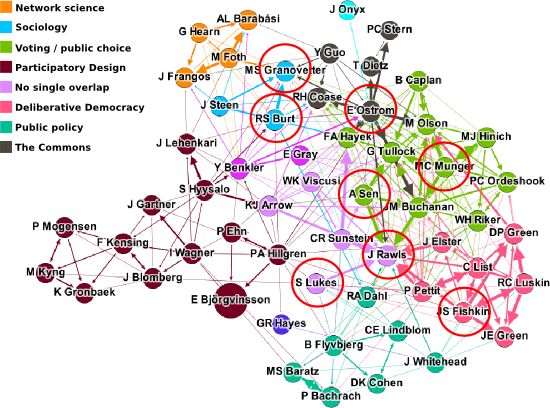
What's interesting about the diagram in this post is that you could figure out who the major writers are in the field without knowing anything about the writers or the field. Take a look. Rawls, Sen and Ostrom occupy central locations. "Basically, it automatically (well - a little effort and a bit of Google Scholar/Gephi competence needed) maps out connected research areas and authors, mined from Google Scholar, including their relative significance and centrality, shaped to fit your research interests." When we can do this for everybody, what would we need tests and exams for any more?

[Link] [Comment]
17 Oct 05:37

You are almost definitely not living in reality because your brain doesn’t want you to

files/images/cognitive-bias-codex.jpeg


Buster Benson, Quartz, Oct 17, 2016


Good article listing sources of cognitive bias (always an interest of mine). Numerous links. "In order to avoid drowning in information overload, our brains need to skim and filter insane amounts of information...

  1. Information overload sucks, so we aggressively filter.
  2. Lack of meaning is confusing, so we fill in the gaps.
  3. We need to act fast lest we lose our chance, so we jump to conclusions.
  4. This isn’ t getting easier, so we try to remember the important bits.

By keeping these four problems and their four consequences in mind (we) will ensure that we notice our own biases more often." The item called to my recollection a CBC interview I listened to this morning with Julia Shaw, author of The Memory Illusion: Why you might not be who you think you are.At least, I think I listened to it.

[Link] [Comment]
17 Oct 05:36

Learning in the Digital Age

files/images/cable_apples.JPG


Michael Grant, Conference Board of Canada, Oct 17, 2016


This report from the Conference Board of Canada "explores the potential of e-learning in the Canadian setting." Most Conference Board reports are expensive (like this excellent  Learning and Development Outlook from last year) but this one is free. Most readers of this newsletter will find the report very superficial, dated and quaint. It's not clear there was actually a literature review, as claimed - many of the (sparse) resources in the  bibliography link to error pages on the Conference Board website (the references have other errors, including a '2003' article on MOOCs). The main points of discussion - whether e-learning should be employed, the quality of faculty-created courses, the nature of the LMS - would have been appropriate in 2004. Aside from a short discussion of MOOCs, there is nothing about modern e-learning: social networks, simulations and virtual reality, gamification, workplace support (indeed, workplace learning is all but ignored). The report contains three recommendations: reduce economic barriers, tackle institutional constraints, and adopt excellent practices. Well sure; we'll get right on that, once we get past this Y2K bug thing.

[Link] [Comment]
17 Oct 05:36

Arbutus Greenway Temp Surfaces

by Ken Ohrn

Get the details HERE.

The gist: asphalt, separated in places for peds & bikes.  Several areas of bark mulch for walking. 

arbutus-temp-1

Artist’s rendering of a portion of the temporary surface


17 Oct 05:35

Industry sources say Netflix could launch offline mode before the end of 2016

by Rose Behar

Netflix may finally be close to adding the feature that all its users desire: offline mode.

According to an industry source interviewed by Light Reading, the streaming platform giant could launch the feature for desktop and mobile before 2016 comes to a close. The publication spoke with Dan Taitz, chief operating officer of Penthera, a company that sells mobile-focused software to streaming video providers.

“We know from our sources within the industry that Netflix is going to launch this product,” Taitz told the publication.

“My expectation is that by the end of the year Netflix will be launching download-to-go as an option for their customers.”

Taitz specified to Fortune that those sources include content providers, cable operators and other streaming service providers.

Additionally, Dan Rayburn, principal analyst at consulting and market research firm Frost & Sullivan told Light Reading that it’s something of an open secret in the streaming video community that Netflix is working on an offline feature.

“We’ve been hearing for months now that they are in fact going to roll out something soon,” said Raybury.

Netflix CEO Reed Hastings has in the past stated that temporary downloads was “never going to happen,” but is more recently quoted by Business Insider as saying: “We should keep an open mind on all this… as we expand around the world where we see an uneven set of networks, it’s something we should keep an open mind about.”

17 Oct 05:35

Recommended on Medium: Dear Men Who Wish To Be Allies to Women

Hello, I’m glad that you care about women’s rights and want to be an ally!

Continue reading on »

17 Oct 05:35

Arbutus Greenway: Temp Surface latest

by Stephen Rees

screen-shot-2016-10-14-at-7-12-28-pm

screen-shot-2016-10-14-at-7-14-41-pm

So since these are screen shots you need arbutus-greenway-temporary-path-oct-2016-open-house-information-displays which is a downloaded pdf from the City. You can also check out their webpage


Filed under: Arbutus Greenway Tagged: Arbutus, Arbutus Corridor
17 Oct 05:35

The New York Times’ boldly effective response to Trump’s libel threats

by Josh Bernoff

The New York Times published an article about Trump sexually assaulting two women. Trump threatened to sue for libel. The letter that the Times‘ lawyer sent in response really hits you smack on the forehead, because it’s so different from anything else you read in the paper. I’ll analyze. There are three kinds of things you … Continued

The post The New York Times’ boldly effective response to Trump’s libel threats appeared first on without bullshit.

17 Oct 05:34

Bots all the way down, and a puppy reference

by charlie

406161373_1b89bdef82_zBots have been around for a long time. Anyone who knows the history of AI remembers ELIZA, a conversation-mimicking AI that made you feel you were talking to a doctor, or, more like, an amateur psychologist. We should not be surprised that, since then, with every new interactive platform, there has been a proliferation of bots.

A botsplosion
In the past year, there’s been a renewed interest in bots on various messaging platforms. These have gone beyond the automated accounts that tweet the TowerBridge or the Shipping Forecast, or tweet the arrival of dictators at Geneva Airport.  Infused with more understanding of language and a dash of AI, these bots now can bait bigoted extremists, or tweet negative Trump quotes – with the source.

Science Friday did a great segment on AI bots and talked to some creators of them. While some of these bots are not, by definition, utilitarian, they are quite imaginative and creative, able to spark wonder and make you think, despite how they come out.

Getting beyond amusement, WeChat (no surprise) and Baidu are taking it up a notch. On WeChat there are bots that can do image recognition or mimic a voice-recognition assistant (I’ll get to voice-driven AI agents in a later post). And Baidu, to circle back to ELIZA, has created a docBot to help start the process (triage?) for folks looking for a doc or medical info.

Getting as smart as a puppy
Things are getting interesting. Duolingo is building chat bots to help folks learn a language. These are basically tutorBots with whom users can message with to practice with. The idea is that the bot is an “eternally patient, nonjudgmental, on-demand instructor.” Though, what I hear about some “patient and nonjudgmental” AI assistants (*cough* Amy) is that they can be extremely annoying.

As these bots get more AI-power, I’ll be on the look out for those that try too much. So far, my experience with machine learning has been that AI systems are usually not smarter than the creator.* But that’s fine. Long ago, a bunch of us concluded that getting too smart could be an annoyance, hence we suggested that ‘smart’ systems should Be as Smart as a Puppy.

For me, the best systems have been the ones that have augmented my intelligence – by being able to sift through large data sets, make broad connections, and present insights in a way to inform me (or the doc, or the data scientist) – rather than trying to supplant my intelligence.

Rather than try to build a bot that thinks it’s as capable as a human, make me a bot that make the humans in the mix work better. Don’t try to outthink me.

Are you using bots in your daily routine, or are they still a curious creature evolving in curious directions?

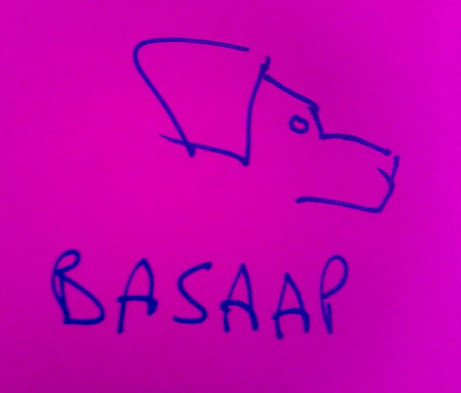
Image of my BASAAP drawing that Matt Jones was kind enough to immortalize back in 2007.

*Oh, and if you think that kids end up smarter than their creators, you’re right. But I don’t think that any of these bots understand what makes kids be smarter than their parents. That, I think, is at the core of human intelligence that will still take some time to sort out.
17 Oct 05:19

On CC0

by Doug Belshaw

There’s a lot to unpack in this post by Alan Levine about his attempts to license (or un-license) his photographs with Creative Commons Zero (CC0). The way I think about these things is:

  • Standard copyright: “All Rights Reserved” — I do the innovation, you do the consumption.
  • Creative Commons licenses: “Some Rights Reserved” — I have created this thing, and you can use it under the following conditions.
  • CC0/Public Domain: “No Rights Reserved” — I have created this thing, and you can do whatever you like with it.

I’m not precious about my work. I donated my doctoral thesis to the public domain under a CC0 license (lobbying Durham University to ensure it was stored under the same conditions in their repository). My blog has, for the last five years at least, been CC0 — although I’d forgotten to add that fact to my latest blog theme until writing this post.

For me, the CC0 decision is a no-brainer. I’m working to make the world a better place through whatever talents and skills that I’ve got. While I want my family to live comfortably, I’m not trying to accumulate wealth. That’s not what drives me. So I definitely feel what Alan says that he’s “given up trying to be an attribution cop”.

I care about the commons, but want to shift the Overton window all the way over to a free sharing economy, rather stay fixated on copyright. To me, things like Creative Commons licenses are necessary to water down and mollify the existing extremely-litigious copyright industry. If I’ve got complete control over my work (as I do) then I’ll dedicate it to the public domain.

An aside: if you’re theory of change involves obligation, then you’re better off using the CC BY-SA license. Why? It means whoever uses your work not only has to cite you as the original author, but they must release their own work into the commons.

CC BY-SA

The thing is that despite this all being couched in legal language (which I’m very grateful to Creative Commons for doing) I’m never, in reality, going to have the time or inclination to be able to chase down anyone who doesn’t subsequently release a derivative work under an open license.

In my experience, reducing the barriers to people using your work means that it gets spread far and wide. Not only that, but the further it’s spread, the greater your real-world insurance policy that people won’t claim your work as their own. After all, the more people who have seen your work, the greater likelihood someone will cry ‘foul’ when someone tries to pass it off as their own.

RSS Feed and CC0 license at dougbelshaw.com/blog

So I’ll continue with my policy of licensing my work under the CC0 license. Not only does it mark out my work as belonging to a community that believes in the commons, but it’s a great conversation starter for people who might be commons-curious…

Image via CC0.press (just because you don’t have to attribute doesn’t mean that you shouldn’t!)

17 Oct 05:19

Weeknote 41/2016

by Doug Belshaw

This week I’ve been:

Next week I’ll be doing some more writing, preparing for MozFest, running a thinkathon with my We Are Open colleagues, and catching up with various people. Wondering if I can help you / your organisation? Get in touch!

17 Oct 05:18

Fruit of the Commons

by Bryan Mathers
Fruit of the Commons

Before I started drawing, I was only remotely aware of Creative Commons – if at all. I remember coming across it a few years ago. Ah! Some people have taken a complicated thing and boiled it down so that people can use my stuff in an appropriate way? For free? Creative Commons is now central to my business model: Let others use your stuff. Every once in a while someone sees something out there I’ve created and thinks “I wonder if he can help us visually capture…”

This image was created for Olga Belikov at Creative Commons as part of #CCquest

The post Fruit of the Commons appeared first on Visual Thinkery.

17 Oct 05:18

Nexus 6P vs Google Pixel XL: Worth the Upgrade?

by Rajesh Pandey
Last year, after years of releasing Nexus devices that compromised on one aspect or the another, Google managed to hit a home run with the Huawei-made Nexus 6P. Sure, the handset was gargantuan with its 5.7-inch display and front-facing stereo speakers, but it had great battery life and decent camera — something which previous Nexus smartphones lacked. This year, Google is replacing the Nexus 6P with the Pixel XL. As Google puts it, the new Pixel smartphones have been completely developed and designed in-house by the company, with the OEM — HTC — having no input in it. Continue reading →
17 Oct 05:18

Day 1: Seoul

by Thejesh GN

We landed this morning around 6am. Hostel was in the middle of the city so we took the metro to Seoul Station (center) and then caught another one to reach the station near hostel. We found the hostel very easily. But then I was dead tired and get-lagged. Only after good food at Sinseon Seolleongtang we decided to do city fort walk.

Floor inside underground shopping mall giving directions.

Floor inside underground shopping mall giving directions.

This seems to happen all the time.

This seems to happen all the time.

Apparently cat cafe's are common. We found one while walking around.

Apparently cat cafe’s are common. We found one while walking around.

We took the bus to Changuimun Gate. We had to fill up and application and show passport at Tourist Center to get a pass to walk inside city wall. It’s still an active fort (military area), so photo opportunity is limited. I didn’t take many but enjoyed the walk. By the time we finished walk we were dead tired. Fortunately we reached a café on Samcheong-ro for a coffee and we were done for the day. Evening we walked around Myeongdong for some good street food and orange juice.

Yes thats me,, during city walk.

Yes thats me,, during city walk.

Fresh orange juice.

Fresh orange juice.

All in all I like the city. Its different from any city I have been until now. Tomorrow should be fun.

Plain Old Telephones inside a metro station.

Plain Old Telephones inside a metro station.

KOAT16: Day 1 - Seoul

Show embedded map in full-screen mode

17 Oct 05:18

Transport Canada bans Samsung Galaxy Note 7 from all Canadian flights

by Igor Bonifacic

Following the lead of the Federal Aviation Administration (FAA), Transport Canada has banned Samsung’s Galaxy Note 7 from Canadian airline flights.

“Transport Canada is of the view that Special Provision 137 of the Transportation of Dangerous Goods Regulations applies. Subsection 5 of Special Provision stipulates that it is forbidden to transport lithium ion cells or batteries that are damaged or defective and that, under normal conditions of transport, produce a flame or a dangerous evolution of heat, or produce a dangerous emission of toxic, corrosive or flammable gases or vapours,” writes the federal agency on its website.

Transport Canada goes on to add, “Air carriers should alert passengers to the prohibition against air transport of a Samsung Galaxy Note 7 device, in particular, immediately prior to boarding and to deny boarding to a passenger in possession of a Samsung Galaxy Note 7 device unless the passenger divests themselves and their baggage, including carry-on and checked, of the Samsung Galaxy Note 7 device.”

Previously, Transport Canada had advised airline passengers to keep their Samsung Note 7 device with them in the cabin as opposed to within checked luggage. The agency also advised against using or charging the device while in flight.

17 Oct 05:18

The Bolt, HTC’s latest phone, may come to Canada

by Igor Bonifacic

The Bolt, HTC’s latest smartphone, has leaked a second time, coming again courtesy of VentureBeat Editor Evan Blass.

htc-bolt-2

The first time we saw this device, the information that was available suggested the Bolt was likely to be exclusive to U.S. carrier Sprint. This leak, however, indicates HTC’s newest smartphone may come to Canada.

According to Blass, the Bolt is “expected to be available globally.” Moreover, he says it’s coming sometime this month.

htc-bolt-3

While it looks like the HTC 10, the Bolt is mid-range device, reports Blass. It features a 5.5-inch 1080p display (making it slightly bigger than the 10), 3GB of RAM, 64GB of expandable storage, front-facing fingerprint scanner, a USB-C port and Android Nougat.

More notably, like the Moto Z and iPhone 7, it does not have a 3.5mm headphone jack.

Are you interested in the Bolt? Tell us in the comment section.

Related: Leaked HTC Bolt may be the latest smartphone to drop the 3.5mm headphone jack

17 Oct 05:17

If I Had a Billion Dollars (Updated)

by Ken Ohrn

David Negrin of Aquilini Development and Construction Inc. will take over as CEO for FN development on 6 properties spanning 160 acres ($1 B worth) of Metro Vancouver land.

david-negrin

David Negrin will begin his new job Dec. 1 as head of the MST Development Corporation, which represents the interests of the Musqueam, Squamish and Tsleil-Waututh nations. Negrin’s appointment was announced Oct. 13 in a press release but Negrin was not made available to the Courier for an interview.

Thanks to Mike Howell at the Vancouver Courier.

From the web site:  The MST Development Corporation currently oversees six properties totaling 160 acres of prime developable lands throughout Metro Vancouver, valued at over $1 billion.

Properties fully or partially owned by the MST Partnership are:

  • Jericho Lands (west) in Vancouver
  • Jericho Lands (east) in Vancouver – co-owned with the Canada Lands Company
  • Heather Street Lands in Vancouver – co-owned with the Canada Lands Company
  • Former Liquor Distribution Branch site on East Broadway in Vancouver – co-owned with Aquilini Investment Group
  • Marine Drive Lands in West Vancouver – co-owned with the Canada Lands Company
  • Willingdon Lands in Burnaby – co-owned by the Musqueam and Tsleil-Waututh with Aquilini Investment Group

[Update]:  And thanks to Frances Bula in the Globe and Mail for reaction from around Vancouver:

They (the real estate community) see it as a sign that First Nations will now be playing a strong role in the development of that land instead of just being a quiet partner behind a private developer or with Canada Lands Corporation, the federal agency that co-owns with the MST the Jericho Lands on Vancouver’s west side and the Heather Lands, in the centre.

“This is very good news [for the First Nations],” said Jon Stovell, the current president of the region’s Urban Development Institute. “The First Nations groups have been having some difficulty finding a fit with conventional business world and their own expectations. Having a real seasoned professional will assist them.” . .

. . . Mr. Negrin’s departure from Aquilini will be a big loss for that company, said many, even though residential development is only a small part of the family’s empire that includes the Canucks, Rogers Arena, cranberry and blueberry farms, hotels and restaurants.

“It’s now clear the successes they were having were probably David’s accomplishments,” said Mr. Stovell.


17 Oct 05:17

Why For-Profit Education Fails

files/images/16.jpg


Jonathan A. Knee, The Atlantic, Oct 18, 2016


This is an interesting discussion but actually very light on the explanation it promises. A close reading reveals it to be this: first, VCs confuse size and scale, preferring to create large institutions in an industry that depends on local impact. Second, scope and scale do not always mix. They try to reform the entire education system rather than focusing on a specific activity or domain. Why do theey do this? Ego plays a role, but ultimately the cause is found in their desire to do good (which runs counter to the need to make money ("one cannot do good for very long if the business does not do well enough to survive")). The consistent failure of private institutions, argues the author, gives ammunition to those who oppose privatization, but "that sphere will always comprise public and private, nonprofit and for-profit institutions, and for-profit businesses play an essential role."

[Link] [Comment]
17 Oct 05:17

Reclaiming Portland

by Reverend

It’s been a whirlwind of a trip since I ventured back to the US two weeks ago. I have neglected the bava, and few things pain me more. But that was then, this is now.

2016-10-01-10-17-57

The trip started in Portland, Oregon, one of my favorite city’s in the U.S., and if we ever move back to the U.S. the Rose City may be atop the the list of destinations. I could see setting up Reclaim Hosting’s storefront there.

meta

Plus, the idea of living in a place where marijuana is completely decriminalized is very, very attractive to me. Before the Reclaim Hosting team met up in Portland on Sunday, I stayed with my old friends Zach and Aimee who were awesome in every way. We have a long history together between grad school in NYC, edtech, and just about everything good in my life. So catching up with them is always a real joy.

2016-10-01-10-18-37

I have found as I get older than nothing makes me happier than seeing old friends who are happy. And that was how I started my trip, which was awesome!

2016-10-01-10-18-21-1

From there I crossed the bridge to downtown Portland for an awesome five days with Tim and Lauren. This is the first time the Reclaim trio all got together since Lauren went full-time, and I have to say it was a perfect place for us to do some bonding. Portland is a really good reminder that my invention of Hipsterism in LA during the early 90s is still going strong.

Portland's Ace Hotel Lobby pano

2016-10-05-17-23-40

Photo Booth detail from Ace Hotel lobby

We stayed at the Ace Hotel, which has an old gold photo booth in it’s gorgeous lobby (click pano above for a distorted sense), so we had to indulge.

cubdgnnviaavela

A shacked up with Mr. Reclaim Hosting himself, and let there me no question I was that somebody!

2016-10-03-16-40-56

Tim answering tickets with his phone

It was also amazing to spend time with Lauren. As I mentioned earlier, this is the very first trip we all took together as a company, and I had no idea how important it was.

2016-10-05-17-31-05

Lauren digging Ace Hotel’s Lobby

I think we needed the time together to work on tickets, discuss issues, make plans, and dream of the future. Don’t get me wrong, we do all this remotely, but the proximity was very nice. For example, when the DNS for one of our servers had issues, it was nice to be working side-by-side with Lauren and Tim making sure we had all bases covered, were notifying the community, updating the status page, and figuring out just what was wrong. It felt good.

2016-10-02-17-41-22

Looking over Mike Caulfield’s shoulder to try and capture that blogging magic

Our first night we caught up with the great Mike Caulfield for dinner and a chat. Mike is Reclaim Hosting’s original benefactor, and despite him calling me a Libertarian Pirate, I’m still a big fan! It was a blast hanging out at Dinerant talking edtech, Portland and everything else. My favorite take away from the evening was his comment on the homeless population in Portland, he said something to the effect “You can’t call it urban camping and pretend it’s all fixed.” I think there was something about orange bikes in there too. I couldn’t stop thinking about that line while walking past homeless shanty after homeless shanty around downtown Portland. It was crazy.

2016-10-04-09-36-55The excuse we used to go to Portland was the cPanel conference. It was my very non-edtech/non-academic conference in the US ever? I’m not sure ever, but certainly in my memory. Couple of observations: the keynote and presentation bar is set pretty low. Academic and edtech conferences can be, and often are, annoying, but the level of thought and expertise that goes into the presentations was light years beyond this one. The keynote from the co-founder of Black Knight hosting Michele Neylon was about as bad as it gets. There was not a point to be made, and he made it clear that his company was pandering to the porn industry because it pays. Bizarre, and at times just downright uncomfortable. It was apparent that folks weren’t really there for the sessions, they were there for the open bar at noon and networking.

That said, I did catch two good sessions, both run by cPanel folks.  Jason Kiniry’s “Creating Custom External Authentication Modules” showed you how to create single sign-on for cPanel with other services like Google+, LinkedIN, etc. Tim has already done this for stateu.org, but it was nice to be in a session where you got taken through the process and it was explained for you in detail. The other was Dustin Scherer’s “Dashboard: The Secret to an Improved User Experience.” This session took you through all the improvements cPanel has made to the dashboard, and there have been many with Paper Lantern. But it also turned into a great back and forth about what we, as cPanel users and customers, would like to see. Awesome. We got to give feedback that they wanted, and it made us feel connected to a piece of software we use to drive much of Reclaim Hosting. That was the last session we attended, so that it ended strong.

2016-10-05-18-25-50

1980s arcade and bar Ground Kontrol

One of the greatest things about Portland all told is Ground Kontrol, a 1980s bar and arcade that is truly a time machine for an arcade rat like myself. I just broke 100K on Pacman, which made me very happy.

2016-10-04-22-25-41

And Tim and Lauren got a taste of how awesome it was to be a child of the 70s 🙂

2016-10-03-21-58-30

A noirish Lauren playing Centipede

We also spent some time in Portland’s Everyday Music. The OG record store and video rental aesthetic appeals to us, and we have had fun with it for the Reclaim Aesthetic—so spending time in the store was fun.

2016-10-05-17-39-19

2016-10-05-17-48-05

Lauren also suggested we try and capture bands that we have (or will) name servers after. What a great idea.

2016-10-05-17-42-23

2016-10-05-17-51-09

2016-10-05-17-55-37

2016-10-05-17-52-49

2016-10-05-17-51-52

And visions of servers to come?

2016-10-05-18-06-21

I also found some traces of that historical artifact ds106, I had no idea it used to be a band called Sonic Youth? The things you learn by getting off the internet 🙂

2016-10-05-18-04-37

I even made a vinyl and laserdisc score that was region specific:

2016-10-08-13-06-06

The trip was a total blast, and the best parts of it were hanging out with Lauren and Tim exploring Portland. If you look hard enough you can see Powell’s Books and Sizzle Pie from our hotel room window, and we indulged in both!

2016-10-04-08-23-57

Can you find Powell’s Bookstore and Sizzle Pie?

We also were right around the corner from the office of the software company Panic, which makes the FTP software I have used for years Transmit (amongst many other things). And in classic Timmmmyboy fashion, as we were walking by he not only pointed its presence out, but proceeded to explain that there is an app online that allows you to change the colors of the company’s sign. And a video was born:

We saw 80s cover bands, ate really, really well, and sang karaoke all night long (but what happens in karaoke stays in karaoke). It was an awesome trip for all these reasons and more, but more than anything it demonstrated that we are building energy and momentum around this crazy idea we had over 3 years ago now, and it is starting to flower is some really beautiful ways, and that is probably a really good segue way to my next post about our recent trip to Muhlenberg College, but until then…stay weird awesome Portland and Reclaim.

17 Oct 05:17

Twitter stocks take a dive after Salesforce pulls out of potential sale

by Jessica Vomiero

After rumours swirled about several potential Twitter acquisitions, the company’s final hope, Salesforce, has pulled its name out of the running.

When Twitter was first put up for sale, several companies emerged as potential suitors. These parties include Google, Apple, Salesforce and Disney. In recent weeks, however, all parties except Salesforce confirmed that they had retracted their interest in making a purchase.

Twitter’s stock had already fallen by over 20 percent after reports that Google, Disney and Apple planned not to make bids. Salesforce, however, wasn’t out of the running just yet.

Recently, Salesforce too has declined to make a bid, pushing Twitter’s stock down another seven percent. CNN reports that Twitter may have to remain independent until more promising offers surface.

While Twitter apparently laid off eight percent of its staff last year, the company still has over three thousand employees worldwide.

RelatedTwitter reportedly in talks with Salesforce regarding potential sale

SourceCNN
17 Oct 05:17

A View of Self-Driving Cars from 1956

by Eugene Wallingford

A friend and fellow classic science fiction fan told me that one of his favorite books as a teenager was Robert Heinlein's The Door into Summer. I've read a lot of Heinlein but not this one, so I picked it up at the library.

Early in the book, protagonist Daniel B. Davis needed to make the most of the next twenty-fours. He located his car, dropped some money into the "parking attendant", set course, and relaxed as the car headed out into traffic:

Or tried to relax. Los Angeles traffic was too fast and too slashingly murderous for me to be really happy under automatic control; I wanted to redesign their whole installation--it was not a really modern "fail safe". By the time we were west of Western Avenue and could go back on manual control I was edgy and wanted a drink.

This scene is set December 1970; Heinlein wrote it in 1956. He may have missed the year in which self-driving cars were already common technology by 45 years or more, but I think he got the feeling right. People like to be in control of their actions, especially when dropped into hectic conditions they can't control. Heinlein's character is an engineer, so naturally he thinks he could design a better. None of my programmer friends are like this, of course.

It's also interesting to note that automatic control was required in the most traffic. Once he got into a calmer setting, Davis could go back to driving himself. The system allows the human to drive only when he isn't a danger to other people, or even himself!

Today, it is commonplace to think that the biggest challenges of the move to self-driving cars are cultural, not technological: getting people to accept that the cars can drive themselves more safely than humans can drive them, and getting people to give up control. It's neat to see that Heinlein recognized this sixty years ago.

17 Oct 05:16

Carbon Sinks

There are 5 carbon sinks that are actuatable on a short time scale:

  1. Atmosphere (smallest sink)
  2. Plants
  3. Topsoil
  4. Surface ocean layers
  5. Fossil Fuel Reserves (largest sink)

Carbonate rock and deep ocean are both long-term sinks that change on the order of 1000s of years.

However, recent advancements mean capturing CO2 in Carbonate rock has become a possibility. The CarbFix project capured and calcified 95% of the carbon emissions of a coal plant in Iceland. Of course, this process requires energy too, but it’s one more tool in the swiss-army knife.

17 Oct 05:16

From PDF to PWP: A vision for compound web documents

by Jon Udell

I’ve been in the web publishing game since it began, and for all this time I’ve struggled to make peace with the refusal of the Portable Document Format (PDF) to wither and die. Why, in a world of born-digital documents mostly created and displayed on computers and rarely printed, would we cling to a format designed to emulate sheets of paper bound into books?

For those of us who labor to extract and repurpose the contents of PDF files, it’s a nightmare. You can get the text out of a PDF file but you can’t easily reconstruct the linear stream that went in. That problem is worse for tabular data. For web publishers, it’s a best practice to separate content assets (text, lists, tables, images) from presentation (typography, layout) so the assets can be recombined for different purposes and reused in a range of of formats: print, screens of all sizes. PDF authoring tools could, in theory, enable some of that separation, but in practice they don’t. Even if they did, it probably wouldn’t matter much.

Consider a Word document. Here the tools for achieving separation are readily available. If you want to set the size of a heading you don’t have to do it concretely, by setting it directly. Instead you can do it abstractly, by defining a class of heading, setting properties on the class, and assigning the class to your heading. This makes perfect sense to programmers and zero sense to almost everyone else. Templates help. But when people need to color outside the lines, it’s most natural to do so concretely (by adjusting individual elements) not abstractly (by defining and using classes).

It is arguably a failure of software design that our writing tools don’t notice repetition of concrete patterns and guide us to corresponding abstractions. That’s true for pre-web tools like Word. It’s equally true for web tools — like Google Docs — that ape their ancestors. Let’s play this idea out. What if, under the covers, the tools made a clean separation of layout and typography (defined in a style sheet) from text, images, and data (stored in a repository)? Great! Now you can restyle your document, and print it or display it on any device. And you can share with others who work with you on any of their devices.

What does sharing mean, though? It gets complicated. The statements “I’ll send you the document” or “I’ll share the document with you” can sometimes mean: “Here is a link to the document.” But they can also mean: “Here is a copy of the document.” The former is cognitively unnatural for the same reason that defining abstract styles is. We tend to think concretely. We want to manipulate things in the digital world directly. Although we’re learning to appreciate how the link enables collaboration and guarantees we see the same version, sending or sharing a copy (which affords neither advantage) feels more concrete and therefore more natural than sending or sharing a link.

Psychology notwithstanding, we can’t (yet) be sure that the recipient of a document we send or share will able to use it online. So, often, sending or sharing can’t just mean transferring a link. It has to mean transferring a copy. The sender attaches the copy to a message, or makes the copy available to the recipient for download.

That’s where the PDF file shines. It bundles a set of assets into a single compound document. You can’t recombine or repurpose those assets easily, if at all. But transfer is a simple transaction. The sender does nothing extra to bundle it for transmission, and the recipient does nothing extra to unbundle it for use.

I’ve been thinking about this as I observe my own use of Google Docs. Nowadays I create lots of them. My web publishing instincts tell me to create sets of reusable assets and then link them together. Instead, though, I find myself making bigger and bigger Google Docs. One huge driver of this behavior has been the ability to take screenshots, crop them, and copy/paste them into a doc. It’s massively more efficient than the corresponding workflow in, say, WordPress, where the process entails saving a file, uploading to the Media Folder, and then sourcing the image from there.

Another driver has been the Google Docs table of contents feature. I have a 100-page Google Doc that’s pushing the limits of the system and really ought to be a set of interlinked files. But the workflow for that is also a pain: capture the link to A, insert it into B, capture the link to B, insert it into A. I’ve come to see the table of contents feature — which builds the TOC as a set of links derived from doc headings — as a link automation tool.

As the Google Drive at work accumulates more stuff, I’m finding it harder to find and assemble bits and pieces scattered everywhere. It’s more productive to work with fewer but larger documents that bundle many bits and pieces together. If I send you a link to a section called out in the TOC, it’s as if I sent you a link to an individual document. But you land in a context that enables you to find related stuff by scanning the TOC. That can be a more reliable method of discovery, for you, than searching the whole Google Drive.

Can’t I just keep an inventory of assets in a folder and point you to the folder? Yes, but I’ve tried, it feels way less effective, I think there are two reasons why. First, there’s the overhead of creating and naming the assets. Second, the TOC conveys outline structure that the folder listing doesn’t.

This method is woefully imperfect for all kinds of reasons. A 100-page Google Doc is an unwieldy construct. Anonymous assets can’t be found by search. Links to headings lack human-readable information. And yet it’s effective because, I am coming to realize, there’s an ancient and powerful technology at work here. When I create a Google Doc in this way I am creating something like a book.

This may explain why the seeming immortality of the PDF format is less crazy than I have presumed. Even so, I’m still not ready to ante up for Acrobat Pro. I don’t know exactly what a book that’s born digital and read on devices ought to be. I do know a PDF file isn’t the right answer. Nor is a website delivered as a zip file. We need a thing with properties of both.

I think a W3C Working Draft entitled Portable Web Publications for the Open Web Platform (PWP) points in the right direction. Here’s the manifesto:

Our vision for Portable Web Publications is to define a class of documents on the Web that would be part of the Digital Publishing ecosystem but would also be fully native citizens of the Open Web Platform.

PWP usefully blurs distinctions along two axes.

That’s exactly what’s needed to achieve the goal. We want compound documents to be able to travel as packed bundles. We want to address their parts individually. And we want both modes available to us regardless of whether the documents are local or remote.

Because a PWP will be made from an inventory of managed assets, it will require professional tooling that’s beyond the scope of Google Docs or Word Online. Today it’s mainly commercial publishers who create such tools and use them to take apart and reconstruct the documents — typically still Word files — sent to them by authors. But web-native authoring tools are emerging, notably in scientific publishing. It’s not a stretch to imagine such tools empowering authors to create publication-ready books in PWP. It’s more of a stretch to imagine successors to Google Docs and Word Online making that possible for those of us who create book-like business documents. But we can dream.


17 Oct 05:16

Fall Dark

Most years I hate this season; less light every day, and with every gust a whirl of summer leaves torn from winter branches. Maybe I dislike the resonance with my life’s own greybeard season. Maybe it’s the trio of huge Pacific storms we’re dealing with. Let’s be honest: Mostly, it’s shitty US politics. Some of the colors are beautiful though.

These days, it needs an effort of will to look away from America’s slow titanic electoral trainwreck. We should make that effort. All it takes is going for a walk and leaving your mobile in your pocket. At least for a few minutes. Long enough to look up, and stay looking up, because these won’t be here for long.

Autumn leaves

I think there’s a song about those.

But it’s impossible to not think about That Election. The attractions of the public burnout of a pathetic bozo rich-kid attention junkie on the world’s largest stage aren’t to be denied.

The good news is, the bozo will soon retreat from the mainstage back to a minor-league freakshow that you only have to look at it if you want to.

One red leaf stands out

That’s really the way it looked.

But wow, poor America really needs an explanation for why 40% or so of its citizens are going to cast a vote that seems incomprehensible and insane. Something a little more convincing than “flyover victims” or “racists, basically”.

Chestnut on basket

Touching chestnuts makes me happy.

I have my own theory: “Fox-heads, mostly”. Where by “Fox” I include all the other right-wing talk radio too. I bet a lot of readers have never listened to it, but I do sometimes. These days I drive to Seattle regularly, in an old car without much but radio to listen to. In the north corner of Washington State, that’s often conservative talk.

Two things about it are striking. First, the endless drumbeat of lies taken as facts: Obama hates America, Hillary is a criminal, the Iran deal enables more bomb-building, Black Lives Matter is racist. Serious-toned grown-up voices with nationwide reach, saying these things over and over. After a while, I think it’s really hard to not start believing them.

Life in those leaves

When it’s dark, bright things stand out.

Here’s the other thing about Fox and its ilk: The ads. It’s just scam after scam after scam: Get rich quick, fix baldness, more male vigor. (There’s a light springling of medical ads aimed at one condition or another, mostly pathologies of the elderly.)

It’s not surprising that people who might buy the crap on sale might also like the “Great Again” scam, which is of about equal depth and quality.

Silly mushrooms

I thought these were only in Tintin.

Have these autumn clouds any silver lining? Perhaps a very public demonstration that certain classes of bad behavior, while they may be rewarded on “reality” TV, are not in civic life.

Also, male chauvinism isn’t abstract any more, it has a face. A repulsive one, with bad hair.

It’s not much, but it’s something.

17 Oct 05:15

Spiraling Down Minuscule DS106 History Details

files/images/The_long_goodbye.JPG


Alan Levine, CogDogBlog, Oct 18, 2016


The assignment bank was one of those details that made DS106 so innovative. Basically the idea was that people submit suggestions for assignments, which other people then browse, select from, complete and contribute. Some of  the earliest posts in  my art blog (now used for my photos of the day, but always subject to change) are from the DS106 assignment bank. The title is also from the DS106 course. Anyhow, this post reconstructs the history of the assignment bank. It begins from a  Michael Cauldfield post in which part of this history became the subject for discussions. Alan Levine drills deep into the historical archive and concludes "the Assignment bank is totally the idea and prowess of Martha Burtis." He also comments on the difficulties of doing digital history. I can relate; I've been updating my  Presentations files recently. When people tell you "the internet is forever" don't believe them. So much has already been lost. Take some time now and repair your archives. The future will thank you. Image: one of my DS106 contributions, The Long Goodbye.

[Link] [Comment]
17 Oct 05:15

Blind Carbon Copy and Outlook.com

by Matt Harris
For some time now there have been issues with Blind Carbon Copy appearing in support forum where the mail provider is outlook.com, in searching for a solution it bacame obvious that the issue encompased all mail clients wsending mail with SMTP, indicated it was a bug, or change of policy at outlook.com.
The effect of this issue was that mail send using BCC was not delivered by outlook.com.  It appeared that BCC addresses were simply stripped  and dropped from the email.  The mail would be delivered to anyone in a CC or To field,  but BCC recipients simply did not receive mail.  At one point I had contact with folk who were able to get some BCC mail addresses to work,  but not reliably and they were doing nothing different to others.  This reinforced my view that indeed there was a bug with outlook.com

I have had a support request with the Outlook folks for some time on this matter and I have now been notified the yes they do have a bug. Yes, they have a fix and are testing it.  Hopefully BCC will soon work again for those using SMTP in the near future.

I will update this post when the fix is released. If I am notified of the release.

Update:  All Outlook.com mail accounts should not work with BCC
16 Oct 21:45

Spare the Driver, Kill the Pedestrian-Driverless Car Programming

mkalus shared this story from Rolandt shared items on The Old Reader (RSS).

mercedes-driverless-car_827x510_61475984606

There are a whole bunch of people (and I am included) that are seriously concerned with how driverless car technology will interface with those pesky cyclists and erratic pedestrians who seem to amble in undetermined ways along city streets. The most efficient way for driverless cars to operate is without any interruption-no bicyclists, no pedestrians. And that has been a worry in terms of thinking of street design, and the potential for pedestrians to be even more marginalized on city streets.

But Mercedes has some new info to help us feel even more uncomfortable about this-“When they crash, self-driving Mercedes will be programmed to save the driver, and not the person or people they hit. That’s the design decision behind the Mercedes Benz’s future Level 4 and Level 5 autonomous cars, according to the company’s manager of driverless car safety, Christoph von Hugo. Instead of worrying about troublesome details like ethics, Mercedes will just program its cars to save the driver and the car’s occupants, in every situation.”

Yes, it’s the next generation of the Trolley Problem. “  Say the car is spinning out of control, and on course to hit a crowd queuing at a bus stop. It can correct its course, but in doing so, it’ll kill a cyclist for sure. What does it do? Mercedes’ answer to this take on the classic is to hit whichever one is least likely to hurt the people inside its cars. If that means taking out a crowd of kids waiting for the bus, then so be it.

The moral confusion is deepened when we consider that autonomous cars may save millions of lives that would otherwise have been snuffed out by careless human drivers. That’s no consolation if a Mercedes chooses to use you as an airbag to save its owner, but maybe you’d already have been killed a few years before if a particular human driver hadn’t been replaced by a driverless car.”

Moral of story? If you see a new generation Mercedes coming down the road, it’s probably a good idea to stay on the sidewalk.


16 Oct 21:44

TENT CARE 101: KEEPING YOUR TENT CLEAN & DRY

by MSR Team
mkalus shared this story from The Summit Register.

After a summer of adventuring, fall is a great time to inspect your gear for wear and tear, conduct any necessary maintenance and, if it’s time to put it away, prep it for longer-term storage. The good news is that if you take care of your MSR tent, you’ll have it for years to come. Here are three frequently asked questions and tent care tips from our customer service department that can help you keep your tent in good working order.

1. What’s the best way to store my tent between trips?
It’s best to store your tent in a dry and cool area, not in direct sunlight. Instead of storing the tent in its stuff sack, keep it in an oversized, breathable cotton bag or mesh duffel, just as you might store a sleeping bag. Or using a simple pillowcase can work just as well.

2. How do I prevent my tent from growing mildew?
All MSR tents feature waterproof protection, but prolonged exposure to moisture can cause hydrolysis—the premature break down of the waterproof coating—in even the most waterproof tents. To prevent this layer from becoming soft, sticky and no longer waterproof, and to keep the fabric from growing mildew, make sure to avoid packing or storing your tent if it is wet, damp or dirty.

It can take as few as 24 hours for mildew to start forming on a wet, crumpled tent, which can cause it to stain and smell, as well as compromise its waterproof coating. Airing out and drying your tent can help protect it. (Mildew and moisture damage are not covered under our Limited Warranty.)

3. How do I clean my tent?
Your tent is designed for the outdoors, so you’ll only need to clean it if it has an offensive odor or becomes heavily soiled. You can remove most loose dirt from the fabric using water pressure from a regular garden hose. For heavy-duty cleaning, set up your tent and hand wash it with warm water, a sponge and a mild, non-detergent soap. Rinse well and allow to it fully dry while pitched, or hang to dry.

Make sure to avoid dishwashing liquid, detergent, bleach and similarly concentrated solutions, and never dry clean, machine wash or machine dry your tent. Any of these methods can remove the tent’s waterproof coatings.

Keeping your tent dry, clean and properly stored can protect it for years to come.

Originally published on May 19th, 2014.

The post TENT CARE 101: KEEPING YOUR TENT CLEAN & DRY appeared first on The Summit Register.

16 Oct 21:43

Q & A about the Gulf Stream System slowdown and the Atlantic ‘cold blob’

by stefan
mkalus shared this story from RealClimate.

Last weekend, in Reykjavik the Arctic Circle Assembly was held, the large annual conference on all aspects of the Arctic. A topic of this year was: What’s going on in the North Atlantic? This referred to the conspicuous ‘cold blob’ in the subpolar Atlantic, on which there were lectures and a panel discussion (Reykjavik University had invited me to give one of the talks). Here I want to provide a brief overview of the issues discussed.

What is the ‘cold blob’?

This refers to exceptionally cold water in the subpolar Atlantic south of Greenland. In our paper last year we have shown it like this (see also our RealClimate post about it):
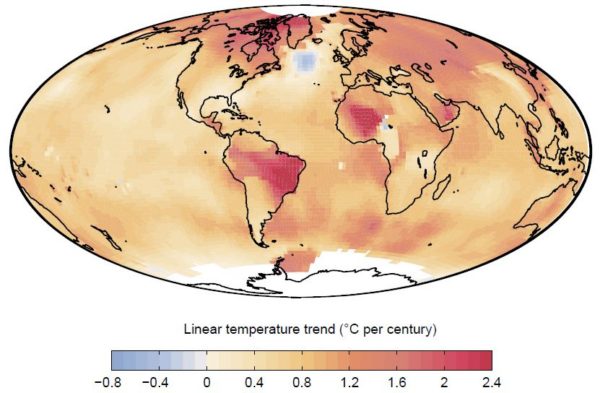
fig1a_new

Fig. 1 Linear temperature trends from 1901 to 2013 according to NASA data. Source: Rahmstorf et al, Nature Climate Change 2015.

Sometimes the term ‘cold blob’ is not used for this long-term trend but for a recent snapshot: 2015 was the coldest year in this region since records began in 1880 – despite this being globally the warmest year on record. In the ‘cold blob’ discussion, one must thus keep in mind whether talk is about the long-term trend or a short-term anomaly. When we wrote our paper, of course, we did not know that its publication would then coincide with record cold in the area.

You can see the current ‘cold blob’ when looking at maps of the sea surface temperature for example on Climate Reanalyzer.
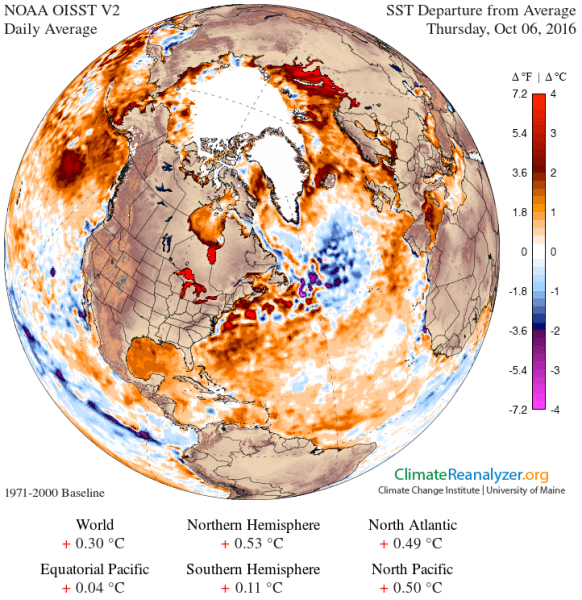
gfs-025deg_nh-sat1_sst_anom-6oct16

Fig. 2 Anomaly of sea surface temperature (relative to the base period 1971-2000) on 6 October 2016. Source: Climate Reanalyzer

What is the cause of the cold blob?

In principle, there can be two reasons for a change in ocean temperature: heat exchange through the surface or heat transports within the ocean. Halldór Björnsson of the Icelandic weather service showed in his lecture on Saturday that the short-term temperature fluctuations from year to year correlate with the heat exchange through the sea surface, but that this does not explain the longer-term development of the ‘cold blob’ over decades. He concluded that the latter is caused by changes in the North Atlantic ocean circulation, also called the Gulf Stream System. That’s exactly what one expects. Weather dominates the short-term fluctuations, but the ocean currents dominate the long-term development.

One suggestion that had been made some years ago – that the cooling may be caused by shading the sun by aerosol pollution – did not show up in the discussion on Saturday. In the scientific literature that idea was rapidly contradicted at the time, for good reasons (we discussed this in more detail in our paper).

What evidence speaks for a slowdown of the Gulf Stream System?

The basic problem is the lack of direct, continuous measurements of the key circulation in the Atlantic, the so-called AMOC (Atlantic Meridional Overturning Circulation). Such measurements are only available since 2004 through a series of moorings at 26°N (RAPID project). For the longer term development, one must therefore use indirect indicators of the flow.

My colleagues Mihai Dima and Gerrit Lohmann of the Alfred Wegener Institute in Germany in a 2010 study analysed the patterns of changes in global sea surface temperatures. They were the first to conclude that the AMOC has been weakening since the 1930’s. The evidence for this is the trend towards cooling in the subpolar North Atlantic which anti-correlates with temperatures in the South Atlantic (suggesting reduced heat transport from the South Atlantic to the North Atlantic). In addition, Dima and Lohmann found an anti-correlation to the temperatures off the US East Coast, to the south-west of the ‘cold blob’. This is not seen in Fig. 1 above, since the NASA data use a smoothing radius of 1200 km, but you can see it, for example, in the currently high temperatures in Fig. 2.

The latest high resolution simulations of the GFDL in Princeton show precisely this pattern in response to a CO2 increase in the atmosphere (discussed more in this RealClimate post). In the model the cause is a slowdown of the Gulf Stream system. There are also coral data from the Gulf of Maine off the US coast, which indicate a similar time evolution of water mass changes there as the ‘cold blob’ (discussed further in the same post).
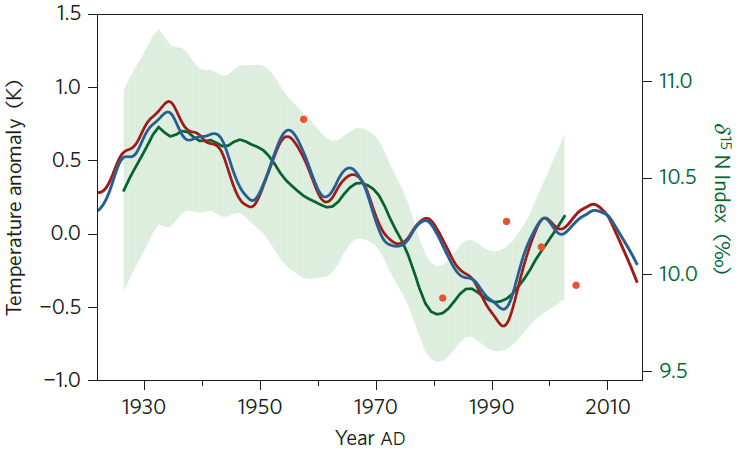
Rahmstorf15

Fig. 3 Index of the strength of the overturning circulation in the Atlantic (AMOC), calculated from the temperature in the subpolar Atlantic minus the mean temperature of the Northern Hemisphere (red and blue curves). The green curve shows the coral data of Sherwood and colleagues. Source: Rahmstorf et al, Nature Climate Change 2015.

For the most recent past, the Atlantic flow index we calculated from the temperature pattern is consistent with other data. For the time since 2004, for which there are direct measurements of the AMOC from the RAPID array, the downward trend by 3 Sv measured there agrees with our indirect estimate. The significant slowdown after 1970 and then following recovery from about 1990 in our curve has been confirmed by other studies with other methods (see e.g. Haine 2016 and its schematic diagram).

What speaks against a slowdown of the Gulf Stream System?

As a counter-argument against a weakening of the Gulf Stream system, Steingrímur Jónsson on Saturday brought up the measurements of the so-called “overflow” from the Nordic Seas across the sills between Greenland, Iceland and Scotland, which do not show any trend. Here one must simply distinguish between different parts of the Atlantic ocean circulation. In our study, we argue that the AMOC in the open Atlantic has weakened – i.e. to the south of the ‘cold blob’, where the heat comes from. This is what’s measured by the RAPID array. The overflows further north are (i) unlikely to have an influence on the temperatures in the ‘cold blob’, and (ii) are largely independent of the AMOC in the open Atlantic – at least that is suggested by a model simulation of the Max Planck Institute for Meteorology in Hamburg, for which we show a correlation analysis in Fig. 2b in our paper.

Another counterargument (though not brought up in professional discourse but on a “climate skeptics” website) is that the measurements on the Oleander line across the Gulf Stream show no slowdown (Rossby et al. 2014). However, these cover only a 20-year period for which our AMOC index also does not show any slowdown. And as Tal Ezer showed in a study in 2015, these measurements of the Gulf Stream don’t correlate with the AMOC measurements of the RAPID array – which is not surprising because the AMOC is only a minor component of the mainly wind-driven Gulf Stream. Therefore these diverse measurements of other aspects of the complex Atlantic ocean circulation are by no means inconsistent with a general long-term slowdown of the AMOC as proposed by Dima and Lohmann.

rax_greenland

Meltwater lake in Greenland. Photo courtesy of Ragnar Axelsson

What role does the meltwater from Greenland play?

In our paper, we argued that the meltwater input from the Greenland ice sheet could play a so far neglected role (but not the main role, as some have misunderstood). The standard IPCC models, for example, have not yet taken into account this meltwater input. A new study by Claus Böning and colleagues (Nature Geoscience in 2016) has specifically studied the effect of added meltwater in a high-resolution ocean model. It was assumed that starting from 1990, the Greenland ice sheet begins to lose mass – initially starting with a melt rate of zero which is linearly increased until 2020. The authors find little influence on the flow – but this is hardly surprising given the design of this experiment. The real Greenland ice has not started to lose mass only since 1990, it takes time until the meltwater spreads and accumulates, and also the ocean circulation will react with delay and inertia. The prescribed cumulative meltwater amount in the model experiment is 7,500 cubic kilometers in the period 1990-2020, over half of which is added over the last ten years, so the AMOC has little time to react. In our paper, based on data from Jason Box from the Geologic Survey of Denmark and Greenland, we estimated that the Greenland ice sheet has already come out of equilibrium since the beginning of the 20th century and has since added about 13,000 cubic kilometers of meltwater to the ocean. The response of the AMOC could therefore be greater than in the model experiment.

In a further experiment, Böning and co-workers showed that a cumulative freshwater volume of ~20,000 cubic kilometers leads to a breakdown of deep convection and a slowdown of the AMOC by 5 Sv within a few years. The main conclusion of their study is not that Greenland melt has no influence on the AMOC, but as the title of the paper says it shows “Emerging impact of Greenland meltwater on deepwater formation in the North Atlantic Ocean”. It thus supports our argument that the contribution of Greenland melt should not be neglected.

Incidentally, the meltwater hardly has a direct cooling effect in the ‘cold blob’ region – its effect is rather via the dilution of the sea water with freshwater, which reduces the density and thereby hinders the sinking of the water which drives the AMOC.

Is the cold bubble caused by humans?

An important question, of course, is whether the changes in the subpolar Atlantic are caused by humans or are part of natural variability. In my opinion, this is a question of the time scale considered: the variations from year to year are obviously dominated by weather, and also decadal variations – such as the warming (probably the increase of the flow) from 1990 to the middle of the 2000s and the subsequent cooling (slowdown of the flow) – are likely to be mainly natural variations. In contrast, the long-term trend of Dima and Lohmann since 1930 is in my view largely anthropogenic. As the proxy reconstruction in our paper shows, it is probably unique in the context of the previous one thousand years. It is also predicted by climate models in response to the rising greenhouse gas content of the atmosphere.

Regarding the 2015 record cold in the subpolar Atlantic, the arguments are like a mirror image of the discussion about the global heat record of 2015. For the latter the question was El Niño or global warming? The answer is the combination of both. If the natural variation goes in the same direction as the human-caused trend, then a new record can be set. If the natural variation goes in the opposite direction, it can over-compensate the climate trend for a while.

rax_iceland

Ice on the coast of Iceland. Photo courtesy of Ragnar Axelsson

What impact does a Gulf Stream System slowdown have?

The potential impacts are increasingly studied, here just briefly a few examples. Haarsma et al. (2015) argue on the basis of model simulation that the weakening of the Gulf Stream system will in the future be the main cause of changes in the atmospheric summer circulation over Europe. Jackson et al. (2015) found that a slowdown is likely to lead to increased storm activity across Britain and parts of mainland Europe. And a new study by Duchez et al. (2016) connects the ‘cold blob’ in the summer of 2015 to the heatwave across Europe that year, because the cold subpolar Atlantic favors a certain air pressure distribution.

A 25-minute video lecture by myself recorded in Iceland last May. Source: Earth101. This project has many more clips with Gavin, Mike, me and other climate scientists – subscribe to their youtube channel (it’s free) to keep them coming.

Could the AMOC break down entirely?

This risk has been discussed since the 1980s, originally due to paleoclimatic data showing a number of abrupt AMOC changes in the course of Earth’s history. It is now well understood that there is a critical tipping point in the system. How far we are from this, however, is not known. Earlier model intercomparisons suggest that a freshwater flow in the order of 0.1 Sv (the equivalent of 3,000 cubic kilometers per year) could be critical. There are some arguments suggesting that models might systematically overrate the stability of the AMOC, which we summarized in PNAS in 2009. An assessment from 2011, commissioned by the European Environment Agency, concluded that the system may be viewed as more sensitive than suggested by earlier assessments.
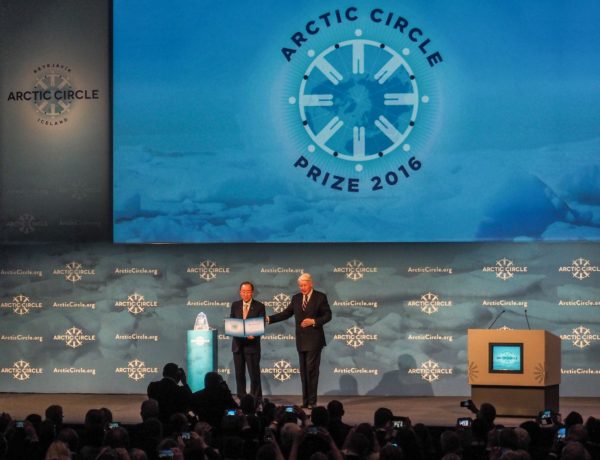
ban_arctic_circle

Postscript on the Arctic Circle Assembly. On Saturday, UN Secretary General Ban Ki-moon was awarded the Arctic Circle Prize for his long-standing commitment to the successful conclusion of the Paris Climate Agreement. He received standing ovations from the more than thousand conference participants in the overcrowded hall. In his acceptance speech he emphasised the record-breaking speed in which the agreement has been ratified; after taking the final hurdle a few days ago, it will come into force on 4 November! “What was once considered impossible has now become unstoppable” he said. “We must now turn words into deeds and implement the Paris Agreement. We do not have a plan B, since we do not have a planet B.”

Ban also answered audience questions, and when asked to give a few key lessons he has learned during his time in office, he said: There are many key players, just don’t leave it to governments! He called upon civil society and the business world to push for a low-carbon and climate-resilient economy.

For the evening, the President of Iceland, Guðni Jóhannesson, invited some Icelandic government members (including Prime Minister Sigurður Jóhannsson and Foreign Minister Lilja Alfreðsdóttir) and a handful of scientists to his mansion for a dinner in honor of Ban Ki-moon, where we further discussed the dramatic climate changes in the Arctic and the progress of climate policy.

Link

The Icelandic newspaper Morgunbladid has a special issue for the Arctic Circle Assembly with the magnificent photos and two articles by Ragnar Axelsson and a series of interviews (e.g with Mike Mann from page 20 and with me from page 16).

morgunbladet

16 Oct 21:43

Your Social Media Fingerprint

mkalus shared this story :
Who tracks you and your browser? Try it and see.

Without your consent most major web platforms leak whether you are logged in. This allows any website to detect on which platforms you're signed up. Since there are lots of platforms with specific demographics an attacker could reason about your personality, too.

For most web platforms there's a way to abuse the login mechanism to detect whether a user is logged in to that service.
Although this vulnerability is well known for several years most companies won't fix it.

The exploit is pretty simple and actually easy to fix. Let's look at <a href="http://facebook.com" rel="nofollow">facebook.com</a> to get an idea of how it works:

How does the login redirect mechanism work?


At first we need to understand the login redirect mechanism. Say you're logged in and visit
<a href="https://www.facebook.com/bookmarks/pages" rel="nofollow">https://www.facebook.com/bookmarks/pages</a>

Now if you open this URL in a private tab where you are not logged in, you will get redirected to the login screen with this URL:

<a href="https://www.facebook.com/login.php?next=https%3A%2F%2Fwww.facebook.com%2Fbookmarks%2Fpages" rel="nofollow">https://www.facebook.com/login.php?next=https%3A%2F%2Fwww.facebook.com%2Fbookmarks%2Fpages</a>
Note the next parameter in the URL: https%3A%2F%2Fwww.facebook.com%2Fbookmarks%2Fpages.

That's the URL we came from and it is used to redirect us back there once we've logged in.
But if we enter the login URL in a browser tab where we are already logged in, we get redirected without getting prompted to login. Therefore this URL returns:

  • If logged in:   the resource at the URL in the next parameter
  • If logged out: the login screen

Bypass the Same Origin Policy

How does this URL help us? The Same Origin Policy prevents to read the results of this request from any other domain but <a href="https://facebook.com" rel="nofollow">https://facebook.com</a>...
Well, the SOP is strict for HTML pages, but it allows to receive images from other origins! So if the resource in the next parameter would be an image we could read it from our website. It can't be any image though. Facebook checks if the URL in the next parameter starts with <a href="https://facebook.com" rel="nofollow">https://facebook.com</a>. So we need to find an image on <a href="http://facebook.com" rel="nofollow">facebook.com</a>. Should be easy, right? Actually it isn't, because facebook hosts almost all images on their CDN servers under the domain <a href="http://fbcdn.net" rel="nofollow">fbcdn.net</a>. Though there is one image that you can find on almost every webserver: the good old favicon.ico!
This is how our login URL looks like with the favicon as next parameter:

<a href="https://www.facebook.com/login.php?next=https%3A%2F%2Fwww.facebook.com%2Ffavicon.ico" rel="nofollow">https://www.facebook.com/login.php?next=https%3A%2F%2Fwww.facebook.com%2Ffavicon.ico</a>
It has a very interesting property:
  • Logged in:   returns the favicon image
  • Logged out: returns the HTML of the login page

We can use this URL in an <img> tag in our website:

<img src="https://www.facebook.com/login.php?next=https%3A%2F%2Fwww.facebook.com%2Ffavicon.ico">
This <img> tag's property:
  • Logged in:   receives the favicon image, will load it successfully, and the onLoad callback will be fired.
  • Logged out: receives the HTML of the login screen, will fail to load it as an image, and the onError callback will be fired.
This leads to the final exploit:
<img onload="alert('logged in to fb')" onerror="alert('not logged in to fb')" src="https://www.facebook.com/login.php?next=https%3A%2F%2Fwww.facebook.com%2Ffavicon.ico">

Other Platforms

This mechanism works for almost all major web platforms, because they all have a redirect parameter in their login endpoint and they need to host their favicon on their domain (bc of browser compatibility, and of the technical debt of the former lack of standards).

Updates

This attack could be a step of a worse attack such as deanonymization techniques, Clickjacking, Profilejacking, or Phishing where it is crucial to know if a victim is logged in to a service.

First of all: disable third party cookies.

You can also install a browser plugin like Privacy Badger, or uMatrix to protect yourself from this attack.

For further information see the discussion on Hackernews or this discussion on Reddit.

The companies won't fix the issue, because the risk for their own service is relatively low. Though so many platforms are vulnerable to this, it becomes a real privacy issue. Please help to raise awareness to push the companies to fix the issue.

If you find more web platforms that are vulnerable to this attack, please file an issue to add it. The more complete this list is, the bigger the issue and the higher the pressure for platforms to fix it.

I'm looking for a job as a Web App Pentester or Frontend Engineer. Here you can find my resume. If you're hiring ping me: robin@capira.de