Shared posts

14 Oct 22:12

Canvas, Episode 21: Office and Google Docs

by Federico Viticci

This week Fraser and Federico complete the set and talk about Microsoft Office and Google Docs on iOS.

This week on Canvas, we conclude our mini-series on office apps for iOS with a look at the Microsoft Office suite and Google's iOS clients. You can listen here.

Sponsored by:

  • Boom for iOS: Redefine the way you listen to music on your iPhone and iPad.

→ Source: relay.fm

14 Oct 22:12

Samsung estimates $4 billion CAD loss for next two quarters due to Note 7 debacle

by Rose Behar

Samsung has updated its estimation of the negative impact that the discontinued Note 7 will have on its profits.

On October 14th, the company pushed out a global release stating that it now estimates a negative impact of approximately “mid-3 trillion won in operating profit from the fourth quarter of 2016 through the first quarter of 2017.”

In U.S. dollars this translates to about $3.1 billion, making the expected loss a whopping $4 billion in Canadian dollars.

In its release, the company notes that it had already taken into account the expected direct cost from the discontinuation of the Note 7 in the recently revised version of its third quarter earnings guidance report — however, it wants the public to expect a longer recovery process.

Samsung says it expects the drop in revenue to continue to have a negative impact on operating profits for the next two financial quarters, with an estimated loss in the mid-2 trillion won range for the fourth quarter of 2016 (about $2.9 billion CAD), and approximately 1 trillion won (about $1.1 billion CAD) in the first quarter of 2017.

As for how it will remedy this situation, Samsung says it will expand sales of its current flagship lineup, the Galaxy S7 and S7 edge.

When it comes to the more difficult process of making customers feel safe again, it says it will make “significant changes in its quality assurance processes.”

The Note 7 was first recalled on September 2nd due to an issue with was thought to be an issue with device’s battery overheating and combusting. It was permanently discontinued on October 11th, 2016, after the issue persisted even in replacement handsets.

SourceSamsung
14 Oct 22:12

Should I make a chatbot or a better FAQ?

Roger pointed me to this interesting article (paywalled, sorry!) about Facebook’s chatbot service. I think the article made a couple of interesting points. The first thing I thought was interesting was their explicit acknowledgement of the process I outlined in a previous post for building an AI startup - (1) convince (or in this case pay) some humans to be your training set, and (2) collect the data on the humans and then use it to build your AI.

The other point that is pretty fascinating is that they realized how many data points they would need before they could reasonably replace a human with an AI chatbot. The original estimate was tens of thousands and the ultimate number was millions or more. I have been thinking a lot that the AI “revolution” is just a tradeoff between parameters and data points. If you have a billion parameter prediction algorithm it may work pretty awesome - as long as you have a few hundred billion data points to train it with.

But the theme of the article was that chatbots may have had some mis-steps/may not be ready for prime time. I think the main reason is that at the moment most AI efforts can only report facts, not intuit intention and alter the question for the user or go beyond the facts/state of the world.

One example I’ve run into recently was booking a ticket on an airline. I wanted to know if I could make a certain change to my ticket. The airline didn’t have any information about the change I wanted to make online. After checking thoroughly I clicked on the “Chat with an agent” button and was directed to what was clearly a chatbot. The chatbot asked a question or two and then sent me to the “make changes to a ticket” page of the website.

I eventually had to call and get a person on the phone, because what I wanted to ask about didn’t apply to the public information. They set me straight and I booked the ticket. The chatbot wasn’t helpful because it could only respond with information it had available on the website. It couldn’t identify a new situation, realize it had to ask around, figure out there was an edge case, and then make a ruling/help out.

I would guess that most of the time if a person interacts with a chatbot they are doing it only because they already looked at all the publicly available information on the FAQ, etc. and couldn’t find it. So an alternative solution, which would require a lot less work and a much smaller training set, is to just have a more complete FAQ.

The question to me is does anyone other than Facebook or Google have a big enough training set to make a chatbot worth it?

14 Oct 20:57

Who they are, who we are

by tychay

I understand Trump appeal, he is a man who speaks for the “people”. The question for me is not Trump because there is away going to be some asshole who comes along, what bothers me is the alt-right movement altogether. It’s like why is there so much hate that is being taken as logic among this group?

The “alt-right” almost ended our revolution before it was declared. They tore at our republic before it was founded. We fought the bloodiest war in our history with them. When it was finally over, they found a way to void it within a decade so their sin would forever be our sin. Even as recently as 1968, George Wallace carried five states solely on their message. After that, the Republican Party rebuilt their entire party around them. Heck, the anti-abortion movement is their proxy contrived for polite company.

They had many guises and went by many names: slavery, “fit vs. unfit”, “separate-but-equal” “states rights”, movement conservatism, “cognitive elite”, “religious freedom”, and, most recently, yes, the alt-right.

Even before they became “Redeemers” at the first hint of threat to their power, they embedded a nomination rule to ensure they had veto power within the Democratic Party. When that was finally excised to elect FDR, they migrated to the Republican Party and they are only now just discovering that their tiny plurality in their former party comprises the majority of the motivated base of their new one (hence Trumpism).

No, the “alt-right” under some name has always been with us and will always be with us. It is our original sin and a part of the American identity. When they rear their ugly head, they need to be fought and “roundly defeated by the abiding decency and good sense” of the rest of us. And yet, at the same time, sadly, we must admit, they are us: We, the People.

Nobody said democracy was easy.

Comfort yourself with the knowledge that they have always been the losers in our history. They were the losers when they said a black man is three-fifth of a person, they were (are?) losers when they said that a woman couldn’t vote, they were losers when they sent blacks to the back of the bus, forced birth on women, and kept gays from marrying. And, yes, they will be the losers again—they that say build this wall, deport that Muslim, and show your birth certificate at the bathroom door.

14 Oct 20:56

Bringing the Power of the Internet to the Next Billion and Beyond

by Katharina Borchert

Announcing Mozilla’s Equal Rating Innovation Challenge, a $250,000 contest including expert mentorship to spark new ways to connect everyone to the Internet.

At Mozilla, we believe the Internet is most powerful when anyone – regardless of gender, income, or geography – can participate equally. However the digital divide remains a clear and persistent reality. Today more than 4 billion people are still not online, according to the World Economic Forum. That is greater than 55% of the global population. Some, who live in poor or rural areas, lack the infrastructure. Fast wired and wireless connectivity only reaches 30% of rural areas. Other people don’t connect because they don’t believe there is enough relevant digital content in their language. Women are also less likely to access and use the Internet; only 37% access the Internet versus 59% of men, according to surveys by the World Wide Web Foundation.

Access alone, however, is not sufficient. Pre-selected content and walled gardens powered by specific providers subvert the participatory and democratic nature of the Internet that makes it such a powerful platform. Mitchell Baker coined the term equal rating in a 2015 blog post. Mozilla successfully took part in shaping pro-net neutrality legislation in the US, Europe and India. Today, Mozilla’s Open Innovation Team wants to inject practical, action-oriented, new thinking into these efforts.

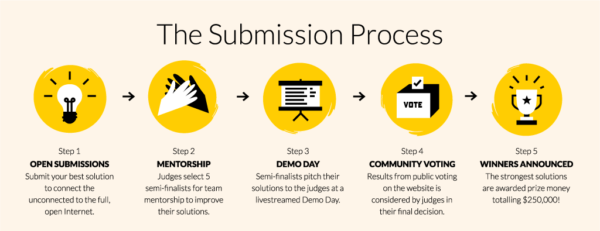
This is why we are very excited to launch our global Equal Rating Innovation Challenge. This challenge is designed to spur innovations for bringing the members of the Next Billion online. The Equal Rating Innovation Challenge is focused on identifying creative new solutions to connect the unconnected. These solutions may range from consumer products and novel mobile services to new business models and infrastructure proposals. Mozilla will award US$250,000 in funding and provide expert mentorship to bring these solutions to the market.

Equal Rating Innovation ChallengeWe seek to engage entrepreneurs, designers, researchers, and innovators all over the world to propose creative, engaging and scalable ideas that cultivate digital literacy and provide affordable access to the full diversity of the open Internet. In particular, we welcome proposals that build on local knowledge and expertise. Our aim is to entertain applications from all over the globe.

The US$250,000 in prize monies will be split in three categories:

  • Best Overall (key metric: scalability)
  • Best Overall Runner-up
  • Most Novel Solution (key metric: experimental with potential high reward)

This level of funding may be everything a team needs to go to market with a consumer product, or it may provide enough support to unlock further funding for an infrastructure project.

The official submission period will run from 1 November to 6 January. All submissions will be judged by a group of external experts by mid January. The selected semifinalists will receive mentorship for their projects before they demo their ideas in early March. The winners will be announced at the end of March 2017.

Submisson Process

We have also launched www.equalrating.com, a website offering educational content and background information to support the challenge. On the site, you will find the 3 key frameworks that may be useful for building understanding of the different aspects of this topic. You can read important statistics that humanize this issue, and see how connectivity influences gender dynamics, education, economics, and a myriad of other social issues. The reports section provides further depth to the different positions of the current debate. In the coming weeks, we will also stream a series of webinars to further inform potential applicants about the challenge details. We hope these webinars also provide opportunities for dialogue and questions.

Connecting the unconnected is one of the greatest challenges of our time. No one organization or effort can tackle it alone. Spread the word. Submit your ideas to build innovative and scalable ways to bring Internet access to the Next Billion – and the other billions, as well. Please join us in addressing this grand challenge.

Further information: www.equalrating.com
Contact: equalrating@mozilla.com

14 Oct 20:56

Does It Come In Black?

14 Oct 20:56

Arbutus Greenway Reminder

by Ken Ohrn

PT got this the other day via the Arbutus Greenway Project Office mail list.

In September, the City held five public workshops on temporary design options for the Arbutus Greenway. We’ve also received more than 500 emails, letters and 3-1-1 calls, and presented at four City of Vancouver advisory committees.

Come to a public information session on the Arbutus Greenway temporary path and learn how the public’s input shaped the final design:

  • Saturday, October 15, 10 am – 2 pm, Kitsilano Neighbourhood House, 2305 West 7th Avenue

These meetings will be drop-in info session format. City staff will be available to answer questions. You can also view the information boards and consultation summary report, which will be posted online and shared with you by email on Friday.

Sincerely,
Arbutus Greenway Project Office, City of Vancouver

arbutusgreenway@vancouver.ca | 3-1-1 | vancouver.ca/arbutus-greenway


14 Oct 20:56

Long Reach Brakes Are Still Popular

by noreply@blogger.com (VeloOrange)
By Scott

Sometimes in the rush to jump onto new products and trends, you tend to forget about the great products that keep on working, without change, for years. Items like Retro Cages, Constructeur Racks (arriving late this month), and Grand Cru Long Reach Brakes. Things that don't change, are solid, dependable and don't cost an arm and a leg. I was thinking about this when I saw a blog post from Red Kite Prayer about our long reach brakes. These brakes are one of those things that we order in and they sell solidly.

While it may seem that disc brakes are every where now, even on road bikes, side pull brakes still have a place. Companies like Chris King's bike line Cielo, put our brakes on their Sportif model. Seven Bikes uses them on their RedSky model, proving that people still want the simplicity, reliability, and power of a dual pivot side pull brakes.


In addition to being super stiff, the Grand Cru long reach brakes are one of the few high quality brake sets that also clear 45mm fenders, a bonus for builders and riders who want wider tires and fenders.


On another note, coffeeneuring 2016 has gotten off to an excellent start. I did two rides this past weekend. One ride to Vigilante Coffee in Hyatsville on Saturday and a ride north from home to a nice park in Montgomery County MD, started things off on a good and delicious note. 

How is everyone's coffeeneuring adventures going?
14 Oct 17:19

New Park — 17th & Yukon

by Ken Ohrn

The City of Vancouver has purchased a lot and built a neighbourhood park on it, also opening nearby Yukon St. to safe travel by people on foot, bike, stroller and so on. Located at the NE corner of the intersection of 17th Ave and Yukon St.

In many ways, this park reminds me of the way West End traffic calming opened up streets from car thoroughfares into people places. Also very much like Jim Deva Plaza, but different in terms of design and surface treatment. Note the playground, the planters that incorporate benches, the chairs and the big rocks for kids to climb on.

Click any photo to see large versions.

yukon-st-park-2 yukon-st-park-3 yukon-st-park
14 Oct 17:19

Spare the Driver, Kill the Pedestrian-Driverless Car Programming

by Sandy James Planner

mercedes-driverless-car_827x510_61475984606

There are a whole bunch of people (and I am included) that are seriously concerned with how driverless car technology will interface with those pesky cyclists and erratic pedestrians who seem to amble in undetermined ways along city streets. The most efficient way for driverless cars to operate is without any interruption-no bicyclists, no pedestrians. And that has been a worry in terms of thinking of street design, and the potential for pedestrians to be even more marginalized on city streets.

But Mercedes has some new info to help us feel even more uncomfortable about this-“When they crash, self-driving Mercedes will be programmed to save the driver, and not the person or people they hit. That’s the design decision behind the Mercedes Benz’s future Level 4 and Level 5 autonomous cars, according to the company’s manager of driverless car safety, Christoph von Hugo. Instead of worrying about troublesome details like ethics, Mercedes will just program its cars to save the driver and the car’s occupants, in every situation.”

Yes, it’s the next generation of the Trolley Problem. “  Say the car is spinning out of control, and on course to hit a crowd queuing at a bus stop. It can correct its course, but in doing so, it’ll kill a cyclist for sure. What does it do? Mercedes’ answer to this take on the classic is to hit whichever one is least likely to hurt the people inside its cars. If that means taking out a crowd of kids waiting for the bus, then so be it.

The moral confusion is deepened when we consider that autonomous cars may save millions of lives that would otherwise have been snuffed out by careless human drivers. That’s no consolation if a Mercedes chooses to use you as an airbag to save its owner, but maybe you’d already have been killed a few years before if a particular human driver hadn’t been replaced by a driverless car.”

Moral of story? If you see a new generation Mercedes coming down the road, it’s probably a good idea to stay on the sidewalk.


14 Oct 17:18

A New School Use-Housing Teachers

by Sandy James Planner

wilkinson_smaller

In the “why didn’t I think of that” department, The St. Louis Dispatch reports on an innovative idea-they are planning to turn a closed school into affordable housing for the system’s teachers.

“the Wilkinson School, closed in 2008 after 80 years of use, has been purchased with the intention of transforming it into affordable housing for teachers to help “attract and retain good teachers that might otherwise leave for better paying jobs in the county,” said SLPS Real Estate Director Walker Gaffney.

Former schools have been turned into apartments elsewhere in the city, but this is the first time St. Louis has explicitly aimed to house teachers affordably there. According to a report by the National Association of Realtors, St. Louis is one of a number of metro areas where rents outpaced income growth for adults aged 25 to 44 between 2009 and 2014. That’s put pressure on new public school teachers especially, whose salaries are on the low end for college-educated professionals.

The intent is to retain quality teachers in St. Louis and protect their rent increases as well. The article also describes that earlier this year, San Francisco’s lawmakers unanimously passed an ordinance that would make teachers nearly immune to no-fault evictions. Last month, after landlords sued, a judge threw it out. “The court is cognizant of the desire to prevent disruption of the educational process,” he wrote in his decision. “[But] that concern must be addressed some other way.”

Certainly converting unused schools into affordable accommodation for teachers is a way to retain good teachers and reuse closed schools. It’s a solution worth a ponder.


14 Oct 17:18

Blix Rider Story: Don from Seattle!

by Thea Adler

The following entry is from Blix Rider Don who is based in Seattle!


I got my Blix Vika+ in June and just passed 1000 miles yesterday. It's the perfect bike for my hilly 10-mile round trip commute each day.

I love how it easily handles all the hills and leaves me with more energy at the end of the day.
So far it is handling very nicely in the wet weather that just started. I plan to commute in every kind of weather with it.

I'm also having fun riding to the many beaches in Bainbridge Island each weekend. I never rode my regular bike on the weekends but the Blix is just so much fun.

My monthly bus pass used to cost $99 each month and twice the commute time. The Blix gets me from the ferry to work (3.7 miles) in 16 minutes including stopping at lights and following traffic rules.

Thanks to Seattle E-bike and Blix for making this bike available here. It's been a game changer for me in so many good ways.


Read more Blix Rider Stories here! 

14 Oct 17:17

Pedestrian Deaths, Seniors and the Walk and Be Seen Project 2016

by Sandy James Planner


walking-facebook

So far this year 11 pedestrians have died on Vancouver streets, the latest being a senior who was struck by a car at Yew Street  and 49th Avenue a few days ago. That is more than one citizen a month that is being killed, and the majority of those deaths are senior Vancouverites.  If it was a disease and  not cars killing residents, we would be calling this an epidemic.

In 2012 seniors (those folks that are over 65 years of age) were only 13.2 per cent of the population. Forty per cent of  pedestrian fatalities that year were seniors.

Two mindful and very involved women in the west side of Vancouver decided to do something about this. Lynn Shepherd and Sabina Harpe come from professional librarian and social work backgrounds and were deeply concerned with the fact that no one is looking at seniors’ pedestrian safety in Vancouver winters.  Even the City of Vancouver gives short shrift to pedestrian issues, with no dedicated staff resourcing,  lumping those issues with cyclists in a volunteer advisory committee to Council.

Pedestrians issues are very different, and it is also the disenfranchised that do a lot of walking-those too young , too  infirm, too old and/or too poor to choose other alternatives. They are truly the voiceless, and no matter how well meaning  any volunteer advisory committee is, the importance  of walking mobility deserves to be championed and staffed separately and aggressively at city hall.

img_7133

Lynn and Sabina have done a lot of the work that the City of Vancouver should have done-they met with experts in the field, spoke to seniors groups and those with mobility challenges, and decided to focus on a project to encourage seniors to walk prudently and safely in winter, the time where most seniors are the most vulnerable to being hit by cars. They formed a committee through the Westside Seniors Hub at Kits House that included representatives from BEST, the Dunbar Residents Association/SFU, the Jewish Family Agency, Walk Metro Vancouver, Kits Community Centre, Brock House Society, ICBC and the Vancouver Police Department. They did their research and found that Sweden has had a three-fold reduction in vehicle and pedestrian fatalities and injuries since the adoption of a Vision Zero campaign in 1997. Besides encouraging better driver behaviour and pedestrian compliance to using intersections and crosswalks, visibility was key.

Vancouver’s low-light winters and rainy days mean that walkers need to be visible-the use of reflective items similar to those used in Finland could bring traffic accident and deaths down. While countries like Finland mandate that children must wear reflective items on their clothes, there is nothing like that in North America. By creating the “Walk and Be Seen Project” seniors that are walking in winter will be asked to walk with and trial various reflective items, including the reflective safety sash and snap on reflective bracelets. They are creating a pilot  project for 150 walking seniors on how to increase safety and visibility in winter by the use of reflective items. Their objectives are to encourage safe walking in low-light, complement ICBC and Vancouver Police Department safety campaigns, gather feedback, and use the date for further initiatives. And I completely expect those seniors to model behaviour and lead the way in us all wearing reflective items while walking  in our low light and potentially dangerous winter street environments, and start the dialogue on championing other pedestrian initiatives-road design, speed, and driver behaviour.

Kudos must be given to these two extraordinary women who are championing vulnerable seniors’ walkability and safety. You can find out more about this project at the Kitsilano Autumn Fair at the Kitsilano Neighbourhood House Open House from 10:00 a.m.  to 3:00 p.m. on Saturday October 22nd, or by emailing wbs@westsideseniorshub.org


14 Oct 14:29

Informing the Treaty Process: Stó:lō Interest Module

by Post, Jesikah GCPE:EX

Guest blog by Sue Formosa, Stó:lō Research and Resource Management Centre


What is this?

Treaty negotiation is a complex and difficult process. Tripartite negotiations between First Nations, the Province and the federal government require large volumes of information from various sources. It is critical that all parties have the information necessary to make informed decisions.  The challenge is to ensure all parties have easy access to identical information. For the Stó:lō Xweywilmexw Treaty Association (SXTA) Treaty Table, the solution is the Stó:lō Interest Module.

In 2013, the SXTA Lands Technical Working Group identified the need for a more efficient way to review interests overlapping Stó:lō cultural use and SXTA’s proposed treaty settlement land areas. At that time they relied on spreadsheets and maps to review sites under discussion. This form of analysis was time consuming and used static data that could quickly become out of date. As a solution to this problem, the SXTA developed the Interest Module, a web portal to provide themselves, provincial and federal negotiators with real time spatial information pertaining to various interests on the lands within the S’ólh Téméxw statement of intent (SOI) boundary.  This module has a direct feed of provincial government data via DataBC.


Stolo SOI Map

SXTA statement of intent boundary


A Tripartite Partnership

Indigenous and Northern Affairs Canada, INAC, provided the initial funding to begin the development of the web portal through a treaty-related measure.  Starting in January 2014, the the SXTA, INAC and the Province of British Columbia as represented by the Ministry of Aboriginal Relations and Reconciliation (MARR), the Ministry of Forest Lands and Natural Resource Operations (FLNRO) and DataBC with the Ministry of Jobs Tourism and Skills Training (JTST)  partnered to make the build possible. Stó:lō Research and Resource Management Centre (SRRMC), provided technical support for SXTA.  MARR provided provincial liaison for the project and FLNRO and DataBC helped identify the spatial data sets required for analysis. Access to data from 19 provincial data custodians was coordinated.  DataBC was engaged as the source of provincial government spatial data for the portal. DataBC established a custom REST web services that provide the web portal with a feed of provincial spatial data holdings from the British Columbia Geographic Warehouse.

The Stó:lō Interest Module has been an unqualified success in increasing the efficiency of the treaty work for the SXTA treaty table.  It has reduced the time it takes to review overlapping claims from days or weeks to hours.   Maps and reporting tools within the web portal provide summaries of these interacting interests to guide joint decision making about refining the proposed treaty settlement land areas, identifying areas within private ownership, and for analysis of potential protective mechanisms for cultural practice areas.

Additional development is planned with the hopes of further increases in efficiency. Another benefit of the project is relationship building, fostering trust that all parties in the negotiation are using the same spatial information to build consensus.

This has been a very satisfying partnership.  It has greatly increased the efficiency of the treaty work for the SXTA treaty table.


14 Oct 14:29

The Library of Babel

by jwz
mkalus shared this story from jwz.

I was thinking about the Borges story The Library of Babel (which you can read here, and browse random books from here) l and I got to wondering whether anyone had done any decent renderings of it.

The universe (which others call the Library) is composed of an indefinite and perhaps infinite number of hexagonal galleries, with vast air shafts between, surrounded by very low railings. From any of the hexagons one can see, interminably, the upper and lower floors. The distribution of the galleries is invariable. Twenty shelves, five long shelves per side, cover all the sides except two; their height, which is the distance from floor to ceiling, scarcely exceeds that of a normal bookcase. One of the free sides leads to a narrow hallway which opens onto another gallery, identical to the first and to all the rest. To the left and right of the hallway there are two very small closets. In the first, one may sleep standing up; in the other, satisfy one's fecal necessities. Also through here passes a spiral stairway, which sinks abysmally and soars upwards to remote distances. In the hallway there is a mirror which faithfully duplicates all appearances. Men usually infer from this mirror that the Library is not infinite (if it were, why this illusory duplication?); I prefer to dream that its polished surfaces represent and promise the infinite ... Light is provided by some spherical fruit which bear the name of lamps. There are two, transversally placed, in each hexagon. The light they emit is insufficient, incessant.

I was disappointed to find that my go-to resource for such things, The Dictionary of Imaginary Places, had no illustration to go along with its entry.

One edition of the book had as its cover one of the illustrations of the library by Érik Desmazières, which are gorgeous, but have a wanton disregard for nearly every particular in the text, so we can pretty much just ignore this one:


So there's Alex Warren's take, which is nicely symmetrical:

However, I think there are several major misreadings here.

  1. The text pretty clearly states that there is only one door from each hexagon to the hallway. To connect the hexagons as shown here requires two or more doors per room.

  2. There is one bookcase on each of 4 walls. Not multiple bookcases, and not on 5 walls.

  3. Each shelf of each bookcase contains 35 books of 410 pages. Even assuming rather thick paper, each of those books would be less than 2" thick, yielding a bookcase less than 6' wide. So the rooms are probably a lot smaller than shown.

  4. The sleep chamber, lavatory and hallway aren't shown.

This image by Andrew DeGraff has an interesting positioning of the stairs, but makes the same mistakes about the number of doors, and omits the hallways.

Thomas Basbøll thinks that since there can only be one door, the library must consist of pairs of hexagonal rooms, which implies that the library must be a tower, immensely tall but not very wide:

But if Borges had meant a tower, I think he would have said a tower, and probably would have used the word "floor" more often instead of words like "region" and "circuit", and wouldn't have said, "If an eternal traveler were to cross it in any direction..."

I think WillH's comment here has the right idea: if the un-described sixth wall is not a wall at all, and sets of six rooms are arranged into pods, it all works out. "Air shafts between" could be interpreted as "between rooms" rather than "between shelves".

That does leave weirdly-shaped unreachable voids between the pods. But at one point he speaks of "in a hexagon on circuit fifteen ninety-four", and the word "circuit" fits well with this circular arrangement.

Kate and Andrew Bernheimer came up with this one, which has the "circuit of hexagons" idea, but links them all into a circle around a void, and again seems to omit the hallways.

Various other illustrations of it that I've seen seemed to assume that the sleep chamber and lavatory open off of the hallway, but "To the left and right of the hallway there are two very small closets" sounds to me like those closets are on the same wall as the entrance to the hallway, that is, they open into the hexagonal room. So that gives us a minimum length of each wall of about 10' (assuming pre-ADA, sub-OSHA standards of construction). That means the bookcases can't possibly fill the whole wall unless there is a lot of empty space on them, or the books themselves are each like 40" thick.

Where does the spiral staircase go? Again, a lot of illustrators stuck it off of the hallway, but it doesn't read that way to me. It sounds to me like there is a spiral stairway within each of the hexagonal book rooms. It might wrap around the air shaft, but I think that's a tortured interpretation.

Well, I fired up Sketchup and took a crack at my own version of it. Fun fact: Sketchup does very poorly with a vast number of objects, even if those objects are wrapped up in "components", most of which are invisible. The file is 400KB but the thing is using almost 2GB of RAM and hypnowheeling constantly for 90+ seconds at a time. Hooray.


I haven't added the stairwells, and I kind of think the "corridors" need to be longer to earn that word. Also those enormous and oddly-shaped voids between "circuits" of rooms bother me. So I don't think this is quite right either.

Wikipedia says that there are 251,312,000 or 1.956 × 101,834,097 possible books. That's a lot of books.

14 Oct 14:28

NHL launches new Arena app to increase digital presence

by Andrea Vacl

Hockey season began yesterday, and with it came the NHL’s new app Arena.

The app is a consumer-focused tool that allows users to search events, receive notifications and promotions, buy tickets, enter venues with mobile tickets and order in-seat food delivery.

MLBAM (Major League Baseball Advanced Media), Arena’s creator, added, “Additional location awareness features and functionality to amplify, share and memorialize live events will be added and announced when available.”

Arena has 12 participating NHL teams and corresponding venues. Of those 12 there are three Canadian teams: the Ottawa Senators at the Canadian Tire Centre, the Vancouver Canucks at the Rogers Arena and the Winnipeg Jets at the MTS Centre.

The app is very similar to the MLB Ballpark app. Both apps are built by MLBAM, the digital and interactive company of the MLB that deals with online media and streaming. MLBAM and the NHL signed a deal in 2015 where MLBAM would take over its digital media initiatives.

This has resulted in redesigned online NHL experiences including the NHL website, NHL app and NHL Game Centre Live.

Along with the NHL’s digital redesign, the MLBAM is launching a Real Time Correspondent program for the 2016-2017 season where correspondents create video and photo content in the arena for NHL and club websites and social media.

The NHL’s Arena App is available on both the Play Store and iTunes.

SourceMedia Post
14 Oct 14:28

Capture, Organize, Synthesize

Takeaway from a Mozilla user study studying how people find, save and share things on the web:

  1. Capture as much as possible. Capture without judgment: your thoughts are more valuable than paper. Externalize what you learn. Once an idea is captured in a tangible form you can begin surveying and manipulating it.
  2. Organize only after you capture. Filter, but don’t delete irrelevant information. Computers are big enough to search and store everything. Make them manage it.
  3. Synthesize into new meaning. Re-contextualize what you learn. This is the creative act, experience becomes art, notes become a novel.

Most creative bottlenecks happen when you try to organize and synthesize before you capture. Spread it all out before you try to arrange it.


Many creative tools are designed for organizing first. Name the file before you can write in it. Create your Photoshop layer before you can draw on it. This causes friction.


Pascal’s Pensées were collected mid-way through capture, organize, synthesize.

…the Pensées, a pile of papers concerning religion, were originally written on mostly large sheets of paper, some of which were subsequently cut into individual passages, of which again only some were divided into twenty-seven bundles or laisse, 414 in all, or just under half of the total were then attached together by thread running through holes pierced in the top left corner and knotted after the title had been given to the group.

14 Oct 14:28

Samsung – Kitchen sink.

by windsorr

Reply to this post

RFM AvatarSmall


Samsung kitchen sinks the note 7 with a massive $5.4bn hit to profit.

  • The note 7 disaster is going to cost shareholders $5.4bn in lost profit and heads are almost certain to roll, but underneath it all I think Samsung has been extraordinarily unlucky.
  • Samsung has updated its guidance for Q3 16 as well as indicating the impact that the note 7 will have on Q4 16 and Q1 17 EBIT.
    • Q3 16 revenues / EBIT will now be KRW2tn / KRW2.6tn lower than Samsung forecast just a week ago.
    • This amounts to total Q3 16 revenues / EBIT of KRW47tn / KRW5.2tn.
    • EBIT will be US$2.3bn lower than previously forecast.
    • Q4 16 EBIT is expected to lower by KRW2.5tn or US$2.2bn.
    • Q1 17 EBIT is expected to be lower by KRW1.0tn or US$885m.
  • This means that over the next 2 quarters EBIT and cash flow will take a $5.4bn hit.
  • I also suspect that by the end of the year, there will be a changing of the guard at the handset business as Samsung tries to draw a line under this disaster.
  • On the surface this looks like very bad management by Samsung but to be fair the company, I think that in the same situation, Apple would have done the same thing.
  • It is certainly a fair argument to say that Apple would have never got itself into this mess in the first place but it is important to remember that Samsung and Apple compete for users very differently.
  • Apple users buy its products because they want to have access to an ecosystem that is exclusively available on iOS devices whereas Samsung competes directly on hardware specification.
  • This means that Samsung is forced to push the boundaries of hardware performance whereas Apple has more time to thoroughly explore new features before it deploys them.
  • It was this pressure that now looks to have sunk Samsung.
  • The most likely explanation now is that the culprit was the fast charging algorithm which combined with an unknown factor or factors that triggered the fires.
  • This is where I think Samsung has been extraordinarily unlucky.
  • Every event of this nature in the past has always been caused by the battery and given that all the early events involved devices carrying the Samsung SDI battery, this looked almost certain to have been the cause.
  • The problem is that to have definitively worked out exactly what the problem was would have taken weeks and Samsung simply did not have that kind of time.
  • I am certain that if the device had been pulled for 6 weeks with users being left high and dry, there would have been a substantial loss of share anyway.
  • This is why Samsung had to act quickly and because it could be more than 90% certain that the cause was the battery, its move to replace Samsung ADI batteries with Amperex was the right move at the time.
  • This is why I am pretty sure that if Tim Cook had been sitting in DJ Koh’s seat, he would have done the same thing.
  • With this $5.4bn hit, I think that Samsung has drawn a line underneath the immediate impact but the hit to its brand and market share has yet to be felt.
  • Samsung depends on the fact that it out-ships its next Android competitor Huawei by 2.7 devices to one for its high profitability and if Huawei can close the gap due to this mess, then the damage could be much greater.
  • Huawei and Google are in pole position to benefit from Samsung’s woes but I continue to believe that these users are unlikely to go to Apple (see here).
  • Although Samsung’s valuation remains undemanding, the damage to its brand and market share has yet to be quantified which is why I feel no urge to get back into Samsung following recent declines.
  • I continue to prefer Microsoft and Baidu.
14 Oct 14:27

What Was It Like to Live in the 1920s? Here's an Amazing Look at Britain Back in the Roaring Twenties

by Vin Ng (noreply@blogger.com)
mkalus shared this story from vintage everyday.

The 1920s, also known as the ‘Roaring Twenties’, was a decade of contrasts. The First World War had ended in victory, peace had returned and with it, prosperity.

The experiences during the War influenced British society, particularly women. During the war, many women had been employed in the factories, giving them a wage and therefore a certain degree of independence. Women over 30 had been given the vote in 1918, and by 1928 this had been extended to all women over the age of 21.

Women felt more confident and empowered, and this new independence was reflected in the new fashions. Hair was shorter, dresses were shorter, and women started to smoke, drink and drive motorcars. The attractive, reckless, independent ‘flapper’ appeared on the scene, shocking society with her wild behaviour. Girl Power 1920s-style had arrived!

No health warnings here - smoking was still cool back then. (General Photographic Agency/Getty Images)

Girls just want to have fun - watching the Epsom Derby from the roof of their car. (Kirby/Topical Press Agency/Getty Images)

Putting on the glitz - flappers at the bar of Isa Lanchester's nightclub in London. (General Photographic Agency/Getty Images)

Demonstrating the trendy new short hairstyles on mannequin heads during the Drapery and Textile Exhibition at the Royal Agriculture Hall, London. (Topical Press Agency/Getty Images)

In 1929, just a year after winning the right to vote on the same terms as men, a carload of women arrive at a polling station to celebrate a Conservative Party election victory. (Puttnam /Topical Press Agency/Getty Images)

See more »
14 Oct 14:27

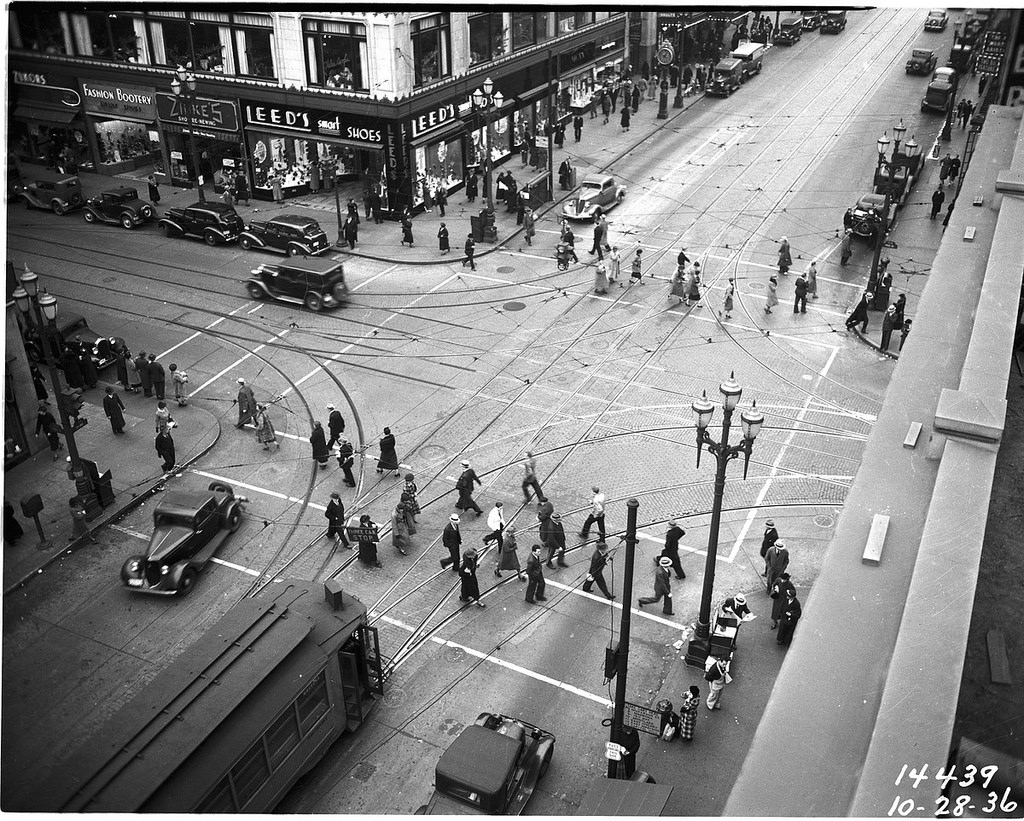
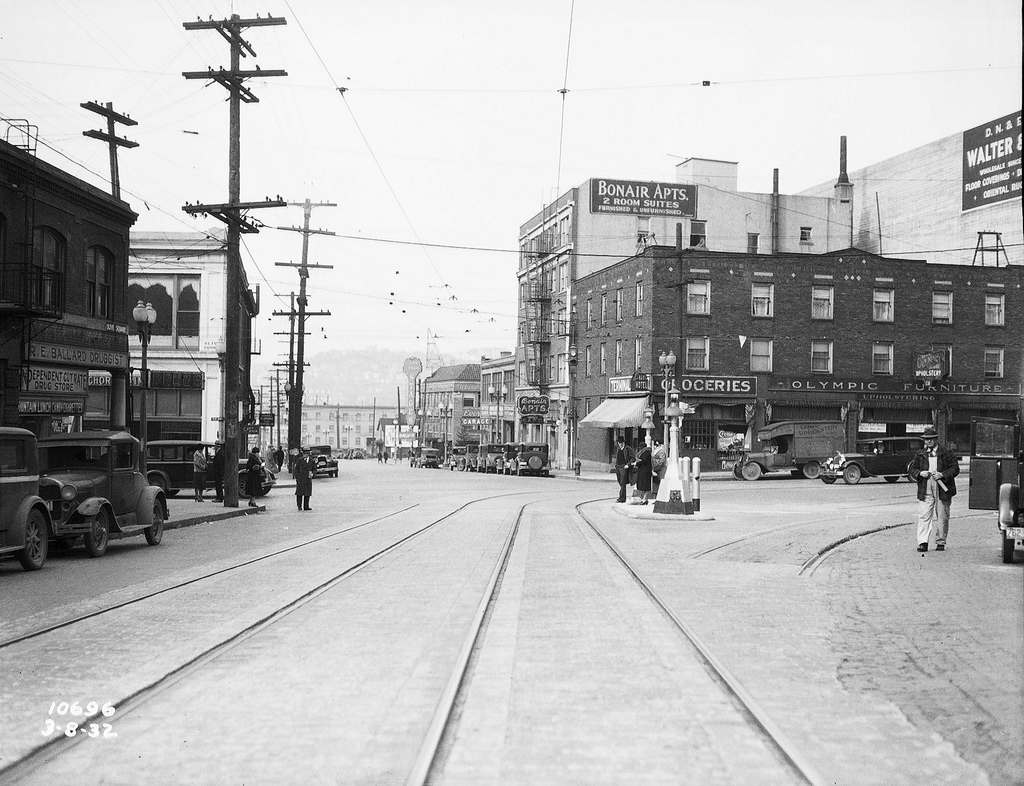
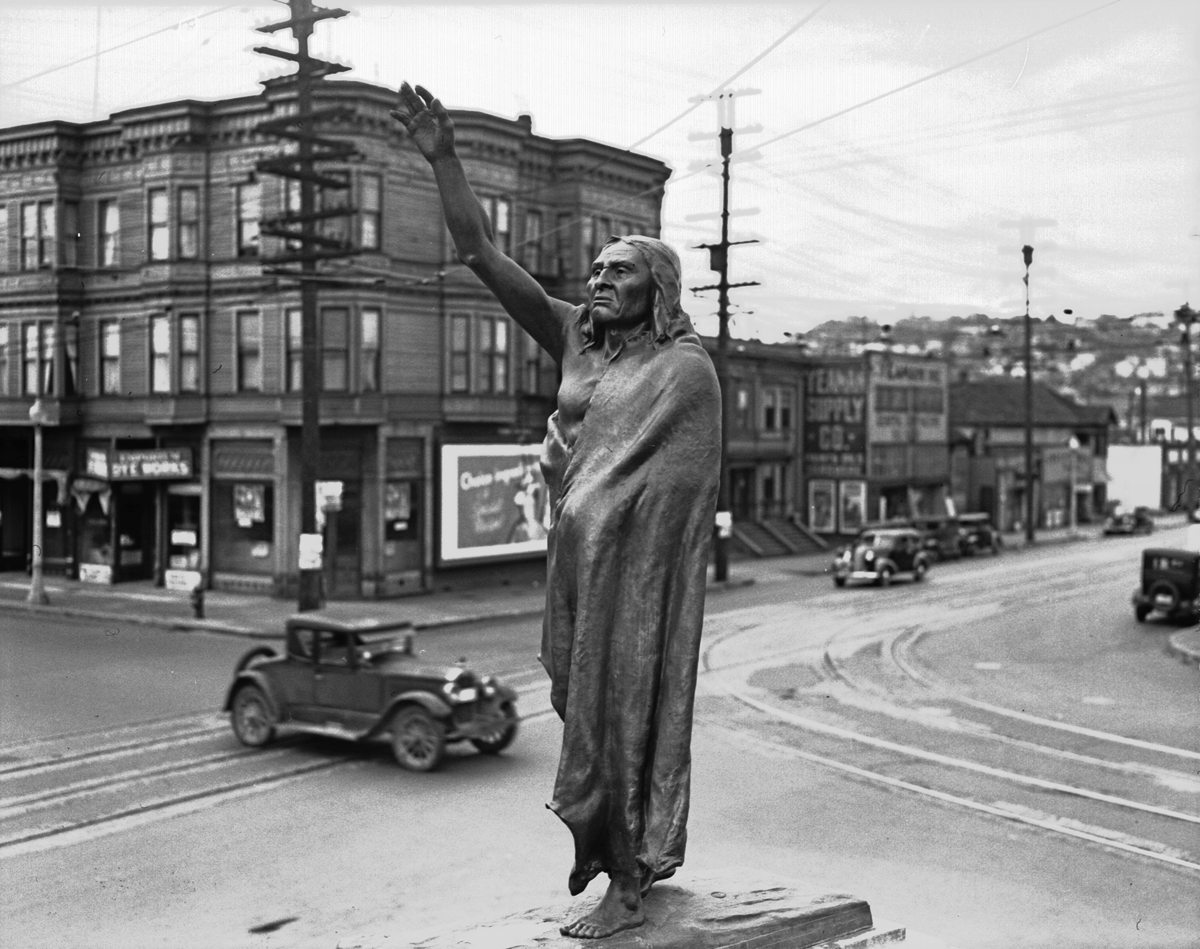
Seattle in the 1930s-40s – 46 Vintage Photos Show How the City Has Changed over 80 Years

by Alogueben (noreply@blogger.com)
mkalus shared this story from vintage everyday.

Seattle is a West Coast seaport city and the seat of King County, Washington. It is the largest city in both the state of Washington and the Pacific Northwest region of North America, and is the 15th largest metropolitan area in the United States.

The city is situated on an isthmus between Puget Sound (an inlet of the Pacific Ocean) and Lake Washington, about 100 miles (160 km) south of the Canada–United States border. A major gateway for trade with Asia, Seattle is the third largest port in North America in terms of container handling.

Let's take a look at these amazing vintage photos to see a Seattle from between the 1930s and 1940s.

Aurora Ave & Denny Way, Seattle, 1940

3rd and Pike, 1936

Cable car at Third and Yesler, 1940

8th and Olive, 1932

Chief Seattle statue at Fifth and Denny, 1936

See more »
14 Oct 14:27

Samsung Expects To Lose $3 Billion Due To Galaxy Note 7

by Rajesh Pandey
Samsung has announced today that the decision to stop selling the Galaxy Note 7 will cost the company over $3 billion over the next two quarters. The company had already accounted $3 billion in expenses for the recall and the decision to stop selling the device in its earnings guidance issued on October 11, with today’s announcement being made to “inform the market on the impact of the Galaxy Note7 discontinuation.” Continue reading →
14 Oct 14:27

Have Fun With The Excel Correl Feature

by Richard Millington

It’s not causation, but it might suggest a possible relationship (or non-relationship).

Take whatever key metric you’re tracking (ideally leads generated, retention, CSAT etc..) and drop it into Google Sheets.

Now pull as many data points from Google Analytics/your platform data package as you can and see what correlates with what you’re tracking.

This is easy enough to do using the =CORREL feature. Highlight the first array, then the second array and see what happens. What has the strongest relationship?

For example, we recently found the level of activity has no correlation to the likelihood of a newcomer participating for the first time. However, the quantity of off-topic or ‘small talk’ discussions is strongly correlated.

This might suggest we should guide newcomers towards off-topic discussions to get them started. We could then adapt our onboarding emails to guide newcomers towards these discussions, interview newcomers to uncover their unique motivations, and pursue this approach (over personal welcomes or @mentions) to engage them for the first time.

You might be surprised by what you find and how you might use it.

P.S. You could take this to a more advanced level by running a regression (or multiple regression) analysis in a more advanced statistics package.

14 Oct 14:26

We’re Proud to Announce the Launch of MappingEDU


Troy Wheeler, Ed-Fi, Oct 16, 2016


This is a very specialized piece of technology, but if you're building learning technologies, it's also an important application. "MappingEDU is a web-based system designed to do one common,  time-consuming data integration task well: map one data standard to another. The primary users are data analysts and technical staff who create mappings between data sources. MappingEDU also contains features to assist subject matter experts in reviewing data mappings." See also this press release.

[Link] [Comment]
14 Oct 14:26

Value, Scale, Time

Often, we associate impact with bigness, speed: large-scale interventions, disruptive innovations, fast-growing startups, the iPhone, solar energy projects, that kind of thing.

Another way to think about impact is to include the time variable:

impact = (value * scale) * time

A neighborhood park that lasts genenerations, a tree planted out front, a library. Small things that last a long time have high impact.

14 Oct 14:26

Tron-style slippy map

by Nathan Yau

tron-style-slippy

Mapzen just released a Tron-style slippy map.

Today we introduce TRON version 2 as a fully realized Mapzen house style, rebuilt from the ground up to take advantage of the latest features of the Tangram graphics engine and Tangram blocks. With this new version, visual forms and elements transform per zoom, revealing new cartographic details and a deep exploration of scale transformations.

It’s slick. Be sure to zoom in.

Tags: Mapzen, Tron

14 Oct 14:26

Periscope users can now stream from non-mobile devices

by Igor Bonifacic

Periscope is no longer a mobile-only platform.

In the coming days and weeks, content creators of all stripes will be able to use the platform to stream live video from any number of sources, including high-end video cameras, drones and webcams. It’s all thanks to a newly announced feature called ‘Producer.’

To start, only a small subset of users who apply to gain access to the feature will be able to use Producer to stream to Periscope. The average user, on the other hand, doesn’t need to do anything different to enjoy the benefits of content created with high-quality gear. Any content streamed through Periscope, whether it comes from a smartphone or something like a Canon DSLR, will still only be viewable via the company’s mobile app as well as its website.

Publications like TechCrunch have been helping to beta test Producer over the last couple of weeks.

As Engadget notes, this isn’t the first time the Twitter-owned company has opened up the platform to non-mobile devices. Since January, Periscope users have been able to stream footage directly from their GoPro camera.

SourcePeriscope
14 Oct 14:26

Ottawa Police has raked in over $1 million this year from distracted driving charges

by Ian Hardy

The Ottawa Police have declared they’re continuing to educate the public about the dangers of using a mobile device while driving, but are still seeing an increase in those disobeying the law.

So far this year, the Ottawa Police have charged 2,187 drivers with distracted driving, amounting to over $1 million in revenues for the city. However, approximately 25 percent of all those fined opted to go to court to fight the infraction.

“These numbers show that drivers are driving too fast and cell phone use is far too common,” said Ottawa Police Traffic Sergeant Eddy Yeoumans in a statement sent to MobileSyrup. “Drivers need to change driving behaviour and make a conscious choice to drive safe every time they get behind the wheel.”

The Government of Ontario banned the use of an electronic device, including smartphones, tablets, music players and laptops, while driving in 2009. Since September 1st, 2015, anyone caught using an electronic device while driving will be fined a minimum of $490 along with three demerit points.

14 Oct 14:26

Professional Photographers and Value

by Gail Mooney

Let’s face it, these days, professional photographers aren’t only competing with other pros – they are competing with anyone and everyone with an iPhone.

Hanoi, Vietnam
Woman with flowers on bicycle. Hanoi, Vietnam

Before you get upset and kill the messenger – ask yourself “What is my value proposition?” What do you offer that your competition doesn’t’?

I started making a list of things that professional photographers could offer to boost their value to potential clients:

  • Skills – Do you have any unique skills that can set you apart from your competition? If you define yourself by a specialized piece of gear that’s new – keep in mind, you may have just 5 years or less before ‘everyone” has it.
  • Vision – Make sure your “vision” comes from you and isn’t just a copy of what’s “hot” or trendy at the moment.
  • Access – Do you have access that others don’t? I realized when I was shooting for National Geographic that I was given access to a lot of photo opportunities that others didn’t have. Sometimes these opportunities yield photo opps that are off limits to others and make some stand out portfolio samples.
  • Rapport – If you are working in video and part of your job is doing interviews, then having a good rapport with your subjects will give you results that only you will get. Good interviews are dependent on social chemistry.
  • Your audience or following – These days, even getting a commissioned assignment may be dependent on your own social media following. Advertisers want to capitalize on that if it’s the same target audience they are trying to reach.
  • Project management skills – Getting the shot is only one skill set that photographers need to compete. Clients expect you to manage the project from soup to nuts and deliver the goods. That could mean wrangling large crews, getting access or simply making sure that everything that needs to get done to complete a project – is done.
  • Sensitivity – Be sensitive not only to your clients’ needs and problems but to whomever you are working with. I know a very good photographer who began burning most of his bridges with his clients. He was more interested in getting his point across and making demands than he was listening to the needs of his clients.
  • Likeability – Similar to above. There are just too many photographers out there to choose from that if you aren’t likable – well – you may want to look for work that doesn’t require any social skills.

If all this sounds simple –  it is. It’s applying it that’s the tough part. But if you do, you will set yourself apart from your competition.

Thinking of moving into motion?  Check out The Craft and Commerce of Video and Moti


Filed under: Photography
14 Oct 14:14

These Exploding Galaxy Note 7 Memes are Hilarious

by George Tinari
As you can probably imagine, Samsung and its customers have been in a bit of a pickle over the fact that, well, the Galaxy Note 7 keeps exploding out of nowhere. A recall is in effect for both the original units and even the replacements… yikes. Continue reading →
14 Oct 14:13

The Compute Module – now in an NEC display near you

by Eben Upton

Back in April 2014, we launched the Compute Module to provide hardware developers with a way to incorporate Raspberry Pi technology into their own products. Since then, we’ve seen it used to build home media players, industrial control systems, and everything in between.

Earlier this week, NEC announced that they would be adding Compute Module support to their next-generation large-format displays, starting with 40″, 48″, and 55″ models in January 2017, and eventually scaling all the way up to a monstrous 98″ (!!) by the end of the year. These are commercial-grade displays designed for use in brightly lit public spaces such as schools, offices, shops, and railway stations.

Believe it or not these are the small ones

Believe it or not, these are the small ones.

NEC have already lined up a range of software partners in retail, airport information systems, education, and corporate to provide presentation and signage software which runs on the Compute Module platform. You’ll be seeing these roll out in a lot of locations that you visit frequently.

Each display has an internal bay which accepts an adapter board loaded with either the existing Compute Module or the upcoming Compute Module 3, which incorporates the BCM2837 application processor and 1GB of LPDDR2 memory found on the Raspberry Pi 3 Model B. We’re expecting to do a wider release of Compute Module 3 to everybody around the end of the year.

The Compute Module in situ

The Compute Module in situ

We’ve been working on this project with NEC for over a year now, and are very excited that it’s finally seeing the light of day. It’s an incredible vote of confidence in the Raspberry Pi Compute Module platform from a blue-chip hardware vendor, and will hopefully be the first of many.

Now, here’s some guy to tell you more about what’s going on behind the screens you walk past every day on your commute.

‘The Power to Surprise’ live stream at Display Trends Forum 2016 – NEC Teams Up With Raspberry Pi

NEC Display Solutions today announced that it will be sharing an open platform modular approach with Raspberry Pi, enabling a seamless integration of Raspberry Pi’s devices with NEC’s displays. NEC’s leading position in offering the widest product range of display solutions matches perfectly with the Raspberry Pi, the organisation responsible for developing the award-winning range of low-cost, high-performance computers.

The post The Compute Module – now in an NEC display near you appeared first on Raspberry Pi.