Shared posts

18 Oct 03:05

Using Programming to Learn Math, Even at the University

by Eugene Wallingford

There is an open thread on the SIGCSE mailing list called "Forget the language wars, try the math wars". Faculty are discussing how to justify math requirements on a CS major, especially for students who "just want to be programmers". Some people argue that math requirements are a barrier to recruiting students who can succeed in computer science, in particular calculus.

Somewhere along the line, Cay Horstmann wrote a couple of things I agree with. First, he said that he didn't want to defend the calculus requirement because most calculus courses do not teach students how to think "but how to follow recipes". I have long had this complaint about calculus, especially as it's taught in most US high schools and universities. Then he wrote something more positive:

What I would like to see is teaching math alongside with programming. None of my students were able to tell me what sine and cosine were good for, but when they had to program a dial [in a user interface], they said "oh".

Couldn't that "oh" have come earlier in their lives? Why don't students do programming in middle school math? I am not talking large programs--just a few lines, so that they can build models and intuition.

I agree wholeheartedly. And even if students do not have such experiences in their K-12 math classes, the least we could do help them have that "oh" experience earlier in their university studies.

My colleagues and I have been discussing our Discrete Structures course now for a few weeks, including expected outcomes, its role as a prerequisite to other courses, and how we teach it. I have suggested that one of the best ways to learn discrete math is to connect it with programs. At our university, students have taken at least one semester of programming (currently, in Python) before they take Discrete. We should use that to our advantage!

A program can help make an abstract idea concrete. When learning about set operations, why do only paper-and-pencil exercises when you can use simple Python expressions in the REPL? Yes, adding programming to the mix creates new issues to deal with, but if designed well, such instruction could both improve students' understanding of discrete structures -- as Horstmann says, helping them build models and intuition -- and give students more practice writing simple programs. An ancillary benefit might be to help students see that computer scientists can use computation to help them learn new things, thus preparing for habits that can extend to wider settings.

Unfortunately, the most popular Discrete Structures textbooks don't help much. They do try to use CS-centric examples, but they don't seem otherwise to use the fact that students are CS majors. I don't really blame them. They are writing for a market in which students study many different languages in CS 1, so they can't (and shouldn't) assume any particular programming language background. Even worse, the Discrete Structures course appears at different places throughout the CS curriculum, which means that textbooks can't assume even any particular non-language CS experience.

Returning to Horstmann's suggestion to augment math instruction with programming in K-12, there is, of course, a strong movement nationally to teach computer science in high school. My state has been disappointingly slow to get on board, but we are finally seeing action. But most of the focus in this nationwide movement is on teaching CS qua CS, with less interest in emphasis on integrating CS into math and other core courses.

For this reason, let us again take a moment to thank the people behind the Bootstrap project for leading the charge in this regard, helping teachers use programming in Racket to teach algebra and other core topics. They are even evaluating the efficacy of the work and showing that the curriculum works. This may not surprise us in CS, but empirical evidence of success is essential if we hope to get teacher prep programs and state boards of education to take the idea seriously.

18 Oct 03:05

I come to bury PHP, not to praise it?

by tychay

(I received an answer request from someone on Quora for this question. At the time of my writing, there were only two answers, both that boiled down to “use Python.” While I feel I was asked to balance out that with some PHP cheerleading, I can’t bring myself to do that. Nor, can I hop on the bandwagon.)

Between PHP and Python which is better for a startup?

My answer reads like a Zen koan: it depends on the nature of the problem; it doesn’t really matter. It becomes the nature for future problems; that makes it matter.


All problems at this level are problems of architecture, not language choice. Cal Henderson, the programmer behind flickr and the CTO of Slack, was fond of saying, “All languages scale, not all architectures do.” Scalability is one problem that your startup might face, and you solve it, not with language choice, but with the solutions you choose within the language you chose.

The fundamental concept drawn from The Timeless Way of Building, the book that first brought forth the concept of a design pattern, is that the best architectural solutions can come only when one considers the environment the problem is in. Language choice is part of that solution, which you choose itself helps create the environment for future choices, so the “best choice” depends on the nature of your problem and the resources at your disposal, and it comes with “consequences.”

Let me give you two hypotheticals:

What if your startup isn’t based on programming at all and the only internet-problem you face is building a landing page for your company. In that case, your problem might be best solved by running a WordPress instance through a service network, managed , or yourself. WordPress happens to be written in the PHP language, but that fact is nearly irrelevant to your business since no (or very little) programming would be involved. This is a very common use case as evidenced by WordPress’s dominance over the CMS market (58.9% market share) and the internet in general (26.9% of all websites).

Let’s say your business uniqueness is the web, and your small engineering team wants to use a single language (excepting the need for Javascript) running and maintaining the network themselves on the cloud. PHP only solves one problem well (making a website), so its a near non-starter here as it demands heterogeneity in languages and tools. The inability of being able to segment your team into DevOps and web development would push your business toward Ruby or Python. Faced with the options in the question, the answer is clearly Python.

However, having chosen, the language choice becomes an environment that affects future decisions:

PHP developers are more ubiquitous and cheaper, even seven years ago there were five million of them in the world. It is easier to hire them, though to hire quality ones will require more vetting. On the other hand, Python works better in large teams because the language design makes it more readable to non-programmers or to programmers jumping to an unfamiliar part of the codebase.

You can do a lot more in Python which means it can act as a lingua franca where diverse parts of your business can inspect and understand almost every part of your software stack (again, front-end and mobile development being excepted). On the other hand, PHPs limitation is a strength, it avoids “not-invented-here” by forcing your engineers to look for applications, tools, and solutions written in other languages and simply binding to it.

This focus is a huge reason for PHP’s success, and why you can’t talk about PHP programming without discussing “LAMP” or some similar specification of the entire stack. To take another poster’s recommendation of “Python [having] the win for the most parts” due to its superiority in asynchronous programming: in the PHP world you would simply defer these problems to a queuing system, database, data structure, messaging system, or write a custom solution in a more amenable language like Erlang, Javascript, or, yes, even Python.

Which then is better (even in this example)? I can’t answer that. I can say only with certainty your choice will affect future decisions through the strengths and weaknesses of the language, the people you hire based on it, and the choices they make going forward. Each of these open up new opportunities and forecloses on others. In pattern design language, we call these “consequences”.

That may seem like a big deal, especially when you consider language switching costs can be immense and, in a few cases, company-ending. But those cases were because poor architectural decisions were compounded by a mistaken belief that it was language choice, not bad architectural decisions, that led to their problems. In the end, it doesn’t really matter. Business decisions and market forces will have a far larger impact on a startup’s success or failure than one small architectural choice made early.

Instead it’s best to simply make a choice, and then just be wise to the strengths and limitations of the choice going forward.

17 Oct 21:34

Twitter Favorites: [kaler] Douglas Coupland reading Bit Rot @ Juniper https://t.co/DJzhc5DPjl

Parveen Kaler @kaler
Douglas Coupland reading Bit Rot @ Juniper instagram.com/p/BLpJT3tgPVK/
17 Oct 21:33

Ohrn Image — Public Art

by Ken Ohrn

Another lovely piece that’s been around for a while at the Planetarium.  “The Crab” by George Norris.


17 Oct 21:24

Thoughts on a year at Microsoft

by Rui Carmo

It’s been a year (to the day) since I joined Microsoft. Having spent most of the time looking forward rather than reminiscing about my choices, this kind of crept up on me. And after the weeks leading up to Pixels Camp and all the craziness involved in trying to make a meaningful contribution, it also caught me in somewhat of a lull – I’ve been spending the past few days reading and catching up on stuff, so trying to put together a cogent summation of the past year wasn’t really on my mind.

Still, I think it’s well worth trying. And even if I can’t go into the specifics, there’s a lot to be said in general.

What I Do

My role’s still mostly the same: as a Cloud Solution Architect and focusing on Azure, I spend a lot of time with customers explaining how to design for (and move their solutions to) a cloud environment.

There’s the usual amount of Windows involved, but I’m making good use of my UNIX background (yes, you can discuss the finer points of debconf at Microsoft), and all the mental baggage I’ve accumulated over the years in systems and networking is a distinctive advantage – you can’t plan in the large without having experience of it, and even if the paradigms have shifted the scale has only increased, so there’s a good fit for my way of tackling problems.

There are good things and bad things about this, and the most important ones are about people. I have a few great customers – great in the sense that they get the cloud, their staff is both knowledgeable and proactive, and I relish the time spent there because there are often good opportunities to get my hands dirty whipping up prototypes and ironing out infrastructure kinks.

The good bit is that there’s no correlation between industry, company size and technological maturity – I’ve come across some great, innovative projects in every vertical and segment (including, for instance, finance and public sector), and they almost make up for all the rest.

Now, if you’re in the startup scene, you likely have a dim view of traditional IT – and the bad bit is that I’d probably call it justified for the most part based on my experiences so far.

That is, if it weren’t for the few people I know that get things and are trying to transform it from the inside. They’re going to succeed, too, but it’s going to be a hard slog (things like containers are decades away from reaching some of the places I visit) and, in the grand scheme of things (and the way businesses are run in Portugal) those knowledgeable folk are, sadly, pretty much invisible.

Fortunately, these days (after a little internal shift) I tend to deal mostly with partners, which alleviates a lot of the grind of dealing with the hard cases. The partners I meet with are mostly knowledgeable, motivated and, above all, independent, so it’s far more gratifying to work with them than the average IT lead.

What I’ve Learned

I’ve had no significant trouble with the technology stack, other than lacking an emotional connection to the lore of .NET and the SQL Server sagas. I haven’t written more than a few hundred lines of C# throughout the year (because what little I develop for work can be done in anything), I’ve waded through the swamps of PowerShell (Jeffrey Snover is an awesome guy and it works, but I have no love for it), and I’ve become quite the wizard at dealing with the Azure Resource Manager APIs.

I’ve had a lot of practical exposure to Microsoft‘s burgeoning analytics and machine learning stack (which is really great stuff, especially the cognitive service APIs), but despite a few highlights (Azure Data Warehouse is pretty amazing from the inside, and my background gives me a great head start into the IoT space), it’s just tech – it’s finding a use for it and building stuff that brings me joy, but the role I have isn’t project-oriented, and it smarts.

But the stuff I’ve been learning isn’t really about the tech. It’s about the business, and the market, and the scale of the company – on the whole, it feels a lot like Vodafone without the narrow-mindedness of tariff plans and, instead of the distraction of grandiose yet piddling WAP portals, a decent services and support business; the wide expanse of what Microsoft does touches just about every part of what a modern business is about, and that allows me a great deal of insight not just into how IT can work as a business, but also how it’s transforming itself.

Digital transformation is a great buzzword (and might be seen by many as just another way to fill bingo cards), but it’s real. And the money riding on it is all too real for those companies who’ve finally understood they have to reinvent themselves, or vanish.

Figuring out how to help out with that is well worth learning, and what little time I spend doing it is well spent. Having to re-learn how to deal with around twenty people playing calendar battleships with my Outlook inbox and never knowing where I’ll be the day after (or what I’ll be doing) seems like a minor trade-off.

What Has Changed

The biggest change for me has been being able to work from home, from my (hitherto somewhat underused) desk, and largely on my own clock. That does not happen every day (I need to go out and meet with customers at least three days a week), but it’s refreshing to not waste time, patience and money on commuting just for the sake of sitting down someplace where other people can see you’re “working”.

I work from home one or two days a week using my elderly Mac mini, Office 365 and the Lenovo X1 Carbon I was assigned, which still feels about as easy to carry about as a canteen tray but which works wonderfully on a shelf – I open a Remote Desktop session to it, another to my work machine on Azure, and make good use of my dual monitor setup that way; there’s nothing quite like walking in with a fresh mug of tea, reconnecting to my sessions and carrying on where I left off in the evening within a few minutes while the sun streams in from the balcony.

Work is a lot more fluid – I can just as likely be out first thing and back in the afternoon as spending the morning in the office doing conference calls and popping out for a meeting in the late afternoon. As a direct result of this, I’m less prone to being interrupted and far more productive than I’d be in a conventional office setting.

I go out with a purpose, and were it not for the constant barrage of meetings I would likely be able to plan my trips for maximum efficiency – that I hope to get the hang of eventually, to the point where I can find myself enjoying having lunch in a random part of the city in between meetings like some of my colleagues.

But that seems to be a state of zen only thoroughbred salespeople can attain, and I am only a lowly architect; such skills must surely require the ability to empty the mind of all technical concerns, and I am not worthy.

What Hasn’t Changed

My main personal computer is still an iPad (I’m typing this on it). I still use an iPhone and Apple hardware at home (although my faith has been wavering of late, I have zero interest in changing that). I haven’t felt any need to switch to Windows, although there is a lot more of it around these days since with the arrival of my work laptop the number of machines running Windows in the house increased by 100% (raising the overall share to… 8%).

I still use vim and code mostly in Python (with a little Go) and churn out custom builds of Android (building Nougat for the Raspberry Pi is a buggy, painful mess that I hope to master some day), as well as tinkering with hardware and porting things to ARM CPUs. There’s a little less Clojure and a little more Erlang in what I perceive as the ideal way to develop at scale, but that’s hardly significant because (sadly) I don’t develop full-time, and my hobbies mostly have no bearing on what I do at work (except for all the Docker stuff I keep tinkering with).

I still read The Economist on weekends and keep tabs on the local startup scene (and there are more startups using Azure than I originally expected – even a couple I helped onboard).

The Good Stuff

There’s a lot of business in the cloud these days. And I mean that in many ways, some of which are intellectually stimulating and others merely rewarding in a financial sense.

The people I work with directly are, by and large, professionally awesome. There’s a lot to learn from them in general (not necessarily in the technical spectrum), and I sorely missed the cultural diversity that you get in a large company like this.

I can get in touch with anybody in the Azure space and get information on anything at the drop of an e-mail, and get answers (and sometimes provide them, as well as feedback) within an hour; Skype for Business is the internal IM and much faster, but timezones seldom contrive to help, and most things do not warrant interrupting folk.

Comparatively, these days what I miss most is leading a team; but there’s a lot less overhead when you can ask a peer (or a superior) to do something for you and it just gets done without any griping, posturing or any of the usual Portuguese theatricals and procrastination techniques; I blame the American ethos that pervades the company, and the constant emphasis on having a growth mindset – which still feels funny and almost Orwellian to my British-reared business persona, but appears to work.

I find it hilarious that I might, in fact, have a knack for the corporate life, and in truth my design and Marketing skills are a good fit for all the non-technical stuff I have to do; but there is little opportunity for doing technical or business management, and that leads me to…

The Annoying Stuff

There are too many meetings. Far, far too many meetings, and conference calls, and syncing and reporting and ‘keeping in the loop’ and whatnot. Even with all the state of the art productivity tooling at our disposal, communication is still the biggest overhead, and I’m fascinated by the thought that, for once, everyone I work with also knows how to use Office properly.

And yet, we spend hours using it for internal tasks – that was something I did not miss from my days at Vodafone, but which I re-learned quickly enough.

Catching up with your immediate team by phone or IM works amazingly well, but the old maxim of meeting efficiency being inversely proportional to the number of people involved is true, and I’d forgotten how it could do so exponentially when you add in people with disparate world views. Triple bookings in Outlook are, alas, not uncommon.

Coordinating with customers and partners is very challenging, partly it’s my role to explain everything to them until they’re able to fend for themselves (which can take some time), and partly because everyone has their own distinct set of priorities, but it’s almost the easiest part because unlike most technical people, I genuinely like meeting people, talking to them and helping them out.

So Far…

It’s a roller coaster, and a mixed bag. I love the corporate angle, the scale and the scope of what Microsoft is trying to achieve with Azure, but I miss the breadth and depth of leading a team, building solutions and delivering them.

The work is crazy challenging (even if also in terms of patience), but (when dealing with the right people) also crazy exciting. I can’t fault the work ethos (other than a local over-emphasis on sales). I love the people and understand the extra effort to coordinate in a matrix organization. I like the new tooling and cross-platform tech but am constantly having to deal with the ‘traditional’ stack.

I love the flexible schedule but find myself working late on stuff that I can’t follow up as a project, and end up spending little time with my kids or reading as much as I used to read. And I recently realized that over Summer break I watched more internal videos than TV shows.

There’s a knack to making this even out, I’m sure, but I’ve yet to find the right balance.

17 Oct 20:27

Labeling fact-check articles in Google News

files/images/top_stories_gjaCoix.width-800.png


Richard Gingras, The Keyword, Oct 20, 2016


I haven't been able to see this actually working yet, but the promise of a 'fact check' option in Google News is intriguing. For now, the actual fact checking will depend on people, and it looks like fact-checking metadata (called Claim Review) will have to be present in the news story. "Publishers who create fact-checks and would like to see it appear with the “ Fact check” tag should use that markup in fact-check articles." The Guardian reports, "In Google News, fact check labels are visible in the expanded story box on the Google News site, on both the iOS and Android apps, and roll out for users in the US and UK first." Presumably those are the places that need fact checking the most. The Guardian also takes a swipe at Facebook: "After sacking their trending topics news team, the social media site was at the center of a storm when its algorithm started promoting fake news." More on fact-checking in Google's help.

[Link] [Comment]
17 Oct 20:27

(Laughter and applause)

by russell davies
17 Oct 20:14

How to Use Bike Reflectors to Be More Visible

by Average Joe Cyclist

These photos show how a couple of carefully placed bike reflectors can light up a bikeHow to use bike reflectors to be more visible to other road users at night. This is a cheap and easy way to make cycling in the dark safer - just invest in a little reflective tape! You could save your life for ten dollars.

The post How to Use Bike Reflectors to Be More Visible appeared first on Average Joe Cyclist.

17 Oct 20:14

Ellen Ripley Is Clearly the Best Female Character in Scifi Film, and That’s a Problem

Ellen Ripley Is Clearly the Best Female Character in Scifi Film, and That’s a Problem:

Adam Bryant, Ellen Ripley Is Clearly the Best Female Character in Scifi Film, and That’s a Problem 

She’s not a sidekick, arm candy, or a damsel to be rescued. Starting with Alien, Ripley was a fully competent member of a crew or ensemble — not always liked and sometimes disrespected, but doing her job all the same. As each film progresses, she comes to the fore and faces challenges head-on — she’s the hero of the piece, in other words.

But, you say, not every science fiction female character is an arm-candy sidekick who needs to be rescued! Sometimes they even kick ass! True, which brings us to the next point:

Ripley isn’t a fantasy version of a woman.
Science fiction film is filled with hot kickass women doing impossible things with guns and melee weapons while they spin about like a gymnast in a dryer. As fun as that is to watch, at the end of the day it’s still giving women short shrift, since what they are then are idealized killer fembots rather than actual human beings. Ripley, on the other hand, is pushy, aggressive, rude, injured, suffering from post-traumatic syndrome, not wearing makeup, tired, smart, maternal, angry, empathetic, and determined to save others, even at great cost to herself. All without being a spinny killbot.

17 Oct 20:14

Bruce Schneier, We Need to Save the Internet from the Internet of Things

Bruce Schneier, We Need to Save the Internet from the Internet of Things:

What was new about the Krebs attack was both the massive scale and the particular devices the attackers recruited. Instead of using traditional computers for their botnet, they used CCTV cameras, digital video recorders, home routers, and other embedded computers attached to the internet as part of the Internet of Things.

Much has been written about how the IoT is wildly insecure. In fact, the software used to attack Krebs was simple and amateurish. What this attack demonstrates is that the economics of the IoT mean that it will remain insecure unless government steps in to fix the problem. This is a market failure that can’t get fixed on its own.

Our computers and smartphones are as secure as they are because there are teams of security engineers working on the problem. Companies like Microsoft, Apple, and Google spend a lot of time testing their code before it’s released, and quickly patch vulnerabilities when they’re discovered. Those companies can support such teams because those companies make a huge amount of money, either directly or indirectly, from their software—and, in part, compete on its security. This isn’t true of embedded systems like digital video recorders or home routers. Those systems are sold at a much lower margin, and are often built by offshore third parties. The companies involved simply don’t have the expertise to make them secure.

Even worse, most of these devices don’t have any way to be patched. Even though the source code to the botnet that attacked Krebs has been made public, we can’t update the affected devices. Microsoft delivers security patches to your computer once a month. Apple does it just as regularly, but not on a fixed schedule. But the only way for you to update the firmware in your home router is to throw it away and buy a new one.

The security of our computers and phones also comes from the fact that we replace them regularly. We buy new laptops every few years. We get new phones even more frequently. This isn’t true for all of the embedded IoT systems. They last for years, even decades. We might buy a new DVR every five or ten years. We replace our refrigerator every 25 years. We replace our thermostat approximately never. Already the banking industry is dealing with the security problems of Windows 95 embedded in ATMs. This same problem is going to occur all over the Internet of Things.

The market can’t fix this because neither the buyer nor the seller cares. Think of all the CCTV cameras and DVRs used in the attack against Brian Krebs. The owners of those devices don’t care. Their devices were cheap to buy, they still work, and they don’t even know Brian. The sellers of those devices don’t care: they’re now selling newer and better models, and the original buyers only cared about price and features. There is no market solution because the insecurity is what economists call an externality: it’s an effect of the purchasing decision that affects other people. Think of it kind of like invisible pollution.

Uh-oh.

17 Oct 20:14

Apple scales back driverless ambitions to develop only software

by Jessica Vomiero

Apple’s ambitions to lead the way on driverless cars may be limited to software.

Reports from Bloomberg suggest that the company has restructured its driverless cars division, cutting hundreds of jobs in the process. Departing members of Apple’s car team have either been reassigned or let go.

While the moves aren’t public, the company’s initiatives have reportedly shifted from building a car from the inside out to building the software that powers a driverless car. This way, Apple will likely have more opportunity to partner with existing car companies.

Bloomberg attributes the change in direction to new leadership, which has led to several hires which represent the department’s new direction. In addition, Apple has given the car team a deadline of late next year to prove the “feasibility of the self-driving system,” reports Bloomberg.

Project Titan, the codename for Apple’s autonomous vehicle initiative, continues to evolve and shrink as Bloomberg estimates that it no longer plans to develop a electric car to compete with companies such as Tesla.

Apple is not the first tech company to set its sights on partnering with members of the auto sector. Google-parent-company Alphabet and ride-hailing company Uber have taken similar paths to building out their own driverless car ambitions.

Apple launched Project Titan in September of 2014, according to reports. It’s important to note that Apple has yet to acknowledge that it’s running a secret car project. While the Cupertino tech company entered the space with high hopes and lofty ambitions, it seems they may have bitten off more than they can chew.

SourceBloomberg
17 Oct 20:13

City Conversations: Granville Island – Oct 20

by pricetags

After Niagara Falls, Granville Island is Canada’s most visited destination. But Emily Carr University’s coming move to Great Northern Way has triggered the need for an update.

Planners want to hear your ideas for better ways to access and move around Granville Island. Get out your wish list! Think out of the box! Now’s the time to fix Granville Island’s problems, celebrate its successes, and insure its sustainability for the next 25 years.

To frame the conversation, we have Michael Stevenson, SFU President Emeritus and Vice Chancellor, and head of the review; and Tim Barton, Senior Transportation Planner at Bunt & Associates.


Thursday, October 20

12:30 – 1:30 PM

Room 1600, SFU Vancouver – 515 West Hastings

Registration is not required. Please try to arrive early to ensure a seat.


17 Oct 20:13

Equity, Resilience, and Achievements in High Performing Asian Education Systems

files/images/educ_china.jpg


Wing-On Lee, Chenri Hui, Low Ee Ling, Frontiers of Education in China, Oct 20, 2016


Many of the leaders in recent PISA and other academic tests have been from east Asian countries. Why? This month's  special issue of Frontiers of Education in China explores the quantitative results with a set of (mostly) qualitative studies. They are all well-written and accessible. The editorial summarizes them nicely, and the first paragraph especially should be required reading (a task I've made easier for you by  extracting and reformatting that paragraph). But do read the articles themselves; they address issues such as equity in Japan (made possible in part by rotating teachers from school to school each year), civics education in Hong Kong (where teachers are expected to model citizenship), changing administrative structures in Shanghai (and the challenges to equity created by marketplace approaches), hidden racism in Korea, and much more. Image: Peking University.

[Link] [Comment]
17 Oct 20:13

LG G5 captures the Raptors’ Cory Joseph sink a 65 foot ‘aerial five-pointer’

by Ian Hardy

Toronto Raptor’s point guard Cory Joseph recently made a basket from 65 feet on top of a 27-story Toronto skyscraper.

Joseph is LG Canada’s “G5 Chief Playmaker” and was challenged to shoot from building to building while LG captured it all on the wide-angle camera on its flagship Android. LG is calling this shot “an aerial five-pointer.”

“When LG asked if I could sink a basket over Adelaide Street from one building rooftop to another – I thought they were crazy, but why not give it a try,” said Joseph.

“I can’t believe I sank that basket. It was pretty windy up there but somehow I got it in.”

Related: LG G5 review

17 Oct 20:13

Better default bookmarks for Nightly

by Pascal Chevrel

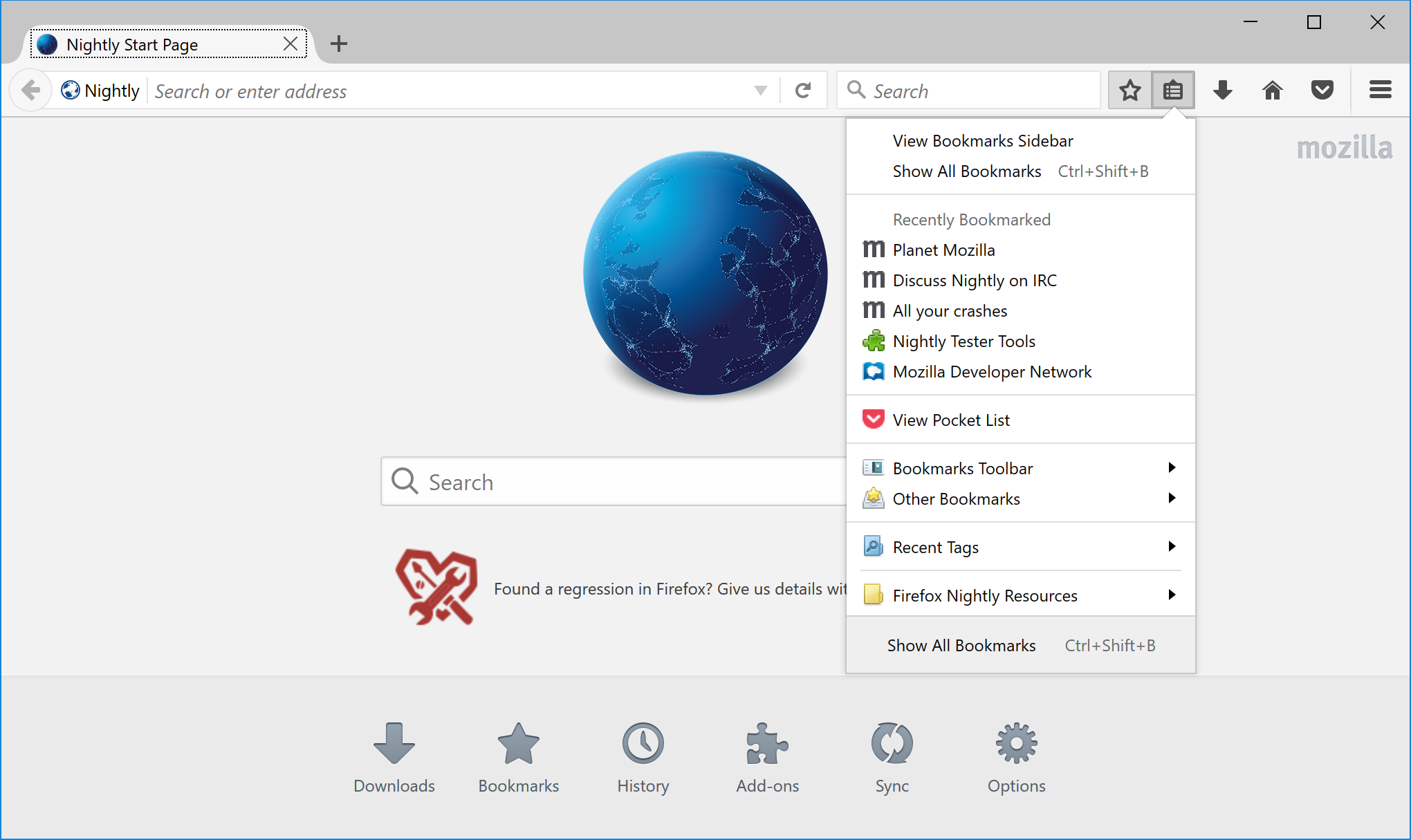
Because software defaults matter, we have just changed the default bookmarks for the Nightly channel to be more useful to power-users deeply interested in day to day progress of Firefox and potentially willing to help Mozilla improve their browser through bug and crash reports, shared telemetry data and technical feedback.

Users on the Nightly channels had the same bookmarks than users on the release channel, these bookmarks target end-users with limited technical knowledge and link to Mozilla sites providing end-user support, add-ons or propose a tour of Firefox features. Not very compelling for a tech-savvy audience that installed pre-alpha software!

As of last week, new Nightly users or existing Nightly users creating a new profile have a different set of bookmarks that are more likely to meet their interest in the technical side of Mozilla and contributing to Firefox as an alpha tester. Here is what the default bookmarks are:

New Nightly Bookmarks

There are links to this blog of course, to Planet Mozilla, to the Mozilla Developer Network, to the Nightly Testers Tools add-on, to about:crashes and to the IRC #nightly channel in case you find a bug and would like to talk to other Nightly users about it and of course a link to Bugzilla. The Firefox tour link was also replaced by a link to the contribute page on mozilla.org.

It’s a minor change to the profile data as we don’t want to make of Nightly a different product from Firefox, but I hope another small step in the direction of empowering our more technical user base to help Mozilla build the most stable and reliable browser for hundreds of millions of people!

17 Oct 20:04

Montag

by Ronny
mkalus shared this story from Das Kraftfuttermischwerk.

Bei mir ist heute Montag, der gleichzeitig ein Freitag ist. Fühlt sich gleich sehr viel besser an.


(via Stef)

17 Oct 15:28

Twitter Favorites: [richarddeitsch] Why @PKSubban1 will be a great broadcaster and what hockey will look like 50 years from now. @SInow Media column: https://t.co/bY19D1C5NE

Richard Deitsch @richarddeitsch
Why @PKSubban1 will be a great broadcaster and what hockey will look like 50 years from now. @SInow Media column: on.si.com/2dgZxJt
17 Oct 15:28

Twitter Favorites: [gregeh] @sillygwailo I've used both at different times of day for a long time, and slowly it's become mostly official client.

Greg Eh @gregeh
@sillygwailo I've used both at different times of day for a long time, and slowly it's become mostly official client.
17 Oct 14:58

Twitter Favorites: [Planta] I would prefer Wendy Mesley as the next National anchor.

Joseph Planta @Planta
I would prefer Wendy Mesley as the next National anchor.
17 Oct 14:57

Being More Than "Just the Programmer"

by James Hague

There's a strange dichotomy that college doesn't prepare computer science majors for: knowing how to program is a huge benefit if you want to create something new and useful, but as a programmer you're often viewed as the implementer of someone else's vision--as just the programmer--and have limited say in crafting the application as a whole.

(Note that here I'm using "application as a whole" to mean the feature set and experience of using the app, not the underlying architecture.)

In my first game development job writing 16-bit console games, I naively expected there to be a blend of coding and design, like there was when I was writing my own games for home computer magazines, but the two were in different departments in different locations in the rented office park space. It had never occurred to me that a game could be failing because of poor design, yet I wouldn't be able to do anything about it, not having a title with "design" in it. I came out of that experience realizing that I needed to be more than an implementer.

I wanted to write up some tips for people in similar situations, people who want to be more than just the programmer.

Go through some formalities to prove that you have domain knowledge. You might think you know how to design good user interfaces, but why should anyone listen to you? Buy and read the top books in the field, have them at your desk, and use them to cite guidelines. Or take a class, which might be less efficient than reading on your own, but it's concrete and carries more weight than vague, self-directed learning.

Don't get into technical details when it doesn't matter. "Why is that going to take three weeks to finish?" "Well, there's a new version of the library that doesn't fully work with the C++11 codebase that we're using so I'm going to have to refactor a few classes, and also there are issues with move semantics in the new compiler, so..." No matter how you say this, it sounds like complaining, and you get a reputation as the programmer who spouts technical mumbo jumbo. Sure, talk tech with the right people, but phrase things in terms of the project--not the code--otherwise.

Don't get into programming or technology arguments, ever. Just don't. Again, this is usually thinking on the wrong level, and you don't want to advertise that. There's also this Tony Hoare quote that I love:

You know, you shouldn't trust us intelligent programmers. We can think up such good arguments for convincing ourselves and each other of the utterly absurd.

Get to know people in departments whose work interests you. Continuing the user interface example from above, go talk to the UX folks. Learn what they like and don't like and why they've made certain decisions. They'll be glad that someone is taking an interest, and you'll be learning from people doing the work professionally.

Build prototypes to demonstrate ideas. If you jump in and do work that someone else is supposed to do, like changing the game design, then that's not going to turn out well. A better approach is to build a small prototype of a way you think something should work and get feedback. Take the feedback to heart and make changes based on it (also good, because you're showing people you value their opinions). Sometimes these prototypes will fall flat, but other times you'll have a stream of people stopping by your desk to see what they've heard about.

17 Oct 14:54

How to Turn Your Existing Carry-On Into Smart Luggage

by Kit Dillon

If you want a suitcase that weighs itself, tracks its location, and charges your phone, smart luggage is one option.1 But you don’t have to buy a new bag to get those features. For most people, it’s easier and more affordable to add them to a bag you already own and love. We’ve spent dozens of combined hours researching and reviewing the best Bluetooth trackers, luggage scales, and USB battery packs. We tested our picks in those categories against three of the most buzzworthy smart-luggage brands to determine the best way to make your existing carry-on a bit smarter.

Don't miss out on our latest picks

Get the freshest expert recommendations first with our weekly newsletter.

four smart suitcases side by side

The smart-luggage models we tested: Barracuda, Bluesmart, Away, and Raden. Photo: Caleigh Waldman

As of this writing, I’ve tested four brands of smart luggage: Bluesmart, Raden, Away, and Barracuda. Among these, the Raden does the best job threading the needle between traditional carry-on and smart features. It’s a nicely constructed hard-shell suitcase in its own right and all the features work as you’d expect. The scale is particularly nice: Lifting your suitcase by the handle to see an accurate weight reading on your phone screen (available only for iOS as of this writing) feels as futuristic as a riding a hoverboard. But even the Raden lacks some basic amenities that you’d expect in a $300 suitcase, such as a suiter or garment folder for protecting clothes and keeping them wrinkle-free.

Our Non-Smart Picks

Best Carry-On Luggage

Best Carry-On Luggage

We have a smart-luggage pick, but we like our non-smart picks better.

Read More

We understand the appeal of an off-the-shelf solution, but if you do the math, going the DIY route is a better value, and will in most cases, get you a better bag—especially if you already have a bag you use and like. The combined cost of all the gadgets featured below is less than half the cost of the Raden and when it comes time to recycle or upgrade any individual part, you don’t need to strip down your luggage or send it back to the manufacturer for maintenance.

This blog was originally published in October 2016 and our picks may have changed since then. Be sure to consult our full reviews for the latest buying advice.

RAVPower 16750 mAh Portable Charger–3rd Gen
Can charge two power-hungry devices simultaneously at top speed—most batteries this size throttle back when more than one device is plugged in. About the size of a portable hard drive, it can fill a midsize smartphone about four times.

The battery on the Raden has a 7,800 mAh capacity (about two iPhone recharges) and is about 4¾ by 2¼ by 1 inches. If you look at our guide to the best USB battery packs, you’ll see that you can get much more capacity in a similar package for about $30 if you get the RAVPower 16750 mAh Portable Charger – 3rd Gen. It’s a portable-hard-drive-sized slab measuring about 5 by 3¼ by ⅞ inches and weighing 11 ounces. In our tests, it had 55.6 Wh (11.03 Ah) of energy available—not the highest in this general size but enough to completely charge a tablet with power to spare, or to charge most smartphones five times over. This is more than twice the capacity of the Raden’s built-in battery, about 65 percent more capacity than the Bluesmart, and it still fits neatly in the front pocket of the Travelpro Platinum Magna 2. If you need even more power, you can upgrade to the RAVPower 22000 mAh Ace Series Portable Charger.

Check out our full review for the latest buying advice for USB battery packs.

Tile Mate
Tile is the best proximity Bluetooth tracker for your luggage. With just under 2 million units sold, it’s backed up by the widest network of Bluetooth receivers available—making it more useful for tracking lost items.

No other tracker has the range or utility of the new thinner, smaller Tile Mate. It’s the latest version of our favorite Bluetooth tracker, and while we haven’t yet finished our full testing, so far it performs almost identically to the recently discontinued Gen 2 Tile—although our initial tests show it’s not quite as loud. This is great, because the previous Tile was already so much better than the competition that we couldn’t justify a runner-up recommendation, and that’s still the case today. The Tile Mate remains the least expensive of the trackers we tested and has the largest user base, making it the most useful option for finding your luggage if your bag leaves your sight.

Putting a Tile in your bag lets you use the Tile app to see its current location (if it’s within Bluetooth range) or last known location (if you’re not close enough). So at the very least, you’ll be able to confirm where your bag isn’t. But if you mark an out-of-range Tile as lost, everyone else who has the app installed can “find” it for you (anonymously) if they come within range. You’ll get notified of its location, and they get a ping that they helped a stranger find something. This sounds pretty hopeless, but Tile’s rising popularity means your odds of figuring out where your stuff is might be higher than you’d expect if your bag is in a busy airport. This works nearly identically to the Raden’s Bluetooth tracking, except Raden has far fewer users than Tile does. We also like that Tile plays a ringtone to alert you of its presence, whereas Raden simply says in the app if it’s “within reach.” It will likely not be that audible in a crowded baggage claim, but it is pretty shrill, so we wouldn’t count it out if you’re listening carefully.

Though it would be nice if you could have a reliable GPS/cellular-based tracking system that can notify you of your bag’s location regardless of where it is, we don’t feel comfortable recommending any at this time. So if that’s a must-have feature, Bluesmart is your only option—it worked well in testing and the GPS makes it more accurate than cell-tower tracking alone.

We also tested LugLoc’s cell-tower tracking system, which you can add as an option to the Barracuda case, but we weren’t sold on its value. It costs $70 for the device alone (included free with the Barracuda) and you’ll have to pay an additional monthly or annual subscription fee ($5 and $30, respectively, as of this writing), but we’d like to see more accuracy for those prices. Because LugLoc lacks GPS, it can only estimate your bag’s location to within a few city blocks based on cell tower triangulation. That’s helpful for knowing if your luggage wound up in the wrong airport, but won’t be as helpful for tracking down a stolen or lost bag on city streets. If that’s worth the cost for you, you should consider it. Like Tile, LugLoc also has built-in Bluetooth proximity tracking when you’re within range, but unlike Tile, it doesn’t have a crowdsourced lost-and-found network. Also, instead of listening for a tone, you open the LugLoc app and follow the strength of the signal toward the source, similar to how you might use a metal detector to find a lost ring on the beach.

Check out our full review for the latest buying advice on Bluetooth trackers.

Balanzza Mini USB
USB charging and a backlit screen mean it’s ready to go wherever, whenever.

The only thing we can’t faithfully re-create in our smart-luggage kit is probably the most attractive feature of smart luggage: a scale built into the top handle. Our luggage-scale pick is the next best thing. Though it’s not as slick as a built-in model, it will be just as accurate and still has a Micro-USB rechargeable battery. And it’ll still work if your phone runs into Bluetooth issues.

Check out our guide to the best travel gear for the latest buying advice on luggage scales.

Travelpro Platinum Magna 2
For most flyers, this 22-inch Travelpro offers the best balance of size, price, reliability, and durability, with high-end details.

*At the time of publishing, the price was $246.

If you don’t already have a suitcase you love, you should consider our top pick. Unlike any piece of smart luggage we tested, it has a built-in garment folder and its soft-sided frame is more malleable and easier to pack, and has greater packing capacity than the hard-sided frames of both the Raden and Bluesmart. Though we prefer two-wheeled designs and think the extra 190 cubic inches of internal storage (about the size of a rolled-up sweatshirt) offered in the standard version is worth the money, the Platinum Magna 2 is also available in a four-wheeled spinner configuration if you value upright handling over better wheel durability.

Check out our full review for the latest buying advice for carry-on bags.

(Photos by Caleigh Waldman.)

Footnotes:

1. We’re not addressing the crowdfunded models that will follow you around like an obedient puppy or let you ride them around the airport like a whacked-out Steve McQueen on a diminutive Triumph until we have proof that they work. Jump back.

17 Oct 14:54

Auto Format

by Navneet Alang

Twitter, by its own hand or some sudden shift in trends, will one day die. What will I do then? The engine of my thought is always directed toward Twitter. As I walk the city, I am attuned to that little empty box insistently asking “What’s happening?” My experience of the material world is shadowed by a kind of holographic plane, a translucent layer over everything, studded with tweet buttons. Conversations, happenings in public spaces, street art, or a celebrity sighting — these are all fodder for a reality that I have come to perceive in tweet-size fragments.

Twitter has colonized my mind. Almost every day for just under a decade, I have checked the site, have tweeted, retweeted, been subtweeted. My mental map is the frontier surrendered, and Twitter is the empire. To become occupied by a social network is to internalize its gaze. It is to forever carry a doubled view of both your own mind and the platform’s. What beckons initially is what feels like a blank canvas — some empty space onto which one can splash one’s desires. So, like millions of others, I conjured a persona for Twitter, at first modulating myself for the tech- and pop-culture-savvy early users, then later techno-skeptics and lefty cultural critics, and now for the many like me who are just exhausted by the whole thing and make aimless or bitter jokes.

That we perform for others isn’t exactly new; it is, rather, a fundamental part of who we are. The field of psychology is littered with concepts like the looking-glass self — in which we form our self-conception based on others’ perception of us — or David Elkind’s imaginary audience, a term describing how an envisioned, general audience affects our behavior. Writing out our identities as an act of self-creation is perhaps the most obvious way in which we respond to this phantom viewing public, positioning and shaping our words to suit who we imagine to be reading them. In Politics and Aesthetics in the Diary of Virginia Woolf, author Joanne Tidwell suggests that Woolf — an author who otherwise demanded much of her audience — wrote for an older self, imagining an ideally sympathetic reader, as if in her diaries Woolf wrote to the person she hoped to become. Social media is another kind of public diarizing, and its trajectory aims at a similarly ideal avatar — it externalizes thought, but also the interpersonal, the communicative. We use it to seek out an empathic witness for our scribblings, projecting into the murk of online space an audience who sees us as we hope to be seen.


Twitter, which is public in both its default settings and its culture, concentrates this effect. You are almost always followed by those you don’t know, or the bots and spam accounts who don’t quite exist but appear to. Each numerical addition to one’s follower list amounts to a little increase in our sense that people have chosen to watch because there is something about us — a wry smirk in a profile pic, an offhandedly funny or heartfelt tweet — that drew them in. One’s audience is like a darkened theater punctuated by hundreds of eyes, anticipating that self-image tucked into the corner of one’s mind, carried about as one moves through the world. If in specifics we distinguish between bots, brands, and our friends, in practical terms they all form part of the same expectant crowd.

Thus, the imagined audience is often just that: an imagining; a conveniently blank, conjured thing, a sort of perfect Other, all id and ego but no wagging finger of the superego — a blurry, smeared collection of people we want to like us, be attracted to us, be jealous of us. We aren’t so much writing to people or acting ourselves out but invoking what we imagine our ideal audience to be. A Twitter joke isn’t just an attempt to get laughs or acquire likes; it’s an attempt to extract from the faceless dark of the limitless web an exact body of people who find what we find funny, funny.

To become occupied by a social network is to internalize its gaze. It is to forever carry a doubled view of both your own mind and the platform’s

But the imagined Other is not just some conveniently homogeneous mass. It is always split, fissures of the Real forming in our fantasizing. It is a horizon of general possibility punctuated by pillars of aspiration and threatening figures of repression, sharp pinpricks interrupting the easy reverie of perfect sympathy. Among the unindividuated mass are those we desperately want to please, those whose money we want, those we want to fuck, those who are out of our orbit and to whom we are grateful for just a shred of attention. There are, too, the predators, the haters, the naysayers, the racists and the sexists, the homophobes, the chaotic monsters who gather around the word “troll.” We push down the thought of one so that we might bathe in the affirmation of the other.

The idealized audience is a thing you forever create and that creates you at the same time. To have an audience at all is to be relentlessly concerned with how you will be read. At times Twitter provides the perfectly sympathetic audience we don’t have elsewhere: a warm embrace to soothe our vulnerabilities, fears, and desires, made more welcoming by the fact that our audience isn’t quite a real person but rather something just close enough to the outline of a person to function like one in our psychology. But the very blankness of that Other imbues it with the threat of disapproval, wildly vacillating in our imaginations from a nagging “no” to the glare of white supremacy or patriarchy. Watch your tone, we tell ourselves, and even when we are actively defiant, that is exactly what we are doing. Each tweet has to be read with the same doubled view of its production: a string of words meant to mean something to someone, and an expression aimed at no one in particular; an object made to expel some desire, not meant to really communicate anything.


Maybe colonization is the right term for Twitter. The internalization of another structure is, after all, just the model of colonialism deployed by the most successful and insidious powers. Thomas Babington Macaulay, the British bureaucrat deeply invested in instituting British schooling in 19th-century India, wrote in his now infamous “Minute on Education” that the point of any new education system in the country was to reform educated Indians into an Anglicized middle class bureaucracy who, indoctrinated in English supremacy, would remake India in Britain’s image. The point wasn’t to repress; it was to have the colonial subject come to express the values of the colonizer “through their own volition.”

The tension between the imagined audience who sees you perfectly and the one who you contort yourself to please is precisely the nature of modern control. When in response to the ubiquity of surveillance we namedrop Foucault — speaking of the way sous-veillance has chilling effects — we often forget that the French philosopher suggested that power doesn’t simply say “no” like a police officer brandishing a truncheon; it beckons us to say yes, asking us to remake ourselves in its image, happily and contentedly producing the right sort of content. To internalize the structure of a social network is a way of both connecting with other humans and becoming subservient to our imagined visions of what they want.

We aren’t so much writing to people or acting ourselves out but invoking what we imagine our ideal audience to be

To use Twitter is to become its consumer but also its bureaucrat. We tweet and read, expressing and absorbing what we wish as we propagate and internalize the logic of the platform, hundreds of millions of us performing these new behaviors in lockstep, beckoning each other to join in. It is a kind of auto-colonization: adopting the notion that a public digital self is a way to temporarily exceed the body, and embracing the personal brand as a mode of existence. We perform, as we always have, but perhaps more consciously, more acutely and persistently attuned to being watched. As we offload more of our identity and day-to-day life to the platform, we bend to the imagined Other like plants craning to maximize their exposure to sunlight.

I worry that this is what Twitter has done to me — or perhaps, what I have let it do to me. I have watched my tweets change over the years: first, in response to more followers, then to the incessant awareness that I need to make a living, then to callout culture, the politics of representation, and sheer exhaustion. But a decade on, I still find myself thinking in the terms of Twitter: how each absurd, mundane happening in my life might be framed so as to be alluring to my audience, a potential employer, a date, or new friend. I still always carry my followers with me. In fact, I can’t get rid of them. They are like a ghostly companion, ever at my side. It isn’t just my tweets that have changed, but the way in which I relate to reality.


It is not, as so many state too breezily, too unthinkingly, that I am simply lost in the frippery of the everyday; rather, each platform offers broad structural and economic incentives for me to perform in a particular way. Twitter asks for the quip, the incisive takedown, or the viral. Instagram beckons the beautiful or the conspicuously consumed. Facebook demands the emotional or the inflammatory, the easily liked or the easily shared. Like a digitized medieval morality play, we have outsourced virtues and vices — Joy, Envy, Lust, Fear — to the dynamics of each platform. It is this, contrary to the ceaseless debates over narcissism or distraction, that forms the crux of our bargain with social media. Those other issues are just the side effects of the main medication. We are always being reconfigured from the outside in. Just as the book shaped thought in a particular way, so too do the many facets of digital, each in their own way.

When my perfect Other disappears, what then? The bind of colonization is that the vacuum left by the colonizer’s absence is so often filled by something similar. There is no going back from that global shift. And when Twitter fades I will seek out another holographic companion that offers the same release, and relentless pressure. Some other structure will occupy me — and it too will implore me to consider what it means when it incessantly asks: What’s happening?

17 Oct 14:53

DevTools now display white space text nodes in the DOM inspector

by Soledad Penadés

Web developers don’t write all their code in just one line of text. They use white space between their HTML elements because it makes markup more readable: spaces, returns, tabs.

In most instances, this white space seems to have no effect and no visual output, but the truth is that when a browser parses HTML it will automatically generate anonymous text nodes for elements not contained in a node. This includes white space (which is, after all a type of text).

If these auto generated text nodes are inline level, browsers will give them a non-zero width and height, and you will find strange gaps between the elements in the context, even if you haven’t set any margin or padding on nearby elements.

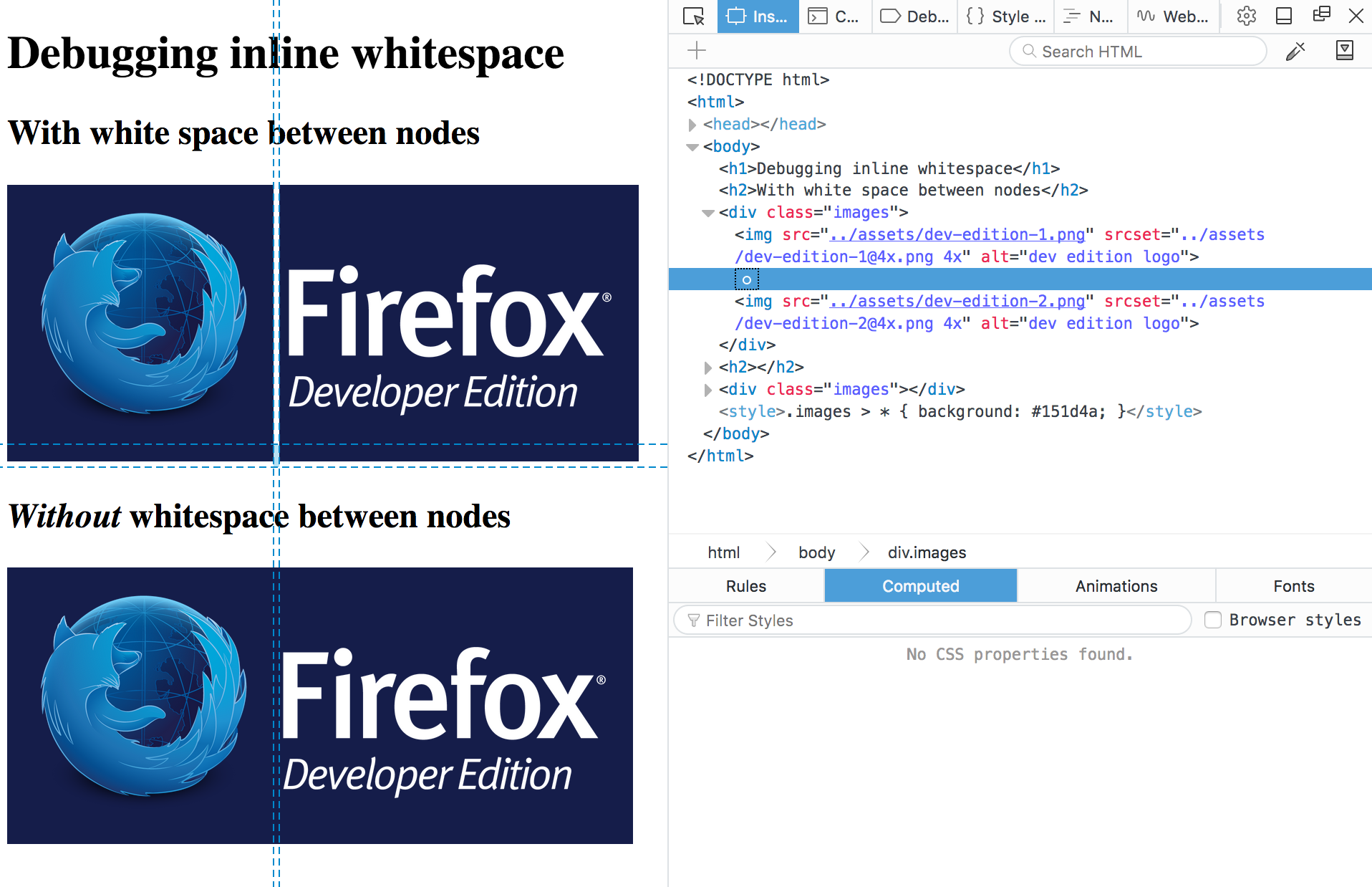
This behaviour can be hard to debug, but Firefox DevTools are now able to display these whitespace nodes, so you can quickly spot where do the gaps come from in your markup, and fix the issues.

Demo

Whitespace debugging in DevTools in action

The demo shows two examples with slightly different markup to highlight the differences both in browser rendering and what DevTools are showing.

The first example has one img per line, so the markup is readable, but the browser renders gaps between the images:

<img src="..." />
<img src="..." />

The second example has all the img tags in one line, which makes the markup unreadable, but it also doesn’t have gaps in the output:

<img src="..." /><img src="..." />

If you inspect the nodes in the first example, you’ll find a new whitespace indicator that denotes the text nodes created for the browser for the whitespace in the code. No more guessing! You can even delete the node from the inspector, and see if that removes mysterious gaps you might have in your website.

17 Oct 14:52

I don’t actually care about growth

by Paul Jarvis
I’m better at working than delegating work.
17 Oct 14:51

Ripley was either a warrant officer or a lieutenant, but only a ‘captain’ in the sense that she was…

by Stowe Boyd
17 Oct 14:51

Peter Thiel and the Future (and Funding) of Education Technology

The New York Times reported over the weekend that, despite a growing number of women who’ve come forward in the last week claiming that Donald Trump has groped or assaulted them, billionaire investor Peter Thiel will be making his first donation to the Republican Party candidate’s presidential campaign.

While some have scoffed that the size of the donation – $1.25 million – isn’t that significant, I think the timing of the donation is still notable for a number of reasons:

Well-known for his libertarian beliefs, Peter Thiel wrote in a 2009 article for the Cato Institute that “Since 1920, the vast increase in welfare beneficiaries and the extension of the franchise to women – two constituencies that are notoriously tough for libertarians – have rendered the notion of ‘capitalist democracy’ into an oxymoron.” Giving women the right to vote, in other words, was a disaster. That sentiment was echoed this week in the hashtag #repealthe19th trended on Twitter, as Trump supporters responded to an image shared by poll analyst Nate Silver showing a landslide victory for Trump if only men voted this fall.

Thiel appeared on stage at the Republican Party convention this summer, perhaps the first time that most Americans had heard of the billionaire. But Thiel has been in the news quite frequently as of late for his bankrolling of Hulk Hogan’s lawsuit against Gawker, a suit that bankrupted the publication and has raised concerns about how this legal tactic will be used to curb free speech and free press. Thiel’s lawyers have threatened other lawsuits against the media – some on behalf of Melania Trump, Trump’s current wife – and Donald Trump himself regularly threatens and files lawsuits against news organizations who report damaging information about him.

Peter Thiel’s beliefs about free speech and the free press are particularly important as he sits on the Board of Directors of Facebook. (He was the first investor in the social media company in 2004.) 44% of US adults, according to Pew Research Center, get their news from Facebook.

Silicon Valley Ideology and the Future of Education


I’ve written extensively about “the Silicon Valley narrative” and the ideological underpinnings of the technology and education technology industries. Libertarianism. Individualism. Global capitalism. Empire.

Although many in these industries – pundits, entrepreneurs, and investors alike – try to paint Thiel as an anomaly, Thiel operates at the center, not at the margins. He operates at the center financially. He sits on boards. He shapes technology products and politics alike.

That matters for the future of democracy, clearly. It matters for the future of "diversity" in tech. It matters for the future of education.

Wait, Who Is Peter Thiel?


Peter Thiel’s entrepreneurial and investment history, in brief:

He co-founded the online payments company PayPal in 1998 with Max Levchin. PayPal merged with Elon Musk’s financial transaction company X.com the following year, going public in 2002 and then sold to eBay later that year.

In 2004, Thiel founded Palantir Technologies, a data analysis company funded in part by Q-Tel, the investment wing of the CIA.

In 2005, Thiel launched his investment firm Founders Fund. Other partners in the firm include Napster co-founder Sean Parker and PayPal execs Ken Howery and Luke Nosek.

Thiel joined the tech accelerator program Y Combinator as a partner in 2015.

A quick look at Thiel’s philosophies and philanthropy:

He is openly gay, and some contend that Gawker’s outing him in 2007 was part of Thiel’s rationale for supporting Hulk Hogan’s lawsuit against the publication.

He has supported other political campaigns, prior to becoming a pledged delegate for Trump this year. He endorsed Ron Paul for President in 2008.

Thiel believes in the singularity – the theory that artificial intelligence will reach a point where it far surpasses human intelligence, eventually bringing about the end of the Anthropocene. Thiel has funded the Singularity Institute for Artificial Intelligence. He’s also a financial backer of OpenAI (along with Elon Musk, LinkedIn founder Reid Hoffman, and Y Combinator president Sam Altman), a non-profit research organization that promises to develop “friendly” AI and, according to recent New Yorker profile of Altman, to “prevent artificial intelligence from accidentally wiping out humanity.” In that profile, Altman described himself as a survivalist of sorts and name-checked Thiel as his back-up plan if the end-of-the-world does come and Altman can’t make it to his bunker. Thiel has also pledged money to the Seasteading Institute, supporting its efforts to develop autonomous ocean-dwelling communities outside of current nation-states’ jurisdictions. And Thiel has supported anti-aging and life-extension research.

And then there’s his influence and investments in education…

Thiel and the Silicon Valley Narratives about Education


Thiel, a graduate from Stanford (with a BA in philosophy and a JD from its law school), pronounced in 2011 that we are in the midst of a bubble – not a real estate bubble but a higher education bubble. He told then Techcrunch editor Sarah Lacy, “A true bubble is when something is overvalued and intensely believed. Education may be the only thing people still believe in in the United States. To question education is really dangerous. It is the absolute taboo. It’s like telling the world there’s no Santa Claus.” College just isn’t worth the price, Thiel argued.

Thiel had unveiled a “20 Under 20” contest at Techcrunch’s annual conference the previous year – a plan to offer twenty young people under the age of twenty $100,000 to drop out of school and pursue other work. Among the recipients of The Thiel Fellowship (which, now in its sixth iteration, has expanded to thirty recipients per year, all under the age of twenty-two): Dale Stephens, founder of UnCollege, a startup that encourages young people to pursue a non-college path and sells “gap year” services; Vitalik Buterin, the co-creator of Ethereum, a blockchain service; Ben Yu, inventor of sprayable caffeine; and Laura Deming, who has founded a venture capital firm to invest in anti-aging and life extension technologies. (Deming is one of the few female recipients of the fellowship.)

Thiel is also the co-author of The Diversity Myth: ‘Multiculturalism’ and the Politics of Intolerance at Stanford, a book that argues that “political correctness,” restrictions on free speech, an “a curricular obsession with oppression theory and victimology” permeate higher education, lowering the quality of education at Stanford and undermining what he deems the most important type of diversity on campus – intellectual diversity.

Despite actively promoting a narrative that college isn’t worth it, Thiel remains heavily involved in education, teaching at Stanford and, of course, investing in education companies.

Thiel and his VC firm Founder’s Fund’s Education Technology Investments (since 2010)


  • Knewton (adaptive teaching software)
  • Declara (adaptive teaching software)
  • AltSchool (private school that relies heavily on data surveillance and software)
  • Thinkful (coding bootcamp)
  • Clever (helps connect various software products for schools so that data can be more easily shared)
  • Uversity (student engagement platform, formerly Inigral, acquired by TargetX)
  • ResearchGate (social networking site for researchers)
  • Lore (learning management system, formerly Coursekit, acquired by Noodle)
  • If You Can (education game-maker, founded by Trip Hawkins, the founder of Electronic Arts)
  • SoFi (private loans)
  • Upstart (private loans)
  • Affirm (private loans)

This portfolio reflects some of the big stories Silicon Valley is selling via education technology – “personalized education,” data collection and analytics, private student loans, coding bootcamps.

Those last two are noteworthy, I’d contend, particularly considering Thiel’s claims about a “higher education bubble.” That is, he seems quite happy to profit from the growing cost of tuition via the booming private student loan market which is well-positioned to profit from the growth in coding bootcamps, whose students are not currently eligible for federal financial aid.

So What?


I track all ed-tech funding data at funding.hackeducation.com. The data is freely and openly available via the GitHub repository that powers the site. The data includes a list of all investors in ed-tech companies going back to 2010, as well as a more detailed look at individual investments, acquisitions, and mergers so far this year.

I track this data, in part, because it helps inform the criticism I write of the ideology of education technology – its business, its politics, its stories. It’s important to peel back the veneer of “progress” – technological progress, political progress – and scrutinize the message, not just the product, being sold. It’s worth scrutinizing the networks – powerful networks – behind education technology. Who is funding the technology makers? Who is funding the policy makers? Who is funding the storytellers? To what end?

At the core of the companies that Thiel has founded and funded is surveillance. Palantir. Facebook. AltSchool. The regime of data collection and analysis is framed as “personalization.” But that’s a cover for compliance and control.

"I no longer believe that freedom and democracy are compatible" – Peter Thiel

What if, instead of wondering how on earth Thiel could support Trump or Trump support Thiel, we consider how they’re quite well-aligned and how the technologies we’re adopting in education are shot through with this very ideological affinity?

17 Oct 14:50

Thalmic Labs opening 50,000-square-foot Waterloo factory to build its next wearable device

by Ian Hardy

Thalmic Labs, the creator of the Myo armband, announced it will manufacture its next product in Waterloo.

A report from The Record, CEO Stephen Lake stated the company will open a 50,000-square-foot factory on 173 Roger Street and will employ approximately 100 people in January.

Last month, Thalmic raised $120 million (USD) in funding from Intel Capital, Fidelity Investments Canada, and the Amazon Alexa Fund and teased it will “have new products in the pipeline” that specifically relates to “human computer interaction.”

The new Roger Street factory will solely be for its next wearable device targeted to the consumer market.

“We are going to be making those future products right here in Waterloo,” Lake said. “We haven’t talked specifics about the products in development. I would love to, and when we can, we will definitely share it. There are a lot of advantages to maintaining that control and proximity to your manufacturing… It lets us innovate on the actual processes to make these things. We think there is a huge amount of skilled labour here because BlackBerry did the bulk of its manufacturing in town here until 2009.”

A dedicated signup page on Thalmic’s website hints a new device is coming, noting, “At Thalmic Labs, we’re making revolutionary wearable technologies that will fundamentally change the way we interact with computers. We’re developing new computer interfaces to seamlessly blend the real and digital worlds.”

Source The Record
17 Oct 14:50

Toronto-based Ecobee launches new ‘lite’ smart thermostat for $219

by Rose Behar

Ecobee, a Toronto-based company that produces wifi-enabled smart thermostats, has announced its first new product in two years: the Ecobee3 Lite.

At $219 CAD, the Ecobee3 Lite is $80 less than the original Ecobee3 ($299 CAD), and it’s also a simpler device. Unlike the Ecobee3, it doesn’t support room sensors, which detect the temperature of their surroundings and adjust the heat accordingly.

It can, however, be controlled using the same apps and devices as its more expensive sibling — whether it be by smartphone, tablet or computer.

The device also has the benefit of voice control functionality, through integrations with Apple HomeKit’s Siri and the Amazon Echo’s Alexa.

The new smart thermostat will be available starting October 31st, 2016.

Update 10/17/16: An earlier version of this article misstated the current price of the original Ecobee3. It is now corrected.

Related: Ecobee raises $35 million from Amazon Alexa Fund, Thomvest and Relay Ventures

17 Oct 14:50

So You Want to Learn Physics...

files/images/Khan..jpg


Susan J. Fowler, Oct 20, 2016


This is an outline of a physics curriculum from first year to graduate studies. It's useful in its own right, but it makes me wonder whether someone could use something like this to actually learn physics. Yes, they would have to be very motivated, persistent, and have a lot of time. But it would have been perfect for, say, someone like me when I was working as a security guard in my early 20s. Now the textbooks in this guide are Amazon.com and therefore expensive - you'd want to replace the material with open content. And there's no community, but maybe one could be made or found. Could it be done? Image: Khan, Physics, inverted.

[Link] [Comment]
17 Oct 14:49

Samsung Did Test Galaxy Note 7 Batteries Before Selling Phones, But Only In-House

by Kate Cox
mkalus shared this story from Consumerist.

As we all know by now, the Samsung Galaxy Note 7 phone has a pretty big design flaw in it that makes the batteries extra-flammable. The phone is totally recalled and permanently off the market now, an expensive debacle for Samsung. But how, one might wonder, does a flaw that big actually escape notice during testing? Was there even testing?

There was, in fact, testing! But as the Wall Street Journal reports, all of Samsung’s battery testing is done in-house, instead of by third party labs, and that may have contributed to the company’s ability to miss the problem.

There are standards for phone battery testing and certification in the U.S. Those standards are maintained by the CTIA, now known as the Wireless Association. Here at Consumerist central we usually hear the name in the context of some piece of lobbying or another lawsuit against the FCC, but as a major industry trade group it actually also does more than that.

In fact, the CTIA certifies certain hardware-spec testing labs for U.S. wireless carriers. Those labs allow “operators and their suppliers” — i.e. anyone who makes the phones — to make sure the lithium ion batteries inside the devices meet IEEE standards, among other things.

The industry created and imposed the program about a decade ago, as cellphones began to proliferate and cheap, poorly-made, knockoff batteries began to hit the market in their wake. That’s bad for everyone — consumers, carriers, manufacturers and brand-holders —

There are many CTIA-certified labs worldwide, with several battery-testing ones across the U.S. and Asia. Any company that wants to have its phone sold by one of the major U.S. carriers needs to test their phone’s battery at one of those certified labs first.

But Samsung, the WSJ reports, only ever tested their Note 7 batteries in their in-house lab. While that lab is CTIA-certified, testing a product in-house obviously has more potential for a conflict of interest to arise — or even for an internal blind spot to simply continue being overlooked — than third-party testing does.

You might assume that having the in-house certified lab do all the testing is standard practice but actually, it’s not quite. Samsung is the only major manufacturer doing 100% of its battery testing in-house, as far as the WSJ could determine.

Apple told the WSJ that it uses third-party CTIA-certified labs to test its batteries. Motorola (Lenovo) and Nokia (Microsoft) have operated their own certified testing labs in the past, the CTIA told the WSJ, but both are closing down.

Motorola told the Journal that it tests its batteries in-house but uses third-party labs additionally to make sure parts get CTIA certification; neither Huawei nor Microsoft provided the WSJ with comment.

Manufacturers like Samsung probably keep as much testing as possible in-house to protect their trade secrets, an expert told the WSJ, which is understandable in a highly competitive market like phone design. But Samsung still hasn’t been able to identify the actual problem inside the Note 7 battery.

With all their continued testing in-house only, there are fewer eyes on the problem — and less shared information out there to prevent others from making the same design mistake. One battery expert who owns a lab told the WSJ he wants Samsung to release details ASAP so everyone else can determine if their own battery testing procedures need to be improved, saying, “They have to tell us what happened so we can fix it.”

Samsung Self-Tested Batteries in Galaxy Note 7 Phone [Wall Street Journal]