The 12MP rear shooter on the Pixel might not seem impressive on paper, but it has received rave reviews, with the camera easily challenging the likes of Galaxy S7 and iPhone 7. The camera is not without its issues though, with many customers and reviewers noting a “halo effect” in photos taken under certain lighting conditions.
Continue reading →
I finally figured out a way to describe my current pain situation that should be familiar to most people. If you’ve ever had one of those serious leg cramps where you have to forcibly straighten your leg until the muscles relax and let go, or a Charley horse, then you should be familiar with that dull, throbbing, lingering ache that doesn’t go away for a long time after the initial cramp. It’s unpleasant at best, and downright painful at worst. Not nearly as bad as that first blast of agonizing pain, but still not something you enjoy.
Now imagine that you live every day, every hour, every minute feeling as if you’ve had a powerful cramp in every single muscle in your body. Usually not that initial blast of cramping pain (although that hits now and then, too), but that lingering sensation of tight, twitchy, burning unhappiness that fades gradually. Except that in my case, it doesn’t keep fading. Eventually it turns around and gets worse again. Sometimes it almost, almost goes away, but then it returns.
Right now, as I write this, I feel the best I’ve felt all day. My chest doesn’t hurt much, for the first time today. Until about 20 minutes ago, my entire body felt like it was being crushed and toyed with by King Kong. Mashed around, twisted and pulled and torn at both inside and out.
The rest of me, though, still feels pretty lousy. Twisting, tearing feelings in all my leg muscles and most of my arm muscles. It’s even less fun than it sounds, because it just keeps going and going. Day after day after day. I’m so tired of it. So very tired of it.
I did my best to work today. Maybe it was a mistake to try. I did get stuff done. I was able to participate, at least to a decent extent, in several meetings, and I did manage to resolve some documentation issues and have a couple of important message exchanges. I proofread a document for someone. I got sample code for the media docs for Firefox 51 nearly finished. It’s working; just needs final polish before I post it.
It’s just so frustrating that I have no way to predict when surges of being able to work will come. I just know today was not a good day for that. I want so badly to be able to crank out massive amounts of docs that people look at and go “This stuff is amazing! And he did it how fast?” again. So badly. I will keep trying to get there.
There’s a lot going on that’s been keeping me on my toes, medically-speaking. I need surgery to repair some leaks in my circulatory system in my legs, but there will be a few months of jumping through hoops to make insurance happy first. I am working toward getting a promising treatment for my nerve damage, but it will take time to get that off the ground. I don’t know how much time, yet. And then I just found out yesterday that there’s new damage in my neck and I will likely need another spinal surgery to correct it before another nerve root is permanently damaged. In the meantime, at least, the spine issue isn’t adding to my pain. It just worries the neurologists.
As part of my treatment program, which involves a lot of doctors and tests and therapies and medications, I see a therapist. Usually our conversations are reasonably light. She says that it’s amazing that through all of this, I manage to keep a reasonably good sense of humor and I tell her that whining about my problems on my blog and on Facebook and Twitter helps a lot. It kind of does, too. She only just recently saw me hit by a major pain incident in person for the first time. I think it was rather informative for her. She has a better understanding of what I’m dealing with now.
Anyway, time to stop whining about my problems and try to do something useful again. If you made it to this sentence, you’re a rock star and you deserve 10 bonus points! Congratulations!
We spend a lot of time training non-community people to become community people.
This is usually people with multiple roles and have less than an hour or so to spend on the community. This group might include teachers, topic experts, or employees throughout the organization.
Our goal is not to deliver a suffocating number of ideas and theory to engage members, but to identify what will have the biggest impact and help people to do a few things really well.
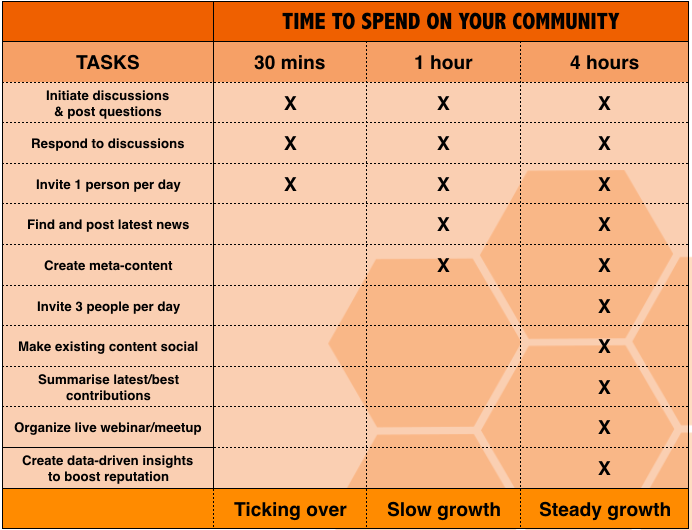
If you only have 1 hour a day (or week?) to spend on the community, where should you invest your time for the biggest impact? For example:
This goes deep into the most core, basic, skills. For example:
How to initiate and respond to a discussion. Phrasing the discussion as a question, keeping it short, understanding the trigger words to use and not use etc…
How to elicit additional participation. Learn how to elicit increased discussion in every discussion. Strike an ego, call for more responses, tap specific people to respond etc…
How to communify existing content. Turn reports and white papers into interactive discussions, webinars, and polls.
How to read and understand what members want. Learn how to recognize member ‘tells’, what they are not saying, and what they really want (increase their reputation, blow off steam, get your attention etc…)
Etc..
The goal by the end of the sessions is to help each person in the workshop/course etc to do each of these once. Once you can see one successful discussion you have created, see the positive feedback on content you have created, and feel you can read your members, you are more likely to create two, then four etc…
If you’re working in communities, the best thing you can do is host a session for colleagues for an hour or two and teach these basic skills. Some will go back to what they’re doing, but a few will start to get involved. This helps scale participation, increase your influence, and realize other benefits.
Better yet, by narrowing in on doing a few things really well you ease the mental burden on their side. The temptation is always to impress colleagues with everything you know. Don’t do this. Zero in on only what they need to know (and nothing else).
…Beginning October 22nd the Expo line will run from Waterfront to
King George OR Production Way University. The Millennium Line will run
between VCC Clark and Lougheed Town Centre, meaning it will no longer
travel to Waterfront. Once the Evergreen extension opens in early 2017,
the Millennium line will extend to Lafarge Lake-Douglas.
Rumors have been swirling that Apple is about to acquire yet another tech startup, the Australian company Sonder Design, arousing intense interest and speculations that dynamic e-ink keyboards, able to shift between different interfaces depending on the application, will be incorporated into the next generation of Macs.
Much like the way you can switch between languages on a keyboard on your mobile screen, the E-ink display, the same kind used for Kindle, will allow the keyboard to shift between not only languages, but photoshop shortcuts, emoticons, game controls, and anything else developers see worthy to create.
Fransisco Serra-Martins, founder of the company, is confident that unlike kindle which “blinks” between pages, a timing control device means there will be no or little time-lapse as you toggle between keyboard interfaces. “You could play a video on there,” he says.
Pretty neat, eh? The next question is line of course is, will they really be featured on the next generation Macs? Though a meeting between Tim Cook and Sonder reported by the Guardian, was denied by the company in a statement, its founder only pointed out that the context of the meeting was inaccurate, without disclaiming the actual talks, in an interview with Technode.
Naturally for a seed phase startup like Sounder, the prospect of being acquired by Apple is both thrilling and intimidating.
It almost seems as if the the keyboards were designed with a destination in mind, as a promotional clip for the product cites the late Steve Jobs vision from 2007: “They all have these keyboards and control buttons that are fixed and plastic…every application wants a slightly different user interface a slightly optimized set of buttons just for it.” Design-wise, the customizable keyboard’s polished and clean appearance would chime with Apple’s style, a cousin to Apple’s Magic Keyboard
Imaginably, becoming a subsidiary of Apple carries an aura that would pave a smooth path for personal business ventures to come, eradicate all money anxieties, and the possible satisfaction of seeing your idea delivered by one of the best loved PCs in the world.
But the clout of a hardware giant that allows for all of the above also means that small fry gobbled up are vastly over-shadowed, perhaps to the point of oblivion. “If you look at nuanced technology like the team behind Siri, the company still exists, but they don’t operate under their name,” was all Fransisco would tentatively say, tiptoeing around the topic of acquisition–Apple disapproves of startups blurting out the details of courtship.
By convention, Apple like to keep a low profile whenever it buys a startup–”Apple buys smaller technology companies from time to time, and we generally do not discuss our purpose or plans”– is the protocol answer from the Cupertino company. In 2015, Apple announced that they had bought 15 companies, but the names and identities of 6 were never made public-if Sonder’s deal carries through, we might never hear Apple holler about it until the new Mac with customizable keyboards is trotted out by Tim Cook.
On average, Apple buys 10-20 startups each year, and some are hard to miss, such as Beats Electronics headphones, its technology incorporated into iTunes and iPhones. Others are fused with existing products and a never heard of again in their maiden name–think Silicon Color, whose technology enhanced Final Cut Studio, the search engine OttoCat, which powers the iOS app store,VocallQ which allows Siri to better understand what you dictate, and thanks to Snappy Labs, acquired in 2014, your iPhones can take slo-mo clips.
But then there are the countless others whose technology Apple merely sits on, perhaps they just wanted the talent, or want it stashed away to get ahead in the unforeseeable future.
For Sonder, the priority is to bring the keyboard into existence, by any means necessary. “For us, it really depends on what Apple’s intentions are, if it aligns with our vision. If not, then we have other options we can pursue”, Fransisco said.
In an era where when the laptop design has reached a bottleneck, a smarter keyboard is an attractive marketing point and unmistakable opportunity for product differentiation–and in the meanwhile streamlining the supply chain. Right now, Apple has more than 32 different language keyboards in their supply chain, Fransisco tells us, and that means it has to forecast sales in different regions to cope with the demand.
Perhaps the actual value of an e-ink keyboard a bit overhyped. After all, those bilingual and polyglots have probably mastered typing methods without a stack of different keyboards, while Dota gamers and CAD designers have the controls memorized by heart at this point. But as long as a laptop maker eager to woo the crowds and show that they can still innovate buys Sonder’s tale, then eventually so will the rest of us.
"The Future of Work with Watson: Build Tomorrow’s Workplace Today with the Magic of Cognitive" - this is how IBM envisions collaboration in the future. Watch the 44 minutes and let me know what you think. I found some humor in the the whole theme "cyber illusion".
Do you understand what this is? It's messaging, Project Toscana. Like Slack. Or Microsoft Teams. Click?
You can just imagine the sceptics, says this article: "You can’ t build a tech site that doesn’ t publish 20 times a day. You can’ t build a content site that isn’ t covered with advertising. You can’ t build an entire business on Amazon affiliate revenue. You can’ t take on Consumer Reports and expect to get any traction. You can’ t pay for this level of in-depth reporting. Ok, great, you built this, but why would anyone ever come back?" If I wanted to monetize OLDaily, this would probably be the route I would take.
A rumor originating from China claims that Samsung will be using an optical fingerprint sensor on the Galaxy S8. If true, it would mean that the Galaxy S8 would be the first smartphone in the world to use an optical fingerprint sensor.
Continue reading →
Great piece by Matthew Townsend of Bloomberg (h/t Brandon Donnelly) that threads the needle on why retail chains need a revolution to counter Amazon and online. CEO’s of companies like Target, Gap, Abercrombie&Fitch, and Barnes & Noble are griping about a ‘challenging retail environment’, which basically boils down to a world with Amazon in it.
Here Townsend quotes John Kernan, an analyst for Cowen & Co.:
Every metric related to the consumer is healthier now than it was the past couple years. The consumer is in a very good position right now.
[…]
All this pleading that the consumer isn’t spending is an excuse, largely from management teams whose product is less relevant. The consumer is actually driving the U.S. economy, so it’s a little ridiculous when we hear the excuse of the macro environment is not good.
The challenge seems limited to those retail companies, because more than half of all product searches start at Amazon.
As Townsend summarizes,
Consumers are still shopping, just somewhere else.
Brandon Donnelly chimes in after reading this Townsend piece, and suggests a simple experiment:
When I look around my place right now and think about where I bought each item – everything from the shoes at my door to the protein powder in my cupboard – it’s pretty amazing to think about how much I now buy online. And I’m sure that many of you are the same.
Groceries aside, I’m probably 85-90% online. What about you?
“I think the way to “solve” the problem of procrastination is to let delight pull you instead of making a to-do list push you. Work on an ambitious project you really enjoy, and sail as close to the wind as you can, and you’ll leave the right things undone.”
“Women workers who are not feminists know that they receive unequal pay for equal work, but they may think that the arrangement is just; the feminist sees this situation as an instance of exploitation and an occasion for struggle. Feminists are not aware of different things than other people; they are aware of the same things differently.”
-
Sandra Lee Bartky, Toward a Phenomenology of Feminist Consciousness
One of the books I’m reading at the moment is Michael Hiltzik’s Dealers of Lightning: Xerox PARC and the Dawn of the Computer Age (my copy is second hand, ex-library stock…), birthplace to ethernet and the laser printer, as well as many of the computer user interactions we take for granted today. One thing I hadn’t fully appreciated was Xerox’s interests in publishing systems, which is in part what put it in mind for this post. The chapter I just finished reading tells of their invention of a modeless, WYSIWYG word processor, something that would be less hostile than the mode based editors of the time (I like the joke about accidentally entering command mode and typing edit – e: select entire document, d: delete selection, i:insert, t: the letter inserted. Oops – you just replaced your document with the letter t).
It must have been a tremendously exciting time there, having to invent the tools you wanted to use because they didn’t exist yet (some may say that’s still the case, but in a different way now, I think: we have many more building blocks at our disposal). But it’s still an exciting time, because while a lot of stuff has been invented, whether or not there is more to come, there are still ways of figuring out how to make it work easier,still ways of figuring out how to work the technology into our workflows in more sensible way, still many, many ways of trying to figure out how to use different bits of tech in combination with each other in order to get what feels like much more than we might reasonably expect from considering them as a set of separate parts, piled together.
One of the places this exploration could – should – take place is in education. Whilst at HE we often talk down tools in place of concepts, introducing new tools to students provides one way of exporting ideas embodied as tools into wider society. Tools like Jupyter notebooks, for example.
The more I use Jupyter notebooks, the more I see their potential as a powerful general purpose tool not just for reproducible research, but also as general purpose computational workbench and as a powerful authoring medium.
Enlightened publishers such as O’Reilly seem to have got on board with using interactive notebooks in a publishing context (for example, Embracing Jupyter Notebooks at O’Reilly) and colleges such as Bryn Mawr in the US keep coming up with all manner of interesting ways of using notebooks in a course context – if you know of other great (or even not so great) use case examples in publishing or education, please let me know via the comments to this post – but I still get the feeling that many other people don’t get it.
“Initially the reaction to the concept [of the Gypsy, GUI powered wordprocessor that was to become part of the Ginn publishing system] was ‘You’re going to have to drag me kicking and screaming,'” Mott recalled. “But everyone who sat in front of that system and used it, to a person, was a convert within an hour.” Michael Hiltzik, Dealers of Lightning: Xerox PARC and the Dawn of the Computer Age, p210
For example, in writing computing related documents, the ability to show a line of code and the output of that code, automatically generated by executing the code, and then automatically inserted into the document, means that when writing code examples, “helpful corrections” by an over-zealous editor go out of the window. The human hand should go nowhere near the output text.
Similarly when creating charts from data, or plotting equations: the charts should be created from the data or the equation by running a script over a source dataset, or plotting an equation directly.
Again, the editor, or artist, should have no hand in “tweaking” the output to make it look better.
If the chart needs restyling, the artist needs to learn how to use a theme (like this?!) or theme generator rather then messing around with a graphics package (wrong sort of graphic). To add annotations, again, use code because it makes the graphic more maintainable.
We can also use various off-the-shelf libraries to generate HTML/Javascript fragments for creating inline interactives that can be embedded within the notebook, or saved and then reused elsewhere.
There are also several toolkits around for creating other sorts of diagram from code, as I’ve written about previously, such as the tools provided on blockdiag.com:
Aside from making diagrams more easily maintainable, rendering them inline within a Jupyter notebook that also contains the programmatic “source code” for the diagram, written diagrams also provide a way in to the automatic generation of figure londesc text.
Electrical circuit schematics can also be written and embedded in a Jupyter notebook, as this Schemdraw example shows:
So far, I haven’t found an example of a schematic plotting library that also allows you to simulate the behaviour of the circuit from the same definition though (eg I can’t simulate(d, …) in the above example, though I could presumably parameterise a circuit definition for a simulation package and use the same parameter values to label a corresponding Schemdraw circuit).
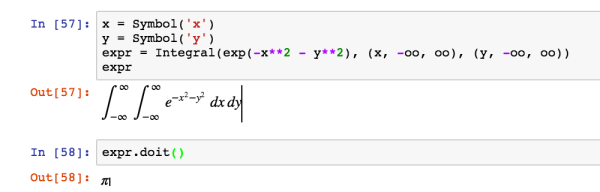
There are some notations that are “executable”, though. For example, the sympy (symbolic Python) package lets you write texts using python variables that can be rendered either as a symbol using mathematical notation, or by their value.
(There’s a rendering bug in the generated Mathjax in the notebook I was using – I think this has been corrected in more recent versions.)
We can also use interactive widgets to help us identify and set parameter values to generate the sort of example we want:
Sympy also provides support for a wide range of calculations. For example, we can “write” a formula, render it using mathematical notation, and then evaluate it. A Jupyter notebook plugin (not shown) allows python statements to be included and executed inline, which means that expressions and calculations can be included – and evaluated – inline. Changing the parameters in an example is then easy to achieve, with the added benefit that the guaranteed correct result of automatically evaluating the modified expression can also be inlined.
(For interactive examples, see the notebooks in the sympy folder here; the notebooks are also runnable by launching a mybinder container – click on the launch:binder button to fire one up.)
As well as writing mathematical expressions than can be both expressed using mathematical notation, and evaluated as a mathematical expression, we can also write music, expressing a score in notational form or creating an admittedly beepy audio file corresponding to it.
(For an interactive example, run the midiMusic.ipynb notebook by clicking through on the launch:binder button from here.)
We can also generate audio files from formulae (I haven’t tried this in a sympy context yet, though) and then visualise them as data.
Packages such as librosa also seem to provide all sorts of tools for analysing an visualising audio files.
When we put together the Learn to Code MOOC for FutureLearn, which uses Jupyter notebooks as an interactive exercise environment for learners, we started writing the materials in (web pages for the FutureLearn teaching text, notebooks for the interactive exercises) in Jupyter notebooks. The notebooks can export as markdown, the FutureLearn publishing systems is based around content entered as a markdown, so we should have been able to publish direct from the notebooks to FutureLearn, right? Wrong. The workflow doesn’t support it: editor takes content in Microsoft Word, passes it back to authors for correction, then someone does something to turn it into markdown for FutureLearn. Or at least, that’s the OU’s publishing route (which has plenty of other quirks too…).
Or perhaps will be was the OU’s publishing route, because there’s a project on internally (the workshops around which I haven’t been able to make, unfortunately) to look at new authoring environments for producing OU content, though I’m not sure if this is intended to feed into the backend of the current route – Microsoft Word, Oxygen XML editor, OU-XML, HTML/PDF etc output – or envisages a different pathway to final output. I started to explore using Google docs as an OU XML exporter, but that raised little interest – it’ll be interesting to see what sort of authoring environment(s) the current project delivers.
(By the by, I remember being really excited about the OU-XML a publishing system route when it was being developed, not least because I could imagine its potential for feeding other use cases, some of which I started to explore a few years later; I was less enthused by its actual execution and the lack of imagination around putting it to work though… I also thought we might be able to use FutureLearn as a route to exploring how we might not just experiment with workflows and publishing systems, but also the tech – and business models around the same – for supporting stateful and stateless interactive, online student activities. Like hosting a mybinder style service, for example, or embedded interactions like the O’Reily Thebe demo, or even delivering a course as a set of linked Jupyter notebooks. You can probably guess how successful that’s been…)
So could Jupyter notebooks have a role to play in producing semi-automated content (automated, for example in the production of graphical objects and the embedding of automatically evaluated expressions)? Markdown support is already supported and it shouldn’t take someone too long (should it?!) to put together an nbformat exporter that could generate OU-XML (if that is still the route we’re going?)? It’d be interesting to hear how O’Reilly are getting on…
I was born in 1990, the year the first web browser was published, a leap forward in the evolution of communication unseen since the invention of the telephone. In 1995, my mother died. I was sent to live with my father, an ambitious, working class Haitian immigrant. We owned a Compaq Presario, complete with dial-up internet service courtesy of the free trial disk from America Online that we received in the mail. It sat on a broken desk in the dining room, whose only other furnishing was a brown, corduroy recliner. While my father married several times and fathered more children, he was never sentimental about birthdays or holidays or childhood memories. I was lonely without my mother. The convenient ability to connect across physical boundaries came at an opportune time in my life.
By the time AOL Instant Messenger was released in 1997, I could read and write. I do not remember the exact sequence of events but I imagine I exchanged usernames with one of my mother’s nieces or nephews during one of the visits my father rarely permitted. Communication came easier. The summers I spent away from my mother’s family were spent in front of the computer. I ate meals over its keyboard. During the school years, I did my homework by the glow of its screen. My cousins and I talked about cartoons and cursed often, a freedom our parents didn’t allow. They told me stories from when I was a baby, when my mother was alive. From them, I learned she was an amazing cook. My favorite was the story of my aunt’s neighbors who built a fence after I gave all of their children chickenpox. Another aunt, my mother’s younger sister, used to say during my stretches of absence that we would always find each other. She did not know the unbreakable bond between us, which transcended time and distance, would be embodied through chatrooms and instant messages, first on AOL, then on MSN, where we played Uno like we did after dinner during the holidays.
When the Compaq died in 2002 I was without a computer for two years. It was the longest I had gone without speaking to my family since I left them as a toddler. In 2004, my father connected a used Dell Tower to our old monitor, but while I regained access to the internet, I had forgotten all my usernames and passwords. My family found me by chance after I joined Myspace. Every person I lost came back to me: We were reconnected as we had been in my early childhood. I was thrilled by each friend request and every comment on my profile. Each cousin held a distinguished spot in my “top eight.” It was not a hard decision: My circle of IRL friends was small. When I was bored, I spent my time perusing my cousins’ profiles. I learned the faces of their best friends. When my older cousins, away at college, transitioned to Facebook, I followed suit. I wanted to see myself classified as family on their profiles. I tagged myself in their albums of family vacations, weddings, and Thanksgiving dinners. Facebook was a digital representation of my belonging to people. It marked the end of my solitary life.
My aunt said we would always find each other. She didn’t know this unbreakable bond would be embodied through chatrooms and instant messages
By 2009 I was a sophomore at Temple University. I lost scholarships, partly due to bad grades, partly to loss of funding. I commuted four hours each day to and from my aunt’s home in Willingboro, New Jersey to alleviate some of the financial burden. On days I didn’t have class, I worked part time at Bath and Body Works in Philadelphia. Class. Home. Work. Home. This pattern repeated for a year. According to my profile, I joined Twitter in November 2010. My handle was pardonmyfrenchx. My 20-year-old self was pleased with the unoriginal use of my childhood nickname, the extra letter added because pardonmyfrench, pardonmyfrench_, pardonmyfrench0, and pardonmyfrenchy were all spoken for. Twitter, like college, was then a miscellaneous and experimental environment, optimal for fostering self-construction. Unlike Facebook, Twitter’s layout was ideal to proliferate beyond my familial fences. Twitter was informal. Its users wrote what they pleased. Posts about making dinner stacked between posts about wanting to die and a meme of crying Michael Jordan superimposed on a wedding cake. There was no order or rhyme or reason. Interactions were open and simple, unless your profile was private. Statements were digestible at 140 characters. This was important, because the feed moved fast.
Through the interests of people I opted to follow, and the people they followed, the well of knowledge was bottomless. I learned about skincare regimens for oily, eczema-prone skin, Caribbean inspired vegan recipes, and Amigurumi, the Japanese art of doll making. In Philadelphia, where I live, there are a handful of black women writers. We were needles in a white male dominated haystack. Twitter connected us. Through them, I learned about writing classes and fellowships. Twitter was a form of communication and a resource.
On Twitter and other social media platforms, as many critics have argued, users volunteer to be bombarded with the consciousnesses of hundreds of thousands of other people. What naysayers fail to realize is that this unique characteristic is what makes social media inherently mystical.
As a first generation Haitian-American, spirituality has always been embedded in my world. My mother’s father was a Christian minister. Her mother’s, my grande’s, every breath is a prayer. Her connection to God is her protection against diabs, devils, and evil spirits, as well as Voodoo priests who knew my grandfather. My mother was a youth minister. My aunts told me stories of her deep voice that filled the modest church house and inspired worshippers when she was 16. For a brief period in my adolescence, I was encouraged to be a minister like my mother.
Twitter, like college, was a miscellaneous and experimental environment optimal for fostering self-construction
I was skeptical of Christianity due to Manichean and sexist interpretations of the Bible. However, I believed in God, the Source, due entirely to my grande’s influence. She survived child slavery in Haiti in the early 1900s, and journeyed with ten children from Haiti to the U.S., where she survived the death of her husband and a daughter. I had no doubt that through her prayer and belief, she tapped into a strength and wisdom beyond her petite frame.
My ideas on spirituality were fragmented: I knew what did not resonate with me, but I did not know what I was looking for until I found holistic practitioners and intuitive guides on Twitter. Francheska Medina, known best as @HeyFranHey, shares tips for holistic health and mental wellness on Twitter and Tumblr, as well as DIY videos on YouTube. She was unlike others in her field, who I thought could not understand my experiences. She reminded me of Denise from The Cosby Show, except health conscious. Her hair was long, wide, curly. She wore vibrant sweatshirts and sweaters. Fifteen-minute videos about self-compassion, DIY body butter and almond milk, and non-toxic cosmetics. On my early morning trips to Philadelphia, the glow of my smartphone became like the willow leaves hanging from the Tree of Souls in Avatar, transporting wisdom from my timeline, my personal Eywa.
Andrew Sullivan, in a recent New York magazine essay, wrote of forfeiting his smartphone at a temple for meditation. He argues that social media compels us to fill silence with content. But it was through Twitter that I came to understand meditation itself, after reading a thread by Maryam Hasnaa, who tweets as @thatgirlhas. “With meditation the thing is not trying to get your mind free of all thought but, just to be the witness of it all,” she posted at 10:45pm, on an ordinary weeknight. “A thought pops up and you simply notice, I’m having a thought. Repeat this step over and over. Then, when your monkey mind has calmed down, notice your breathing.” I watched the tweets appear from the comfort of my pillow while still dressed in clothes from work. On the timeline was the latest in the slew of deaths of black people by law enforcement caught on video. I was feeling a combination of sadness and paranoia. I had tried meditating before, using one of Deepak Chopra and Oprah’s “21-Day Meditation” challenges, but I’d assumed that distraction meant failure, and stopped for frustration of meditating incorrectly. What Hasnaa’s tweets helped me understand is that the practice of meditation is about observing the mind and refocusing on the breath, consequently the present moment. Her tweets instructed on how to operate in the discord of the feed that surrounded them.
Maryam Hasnaa is the daughter of Amina Wadud, a scholar of Islam, and mother of an adorable, chess-playing son, or Sun as she affectionately calls him. She uses her Twitter and Instagram to share spiritual texts, and her blog on Medium, Vibrational Medicine, for longer ruminations. To her 32,000-plus followers, her timeline is a comprehensive gateway to understanding the spiritual realm. She discusses love and energetic self-mastery, and posts links to lectures on YouTube about spirituality. She shares her monthly audio newsletter and meditations from Soundcloud and facilitates one-on-one therapy sessions. I inquired about Hasnaa’s intuitive guidance over the summer. I was meditating and embodying love by pouring love into myself. I felt good. I could only benefit from personalized insight. Each session is held over the phone or Skype audio, which offers the clearest connection. The conversation begins with the client’s emotional, mental, physical and spiritual state. Hasnaa asks the client some questions to be discussed during the call: Why did you decide to contact an intuitive guide? What is your intention for the session? Are there any areas in your body that hurt, feel uncomforted, need more love?
Rather than hindering humanity, social media has the potential to bring people into humanity
Hasnaa feels that social media can be used as an entry point to inspire people to explore deeper spiritual work. “People can use social media as a way to connect to other people who are doing the work and to be reminded to stay on the path,” she explains. “That is a blessing because at times one can feel disconnected from those around them when they truly commit to this path.” She asserts that true spiritual work is an inner journey and would really require someone to step away from all distractions, not only the internet. Hasnaa uses Twitter to remind her followers to learn how to turn within, and commune with the silence. She believes there are infinite possibilities for spirituality through social media. “I take long breaks when needed to get reconnected to my spirit,” she explains. “I have learned how to become more resilient with my practice through being on social media. For my own future I see me not being available through these mediums at some point. In the meantime, I’m excited to connect with others who value and benefit from my work.” Social media, which allows communication across physical boundaries, is a spiritual evolution, taking us a little closer to a collective consciousness.
Twitter has its limitations. It is two-dimensional; conversations are short and sometimes one-sided; it is vulnerable to trolling and harassment. “The mania of our online lives reveals this: We keep swiping and swiping because we are never fully satisfied,” Andrew Sullivan writes. He describes his, and our, use of social media as an addiction. As escapists, addicts use their fixations to distract themselves from what haunts them — anxiety from lack of control, or mortality, or loneliness. The sickness is within the individual; the remedy is not forfeiting the smartphone on a digital Sabbath, but a consistent, conscious effort to understand the self, and define its purpose.
Dalai Lama, who joined Twitter in February 2009, has a following of 12.9 million. Deepak Chopra, since adopting Twitter in July 2008, has accumulated a following of nearly 3 million, myself included. “Interconnectivity of the mind isn’t good or bad; it’s neutral,” he explained in a 2012 Mashable interview. “We can cause devastation worse than any war through making diabolical use of the social networks, or we could bring the world together in the direction of peace, harmony, sustainability and social justice. It’s up to us.” Rather than hindering humanity, as Sullivan believes, Chopra believes social media, by transcending ethnic, racial, and geographic boundaries, has the potential to bring people into humanity.
Christina Puchalski, MD, director of the George Washington Institute for Spirituality and Health, contends that “spirituality is the aspect of humanity that refers to the way individuals seek and express meaning and purpose and the way they experience their connectedness to the moment, to self, to others, to nature, and to the significant or sacred.” In trying to define spirituality for myself, I realize there’s no action more pretentious than defining spirituality. It focuses on the soul. Spirituality is a malleable practice. It is to appreciate life for the marvel that it is. To recognize what connects you to the Source, to and others, and to connect to your purpose and your boundlessness.
I spent the summer of 1981 in a basement programming every bit of a TI-99 computer in order to build a Star Trek game. It wasn't much (but for the time it was great, with a strategy view and a viewscreen view and enemies that avoided being shot). You couldn't do a lot with a computer in those days, but this was always my objective: a fully immersive Enterprise bridge crew simulation. So, some 35 years later, for me, the future has arrived. Or will arrive, when I get to play this puppy.
I can replace Esc with Ctrl+C in vim, but if this is real then Apple has gone batshit insane, even if there are workarounds.
I actually use and rely upon that top row too much to feel comfortable with the idea of a touch bar. It’s true I’m typing this on an iPad soft keyboard, but come on, a MacBook Pro was until now meant to be used as a real computer, and that, for UNIX-centric folk like myself, means using a terminal — which in turn means having an Esc key, because the equivalent key combo (Ctrl+[) does not exist on a Portuguese keyboard.
When I have to research and outline longform feature stories such as my iOS reviews, I use iThoughts. I wrote about my mind-mapping workflow in the Club MacStories newsletters before: essentially, iThoughts allows me to have finer controls over the way my mind maps look and how they work with external keyboards on the iPad.
I love the way I can structure a mind map in iThoughts to my needs, and several touches such as pasting images into nodes or quickly creating parallel or nested nodes speed up editing and collection of research material. Without iThoughts, my iOS 10 review wouldn't have been possible.
Today, iThoughts developer Craig Scott launched version 4.0 of the app with native Markdown formatting. Markdown was already supported in the iThoughts URL scheme to create templates; now, you can format text inside individual notes with standard Markdown and iThoughts will display it as rich text when you're done editing.
I took Markdown formatting for a spin today, and it's exactly what I hoped it would be (for instance, I like how links are automatically converted after pasting them in a node). This is going to be extremely useful in June 2017, but I also think it'll help me use iThoughts more regularly alongside my text editor.
Like MacStories? Become a Member.
Club MacStories offers exclusive access to extra MacStories content, delivered every week; it’s also a way to support us directly.
Club MacStories will help you discover the best apps for your devices and get the most out of your iPhone, iPad, and Mac. Plus, it’s made in Italy.
During its keynote presentation today, Microsoft demonstrated a new virtual reality accessory that can be integrated with Hololens to create new “mixed reality” experiences. The demonstration indicated that the device is capable of scanning the environment around it, similar to Microsoft’s HoloLens.
The VR headset starts at $299 USD and is set to be produced by partners including HP, Dell, Lenovo, Asus, and Acer. It will include inside-out tracking sensors, allowing it to sense the boundaries of its environment — like the HTC Vive’s Chaperone system — without the need for external cameras or laser systems, and for a much lower price tag.
This is a similar concept to Oculus’ Santa Cruz prototype which features inside-out tracking and is self-contained. On stage, however, the Microsoft headset appeared to be connected to a PC via wires.
The company has noted that the headsets will launch in 2017 following the Windows 10 Creator’s Update. We reached out to Microsoft for information related to Canadian pricing and availability and will update this story when we know more.
On the heels of their recent purchase of the streaming video service Beam, Microsoft has announced that game streaming will soon be built directly into Windows 10 and the Xbox One via its upcoming Creator’s Update.
The Windows-G keyboard shortcut will prompt the start of a stream, and with one additional click you’re broadcasting over Xbox Live, according to Microsoft’s presentation.
This stream can then be viewed on a Windows PC, Xbox One, or a mobile device. Microsoft noted during its keynote that young gamers are now spending twice as much time viewing game streams and e-sports tournaments than they are actually playing video games.
Am siebten Tag aber war Ruhe …, But on the seventh day a bit of peace and quiet…,190 x 190 cm, 2016, courtesy of Marlborough Chelsea and the artist.
A dachshund in a pink wig stares resolutely out from under a lamp. Off to the left, a disembodied hand, it’s manicured fingers loosely grasping the lamp’s cord, floats off into the jagged, navy background. "Poor soul," you might think with a laugh, and you'd be right. Poor Souls is less an art show than it is a laughter-fueled trip into the mischievous mind of the legendary German artist Werner Büttner. Opening at Marlborough Chelsea, the show is Büttner’s first in New York in 30 years, marking his return with a formidable collection of paintings and never-before-seen collages.
Though these works are new, they retain the dark wit and imbedded critique audiences have come to expect from the 62-year-old artist-cum-art professor. Back in 1970s Cologne, Büttner and his fellow members of the Junge Wilde movement pushed against the minimalistic, conceptual pull of their moment with a style of exuberance, intensity, and a joie de vivre sense of irony.
Unser tägliches Detail, Our Daily Detail, 2016, 41 x 33 cm, courtesy of Marlborough Chelsea and the artist.
This is the same over-the-top style still seen in the artist’s work today, such as his piece But on the seventh day a bit of peace and quiet (top). It testifies to another characteristic of Büttner’s style: the works are as much about the iconoclastic imagery as they are about the words that accompany them. The artist’s titles are often long, usually contradictory, and seemingly extraneous to many of the images they describe. What, for example, does The Confetti of Duration have to do with a brick building front and a suspended string of sausages? “If the lessons are obliquely proffered and veer toward the gnomic,” says the show’s press release, “they are all the more powerful for it.”
Das Konfetti der Dauerei, The Confetti of Duration, 190 x 150 cm, 2016, courtesy of Marlborough Chelsea and the artist.
Angst-Die Gekrönte Konstante…, Fear-The Crowned Constant…, 2016, 41 x 33 cm, courtesy of Marlborough Chelsea and the artist.
Das einsame Tribunal, The lonesome tribunal, 150 x 120 cm, 2015, courtesy of Marlborough Chelsea and the artist.
Ballspielende Mönche, Monks Playing Ball, 2016, 41 x 33 cm, courtesy of Marlborough Chelsea and the artist.
Poor Souls opens tomorrow, October 27th, at Marlborough Chelsea. Find out more on the show on the gallery’s website.
Anil Dash@anildash
Like, *lots* of people read text online by highlighting it, and many of them continuously highlight & unhighlight text while reading.
Those who have been waiting for Apple’s inevitable, long awaited revamp of the MacBook Pro are finally in luck.
Following the launch of the iPhone 7/iPhone 7 Plus as well as the Apple Watch Series 2, the Cupertino, Califonia based company is set to revamp its most ancient product category, the MacBook Pro, marking its first redesign since 2012. This refresh will be the first upgrade since 2015 to a Mac that doesn’t include the company’s 12-inch MacBook getting a gold colour variant and marginally faster hardware.
Rejoice, a new MacBook Pro is coming
The updated Pro will reportedly feature a thinner case, larger trackpad, faster graphics card and most interestingly, a secondary OLED display that replaces its standard function keys. According to rumours, this screen will be highly customizable, shifting based on the application it’s currently running, similar to a smartphone of tablet’s touchscreen. This is a fact Apple’s former CEO Steve Jobs placed significant emphasis on at the iPhone’s initial keynote reveal back in 2007. Unlike static, physical keyboards, touchscreens have the ability to change user interfaces for every app the device is running.
While strange-sounding at first, this feature could fundamentally alter how people interact with the traditional laptop. For example, a video editing application could now display controls related to its specific purpose, where as a word processor might adopt inputs related to its function. While nothing has been confirmed, this new display, which may also feature a built-in fingerprint sensor, could be called the “Magic Toolbar.” The image (posted above and first reported by MacRumours) that leaked earlier today seems to confirm the Magic Toolbar’s functionality.
It’s also expected that the MacBook Pro will utilize USB-C, though it will likely feature more than one port unlike the 12-inch 2015 and 2016 iteration of the MacBook. However, it looks like Apple’s popular MagSafe port is going to be scuttled in favour of USB-C charging, though it’s possible Apple could have developed its own version of a USB-C MagSafe adapter.
The laptop’s body, however, won’t be tapered like current MacBook Air and Retina MacBook, instead adopting shallower curves around its edges. Other details include the fact that the MacBook Pro will continue to be available in 13-inch and 15-inch sizes. It will also feature a pressure sensitive Force Touch trackpad, revamped keys that could be more like the 12-inch MacBook’s, thin speaker grills beside its keyboard and up to 2TB of storage space.
Finally, the new MacBook Pro will feature faster flash storage, Intel’s new Skylake Processor, an improved retina display and a new colour option accompanying gold, rose gold, silver and space gray, though its unclear exactly what the hue is.
Could the iMac get a refresh
While this rumour is less concrete, Apple might also reveal new iMacs with updated AMD graphics chips at its event on Thursday. It’s unclear if the new iMac will also get an aesthetic revamp. Though the industry has shifted largely towards laptops, the power dedicated work stations like the iMac provide is still valuable for people working in certain industries.
More recent rumours indicate that we won’t get our first glimpse at Apple’s future plans for the iMac on October 27th. Instead, the company may wait until early 2017 to reveal and launch the new desktop devices. They will reportedly not receive a processor upgrade though since they’re already using Intel’s Skylake generation of chips.
As a side note, Apple could show off the successor to its retired Thunderbolt display, a new 5K (5120 x 2880 pixel) retina display with an integrated GPU, manufactured through a partnership with LG.
Finally, it’s possible both the Mac mini and the Mac Pro could get a refresh, since it’s been a number of years since Apple has updated the internals of either device. It’s also possible that Apple has decided to ditch those form factors altogether though.
Time to live #DongleLife
It’s expected that Apple could either leave behind the MacBook Air or, in an alternate scenario, slightly revamp the device with USB-C technology. Unfortunately if the Air does live on, it likely won’t get a retina display, but will be equipped with Skylake architecture.
In the scenario where the Air does survive Apple’s keynote on Thursday, speculation indicates the 11-inch Air will be retired.
We’ll be on the ground at Apple’s Mac event this coming Thursday, bringing you all the news directly from the show floor.
Apple reported its fourth quarter earnings this past Tuesday and achieved better than expected results.
Reports indicate that the tech giant achieved a total revenue of $46.9 billion USD, a net income of $9 billion and reached $1.67 per share. Furthermore, Apple reported over 45.51 million iPhones sold in the three months leading up to September 24.
“Our strong September quarter results cap a very successful fiscal 2016 for Apple,” said Apple CEO Tim Cook in a statement.
“We’re thrilled with the customer response to iPhone 7, iPhone 7 Plus and Apple Watch Series 2, as well as the incredible momentum of our Services business, where revenue grew 24 percent to set another all-time record.”
Despite these sales beating analysts’ estimates, this is the third quarter in a row of falling iPhone sales, having sold over 48 million iPhones this time last year. This represents a 13 percent sequential increase but a five percent annual drop in the number of units sold.
On an earnings call, Cook claims that the iPhone 7 and iPhone 7 Plus have been a huge success, which reportedly saw demand outpace supply on many occasions. This was true in Canada where the iPhone Plus was initially sold out in many locations.
The iPhone isn’t the only Apple device that experienced an annual decline. In addition, both the MacBook and iPad product lines experienced decreases in units sold. While iPad products saw an annual decrease in units sold by six percent, the MacBook product line saw an annual decrease of 14 percent.
Apple did not provide specific revenues for the Apple Watch Series 2, but said it experienced a 22 percent decrease in revenue from its “other product” section year over year.
Despite the company’s quarterly growth, it’s important to note that this is the first time since 2001 that Apple’s annual revenue has fallen. Revenue from this quarter fell approximately nine percent year over year to $51.5 billion with a net income of $11.1 billion. Apple reported that 62 percent of this quarter’s revenue can be credited to international sales.
While several of their international markets experienced significant growth rates this past quarter, China stood out as an area of unusual decline. As per Apple’s earnings report, the company saw its revenues in China decrease 30 percent year over year from $12.5 billion to $8.7 billion.
Another area of growth covered in the earnings call included Apple Pay, which Tim Cook claimed has increased in use by over 500 percent. Apple Pay expanded its presence in Canada this past year and is now used by all the major Canadian banks.
More Apple Pay transactions were apparently completed in September of 2016 than were completed in all of the 2016 fiscal year. Apple Pay went live in Japan yesterday and will be going live in Spain in the near future.
Cook then went on to discuss the vision of the company in a more general sense. The CEO didn’t confirm or deny Project Titan, saying that he “can’t speak about rumours.” He did however say that the company is “always looking at new things.”
“The car space is an area in general where it’s clear there’s a lot of technology that will either become available or will be able to revolutionize the car experience so it’s interesting from that point of view but nothing to announce today.”
He did note however that research and developments spending has shot up due to investments in products that are not yet on the market. It was recently revealed that Apple is working on a portion of its car project from an office in Kanata, Ottawa, just a few minutes from BlackBerry-owned QNX.
In terms of voice assistants virtual assistants similar to Amazon’s Echo, Cook hinted that Apple won’t be going the route of a home assistant. He stated in during the call that living in a mobile world requires a virtual assistant to be mobile in order to be useful. It’s important to note however that he didn’t entirely dismiss the possibility.
On the topic of artificial intelligence, Cook discussed the merits of privacy versus machine learning. He stated that Apple customers wouldn’t have to give up privacy to reap the benefits of machine learning, addressing a argument that’s been brewing in the tech space since the commercialization of artificial intelligence, as well as the commentary surrounding Google’s new Assistant.
“I think it’s a false trade-off that people would like you to believe that you have to give up privacy to have AI do something for you. We don’t buy that. It’s sort of like the age old argument of privacy vs. security. We should have both. It shouldn’t be making a choice,” he concluded.
Apple has forecast that in the upcoming quarter will earn between $76 and $78 billion in revenue, likely due to the bustling holiday shopping season.
Apple has just published their financial results for Q4 2016, which covered the three months from July through to September 2016. The company posted revenue of $46.9 billion with a quarterly net profit of $9 billion. Apple sold 9.2 million iPads, 45.5 million iPhones, and 4.8 million Macs during the quarter.
“Our strong September quarter results cap a very successful fiscal 2016 for Apple,” said Tim Cook, Apple’s CEO. “We’re thrilled with the customer response to iPhone 7, iPhone 7 Plus and Apple Watch Series 2, as well as the incredible momentum of our Services business, where revenue grew 24 percent to set another all-time record.”
Estimates for Q4 2016 and the Year Ago Quarter (Q4 2015)
Apple's guidance for Q4 2016 fell between $45.5 billion and $47.5 billion, with gross margin estimated to be between 37.5% and 38%.
In the year ago quarter (Q4 2015), Apple earned $51.5 billion in revenue, and $11.1 billion in profit. During that quarter Apple sold 48 million iPhones, 9.9 million iPads and 5.7 million Macs.
Graphical Visualization
Below, we've compiled a graphical visualization of Apple's Q4 2016 financial results.
Like MacStories? Become a Member.
Club MacStories offers exclusive access to extra MacStories content, delivered every week; it’s also a way to support us directly.
Club MacStories will help you discover the best apps for your devices and get the most out of your iPhone, iPad, and Mac. Plus, it’s made in Italy.
Delay of audience gratification has been a staple of episodic storytelling for a long time, but no show advanced the practice more than the grandfather of plotblocking, Lost. No matter how well-written the various flashbacks often were, the writers knew that what kept us hooked was the mystery of the island -- and that storyline was illiberally meted out like capfuls of water to a thirsty man. Just enough to keep us alive. I've actually found that the shows that are the most "binge-worthy" are the most narratively stingy. You start each new episode almost out of frustration, hoping it will deliver a morsel of satisfaction, an inch of forward progress.
That paragraph right there nails it. I find the rest of the article to be kind of rambling, partly because I hated Stranger Things, but, that right there.
(I hated Stranger Things because it is composed almost entirely of things that I despise: 1: Steven Spielberg movies; 2: Stephen King movies; 3: Nostalgia.)
A lot of my friends are freaking out about the season premiere of The Walking Dead, and I feel their emotions are misdirected: rather than feeling sad for the fate of characters they liked, they should feel angry at the crass manipulativeness of the writers.
The "who died?" cliffhanger at the end of the last season was forgivable. It's just a cliffhanger. Those are a staple of season-based television. It's a cheap technique, and time-honored, while not in any way honorable.
But the real manipulation came in the followup episode, where, for almost the entire episode, the only people in the dark about what just happened were the audience.
If you are a writing a story and you hide from the audience facts that are well known to all of the characters in the story, you are a hack.
If you are a writer and your viewpoint character is an omniscient narrator, but you made that narrator be more ignorant than literally every character actually participating in the plot, what the fuck is that? That's hack writing, that's what the fuck that is. It's cheap, it's cheating, you are bad at your job and you should feel bad.
Let me be clear: my anger about how bad that writing was is not based on my love of the show. I don't have any emotional investment in The Walking Dead. I watch it, but I think it's mediocre. It's not bad, but I just don't care that much about any of the characters.
Though like I keep saying, Fear The Walking Dead seems to exist solely to remind us of how much worse The Walking Dead could be: a good metric for when you should stop watching a show is if you can't think of a single character where that character's death would leave you with any emotional impact besides, "Yay, I don't have to hear their whining any more, or be angry at their reflexive secrecy, at their stultifying incuriosity, or at their stupid decisions that seemed to exist solely to create bullshit plot problems for the writers to solve."
Some people have accused Mr. Robot of plotblocking, but I don't think that's really true. Mr. Robot is a show that is explicitly about an unreliable narrator. Most of the reveals we get happen when Elliot learns about them, or when Elliot's various mental compartments allows him to know them. Most of the time, he's our viewpoint character and his confusion and ignorance is ours. Or he's directly and explicitly lying to us in the second person.
Although Netflix is currently producing some of the most popular and buzz-worthy TV currently out there, the company’s co-founder and CEO Reed Hastings sees a need to diversify.
At the Wall Street Journal‘s WSJD event, Hastings stated that in the future, movies and TV shows will wane in popularity and become “like the opera and the novel.” Inevitably, posited Hastings, “substitutes” will arise to replace TV and movies just as they replaced their popular culture predecessors.
Exactly what those substitutes might be is a question that Netflix is working to answer, said Hastings, though he did have one idea to put forth: drugs.
One potential substitute for movies? Netflix's @reedhastings muses on the "pharmacological," like a pill that entertains you. #WSJDLive
Hastings said one substitute could be “pharmacological.” Though this may seem like a form of entertainment that’s already available, the Netflix brand of pharmacological entertainment would presumably be much safer and family-friendly than what’s currently on the (black) market.
While this idea may never see the light of day, it’s a good indication of just how open-minded the Netflix boss is when it comes to shepherding his brand into the future.
Last week some tweeted a link to
Write code that is easy to delete, not easy to extend,
an old blog entry by @tef from last February. When I read it
yesterday, I was nodding my head so hard that I almost fell
off of the elliptical machine. I have done that before.
Trust me, you don't want to do it. You don't really fall;
the machine throws you. If you are moving fast, it throws
you hard.
I don't gush over articles in my blog as much these days as I
once did, but this one is worthy. If you write code, go read
this article. Nothing I write hear will replace reading the
entire piece. For my own joy and benefit, though, I record a
few of my favorite passages here -- along with comments, as I
am wont to do.
... if we wish to count lines of code, we should not regard
them as "lines produced" but as "lines spent".
This is actually a quote from
EWD 1036,
one of Dijkstra's famous notes. I don't always agree with
EWD, but this line is gold and a perfect tagline for @tef's
entry
Building reusable code is easier to do in hindsight with a
couple of examples of use in the code base, than foresight
of ones you might want later.
When OO frameworks first became popular, perhaps the biggest
mistake that developers made was to try to write a framework
up front. Refactoring from multiple programs is still the
best way for most of us mortals to create a framework. This
advice also applies to cohesive libraries of functions.
Aside: Make a util directory and keep different
utilities in different files. A single util
file will always grow until it is too big and yet too
hard to split apart. Using a single util file
is unhygienic.
Golf clap. I have this pattern. I am glad to know that
others do, too.
Boiler plate is a lot like copy-pasting, but you change
some of the code in a different place each time, rather
than the same bit over and over.
For some reason, reading this made me think of copy-and-paste
as a common outcome of programming language design, if not
its intended effect.
Boilerplate works best when libraries are expected to
cater to all tastes, but sometimes there is just too
much duplication. It's time to wrap your flexible
library with one that has opinions on policy, workflow,
and state. Building simple-to-use APIs is about turning
your boilerplate into a library.
Again, notice the role refactoring plays here. Build lots
of code that works, then factor out boilerplate or wrap it.
The API you design will be informed by real uses of the
functions you define.
It is not so much that we are hiding detail when we wrap
one library in another, but we are separating concerns:
requests is about popular http adventures;
urllib3 is about giving you the tools to choose
your own adventure.
One of the things I like about this blog entry is its theme
of separating concerns. Some libraries are perfect when you
are building a common application; others enable you to build
your own tools when you need something different.
A lot of programming is exploratory, and it's quicker to
get it wrong a few times and iterate than think to get
it right first time.
Agile Development 101. Even when I know a domain well, if the
domain affords me a lot of latitude when building apps, I like
explore and iterate as a way to help me choose the right path
for the current implementation.
[O]ne large mistake is easier to deploy than 20 tightly
coupled ones.
And even more, as @tef emphasizes throughout: It's easier to
delete, too.
Becoming a professional software developer is accumulating a
back-catalogue of regrets and mistakes.
When we teach students to design programs in their first couple
of years of CS, we often tell them that good design comes from
experience, and experience comes from bad design. An important
step in becoming a better programmer is to start writing code,
as much as you can. (That's how you build your catalog of
mistakes.) Then think about the results. (That's how you turn
mistakes into experience.)
We are not building modules around being able to re-use them,
but being able to change them.
This is one of the central lessons of software development.
One of the things I loved about OO programming was that it
gave me another way to create modules that isolated different
concerns from one another. So many folks make the mistake of
thinking that objects, classes, and even frameworks are about
reuse. But reuse is not the key; separation of concerns is.
Design your objects that create
shearing layers
within your program, which make it easier to change the code.
It isn't so much that you're iterating, but you have a
feedback loop.
As I
blogged recently,
competence is about creating conditions that minimize mistakes
but also help you to recognize mistakes quickly and correct
them. You don't iterate for the sake of iterating. You
iterate because that's how you feed learning back into the
work.
The strategies I've talked about [...] are not about writing
good software, but how to build software that can change
over time.
This blog entry isn't a recipe for writing good code. It's
a recipe for creating conditions in which you can write good
code. I do claim, though, that all other things being
reasonably equal, in most domains, code that you can change
is better code than code you can't change.
Good code isn't about getting it right the first time. Good
code is just legacy code that doesn't get in the way.
That is a Kent Beck-caliber witticism: Good code is just legacy
code that doesn't get in the way.
A lot of photo success depends on having the “eye” for what works and what doesn’t. Some people have it in spades (thinking of you, Fred Herzog). Here’s someone else who does: Loes Heerink.
Keen photographers have the ability to elevate the ordinary into stunning imagery and photographer Loes Heerink has done just that with her series about the street vendors of Hanoi. Waking up at 4 am, the vendors—often female migrant workers—pack their bicycles to the brim with fresh flowers and fruit, walking miles throughout the course of the day to peddle their wares. Heerink lived in Vietnam for many years and became fascinated with these street vendors, so much so that she sought to capture their beauty in a unique way.
Apple is reportedly working on its self-driving car project in QNX’s backyard.
Bloomberg reports that Apple has opened a Canadian office in the Ottawa suburb, Kanata, which is a short distance from BlackBerry-owned QNX. Despite this however, the office is staffed with two dozen engineers who’ve partially been poached from QNX.
MobileSyrup previously reported that Apple hired the former head of QNX Dan Dodge most likely to work on its driverless car project, otherwise known as Project Titan. In addition, Apple also poached Derrick Keefe, a former senior engineer at QNX after more than 10 years of employment.
While Apple has never officially confirmed the existence of Project Titan, several outlets have reported rumours of a car project since it was allegedly founded in 2014. While Apple has quietly hired automotive and software engineers to work on ‘Project Titan,’ a specific development location has not been leaked until now.
This development is a new one for Apple, as the tech giant normally prefers to keep works in progress close to its Cupertino campus. However, Apple’s intention to open a location in Ottawa was reported earlier this year.
The Ottawa Citizen claimed that the 22,000-square-foot space was located on the third floor of 411 Legget Drive. It was speculated at the time that the choice of location could be linked to the office’s proximity to QNX, though nothing had been confirmed.
Bloomberg reports that Apple specifically targeted QNX engineers because of their “experience developing fundamental components of operating systems and power management.” QNX was acquired by BlackBerry in 2010, and has since become known as one of the foremost influences in the rapidly developing driverless car market.
Despite these reports, Apple has reportedly experienced difficulty bringing Project Titan to fruition. According to previous reports from Bloomberg, Apple recently laid off hundreds of people in its car division. MobileSyrup previously reported that departing members of the team had either been reassigned or let go. The Cupertino, California-based tech giant has also never officially acknowledged the existence of Project Titan.
This was supposedly due to Apple’s decision to restructure the car project to reflect a software-based vision rather than a hardware one. More specifically, Apple apparently decided to focus on building the software required to operate a driverless car, leaving it open to partner with existing automotive companies to develop the body of the car.
In addition, it was predicted that Apple no longer plans to develop an electric car to compete with companies like Tesla.
Previous to WWDC 2016, rumours circulated that Apple might bring one of its most valuable iPhone differentiators to Android with the development of an iMessage app for the competing operating system.
The idea had an air of credibility due to Apple’s recent focus on services, such as Apple Music, as the future revenue drivers for its brand, but ultimately the company didn’t reveal any such cross-platform solution.
That doesn’t mean, however, that the concept is completely off the table, however, at least according to long-time Apple columnist John Gruber, founder of the online publication Daring Fireball.
“I’ve heard from little birdies that mockups of iMessage for Android have circulated within the company, with varying UI styles ranging from looking like the iOS Messages app to pure Material Design,” writes Gruber.
While this is certainly no guarantee that an Android iMessage app will ever come to light, the mock-ups suggest, as Gruber notes, “there’s no ‘of course not’ to it.”
 The 12MP rear shooter on the Pixel might not seem impressive on paper, but it has received rave reviews, with the camera easily challenging the likes of Galaxy S7 and iPhone 7. The camera is not without its issues though, with many customers and reviewers noting a “halo effect” in photos taken under certain lighting conditions.
Continue reading →
The 12MP rear shooter on the Pixel might not seem impressive on paper, but it has received rave reviews, with the camera easily challenging the likes of Galaxy S7 and iPhone 7. The camera is not without its issues though, with many customers and reviewers noting a “halo effect” in photos taken under certain lighting conditions.
Continue reading →



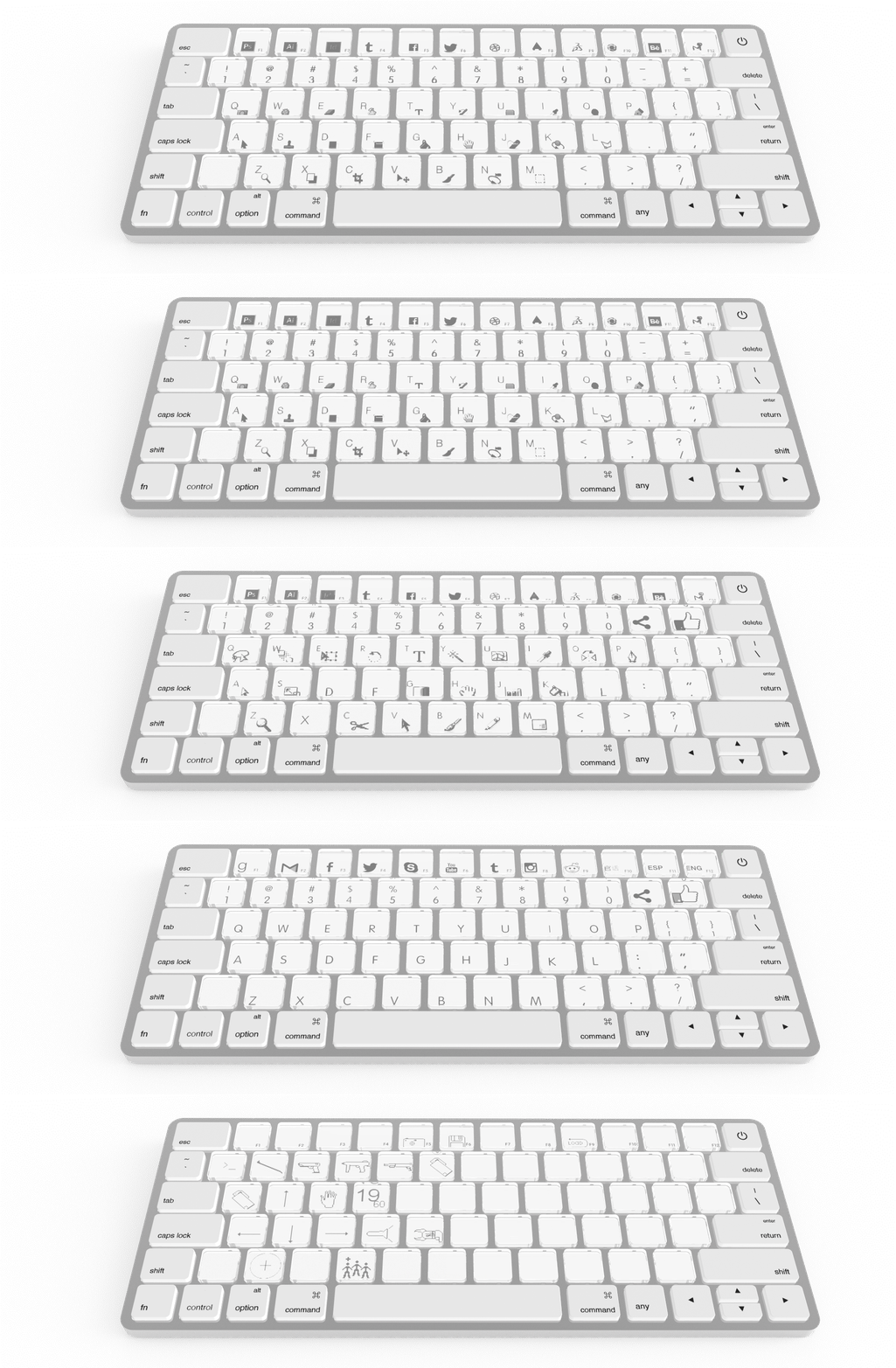
 Fransisco Serra-Martins, founder of the company, is confident that unlike kindle which “blinks” between pages, a timing control device means there will be no or little time-lapse as you toggle between keyboard interfaces. “You could play a video on there,” he says.
 A rumor originating from China claims that Samsung will be using an optical fingerprint sensor on the Galaxy S8. If true, it would mean that the Galaxy S8 would be the first smartphone in the world to use an optical fingerprint sensor.
Continue reading →
A rumor originating from China claims that Samsung will be using an optical fingerprint sensor on the Galaxy S8. If true, it would mean that the Galaxy S8 would be the first smartphone in the world to use an optical fingerprint sensor.
Continue reading →




 Am siebten Tag aber war Ruhe …, But on the seventh day a bit of peace and quiet…,190 x 190 cm, 2016, courtesy of Marlborough Chelsea and the artist.
  Unser tägliches Detail, Our Daily Detail, 2016, 41 x 33 cm, courtesy of Marlborough Chelsea and the artist.
  Das Konfetti der Dauerei, The Confetti of Duration, 190 x 150 cm, 2016, courtesy of Marlborough Chelsea and the artist.
 Angst-Die Gekrönte Konstante…, Fear-The Crowned Constant…, 2016, 41 x 33 cm, courtesy of Marlborough Chelsea and the artist.
  Das einsame Tribunal, The lonesome tribunal, 150 x 120 cm, 2015, courtesy of Marlborough Chelsea and the artist.
 Ballspielende Mönche, Monks Playing Ball, 2016, 41 x 33 cm, courtesy of Marlborough Chelsea and the artist.
 Anil Dash @anildash






 "What the fuck is up with this statue's toes?" and other questions that you never get to know the answer to. "Plotblocking" is a new word for describing what's wrong with a lot of television writing.
 jwz.
jwz.


