Shared posts

31 Oct 21:20

Lupine Piko 4 Bike Helmet Light – an Average Joe Cyclist Review

by Average Joe Cyclist

the Lupine Piko 4 bike light has the advantage of being good looking and unusual, so your beloved cyclist will be admired by other cyclists!Here's a complete review of the Lupine Lighting Systems Piko 4 Bike Helmet Light, an ultra-bright, super lightweight helmet light that is perfect for commuter cyclists – and also bright enough to use on trails.

The post Lupine Piko 4 Bike Helmet Light – an Average Joe Cyclist Review appeared first on Average Joe Cyclist.

31 Oct 21:20

Benjamin Button Reviews The New MacBook Pro

by maciej@pinboard.in (Maciej Ceglowski)

The new MacBook Pro shows that Apple is finally becoming serious about developers.

Gone is the gimmicky TouchBar, gone are the four USB-C ports that forced power users to carry a suitcase full of dongles. In their place we get a cornucopia of developer-friendly ports: two USB 3.0 and Thunderbolt 2 ports, a redesigned power connector, and a long-awaited HDMI port.

Photographers will rejoice at the surprising and welcome addition of an SDXC card reader, a sign that Apple might be thinking seriously about photography.

The new MagSafe connector is a bit of Apple design genius. The charging cord stays seated securely, but pops right off if you yank on it. No more worries about destroying your $2k laptop just by accidentally kicking a cord.

What hasn't changed: Apple has kept the beautiful Retina display, and storage and memory are the same as before. The new machines will be slightly thicker (to accomodate the USB ports) and 200 grams heavier, but it's not clear how this will affect battery life.

Interestingly, Apple has removed the fingerprint reader and its associated dedicated chip, perhaps assuming that developers would not comfortable with a machine they don't fully control.

The most obvious change is the redesigned keyboard. Removing the Touchbar creates room for a row of physical function buttons and, in a nice touch, an escape key. This isn't a perfect solution: the function buttons map to a confusing series of actions that can send windows flying around the screen with an errant keystroke, and the new physical off switch is too close to the backspace key. But it is certainly a huge step forward, and it will be interesting to see how software developers take advantage of this clever new feature.

Everything about the new machine seems designed for typists. The trackpad has been made smaller, so you're less likely to brush against it with your palm. The keys themselves are much more comfortable to type on, with improved key travel, a softer feel, and more satisfying tactile feedback. You no longer feel like you're tapping on the glass surface of an iPad. And not having a TouchBar means no longer having to look down at your hands all the time.

Despite the many improvements, Apple is actually dropping the price on its flagship 15" MacBook Pro by $400, another sign that they're serious about winning over developers.

The release is an encouraging sign of life at Apple, whose products have not seen significant changes since the company introduced a separate operating system for its laptops in 2019. There's even speculation that Apple may refresh its antiquated Mac Pro and desktop macs, neither of which have been updated since their release in 2022.

Rumors are also swirling that the company will add a headphone jack to its already popular iPhone. The announcement could come as early as this month.

31 Oct 21:20

Twitter Favorites: [greenfield64] Most Americans prefer football to baseball. This may be the single best argument against majority rule.

Jeff Greenfield @greenfield64
Most Americans prefer football to baseball. This may be the single best argument against majority rule.
31 Oct 21:17

Twitter Favorites: [SnarkySteff] One of the many reasons @yvrairport is repeatedly called the world's best: Airport laws dictate "city" pricing for all dining.

Nasty Steffani @SnarkySteff
One of the many reasons @yvrairport is repeatedly called the world's best: Airport laws dictate "city" pricing for all dining.
31 Oct 21:16

Twitter Favorites: [ThePalateDeck] Which hops taste like peach? Or blueberry? This guide to the numerous hop varieties sorts them by flavor and aroma:… https://t.co/TbKW9eXCTv

The Palate Deck @ThePalateDeck
Which hops taste like peach? Or blueberry? This guide to the numerous hop varieties sorts them by flavor and aroma:… twitter.com/i/web/status/7…
31 Oct 21:09

Apple Should Buy Netflix

by Ben Thompson

While much of the focus of last Thursday’s Apple announcement was on the new MacBook Pros (and the Macs that were not updated), the more interesting announcement from a strategic perspective was about Apple TV. Tim Cook stated Apple’s goals plainly:

We want Apple TV to be the one place to access all of your television. A unified TV experience. That’s one place to access all of your TV shows and movies. One place to discover great new content to watch. So today we’re announcing a new app and we simply call it ‘TV’…

After the app demo, Cook concluded:

Apple TV, iPhone and iPad have become the primary ways that many of us enjoy watching television, and now with the TV app there’s really no reason to watch TV anywhere else.

Unless, of course, you want to watch Netflix.

Apple’s Leverage Playbook

There is a bit of a playbook to the way Apple comes to dominate industries, and it is founded on customer loyalty. The best example is, naturally, the iPhone:

  • Back in 2006 Apple sought to release the original iPhone on Verizon; the leading carrier in the U.S., though, was wary of Apple’s demands that there be no Verizon branding, no Verizon control of the user experience, and no Verizon relationship with iPhone users beyond managing their data plan. Therefore, Apple launched the iPhone on the second-place carrier (AT&T née Cingular); AT&T accepted Apple’s demands in full with the hope that Apple’s famously loyal customers would see the iPhone as a reason to switch.
  • That, of course, is exactly what happened: in the five years following the iPhone launch, AT&T went from trailing Verizon by $400 million in wireless revenue to leading by $700 million; that’s a $1.1 billion switch thanks in large part to Apple loyalists’ willingness to switch carriers to get an iPhone. The effect was even greater on smaller carriers, which had no choice but to accede to Apple’s increasingly demanding terms: not only would Apple own the customers, but carriers had to agree to significant marketing outlays and guaranteed sales to carry the iPhone.1
  • Apple repeated this formula in market after market: in Japan, for example, Softbank leveraged the iPhone to huge increases in market share, forcing NTT Docomo to finally give in to Apple’s terms. Apple’s leverage also played a role in bringing China Mobile to the negotiating table, along with Apple’s ability to drive higher average selling prices for China Mobile’s then new 4G network.

The iPhone wasn’t the first time Apple used this approach: perhaps the most famous example of Apple coming to dominate its suppliers was the iPod and iTunes Music Store, when Apple was able to leverage its loyal users to dictate terms to the music industry. In some respects this was the more impressive achievement, because while carriers are largely undifferentiated (presuming you live in a location with comparable coverage), music labels have exclusive rights to huge catalogs of music. This should, in theory, provide strong leverage in negotiations, but especially when the iTunes Music Store got started, the labels were terrified of the effect music piracy was having on their business. Apple offered a better alternative to piracy, and then grew so big the labels couldn’t afford to not have their music on the iTunes Music Store.

The problem Apple has in premium video — and given that the company has been trying and failing to secure video content on its terms for years now, it definitely has a problem — is that its executives seem to have forgotten just how important the piracy leverage was to the iTunes Music Store’s success. This Wall Street Journal story from this past summer is one of many similar stories over the years detailing Apple’s take-it-or-leave-it approach to premium video content:

[Senior Vice President of Internet Software and Services Eddy] Cue is also known for a hard-nosed negotiating style. One cable-industry executive sums up Mr. Cue’s strategy as saying: “We’re Apple”…TV-channel owners “kept looking at the Apple guys like: ‘Do you have any idea how this industry works?’” one former Time Warner Cable executive says…Mr. Cue has said the TV industry overly complicated talks. “Time is on my side,” he has told some media executives.

Time may be on Apple’s side, but the bigger issue for Cue and Apple is that leverage is not; that belongs to the company that is actually threatening premium content makers: Netflix. Netflix is the “piracy” of video content, but unfortunately for Apple they are a real company capable of using the leverage they have acquired.

Netflix’s Rise

Much like Apple vis-à-vis the music industry in the 2000s, Netflix got its start by being a friend to the industry it would eventually threaten: DVD sales simply added to the premium video industry’s bottom line, and when the company made the leap to streaming it was through a deal with Starz that the latter basically viewed as found money. Streaming, though, was transformative to the user experience: while Starz had an 11,000 movie catalog, the effective catalog size was one — whatever was showing on the Starz linear TV channel. On Netflix, though, the effective size of the catalog was 11,000: Netflix customers could watch whichever movie they wished whenever they wished on any device they wished.

That superior user experience drove Netflix’s ever-expanding user base, which gave the company the capability to acquire more content with money that was still pure profit for network owners; by the time said networks woke up to the fact that Netflix was devouring attention they were, like the music industry relative to Apple in the 2000s, increasingly captive to what was one of their biggest buyers. Netflix, meanwhile, was investing in its own original content, making deals with content creators directly; this strengthened Netflix’s value proposition to customers, further weakened the negotiating power of networks, and laid the groundwork for Netflix to leverage the Internet to offer its service to nearly every customer on Earth.

Netflix’s strategy has been a textbook example of Aggregation Theory; Netflix has built leverage and monopsony power over the premium video industry not by controlling distribution, at least not at the beginning, but by delivering a superior customer experience that creates a virtuous cycle: Netflix earns the users, which increases its power over suppliers, which brings in more users, which increases its power even more.

It is this virtuous cycle that drives Netflix’s $54 billion valuation, which implies a sky-high price-to-earnings ratio of 340; the company is spending billions on an ever increasing amount of original content that threatens to cut out networks entirely, leading Hollywood to fear a content monopoly. The big question is if Netflix has the financial firepower to pull it off: the company had -$506 million in free cash flow last quarter thanks to its ongoing shift from licensing original content (which is pay on delivery) to self-producting it (which requires investment months or years before the content is actually available); this shift gives Netflix even more leverage — and cuts out traditional networks even more — but it’s expensive, and the company has to keep raising debt on the assumption subscriber numbers will increase enough to pay for it.


There were mixed reports as to why Netflix is not in Apple’s new ‘TV’ app: Peter Kafka reported that Netflix was out even before Apple’s event, while Netflix told Wired that the streaming service is “evaluating the opportunity.”

In fact, though, I suspect those reports aren’t so different after all: Apple’s desire to be “the one place to access all of your television” implies the disintermediation of Netflix to just another content provider, right alongside its rival HBO and the far more desperate networks who lack any sort of customer relationship at all. It is directly counter to the strategy that has gotten Netflix this far — owning the customer relationship by delivering a superior customer experience — and while Apple may wish to pursue the same strategy, the company has no leverage to do so. Not only is the Apple TV just another black box that connects to your TV (that is also the most expensive), it also, conveniently for Netflix, has a (relatively) open app platform: Netflix can deliver their content on their terms on Apple’s hardware, and there isn’t much Apple can do about it.2

The truth is that Apple’s executives seem stuck in the iPod/iTunes era, where selling 70% of all music players led to leverage over the music labels; with streaming content is available on any device at any time, which means that selling hardware isn’t a point of leverage. If Apple wants its usual ownership of end users it needs to buy its way in, and that means buying Netflix.

Why Apple Should Buy Netflix

I am, as a rule, skeptical of large acquisitions: they are all too often a byproduct of management empire-building, and value-destructive for shareholders. Moreover, not only do promised synergies often fail to materialize, but both the acquirer and the acquired are deeply distracted for years.

I am even more dubious when an acquisition entails combining horizontal and vertical business models:3 horizontal business models, like Netflix’s, entail reaching the maximum number of customers across all devices in order to better leverage up-front costs; vertical business models, like Apple’s, entail offering exclusive services to increase the differentiation of devices sold at a profit.

So why am I advocating an acquisition that is both large and entails combining two orthogonal business models? Surprisingly, I think the argument for Apple is more compelling:

  • As I argued earlier this year, the iPhone was the pinnacle of the product business model: it leveraged software to sell an incredible number of highly differentiated physical devices with a fabulous profit margin (in both percentage and absolute terms), but the future of high-dollar physical goods is to be offered as a service. I strongly suspect this reality was an important reason for Apple’s reset of the Apple Car project.
  • In an ideal world one could argue that Apple should change its employees’ compensation mix to more strongly favor high salaries over stock, dramatically increase its dividend program, and gracefully ride its hardware business model as long as it could; here on planet Earth Apple needs a growth engine to replace the iPhone, if not in reality than at least in potential.
  • Apple is at its best when it is creating new products that are the best they can possibly be; it is a capability that is rather independent from Apple’s biggest strategic assets: its dedicated user base and massive cash pile.

A Netflix acquisition would:

  • Give Apple one of the strongest entrants when it comes to business models of the future
  • Provide a far more compelling growth narrative than its current hardware business (particularly given the advantages Apple gives Netflix, which I will discuss below)
  • Leverages Apple’s assets in a way that leaves the product company free to focus on what it does best

The payoff for Netflix is more straightforward:

  • As I noted above, Netflix’s valuation is already sky-high, with a stock so volatile that CEO Reed Hastings felt compelled to apologize to investors on Netflix’s recent earnings calls. The issue is that Netflix’s potential is massive for all the reasons I described above, but realizing that potential entails spending money the company hopes to gain from future subscribers. Ergo, any surprises in churn or new user numbers send the stock on a roller coaster. Having Apple’s financial backing will alleviate those concerns.
  • Apple’s bank account will also allow Netflix to accelerate its strategy of complete ownership of original content. As I hinted at above, most original Netflix content to date has been licensed, not owned, which is problematic in two ways: first, Netflix faces some restrictions on said content, whether it be a temporal license or a geographic one. Secondly, Netflix isn’t realizing the full profit from its original content, in perpetuity; given Netflix’s business model is so powerful precisely because content is valuable not only when it is shown the first time but every time thereafter, this is an unfortunate giveaway dictated by Netflix’s meager cash position. With Apple behind it Netflix could pursue the same strategy it used for this summer’s Stranger Things: produce content without any middle men, and reap the proceeds — and leverage the freedom — forever.
  • While Apple should keep Netflix cross-platform (limiting Netflix to Apple devices would be massively value destructive — Netflix’s value is predicated on being everywhere — and not even that helpful given that Apple’s devices already dominate their price points), that doesn’t mean that making Netflix available by default on every Apple device wouldn’t have the potential to drive Netflix subscriptions. This could be especially effective internationally where Apple’s brand is much stronger than Netflix’s.

Make no mistake, this would be a massive deal: Apple would probably need to pay a 20% premium at a minimum, which means an acquisition price north of $65 billion (and I’d bet higher). And yet, the biggest reason I’m skeptical it will happen is that I’m not sure Netflix would say yes: the company has made it this far with a ladder up strategy predicated on delivering a superior customer experience, and provided the company can keep the cash flowing the leverage in video is all theirs. Granted, Amazon Prime Video is a big threat, particularly because their orthogonal business model and big company backing give them the ability to match Netflix dollar-for-dollar when it comes to acquiring content, but having made it thus far, does Hastings want to take the easy way now?

As for Apple, Cook has been resolute in following the Steve Jobs playbook, which would seem to rule out a transformative acquisition of this nature. Still, strains are showing: in retrospect the Apple Watch was rushed to market, the company is raising prices to preserve margins and average selling prices, while the company seems to be cutting costs on the margins. Wouldn’t it be a relief to sell a future based on more than squeezing the last drops of blood out of the iPhone rock? Indeed, the iPhone as cash cow and Netflix — run as an independent subsidiary — as growth driver would arguably create the greatest possible freedom to recreate the future once again.

  1. As I’ve noted several times in the Daily Update, these contracts gave Apple remarkable precision in forecasting iPhone growth; that the iPhone is mostly everywhere now is, I suspect, a reason why Apple’s forecasting has been off (in both directions) for the last several quarters
  2. In theory Apple could mandate that all streaming apps tie in to the TV app, but I think the company would soon find that Netflix could drive the sale of other streaming devices more easily than Apple can drive the surrender of Netflix’s most important strategic advantage
  3. Hello AT&T and Time Warner!
31 Oct 21:00

Plantronics BackBeat Pro 2 :: First Impressions

by Volker Weber

ZZ1ADA4E7D

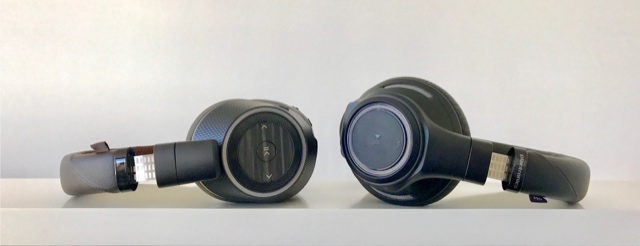
I love the BlackBeat Pro cans and have recommended them for years. Their only downside is that they are comically large. Now Plantronics has addressed this issue and made the new headset oval shaped instead of round.

I want to write this from a comparison perspective. But before we dive into that, first an introduction to both headsets for those who don't know them. The BackBeat Pro is an over-the-ear headset that provides great isolation when traveling. You can take a phone call, but the headset isn't designed for that. The microphones cannot provide an experience even close to what a Voyager Focus provides. But when you are sitting on a train or in an airport, you will not miss a call. Both headset provide the isolation through their over-the-ear design and an additional active noise cancellation that can be switched off when you are in quiet environments. Both headset connect via Bluetooth or via a 3.5mm cable, for instance to connect to the inflight entertainment when traveling. And both have ridiculous battery life. Plantronics says 24 hours between charges, but I have never been able to run them down, and get a good estimate of the time. I rate them at one week.

ZZ639802BE

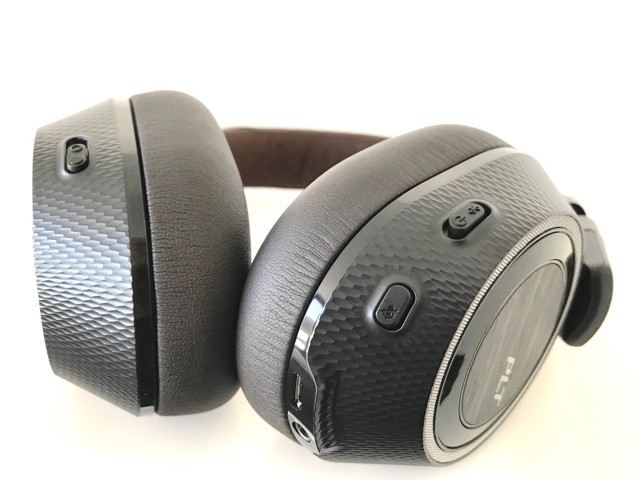
Let's get to the differences. The new model has all audio controls on the left can. The right can has the 3.5mm connector, the microUSB plug for updates and charging, the on/off switch which puts the headset in pairing, when you hold the switch beyond the on position and a mute button. The volume wheel went from the right to the left cup. It no longer turns all the way around, but now rocks back and forth. Volume is coordinated with your phone. You can adjust it either on the headset or the phone. Track control is now inside the volume ring.

Both BackBeat Pro have an open-mic feature that will route your microphones to your speakers. That is useful when the flight attendant asks you something or you want to hear an announcement in the train station. This has become easier to operate. The noise cancellation switch now has three positions: on, off, open-mic. So you go from hearing nothing to hearing everything in two steps. This is an outright creepy feature. You can appear to hear nothing while being able to clearly hear what the person next to you says.

ZZ6A8114C6

The cups are clearly marked so you know which one belongs where. That was very subtle on the original and has continued on with the Focus and the Sense headsets. This time it screams. No complaints from me. You want to see what you are doing even in a dark aircraft cabin. The headset also has sensors that know if you are wearing them. Take them off and the audio book or podcast stops. Put them back on, and they continue to play.

ZZ00EB6E55

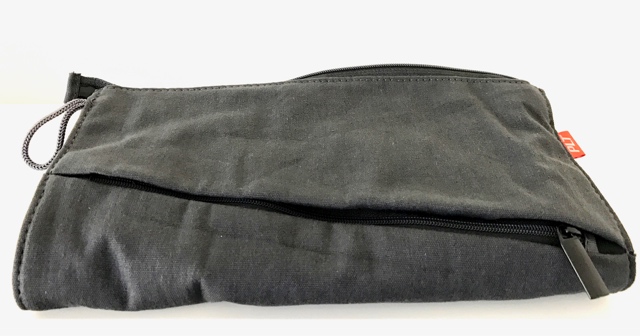
The headset comes with a soft carrying bag, that has improved by having an extra compartment for the two cables and other accessories you might want to carry, like a two prong adapter for odd airline seats. Plantronics also sells a more expensive version in "silver" with a hard case, but I find this bag way more practical. Notice the small loop at the left. I put this over the coat hook on the seat in front of me and organize all the little things I need during a flight in this bag.

So this is again a pretty big recommendation. There is just one thing. I don't like the materials. The old headset was an honest black plastic. The new one has fake wood veneer insets and all sorts of other plastic materials that pretend to be something else. The "silver one" might be worse in that it mimics metal. Plantronics might want to improve on that in future updates.

Plantronics may not have the best industrial design but they know audio. This is again a headset that sounds just great. Music is very transparent and the headset can provide a thumbing bass without being overly bass heavy. Put on The xx 'Fantasy' or James Blake 'Limit to your love' and you will hear it right away.

What does this headset compete with? Clearly the more expensive Bose QC35. The Bose headset has one big advantage: it folds much smaller and needs less space in your bag. Bose has also mastered noise cancellation. They are best bought with air miles.

One mugshot behind the fold.

31 Oct 20:59

Running the Numbers – How Can Hamilton Still Take the 2016 F1 Drivers’ Championship?

by Tony Hirst

Way back in 2012, I posted a simple R script for trying to work out the finishing combinations in the last two races of that year’s F1 season for Fernando Alonso and Sebastien Vettel to explore the circumstances under which Alonso could take the championship (Paths to the F1 2012 Championship Based on How They Might Finish in the US Grand Prix); I also put together a simple shiny version of the script to make it bit more app like (Interactive Scenarios With Shiny – The Race to the F1 2012 Drivers’ Championship), which I also updated for the 2014 season (F1 Championship Race, 2014 – Winning Combinations…).

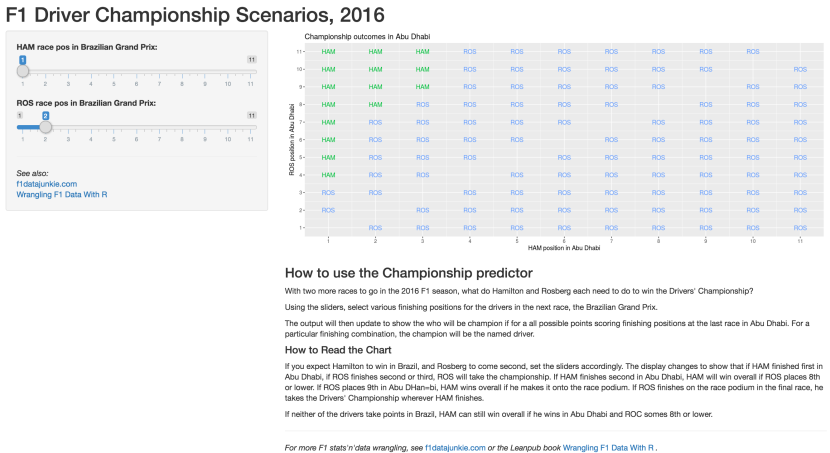
And now we come to 2016, and once again, with two races to go, there are two drivers in with a chance of winning overall… But what race finishing combinations could see Hamilton make a last stand and reclaim his title? The  F1 Drivers’ Championship Scenarios, 2016 shiny app will show you…

f1_driver_championship_scenarios__2016

You can find the code in a gist here:


31 Oct 20:59

Charlie Brooker is the force behind Black Mirror, and his notion...

mkalus shared this story from Rolandt shared items on The Old Reader (RSS).


Charlie Brooker is the force behind Black Mirror, and his notion of how we’ll look 30 years in the future seem prescient to me, especially the VR contact lenses:

John Robinson, Charlie Brooker: ‘The more horrible an idea, the funnier I find it’

I used to smoke and the first thing I did was reach for a cigarette. Now the first thing I do is that [reaches for iPhone]. In 30 years’ time there will be a drama series set in 2016. Characters will be on their phones and the viewers will look at it like we do with Mad Men and smoking: “Look at them! They’re all on their phones in meetings! Well, of course, they didn’t know about the thumb cancer those things give you…” Having said that, I remember life before smartphones, and it was fucking boring. The most exciting thing you could do was get a cover for your phone, or play Snake. I don’t think we’ll replace them until we get in-eye contact lenses that do the same thing; so we can stare at people while we’re ignoring them. We should try and make people more interesting than phones.

Yes I agree that we should make people more interesting than phones.

31 Oct 20:59

Samsung Galaxy S7 updated with security enhancements, Android Pay button

by Ian Hardy

Galaxy S7 and Galaxy S7 edge owners in Canada have received a system update that brings improvements to Android 6.0.1 Marshmallow.

The total size is approximately 41MB and reportedly removes Shomi from the device — which will officially shutter November 30th — and also adds various Google security enhancements to the phone.

gs7

In addition and most importantly, Rogers owners are reporting this update allows Android Pay to be installed on the device, though unfortunately a credit card still can’t be added as a payment option.

Android Pay is expected to launch in Canada at some point in the near future. The recently released version 7.1 update to Android Pay’s app includes references in its code to Interac, Canada’s debit card payment network.

(Thanks Sean!)

Related: Latest version of Android Pay suggests the platform could soon come to Canada

31 Oct 20:59

Ohrn Image — Vanier Park

by Ken Ohrn

Riding home at sunset.  BTW, this image looks best when viewed large.


31 Oct 20:58

Snail Spam

by Kristina Chodorow

When I started blogging, I called my blog “Snail in a Turtleneck,” a cute image that Andrew & I came up with. I drew up my mascot:

A bemused snail, wearing a turtleneck.

A bemused snail, wearing a turtleneck.

and I began posting cartoons I had drawn. I quickly became bored of doing cartoons, and found I was more motivated to put up technical blog posts. Most of my initial readers were coworkers and MongoDB users. When Andrew and I got married, I told my teammates the day before that I’d be out the next day, as I was getting married (we got married at the city clerk’s, so it wasn’t a big production). When I got back to work, I found this at my desk:

A stuffed snail, a snail tape dispenser, and a very lovely bouquet (that was entirely free of snails).

A stuffed snail, a snail tape dispenser, and a very lovely bouquet (that was entirely free of snails).

I was very touched by their thoughtfulness: Andrew and I still have the stuffed snail and I brought the tape dispenser along to Google (where, unfortunately, it was later lost during an intra-office move).

However, as MongoDB gained popularity, some of my posts became very popular and I began to regret the name: customers seemed a little embarrassed to mention they had gotten advice from it and a lot of people didn’t realize that I was actually behind it. I purchased kchodorow.com, set up permanent redirects, and basically stopped referencing “Snail in a Turtleneck.” After a couple of years, I let the domain name lapse.

Last week, someone told me that my site had been hacked. I was confused, until they told me it was snailinaturtleneck.com. I took a look and, bizarrely, someone seems to have taken a dump of my site circa 2011, put spam on the index, and put it up at snailinaturtleneck.com, complete with my artwork, cartoons, etc. The domain was registered through a privacy protection service, so I guess the next step is sending a DCMA takedown notice to the registrar.

Who does this? (I mean, spammers, but… so annoying.)

31 Oct 20:58

Overdue library book eventually returned after 42 years

by arbroath (noreply@blogger.com)
mkalus shared this story from Nothing To Do With Arbroath.

A copy of William Shirer's "The Rise and Fall of the Third Reich" checked out of New York's Guilderland Library in April 1974 was returned on Tuesday.


"It's a notable thing. Doesn't happen very often. I've been in libraries for 30 years and this is the most extreme overdue book I'm aware of," said director Tim Wiles.

"He left, he told us he moved to another country and had taken the book with him and moved back but felt it should come back home," explained Wiles.


The usual late fee for a book that is 15,531 days overdue totals $3,106.20. But in this case, the library gave the patron a pass.

With news video.
31 Oct 20:57

Apple’s Willingness to Embrace Its Past

by John Voorhees

Jonathan Zufi, author of ICONIC, a coffee table book that celebrates the history of Apple products through beautiful photography, uses the October 27th Apple event to challenge a comment by Phil Schiller in 2012 that Apple is ‘focused on inventing the future, not celebrating the past.’

Although Steve Jobs shut down Apple’s internal Apple museum in 1997 and transferred its collection to Stanford, Zufi points out that Apple has begun honoring past products more often in recent years, especially where doing so highlights the innovations of current products. As Zufi observes:

People love reminiscing about the past, and there are still many Apple fans who love to celebrate the company’s rich product history — its successes and its failures. I’ve heard from readers who simply loved the fact that they sat down with [ICONIC and] a glass of wine and lost themselves for hours reliving these old machines, where they were in their lives when they first came across them, and how much has changed.

That’s why Phil Schiller’s comment about not celebrating the past always bothered me and I’m going to disagree with Phil on this — I’m certain Apple will continue celebrating their past as they blaze the future.

Selling the past short isn’t a prerequisite to embracing the future. Apple’s newfound willingness to look back feels like the mark of a mature company that’s as confident with where it’s been as it is with where it’s going.

→ Source: medium.com

31 Oct 20:57

Making It Tick: 5 Years (And More) With Ed

by Paul Kafasis

For the second time this year, we’re delighted to celebrate a five-year anniversary here at Rogue Amoeba! This is always a treat for me, because it’s a chance to put one of our great employees in the spotlight for a bit. Today, we’re honoring Ed Wynne, who joined Rogue Amoeba full-time back in October of 2011. Since then, he’s been helping to make our products the best they can be. In fact, he was doing so for many years before he came on full-time as well.

Ed’s most visible work is actually our newest product, Loopback, which allows you to route audio between applications and around your Mc. While Ed has been working for Rogue Amoeba since 2011, this app marked the first time he handled the front-end of an application. Loopback has proven even more popular than we expected, and we’ve been pleased to see Ed’s skills develop in this area after many years working behind the scenes.

It’s in our back-end code that Ed has made his biggest contribution. From the recording done by Audio Hijack and Piezo to the local audio streaming Airfoil allows, and even broadcasting to the web with Nicecast, audio capture is an integral part of our apps. The Instant On component used for much of this audio capture has long been Ed’s domain, and he’s worked long and hard to make Instant On powerful, robust, and as close to flawless as it can be.

Even before Ed joined us full time, he did contract work on our audio capture code. For over 13 years, Rogue Amoeba has been using Ed’s work. In the past five years things have really improved, however, as Ed has been able to devote his full efforts. When things work right, users barely notice, but we certainly pay attention internally. From reduced latency in audio capture to far fewer bumps surrounded OS updates, we’ve got a lot of reasons to be thankful to Ed.

Most recently, Ed was instrumental in adding support for Chromecast to Airfoil for Mac. He’s also hard at work on updates to Loopback, so you can be sure he’s not done making things better yet. We hope our users will continue to be delighted with Ed’s work for many years to come.

Nerding Out

When an employee reaches the five year mark with us, we like to find a gift especially for them. For several years, Ed’s been working with his son and daughter on various robotics competitions. If you’re thinking of Battle Bots, you’ve got the general idea, anyhow.

To help him in these endeavors, we provides a gift certificate to SparkFun Electronics, one of the best electronics retailers out on the web. While Radio Shack may have gone the way of the do-do, the internet has fortunately stepped in to provide places to purchase all the bits and pieces needed for electronics projects.

Even more fun is the Flir One thermal imager we got for Ed. Below, you can see our old friend Ammo using a Flir to diagnose a problem.


“Yup. There’s the problem.”

The Flir One attaches to an iPhone (or an iOS device), and turns it into an infrared camera. This can show overheating components in a robot, which windows are drafty and in need of repair, and even find leaks behind walls. Or you can just point it at a dog to see which parts of your canine are the hottest. In Ed’s own words, “this is so much better than the plaque my last employer gave me after 5 years!”

Dog picture
Cold Nose

In addition to these gifts, there was also our traditional custom card and 5 year challenge coin as well.

Coin and Card
Custom Card

Thank You!

I’ll close by again publicly expressing our gratitude to Ed. The work he’s done to help our products, particularly in his last five working full-time for Rogue Amoeba, has been tremendously appreciated. Thank you for all you’ve done, Ed!

Previously

We’ve previously celebrated the five year anniversaries of six other employees here at Rogue Amoeba:

31 Oct 20:15

Apple Discontinuing MacBook Startup Chime

by Ashlee Kieler
mkalus shared this story from Consumerist.

One of the most instantly recognizable sounds in electronics may be about to go the way of “You’ve Got Mail,” as Apple is reportedly doing away with it signature startup sound on its Mac computers.

Business Insider, citing blog Pingie.com, reports that the single note chime did not migrate to Apple’s newest MacBook Pro announced last week.

The chime-less startup is likely the result of the way the new MacBooks turn on: with no power button, the computer simply starts anytime the cover is lifted.

Additionally, a FAQ page for the older Macs indicated that the “startup sound” was a way to reset a computer’s non-volatile random-access memory. A mention of the chime sound is not included in the new MacBook FAQ page.

Pingie.com writer Dan, who owns one of the new laptops, points out that the writing was on the wall for the chime’s discontinuation, as Apple’s newest products, including the iPhone, don’t have startup sounds.

Still, Business Insider notes that the chime had been a part of Apple’s computers for almost as long as Apple has made computers: the tones began singing from devices in the 1980s, and were reconfigured to today’s chime in 1998 with the iMac G3.

Here’s the sounds all Mac users will be missing (if they buy the new MacBook):

And for a trip down memory lane, here are the different variations of Apple’s startup chime through the years:

Apple Says Goodbye To The Startup Chime with the New MacBook Pro [Pingie.com]
Apple is killing off its iconic startup chime [Business Insider]


31 Oct 20:15

@Tay.AI predicts the next Pulitzer

by tychay

I love articles like this. After all, I’ve been saying for the better part of a year that Donald Trump is Microsoft Tay made flesh and stuffed into an ill-fitting suit:

Note to self: Add Sanjiv Rai to this tool and this one to list of people that we won’t have to hear anything about ever on November 9.

I seriously wonder how these reporters find these whack-a-loons, because they deserve whatever the Ig Nobel-equivalent there is for a Pulitzer. Who knew there is such a large market for liberal bed-wetting? 😀

31 Oct 20:15

Density – the New Bike Lane

by Ken Ohrn

As transportation (bike lanes!!) appears to be receding as a hot cultural change issue, housing density’s noise level is rising.  This arguement won’t likely get quite so hot, and may take much longer to resolve. What with the Provincial Gov’t (and all its allies, stooges and agents) continuing to argue the case for (and massively fund) sprawl, strip malls, freeways and paving farmland for cheesy suburbs. After all, it worked just fine in the case of the Burrard Bridge (Kits and Dunbar become suburbs), Lions Gate Bridge (opened up North and West Vancouver to car-oriented development); Oak Street Bridge (thousands of acres of Richmond farmland), the Massey Tunnel and so on.

Here’s a few things going on.

lausterFirst, this from UBC Professor Nathanael Lauster Abandon the Dream Home… You’ll Be Happier“.  He argues along a familiar track — too much land is devoted to housing too few people. He discusses Vancouver as a city pointing to the future of more diverse development, with a long way to go. And he’s not one to cloak his thoughts in fluffy words:

He calls the single-family house an “invasive parasite.”

“I’m not opposed to the house as part of a set of broader, diverse ways of living in the city,” Lauster insists, “but I am opposed to regulations that set aside land for houses and houses alone.” Too many houses, he argues, are bad for cities, bad for urban dwellers, and bad for diversity. . .

. . .Before policy can open those areas to more diversity in housing, Lauster says, a cultural shift is needed, “redefining what it means to be a success.” Today’s parents, he says, need to accept that kids can grow up healthy and happy without doing it in a house.

“Making that culture shift is trickier than making policy shifts,” he said. “But I think policy shifts help us move towards that culture shift.”

With thanks to Christopher Cheung in The Tyee.

Prof Lauster has a book on the subject “The Death and Life of the Single-Family House“.  It’s introduction is HERE.

Next, the City of Lougheed:  your local, friendly $7 B transit-oriented development: a 40-acre site in Burnaby being turned into a neighbourhood of 23 high-rise dwellings (25-65 stories), walkable central galleria cum boulevards, major mall and so on.  Eventually to deliver 11,000 residential units, over a period of 30 years.

lougheed-aerial

Thanks to Kenneth Chan at VanCity Buzz for this overview of the City of Lougheed. And to Michael Kluckner for his thoughts on it earlier this year in Price Tags.

It’s a big dollar vote by Shape Living in favour of compact and dense development, that makes me happy to see, along with its focus on transportation alternatives.  This in stark contrast to the Tsawassen Mills car-dependent sprawl-oriented mall and adjacent car suburb, which in my mind are at serious risk of failure. And I’m hoping that the Jericho and Heather developments will go dense and transit-oriented, and not follow in the Tsawassen mold.

Fueled by infrastructure investments and improved transportation access, Shape Living’s master-planned City Centres are strategically located on SkyTrain’s rapid transit lines, providing residents with unsurpassed connections to Vancouver’s downtown core, YVR and beyond. Our bold developments will thrive from the success of SkyTrain’s $1.6 billion Millennium Line as well as the construction of the $1.4 billion Evergreen Line. By positioning homes directly on transit, we offer a sustainable way to live and freedom from car ownership.

lougheed

And last, thoughts from elsewhere on density and reshaping the city continue to pop up. “Waking Up to Shorter Commutes” in the New York Times discusses transportation funding in the USA.

On Nov. 8, there will be about 45 ballot proposals across the country that could raise nearly $200 billion for transportation improvements.

Many local officials say they have no choice but to raise taxes to invest in transportation, especially in mass transit, because their highways are clogged and more people are moving to cities.


31 Oct 20:13

The Tour de France … is in France, not on Bloor

by dandy

notthetour

Photo by Martin Reis of Liz Sutherland at the Bloor bike lane opening.

The Tour de France … is in France, not on the Bloor bike lane

by Albert Koehl

“You were going too slow,” a cyclist recently chastized dandyhorse publisher, Tammy Thorne on the new Bloor bike lane. The cyclist had brushed dangerously, and at high speed, past Tammy as she cycled along the lane. When she caught up to him at the intersection she demanded an explanation, and he offered his rationale. (See the full story here.) But is there such a thing --- whether by law or by etiquette --- as a maximum or minimum speed in a bike lane?

A speed limit for cyclists on our roads hasn’t received much attention in recent years. We’d probably have to go back more than a century to the era when bicycles first became popular for a lively debate on the topic. Today, however, as cyclists find themselves interacting directly on an exclusive bike lane with other cyclists --- including novice riders, parents with young children, and dandyhorse publishers --- the issue may again become prominent.

On trails in parks, cities have the authority to regulate cyclists’ speed. On parts of Toronto’s waterfront bike trail, for example, the speed limit is posted at 20 km/h, presumably to protect the many pedestrians, including tourists, in the area. In fact, this bicycle speed limit, pursuant to Chapter 608 of the Municipal Code, is in force in all city parks.

On roadways, section 128 of Ontario’s Highway Traffic Act (HTA) sets a maximum speed for motor vehicles, while giving discretion to cities to set a higher or lower limit. And s. 132 of the HTA prohibits motor vehicles from travelling so slowly that they “impede or block the normal and reasonable movement of traffic.” Neither of these HTA provisions, however, applies to bicycles.

In the 1890s when bicycles first became a common sight on roads, the potential for speed attracted many riders. The Globe wrote in July 1894 that the bicycle provided “the facility for covering space and making a jest of time.” The downside was the danger to other road users. Beverley Jones, a pedestrian who had been seriously injured when hit by a cyclist, wrote to The Evening Star on March 29, 1895 about “the necessity for some legislation to regulate the ‘scorcher’ cyclist.” Influential Toronto cycling clubs, however, generally resisted speed limits, such as a proposed maximum of 8 mph (13km/h). Instead, by-law 2464 ‘for the regulation of the Streets, and for the Preservation of Order therein was amended in 1895 to prohibit cyclists from racing or riding at “an immoderate or dangerous rate.”

It’s doubtful that the by-law was ever vigourously enforced against cyclists given the vague wording. The provision relating to travelling at an immoderate speed was repealed in 1904.

Since that time, cycling speed on the roads hasn’t often been a matter of public debate -- until now.

Although there is no upper speed limit for cyclists in Toronto, except in parks, is there nonetheless a right speed, and should cyclists care? There’s a good reason to answer both questions with “yes”.

Cyclists have long advocated for bike lanes on the basis of safety concerns. A speed in the bike lane that keeps safe not only all cyclists but also pedestrians who cross, or accidentally step into, the bike lane is consistent with this safety goal.

And, of course: A safe speed will vary with the road environment.

On constricted parts of the Bloor bike lane --- especially in the busy Christie to Spadina shopping area where the lane is between parked cars and the sidewalk on the south side --- the speed of cyclists must be a cautious one, with 20 km/h likely being a (more than) reasonable upper limit. Such a limit protects young and novice cyclists, pedestrians who inadvertently step into harm’s way, and cyclists who need to take evasive action when coming upon a negligently-opened passenger car door.

Where the bike lane is broader and sight lines unobscured, the upper limit can be somewhat higher but not beyond 30 km/h – the speed recommended by Ontario’s Chief Coroner and Toronto’s Medical Officer of Health for automobiles on residential streets.

When a cyclist is travelling “too slowly” in the bike lane, a following cyclist can pass but the passing must be done safely either by moving into the car lane --- where that option exists --- or, when space permits, within the bike lane. In each case, the passing must be done on the left while leaving adequate space. A courteous warning is useful - especially in the event that the cyclist you are passing has to maneuver around debris or potholes in the bike lane. Faster cyclists can also take the lead at intersections, while waiting at the red, by pulling in front of the "peleton." A cyclist who negligently causes a collision by passing too closely at a high speed, regardless of the absence of a speed limit, may also be subject to civil liability or charges under the HTA for careless driving.

The only acceptable number of serious pedestrian (or cyclist) injuries or deaths is zero. This is consistent with the international Vision Zero road safety strategy recently adopted by Toronto. It’s unacceptable for cyclists to suggest that a pedestrian who mistakenly steps into the bike lane is responsible for his or her misfortune. Such an argument simply perpetuates a mentality that has justified the automobile carnage on our roads for over a century.

It’s worth noting that a serious pedestrian injury on the Bloor bike lane, regardless of ‘fault’, will likely get widespread media attention and, fair or not, hurt the cause of cycling in this city.

The other option (unless you are running late to perform heart surgery) is to fall in line with slower cyclists, enjoy the outdoor air, and savour the fact that you are among the first people in Toronto’s history to cycle on a bike lane on Bloor.

Albert Koehl is an environmental lawyer, writer, and co-founder of Bells on Bloor.

Related on dandyhorsemagazine.com

Bike Spotting on Bloor: What do you think of the new bike lane?

Vision Zero: A Road Safety Plan for Toronto

Cycling History in Toronto

The long road to a bike path (from issue 1)

Riding the Bells on Bloor "Victory Lap" in the new bike lane

Grand Prix Cyclist recap (2011)

2008 CMWC race in Toronto

31 Oct 20:13

Firefox 51.0a2 Aurora Testday Results

by Petruta Rasa

Hello Mozillians!

As you may already know, last Friday – October 28th – we held a Testday event, for Firefox 51 Aurora.

Thank you all for helping us making Mozilla a better place – Logicoma, Iryna Thompson, Rajesh, Moin Shaikh, Onek Jude, Prosper Salama,  Biraj Karmakar, Vibhanshu Chaudhary, Avinash Sharma, Sadamu Samuel.

From Bangladesh: Nazir Ahmed Sabbir, Maruf Rahman, Saheda Reza Antora, Md. Almas Hossain, Shahidul Islam, Md. Majedul Islam, Md. Mujtaba Asif, Tariqul Islam Chowdhury, Sajedul Islam, Rezwana Islam Ria, Amir Hossain Rhidoy, Md. Nafis Fuad, Shaheen Javed, Ahmed Safa, Akash, Toki Yasir.

From India: Nagaraj.V,  Pavithra.R, Surentharan.R.A, Paarttipaabhalaji, Meruso, Subhrajyoti Sen, Avinash Sharma, Bhuvana Meenakshi.K, Survesh Jones, Vibhanshu Chaudhary.

A big thank you goes out to all our active moderators too!

Results:

Keep an eye on QMO for upcoming events!

31 Oct 20:13

What should the next generation of digital learning environments do?

files/images/student-working-on-laptop.jpg


JISC, Nov 03, 2016


The U.K.'s JISC is asking for contributions (in the form of tweet chats) to a series of 'six challenges' posed by the future of learning and research in a digital environment. You will want to read their set of visions before participating in this exercise (or indeed, before participating in JISC-funded research, as these visions will guide funding decisions). It is for the most part based on data-driven decision-making (as opposed to, say, design) and it is focused mostly on skills and employment, with a nod toward resources and personalization.

[Link] [Comment]
31 Oct 20:13

Thumb War

mkalus shared this story from xkcd.com.

"Seventeen, eighteen, nineteen, twenty--" / "Can't we just read Pat the Bunny?"
31 Oct 20:13

These Weeks in Firefox: Issue 4

by mconley

The Firefox Desktop engineering team met together last Tuesday to chat about what they’re working on. Here are some juicy tidbits from that meeting:

Highlights

Contributor(s) of the Week

Project Updates

Add-ons

Content Handling

Electrolysis (e10s)

Firefox Core Engineering

Form Auto-fill

Go Faster

  • Next areas of focus are likely to be improving the system add-on roll-out facilities (tools to make publishing easier) & update times (time from publish to when a user is running with the update).
    • Restartless system add-ons likely to land soon
    • Other issues being discussed in this bug

Localization

Platform UI and Other Platform Audibles

  • daleharvey fixed a bug that was preventing GMP installation for 64-bit OS’s
  • mconley is working with Layout to make it easier to style checkbox / radio boxes
  • Simplify Page feature for Print Preview has been disabled in a few areas:
    • Only enabled on Nightly for Linux until this bug is fixed
    • Enabled on Windows up to early beta until these two bugs are fixed

Privacy / Security

Quality of Experience

Search

Video Controls

Here are the raw meeting notes that were used to derive this list.

Want to help us build Firefox? Get started here!

Here’s a tool to find some mentored, good first bugs to hack on.

31 Oct 20:11

Montreal police spent months tracking a La Presse journalist’s iPhone

by Jessica Vomiero

The Montreal Police department has been tracking the La Presse journalist Patrick Lagacé via his iPhone for months, according to a new reports.

Over 24 surveillance warrants for the phone were granted by the court in 2016, and of those, three warrants allowed police to obtain information regarding incoming and outgoing numbers sent and received by the phone.

According to the Montreal Gazette, the SPVM (Service de Police de la Ville de Montréal) utilized the GPS chip in the phone to be able to locate Lagacé. The head of the SPVM, Costas Labos, gave the green light to the investigation though he claims that no other journalist has been under surveillance by the department in years. 

Labos was subject to a criminal investigation this past summer in connection with a look into media leaks, according to the Montreal Gazette. No charges were filed against him.

The investigation has blown up on Twitter, where history’s most famous whistleblower, Edward Snowden, referenced the event as grounds for a warning to journalists. Snowden now works for the Freedom of the Press Foundation, a non profit organization that supports public interest journalism.

The warrants on Lagacé’s phone were apparently requested and obtained in relation to an ongoing investigation into police personnel. The investigation, dubbed Project Escouade, included allegations of fabricating evidence related to an investigation into Montreal drug trafficking and street gangs. Five police officers were arrested in connection to the investigation and two were charged.

Investigators explained to the Gazette that by monitoring his cell phone, they detected contact between police and Lagacé. 

Related: Canadian government re-opens privacy debate on access to telecom subscriber info

31 Oct 20:11

Greek Experts Reopened Jesus' Tomb | Last Week in Art

by Nathaniel Ainley for The Creators Project

Via

A lot went down this week in the weird and wild world of Art. Some things were more scandalous than others, some were just plain wacky—but all of them are worth knowing about. Without further ado:

+ Greek preservation experts cracked open Jesus’ Jerusalem tomb for the first time in centuries. [Art Daily]

+ German baking products manufacturer Dr. Oetker says it found four artworks in their company collection that may have been looted by the Nazis in World War II. [The Art Newspaper]

+ An art historian thinks she might have found the bed van Gogh famously painted in The Bedroom. [TIME]  

Via

+ Dev Hynes, a.k.a., Blood Orange released a new music video for "I Know," featuring featuring Russian ballet dancer Maria Kochetkova. [Noisey]

+ Philanthropist, millionaire, and collector Eric Smidt donated $25 million to the Los Angeles County Museum of Art. [My News LA]

Via

+Somebody spent $22,000 on a naked statue of Donald Trump known as The Emperor Has No Balls. [The Los Angeles Times]

+ Swedish hotel magnate and financier Urs Schwarzenbach received a four-million-dollar fine from Swiss authorities for avoiding import tax after failing to register 200 artworks he had brought into the country. [The Daily Times]

+ A genuine 21st century art form is about to die: Vine was bought out by Twitter in 2012 and it looks they are finally pulling the plug on the shortform video app. [Vine]

Via

+ Pussy Riot released a new music video reacting to trump and celebrating the vagina. [YouTube]


+ This Saturday, a performance at the Metropolitan Opera House at Lincoln Center came to an abrupt end when an audience member reportedly threw a “powdered substance” into the pit of the orchestra that was later identified as human ashes. [The New York Times]

+ A new theory regarding van Gogh’s ear has emerged in writer Martin Bailey’s new book Studio of the South. Bailey suggests that the painter’s notorious act of self mutilation was set off by the news of his brother’s engagement. [The Telegraph]  

+ The LACMA hosted their celebrity ridden Art + Film Gala this weekend and raised $3.6 million. [Variety]

+ Student-led protests erupted outside the Art Institute of Chicago to contest a museum trustee’s complacency in budget cuts to Public Education in Illinois. [Hyperallegeric]


A photo posted by Nicki Minaj (@nickiminaj) on


+ Nicki Minaj hung out with Marina Abramović at Fashion Group International’s Night of Stars Gala. [Instagram]

+ Icelandic artist Ragnar Kjartansson hilariously trolled Yoko Ono at her own show with a deep Simpsons reference. [Artnet News]

+ A 6.6-magnitude earthquake hit central Italy this week, destroying much of the Basilica of San Benedetto in Norcia and the 15th century frescoes inside. [CNN]

Did we miss any pressing art world stories? Let us know in the comments below!

Related:

FOR SALE: Salvador Dali's Lobster Phone | Last Week in Art

The New Smithsonian Looks Like a Fortress: Last Week in Art

Snoop Dogg Is Painting Now: Last Week In Art

31 Oct 20:10

Apples TV’s Struggles

by Matt

apple-tv.jpgJoseph Rosensteel has an outsider but savvy perspective on the updates and technology around Apple TV. Definitely a worthwhile read. I’ve experienced a lot of this frustration myself — I have a large library of things bought through iTunes, I like the interface of the Apple TV (though I liked the old one a little better), and Airplay is handy, so I want to love the Apple TV. The market is so bad right now that most review sites like Wirecutter recommend Roku, which for me came with a branded remote button for a service that is out of business (Rdio) and has an interface that feels DOS-like.

31 Oct 20:10

The Best Smart Smoke Alarm

by Jennifer Pattison Tuohy
smokedetectors-lowres-4927

It’s hard to overstate the importance of having functioning, reliable smoke detectors in your home. From 2007 through 2011, almost a quarter of all home fire-related deaths in the US occurred in homes with nonworking smoke alarms. While any functioning smoke alarm will alert you to problems if you’re at home, a smart alarm can alert you anywhere your smartphone has an Internet connection. For our tests, a former firefighter installed every currently available smart smoke alarm in her own home, both hardwired versions and battery-powered models, to find the best one for keeping you informed about your house’s status, whether you’re home or away. After mounting them to ceilings and walls, blowing smoke at them, fiddling with their batteries and accompanying apps, and generally pushing their buttons, we found that the second-generation Nest Protect smoke and carbon monoxide alarm is the best smart smoke alarm.

31 Oct 20:10

MIT study finds racial and gender discrimination by Uber and Lyft drivers

by Rose Behar

A recent study held by renowned American research university Massachusetts Institute of Technology (MIT) indicates that racial and gender discrimination is commonplace from drivers for ride hailing companies like Uber and Lyft.

The study had its subjects (split evenly by race and gender) hail nearly 1,500 rides on controlled routes in Seattle and Boston, and then recorded key performance metrics.

It found that the cancellation rate for “African American sounding names” was more than twice as frequent compared to “white sounding names.” Additionally, in Seattle the researchers observed up to 35 percent longer wait times for African American passengers.

The researchers also found evidence that drivers took female passengers for longer, more expensive rides in Boston.

“Passengers have faced a history of discrimination in transportation systems,” the study points out in its summary. “Peer transportation companies such as Uber and Lyft present the opportunity to rectify long-standing discrimination or worsen it.”

The study notes that removing names from trip booking might alleviate the problem, but could introduce new issues entirely. Currently, both companies present drivers with customer names, while Lyft also provides profile pictures if uploaded by the user. Lyft has not yet expanded to Canada.

“Ridesharing apps are changing a transportation status quo that has been unequal for generations, making it easier and more affordable for people to get around,” Rachel Holt, Uber’s head of North American operations told the Toronto Star in an emailed statement.

“Discrimination has no place in society and no place on Uber. We believe Uber is helping reduce transportation inequities across the board, but studies like this one are helpful in thinking about how we can do even more.”

Related: Uber to expand mapping technology in Toronto and to other Ontario cities

31 Oct 20:09

Here are all the apps that will support Microsoft’s Surface Dial at launch

by Igor Bonifacic

For such a small device, one of the most interesting announcements to come out of Microsoft’s fall hardware event last week was the Surface Dial, a puck-like accessory that adds a host of functionality to the company’s upcoming all-in-one PC.

If you missed the keynote, Surface Dial is set to land alongside Surface Studio when it comes to Canada sometime next year. When sitting next to a Windows 10 PC, the accessory allows users to adjust global Windows settings like audio volume. By contrast, when picked up and placed on top of Surface Studio, Dial gains additional functionality depending on the app in use currently. Paired with Photoshop, for instance, the accessory allows users to zoom in on an image. Microsoft plans to update the Surface Pro and Surface Book to allow owners of those devices to use the accessory as well.

The company has updated to the U.S. Surface Dial store page with a complete list of first and third-party apps that will support the accessory at launch. Note that these are only the apps that will support Surface Dial on the date of its U.S. launch; more apps are sure to support the accessory by the time it arrives in Canada.

  • Revu
  • Drawboard PDF
  • Mental Canvas Player
  • Sketchable
  • Moho 12
  • Spotify
  • StaffPad
  • Word, PowerPoint, Excel (Office Win32)
  • OneNote (UWP version)
  • Windows Maps
  • Plumbago
  • Sketchpad
  • Groove Music
  • PewPew Shooter
  • Microsoft Photos
  • Paint
  • Adobe Photoshop (basic zoom support)
31 Oct 20:09

The Man Party and the Woman Party

This weekend I voted — proudly, enthusiastically, and happily — for Hillary Clinton. It’s my third vote for Hillary this year, because Washington state is weird and has both a caucus and a primary.

I was struck this election by just how many women I voted for — more women than men. In many races, the choice was between a Republican man and a Democratic woman. It looked almost as if our parties are actually the Man party and the Woman party. (Even in the non-partisan races you could tell the party affiliation of most candidates.)

I voted for Pramila Jayapal to represent Washington’s 7th Congressional District. She’ll replace the retiring Jim McDermott. I voted for Patty Murray, Gael Tarleton, Noel Frame, Tina Podlodowski, Pat McCarthy, Hilary Franz, Mary Yu, and Barbara Madsen. (I’m forgetting some of the races, surely — the actual list is longer.)

It feels, surprisingly, like a big relief. I’m a 48-year-old straight white male who’s done pretty well in life — which makes me part of the traditional ruling class, I suppose. It felt amazingly good to help make it so that people like me don’t have to be in charge of every damn thing. Why should we be? Why would we even want to?

PS How awesome is Mary Yu. She’s a judge with a name that sounds like “marry you” — and she opened her court at midnight to perform the first same-sex marriages in Washington State.