Shared posts

04 Nov 21:15

iOS 10 Hidden feature: Collaborative Notes

When Apple released iOS 10, the latest system software for the iPhone/iPad, it made a big deal out of the major features, like a redesigned Music app and contextual predictions in autocorrect.

But Apple’s engineer elves worked for a year to overhaul iOS 10, and they’ve planted lots of hidden gems. Today, I’m happy to present another of the best iOS 10 features that Apple forgot to mention.

You and your buddies can now edit a page in Notes simultaneously, wirelessly, across the Internet. Fantastic for planning an event, building a wish list, working together on a little brainstorming document, and so on.

Open the Notes app. Find the page you want to share, and then tap the round Person icon at the top. You’re asked to share the page using any of the usual methods: by message, email, AirDrop, and so on.

Once your colleague accepts your invite, you’ll briefly see yellow highlighting appear on the note to indicate where that person is making changes.

For more Pogue

A dozen iOS 10 feature gems that Apple forgot to mention

GoPro’s most exciting mount yet: a drone

Professional-looking blurry backgrounds come to the iPhone 7 Plus

Pogue’s Basics: Turn off Samsung’s Smart Guide

Pogue Basics: Touch and hold Google Maps

The Apple Watch 2 is faster, waterproof—and more overloaded than ever

We sent a balloon into space — and an epic scavenger hunt ensued

Now I get it: Snapchat

The new Fitbits are smarter, better-looking, and more well-rounded

Apple has killed every jack but one: Meet USB-C

04 Nov 21:15

Using the Palate Deck

Getting familiar with how you use the Palate Deck requires trying some beer, so let's walk through a widely-available beer to get a feel for how using it to evaluate that beer works.

We'll start with a Quebec beer that is well known throughout the world, Unibroue’s Fin du Monde. This flavorful Belgian-style tripel is packed with fruit and spice, and carries some serious weight at 9% ABV. Its complexity makes it a great way to show off how the Palate Deck can adapt to your experience level with beer tasting.

Here’s a very basic tasting mode. If you (or friends you’re sampling with) are new to beer tasting, you can keep it simple and focus on generals without getting wrapped up in specifics. Pull out the color cards and the Tasting Family cards (20 cards in total) and simply play the ones that match the beer.

Fin du Monde with 6 very basic cards played

Fin du Monde is a hazy golden color, and the spicy fruity notes are prominent along with some sweet flavor and a noticeable alcohol character. You might only be able to match 3 or 4 cards, but maybe you’ll find 7 or 8 that match; either result is okay.

That may be as far as you want to go, and that’s enough to get a feel for what the Palate Deck can offer. But you may also notice during the conversation that you naturally gravitate toward breaking it down further.

Fin du Monde now with three evaluation cards and some attributes

I mentioned Fin du Monde was hazy, and conveniently there’s a card for that. It’s also a frothy beer when first poured, with big carbonation that almost pushes the cork straight out of the bottle as soon as you remove the wire cage on top. Combine those two attributes with the golden color, and we can start marking out how this beer looks.

In addition, the sweetness and the alcohol presence are primarily noticed while tasting, but the fruit and spice notes come out strong as soon as the bottle is opened. By forming columns and aligning the tasting cards with the evaluation cards, I can start building up a better picture of how this beer tastes.Since there are clarifying tasting notes printed on each of the family cards, what commonly happens is that you’ll find your group picking out more specific aromas and flavors from the cards that help describe the beer in more detail.

The same evaluation setup as the previous image, with a few more specific cards

So in this case, I was able to identify the spicy character as pepper, and the fruit as being a split between stone fruit and citrus. Additionally, the sweetness struck me as leaning slightly in a vanilla direction.

Once you’re comfortable with describing beer to this level of detail, the second deck of cards gives you even more evaluation tools and the ability to dive into a huge variety of specific tastes.

A more detailed evaluation with many specific cards and the intensity scale cards played.

By using the intensity scale I can show whether I’m perceiving something as light or strong. I can also start describing the physical sensation of the beer, known as mouthfeel. And with more specific tasting cards, I can call out that stone fruit character as being peach-like.

With 108 cards, the two decks provide a lot of nuance and detail. They don’t cover every situation however, so stay tuned for a future update where I shed some light on the Second Edition.

04 Nov 21:15

async/await support in Firefox

by Soledad Penadés

async/await demo

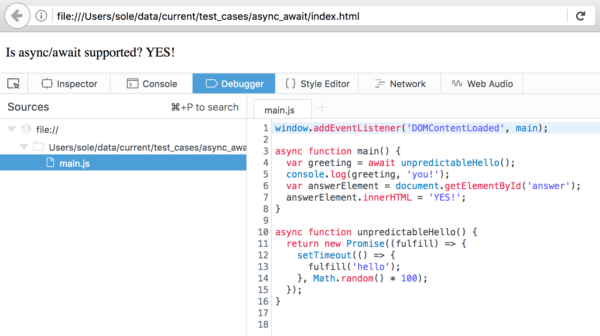
Support for async/await has been added in the Nightly build from the 31st of October (bug #1185106). Great stuff!

Time to start removing those JavaScript transpilers from your experimental projects, and testing native browser support 😉

Here’s a demo. If your browser supports async/await natively, you will see “YES”.

04 Nov 21:11

North American Advances in Cycling Infrastructure that Europe Could Benefit From

by HJEH (Jack) Becker
Recently, a European consultant asked a question that prompted some interesting thinking. Normally, we are focused on bringing European thinking on furthering cycling usage growth to this side of the Atlantic Ocean. Now, the thought of suggesting local techniques for European usage was an interesting twist.  more……
04 Nov 21:11

The Perfect Trifecta For Most Branded Communities Today

by Richard Millington

screenshot-2016-10-24-11-56-40

For most organizations today, this is the best of all three worlds.

The forum is for responses to new and unique questions.

The knowledge area for documenting the new responses and tackling the most common questions before people call the call center.

The ideas area for product complaints and suggestions (because isn’t every complaint also a very precise suggestion?)

Once you realize what each area is for you can begin to optimize each.

The goal of the forum is to answer the question in the quickest possible time and with a satisfactory answer. That means immediate access to experts who are eager to help and know what they are doing. This, in turn, means growing a base of experts who are motivated to answer questions.

The goal of the knowledge base is to hit the search traffic for the most relevant terms. This means keeping it frequently updated and ensuring it’s technically suited for search. This means finding processes to highlight the best material and the people who enjoy documenting this knowledge.

The goal of the ideas (or complaints/customer service) zone is to respond to criticisms or complaints where people feel listened to and that they had an impact. You might want to use a Reddit-style ranking feature for this so people can vote up the ones most relevant to you and surface useful insights from the community.

04 Nov 21:11

Football has entered the Asian era – and the region is reinventing the global game

by Simon Chadwick
There is an argument that you can divide modern football into three distinct eras. In the 19th century, we had Football 1.0 (the European era). As the industrial revolution reached its peak, football teams across Europe were formed, formal codification took place, league structures were created and the football that many of us either know or yearn for a return to was born. Football at this stage was a product of its time: a sport drawing from socio-cultural customs and practices established...
04 Nov 21:10

Facebook – Gamification.

by windsorr

Reply to this post

RFM AvatarSmall


Facebook does not intend to play second fiddle to Tencent for long. 

  • Facebook is increasing its position in gaming aiming to come at this critical Digital Life service from all angles to ensure that it ends up dominating the segment in developed markets.
  • Facebook has launched a new app for the desktop called Gameroom which is a client, much like Steam, which allows games that are developed in Unity to be easily published and accessed via Facebook’s platform.
  • Steam is a PC gaming platform that serves as a distribution channel for digital games, supports multiplayer and has a thriving community of PC gamers.
  • Gameroom aims to be very similar with the added kicker that it will provide game developers with much easier access to its 1.6bn users which is an asset not to be sniffed at.
  • Facebook’s aim is to help developers sell more of their games to users and to encourage users to play games on its platform rather than elsewhere.
  • Steam gamers are mostly hard core players but it does also distribute casual games and I think that it is this segment that Facebook is going after at this stage.
  • This makes complete sense because when it comes to the ecosystem, it is the smartphone and the tablet that really matter as the vast majority of games played on these devices are casual games.
  • Hence, when Facebook is trying to entice users to spend more time within its properties, it will be on these devices where it will need to generate the most traction.
  • This is because it is based on the experience on these devices that the user’s ecosystem decision is taken.
  • Hence, I do not see Gameroom as a real challenge to Steam but instead a play to fully colonise the Gaming segment of the Digital Life pie which in developed markets remains largely unoccupied.
  • Facebook is coming at gaming from all angles from VR and Occulus at the high-end to experimenting with gaming within its chat app Messenger.
  • Gameroom adds another string to Facebook’s bow when it comes to conquering gaming and of all of the major ecosystems, it is probably in the best position for gaming (except Tencent in China).
  • Microsoft and Sony also have thriving gaming communities but have completely failed to convince any of these players to play casual games within their systems on mobile.
  • This has left the largest (30%) segment in Digital Life wide open which is why I think Activision bought King Digital (see here).
  • I also believe that this is why Tencent purchased Supercell (see here) but the consortium structure that it is building around this acquisition makes me think twice.
  • This launch further reinforces my belief that Facebook is working at becoming the largest ecosystem of them all with over 2bn users and 80% Digital Life coverage.
  • This would put Facebook in undisputed leadership with Tencent in second place with 77% coverage and over 1bn users.
  • This is how Facebook goes from being a US$20bn revenue company to US$50bn, a large slice of which is likely to come out of Google.
  • However, in the meantime, Facebook has a lot of work to do as its current Digital Life coverage is just 36% and it remains really just a collection of apps rather than an ecosystem in its own right.
  • This is why I am nervous on the short-term outlook for Facebook as market estimates are assuming that revenues materialise from the new ecosystem services long before I see them as being mature enough to generate revenue.
  • I think the slip comes pretty soon, which is why I remain short-term cautious on Facebook despite the fact that it has a lot of long term potential.
  • There will be a better time to get in.
03 Nov 20:44

Recommended on Medium: Microsoft Surface Book and Surface 4 Options for my Next Laptop

Hey Jeff, thanks for the comment.

As you know, I haven’t been a hater in a long time. I am worried about rot & driver issues (especially if I want to play a couple of games), but I’ve used Windows for long periods of time and know I could be productive. Linux? No idea!

I took a quick look at both Surface Book and the pricing scared me off. Well, that and The Wirecutter didn’t list them at the top, and I was drowning in options without that as a guide.

More than anything else, the actual experience of shopping / looking for details on Windows machines was the most frustrating.

Surface Book

I took a look at Surface Books just now:

Of course, both are also the older 6th gen Intel chips. And, not to be discounted, they are full touchscreen + stylus tablets.

Surface 4

I am super intrigued by this. For me, it’s in the same class as the iPad Pro, but since it’s Windows everywhere, you do have a full professional desktop-class operating system.

In my article I didn’t go down the “can I use an iPad Pro with a keyboard case” route, but Surface is a real option for me I think.

  • 12.3" touchscreen, Core i5 with 8GB memory and 256GB drive, $1299
  • Core i7 $1599

Same link for both at Microsoft Store.

Considering Microsoft

I definitely would consider buying any of these. A MacBook Air 13" i7/256GB is $1349 and the MacBook Pro 13" TouchBar i5/256GB is $1799.

Neither are completely fair apples to apples comparisons, but they’re close. I am mentally applying a tax to the switch to Windows, so on price alone the MBAir or MBPro are price competitive.

The Surface 4 with the i5 would seem to be the closest for me in use case, (small) size, price, and performance. As a bonus, it really is a tablet.

Thanks for the prompt, now I have this option diagrammed out as well!

03 Nov 20:42

Storing Sensitive Data with Encrypted KVMs

by prithpal
A powerful feature of the latest Apigee Edge cloud release

We’re pleased to announce the general availability of encrypted KVMs. This capability is available as part of the Apigee Edge Cloud 16.09.21 release, which we detailed in a previous blog post.

What are KVMs?

Key value maps are routinely used by Apigee Edge customers to store various kinds of lookup information. For example, you can use KVMs to store:.

  • Code tables
  • Back-end target URLs
  • Environment properties

KVMs can be scoped at the API proxy level, the environment level, and at the org level. This tiered approach can be used to store information that’s accessible only by a specific proxy, by all proxies deployed in an environment, or by all proxies inside an org. The information stored within the KVM can be accessed by the API proxies during runtime.

Apigee Edge provides policies & RESTful management APIs that can be used to create, populate, and lookup entries from KVMs. One of the limitations of the KVMs, however, has been that the information stored inside them is unencrypted. So they weren’t suitable for storing sensitive information such as service accounts or system credentials.

Encrypted KVMs

Enter encrypted KVMs. They give you the ability to securely store sensitive information, and the contents (the value component) of these KVMs are automatically encrypted for you by the platform. You specify that the KVM is encrypted during creation time via a flag.

This information (the “value” held inside the KVM for a specific “key”) is available to API proxies during runtime, but is otherwise obfuscated when you turn on the trace mode for a proxy or use management API calls to interact with the KVM. Encrypted KVMs have the same characteristics as general KVMs such as the different scoping levels and access via policies and management APIs—the only difference is that their contents are encrypted.

Some common use cases for encrypted KVMs include:

  • Storing security credentials of third party systems and services that you may connect to SaaS applications and identity providers
  • Storing credentials / sensitive information for back-end target endpoints

A service account information example

Lets walk through a simple use case in which you need to store service account information securely (to connect to a third-party API). For this you’ll create an environment-level KVM called “service-accounts”:

  • Log in to Apigee Edge and select your org; in this case, it’s “pbhogill.” From the menu click on “APIs → Environment Configuration.” Select the “Key Value Maps” tab and click on the “+ Key Value Map” button. On the pop-up window enter “service-accounts” for the KVM name and check the “Encrypted” check-box, then hit “Add”


  • Add a couple of key-value pairs by clicking the “Edit” button. In the UI the values of the Encrypted KVM are displayed in text, so you can manipulate them easily.


  • If you make a management API call to query the contents of the encrypted KVM, the value component of entries in the map are masked. Your management API endpoint may be different, byut for Apigee Edge Cloud your endpoint would be: 

https://api.enterprise.apigee.com/v1/organizations/{your-org}}/environments/{your-env}}/keyvaluemaps/{your-kvm-name}


When you use an encrypted KVM in an API proxy, its contents are also masked in the trace tool, so sensitive information is not visible in the clear at run-time (see the “Using Encrypted KVMs” section of the release notes).

Additionally, as it works today for existing KVMs,  you can also access the decrypted value using the apigee-access module in Node.js code:
 

var apigee = require('apigee-access');

 var encryptedKVM = apigee.getKeyValueMap('service-accounts', 'environment');

 encryptedKVM.get('system1', function(err, secretValue) {

 // use the secret value here

});
 
Hope you’re as excited about this new feature as we are. We strongly encourage customers to use this feature, ask questions, and provide feedback on the Apigee Community.


03 Nov 20:42

Becoming the Uncarrier: T-Mobile's Digital Journey

by olaf
Webcast replay

To become the "Uncarrier," T-Mobile had to make some big changes to its IT organization.

In this webcast replay, learn how the telco successfully adapted and evolved on its digital journey. T-Mobile's Himanshu Kumar and Apigee's Paul Williams walked through key business and technical aspects of the journey, including:

  • key business drivers behind the journey
  • key design principles and the overall technology approach
  • how hearts and minds were won during the journey


03 Nov 20:26

Google is ‘evaluating’ the idea of bringing Pixel’s fingerprint scanner gesture to the Nexus 6P and 5X

by Rose Behar

A lot of Pixel users love the Android 7.1 feature that lets them slide down the notification shade by swiping down on their fingerprint sensor. In fact, a lot of Nexus 6P and 5X users love the idea too — but the feature isn’t available on their devices, despite the fact that all the devices use the same fingerprint scanner hardware.

This caused enough frustration that Android Police sourced a comment on the issue from Ian Lake, a Developer Advocate at Google, who said that while the hardware might be the same, the older firmware doesn’t support any kind of gesture detection on the scanner (though some coders have created a clever solution by classifying the ‘Finger moved too fast’ status as a swipe).

The next question on everyone’s minds, of course, was whether Google might consider a firmware update to add the feature, and the answer, it turns out, is maybe. Google told Android Police that it was “evaluating” a firmware update to add support for the fingerprint scanner gesture feature on the Nexus 6P and 5X.

“Stay tuned,” the company added.

02 Nov 00:28

Recommended on Medium: Introducing Docula!

No trick, just a treat! One of the big things that I love is the idea of making documentation (when needed) more of a community effort. In…

Continue reading on »

02 Nov 00:28

Samsung claims it will seek a ‘new start’ after Note 7 fiasco

by Jessica Vomiero

When Samsung’s Note 7 went up in flames, no one knew what would become of the the Note line, the company, or the brand.

Samsung claims, however, that it will attempt to walk away from this crisis with something positive. Reports from Bloomberg indicate that Samsung’s leadership believes the company has become complacent.

Samsung’s co-CEO Kwon Oh-hyun told Bloomberg that he’d urged the company to develop a more reliable crisis management system so as to better respond to incidences like what happened with the Note 7.

Furthermore, the company apparently intends to focus on “innovation, strength and competitiveness,” to win back the trust of the consumer. Samsung reported a 17 percent decrease this fiscal quarter as the results of the recall are felt.

After all was said and done, the costs of the Note 7 crisis totaled approximately $6 billion USD, a price that will likely affect the company’s annual earnings for the 2016 year and fiscal earnings for the first quarter of 2016.

Related: Samsung Galaxy S8 could feature 90 percent screen-to-body ratio

SourceBloomberg
02 Nov 00:28

My big dumb #MozFest fail

by OpenMatt

A few days ago I did one of the dumbest things I’ve ever done at work: I accidentally sent a personal tweet through an official work account followed by 2.8 million people. :/

I was at the Mozilla Festival, prepping notes in an etherpad for a session I was helping to organize. I was distracted, signed in with the wrong credentials, hit the wrong button and — what?! ohmygod ohmygod ohmygod  — suddenly realized I had just shared my geeky etherpad link with a potential audience of nearly 3 million (yes, million) twitter account followers.

Yep.

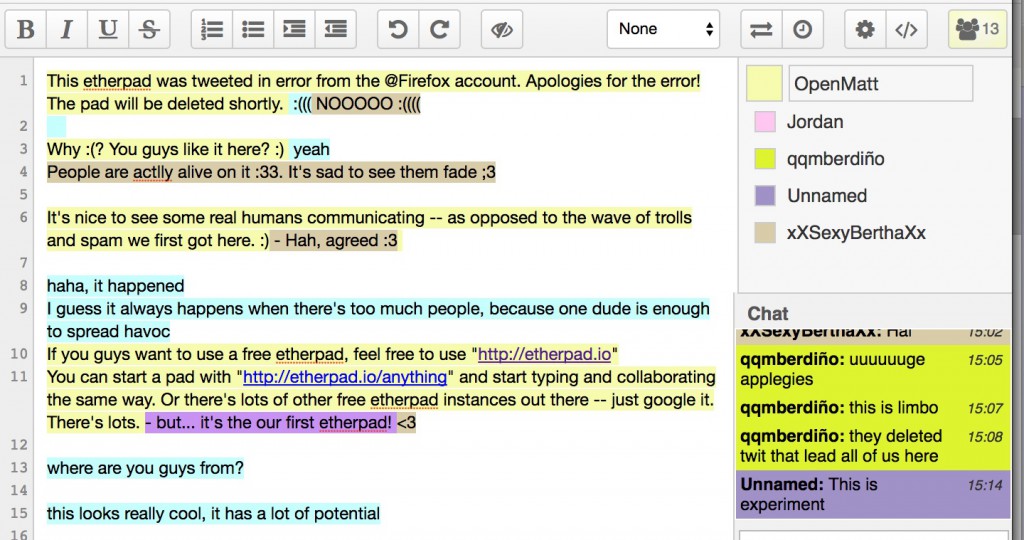
I knew something was up when a lot of people immediately showed up in that pad. Like… a lot. 20, 30, 50 folks streaming in all at once. “Strange game!” someone wrote. “What is this?!!!” Most had never seen an etherpad before (if you’re not familiar, it’s a simple collaborative writing and editing tool, like Google Docs). It’s basically just a blank sheet of paper posted on the web, one that anyone can read and write on — and the twitter users who had suddenly arrived there were (understandably) confused.

“What is this????”
“о чем это???”
“Make America Great Again!!!!!”

The pad was overflowing with random ether-noise and flotsam, with people all writing and remixing and talking over top of each other. I explained at the top of the pad that the link had been tweeted in error, and apologized for the mistake — but of course…. it’s an etherpad! People erased my message and just wrote over top of it. It filled with a cacophonous rainbow-colored torrent of ether-junk, a bubbling petrie dish of speech that pulsed and warbled and mutated all over itself.

It could have been worse — there are worse things to share out than a blank etherpad. But I was, of course, freaking out. As Mozilla staff, we take pains to ensure all our users (including twitter followers) have great experiences. So: I hit the red alert button. I sent panicky notifications to colleagues, found someone with the power to delete the tweet (something I lacked the credentials to do myself), and within about 20 minutes of my mistake, it had been erased, ensuring it wouldn’t confuse any more followers — a relatively small number of whom had actually seen the tweet.

My pulse slowly returned to a saner level.

BUT: there was still one issue remaining —
what to do about that etherpad?

No one new was arriving, but there were still a dozen or so users splashing around in it —  with various weird memes, random You Tube videos, Cyrillic script and U.S. election slogans swirling. It was strange and unpredictable in there. I wanted to ensure none of those users ended up having a negative experience, so I filed a bug with I.T. to get the pad deleted.

etherpad-graphic

But then, a funny thing happened: the trolls got bored and drifted away. The maelstrom of people shouting over top of each other quietened. Soon there were just a tiny handful of people left, and they started to… well… actually talk to each other.

“This looks really cool, it has a lot of potential,” one of the users wrote.

They’d never seen an etherpad before, and were intrigued by its open, geeky charm. A couple others started chatting about a problem they were having with their computer, offering each other advice. They were connecting. And helping each other.

“But… it’s our first etherpad! <3”

When I explained that the pad was going to be deleted soon, they were sad and didn’t want to leave.

NOOOOOOO!!!! :((((

— Why? Do you guys like it here? 

Yeah. People are actually alive on it :3. It’s sad to see them fade.

This lead to me explaining they were welcome to start their own pad and keep talking, or use it whenever they wanted. Which they did.

#fail –> teachable moment

Thinking about it afterward, it felt fitting that the whole thing happened at the Mozilla Festival, a gathering of people dedicated to protecting and growing the human potential of the Internet — with a big emphasis on web literacy and open collaboration. My dumb fail had prompted a teachable web literacy moment all its own. These folks had encountered a new tool, experienced a brief moment of connection, and come away with a slightly different understanding of what you can do on the web. And the whole experience felt like it contained many of the core ingredients of the internet itself in 2016:

  • noise / random weirdness / people talking over top of each other
  • trolls
  • dank memes
  • русский
  • Trump slogans

And, occasionally, when we’re lucky:

  • learning
  • new tools and possibility
  • fortuitous accidents / serendipitous encounter
  • brief moments of real human connection

“You mean, I can just type on this thing?!”

For me, as old school and antiquated as etherpad can now seem, it still contains a bit of web magic — and it was nice to see others discover some of that for the first time. Etherpad feels like a throwback to Doug Engelbart‘s original vision of what digital spaces are for: collaboration. He imagined interfaces that had two mouse pointers, not just one — because the whole goal was “people working together in a shared intellectual space.”

In a world of increasingly managed, read-only experiences, the fact that etherpads are so wide open to anyone to just write and edit on is a beautiful encapsulation of fragile trust and care, and of the multi-vocal nature of the web (and world) itself — what my lit professor would call “polyglossia,” multiple voices sharing a space.

My #MozFest 2016 moment

It’s not something I plan on doing again any time soon. (Or ever, ever again. Promise.) But I came away a little grateful for the accident. It felt like a very #MozFest moment.

“Jordan,” “qqmberdino” and “Bertha,” whoever, wherever you are — I hope you’re awesome, and still happily etherpadding in some corner of the web somewhere.

02 Nov 00:27

Would you still like to buy the world a Coke?

by Don Marti

Here's a TV commercial from 1971.

Aww.

But here on the Internet, at least a lot of the time, people are more like, I'd like to buy my tribe a Coke® and the rest of the world can go die in a fire.

People have an us-and-them side and a more inclusive side. And advertising has an unwritten rule about which side of the customer you're allowed to talk to. For a long time brands have stuck with a kind of generic globalism, not enough to satisfy a bona fide social justice warrior but never tied up with a specific tribe. Right-wing talk radio in the USA has trouble keeping mainstream advertisers. In one case, a blogger going by "Spocko" made fair use recordings of some radio shows and raised a stink to the advertisers. Despite some legal threats, it basically worked. Most brands are risk-averse enough to stay off talk radio. Even on the web, it's news when a brand shows up sponsoring a beheading video on a jihadi site.

Do things work differently, though, when it's an algorithm placing the ad in a niche that only sympathizers can see?

Timothy B. Lee writes,

The increasing polarization of news through social media allows liberals and conservatives to live in different versions of reality. And that’s making it harder and harder for our democratic system to function.

From BuzzFeed, Hyperpartisan Facebook Pages Are Publishing False And Misleading Information At An Alarming Rate.

The rapid growth of these pages combines with BuzzFeed News’ findings to suggest a troubling conclusion: The best way to attract and grow an audience for political content on the world’s biggest social network is to eschew factual reporting and instead play to partisan biases using false or misleading information that simply tells people what they want to hear. This approach has precursors in partisan print and television media, but has gained a new scale of distribution on Facebook.

Filter bubbling has been a thing for political advertising for quite a while, as Zeynep Tufekci pointed out back in 2012. Campaigns can target ethnic groups on Facebook with "voter suppression", or share misleading messages where they're harder for outsiders to track down.

What happens after the election, when tribal rage bubbles keep right on being a thing, but the political ads dry up? Are regular brand ads going to get placed on fake news, scenes of violence or threats of violence, and all the other us-versus-them crap out there? You probably wouldn't put your brand on Stormfront, but will you put your brand on one of the thousands of algorithmically micromanaged mini-Stormfronts of Facebook? Are dark posts the thing now?

This isn't a question about whose politics match with whose, or whether or not Facebook enables targeting using data that we would prefer to keep private, or whether or not individuals should leave Facebook. The question is whether brands are now getting comfortable with working inside bubbles that would not have previously been considered brand-safe.

People keep saying that Google doesn't get social, but in a way, that's a compliment. A lot of the time, people's idea of being social is to split up into tribes and fling Internet poo, or worse, at each other. Part of getting social is developing the ability to exploit people's other-tribe-hating brain circuitry in the same way that spammers took advantage of open SMTP relays and SilverPush took advantage of an opportunity to sneakily connect mobile user data. (The Peter Thiel brouhaha is raising the profile of the social filter bubble issue by putting a human face on it. Every time Sanford Wallace's smug face made the news in the 1990s, it motivated us to fix up our mail servers and set up the early spam filters. Now it's Thiel in the news, making money on both ends of the pipeline—recruiting 4GW participants on Facebook, and selling Palantir contracts to track them down later. Ingenious patriotism at scale. So what to invent now?)

Andy Warhol once said:

What's great about this country is that America started the tradition where the richest consumers buy essentially the same things as the poorest. You can be watching TV and see Coca-Cola, and you know that the President drinks Coke, Liz Taylor drinks Coke, and just think, you can drink Coke, too. A Coke is a Coke and no amount of money can get you a better Coke than the one the bum on the corner is drinking. All the Cokes are the same and all the Cokes are good. Liz Taylor knows it, the President knows it, the bum knows it, and you know it.

That was then. But today we're not even drinking the same damn Coke. I'm drinking the version bottled in Mexico. Meanwhile, out in High Fructose Corn Syrup land, they're drinking the other kind.

And that's just Coke. Are economic inequality and social distances between tribes getting big enough that the idea of a brand-safe ad placement is over? Are brands just supposed to take sides now? That's fine for fast food and soda pop, but what happens when an IT brand that benefits from economies of scale has to pick a side?

Related: Zeynep Tufekci on "Digital Inclusion and Decentralization"

Bonus links

01 Nov 20:40

In the Wix vs. WordPress fight, impressions matter

by Josh Bernoff

Matt Mullenweg, the originator of WordPress and CEO of Automattic, is fighting with Avishai Abrahami, CEO of Wix. (Both companies make it easy to build web content.) The question driving this fight is the appropriate use of open source code. But what’s really at stake is reputation — and on that front, Abrahami’s wry commentary … Continued

The post In the Wix vs. WordPress fight, impressions matter appeared first on without bullshit.

01 Nov 20:40

If You Build It They will Walk-the Case for Density, Transit and Well-Being

by Sandy James Planner

bird

Five years ago an extraordinary team of people from the two universities, the two health authorities, the metro Vancouver municipalities and regional government and TransLink got together to run a conference with an innovative idea-that creating communities around walkability was the intersection between health, happy places, liveliness and aging in place.You can view some of the proceedings from the Walk21 Metro Vancouver conference here.

Now Co.exist and others accept as doctrine the innovative concept that the conference was trying to impart-that a walkable city  is a sustainable, sociable well designed city that puts the health and well-being of residents first. In fact while the relationship between walkability and health status has already been established, this study “published in the Lancet, looked at 14 cities in 10 countries, all of which had a similar design, in order to determine whether or not the cities’ layouts themselves were the reason for increased health, as opposed to different lifestyles in different countries. The physical activity of the 14,222 adult participants was measured over four to seven days using Fitbit-style accelerometers. The principal data point was the average number of minutes walked per day.”

Looking at cities in Australia, South America, Europe and three cities in the United States there were some surprising findings, specifically that  urban factors that meant people walked more included “residential density, park and public transport density, and intersection density. Parks are obvious in their effect—people take walks in parks. Residential density is important because if you live in a compact neighborhood, you can easily walk to do your errands. And public transit density is important because not only does it obviate car use, but people have to walk to their nearest station instead of their driveway”

Mixed use development, density, and convenient transit go hand in hand in making walkable places. We’ve now got the evidence to convince policy makers of the important interconnectedness of these three things to design for walkable sustainable communities that support happier, healthier residents of any age.

waterfront2bstation2bof2bcanada2bline2bsubway2bdowntown


01 Nov 20:40

Us in Korea

by tychay

From my aunt’s e-mail thread.

Here is family photo sans Aboji. I sent you this photo of us in our Seoul house in 1954. We had a large spacious house with tatami mats, heated floors and a large yard with a garden. Surrounding it was a cement wall for privacy. The back of the photo gives our names and ages. (The ages are Korean ages, meaning it is one year older than it is here in the western world).

Francis Ree Family

Clockwise from the top left: (Hay In) Francis 19, (Shin He) Teresa 17 (my mother), mother (grandma), (Jung He) Jeanne 9, and (Ju He) Bernadette 20.

COUSIN ALEX:
So you were the top tenth of one percent. The Mitt Romney’s of the world walled off from the plebs. 😉

AUNT GIA:
I wrote about our house in Korea because Aunt Tamaye mentioned in her recollection about Grandpa Aboji’s clothing and the “Y” hotel we stayed at and the small apartment we rented in SLC. It must have been tough for my older siblings going from living in spacious house, with all the privileges that Grandpa’s name brought, and then moving to cramped housing in the U.S.. Uncle Francis slept on a couch in a small living room and us three girls shared a bedroom. Aunt Tamaye and Uncle Francis were enrolled at the U of Utah (I think Uncle was a freshman and Aunt was a sophomore or junior). Aunt Teresa was enrolled at Judge Memorial High School as a senior (I think).

KEN:
When did Jeanne become Joan?

AUNT GIA:
My baptismal name was Jeanne (pronounced “gee-an” with slight emphasis on the “gee” part). When we came to the U.S. it was changed to Americanized Joan and that is on my citizenship paper.

AUNT TAMAYE:
Jeanne is the French version of Joan, Jeanne D’Arc

KEN:
Makes sense.  Learned something new today.

ME:
Alex, not only that, but apparently like Trump, they never paid their taxes back then! Mom used to say that when the tax collector came, Grandma would hold out arms, wrists up and say, “Take it out of my blood, because we don’t have any money!” 😀

AUNT GIA:
Haha, I think I have faintly remember my mom doing that. Maybe Aunt Tamaye or Uncle Francis may enlighten us more. (The government was very corrupt back then and taxes went to the coffers of already wealthy officials.)

01 Nov 20:40

"Perhaps all you have left in the end is a scrapbook filled with old newspaper clippings."

“Perhaps all you have left in the end is a scrapbook filled with old newspaper clippings.”

- Tammy Grimes, cited by Anita Gates in Tammy Grimes, the Original ‘Unsinkable Molly Brown,’ Dies at 82
01 Nov 20:39

Wither on the Vine

01 Nov 20:39

Frequently Asked Questions About Airfoil and Chromecast

by Paul Kafasis

On Friday, we released version 5.5 of our home audio streamer Airfoil for Mac. This free update adds support for Google Chromecast, and other Google Cast devices, to Airfoil. Since then, we’ve been gratified to hear from many users thrilled with the new functionality. We’ve also heard a few questions repeatedly, so I thought I’d answer them here.

Can Airfoil stream <insert app name here>?


Stream audio from any app on your Mac, or all of your System Audio at once

As veteran users can no doubt guess, this question is coming from folks new to Airfoil. Airfoil can stream any audio from your Mac out to remote speakers. That includes music apps like Spotify and iTunes, web-based services like Pandora, and even all System Audio at once. Whatever you’re playing on your Mac can be streamed via Airfoil.

Does Airfoil work with <insert my Chromecast here>?

We’ve successfully tested with every Chromecast device Google has released thus far. That includes both of the current puck-shaped models (Chromecast Audio and Chromecast), as well as the original stick-shaped model released back in 2014. Airfoil works great with all of this Chromecast hardware!

Does it work with the Chromecast Ultra?

Ah, we can’t fool you, dear questioner. The Chromecast Ultra is not yet released, and thus doesn’t fit the answer above. Because it isn’t yet available, we haven’t tested with it. We’ll be getting the Ultra as soon as possible, however, and we’re confident it too will be supported.

What are Google Cast devices, exactly?

“Cast” is the official name for Google’s streaming protocol. It’s essentially their version of Apple’s “AirPlay” protocol. Like AirPlay, third-party hardware manufacturers can incorporate Cast technology into their devices. A “Google Cast” device is simply a piece of hardware which can receive audio via the Cast protocol.

While the Chromecast devices made by Google are the most well-known Cast devices, there are hundreds of others out there. This includes televisions made by Sony and Vizio, as well as speakers from LG, Grace, Bang and Olufsen, and more. Check your hardware, because you might have a Cast receiver and not even realize it!

Can I send to multiple Cast devices at once?

You can indeed. Airfoil can send the same audio to multiple Cast devices, so if you’ve got more than one Chromecast, you can play audio throughout your house in sync.

Can I send to a mix of devices?

Yes again. If you have an Apple TV attached to your television in the living room, a Chromecast Audio attached to your stereo in the bedroom, and a Bluetooth speaker in the office, Airfoil will send audio from your Mac to all of these devices. Airfoil now supports sending audio via AirPlay, Bluetooth, and Cast, or any combination of the three. Whatever supported devices you have, Airfoil will send to any and all of them, with audio played in perfect sync.


Airfoil A-B-C’s: Send to any combination of AirPlay, Bluetooth, and Chromecast devices

When will Airfoil for Windows get Chromecast support?

We’re hard at work on adding Chromecast support to Airfoil for Windows as well, and we’ve been making good progress. This will be a free update, and we hope to ship it by early next year.

Did people really ask all of these questions?

Yes.

Even the one asking if people really asked all of these questions?

Well, no.

I have a different question. How can I get help?

As always, contact us via our support form, and we’ll be glad to assist.

01 Nov 20:39

Twitter Automates Customer Service Direct Messages

by John Voorhees

Twitter revealed two new features for businesses that use direct messaging as a customer service channel – welcome messages and quick replies. Welcome messages are automated responses to customers who direct message companies. Quick replies present customers with a series of choices to reduce text input and, according to Twitter, are designed to work alongside welcome messages to speed up the customer service process.

Twitter’s Advertising Blog explains that:

These features are designed to help businesses create rich, responsive, full-service experiences that directly advance the work of customer service teams and open up new possibilities for how people engage with businesses on Twitter.

→ Source: blog.twitter.com

01 Nov 20:38

Perspectives on Personal Digital Archiving


Bill LeFurgy, Library of Congress, Nov 04, 2016


I've been tending to my own archives lately and I echo this sentiment from this Library of Congress publication (79 page PDF): "One of the still unfolding impacts of the computer age is that everyone now must be their own digital archivist. Without some focused attention, any personal collection is at high risk of loss – and quick loss at that." Here are some resources to underline this important effort:

[Link] [Comment]
01 Nov 20:38

Talkshow Will Shut Down on December 1

by John Voorhees

Talkshow, which launched about six months ago, will be shutting down effective December 1st. The service allowed groups to have text-based conversations in public. It quickly became a place to assemble panels to comment on live events or just discuss a particular topic. The discussion was limited to the host and guests, but people observing the Talkshow chat could submit questions.

In an email to users and post on Medium, Talkshow says:

While we have enjoyed the conversations that have happened on Talkshow, and are grateful for the community that has formed around the product, we don’t see it getting big enough to have the impact we had hoped for.

Talkshow’s shutdown is happening in stages over the next month. Talkshow is being removed from the App Store today. On November 8th, active Talkshows will end and tools will be made available to export existing shows. Finally, on December 1, the service will be turned off, which means the app will no longer show existing, inactive Talkshows, even in browsing mode.


Like MacStories? Become a Member.

Club MacStories offers exclusive access to extra MacStories content, delivered every week; it’s also a way to support us directly.

Club MacStories will help you discover the best apps for your devices and get the most out of your iPhone, iPad, and Mac. Plus, it’s made in Italy.

Join Now
01 Nov 20:38

This is voter suppression.

To get an idea of voter suppression in action let's overlap the The Racial Dot Map with Wake County's early voting locations.

01 Nov 20:34

Samsung Galaxy S8 could feature 90 percent screen-to-body ratio

by Patrick O'Rourke

It’s obvious Samsung needs to do something mind blowing with the S8 in order to win back those scorned by the disaster its overheating Note 7 flagship became, and it looks like that’s exactly what the beleaguered South Korean tech giant has in the works for the S8.

New rumours sourced by Sammobile, which have surfaced in the past as well, indicate the Galaxy S8 could come equipped with an OLED screen that features a greater than 90 percent screen-to-body ratio. During a iMiD 2016 display exhibition last week in Seoul, Korea, an engineer from the company mentioned that Samsung has plans to roll out this technology next year, though did not confirm that the company will feature the new display in the S8.

The overall description of the phone is reminiscent of the Xiaomi Mi Mix, a Chinese-manufactured smartphone that likely won’t be released in Canada with a screen-to-body ratio of over 90 percent.

It’s expected that Samsung will give the Note branding some time off in the coming year in order to refresh the device’s direction. During the same presentation at iMiD, one of Samsung Display’s principal engineers, Park Won-sang, revealed concepts of a smartphone that features a very small bezel, adding to earlier rumours that the phone could ditch its iconic physical home button with the release of the S8.

A contextual button with a built-in fingerprint scanner will reportedly take its place.

Related: Samsung Galaxy S8 could feature an optical fingerprint scanner

SourceSammobile
01 Nov 20:33

Truck-Sized Pinhole Camera Captures the Great American Panorama

by Masha (Maria) Koblyakova for The Creators Project

IMG_7566.jpgOptics Division of the Metabolic Studio (Lauren Bon, Richard Nielsen, and Tristan Duke). Liminal Camera. Adaptive Re-use of the standard unit of global trade—the shipping container at de Young museum, 2013. ©2013 Metabolic Studio LLC

Photographs made by and in a dark-room/camera complex that traveled across the USA go on display in a new show at MASS MoCA. Liminal Camera: Drought presents the photographs made with the so-called Liminal Camera, Metabolic Studio's 20-foot shipping container containing a pinhole camera and built-in darkroom. Led by Lauren Bon, the Metabolic team traveled with the camera for the last six years. Bon, alongside Richard Nielsen and Tristan Duke of Metabolic Studio's Optics Division, were researching the photochemical properties of naturally occurring substances, including ink made from the silver oar in the Sierra Nevada Mountains, gelatin made from local cattle, and developing agents formed from native plants and mineral sediments of the Owens Valley.

1.jpgOptics Division of the Metabolic Studio (Lauren Bon, Richard Nielsen, and Tristan Duke). Dead Cottonwood by Paiute-Shoshone Reservation, 2014.. Lakebed Developed Gelatin Silver Liminal Print. [LBD.2014.2] [2014.7785]. ©2014 Metabolic Studio LLC

Transported by the flatbed truck, the group worked inside of the darkroom daily, sometimes producing negatives up to 12' long and 6' high. Even the name "liminal" refers to the immediacy of the threshold between the reality and the produced photographic material.

The images at MASS MoCA focus on the Owens Valley in eastern California, approximately 200 miles from LA. The valley provides 35% of the city's water, resulting in a dry, technogenic climate. The project has technically been gonig on since 2006, when Bon drove a tanker truck of water from LA to the valley and deposited it back in the lakebed. For the 100th anniversary of the LA aqueduct, which still takes water from the Owens Valley, Bon led 100 mules on a 28-day journey, tracing the entire length of the road.

During the project in the Owens Valley, the team searched for photoreactive elements and found a small oasis: a crimson-colored pool of water in the middle of a dry lakebed. Miraculously, this pool was a concentrated source of a chemical fixer essential to the photographic process. By drenching the photographs in the pool, the team achieved more than simply 'fixing' the photographs—the artists transformed them. The photographs of the landscape are literally saturated by the chemical composition of the Valley, making Liminal Camera a photographic project MASS MoCA calls “literally of the land.”

3.jpgOptics Division of the Metabolic Studio (Lauren Bon, Richard Nielsen, and Tristan Duke). Owens Dry Lake Bed, hotbed of extremophiles sources for use as photo-fixatives. © Metabolic Studio LLC

Prints from the Liminal Camera are on view at MASS MoCA through November 27. Click here for more information. 

Related:

Pinhole Cameras Made from Twigs and Dirt Capture Hazy Landscapes

This Book Doubles As a Working Pinhole Camera

How To Catch A Thief Using A Pinhole Camera

01 Nov 20:33

New Doc Tells the Story of Pioneering Electronic Group The Orb

by Kevin Holmes for The Creators Project

Alex Paterson and Thomas Fehlmann. Image courtesy of Kompakt records

If you were listening to electronic music back in the 1990s, then you were no doubt a fan of The Orb, the musical duo comprising Alex Paterson and Thomas Fehlmann. The band's debut album was The Orb's Adventures Beyond The Ultraworld, which kicks off with "Little Fluffy Clouds," an ambient classic with its instantly recognizible sample from Rickie Lee Jones talking about the dreamy skies of her childhood in Arizona (they even did a great spoof with comedian Simon Munnery called "Grey Clouds" about the much more dreary skies of Watford, UK).

Then, with an airplane soaring off it segues into "Earth (Gaia)" which merges Ming the Merciless' Flash Gordon quotes with doom-laden bible soothsaying and rich ambient sounds—and so begins a near-two hour progressive journey that doesn't do a disservice to the title. It was the first introduction in album form to a group who have seen numerous members over the years. The Orb's one constant was Alex Paterson, a former roadie for Killing Joke who used to DJ along with fellow Orb founder, the KLF's Jimmy Cauty, in the chillout room at Paul Oakenfield's Land of Oz acid house club night at Heaven in London, playing Brian Eno and Pink Floyd to people who loved up (or coming down) on ecstasy.

A new documentary, called Lunar Orbit, having its London premiere at the Doc 'n Roll Film Festival, takes a look at these pioneers of ambient music and the processes and stories behind their sound. The doc is directed by Patrick Buchanan who has been a fan of the group since the mid-90s.

"My relationship with The Orb’s music has bordered on obsessive over the years, I will admit," Buchanan explains to The Creators Project, detailing that he wanted to make a film that a fan like him would want to see. "There hasn’t been much media documenting The Orb so I took it upon myself. As a first time filmmaker I knew I was going to spend a lot of time on this so I picked a subject close to my heart: music. I knew their music very well but I didn’t know much about the creators themselves and their history."

Although this was Buchanan's inaugural feature, he's been involved with the TV industry as an editor for a number of years. He hit a low point during the summer of 2012 and, feeling uninspired, decided to make his own film, a doc about his musical heroes. So he approached The Orb with his idea and the project began. It took him around three years from beginning to end to make the doc, which is still looking for a distributor, hence why it's touring the film festivals.

Screengrabvia

The film features interviews with Paterson and Fehlmann and follows them as they record their 13th studio album in Berlin, Moonbuilding 2703AD, which was released last year.

"Alex and Thomas are very different from each other, and I think that really balances out their vibe," Buchanan says of the duo. "Alex comes from punk rock, and got his start in music with Youth and working for Killing Joke, Thomas is really into art and jazz and was part of Palais Schaumburg, also a key figure in the Berlin techno scene in Berlin in the late eighties. Helen Mead who was a live editor at NME in the early 90s and knows them both, compared them to Laurel and Hardy. Alex isn’t really into jazz and Thomas not so much into punk. They meet in the middle."

The film itself has interviews with not just the current members, Paterson and Fehlmann, but features archive live performances and interviews with key players and contributors throughout the group's decade-spanning career. Childhood friends who Paterson went to a Christian boarding school with, like Guy Pratt and Martin "Youth" Glover, bass player for Killing Joke ("Youth is a key interview in the film, his friendship and contributions are important to The Orb," notes Buchanan) have interviews in the film. There film also features Orb contributors Steve Hillage, Simon Philips, and Tom Green, and musical contemporaries like Mixmaster Morris and Matt Black from Coldcut.


Screengrabvia

Although like any film about a band and their history Buchanan looks at the band's past work and their musical inspirations ("Two key musical influences that are covered in the film are Chic and Steve Reich. I’d add that people like Brian Eno, and groups like Cluster and the work of Robert Fripp are key to them both," explains the director) he also wanted to focus on the now. The processes that informed the Moonbuilding 2703AD album and the studio sessions he sat in on, in particular, gave him a great insight into this and helped, for Buchanan, set the film apart.

"Here I am sitting on the floor with a mic and headphones listening to The Orb—but I’m in Berlin and I’m in their studio!" Buchanan notes. "This was an aspect that I really wanted to get, to explore the creative process and document it. The Orb have an interesting way of making records, its an exploratory way of jamming; they jam, they experiment and then they manipulate their sessions, sometimes unrecognizable. [In the doc] we tell the stories, we talk about the history but it’s very much rooted in the present, yes they had hits 25 years ago, but the music they make today is very strong and in some cases better. Moonbuilding 2703 AD is one of the best Orb albums in a decade, and we witness some of the magic. I think it takes this film to the next level as far as a documented event."

Check out an excerpt from Lunar Orbit below.

Doc 'n Roll Film Festival is on from November 2 to 13, 2016 in various venues across London. Lunar Orbit will premiere on 11 November at Picturehouse Central. Learn more about the film here. Learn more about The Orb at their website here, stream their latest album COW / Chill Out, World here, and catch them on tour throughout November and December across the UK.

Related

Nick Zinner and Johanna Schwartz Talk Music Documentary ‘They Will Have To Kill Us First’

Watch an Album Get Produced on the Trans-Siberian Railway

The Glitch Mob Takes You 'Behind the Blade' in a New Short Documentary

01 Nov 20:33

In diesen Luxus-Flugzeugen vergisst du, dass du in der Luft bist

by Catherine Chapman for The Creators Project
1 BBJ_Geneve-5250514_c.jpgBild: Kestrel Aviation Management

Bei Flugreisen denken die meisten Menschen an lästige Gepäckbeschränkungen, ewig lange Schlangen an der Sicherheitskontrolle und das Dilemma, wieder mal hinter einem schreienden Baby zu sitzen. Komfortabel sieht anders aus. Doch für die wenigen Glücklichen, die sich für ungefähr 300-400 Millionen Dollar eine maßgeschneiderte Boeing 787 leisten können, kann sich eine Flugreise in ein luxuriöses, exklusives Erlebnis verwandeln.

Stephen Vella ist der CEO und Gründer des Luftfahrtunternehmens Kestrel Aviation Management. Gemeinsam mit dem Pariser Pierrejean Design Studio entwerfen sie seit 15 Jahren Innenausstattungen für Flugzeuge, die alles andere als standardisierte Massenanfertigungen sind. Für ihre betuchten Kunden erschaffen sie personalisierte, harmonische Räume, die trotz allem Komfort den strengen Sicherheitsbestimmungen der Federal Aviation Administration (FAA) entsprechen.

The Creators Project hat mit Vella gesprochen, um herauszufinden, welche Design-Grundsätze hinter der perfekten Flugatmosphäre stecken.

The Creators Project: Was ist die Aufgabe von Kestrel Aviation Management?

Stephen Vella: Wir schaffen einen Raum, den der Passagier nicht mehr verlassen möchte, sobald er sich einmal hingesetzt hat, da er ergonomisch alles in Reichweite hat, was er braucht—sei es eine Wasserflasche oder eine Laptop-Ablage. Wo kann ich meine Jacke aufhängen? Wo kann ich mein Kleingeld aufbewahren? Das sind all die wichtigen Details, auf die wir uns in unserer Arbeit konzentrieren—90 Prozent der Passagiere werden diese Feinheiten nicht einmal sehen. Aber sie werden sie spüren. Wir schauen uns das Design aus der Perspektive des Nutzers an. 

1 BBJ_Geneve-5250949_c.jpgDie Sanitäranlage in einem Privatjet | Bild: Kestrel Aviation Management

Wie macht ihr das?

Wir versuchen, durch ein multisensorisches Erlebnis eine ruhige Umgebung zu schaffen. Wenn man 17 Stunden in einem Flugzeug verbringt, will man sich an diesem Ort wohl fühlen, egal ob man Geschäfte abwickeln oder sich entspannen möchte. Wir schaffen durch Farbe, Licht, Schallisolierung und Luftbefeuchtung eine Atmosphäre, in der man sich auch nach einem langen Flug noch fit fühlt.

Eure Privatjet-Designs sind meist auf den Kunden zugeschnitten. Wie schafft ihr es, diese ruhige Umgebung zu schaffen und trotzdem den individuellen Stil widerzuspiegeln?

Ich besuche viele Kunden zuhause, weil ein Haus viel darüber aussagt, wie jemand ist und wie er gerne sein würde. Ich hatte beispielsweise einen Kunden, dessen Architektur- und Farbkonzept sehr skandinavisch geprägt war. Ein Flugzeug ist wie ein Apartment, es ist etwas sehr persönliches und ein Ort, an dem man sich wohl fühlen sollte.
 

1 BBJ_Geneve-5250445_c.jpgSchlafzimmer über den Wolken | Bild: Kestrel Aviation Management

Es ist bestimmt nicht immer leicht, diese Design-Vorstellungen umzusetzen…

Ich hatte auch andere Kunden, vor allem aus dem Nahen Osten, deren Häuser mit dunklen Möbeln in Braun- und Rottönen gefüllt waren. Ein Flugzeug ist jedoch ein länglicher Schlauch, der sehr einengend ist und den man nicht in solch dunklen, erdrückenden Farben gestalten sollte.

1 BBJ_Geneve-5250482_c.jpgBild: Kestrel Aviation Management

Ein Flugzeug zu designen, hört sich etwas komplizierter an, als ein Haus zu gestalten.

Es ist ein sehr langwieriger Prozess. Unser Produktzyklus beträgt mindestens zwei Jahre, meistens sogar drei, weil wir erst einmal das Flugzeug aussuchen und es dann bauen und liefern lassen müssen. Danach kommt erst der Innenausstatter mit der Planung, Herstellung und Montage der Einrichtung ins Spiel. Es ist ein interessanter Prozess, der sehr technisch, aber auch sehr künstlerisch ist.

Ihr müsst euch außerdem an zahlreiche Sicherheitsvorschriften halten.

Es gibt extrem strenge Vorschriften zur Entflammbarkeit von Materialien. Das bedeutet, dass alles, was wir im Flugzeug benutzen möchten, testweise abgebrannt werden muss. Wenn wir einen neuen Sitz entwerfen, kaufen wir nur das Metallgestell und die Elektrik ein und bauen den Sitz und die Polsterung dann aus verschiedenen Arten von Schaumstoff und Leder. Diese Muster schicken wir an das Labor, wo sie angezündet werden und ihre Entflammbarkeit bewertet wird. Sie müssen langsam genug abbrennen, dass Passagiere im Brandfall noch rechtzeitig das Flugzeug verlassen können. Wenn ein Musterexemplar zu schnell abbrennt, müssen wir noch einmal von vorne anfangen und andere Flammschutzmittel verwenden oder die Materialien so lange anpassen, bis alles stimmt.

Das erinnert mich an die Bruchlandung der Emirates Boeing 777 in Dubai, bei der alle 300 Passagiere das ausgebrochene Feuer überlebten.

Das ist ein Beweis dafür, wie wichtig die strikten Vorschriften sind und dass sie durch gutes Design umgesetzt werden können. 

1 BBJ_Geneve-5251019_c.jpgBild: Kestrel Aviation Management

Einige dieser entspannenden Designs, über die wir hier reden, sind nur den Superreichen vorbehalten. Besteht die Chance, dass die luxuriöse Innenausstattung von Flugzeugen auch auf die kommerziellen Fluglinien abfärben wird?

Ja, das Design wird früher oder später auch auf die Business Class abfärben. Man das auch heute schon Qatar Airways beobachten. Air Canada und Delta haben den Design-Ansatz auch schon aufgegriffen, weil sie gemerkt haben, dass sie etwas ändern müssen, um mit den nahöstlichen Fluggesellschaften mitzuhalten und die gut zahlende Kundschaft zu halten.

Weitere Informationen über die Arbeiten von Kestrel Aviation Management findet ihr hier

01 Nov 20:33

History Repeats Itself in a Found-Footage Augmented Reality Experience

by Andrew Nunes for The Creators Project

All images courtesy of Andrea Wolf and Karolina Ziulkoski

There's an aphorism, popular with history teachers, that goes, "Those who cannot remember the past are condemned to repeat it." But sometimes, taking a close look at history can be just as unsettling as it is illuminating. With their augmented reality project Future Past News, artists Andrea Wolf and Karolina Ziulkoski explore parallels between current events and news stories circa 1937, when the world was on the brink of massive, global conflict.

Wolf and Ziulkoski met working next to each other at NEW INC, the New Museum's incubator for art, design, and technology. While vacationing in Mexico City, Wolf came across black-and-white American newsreels from 1937. Future Past News displays that found-footage on a browser, while an accompanying app, developed by Ziulkoski, unlocks second-screen AR content contrasting the 1937 news with modern-day headlines.

Footage of the Spanish Civil War from the 1930s morphs into a headline about the ongoing Syrian Civil War and resulting refugee crisis. Early-20th century industrial labor strikes are mirrored by modern workplace protests, securing a minimum wage hike in NYC and California in the coming years. Benito Mussolini’s 1937 meeting with Adolf Hitler transforms into challenges faced at the most recent NATO summit, such as terrorism, Brexit, and Russian aggression.

Wolf found the 1937 newsreels a couple of years ago, and the idea of creating a historically comparative narrative developed gradually. “I knew I wanted to do something with this film, but I wasn’t exactly sure how to use it. And then the election season began, and things started to get really crazy,” Wolf tells The Creators Project.

“But also, [there are so many other news stories] and events, like the Syrian conflict and its millions of refugees, the Black Lives Matter movement, the fight for a decent minimum wage, Brexit, the Paris Attacks, nationalistic movements and leaders gaining momentum … we could go on. These are very effervescent times," she says.

“It feels like we are starting to catch up with the effects of fast-paced technological progress and its social and cultural impact, and not all our responses are in line with the openness, fluidity, and connectedness that [technology] enables and promotes, but rather the opposite: nationalism, xenophobia, racism, closed borders, and so on,” Wolf says. “Talking with Karolina, it was clear that we both shared this feeling.”

At the end of Future Past News, a headline on the browser reads, “In the Hands of these Five Men Rests the Destiny of the World,” before screening footage of Hideki Tojo, Joseph Stalin, Adolf Hitler, Benito Mussolini, and Franklin D. Roosevelt. Hinting at their modern-day counterparts, the AR app shows, in turn, Kim Jong Un, Vladimir Putin, Donald Trump, Marine Le Pen, and Charles and David Koch. The lineup is an allusion to numerous Hitler-Trump comparisons made in response to the candidate’s nationalistic ideology.

Despite Future Past News’ plethora of parallels, the artists say they’re not implying that the modern-day political environment exactly mirrors that pre-WWII. “We are not saying that we are on the brink of another World War, but the animus is dense and edgy,” Ziulkoski says. “And we get this presidential candidate who is a known racist, who believes some citizens to be second class to his heritage, who relies on fear and paranoia, and who promises to protect his nation from the threats of outsiders, whom he believes are criminal and will lower the standards of his beloved country. It feels a bit like déjà vu.”

Check out the Future Past News website, where you'll find both the 1937 footage and a download link for the iOS app.

Related:

How Augmented Reality Is Fighting Cultural Erasure in East Harlem

We’ve Seen the Future of Storytelling, and It's F@#%ing Awesome

A Dutch Artist Takes Augmented Reality into the Clouds