Shared posts

04 Nov 21:10

How I’m Getting Shift Done

by Doug Belshaw

NewCo Shift is a publication on Medium’s platform. It launched in April 2016 and covers “the biggest shift in business and society since the industrial revolution”.

This week, they launched a new part of the publication with the title ‘Getting Shift Done’ [GSD], divided into a Management section and a Tips and Tricks section. It’s an experiment, made possible with the help of sponsors Xero (which I use for Dynamic Skillset) and Work Market (which they’re using to manage freelancers for GSD).

I’m pleased to say that I’ll be contributing around five articles a week to NewCo Shift GSD. My first, How to Productively Stalk your Co-Workers using Dropbox Paper is now live (with a creepy, if germane, accompanying image). My focus will be sharing very straightforward ‘howto’-style posts, mostly for tools that I use and recommend.

If you appreciate my work, I could use your support in favouriting, commenting, bookmarking, and otherwise sharing my work on this new platform. Thanks in advance!

Note: I’ll include these posts in my weeknotes and Thought Shrapnel newsletter, rather than cross-post every single one here!

04 Nov 21:10

David Bowie Emojis Included in iOS 10.2 Beta

by Federico Viticci

Sheldon Pearce, writing for Pitchfork:

The latest iOS update for iPhone will feature “male and female singer” emoji’s based on the cover of David Bowie’s 1973 album, Aladdin Sane, _The Sun_ reports. It is a part of a profession selection that includes firefighters, painters, doctors, scientists, pilots, and more. Take a look at the male and female singer emojis below via Emojipedia. iOS 10.2 also includes updated versions of previously released transportation and food emojis.

Great nod to Bowie. I love that Apple is including this in a keyboard millions of people will use every day.

→ Source: pitchfork.com

04 Nov 21:10

Visual Stickery – 5 days to go!

by Bryan Mathers
Visual Stickery

Naked laptop? Yes, I thought so… Well, for the next few days only, you’ll be able to tattoo your laptop with some of my artwork exclusively via this Indigogo crowdfunding campaign. Don’t miss out!

P.S. Any surplus will go towards my non-profit wapisasa C.I.C!

The post Visual Stickery – 5 days to go! appeared first on Visual Thinkery.

04 Nov 21:10

Ab mit der Kirche, ins Dorf!

by Volker Weber

ZZ7FE086A4

Nachdem uns letzte Woche kollektiv der Nucki rausgefallen ist, weil Apple nicht einfach so weiter gemacht hat, ist es jetzt mal an der Zeit, mit dem Gebrüll aufzuhören und den Nucki wieder reinzustecken. Ich kenne meine Pappenheimer. Wenn Gadget Blogger Apple bescheinigen, endgültig verblödet zu sein, dann sehe ich Clickbait und nicht etwa Nachdenken. Zeit also selbst mal zu reflektieren, ob nur das Knie gezittert hat oder die Erde bebt.

Was ist passiert? Apple hat aus den neuen MacBook Pro alles an Ports rausgeschmissen, was bislang hoch und heilig war und durch Thunderbolt 3 ersetzt. Da passen USB-C Stecker rein, aber Thunderbolt kann noch viel mehr. Davon soll jetzt keine Rede sein und auch nicht davon, dass die auf der linken Seite wohl noch etwas schöner sind als die rechts. Jedenfalls gibt es vier Anschlüsse, die was können. Unter anderem auch das MacBook Pro laden oder mit diesem andere Geräte. Kreuz und quer.

Der Nachteil liegt auf der Hand: erstmal passt nix, was gestern noch passte. Also auch nicht der sehr praktische Magsafe-Anschluss. Aber nun muss ich daran denken, dass ich oft mein MacBook nicht mit genommen habe, weil es eben ein weiteres Netzteil braucht und nicht etwa wie das Surface 3 einfach am USB-Netzteil ladbar ist. Und nun greift Apple zu einem Standard, der sich überall von Smartphones bis zu Rechnern durchsetzt und auf einmal ist das nicht recht. Vielleicht sollten wir da noch mal drüber nachdenken.

Mein aktuelles MacBook Pro hat acht Anschlüsse. Links Magsafe, 2x Thunderbolt (mit Displayport), USB-A, 3.5mm. Rechts USB-A, HDMI, SD. Die neuen also nun fünf: 4x Thunderbolt und 3.5 mm. Wer mit dem Gerät zu Hause auf dem Schreibtisch arbeitet, kauft sich vorübergehend vielleicht mal sowas. Und unterwegs?

Solche Adapter braucht man nicht nur für das MacBook Pro sondern eben auch für das Smartphone. Demnächst vielleicht als Schlüsselanhänger oder Werbegeschenk.

Also mit etwas Abstand nochmal: USB-C ist der Stecker der Zukunft. Und in das neue MacBook Pro passen vier rein. Wollen wir Apple für diese Innovation wirklich schlagen?

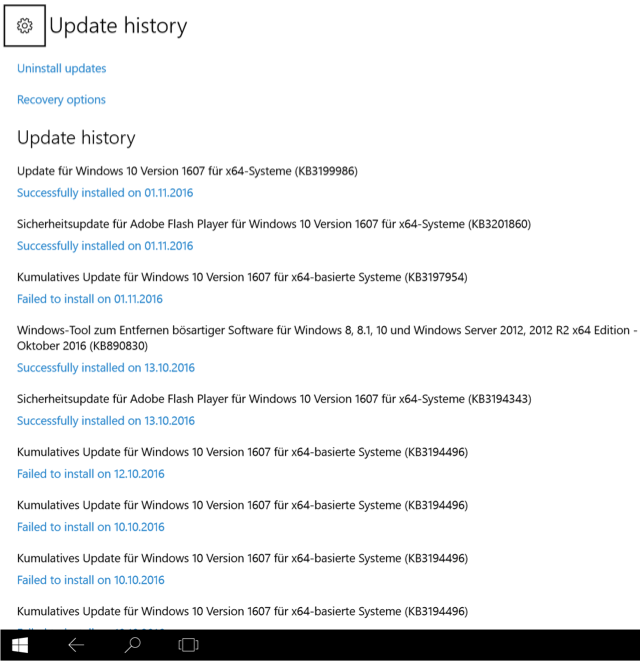
Einen habe ich noch für das Pauschalurteil, dass Apple jetzt aber wirklich gegen Microsoft sowas von verloren hat. Das Update-Protokoll meines Microsoft Surface:

ZZ7A87A2A6

04 Nov 21:10

Ohrn Image — Public Art

by Ken Ohrn

Just off Robson on Bidwell.  Created and painted by Bonnie Ackland, 2004.

davie-cardero

Sponsored by West End Paint and Hardware; paints provided by Pittsburgh Paints.


04 Nov 21:10

Fivethirtyeight.com reveals the whole election in one gutsy graphic

by Josh Bernoff

This is a puzzling election to understand, with unconventional candidates, unusual voting patterns, and hundreds of fluctuating polls. One site does the best at tracking the race (as opposed to the candidates and issues): Nate Silver’s fivethirtyeight.com. And one very strange graphic on that site shows exactly what’s happening, what matters, and what’s changing. Here … Continued

The post Fivethirtyeight.com reveals the whole election in one gutsy graphic appeared first on without bullshit.

04 Nov 21:10

Slack is afraid

by Volker Weber
Dear Microsoft,

Wow. Big news! Congratulations on today’s announcements. We’re genuinely excited to have some competition.

Not of IBM, though.

More >

04 Nov 21:10

“The Single Worst Bottleneck in the Province”

by Sandy James Planner

00-gill-protest-signs-03jpg-350x263

Well, where would that be? If you are Minister Todd Stone and you are writing a letter to The Richmond News published October 25 in response to the  potential twinning of the Massey Tunnel under the Fraser River, it IS the Massey Tunnel.

Answering a query to the 2006 Gateway Program Definition Report that identified a longer-term plan to twin the George Massey Tunnel,  Minister Stone responds: “Twinning the tunnel in this context was not an endorsement of the construction of a new tunnel, but rather the report promoted the need to increase the capacity of this vital crossing.”

“There is no doubt amongst anyone who must pass through the current tunnel that a change is necessary. The George Massey Tunnel represents the single worst bottleneck in the province. Over the last 10 years, the ministry has engaged in detailed technical analysis and broad consultation on a number of options that will ensure the smoother movements of people and goods along this important corridor.”

And here is the best part of the letter:  “The new bridge will be 10 lanes wide, benefitting both drivers and transit users with increased reliability and reduced transit travel time. The new bridge design includes dedicated transit/HOV lanes to ensure reliable transit service, and will be built to accommodate future rapid transit service. It will also have added access for cyclists and pedestrians. This free-flowing bridge is expected to reduce GHGs by about 13,000 tonnes a year, a 70 per cent reduction from current conditions at the tunnel, and save most commuters 30 minutes a day.”

Now that is news to me that pedestrians will be walking across the proposed Massey Bridge. I don’t know where they will be walking to or from. I expect the tonnes of GHG reduction must be from the Province’s estimation of vehicles idling, which of course could also be solved by tunnel twinning. And of course free-flowing refers to traffic ON the bridge, not the bottlenecks that will  occur off the bridge.

Not only does Minister Stone say that a new tunnel would be more expensive than a bridge, he notes a tunnel “ also carry significantly more construction risks and would have a greater impact on the environment, private property, agricultural land, and the Fraser River. The George Massey Tunnel Replacement Project is subject to British Columbia’s world class environmental assessment process that incorporates the feedback from several federal agencies, including the Canadian Environment Assessment Agency, Environment and Climate Change Canada and Transport Canada, into their final decision. And let me be clear — there are no plans to dredge the Fraser River.”

Minister Stone notes that the new bridge will survive a one in 2,475 seismic earthquake event, and that public feedback on the project has been “instrumental” and the project “will continue to incorporate local advice”.

The full statement can be read here.

cfjc-toddstone


04 Nov 21:09

World of Light – an interactive feedback map

by Alex Bate

Using a self-written API, Joshua Krosenbrink gifted the new Usabilla office with the World of Light, a 426 RGB LED-powered map of the world.

World of Light

The API pushes user location information to a Raspberry Pi, animating the LEDs in real time to respond to website feedback as and when it’s received by the company.

World of Light

Nice LED wall I built with 426 RGB LEDs and a Raspberry Pi with WIFI. Renders live user feedback that comes in from all over the world by pulling data from the public API. A ‘little’ present for in the new office.

Joshua spent a decent amount of time using a CNC machine to drill the 426 holes needed, while distributing 30 amps of power to produce the beautiful effect. 

World of Light Map

More photos of the build can be found at the project’s Hackaday page. While we figure out what we could use this map for at Pi Towers, why not tell us how you would use one in the comments below?

The post World of Light – an interactive feedback map appeared first on Raspberry Pi.

04 Nov 21:09

The Guns At Last Light

The concluding volume of Rick Atkinson’s biography of the US Army in the Second World War shares many of the strengths of its predecessors: generosity, vision, and expanse. This volume covers the campaign from Normandy to Berlin, a story now so familiar and so heavily fictionalized that some historical episodes, such as Patton’s ill-fated and ill-advised effort to rescue his captured son-in-law, Lt. Col. John Knight Waters, are confusing to read because we know the fiction so well.

What made the first book, An Army At Dawn, so compelling was that it saw the flaws and errors of the new American army so clearly, and described them so well. There’s less of that here, in part because it’s hard to see problems in the glare of victory. When an army is losing narrowly, the blunders and missed opportunities are clear. When it’s winning, no one notices lapses in training and attention.

One thing that’s getting hard to appreciate is the scale of logistics in WW2, all managed without calculators or computers. The Army was running a supply operation with 800,000 SKUs, all shipped overseas at enormous expense, and any of which might be urgently needed almost anywhere. Sorting this out would have been hard enough if there hadn’t been a war on; the story of this success is less fun than it might have been because the leadership of the supply operation was unpleasant and a good deal of the day-to-day operations were, perhaps inevitably, corrupt.

04 Nov 21:09

Microsoft Teams

by Volker Weber

Today, at an event in New York City, we announced Microsoft Teams—the new chat-based workspace in Office 365. Microsoft Teams is an entirely new experience that brings together people, conversations and content—along with the tools that teams need—so they can easily collaborate to achieve more. It’s naturally integrated with the familiar Office applications and is built from the ground up on the Office 365 global, secure cloud. Starting today, Microsoft Teams is available in preview in 181 countries and in 18 languages to commercial customers with Office 365 Enterprise or Business plans, with general availability expected in the first quarter of 2017.

And this is how Microsoft kills. They are just adding it to their existing plans Business Essentials, Business Premium, and Enterprise E1, E3, (E4) and E5.

More >

04 Nov 21:09

Bullshit is there for a reason

As Professor Harry G. Frankfurt once wrote,

One of the most salient features of our culture is that there is so much bullshit.

Bob Hoffman points out that this is especially true in keynote speeches about online advertising. But all that bullshit is there for a reason. What would happen if you took the bogus scientification and marketing-speak out of the Thought Leader Insights? You'd get something more like these.

  • You don't need to make creative advertising because a machine, or some random person on Amazon Mechanical Turk, can generate a bunch of ads until something sticks.

  • Third-party tracking lets you reach high-value users for less money on low-value sites, because CTOs and minivan buyers regularly visit che3p-viagra.biz and watch the videos all the way through.

  • Fraud isn't a problem because code monkeys in an open-plan monkey house, reporting to douchebags and working for point squat percent of a company in four years, are smart enough to out-hack a fraud developer who is working on his own time, for 100% of the gain, in 30 days.

  • If you just educate users about how web ads work, they'll be happy to let sites they've never heard of excrete untested combinations of code onto the computers and devices where they keep stuff they care about.

None of those will fly in their bare form, but load them up with a bunch of "customer journey" and "deep learning" and now you've got a keynote.

So there may be perfectly good reasons why you might want to apply a substantial layer of bullshit to what you're doing. If so, carry on.

But what if you have a real problem?

  • The web is still a terrible place to build brands.

  • Web advertising is still low-value enough that it won't sustain high-reputation publications when print revenue goes away.

  • Third-party crap is still a security risk.

Then you need an alternative to bullshit, so go read more about getting Bob to speak at your event.

04 Nov 21:08

Two Centuries of Population, Animated

by Nathan Yau

Population density

A visual history of a growing United States. Read More

03 Nov 20:45

Six strategies for Canadian universities to foster innovation

files/images/feature-danBreznitz-300.jpg


Moira MacDonald, University Affairs, Nov 05, 2016


This is a set of six short articles that overall represent an industry-driven approach to support for innovation in universities "by being willing to work with industry as partners and having our researchers work closely to solve key industry issues, rather than looking for places where university discoveries can be plugged in." From where I sit, this may (may) support innovation, but it puts the brakes on disruption and transformation. In a certain sense it represents a diversion of effort and resources toward incumbents and away from new ideas and businesses that would genuinely move us forward. This has been my experience with the policy over the last several years. Yes, this document deserves deeper discussion and criticism. But in my mind it represents a failed innovation policy.

[Link] [Comment]
03 Nov 20:43

Recommended on Medium: Dear Microsoft,

Wow. Big news! Congratulations on today’s announcements. We’re genuinely excited to have some competition.

We realized a few years ago that the value of switching to Slack was so obvious and the advantages so overwhelming that every business would be using Slack, or “something just like it,” within the decade. It’s validating to see you’ve come around to the same way of thinking. And even though — being honest here — it’s a little scary, we know it will bring a better future forward faster.

However, all this is harder than it looks. So, as you set out to build “something just like it,” we want to give you some friendly advice.

First, and most importantly, it’s not the features that matter. You’re not going to create something people really love by making a big list of Slack’s features and simply checking those boxes. The revolution that has led to millions of people flocking to Slack has been, and continues to be, driven by something much deeper.

Building a product that allows for significant improvements in how people communicate requires a degree of thoughtfulness and craftsmanship that is not common in the development of enterprise software. How far you go in helping companies truly transform to take advantage of this shift in working is even more important than the individual software features you are duplicating.

Communication is hard, yet it is the most fundamental thing we do as human beings. We’ve spent tens of thousands of hours talking to customers and adapting Slack to find the grooves that match all those human quirks. The internal transparency and sense of shared purpose that Slack-using teams discover is not an accident. Tiny details make big differences.

Second, an open platform is essential. Communication is just one part of what humans do on the job. The modern knowledge worker relies on dozens of different products for their daily work, and that number is constantly expanding. These critical business processes and workflows demand the best tools, regardless of vendor.

That’s why we work so hard to find elegant and creative ways to weave third-party software workflows right into Slack. And that’s why there are 750 apps in the Slack App Directory for everything from marketing automation, customer support, and analytics, to project management, CRM, and developer tools. Together with the thousands of applications developed by customers, more than six million apps have been installed on Slack teams so far.

We are deeply committed to making our customers’ experience of their existing tools even better, no matter who makes them. We know that playing nice with others isn’t exactly your MO, but if you can’t offer people an open platform that brings everything together into one place and makes their lives dramatically simpler, it’s just not going to work.

Third, you’ve got to do this with love. You’ll need to take a radically different approach to supporting and partnering with customers to help them adjust to new and better ways of working.

When we push a same-day fix in response to a customer’s tweet, agonize over the best way to slip some humor into release notes, run design sprints with other software vendors to ensure our products work together seamlessly, or achieve a 100-minute average turnaround time for a thoughtful, human response to each support inquiry, that’s not “going above and beyond.” It’s not “us being clever.” That’s how we do. That’s who we are.

We love our work, and when we say our mission is to make people’s working lives simpler, more pleasant, and more productive, we’re not simply mouthing the words. If you want customers to switch to your product, you’re going to have to match our commitment to their success and take the same amount of delight in their happiness.

One final point: Slack is here to stay. We are where work happens for millions of people around the world.

You can see Slack at work in nearly every newsroom and every technology company across the country. Slack powers the businesses of architects and filmmakers and construction material manufacturers and lawyers and creative agencies and research labs. It’s the only tool preferred by both late night comedy writers and risk & compliance officers. It is in some of the world’s largest enterprises as well as tens of thousands of businesses on the main streets of towns and cities all over the planet. And we’re just getting started.

So welcome, Microsoft, to the revolution. We’re glad you’re going to be helping us define this new product category. We admire many of your achievements and know you’ll be a worthy competitor. We’re sure you’re going to come up with a couple of new ideas on your own too. And we’ll be right there, ready.

— Your friends at Slack


Dear Microsoft, was originally published in Several People Are Typing — The Official Slack Blog on Medium, where people are continuing the conversation by highlighting and responding to this story.

03 Nov 20:26

Shaw adds almost 40,000 wireless subscribers in Q4 2016

by Igor Bonifacic

Shaw announced its Q4 2016 and year-end results on Wednesday morning, posting strong wireless results.

Revenue for the quarter hit $1.3 billion CAD, an increase of 15.5 percent over the same period last year. Meanwhile, year-to-date revenue climbed to $4.9 billion, a year-on-year increase of 8.9 percent.

Revenue derived specifically from Wind Mobile, the company’s recently acquired wireless division, hit $148 million, a 12 percent increase from its first quarter under Shaw’s wing. Wind Mobile was able to add 39,819 subscribers during the quarter, 27,031 of whom were postpaid customers. All told, the company now has 1,043,288 total subscribers. Wind announced it had acquired its 1 millionth subscriber back in May.

Average revenue per user (ARPU) climbed by 3 percent from the previous quarter to $37.40 thanks to higher handset revenue.

“Fiscal 2016 marks a very deliberate pivot in the strategic direction for Shaw towards long-term, sustainable growth. This exciting new era builds on our wireline network advantage and extends our position into wireless and an enhanced connectivity company, delivering significant value to both our customers and our shareholders,” said the company’s CEO Brad Shaw in a statement.

“Strong execution in fiscal 2016 resulted in solid financial results through this period of significant change. Our growth segments, comprised of Wireless, Business Network Services and Business Infrastructure Services, will continue to play a key role as we work towards building a stronger future for Shaw that drives long-term growth for all stakeholders.”

Net income for the quarter was $154 million. That’s actually a decrease from the $276 million net income Shaw reported this same time last year. In 2015, Shaw sold wireless spectrum it had acquired in a previous Industry Canada wireless auction to Rogers, which helped boost its fiscal results that quarter. That said, net income for the year hit $1.2 billion, a significant increase from the $880 million, thanks in large part to the $2.65 billion sale of Shaw Media to Corus Entertainment.

Shaw says it expects to record an operating income between $2.125 billion and $2.175 billion in fiscal 2017.

SourceShaw
03 Nov 20:26

Slack attacks Microsoft’s Teams app in full page New York Times ad

by Patrick O'Rourke

The battle of workplace messaging apps is set to begin today now that Microsoft has launcheed its Teams app, though it seems Slack, the service’s main competitor, has made a preemptive strike in the form of a scathing full page ad in the New York Times.

The ad, which was also posted to Slack’s official blog, features excerpts like, “Wow. Big news! Congratulations on today’s announcements. We’re genuinely excited to have some competition,” and “First, and most importantly, it’s not the features that matter… The revolution that has led to millions of people flocking to Slack has been, and continues to be, driven by something much deeper.”

In the post, Slack emphasizes that an “open platform is essential” and that features are not what has made Slack popular, explaining that “making a big list of slack’s features and simply checking those boxes,” is not enough to build a viable Slack competitor.

Slack, co-founded by Canadian Stewart Butterfield, along with Eric Costello, Cal Henderson, and Serguei Mourachov, started life as an internal communication tool designed to be a chat interface for the company’s now defunct online multiplayer game called Glitch. Butterfield is also the co-founder of Flickr.

At one point, Microsoft reportedly considered an $8 billion bid for Slack, though the company decided to develop its own version of Slack’s concept, a program that eventually evolved into Teams.

It’s expected that Microsoft will reveal its new Teams platform at its Microsoft Office Event later today.

SourceSlack
03 Nov 20:26

Netflix still reportedly plans to launch the ability to download movies and TV shows

by Patrick O'Rourke

Netflix boss Ted Sarandos told CNBC on Wednesday that his company is still “looking at” a way for users to download Netflix television shows and movies for offline viewing.

It’s likely that the feature won’t roll out in the U.S. and Canada first and instead will launch in a region where having a download button would be more useful, particularly countries with spotty internet access.

“Now as we’ve launched in more territories … They all have different levels of broadband speeds and Wi-Fi access,” said Sarandos in the interview. “So in those countries they have adapted their behaviors to be much more of a downloading culture. So in those emerging territories it starts to become a little more interesting. We still think for the developed world our thesis has been true but I think as we get into more and more (of the) undeveloped world and developing countries that we want to find alternatives for people to use Netflix easily.”

The ability to download content rather than just streaming fundamentally changes the type of licensing agreements the Netflix is able to sign with distributors and rights holders. It’s likely that at least at the outset when the feature launches, the only content that will be able to be streamed from the service will be Netflix originals.

SourceCNBC
03 Nov 20:26

LastPass is now free to use on mobile devices

by Igor Bonifacic

In a welcome bit of news, LastPass users no need to longer to subscribe to the platform’s ‘Premium’ tier to sync their passwords across desktop and mobile. Moving forward, the app’s syncing functionality, the feature that makes password managers like LastPass so useful, is free to all users.

Previously, LastPass was to free to use on desktop, but users had to pay $1 USD per month if they wanted to sync their passwords on a smartphone or tablet.

Unlike Instapaper, which made all of its paid features free yesterday, LastPass will continue to offer a ‘Premium’ tier to users. The service will continue to cost $1 per month and will grant users access to priority tech support and family sharing features.

“By offering LastPass for free across all your devices, we’re making it that much easier for everyone to make good password habits the norm. Because when you have a password manager that goes everywhere you do, you have a strong foundation for securing and taking control of your identity,” said LastPass founder Joe Siegrist in the blog post accompanying the announcement.

LastPass was acquired by LogMeIn in 2015.

SourceLastPass
02 Nov 17:37

Your Brands and Lovers

by Alana Massey

At the peak of the hunt, there were seven dark-gray sofas under consideration. To the average person, they are likely indistinguishable. But who wants to be average? As I toggled between tabs, returning again and again to the web pages where I found these sofas, a few key variables became discernible. Are iron legs more attractive than wooden ones? How many people can fit comfortably on 82 inches of length? Is 90 inches excessive? Does a straight back look more or less authentically “midcentury” than a modestly curved edge? Why don’t “charcoal” gray or “gravel” gray resemble their namesakes? Why would I want them to?

Where I was once either ambivalent about or annoyed at the tedium of furniture selection, I have recently found the turmoil of this process thrilling, thanks to the source of my impulse to buy a gray sofa in the first place: Instagram advertisements.

While I engage with Twitter ads primarily to mock them and get entertainment from Facebook ads mainly through learning who among my friends has actually bothered to like which brands, I have clicked Instagram ads and been carried onto e-commerce platforms not just willingly but eagerly. The ads don’t just appeal to my existing consumer interests; they anticipate latent ones. I find myself suddenly adorned in Russian designer fashion and interested in rings when I’ve almost always been a necklace-only stalwart. And I am suddenly interested in furniture.

Instagram’s emphasis on visual immediacy lets advertisers replicate print, while appearance beside friends’ similarly aspirational images legitimates the ads as socially relevant

The first furniture ad I recall seeing was from the brand Article (called Bryght when I first encountered it). Then came Joybird. Then AllModern. Then Lulu and Georgia. I probably saw many more before I started consciously noticing, but my grooming to enjoy these ads in my feed specifically began even further back, in the white walls and reclaimed wood dining tables and bookshelves held together by industrial piping made familiar from friend accounts. Brand images of tasteful furniture and plant-based meals delicately garnished in clay bowls blend seamlessly with my friend Alanna’s photos from a charming Airbnb in Montreal and the calculated eclecticism of hotel interiors that my friend Britt is always finding herself in. When these motifs were combined with the only slightly better framing and texture of commercial photography, what was a passive appreciation for a slightly glammed up version of the minimalist aesthetic popularized by Kinfolk soon transformed into an active disdain for my own home furnishings. The brown sectional sofa from IKEA that I rarely considered with anything but neutral observation became loathsome. It was no use vacuuming it and removing the stray threads and fibers. I had seen how green (or in this case, gray) it could be on the other side of the fence.

On Instagram, the advertising is starting to replicate the look of our friends’ feeds, and it works. “It’s as if an algorithm digested everyone I follow and spat out a robotic approximation of the overall aesthetic,” Kyle Chayka observes in the Atlantic. “The convergence shows that users are gaining influence over brands rather than vice versa. On social media, we’re dictating what aspiration looks like.” We have essentially been sitting on Instagram conducting years-long focus groups on what we like to see, in what filters we like to see it in, at what times of day we like to have a look. Now brands are ready to deploy our own tastes onto our feeds with more intentions to please us than our friends have. To Instagram’s advertisers, our accounts have become little more than mood boards from which to gather their next ad materials.

I am perhaps more shameless in my gleeful aspirations to better living through clothes and furniture than others. But I am not alone in enjoying the seamless integration of ads on Instagram. As Michael Griffin, a digital marketing director, points out, “the internet is awash in shitty banner ads and weird spammy garbage ads. On Instagram, there is nothing low-quality and everything is well targeted.” Nir Eyal, who studies consumer psychology and behavioral design, argues that “nobody likes television commercials because they’re interruptive.”

On Instagram, the line between editorial and advertising blurs most beautifully, and it makes for an ideal advertising platform. Instagram’s emphasis on visual immediacy lets advertisers replicate print advertising’s existing formula of a striking, quickly consumable visual focal points, while their appearance beside friends’ similarly aspirational images legitimates them as socially relevant.

As to the potency of this combination, two cases in point from my childhood stand out. The first is this 1995 Calvin Klein campaign shot by Steven Meisel in what looks like a 1970s trailer, in which Kate Moss and a horde of barely-legal-looking models appear on the brink of their first amateur porn shoot. The jeans are the only things for sale, but what’s doing the selling is the spaces between a model’s parted lips and the moment Meisel stopped shooting, their pouts pointing toward an imminent and salacious initiation into their sex gang. The overall effect made them the young authors of their own exploitation. They were friends who would get you killed but who would make you feel so beautiful first. The second was an ad for Clinique’s Happy perfume that I kept taped inside my locker for years. It features a football player and a cheerleader, both mugging with their teeth, flanking a lithe, gently smiling brunette in a delicate party dress holding a giant, ornate cake. Scrawled across this tableau are the words “Make someone happy.” Perfume is invisible, but the fantasy of being a thin girl bearing cake is not exactly veiled in its signifieds (though the layers that my friends and I on the pro-ana forums of our day gave to this ad were a step beyond).

We do not see the Joneses of Instagram and lament that we cannot become them, but that with the right waist trainer and contouring makeup tutorial, we absolutely could

Unbeknownst to us, even before the platform had ads, Instagram users were grooming one another for a flood of commercial activity. Some might comment on a friend’s post, “Oh my God, where did you get that?” if they were sufficiently thirsty. Others would acknowledge desire but remand it to cutesy internet speak, noting simply: “want.” Some posters were generous and used the @-handle of the brand they showed. Others replied with charming anecdotes of finding the item in a vintage shop, in another galaxy, in a dream they had, making any attempt at replication seem futile. The worst sort of Instagram user would withhold reply, hoarding what was likely an entirely pedestrian vintage find like a deluded digital Rumpelstiltskin.

Even as I rolled my eyes at those who thought they were the second coming of Chloë Sevigny circa 1994, I found myself more readily wanting to experiment with design and cuisine. I spent a lot of time online wondering if that time would be better spent learning to crochet scarves, make crème brûlée with my own mini-torch, or organizing my bookshelf by the color of the book spines. A lot of it looked beautiful and some of it even looked kind of fun, despite my longstanding hatred for textile crafts and baking.

In his 1928 treatise Propaganda, Edward Bernays explained how he sold pianos effectively on behalf of a client not by promoting the superior qualities of these particular pianos to prospective piano buyers but by suggesting to all readers that of course every American household contained a music room. And you couldn’t very well have a music room without a piano in it. It was a variation on what we now call “FOMO” — fear of missing out. The response to FOMO that involves buying the newer and flashier version of what we fear missing out on is still called keeping up with the Joneses, despite the phrase conjuring an image of a more Clark Griswold-ian suburban figure than a Kardashian disciple. (Few of us seem to care or notice that someone we don’t know actually invented the Joneses.)

But FOMO is not strictly a matter of exclusion and competition; it is also a fear of failing to live up to our own ideals of selves as social creatures. Many experience FOMO not about parties they weren’t invited to but ones they opted not to attend. We do not necessarily see one of the Joneses (or the Kardashians, or Hadids, or what-have-yous) on Instagram and lament that we cannot ever become them; we regret that we’ve squandered time when there is a very real possibility that with the right waist trainer, dieter’s tea, and contouring makeup tutorial, we absolutely could become them. That’s the fantasy, anyway: not that the Kardashians were ever ordinary like us but that the right combination of consumer elixirs and photobombs of actually famous people elevated them to their present status.

Since no group is more hyper-attuned to the pitfalls of social media than its threatened media ancestors, it was no surprise that the New York Times was quick to prophesize doom via Instagram envy.” This pox promised to undermine the otherwise hardy, bulletproof self-esteem of young women with data plans and basic cognition skills the world over and to no doubt kill countless teens in its wake. As evidence, the piece provided quotes from several Instagram users suffering from envy of the vacations and recipes and outfits on their feeds. One 26-year-old woman who went by the handle “likewantneed” talked about the intensity of her desire to be in Paris after seeing an Instagram photo of an especially compelling table setting there: “You’re searching through your feed and a picture will hit you, like that Paris shot. It’s just so perfect. You just think, ‘I want that, I want that life.’ ”

But calling something a source of envy is just a negative way to describe a source of desire and, sometimes, ambition. It ignores how exhilarating it can feel to covet a life framed in compelling images. The ache is aspirational. I looked up likewantneed’s Instagram account now: Her bio lists her as a “part-time Parisienne.”


The prevailing myth about the envy conjured by Instagram is that what we see there is beyond our reach, cordoned off by prohibitive costs or ceremonial but still functional exclusivity. But with 500 million users as of June 2016, it would be a losing prospect indeed to flood Instagram with goods that were overwhelmingly out of reach to most users. And so trickling onto our feeds come the kinds of goods that point not to a tax bracket but to a level of taste, one our friends already aim for but don’t sell to us directly.

Yes, I am interested in looking at and affirming my friends’ lifestyle aesthetics. But I am more selfishly interested in enhancing my own. I seek actionable content. That is what Instagram ads provide. A photo of a friend’s tastefully appointed apartment or their vacation to Majorca prompt jealousy that has no clearly apparent remedy — all the approving heart-eyes emojis in the world aren’t going to win you your friend’s antique armoire. In fact, liking things too much can give one or both parties a sense that the other is obsessing over them, whether their behavior constitutes “obsession” or not.

Trickling onto our feeds come the kinds of goods our friends already aim for but don’t sell to us directly. Instagram ads now say: “Your friend, but better because it’s yours

Well-crafted ads that accurately mirror the aesthetics of our friends induce a similar desire for furniture and bargain airline tickets but do not observe the “Look, but don’t touch” rule that governs personal accounts. Instead, the “Shop Now” button functions as a valve that makes the coveted into the consumable within seconds. As of this November, users can tap a button and the name and price of items in the photo will appear on top of them, looking very much like the way friends’ account handles appear when they are tagged in photos. Friends would not surrender the objects, apartments, or experiences they post to Instagram so casually. You don’t have to be that Rumpelstiltskin type not to want to part with a precious embroidered jacket or proper Danish armchair. Our friends’ photos say, “Behold this thing and revel in the fact that it is mine.” Advertising images from brands say, “Look at this thing, how glorious that it can soon be yours.” As Instagram ads have begun to blend more and more seamlessly into a feed once dominated by friends, the substance of their pitch has shifted similarly: Before the ads said, “You, but better.” Now it’s “Your friend, but better because it’s yours.”

Brands function more optimally than our friends. We continue to engage our friends on Instagram, of course, if we aren’t monsters, and because we do like the way the quilt is coming along, but brands would never do the feed-cluttering photo dumps from vacations that our friends might. Brands wouldn’t post virtually indistinguishable selfies every day without at least doing us the courtesy of saying which makeup products they’re wearing.

Eyal says that Instagram will likely go beyond replicating the aesthetics of the things already on our feeds. It can adjust the ads it serves to the way we behave in our own feeds, determining how many ads we will tolerate, how long we’ll look at them, and adjust the ratio accordingly. In an effort to uplift spirits and reconnect mine, I have made a concerted effort to like Instagram photos of strangers, of every selfie I see, and of every landscape to see if my advertising load adjusts accordingly. I briefly attempted to use the “Hide This” feature, but it is even more effort than “Shop Now,” and I don’t think that’s by accident. Besides, I would rather see if I can game the maze of furniture and fashion rather than X my way out

The dark gray sofa I eventually bought came from Overstock.com — an e-commerce platform I hadn’t used in years but was reintroduced to by an Instagram ad. I placed the sofa in the living room that I painted white like so many effortlessly elegant interiors I’d seen on Instagram. I bought the sofa almost immediately after moving from Brooklyn to a farmhouse in the Catskills, a hundred miles from all my friends.

My own Instagram feed has never been more alight with activity. I post images of myself in a new folk-inspired frock, or a recently decorated room. I have never had more friends interested in coming to my home. I summon more objects, furniture, and other decorative flourishes. I am not so naive as to think I found them as much as they found me.


02 Nov 17:24

The Director of Android Security Says Pixel and iPhone Offer The Same Level of Security

by Rajesh Pandey
It is widely that Android as an OS and platform is simply not as secure as iOS. While Google has made some great strides in this area over the last couple of years, ask any average joe and they will still believe that iOS is more secure than Android. Now, in a short interview with Motherboard after delivering a speech at a security conference in Manhattan, Adrian Ludwig, the director of security at Android, said that both Android and iOS are on the same level when it comes to security. Continue reading →
02 Nov 17:23

Phil Schiller Discusses the MacBook Pro

by John Voorhees

Apple Senior Vice President of Worldwide Marketing, Phil Schiller, sat down for an interview with The Independent after the October 27th Apple event to discuss the new MacBook Pro. Schiller and David Phelan of The Independent discussed a wide range of MacBook-related topics, including the evolution of Apple’s laptop lineup, why there is no touchscreen MacBook, and Siri on the Mac. What interested me most of all though, was Phelan’s two follow-up questions posed after the initial interview:

How would you describe the response to the new MacBook Pro?

There has certainly been a lot of passionate dialogue and debate about the new MacBook Pro! Many things have impressed people about it, and some have caused some controversy. I hope everyone gets a chance to try it for themselves and see how great the MacBook Pro is. It is a really big step forward and an example of how much we continue to invest in the Mac. We love the Mac and are as committed to it, in both desktops and notebooks, as we ever have been.

And we are proud to tell you that so far our online store has had more orders for the new MacBook Pro than any other pro notebook before. So there certainly are a lot of people as excited as we are about it.

Are you surprised by how vocal the critics have been?

To be fair it has been a bit of a surprise to me. But then, it shouldn’t be. I have never seen a great new Apple product that didn’t have its share of early criticism and debate — and that’s cool. We took a bold risk, and of course with every step forward there is also some change to deal with. Our customers are so passionate, which is amazing.

We care about what they love and what they are worried about. And it's our job to help people through these changes. We know we made good decisions about what to build into the new MacBook Pro and that the result is the best notebook ever made, but it might not be right for everyone on day one. That’s okay, some people felt that way about the first iMac and that turned out pretty good.

Schiller’s message is clear. Apple took a risk with its new MacBook Pros, is confident in its decision, is committed to both desktops and laptops, and cares about its critics’ concerns. That said, by emphasizing that the MacBook Pro has had record online sales, Schiller is also suggesting that the MacBook Pro’s critics are a vocal minority.

→ Source: independent.co.uk

02 Nov 17:23

New ICANN Policy Changes Coming December 1, 2016

by James Koole

Starting December 1, 2016, the organization that oversees the domain name system (known as the Internet Corporation for Assigned Names and Numbers or ICANN for short) is implementing some new rules that will change how updating certain WHOIS contacts on your domain names will work.

In short, ICANN is creating a new “trade” system that will come into effect whenever either a registrant, or someone acting on their behalf, makes a change to the name, organization or email address for the owner contact of a generic top-level domain like .com, .net, .photography or .xyz. Some country-code domains like .uk already have a similar trade concept in place but this new ICANN policy only applies to generic top-level domains.

Is it a trade, or not a trade?

ICANN considers any change of the owner contact name, organization or email address to be a trade, or transfer of the ownership of the domain between the two parties. That means that it is a “trade” in ICANN’s eyes even if the change doesn’t actually cause the domain to change hands.

For example, if you update the spelling of your first name (i.e. change from Kate to Kathryn) or change your owner contact email from one email address you use to another (i.e. from kate.customer@hotmail.com to a new custom domain email address like kate@katecustomer.com), ICANN sees that as a trade between two people even though they are both you.

Of course, if you actually change ownership of the domain via a contact change, the trade rule also applies. Changing the name from Larry Smith to Sarah Jones or the email contact from larrysmith@yahoo.com to sjones@gmail.com is clearly a trade of the domain between two parties and would trigger the policy.

More Security, and a Little Bit More Complexity

At its core, the goal of this update to ICANN’s Inter-Registrar Transfer Policy (IRTP), is to add an additional level of security to domain name ownership and also to provide more information to domain registrants around contact updates.

We’ve been tracking the progress of ICANN’s Transfer Policy Change Working Group as they’ve developed the new policy over last couple of years (seriously…it takes that long). As you would expect from Hover, we’re going to take that policy and implement it fully, and in a way that is as registrant-friendly as possible.

In other words, we’re attempting to maximize the positive benefits of the policy while keeping the added complexity to a minimum.

Emails and Transfer Locks

In terms of the impact on our customers, it boils down to a couple of things:

  1. The policy requires us to provide some additional communication, via email, when the owner contact is changed. Specifically, it says we need to tell both the old and the new contact that the change has been made. There is no provision that would allow either party to opt-out of getting that communication and both contacts will get an email, even if that’s two emails sent to the same person.
  2. The policy allows for (but does not require) the application of a 60-day transfer lock on a domain where the owner contact is updated. That 60-day transfer lock is the same one that is applied when a domain is transferred between registrars (like from from Go Daddy to Hover) and it prevents a domain from bouncing from one registrar to another, to another in a short period of time. It’s not the same as the lock you can toggle on your domain within the Hover control panel and the policy says it’s up to the registrant to say they don’t want the domain locked if that’s their preference.

Hover’s Take

We generally like the idea of the emails. Sending an email out to the old contact and also the new contact to let them know a change is being made represents a nice bit of additional security that could alert a domain registrant in the unlikely event that someone makes a change without their approval. It does mean that registrants will get a couple more emails that they can’t opt out of, but over all, we think it’s a positive addition.

The 60-day lock also seems like a decent idea at first glance. But we also know from our experience in helping tens of thousands of registrants transfer domains in and out of Hover over the years that a lot of registrants update one or more of those contacts just prior to starting a transfer of their domain from one registrar to another. While some registrars will (and in some cases already do) see the addition of that 60-day transfer lock as a good opportunity to “save” their customer from transferring away, the policy allows registrants the option to skip the lock if they wish and so we’ll put full control of whether that optional lock is applied in the hands of the registrant where it belongs.

We’ll provide more information on exactly what the IRTP policy will mean to you as it relates to managing your domains at Hover in the coming weeks.

02 Nov 14:37

Twitter Favorites: [neil21] What does this even mean? All citizens must march alone and in step scanning the horizon like a radar? "Distraction… https://t.co/HcTqxo29fm

neil21 @neil21
What does this even mean? All citizens must march alone and in step scanning the horizon like a radar? "Distraction… twitter.com/i/web/status/7…
02 Nov 14:37

Twitter Favorites: [Pinboard] For the record, I think @bthdonohue is a solid guy and means what he says about Instapaper. I just don’t trust his new masters one bit

Pinboard @Pinboard
For the record, I think @bthdonohue is a solid guy and means what he says about Instapaper. I just don’t trust his new masters one bit
02 Nov 14:37

Twitter Favorites: [tomhawthorn] World Series is more than a century old. You never know when you're going to see something never done before. https://t.co/pVuhV6sDRK

Tom Hawthorn @tomhawthorn
World Series is more than a century old. You never know when you're going to see something never done before. twitter.com/jaysonst/statu…
02 Nov 14:37

Twitter Favorites: [bmann] Now @berniedotai “personal matchmaker AI who understands your type, & finds them on your favorite dating networks” https://t.co/XVAkGme9pc

Boris Mann @bmann
Now @berniedotai “personal matchmaker AI who understands your type, & finds them on your favorite dating networks” Bernie.ai
02 Nov 14:37

NewsBlur Blurblog: kottke.org memberships

sillygwailo shared this story from kottke.org.

If you are a regular reader and appreciate what I do here, please support kottke.org by purchasing an annual membership. It only takes a minute (or about 20 seconds on iOS w/ Apple Pay) and your collective support will mean a lot to the future of kottke.org. This has been in the works for a while now and I have a lot to say about it, but go check it out first, subscribe, and then come back. I’ll wait.

All set? Ok. A couple of recent catalysts have set this into motion, but I’ve been thinking about it for the last few years. So here’s why I feel this is necessary now, in four interconnected main points.

Focus on dedicated readers. Anyone who relies on an audience of some kind — artists, writers, businesses, etc. — has to focus on serving regulars while keeping an eye on attracting new readers/customers/users. As much as I feel that everyone in the world would enjoy reading the world’s best blog — I mean, who wouldn’t? — it’s difficult for me to take time out from writing the site to reach out to potential new readers.1 I love being a regular myself and at this point in the site’s evolution, it makes sense to focus mostly on the people who read and love the site. Part of that focus is building up the financial link between us. In an ideal world: I write for you, you pay me, I write some more. No middlemen. I’m not sure that’s an entirely feasible arrangement at this point, but we can get part of the way there and work on the rest.

Revisiting an old idea. Some of you may remember that I’ve asked for support directly from readers before.2 A few months ago, I went out to lunch with Tim Urban from Wait But Why. We’d hardly said hello when he said something like “my goal for this lunch is by the end of the meal, you’ll agree to ask your readers to financially support kottke.org”. Tim was very clear that asking his readers for support on Patreon had been game-changing for his site. Project creators and potential backers have become comfortable with directly funding creative efforts online, particularly through Kickstarter & Patreon and I’m curious to see how it works for kottke.org in 2016.3

A changed media landscape. It’s been 11+ years since I quit my job to do kottke.org full-time. Online media has changed a lot since then. Hell, it’s changed a lot in the past few years. Blogs are dead — long live blogs! — and the open web is struggling. If you ask around to the creators of other established independent sites on the web (and I have talked to many of them), you’ll hear that traffic and display ad revenue have been falling for the last few years. Many factors have contributed — Facebook, readers switching to mobile, the rise of apps, social overtaking search for discovery, ad blockers, Google Reader’s shutdown, VC money flooding into online media — and smaller sites without dedicated content marketing and mobile/social development teams can’t keep up. Other strategies are necessary.

Diversification. The site currently has two main sources of revenue: advertising via The Deck & the We Work Remotely job board and affiliate income from Amazon & iTunes. In an effort to diversify revenue, I’ve tried several things — RSS sponsorships, sponsored posts for Kickstarter projects, consulting for startups, and speaking — and none of them have stuck. I’ve thought about writing a book, putting on a conference, or doing a podcast. But that all feels like it’s beside the point and not what I really want to do, which is just to write here, for you. A recent (hopefully temporary) hiccup in one of these revenue sources4 has driven home the need for not putting all my eggs in one basket. I would love for reader support to become a healthy third leg on the ol’ revenue stool.

I could go on — and in several previous drafts, boy, did I! — but here’s what it boils down to for me: I’m proud of what I’ve built here at kottke.org over the past 18 years and I’m committed to publishing here regularly and operating independently as long as I am able. Even though the site is primarily a one-person operation, I’ve never done it alone. You have always been an essential part of this site — providing me with feedback, counsel, encouragement, pushback, and many great links and ideas for posts — and I’d love your help in taking this next step. As always, thanks for reading and thanks for the support!

  1. I’ll let you in on a little secret: kottke.org is a secret. Oh, not to you, of course. But approximately no one in the world has ever heard of or read this website before. kottke.org also has this weird little problem that much bigger sites like Buzzfeed or Vox don’t have where readers assume that everyone else is reading the site and so they don’t share links or posts on Facebook or Twitter. I’ll see tweets like “I don’t usually post links to @kottke because everyone reads it, but…” It makes me tear my hair out because I can assure you from looking at my stats that is absolutely not the case. You’re not big sharers, I get it, but tweet out some links, tell a friend, etc. ♫Tomorrow there’ll be more of us!♫

  2. Back in 2005, when I first started working full-time on kottke.org, I launched a micropatron campaign that funded my activities on kottke.org for the first year and bootstrapped the site into a sustainable independent business.

  3. I’m a big believer in supporting the things you love and the people who do them. I’ve backed quite a few projects on Kickstarter, am currently supporting some of my favorite creators on Patreon (Eric Holthaus, Wait But Why, Kurzgesagt, The Nerdwriter, and Every Frame a Painting), give monthly to Wikipedia, and have previously backed Daring Fireball, Mlkshk, and probably a few others I’m forgetting.

  4. Guess which one! I’ll give you a hint: it rhymes with “bisplay madvertising”. Nothing gold can stay, folks.

Tags: kottke.org   weblogs   WWW
02 Nov 14:37

Twitter Favorites: [GreatDismal] I never block, only mute. That way, they may further utterly waste entirely unrecoverable moments of their lives

William Gibson @GreatDismal
I never block, only mute. That way, they may further utterly waste entirely unrecoverable moments of their lives
02 Nov 14:36

Mohamed, Lacavera, Natale part of Canadian company taking over New Zealand and Bolivia-based telecom

by Patrick O'Rourke

Telecom Trilogy International Partners, a company that runs telecom networks in New Zealand and Bolivia, plans to launch in Canada through an agreement by Toronto-based Alignvest Acquisition.

Trilogy is a private company founded by U.S. wireless entrepreneur John Stanton. Late Tuesday, Trilogy revealed plans to pay down its debt and create a new Toronto Stock Exchange listing that values its enterprise business at $1 billion CAD.

This transaction has Alignvest, a special purpose acquisition company (SPAC), and its backers investing $269 million USD in Trilogy to secure a 50.1 percent stake in the company. This transaction also includes cash raised when the company went public last year as well as $61 million in new capital from Alignvest management and its backers.

If the deal goes through, it’s expected that Alignvest chairman and former CEO of Rogers Communications, Nadir Mohamad, Wind Mobile’s former CEO and current president of Globalive Capital Anthony Lacavera, and Joe Natale, “proposed president” and CEO of Rogers communications and former president and CEO of Telus, will be added to Trilogy’s board of directors.

Trilogy owns 2degress and NuevaTel, the third largest telecom companies in New Zealand and Bolivia, two markets that according to The Globe And Mail, resemble the stage where Canada’s wireless industry was 10 years ago.

John Stanton, Trilogy’s current Chairman and Brad Horwitz, Trilogy’s current CEO have played a significant role in creating a number of large wireless operators, including Western Wireless, T-Mobile USA, McCaw Cellular and Clearwire.