Shared posts

04 Nov 21:08

Goodspell: Gospel Radio for the #ds106 Generation

by Reverend
Credit "Ask not what you can do for #ds106 ..." by Alan Levine

Credit “Ask not what you can do for #ds106 …” poster by Alan Levine

This past Sunday I was honored to be a guest on the very last episode of Mariana Funes and John Johnston‘s podcast the ds106 Goodspell. They have been talking in detail about 106 bullet points of ds106 that Mariana posted back in December 2013, and they have finally come to the final bullet point, 107, which was actually a comment I left on that post 3 years ago, back when I commented and made sense 🙂

Therein lies point 107 for your list: letting go. ds106 means letting it all happen with whomever wants to make it their own for whatever reason. For it to be truly great, it must contain multitudes and serve the one-off assignment, the community, as well as the random search on Google equally. ds106 is the web, just with fewer trolls 🙂

Always bizarre to re-read something you don’t remember thinking/writing, especially when you like it. Our far-ranging discussion talks about everything from the early days of ds106 to ds106 as community to ds106 as infrastructure to ds106 as socks, and then some. I love talking about ds106, and this hour and 20 minutes was no different. A special treat was talking to the other guest Ron “Daily Create extraordinaire” Leunissen, who, along with Sandy Brown Jensen, has done over 400 Daily Creates, which is truly impressive. I want to think John and Mariana for having me on their final show, but even more all they have done for the #ds106 community at large. They are two brilliant stars in the communal constellation that was, is, and always will be ds106. #4life

04 Nov 21:08

Automation Service IFTTT Announces New Functionality and Apps

by John Voorhees

A big limitation of IFTTT has been that Recipes could only execute one action. Today, IFTTT launched Applets, which can do everything that Recipes could, but more. According to the IFTTT blog:

In the past, you used IFTTT by adding Recipes, which were “if this, then that” connections between two services. Today, Recipes have evolved into Applets. Applets can do everything that Recipes could — and much more. They bring your services together, creating new experiences that you can unlock with a single switch.

The introduction of Applets includes a redesign of IFTTT.com and the combination of IFTTT’s IF and DO apps into one app called IFTTT, which can be downloaded for free on the App Store.

Applets

Applets

IFTTT is also adding tools for its partners to build services that take advantage of Applets’ multiple action and filtering capabilities and opening its partner platform to anyone with an API, which should help IFTTT add to its library of Applets quickly. Multiple action support is a big deal for IFTTT that opens up a wide array of possibilities. It will be interesting to see what integrations are built.

→ Source: ifttt.com

04 Nov 21:08

New Apple Ad: Dive

by John Voorhees

Apple introduced a quirky iPhone 7 ad on YouTube today called Dive. The ad features an older gentleman lounging by a swimming pool at what looks like a resort. As La Virgen De La Macarena begins to play, he turns up the volume, props his iPhone 7 up in a puddle of water on a table, and heads to the diving platforms. He hands his sunglasses to a girl as he climbs to the highest platform, pauses to glance down at a young woman sunbathing by the pool, and executes a perfect dive that splashes his iPhone. The spot ends with the tag line ‘stereo speakers on iPhone 7’ followed by, ‘practically magic.’ The clothing and slightly washed out colors of the video, which highlights the iPhone 7’s stereo speakers and water resistance, give it a vaguely old-fashioned, eccentric feel.

→ Source: youtu.be

04 Nov 21:08

Should Children Learn More Languages in the Future?

by admin

It is true that computers can translate all kinds of languages well, but based on this observation, if it is assumed that there is no need for our children to learn more languages other than the mother tongue, it will be a wrong approach. Despite the availability of Google translator at the tip of one’s finger for translating a foreign transcript into a readable version, there are reasons aplenty for children to learn more languages.

19

The first reason is that the Google translator or any online translator for that matter is only an alternative option for a human translator to translate a foreign transcript into a language one is familiar with. It cannot be a substitute for a human translator as these computer translators are preprogrammed to translate a language based on the rules of Grammar (Hashi, 2015). However, every language in the world has some exceptions to the rule due to which the translated result may end up with something meaningless. Besides, the nuances of a language, the metaphors and similes used cannot be tied to the rules of Grammar and hence, more often than not, the outcome of such preprogrammed translation is completely preposterous and unusable (Hashi, 2015). Therefore, if children want to read a book in Spanish, they must learn the language first as the computer translators are simply not reliable.

Secondly, relying on computer translators will not enable one to establish an interpersonal communication with foreign language speaking people. Reliance on computer translators will also not be useful for enjoying a foreign movie if the subtitle option is turned off or not available. Therefore, despite the availability of computer translators, children should be encouraged to learn as many languages as possible, because the knowledge of a number of languages helps one overcome the communication barrier with foreigners easily.

In conclusion, though technological development has made the task of translation easier through the use of computer translators, the need of learning languages remains strong because of several reasons. The computer translators are programmed based on the rules of Grammar. However, since every language goes beyond the rules of Grammar in expression of metaphors and nuances, translation achieved by using computer translators is often not accurate and reliable. Besides, in order to be able to communicate interpersonally with foreign language speaking people and enjoy foreign movies with no subtitles, one ought to learn more languages other than one’s mother tongue. Therefore, children should be encouraged to learn more languages and not to grow too dependent on computer translators.

The post Should Children Learn More Languages in the Future? appeared first on BookRiff.

04 Nov 21:08

The Best Way to Predict the Future is to Issue a Press Release

This talk was delivered at Virginia Commonwealth University today as part of a seminar co-sponsored by the Departments of English and Sociology. The slides are also available here.

Thank you very much for inviting me here to speak today. I’m particularly pleased to be speaking to those from Sociology and those from the English and those from the Media Arts departments, and I hope my talk can walk the line between and among disciplines and methods – or piss everyone off in equal measure. Either way.

This is the last public talk I’ll deliver in 2016, and I confess I am relieved (I am exhausted!) as well as honored to be here. But when I finish this talk, my work for the year isn’t done. No rest for the wicked – ever, but particularly in the freelance economy.

As I have done for the past six years, I will spend the rest of November and December publishing my review of what I deem the “Top Ed-Tech Trends” of the year. It’s an intense research project that usually tops out at about 75,000 words, written over the course of four to six weeks. I pick ten trends and themes in order to closely at the recent past, the near-term history of education technology. Because of the amount of information that is published about ed-tech – the amount of information, its irrelevance, its incoherence, its lack of context – it can be quite challenging to keep up with what is really happening in ed-tech. And just as importantly, what is not happening.

So that’s what I try to do. And I’ll boast right here – no shame in that – no one else does as in-depth or thorough job as me, certainly no one who is entirely independent from venture capital, corporate or institutional backing, or philanthropic funding. (Of course, if you look for those education technology writers who are independent from venture capital, corporate or institutional backing, or philanthropic funding, there is pretty much only me.)

The stories that I write about the “Top Ed-Tech Trends” are the antithesis of most articles you’ll see about education technology that invoke “top” and “trends.” For me, still framing my work that way – “top trends” – is a purposeful rhetorical move to shed light, to subvert, to offer a sly commentary of sorts on the shallowness of what passes as journalism, criticism, analysis. I’m not interested in making quickly thrown-together lists and bullet points. I’m not interested in publishing clickbait. I am interested nevertheless in the stories – shallow or sweeping – that we tell and spread about technology and education technology, about the future of education technology, about our technological future.

Let me be clear, I am not a futurist – even though I’m often described as “ed-tech’s Cassandra.” The tagline of my website is “the history of the future of education,” and I’m much more interested in chronicling the predictions that others make, have made about the future of education than I am writing predictions of my own.

One of my favorites: “Books will soon be obsolete in schools,” Thomas Edison said in 1913. Any day now. Any day now.

Here are a couple of more recent predictions:

“In fifty years, there will be only ten institutions in the world delivering higher education and Udacity has a shot at being one of them.” – that’s Sebastian Thrun, best known perhaps for his work at Google on the self-driving car and as a co-founder of the MOOC (massive open online course) startup Udacity. The quotation is from 2012.

And from 2013, by Harvard Business School professor, author of the book The Innovator’s Dilemma, and popularizer of the phrase “disruptive innovation,” Clayton Christensen: “In fifteen years from now, half of US universities may be in bankruptcy. In the end I’m excited to see that happen. So pray for Harvard Business School if you wouldn’t mind.”

Pray for Harvard Business School. No. I don’t think so.

Both of these predictions are fantasy. Nightmarish, yes. But fantasy. Fantasy about a future of education. It’s a powerful story, but not a prediction made based on data or modeling or quantitative research into the growing (or shrinking) higher education sector. Indeed, according to the latest statistics from the Department of Education – now granted, this is from the 2012–2013 academic year – there are 4726 degree-granting postsecondary institutions in the United States. A 46% increase since 1980. There are, according to another source (non-governmental and less reliable, I think), over 25,000 universities in the world. This number is increasing year-over-year as well. So to predict that the vast vast majority of these schools (save Harvard, of course) will go away in the next decade or so or that they’ll be bankrupt or replaced by Silicon Valley’s version of online training is simply wishful thinking – dangerous, wishful thinking from two prominent figures who will benefit greatly if this particular fantasy comes true (and not just because they’ll get to claim that they predicted this future).

Here’s my “take home” point: if you repeat this fantasy, these predictions often enough, if you repeat it in front of powerful investors, university administrators, politicians, journalists, then the fantasy becomes factualized. (Not factual. Not true. But “truthy,” to borrow from Stephen Colbert’s notion of “truthiness.”) So you repeat the fantasy in order to direct and to control the future. Because this is key: the fantasy then becomes the basis for decision-making.

Fantasy. Fortune-telling. Or as capitalism prefers to call it “market research.”

“Market research” involves fantastic stories of future markets. These predictions are often accompanied with a press release touting the size that this or that market will soon grow to – how many billions of dollars schools will spend on computers by 2020, how many billions of dollars of virtual reality gear schools will buy by 2025, how many billions of dollars of schools will spend on robot tutors by 2030, how many billions of dollars will companies spend on online training by 2035, how big will coding bootcamp market will be by 2040, and so on. The markets, according to the press releases, are always growing. Fantasy.

In 2011, the analyst firm Gartner predicted that annual tablet shipments would exceed 300 million units by 2015. Half of those, the firm said, would be iPads. IDC estimates that the total number of shipments in 2015 was actually around 207 million units. Apple sold just 50 million iPads. That’s not even the best worst Gartner prediction. In October of 2006, Gartner said that Apple’s “best bet for long-term success is to quit the hardware business and license the Mac to Dell.” Less than three months later, Apple introduced the iPhone. The very next day, Apple shares hit $97.80, an all-time high for the company. By 2012 – yes, thanks to its hardware business – Apple’s stock had risen to the point that the company was worth a record-breaking $624 billion.

But somehow, folks – including many, many in education and education technology – still pay attention to Gartner. They still pay Gartner a lot of money for consulting and forecasting services.

People find comfort in these predictions, in these fantasies. Why?

Gartner is perhaps best known for its “Hype Cycle,” a proprietary graphic presentation that claims to show how emerging technologies will be adopted.

According to Gartner, technologies go through five stages: first, there is a “technology trigger.” As the new technology emerges, a lot of attention is paid to it in the press. Eventually it reaches the second stage: the “peak of inflated expectations.” So many promises have been made about this technological breakthrough. Then, the third stage: the “trough of disillusionment.” Interest wanes. Experiments fail. Promises are broken. As the technology matures, the hype picks up again, more slowly – this is the “slope of enlightenment.” Eventually the new technology becomes mainstream – the “plateau of productivity.”

It’s not that hard to identify significant problems with the Hype Cycle, least of which being it’s not a cycle. It’s a curve. It’s not a particularly scientific model. It demands that technologies always move forward along it.

Gartner says its methodology is proprietary – which is code for “hidden from scrutiny.” Gartner says, rather vaguely, that it relies on scenarios and surveys and pattern recognition to place technologies on the line. But most of the time when Gartner uses the word “methodology,” it is trying to signify “science,” and what it really means is “expensive reports you should buy to help you make better business decisions.”

Can it really help you make better business decisions? It’s just a curve with some technologies plotted along it. The Hype Cycle doesn’t help explain why technologies move from one stage to another. It doesn’t account for technological precursors – new technologies rarely appear out of nowhere – or political or social changes that might prompt or preclude adoption. And at the end it is simply too optimistic, unreasonably so, I’d argue. No matter how dumb or useless a new technology is, according to the Hype Cycle at least, it will eventually become widely adopted. Where would you plot the Segway, for example? (In 2008, ever hopeful, Gartner insisted that “This thing certainly isn’t dead and maybe it will yet blossom.” Maybe it will, Gartner. Maybe it will.)

And maybe this gets to the heart as to why I’m not a futurist. I don’t share this belief in an increasingly technological future; I don’t believe that more technology means the world gets “more better.” I don’t believe that more technology means that education gets “more better.”

Every year since 2004, the New Media Consortium, a non-profit organization that advocates for new media and new technologies in education, has issued its own forecasting report, the Horizon Report, naming a handful of technologies that, as the name suggests, it contends are “on the horizon.”

Unlike Gartner, the New Media Consortium is fairly transparent about how this process works. The organization invites various “experts” to participate in the advisory board that, throughout the course of each year, works on assembling its list of emerging technologies. The process relies on the Delphi method, whittling down a long list of trends and technologies by a process of ranking and voting until six key trends, six emerging technologies remain.

Disclosure/disclaimer: I am a folklorist by training. The last time I took a class on “methods” was, like, 1998. And admittedly I never learned about the Delphi method – what the New Media Consortium uses for this research project – until I became a scholar of education technology looking into the Horizon Report. As a folklorist, of course, I did catch the reference to the Oracle of Delphi.

Like so much of computer technology, the roots of the Delphi method are in the military, developed during the Cold War to forecast technological developments that the military might use and that the military might have to respond to. The military wanted better predictive capabilities. But – and here’s the catch – it wanted to identify technology trends without being caught up in theory. It wanted to identify technology trends without developing models. How do you do that? You gather experts. You get those experts to consensus.

So here is the consensus from the past twelve years of the Horizon Report for higher education. These are the technologies it has identified that are between one and five years from mainstream adoption:

It’s pretty easy, as with the Gartner Hype Cycle, to look at these predictions and note that they are almost all wrong in some way or another.

Some are wrong because, say, the timeline is a bit off. The Horizon Report said in 2010 that “open content” was less than a year away from widespread adoption. I think we’re still inching towards that goal – admittedly “open textbooks” have seen a big push at the federal and at some state levels in the last year or so.

Some of these predictions are just plain wrong. Virtual worlds in 2007, for example.

And some are wrong because, to borrow a phrase from the theoretical physicist Wolfgang Pauli, they’re “not even wrong.” Take “collaborative learning,” for example, which this year’s K–12 report posits as a mid-term trend. Like, how would you argue against “collaborative learning” as occurring – now or some day – in classrooms? As a prediction about the future, it is not even wrong.

But wrong or right – that’s not really the problem. Or rather, it’s not the only problem even if it is the easiest critique to make. I’m not terribly concerned about the accuracy of the predictions about the future of education technology that the Horizon Report has made over the last decade. But I do wonder how these stories influence decision-making across campuses.

What might these predictions – this history of the future – tell us about the wishful thinking surrounding education technology and about the direction that the people the New Media Consortium views as “experts” want the future to take. What can we learn about the future by looking at the history of our imagining about education’s future. What role does powerful ed-tech storytelling (also known as marketing) play in shaping that future? Because remember: to predict the future is to control it – to attempt to control the story, to attempt to control what comes to pass.

It’s both convenient and troubling then these forward-looking reports act as though they have no history of their own; they purposefully minimize or erase their own past. Each year – and I think this is what irks me most – the NMC fails to looks back at what it had predicted just the year before. It never revisits older predictions. It never mentions that they even exist. Gartner too removes technologies from the Hype Cycle each year with no explanation for what happened, no explanation as to why trends suddenly appear and disappear and reappear. These reports only look forward, with no history to ground their direction in.

I understand why these sorts of reports exist, I do. I recognize that they are rhetorically useful to certain people in certain positions making certain claims about “what to do” in the future. You can write in a proposal that, “According to Gartner… blah blah blah.” Or “The Horizon Reports indicates that this is one of the most important trends in coming years, and that is why we need to commit significant resources – money and staff – to this initiative.” But then, let’s be honest, these reports aren’t about forecasting a future. They’re about justifying expenditures.

“The best way to predict the future is to invent it,” computer scientist Alan Kay once famously said. I’d wager that the easiest way is just to make stuff up and issue a press release. I mean, really. You don’t even need the pretense of a methodology. Nobody is going to remember what you predicted. Nobody is going to remember if your prediction was right or wrong. Nobody – certainly not the technology press, which is often painfully unaware of any history, near-term or long ago – is going to call you to task. This is particularly true if you make your prediction vague – like “within our lifetime” – or set your target date just far enough in the future – “In fifty years, there will be only ten institutions in the world delivering higher education and Udacity has a shot at being one of them.”

Let’s consider: is there something about the field of computer science in particular – and its ideological underpinnings – that makes it more prone to encourage, embrace, espouse these sorts of predictions? Is there something about Americans’ faith in science and technology, about our belief in technological progress as a signal of socio-economic or political progress, that makes us more susceptible to take these predictions at face value? Is there something about our fears and uncertainties – and not just now, days before this Presidential Election where we are obsessed with polls, refreshing Nate Silver’s website obsessively – that makes us prone to seek comfort, reassurance, certainty from those who can claim that they know what the future will hold?

“Software is eating the world,” investor Marc Andreessen pronounced in a Wall Street Journal op-ed in 2011. “Over the next 10 years,” he wrote, “I expect many more industries to be disrupted by software, with new world-beating Silicon Valley companies doing the disruption in more cases than not.” Buy stock in technology companies was really the underlying message of Andreessen’s op-ed; this isn’t another tech bubble, he wanted to reinsure investors. But many in Silicon Valley have interpreted this pronouncement – “software is eating the world” – as an affirmation and an inevitability. I hear it repeated all the time – “software is eating the world” – as though, once again, repeating things makes them true or makes them profound.

If we believe that, indeed, “software is eating the world,” that we are living in a moment of extraordinary technological change, that we must – according to Gartner or the Horizon Report – be ever-vigilant about emerging technologies, that these technologies are contributing to uncertainty, to disruption, then it seems likely that we will demand a change in turn to our educational institutions (to lots of institutions, but let’s just focus on education). This is why this sort of forecasting is so important for us to scrutinize – to do so quantitatively and qualitatively, to look at methods and at theory, to ask who’s telling the story and who’s spreading the story, to listen for counter-narratives.

This technological change, according to some of the most popular stories, is happening faster than ever before. It is creating an unprecedented explosion in the production of information. New information technologies, so we’re told, must therefore change how we learn – change what we need to know, how we know, how we create and share knowledge. Because of the pace of change and the scale of change and the locus of change (that is, “Silicon Valley” not “The Ivory Tower”) – again, so we’re told – our institutions, our public institutions can no longer keep up. These institutions will soon be outmoded, irrelevant. Again – “In fifty years, there will be only ten institutions in the world delivering higher education and Udacity has a shot at being one of them.”

These forecasting reports, these predictions about the future make themselves necessary through this powerful refrain, insisting that technological change is creating so much uncertainty that decision-makers need to be ever vigilant, ever attentive to new products.

As Neil Postman and others have cautioned us, technologies tend to become mythic – unassailable, God-given, natural, irrefutable, absolute. So it is predicted. So it is written. Techno-scripture, to which we hand over a certain level of control – to the technologies themselves, sure, but just as importantly to the industries and the ideologies behind them. Take, for example, the founding editor of the technology trade magazine Wired, Kevin Kelly. His 2010 book was called What Technology Wants, as though technology is a living being with desires and drives; the title of his 2016 book, The Inevitable. We humans, in this framework, have no choice. The future – a certain flavor of technological future – is pre-ordained. Inevitable.

I’ll repeat: I am not a futurist. I don’t make predictions. But I can look at the past and at the present in order to dissect stories about the future.

So is the pace of technological change accelerating? Is society adopting technologies faster than it’s ever done before? Perhaps it feels like it. It certainly makes for a good headline, a good stump speech, a good keynote, a good marketing claim, a good myth. But the claim starts to fall apart under scrutiny.

This graph comes from an article in the online publication Vox that includes a couple of those darling made-to-go-viral videos of young children using “old” technologies like rotary phones and portable cassette players – highly clickable, highly sharable stuff. The visual argument in the graph: the number of years it takes for one quarter of the US population to adopt a new technology has been shrinking with each new innovation.

But the data is flawed. Some of the dates given for these inventions are questionable at best, if not outright inaccurate. If nothing else, it’s not so easy to pinpoint the exact moment, the exact year when a new technology came into being. There often are competing claims as to who invented a technology and when, for example, and there are early prototypes that may or may not “count.” James Clerk Maxwell did publish A Treatise on Electricity and Magnetism in 1873. Alexander Graham Bell made his famous telephone call to his assistant in 1876. Guglielmo Marconi did file his patent for radio in 1897. John Logie Baird demonstrated a working television system in 1926. The MITS Altair 8800, an early personal computer that came as a kit you had to assemble, was released in 1975. But Martin Cooper, a Motorola exec, made the first mobile telephone call in 1973, not 1983. And the Internet? The first ARPANET link was established between UCLA and the Stanford Research Institute in 1969. The Internet was not invented in 1991.

So we can reorganize the bar graph. But it’s still got problems.

The Internet did become more privatized, more commercialized around that date – 1991 – and thanks to companies like AOL, a version of it became more accessible to more people. But if you’re looking at when technologies became accessible to people, you can’t use 1873 as your date for electricity, you can’t use 1876 as your year for the telephone, and you can’t use 1926 as your year for the television. It took years for the infrastructure of electricity and telephony to be built, for access to become widespread; and subsequent technologies, let’s remember, have simply piggy-backed on these existing networks. Our Internet service providers today are likely telephone and TV companies; our houses are already wired for new WiFi-enabled products and predictions.

Economic historians who are interested in these sorts of comparisons of technologies and their effects typically set the threshold at 50% – that is, how long does it take after a technology is commercialized (not simply “invented”) for half the population to adopt it. This way, you’re not only looking at the economic behaviors of the wealthy, the early-adopters, the city-dwellers, and so on (but to be clear, you are still looking at a particular demographic – the privileged half.)

And that changes the graph again:

How many years do you think it’ll be before half of US households have a smart watch? A drone? A 3D printer? Virtual reality goggles? A self-driving car? Will they? Will it be fewer years than 9? I mean, it would have to be if, indeed, “technology” is speeding up and we are adopting new technologies faster than ever before.

Some of us might adopt technology products quickly, to be sure. Some of us might eagerly buy every new Apple gadget that’s released. But we can’t claim that the pace of technological change is speeding up just because we personally go out and buy a new iPhone every time Apple tells us the old model is obsolete. Removing the headphone jack from the latest iPhone does not mean “technology changing faster than ever,” nor does showing how headphones have changed since the 1970s. None of this is really a reflection of the pace of change; it’s a reflection of our disposable income and a ideology of obsolescence.

Some economic historians like Robert J. Gordon actually contend that we’re not in a period of great technological innovation at all; instead, we find ourselves in a period of technological stagnation. The changes brought about by the development of information technologies in the last 40 years or so pale in comparison, Gordon argues (and this is from his recent book The Rise and Fall of American Growth: The US Standard of Living Since the Civil War), to those “great inventions” that powered massive economic growth and tremendous social change in the period from 1870 to 1970 – namely electricity, sanitation, chemicals and pharmaceuticals, the internal combustion engine, and mass communication. But that doesn’t jibe with “software is eating the world,” does it?

Let’s return briefly to those Horizon Report predictions again. They certainly reflect this belief that technology must be speeding up. Every year, there’s something new. There has to be. That’s the purpose of the report. The horizon is always “out there,” off in the distance.

But if you squint, you can see each year’s report also reflects a decided lack of technological change. Every year, something is repeated – perhaps rephrased. And look at the predictions about mobile computing:

  • 2006 – the phones in their pockets
  • 2007 – the phones in their pockets
  • 2008 – oh crap, we don’t have enough bandwidth for the phones in their pockets
  • 2009 – the phones in their pockets
  • 2010 – the phones in their pockets
  • 2011 – the phones in their pockets
  • 2012 – the phones too big for their pockets
  • 2013 – the apps on the phones too big for their pockets
  • 2015 – the phones in their pockets
  • 2016 – the phones in their pockets

This hardly makes the case for technological speeding up, for technology changing faster than it’s ever changed before. But that’s the story that people tell nevertheless. Why?

I pay attention to this story, as someone who studies education and education technology, because I think these sorts of predictions, these assessments about the present and the future, frequently serve to define, disrupt, destabilize our institutions. This is particularly pertinent to our schools which are already caught between a boundedness to the past – replicating scholarship, cultural capital, for example – and the demands they bend to the future – preparing students for civic, economic, social relations yet to be determined.

But I also pay attention to these sorts of stories because there’s that part of me that is horrified at the stuff – predictions – that people pass off as true or as inevitable.

“65% of today’s students will be employed in jobs that don’t exist yet.” I hear this statistic cited all the time. And it’s important, rhetorically, that it’s a statistic – that gives the appearance of being scientific. Why 65%? Why not 72% or 53%? How could we even know such a thing? Some people cite this as a figure from the Department of Labor. It is not. I can’t find its origin – but it must be true: a futurist said it in a keynote, and the video was posted to the Internet.

The statistic is particularly amusing when quoted alongside one of the many predictions we’ve been inundated with lately about the coming automation of work. In 2014, The Economist asserted that “nearly half of American jobs could be automated in a decade or two.”“Before the end of this century,” Wired Magazine’s Kevin Kelly announced earlier this year, “70 percent of today’s occupations will be replaced by automation.”

Therefore the task for schools – and I hope you can start to see where these different predictions start to converge – is to prepare students for a highly technological future, a future that has been almost entirely severed from the systems and processes and practices and institutions of the past. And if schools cannot conform to this particular future, then “In fifty years, there will be only ten institutions in the world delivering higher education and Udacity has a shot at being one of them.”

Now, I don’t believe that there’s anything inevitable about the future. I don’t believe that Moore’s Law – that the number of transistors on an integrated circuit doubles every two years and therefore computers are always exponentially smaller and faster – is actually a law. I don’t believe that robots will take, let alone need take, all our jobs. I don’t believe that YouTube has been rendered school irrevocably out-of-date. I don’t believe that technologies are changing so quickly that we should hand over our institutions to entrepreneurs, privatize our public sphere for techno-plutocrats.

I don’t believe that we should cheer Elon Musk’s plans to abandon this planet and colonize Mars – he’s predicted he’ll do so by 2026. I believe we stay and we fight. I believe we need to recognize this as an ego-driven escapist evangelism.

I believe we need to recognize that predicting the future is a form of evangelism as well. Sure gets couched in terms of science, it is underwritten by global capitalism. But it’s a story – a story that then takes on these mythic proportions, insisting that it is unassailable, unverifiable, but true.

The best way to invent the future is to issue a press release. The best way to resist this future is to recognize that, once you poke at the methodology and the ideology that underpins it, a press release is all that it is.

Image credits: 2, 3, 4, 5, 6, 7, 8, 9, 10, 11, 12, 13, 14, 15, 16, 17, 18, 19, 20, 21, 22, 23, 24, 25, 26, 27, 28. And a special thanks to Tressie McMillan Cottom and David Golumbia for organizing this talk. And to Mike Caulfield for always helping me hash out these ideas.

04 Nov 21:07

NaNoWriMo 2016

by tychay

Ever since Marie wanted to learn to program in 2009, I’ve wanted to write a book to help her. But I never could get started.

The National Novel Writing Month is November every year for just this purpose: to motivate people to put 50,000 words on paper (about the size of the novel, Slaughterhouse-Five), editor be damned.

I first heard about it in 2007, when I started using Scrivener, but dismissed it because the requirement that a novel be fiction. I only just found about NaNo Rebels, which allows you to customize the “50,000 words” into nearly any other creative exercise, including non-fiction. So yesterday, this was born:

NaNoWriMo 2016 Participant Badge

Nowadays, I use Ulysses. I simply created a group in the software and set a 50,000 word goal and started typing away!

NaNoWriMo 2016 Day 2

Goal setting on my iPad.

I don’t know if I can finish since it’s about a good sized blog article each and every day. We’ll see how it goes. So far it’s been a bit strange writing a book. For instance, I can’t use my WordPress shortcode macros lest I ruin the word count.

Periodically, I’ll dump the output to my blog, which you can track here. Wish me luck!

If you want to buddy up, I’m “tychay” there.

04 Nov 21:07

Webinar: Don’t become an Accidental Brand

by Ben Garfinkel

Practical tools to assess and grow your brand from the inside out.

Whether you’re just starting a company, or already a success, along the way the decisions you’ve made—or not made—affect the brand you own. Not everyone has the time, expertise and resources to craft, guide and maintain their brand. So how do you tell where your brand is at, and then, what do you do about it?

After this session you’ll:

  1. Understand the cues for when it’s time to (re)consider your brand
  2. Learn how to make an initial assessment of your brand strength and health
  3. See how to get past your own and other internal assumptions about your brand
  4. See how avoiding the accidental brand leads to greater company valuation

A brand is not your logo. The deeper you go you’ll see how your brand ties into corporate values as a cultural and operational catalyst.

Initially presented as part of the Incrementa Manufacturing Conference 2016.

The post Webinar: Don’t become an Accidental Brand first appeared on Industrial Brand.
04 Nov 21:07

Links for November 2nd

by delicious
04 Nov 21:06

Pogue's Basics: Activate Street View in Google Maps on your phone

Street View is one of the most amazing features of Google Maps.

Like magic, you can “stand” at any spot in America (or many other countries) and look around you, thanks to the millions of stitched photographs taken by Google’s camera vans over the last few years.

But on the phone, how do you enter Street View? How do you see it?

Simple, but you might not guess: Hold your finger down on a particular spot on the map.

That produces a red pin, and it also produces a thumbnail image in the lower-left corner of the screen.

Tap it to enter Street View and start looking around your world!

For David Pogue check out:

A dozen iOS 10 feature gems that Apple forgot to mention

GoPro’s most exciting mount yet: a drone

Professional-looking blurry backgrounds come to the iPhone 7 Plus

Pogue’s Basics: Turn off Samsung’s Smart Guide

Pogue Basics: Touch and hold Google Maps

The Apple Watch 2 is faster, waterproof—and more overloaded than ever

We sent a balloon into space — and an epic scavenger hunt ensued

Now I get it: Snapchat

The new Fitbits are smarter, better-looking, and more well-rounded

Apple has killed every jack but one: Meet USB-C

For more Yahoo Tech content check out:

Apple reveals new MacBook Pro with Touch Bar

This smart crib will help your baby sleep safely through the night

New hybrid console takes Nintendo on the go

Self-driving cars have hit Great Britain

More from Dan Howley

Here’s why the Galaxy Note7 recall likely won’t kill Samsung

The new MacBook Pro: Thinner, lighter, faster and pricier

I got my hands on Microsoft’s $3,000 PC that’s also a giant tablet

Here’s how the 4 top virtual reality systems stack up

Google Pixel XL review: An excellent phone with one flaw

The one obvious problem with Apple’s new self-driving car plan

The best US mobile data plans side by side


04 Nov 21:06

When to use coaster brake, and when to use rear rim brake?

by Jack Aidley

I have recently moved to Germany (from the UK) and started commuting to work by bike. Apart from the confusion of cycling on the other side of the road, and the levers for the brakes being the other way round to the are in the UK, my new bike is fitted with a coaster brake as well as calliper rim brakes for the front and rear wheels.

I have never ridden a bike with a coaster brake before, as they are unusual in the UK. I am unclear as to when I should use the coaster brake and when I should prefer using the rim brake for the rear wheel? Are they essentially equivalent and I should just use whichever I find easier, or are there circumstances under which I should favour one or the other or even both together?

If it makes a difference my route to work is fairly flat and mostly consists of cycle paths separated from the road, although at this time of year there are a lot of wet leaves on which I'm finding it difficult to control the speed as easily as I'd like. It has been several years since I have ridden a bike.

04 Nov 21:06

[Flickr]

by vanderwal

vanderwal posted a photo:

04 Nov 21:05

Peanut butter and chocolate moment: AI goes great with…?

by charlie

1849953350_79809bd7e6_zI have an ideation game I play called “Peanut Butter and Chocolate.” Basically, it’s mashing two seemingly unrelated things to think of how they would go together (I’m sure others have a similar technique). For example, most recently, we wondered about toilet paper (everyone needs toilet paper) and how it might go with religion (very popular) or 3D printing (also popular, though not as much as toilet paper or religion).

So, as is evident by the title of this post, what happens when we add AI to something? For me, I turn to two areas that are never far from my mind: healthcare and mobile.

Healthcare
I have seen machine learning being used to develop better models around readmission (yawn, isn’t it always readmissions?). What I’d like to see are more optimization solutions, such as optimizing staff, equipment, or drug usage. Or how about helping patients choose the best health plan based on their medical and resource usage history (this is a dear one to me).

Another area where I would like to see AI applied is behavioral health – can we help patients manage their mental health, what can we provide caregivers to better manage relapses or even violence? I think we spend so much time on the Big Three – heart disease, obesity, diabetes – that we fail to hit in places that are not getting attention, such as mental health, geriatrics, or the impact of poverty on health.

Though I always come back to my original concern with AI in healthcare – will it ever be better than a good nurse armed with some good data? Watson, what’s your comment on this?

Mobile
I think back to my early years in mobile and how I used to talk about the mobile lifestyle. The success of AI in mobile will also be related to how it flows in with the mobile lifestyle. Though I think these days folks are a bit more savvy with mobile than way back when.

But there’s been an inordinate amount of focus on speech-driven agents that are really clever assistants. Yes, I am looking forward to agents talking to agents to schedule meetings, booking tickets or restaurants, and the like. Yet these agents require me to stop what I am doing and talk to them, breaking the mobile flow.

I want AI to recede into the background. I don’t want to tell the AI what to do, it should know. For example, when I schedule a meeting, don’t just tell me about the participants, but learn from me what is the usual info I collect before a meeting and summarize it for me. Or, learn from me what I like to know at the start of the day and summarize that for me. Or pay attention to what I am doing and where I am and make sure I get things done, based on my email or based on my calendar.

OK, so I am not so clear on where AI can go in mobile, but I do see we need to get beyond our fixation with bots and speech-driven agents.

Have you seen anything interesting around AI in mobile?

Image from Graham Hellewell

04 Nov 21:05

CCK2 Switching to Lifetime Support

by Mike Kaply

Effective immediately, I am switching CCK2 support from a subscription to a single purchase for lifetime support. I am also raising the price to $999 USD effective February 1, 2017.

Anyone with an active subscription on January 31, 2017 will be automatically upgraded to lifetime support.

What exactly does lifetime support mean?
My goal is to support the CCK2 as long as is practically possible, and I believe that will be for at least the next couple years.

Why am I making this change?
When I originally setup the CCK2 support subscription, I intended it to be recurring income for my consulting business. That didn’t really happen. There wasn’t enough consistent income to make a large impact and I spent a great deal of time chasing down renewals (many of which didn’t happen). The best use of my time and energy is working on the CCK2, not trying to get folks to renew.

Will the level of support be changing?
At this time, there will be no changes to the level of support as indicated here.

Does this mean you are reducing your commitment to the CCK2?
Quite the contrary, it will allow more focus more on the development side of the CCK2 instead of the business side.

How can I purchase CCK2 Lifetime Support?
If you want to purchase CCK2 support at the current price ($499 USD), you can use the button below or click here.

[stripe payment_button_label=”Purchase Lifetime CCK2 Premium Support ($499 USD)” name=”Kaply Consulting” description=”CCK2 Premium Support” enable_remember=”false” amount=”49900″]

Thank you for your continued support.

04 Nov 21:05

Ralph Gibson: How to Make a Book

by A Photo Editor

Source: NOWNESS

------------------------

Visit our sponsor Photo Folio, providing websites to professional photographers for over 9 years. Featuring the only customizable template in the world.

------------------------

04 Nov 21:05

Why Hillary? Second in a Video Series...

by Arjun Singh

Donald Trump and Temperament...


04 Nov 21:05

Pilot Teams

NOTE: This article is by SVPG Partner Chris Jones.  He specializes in helping organizations and teams transform to raise their game.  This is the first in a series he's writing on this critical topic.  This technique is fairly straight forward, but is one of the most powerful tools to introduce substantial change.

At SVPG, we often work with product leaders who recognize that the way their companies create products needs to change. Oftentimes this happens with a leader who has inherited an organization that needs to be realigned or even turned around. At the same time this leader is creating products, she is also transforming her entire organization and processes around new models of product discovery and development. This realignment can be complex and often impact organizational structures, product planning, delivery processes, and culture. 

Adoption Life Cycle

If you’re in this situation, you should consider the rollout as carefully as you consider your desired end state. The technology adoption lifecycle also applies to organizational change. Some people in the organization love change, some hate it, some need higher levels of evidence, and some just need time to digest the change. If you get too excited and roll out a significant change to everyone in the organization at once, then the laggards (those that hate change) may resist or even sabotage your efforts.

Pilot Teams

Readers of these articles understand that great products are seldom planned, designed, developed, and delivered all at once in a huge waterfall. Just like creating a great product, successful organizational transformation requires that teams experiment, iterate, validate, and leverage what is learned into the wider rollout. In other words, it requires being agile (that’s agile with a small “a”) 

One of the simplest techniques for facilitating transition is pilot teams. Pilot teams allow the roll out of one or more aspects of a transformation to a limited part of the organization before implementing it more broadly.

Perhaps you are implementing a process of dual-track agile and continuous discovery. Or maybe you want to make individual teams accountable for delivering against business impact goals rather than features or roadmaps. Rather than roll out these changes to the entire product organization all at once, start with a small number of pilot teams (often just one) and leave the rest of the organization to operate status quo. 

Choose the Teams

You can modify existing teams or form brand new ones. Selecting the teams depends on your specific goals. Consider these criteria:

  • People: The success of any pilot team starts with the team members. A dedicated product manager, UX designer and lead developer are usually critical, and depending on your goals there will likely be additional roles. Consider the specific individuals who will be filling those roles. Do they have the skills and mindset to drive the pilot team’s success? Most importantly, are they enthusiastic about the change?
  • Location: Effective teams need close, cross-functional collaboration. Are the members of the team able to sit together? This means not just in the same city or office, but physically next to one another.
  • Charter: What is the scope of the product team’s responsibility? To what extent can the work of the team be framed in terms of business outcomes vs. features or tasks?
  • Autonomy: How much will the work done by the team be dependent on other parts of the organization? Can you set up your teams to minimize dependencies?. Fewer dependencies allow the team to focus on the actual models or techniques you are piloting

Learn

Once the teams are selected, let them run in the new model for one to two quarters. During this time, it’s important to insulate the pilot teams from legacy processes. This is not always easy, but it’s mandatory for giving the pilot teams a chance to succeed with the new model. 

Pay close attention to what’s working and what’s not. Adjust your course (and iterate!) accordingly. Your specific success measures will depend on your goals, but ultimately you’re looking to compare effectiveness in delivering business outcomes, i.e. - how much do the pilot teams movex the business metrics they are are responsible for? How does this compare to your status quo?

Given the nature of the experiment, your comparisons will often be qualitative, but that doesn’t make them any less compelling. After one to two quarters the benefit of the new approach should be clear and the pilot teams will either lead the way to a broader transformation or tell you what’s in the way of change.


03 Nov 20:45

Microsoft Teams challenges work chat rival Slack

files/images/_92227442_a0b16380-cdd6-408c-9723-62530c9759e6.jpg


Leo Kelion, BBC News, Nov 05, 2016


Microsoft has announced Microsoft Teams, a product to support work teams, rivaling Slack. The pending announcement prompted Slack CEO to run a newspaper ad "warning that running such a tool is 'harder than it looks'," according to this BBC article. "You're not going to create something people really love by making a big list of Slack's features and simply checking those boxes," it says. "Tiny details make big differences. If you want customers to switch to your product, you're going to have to match our commitment to their success and take the same amount of delight in their happiness." More from Ars Technica, Tech Crunch, the Verge,

[Link] [Comment]
03 Nov 20:45

Look out below: Cuts underway as advertising tumble accelerates

files/images/WSJ-Hero-Image.jpg


Pete Vernon, Columbia Journalism Review, Nov 05, 2016


It was not so long ago I heard people declaring that paper newspapers would endure and that large publications like, say, the Wall Street Journal, were too entrenched to imagine being impacted by the internet. Two weeks ago the WSJ offered buyouts to the paper’s entire editorial staff. Today came the layoffs and the dramatic reduction in size of the physical product. Meanwhile backs refused to back a loan that would allow Gannet to buy Tronc, the owners of the LA Times and Chicago Tribune. The end is near for paper-based newspapers. 

[Link] [Comment]
03 Nov 20:45

Blogging is a Choral Act

files/images/2664664620_4dbfe7f0f9_o.jpg


Bonnie Stewart, Digital Pedagogy Lab, Nov 05, 2016


Bonnie Stewart: "Blogging is a choral act. Posts are commented on; ties are formed. Stories and backstories become known. As I connected with other bloggers and found community first with other parents and then with those whose writing, like my own, unpacked identities in various forms, I stumbled into something extraordinary: a space wherein I was able, in small ways, to publicly mother a child who was not here."

[Link] [Comment]
03 Nov 20:45

Building a News Bot for Facebook Messenger

files/images/facebook-story-top.jpg


Julien Genestoux, Nov 05, 2016


Building a Facebook news bot is all very fine, but there's this: it's easy (relatively speaking) to import content into Facebook. My own gRSShopper did that, and gRSShopper is also a web aggregator (though I had too much respect for readers to simply dump aggregated content into Facebook). What's difficult is getting content out of Facebook. Oh sure, it can be done, after a fashion - gRSShopper could harvest Facebook page feeds, for example. But Facebook doesn't really want you sharing Facebook content outside their platform. It wants everyone to use Facebook, which is why you hear that giant slurping sound as it tries to suck everyone in. Related: Here's why young people are abandoning Facebook: "It’ s clogged with brands, news and the odd meme. It’ s lost any semblance of a personality." Via Ben Werdmuller.

[Link] [Comment]
03 Nov 20:45

The State of Javascript 2016

files/images/state_of_js.JPG


Sacha Greif, Nov 05, 2016


This is a terrific website (it wouldn't be accurate to call it an article) covering the many flavours of Javascript libraries assembled in various web site and web service stacks. There's too much to summarize here, but there seems to be a general divide between Facebook's React framework and a range of other options. But don't think it's a neat divide; it's not. Anyway, these frameworks don't last long - JQuery (which powers this website) is already history. This work will take some effort to read and comprehend, especially if you haven't kept up, but it's well work the effort.

[Link] [Comment]
03 Nov 20:45

Deep Learning is Revolutionary

files/images/deep_learning.JPG


Oliver Cameron, Medium, Nov 05, 2016


Yes, this article is pretty superficial (and a "ten reasons" listicle) but if you haven't been looking at some of the things neural networks are doing you may want to take a look. Also, it makes me feel good, because I always knew they'd perform like this.

[Link] [Comment]
03 Nov 20:26

Apple’s Phil Schiller says the MacBook Pro doesn’t need an SD card port

by Patrick O'Rourke

Apple’s new line of MacBook Pros is controversial.

Rather than feature the plethora of ports found in the 2012 MacBook Pro, Apple has nixed USB 3.0, MagSafe and the SD card slot in favour of USB-C, with its new devices. While USB-C is the future of connectivity, that future isn’t quite here yet, forcing those opting to purchase Apple’s new MacBook to adopt the #donglelife.

While the switch to USB-C makes sense and can be defended to some extent, dropping the standard SD card slow is nearly impossible to justify. In an interview with The Independent, Apple executive Phil Schiller said that Apple removed the SD card slot because it felt the port was “cumbersome” and that wireless transfer technology for DSLRs and other cameras is “proving very useful” as an alternative.

Anyone who has attempted to transfer photos to their laptop, whether your camera of choice is a Nikon, Canon, or a mirrorless shooter from Panasonic or Sony, know that this is not true. In order to send photos to your laptop, you first need to navigate to a specific menu in the camera and in most cases, connect to a Wi-Fi signal emitted from the camera, and, in some cases, even install software on your laptop to complete the transfer. This is far more difficult than simply popping a card out of the DSLR and sliding it into your computer, especially for someone like myself who often covers live events in a fast-paced environment.

Find the full statement from Schiller’s interview with The Independent below:

“Because of a couple of things. One, it’s a bit of a cumbersome slot. You’ve got this thing sticking halfway out. Then there are very fine and fast USB card readers, and then you can use CompactFlash as well as SD. So we could never really resolve this — we picked SD because more consumer cameras have SD but you can only pick one. So, that was a bit of a trade-off. And then more and more cameras are starting to build wireless transfer into the camera. That’s proving very useful. So we think there’s a path forward where you can use a physical adapter if you want, or do wireless transfer.”

Schiller also claims that Apple plans to “help people through these changes,” though doesn’t specify if the company has any specific plans to help users deal with the growing pains of adopting USB type-C. Schiller also recently stated in an interview that the new MacBook Pro only features 16GB of RAM in order to save battery life.

Related: MacBook Pro 2016 Hands-on: A future without function keys

03 Nov 20:19

Facebook outperforms expectations in Q3 2016 with $7 billion in revenue, over a billion daily mobile users

by Rose Behar

Facebook has announced its Q3 2016 earnings results, revealing an impressive quarter that saw above-expected jumps in users and revenue.

The company pulled in $7.01 billion USD in revenue, outdoing the $6.92 billion average from market analysts originally reported by Business Insider. Meanwhile, the social network’s monthly active users increased by 80 million to hit 1.79 billion, improving on the 1.76 billion analyst’s estimate and daily active users are now at 1.18 billion, in comparison to 1.16 billion expected.

facebook daily active users


The company also now boasts over one billion daily users on mobile for the first time, an increase of 22 percent year-over-year. In accordance with that improvement, Facebook’s mobile ad business brought in $5.7 billion — 84 percent of its total ad revenue. In its 2015 Q3 earnings, the company reported mobile ad revenue comprised 78 percent of its total revenue, meaning a year-over-year increase of six percent.

“We had another good quarter,” said Mark Zuckerberg, Facebook’s founder and CEO, in a release. “We’re making progress putting video first across our apps and executing our 10 year technology roadmap.”

Facebook’s chief financial officer David Wehner cautioned that revenue growth could decline in the fourth quarter, however, due to a “meaningfully” lessened ad load.

“We expect revenue growth rates will decline as we lap strong quarters,” said Wehner during the earnings call.

SourceFacebook
03 Nov 20:19

Google’s director of Android security says Pixel and iPhone are ‘for sure’ equally secure

by Rose Behar

Google’s director of security at Android, Adrian Ludwig, wants mobile users to know that the Pixel and the iPhone are security equals.

In an interview with Motherboard after the O’Reilly Security Conference in New York, Ludwig stated that “For almost all threat models, they are nearly identical in terms of their platform-level capabilities.”

He also said that “for sure” the Pixel, the first ‘Made by Google’ phone, is as secure as Apple’s iPhone, adding that Android will soon exceed Apple’s level of security.

“In the long term, the open ecosystem of Android is going to put it in a much better place,” Ludwig told the publication.

During the conference, Ludwig noted that Android’s security product ‘Safety Net’ scans 400 million devices per day and checks six billion apps per day, resulting in less than one percent of Android smartphones containing malware.

He also brought up the infamous Android bug Stagefright, which made the news due to its large potential scope. In reality, Google has yet to see a real-life hack of its OS using Stagefright, according to Ludwig.

While extremely confident in his operating system’s security, the director did admit that the lag in security patch adoption by OEMs and carriers still had to be addressed.

“We got quite a bit of work left to do to get to a point where that actually happens on a regular basis across the whole the ecosystem,” said Ludwig.

Related: Rogers confirms Pixel updates will come straight from Google

03 Nov 03:15

Gorgeous 10K Timelapse Documents Night and Day in LA

by Nathaniel Ainley for The Creators Project

Screencaps via

Whether monitoring the flow of traffic on the I-405 or documenting tidal fluctuations in Malibu, timelapser Joe Capra, a.k.a., Scientifantastic, specializes in documenting details on a grand scale. This time around, he paints a picture of Los Angeles as a teeming metropolis in his new 10K by 4K timelapse film, Pano | LA. The Creators Project previously featured Capra’s stunning 10K timelapse video of Brazil, and now he’s turned his camera on the City of Angels, documenting 24 hours in the city in just under 6 minutes.

Capra started filming wide-angle shots of LA years ago, when a client requested panoramic timelapses of the city. To achieve the look he wanted, Capra invested in some new gear—two Canon 5DIII cameras, plus 24-70mm, 24-105mm, and 70-200mm lenses—and trekked to Malibu to take seaside test shots. Capra was so inspired by the initial images, that he decided to keep shooting for himself. After nearly two years of filming, he’d amassed enough to complete Pano | LA.

Capra shared iterative works throughout the filming process. In 2015, he released 36 seconds of footage documenting the Fourth of July in LA. And earlier this year, Capra shared Phased | LA, a 12K timelapse shot on a Phase One XF IQ3 100 megapixel camera. Pano | LA was shot with the two Canon 5DIII DSLRs placed side by side.

Capra tells The Creators Project that he did not shoot Pano | LA for the purpose of extreme resolution, but rather for its “panoramic look, especially the compressed look you get when using long lenses.” His custom setup allowed him to create a panoramic frame within a timelapse format, without “faking it by just cropping the top and bottom of regular timelapse shots.”

Check out Pano | LA below: 

PANO | LA from SCIENTIFANTASTIC on Vimeo.

Check out more of Capra's work on Vimeo and on the Scientifantastic website.

Related:

An Incredible 12K Timelapse Lets You Experience LA Sans Traffic

Forget 4K, Lose Yourself in a Stunning 10K Timelapse of Brazil

The Yellowstone Supervolcano Breathes in a Gorgeous Timelapse Video

03 Nov 03:13

Pause for station identification

by charlie
aut-viam-inveniam-aut-faciam
“I will find a way or make one” – on my Harvard University chair kindly given by Gary Silverman on my departure from his lab

Through the years, each of these pauses have been a definition of where I am at in that sliver of time. Alas, currently, I’m exploring a few potential paths, so defining where I am in this sliver of time is important to me.

So here we go.

Me
Hello. My name is Charlie Schick. I’m passionate about the intersection of healthcare, mobile, and data; particularly how we can improve the way healthcare organizations engage with customers, patients, and families. I also advise companies on mobile, marketing, and analytics.

I have 20 years of experience in engaging with customers through various roles in marketing, sales, solution design and development, and research at major brands, such as IBM, Nokia, and Boston Children’s Hospital. Also, I have been influential leading these major brands with innovative ways of engaging with customers, particularly through digital solutions.

What I’m doing now. Again.
My first gig out of the lab was my own company, Edubba, providing editorial consulting – running proto-blog sites, being a columnist for some magazines, providing wordsmithing for product reviews and marketing material.

That independent effort quieted down when I moved to Nokia, though I did keep working on the side – writing feature articles for organizations, a biz plan here or there. The bulk of my writing and strategy work in the past 20 years, though, has really been corporate –  the Beagle; Hello Direct; the Nokia Cloud project; the Nokia corporate blog; Children’s Facebook page and blog; sales consulting and occasional writing for IBM; trying to make a difference at Atigeo.

Consultant-reborn
Now that I am on my own, again, I’m going back to my first job out of the lab. I’m launching a new consultancy, 777labs. This time I will have a broader scope than before, tapping into my many years of experience in the corporate world, and relevant to where I want to make an impact.

777labs is a customer engagement strategy consultancy helping clients identify, target, build, and nurture customer relationships, market opportunities, and brand growth. Our services cut across sales, marketing, and solution design strategy and also include the necessary tools, analytics, and content development. Our primary focus is in healthcare, including providing value to non-healthcare companies who are entering the healthcare market.

I’m excited to get back into leading this work full-time, for myself.

Thinking and speaking and helping
Beyond the new consultancy, I want to continue giving talks and running panels. I regularly speak in front of large audiences, sharing my experience and interests through various forms of media and design, and in the office of CxOs. Send me a note if you want to know more.

And of course, my standard disclaimer
(riffing off of an ancient Cringely disclaimer)
Everything I write here on this site is an expression of my own opinions, NOT of any of my clients. If these were the opinions of my clients, the site would be called ‘777labs’ client’s something or other’ and, for sure, the writing and design would be much more professional. Likewise, I am an intensely trained professional writer :-P, so don’t expect to find any confidential secret corporate mumbo-jumbo being revealed here. Everything I write here is public info or readily found via any decent search engine or easily deduced by someone who has an understanding of the industry.

If you have ideas or projects that you think I might be interested in please contact me, Charlie Schick, at firstname.lastname@molecularist.com; via my profile on LinkedIn; or via @molecularist on Twitter. And if you’re interested in working with 777labs, you can contact me at firstname.lastname@777labs.co.

03 Nov 03:13

What is 777labs?

by charlie

777labs_consultancyFor the past 20 years, I have been helping folks in marketing and sales identify, target, build, and nurture customer relationships, market opportunities, and brand growth. I have either led or heavily influenced sales strategies, marketing efforts, or solution design and development, giving me a unique perspective as to how strategy and execution cut across key areas of an organization and affect their customers.

My goal is to make this experience available through 777labs. I want to help my clients build an engagement strategy, whether the customer is another business or a consumer of a service or product. And I want to help build the content that enables the client to deliver on that strategy, be it sales content to provide the sales staff competency and credibility, or clever tweets and blog posts.

This is what I have been doing for decades, and this is what I enjoy doing.

A list what I offer
Marketing: Digital marketing strategy, Content strategy, Social media strategy, Marketing strategy, Marketing content, Brand building, Marketing analytics, Community management

Sales: Customer engagement strategy, Sales strategy, Sales content, Sales training, Sales analytics

Solution design: Mobile service design strategy, Web service design strategy, Product and solution marketing, Solution design strategy, Data enrichment strategy

Healthcare, in particular
While I can do these things for companies in practically any industry, I’d like to focus on one industry I have extensive experience in: healthcare. I’m particularly interested in providing guidance to clients who are not traditional healthcare companies, but who are building a healthcare vertical or are interested in figuring out how to enter the healthcare market.

Contact me
If you are a company looking to take your product or service into healthcare, or you want to grow your digital health or patient engagement activities, 777labs can help. You can contact me, Charlie Schick, at firstname.lastname@777labs.co.

03 Nov 03:13

All Soul’s Day, or I Miss These Ladies

by Ms. Jen
1960 or 1961 - Great Aunt Babe, Great Grandma Rachel, and Grandma Grace

Wed 11.02.16 – Today is All Soul’s Day and while I am not a Roman Catholic – I find the idea of Purgatory to be quite alien – I do enjoy the days of Allhallowtide. At my Grandpa Jim’s Catholic funeral a few weeks ago, it was the priest’s reciting of the faithful dead’s names... Read more »

03 Nov 03:13

The Monument to Electricity That Never Was | History

mkalus shared this story .

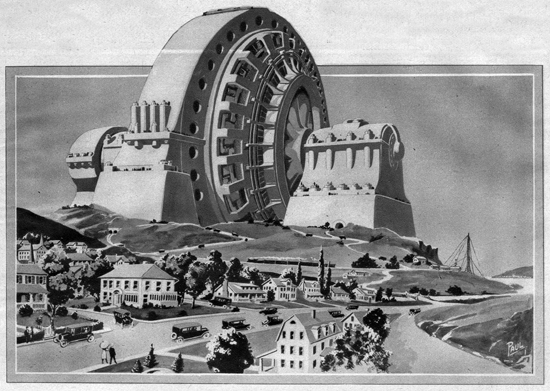
Hugo Gernsback's vision for a monument devoted to electricity (1922)

In 1922, eccentric magazine publisher Hugo Gernsback decided that the world needed a 1,000-foot tall concrete monument to electricity. Gernsback imagined that this monument might last for thousands of years, and rather than some static behemoth stuck in time, the interior of his monument would be constantly changed to reflect the technological advances of each new generation.

Gernsback’s article in the October 1922 issue of Science and Invention magazine explained why electricity was worthy of a monument. Interestingly, he saw it as a message to future generations that even if our civilization should be wiped out by war or natural disasters, we were still able to accomplish something great at one time.

In connection with our editorial of this month, we show on this page a monument dedicated to the age in which we are living. Electricity, more than anything else, has made our present civilization what it is, and if this civilization should be wiped out by war or some other cataclysm, nothing would remain to tell what Electricity did for the race during the past century.

Before the Egyptians built their first pyramid they probably foresaw that unless they built something of a tremendous size it would not stand the ravages of man and Nature. Hence the size and form were chosen in such a way as to make it last for practically all time.

Gernsback explained that this monument would look like a gigantic electrical generator, 1,000 feet tall. By comparison, the Statue of Liberty is just 305 feet tall, and the Empire State Building (which was almost a decade away from being built in 1930) isn’t that much taller than the proposed monument, at just 1,250 feet if you don’t count its spire.

When we therefore propose to build a gigantic monument to Electricity, we have the same objects in mind. On some plateau we could erect an electrical generator, molded in concrete, 1,000 feet high. Molded of the finest concrete, such a monument would last for a thousand years. It would probably not be affected by the weather and the climate, and it is doubted whether it could be easily destroyed by any savage race that might come after us.

In the inside passages, along the walls, could be inscribed, in diagrams and otherwise, electrical fundamentals, from the first static machine down to the latest radio developments. As new inventions come about, these can be inscibed from year to year.

If the entire electrical industry would think well of such a plan, a monument of this kind could be built without taxing any one concern a great amount. It would be a lasting tribute to our race, and to the progress that is exemplified by Electricity.

Gernsback doesn’t suggest where such a monument might be built, but judging by the illustration, it could very well be in Smalltown, U.S.A. The illustration is by Frank R. Paul, who would help define the 1920s and ’30s pulp sci-fi era’s aesthetic. Four years later, in 1926, Gernsback began publishing Amazing Stories, the first magazine ever devoted solely to science fiction. Amazing Stories featured countless covers and story illustrations by Frank R. Paul, whose most famous illustration for the magazine appeared in 1927 for a reprint of H. G. Wells’ War of the Worlds.

Like this article?
SIGN UP for our newsletter