Shared posts

08 Nov 15:39

Trudeau’s economic model is clear and it is not good

by Michal Rozworski

Last week gave us a good idea of the economic model that Trudeau’s Liberals are gradually putting forward and it is business-friendly to the core. The infrastructure bank privatization scheme was the big news item in the fall fiscal upate (see my post from last week), but there are far more goodies to make business happy tucked away in the update and in news from recent weeks. The Liberals plans for the economy are not just about being business-friendly today but about integrating government with business ever further, in ways harder for future governments to unwind. Theirs is a tweaked neoliberalism for an age of stagnation. The mantra remains the market and the state is there to support it.

Here’s the broad strokes of how the Liberals’ plans are shaping up on economics.

trudeau-morneau

Freeing trade and expanding foreign investment. First things first: today’s trade deal are less about trade, which is already largely free. For instance, while Canada and the EU just signed CETA, they rank 13th and 5th respectively on the World Economic Forum’s measure of the absence of trade tariffs. The Liberals have been immense champions of this deal and the Trans-Pacific Partnership (TPP) that links the Pacific Rim countries.

So why are these deals so important? They help cement pro-business regulation not only now but in the future. At 1000s of pages, the main thrust of an agreement like CETA is not lowering tariffs; trade is complex, but not that complex.  The bigger aim is to entrench rules that can be used to put limits on and circumvent democracy. Today’s free trade agreements are not mainly about removing regulations for business but placing new regulations on government.

The Liberals are also planning to ease foreign investment rules, clearly signaled in last week’s update. The problem isn’t that liberalized capital is foreign, it’s the lack of control. Here is another example of the government abdicating its presence as an democratic check on major economic relationships. Relaxed rules will put more communities at the whim of investors who can fly as quickly as they land. And freely-moving capital has its twin in unfree labour…

Keeping temporary workers temporary. Rather than revamping migrant workers programs in the name of justice—crucially, status on arrival with a clear path to citizenship—the Liberals are continuing and expanding the shameful temporary worker programs of the Harper government. Keeping migrant workers tied to one employer for the length of their contract opens the door to every possible violation of labour rights. Without the possibility to exit a contract, workers are at the mercy of bad bosses.

Rather than forcing employers to treat all workers equally and expand immigration, the Liberals are carving out more space for exemptions, whether for low-wage agricultural and service workers or high-end, fly-by-night professionals, something just introduced in the fall update. Here too, business gets the upper hand. Equal rights and status for migrants could revitalize entire communities, grow the labour movement and boost local economies. The Liberals would prefer to give business one more way to keep all workers in line by limiting the rights of some.

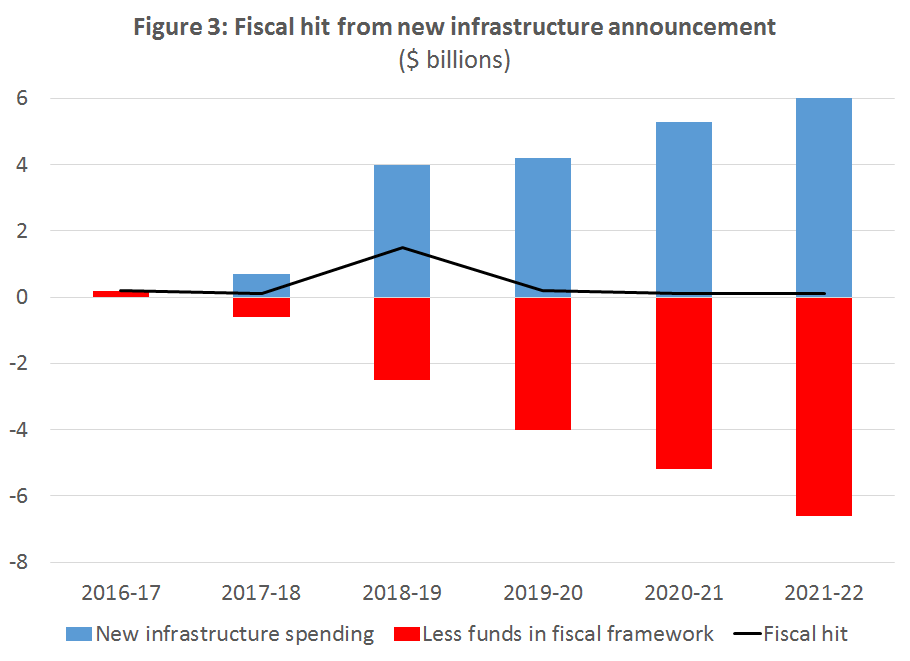
Privatizing and privatizing some more. I wrote last week about how letting private investors fund infrastructure is effective privatization. I’ll just add that there is a whole cycle involved. Take a look at this helpful chart which shows how much the government will have to spend on this massive infrastructure program.

Five out of the next six years, they’re spending nothing! Why would a massive new infrastructure program cost the government effectively nothing after the first year? Not only will private investors be largely building and operating the new roads and utilities, existing public infrastructure can be sold off to the same private investors to get the government’s seed capital. Major airports have cropped up on the list of object first on the auction block. Rather than operate for public benefit, they will now be run for private profit. Public infrastructure is easy to sell and very hard to buy back—just ask the British, who would love to have their public railways (by a 60% majority) or post service back. Once more, privatization will benefit business not only today, but bolster its hand far into the future.

Rationalizing the welfare state. The goodies that are supposed to soften the blow of all the policies outlined so far look to be more about marketing than substance. The Canada Child Benefit is so far the best example—and a mildly positive one—of this trend. The Liberals unified multiple transfers with multiple exemptions a single, simple cash benefit that’s higher than the old ones put together and gave it a sexy new name. The problem is that, by 2020, low-income families will receive scarcely a few dollars more per month than what they would have under Harper’s old web of benefits. Income supports are welcome but they should buttress expanded universal services rather than be at the centre of social policy.

The federal Liberals are learning lessons from their Ontario counterparts who have perfected the art of reorganizing and repackaging existing benefits as exciting new programs linked to popular left demands: a single process for grants is now free tuition! Sure, one process or one benefit is better than ten but other than simplicity there is often little more to it than high-flung rhetoric. And while we’re just hearing the first whispers of it federally, talk of basic income falls under this rubric and could be much more dangerous, paving the way below poverty-line benefits to be normalized for a long time.

Keeping a lid on wage growth. Both Justin Trudeau and his finance minister Bill Morneau have recently expressed an odd kind of “get-used-to-it” empathy with precarious workers. The best they can offer are palliatives, mostly re-training. What they won’t say is that the problem is much broader: it’s not just that jobs are more temporary—in fact, the amount of the actual temporary work may barely be rising—they are generally crappy. And the Liberals will not do the one thing that would help the most: put pressure on employers to raise wages. A federal $15 minimum wage and pressure on the provinces would be a relatively simple start.

The fall fiscal update was full of ideas to raise returns for investors but said little about raising wages for workers. Even the dovish among US central bankers are talking about letting the economy run hot for a while to allow some wage pressure to build for the first time in a decade. In Canada, the recent review of monetary policy was an opportunity lost; it passed nearly without sound. The Liberals take the crap the business world dishes as a given and offer the equivalent of a shoulder to cry upon for the rest of us.

Running deficits. This plank of Liberal policy gets all the press, but it is really one of the least significant. The Liberals are propping up demand a bit in the next couple of years, but the neoliberal project of remaking the state in the interests of business, started decades ago and continued valiantly by Chretien, Martin and Harper, remains unchanged.

While deficits will hover at a not very significant 1% of GDP for the next few years, the capacity of government to provide services will not expand. Program expenses as a percentage of GDP are projected to be the same in 2021 as they are today; government revenues as a percentage of GDP will be even lower! Canada’s ultra-low debt-to-GDP ratio, a reason to pursue really expansionary policy, is projected to fall from 31.1% this year to 30.4% by 2021.

Putting the pieces together. I’ve long argued that the Liberals are at the leading edge of rebuilding a centrist, neoliberal consensus for a low-growth world. This is mere tinkering at the edges of a rotting, fragile equilibrium. Rising debt, run-away housing costs, shitty jobs, a growing climate emergency—any solutions that would truly start to redistribute power and resources to deal with any of these pressing issues are out of bounds. Trudeau is showing what the global elite thinks is the perfect play for the moment. Poverty, inequality and precarity liberally pepper speeches and marketing materials, only problem is that the underlying phenomena stay the same.

Trudeau is capably steering Canada towards a new money-manager capitalism—one that uses government to guarantee profits for global asset owners while keeping a lid on discontent from the rest with vaguely progressive messaging. It is no longer individual firms like GM or Enbridge that get the most important meetings with ministers. Blackrock, the world’s largest asset manager, and McKinsey, the world’s largest consulting firm, are the new faces of government’s closest allies. Their executives are among the government’s closest advisors, most notably Dominic Barton, McKinsey’s managing director, who chaired Morneau’s growth advisory council.

There is real change from Harper’s regime, only the change Trudeau is slowly enacting isn’t one driven by remotely progressive economics but a realignment with different economic elites. Harper’s Conservatives had close ties to narrow sections of the elite, the fossil fuel industry for one. Their economic policy was also more transparently redistributive; for example, their income splitting plan if passed would have effectively given a massive tax cut to the top 10%.

Trudeau’s Liberals are in tune with a much broader elite and they are able to keep up some appearance of a an even broader coalition of interests. For example, the “middle class tax cut” was immensely successful rhetorically despite cutting taxes most for the second-to-top 5% (90-95%) of the income distribution. In other words, the Liberals are oriented towards the entire elite, and not just in Canada, while their policies are rhetorically in line with nascent sentiment against growing inequality. In the end, the Liberals still serve narrow interests, but more global than those Harper aligned with.

Trudeau’s economic plan might not come with as big billboards as Harper’s or such easy and obvious targets for opposition. It may seen friendlier, greener or more cosmopolitan. It’s lasting effects, however, may be much harder to undo. Trudeau is slowly working to bind the hands of future governments to an economic vision written not for us but for the few.

08 Nov 07:17

UBC’s president a leader like Vancouver hasn’t seen before

by Frances Bula

UBC is a huge presence in Vancouver: a university, a land developer, a research centre, a generator of start-up businesses, and a hotbed of intellectual ferment.

So it means a lot to the city what kind of leader is chosen.

The board’s decision to pick Santa Ono, then former president at the University of Cincinatti, was bold. I’ve interviewed a lot of CEOs, presidents, and executive directors. He’s unlike anyone I’ve profiled before, as I said to my editor at BCBusiness.

This is my portrait of this unusual man, who will be generating a lot of news, I’m sure.


08 Nov 07:17

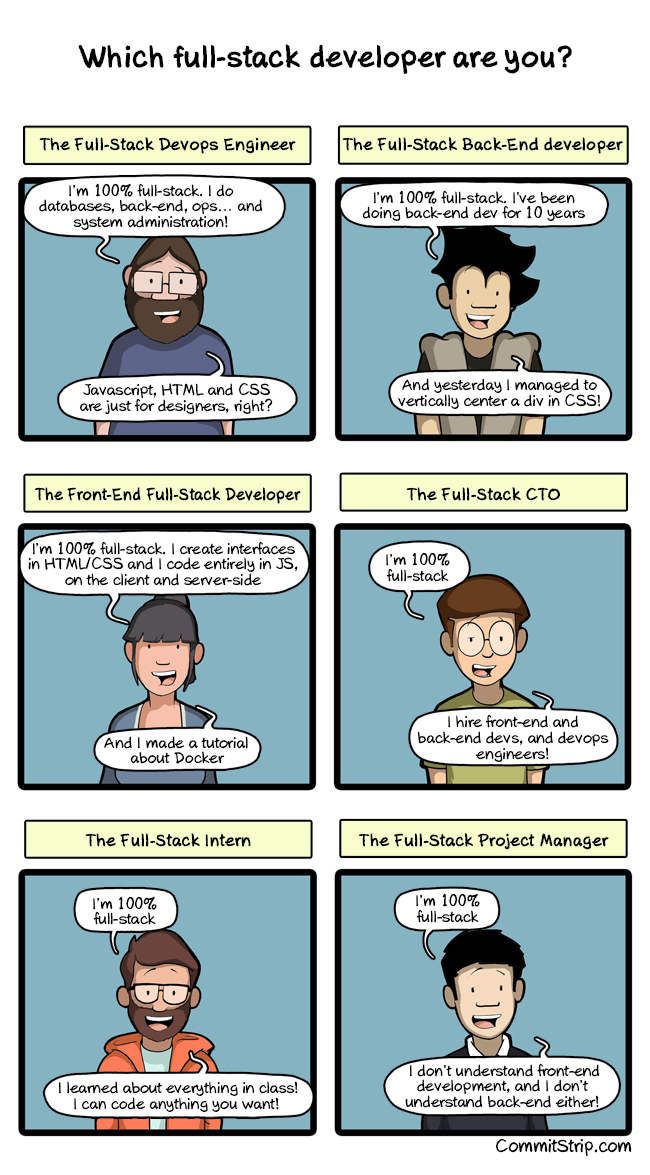
Which full-stack developer are you?

by CommitStrip
mkalus shared this story from CommitStrip.

strip-nous-sommes-tous-full-stack-english650-final

08 Nov 07:16

There is no university of the future

files/images/corridor.jpg


Alastair Creelman, The corridor of uncertainty, Nov 10, 2016


I want to highlight a couple of points from this short article. First, "There is no one model for the future, there will be a wide range of different interpretations from traditional to innovative." This is what was wrong with Sebastian Thrun's  prediction that after MOOCs only ten universities would remain. These new technologies create a proliferation of models, methodologies, and institutions. Second, and related to this, traditional credentials, while they may persist, will be supplemented by a wide range of qualifications. "If the new credentials are verifiable and trustworthy and employers accept them then they will become hard currency."

[Link] [Comment]
08 Nov 07:16

BC Open Educational Technology Collaborative

files/images/20160315_v210.png


Clint Lalonde, BC Campus, Nov 10, 2016


I'm not suggesting so much that you join this group (unless you live in British Columbia) as I am recommending this document (and Mattermost, an open source software alternative to Slack) as a model for the formation of your own cooperative with similar objectives. Or as a model of network-based learning generally. As the  Cape Town Open Education Declaration says, "open education is not limited to just open educational resources. It also draws upon open technologies that facilitate collaborative, flexible learning and the open sharing of teaching practices that empower educators to benefit from the best ideas of their colleagues."

[Link] [Comment]
08 Nov 07:12

Wiki and the Alt-Right

Benoit Landry, who uses the Wikipedia alias “Salvidrim!” and who is the first announced candidate for Wikipedia’s powerful arbitration committee, launched his candidacy with an attack on yours truly. Landry has previously expressed support for the notorious Gamergater whose screen name reflects his love for the sweet, sweet song of Nazi dive bombers, and who likes to call me “Reichstag.” Why that name, do you (((suppose)))?

Landry argued that my resistance to using Wikipedia for harassment is just as bad as the harassment. Just in case you’re keeping score at home, some of the harassment I opposed included:

  • Using Wikipedia talk pages to publicize the accusation that a software marketer was a prostitute.
  • Attempting to endanger a member of the US Congress who was investigating Gamergate harassment by summoning a SWAT teams to her home.
  • Extortion.
  • Informing a software developer on her Wikipedia page that she would shortly be deceased.
  • Continuing efforts to use Wikipedia to publicize and discuss the sexual history of that developer.
  • Using Wikipedia to excuse implicit and explicit rape threats and anti-Semitic dog whistles, seeking both to spread them as widely as possible and to gaslight intended victims.

There is, of course, no comparison between the petty vitriol that Gamergate and their many Wikipedia supporters have directed at me and the horrific harassment they have directed at the women who have been their chief targets – women who have lost jobs and been forced from their homes.

One the one hand we have rape and murder, on the other, stern censure. Clearly: both sides are equally bad!

Update: Benoit Landry has now withdrawn his accusation. He writes on Twitter:

I apologize for characterizing the abrasiveness of your attitude and the excessive volume of your voice as “harassment.”

If Wikipedia administrators like Mr. Landry had succeeded in stopping the use of Wikipedia to threaten and smear Gamergate victims at any point in the past two years, abrasiveness would be unnecessary. Their failure to stem that flood might be attributed either to incapacity, to indifference, or to quiet support; perhaps Mr. Landry may take a moment from his campaign to enlighten us on this count.

With regard to excessive volume, I confess that it can be hard to gauge the correct volume to adopt with Wikipedia, when Wikipedia is being used to threaten one’s colleagues with rape and murder. Especially when people keep sending one gas chamber pictures.

Polls open in the US in a few short hours. I'm with her.

08 Nov 07:12

Dongle me.

by Michael Sippey

Mini DisplayPort + Thunderbolt 2 + USB-C = ???

The new MacBook Pros sure are pretty. It might even be worth springing for one! The display is gorgeous. The trackpad is huge! And the keyboard seems to not suck. Might as well throw in a dongle or two, so that I can make it work with my other electronic things, like an iPhone or an iPad or an SD card or MIDI keyboard…or this expensive monitor with the Apple logo on it.

If only it were that simple! I try to be an educated consumer of tech-like things, so I decide to go read up on USB-C, since it’s so clearly the FUTURE. This is actual support copy from Apple’s “About Thunderbolt Ports and Displays” page.

Note that although it uses a Mini DisplayPort connector, the Thunderbolt 3 (USB-C) to Thunderbolt 2 Adapter doesn’t support connections to Mini DisplayPort displays. Also, this adapter supports only one powered Thunderbolt 2 device on a USB-C equipped Mac.

Got that?

Glenn Fleishman, bless his heart, wrote about a thousand words for Tidbits trying to explain it. Here’s a paragraph from his piece:

Thunderbolt 3 cables are labeled with the same lightning logo used by Thunderbolt 2 cables, while USB cables with USB-C connectors show the familiar USB logo and may also be branded with SS+ for SuperSpeed+. Older USB 3.0 (also known as USB 3.1 Gen 1) cables are sometimes also branded with an SS for SuperSpeed.

Got that?

I have a 12" MacBook from 2015, and a 27" Cinema Display with Thunderbolt. Do they work together? Nope. You know how much bullshit technical jargon I would have had to read to figure that out? An infinite amount, more or less. I was approaching this infinite amount when I gave up, asked on Twitter and was lucky enough to have two super genius experts — Glenn and Jason Snell — answer me. Thanks, super genius expert friends; I know it’s not your fault.

Hey Apple (or Apple publications)! In lieu of actually fixing the underlying problem (lol), here’s an idea. Forget trying to explain the standards and what data transfers over what protocol at what speeds: no one cares. Instead, build a simple tool that lets you pick your computer on one end, the peripheral / device / monitor / doohickey on the other, and then spits out (a) whether that’s even possible and/or (b) what combination of dongles / cables you need to buy to make it possible.

After all, they’re on sale!


Dongle me. was originally published in stating the obvious on Medium, where people are continuing the conversation by highlighting and responding to this story.

08 Nov 07:12

Learning Ecosystem Participant Model

by dave

A group of us had a conversation a couple of weeks ago about creating a learning community(ies) for an existing nonprofit open online learning site. How do you go about it? How do you translate what we believe about open learning to language that will respond to a project plan? Who are the multiple audiences? What do they want? It was a very interesting five or so days of chatting. We had some very smart, very experienced people chime in and while we certainly didn’t all come down to one final conclusion, there was a fair amount of overlap in our thinking.

Near the end of our sprint discussion, I proposed a model that could potentially serve as a starting point for discussions around the planning table. You might use it to talk to people about how someone can come into your ecosystem from any of these points, how people can move from being one kind of participant to another, and how those participants might interact with each other.

The model got bounced around between us with people adding to it and debating one part or another. This is my version. I’d love to hear what you think about it, whether it resonates with you or what you might hate about it.

CC by Non Commercial
Learning Ecosystem Participant Model CC by Non Commercial

When we teach in a classroom, we get to define the start and end times, we decide how much time investment is appropriate, the workload, the content choices etc… basically the syllabus of a course. Students have already committed to learning in a structured way. They have, in many cases, self-selected or at least they know they are going to have to take your course. The reason they are learning is generally clear to anyone.

When we work in an online space, we get all kinds of learners. As a learner, I’m not always going to be invested in a deep learning experience. Sometimes i just need to find out how to cook a turkey – i don’t need to push turkey theory to new levels. Maybe, after cooking some turkeys… i might change my mind, but i’m not going to be able to do ‘turkey theory’ cold.

Four kinds of participants in a learning ecosystem

  • Consumer (What temperature do i take the turkey out?)
  • Student (How do I prepare a turkey from purchase to eating)
  • Rhizomatic learner (How can I come to my own approach to turkeys?)
  • Mentor (How can i help others with their turkeys?)

Moving from one group to another
This model is, in some ways, a directional development model that says that if you want people to learn the thing that you want them to learn… whether mental health, non-profit or whatever… that you generally want (a certain percentage of ) people moving from

  • Consumer to student
  • Consumer to rhizomatic learner
  • Student to rhizomatic learner
  • Rhizomatic learner to Mentor
  • Student to Mentor
  • Mentor to Rhizomatic learner

Spaces needed to support the model
Not all platforms are ready for this kind of interaction, some are focused on delivering content (to consumers) some are lock-step course platforms and others are designed for communities. I think all three of these can be (and probably should be) used together. My feeling is that there is a mix here, a combination of these spaces that can be achieved to reach that ecosystem. I should add… it need not all be on the same website.

  • Information space
  • Course spaces
  • A place for people to gather

Mentors aren’t really a space, which is why this isn’t a space chart. It’s a membership chart. Mentors are going to live across all three spaces. They will, potentially, answer questions in the information space. They will, potentially, be part of the audience, or be the teachers in the course space. They will, potentially, be participants in the community space.

What problem does this solve?
What it does for me is it gives me a framework that allows me to talk about how to create an online learning experience. In a course like #rhizo14/15 (a course on rhizomatic learning) I’m focusing almost entirely on the community. Should I make more of an effort to leave people with answers to their questions? Should I have an onboarding process that people could use that would give them a structured introduction to the idea? Should I make an effort to organize mentors who can help direct traffic for new people?

Community can do a great deal to support an organization in the work it wants to do… but it’s mostly hard work. I’ve spoken to many groups over the years who are willing to do that work, but didn’t have the language they needed internally to plan for what need to be done. In looking long term for any organization that wants to achieve its goals through open learning, these could help with planning by providing some language for a conversation. It could also allow you to keep track of the community over time. Are we seeing fewer mentors over time? Is our student community growing? A different balance is going to be struck depending on your goals…

If you’re looking to enact a change, say, to a more open environment or a more collaborative environment, hopefully this gives you a place to start. Take, modify, share.

Notes

  • This model certainly owes some of its inspiration to Dave Snowden’s Cynefin model.
  • There are potential similarities here to the Visitors and Residents model.
  • This chart was built through a sprint process, from October 19th to 24th. Original draft by Dave Cormier. Draft 2 Tayte Willows. Draft 3 Rebecca Petersen & Dave Cormier. Sprint members – John Schinker, Maha Bali, Michael Rutter, Jennifer Maddrell, Rebecca Petersen, Lawrie Phipps, Robin DeRosa, Tayte Willows, Bonnie Stewart, Erin DeSilva and Dave Cormier
08 Nov 07:11

Chomsky: Warum die Republikanische Partei die "gefährlichste Organisation der Weltgeschichte" ist

by Nfes2005
mkalus shared this story from Nfes2005's YouTube Videos.

From: Nfes2005
Duration: 02:41

Werde ein Naivling ► http://bit.ly/1A3Gt6E
Fanshop ► http://fanshop-jungundnaiv.de/

Ausschnitt aus Folge 284 Jung & Naiv mit Noam Chomsky. Hier gibt's die komplette Folge: https://youtu.be/h0qdbsE3Jqo

"Im reichsten und mächtigsten Land der Weltgeschichte, wo die Zukunft maßgeblich beeinflusst wird, gibt es eine wichtige politische Partei gibt – derzeit hat sie auch noch die Mehrheit im Kongress – diese Partei streitet einfach ab, dass das alles geschieht. Die haben eine Politik zum Thema Erderwärmung: “Vergiss es!”. Die Erderwärmung findet nicht statt, okay? Es ist schwierig, das in Worte zu fassen. Es bedeutet, dass im mächtigsten Land der Weltgeschichte, im Land mit der besten Bildung, mit allen Vorteilen, dass da eine große politische Partei sagt: „Lasst uns die Ersten am Abgrund sein!“ Und keiner sagt was dazu. Versuch mal da einen Kommentar dazu zu finden. Das bedeutet, diese [Republikanische] Partei ist die gefährlichste Organisation der Weltgeschichte. Schau sie dir an! Ist das eine Übertreibung? Im Vorwahlkampf, im republikanischen Vorwahlkampf, hat jeder einzelne Kandidat gesagt, die Erderwärmung finde nicht statt. Mit einer Ausnahme: John Kasich, der angeblich vernünftig und gemäßigt ist. Er sagte: Ja, das gibt’s, aber wir sollten da nichts machen – und das ist noch schlimmer. Hundertprozentige Verweigerung. Der siegreiche Kandidat [Donald Trump] streitet ab, dass etwas passiert, was sehr wohl im Gange ist. Und er sagt auch noch, wir sollten es weiter verschlimmern. Wir sollten mehr fossile Brennstoffe nutzen, auch Kohle. Kohle ist am umweltschädlichsten. Umweltregularien sollten begrenzt werden. Wir sollten uns weigern, ärmeren Ländern dabei zu helfen nachhaltige Energiequellen zu erschließen, wie das in Paris letztes Jahr beschlossen wurde. Er will das Abkommen kündigen, mit anderen Worten, er will so schnell wie möglich an den Abgrund kommen" - Noam Chomsky

Untertitel: Cristian Wente

Leseversion: http://www.jungundnaiv.de/2016/10/23/noam-chomsky-die-ausserirdische-perspektive-folge-284/

Bitte unterstützt unsere Arbeit finanziell:
Tilo Jung
IBAN: DE36700222000072410386
BIC: FDDODEMMXXX

PayPal ► http://paypal.me/JungNaiv

Fanshop ► http://fanshop-jungundnaiv.de/

08 Nov 07:10

Samsung Running Full-Page Ads in Newspapers Apologising for Galaxy Note 7 Debacle

by Rajesh Pandey
In a bid to regain customer confidence after the Galaxy Note 7 fiasco, Samsung has published full-page ads in the Monday editions of The New York Times, The Wall Street Journal, and The Washington Post. The ad is actually a letter from Samsung’ North America president and CEO Gregory Lee in which he apologizes for the whole Note 7 fiasco. Continue reading →
08 Nov 00:36

Gossip, Rumors, and Lies

by rands

Everyone is just… sitting there.

Six of you. All managers who report up to Evan, your boss, who decided two weeks ago that “it’s probably a good idea for this leadership team to get together on a regular basis and talk about what is up.” He dropped an agenda-less, sixty-minute recurring meeting on everyone’s calendar and that meeting is now.

Six of you. You know these humans. You work closely with two of them every single day. You’ve had occasional projects of significance with two others. The last two are friendly first names.

Evan kicks off the meeting repeating exactly what he told each of you face-to-face and in the meeting invite. It’s probably a good idea for this leadership team to get together blah blah blah. He finishes his bland opener and everyone is just… sitting there. Saying nothing.

Welcome to your first staff meeting.

An Unacceptable Amount of Crap

I’m solidly on the record as 1:1s being the most important meeting of the week. A very close second is the staff meeting. I find that 1:1s beat staff meetings in two important categories: trust building and quality of signal. But, there are ongoing compounding benefits to a regular well-run staff meeting. Team building, efficient information dissemination, and healthy debate are three I can think of off the top of my head. There are more.

Definitions first. I define a staff meeting as “the correct collection of leadership gathered together to represent a team, product, company, or problem.” Lot of words. A simpler and perhaps more immediately applicable version is, “a meeting of your direct reports.”

Great! You have directs which means you should have a staff meeting, right?

Maybe.

The decision to start your first staff meeting requires judgement. Ask yourself the following questions:

  • How many direct reports? 2? Yeah, no staff meeting necessary. 3 or more? Keep reading.
  • How many of your directs spend time working together? If it’s more than half, consider a staff meeting
  • Do your directs have direct reports? You needed a staff meeting awhile ago.
  • How much has your team grown in the last six months? A lot? Have a staff meeting.
  • How much of the crap that you’ve dealt with in the last month smells like it could have been resolved if people on your team were just talking with each other? If the amount of crap is unacceptable to you, have a staff meeting.
  • Did something recently organizationally explode? Have a staff meeting.

A Well-Intentioned Hatred of Meetings

A new staff meeting is understandably a pretty quiet affair. It’s a delightful combination of unfamiliarity combined with a well-intentioned hatred of meetings. In our hypothetical example above, Evan set horrible initial meeting tone because he committed the worst meeting sin: no agenda.

Here’s an initial agenda:

  • The Minimal Metrics Story
  • Rolling Team-sourced Topics
  • Gossip, Rumors, and Lies

Before I dive into these agenda topics, let’s talk about two essential meeting roles. 95% percent of the activity in a well-run staff meeting is healthy conversation and debate. Keyword: “healthy.” It’s a clear signal that a staff meeting is working when attendees jump into conversations and drive those conversations in unexpected directions. It’s a clear sign that no one is curating those conversations when those unexpected directions are not revealing insight or value.

The Meeting Runner has two jobs: set the agenda and manage the flow. We’ll talk agenda shortly, so let’s first talk about managing flow. The Meeting Runner is responsible for making the following call throughout the meeting: When is this particular conversational thread no longer creating enough value? It’s a nuanced job, but without this human curating the conversation, a staff meeting can turn into directionless heated vent session. Fortunately, as we’ll learn shortly, the Meeting Runner has an essential driving force at their disposal – the agenda.

The role of Meeting Runner is traditionally the human who called the meeting. It’s usually the he or she accountable for the team, which allegedly gives them the context to run the meeting efficiently. Usually.

The second role is Meeting Historian. This non-obvious role is not required in the first few get-to-know-you meetings, but is essential long term. Their job: capture the narrative of the meeting. We’re not looking for every single word, we’re looking for major themes and points that are discussed. Action items, relevant thoughts, jokes, it’s all captured by the Meeting Historian.

Two guidelines for Meeting Historian. First, it can’t be the Meeting Runner because this human has their hands full keeping this meeting pointed in the right direction. Second, the Meeting Historian is not responsible for editorial or curation. Their job is to capture everything. This seems like a no-brainer until you understand that your next job is to send these notes to the entire company.

Wait. What?

Humans have complicated relationships with meetings. If they’re in the meeting and it’s not meeting their expectations, they’re mad. If they’re not invited to a meeting where they believe they should be present, they’re mad. Combine this slippery situation with that fact that meeting efficiency devolves as a function of the number of humans greater than seven and you’ve got a maddening set of complicated constraints. The simple but perhaps controversial practice I’d recommend is that every single meeting have a Meeting Historian and the work of that Historian is broadcast to the whole company.

If you’re a frequent meeting denizen and the hair on the back of your neck stands up when you imagine the notes of your meeting being shared with the whole of your company, my question is, “What are you talking about in that meeting that can’t be shared?” Of course, the Meeting Runner will remove confidential information about individuals as well as other clearly confidential company information before sending. If that doesn’t calm you down, I’m still curious what you think is being said in this meeting that can’t be shared with your team?

Meetings create power structures. Intentionally or not, they become a measure of status. Are you in that meeting? No? Well, I am. If you found sound reason to have a staff meeting in my list above, I’m not worried about the first three month of this meeting’s existence. It’s year two when that good reason may have vanished and now you have this formerly important meeting purely out of habit.

The rule is: in the absence of information, humans fill the gap with the worse possible version of the truth. Two years into your meeting when you’re not sharing the notes, the humans not in the meeting tell the most interesting and untrue stories about what happens in your meeting. I guarantee it. This isn’t out of spite. They aren’t being malicious. They just don’t know what is going on, so they’re going to tell their version of the story.

Share your notes. Every time. The act of doing so will force you to ask the following question before you share them “Is what we are doing here valuable?”

A Three Point Agenda

The Minimal Metrics Story is the list of essential metrics this group must review on a regularly basis and I recommend leading with them because they frame the whole meeting. Not knowing precisely why you chose this precise time and situation to start a staff meeting makes it tricky to recommend what type of metrics you need to review.

What are the key metrics this group is responsible for? Revenue? Application performance? Security incidents? Number of critical bugs filed? The list is endless and it’s ok if your first meetings don’t have these defined. But after a month, if these haven’t shown up, I’m wondering why you pulled this group together? What problem are you trying to solve? I’m not saying you demonstrated poor judgement by calling the meeting, but if a concrete set of measurable things hasn’t shown up, why is the group meeting on a regular basis?

You’ll know you’ve found a good initial set of metrics when they tell a story and leave you with questions. Total billings in the last week were X millions. Recurring revenue added was Y thousands. Last week they were X and Y? That’s a big change. What do we think happened? The questions and the debate that surround the story both align the room and frame the rest of the conversation. There will be weeks where the metrics story is, “Tracking. Nothing to discuss,” but if it’s been three months and that’s the only story, you’ve either got the wrong metrics or the good reason to have this meeting has passed.

A Rolling Team Sourced Agenda is the heart of your meeting. For the first iteration of this meeting, you’ll need to build the agenda yourself. This shouldn’t be hard because there are pressing reasons for these humans to be together. Once, twice, or perhaps three times you can set the agenda for the meeting to address that pressing reason, but at end of the first meeting you say, “Here’s a document I’ve shared with everyone, please add any agenda topics for next time.”

They won’t.

The social fabric and the sense of team that you are building with this meeting will take time to form and you’ll need to be more involved in both building the agenda and moving the narrative along for the first handful of meetings. You’re looking for two important developments over the course of the first three meetings:

1) Unexpectedly useful conversational detours. You’re going to do a lot of talking in the first few meetings because you’re the leader, you’ve identified some problem, and you’re attempting to solve it. Good job, but very quickly you need to stop talking. Introvert leaders of the world will have no problem with this advice. Extrovert leaders. Listen to me. It’s not your meeting, it’s their meeting. You need everyone in the room to bring their experience, their questions, their curiosity, and their drive to the table and they each need to feel comfortable sharing these thoughts. If you don’t stop talking, they won’t start.

2) A similar positive health sign is the arrival of unsolicited agenda items by the rest of the room. I’m not talking about the ones you ask for, I’m talking about the agenda items that just appear. These random new additions are emerging proof that the rest of the room is beginning to see that this is a meeting where work is done.

Staff meetings are an hour. It feels like a lot of time, but when this meeting is working you’ll effortlessly fill the time.
It’s a rolling agenda because the steady healthy state for this meeting is that you never get through the agenda – there are too many topics to discuss.

Gossip, Rumors, and Lies is the final permanent agenda item. With the last five to ten minutes of your meeting, you’re carving off time for communication error correction. I’ll explain.

The reason you’re having this meeting is because of a seismic shift. Your team suddenly grew, your company changed direction, major responsibility shifted, or maybe a reorganization occurred. The knee-jerk move when a shift occurs is to call all the relevant parties into the room and ask, “WTF?” This feels good. People talk and explain their feelings regarding the shift. Information is shared, we nod, and feel aligned, but other than the therapy, we didn’t solve whatever problem existed that precipitated the need for this meeting. Meetings are a symptom of a disease, they are not the cure.

The metrics framing and rolling agenda should give you an actionable narrative. They should give you the opportunity for the airing and discussion of grievances. They should create a set of follow-up work that is far more likely the cure. However, you should still be asking, “WTF?”

This final section of your staff meeting is a safe place for all participants to raise any issue, to ask any random question, or to confirm any hallway or Slack chatter. Chances are, whatever seismic event caused this meeting to occur is still being organizationally digested and often the stories being told are absurd. Gossip, Rumors, and Lies is time to get that important absurdity out in the open, so you can begin to construct a healthy response.

Meetings are a Symptom, Not the Cure

High on my list of professional pet peeves is the emergence of corrosive politics within a company. Politics are a natural development in a large group of humans working together. Corrosive politics give me rage: taking credit for other’s ideas, hoarding information, or not allowing the best idea to win. The list goes on and on and when I discover this type of politics where I work there is rage, so I’ve spent a good portion of my career understanding the root causes.

Seismic shifts within your company or team create change, and humans attempting to get work done consistently, of high quality, and at velocity don’t like change. It harshes their productivity buzz. The intensity of their response to change is a function of their discomfort and that discomfort increases exponentially the longer their discomfort remains unresolved.

The reason meetings have evolved as an acceptable first response is because they do address one key issue: they give the team an opportunity to discuss their perceptions of the change. This feels good. The reason meetings are often hated is because while talking feels good, it’s not true progress.

If you’ve called the meeting for the right reason, if you’ve discovered story-filled metrics, if you build a compelling team-sourced agenda, if you give everyone time to discuss the absurd, and if you share the insights from this meeting with everyone, you’ve given the team a chance to collectively resolve the core issue. The sharing of this work will decrease miscommunication, it can help inoculate against politics, and it will create unexpected serendipity.

No one is going to just sit there when they understand the problems at hand, they trust they can be heard, and they can count on resolution.

07 Nov 22:05

Nuclear war is on the ballot

by Nathan Yau

Neil Halloran, creator of the interactive World War II documentary focused on deaths, is working on another focused on the cost of nuclear war. With the election tomorrow, Halloran pushed out an “election cut” to highlight what’s at stake. Very scary.

Tags: election, nuclear

07 Nov 21:55

Learning Toys and STEM Toys We Love

by Courtney Schley
learning and stem toys picks from above

We don’t think there’s a right or wrong way for kids to play. For this kid-oriented gift guide, we focused on learning toys—open-ended games, kits, toys and crafts that promote lifelong skills like critical thinking, problem solving, logic, and even coding. To choose from the hundreds of toys available, we spent more than 30 hours trying 35 recommendations from experts, educators, and parents, including a reporting trip to the Katherine Delmar Burke School’s tinkering and technology lab in San Francisco, CA.

07 Nov 21:55

Thinking Different

by xjgi4k
There is an almost mythic belief that macOS is far better than Windows. So much so that most Mac users feel it’s not even worth trying. I’ve been on Macs...
07 Nov 19:37

Progressivity, not Productivity

I’ve been struggling with the ‘productivity’ term for years, especially regarding the collection of capabilities or tools that help people coordinate, communicate, and cooperate at work. Historically, this has been characterized as ‘collaboration’, but that term has become too generalized, too widely applied, and too stripped of affect to really draw a sharp focus on tools and their critical role in helping us get things done.

Microsoft, for one, has adopted the term ‘productivity’ for such tools, and for the goal underlying their purpose. But ‘productivity’ is off-kilter: the original and subliminal meaning is the rate of output per unit of input, and which implicitly stresses increasing output. As I recently commented at a dinner party, the term ‘productivity’ has a bit of barbed wire in its deeper associations.

We aren’t really designing tools or practices to increase output, per se, despite using the term ‘productivity’ so liberally. We are really seeking to improve outcomes, which is something different altogether. And that distinction is critical, because it opens the door to incorporating innovation, creativity, and the emergent value of people cooperating toward mutual ends. 

So, I am advocating the term ‘progressivity’ in this way, as a replacement for ‘productivity’. The definition is derived from progressive: 

favoring or advocating progress, change, improvement, or reform, as opposed to wishing to maintain things as they are.

And the only conflict in common usage is that the term ‘progressivity’ is most often used with regard to tax laws. But that won’t conflict and won’t confuse, I don’t think.

So, you will see me talking about Microsoft’s ‘progressivity apps’ where in the past I might have said ‘productivity’. 

Try it. You’ll like it.

07 Nov 19:37

The Best Digital Photo Frame

by Amadou Diallo
digital photo frame

After 18 hours of research and testing, we think the 10-inch Nixplay Seed is the best digital photo frame for most people who want to display pictures uploaded wirelessly from their smartphones, hard drives, or social media and cloud storage accounts. Its superior display and simple setup lift it above the competition, and since you can send photos to the frame via Nixplay’s cloud services, email, or a shared Dropbox folder, if you give one as a gift you can share photos directly to your loved ones’ frames, even if they’re halfway across the world.

07 Nov 19:37

WeChat Is Bike Sharing? “That Would Be Us”, Says 700 Bike

by April Ma

Whether or not you’ve been paying attention, bikes are back.

In the material-deprived seventies in China, owning a bicycle was a clear wealth indicator, the equivalent of owning an apartment in Beijing today (okay, not THAT wealthy).  After being dubbed “the kingdom of bicycles”, the last two decades have for the most part been a demise of these two wheelers, but that trend is fast turning around, the recent bike-sharing mania standing testament to this retro fad.

As part of the smattering of bike-sharing related news that hits Chinese startups and VC circles weekly, a gallery of so-called “Webikes” went viral last week, evoking rumors that WeChat would be the next mammoth player, stirring up the already choppy waters.

webike

The mysterious “WeBike” that left people guessing last week

Today, Zhang Xiangdong, founder of 700 Bike, a maker of high-end urban bikes, has explicitly explained that the bikes are not a display of WeChat’s ambitions to cross into bike sharing, but are rather a customized service by his company.

“Some have spotted the foldable clasps in the bike, which is our patent, so to clarify, we are the ones behind WeChat’s project, it’s part of our initiative called ‘Cool Companies’, where  we customize a solution for companies with large campuses like WeChat or Mafengwo, mostly by providing a uniform coating, parking, network, anti-theft and management add-on services,” said Zhang at TechCrunch Beijing’s conference on Monday.

For now there’s no sharing element involved, but their expertise in bike making has put them in demand. “More than 10 bike sharing companies have courted us recently, seeking cooperation. Everyone is in full pursuit of this market.”

Despite all the attention, Zhang is reluctant to swerve from what he set out to do, which is forging a brand of high end road bikes with artisan design and technology and selling those bicycles at a profit.

Bike sharing,a capital intensive sector as with all sharing economies that must be kept afloat at the beginning with an unfailing supply of cash, is a risky business, said 700 Bike’s Zhang.

“It has a propensity to end up a highly regional or local business, though it’s easy to take down a single city, its nearly impossible to call the entire nation your market. Even with a DAU of millions you only have a municipal market. The best companies can do is win a regional market, and hope that the eventual survivor will buy you out. ”

So bikes are supposed to be back, perhaps signifying that a sustainability minded China might be walking in the steps of cities on wheels like Amsterdam, London and Copenhagen. However as a prerequisite for that to happen, Zhang says that companies and governments need to shoulder the responsibility of turning congested cities into bike-friendly ones.

07 Nov 19:37

The Real Challenge For Roomba Is Not AI, iRobot CEO Says

by Eva Yoo

Colin Angle, CEO and co-founder of iRobot shared its knowledge and insights about artificial intelligence behind its robotic vacuum cleaner Roomba on Monday at TechCrunch Beijing.

“The real challenge for robotics is not AI, it’s about making robots to understand the environment,” Mr. Angle said.

There has been 20 years of AI research to make Roomba to understand two sentences, ‘please go to the kitchen and vacuum’. If the robot doesn’t know where the kitchen is, then it’s not going to work. So the primary understanding of the rooms should come first, then users can designate which rooms to go. As soon as the robot understands the rooms, the robots can help the security part of the house as well, he explains.

“We not only create the vacuum, but is also creating the person that pushes it: AI,” he says. “This requires more sensors than any other players in the market because we’re actually trying to make Roomba to mimic the way you vacuum the floor.”

For example, when we vacuum dirty area, we push the vacuum back and forth multiple times, and the company is trying to enhance its AI’s understanding of the environment to do just that.

“20 percent of vacuums in the world are now robots, and over 70 percent is our market share,” Mr. Angle says.

Image Credit: TechNode

07 Nov 19:34

Twitter Favorites: [VPL] Zadie Smith has a forthcoming novel called Swing Time. Here's a review from the Guardian. https://t.co/tDPFi4dDbI https://t.co/sAPEU8KrJl

Vancouver Public Lib @VPL
Zadie Smith has a forthcoming novel called Swing Time. Here's a review from the Guardian. ow.ly/CFCz305RYHQ pic.twitter.com/sAPEU8KrJl
07 Nov 19:34

Twitter Favorites: [Stv] I really enjoyed Crouching Dragon Hidden Inception.

Steve @Stv
I really enjoyed Crouching Dragon Hidden Inception.
07 Nov 19:33

Twitter Favorites: [ReneeStephen] @ONgov Don't try to apply welfare-rules reasoning to this; it is not welfare.

Renée Stephen @ReneeStephen
@ONgov Don't try to apply welfare-rules reasoning to this; it is not welfare.
07 Nov 19:33

Twitter Favorites: [CatherineOmega] @mor10 the French word for "silver" actually comes from the country, based on the bells attached to traditional Argentine footwear.

Catherine Winters @CatherineOmega
@mor10 the French word for "silver" actually comes from the country, based on the bells attached to traditional Argentine footwear.
07 Nov 19:33

Twitter Favorites: [ReneeStephen] America, Canada will always be your supportive, caring hat. Right now it has "HILLARY PLS" written on it. And it's more of a toque really.

Renée Stephen @ReneeStephen
America, Canada will always be your supportive, caring hat. Right now it has "HILLARY PLS" written on it. And it's more of a toque really.
07 Nov 19:32

What are the Six Degrees of Freedom (6DoF)?

by Lytro
Six degrees of freedom (6DoF) and three degrees of freedom (3DoF) are very common terms you’ll hear at VR/AR mixers, conferences and the Lytro lunchroom. “degrees of freedom” refers to the freedom of movement a [...]
07 Nov 19:31

You can now use Android Auto with almost any car in Canada

by Igor Bonifacic

Google announced today that it is dramatically broadening the availability of Android Auto.

With the launch of Android Auto 2.0, all the functionality of the platform, including the ability to control various apps with voice commands, can be accessed with just an Android smartphone. That includes accessing turn-by-turn directions from Google Maps and playing music from supported streaming apps like Spotify and Google Play.

“This update allows anyone with an Android phone (running 5.0 or later) to use a driver friendly interface to access the key stuff you need on the road — directions, music, communications — without the distraction of things that aren’t essential while driving,” said Android Auto product manager Gerhard Schobbe says in an accompanying blog post. “Whether your phone is connected to a compatible car display, or placed in a car mount on the dashboard, Android Auto brings your favorite apps and services into one place, making them accessible in safer and seamless ways.”

updated Auto Rifle

Previously, taking advantage of Android Auto meant buying a car model that was compatible with the infotainment platform. While more and more car manufacturers are starting to support the platform (the full list can be found here), the number of cars that include Android Auto is still relatively minuscule.

The company says it’s rolling out the updated app in the more than 30 countries where Android Auto is already available, which is to say the Android Auto 2.0 should be available in Canada soon.

SourceGoogle
07 Nov 19:31

Class action lawsuit filed in Canada over Note 7 smartphones catching fire

by Patrick O'Rourke

A class action lawsuit has been filed in Canada surrounding Samsung’s beleaguered Galaxy Note 7 smartphone.

Galaxy Note 7 phones were recalled last month following reports of overheating batteries that have the potential to become fire hazards, with various incidents of the phone overheating occurring around the world. Samsung issued replacement devices, but those devices were also recalled following further combustion issues.

The lawsuit was filed in the Ontario Superior Court by London, Ontario-based McKenzie Lake Lawyers LLP. The claim alleges that Samsung was negligent because it either knew or should have known that the devices could potentially harm consumers. The lawsuit seeks damages and a declaration that defendants actions were false and emphasizes that they violated the Consumer Protection Act and the Competition Act.

Similar lawsuits have been filed in the past surrounding issues with the iPhone 6’s touch screen, dubbed ‘touch disease.’

Samsung is allowing customers who returned their phone to either exchange it for a Galaxy S7 or Galaxy S7 Edge.

07 Nov 19:31

Write Stuff about Databases into 2017

by Dj Walker-Morgan
Write Stuff about Databases into 2017

TL;DR - Write about databases for Compose, get writing, get better, get published, get visibility, get paid. That's the Write Stuff at Compose.

There's a $1000 bonus up for grabs in this cycle of Write Stuff. The Write Stuff project is where we ask you to write about databases for Compose Articles. There's a lot of knowledge out there and only so many people writing about it, so we'd like to encourage and help new writers with experience of databases to create new articles. That said, if you've got writing experience, feel free to submit your articles ideas to Write Stuff too.

This cycle we are particularly looking for people to write about using more than one database in an application - MongoDB and Redis, PostgreSQL and Elasticsearch, etcd and RabbitMQ, whatever combination works for a particular application, we want you to write about it. We know there's a lot of polyglot persistence going on out there and we're looking to the people who are doing it to explain how it works and why it works for them.

We're open for all other ideas too, ideally centered on the databases and messaging platforms Compose carries . That's a lot of options. There's the NoSQL selection: MongoDB, Redis, Elasticsearch, RethinkDB, etcd and the Cassandra-compatible ScyllaDB. Then there's the SQL range: PostgreSQL and MySQL. And there's RabbitMQ if you are all about the messaging. Write about the technology, write about how you apply it; basically, write stuff about databases.

Each article can earn you $200 cash and $200 database credit and when the cycle ends on 31st January 2017, we'll select the best article of the cycle for a $1000 bonus. We're looking for articles over 1500 words but if your words are the best words then we can be flexible.

If you're new to writing, don't worry - submit your idea in as much detail as you can on the Write Stuff form and we'll give you pointers into how to hone that idea into an sharp article that you can be proud of.

So what are you waiting for? Get your ideas in now and we'll get working with you to turn the stuff you write into the Write Stuff on Compose. Full details and the submission form are on the Write Stuff page.

You may be wondering what happened in the previous the previous cycle of Write Stuff. We considered the entries we received and decided that this cycle we'd stop taking submissions for the smaller addon articles, and rolled over the bonus (and eligibility) of full articles from that cycle into this new cycle. We also lengthened the cycle into January to give people plenty of time to work on their articles without worrying about holiday commitments.

07 Nov 19:31

Why Twitter risks a similar fate as BlackBerry

by Dean Bubley
Twitter's woes are well-known. Its user-base has been stagnating, it's been looking to be acquired, but nobody has stepped up - apparently Google, Microsoft, Facebook, Salesforce and others have looked but walked past. (Personally I'm quite glad - I'd be very upset if either Google or MS bought Twitter as they own this blog's platform and my LinkedIn account respectively, and I don't want any further consolidation of my online presence).
 
Other companies in the "social", "messaging" and "information flow" spaces are out-stripping it in growth and coolness - for example, SnapChat for consumers, with the addition of broadcast media-type streams from celebrities or TV channels.

But I think one important comparison and lesson from history hasn't been well-described: Twitter has some of the characteristics of BlackBerry, c2012-13. In particular, it's very hard to continue growth when your company has very disparate groups of users and use-cases, especially split between consumers and businesses.

BlackBerry had a whole range of tensions stemming from keeping two main groups happy:
  • Businesses and government users who wanted secure email, plus some optimised Internet access and maybe a few serious productivity/enterprise mobility apps.
  • Teenagers and young consumers, who wanted BlackBerry Messenger (BBM), unfettered Internet access and a wide range of apps from games to social. This was especially true outside the US, where younger prepay customers had to pay per-SMS rather than getting plans/bundles. It also had a separate PIN identity, which appealed where people didn't want to give out a phone number, eg Middle East.
  • (Note: both groups liked the keyboard)
The tensions here were very hard to reconcile. One group was interested in security, integration with corporate IT infrastructure and (hopefully) enterprise apps. The other wanted cheaper / cooler devices, support for social networking, and messaging that evolved to compete with Whatsapp and its peers with emoji and stickers etc. 

The consumer team was competing (fruitlessly) against Apple's app support and brand, as well as Android's plummetting device margins. The enterprise team needed systems integration support, and was working against the BYOD tide as employees demanded to be allowed to use iPhones. Microsoft was also spending huge sums to become the #3.

I see something similar as a risk for Twitter. It too has multiple constituencies:
  • Consumers are using Twitter to update friends, cross-post pictures from Instagram, follow sport or celebrities or politics, watch realtime news events unfold - and perhaps engage in group activities from finding food trucks to becoming involved in protest movements.
  • Brands are using Twitter for some forms of social CRM and advertising - perhaps informing people about airline delays, or fielding complaints and customer-service questions.
  • Business users look at Twitter as a discussion platform, a way to promote company news or events, or share news items and analysis. 
I fall into this last category of business users. I don't really use @disruptivedean for personal stuff, although occasionally I'll use my follower numbers as a "do you know who I am?" blunt-instrument if I want to make a point, or complain about something (sorry about that!) as I suspect it makes me appear more "influential" and prioritised for action, than a random anonymous egg account.

But that doesn't stop me getting irrelevant notifications like this, from the new Twitter Highlights service:


 I also have screen real-estate wasted with the pointless "explore" tab, mostly giving me suggestions about sports I never watch or as right now - and I'm not making this up - "When Justin Beiber plays at your pub" and "A baby iguana chased by snakes has nation in a frenzy".


Now I recognise that other people are fascinated by this stuff. But the ongoing drift of Twitter to try to compete with SnapChat, Buzzfeed on Facebook and assorted news/media sites detracts from my (and many of my contacts') use-cases. I also need to try to keep as much of Twitter's curation algorithms away from me as possible - I want a raw feed, not what it *thinks* I want to see first, and I don't want mentions or retweets to be filtered.

Personally I try to firewall my personal social stuff (Facebook, Instagram, in the past SnapChat & I might try again) from my business life (Twitter, LinkedIn, this blog, maybe Slack in future). A couple of communications apps like Whatsapp and Skype cross the boundary, but I view Twitter as an important part of my B2B interaction. I don't want to see it getting too consumerised. Incidentally, Twitter makes some money out of me too - I sometimes pay for advertising, for example if I publish a report. (Blatant plug: buy my eSIM study! link)

So the question I have is how Twitter manages to reconcile its B2B, B2C [CRM], B2C [Media] & C2C uses without alienating any of its constituencies. Based on BlackBerry's experiences, I think it's going to struggle - unless perhaps it positions itself more as a platform, or gives users much better filtering tools.
 
Some people may also recall that I used to run a paid (locked) Twitter feed called DApremium (link) about 4-5 years ago. It was a nice idea and generated some revenues for me, but interaction like retweets and multi-party debates was hard because the tweets were protected. I'd definitely be interested in mechanisms to do something similar in future - and would happily do a rev-share with Twitter if it was well-designed.
 
Meanwhile, I'm definitely interested in other options in case Twitter decides against business users as a strategically important group. I am increasingly getting more followers on LinkedIn (it distinguishes contacts from followers if you post articles - some people don't realise), and it's a pretty good platform for discussion in comments. I'm open to other suggestions too. Meanwhile, if you're not already following me, I'm @disruptivedean for now at least! (link) as well as here on LinkedIn.


07 Nov 19:28

Android Auto directly on your phone screen

by Volker Weber

ZZ73DFF10B

We launched Android Auto two years ago with the goal to better integrate phones and cars, and give drivers an easier way to access the information they need. There are now over 200 new car models supporting Android Auto offered from more than 50 brands, and many more launching every day.

But we know there are millions of older cars on the road that are not compatible with Android Auto, and many don't have a screen at all. We wanted to bring the same connected experience to these drivers too.

This is great news. Some auto manufacturers make you buy their most expensive entertainment system before you can connect your Android phone. Which then provides more smarts than what you just bought. Google Maps is incredibly accurate with traffic information in this country for instance. They have enough probes on the road.

All you need is a car mount and a power wire and you are good to go.

More >

07 Nov 19:27

A Brief Interlude On Science Studies

by Gabi Schaffzin

After my last post on Neil Degrasse Tyson and the (seemingly fictional?) War on Science, I received feedback from a few people suggesting that there was more to be written. In fact, more has been written; for well over a century, the field of science studies has been developing and shifting, comprised of scholars studying the history, philosophy, and sociology of “science” and many of its cousins (technology, asceticism, “innovation”, et al.). I am an artist who is starting to immerse myself in the field in order to strengthen my critique of technological mediation in culture. So while I don’t plan on using science studies frames in every one of my posts, I do expect there to be shades of its tenets throughout.

That said, where should one start to understand the history and development of science studies? There are, of course, the mainstays: the best-sellers like Thomas Khun’s The Structure of Scientific Revolutions which reintroduced the term “paradigm” to the sciences and broader culture in general. Lorraine Daston and Peter Galison’s Objectivity is superb, especially for those of us in the visual culture side of things. But these works mark the spot on which I’d like to end, not begin.

Pierre Duhem

Late 19th century physicist, historian, and philosopher, Pierre Duhem, is a fascinating lesson in the importance of learning history, especially to a field with as widespread an influence and frequent changes as science. Alive during France’s Third Republic, Duhem saw the Catholic Church being pushed out of government as detrimental, an ignorance to the Church’s significant contributions to society (especially, of course, science) in the Middle Ages. This did not win him many friends in Paris and he was exiled to Bordeaux where, even without direct access to archives, he still penned the ten volume Le système du monde: histoire des doctrines cosmologiques de Platon à Copernic (The System of World: A History of Cosmological Doctrines from Plato to Copernicus). Maybe don’t try to read that. Instead give “The English School and Physical Theories” a looksee—it’s a fascinating case study in French nationalism and the subjectivity inherent to scientific approaches.

Boris Hessen

Here’s an amazing story: in 1931, a delegation from Soviet Russia gets on an airplane to London to attend the Second International Congress of the History of Science. On the plane are three notable figures: Boris Hessen, Nikolai Bukharin, and a guy named Ernst (né Arnosht) Kolman. Bukharin, who struggled for power with Stalin at one point (which gives you a hint of where he ends up) forgets his paper in Moscow and they turn the plane around. Kolman is there simply to watch over the delegation and make sure it espouses the proper party politics. Meanwhile, Hessen, a physicist who spent some time pre-revolution studying in Edinburgh, spends the entire flight writing out a paper entitled “The Social and Economic Roots of Newton’s Principia” which is then typed up by a pool of secretaries (who came with Hessen, et al) and published for the conference.

In the paper, Hessen makes an argument that attempts to resolve the Scientific Socialist philosophies governing his homeland (℅ Marx) and their absolute progressivism with the relatively new Einsteinian theories of relativity. In a sense, Hessen argues that Einsteinian theories must be incorporated into the party philosophy so that scientific progress might be achieved—but he has to do so by discounting Newtonian physics through an analysis of the social contexts in which they were developed. The historian Loren Graham (who, somehow, runs into Kolman at another International Congress in Moscow in 1971) notes that this paper is “one of the most influential reports ever presented at a meeting of historians of science.” So, probably worth a read.

Robert Merton

Born Meyer Schkolnick, Robert Merton chose to go by a stage name when performing magic (the show kind, not the Harry Potter “real” kind) as a child around Philadelphia in the 1920s. That stage name probably helped when he tried to get into Harvard in 1931 and was accepted. I cited Merton in my previous post, but I think he’s an important figure to review here, albeit briefly.

Merton, who was in the audience at Hessen’s talk in London in 1931, toyed with the question of “can there be a sociology of science?” This also explains why a search for his name on The Society Pages turns up a number of results. Merton understood that religion has an important and complicated relationship with science (as I sought to demonstrate previously), but his was different than what had come before—mainly, Hessen’s arguments about Newton, Descartes, and God. Instead, his turning to the Protestant ethic illustrates his commitment to Weberian theories of society.

This list is, of course, a very small tip of a very large iceberg. But this is not a science studies blog and I’m not a science studies scholar (yet), so I hope you’ll bear with me and check out those who I’ve recommended above. I’m also hoping that, if you know of any critical figures in the history of science studies, you’ll contribute them in the comments, below. I’m especially eager to learn of individuals who are not old white dudes.

But I’m also eager to post this list because when I tell most people that I’m working in science studies, the first response is almost always, “science what?” The idea that there is a place outside of science to understand the field is foreign to many, since science is posed, in itself, an answer to many quandaries about the natural world. The history of science, philosophy of science, and sociology of science are all critical places from which to understand so much of our culture. I hope I can bring more insights from the field throughout my contributions to this blog.