I wrote about voting in a historic election eight years ago. Since then, California has become more blue, there are even more political fliers, and the only thing the left wing can seem to agree with the CAGOP on is what this state needs is even more propositions on the ballot.
Even though, back then, I strongly suspected I’d be casting this vote eight years later for Hillary Clinton, I didn’t realize how this day would hit me.
Marie got dressed in a pantsuit and we walked across the street to the community center to vote. Unlike me, she was homeschooled as a Christian conservative and voted for George W. Bush in 2004—her vote is more meaningful than mine.
Not this time! I called Dad yesterday and he said he’s with her—quite possibly his first vote for a Democratic candidate for President of the United States, definitely his first vote for a woman for that position.
…
I started blogging with the purpose to “write to create context for another to think” just after argument with my father about politics in 2004. He said:
“Nobody said democracy is perfect. It’s just the best thing we’ve got. Terry, maybe you’re right, and I’m wrong. But if you are, then have some faith in our system that the truths will come out. Have some faith that people can change. They just don’t have to change on your timetable.”
I honestly never thought Dad would change. But my father, with his vote with mom now, and a lifetime of past votes against, finally won an argument with “mom’s lawyer”: I have faith, and people can change.
No matter the outcome, this election reaffirms that faith in the conversation that is our democracy.
One Bad Hombre and one Nasty Woman (in a pantsuit) went to the polls and voted!
San Francisco, California, United States
So lucky she and I can split the workload of sifting through all those ballot propositions. Now that’s love.
Facebook’s campus in Silicon Valley is an 8-acre open room, and Facebook was very pleased with itself for building what it thought was this amazing place for developers,” Spolsky said in an interview with GeekWire co-founder Todd Bishop. “But developers don’t want to overhear conversations. That’s ideal for a trading floor, but developers need to concentrate, to go to a chatroom and ask questions and get the answers later. Facebook is paying 40–50 percent more than other places, which is usually a sign developers don’t want to work there.
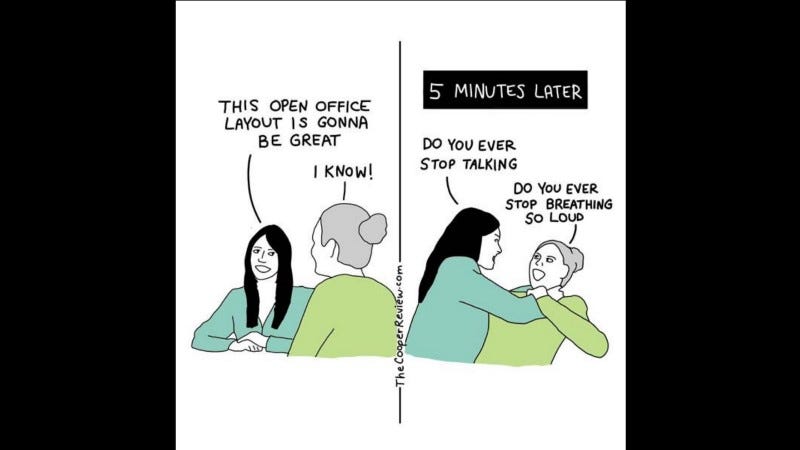
The growing backlash about the open office model continues. We have to get past the sunshine-and-flowers whitewashing of the anywhereism trend. It’s just an economic effort to shave margins by taking back all the real estate that could/should/would have been dedicated to offices if in fact the real goal was higher productivity, serendipity, creativity, and innovation.
The open office model brings together the worst design features of discount airlines and elementary schools while promising increased human potential, camaraderie, and higher engagement. Instead, people are opting to work from home whenever they need to accomplish ‘deep work’ as Cal Newton calls it. In fact, only 7% of workers say the office is the best place to do their most productive work. This is a failure of business thinking on par with discrimination against women and minorities, or the myriad ways that organizations impose conformity.
When it’s not competing with Facebook’s Instagram, Snapchat’s augmented reality game is actually really strong.
Snapchat unveiled a new feature today called World Lenses, which unlike it’s popular Selfie Lenses, change a user’s surrounding environment. The new feature is activated when you tap anywhere on the screen with the rear camera running.
Currently, there are only seven new filters available, including an election filter for those in the United States. Some of the others include a rainbow cloud, a fish frozen in ice, exploding hearts, a disco scene and butterflies.
Reports indicate that these augmented reality specs could potentially work on the company’s Spectacle glasses, which allow users to record video clips to share on the app.
While there isn’t a set release date for Spectacles, today’s update also added a page in the app to pair Spectacles with the app.
In recent months, WikiLeaks and I personally have come under enormous pressure to stop publishing what the Clinton campaign says about itself to itself. That pressure has come from the campaign’s allies, including the Obama administration, and from liberals who are anxious about who will be elected US President.
On the eve of the election, it is important to restate why we have published what we have.
The right to receive and impart true information is the guiding principle of WikiLeaks – an organization that has a staff and organizational mission far beyond myself. Our organization defends the public’s right to be informed.
This is why, irrespective of the outcome of the 2016 US Presidential election, the real victor is the US public which is better informed as a result of our work.
The US public has thoroughly engaged with WikiLeaks’ election related publications which number more than one hundred thousand documents. Millions of Americans have poured over the leaks and passed on their citations to each other and to us. It is an open model of journalism that gatekeepers are uncomfortable with, but which is perfectly harmonious with the First Amendment.
We publish material given to us if it is of political, diplomatic, historical or ethical importance and which has not been published elsewhere. When we have material that fulfills this criteria, we publish. We had information that fit our editorial criteria which related to the Sanders and Clinton campaign (DNC Leaks) and the Clinton political campaign and Foundation (Podesta Emails). No-one disputes the public importance of these publications. It would be unconscionable for WikiLeaks to withhold such an archive from the public during an election.
At the same time, we cannot publish what we do not have. To date, we have not received information on Donald Trump’s campaign, or Jill Stein’s campaign, or Gary Johnson’s campaign or any of the other candidates that fufills our stated editorial criteria. As a result of publishing Clinton’s cables and indexing her emails we are seen as domain experts on Clinton archives. So it is natural that Clinton sources come to us.
We publish as fast as our resources will allow and as fast as the public can absorb it.
That is our commitment to ourselves, to our sources, and to the public.
This is not due to a personal desire to influence the outcome of the election. The Democratic and Republican candidates have both expressed hostility towards whistleblowers. I spoke at the launch of the campaign for Jill Stein, the Green Party candidate, because her platform addresses the need to protect them. This is an issue that is close to my heart because of the Obama administration’s inhuman and degrading treatment of one of our alleged sources, Chelsea Manning. But WikiLeaks publications are not an attempt to get Jill Stein elected or to take revenge over Ms Manning’s treatment either.
Publishing is what we do. To withhold the publication of such information until after the election would have been to favour one of the candidates above the public’s right to know.
This is after all what happened when the New York Times withheld evidence of illegal mass surveillance of the US population for a year until after the 2004 election, denying the public a critical understanding of the incumbent president George W Bush, which probably secured his reelection. The current editor of the New York Times has distanced himself from that decision and rightly so.
The US public defends free speech more passionately, but the First Amendment only truly lives through its repeated exercise. The First Amendment explicitly prevents the executive from attempting to restrict anyone’s ability to speak and publish freely. The First Amendment does not privilege old media, with its corporate advertisers and dependencies on incumbent power factions, over WikiLeaks’ model of scientific journalism or an individual’s decision to inform their friends on social media. The First Amendment unapologetically nurtures the democratization of knowledge. With the Internet, it has reached its full potential.
Yet, some weeks ago, in a tactic reminiscent of Senator McCarthy and the red scare, Wikileaks, Green Party candidate Stein, Glenn Greenwald and Clinton’s main opponent were painted with a broad, red brush. The Clinton campaign, when they were not spreading obvious untruths, pointed to unnamed sources or to speculative and vague statements from the intelligence community to suggest a nefarious allegiance with Russia. The campaign was unable to invoke evidence about our publications—because none exists.
In the end, those who have attempted to malign our groundbreaking work over the past four months seek to inhibit public understanding perhaps because it is embarrassing to them – a reason for censorship the First Amendment cannot tolerate. Only unsuccessfully do they try to claim that our publications are inaccurate.
WikiLeaks’ decade-long pristine record for authentication remains. Our key publications this round have even been proven through the cryptographic signatures of the companies they passed through, such as Google. It is not every day you can mathematically prove that your publications are perfect but this day is one of them.
We have endured intense criticism, primarily from Clinton supporters, for our publications. Many long-term supporters have been frustrated because we have not addressed this criticism in a systematic way or responded to a number of false narratives about Wikileaks’ motivation or sources. Ultimately, however, if WL reacted to every false claim, we would have to divert resources from our primary work.
WikiLeaks, like all publishers, is ultimately accountable to its funders. Those funders are you. Our resources are entirely made up of contributions from the public and our book sales. This allows us to be principled, independent and free in a way no other influential media organization is. But it also means that we do not have the resources of CNN, MSNBC or the Clinton campaign to constantly rebuff criticism.
Yet if the press obeys considerations above informing the public, we are no longer talking about a free press, and we are no longer talking about an informed public.
Wikileaks remains committed to publishing information that informs the public, even if many, especially those in power, would prefer not to see it. WikiLeaks must publish. It must publish and be damned.
We are immensely fond of tutorial-maker extraordinaire Matt Timmons-Brown, who you may know as The Raspberry Pi Guy, and we treasure his widdle brain. Matt, please wear a helmet consistently next time you use this skateboard monster thing.
Over the summer, I made my own electric skateboard using a £4 Raspberry Pi Zero. Controlled with a Nintendo Wiimote, capable of going 30km/h, and with a range of over 10km, this project has been pretty darn fun. In this video, you see me racing around Cambridge and I explain the ins and outs of this project.
This is a beautiful build, with a Bluetooth-connected Raspberry Pi Zero controlling the speed of the brushless motor that drives the board. Matt’s using a Wiimote to control the speed, and terrifying the residents of Cambridge into the bargain.
The metal boxes underneath the skateboard that Matt’s made to house the battery and electronics are, in a way, the most important part of the build. When you’re tooling along at 30kmph, the last thing you want to do is to grate your lithium-ion battery on the tarmac at speed.
Matt visited Pi Towers to show us what he’d made, and Gordon had a go. You’ll want to turn the sound on.
The Raspberry Pi Guy popped into Pi Towers to show off his new creation. While skating up and down the office on his Pi-powered skateboard, our Director of Software Engineering, Gordon Hollingworth, decided to have a go.
And if the US Election results don’t interest you, how about this muralishious bash on Nov 8.
Those interested in applying are invited to attend a video launch and info session hosted by the VMF team at the American (926 Main Street) on Tuesday (November 8). Doors to the event open at 6:30 p.m. A short video will be shown at 7, and an info session will follow. Guests are encouraged to stick around for SNAG, an alternative arts event that features live painting, which kicks off at 8 p.m.
Gail Collins: Well, if Donald Trump wins the election, there are a whole lot of people who will be talking about renting a U-Haul and moving to Vancouver.
Arthur Brooks: I hear Canada is building a wall and making us pay for it.
I’ve been using Pocket for a fairly long time now (around a year), and was wondering if I should switch back. This reassurance of why it decided to provide Premium features, coupled with the little nagging prompts I get inside Pocket every now and then and my recent return to the Kindle (which Instapaper always handled very well) seem like a good enough reason.
Nonetheless, and even though Instapaper’s long term survival seems assured. I’ve been looking into WARC as a way to archive stuff I’m interested in. OneNote’s bitmap captures are too clunky, and PDFs seem a bit overkill, so I’ve been tinkering with ways to convert WARCs into .webarchive files for quick previewing and might have some news on that in the near future.
Like I’ve written many times before, my iPad is my main personal computer. But both the kind of work I do and the hobbies I engage in force me to remote to various machines on a daily basis and I’ve grown tired of Apple‘s take on what “professional” use of their hardware is like, so when I caught a whiff of the X1, I fished around until I could order one in Europe.
A Mouse? On an iPad?
Yes. The X1 is companion hardware for the Citrix Receiver, their iOS client. Citrix has had brilliant, high-performing remote desktop technology for years, and I notably used it ten years ago to close my laptop in Portugal, re-open a few hours later in Italy and just keep on going on a Word document (an RFP for DSL equipment, if I remember correctly) on top of GPRS. Yes, less (average) bits per second than dial-up. And it worked.
These days things have changed tremendously, and RDP delivers an excellent desktop experience with moderate bandwidth use – so I regularly use that to connect to my machines on Azure, and fall back to VNC on Linux (largely because X11rdp is still a pain to set up and keep secure). Jump Desktop supports both just fine (including tunneling both inside SSH), so that’s what I’ve been using for years now.
Even though Jump Desktop supports a “trackpad” mode that goes a long way toward making a remote mouse pointer usable on an iPad, it’s not as immediate as a mouse – I’ve grown used to it and compensated by using keyboard shortcuts extensively on Linux, but using Windows machines remotely is a pain, especially when you’re dealing with single-purpose VMs that are not worth the time to configure the way you prefer (and believe me, I’ve looked for ways to script the configuration of various keyboard shortcuts and never found anything that fit me).
The interesting thing is that I have no trouble whatsoever with using the touchscreen itself – in fact, I’ve become somewhat of a fan of Windows 10 Tablet Mode, which translates beautifully over Remote Desktop. It’s having to constantly toggling between touch and trackpad modes that has been getting to me, especially since the iPad mini’s small size makes it a little too hard to position the caret and do precision dragging in touch mode – now there’s no need to toggle anything anymore.
Incidentally, the keyboard I use is the Logitech Keys-to-Go, which I got during my recent trip to Seattle. I like its portability and the fact that (unlike some of Logitech’s other offerings) it has a Ctrl key. It doesn’t have Esc, though, which is a constant pain, but it sort of makes up for it by being close enough in key size and spacing to make it possible for me to touch-type at speed without any hiccups.
I’ve been using it to write just about everything here for the past eight months, and love it:
My little mobile office.
Yep, again, that’s an iPadmini. I prefer that form factor for portability and general-purpose use (and freely grant it can feel a little cramped at times), but with a full-screen editor going and the font set to a sensible size it is just right.
The whole setup (plus a power adapter and the requisite dongles) fits into a small messenger bag.
The X1
Physically there’s nothing much to it: It’s your average nondescript plastic mouse, suitable for both left-handed and right-handed use. Here it is alongside my battered Apple Magic Mouse:
The little nub is actually a button that lights up with a blue LED when the mouse wakes up, but strangely enough it's completely undocumented.
The electronics seem to be thrifty, taking a single AA battery:
With the cover removed. Note the apparent re-use of a mould that would take a wireless transceiver.
It’s not the best built mouse ever, but it’s ergonomic enough. I’m a bit concerned that the bottom cover retainers appear quite fragile, but I don’t plan on opening it very often.
These look flimsy and breakable.
Compatibility
So far, it works perfectly with Jump Desktop, regardless of the display protocol in use or the kind of machine I’m accessing. No lag, no trouble using the mouse wheel, no trouble on any of the surfaces I’ve used (but no glass tables yet, which are often a problem).
But since the mouse support is baked in to Jump Desktop, the X1 doesn’t work with the official Microsoft Remote Desktop client for iOS, nor with any other applications like Prompt or Coda which provide SSH access. Those would also benefit greatly from mouse input, for even text-based terminals these days support mouse events when appropriately configured.
Or even without any configuration at all – On Ubuntu, I regularly use a mouse with vim without even thinking about it, and got it to work many times with tmux when SSHing to various other distributions.
But until Panic and the like catch on, my usual cop-out is to open a VNC session on one of my UNIX boxes and use terminals there – which works, but is hardly ideal on the road.
Getting Natural Scrolling “Back”
The only thing I missed was natural scrolling when connecting to Windows machines, but that’s easy enough to hack through a registry tweak:
Run regedit.exe
Go to HKEY_LOCAL_MACHINE\SYSTEM\CurrentControlSet\Enum\HID
Find the mouse hardware ID (you can fetch it from hardware properties inside the Settings app)
Look for DeviceParameters and change FlipFlopWheel to 1
In Linux/VNC, it’s much easier (but a tad obscure, I’ll grant):
The mouse does pair with iOS, but obviously nothing happens since Apple doesn’t believe a mouse is useful in iOS and has built no support for it (which dovetails nicely with the discussion about touch screens on laptops I alluded to a couple of days ago).
And, like I mentioned above, it will only happen at all if developers do it themselves – which is kind of a shame, really, since when Apple implemented two-finger cursor movement in iOS 9 they could have extended that to some kind of mouse support1.
But alas, that is likely not to be. The iOS+touch vs Mac+trackpad split is unlikely to change, and “Pro” users who need access to remote machines and legacy apps are likely to have to put up with this situation forever.
Nevertheless, I now have a pretty nice way to work remotely – I’ve even plugged in an aging external monitor via VGA on one occasion (but at 1024x768 resolution, which is ridiculous these days). I know this smacks of Continuum, but if iOS devices had consistent hardware (and software) support for full HD display output, I’d be a happier camper.
I know using a standard Bluetooth mouse has been possible for years if you jailbreak your device, but I have no interest in doing that. ↩︎
Why is it so hard to just sell unflavoured / basic stuff that I can then flavour / use any way I like?
Oh yeah, profit margins.
Just the words “cottage cheese” may conjure up images of the goopy, runny stuff mounded high on a plate next to some slices of melon in the “lighter fare” section on a diner’s menu, perhaps. But cottage cheese wants to shed that uncool, unappetizing image, and be more like its cooler dairy cousin, Greek yogurt.
Sales of Greek yogurt are way up amid consumers’ shifting tastes toward high-protein foods, prompting cottage cheese makers to shift their products in the same way, with new flavors and packaging to help boost interest, The Wall Street Journal reports.
In contrast, though once beloved by dieters in the 1970s, “Cottage cheese has been all alone on the shelf for years, just begging to be noticed,” Andrew Westrich, a brand manager at Organic Valley tells the WSJ. “Now, lo and behold, consumers are realizing there are cultures, protein and good fat in it.”
The bosses in the cottage cheese industry are now trying out new flavors like maple vanilla, Kalamata olive, and basil Parmesan, with single-serve containers that are akin to yogurt cups to attract folks on the go.
“Until now, cottage cheese didn’t do anything while yogurt innovation exploded,” Gerard Meyer, chief executive of Muuna cottage cheese, told the WSJ, adding that he thinks a creamier product will draw shoppers. To that end, his company introduced single-serving cups in August with flavors like pineapple and mango that promised “a melt-in-your-mouth experience.”
General Mills is also getting in on the cottage cheese game with investments in a company called Good Culture that makes a line of “gourmet” organic cottage cheeses in single-serving containers with flavors like blueberry acaí chia.
These efforts seem to be working: cottage cheese sales are showing sigs of improvement after years of flat sales. That being said, the food only makes up about 2% of total dairy sales, John Crawford, a dairy analyst at IRI tells the WSJ.
The current U.S. federal election has captivated the world, and the moment of truth has finally arrived.
From Twitter, to YouTube to the the CBC’s live updates, there are several ways for Canadians to follow along with the action on their smartphones.
CBC
For Canadians looking for election coverage on the fly, the CBC will start blogging about the results at noon ET.
From there, users can watch a live stream of the network’s election coverage an receive updates from CBC’s U.S. correspondents. Furthermore, when the first polls close at 6 p.m. ET and until midnight, the CBC live blog will provide state-by-state voting results.
Several news outlets have partnered with YouTube to live stream their coverage of the United States federal election. Users can tune in at 7 p.m., select their favourite news outlet from the options provided and follow along.
In a content deal with publishers, Facebook committed $50 million to publishers in exchange the production of live video on their Facebook pages. Several of these outlets are putting their money where their mouth is this election by producing live video coverage.
In an interesting development, Buzzfeed announced in September that it would partner with Twitter to live stream the election results on the real-time social platform.
This event is just the latest in a string of attempts by Twitter to promote video content on its platform. Users can also head over to Moments and follow Live Election Updates to have results integrated into their Twitter feeds.
GIPHY’s iPhone app was updated today with the ability to save favorite GIFs. What’s more, you can sign up for, and into, a GIPHY.com account from the iOS app so those favorites sync across GIPHY’s website, the iPhone app, and its companion Messages app. It’s a relatively simple change, but one that makes a big difference in the utility of the app. If you have a go-to reaction GIF, now you only need to save it as a favorite once to access it from the web, the iPhone app, or the Messages app.
In my limited testing, syncing was seamless and immediate. The update does not include GIPHY Keys, GIPHY’s custom iOS keyboard. Favorites saved in the keyboard app do not sync to your GIPHY account. In addition, the lack of an iPad app is curious; I find myself wanting a GIF at least as often on my iPad as on my iPhone. That said, this is a welcome update that should make GIPHY much more useful to diehard GIF fans.
It turns out Home doesn’t hide a lot within its diminutive frame. The device only has two microphones. That’s notable insofar that Amazon’s Echo smart speaker, Home’s main inspiration and competitor, has seven microphones. Despite its less capable hardware, Google says Home is able to differentiate voices patterns from background noise just fine.
iFixit was also discovered the device also uses a lot of the same motherboard components found in last year’s Chromecast — validating, at least in part, the pre-release rumour that Home was set to be just a repurposed Chromecast.
With everything said and done, iFixit gave Home an eight out of 10 repairability score. Minus some problematic adhesive that helps keep the touch board attached to the upper case, all of Home’s other disparate components are easy to access and replace.
What if instead of shoes, Adidas sold weapons? Or instead of hamburgers, McDonald’s sold missiles? These are the kinda questions posed in Corporate Warfare, a digital illustration series by the Foreal design studio that equates the power and impact of big brand corporations to that of a torpedo or atomic bomb.
Known for these subversive digital illustrations, the young studio out of Germany wanted to represent and some how visualize the power of these corporations over our culture and economy in a way people could understand them. Dirk Schuster, cofounder of Foreal, tells The Creators Project, “Big corporations can have more power than governments, so we put them in a military context.”
McDonald’s
The colorways of companies like McDonald’s and Adidas have been stretched and reshaped into expensive instruments of destruction. The bombs are squeaky clean and presented in a glossy sterile environment as if we were examining each weapon at an arms show. “We wanted to mix a military, technical aesthetic with the colorful and bold world of corporate design to create something forbidding and appealing at the same time,” says Schuster.
DHL
The team started with rough sketches of each missile to get a general idea of the shape. Those sketches were then flushed out more fully in Cinema 4D, which Schuster tells us is the studio’s primary 3D software program. From there each illustration was rendered in Octane and then thrown into photoshop for additional touch ups.
Google
Check out more work by the Foreal design team on their website.
A while back a prominent blogger wrote a post called “Why didn’t you blog about Trump, Daddy?” The basic argument of the post was this — his blog was a professional space, and he liked to keep it about the subject he was an expert in, and let’s face it, how he came down on the vote wasn’t really going to matter to people anyway.
But against that there was this: this is not a normal election. This is the sort of election your kids and grandkids (or grandnephews and grandnieces) will ask you about many years from now. They are not going to want to hear about how your blog was really about information environments and UX and open content. They are going to ask one thing: “What did you do to stop Trump?”
I’ve put in my canvassing time, and made my donations. I’ve written pieces on DailyKos that attempted to patch up the Sanders/Clinton divide.
But I want to put this here, in this non-political space, that this is the most important election I’ve lived through. And it has driven me nuts watching commentators say “What is the big vision of Clinton? What is she about?”
For me, it’s right behind her on signs at every event. It’s in the speeches and the ads. It’s expressed positively and negatively. It has inspired the speeches of Michelle Obama as a surrogate, speeches which could stand their own with any of the great speeches of the last 240 years. It has brought Glenn Beck — Glenn fricking Beck — to re-evaluate his life choices.
The vision is this: we’re stronger together. When we see our differences as our strength, we all win.
If you wanted me to, I could dive down and show you how that is reflected in two dozen different policy details of Clinton’s plans. The difference is in every detail, from the approach to police killings of black citizens, to free college tuition, to the acceptance of the LBGTQ community, to the proposals to fix Obamacare so it works for everyone. On every issue, in every policy, is what has become the core idea of the Democratic Party: when we help people live up to their potential, we grow the pie for everyone.
The Romney and McCain campaigns argued that we, as a nation, had gone overboard in some places with these things. That too progressive a tax decreased our productivity, or in Romney’s famous formulation, increased the laziness of the 47%. That tensions between religious and civil liberties needed to lean more into religion, and less into civil rights. These were not things I agree with. I fought hard against them. I think there is some ugliness under these ideas, when you strip away the veneer.
But Trumpism is different. It is not talking about growing the pie, or even dividing the pie a bit differently. Trumpism means one thing: you win by punishing others or bringing others low.
It’s not enough that Trump wins: Hillary must go to jail. It’s not enough we build a wall: Mexico must pay. It’s not enough that we restrict abortion: women who receive abortions must be prosecuted. Mexicans, Muslims, African-Americans, the disabled: through the power of Trump they will learn their place. They will get in line behind us, where they belong. They will not dare to speak back, or look us in the eye.
I find this terrifying. It is not the politics of Reagan or even George W. Bush. It is the politics of a lynch mob. It is a politics of subjugation. Of punishment. Of mob justice.
There are some people out there who say that Hillary doesn’t have a vision. I think, in this election, she has the only vision that matters. We are stronger together. If you believe that, please go out and vote for Clinton tomorrow, and give her a House and Senate that allow her to govern.
Thank you, and we now go back to our scheduled programming.
I spent a tiny amount of time in Moscow in the mid 90s. One business trip and some traipsing around the rest of Eastern Europe. This (from an archive of Russian photography) is exactly how I remember it.
I like my Surface 3. But a few days ago I briefly played with a Surface Pro 4. I don't care much for the additional power. But the keyboard cover plays in a completely different league from the old Surface 3 keyboard. This alone would be worth the upgrade.
The trackpad has also improved tremendously, but it cannot touch a MacBook trackpad. They are worlds apart. Rule of thumb: if you see somebody unpack a mouse, the trackpad sucks.
Most community strategies are a collection of tactics bundled together from books, blogs and conferences. They try to help you do what you’re doing better.
But a strategy isn’t about optimizing what you do. A strategy decides what’s worth doing in the first place and allocates your resources to do these things unbelievably well.
You can spend your entire year doing routine tasks like welcoming every new member, writing content to fill your calendar, hosting AMAs, interviewing experts, writing your newsletter, organizing meetups, initiating new discussions, replying to discussions etc…
But have any of these ever moved the needle for you? Have any of these driven double-digit growth in any metric that matters to you?
You want to allocate your time, money, and your energy to the 3 to 5 things that are worth doing and give these things everything you’ve got.
The biggest communities today didn’t try to do everything really well. They identified which were the critical things worth doing in the first place.
Great Things Happen When You Allocate Your Resources Well
Let’s take a simple example. You might interview experts on a weekly basis to help members learn more about the products and increase customer retention.
There are two ways of doing this.
1) A Weekly Webinar. Create a weekly slot to interview an expert, reach out and see who’s available, ask them to present their idea in an interview format, record the webinar and publish the video on YouTube.
2) An Expert Video Series. Take a week to interview 10 members to find out what they are struggling with and what kind of help they need. Research who has the best solution to that problem. Fly them to a professional recording studio to give a hands-on demonstration. Hire an editor to make the footage look incredible. Give top members a sneak preview and ask them to promote it when it’s live. Host the video on Vimeo or Wistia for easy-sharing/tracking tools. Have the expert answer any follow-up questions for a period of two weeks.
You can easily see the difference in impact of the two. The former will get a few attendees, the latter might be shared across the web. The latter has the potential to move the needle.
Even if you cannot afford to fly the experts in, you can still hire a professional editor to cut an hour-long tedious webinar into a terrific-looking 15-minute clip that gets sent to every new member with native sharing features enabled.
These are the kinds of things we’re talking about when we talk about moving the needle.
Building The Definitive Database
Or imagine if instead of replying to every single discussion, you use every answer and your own research to build the definitive database of members, products, companies, reviews, tools, locations, or whatever else might matter to your members.
Every good answer to every question gets added to the database. A resource like this will attract far more people. You could reward the people who get the most additions to the database. Once you free yourself from doing the little things you can focus on the really big things like this. You’re still using the same amount of resources, but you’re allocating them differently.
What Would You Do With Unlimited Resources?
You can do this for almost any tactic you do today.
Take a second to imagine what would happen if you had to spend all your time, money, and resources on just one tactic.
It’s this kind of thinking that sets you on the path to achieving phenomenal results. You might be amazed by just how much you can achieve once you learn to stop doing the things which don’t have a big impact.
p.s. Registration for our Strategy Community Management program opens this week. We’re going to take a group of passionate community managers through the process of applying strategic thinking to every single action you take to achieve phenomenal growth.
Today, when you install Drupal 8.2, the out-of-the-box media handling is very basic. For example, you can upload and insert images in posts using a WYSIWYG editor, but there is no way to reuse files across posts, there is no built-in media manager, no support for "remote media" such as YouTube videos or tweets, etc. While all of these media features can be added using contributed modules, it is not ideal.
This led me to propose a "media initiative" for Drupal 8 at DrupalCon New Orleans. Since then a dedicated group of people worked on a plan for the Drupal 8 media initiative. I'm happy to share that we now have good alignment for that initiative. We want to provide extensible base functionality for media handling in core that supports the reuse of media assets, media browsing, and remote media, and that can be cleanly extended by contributed modules for various additional functionality and integrations. That is a mouthful so in this blog post, I'll discuss the problem we're trying to solve and how we hope to address that in Drupal 8.
Problem statement
While Drupal core provides basic media capabilities, contributed modules have to be used to meet the media management requirements of most websites. These contributed modules are powerful — look at Drupal's massive adoption in the media and entertainment market — but they are also not without some challenges.
First, it is hard for end-users to figure out what combination of modules to use. Even after the right modules are selected, the installation and configuration of various modules can be daunting. Fortunately, there are a number of Drupal distributions that select and configure various contributed modules to offer better out-of-the-box experience for media handling. Acquia maintains the Lightning distribution as a general purpose set of components including media best practices. Hubert Burda Media built the Thunder distribution and offers publishers strong media management capabilities. MD Systems created the NP8 distribution for news publishers which also bundles strong media features. While I'm a big believer in Drupal distributions, the vast majority of Drupal sites are not built with one of these distributions. Incorporating some of these media best practices in core would make them available to all end-users.
Second, the current situation is not ideal for module developers either. Competing solutions and architectures exist for how to store media data and how to display a library of the available media assets. The lack of standardization means that developers who build and maintain media-related modules must decide which of the competing approaches to integrate with, or spend time and effort integrating with all of them.
The current plan
In a way, Drupal's media management today is comparable to the state of multilingual in Drupal 7; it took 22 or more contributed modules to make Drupal 7 truly multilingual and some of those provided conflicting solutions. Multilingual in Drupal 7 was challenging for both end-users and developers. We fixed that in Drupal 8 by adding a base layer of services in Drupal 8 core, while contributed modules still cover the more complex scenarios. That is exactly what we hope to do with media in a future version of Drupal 8.
The plan for the Drupal 8 media initiative is to provide extensible base functionality for media handling in core that supports the reuse of media assets, media browsing, and remote media, and that can be cleanly extended by contributed modules for various additional functionality and integrations.
In order to do so, we're introducing a media entity type which supports plugins for various media types. We're currently aiming to support images and YouTube videos in core, while contributed modules will continue to provide more, like audio, Facebook, Twitter, etc. To facilitate media reuse, WYSIWYG image embedding will be rebuilt using media entities and a media library will be included to allow selecting from pre-existing media.
We consider this functionality to be the minimum viable product for media in Drupal 8 core. The objective is to provide a simple media solution to make Drupal 8 easy to use out of the box for basic use cases. This would help users of sites large and small.
A work-in-progress prototype of the proposed media library.
Expected timeline and call for help
We believe this could be achieved in a relatively short time — to be included in Drupal 8.3 or Drupal 8.4 as experimental modules. To help make this happen, we are looking for organizations to help fund two dedicated code sprints. The existing contributors are doing an amazing job but dedicated in-person sprints would go a long way to make the plans actually happen. If you are willing to help fund this project, let me know! Looking to help with the implementation itself? The media team meets at 2pm UTC every Wednesday. I also recommend you follow @drupalmedia for updates.
I tried to make a list of all people and organizations to thank for their work on the media initiative but couldn't. The Drupal 8 initiative borrows heavily from years of hard work and learnings on media related modules from many people and organizations. In addition, there are many people actively working on various aspects of the Drupal 8 media initiative. Special thanks to everyone who has contributed now and in the past. Also thank you to Gábor Hojtsy, Alex Bronstein and Janez Urevc for their contributions to this blog post.
Thanks for the update, Dries! I am following the discussion around the Media Initiative on d.o and I have one question: Will the Media entity you mention correspond to the Media entity we now have through contrib? In other words, do I have to worry about the Media library I am building up right now in Lightning, because Media handling is improved and eventually changed in core in half a year or a year? Do I have to worry about compatibility?
I would be happy to hear your opinion on this one.
I second this question. I'd love some information on a migration path, and if there will be a preferred contribu module which will make the migration easier.
Andreas, the plan linked in the post outlines the sub-issues, especially the 8.3 plan at https://www.drupal.org/node/2825215 which links to https://www.drupal.org/node/2801277 which is the issue to figure out how to move Media Entity contrib module into core. We are not making this up again, but we may not have all of Media Entity contrib's functionality in core at the end. Please join the discussion on that issue to get involved.
Thanks Gábor for pointing to the relevant issues. For non-developers it's sometimes hard to understand which will be the consequences of decisions made on a technical layer. That's why I posted my question here.
While not all functionality will move into core, it will most likely continue living in contrib. That sounds as if it will be safe to build on Media Entities now, if there is no heavy customization involved.
Hi Andreas. We (the maintainers of Lightning) are committed to an update path from our current media entities to whatever ends up in core - and we're working with the those involved in the media initiative.
Tangentially related, the same holds true for migrating to core's Content Moderation from our current implementation of Workbench Moderation once that becomes stable.
Like others, I am getting ready to start using Drupal 8 and with media being a client expectation it is helpful to know that this is coming along soon. Thank you clarifying that Media Entity module is the way to go in the meantime.
Thanks for the article. We are struggling to implement a robust and complete file management for large public websites at the moment. You are now calling for a sprint effort, but are the requirements already clear and complete? I'd be happy to help for this...
The plan for 8.3 is posted at https://www.drupal.org/node/2825215, and the sub-issues being used for planning the exact details. The high level goals are agreed on as documented in this post as well, the details are still being figured out. We are not using a waterfall type approach where we would have detailed requirements first before doing any implementation, approaching this in an agile way instead.
The current plan is to handle PDF files through a contributed module. For the MVP we're focused on image support as that is the most important use case. It's good to add YouTube support to core as part of the MVP, as it is probably the number two use case _and_ it's healthy to have one remote media example. Let's revisit adding support for PDF files after we completed the MVP.
Hi Dries! Why YouTube support to core? Why not Dailymotion? Or some other provider?
I mean, should we tie Drupal to a particular company? Be it Google. I would respectfully suggest being as abstract as possible for Media management (PDF, Images, Audio and other "local" documents). And leave remote media management pluggagle, but in contrib modules.
Thanks for bringing this to the forefront. Like Rich Allen and others above post, I make heavy use of Media in Drupal 7, and am very interested in the migration path.
I'd love to help in any way I can, but most of my strengths are in design and front-end. Since development time is very valuable, how about doing something similar to what was done with the Rules module--crowdfunding development?
Not all developers, and organizations who employ them may have the resources to give toward community projects, so crowdfunding could help to move it along.
Embedding a single image in a node is one very important use. It could be done by uploading inline or selecting from a media library.
There are scores of requests all over the web for a gallery feature in Drupal which you do not seem to be addressing. It needs a bit more dressing up than browsing a media library, but I would have thought there was much in common in the implementation. Would it be possible to implement a simple library from the outset?
I like the implementation of D6 with the gallery2 project - both sadly unsupported now, so adding urgency to my request. D7 seems to have come and gone without a decent gallery solution that is easy to use. The D6/G2 combination offered:
Hierarchical galleries (I want one per member, with sub-galleries)
Flexible permissions
Bulk uploading
Space quotas per user
Ease of use for non technical end users (bit of a pig for webnaster to configure sometimes though)
I don't have the skills to contribute code to something like that, but I would add to a chipin or similar.
There are several of those things that would indeed be good to implement out of the box, whether its Facebook or Twitter post embedding or audio file support or galleries. What we are looking at is how we can improve the core system significantly with some of the common things that *all* of these will need anyway first. Once we delivered that successfully, we should definitely look at next steps and priorities. If we are trying to solve everything at once, that would likely not result in any progress for Drupal users for much longer, so we chose to make smaller steps available to users sooner and then continue to work on it based on feedback and further priorities.
Google has purchased the team behind LeapDroid, a PC Android emulator first released to the public in June, announcing that the developers are joining the Mountain View, California-based company.
As a result of this move, LeapDroid is unfortunately no longer in development. It’s unclear if Google has plans to launch its own take on PC-based Android emulation, but given the popularity of other Android emulation programs like Bluestacks, it’s possible this could be the case.
In an announcement revealing the acquisition, Huan Ren and Huihon Luo, the co-founders of LeapDroid said, “While it’s too soon to comment on specific plans, we look forward to working with our new colleagues at Google to continue pushing the frontier of technology.”
It’s important to point out that Google hasn’t actually purchased LeapDroid and instead has hired the team behind its software. Those who already have LeapDroid installed on their PC will continue to be able to use the program, it’s just not going to receive any future updates.
It is election day in the United States, and the tech figure who had one of the biggest impacts on the current cycle is perhaps a non-obvious one: Jeff Bezos.
Back in 2013 Bezos bought the Washington Post, whose coverage of the campaign has been exemplary. The august newspaper’s reporting, particularly the work of David Fahrenthold, has uncovered stories that have had a far bigger impact than any number of tweets or blog posts or calls for days-off-work in Democrat-safe California ever could have had. What Bezos understood is a technology industry truism: impact is made at scale through the construction of repeatable processes. In the case of the Washington Post, facilitating a strong, confident newsroom has reaped far greater returns than any of us can accomplish on our own.
When Bezos made his purchase, I wrote an article entitled Rebuilding the World Technology Destroyed. It is, by Stratechery standards, pretty short, so I hope you will forgive my taking the unusual step of quoting it in full:
The Washington Post was headed for bankruptcy, and was finally sold for a pittance. Its buyer began his career on Wall Street, only to move into a burgeoning new industry, where he truly made his wealth. The newspaper he bought has a noble history, but will certainly earn losses for years to come.
I’m talking not about Jeff Bezos, who bought the Washington Post yesterday, but rather Eugene Meyer, who bought the Post in 1933. Meyer left a lucrative career on Wall Street in 1920 to seize the burgeoning opportunity in industrial chemicals and founded Allied Chemical (today’s Honeywell). After making millions, Meyer spent the rest of his life both in public service and building the Post, spending millions of his own money in the process.
Meyer was in many ways following the established playbook for industrial magnates. Families like the Vanderbilts, Rockefellers, and Carnegies, who made their fortunes in railroads, oil, and steel, respectively, plowed money into universities, museums, and a host of other cultural touchstones.
It’s this tradition that makes Bezos’s purchase feel momentous, a crossing of the Rubicon of sorts. The tech industry is now producing its own magnates, who are following the Rockefeller playbook. See Mark Zuckerberg giving $100 million to the Newark school district, or Chris Hughes buying the New Republic. Neither though, feels as momentous as Jeff Bezos, the preeminent tech magnate, buying the Washington Post, the nation’s third most important newspaper.
The ironic thing, of course, about a tech magnate buying the Washington Post is that technology has destroyed the traditional newspaper business model. Not that newspapers are particularly special in this regard. As I wrote a month ago in a piece called Friction:
If there is a single phrase that describes the effect of the Internet, it is the elimination of friction.
With the loss of friction, there is necessarily the loss of everything built on friction, including value, privacy, and livelihoods. And that’s only three examples! The Internet is pulling out the foundations of nearly every institution and social more that our society is built upon.
While the struggles of the Washington Post and other newspapers fall squarely into the “value” bucket, the particularly devastating effect of our new world order is seen much more strongly in its effect on livelihoods. This piece on the Crumbling American Dream is a must-read:
But just beyond the horizon a national economic, social and cultural whirlwind was gathering force that would radically transform the life chances of the children and grandchildren of the graduates of the P.C.H.S. class of 1959. The change would be jaw dropping and heart wrenching, for Port Clinton turns out to be a poster child for changes that have engulfed America.
Port Clinton’s demise was largely about the demise of manufacturing, but to my mind, the story of manufacturing is the story of technology. The relentless pursuit of productivity has created massive wealth in the aggregate, even as it has destroyed the foundations of many of our institutions.
In this respect, what Bezos is doing feels almost obligatory. Technology — and I’m using the term very broadly here — has torn so much down; surely it’s the responsibility of technologists to build it back up.
And yet, I fear we as an industry are woefully unprepared for this responsibility. We glorify dropouts, endorse endless hours at work, and subscribe to a libertarian ideal that has little to do with reality. We say that ideas don’t matter, and yet, as Chris Dixon wrote in The Idea Maze:
The reality is that ideas do matter, just not in the narrow sense in which startup ideas are popularly defined. Good startup ideas are well developed, multi-year plans that contemplate many possible paths according to how the world changes.
But do we as an industry understand the world?
It’s here this essay turns personal.
My life is just about the exact opposite of what you would expect from a technologist. I studied political science as an undergrad, was an editor of one of the largest student newspapers in the country, and planned to work in politics. After graduating I took off for Taiwan to travel and teach English, and ended up with a family. Six years later I managed to finagle my way into a top-tier MBA program, only to be rejected by every tech company (but one) when it came time for internships. I didn’t have the right background — I hadn’t lived my life in the technology industry.
Yet I had lived life! I had lived life so fully, and gained so much perspective. And it turned out there was one company that valued that: Apple hired me within 24 hours of my first interview.
I think my being hired had something to do with this:
“It’s in Apple’s DNA that technology alone is not enough — it’s technology married with liberal arts, married with the humanities, that yields us the result that makes our heart sing.” — Steve Jobs
It turned out that a life lived outside of technology was my greatest asset, at least at the company most every founder claims to idolize. But how many take this image and this philosophy seriously? It seems most are more closely aligned with Peter Thiel, who suggested that the best way to increase technological progress was to “Discourage people from pursuing humanities majors.”
Thiel may be right about the best way to “increase technological progress,” but progress is an objective fact; whether its effect is positive or negative remains to be determined.
There was a third article I read this weekend, about the social scientist Daniel Kahneman, called The Anatomy of Influence:
Kahneman’s career tells the story of how an idea can germinate, find far-flung disciples, and eventually reshape entire disciplines. Among scholars who do citation analysis, he is an anomaly. “When you look at how many areas of social science he’s put his fingers in, it’s just ridiculous,” says Jevin West, a postdoctoral researcher at the University of Washington, who has helped develop an algorithm for tracing the spread of ideas among disciplines. “Very rarely do you see someone with that amount of influence.”
But intellectual influence is tricky to define. Is it a matter of citations? Awards? Prestigious professorships? Book sales? A seat at Charlie Rose’s table? West suggests something else, something more compelling: “Kahneman’s career shows that intellectual influence is the ability to dissolve disciplinary boundaries.”
Influence lives at intersections. Yet, as an industry, it at times feels the boundaries we have built around who makes an effective product manager, or programmer, or designer, are stronger than ever, even as the need to cross those boundaries is ever more pressing. It’s not that Thiel was wrong about what types of degrees push progress forward; rather, it’s the blind optimism that technology is an inherent good that is so dangerous.
Technology is destroying the world as it was; do we have the vision and outlook to rebuild it into something better? Do we value what matters?
I’m confident in Jeff Bezos. I’m a little more worried about the rest of us.
To say that this election cycle has only deepened those worries would be a dramatic understatement. This is not a partisan statement, just an objective statement that technology has made objective truth a casualty to the pursuit of happiness — or engagement, to use the technical term — and now life and liberty hang in the balance.
A few weeks ago, during the keynote of the Oculus Connect 3 developer conference, Facebook founder and CEO Mark Zuckerberg articulated a vision for Facebook that I found chilling:
At Facebook, this is something we’re really committed to. You know, I’m an engineer, and I think a key part of the engineering mindset is this hope and this belief that you can take any system that’s out there and make it much much better than it is today. Anything, whether it’s hardware, or software, a company, a developer ecosystem, you can take anything and make it much, much better. And as I look out today, I see a lot of people who share this engineering mindset. And we all know where we want to improve and where we want virtual reality to eventually get…
The magic of VR software is this feeling of presence. The feeling that you’re really there with another person or in another place. And helping this community build this software and these experiences is the single thing I am most excited about when it comes to virtual reality. Because this is what we do at Facebook. We build software and we build platforms that billions of people use to connect with the people and things that they care about.
Leave aside the parts about virtual reality; what bothers me is the faint hints of utopianism inherent in Zuckerberg’s declaration: engineers can make things better by sheer force of will — and that Facebook is an example of just that. In fact, Facebook is the premier example of just how efficient tech companies can be, and just how problematic that efficiency is when it is employed in the pursuit of “engagement” with no regard to the objective truth specifically, or the impact on society broadly.
Last spring Facebook was caught up in a ginned-up controversy about alleged bias: a solitary member of Facebook’s contracted Trending Topics editorial team claimed that conservative news stories were suppressed thanks to team members’ liberal bias. After an investigation Facebook found no evidence of said suppression, but went ahead and laid off the entire team anyways in favor of an algorithm; within days a fake news story was in Trending Topics, and at least four more followed in the next few weeks.
Granted, trending topics has always been a sideshow; what is much more disturbing are the revelations that fake news is widespread in Facebook’s news feed; unsurprisingly, given they are human, many Facebook users wish to connect with people and things that confirm their pre-existing opinions, whether or not they are true.
Make no mistake, this results in a great business: I have written effusively about Facebook’s financial potential and noted that the News Feed algorithm is a big reason why Facebook Squashed Twitter. Giving people what they want to see will always draw more attention than making them work for it, in rather the same way that making up news is cheaper and more profitable than actually reporting the truth.
And yet it is Twitter that has reaffirmed itself as the most powerful antidote to Facebook’s algorithm: misinformation certainly spreads via a tweet, but truth follows unusually quickly; thanks to the power of retweets and quoted tweets, both are far more inescapable than they are on Facebook. Twitter is a far preferable manifestation of Supreme Court Justice Louis Brandeis’ famous concurrence in Whitney vs California (emphasis mine):
Those who won our independence believed that the final end of the State was to make men free to develop their faculties, and that, in its government, the deliberative forces should prevail over the arbitrary. They valued liberty both as an end, and as a means. They believed liberty to be the secret of happiness, and courage to be the secret of liberty. They believed that freedom to think as you will and to speak as you think are means indispensable to the discovery and spread of political truth; that, without free speech and assembly, discussion would be futile; that, with them, discussion affords ordinarily adequate protection against the dissemination of noxious doctrine; that the greatest menace to freedom is an inert people; that public discussion is a political duty, and that this should be a fundamental principle of the American government. They recognized the risks to which all human institutions are subject.
Brandeis’ concurrence was a defense of free speech, the right of which applies to government action; private companies are free to police their platforms at they wish. What, though, does free speech mean in an era of abundance? When information was scarce, limiting speech was a real danger; when information is abundant shielding people from speech they might disagree with has its own perverse effects.
To be clear, Twitter has a real abuse problem that it has been derelict in addressing, a decision that is costly in both human and business terms; there is real harm that comes from the ability to address anyone anonymously, including the suppression of viewpoints by de facto vigilantism. But I increasingly despair about the opposite extreme: the construction of cocoons where speech that intrudes on one’s world view with facts is suppressed for fear of what it does to the bottom line, resulting in an inert people incapable of finding common ground with anyone else.
This is why Twitter must be saved: the combination of network and format is irreplaceable, especially now that everyone knows it might not be a great business. For all the good that the Washington Post has done it is but one publication among many; the place where those publications disseminate information is the true scale, but Facebook has made its priorities clear: engagement and dollars, leavened with the certainty that engineers can make it all better; the externalities that result from a focus on making people feel good are not their concern.
The weakness of Twitter, in contrast, is its unwieldy reliance on humans, to build their own feeds, to find a new network, to broadcast to potentially no one what they think. The payoff, though, is the capability of spreading information more widely and more quickly than has ever before been possible; the societal benefit is an externality that needs to be preserved.
Twitter is mulling over a potential sale of Vine, according to TechCrunch’s Josh Constine, who spoke to several unnamed sources within Twitter. The company was reportedly approached by several interested parties after it announced on October 27th it planned to shut down the six second looping video app in “the coming months.”
Twitter has reportedly narrowed the list of potential suitors down to five companies. Japanese messaging company Line is among the bidders, according to TechCrunch.
Twitter is not expected to recoup the cost of acquiring Vine in the first place — the company reportedly spent $30 million in 2012 to acquire the app and its team — with bids coming in as low as $10 million.
When asked to comment on the potential sale, Twitter declined to do so. It’s important to keep in mind that the sale may not go through for any number of reasons.




 Consumerist:


 Adidas. Images courtesy the artist.
  McDonald’s
  DHL
DHL  Google