Shared posts

14 May 17:17

Vancouver’s Last Natural Salmon Creek & First Sustainable Street

by Sandy James Planner


Did you know that there is still one natural salmon bearing stream left in the City of Vancouver? That is on Crown Street south of Southwest Marine Drive, and you can see it as it goes through Musqueam Park. Fish that have used this creek are Chum, Coho and Cutthroat trout.

This stream and its location is also important, as it is next to the Musqueam First Nation, and Crown Street is also a major entrance to the Nation.

Even two decades ago the City of Vancouver had a surprising percolating font of innovation in the most unexpected place, the Engineering Department. There visionaries like Doug Smith of Greenways (who now heads up the Sustainability Department) and David Desrochers who was manager of Sewer Design stewarded new approaches to managing streets and stormwater. They believed that work could be done in a different, more ecologically sensitive way, and looked for opportunities to test new materials and work in their projects. One grumpy conservative engineer at the city  said that both of these individuals should lose their engineering accreditations for their innovative approaches. But that most certainly  did not happen, instead both Mr. Smith and Mr. Desrochers created work that garnered international attention and awards. And no one talks about the grumpy engineer.

David Desrochers along with  Wally Konowalchuk and Jonathan Helmus had been looking for a place to experiment with a more ecologically responsible way to innovate on  the standard street curb and gutter.  Crown Street with its proximity to this important  salmon stream  and  to the  gateway of the  Musqueam First Nations lands was chosen.

The work on Crown Street between Southwest Marine Drive and 48th Avenue was approved in 2002 . In 2004 funding of 1.18 million was approved with $545,000 being the city share of the cost. Other funding came from the Federation of Canadian Municipalities,($593,350) with the remainder from the Musqueam First Nation and through a Local Improvement Program initiative cost shared with residents.


Crown Street became a traffic calmed street with many of the elements of Seattle’s SEA streets, with minimal impermeable surfaces, and a natural storm water management system. Ditches and infiltration bulges are filled with appropriate plants. Those plants naturally filtrate storm water contaminants before reaching the streams, which enhances fish habitat. Granite curb sets, pavers and markers, many recycled, were used to delineate the street instead of cement and concrete.

Fifteen years later Crown Street with its narrowed road surfaces and gravelled separated sidewalks has been a success. This street shows how to move away from the standard curb and gutter treatment and maximize green space, squelch heat-island impacts of larger asphalt surfaces, and infiltrate and clean storm water in verges and ditches.

There are two other fish bearing streams in Vancouver: one in Stanley Park that is a fish habitat  exhibit, and a restored creek at Spanish Banks, where Coho and Chum salmon return. But none of those are natural.

This map produced by the Vancouver Park Board shows a walk around Musqueam Park and points of interest.

14 May 17:06

Pre-Approved

by Richard Millington

In a current client project, we’ve been launching a new, private, community in a niche field.

Given the nature of the topic, we needed to invite and approve everyone who joined.

We quickly noticed a problem. Regardless of how quickly we approved new accounts (most were approved within an hour), many approved members weren’t returning back to visit the community. That short delay was having a big negative impact.

We tried @mentioning members and nudging them from within the community, but it wasn’t having much of a difference.

So we tried Discourse’s improved invite system instead. Essentially, anyone who joins via a specially created link is pre-approved to join the community. We began using this link in every invite instead of the generic community link.

It’s early days, but so far the results have been close to a 100% success rate. Removing the wait to be approved has a big impact upon someone’s likelihood of visiting and participating in the community.

If you’re building a private community and your platform lets you create a pre-approved list (or pre-approved emails/domains etc..), I’d suggest you use it.

The post Pre-Approved first appeared on FeverBee.

14 May 17:05

2021-05-10 BC

by Ducky

Vaccine Clinics

I missed it on 6 May, but restaurant workers over 18 can now get immunized on the occupation track.


Everyone over 18 who lives in a hotspot can now get a vax!

Press Briefing

In addition to the stats (see below), Dr. Henry said:

  • Regarding the data leak, the primary primary most important purpose of the data is to help pub health make decisions. As such, they distribute it widely [internally]. As we get data, a ton of people review it, and after it has been reviewed, we share it with the public. We also provide a slightly different set of data once per month in our modelling updates.
  • There are rules about privacy that they respect which mean that they cannot publish data at a level that is fine enough that you could figure things out about an individual. As the pandemic has progressed and we’ve gotten more data, we’ve been able to decrease the size of the reporting jurisdictions. We did that once before going from Health Authority to Local Health Area. We had been discussing dropping down to even smaller jurisdictions, and in fact on Wednesday I had authorized going down to Community Health Service Areas. We will be releasing data by CHSA on Wednesday. Some rural areas will still be by LHA instead of CHSA because there isn’t enough data to ensure privacy.
  • We wanted to have a whizzy app which would let you look at the data by age and sex also, but that didn’t get done, so it’ll be static images for now.
  • As we get vaccinated, it’s tempting to think ahead to the post-pandemic life, but we aren’t there yet, so plleeeeeeeaaase keep Doing The Things!

Dix said:

  • The data that got leaked was almost all data that is regularly published. Only four slides had data that wasn’t already public. (I can verify that is true.)
  • Hospitalizations are still too high. We are using 118 regular surge beds and 15 critical care surge beds.
  • We got a ton of vax last week from Pfizer and Moderna, we’re going to get another ton from them this week.
  • Tons of people have registered.
  • The feds have not released the J&J to us yet.
  • We still need to Do The Things!

Q&A

Reminder: I paraphrase heavily.

Q: With restaurant workers now getting vaccinated, does that mean we can go back to indoor dining soon? A: Hold your horses, we still have a lot of cases right now. Yeah, indoor dining is important both to get people paycheques but also as an important social gathering, but first things first.

Q: Why aren’t you letting restaurant workers under 18 get vaccinated? A: C’mon, they only approved Pfizer for teens a few days ago! (Welllllllll…. Pfizer was already approved for those over 16.) We’ll figure it out.

Q: Are you talking to Saskatchewan about their re-opening plan which is based on vaccination rates? Is BC going to do something like that? A: Of course I talk to them, all the provinces talk to each other all the time, I just talked to them yesterday on our regular Sunday call, but they didn’t tell us they were going to spring this on us. We’re not going to base it only on vax rate, we’ll probably look at a bunch of things including rolling seven-day average of case rate and death rate, hospitalization stats, etc. Remember our goals: 1. decrease mortality, 2. don’t overwhelm HC system, 3. minimize disruption. That’s what we will base our reopening on. Also note that if we open too fast, cases can explode, ooo, don’t want that. We need to be careful.

Q: Will BC release data on schools and daycares? A: Look, we don’t have the kind of data that you want. We can’t say, “this person infected that person” for every person. We have had some small outbreaks in childcare, which is why we prioritized childcare workers. And while we have been getting good uptake from schoolteachers, the uptake in childcare workers isn’t as high as we’d like, so CHILDCARE WORKERS, PLEASE GO GET VAXXED!

Q: The positivity rates are different in different places, can we do regional re-openings? A: No. We’ve tried region-based things twice, and they didn’t work. If we learn more, we can change, but what we’ve seen so far is that the virus travels with people when people travel, so you can’t do region-based restrictions. We’re going to do this together. (I am not sure what she’s referring to, but I bet what happens if you reduce restrictions in one place is that encourages people from high-cases/high-restrictions areas to low-cases/low-restrictions areas to do their things (e.g. have a wedding).)

Q: How are you going to make sure people get their second dose at 16 weeks? A: All the names are in the system. We don’t always have contact info in the system, but the people who are coming due soon were mostly in long-term care and First Nations communities, so we’re going back to those places. Also, we started to work on that in week 13 to make sure that we find them by week 16. It’s most efficient for us if you register, so GO REGISTER!

Q: Dix, you mortally wounded public trust by withholding data, how are you ever going to rebuild public trust? A: Oh come on, there were only four slides that had data we hadn’t yet released. We’ve given you data on all kinds of things when you asked, including long-term care home data, personal protective equipment data, surgical renewal data, etc. And we’ve given results by having our politicians stand back and let pub health run things: BC has a mortality rate that is HALF of the Canadian average and one of the best in Europe and North America for jurisdictions our size or bigger. We have learned and adapted and oh EVERYBODY GO REGISTER!

Q: 1.5M BCers have gotten a first vax (actually it’s >2M), when are they going to get updated guidance on what they can do, like can two people with one dose meet socially? A: No. Case counts are still too high. We’re going to get there soon — weeks not months — but we aren’t there yet.

Statistics

Fri/Sat: +596 cases
Sat/Sun: +605 cases
Sun/Mon: +558 cases

Over the weekend: +20 deaths, +110,064 first doses, +6,597 second doses.

Currently 415 in hospital / 150 in ICU, 6140 active cases, 128,139 recovered.

We have 306,437 doses in the fridges, which we will use in 7.6 days at last week’s rate. We have given more doses than we’d gotten by 7 days ago.

We have 259,636 mRNA doses in the fridges; we’ll use it up in 6.5 days at last week’s rate. We’ve given more shots than we’d received by 7 days ago.

We have 46,801 AZ doses in the fridges; we’ll use it up in 26.3 days at last week’s rate.

Charts

14 May 17:04

Is the Shine Starting to Come Off Bill Gates’s Halo? A ‘Nation’ Investigation

by Stephen Rees

The rest of this post comes from a Press Release from The Nation. There are three articles in the links below but fortunately if you are not a Nation subscriber you can have three free articles. I think you will agree when you have finished reading them that this is a very worthwhile use of your time. And, if you have not been paying attention, go read Cory Doctorow’s latest on his blog

The Nation’s Tim Schwab—whose incisive three-part investigation into the Gates Foundation won a 2021 Izzy Award for independent media—is out with a new deep dive into Bill Gates’s opposition to patent waivers on Covid vaccines: A stance that isn’t just ideological, but could be linked to the Gates Foundation’s co-ownership of a vaccine company—and likely a vast trove of intellectual property:

Is the Shine Starting to Come Off Bill Gates’s Halo?

The billionaire’s role in perpetuating vaccine apartheid in the name of protecting intellectual property rights has begun to draw criticism.

Amid a growing chorus of criticism for Bill Gates’s role in the unfolding vaccine apartheid around the world, Schwab reports that many have understated the full scope of the Gates Foundation’s interests in this debate—including the sprawling array of intellectual property the charity has acquired access to through its grants and investments. And the fact that the foundation co-owns a vaccine company. It is increasingly urgent to ask if Gates’s multiple roles in the pandemic—as a charity, a business, an investor, and a lobbyist—are about philanthropy and giving away money, or about taking control and exercising power—monopoly power.

ABOUT: Tim Schwab (@TimothyWSchwab) is a freelance journalist based in Washington, D.C., whose sweeping three-part Nation investigation into The Gates Foundation was part of a 2019 Alicia Patterson Foundation fellowship.

The first installment uncovered the historically opaque operation’s two billion dollars in ‘charitable’ donations to private businesses, documenting how their endowment generates far more income than it gives away. The second part unearthed the foundation’s hundreds of millions invested in companies working on Covid-19, putting it in a position to generate windfall revenues, which Gates himself has failed to disclose publicly. The third piece offered damning criticism of the foundation’s highest-profile research project, the Institute for Health Metrics and Evaluation, which holds near-monopoly power over global/public health. It exposed a welter of financial conflicts of interest and other irregularities at The Lancet, a leading journal that publishes much of IHME’s work.

Representingthe first substantive investigation into the Gates Foundation in 15 years, Schwab provided readers with a singular narrative about how the super-rich transform money into power and wield a devastatingly undemocratic hold over public policy.

Founded by abolitionists in 1865, The Nation has chronicled the breadth and depth of political and cultural life from the debut of the telegraph to the rise of Twitter, serving as a critical, independent, and progressive voice in American journalism.

14 May 17:04

iPad Camera Multitasking

by Rui Carmo

I stopped using Teams on my iPad months ago because it was impossible to use the camera while looking up e-mails, so I’m quite amazed this was possible with Zoom (apparently my kids have been using it in school and thought it was a standard feature, so it never came up).

I completely get the need for entitlements (and curtailing their use when they’re privacy sensitive), but I have to wonder why this isn’t available to every major conferencing app (including WebEx, which Apple itself uses internally and that I had to resort to a couple of times recently).


14 May 17:03

Sandy James walks us through ‘JayWalking’

by Gordon Price

Here’s the Sandy James interview with Margaret Gallagher on CBC Radio – on the history of jaywalking.  More than I knew (and I thought I knew a lot).

Peter Norton in ‘Fighting Traffic” was the scholar who made the connection between the origins of ‘jaywalking’ and motordom (the designation for all the interests and infrastructure promoting automobility and the resdesign of our cities to accommodate it.)  An essential read for those who want to understand the world we live in and how we move around.

14 May 17:02

What skills shortage?

Harold Jarche, May 11, 2021
Icon

Discussion of the skills shortage has reached a new plateau recently and it causes Harold Jarche to look back a few years to think about what it means exactly to say that there's a skills shortage: “When employers say there’s a skills gap, what they’re often really saying is they can’t find workers willing to work for the pay they’re willing to pay,” according to Marina Gorbis. As Jarche writes, "to understand human performance improvement we need to focus on the system, not the individual worker. As W. Edwards Deming noted from his extensive experience, 94% of work performance issues are a result of the system... This looks like a major gaslighting operation, driven by corporations, educational institutions, and big consultancies. Blaming the victims (workers) of financial capitalism takes the spotlight away from the real causes of our problems and challenges." Or as another commentator said recently: "artificial intelligence isn't taking away your jobs. Management is taking away your jobs, and blaming it on AI."

Web: [Direct Link] [This Post]
14 May 16:59

Remember the Days When People Commented on Blog Posts?

Helen Blunden, Activate Learning, May 11, 2021
Icon

This is a post not only about the demise of comments on blogs and the damage that social media did to blog conversations in general but also about what's important in online writing and what metrics (if any) really matter. Hint: it's not likes and retweets. "Maybe we need to review our 'why' of using social media," writes Helen Blunden. "Is it to simply 'push' our articles, blog posts, thoughts and reflections. Or, can we have more meaningful responses and conversations in our blogs in exchange with our readers who took the time to respond to our posts?"

Web: [Direct Link] [This Post]
14 May 16:58

‘Less than 10 percent’ outdoors

by Nathan Yau

The CDC said that “less than 10 percent” of coronavirus cases were from outdoor transmissions. David Leonhardt for The New York Times argues why in all likelihood that number is way too high and leads to public confusion:

If you read the academic research that the C.D.C. has cited in defense of the 10 percent benchmark, you will notice something strange. A very large share of supposed cases of outdoor transmission have occurred in a single setting: construction sites in Singapore.

In one study, 95 of 10,926 worldwide instances of transmission are classified as outdoors; all 95 are from Singapore construction sites. In another study, four of 103 instances are classified as outdoors; again, all four are from Singapore construction sites.

This obviously doesn’t make much sense. It instead appears to be a misunderstanding that resembles the childhood game of telephone, in which a message gets garbled as it passes from one person to the next.

Tags: CDC, coronavirus, New York Times, outdoors

13 May 18:15

Adventures in modern web programming

by kchodorow

At this point, I’ve fallen so far behind of where JS developers are that I don’t think I’ll ever be able to figure out what’s going on. However, Vercel is a portfolio company of GV’s, so I decided to give it a valiant effort.

Thus, I started at vercel.com. I went through their deploy flow for a Gatsby template, linked my GitHub account, and ended up with a static webpage. This created a new Gatsby repository on my GitHub account. Unfortunately, I also have no idea how to use Gatsby. However, I’ve also been meaning to learn Gatsby, so let’s dive in.

I cloned the repository and opened up in Visual Studio Code. Unfortunately, I’m not super familiar with VS Code, either, so then I had to look up how to add the damn folder to my workspace. (The weird thing about working at Google is that I have the best tools in the world at my disposal… just not the ones anyone else in the world uses.)

One quick StackOverflow search later, I’m suspiciously inspecting index.js in VS Code. This seems to be the business end of the app, but unfortunately I’m not familiar with React nor Helmet, both of which seem to be doing some lifting here.

Usually I’ve found the best way to learn a new thing is to mess around with it, so let’s start by changing the front end. I change the h1, commit, and push.

I head to the Vercel equivalent of the github page (e.g., my repo is github.com/kchodorow/gatsby, so my Vercel dashboard for it is https://vercel.com/kchodorow/gatsby. Nice. After a second, it updates and shows my new commit as the deployed version. Very nice. It also has been emailing me about its actions each step, which is a bit much for a personal project but would be nice in general.

Okay, time to get serious. How do I actually connect Vercel to a backend? Googling around for this, it looks like I’m going to be writing serverless functions. Guess what else I’m not familiar with? However, this looks interesting. Basically I can put node.js functions in files like api/foo.ts and this becomes a server request my app can make (/api/foo). I rename date.ts to hello.ts and push it out.

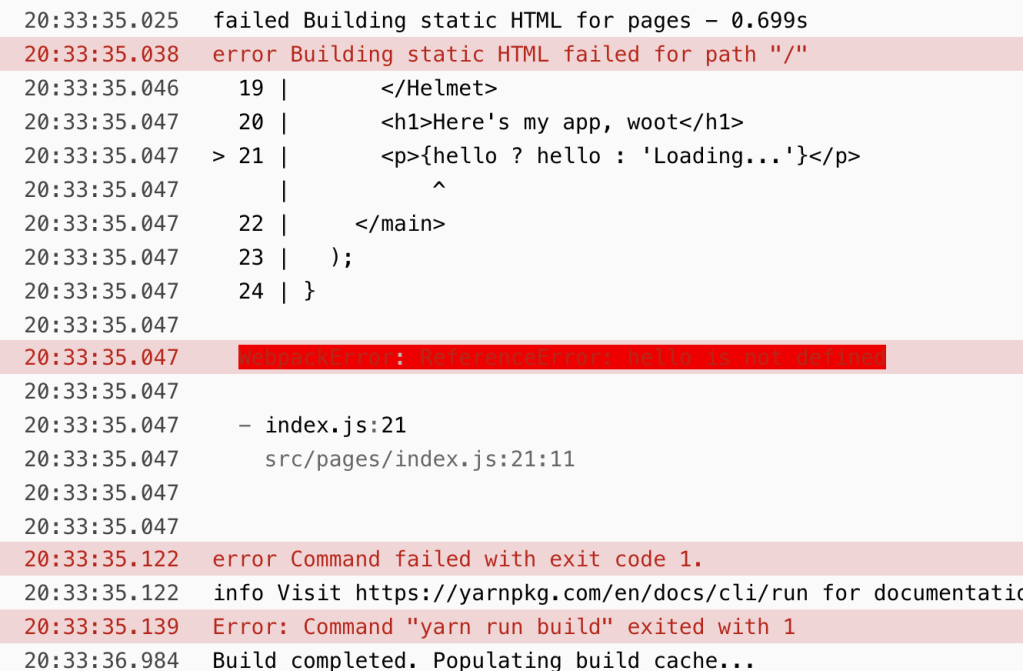
Vercel displays “Build failed.” Clicking on it, It gives me the build logs:

I take a look at index.js and realize that there’s some code that calls the backend function and loads it into a variable, which I completely neglected to change. Well, that’s good, just having {hello} work would be a bit too magic for my blood (and how would nested directories in /api be specified?). I update index.js and this time, cleverly, run yarn run build before pushing.

Sigh. Fine. I install yarn. Then I run yarn. It immediately fails because I needed to run npm install first. So I install dependencies, then I run yarn. Success! A push later, a successful build, and:

Verdict: Vercel is very cool. And I feel a little less behind the curve.

See the actual code behind this paragon of frontend programming at https://github.com/kchodorow/gatsby.

13 May 18:07

Rhubarb syrup. Chop rhubarb, cover in sugar, le...

Rhubarb syrup. Chop rhubarb, cover in sugar, let sit for several days. Strain to get syrup, cook down rhubarb with water to get more liquid out.

13 May 18:06

Metadata, Taxonomy, And Integration

by Richard Millington

Early on in my consulting career, I advised a client to use a taxonomy and categorisation system for the community which was distinct from their other content articles and internal structures.

In the short term, this was better for the community. But seven years later, this made it difficult to do really simple things.

For example, if you want related discussions to show up alongside relevant content articles, how will your system know what’s relevant? How will it know what keywords to match? Because I had advised a different taxonomy, there was no metadata to connect the two.

If you want to automatically route relevant articles, know what products members are talking about, or do anything which involves connecting two systems, you have to think through precisely how that will work and plan in advance for it.

Generally speaking, it’s unlikely a company is going to change its entire taxonomy and data structure to suit your community. So if you want the community to integrate with other systems, you need to adapt the community as best as you can to your current systems.

The post Metadata, Taxonomy, And Integration first appeared on FeverBee.

13 May 18:06

2021-05-12 General

by Ducky

Variants

There is a somewhat worrying report from Qatar saying that the efficacy of only one dose of Pfizer is only 29.5% against infection from B.1.1.7 and 54% against hospitalization. If you only have one dose, maybe don’t go licking doorknobs just yet.

However, this report, also out today, from the UK from December to April (i.e. when B.1.1.7 was flourishing) says that Pfizer had an efficacy of 65% after one dose and 70% after two.

Did Qatar mishandle their vax and let it get warm? Did they have a slightly different version of B.1.1.7? (B.1.1.1.1.1.1.1.1.1.7?) I don’t know. That’s the maddening thing about data: sometimes more data gives less clarity instead of more.

Still, hold off on licking the doorknobs.

Vaccines

This report says that Moderna can give a rash in the arm you were injected in.

Long COVID

This study found virus particles in the penis tissue of men who’d had COVID 4-6 months before. And the men had erectile dysfunction. Men, get a vax, yo.


A different study found significantly lower sperm counts in men who had gotten COVID-19.

Science

This article is specifically about COVID-19, but more broadly about how medical practice should be informed by science, and how hard that is in practice. It’s not really going to tell you anything practical that you need to know about COVID, but I thought it was really interesting.

13 May 18:00

Quoting Brian LeRoux

Folks think s3 is static assets hosting but really it's a consistent and highly available key value store with first class blob support

Brian LeRoux

13 May 18:00

Putting Personal Knowledge Management in Context

by Jim

The notion of Personal Knowledge Management (PKM) is experiencing something of a renaissance. This rebirth is being driven by a combination of new apps, new ideas, and new thinkers promoting their wares. The apps, ideas, and thinkers are all worth paying attention to. At the same time. the brightness of shiny new things is obscuring important history and context.

At the risk of sounding like a grumpy old man yelling at people to get off of his lawn, I thought it would be helpful to look at some of that context in the hopes that it might make it less likely that we would repeat old mistakes. We should at least strive to make interesting new mistakes. 

If you set aside the notion that knowledge management could arguably be considered a synonym for library science, what we label knowledge management in organizations today was born in the late 1980s/early 1990s in the efforts of a number of knowledge intensive organizations (HP, IBM, Accenture, McKinsey, Toyota, etc.) to systematically leverage the things inside their workers’ heads. Chief Knowledge Officers were appointed (a hat I once wore), taxonomies were defined, religious debates were held over the relative merits of Lotus Notes and Microsoft Sharepoint. Today, knowledge management is a reasonably well-defined function within most large organizations. 

Enterprise knowledge management was built on the premise that the number of knowledge workers whose knowledge mattered enough to manage was a small and easily identified subset of the workforce as a whole. Knowledge management was a hedge against having the knowledge in those smart heads walk out the door. 

The knowledge management problem changes when the proportion of the workforce classified as knowledge workers represents a significant fraction of the workforce. When everyone is a knowledge worker, knowledge management becomes personal not organizational.

A classic enterprise knowledge management problem is that of persuading the knowledgeable to share their knowledge with the rest of the enterprise. The naive hypothesis was that knowledge workers hoarded knowledge to preserve and protect their organizational status and position. A slightly less cynical take was that knowledge workers needed help to unpack and externalize their expertise so that it could be shared. 

My take is that the average knowledge worker has no clue about what it would mean to manage their knowledge and no useful models to emulate. You see individual executives and knowledge workers using email as their primary knowledge storage structure. You see arguments that enterprise search engines will bring Google inside the organization and prove sufficient to find and reuse knowledge assets when the time comes. You see elaborate folder and directory structures trying to impose order on proliferating documents and deliverables. 

The rise of personal computing and the web encouraged some knowledge workers to experiment with better ideas. Wikis, blogs, and bookmark managers were pressed into service. Ideas that were ahead of the technology curve (Memex, Augmentation, Dynabook, Mundaneum, and, recently, Zettelkasten) have been dusted off and revisited. 

The latest round of innovation and experimentation holds great promise. As an individual knowledge worker, you have several choices. One is to do nothing and wait for the dust to settle. A second is to place your bet on one of the current players and hope your support contributes to that player becoming the winner. 

A third strategy—and the one I am pursuing—is to recall an observation Peter Drucker once made about the productivity gains made during the early years of the 20th Century;

Whenever we have looked at any job – no matter how many thousands of years it has been performed – we have found that the traditional tools are wrong for the task.

Peter Drucker

Those extraordinary gains flowed from examining tools and task and rethinking the combination in parallel. Changing tools without changing the task is a recipe for speeding up the mess. Changing tasks without rethinking tools will make the current mess a morass.

Personal knowledge management has to be one component of a personal quest to become a more effective knowledge worker.

The post Putting Personal Knowledge Management in Context appeared first on McGee's Musings.

13 May 17:59

Lenovo Go

by Volker Weber

3705342b7075ece5fa2f26b29358d246

Lenovo schafft eine Submarke mit dem Namen Go für das Zugehörgeschäft und startet mit zwei neuen Produkten: Eine 65 W starke Powerbank, die Laptops und zwei weitere Geräte nachladen kann, sowie eine Travel-Maus, die induktiv per Qi geladen werden kann.

More >

13 May 17:57

The Post-Pandemic Seasonal Restaurant

by Gordon Price

Here in the Gilford Street minipark in the West End, there is a restaurant – once the fabled Delilah’s (ask your older gay friends), now Robba da Matti – that has expanded their footprint (and their ceiling) to create something more enticing:

Even as they keep their airiness, they are also becoming more formal, more an extension of their indoor space.  Eventually more permanent.  Restaurants capable of creating outdoor rooms will have two year-round options based on the seasons – outdoors in good weather, where landscaping will be as mood-shaping as the interior design.

Expansion into the public realm will of course raise an issue.  How much should be privatized or made special purpose?

In the case of this restaurant, the expansion of the patio originally occurred where the space itself was little-used and didn’t block any walk-through option.  Now it has doubled.  Has it added vitality and helped keep a business alive – or is it an incremental intrusion and a concerning precedent for our public open spaces?


UPDATE: Dominic Brown commented below: “I think you’ve used a photo of the mini-park across Haro from the space in question, that shows a fellow relaxing in a big burgundy-coloured hammock under the cherry trees. That was me. I miss that place.”

You mean this one!


12 May 17:15

Poly Voyager Focus 2 angekündigt

by Volker Weber

6febbe3ff7c3e182f9179e0ef19f38ee

Ich war jahrelang zufriedener Nutzer des Voyager Focus UC, bis mich letztes Jahr das Jabra Evolve2 65 noch mehr überzeugt hat. Eine bessere Sprachaufnahme mit natürlicherem Ton, 35 Stunden Akkulaufzeit, überlegener Sound auf den eigenen Ohren. Was ihm fehlt, ist eine aktive Geräuschunterdrückung.

Das Voyager Focus hatte eine sanfte Geräuschunterdrückung, wie sie in Büros passt und einen Mikrofonarm, der besonders leistungsfähig war, wenn es darum ging, Nebengeräusche zu filtern, so wie man es vom Voyager 5200 kennt. Dieser Filter führt dazu, dass Sprache weniger natürlich klingt, aber sehr gut verständlich bleibt.

Das Voyager Focus 2 legt nun nach, in dem es die "Acoustic Fence" Technik vom Blackwire 8225 übernimmt. Das ist das einzig mir bisher bekannte Headset, dass selbst Hundegebell unterdrückt. Dazu setzt es vier Mikrofone ein: eins direkt am Mund nimmt die Sprache auf, eins an der Außenseite des Mikrofonarm macht eine Vergleichsaufnahme, bei der die Stimme weniger präsent ist und zwei weitere auf den Ohrmuscheln nehmen vor allem die Nebengeräusche auf. Mit diesen vier Inputs isoliert Acoustic Fence dann die Stimme. Das Ergebnis klingt so:

Das Focus 2 bekommt zusätzlich ein zweistufige ANC, das man sich nicht so vorstellen darf wie bei einem Bose, Sony oder AirPods Max. Die Akkulaufzeit wächst von 12 auf 19 Stunden, das Headset ist gemäß Microsoft Teams Open Office zertifiziert und lässt sich auch direkt per USB-Kabel statt Bluetooth verbinden.

Zwei Versionen gibt es: Focus 2 UC und Focus 2 Office. Die UC-Version mit einem Bluetooth 5.1 Dongle geliefert und verbindet sich über diesen mit Mac oder PC, sowie gleichzeitig per Bluetooth mit dem Smartphone. Das Focus 2 Office hat eine Basis, die per USB-Kabel mit PC/Mac, einem speziellen Verbindungskabel mit einem Deskphone sowie per Bluetooth mit dem Smartphone verbunden ist.

Ich werde Poly bitten, mir ein Focus 2 zu schicken, und dann testen, wie es sich im Vergleich mit Jabra Evolve2 65 und dem ersten Focus UC schlägt.

Bis dahin hat Poly ein paar informative Videos auf der Produktseite.

12 May 17:04

How It Could Work

by Stephen Downes

I'm just going to offer a short post today as I develop some aspects of gRSShopper. In particular, I now have the gRSShopper MOOC environment up and running in a Docker environment - all the instructions are here if you want a copy for yourself, plus there's a video showing how to do it. But that's not what this post is about.

Last week I read an email on a discussion list highlighting the new Matrix Algebra with Computational Applications e-book offered by Michigan State University. It's a lovely book, and what stood out about it was the way it used PressBooks for distribution as an open e-book, and how it embedded Jupyter Notebook in with the text. I spent some time looking at the source, as I do, and I would have sworn I saw an Atom feed in there somewhere (I haven't been able to find it again, but I'm sure I saw it).

Anyhow, it tweaked in me the thought that a book could be thought of as a feed, because, after all, a feed is just a list of (related) articles, and so is a book. So this would be a great way to make the book available to someone studying in a cMOOC using gRSShopper. Such a student would have their own RSS reader, and could receive the feed information as part of the process of enrolling for the course.

As I said, I couldn't find the Atom feed, but I did find that the books published using Pressbooks by the Michigan State University open library each contain their own RSS feeds; the items in the feed correspond to book chapters. Most of the Matrix Algebra book, unfortunately, is not in PressBooks, it's published on GitHub (it's here where I thought I saw the Atom feed, but if it ever existed, it's gone now).

What I wanted to do is showcase using gRSShopper to aggregate book chapters that would, when read inside gRSShopper, allow readers to open Jupyter Notebooks in Binder. This of course is perfectly possible (and probably has been done by Tony Hirst in one form or another). 

But the idea still had merit, so I thought I would simply add a PressBook book to a gRSShopper PLE or MOOC. I ended up using the el30 MOOC (it's what I had open at the time and I was just messing around) and didn't see anything directly relevant at Michigan State but a little searching took me to Designing the Digital World, part of the PressBoooks collection at UCI Galway. I put the RSS feed into the feed reader and unsurprisingly had the book's contents available for reading:

Now it wasn't seamless. I had to study the source to find the RSS feed, something an average reader wouldn't do. The contents weren't classified in any way. More importantly, they did not appear in the right order in the reader. Also, the RSS feed items were stubs; you had to click a link and read the book at its original PressBooks location, which would not be ideal for offline reading. Still, it was pretty elegant.

And what's neat is that all of these book chapters merge together in the same environment. So if I'm looking for something, I can search my own collection and see where it appears in Chapter 3 of one book, Chapter 5 of some other book, and Chapter 8 of some other book. All in one reading environment, all right beside each other.

                               

Now yesterday I was involved in an online discussion about Sharing and collaborating our way out of the storm with Alastair Creelman and the University of Edinburgh's Melissa Highton. I mention her institution because among the highlights of her talk and discussion was a reference to their OpenEd initiative featuring a large collection of Open Educational Resources. And you can probably see where this is going.

Part of the problem with OERs, said Creelman, is that their use is not really organized or structured in any way. I see the objection, but I didn't like the way he framed it from with an institutional and teaching perspective. I mean, ideally, OERs are designed to be used by - nay, even created by - students. For this to work they would this need to be directly available within a student's learning environment, not lingering in some repository waiting for an instructor to discover and adapt them.

So on a hunch I decided to look at the source code for the Edinburgh repository, and perhaps surprisingly, I found an RSS feed (maybe they're using WordPress to organize their resources). So I browsed through to a category relevant to the el30 course, subscribed to the RSS feed, and the resources just flooded into the reader. Like so:


Again, the item is just a stub, so you need to click through to the original resource. And again, the resources are presented in no particular order. But I'm not too worried about this; I could just present a set of OERs or book chapters in the form of a serialized MOOC (this is a topic for another day).

But imagine these institutions actually provided the full resources. Imagine that we were able to find a large number of courses and books, so that institutions and individuals could use them to create courses and provide these learning resources on the fly. And imagine that each student had his or her own collection of these resources, perhaps annotated or linked to categories or projects, from all of their courses, no matter where they too the course from.

This is what it could be. If institutions would provide lists of their books or OER collections in OPML files, and make them available to - well, me to start, but to the community more generally - we could in very short order have an open and distributed learning resource network. I looked, for example at Ton Zijlstra's Federated Bookshelf Proof of Concept. Perhaps what we want - in part is Tom Critchlow's Web of Books

We could have this - if this is what we want - in very short order. Books and OER distributed by RSS. OPML lists creating collections for specific purposes - courses, discussion lists, whatever. RSS readers like gRSShopper using these OPML files to aggregate the contents and present them inside the student's own integrated learning environment. And then these - chapters, resources, comments, etc. - shared through the network among people taking the same course, working in the same community, or associated in any other way.

Why don't we have this? It's hard not to be cynical about the intentions of academic institutions and publishers. But this isn't the place for that just now. This is to point to the possibility - the fact that if we want this we could have this now. This is how it would work. This is what it would look like.

And then we could tackle the other questions of collaboration, mentoring, projects and activities, and the rest.


12 May 17:04

Thoughts from Taipei

by kevin huang

Asian Heritage Month, 2021 By Kevin Huang, co-founder & executive director Heritage is a complicated word, loaded with mixed feelings. I am writing this from my family home in Taipei, Taiwan, where 12 years ago, I stayed to study Chinese and improve my Mandarin. It was on that trip that I realized how much of...

The post Thoughts from Taipei appeared first on hua foundation.

12 May 17:04

How Micromobility Might Save the World

by Gordon Price

From Peter Ladner:

My son Brendan put me on to Horace Dediu.  He’s a cycling advocate who has done pioneering math on actually reaching our targeted GHG reductions in transportation and discovered that even massive adoption of EVs won’t cut it. The unavoidable sweet spot is the burgeoning world of “micro-vehicles”– between skateboards, mechanical bikes, scooters and golf car(t)s. Vancouver-based Veemo (right) is just one example.


Dediu, a Romanian-born Harvard MBA “known for his analysis of Apple’s business strategy and predictions of their financials,” applied his surgically-curious mathematical mind to transportation in this article, revealing the unheralded market for micromobility.


I would also highly recommend his drawn-out but utterly-mesmerizing-for-geeks podcast on How Micromobility Can Save the World.   (Zen cyclists would appreciate Dediu’s seven-minute Youtube meditation on a Zen master’s answer to “why cycle?”)

Brendan (SmartWhistler.org) matched Dediu’s math. He worked out that even if EV adoption were ahead of predictions and all internal combustion-engine sales stopped by 2040, transportation emissions in Whistler would be higher than today due to the slow pace of automobile turnover, population growth, and EVs’ hidden GHGs.

Achieving Whistler’s, Metro Vancouver’s or B.C.’s GHG reduction targets in transportation is simply not going to happen without a massive conversion to micro-mobility modes of getting around.

Not enough people realize how much that is already happening. Horace tells all.


(Click title for full article by Dediu.)


Measuring the Market for Micromobility

The market for micromovilidad, micromobilidade, micromobilité, mikromobilität, micromobilitate, mikromobilita, микромобильность, μικροκινητικότητα, الدقيقة, マイクロモビリティhas never been better.

More people are riding more vehicles further and for more reasons than ever. With over 300 million electric bicycles in use in China, over 230 million two-wheelers in India, 72 million bicycles in Japan, 40 million in Brazil and over 100 million in the U.S., there are more microvehicles in use than there are cars. With electrification, connectivity, and software injections, these uncounted and largely unmeasured categories are gaining superpowers. It all happened so quickly.

The sheer number of form factors, the rapidity of development, the lack of registration or regulation, the variability of applications, business models, geographies, and infrastructures means that there is no single number for the “micromobility market.” No numbers for users, volumes, or value. No numbers for production, profit, or popularity.

That is not entirely a bad thing. Being uncounted usually means being unnoticed, and no competitive response means the small have more time to evolve. Flying under the radar, as the saying goes, gives you more time. But being invisible does not mean being unfelt. The perception of micromobilty is evident all around us.

In the cities, in the delivery services, the infrastructures, the agendas of planners, but most importantly, in the language. Pay attention to language, as it moves faster than data.

Take for example the word “scooter.” It can mean a kick scooter, a Vespa-like feet-forward motorbike, or a motorized wheelchair (in UK parlance). Or it can mean a shared tandem-wheeled electric board you stand on. People are appropriating the word to describe an activity that was not possible a few years ago: motorizing individual short-distance travel without having to pay for parking, insurance, fuel, or owning the vehicle.

Or look at “golf cart”—a misnomer as a cart cannot, by definition, be motorized, nor is it typically used on golf courses. Alternative names include neighborhood electric vehicle, rural cars, and low-speed electric vehicles. Millions are sold in China. More than electric cars.

Or take the humble rickshaw, human-powered, motorized, or electrified. Also known as auto, baby taxi, pigeon, bajaj, chand gari, lapa, tuk-tuk, Keke-napep, 3wheel, pragya, bao-bao, tukxi, tig or saqajamad. As of 2019, Bajaj Auto of Pune, India was the world’s largest auto rickshaw manufacturer, selling 780,000 units during the fiscal year. How many have heard of this manufacturer? Millions of these vehicles are sold each year and few are added up to any total.

When recalling the history of the car, note how much of that language came from French: garage, sedan, cabriolet, chauffeur, chassis, piston, grille, tonneau, limousine, coupé, convertible, and automobile. The reason is that France was the nursery of the car, the place where the technology was patented, developed, and shaped for its first 20 years (between the German invention and American mass production.) We don’t give much thought to how France made the car as we know it but we still use their words for it. The traces in the language tell us how things began.

Our mission at Micromobility Industries has always been to shine a light on this sub-auto world, the negative space in the graph of personal automobiles shown below.


This is why micromobility is defined not as what it is but what it isn’t. I chose a weight threshold because I knew what would not fit there, and in so doing, I knew how many other things would. It’s a “no-man’s land” but yet it is teeming with other species. You don’t need a telescope. If you choose to look with a microscope you can see entire new worlds.

Yet still, one feels that we should try to measure the scale and scope of this negative space. It deserves some inspection. This is my attempt to do so. This view is based on a bottom-up analysis of a few regions and a few vehicle types:


Note that the graph of micromoiblity is shown next to that of electric automobility. The so-called EV car market is perhaps overly optimistic in a projected 80 million units/yr in 14 years (up from 3.4 million last year) but I believe the micromobility market of 200 million units is conservative.

It’s a projection of data from Europe, China, the U.S., and some of India. It does not include one-wheelers or skateboards or hover boards. It does not include rickshaws or traditional motorcycles, many of which will be electrified.

The chart extrapolates from the data we do have: The growth in the European (EU) e-bike market. It takes into consideration the e-scooter and e-moped and some of the heavy micromobility (kei car and golf car[t]). It considers the electric two-wheeled market in India, which promises to grow rapidly through disruptive new entries.

It adds up to hundreds of millions of units of production. Over 1.2 billion in 15 years. Enough to supply mobility to a rapidly emerging, personally mobile, non-consuming middle class and an automobility over-served existing urban citizenry. And this is over a 15 year period: three automobile product cycles.

And yet, even with this, the answer to how big is the micromobility market is elusive. We don’t know the value. We can only guess at pricing and ownership models. We can only guess at utilization, sharing or replacement rates. And don’t even mention profitability. The question of the market size is perhaps best left unanswered. It’s going to be as big or as small as our imaginations.

12 May 17:04

Twitter Favorites: [jonnymorris1973] 20 years ago Douglas Adams died. This made a lot of people very upset and has been widely regarded as a bad move. https://t.co/HdhJQRkACL

Jonny Morris @jonnymorris1973
20 years ago Douglas Adams died. This made a lot of people very upset and has been widely regarded as a bad move. pic.twitter.com/HdhJQRkACL
12 May 17:01

Twitter Favorites: [jmt_18325] To all of the people who got AstraZeneca: feel protected, and feel proud.

John Mark Taylor @jmt_18325
To all of the people who got AstraZeneca: feel protected, and feel proud.
12 May 17:01

Twitter Favorites: [jeffjedras] I mean, I'll take my second shot of the AZ if they're looking for ideas. Scheduled for August but happy to make my… https://t.co/F07PUZD0t4

Jeff Jedras @jeffjedras
I mean, I'll take my second shot of the AZ if they're looking for ideas. Scheduled for August but happy to make my… twitter.com/i/web/status/1…
12 May 17:01

What’s the Perfect Number of Days to Work from Home?

by Gordon Price

From The Atlantic:

If you’ve been able to work from home, you’ve had an enormous privilege. But devoid of choice and novelty, remote work has lost some of its romance for office workers who previously dreamed of ending their commute. …

What would be best for most office workers—and what’s most likely to happen for many of them—is something between the extremes of old-school office work and digital nomadism. … I’m here to argue for a particular baseline: three days in the office, and two at home.

Working from home also gives you more control of marginal time in the workday itself. At the office, if you need a break from your computer, that might mean going to stand in line to buy a salad or yet another coffee. At home, it could be washing dishes or folding laundry or doing a grocery run—stuff that would otherwise eat away at personal time. …  Working from home can also open up new choices about where to live; even if you’re commuting two or three days a week, you might be able to opt for a more affordable neighborhood, or a town that offers more outdoorsy activities that’s farther away from the office.

But working from home is also not what most people say they want to be doing full-time in the near future. …  Many people benefit from working and living in separate places. Commutes can have upsides. Last year, I was somewhat embarrassed to realize that I was among the half of American office workers who missed mine; the time I used to spend walking and riding the train every morning provided a psychological in-between, when all I needed to do was let my brain transition into work mode while I listened to a podcast.

Once you’re actually at work, seeing others there can be valuable, even if you have a robust outside social life. …  That effect is particularly strong for early-career workers, who need opportunities to learn from older colleagues, network with people in their industry, and figure out the internal politics of their workplace. …

By letting people choose their own office adventures, employees can gain back some of what’s sorely missing in American work culture: self-determination. Need to plow through a task that will take you a full day? Stay home. Need to talk through some plans with a few co-workers? Everyone goes in. Kid got the sniffles? Expecting a delivery? Have dinner plans near the office? Do what you need to do to manage your life. Being constantly forced to ask permission to have needs outside your employer’s Q3 goals is humiliating and infantilizing. That was true before the pandemic, but it’s perhaps never been as clear as it is after a year in which many employers expected workers not to miss a beat during a global disaster unlike anything in the past century. …

We’re in a rare moment when American office workers are likely to have significant leverage over their working conditions—in a recent survey, well over half of middle-income workers said they were considering switching jobs this year, and for most of them, remote flexibility would be a factor. Companies that don’t want to spend a fortune replenishing their ranks in a hot labor market will need to make concessions. They can start with two days a week.


12 May 17:00

Ontario ICU nurses say doctors are getting 10 times their pay for similar work during pandemic

mkalus shared this story .

Two Toronto-area nurses are airing their frustrations over how the Ontario government let their pandemic pay expire while continuing to pay boosted wages to doctors, some of whom are doing the same work as nurses due to COVID-19.

Deepi Saharan, 27, received support from thousands of people when she posted about the issue on Instagram recently.

"Unappreciated, disrespected, and lack of support for nurses by this Ford Government," she wrote, referring to the government of Premier Doug Ford.

Saharan pointed out that some physicians earning as much as $450 an hour in intensive care units (ICUs) are working under nurses being paid $33 to $48 an hour.

"HOW IS THAT OKAY??" her post said.

Nurses and other front-line workers in Ontario received an increase in their hourly rate, plus a monthly lump-sum payment, for four months beginning last April. While the extra remuneration expired in August, doctors have continued to receive temporary pandemic pay.

Saharan, who cares for COVID-19 patients in an ICU, said that she decided to go public because she feels the situation is unfair. She stressed that she was only speaking for herself and not for her employer, union or governing body.

"It just felt wrong," Saharan wrote in an email to CBC News. "Providing temporary provincial support for one profession and not another, one who is equally if not more involved, is not right."

She said physicians deserve to be compensated for their skills and education, but nurses are not being paid enough for the extra work and stress they've taken on during the COVID-19 pandemic.

"The pandemic has taken an enormous toll on my colleagues and I, a toll which is indescribable."

Doctors' pandemic pay meant to simplify billing

In April 2020, Ontario offered nurses and other front-line workers a $4-an-hour pay hike for 16 weeks, plus a $250 lump-sum payment for each of the next four months if they worked more than 100 hours per month. But that pay expired in August.

Physicians who work in ICUs that are experiencing surges caused by COVID-19 are getting paid a temporary rate of $385 an hour for day shifts and $450 an hour for overnight shifts, according to an April 2020 memo sent to hospitals by Ontario's Ministry of Health. Doctors who work in other parts of hospitals are also earning special rates.

WATCH | Ontario nurses under pressure from provincial orders in hospitals:

Nurses say Ontario orders to work beyond their scope of practice are causing stress and confusion. 2:23

In some cases, when ICUs are in dire need of staff, doctors earning these rates are working as "nurse extenders" to support nurses with their tasks, Doris Grinspun, CEO of the Registered Nurses' Association of Ontario, told CBC News.

"It's a bit upsetting," Grinspun said of the pay discrepancy, "in the sense that the nurses are the experts training them."

In a statement, a spokesperson for the Ministry of Health said the temporary funding for physicians creates flexibility so that hospitals can better respond to surges in COVID-19 caseloads.

A spokesperson for the Ontario Medical Association said the temporary hourly rates were not meant as pandemic bonuses but to simplify billing for doctors who normally have to charge for each service they provide.

"Some physicians have volunteered to cover nursing shifts to allow nurses to have time off or to address staffing gaps. It's up to individual hospitals and the Ministry of Health to decide how to compensate physicians working as nurses," Leslie Shepherd said in an email.

Veteran nurse thinking of move to U.S.

Nikki Skillen, another ICU nurse in the Greater Toronto Area, said many nurses are reconsidering their profession or thinking about moving to the United States, where the pay is better. She's applying for a U.S. visa to have in her "back pocket," she told CBC News.

"There has been absolutely no incentive for us here," said Skillen, who's been an ICU nurse for 24 years in the Toronto area.

Both she and Saharan, who did not want to identify the hospitals where they work, said that nurses' raises are also being capped at a maximum of one per cent a year under legislation introduced by the Ontario government in 2019.

"We were really enraged by this," said Skillen, who started a Facebook group to fight against the wage cap. "We're worth more than one per cent."

The ministry's spokesperson didn't respond to a question about why nurses aren't getting a pay boost while physicians continue to receive temporary pandemic pay.

David Jensen said Ontario is spending $52 million to recruit and retain 3,700 new health-care workers, including nurses.

"This is one of the largest health-care recruiting and training initiatives in the province's history," he said.

12 May 15:31

2021-05-11 General

by Ducky

Secondary Effects

A study in the UK says that diabetes diagnosis, management, and mortality have been impacted pretty badly during the pandemic. 🙁

Vaccinations

Today, Canada passed the 40% mark in what percentage of its population has gotten at least one dose, and it doesn’t look like the vaccination rate is slowing down at all! Canada is going to pass the US in a a week at this rate.


Many provinces have already passed a number of US states:

Vaccines

A real-world study from the Mayo Clinic says that the J&J vaccine has 76.7% efficacy.


A pregnant woman in Brazil had a fatal stroke after getting AZ. Investigators are investigating.

Variants

B.1.617.2 (one of the “India variants”) does not seem to be particularly immune-evasive, but it does seem to out-compete B.1.1.7, which suggests it is even more transmissible. 🙁

Mitigation Measures

A preprint from the National Bureau of Economic Research looked at interventions to encourage mask wearing. Giving people masks AND having village police remind people to use them worked really well and the effect lasted at least ten weeks after the intervention stopped. Things that did not work included: text reminders, public signage commitments, monetary or non-monetary incentives, and altruistic messaging / verbal commitments.

Transmission

Outdoor transmission is really really rare.


Yesterday, I pointed to a study which said that 2% of the COVID patients carried 90% of the virions. Today I saw a tweet that said that it’s not that 2% of the people are supercarriers, it’s that all COVID patients go through a supercarrying phase. I think it’s premature to say that all patients are carriers for 2% of their time, as that would be about 7 hours out of a two-week infection. I think they don’t know.

12 May 15:30

Organic Growth and Communities

by Richard Millington

A common idea is to launch a community, get a few members, and wait for members to spread the word.

That can happen, but it’s rare. It’s rarer still in private communities which aren’t open to the public.

Be honest, how many communities have you recommended to your peers in the last month? (or even in the last year?). It’s probably not many (if any!).

This is why Rand’s post on amplification content is worth a read. Many of the motivations/reasons for amplifying a content Rand lists are the same I’d list for promoting a community. To adapt Rand’s reasons slightly, these include:

  • Novelty. It’s a completely brand new and surprising idea for a community (a typical forum for people to ask and answer questions doesn’t cut it).
  • Belief reinforcement (i.e. it validated your belief). The community concept or content posted within the community strongly supports a closely held belief and connects people who strongly support that belief.
  • Relationship with the founder. Members know the founder and want to help the founder.
  • Controversy. Disputes between members that resonate on a broader scale (or even a good debate).
  • Familiarity. It hosts many of the well-known names in the industry.
  • Rankings. The community offers a codified ranking of the best successes within the sector or top people within the community.
  • Ego. Members have their egos invested in the success of the community. Either the community is about them, they’re the founding members etc…

This isn’t a comprehensive list, but it’s a good place to start.

While you might attract organic growth via search over time, if you want members to talk about it you need to give them a reason too besides the community simply being ‘really good’.

The post Organic Growth and Communities first appeared on FeverBee.

12 May 15:29

Replied to How It Could Work by Stephen Downes ...

by Ton Zijlstra
Replied to How It Could Work by Stephen Downes (halfanhour.blogspot.com)
We could have this - if this is what we want - in very short order. Books and OER distributed by RSS. OPML lists creating collections for specific purposes - courses, discussion lists, whatever. RSS readers like gRSShopper using these OPML files to aggregate the contents and present them inside the student's own integrated learning environment. And then these - chapters, resources, comments, etc. - shared through the network among people taking the same course, working in the same community, or associated in any other way.

Sounds good to me Stephen! One question I do have w.r.t. to RSS as vehicle for distribution. Isn’t RSS, or at least aren’t RSS reading tools, based on the assumption the timeline is a key organising principle? It only shows the most recent elements in a feed, and RSS readers tend to not show ‘old’ posts, for whatever value of old is adopted. In the case of your book example, my reader will not show the chapter items anymore as of tomorrow, as they are timestamped over a month ago. If time is not an organising principle for the content feed, would h-feed or otherwise meaningfully marked-up HTML, or indeed OPML itself not be as useful? Though I agree that RSS, and the ability to import lists of feeds as OPML is widely distributed and adopted set-up already, so that we could do it now.

12 May 15:27

Because I am bored ...

by Charlie Stross
mkalus shared this story from Charlie's Diary.

While Bitcoin was originally proposed as a currency, it has most of the attributes of a commodity bubble, including a huge halo of swindlers and scam artists working to exploit it. It's also horribly energy-inefficient and contributes to the current global semiconductor shortage, neither of which are desirable. Even worse: attempts at fixing Bitcoin mostly revolve around tweaking the "proof of work" required to add a transaction to the blockchain. Currently, BtC and relatives are computation-intensive. Other paradigms exist, including the new fad for Chiacoin, currently big in China, which is storage intensive — this is what happens when the designer of Bittorrent brings his own personal obsessions to bear on the problem of manufacturing scarcity, and if you want to upgrade your SSD or hard drive in the near future you'd better get right to it before this catches on.

(And about NFTs, the less said the better. Grift, 100% grift, and exploitation of artists as well. Oh, and it appears to be mostly used for money laundering. So fuck off and die if you own any, and especially if you thought pirating some of my work and turning it into NFTs would be a good way to milk the gullible.)

However, these aren't the only options.

It occurs to me that if you want a blockchain secured by scarcity and diminishing returns, you might consider other options that don't totally fuck our lived environment and that can't be gamed trivially by, say, running Chiacoin (the storage-space coin protocol) as part of the burn-in for new consumer grade drives your employer has you shoving in racks at Amazon S3 or maybe Arsebook. (Who totally have a first-mover advantage on that brain-damaged currency in the "phone my customer account manager at Western Digital, tell him I want another ten million terabytes of non-shingled platters" stakes.)

For example, to Elon Musk, a modest proposal:

Hork up a bunch of space probes going somewhere of interest to JPL or NASA or ESA, as both a tax write-off and an apology to the international astronomical community whose night skies you just vandalized with Starlink. Order, say, a dozen. For energy where they're going and for what's coming next they're definitely going to need RTGs, but you're not as fussy about maximum launch weight as the US government (you have Falcon Heavy and, soon, Starship to launch them with) so you can order up something running on, say, Strontium-90: it'll be heavier, but who cares. You're also going to use some of the power from it to run ion rockets for positioning and slow long-term acceleration (hint: Starlink uses ion propulsion for station keeping/reboost: presumably SpaceX have got quite a bit of experience with this tech by now).

So, you kindly donated a couple of dozen probes to Neptune, Uranus, Pluto, Eris, Makemake, Haumea, and the rest of the gang (and the dwarf planet wonks are ecstatic).

But you're not going to be using much bandwidth for sending back data, most of the time. So what to do with those radio transmitters you just kicked out at something above solar escape velocity?

Code signing, that's what you do.

Each probe has a dedicated crypto processor and a very VERY private key. It receives a constant uplink from the ground, and replies by signing and echoing back to Earth the blockchain transactions it receives. The further away from Earth it gets, the longer the delay. Also, the higher demand for the currency rises, the longer the delay to get your transaction into the queue for uplink and signing via the big dishes. You might be able to make an end run around the queue by bribing someone, but gambits based on building hardware are going to run into the wee problem that Deep Space Tracking Networks aren't off-the-shelf commodities and even if they were, you couldn't force the receding space probe to listen to your transmitter and reply (presumably the uplink is secured by the coin owner's own PKI system).

Upshot: it's a cryptocoin system with a big up-front setup cost (as in, billions), which is good (it deters low-end me-too systems), guaranteed scarcity of signing resources, and absolutely no advantage accruing to anyone buying up earthly power or material resources. So it shouldn't drive scarcity in hard disks/GPUs or unreasonable power demands. Flip side: there's a centralized chokepoint (the deep space network) that can be throttled by governments. But some might see this as an advantage ...

PS: my preferred solution to the problems created by cryptocurrencies is to treat them all like child pornography: totally illegal, possession a strict liability offense, choke off interoperability with real currencies at the credit agency/bank interchange level, and make them useless for non-criminals, at which point only criminals will bother with them. And India is going down this route. Let's hope other governments follow suit rapidly and we can say goodbye to this Trump-grade lunatical grift before it degrades our lived environment any more.

PPS: I despise libertarianism. Just in case you were wondering ...