Shared posts

12 Nov 19:12

Not all information wants to be free

by Tara Robertson

It was an honour to be invited to give the closing keynote at LITA Forum. I have never been asked to do a keynote, so I was equal parts terrified and excited.

Here’s the text from my talk. I’d love to know what you think: @tararobertson on Twitter or email me.

Note: the Creative Commons license for these slides differs from the rest of the content on this site. These slides are licensed with an Attribution-NonCommercial-NoDerivatives license as they contain extended quotes that are not mine, and while most of the of the images are CC-BY licensed, several are not.

Title slide - Not all information wants to be free: ethical considerations for digitization, LITA Forum, November 2016, http://bit.ly/tara-slides, Tara Robertson, @tararobertson, CC-BY-NC-ND

Land acknowledgement

I am from Vancouver, Canada which is the unceded traditional territory of the Musqueam, Squamish and Tsleil-Waututh nations. Unceded means that the land was never sold, given, or released to any colonial government. In Canada we’re thinking a lot about relationships between settlers and First Nations in many areas of society.

In Canada we’re still deeply feeling the effects of colonization and the effects of Residential Schools where the church and state tried together to “kill the Indian in the child”. Through the process of Truth and Reconciliation we’ve witnessed the stories of people who survived and heard about the massive amount of physical, sexual and emotional abuse that occurred. The Truth and Reconciliation Report called this cultural genocide. Despite systemic efforts from the church and the state to erase Aboriginal people in Canada these nations and cultures continue to persevere, resist, and First Nations and settlers are actively working to break the cycle of violence and trauma.

I’m half-Japanese-Canadian and my family was interned during WWII in Canada. So for me a settler, learning and naming whose land I’m on is a small thing that I’m committed to doing as part of the process of decolonization and reconciliation with First Nations.

Even with the help of several librarians I wasn’t able to find out whose homeland we have been conferencing on. If you know, I’d love to learn how to appropriately acknowledge this.

powerlines with transmission towers that look like giant abstract people holding the powerlines up over the landscape
Choi+Shine Architects. The Land of Giants. (used with permission)

Introduction

For me the land impacts my thinking quite a bit. While I was born in Vancouver, I grew up in a northern logging town halfway between Washington state and Alaska. While I live in a city now, a lot of the technology work I’ve done supports people in rural areas and seeks to bridge the digital divide.

I’ve worked in libraries for 13 years, 9 of which I’ve been a librarian. I’ve worked doing training and support for small public libraries who migrated to Evergreen, an open source ILS. I’ve worked as a systems librarian at a small art and design college, and currently do accessibility work to remove barriers for students with print disabilities by format shifting their textbooks.

I love this image from Choi+Shine Architects’ concept drawings for powerlines in Iceland. I feel like this photo illustrates the technology work I’ve done in libraries. When having a imposter syndrome moment at a conference, a colleague said, “I think of the technology work you do is the last mile”. So, while I’m not at the front breaking new ground and innovating, I’m chugging along behind making sure everyone can access information.

I became a librarian because I’m passionate about access to information. My core values are around “open”: open source, open access, open textbooks and open education. So, why am I arguing that all information should not be accessible?

Before I get into that, I’d like to tell you about one of my favourite writers.

Amber Dawn

cover of Amber Dawn's book How Poetry Saved My Life: A Hustler's Memoir

Amber Dawn is a writer, a poet, and a creative writing instructor at a couple of universities and in community driven art and healing spaces.

In the preface to How Poetry Saved My Life: A Hustler’s Memoir, she writes:

…my writing does not stand on its own. My writing is comprised of the lives, deaths, struggles, and the work, accomplishments, alliances, and love of many. My writing is indebted to queers and feminists, sex workers and radical culture makers, nonconformists and trailblazers, artists and healers, missing women and justice fighters. My writing stands with those who also have been asked—in one way or another—to edit their bios.

Thank you
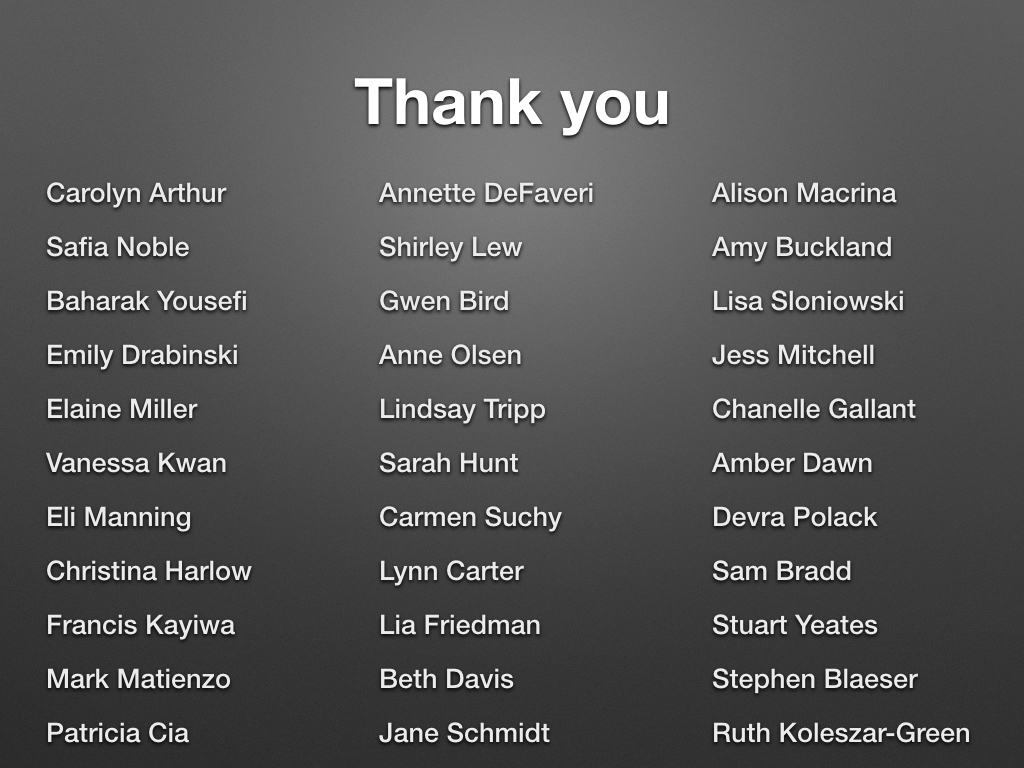
list of 33 people, see: http://tararobertson.ca/2016/thank-you/

I feel a great deal of gratitude towards many people who inspire me and have my back.

I’m one of those annoying extroverts who needs to think out loud. I appreciate the generosity that all of these people have extended to me. These people are friends, colleagues, comrades, librarians, sex worker activists, academics, feminists, queers, artists and pornographers. I think it’s important for me to acknowledge all of these people as extended feminist citation practice but also because I wouldn’t have the courage to speak today. I’m standing on the shoulders of these giants.

I feel privileged to talk to you today about some of the ethical issues I’m concerned about in digitization. For me I need to step out of my comfort and safety of being a professional and share my personal stake in this conversation.

Amber Dawn writes:

If comfort or credibility is to be gained by omitting parts of myself, then I don’t want comfort or credibility. I am not ashamed of my bio. What would be a shame is if I were to fall silent. Each time I bring my fingers to the keyboard, I join the many who also seek to explore and discover seldom-told stories, speak the tough and tender words that are too rarely articulated in day-to-day discourse, and create that place where we have permission to express emotions.

Red umbrellas

5 open red umbrellas in a tree

The first time I did sex work, I was 19 years old and studying Japanese at the University of Victoria. I was a macho third wave feminist and I was broke. I dipped in and out of different types of sex work over the next 15 years, usually while doing some other straight job as well. I worked at Legal Aid while I worked at a BDSM brothel and worked at the public library while I worked as an escort. My shame kept these two work lives very separate and I was unable to speak to many people about my experiences. I don’t think sex work is shameful work, but the judgements and assumptions that are made about sex workers has made me wary and careful about where I’ve talked about these parts of my life.

Until very recently this isn’t something that I ever talked about.

It’s interesting to be a stealth about my sex work history while working in higher education. I’ve heard a lot of very educated people say some very ignorant things when they were describing sex workers with simplistic stereotypes. At last year’s Open Ed conference the participant swag were red umbrellas. It rains a lot in Vancouver, so that makes sense. What the organizers didn’t know is that red umbrellas are the symbol for sex worker rights. 

Montreal Out Games, 2006
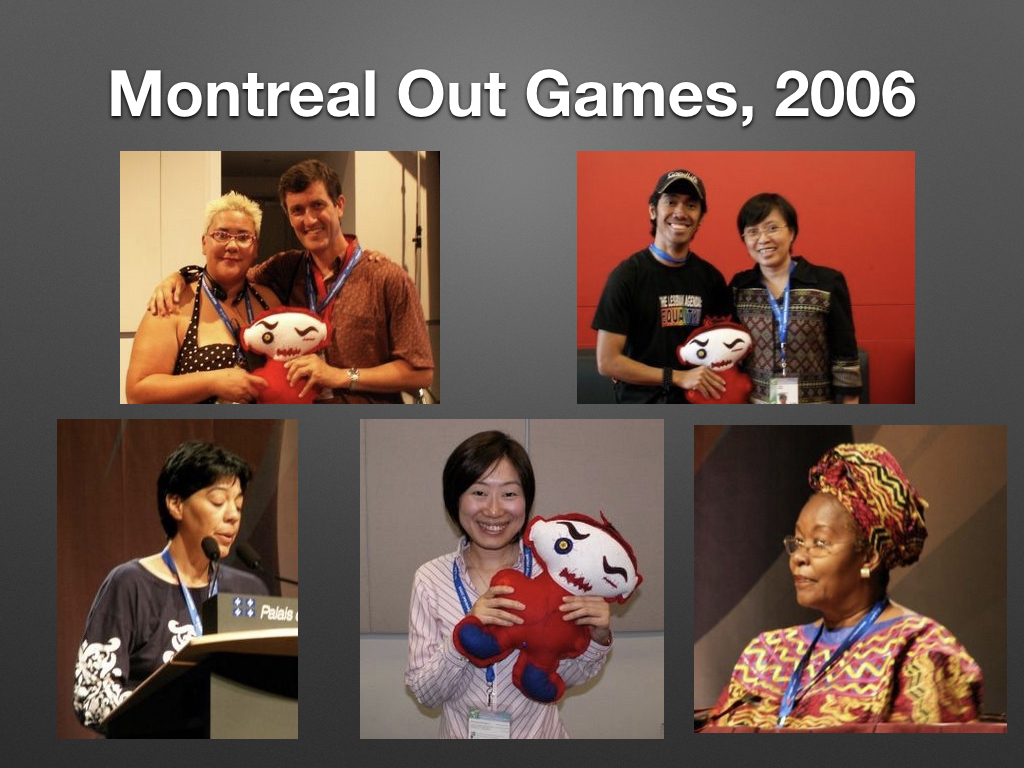
5 different photos of participants from around at the world at the Workers Out human rights conference

When I was working at the public library as a library assistant I was selected to represent my union at an international LGBT labour union conference in Montreal that was part of the Out Games. One of the goals was to produce a proclamation on LGBT human rights. We met in various caucus groups to learn about issues from different countries and the issues facing workers in different industries.

The plenary took place in a large, generic, beige conference room with a panel at the front of the room on the stage, mic in the middle of the centre aisle, and the simultaneous translation booths at the back. In the caucus meetings leading up to the plenary I’d listened to many of the older feminist union leaders talking about us sex workers as pitiful and naive victims who were undeserving of workplace protections.

I hadn’t planned on speaking, so I’m not sure how I ended up at the mic. My hands and my voice were shaking. I remember introducing myself as a feminist, a sex worker and a library worker. I said inherent in the phrase “sex worker” was that we were workers and like all workers should be entitled to a safe and respectful workplace. After I felt super overwhelmed and my hearing started to go, like it does before I black out. Through my inadequate high school French and some professional translators I had a passionate discussion with some of the feminist leaders of the Quebec labour movement who had done a 180 and were now supporting including explicit protections for sex workers in the proclamation. Svend Robinson (that’s me and him in the top left photo), Canada’s first openly gay national politician, crossed the floor and gave me a big hug and told me how proud he was of me for strategically coming out to facilitate a more inclusive proclamation. Speaking from my experience was really powerful for me because I changed people’s attitudes about sex workers.

ProQuest: Canadian Major Dailies

screenshot of ProQuests' Canadian Major Dailies datatbase with "Action plan on rights set up [Final Edition]" article

What I didn’t know was that a reporter from the Montreal Gazette was in the room. The next morning while reading the newspaper I almost threw up when I saw I had been quoted in the newspaper as “Tara Robertson, Vancouver public librarian and former sex worker”.

Honestly about half my fear was the wrath of librarians policing the border between paraprofessionals, which I was, and their credentialed selves. The various types of sex work I had done had always been under a pseudonym and with the makeup and wigs, I wasn’t easily recognized as my library worker persona. I was angry and scared. I didn’t know that there were media in the room and I hadn’t intended to come out, let alone make a public, searchable record of it.

The Montreal Gazette is indexed in a couple of ProQuest databases. My biggest fear, earlier in my career, was that I would be outed through a thorough reference check for a job. People would be searching for “Tara Robertson and libraries” and discover that I was a former sex worker. This is one of the reasons that I purchased my website domain when I was a library school student. I wanted to do what I could to control what came up when people searched for me.

I didn’t have the courage to retrieve this article until earlier this year.

Reflect Look inside. By yourself think about a time when you felt shame. You will not be asked to share these thoughts with others.

This is a self reflection exercise and I will not be asking you to share your thoughts out loud with other people. For the next minute you may want to close your eyes. I’d like you to think about a time when you felt shame.

What caused this shame? Where do you feel shame in your body? Who has seen your shame? What would it be like if your shame was public?

On Our Backs

screenshot of On Our Backs in Reveal Digital's Independent Voices collection

I know firsthand what it’s like to have information on the internet that I didn’t consent to, the fear that it could harm my career, and the double standard against women’s sexuality in our culture.

In March of this year I learned that Reveal Digital has digitized On Our Backs, a lesbian porn magazine that ran from 1984-2004. It had actually been online for several years before I learned about it. For a brief moment I was really excited — porn that was nostalgic for me was online! Then I quickly thought about friends who appeared in this magazine before the internet existed. I was worried that this kind of exposure could be personally or professionally harmful for them.

While Reveal Digital claims to have gone through the proper steps to get permission from the copyright holder, there are ethical issues with digitizing collections like this. Consenting to a porn shoot that would be in a queer print magazine is a different thing to consenting to have your porn shoot be available online.

I talked to a few people I know who modelled and they generously agreed to give me quotes to use in this talk.

Quote #1

litaforum-010

From the first discussion with the editors, I knew I had to weigh what appearing in the magazine might cost me in my work and community life. But at the time, I felt that the magazine had a small print run, and was sold in queer spaces to queer audiences.

When I realized the distribution was broader, I requested that my name not be added to metadata, and tried to do my best to protect myself. The editors respected my request and even had the UK distributor edit their tags and metadata for me.

Quote #1 continued
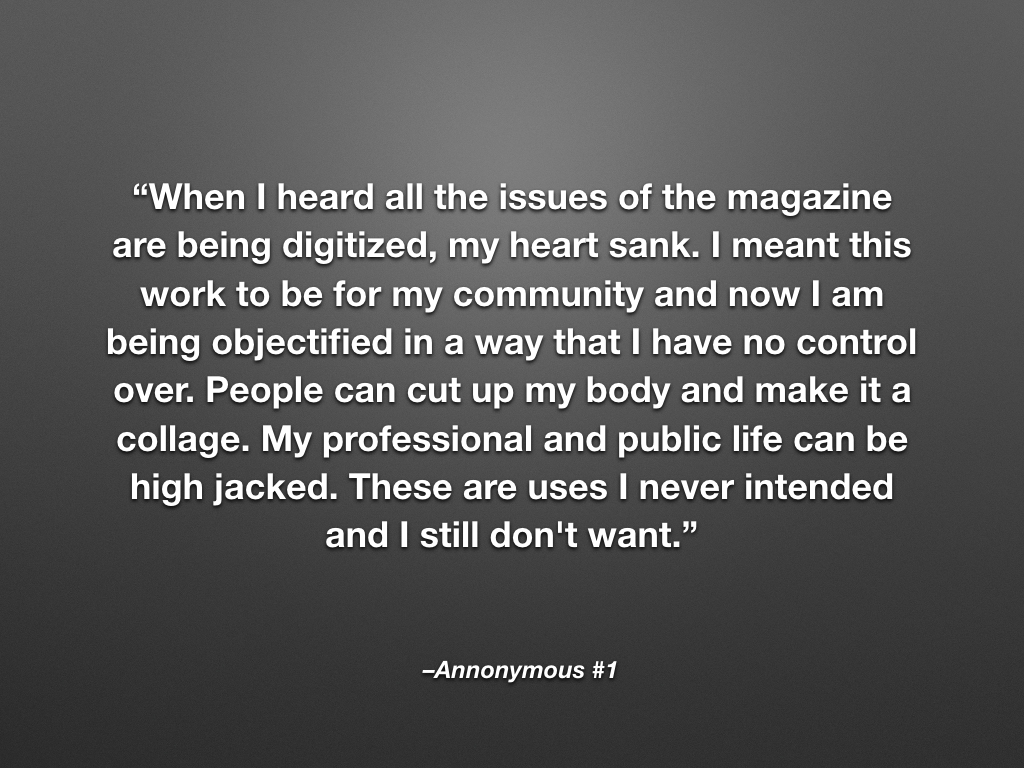
litaforum-011

When I heard all the issues of the magazine are being digitized, my heart sank. I meant this work to be for my community and now I am being objectified in a way that I have no control over. People can cut up my body and make it a collage. My professional and public life can be high jacked. These are uses I never intended and I still don’t want.

Quote #2

litaforum-012

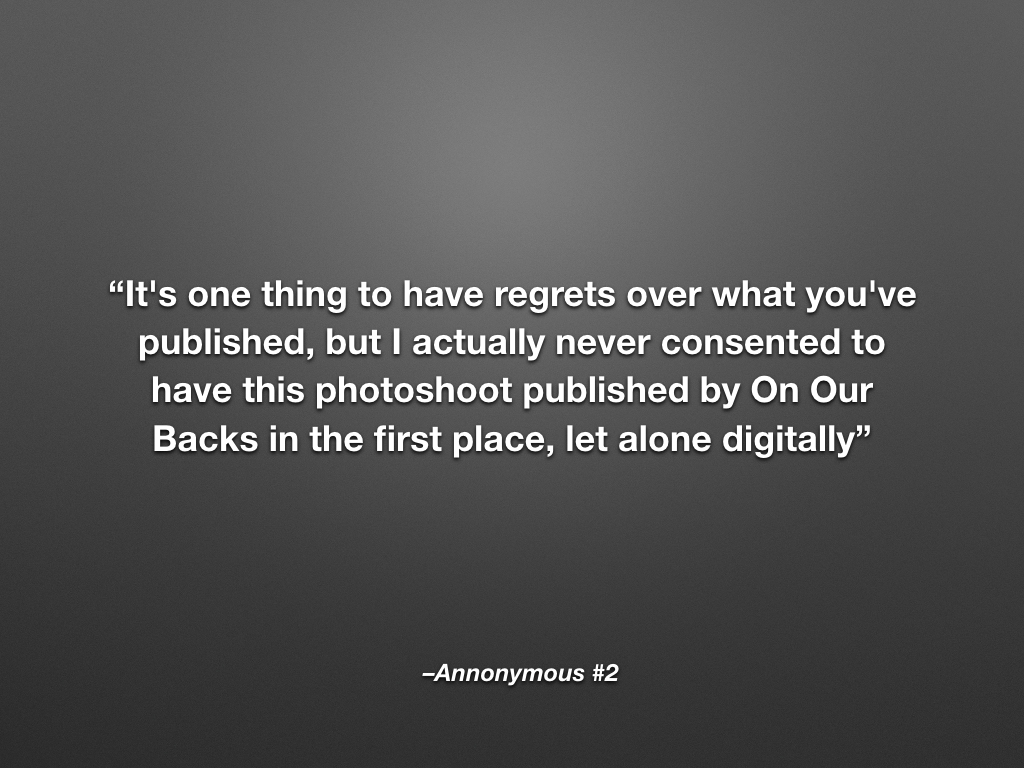
I actually never consented to have my photoshoot published in On Our Backs in print, in 2002. My ex and I were in a photoshoot specifically for a photographer’s book on kink in 1993—before the first web browser was released!—and signed a model contract for limited use. So 9 years later, I felt fairly fucked over to discover this shoot in On Our Backs–with our real names on the cover–after it had already been out for over a month.

This person works in the tech industry and as a queer woman has to work harder to be taken seriously as an expert in her field. She’s worried that if this is digitized, with her name on the cover, it’ll impact what is searchable under her name.

Quote #2 continued
litaforum-013

“It’s one thing to have regrets over what you’ve published, but I actually never consented to have this photoshoot published by On Our Backs in the first place, let alone digitally.”

Quote from Amber Dawn Quote from Amber Dawn

In 2005, I co-edited a queer erotica anthology titled With A Rough Tongue: Femmes Write Porn. The collection marked many things for me, the most significant of which was my coming out as a queer, femme sex worker and survivor within published writing. I was motivated by the growing number of mentors and peers who had spoken up before me, and also by the much larger number of sex workers and survivors I knew who did not have the privilege or ability to speak up. The evolving sex-positive and social justice values of the mid-2000s did not protect me from fear and stigma I faced coming out. Backlash, I discovered, was very real consequence. I quickly learned importance of making strategic and self-caring choices about where to use my voice and body.”

Some early decisions Amber Dawn made for herself included:

  1. to only speak, publish or showcase body art in forums where she can directly speak to and negotiate with the editor or curator,
  2. where she understands the intended audience to be communities that share similar sex-positive and social justice values and
  3. where she has the ability to directly connect with audiences and foster future respectful dialogue.

Amber Dawn says that choosing to appear in OOB in 2005 allowed her to adhere 3 of these conditions.

Quote from Amber Dawn continued

litaforum-015

Years later, the digitization of On Our Backs strips me of all three. What was once a dignified choice now feels like a violation of my body, my voice and my right to choose. In no small way is the digitization a perpetuation of how sex workers, survivors and queer bodies have been historically and pervasively coopted. How larger, often institutional, forces have made decisions without consulting us or considering our personal well-being.

Ethics of care
litaforum-016

These three quotes clearly illustrate that these people had clear ideas about the content, how they wanted it viewed and used. They all have sophisticated and nuanced understandings of media representation and how they wanted to be represented.

The consent issues here are dodgy. For the first woman there was an agreement that this content would never be online. For the second woman there was no consent given to even appear in the magazine. For Amber Dawn having OOB digitized and put online violated the conditions that she had decided were critical for her.

Even the copyright issue is complicated: the photographer would’ve held copyright, not the models. The photographer would’ve then either handed over copyright to the magazine, signed over copyright for a specified time period, or agreed to have them published and retained copyright. OOB doesn’t exist anymore, so it takes some sleuthing to track down who now owns the rights. When I was at Cornell I visited the Rare Book and Manuscripts Collection to sift through Susie Bright’s papers. Susie Bright is a sex positive feminist who cofounded and edited OOB from 1984-1991. I found copies of contributor agreements. Some of them were for one time rights only, or for first time North American serial rights, or for a period of one year from a specific date.

In talking to some queer pornographers, I’ve learned that some of their former models are now elementary school teachers, clergy, professors, child care workers, lawyers, mechanics, health care professionals, bus drivers and librarians. We live and work in a society that is homophobic and not sex positive. This could negatively impact many people’s careers and lives.

When I brought up these concerns in March the most common critique from librarians was about our responsibility to be good stewards of our collections. A few librarians viewed this as limit on open access and worried about censorship. A year ago these would’ve been the same points that I would have made.

We talk about our responsibility to the collections, but what about our responsibility to communities. In this case I found myself caught between my profession and one of my communities, and I noticed that my opinion changed. “The community” wasn’t an abstract notion, it was the people who gave me those generous quotes. I could see their faces and empathize with their fears and feelings that institutions had screwed them over again.

If you haven’t read Bethany Nowviskie’s piece on Capacity and Care I highly recommend it. In discussing the application of an ethic of care Nowviskie says:

…let’s create more cultural heritage platforms that promote an understanding of the vulnerability of the individual person and object. Let our visualization systems more beautifully express the relationship of parts, one to another and to many a greater whole.

Reveal Digital takes down OOB

litaforum-017

On August 24, 2016 Reveal Digital announced that they were temporarily removing access to the OOB content. The main reason they gave was took this collection down citing minors access to pornography, the privacy concerns I raised and the need to consult with community.

I was happy to hear that they had removed this content from the web, even if it is temporarily. However, I feel very conflicted about the work that Reveal Digital is doing. On one hand I admire that they’ve figured out a unique business model and a way to work with libraries to digitize and make independent media accessible on the web. On the other hand I feel that naming restricting access to minors as the first reason for why On Our Backs as been temporarily removed is odd. While citing the Greenberg v. National Geographic Society ruling Reveal Digital says it gives “the legal right to create a faithful digital reproduction of the publication, without the need to obtain permissions from individual contributors”. When I first started talking to them about my concerns they defined community narrowly, basically as the libraries that are funding their work. Thankfully they’ve broadened their idea of community in this instance to include “publishers, contributors, libraries, archives, researchers, and others”.

In an interview in The Charleston Advisor Peggy Glahn, Project Manager at Reveal Digital, stated that future projects will focus on zines. She said that they would be “working in close partnership with librarians who are currently following the Zine Librarians Code of Ethics and intend to be in full compliance with this document when we do work with zine content.” This statement is a bit odd for me as the Zine Librarians Code of Ethics is not a technical standard or legal code that one could be in full compliance with. The Zine Librarians Code of Ethics says “This document aims to support you in asking questions, rather than to provide definitive answers.”

Zine Librarians Code of Ethics

screenshot of the cover of the Zine Librarians Code of Ethics

We need to have an in depth discussion about the ethics of digitization in libraries. The Zine Librarians Code of Ethics is the best discussion of these issues that I’ve read. There are two ideas that are relevant to my concerns are about consent and balancing interests between access to the collection and respect for individuals.

Zines are often highly personal and some authors might find the wider exposure exciting, but others might find it unwelcome.

For example, a zinester who wrote about questioning their sexuality as a young person in a zine distributed to their friends may object to having that material available to patrons in a library, or a particular zinester, as a countercultural creator, may object to having their zine in a government or academic institution.

The Zine Librarians Code of Ethics does a great job of articulating the tension that sometimes exists between making content available and the safety and privacy of the content creators:

Librarians and archivists should consider that making zines discoverable on the Web or in local catalogs and databases could have impacts on creators – anything from mild embarrassment to the divulging of dangerous personal information.” Zine librarians/archivists should strive to make zines as discoverable as possible, while also respecting the safety and privacy of their creators.

Delgamuukw Trial Transcripts

screenshot of UBC Library's Open Collections, Delgamuuk Trial Transcripts

Here’s another example of something that shouldn’t have been digitized.

The Supreme Court of Canada decision in the Delgamuukw case (PDF) in 1997 is widely seen as a landmark case for treaty negotiations. During the trial Delgamuukw elders testified and shared information that would not normally be shared outside their community. They chose to break cultural protocols for the greater good of their community’s land rights. As this was in the courts their testimonies were part of the court record.

These trial transcripts are widely available in print in law libraries across Canada. At the request of UBC’s Law Library they were digitized. As you can see in the screenshot, these are part of UBC’s “Open Collections”.

Even though these materials are widely available in print at law libraries across Canada, some people believe that UBC should not have digitized this collection. There was an acknowledgement that a policy is needed, but this collection is still up while there’s slow progress towards writing the overall policy. UBC should take this collection down while they consult with the nations whose traditional knowledge was put online without their consent.

Mukurtu

screenshot of Mukurtu website

So, I’ve showed you a couple of examples of digitization projects that I consider really problematic. What’s a better way to do this?

Mukurtu is a Warumungu word meaning a safe keeping place for sacred materials. The Warumungu are a group of Indigenous people in Australia.

Mukurtu is an awesome grassroots project aiming to empower communities to manage, share, preserve, and exchange their digital heritage in culturally relevant and ethically-minded ways. It’s open source and community driven. The top priority is to help build a platform that fosters relationships of respect and trust.

Mukurtu allows you to set up complex permissions, for both digital objects and users, so that the digital access mirrors existing cultural protocols around accessing information. I also love how the community can contribute metadata alongside our spare institutional metadata.

This summer I attended one of their twice monthly online office hour sessions. This is a great strategy for open source software projects. It’s really accessible, welcoming and while documentation is good, it’s great to talk to someone who really knows the software. Alex Merrill did a great demo and was able to answer all of my questions about how permissions work.

Traditional knowledge (TK)

""

I was at a loss of what to put for an image here. I thought of a variety of First Nations technologies, and then decided it was best to leave it blank. These aren’t my cultural traditions and it didn’t feel like it was my place to pick an image for this slide.

I’ve read several of Greg Younging’s publications on traditional knowledge and copyright. I love the ideas he’s introduced me to and how accessible his writing is.

In the recently released (July 2016) IFLA publication Indigenous Notions of Ownership and Libraries, Archives and Museums he has a chapter where he gives many examples of customary laws around the use of traditional knowledge. These vary greatly between indigenous nations and include:

  • certain plant harvesting, songs, dances, stories, and dramatic performances
    which can only be performed/recited in certain settings, seasons and for certain cultural reasons;
  • artistic aspects of TK, such as songs, dances, stories, dramatic performances, and herbal and medicinal techniques which can only be shared in certain settings or spiritual ceremonies with individuals who have earned, inherited, or gone through a cultural or educational process.

These are just two examples, Younging identifies several more.

Younging lists 3 major ways that TK and Western system of intellectual property rights clash:

  1. that expressions of TK often cannot qualify for protection because they are too old and are, therefore, supposedly in the public domain;
  2. that the “author” of the material is often not identifiable and there is thus no “rights holder” in the usual sense of the term;
  3. that TK is owned “collectively” by indigenous groups for cultural claims and not by individuals or corporations for economic claims.

So, what is a good way to respond to these conflicts?

TK labels

Screenshot of http://localcontexts.org

There are some TK licenses that have been developed for when people own the copyright for their traditional knowledge. But what about cases where someone else, like a museum or a library holds the copyright to traditional knowledge that belongs to an Indigenous group? TK labels were designed for this scenario. TK labels are educational and informational. They are not legal tools.

I watched a video of Kim Christen Withey speaking on TK. She says:

Many Indigenous knowledge systems rely on protocols. Many of the protocols have to do with *not* seeing, which very much is the antithesis of the Western “seeing is believing”. You have to see it to know it. And these systems are saying you don’t get to see it or know it—deal with it.

Last summer I went to the c̓əsnaʔəm exhibition where the Musqueam nation told the story of their history and culture in their own words. One of the most impactful things was a display case with photo of a bowl. The actual bowl wasn’t inside. The explanation read:

Our relationships with the spiritual and sacred world are personal and private. Some belongings, such as those used in ceremonies and the ornate stone bowls used for mixing medicines, were the property of powerful ritualists who lived at c̓əsnaʔəm. These belongings remain spiritually potent and can be dangerous. They must not be touched or viewed by people who do not have the proper ritual training, hereditary privileges, or ceremonial knowledge.

Like Kim Christen Withey said “you don’t get to see it, deal with it”.

At localcontexts.org they explain that working with the community is necessary to use TK labels:

Using the TK Labels requires community decision-making. This is especially the case for cultural material that is not owned individually but should be managed collectively by your local community. The decision-making processes for using these TK Labels should be established before you choose which labels will suit your needs. The TK Labels can also facilitate dialogue about what options are more appropriate for your local context, and what kinds of conversations need to happen before even using or developing the TK Labels. Each family, clan or community will have different processes and frameworks for decision-making.

Moko: or Maori Tattooing (1896)

Maori man who has the right side of his face tattooed.

Moko; or Maori Tattooing was published in 1896 by Chapman & Hall in London. Horatio Gordon Robley wrote this book, and it contained many illustrations that he did of mokomakai. According to Wikipedia: “Mokomokai are the preserved heads of Māori, the indigenous people of New Zealand, where the faces have been decorated by tā moko tattooing. They became valuable trade items during the Musket Wars of the early 19th century.”

This is an important historical book for New Zealand so the New Zealand Electronic Text Collection wanted to digitize it. They wrote a thoughtful report that includes background information, outlines a range of digitization options, describes the community consultation process and concludes with the digitization path that they chose. I love that they’ve put their report online, which raises awareness of the issues that surround digitization of textual taonga, or cultural treasures.

The six perceived options for digitization ranged from:

  • Present everything online.
  • Provide access to all content except photographs of mokamokai.
  • Provide access to all content except photos and line drawings of mokamokai.
  • Provide access to all content except all photos of people and line drawings of mokamokai.
  • Provide access to text only.
  • Suppress everything.

They consulted with academics, librarians and curators, and with communities.

Academics were generally in favour of retaining the integrity of the book in the interests of scholarship by presenting all the content online.

Librarians and curators had a wide variety of opinions. Some concerns were “expressed about both the public display of images of ancestral remains and the potential for the moko themselves to be copied and used in inappropriate ways when made globally accessible online”. As parts of the book had been digitized by Google Books some felt that it was better that a New Zealand organization was digitizing New Zealand historical materials.

People from user and source communities also had a wide variety of opinions. One artist was against, it as he felt that wide dissemination of moko designs might result in others profiting from them. Suggestions were made that they should contact the family of those in the images to ask for permission to display them or to have a way of dealing with grievances and requests from family asking them to remove the images.

In the end they decided to present the text with all associated images except those depicting mokamokai or human remains. They also stated that they were open to altering their decision. They were willing to remove images of people’s ancestors as well as willing to add information about people’s ancestors.

Spare Rib
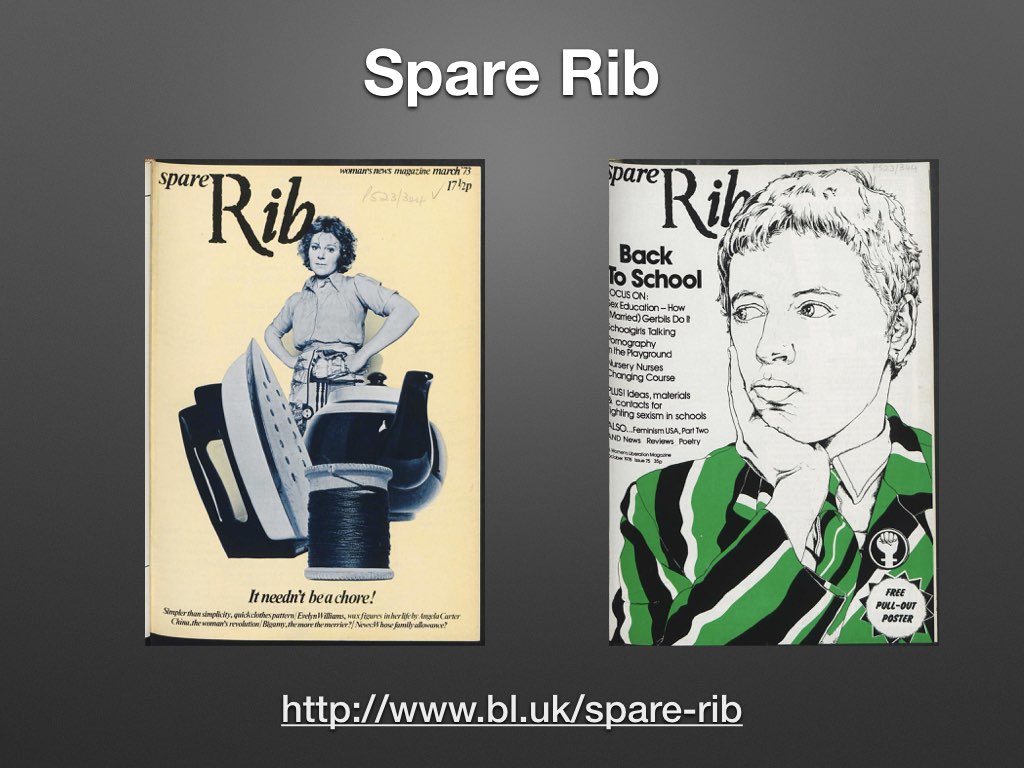
2 covers of Spare Rib magazine. Left one shows a woman standing behind giant photos of an iron, teapot and spool of thread. Right: illustration of a short haired woman with her hand resting on her chin

Michelle Morovec, a historian of women’s culture and digital history at Rosemont College in Philadelphia introduced me to this case study. Spare Rib was a UK feminist magazine that was published from 1972-1993. In 2013 the British Library wanted to digitize and put the entire magazine run online. Unlike a mainstream magazine, Spare Rib was edited by a feminist collective who didn’t necessarily get copyright clearances for things they published. The British Library hired a copyright clearance officer who worked with some members of the collective to track down over 4,000 authors and artists who had contributed to Spare Rib.

A contributor named Gillian Spragg wasn’t opposed to the content being digitized and put online, but she found the request that contributors agree to have their content licensed under a Creative Commons Attribution Non-Commercial license to be problematic. She was worried that her feminist content could be remixed for anti-feminist purposes. In 2014 a law was passed that allowed “orphan works”, or work where the copyright holder can’t be found, to be digitized and the project went ahead. For each digital object there are clear rights statements. It’s also easy to find who to contact if you have more information about an object which I assume also includes if you know whose work it is, or if it’s yours and you want to have the licensed changed or have it removed from the website.

According to the British Library approximately 20% of the Spare Rib content has been removed from the website.

I love that they also have a page on Ethical Use acknowledge that the “usage guide is based on goodwill. It is not a legal contract. We ask that you respect it.”

Generate examples

Generate examples: In pairs discuss What are some other examples of culturally sensitive materials in libraries, archives and museums?

What are some other examples of culturally sensitive materials in libraries, archives and museums?

You’ll have 4 minutes, 2 minutes each to talk. I’ll give you a time check halfway through.

Community led digital projects

the night sky

Academic libraries can learn a lot from public libraries about how to work in community and with community.

In a toolkit on community-led libraries Annette DeFaveri talks about a time when she worked to build relationships with people in a homeless shelter and how it revealed some of her assumptions and biases. When she asked them what they might like from the library

One man said that he thought the library should give free courses in astronomy. Another person suggested that the library do astrology courses as well. Finally, someone else suggested that the library buy a telescope. This was a significant discussion for me and revealed many of the biases and prejudices I had brought to the work. I had expected people to talk about the importance of offering free coffee at the library or to discuss the dismal lack of wet weather beds in the community and ask what the library could do about that. I thought I would hear about all the issues that concerned me about homeless people in the community. After I left the shelter, I realized that the people I talked with had asked for things from the library that were relevant to their lives. They were interested in the night sky, astronomy, astrology and telescopes because they often slept outside and so spent significant amounts of time looking at the stars.

If the library worked with the community to co-create a digitization project from the start I think the process and the outcome could be awesome. Co-creation is much more than just consulting with the community on metadata, or tweaking a project that’s already done. It’s working with communities to identify the scope of the project, the process and what the final project will look like. We bring some knowledge of digitization, workflows and metadata, but I think we could let go of control a lot more and truly co-create with our communities. This could be transformative. Not just for the digital collections that we create, but for the relationships we have, and for libraries as a whole.

Problem solve
Problem Solve: In groups of 4 discuss How can we do a better job of digitizing and providing access to culturally sensitive materials? Add your ideas to this document: http://bit.ly/LITAshare

How can we do a better job of digitizing culturally sensitive materials? 

Break into groups of 4 and discuss. Add your ideas to this Google Doc: http://bit.ly/LITAshare

Conclusion

closeup of a microphone

I work at a really wonderful community college. In preparation for this talk, I had a few meetings to make sure that speaking about being a former sex worker wouldn’t compromise or cost me my job. Both my director and faculty association president had awesome, supportive responses. I used to describe myself as lucky, but more and more I’m realizing that it’s not luck—it’s privilege. Because I have this privilege I have a responsibility to speak up about these things.

I’d like to end with another quote from Amber Dawn. She writes about a social experiment she ran in the 90s when she would answer the question “what kind of work do you do?” with “prostitution.” She observed that this made people uncomfortable and speechless. She writes:

While this little investigation was by no means sound research, it revealed a larger truth—that to listen to and include sex workers’ voices in dialogue is a skill that we have not yet developed, just as we have not learned how to include the voices of anyone who does not conform to accepted behaviours or ideas. What does it mean to be given the rare and privileged opportunity to have a voice? To me, it means possibility and responsibility. It means nurturing my creativity and playing with personal storytelling, while honouring the profound strength and dignity of a largely invisible population of workers and survivors. It means revelling in the groundbreaking work of voices that have come before me.

I’d like to ask you to listen to the voices of the people in communities whose materials are in the collections that we care for. I’d also like to invite you to speak up where and when you can. As a profession we need to travel the last mile to build relationships with communities and listen to what they think is appropriate access, and then build systems that respect that.

Thank you.

Image credits

All images are CC-BY except for The Land of Giants, fingerlove, and the Spare Rib covers.

21 Nov 15:39

A Graphic File I Couldn’t Resist

by Stephen Rees

The original comes from The Independent – a uk newspaper

29187-m4oqnr

I got this from the facebook page of Friends of the Olympic Line where I also found


Filed under: Transportation
21 Nov 15:39

Muting Doesn’t Equal Silence (or safety)

by Sunny Moraine
Response to harassment report issued by EA's COO Peter Moore in Dec. 2014
Response to harassment report issued by EA’s COO Peter Moore in Dec. 2014

It’s probably appropriate that amidst a torrent of harassment and abuse directed at marginalized people following the election of noted internet troll Donald Trump, Twitter would roll out a new feature that purports to allow users to protect themselves against harassment and abuse and general unwanted interaction and content. Essentially it functions as an extension of the “mute” feature, with broader and more powerful applications. It allows users to block specific keywords from appearing in their notifications, as well as muting conversation threads they’re @ed in, effectively removing themselves.

In a lot of ways, this seems like a good feature and a useful tool. Among other things, it addresses problems with Twitter’s abuse reporting system, where people reporting abusive tweets are told that the tweets in question don’t violate Twitter’s anti-abuse policy. As Del Harvey, Twitter’s head of “trust and safety”, explains it:

We really tried to look at why — why did we not catch this? And maybe the person who did that front-line review didn’t have the cultural or historical context for why this was a threat or why this was abuse.

In that same Bloomberg piece, it’s noted that there’s also a new option to report “hateful conduct”, and that abuse team members are being retrained in things like “cultural issues”. Also good. Especially right now, when – despite Melania Trump’s charmingly quixotic stated mission to protect everyone from her husband on Twitter – there’s likely to be a significant upswing in this kind of profound ugliness, probably for a long time.

Here’s the problem, though. And it’s more of a quibble, but it’s worth the quibbling.

The primary thrust of Twitter’s new initiative is oriented toward the target. By which I mean, what looks like putting power in the hands of a user actually has the potential to put responsibility on them for their own safety. Which a lot of people would probably think is perfectly reasonable, and I agree – to a point.

The issue is that it’s very easy to do something like this – toss something into someone’s lap for them to use – and adopt the assumption that this is the best strategy for dealing with the deeper problem. Which isn’t that abusers are able to reach their targets. It’s that the abusers are there at all.

Here’s where someone says hey, that’s the internet, what do you expect? And yeah, I know. Believe me, I know. But what I expect? Is more than putting responsibility on a user in the guise – even if it’s not entirely a guise – of giving them power. I understand that it’s very difficult to kick these people out and keep them out. I understand that it’s just about impossible. I appreciate that Twitter does seem to be doing work in that direction. But it’s not enough. What I expect is that we’ll create spaces where we don’t have to worry about muting these people because they never start talking in the first place.

There’s also the issue of how, when you successfully ignore something while not removing it, you can actually enable its presence. Which is not to say that users shouldn’t take full advantage of this feature, but instead to say that Twitter should remember that just because you can’t hear it, that doesn’t mean it isn’t there.

And it doesn’t mean it isn’t getting worse.

There’s more work to do.

Sunny is on Twitter – @dynamicsymmetry

21 Nov 15:38

Who won the Trump University lawsuit? Look at the statements.

by Josh Bernoff

The Trump Organization settled fraud suits against Trump University for $25 million, removing the trial from the President-elect’s schedule. But because a settlement is a negotiated solution, you can’t immediately tell who came out on top — maybe $25 million is a lot less than the plaintiffs could have gotten. That is, until you read … Continued

The post Who won the Trump University lawsuit? Look at the statements. appeared first on without bullshit.

21 Nov 15:38

The Normalization of Dissent, or: Mr. Pence goes to Hamilton

by Sunny Moraine

image

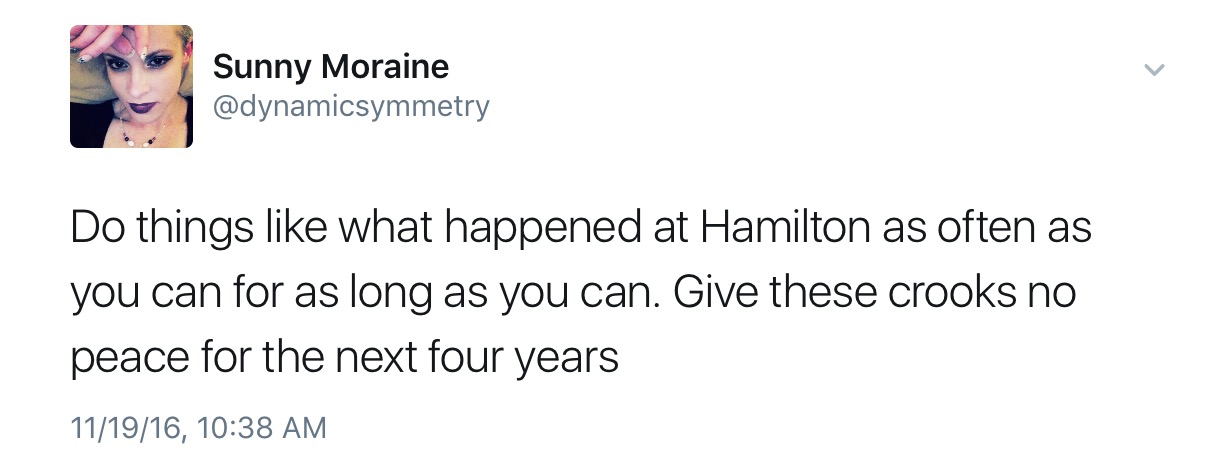
On Friday night, VP-elect Mike Pence went to see Hamilton. He was loudly booed. The cast delivered a respectful message asking him to “work on behalf of all of us”. President-elect and noted internet troll Donald Trump accused the cast of harassment, because the truth is whatever he says it is. By Saturday morning, it was – going by my feed – most of what Twitter was talking about.

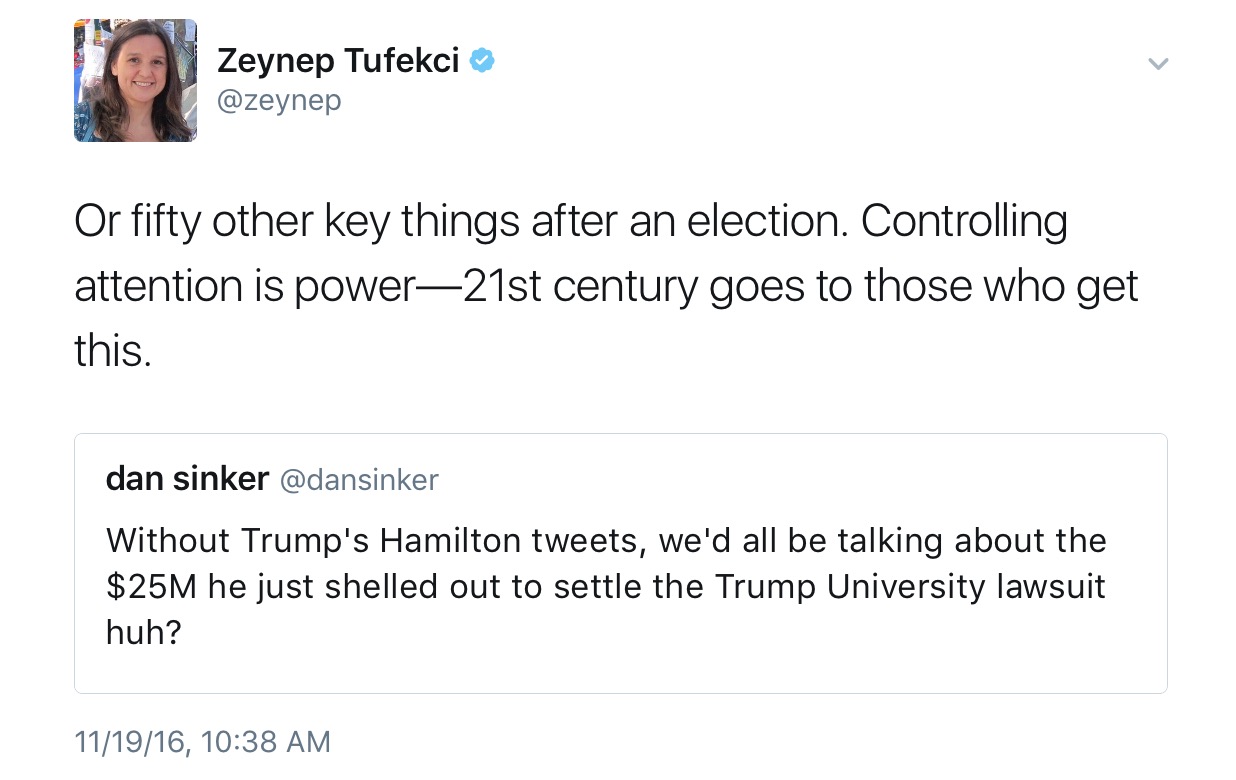
So far I’m sure I’m not delivering any information that anyone reading this doesn’t already know. What was especially noteworthy about what happened – aside from the fact that it happened at all – was the timing. Specifically, it happened almost immediately after Trump settled a fraud lawsuit for $25 million, after trying to delay it until after the Inauguration. People had been talking about that, but suddenly it was largely submerged under Hamilton tweets. Which didn’t go unnoticed.

image

The point is impossible to argue. That’s exactly what happened. And it’s definitely disturbing; Pence getting booed at Hamilton is arguably both a more spectacular event and an event with significantly less legal and ethical importance. In fact, since then – and I’m sure I’m not alone in considering this – I’ve wondered if it wasn’t calculated. It seems like something tailored specifically for social media: take a despised political figure (also a virulent misogynist and dangerous homophobe, among many other things), put him in the audience of a massively popular musical where 90% of the audience plus the cast is pretty much guaranteed to dislike him, add smartphones, and hit purée.

Meanwhile, the President-elect’s generally unambiguous criminal activity – and his avoidance of a court appearance – slides under the radar.

Regardless of exactly how this happened, like I said, I’m disturbed by it and by its implications. Because if there’s one thing these people do understand, it’s how to manage a news cycle. I think we need to be watching for exactly this kind of thing, because I don’t think we’ve seen the last of it. This is a President-elect who genuinely appears to be under the impression that this is in fact all a reality show (is he even wrong? experts disagree), and he’s being advised by at least one man who knows how to leverage spectacle and manipulate an audience. This is a tactic that is likely to be effective as a distraction measure. It’s dangerous.

Does that mean we shouldn’t have been talking about it?

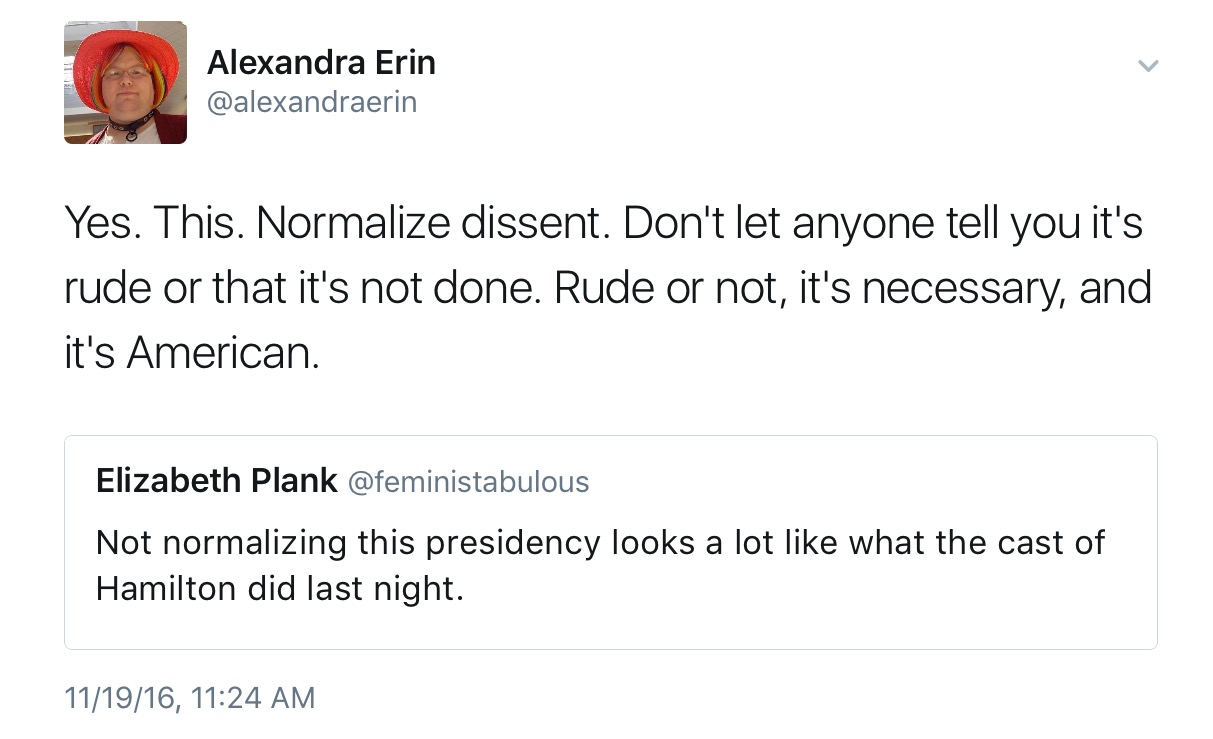
No. We should. What happened on Friday night should be talked about – only not because it’s fun to be clever on the internet (it is) or because these men are easy to mock (they are). It deserves our attention because it’s yet another way to emphasize and underline the fact that this is not normal.

image

Those of us who want to fight what’s happening, those of us who want to dissent, we need to do it with every single tool we can get our hands on, and the normalization of this entire situation is one of the biggest dangers right now. Normalization paves the way for much, much worse. A normal VP-elect goes to a Broadway show, and maybe a few people heckle, but hey, that’s normal. What happened on Friday night was not normal, and everyone saw it, or heard about it, and everyone knew.

Regardless of how much Trump wants to lie about how it really went down.

Letting events like this be a distraction from things like a multimillion dollar fraud settlement is dangerous, and it’s what they want. But taking events like this and using them as a way to broadcast dissent, to normalize it… That is not what they want. That’s one of the last things they want. A society that has normalized dissent is a society that is much less likely to normalize them.

This is going to be one of the major sites of contention over the course of the next four years, and it’s not new but it’s going to be of unprecedented importance: not the details of what happens, but how they’re used. Not that a spectacle occurs, but what it ends up meaning. Because that’s one of the fights we’re looking at in a post-truth environment. Not what happened, but instead: What does this mean?

It’s abstract. It’s also not. It’s about as meaningful as you can get.

This is the machine, in a courtroom (or not) and in the audience of a Broadway musical. It’s not here or there; it’s everywhere. We can’t afford to focus too much of our attention in any one place, on any one front; we also can’t afford to ignore any of the tools we can use.

This is the machine. Grab every wrench you can, and throw.

21 Nov 15:38

WeChat Officially Replaces the App Store

by mjkim

Months after the official announcement, WeChat Mini Apps are finally here.

On November 18, Zhang Xialong, Tencent Senior Vice President and the “Father of WeChat”, posted a picture on Moments of his home screen filled with WeChat Mini Apps. This suggests that the apps themselves can actually be placed on the home screen, not just inside WeChat itself, at least for Android phones.

article_cover_201611_18_220608120698

At the beginning of 2016, Zhang Xiaolong introduced the idea of “an app within an app within WeChat”, saying, “These are apps these are apps that you don’t need to install; you can open them simply by searching or scanning a QR code. This make for one-time use apps.”

On September 22, Tencent officially sent out two-hundred invitations for closed beta testing of the Mini Apps. Lifestyle companies like Dianping, Miaoyan Movie, and Hainan Airlines participated in testing the platform.

Just as with other application stores, WeChat Mini Apps will be vetted, by either Tencent or a certified third party. WeChat promises that all apps within the Mini App store will meet security and safety requirements.

3617590434ce88d6-1

With WeChat’s already large user base, attracting users should not be a problem. And for users, the benefits are obvious: users no longer need to download all their Mini Apps, thus saving space; plus, when switching phones, Mini Apps don’t need to be re-downloaded.

For service providers, they don’t need to invest large amounts into app development. Rather they can easily build a Mini App and test market viability. What’s more, WeChat Mini Apps are by nature cross platform: they exist solely within WeChat, completely negating the common problems with compatibility across so many different phone models.

fa9fc6ff-4bbf-43aa-b84d-2a307956bea0

There is also speculation that, in the long term, Mini Apps may even threaten aggregation platforms such as Tmall. Brands, merchandisers, and retailers can now simply create their own Mini Apps for users to browse and purchase products, directly inside WeChat.

WeChat, like Facebook, is quickly becoming more than just a social media platform. Now, with Mini Apps, their domination of China’s attention will only grow.


21 Nov 15:37

Cult of One

by Tara Isabella Burton

Earlier this spring, I got into a ferocious argument when a joke about “personal brands” turned into a two-hour debate about whether we are all Kardashians now. The obsession with public identity performance in the digital sphere has supposedly made for a generation of solipsists and inauthentic re-enactors, each with a pithy 140-character Twitter bio.

It’s an argument I’ve encountered frequently, particularly among those nostalgic for an imagined golden age of authentic identity divorced from the need from performance. In Creating the Self in the Digital Age: Young People and Mobile Social Media, Toshie Takahashi of Waseda University seems to support that premise. She cites Japanese teenagers who use Facebook to project an image of reajuu, or living life to the fullest, mainly by uploading photos and tagging each other, suggesting that Facebook is, if not responsible for the phenomenon, nonetheless a prime avenue for its intensification.

In support, Takahashi quotes a verbose British teenager who manages to quickly touch on seemingly every narcissist stereotype: “I do want to stand out, in a way … not by what I post but by who I post it to and how often. It’s not necessarily by what I post that I want to stand out, making sure that people don’t forget about me, like, oh don’t forget me [laughs]. Also as a kind of PR, like a personal PR machine, like this is the image I want to give people, how can I remind people that I exist.” The self, it would be easy to say, is rendered nothing more than a commodity by this “machine,” selling itself for social and financial capital in a digital marketplace in which attention doubles as currency. In such a paradigm, this contemporary digital form of self-creation necessitates a necessarily capitalistic conception of the self, complete with a healthy (or perhaps unhealthy) level of market competition.

But as an otherwise confirmed nostalgist myself — and a historian of 19th century French culture — I’m all too conscious that the phenomenon of self-creation is nothing new and hardly contingent on digital media. If anything, the current concern with unseemly self-creation is a replay of the anxieties sparked by 19th century technologies when they were new and were transforming the experience of urban life and public space. A good century and a half before Kim Kardashian Snapchatted her Paris hotel room, confirmed countercultural dandies like Barbey D’Aurevilly and Joséphin Peladan were using the newly broadened boulevards of Paris — and their equally new outward-facing café terraces and gas lamps that made being visible in public both possible and safe — as a canvas for performing identity. The expansion of usable, strollable public space in the increasingly bourgeois cityscape allowed, in turn, for an expansion of the concept of self to fill it. Hence the emergence of the people-watching flâneur.

As department stores began to appear, humans and things were starting to be seen as interchangeable. In this context, deliberate self-creation was deeply radical

It’s possible to make the case that today’s “digital marketplace” is simply an extension of what occurred on the Parisian arcades and boulevards of the 19th century: a transformation of public space from something primarily functional to something commercial to something that is ultimately theatrical. In this transformed public space, people of all social classes could participate in the rites of seeing and being once limited to the upper echelons of society, behind gates or walls. The urban chaos of a terrasse on Boulevard Haussmann, for example, might well be considered a direct material precursor of the Facebook wall.

To speak of a life lived publicly, in both digital and nondigital forms, can be to imply a duality of the self: the “real person” (whose being, thoughts, and circumstances determine who she is) and the “artificial” double who appears before others: a doppelgänger that is, generously, an aspirational figure and, ungenerously, a total sham. This duality rests upon an assumption that one’s true self is static, determined ultimately by the conditions into which one was born — that social mobility is not possible. From this perspective, we are defined not by how we see or would like to see ourselves but by an intrinsic essence that can be expressed, maybe betrayed, but not changed. It’s an intensely class-conscious mentality that I’m particularly aware of in my adoptive country of England, where someone who transgresses shibboleths of dress or manner is casually dismissed as “inauthentic.” Any presentation of ourselves beyond caste parameters is held to necessarily be a lie.

Figures like D’Aurevilly, Peladan, and Charles Baudelaire vehemently rejected this understanding of the performance of self. Instead, they regarded the power to shape one’s identity as an act of creative resistance to a culture increasingly suffused with mass production and consumerism. Department stores began to appear, offering standardized goods that seemed to threaten a standardization of those consuming them. It was an era in which humans and things were starting to be seen as interchangeable — as in one anecdote told by the Goncourt brothers in which prostitutes whisper to their johns about “robot courtesans” hardly distinguishable from female flesh.

In this context, deliberate self-creation was deeply radical, a way to divide a creator-self from the world of goods that surrounded it, and from la foule, a politicized and loaded term of the era for “the crowd”: the indistinguishable masses defined by their biology (phrenology and other forms of pseudoscience were in full flower), their (lower) social class, and the manipulations of wider market and political forces. From the dandies’ perspective, the people of the crowd may as well have been robots. But self-creation could serve to affirm our irreducibility in a world of reproductions. Even as the lower bourgeoisie began to purchase mass-produced goods at the newly popular department stores, aping the mannerisms of the upper classes, the dandies began to define themselves against any engagement with the reproducible, developing an obsession with singularity that bordered on the monomaniacal. One tale by dramatist Jean Richepin, “Deshoulières,” features a dandy committing murder out of boredom, only to lean back his head at his execution so the guillotine will sever him in a different spot from all other men.

Joséphin Peladan, who was prone to wandering through the streets of Paris in magician’s robes, exhorted his readers to “create your own magic”: Perform the acts of faith and the faith will come

Though they were dandies, they regarded creative self-performance as about more than, say, showing off a nice cravat (or, in the case of Gerard de Nerval, a live lobster on a leash). Rather it was an ethical calling. In his essay “The Painter of Modern Life” Baudelaire wrote of “the burning need to create for oneself a personal originality, bounded only by the limits of the proprieties … a kind of cult of the self.” For Peladan, an occultist writer, self-creation was what he called kaloprosopia, the art of the beautiful person. “One asks what the object of life is,” he wrote. “For a man who thinks, it can only be the occasion and the means to remake the soul that God has given him: to sculpt it into work of art.”

Peladan, who was prone to wandering through the streets of Paris in magician’s robes, exhorted his readers to “create your own magic.” He quoted Saint Ignatius of Loyola: Perform the acts of faith and the faith will come. Performative self-making — externalization — was the first step of a total transformation of the self from animal to spiritual being.

In his advice to actors, director Konstantin Stanislavski exhorts performers to focus on what their character wants the most. Their objectives, their wants, their desires, make the characters who they are: These are not just a part but indeed the very lynchpin of their identity. Why, therefore, should our own aspirational versions of ourselves not be considered equally authentic iterations (if not more so) of our own selves? Why are we not, in other words, who we want to be?

The dandies’ conception of the self was at times astonishingly divorced from the biological, from questions of facticity. A recurring theme in dandy literature is characters who try to transcend basic human acts like eating or sleeping; in Huysmans’s Á Rebours, Des Esseintes tries and fails to feed himself by means of peptone enema. Willed createdness, and the rejection of the biological or the necessary, becomes the measure of successful humanity: We are defined by our actions, not our situatedness.

For Ricoeur, ethics lies in internal consistency — in “keeping one’s word” in future encounters. So our performances publicly may help us shape who we are privately as well

The dandies, of course, take this to extremes. But as 20th century philosopher Paul Ricoeur points out, self, self-conception, and action are not so easily divorced from one another. The stories we tell ourselves about ourselves — including through public performance in the social sphere — also come to govern our actions. “As the literary analysis of autobiography confirms, the story of a life continues to be refigured by all the truthful or fictive stories a subject tells about himself or herself,” he writes in Oneself as Another (1992). “This refiguration makes this life a cloth woven of stories told.” For Ricoeur, that story we tell ourselves about ourselves allows us to be the same “person,” in the sense of selfsame identity, even as our circumstances change.

Those stories are inextricable from public discourse, not only from the audiences to whom they are told but from the whole field of signs, images, and myths that we allow to shape us and determine our actions. As Ricoeur puts it, “the identity of a person or a community is made up of these identifications with values, norms, ideals, models, and heroes, in which the person or the community recognizes itself.” In other words, we are legible to ourselves — and to each other — only in communion with our collective world of stories, of narratives and cultural touchstones. Our understanding of ourselves as heroes, for example, cannot be separated from the cultural sedimentation of Achilles and Patroclus, or King Arthur and Lancelot, or any other narrative repository of our values.

Playing a public role on social media, presenting ourselves as a “character” (the “fun one,” the workaholic, the gleeful bohemian, the “good friend,” the liberal do-gooder, and so forth), is to commit to being that person in the social sphere: to enter into an informal contract with those that witness us to “be that person.” It’s an argument similar to that of the Canadian-American sociologist Erving Goffman, who understood the self as a constant performer, narrating and navigating its selfhood in direct response to its audience. But Ricoeur’s “audience,” as it were, goes beyond the horizontal — the social present — and into the realm of the literary and the mythic. We are creating ourselves not merely “before” others but also “before” the cultural and historical characters we want to be and “before” an imagined future audience: part of a (perhaps unconscious) chain of discourse that links us, in terms of our significance, to an Achilles or an Arthur.

While Goffman allows for a “backstage” — a place where we can be ourselves without theatrical presentation — Ricoeur’s model allows for no such place. There is nowhere beyond language and narrative, and so there is nowhere we are not in dialogue with the stories that have shaped and will continue to shape our self-understanding. For Ricoeur, ethics lies in internal consistency — in “keeping one’s word” in future encounters. So our performances publicly may help us shape who we are privately as well.

Our narrative identities and their refiguring power to shape both our own personal stories and the stories of others are integral to our ability to better ourselves: which is to say, to create versions of ourselves more in line with the values we hold, and the people we most want to be. If sin, for Saint Augustine as for a long line of theologians and philosophers alike, lies in the chasm between who we are and who we want to be, self-improvement can be a matter of closing of that gap in the successful enactment of the narratives that shape us.

In the aftermath of the U.S. election, it is more difficult than ever to deny that we operate at least on some level as characters caught up in enacting versions of ourselves in myths

The dandies, of course, were only concerned in their own narratives — everyone else was rendered an object in the stories they told about themselves, stripped of their own subjectivity or agency. They were artists for which the rest of the world was material for their own self-propagation. But a modified form of dandyism — originality as resistance to capitalistic conceptions of the self, self-creation as a profession of faith in the power of the stories that shape us — nevertheless opens up avenues for active participation in our own selfhood.

Just one example of many: a 2015 University of Pennsylvania study found that participants in an exercise program who used a controlled social media environment to share their progress exercised more than those who did not. By “performing” the identity of pro-exercise, healthy, self-improving individuals in a social setting that rewarded and responded to this, these participants ultimately became those people. To question whether they “really” were or not seems purely sophistic.

But we can take this further: If I make the public choice on social media to present myself as a serious, scholarly type of person, challenging those in my orbit to treat me as such, I make an implicit commitment to those around me: I am this kind of person, I will behave in such and such a way. That narrative of myself, existing in the public sphere, will both affect how people approach me (“What are you doing out at the pub when you’re so busy working on your doctoral thesis?”) and how I view myself (“What am I doing with a pint when I should be finishing my doctoral thesis?”).

If my best self, the self I most long to be — the self that Stanislavski would say is my true self, governed by my wants — is that serious, scholarly academic, why not do as Peladan and Saint Ignatius both suggest: perform the actions of faith first, to let the faith come next? Kim Kardashian may be the bête noire for cultural pessimists, but in the way she puts her life on display for the world to consume, she may the truest believer of all in this creed: a dandy for the democratic era.

Even if self-making opens one to accusations of narcissism, the alternative, if Ricoeur is right, is worse. He points to Austrian writer Robert Musil’s “man without qualities,” who is unwilling or unable to commit himself to any narrative of himself, who lives in a house he cannot even bear to furnish lest his decorating be taken by others as a binding referendum on who he is. If Barbey D’Aurevilly is the proto-Kardashian, then the man without qualities is the anti-Kardashian: someone with no narrative at all. His curious apathy makes him a void: incapable of real engagement because he cannot commit, publicly or privately, to a position, an idea, a way of being. In Ricoeur’s words, he “becomes ultimately nonidentifiable … ridiculous to the point of being superfluous.” Fittingly, the novel in which he appears was never finished.

To be protean, to be “no one” in the sense of a character, is also to be alone. When we strip away or mute all our public qualities, we become not some kind of Rousseauian “natural man” or “woman,” undefiled by Facebook likes or retweets. Rather, we deny ourselves — and one another — the commitment to self-making that performativity allows, the commitment to being to one another the people we intend to be for ourselves. “Give a man a mask,” Oscar Wilde famously said, “and he’ll tell you the truth from another point of view.” So too do our self-performances — airbrushed, filtered, contoured, and all — reveal the truth about ourselves, offered up in the masks we choose.

There is a political dimension, too, to conscious self-making. In the aftermath of the U.S. election, it is more difficult than ever to deny that we operate at least on some level as characters caught up in enacting versions of ourselves in myths. These myths can either be either of our own making or belong to those who seek to use us as supporting characters — just as the dandies of fin de siècle France did — in their own narratives. Donald Trump’s campaign structured a powerful story for his supporters, in which their vote would “drain the swamp” and bring down Wagnerian destruction on the establishment. By this logic, voting became an act of heroic and defiant self-making and meaning making. It’s a reminder of how easily our attempts self-making can be manipulated by another, more powerful, storyteller.

Yet only through conscious control of the stories we tell about ourselves — a discernment rooted in rebellion against the stories foisted upon us by others — that we can resist being rendered la foule. We perform the acts of faith so that the faith may come. So too do we perform them consciously, so that we may not unwittingly perform another’s.

21 Nov 15:35

Apple is replacing the batteries in ‘a very small number of’ iPhone 6s units

by Igor Bonifacic

Following the arrival of its new, less expensive ‘Touch Disease’ repair program, Apple has just announced another new repair initiative.

According to the company, “a very smaller number” of its iPhone 6s units are shutting down randomly due to faulty batteries. Specifically, the issue relates to iPhone 6s units manufactured between September and October 2015. The company notes that the batteries, while unreliable, do not pose a safety risk.

If the iPhone 6s you own was manufactured between those dates, all you need to do is head to your local Apple or Authorized service provider to get your phone’s serial number checked. Apple adds it will refund any customers who already paid for a battery replacement out of pocket.

Related: Apple lowers price of iPhone 6 Plus ‘touch disease’ repair to $189 CAD

SourceApple
21 Nov 15:35

Uninstall Facebook for Android to Improve Your Android Device’s Battery Life by 20 Percent

by Rajesh Pandey
It’s no secret that the official Facebook client for Android (and iOS) is a very resource hungry app that can greatly affect the battery life of your device. Almost a year ago, tests conducted by various Redditors and other publications showed that uninstalling the Facebook app was enough to increase the battery life of their device and its performance by a significant margin. Continue reading →
21 Nov 08:10

Communicating Through Art in a Post-Language Era

by Lars Bengston for The Creators Project

Photo by Brad Ogbonna. Courtesy of Aerosyn-Lex Mestrovic

The steady flow of content into our timelines, feeds, and screens has replaced traditional forms of communication. Our multi-device lifestyle has made connecting with one another faster and easier than ever before, though it comes at a price. To Argentine fine artist and calligrapher Aerosyn-Lex Mestrovic, we're losing much more than we think.

“Technology has outpaced morality,” he tells The Creators Project. “The speed at which we consume content makes it difficult for people to activate genuine emotion and empathy. We’re consuming so many different things at such a rapid rate that we’re no longer having conversations as much as we’re having sensory interactions. I think language is heading towards a convergence. You have unprecedented numbers of languages dying off in favor of the 'Lingua Francas' of the world. What's sad is that with that kind of loss, we lose not only a language but a facet or view on how to see reality."

Mestrovic in his studio in New York. Photo Courtesy of Aerosyn-Lex Mestrovic

In contrast, Mestrovic’s art seeks to restore dialect to the conversation. His signature marriage of meticulously penned calligraphy and gestural, flowing brush strokes returns focus to thoughtful communication.

The result is a mélange of disparate cultures, languages, and typographic styles that unexpectedly make perfect sense together, visually symbolizing the natural ebb and flow of a good conversation. It’s a patient experience, one that requires a step outside of our rushed world to fully savor.

Photo Courtesy of Aerosyn-Lex Mestrovic

"My work is communication. Art is a process and a conversation, a dialogue between the creator and the viewer, and for me it's always been a form of visual communication and expression," Mestrovic says.

The artist's old-world method appears to run counter to the speed in which our modern world operates, yet his approach to visual language has attracted consistent attention from the art and fashion worlds. He's worked with brands such as Nike and KENZO, exhibited at MoMA and The White House, partnered with Diane Von Furstenberg to create artwork for the CDFA Fashion awards, and launched his own clothing line for Japanese Luxury brand ADORE, in partnership with VOGUE Japan.

Nike’s Mestrovic-designed storefront in New York. Photo Courtesy of Aerosyn-Lex Mestrovic

Mestrovic made his directorial debut with Scriptura Vitae, an artistic short film commissioned by the UK’s Channel 4, featuring a blend of Japanese Butoh and his communicative style of art. A year later, Mestrovic was invited to create a featured installation for the renowned SCOPE Art Fair, where he expanded on his theme of visual communication outside of the canvas via ARTAMENTUM, a massive, mirrored chamber that served as a personal confessional booth, broadcasting private moments to the entire fair on towering structures.

A poster for Mestrovic’s first-ever solo show in the SEZON Art Gallery in Japan. Photo Courtesy of Aerosyn-Lex Mestrovic

Mestrovic’s unique multicultural upbringing spawned his early fascination with language and communication. Buenos Aires-born, he was raised by a Croatian father who emigrated to Argentina. He grew up speaking a mix of Spanish, English, and Croatian at home. Taking an interest in calligraphy at an early age, Mestrovic moved to Japan, where he learned Japanese and continued to expand his interest in the spoken and written word.

For Mestrovic, the broader his ability to express himself linguistically, the more his art could say. “Maybe that’s why visual language became a first love,” he says. “There’s always been power in words; for me, I think I’m interested in how that power takes shape.”

Butoh Dancer Maki Shinagawa reveals Mestrovic’s work for his first Debut film, Scriptura Vitae. Photo Courtesy of Aerosyn-Lex Mestrovic

In recent months, Mestrovic has been actively using his work to tackle global problems, from bridging communication gaps between nations to promoting education through charity. He was selected by the White House as a featured ambassador for the US-Japan Leadership Council, a bipartisan group comprised of the top thinkers and creators from both countries for the purpose of bridging cultural relations through art and technology.

Mestrovic prepares for a live painting with a Japanese ballerina as part of a performance art piece for the U.S.-Japan Leadership Program. Photo Courtesy of Aerosyn-Lex Mestrovic

This fall he took on Creative Director duties for Scott Braun’s Pencils of Promise, an international charity dedicated to building schools, offering education training programs, and funding scholarships for children around the world. Mestrovic hopes that through teaching us to view language in multiple dimensions, we can begin to shift our focus towards a more empathetic global society.

“There is an innate, universal commonality in communication, and that to me is inspirational because as much as you can see the dissimilarities, we have so much more in common as human beings, regardless of cultures and language differences," he says.

Mestrovic with a young collaborator as he works on his motion visuals for the Pencil’s of Promise 2016 Gala. Photo by Carlo Dumandan. Courtesy of Aerosyn-Lex Mestrovic

At the end of the day, what Mestrovic seeks to achieve in his art is the foundational human desire shared by all of us: The desire to be understood. “Language is critical to my work; language, in essence, is my work. At the core, I hope to relay something about myself and my experience and my perspective on the world around me," he says.

Check out more of Aerosyn-Lex Mestrovic's work on his website.

Related:

New Film Features Supernatural Death, Possessed Dancing, Diplo


21 Nov 08:09

@stoweboyd

@stoweboyd:
21 Nov 08:09

@stoweboyd

@stoweboyd:
21 Nov 08:08

"One of the many lessons of the recent presidential election campaign and its repugnant outcome is..."

“One of the many lessons of the recent presidential election campaign and its repugnant outcome is that the age of identity liberalism must be brought to an end. Hillary Clinton was at her best and most uplifting when she spoke about American interests in world affairs and how they relate to our understanding of democracy. But when it came to life at home, she tended on the campaign trail to lose that large vision and slip into the rhetoric of diversity, calling out explicitly to African-American, Latino, L.G.B.T. and women voters at every stop. This was a strategic mistake. If you are going to mention groups in America, you had better mention all of them. If you don’t, those left out will notice and feel excluded. Which, as the data show, was exactly what happened with the white working class and those with strong religious convictions. Fully two-thirds of white voters without college degrees voted for Donald Trump, as did over 80 percent of white evangelicals.”

-

Mark Lilla, The End of Identity Liberalism

Mark Lilla punctures the myth of coalition liberalism, where explicit appeals to identified liberal-leaning minorities has backfired, because those not mentioned feel – justifiably – excluded.

We will be seeing new rhetoric from the new crop of liberals, now that all the baby boomer leaders – Hillary, Sanders, Warren, Pelosi, Schumer – are sidelined by… who exactly?

21 Nov 08:08

Twitter Favorites: [dlbno] Had an amazing time on the Eastside @CultureCrawl today. Humbling to think how much incredible talent is in this city.

db @dlbno
Had an amazing time on the Eastside @CultureCrawl today. Humbling to think how much incredible talent is in this city.
21 Nov 08:08

10 Things That Happen When Students Engage in Design Thinking

files/images/when-students-embrace-design-thinking.001-1.png


John Spencer, Nov 23, 2016


Scroll down past the full-page advertisement, skim though the 'ten things' and linger on the image before you get to the meat of the article. "Design thinking prepares students for a creative life — whether that is in business, in the social or civic spaces, in the arts, or in engineering. But it does this by allowing them create things that matter to them right now. It’ s not some far off 'grown up' thing." I agree. Via George Couros.

[Link] [Comment]
21 Nov 08:08

Vancouver and the Secret of the 1970’s

by Sandy James Planner

4170011537_652ba72e76_b

Gastown Riot, photo by Stan Douglas

Vancouver has developed differently from any other city in North America in terms of its civic engagement, strong citizen identity and early adaptation to environmental concerns and social causes.  Some of the events coming out of the 1970’s that profoundly changed Vancouver are in Kate Bird’s book Vancouver in the Seventies.

In the Youtube video below,  local luminaries including Kate Bird, Shelley Fralic, Aaron Chapman and Michael Kluckner describe some of the key events in the 1970’s which have shaped Vancouver thought, culture and politics.

Kate Bird is also the guest curator of the Museum of Vancouver exhibit “Vancouver in the Seventies” which will be at the museum until February 26, 2017.


21 Nov 08:08

Celebrating a Friend's Success

by Eugene Wallingford

Wade Arnold accepting the Young Alumni Award from UNI President Jim Wohlpart

Last week, I read a blog entry by Ben Thompson that said Influence lives at intersections. Thompson was echoing a comment about Daniel Kahneman's career: "Intellectual influence is the ability to dissolve disciplinary boundaries." These were timely references for my week.

On Friday night, I had the pleasure of attending the Heritage Honours Awards, an annual awards dinner hosted by my university's alumni association. One of our alumni, Wade Arnold, received the Young Alumni Award for demonstrated success early in a career. I mentioned Wade in a blog entry several years ago, when he and I spoke together at a seminar on interactive digital technologies. That day, Wade talked about intersections:

It is difficult to be the best at any one thing, but if you are very good at two or three or five, then you can be the best in a particular market niche. The power of the intersection.

Wade built his company, Banno, by becoming very good at several things, including functional programming, computing infrastructure, web development, mobile development, and financial technology. He was foresightful and lucky enough to develop this combination of strengths before most other people did. Most important, though, he worked really hard to build his company: a company that people wanted to work with, and a company that people wanted to work for. As a result, he was able to grow a successful start-up in a small university town in the middle of the country.

It's been a delight for me to know Wade all these years and watch him do his thing. I'll bet he has some interesting ideas in store for the future.

The dinner also provided me with some unexpected feelings. Several times over the course of the evening, someone said, "Dr. Wallingford -- I feel like I know you." I had the pleasure of meeting Wade's parents, who said kind things about my influence on their son. Even his nine-year-old son said, "My dad was talking about you in the car on the drive over." No one was confused about whom we were there to honor Friday night, about who had done the considerable work to build himself into an admirable man and founder. That was all Wade. But my experience that night is a small reminder to all you teachers out there: you do have an effect on people. It was certainly a welcome reminder for me at the end of a trying semester.

21 Nov 08:08

SUMO Show & Tell: A Small Fox on a Big River

by Michał

Hey there, SUMO Nation!

It is with great joy that I present to you a guest post by one of the most involved people I’ve met in my (still relatively short) time at SUMO. Seburo has been a core contributor in the community from his first day on board, and I can only hope we get to enjoy his presence among us in the future. He is one of those people whose photo could be put under “Mozillian” in the encyclopedias of this world… But, let’s not dawdle and move on to his words…

This is the outline of a presentation given at the London All-Hands as part of a session where the SUMO contributors had the opportunity to talk about the work that they have been involved in.

Towards the end of 2015, I noticed that we were getting an increasing number of requests on the SUMO Support Forum questioning how users could put Firefox for Android (Fennec, the small fox of this tale) on their Amazon Kindle Fire tablet (the big river).  At first it was just one or two questions, but the more I saw the more I realised that there were some key facts driving the questions:

  • We know that users like using Firefox for Android on their mobile devices.  It enables them to use Firefox as their user agent on the web when they are away from their laptop or desktop.
  • We know that people like using Android, possibly the worlds most popular operating system.  People recognise and take comfort from the little green Android logo when they see it alongside a device they wish to purchase and they appreciate the ease of use and depth of support at a lower price point than its competitors.
  • With a little research, it became clear why people have the Kindle Fire tablet – the price point.  In the UK at the time it was retailing for £60, almost half the price of a comparative device from the big name brand leader.

What was confusing and confounding users was that having purchased a device at a great price, that uses an operating system they know, they could not find Firefox for Android in the Amazon app store.  SUMO does not support such a configuration, but with the number of questions coming through, I realised that there must be something we could do.

I started helping some users side load Firefox for Android onto their devices and through answering questions I soon found myself using a fairly standard text that users found solved their problem.  As I refined it, it made sense for this to be included within the SUMO Knowledge Base, the user facing guide to using Mozilla software. But before I could do this, there was one key issue for which I needed the help of the truly amazing Firefox Mobile team…which version of Firefox for Android to use.

Whilst Firefox and Firefox Beta are seen as the best product versions, I was advised they they would only get updates through Google Play – not ideal if the user in on the Amazon variant of Android.  I was advised that Aurora was the version to use as it would get important security updates and pointed in the direction of the site where it could be downloaded from.  In addition to this, the Firefox Mobile team helped shape some of the language I was going to use and helped check my draft article (I did say that they are amazing…!).

The article was uploaded to SUMO for approval and further to this, went live for users to see. The article has proven to be popular with users and I understand has been pickup up by some of the SUMO L10n teams, broadening its reach (it is even linked to from an MDN article).

Whilst there is no change to our support of the Kindle platform (the article carries a “health warning” to that effect), I think of this work as a great example of how several different teams, both staff and contributors, can come together to help find a user focussed solution.

Thank you for sharing your story, Seburo. An inspiring tale of initiating on a positive change that affects many users and makes Firefox more available as a result.

Do you have a story you would like to share with us? Let us know in the comments!

21 Nov 08:07

Recommended on Medium: Signal for Beginners

For some reason, people have gotten pretty interested in mobile security lately. So let’s talk about a secure messaging app called Signal.

Continue reading on »

21 Nov 08:06

Cameras, ecommerce and machine learning

by Benedict Evans

Mobile means that, for the first time, pretty much everyone on earth will have a camera, taking vastly more images than were ever taken on film ('How many pictures?'). This feels like a profound change on a par with, say, the transistor radio making music ubiquitous.

Then, the image sensor in a phone is more than just a camera that takes pictures - it’s also part of new ways of thinking about mobile UIs and services ('Imaging, Snapchat and mobile'), and part of a general shift in what a computer can do ('From mobile first to mobile native'). 

Meanwhile, image sensors are part of a flood of cheap commodity components coming out of the smartphone supply chain, that enable all kinds of other connected devices - everything from the Amazon Echo and Google Home to an August door lock or Snapchat Spectacles (and of course a botnet of hacked IoT devices). When combined with cloud services and, increasingly, machine learning, these are no longer just cameras or microphones but new endpoints or distribution for services - they’re unbundled pieces of apps. ('Echo, interfaces and friction') This process is only just beginning - it now seems that some machine learning use cases can be embedded into very small and cheap devices. You might train an ‘is there a person in this image?’ neural network in the cloud with a vast image set - but to run it, you can put it on a cheap DSP with a cheap camera, wrap it in plastic and sell it for $10 or $20. These devices will let you use machine learning everywhere, but also let machine learning watch or listen everywhere. 

So, smartphones and the smartphone supply chain are enabling a flood of UX and device innovation, with machine learning lighting it all up. 

However, I think it’s also worth thinking much more broadly about what computer vision in particular might now mean - thinking about what it might mean that images and video will become almost as transparent to computers as text has always been. You could always search text for ‘dog’ but could never search pictures for a dog - now you’ll be able to do both, and, further, start to get some understanding of what might actually be happening. 

We should expect that every image ever taken can be searched or analyzed, and some kind of insight extracted, at massive scale. Every glossy magazine archive is now a structured data set, and so is every video feed. With that incentive (and that smarthone supply chain) far more images and video will be captured. 

So, some questions for the future:

  • Every autonomous car will, necessarily, capture HD 360 degree video whenever it’s moving. Who owns that data, what else can you do with it beyond driving and how do our ideas of privacy adjust?
  • A retailer can deploy cheap commodity wireless HD cameras thoughout the store, or a mall operator the mall, and finally  know exactly what track every single person entering took through the building, and what they looked at, and then connect that to the tills for purchase data. How much does that change (surviving) retail?
  • What happens to the fashion industry when half a dozen static $100 cameras can tell you everything that anyone in Shoreditch wore this year - when you can trace a trend through social and street photography from start to the mass-market, and then look for the next emerging patterns?
  • What happens to ecommerce recommendations when a system might be able to infer things about your taste from your Instagram or Facebook photos, without needing tags or purchase history - when it can see your purchase history in your selfies?

Online retailers have been extremely good at retail as logistics, but much less good at retail as discovery and recommendation - much less good at showing you something you didn’t know you might like ('The Facebook of ecommerce'). I sometimes compare Amazon to Sears Roebuck a century ago - they let you buy anything you could buy in a big city, but they don’t let you shop the way you can in a big city. (I think this is also a big reason why ebook sales have flatlined - what do you buy?) 

Now, suppose you buy the last ten years’ issues of Elle Decoration on eBay and drop them into just the right neural networks, and then give that system a photo of your living room and ask which lamps it recommends? All those captioned photos, and the copy around them, are training data. And yet, if you don’t show the user an actual photo from that archive, just a recommendation based on it, you probably don’t need to pay the original print publisher itself anything at all. (Machine learning will be fruitful grounds for IP lawyers.) We don’t have this yet, but we know, pretty much, how we might do it. We have a roadmap to recognize some kind of preferences, automatically, at scale. 

The key thing here is that the nice attention-grabbing demos of computer vision that recognize a dog or a tree, or a pedestrian, are just the first, obvious use cases for a fundamental new capability - to read images. And not just to read them the way humans can, but to read a billion and see the patterns. Among many other things, that has implications for a lot of retail, including parts not really affected by Amazon, and indeed for the $500bn spent every year on advertising, 

Really, though, we don't know what all the implications might be. I've suggested a few of the crass, commercial possibilities that come out of this, but there are plenty of others. Science has already overturned some Old Master attributions and created others - might we find, or unfind, a Rembrandt?  Will we transcribe the Cairo Geniza in a decade instead of a century? When we can turn images into data, we’ll find lots of sets of images that we never really thought of as data before, and lots of problems that didn't look like image recognition problems.

21 Nov 08:06

mapsontheweb: Predicted shift of diversity of tree species in...


mapsontheweb:

Predicted shift of diversity of tree species in North America due to climate change.

Keep reading

You can see the future of the great majority of the US will not be forested. How do we know? Wildfires.

21 Nov 08:06

"What’s magical, sometimes, has deeper roots than reason."

“What’s magical, sometimes, has deeper roots than reason.”

- Mary Oliver, Such Silence
21 Nov 08:06

Photo


21 Nov 08:05

This Is Not Normal

Joshua Foust produces a long long long list of starkly abnormal things going on in Trump’s campaign and post-election activities, and caps it with this:

Joshua Foust, This Is Not Normal

Look, I gave up at this point. I’m sure all of you can find more disturbing, deeply abnormal things he has said and plans to do.  The point is that this is not normal: it is abnormal. It is a series of giant warning sirens about something fundamentally going wrong with our country. It has nothing to do with right or left, with Republican or Democrat — huge numbers of Republican voters are appalled by what Trump represents. 

The only response I can think of for this: refuse. Refuse to accept this. Refuse to make it normal. Refuse to let him and his cronies redefine how the country works. Refuse to let our country be stolen from us. Only by refusing to let this feel normal can we hope to reverse it. So: I refuse. Will you join me?

Yes, Joshua, I will join you – and John Oliver – in refusing to accept Trump’s election and presidency as normal. And yes, it represents something deeply unsettling about our country, a dramatic white identity backlash against the progressive agenda of the coastal liberals. 

I refuse to let this feel normal. That’s at least a start.

21 Nov 08:05

Wikity, One Year Later

by mikecaulfield

Consider this my one year report.😉

When I got a Shuttleworth Flash Grant one year ago, I knew just what I wanted to do. I wanted to make Wikity.

The idea of Wikity would evolve much over the next year, but the core idea of Wikity was simple: what if we bent the world of social media a bit away from the frothy outrage factory of Twitter and Facebook towards something more iterative, exploratory, and constructive? I took as my model Ward Cunningham’s excellent work on wiki and combined it with some insights on how to make social bookmarking a more creative, generative endeavor. The shortest explanation of Wikity I can provide is this: Wikity is social bookmarks, wikified.

It took me four months just to get to that explanation.

What does “wikified social bookmarks” mean? Well, like most social bookmarking tools, we allow for people to host private sites, but encourage people to share their bookmarks and short notes with the world. And while the mechanisms are federated, not centralized, we allow people to copy each other’s bookmarks and notes, just like Delicious or Pinboard.

That’s what’s the same. But we also do three things current social bookmarking sites do not.

  • We don’t bookmark pages. We bookmark and name ideas, data, and evidence. A single page may have multiple bookmarks for the different ideas, theories, and data referenced in the page.
  • We provide a simple way of linking these “idea” bookmarks, so that finding one idea leads naturally to other ideas. Over time you create an associative map of your understanding of an issue.
  • As we revisit pages over time, we expand and update them, building them out, adding notes, sources, counterarguments, summaries, and new connections.

And the end result, after a year and about 300(!) hours of work, is something I love and I use every day. It’s a self-hosted bookmark manager for linked ideas and data that has (for me) revolutionized my ability to think through issues and find connections between ideas I would have otherwise missed. If you want to see me construct an argument about something, you can read my blog. But if you want some insight into how I conceptualize the space, you can visit my Wikity site, and follow a card like Anger Spreads Fastest.

I use it every day, and have accumulated over 2,000 “cards” in it, varying from interesting clippings on subjects of interest to more lengthy, hyperlinked reflections. As outlined a couple years ago in my Federated Education keynote, the cards often start out as simple blockquotes or observations, but often build over time into more complex productions, with links, sources, bibliographies, videos, and additional reflections.

(I’m tempted to recount every development decision here, to explain all the expansion and tweaking the product has undergone to get to its current state. I know some people may be looking at it and thinking “300 hours? Really?” But the path to product was never a straight one.)

Wikity Today

Wikity, like all Shuttleworth projects, is open. It’s constructed as a WordPress theme, and you can download it from GitHub. It does a lot more than your average theme, but installation is a simple as uploading it to your WordPress theme directory and applying the theme. I learned PHP specifically for this project, so it’s not the most beautiful code you’ve ever seen. But it does work, and shows another way of thinking about our web interfaces and daily habits.

Now that Wikity is easily installable as a theme on self-hosted WordPress, I’ll be phasing out signups on the wikity.cc site, which I was running as a central space for new users to try out Wikity. In its place I hope to put an aggregation site that makes it easier for different people’s Wikity installs to see what other people are writing about. That will reduce the cost and effort of running and maintaining an enterprise server for other people’s content. I’ll be reaching out to the owners of the 127 sites on there.

I should also mention to some early users that the scope of what Wikity does has actually been reduced in many ways. There’s a way in which this is sad, but in other ways the biggest advance over the past year in Wikity has been realizing that the core of Wikity could be expressed as “social bookmarks, wikified.” If you’ve ever built a product, you know what I mean. If you haven’t — trust me, it’s a painful but necessary process.

You can still use Wikity for a variety of things other than wikified bookmarks and notes — I worked with a professor in the Spring, for example, to use it to build a virtual museum, and as far as I can tell, Wikity is the simplest way to run a personal wiki on top of WordPress. But the focus is a hyperlinked bookmarking and notetaking system, because after a year of use and 2,000 cards logged, I can tell you that is where the unique value is. The beautiful thing is if you think the value is somewhere else the code is up there and forkable — sculpt it to your own wishes!

Finally a promise: Wikity core is safe from the demons of decay, at least for now. It will continue to be maintained and improved, mainly because I am addicted to using it personally. On top of that, we’re currently organizing a Wikity event for Christmas break, to introduce educators to the platform as a learning and research tool for students.

Now lets talk about some of the struggles we’ve been through here, and where we’re going in the future.

The Long and Winding Road

I have to admit, I thought early on that there would be larger appetite for Wikity. There may still be. But it has proved harder than thought.

Part of the reason, I think, is that the social bookmarking world that I expected Wikity to expand on is smaller than I thought, and has at least one good solid provider that people can count on (Pinboard, written and maintained by the excellent Maciej Cegłowski). More importantly, people have largely built a set of habits today that revolve around Twitter and Facebook and Slack. The habits of personal bookmarking have been eroded by these platforms which give people instant social gratification. In today’s world, bookmarking, organizing, and summarizing information feels a bit like broccoli compared to re-tweeting something with a “WTF?” tag and watching the likes roll in.

I had a bunch of people try Wikity, and even paid many people to test it. The conclusion was usually that it was easy to use, valuable, cool — and completely non-addictive. One hour into Wikity people were in love with the tool. But the next day they felt no compulsion to go back.

We could structure Wikity around social rewards in the future, and that might happen. But ultimately, for me, that struggle to understand why Wikity was not addictive in the ways that Twitter and Facebook were ended up being the most important part of the project.

I began, very early on, compiling notes in Wikity on issues surrounding the culture of Twitter, Facebook, social media, trolling, and the like. Blurbs about whether empathy was the problem or solution. Notes on issues like Abortion Geofencing, Alarm Fatigue, and the remarkable consistency of ad revenue to GDP over the last century. Was this the battle we needed to have first? Helping people understand the profound negative impact our current closed social media tools are having on our politics and culture?

I exported just my notes and clippings on these issues the other day, from Wikity, as a pdf. It was over 500 pages long. I was in deep.

As the United States primary ramped up, I became more alarmed at the way that platforms like Facebook and Twitter were polarizing opinions, encouraging shallow thought, and promoting the creation and dissemination of conspiracy theories and fake news. I began to understand that the goals of Wikity — and of any social software meant to promote deeper thought — began with increasing awareness of the ways in which our current closed, commercial  environments our distorting our reality.

Recently, I have begun working with others on tools and projects that will help hold commercial social media accountable for their effect on civic discourse, and demonstrate and mitigate some of their more pernicious effects. Tools and curriculum that will help people to understand and advocate for the changes we need in these areas: algorithmic transparency, the right to modify our social media environments, the ability to see what the feed is hiding from us, places to collectively fact-check and review the sources of information we are fed.

Wikity will continue to be developed, but the journey that began with a tool ended at a social issue, and I think it’s that social issue — getting people to realize how these commercial systems have impacted political discourse and how open tools might solve the problem — that most demands addressing right now. I don’t think I’ve been this passionate about something in a very long time.

I’ve had some success in getting coverage of this issue in the past few weeks, from Vox, to TechCrunch, to a brief interview on the U.S.’s Today Show this morning.

cxulkdmukaagnhe

I think we need broader collaborations, and I think open tools and software will be key to this effort. This is a developing story.

So it’s an interesting end to this project — starting with a tool, and getting sucked into a movement. Wikity is complete and useful, but the main story (for me) has turned out to lead beyond that, and I’m hurtling towards the next chapter.

Was this a successful grant? I don’t know what other people might think, but I think so. Freed from the constrictions of bullet pointed reports and waterfall charts, I just followed it where it led. It led somewhere important, where I’m making a positive difference. Is there more to success than that?

Thanks again to the Shuttleworth Foundation which kicked me off on this ride. I’ll let you all know where it takes me in the future.

(And to my Wikity fans and users — don’t worry: Wikity is not going away. As long as I can’t live without it, it’s going to continue to be developed, just a bit more slowly).


21 Nov 08:02

The End of Identity Liberalism

mkalus shared this story .

When young people arrive at college they are encouraged to keep this focus on themselves by student groups, faculty members and also administrators whose full-time job is to deal with — and heighten the significance of — “diversity issues.” Fox News and other conservative media outlets make great sport of mocking the “campus craziness” that surrounds such issues, and more often than not they are right to. Which only plays into the hands of populist demagogues who want to delegitimize learning in the eyes of those who have never set foot on a campus. How to explain to the average voter the supposed moral urgency of giving college students the right to choose the designated gender pronouns to be used when addressing them? How not to laugh along with those voters at the story of a University of Michigan prankster who wrote in “His Majesty”?

This campus-diversity consciousness has over the years filtered into the liberal media, and not subtly. Affirmative action for women and minorities at America’s newspapers and broadcasters has been an extraordinary social achievement — and has even changed, quite literally, the face of right-wing media, as journalists like Megyn Kelly and Laura Ingraham have gained prominence. But it also appears to have encouraged the assumption, especially among younger journalists and editors, that simply by focusing on identity they have done their jobs.

Recently I performed a little experiment during a sabbatical in France: For a full year I read only European publications, not American ones. My thought was to try seeing the world as European readers did. But it was far more instructive to return home and realize how the lens of identity has transformed American reporting in recent years. How often, for example, the laziest story in American journalism — about the “first X to do Y” — is told and retold. Fascination with the identity drama has even affected foreign reporting, which is in distressingly short supply. However interesting it may be to read, say, about the fate of transgender people in Egypt, it contributes nothing to educating Americans about the powerful political and religious currents that will determine Egypt’s future, and indirectly, our own. No major news outlet in Europe would think of adopting such a focus.

But it is at the level of electoral politics that identity liberalism has failed most spectacularly, as we have just seen. National politics in healthy periods is not about “difference,” it is about commonality. And it will be dominated by whoever best captures Americans’ imaginations about our shared destiny. Ronald Reagan did that very skillfully, whatever one may think of his vision. So did Bill Clinton, who took a page from Reagan’s playbook. He seized the Democratic Party away from its identity-conscious wing, concentrated his energies on domestic programs that would benefit everyone (like national health insurance) and defined America’s role in the post-1989 world. By remaining in office for two terms, he was then able to accomplish much for different groups in the Democratic coalition. Identity politics, by contrast, is largely expressive, not persuasive. Which is why it never wins elections — but can lose them.

The media’s newfound, almost anthropological, interest in the angry white male reveals as much about the state of our liberalism as it does about this much maligned, and previously ignored, figure. A convenient liberal interpretation of the recent presidential election would have it that Mr. Trump won in large part because he managed to transform economic disadvantage into racial rage — the “whitelash” thesis. This is convenient because it sanctions a conviction of moral superiority and allows liberals to ignore what those voters said were their overriding concerns. It also encourages the fantasy that the Republican right is doomed to demographic extinction in the long run — which means liberals have only to wait for the country to fall into their laps. The surprisingly high percentage of the Latino vote that went to Mr. Trump should remind us that the longer ethnic groups are here in this country, the more politically diverse they become.

Finally, the whitelash thesis is convenient because it absolves liberals of not recognizing how their own obsession with diversity has encouraged white, rural, religious Americans to think of themselves as a disadvantaged group whose identity is being threatened or ignored. Such people are not actually reacting against the reality of our diverse America (they tend, after all, to live in homogeneous areas of the country). But they are reacting against the omnipresent rhetoric of identity, which is what they mean by “political correctness.” Liberals should bear in mind that the first identity movement in American politics was the Ku Klux Klan, which still exists. Those who play the identity game should be prepared to lose it.

We need a post-identity liberalism, and it should draw from the past successes of pre-identity liberalism. Such a liberalism would concentrate on widening its base by appealing to Americans as Americans and emphasizing the issues that affect a vast majority of them. It would speak to the nation as a nation of citizens who are in this together and must help one another. As for narrower issues that are highly charged symbolically and can drive potential allies away, especially those touching on sexuality and religion, such a liberalism would work quietly, sensitively and with a proper sense of scale. (To paraphrase Bernie Sanders, America is sick and tired of hearing about liberals’ damn bathrooms.)

Teachers committed to such a liberalism would refocus attention on their main political responsibility in a democracy: to form committed citizens aware of their system of government and the major forces and events in our history. A post-identity liberalism would also emphasize that democracy is not only about rights; it also confers duties on its citizens, such as the duties to keep informed and vote. A post-identity liberal press would begin educating itself about parts of the country that have been ignored, and about what matters there, especially religion. And it would take seriously its responsibility to educate Americans about the major forces shaping world politics, especially their historical dimension.

Some years ago I was invited to a union convention in Florida to speak on a panel about Franklin D. Roosevelt’s famous Four Freedoms speech of 1941. The hall was full of representatives from local chapters — men, women, blacks, whites, Latinos. We began by singing the national anthem, and then sat down to listen to a recording of Roosevelt’s speech. As I looked out into the crowd, and saw the array of different faces, I was struck by how focused they were on what they shared. And listening to Roosevelt’s stirring voice as he invoked the freedom of speech, the freedom of worship, the freedom from want and the freedom from fear — freedoms that Roosevelt demanded for “everyone in the world” — I was reminded of what the real foundations of modern American liberalism are.

Continue reading the main story
21 Nov 08:02

Origins: Developing MSR’s Community Chlorine Maker

by MSR Team
mkalus shared this story from The Summit Register.

Since its debut in 2015, MSR’s Community Chlorine Maker has been providing communities in the developing world with a reliable way to treat their water. While the device is a revolutionary solution for advancing global health, the science and technology behind it is far from new. In fact, the technology dates back more than a decade to a product developed for the U.S. military. Today, many still remember that device: The MIOX Pen was a hand-held purifier that generated chlorine using only water, salt and electricity from two small batteries.

1998: MSR meets MIOX®

By 1998, the military had recognized that the ability to purify water in the field was a key tactical advantage for service members. Seeking a solution, the military turned to two companies that could help: MIOX, a creator of large-scale municipal water treatment solutions, had harnessed the process of creating chlorine through electrolysis of water and salt. The other company, MSR, had the engineering and manufacturing capabilities to commercialize that science in an affordable hand-held device for individual use.

414n761k7al

2003: Award-winning innovation

The MSR-MIOX collaboration resulted in MSR MIOX Pen Purifier, which launched to the military and outdoor recreationalist markets with much acclaim. The Wall Street Journal, USA Today and Newsweek wrote articles on it. Popular Science Magazine honored it with a design innovation award. Within its first year, it became the number one selling portable water purifier among outdoor users.

blog3

Its basic scientific principle was simple: Electricity from the batteries triggered a chemical reaction between salt and water ions, generating sodium hypochlorite, or liquid bleach. When added to water, the chlorine killed any waterborne pathogens present.

What made the MIOX Pen revolutionary was its ability to produce a consistent chlorine concentration each time. It did so through a microprocessor which compensated for changes in salinity levels caused by imprecise users (who were required to add the salt themselves), as well as changes in battery voltage as the batteries aged.

This small device relied on 6 volts and a single reaction cell that sent the electrical currents through the water. Indicator lights signaled completion or troubleshooting.

Today, thousands of MSR MIOX purifiers continue to be used as a solution for reliable water treatment around the world.

2007: Scaling up the MIOX technology for surface sanitation

Recognizing the benefits of the MIOX purifier, a sergeant from the military approached MSR about scaling the technology up into a larger-batch electrochlorinator. Military units in remote regions were struggling to find a solution for surface sanitation—liquid bleach is difficult to transport and breaks down quickly. The MIOX technology’s ability to generate chlorine on the spot using simple resources—just water, salt and electricity—was a huge advantage for service members at distant outposts.

blog4

untitled

2008: An ideal solution for global health

It didn’t take long for global health NGOs to take note of MSR’s chlorine-making devices. PATH, a leader in global health innovations, had identified a need for community-sized water treatment in rural villages of the developing world—places where resources are scarce, but water, salt and motorbikes (with batteries) are abundant.

Partnering around a common goal to use technology to improve global health, PATH and MSR began innovating a chlorinator that could be used by water kiosks operators in rural places who sold drinking water to their local community members.

blog6

This latest incarnation of the MIOX technology was called the SE20 (for Smart Electrochlorinator). Each dose was provided enough chlorine for purifying 20 L jerry cans, the most common method for transporting water in these regions.

dsc02208

To gain user feedback, PATH took several devices to Korogocho, an urban slum of Niarobi, Kenya. The results were promising. The system served as an effective purification method and its operation was easy to teach and understand across languages and cultures.

The trials revealed, however, that the small doses were far too small and inefficient. It simply took too long to purify all the water a community needed in a day.

2009: Larger Community Chlorine Maker becomes a success

MSR and PATH went back to the drawing board and began conjuring a device that could produce a dose to treat 200 liters rather than 20. But this required a redesign. Now the device would feature two electrical cells and would run off 12v (instead of 6), allowing it to be powered more efficiently by car and motorbike batteries.

blog7

It also featured an oval shape that was more ergonomical in the hand, and its beaker design was easier to pour.

A permanent lid was affixed to keep fingers away from the electrode cells, as well as any utensiles that would short it out. Its size, a little larger than a can of soup, kept it from being easily tipped over or lost.

One of the most exciting improvements was the reposition of the indicator lights. They were angled to shine through the bubbling, brewing concoction, illuminating the electrolysis process and making it seem like magic.

One challenge was adapting the device to run off both 12v batteries and a mains power supply. Another was adding decals. What kind of symbol would universally define salt?

blog8

After further field tests, the color changed to blue—black represented death in many cultures—and the cells were recessed for protection of the circuit and for ease of manufacturing.

blog9

In its final cast, the Community Chlorine Maker came in a complete kit, featuring a brine mixing bottle, dosing spoons and a chlorine storage bottle. It also included testing strips that the MSR team spent numerous hours refining to ensure they were easy to use across language barriers and that their accuracy was consistent across different water types.

This all-in-one system fully supported the chlorine making and storage process—and increased user acceptance of this water treatment device which was vital to the larger goal: improving global health.

msr-fb-device-v3

Today, MSR’s Community Chlorine Maker is being used to create safe water in more than 20 countries worldwide. And MSR’s electrochlorination technology is being applied in devices that can serve large refugee camps and hospitals. Perhaps it’ll be expanded even further into applications yet to be discovered through science, engineering—and many, many prototypes.

Now you can join MSR’s safe-water initiative! Help us get these chlorine makers into the field and bring safe water to 500,000 people in need. Contribute now!

The post Origins: Developing MSR’s Community Chlorine Maker appeared first on The Summit Register.

21 Nov 08:01

Uber’s pending sale of your personal data

by Doc Searls

This is a second draft of this post, corrected by Denise Howell’s comment below. Key facts: I am not a lawyer. She is. Good one, too. So take heed (as I just did). And read on.

nouber

Uber has new terms for you:

User Provided Content.

Uber may, in Uber’s sole discretion, permit you from time to time to submit, upload, publish or otherwise make available to Uber through the Services textual, audio, and/or visual content and information, including commentary and feedback related to the Services, initiation of support requests, and submission of entries for competitions and promotions (“User Content”). Any User Content provided by you remains your property. However, by providing User Content to Uber, you grant Uber a worldwide, perpetual, irrevocable, transferable, royalty-free license, with the right to sublicense, to use, copy, modify, create derivative works of, distribute, publicly display, publicly perform, and otherwise exploit in any manner such User Content in all formats and distribution channels now known or hereafter devised (including in connection with the Services and Uber’s business and on third-party sites and services), without further notice to or consent from you, and without the requirement of payment to you or any other person or entity.

The emphasis is mine. Interesting legal hack there: you own your data, but you license it to them, on terms that grant you nothing and grant them everything.

Talk about a deal breaker. Wow. (Except it’s also the old deal.)

Here’s the prior (and still current) version.

The new one goes into effect on 21 November. As I read that (when I wrote the first draft of this post), they have sale on personal data pending until that time.

For what it’s worth (nothing, given the above), here’s Uber’s privacy policy.

Meanwhile, here are Lyft’s terms:  Its privacy policy is on the same page, but here’s a direct link.

At the very least, Lyft should make hay on this, if they actually do have an advantage in the degree to which they protect privacy. (Denise, below, says they don’t. But hey, maybe they could if they wanted to compete on privacy.)

Here’s what matters (and remains unchanged from Denise’s corrections):::

We need our own terms. Meaning each of us should be the first party in agreements with service providers, not the second. Meaning they need to agree to our terms.

That’s Customer Commons’ reason for being. Just as Creative Commons is where you will find copyright terms you can assert as an artist, Customer Commons will be where you will find service terms you can assert as a customer.

With the wind of new .eu and .au  privacy laws (e.g. the EU’s GDPR) at our backs, we stand a good chance of making this happen.

The question is how we can get some mojo behind it. Thoughts welcome. Shoulders to the wheel as well.

Save

Save

Save

21 Nov 08:01

Member Completion Exercises

by Richard Millington

Try some member completion exercises.

Reach out to 10 members of your community.

Ask them about challenges they have faced in the last week.

Then ask how they are trying to solve them now.

  • Do they ask a friend? (Who/Why?)
  • Do they search Google? (What terms do they use? What did they find?)
  • Do they ask in the community? (What exactly does their journey look like?)

Make sure the people they ask know about your community and the information it provides. In a smaller B2B community, a large amount of valuable traffic can be driven by very few people. Encourage these people to answer the question in your community. Find out why these people were approached and used similar reputation signals for top members in your community too.

Go to the links that show up in Google and see if the authors can link to your community discussion that also helps answer the question. Consider a webinar or interview with these authors too that they can link to from that page. Use the exact same terms in your online community to discuss and resolve the problem.

Look at the journey members follow in the community. How can you help people find the solution faster? Could you create a separate page to resolve the problem? What percentage of them find the answer first time? Could this be included in a ‘common questions’ or a ‘featured answer’? How can you shave off a few minutes (or even seconds) in this process?

You might be amazed just how effective this simple process can be.

Now repeat the process again with a different group of members.

21 Nov 08:01

reviewinhaiku: Independence Day: Resurgence Like many people...


reviewinhaiku:

Independence Day: Resurgence

Like many people around my age, I remember the first Independence Day movie with great fondness. It wasn’t great, or even, in hindsight, really very good. But it was fun. It was one of the first summer blockbusters I remember being really, really, really excited about. 

The second one tries to hark back to those feelings. And it fails quite miserably. It both tries way too hard and at the same time, not nearly hard enough. I think the moment where something like this could work has just passed us by…