Shared posts

12 Nov 19:12

Thank you

by Tara Robertson

litaforum004

I feel a great deal of gratitude towards many people who really have my back.

I’m one of those annoying extroverts who needs to think out loud. I appreciate the generosity that all of these people have extended to me. These people are friends, colleagues, comrades, librarians, sex worker activists, academics, feminists, queers, artists and pornographers. I think it’s important for me to acknowledge all of these people as extended feminist citation practice but also because I wouldn’t have the courage to speak today. I’m standing on the shoulders of these giants:

Carolyn Arthur

Safia Noble 

Baharak Yousefi

Emily Drabinski 

Elaine Miller

Vanessa Kwan 

Eli Manning

Christina Harlow

Francis Kayiwa

Mark Matienzo

Patricia Cia

Annette DeFaveri

Shirley Lew

Gwen Bird

Anne Olsen

Lindsay Tripp

Sarah Hunt

Carmen Suchy

Lynn Carter

Lia Friedman

Beth Davis

Jane Schmidt

Alison Macrina

Amy Buckland

Lisa Sloniowski

Jess Mitchell

Chanelle Gallant

Amber Dawn

Devra Polack

Sam Bradd

Stuart Yeates

Stephen Blaeser

Ruth Koleszar-Green

22 Nov 05:21

Dis-ingenuous

by hrbrmstr

Bulbs.

If those were real, functional bulbs that were destroyed…spreading real, irreclaimable refuse…all to shill a far less than revolutionary “professional” laptop…then, just how “enlightened” is Apple, really?

But, I guess it’s fine for the intelligentsia class to violate their own prescribed norms if it furthers their own causes.

22 Nov 05:21

Education Technology Under Trump: A Syllabus

How do we understand Trump and ed-tech? How do we help students understand? How do we help all of us understand and respond?

Back in June, The Chronicle of Higher Education published a mock syllabus for “Trump 101” – “this course will explore the phenomenon that is Donald Trump’s presidential campaign.” The syllabus, which tried to position itself in a long line of crowdsourced syllabi – relevant and radical, generated to help students understand recent events – failed to include the work of scholars of color. Utterly failed.

There have been several responses and rewrites, most notably Trump Syllabus 2.0, written by N. D. B. Connolly and Keisha N. Blain. It's an important document. Work your way through all of it.

This is my addition of a week (or more) of reading, if you will, to that syllabus. It’s a week (or so) focused on understanding Trumpism and/with education technology (and technology more broadly). (There’s still a lot that could be added about education specifically, I think.)

This is a very rough draft.

Before listing the readings, I want to go through the assignments – one of those other core elements of a syllabus. In other words, these are the tasks I’d like to see those working in education and education technology undertake:


Assignments:

  • What data are you gathering on students and teachers?
  • If this data puts students at risk – of profiling, of deportation – can and will you delete this data before January 20?
  • What data is being shared with third party vendors? Why? Who do they share data with? Why? At what point might the risks of data sharing outweigh the benefits? What are your plans to protect students’ data once that happens?
  • Do you know who the investors are of the third party vendors your school utilizes -- those sanctioned and unsanctioned by administration? (Do you know, for example, that Clever and Knewton are funded by Peter Thiel?)
  • What sorts of profiles are being built about students based on the data that’s being gathered -- thanks to policy and thanks to promises of "ed-tech innovation"? How is this data being used? How might this be used?
  • Do students know what data is being gathered about them? Do they have any say in that?
  • How are you helping students understand the role of technology in surveillance, in propaganda, not simply in homework or testing?

Support independent ed-tech journalism.

Readings:

  • Edwin Black, IBM and the Holocaust: The Strategic Alliance between Nazi Germany and America’s Most Powerful Corporation
  • Simone Browne, Dark Matters: On the Surveillance of Blackness
  • Jesse Daniels, Cyber Racism: White Supremacy Online and the New Attack on Civil Rights
  • David Golumbia, The Politics of Bitcoin: Software as Right-Wing Extremism
  • Ivan Illich, Tools for Conviviality
  • Stuart Leslie, The Cold War and American Science: The Military-Industrial-Academic Complex at MIT and Stanford
  • Tressie McMillan Cottom, Lower Ed: The Troubling Rise of For-Profit Colleges in the New Economy
  • Evgeny Morozov, The Net Delusion: The Dark Side of Internet Freedom
  • David Noble, Digital Diploma Mills
  • Cathy O’Neil, Weapons of Math Destruction: How Big Data Increases Inequality and Threatens Democracy
  • Seymour Papert, The Children's Machine
  • Neil Postman. Amusing Ourselves to Death
  • Astra Taylor, The People’s Platform: Taking Back Power and Culture in the Digital Age
  • Siva Vaidhyanathan, The Googlization of Everything: (And Why We Should Worry)

(For fiction: see this list of education technology and SF novels and movies.)

This is a work in progress. Obviously. And I hate publishing stuff that isn’t polished. But here we are.

This document is available for editing via GitHub. Please suggest readings or tasks. (Yes, I know Google Docs might be easier for some. But I’m disinclined to make a publicly editable doc on Google for many many reasons. If you do not know how to make a pull request on GitHub, you can also leave a comment by filing an issue. Or you can email me or DM me with your addition/deletion/feedback.)

22 Nov 05:20

Intel – Data dreaming

by windsorr

Reply to this post

RFM AvatarSmall


Intel is doing what it must to keep its position in the Data Centre. 

  • Intel has launched its attack on the field of Artificial Intelligence (AI) with a series of initiatives aimed at easing the compute load but seems to completely miss the fact that the real challenges of AI are based on software not hardware.
  • At a special event in San Francisco, Intel detailed its strategy to address AI and at the same time relaunched an AI compute platform it acquired from Nervana.
  • Intel’ strategy includes:
    • First: A new Intel product called Knight’s Crest that tightly integrates Xeon processor with Nervana’s computing platform that is built from the ground up for AI.
    • Second: An update to the Xeon Phi processors (Kinghts Mill) that will be available in 2017 that will deliver a 4x improvement in AI computations.
    • Third: Intel has launched a series of initiatives to ensure that the platform it is offering is both easy to use and as widely available as possible.
    • This includes the release of developer tools and a series of initiatives aimed at driving engagement with the AI community, higher education and schools.
  • This strategy is exactly what Intel needs to be doing as it plays directly to its strengths in terms of designing the best performing processors but its commentary shows that it has not understood what the big challenges of AI are.
  • Intel confidently expects that the Intel Nervana platform will provide a dramatic reduction in the time required to train neural networks and promises to deliver a 100x improvement in performance by 2020.
  • However, I think that Intel has missed the fact that the big challenges faced by AI today have very little to do with the ability to crunch data.
  • The biggest problems with AI are:
    • A vast amount of data is needed to train an AI because the algorithm needs to see a lot of examples before it can draw any conclusions.
    • A trained AI cannot transfer what it has learned to any other task.
    • Building and adjusting the models during training is a manual and very time consuming task.
  • I believe that it is these issues that are holding up progress in AI and no amount of raw horsepower is going to meaningfully speed up the solution of any of these problems.
  • Consequently, while Intel might deliver a 100x increase in performance in number crunching, it won’t be until the programmers have figured out how to train AIs with less data or to have the machines build their own models that AI takes a big leap forward.
  • The net result here is that Intel has produced a product line-up that should help preserve its dominant position in data centre processors but it will not suddenly make Intel a nerve centre for AI.
  • If Intel can encourage all of the AI industry to run its models on Intel processors, then the threat from ARM in the data centre will be meaningfully reduced.
  • Intel is merely doing what it must to ensure that its hugely dominant and highly profitable products are relevant for the next generation of data centre computation.
22 Nov 05:20

Twitter Favorites: [TristinHopper] The closer an American lives to Toronto, the more likely they were to switch their vote to Trump. https://t.co/GbIWvIyVu5

Tristin Hopper @TristinHopper
The closer an American lives to Toronto, the more likely they were to switch their vote to Trump. pic.twitter.com/GbIWvIyVu5
22 Nov 05:11

iA Writer 4 Adds Markdown Content Blocks

by Federico Viticci

A major update to iA Writer, the popular Markdown text editor for iOS and macOS, has been released earlier today. I didn't have enough time to test the beta of version 4.0, but I'm intrigued by the idea of file transclusion – effectively, a way to structure documents with content blocks based on local file references.

From the blog post:

We’ve made a swath of improvements in iA Writer 4. The meat on the bone is this new file referencing syntax. Every file reference you insert adds a block of content to your document, be it an image, table, or plain text file. These content blocks can then be ordered, stacked and chained with ease.

We think this syntax is a natural extension to Markdown, and it would please us to see other apps use it too. We’re a bit nervous since it’s a deviation, but we’d still like to try it out and hope it finds friends. We’ve published an introductory spec on GitHub to get the ball rolling. Hopefully, content blocks based on file transclusion will become a thing beyond iA Writer. One day all Markdown editors may work like that, but, as IBM famously said, why wait?

You can reference text files, images, and even .csv files to include in the compiled text output as MultiMarkdown tables. I think this is a genius way to handle file embeds in longer documents, and it's something I would consider for future longform projects. I'm not aware of any other Markdown text editor for iOS that implements a similar option. I'd also like to see iA go beyond local file callbacks (which only work with iCloud) and allow documents to be comprised of files stored in iOS document providers. iA Writer is one of the few text editors that fully support opening and editing files from external document providers, so extending that integration to content blocks would be the next logical step.

There's a lot to like in iA Writer; I don't think it's appreciated enough by iOS power users. The aforementioned integration with iOS document providers is solid, there are several editing tools such as writing statistics and parts-of-speech highlights, plenty of output options, support for iCloud versions, and more. I hope that iA will consider adding more features to the app's basic URL scheme in the future – one area where iA Writer is considerably behind alternatives such as Ulysses and 1Writer.

I'm going to play around with iA Writer for a while – I feel like the app deserves more attention, and I want to experiment with document providers and content blocks for MacStories reviews and our newsletters.


Support MacStories Directly

Club MacStories offers exclusive access to extra MacStories content, delivered every week; it’s also a way to support us directly.

Club MacStories will help you discover the best apps for your devices and get the most out of your iPhone, iPad, and Mac. Plus, it’s made in Italy.

Join Now
21 Nov 15:56

Dark Days & Dangers of Distracted Driving vs. Distracted Walking

by Sandy James Planner

shutterstock_266736551

Here we go into the darkest months of the year when pedestrian/vehicular crashes usually spike and the very surprising and rather aptly named season of “Pedestrian shaming” begins. A poll of Canadians showed that an estimated 66 per cent of respondents agreed with a ban on texting while walking. In fact, the City of Toronto considered instituting such a ban and debated it at Council. The Toronto City Council had changed the Highway Traffic Act to prohibit using “a hand-held wireless communication device or hand-held electronic entertainment device while on any travelled portion of a roadway”.

Even British Columbia’s Insurance Corporation of British Columbia (ICBC) has teamed up with the RCMP to hold an event on the dangers of distracted walking. “Remove headphones, and don’t venture onto streets while talking or texting on your phone,” is the word from the RCMP.

Kudos to The Abbotsford News for having the temerity to point out that blaming the pedestrian will not likely increase behavioural compliance and may indeed be a misuse of scarce policing resources. The lack of driver focus and attention appears to be more the issue according to a report in the New York Times.  Highway fatalities in the United States “recorded the largest annual percentage increase in 50 years. And the numbers so far this year are even worse. In the first six months of 2016, highway deaths jumped 10.4 percent, to 17,775, from the comparable period of 2015, according to the National Highway Traffic Safety Administration“.

Why? “Insurance companies, which closely track auto accidents, are convinced that the increasing use of electronic devices while driving is the biggest cause of the rise in road fatalities, according to Robert Gordon, a senior vice president of the Property Casualty Insurers Association of America. The  use of  “apps” is a serious safety concern as cars become entertainment centres as well as a conveyance.

walksign

It would be a better resourcing of  time  to concentrate less on pedestrian distraction and focus on why there are 70 per cent of all pedestrian vehicular crashes at intersections-visibility, street design, speed, and driver behaviour. Give the pedestrian the reminder to be cautious and visible, and focus enforcement on vehicles. Pedestrian and cyclist lives depend on that.


21 Nov 15:55

Great Deals on Phone Chargers

by Christina Wood


phone charger

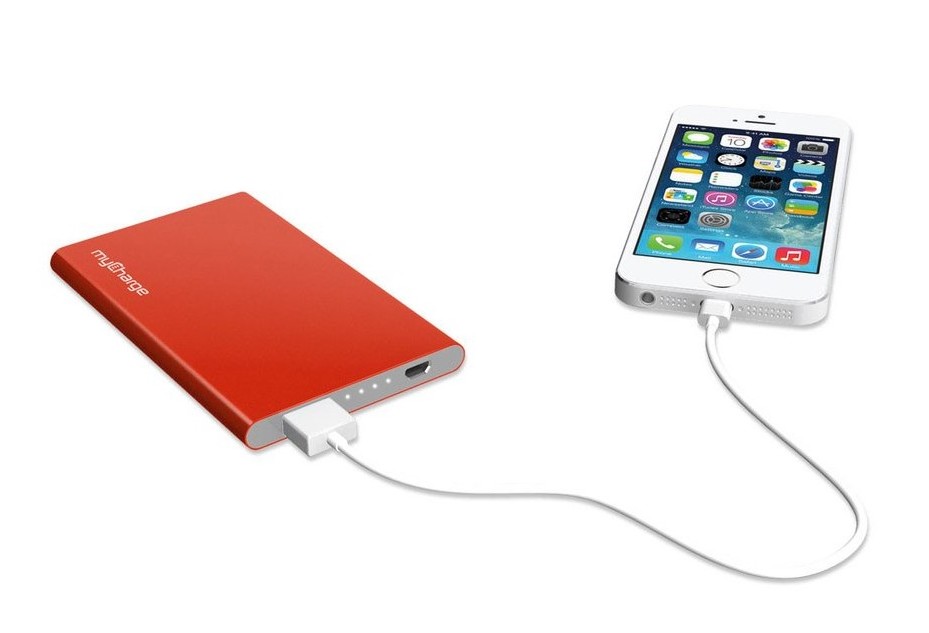
I keep a battery phone charger in my purse at all time. In fact, I have a dozen of these things charging all over my house so that I – and everyone else who lives here – can grab one and run out the door without fear of being out in the world with a dead phone.

This is not just an overactive addiction to social media or texting. If I get to a meeting and don’t know the room number or the phone number of the people I’m meeting, it’s on my phone. If I get lost, my phone navigates me back on track. If I come out of a meeting and it’s pouring rain and I have a ten-minute walk to BART, I need my phone to get a Lyft (use the code geekGF to get a free ride.)

I don’t have the time or data to go without my phone anymore. Someone will probably think that’s silly. That someone did not once carry a laptop, printouts of meeting notes, and a host of other data points to get through a day. All of that is on my phone now, which is why I can do this day — and most days — carrying everything in a stylish but affordable gray leather purse.


MyCharge RazorMax

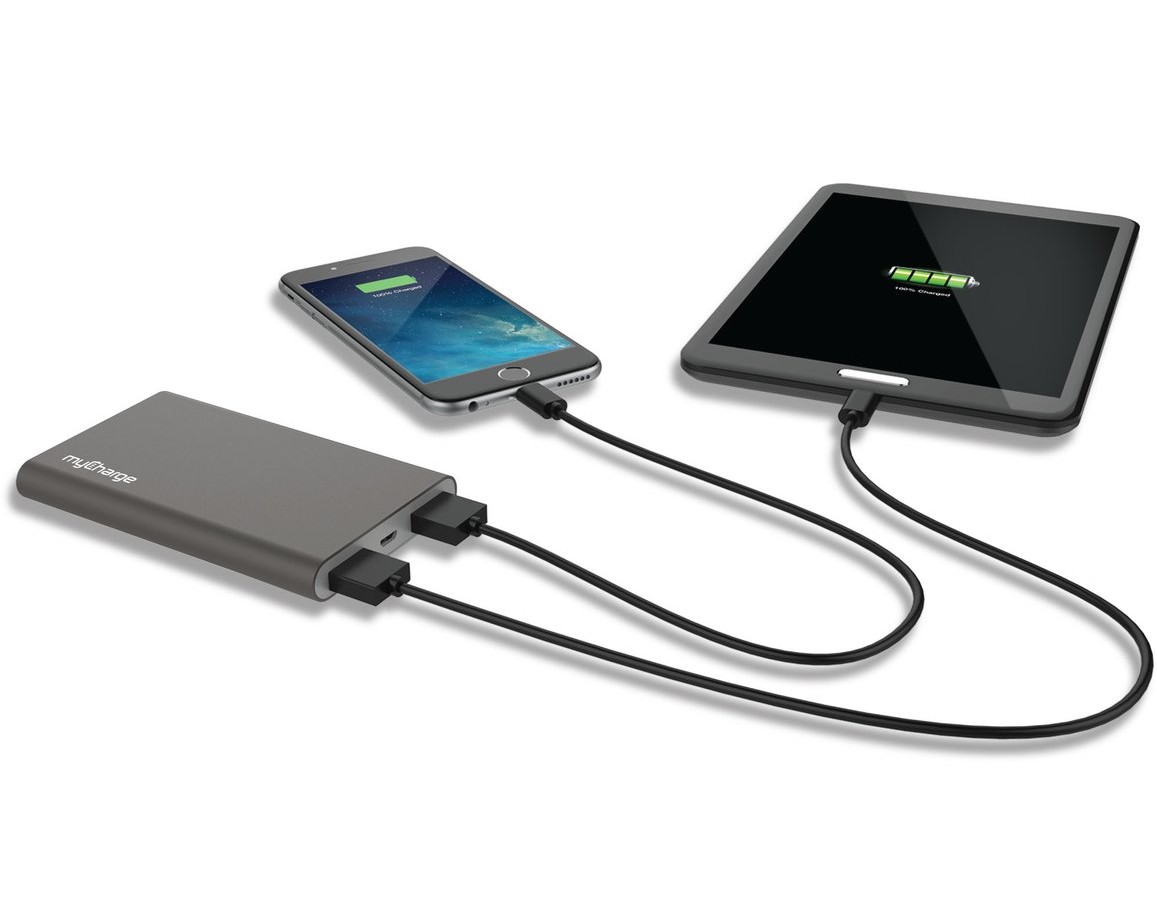
The RazorMax charger from MyCharge powers up two devices at once.


I am a big fan of MyCharge chargers. The one that is most often in my purse is the RazorMax because it is compact, pretty, snugs up to my phone when it’s charging so I can keep right on working. And it will charge a friend’s phone or tablet at the same time so it makes me popular.


amp30w-a_recharge_copy_580x2x

I keep the AmpProng model plugged in and handy in case my favorite is already dead in my purse.

phone charger

The RazorPlus is on sale for $20


I think these are must-have tech. And I usually put on in my kid’s stockings at Christmas and give them as gifts whenever I don’t know what to get. Many of them are on sale right now. Stock up!


21 Nov 15:42

How many Chrome Extensions run in Firefox?

Update: I did a bit more filtering and checking and the numbers dropped to around 76%. Head down past the caveats for more.

This question gets asked quite a lot around Mozilla now that we've been working on WebExtensions for a while. We've been aiming for some sort of Chrome parity. A while back I wrote a script that I used on arewewebextensionsyet.com. That produced a percentage of WebExtensions, but I always felt nervous about talking about it because there so many caveats it never felt accurate.

One of the major caveats was that the sample size of extensions I had from the Chrome store of 10,000 felt too small (that sample is the one used on arewewebextensionsyet.com currently). This week I used this project to parse the sitemap on the Chrome store and get 100,000 extensions and apps. A much more satisfying amount.

After stripping out apps, I then ran some scripts over those extensions to see how many would work in Firefox Nightly. Here's the output:

Number Percentage
Extensions 71,551
Missing one or more permission 5,463 7.64%
Missing one or more API 6,542 9.14%
Easily convertable 62,792 87.76%

And here is an explanation of the long list of caveats and why I still am very cautious about this number.

Caveats

  • This doesn't mean they can run out of the box, it means they are easily convertable. Possibly the most obvious reason is that some of these extensions contain deprecated methods. Firefox hasn't implemented those deprecated methods. But if the developer updates their extension to use the new methods it will work in both Firefox and Chrome.
  • This method filters out apps, or extensions which use apps API, which can be a little heavy handed and hard for extension users to spot.
  • This method just looks at APIs and permissions. Which means that features that are required beyond those two methods are not covered. Web APIs for example aren't tested.
  • Whilst we've got many APIs, some of them may not be implemented exactly the same as Chrome. Or have bugs. That can cause some extensions to have some problems.
  • A grep of chrome.* for APIs reveals domains, typos, comments and some just wierd strings. If you ignore those there would probably be even more that work.
  • This uses data from Firefox Nightly, if you use earlier versions of Firefox, you'll get less. Also not every single API is ready for release yet.

The result of these caveats is a list of variables which you can see in the code. A more perfect scenario would be to download the extension, try loading it into Firefox and then seeing the result. But automating and building it all out would take more than one hour or two of hacking. If anyone wants to try to do that for 100,000 extensions let me know.

So what can you take from the number 87.76%? Some comfort that its probably somewhere around that number. I can say with a lot of confidence that over 75% of extensions are easily convertable to Firefox. A bit less confidence that over 85% are.

That sounds pretty good to me though and a credit to the hard work the team has put in this year.


Update: November 22nd

A couple of more issues or caveats were pointed out to me:

  • This list of add-ons includes themes, those are possible in Firefox already and although its related slightly different. Because themes don't use APIs and are different they should probably be excluded. By the way, there is a plan to get new theming support in Firefox. This dropped our total number of extensions examined down.
  • This does not include manifest keys. Some elements of the manifest do not need an API or permission so if we don't support them we still aren't at parity. All the big ones, we already have bugs and plans for, but just to be complete I included these.

The result is now:

Number Percentage
Extensions 57,804
Missing one or more permission 5,242 9.07%
Missing one or more API 6,309 10.91%
Missing one or more manifest 7,799 13.49%
Easily convertable 44,716 76.36%

Told you I felt pretty good about 75% of extensions. For a more detailed output, check out the repository.


Full output of the script from today:

Importer stats
--------------
  71551 74.81% success
  24041 25.13% apps
     56 0.06% error

   5463 7.64% missing_permissions
   6542 9.14% missing_apis

  62792 87.76% easy_conversion

Missing APIs
------------
   1369 chrome.desktopCapture.chooseDesktopMedia
    533 chrome.permissions.request
    458 chrome.declarativeContent.onPageChanged
    454 chrome.declarativeContent.PageStateMatcher
    443 chrome.declarativeContent.ShowPageAction
    427 chrome.devtools.panels
    360 chrome.identity.getAuthToken
    346 chrome.proxy.settings
    311 chrome.permissions.remove
    292 chrome.devtools.inspectedWindow
    291 chrome.desktopCapture.cancelChooseDesktopMedia
    272 chrome.permissions.contains
    221 chrome.management.setEnabled
    187 chrome.runtime.error
    185 chrome.identity.launchWebAuthFlow
    182 chrome.management.onInstalled
    168 chrome.tts.speak
    167 chrome.identity.removeCachedAuthToken
    146 chrome.browsingData.remove
    141 chrome.tabs.cr_tabs_TabClosed_listeners_added
    141 chrome.tabs.cr_tabs_TabCreated_listeners_added
    141 chrome.tabs.cr_tabs_TabSelectionChanged_listeners_added
    141 chrome.tabs.hasOwnProperty
    128 chrome.identity.getProfileUserInfo
    126 chrome.management.onUninstalled
    126 chrome.devtools.network
    116 chrome.management.onEnabled
    109 chrome.manifest.content_scripts
    107 chrome.extension.onMessageExternal
     99 chrome.management.uninstall
     94 chrome.downloads.onDeterminingFilename
     94 chrome.management.onDisabled
     92 chrome.extension.onClicked
     78 chrome.experimental.cookies
     76 chrome.proxy.onProxyError
     76 chrome.identity.getRedirectURL
     71 chrome.storage.managed
     71 chrome.tts.stop
     61 chrome.privacy.services
     59 chrome.manifest.version
     57 chrome.privacy.network
     56 chrome.tabCapture.capture
     54 chrome.pageCapture.saveAsMHTML
     51 chrome.permissions.onAdded
     50 chrome.tts.getVoices
     46 chrome.browsingData.removeCache
     43 chrome.d.ts
     43 chrome.debugger.attach
     43 chrome.storage.set
     42 chrome.debugger.sendCommand
     40 chrome.permissions.onRemoved
     38 chrome.extension.connectNative
     38 chrome.permissions.getAll
     37 chrome.debugger.onEvent
     37 chrome.debugger.detach
     34 chrome.privacy.websites
     33 chrome.i18n._getL10nData
     33 chrome.i18n._setL10nData
     31 chrome.identity.onSignInChanged
     31 chrome.webRequest.MAX_HANDLER_BEHAVIOR_CHANGED_CALLS_PER_10_MINUTES
     30 chrome.tts.isSpeaking
     26 chrome.fontSettings.getFontList
     25 chrome.storage.get
     24 chrome.contentSettings.javascript
     24 chrome.debugger.onDetach
     22 chrome.webstore.install
     21 chrome.cast.media
     21 chrome.input.ime
     21 chrome.contentSettings.popups
     20 chrome.system.cpu
     20 chrome.cast.SessionRequest
     20 chrome.runtime.onUninstalled
     20 chrome.declarativeWebRequest.onRequest
     20 chrome.cast.ApiConfig
     19 chrome.cast.requestSession
     19 chrome.browsingData.removeHistory
     19 chrome.system.display
     18 chrome.contentSettings.cookies
     18 chrome.cast.initialize
     18 chrome.browsingData.removeDownloads
     18 chrome.browsingData.removeCookies
     17 chrome.tabs.TAB_ID_NONE
     17 chrome.declarativeWebRequest.RequestMatcher
     17 chrome.webRequest.ResourceType
     16 chrome.browserAction.show
     16 chrome.settings.uuuid
     16 chrome.extension.getVersion
     15 chrome.system.storage
     15 chrome.tabs.executeScriptAsync
     15 chrome.contextMenus.ACTION_MENU_TOP_LEVEL_LIMIT
     15 chrome.privacy.IPHandlingPolicy
     15 chrome.runtime.lasterror
     15 chrome.tabs.executeScriptInFrame
     14 chrome.example.echo
     14 chrome.settings.get
     14 chrome.runtime.Port
     14 chrome.contentSettings.images
     14 chrome.extension.onConnectExternal
     13 chrome.ttsEngine.onStop
     13 chrome.settings.set

Missing permissions
-------------------
   1382 desktopCapture
    620 clipboardRead
    616 declarativeContent
    510 proxy
    476 geolocation
    457 browsingData
    348 contentSettings
    275 tts
    232 system.cpu
    158 privacy
    156 debugger
    151 pageCapture
    144 identity.email
    120 tabCapture
     91 sessions
     79 downloads.shelf
     54 fontSettings
     52 unlimited_storage
     39 ttsEngine
     36 system.storage
     32 input
     30 fileBrowserHandler
     29 system.display
     26 declarativeWebRequest
     18 system.memory
     14 processes
     11 power
      8 audioCapture
      7
      7 {u'socket': [u'tcp-connect', u'tcp-listen']}
      7 videoCapture
      7 printerProvider
      6 location
      5 webview
      5 fileSystem
      5 enterprise.platformKeys
      4 create
      4 experimental
      4 infobars
      4 {u'fileSystem': [u'write']}
      4 signedInDevices
      4 wallpaper
      3 networkingPrivate
      3 dial
      3 cast.streaming
      3 app
      3 mdns
      3 cast
      3 streamsPrivate
      3 keybinding
      2 bookmarkManagerPrivate
      2 certificateProvider
      2 preferencesPrivate
      2 activetabs
      2 enterprise.deviceAttributes
      2 {u'fileSystem': [u'write', u'retainEntries', u'directory']}
      2 usb
      2 *
      2 dns
      2 tab
      2 audio
      1 *//yousonnik.ru/*
      1 all_frames
      1 webR/equestBlocking
      1 offroad
      1 hid
      1 @ant-sites-string-list@
      1 newtab
      1 accessibilityFeatures.read
      1 activeTab1
      1 t
      1 .entireweb.com
      1 accessibilityPrivate
      1 externally_connectable
      1 brailleDisplayPrivate
      1 alwaysOnTopWindows
      1 Storage
      1 mangement
      1 clipboardWrite
      1 https:ajax.googleapis.com/
      1 *.facebook.com/*
      1 dataReductionProxy
      1 desktopCapturePrivate
      1 enterprise.platformKeysPrivate
      1 popup
      1 copresence
      1 accessibilityFeatures.modify
      1 platformKeys
      1 beamrise
      1 Tabs
      1 http//gosnapshot.com/snapshot
      1 s
      1 urls
      1 https: //*/*
      1 commandLinePrivate
      1 system
      1 sienium
      1 virtualKeyboardPrivate
      1 www.bgu.ac.il
      1 none
21 Nov 15:42

iOS 10 Hidden Feature: Creates movies automatically

When Apple released iOS 10, the latest system software for the iPhone/iPad, it made a big deal out of the major features, like a redesigned Music app and contextual predictions in autocorrect.

But Apple’s engineer elves worked for a year to overhaul iOS 10, and they’ve planted lots of hidden gems. Today, I’m happy to present another of the best iOS 10 features that Apple forgot to mention.

In iOS 10, the new Photos app introduces Memories: beautiful, automatic, musical slideshows that include all the pix and videos from a certain trip or weekend. Most people are pleasantly surprised at how coherent and well-created these are, even though they’re totally automatic.

Open Photos; at the bottom, tap Memories. There they are. You can tap one to play it; you can also adjust the musical style, the length, and even which photos and videos are in it.

And once you’re satisfied, you can share it or post it online.

More from David Pogue

Atlas Recall is a (mostly) photographic memory for your computing life

iOS Hidden Feature: Expanded Control Center

Now I get it: The rules for drones

The New MacBook Pro: The ultimate good news/bad news story

Pogue’s cheap, unexpected tech gifts #2: ThinOptics glasses

A dozen iOS 10 feature gems that Apple forgot to mention

GoPro’s most exciting mount yet: a drone

Professional-looking blurry backgrounds come to the iPhone 7 Plus

Pogue’s Basics: Turn off Samsung’s Smart Guide

Pogue Basics: Touch and hold Google Maps

The Apple Watch 2 is faster, waterproof—and more overloaded than ever

We sent a balloon into space — and an epic scavenger hunt ensued

Now I get it: Snapchat

The new Fitbits are smarter, better-looking, and more well-rounded

Apple has killed every jack but one: Meet USB-C

21 Nov 15:41

Fujifilm Photowalk

On Sunday, I bought new shoes. On Monday, I got my Kickstarter-backed long-delayed Daguerrotype Achromat 2.9/64 Art Lens. Thus, on Tuesday I was well-prepared for a Fujifilm-sponsored photowalk on Vancouver’s Granville Island.

Vancouver’s Granville Street Bridge by night

That’s the Granville Street bridge,
with the downtown condo wall behind it and a supermoon above.

Sometime in the 3½ years I’ve been in Fuji-land I got on their mailing list, which is OK because it’s low-volume and, well, got me this invite. The ultimate hosts were Fujifilm Canada (whose President and SVP were there), but also present and helping were The Fuji Guys and Beau Photo.

I wish I had the cycles to do more photowalks. As I’ve written before, dropping into a mode where you’re consciously walking around looking for pictures means that you see pictures wherever you look.

You can read about the lens and see the groovy pix it took in Achromat Photowalk, and I won’t write about the shoes, they’re just shoes OK?

But that photowalk was pure fun, in the chill clear oceanside air. Obviously, we came looking for shots like this.

False creek by night

Many of us (the crowd was 50 or so) went to extreme lengths, deploying tripods, ninja postures, long exposures, and big lenses, all coming away with similar pictures.

There were lenses and camera bodies you could borrow; I fooled with an X-Pro2 and a 50-140 F2.8, and found both uncomfortably larger than my little X-T1 with its 35mm F1.4 nailed on almost permanently.

Fortunately, among the condo-tower-reflection clichés were visual oddities.

Visual oddity

The yellow cylinder with the shadowed face is one of the Biennale giants.

Our hosts and guides were charming, generous with opinions and examples around making good pictures; leavened only moderately with advantages-of-Fujifilm messaging. And in fact the Fuji tools are hitting sweet spots these days; they were making a bunch of photogs smile, ambling round the wet dark seawalls and sidewalks.

Not all photographs have to be dramatic; there’s a place for calmer rhythms too.

Boats near Vancouver’s Granville Island

The group I was in was led by Fuji’s Greg Poole, who taught me a few things about angles and technique and patience. I’m totally a Zen photographer, all about seizing the moment. If I had Mr Poole’s poise and determination, my pictures would be so different.

Embracing on a Granville Island dockside

But impulse photography makes me happy, and since it’s hard to get paid for photography these days, happiness matters.

21 Nov 15:41

Achromat Photowalk

On a recent cold and damp (but not actually rainy) evening I was invited on a Fujifilm-sponsored photowalk on Vancouver’s Granville Island. The day before, I’d received the fruits of a whimsical Kickstarter splashout from months and months back: a Daguerrotype Achromat 2.9/64 Art Lens from Lomography. It was great fun among the sparkles in the dark.

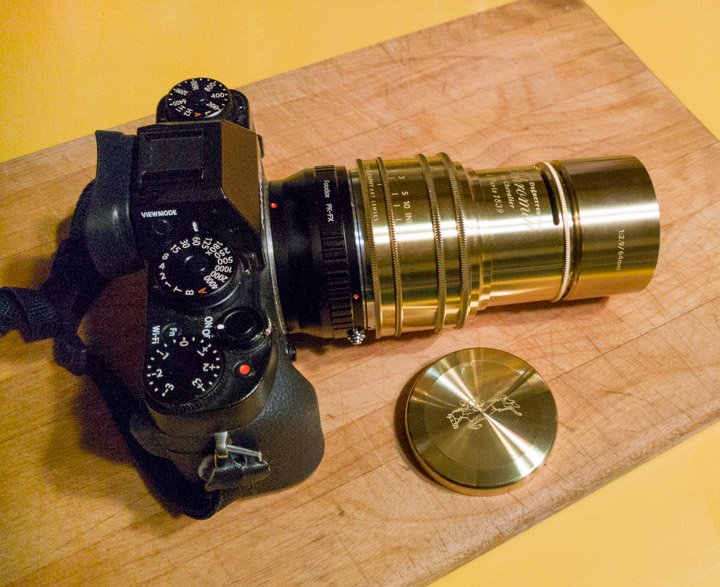
The lens looks like this:

Daguerrotype Achromat lens by Lomography on a Fujifilm XT-1

It has a Pentax K-mount, fastened here to my Fuji XT-1 using a Fotodiox adapter. Look at the fancy writing on the narrow part of the lens, then look a little further away from the camera body, above the writing, and you see a black slot in the top of the lens. It doesn’t have an aperture dial, so if you want to change the F-stop, you insert “Waterhouse aperture plates”.

Waterhouse aperture plates for Achromat lens

(Photo stolen from Lomography.com, hope that’s OK.)

The top row are straightforwardly marked with their aperture, F2.9 through F16. The others introduce various sparklies and squigglies to your pictures. I got more aperture plates than in the picture, there were a whole bunch of them, some marked “experimental”, whatever that means in this context.

In fact, I got a lot more than that. The lens came in a lovely little box with a beautifully printed book full of history and dreamy over-artistical shots. This kind of lens was used, in 1838, to take the first known photograph that included a human. Eventually, the Achromat design was succeeded by the Petzval, which among other things is more compact. Take a look at that first picture above and you can see why; smaller isn’t always better, but this is a beast by any measure.

Enough preamble: Here are a couple of Achromat pictures of a bare tree wrapped in christmas lights.

Achromat lens take on light-wrapped tree Achromat lens take on light-wrapped tree

The first is way out of focus, the second as sharp as I could manage; since the Fuji is WYSIWYG, all the sparklies made focusing hard. I found using the screen worked better than the viewfinder, for some reason. I have to say they made me smile. You really might want to click on that second picture for full effect.

It’s worth noting that if you want to monkey around with funky manual-focus lenses, the Fujifilm X-cams are a good choice, because of the superb focus-assist features.

At the market there were light-studded spheres hanging overhead.

Overhead lights via Achromat lens Overhead lights via Achromat lens

I forget exactly which of the aperture plates I used, by this point they were in a messy tangle at the bottom of a camera-bag side-pocket and remember, it was dark.

It can’t always be sparkles and tingles, in Lomography as in life, so I wrestled the brass beast into shots that I might have tried with more normal gear. It was a super-moon evening.

Super-moon through bare branches via Achromat

And then, finally, people. The face treatment is, uh, unique, and the background surprising.

Faces at the Fujifilm photowalk, via Achromat

Every picture has been quite extensively processed. I think that’s the right way to proceed in this photographic space; obviously one is shooting for effect, not for truth.

21 Nov 15:40

Blog – Verizon’s 5G and a video by R&S

by Martin

A couple of days ago, I had a post on the status of 5G and realistic timelines. A lot of politics is involved concerning the dates and when to do what but few technical details have so far emerged without looking deeply into the meeting minutes. Zahid Ghadialy over at the 3G4G blog, however, has now dug up some interesting technical details.

Personally I found the Rohde and Schwarz video he links to very interesting. It explains in some detail in 7 minutes what Verizon has in mind for their early 5G non-mobile wireless last-mile connectivity network. In essence, Verizon wants to use a modified TD-LTE air interface for the 28 GHz band with up to 8 carriers with a bandwidth of up to 100 MHz each. So in total they could combine up to 800 MHz which is an interesting comparison to the 50 to 60 MHz typically aggregated today by high quality networks (or even only 10 MHz in some rural deployments). That sounds a lot and it probably is. However, it should be kept in mind that at 28 GHz and longer distances, there will probably be only a single data stream per device and conservative modulation and coding.

In addition, instead of using OFDM with a 15 kHz subcarrier spacing they are going for 75 kHz because, from what I understand, they want to use massive MIMO on the base station side for beamforming so there’s less multipath fading that requires narrower carriers. On the MAC layer, modifications are made to TD-LTE to quickly adapt to changing uplink and downlink traffic ratios. Again, beamforming helps to isolate different cells and beams from each other so simultaneous uplink and downlink transmissions have a limited effect on each other.

The R&S video also mentions that the uplink will also be in the 28 GHz band. Zahid and the EETimes, on the other hand note that the Qualcomm X50 chipset for mobile devices also supports simultaneous transmissions in the 28 GHz band with a lower frequency band which is then used for signaling. This not mentioned in the video so I guess this is more applicable for Korea and Japan where network operators want to roll out a mobile 26 GHz pre-5G standardized network.


21 Nov 15:40

"Transclusion means that part of a document may be in several places—in other documents besides the..."

“Transclusion means that part of a document may be in several places—in other documents besides the original—without actually being copied there.”

-

Theodore Holm, citing Ted Nelson in the preface to Literary Machines: The Report on, and of, Project Xanado

The feature missing in my journaling, but apparently supported by iA Writer, so I am giving it a try.

21 Nov 15:40

Apple Book :: The complete walkthrough

by Volker Weber

21 Nov 15:40

Twitter Favorites: [jmv] Here's to our 1001st post at https://t.co/nDzZZ44SvM, our Tumblr blog on #transit. @counti8 @sillygwailo https://t.co/wAypK7tuUU

Jason M Vanderhill @jmv
Here's to our 1001st post at Translinked.com, our Tumblr blog on #transit. @counti8 @sillygwailo translinked.com/post/153356212…
21 Nov 15:39

Rest and motion

by russell davies

Further to things not changing:

"the amount of time people have spent in motion has remained constant since 1950"

from Hypermobility. via

21 Nov 15:39

Responsive Design

by Volker Weber

ZZ1C77EC76 ZZ75B0540D

Die Website skaliert mittlerweile ganz gut lesbar auch auf Mobilgeräten. Nur die Youtube Videos nicht. Kein Problem auf iOS, aber sehr wohl auf Windows Phone.

Man kann den Embed Code in einem DIV verpacken und damit die richtige Skalierung erreichen. Siehe Tutorial. Aber das funktioniert nicht mit den ganzen alten Postings und ich müsste das in Zukunft immer von Hand machen.

Ich probiere das jetzt mal mit Fluidvids.js. Work in progress.

21 Nov 08:12

Google says the Pixel’s security features are ‘better, faster’ and ‘stronger’ than other devices

by Patrick O'Rourke

Google wants you to know that the Pixel is secure, so the company wrote an entire blog post on the subject.

In a Google Security Blog post entitled ‘Google Pixel: better, faster, stronger,’ two of the tech giant’s senior software engineers discuss how the Pixel’s encryption implementation improves the “user experience, performance, and security” of the company’s smartphones.

On a technical level, the Pixel utilizes full disk encryption known as FBE, which means different files are encrypted with different keys, with each file being unlocked independently. Typically smartphones utilize FDE encryption known as full disk encryption.

Google says that through this method the company has given users access to the Pixel’s unlock and decrypt screen, allowing applications like alarm clocks, accessibility settings and phone calls, to be used right after booting. Google also says it utilizes technology called TrustZone that enforces a verified boot process, which results in the OS not booting gif its detected any form of modification. Finally, the company says it’s dropped eCryptFS encryption, stating that it does not meet its encryption requirements.

For more information on Pixel related security, check out Google’s full blog post.

21 Nov 08:10

Mirrored #NoDAPL Protest Signs Protect Protestors from Anti-Police

by Kevin Holmes for The Creators Project


GIF courtesy of Nikolas Bentel

The Dakota Access pipeline protests have been ongoing and intensifying since April. Since the start, various indigenous tribes and people across the US and further have joined the fight to oppose a multibillion dollar project that aims to see a pipeline carry oil from North Dakota to Illinois. It will run under a lake that the Standing Rock Sioux use as a source of drinking water, meaning any potential leaks will contaminate it.

At the symbolic center in Standing Rock, protesters aiming to halt construction continue to clash with police. Meanwhile the CEO of Dakota Access, the firm behind the pipeline who believe it will bring jobs and is a safer way to transport oil then rail, has maintained that it will be built and has now gone to a federal court to get a final permit so it can be completed.

Amongst all this, New York "social designer" Nikolas Bentel has released a new project involving mirrored protest signs that Bentel says "are expressly designed to prevent police from hurting protestors by using the effects of a mirror." Bentel wants to give away these signs to as many protesters as possible and also show them how to make them in the face of what appears to be increasing violence against the protesters.

Image courtesy of Nikolas Bentel

"The violence and violation of human rights has escalated a lot faster than it has been up until this point," Tia Blaise-Billie, a protester and member of Florida's Seminole tribe, tells The Creators Project. "Not only are organized forces such as the DAPL employed security and law enforcement increasing their violence against peaceful water protectors on the front lines, but escalated violence against unarmed protectors is being seen from other law enforcement as well. Just recently [November 17] at a nonviolent demonstration in downtown Bismarck, riot police beat and dislocated the shoulder of veteran Charles Jordan for having picked a flower. Even in the hours following [this], interview news of disturbing disregard for the humanity and rights of our protectors surfaced. There has been raiding and vandalization of personal property from camp, as well as vehicular aggression and brandishing of lethal weapons against unarmed and nonviolent groups on multiple occasions. Not only are organized forces such as the DAPL employed security and law enforcement increasing brutality against peaceful water protectors on the front lines, but there's been escalated violence against unarmed protectors in other cities as well."


Image courtesy of Nikolas Bentel

Bentel explains in a video about the project (below), which also features Blaise-Billie, that he took inspiration for the idea from the story of Archimedes who repelled Roman warships in the siege of Syracuse in 212 BC by getting soldiers to hold up their reflective shields, setting the Roman ships ablaze. Bentel doesn't want to start fires but instead wants to use the mirrored signs as a disruptive technique. 

The signs, along with having slogans written on them, will focus and aim light. This means that opposing police will not only see themselves reflected in them—possibly causing them to pause in their actions—but they will also work as distractions and as protection, creating lens flare, as the light bounces off. Bentel also believes they could be used to send non-electronic messages, heliograph-style, across the plains.

"These protest signs are not weapons. They are means of expressing concerns and communicating ideas," Bentel explains. "The signs I hope will assist protesters in drawing the attention of the police away from their efforts to push you aside."

Watch the video below to learn more about the project.

Anti-DAPL protestors can email info@nikolasbentelstudio.com to request a sign, give an address, and tell him what they want it to say. Bentel says he will make as many as he can until his funds run out. "If people would like to make their own mirrors it is simple." Bentel explained to The Creators Project. "All you need is a piece of acrylic, spray paint, and chalk marker. It will cost the protestor about $20 if purchased from cheap stores. And if purchased in bulk it costs quite a bit less. You apply the spray paint to one side of the plexiglass and the chalk marker with your statement on the other side."

Visit Nikolas Bentel's website here to learn more about his work.

Related

This Kit Gives Protesters Weapons for Anonymity & Encryption

Stunning Archival Images Tell the Story of Standing Rock

For This Photojournalist, People Are More Important Than Pictures

21 Nov 08:03

The Tenth Avenue Bikeway, The Hospital Precinct, and the $900,000 Question

mkalus shared this story from Rolandt shared items on The Old Reader (RSS):
The road is too narrow to get it all. The idea that you can alway smake everybody happy is what has given us a ton if shitty road design. Personally I am glad the city is willing to forgo the revenue from the metres. Having said that, like with Granville Island I never understood why there isn't an offer of a park & ride service. $4 roundtrip, even if subsidized would make this whole mess a whole let messy.

image2

The City of Vancouver has information here on their proposed bikeway plan for Tenth Avenue between Oak and Cambie Streets which will take out one hundred parking spaces and which will install east and west bike lanes on this well-travelled street. The City calls this section of street the “Health” instead of the “Hospital” precinct, as one astute observer noted.  While cyclists see this as a street to bike through, for many health consumers in the Province this location is close to their last stop.

Of course everyone should walk, take transit or bike to services. Yes there is off-street parking, but many of the institutions do not allow “general” parking unless you are going to that specific centre, which is often full. Most out of towners do need to come by car. Most are also health compromised and cannot walk too far. Most are ill, infirm, and will have perceptual conflicts crossing the street with bikes travelling on the new lanes. Those encumbered folks will not be able to respond quickly.

In many ways the current situation on Tenth Avenue makes vehicles, bikes and pedestrians slow down and take notice of everything happening in their surroundings. The street is heavily used by pedestrians. It has wonderful street trees. And that on-street parking provides a buffer for pedestrians from the travelled portion of the street. The impacts of  losing one hundred on street parking spaces is not only challenging for hospital clients-its a big loss to the city too.

Tenth Avenue in this “Hospital” precinct has some of the highest parking meter turnover in the city-this is a metered “cash cow”. The current parking meter rate of $3.00 an hour for each meter makes approximately $9,000 a year for each meter or a total of $900,000 a year for all one hundred meters that are being taken out. (This does not include any revenue from parking enforcement).

Over a 20 year period, if parking meter rates rose at current annual interest rates (3% – 5%), the present value of the parking meter revenue would be $18 Million. If the current parking meter rates were to increase annually by just 2% more  the present value of the revenue would be $27 Million. The City’s new meter policy approved this week is likely to increase the rates in this area by at least a dollar an hour, so you may have to add 33 per cent to these numbers. 

The financial incentive is there to continue the use of these parking spaces. Is it worth $900,000 a year annual municipal revenue to come up with an inclusive design that includes these metered parking spaces in this hospital precinct?

hi-bike-lane-istock


19 Nov 00:17

The Tenth Avenue Bikeway, The Hospital Precinct, and the $900,000 Question

by Sandy James Planner

image2

The City of Vancouver has information here on their proposed bikeway plan for Tenth Avenue between Oak and Cambie Streets which will take out one hundred parking spaces and which will install east and west bike lanes on this well-travelled street. The City calls this section of street the “Health” instead of the “Hospital” precinct, as one astute observer noted.  While cyclists see this as a street to bike through, for many health consumers in the Province this location is close to their last stop.

Of course everyone should walk, take transit or bike to services. Yes there is off-street parking, but many of the institutions do not allow “general” parking unless you are going to that specific centre, which is often full. Most out of towners do need to come by car. Most are also health compromised and cannot walk too far. Most are ill, infirm, and will have perceptual conflicts crossing the street with bikes travelling on the new lanes. Those encumbered folks will not be able to respond quickly.

In many ways the current situation on Tenth Avenue makes vehicles, bikes and pedestrians slow down and take notice of everything happening in their surroundings. The street is heavily used by pedestrians. It has wonderful street trees. And that on-street parking provides a buffer for pedestrians from the travelled portion of the street. The impacts of  losing one hundred on street parking spaces is not only challenging for hospital clients-its a big loss to the city too.

Tenth Avenue in this “Hospital” precinct has some of the highest parking meter turnover in the city-this is a metered “cash cow”. The current parking meter rate of $3.00 an hour for each meter makes approximately $9,000 a year for each meter or a total of $900,000 a year for all one hundred meters that are being taken out. (This does not include any revenue from parking enforcement).

Over a 20 year period, if parking meter rates rose at current annual interest rates (3% – 5%), the present value of the parking meter revenue would be $18 Million. If the current parking meter rates were to increase annually by just 2% more  the present value of the revenue would be $27 Million. The City’s new meter policy approved this week is likely to increase the rates in this area by at least a dollar an hour, so you may have to add 33 per cent to these numbers. 

The financial incentive is there to continue the use of these parking spaces. Is it worth $900,000 a year annual municipal revenue to come up with an inclusive design that includes these metered parking spaces in this hospital precinct?

hi-bike-lane-istock


19 Nov 00:17

Bethany's Blix!

by Thea Adler

Bethany Menzel wrote up a blog post up about her Blix Komfort+

"This Summer I started riding a Blix Electric Bike and I'm so in love with it. We live in an area with lots of hills so I would rarely bike because I always ended up walking my bike up the hills (I may not be the most athletic haha). Basically, the electric pedal assist has changed my life. We can get down to the beach, to the coffee shop or the bakery in a couple minutes. It's so nice to be able to run out to grab more milk quickly in the morning without having to get in the car. It's also just a lot of fun, We always make friends try it out on our street when they come over.To continue reading, and see more beautiful photographs created by Bethany, follow this link.

19 Nov 00:16

E-Learning 2.0

[Slides][Audio]

I spent the day at the Canadian Heritage Information Network engaged in a lengthy and free-wheeling discussion of the concepts surrounding E-Learning 2.0 Although the PowerPoint Slides for my presentation today are basically the same as those I used in Edmonton a few months ago, the discussion was much more wide ranging. Audio segments (each about an hour): Part One, Part Two, Part Three.

Invited Workshop, Gatineau, Quebec (Workshop) Nov 18, 2016 [Comment]
19 Nov 00:16

New hashtag: #WaaH

by Volker Weber

ZZ20E3E2CF

I propose a new hashtag: #WaaH. We know SaaS (Software as a Service), PaaS (Platform as a Service) and IaaS (Infrastructure as a Service). WaaH stands for Windows as a Hobby.

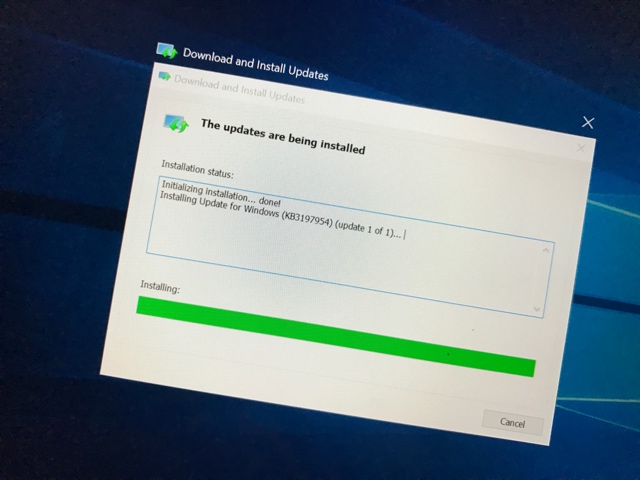
I have now spent hours on trying to install a Windows 10 cumulative update. I even tried installing a standalone installer, which isn't so easy when you are in a reboot loop of install/rollback. I have waited for a new cumulative update - which also did not install. I have done the System File Check (sfc) and Deployment Image Servicing and Management (DISM) routine, to no avail. Can't reboot anymore without going through an install/roll back cycle each time.

So I am shutting the Surface 3 down for good. One day I might do a full Windows restore & update cycle. Or update to a new machine. This one is broken, although I never installed anything but fixes and apps from the Windows store.

This is a Microsoft problem that needs to be addressed at scale. I am not alone.

19 Nov 00:16

Bikelash in North Van: Lynn Valley

by pricetags

If you’re tired of talking about 10th Avenue, there’s always the North Shore:

bike-lanes

Lots more here.


19 Nov 00:15

Chip Ramsay Interview

Interview for the Intellium blog. What I do with the NRC, and what the NRC does. I also talk at some length about my presentation audio and video recordings. You can also see the interview on  Intellium's Player FM channel.

, (Keynote) Nov 18, 2016 [Comment]
19 Nov 00:15

How Does the Electric Assist Work?

by Pontus Malmberg


What’s the point of electric assist?

The idea of using electric power for a bicycle is to make it easier to get around by bike, and eliminate many of the downsides of cycling. These downsides are frequently the reason why many people will choose to take a car over a bike. Here are a few of those:

  • You arrive sweaty
  • Distance is too long
  • Too many hills
  • Aching muscles or ligaments
  • Bringing things with you makes it too heavy to pedal

A Blix electric bike solves all of the above problems, and makes the bike the best option to get around in many cases. Here’s how it works:


Components of the electric assist system:

The electric assist system is composed of 3 main components:

  • The motor – placed in the wheel hub or in the crank depending model
  • The battery – placed on the frame below the seat
  • The display – placed on the handlebar. The display let’s you control every aspect of how you want the electric power to assist you. Besides these 3 components, the bike works just like a regular bicycle!


So, how does the electric assist work?

Ebikes provide assist 2 ways: pedal assist and throttle.

All Blix bikes have pedal assist. This means that when you pedal, the motor is automatically activated and will give you an appropriate amount of power depending on your pedaling.

All Blix models powered by the Spin Tech™ system also have a throttle. The throttle lets you go up to 20mph without pedaling at all.


The Pedal Assist System (PAS)

Blix’s Spin Tech™ system has 4 power levels of electric assist. A higher assist level enables the motor to assist you at higher speeds - level 4 can take you up to 20 mph depending on bike model. The amount of power assist is automatically provided based on which gear you’re using: A lower gear gives higher pedaling speed and more assist. So when going uphill, switch to a lower gear and enjoy!

The Shimano Steps system has 3 levels of assist, and measures both your pedaling speed and torque to give you smooth level of assist at all times. The electric motor can assist you up to 20mph, and cuts out if you pedal faster than that.


The Throttle

All models with the Spin Tech™ system have a throttle. If you don’t want to pedal at all, you can use the throttle to receive electric assistance up to 20 mph as long as the controller panel is turned on. The more you push the throttle forward, the faster you go.

To turn the pedal assist off but keeping the throttle function on, switch to pedal assist 0.

While using the throttle is an amazing function (especially when stopping and starting at red lights), the throttle function will cause the battery to run out faster than when using pedal assist.


The Display

The display shows riding info such as current speed, distance traveled, time traveled and average speed on your commute. From the display, you also control the integrated front & rear LED lights, which are powered directly by the battery. Cycling has never been easier or more fun!

Here are some of the functions you can see on the display:


  • Speed
  • Power level
  • Battery life
  • Trip distance & time
  • LED lights
  • Odometer


Blix models using the Spin Tech™ system: Vika+, Vika Travel, Aveny, Komfort+, Stockholm

Blix models using the Shimano Steps system: Komfort Prima


19 Nov 00:15

Latest In Rebuttal Shopping: Trump’s IQ

by mikecaulfield

I’m playing with this idea of Facebook posting as “rebuttal shopping”. The idea is that a lot of stuff that goes viral on Facebook is posted as an implicit rebuttal to arguments that the poster feels are being levied against their position. This stuff tends to go viral on Facebook because the minute the Facebook user sees the headline they know this is something they need, an answer to a question or criticism that irks them.

Maybe the idea holds together and maybe it doesn’t. But I’ll occassionally be looking at new things that are trending on Facebook and seeing how they do or don’t fit that pattern.

Today in rebuttal shopping we have this, on Trump’s IQ:

trump

I don’t think I have to prove this fake: there is no official record of Presidential IQ scores throughout history, and of course intelligence tests didn’t become common until well into the 20th century. Outside that, we even have the card description here, which references a “think thank” that proposed this, and the weird phrase “Intelligence professors”. But if you want to click through, it is a blog post on Prntly.com that references a “report” that turns out to be someone talking on a forum.

Number of shares on this are not groundbreaking, but clearly in viral territory for something posted two days ago: 24,836 shares.

One of the comments on it, liked 59 times, seem to support the rebuttal shopping idea:

“Democrats love to talk about IQ’s. Well they won’t be talking about Trumps. They thought Obama was the smartest president ever.”

However, a lot of the other comments rant about unrelated things, so maybe comments aren’t the best result here.

This IQ issue seems to be a ongoing thing. A satirical article on Empire News last year claiming that Obama scored the lowest on an IQ test of any president in history garnered over 30,000 shares, and a chain letter hoax in the early 2000s had George W. Bush as the the lowest in history.

Where does this leave “rebuttal shopping”? I’m not sure. The new Trump fake news seems to follow the rebuttal pattern, as does the Obama story. The Bush story confirms something that wasn’t much disputed at the time, however, and looks more like shopping for confirmation than rebuttal. It certainly is not resolving any cognitive dissonance.

We’ll play with the idea a few more days and see what it brings to the fore.


18 Nov 23:48

Dev Diary (October 2016)

(Eve is a new programming language, and this is our development blog. If you’re new to Eve, start here)

In September, we were busy prepping for the launch of Eve. This work carried over into October, and we released Eve v0.2 on October 28. Thank you to everyone who gave Eve a try and sent us your comments and criticisms. We’ve read hundreds of comments on HN, Reddit, and the mailing list, so November is really focused on how to address these and what the right path forward for Eve is. But first let’s talk more about what we did in October!

Eve alpha v0.2

Again, the biggest news from October was the release of Eve v0.2 (alpha) into the wild. We put up a lot of content on programming.witheve.com explaining our vision, the major highlights of Eve, and some discussion on how we got to where we are. We also made a nice video, showing how we think Eve could be useful in a development context.

Key features demonstrated in this video are:

  • The literate programming environment for Eve - with the Table of Contents, document-like WYSIWYG editing experience, and live application view
  • The inspector -  a debugging tool that lets you introspect and debug your program as it runs. The inspector is discussed more below.
  • Views - allow you to visualize the result of a block below the actual block. So far you can view text and various charts and graphs. We’ll be adding more views in the future. More on this below.
  • State loading - save and load the state of a running Eve application. This is useful in a bug report/debugging scenario. If you encounter a bug, you can save the state of the program and send it to another developer, who will see exactly the state of the application that you see.

Platform

As we teased last month, the Eve platform has moved over to a TypeScript codebase. This was really a tactical move more than anything else. One of the main motivating factors was that with TypeScript we could run Eve in the browser without any setup. Providing a zero friction programming experience is what we are trying to do, and there was a lot of friction with the C runtime. The TS runtime will act as a reference implementation, so Eve can be implemented in other languages and work as a cohesive system.

Roadmap

Let’s take a look at the platform roadmap, which provides a general direction for where we are headed:

  • Milestone 1: Programming for humans (We are here) - This milestone is about the language, semantics, syntax, and editor – the basis of Eve on which everything else will be built. Right now we’re focusing on fleshing out the langauge, building the standard library, defining what it means to work with Eve for a project, figuring out how Eve fits in with existing projects, connecting Eve to different data sources, deploying Eve programs, etc.

  • Milestone 2: The World Scale Computer - Eve is a meant to be a distributed system by default. We’ve left those features out of the 0.2 release, but the next big release will be about how Eve programs scale and distribute to multiple machines.

  • Milestone 3: Computation for all - This final milestone is the furthest out, requiring us to revisit our experimental work in end-user computing, and turning that into a real product for non-programmers. We’ve explored many ideas here, some more promising than others, but we still don’t have the right answer for what this looks like. So, we’ll be doing a lot more research before we can complete this milestone. One thing to note here is that we’re not calling this milestone “programming for all”. That’s intentional, for two reasons:

     1. We don’t believe a product like this will resemble programming as it exists today. Will it be graphs? A grid? A wiki? We’re not sure, but it will be exciting to find out.

     2. Most people don’t actually want to program. We don’t anticipate that the general population will want to use Eve to write traditional applications. Instead, we think Eve will be appealing to them for its ability to aggregate, transform, and distribute data to answer questions. Today, these are tasks you have need an experienced developer to accomplish. We don’t think it has to be that way.

Editor

The biggest changes to the platform were in the editor. We’ve already looked at the table of contents and the editing experience, which have been polished a little more since September. Let’s look at some other changes though:

The Inspector

The inspector is activated via the magic wand icon at the top of the editor. This toggles inspection mode, which allows you to click on any block in your program or element in your application, and get some info about it.

Eve Inspector

The inspector tool is a sort of one-stop-shop for all your debugging needs. If an area of your program isn’t displaying, the inspector can tell you why. If you see too many elements (or too few), the inspector will tell you how they came to be. If your program is running slowly, the inspector will tell you which blocks are consuming the most processing time:

Performance

Views

Up to this point we’ve been using bind @browser [#div text] as a sort of console.log() for Eve. This process is pretty antithetical to Eve, when you think about it. First, we’ve known for a long time now that drawing the result of a computation spatially near the computation is very powerful for debugging. Second, many things you don’t want to visualize as text. You can’t console.log() a bar-graph, for example. Enter views. Views are a way to visualize a block’s output right under the block itself. By writing data into the @view database, you can visualize it as chart, or even a time-series:

data over time

And of course we support plain text views:

Text view

The nice thing about both the inspector and views is that they are implemented entirely in Eve! The following links open in the Eve editor:

Community

First, I’d like to say the response to Eve has been fantastic. The mailing list has seen a lot more activity and a 30% increase in membership since the launch, which is great. Beyond the volume though, we’ve also gotten some very detailed and thorough proposals, comments, pull requests, and bug reports. Hopefully we can keep up this momentum, so spread the word!

Handbook

The Eve handbook has been moved to docs.witheve.com. The style now matches the Eve editor more closely, and you can now start to imagine how docs and Eve can work side by side. As always, there is an endless amount of work to do here, so keeping the docs up to date will be an ongoing process. If you find any docs that are missing, outdated, or insufficient, please let us know by submitting an issue here: https://github.com/witheve/docs/issues.

Eve Around the Web

We made a little splash on the web that generated some discussions and stories. Here are the launch day discussion threads:

And even better, some user-generated videos and blogs about Eve! These were fascinating to read and watch, so thanks everyone for taking the time to make these.