Shared posts

11 Dec 17:35

Is ‘Empathy’ Really What the Nation Needs?

by rands

What social networks like Facebook really offer is empathy in the aggregate — an illusion of having captured the mood of entire families and friend networks from a safe, neutral distance. Then they turn around and offer advertisers a read on more than a billion users at once. Buzz Andersen — a tech veteran who has worked for Apple, Tumblr and Square — told me that in Silicon Valley, “empathy is basically a more altruistic-sounding way of saying ‘market research.’ ”

(Via Amanda Hess on the New York Times.)

#

11 Dec 17:35

Why Trump Won: Fairness and Change

by Michael Mace
Donald Trump won the 2016 US presidential election because of two issues: Deep concerns about the fairness of American government, and an intense desire for change. That's a different story that we've heard from many commentators (link), but I'm confident in my opinion because I heard it directly from Trump voters. Below I'll share their voices with you, and tell you how I found them.

This post grew out of an experiment I ran at UserTesting (my employer). I wanted to see if our technology could be used to gather public opinion info. I was pleased with the results, and wanted to share them. At a time when most people are focused on talking, think of this post as an opportunity to listen, and maybe get a better idea of what the whole election meant.


Background. Like many people in Silicon Valley, I was surprised and worried by the recent election of Donald Trump. I didn't understand why so many of my fellow citizens would vote for someone who had such obvious personal flaws. There were plenty of explanations in print and online, but most of them came from the same people who predicted the election wrong. I didn't trust their analysis; I wanted to hear from Trump voters directly.

Fortunately, I had a way to do that. UserTesting runs a system to give companies fast user feedback on websites and apps. You come to us, describe the demographic you want and the tasks you want them to perform, and we recruit normal people to record themselves doing the task. The whole process is automated and extremely fast – you start getting videos back in as little as one to two hours.

I figured I could probably use the same system to run interviews with voters. Instead of testing a website or app, the participants would just answer written questions about the election.


What I learned. I reached out to Trump voters the day after the election, and within a few hours I had all the responses. As you'd expect, there were many different motivations, but I think two threads connected the Trump voters:

--They feel the system in the US is unfair, and is being exploited by people who cheat on the rules.

--They felt that Donald Trump, as an outsider, was the best bet to change the system. Hillary Clinton's long history in government worked against her with many of these voters, because it meant she was seen as a product of the system rather than a change agent.

Trump stood for change. Clinton stood for continuity. Change won.


Don't take my word for it. Below are recordings of the Trump voters, explaining the decision in their own words. First there's a sampler with highlights chosen by me, followed by the full recordings of each interview, so you can judge for yourself. A few notes:

--To protect the privacy of the participants, I did not record their faces, and I have removed any references to their location. All you'll get is a black screen and their voices.

--The participants came from all over the country, and range in age from their 20s to their 60s.

--There are nine recordings. Before anyone objects, I know that's not enough for a statistically significant sample. But statistically significant surveys failed us during the election; do you really want another one? These recordings are more like a focus group, except it was completed in hours instead of weeks, each interview was separate, and the questions were written. So there's no groupthink and no moderator bias. This sort of research won't tell you the exact percentage of people who hold a particular view, but it's excellent for understanding why they think as they do, which is what I wanted.

Here's my highlight reel of Trump voters talking about their choice:

Other issues: What's the mandate?  The full interviews are much richer than my summary, and I encourage you to listen to them. Here are some of the issues that stood out to me:

--The vote was a very difficult decision for some of them. I was humbled by the amount of thought they put into it.

--Some were motivated by intense distrust or hostility toward Hillary Clinton.

--Some were motivated by opposition to abortion.

--There was not a huge amount of hostility to immigration in and of itself. Some of the participants went out of their way to acknowledge the contribution of immigrants. What bothered many of them was illegal immigration, because that was viewed as cheating. Sometimes that was paired with concerns about citizens who cheat on government services. It's the fairness aspect that bothers them: "I'm working hard to make ends meet; it's unfair when others don't follow the rules."

--Although I didn't ask about it, several people mentioned health care costs. They said health insurance prices have gone up dramatically in the last few years, despite President Obama's reforms. In fact, some blamed him for the rise in premiums.

--There was a lot of desire for reconciliation with the part of the country that voted for Clinton. Some of the Trump voters went out of their way to say that they want more cooperation in the country, more equality, and less racial tension.

Overall, I think it's fair to say that the election was a mandate for dramatic change in the system and for increased fairness. That's especially vivid when you think how close Bernie Sanders, another advocate of change, came to the nomination on the Democratic side.

I don't think the election was necessarily a mandate for every other proposal that was floated during the election. In the recordings you'll even hear some Trump voters scoffing about the border wall, and saying they don't want Roe vs. Wade overturned.

I think the election result was a cry for help from people who thought Trump was worth the risk. As one woman put it: "I decided to go with Trump...because I thought maybe he could make a change and he could make a difference, and I am praying that I am right."

You're not the only one, sister.


Here are the full interviews:

What do you think? I'm going to take a chance and leave comments open. I'd love to hear your thoughts on the interviews and what they say to you. But please don't vent, and don't criticize the interview participants. They had the courage to share their thoughts candidly, and deserve to be treated with respect.

PS: Although UserTesting allowed me to do this research, I did it on my own time, because I wanted to understand the election, and I was curious to see if our tool could be used this way. I used personal time to edit the videos, which is why you're seeing this several weeks after the election.

PPS: If you're wondering why I put a political post on a technology blog, stay tuned. There is a connection, which I'll explain in future posts.

Copyright 2013 Michael Mace.
11 Dec 17:35

On Flesh and Bone

An Amazon original series, and a fascinating contrast to another Amazon original, Mozart In The Jungle.

Mozart is supposed to be about music, but it’s really about life and the arts. At Web Science 2013, Cory Doctorow said that no one should work in the arts unless they must; that, pretty much, is the argument in Mozart. Mozart has a lot of empathy for people who don’t have that choice.

Flesh and Bone (I've seen only the first episodes) is supposed to be about dance, but it’s really about damage, about bodies and the way things go wrong. Its characters make sacrifices, but those sacrifices are to their compulsions and their fears, not to their art. Lots of the damage isn’t a choice or a sacrifice. Everyone, it seems, is more or less damaged.

It’s not exactly pleasant. The dramatic premise of the first season, apparently, places a vulnerable and sympathetic dancer into precisely the situation with which she cannot hope to cope, having been cast into a ballet about a subject she dreads under the direction of teachers who cannot fathom the difficulty. The teachers, in turn, are former dancers with physical and emotional scars accrued over decades; they cannot imagine what pain this girl could possibly possess that could equal theirs.

The whole thing balances precariously. Make this much less horrible and you're trivializing sexual trauma, abuse, and pain. Make it any more horrible and you’re appealing to sadists.

11 Dec 17:35

An Ode to the Underappreciated Spreadsheet

by Alexandra Samuel

Spreadsheets get a raw deal. We are so dependent on tools like Excel and Google Sheets for managing budgets and P&Ls that it’s easy to fall into the trap of seeing spreadsheets only as applications for managing money, or at the very least, for working with numbers.

But the structure and features of spreadsheets make them so useful for a wider range of purposes, from project planning to writing. Breaking information or text into cells helps you break your work into bite-size chunks so you can find different ways of structuring it. The ability to sort and filter cells makes it easy to find, categorize, or reorganize lists or content. And yes, it’s nice to be able to do quick calculations when you are working with numbers.

Content Creation

Spreadsheets can be useful writing tools because they can help you organize resources and ideas. Here are a few ways you can use spreadsheets in content creation.

Structure a document. When you’re putting together a major document, PowerPoint deck, or book, the hardest part is often figuring out the structure. If you have seen (or authored) a document or deck that has the structure you need, consider mapping the structure out in a spreadsheet. I once drafted a book proposal by mapping out the structure of a book I admired, using column A to capture the title of each chapter and column B for each subsection within each chapter. Then I wrote my proposal in column C, mirroring the structure of the original book.

Create an asset file. If there’s a certain type of information you need again and again — like quotes you can use in speeches, or examples for presentations and reports — a spreadsheet can be a useful way of organizing that information in a way that makes it easy to find again. For example, I created a spreadsheet of digital lifestyle anecdotes, labeled by subtype (“money,” “family,” “business,” etc.). Because I can search or sort by those subtypes, I can easily refer back to those quotes when I need a story to illustrate a speech or blog post.

Build an idea file. Jotting down new project or story ideas in a plain text file is better than nothing, but makes it hard to organize and prioritize — let alone track those ideas through to completion. I now keep all my blog post and story ideas in a Google Sheet, with columns for “subject” (the broad topic area each idea relates to), intended outlet (e.g., HBR), and status (idea, pitched, assigned, complete). While some people maintain this kind of file using a project management tool like Trello, I’ve found a spreadsheet gives me more options for customizing my setup and organizing my ideas in different ways. Since it’s a pain to open my spreadsheet every time I have a new idea, though, I also maintain an Evernote notebook titled “story ideas”; when I have an idea, I immediately add it to that notebook (one note for each idea), and this If This Then That recipe simply adds my idea to that Google Sheet as a new row.

Planning and Organizing

In a world full of purpose-built task managers and productivity tools, it can be tempting to use a different application for each aspect of productivity or information management. But spreadsheets are often more flexible and powerful than specific productivity apps, because you don’t have to install a new application for each use case — and you can tailor them to your personal requirements. Here are a few of my favorite ways to use them:

Plan a project. You don’t necessarily need a dedicated project management tool to plan a project, track milestones, or capture dependencies. I create many of my project plans in a spreadsheet, with one column for dates (with a row for each week) and a column for each team or team member. That way I can map out what each person needs to accomplish in a given week, and keep the whole project on track. I often add an additional column to estimate my own hours at each step along the way, so I know how much time to block off in my schedule for each week of the project.

Set priorities. Whether I’m looking ahead at the week, the quarter, or the year, I find that a spreadsheet is the best way of capturing all my tasks or projects, estimating the time each one requires, and then prioritizing my to-dos based on the time I actually have available. It’s easier for me to see the big picture in a spreadsheet than in a task manager, and once I decide what I am going to prioritize, I can transfer actionable items to a task manager (without clogging it up with all the stuff I won’t actually have time to tackle). You can create your own spreadsheets for each type of prioritization process, or get the spreadsheets I use as part of the new Getting the Right Work Done tool kit.

Create a directory. AppSheet is a web service that lets you create mobile apps from spreadsheets, and it’s a great way to create a flexible contact directory for your team or organization. I created a mobile app for my kids’ school by getting parents to fill in a contact form I created with Google Forms; that form populates the Google Sheet that drives the directory, so we can offer a mobile app that not only lets parents search for a specific family but also allows them to see a list of kids by homeroom — or even a map of families so we can plan carpools. You can do the same thing for your organization, or even for your own personal contact list.

Working with Data

Surprise! Yes, spreadsheets are also useful in working with data. In addition to the obvious — organizing and calculating data, and creating basic charts — here are a couple of my favorite ways to use spreadsheets when working with data.

Surface interesting data. I do most of my serious data analysis in Tableau, but when I first dig into tables to summarize survey results, I use a spreadsheet to see which segmentations yield the most-interesting variations. For example, if I have a survey where results are segmented by age, gender, ethnicity, and social media usage (my usual columns), I want to see whether any of those segments differ significantly from the overall average. So I create what I call “Brent columns” — named for Brent Peppiatt, the colleague who showed me how to set up conditional formatting for a set of columns. If the responses for a particular segment (e.g., 18-to-25-year-olds) give a response that’s more than 10% higher or lower than the average, my conditional formatting turns that cell green. It’s a great way to quickly scan hundreds of response cells to see which ones are worth zeroing in on. (Excel has a button to do this quickly, but there is an art to making it work right, showing the right ranges in the right colors to actually help you interpret your data.)

Plan your infographics. If you’re producing a set of data-driven infographics for publication, you probably won’t want to release graphics you created in a spreadsheet. (I usually rely on Tableau or Infogr.am for infographic design.) But a spreadsheet is still essential for getting your data ready for visualization, particularly if someone else will do the actual graphic design. Create a separate worksheet for each graphic you need, and put the data you will be visualizing in a simple, clear table. Then create a rough mockup of your desired design using your spreadsheet’s built-in chart creation tools. Annotate the table and mockup with a few lines at the top of each worksheet, explaining what this graphic is intended to show, and what the key point of the chart needs to be. That makes it a lot easier for a designer to get their hands on the data (as opposed to wading through a huge spreadsheet) and it makes your communications goals clear.

Getting More from Your Spreadsheets

Once you start using spreadsheets for more than just financial data, you may find it helpful to have a few different spreadsheet applications in your tool kit. I use Excel for any spreadsheet I’m working on solo, or if I need advanced filtering, conditional formatting, or chart options. I use Google Sheets when I need to share a spreadsheet with other people, when I want to connect it to other web services (like my Evernote-powered ideas file), or when I want other people to add data to it from a form (like my support request system) — or when I want to be able to access it on the go.

There are also a few spreadsheet features that many people overlook or underuse but that will make spreadsheets more useful to you.

Learning how to use filters. Showing or hiding specific cells depending on whether they contain a specific word or value makes spreadsheets a lot more useful for quickly zooming in on specific information (as in a file of quotes or examples), and can speed up the process of cleaning up a workbook so that it’s more usable (by making it easy to just show and copy the rows you care about).

Conditional formatting. Making cells change color based on their content or value can take a little more work to nail down, but it is essential for anyone who routinely works with enormous spreadsheets of data they need to scan quickly.

Cell annotation. Most spreadsheet applications allow you to annotate cells; this lets you attach comments to a specific cell so you can explain what it means (or how to use it).

Invest a little time in learning to get more from your spreadsheets, and you’ll likely find yourself where I am now: turning to my spreadsheet applications as a way of dramatically simplifying and accelerating a wide range of business tasks;

11 Dec 17:34

2016 week 48 in review

by D'Arcy Norman

Work

The UCalgary Makerspace community met over in the Environmental Design fabrication shops. Lots of awesome stuff going on there, and they’re adding 2 giant 5-axis robot arms for high end custom fabrication.

image

Reps from Top Hat were on campus, doing a series of workshops for instructors and staff. Top Hat is used pretty extensively in some of our largest courses, but also in many smaller ones. The more interesting uses involve anonymous questions and formative feedback from students…

PhD

I went to a presentation by Mike Casey from Indiana University, on media preservation. He’s working to save a giant collection of analog recordings, which are in the process of degrading and the players are obsolete and failing. Triggered thoughts about planning to keep important (and even not-important) media safe so that it will survive shifts in technology and whims of budgetary processes over the years.

I was fortunate enough to hear 2 presentations by Adam Bradley, who is doing post-doc work in the INNOVIS lab with Sheelagh Carpendale1. Adam is doing interesting work on augmenting close reading of poetry, and had a room full of computer science nerds analyzing a poem together – and all actively engaged in the process. Code can be used to infuse humanity and art, rather than algorithmically sucking the life out of it. These talks triggered a LOT of thinking for me, and definitely adjusted how I’m looking at my PhD research plan.

Other

  1. INNOVIS is part of the iLab, which is my home in CPSC
11 Dec 17:34

How to Use Online Games and Activities to Connect to Grandchildren

by Alex

Technology doesn’t have to drive family members apart: it can also bring generations together. My latest post for The Wall Street Journal, featured in today’s Encore Report, spells out how grandparents can embrace online activities to get closer to their grandchildren. For example:

Online games: Games such as “Draw Something” and “Words With Friends” are popular among adults and children. Even children who are barely reading can enjoy the mobile versions of multiplayer games like “Ticket To Ride” and “Carcassonne.” Many have a chat function, and so give you a way of exchanging short messages along with your game play. The latest iPhone messaging app places such games within text messaging, which can be a good way of inserting yourself into grandchildren’s texting habits. You’re much more likely to hear from them regularly if you stay in touch via text rather than email.

Read the full story in The Wall Street Journal.

11 Dec 17:34

To Fix Fake News, Look to Yellow Journalism

by Alex

Some writers have not hesitated to indict the entire newspaper business-or profession-on such charges as deliberate suppression of certain kinds of news, distortion of news actually published, studied unfairness toward certain classes, political organizations and social movements, systematic catering to powerful groups of advertisers, brazen and vicious “faking,” and reckless disregard of decency, proportion and taste for the sake of increased profits.

If you think that quote comes from a recent critic of fake news, think again! That’s from a 1922 article by Victor Yarros, and it’s part of my look at the long tradition of lousy journalism — most notably, the “yellow journalism” phenomenon of the late 19th and early 20th centuries.

My latest JSTOR post uses the case of yellow journalism to make sense of the media crisis today. Read the whole piece at JSTOR Daily.

11 Dec 17:34

Pat McCrory in the context of elite overproduction.

As we head into the fourth week of Pat McCrory's failure to conceeed in the NC gubernatorial race, it's important to look at McCrory's infantile behavior in a larger context. While it would be tempting to try to psychoanalyze his continued intransigence as yet another man-child temper tantrum, there are larger forces at work, of which McCrory is just one sad symptom.

The root of the problem stems from the ever widening wealth gap and subsequent elite overproduction. As more and more millionaires and billionaires are minted they seek to convert their newfound wealth into political power. But the levers of power are limited, there's a finite number of House and Senate seats, there are only 50 governors, and only one President. No new power levers are being created, yet there are more and more people scrambling for them. More and more millionaires think they should be on the city council or run for their state legislature, while more billionaires think they too should be President. In a simple example of the law of supply and demand, you can see the price of running for office rising steeply over the last 40 years, with the cost of running for President exceeding $2 billion in 2012.

But what happens when the demand outstrips the supply so that no manner of money can buy you that cherished lever of power? When there are multiple millionaires, each backed by a group of billionaires, all vying for power? What do you pay then? You pay in social norms. Common decency. The destruction of these are the price you pay. Pat McCrory, in a desperate bid to retain his power, is willing to violate every norm of U.S. democracy and attempt to destroy all faith in the election process, the same process that put him in power four years ago. If Pat McCrory can't be governor, well then, he might as well burn down the entire edifice so no one else can be either.

You can also see this playing out on the national stage, with Donald Trump willing to violate every norm, digging deep into the veins of xenophobia, racism, and bigotry to propel himself into office. Under normal circumstances no politician would openly court the worse side of the human tribal instinct, the horrors from the last rise of fascism leading up to WWII have been too close and too fresh in memory. But time has passed, the last survivors of WWII are dying out, the reality of tens of millions of people dying in wars, revolutions, and pogroms are just dry history lessons now, not to be considered in the raw and ugly scramble for power.

So don't blame Pat McCrory, as infantile and destructive as his behavior has become, he is just a symptom of a much larger breakdown in political norms, and these are just a couple steps along a longer arc of societal disintegration. We're already seeing the normal U.S. two-party system fragment into five distinct parties; the neo-liberal wing of the Democratic party as exemplified by Hillary Clinton, the populist wing of Bernie Sanders followers, the traditional big business GOP, the Tea Party republicans, and finally the Trumpers. And this isn't the end of the disruption, merely the beginning. Layer on global warming, the continued disruption of technology, and the world wide migration of people from rural areas into cities and we have all the ingredients for massive upheaval. Will we descend into our own Cultural Revolution, shatter the country in another Civil War, or will the similar rise of fascism across Europe lead to another world engulfing spasm of death and desctruction? The patterns are all there, the roots of the problem can be clearly mapped out, and while there's no guaranteed way to avoid the coming disintegration, maybe we should at least try.

11 Dec 17:34

Ads in the Hype Machine Android App [updated]

by Anthony

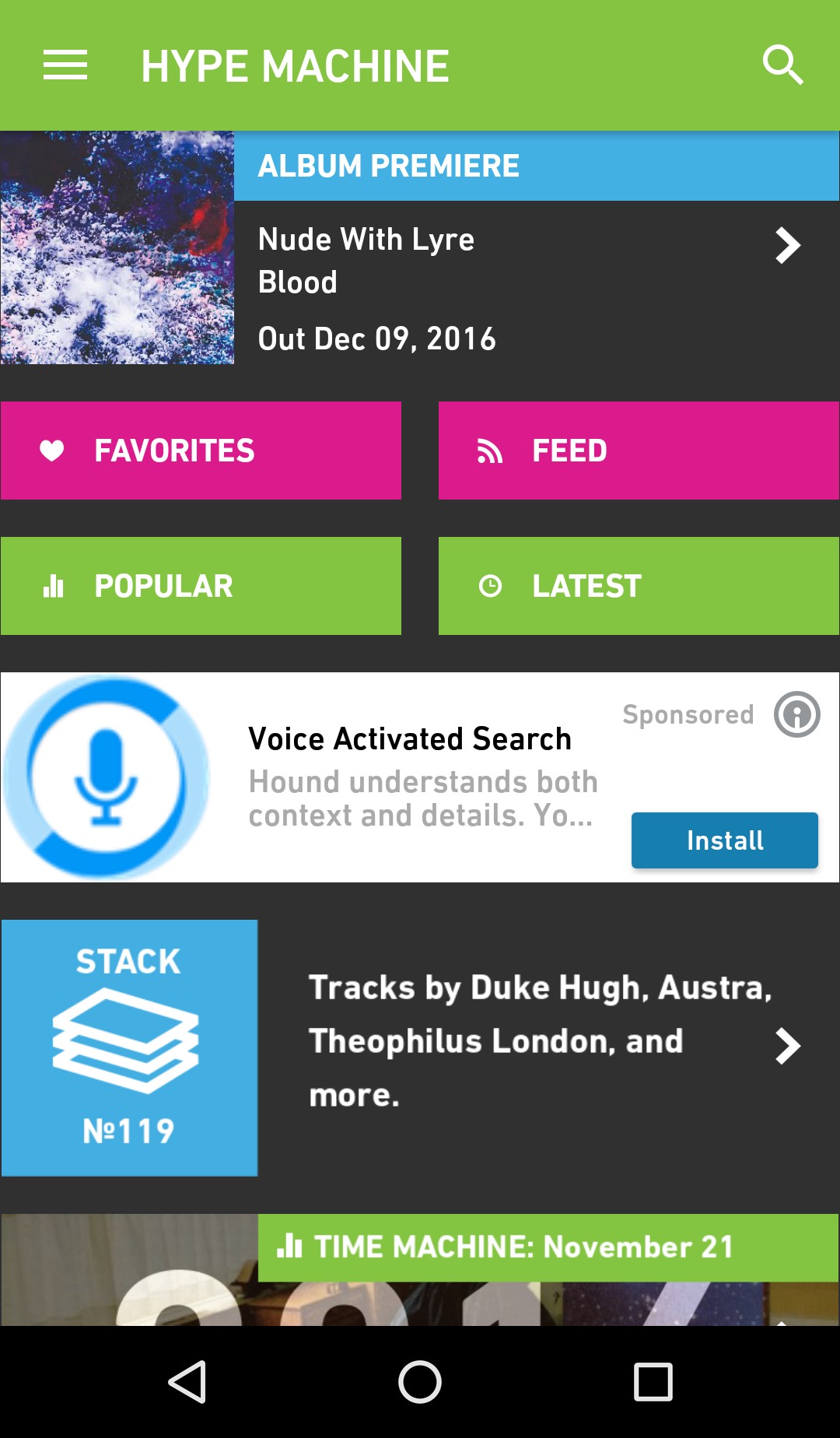
This past Friday, December 2, 2016, we enabled ads in our Android app.

Hype Machine Android Front Screen with Ad Popular Playlist with Ad

We released Hype Machine for Android in October 2014 as a $3.99 premium app. The revenue from these sales allowed us to publish many updates, including a full rewrite, maintaining the app as the Android platform underwent rapid changes.

Unfortunately, we were not able to generate enough sales to support our small team and continue development. Unlike many other online services, we don’t have outside funding. Hype Machine is a straightforward business – we get revenue from advertising and invest it into making products for music listeners.

We understand that it’s frustrating to have paid for the app and now see ads on your screen. Though the app became free in April, we’ve waited until December to introduce ads as a small sign of our appreciation of your earlier support. Whether you bought the app years ago or months ago, we hope that the music it’s brought into your life has been worth it.

In the coming months, we’ll be working to make sure the app continues to help you discover new music while keeping the ads as unobtrusive as possible.

I wish we could provide an ad-free experience, but we simply would not be able to continue maintaining the app without this revenue.

UPDATE 12/14/16

We considered many options before introducing ads in our apps, and there are many reasons why subscription/donation/IAP offers were not workable for us at the time (for example, supporting two product experiences is tough for a team of three people).

Given the strong show of support for an ad-free solution since the announcement, we are looking into ways people could remove ads in the apps. If you are interested, sign up here.

UPDATE 03/23/17

Ads in our mobile apps have been temporarily disabled.

11 Dec 17:34

Stroller Update: 5 months in

by Alison Mazurek
Us out with the Bugaboo Bee (Mae not realizing how lucky she is to be in such a nice stroller)

Us out with the Bugaboo Bee (Mae not realizing how lucky she is to be in such a nice stroller)

I thought it was time for an update on our stroller choice.  I knew when I chose our stroller this time around that it would be my everything.  We share one car and Trevor needs it for work most days so I am on foot pretty much everyday.  I love being able to walk almost everywhere we want to go. One of the reasons we live small is so we can stay in our walkable neighborhood and easily access everything we need on foot, be it parks, groceries, chores, coffee, preschool or art class. This stroller was a big investment and not one that everyone can or will want to make.  My justifications for such a spend was that it is much cheaper than a second car, would last us for at least 3 years without the need for a second stroller and have a decent resale value. Here are my thoughts 5 months in:

What's working:

Ride Along Board - I am loving the Ride Along board and I'm glad I splurged for the Bugaboo version.  While I initially thought the seat attachment was silly, it has turned out to be a great feature.  Theo loves to sit on it when he is tired.  I can also use it as punishment if he is not listening while we are walking.

3 yr old's stroller aversion - While I see many 3 and 4 year olds in strollers, Theo has considered himself too big and fast for strollers since he was about 2.5.  He is actually a great little walker and can walk the kilometre to preschool and back quite quickly but there are still times when he is slow, distracted or tired and I'm so glad we have the Ride Along Board (or "Scooter" as he calls it) to get places faster.  Knowing my little guy's personality, a double stroller would not have been an option for us.  He wouldn't want to be strapped into a stroller or be in the same seat as his baby sister. Though I would say that if by some magic your oldest still likes riding in a stroller or naps in the stroller then I would go for a double stroller.  It's all about knowing your kid.

Size and Ease of Use - This stroller is impressively small for all it can do.  I often have to fit through small doorways and share busy sidewalks living in the city and I never feel in the way, the way I did with a larger stroller.  I also can maneuver it with one hand, even with the "scooter" attached.  This is important for me as I often have to take my coffee to go :).

Full Featured - One main reason I chose this stroller is because it was usable right from birth.  The seat can face you and almost fully recline so a bassinet is not needed (we don't have space for more gear). I love that a stroller this compact still has all the features of a much larger stroller.

Unexpected challenges:

Baby Sleep Problems - Mae is not a great stroller napper.  Sometimes I get a half an hour nap out of her and sometimes she cries for half an hour straight until I pick her up.  This was very unexpected for me as Theo loved to stroller nap, which kept me very mobile during his first year.  With Mae it is always a bit stressful heading out in the stroller so I always pack my Ergobaby carrier with me and resort to carrying her if I can't take the crying anymore.

Weather -  It has rained for almost 2 months straight in Vancouver!!  Seriously!! It rains a lot in Vancouver but when I thought of my first fall with two kids I wasn't quite ready for packing everyone up in rain gear everyday! Needless to say a rain cover is of vital importance and so is a 100% waterproof coat for me and Theo (Mae's got the best deal of the bunch).  I definitely underestimated the effort it takes to get out the door, geared up with 2 kids but I am getting better at it (beyond the proper gear, the biggest issue is convincing a 3 yr old to get dressed). 

Storage - A downside of a compact stroller is less storage.  Once I put the diaper bag and carrier in the compartment under the seat, there isn't much room left for groceries or other items.  While I would love a little more storage, it is easy to throw my diaper bag (ie. backpack) on to make more room.  I also think when I can turn the seat to face baby outwards there will be a little more room or at least it will be easier to access. 


Theo on the "Scooter". Mae (uncharacteristically) asleep in her cozy Simply Merino hat

Theo on the "Scooter". Mae (uncharacteristically) asleep in her cozy Simply Merino hat

11 Dec 17:33

Five Leadership Hacks

by rands

MIT has a storied history regarding hacking where the act is viewed as a “clever, benign, and ethical prank or practical joke” at the University. Hack is also defined as the act of breaking into computers or computer networks. My definition is a combination of both.

To me, a hack is a clever or unexpectedly efficient means of getting something done. A good hack should feel like cheating because the value created by the hack feels completely disproportionate from the work done.

With this definition in mind, I present five leadership hacks I regularly use. These are not practices designed to redefine your leadership philosophy. They are hacks. 

Two minutes early. For everything.

Let’s start simple. I attempt to show up for every single meeting approximately two minutes early, and it has to do with Apple. It may have changed since then or been team dependent, but the expectation at Apple was that every meeting started roughly five minutes after the scheduled start time. It was assumed. We called it “Apple Standard Time.”

If everyone is aware that “Apple Standard Time” is the standard then no big deal, everyone ends up accounting for this handy five-minute buffer. But everyone is not aware. There was no onboarding were we learned about “Apple Standard Time,” so there were not infrequent meetings where half the people showed up and stared at each other for five minutes wondering, “Where the hell is everyone?”

The origins of “Apple Standard Time” are unknown to me, but I bet it started decades ago when someone important, someone with an impressive title kept… showing… up… late. No one said anything because everyone assumed there was good reason for the tardiness. There was a reason: this leader was bad at running their schedule. Worse, this behavior was allowed to exist and – even worse – it became part of the culture. 

Two minutes early. For everything. This means I look at my calendar at the beginning of the day and account for transit time. This means I gracefully leave the prior meeting five minutes before the scheduled end. This means I profusely and honestly apologize for wasting people’s time when I walk in two minutes late and this means I don’t let this failure become a habit.

The clock faces you.

Ending a meeting that is going well is tricky. Laura is in the middle of a soliloquy about the powers of a good engineering program manager. It’s great. She’s on a roll, but I need to be across the building for a 2pm meeting, and it’s 1:55pm right now, and I can not hear an ending to Laura’s speech. 

Laura knows nothing about my internal scheduling turmoil and she’s looking straight at me because she knows my support for program managers is critical and if I’m busily checking my calendar rather than listening, I am telling the rest of the room, “This thing she is talking about is not that important.”

The first thing I do when I sit down in a conference room is to find easy sight lines to the clock. Hopefully, it’s on a wall, or maybe I need to turn it face me on the desk. The hack is: “I should be able to know the precise time of day at any moment without a single human noticing.”

By having an intimate understanding of the time, I can shape my exit. I can listen for the ever-so-small pause Laura lands at 1:58pm. She’s not stopping, she’s taking a deep breath, so I can jump in and say, “This is great. I have a 2pm across the building, can we continue this discussion later?”

Whether you’re running the meeting or attending the meeting, being frictionlessly aware of the time is the first step to getting a meeting to end on time.

Office hours.

At my last gig, I wanted to meet everyone. First all hands, I committed, “I will personally meet with each and every one of you.”

Admirable. Doesn’t scale.

I started with 1:1s, but it was quickly obvious it’d take six months to get through the entire team, so we quickly pivoted to round tables. Five to ten folks plus me – every week. These meetings were more time efficient, but in each, it was clear that there were always a handful of folks who simply didn’t want to be there. I have work to do.

You can flatten your organization by creating as many communication conduits in as many unexpected directions as possible, and this was the goal with my flawed “meet everyone” strategy. The question is how do you create this communication serendipity for all the humans?

Office hours. They’re announced broadly every two weeks. Two hours total. 30-minute slots. Google Calendar makes this super easy. 

The result: my office hours are filled every time I announce them by the folks who want to talk and have an agenda. These are some of the most interesting meetings that I have with the team on a week to week basis. Random thoughts. Emerging concerns. Criticism. Growth conversations. Deep strategic concerns. Communication that only happens 1:1 and in person on a regular basis.

Three questions before any meeting.

Another morning calendar hack: I glance at my day and make a quick assessment: what is the value being created by each of the meetings on my calendar? In a moment, I should be able to answer that question. It’s a new director and we’re going to get to know each other. It’s a weekly sync with a team in crisis. It’s a regularly scheduled 1:1. 

Once I understand the why, I then focus on the what. Whether I run the meeting or am a participant, I write three questions that I’d like to get answered at this meeting. For a day full of meetings, the three question exercise should only take a few minutes and it achieves two important outcomes:

First, it frames my goals for this meeting. What is top of mind for me and what am I going to ask when given a chance?

Second, if I am failing to come up with three questions, I ask myself, “Why am I going to this meeting?” Meetings are a virus. They infect and they multiply. The longer they exist, the more likely the humans forget why the meeting was called. If it takes more than 30 seconds to think about my three questions or if I can’t think of a single question that I want to ask, I decline the meeting with a clear explanation. 

Continually fix small broken things.

There’s a stack of books on the right side of my desk. They’ve been slowly growing over the past month; I keep telling myself I’ll deal with them, but today I’m dealing with them. The one good book goes in my backpack for reading; the rest go to the bookshelf because I have decided I will likely never read those books.

Sticking with the desk. I’ve been collecting pens, and my pen cup is too full. So, I pour them on the floor and decide which pens are staying in the cup and which pens will be declared free. It takes a little over a minute, but I reduce my pen load by 50% and a lucky someone in the office is going to find a bunch of exceptional pens in our office supply cabinet.

There are five more small broken things on my desk that – in less than 10 minutes – I could fix. These are small broken things I’ve been staring at and stressing about for a month, and in 10 minutes that compounding guilt is better. That 10 minutes made standing at my desk more joyful. 

As you walk around your office, you constantly see little things that are broken, but you often ignore them because you are urgently working on the big things. The last hack is the easiest and it’s the best: fix small broken things. Always. It takes seconds to clean that whiteboard, to plug in the clock in the conference room, and to stop, lean down, and pick up a piece of trash. Seconds.

The value created isn’t just the small decrease in entropy, it’s that you are actively demonstrating being a leader. I understand the compounding awesomeness of continually fixing small broken things.

11 Dec 17:33

History is written by the bloggers

by russell davies

I think 'writing the history' was one of the first couple of things I asked Giles to think about when he came to work at GDS. Neither of us really knew what that meant, just that it felt important. Well, he's worked out what it meant and today they've published it.

I love how it's history written about, for, on and of the web. :

I love how there's virtually no 'writing' in it at all. It's all research and links. Which, of course, makes it a better form of writing. I know for a fact that Giles has elegant paragraphs telling many of these same stories, but links and fragments are much better ways to do it.

I love how, like the web, this story is now difficult to remove and easy to update. Corrections can be made, and tracked, but I bet there are already dozens of backups on servers and services, just in case someone decides to delete it.

I love how it's extensible - stick it on a hackpad or a wiki and it quickly forms the framework for the unofficial version, which will clearly soon follow.

I love how it uses and validates all the blogging we did. This is how the history of public services should be written - in public, as it happens.

I love how it's comprehensive, but doesn't pretend to be definitive. As they say, it's 'a story'. But what a brilliant story.

11 Dec 17:33

Helen Turvey Joins the Mozilla Foundation Board of Directors

by Mitchell Baker

Today, we’re welcoming Helen Turvey as a new member of the Mozilla Foundation Board of Directors. Helen is the CEO of the Shuttleworth Foundation. Her focus on philanthropy and openness throughout her career makes her a great addition to our Board.

Throughout 2016, we have been focused on board development for both the Mozilla Foundation and the Mozilla Corporation boards of directors. Our recruiting efforts for board members has been geared towards building a diverse group of people who embody the values and mission that bring Mozilla to life. After extensive conversations, it is clear that Helen brings the experience, expertise and approach that we seek for the Mozilla Foundation Board.

Helen has spent the past two decades working to make philanthropy better, over half of that time working with the Shuttleworth Foundation, an organization that provides funding for people engaged in social change and helping them have a sustained impact. During her time with the Shuttleworth Foundation, Helen has driven the evolution from traditional funder to the current co-investment Fellowship model.

Helen was educated in Europe, South America and the Middle East and has 15 years of experience working with international NGOs and agencies. She is driven by the belief that openness has benefits beyond the obvious. That openness offers huge value to education, economies and communities in both the developed and developing worlds.

Helen’s contribution to Mozilla has a long history: Helen chaired the digital literacy alliance that we ran in UK in 2013 and 2014; she’s played a key role in re-imagining MozFest; and she’s been an active advisor to the Mozilla Foundation executive team during the development of the Mozilla Foundation ‘Fuel the Movement’ 3 year plan.

Please join me in welcoming Helen Turvey to the Mozilla Foundation Board of Directors.

Mitchell

You can read Helen’s message about why she’s joining Mozilla here.

Background:

Twitter: @helenturvey

High-res photo

11 Dec 17:33

Why I’m joining Mozilla’s Board, by Helen Turvey

by Helen Turvey

Today, I’m very honored to join Mozilla’s Board.

Firefox is how I first got in contact with Mozilla. The browser was my first interaction with free and open source software. I downloaded it in 2004, not with any principled stance in mind, but because it was better, faster, more secure and allowed me to determine how I used it, with add-ons and so forth.

Helen Turvey joins the Mozilla Foundation Board

Helen Turvey joins the Mozilla Foundation Board

My love of open began, seeing the direct implications for philanthropy, for diversity, moving from a scarcity to abundance model in terms of the information and data we need to make decisions in our lives. The web as a public resource is precious, and we need to fight to keep it an open platform, decentralised, interoperable, secure and accessible to everyone.

Mozilla is community driven, and it is my belief that it makes a more robust organisation, one that bends and evolves instead of crumbles when facing the challenges set before it. Whilst we need to keep working towards a healthy internet, we also need to learn to behave in a responsible manner. Bringing a culture of creating, not just consuming, questioning, not just believing, respecting and learning, to the citizens of the web remains front and centre.

I am passionate about people, and creating spaces for them to evolve, grow and lead in the roles they feel driven to effect change in. I am interested in all aspects of Mozilla’s work, but helping to think through how Mozilla can strategically and tactically support leaders, what value we can bring to the community who is working to protect and evolve the web is where I will focus in my new role as a Mozilla Foundation Board member.

For the last decade I have run the Shuttleworth Foundation, a philanthropic organisation that looks to drive change through open models. The FOSS movement has created widely used software and million dollar businesses, using collaborative development approaches and open licences. This model is well established for software, it is not the case for education, philanthropy, hardware or social development.

We try to understand whether, and how, applying the ethos, processes and licences of the free and open source software world to areas outside of software can add value. Can openness help provide key building blocks for further innovation? Can it encourage more collaboration, or help good ideas spread faster? It is by asking these questions that I have learnt about effectiveness and change and hope to bring that along to the Mozilla Foundation Board.

11 Dec 17:33

Building a supportive community for everyone

by Arden Hoffman

Photo of Dropbox employeesLast year, we were very proud that Human Rights Campaign’s Corporate Equality Index (CEI), awarded Dropbox a perfect score for LGBTQ equality in the workplace. Today, we’re happy to announce that we have achieved that perfect score again for 2017, and that Fortune Great Places to Work has named us a Best Workplace for Diversity, as well as a Best Workplace for Asian Americans. These recognitions underscore our commitment to creating a diverse, inclusive, and supportive community at Dropbox.

The first award, Human Rights Campaign’s Corporate Equality Index (CEI), created by the Human Rights Campaign Foundation is considered one of the best measures of corporate LGBT-friendliness. Fortune named Dropbox to the 2016 Best Workplaces for Diversity list and to the 2016 Best Workplaces for Asian Americans based on our employees’ assessments of workplace fairness, opportunities for training, and access to senior leadership, among other factors.

Diversity at Dropbox is not just about who we hire, but how welcoming we make the work environment for employees of every background and every identity. We support benefit parity and equal pay for equal work. We have many family-friendly policies, and they apply equally to all kinds of families. We also support a wide range of very active employee resource groups including Pridebox, Women@, Black Dropboxers, LatinX, and Asians@.

We are honored to be recognized, but what matters most is what happens every day at Dropbox. There’s always more to do to make this a place where everyone can be themselves and do their best work.

11 Dec 17:33

Food patterns

by Nathan Yau

Food trends come and go. Some stay longer than expected, and others come back a certain time every year. With their new project, The Rhythm of Food, Google News Lab and Truth & Beauty explore these patterns through twelve years of search trends.

As shown above, you get a circular timeline for each topic. Color represents the year, and distance from the center of the circle represents search volume. You can see the trend play out for each using a play button, or you can mouse over at the top to look at a specific year.

Fun stuff.

There are also a lot of thoughtful design touches that you might notice. A few off the top: annotation for the more trendy foods, notes for holidays or specific events that relate to the topic you view, and segments sized for area as you move from the center of the circle to the edges to compensate for visual attention.

Search and browse 195 food and drink topics. It looks like there’s a whole lot of peppermint and hot chocolate going on this time of year.

Tags: food, Google, Moritz Stefaner

11 Dec 17:33

Interacting With Amazon Athena from R

by hrbrmstr

This is a short post for those looking to test out Amazon Athena with R.

Amazon makes Athena available via JDBC, so you can use RJDBC to query data. All you need is their JAR file and some setup information. Here’s how to get the JAR file to the current working directory:

URL <- 'https://s3.amazonaws.com/athena-downloads/drivers/AthenaJDBC41-1.0.0.jar'
fil <- basename(URL)
if (!file.exists(fil)) download.file(URL, fil)

To avoid putting credentials in code, you can store the AWS key and secret you’re using for the queries in ATHENA_USER and ATHENA_PASSWORD environment variables via ~/.Renviron. You’ll also need an S3 bucket writable by those credentials for the Athena staging directory. With that info in hand, it’s easy to connect:

library(RJDBC)
library(dplyr)

drv <- JDBC(driverClass="com.amazonaws.athena.jdbc.AthenaDriver", fil, identifier.quote="'")

con <- jdbcConnection <- dbConnect(drv, 'jdbc:awsathena://athena.us-east-1.amazonaws.com:443/',
                                   s3_staging_dir="s3://accessible-bucket",
                                   user=Sys.getenv("ATHENA_USER"),
                                   password=Sys.getenv("ATHENA_PASSWORD"))

Even if you have no data configured in Athena, you can check out the test data available to all:

dbListTables(con)
## [1] "elb_logs"

If that worked, then you should be able to query data (using the fully qualified table name in this case):

dbGetQuery(con, "SELECT * FROM sampledb.elb_logs LIMIT 10") %>% 
  dplyr::glimpse()
## Observations: 10
## Variables: 16
## $ timestamp             <chr> "2014-09-27T00:00:25.424956Z", "2014-09-27T00:00:56.439218Z", "2014-09-27T00:01:27.441734Z", "2014-09-27T00:01:58.366715Z", "2014-09-27T00:02:29.446363Z", "2014-09-2...
## $ elbname               <chr> "lb-demo", "lb-demo", "lb-demo", "lb-demo", "lb-demo", "lb-demo", "lb-demo", "lb-demo", "lb-demo", "lb-demo"
## $ requestip             <chr> "241.230.198.83", "252.26.60.51", "250.244.20.109", "247.59.58.167", "254.64.224.54", "245.195.140.77", "245.195.140.77", "243.71.49.173", "240.139.5.14", "251.192.4...
## $ requestport           <dbl> 27026, 27026, 27026, 27026, 27026, 27026, 27026, 27026, 27026, 27026
## $ backendip             <chr> "251.192.40.76", "249.89.116.3", "251.111.156.171", "251.139.91.156", "251.111.156.171", "254.64.224.54", "254.64.224.54", "250.244.20.109", "247.65.176.249", "250.2...
## $ backendport           <dbl> 443, 8888, 8888, 8888, 8000, 8888, 8888, 8888, 8888, 8888
## $ requestprocessingtime <dbl> 9.1e-05, 9.4e-05, 8.4e-05, 9.7e-05, 9.1e-05, 9.3e-05, 9.4e-05, 8.3e-05, 9.0e-05, 9.0e-05
## $ backendprocessingtime <dbl> 0.046598, 0.038973, 0.047054, 0.039845, 0.061461, 0.037791, 0.047035, 0.048792, 0.045724, 0.029918
## $ clientresponsetime    <dbl> 4.9e-05, 4.7e-05, 4.9e-05, 4.9e-05, 4.0e-05, 7.7e-05, 7.5e-05, 7.3e-05, 4.0e-05, 6.7e-05
## $ elbresponsecode       <chr> "200", "200", "200", "200", "200", "200", "200", "200", "200", "200"
## $ backendresponsecode   <chr> "200", "200", "200", "200", "200", "400", "400", "200", "200", "200"
## $ receivedbytes         <dbl> 0, 0, 0, 0, 0, 0, 0, 0, 0, 0
## $ sentbytes             <dbl> 2, 2, 2, 2, 2, 2, 2, 2, 2, 2
## $ requestverb           <chr> "GET", "GET", "GET", "GET", "GET", "GET", "GET", "GET", "GET", "GET"
## $ url                   <chr> "http://www.abcxyz.com:80/jobbrowser/?format=json&state=running&user=20g578y", "http://www.abcxyz.com:80/jobbrowser/?format=json&state=running&user=20g578y", "http:/...
## $ protocol              <chr> "HTTP/1.1", "HTTP/1.1", "HTTP/1.1", "HTTP/1.1", "HTTP/1.1", "HTTP/1.1", "HTTP/1.1", "HTTP/1.1", "HTTP/1.1", "HTTP/1.1"

And, you can disconnect when done:

dbDisconnect(con)

You should probably store the JAR file in a central location and refer to it that way in “production” scripts.

Now, you can go crazy querying data and racking up AWS charges 😀.

11 Dec 17:33

The Outline

(Just to be clear: this has nothing with outliners or the app I work on all day.)

In Welcome to the Outline:

I could have linked to all of these stories, but instead they're bundled into this handy thing below. We call it a stack. Enjoy.

No.

11 Dec 17:33

Why I Love a $200 Laptop

by Christina Wood

sam_0036
I get a lot of computers in to try here at GeekGirlfriends.com. Expensive ones, cheap ones, innovative ones, pretty ones, and powerful ones. I often get attached to one computer, though, and my reasons have less to do with price, specs, cleverness, or bling than function. And when I say function, I don’t mean speed and features. I mean, how well it works for what I do.

I recently did a (completely unscientific) experiment on this theory using the Lenovo 100s and the ASUS Chromebook Flip C100P.  I handed the Chromebook to Dennis (GeekGirlfriends.com’s Lab director) and set up the Ideapad 100s for myself. He fell completely in love with that Chromebook. And I have become so inseparable from this Lenovo 100s that I will buy one when they want it back. Months later, we are both still (respectively) dedicated to these machines.

Aside from differences in color, size, and specs they are a similar category of computer: Small, light, portable, and meant to be used mainly while connected to the Internet. I do not use the Lenovo as my main work computer. I have an office, a big screen, an ergonomic keyboard, and all the trimmings for that. But when I travel — even if only to a meeting in the city or a cafe to get away from my house — I take the Lenovo with me.

The Chromebook has a touch screen, the screen flips around so you can use the keyboard as a stand and watch movies on it. And it, of course, connects to Google universe of productivity tools: Google Drive, Google Docs, Google Sheets, and like that. Dennis loves everything about it. (Ask him about it…. Hell, just look at it and he will tell you, “I love this thing.”)

The Lenovo 100s is more basic. It has a slightly larger screen and keyboard. It is not a touch screen. It doesn’t flip around. But it’s a Windows machine. I don’t care about Windows but I am completely dependent on Word for writing and OneNote for research and planning. And that means that I have to use Windows. (A deal I am willing to make without complaint because I am so grateful for the existence of those two tools, without which I would probably flail around uselessly.) The only reason I carry a laptop is to write. And I write – unless someone forces me to use some other tool – with Microsoft Word. This machine makes me very happy. It fits in my purse. The battery lasts all day. It’s easy to carry. And it’s a cute red.

Microsoft

There are specs we both like about these laptops respectively but nailing  this primary use is the essential element. If the keyboard disappointed. If it made getting to the place either of us stored our files annoying. Or if it was too big for the bag we carry, we would not be interested in USB ports, HDMI ports, storage, or processors. In the current world of specs, those are all gravy.

This casual social experiment proved my theory about buying a computer: Know thyself first. If you ask someone you think is a computer nerd, Apple fanboy, or gamer what computer they would buy, you might learn something interesting. But it won’t be the answer to the question, “What computer should I buy?” For that, you have to look in the mirror.

11 Dec 17:33

Dev Diary (November 2016)

(Eve is a new programming language, and this is our development blog. If you’re new to Eve, start here)

With the launch of Eve v0.2 at the end of October, the early weeks of November were spent reacting and responding to feedback from new users to the ever-growing Eve community. Still, we managed to make some pretty big changes to Eve this month, so let’s get right to it!

What’s new in Eve Alpha v0.2.2?

We’re starting to become more serious about version numbers and releases, but we don’t have a fixed release schedule yet. This release was triggered by the addition of the Eve npm package, which adds enough features to Eve that it’s worth highlighting them. For a full list of changes in v0.2.2, check out the [release notes][1.1]. We’ve got several highly requested features in there for you. Let’s take a look at those in detail.

Eve npm package

We published a package for Eve on npm, so you can now install Eve like so:

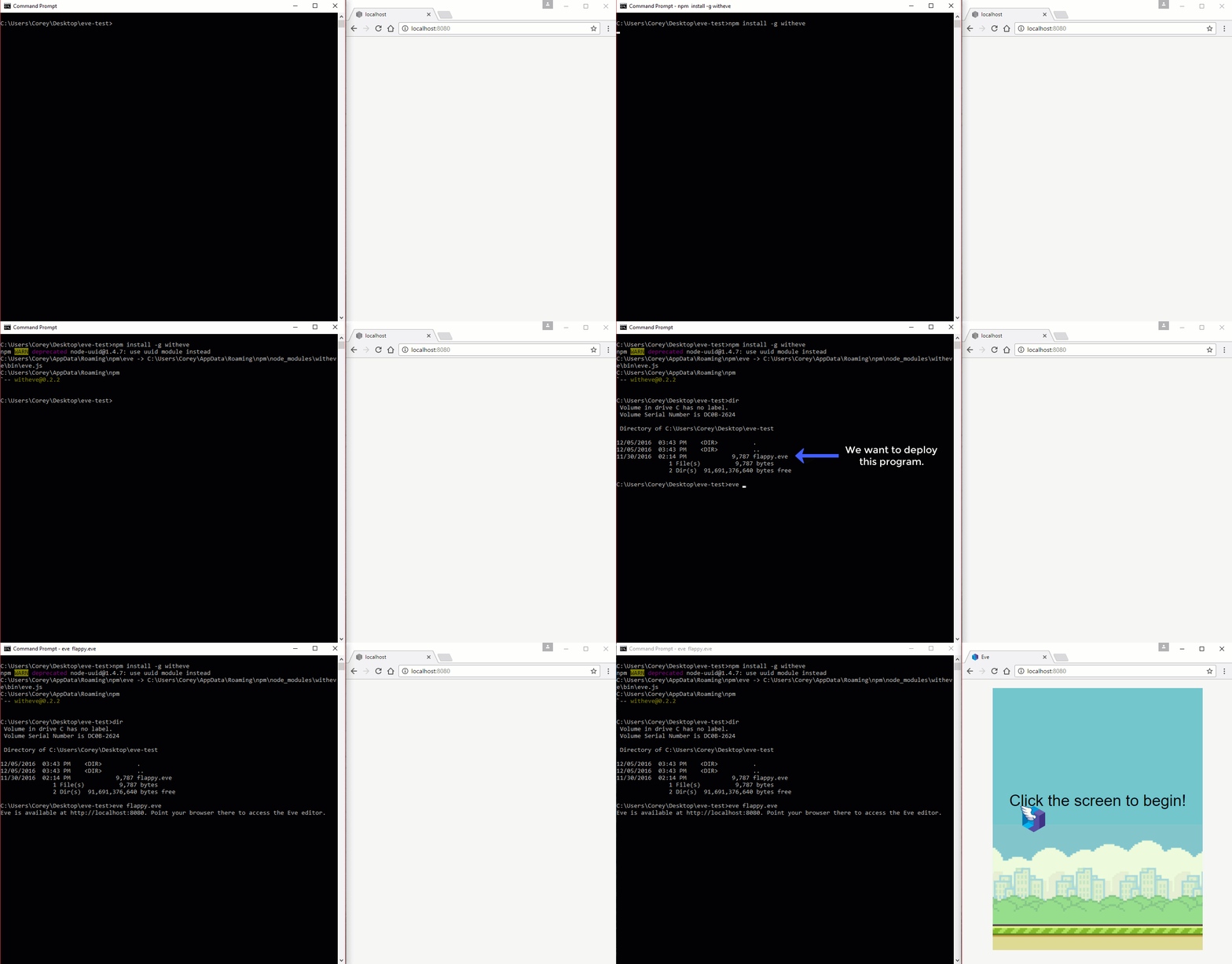
npm install -g witheve

This will give you a global Eve installation that you can invoke with the command eve from anywhere. Doing so will start an Eve server, in the same way npm start currently does. (Note: be sure to install witheve, as installing eve will give you a different package)

Workspaces

We’re introducing the ability to run Eve in a custom project workspace. To create a new Eve project workspace, create a folder with an empty file named package.json then start Eve from within this folder. Eve recognizes that it’s starting in an Eve project, and will serve *.eve files from within this directory instead of the Eve examples folder. Furthermore, you can serve various assets, like images or CSS, by placing them in an “assets” sub-folder.

Server Mode

Now, Eve can be started in server mode using the --server flag:

eve --server

Without this flag, execution of Eve programs happens within the browser, with the Eve server acting as an intermediary between the browser and your local system. In server mode, Eve will instead execute your program on the server. Currently written programs will operate exactly as before, but this is a preliminary step in order to get networked Eve applications going (like a chat server or a multiplayer game). There is still work needed to be done there (currently in review), so stay tuned for more!

Deploying Eve Apps

Eve npm

This is one of the most requested features to date, so we’re happy to bring it to you! You can now run Eve applications without the editor, which should pave the way to deploying them on your own server. You can specify which Eve program you want to run after the Eve command:

eve ~/myEveDir/myEveFile.eve

Now you can navigate to Eve in your browser to access the specified program. If you like, you can also recover the editor with a flag:

eve ~/myEveDir/myEveFile.eve --editor

This will run the supplied Eve program with the editor visible.

Standard Library

The standard library still needs a lot of work, but thanks to our intrepid community we made some great progress on adding basic functionality.

  • Added support for the vast majority of HTML/SVG tags (thanks @frankier!)
  • Added urlencode[] (thanks @renegr!)
  • Achieved parity with Javascript math library functions and constants (thank @Cormac-Williams!)

There’s still a lot of work to do here, so let us know if you’re missing some basic functions that could easily be added.

Community

It’s been a month now since the launch of Eve, and we’ve been thrilled by the response so far. It seems like I say this with every new dev diary, but every day we receive more issues, pull requests, and especially Eve programs that are getting increasingly sophisticated.

With a fast growing community though, it’s tough staying on top of everything, especially with a small team like ours (we’re only 4 developers here, if you didn’t know!). Thankfully, our great community has been picking up the slack, answering questions on the mailing list, tracking down issues, identifying and implementing improvements, reviewing pull requests… the list goes on. So a very special thanks goes out to our contributors this month:

frankier, Cormac-Williams, renegr, gamebox, mpj, olafleur, beliharz, yshalabi, jonnor, esoeylemez, claushellsing, gilrosenthal, matthiaslange, pragmatrix, eobrain, austinlyons, shamrin, nmsmith, Skinney, cgarvis, vickychijwani, and thomaswrenn.

Developing with the Community

Surprisingly, one of the biggest changes to happen to Eve last month was our development process. For the past two years, we’ve been developing Eve in the open on GitHub, but many day-to-day details were sequestered in the Kodowa office. This was mainly for timeliness; discussing implementation or design details face-to-face is much faster than an asynchronous discussion on GitHub. But it also meant that the community really couldn’t participate in developing with us. With the release of v0.2, all that changes, as we are being much more deliberate about making the development of Eve transparent and open. Here are the ways we’re improving our community-focused development process.

  1. The main Eve repository can only be updated through pull requests. This applies to everyone in the office as well, which means every change to Eve is now based in a PR that gets reviewed and tested. Hopefully this leads to higher quality code and fewer broken builds, but it also means we’re creating a log of all the work done on Eve; the changelog above is just a listing of all the PRs since the last release.

  2. Everything is tracked in issues. If a bug is found we immediately make an issue for it. If we discuss a feature that’s needed, we make an issue for it. This way, anyone looking to contribute to Eve can come into the repository and find ways to contribute. We’re starting to label and categorize these issues, so beginners can find an appropriate issue to start working on.

  3. We’ll be refactoring the Eve codebase to make it more beginner friendly. Speaking of issues, that process is already tracked: [632], [609], [608], [510].

Top Feedback for Eve

Now that Eve has been in general use for a month, we’d like to hear your top 3 pieces of feedback for Eve. This feedback can relate to the language itself, the syntax, the editor, the community, or anything else really. What’s working for you, what’s not? What’s the biggest feature you’re missing? Which feature has been the best? What’s surprised you the most? You can read feedback others have posted in the mailing list, and be sure to add your own!

Puzzles & Paradoxes

One member of the community, William Taysom, has started writing a series of posts on the mailing list looking at some of the trickier corners of Eve. For example, how do you get the count of 0 records? What does the per attribute do in an aggregate? Every day William is posting a new puzzle, and a solution to the previous day’s puzzle. Here are the puzzles to date:

  1. Puzzles & Paradoxes I: How do you count #nothing?
  2. Puzzles & Paradoxes II: What is the PERpose?
  3. Puzzles & Paradoxes III: Overcommitted
  4. Puzzles & Paradoxes IV: Overbound

They’re becoming increasingly complex, so these puzzles might end up becoming a tutorial on their own.

Eve Around the Web

Another member of the community, Liron Shapira, has been writing a series about Eve on the website Hackernoon. It’s a 6 part series, with parts 1-5 out now:

  1. How Eve unifies your entire programming stack
  2. When logic programming meets CQRS
  3. Throwing off our scope chains
  4. Smalltalk and protein programming
  5. The rock-solid foundation for Eve’s big vision

Part 6 should be coming soon! The first post in the series got a little attention on HN, so you can read the comments if you’re interested.

11 Dec 17:21

Notice The Difference In Empathy?

by Richard Millington

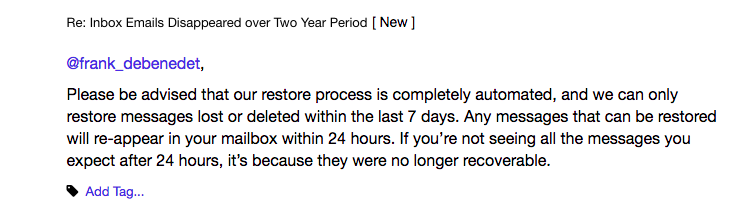
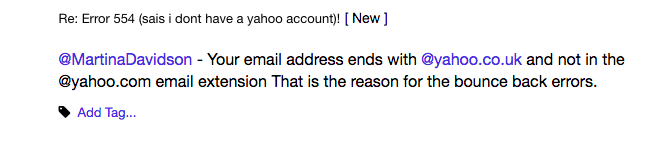
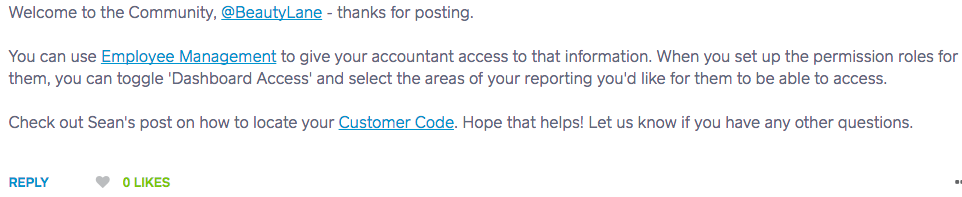
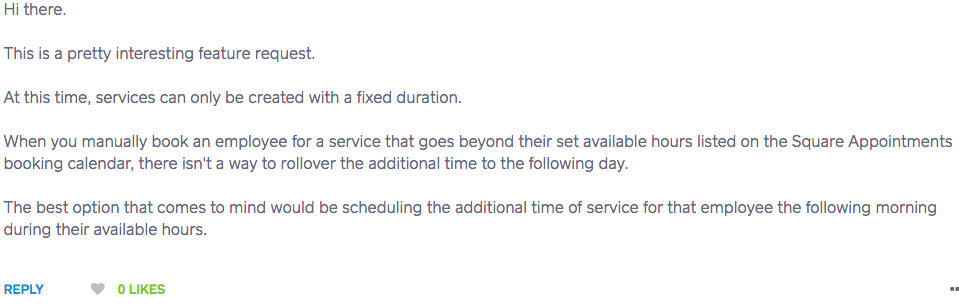
Take a second to look at the difference in responses between Yahoo and Square below:

These first two are from Yahoo help community:

yahoo1


yahoo2
The next two are from the Square support community.

square1


square3
Do you notice the clear difference in empathy between the two?

Yahoo moderators feel like they are playing a numbers game. They need to get through each response as quickly as possible regardless of how the user feels.

Square moderators feel like they care and want to ensure each customer feels better after every interaction at Square.

My bet is this has a direct and significant impact on improving the customer satisfaction score too.

I’ll also bet this is one of the easiest, cheapest, and quickest way to improving customer satisfaction score for many organizations today.

Spend a little time and train moderators to respond with a little more empathy.

11 Dec 17:21

Matching Community Tactics to Community Goals

by Richard Millington

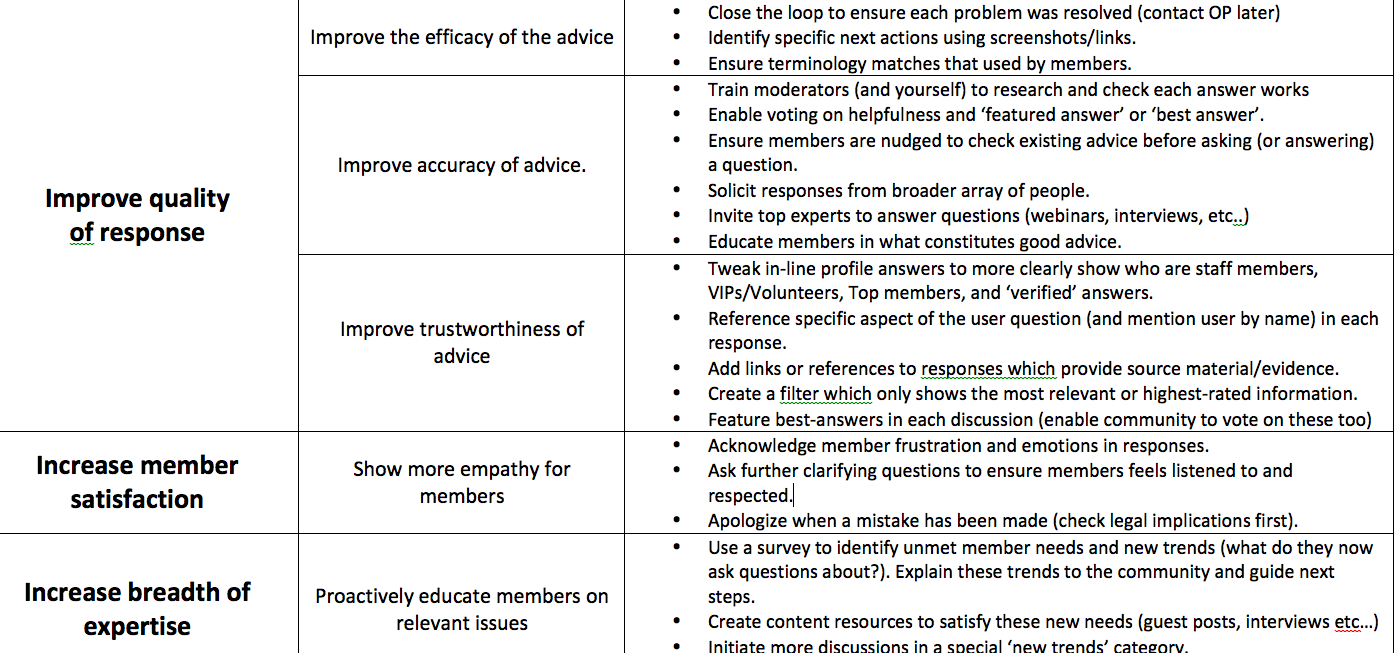
One of the things we share with our Strategic Community Management course participants is the table of tactics. This is a document which aligns 250+ community tactics to a specific objective.

The goal of this document is to let our new clients know which of the tactics they are executing are strategic.

Most tactics are habits. They are things we’ve gotten used to doing rather than the most pressing next step to achieve our objectives.

Here’s a small preview:

qualityofresponse

(click for a bigger image)

This is 1 of 17 pages (and we’re adding more every week).

Whether the targets in the left align with your objectives depends very much upon your tactics in the target audience matrix.

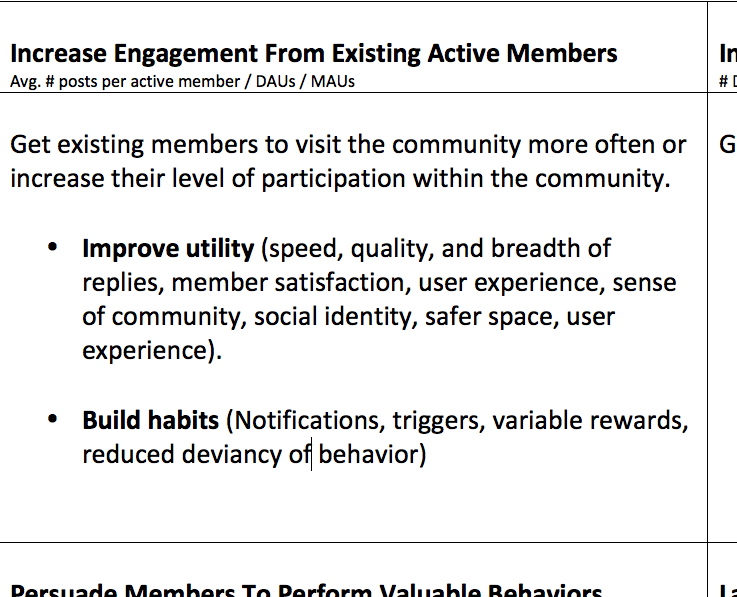
If you know the biggest win is to get existing members more engaged (as opposed to attracting newcomers or getting members to do something different), you might discover the best way of doing that is improving the utility of the site (also from the tactics table):

increaseengagement
Now you can make sure everything lines up. If you want to increase engagement from existing members you might decide to improve the utility of the site by improving the quality of replies members get.

This might mean improving the accuracy of the advice given by enabling members to vote if the answer helped them. It might mean getting advice from a diverse array of people. It might mean adding a guidelines box in what constitutes a great response (e.g. adding links, references, and describing solutions in minute detail).

All of these clearly link to a specific objective you’re trying to achieve.

The goal of thinking strategically is you can check every single tactic is the best pathway to achieve your goal. This should pull you from the rut of doing routine tasks and force you to work on the biggest possible wins.

This is the key reason we put the Strategic Community Management course together.

It’s time to focus on the big wins and real results, not more engagement metrics from routine tasks. I hope you will join us:

www.feverbee.com/scm

11 Dec 17:20

VR / AR – legions of limitations

by windsorr

Reply to this post

RFM AvatarSmall


VR hits a bump but AR in the enterprise fares better.

  • It looks very much as if 2016 for augmented reality (AR) and virtual reality (VR) has panned out much as I feared it would (see here) in contrast to the optimism and hype at CES 2016.
  • The supply chain has invested heavily in production of VR and AR units but has subsequently seen HTC’s Vive, Occulus Rift and Samsung’s Gear VR all undershoot expectations with no immediate improvement on the horizon.
  • Worst of the lot is Sony’s Playstation VR which was expected to ship 2.6m units during 2016 but now looks set to ship just 750,000 (SuperData).
  • Google Daydream has also disappointed with shipments now expected to be around 250,000 rather than 450,000.
  • This is a strong indication that the limitations of VR in particular remain legion including:
    • Price: Many of the devices cost several hundreds of dollars and also require a PC to run, further increasing the cost.
    • Clunky: VR and AR units are still large, clunky and uncomfortable to wear.
    • In many cases they also make the user feel foolish when wearing one.
    • Comfort and security: VR in cuts the user off from almost all sensory inputs from his immediate environment severely limiting the situations in which the user would feel comfortable using one.
    • Many units also cause feelings of nausea due to an imperfect replication of the real world compared to what the brain is expecting.
    • Cable: Many units require an HDMI cable which prevents the user from moving and also increases the risk of a fall should the user trip over the cable.
    • Content: Both games and content remain in short supply limiting the reasons for users to immediately adopt the platform.
    • The adult entertainment industry is a good yardstick for the adoption of new media types and even this has been slower than expected to jump in.
  • The low volumes of the Sony PlayStation VR headset is the most surprising as I have long been of the opinion that it has the best chance of success.
  • This is because the unit is cheaper than the others, runs on the PS4 which already has an audience of nearly 100m dedicated game players.
  • For these reasons, I think that PS4 VR has a big advantage over the others but its marketing efforts have not been particularly aggressive which has also hurt its appeal.
  • The net result is that VR is clearly not ready for the prime time and there remains a lot of work to do before volumes will really take off.
  • I do not see this happening in 2017 meaning that the outlook for next year remains pretty grim.
  • AR has exactly the same problems with the exception that it has plenty of applications in the enterprise where the content, comfort and price limitations are less important.
  • Consequently, those AR companies that are focused on productivity applications are likely to fare better in the short term.
  • I would steer clear of any investment depending on VR for now and HTC in particular.
11 Dec 17:14

Forget Fake News – Worry About the Chaff…

by Tony Hirst

According to the Encyclopedia Britannica (online edition) there are several sorts of electronic countermeasure used against opponents’ radar:

Electronic countermeasures (electronic warfare)

The purpose of hostile electronic countermeasures (ECM) is to degrade the effectiveness of military radar deliberately. ECM can consist of (1) noise jamming that enters the receiver via the antenna and increases the noise level at the input of the receiver, (2) false target generation, or repeater jamming, by which hostile jammers introduce additional signals into the radar receiver in an attempt to confuse the receiver into thinking that they are real target echoes, (3) chaff, which is an artificial cloud consisting of a large number of tiny metallic reflecting strips that create strong echoes over a large area to mask the presence of real target echoes or to create confusion, and (4) decoys, which are small, inexpensive air vehicles or other objects designed to appear to the radar as if they are real targets. Military radars are also subject to direct attack by conventional weapons or by antiradiation missiles (ARMs) that use radar transmissions to find the target and home in on it. A measure of the effectiveness of military radar is the large sums of money spent on electronic warfare measures, ARMs, and low-cross-section (stealth) aircraft.

These are worth bearing in mind when using Twitter and other social media, as well as keyword driven news search alerts, as your own, personal news radar. In this analogy, the things I want to detect are “true” news stories (whatever that means…); here are some countermeasures you could take to try to prevent high quality news signals, or news signals that inform me about the things you are doing that you don’t want me to know about, or that you need to spin because they paint you in an unfavourable light, getting through to me:

  • noise jamming: pollute my feed with noise that makes me filter out certain forms of traffic (your noise) and, as a side effect, legitimate news; reference me in e.g. tweets and swamp my mentions feed with noise; if I’ve subscribed to one of the accounts you control, feed that stream with random retweets, auto-generated rubbish, etc;
  • false target generation: try to get me to subscribe to an account you control, thinking it’s a legitimate news source;
  • chaff: chaff masks your current “location”, or a story about you; if I make a search or want to follow a particular topic, try to make sure all I can ever find are empty pages that attract those search terms, or your spin on the story;
  • decoys: push out your own news story or, even better, a ridiculous claim that gets widely reshared and that pulls interest away form a legitimate story breaking about you; if I’m only going to read one thing about you today, better it’s the one you put out rather than the one that shows you for what you are…

(If you can think of better examples, please share them in the comments; this was just a quick coffee break post… didn’t really try to think the examples through…)

Remember, folks, this is information war… We should all be reading up on psyops too…


11 Dec 17:14

Would You Describe Your Relationship With Google, Amazon, or Apple as “Intimate” and/or Their Relationship With You as “Controlling” or “Coercive”?

by Tony Hirst

I’ve been thinking about all those terms and conditions that the big web corps use to justify doing what they want with the data they collect about our actions. And also the way that Facebook, particularly, does abusive stuff and then just apologises, says sorry, it won’t happen again…

From the UK Serious Crime Act 2015, c. 9, Part 5, s. 76:

76 Controlling or coercive behaviour in an intimate or family relationship

(1) A person (A) commits an offence if—

   (a) A repeatedly or continuously engages in behaviour towards another person (B) that is controlling or coercive,

   (b) at the time of the behaviour, A and B are personally connected,

   (c) the behaviour has a serious effect on B, and

   (d) A knows or ought to know that the behaviour will have a serious effect on B.

(2) A and B are “personally connected” if—

   (a) A is in an intimate personal relationship with B, or

   (b) A and B live together and—

   (i) they are members of the same family, or

      (ii) they have previously been in an intimate personal relationship with each other.

(3) But A does not commit an offence under this section if at the time of the behaviour in question—

   (a) A has responsibility for B, for the purposes of Part 1 of the Children and Young Persons Act 1933 (see section 17 of that Act), and

   (b) B is under 16.

(4) A’s behaviour has a “serious effect” on B if—

   (a) it causes B to fear, on at least two occasions, that violence will be used against B, or

   (b) it causes B serious alarm or distress which has a substantial adverse effect on B’s usual day-to-day activities.

(5) For the purposes of subsection (1)(d) A “ought to know” that which a reasonable person in possession of the same information would know.

(6) For the purposes of subsection (2)(b)(i) A and B are members of the same family if—

   (a) they are, or have been, married to each other;

   (b) they are, or have been, civil partners of each other;

   (c) they are relatives;

   (d) they have agreed to marry one another (whether or not the agreement has been terminated);

   (e) they have entered into a civil partnership agreement (whether or not the agreement has been terminated);

   (f) they are both parents of the same child;

   (g) they have, or have had, parental responsibility for the same child.

(7) In subsection (6)

  • “civil partnership agreement” has the meaning given by section 73 of the Civil Partnership Act 2004;

  • “child” means a person under the age of 18 years;

  • “parental responsibility” has the same meaning as in the Children Act 1989;

  • “relative” has the meaning given by section 63(1) of the Family Law Act 1996.

(8) In proceedings for an offence under this section it is a defence for A to show that—

    (a) in engaging in the behaviour in question, A believed that he or she was acting in B’s best interests, and

    (b) the behaviour was in all the circumstances reasonable.

(9) A is to be taken to have shown the facts mentioned in subsection (8) if—

    (a) sufficient evidence of the facts is adduced to raise an issue with respect to them, and

    (b) the contrary is not proved beyond reasonable doubt.

(10) The defence in subsection (8) is not available to A in relation to behaviour that causes B to fear that violence will be used against B.

(11) A person guilty of an offence under this section is liable—

   (a) on conviction on indictment, to imprisonment for a term not exceeding five years, or a fine, or both;

   (b) on summary conviction, to imprisonment for a term not exceeding 12 months, or a fine, or both.

To what extent could the sorts of thing that recommendation services do, (recommendation services that model a great deal about us), start to appear coercive? Can the asymmetric (power) relationship we are in with this services be defined as “intimate”?

PS by the by, I’ve started looking at laws again that might be used as the basis of “robot laws” (laws relating to slavery, animal rights, accessibility, limits on behaviour as a result of mental (in)capacity etc) and also started trying to note the laws that companies use to weasel their way out of various corporate responsibilities. Things like the Innocent publication defence in The Business Protection from Misleading Marketing Regulations 2008, for example; how easy is it to look up whether Google or Facebook have availed themselves of this sort of defence, I wonder?


11 Dec 17:09

Remote Meetings are Getting Better with VR

by Eva Yoo

Imagine instead of choppy video, broken voice, and a laggy screenshare, you could have a remote meeting in virtual space where everyone can see and share the same thing. French developer MiddleVR is doing exactly that.

Improov3 is VR software that offers a virtual meeting room for engineers, designers, and architects. Using the software, users from different locations can invite multiple users for a product review while seeing a CAD  (computer aided-design) model.

“If a company wants to see the CAD model in reality before making a prototype, they can import CAD 3D model into our software. As they put on VR headset, they can see the product in real size,” Hanna Burdorf, Shanghai manager at MiddleVR says. “It’s useful for companies that create products like motors and engines.”

screen-shot-2015-11-30-at-09-43-56-copy-768x480

Three users having a product review meeting using Improov3 (Image via MiddleVR)

In a virtual meeting room, users can load multiple 3D models, speak with each other, measure the length of each part of the product, take off the parts, and take pictures. For the user who doesn’t have VR headset, there is also a desktop version. The desktop version is available for trial.

Launched in July, Improov3 is now adding other functions such as collision checking. Collision checking is a suite of algorithms that detect, and possibly prevent, two or more virtual objects from colliding.

“There is huge potential for VR in the B2B market. Companies can use VR to improve their work communication,” Ms. Burdorf says.

More and more VR companies providing B2B solutions have emerged in China this past year. Shanghai-based GDI provides VR solutions for high-end manufacturing, national defense training, and education sectors. Plex VR creates custom 360 degree content for shops, museums, and real estate developers. While VR companies focusing on B2C find it hard to monetize from its customers, the B2B market is gaining attention powered by Chinese tech giants like HTC and Alibaba.

“China is the manufacturing hub. In China, people create things, design, and produce things. We believe our solution can be useful for companies here and want to expand into the Asian market from here,” Ms. Burdorf says.

Founded in 2012 in Paris, MiddleVR provides immersive VR applications and services, including a VR plugin for Unity. The founder and CEO of MiddleVR, Sebastien Cb Kuntz gained 15 years experience in virtual reality during his time wth SNCF French Railway.

Image Credit: Shutterstock

11 Dec 17:07

currentsinbiology: Very-high-fat diet reversed obesity and...


currentsinbiology:

Very-high-fat diet reversed obesity and disease risk

A new Norwegian diet intervention study (FATFUNC), performed by researchers at the KG Jebsen center for diabetes research at the University of Bergen, raises questions regarding the validity of a diet hypothesis that has dominated for more than half a century: that dietary fat and particularly saturated fat is unhealthy for most people.

The researchers found strikingly similar health effects of diets based on either lowly processed carbohydrates or fats. In the randomized controlled trial, 38 men with abdominal obesity followed a dietary pattern high in either carbohydrates or fat, of which about half was saturated. Fat mass in the abdominal region, liver and heart was measured with accurate analyses, along with a number of key risk factors for cardiovascular disease.

“The very high intake of total and saturated fat did not increase the calculated risk of cardiovascular diseases,” says professor and cardiologist Ottar Nygård who contributed to the study.

“Participants on the very-high-fat diet also had substantial improvements in several important cardiometabolic risk factors, such as ectopic fat storage, blood pressure, blood lipids (triglycerides), insulin and blood sugar.”

The study was published online on November 30 2016 in The American Journal of Clinical Nutrition: http://ajcn.nutrition.org/content/early/2016/11/30/ajcn.115.123463.abstract?papetoc.

That explains everything.

11 Dec 17:04

Questioning 'Identity Liberalism'

files/images/identitz.png


Colleen Flaherty, Inside Higher Ed, Dec 08, 2016


This is a good article dealing with the implications of the backlash against diversity in the wake of recent populist victories. The premise of the anti-diversity argument is that " liberals must appeal 'to Americans as Americans.' But of course, "Lilla 'overlooks the fact that Americanness itself is a particular constructed identity." So is Britishness. Etc. So I don't think the populist appeal opposes diversity, notwithstanding the clumsy way is is supported by its proponents. It is an appeal to the support of 'people like us' who are getting a raw deal. These people are, variously, white, or poor, or lowlanders, or Oceanians.

But the best bit is in the comments by cb-king1: "the question then becomes: How do we, from the place of BEING a woman, or a black person, or gay, or whatever, relate to OTHER kinds of identities, but always from within that coverall political umbrella, and where we all can pursue a vision of the common good--from the general to the particular in our own lives and as history moves forward?"

[Link] [Comment]
11 Dec 17:04

Inside IFTTT's Plan For A More Harmonious Internet

files/images/3065864-poster-p-1-more-harmonious-internet.jpg


Jared Newman, Fast Company, Dec 07, 2016


I've been using IFTTT as a useful tool to connect my various social network services for several years now. As it migrates from a free service to something more self-sustaining, though, IFTTT is shifting its focus. It remains an open question whether it will continue to be useful. According to this article, "IFTTT has been backing away from its do-it-yourself roots, and catering more to the companies whose services it connects... 'We want to become a PayPal for access,' says Linden Tibbets, IFTTT's founder and CEO. 'A trusted third party that facilitates an exchange from one service to the next.'"

[Link] [Comment]
11 Dec 17:04

What You Can Learn From the Social Media Crisis That Wasn't

files/images/100_BigMac_3X2_Courtesy_McDonalds.jpg


Ken Wheaton, Advertising Age, Dec 08, 2016


When I was the editor of a student newspaper so many years ago I was amazed how sensitive people were to every word we wrote. I knew our influence was far less than people thought. The same is true today of social media, as this item shows. And the conclusion is good advice generally: "Don't do anything offensive or hurtful. Don't say anything offensive or hurtful on social media. And if you do do something stupid, especially if it's an accident, sit tight and give it a chance to blow over."

[Link] [Comment]