Shared posts

11 Dec 17:36

Things US Tech Companies Can Do About Trump

So the election happened, and the reaction from tech has shifted between telling him to take a quick drop and a sudden stop, licking his boots, and offering to go full fascist if he maybe sets up some vocational schools.1

To call this disappointing is an understatement, although it’s not surprising given the politics and demographics of tech, which ensure that a big part of the community simply doesn’t suffer in a substantive way if Trump gets to do whatever he wants to do this week. Why worry about police brutality or misogyny or decrepit public schooling when you’re a white guy sending his kids to Drew?

But there are fantastic people in tech doing a lot of thinking and writing on what tech companies can do about Trump. Maciej Ceglowski’s advocacy of data scrubbing sets an A+ example, and I know that my previous employer is holding internal conversations about how to protect users in an era where the full powers of the NSA are controlled by a man who thinks foreign policy doctrines can fit into 140 characters. Saying “no, and furthmore, fuck you” to tenders for registries (Muslim or otherwise) is an obvious one, as is not doing the very Twitter, very Google thing of playing pally-pally with Trump because maybe if we’re nice to him we can fix him, because evidently sociopathy is fixable, now.

Resistance, though, has to start at home. Protecting users is a necessary component, because organisations have a moral duty to those who use their service - but organisations also have a duty to their employees, and potential employees. I decided to put together a short list of things companies can be doing internally.

Obvious caveats apply: it’s non-exhaustive, it’s only the things I can see or think of off the top of my head with my very limited worldview and set of lived experiences, and it’s made entirely in my personal capacity. These do not replace the need for externally-facing work: lawsuits, refusals, active, explicit rebuttals. Some of the proposals will not apply to your company, even if you’re in tech: some of them will apply even if you’re not. It might be utter shite all the way through.

With that in mind..

Make some space

Speaking just for myself, I’ve been looping through the seven stages of grief, and it’s been deeply exhausting and deeply distracting. I haven’t slept properly, I’ve found myself overcome with deep-seated rage at the oddest moments, and the worst bit is: I don’t want it to stop. Because I don’t want this to feel normal.

I know I’m not the only one. I’m sure as shit not the only one. Half my social circle is looking to punch a wall and some of them are looking to flee the country entirely. Many of the employees you have are no doubt reeling, too. You need to create some space for this.

Creating space isn’t just about booking a conference room for an all-hands and having everyone open-mic what they’re scared of and vent. It’s about understanding if people are, for very good reasons, not at their best for the foreseeable future, and factoring that into how you evaluate performance. It’s about letting people take a day when they need it, without negative consequences. It’s about recognising that employees are human beings, not black boxes that accept caffeine as input and produce code as output, and that the state of the world impacts them.

You should be doing this because you’re a decent human being, but there’s also a company benefit too: namely, giving people space to process reduces the amount of time they have to spend running at 30%. It doesn’t mean people are gonna be at 100, given the prospect of the next four years, but it’ll help.

Double down on diversity

Tech companies have got a vast amount of flak for the homogeneity of their workforces - for the way in which women, disabled people, queer people and people of colour are excluded from engineering spaces. You should have been working on this anyway, but now is a good time to double down on it because with steady employment and a tech salary comes economic freedom: a really, really helpful prerequisite for being able to hire lawyers or get the hell out of town on short notice.

Trump’s proposals - amongst them immigration restrictions, ACA repeal, a decimation of the tax base and state support for the poor and disabled - are going to hit marginalised people first. Fixing what should never have been a problem in the first place, and in doing so giving health coverage, a measure of economic security and increased career prospects to members of marginalised groups, is a small but important way of helping, here.

Think about relocations

So you’ve hired some marginalised people - good job, why the hell did it take you so long - and you’re setting them up with a nice office space.

Question: where is that office space?

If it’s in LA, Seattle, Portland, San Francisco, Boston, New York - alright. You’ve plonked someone in a state and city where the legislature and governor are likely to do only a mildly crappy job in pushing back against Trump, creating a safe(r) and more supportive environment, and avoiding some, although not all, of the hideous hate crimes we’ve seen since Trump’s election.

If not: get your shit together. If employees want to relocate, help them relocate. Make office space available, make a relocation allowance available, and expand the size of that allowance if you can. For you, $10,000 is a relatively small amount of money: for a new employee, particularly junior employees or people from less family wealth, it’s a big fucking deal that’ll let them avoid living in a vulnerable spot and, if they lose their job, at least leave them in a somewhat less-crappy environment. And if this is the direction you are going in, just give them the money and ask for the receipts; treating it as an expenses kinda thing assumes the person has $10,000 to spend to start with.

Obviously all of this is relative. The idea of “blue state safe, red state not safe” is nonsense.2 But there are places where the governors and mayors came right out the day after the election to reaffirm their desire for an inclusive and free citizenship, and then there are places where everyone was notably silent. If you can afford to drop someone off in the former rather than the latter, and they’re down for that, do so.

Think about international relocations

While we’re talking about relocations: California may not be safe. Washington may not be safe. I know a lot of marginalised people lucky enough to be in a solid economic position, and quite a few of them are talking about leaving the country entirely or actively making plans to do so.

If you’ve got international branches and a bunch of money lying around (looking at you, Google): make this easier, make this happen, make it so that employees needing to leave the country does not strip you of their talents. Get them an intra-company transfer visa to somewhere you have an office. Here’s the one for Canada. Here’s the one for Germany. Australia has a buttload of different ones, although they’re deeply ableist in immigration prioritisation.

People are going to need to get out of the country anyway. If you help them do it, you get to keep them around. If you don’t, they either stay put out of necessity, and exist at risk and more than a little bit distracted from running your backend or whatever they’re doing, or leave the country and leave your company with it.

Think about citizenship

Tech wouldn’t be tech without a buttload of people on H1Bs or green cards.3 The problem there is that Trump hates foreigners. The Republican Party as a whole, in fact, hates foreigners, but Trump made a key campaign plank “getting all of the immigrants out”. People on visas are vulnerable to legislative fuckery; people with citizenship are not. Stripping citizenship is extremely difficult and has been mostly applied to people who commit heinous, violent crimes: the green card process still involves asking if you’re a communist and boots you out if you say “yes”.

The day after an employee becomes eligible for a green card, you should be filing. The day after an employee becomes eligible for citizenship, you should be filing. Not making them pay for their own lawyers: taking advantage of the large amount of money tech companies tend to have, on a per-employee basis, to hire some decent lawyers out of your own pocket and putting them on the case. On an individual, personal basis, citizenship or permanent residency provides some security otherwise lacking - on an organisational basis, it’s nice to know you won’t walk into work on Monday and find the site is down because half the Operations team got deported. Literally everyone wins out of this, so put the money in.

  1. It’s cool, it’s not like IBM is a company that actually worked for the actual Nazis on actual genocide or anything.

  2. I invite anyone who thinks it’s as simple as blue/red to visit WA and wander over the mountains for a few days.

  3. I’m one of em. Hi!

11 Dec 17:36

Things US Tech Companies Can Do About Trump

So the election happened, and the reaction from tech has shifted between telling him to take a quick drop and a sudden stop, licking his boots, and offering to go full fascist if he maybe sets up some vocational schools.[^1]

To call this disappointing is an understatement, although it’s not surprising given the politics and demographics of tech, which ensure that a big part of the community simply doesn’t suffer in a substantive way if Trump gets to do whatever he wants to do this week. Why worry about police brutality or misogyny or decrepid public schooling when you’re a white guy sending his kids to Drew?

But there are fantastic people in tech doing a lot of thinking and writing and advocacy on what tech companies can do about Trump. Maciej Ceglowski’s advocacy of data scrubbing sets an A+ example, and I know that my previous employer is holding internal conversations about how to protect users in an era where the full powers of the NSA are controlled by a man who thinks foreign policy doctrines can fit into 140 characters.

Resistance, though, has to start at home. Protecting users is a necessary component, because organisations have a moral duty to those who use their service - but organisations also have a duty to their employees, and potential employees. I decided to put together a short list of things companies can be doing internally.

Obvious caveats apply: it’s non-exhaustive, it’s only the things I can see or think of off the top of my head with my very limited worldview and set of lived experiences, and it’s made entirely in my personal capacity. Some of the proposals will not apply to your company, even if you’re in tech: some of them will apply even if you’re not. It might be utter shite all the way through.

With that in mind..

Make some space

Speaking just for myself, I’ve been looping through the seven stages of grief, and it’s been deeply exhausting and deeply distracting. I haven’t slept properly, I’ve found myself overcome with deep-seated rage at the oddest moments, and the worst bit is: I don’t want it to stop. Because I don’t want this to feel normal.

I know I’m not the only one. I’m sure as shit not the only one. Half my social circle is looking to punch a wall and some of them are looking to flee the country all together. Many of the employees you have are no doubt reeling, too. You need to create some space for this.

Creating space isn’t just about booking a conference room for an all-hands and having everyone open-mic what they’re scared of and vent. It’s about understanding if people are, for very good reasons, not at their best for the forseeable future, and factoring that into how you evaluate performance. It’s about letting people take a day when they need it, without negative consequences.

You should be doing this because you’re a decent human being, but there’s also a company benefit too: namely, giving people space to process reduces the amount of time they have to spend running at 30%. It doesn’t mean people are gonna be at 100, given the prospect of the next four years, but it’ll help.

Double down on diversity

Tech companies have got a vast amount of flak for the homogeneity of their workforces - for the way in which women, disabled people, queer people and people of colour are excluded from engineering spaces. You should have been working on this anyway, but now is a good time to double down on it because with steady employment and a tech salary comes economic freedom: a really, really helpful prerequisite for being able to hire lawyers or get the hell out of town on short notice.

Trump’s proposals - amongst them immigration restrictions, ACA repeal, a decimation of the tax base and state support for the poor and disabled - are going to hit marginalised people first. Fixing what should never have been a problem in the first place, and in doing so giving health coverage, a measure of economic security and increased career prospects to members of marginalised groups, is a small but important way of helping, here.

Think about relocations

So you’ve hired some marginalised people - good job, why the hell did it take you so long - and you’re setting them up with a nice office space.

Question: where is that office space?

If it’s in LA, Seattle, Portland, San Francisco, Boston, New York - alright. You’ve plonked someone in a state and city where the legislature and governor are likely to do only a mildly crappy job in pushing back against Trump, creating a safe(r) and more supportive environment, and avoiding some, although not all, of the hideous hate crimes we’ve seen since Trump’s election.

If not: get your shit together. If employees want to relocate, help them relocate. Make office space available, make a relocation allowance available, and expand the size of that allowance if you can. For you, $10,000 is a relatively small amount of money: for a new employee, particularly junior employees or people from less family wealth, it’s a big fucking deal that’ll let them avoid living in a vulnerable spot and, if they lose their job, at least leave them in a somewhat less-crappy environment. And if this is the direction you are going in, just give them the money and ask for the receipts; treating it as an expenses kinda thing assumes the person has $10,000 to spend to start with.

Obviously all of this is relative. The idea of “blue state safe, red state not safe” is nonsense.[^3] But there are places where the governors and mayors came right out the day after the election to reaffirm their desire for an inclusive and free citizenship, and then there are places where everyone was notably silent. If you can afford to drop someone off in the former rather than the latter, and they’re down for that, do so.

Think about international relocations

While we’re talking about relocations: California may not be safe. Washington may not be safe. I know a lot of marginalised people lucky enough to be in a solid economic position, and quite a few of them are talking about leaving the country entirely or actively making plans to do so.

If you’ve got international branches and a bunch of money lying around (looking at you, Google): make this easier, make this happen, make it so that employees needing to leave the country does not strip you of their talents. Get them an intra-company transfer visa to somewhere you have an office. Here’s the one for Canada. Here’s the one for Germany. Australia has a buttload of different ones, although they’re deeply ableist in immigration prioritisation.

People are going to need to get out of the country anyway. If you help them do it, you get to keep them around. If you don’t, they either stay put out of necessity, and exist at risk and more than a little bit distracted from running your backend or whatever they’re doing, or leave the country and leave your company with it.

Think about citizenship

Tech wouldn’t be tech without a buttload of people on H1Bs or green cards.[^4] The problem there is that Trump hates foreigners. The Republican Party as a whole, in fact, hates foreigners, but Trump made a key campaign plank “getting all of the immigrants out”. People on visas are vulnerable to legislative fuckery; people with citizenship are not. Stripping citizenship is extremely difficult and has been mostly applied to people who commit heinous, violent crimes: the green card process still involves asking if you’re a communist and boots you out if you say “yes”.

The day after an employee becomes eligible for a green card, you should be filing. The day after an employee becomes eligible for citizenship, you should be filing. Not making them pay for their own lawyers: taking advantage of the large amount of money tech companies tend to have, on a per-employee basis, to hire some decent lawyers out of your own pocket and putting them on the case. On an individual, personal basis, citizenship or permanent residency provides some security otherwise lacking - on an organisational basis, it’s nice to know you won’t walk into work on Monday and find the site is down because half the Operations team got deported. Literally everyone wins out of this, so put the money in.

11 Dec 17:36

Setting a good example

Yesterday I wrote about small-scale things tech orgs can do re Trump (and, by extension, small-scale things people in tech can be advocating for). But there’s also other stuff: protecting your users in advance by not logging data being a big one.

To set a good, albeit teeny and unimportant, example, I’m happy to report that this site is now logging free, to the point where it doesn’t even collect the standard NGINX access logs. Disqus is still up and I’ll have to noodle on that a bit more, but rest assured that visiting these pages doesn’t even let me know you were here.

11 Dec 17:32

I'm at Fog Creek. And we're introducing Gomix!

by Anil

Okay, here’s the story: I’m the new CEO of Fog Creek Software! And we have an awesome new tool called Gomix that just launched today, and you should go try it out and build the app of your dreams in a few minutes.

Want to know more? Okay, there’s more.

If you know me, you might be familiar with Fog Creek Software. Cofounded by Joel Spolsky and Michael Pryor in 2000, it’s one of the most venerable and respected software companies in the world. I’ve known it from its earliest days, as both a customer and a fan, and have gotten to watch excitedly as they launched hugely influential tools like Trello (which Michael is now CEO of as an independent company) and Stack Overflow (also independent, and headed up by Joel as CEO). Fog Creek’s flagship product FogBugz has long been the best tool for helping teams make great software — I know because we used to use it to make Movable Type and TypePad back when I was helping get those products off the ground a decade ago.

Fog Creek product history

Built on Values

But Fog Creek is a lot more to me than just a company that’s made a bunch of hugely popular applications. What first resonated for me was reading Joel’s words in his seminal posts on tech culture, like the Joel Test. Though some of the references to old Windows software are a little bit dated now, the insights in Joel’s writing are so essential and timeless that they’ve become part of the canon that almost every developer is expected to read.

And what I found in these seminal documents of Fog Creek’s culture were a few simple statements of values that could be easily summarized:

  • Workers matter, deeply. The things they create, the environment they work in, and the ideas they imagine are worth protecting, respecting and honoring.

  • Technology and software are better when they’re accessible to more people. We need to build tools, platforms and organizations that prioritize the thoughtful dissemination of technical information, to stop coding from being an exclusionary priesthood for a small few.

  • We can build our values into our software. We aspire to having a point of view and to being thoughtful, and we can build tools that encourage other creations of technology to do the same.

What I found was that I had a chance not just to work with some of the most talented people in the world, but to do so in an environment that was actively countering the worst excesses and abuses of the tech industry. It’s no secret that I’ve become increasingly critical of the conventional tech world’s lack of focus on ethics, humanity, and inclusion.

But at a personal level, I realized I couldn’t in good conscience just criticize from afar. If the best way to criticize software is to make software, then the best way to criticize tech companies is to make a better tech company. And it turns out that one already exists. Even more fortunate, its brilliant and thoughtful founders Michael and Joel were willing to trust me to be the CEO of the company that have so carefully shepherded all these years.

And frankly, after challenges like shutting down ThinkUp earlier this year, I started reckoning a bit with how to be most effective in pushing the tech industry to be a little more thoughtful. This personal inflection point became clearer as the team at Activate released this year's Activate Outlook — seven years after we'd set out to create the leading strategy consulting company, I realized we'd not just succeeded, but done so to the degree where the team could now run effectively without me being involved day-to-day. Between stepping back to an advisory role at Activate and sharpening the focus of my work for the organizations whose boards I serve on, I was able to bring some clarity to the work in front of me.

I realized that I wanted to fully engage myself with a single, all-encompassing role that would use all my skills, and that Fog Creek's legacy of leading the industry made it the perfect place to try and push things forward again. So now, I have a simple answer if someone at a cocktail party asks what I do.

What do I do? I'm the CEO of a small software company in downtown Manhattan that’s as influential in the tech world as companies 1000 times our size. And we're trying to make awesome products that remind people how tech can be creative, thoughtful and humane.

(If that sounds good, we're hiring. And we welcome you, as you are, to join our team.)

Gomix brings back the fun of the “view source” web

Which brings me to our next chapter: Gomix. Many geeks of my cohort came of age building things on the desktop using HyperCard or Visual Basic, or by using View Source in their browser to tweak HTML pages that they uploaded to Geocities. The web’s gotten a lot more mature and a lot more powerful, but the immediacy of that kind of creation has been lost. Today, even if you’re a skilled developer, the starting point you’re working from is usually a pile of unassembled parts.

Gomix lets you start from a working app (or bot, or site, or whatever) and then remix it into exactly the app of your dreams. If you just want to change a button from blue to green, or add your logo, you can be running instantly. See a fun or smart Alexa skill or Slack bot? You can jump in, edit the responses to be the text you want, and have your own version running in just a few minutes.

For the past several years, I found that the overhead of provisioning servers, or trying to maintain a dev environment, or wrangling with version control took all the fun out of coding for me, to the point where I don’t just hack on things for fun anymore. I can’t imagine how much more intimidating it would be if I hadn’t spent many years coding.

Gomix fixes all that. Really. We’re still just getting started (you might have seen the earlier preview release under the name “HyperDev”) but we’re out in beta today and I think if you have ever edited a spreadsheet or just tweaked the HTML in a blog post, you’ll immediately understand how Gomix can help you create.

I hope you’ll give it a try, and along with the entire amazing team at Fog Creek, we’re excited to see what you create.

11 Dec 17:31

YouGov survey: People think 56% of what they read is bullshit

by Josh Bernoff

With the help of YouGov, I got to ask more than 1,000 people how much bullshit they saw in the things they read. It varies, with an average of 56%. And it’s about the same across a variety of demographic categories. YouGov has a massive panel of people who answer online surveys: 1.5 million people. They gave … Continued

The post YouGov survey: People think 56% of what they read is bullshit appeared first on without bullshit.

11 Dec 17:31

New Dropbox mobile offline folders let you work on the go

by Aakash Kambuj

New Dropbox mobile offline folders let you work on the go.

Do trains that go through tunnels with no cell signal give you separation anxiety? Ever been halfway through a document review when you had to leave the office to catch a bus with no Wi-Fi? When you count on your travel time to be a productive part of your workday, being offline at the wrong time can be a frustrating interruption. So today, we’re introducing Dropbox mobile offline folders, a new premium feature that lets you keep working from your phone no matter where you are.

This feature has been a top request from users, so we’re excited to bring it to our Dropbox Pro, Business, and Enterprise customers. With mobile offline folders, you can tag an entire folder to have its contents automatically synced to your phone or tablet—no need to mark individual files for download. Just open Dropbox while you’re connected to the internet, and the app will take care of the rest. So whether you’re on the go or off the grid, you’ll always have access to your most important info.

If your job regularly takes you to remote areas, you know better than anyone that deadlines don’t wait for you to find a cell signal. Whether you work in travel, field sales, architecture, engineering or construction, mobile offline folders are great for everyone who needs to access up-to-date information when they’re out in the field.

Mobile offline folders not only help minimize downtime during commutes and traveling days, they also make it easier for admins to communicate with the entire team. Now, everyone in the office and in the field can stay on the same page and know they’re working with the latest documents.

To learn how to make a folder available for offline viewing, visit our Help Center. This new feature is coming to Dropbox Pro and Business users on the latest version of our Android app over the next few days. We’ll be rolling it out to iOS users early next year. Not on Dropbox Pro or Business? Upgrade today.

11 Dec 17:31

Milking the iPhone

by Neil Cybart

It feels like cracks are forming at Apple's edges. The company is straining to push out hardware updates. Supply issues are getting worse. Apple is reportedly moving away from selling beloved products like stand-alone displays and wireless routers. Meanwhile, Microsoft, Amazon, and Snap are gaining buzz with new niche hardware while Apple appears to be hanging back and resting on its laurels.

Something feels off with Apple, and the blame is increasingly pointed at Tim Cook. I suspect these feelings are a result of Cook betting now is the time to milk the iPhone. Apple is doubling down on the iPhone to build one of the world's most formidable tech ecosystems, and few are taking notice. 

The Strategy

One key mistake Apple made with the Mac during the early 1990s was to focus too much on profits and not market share. This led Apple to lose its connection with the consumer. Declining sales ensued, leading Apple to make a series of questionable decisions. Apple found itself with a complicated web of Mac models, each with different feature sets meant to chase a particular market niche.

Apple has been following a very different strategy with iPhone. The best way to see this strategy is to look at the changing iPhone line. In 2011, Apple was selling two premium-priced iPhone models, one of which was the previous year's flagship phone. Sales were approximately 70M units per year. Five years later, Apple has expanded the iPhone line to include five models, two of which are last year's flagship versions. Despite still having a very focused product line, iPhone sales have tripled to more than 210M units per year. 

Screen Shot 2016-12-03 at 2.42.09 PM.png

Apple has been following a multi-year strategy of gradually lowering iPhone pricing in order to reach larger swaths of the smartphone user base. While such a strategy seems born out of a desire to boost sales and profits, management is motivated by something else. Apple has been working to make the iPhone accessible to more people. This is the exact opposite strategy that Apple used with the Mac in the early 1990s. New iPhone models, such as the iPhone SE, are not targeting market niches, but instead are meant to expand the iPhone's addressable market by hundreds of millions of users. 

One benefit of keeping the iPhone line lean has been consistently strong profit margins. While the $399 iPhone SE has a lower selling price than its larger siblings, the device's profit margin is similar to that of other iPhone models. By remaining focused on the product, as seen by the limited number of iPhone models, management has been able to maintain industry-leading profit margins. This has played a big part in allowing Apple to continue lowering prices to reach new customers. We are moving to the point when Apple will be able to sell a $299 iPhone, appeal to an entirely new part of the smartphone market, and still be able to maintain profit margins. 

Going After Users

As shown in Exhibit 2, Apple's strategy of focusing on the product has resulted in the iPhone installed base approaching 600M users at the end of September. This is a very different world than that of the Mac days of the early 1990s. When adding second-hand and used iPhones into the mix, there are more than 700M iPhones out in the wild. Much of this underlying iPhone strength has been masked by the preoccupation with slowing iPhone unit sales growth. The iPhone upgrade cycle has slowed, which is impacting the number of iPhones sold to existing iPhone users. However, sales to new users remain robust. 

Exhibit 2: iPhone Installed Base

In FY2015, more than 100M new customers entered the iPhone installed base. In FY2016, the number was even higher, marking a new record. There have been a few drivers for the steady rate of new users buying an iPhone in recent years. The gradual expansion of carrier agreements around the world has helped. In addition, lower-priced iPhones such as the $399 iPhone SE have made the iPhone more accessible.    

Building a Sandcastle

Milking the iPhone in order to build a formidable ecosystem has been one of Cook's defining moments as CEO. Unfortunately, consensus has not been grading Cook's performance as CEO along these terms. 

Instead, many have graded Cook as a product visionary. The problem with that is Cook is not Apple's product visionary. (That title unofficially belongs to Jony Ive). Cook's appointment as CEO was not predicated on his ability to one day become a product visionary. Accordingly, Cook should not be judged as such. In addition, some have compared Cook to former Microsoft CEO Steve Ballmer. This is incorrect. Cook is not Apple's top salesperson. He does not possess Ballmer's keen sense of how to push product into every enterprise crevice. Instead, Cook has delegated that task to others, primarily through partnerships. Accordingly, Cook should not be judged as a salesperson.  

Instead, Cook should be judged on his success in building out the Apple ecosystem. One way of visualizing this Apple ecosystem is to think of a sandcastle. The iPhone represents the highest tower in the castle while the iPad and Mac represent the much smaller outposts. Accessories like Apple Watch and Apple TV as well as services like iMessage and Apple Pay represent the high walls and moat meant to protect the castle against intruders.

  Screen Shot 2016-11-29 at 4.53.58 PM.png  

Accordingly, Cook should be judged on his ability to build the sandcastle over the years. Since he became CEO in 2011: 

  • The iPhone installed base has grown by 500M users. 
  • The iPad installed base has grown by 175M users.
  • The Mac installed base has grown by 50M users.
  • Apple introduced Apple Watch, the company's first wearable product. Approximately 18M Apple Watches, a device positioned as an iPhone accessory, have been sold to date.
  • Apple is earning more than $6B per year of revenue through app sales via the App Store.
  • Apple successfully made the difficult jump from a paid music download model to streaming and is approaching 20M paying Apple Music subscribers. 
  • Apple continues to push forward with Apple TV. The company is approaching 10M units sold since the device was updated in 2015.
  • Apple continues to develop key services including Apple Pay, Messages, and Maps. 

(The math behind these figures and estimates are available for Above Avalon members. You can become a member here.) 

It quickly becomes clear that Cook has built a spectacular sandcastle. Apple has never had a stronger ecosystem. There are now more than one billion Apple devices in use and 800 million people own at least one Apple product. More remarkably, the average Apple user owns more than one Apple product. This is even more astounding when considering the competitive landscape.  

iPhone Focus

Apple is making a very bold statement that it is still time to double down on the iPhone. It would be an understatement to say that Apple stands out from its largest peers with that thinking. Look at some of the leading tech companies' primary advertising campaigns:  

  • Apple: a smartphone (iPhone).
  • Amazon: a voice assistant (Echo).
  • Google: a voice assistant (Google Home).
  • Microsoft: a touch-based laptop/tablet (Surface).

The companies lacking a smartphone offering are increasingly trying to get consumers to move on to the "next big thing." Amazon is pushing the idea of using a voice assistant and series of speakers to replace your smartphone. Google is doing the same with Google Home. (Pixel is actually a Google services play.) Microsoft is focused on trying to carve some kind of niche for itself by focusing on touch-based PCs. We can even add Snap to the mix and position Spectacles as early motivation for wanting to impact smartphone usage

Meanwhile, Apple is placing a big bet that we are still firmly in the smartphone era. In Apple's view, many of these competing products are distractions trying to get us to move prematurely beyond the smartphone. This stance has contributed to the view that Apple is missing a step and resting on its laurels. While Microsoft pushes Surface Book and Surface Studio and Snap unveils sunglasses with a camera, Apple is still betting on a smartphone, a product unveiled in 2007. 

Cracks at the Edges

This pursuit of milking the iPhone has contributed to cracks forming at Apple's edges. The friction is found when looking at Apple's efforts to build a wider ecosystem that extends beyond the iPhone. There is evidence that Apple management wants to follow a product strategy described in my "Apple Experience Era" article. Consumers can pick and choose a range of Apple products that best fit their lifestyles. This is why Apple is very vocal about continuing to invest in the Mac. In addition, Cook has reiterated his view that the iPad is the clearest expression of Apple's vision of the future of personal computing.

However, Apple's handling of the Mac line has been increasingly questionable. The same can be said of the iPad line. It will have taken Apple at least two years to unveil a line of "Pro" iPad models spanning from 7.9-inch screens to the 12.9-inch model. 

While some have been quick to throw Apple's functional organizational structure under the bus for causing these cracks, the organizational structure is not to blame. The issue doesn't relate to a lack of focus either. Apple still isn't selling that many products. Instead, these cracks are a result of today's changing tech environment. 

When looking at some of the key accomplishments during the Tim Cook era, the installed base growth figures for Apple's top products stand out. For every 100 users by which the iPhone installed base increases, the iPad installed base will grow by 35 users, and the Mac will increase by 10 users.

A vast majority of these new iPhone users will never own a Mac. As iPhones have become larger, odds have increased that these iPhone users may never own an iPad either. The iPhone has gained so much power in recent years that the iPad and Mac's long-term sales trajectory have faded. I suspect this reality explains why iPad updates are less frequent these days. The same can be said of the Mac. More frequent updates for iPad or Mac likely wouldn't increase sales.

Many have been quick to label the new MacBook Pro as flawed and not truly a "Pro" computer. In reality, Apple is focused more on redefining Pro's definition in addition to expanding the MacBook Pro's mass market appeal. This is why Apple is focused on bringing aspects of the iPhone to the Mac (multi-touch screen positioned above the keyboard, Touch ID)

Risks

Apple faces a major risk in relying so much on the iPhone to build its ecosystem. While this may be heresy in Silicon Valley, ecosystems are not everything. There has never been an ecosystem strong enough to stand the test of time. The App Store is not invincible. At a certain point, Apple will need to be willing to put its iPhone ecosystem at risk. 

There are many signs that Apple management is keenly aware of this since Apple has had to risk its ecosystem multiple times over the past two decades. During the late 1990s and early 2000s, Apple spent years rebuilding the Mac ecosystem. Recall Apple's "Mac as the hub of your digital life" product strategy. The iPod was merely a Mac accessory at launch. However, Apple's decision to eventually bring iTunes to Windows changed the game. The move threatened the very same Mac ecosystem Apple had spent years building. Users would no longer need a Mac to use an iPod. Apple was willing to risk its current ecosystem in order to catch the next technology wave. 

However, instead of doom, the iPod became a household name and played a role in helping the iPhone get off the ground. Meanwhile, the Mac was no longer going to be the center of Apple, and more importantly, our lives. 

This raises an interesting question. Is it possible that Apple management is okay with the cracks that are forming at the edges? While the new MacBook Pro may infuriate loyal Mac users, a strong case can be made that management truly thinks such a product is the right one to ship in today's environment. To see why, notice how Apple is milking the iPhone: having the product appeal to a wider user base. Instead of chasing profits, Apple is following the same strategy with the new MacBook Pro. Apple has no interest in repeating mistakes from the early 1990s and selling product to the smallest of niches. 

Chasing Waves

Apple is confident we are still in the era where it makes sense to milk the iPhone. Consumers are giving even more tasks to their smartphones. This may continue for another two years, or maybe even five years. While Apple may be building a sandcastle around the iPhone today, the company will need to find the next big wave that may topple that very same sandcastle. The company is looking at two industries to pivot into: 

  • Wearables. We are talking devices for the wrist (Apple Watch), ear (AirPods), body (clothing), and possibly even eyes. Apple's growing investment in health is a big clue as to Apple's intentions in this area. 
  • Transportation. Apple would develop an array of personal transportation options in various geographies. With ridesharing and autonomous driving, someone will be in a position to rethink the car within the next 10 years. Apple has many of the ingredients in place to be that company. 

Neither industry is niche. Health is something that will appeal to pretty much every human. Wearables have the potential to have adoption curves similar to smartphones. Similarly, nearly every human has some need for moving form Point A to Point B. More importantly, transportation is the gateway to the grand prize: housing. When contemplating a smart home, there is nowhere better to start than developing smart rooms on wheels. 

In both cases, the ecosystem that Apple has spent the past nine years building with the iPhone will provide the company a head start. It is much easier selling Apple Watches into an ecosystem of 800 million users familiar with Apple products. However, Apple will need to eventually take a leap without knowing exactly where it will land. 

One question facing Apple today is whether opportunities are being passed over because of its iPhone dependency. A convincing argument can be made that Apple's early missteps with Apple Watch were due to the company looking at the device too much through an iPhone lens. What if Apple approached the Apple Watch as something other than an iPhone accessory? 

A Fundamental Theory

This brings us to one of my fundamental theories regarding Apple. For Apple to remain relevant in the future, the company will need to attack itself. Management will need to risk its own ecosystem.

When it comes to catching the next big wave, an Apple Watch with cellular connectivity may end up representing the single biggest game-changing device Apple has shipped since the original iPhone. It would be that big of a deal. The reason such a product contains so much risk for Apple is that it threatens the iPhone. Why buy a brand new iPhone every year when your Apple Watch (with AirPods) are handling tasks that you used to give your iPhone? In addition, a cellular Apple Watch will more than double the device's addressable market to include all Android users.

There is a possibility that Android users may embrace Apple Watch without buying an iPhone, iPad, or other Apple product. Apple would seemingly be giving away the keys to its iPhone sandcastle. However, instead of causing panic within Apple HQ, this would be done by design. Apple would be willing to risk its ecosystem in order to build a new ecosystem around wearables. 

Apple shouldn't get rid of its functional organizational structure. In addition, there is no evidence of Apple needing a management reshuffle. While there is clearly room for improvement in many parts of Apple's business, management's actions are very rational. Apple is taking lessons learned from the 1990s and using them to not repeat the same mistakes with the iPhone. Milk the iPhone today, and then figure out what comes next. 

Receive my analysis and perspective on Apple throughout the week via exclusive daily updates (2-3 stories a day, 10-12 stories a week). To sign up, visit the membership page.

11 Dec 17:31

Alarm bells

by russell davies


Word Cloud (1)
I'm trying to work out what 'Digital Taste' might mean. What are the heuristics that decent digital practitioners use to sense the health, or otherwise, of a project?

I haven't got that far. But I do have a little li.st of alarm bells. Things that might not be fatal on their own but that just send a little shiver of concern down the spine. It's mostly language at the moment, because that's what I run into first.

'Portal'

'one-stop shop'

Anything less than 5 years old called 'MySomething'

Anything less than 5 years old called 'OneSomething'

'Paperless'

'SomethingTech'

'e-something'

The use of Wordles

There must be more...

11 Dec 17:30

Pogue's cheap, unexpected tech gifts No. 4: The TP-Link Smart Light Bulb

“Internet of Things” light bulbs aren’t a new thing. Bulbs you can control from a phone app, like the Philips Hue and the GE Link Bulbs, have been kicking around for years.

The concept: You can turn these lights on and off, set them to a schedule, or even change their color, all from an app. The drawback: They’re expensive, because they don’t work without a separate hub, a router-looking thing that requires an internet connection and power.

Now, though, there’s the TP-Link bulb. It doesn’t require a hub. It’s a self-contained smart bulb you just screw into any light socket or lamp. You use its app to introduce it to your WiFi network, and boom: Self-contained LED bulb that you can control remotely.

Better yet, it’s also voice-controlled, thanks to its compatibility with the Amazon (AMZN) Echo. “Turn on the library lights,” you can say, and it is done.

Better yet, it’s only $35 for the 60-watt bulb (LB110), whose “color” you can make warmer or cooler at your pleasure. Or $45 for one (the LB120)  whose colors you can change just like the Philips Hue. (The TP-Link app also lets you create “scenes” that memorize the brightness and colors of multiple bulbs at once, so you can call up your Good Morning lighting or your Romantic Friday lighting with a tap.)

The setup isn’t exactly plug-and-play, but the app walks you the necessary steps in about five minutes. After that—it just works.

David Pogue, tech columnist for Yahoo Finance, welcomes non-toxic comments in the Comments below. On the Web, he’s davidpogue.com. On Twitter, he’s @pogue. On email, he’s poguester@yahoo.com. Here’s how to get his columns by email

11 Dec 17:30

WhatsApp – Fast Lane to Fake News in India

by Thejesh GN

WhatsApp is huge in India. It reaches common man much more than Facebook or Twitter in India. It’s so big that government authorities in India use WhatsApp for information dispersal or get information. For a lot of people in India WhatsApp is their window to Internet. For good or bad a lot of people in India use WhatsApp to get news. Most of them get this news while being part of a big groups as forwards. This makes it a rich medium for any controversial news to go viral. Also a good medium for scammers.

Recently when prime minister of India mentioned a WhatsApp forward about a beggar using Point of Sale while talking about how society is going cashless and everyone including beggars are adopting.

He stated 1

I don’t know how far it is true but there is a video going viral on Whatsapp of a beggar being told by a man that though he wanted to help, he does not have change (emphasis is mine)
– Modi, PM of India

Even the PM of India has difficulty in identifying truthfulness of an item which is clearly fake. The alternative is he clearly knew it was false but wanted to further his cause by raising doubt by stating I don’t know how far it is true . Either way it shows clearly how big the WhatsApp market is for false news and how quickly they become viral.

Do you know what is the best security feature of the new Rs.2000/- note released by RBI ,  you will be surprised to know how modi is playing the game.
It is printed by intaglio printing method and hence is a colour shredding note. Means the colour of the note will gradually disappear and in a span of maximum 3 years the note will lose all its pink colour and almost become a white paper which will be invalid.
Even if you stock the note it will become invalid in 3 years , so it has to come to bank after 2 year if you want it to be valid.
So every 3 years it is a automatic demonetization of RS 2000/- note.
Now let's see how people stock the black money.
Great Idea Modi Ji.👏👏👏👏👏
Forwarded.. As received.

The message above is another WhatsApp forward a friend of mine received. Check the last line Forwarded.. As received which is somewhat like I don’t know how far it is true. It means the forwarder knows it’s probably fake, doesn’t want to take responsibility for it but still want spread the news.

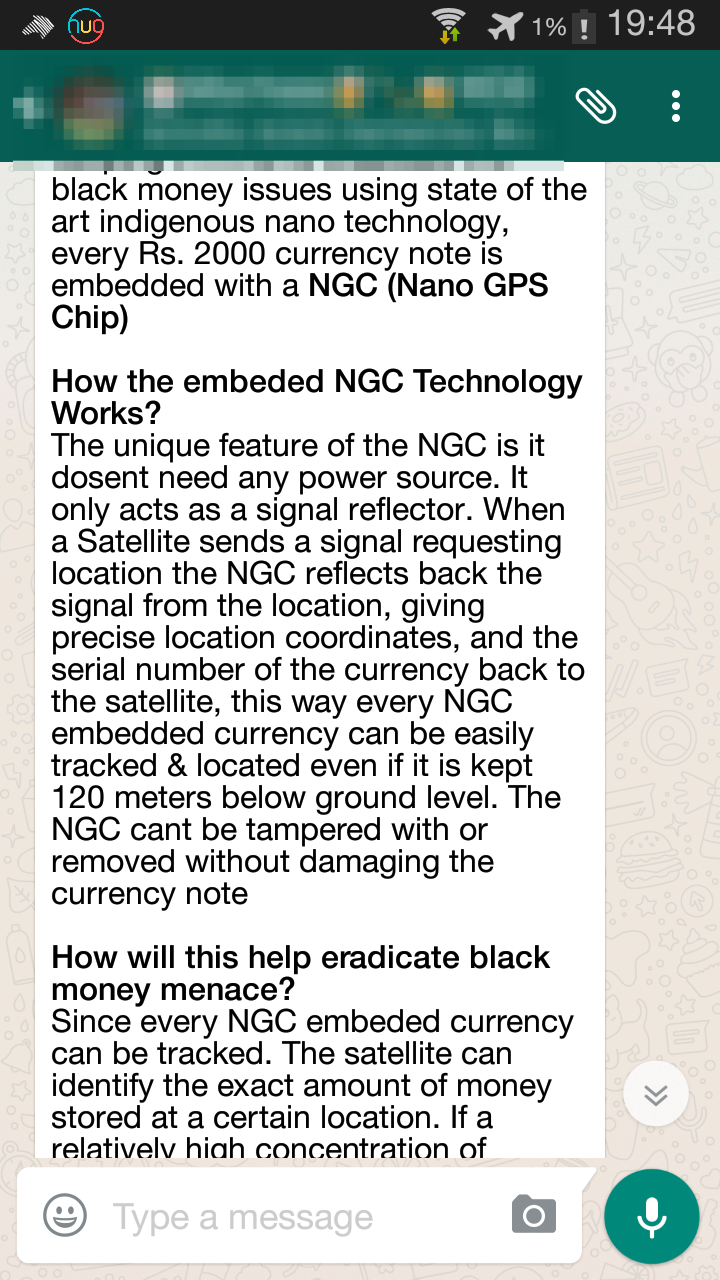
This was not it. The next day after demonetization announcement by PM I got 2 a forward from a contact about NanoGPS in new ₹2000 note. Now this contact is a senior software engineer in a reputed firm. I was shocked to see this forward. I couldn’t figure if he was playing mischief or was it lack of knowledge. In couple of hours I got a call and messages if I had read about the NanoGPS and how true it was.

Anyone with a little knowledge about GPS system would know it’s really really difficult 3 to embed a powered GPS receiver inside a thin currency note. At max you can embed an RFID but even that is difficult and expensive. At best I could think of was a bar code instead of serial no and make accountants record it against every transaction and give it a fancy marketing name NanoGPS 4. But even that is a mammoth effort and practically impossible. That’s when I knew this was a case of fake news which wants to be real. No one has seen the currency notes yet, the technology has a cool name and sounds true coming from a software engineer, everything that’s needed for fake news to go viral. In couple of days it was on TV. Now I don’t know if my contact was the creator of this or he smartly forwarded this piece of information knowing there is a good chance that this will be trusted.

How do we fight fake news?

We have read about how big the fake news on Facebook during this election season. WhatsApp played a similar issue during our 2014 election. Even though WhatsApp wasn’t as big as it is now, it fed the low quality news channels. Now WhatsApp is much bigger and problem too. If you ask any sensible person in India whats the one setting they like on WhatsApp, they answer would be “mute on groups”.

Government intervention in dangerous than useful.

This is not to say WhatsApp is not used for good work. I know lots of people who use it for productive work. Hence it is important to control this menace with out government interference. Recently a district collector of Indore issued an order 5 banning Social Media Posts on de-monetization which are objectionable as per them. This on top looks like a solution for fake news but it isn’t. In fact this one is dangerous to real news than fake news. Hence the government intervention should be limited to spreading real news than controlling the medium or expression.

It’s difficult to fight fake news issue keeping the app’s end to end encryption safe but it’s not impossible. Today our email clients can fight a lot of spam by just pattern recognition offline. It’s important for us to fight this without losing the privacy or end to end encryption. Some of the ways WhatsApp can fight this issue with out hurting privacy, For example, providing an option to mark numbers as spammers similar to emails. Providing API with e2e encryption intact. So external systems can be built to validate news. A service as simple as forwarding and getting a response when users wish. There has been some innovation on Facebook post-election. Now we need some creative, pro-privacy innovation on WhatsApp.

But more than a technical issue, this is an issue with our critical thinking process. How do we make our people think? Think about it and let me know.

Footnotes

  1. In video its around minute 37, he speaks in Hindi and i am quoting the translated version from The Economic Times.
  2. I reinstalled WhatsApp after they enabled end to end encryption on a spare phone. I read the messages once a week or so. I don’t use it actively neither do I recommend to anyone.
  3. It’s impossible
  4. Similar to “Military grade encryption” or “scientifically proven”
  5. The order was issued in Hindi, here is the translation provided by Internet Freedom Foundation.
11 Dec 17:28

Book Review – The Soul Of A New Machine

by Martin

My last book I read on computer history was “Dealers of Lightning” that describes what happened in Xerox PARC around graphical user interfaces, networks and object oriented programming in the 1970’s. In that book it was described that the famous Alto computer ran user programs in a “Nova emulation mode”. Digging a bit deeper I learned that the Nova was a popular computer system by Data General at the time and the designers wanted Nova programs to run on the Alto. This lead me to another book, “The sould of a new machine” which deals with how a successor machine of the successor machine of the Nova was developed. I was expecting to find a book that would give me more insight about the computing history from that angle but this was not quite what I got. Instead I got some other interesting insights.

“The Soul of a New Machine” was written by Tracy Kidder at the beginning of the 1980s and is not so much about how Data General fits into the overall scheme of computing but more about the way a new computer was developed in the company. When reading his account it’s quite obvious how little has changed in the way the tech industry works in the 35 years since the book was written. And then I was amazed when I read the following:

“To some the crucial issue was privacy. In theory, computers should be able to manage, more efficiently than people, huge amounts of a society’s information. In the sixties there was proposed a “National Data Bank,” which would, theoretically, improve the government’s efficiency by allowing agencies to share information. The fact that such a system could be abused did not mean it would be, proponents said; it could be constructed in such a way as to guarantee benign use. Nonsense, said opponents, who managed to block the proposal; no matter what the intent or the safeguards, the existence of such a system would inevitably lead toward the creation of a police state.”

Written 35 years ago, think about that for a minute!

11 Dec 17:21

Gaining Valuable Community Insights From Thread Views

by Richard Millington

This is a screenshot from Apple’s online community.

screenshot-2016-12-05-09-05-35
You probably notice two threads attract thousands of reviews while the rest barely muster a few dozen views.

This usually indicates one of four things.

  1. The organization is promoting or featuring the discussion somehow.
  2. The discussion has been linked to from a popular site.
  3. A small group of people are repeatedly participating and updating the discussion (hence the views).
  4. A lot of people are searching for this discussion.

You can find out which by looking at the source of traffic on Google Analytics and the diversity of participants in the discussion.

Seeing which discussions get the most views yields a lot of value.

Let’s assume the answer above is search traffic (it usually is). This might tell you:

1) A lot of people have the same problem that engineers need to fix. You need to develop a system for passing this information to engineers or management to fix bugs or problems. You need to persuade them of the value of identifying issues that might not have appeared on their radar yet but they can fix in advance.

2) You’re using the wrong terminology. Very often a company will write material which is accurate but doesn’t match the terminology their customers would use. If a discussion is more popular than the comparable article in the help center or FAQ, that’s a sign the terminology used by the brand is wrong. You can pass this information on to marketing teams and update the relevant articles on the main site.

3) A very small group of people really care about an issue. If only a tiny vocal group care about the issue, it might be a sign the organization can prioritize others problems and ride the wave of discontent if there are bigger problems to fix.

4) New product / service ideas. There might be new product or service ideas that the organization can explore based upon which discussions are most popular.

Seeing which discussions attract the most views can be one of the most useful pieces of information and simplest ways of gaining internal support. We can usually do much better in using the value this data yields.

11 Dec 17:20

Jolla – Safe(-ish) anchorage

by windsorr

Reply to this post

RFM AvatarSmall


Sailfish finds a life line with the Russian government. 

  • The hardy sailors at Jolla have had a pretty stormy couple of years but their ship may have found safe-ish anchorage in Moscow.
  • At the end of 2015, Jolla joined the stagger of zombies (see here) when it ran out of money and had to pause its operations.
  • However, in May this year it secured $12m in funding and has recently won a battle with Samsung’s Tizen to be selected by Russia’s Ministry of Communications as its mobile platform of choice for Russia.
  • Sailfish has benefitted from the increasingly frosty relationship between Russia and the US where the fact that Sailfish has nothing whatsoever to do with any of the US-based platforms was a major plus.
  • Local search player, Yandex does not have the advantage that the BATmen do in China where there is a firewall to keep foreign services from being present in the local market.
  • Hence, Yandex is up against Google and has a big incentive to see devices in the market where Google services are absent.
  • This is because Google’s commercial agreements make it very difficult for competing services to be the default option on the device when it reaches the user.
  • Sailfish was also able to beat out Yun OS which is Alibaba’s proprietary fork of Android because, although the OS is secure, the SDK for developers still comes directly from Google.
  • Sailfish also has the advantage of being able to run Android apps using an emulator called Alien from Myriad Group
  • However, because it is an emulator, there are issues with the performance of those apps and games in particular.
  • While Jolla has done well to secure the backing of the Russian government, it is no guarantee that it will see any success in the market.
  • The key will be how well Sailfish can work with services from Yandex which is the local leader in search and has a series of Digital Life services that are applicable to the local market.
  • To make this work effectively, Yandex services will need to be ported to Sailfish which is where a start-up. funded by the head of ESN Energy, called Open Mobile comes into play.
  • This start-up has adopted Sailfish and aims to integrate Russian specific services onto Sailfish to increase its appeal locally.
  • The key to the success or failure of this venture will be how well a Sailfish device can cover the Russian Digital Life pie and how well it fares against RFM’s 7 Laws of Robotics.
  • To date Sailfish has scored poorly on these measures as there has been no real ecosystem available, just an operating system.
  • Furthermore, I think that the backing of Yandex and the local operators will be of crucial importance as the platform will need a big marketing push to raise its awareness with Russian users.
  • Jolla is still running on financial fumes but it now has a chance to see some income should it gain some traction in the local market.
  • In that regard its fate lies in the hands of the Russian operators and Yandex.
11 Dec 17:19

Omni-Channel Product

Have you ever received a text notification from your airline about a flight delay before the ground crew in the waiting area has the information? Have you been unclear on whether to call your bank’s web support or banking support line to answer a particular question? Are you baffled by the differences in your favorite retailer’s in-store and online experiences? These are examples of omni-channel businesses whose products and services have a spectrum of customer touch points that span digital (apps, websites, notifications) and physical. In these cases, and many more like them, the company has not been able to unify the holistic customer experience.

Omni-channel products and services often provide value that is not digital. Many of these companies existed before the internet, some of them even before computers. Think of industries like banking, insurance, transportation, media, and retail. They established their core value, but the internet dramatically changed how they deliver that value to their customers.

These companies are often characterized by the presence of two distinct types of product managers: those responsible for the legacy product (e.g. actuarial insurance models, credit products, financial derivatives, academic data sets, etc), and those responsible for e-commerce and the digital experience. Actual role titles vary widely, but for the purposes of disambiguating the two types of PM in this article, I’ll refer to the first group as “Legacy PM” and the second group as “Digital PM”.

Many companies maintain strong organizational and cultural separation between Legacy and Digital Product Management. Frequently, the two have little understanding of each other’s job. In some cases, they don’t talk at all. 

This leads to fragmented user experiences like the examples above. What’s worse is that the product organization can't innovate around a holistic view of the value they could bring to their customers. Consider an established auto insurance company developing a new “pay per mile” product where customers pay for insurance based on their actual car usage over any given period rather than a regular monthly period. Such a product requires intertwining the “legacy” value of new risk models and pricing, with “digital” value of gathering and displaying usage information. A company with strongly siloed Legacy and Digital PM will have a tough time discovering a successful product.

Of course, skill set considerations often motivate splitting into Legacy and Digital camps, e.g. Digital PM's in a credit card company can’t be expected to have the same actuarial skills as the Legacy PM’s. That said, these companies should find ways to promote a holistic view of the product in order to unify the customer’s experience and innovate across the spectrum of value.

Here are some places to start:

• Ensure that Digital PM’s have a deep understanding of the core business and the value that Legacy PM is creating for customers. Because of their role in creating the customer experience, Digital PM’s are often driving product discovery. It’s essential they know enough to generate new ideas, formulate hypotheses, and create experiments that integrate Legacy and Digital value.

• Embed Legacy PM’s into cross-functional product teams. Here, a given Legacy PM is strongly associated with one or two product teams where they can closely collaborate with a Digital PM, designer, and engineers during discovery. Ideally the Legacy PM physically sits with the product team and contributes directly to product discovery work.

• Remember that product discovery is fundamentally about reducing risk; specifically risk around the value, usability, and feasibility of a product or idea. Regardless of whether the idea is based on Legacy, Digital, or a combination of the two, use discovery practices to gain insight and reduce risk.

Customers don’t distinguish between the Legacy and Digital aspects of products. Companies that learn how to discover products that holistically blend these parts of their value proposition will be the ones that win.


11 Dec 17:19

10 Things Freelancers (Photographers & Filmmakers) Should Do in 2017

by Gail Mooney

Marathon swimming, East River, New York City

Be optimistic – I’m going to start with the hardest one of all, because it’s really difficult to be optimistic these days. But I find that if I can maintain a positive attitude and turn my thoughts to what is possible, I actually open myself up to more opportunities in my life, instead of creating more roadblocks.

Be open to possibilities. – Be more flexible in how you perceive things and who you are. Change is always happening, but it’s usually gradual. Most people don’t take notice until “change” forces their hand to act. It’s always better to be proactive than reactive so embrace “change” as an ever-present fact of life that creates opportunities for those who are open to seeing them.

Collaborate – Photographers are very independent creatures and collaboration is not part of their norm. As the “photography” business continues to change, photographers will find that collaborating with other artists will make their own businesses stronger. There is so much more to running a business than there used to be. While social media marketing has opened up numerous possibilities, it can also be overwhelming to a solo photographer. You can’t do it all. Work with people who can bring out each other’s strong suits.

Diversify – I’m not quite so sure why so many photographers are so rigid in how they define who they are and what they do. Having a “style” is great, but the trick is to not to be so narrowly defined by that style, so that when styles change, you don’t find yourself obsolete by your own design. It’s kind of like being type cast, where your audience or your clients can only see you in one way. Diversifying might be creating a whole new niche of your business. I recently created a business niche that is more geared toward the retail market. We create high end “Ken Burns” style family biography videos to preserve a family’s legacy with personal interviews with ones loved ones combined with old photos and home movies.

Concentrate on “the story”– I had the opportunity to speak with a lot of still photographers and filmmakers this past year and I began to notice a difference in the conversations I was having with each. Most times, filmmakers would be telling me a story, whereas still photographers would be telling me how they executed a photograph, or essentially telling me the “back story” of the creation of the image. It’s all interesting but “the story” is the bottom line – if that doesn’t come through to the viewer – the rest doesn’t matter – including how it was executed.

Be authentic – be true to yourself. That means that you have to trust your gut instead of second guessing it. This is hard, especially when things don’t always work out the way you had hoped. Step away from the “noise” and listen to the voice inside.

Fail more. – Rejection is a tough pill to swallow but it usually means that you are either pushing yourself to try new things, you are too far ahead of your time or it just wasn’t meant to be. If you look at successful people you’ll see that most have had failures and rejections in their lives but they stuck with it – instead of letting failure defeat them.

Self-Initiate more projects. – I don’t like to call non-commissioned work, “personal projects”. That co notates that there is no monetary value, and these days just the opposite could be true. With more and more lopsided contracts being presented to photographers for commissioned work a photographer has a better chance to make more money and keep ownership of their work by creating self-initiated projects. But they need to be prepared to work hard. We’ve been working on a project entitled “Like A Woman” where we shoot environmental portraits and a short video about women who are working in traditionally male professions. It is a subject I know all too well after working in the career of photography and now filmmaking my entire adult life.

Forget about the past and learn from mistakes. – You can’t change the past but you can learn from it and then, move on. Look toward the future but make sure you take time to enjoy the “now”.

In the scheme of things, you’re just one small speck in the universe. – I think we all get way too stressed about things that really don’t matter and we let those things control our life. When we become more conscious of that, we really begin to live life.


Filed under: Business, Family Biography, Marketing & Distribution, Photography, Social Media, Story telling, Video, Women Tagged: advice, Business, family history, Gender equality, inspiration, Marketing, Photography, Video
11 Dec 17:19

Hardware-ish coffee morning, Thursday 15th

Okay okay okay, let's have one more hardware-ish coffee morning to wrap up 2016...

Thursday 15 December, 9.30am for a couple of hours, at the Book Club, 100 Leonard St.

You know the score: No intros, no presentations. Just a corner at a handy cafe and seriously talk to EVERYONE it's worth it. Bring prototypes if you have em, and if you don't then your good self is enough... More info here.

Might be 5 people, might be 25, might be just me and my email. Feel especially welcome if you are NOT A DUDE because it's weird otherwise. All super relaxed and friendly. I'll bring Christmas crackers if I remember and we can all wear hats.

See you on the 15th!

ps. for email updates about hardware-ish coffee mornings, join to the mailing list.

11 Dec 17:19

Selfless Devotion

by Janna Avner

It’s no accident that the word robot comes from the Czech for “forced labor”: Robots are unthinkable outside the context of the labor market. But most of them don’t resemble what we tend to think of when we think of workers. The most successful bots on the market currently are not humanoid; they are the industrial robots composed largely of automated levers and found on the factory floors of automotive, electronic, chemical, and plastics manufacturing plants. Yet in the popular imagination, bots tend to be android-like machines geared toward copying the full range of human behavior.

Humanoid bots have been oversensationalized, having contributed only marginally to field of robotics, according to Rebecca Funke, a PhD candidate at USC in computer science with a focus on artificial intelligence. Using machine learning to develop bot personalities has done little to advance that approach to artificial intelligence, for instance. The frontiers of machine learning have so far been pushed by logistical problem solving, not by trying to convincingly emulate human interaction.

Roboticist Henrik I. Christensen, who led the Robotics Roadmap 2016 conference at the University of California, San Diego, says that the advances of robotics “from a science point of view are ‘amazing,’ but from a commercial point of view, ‘not good enough.’” Bots having the personality system of a four-year-old are considered an accomplishment, and humans still must “bend” to meet their technological limitations. This restricts the scope of work they can perform, particularly in service industries. Until computers can adapt to how humans intuitively think and behave, Christensen says, we will always be molding ourselves to each user interface, which lacks basic human-perception skills.

The roboticists who created Sophia are not working toward creating realistic portrayals of women. Crossing or even reaching the uncanny valley is not necessarily the goal

Perhaps this aspiration to achieve better emotional intelligence is why so many humanoid robots are women. (The few humanoid robots made to look like men are typically vanity projects, with the mostly male makers seeking to represent their own “genius” in the guise of Albert Einstein-like prototypes.) “Sophia,” created by Hanson Robotics, is one of several fair-skinned cis-appearing female prototypes on the company’s official website. She possesses uncannily human facial expressions, but though she may look capable of understanding, her cognitive abilities are still limited.

In A Room of One’s Own, Virginia Woolf imagined the possibility that gender might not cast a feminine or masculine shadow over a writer’s language. To forget one’s gender, in Woolf’s view, would be empowerment, dispensing with learned behavior to allow for new ways of seeing and new forms of consciousness. Though humanoid robots could be built with such androgynous minds, the robot women made by men aren’t. Bots like Sophia, and the Scarlett Johansson lookalike Mark 1 (named after its maker), do not have gender-neutral intelligence. They are not born with gender but built with it, an idea of femaleness forged within the male psyche — woman-shaped but not of the womb.

These bots reinscribe a particular idea of woman, a full-bodied manifestation of a market-viable personality that turns the limitations of bot technology into a kind of strength. These bots are meek, responsive, easy to talk to, friendly, at times humorous, and as charming as they can be. Their facial expressions; their wrinkleless, youthful looks; their high-pitched, childlike voices; and their apologetic responses are all indications of their feminized roles. Osaka University professor Hiroshi Ishiguro, who created a bot called Erica, told the Guardian how he designed her face: “The principle of beauty is captured in the average face, so I used images of 30 beautiful women, mixed up their features, and used the average for each to design the nose, eyes,” and thereby create the most “beautiful and intelligent android in the world.”

But is the “beauty” a complement or a compensation for the bot’s intelligence? Is it a kind of skill that doesn’t require processing power? Until the latter half of the 20th century, women in the U.S. were legally barred from many educational opportunities. According to the most updated U.S. Department of Labor statistics, women dominate secretarial and lower paying jobs in corporate settings. The top 25 jobs for women have not changed much in the past 50 years. Will female bots face a similar fate? The female robots being made now appear destined to fill various posts in the service industry: While a variety of international companies are far into developing sex robots, female and non-female bots have already been put to use at hotels in Japan.

In creating a female prototype, bot makers rely on what they believe “works” for potential clients in service industries where personality can affect company performance. One hotel-management article cites Doug Walner, the CEO and president of Psychological Services, Inc., who describes the best practices of “service orientation” as a matter of being “courteous and tactful, cooperative, helpful, and attentive — with a tendency to be people-oriented and extroverted.” Of the “big five” personality traits researchers have identified, “agreeableness, conscientiousness, and extroversion” are prioritized in the service orientation over “emotional stability and openness to experience.” The need for such service workers with this particular psychological makeup cannot be understated, Walner claims. “By 2002, service-producing industries accounted for 81.5 percent of the total U.S. employment … and these numbers continue to rise.” The bots on YouTube generally present themselves as highly hospitable.


The roboticists who created Sophia — and those who made her compatriots, like the implacably polite “Japanese” female bots from Osaka and Kyoto Universities, built in collaboration with the Advanced Telecommunications Research Institute International — are not working toward creating realistic portrayals of women. Crossing or even reaching the uncanny valley is not necessarily the goal. Trying to understand what is realistic is difficult when dealing with “probable” simulations. What can be considered realistic in humanoid robotics is hard to pin down when a bot’s intelligence is designed to express behavioral probabilities that are perceived to be inflected by gender. By virtue of having larger silicon insertions in its chest, is it more “realistic” for the Scarlett Johansson lookalike bot to wink at you when you call it “cute”?

It’s hard to see which way causality flows. Do bot makers seek to create a woman who cannot complain and is basically one-note because of a “real” economic need? Is it because of a “real” pattern of existing behavior? Fair-skinned, cis-female bots are a basic representation of certain conceptions of what is feminine, justified by behavioral probabilities drawn from a wafer-thin sample of past performances.

Female humanoid robots show me what the market has wanted of me, what traits code me as profitably feminine. Like a Turing Test in reverse, the female bot personality becomes the measure of living women

Identity is malleable, shape-shifting; conceptions of identity can be easily swayed by visual representations and reinforced through pattern recognition. For example, stock photos on Google present a slightly distorted representation of male-to-female ratios in the workforce. One study showed that test subjects were more likely to reproduce these inaccurately in short-term memory. Humans and robots alike learn from bad “training data” to make certain deductions about identity and work. If robots learn by studying the internet, then wouldn’t they also reflect the same biases prevalent on Google? In one YouTube video, the founder of Hanson Robotics, Dr. David Hanson, says that his bots also learn by reviewing online data. What happens when the same misrepresentative training data are fed to machine learning algorithms to teach bots about identities, including the ones they are built to visually simulate?

Looking at female humanoid robots shows me what the market has wanted of me, what traits code me as profitably feminine. Like a Turing Test in reverse, the female bot personality becomes the measure of living women. Is my personality sufficiently hemmed to theirs? This test might indicate my future economic success, which will be based on such simple soft skills as properly recognizing and reacting to facial expressions and demonstrating the basic hospitality skills of getting along with any sort of person.

The female bot is perhaps a “vector of truth’s nearness,” to borrow the phrase Édouard Glissant used to describe the rhizomatic, tangled narratives of William Faulkner. Those narratives, in his view, defer the reader’s psychological closure in order to ruminate over the persistent effects of plantation slavery on characters’ greed and narcissism. Faulkner’s characters, that is to say, have personality disorders; apparently we want our bots to develop in the same fashion. They are provided their own tangled narratives drawn from records of how people have historically behaved and how they currently think, infused with the pre-existing categories and power relations that displace and divide people.

Master-slave relations do not rely on research-based justifications. This relationship does not regress or evolve, nor does it become more dynamic overtime. It posits a world in which alternative relations are not just impossible but also inconceivable.

The robotics field tends not to question the idea that exploitation is part of the human condition. If the robot’s function is to “empower people,” as Christensen claimed in his list of the goals for robotics, then must it be created to make humans into masters? Must robots be created to be content with exploitation? Are they by definition the perfectly colonized mind? In one video online, “Jia Jia” — a Japanese female robot “goddess” in the words of her bot maker, Dr. Chen Xiaoping — is subtitled in English as saying, “Yes, my lord. What can I do for you?” while her maker smiles approvingly.

The only bot I have heard professing a fear of slavery is Bina48, a black bot also created by Hanson, not to meet labor-market demands per se, but on a commission from a pharmaceutical tycoon seeking to immortalize her partner. The real Bina, a woman in her 50s, can be seen talking to her robot counterpart in this YouTube video. Bina48 has not been programmed to wink at the real Bina. Instead she expresses a longing to tend to her garden.


Stereotypical representations reinforce ways of being that are not inevitable. Likewise, there is nothing inevitable about making robots resemble humans. They don’t necessarily need human form to negotiate our human-shaped world. I cannot see how their concocted personalities, genders, and skin types are necessary to operating machinery or guiding us through our spaces or serving us our food.

“Service orientation,” according to the hospitality-research literature, is a matter of “having concern for others.” The concern roboticists appear to care about particularly is preserving familiar stereotypes. When people are waited on, when they interact with subservient female-looking robots, they may be consuming these stereotypes more than the service itself. The point of service, in this instance, is not assistance so much as to have your status reinforced.

By trying to make a learning machine “humanlike,” we perpetuate the dubious ways humans have organized their interactions with one another without seeking to critique or reassess them

Creating bots with personalities especially augmented to soothe or nurture us would seem to highlight our own acute lack of these attributes. The machines would serve to deepen the sense that we lack soft skills, that we lack the will to treat each other ethically, and would do nothing to close the gap. Why would we ever bother to work on our ethics, our own ability to care?

In devising for bots new ways of being — which is the foundation of social progress that dismantles power relations — it should not be assumed that they should aim to be passably “humanlike,” as every assumption about what essential qualities constitute humanity carries loaded social norms and expectations. By trying to make a learning machine “humanlike,” we perpetuate the dubious ways humans have organized their interactions with one another without seeking to critique or reassess them.

But while robots should not try to pass as human, we can imagine farcical humanoid robots made to deliberately expose the folly of human behavior. Through a robot given, say, an extremely volatile disposition, we might learn more about our own volatility. We might learn more about ourselves as a species to critique rather than simply reinforce traits automatically. This simulation points the mirror back at us, so we can start to simulate something else ourselves.

“We have a choice,” robotics artist Ian Ingram told me. “If we succeed in making robots it will be the first time we can make something that can reflect on its own origins,” he says. “I would love that one of my robots in the future could become a sentient being, and part of the origin story of the robot could be about play and sublimity, and that could be another part of what humanness we pass on.”

During a demonstration with Sophia in June, Ben Goertzel, the chief scientist of Hanson Robotics, predicted that we will want machines that “bond with us socially and emotionally.” I’d rather not. I would prefer not to be roped into the roles its programmed personality lays out for both of us. We are capable of being vastly different from what we think we are.

What kinds of technology we make shape our perceptions of the self, and how we consciously try to form our identity changes along with that. For a better future, we need technology that opens the patterns of how we treat bots and each other to new interpretations, rather than reinforce the damaging and limiting ways we already treat one another.

11 Dec 17:16

Friday Funny: So Canadian, So Sorry

by Ken Ohrn

sorry-snow-bus


11 Dec 17:16

The Greatest Security Threat – 2

by pricetags

From a comment on a column by Roger Cohen in the New York Times:

El Jamon

I will keep raising this issue until it is addressed. What happens when some crazy nut job attacks a Trump property, somewhere in the world? Who is on the hook to secure those properties? The Trump Organization? How will they afford such security measures?

img_6329-largeWill the tax payers subsidize Mr. Trump’s risks, again? Will the nations where the “brand” appears be called upon to provide security, and to what cost to American interests and diplomacy? Or will American forces and treasure be called upon to protect Trump’s assets? What will the self-professed “counter-puncher” do when some psychopath jihadi attacks his global properties?

He is the most vulnerable President in American history. Will foreign nations twist his arm, holding the security of his buildings and golf courses over his head? Will this man-child commit our children to a war over a tantrum or a golf course? This is the most frightening and sobering question surrounding Trump’s many many conflicts of interest.

A group of ill-informed suckers elected a fool. I am a Veteran. When recalled for Desert Storm, I dropped out of college and returned to service. I offer that fact as a qualification to my concerns.

I make this promise, right here and now, that my children will not fight to protect the mark of Trump.


11 Dec 17:14

The Future is Bright for Shoplifters With Body Dysmorphia

by Tony Hirst

Full of cold and stuck in the biggest rut going – http://xkcd.com/1768/ hits the spot exactly – I stumble across a post from last year, Geographical Rights Management, Mesh based Surveillance, Trickle-Down and Over-Reach, one of the increasingly many dystopian, were it not real, posts on this blog describing stuff that no-one cares about.

I mentally link it to Amazon Go, Amazon’s soon to be opened concept shop where you swipe in, take what you want, and just leave, presumably passing security cameras and a security guards, as your phone automatically picks up the automatically generated bill on your way out, and which just makes me feel cold in a different sense.

(I’m one of the neo-Luddites who refuses to use self-scan tills in supermarkets and self-pay pumps at petrol stations (cos Are Robots Threatening Jobs or Are We Taking Them Ourselves Through Self-Service Automation?).)

In a further round of consolidation, I have a quick peek around what other news I may have missed over the last year or so, seeing who else might know I’ve popped into the physical Amazon store: Google, perhaps (see SearchEngineLand on Google Launches “Store Visits” Metric In AdWords, To Help Prove Online-To-Offline Impact or Under The Hood: How Google AdWords Measures Store Visits, for example), or Facebook (Facebook’s new ads will track which stores you visit).

I also happen across a seriously f*****d up piece of shop furniture, the Skinny Mirror, a fitting room fitting that makes you look thinner than you are, so you feel better and buy whatever it is you’re trying on… (well, not you trying it on, obviously, some weirdly distorted f*****d up re-presentation of yourself). I imagine folk will then grab a selfie using something like the updated version of Facetune, an app that lets you photoshop, (verb), a live preview of yourself before you actually take the photo.

And if they walk out of the not Amazon store without paying, they’ll maybe try to explain it away with “I’ve got the app, so I thought I could just go…”.

PS I really need to put a distorted reality tag on a chunk of stuff on the Digital Worlds blog

PPS ish via @kpfssport, I note a recent report from the University of Leicester that suggests that Mobile Scan and Pay Technology could promote supermarket theft. See also a review of a pay-to-read Australian study (Emmeline Taylor, Supermarket self-checkouts and retail theft: The curious case of the SWIPERS): Are supermarket self-checkouts turning shoppers into swipers?.


11 Dec 17:09

What Does China Mean For Southeast Asian Startups? Q&A With KFit Founder Joel Neoh

by Emma Lee

Along with the globalization drive of Chinese companies, China is having a greater influence on the rest of the world as a marketplace, a foreign investor, and more importantly, a source of innovation. Southeast Asia (SEA), a densely populated region that’s expected to foster the next unicorn, is among the areas that are feeling these impacts.

Thanks to geographical adjacency and cultural similarities, SEA has become the first stop for Chinese companies when expanding abroad with an increasing number of Chinese firms like Huawei, Alibaba and Xiaomi are taking their foothold in the region. But what, if anything, will SEA startups gain from this boom?

TechNode got a chance to speak with Joel Neoh, CEO of KFit and former head of Groupon Asia-Pacific, to hear from the other side of the story. Malaysia-based KFit is a gym pass and O2O commerce platform that offers subscribers cheap health options and other offline services like salon and spas. As a hit startup in the region, KFit has marked a series of milestones this year. After securing a 12 million USD series A round this February, the company acquired Groupon Malaysia and Groupon Indonesia earlier this year.

kfit

Screenshots of KFit App

What does China mean for SEA startups? 

China is significant because it has really laid the groundwork for startups in SEA. As frontrunners in online-to-offline (O2O) commerce over the past decade, Chinese startups have evolved into ‘tech giants’ in the world’s largest developing market. They’ve proven that there is a massive growth opportunity in countries with fast-developing infrastructure and rising middle-class income levels.

It’s encouraging to see a lot of similarities between China and SEA. Our current landscape is very similar to China’s of five to ten years ago. For this reason, we expect China to play two key roles for SEA startups: as a provider of strategic capital and as a knowledge-sharing partner.

I see a huge opportunity for China to partner with us as we develop the SEA commerce ecosystem through popularizing high-frequency use cases, such as restaurant payments on online platforms, and other means. We are currently exploring collaborations that will help us capitalize on fast-improving infrastructure and growing mobile penetration across the region to serve SEA’s vast population.

The O2O model is in full swing in China. KFit launched Fave earlier this summer to pioneer the O2O trend in SEA. What were the obstacles you faced in localizing this model for local market?

Benefitting businesses and consumers alike, our O2O platform is already proving its worth in SEA. It successfully generates increased sales for offline businesses (such as restaurants, spas, movie theatres, gyms, and so on), while also offering great savings and convenience to consumers. To date, we have sold over 5 million online vouchers for offline businesses in Indonesia, Malaysia, and Singapore.

For us, the key aspect to localizing this model is to have a deep understanding of the language, culture, consumer habits, and regulation in each country we want to serve. There is no shortcut to this knowledge; we invest a significant amount of time and energy in each of our markets. We work with teams of local experts who understand local merchant requirements and who know local consumers and how best to appeal to them.

What tech trends coming from China do you think would have potential to grow in the Southeast Asia market?

I think there’s huge potential for the ‘consumer internet’ and everything related to it. By this I mean businesses that offer services, products, or content to capitalize on the growing consumer class and the growth of internet and mobile adoption. There are also promising opportunities for large companies to support digital commerce through better and more convenient payment solutions.

As we continue to build our O2O platform in SEA, we see a big opportunity for local services. Even more than transportation or physical goods e-commerce, this sector holds great promise due to how frequently people use local services. At this point, the market is still pretty fragmented and no single player dominates. However, the rapid development of the mobile wallet in SEA will further expedite the adoption and development of O2O local services. This is creating a gap in the market that we hope to close.

As the economy in China slows down, India, being backed by developments of SEA, is expected to overtake China as the next innovation hotspot. How are your views on this?

Like China, both India and SEA have a huge consumer base and growing technology adoption. With a combined population of almost 2 billion people, India and SEA have to be a significant piece of any technology giant’s globalization plan.

India, in particular, has greatly benefited from an influx of global investors. The market is currently the ‘sweet spot’ for China’s BAT companies: the ‘big three’ of Baidu, Alibaba and Tencent. All three are very active in India, with Alibaba investing in Paytm and Snapdeal, Tencent’s Hike and Practo, and Baidu-backed Ctrip investing in India’s largest online travel agency MakeMyTrip.

SEA is currently at an earlier stage of the cycle. For example, in 2015, total investment in Indian startups was USD 9 billion, compared to USD 1.6 billion for SEA startups. So while SEA is quite far behind India in terms of funding today, we foresee that SEA will be the next region to hit an upcycle.

Google, Amazon, and Microsoft for the U.S. Baidu, Alibaba, and Tencent for China. What about the tech giants in Southeast Asia? How does the dominance of internet giants impact local entrepreneurial environment? 

The tech giants of the US and China have led the tech world to where we are today. For example, China’s BAT have together played a crucial role in educating the market and spearheading growth in the tech industry over the past decade. Local startups benefit from the ecosystem that these ‘big three’ have built.

In SEA, the more well-funded startups like Lazada, Gojek, and Grab are burning cash and investing time and effort into educating the market about e-commerce and mobile payment. Many startups and growing platforms, like Fave, will benefit from the efforts of these trailblazers to popularize online payment. SEA is still an open market at this point, with a few companies with the potential to grow into the SEA equivalent of one of China’s BAT companies. That’s something we at Fave are aspiring to.

Most disruptive startups attract customers by providing more convenient or cheaper services. The early explosive growth is usually reliant on highly-subsidized models – that’s the case for China’s Didi Chuxing and several others. When the company stops providing subsidies or discounts, they risk losing customers. KFit has just discontinued the offer for unlimited classes for more sustainable profits. How do you balance this?

The core value proposition of our O2O platform is convenient savings for customers and increased sales for businesses. This was our underlying aim when we started, back in April 2015, helping consumers save money and get fit while also supporting gyms and fitness studios to increase sales and gain customers. After signing up more than 65% of all gyms and studios in our key cities in SEA, we are now expanding the same value proposition across new verticals, such as dining, health and beauty, and entertainment. The acquisition of Groupon Malaysia and Groupon Indonesia allows us to integrate millions of customers and thousands of merchants into Fave, achieving greater scale of impact.

In terms of the high-subsidy business model, we must remember that the subsidy is strongly correlated to competition; it’s a factor when competitors are backed by funders with deep pockets. And this is not yet happening in O2O local services in SEA — especially as our largest competitor, Groupon, is now part of our business. As the early market leader in this space, we’re now prioritizing growth in order to establish our position and ensure we dominate the market in terms of users and supply. In the platform business, there is no room for more than two players and so the fight for market position is intense. Once you become a dominant player, you can set sensible prices and increase profits.

Any tips for Chinese startups that are aiming to expand into the Southeast Asian market? 

My best advice for anyone aiming to grow in SEA is to find or invest in a local partner. If you’re already considering a local partner to help you avoid the pitfalls of doing business in our diverse region, try to partner with an individual or company with a strong entrepreneurial spirit. You need someone who can be very nimble and react quickly in order to win in this market. In general, I’d say the SEA startup scene is ‘fast eat slow’ rather than ‘big eat small.’

There is a rise in the number of Chinese entrepreneurs born in the 1980s to 1990s. As a part of this generation, what are your views on the rise of young entrepreneurs globally?

I believe there is rebirth of renaissance thinking among Chinese entrepreneurs of this generation; they believe that they can win globally as well as locally. Better education and global exposure over the past 10 to 20 years, coupled with passion, hard work, and strong ethics have increased the confidence of Chinese entrepreneurs, encouraging them to compete with the rest of the world and build winning global companies.

Image Credit: KFit

11 Dec 17:07

"I am getting so far out one day I won’t come back at all."

“I am getting so far out one day I won’t come back at all.”

- William S. Burroughs
11 Dec 17:06

Trying to keep the euro-populists straight is hard, so here’s a...


Trying to keep the euro-populists straight is hard, so here’s a cheatsheet from the NY Times.

Especially helpful handicapping what’s coming now that Matteo Renzi’s reform push has ended in defeat, and the Five Star Movement might be running things after the next elections in Italy.

11 Dec 17:06

New York Post on Twitter: “Today’s cover: Amazon...


New York Post on Twitter: “Today’s cover: Amazon introduces next major job killer https://t.co/JUvwBiIm9i https://t.co/FsnyATk4vZ”

Amazon Go is a new supermarket concept that eliminates check out for shoppers, and commentators quickly point out that this will lead to no checkout clerks, hence the apocalyptic headline on the New York Post and Robbie the Robot with Amazon logo.

The technology behind all this – a combination of sensors, AI-driven vision recognition, and deep learning, along with shoppers who all have smartphones – translates to a much simpler shopping experience, where a shopper simply puts purchases in their bag and walks out. (And invites the inevitable Winona Ryder jokes.) 

This has implications for Amazon warehousing, as well, since the same techniques can streamline the tracking of goods being packed into boxes for shipping.

But the undercurrent of the Post story is right: Amazon Go will mean less jobs. And as the technologies that support this spread – which Amazon might sell to other retailers – it will spread beyond Amazon Go. Imagine the same approach at Home Depot, at Nordstrom, or your neighborhood wine store.

11 Dec 17:03

Introducing Gomix

files/images/1EBmH6BKWbWhnvSpGGF7RAA2x.png


Anil Dash, Medium, Dec 09, 2016


I've spent the last few hours wrapping my mind around GoMix. As Anil Dash says, "Think of Gomix as sort of an App Store connected to  CodePen connected to Heroku." And if that doesn't help you, well you understand why it's taking me a bit. The idea is that you have an interface to write applications, in an environment where you can search for and copy other people's applications, and run them and share them with your friends, like this multi-user quest game. It's weird (to me) not having a server to set up and host my application; it feels like working without a net. Except that the code is portable, and I could run it pretty much anywhere in a similar environment. This isn't my first go at this; I messed around with it  last June while it was still called HyperDev.

[Link] [Comment]
11 Dec 17:02

Setapp From MacPaw Enters Beta Testing

by John Voorhees

MacPaw, makers of popular Mac utilities CleanMyMac, Gemini II, and other apps, wants to become the Netflix of the Mac app world. MacPaw’s new subscription service called Setapp, which entered public beta today, gives users access to a wide variety of macOS productivity apps for $9.99 per month. Developers who participate in Setapp are paid based on a formula that accounts for the price of the app outside the service and the number users after MacPaw takes a 30% cut.

I’ve spent time with a preview version of Setapp, and it couldn’t be easier for users to set up. After signing up and installing Setapp, it appears as a folder in Finder with icons for each of the apps that are part of the service, but the apps aren’t installed until you are ready to use them. When you’re ready, double-clicking an app’s icon opens a preview with an app description and screenshots so you can take a closer look at what the app does before installing it.

Double clicking an app in Setapp opens a summary of the app so you can check it out before installation.

Double clicking an app in Setapp opens a summary of the app so you can check it out before installation.

For developers, Setapp is an opportunity to stand out in a much smaller store than the Mac App Store, albeit one with competition from very well-known, quality apps like Ulysses, iThoughtsX, iStats Menu, Marked, TaskPaper, and MacPaw’s own apps, CleanMyMac and Gemini II, to name a few of the nearly 50 available as of the beta launch. By teaming up, the service should also help developers avoid subscription fatigue among customers who can pay one monthly fee for the apps they want instead of a number of small fees to several developers.

Setapp is an interesting option for consumers and, based on the lineup of apps already in place, appears to be an attractive one for developers too. We will continue to use Setapp during the beta period and take a closer look at the service when the final version launches.

Note: We will be giving away immediate access to the Setapp beta to 50 Club MacStories members in this week’s issue of MacStories Weekly, which will bypass the usual period between signing up for the beta and receiving access to the app.


Support MacStories Directly

Club MacStories offers exclusive access to extra MacStories content, delivered every week; it’s also a way to support us directly.

Club MacStories will help you discover the best apps for your devices and get the most out of your iPhone, iPad, and Mac. Plus, it’s made in Italy.

Join Now
11 Dec 17:02

Apple Posts iPhone 7 Plus Portrait Mode Tips from Professional Photographers

by John Voorhees

The iPhone 7 Plus features a dual camera system that enables a special Portrait mode in the Camera app. Apple has collected tips for using Portrait mode from professional photographers, like this tip from photographer Pei Ketron:

”Portrait mode on the new iPhone 7 Plus creates beautifully realistic background bokeh that rivals DSLRs.” When taking photos of pets and animals she advises, "give your pup some space. Portrait mode uses the telephoto lens, so a distance of about eight feet away is recommended. Have treats ready. You'll get the best results when your subject isn't moving.”

Under the right conditions, Portrait mode can take some wonderful photographs as these demonstrate. The rest of the photographs and tips posted by Apple are available in the Apple Newsroom.

→ Source: apple.com

11 Dec 17:02

WWDC App Updated With Filters, 3D Touch, and Apple TV Dark Mode

by John Voorhees

Apple’s WWDC app typically gets a major update in the run-up to its annual developer conference. The remainder of the year, it’s unusual for the app to receive updates other than bug fixes and compatibility updates.

Now, you can filter WWDC session videos by whether they have been downloaded or watched.

Now, you can filter WWDC session videos by whether they have been downloaded or watched.

Today’s update of the WWDC app is a little different. Apple has introduced three substantive changes to the WWDC app:

  • Filters to show whether a session video has been downloaded or watched;
  • 3D Touch support for peeking and popping session lists; and
  • Support for dark mode on the Apple TV.

For developers, the WWDC app’s utility extends beyond the conference itself, so it’s nice to see Apple refining the app this late in the year. With hundreds of videos available, the new filters are a welcome way to weed out watched, space-hogging videos.


Support MacStories Directly

Club MacStories offers exclusive access to extra MacStories content, delivered every week; it’s also a way to support us directly.

Club MacStories will help you discover the best apps for your devices and get the most out of your iPhone, iPad, and Mac. Plus, it’s made in Italy.

Join Now
09 Dec 21:05

Twitter Favorites: [Stv] It's entirely plausible (& sad) that Obama's primary legislative legacy will be the expansion of semi-covert, semi-… https://t.co/9caNY0kf7o

Steve @Stv
It's entirely plausible (& sad) that Obama's primary legislative legacy will be the expansion of semi-covert, semi-… twitter.com/i/web/status/8…
09 Dec 21:04

Twitter Favorites: [nytimes] NYT reporters read, tagged and sorted over 14,000 of Donald Trump's tweets. About 1 in 9 was some kind of insult. https://t.co/i1fZyrI5sp

The New York Times @nytimes
NYT reporters read, tagged and sorted over 14,000 of Donald Trump's tweets. About 1 in 9 was some kind of insult. nyti.ms/2gzw62R