Shared posts

12 Dec 06:17

Getting good at living with complexity

by Chris Corrigan

I wonder how the media should change its reporting of volatile weather systems with hyper local effects? The biggest problem with the way storms hit our crinkly coast is that they can be radically different in effect in locations only a few Kms apart and the projections can change by the hour. And yet, mass media runs with the single regional forecast that is issued every six hours and people believe what they want, then getting frustrated with the quality of weather forecasting. We just want to be told what will happen.

Weather forecasting and monitoring is incredible now and we all have access to most of the raw data. But many people expect forecasters to get it right to a level of precision that is impossible at local scales and hardly anyone is prepared to to the work of slogging through the theory to understand what’s happening.

Was snow predicted for today? Yes. Is it happening? Yes. Are there areas in which it is creating treacherous conditions and therefore worthy of a regional warning? Yep. Is that true at your house?

If the answer to the last question is no it does not invalidate the accuracy or the role of meteorology. It might be an indictment of radio and newspapers who are never willing to explain the intricacies of complexity whether it is about economics, society, politics or weather.

Collectively we need to stop looking for simple answers and easy knowledge about complex system and get used to living with volatility, uncertainty and unpredictability because that is how the world actually works. It would help if we could all learn a little more about the complexities of the things that affect us and learn to use the raw data that shows what’s happening. I have a constant irritation that society in general is stuck because folks a) won’t do the leg work to understand complexity and b) expect those that do do the legwork to be the final arbiters of truth.

We are dangerously wanting to have our cake and eat it too.

11 Dec 16:55

Shaw’s Mobi Win

by Ken Ohrn

Glen Korstrom in Business In Vancouver samples opinion around Shaw’s Mobi by Shaw Go sponsorship deal.  Looks like Shaw has done pretty well.

Given Vancouver’s 10% (and rapidly growing) mode share for people taking bike trips to and from work, I think that Shaw’s sponsorship taps this growing demographic on the shoulder and says: “Hi, we’re with you”.

Mobi, shaw

Writes Korstrom:  “Not only does Shaw get to associate its brand with an initiative that many view in a positive light, it also gets to put its brand on a swarm of moving billboards and connects the brand with a demographic that is likely to buy Shaw products such as mobile phone plans and Wi-Fi.

“They’re really painting themselves the right colour here and showing that they care about social equity,” said Simon Fraser University Beedie School of Business marketing professor Lindsay Meredith. . . .

. . . University of British Columbia Sauder School of Business marketing professor Darren Dahl: “Shaw taps into a specific consumer segment: younger and typically more environmentally conscious, . . .”

It is distressing that Prof. Meredith seems to think that Mobi, and probably bikes in general, are mostly for the poor.  This contradicts research into the demographics of people who ride bikes, and is a good example of myopic motordom at its finest.


11 Dec 16:51

Mobile is eating the world

by Benedict Evans

As we pass 2.5bn smartphones on earth and head towards 5bn, and mobile moves from creation to deployment, the questions change. What's the state of the smartphone, machine learning and 'GAFA', and what can we build as we stand on the shoulders of giants?

Slides embedded above - video version with talk track below. 

11 Dec 16:51

Pogue's Basics: Money - The argument for paying for insurance with a credit card

Progressive, GEICO, State Farm, Allstate, Esurance — all major insurance companies let you pay for your insurance with a credit or debit card.

And you know what? You should. Because if you have a rewards or cash-back credit card, you’re getting rewards or cash back on a big expense: the thousands a year you spend on insurance. If you have a typical $900-a-year car-insurance plan, your card will kick back $18 each year; if you spend $3,000 a year on homeowners insurance, your card will refund $60 every year.

You’ve got several kinds of insurance to pay. You’ve got utility bills, too—same trick. It adds up handsomely.

As a handy bonus, you can set up a recurring, automatic charge to your card each month. That way, you never forget to pay your premium (and never have to bother).

For a typical American consumer, this trick will save you about 150 bucks a year. Thank me in your heart.

More from Pogue:

iOS 10 Hidden Feature: Bedtime-consistency management

Pogue’s Basics: Money – The Amazon card

iOS 10 Hidden Feature: Do Not Disturb Emergency Bypass

Pogue’s Basics: Money – Extended warranties

Pogue’s cheap, unexpected tech gifts #2: ThinOptics glasses

A dozen iOS 10 feature gems that Apple forgot to mention

GoPro’s most exciting mount yet: a drone

Professional-looking blurry backgrounds come to the iPhone 7 Plus

Pogue’s Basics: Turn off Samsung’s Smart Guide

Pogue Basics: Touch and hold Google Maps

The Apple Watch 2 is faster, waterproof—and more overloaded than ever

We sent a balloon into space — and an epic scavenger hunt ensued

Now I get it: Snapchat

The new Fitbits are smarter, better-looking, and more well-rounded

Apple has killed every jack but one: Meet USB-C

11 Dec 16:50

"The heart has no grammar, the soul no set syntax, and so to be in the world is to lose oneself in..."

“The heart has no grammar, the soul no set syntax, and so to be in the world is to lose oneself in translation day after day after day.”

-

Matt Brennan, The Blighted Language of Kenneth Lonergan

I now plan to write a song called The Heart Has No Grammar. Coming soon.

11 Dec 16:50

The boycott war has descended into madness

by Josh Bernoff

The divisions in the country have spilled over into commerce, with calls to boycott businesses from Nordstrom’s to Kellogg’s. Feel free to boycott businesses that backed a candidate you despise. But draw the line at extending those boycotts up the supply chain, because that way lies madness. After the most vitriolic election in memory, the country … Continued

The post The boycott war has descended into madness appeared first on without bullshit.

11 Dec 16:50

The MacBook Pro w Touch Bar is Great for this Knowledge Professional

by janet tokerud
macbookprowithtouchbar

Macs are still Relevant to the Knowledge Professional

There are lots of reasons why a knowledge professional would like this Mac. First, it is a Mac which is historically the favorite for creatives. I’m going to assume that knowledge professionals must be creative to do their jobs regardless of the field. If you are operating with knowledge at a professional level and might be a knowledge enthusiast too, this is your brand.

But this gorgeous MacBook Pro is Pricey!

Let’s get this out of the way early. Yes. Apple raised their prices on these better quality Macs. You get your money’s worth, but yeah, it will cost you. As my father used to say, money doesn’t grow on trees. And the last 30-years haven’t been kind to the middle class. But your tools have never been like this.  You are better educated and more knowledge-capable than ever. If you are serious about your career, this big tax deduction is a great investment. It is your primary tool so consider cutting back elsewhere in your budget.

iPad is Not (Yet) Enough. Now that you are preferring Mac and are creating with knowledge whether writing, advising, creating presentations or diagramming, you’ll probably want a Mac not just an iPad to get your work done. I say you need both if you can do it because reading, the primary activity of a knowledge professional, is best on an iPad by a large margin. It feels better. It’s less awkward.

Mac wins when you are writing. If you are reading and typing, you’ll probably be better on a Mac than an iPad just due to the advantage extra MacBook functionality. With a Mac you can still read but you get some extras. The screen is adjustable to any angle and is always with you (you don’t need a stand or foldable cover to prop it up). The keyboard is really good and is built in. It works well on a table or your lap or anything in between. While Apple doesn’t give you a touch screen, it gives you the world’s best trackpad which you can operate and still keep your hands in perfect typing position.

Mac wins when you are gathering and organizing as you begin or review a project. The Finder with its multiple windows and ease of connecting and working with external data, beats the iPad handily in these critical knowledge functions. There are many Mac apps to choose from. I like Scapple for the visual note-taking. I like Ulysses because it keeps my serious writing and important notes in a database so all that stuff is there so I can grab what I need quickly. I think Scrivener is great for long writing projects. But also we have lovely OmniOutliner and Omnigraffle.

Why Would the MacBook Pro with Touch Bar be your choice for your next portable Mac?

Look and Feel

Jony Ive outdid himself with this Mac. I’ve got the space gray model which is stunning. I believe and its been documented that beauty can inspire and energize. What knowledge professional doesn’t need all the inspiration and energy they can get when faced with tough creative challenges? It is smooth as silk opening, closing  and adjusting the screen angle.  The screen is wide color and brilliantly lit. The touch bar is perfectly blended with the keyboard. The 4 Thunderbolt ports are small leaving the sides uncrowded.

Form Factor

I’ve been using the MacBook 12 and I have to say that the small size and 2 lb. weight are wonderful on your lap or in your bag. It’s better for me to have the extra screen size, though. I like big screens because I get a larger canvas just like I like bigger notebooks and note pads when I need to figure out what I am doing on a new problem or project. For me, the 13″ size is as big as I’m willing to carry or hold. I would not have gone 13″ if the MBPTB was bigger or heavier than its compact 3 lbs. I like that it is smaller than the MacBook Air 13 by a large margin and, of course, way cooler. It’s more comfortable on my lap.

The Amazing Touch Bar

I’m typing on it now. I have an iPad Pro 12.7 next to me but it is sitting idle for the reasons I’ve just covered. The Touch ID on the right edge of the touch bar is the biggest favorite out of the box. It’s not to be typing to login anymore. I haven’t learned much about the new touchbar yet, but I like that Apple has given me a small strip of iOS in this new MacBook Pro. That strip is great for discovering the commands available at any given moment. Simply engaging touch in the middle of a writing project may help your brain get a little more creative. I’m thinking it engages with the right brain, subconscious, primitive capacities of the mind where breakthroughs and insights are facilitated.

 Largest Trackpad

With the exception of the new MBP15 trackpad, this is the biggest trackpad around. Apple already makes by far the best trackpads. Turns out as you get into gestures including drag, pinch and zoom, the bigger the better. If palm rejection wasn’t excellent, the size of the trackpad would be an issue. Not a problem that I’ve experienced.

Fastest Solid State Drive

Apple says this solid state drive is twice as fast as previous SSD generations. This affects how fast things start – you are doing one thing and you do another thing. It’s extremely responsive. There’s no resistance to your effort. Faster is better when you work on hard stuff.

The USB-C Thunderbolt Ports

I’m not the best one to judge the downsides of not having the ports that came on previous MacBook Pros. I already have been using a single USB-C port with my MacBook 12 for over a year and a half and 4 ports seem like a complete luxury even though USB-C. They aren’t as compatible so I’ve used Apple 3 port adapters when I wanted power and a backup. With four ports, I don’t need a hub or multiple function adapters. I plug in power in one port and a hard drive and a USB stick all at the same time. I’ve got a 64 gig USB-stick that has a regular USB3 side and a USB-C side so that’s already available and I recommend one of these if you are new to USB-C.

My 2013 MacBook Pro 13 had an SD card slot, 2 USB3 ports and a Thunderbolt 2 port.  Now I get 2 full speed Thunderbolt 3 ports and 2 full speed second generation USB-C ports. I just bought 2 new $89 1-terabyte 7200 rpm G-drive portable drives in space gray from the Apple Store. I can’t find that $89 price anywhere else so I think Apple is helping out on that price a bit to make buying new USB-C drives palatable.

I am a technology enthusiast, so all these really powerful and fast, state of the art ports seem good. The lack of legacy compatibility and requirements to sometimes use an adapter for old drives seems like a very reasonable price to pay considering how small and light the MBPTB is and what I get. You can get a USB-C to USB3 adapter for about $10. Apple has their USB-C to USB3 adapter for sale for $9. Apple is trying to make these adapters affordable to smooth your way into the future.

You can keep all of your dongles at home except maybe take that USB stick with USB-C and USB-3. You already had a USB stick with you anyway didn’t you?


11 Dec 16:49

What is going on with math education in the US?

When colleagues with young children seeking information about schools ask me if I like the Massachusetts public school my children attend, my answer is always the same: “it’s great…except for math”. The fact is that in our household we supplement our kids’ math education with significant extra curricular work in order to ensure that they receive a math education comparable to what we received as children in the public system.

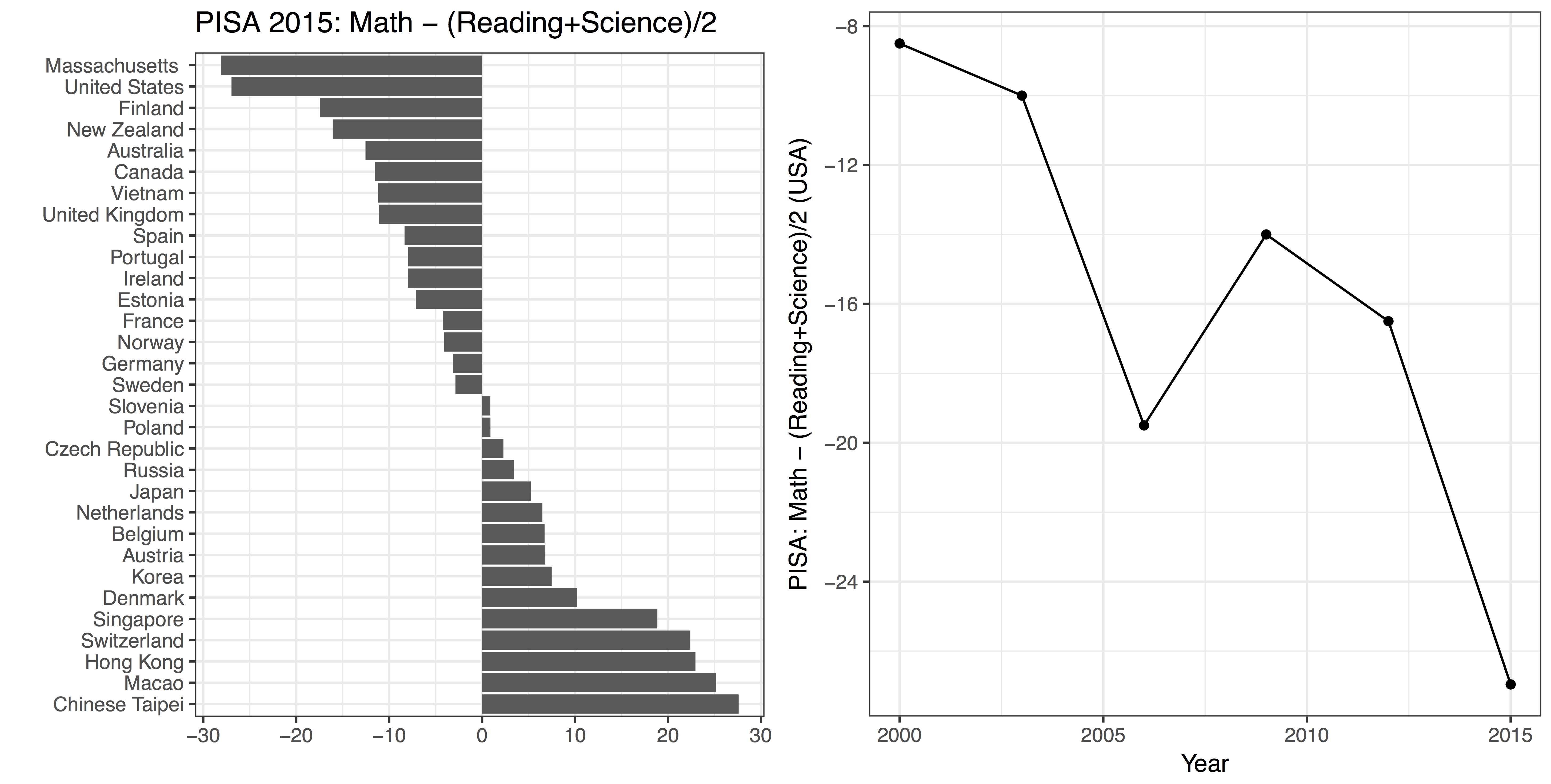
The latest results from the Program for International Student Assessment (PISA) results show that there is a general problem with math education in the US. Were it a country, Massachusetts would have been in second place in reading, sixth in science, but 20th in math, only ten points above the OECD average of 490. The US as a whole did not fair nearly as well as MA, and the same discrepancy between math and the other two subjects was present. In fact, among the top 30 performing countries ranked by their average of science and reading scores, the US has, by far, the largest discrepancy between math and the other two subjects tested by PISA. The difference of 27 was substantially greater than the second largest difference, which came from Finland at 17. Massachusetts had a difference of 28.

PISA 2015 Math minus average of science and reading

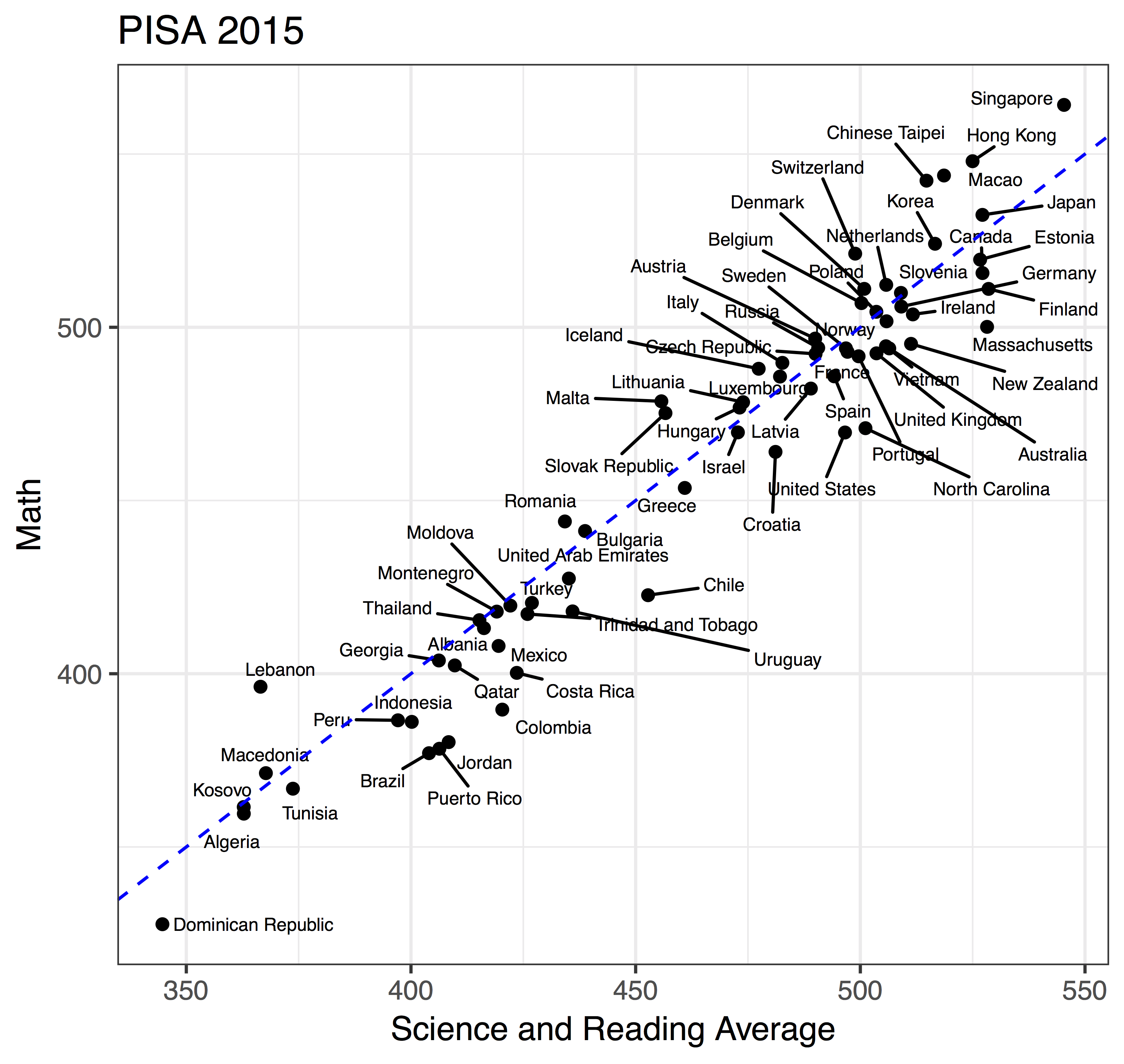
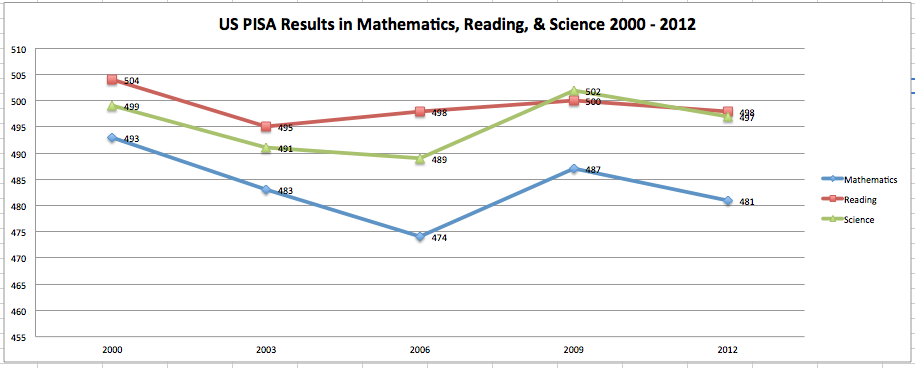
If we look at the trend of this difference since PISA was started 16 years ago, we see a disturbing progression. While science and reading have remained stable, math has declined. In 2000 the difference between the results in math and the other subjects was only 8.5. Furthermore, the US is not performing exceptionally well in any subject:

PISA 2015 Math versus average of science and reading

So what is going on? I’d love to read theories in the comment section. From my experience comparing my kids’ public schools now with those that I attended, I have one theory of my own. When I was a kid there was a math textbook. Even when a teacher was bad, it provided structure and an organized alternative for learning on your own. Today this approach is seen as being “algorithmic” and has fallen out of favor. “Project based learning” coupled with group activities have become popular replacements.

Project based learning is great in principle. But, speaking from experience, I can say it is very hard to come up with good projects, even for highly trained mathematical minds. And it is certainly much more time consuming for the instructor than following a textbook. Teachers don’t have more time now than they did 30 years ago so it is no surprise that this new more open approach leads to improvisation and mediocre lessons. A recent example of a pointless math project involved 5th graders picking a number and preparing a colorful poster showing “interesting” facts about this number. To make things worse in terms of math skills, students are often rewarded for effort, while correctness is secondary and often disregarded.

Regardless of the reason for the decline, given the trends we are seeing, we need to rethink the approach to math education. Math education may have had its problems in the past, but recent evidence suggests that the reforms of the past few decades seem to have only worsened the situation.

Note: To make these plots I download and read-in the data into R as described here.

11 Dec 16:49

Your Ellie – On the Primacy of Networked Knowledge

files/images/img_0360.jpg


Amy Burvall, AmusED, Dec 12, 2016


I commented to someone this week, "For all my talk about networking, I'm not a very good networker." Maybe when you don't have it you see what it is more clearly? So consequently, I don't have what Amy Burvall's daughter would call "an Ellie" - a close (and more organized) friend she calls instead of using antique technology like a website. This reminds me of a survey we did when researching for MuniMall in the 1990s - we asked municipal officials where they got the information they needed, and the number one answer was to "'call someone they know." Burvall suspects we prefer this method because it's more human. I suspect it's rather because it's more efficient.

[Link] [Comment]
11 Dec 16:37

Verizon refuses to release Note 7 update to prevent device from charging

by Jessica Vomiero

Samsung recently announced a software update for the Note 7 that is designed to stop the smartphone from charging.

Not every carrier however will be immediately releasing said update, as Verizon has already announced. Upon receiving the announcement, Verizon released a statement claiming that the American telecom giant will not be releasing the update.

Other American telcos such as AT&T and Spring have opted to wait until after the holidays have concluded, while T-Mobile will release the update just two days after Christmas, on December 27th.

Verizon attributed the decision to customers who may not have another option should their Note 7 functionality be limited. The carrier went on to claim that debilitating its customers’ smartphones during the season of holiday travel could prove a safety risk in itself.

Ironically enough, the Note 7 is banned from all airlines by the FAA and is prohibited from being used in many other public transit locations in the United States.

Functional restraints such as limiting the battery life and disabling Wi-Fi were implemented on December 12. Canadian carriers on the other hand recently got word that starting December 15th, Canadian Note 7 users will no longer be able to make calls, use data or send text messages.

Related: Samsung Canada says it will ‘deactivate service’ on all Note 7s on Dec. 15th

SourceThe Verge
11 Dec 16:35

These Speaker Dresses Are Both Eye and Ear Candy

by Michael Barron for The Creators Project

Screen Shot 2016-12-07 at 6.19.36 PM.pngPauchi Sasaki and Claire Chase performing Pauchi's Gama XV : Piece for Two Speaker Dresses ©Rolex/Bart Michiels

Dresses are more likely to be worn as attire to draw the eye than as a self-contained sound system to lure the ear. But my ears perked up when midway through the first night of Claire Chase's density 2036: part iv—an evening of flute, vocal, and breath works performed at NYC experimental arts venue The Kitchen—the renowned flutist was outfitted by a chorus member in a plated silver skirt of flattened speakers. I watched as she was then handed a swab of glowing cables that resembled the spilled intestinal tubes of Ash, the android from Alien. Chase put this tangle to her mouth and began to play.

As the stage and platform lighting dimmed to a mere two spotlights, ghostly sounds emerging from the dress filled the room in a foggy ambience. From the corner, a second woman in a speaker dress—its designer, the Peruvian musician and sound artist Pauchi Sasaki—was making her own noises, scream-like breaths amplified from a headset and mic hanging over her lips. In slow, methodical steps, the two performers enacted a Butoh-like choreography; their bodies and attire embodying the aurality of the space.

What I was witnessing was the world premiere of Gama XV: Piece for Two Speaker Dresses, described in the program as exploring “the relationship between air as sound source; body as a medium of sound amplification; and space as the container of [elemental] interaction.” Also making its premiere was the second of Sasaki’s speaker dresses (the one worn by Chase). “For the first dress,” Sasaki wrote in her artist’s note,” a usually soundless skin becomes the sound source for the dress.” Sasaki added that for the second dress, she “wanted to visually integrate air and respiration.” The web of chords played by Claire was meant as a “mask...with several [tubes] connected to a purse [emanating] negative ions, becoming an emulation of an artificial ‘lung system.’"

Following the performance, Sasaki was kind enough to answer a few questions from The Creators Project:

Screen Shot 2016-12-07 at 5.38.01 PM.pngPauchi Sasaki at the Kitchen in New York City, December 1, 2017, with self-designed speaker dresses for her composition Gama XV : Piece for Two Speaker Dresses ©Rolex/Bart Michiels

The Creators Project: How did you make the dresses and how did they fit into the performance?

Pauchi Sasaki: I made the first speaker dress in 2014; it is a self-contained system that functions with three stereo amplifiers, a battery, and covered in 100 speakers. The second dress, which premiered today, is made out of 125 speakers. It’s an independent system, everything is wearable. Both dresses utilize a double-wireless system—one travels from the microphone to the headset to the mixer. And the other brings in receives the signals for the sounds I designed through a Max MSP patch. In designing these, I wanted to stress their efficiency as a self-contained system. This was the first time I had two dresses on stage at the same time so it was very exciting to see how they played off each other, and how, as sound sources, they could move around the space.

Can you talk to me about your choreography process in working with these dresses?

This piece is based on structure, not note by note. It’s all done by scenes. The first scene were done by interpretive instruction—take deep breaths, sound like a firework, now a squirrel. But these are component ideas; the next full scene was to make diagonal sounds with our body, like screaming and pulling sound away from the body. Each scene had its own specific treatment.

Screen Shot 2016-12-07 at 6.20.14 PM.pngPauchi Sasaki playing the electric violin, wearing self-designed speaker dress for her composition Gama XV : Piece for Two Speaker Dresses ©Rolex/Bart Michiels

Where did the idea to create speakers dresses come about?

A few years ago, I was to perform in a temple in Lima, and I brought my violin and my system to process its sounds. But of course, it’s an ancient temple, so there was no electricity or outlets; I could perform only acoustic sounds, even though that’s not what I had planned. That’s when I got the idea of a self-contained system, but one that could be integrated into my body, that was the idea.This resulted in the first speaker dress that wasn’t just functional as a mobile sound system, but also as something visually compelling.

What kind of performances with these dresses do you have in mind for the future?

My dream, well, I say that after suffering through building the second dress [laughs], my dream is to make a medium-sized opera with very weird characters. But medium-sized because these dresses don’t really function well in large concert halls, where it’s hard to manipulate the sound sources.

Will there be male characters?

For now, no. I’m focused on femininity and what it means to have a body that screams. So I’m just sticking with feminine dresses for now. But rather than developing a male counterpart, I’d like to work on more androgynous outfits. I think that’s what I’ll work on next.

To learn more about Pauchi Sasaki’s work, visit her website here.

Related:

A 3D-Printed Ear Explores What It Means to Be a Machine

This DIY Electronic Soundsystem Turns Your Body into an Instrument

Body Painting and Performance Art Collide in 'SCAR CYMBALS'

11 Dec 16:35

╭∩╮Marina Abramovic Turns 70╭∩╮| Insta of the Week


A photo posted by mrsahmed (@mrsahmed) on


Last night Marina Abramović hosted friends and enemies alike at her 70th birthday party, which filled the winding staircases of the Solomon R. Guggenheim Museum of Art in New York City. Abramović is an icon, known for groundbreaking performances in which she sliced her own hands with a knife, stood still while encouraging visitors to do anything they desired, sat making direct eye contact with guests at the Museum of Modern Art eight hours a day for three months, and prowled a room full of blindfolded visitors. Appropriately, her birthday party was as enigmatic and interactive as her lifelong practice.

Invitees were given gold leaf to be placed directly on their lips. This was not a good look for

A photo posted by @jameslartin on

" target="_blank">men with " target="_blank">beards. The party kicked off with 70 minutes of silence, broken by a short speech from Abramović, followed by British artist and singer ANOHNI's stunning rendition of "My Way," popularized by Frank Sinatra, and later, Sid Vicious. Then management broke out the champagne and the birthday girl gave the cameras the bird for the awesome photo above.

Abramović turned 70 on November 30, but last night was the official celebration, attended by artists Andres Serrano, Martha Tuttle, Nir Hod, Dustin Yellin, Shirin Neshat, as well as actress Naomi Campbell, magician David Copperfield, and Monica Lewinsky. 


A photo posted by Ladymossymoss (@ladymossymoss) on


A video posted by James Zigras (@james_zigras) on


Follow Marina Abramović here and check out The Creators Project's Instagram to find your next favorite artist.

Related:

A Brief History of Men Whining Over Women Artists Winning

Death: Marina Abramović's Final Performance?

Marina Abramović and Mark Ruffalo Speak Out in New Climate Change Documentary

11 Dec 07:53

Lunch with my friend, the Trump supporter

by Ethan

Two week ago, I wrote an op-ed for CNN.com on Steve Bannon, the “alt-right” and white nationalism. It got the reaction I usually get when I write on CNN – passionate wishes for my speedy demise, helpful reminders that I am overweight and smell bad, and calls to my employer to fire me immediately.

The most interesting response I received came from an alum of Williams College, the small college in western Massachusetts I graduated from. My op-ed raised questions for him, and he wanted to buy me lunch to talk about them if I was willing to dine with a Trump supporter.

I was. Not only was he paying, but I’m acutely aware that I’m ideologically isolated and that I have almost no Trump supporters – or, perhaps, no _out_ Trump supporters – in my work and personal circles.

We had lunch earlier this week, and we spent an hour getting to know each other – our families, our paths to the jobs we hold today, our feelings about our alma mater. Basically, we spent an hour becoming friends. I like the guy. I’m going to have lunch with him again, and I’m going to pay the next time.

All of which made it harder to ask the question I needed to ask: Why Trump?

My friend acknowledged that Trump is thin-skinned, erratic, blustery, abusive, that he’s said and done things that were lewd, boorish and abusive, that he has grave doubts about his judgement. But Trump gives him hope on the one issue he cares about: immigration.

The US has approximately 42 million immigrants, or 13.3% of the population, with roughly 1.2 million arriving per year. My friend would prefer we move to a much more restrictive set of immigration policies taking us towards net zero immigration. His reasons surprised me. “What happens to the wages of the average waiter in this restaurant if we end immigration. Labor is more scarce. Wages rise.” If we ended immigration, we’d take steps towards improving the lives of the underemployed and reducing inequality in the US, he argues.

Good progressive that I am, I can think of a lot of other ways to reduce inequality and improve waiters’ lives: a livable wage law, single-payer healthcare, redistribution of wealth via a progressive income tax. I expected a fight over regulated and unregulated markets with my friend, but we ended up in a different place: a fundamental disagreement over who matters.

My friend identifies as a “citizenist”, someone who believes our goal as Americans should be to better the lives of other American citizens. “I don’t care who they are, where they’re from, what they believe – if they’re here and they’re citizens, they’re the ones we should help.” I identify as a globalist. I consider it an accident of birth that I’m an American rather than Nigerian, and I don’t see a strong reason to privilege the economic success of someone who happened to be born here over that of someone who wants to come here. I have great sympathy for Lant Prichett’s argument that eliminating national boundaries would be the best possible step for global economic development.

During my first year of college, I roomed with a devout Christian from a small town in Pennsylvania. We were both philosophy majors, we both loved to argue, and we became dear friends despite the fact that our worldviews diverged radically on many subjects. A few months into our friendship, we learned that certain of our arguments simply reduced to a fundamental moral disagreement that neither of us would budge from. Finding the roots of these disagreements was surprisingly satisfying – it allows you to look at someone you respect and say, “Oh, THAT’s why you believe that apparently absurd thing.” When my Trump-supporting friend and I reached the citizenist/globalist split, I feel like we’d found bottom in that way. I believe he’s fundamentally wrong, but I can see how he got from his underlying principles to his otherwise incomprehensible conclusion.

My friend’s question for me was far more specific than why I opposed Trump. He quoted the final line of my CNN op-ed: “If we can’t agree that Richard Spencer and Steve Bannon are beyond the pale, what can we agree on?” Was it fair to put white supremacist Spencer and activist publisher Bannon in the same category?, my friend probed.

The question mattered to him because he finds himself siding with Bannon on many issues. More critically, he saw Breitbart, the site Bannon published, as one of the few that gave voice to his perspectives on immigration. “If Bannon is beyond the pale, and Breitbart’s beyond the pale, does it mean that my views on immigration are beyond the pale? And what about the millions of Americans who agree with me?”

And so, here it gets complicated. My friend and I agree that political dialog in the US is often too narrow. He’d like the sphere of legitimate controversy to include discussion of net-zero immigration. I’d like to see the dialog expand to include elimination of national borders. The rise of the internet as the dominant public sphere has led to an expansion of opinions we can encounter online, giving voice to perspectives that are still in the sphere of deviance for most media. For the most part, I think this is a good thing.

screen-shot-2016-12-08-at-10-00-49-pm

But here’s the catch. When Breitbart comes on the scene and pushes the sphere of legitimate controversy to the right, we start hearing points of view that probably should remain in the sphere of deviance. Bannon gives voice to the net-zero immigration point of view, but also to the ethnonationalist point of view. I’d argue that’s a point of view that should remain in the sphere of deviance due to the damage it’s caused over the years. (There’s clearly points of view on the left that I’d put in the sphere of deviance as well. For me, black bloc protests that focus on property destruction as a way of challenging global capitalism probably push into the deviant sphere. And I’m happy putting the anti-vaxxers there.)

My friend is with me… sort of. We both agree there’s points of view that we’re best not giving airtime to. But we’d draw the line differently. He wants to exclude “the guys in the sheets”. I propose a line that excludes Milo Yiannopoulos, who has promoted misogynistic bullying online during Gamergate, but my friend is a reader and fan of Milo. And the more I talk about the issue with him, the more I realize I’m uncomfortable both with where that line should be placed and, more broadly, with placing lines.

Psychology professor Peter Coleman wrote a book called The Five Percent about apparently intractable conflicts. One of the key stories he explores is tension between pro-choice and pro-life activists in Boston. In 1994, John Salvi III opened fire in two abortion clinics in Brookline, MA, killing two and wounding five. Coleman describes how a group of six women, some ardently pro-life and others ardently pro-choice, began meeting in secret over the course of six years.

Over the years, the women became deeply fond of one another. But rather than coming to agreement on issues of abortion, they became more polarized over time. Through years of explaining their positions respectfully to someone who deeply disagreed with them, the women became stronger and clearer in their convictions.

Is this a success or a failure? If you’re in the camp that believes that careful, fact-based deliberation leads to compromise and new solutions, it’s disappointing. But for Dr. Coleman, this is as good as we could hope for. The vitriol and anger that characterized the dialog between these two groups evaporated as these core activists began to know each other as people. And this may be the best we can hope for with controversies that reduce to fundamental conflicts of values.

Sitting down with my friend was made easier by the fact that we have a lot in common. We’re both hyper-privileged white males, we had enough time and flexibility to schedule the conversation, we both felt comfortable in the setting he’d chosen for the conversation. We had a great deal of common experience through our time at the same college. Neither of us felt personally threatened by recent political events in the way an undocumented immigrant or a Muslim American might. And even with all this going for us, it wasn’t an easy conversation – we circled around it for an hour before diving into it.

At this point, my friend isn’t comfortable revealing his identity, for fear that being identified as a Trump supporter will hurt his chances at working in academia. That, too, is an obstacle to these conversations, and some of that blame goes to me and friends on the left who are working to ensure that no one believes that President Trump has the approval of a citizenry united behind him. But I’m looking for ways to fight the excesses candidate Trump has promised while finding a way to keep open dialog with the people who supported him.


Postscript: I talked through the diagram I offered above with my friend and colleague Nathan Matias. He noted that, while helpful, the diagram does little to shed light on the current question d’jour: fake news. He’s right. The diagram above presumes good faith, and much of the media that’s created around the 2016 presidential election was not disseminated in good faith.

Stories in good faith often work to push the boundaries of the sphere of legitimate controversy. As a result, they make some people uncomfortable, since they bring in perspectives and views we’re not comfortable entertaining. But that’s different from two categories of news that are being lumped into the idea of “fake news”.

Some “fake news” is propaganda. It’s weaponized text, designed to make our side look good and the other side look bad. Much propaganda isn’t fake – it’s simply heavily biased, and offers an incomplete view of events to have a persuasive effect. The medium term effect of propaganda is polarization, as we stop seeing our political opponents as reasonable people we disagree with, but as people who are so wrong and misguided that we couldn’t possibly find common ground with them. In the long term, propaganda destroys democracy, because it silences dissent and calcifies the parties currently in power.

A small amount of “fake news” is better described as disinformatzya. Its goal is not to persuade readers of its truth so much as it attempts to raise doubt in the reader that anything is true. We’re not used to disinformatzya in the US, but it’s been quite common not only in Russia but in Turkey, where Erdogan has manufactured fake news designed to reduce Turkish trust in Twitter, trying to disable it as a vehicle for organized opposition to his leadership. The long-term effect of disinformatzya is reduced faith in institutions of all sorts: the press in particular, but government, banks, NGOs, etc. Who benefits from this doubt? People who already have power benefit from a population that’s disempowered, frustrated, confused. And highly charismatic leaders who promise guidance away from failed institutions benefit personally from this mistrust.

My friend and I didn’t directly engage with issues of propaganda and disinformatzya versus boundary-pushing in good faith, but the subject came up more than once by accident. Trying to demonstrate Breitbart’s pushing of subjects beyond the pale, I referenced an article, “Are Jews White?”… which of course proves to be an Atlantic article asking questions about whether Breitbart is raising questions like this, not an actual Breitbart article. Yep, I’m a communications scholar, and I’m still susceptible to confirmation bias.

NB: I asked my friend to review my blog post and offer corrections and clarifications to ensure that I’m portraying him fairly. This post reflects his corrections and amendments.

11 Dec 07:53

Changes to syncing in 2.0

by Dan Corbin

Changes to syncing in 2.0

We have some very exciting news about our 2.0 syncs! We’re proud to announce that we are moving to a brand new system and completely getting rid of the underlying syncing mechanism 2.0 used to rely on.

If you’re familiar with the 2.0 version of our API, you may already know that this version of the API uses a syncing mechanism to keep a user’s mailbox updated.

How it’s worked in the past

The syncing mechanism in 2.0 used to work as follows:

  1. A change would be detected in the mailbox (i.e. a new message arriving, or a message being moved, deleted or sent).
  2. This change detected would trigger a sync for the account
  3. The sync would enter the sync queue and be performed in the order it arrived
  4. While the sync waits its turn in the sync queue, subsequent syncs triggered for the account would be discarded
  5. The sync completes, new messages are synced with the mailbox, webhooks are sent for new messages (if webhooks exist for the user / application)

The problem with this system

This old syncing mechanism was not robust enough. There would often be too long of a lag between the time a message arrived in a mailbox and when it would be available to Context.IO due to the syncing wait time.

The Future (a.k.a. our new system) is here!

This new system is built on top of a stream of event data, that will keep changes in a mailbox as close to real time as possible and drastically reduce the latency in 2.0.

What does this mean for your application?

  1. First and foremost, you no longer need to worry about syncs! For this reason, the sync endpoint will be deprecated and no longer needed.
  2. Reduced latency of webhooks. You will get webhook callbacks much faster after a change is detected in a mailbox.
  3. As of now, the initial sync times are longer than the old system but we expect it to speed up in the coming days and weeks as we optimize the new system. We’re also adding a new webhooks option so you can receive alerts for historical messages during the initial sync. This will allow you to start using the data much faster and not have to wait until the messages to been added to the caching layer.

If you currently use the sync endpoint in your code, we recommend removing any calls to this endpoint, as it will become deprecated in this new system.

If you have any questions about this change to the 2.0 API, please reach out to us via support@context.io.

11 Dec 07:52

Pebble Alternatives

by Rui Carmo

This Google spreadsheet is pretty amazing.

09 Dec 20:50

Twitter Favorites: [DavidKaib] Anti-union folks call them "union bosses" because people don't like bosses, which is why people need unions.

David Kaib @DavidKaib
Anti-union folks call them "union bosses" because people don't like bosses, which is why people need unions.
09 Dec 20:50

Twitter Favorites: [Sean_YYZ] Luckily, the NHL has a great name for a team it can fall back on: Québec Nordiques. https://t.co/OtFMLCRnrC

Sean Marshall @Sean_YYZ
Luckily, the NHL has a great name for a team it can fall back on: Québec Nordiques. twitter.com/cbcalerts/stat…
09 Dec 20:49

Twitter Favorites: [timbray] Hey, AWS Canada region opened: https://t.co/e2MpvjtJzO

Tim Bray @timbray
Hey, AWS Canada region opened: aws.amazon.com/blogs/aws/now-…
09 Dec 20:49

Twitter Favorites: [suzyelbow] I love Zadie Smith more and more with each passing year. https://t.co/bFbHQGRDc9

suzy elbow @suzyelbow
I love Zadie Smith more and more with each passing year. nybooks.com/articles/2016/…
09 Dec 20:49

Twitter Favorites: [bmann] Start VR/AR/MR design now “we’ll have to try to transition more or less a whole industry from 2D to 3D design” https://t.co/ceE3CGFp66

Boris Mann @bmann
Start VR/AR/MR design now “we’ll have to try to transition more or less a whole industry from 2D to 3D design” bit.ly/2hlLGmI
09 Dec 20:49

Consumerist Friday Flickr Finds

by Laura Northrup
mkalus shared this story from Consumerist.

Here are five of the best photos that readers added to the Consumerist Flickr Pool in the last week, picked for usability in a Consumerist post or for just plain neatness.

(Paul McCarthy)
Brian Rome)(
(seth albaum)
(Chris Goldberg)

Want to see your pictures on our site? Our Flickr pool is the place where Consumerist readers upload photos for possible use in future Consumerist posts. Just be a registered Flickr user, go here, and click “Join Group?” up on the top right. Choose your best photos, then click “send to group” on the individual images you want to add to the pool.


09 Dec 20:48

Peeqo – The GIF Bot

by Alex Bate

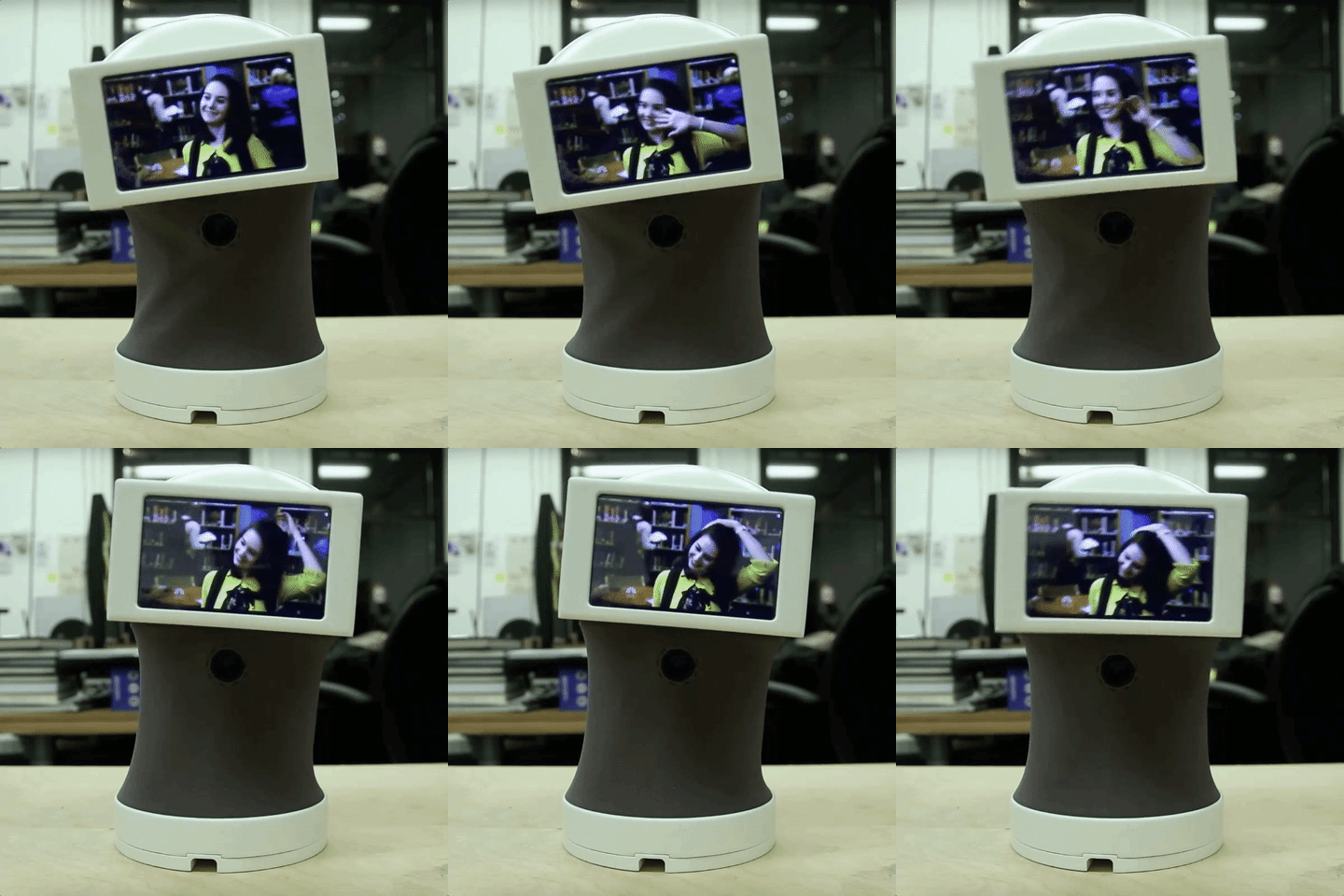
Peeqo is a conversational UI that answers only in GIFs. For those who know me, it’s essentially the physical version of 90% of my text messages with friends and colleagues.

I’m sure that future historians will look back on 2016 (if they dare acknowledge its presence) as the year we returned to imagery as our main form of social interaction. Once upon a time, we communicated stories and emotions via drawings on cave walls and hieroglyphs etched into stone. Throw in a few thousand years of language evolution, and we’re right back to where we started, albeit with a few added frames of movement.

So whether you pronounce it GIF with a ‘Guh’ or GIF with a ‘Juh’, you’re sure to have come across one in your everyday life. After all, they make for a much better visual response than the boring old word format we’ve grown accustomed to.

So it’s no surprise that when programmer and developer Abhishek Singh introduced Reddit to Peeqo, he managed to pique-o* our GIF interest right away.

Peeqo was Singh’s thesis project at the New York University Tisch School of the Arts. It was his attempt to merge the three things he loves: making things by hand, animated movies, and the GIF.

Some of you may be aware of Slack, a team messaging system used by businesses, groups, and charities (*ahem*) across the globe. One of Slack’s many features is the ability to pull GIFs from the popular GIF database GIPHY and display them in response to text conversation. Peeqo uses this same premise, searching keywords on the site to pull the correct response to your verbal communication with the bot.

(It’s a great lesson in making sure you use correct keywords when saving images to the web for public use, as some of the responses don’t always fit the mood. An example, which I will leave you to find, would be a specific Team America GIF that Liz has banned me from using in the Comms Team channel.)

Peeqo sits on your desk and uses the Google Speech API to detect the use of the wake word ‘Peeqo’ via one of four microphones, then it uses api.ai to search GIPHY for the correct response to your query. All of this runs with a Raspberry Pi at its heart, while two Arduinos work to control the LED notification ring atop its head and the servo motor that dictates the body’s movement. Peeqo also acts as a great bridge into home automation, controlling lights and other smart devices in your home or office, along with acting as a media player and new best friend work-based assistant.

I won’t go into the technical details of the build, but if you’re interested, an almost fully GIF-powered walkthrough of Peeqo is available here.

As is the case with so many of you lovely makers out there, Singh aims to make the entire project open-source; you can sign up for a notification as to when this will happen here.

Until then, here’s Abhishek explaining his project in more detail.

Abhishek Singh – PEEQO – YOUR DELIGHTFUL ROBOT ASSISTANT

Peeqo is a personal desktop robotic assistant who expresses himself through GIFs. Designed for people who spend long hours at their desks, this pint sized robot helps with essential work tasks and provides little moments of delight and entertainment often needed to get through the day. https://itp.nyu.edu/thesis2016/project/abhishek-singh http://peeqo.com


*Pique-o? Oh wow. Wow. I’m sorry. I’m so sorry. I’ll get my coat.


The post Peeqo – The GIF Bot appeared first on Raspberry Pi.

09 Dec 20:48

Most Popular This Week

by WC Staff
09 Dec 20:48

Inner Vision for the Weekend of December 9, 2016

by Gregory Han

Inner Vision is a weekly digest connecting the dots between great everyday objects and the cultures and techniques behind living well with them. Here, we move beyond recommendations and ratings, because just as important as knowing what to buy is knowing what’s possible using the products you’ve purchased.

09 Dec 20:48

The Death Of Sweet Mister

This novel shares a lot with Winter’s Bone: the same Ozark terrain, the same hardscrabble existence, the same concern with an absent father. Yet Winter’s Bone is wonderfully taut while this slender novel seems about as flabby as its thirteen-year-old narrator. In the end, this unsympathetic boy’s life revolves around the stellar, erotic figure of his dissolute mother, but the mother is the character we don’t see from the boy’s perspective. From the wrong angle, all love is love gone wrong.

09 Dec 20:48

Cycling Safety and London Leads with one simple change

by Sandy James Planner

1332

This article in The Guardian is important because it underscores how a  careful review of data can make profound changes in cycling safety. In London England over 50 per cent of all cycling mortalities and over 20 per cent of all pedestrian deaths result from trucks with poor sightlines/visibility from the truck cab.

Road safety campaigners have long called for action against some types of heavy goods vehicles (HGVs), especially high-wheeled construction lorries, which have significant blindspots.”

The Mayor of London will be developing a “five star-based safety rating” for these trucks based upon the vision clearance the operator has from the truck cab. Those that have obstructed vision (mainly construction trucks ) will be banned, with trucks with a three star ranking or more allowed to drive within the city.

Here is the heart-breaking statistic from  the Mayor of London’s office: in the last three years the 35,000 trucks operating with severely limited visibility from the cab were responsible for 70 per cent of the cyclist deaths.  Similar to the pedestrian shaming campaigns that tell pedestrians to wear bright colours to avoid being crashed into, the advice for cyclists was to not cycle near the sides of trucks. But trucks often overtake cyclists, and then don’t have sight lines from the driver’s cab to see a cyclist when turning a corner.

The move was welcomed by the London Cycling Campaign. “Pedestrians, cyclists and drivers and operators of HGVs all stand to gain if modern designs with minimal blindspots become the norm for on-street use – no one wants fatalities and life-changing injuries to continue to happen,” said Tom Bogdanowicz, its senior policy manager.

There is of course pushback from the trucking association regarding the restricted use of trucks with limited visibility. In the Vision Zero world of road safety, the impact of restricting these vehicles from causing further mortalities is priceless. Lets hope other cycling cities follow London’s lead.

lorry-bike-lane_2742654b


09 Dec 20:48

Radical Technologies: The Design of Everyday Life, now available for pre-order

by AG

The other night I selected-all in a file on Google Docs and turned the entire text bright red. This was my signal to my editor Leo that I’d made the final round of edits on the last outstanding chapter I owed him. And this, in turn, means that after eight years and eleven months, I’m finally done with the project I started in this blog post. I’ve finished my book.

It is, in too many ways to count, a different book from the one I set out to write. I owe most of this to Leo, actually. Do you know the scene in Inception where Joseph Gordon-Levitt and Tom Hardy, as intruders in the virtual world of another man’s mind, are under assault by the ghostly brigades of their subject’s “militarized subconscious”? Gordon-Levitt’s character is standing at the door of a warehouse, plinking away ineffectually at the encroaching horde with an assault rifle, when Hardy shoulders him aside. With the words, “You mustn’t be afraid to dream a little bigger, darling,” he hoists a massive South African grenade launcher, lobs a round onto the opposite rooftop, and blows things up reeeeal good.

That was Leo. I came to him with a book about cities and technology — a book that had been dangling out in public for six years at that point, a book I’d already published a quarter of — and two chapters into our work on it, he pulled a Hardy on me, in the biggest possible way. “I don’t think you’re writing a book about cities anymore,” he told me, over stand-up espressos beneath the awning of the Algerian Coffee Stores, as drizzle dampened the greasy Soho asphalt. “I think you’re writing a book about Everyday Life.”

I could hear the capital letters, and knew immediately (as my bowels turned to ice) that he was invoking the whole tradition of thought that starts in Michel de Certeau and Henri Lefebvre. Which is to say that he wasn’t simply asking me to paint on a bigger canvas, though he was definitely doing that. He was demanding that I take myself and my work seriously, and understand that what I was writing might someday find its place on a shelf alongside people who had actually contributed to Western thought and culture. (In Lefebvre’s case, rather explosively, given his influence on the events of May ’68.)

It put the zap on my head so hard that I didn’t get any further work done on the book for a good six months.

I don’t know what it’s like for you. I won’t presume to say I understand anyone else’s interiority, or process, or approach to their work. I imagine that there are some creators who are safely armored by a transcendent belief in their own talent, who glide through pitches and contracts and reviews lubricated by a sense of inevitability and rightness. I’m not one of those people.

So in a way, what Leo did to me was cruel. But it also led directly to a change of title, a change of scope, and a much bigger and more ambitious book. What had started out as a rather constrained proposition turned into a sprawling survey of some of the major ways in which networked information technologies shape the choices arrayed before us. I should be clear that it probably misses as much as it gets right; I have a sustained history of focusing too much on the wrong aspects of a technology, or at least not the aspects that turn out to be most salient to our understanding of it, and I’m not sure it’s any different here.

I’m also a little gutted to have written a book that’s so obviously and prominently about information technology. As I’d originally envisioned it, this was supposed to be a decisive pivot away from all of that, and toward the thing I care more deeply about, which is the life of cities. But as Nurri always reminds me, there are any number of writers in the world who have deeper or more original insight into cities. It just isn’t what people seem to want from me. After awhile, if you’re smart, you listen to what the world tells you about what it wants from you, with intense gratitude that it appears to want anything at all.

So: Radical Technologies: The Design of Everyday Life, now available for pre-order.

In its ten chapters, I take up some of the recent and emerging technical developments that now condition the way we experience the everyday, just about everywhere on Earth. I start with the smartphone, ready-to-hand as it is, and continue on to augmented reality; the so-called internet of things; 3D printing, CNC milling and other digital fabrication technologies; cryptocurrency and the technology underlying it, the blockchain; and finally the constellation of practices and ideas that is dedicated to the eclipse of human discretion, and includes machine learning, the automation of work and artificial intelligence. I spend some time considering the ways in which these discrete techniques are brought together in particular ensembles and commercial value propositions — and by whom, and particularly toward what ends — and finish up by asking if there’s a space for tactics or even resistance available to us in any of this. All in all, I think it’s turned out rather well.

Most writers say something along these lines, but it’s really true and I really do mean it: though I take full responsibility for whatever infelicities and misapprehensions remain, just about all the good in this book arises from the conversations I’ve had with you. It’s not — and I’m not — Lefebvre, but that’s OK. It’s not half-bad. I don’t think I’ll ever stop being grateful.

I’m rather fond of the title, by the way. It’s ambitious, a title to conjure with. It has a certain amount of what the Rastafarians used to call Dread. I don’t know if the book I’ve written really deserves a title like that, but I guess you’ll let me know, won’t you?

Thanks to those of you who came along for the ride — especially those who’ve stuck with me all the way from that first blog post, when I was promising you a self-published book called The City Is Here For You To Use, and it was 90% a reaction to the incompetence of my first publisher. Thanks doubly to the 859 of you (!) who ponied up to pre-order that book, most of you in the weeks immediately following the project’s announcement, and who had to wait until the last quarter of 2013 to get your hands on anything resembling the thing you’d ordered. Thanks, eternal thanks, to Leo Hollis, for kicking out the jams. And thanks always to Nurri for sticking with me through all the chicanes and blind alleys of this endless, endless project. Let’s see what happens now.

09 Dec 20:48

Friday Funny — Inspired Lunacy

by Ken Ohrn

Then check out this video, which I chose especially for snow-bound residents of Vancouver.  The human spirit of inspired lunacy at its best.

It makes me want to rush outside and throw a snowball at someone.


09 Dec 20:48

City-Building, and Health

by Ken Ohrn

This article from the Lancet discusses the link between cities, city planning, and population health.  Nothing is really new here, with a focus on density, public transportation and active transportation.  This reflects thinking from UBC’s School of Population and Public Health, plus City of Vancouver’s active transportation policies.  But it’s a powerful voice from another part of the world.

The Lancet’s authors are re-thinking disease prevention, and in the first of a three-part series, conclude this:

A key part of the solution is city planning that reduces non-communicable diseases and road trauma while also managing rapid urbanisation.

This Series of papers considers the health impacts of city planning through transport mode choices. In this, the first paper, we identify eight integrated regional and local interventions that, when combined, encourage walking, cycling, and public transport use, while reducing private motor vehicle use. These interventions are

  • Destination accessibility
  • Equitable distribution of employment across cities
  • Managing demand by reducing the availability and increasing the cost of parking
  • Designing pedestrian-friendly and cycling-friendly movement networks
  • Achieving optimum levels of residential density
  • Reducing distance to public transport
  • Enhancing the desirability of active travel modes (eg, creating safe attractive neighbourhoods and safe, affordable, and convenient public transport).

New Point Grey

. . . .  Designing pedestrian-friendly and cycling-friendly cities will help to reduce inequities and produce co-benefits across multiple sectors, including health, traffic management, environment (mobility, air quality, energy, water, and climate change), and the economy. Better planned and designed cities will help to build communities by decreasing commute and mandatory travel times away from one’s neighbourhood.

City planning is therefore an essential element of a multilevel, multisector response to face the major global health challenges of the 21st century. Appropriate legal, administrative, and technical urban planning and design frameworks are urgently needed to create more compact cities that facilitate active travel modes to promote health and lower greenhouse gas emissions.

Active transportation has been identified as a key personal choice that helps reduce the incidence of several common chronic conditions, such as coronary heart disease, type 2 diabetes, colon cancer, and breast cancer, as well as reducing life expectancy.

active-transport

In the light of recent discussions, I am pleased to see that “road trauma” (people maimed and killed by cars, then blamed, followed by laughable penalties for death-dealing motor-vehicle operators) is also in the sights of the Lancet’s authors. Perhaps this paper helps start the wider conversation about Canada’s car culture, and how it seems so at odds with life, health and safety.  But I’m not expecting much to change.

To quote the Lancet article:

The health burden of motor vehicle-related injuries continues to disproportionately affect active transport users (as discussed in this Series) and those without access to a vehicle, including poor, young, and older people. Concerns about traffic and road safety are a major deterrent to parents permitting children to use active travel modes. In high-income countries, such as the USA and Australia, many city streets have become child-free zones, with rapid declines in the number of children using active transport modes to travel to and from school and around their neighbourhoods.

In several countries (eg, Germany, France, The Netherlands, and Sweden), injury and fatality rates for active transport users have been reduced by more than 70% (from 1975 to 2001).  These countries have implemented new laws of strict liability, where vulnerable road users (not drivers) are assumed to be innocent. These countries have also lowered speed limits in towns and cities to 30 km/h; introduced high-quality transport systems; introduced demand management strategies, including reduced car parking; devised protective road designs that reduce conflicts between pedestrians, cyclists, and drivers; and improved traffic signals. These practices could be trialed elsewhere to reduce the global burden of road injury while also increasing the demand for active travel and reducing NCD risks.


09 Dec 20:42

Hack Education Weekly News

Presidential-Elect Donald Trump


Trump Education Secretary Pick Has Indirect Stake in Student Lender,” The Wall Street Journal reports. That’s Betsy DeVos, of course, and Social Finance a.k.a. SoFi.

Via Politico: “Trump‘s education pick says reform can ’advance God’s Kingdom’.”

Via NPR: “Trump’s Pick For Education: A Free Market Approach To School Choice.”

Via OpenSecrets.org: “Betsy DeVos and her big-giving relatives: Family qualifies as GOP royalty.”

Via The Chronicle of Higher Education: “Dreamers in Jeopardy.” Trump for his part says he’ll “work something out” for them. Mmmm, I bet he will.

This Q&A with the free market fans at Reason and an attorney who represents students accused of sexual assault is, no surprise, truly awful: “Will President Trump Fire the College Sex Police.”

Via Inside Higher Ed: “How Sessions Tried to Block Gay University Event.” That’s Jeff Sessions, Trump’s pick for Attorney General who tried in 1996 to prevent the Southeastern Lesbian, Gay, Bisexual College Conference from holding its conference at the University of Alabama.

More on Trump University in the for-profit section below.

Education Politics


“Obama Administration Mistakes Threaten Student Loan Relief Programs,” Buzzfeed reports.

Via The Chronicle of Higher Education: “Rep. Virginia A. Foxx, a North Carolina Republican who just won election to her seventh term in Congress, was named on Friday as the new chairwoman of the House Committee on Education and the Workforce, the main policy-making panel for higher education in the chamber.”

Via Inside Higher Ed: “Chinese President Xi Jinping called for strengthening ideological and political education in universities and charged Communist Party of China officials with prioritizing their work in this area, according to an account of a speech he gave at a two-day meeting on ‘ideological and political work in China’s universities and colleges’ published in the state-run media outlet Xinhua.”

Via ProPublica: “New Jersey Will No Longer Collect Loans From Families of Dead Students.”

Via The Hechinger Report: “Mississippi defies national trend; decreases scrutiny of early child care quality.”

In a move that should surprise no one, Jeb Bush has joined a lobbying firm.

Via Inside Higher Ed: “Congresswoman Jackie Speier, a California Democrat, introduced a bill Thursday that would require academic transcripts to show that a student has violated campus policies involving sexual violence.”

Via EdSource: “The big burden of charter school oversight.”

“Republican Gov. Bruce Rauner‘s veto of a bill that would have eased Chicago Public Schools’ massive pension burden threatened to blow a $215 million hole into a budget that has been criticized by bankers and civic groups for its reliance on uncertain state assistance,” Governing reports.

Via Inside Higher Ed: “The number of complaints filed last year with the U.S. Department of Education’s Office for Civil Rights soared to a record 16,720, according to a report the department released Thursday. The number of complaints was a 61 percent increase over the previous year’s total.”

Education in the Courts


Via The New York Times: “In the latest episode over the proliferation of fake news and the people who believe it, a Tampa woman who thinks the Sandy Hook school massacre in Newtown, Conn., was staged has been charged with threatening a parent of one of the slain children.”

Via The New Yorker: “Gavin Grimm’s Transgender-Rights Case and the Problem with Informal Executive Action.”

Via The Washington Post: “Rolling Stone asks judge to overrule jury in U-Va. defamation case.”

Via Chalkbeat: “Colorado Supreme Court weighs challenge to law governing job protections for teachers.”

Via The New York Times: “Campus Press vs. Colleges: Kentucky Suit Highlights Free-Speech Fight.”

More on court cases in the for-profit higher education and the accreditation sections below.

Testing, Testing…


It’s time once again for one of my least favorite events in education journalism: the release of PISA scores. “The 2015 PISA Results: What Do They Mean?” asks Education Week. “U.S. now ranks near the bottom among 35 industrialized nations in math,” The Hechinger Report frets. Via the same publication: “Why America should care about its students’ lackluster performance on the global PISA tests.” “How Do American Students Compare to Their International Peers?” asks The Atlantic. “U.S. Schools May Not Have Quite the ‘Math Problem’ We Think They Do,” says Pacific Standard. Learning theorist Roger Schank says “OECD should be ashamed; PISA scores announced; doing more damage.” Education professor Yong Zhao has several blog posts on the results of PISA and TIMSS and what we can (and can’t) learn from them.

Via NJ Spotlight: “Few Class of 2016 Graduates Manage to Pass PARCC Tests.” That’s 1 in 10 students in New Jersey, to be clear. In four years time, the test will be required in order to graduate high school in the state.

Via Education Week: “The Iowa Department of Education is disputing $1.6 million in charges from a Minnesota company over a software system that repeatedly failed during mandatory statewide elementary school testing.”

Via the Pittsburgh Post-Gazette: “Former Pitt student, key figure in Chinese-U.S. college testing scam, to be deported.”

Online Education and The Once and Future “MOOC”


Deakin University in Australia will next year offer graduate degrees and certificate programs through FutureLearn, the online learning platform owned by the Open University in the U.K.,” Inside Higher Ed reports.

Via Mindwire Consulting’s Phil Hill: “UT Austin and SMOCs: What these synchronous courses look like and cost.”

Via Edsurge: “Online Learning Consortium Releases New Scorecards to Evaluate Digital Classes.”

Coursera Monthly Subscriptions Channel Lynda and Pluralsight,” says EduKwest’s Kirsten Winkler.

Coding Bootcamps and the Once and Future “For-Profit Higher Ed”


Via Bloomberg: “Want a Job in Silicon Valley? Keep Away From Coding Schools.”

Via Inside Higher Ed: “After months of review, the U.S. Department of Education on Wednesday approved the proposed $1.14 billion sale of Apollo Education Group, which owns the University of Phoenix, to a group of three private equity firms.” The sale comes with conditions, including: 1) the Department of Education demands a letter of credit valued at 25% of the company’s federal funding allocation; 2) the company cannot add or change its educational offerings or open new locations until 2018; and 3) enrollment must be maintained at or beneath current levels. More via The Chronicle of Higher Education and via Bloomberg.

The Department of Education will deny federal financial aid to the for-profit Globe University and the Minnesota School of Business.

Via NPR: “What Former Employees Say ITT Tech Did To Scam Its Students.”

Via The Washington Post: “For-profit college students make a last-ditch attempt at faster debt relief.”

Rebecca Schuman explains “Why For-Profit Colleges Are Undaunted by the Trump University Case.”

Via NBC News: “Student Sues Walden University: ‘I Wasted Six Years of My Life’.”

More on court battles over accreditation of for-profits in the accreditation section below.

Meanwhile on Campus


Harvard will not designate itself a “sanctuary campus.” The University of Illinois will not designate itself one either.

UNLV Instructor Apologizes for Saying He Would Report Undocumented Students,” The Chronicle of Higher Education reports.

No more tenure in the University of Wisconsin system. “University of Wisconsin system regents on Thursday approved a new policy mandating that administrators conduct “independent, substantive reviews” of tenured faculty members every five years,” The Chronicle of Higher Education reports.

Via The Guardian: “ To Kill a Mockingbird removed from Virginia schools for racist language.”

Inside Higher Ed profiles the MasterCard Foundation, “an $828 Million Private Scholarship Program.”

White nationalism: coming soon to a campus near you. Via The Daily Dot: “University Wi-Fi named racist slur during white nationalist event.”

Via Inside Higher Ed: “The faculty union at Rutgers University on Friday escalated its criticism of how the university is handling faculty members’ communication, urging its members to opt of the university’s new email system or risk compromising their academic freedom.”

“Should children get to have cellphones in elementary school?” asks The Washington Post.

Via Inside Higher Ed: “The ‘Computerless’ Computer Lab.”

Via BoingBoing: “University student gets a zero because her art project violated dress code.” The student in question attends BYU.

A graduate student has been arrested for allegedly stabbing and killing USC professor Bosco Tjan.

Accreditation and Certification


Via Inside Higher Ed: “The U.S. Chamber of Commerce filed an amicus brief in the D.C. Court of Appeals this week arguing that the Consumer Financial Protection Bureau doesn’t have the authority to investigate college accreditors.” The CFPB has been blocked by a DC District Court ruling from investigating the ACICS, the accreditor for many for-profit colleges.

“A regional accreditor has placed Baylor University on warning and the University of Louisville on probation for 12 months,” The Chronicle of Higher Education reports.

Go, School Sports Team!


There’s more news about Baylor University and the fallout from its sexual assault scandal in the accreditation section above.

From the HR Department


Via The Verge: “Yik Yak lays off 60 percent of employees as growth collapses.” Not sure how anyone thought that an anonymous messaging app for college campuses was a good idea, let alone a money-making one. But it has raised $73.5 million in VC funding.

“Contract negotiations between Long Island University and its faculty union are again stalled, just three months after the parties came to a temporary agreement that ended a 12-day faculty lockout,” Inside Higher Ed reports.

Via The Chronicle of Higher Education: “Executive Compensation at Private and Public Colleges.”

Via the AP: “Private university graduate students begin unionization vote.”

Teacher Hiring Poised to Rise After Years in the Doldrums,” according to EdWeek’s Market Brief. Edsource has a slightly different take on the problem: “As charter schools grow, they face challenge of hiring amid a teacher shortage.”

This Week in Betteridge’s Law of Headlines


Via the Udacity blog: “Will Artificial Intelligence Destroy Our Jobs, or Empower Us to Unfold Our True Creative Powers?”

(Reminder: according to Betteridge’s Law of Headlines, “Any headline that ends in a question mark can be answered by the word no.”)

Upgrades and Downgrades


Reuters continues its investigative series on various education (technology) scandals. The latest looks at New Oriental Education Group and college admissions fraud.

Via Edsurge: “The Edtech World is a ‘Swamp of Gimmicks’ – and Here’s How We Can Drain It.” Factoid: did you know that “drain the swamp” was a phrase invoked and a plan devised by Mussolini?

Also via Edsurge: “Meet Intel Education Accelerator’s Newest Cohort of Edtech Visionaries.”

ClassDojo Is Teaching Kids Empathy In 90% Of K–8 Schools Nationwide,” says Fast Company. It’s apparently teaching empathy with five-minute animated videos. Good luck with that.

It’s CS Week, featuring an Hour of Code and a lot of branded content and PR opportunities. “ Computer science education expands with new AP courses,” says Education Dive, arguing that schools should do more than just an “Hour of Code” – they should enrich the College Board. EdWeek’s Market Brief reports that “Tech Giant Oracle Makes Billion-Dollar Pledge for Coding Education in Europe.”

Pay attention to student loan companies! “USA Funds, which has played a growing role in education philanthropy and investing in the last few years, announced on Wednesday that it would shed its loan-guarantee affiliates,” The Chronicle of Higher Education reports.

Here’s another trend to watch: how jail tech and ed-tech will merge. Via NPR: “Video Calls Replace In-Person Visits In Some Jails.”

“What If We Stopped Calling Them Classrooms?” asks Edsurge. Whoa. What if.

From Mike Caulfield, the American Democracy Project’s first “civic fellow”: “Announcing the Digital Polarization Initiative, an Open Pedagogy Project.” Among the things the initiative will research: “The impact of algorithmic filters and user behavior on what we see in platforms such as Twitter and Facebook, which tend to limit our exposure to opinions and lifestyles different than our own.”

Artificial Intelligence Could Help Colleges Better Plan What Courses They Should Offer,” says Edsurge. More promoting the wonders of AI in this Edsurge story: “A Siri for Higher Ed Aims to Boost Student Engagement.”

Funding and Acquisitions (The Business of Ed-Tech)


IOT e-toy maker Osmo has raised $24 million from Mattel, Houghton Mifflin Harcourt, Collab+Sesame, Accel Partners, Upfront Ventures, and K9 Ventures. The company has raised $38.5 million total.

Peergrade has raised $300,000 from Emerge Education and Nordic Makers.

VoLT, a vocabulary app, has raised an undisclosed amount of funding from YMS Mobitech.

PowerSchool will buy SunGuard K–12.

The Waterford Institute will acquire now defunct Curriculet.

Data, Privacy, and Surveillance


“Talking Dolls May Spread Children’s Secrets, Privacy Groups Allege,” The Wall Street Journal reports. Buzzfeed has more on the FTC complaint filed over the My Friend Cayla doll and the I-Que robot: these toys “collect personal information from children and send it to a software company that contracts with military and intelligence agencies.”

“So-So Social Media Privacy? State Legislators Should Reject New Model Bill and Stick With ACLU’s Gold Standard,” says the ACLU. The model bill in question has been drafted by the Uniform Law Commission (ULC), an association of lawyers, and the ACLU has several concerns about who and how it would protect.

Via The Guardian: “Facebook, Twitter, Google and Microsoft team up to tackle extremist content.”

The companies are to create a shared database of unique digital fingerprints – known as “hashes” – for images and videos that promote terrorism. This could include recruitment videos or violent terrorist imagery or memes. When one company identifies and removes such a piece of content, the others will be able to use the hash to identify and remove the same piece of content from their own network.

Via the BBC: “French privacy row over mass ID database.”

More on surveillance in the campus section above.

Data and “Research”


Common Sense Media surveyed parents on their own digital media habits. “On any given day, parents of American tweens and teens average more than nine hours with screen media each day.”

Corporate-backed “privacy” organization, the Future of Privacy Forum, has released its latest survey on what “public school parents actually know and want concerning the use of technology and collection of data in their children’s schools, as well as their perspectives on the benefits and risks of student data use within the educational system.”

“Does Your State Provide Good Data On Your Schools? Probably Not,” says NPR.

Via The Hechinger Report: “Touted as the next big solution, competency ed programs that stress skills aren’t always a ‘quick and easy moneymaker,’ study finds.”

Via Pacific Standard: “Which States Have More School Shootings, and Why?”

“A Population in Flux Forces Colleges to Adapt,” says The Chronicle of Higher Education, drawing on a recent report on shifting demographics from WICHE.

Via Bryan Alexander: “New findings on income inequality, and there’s very little good news.”

Via Bloomberg: “Rich-Poor Achievement Gap Is Narrowing in American Education.”

Data from the Survey of Earned Doctorates: “American universities awarded a record number of doctorates in 2015 – although the rate of growth in the number of Ph.D. recipients continued a several-year decline. And the 55,006 recipients were more likely to be men and to be American citizens or permanent residents than they were the year before.”

“After falling, college graduation rates begin to rebound,” The Hechinger Report reports.

“For College Students With Kids, Getting Cheap Child Care Is A Challenge,” NPR reports, drawing on a study from Child Care Aware of America.

The Wall Street Journal ranks schools and finds “Midwest Colleges Rated Highest by Students for Career Preparation.”

Edsurge has released the final article in its AT&T-funded research report on “the state of ed-tech.”

“Is Ed-Tech research nearing its ’Big Tobacco’ moment?” ask Neil Selwyn, Thomas Hillman, and Jonas Linderoth.

Icon credits: The Noun Project