
Into oblivion.
Ironically, the Pebble was one of the first modern IoT devices – in the sense that once their cloud servers are gone, managing your Pebble will be nigh on impossible without something like Gadgetbridge.
Into oblivion.
Ironically, the Pebble was one of the first modern IoT devices – in the sense that once their cloud servers are gone, managing your Pebble will be nigh on impossible without something like Gadgetbridge.

Ahmed Bouchboua, Rabah Ouremchi, Mohammed El Ghazi,
International Journal of Emerging Technologies in Learning (IJET),
Dec 11, 2016
This is a pretty good paper, though readers will no doubt find significant flaws. The authors propose an architecture for a CleverUniversity learning management system based on modeling and then matching resources across three sets of models: the domain model, which classifies and orders the subject of enquiry; the learner's model, which classifies learning styles, and the pedagogic model, which proposes a set of teaching frameworks. Now none of these models is without problems (I have argued in the past that the model is just the wrong sort of approach for this sort of work). But surely the mapping across these three dimensions isn't flawed, not even (and perhaps especially not) for informal and self-directed learning. By the same authors see also this article on learning styles and this article on learner models.
[Link] [Comment]Dave Gershgorn, writing for Quartz, published the details of an invitation-only lunch at the NIPS 2016 conference, where Apple's newly appointed director of AI research, Russ Salakhutdinov, elaborated on the state of AI and machine learning at Apple.
There are lots of interesting tidbits on what Apple is doing, but this part about image processing and GPUs caught my attention:
A bragging point for Apple was the efficiency of its algorithms on graphics processing units, or GPUs, the hardware commonly used in servers to speed processing in deep learning. One slide claimed that Apple’s image recognition algorithm could process twice as many photos per second as Google’s (pdf), or 3,000 images per second versus Google’s 1,500 per second, using roughly one third of the GPUs. The comparison was made against algorithms running on Amazon Web Services, a standard in cloud computing.
While other companies are beginning to rely on specialty chips to speed their AI efforts, like Google’s Tensor Processing Unit and Microsoft’s FPGAs, it’s interesting to note that Apple is relying on standard GPUs. It’s not known, however, whether the company builds its own, custom GPUs to match its custom consumer hardware, or buys from a larger manufacturer like Nvidia, which sells to so many internet companies it has been described as “selling shovels to the machine learning gold rush.”
In my review of iOS 10, I wondered4 how Apple was training its image recognition feature in the Photos app, citing the popular ImageNet database as a possible candidate. We have an answer to that today:
The images Apple uses to train its neural network on how to recognize images also seems to be proprietary, and is nearly twice the size of the standard ImageNet database.
According to Salakhutdinov, Apple will also be more open about their research and they will actively participate in the academic community.
→ Source: qz.com
Robert Scoble and Shel Israel just published The Fourth Transformation: How Augmented Reality and Artificial Intelligence Change Everything. It’s an indispensable guide to the future, and a gripping read. Get yourself a copy. This is not an unbiased review. While Scoble and Israel wrote this book and are responsible for the content, I edited it. … Continued
The post The Fourth Transformation is your VR wake-up call appeared first on without bullshit.

Sue Halpern writes insightfully about technology for the New York Review of Books. Below are a few excerpts from an essay/review of Driverless: Intelligent Cars and the Road Ahead, by Hod Lipson and Melba Kurman, MIT Press, 312 pp., $29.95.
The article is ‘locked’ – for subscribers only. The quotes below are, I hope, within the realm of “fair use.”
For generations of Americans especially, and young Americans even more, driving and the open road promised a kind of freedom: the ability to light out for the territory, even if the territory was only the mall one town over. Autonomous vehicles also come with the promise of freedom, the freedom of getting places without having to pay attention to the open (or, more likely, clogged) road, and with it, the freedom to sleep, work, read e-mail, text, play, have sex, drink a beer, watch a movie, or do nothing at all. In the words of the Morgan Stanley analysts, whose enthusiasm is matched by advocates in Silicon Valley and cheerleaders in Detroit, driverless vehicles will deliver us to a “utopian society.”
That utopia looks something like this: fleets of autonomous vehicles—call them taxi bots—owned by companies like Uber and Google, able to be deployed on demand, that will eliminate, for the most part, the need for private car ownership. (Currently, most privately owned cars sit idle for most of the day, simply taking up space and depreciating in value.) Fewer privately owned vehicles will result in fewer cars on the road overall. With fewer cars will come fewer traffic jams and fewer accidents. Fewer accidents will enable cars to be made from lighter materials, saving on fuel. They will be smaller, too, since cars will no longer need to be armored against one another.
With less private car ownership, individuals will be freed of car payments, fuel and maintenance costs, and insurance premiums. Riders will have more disposable income and less debt. The built environment will improve as well, as road signs are eliminated—smart cars always know where they are and where they are going—and parking spaces, having become obsolete, are converted into green spaces. And if this weren’t utopian enough, the Morgan Stanley analysts estimate that switching to full vehicle autonomy will save the United States economy alone $1.3 trillion a year.
She goes on to describe the technical challenges, such as, what will a car’s “perception” be and how it will be programmed to deal with various life and death situations? She asks: “Will members of car-sharing services have to waive their right to sue if a fleet car gets in an accident? And how will blame be assessed? Was the accident the fault of software that didn’t accurately read the road, or the municipality that didn’t maintain the road? Tort law is likely to be as challenged by the advent of self-driving cars as the automobile industry itself.”
Looking more broadly at the societal issues, she notes: “It does not take a sophisticated algorithm to figure out that the winners in the decades ahead are going to be those who own the robots, for they will have vanquished labor with their capital. In the case of autonomous vehicles, a few companies are now poised to control a necessary public good, the transportation of people to and from work, school, shopping, recreation, and other vital activities.” And, “lawmakers in this country are now using the autonomous vehicle future laid out by companies like Uber and Google to block investment in mass transit.”
What of all the people who will end up on the dole – all the drivers of trucks and taxis, supporting themselves and their families, clawing their way toward a decent standard of living?
Getting into the realm of the creepy, she imagines a scenario of “Google offering rides for free as long as passengers are willing to “share” the details of where they are going, what they are buying, who they are with, and which products their eyes are drawn to on the ubiquitous (but targeted!) ads that are playing in the car’s cabin.”
I was pondering all this as I watched a UPS driver deliver a package to the house next door and imagined a driverless delivery vehicle doing this job. There was nowhere to park on the block, but he managed to double-park on the corner, make his way back to the house, negotiate its latched front gate and pacify the dog, climb the stairs and chat with the customer. Will neighbourhoods have to be redesigned to accommodate robots, or will a human ride along, maybe watching videos or updating his Facebook page, in order to make the delivery itself? There’s a job for you!
Will there ever be a time where a techno-revolution such as this will be banned for not being in the public good?


Photo of a tempting truck ramp in the Wellesley bike lane by Jake Tobin Garrett.
You're Not Allowed To Park There You Know?
A new planner's perspective on parking in the bike lanes
With more bike lanes we're seeing more cars parking in them. New Torontonian David Tran has used his skills as a planner to better understand the relationship between where, when and why people think they can park wherever they like.
dandyhorse caught up with him to ask how street design can help battle the plague of parking in the bike lane we have in Toronto.
I recently moved to Toronto from Kingston to work in urban design and data analysis. I'm particularly interested in studying public policy and how it impacts the way we exist in cities. With the use of available data, my aim is to help the public make more informed decisions in planning especially when it comes to walking, cycling and public transit.
Full disclosure: I don’t own a bicycle yet, and instead I use Bike Share from time to time since I recently move here to Toronto. I mostly use the TTC to get around since the destinations I need to get to can be far. I plan on cycling more in the new year.
A previous project I worked on was the Sydenham Street Revived in Kingston, which tried to better understand the relationship between cars and pedestrians in a dense area of the city. I currently don't have access to a team of planners and volunteers to do qualitative and quantitative studies -- so to better understand my new city I decided to do a little study of my own.
Traffic congestion in Toronto is problematic, like many other cities, and with the rapid population growth, the city will need to encourage people to use other means of transportation including cycling. Safety and the perception of safety for cycling is very important. One of the issues that is most commonly raised is how dedicated cycling lanes are often obstructed by vehicles. This is dangerous for cyclists and drivers alike.
Although it's easy to blame oblivious drivers, the real culprit is often bad street design. To better understand this problem I analyzed the locations where people parked in the bike lane the most.
The City of Toronto has a portal with a list of available datasets open to the public, including parking tickets issued every year since 2008. For this data analysis, I used the most recent dataset, from 2015, and took a closer look at the different parking infraction codes. By simply filtering out the irrelevant infraction codes, I was able to reveal interesting information such as the location of these offences and to plot them on a map. You can check out a city-wide map here. It looks like this:

The three infraction codes relating to this analysis are:
Code 383: STOP NON-BICYCLE IN CYCLE TRCK
Code 384: STOP VEH OTR THN BCYCL-BYCL LN
Code 387: PARK PRO VEH ON BICYCLE PATH

A heatmap showing the distribution of parking tickets for infraction code 383, 384 and 387 based on the day of the week and hour.
I plotted the parking tickets from across the city and the intensity level is based on the frequency and distance of addresses.

A man parked in the Bay/Avenue bike lane during lunch hour. Photo by Tammy Thorne.
I wanted to take a closer look on why there was a high count of parking ticket on on particular street section. On my walk there I noticed two large vehicles on the cycling lanes with their flashers blinking.
Now this data relates to last year, when Gerrard Street had a slightly different street design. If you look at the Google Street View in 2015, there were just white lines on each side separating bicycles and vehicles. Now, the City has done a pretty good job in redesigning the street to be safer for all users. All the markings are clearer, the bicycle lanes are more visible (more bicycle stencils) and there is now a buffer separating the cycling lane and moving traffic. As for the more high profile bike lane project in Toronto - the Bloor bike lane - I have heard comments from both sides, but from a design point of view I think the City did a good job. The polls [bollards] and buffers are basic elements for a safe bicycle lane and I’m relieved that they incorporated them. It will be interesting to see the impact and results of this pilot project.
It will take some time for drivers to get accustomed to the new environment. It’s a question of educating people, and to developing new habits. People riding bikes need to beware of being doored by passengers, Most of the passengers will develop these [new] habits [like checking before they open the car door] as they experience more of this new setting. Perfection can never be expected in a pilot project such as the one on Bloor. Pilots serve as a great way to learn what works and what doesn’t and gives the city a chance to gradually perfect them.
But back to the Gerrard bike lane. As you can imagine, vehicles still block the cycling lanes even with the new design. But we don’t have this year’s data yet to compare with last year’s and see if the new design made a big difference. I suspect parking in the bike lane might be less of a problem now that the design is better, but it still persists.


Photos by Tammy Thorne. Same bike lane, same time, two different trucks.
What constitutes a good bike lane design? Do we need to remove on-street parking to make truly safe and secure bike lanes?
Generally speaking, we want bicycle lanes to be connected (strong network), safe and convenient (with enough bicycle parking). A logical and efficient way to plan this, is to consider the following:
1. Design segregated bicycle lanes on major roads that can connect different neighbourhoods such as Bloor St. AND through high-density residential/commercial areas such as the central core of our city. I view this as the spinal cord of our bicycle network where, just like the subway, it allows cyclist to quickly and safely move through (and to) different parts of the city.
2. We need our local streets to be safer for cyclists and pedestrians. One of the things that aggravates me the most, aside from traffic congestion, are self-entitled drivers speeding on local streets! Unfortunately, this happens quite regularly. There are many possible design interventions with the intention is to slow down cars. This will create a safer environment for cyclists.
Once you have these two elements laid out, you have a really good start.
So, to answer your question, removing on-street parking can be a double-edged sword. Yes, [those parking spots] can be replaced with a great bicycle lane, but they can also slow down car traffic, which is good if they’re isn’t a a bicycle lane.
I do believe it is safer when the cycling lanes are next to the sidewalk and have parked cars act as a protective barrier [from moving traffic.]
David Tran is new in town but you can follow him on twitter (@dave_tran) as well as check out his work on his website: http://www.urbananalysis.ca
Related Articles
Point/Counterpoint: On-street parking
How much does a bike lane cost?
City Cyclist at it again: Bike lanes on Bloor and on-street parking
The strong do what they will, the weak do what they must, and the manipulated do what they think they must (which is what the strong or weak will). Manipulation — influencing behavior by altering another’s viewpoint in a manner indifferent to whether or not the alterations are true or desirable — is one of the most important aspects of social conflict and competition. While you may not be interested in manipulation, manipulation is interested in you (though it may disguise this interest beneath layers of dissimulation). In this post I provide a selective overview of the theory and practice of manipulation. Why does this matter? Whether in geopolitics or at home, we must either understand and confront manipulation or be victimized by a Machiavellian Mini-Me.
To coerce is to forcibly impress upon the target that the objective “facts on the ground” make compliance rational. Do as I say or the gun goes bang bang. To manipulate is to do the opposite: change the target’s perceptions of facts on the ground such that the target believes compliance is rational even when it may not be the case. Given that strategic behavior concerns the fine art of using coercion to accomplish a goal in the face of some form of opposition, manipulation is difficult to reconcile with how we ordinarily think about conflict and competition.
All strategy involves asymmetry. By generating massive asymmetries in military-industrial production and logistics over the Axis, the World War II Allies were able to create and exploit a powerful advantage that the Axis could not. By analogy, if a con man is conning a sucker out of his hard-earned cash by abusing a position of trust, the ultimate asymmetry is in effect. He is scamming you, you do not know he is scamming you, and you are unwittingly participating in the scam operation! This is what makes the idea of manipulation as an alternative model of strategic behavior superficially attractive.
Suppose Alice would like to deceive Bob such that she can achieve strategic surprise in some operation she is planning. Elements of the scenario include:
In order for Alice’s deception attempt to succeed, Alice must “hide the real” (conceal what she is doing) and “show the fake” (convince Bob that she is doing something that she really is not). In military and intelligence studies, the field of “denial and deception” (fittingly abbreviated D&D) deals with these dark arts in exhaustive detail. However, there is nothing specific to the military about D&D. Some of the foundational sources of knowledge about it come from sources as eclectic as card cheats, magicians, and animal and plant behavior observed in the wild.
But what if Alice is engaged in a far more ambitious maneuver than simply just deluding Bob as to what choice that she will make in a critical situation? Suppose Alice is looking to subvert an situation that marginally favors Bob. What can she do? It is here that we see that the line between creating asymmetries by altering perceptions vs. creating asymmetries by altering realities is rather blurry. Alice might use a combination of clever rhetoric and subtle agenda-shaping so that she is more likely to win in the long term than Bob is. But Alice can and likely will do far more unsavory things to win. Suppose Alice engages in dirty tricks, covert operations, etc.
Alice manufactures lies and fabrications that lessen Bob’s hold on power, spies on Bob and other relevant actors, and infiltrates Bob’s organization to make it less effective and cohesive. Or suppose Alice tries her hand at heightening the contradictions. Alice sets key components of Bob’s power structure against each other, spreads discord, encourages Bob’s opponents, or otherwise undermines Bob’s hold on power by accelerating existing flaws and dysfunctions that threaten Bob. Alice may also utilize divide and conquer strategies that exploit media and social media to accelerate inter-group and intra-group conflict (and thus further strengthen herself at the expense of Bob).
After this expansion of our original view of Alice, perhaps we can say that Alice is engaging in a kind of subset of strategic behavior: subversion and Machiavellian trickery. But there is still a problem with this redefinition. Alice is inducing Bob to act in a way that suits her interests and disadvantages Bob’s. Alice wants to exert Bob to overextend himself to match a key advantage she holds, unnecessarily isolate himself and maximize his own internal disorganization, and generally act in a way that harms himself and benefits her. But how? Suppose Bob fervently opposes Alice, distrusts her, and is already on the lookout for her manipulations. Why on Earth would Bob do anything that benefits such a bitter enemy that he already opposes, despises, and distrusts?
To make matters worse, Alice has a additional but far larger problem. A large number of other people must – seemingly spontaneously – act in a way that favors her interests (even if it harms theirs). And believe that they are doing so spontaneously and independently. In short, Alice needs Bob – and an enormous amount of related or unrelated third parties – to engage in behavior that weakens or subverts Bob and benefits Alice. Without Alice’s hand being obviously seen. This behavior must be done voluntarily, with the belief that it is being performed due to one’s own free will, and not the desire of some external puppetmaster. Alice must arrange a collection of these behaviors such that their interaction and runaway escalation produces a breakdown of the Bob-controlled establishment and dominant order. But how?
Broadly speaking, Alice ideally must first be sphinxlike in character to pull any of this off. She must foster ambiguity about what her ultimate goals are in order to have an advantage over those around her. This style of behavior is called “robust action” in sociology. For Alice to be an ideal manipulator, her actions must be interpretable from multiple perspectives at once, potentially function as moves in multiple games at once, and conceal her public and private motivations. This maintains her flexibility and discretion and thwarts attempts by rivals to narrow her space of choices. Forced clarification of her commitments and lock-in to hard goals only gives Bob an ability to constrain her.
Meanwhile, Alice may quietly shape perceptions of others to her end, alter the structure of power through her actions, or set up situations in which others act in a way that favors her goals. Alice might be a scheming palace insider behind the scenes or a polarizing public figure that foments enough division to succeed. But Alice need not be anyone particularly important or even a single person. Perhaps “Alice” is a composite for a group of people acting with some degree of coordination and some degree of independence! Regardless of who or what Alice is, others must be socially legible to Alice, but she is illegible herself to them.
Others must be constrained, predictable, explainable, and fixed enough for Alice’s plans to reach fruition, but she must continuously defy final clarification and understanding. She must utilize a variety of political strategies – such as concealment, clientage, and dissimulation – to maintain her own autonomy and freedom of action. But in order for Alice to really get what she wants she has to – pardon the profanity – fuck with Bob’s mind. If Bob’s mind is fucked with, he will be both less coherent and competent and also more likely to be fooled by Alice into doing her bidding. When we think about manipulation this way, it is hard to think of a strategic activity that doesn’t require some form of it.
War, chess, business, and other similar competitive activities are all forms of “adversarial problem solving” (also known as “adversarial reasoning”) – the art of anticipating, understanding, and counteracting the actions of an opponent. But this conception of adversarial reasoning admits some ideas of strategy and excludes others. The difference between strategy as perceived by economists and strategy as perceived by cognitive scientists is essentially the difference between cognitive optimality vs. cognitive maximality. The cognitive optimizer has to learn the optimal probabilities for performing each move and select her own moves at random according to these probabilities. Maximal players, however, do not use a fixed way of responding. They use some form of learning or thinking to improve the choice of future moves over time, adjusting their responses to exploit perceived weaknesses in the opponent.
Most real-world entities are closer to maximal players than optimal ones except in certain highly constrained niche environments. It helps to “construct a model of an opponent that includes the opponent’s model of the agent” so that you can better predict what the opponent will do based on your belief about what he believes you will do. You are more likely to succeed in such a situation if you manage the perceptions of an opponent in a way that makes his internal model of you and the world around him systematically unreliable. At a minimum, you want to manage the opponent’s perceptions in a way such that he cannot impede you from attaining your own aims.
The Cold War eventually turned all strategy into a subset of manipulation, as seen in ideas like the “madman” theory of deterrence:
In his post-Watergate memoir The Ends of Power, former White House chief of staff H.R. Haldeman wrote that [Richard Nixon’s] use of the strategy was hardly unconscious. “I call it the Madman Theory,” Haldeman recalled the president telling him. “I want the North Vietnamese to believe I’ve reached the point where I might do anything to stop the war. We’ll just slip the word to them that, ‘for God’s sake, you know Nixon is obsessed about communism. We can’t restrain him when he’s angry — and he has his hand on the nuclear button,’ and Ho Chi Minh himself will be in Paris in two days begging for peace.”
Whether or not Nixon was actually insane was secondary to whether or not the Communists believed he was insane. The entire basis of Cold War lay in what Dr Strangelove famously depicted as a ghastly absurdity: the idea that someone would use a weapon that would likely obviate any meaningful strategic objective that could be attained through force of arms. Yet understanding manipulation requires us to comprehend a conceptual continuum of manipulative activities, ranging from the scheming of the stereotypical criminal mastermind to brute force mindfucking.
The origin of strategic thinking as a whole in the West can be conceptually traced to strategos, the art of the general. This conjures up images of a central commander moving pieces on a chessboard to attack the enemy. The challenge of strategos is combinatoric: one could spend an eternity pondering the best possible sequence of moves to defeat the enemy without the ability to prune possible operations that need not be considered. The problem with this example is that chess is a deterministic game of complete information. The enemy’s pieces can be seen and the direct effects of each action are known. Suppose we alter chess by adding a condition of incomplete information or “fog of war.” We can see our own pieces but not that of the opponent.
In the case of regular chess, we can assume that the opponent’s preference is to choose the action most likely to undermine us. But in this new form of chess, this is not enough. We need to make some assumptions about what our adversary believes about the state of the game. And thus we enter into the realm of beliefs about beliefs. In the Sherlock Holmes story “The Final Problem,” Holmes faces off against the criminal mastermind and “Napoleon of Crime” Professor James Moriarty. In the course of the story, Holmes seeks to elude the pursuing Moriarty.
In response to Moriarty’s threats, Holmes asks Watson to come to the continent with him, giving him unusual instructions designed to hide his tracks to Victoria station. On meeting at Victoria Station Holmes plans that the two head to Dover in order to flee to the continent. The next day Watson follows Holmes’s instructions to the letter and finds himself waiting in the reserved first class coach for his friend, but only an elderly Italian priest is there. The cleric soon makes it apparent that he is in fact, Holmes in disguise.
As the train pulls out of Victoria, Holmes spots Moriarty on the platform, apparently trying to get someone to stop the train. Holmes is forced to take action as Moriarty has obviously tracked Watson, despite extraordinary precautions. He and Watson strategically alight at Canterbury (before reaching Dover), making a change to their planned route. As they are waiting for another train to Newhaven a special one-coach train roars through Canterbury, as Holmes suspected it would. It contains Moriarty, who has hired the train in an effort to overtake Holmes and catch him before he and Watson were to reach Dover. Holmes and Watson are forced to hide behind luggage, but they manage to make their escape to the continent!
Note that the entirety of this duel takes place within the minds of Holmes and Moriarty. Physical violence is only a possibility should Holmes be caught by the Professor. Those familiar with game theory will likely automatically start to draw payoff matrices and model Holmes and Moriarty mathematically:
…Holmes is faced with the decision of either going straight to Dover or disembarking at Canterbury, which is the only intermediate station. Moriarty, whose intelligence allows him to recognise these possibilities, has the same set of options. Therefore the strategy sets for both players contain only Dover and Canterbury. ….Holmes believes that if they should find themselves on the same platform, it is likely that he’ll be killed by Moriarty. If Holmes reaches Dover unharmed, he can then make good his escape. Even if Moriarty guesses correctly, Holmes prefers Dover, as then, if Moriarty does fail, Holmes can better escape to the continent.
This case is a useful illustration of stratagem, a companion concept to strategos. Stratagem is the practice of achieving the aim via the cunning plan, specifically a plan that an opponent cannot thwart outright. This is the essence of the stratagem view of conflict: an abstract game played against a logical but cunning opponent. Perhaps one of the more interesting recent ideas of how this works is the Russian theory of reflexive control, as “reflexive control” is defined as “a process by which one enemy transmits the reasons or bases for making decisions to another.” To engage in reflexive control is to, quite simply, convey information to an opponent that inclines her to voluntarily make a decision you have predetermined:
According to the concept of reflexive control, during a serious conflict, the two opposing actors (countries) analyze their own and perceived enemy ideas and then attempt to influence one another by means of reflexive control. A reflex refers to the creation of certain model behavior in the system it seeks to control (the objective system). It takes into account the fact that the objective system has a model of the situation and assumes that it will also attempt to influence the controlling organ or system. ….In a war in which reflexive control is being employed, the side with the highest degree of reflex (the side best able to imitate the other side’s thoughts or predict its behavior) will have the best chances of winning. …
Although no formal or official reflexive control terminology existed in the past, opposing sides actually employed it intuitively as they attempted to identify and interfere with each other’s thoughts and plans and alter impressions of one, thereby prompting an erroneous decision …..If two sides in a serious conflict—A and B—have opposing goals, one will seek to destroy the other’s goals. Accordingly, if side A acts independently of the behavior of side B, then his degree of reflex relative to side B is equal to zero (0). On the other hand, if side A makes assumptions about side B’s behavior (that is, he models side B) based on the thesis that side B is not taking side A’s behavior into account, then side A’s degree of reflex is one (1). If side B also has a first degree reflex, and side A takes this fact into account, then side A’s reflex is two (2), and so on.
The key to reflexive control is manipulating the filter that the opponent utilizes to process information and thus has some relation to the technical idea of compromising information systems via the exploitation of their enabling subsystems Reflexive control is thus a useful exemplar of the broader principles of manipulation in social conflicts. However, the degree of psychological harm inflicted as a result of the filter hacking varies. “Mindfucking” is an example of reflexive control on the extreme end of the spectrum of harm. Philosopher Colin McGinn has written a book about mindfucking and defines mindfucking as a kind of deliberate unbalancing of the target’s psychological equilibrium.
Putting these various expressions together, then, we may speak of fucking with somebody’s head by playing mind games on them, pushing their buttons and, as a result, mindfucking the individual in question. To put it in less slangy terms, one may interfere with a person’s psychological equilibrium by playing on their emotional sensitivities, and leaving that person in a state of mental violation. A mindfuck can plant seeds in the mind that cause it to conceive a new life, and that life may go forth into the world and multiply. ….[t]he mindfuck involves planting seeds in someone else’s mind that then take on a life of their own and may spread through the population.
Suppose you are a senior military officer in a wealthy republic. You have been decorated for courage under fire and return victorious to a beautiful and loving wife, the respect of the people, and the trust of your superiors. But there is a small part of you that is weak, afraid, paranoid, and above all else vulnerable. A scheming subordinate exploits your weakness, planting lies in your head and playing on your emotions. With every counterproductive action you take based on this initial lie, you become that much more vulnerable to his manipulations. Things get worse and worse for you, until you hit rock bottom. You destroy the one you love the most and finally destroy yourself. You are noble Othello the Moor from Shakespeare’s Othello. And you have just been mindfucked.
Othello illustrates several salient features of mindfucking:
So if one were to prioritize, mindfucking is really the most significant and dangerous form of manipulation. Mindfucking both simplifies the act of manipulation and also inflicts the most psychological violence on the target. One can develop mental heuristics for detecting subterfuge reasonably well, build bureaucratic procedures for manipulation detection, or develop automated tools for detection and response. One may also develop generalized security or regulatory procedures that make it more difficult for manipulation to be successfully carried out. All of these steps may be enough to make the manipulation effort costly relative to the likely gains and the manipulator’s expectations of success or failure. But all of this preparation can be defeated if someone successfully mindfucks you. Additionally, some of the most effective recent examples of manipulation involve attacks on trust, coherence, and the target’s perceptions of reality. In other words: mindfucking.
Consider the murky claims of self-confessed election hacker Andrés Sepúlveda:
Rendón, says Sepúlveda, saw that hackers could be completely integrated into a modern political operation, running attack ads, researching the opposition, and finding ways to suppress a foe’s turnout. As for Sepúlveda, his insight was to understand that voters trusted what they thought were spontaneous expressions of real people on social media more than they did experts on television and in newspapers. He knew that accounts could be faked and social media trends fabricated, all relatively cheaply. He wrote a software program, now called Social Media Predator, to manage and direct a virtual army of fake Twitter accounts. The software let him quickly change names, profile pictures, and biographies to fit any need. Eventually, he discovered, he could manipulate the public debate as easily as moving pieces on a chessboard—or, as he puts it, “When I realized that people believe what the Internet says more than reality, I discovered that I had the power to make people believe almost anything….Sepúlveda’s team installed malware in routers in the headquarters of the PRD candidate, which let him tap the phones and computers of anyone using the network, including the candidate. He took similar steps against PAN’s Vázquez Mota. When the candidates’ teams prepared policy speeches, Sepúlveda had the details as soon as a speechwriter’s fingers hit the keyboard. Sepúlveda saw the opponents’ upcoming meetings and campaign schedules before their own teams did.
Money was no problem. At one point, Sepúlveda spent $50,000 on high-end Russian software that made quick work of tapping Apple, BlackBerry, and Android phones. He also splurged on the very best fake Twitter profiles; they’d been maintained for at least a year, giving them a patina of believability. Sepúlveda managed thousands of such fake profiles and used the accounts to shape discussion around topics such as Peña Nieto’s plan to end drug violence, priming the social media pump with views that real users would mimic. For less nuanced work, he had a larger army of 30,000 Twitter bots, automatic posters that could create trends. One conversation he started stoked fear that the more López Obrador rose in the polls, the lower the peso would sink. Sepúlveda knew the currency issue was a major vulnerability; he’d read it in the candidate’s own internal staff memos. Just about anything the digital dark arts could offer to Peña Nieto’s campaign or important local allies, Sepúlveda and his team provided. On election night, he had computers call tens of thousands of voters with prerecorded phone messages at 3 a.m. in the critical swing state of Jalisco. The calls appeared to come from the campaign of popular left-wing gubernatorial candidate Enrique Alfaro Ramírez. That angered voters—that was the point—and Alfaro lost by a slim margin.
As illustrated in this anecdote, the contemporary manipulator attempts to manage or manufacture large-scale social processes. These processes play out in highly connected information-age societies that are manipulatable through various forms of “political technology.” The manipulator thus indirectly seeds/manipulates information and features of the environment such that large groups of people simultaneously yet semi-independently act, react, and interact in a way that a desired macrobehavior emerges from low-level microbehavior. So are we fated to be manipulated? Can we avoid being fucked with?
Where do we go from here? Group manipulation is a collective action problem. The manipulator only succeeds when she convinces enough members of the group to act as she desires. If the members of the group are on the lookout for her activities and work together to thwart them, the attack can be defeated. This why everyone from the CIA to labor activist groups develops counterintelligence and operational security procedures and a means of getting the entire organization to participate in them. Without this precaution, they would be helpless in the face of spies and agent provocateurs. But there is a catch: just because they are out to get you doesn’t mean you aren’t paranoid. CIA counterintelligence chief James Jesus Angleton, in his zeal to root out double agents and traitors, inflicted massive damage on his organization and nonetheless failed to catch the spies he was looking for.
Angleton’s woes suggest that the first step to countering manipulation and mindfucking is to not fuck your own mind in the process (which may or may not be an objective of the adversary). Paranoia can also be corrosive when it spreads through a group, which is why fomenting fear, confusion, and insecurity within the group degrades their overall effectiveness. In one particularly bad case, members of the group killed each other out of paranoia while the real mole patiently watched among them. The cure can be worse than the disease. A bigger problem is the way in which collective action problems in cutting-edge manipulation seemingly tilt in favor of the manipulator.
The very structure of our media culture, for example, facilitates manipulation via the stirring-up of online flamewars. This gives the manipulator a potent mechanism for achieving her aims, because all it takes for someone to unwittingly participate in the operation is an like, tweet, or share. What can we do? Perhaps the best place to start is to think about how to stop a very particular type of tactic used to further undermine and divide:
Express an opinion that engenders either fanatical support from those who identify [with it] or rabid opposition from those who do not. Wait for media – social or traditional – to amplify the vitriol and divisiveness. One group yells; the other group yells back. Everyone slings insults. It’s a feedback loop. At the end of each episode, people forget the intellectual basis for their arguments – only group identity remains as a salient factor.
The power of this approach is that the manipulator exploits pre-existing social scripts and simply combines them together such that they yield macrobehavior consistent with the manipulator’s plan. Any solutions will likely be ones that dilute, complicate, starve, or otherwise thwart the attempt to spark scripted responses. In the longer term, solutions also need to interrupt or muddle the way in which group identity produces scripts. This will not be easy.
Declining trust in media and other official sources of information also suggests that the manipulator can take advantage of an adaptive tactic the social media user employs to derail what they increasingly feel is manipulation from the establishment: paying more attention to information that people with strong ties tell them is important. Censorship, filtering, nudging, or a naïve belief that experts can curate quality information will not save us. At the end of the day it is an individual choice to be manipulated or not-manipulated. We cannot make that choice for the public, and attempting to do so often simply just reduces our ability to influence their views and behaviors. Finding a way to counter manipulation without Orwellian measures is a critical problem for policymakers, journalists, scientists, and other interested parties.
Should we engage in manipulation ourselves? Perhaps the best defense is a strong offense. Or not. Just because an opponent does it well does not mean that you should try to mimic them. The entire political system of the Soviet Union was a giant lie, so it is unsurprising that USSR intelligence services would be better than American ones at deceiving and manipulating. It is also questionable whether either side really understood the long-term strategic tradeoffs and risks inherent in covert operations and the ethical complications they create. Certain forms of manipulation, such as tricking an opponent into acting in a way contrary to her interests, may seem to be more justifiable than others that draw in third parties or inflict long-term damage on social institutions. But this assumption can sometimes be misleading.
If the USSR’s political system itself was a manipulation, American capitalism has normalized perception management of varying sorts as an organizing principle since the days of famous showman P.T. Barnum. American public relations pioneer Edward Bernays was famously a propagandist for the idea of propaganda, reasoning that without propaganda no one would be able to solve every single problem or make every single choice that modern life throws at us. That is still not necessarily equivalent to a KGB black operation. But given the significant philosophical ambiguities as to what constitutes manipulation, the line can easily blur. And it is interesting that Bernays – a unrepentant veteran of World War I propaganda operations – made an link between propaganda in war and the “propaganda” of selling people items in department stores.
Lastly, any ethical assessment must also take account the fragility of our minds to deception and misrepresentation. What we perceive and experience is very much a crude simulation of reality enabled by various forms of internal filtering, simplification, and “good enough” heuristics and inference. Our preferences and identities are also not necessarily revealed by our actions. Rather, our actions often construct and reinforce existing identities and preferences. The consistency we attribute to the coherence of our selves and the decisions that flow from them is itself an illusion that effortlessly rectifies troubling inconsistencies, contradictions, and ambiguities.
Moreover, our experience of the world is also mediated by a number of external devices such as the things we use to display, record, and communicate information, the social representations that influence our collective thought and memory, and the various social fictions that our thoughts and actions embed in our external environment. We probably have also always required some kind of helpful external signal in order to process complex abstractions, and this need is greater than ever in a world characterized by a chaotic flood of internal and external stimuli.
In short, we already fool ourselves far more than we believe. Let us carefully consider whether we should fool others.
Without fail, when you tell me about a new productivity system, editor, or typeface, I will drop everything I am doing and give your new productivity system, editor, or typeface a whirl.
This happens weekly. It’s a problem.
The majority of these excursions are brief and can be summarized thusly:
I usually find a deal breaker in the first few minutes of entering and managing tasks, writing a thing, or staring at a new typeface. Typical meh-ness can be attributed to the productivity system frustrating amount of opinion, the editor missing an essential feature or keyboard shortcut, or a typeface having juUuUUUUst a bit too much personality. Infrequently, an app or a typeface makes the cut. Bear made the cut.
Bear is a thin text editor. It’s not attempting to be every editor to every person. Bear is the designed for the tech savvy, multiple device, and design-minded humans. Starting with the name – Bear – the application is an elegant combination of design, whimsy, and voice.
Here are a few of my favorite feature and design choices:

Other than a currently mysterious relationship with Markdown3, my biggest gripe with Bear is that you can’t purchase it outright, you need to purchase a subscription. While I was fully prepared to lay down cash money for Bear, I paused for many weeks because subscription models feel like credit cards. Like credit cards, subscription models are more profitable because humans are lazy. While I have no issue with dollars going to the developers, I do have an issue with myself forgetting to act managing my subscriptions. I would much rather pay as I go as new and better releases of a product are released.
But I did get a subscription. Bear is that good. No meh.

I work at home. So I wear a lot of leggings and cute T-shirts to work. The problem with this comfy work uniform? No pockets. So I choose my warm layer for it’s ability to carry my phone, keys, and Bluetooth headset. SCOTTeVEST sent me the Chloe Hoodie to try months ago. I was skeptical, at first, that I would wear it much. But since the weather has turned cold, I live in the thing. And I always have my phone within reach. I can run out of the house without any kind of bag and have everything I need right at hand. I even went to a small wallet to make this all work effortlessly.

It has so many pockets, it might be overkill. I will never fill them all. But I do like being able to carry everything I need. I leave a pair of headphones threaded into it so I always have tunes. And the thumb holes are cute and keep my hands warm.
In the latest update released today, Workflow has received support for six new Bear actions. Bear is the note-taking app with power-user features I reviewed in November, which I'm still using.
With the new Workflow actions, you can further automate Bear without writing a single URL scheme yourself. They are quite powerful: you can create new notes in the app, open a specific note in Bear (something Apple Notes can't do), and even turn a webpage into Markdown and save it as a note in Bear.
My favorite action, though, is 'Add to Bear Note', which can take any file or text and append it to an existing note. I have a Scratchpad note in Bear where I keep a little bit of everything, and with this workflow I can quickly pick a file or a photo and send it to the bottom of the note. Great stuff.
Bear actions are available in the latest version of Workflow.
→ Source: itunes.apple.com
I have been doing something I shouldn’t have, feel bad about it and will now stop.
I recently read Jordan Bateman’s book about how he – almost singlehandedly – defeated the transit referendum. You cannot get it from the library or indeed most bookshops except as a print on demand. Amazon has it as an ebook for Kindle, but I am not recommending it. His technique was to stick to two simple statements and two figures. And, the key point, is that it did not matter that they were not true.
We have, of course, now become used to the idea of a post factual political landscape since both Brexit and Trump followed a similar strategy. And even though it might be effective it doesn’t make it right. The ends do not justify the means.
I have wanted to defeat the Kinder Morgan Transmountain Pipeline expansion proposal. Mostly because the expansion of the Alberta tar sands defeats Canada’s commitment to the Paris Agreement to combat climate change. But I have noted that most people here do not pay much attention to that. Mostly it is – as you would expect – concerns about spills. Or the noise disturbing the orcas. Local environmental impacts score more immediately with people than distant more widespread issues. So I have been writing – and saying – “Dilbit Sinks”. Good pithy slogan. But unfortunately, if you read any of the material cited in the previous blog posts, not exactly the whole story. In fact we have had a dilbit spill from the existing KM line into the Burnaby terminal and it did get into the Burrard Inlet, and the recovery rate was very good. Which is much better news than the ongoing problems from another dilbit spill into the Kalamazoo River – which is not at all like the Salish Sea. The problem is that, as usual, the behaviour of dilbit when spilled is largely a matter of conjecture based on modelling and laboratory type simulations. So the data is both incomplete and inconsistent – a wonderfully complex and nuanced message no-one is actually going to be bothered to read about until they have to. We do know that the recent oil spills that got so much attention here – the Marathassa and the Nathan E Stewart – are not actually a very good guide to what might happen here with dilbit since they involved Bunker C and diesel respectively. And both those products behave differently in seawater to dilbit. But they did have an impact on the Government of Canada, and the commitments to improving spill response.
Since no-one is going to spill dilbit into the sea in bad weather deliberately, just to see what happens, we will not know until disaster actually strikes. Now, if we actually had a government in Ottawa really committed to data driven policy making the precautionary principle would apply, and the pipeline would not have been approved. And it is still not too late to defeat it. Indeed we must continue the fight against it. But important though that fight is, I cannot in all conscience employ the tactics of Donald Trump, Jordan Bateman or Nigel Farage. Indeed I reserve the right to lambaste them for their lack of integrity – and cannot do that if I am guilty of the same sin of commission.
UPDATE Max Fawcett in the National Observer
But jamming up a single pipeline does nothing to achieve CO2 reduction. The concerns that I think are fair are the ones around, you know, certainly the whale population in the … the Strait of Juan de Fuca and the spill concern.
I think the spill concern is being overstated. The risks are pretty insignificant. But if it happens, it’s a disaster, no question.
And now DeSmogBlog weighs in: Review of 9,000 Studies Finds We Know Squat About Bitumen Spills in Ocean Environments


life:
John Glenn, the first American astronaut to orbit the Earth, died on Dec. 8, 2016. He was 95.
Glenn was a military man who flew 149 combat missions during the Korean War. In 1959, the year he posed for this portrait in a Mercury program pressure suit and helmet, he was announced as one of NASA’s original seven astronauts. Pictured here on the cover of the Feb. 2, 1962 cover - MAKING OF A BRAVE MAN. (Ralph Morse—The LIFE Picture Collection/Getty Images) #JohnGlenn



Backers are either angry or sad, some decided to take action to #savePebbleCore! Since the announcement by Pebble that Kickstarter backers…

Today we’re announcing updates for Lightroom Mobile, Lightroom CC, and Adobe Camera Raw. Read on below for the updates in Lightroom for iOS 2.6 and Lightroom for Android 2.2.2 or click the following links to open new windows for the announcements of Lightroom 6.8 and Adobe Camera Raw 9.8.
Lightroom for iPhones includes a new edit experience, a new info section, a new capture interface with a brand new professional mode, support for all of the latest cameras and lenses provided in today’s Adobe Camera Raw and Lightroom releases, as well as bug fixes and improvements. Lightroom for iPads adds in the new capture interface, camera and lens support, and bug fixes, and Lightroom for Android provides support for new cameras and lenses as well as bug fixes. To download Lightroom for iOS and Android, tap here.
The teams for both Lightroom for iPads as well as Lightroom for Android are also working on adding in the new edit and info experiences and we hope to release those updates soon.
Check out the new series of videos our very own Julieanne Kost has made covering Lightroom Mobile from end-to-end, including these new features, by clicking here.
In Lightroom for iPhones, you’ll find the following updates:
Lightroom mobile 2.6 represents a significant evolution of editing on mobile devices. We wanted to improve the ability to quickly find and access tools and ensure the fastest way to enhance and edit images on a phone. Our design team reached out to photographers of all skill levels to help us figure out how people edit with Lightroom mobile, what’s missing, and how we could make it even better. This update represents our first release taking advantage of this research.
The first step we took was to organize similar tools into categories to make it faster to use tools that are often used together.

We then built an interface that was easy to use with a single hand, something we find ourselves doing pretty often while on our phones. This meant ensuring that you could see the entire image while editing it, but also to ensure that you can easily get to often used tools like showing the before and after without having to use your second hand (goodbye three-finger before and after, hello single finger tap and hold).

Finally, we built ways of expanding the interface so that additional groups of functionality could be added in, like the often requested ability to add in titles, captions, and copyright from mobile devices. This new interface extensibility means we can continue to deliver on the features that photographers have been asking for, turning their mobile devices into more and more capable image processing devices.

Version 2.6 also adds in a brand new capture interface (the same that Android users received earlier this year) that provides access to a new professional mode that provides control over all aspects of your camera’s exposure and focus. This new mode makes it easy to dial in exactly the exposure you need to capture the shot you want.

These updates are all available now, tap here to download.
We’d love to hear your thoughts about the new improvements in the comments below.
Today Lightroom CC(2015.8) / 6.8, Adobe Camera Raw 9.8 and updates to Lightroom for mobile are now available. Please click here to read the Camera Raw release notes and click here to read all the Lightroom for mobile news.
Introducing Reference View

Reference View is a new view mode available in the Develop Module that allows you to compare 2 different images in order to make them visually consistent. This is helpful when making a group of images from a single event look similar or setting the white balance appropriately in mixed lighting conditions.
To get started,
Click here for more information on Reference View.
Performance Improvements
Lightroom CC (2015.8) / 6.8 includes ‘under-the-hood’ changes designed to improve the responsiveness of your Lightroom experience. You should notice improvements in image editing responsiveness when background tasks (such as Preview Generation) are running, moving files between folders, running catalog backups.
Fit/Fill Improvements
You can now zoom to fit and zoom to fill. Particularly when using ultra high-resolution (i.e. 4K and 5K) monitors, prior versions of Lightroom would not completely fill the Loupe window.
Additional Features
New Camera Support in Lightroom CC (2015.8) / 6.8
* denotes preliminary support
New Tethered Shooting Support in Lightroom CC (2015.8) / 6.8
New Lens Profile Support in Lightroom CC (2015.8) / 6.8
| Mount | Name |
| Apple | Moment Macro Lens for iPhone6 |
| Apple | Moment Macro Lens for iPhone6 Plus |
| Apple | Moment Superfish Lens for iPhone6 |
| Apple | Moment Superfish Lens for iPhone6 Plus |
| Apple | Moment Tele Lens for iPhone6 |
| Apple | Moment Tele Lens for iPhone6 Plus |
| Apple | Moment Wide Lens for iPhone6 |
| Apple | Moment Wide Lens for iPhone6 Plus |
| Apple | Moment Macro Lens for iPhone6s (DNG + JPEG) |
| Apple | Moment Macro Lens for iPhone6s Plus (DNG + JPEG) |
| Apple | Moment Superfish Lens for iPhone6s (DNG + JPEG) |
| Apple | Moment Superfish Lens for iPhone6s Plus (DNG + JPEG) |
| Apple | Moment Tele Lens for iPhone6s (DNG + JPEG) |
| Apple | Moment Tele Lens for iPhone6s Plus (DNG + JPEG) |
| Apple | Moment Wide Lens for iPhone6s (DNG + JPEG) |
| Apple | Moment Wide Lens for iPhone6s Plus (DNG + JPEG) |
| Canon EF | SIGMA 12-24mm F4 DG HSM A016 |
| Canon EF | SIGMA 85mm F1.4 DG HSM A016 |
| Canon EF | SIGMA 500mm F4 DG OS HSM S016 |
| Canon EF | TAMRON SP 150-600mm F/5-6.3 Di VC USD G2 A022E |
| Canon EF | TAMRON SP 150-600mm F/5-6.3 Di VC USD G2 A022E x1.4 |
| Canon EF | TAMRON SP 150-600mm F/5-6.3 Di VC USD G2 A022E x2.0 |
| Canon EF | Zeiss Milvus 2.8/15 ZE |
| Canon EF | Zeiss Milvus 2.8/18 ZE |
| Canon EF | Zeiss Milvus 2/135 ZE |
| Pixel (DNG + JPEG) | |
| Pixel XL (DNG + JPEG) | |
| Go Pro | HERO5 Black (Linear FOV) |
| Go Pro | HERO5 Black (Medium FOV) |
| Go Pro | HERO5 Black (Narrow FOV) |
| Go Pro | HERO5 Black (Wide FOV) (raw + JPEG) |
| Leica M | Leica SUMMARON-M 28mm f/5.6 |
| Nikon F | Nikon AF-S NIKKOR 70-200mm f/2.8E FL ED |
| Nikon F | SIGMA 12-24mm F4 DG HSM A016 |
| Nikon F | SIGMA 50-100mm F1.8 DC HSM A016 |
| Nikon F | SIGMA 85mm F1.4 DG HSM A016 |
| Nikon F | SIGMA 500mm F4 DG OS HSM S016 |
| Nikon F | TAMRON SP 150-600mm F5-6.3 Di VC USD G2 A022N |
| Nikon F | TAMRON SP 150-600mm F5-6.3 Di VC USD G2 A022N x1.4 |
| Nikon F | TAMRON SP 150-600mm F5-6.3 Di VC USD G2 A022N x2.0 |
| Nikon F | Zeiss Milvus 2.8/15 ZF.2 |
| Nikon F | Zeiss Milvus 2.8/18 ZF.2 |
| Nikon F | Zeiss Milvus 2/135 ZF.2 |
| Ricoh | Ricoh GXR A16 24-85mm F3.5-5.5 |
| Samsung | Samsung Galaxy S7 Edge Rear Camera (DNG + JPEG) |
| Samsung | Samsung Galaxy S7 Rear Camera (DNG + JPEG) |
| Sigma | SIGMA 12-24mm F4 DG HSM A016 |
| Sigma | SIGMA 85mm F1.4 DG HSM A016 |
| Sigma | SIGMA 500mm F4 DG OS HSM S016 |
Customer reported issues resolved
Installation Instructions
Please select Help > Updates to use the update mechanism in the Creative Cloud app.
Give us feedback
Once you’ve updated to the latest version of Lightroom, don’t forget to leave us feedback about your experiences. Lightroom wouldn’t be what it is today without our passionate and loyal customers around the world. Giving us regular feedback helps us to find and fix issues that we may otherwise not know about. We are listening.
Here are a few ways that you can send us feedback:
Report bugs and suggest features
Discuss workflow and get help with how-to questions or basic troubleshooting
Thanks!
Camera Raw 9.8 is now available through the update mechanism in Photoshop CC and the Creative Cloud application.
The goal of this release is to provide additional camera raw support, lens profile support and address bugs that were introduced in previous releases of Camera Raw.
New Camera Support in Camera Raw 9.8
* denotes preliminary support
New Lens Profile Support in Camera Raw 9.8
| Mount | Name |
| Apple | Moment Macro Lens for iPhone6 |
| Apple | Moment Macro Lens for iPhone6 Plus |
| Apple | Moment Superfish Lens for iPhone6 |
| Apple | Moment Superfish Lens for iPhone6 Plus |
| Apple | Moment Tele Lens for iPhone6 |
| Apple | Moment Tele Lens for iPhone6 Plus |
| Apple | Moment Wide Lens for iPhone6 |
| Apple | Moment Wide Lens for iPhone6 Plus |
| Apple | Moment Macro Lens for iPhone6s (DNG + JPEG) |
| Apple | Moment Macro Lens for iPhone6s Plus (DNG + JPEG) |
| Apple | Moment Superfish Lens for iPhone6s (DNG + JPEG) |
| Apple | Moment Superfish Lens for iPhone6s Plus (DNG + JPEG) |
| Apple | Moment Tele Lens for iPhone6s (DNG + JPEG) |
| Apple | Moment Tele Lens for iPhone6s Plus (DNG + JPEG) |
| Apple | Moment Wide Lens for iPhone6s (DNG + JPEG) |
| Apple | Moment Wide Lens for iPhone6s Plus (DNG + JPEG) |
| Canon EF | SIGMA 12-24mm F4 DG HSM A016 |
| Canon EF | SIGMA 85mm F1.4 DG HSM A016 |
| Canon EF | SIGMA 500mm F4 DG OS HSM S016 |
| Canon EF | TAMRON SP 150-600mm F/5-6.3 Di VC USD G2 A022E |
| Canon EF | TAMRON SP 150-600mm F/5-6.3 Di VC USD G2 A022E x1.4 |
| Canon EF | TAMRON SP 150-600mm F/5-6.3 Di VC USD G2 A022E x2.0 |
| Canon EF | Zeiss Milvus 2.8/15 ZE |
| Canon EF | Zeiss Milvus 2.8/18 ZE |
| Canon EF | Zeiss Milvus 2/135 ZE |
| Pixel (DNG + JPEG) | |
| Pixel XL (DNG + JPEG) | |
| Go Pro | HERO5 Black (Linear FOV) |
| Go Pro | HERO5 Black (Medium FOV) |
| Go Pro | HERO5 Black (Narrow FOV) |
| Go Pro | HERO5 Black (Wide FOV) (raw + JPEG) |
| Leica M | Leica SUMMARON-M 28mm f/5.6 |
| Nikon F | Nikon AF-S NIKKOR 70-200mm f/2.8E FL ED |
| Nikon F | SIGMA 12-24mm F4 DG HSM A016 |
| Nikon F | SIGMA 50-100mm F1.8 DC HSM A016 |
| Nikon F | SIGMA 85mm F1.4 DG HSM A016 |
| Nikon F | SIGMA 500mm F4 DG OS HSM S016 |
| Nikon F | TAMRON SP 150-600mm F5-6.3 Di VC USD G2 A022N |
| Nikon F | TAMRON SP 150-600mm F5-6.3 Di VC USD G2 A022N x1.4 |
| Nikon F | TAMRON SP 150-600mm F5-6.3 Di VC USD G2 A022N x2.0 |
| Nikon F | Zeiss Milvus 2.8/15 ZF.2 |
| Nikon F | Zeiss Milvus 2.8/18 ZF.2 |
| Nikon F | Zeiss Milvus 2/135 ZF.2 |
| Ricoh | Ricoh GXR A16 24-85mm F3.5-5.5 |
| Samsung | Samsung Galaxy S7 Edge Rear Camera (DNG + JPEG) |
| Samsung | Samsung Galaxy S7 Rear Camera (DNG + JPEG) |
| Sigma | SIGMA 12-24mm F4 DG HSM A016 |
| Sigma | SIGMA 85mm F1.4 DG HSM A016 |
| Sigma | SIGMA 500mm F4 DG OS HSM S016 |
Customer reported issues resolved
Installation Instructions
Camera Raw 9.8 – Please select Help>Updates to use the update mechanism in the Creative Cloud app.
Please note – If you have trouble updating to the latest Camera Raw update via the Creative Cloud application, please refer to the following plugin installation:
http://helpx.adobe.com/x-productkb/multi/camera-raw-plug-in-installer.html
Thanks!
mkalus
shared this story
from  Consumerist. Consumerist.
|
The way that smart watch company Pebble is going out of business isn’t what we’re used to seeing: instead of officially filing for bankruptcy first or being fully acquired by another firm, Pebble sold only its software assets to Fitbit. The end of Pebble as a company means that the warranties on its devices are now done, too: even new devices that you might have just purchased.
What does that mean? Here’s what you should know about the fall of Pebble.
If you’ve purchased a new Pebble device recently: If you’ve recently purchased a watch from the company, it means that you have an important choice: you can either keep it and hope that it has no hardware problems that you can’t fix yourself, or return it to the retailer. This will depend on the retailer’s return policies, of course.
If you already owned a watch that was still under warranty: Um, it isn’t anymore.
If you backed the project on Kickstarter, you’ve most likely already received an email with information about your pledge, but let’s lay things out for everyone else in the audience as a cautionary tale about crowdfunding.
If you backed the most recent Kickstarter campaign and chose a Pebble 2 If you received your Pebble 2, you’re doubly stuck: you can’t return the device, and there will be no warranty support available for it. The good news is that you’ll have a super sad story to share with people who admire your watch. Wait, is that good news?
If you backed the most recent Kickstarter campaign and chose any other device: You’ll receive a refund: while initial reports were that the refunds may not be issued for a few months, Pebble now reports that Kickstarter refunds will be issued within about a week.
If you own any Pebble device: Be prepared for it to stop working, since the cloud-based services for the watches have been passed on to Fitbit, which will probably not keep then going indefinitely. “No immediate changes to the Pebble user experience will happen at this time,” the company assures users, but it’s the “at this time” part that’s important.


mkalus
shared this story
from  law blog. law blog.
|
Bei der Disziplinierung ihrer Truppen waren die Römer einfallsreich. Im Falle schwerer Vergehen, etwa Meuterei oder Feigheit vor dem Feind, konnte der Kommandant eine Dezimation anordnen. Jeder Soldat, auch die Offiziere (mit Ausnahme des Heerführers), mussten ein Los ziehen. Jeder zehnte hatte dann eine richtig fette Niete in der Hand, nämlich sein Todesurteil. Das durften die „glücklichen“ Kameraden dann gleich durch Prügel vollstrecken.
In einer Folge der Fernsehserie Spartacus (Amazon-Partnerlink) 
Keine Regel also ohne Ausnahme. Bis zur bayerischen Justizverwaltung hat sich diese Erkenntnis aber noch nicht rumgesprochen, obwohl eigentlich ausreichend Zeit gewesen wäre. Zumindest in der Haftanstalt Straubing praktizierte man bisher nämlich ein Ritual, bei dem auch Gefangene nach strenger Arithmetik einem zwar nicht tödlichen, aber dennoch entwürdigenden Akt unterzogen wurden. Einer Nacktkontrolle nämlich, mit Inaugenscheinnahme aller Körperöffnungen. Jeden fünften Gefangenen, der Besuch von draußen erwartete, musste es laut Anordnung treffen.
Das Bundesverfassungsgericht hat diese Pauschalkontrolle in der praktizierten Form nun kassiert. Und zwar mit einer Begründung, die auf viele Standardmaßnahmen zutreffen wird, die so in Gefängnissen praktiziert werden. Dass jeder Fünfte kontrolliert werden soll, lässt das Gericht noch als „Einzelanordnung“ durchgehen, wenn auch mit Bauchschmerzen. Was aber gar nicht gehe sei das Fehlen jeder Ausnahme für diesen heftigen Grundrechtseingriff. Das heißt, zumindest in den Fällen, in denen auch das Personal beim besten Willen nicht davon ausgehen kann, dass der Gefangene das Besuchsrecht missbraucht, muss von der Kontrolle abgesehen werden können.
Nur so, befindet das Gericht, sei ein „gerechter Ausgleich zwischen dem allgemeinen Persönlichkeitsrecht, der Wahrung der Intimsphäre des Gefangenen und dem Sicherheitsinteresse der Vollzugsanstalt zu erreichen“ (Aktenzeichen 2 BvR 06/16).

mkalus
shared this story
from  Free Range Kids. Free Range Kids.
|
.
Is all European parenting like this? Probably not. I hear of helicopter tendencies creeping in. Nor are all American children on leashes. And yet, there IS a cultural difference and this video — so simple, hence so powerful — packs a punch. It seems to be attracting another one million views each day.
How I love the clear and sympathetic link it makes between media constantly hyping danger and parents reacting with understandable terror.
If anyone is in touch with the guy behind these ATTN: videos — Matthew Segal — let me know. I want to connect! (And not JUST because Wikipedia tells me we went to the same high school.) – L.
.

Are American parents the laughingstock of Europe?
.
This post was originally posted on the Mozilla.org website.

Helen Turvey, new Mozilla Foundation Board member
Today, we’re welcoming Helen Turvey as a new member of the Mozilla Foundation Board of Directors. Helen is the CEO of the Shuttleworth Foundation. Her focus on philanthropy and openness throughout her career makes her a great addition to our Board.
Throughout 2016, we have been focused on board development for both the Mozilla Foundation and the Mozilla Corporation boards of directors. Our recruiting efforts for board members has been geared towards building a diverse group of people who embody the values and mission that bring Mozilla to life. After extensive conversations, it is clear that Helen brings the experience, expertise and approach that we seek for the Mozilla Foundation Board.
Helen has spent the past two decades working to make philanthropy better, over half of that time working with the Shuttleworth Foundation, an organization that provides funding for people engaged in social change and helping them have a sustained impact. During her time with the Shuttleworth Foundation, Helen has driven the evolution from traditional funder to the current co-investment Fellowship model.
Helen was educated in Europe, South America and the Middle East and has 15 years of experience working with international NGOs and agencies. She is driven by the belief that openness has benefits beyond the obvious. That openness offers huge value to education, economies and communities in both the developed and developing worlds.
Helen’s contribution to Mozilla has a long history: Helen chaired the digital literacy alliance that we ran in UK in 2013 and 2014; she’s played a key role in re-imagining MozFest; and she’s been an active advisor to the Mozilla Foundation executive team during the development of the Mozilla Foundation ‘Fuel the Movement’ 3 year plan.
Please join me in welcoming Helen Turvey to the Mozilla Foundation Board of Directors.
Mitchell
You can read Helen’s message about why she’s joining Mozilla here.
Background:
Twitter: @helenturvey
Earlier this year, I got a Facebook invite for a surprise birthday party in Malta. I’m sure when it was sent out nobody thought anyone from Canada would show up, since it’s a really long way to go for a birthday. But as soon as I received the invite, I decided it would be really fun to show up, and also a chance to see a little more of Europe.

British Parliament
I left at the end of May and stopped briefly in London for a few days. I met up with my friend Barry, someone I recently met in Argentina back in February. We mostly just hung out around his area, watching football in the pubs. But one night we ventured to another part of town and set up for the afternoon on this rooftop pub.
During the day we encountered this really great group of people from Sweden, and spent most of the rest of the night hanging out with them. They were the first Swedes I had ever met, and we all felt they were a really amazing group of people. I’d love to get the opportunity to visit them someday in Sweden, but it probably won’t happen for a few years.

Drinking with the Swedes
Once the festivities in London were over, I boarded a late night flight to Malta. Since it was a surprise birthday party for my friend Krisztina, her boyfriend had agreed to pick me up at the airport. Unfortunately I arrived too late for most pubs to be open, but Hardy and I managed to convince one bartender at the Funky Monkey to let us have two beers even though they were closing up.
Without a doubt, Malta was one of my favourite places I visited years ago. It is a really beautiful island right on the Mediterranean, and it certainly helps that I have a few friends there. So I was really excited to go back and visit it again.
Some people probably think it’s a bit strange that I return to places I have visited before, given that there is so much still left to see. There’s a passage in the movie “Night Train to Lisbon” that I quite like, and it sums up my feelings exactly with regards to visiting a place a second time:
We leave something of ourselves behind when we leave a place, we stay there, even though we go away. And there are things in us that we can find again only by going back there.
The birthday party was a resounding success, and my friend Krisztina was definitely surprised that I showed up (although her and I actually ran into each other the day before, I just kept walking and hoped she wouldn’t actually think I was there, which worked!).
A few days later, Hardy and I did a road trip to Gozo, which is another little island beside Malta. The movie Popeye was filmed there, as is a large part of Game of Thrones. You have to take a little ferry over to the island, which presents a nice opportunity to have a few beers and soak up some rays.

Beers in Gozo
We were only in Gozo for a few hours, so we mostly just drove around, occasionally stopping to take photos.

Rock Formation in Gozo
The beaches there were pretty incredible though, and I wish I would have had more time to explore. But all in all it was a great day trip, and I’m glad I got the chance to see it.

A Beach in Gozo
Unfortunately I only had about six days in Malta for this trip, and it went very fast. But I suspect I’ll end up there again sometime, since it’s such a beautiful place and it’s always nice to catch up with old friends.
We’ve worked with several hundred organizations. Of them, only 1 had full and unrestricted access to every piece of data they needed.
The rest had to make a case with what they had.
You may not have access to Omniture, Google Analytics, or any other package that will let you gather all the data you need, but that’s no excuse for bringing no data into the meeting.
Even if you’re not asked for data, you should bring some evidence that you’re seeing success.
My advice, bring at least a smidgen of data to the table. Gather a sample of 10 to 20 members and see what they do differently once they join a community.
Does their spending increase? Do they refer others?
Can’t track it directly? ASK THEM!
You can be forgiven for missing pieces of the jigsaw. But you shouldn’t be forgiven for ignoring the puzzle altogether.

Massive setback means more money likely to be needed
We hosted an exciting batch of IoT talks at the Mozilla All Hands in Hawaii and are happy to share the details with you here.

 Sandip Kamat talked to us about VoiceBank.
 Ben Francis talked to us about the Web of Things.
 Emma Humphries talked to us about the obsolete Gopher protocal and IoT.
 David Flanagan talked to us about Computational Inquiry and Inquisitive Programming.
 Dietrich Ayala talked to us about the results of an IoT developer research project.
 Francisco Jordano talked to us about his project to decentralize personal media storage.
 Katie Hendrix talked to us about smart cities and community based innovation.
 David Teller talked to us about ramping up security for the age of IoT with Redox OS.
 Michelle Thorne talking about Mozilla’s Open IoT Studio.
 Jon Rogers talked to us about an Internet connected mirror.
 David Teller also talked to us about Mozilla’s Project Lighthouse.
 Sam Foster talked to us about using WebRTC for private and secure P2P communications.
Slides
 Istvan Szmozsanszky talked to us about teaching JS via HTML5 games on microcontrollers.
 Kelly Davis talked to us about the internals behind Project Vaani, Mozilla’s speech recognition engine.
 Gervase Markham talked to us about a vision for IoT security.
 Guillaume Marty talked to us about VR and immersion into local content.
In its latest year in review, Flickr notes 48 percent of the photos uploaded to its photo sharing service in 2016 came from smartphones.
Continuing the trend Flickr saw in 2015, the number of image uploads originating from mobile devices grew nine percentage points, while DSLR uploads dropped from 31 percent to 21 percent, a change of 38 percent year over year. Other categories of dedicated cameras didn’t fare any better; point-and-shot uploads declined from 25 percent to 21 percent, while mirrorless uploads stayed still at three percent.
In terms of specific devices, it’s a familiar story. The majority of uploads — 47 percent, to be exact — came from Apple devices. In fact, eight out of the site’s top devices are made by Apple, with the iPhone 6, 5s and 6s taking the top three spots. Canon’s EOS 5D Mark II and Mark III cameras rounded out the list.
While Flickr’s stats certainly speak to how mobile devices have already established dominance in the photography space, it’s important to keep in mind they don’t tell the entire picture.
Notably missing from Flickr’s devices list are Android devices. This says less about the state of Android and more about the state of Flickr in 2016. In 12 months since Flickr’s 2015 year in review, Google Photos hit the 200 million user milestone. That’s 200 million Android users who likely aren’t using Flickr to upload and share their photos (Photos comes pre-installed on Android devices). Similarly, since 2009, some 7 million professional photographers have moved to websites like 500px.
While rumours of an acquisition were on the horizon, Spotify has reportedly backed out of purchasing SoundCloud for fear that the acquisition could hurt its IPO preparation.
According to reports stemming the Financial Times back in September, Spotify was once again batting around the idea of acquiring the musical community platform SoundCloud.
However, a source familiar with the discussions at Spotify has told TechCrunch that the merger won’t be taking place after all. This source apparently went on to say that this acquisition would hurt the music streaming company’s IPO preparation.
While Spotify hasn’t officially stated that it will go public in 2017, though there has been much speculation about the possibility Furthermore, it’s likely that Spotify simply backed away from an additional legal situation with its impending IPO looming.
Spotify has apparently turned down requests to acquire SoundCloud twice before. In a recent announcement, the Sweden-based streaming company raised $1 billion USD in convertible debt in March, with terms that are favourable for Spotify to go public in 2017:
Reports indicate that SoundCloud’s revenue jumped this year by 43 percent to $28 million, largely due to the $9.99 subscription plan introduced this past year.
Related: Spotify reportedly in talks to buy SoundCloud as competition with Apple Music heats up
Canadian consumers are expected to spend $1 billion CAD on December 23rd this year.
Data released from Interac predicts that, with everyone running out for last minute gifts and perfecting their Christmas recipes, December 23rd will be the busiest shopping day of the year.
On December 23rd , 2015, Interac’s point of sales data claims that Canadians made over 21 million transactions and spent approximately $1 billion. These numbers beat out both December 24th and Black Friday both for the total amount spent by Canadians and the number of transactions.
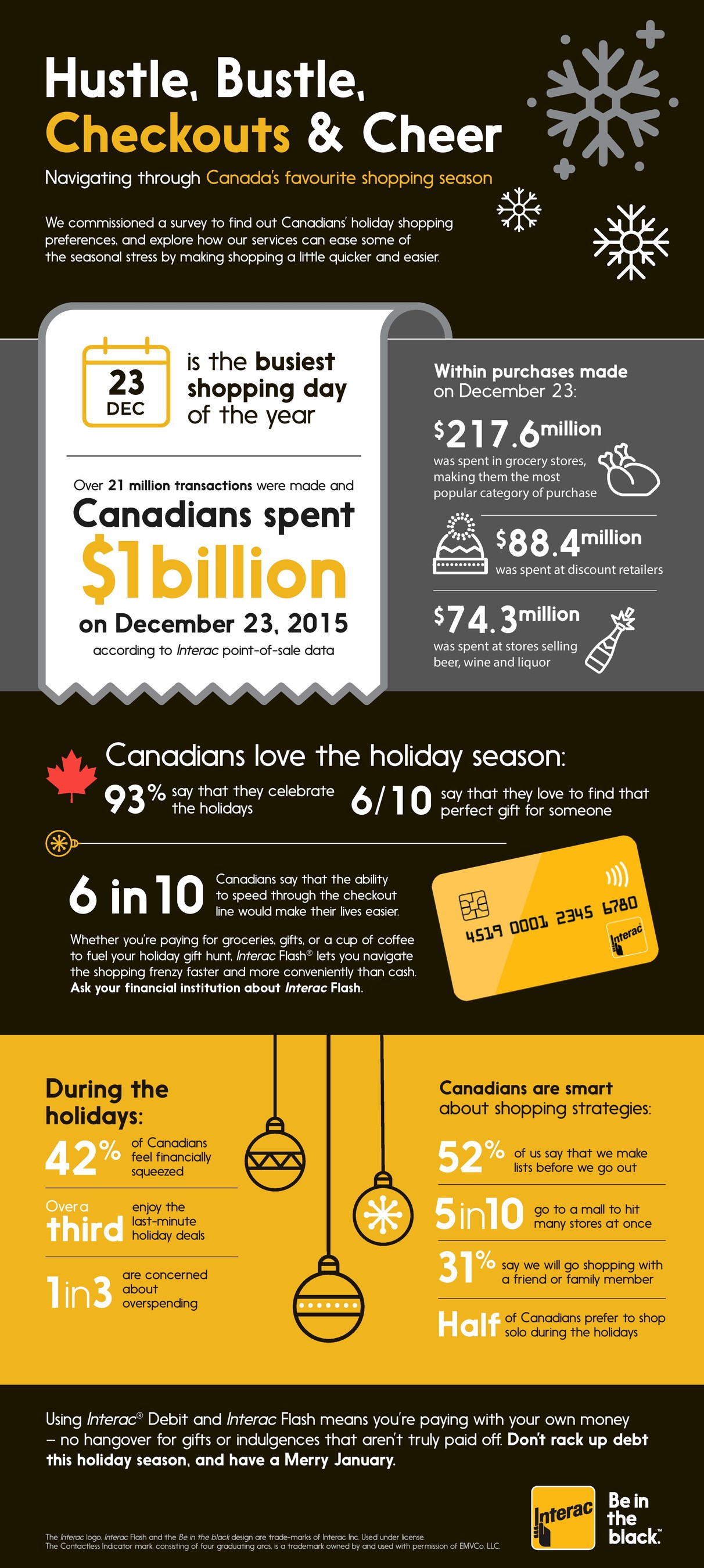
Interac goes into detail in its report about what Canadians spent their money on last year. Of all the purchases made on December 23rd, grocery stores were the most frequented, with more than $217 million being spent in grocery retailers that day. Discount retailers came in second place at $88 million, and alcohol vendors came in third at just over $74 million.
“Our recent data shows Canadians are embracing the speed and convenience of Interac Flash. For the month of November 2016, Interac Flash volumes have nearly doubled compared to the same period in 2015,” Martin Ho, AVP of Product Management, Interac Association and Acxsys Corporation, said in a statement.
“With the holidays nearly upon us, Canadians can rely on Interac Flash to speed through the busy checkout lines with ease.”
Interac’s online survey was conducted during the period of November 29 to 30, among 1,508 Canadian adults. The margin of error is +/- 2.5%, 19 times out of 20.
