Shared posts

21 Dec 04:25

Thought Leadership: Beyond Marketing

by Stowe Boyd
A piece from 2010, in which I proposed a thought leadership approach to marketing that has become more or less standard today.

I had a short conversation with the CEO of a European software company at the recent Web 2.0 Expo in San Francisco a few weeks back [note: this was in 2010]. He was explaining his plans for increasing his efforts to compete in the US. I suggested a slightly oblique approach, which motivated me to write this post.

We have become jaded by superlative overload, where products are the best, the most innovative, the coolest, or guarantee higher productivity, or more contented clients.
In a time of maximal messaging efforts, the noise is so great that no one can be heard, like standing in a room with hundreds of people shouting at the top of their lungs.

Marketing Messages And Product Features: Fail

The rise of the social web has meant that a growing proportion of those likely to be ‘targets’ of traditional advertising and marketing have grown immune, or extremely hard to reach. We have become jaded by superlative overload, where products are the best, the most innovative, the coolest, or guarantee higher productivity, or more contented clients.

In a time of maximal messaging efforts, the noise is so great that no one can be heard, like standing in a room with hundreds of people shouting at the top of their lungs.

Is there any way to stand out?

I think there is.

Thought Leadership

Even in a time of great noise, people are still looking for guidance: they still need to make informed decisions, and to take action on their own behalf or on behalf of their companies.

To do so, they look more than ever to those individuals and organizations that they trust, those that have credibility and hard-won reputations.

How Can A Competitor Be A Thought Leader?

There are serious barriers to a company — a competitor in a particular marketplace — to be considered a thought leader. People evaluating options in that marketplace will naturally assume that the company and its spokespeople will use any marketing vehicle to favor their own products and services. As a result, any efforts in this regard are likely to be suspect.

Alternative courses of action are well known, but pose problems for companies trying to be thought leaders.

One obvious course is to hire existing thought leaders. This is a timeless approach. As examples consider Deloitte’s Center For The Edge, with John Seely Brown and John Hagel III as co-directors, or Tom Davenport’s work at Accenture’s Center For Excellence. These are individuals who are so well-known and well-regarded that the community considers them outside the conflict of interest potentially at work in their employment. The limitations here are costs: only a large firm like Deloitte or Accenture would be capable of investing the time and money in creating a research institute, and attracting people like these to work there.

Another path is to become allied with various projects and programs that are considered innovative, or oriented toward solving some societal problem, like IBM’s Smarter Planet initiative. But here again the costs are significant: IBM must be investing many millions into Smarter Planet, and many people have to be basically dedicating themselves to it full-time.

A third path is to organically develop thought leadership based on participation in open discourse about the issues that confront the community, through writing and public speaking. If you are selling ‘enterprise 2.0’ software, for example, that would involve discussions about adoption, the impact of technologies on business processes, and change management. But if these discussion seem generally canted toward positioning the company’s products rather than a more high-minded examination of needs and trends, it is likely to not work, and to possibly backfire altogether. If this works, however, it can be of inestimable value. Consider Tim O’Reilly’s reputation as the ‘sage of Silicon Valley’ or the throw weight that David Armano brings to a conversation about marketing.

What’s A Start-up To Do?

All of these paths have serious benefits, but considerable costs. A startup wondering how it can stand out in a crowded field may just punt, and go down the classic social media route: the CEO and/or marketing folks will blog on the company website, and hope that people read the posts; they pay to attend conferences, and hope that they can get a speaking slot; and they try to make the company and its various spokespeople seem to be highly regarded in the community. This is the path that all companies seem to head down, so it comes as no great surprise that it generally doesn’t lead to outstanding results.

In the discussion I had with that CEO in San Francisco, I sketched out three alternatives that could be both effective — leading to real thought leadership, not some stunt — and still affordable.

Rather than creating the standard company blog — with product release updates, hirings and travel plans — a company might be much better off developing an semi-independent blog, perhaps edited by an industry thought leader, and having one or more of the company’s management team acting as contributors. The company might also be clearly identified as an advertiser, and of course full disclosure of this relationship would ne necessary. For example, consider a company developing a small business accounting solution: instead of writing a company blog, the company could be a sponsor and participant in a blog dedicated to small business management. As a result, the company would be associated with the thought leadership that would grow with that website.

And rather than attending conferences and hoping to get a speaking spot, a company might be better off structuring its own event. For example, a company developing a solution to support human resource management might be better off holding a series of one day events in major US and European cities on ‘Best Practices In Career Development And Talent Retention’. And instead of packing the event with the companies managers, and endless product demos, well-regarded local figures in HR and management might be invited to speak. This way the company is viewed as a source of sage advice, and acting with the community in mind, rather than as an overly aggressive sales machine.

Another course of action that I recommend is to create an advisory board with thought leaders; however, advisory boards often are mere window dressing. If you’d put a bit more energy into using an advisory board — and convince your board members to contrbute more as well — the returns can be significant. For example, consider a software vendor with a large developer community that build products on the company’s platform. Getting a well-known software designer to head up a developer forum, and to keynote or MC a developer conference could lead to significant payback, much more than the typically passive advisory board might.

Planning For Thought Leadership

Every company’s situation is unique, but broad principles apply, and therefore the basic approach for any company has similarities.

If you have true thought leaders — individuals whose reputation exists independently of the company’s brand — certainly work to harness that social capital. Be cautious, however, because that regard can shift if the community beleives the thought leader is selling out in some way. If you are considering hiring a throught leader, this cautionary note is even more relevant.

If you are considering one or more of the sorts of programs I have outlined, obviously a great deal of planning must be involved. In a software company — where I have the most experience — this will have impacts on marketing and product teams, if it is to lead to real effects, not just window dressing.

Originally published at www.stoweboyd.com in 2010.


Thought Leadership: Beyond Marketing was originally published in Another Voice on Medium, where people are continuing the conversation by highlighting and responding to this story.

21 Dec 04:23

Kickstart: Can Chinatown be culturally zoned?

by pricetags

Another article on our doomed Chinatown by Kerry Gold in the Globe and Mail:

chinatown

Gentrification isn’t just nibbling at Chinatown’s edges. Thanks to rezoning changes, it’s taking major bites out of the neighbourhood. …  Class inversion is happening in cities throughout North America. Urban cores used to be the domain of low-income groups, while the wealthier demographic lived in the suburbs. In recent years, wealthier groups are choosing urban living and pushing low-income groups to the outskirts, or further.

“You have to ask, ‘Where is this coming from? Who are you serving?’” asks Kevin Huang, executive director of the Hua Foundation, a non-profit for young Chinese-Canadians. Mr. Huang is also committed to supporting the people who form the tight-knit Chinatown community, and who are now under threat of displacement. …

“With this rezoning, I think this is a battle for the soul of Chinatown, and what does it mean for us as a city in terms of diversity and inclusion,” Mr. Huang says. …

“We seem to be treating Chinatown as a development site instead of a community,” civic historian John Atkin says.

The old mom-and-pop shops are already hurting, faced with mounting property taxes and aging ownership. The educated next generation doesn’t always want to take over the old business. And those new corporate retailers wouldn’t be able to buy from within the neighbourhood or from small local farms the way current businesses have for a century. The old local economy of Chinatown – a model of sustainability before it became a buzzword – would be destroyed….

Melody Ma, a self-professed “policy wonk,” grew up attending dance classes in Chinatown. Both Ms. Ma and Mr. Huang see the city’s failure to prioritize people, with their histories and traditions and lives, as the problem. Other cities have adopted culture as an integral part of their urban planning, including New Westminster and Montreal, so they’ve asked Vancouver City to consider doing the same. …

“That means developers will have to make sure they consider the needs of the community prior to even talking to city hall – that we’re recognizing the culture and history and the aspirations of the people who live there,” she says.

It’s more than the buildings. Unless the culture is preserved, the place becomes commodified and soulless, she says. To thwart displacement, the city offers up bigger building potential in exchange for a few units of social housing. But what good is social housing if a community is wiped out? …

Small businesses such as Mr. Mah’s face deeper challenges if the city doesn’t craft policies to protect them. …

But pressure on the community will only intensify because the area is in the crosshairs of future densification. A couple of blocks away, the viaducts will come down and the new St. Paul’s Hospital will transform the historic area into a hub of high-tech medical care.

Ms. Ma says “it was a mountain to climb” just getting council to agree to consider culture as a priority.

“We have to ask ourselves, ‘How do we place a culture or community first – rather than just follow finance?’”

.

I am a loss to understand what is wanted for Chinatown – or what is even possible.  

Should it be a goal to “prioritize people, with their histories and traditions and lives,” if it means we’re intending to preserve a cultural product that was a consequence of one of the most racist periods in our history.  Chinatown was a ghetto in the worst sense of the word.

Is the desire to exclude anything that doesn’t reflect that era?  

And even if there was an inherent racism in that assumption of exclusion, how can a zoning code preserve or even encourage businesses no longer wanted, no longer viable?

The forces of time and change mean there is essentially no hope to maintain the cultural moment of Chinatown.  Surrounding development forces, the removal of the Viaducts, a new St. Paul’s and changing demographics guarantee that.

Why would we set ourselves up for failure?

Shaping urban form and use is the purpose of zoning and development bylaws.  Saving a culture is not.  And that’s as true for the gay village on Davie and the Punjabi Village on Main as it is for Chinatown on Main.


21 Dec 04:23

The Best VR Headset for Your Phone So Far

by Signe Brewster
mobile virtual reality headset

Smartphone VR headsets are a great way to try virtual reality without spending a fortune. They’re the only midrange options between cheap cardboard and expensive, complicated desktop VR devices. In our testing, Google Daydream View narrowly beat out Samsung Gear VR as the best mobile virtual reality headset. It’s comfier to wear and comes with a hand-tracking controller that makes gameplay easier and more immersive. However, the competition is so close, and the tech so new, that you can’t go wrong picking whichever headset works with your phone. (Our main picks only support a handful of Android phones each; iPhone users don’t have good VR options yet.) If you don’t have a phone that works with either, VR isn’t enough reason to buy one, but it could be a factor next time you buy a phone.

21 Dec 04:23

Future kinds of work

by Bryan Mathers
Future Types of Work

How I work has changed massively over the past ten years. Okay, so now I draw pictures, whereas I used to write programs – or lead others to write programs. Probably the biggest change I’ve had is being exposed to Mozilla’s way of working. They corale creative communities using some very clever practices and technologies. And right at the centre of this deeper magic community alignment

This thinkery was created for this DML blog post.

The post Future kinds of work appeared first on Visual Thinkery.

21 Dec 04:22

HealthFace Puts Health App Data on Your Wrist

by John Voorhees

HealthFace, by Australia-based Crunchy Bagel, maker of the 2016 Apple Design Award-winning app Streaks, is an iOS and watchOS app that uses Apple Watch complications to display data stored in Apple’s Health app. The Health app got a much-needed makeover with iOS 10, but it can still take a lot of tapping to find what you want. HealthFace cuts through the clutter by letting you pick and customize the data that’s important to you and displaying it where it’s readily available – on your Apple Watch.

Setup happens in HealthFace’s iOS app. By default, HealthFace lists every watch face available on the Apple Watch, but you can turn off the ones you don’t use in settings, which I found makes navigating the app easier. Tapping a watch face from the main screen displays the complications available for that face. With a Modular face, for instance, you can set up three large complications and one small one, whereas the Utility face has just one large and one small complication.

Tapping on a complication type lets you pick the data you want to display in it. There are a lot of options. The trackable information is broken down into nine categories that collect over 80 data types, including weight, blood pressure, sleep, step count, heart rate, many nutrition statistics, various test results, and much more.

After you pick what you want to track, you can adjust exactly how it’s reported with options for units of measurement, whether an icon is displayed, the date range for tracking the measurement, and an option for adding a goal. Changes you make are previewed at the top of the screen. HealthFace also includes iMessage stickers featuring the icons available in the main app.

The watch faces I have configured, my Modular face setup, and data-specific customizations.

The watch faces I have configured, my Modular face setup, and data-specific customizations.

It's important to note that because of the way Apple Watch complications work, changes you make to what a certain type of complication displays are applied across all the watch faces you have set up in HealthFace. For example, the Utility and Chronograph watch faces both use the 'Utilitarian Small' complication. If you set up HealthFace to display your weight in that complication on one watch face, it will display your weight in the complication on the other watch face too. If later you want to remove your weight from one of those watch faces, doing so will also eliminate it from the other face. That's not ideal – I'd prefer edits to only affect one watch face at a time – but it's a technical limitation of watchOS, not a design choice by Crunchy Bagel.

HealthFace works best where it has the most room to display information. The smallest complications are so space-constrained that they can be a little hard to read. To make the most of HealthFace, I configured a Modular face, which has three large complications and a small one available. I use the Utility face as a sort of home base on my Apple Watch and put the new Modular face right next to it, so active calories burned, stair flights climbed, my step count, and hours standing are just one swipe away. HealthFace does a good job of updating in the background, but if you want the very latest data, tapping on any of the HealthFace complications opens its watchOS app, which consists of a button that refreshes the data it tracks when it’s tapped.

The power of HealthFace is that it unlocks a deep catalog of data stored in the Health app, customized to your preferences, and makes it immediately available on your wrist. With the New Year around the corner, I plan to fine-tune the Modular face that I set up while testing HealthFace to serve as a reminder of my health and fitness goals for 2017 and help me keep tabs on my daily progress.

HealthFace is available on the App Store for $0.99.


Support MacStories Directly

Club MacStories offers exclusive access to extra MacStories content, delivered every week; it’s also a way to support us directly.

Club MacStories will help you discover the best apps for your devices and get the most out of your iPhone, iPad, and Mac. Plus, it’s made in Italy.

Join Now
21 Dec 04:22

MarcyMoji: A Sticker Tour Around the World

by Ryan Christoffel

When Apple launched the iMessage App Store with the release of iOS 10, it was dominated by sticker packs. Many of my personal favorites came from Disney, including the Star Wars , Zootopia , and Mickey & Friends packs. But one of the nice things about the new App Store was its accessibility to a wide variety of creatives, not just the big players like Disney. A simple sticker pack truly requires no coding knowledge. Because of that, since day one there has been an abundance of sticker options on the iMessage App Store, each with a unique story behind it.

One such story comes from Marcy Smith and Andrew Williams, the creators of MarcyMoji . Born out of Marcy's lifelong love of painting, MarcyMoji was originally conceived as a custom keyboard, but Apple's announcements at WWDC quickly shifted the couple's focus to building an iMessage app.

The moment MarcyMoji was born

The moment MarcyMoji was born

MarcyMoji's uniqueness begins with the story behind it. Its makers are currently bicycling around the world, a journey they started last April in Southeast Asia and hope to continue for the next couple years at least. Throughout each day of their travels, Marcy uses much of the time needed for resting and cooling down to paint and sketch. One day, shortly after beginning their travels, Marcy had drawn a number of things resembling emoji, and the idea was struck to combine Marcy's art and Andrew's experience with programming to create something new altogether that could be shared with the world. Thus began MarcyMoji.

The stickers in MarcyMoji are directly inspired by the couple's travels to this point, including things they've seen along the way, or things they miss from home. So there are stickers based on new places they've explored, like Bali and Vietnam, and there are also stickers that harken back to Southern California, where they both grew up. The array of new experiences they're immersed in each day are funneled into Marcy's work, which Andrew later adds to MarcyMoji as new stickers.

A sampling of MarcyMoji's stickers

A sampling of MarcyMoji's stickers

Aside from the unique story behind the app, MarcyMoji is also unlike much of its competition in that it is not merely a one-off sticker pack. Because the couple continues to travel and see new things, they have gone the route of creating an iMessage app that is continually updated with new packs of stickers. Some of these packs are tied to a specific place they've traveled, while others fit broader categories such as Animals, Camping, Eats, and Faces. Current events also play a role in which stickers they add, as evidenced by the recent Christmas pack.

Because of the variety of stickers in MarcyMoji, and the plan to continue adding new packs each month, the app has adopted a freemium model. A free download of the app garners a starter pack of 30 stickers, while additional packs can be purchased for $1.99 each, or you can sign up for an in-app subscription for $2.99 per month to gain immediate access to all of MarcyMoji's current sticker packs, plus future packs as they're added.

The clean, simple interface of MarcyMoji

The clean, simple interface of MarcyMoji

MarcyMoji organizes its sticker packs in a way that's quick and easy to navigate, with an interface I wish Apple would adopt in the basic iMessage drawer interface. Once you enter the full view by tapping the up arrow in the bottom-right corner, you can scroll through a vertical arrangement of all sticker packs, each divided by a visual header. Optionally, you can also tap the Filter button at the top to view a full list of packs and jump straight to the one you want. This interface isn't particularly flashy or innovative, but it gets the job done by making stickers quickly accessible in an intuitive way.

Hard at work on a new batch of stickers

Hard at work on a new batch of stickers

Each of the stickers in MarcyMoji have been hand-painted by Marcy herself. After she paints them, Andrew photographs them and gives those RAW files to Marcy for touch-ups so that they look just right on mobile displays. After she completes her work and gives the go-ahead, Andrew adds them to the app. They currently appear to have the largest single collection of hand-painted stickers on the iMessage App Store.

Building an iMessage app while bicycling around the world may sound romantic, but it is certainly not without its challenges. Marcy and Andrew bike for 6-8 hours a day, and all work on the app has to be done before or after that while using sometimes unreliable wireless service. Bug fixes have been uploaded over 3G from a roadside food stand in the middle of nowhere, and support emails have been answered from a mountaintop while awaiting sunrise. These challenges considered, Andrew shared that the couple loves the balance of being outside, traveling, and exercising mixed with working on something they're both very passionate about.


Along with each new App Store introduced by Apple, a new crop of opportunities arises. MarcyMoji seeks to take advantage of that opportunity with a group of stickers that act as one couple's storytellers. Marcy and Andrew are chronicling their bicycling journey through stickers, and they hope to do so for the foreseeable future as new places are explored, new sticker packs are made, and more people share their adventure with them.

MarcyMoji is available from the App Store as a free download .

If you would like to follow Marcy and Andrew on Instagram, their app's account is @marcymoji , while each member of the pair shares more of their adventures at @marcydaypaints and @convenientlylocated .


Support MacStories Directly

Club MacStories offers exclusive access to extra MacStories content, delivered every week; it’s also a way to support us directly.

Club MacStories will help you discover the best apps for your devices and get the most out of your iPhone, iPad, and Mac. Plus, it’s made in Italy.

Join Now
21 Dec 04:18

Parking apps are tied to cars not location

Parking meter apps are tied to the car rather than just the location. Making implicit explicit requires adjustment.
21 Dec 04:18

Reclaiming Domain Privacy

by Reverend

One of the issues that’s gotten increasingly troublesome recently has been the increasingly more aggressive domain registration spam and scams. As I wrote earlier this year, it’s gotten to the point where companies are calling our clients soon after sign-up pretending to work for Reclaim and asking for credit card information. This is unconscionable, and we knew then and there we could no longer make identity protection for domains optional. So, as of January 1, 2017 we will be including ID protect for all new domains, whether registered individually or as part of a hosting account.

There is a cost involved in doing this, so we will be increasing the price of domains to $15 /year, and Student and Faculty shared hosting accounts will be raised to $30 and $50 /year respectively. We understand increasing prices may not be ideal for many, but being able to guarantee Reclaimers’ online identity helps justify the costs while reinforcing an ethos of openness and vigilance when it comes to one’s digital lifebits.

Let us know in the comments below if you have questions or concerns.

Nota bene: Any existing coupon codes that entail bulk account purchases will be honored at previous pricing structure.

21 Dec 04:18

Apple’s Tim Cook denies the Mac is dead, says ‘great desktops’ are still coming

by Patrick O'Rourke

With the release of Apple’s new, pricey line of controversial USB-C MacBook Pros and the absence of any mention of desktop Macs at the company’s most recent press conference, some assumed the tech giant had plans to slowly abandon the Mac.

However, in a recent internal employee posting, Apple CEO Tim Cook says the company remains committed to the Mac.

“Some folks in the media have raised the question about whether we’re committed to desktops,” writes Cook. “If there’s any doubt about that with our teams, let me be very clear: we have great desktops in our roadmap. Nobody should worry about that.”

Cook goes on to say that desktop Macs are important to Apple because they provide more screen real estate, additional memory, storage and more variety, to the company’s customers, before emphasizing that they are, “really important, and in some cases critical, to people.”

“The desktop is very strategic for us. It’s unique compared to the notebook because you can pack a lot more performance in a desktop — the largest screens, the most memory and storage, a greater variety of I/O, and fastest performance. So there are many different reasons why desktops are really important, and in some cases critical, to people. The current generation iMac is the best desktop we have ever made and its beautiful Retina 5K display is the best desktop display in the world,” writes Cook.

In a response to an employee question inquiring what Cook believes is Apple’s biggest differentiator in the tech sector is, Apple’s CEO had an interesting answer.

“Our greatest differentiator is our culture and our people. They are the foundation by which everything else comes about. Without great people and a great environment that people can live in, we wouldn’t have intellectual property. We wouldn’t have the best products. We wouldn’t have the inventions or features I mentioned earlier,” said Cook.

If Cook’s statements are true, it looks like Apple’s Mac line isn’t going anywhere and the company still intends to continue pushing forward with desktop-based Mac devices. It’s likely that along with the rumours iPad/iPad Pro refresh, Apple’s next press event will focus on applying a fresh coat of paint to the company’s aging desktop Mac line.

It is unclear, however, if Cook is referencing Apple’s iMac all-in-one line, or if his statements refer to the Mac Mini and the Mac Pro. The lack of updates surrounding all three devices indicates that Apple’s CEO could be discussing the entire line in general.

To put the Mac line in perspective, the Mac Mini has been updated almost every year between 2007 and 2012, and then once again in 2014. The Mac Pro, however, has been updated nearly every year between 2006 and 2013, and has not received an update in more than three years.

The all-in-one iMac, the high-end device in Apple’s Mac line-up, is the most up-to-date device, with the 2015 model getting a 5K retina option just last year.

The internal Apple memo was obtained and verified by TechCrunch. It’s more than likely Apple “leaked” the memo intentionally in an effort to negate the controversy currently surrounding the lack of updates to the Mac line.

SourceTechCrunch
21 Dec 04:18

The Best Cheap Bluetooth Earbuds So Far

by Lauren Dragan
cheap in ear bluetooth headphones lede

After extensive research and over two dozen hours of testing by our expert panelists, we think the Anker Soundbuds Sport IE20 are the best Bluetooth in-ear headphones available under $50. Though they aren’t perfect, if you’re looking for something ultra-affordable that gets the job done, the IE20 are the best of the options available. They sound decent for the price, fit most people, handle phone calls remarkably well, and are inexpensive enough that it’s possible to ignore their flaws (and replacing them won’t break the bank should you lose them). Additionally, with Anker’s 30-day return-for-any-reason policy and 18-month warranty, if you find they aren’t for you, you won’t be stuck with buyer’s remorse.

21 Dec 04:17

Here’s Why The Reddi-Wip Shortage Is Extra Sad

by Laura Northrup
mkalus shared this story from Consumerist.

If you’ve been looking for canned whipped cream from Reddi-wip or other brands for your holiday celebrations, you may have come home empty-handed. Canned whipped cream is in short supply right now, and it’s for a reason that is much sadder than the mere lack of whipped cream.

As you run a hand mixer in a bowl of heavy cream the old-fashioned way this coming week, or use up your last can of Reddi-wip on holiday desserts, keep in your thoughts the 32-year-old employee of the company Airgas who was killed this summer while filling a tanker with nitrous oxide. The Atlantic found the details of the accident, the investigation, and how a tragic accident leads to a nationwide shortage of whipped cream cans.

He worked at a purification plant next door to a nylon factory, since the gas is a byproduct of nylon manufacturing. The tanker that he was filling exploded, and that explosion punctured another tank in turn, causing two explosions and killing the worker.

The accident is still under investigation by the U.S. Chemical Safety Board, and the Airgas plant in Florida remains closed. It had been open for 30 years with no accidents until this year. An investigator with the Chemical Safety Board told the Atlantic that the explosion was most likely caused by residual heat in the pump used to fill tanks, which set off a chemical reaction that led to the explosion. Static electricity was also a possible cause.

Having one of its purification plants offline means that Airgas isn’t at full capacity, and the company says that it’s prioritizing the medical customers who need the gas for use as an anesthetic over the food businesses that use it to make whipped cream squirt out of a can.

ConAgra, maker of Reddi-wip, announced that it was stopping production until it could get a source for food-grade nitrous oxide. “As of this week, there is no food grade capacity available in North America,” the company told a trade association back in November.

Want more stories from Consumerist? We’re a non-profit! You can get more stories like this in our twice weekly ad-free newsletter! Click here to sign up.


21 Dec 04:06

Uber Admits Its Self-Driving Cars Have A Problem Handling Bike Lanes

by Mary Beth Quirk
mkalus shared this story from Consumerist.

The rules of the road don’t just cover cars — there are conveyances of the two-wheeled variety out there as well. Considering many human drivers don’t understand how to share the streets with bicycles, it’s somewhat unsurprising that Uber is admitting that its autonomous vehicles are having a hard time dealing with them as well.

Just a few days after Uber and the state of California escalated their slapfight over the ride-hailing company’s newly launched fleet of self-driving cars in San Francisco, which the state Department of Motor Vehicles says is illegal, the company says it knows the vehicles have a “problem” with how they cross bike lanes, potentially endangering cyclists.

A company spokeswoman told The Guardian that engineers are working to solve an issue in the car’s programming that causes the vehicles to cut across bike lanes: the San Francisco Bicycle Coalition released a warning about Uber’s autonomous vehicles after the group’s executive director tested the car two days before launch.

“In the ride I took through the streets of SoMa on Monday, the autonomous vehicle in ‘self-driving’ mode as well as the one in front of it took an unsafe right-hook-style turn through a bike lane. Twice,” he writes in the warning. “This kind of turn is one featured in a 2013 blog post that is known to be one of the primary causes of collisions between cars and people who bike resulting in serious injury or fatality.”

In other words, instead of merging into the bike lane before turning, per California law, the car crossed in front of the bike lane at the last second, leaving very little time for a cyclist going forward to avoid a collision.

A coalition spokesman says the group warned Uber about the issue as well, and the company told them it was working on it, but didn’t mention that self-driving cars would be launched two days later, sans permit.

“The fact that they know there’s a dangerous flaw in the technology and persisted in a surprise launch shows a reckless disregard for the safety of people in our streets,” the spokesman told The Guardian.

Uber says that engineers are “continuing to work on the problem,” and that it has instructed drivers to take over when the car approaches a right turn on a street with a bike lane — the same drivers that Uber blamed last week for a video of tricked-out Uber Volvos apparently running red lights.


21 Dec 04:06

Bike Lanes Made Permanent

mkalus shared this story from Rolandt shared items on The Old Reader (RSS).

Calgary City Council has voted to make their downtown bike lanes a permanent part of the city, based on a year and a half of data:

calgary-cycle-tracks-fast-facts-2016

To quote the Mayor:

Mayor Naheed Nenshi said he thinks the cycle track network was a false controversy, pointing to the fact he got 850 emails to his office, 825 of which were supportive of the project.

“People kept saying this is controversial, but it’s controversial I think in the way secondary suites are controversial, which is it’s controversial around the council table,” he said.

“In fact, as it turned out with the final vote, not that controversial around the council table.”

calgary-cycle-track-report

Photo thanks to the CBC


21 Dec 04:06

Amazon Prime Video’s official Canadian launch date for season 2 of Man in the High Castle is unclear

by Patrick O'Rourke

Just last week Amazon Prime Video finally officially launched in Canada as well as 200 other regions around the world, after months of rumour and speculation.

While the service is a welcome addition to the relatively competition free Canadian streaming app market, some Amazon prime subscribers have noticed that the second season of specific originals, including Man In the High Castle (which released on December 16th on the service in the U.S.), still aren’t available in Canada.

While other shows like Mozart in the Jungle and Transparent initially didn’t launch in Canada with season two availability, the platform eventually released the second run of both critically-acclaimed Amazon originals.

When MobileSyrup contacted Amazon for comment regarding Man In The High Castle Season two’s official release date, we were told the following statement by a representative from the tech giant:

“We don’t have any specifics to share at this time. We’ll continue to add a full line-up of fresh new original programming from some of the world’s greatest storytellers and entertainers to Prime Video globally in early 2017. Stay tuned!”

Interestingly, while the second season of Man in the High Castle isn’t officially available in Canada, it’s still accessible through Prime Video’s “Watch While Abroad” feature.

It looks like unlike Netflix, Amazon Prime Video Originals will not launch on a same-day world wide basis.

(Thanks @christophepoug and Acco)

21 Dec 04:06

These Weeks in Firefox: Issue 7

by mconley

The last Firefox Desktop Engineering meeting for 2016 recently occurred! Here are the relevant tidbits.

Highlights

Contributor(s) of the Week

Project Updates

Add-ons

  • andym reports that the Washington Post Trump article has been updated with the Firefox version of the add-on. This is yet another example of the WebExtensions API making it easy to ship multi-browser add-ons!

Activity Stream

Content Handling Enhancement

Electrolysis (e10s)

Firefox Core Engineering

Platform UI and other Platform Audibles

  • jjong landed Bug 1286182 – Implement the layout for <input type=date>
    • This is currently disabled behind dom.forms.datetime and dom.forms.datetime.timepicker
  • MSU students have finished up their semester – see this update on jaws’ blog, along with their excellent final video presentation
    • Bug 1300784 – Combine e10s and non-e10s <select> dropdown mechanisms
      • A blocking bug autolanded yesterday, this will hopefully land today (preffed off)
    • Bug 1309935 – Add ability to find within select dropdown when over 40 elements
      • Currently undergoing review iterations

Privacy / Security

Quality of Experience

  • Kicking off a project to update preferences UI and remove inconsistencies
    • UX team in Taipei completed user research and user testing of different organizations to get a more productive, consistent UI
    • Here’s the spec
    • There are great bugs in here for mentoring, and hacking on Firefox for the first time! Like this one! Or this one! Or this one! Or this one!
  • New theme API
    • Work will begin in Q1 to start implementing the Theme API in mozilla-central
    • Community outreach soon to communicate the planned API
    • Will schedule a couple short meetings with some Firefox front-end engineers to discuss implementation and ask for feedback on internal API
  • Onboarding 51 funnelcake
    • Work is ongoing to provide a new onboarding experience for new Firefox users as part of a funnelcake running against Firefox 51 release

Search

  • Drew posted a first draft of a patch that will allow add-ons to replace the entire AwesomeBar dropdown without having to go through XBL or XUL. This is groundwork to potentially expose this as a WebExtension API.
  • The SHIELD study for a unified URL and search bar is still ongoing. The results are expected some time in January.

Here are the raw meeting notes that were used to derive this list.

Want to help us build Firefox? Get started here!

Here’s a tool to find some mentored, good first bugs to hack on.

21 Dec 03:57

BlackBerry open to working with Apple or Google on autonomous vehicles

by Jessica Vomiero

BlackBerry announced this week that it would be open to working with Apple or Google to develop a driverless car.

John Chen made the statement on December 20th, following the launch of BlackBerry’s Autonomous Vehicle Innovation Centre (AVIC) in Ottawa a day earlier.

“I’m actually building a secure, foundational infrastructure for cars…to talk to each other,” he said. “I don’t know what Apple’s plan is, or Google’s plan is, in detail; we definitely could even be partners with them, we could provide them those solutions,” Chen told BNN.

Prime Minister Justin Trudeau frequented the launch of the BlackBerry QNX AVIC on Monday, claiming that such innovations would serve a a creator of jobs for middle class Canadians.

Both BlackBerry and Google-parent Alphabet have been vocal about their intentions to enter the driverless space, while Apple has yet to confirm its even working on a driverless car.

In addition, BlackBerry announced its earnings for the second fiscal quarter of 2017 this past week, which revealed a $114 million USD net loss on a $289 million revenue.

MobileSyrup previously reported that $160 million USD of this revenue was generated from software. This is significant because BlackBerry has repeatedly committed to turn things around by maintaining the software segment of its business, which includes auto-tech.

BlackBerry QNX’s technology, the Waterloo-based smartphone maker’s auto subsidiary, is currently in 60 million cars around the world. Apple has kept its driverless project under lock and key, but has also poached BlackBerry QNX senior leadership in an effort to assist its own auto ambitions.

Google’s driverless initiatives are further along, as the company just split off its autonomous vehicle vertical into a new company under Alphabet, called Waymo.

SourceBNN
20 Dec 17:27

Working with Duet Display

by Jake Underwood

Stumbling around on a Monday morning, I wake up too late, throw on a hat, and unplug four devices: my 12.9" iPad Pro, my iPhone 7, its companion Apple Watch, and my 12" MacBook. The first and last are tossed in my backpack to be used in and between classes to take notes, check social media, and design documents.

When I sit down in my design class, I pull out my MacBook, open inDesign, and try to manage multiple windows as I pull images from the Web and import them into my document. On the MacBook's 12" screen, the limited real estate forces me to use a slew of keyboard shortcuts and trackpad gestures as I jump between apps. Frustrated, I pull out my iPad, fire up an iOS app to replace one on the Mac, and work in two separate environments.

The problem here is obvious: although macOS and iOS functionality overlaps, working in two OSes simultaneously isn't ideal. The inability of the iPad to act as an extension of the MacBook's display limits my productivity. Even people with larger 15" MacBook Pros would probably appreciate it if their iPad's screen was available to display Mac apps.

For a while, I've been trying to solve this problem by using Duet Display, an iOS app that allows your iPad or iPhone to function as a second screen for your Mac or Windows PC. Duet has been around for a couple of years, but continues to get significant updates to speed it up, reduce lag, and offer touchscreen support. The fundamentals, however, are still the same: Duet, with an iOS device, can be your mobile Mac monitor.

Getting Connected

It's important to note how seamless and fast Duet is. When the app is running on both devices, the lag is minor and often imperceptible. One of the primary reasons for this, which to some people may also seem like Duet's biggest flaw, is that the app works over a wired connection with a Lightning to USB cable.

Carrying an extra cable in my bag doesn't bother me. It's a small inconvenience for the benefit of a fast second display. While it’d be nice if the whole setup were wireless, achieving the reliability, speed, and image quality is simply not possible with current technology.

Other than the cable, the only other thing you need is a copy of Duet on the two devices you want to connect. On the Mac and PC, Duet is free – you’ll pay when you purchase the iOS app in the App Store. Start both apps, follow the straight-forward directions, and you’ll be up and running in no time.

Look and Feel

After connecting my MacBook to a 24-inch monitor for the past few months, I've become accustomed to the feel of its fast dual display support. When I began using Duet, I was expecting it to be good, but not really comparable with what I get from my USB-C to HDMI connection. I was wrong.

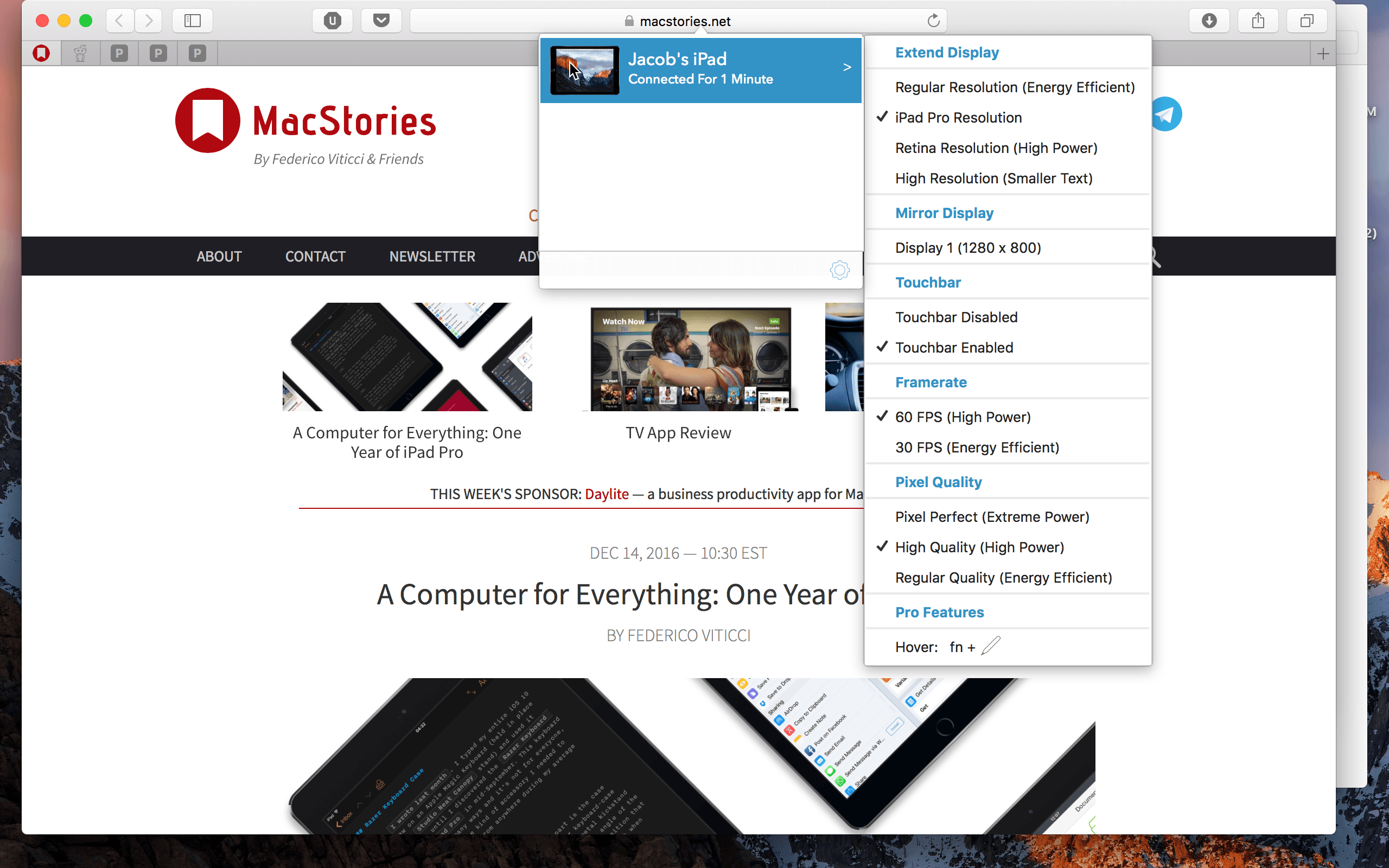
Using Duet to connect my MacBook and iPad Pro is comparable to the way you’d expect an external monitor to work. In my current setup, I have the iPad Pro set at its native screen resolution with the frame rate at a steady 60 frames per second (this can be changed in the Duet app on the Mac to suit your needs). It's a combination that looks great and runs smoothly. While I wouldn’t recommend trying to play a resource heavy game on your iPad Pro’s screen through Duet, it has no trouble accomplishing productivity tasks.

Duet's settings on the Mac

Duet's settings on the Mac

It's important to use the correct settings. Some graphics settings perform better than others, but different Mac specs may affect this. It's worth trying different configurations to see what works best with your setup.

After I got it set up properly, Duet has given me a dual-monitor setup that I can rely on to be high-resolution and responsive. As I’m writing this on my MacBook, my iPad is sitting with me on the couch displaying macOS’s Messages and Tweetbot as my secondary monitor. For much of this review, I’ve been moving windows around, watching video on the second monitor while I work in Bear and Safari, something that is significantly more seamless than trying to simultaneously navigate two operating systems.

Additional Features and Add-Ons

Although Duet’s best feature is enabling my iPad to act as a second display for my Mac, it has a couple of other nice features that make it worth its price tag of $20.

My favorite so far is the digital Touch Bar, a replica of the feature added to some of the 2016 MacBook Pro models. Although we’ve seen workarounds to get a screen-based version of the Touch Bar running on other Macs, the Touch Bar in Duet is the best representation of the feature. Running across the bottom of the iOS device, the Touch Bar responds to touch inputs, allowing for all the controls you’d expect from the physical version, something a screen-based macOS version cannot do. I’ve been using this quite a bit, controlling my Mac’s volume, triggering Siri, and even picking emoji without a keyboard shortcut. If you’re interested in testing the Touch Bar before you buy a new MacBook Pro, Duet is a good way to do that.

Touch Bar Support on the iPad Pro

Touch Bar Support on the iPad Pro

Duet also responds to touch navigation on an iPad, meaning that you can move the mouse around the display with your finger or, better yet, the Apple Pencil. It even supports a couple of gestures, like two finger scroll. I don't use this feature much, but there have been times that I've found it useful for things like scrolling quickly through Tweetbot. Because macOS isn't designed for touch, your mileage may very with this.

For an extra $20 a year, Duet offers Duet Pro, an In-App Purchase that adds faster performance, better color correction, and extended Apple Pencil support. With Duet Pro, the iPad’s display functions as an external drawing tablet app similar to Astropad. In apps like Adobe Photoshop and InDesign, the Apple Pencil can be used for precise sketching and design work. I’ve primarily been using the Apple Pencil support to navigate around macOS more efficiently, moving windows on the second screen and tapping into text fields without having to move my mouse to the second screen with the trackpad. However, I’m certain designers will find a use for the more advanced Pencil support.

In Practice

Duet has been a serious improvement to my workflow. Connecting my iPad Pro to my MacBook adds just the right amount of space to declutter my MacBook's screen. Working with both devices tied together has given me a better sense of unity in my work, letting me put to use both devices when one would have previously been sitting in my bag.

However, Duet isn't practical in every situation. When you’re in the car, sitting at a small desk, or working on a plane, there isn't enough space to hook up your iPad with a cable. But at your desk or even in your lap, Duet can provide a convenient addition to your work that I’ve yet to see other apps offer at the same level of quality.

Nor is Duet perfect. You may need to fiddle with settings to get optimal display performance and reduce lag, which, on rare occasions, can be noticeable and even a little frustrating, requiring waiting a few seconds to accomplish a task. But more often than not, having Duet installed is much, much better than being without it. Being able to have it on hand is a convenience that I’ve already begun to take for granted.

Conclusion

Duet Display's usual price of $19.99 is fair considering that you’re essentially enabling an external, high-resolution display. It works on both iPhones and iPads, but unless you want to see your Mac’s screen on a tiny display, I’d stick to running it on an iPad. Duet Pro, on the other hand, may not be worth the additional cost unless you plan on using your iPad as a makeshift Wacom tablet. That said, having those features available as an In-App Purchase in case I ever need them is reassuring.

If you own a Mac and an iPad and have ever felt the need for more screen real estate while you're on the go, check out Duet Display. I think you'll find that you appreciate the extra space more than you might anticipate.

Duet Display in available in the App Store here and for a limited time, you can get it 50% off for $9.99. The accompanying Mac and PC apps are available at duetdisplay.com.


Support MacStories Directly

Club MacStories offers exclusive access to extra MacStories content, delivered every week; it’s also a way to support us directly.

Club MacStories will help you discover the best apps for your devices and get the most out of your iPhone, iPad, and Mac. Plus, it’s made in Italy.

Join Now
20 Dec 17:24

sergeant : An R Boot Camp for Apache Drill

by hrbrmstr

I recently mentioned that I’ve been working on a development version of an Apache Drill R package called sergeant. Here’s a lifted “TLDR” on Drill:

Drill supports a variety of NoSQL databases and file systems, including HBase, MongoDB, MapR-DB, HDFS, MapR-FS, Amazon S3, Azure Blob Storage, Google Cloud Storage, Swift, NAS and local files. A single query can join data from multiple datastores. For example, you can join a user profile collection in MongoDB with a directory of event logs in Hadoop.

Drill’s datastore-aware optimizer automatically restructures a query plan to leverage the datastore’s internal processing capabilities. In addition, Drill supports data locality, so it’s a good idea to co-locate Drill and the datastore on the same nodes.

It also supports reading formats such as:

  • Avro
  • [CTP]SV ([C]omma-, [T]ab-, [P]ipe-Separated-Values)
  • Parquet
  • Hadoop Sequence Files

It’s a bit like Spark in that you can run it on a single workstation and scale up to a YUGE cluster. It lacks the ML components of Spark, but it connects to everything without the need to define a schema up front. Said “everything” includes parquet files on local filesystems, so if you need to slice through GBs of parquet data and have a beefy enough Linux workstation (I believe Drill runs on Windows and know it runs on macOS fine, too, but that’s $$$ for a bucket of memory & disk space) you can take advantage of the optimized processing power Drill offers on a single system (while also joining the data with any other data format you can think of). You can also seamlessly move the data to a cluster and barely tweak your code to support said capacity expansion.

Why sergeant?

There’s already an R package on CRAN to work with Drill: DrillR. It’s S4 class-based, has a decent implementation and interfaces with the REST API. However, it sticks httr::verbose() everywhere: https://github.com/cran/DrillR/search?utf8=%E2%9C%93&q=verbose.

The sergeant package interfaces with the REST API as well, but also works with the JDBC driver (the dev version includes the driver with the package, but this will be removed for the eventual CRAN submission) and includes some other niceties around Drill options viewing and setting and some other non-SQL bits. Of note: the REST API version shows an httr progress bar for data downloading and you can wrap the calls with httr::with_verbose(…) if you really like seeing cURL messages.

The other thing sergeant has going for it is a nascent dplyr interface. Presently, this is a hack-ish wrapper around the RJDBC JDBCConnection presented by the Drill JDBC driver. While basic functionality works, I firmly believe Drill needs it’s own DBI driver (like is second-cousin Preso has) to avoid collisions withy any other JDBC connections you might have open, plus more work needs to be done under the covers to deal with quoting properly and exposing more Drill built-in SQL functions.

SQL vs dplyr

For some truly complex data machinations you’re going to want to work at the SQL level and I think it’s important to know SQL if you’re ever going to do data work outside JSON & CSV files just to appreciate how much gnashing of teeth dplyr saves you from. Using SQL for many light-to-medium aggregation tasks that feed data to R can feel like you’re banging rocks together to make fire when you could just be using your R precision welder. What would you rather write:

SELECT  gender ,  marital_status , COUNT(*) AS  n 
FROM  cp.`employee.json` 
GROUP BY  gender ,  marital_status

in a drill-embedded or drill-localhost SQL shell? Or:

library(RJDBC)
library(dplyr)
library(sergeant)

ds <- src_drill("localhost:31010", use_zk=FALSE)

db <- tbl(ds, "cp.`employee.json`") 

count(db, gender, marital_status) %>% collect()

(NOTE: that SQL statement is what ultimately gets sent to Drill from dplyr)

Now, dplyr tbl_df idioms don’t translate 1:1 to all other src_es, but they are much easier on the eyes and more instructive in analysis code (and, I fully admit that said statement is more opinion than fact).

sergeant and dplyr

The src_drill() function uses the JDBC Drill driver and, hence, has an RJDBC dependency. The Presto folks (a “competing” offering to Drill) wrapped a DBI interface around their REST API to facilitate the use of dplyr idioms. I’m not sold on whether I’ll continue with a lightweight DBI wrapper using RJDBC or go the RPresto route, but for now the basic functionality works and changing the back-end implementation should not break anything (much).

You’ve said “parquet” alot…

Yes. Yes, I have. Parquet is a “big data” compressed columnar storage format that is generally used in Hadoop shops. Parquet is different from ‘feather’ (‘feather’ is based on another Apache foundation project: Arrow). Arrow/feather is great for things that fit in memory. Parquet and the idioms that sit on top of it enable having large amounts data available in a cluster for processing with Hadoop / Spark / Drill / Presto (etc). Parquet is great for storing all kinds of data, including log and event data which I have to work with quite a bit and it’s great being able to prototype on a single workstation then move code to hit a production cluster. Plus, it’s super-easy to, say, convert an entire, nested directory tree of daily JSON log files into parquet with Drill:

CREATE TABLE dfs.destination.`source/2016/12/2016_12_source_event_logs.parquet` AS
  SELECT src_ip, dst_ip, src_port, dst_port, event_message, ts 
  FROM dfs.source.`/log/dir/root/2016/12/*/event_log.json`;

Kick the tyres

The REST and JDBC functions are solid (I’ve been using them at work for a while) and the dplyr support has handled some preliminary production work well (though, remember, it’s not fully-baked). There are plenty of examples — including a dplyr::left_join() between parquet and JSON data — in the README and all the exposed functions have documentation.

File an issue with a feature request or bug report.

I expect to have this CRAN-able in January, 2017.

20 Dec 17:23

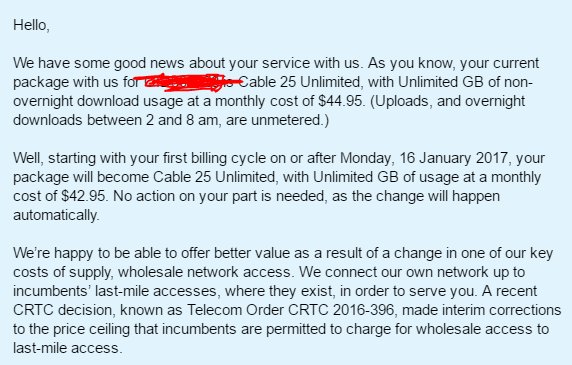
TekSavvy plans to up internet speeds and lower prices in January

by Patrick O'Rourke

Chatham-Kent-based third-party internet provider TekSavvy has plans to lower the price of many of its plans in the near future, according to various reports from customers that surfaced on Twitter this morning.

The internet provider will release details on its new pricing structure on January 16th.

It’s unclear exactly what the rate changes are, but most plans seem to be decreasing in price by at least a few dollars. TekSavvy’s official Twitter has also stated that all customers will continue to receive unlimited data between the hours of 2am and 8am.

We reached out to TekSavvy for comment and the provider has confirmed that it plans to lower prices and raise speeds, though declined to give specifics regarding its new pricing structure.

“We’ve been pushing for this for a long time, so it feels great to be able to bring more value to our customers this holiday season. This is one of the largest price drops we’ve ever seen. We are making changes for virtually our entire customer base,” said Marc Gaudrault, CEO TekSavvy Solutions, in an interview with MobileSyrup.

This week thousands of Canadians received emails stating their internet bills are set to go down at some point in the next few months as a result of a recent CRTC decision. Back in October, the CRTC ruled that telecoms like Bell, Rogers and Vidéotron, are charging third-party internet providers too much for access to their “last mile” infrastructure.

A CRTC ruling from back in 2010 permitted telecoms to charge third-party internet providers to access their wires at a 10 percent markup. The ruling back in October cited that the provider’s rates had grown too high. This shift effects third-party internet providers like TekSavvy, Distributel and Acanac, with the latter two services not yet indicating if they have plans to lower their plan pricing structure.

Specifically, the CRTC has cut network access rates by up to 39 percent, and has also reduced the rate to transport internet data by 89 percent.

Twitter user @DaftFunk_JD states that TekSavvy informed him his pricing will go down by $10 with the speed increasing by 10mb/s. Another Twitter user, @fakejaime, told MobileSyrup that the pricing for his plan is going down $2 and that the speed is not changing (he says he’s signed up for TekSavvy’s 10 upload/25 download internet plan.

“Competitors that provide retail Internet services to Canadians using wholesale high-speed services must have access to these services at just and reasonable prices,” said CRTC chairman and CEO Jean-Pierre Blais in a statement following the regulatory body’s October ruling.

“The fact that these large companies did not respect accepted costing principles and methodologies is very disturbing. What’s even more concerning is the fact that Canadians’ access to a choice of broadband Internet services would have been at stake had we not revised these rates. As always, we strive to create a dynamic competitive telecommunications market for Canadians.”

teksavvydownloadtip

In the Canadian telecom market where providers are often raising prices, it’s refreshing to see an internet supplier, even if it’s only a third-party provider, reduce its fees while still increasing speeds.

(Thanks Kevin and @DaftFunk_JD)

20 Dec 17:22

Bike Lanes Made Permanent

by Ken Ohrn

Calgary City Council has voted to make their downtown bike lanes a permanent part of the city, based on a year and a half of data:

calgary-cycle-tracks-fast-facts-2016

To quote the Mayor:

Mayor Naheed Nenshi said he thinks the cycle track network was a false controversy, pointing to the fact he got 850 emails to his office, 825 of which were supportive of the project.

“People kept saying this is controversial, but it’s controversial I think in the way secondary suites are controversial, which is it’s controversial around the council table,” he said.

“In fact, as it turned out with the final vote, not that controversial around the council table.”

calgary-cycle-track-report

Photo thanks to the CBC


20 Dec 17:12

Tech uber cyclists

by michaelkluckner

a2

From The Guardian: another kind of collateral damage as tech marches on….

Despite threats of legal action from the department of motor vehicles (DMV) and California’s attorney general, Kamala Harris, Uber refused to back down on Friday, claiming its rejection of government authority was “an important issue of principle”.

Concerns are mounting about how the cars behave in dense urban environments, particularly in San Francisco, where there are an estimated 82,000 bike trips each day across more than 200 miles of cycling lanes.

The San Francisco Bicycle Coalition has released a warning about Uber’s cars based on staff members’ first-hand experiences in the vehicles. When the car was in “self-driving” mode, the coalition’s executive director, who tested the car two days before the launch, observed it twice making an “unsafe right-hook-style turn through a bike lane”.

That means the car crossed the bike path at the last minute in a manner that posed a direct threat to cyclists.


20 Dec 15:42

"Exxon is another country, and proud of it. The corporate milieu is like Harvard crossed with the..."

Exxon is another country, and proud of it. The corporate milieu is like Harvard crossed with the former Soviet Union: a culture of excellence combined with a set of rules that are byzantine and uncontestable. No one talks to the press.

The company is known to hire its executives right out of college and to rarely go outside after that. Everyone works their way up, serving time in facilities like the giant Baytown refinery east of Houston, before learning how to negotiate with foreign potentates and gaining a spot in the C-suite.

A knowledge of power and how to wield it is mandatory. Small companies are mere prey waiting to be swallowed up. If George W. Bush had worked at Exxon, he would have known better than to look for a soul in Vladimir V. Putin’s eyes. As one oilman put it, “Tillerson didn’t get to be C.E.O. of Exxon because he’s a nice guy.”


- Mimi Swartz, Scout’s Honor, Texas Style
20 Dec 15:41

Downloading for Christmas

by russell davies

I've noticed a new thing I do now. Stockpiling digital stuff for Christmas. Downloading movies for the moments I retreat to the spare bedroom at the in-laws - a place where wifi (and heating) does not reach. And downloading BBC radio and detective dramas for the motorway journeys where the 3G runs out. 

20 Dec 15:41

Microsoft Surface 3 :: Die Überraschung

by Volker Weber

ZZ3FDAF41C

Ich bin seit mehr als zehn Jahren Mac-Nutzer. Und war davor zehn Jahre mit Windows unterwegs. Und davor nochmal zehn weitere Jahre mit OS/2, Linux und DOS. OS/2 und DOS sind Geschichte, Windows und Linux aber nicht. Und diese kleine Maschine hat mich dazu gebracht, Windows wieder häufiger neben meinen Macs zu benutzen. Damit hatte ich nicht gerechnet.

Mein Lieblingsprogramm ist NextGen Reader UWP. Ich lese fast alle News in diesem Programm, ich mache mir Notizen in OneNote und ich male auf Screenshots herum. 2015 habe ich mit Windows 8.1 angefangen, dann auf Windows 10 aktualisiert und dies wiederum vor Monaten auf das sogenannte Anniversary Update. Wir hatten unsere Probleme miteinander, aber ich habe sie am Ende immer durchgebissen.

Surface 3 ist mit mir weit gereist, nach San Francisco, nach Orlando, nach New York, nach Santa Barbara und Los Angeles. Und es war ein treuer Begleiter, der mich nie im Stich gelassen hat. Die Kombination aus Tablet und Laptop, mit Zeichenstift und Tastatur, hat sich als ideal für Reisen herausgestellt.

Warum dieser Nachruf? Morgen beginnt ein neues Kapitel. Surface wird erwachsen. Ein größerer Bildschirm, ein i7 und vor allem eine bessere Tastatur. Ich freue mich.

20 Dec 15:41

GoFundMe CEO says Canada is on the cutting edge of a charity paradigm shift

by Rose Behar

A trip to GoFundMe.com is both heart-wrenching and inspiring. On any given visit you might see the story of two parents both fighting cancer, or a terminally ill child’s bucket list, or a young immigrant suffering a debilitating stroke far from her family.

That’s the heart-wrenching part.

The inspiring aspect of the platform comes from the love and generosity the stories inspire. Most often, the campaign is created not by the individual, but by someone who cares about them. They do their best to convey the quality of that individual’s character and the direness of their situation. Then, if the story is compelling and the community is strong, the donations begin flowing in, making impossible goals suddenly possible through the power of mass compassion. One of these campaigns is created every 30 seconds worldwide.

That means every 30 seconds someone seeks aid and mercy, and in many cases their pleas are answered, by a group of people — connected somehow or perhaps complete strangers — who help because they can. Those people change a life, and their kindness echoes out from that act of charity and touches many more in its path. That’s what’s known as personal cause fundraising, and it’s the concept that powers GoFundMe.

A new kind of charity fundraising

gofundme home page

“What we want to do is give people the power to change their world,” says GoFundMe CEO Rob Solomon in an interview with MobileSyrup. “We’re building a platform that is going to help people change their world, which has a profound impact over time. In the next few years, we’ll have more volume flowing through our platform than the world’s largest charities on an annual basis. Than the world’s largest foundations on an annual basis.”

The growing ease and popularity of personal fundraising is a paradigm shift, and one that Canada is on the cutting edge of, according to Solomon.

“I think that Canada could be one of the largest markets on a global basis. It may not have the population equivalent of some of the larger countries in the world, but from what we can tell, we should get to a place in the next few years when one in 10 or so Canadians will have given to a GoFundMe campaign.”

Those donations will likely be generous, too. Solomon says that the Canadian donor is more giving compared to other markets. The average donation is about $77, versus about $65 in the other countries where the platform operates — the U.S., Australia and the U.K.

“Canadians are very generous,” says Solomon, adding: “A lot of it has to do with the media. Canadians are very engaged with both traditional media and social media and the lifeblood of a successful GoFundMe campaign is people sharing it on Facebook, on Twitter, the local paper, the radio.”

So far, in the little over two years the platform has been active in Canada, it’s brought in $140 million in donations from 1.8 million Canadian donors. In the last year alone, the number is close to $70 million. That’s a small percentage of GoFundMe’s overall volume — in the last year and a half about a billion dollars flowed through its digital gates – but it’s still significant, especially considering Canada is outdoing both its mother country, the U.K., and fellow commonwealth nation Australia.

Is this the future of fundraising?

ethan faria

Given the platform’s seemingly sudden ubiquity (in fact it’s been a six-year development process), it seems fair to assume that in the era of Humans of New York and other viral charitable campaigns, this may be the future of fundraising. Solomon doesn’t entirely agree, however.

“I don’t know if it’s the future necessarily. Giving is a gigantic space. In the U.S. it’s a $375 billion USD market, globally it’s probably half a trillion dollars. I think charities will continue to raise money and do what they’re good at. Saving whales or helping homeless children. The sea change that we’re seeing is that now we’ve democratized organization and fundraising, meaning that anybody can do it.”

In particular, Solomon makes mention of the two women behind the Ethan Faria campaign, a notable Canadian initiative that saw $105,000 raised to help purchase prosthetics for a toddler who lost parts of his limbs after contracting a rare bacterium. Neither of the women were professional organizers or fundraisers, but their campaign was wildly successful. This brings a new element to charity and one that Solomon believes can become a bridge between the traditional model and GoFundMe’s platform.

“I think we’ll start seeing people raising money for traditional charities using our platform. That’s a profound change and we want to drive that as much as possible. What I like about that is that if I give $100 to Sick Kids Hospital, it’s just one donation. If I create a GoFundMe campaign to tell the story of why I’m giving to Sick Kids I can turn my $100 donation into ten people writing $100 checks.”

What constitutes a good cause?

GoFundMe policies

It’s the authenticity and personal touch of these campaigns that makes all the difference, says Solomon. Of course, not every campaign is perfect. Some are riddled with so many spelling mistakes and punctuation errors that they’re difficult to read. Others are controversial — considered charitable by some, and decidedly not by others. Take the campaign for Officer Darren Wilson, the police officer who shot and killed Mike Brown, for instance.

Solomon says GoFundMe aims to keep its policies hands-off, letting the community decide whether or not a campaign is worthy of funding.

“It’s much like Facebook or Twitter. They don’t want to judge the content you’re putting up there. They want you to use the platform within a set of guidelines, we call it terms of service. If someone is violation those terms of service, we want the community to tell that campaign organizer whether they want to donate or not to the cause.”

But while this sounds like it might work in an ideal world, in reality there are issues that crop up — even for Facebook and Twitter. For example, Facebook’s notorious issues with its trending news topics, which were at first identified as having an editorial slant, then advertised hoax articles throughout the most recent American election. Facebook has had to work hard on remaining impartial while retaining an adequate level of quality, and has just rolled out a series of new features and tools to further that ambition.

Toeing the line of impartial platform

paleta man

In dealing with its own questions of morality and impartiality GoFundMe has nixed legal defense funds.

“It gets pretty complicated,” Solomon offers in explanation, “There are many organizations that help people when they need legal defense and we’ve decided that there’s so many issues that are related that it didn’t make sense for those to run on the platform.”

Polishing campaigns is also something the company avoids.

“We’ll provide guidance and tips and coaching when we see things that could be done better but the more authentic these things are, the better they perform. We don’t necessarily want these things to be well-polished and highly editorialized.”

As for hoaxes, Solomon says they are very rare, amounting to less than one-tenth of one percent. The platform also has a fairly robust system for vetting campaigns. The first line of defense is public opinion, but the company also employs anti-fraud software (both proprietary and third-party) and offers a guarantee that ensures a refund to anyone that feels they’ve been defrauded.

As the platform expands, these issues will tag along, but so will the powerful concept of personal fundraising. The Californian startup expects to launch in Germany, France and Spain in 2017, bringing its platform to countries where no major competitors exist — at least, none that the platform has identified as of yet.

“There’s need everywhere,” says Solomon, “and wherever there’s need, we think that people want to come together and help each other out.”

20 Dec 15:41

AutoSleep Turns the Apple Watch Into an Automatic Sleep Tracker

by Federico Viticci

I'm terrible at keeping a decent sleep schedule. I love my job and I often stay up late working on my latest story. Sometimes, I decide to relax with a videogame, I lose track of time, and suddenly it's 4 AM. I know, however, that getting enough quality sleep every night is key to a healthy lifestyle, which is why, over the past month, I've tried to wake up earlier and work out in the morning.

With these personal changes, motivation only goes so far for me. I want to be able to visualize my progress and current streak. Since getting an Apple Watch Series 2 a couple of weeks ago, I've started looking into the idea of using it as a sleep tracker again. There are some solid options on watchOS, but all of them require pressing a button in an app right before you're about to sleep. And because I normally drift off to sleep, I forget to activate sleep tracking mode and no sleep gets tracked at all.

In my limited tests with a Fitbit this month (before getting a new Apple Watch), I came away thinking that automatic sleep detection was my favorite feature of the product. You don't have to press anything and the Fitbit figures out when you started sleeping and when you woke up. Combined with a dashboard like Gyroscope, it's a great way to build an automatic sleep log that passively monitors your sleeping habits.

David Walsh, developer of MacStories favorite HeartWatch, wants to recreate the same experience with AutoSleep, an iPhone app that turns your Apple Watch into an automatic sleep tracker without installing a Watch app. I've been wearing my Watch to bed for the past week, and AutoSleep has worked surprisingly well.

AutoSleep doesn't install any app on your Apple Watch and you don't have to interact with it before going to bed. The app's instructions make it clear: if you want to use your Apple Watch as a sleep tracker, you just need to wear it and sleep. That's it. No toggling of on/off modes, no menus to confirm in the morning – nothing. AutoSleep's whole selling point is that you install the app and forget about it.

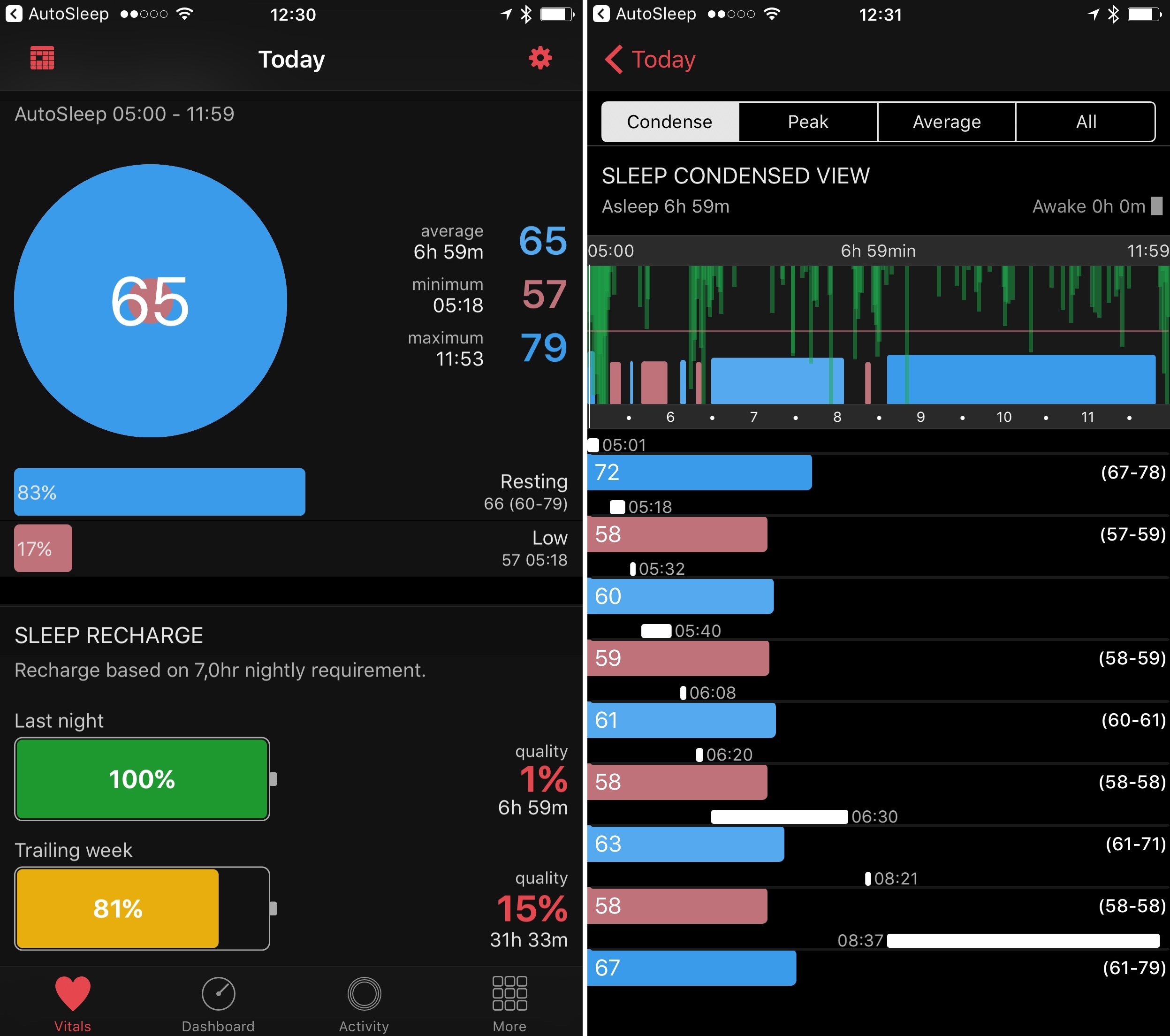
On the iPhone, AutoSleep employs an algorithm based on advanced heuristics using HealthKit and iOS frameworks to monitor motion data from the Watch and the iPhone. The app understands when you were sleeping and when you woke up, and it presents the results in a unique clock interface that packs a lot of information. As long as the Watch is on your wrist and AutoSleep has been configured to infer your sleep times, the app can also correlate data about sleep quality (based on movement) and heart rate (from the embedded sensor in the Watch) to tell you how you slept.

To offer this kind of invisible experience, however, Walsh had to include settings to train AutoSleep to correctly guess your habits. For instance, you can tell the app to only detect sleep within pre-selected start and end times: if you set AutoSleep to monitor sleep between midnight and 7 AM, it won't detect as sleep two hours spent being still during class. You can also adjust the sleep detection level with a slider that goes from 'Still' to 'Restless', and you can tell the app that your iPhone isn't likely to be touched or moved at night. Furthermore, you can choose to treat the first iPhone unlock after a certain time in the morning as the final signal that you're awake and want to be notified of logged sleep time.

Configuring some of AutoSleep's settings.

Configuring some of AutoSleep's settings.

These settings add some complexity to the experience and they're most effective only if you have consistent sleep patterns, but they're necessary to make AutoSleep's magic work. If you tend to go to bed around the same time every day, wear your Watch while sleeping, and your iPhone charges at night so it doesn't move1, you meet all the requirements for an ideal AutoSleep experience. I followed this optimal setup for the last week, and I was impressed by how AutoSleep worked out when I fell asleep and woke up to go the bathroom – all without having to interact with the Watch or iPhone app.2

In the main app, AutoSleep uses a clock interface (with an Apple Music-inspired page layout) with colored rings and blocks to represent different bits of data captured by HealthKit. Asleep time is indicated with purple blocks, where lighter purple means deeper sleep; this is calculated by considering physical movement (displayed as an inner green ring) and heart rate (a red ring). In deeper stages of sleep, your heart rate will likely be lower than usual and you'll see a lighter red color block in the associated ring; by contrast, light green indicates you were restless, which tends to be paired with dark purple (light sleep).

Once you make sense of what the colors mean and the connections between them, you can see why Walsh opted for this clock design – it's a clever way to plot sleep times against activity and heart rate data measured during the day. However, I often felt like AutoSleep's clock UI was preventing simple interactions with my data – almost as if I couldn't get past the initial learning curve of clock rings and blocks.

I think AutoSleep's interface should be simplified, making it easier to discern the meaning of colored blocks and how they can be manually edited if the measurements are wrong. Reading and editing the clock UI in AutoSleep 1.0 feels somewhat over-engineered – a stark contrast with the app's straightforward premise. A FAQ this long shouldn't be necessary, and the app should have a superior onboarding process to let users learn its concepts.

AutoSleep's biggest issues in this first version, though, are the lack of settings for "special days" that don't follow a standard routine (like weekends or vacations) and the trade-offs for people who don't want to wear a Watch at night. AutoSleep can also calculate sleep times based on motion recorded by the iPhone, but the app loses the ability to compare sleep times with heart rate and movement measured by the Watch. Much of AutoSleep's appeal is lost if the Apple Watch isn't used as an automatic tracker, and there are dozens of other iPhone sleep tracking apps with easier interfaces, superior reporting tools, and alarm clock features I'd recommend instead.

Viewing AutoSleep's data in Walsh's other app, HeartWatch.

Viewing AutoSleep's data in Walsh's other app, HeartWatch.

The way I see it, the best way to enjoy AutoSleep is to use it as a mission control center for sleep times on the iPhone while you're wearing the Watch to bed. In addition to not having to worry about anything else, you'll end up with overnight heart rate data alongside an accurate representation of how much you tossed and turned. These stats and their averages are available in the 'Sleep Quality' section at the bottom of each day in AutoSleep, and they can also be viewed in more detail in Walsh's excellent HeartWatch app on the iPhone.

I've worn the Apple Watch at night with AutoSleep on the iPhone for over a week now. The iPhone app works in the background and it does a good job at using data captured by the Watch to understand how much I've slept, the quality of my sleep, and when I've gotten out of bed. I've also appreciated the fantastic battery life of the Apple Watch Series 2: I can wear the Watch all day, keep it on while I sleep, and I still wake up to over 60% of battery left. As a follower of the Underscore Watch Charging Method, I charge the Watch while I take a shower or prepare lunch – the Series 2 makes a second evening charge unnecessary.

AutoSleep data in Apple Health and Gyroscope.

AutoSleep data in Apple Health and Gyroscope.

AutoSleep is one of the reasons I'm happy to have an Apple Watch again. The app is building an automatic sleep log that is archived with HealthKit and made accessible to other health apps I use such as HeartWatch and Gyroscope. AutoSleep isn't for everyone and there's lots of room for improvements in the design department, but if you've been looking for the easiest way to turn the Watch into a Fitbit-like sleep tracker, AutoSleep is the app you need to try.

For a limited time, AutoSleep is available on the App Store at a launch price of $1.99.


  1. Here's what I use↩︎
  2. You can even sleep with the Watch in Airplane mode and AutoSleep on the iPhone will fetch and parse data once the Watch is connected again in the morning. ↩︎

Support MacStories Directly

Club MacStories offers exclusive access to extra MacStories content, delivered every week; it’s also a way to support us directly.

Club MacStories will help you discover the best apps for your devices and get the most out of your iPhone, iPad, and Mac. Plus, it’s made in Italy.

Join Now
20 Dec 15:40

The Truth Foundation

by Josh Bernoff

Here are some things to know about truth: Truth exists. Finding truth takes work. And truth changes over time. I devote my energy to finding and promoting that truth, even when it is uncomfortable. It’s time for our biggest technology companies to do the same. Myths are persistent Megan Scudellari published an article in Science one year … Continued

The post The Truth Foundation appeared first on without bullshit.

20 Dec 15:40

Science fiction and analytical thinking

by Josh Bernoff

I was a science fiction fan growing up in the 60s and 70s. I was a technology analyst, predicting the future, in the 90s and 00s. Here’s what science fiction and strategic analysis have in common — and what they don’t. How science fiction challenges the mind (and “sci-fi” doesn’t) Science fiction is not the same … Continued

The post Science fiction and analytical thinking appeared first on without bullshit.

20 Dec 10:11

Using Trending Topics / Discussions Within An Online Community

by Richard Millington

If you wake up in the morning and 3 people have mentioned an issue that has arisen before, that’s a sign.

It’s a sign a lot more are about to ask the same question.

Make this a trending topic. Provide regular live updates on how you’re taking action. Make sure this appears at the top of your community.

This is one of the places where a community can really excel. You can use a single discussion thread to identify a new problem, collate the impacts of the issue from various people, let key product people know about the issue (with a link to the discussion), test and cultivate different solutions, then publish the solution to everyone who participated in the discussion.

Crucially, add any new updates by replying to the discussion (to update previous participants) and editing ‘updates’ to the original post too for newcomers to get the latest information without wading through the rest.

There are some places where a support community can really shine. This is one of them.

20 Dec 10:11

Copyright vs. Creative Commons

by Bryan Mathers
Copyright vs Creative Commons

Copyright and Creative Commons licences come from totally different directions. I was talking with Kamil from Creative Commons about certificates and knowledge, and this contrast emerged. Read his full post here

The post Copyright vs. Creative Commons appeared first on Visual Thinkery.