Shared posts

25 Dec 21:24

Here's What Happens When Dancing Meets Creative Coders

by Kelsey Lannin for The Creators Project

Lannin-001.jpgHien Huynh dances with HTC Vive headset and controllers to create projection mapped imagery in a WebGL environment programmed by designer Marpi. All photos by the author

What do you get when 70 dancers and creative coders meet for a hackathon? Chaos, yes, but also 18 compelling two-minute performances using both familiar and emerging new media tools, like full-body motion tracking, livestreamed 360-degree video, projection mapping, machine learning, virtual reality, and repurposed biometric data. This celebration of tactile performance and digital art forms the basis for DanceHackDay, an annual project hosted by Kinetech Arts, which was hosted at CounterPulse in San Francisco earlier this month.

“The hack day is really a way of bringing people from different disciplines—tech, art, dance, music—together,” Kinetech Arts founder Weidong Yang tells The Creators Project. Yang, a trained physicist and dancer who also heads virtual reality data visualization company Kineviz, says DanceHackDay is a way to facilitate creativity amidst disorder. “As a scientist, I never achieved a significant discovery in the direction that I set off in,” he says. “All my major discoveries were from the mistakes, from the things that I didn’t expect to happen.”

Lannin-003.jpgStephanie Sherman and Alexander Diaz perform the first act of Heartbeat Across the World to piano music generated by Sachin Deshpande's program which is based on a real-time feed of biometric data

The variety of performances on display was staggering. In one piece, aided by a DIY heart rate monitor, an internet connection, and a program developed by participant Sachin Deshpande, dancers moved to the sound of their own heartbeats and the heartbeats of counterparts in London and Paris. In Heartbeat Across the World, the pulses took the form of lilting piano notes akin to a minimal, freeform instrumental piece, but the biometric data could potentially be shaped into any number of aural or visual accompaniments.

During the hackathon portion of the event, developers Lauren Bedal and Fabien Lemaitre recorded dancer Stephanie Sherman’s movements in Unity. Sherman hugged, swayed, and leaned on another dancer, whose movements were not being tracked, making it appear that Sherman’s avatar was interacting with an invisible partner. “It’s amazing how much emotion is conveyed just through movement, and you don’t even have to see her facial expression,” Bedal marveled.

Lannin-005.jpgDevelopers and dancers collaborating in the main theater room at CounterPulse

For participants like Dustin Freeman, one-half of digital improv group Raktor, DanceHackDay was an opportunity to riff and collaborate on ideas-in-progress. Working with Hallie McConogue and Jasper DeTarr, Freeman enabled dancers to embody a multitude of avatars in real time using Microsoft Kinect. He sees tools like these as having a major influence on the future of live performance and participatory theater.

“Most VR experiences right now are games or they’re film. They’re not participatory,” Freeman says. “So we’re like, let’s bring this to virtual spaces where the people who are interacting don’t have to geographically be in the same location. Right now, we’re interested in local experiences that include digital participants.”

Lannin-004.jpgStephanie Sherman tests out a full body motion tracking suit which renders her movements in Unity, a 3D game development platform used to create VR and AR environments

While event organizers hand-picked a few participating artists, registration was open to the public, and the diversity of performers reflected that inclusive spirit. “It’s all kinds of people doing all kinds of dance. Some people are doing ballet, some people are doing contemporary dance, some people are doing social dance, some people are doing butoh, and some people are coming from Indian dance,” Daiane Lopes da Silva, Artistic Director of Kinetech Arts, says.

Kinetech Arts plans to organize an expanded heartbeat simulcast, which will include a broader scope of international participants from Lisbon, Berlin, Amsterdam, Seattle, Chicago, and New York City during a two-day event in 2017. The organization hosts an open lab every Tuesday night in San Francisco.

Related:

New Cinema Hackathon: Dance with Your Face

Dancer Defies Gravity with Stunning 3D Projections

Heart Bot Turns Heartbeats Into Personalized Illustrations

25 Dec 21:24

Twitter Favorites: [rcousine] "Dirk Gently's Holistic Detective Agency": the correct level of weird for my tastes.

Ryan Cousineau @rcousine
"Dirk Gently's Holistic Detective Agency": the correct level of weird for my tastes.
25 Dec 21:24

Twitter Favorites: [cstross] This talk from Maciej Ceglowski—on why singularitarianism is bunk—is indispensible: https://t.co/gOIhlOjaOO

Charlie Stross @cstross
This talk from Maciej Ceglowski—on why singularitarianism is bunk—is indispensible: idlewords.com/talks/superint…
24 Dec 05:25

Project SensorWeb Dev Boards Arrive Today

by Porfirio Landeros

24 Dec 05:24

AirPods Kick off Apple's Battle for Our Ears

by Neil Cybart

AirPods are Apple's surprise hit product of 2016. While their simplicity may evoke comparisons to previous Apple blockbusters like iPod, AirPods are something very different. We are witnessing a new chapter unfolding at Apple in which Jony Ive and the Industrial Design group press down on the wearables accelerator. While Apple Watch wages a war for our wrists, AirPods are kicking off Apple's battle for our ears. 

A Wireless Future

There were hints that AirPods were going to be popular. Back in September, at Apple's annual iPhone event, the focus didn't end up being on the iPhone 7 or 7 Plus, or even new Apple Watches, but instead on a pair of wireless headphones. While Apple SVP Phil Schiller did not talk up AirPods much on stage, Apple's Chief Design Officer, Jony Ive, didn't hold anything back. The fact that AirPods received its own Jony video spoke volumes. Here's Jony describing the motivation behind AirPods

"We believe in a wireless future. A future where all of your devices intuitively connect. This belief drove the design of our new wireless AirPods...We're just at the beginning of a truly wireless future we've been working towards for many years where technology enables the seamless and automatic connection between you and your devices."

On the surface, Apple's focus on a wireless future seems to describe the company's efforts to remove wires from our lives. As our iPhone and iPad usage have increased, the number of headphone wires and charging cables in our life have grown in number as well. However, Apple's interpretation of a wireless future isn't just about the lack of wires. Instead, Apple is focused on empowering people through a new collection of personal technology devices. This ends up serving as a good background for AirPods, Apple's second wearables product

Impressions

I have been using AirPods for the past week. Here are my impressions:

Wireless Headphones. AirPods are Apple's answer to rethinking headphones. Relative to Apple Watch, AirPods contain much less risk as a product category. Given our increased dependency on consuming content via smartphones and tablets, headphone usage has been on the rise. In addition, wireless headphones had already begun to gain momentum in the marketplace. AirPods can best be described as wireless headphones that can do a little bit more. The wireless headphone part of the product will drive sales today while the "little bit more" part represents the vast potential found in a wearables product for the ear. 

Pricing. At $159, AirPods are Apple's lowest-priced wearables device. The starting price for Apple Watch is $269. AirPods are also priced very competitively considering Samsung's Gear IconX retail for $199 and Bragi's Dash goes for $299. While there are much less expensive headphones available, including the free pair of EarPods that come with every iPhone, the value proposition found with AirPods centers around not having to deal with any headphone wires. In addition, there is value found with being able to seamlessly connect AirPods to my Apple devices. Given historical trends, it's safe to assume there will one day be a sub-$100 pair of AirPods. The prospects of a $99 wearables device from Apple goes a long way in redefining mass-market luxury. 

Usage. I do not find myself wearing AirPods throughout the day. Instead, usage is heavily dependent on my current environment. While sitting at my desk, AirPods often remain in their case. However, AirPods become incredibly more valuable when I'm on the move. The lack of wires makes AirPods an ideal product for fitness activities and various workout routines (such as snow shoveling). 

Comfort. Even though AirPods have a near identical shape to Apple's wired EarPods, the lack of wires gives AirPods a noticeably more comfortable feel. Without wire tension, it is extremely easy to forget that AirPods are in my ears. This will have many implications when AirPods receive additional functionality down the road. It is not difficult to envision a scenario in which we will want to wear AirPods for long durations (or at least until the battery dies). 

Fit. AirPods are without question more snug than EarPods. Throughout my week of usage, I didn't have one instance of AirPods falling out or becoming loose. One reason I suspect AirPods are much more snug than EarPods, despite having a very similar shape, is their ability to sit at a slightly different angle in my ear. With wired EarPods, the device has to be worn at a particular angle due to the hanging cord. While AirPods fit my ears, others have had significant issues with AirPods fitting in their ears. It's difficult to put a number on the people impacted by ill-fitting AirPods. It probably isn't trivial. There is too much on the line for Apple not to eventually address various ear shapes with a few different AirPods sizes. 

Sound. AirPods sound better than Apple's wired EarPods. With that said, wireless headphones don't strike me as a product category in which sound quality is high on the value proposition list. Instead, AirPods derive much of their value from the lack of wires and ability to seamlessly connect to my devices. For the vast majority of consumers, AirPods will sound just fine. 

Siri. Double tapping on an AirPod will bring up Siri. It took a few days of practice to figure out how to get the double tap just right to activate Siri nearly every time. After a week of using AirPods, I have seen a modest increase in my Siri usage. While it is nice to have Siri access through AirPods, I haven't found it to be a game-changing experience...yet. Half the time I wear AirPods, I end up just saying "Hey Siri" since my iPhone is close by. While some people are jumping with both feet into a voice-only paradigm of computing pushed by devices like Amazon Echo and Google Home, I still have major reservations. Voice is an incredibly inefficient way to transfer data, and I am finding that I really don't want to talk with my computers. Siri's potential continues to be found in being more of a proactive assistant. In that scenario, Siri and AirPods will be incredibly useful in my life. We aren't there yet.

Simplicity. Apple was deliberate in maintaining a high degree of simplicity with AirPods. There is only one control available on AirPods. A double tap to an AirPod enables one to either activate Siri or answer a call. This produces a rather obvious drawback when it comes to music playback controls. The user is required to either use Siri or a controller (nearby iPhone, Apple Watch, iPad etc.) I think Apple made the right decision in not adding a lot of controls to AirPods V1.0. If not done correctly, additional controls such as swipes and triple taps could lead to a disaster. In terms of music playback, I find using 1) Apple Watch 2) iPhone 3) "Hey Siri" to be adequate options. For the first time, Apple Watch's Digital Crown proved to be useful when it controlled the music volume for my AirPods. 

Design. AirPods are designed to be worn and seen. Everything about AirPods, from their white color and long stem to their charging case, screams Apple Industrial Design (ID). The product is an example of how the Apple ID group is firing on all cylinders when it comes to its push into wearables. 


Given Apple's culture and functional organizational structure, the ID group holds near to absolute power within Apple. This structure is one of the most critical elements to keep in mind when analyzing Apple's product strategy, including AirPods' trajectory. I have been very outspoken about Apple ID gaining power within Apple. 

This power is manifesting itself in Apple's aggressive push into wearables.

Window into a Wearables World

One of the main takeaways from using AirPods for the past week is that they represent a window into a wearables world. When the Apple Watch was unveiled, Apple talked about a scenario in which one can leave the iPhone by the door and just use an Apple Watch around the house. This hasn't happened. As it turns out, AirPods end up having a much better chance of achieving what the Apple Watch was originally tasked to achieve. AirPods help break the chains that have held me so close to the iPhone. Combine AirPods with an Apple Watch, and an even greater number of chains are broken. While we aren't at the point of being able to move beyond the iPhone, AirPods provide glimpses as to how this process is going to occur. 

Sales Implications

I think Apple is going to sell a lot of AirPods. While the device is not an impulse purchase with a $159 price, AirPods have a few things going for them that should result in significant sales.

  1. AirPods work with any device that supports bluetooth. This gives the product an addressable market that is at least 7x larger than that of Apple Watch. There are faint similarities between AirPods working with Android and the iPod working with Windows. It was that Windows support that set iPod sales on its eventual blockbuster sales trajectory. 
  2. AirPods have a very clear value proposition out of the gate. Many customers are going to see value in AirPods as they are wireless headphones. All of the device's additional functionality found with Siri (available with Apple devices) is just an added benefit. 

The most accurate measurement of AirPods demand will likely be measured in tens of millions of units over the next two years. For context, Apple sold 20M Apple Watches in 20 months while Amazon has reportedly sold 5M Echoes in two years. The ingredients are in place for AirPods to be a multi-billion dollar business within the next few months. It doesn't hurt that sales expectations facing AirPods are much more contained than the lofty goals set for Apple Watch at launch. 

The Battle for Our Ears

Apple Watch kicked off Apple's battle for the wrist. Given the finite amount of wrist real estate available, there is an incredible amount of power found in getting a device on one's wrist. This means that Apple Watch is in one way or another competing against everyone from Swiss watchmakers to fitness & health trackers and jewelry makers. Much of Apple's future strategy with Apple Watch will be guided by this battle for the wrist. 

Apple is now kicking off a new battle with AirPods. This time, the battle is for our ears. Every pair of AirPods sold and worn represents another set of ears ready for Siri. In some ways, Apple has a head start as the company has been selling hundreds of millions of wired EarPods each year. In addition, Beats gives Apple instant access to parts of the headphone market not addressed by AirPods. My suspicion is that this difference in target markets is one reason why Apple has given Beats headphones a bit of independence since the acquisition. However, the message is clear: AirPods are Apple's flagship weapon in its quest for our ears.  

Over time, Apple will expand AirPod functionality to include additional voice capabilities such as translation, various types of audio curation and delivery, biometrics monitoring, and augmented reality. The greater the number of AirPods that are out in the wild, the more valuable these additional capabilities will become.  

As the smartphone battle quiets down, the battles for our wrist and ears are only beginning. Welcome to the wearables era. 

Receive my analysis and perspective on Apple throughout the week via exclusive daily updates (2-3 stories a day, 10-12 stories a week). To sign up, visit the membership page.

24 Dec 05:23

Snapchat coding error nearly destroys all of time for the internet • The Register

mkalus shared this story from The Register.

The current release of the Snapchat app on iOS contains a coding error which is flooding the internet's Network Time Protocol (NTP) pool.

NTP is one of the oldest internet protocols, and has for decades been used to synchronise computers to within milliseconds. The NTP pool is a network of volunteers' servers which synchronises over 15 million 'net-dependent systems.

Unfortunately, some sloppy coding which made its way into the recent release of the Snapchat app for iOS is continuing to flood the NTP pool with nuisance traffic. Server operators and NTP in access networks are reporting traffic increases of up to 20 times normal levels.

An investigation by the perennially under-resourced pool discovered that multiple Snapchat installs on iPhones were looking up the following hostnames in DNS and sending NTP to each of the 35-60 unique IPs returned.

<a href="http://0.pool.ntp.org" rel="nofollow">0.pool.ntp.org</a>
<a href="http://0.uk.pool.ntp.org" rel="nofollow">0.uk.pool.ntp.org</a>
<a href="http://0.us.pool.ntp.org" rel="nofollow">0.us.pool.ntp.org</a>
<a href="http://asia.pool.ntp.org" rel="nofollow">asia.pool.ntp.org</a>
<a href="http://europe.pool.ntp.org" rel="nofollow">europe.pool.ntp.org</a>
<a href="http://north-america.pool.ntp.org" rel="nofollow">north-america.pool.ntp.org</a>
<a href="http://south-america.pool.ntp.org" rel="nofollow">south-america.pool.ntp.org</a>
<a href="http://oceania.pool.ntp.org" rel="nofollow">oceania.pool.ntp.org</a>
<a href="http://africa.pool.ntp.org" rel="nofollow">africa.pool.ntp.org</a>

The list of bothered servers matched that which was hardcoded into the iOS NTP library, although they have since been switched out. On a mailing list discussing Snapchatageddon, Jad Boutros, Snapchat's CSO, copped to the issue, writing:

Immediately after being notified that our latest iOS release was causing problems with NTP traffic, we started working to disable the offending code in v9.45. We submitted a new mobile release to the Apple App Store earlier this morning for their review, which should disable these NTP requests.

We are hoping Apple will be able to review this release in time before the holiday break, and we have stressed its urgency. When the release does get approved, we should very quickly begin to see a decrease in NTP traffic from our app as users start upgrading to the new release.

We deeply regret this situation, and we will post an update here once we hear back from Apple. We are also open to any suggestions on how we can help with the present traffic.

Volunteer Time Lords sought

We are informed that Christmas is a time of goodwill, and BOFH-inspired readers with a hankering for mischief might be interested in redeeming their sins of the year by helping the NTP Pool.

Currently, the volunteer network has around 2,700 servers on IPv4, and just over 1,000 servers serving that sweet IPv6 figgy pudding. Unfortunately, with the number of internet "things" increasing (and due to bounce up when presents are unwrapped on Sunday) so too is the load on the volunteer servers. If readers would like to contribute "a few column pixels" as it was described to The Register, to this volunteer network, you lot can find out more here. ®

Sponsored: The world has changed, has your IAM strategy?

24 Dec 05:23

2016 and 2017

If 2016 was a tough year for a number of reasons, it was tough especially because we agreed to hand a machine gun to a monkey.

So we can all agree that we’d like to put 2016 behind us. Good riddance to a bad year.

The problem is that 2017 is the year that the monkey pulls the trigger.

24 Dec 05:23

Now We All Agree: There are no safe backdoors when it comes to encryption

by Denelle Dixon-Thayer

There are many recent examples of the threats to Internet security. We’ve talked about how protecting cybersecurity is a shared responsibility and we see increased need for governments, tech companies and users to work together on topics like encryption, security vulnerabilities and surveillance.

The most well known example is the Apple vs FBI case from earlier this year. In this case, law enforcement officials said they were unable to access encrypted data on an iPhone during an investigation. The FBI wanted to require Apple to create flawed versions of their software to access encrypted data on an iPhone of a known criminal.

Mozilla argued in statements and filings that requiring tech companies to create encryption backdoors for law enforcement to decrypt data would 1) weaken security for individuals and the Internet overall, defeating the purpose of creating such technology in the first place and 2) set a dangerous precedent in the US and globally for governments to require tech companies to make flawed versions of software that would be vulnerable to criminals (not just government hacking).

We said there were other ways the FBI could access this data, as did Apple and many other tech companies. Mozilla also launched a global encryption advocacy and education campaign just days before news of the Apple vs. FBI case broke. The FBI found alternate methods to get the data (spending more than $1 million on a hacking tool) and dropped the case, without disclosing any details to Apple to help the company patch the software and protect its users.

This case is important for many reasons. One of the most important is that it created mainstream discourse about some very important topics relevant to all Internet users – encryption, user security and government access to data. Government access to encrypted data isn’t a new topic, but I love that this case created more awareness and discussion about what needs to change to balance the needs of national and individual security in today’s fragile cybersecurity reality.

The bipartisan Congressional Encryption Working Group was created in the wake of the Apple vs FBI case. This working group was formed because “the case, and the heated rhetoric exchanged by parties on all sides, reignited a decades – old debate about government access to encrypted data.”

The Encryption Working Group just released their end of year report, which concludes encryption backdoors do more harm than good. While there are law enforcement challenges to accessing encrypted data, “stakeholders from all perspectives acknowledged the importance of encryption to our personal, economic, and national security.”

The report talks about the profound impact that encryption has had on law enforcement investigations and the “going dark” phenomenon, but cautions that there is no “one-size-fits-all” solution to the encryption challenge. The report calls for next steps including “exploring opportunities to reduce the knowledge and capabilities gap between law enforcement and the technology community.” Helping to close this gap and solve for the “going dark” phenomenon is something Mozilla is committed to and well suited to do as part of our mission.

The report included questions about other important cybersecurity issues that the Apple vs. FBI case raised in relation to encryption, including two Mozilla has strongly worked on reform to – government hacking and government disclosure of security vulnerabilities.

You can read the Mozilla Policy blog post from Heather West for more information, but I’ll leave you with the closing to the Encryption Working Group report because I think it nicely echoes what Mozilla and I personally have been advocating for in cybersecurity this year.


“We must strive to find common ground in our collective responsibility: to prevent crime, protect national security, and provide the best possible conditions for peace and prosperity. That is why this can no longer be an isolated or binary debate. There is no ‘us versus them,’ or ‘pro-encryption versus law enforcement.’ This conversation implicates everyone and everything that depends on connected technologies including our law enforcement and intelligence communities.

This is a complex challenge that will take time, patience, and cooperation to resolve. The potential consequences of inaction—or overreaction—are too important to allow historical or ideological perspectives to stand in the way of progress.”

24 Dec 05:22

Recommended on Medium: How to Internet

This is a version of a talk I gave at The Internet! A Retrospective at SPUR in October, with a few additions and a different ending.

Continue reading on Medium »

24 Dec 05:22

Twitter Favorites: [JulieSLalonde] Feminists are trying to help you, dudes. Whether you agree with us or not, we still fight for you. https://t.co/T3CyiWcYBD

Julie S. Lalonde @JulieSLalonde
Feminists are trying to help you, dudes. Whether you agree with us or not, we still fight for you. twitter.com/delafina777/st…
24 Dec 05:18

Recommended on Medium: Quick thoughts after a morning spent driving on the North Shore.

I spent this morning driving, roughly:

Continue reading on Medium »

24 Dec 05:17

Twitter Favorites: [Stv] @sillygwailo you’ve had quite the tumultuous year.

Steve @Stv
@sillygwailo you’ve had quite the tumultuous year.
24 Dec 05:17

What’s Happening In The Community Platform Market?

by Richard Millington

IDC released their report on the community platform market.

Read it for free here:

http://idcdocserv.com/US41576016 (Via Rachel)

…and then enjoy a great Christmas and New Year.

24 Dec 05:17

Facebook to partner with Waterloo, Harvard and other universities on technology research

by Jessica Vomiero

Facebook announced a new partnership with Waterloo, Harvard, Princeton and 14 other universities on Wednesday, with the intent of allowing “swifter collaboration on technology research projects,” according to The Financial Post.

The 17 universities came to an agreement with Facebook’s “Building 8,” and serves to create new streams of revenue for the social media giant while fostering growth in fields like artificial intelligence and virtual reality. The partnership comes just one month after the social network revealed it started stalling in advertising growth, despite still commanding an average of 1.8 billion active users every month.

Building 8 team member Regina Dugan says research partnerships of this kind usually take nine to 12 months to facilitate, but the new partnership should allow for immediate collaboration, though Dugan did not provide specifics as to how it would do so.

Harvard University chief technology development office Isaac Kohlberg expects the new arrangement to spur growth in his field, too.

“When curiosity strikes, with this new agreement in place, Harvard researchers can initiate new projects with scientific colleagues at Facebook almost immediately,” Kohlberg said in a statement. “This agreement with Facebook recognizes that the most significant, transformative solutions will be informed by university science.”

This step is the latest in a stream of attempts by Facebook to find new ways of monetizing its user-base. For example, Facebook users are no strangers to seeing ads on their respective pages, but consumers have also been introduced to Facebook acquisitions such as WhatsApp, and the Oculus Rift, a virtual reality headset that began its life on KickStarter before being acquired by the company in March of 2014.

Those services, as well as the acquisition of popular photo app Instagram, serve to make Facebook one of the internet’s largest advertising forces, though the company continues to seek new avenues of growth in this sector.

Facebook will also issue payments to participating universities, though a company spokesperson did not specify the amount.

The full list of schools includes Stanford, Massachusetts Institute of Technology, California Institute of Technology, Georgia Institute of Technology, University of Illinois at Urbana-Champaign, Johns Hopkins University, Northeastern University, Rice, University of California-Berkeley, University of California-San Francisco, Georgia Tech, Virginia Tech, Arizona State University, Texas A&M University, and the University of Waterloo.

The University of Waterloo was the only Canadian school to be included in the partnership.

24 Dec 05:17

Minimizing discrimination in machine learning

by Nathan Yau

From Google Research, a look at how discrimination in machine learning can lead to poor results and what might be done to combat:

Here we discuss “threshold classifiers,” a part of some machine learning systems that is critical to issues of discrimination. A threshold classifier essentially makes a yes/no decision, putting things in one category or another. We look at how these classifiers work, ways they can potentially be unfair, and how you might turn an unfair classifier into a fairer one.

Tags: discrimination, machine learning

24 Dec 05:17

Interpolate your data for animation in R

by Nathan Yau

The tweenr package in R, by Thomas Lin Pedersen, helps you interpolate data for easier animated transitions.

tweenr is a small package that makes it easy to interpolate your data between different states, specifying the length of each change, the easing of the transition and how many intermediary steps should be generated. tweenr works particularly well with gganimate but can be used for any case where interpolation of data is needed.

Why I’m just now learning about this, I have no clue. I thought we were friends.

Tags: animation, package, R

24 Dec 05:16

Superintelligence: The Idea That Eats Smart People

files/images/si.073.thumb.jpg


Maciej Cegłowski, Idle Words, Dec 26, 2016


This is one of the better things I've read in a while, and I also like the way it's presented. The point of departure is the concern, expressed by many, that artificial intelligence might exceed humanity and ultimately wipe us out. Maciej Cegłowski has very clearly thought about this in some depth, and the argument he lays out against superintelligence is a nimble application of demonstration and reason. The talk ventures into some interesting territory as well, including the foundational crisis in mathematics, and the surprising story of the great Australian Emu War. And there are some searing comments about the AI community that spawned the argument in the first place, "like nine year olds camped out in the backyard, playing with flashlights in their tent. They project their own shadows on the sides of the tent and get scared that it’ s a monster. Really it's a distorted image of themselves that they're reacting to." Awesome.

[Link] [Comment]
24 Dec 05:16

Spotify adds MacBook Pro with Touch Bar functionality to macOS app

by Patrick O'Rourke

Since it’s launch just a few week’s ago, Apple’s new USB-C MacBook Touch Bar has been lacked the support of a variety of major macOS apps.

That’s slowly changing, with the release of Photoshop Creative Cloud Touch Bar functionality, and now, Spotify playback controls, an update I’ve been eagerly waiting for.

Users with MacBook Pro with the Touch Bar now have access to controls similar to iTunes’ Touch Bar functionality. The Touch Bar can be used to ‘scrub” through tracks, play, pause, shuffle and also gives users a quick search option.

This gives users quick access to simple music controls, though it’s important to note that when you switch apps — just like with every Touch Bar app — the contextual Touch Bar controls disappear. When Spotify is running, however, a shortcut appears in the left hand side of the Touch Bar’s right quick-access panel.

While not publicized by Spotify, the desktop update also pauses music playback when Apple’s AirPods are removed from one of the listener’s ears, with music resuming when re-inserted.

To download the update, navigate to Spotify’s official website and re-download the streaming music app’s installer.

SourceSpotify
24 Dec 05:16

TAG Heuer using Drupal

Growing up my dad had a watch from TAG Heuer. As a young child, I always admired his watch and wished that one day I'd have one as well. I still don't have a TAG Heuer watch, however I just found out that TAG Heuer relaunched its website using Drupal 8 and that is pretty cool too.

TAG Heuer's new website integrates Drupal 8 with their existing Magento commerce platform to provide a better, more content-rich shopping experience. It is a nice example of the "Content for Commerce"-opportunity that I wrote about a month ago. Check it out at https://www.tagheuer.com!

24 Dec 05:16

Give Me Back That Tunnel Coverage – The Joys Of Operator Monopoly And Outsourcing

by Martin

Today I have a practical example of how monopolizing access and outsourcing network operation ends up in the ultimate customer disappointment: Network coverage in tunnels and the inability of the network operator to fix it.

I really like using public transport for my commuting. As part of my daily commute, the trains I usually take go through a pretty long tunnel under Cologne/Bonn airport. That’s usually not a problem as there is 3G network coverage during the 5 minutes the train is in the tunnel. For the past 3 weeks however, the system is broken. The base stations are still on air but the backhaul seems to be cut-off as I get RRCConnectionReject messages with reason “Congestion” and a backoff timer (nice implementation).

At first I hoped it would be temporary but after three weeks without any improvement I decided to open a ticket with my mobile network operator. I got an answer pretty quickly that they were aware of the problem but were unable to do anything because the repeater setup in the tunnel is managed for all network operators by one of the other mobile network operators.

I have a bit of insight into what is happening at that other operator In the past the setup was working great as they wanted to offer good service to their customer and maintained those common systems themselves. Unfortunately the bean counters have taken over in the meantime and as a result, repeater installation maintenance was outsourced to a company abroad. Since then outages of several weeks are not uncommon anymore.

There you have it, the perfect storm: A monopoly coupled with outsourcing and loosing control of your operation. There is more to fixed than just coverage in that tunnel…

24 Dec 05:15

Digital Christmas Trees to Upgrade Your Apartment | GIF Six-Pack

by Beckett Mufson for The Creators Project

Admiral Potato

Christmas trees are a nice thought, but the pointy pine needles and inevitable shattered ornaments can make them more trouble than they're worth. That's where the internet comes in: Festive souls with little patience for slowly dying plants taking up half their living rooms, rejoice, for GIF artists have studied the properties of evergreens and improved on them in animated form. From futuristic, levitating digital sculptures by Admiral Potato to Phoenixpen's crocheted tree facsmile and Will Kim's low-fi illustration, here are totems of holiday cheer that live forever. Slap one up on your flatscreen, projector, or smartphone this weekend to emnate infinite yuletide vibes.

Cindy Suen

Phoenix Pen

Re Modernist

Admiral Potato

FASHGIF

Will Kim

Find more GIFmas trees on GIPHY.

Related:

[12th Day of GIFmas] Home Alone with Pizza

Clever Alternatives to the :) | GIF Six-Pack

10 Christmas GIFs To Get You In The Holiday Spirit

24 Dec 05:15

Is Aquaman an Underwater Terrorist?

by Giaco Furino for The Creators Project

Header.pngPanel selection from Aquaman #13. Illustrated by Scot Eaton. Screencap via the author.

Each week, The Creators Project seeks out the best and brightest from the comics industry.

Fabian Lelay is the co-writer (along with Katy Rex) and artist behind the Breakfast Club-meets-Sailor Moon action/fantasy comic Jade Street Protection Services, from Black Mask Studios. With a new issue hitting shelves next week, Lelay's offered up some picks for great comics to read right now. Fabian says two books “stood out among the rest,” and recommends readers check out Jem: The Misfits #1 and Archie #15. “We rarely see any book that tackles issues and topics in a setting not far from the real world,” explains Lelay. “And thematically, comics being a superhero/supernatural/crime dominated medium, I like seeing the change of pace with a band-themed book in The Misfits.” Lelay explains that there should be more storytelling in comics dealing with subjects other than punching Doomsday in the face or trimming Tony Stark’s goatee. “Even sports themed books would be good to show the diversity of the comic genre and not to be just tied to the old themes we've been so used to.”

This week’s comic roundup includes some varying themes, from Aquaman’s political intrigue, to a great Polish indie comic, to a heartfelt story about growing up confused about one’s gender, and some classic manga.

Aquaman #13

Aquaman.jpgCover for Aquaman #13. Illustrated by Scot Eaton. Photo courtesy DC Comics.

Aquaman is one of the more interesting members of the Justice League these days, thanks, in part, to the political intrigue that encompasses his story. Atlantis, the nation he rules, is at war with the United States, but there may be a third, evil entity pulling the strings and making it look like Atlantis is the aggressor. Believe it or not, the U.S. is responding with extreme prejudice, and trying squash what they see as a hot war. Aquaman’s now an enemy of the state, and the government plans to squash him as best they can. This is as good a comic to jump into as any in the DC lineup out this week, and it’s nice to see little glimpses of the Justice League doing what they do (working together, bantering, offering differing opinions). The political plot of this comic isn’t anything that’s going to blow a reader’s mind, but the race-against-the-clock feel to the whole story arc adds some much-needed tension.

FKT #15

FKT.jpgCover for FKT #15. Illustrated by Andre Krayewski. Photo courtesy Krayewski-Krayewski.

FKT is a comic drawn by Polish graphic designer Andre Krayewski and written by Krayewski and his son Ed. Translated into English, the comic follows in the mold of “true life” comics like American Splendor, but twists and contorts the action to show Andre and his son as near-Looney Tunes-esque characters (Ed is even illustrated as a pig in this comic, complete with buttcrack constantly peeping out from beneath his pants). In this issue, a story emerges about the two trying to turn their comics into movie properties, and Ed constantly getting his ideas stolen, getting nudged out of the equation, and losing opportunities.

Gumballs #1

Gumballs.jpgCover for Gumballs #1. Illustrated by Erin Nations. Photo courtesy IDW Publishing.

Gumballs is a comic that feels true to its name. As a brightly colored series of short, one-to-three page comics, Erin Nations' work forms an incredible anthology. It serves up slices of life, and features “Tales of Being Trans,” honest stories that reflect Erin’s own transition. There’s a wonderful, powerful art at work here, where the main character of an (albeit indie-aesthetic) comic is transgender, and it focuses on his life in all its facets, from adolescent confusion, to coming out, to strange customers at the grocery store where he works, to being afraid to make phone calls. Gumballs presents both the height of struggle and the mundanity of daily life through the eyes of Erin the comic character, and the result is a fully rendered, real, sad, funny, conflicted story. Originally published by Top Shelf Comix, Gumballs will now reach a much larger audience and take up plenty of shelf space with IDW Publishing.

Manga of the Week: Weekly Shonen Jump Vol. 253

Shonen.jpgCover for Weekly Shonen Jump Vol. 253. Illustrated by Kazuki Takahashi and Nobuhiro Watsuki. Photo courtesy Viz.

Weekly Shonen Jump is the best-selling weekly manga collection in Japan. First launched in 1968, Weekly Jump has hosted weekly installments of everything from Dragonball to Yu Yu Hakusho to One Piece and more. If it was a quality manga released in a serialized format, there’s a good chance it’s been in Jump. This week’s issue is a special treat for U.S. audiences, as the magazine takes the next two weeks off in Japan. So included are the first parts of a Yu-Gi-Oh story and a Rurouni Kenshin story. These are both great jumping-in points, as each story starts with a short paragraph catching up new readers. While the card game comic Yu-Gi-Oh normally runs a little young, this story features virtual reality, strange entities, and an exciting view of the possible futures of gaming. The Kenshin manga is predictably manic and all over the place, but its frenzy is charming.

Footer.pngPanel Selection from Gumballs #1. Illustrated by Erin Nations. Screencap by the author.
What was on your pull list this week? Let us know in the comments below or on Twitter @CreatorsProject

Related:

Kate Bishop Is the New 'Hawkeye'

Nightwing's a Hunk, but Thor's a Total Loser | This Week in Comics

Ray Guns, 'The X-Files', and Groot | This Week in Comics

24 Dec 05:12

North Carolina’s Neighborhood

by hrbrmstr
UPDATE: I’m glad I’m not the only one who was skeptical of this project: http://andrewgelman.com/2017/01/02/constructing-expert-indices-measuring-electoral-integrity-reply-pippa-norris/

When I saw the bombastic headline “North Carolina is no longer classified as a democracy” pop up in my RSS feeds today (article link: http://www.newsobserver.com/opinion/op-ed/article122593759.html) I knew it’d help feed polarization bear that’s been getting fat on ‘Murica for the past decade. Sure enough, others picked it up and ran with it. I can’t wait to see how the opposite extreme reacts (everybody’s gotta feed the bear).

As of this post, neither site linked to the actual data, so here’s an early Christmas present: The Electoral Integrity Project Data. I’m very happy this is public data since this is the new reality for “news” intake:

  • Read shocking headline
  • See no data, bad data, cherry-picked data or poorly-analyzed data
  • Look for the actual data
  • Validate data & findings
  • Possibly learn even more from the data that was deliberately left out or ignored

Data literacy is even more important than it has been.

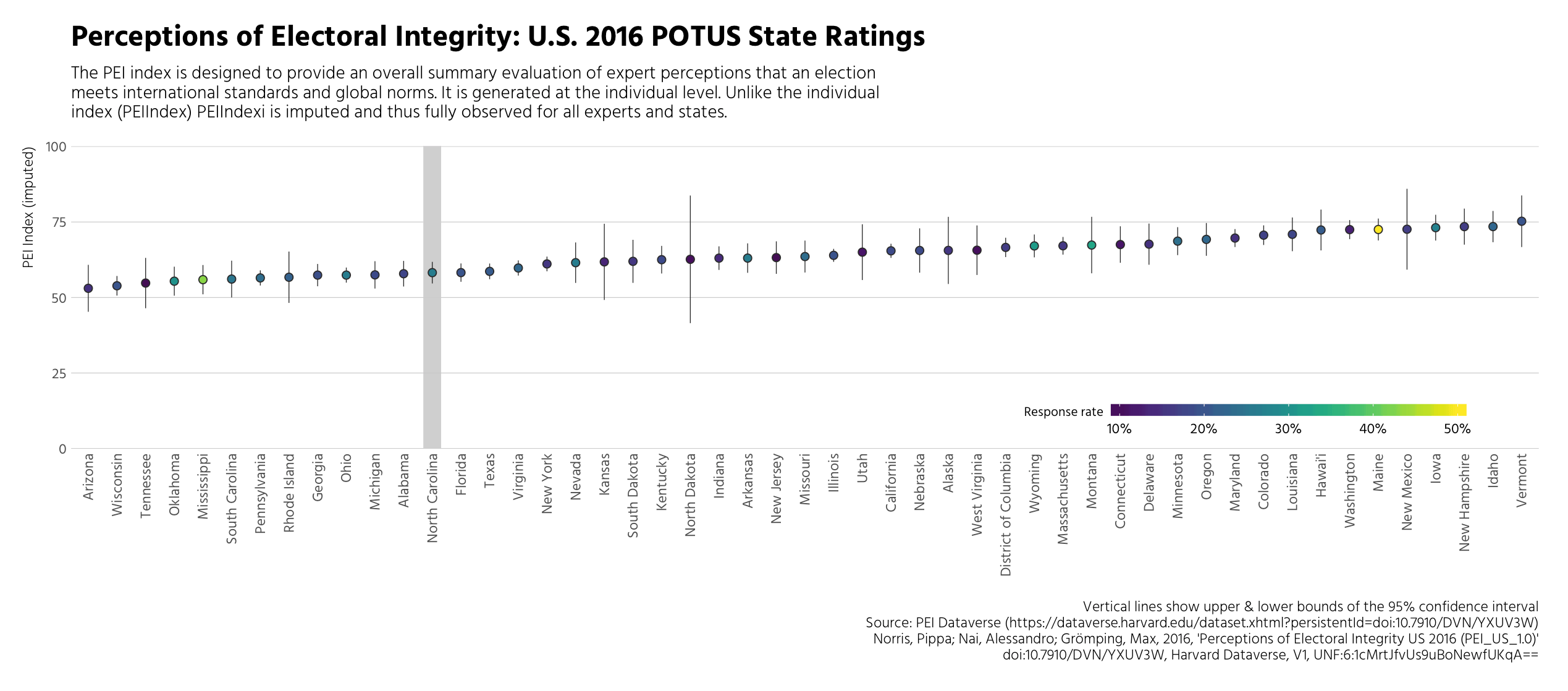
Back to the title of the post: where exactly does North Carolina fall on the newly assessed electoral integrity spectrum in the U.S.? Right here (click to zoom in):

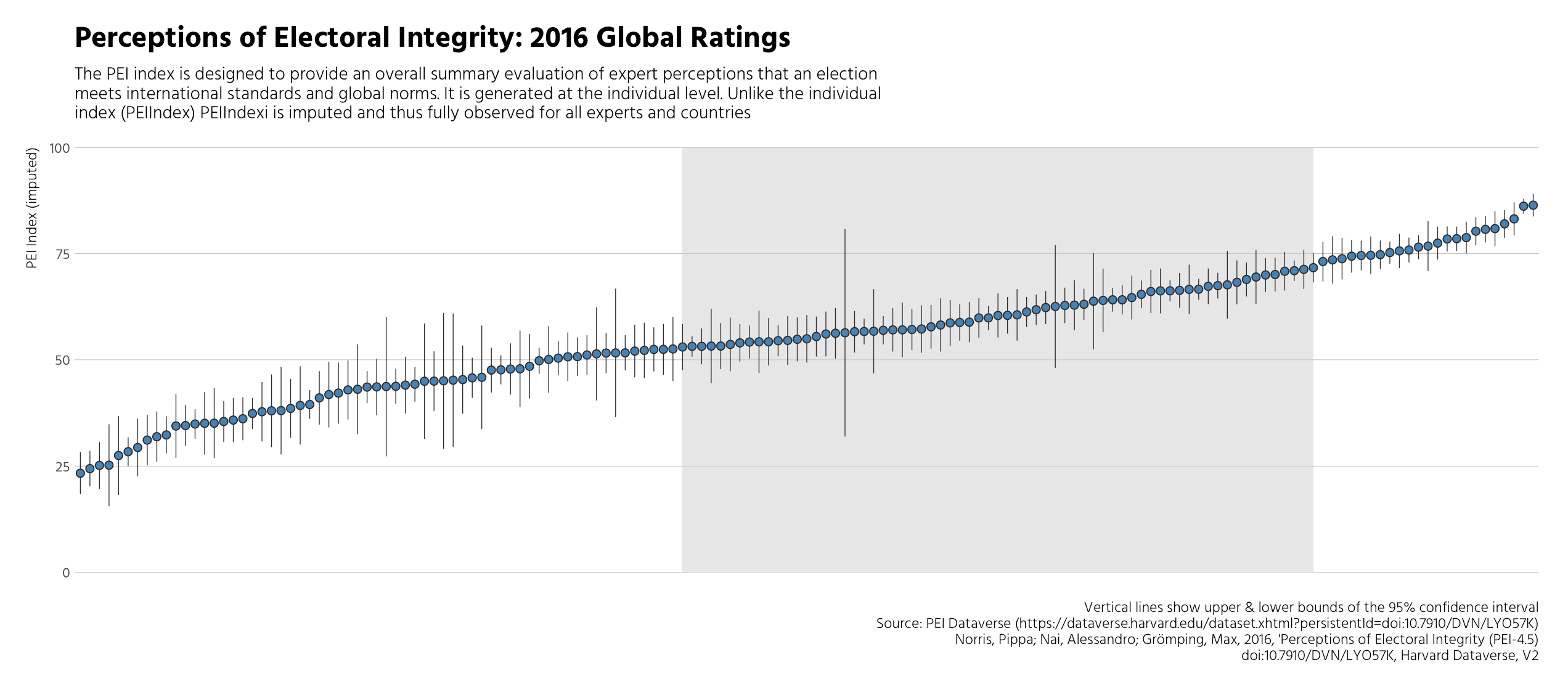
Focusing solely on North Carolina is pretty convenient (I know there’s quite a bit of political turmoil going on down there at the moment, but that’s no excuse for cherry picking) since — frankly — there isn’t much to be proud of on that entire chart. Here’s where the ‘States fit on the global rankings (we’re in the gray box):

You can page through the table to see where our ‘States fall (we’re between Guana & Latvia…srsly). We don’t always have the nicest neighbors:

This post isn’t a commentary on North Carolina, it’s a cautionary note to be very wary of scary headlines that talk about data but don’t really show it. It’s worth pointing out that I’m taking the PEI data as it stands. I haven’t validated the efficacy of their process or checked on how “activist-y” the researchers are outside the report. It’s somewhat sad that this is a necessary next step since there’s going to be quite a bit of lying with data and even more lying about-and/or-without data over the next 4+ years on both sides (more than in the past eight combined, probably).

The PEI folks provide methodology information and data. Read/study it. They provide raw and imputed confidence intervals (note how large some of those are in the two graphs) – do the same for your research. If their practices are sound, the ‘States chart is pretty damning. I would hope that all the U.S. states would be well above 75 on the rating scale and the fact that we aren’t is a suggestion that we all have work to do right “here” at home, beginning with ceasing to feed the polarization bear.

If you do download the data, here’s the R code that generated the charts:

library(tidyverse)

# u.s. ------------------------------------------------------------------------------

eip_state <- read_tsv("~/Data/eip_dataverse_files/PEI US 2016 state-level (PEI_US_1.0) 16-12-2018.tab")

arrange(eip_state, PEIIndexi) %>%
  mutate(state=factor(state, levels=state)) -> eip_state

ggplot() +
  geom_linerange(data=eip_state, aes(state, ymin=PEIIndexi_lci, ymax=PEIIndexi_hci), size=0.25, color="#2b2b2b00") +
  geom_segment(data=eip_state, aes(x="North Carolina", xend="North Carolina", y=-Inf, yend=Inf), size=5, color="#cccccc", alpha=1/10) +
  geom_linerange(data=eip_state, aes(state, ymin=PEIIndexi_lci, ymax=PEIIndexi_hci), size=0.25, color="#2b2b2b") +
  geom_point(data=eip_state, aes(state, PEIIndexi, fill=responserate), size=2, shape=21, color="#2b2b2b", stroke=0.5) +
  scale_y_continuous(expand=c(0,0.1), limits=c(0,100)) +
  viridis::scale_fill_viridis(name="Response rate\n", label=scales::percent) +
  labs(x="Vertical lines show upper & lower bounds of the 95% confidence interval\nSource: PEI Dataverse (https://dataverse.harvard.edu/dataset.xhtml?persistentId=doi:10.7910/DVN/YXUV3W)\nNorris, Pippa; Nai, Alessandro; Grömping, Max, 2016, 'Perceptions of Electoral Integrity US 2016 (PEI_US_1.0)'\ndoi:10.7910/DVN/YXUV3W, Harvard Dataverse, V1, UNF:6:1cMrtJfvUs9uBoNewfUKqA==",
       y="PEI Index (imputed)",
       title="Perceptions of Electoral Integrity: U.S. 2016 POTUS State Ratings",
       subtitle="The PEI index is designed to provide an overall summary evaluation of expert perceptions that an election\nmeets international standards and global norms. It is generated at the individual level. Unlike the individual\nindex (PEIIndex) PEIIndexi is imputed and thus fully observed for all experts and states.") +
  hrbrmisc::theme_hrbrmstr(grid="Y", subtitle_family="Hind Light", subtitle_size=11) +
  theme(axis.text.x=element_text(angle=90, vjust=0.5, hjust=1)) +
  theme(axis.title.x=element_text(margin=margin(t=15))) +
  theme(legend.position=c(0.8, 0.1)) +
  theme(legend.title.align=1) +
  theme(legend.title=element_text(size=8)) +
  theme(legend.key.size=unit(0.5, "lines")) +
  theme(legend.direction="horizontal") +
  theme(legend.key.width=unit(3, "lines"))

# global ----------------------------------------------------------------------------

eip_world <- read_csv("~/Data/eip_dataverse_files/PEI country-level data (PEI_4.5) 19-08-2016.csv")

arrange(eip_world, PEIIndexi) %>%
  mutate(country=factor(country, levels=country)) -> eip_world

ggplot() +
  geom_linerange(data=eip_world, aes(factor(country), ymin=PEIIndexi_lci, ymax=PEIIndexi_hci), size=0.25, color="#2b2b2b00") +
  geom_linerange(data=eip_world, aes(factor(country), ymin=PEIIndexi_lci, ymax=PEIIndexi_hci), size=0.25, color="#2b2b2b") +
  geom_point(data=eip_world, aes(country, PEIIndexi), size=2, shape=21, fill="steelblue", color="#2b2b2b", stroke=0.5) +
  scale_y_continuous(expand=c(0,0.1), limits=c(0,100)) +
  labs(x="Vertical lines show upper & lower bounds of the 95% confidence interval\nSource: PEI Dataverse (https://dataverse.harvard.edu/dataset.xhtml?persistentId=doi:10.7910/DVN/LYO57K)\nNorris, Pippa; Nai, Alessandro; Grömping, Max, 2016, 'Perceptions of Electoral Integrity (PEI-4.5)\ndoi:10.7910/DVN/LYO57K, Harvard Dataverse, V2",
       y="PEI Index (imputed)",
       title="Perceptions of Electoral Integrity: 2016 Global Ratings",
       subtitle="The PEI index is designed to provide an overall summary evaluation of expert perceptions that an election\nmeets international standards and global norms. It is generated at the individual level. Unlike the individual\nindex (PEIIndex) PEIIndexi is imputed and thus fully observed for all experts and countries") +
  hrbrmisc::theme_hrbrmstr(grid="Y", subtitle_family="Hind Light", subtitle_size=11) +
  theme(axis.text.x=element_blank()) +
  theme(axis.title.x=element_text(margin=margin(t=15)))
24 Dec 05:12

Portraits

by Reverend

I’ve blogged a fair amount this year, if I hit the 165 posts mark—which I should—that would be an average of a post every 2.2 days. And that’s with a month away in between October and November. We’re nothing if not regular, and despite what both the British and Americans would have you think, 2016 has been an incredible year. What is it that the Clash said, something like I’m so bored with the USA-that sentiment is doubly true 40 years later.

Most of my experiences this year did not necessarily happen on the bava blog, but through my phone and Twitter. Being new to a smartphone/camera made for some distractions; I was like a kid in a candy store. That was compounded by the fact I’m still in Italy and have been lucky enough to travel to some awesome places around Europe (and even America). Posting to Twitter is something I’ve done since 2007, so it’s very much ingrained into my online habits. But as for many others, this year’s shrill political atmosphere has made it rough to sustain for long periods of time. And while I still enjoy many of the people and posts there, it’s become increasingly humorless.

I’m hoping to post and narrate my photos more regularly on Flickr. In fact, I have posted many of the 4500+ videos and images I’ve taken to Flickr, but they’re almost all private. That’s simply because they automatically upload from my phone and I have done an awful job at titling, tagging, and generally attending to them. Over the next couple of weeks I’ll be rectifying that by trying to get much of what I captured this year organized on Flickr and posted to my blog with some context. I can’t claim 2016’s greatness without some evidence 🙂

Anyway, this post is just a baby-step to that end. I recently upgraded my phone to the iPhone 7+ (I’m soulless, I know) almost exclusively for the camera. You see, I am a long-time fan of Tom Woodward’s photography. In particular, I think his Stranger Portraits may have been the closest a ds106 assignment project ever came to a gallery-ready concept piece, just gorgeous stuff. His project was about overcoming his own aversion to people and actually asking total strangers if he could take a picture, and the resulting discomfort and tension is captured beautifully in the artifacts of the encounter. 

Clerk

Tom always likes to push himself to bizarre challenges like confronting strangers and staying physically fit. Me, not so much.  I like easy. So I doubled up on it this year. I got a phone that takes pretty impressive portraits (including artistic blurred backgrounds) and recruited the opposite of strangers (namely my family) to be my subjects. I’m kind of like the anti-Tom Woodward, and the better for it 🙂 Anyway, I organized my recent portraits of my family on Flickr last night as a push to start getting my photo collection from 2016 underway. So, here it is:

Nonna & Miles

24 Dec 05:11

Stickers

by Reverend

Bryan Mathers siphoned off some booty to Italy from the Reclaim Hosting motherload. We secured a bunch of stickers by backing Visual Thinkery’s Indiegogo campaign, and I’m glad we did. I really love the stickers visually, and they are also quite functional because many of them, like the USA Eagle stamp and EDUPUNK head, are fairly transparent which creates a gorgeous layering effect. After adding them I realized the only thing missing is a ds106 sticker. I believe I have one of Jason Toal‘s #ds106radio skull stickers left, but I am loath to use it given it will be a collector’s item one day. I like how the collage on my laptop speaks to influences and experiences past and present, and the fact that the EDUPUNK character is kissing the Reclaim Hosting logo thrills me to no end. You can also see Jessica Reingold’s DTLT TV, which I dig, some WordPress love, and a lot of Audrey Watters cause she is the ed-tech internet now. I still have a little ways to go, but I am quite happy with this deck. Bryan has been churning out amazing designs all year long, which reminds me I have a post in the queue about his artwork for Domains 17.  But until then, enjoy savor the laptop art.

24 Dec 05:11

Canvas, Episode 26: Advanced Workflow Programming

by Federico Viticci

This week Fraser and Federico take a look at some of the advanced programming structures in Workflow.

On this week's episode of Canvas, we cover some of the advanced features of the app, including conditional blocks and regular expressions. On the final episode of the Workflow series, due to be released in January, we'll cover even more advanced Workflow use cases.

You can listen here.

If you haven't listened to the previous episodes of the Workflow series yet, you'll want to go back and start from there.

Sponsored by:

  • Pingdom: Start monitoring your websites and servers today. Use offer CANVAS for a special 50% off.

→ Source: relay.fm

24 Dec 05:10

Super Mario Run Is a Defense of Craftsmanship

by Federico Viticci

Excellent point by Sam Rosenthal on Super Mario Run:

Borrowing a staple from modern console Mario games, each level in Super Mario Run has multiple tiers of coins to collect. The coins fundamentally change the way you navigate the space, and sometimes the space itself changes to accommodate them. A just out of reach coin reminds you about the spin jump’s utility. Former obstacles are recontextualized as potential platforms.

If the game’s initial tutorial feels like a concession to a broader audience, the coins remind us why Nintendo’s game design deserves to be treasured. Even on another company’s platform, in a genre they didn’t invent, they unearth an astonishing amount of surprise and delight.

Collecting all the coins shows how Super Mario Run isn't just "a runner game for iOS" – it's a classic Nintendo game. There's an ingenuity to each level that can only be appreciated by playing to get the harder coins. Seriously – if you think you've completed Super Mario Run by clearing all the stages, go back and try to collect all the coins. The game changes quite deeply.

Unfortunately, most people won't even see the fourth stage. And that's a shame, because I think Nintendo delivered a lesson in iOS game design that everyone should experience.

→ Source: medium.com

24 Dec 05:10

Elites

Damn I’m slow.

It’s been a thing for years where Republicans talk about the “elites,” and I laugh — because the Republican party, the party for the super-rich and mega-rich (and the generals, it seems) is clearly the party of the elites.

I honestly didn’t know what they meant. I know who they meant — they meant people who make TV shows and movies, write books, sing songs, improve public schools, or who just lead nice lives in the cities and vote for Democrats. (That last one includes me.)

But here’s what they mean, specifically, I think: the “elites” are the people who will, directly or implicitly, tell you you’re a racist. Or sexist, or homophobe, or Islamophobe, or some form of bigot.

And since calling you a bigot has become, somehow, the very worst thing you can do in America, the “elites” are the very worst people.

The “elites,” just by making Modern Family and calling for health insurance even for people who aren’t white, are somehow telling these Republicans that they’re bad people. I get it now. (Maybe I’m the last person to understand this!)

Tough shit.

24 Dec 04:21

A musical wish to brighten your holiday

by Josh Bernoff

Creativity has no boundaries — and the raw material can come from anywhere. Consider this my gift to you along with best wishes for a wonderful holiday and an improved new year.

The post A musical wish to brighten your holiday appeared first on without bullshit.

22 Dec 21:51

The Next Big Thing

by rands

The icing on the cake when I do a presentation is Q&A. Being peppered with random questions might seem problematic, but I love it. First, because it tells me what the audience heard and, second, because it allows to me fill in the gaps of the presentation.

There are a standard list of questions I get on a regular basis, and one of them is, “If you were going to found a start-up, what would it be?” My answer has been consistent for the past five years, “I don’t know how I’d do it nor how I’d make money, but I would provide a service which allows a human to determine the source of a piece of information.”

Everyone suddenly cares about this idea a lot. Facebook recently announced it’s plan to vet alleged fake news with five different independent news/fact-checking groups. These groups are:

I remain jaw on the floor shocked how much opinion that swirls me is repackaged as facts. I’m not pointing the finger at a particular demographic; I’m talking about everyone (including myself) who says, “That insert-fact-here just feels wrong.” We are 100% entitled to our opinions. Our views are also protected. However, usage of an opinion as fact is rotting our national discourse.

Kudos to Facebook for taking action, but a better course of action is when you hear or read a fact that seems just plain off check out one of the sites above get the real facts.

p.s. There is a fact-checkers code of principles.

#