Shared posts

29 Dec 06:11

Volkswagen acquires Vancouver-based PayByPhone

by Ian Hardy

Volkswagen has acquired Vancouver-based PayByPhone for an undisclosed amount of money.

According to the Wall Street Journal, Volkswagen is interested to clean up its image from the 2015 diesel-emissions controversy and this deal is about solely a play to gain access to proven technology that makes the overall driving experience easier and convenient.

“This is a tremendous opportunity for PayByPhone to explore new ways to expand our mobile payments technology into different verticals, markets and use cases. The mobile payment movement has exploded recently, and we look forward to accelerating our consumer parking and payments agenda made possible by this deal,” said Kush Parikh, CEO of PayByPhone. “Volkswagen Financial Services AG has been at the forefront of innovation to fit its customers’ mobile lives, and we are honored to be a part of its global vision.”

PayByPhone was founded in 2000 and allows users to easily pay for parking spaces from their mobile device via its iOS, Android and BlackBerry app, phone call or text message. According to its site, PayByPhone says it processes over $300 million in payments annually and has over 12.5 million consumers in North America, Europe and Australia.

Similar to how the newly redesigned GreenP parking app operated, PayByPhone “reminds the user when their parking is about to expire, allowing them to top up from anywhere, at any time.”

Source PayByPhone
29 Dec 06:11

stevethompson-art:Heartbroken. May the force be with you.


stevethompson-art:

Heartbroken. May the force be with you.

29 Dec 06:10

Things that don't work for me :: Assistants

by Volker Weber

ZZ56D9D5D5

I love using Siri for dictation. Speak and let it transcribe to text. But I never ever ask Siri for information, not let it do something. Even for the most simple tasks like dialing a phone number, I use some other means. There is only one exception: when I am wearing a Plantronics Voyager headset and cannot touch the iPhone.

And I am not singling out Siri here. I have tried Alexa, Cortana and whatever-Google-calls-it-today. Yes, I see the potential but today it's just too much effort for me.

Yesterday I witnessed the worst use case for Alexa: turning on or off the lights. How about you? Does this stuff work for you?

29 Dec 06:10

New DTES Rental Housing

by Ken Ohrn

After years of being vacant, a DTES property (95 W Hastings at Abbot) is to become a 10-storey 132-unit market rental building, with retail, built by the Holborn Group.  Just as soon, that is, as they get their Trump Tower into operation and their Little Mountain 17-building, 15-acre 8-year project past planning stage.  It will be another change in an area that has been moving away from dereliction for years.

The design is by architect Gair Williamson.

Rental units (132) consist of 83 studios, 3-1 BR, 46-2 BR. Parking for 74 vehicles and 167 bicycles.  Three commercial / retail units at street level. Floor plan detail HERE.  None of the units is large.

Thanks to Frances Bula in the Globe and Mail for the tip.

Check it all out from 5 to 8 pm on Thursday, January 26, 2017 at Vancouver Community College (255 West Pender Street), Room 240, with the applicant team and City staff available to answer questions.  Online feedback welcome HERE.


29 Dec 06:10

Vivienne Westwood, via Architecture + Film


Vivienne Westwood, via Architecture + Film

29 Dec 06:10

luz-natural: We live on a suspended time. (One of a thousand...


luz-natural:

We live on a suspended time. (One of a thousand ways to defeat entropy), ryoichi kurokawa

29 Dec 06:10

Neptune's Inferno: The U.S. Navy at Guadalcanal

This 2011 history is large and was well-received, but I’m not convinced I see the point. A 21st-century history of the US Navy in the Solomons necessarily starts in the shadow of Samuel Eliot Morison’s History of United States Naval Operations in World War II, specifically his Volume 5 on the Guadalcanal campaign. Morison had formidable advantages: he was a Harvard historian, he was a sailor, he had personally met every US president since Teddy Roosevelt and in the war he held a presidential commission to record its naval history. Morison knew the senior officers, he had staff to track down survivors and documents, he was a terrific writer, and he’s still in print.

Hornfischer relies on Morison for a number of anecdotes and accounts. He adds some details and skips some others. He takes greater pains to emphasize the surface fleet, but Morison is hardly unjust on this score. Hornfischer a little bit more frank in drawing character sketches of the senior officers, but only a little. Morison actually knew these people; Hornfischer has to rely on the record, but Hornfischer has the advantage of not running into them at parties and reunions.

One problem with Morison, which Hornfischer repeats, is that almost every mistake and shortcoming is committed by the losing side, which in almost every case is the side with the least metal. In August, the US Navy can’t get out of its own way; lookouts don’t look out, radar doesn’t work or is installed in the wrong ships, admirals express themselves poorly. By November, it’s the Japanese navy that has all the bad luck. This is an illusion of causality: the losers remember the inept lookout and the wrong turn as a lost chance, but the winners forget them.

I wonder, for example, whether Ghormley got a raw deal. The contemporary verdict, which Hornfischer largely endorses, is that he was a timid commander, and perhaps a negligent one, a micromanager who approached a nervous breakdown before his relief by Bull Halsey. That could be right. Could you put together a case that Ghormley was under overwhelming pressure to account for every paper clip, to lose nothing, expend nothing, and above all not to lose?

Hornfischer is critical of Capt. Howard Bode of the Chicago, but Bode’s 1943 suicide makes him a safe target.

If you’re going to write a new account of Guadalcanal, it seems to me you need to take advantage of our more distant perspective. In 1949, the emphasis was naturally on violence and suffering, because the audience had been there or had known people who were there, and they wanted to know what it was like. Today, we might spend a little more time on why and how. All those freighters and support ships, base personnel and clerks were indispensable. That was a tough sell in 1949, but we’ve seen Mr. Roberts (about a freighter) and 12 O’Clock High (company clerk) and The Caine Mutiny (junior officer on a minesweeper that never sweeps a mine) now. Remember: they didn’t have computers or calculators; they didn’t even have ball-point pens.

The other thing you could do in a new account is to recognize that today’s audience doesn’t necessarily know the difference between a light cruiser and a destroyer, what either was supposed to do, or how they did it. We’re almost half as far from Guadalcanal as Guadalcanal lay from Trafalgar. We also understand how the stereotyped language of gallant sailors and heroic deeds can mask the ghastly reality, and to look more squarely at some less-than-noble actions from which Hornfischer still prefers to glance away as soon as he decently can.

29 Dec 06:10

Igor’s favourite things of 2016

by Igor Bonifacic

When I sat down to write this same feature at the end of 2015, the world seemed a much simpler place. At least that’s the impression I have.

In hindsight, I’m sure the same anxieties that worried me throughout 2016 also worried me in 2015. Politics aside, 2016 was an impressive year in a lot of other ways, and like the rest of the MobileSyrup team, here I’ll highlight some of my favourite things from the past twelve months.

Best smartphone: OnePlus 3T

OnePlus 3T

If you’ve read MobileSyrup’s reviews of the OnePlus 3 and OnePlus 3T, then this pick should come as no surprise. I reviewed both phones for the website and gave each a glowing recommendation.

In a year in which Apple delivered the headphone jack-less iPhone 7 and Samsung couldn’t keep its best phone to date from exploding, the OnePlus 3 stood out to me as one of the most compelling phones to come out in 2016. Granted, Samsung also released the excellent S7, but even after the touchups the company made to TouchWiz, something about the minute-to-minute experience of using a Samsung phone still doesn’t appeal to me.

The OnePlus 3, meanwhile, impressed me with its clean take on Android and mountain of customization options. It also helped that 2016 was the year that Android grew into a stable and mature operating system.

I’m sure someone will jump into the comments to tell me 2016 saw much better phones than the OnePlus 3. They’re not wrong. The fact of the matter is, even with all the misses this year, 2016 saw some exceptional phones. That said, no other phone quite appealed to my particular tastes like the OnePlus 3 did.

App: Hopper

hopper-android

In the past year, I’ve been fortunate to travel to cities like San Francisco and New York, as well as countries like Italy and Croatia. If there’s one thing that has helped me achieve that feat (besides a stable and well-paying job at MobileSyrup — thanks, Ian!), it’s an app called Hopper.

Made by a Montreal startup, Hopper allows iOS and Android users to easily track and compare flights to save money. Simply pick a destination and the date you want fly out by, and Hopper will notify you when it’s the ideal time to book a flight. I’ve saved hundreds so far using the app. I can’t recommend Hopper enough, even if you only fly infrequently.

Music: Chance the Rapper – Coloring Book

Chance the Rapper
By all accounts, 2016 was an awful year, but if there’s one piece of music that helped me get through this year’s toughest moments, it was the soulful and hopeful vibes found on Chance the Rapper’s second mixtape, Coloring Book.

With a voice and delivery unlike anyone else on the rap scene, Chance soothed with his positive but poignant songs about young love, lost friends and faith. At its best, Coloring Book is a celebration of life, both its brightest and darkest moments, and it’s for that reason that I fell in love with it.

Coloring Book is also an important inflection point for both tech and the music industry. It is the first album to chart on the Billboard 200 based solely on streams — it was only available on Apple Music when it came out in May. Moving forward, I’m sure we’ll see more artists achieve the feat, but I can’t think of an artist more deserving of the distinction.

Music: Tycho – Epoch

Tycho's Scott Hansen

Fun fact: according to Spotify, I am in the top 1 percent of Tycho fans.

I’ve been a huge fan of Scott Hansen’s music since 2011’s Dive, more or less the best piece of Boards of Canada-esque music released since Boards of Canada itself came out with Geogaddi in 2002. That said, Epoch is the band’s tightest, most focused album released to date, and it sees Tycho forging a musical identity that is all its own.

Best video game: Titanfall 2

Titanfall 2

2016 may go down as the year humanity consigned itself to a future of catastrophic climate change or nuclear annihilation (or both), but it will also likely go down as one of the best years in video game history, perhaps even matching the highs set by 1998 and 2004.

Between games like Dark Souls 3, Overwatch, Dishonored 2 and more, there were so many great gaming experiences to check out this year, but my personal favourite to come out this year was Titanfall 2. Between its incredible single player campaign that evokes memories of Half Life 2 and perfectly tuned multiplayer, Titanfall 2 is close to perfect. It’s a shame then that EA, the game’s publisher, decided to release it in between Battlefield 1 and Call of Duty: Infinite Warfare, new entries in two giant franchises, but none of that diminishes from Titanfall 2’s brilliance.

If you have any interest in the game, it’s currently 50 percent off on EA’s Origin platform.

29 Dec 06:09

Meticulously-Painted Glitch Art Maps the Human Psyche

by Andrew Nunes for The Creators Project

TRIP (7/15/16), Andrew Kuo, 2016. All images courtesy the artist and Marlborough Chelsea

Best known for his Instagram account filled with curated funny animal pictures, Andrew Kuo is more than just a social media maestro. He is also a talented painter represented by the prestigious Marlborough Chelsea gallery, where his solo show No To Self, comprised of exacting geometric paintings, is currently on view.

No to Self recalls the geometric abstractions of artists like Frank Stella and Ilya Bolotowsky, but Kuo emphatically asserts that the paintings are not abstract, but meticulously intentional, guided by a series of map-like legends at the bottom of the works. “The paintings are dictated by the rules that are at the bottom of the paintings. They provide the key that tells me what to do,” Kuo tells The Creators Project.

FORWARD (9/28/16), Andrew Kuo, 2016

The legends effectively transform the artist’s brushstrokes into representations of a diverse array of feelings and questions that are entirely different depending on where they are located in the work. In Cues (9/23/16), pink marks in the left-hand quadrant of the work embody the question, “Is haunting our enemies frowned upon?” while marks of the same color in the right-hand portion of the canvas ask, “Could our parents be pre-parental versions of themselves?” The sets of inquiries and explorations are different in each work, falling under varying groupings, expressing human musings like Things I’d Love to Know and What I’m Actually Saying When I’m Saying.

News, Andrew Kuo, 2016

Even the geometric shapes on the canvas have philosophical implications. Reminiscent of the jumping stack of cards animation that plays after winning a game of Solitaire on Windows 2000, the forms emphasize “the ongoing battle between empiricists and those who depend on instinct,” according to the exhibition press release.

“The ‘deck of cards’ was an inspiration in that it represents the idea of luck, or the opposite of empirical thinking,” Kuo elaborates further. “But there’s also a way to count a deck where it takes away chance for the space of probability. Luck definitely exists, but it can also be normalized through repetition and sample size. I like that idea.”

CUES (9/23/16), Andrew Kuo, 2016

No to Self is on view at Marlborough Chelsea through January 14, 2017. Check out Andrew Kuo’s Tumblr and Instagram accounts for an assortment of artist-curated oddball imagery.

Related:

Andrew Kuo Talks Art, Sports, and Obsession

Andrew Kuo and Scott Reeder Open a Nightclub in a Gallery

It's Time to Relax With These Soothing Geometric GIFs

29 Dec 06:09

Big Software Services Sale

by Ken Ohrn

Or:  there’s gold in them-thar smartphones.

Vancouver tech company “PayByPhone” has a new owner – Volkswagen Financial Services AG. Thanks to Tyler Orton at Business In Vancouver for the tip.

A 2001 startup, the company’s service is now used by approx. 2M people in Vancouver, at over 13,000 parking meters.  Worldwide, PayByPhone has 12.5M users and handles around $300M in payments per year. Paris alone uses the service on 155,000 parking spaces.

paybyphone

Motor vehicle operators can use it to pay tolls on the Port Mann Bridge.

paybyphone-kush2

Kush Parikh

From TechCrunch:   “It is important to make the distinction that it is Volkswagen Financial Services (VWFS) who acquired us, and they have a charter to focus on general mobility services,” said PayByPhone CEO Kush Parikh in an email interview. “Outside of being the largest parking payment provider, the key asset we bring to the table is the relationship we have via our flagship mobile applications with our users. The mobile relationship is a one to one relationship that can extend into a myriad of additional services.”

. . . .  The company already has a program in London where license plates are coordinated with a user account when the car arrives in a lot, and then the user is charged for her parking time when she leaves. “[This] can quite easily be extended into the autonomous vehicle movement,” Kush said.

PayByPhone’s expansion hasn’t been hindered so much by its ability to scale as by an entrenched parking industry “that continues to hold on to archaic cash and credit card based systems, which are very capital intensive,” as Kush put it. PayByPhone does expect that VWFS’s investment will help the company expand into new countries.

Kush noted that while the company will be focused on making parking payments as seamless as possible, they do have an eye on the future. “Parking is a great way to attract users where their identities can be used for a myriad of additional services, including movement around cities (aka smart cities) and distributing our service into any application, such as mapping and travel applications.”


29 Dec 06:08

Android 7.1.1 update will come to the Nexus 6, Pixel and Pixel XL in January

by Jessica Vomiero

Nexus 6 users who’ve been waiting for a long time to get Android 7.1.1 on their smartphone will finally get their hands on the update this coming January.

While Google has been fairly quiet about the reason for the delay, the company claimed to have discovered a bug particular to the Nexus 6, which caused the delay of the 7.1.1 rollout. Google went on to say that it has since resolved the problem.

Nexus users were eager for the rollout of 7.1.1 because their devices hadn’t received the preceding update, Android 7.1, which includes several new features such as app shortcuts, keyboard image insertion and Daydream VR mode, as well as a variety of Pixel-specific updates.

When Google said it would not update the Nexus 5 to Android 7.0 this past August, the Nexus 6 became the oldest remaining Nexus still supported by the search giant.

The Google Nexus 6 was first released in 2014, making the device just over two years old. Android enthusiasts will know that, as per Google’s commitment to support its devices for up to three years after they’re released, the 7.1.1 update could be the last one for the Nexus 6.

In addition, for Nexus 6P owners, Rogers is reporting the monthly security update and the rollout of  Android 7.1.1 will arrive on January 3 alongside the Google Pixel and the Pixel XL.

29 Dec 06:08

Unclear on the Concept, or How Ken Griffey, Jr., is like James Monroe

by Eugene Wallingford

Today I read an article on faithless electors, those members of the Electoral College who over the years did not vote for the candidate they were pledged. One story from 1820 made me think of baseball's Hall of Fame!

William Plummer, Sr. was pledged to vote for Democratic-Republican candidate James Monroe. Instead, he cast his vote for John Quincy Adams, also of the Democratic-Republican Party, although Adams was not a candidate in the 1820 election.

Supposedly, Plummer did not feel that the Electoral College should unanimously elect any president other than George Washington.

There are many Hall of Fame voters each year who practice Mr. Plummer's ostentatious electoral purity. They don't vote for anyone on his first ballot, preserving "the legacy of their predecessors", none of whom -- neither Cobb nor Ruth, Mays nor Aaron -- were elected unanimously.

(Some leave a great off the ballot for a more admirable reason: to use the vote to support a player they believe deserves entry but who does not receive many other votes. They hope to give such a player more time to attract a sufficient body of voters. I cut these voters a lot more slack than I cut the Plummers of the world.)

It was a silly idea in the case of President Monroe, whose unanimous election would have done nothing to diminish Washington's greatness or legacy, and it's a silly idea in the case of baseball greats like Ken Griffey, Junior.

29 Dec 06:08

How to be happy

by Volker Weber

Frau Brandlinger says:

  • Surround yourself with people who make you happy.
  • Stay away from Facebook.
  • Get out and walk as much as you can.

I could not agree more.

29 Dec 06:08

Pogue’s Basics: Money - Free fine art for your fine walls

Fine art for your walls is usually considered a wealthy person’s game. A handsome original piece of art might cost hundreds or thousands of dollars, plus $300 to get it custom-framed.

There is, however, an ingenious way to get stunning artwork for nothing — and to custom-frame it for one-tenth as much as you’d expect.

First, pick out the free art. Visit Flickr.com, one of the Internet’s largest repositories for spectacular photography. Yes, owned by Yahoo, but that’s not the point.

Search for the kind of imagery you’re looking for: landscape, cityscape, trees, sunset, abstract, or whatever. (Bonus tip: Search for shots of “spiral staircases.” Those make really cool art, especially in black-and-white.)

Now you want to find the free ones — the ones whose creators have given permission for anyone to use their work in any way.

To do that, click the “Any license” pop-up menu and choose “All creative commons.” Now you’re looking at pictures that you’re free to download and print.

Click the photo and inspect it; make sure that its resolution will be high enough for the print size you want. Download the file.

Now, order the framed print. A number of websites offer professional printing and framing of any picture you send them. At Mpix.com, for example, you can upload your photo, choose a frame type, specify a final size, and order the whole thing. They’ll print the photo on gorgeous paper and frame it for you in a couple of days. An 8-by-10-inch photo becomes an 11.5-by-13.5–inch framed print — and costs about $26.

The results look exactly like the most professional, high-end photography and framing you could possibly buy. Nobody will ever know that your grand total expenditure was 26 bucks.

29 Dec 06:08

New Tool Downloads Any Netflix Video Instantly

by Ernesto
mkalus shared this story from TorrentFreak.

netflix-logoA few weeks ago Netflix announced that it would allow users to download a small selection of videos for offline use, on mobile devices.

While this is a great step forward, there’s also a large group of users who would like to do the same with other videos on other operating systems.

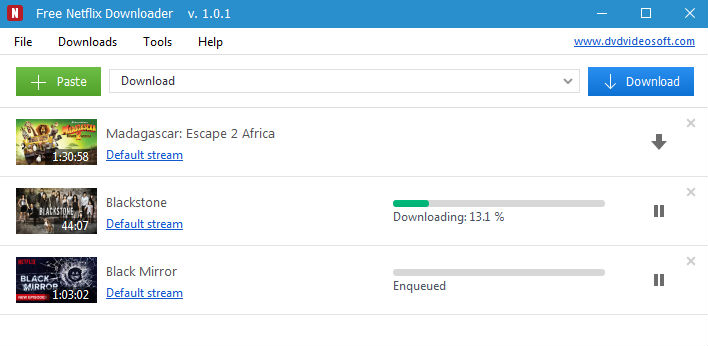
Free Netflix Downloader is application that offers exactly this. Developed by DVDVideoSoft, it is the first Windows application that allows people to download Netflix videos to their computers through an easy-to-use interface.

After logging in to Netflix, users simply enter the video URL and ‘Free Netflix Downloader’ then downloads any video in a few minutes. The tool also offers the option to convert the output files to AVI, MP3, or a version optimized for iPhone and iPad.

“This is the ONLY app in the world that can do this trick now!” DVDVideoSoft’s Alex informs TF.

The software supports multiple downloads at the same time and according to the developer, it is ideal for people who have slow Internet connections, among other things.

“[It is intended for] users with slow Internet connections, for those who like to store everything on their computer, for those who don’t have smart TVs; it’s also great for downloading a whole series season at a time,” Alex says.

Free Netflix Downloader in action
netflix-downloader

While ‘Free Netflix Downloader’ works as advertised, there is also a major drawback. The video quality appears to be rather low and certainly not what people are used to when watching Netflix.

The developers don’t go into detail on this issue but say higher quality video may follow later. However, it’s likely that Netflix’s higher resolution video is better protected, which makes it much harder to rip.

Finally, it should be stressed that people who use the tool might violate Netflix’s Terms of Service, which forbids users to archive or download content without permission. This is also the main reason why Netflix and rightsholders are probably not too fond of the service.

For now, Free Netflix Downloader’s developers don’t anticipate any pushback from Netflix. However, they realize that this could change if their software becomes very popular in the future.

“Maybe if the program becomes very popular,” Alex says, but she also notes that Netflix just created its own downloader feature for mobile users.

For now, however, the tool is still freely available. More information on ‘Free Netflix Downloader’ and its capabilities is available at DVDVideoSoft’s official site. As always, those who are interested should proceed at their own risk.

Source: TF, for the latest info on copyright, file-sharing, torrent sites and ANONYMOUS VPN services.

29 Dec 06:07

So long, and thanks for all the badges!

by Nate Otto

The Badge Alliance has successfully merged into IMS Global Learning Consortium as of January 2017, and we have moved all our posts to the Open Badges publication on Medium, maintained by IMS Global.


So long, and thanks for all the badges! was originally published in Badge Alliance on Medium, where people are continuing the conversation by highlighting and responding to this story.

29 Dec 06:07

Transformative 2016

image

2016 will be remembered as a rough year for many reasons. But for me personally, it was a year of transformations and positive growth. 

I left the federal government and started working as a communications specialist on urban issues with MODUS Planning, Design and Engagement. It’s been exciting, challenging and fulfilling to have my passions line up with the work I am doing. 

My hip and other post-viral fatigue health issues seem to have resolved to the point that I was able to enjoy a yoga retreat and ski a few times in December (for the first time in three years!).

In the realm of urbanism and blogging, I was given opportunities to speak about housing and family-friendly cities with the City of Vancouver and National Capital Commission, while starting a bi-weekly column with Spacing Magazine online. 

Most importantly, I continue to share my love of cities with readers like you.

Thank you for supporting the blog. I wish you peace, fulfillment and joy in 2017 xo

29 Dec 06:07

Open Society Needs Defending

files/images/f6a0a31ce1d3796b9dc37dee5cc25f95.author-portrait.JPG


George Soros, Project Syndicate, Dec 31, 2016


Argument from George Soros to the effect that, yes, the open society needs defending. "Open societies are in crisis," he writes, "and various forms of closed societies – from fascist dictatorships to mafia states – are on the rise." A bit sgtrong but we'll accept thes. He then asks, "How could this happen? The only explanation I can find is that elected leaders failed to meet voters’ legitimate expectations and aspirations and that this failure led electorates to become disenchanted with the prevailing versions of democracy and capitalism." Well, that much is true, but the prevailing institutions - including the EU, which he seeks to defend in this article - weren't showing any sign of actually meeting those legitimate expectations. How many times has the European Commission tried to sneak software patents into law, for example?

[Link] [Comment]
29 Dec 06:07

Panasonic dedicates $256 million to Tesla in a solar cell partnership

by Jessica Vomiero

Panasonic will invest over $256 million USD (or 30 billion yen) toward Tesla’s solar initiatives.

The investment will be directed towards the company’s New York-based photovoltaic (PV) cells and modules production facility. PV cells are also known as solar cells, which speaks to Tesla’s several solar initiatives.

The Japanese consumer electronics company will deepen its partnership with Elon Musk’s auto manufacturer through the investment. As part of the agreement, the electric car company will receive a long-term purchase commitment from Panasonic.

A  joint statement reveals that the two tech companies plan to start the production of PV cells in the summer of 2017 and increase to one gigawatt of module production by 2019, reports Entrepreneur.

This agreement continues the longstanding partnership between Panasonic and Tesla. The consumer electronics provider is the exclusive provider of batteries for the company’s first mass-market vehicle, the Model 3, as well as its predecessors, the Model S and Model X.

In addition to being the most well-known provider of electric vehicles, Tesla has taken several steps towards the integration of sustainable energy models. This past November, it was revealed that Tesla is powering the entire island of Ta’u in American Samoa using solar energy.

This news surfaced just days after the completion of Tesla’s acquisition of SolarCity, an American company that specializes in solar energy services and that was co-founded by two of Musk’s cousins.

29 Dec 06:07

Trudeau’s Liberals were told donor was China graft suspect, but kept taking his money and help

by Ian Young
The Liberal Party of Canadian Prime Minister Justin Trudeau was tipped off in 2013 that a wealthy party benefactor was wanted by China for corruption, long before the news became public, in an email that has been leaked to the South China Morning Post by a former party executive. The former executive said they were assured at the time that the anonymous email and its startling claims about Vancouver developer Michael Ching Mo Yeung had been “dealt with”. But the party kept quiet...
29 Dec 06:07

Second Life's creator is building a 'WordPress for social VR'

files/images/mars1.jpg


Nick Summers, Engadget, Dec 31, 2016


Virtual worlds and virtual reality are natural partners. So there's no real surprise that Second Life is looking to develop to support Oculus Rift and similar technologies. But getting the mix right is difficult - you don't want people to simply inhabit your environment, you want them to invest in it, to build it themselves. Hence, the WordPress analogy - what makes a blog worth reading isn't the software it was written with, it's the content that is written. But the other thing about WordPress is that each person had his or her own blog. Via The Blog Herald.

[Link] [Comment]
29 Dec 06:07

Finding the squishy middle (before fact-checking everything drives you nuts)

files/images/can.jpg


Michael Caulfield, Hapgood, Dec 31, 2016


It's easy to say we should fact-check the internet (or at least that part of it pirporting to be news and information). Actually doing it is a lot harder. As Michael Caulfield says, fact-checking is boring unrewarding work. It's better shared with others. Enter annotation, as provided by (say)  hypothes.is - now through the mechanism of annotation we can share our fact-checking efforts. For example, here's an annotated news article. Will this technology work where so many previous efforts at annotation have failed?

[Link] [Comment]
29 Dec 06:06

My rediscovery of music

by Bruce Byfield

I have spent the last few months in the grip of an enthusiasm. At my age, I am proud I can still have an enthusiasm, because it proves that I have kept a youthful engagement with the world well into middle-age, but it is one I would have thought unlikely when I was a boy. It is, of all things, an enthusiasm for the Fiio line of music players – or, as I prefer to think of them, portable stereos.

I learned about music the hard way, by myself, with lots of false leads and blind alleys. My family is not musical, and my elementary school music teacher, who wanted to be a professional musician, was only interested in encouraging students who had already taken music lessons. When the transfer to high school allowed me drop music, I did so without hesitation. The only reason I was even attempting to play the trombone was that it could be rented to own cheaply.

I started high school so profoundly ignorant that I might have grown up to be a life-long hater of music. I definitely took years to develop any knowledge; I was in my twenties, for example, before I could tell the difference between a sharp and a flat, and when I learned, I was profoundly excited.

Yet free from the humiliation of the band, I started discovering music first. As a would-be writer, I gravitated naturally to songwriters: first Simon and Garfunkel, and later Bob Dylan. Other explorations, such as the work of all the Beatles after the band broke up, including Yoko Ono, did not last, being less fortunate.

Still, by the time I started university, I was a compulsive music listener. I developed a taste for folk rock, and I still remember being down in the basement bedroom in my parents’ house, listening to Steeleye Span singing “Thomas the Rhymer” on my cheap transistor, absolutely delighted that a song seven hundred years old had been transformed into a modern hit.

Throughout my marriage, the Vancouver Folk Festival and later the Rogue Folk Club were the main part of our socializing. I can still remember the first time I heard Stan Rogers, Loreena McKennitt and Oysterband, and over the years we bought hundreds of records, cassettes and CDs (people bought albums in my youth, and I still do, as a way of supporting artists I appreciate). Usually at the folk festival we bought cassettes, because they were less likely to warp in the summer sun.

Over the last seven years, I have been slowing digitalizing my music collection. Usually, I made files of medium quality, reasoning that, since I would often be listening to the digital files on public transit, high quality files would be largely wasted on me. I looked forward to the day when all my music would be available from the same source, envisioning first a dedicated laptop and later a music player with enough memory to hold 12,000 tracks or so.

As SD micro cards became larger, I was nearing that goal when my Sansa Fuze music player needed to be replaced. I bought a Sansa Clip, but the manufacturer had lapsed from their former standards. My new player especially seemed to dislike my Ogg Vorbis files, refusing to recognize some and only playing others at a whisper.

According to my research, the Fiio X1 should perform better. I had noticed it when searching for a new player, but it seemed unusually large and clunky. I especially disliked the arrangement of four buttons at the corners of the scroll wheel – an example of poor design if there ever was one. But if it could let me play my files in the way I wanted, I was prepared to put up with the appearance. I did wonder, though, if the X1 would burst the seams of my pocket.

My reluctance vanished the first time I tried the X1. Even my average quality files sounded better on it. As for the high quality ones – have you heard the expression “wall of sound”? It refers to arrangements full of orchestration, each instrument interacting with the others in complex and interesting ways. That was what I heard on the X1. I even heard subtleties I had never heard on music players from other manufacturers.

That was when I realized why Fiio products were so much larger than other music players. They weren’t just music players. They were portable stereos, and, as far as miniaturization has progressed, their DAC (Digital Analog Converters) and headphone amplifiers could still only be made so small. The Fiio product line did not consist of oversized music players, but stereo systems that were as small as our current technology allowed.

As a lover of both excellence and music, I bored everyone in hearing about this discovery. Before long, I began planning to re-record some of my digitized music with the highest quality possible. I also decided I wanted an X7, Fiio’s top of the line product, for use at home. Unfortunately, my editors were slow in paying at the time, and I knew I had to wait.

Finally, in the last week before Christmas, payments started rolling in. One morning, I was just debating whether I could afford an X7 when I received a cheque for almost exactly the amount I needed.

This, I told myself, was obviously kismet. Within moments, I had placed my order. Miraculously, in the middle of the holiday season, it arrived the next day.

I had read the universally enthusiastic reviews of the X7, so I knew what to expect. Still, having been impressed already by the X1, I doubted there was much room for any improvement.

I couldn’t have been more wrong. As superior as the X1 was to music players from other manufacturers, so the X7 was to the X1. The wall of sound had become a tsunami, and I have happily spent the last few days rediscovering my music. Once or twice, I have even mistaken a detail I could only detect on the X7 for a sound behind me or in the next room.

This was not just music; this was the kind of revelation that produces fanatics. The interface, the construction, the sound and everything else about the X7 has a quiet quality that I both respect and enjoy immensely.

I already listen regularly to music, but already I suspect I will be listening to a lot more. It sounds like advertising hype, but I really do feel like I have rediscovered music — including many old favorites — all over again because of my purchases.


29 Dec 06:06

NewsBlur Blurblog: New Economics

sillygwailo shared this story from AVC.

I am tired of the classic left/right perspective on society, policy, and politics. I realize that markets are an incredible tool to allocate resources efficiently. And I also realize that markets are subject to failure and we need to protect our society from these market failures. I am not a purist on either side of this debate and I find the hard core advocates on the far left and the far right impossible to take. I believe orthodoxy is one of the worst human traits.

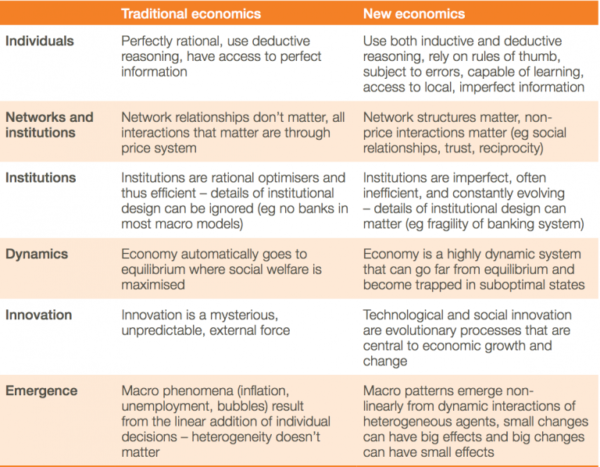
So I enjoyed reading this post on “new economics” and I particularly like this table that shows the difference between traditional economic thinking and new economic thinking:

The post goes on to explore how these new economics thinking will eventually impact politics, policy, and society at large.

One particular example reminds me of our work at USV on “Regulation 2.0”:

First, rather than predict we should experiment. Policymaking often starts with an engineering perspective – there is a problem and government should fix it. For example, we need to get student mathematics test scores up, we need to reduce traffic congestion, or we need to prevent financial fraud. Policy wonks design some rational solution, it goes through the political meat grinder, whatever emerges is implemented (often poorly), unintended consequences occur, and then – whether it works or not – it gets locked in for a long time. An alternative approach is to create a portfolio of small-scale experiments trying a variety of solutions, see which ones work, scale-up the ones that are working, and eliminate the ones that are not. Such an evolutionary approach recognises the complexity of social-economic systems, the difficulty of predicting what solutions will work in advance and difficulties in real-world implementation. Failures then happen on a small scale and become opportunities to learn rather than hard to reverse policy disasters. It won’t eliminate the distortions of politics. But the current process forces politicians to choose from competing forecasts about what will and won’t work put forward by competing interest groups – since it is hard to judge which forecast is right it is not surprising they simply choose the more powerful interest group. An evolutionary approach at least gives them an option of choosing what has been shown to actually work.

I also like this bit about the tolerance for failure:

A major challenge for these more adaptive approaches to policy is the political difficulty of failure. Learning from a portfolio of experiments necessitates that some experiments will fail. Evolution is a highly innovative, but inherently wasteful process – many options are often tried before the right one is discovered. Yet politicians are held to an impossibly high standard, where any failure, large or small, can be used to call into question their entire record.

I don’t think the way we do things in startup land should be a model for how everything should work, but there is a lot to be learned from the way the tech sector works. Innovating, trying new things, measuring the impacts of these new things, and evolving leads to forward progress. And when something fails, we accept is as a lesson learned, not something to be embarrassed about (or fired for).

If the worlds of economics and politics are moving in our direction, I am very pleased and optimistic about that.

29 Dec 06:06

Twitter Favorites: [kaler] @camcavers I also despise puns

Parveen Kaler @kaler
@camcavers I also despise puns
28 Dec 06:25

NewsBlur Blurblog: Swift Playgrounds: Learn to Code 1

sillygwailo shared this story from Hello World - Medium.

I’ll admit it: The reason it took me so long to start actually learning to program is that I was scared. After psyching myself up so much for the journey, I was worried I would get my hands dirty for the first time and discover I didn’t have what it took.

I needn’t have worried. I just completed Apple’s first Learn to Code course in Swift Playgrounds, and it was one of the most enjoyable learning experiences of my life.

I can wholeheartedly recommend this to anyone. If you’re concerned like I was with the question of whether or not you could learn to program, Learn to Code 1 will settle it for you. Not only do I know for sure now that this is something I can do, I’m hungry for more. Good thing there are two more Learn to Code playgrounds where the first one came from.

It surprised me how much the cutesy game/puzzle aspect of these lessons helped. At the beginning, when you’re basically just learning vocabulary words, the visuals make it intuitively easy to plan out what needs to happen in the exercise. As the concepts built on each other, though — and the learning curve is kinda steep, but in a way I found satisfyingly challenging — two things started to happen to me:

New twists in the puzzle world became an illuminating shorthand for what I could do with the new programming concept I just learned that I couldn’t do before. But also, simultaneously, I noticed the reality of the game world starting to fall away, revealing the pure abstractions of the code behind it, and the next thing I knew, I was debugging my algorithms in a text editor instead of in the game because it was faster. That seemed like a really healthy sign to me.

The last level of Learn to Code 1 is pretty hard, but only because by that point you’ve been taught to do things the hard way. You certainly could just solve the last puzzle in a long string of pre-fabricated

turnLeft()
moveForward()
moveForward()
turnRight()

commands like you do in the first few levels. But you’ve just spent the past few lessons learning to wrap conditional code into algorithms that can solve problems situationally, and you already know how to bundle those up into functions and run them in loops. So the hard part isn’t solving the problem anymore but doing it in the most efficient and satisfying way.

I really like my solution to the last level! It’s a mixture of devastatingly elegant solutions glued together by a couple rough but clever hacks, and that sounds pretty familiar from my years of listening to programmers talk about what they do.

I’m going to keep on trucking through the Learn to Code series. I feel so much more educated already that I don’t even want to speculate on where I’ll be in my learning by the end of part three.


Swift Playgrounds: Learn to Code 1 was originally published in Hello World on Medium, where people are continuing the conversation by highlighting and responding to this story.

28 Dec 06:25

Carrie Fisher has died at the age of 60

by Rui Carmo

Definitely not a year to treasure.

28 Dec 06:25

Is “that” a bad word? (Ask Dr. Wobs)

by Josh Bernoff

Must you delete the word “that” when it connects two clauses in a sentence? Nope. Today, in response to a reader’s question, I restore your faith in “that” and show why you shouldn’t treat it as toxic. Dear Dr. Wobs: Why did you use the word “that” in Writing Without Bullshit where it didn’t seem necessary? For example … Continued

The post Is “that” a bad word? (Ask Dr. Wobs) appeared first on without bullshit.

28 Dec 06:25

Rands in Review, 2016

by rands

I just finished the pitch letter for the third book. Unlike the prior two books, the next book is primarily based on material never published before. My goal is to finish the third book of the leadership trilogy this summer which means a fall publication. Yeah, we’ll see.

Enough about the future, let’s review this terrible no-good very bad year that finishes with the passing of Carrie Fisher.

2016 started big for this place with the publication of Shields Down which is another perfect example of me having zero idea what articles are going to resonate with you. The honest appraisal of how people quit was by far the most popular piece in an otherwise quiet publishing year.

The next article of significance came in May. The Cave Essentials was written in between Pinterest and Slack. I started and finished the herculean task of a complete re-organization of all the books shelves. This multi-day job was pure joy. I worry about the future of books, but when I hold them with my hands, I worry less.

How I Slack showed up in mid-July after I’d started at Slack. This documentation of early Slack-learnings still captures the essentials of my Slack workflow. Part 2 is still kicking around my head. I remain stunned how much Slack’s own Slack and the Rands Leadership Slack have cauterized email from my life.

In late August, I published The Half Life of Joy. I wish I’d spent more time on the chart. It looks like a 4-year old doodled it.

The third edition of Managing Humans landed in September. This cover is my favorite. I removed chapters I hated. I freshened chapters that needed new life and perspective. I suspect I will continue to revise this book every three years until management doesn’t matter.

How to Recruit was a beast to write. In particular, the graph in the middle which depicts my recruiting model felt like accessible hard earned experience. However, for hours invested, the piece did not resonate as I expected further proving you should spend less time thinking what resonates and more time writing.

Finally, Five Leadership Hacks showed up in early December. It’s based on a talk I wrote for the second iteration of Calibrate called The Impossible Job. A simple concept with clickbait-ish title did well. In fact, the basic concept was the inspiration for the next book.

38 short form and long pieces written last year. Meh. I didn’t count articles written in 2015, but my sense is that I did less writing than the prior year. However, I feel we’ll have plenty to discuss in 2017.

Happy New Year.

28 Dec 06:24

Nexus 6 Will Receive Android 7.1.1 in ‘Early January’

by Evan Selleck
Earlier this month, Android 7.1.1 started making its way to more devices than the Google Pixel lineup. Continue reading →