Shared posts

28 Dec 06:26

HTC 10, six months later

by Ted Kritsonis

More than six months have passed since the HTC 10 first launched in Canada, but little has changed with the device since late October. HTC’s best smartphone from a design and functionality perspective met with stiff competition in a year where its flagship handset held up well in spite of that.

HTC arguably fumbled whatever momentum it may have built with the One M7 and M8 by releasing a mediocre device in the M9 in 2015. Moving away from the ‘M’ prefix, the 10 was not a reset, but more a corrective device that fixed the camera woes and improved everything else with simple, incremental tweaks in the right direction.

Getting the word out was the issue. While HTC’s Vive VR headset received deserved acclaim, the company’s flagship smartphone seemed to be in a marketing fog. It was made available unlocked directly from HTC — albeit at a hefty price tag of $999.99. Bell was the only carrier offering it on contract.

And so, the conundrum that had plagued the company in the past — where making a solid product simply wasn’t enough to draw a crowd — may have become a crippling barrier again.

The device

HTC-10-flat-face-down

In 2013 and 2014, I had considered the HTC M7 and M8 to be the most attractive and well-built Android phones, respectively, for those years. This was before Samsung and LG raised their game to produce hardware eliciting elite pretenses, except there was always a struggle to gain traction.

The HTC 10 is effectively the same design philosophy on the outside, ensuring a level of manufacturing consistency that is worth applauding. It’s not about the body being made of metal, as nice as it looks, it’s about the fact it feels like a quality product in hand.

To make room for the fingerprint sensor, the BoomSound stereo speakers had to be neutered, so that the lower speaker pumped audio out from the bottom edge of the device. Rather than retreat from its audio focus due to physical constraints, HTC doubled down, boosting the headphone amp and including a DAC (digital-to-analog converter) to deliver superior audio playback, both through the headphone jack and over Bluetooth.

It seems odd that, with audio content being so prevalent on smartphones, most manufacturers haven’t done that much to augment performance in that area. HTC first marketed this back with the ill-fated Windows Phone 8X in 2012, yet made a real point of pushing the narrative with the One A9, even including higher-end earbuds in some markets. The audio boost wasn’t lost on me, personally. I tend to use the HTC 10 as one of my go-to handsets when testing headphones or earbuds because fidelity is more obvious, be it good or bad.

Naturally, this was a feature that needed to be heard. It wasn’t something that could visually stand out on the device itself. Not that there’s much to nitpick about aesthetically because HTC crafted a sleek and stylish phone built to last. The unibody design, aside, a slightly larger 5.2-inch Quad HD Super LCD5 with improved colour gamut and high brightness makes it among the best from a visual standpoint. Capacitive navigation buttons, a solid fingerprint sensor and not-so-bulging rear camera were nice choices. Apart from an improved camera, the Snapdragon 820 quad-core processor, 4GB RAM, 32GB internal storage with up to 2TB of expandability suggested overall performance had the right pieces in place.

The software

HTC-10-angle

HTC has learned that its Sense UI overlay is better when it isn’t plastered all over Android like a Wanted poster. The restraint has been noticeable from other vendors too, and HTC began taking the right approach on this going back to the M8.

The One A9 was positioned as being the closest to stock Android, making Sense less prominent, reducing or eliminating bloatware and aligning more widely-used features with popular apps. For example, Google Photos is the default gallery. Google Play Music is the default music player. Chrome is the default browser. You get the picture.

BlinkFeed, HTC’s news feed, was relegated to a separate screen you could swipe in from the home screen, and it could be disabled. Zoe, HTC’s photo/video editor, is embedded as an option in the camera interface, as well as a standalone app. Outside of that, however, the amount of unnecessary bloat is minimal to non-existent.

Instead, the company has focused on offering “themes” as a way to personalize the layout with unique wallpapers, icons, colours, fonts, sounds, notifications — even going as far as to include Theme Maker Pro for creating new ones from scratch. A social component required signing in with an HTC account for full access and the ability to follow other users. It’s well-intentioned, but is one of those features that can only go as far as adoption takes it, which doesn’t appear to have been substantial months later.

Most of HTC’s own apps are left tucked away, almost as if to not make them obvious. The Tools folder includes Boost+, an app designed to clear up clutter and optimize memory. I never really felt like the 10 needed this ‘boost’ on any regular basis, but I don’t view its presence as a bad sign. Even if the immediate impact isn’t acute, the residual effect can’t hurt. For example, Clear Junk could, at the very least, save some storage space. I could also lock out apps by setting up a pattern to make them more private when a friend or relative uses the phone.

Software is also a good measure of overall performance, and that’s what makes this phone among the best Android handsets in 2016. There wasn’t much to fix or resolve, especially coming off the heels of the One A9, so HTC didn’t push much that was new. Taking a less is more approach has benefitted Android phone makers who would have otherwise blanketed the OS with senseless (pardon the pun) fluff that did little to enhance usability.

Sure, HTC could have added an always-on display or something similar to its competitors, but a simple double-tap of the screen or a fingerprint was always enough to light it up.

The camera

HTC-10-back

Unquestionably, this is where the HTC 10 separated itself most from its predecessor. The One M9 proved, once again, that more megapixels don’t mean a thing. There’s no sense in being able to zoom in or crop an image more when the composition is laden with flaws, and it turned out to be a drawback with terrible timing. Samsung and LG had each released excellent cameras well beyond what they had managed before around the same time.

The high megapixel count was HTC veering in a different direction after trying the larger UltraPixels in the M7 and M8. With the 10, it went back again, opting for a 12MP UltraPixel sensor with 1.55 micron pixels, a f/1.8 aperture, optical image stabilization (OIS) and laser autofocus. All that combined should yield solid low-light images, and for the most part, the results are a far cry from what the M9 could do.

The caveat, however, is that the larger pixels don’t always interpret light differently, regardless of source or time of day. Shooting in bright daylight or with high contrast affects white balancing, muting saturation just enough to dull the shot. When the lights dim, the effect reverses, outputting more vibrancy.

From the beginning, I felt this was a consequence of the Auto mode overcompensating when measuring exposure and metering. Pro mode does away with a lot of that, which is why I shot that way a good 80 per cent of the time. The results were consistently better, but I also knew I could trust Auto for basic snaps in a way I couldn’t with the M9.

Gallery


A subsequent update added four presets to the Pro mode: Auto, Macro, Action and Night. At first, I thought them redundant, but then I realized how helpful they could be for users learning to use manual controls. The presets don’t always get the settings right because they will each default to set ISO or shutter speed. What works is that it saves a more inexperienced user time to adjust for better composition.

That goes for any time of day. Pro mode can do wonders in bright light, and being able to shoot in both JPEG and RAW offers even more flexibility for users in post-production.

The problem is that Pro isn’t connected to HTC’s Zoe camera mode, which always defaults to Auto. The one workaround was to use the Zoe Video Editor app and select images taken manually in Pro for a short clip. It’s more steps to an end goal, but at least it’s there.

By default, swiping down twice while the screen is off launches the camera. Every manufacturer seems to look for a way to make that snappy and effortless, and this one is, well, different, I guess. It’s not the most elegant one, but it tends to work.

As it stands…

HTC-10-main

Two things immediately stood out for me a mere week into using the HTC 10: the camera was better and the phone didn’t heat up to the point of handheld discomfort. Qualcomm’s Snapdragon 810 was the real overheating culprit, ushering in newer chipsets that would run cooler.

A casualty of overheating is battery life, and with temperature under control, the 10 was better at staying on for longer. Months later, the battery still holds up well, though certainly not the two days of usage HTC had first posited. A full day of moderate usage takes up a large chunk, but recharging usually happens overnight.

The company’s growing pedigree in sound has stood out more here for private listening, rather than the speakers themselves. The One M8 is noticeably louder than the 10 is, which is hardly surprising. But the DAC in the 10 makes all audio sound crisper and clearer than previous models could. Even Samsung and Apple, who claim to offer great sound with their flagships, are not at the top of the podium on this one.

The support for Hi-Res audio isn’t new — Sony has been doing that for some time — but it’s the DAC that makes a bigger difference because it impacts all audio for any listener. Be it a playlist on Spotify, a DJ set on SoundCloud or 24-bit music files played natively, they sound better on this phone than they would on others that have no enhancements.

A good pair of headphones truly bears this out, as I experienced when using various models from the likes of Sennheiser, Parrot, Plantronics, Focal, Sol Republic and Jabra, among others. If good sound really matters, this is a phone worth considering. Even phone call quality sounded better, though not as much as music or talk programming did.

As of this review, Android 7.0 Nougat has yet to reach the HTC 10, though I’m personally intrigued as to what impact the update will have. As is, HTC has a flagship smartphone that is being overshadowed completely by the Vive. Two different product categories, of course, but for a company with a tenuous future, such a distinction matters because it raises questions on how long HTC plans to stay in the phone business.

This is the best smartphone the company has built on its own, hands down. Despite kinks that make it stumble along the way, the 10 outperforms its predecessors and looks good doing it. The problem is that few among the masses would have been able to notice. Offering the phone unlocked directly to consumers is great, and should always be an option, but when the price is as high as an iPhone or Galaxy S7, people need a reason to be excited to justify rolling the dice.

It’s available now for $749.99 unlocked and carriers no longer has it on its website. In other words, a high price with limited availability and pricing options. These are the sort of optics that don’t engender a lot of confidence.

And yet, the device holds its own just fine.

28 Dec 00:42

Photo Challenge: Path

by Stephen Rees

via Photo Challenge: Path

So my first reaction to this, somewhat belated, challenge was the Arbutus Greenway. But the first photo I came across on my flickr photostream was this more recent one – of the path through the Arbutus Village Park. The path I use most often.

You will need yer wellies today

This was taken before Christmas, but it might as well be today. While major roads get salted and ploughed when it snows, and sidewalks are supposed to be shovelled by the property owners adjacent to them (but more often aren’t) paths get neglected.

Blacktop

This is what it looked like back in August – and I took this picture to illustrate another blog post about the use of blacktop for pedestrian/bike/non-vehicle paths.

Because I use this path all the time, I rarely think to take a picture of it.

I believe that we need more car free paths – indeed to illustrate the point I even curate a flickr group called Places Without Cars – though I have had to close it to any more pictures as so many people do not seem to understand why pedestrian only streets and plazas are worth documenting.

And I did actually take a picture of the path in question today: I have only now got round to posting it to Flickr

Intruder

The point being that the car parked there ought not to be in the park at all


Filed under: pedestrians, photography Tagged: photo challenge
27 Dec 23:10

Cyanogen Inc. shuts down Cyanogen OS nightly builds and services

by Rob Attrell

It’s been a shaky couple of years for the modified Android ROM maker Cyanogen Inc. The company worked with big-name OEMs like OnePlus to put Cyanogen services and software onto smartphones, but uncertainty about the future, among other issues, meant that the projects never really took off.

In a blog post this past week, Cyanogen Inc. announced that as of December 31, 2016, no new nightly builds of Cyanogen OS will be released, and all associated services will be discontinued. As a result of the announcement, Cyanogen devices like the OnePlus One will need to switch to the open source CyanogenMod OS to receive future software updates.

This news comes after Cyanogen Inc.’s co-founder Steve Kondik left the company last month. The company said at the time that it would be consolidating into one team focused on a modular approach, building add-ons for Android as opposed to a complete operating system.

Following the announcement, the CyanogenMod team said it will start work on a new project called Lineage that aims to adhere more closely to the original grassroots vision for Cyanogen. Currently there aren’t many details on the new project, but for now, anybody using Cyanogen OS is effectively stuck without support, and those using Cyanogen services (if they exist) will be searching for replacements next week.

SourceCyanogen
27 Dec 16:43

On Death And Taxes; Some Tools to Make End-Of-Life Easier

by bbum

We all face the death of our family’s older generation at some point or another. Death is inevitable.

Here are some thoughts and tools that I have found to be very helpful.

There are the obvious; make sure there is a will in place. Make sure the household can be maintained upon death; bills paid, taxes paid, bank accounts accessed without probate, etc…

Then there is the non-obvious. Or, at least, tools I never saw mentioned as we approached Mom’s expiration date and prepare ourselves for our father’s eventual death.

More likely than not, the older generation will have cabinet(s) full of paper records. Everything from real estate transactions to legal agreements to personal letters to certificates, etc….

While preserving the original of some of these documents is critical, having easy access to all of the documents while also preserving them is also critical.

To that end, get a good document scanner. The Fujitsu ScanSnap iX500, in particular. Fujitsu also makes a cheaper, portable, variant that works well, but is not nearly as bulk-friendly as the ix500.

It is the best document scanner I’ve used (and it does a good job on photos, too). The software — no surprise — is kinda lacking in the UI department, but that’s OK. You don’t want to have to interact with any UI at all and it can easily be configured to do exactly that.

Specifically, you want a solution that enables very quick scanning of hundreds or thousands of pages with minimal interruption. And the ScanSnap does exactly that. Stick a document in it, push the blue button, done. It’ll detect if there is a jam of any sort, but does a remarkable job of not jamming. It will OCR the documents as they are scanned, meaning that they are indexed by SpotLight for easy searches later (this has been invaluable for cross-referencing documents).

I configured the iX500 to scan straight to an iCloud folder. Once captured, I’ve then been renaming and creating a folder structure, as warranted. Being in iCloud, I have easy access to the documents from any of my devices. I do wish that iCloud allowed folders to be shared amongst users (radar filed), though.


In our family, my father was (he hasn’t picked up a camera in a couple of decades) an avid photographer. As such, we have boxes and boxes of slides dating back to the 1950s. Beyond some genuinely amazing bits of family history, said slides also capture little bits of history — and sometimes big bits — that are of interest well beyond the family.

Now, I could send these slides off to a service like iMemories or the like and have them scanned. And I might still do that. But it is scary to think of the only copy of said slides being out of our hands even for that.

For the 1200 or so slides my Dad had, I picked up a Wolverine F2D 20MP slide scanner. Key features are that it works quickly, writes the images to an SD card that can be imported just like an SD card from a camera, and the results are of good quality.

It does all that. Quite well. And very quickly. You can get higher quality by spending more and going with a computer connected device, but it isn’t nearly as convenient.

In scanning all of the images, it also catalyzed some wonderful conversations with my father as he relived some of the memories contained within.

As it turns out, my father has one of the single largest collections of slides from a single MASH unit in Korea that I’ve been able to find. Over 200 images of his time in Korea. Once I’m done capturing them, we’re going to donate this treasure trove of documentation to one of the historical preservation groups focused on the Korean war.


8063rd MASH Sign

This is an image from the slide scanner. A slide from ’53 in Korea, specifically.

Pretty good for a slide that has been shoved away in a box in an attic or a corner of the garage in Midwest weather for 60+ years!


Beyond the aforementioned obvious, this post is really to encourage you to preserve the past. All those documents? The slides? They mean little to anyone but the family, but they surely mean a lot to the family.

And, while you still have the chance, sitting down to talk through the events of your elders is a tremendous way to learn much of your history.


27 Dec 16:42

2016-12-26 No Returns

by Yehuda Moon
mkalus shared this story from Kickstand Comics featuring Yehuda Moon.

The post 2016-12-26 No Returns appeared first on Kickstand Comics featuring Yehuda Moon.

27 Dec 16:42

The prayer for our secular times

As we become hardened to terror – inevitably, inexorably – the reaction to each new incident becomes hardened, as well. We flinch in the same old ways, and ward off the need to face the real questions at the heart of the conflict with rote expressions of hope and condolences. And where does that leave us?

Anna Sauerbrey, Petrified Unity in Terror-Struck Berlin

Over the years, the Western world has developed a set of rituals in response [to terrorist acts like the recent events in Berlin]: The lighting of candles, the pilgrimage to the sites of the attack, the defensive occupation of public spaces, the public oath by our representatives to not succumb to fear, the public profession to our liberal values.

On Tuesday the Brandenburg Gate was bathed in lights the colors of the German flag. The posting of hashtags of solicitousness is the prayer of our secular times. Even the far-right expressions of wrath, the call for an eye for an eye, are part of the ritual. The populists’ exploitation of the anguish over terrorism has become part of the Western post-attack script.

Of course, while rituals are comforting, they risk losing their meaning through repetition. We do not succumb to fear, but as we repeat it, we risk ending up holding the empty shells of former truths.

Sauerbrey nails it: the prayer of our secular times are the hashtags capturing our hopes, and fears, and commiseration. And without some real progress at the root cause we’re just talking in circles, and we may never find a way out.

27 Dec 16:41

Student Assessment of Quality of Access at the National Open University of Nigeria (NOUN)

files/images/access_model.PNG


Juliet Obhajajie Inegbedion, Folorunso Israel Adu, Christine Yetunde Ofulue, Open Praxis, Dec 29, 2016


The more interesting part of this article is in the opening sections as we learn about the National Open University of Nigeria (NOUN) and in particular how it is positioned to meet government objectives of access and open education. Still, the survey provides some helpful information, suggesting that too few people in Nigeria are aware of the university (and hence recommending radio and TV advertisements), and the surprising result that people find the university website easier to access than the printed student handbook.

[Link] [Comment]
27 Dec 16:41

Learn By Programming

by Eugene Wallingford

The latest edition of my compiler course has wrapped, with grades submitted and now a few days distance between us and the work. The course was successful in many ways, even though not all of the teams were all able to implement the entire compiler. That mutes the students' sense of accomplishment sometimes, but it's not unusual for at least some of the teams to have trouble implementing a complete code generator. A compiler is a big project. Fifteen weeks is not a lot of time. In that time, students learn a lot about compilers, and also about how to work as a team to build a big program using some of the tools of modern software development. In general, I was quite proud of the students' efforts and progress. I hope they were proud of themselves.

One of the meta-lessons students tend to learn in this course is one of the big lessons of any project-centered course:

... making something is a different learning experience from remembering something.

I think that a course like this one also helps most of them learn something else even more personal:

... the discipline in art-making is exercised from within rather than without. You quickly realize that it's your own laziness, ignorance, and sloppiness, not somebody else's bad advice, that are getting in your way. No one can write your [program] for you. You have to figure out a way to write it yourself. You have to make a something where there was a nothing.

"Laziness", "ignorance", and "sloppiness" seem like harsh words, but really they aren't. They are simply labels for weaknesses that almost all of us face when we first learn to create things on our own. Anyone who has written a big program has probably encountered them in some form.

I learned these lessons as a senior, too, in my university's two-term project course. It's never fun to come up short of our hopes or expectations. But most of us do it occasionally, and never more reliably than we are first learning how to make something significant. It is good for us to realize early on our own responsibility for how we work and what we make. It empowers us to take charge of our behavior.

Black Mountain College's Lake Eden campus

The quoted passages are, with the exception of the word "program", taken from Learn by Painting, a New Yorker article about "Leap Before You Look: Black Mountain College, 1933-1957", an exhibit at the Institute of Contemporary Art in Boston. Black Mountain was a liberal arts college with a curriculum built on top of an unusual foundation: making art. Though the college lasted less than a quarter century, its effects were felt across most of art disciplines in the twentieth century. But its mission was bigger: to educate citizens, not artists, through the making art. Making something is a different learning experience from remembering something, and BMC wanted all of its graduates to have this experience.

The article was a good read throughout. It closes with a comment on Black Mountain's vision that touches on computer science and reflects my own thinking about programming. This final paragraph begins with a slight indignity to us in CS but turns quickly into an admiration:

People who teach in the traditional liberal-arts fields today are sometimes aghast at the avidity with which undergraduates flock to courses in tech fields, like computer science. Maybe those students see dollar signs in coding. Why shouldn't they? Right now, tech is where value is being created, as they say. But maybe students are also excited to take courses in which knowing and making are part of the same learning process. Those tech courses are hands-on, collaborative, materials-based (well, virtual materials), and experimental -- a digital Black Mountain curriculum.

When I meet with prospective students and their parents, I stress that, while computer science is technical, it is not vocational. It's more. Many high school students sense this already. What attracts them to the major is a desire to make things: games and apps and websites and .... Earning potential appeals to some of them, of course, but students and parents alike seem more interested in something else that CS offers them: the ability to make things that matter in the modern world. They want to create.

The good news suggested in "Learn by Painting", drawing on the Black Mountain College experiment, is that learning by making things is more than just that. It is a different and, in most ways, more meaningful way to learn about the world. It also teaches you a lot about yourself.

I hope that at least a few of my students got that out of their project course with me, in addition to whatever they learned about compilers.

~~~~

IMAGE. The main building of the former Black Mountain College, on the grounds of Camp Rockmont, a summer camp for boys. Courtesy of Wikipedia. Public domain.

27 Dec 16:40

Jessica’s favourite things from 2016

by Jessica Vomiero

This past year is particularly special to me because it marked my first as a MobileSyrup staff writer. 2016 allowed me the opportunity to sink my teeth into the stories I’d only ever touched on before, and I’m so incredibly fascinated by this space as a result.

Through the eyes of a business-tech reporter, 2016 was a year of big moves. Several key players in the tech industry laid the groundwork for the next decade of innovation and development, whether they be regulators or corporate titans. Apple, Google and Microsoft all took confident strides into spaces we’d never expected to see them in, and governments have been working with tech companies in ways they never have before.

Here are a few things from this past year that not only peaked my interest, but that I predict will play crucial roles in the year to come.

Canada shifts its stance on personal data security 

canada

This past November, it came to light that the Canadian Security Intelligence Service (CSIS) had been illegally collecting Canadian data for over a decade. The federal government chastised the agency for its actions, and handed down a ruling stating that the intelligence service had breached its duty to inform the court of its mechanisms.

The information had been collected for reasons other than national security threats, and therefore, should not have been retained by CSIS in the first place. This report accompanied several others in 2016 detailing the relationship between federal regulators and Canadian data. News that a Quebec police station tracked the smartphones of six journalists made headlines around the world and attracted commentary from history’s most famous whistleblower, Edward Snowden.

The reaction to these stories by federal courts and regulators demonstrates a more modern perspective on data than we’ve seen from Canadian governments in the past. It’s encouraging for many Canadians to see that the legacy left by Bill C-51 needn’t be a permanent one.

Of several notable topics in technology news, this year truly seems to be the year of cybersecurity. We’ve begun laying the framework for our expectations of the companies that safeguard our data, and have learned in more ways than one that our information is our most valuable commodity.

The epic Uber vs. taxicab saga 

uber-headquarters

It was this historic year that the Uber vs. Taxicab saga finally came to an end in Toronto. While the two parties are still battling it out in other parts of Canada, the legalization of the ride hailing service and all services like it in the country’s largest city is a huge step towards complete integration. It’s become clear this year that transportation is changing, and like many services, it will soon be fully integrated with our smartphones.

The conclusion to the months-long court case was met with protest and discontent for many and a long-awaited triumph for the San-Francisco based tech company. It reminded everyone that pursuing innovation is often difficult because it means letting go. It means relinquishing our attachment to systems that no longer work in favour of ones that do. It is, and always has been, the simple mechanism by which society moves forward.

While Uber is now legal in Montreal, Quebec, Toronto, Ottawa, Edmonton and the province of Quebec, there’s still a lot of work to do before it’s a regularly-accepted platform across the country. Mississauga voted earlier this year to ban the service until a pilot project can be agreed upon.

One thing is certain however. The way by which we get from A to B is inevitably changing, and consumers will need to take greater responsibility for directing those changes.

Apple vs. the United States FBI 

applemusic

This story is likely the most significant tech-government standoff in recent history. In my opinion, this is the most definitive demonstration of the shift in power from federal regulators to international innovators.

Shortly after the San Bernardino shooter was identified and detained, the FBI appealed to Apple to unlock the shooter’s iPhone to reveal potentially incriminating information. To everyone’s surprise however, Apple refused on the basis of their commitment to user security.

The relationship between government and non-government actors has always been a shaky one, to the point where it’s often been debated who truly has more power. However, this case seems to clear up any confusion on the subject.

The fact that Apple was able to refuse the order of a federal court until the request was waived not only demonstrates its ability to stand up to regulators, but sets a precedent for other corporate giants who may respond similarly in the future. The standoff lasted for months before the FBI found another avenue to unlock the phone and dismissed the request.

On the other hand, it was recently uncovered that Yahoo handed over millions of user accounts to assist the federal government with a terrorism investigation, and was met with public hostility upon revealing this dissent.

Not only do government and technology seem to bump heads more frequently these days, but the public seems to have a renewed sense of protectionism over their information.

Driverless cars became a real possibility

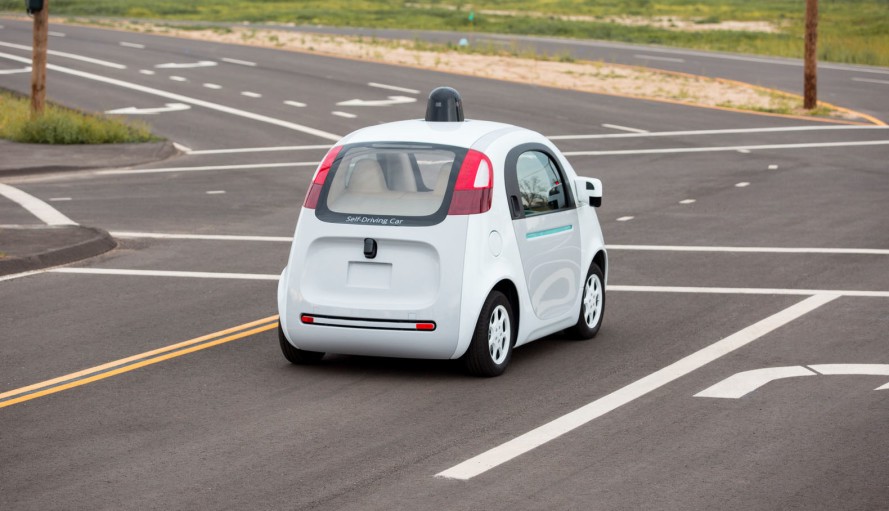
Google driverless car

For years, I’ve had an unexplained interest in driverless cars, though it’s undeniable that transportation has forever been the afterthought of society. For the majority of the modern world, their day starts after their morning commute. In 2016, the world got its first tangible taste of the changes that could be coming to their morning commute in the next ten years.

With the strong push by several tech giants and auto manufacturers, such as Apple, Google, BlackBerry QNX, GM, etc., towards the development of driverless cars, governing bodies have been forced to consider the implications of this innovation. With autonomous vehicles comes a whole slew of security, development, integration and infrastructure concerns that are, for the most part, yet to be addressed.

Not only will our roads look different when driverless age finally dawns, but the majority — if not all — components of transportation in cities will need to be connected by a singular platform to avoid accidents, device malfunction and other complications.

Furthermore, the notion of driverless cars has called the structure of vehicle ownership into question as regulators consider whether a ride-sharing model might be better suited to the development of smarter cities.

Canada has been home to some significant strides towards developing autonomous vehicles in the past year, including a 1000-person hiring announcement by GM Canada and the opening of an autonomous vehicle research centre by BlackBerry QNX. Both events were frequented by Prime Minister Justin Trudeau.

The technology is there. The next few years will bring new challenges of integration and acceptance.

Netflix: 1 – Struggling Canadian content industry: 0

shomi-1

The reign of American entertainment continued well into 2016 with the shutdown of the jointly-owned Rogers-Shaw streaming platform, Shomi. Shomi had been operational for just two and a half years at the time of shut down, and had yet to delve into producing original Canadian content. While this isn’t the first platform to emerge to compete with Netflix, it was the first of its kind to do so in Canada. Shortly after Shomi’s release, Bell launched a very similar platform called CraveTV.

In one year, Canadians went from having virtually no home-grown video streaming options to having two, though many speculate that at this point, it didn’t matter much. The nation was already enthralled with Netflix, and it was way past entrenched with the U.S.-based service. Shomi’s shut down was announced at the end of September, sparking conversations about the value of Canadian culture vs. the integrity of content on the internet.

What’s more significant here, is that it presented one of the rare occasions where a Canadian tech story bleeds into the entertainment, culture, media, business and human interest spaces, all at once. I’m almost convinced that this is the most interesting Canadian tech story that broke in 2016, because of the magnitude of its impact, ranging from the people let go from the fledgling video service, to the comments the CRTC made about Shomi’s closure after the fact.

The service closing not only made the country pay attention to Shomi in a way it never had — not even when it launched — but the shut down forced us to think about the Canadian content industry taking a backseat to the U.S. once again. Is this the cultural legacy we want to leave?

That’s all folks!

Well, there you have it. The key players have been named, the swords have been drawn, and the battles of 2017 are about to begin. All I have to say is, bring it on.

Happy holidays!

27 Dec 16:40

Photo


27 Dec 16:40

2016 in Review

by Rui Carmo

This year I decided I was going to take a break during the holiday season, or else. As it turned out, I am sort of taking a break while recovering from another cold and drenched in antihistamines to the gills, which is neither here nor there but which at least affords me some time to jot down some cursory notes and string them together by topic.

Overall, it was an unusual year. Ignoring (for the sake of sanity) the political upheaval across the Atlantic, technology and industry still left somewhat of a sour taste that I couldn’t foresee, and the overall feeling I have is that of a year we’d all gladly skip – if we could.

Work

My coding output decreased markedly this year, which I blame squarely on the kind of work I’m doing these days and the constant context switching I have to muddle through. After years of having a single working environment seamlessly synced across multiple Macs, going back to switching operating systems between home and work is taking its toll, and is something I intend to revisit next year.

But most of it comes from the nature of the work itself – architecture work in “traditional” IT is rather less about building stuff from scratch than re-using existing pieces, so there are a lot less interesting problems to solve from a coding perspective.

I ended up in the rather ironic position of being unable to dive into the .NET ecosystem in any meaningful way, but then again I’m not really sure I want to, since my current skill set is tremendously useful in my role, and I’ve had a sizable amount of fun leveraging it.

Cloud

Azure is now a completely different beast from what it was when I joined up.

Besides the dizzying array of features launched each week (which is par for the course, as I also read and subscribe to competition announcements), the tooling and APIs are constantly improving, and my toolbox is now updated on a monthly basis.

Templating has made infrastructure deployments trivial, but moving infrastructure to the cloud is only one step in a transformational process that most organizations have trouble addressing systematically. Software architectures are changing, but it will take time, and despite hosting the Web Summit and having plenty of technical savvy, Portugal isn’t that well off that established companies can re-architect their IT solutions at the drop of a hat.

As with many other technology shifts in the past, the trouble is not so much about the tech itself but with people’s ability to change, and that’s all the more evident now that it entails removing reliance on physical assets.

Apple

For me, this is the year Apple fell off the pedestal, for three reasons:

  • Their software quality has decreased markedly (witness my struggles with iOS, photos and backups – especially photos)
  • Their hardware designs now completely prioritize style over substance, with polish and state of the art technology taking (even more of) a backseat to profit
  • Their biggest push in what regards technical innovation is now… expansion ports and dongles.

The last point is the one that is likely to be most contentious, so I’ll expand upon it a bit: they may be driving innovation in terms of manufacturing processes and integration (all of their devices have unique characteristics that only they can deliver), but they can hardly be considered visionaries at this point – if they have a computing and user experience vision that goes beyond the what the iPad currently delivers, it doesn’t show (or, indeed, seem feasible). All we see is machines being turned into sleek, expensive appliances at the expense of existing connectivity and functionality.

Apple is unlikely to move wholesale to ARM in the near future (at least not without redesigning all the glue they get essentially for free with the Intel chipsets), but nobody cares what chipset an appliance is using as long as it works.

Applications

I am atypical in that I mostly rely on my iPad for a lot of my personal computing needs and cannot envision myself using regular PCs in the future, but am still concerned with the shift to web technology.

It’s clear to me that despite my distaste for the trend and underlying technology, the future of mainstream desktop apps is now a mix of high-quality (but expensive) fully native apps and a bunch of generic, cross-platform Electron shells with captive web apps inside.

The browser hasn’t replaced the desktop yet. And given this trend, it probably never will, really – they’ll just glom together into an even bigger mess.

Next Year

Being older and (arguably) wiser, I’ve learned to curb my tendency towards drafting elaborate plans, but there are a few major areas I intend to address.

One is work-life balance – I’ve always skimped on the latter, and I think it’s time to re-assess that, or at least make sure the former becomes more enjoyable and gratifying, even if it entails shifting away from technology (something I ponder every year and have so far avoided tackling). That entails a little more soul-searching and assessing which goals to reach for, so I expect it to take a long while to sort out.

Another is figuring out which subset of those goals fit into what I need to learn next to stay relevant. For instance, I have so far resisted the temptation to jump onto the deep learning bandwagon – there is so much to be done in terms of data cleansing and simple plumbing (most of what people actually need is meaningful, trustworthy data, not magical insights) that I’m left with relatively little time to do fancy stuff.

Deep learning seems interesting in that regard because it’s been too long since I’ve had truly off-the-wall stuff to do, I have the requisite background, and it seems to be what all the cool kids are doing these days.

Which obviously means there’s a sizable risk of it being over-hyped, but then again anything that is poorly understood by the tech industry falls into that category, and I at least have a notion of its suitability to task.

Onwards, then, to an arguably better future.

27 Dec 16:39

Rogue One: Recruitment Poster For The Resistance

  • You have nothing to offer but blood, toil, tears, and sweat.
  • However greedy, evil, vain, and cruel, power will find servants. Some of those servants will prove capable.
  • The grownups will not protect you.
  • When offered the choice between truth and justice or tickets to the inaugural ball, Republicans will take the tickets.
  • Ask not what your galaxy can do for you: ask what you can do for your galaxy.
  • Do not rely too much on the Democratic Party: the institution will sometimes seek safety and compromise at the crucial moment. The volunteers will bear any burden and pay any price, but someone has got to ask.
  • The problems of little people don’t amount to a hill of beans in this crazy world.
  • All you have to decide is what to do with the time that is given you.
  • That may be less than you thought.
  • You cannot outrun what is coming.
  • Faith manages.
  • Hope.
27 Dec 16:34

The broken edtech ecosystem investors once avoided is changing

files/images/gettyimages-548929035.jpg


Charles Wiles, TechCrunch, Dec 29, 2016


According to this article, " innovative apps have been unable to displace archaic, inferior technologies in schools because of restricted funding and a general unwillingness of schools to disrupt the status quo." This, however, is beginning to change. "Schools are ripe for this new generation of intelligent software that uses data, analytics and intelligent algorithms to make teaching more informed and effective and to help students learn better." I think the gushing tone of this article is a bit overstated, and so, therefore, is the forecast "to grow 17 percent year-on-year to become worth $252 billion by 2020," if only because educators are more resistant to commercialization than they are to technology.

[Link] [Comment]
27 Dec 16:29

Why Are Mirrorless Cameras Necessary?

Here's a question I get in a variety of ways: why do we need mirrorless cameras?

Sometimes it's not a question, but an assertion. That assertion is often hugely broad, as in "mirrorless is the future of interchangeable lens cameras."

27 Dec 16:29

There is No Best

2016 will be the first year that I don’t proclaim any “best of year” awards for mirrorless cameras. 

Why? Well, in doing my year-end research I became convinced that virtually every product introduced in 2016 was getting a “best of year” award from someone. …

27 Dec 16:29

Florida Gothick Fun

I refer to Razor Girl by Carl Hiaasen, which I enjoyed more than any other single book I read this year. Not saying it’s the best book of the year; but in late 2016, reading something that makes you repeatedly laugh out loud over a span of hours is not to be sneezed at.

Razor Girl cover

I’ve previously plugged Hiaasen in this space, although not in this decade. Previously I would have said that my fave Hiaasen was Sick Puppy, but I recently re-read it and it’s dated a bit. Don’t know where I’d rank this in the Hiaasen hit parade, but I sure enjoyed the hell out of it.

What’s it like? The basic Hiaasen concept has more than a little flavor of the hilarious @_FloridaMan Twitter feed. I’m sure there are nice normal even-tempered law-abiding people in Florida, lots of them, but they tend not to feature. The villains are exquisitely scummy and come to satisfyingly bad ends. The protagonists are flawed but loveable. The action is pretty well non-stop, and totally hilarious. Mind you, some of the laughs are cheap but, like I said, this is late 2016.

Let’s see: Within the first few pages, one of our protagonists is rear-ended by a woman, distracted because she was engaged in shaving her pubic area while driving, and a Duck-Dynasty style reality-TV shitkicker accidentally takes his routine to a black/gay bar in Key West; the outcomes of both these disasters are complicated and even sort of believable.

Warning: Do not take this to bed if you share that bed; your companion will not appreciate the repetitive snickering and guffawing.

27 Dec 16:29

International Bike Spotting – Angela Bischoff

by dandy

Angela enjoying the new bike lanes on Bloor this winter. Photo by Cayley James.

To help us get through the next couple of colder months, dandyhorse is profiling cyclists from around the world! Folks who love to cycle here in Toronto and further afield will give us insight into what it's like to cycle in their cities. Want to add your voice to the Bike Spotting series? Get in touch with us at: cayley@dandyhorsemagazine.com

Angela Bischoff is Outreach Director for the Ontario Clean Air Alliance. Networker extraordinaire, she publishes two of Toronto’s finest e-newsletters – No Nukes News and T.O. Greenspiration Events.

Angela is also one of the original advocates for bike lanes on Bloor, and she held the banner high during the Bells on Bloor Victory lap this summer when the bike lane pilot project finally opened. dandyhorse asked her to be one of our few Toronto-based folks in our international bike spotting series this winter. Here's what she had to say about her relationship with the bicycle in Toronto.

What’s your history with the bicycle?

Bikes have always been one of the few things I owned and truly loved. My first bike had a banana seat and ape handlebars. My second bike was a 5-speed, and then I got a 10-speed. At age 25 I bought a mountain bike that I used to commute from the suburb into the city; that bike I called Purple Bliss (though it wasn’t purple). It emancipated me. Suddenly I could ride anywhere – the inner city or the mountains.

My next bike was The Owl, and then Blue Molly, then Artimis and Athena (depending if I was in the country or the city), then the Green Machine, then Tookela, and now I ride Blue Jay.

My bikes have enabled my independence as a woman, allowing me to swoop in and through the world on my own accord, and not be reliant on others for car rides or on public transit. It’s important to me that my vehicles of choice are clean, silent, non-polluting and fossil-fuel-free. Bikes have kept me connected to my body and fully aware of my environment year round. And truly, biking has kept me joyful – the best part of my day is when I’m on my two-wheeled steed. I feel like I’m dancing and doing yoga and singing and playing an instrument all at once, gracefully and skillfully, as I spin my wheels.

You sound like you’ve been around the block on your bikes.

I’ve ridden my bikes in many countries – from the chaotic streets of Calcutta, to the horn-blasting streets of Guangzhou, to the highlands and forests of Vietnam and Japan. I’ve ridden from beaches and cliffs of Mediterranean islands to ancient pilgrimage trails of Spain and France. From Rocky Mountain passes to Dutch sand dunes to Laurentian rails-to-trails. From Indian ashrams to Cuban bike factories to Mexican playas. It’s the best way to travel. I schlepp my bike on trains and busses for the long hauls, but there’s nothing like cruising new cities or island hopping on your own wheels.

How does Toronto compare?

I’d say we’re behind most Western cities. Every time I arrive at my destination, I thank the heavens that I made it safely. It’s been amazing to see the bike lanes pop up around town in recent years, and I gravitate to them like a bee to honey. But they are too few and they are too far between. Montreal and Vancouver are miles (literally) ahead of Toronto, though even they don’t hold a candle to much of western Europe. It’s no wonder that in some Scandinavian cities 50 per cent of the trips are made by bike. Quebec is the closest thing to this in North America with their provincially-funded Route Vert (5,000 km of bike trails connecting cities and towns.) And Montreal has an incredible bike network on par with many European cities.

Toronto is just beginning to accommodate bikes, which is a tarnish on our reputation as a great city. Congestion and air pollution are serious issues in Toronto – both could be alleviated by relatively low-cost investments in bike infrastructure. And I think bike infrastructure is the surest way to reduce our climate ‘car’ma.

What was your role in establishing bike lanes on Bloor?

I moved to Toronto in 1999 with my partner, Tooker Gomberg. He was a formidable climate and bike activist and political actor. When he passed away in 2004, some bike friends got together to scheme a legacy project in his honour.

We met at Futures on Bloor, and came up with the campaign for a grand bicycle expressway from Mississauga to Scarborough along the Bloor Danforth corridor. Cyclists had been calling for safe passage on this route since 1896, I kid you not. But there had never been a concerted campaign.

We called it Take the Tooker and began hosting mass bike rides, demonstrations and a petition. Bells on Bloor formed, then Bells on Danforth. Larger rides ensued, court cases were launched, and rallies filled Nathan Phillips Square. Toronto Coalition for Active Transportation released some stellar research and reports showing that businesses would benefit from bike lanes along Bloor Danforth. Cycle Toronto got on board. With the help of Councillors Mike Layton and Joe Cressy, the pilot project on Bloor was officially inaugurated on Aug. 12, 2016 – which just so happens to be Tooker’s birthday. How sweet is that?

Angela and her new bike "Blue Jay" at Bloor and Shaw. Photo by Cayley James.

What else are you passionate about?

Bikes and renewable energy. They’re both smart, healthful, low carbon and low footprint technologies that will help solve our climate, pollution, congestion, safety and financial challenges.

SUVs are to bicycles as nuclear reactors are to solar/wind/water – dangerous, expensive, and damaging to the environment. Ontario is now turning its back on renewable energy and investing tens of billions of dollars instead on rebuilding our aging nuclear infrastructure. Likewise Toronto is spending billions on the Gardiner and subway to Scarborough rather than city-wide LRT and bike infrastructure. It makes no economic or environmental sense especially in the climate era.

It’s time to wise up and double down on efficient human-powered transport and renewable energy technologies – and reap the tremendous rewards.

Photo by Tammy Thorne of Angela Bischoff winning a new bike courtesy of Cycle Couture and dandyhorse.

Related on dandyhorsemagazine.com

International Bike Spotting - Netherlands

Winter Bike Spotting

Never Accept the Status Quo: Interview with Angela Bischoff

International Bike Spotting - Scotland

Bloor Bike Lane opening in photos

Bells on Bloor Victory Lap at Suzuki Crawlfest


27 Dec 16:28

By The Numbers: MOOCS in 2016

files/images/By-the-Numbers-MOOCs-in-2016.jpg


Dhawal Shah, Class Central, Dec 29, 2016


This year's MOOC numbers from Class Central. "In it’ s fifth year, 23 million people worldwide registered for a MOOC for the first time ever... This makes the total number of students who signed up for at least one MOOC estimated to be 58 million."

[Link] [Comment]
27 Dec 16:28

Oh, neat, the LTMuseum has subway car cushions! (20% off for...

by illustratedvancouver


Oh, neat, the LTMuseum has subway car cushions! (20% off for Boxing Day, code=glovesoff20)

27 Dec 16:27

Simplifying your document processing: The Four Trays Method

by Raul Pacheco-Vega

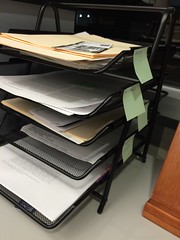
Filing traysI originally wrote this blog post as an email response to a request by Dr. Brian Leech from Augustana College on how I do my document processing and filing. This problem happens to all of us: we have a number of things that need processing (committee materials, student files, printouts, etc.) Often times, we are so overwhelmed by other things that we end up saying “oh, I’ll file these materials soon” and end up needing to have accessed them before. I use a method (the Four Trays Method) that I shared with Brian and that I am happy to share with all my readers. Here is how it works.I book at least 30 minutes to 1 hour on Friday after lunch (which is when my brain is completely useless) to file. I have a set of five filing trays, four of which I occupy regularly with the following labels:

- For a paper I’m working on (data, newspaper clippings, printouts, etc.)
- Should be memo’d (aka I should write a memo on this article)
- For someone else (my admin assistant usually sends these to the person I label this for)
- To file (these are items related to my students, letters I send, committee work, etc.)

I have a fifth tray, as can be found in the photo, with the title “Processing” – this is usually something I am actually working on at the time, and it’s usually the last tray, because since I am already processing that document, I should be able to put it in any of the other four (which is why the technique is called the Four Trays Method). This method needs to be adapted if you don’t have administrative and/or research assistantship support (both of which I am lucky to have).

My research process (when writing grants)

My admin assistant usually looks every day at my “To File” tray. If I have labeled something with the name of certain file, she files it in that folder. Or she opens a new folder for a file. Or she contacts whoever I said needs to be contacted. If you don’t have admin support, the “To File” tray is the first one you may want to process on the Fridays, because that’s usually the one that grows faster (creating file folders, labeling them and locating them in your filing cabinet actually does take a lot of time, believe it or not). But let’s assume you DO have admin support, for the sake of it.

The second tray that always gets processed by someone other than me is the “For someone else“. In this case, either my research assistant or my administrative assistant send these to whomever I marked the items for. For example, if I’ve found a paper in a print journal that I think a colleague of mine at CIDE would benefit from reading, or I have a new book that they might want to scan, I put it in that tray.

On Fridays, after I’ve processed everything that needs to be put in the “To File” tray, the next stack (or tray) I deal with is the one labeled “For a paper I’m working on“. I label the item with the action I need to undertake (’clean up this dataset‘ , or ‘ask my RA to download articles related to this one‘ or ‘write a rhetorical precis for this paper‘). I dispose of it by writing in my Everything Notebook what I should be doing with that piece of work (my RAs have similar filing trays, though they are usually “IN” and “OUT” only) – the IN items for my assistants are things they need to do for me by a certain date, the OUT is usually stuff they need to deal with (either give me or email me).

The last stack I deal with is the “Should be memo’d“. I book time in the morning to write a memo for those articles, books and book chapters usually on Tuesdays (Mondays I am usually more creative in my #AcWri so I usually blurt out words, but Tuesdays I need something to “prompt” me). I usually memo 3-5 articles in 2 hours, but that’s because I read really fast. You don’t need to force yourself to memo an entire article in a writing session, but I find that processing them fast (by writing a memo and getting quotations or dumping the rhetorical precis in my Excel dump) it helps me become more motivated, thus I process more documents (untli I get fatigued).

The trick is – if you have admin support, make sure they know what to do with the item (or make sure you create your own shorthand and codes). I use disposable Post It notes (really tiny) with abbreviations. For example, a letter of reference I wrote for a student usually has something to this end: “FILE -> STUDENT’S NAME”. My assistants (and I) know my abbreviation codes. For example, if I am working on an R&R and I already received a response, I usually write on the Post-It “FILE-> PAPER’S NAME”. If I need to memo a paper, I usually write “MEMO BY A DEFINED DATE” on the Post It Note.

I know my process may be weird for some people, but it really does help me. The two items I find are most useful is: booking time every week to do the filing/processing, and using the trays to help you plan your next week (which is why I process documents on Fridays, to have a To-Do list for Monday morning ready). Hopefully it will be helpful for other people!

27 Dec 16:27

body surfers and boogie boarders riding the crazy sandy beach shore break

by Emily Chang

body surfers and boogie boarders riding the crazy sandy beach shore break

Photo Caption: body surfers and boogie boarders riding the crazy sandy beach shore break

Photo taken at: Sandy Beach, Oahu

Instagram filter used: Normal

View in Instagram ⇒

27 Dec 16:27

Twitter Favorites: [cqwww] Have a big decision that would be great to resolve? @decisiontreeio is hoping to help you and/or your team get to a… https://t.co/wSAPFxdu0p

Kris Constable @cqwww
Have a big decision that would be great to resolve? @decisiontreeio is hoping to help you and/or your team get to a… twitter.com/i/web/status/8…
27 Dec 16:27

Twitter Favorites: [ryanxcharles] Question emotional beliefs. If you notice you were emotioned into a belief, recognize you will be better off to reconcile with reality.

Ryan X. Charles @ryanxcharles
Question emotional beliefs. If you notice you were emotioned into a belief, recognize you will be better off to reconcile with reality.
27 Dec 16:27

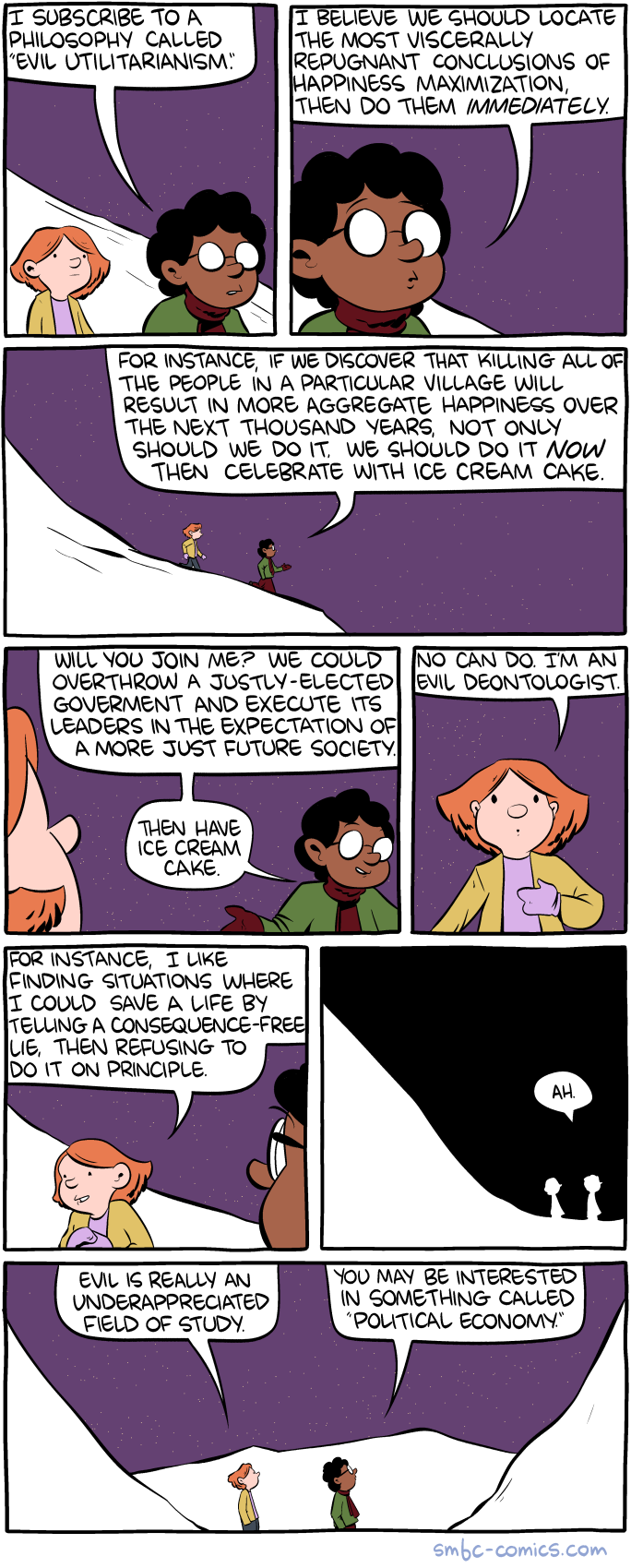
Saturday Morning Breakfast Cereal - Evil Ethics

by tech@thehiveworks.com
mkalus shared this story from Saturday Morning Breakfast Cereal.


Click here to go see the bonus panel!

Hovertext:
Fortunately, there aren't any Evil Nietzcheans.

New comic!
Today's News:

Christy Christmachrist!

27 Dec 16:27

Saturday Morning Breakfast Cereal - The Chosen Ones

by tech@thehiveworks.com
mkalus shared this story from Saturday Morning Breakfast Cereal.


Click here to go see the bonus panel!

Hovertext:
'Why is the alien an abstract circle thing?' Because it's easier to draw than an abstract square thing.

New comic!
Today's News:
27 Dec 16:27

This Co-Working Space Uses a Freemium Model to Build Their Community

by Emma Lee

Just four years ago, co-working spaces were a rarity in China. Propelled by a series of favorable policies and trends, hundreds of thousands of operators have flocked to the emerging market. Local tech media has said that there are over 2,300 co-working operators in the market as of early 2016. After this stunning growth, however, we can now see the inevitable overcapacity problem, leading to major consolidations in the market since the beginning of this year.

“Over the past years, co-working boomed, but the supply has definitely exceeded the demand. The demand is coming up but not as quickly as the supply,” said Liu Lei, founder and CEO of Sandbox, one of the few free co-working spaces in Shanghai. “Having an open community and the belief that anyone can adopt this lifestyle is how we built our demand.”

Why An Open Community?

“In co-working, we sell the community. The key essentials for the community is a group of people that understand each other’s commonality, they share values, interests, and sharing the same space is the fundamental commonality a lot of these people have,” said Liu.

While commonality is easy for most co-working communities to achieve given their word-of-mouth marketing, Liu pointed out that diversity, another essential component that defines a prosperous community, is missing in most of China’s co-working spaces due to the closed nature of their operation.

“I went to a major co-working brand in Shanghai just to look around. There was a glass door, I stand outside the glass door for almost 30 minutes like an idiot and couldn’t get in until the reception opened the door for me,” he said. “The first thing she asked is whom I am here to see. When I told her I just want to take a tour around the facilities, she brings the salesman who inquires on what kind of space I want.”

While noticing that the whole space is 70% empty, Liu wondered why they still kept their doors shut rather than open it up to people who are willing to use it and allow more diversity to flow in.

“With an open community, what happened is your open portion of the room allows diversity to come in, allows people to come for maybe just a cup of coffee, maybe just for the meeting room, or meet a friend or two,” he said. “Those people could be your potential customer, guest’s customer, future suppliers, or partners. That inflow of diversity is essential for a community. We want to have an inflow of different kinds of people. We call it ‘fresh blood': every day you end up seeing a portion of people you have never seen before. That gives you an opportunity to know them.”

sand

Freemium Model Pays Well

Being known for providing rental-free spaces, people may easily wonder how Sandbox makes money.

The company seems to have been paid well by building an open community. A four square meter meeting room with the maxim of 5 seats and one round table in Sandbox’s Zhangjiang location is priced at 50RMB per hour.

“In October, from just that one room we generated 6750RMB (971 USD). That’s 57 RMB per square meter per day, much higher than retail space on Huaihai Road [a popular shopping street in Shanghai],” he said.

Hands-off Approach for Running A Space

Sandbox started just a year ago as the odd man out: completely free to use the public space and very few staff. When you walk around Sandbox, you can’t see any senior staff who control the community, just a few trainees or some young hipsters willing to help you out when needed.

“Everything build online because we want to build a space that manages itself. We don’t put in much effort to control the community,” said Liu. “We rarely host events. All the events held in Sandbox are organized by our community members. We provide the space and things just take happen.”

Image credit: Sandbox

27 Dec 16:27

rebooting my rss workflow

by D'Arcy Norman

I’ve lived with RSS as a major source of information for over a decade. I’ve been using Shaun Inman’s fantastic Fever˚ self-hosted reader since 2009 or so. It’s been a solid workhorse, and I’ve built quite a workflow around it. Shaun is refocusing his efforts on software that he uses himself, and is putting Fever˚ and Mint out to pasture. That’s a hard decision to make, and I admire him for making it. Since Fever˚ is self-hosted, I could just keep using it until it eventually crumbles (as PHP updates around it, etc.) but I’m taking this opportunity to take a look at how I manage my feeds.

First, I had subscribed to too many feeds. Well north of 1,000. Which was handy for keeping on top of everything, but that’s not something I care to do anymore. So, I exported my feeds from Fever˚, cracked open the OPML file in BBEdit, and started pruning. I’m now down to 161 feeds that are important enough to keep on top of. And some of those will likely be pruned to help with focus.

Next, how to manage the feeds? Self-hosted tools (other than Fever˚) are a bit clunky. I don’t have the energy to battle with creaky software anymore. So, a tool hosted by an individual, organization, or company that doesn’t suck. I was looking at Feedly and Newsblur. Both seem decent. Both integrate with Reeder on Mac and iOS. Christina suggested Newsblur. That recommendation is good enough for me. So I picked up a one-year license, and fed my 161-feed OPML file into it.

I’m going to give Newsblur some time – the UI is way different than what I’m used to with Fever˚, and I need to figure out how to rebuild parts of my previous workflow (like getting a list of the last 7 days’ worth of saved items in Markdown format for pasting into my week-in-review posts…). And, it will take a week or so to build up content in the feeds I subscribe to. Right now, it’s a lot of emptiness. Which is refreshing, but not interesting.

RSS is dead. Long live RSS!

27 Dec 16:26

Things That Moved Me In 2016 – Part 1: Networks

by Martin

Like every year, time has flown and it is already end of December and thus time to look back at what has happened this year that has literally ‘moved’ me. This year I have three categories: Networks, Linux & General computing and Miscellaneous Other Things. Let’s start with a look back at my year in the network section:

LTE – Legacy but Cool!

LTE networks are hardly anything new anymore and in 3GPP, LTE is almost considered ‘legacy technology’ now that a lot of effort is spent on 5G, i.e. ‘New Radio’ and the ‘Next Generation Core Network’. There is not yet too much to report about 5G from a practical point of view, so that’s perhaps something for next year. On the LTE side, however, quite a number of things have happened in practice. In Germany and other countries, many network operators have started to massively deploy Carrier Aggregation. In Germany, for example, one network operator is now on air with 50 MHz.

Getting Into QAM Modulation

One thing that was always a bit blurry to me was how Quadrature Amplitude Modulation (QAM) that is used in LTE and other fixed line and wireless systems can best be described without going too far into the maths. I finally came up with this blog post which I think describes it pretty neatly. Suddenly, the baseband with it’s I and Q inputs and outputs makes a lot more sense.

VoLTE and VoWifi

Moving up the protocol stack, 2016 has definitely been the year of VoLTE and VoWifi. Not because they were brand new, the IMS has been specified for over a decade. However, Voice over LTE has finally made it into live networks on a bigger scale. I’ve had quite a number of posts on the topic over the year, too many to link them here. If you are interested in some of the SIP and bearer details, just search for VoLTE by using the search box in the left sidebar of this website. Voice over Wifi and handover of an ongoing call between LTE and Wifi has also made it into live networks this year (well, already last year in some countries). To me, VoWifi is not only a tremendously useful extension to VoLTE but a general evolution of the traditional mobile network operator voice service to fixed line networks as well. I know the term ‘convergence’ is old and tried but it fits what is happening here.

Delay, Jitter and Loss Experiments

With a suitable Wi-fi access point, VoWifi can also serve as an interesting basis for experiments with delay and packet loss. A Raspberry Pi and Wi-Fi dongle is pretty much all that is needed to see how much delay, jitter and packet loss can be artificially introduced without perceptible loss of speech quality and shows nicely what happens when this threshold is crossed.

Analyzing Wireshark Traces

Wireshark is probably running more often on my notebook than LibreOffice Writer as it’s and indispensable tool for my daily work. For repetitive tasks, I’ve now found a way to analyze Wireshark dissected packets with Python programs. Sounds complicated to setup but it’s actually quite straight forward.

IPv6 At Home

IPv6 has been coming for years now but the sad truth is that still only a few percentage of the traffic coming to this website is via IPv6. My fixed line network operator at home seems to be one of the few who’s deployed IPv4v6 dual stack. 2016 has thus been the year for me in which I’ve set up my first server at home that is reachable over IPv6, despite a daily changing prefix. Quite a lot of things had to be put into place to update the DNS server entry when the prefix changes and to configure the DSL router to forward incoming IPv6 TCP connection requests to the right box in my home network. While it was some work I’m glad about the experience I’ve gained. A summary with links to detailed blog entries can be found here.

Eduroam

Another interesting topic I’ve researched in-depth this year is how Eduroam works across the world and how it enables students to use their student credentials to gain Internet access at all universities, research institutions and even airports that have Eduroam Wi-Fi access points on air. Interestingly enough, my article on how to set-up Eduroam securely on Ubuntu is in the top-5 accessed blog posts of this site even months after I’ve written the post.

EU Roaming

A lot has happened in 2016 when it comes to EU roaming charges. Lots has been reported by the not so tech-savy magazines so I decided to comment what was going on and why some things are not so easy as they seem. By and large the only thing that is still missing now is that the EU parliament and the EU commission agree on a wholesale price for inter-operator IP data but that should happen any day now. After that one can only wait until roaming charges are finally removed for everyone in the EU by mid-2017.

NB-IoT Questions

On the other end of the scale, the Internet of Things (IoT) and in particular Narrowband-IoT has been on the agenda of this blog quite a number of times. In 10 blog entries, I’ve been going through quite a number of subjects on the topic ranging from a look at the new air interface to a discussion of the envisaged 10 years battery life and whether it really is such a good idea for IoT devices to have an IP address.

Wi-Fi Speed Speed Speed

An finally, Wi-Fi has also had a couple of surprises for me this year. In October, for example, I ran a speed test with an 802.11ac capable notebook running Ubuntu with an 802.11ac capable access point at home. The results were quite breathtaking.

A year full of interesting topics and I’m just getting started. In two follow up posts I’ll have a look at what’s happened for me in Linux & general computing and miscellaneous other things. So stay tuned…

27 Dec 16:26

My impressions of Elm

by Brett Cannon

If you know me or have been reading this blog for a couple of years then chances are you know I'm a programming language nut. I not only believe that being a polyglot programmer makes you a better programmer overall, but I'm always on the look out for new ideas that may benefit Python in some way. This means that when I get a decent stretch of time I typically try to use it to learn a new programming language (to put this into context, to relax while attending my first OOPSLA conference I learned Icon which where Python got its inspiration for generators).

Since I had to use my vacation or lose it this year, my winter holiday is about two weeks, during which Andrea has to work for part of it. That means I had time to learn a new programming language. I decided to learn Elm as I have a one-page web app I wanted to create which seems perfect for the language's functional, reactive style. So during my vacation I read An Introduction to Elm and coded up my web app.

The good

The first thing I found fascinating about Elm was it has automatically enforced semantic versioning. It's one of those ideas that seems obvious in hindsight. Since Elm is statically typed it can infer when the API of a library changes from a previous version (you can even diff the APIs between versions). That means that from an API perspective you don't have to even think about how to handle a version bump or worry if a library messed up their version number as you can infer programmatically when the API is exactly the same, when something was added to the API, or when some part of the API changed in an incompatible fashion (this obviously doesn't cover semantic changes directly, but if you're asking for a version bump and the API didn't change then there's obviously some bugfix, and if you did add/change something then semantics changes are covered by the version bump anyway). It's rather clever and something other statically typed languages could benefit from also instituting. (I don't see how this could work in Python simply due to the fact that __getattr__() exists and thus there's no good way to define the API programmatically.)

The next interesting bit is the author of Elm has obviously been exposed to Python. In the section introducing the core language there's a discussion of integers and floats and how Elm does it the way Python 3 does it (e.g. 9 / 2 == 4.5).

I also appreciate that the language pushes a reactive programming approach. My first major exposure I had to a view automatically reacting to changes in your model was through Angular2 and a MVVM approach for Which Film. But Elm is able to take all of this even further with its reactive programming architecture by having everything revolve around changes to the model. This allows all asynchronous events to trigger messages and have the model react to those messages. This then cascades to anything that deals with the model after every change to it. And by having Elm itself handle when to fire those messages you end up with a very performant system which can quickly react to changes in the model.

Trying to make the compiler more of an assistant than enforcer helps deal with the functional programming aspect of Elm that's very nice. If you have ever programmed in other functional languages like Haskell or OCaml then you're probably used to some rather cryptic error messages coming out of the compiler. And in the case of functional languages, having cryptic compiler messages is rather bad since these programming languages are often structured such that the compiler can infer and enforce so much and so they also enforce a lot (the amount of inference that's possible is why financial companies sometimes latch on to functional languages as their compilers can make them extremely fast with less effort than in languages where you have to be a bit more explicit). But Elm has put effort into trying to provide more literate error messages to help people solve issues. Elm's approach to compiler error messages is liked so much that it's already inspired Rust to have better compiler error messages. There's also been discussions about how to apply this idea to Python, but as exceptions are used for both error reporting and control flow it's a delicate balance of exception construction cost compared to error message detail.

Doing front-end web development in a functional language is a rather good fit (JavaScript was originally supposed to be "Scheme in the browser"). For instance, Elm only has immutable data with side-effect-free functions (called pure functions in functional language parlance). This allows Elm to have a great debugger where it logs all data transitions and thanks to reactive programming you can simply replay the transition log to repeat exactly what led to a specific situation. Since there's no global state to track that means you don't have to worry about the log missing any details.

Looking at all of these positives, you can tell the language is being designed to try and solve the problem of how to do client-side web programming efficiently and be easy to grasp. The creator of Elm, Evan Czaplicki, gave an interesting talk at a functional programming conference where here clearly points out how gradual learning, communication, usage-driven design, culture, and tooling really drive language adoption. I see some parallels with how Python has done things, and Evan even admits to taking ideas from Python and Ruby to try and grow Elm usage.

The bad

But Elm is obviously not without faults. Probably the biggest one is simply how nascent the language is. For instance, I attended a talk at OSCON 2016 that was supposed to be on signals in Elm, but literally about a week before the conference that paradigm was switched to subscriptions. You can also look at the documentation where there are still some holes, e.g. there's nothing about tasks, and yet you need them for some fundamental things like getting the current time (if you're not waiting on a clock interval).

The ugly (code of mine)

In the past I have learned a ton of languages by reading their documentation and then doing a handful of toy examples to just get a feel for things. The problem with that is while it's enough to get a sense of the flavour of a language and how difficult it is to get started, it doesn't dive into deeper details like how the community is organized. To allow me to dive into a language a bit deeper which allows me to have an opinion without coming off as uninformed, I now solve an actual problem I have in the new language. While this means I learn fewer languages, the ones I do bother learning I have a more well-rounded, informed opinion of.

For Elm I ended up creating a simple, single-page time clock web app that counts down how much time is left in the workday along with accounting for any (un)used lunch time. I find I tend to be more focused on my work when I know how much time I have left in my workday. Andrea also has to record her hours for work and so I figured I could work on a simple web app to assist the both of us. It also fit nicely into Elm's strength of reactive programming as the app basically reacts to the tick of a clock to countdown how much time is left in the workday (or lunch break).

The code for what I created can be found in my time-clock repository on GitHub and the deployed site is at http://time-clock.surge.sh (which I'm still playing with). The key insight for me in this exercise was that beyond messages triggering updates to the model, the model itself communicates with parts of the system when it changes. What this means is that the view produces update messages, which trigger changes to the model. Changes to the model trigger subscriptions, which themselves trigger update messages (commands also produce update messages to the model). So realizing that triggering subscription changes was through changes to the model was key as all other aspects of Elm communicate through update messages.

After that the only other real annoyance was simply the immaturity of the platform due to how young it is. For instance, to set the title of a page you have use the JavaScript interoperability support, otherwise you have to embed Elm in a page instead of letting Elm handle everything because it doesn't expose anything outside of the <body> tag in its view and support for specifying the title hasn't been added to the Html library yet. (In the end I will probably embed the Elm code anyway so I can specify stylesheets for the page.)

Otherwise the experience was rather positive. The compiler messages were very helpful as designed. The syntax was simple and clean. The performance seemed great (albeit my app is simple).

My overall impression

In the end I enjoyed using Elm. It's obvious it has some growing to do (the language is only at version 0.18), but I will be keeping an eye on this language going forward as a competing for my front-end web development attention next to Dart and TypeScript.

27 Dec 16:26

Ofo Wants to Connect Bikes, Not Make Them

by mjkim

A lot of people are curious about how Ofo and Mobike, China’s dominant bike-sharing platforms, are different. From a user perspective, they may not be so different, but from our previous post, we can see that Mobike is about creating a moving IoT platform. Ofo, on the other hand, emphasises user connection and the sharing economy.

To learn more, we spoke with Li Zekun, Head of Ofo Public Relations.

%e5%8c%97%e4%ba%ac12

A rider in Beijing (Image credit: Ofo)

How many university campuses have OFO implemented its business so far?

Over 200 campuses so far across Shanghai, Guangzhou, Shenzhen, Wuhan, Xian, and Hangzhou.

How do you differentiate yourself from your competitors?

I would say that Ofo took a ‘sharing economy’ model. While Mobike manufactures the bikes in its own factories, Ofo wishes to share the bikes. That is, users can share their own bikes by registering their bikes to Ofo platform.

What happens when people register their own bikes?

They give up the bicycle and instead, get the access to all the Ofo bikes, wherever and whenever they want for free for one to three years. Their bikes will be re-painted yellow and we will put an Ofo lock and number plate on them.

Our model promotes the right to use a bike more conveniently by giving up the right to own.

It was announced recently that Ofo will partner with 700Bike. How will this partnership benefit Ofo?

Partnership with 700 Bikes marks the beginning of another way of sharing. Ofo will become an open platform to the businesses, bicycle brands, and manufacturers. In this ecosystem, bike-sharing platforms do not compete with traditional bike manufacturers. Rather, two players are mutually beneficial to each other. These manufacturers can continue their business by producing bikes with Ofo brands.

Through cooperating with the bike suppliers, Ofo ensures the stable and efficient supply of bikes so that it does not slow down the growing demand. At the same time, Ofo brings in the individuals’ bikes into Ofo’s platforms to expand the value of existing resources.

Why did you choose this business model?

The main reason Ofo never tried to manufacture bikes is because our society does not need more bikes. In Bejing alone, there are more than 20 million bikes.

Rather than increasing the absolute number of bikes and making the existing ones become obsolete, Ofo wants to bring the bikes to our platform and add value from existing resources, preventing waste and bike-jams.

%e7%ba%a2%e4%ba%ba2

A rider in Shanghai (Image credit: Ofo)

One major difference from Mobike is that Ofo’s bikes are not equipped with a smart
lock. Do you plan to implement one in the future?

There are a number of advantages of using our traditional number lock, so we currently do not plan to change our lock system.

It is more robust, stable, and reliable. In very low temperature and harsh weather conditions, smart locks can break. As users have to unlock the bike before riding it, lock break-downs can deter a good user experience.

We accumulate data through the app itself, not through the smart lock on the bikes. It is just like the running apps. All the movement data is tracked through the mobile interface.

Is Big data important for Ofo? How do you make use of it?

Big data is crucial for enhancing our service.

The data of how many people use Ofo’s bikes, in what kinds of places directly represents the size of demand. So, it is used to decide distribution plans such as where to put how many bikes.

Furthermore, this data will also be used for urban traffic planning. That is, we want to identify which roads have more bike riders to help the government implement bike lanes. Only when this kind of infrastructure in city scale is improved to fit the demand can Ofo really solve the last mile problem.

Image credit: Ofo