
Shared posts

27 Feb 21:31

Team Offsites That Even an Introvert Can Love

by Crystal Beasley

Strategy around what I want to do in the next year is naturally on my mind as we slip from one year’s end into another beginning. One of the best ways to get everyone at work on the same page about these is to first get them in the same room.

I’d spent too many days in big team meetings in florescent-lit, over-air-conditioned conference rooms eating cold turkey mayo sandwiches on stale bread. Working for Mozilla, an 800-person corporation, it was par for the course. Meetings like this deserve their reputations for being soul sucking.

To change your perspective, change your place.

As an experience designer, I consider it my responsibility to design all experiences, the IRL ones as well as the ones intermediated by pixels and code. I persuaded my director to give me the reins to plan the next big team event. “This time it will be better,” I said to myself. “We will not end the meeting red-eyed and brain-fizzled.”

By hosting the offsite in a large home rather than a conference room, we accomplished that and more. I’m pleased to report that years later my team was still wistfully whispering the word “Breckenridge” and talking about how great it had been.

My 20-person team stayed in this resort for less than the cost of a hotel.

Engineer for connection

Whether you have a group of 3, 30 or 300, your group should occupy the entire space. Size your venue so that you can rent the whole thing. A three-person team takes a regular house. A thirty-person team occupies a retreat. A 300-person team buys out an entire hotel or co-working space. What’s key is that anyone can walk up to anyone else at that venue and strike up a conversation, knowing they’re part of the same group. I cannot over stress the importance of this point. It changes the dynamic entirely to have strangers in the group. Everyone at the space must be a part of the event.

In settings where you don’t take over the whole space, people tend to scatter. Smaller fragments of the group wander off to a bar or restaurant but there’s no place to naturally reconvene. Especially if you’re in a foreign country with limited cell access, it’s almost impossible to gather the group back together. This means people have to decide between hanging out or recharging alone. Once you lose track of the group, you’re out of luck.

The house serves as a magnet.

People can get away from the house whenever they need knowing that when they came back there still be people around. I’ve found that people self-organized 1:1 meetings. Pascal and Lloyd went out for a run and talked strategy. I pulled Ben in for a chat over a round of horseshoes in the backyard. Because there was a lower risk of getting stranded from the group, people feel more free to break off for more intimate conversations.

Initially, the introverts on the team were nervous that the house would mean they could never get away to recharge, but the opposite ended up being true. They can go back to their rooms and when they felt up to being social again, all they have to do was walk out of their door to find the team.

Kitchen is central node.

Observe where they group will naturally gravitate to and use it to maximum effect. In homes, the central gathering point will inevitably be the kitchen. Find a wall nearby that you can make the command center to display the schedule for each day.

Mornings were for pre-planned sessions everyone needed to be a part of. Afternoons were inspired by the unconference method of self-organizing, we covered the wall with post its listing what people wanted to talk about. Everyone votes on what they like by marking a dot on the post it. Then, make a grid with painters tape and assign time slots and rooms based on how much interest there is on each topic. Topics with lots of votes get placed in big rooms, while few dots get small rooms.

Photo courtesy Elijah van der Giesson

Place matters

For groups from 3 to 30, it’s easy to find venues. You can do a search on AirBnB not by city, but by country. That will show you all of the results to help you figure out which city works best. VRBO has more inventory of resorts for mid-sized groups.

If you’re a remote company, you’re going to be paying to fly people in anyway. It’s a welcome break to have them come into Breckenridge or Playa del Carmen instead of wherever the head offices are. One you’ve figured in the savings on food and venue, it can end up being cheaper to go to an international destination.
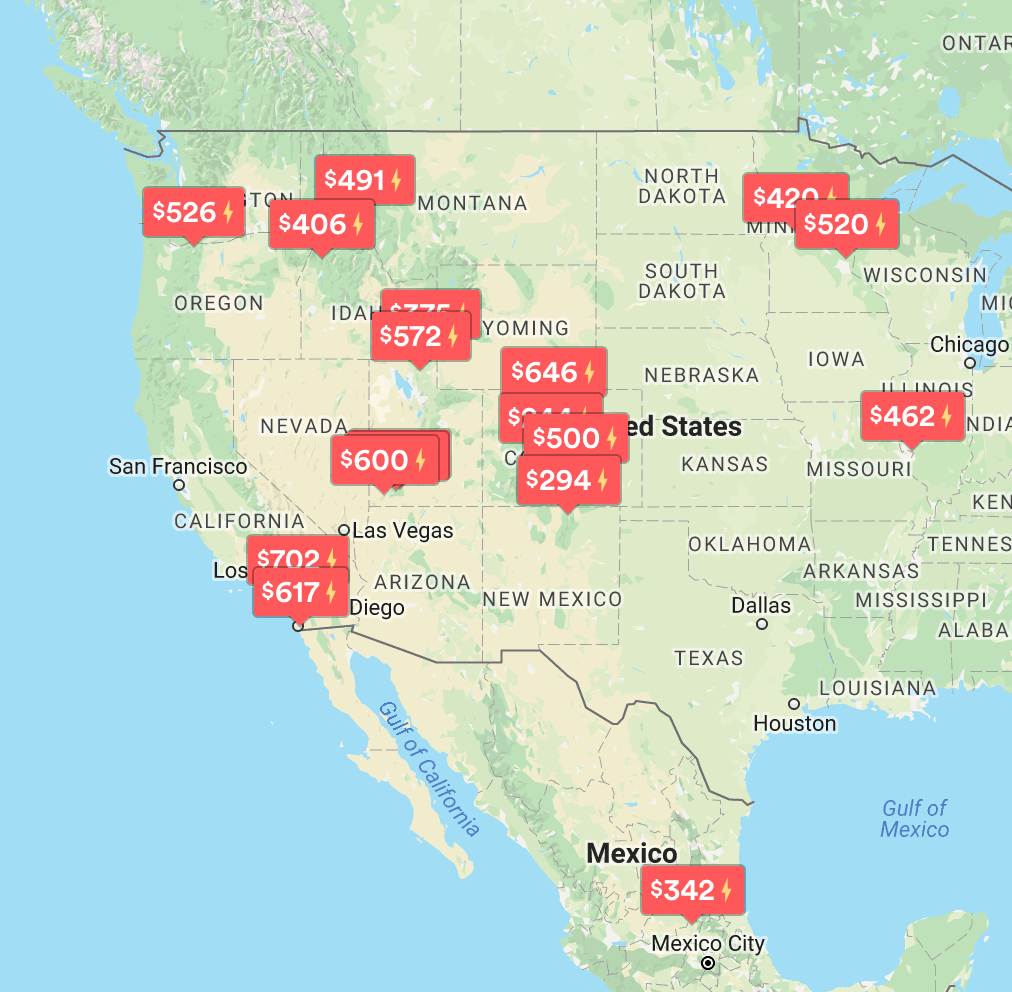
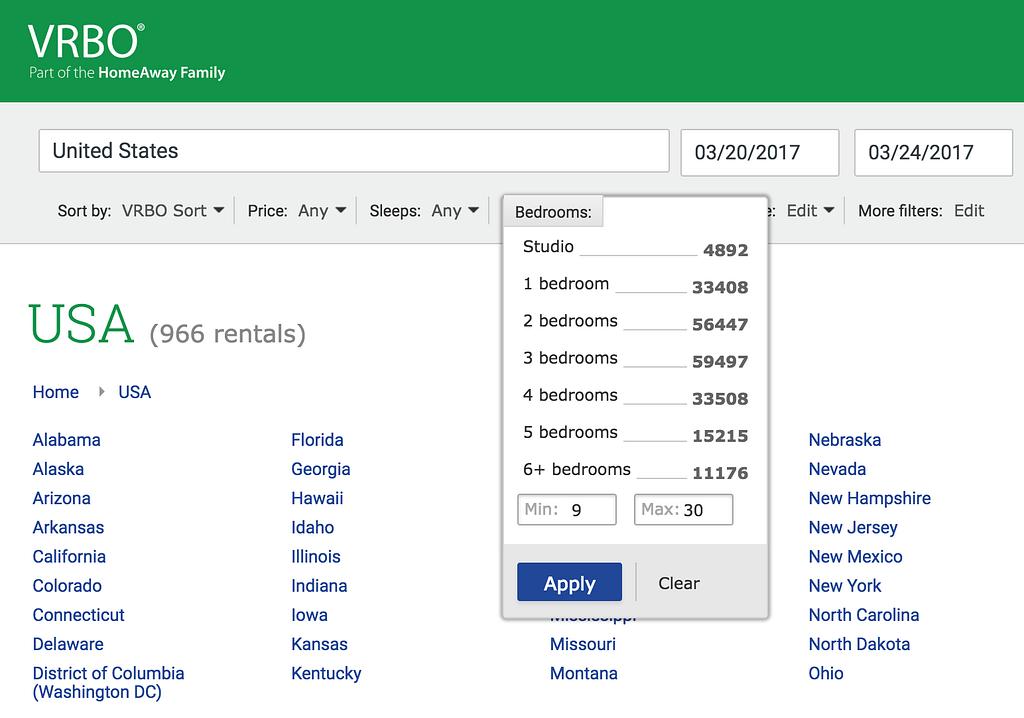
If you search by number of guests, it will assign double occupancy to bedrooms which is no bueno. We only want one person per bed. On the results page of both AirBnB and VRBO, you can filter by bedrooms, not guests.
I was initially concerned that people would object to sharing a room with two twin beds, but it turned out not to be an issue. I asked for volunteers for who wanted to be roomies and got immediate replies.

Saving money

Like any travel planner worth their salt, I’ll tell you to go off-season. There are lots of large, fantastic vacation homes which are have discounted rates in their slow times. In the summer, go to a ski town like Breckenridge or a desert outpost like Palm Springs. In the winter you have even more choices – go anywhere that’s not the usual conference hot spot like Vegas or Atlanta. It ranges from $100-$200 per person per bedroom, which is often cheaper than getting everyone a hotel room.

Palm Springs 6BR/6BA

Large venues

Call hotels directly to inquire if they rent out the entire property. Boutique hotels like the Ace Hotel, Jupiter Hotel and The Freehand are ideal for 150–300 person teams and have locations in Portland, Seattle, Palm Spring, Chicago and New York. The Ace in Palm Springs, for example, offers small and medium-sized meeting rooms, two pools and a covered lounge area. Some rooms offer private patios which people used to host smaller groups.

Look for large lobby or lounge areas that will fit the size of your team. Without a kitchen, the lobby/lounge will make for the central meeting point for everyone. Ideally, this space should comfortably fit at least 80% of the team at any given time. A bar in the lobby can be a great bonus to bring people together and get people talking comfortably.

Your daily meeting space will be key, prices will be high if you stay in the hotel. If your group is larger than 150 you could consider a separate private events space, or coworking office that is setup to host large groups within walking distance of the hotel. This helps get people out of the hotel for the week and can be nice to have a nice brisk walk to get your day started.

You get even more space for socializing by renting out large suites. Stock the fridge full of beverages and the cupboards full of snacks. Each day, replenish the stock. Any given night we will have tables full of people playing games, or self organizing events in other conference spaces: ping pong room, VR room, Band room, etc.

“The army marches on its stomach.”

Napoleon offered a prize of 12,000 Francs in 1795 (more than $1MM in today’s money) which led to the technology for keeping food fresh which we still use today. That’s right, we have Napoleon to thank for canned peas. He knew his army was only as good as they were fed.

Keeping your team at top brain power requires high-quality, healthy meals and access to snacks. Chess champions eat almost continuously so that their blood sugar never drops, causing them to lose mental acuity.

Food is connection. Food is story. Food is love.

We spent thousands of years sitting around a campfire cooking a meal and telling tall tales. View breakfast, lunch and dinner as opportunities to break the ice instead of a necessary chore to get calories in bellies. You can start your team off with a prompt as simple as “What’s your story?” Everyone interprets that deliberately vague question a little bit differently, which is exactly the point.

Photo courtesy Jeff Attaway

I love asking the team to make dinner for each other. I assign tw0-person cooking teams a few weeks ahead of the event. I pair people who wouldn’t normally work together so they get a chance to collaborate on a specific task. They chose a menu together and divide up the cooking tasks. (There is a separate two-person clean up team.) The choice of meal to make inevitably has a story, so make sure you have them explain why they chose this recipe. One of my vendors made his wife’s Japanese curry recipe. Getting the rice correct was so important he carried a bag of it in his suitcase so we would get to taste the right flavor.

I ask my cooking pairs a week ahead of time to get their menu to me so I can do all of the calculations to scale the recipe to feed the right number of people. You can use a service like Instacart to automate the shopping. Cooking yourself saves a ton over eating at a restaurant. I budget about $40 per person per day for breakfast, lunch and dinner. You also save a fortune buying alcohol from the liquor store down the road instead of by the glass at a restaurant.

Food presents a huge opportunity to make everyone feel included. Asking ahead of time for food preferences and restrictions shows respect to their identity and culture. Folks who have severe dietary restrictions such as Celiac prefer to have a kitchen to cook their own food, which a house provides. It removes a ton of stress for them to know they will be able to eat what they need to be healthy. People who are well fed feel taken care of.

Hospitality

We bother to get on planes because the interaction you have in person is so much richer. You get to see a side of the personality that you wouldn’t see otherwise. There’s no time in your meeting agenda to talk about your colleague’s grandma’s special lasagna she made for their birthday every year and wasn’t even very good because the corners were invariably burned, and how there was a ruse where she asked what kind of birthday cake they wanted and every year they said “banana cream pie” which made granny laugh. Those small moments build the regard for each other as more than colleagues but as friends. This is the connection that sticks you together in the stressful times.

In the end, it’s about hospitality. For good or for ill, we derive a large part of our identity and satisfaction from the work we do. We spend so much time together, it’s worth the investment of time, money and attention to build strong bonds with each other. Creating a warm welcome for your team means they’re more likely to welcome each other into their lives.

Check out the roundtable on this topic that inspired this post. It was a pop-up in Ellen Leanse’s series on Enlightened Leadership.

https://medium.com/media/62889a5c9fbc6b4e7aaf42680704b254/href

Thanks to fellow classmate, Maria Scarpello, for her suggestions and advice on creating the excellent culture at Automattic via offsite events in large venues.

03 Jan 11:05

RFM 2017 – Top 5.

by windsorr

Reply to this post

RFM AvatarSmall


Artificial Intelligence. 

  • AI is likely to be the most important theme in the technology sector this year.
  • This is because AI could become a major differentiator in determining which Digital Life services are the best and therefore preferred and paid for by consumers.
  • AI will also underpin the autonomy of any machine be it an automobile, a drone, a piece of factory equipment or a thermostat.
  • Hence, I expect that the hype and the claims being made with regard to AI will intensify further in 2017 making it even more difficult for executives and investors to see what the realities are.
  • While the hype will be huge, the progress will be slow as developing truly intelligent machines requires far more than just advances statistics.
  • I am looking for companies that are addressing the three real challenges of AI (see here) as it is the solution of these problems that will allow the quality and richness of services to really evolve.
  • RFM research finds that it is the search engines, Google, Baidu and Yandex that lead this field because they have been doing it the longest.
  • Everyone else is scrambling as fast as they can to catch up and are making an increasing amount of noise at the same time.
  • I expect to see feverish M&A activity in 2017 as AI currently takes so long to create that many players may feel they have no other choice than to acquire.

Autonomous time bomb.

  • Autonomy is likely to be everywhere at CES from domestic robots and drones to cars but I still think this is very far away from becoming viable.
  • The technology still has a long way to go before it is reliable enough before it can be trusted with the lives of every day users but I do not see this as the biggest problem.
  • The biggest issue, as I see it, remains me feeling that the market will not be ready to receive autonomy until long after the technology itself has matured.
  • This is because transport involves risk and with risk comes liability when, inevitably, something goes wrong.
  • I have written numerous times (see here and here) about why the technology will be ready long before the market is ready to deploy it.
  • I think that this will result in a shakeout.
  • Investors have been promised results and when the technology they have invested in has to sit on the shelf for several years, they are unlikely to be forthcoming with further capital.
  • Hence, I think that there is no real need to invest everything in autonomy now (outside of AI) as there is a very good chance that there will be bargains to be had when everything takes far longer than expected to start earning a return on investment.

 User growth slowdown. 

  • The growth of the hardware companies has been hammered over the last 12 months as smartphone shipment growth has slowed to below 5%.
  • I think that this is likely continue in 2017 resulting in consolidation (see below).
  • In contrast the companies whose revenues are based on the number of users, Google, Alibaba, Tencent, Facebook and so on, have enjoyed a great 2016 as the number of ecosystem users has continued to grow very healthily.
  • RFM calculates that global mobile ecosystem users grew by 12% in 2015 which combined with good growth in usage per user underpinned the 20%+ revenue growth seen from most of these players.
  • However, I think that 2017 will see both of these metrics slow with users slowing to around 8% YoY.
  • I think that this will still allow the companies whose growth is based on users not devices to show comfortably more than 10% but where investors have very high expectations, I see disappointment.
  • Facebook has already done this in saying that growth will slow materially in 2017 (see here).
  • I doubt it will be the last.

Hardware consolidation. 

  • The further slowing of smartphone device shipments is going to put more pressure on those trying to make a living by selling hardware.
  • There will be less and less differentiation in Android as Google and the BATmen (see here) take more and more control of the software that runs their ecosystems.
  • This leaves the hardware companies with the opportunity to differentiate through a cross device strategy (like Samsung, Apple and Microsoft) or by competing for scale (Samsung).
  • The execution of both of these opportunities increases the scope for consolidation among the hardware companies and I expect to see more deals in 2017.
  • Samsung buying Harman and Qihoo acquiring Blephone are good examples of the type of M&A I expect in hardware this year.

Year of the donkey. 

  • Unicorns are, by definition, very rare and I think they will become even rarer in 2017.
  • Many companies masquerading as Unicorns have been unable to execute on their promises leading to falling valuations and high executive turnover.
  • These are what I have referred to many times as donkeys (see here) who fear are going to have an even tougher time in 2017 than they did last year.
  • In the networked economy, a true unicorn needs to be almost unopposed in its field or be in a position to develop a commanding position in its market.
  • Furthermore, it must have management that is capable of executing as the best idea is worthless unless it can be brought to life.
  • Facebook, Uber, Airbnb, Linked-in, Amazon and Spotify are all good examples of companies that meet or are close to these criteria and it is these that I would consider to be the true unicorns.
  • Snap Inc., Magic Leap, LINE , Flipkart, Ola and so on are good examples of companies that currently command the valuation but where I am reluctant to put them in that hallowed territory.
  • I expect the list of unicorns to grow shorter as more and more of these companies show their true colours in the more difficult environment.
03 Jan 11:05

The Daily Practice Of Helping Members Feel Great About Helping You

by Richard Millington

Almost every community has people who want to help, but how far will they go?

You can (and should) test this.

Don’t overthink it. You don’t need complex MVP programs with big asks and detailed reward systems to get started. These programs should handle complexity, not create it. You can develop these when you need to.

Focus instead on getting really good at the daily practice of sending out simple messages of appreciation and asking for something more – something valuable.

If you’re not getting much of a response, try different messages. Vary the tone and the ask.

If you send a single message today and get a volunteer for years, that’s a lot of bang for your buck, so feel free to send out plenty.

Find the things members want to do and help them feel terrific about doing it. Get really good at the simple stuff, then move on to the complicated systems.

03 Jan 11:05

Happy New Year! Don't Forget I Have a Pizza Blog

Welcome to 2017. I don't have much to say right now (maybe a State of the Meat post soonish?) but I thought I'd remind old readers, and inform new ones, that I have a pizza blog where I write about… pizza.

I also tend to post pizza pics on Instagram as well.

Enjoy.

03 Jan 11:05

rsync

by Rui Carmo

Simply the best thing around for keeping file trees up to date across machines, partitions, etc. These are my random notes on it (in the sense that they might seem somewhat random, but they’re mine alone):

Bulk Photo Sync

The fastest way to sync a few hundred gigabytes of photos from my NAS to a backup disk is, alas, to bypass the rsync algorithm entirely and do it with:

--verbose
--archive (same as -rlptgoD, i.e. --recursive --links --perms --times --group --owner --devices --specials)
--whole-file
--extended-attributes
--partial
--progress

This because doing full checksums on the whole thing takes a long time for large photos and video files. And yeah, it’s pretty much like the Mac’s built-in ditto.

The above can be neatly summarized as:

rsync -vaWEP /Volumes/photo/ /Volumes/Fort\ Knox/Photos

And I occasionally swap the “W” with an “I” when I want a full binary sync (which is very seldom needed for a photo archive, but essential if you tweak the EXIF tags on it now and then).

Cut & Paste shortcut for one of my LAN backups

rsync -Cravztue ssh --progress --no-whole-file --stats --sparse --dry-run /home/rcarmo rcarmo@mini:/Volumes/Pedestal/Backups/monolith/home/carmor

Poor man’s rsync using only cp:

Assuming file contents don’t change, this will only copy new files across:

cp -npRv "/Volumes/Local" "/Volumes/Remote"

Resources:

  • truck, a rsync GUI for the Mac.
  • csync - a non-rsync file synchronizer that happens to be bi-directional and support SFTP.
  • mrsync - a multicast-enabled version that seems pretty useful for keeping large sets of machines in sync
  • rsnapshot, a filesystem snapshot utility (written in Perl for making backups of local and remote systems.
  • A HOWTO I mirrored locally for setting up the daemon under Leopard.
03 Jan 11:03

China to see electric vehicle boom before the rest of the world: Tom Tan, President of BorgWarner China

by Emma Lee

Like computing, changes in transportation accelerate every year. China, the world’s largest automobile market, is recording a spectacular growth of the New Energy Vehicle (NEV) with 200-plus companies in the industry.

Tom Tan, Vice President of BorgWarner Inc. and President of BorgWarner China, recently talked with us to share his thoughts on the rise of NEV in China and on current trends in the automobile industry. The following are edited excerpts from the interview.

What will be the prospect for China’s automotive industry in the coming ten years? 

China’s auto industry will continue to grow over the next decade, albeit at a much slower pace than the double-digit growth of the last ten years. Overall growth in the low single digits is to be expected.

There are four important trends at work here: 1) China’s population is the largest in the world and urbanizing rapidly; 2) The nation has an ever-increasing middle-class, with growing purchasing power and changing lifestyles; 3) Air pollution is becoming a serious issue; 4) The government has announced an energy strategy that will cap oil importation at the current 60+% level and gradually reduce it.

The first two trends are certainly supporting the continued growth of the automotive industry in China, while concerns about air quality and foreign oil dependency are prompting the government to establish more rigorous fuel and emission standards. Taken together, these four trends provide a major motivation for the government to accelerate the development of New Energy Vehicles (NEVs) such as electric vehicles (EVs), hybrid electric vehicles (HEVs), and plug-in hybrid electric vehicles (PHEVs), along with highly efficient low-emission combustion engines.

In recent years, China’s government has made a huge effort to promote NEVs, largely to reduce oil importation. As this effort continues, we will see the overall auto market gradually increase, but with HEV and EV growing at a much faster rate, with HEV dominating in the next five years and EV in the five years after that.

It is believed there will be a shift from combustion to electric propulsion systems in the near future. What is your view on this? 

I expect that the market for traditional combustion vehicles will be flat over the next seven years. The growth rate for pure EV will be much higher, but we’re starting from such a small base and the current cost is high, as is user inconvenience, so I expect that the market share will be less than 2% worldwide.

The story could be different in China, though. With strong government incentives and policy guidance, pure EV and plug-in hybrid EV will likely achieve 4%-5% of the total China market, which could be well above one million units a year in five to seven years’ time. We understand that there are now more than ten new companies in China dedicated to building EVs, and most claims to have raised capital of more than $1 billion in first-round financing. We should see the first EVs from these companies in the 2018 to 2020 period.

Due to the advantages of HEVs in terms of technology, cost, and CAFE achievability, we will see hybrids take off faster and on a larger scale in China. The most aggressive forecast is that HEVs will reach 20% market share in 10 years.

How long before we have fully autonomous vehicles on the road? What are the challenges of product innovation?

When we talk about fully autonomous vehicles, we really mean the ultimate SAE Level 5 self-driving car with no steering wheel, pedals, or human driver….it may take another 10 or more years before we see fully autonomous vehicles on the road in any meaningful number.

There are many challenges to overcome including the navigation systems (using radar, lidar, GPS, sensor, vision, laser, or satellite mapping) and the vehicle-to-vehicle (v2v) and vehicle-to-infrastructure (v2i) communication systems that allow vehicles to communicate even under extreme conditions, such as city chaos or heavy snow.

bw-location-ningbo_edit

BorgWarner Automotive Components (Ningbo) Co., Ltd. In Ningbo, Zhejiang Province, China

It has been said that over time, as self-driving cars as well as ride-hailing and on-demand service becomes more prevalent, that the demand for car purchases will decrease. Do you agree?

Yes, to some extent I do agree. A certain number of people will choose to not own a vehicle when self-driving cars and ride-hailing services become mainstream. However, I believe that the majority of people will choose to own their own vehicle for quite a long time.

Certainly, there will be a lot more vehicle-sharing options on the market when self-driving vehicles become mainstream. We will likely see some reduction in private vehicle ownership, especially in cities where parking is problematic and expensive. Car ownership will carry some inconvenience in the future, but this will not necessary mean that most people will want to give up the enjoyment of driving their own vehicle.  There is a social meaning to car ownership that won’t quickly change.

 Image credits: BorgWarner

03 Jan 11:03

Twitter Favorites: [geerlingguy] Going to start writing next book soon: photography, Drupal, or infra automation?

Jeff Geerling @geerlingguy
Going to start writing next book soon: photography, Drupal, or infra automation?
03 Jan 06:07

good morning frome ice ville :-) ! added as a favorite.

by Vida Morkunas (seawallrunner)
03 Jan 06:07

The 15 Warnings Signs of Impending Tyranny

robertreich:

As tyrants take control of democracies, they typically:

1.  Exaggerate their mandate to govern – claiming, for example, that they won an election by a landslide even after losing the popular vote.

2.  Repeatedly claim massive voter fraud in the absence of any evidence, in order to restrict voting in subsequent elections.

3.  Call anyone who opposes them “enemies.”

4.  Turn the public against journalists or media outlets that criticize them, calling them “deceitful” and “scum.” 

5.  Hold few if any press conferences, preferring to communicate with the public directly through mass rallies and unfiltered statements

6.  Tell the public big lies, causing them to doubt the truth and to believe fictions that support the tyrants’ goals.

7.  Blame economic stresses on immigrants or racial or religious minorities, and foment public bias and even violence against them.

8.  Attribute acts of domestic violence to “enemies within,” and use such events as excuses to beef up internal security and limit civil liberties.

9.  Threaten mass deportations, registries of religious minorities, and the banning of refugees.

10. Seek to eliminate or reduce the influence of competing centers of power, such as labor unions and opposition parties.

11. Appoint family members to high positions of authority

12. Surround themselves with their own personal security force rather than a security detail accountable to the public.

13. Put generals into top civilian posts                

14. Make personal alliances with foreign dictators.

15. Draw no distinction between personal property and public property, profiteering from their public office.

Consider yourself warned.

(Cue the creepy music.)

When do they start rounding up the people that repost things like this?

03 Jan 03:45

Try Compose and Get Your Free Tools of the Trade T-Shirt

by Thom Crowe
Try Compose and Get Your Free Tools of the Trade T-Shirt

Ring in the new year in style with your new Tools of the Trade t-shirt from Compose. That's right, sign up for a new Compose account and try out a MongoDB, Elasticsearch, Redis, PostgreSQL, MySQL, ScyllaDB, RethinkDB, RabbitMQ or etcd deployment, and we'll hook you up with a snazzy new shirt. It's easy, give Compose a try for free for the first 30 days to see what Compose can do for you by signing up for a free 30 day trial with Compose and we'll send you a free t-shirt.

Just our way of wishing you a happy 2017.


If you have any feedback about this or any other Compose article, drop the Compose Articles team a line at articles@compose.com. We're happy to hear from you.

03 Jan 03:45

First of Six 2016 Gordie Awards-Biggest Transportation Story-

by Sandy James Planner

59-1

The “Gordies” are awarded annually by the Editorial Board of Price Tags with input from readers. “Gordies” for 2016 will be presented daily every day in six outstanding categories. 

Today, Tuesday January 2 , Price Tags Editorial Board presents the Gordie for:

*Biggest Transportation Events*

There were four notable contenders in this category.  The Biggest Transportation Events of 2016 are:

The Massey Bridge-–”10 lanes to fresh new sprawl. Yummy.  Cars for everyone!!  And billions upon billions of referendum-free dollars for them, with no end in sight.  How many months until that Provincial election?”

new-bridge-to-replace-george-massey-tunnel


Approval of Mayors’ Phase One Transit Plan“$2B more bus, Skytrain, Seabus and HandyDART; money from Feds, Province and Metro Vancouver.  Serious planning on Broadway subway and Surrey LRT lines.  Baby steps, too, on the way to regional mobility pricing.”

new-westminster-b-c-nov-23-2016-vancouver-mayor-gregor-e1479952930473


More SkyTrain — “approval of $93M for 28 spankin’ new SkyTrain cars (a 9.8% increase) arrivals start in 2018; cars in service by the end of 2019.”

vanc-skytrain042-near-stadium1


Opening of Evergreen Line –“ $ 1.43 B (capital), 11-km, 7 stations, construction since 2013.  Hopes for development to boom around the stations. Transit-oriented development rises in local thinking.”

evergreen-line-opening-ribbon-cut


Tomorrow, stay tuned for another “Gordie” 2016 award in the “Happiest Tranportation Story” category.


03 Jan 03:44

currentsinbiology: Orgasm is all about rhythmic timing,...


currentsinbiology:

Orgasm is all about rhythmic timing, according to new research paper

“Synchronization is important for signal propagation in the brain, because neurons are more likely to fire if they are stimulated multiple times within a narrow window of time,” Safron said. “Otherwise, the signals decay as part of a general resetting mechanism, rather than sum together. This then caused me to hypothesize that rhythmic entrainment is the primary mechanism by which orgasmic thresholds are surpassed.”

Safron said this research could be relevant for improving sexual functioning, encouraging people to focus more on the rhythmic aspects of sexuality.

“The idea that sexual experiences can be like trance states is in some ways ancient. Turns out this idea is supported by modern understandings of neuroscience,” Safron said. “In theory, this could change the way people view their sexuality. Sex is a source of pleasurable sensations and emotional connection, but beyond that, it’s actually an altered state of consciousness.”

Safron found parallels between sexual climax and seizures as well as with music and dance—something he wasn’t expecting.

In both orgasm and reflex seizures, rhythmic inputs into high-bandwidth sensory channels resulted in an explosive process after certain stimulation thresholds were surpassed.

“And although obvious in retrospect, I wasn’t expecting to find that sexual activity was so similar to music and dance, not just in the nature of the experiences, but also in that evolutionarily, rhythm-keeping ability may serve as a test of fitness for potential mates.”

He said this is consistent with the fact that rhythmic song and dances are nearly universal parts of mating, going back hundreds of millions of years to our common ancestors with pre-vertebrate animals such as insects.

The article appeared in the journal Socioaffective Neuroscience and Psychology’s special issue “Orgasm: Neurophysiological, Psychological, and Evolutionary Perspectives.”                                        

I would have thought it obvious that orgasm, seizures, and dance are related.

03 Jan 03:40

Some Predictions, 2017

I’ve been late to the prediction game, but I will riff on some ideas inspired by recent events. Some of these are a bit fabulous, but bear with me: what is coming could wind up being much more strange than these vignettes. (Numbered but not ordered in any particular way.)

  1. Work chat will continue to dominate the market for enterprise ‘collaboration’, and AI-based ‘team members’ with deep learning skill sets will become commonplace, building on chatbot models of interaction but assuming larger roles in project management, development, marketing, and HR. Slack is acquired by Amazon for $35 billion, and loosely integrated into AWS.
  2. The hottest business trend of 2017 will be AI-based ‘driverless management’, displacing Holocracy and other management ‘business operating systems’ fads. AI will play a significantly larger role in areas that human cognitive biases are most problematic, like hiring and promotion, decision support, and ensuring diversity, equality, and well-being in the workplace. (Daemon (via Daniel Saurez) meets the workplace.) Several unknown start-ups will lead this new exploding sector.
  3. Following Trump’s proposed withdrawal of US supporting NATO troops in the Baltics and Eastern Europe, Vladimir Putin’s Russia will occupy some part of the Baltics, like the Latgale region of Latvia, which is ~40% ethnic Russian. Mike Pence resigns as Vice President following major disagreements with Trump on the Baltics and NATO. Trump nominates Elaine Chao as Vice President, his Secretary of Transportation, and she is appointed in October, the first woman and first Asian American to serve in that role.
  4. North Korea will fire a rocket that hits Kodiak Island in Alaska, although it carries only a conventional warhead. Kim Jong-un says the rocket was supposed to have crashed in the ocean before landfall, but many believe it was on track to hit Anchorage. 
  5. Trump raises massive trade barriers to Chinese goods, sparking a trade war that damages both countries’ economies. This is in part because of an inability to get China to – in effect – take control of North Korea, but also as part of an attempt by US and European companies to make China’s markets more open: a second Opium War. 
  6. Britain begins that actual process of Brexit in mid 2017, leading Scotland to a referendum in favor of leaving the UK and applying to the EU for membership.
  7. The US Congress will pass legislation in early 2017 to repeal Obamacare, but defers any implementation until 2018 at the earliest, because they can’t agree on how it will be replaced or by what approach. Trump proposes a single payer system as a companion to a radical restructuring of the tax code, as he had hinted in his campaign, and falls into open discord with the establishment wing of the GOP. 
  8. Driverless car fleets are rolled out by various car companies (Ford, Chrysler, Tesla, etc.) and car hailing platforms (Uber, Lyft, etc.). Car ownership in major urban areas continues to decline, and many municipalities create partnerships with fleet owners to augment conventional mass transportation solutions. The value of New York City taxi medallions drops over 75%.
  9. Amazon will buy Snapchat, and announce a new take on augmented reality glasses, picking up where Google dropped the ball years ago. Building on the success of Alexa-based Echo devices, Kindle, Fire TV, Amazon Prime, and the growing popularity of Snapchat, Amazon Eyes are the hit of Christmas 2017, with over 50 million ordered in November and December.
  10. The war in Syria comes to a Korean War-like end, with a partition of the country into various regions, and a unceasing belligerence on all parts. It is clearly a shadow war between factions backed by the West, Saudi Arabia, Iran, Turkey, and Russia. The stalemate here is a reflection of the reappraisal of loyalties and goals of the shadow players, more than the aims of the Syrian government and the insurgents. Bashar al-Assad rules a rump state of western Syrian, with much of the rest of ‘Syria’ in shambles.
  11. Hillary Clinton files for divorce from Bill Clinton in March 2017, and assumes the role of president of Harvard University, two weeks later.
  12. Marine Le Pen loses an unexpectedly close run-off with François Fillon, but the close election pulled Fillon and his Republicans farther right than in recent decades.
  13. Oprah announces that she intends to run for President in the next election.
  14. Angela Merkel narrowly wins reelection, after wide-spread controversy of scandals uncovered by leaks generally attributed to Putin’s brigade of hackers.
  15. Barack Obama joins Andreessen Horowitz as a partner, and leads a round funding AdjectiveNoun (fictitious, note), one of the most promising ‘driverless management’ startups. He also comes out in support of Oprah Winfrey’s candidacy.
  16. Microsoft acquires Salesforce for $75 billion. Marc Benioff leaves to run philanthropy (amid discussions of political ambitions).
  17. Apple acquires Tesla for $75 billion. Tim Cook announces retirement, Elon Musk becomes CEO.
  18. Despite inaction by the US Federal Government, and chaos in the EPA and Energy Department, CO2 levels continue to fall worldwide. Environmental groups suggest that we may have turned the corner on energy in 2017, because solar is now cheaper than other energy sources in most places in the world. However, global temperatures continues to rise, and many models show that it might take 1000 years to reduce global temperatures.
  19. California and San Francisco, with support from Uber, Lyft, Airbnb, and other platform companies, announced a project to convert increasingly unneeded parking lots to small ‘park villages’ with dense, micro-apartment developments, for low-income and homeless residents. Trump-sponsored infrastructure funds are directed to US micro-building factories and a new California Construction Corps, which is strongly supported by both Democrats and Republicans. The state’s program is seen as a blueprint for the rest of the country.
  20. Michael Bloomberg announces plans to create a third ‘Pragmatist’ party, based on economic conservatism and social liberalism, and rapidly attracts a large minority of GOP and Democratic legislators in Washington who have been whipsawed by the 2016 elections, and by the growing discord in both major parties over the future of their platforms. Some project that the Pragmatists could gain as many as 30% of the seats in the House, and as many as 10 governorships in coming years. Bloomberg announces his plans to run for President.
03 Jan 03:39

Appliance Repair

mkalus shared this story from xkcd.com.

[holding up a three-phase motor] As you can see here, the problem is that the humidifier I took this from is broken.
03 Jan 03:35

Manton Reece Launches Campaign for Microblogging Service and Book

by John Voorhees

Today, Manton Reece launched a Kickstarter campaign to raise money for Micro.blog, a platform for independent microblogging and a related book on the subject. Micro.blog has a lot in common with social networks like Twitter, such as replies and favorites, but with an important difference. Instead of locking users into a proprietary system owned by someone else, the content created by individuals is owned and controlled by them. As part of the Micro.blog service, Reece is also building publishing tools with Markdown support, including a native iPhone app, to help people get started with microblogging.

At the core of Micro.blog is an critical design decision – the separation of publishing from social networks. That choice ensures that the microblog content you create remains yours to publish at [your-name].micro.blog or anywhere else you can host a website. At the same time, Micro.blog doesn’t ignore existing social networks. Microblog posts can be cross-posted to other services, which has the potential to give users the best of both worlds – control over their content and access to the broad audiences of services like Twitter.

In addition to Micro.blog, Reece is writing a book on independent microblogging that makes the case for the format and provides practical advice on how to start a microblog. Backers of Reece’s campaign can choose from a variety of rewards that include Reece’s book, early access to the Micro.blog service, free months of the Micro.blog service, and stickers.

New social networks have come and gone over the years, but Reece’s focus on decentralizing microblog publishing from social networks is unique. I had a chance to speak with Manton about Micro.blog at WWDC and know how much time and thought has gone into this project. The campaign is off to a great start and I’m excited to try it soon.

→ Source: kickstarter.com

03 Jan 03:35

Nixon's Vietnam Treachery

by jwz
mkalus shared this story from jwz.

Now we know Nixon lied.

A newfound cache of notes left by H. R. Haldeman, his closest aide, shows that Nixon directed his campaign's efforts to scuttle the [Vietnam] peace talks, which he feared could give his opponent, Vice President Hubert H. Humphrey, an edge in the 1968 election. On Oct. 22, 1968, he ordered Haldeman to "monkey wrench" the initiative.

The 37th president has been enjoying a bit of a revival recently, as his achievements in foreign policy and the landmark domestic legislation he signed into law draw favorable comparisons to the presidents (and president-elect) that followed. [...] Haldeman's notes return us to the dark side. Amid the reappraisals, we must now weigh apparently criminal behavior that, given the human lives at stake and the decade of carnage that followed in Southeast Asia, may be more reprehensible than anything Nixon did in Watergate. [...]

In a conversation with the Republican senator Everett Dirksen, the minority leader, Johnson lashed out at Nixon. "I'm reading their hand, Everett," Johnson told his old friend. "This is treason."

"I know," Dirksen said mournfully.

Johnson's closest aides urged him to unmask Nixon's actions. But on a Nov. 4 conference call, they concluded that they could not go public because, among other factors, they lacked the "absolute proof," as Defense Secretary Clark Clifford put it, of Nixon's direct involvement.

Nixon was elected president the next day.

Maybe now's a good time to re-read Hunter S. Thompson obituary of this fine American:

If the right people had been in charge of Nixon's funeral, his casket would have been launched into one of those open-sewage canals that empty into the ocean just south of Los Angeles. He was a swine of a man and a jabbering dupe of a president. [...] Let there be no mistake in the history books about that. Richard Nixon was an evil man -- evil in a way that only those who believe in the physical reality of the Devil can understand it. He was utterly without ethics or morals or any bedrock sense of decency. Nobody trusted him -- except maybe the Stalinist Chinese, and honest historians will remember him mainly as a rat who kept scrambling to get back on the ship. [...]

Some people will say that words like scum and rotten are wrong for Objective Journalism -- which is true, but they miss the point. It was the built-in blind spots of the Objective rules and dogma that allowed Nixon to slither into the White House in the first place. He looked so good on paper that you could almost vote for him sight unseen. He seemed so all-American, so much like Horatio Alger, that he was able to slip through the cracks of Objective Journalism. You had to get Subjective to see Nixon clearly, and the shock of recognition was often painful. [...]

Nixon's spirit will be with us for the rest of our lives -- whether you're me or Bill Clinton or you or Kurt Cobain or Bishop Tutu or Keith Richards or Amy Fisher or Boris Yeltsin's daughter or your fiancee's 16-year-old beer-drunk brother with his braided goatee and his whole life like a thundercloud out in front of him. This is not a generational thing. You don't even have to know who Richard Nixon was to be a victim of his ugly, Nazi spirit.

He has poisoned our water forever. Nixon will be remembered as a classic case of a smart man shitting in his own nest. But he also shit in our nests, and that was the crime that history will burn on his memory like a brand. By disgracing and degrading the Presidency of the United States, by fleeing the White House like a diseased cur, Richard Nixon broke the heart of the American Dream.

Previously, previously, previously.

03 Jan 03:34

Facebook’s Instant Articles: damned if you do, damned if you don’t

files/images/boy_and_filberts.jpg


Enrique Dans, Medium, Jan 05, 2017


Maybe things work differently for major news media. Perhaps they still believe they need Facebook. From my perspective, when I stopped posting on Facebook at the end of last summer, my visits  increased substantially. Facebook was neither showing my content nor referring traffic, yet people thought I was posting on Facebook and didn't look elsewhere. Meanwhile, Facebook started suggesting I pay for advertising, and at the same time they started flooding my news stream with advertising. If news media did what I did, their Facebook problem would be solved. But they're like the boy and the filberts. If they want to escape the trap, they have to let go a bit, but their greed won't let them. Image: itsaperfectstory

[Link] [Comment]
03 Jan 03:34

A Few More Words on Mirrorless

My recent article on why mirrorless cameras are needed provoked a few emails I need to respond to, and in addition to doing so privately I thought it worthwhile to add a couple of thoughts to my previous article.

03 Jan 03:34

When Will Mirrorless Replace DSLRs?

You've seen endless variations of this question, and it's related to the question I wrote about last week. Everyone seems to want to know what the DSLR Sell By Date is. 

Surprise: the question has two sub-answers that are needed before we get to the final answer.

03 Jan 03:34

How change happens. (Hint: it’s not through New Year’s resolutions.)

by Josh Bernoff

Things are going to be different this year, you have resolved. But that’s not how change happens. It’s a process. Here’s how New Year’s resolutions (don’t) work. You figure out something you want to change. You make a resolution. “I want to quit smoking” or “I want to stop using the passive voice.” You try really … Continued

The post How change happens. (Hint: it’s not through New Year’s resolutions.) appeared first on without bullshit.

03 Jan 03:34

Lineage OS, the ROM formerly known as CyanogenMod, gets a new logo

by Igor Bonifacic

After a disastrous 2016 in which Cyanogen abandoned its titular OS, the CyanogenMod team, the group behind Android’s most popular ROM, announced it was breaking ranks with the company and starting a new project, Linage OS, that would more closely adhere to the grassroots origins of Cyanogen.

While Android users can’t download the ROM just yet, a member of the Lineage team uploaded the operating system’s new logo to GitHub earlier today, hinting at what’s to come. The Lineage team has since added the logo to their official website as well. As the Android Police notes, the design is a clever visual reference to the project’s Android and Cyanogen roots.

We’ll likely learn more about Lineage in the coming weeks and months.

In the meantime, what do you think of the design? Tell us in the comment section below.

SourceGitHub
03 Jan 03:33

Kickstand Cyclery ‘Find the Customer’ Contest

by Yehuda Moon
mkalus shared this story from Kickstand Comics featuring Yehuda Moon.

It’s time for the January Walz Caps contest!

This month, we’re celebrating all of the Kickstand Cyclery customers who have passed through the shop doors over the years.

Each week, we’ll show you a picture of a Kickstand Cyclery customer. The customer appeared in one of the comics at yehudamoon.com. Look for them!

  1. When you’ve found the customer in one of the comics, copy and paste the URL in the browser address bar as a reply to the contest post on our Facebook or twitter pages.
  2. The first reader to spot the customer in one of the comic strips and reply with the URL is entered into a drawing on January 31, 2017 for a $40 Walz Caps gift card. Make sure to accompany the URL with #IamYehudaMoon and @WalzCaps!

Here’s the first customer:

Kickstand Cyclery Customer Contest: Customer #1

We’ll post new customer pictures every weekday in January.

Good luck!

The post Kickstand Cyclery ‘Find the Customer’ Contest appeared first on Kickstand Comics featuring Yehuda Moon.

03 Jan 03:33

Rogers may be expanding ‘Rogers-EXT’

by Steven Hurdle

Back in March 2015, Rogers announced domestic roaming for Rogers, Fido, and Cityfone customers under its “Rogers-EXT” brand. When a phone says Rogers-EXT, however, it’s not actually on Rogers’ network: it’s roaming on Bell/Telus.

Up until now, the telecom has attempted to limit access to Rogers-EXT to areas where Rogers has no coverage, using the service as a way to provide coverage where its network is limited or nonexistent. If you attempt to force your phone to use EXT inside of Rogers’ advertised coverage footprint, it usually did not work.

However, that may have changed recently, at least in some locations. We’ve recently read reports of people getting access to EXT in areas where they didn’t before, and others being able to force their phone to use EXT.  I put it to the test and, sure enough, I was able to force a device to use EXT, allowing me to use my phone normally. These tests were done deep inside Rogers’ advertised coverage footprint in an area where the telecom’s signal is stronger than the EXT signal. Previous tests to force EXT in this area were not successful.

There is uncertainty whether this shift applies only to specific areas, or is still in the process of being fully implemented. Reports out of B.C. and Alberta are indicate unrestricted EXT access is on the way, but some people testing EXT in Southern Ontario are suggesting they’re still unable to access the service in the GTA, Kitchener-Waterloo and Hamilton.

If this is a policy change, rather than a mistake that will later be corrected, it could be very good for some Rogers customers.  For the most part, Rogers has only blocked EXT access in areas where its signal is strong. However, due to the differences between the Rogers network and the EXT network, there were some locations where Rogers chose to block off where its signal was sufficiently weak as to not be reliable, or in some cases nonexistent. If Rogers is truly allowing unfettered EXT access, this should mean a better experience in fringe areas for Rogers users.

There are limitations to keep in mind, however.  If you’re on a call it will drop when transitioning from Rogers to the EXT network.  Rogers also requires that you be on a post-paid plan (not prepaid), and that the majority of your usage be on the Rogers network.

Update 01/03/16:  When Rogers first launched EXT, older “my10” plans were excluded.  Some users are reporting that those grandfathered plans now have access to EXT as well.  Thanks Scott M. for the tip!

03 Jan 03:33

Checking Internet-Based Claims

by mikecaulfield

I’ve been working over the break to boil down how to check Internet claims into something short and active. Short, because longer prescriptions don’t work. Active, because we are trying to build habits.

Here’s what I’ve got so far.

  1. See if someone has already done the work. Some people call this the “Check Snopes First” rule, but there’s actually a broader array of sites you can check as well. My guess is if people checked Snopes and other sites first then 80% of the most pernicious stuff would disappear from our feeds overnight.
  2. Go upstream. Here’s the second maddening thing with claim-checking. I have watched in my long career student after student looking at an article on some third-tier clickbait aggregation site and trying to determine the validity of an article by evaluating that particular site. That site doesn’t matter. Go upstream and get as close to the original source as possible before starting your analysis.
  3. Look at what others say about the source. Once you find your site upstream, it’s time to get off it again. See what other people say about your source. Use tools such as whois, Google Scholar, and SourceWatch to find out who is behind the information on the site, what their agenda is, and what expertise they bring to the table.
  4. Get a second opinion. But not from the same doctor! So your final step is to look for corroborating (and disproving!) evidence. But here’s what happens a lot of times: people see a claim (“Ford Motor Company supports Black Lives Matter group”). They trace it to the source (rare, but sometimes happens). Then to verify it they search on the claim and find there are dozens of stories out there talking about this. The thing is, if all these stories stem from the same original source, they can’t be used to verify that source. So as you scan search results, be looking for a source that is going to bring in additional information, or approach the question from a different angle.

There’s some bigger understandings that inform these actions. One thing I’m thinking about a lot nowadays is how the level of syndication and rampant “reporting on reporting” creates the appearance of broad consensus within hours of an original claim. I mean, you’re seeing the same claim on literally hundreds of sites. It must be true, or at least valid, right?

Jon Udell is working on a Chrome extension that encodes some of the process we’re discovering works most consistently; you can see that work here. As I said, we’re still trying to get this down to something that almost becomes muscle memory — we don’t believe you’ll be able to fully investigate a site off of a recipe, but to borrow a term from Jon, I think we can make some “strategies for internet citizens” partially encode as habits.


03 Jan 03:33

Google and Fiat Chrysler built a new Android-based infotainment system

by Rose Behar

Google and Fiat Chrysler have collaborated on a new Android-based infotainment system, the two companies announced on Monday.

The system is based off of Android 7.0 Nougat, skinned with Fiat Chrysler’s UConnect interface. It integrates Google apps like Maps and Assistant, as well as third-party apps such as Spotify and Pandora. The collaborative project is the latest in a partnership that has already produced 100 Chrysler Pacifica minivans featuring Google’s self-driving technology.

The development also builds towards Google’s ambition of integrating its open-source Android into all user-facing aspects of the car — including the speedometer and climate control — which the company laid out at its 2016 I/O developer conference.

The two companies have yet to state when infotainment system will become available to consumers, though more information may be forthcoming at the Consumer Electronics Show (CES) in Las Vegas, Nevada.

SourceThe Verge
02 Jan 16:13

New favorite artist

02 Jan 16:13

New favorite artist

02 Jan 16:13

New favorite artist

02 Jan 16:12

Structure

by Nathan Jurgenson

Real Life is on winter break. We’ve put together eight SPECIAL ISSUES for your consideration. We’ll publish one a day, each selected by an editor and based on a thematic topic. Click the image below for a pdf. And please enjoy these mid-season reruns until we return to our usual scheduled program.


There is an old joke that technology is everything invented after you were born. Everything else we take for granted, forgetting how it had been developed, implemented, naturalized. It’s easy to fixate on the novelty of screens and overlook how the rest of our environment already consists of technologies that are so familiar as to seem immutable. Cities, buildings, clothing, transportation systems may not seem technological in the same way as digital devices, but they all are means by which social relations are sustained and given a graspable order. They all shape what kinds of thought are possible, what collective and individual aspirations can be conceived, what sorts of failure we may face. That is to say, they structure, and the innumerable iterative choices that have gone into them afford and preclude experience, extending new freedoms — and risks. The affordances of digital technology are so new as to seem somehow apart, a supplement to what’s always been integral and “real” about our lives. But recognizing how the entire built environment is both structured and structuring makes it plain that what happens on screens is as real as the room you’re standing in. —Nathan Jurgenson, Founding Editor

Featuring:

“True-ish Grit,” by David A. Banks

“Magnificient Desolation,” by Elisa Gabbert

“Perpetual Motion Machines,” by Chenoe Hart

“Pajama Rich,” by Moira Weigel

02 Jan 16:12

Samsung will reportedly soon reveal exactly why the Galaxy Note 7 caught fire

by Ian Hardy

After a glorious entry into the market, Samsung’s Galaxy Note 7 quickly went down in flames in 2016. The device was one of the nicest looking handsets the company has ever manufactured, but also came embedded with a faulty battery that caused several to explode, bringing on a full recall of its flagship smartphone.

According to a new report by Korean publications JoongAng Ilbo and the Korea Herald, Samsung has concluded its investigation into the Note 7’s issues, with assistance from both the Underwriter Laboratories (UL) and the state-owned Korea Testing Laboratory. The details are not yet known, but Samsung will reportedly make the results public by mid-January.

Health Canada noted Samsung “sold or distributed” approximately 39,000 Galaxy Note 7 smartphones in Canada and received four reports of phone batteries overheating with one incident resulting in a “minor burn injury to a consumer’s forearm.”

Samsung has since deactivated all Note 7’s from operating in the Canadian market.