Shared posts

09 Jan 22:31

Did Russia hack the election? Intelligence report is active and persuasive.

by Josh Bernoff

When you think of government reports, do you expect clarity or doubletalk and jargon? The report on Russia and its influence in our elections, from the U.S. Director of National Intelligence James R. Clapper, is brief, direct, and unequivocal. It’s a great study in how to use clear language to persuade. This document is a joint production … Continued

The post Did Russia hack the election? Intelligence report is active and persuasive. appeared first on without bullshit.

09 Jan 22:31

The Ten Year Anniversary of the Apple TV

by Ben Thompson

On January 9, 2007, ten years ago today, Steve Jobs took the Macworld stage and introduced the Apple TV.1

That the iPhone had to share the stage the same day it was unveiled to the world is a footnote in history, especially given the degree to which that history has been indelibly shaped by the most consequential device the tech industry has ever produced.

I get that that is a bold statement: what about the IBM System/360, which transformed the back-end systems of governments, financial institutions, and enterprise? What about the PC, that did the same on an even broader scale, first in the office and then at the home, achieving Microsoft’s seemingly impossible goal of “a computer on every desk and in every home”? Or what about the data center, without which much of the iPhone’s magic would simply not exist?

In fact, the truth about any historical breakthrough is that it is built on everything that came before; this is especially the case with technological products. Even looked at narrowly, the iPhone’s software was built on OS X, itself built on NeXTSTEP, which was built on Unix; Unix was a product of AT&T’s Bell Labs research center, which also pioneered the transistor. The latter’s evolution to a 412 MHz single-core ARM11 CPU that was just powerful enough to drive the iPhone was just as critical to making the iPhone a viable product as was the evolution of a command-line driven operating system to one driven by touch.

And yet, out of all the evolutionary steps of both software and hardware the iPhone truly is special for a very simple reason: it combined the two in a way that made the power of each not just accessible but desirable for every single person on earth, resulting in a device that was not just stuck on a desk but in every pocket. This is the potential payoff from Apple’s focus on the integration of hardware and software: it creates the conditions to bring in users motivated not by a sense of professional obligation but drawn by delight.


I have long been struck by Marc Andreessen’s comment in a 2014 New York Magazine interview that he arrived in Silicon Valley filled with disappointment:

There had been this PC boom in the ’80s, and it was gigantic — that was Apple and Intel and Microsoft up in Seattle. And then the American economic recession hit—in ’88, ’89 — and that was on the heels of the rapid ten-year rise of Japan…I came out here in ’94, and Silicon Valley was in hibernation. In high school, I actually thought I was going to have to learn Japanese to work in technology. My big feeling was I just missed it, I missed the whole thing. It had happened in the ’80s, and I got here too late.

Andreessen, of course, went on to create Netscape, the pioneering web browser that declared in its advertising that “the web is for everyone”; it is, in terms of historical impact, the software analog of the iPhone. The Internet had existed in some form since the 1970s, and the World Wide Web was first proposed by Tim Berners-Lee in 1989, but it was Netscape that made that transformational technology accessible to everyone. Indeed, this is the common trait of truly consequential breakthroughs: they are adopted by everyone. And, by extension, it is that adoption that drives everything that follows.

To that end, the reason I was struck by Andreessen’s quote is that I once felt the same: I went to university during the dot-com era, and while even then I was obsessed with technology, my background was such that I never even considered working in the tech industry; by the time I figured out that I might have something to contribute not only had the tech industry bounced back from the bubble bursting, but the iPhone and the competitors it inspired had long since launched. What was left?

In fact, nearly everything: the reason the iPhone is so important is that by combining the Internet with the portability of mobile it created the conditions for the transformation of every part of society, from business to government and everything in between. Today I see my role with Stratechery as not only providing analysis of the news of the day but in many respects as a chronicler of some of the most fundamental transformations in history.


So here we are, ten years on: over two billion people own smartphones, the entire post-World War II economic order is teetering, and populism is on the march; I don’t think these facts are independent of each other.

There is, though, one more lesson, and that comes from the Apple TV: none of us ultimately know anything, including the late Steve Jobs. There’s no question that Jobs knew that Apple was on to something — he said so in the keynote, when he analogized the iPhone to the Mac and iPod. And yet, had he truly known that the iPhone would be exponentially more consequential than either, the Apple TV would have not made an appearance.

The truth is that dents in the universe are only observable after they have occurred; this is why their continued creation is best induced by the establishment of conditions in which risk-taking and experimentation are rewarded. The temptation is to adopt the mistaken mindset that all there is to be invented — and, more pertinently, to be adopted — already exists.

Andreessen worried innovation was over, when in fact the browser unleashed more innovation than had ever come before; for me it turned out that the smartphone wars were simply a prerequisite for the upending of everything we thought we knew about business and society. And, ten years on, it’s worth remembering that even Steve Jobs hedged his bets; the truly transformational can scarcely be imagined, much less established by fiat. That it happens anyway is freedom’s greatest triumph.

  1. The product had been previewed as “iTV” a few months prior
09 Jan 22:30

West Pender and Granville – sw corner (3)

by ChangingCity

w-pender-granville-sw3

We’ve see the first building that was built here in two earlier posts. It was the site of the city’s post office: a controversial and much fought-over choice of location. The Canadian Pacific Railway Co offered the Federal Government the site on Granville Street at a significant discount from its market value. Of course, the Federal Government had given CP the land a few years earlier to help them decide on Vancouver as the terminus of the railway, so it was only really returning a favour. The benefit to CP was significant – it pulled the city’s important public services westwards, away from the original Granville (the name for the Gastown original city centre) and towards CP’s own Granville; the street with their station, hotel and Opera House located some distance from civilization in the recently cleared forest.

After the Post Office operations moved out in 1910 to a newer, and even bigger building nearby, the previous post office was used for the Dominion of Canada Assay Office until 1924. In 1926 the street directory records this location as ‘under construction’ and in 1927, when this Vancouver Public Library image was taken, it housed the offices of the Northern Pacific Railway Co. (We’ve looked at their new station, built in 1919 on the reclaimed False Creek Flats, designed by Pratt and Ross of Winnipeg).

We haven’t identified the architect of this building, and initially we thought the railway company were the developers as it was called the Northern Pacific Building into the 1930s, although the railway soon stopped occupying main floor space in the building, their corner office replaced in 1935 by Christie’s Shoes. Thanks to Patrick Gunn’s research we now know it wasn’t the railway company, but Mr. A J Buttimer who developed the building, with Dominion Construction building it at a cost of $65,000. Dominion may have used their in-house designers, as no architect is identified on the permit or in the newspaper story.

A J Buttimer arrived in Vancouver in 1890, and established the Brunswick Canning Co (reflecting his New Brunswick origins). WestEndVancouver say that “He continued to be involved in the fishing industry until 1925, when he sold his interest to B.C. Packers and devoted his time to Vancouver real estate.”

Pender Place, a pair of office towers designed by Underwood, McKinley, Wilson & Smith now occupies the spot.


09 Jan 22:30

Deco-Decoration: Part II

by Ken Ohrn

While lovely lamps and retro-referencing designs go in above the Burrard Bridge’s deck, more contemporary work adorns the water level pillars.  Seen from one of Vancouver’s real treasures — the False Creek Ferry.

According to the Online Slang Dictionary:
loaft [verb – intransitive]……      to be unproductive.

And from elsewhere:         Kush:  a superior strain of cannabis  (See KUSH.CA).

And note the style and graphic elements here which give a sense of the look of the upcoming legal cannabis industry’s advertising.


09 Jan 22:30

Day Six: The Gordie Award for Moments of Courage

by Sandy James Planner

59-1

Today is the final day of the Gordie Awards where the Editorial Committee of Price Tags ranks the good, the bad, the fun and the just plain puzzling Transportation and Planning stories of 2016.

Today’s Gordie Awards goes for “Moments of Courage”-when work occurs that is not what is normally anticipated or expected, but meets an unfulfilled need.

There were two winners in this category:

Moments of Courage

Housing Crisis Forum

ww-large-group

A forum was held in November 2016 that was an inclusive discussion of ” The Housing Crisis is Global! Anti-Imperialist Perspectives on the Foreign Investor Myth in B.C.” This forum provided a diverse discussion and was inclusive of the dispossession of First Nations peoples from their lands. While so much could have gone wrong at such a meeting, it didn’t . Here is the link to the meeting:: https://www.facebook.com/events/329547804095114/

Standouts about the meeting included translation in many languages, including simultaneous interpretation in Cantonese and Mandarin, the discussion of complex topics including race and housing with  underexposed demographics, the meeting was held at a location that was not downtown, and lastly provided free child care.


Fentanyl Crisis

overdose-treatment-facility

There is nothing more important than protecting and assisting the most vulnerable of our citizens, and ensuring that appropriate care is given. This award is given to the City of Vancouver for  responding to urgent need.  A City tax increase was approved by Council  for increased first responders as the death toll rises in an awful epidemic of death.


This concludes the Awarding of the 2016 Gordies for Transportation and Planning Stories of 2016. What will 2017 bring for inclusion in next year’s awards?


09 Jan 22:29

iPhone at ten: the revolution continues

by Rui Carmo

Macworld 2007 seems like a lifetime ago – it was literally another world back then.

It’s going to be interesting reading up on all the reminiscences that are going to pop up over the next few days from all the anointed who were actually there. I lack the time to write anything of consequence, but while waiting for the iPhone 3G (for which I was the product manager at Vodafone), I spent a while maintaining an iPhone timeline. It didn’t age very well, but it’s still up.

Also, this piece makes for some good reading/listening to.

Happy 10th Birthday, iPhone.

09 Jan 22:29

The Year of the Bicyclette

by Sandy James Planner

A man takes an early morning bicycle ride across a bridge near the Eiffel Tower in Paris

As reported by Reuters Paris is aggressively working towards a cyclable city , banning cars outside the Louvre and announcing a two-way four kilometer dedicated bike lane along Rue De Rivoli, one of Paris’ most iconic streets. This connection will tie together Place de la Bastille and Place de la Concorde.

Mayor Anne Hidalgo noted that Paris will be doubling cycling lanes in the next four years. “Climate is the number one priority. Less cars means less pollution. 2017 will be the year of the bicycle.” The city will also ban private cars from the historical Place du Carrousel du Louvre, which cuts through the Tuileries park and the square in front of the Louvre, the world’s most visited museum with about 9 million visitors per year.

Private car use has had a 30 per cent reduction in the city as Velib and Autolib, the bike share and the electric vehicle share has become popular.Paris is also planning a public  tram bus along the Seine’s right bank  as it prepares for the 2024 Olympic bid.

While most places would be gloating over such achievements, Paris believes it can do better, noting that Lyon and Bordeaux have already banned diesel cars and reopened public access to the riverbanks. Paris has been experiencing peak pollution levels directly attributable to diesel vehicles which will soon be banned. The municipality also opened up the stretch of highway on the right bank of the Seine as a new pedestrian zone despite strong protests by vehicular commuters and  critics.

bike-paris-parijs-68


09 Jan 22:29

More People, Less Cars in Vancouver

by Sandy James Planner

dscn5899-vancouver-translink-bikes-rack-on-bus

From the Business in Vancouver’s Glen Korstrom is preliminary evidence showing decreased use of private vehicles  in Vancouver.

Insurance Corp. of British Columbia (ICBC) data provided to Business in Vancouver showed that 270,000 passenger vehicles were registered in the city of Vancouver at the start of 2016. That’s 3.8% more than at the start of 2012, but Vancouver’s population  during that same period rose 5.2% to 666,996, according to BC Stats.”

The annual City of Vancouver survey of 2,500 citizens conducted by CH2M and the Mustel Group had already identified this trend, showing that 50 per cent of trips were being made by walking, transit or cycling. That is an increase from 47 per cent in 2013. As well 26 per cent of driving aged citizens had access agreements  to car share, an increase from 20 per cent in 2014.

“Simon Fraser University city program director Andy Yan is eager to see the results of the 2016 census, which asked about transportation modes. He expects that data to be released in November and be more reliable than the city’s survey, given the census’ large sample size.”  While Vancouver is doing an admirable job, more work needs to be done across the metropolitan area  to make transit a viable option for residents in the region.

davie-eb-at-denman-6-downtown-layover-vehicles-2010-02-03


09 Jan 22:29

Good People Doing Good Things

by Ken Ohrn

Out and riding around on Sunday, buying lunch and enjoying the chilly day’s ride immensely.  At Kits Beach, ran into a Xmas tree chipping station, run by volunteers from the Lions Club.  I love it when a crew gets together like this and does something good.

And folks, don’t forget the timely admonishment from the Recycling Council of BC’s publicity on the chipping program:  “Only naked trees will be accepted”.

The chipped trees apparently become mulch, used by Parks Board among other gardeners. At this station, just before Sunday noon, the crew had handled 113 trees.  Saturday’s total was 430.  Last year around 800.  And the Lion’s Club apparently had 4 other stations in operation around the city.

[Click pix for a larger version]

lions-chip-treeslions-chip-trees-2


09 Jan 22:29

Nicholas Clairmont, Trump Is Turning American Companies Into Reality-Show Contestants

Nicholas Clairmont, Trump Is Turning American Companies Into Reality-Show Contestants:

Trump is acting more like a king than a president.

Nicholas Clairmont, Trump Is Turning American Companies Into Reality-Show Contestants

Because Trump’s moves are (or seem) more calibrated for political messaging than for policy effectiveness, one of the most striking things about his week of tweets criticizing international companies for doing business internationally is how paltry the number of American jobs he’s actually concerned himself with is, in the scheme of things. In total, it’s in the neighborhood of 3,000—roughly the number of jobs the U.S. economy added in one third of one average day of August 2016, a strong-ish month for the recovery. Plus, notably, he’s singling out factory investments in Mexico while ignoring relevant examples in Canada, further evidence that his motive may be more scapegoating than it is actually helping people.

It’s extremely unlikely that Trump will ever warm up to globalization, which in turn makes it unlikely that he’ll scale back his fiery condemnations of firms—automakers and others—that import goods manufactured abroad into the U.S. What does Trump’s focus on specific companies—and often on relatively small decisions those companies make—mean for American society, and specifically for American business? Under Trump, many companies will (and already do) feel pulled two ways—in one direction towards their interests in capturing the economic efficiencies of globalization and in the other direction toward appeasing a U.S. president whose outbursts and obloquies are unpredictable and bad for their business, and who has a personal stake in scoring political wins by keeping manufacturing domestic, efficiency be damned.


Trump is attacking automakers over roughly the number of jobs the U.S. economy added in one third of one average day of August.


From his behavior so far, it seems that Trump thinks a big part of his job will be to examine and adjudicate particular companies’ behavior and to decide what’s allowed and what’s fair on a situational basis, not just on a policy one. Without hyperventilating over the term, this means that in one small way he wants to operate like a king.

Meanwhile, back at the real economy…

09 Jan 22:28

“President” Trump: Not a Real President, just a #scarequotepresident

In a NY Times Op-Ed today, Charles Blow hinted at an idea that I am embracing, and I think that all that oppose Trump’s plans should adopt it as well.

It’s clear that Putin and Wikileaks influenced the election, and combined with Comey’s messing around, maybe that got Trump the windage he needed to “win” the election (which he lost, by the popular vote, mind you).

Blow wrote, with regard to Trump’s use of scare quotes around the word “intelligence” in a tweet, 

You twist the truth like a string of yarn caught in a fan. But eventually, you and every citizen of this country must face the fact that you were not only elected but also installed, that your victory will be forever tangled up in the yellow tape of an international crime scene.

No wonder then that you have systematically sought to denigrate all inquiry into this act of cyber warfare that the intelligence report called “unprecedented.” You have scorned our intelligence agencies — you tweet “intelligence” in quotes the same way that we should eventually use quotes around the word “president” when it precedes your name — and you have continued your assault on the press.

[…]

Mr. Trump, your victory is tainted; your legitimacy is rightly in question. The American people cast their ballots in the fog of fake news and under influence of stolen property weaponized as a tool of propaganda.

Some may hesitate to say that the American presidency was stolen, but it is irrefutable that the integrity of our democratic process was injured when the sanctity of what we considered uncorrupted self-determination was assaulted.Donald Trump is Vladimir Putin’s American “president” — clearly his preference and possibly his product.

I plan to always use scare quotes around the word “President” whenever referring to “President” Trump (or “President-Elect” Trump). A small, needling gesture, one that everyone can use to indicate opposition to the plans, policies, and offenses of this illegitimate “presidency”. 

He’s not a real president, he’s just a #scarequotepresident. 

Twenty years from now, if I’m still kicking, I’ll write a post talking about the first time I called him “President” Trump. I’ll never stop.

Join me. Tell your friends.

09 Jan 22:28

Atlassian acquires Trello for $425M, broadening their reach

Atlassian is a work technology company, focused on great products to help teams work more effectively, and today they’ve announced the acquisition of Trello, another company dedicated to the same goals. The deal is for $425 million, $360 million in cash, and the rest in stock, and has been widely reported

.

Trello is perhaps the best-known example of Kanban work management, a technique originally developed in manufacturing, which has spread broadly into technology-oriented project planning and management. Trello was spun out of Fog Creek Software in 2014, and in May 2016 the company reported more than 1.1 million daily users and 14 million users.

Kanban is a technique for managing work based on ‘boards’ that contain ‘lists’ or ‘cards’, where cards (more or less) represent tasks, and lists are a way to order cards into phases or categories, like ‘to do’, ‘doing’, and ‘done’.

image

Trello is a highly intuitive tool, one that starts with the easiness of simple task lists – like Wunderlist, or checklists in Evernote – but has a rich range of capabilities, like plug-ins from third-party tools for customer support, CRM, and other functions. Trello is also integrated into work chat tools, like Slack, and notably, Atlassian’s Hipchat. It’s become a platform, with a rich ecosystem of integrated tools and services.

In recent discussions with Atlassian’s president, Jay Simons, prior to the New Year, he indicated that the company was interested in building on their strengths: an obsession with product, and a deep commitment to team innovation.  But they hope to reach beyond the community of technical users most invested in the company’s existing tools – Confluence, Jira, HipChat, and so on – with other tools that might be more accessible to less technical people, over in HR, marketing, and finance.

The acquisition of Trello meets both these goals, since Trello has broad adoption in the developer and tech communities, as well as general acceptance by all walks of life.

I will update this post when I get more in-depth information.

09 Jan 19:15

“The Best 1.0 in Tech History”

by Federico Viticci

Marco Arment:

Not only was it truly mind-blowing at the time, but in retrospect, so much of modern computing was invented for that first iPhone phone and revealed to the world for the first time in that hour. Just watch the software demos: most modern UI mechanics and behaviors, large and small, began that day.

When it shipped six months later, it was possibly the best 1.0 in tech history, followed by a decade of relentless hardware and software improvements with the highest success rate and fastest advancement of any product line I’ve ever seen.

Regardless of modern UI design trends, we're still living in the era defined by the first iPhone.

→ Source: marco.org

09 Jan 19:13

Testing the Operating Range of AirPods and Beats Solo3

by Federico Viticci

Steffen Reich ran some tests to determine range differences between AirPods, W1-equipped Beats headphones, and older Beats models:

Much has been said about the virtues of the W1 chip Apple started baking into their latest wireless Beats line-up and of course the AirPods. By now we know for sure that W1 facilitates a much faster pairing process, as do we know that the chip significantly amplifies both battery life and conservation techniques. What’s less prominently talked about – at least from official sides – is the operating range of these wireless headphones and the presumed effect the W1 chip addition has had on that benchmark.

Obviously, walking a straight line in a park is no replacement for the kind of wireless interference you'd have on a train, in a crowded street, or in an office with walls and other Bluetooth devices nearby. Also, the AirPods are a new category altogether – I'm not sure how relevant a comparison to non-wireless Bluetooth buds can be.

However, these base results are in line with the excellent range I also experienced with the Beats Solo3, which makes me wonder how impressive (range-wise) future Studio Wireless headphones will be.

I keep wishing Apple would license the W1 chip to third-parties – especially on large headphones, it makes pairing and range performance so much better than regular Bluetooth.

→ Source: idownloadblog.com

09 Jan 16:04

Mini-apps are here. Here are our first impressions

by mjkim

The day has come: the long-awaited WeChat mini-apps were officially launched today, January 9th, 2017. Now, WeChat users can find the mini-apps inside their own WeChat and download some of them.

TechNode has been following the development of the mini-apps, ever since its first announcement in September last year. In our last article, we explored whether or not WeChat can be thought as another entry-point for more traffic in an interview with Zhao Jiuzhou, CEO of HuosuMobi.

Today, we bring our first impressions.

Light and easy
The whole process of searching, downloading and using the mini-apps takes less than a minute. It even felt like there were no ‘download’ per se. Once you click the mini-app icon and enter it, it loads automatically. From a user-experience perspective, it feels almost like an advanced version of a WeChat official account.

wechatimg38

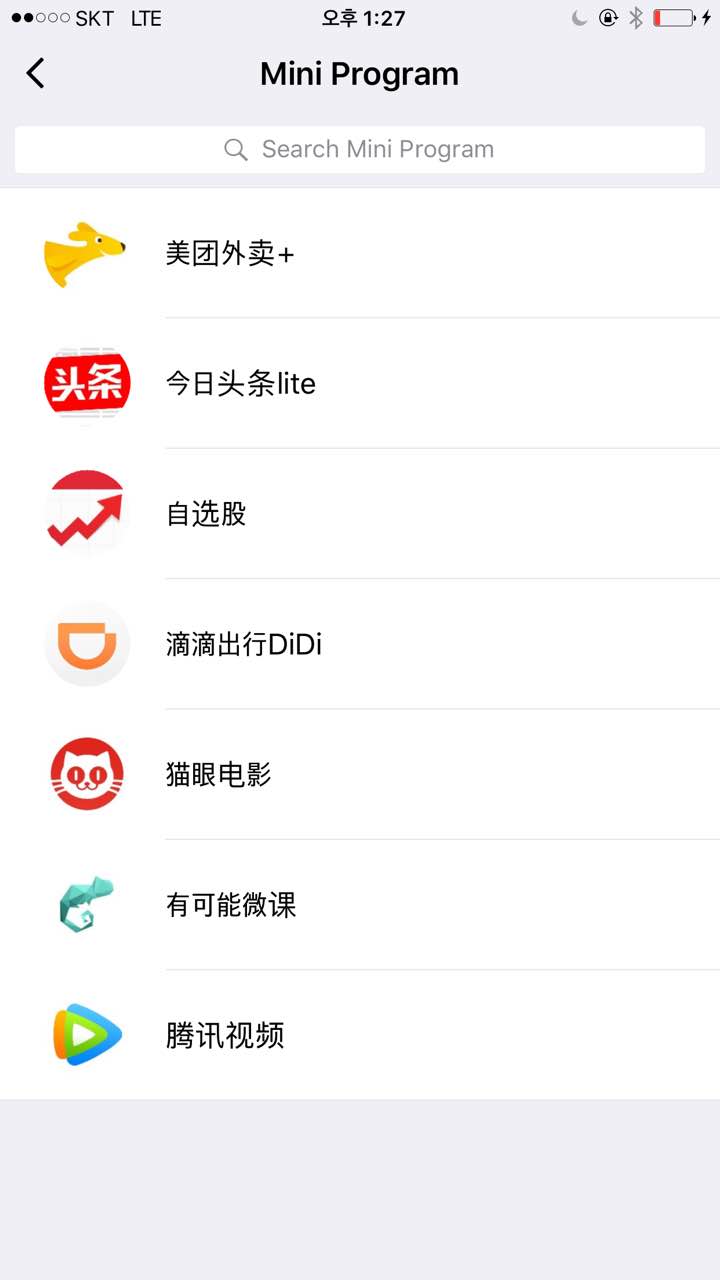
List of mini-apps, all downloaded in less than two minutes

More app-like functions
However, of course, the functionality and content inside a mini-app are much the same as their larger brethren. On Android, mini-apps can even be placed on home page of the phone, making it hard to distinguish between them and regular ones.

Large differences in quality 
But, for the time being, there is a great degree of variation among the mini-apps: some look like there was a lot of effort put into them, while other appear too simple to be compared to an actual app. Each major company has probably considered whether or not its users will use the mini-app instead of its original app and, if so, how much of its user base. Based on this reasoning, they chose which functions to include in their mini-app.

Below is a screenshot from the Didi mini-app: you can only call a kuaiche (快车, Didi’s private car-hailing service). Didi decided to leave out other functionality in this version of the mini-app.

wechatimg158

On the other hand, in the case of Zixuangu (自选股, a stock market tracker and news app), all functions except their news stream is available in their mini-app.

wechatimg35

There are already promotions. For instance, when you take a look at the Maoyan Movies mini-app, you will notice that you can receive a hongbao (红包 or lucky money in English) when you make your first purchase in the mini-app.

wechatimg155

If you haven’t used a mini-app yet, here are some instructions:

wechatimg154

1. Open your WeChat and click “Discover” on the menu. You will see “Mini Program” at the bottom. (Editor’s note: In order to avoid conflict with Apple or Android app stores, WeChat is avoiding any use of the term “app”.)

wechatimg36

2. Here you can search for a mini-app that you are looking for. I had searched Maoyan Movies(猫眼电影).

The landing page will only show you the mini-apps you have already. Great for going back to an app, not so great for discoverability.

wechatimg33

3. Tap the mini-app and use it. You can also forward to different chats and share with your friends.


09 Jan 16:04

Whitelist vowe.net, maybe?

by Volker Weber

ZZ587F26D7

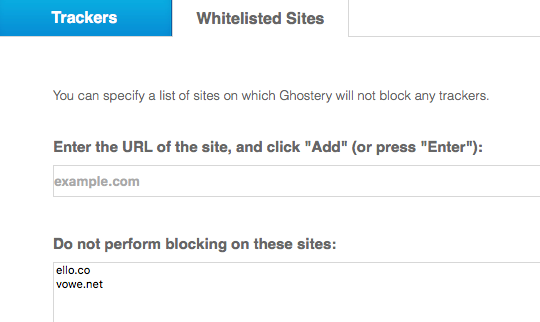
Ghostery is a wonderful browser extension, but it does break things. If you run it, consider whitelisting vowe.net. I try to not track people as good as I can. I even use the no-cookie YouTube site. But if you run Ghostery full-on you will not see the impressive list of Twitter photos here. Whitelisting vowe.net solves that issue.

09 Jan 16:03

Detlev ist mein Held

by Volker Weber

ZZ1DB7934B ZZ487B56B6

Detlev Pöttgen läuft etwa drei Wochen vor mir und ich kann ihn nicht einholen.

09 Jan 16:03

Samsung Gear S3 #dontbreakthechain

by Volker Weber

#dontbreakthechain @vowe #samsunggear

A photo posted by Christopher Schmidt (@chris87de) on

Das gleiche Prinzip. Jeden Tag gewinnen. #dontbreakthechain

09 Jan 16:03

Apple’s executive team get pay cuts after missing 2016 sales targets

by Rob Attrell

Modern Apple is highly dependent on the success of the iPhone as a luxury product.

Fortunately for the tech giant, sales and profits stemming from the iPhone have dwarfed every other technology product for the last several years. However, at a certain point, it becomes impossible for sales to continue to grow at such a rapid pace. For the first time in years, Apple’s executive team will feel financial effects of missing performance and sales targets, according to an SEC filing from the company this week.

One widely shared piece of information from the report pertains to the total pay of CEO Tim Cook. Cook’s total pay dropped by 15 percent compared to last year, even though his base salary increased. What did decrease were the performance bonuses given to Cook and the rest of the executive team, because while the company still made money hand over fist, profits shrank compared to last year.

Compared to the rest of the Apple executive team, Cook actually earns the smallest salary, though most of his earnings come from bonuses and company stock holdings. While iPhone sales have slowed, the company’s stock ended last year up 10 percent. Apple’s financial situation in the wake of the release of the iPhone 7 through the holiday season will become clear when the company reports its quarterly earnings at the end of January.

Source: CNN

09 Jan 16:03

10 Years Ago, the iPhone Redefined Mobile Computing

by John Voorhees

Steve Jobs’ introduction of the iPhone to the world 10 years ago was captivating:

today, we’re introducing three revolutionary products…. The first one: is a widescreen iPod with touch controls. The second: is a revolutionary mobile phone. And the third is a breakthrough Internet communications device.

So, three things: a widescreen iPod with touch controls; a revolutionary mobile phone; and a breakthrough Internet communications device. An iPod, a phone, and an Internet communicator. An iPod, a phone … are you getting it? These are not three separate devices, this is one device, and we are calling it iPhone.

In retrospect, it’s hard to believe just how cobbled together and buggy that demo iPhone was:

Only about a hundred iPhones even existed, all of them of varying quality. Some had noticeable gaps between the screen and the plastic edge; others had scuff marks on the screen. And the software that ran the phone was full of bugs.

Despite the unfinished state of the iPhone, the onstage demonstrations at Macworld Expo went smoothly. Jobs told the cheering crowd that the iPhone would be available in six months’ time in 4 and 8 GB models for $499 and $599 on a sole US carrier, Cingular. Jobs also revealed something that would have a much bigger impact on the iPhone’s long-term success: its operating system was built on a foundation of Mac OS X.

Almost immediately, OS X developers began clamoring for a way to create apps for the iPhone. At WWDC in June 2007, less than three weeks before the iPhone’s launch, Steve Jobs announced what he called a ‘very sweet solution’ – developers could build web apps for the iPhone. The idea wasn’t well-received. Developers took matters into their own hands: a vibrant jailbreaking community emerged that gave rise to native apps like Twitterrific.

Just four months later, an official iPhone SDK was announced by Steve Jobs. There weren’t many details, but in March 2008 the iPhone SDK was released. Developers dug in and built hundreds of apps, a comically small number by today’s standards. When the App Store opened its doors that October with 500 apps, an entirely new revolution was sparked – an app economy that helped drive iPhone sales to even greater heights. The iPhone and App Store have been inextricably linked ever since.

In the ensuing years, the iPhone and the App Store ecosystem surrounding it have grown larger than anyone could have imagined. Today, there are over 2.2 million apps in the App Store, which generated over $20 billion in 2016. With so many apps, it's hard to find what will suit your needs, which is why MacStories has reviewed thousands of apps over the years.

As we think about what might be next for the iPhone, it’s interesting to look back at where it all started, and consider just how much the iPhone has evolved. To commemorate the tenth anniversary of its introduction, we’ve collected some of our favorite MacStories articles about the iPhone:

When Steve Jobs unveiled the iPhone, it was clear that it was different. Just how different only came into focus with the passage of time. The iPhone fundamentally altered computing for millions of people. That sort of foundational shift doesn't come along very often. What's exciting is the inescapable feeling that we are still in the early days of the sea change sparked by the iPhone and there is still room for fresh surprises.


Support MacStories Directly

Club MacStories offers exclusive access to extra MacStories content, delivered every week; it’s also a way to support us directly.

Club MacStories will help you discover the best apps for your devices and get the most out of your iPhone, iPad, and Mac. Plus, it’s made in Italy.

Join Now
09 Jan 16:03

Airmail 1.5 Brings Custom Actions, Workflow Integration

by Federico Viticci

Airmail, the most powerful email client for iOS and my 2016 App of the Year, has made integrations with third-party apps and services the central element of its experience, allowing users to deeply fine-tune their email workflows. With version 1.5, launching today on the App Store, the developers at Bloop are further expanding Airmail's integration roster with the ability to create custom actions as well as Workflow support to craft automations tailored for messages shared from Airmail.

Custom Actions

I've been playing around with custom actions in Airmail for the past month, and, even if what I came up with isn't dramatically advanced, I think this feature will be useful to anyone who's ever needed custom processing flows when sorting and acting on email messages.

A custom action in Airmail is a combination of multiple actions in a single command. The majority of Airmail's existing actions – including the third-party app ones – can be mixed and matched within a simple UI that executes every step for the selected message.

The custom action UI in Airmail 1.5.

The custom action UI in Airmail 1.5.

For example, you can create a custom action that marks a message as read, snoozes it until next week, and creates a reminder for it with one tap; or, you can put together an action that saves the sender of a message as VIP and creates a Trello card with the details of the email you want to remember. Whether they're built-in app features (such as snoozing or applying labels) or third-party app/service actions, you'll be able to combine them with custom actions to save time if you find yourself manually performing the same operations in a row on a regular basis.

Airmail's custom actions don't sport any kind of basic control flow and variable support; they're a way to bundle multiple actions in a custom shortcut, not a miniaturized programming environment inside Airmail. Their simplicity, however, doesn't diminish their effectiveness; because they're extremely easy to assemble, custom actions have the potential to benefit everyone.

I've mostly relied on custom actions to file messages into specific folders more quickly, which is especially convenient given the ability to assign a custom action to a swipe gesture in the inbox. This way, I can triage messages for my SaneBox workflow with a combination of swipes and custom actions – an option I can't have in other email apps for iOS. I would like to see all native Airmail actions to be supported in the custom action setup UI (some of the actions you can configure in the app's settings are not available as custom actions), and there should be a more flexible configuration for some of them1, but, overall, I believe the ability to let users create their own action bundles is another strong addition to Airmail.

Workflow Integration and Open URL Actions

There's one aspect of custom actions that opens up exciting new possibilities for automation – a Workflow action to send specific message data as input from Airmail to a workflow.

Upon creating a custom action (and if you have Workflow installed), scroll to the bottom of the list of supported actions, and you'll find one called 'Send to Workflow'.

This action contains a list of toggles for different properties of a message that you can send as input to a workflow. Message properties include:

  • Sender email address
  • Sender name
  • To, CC, BCC
  • Subject
  • Message text
  • Message HTML
  • Message text simplified
  • Unique Airmail URL to a message
  • Clipboard contents
  • Message as PDF2

In addition, you can define a custom separator for each value Airmail will send to Workflow (useful to later split text into multiple bits), and you can set an action to be performed after invoking a workflow, such as creating a new email message or sending a reply.

Thanks to this Workflow integration, you'll be able to create custom actions that trigger workflows to parse email messages either as text or PDFs, extracting metadata (like sender information and email addresses) to do something with them by leveraging Workflow's hundreds of actions and web API support. For advanced users, this is a solid solution to the problem of automating email data from Airmail with an easy step that doesn't involve the system clipboard, and it's poised to unlock deep automation possibilities not available in other email clients.

In a custom Workflow action that I will share later this week with Club MacStories members, for instance, I created my own 'Add to Todoist' action in Airmail by sending bits of a message to Workflow and using its regex tools and Todoist support to convert an email message into a rich task.

I expect to hear from readers and Airmail users about innovative ways to automate messages and save them into others apps thanks to custom actions and Workflow.

Finally, these automation features in custom actions aren't exclusive to Workflow: the same message parameters that can be sent to Workflow are available as URL scheme tags in the new 'Open URL' action. As the name implies, this will allow those who know the URL scheme of an app not natively supported by Airmail to create actions that send message data to it.

Details for the URL scheme are documented in the Open URL action itself; even though I haven't found a need for custom URL scheme actions myself, it's a nice to have the option.

Airmail 1.5

In its first update of 2017, Airmail once again focuses on user customization and going beyond the tools traditionally offered by email apps on iOS. Anyone who needs to process dozens of email messages and work across multiple apps every day should consider Airmail – there's nothing else like it, and now you can even create your own actions and workflows around it. I'm excited about what's in store for Airmail this year.

Airmail 1.5 is available on the App Store.


  1. For instance, the 'Reply' action can only be used for canned responses to send a pre-composed message to someone. In a custom action, Reply won't open the message compose screen to start typing a new message. I can see why the Airmail team opted for canned responses, but I was confused at first as I was expecting to be able to type a message myself. ↩︎
  2. The PDF version of a message is generated with an iCloud Drive API that puts a PDF file in the Airmail folder of iCloud Drive and returns a public iCloud.com URL to the document. It's the first time I've come across this feature. ↩︎

Support MacStories Directly

Club MacStories offers exclusive access to extra MacStories content, delivered every week; it’s also a way to support us directly.

Club MacStories will help you discover the best apps for your devices and get the most out of your iPhone, iPad, and Mac. Plus, it’s made in Italy.

Join Now
09 Jan 16:01

Did Media Literacy Backfire?

by zephoria

Anxious about the widespread consumption and spread of propaganda and fake news during this year’s election cycle, many progressives are calling for an increased commitment to media literacy programs. Others are clamoring for solutions that focus on expert fact-checking and labeling. Both of these approaches are likely to fail — not because they are bad ideas, but because they fail to take into consideration the cultural context of information consumption that we’ve created over the last thirty years. The problem on our hands is a lot bigger than most folks appreciate.

CC BY 2.0-licensed photo by CEA+ | Artist: Nam June Paik, “Electronic Superhighway. Continental US, Alaska & Hawaii” (1995).

What Are Your Sources?

I remember a casual conversation that I had with a teen girl in the midwest while I was doing research. I knew her school approached sex ed through an abstinence-only education approach, but I don’t remember how the topic of pregnancy came up. What I do remember is her telling me that she and her friends talked a lot about pregnancy and “diseases” she could get through sex. As I probed further, she matter-of-factly explained a variety of “facts” she had heard that were completely inaccurate. You couldn’t get pregnant until you were 16. AIDS spreads through kissing. Etc. I asked her if she’d talked to her doctor about any of this, and she looked me as though I had horns. She explained that she and her friends had done the research themselves, by which she meant that they’d identified websites online that “proved” their beliefs.

For years, that casual conversation has stuck with me as one of the reasons that we needed better Internet-based media literacy. As I detailed in my book It’s Complicated: The Social Lives of Networked Teens, too many students I met were being told that Wikipedia was untrustworthy and were, instead, being encouraged to do research. As a result, the message that many had taken home was to turn to Google and use whatever came up first. They heard that Google was trustworthy and Wikipedia was not.

Understanding what sources to trust is a basic tenet of media literacy education. When educators encourage students to focus on sourcing quality information, they encourage them to critically ask who is publishing the content. Is the venue a respected outlet? What biases might the author have? The underlying assumption in all of this is that there’s universal agreement that major news outlets like the New York Times, scientific journal publications, and experts with advanced degrees are all highly trustworthy.

Think about how this might play out in communities where the “liberal media” is viewed with disdain as an untrustworthy source of information…or in those where science is seen as contradicting the knowledge of religious people…or where degrees are viewed as a weapon of the elite to justify oppression of working people. Needless to say, not everyone agrees on what makes a trusted source.

Students are also encouraged to reflect on economic and political incentives that might bias reporting. Follow the money, they are told. Now watch what happens when they are given a list of names of major power players in the East Coast news media whose names are all clearly Jewish. Welcome to an opening for anti-Semitic ideology.

Empowered Individuals…with Guns

We’ve been telling young people that they are the smartest snowflakes in the world. From the self-esteem movement in the 1980s to the normative logic of contemporary parenting, young people are told that they are lovable and capable and that they should trust their gut to make wise decisions. This sets them up for another great American ideal: personal responsibility.

In the United States, we believe that worthy people lift themselves up by their bootstraps. This is our idea of freedom. What it means in practice is that every individual is supposed to understand finance so well that they can effectively manage their own retirement funds. And every individual is expected to understand their health risks well enough to make their own decisions about insurance. To take away the power of individuals to control their own destiny is viewed as anti-American by so much of this country. You are your own master.

Children are indoctrinated into this cultural logic early, even as their parents restrict their mobility and limit their access to social situations. But when it comes to information, they are taught that they are the sole proprietors of knowledge. All they have to do is “do the research” for themselves and they will know better than anyone what is real.

Combine this with a deep distrust of media sources. If the media is reporting on something, and you don’t trust the media, then it is your responsibility to question their authority, to doubt the information you are being given. If they expend tremendous effort bringing on “experts” to argue that something is false, there must be something there to investigate.

Now think about what this means for #Pizzagate. Across this country, major news outlets went to great effort to challenge conspiracy reports that linked John Podesta and Hillary Clinton to a child trafficking ring supposedly run out of a pizza shop in Washington, DC. Most people never heard the conspiracy stories, but their ears perked up when the mainstream press went nuts trying to debunk these stories. For many people who distrust “liberal” media and were already primed not to trust Clinton, the abundant reporting suggested that there was something to investigate.

Most people who showed up to the Comet Ping Pong pizzeria to see for their own eyes went undetected. But then a guy with a gun decided he “wanted to do some good” and “rescue the children.” He was the first to admit that “the intel wasn’t 100%,” but what he was doing was something that we’ve taught people to do — question the information they’re receiving and find out the truth for themselves.

Experience Over Expertise

Many marginalized groups are justifiably angry about the ways in which their stories have been dismissed by mainstream media for decades. This is most acutely felt in communities of color. And this isn’t just about the past. It took five days for major news outlets to cover Ferguson. It took months and a lot of celebrities for journalists to start discussing the Dakota Pipeline. But feeling marginalized from news media isn’t just about people of color. For many Americans who have watched their local newspaper disappear, major urban news reporting appears disconnected from reality. The issues and topics that they feel affect their lives are often ignored.

For decades, civil rights leaders have been arguing for the importance of respecting experience over expertise, highlighting the need to hear the voices of people of color who are so often ignored by experts. This message has taken hold more broadly, particularly among lower and middle class whites who feel as though they are ignored by the establishment. Whites also want their experiences to be recognized, and they too have been pushing for the need to understand and respect the experiences of “the common man.” They see “liberal” “urban” “coastal” news outlets as antithetical to their interests because they quote from experts, use cleaned-up pundits to debate issues, and turn everyday people (e.g., “red sweater guy”) into spectacles for mass enjoyment.

Consider what’s happening in medicine. Many people used to have a family doctor whom they knew for decades and trusted as individuals even more than as experts. Today, many people see doctors as arrogant and condescending, overly expensive and inattentive to their needs. Doctors lack the time to spend more than a few minutes with patients, and many people doubt that the treatment they’re getting is in their best interest. People feel duped into paying obscene costs for procedures that they don’t understand. Many economists can’t understand why so many people would be against the Affordable Care Act because they don’t recognize that this “socialized” medicine is perceived as experts over experience by people who don’t trust politicians who tell them what’s in their best interest any more than they trust doctors. And public trust in doctors is declining sharply.

Why should we be surprised that most people are getting medical information from their personal social network and the Internet? It’s a lot cheaper than seeing a doctor, and both friends and strangers on the Internet are willing to listen, empathize, and compare notes. Why trust experts when you have at your fingertips a crowd of knowledgeable people who may have had the same experience as you and can help you out?

Consider this dynamic in light of discussions around autism and vaccinations. First, an expert-produced journal article was published linking autism to vaccinations. This resonated with many parents’ experience. Then, other experts debunked the first report, challenged the motivations of the researcher, and engaged in a mainstream media campaign to “prove” that there was no link. What unfolded felt like a war on experience, and a network of parents coordinated to counter this new batch of experts who were widely seen as ignorant, moneyed, and condescending. The more that the media focused on waving away these networks of parents through scientific language, the more the public felt sympathetic to the arguments being made by anti-vaxxers.

Keep in mind that anti-vaxxers aren’t arguing that vaccinations definitively cause autism. They are arguing that we don’t know. They are arguing that experts are forcing children to be vaccinated against their will, which sounds like oppression. What they want is choice — the choice to not vaccinate. And they want information about the risks of vaccination, which they feel are not being given to them. In essence, they are doing what we taught them to do: questioning information sources and raising doubts about the incentives of those who are pushing a single message. Doubt has become tool.

Grappling with “Fake News”

Since the election, everyone has been obsessed with fake news, as experts blame “stupid” people for not understanding what is “real.” The solutionism around this has been condescending at best. More experts are needed to label fake content. More media literacy is needed to teach people how not to be duped. And if we just push Facebook to curb the spread of fake news, all will be solved.

I can’t help but laugh at the irony of folks screaming up and down about fake news and pointing to the story about how the Pope backs Trump. The reason so many progressives know this story is because it was spread wildly among liberal circles who were citing it as appalling and fake. From what I can gather, it seems as though liberals were far more likely to spread this story than conservatives. What more could you want if you ran a fake news site whose goal was to make money by getting people to spread misinformation? Getting doubters to click on clickbait is far more profitable than getting believers because they’re far more likely to spread the content in an effort to dispel the content. Win!

CC BY 2.0-licensed photo by Denis Dervisevic.

People believe in information that confirms their priors. In fact, if you present them with data that contradicts their beliefs, they will double down on their beliefs rather than integrate the new knowledge into their understanding. This is why first impressions matter. It’s also why asking Facebook to show content that contradicts people’s views will not only increase their hatred of Facebook but increase polarization among the network. And it’s precisely why so many liberals spread “fake news” stories in ways that reinforce their belief that Trump supporters are stupid and backwards.

Labeling the Pope story as fake wouldn’t have stopped people from believing that story if they were conditioned to believe it. Let’s not forget that the public may find Facebook valuable, but it doesn’t necessarily trust the company. So their “expertise” doesn’t mean squat to most people. Of course, it would be an interesting experiment to run; I do wonder how many liberals wouldn’t have forwarded it along if it had been clearly identified as fake. Would they have not felt the need to warn everyone in their network that conservatives were insane? Would they have not helped fuel a money-making fake news machine? Maybe.

But I think labeling would reinforce polarization — but it would feel like something was done. Nonbelievers would use the label to reinforce their view that the information is fake (and minimize the spread, which is probably a good thing), while believers would simply ignore the label. But does that really get us to where we want to go?

Addressing so-called fake news is going to require a lot more than labeling.It’s going to require a cultural change about how we make sense of information, whom we trust, and how we understand our own role in grappling with information. Quick and easy solutions may make the controversy go away, but they won’t address the underlying problems.

What Is Truth?

As a huge proponent for media literacy for over a decade, I’m struggling with the ways in which I missed the mark. The reality is that my assumptions and beliefs do not align with most Americans. Because of my privilege as a scholar, I get to see how expert knowledge and information is produced and have a deep respect for the strengths and limitations of scientific inquiry. Surrounded by journalists and people working to distribute information, I get to see how incentives shape information production and dissemination and the fault lines of that process. I believe that information intermediaries are important, that honed expertise matters, and that no one can ever be fully informed. As a result, I have long believed that we have to outsource certain matters and to trust others to do right by us as individuals and society as a whole. This is what it means to live in a democracy, but, more importantly, it’s what it means to live in a society.

In the United States, we’re moving towards tribalism, and we’re undoing the social fabric of our country through polarization, distrust, and self-segregation. And whether we like it or not, our culture of doubt and critique, experience over expertise, and personal responsibility is pushing us further down this path.

Media literacy asks people to raise questions and be wary of information that they’re receiving. People are. Unfortunately, that’s exactly why we’re talking past one another.

The path forward is hazy. We need to enable people to hear different perspectives and make sense of a very complicated — and in many ways, overwhelming — information landscape. We cannot fall back on standard educational approaches because the societal context has shifted. We also cannot simply assume that information intermediaries can fix the problem for us, whether they be traditional news media or social media. We need to get creative and build the social infrastructure necessary for people to meaningfully and substantively engage across existing structural lines. This won’t be easy or quick, but if we want to address issues like propaganda, hate speech, fake news, and biased content, we need to focus on the underlying issues at play. No simple band-aid will work.


Special thanks to Amanda Lenhart, Claire Fontaine, Mary Madden, and Monica Bulger for their feedback!

This post was first published as part of a series on media, accountability, and the public sphere. See also:

09 Jan 16:01

Pioneers: the first challenge is…

by Alex Bate

After introducing you all to Pioneers back in November, we’ve seen some amazing responses across social media with teams registering, Code Clubs and Jams retweeting, and everyone getting themselves pumped up and ready for action.

Nicholas Tollervey on Twitter

This is the best thing I’ve seen in all my years involved in tech related education: https://t.co/5jerR9770r #MakeYourIdeas

Mass excitement all round, including here at Pi Towers! So, without further ado, here’s the delightful Owen to reveal the first challenge.

Pioneers: the first challenge is…

MakeYourIdeas The eagerly anticipated first Pioneers theme launch is here! Have you registered your team yet? Make sure you do. Head to the Pioneers website for more details http://www.raspberrypi.org/pioneers And if you’ve no idea what we’re talking about, here’s Owen to explain more https://www.youtube.com/watch?v=nPP3dfTlLOs&t=18s And thanks to Owen for the video.

That’s right: we want you to make us laugh with tech. As well as the great examples that Owen provides, you’ll also find some great starters on the Pioneers website, along with hundreds of projects online.

If you’ve yet to register your team, make sure you do so via this form. And if you’re struggling to find a mentor for your team, or a team to mentor, make sure to use the #MakeYourIdeas tag on social media to keep in the loop. It’s also worth checking organisations such as your local Code Club, CoderDojo, or makerspace for anyone looking to get involved.

This Pioneers challenge is open to anyone in the UK between the ages of twelve and 15. If you’re soon to turn twelve or have just turned 16, head over to the Pioneers FAQ page – you may still be eligible to enter.

So get making, and make sure to share the process on YouTube, Facebook, Twitter, Instagram, and Snapchat using #MakeYourIdeas!

posting your projects progress

The post Pioneers: the first challenge is… appeared first on Raspberry Pi.

09 Jan 16:01

Samsung Expects to Ship 60 Million Galaxy S8 Units in 2017

by Rajesh Pandey
Not to be deterred by the Galaxy Note 7 fiasco, Samsung has high expectations from its upcoming flagship: the Galaxy S8. The Korean company has reportedly set itself a shipment goal of 60 million units for the year, which is higher than what it had set for the Galaxy S7 and S7 edge last year. Continue reading →
09 Jan 16:01

Solve for Why

by Nisse Greenberg

I lament the loss of play. I lament adulthood because it colonized my childhood imagination with facts and truths generated by the Captain Hooks of the past eager to indoctrinate a new soul into the soulcrusher that we call the workplace. I lament that drifting in the wind has become an action of deep anxiety — a journey with no destination that forces me to create plans and schedules to anchor myself within it. I lament that my actions no longer feel like my own but like a fulfillment of a mission put in place by a construct, safeguarded by people who start their sentences: “Technically…”

I have fallen out with friends. And with time I resent them more than I miss them. Does that happen to you? I decide they were wrong and I was right, and as time passes I decide they were wronger and I was righter, until soon they have become cartoonish villains bent on the destruction of society and I have become the humble martyr slogging toward a more just world.

It’s pathetic. It’s childish. It’s gonna be weird when I’m a parent, won’t it?


When I was 11 I flew to Sweden to visit my family and I packed two bags. One with clothes and toiletries, the other with two full binders of basketball cards and a calculator. Basketball cards list statistics on the back: offensive rebounds and turnovers per game, three-point shot percentage, and a smorgasbord of others to play with, and the calculator was my tool of efficient play. Any time I could get a hold of some numbers, I was excited to plug them into my calculator and find patterns. And it worked. I loved math. I love math. And now I teach math to high schoolers.

When calculators were first introduced into American classrooms in the early ’70s, one of the major arguments for their inclusion was that they would make math more fun. In 1975, a survey of math teachers for the Mathematics Teacher journal found that 96 percent of teachers thought that the “availability of calculators will permit treatment of more realistic application of mathematics, thus increasing student motivation.”

The notion that the only thing stopping students from having fun in math class is that they don’t see its usefulness is pervasive in our educational institutions. We believe that school has become a place for building workers, not learners, and therefore the classroom must be built around the idea of usefulness — for the worker. Douglas Lapp, a science curriculum specialist and avid calculator advocate in the ’70s, suggested that “The fundamental problem in math education still is that kids too often don’t know the meaning of mathematical education.” Jill Horlick, an elementary school math specialist around the same time who also advocated for calculators in classrooms, offered: “Kids normally think about the universe; they love to manipulate large numbers because it makes them feel important. Why stop [the child] from thinking beyond those numbers just because he doesn’t have the tools yet?”

When I struggle to find a “reason” my students should find the roots of a quadratic equation, colleagues say, “Tell them you’ve thrown their iPhone up in the air…” They are more adept at crafting answers than questions

These two seemingly compatible opinions point to the disconnect between the educator and the student. Educators see that students are interested in the big questions, the questions without final answers, and their response is to trick them into thinking they are doing something important. In the same article that quoted these two math educators, the calculator was heralded as a beacon of excitement in the classroom because it could offer students thrilling opportunities like “find[ing] how many cubic centimeters it would take to fill this room,” and how far the moon is in inches.

It feels impossible to ask these questions without putting on your most condescending voice and infusing it with false enthusiasm. As a math teacher I often find that this is the solution I’m given by administrators and colleagues when I’m struggling to find a “reason” to find the roots of a quadratic equation: “Tell them you’ve thrown their iPhone up in the air and they have to find out when it is going to come back down so that they can catch it and it doesn’t break into a million pieces.” They are more adept at crafting answers than questions, certainly; they don’t see that pretending these meaningless questions have meaning in order to serve as reason to attain an answer only forms distrust between the students and the adult in the classroom. I can hear the teenager in me grumbling: “If you think finding the cubic centimeters in this room is important, that it’s worth my time to calculate when the express train will catch up to the local train, why would I trust you to tell me what’s important.”

We are not the first society to create word problems in order to “make math fun.” The text that is often referred to as the origin of Chinese mathematics was a collection of word problems compiled over eight centuries and finished around 186 BCE: The Nine Chapters of the Mathematical Art was a series of parables that read alarmingly like questions we now see on the SAT. Questions like: “A square town has a gate at the midpoint of each side. Twenty paces north of the north gate there is a tree which is visible from a point reached by walking from the south gate 14 paces south and then 1775 paces west. Find the side of the square.”

Soon after the creation of The Nine Chapters, the Han Dynasty began the first massive public school initiative as well as competing private-school formats that were sanctioned by the emperor. Dong Zhongshu, an influential thought leader in the beginning of the Han Dynasty, wrote: “To wish for worthy men without having nurtured one’s corps of officers is like looking for beautiful patterns in unpolished jade. In nurturing officers, nothing could be more important than establishing an academy. An academy is the gateway of worthy gentlemen and the source of the transformations of the proper teaching.” He went on: “I would wish your majesty to erect a central academy and appoint enlightened teachers to it in order to nurture the gentlemen of the world. They should be periodically tested in order to push them to the limits of their abilities. If this is done, it should be possible to recruit the flower of the empire’s youth.”

From 124 BCE to 146 CE the number of boshi disciples (analogous to university students) rose from 50 to 30,000. The Nine Chapters became a central text in the academy. And therefore these word problems became central in the selection of who would take power in and around the new government.

By 600 CE, the Sui Dynasty created a civil service exam meant to determine a meritocracy of hiring through the schools. Those who did well in school got better jobs. The Song Dynasty (960-1279) created an academia to push stellar students into research and writing. This fostered a group of scholar-gentry civil servants (an intellectual class). But all the while, this intellectual class was getting corrupted by the test that put them in place. As Robert Eno, professor of early Chinese History and Thought at Indiana University Bloomington, states, “A small percentage of brilliant or outstanding ministers and scholars did help to mitigate the brutality of China’s autocratic political culture. But a far greater number of academy or examination graduates ended up either cynics or blatant hypocrites, and while they mouthed Confucian pieties to enhance their status and coerce the population they ruled, their personal and political conduct was deeply scarred with loyalties to self and family over the state and the people.”

The pendulum swung back. As we’ve seen with any meritocracy there are people left out, and the upper class often considers those people strong but stupid. The Yuan Dynasty (1271-1368), a militaristic and colonial power, took control of the educational system and began using it as an ideological education. They separated people they felt might unite and rebel and created a caste system that castigated the formerly elite Han and Nanren people to the bottom two social classes, which eventually came with restricted weapon and pet ownership as well as stricter punishment for similar crimes. The corruption of a meritocracy is always based on who gives the merit, and when people feel left out of the elite it causes a militaristic uprising that eventually takes control of the meritocracy and finds new, often more nationalist, ways to judge.


When I was in fourth grade I was annoying. I might still be annoying, but I’ve now surrounded myself with people who can tolerate me. In public school in rural Maine, I lacked this luxury. I kept raising my hand because I knew that when I got a question right the teacher was forced to give me validation. I was eager for validation from the authority figures in my life.

They saw that I was distracting other students so they gave me the textbook and a calculator and banished me to a back corner of the classroom. I was told to just figure out how to do all the questions at the end of each chapter. I did well in math that year, except that when my parents came in for parent-teacher conferences my teacher explained that I was letting the future I had in math slip through my fingers. My parents asked how, and my teacher elaborated: “Because Nisse is learning on his own; he’s refused to read the vocabulary sections of the textbook. He therefore has started calling a ‘sum’ an ‘add-em-up.’” Well, duh. “Sum” didn’t make sense because it wasn’t some of anything. It was all of it.

Nobody explained that sum is an abbreviation for summation which comes from the same base word as summary. Also nobody explained that the subtle dictatorial method of decision-making that drove the classroom forward was an inoculation to the militaristically inspired society in which I was meant to become a soldier.

Presidential campaign ads consistently refer to a “button” that can launch nuclear weapons, themselves always a kind of final solution. This concept of a touch-key that allows you to wipe clean all progress in other directions and focus simply on the destination is a relatively new concept that is intrinsic to the invention of the handheld calculator.

Our original western public education is a direct reaction to a compulsory military draft. The government saw the need to acclimate children to this style of taking orders and organizing themselves, so there were strict rules around discipline and punishment, and all of the moments of autonomy (food, play) were organized around lining up; they were allowances that could be removed with demerits. By World War I, the U.S. realized that wars won on the battlefield were won first in factories; there became a push to change the format of education to mimic factory work. Schools integrated bells to indicate when to change tasks, and classwork began to mimic the Ford model for repetitive tasks, and children, organized by age, were systematically awarded certificates of approval.

Post WWII, President Eisenhower warned the American people that “This conjunction of an immense military establishment and a large arms industry is new in the American experience. The total influence — economic, political, even spiritual — is felt in every city, every statehouse, every office of the federal government.” What he didn’t say was that the military was already adapting to a new world post atom bomb where wars were won with anticipatory fear: Awesome displays of massive destruction was the format of war in the cold war era. In response to the Soviet Union’s first atomic bomb test in 1955 and the launching of Sputnik in 1957, the Eisenhower administration passed the National Defense Education Act of 1958, which created higher standards for math and science as well as a student loan system specifically for students going to college for science, mathematics, engineering, or a modern foreign language — disciplines that were thought helpful in the fight against the red menace. The bill dedicated $70 million to new equipment in schools that helped teach science, math, or foreign language, and even held institutions to an oath, to “solemnly swear (or affirm) that [they] will bear true faith and allegiance to the United States of America and will support and defend the Constitution and the laws of the United States against all its enemies, foreign and domestic.” Y’know, in case you didn’t get what the money was for. In the ’60s, education officials, in their attempt to compete with the Soviets, changed the number of years of math required in high school from one to three. The “Rockefeller Report on Education” called The Pursuit of Excellence: Education and the Future of America (1958) is touted by educational and cold-war theorists as the paper from which the NDEA got its ideas for the bill that forever shaped public education in the U.S. Written by liberal intellectuals of the time, it reasons, regarding affirmative action, that “[In the case of African Americans,] it’s not so much that developed talent is rejected but that talent is not allowed to develop.” The authors also pointed to the unfairness of society’s demands for women to be wives and mothers without being given the opportunity to join the workforce. And yet, the same paper also claims that “The educational system, among other things is a great sorting out process,” and “The general academic capacity of students should be at least tentatively identified by the eighth grade as a result of repeated testings,” before ultimately externalizing the neo-liberal’s true agenda: “The heart of the matter is that we are moving with headlong speed into a new phase in man’s struggle to control his environment.”

When the first pocket calculator came out, the equals sign was combined on the same button with the addition sign and was philosophically linked to the answer — a relieving finality

By the mid ’70s, the Red Scare had died out, but as authorities were eager to maintain a delusionary commitment to the triumph of “good” over “evil,” the military-educational complex was given the gift of the handheld calculator — a machine made of buttons that could train students in the art of final answers, that only displayed conclusions, and that was accurate enough for scientific purposes but not invested in the truths that math had historically been based on. While Pythagoras had once drowned a man for suggesting that there might be numbers that exist that cannot be represented as a ratio of the two legs of a right triangle, now we were comfortable with formatting all numbers in decimal form and rounding to nine digits or less. Instead of 2/11, teachers became comfortable with “about 0.22.” I’m not advocating for drowning your enemies, but maybe a little passion for the concept of truth. As Georges Bataille writes in Inner Experience, “no answer ever preceded the question: and what does the question without anguish, without torment mean?” It becomes the job of only “good apostles,” not of philosophy, to “have an answer for everything; they indicate limits, discreetly, the steps to follow, as does, at burial, the master of ceremonies.” Can we not handle an argument without a final answer?

In 1971 when the first pocket calculator came out, the equals sign was combined on the same button with the addition sign and was philosophically linked to the answer. By 1974, calculators began losing the equals button altogether and replacing it with the more direct “enter” key. Now, on the graphing calculators most high schoolers use, the equals sign is either labeled “ANS,” or “EXE,” linking the execute button with a relieving finality.

When I asked my high-school students about the pros and cons of the calculator they eagerly told me that while it makes them “lazy and dependent” it is an “efficient tool for solving as many problems as possible as quickly as possible.” What problems? How many miles Sally has to run in order to catch up with Robert who has been running for two hours before Sally but runs at a slower pace? Why is it important to solve that quickly? My students offered the rebuttal that getting more practice is necessary if they are going to do well on the SATs. This gets to the heart of the cyclical nature of our standardized testing: Standards change the way we educate, which changes the way we create standards — standards beget standards.

Nowhere is this more evident than in the change in math education after the invention of the calculator. Never was a technology more quickly integrated into the curriculum. The calculators were heralded by the Mathematics Teacher as “pocket-sized units [that] are already replacing textbooks in elementary schools,” who went on to say that “teachers are hoping that what once seemed to children a tedious labor may, through the calculator, become fun.” And yet instead of being content with the students solving the same number of problems at a quicker rate, education standards adapted and changed what was expected of students. In what seems to be a parody of the way capitalism adapted to Keynes’s prediction that human work would be unneeded in a future of robots, we added more questions to every worksheet — we made the numbers in the word problems more confusing. We turned to more “real life examples” of balls falling off cliffs and gardens doubling in area. The real reason these examples popped up is, obviously, not because more balls were falling off cliffs nor were more landscapers doubling the area of the gardens they were building, but because squaring and square-rooting became simple with the invention of the calculator, and because there was a new tool that sped up old processes, educators excitedly demanded that students become proficient in the use of that tool. More important to the military-educational complex, all of these problems involved hitting the “execute” button in order to find the solution.

The corruption of the equals sign was the most complete change of identity of a symbol until the hashtag, which was originally a British symbol for the pound (weight) called the Libra, from the balancing scales of astrology. Robert Recorde — a Welsh mathematician from the 1500s with the same deep, sullen eyes that seem to hide a sadness he doesn’t think worth talking about as Milton from Office Space — dedicated all of the books he wrote to the queen, his chief aspiration being to take on the position of lead accountant at the treasury. He was obsessed with Arabic mathematics and was bent on bringing Arabic numerals to England. In his crusade to systematize data, he invented a symbol meant to describe the idea that two mathematical descriptions are equivalent: a set of two parallel lines, the “equals sign,” would signify the scales being balanced — that theirs are two equivalent sentences. He wrote that he wanted to use “a paire of paralleles, or gemowe lines of one lengthe: =, bicause noe 2 thynges can be moare equalle.” “Gemowe lines,” like the hashtag’s Libra, comes from an old astrological text that Recorde was reading, referring to an old symbol for the Gemini twins through two parallel lines.

And yet a recent study shows 6 to 12-year-old students see the equals sign as the necessary precursor to the answer in a mathematical sentence. Students will read 8=5+3 as being “written backwards.” The equals sign has taken on a brand new identity as the “solution sign.” The shifting of meaning of the equals sign is a movement to take away the mathematical teaching of the idea of equality and replace it with the mathematical teaching of the idea of finality. Instead of giving students the metaphor that on either side of equality is a set of contexts and thoughts that combine in different ways but mean the same thing, we give them the metaphor that if you do things in order you end up getting an answer, and then you are done.


Guy Debord was fascinated by idea that there could be a journey with no destination and created a practice of wandering through the city he lived in that he called the dérive, which is a term taken from sailing to describe the act of letting down your sails and drifting with the water.

Freshman year of college, my TI-83’s batteries died. I knew that you weren’t supposed to throw batteries away in the regular trash but I didn’t know where the battery trash was. At 18 years old I was very into the idea that I was a self-sufficient adult who needed the help of nobody but his own brain and so I didn’t ask what to do with batteries. Instead I just left them in my calculator. That was 12 years ago. I still have that calculator. The batteries still don’t work. I still don’t know what to do with old batteries. I still harbor the delusion that I am a self-sufficient adult who needs the help of nobody but my own brain.

I majored in math, which meant that for multiple tests I would do six-digit long division in the margins, and I would force myself to find ways to simplify algebraic expressions so that they were manageable fractions. I look back at my probability class as the one in which I learned the most useful tools for teaching number sense to high-school freshmen. I learned more through the process of decoding large numbers and breaking them down into their parts than I had in all of high school. The process taught me this, not the product. And yet I would not have engaged in this process without the product as a destination to lead me there.

Numbers were an invention, like the calculator, and we used them to investigate big questions. But they became less tools to manipulate tools, and more tools to manipulate us into thinking we had answers

In the 19th century, math education was a mental exercise. It was the mental equivalent of gym class, with the idea that the brain is simply a muscle needing to be stretched. In 1893 an educator said of arithmetic: “It is refreshing to know that there is one subject which [the student] must master for himself slowly, sometimes painfully, and always with much labor.” And A. Lawrence Lowell, the president of Harvard, in pointing to the purpose of math education, declared: “To those of us who have not pursued the study of mathematics since college days, the substance of what is taught to us has faded away, but the methods of thought, the attitude of mind and mode of approach have remained precious possessions.” In the early 20th century the debate of what is math education began orbiting around a divide between “pure” and “applied” mathematics. There became two schools of thought: G.H. Hardy’s perspective that Pure Mathematics is an art because “a mathematician, like a painter or poet, is a maker of patterns. If his patterns are more permanent than theirs, it is because they are made with ideas.” Applied Mathematics, to Hardy, was an exercise in hypocritical futility because “It is indeed rather astonishing how little practical value scientific knowledge has for ordinary men, how dull and commonplace such of it as has value is, and how its value seems almost to vary inversely to its reputed utility.” On the other hand, E.H. Moore, who presided over the American Mathematical Society, decried what he saw as a “chasm” between pure and applied mathematics. “Beginning with matters ‘thoroughly concrete in character’ they would proceed to … demonstrations of physical phenomena ‘to develop on the part of every student a true spirit of research, and an appreciation, practical as well as theoretical, of the fundamental methods of science.’”

Where Hardy wanted to allow math to be an art form devoid of applicability, since “a science is said to be useful if its development tends to accentuate the existing inequalities in the distribution of wealth, or more directly promotes the destruction of human life,” Moore saw science as an avenue into math. He believed that the only way to get students interested in the abstractions was through an investigation of the practical — that a journey needs a destination to motivate the journey.

When I was in college I tried to nickname myself “NisAdventure” because my name is Nisse and I loved the idea of getting lost — of finding the joy in the process without the product. I didn’t see the irony of doing so by attempting to nickname myself. You can’t declare a nickname for yourself because a conclusion can’t be made without the process to get you there — the destination doesn’t come before the journey. Also you can’t declare a nickname for yourself because trying to do so makes you a narcissistic asshole.

Moore ended up winning out the debate over Hardy in determining the direction of math education in the U.S., and we have since seen math as a necessary class for learning how to balance your checkbook and creating engineers. And because the goal of math class has become usefulness, teachers search for ways to make math class more useful, which reinforces that the purpose of math class is to be useful. I find myself at odds with curriculum and unable to engage in the discussions that got me interested in math in the first place, because the students and other teachers are frustrated that my class is “not getting enough done.” There is a focus on results, and this stems from and to every part of education and society. We have a system that is focused on the proof of truth through numbers partially because we believe that numbers give us a perspective on truth. And yet any mathematician will tell you that the numbers are tools, not answers. Numbers were an invention, just like the calculator, and we used them to investigate the big questions, but at some point we were given these calculators to the end of spitting out answers. And what they spit out were numbers written in base 10 fractions that were rounded to nine fractions. These became less tools to manipulate tools, and more tools to manipulate us into thinking we had found the answers we were looking for.

A life with answers is not a life worth living; a life with answers is over. If math can teach us anything it should be that any good question simply leads to more questions, and yet the calculator has given us the delusion of finality: it has forgone exploration for the sake efficiency; it has offered endings in the place where a beginning may have birthed; it has turned play into work and made Jack a dull boy; it has morphed our brains into machines that process ideas as being “right” or “wrong.” And while I often feel comfortable with my versions of right and wrong because I surround myself with people who I like and who like me, I know I’ve lost friends. I know I’ve alienated people. And I know those people exist in the same world as me, believing in a different set of rights and wrongs. And if we don’t find a way for our rights and wrongs to co-exist we will be forced to prove ourselves righter or wronger. And I wonder who will win. Probably whoever has the biggest gun. Probably not me.

09 Jan 16:00

Here's a Petaled Light That Responds to Human Movement

by Kevin Holmes for The Creators Project

It's not your imagination, this clever strip of lighting really is moving when you do. That's the thought that no doubt might creep into people's minds when they come into contact with Lift, a new interactive light by designer James Patten and his team at Patten Studio. MIT Media Lab alumni Patten's latest prototype senses human movement and responds with an organic, flowing motion.

The first gen prototype is currently on display at SHoP Architects in NYC and features 24 petals attached to a spine which flutter and ripple like a glowing deep sea creature when someone walks by.

“We stand at the dawn of a huge shift in the field of interaction design," says Patten, "one where the dynamism of the digital world is embodied in the physical, where our everyday objects have even richer interactivity than today’s smartphones, and where the built environment and interactive media become one and the same.”

Photo credit: Ty Cole

The light uses a low resolution thermal camera to detect and monitor how people are moving about, while an embedded microcontroller processes the data and radio links it to the petals, telling them how to move. To make the petal's motion appear more fluid and natural, the studio used the shape memory alloy, nitinol, or "muscle wire," which shrinks when heated. Electricity is sent through the wire, causing it to contract and the petals to lift—it also means no motors were needed, so the light is able to move in serene silence.


Photo credit: Ty Cole

“It challenges us to think about the design decisions we can make when we not only begin to incorporate materiality and physicality, but also raise our expectations of technology and imbue our spaces with some of the richness, nuance, and immediacy we experience in the natural world,” notes Patten. “We often look at technology as something that separates—a couple sits at a restaurant looking at their phones instead of each other, mobile apps capture our attention with seemingly endless stimulation—but that behavior isn’t inherent to technology. What we design today can and will have huge implications for tomorrow, shaping how we come to connect with those around us."

Photo credit: Ty Cole


Photo credit: Ty Cole

Find out more about the interactive design work of Patten Studio at their website here.

Related

Living Dresses Move, Breathe, and Know How You’re Feeling

This Gig Bag Is Actually a Playable Guitar

A Digital Living Space Predicts the Home of the Future

09 Jan 16:00

3 Areas Where Having “The Innovator’s Mindset” is Crucial

files/images/8-Characteristics-of-the-Innovators-Mindset.png


George Couros, Jan 12, 2017


George Couros discusses three key areas on an innovator's mindset: entrepreneurial spirit, ethical citizen, and empowered learner. The first is a bit of a tautology if you accept the current definition of innovation. But the latter two are important. 'Ethical citizen' involves "humility, fairness and open-mindedness... respect, empathy and compassion; and ... teamwork, collaboration and communication." And the last requires one "who thinks critically and makes discoveries; who uses technology to learn, innovate, communicate, and discover." Of course all of these constitute much more that mere innovation. They are required for citizenship generally.

[Link] [Comment]
09 Jan 16:00

Firefox 51 Beta 12 Testday Results

by Bogdan Maris

Hi everyone!

Last Friday, January 6th, we held the first testday of this year Firefox 51 Beta 12 Testday.  It was yet another successful event (please see the results section below) so a big Thank You goes to everyone involved.

First of all, many thanks to our active contributors: Vuyisile Ndlovu, Moin Shaikh, P Avinash Sharma, Ilse Macías.

Bangladesh team: Maruf Rahman, Humayra Khanum, Jobayer Ahmed Mickey, Md. Almas Hossain, Raihan Ali, Iftekher Alam, Tariqul Islam Chowdhury, Saima Sharleen, Md.Tarikul Islam Oashi, Toki Yasir, Majedul islam Rifat, Kazi Nuzhat Tasnem, Rezwana Islam Ria, Aminul Islam Alvi and Tanvir Rahman.

India team: Subhrajyoti Sen, Baranitharan, Aishwarya.B, Deepak Chandh, Roshan Dawande, Vishnupriya .V, Selva Makilan, Rajesh D, SriSailesh, R.Krithika Sowbarnika, P Avinash Sharma, Sakshi Prajapati, Sankaraman, Sriram, Surentharan .R.A, Nagaraj.V, Pavithra.R, Paarttipaabhalaji, Kavya Kumaravel, Vinothini, Satchidanandam.M, Karthikeyan S, Dhevendhiran, Kavipriya and Dinesh Kumar.

Secondly, a big thank you to all our active moderators.

Results:

Third, some tests that were failed need more information from you guys. I left a few comments in the etherpads so please provide me with that information so we can see if we should log bugs on those or not.

Again thanks for another hugely successful testday 🙂

We hope to see you all in our next events, all the details will be posted on QMO! Happy new year!

09 Jan 08:20

Transforming the Space... Again

by Alison Mazurek
IMG_4837.JPG

[Note: I wrote this the week before we moved both kids into the same room.  While I'm no longer moving the bassinet around, the thoughts and feelings shared below are still relevant]

The transition to two kids has been very challenging for us as I am sure it is for many people. That is not to say we aren't incredibly grateful and so blessed for a family of four but anything this wonderful doesn't come without some hard work. In the past six months of little sleep and toddler meltdowns I have been hyper-aware of all aspects of our lives and if they are helping or hindering our family.  

One of these focuses is our small space. I have found the daily physical transformation of our home, to be the most challenging part of living small with two kids. By this I mean the physical moving of furniture and toys required to create the different uses of our space. When the living room is also our bedroom and the playroom, and we don't have an extra room to hide anything that is in the way, some fancy rearranging is required.  I'll walk you through my morning:

Trevor leaves early for work so he can get home and spend time with the family before bedtimes. So in the mornings I wake, tend to baby and toddler while making and putting the bed away. Folding away the murphy bed transforms our bedroom back into our living room, leaving room for Theo to play.  I then carry the bassinet into the bedroom.  Next, I pull the baby chair out of the bedroom and set it up where Mae can see me and her brother.  (I love the Nuna but wonder if the Baby Bjorn might have been a better choice for us as it is much lighter and smaller).  At the end of the day we repeat these steps in the reverse order, obviously it is much easier with Trevor's help.

I am very pleased with the fact that we have few large items for our baby and toddler and the ones we do have are multipurpose, quality and design conscious. But some days when I am wearing a fussy baby and my toddler is hell bent on revenge, these physical acts can seem insurmountable. My logical brain knows that these days will pass and I won't need the baby chair or bassinet anymore and there will be new challenges in our space.  But as I live through these long, messy days I wanted to share with you these challenges. Maybe you have similar ones in your small space?  Or maybe in a larger space these are not things you experience.

A few coins have definitely gone into the "this space is not working" jar due to the physical transformation of our space required on a daily basis. But at 6 months in with 2 kids we are still committed to living in our small space, having less things and focusing on experiences. 

09 Jan 08:19

Book: Spam Nation

by Thejesh GN

SPAM NATION Spam Nation by Brian Krebs reads like a crime thriller. For cyber security enthusiasts Krebs is no stranger. He has been writing about cyber security and crime on his blog KrebsOnSecurity for more than seven years now and before that at WaPo. I have been reading his blog for more than half a decade now and has been huge fan of his coverage on SPAM, DoS, *wares 1.

One of the biggest series on KrebsOnSecurity was coverage of pharma wars. It covers the story online pharmacies selling unauthorized medicines without prescription to Americans2 using SPAM. This series forms the base of this book. The book covers all aspects of the illegal online pharmacies – SPAM Bot systems, Malware, Payment systems, Drug manufacturers and reluctance of big pharma companies, How individuals and researchers are the biggest saviors etc. You feel like an insider. Now every time you see that Viagra advertisement spam in your inbox, you can visualize how the whole system works.

While most of the book is dedicated to pharma wars, the book also tracks the first biggest SPAM success pumping and dumping microcap stocks schemes to the rise of online pharmacy to current of ransomware/cryptoware. It captures an era in the spam world like a history book but reads like a novel. All in all its a must read for anyone who is interested in cyber security.

  1. Ransom-ware, Malware etc
  2. USA